tfx-20231231false2023FY0000096943P1Yhttp://fasb.org/us-gaap/2023#PrepaidExpenseAndOtherAssetsCurrenthttp://fasb.org/us-gaap/2023#OtherAssetsNoncurrenthttp://fasb.org/us-gaap/2023#OtherLiabilitiesCurrenthttp://fasb.org/us-gaap/2023#OtherLiabilitiesNoncurrenthttp://fasb.org/us-gaap/2023#SellingGeneralAndAdministrativeExpensehttp://fasb.org/us-gaap/2023#SellingGeneralAndAdministrativeExpensehttp://fasb.org/us-gaap/2023#EquitySecuritiesMemberP3Yhttp://fasb.org/us-gaap/2023#OtherLiabilitiesCurrenthttp://fasb.org/us-gaap/2023#OtherLiabilitiesCurrenthttp://fasb.org/us-gaap/2023#OtherLiabilitiesNoncurrenthttp://fasb.org/us-gaap/2023#OtherLiabilitiesNoncurrent00000969432023-01-012023-12-3100000969432023-07-02iso4217:USD00000969432024-02-20xbrli:shares00000969432023-10-022023-12-3100000969432022-01-012022-12-3100000969432021-01-012021-12-31iso4217:USDxbrli:shares00000969432023-12-3100000969432022-12-3100000969432021-12-3100000969432020-12-310000096943us-gaap:CommonStockMember2020-12-310000096943us-gaap:AdditionalPaidInCapitalMember2020-12-310000096943us-gaap:RetainedEarningsMember2020-12-310000096943us-gaap:AccumulatedOtherComprehensiveIncomeMember2020-12-310000096943us-gaap:TreasuryStockCommonMember2020-12-310000096943us-gaap:RetainedEarningsMember2021-01-012021-12-310000096943us-gaap:AccumulatedOtherComprehensiveIncomeMember2021-01-012021-12-310000096943us-gaap:CommonStockMember2021-01-012021-12-310000096943us-gaap:AdditionalPaidInCapitalMember2021-01-012021-12-310000096943us-gaap:TreasuryStockCommonMember2021-01-012021-12-310000096943us-gaap:CommonStockMember2021-12-310000096943us-gaap:AdditionalPaidInCapitalMember2021-12-310000096943us-gaap:RetainedEarningsMember2021-12-310000096943us-gaap:AccumulatedOtherComprehensiveIncomeMember2021-12-310000096943us-gaap:TreasuryStockCommonMember2021-12-310000096943us-gaap:RetainedEarningsMember2022-01-012022-12-310000096943us-gaap:AccumulatedOtherComprehensiveIncomeMember2022-01-012022-12-310000096943us-gaap:CommonStockMember2022-01-012022-12-310000096943us-gaap:AdditionalPaidInCapitalMember2022-01-012022-12-310000096943us-gaap:TreasuryStockCommonMember2022-01-012022-12-310000096943us-gaap:CommonStockMember2022-12-310000096943us-gaap:AdditionalPaidInCapitalMember2022-12-310000096943us-gaap:RetainedEarningsMember2022-12-310000096943us-gaap:AccumulatedOtherComprehensiveIncomeMember2022-12-310000096943us-gaap:TreasuryStockCommonMember2022-12-310000096943us-gaap:RetainedEarningsMember2023-01-012023-12-310000096943us-gaap:AccumulatedOtherComprehensiveIncomeMember2023-01-012023-12-310000096943us-gaap:CommonStockMember2023-01-012023-12-310000096943us-gaap:AdditionalPaidInCapitalMember2023-01-012023-12-310000096943us-gaap:TreasuryStockCommonMember2023-01-012023-12-310000096943us-gaap:CommonStockMember2023-12-310000096943us-gaap:AdditionalPaidInCapitalMember2023-12-310000096943us-gaap:RetainedEarningsMember2023-12-310000096943us-gaap:AccumulatedOtherComprehensiveIncomeMember2023-12-310000096943us-gaap:TreasuryStockCommonMember2023-12-310000096943us-gaap:BuildingMember2023-12-310000096943srt:MinimumMemberus-gaap:MachineryAndEquipmentMember2023-12-310000096943srt:MaximumMemberus-gaap:MachineryAndEquipmentMember2023-12-310000096943srt:MinimumMembertfx:ComputerEquipmentAndSoftwareMember2023-12-310000096943srt:MaximumMembertfx:ComputerEquipmentAndSoftwareMember2023-12-310000096943srt:MinimumMemberus-gaap:IntellectualPropertyMember2023-12-310000096943srt:MaximumMemberus-gaap:IntellectualPropertyMember2023-12-310000096943srt:MinimumMemberus-gaap:CustomerListsMember2023-12-310000096943srt:MaximumMemberus-gaap:CustomerListsMember2023-12-310000096943srt:MinimumMemberus-gaap:DistributionRightsMember2023-12-310000096943us-gaap:TradeNamesMembersrt:MinimumMember2023-12-310000096943us-gaap:TradeNamesMembersrt:MaximumMember2023-12-310000096943tfx:HospitalsAndHealthcareProvidersMemberus-gaap:CustomerConcentrationRiskMemberus-gaap:SalesRevenueNetMember2023-01-012023-12-31xbrli:pure0000096943us-gaap:CustomerConcentrationRiskMembertfx:OtherMedicalDeviceManufacturersMemberus-gaap:SalesRevenueNetMember2023-01-012023-12-310000096943us-gaap:CustomerConcentrationRiskMembertfx:HomeCareProvidersMemberus-gaap:SalesRevenueNetMember2023-01-012023-12-310000096943tfx:VascularAccessMember2023-01-012023-12-310000096943tfx:VascularAccessMember2022-01-012022-12-310000096943tfx:VascularAccessMember2021-01-012021-12-310000096943tfx:AnesthesiaMember2023-01-012023-12-310000096943tfx:AnesthesiaMember2022-01-012022-12-310000096943tfx:AnesthesiaMember2021-01-012021-12-310000096943tfx:InterventionalMember2023-01-012023-12-310000096943tfx:InterventionalMember2022-01-012022-12-310000096943tfx:InterventionalMember2021-01-012021-12-310000096943tfx:SurgicalMember2023-01-012023-12-310000096943tfx:SurgicalMember2022-01-012022-12-310000096943tfx:SurgicalMember2021-01-012021-12-310000096943tfx:InterventionalUrologyMember2023-01-012023-12-310000096943tfx:InterventionalUrologyMember2022-01-012022-12-310000096943tfx:InterventionalUrologyMember2021-01-012021-12-310000096943tfx:OemMember2023-01-012023-12-310000096943tfx:OemMember2022-01-012022-12-310000096943tfx:OemMember2021-01-012021-12-310000096943tfx:OtherMember2023-01-012023-12-310000096943tfx:OtherMember2022-01-012022-12-310000096943tfx:OtherMember2021-01-012021-12-310000096943tfx:PaletteLifeSciencesABMember2023-10-102023-10-100000096943tfx:PaletteLifeSciencesABMember2023-10-10tfx:payment0000096943us-gaap:IntellectualPropertyMembertfx:PaletteLifeSciencesABMember2023-10-100000096943us-gaap:IntellectualPropertyMembertfx:PaletteLifeSciencesABMember2023-10-102023-10-100000096943us-gaap:TradeNamesMembertfx:PaletteLifeSciencesABMember2023-10-100000096943us-gaap:TradeNamesMembertfx:PaletteLifeSciencesABMember2023-10-102023-10-100000096943us-gaap:CustomerRelationshipsMembertfx:PaletteLifeSciencesABMember2023-10-100000096943us-gaap:CustomerRelationshipsMembertfx:PaletteLifeSciencesABMember2023-10-102023-10-100000096943tfx:PaletteLifeSciencesABMember2023-01-012023-12-310000096943tfx:PaletteLifeSciencesABMember2022-01-012022-12-310000096943tfx:StandardBariatricsMember2022-09-272022-09-270000096943tfx:StandardBariatricsMember2022-09-270000096943us-gaap:DisposalGroupHeldforsaleNotDiscontinuedOperationsMembertfx:RespiratoryBusinessMember2021-05-150000096943us-gaap:DisposalGroupHeldforsaleNotDiscontinuedOperationsMembertfx:RespiratoryBusinessMember2021-06-282021-06-280000096943us-gaap:DisposalGroupHeldforsaleNotDiscontinuedOperationsMembertfx:RespiratoryBusinessMember2022-01-012023-12-310000096943us-gaap:DisposalGroupHeldforsaleNotDiscontinuedOperationsMembertfx:RespiratoryBusinessMember2023-12-042023-12-040000096943us-gaap:DisposalGroupHeldforsaleNotDiscontinuedOperationsMembertfx:RespiratoryBusinessMember2021-01-012021-12-310000096943us-gaap:DisposalGroupHeldforsaleNotDiscontinuedOperationsMembertfx:MedlineManufacturingAndSupplyTransitionAgreementMembertfx:RespiratoryBusinessMember2023-01-012023-12-310000096943us-gaap:DisposalGroupHeldforsaleNotDiscontinuedOperationsMembertfx:MedlineManufacturingAndSupplyTransitionAgreementMembertfx:RespiratoryBusinessMember2022-01-012022-12-310000096943us-gaap:DisposalGroupHeldforsaleNotDiscontinuedOperationsMembertfx:MedlineManufacturingAndSupplyTransitionAgreementMembertfx:RespiratoryBusinessMember2021-01-012021-12-310000096943srt:MinimumMembertfx:SpecialTerminationBenefitAndOtherRestructuringMembertfx:A2023RestructuringPlanMember2023-12-310000096943srt:MaximumMembertfx:SpecialTerminationBenefitAndOtherRestructuringMembertfx:A2023RestructuringPlanMember2023-12-310000096943srt:MinimumMembertfx:AcceleratedDepreciationAndOtherCostsMembertfx:A2023RestructuringPlanMember2023-12-310000096943srt:MaximumMembertfx:AcceleratedDepreciationAndOtherCostsMembertfx:A2023RestructuringPlanMember2023-12-310000096943srt:MinimumMembertfx:A2023RestructuringPlanMember2023-12-310000096943srt:MaximumMembertfx:A2023RestructuringPlanMember2023-12-310000096943tfx:A2023RestructuringPlanMember2023-01-012023-12-310000096943srt:MinimumMembertfx:SpecialTerminationBenefitAndOtherRestructuringMembertfx:A2023FootprintRealignmentPlanMember2023-12-310000096943srt:MaximumMembertfx:SpecialTerminationBenefitAndOtherRestructuringMembertfx:A2023FootprintRealignmentPlanMember2023-12-310000096943srt:MinimumMembertfx:AcceleratedDepreciationAndOtherCostsMembertfx:A2023FootprintRealignmentPlanMember2023-12-310000096943srt:MaximumMembertfx:AcceleratedDepreciationAndOtherCostsMembertfx:A2023FootprintRealignmentPlanMember2023-12-310000096943srt:MinimumMembertfx:A2023FootprintRealignmentPlanMember2023-12-310000096943srt:MaximumMembertfx:A2023FootprintRealignmentPlanMember2023-12-310000096943tfx:A2023FootprintRealignmentPlanMembersrt:MinimumMember2023-12-310000096943tfx:A2023FootprintRealignmentPlanMembersrt:MaximumMember2023-12-310000096943tfx:A2023FootprintRealignmentPlanMember2023-01-012023-12-310000096943tfx:A2023RestructuringPlanMember2023-01-012023-12-310000096943tfx:A2023FootprintRealignmentPlanMember2023-01-012023-12-310000096943tfx:A2023RestructuringPlanMember2023-12-310000096943tfx:A2023FootprintRealignmentPlanMember2023-12-310000096943us-gaap:SpecialTerminationBenefitsMembertfx:A2024FootprintRealignmentPlanMember2023-01-012023-12-310000096943tfx:A2024FootprintRealignmentPlanMemberus-gaap:OtherRestructuringMember2023-01-012023-12-310000096943tfx:A2024FootprintRealignmentPlanMember2023-01-012023-12-310000096943us-gaap:SpecialTerminationBenefitsMembertfx:A2023FootprintRealignmentPlanMember2023-01-012023-12-310000096943us-gaap:OtherRestructuringMembertfx:A2023FootprintRealignmentPlanMember2023-01-012023-12-310000096943us-gaap:SpecialTerminationBenefitsMembertfx:A2022RestructuringPlanMember2023-01-012023-12-310000096943us-gaap:OtherRestructuringMembertfx:A2022RestructuringPlanMember2023-01-012023-12-310000096943tfx:A2022RestructuringPlanMember2023-01-012023-12-310000096943tfx:RespiratoryDivestiturePlanMemberus-gaap:SpecialTerminationBenefitsMember2023-01-012023-12-310000096943tfx:RespiratoryDivestiturePlanMemberus-gaap:OtherRestructuringMember2023-01-012023-12-310000096943tfx:RespiratoryDivestiturePlanMember2023-01-012023-12-310000096943us-gaap:SpecialTerminationBenefitsMembertfx:OtherrestructuringprogramsMember2023-01-012023-12-310000096943tfx:OtherrestructuringprogramsMemberus-gaap:OtherRestructuringMember2023-01-012023-12-310000096943tfx:OtherrestructuringprogramsMember2023-01-012023-12-310000096943us-gaap:SpecialTerminationBenefitsMember2023-01-012023-12-310000096943us-gaap:OtherRestructuringMember2023-01-012023-12-310000096943us-gaap:SpecialTerminationBenefitsMembertfx:A2022RestructuringPlanMember2022-01-012022-12-310000096943us-gaap:OtherRestructuringMembertfx:A2022RestructuringPlanMember2022-01-012022-12-310000096943tfx:A2022RestructuringPlanMember2022-01-012022-12-310000096943tfx:RespiratoryDivestiturePlanMemberus-gaap:SpecialTerminationBenefitsMember2022-01-012022-12-310000096943tfx:RespiratoryDivestiturePlanMemberus-gaap:OtherRestructuringMember2022-01-012022-12-310000096943tfx:RespiratoryDivestiturePlanMember2022-01-012022-12-310000096943us-gaap:SpecialTerminationBenefitsMembertfx:TwoThousandNineteenFootprintRealignmentPlanMember2022-01-012022-12-310000096943us-gaap:OtherRestructuringMembertfx:TwoThousandNineteenFootprintRealignmentPlanMember2022-01-012022-12-310000096943tfx:TwoThousandNineteenFootprintRealignmentPlanMember2022-01-012022-12-310000096943us-gaap:SpecialTerminationBenefitsMembertfx:TwoThousandEighteenFootprintRealignmentPlanMember2022-01-012022-12-310000096943tfx:TwoThousandEighteenFootprintRealignmentPlanMemberus-gaap:OtherRestructuringMember2022-01-012022-12-310000096943tfx:TwoThousandEighteenFootprintRealignmentPlanMember2022-01-012022-12-310000096943us-gaap:SpecialTerminationBenefitsMembertfx:OtherrestructuringprogramsMember2022-01-012022-12-310000096943tfx:OtherrestructuringprogramsMemberus-gaap:OtherRestructuringMember2022-01-012022-12-310000096943tfx:OtherrestructuringprogramsMember2022-01-012022-12-310000096943us-gaap:SpecialTerminationBenefitsMember2022-01-012022-12-310000096943us-gaap:OtherRestructuringMember2022-01-012022-12-310000096943tfx:RespiratoryDivestiturePlanMemberus-gaap:SpecialTerminationBenefitsMember2021-01-012021-12-310000096943tfx:RespiratoryDivestiturePlanMemberus-gaap:OtherRestructuringMember2021-01-012021-12-310000096943tfx:RespiratoryDivestiturePlanMember2021-01-012021-12-310000096943us-gaap:SpecialTerminationBenefitsMembertfx:A2021RestructuringPlanMember2021-01-012021-12-310000096943tfx:A2021RestructuringPlanMemberus-gaap:OtherRestructuringMember2021-01-012021-12-310000096943tfx:A2021RestructuringPlanMember2021-01-012021-12-310000096943us-gaap:SpecialTerminationBenefitsMembertfx:TwoThousandNineteenFootprintRealignmentPlanMember2021-01-012021-12-310000096943us-gaap:OtherRestructuringMembertfx:TwoThousandNineteenFootprintRealignmentPlanMember2021-01-012021-12-310000096943tfx:TwoThousandNineteenFootprintRealignmentPlanMember2021-01-012021-12-310000096943us-gaap:SpecialTerminationBenefitsMembertfx:TwoThousandEighteenFootprintRealignmentPlanMember2021-01-012021-12-310000096943tfx:TwoThousandEighteenFootprintRealignmentPlanMemberus-gaap:OtherRestructuringMember2021-01-012021-12-310000096943tfx:TwoThousandEighteenFootprintRealignmentPlanMember2021-01-012021-12-310000096943us-gaap:SpecialTerminationBenefitsMembertfx:OtherrestructuringprogramsMember2021-01-012021-12-310000096943tfx:OtherrestructuringprogramsMemberus-gaap:OtherRestructuringMember2021-01-012021-12-310000096943tfx:OtherrestructuringprogramsMember2021-01-012021-12-310000096943us-gaap:SpecialTerminationBenefitsMember2021-01-012021-12-310000096943us-gaap:OtherRestructuringMember2021-01-012021-12-310000096943tfx:AmericasSegmentMemberus-gaap:OperatingSegmentsMember2021-12-310000096943tfx:EMEASegmentMemberus-gaap:OperatingSegmentsMember2021-12-310000096943tfx:AsiaSegmentMemberus-gaap:OperatingSegmentsMember2021-12-310000096943us-gaap:OperatingSegmentsMembertfx:OemMember2021-12-310000096943tfx:AmericasSegmentMemberus-gaap:OperatingSegmentsMember2022-01-012022-12-310000096943tfx:EMEASegmentMemberus-gaap:OperatingSegmentsMember2022-01-012022-12-310000096943tfx:AsiaSegmentMemberus-gaap:OperatingSegmentsMember2022-01-012022-12-310000096943us-gaap:OperatingSegmentsMembertfx:OemMember2022-01-012022-12-310000096943tfx:AmericasSegmentMemberus-gaap:OperatingSegmentsMember2022-12-310000096943tfx:EMEASegmentMemberus-gaap:OperatingSegmentsMember2022-12-310000096943tfx:AsiaSegmentMemberus-gaap:OperatingSegmentsMember2022-12-310000096943us-gaap:OperatingSegmentsMembertfx:OemMember2022-12-310000096943tfx:AmericasSegmentMemberus-gaap:OperatingSegmentsMember2023-01-012023-12-310000096943tfx:EMEASegmentMemberus-gaap:OperatingSegmentsMember2023-01-012023-12-310000096943tfx:AsiaSegmentMemberus-gaap:OperatingSegmentsMember2023-01-012023-12-310000096943us-gaap:OperatingSegmentsMembertfx:OemMember2023-01-012023-12-310000096943tfx:AmericasSegmentMemberus-gaap:OperatingSegmentsMember2023-12-310000096943tfx:EMEASegmentMemberus-gaap:OperatingSegmentsMember2023-12-310000096943tfx:AsiaSegmentMemberus-gaap:OperatingSegmentsMember2023-12-310000096943us-gaap:OperatingSegmentsMembertfx:OemMember2023-12-310000096943us-gaap:CustomerRelationshipsMember2023-12-310000096943us-gaap:CustomerRelationshipsMember2022-12-310000096943us-gaap:InProcessResearchAndDevelopmentMember2023-12-310000096943us-gaap:InProcessResearchAndDevelopmentMember2022-12-310000096943us-gaap:IntellectualPropertyMember2023-12-310000096943us-gaap:IntellectualPropertyMember2022-12-310000096943us-gaap:DistributionRightsMember2023-12-310000096943us-gaap:DistributionRightsMember2022-12-310000096943us-gaap:TradeNamesMember2023-12-310000096943us-gaap:TradeNamesMember2022-12-310000096943us-gaap:NoncompeteAgreementsMember2023-12-310000096943us-gaap:NoncompeteAgreementsMember2022-12-310000096943us-gaap:TradeNamesMember2023-12-310000096943srt:MinimumMember2023-01-012023-12-310000096943us-gaap:RevolvingCreditFacilityMember2023-01-012023-12-310000096943us-gaap:RevolvingCreditFacilityMember2022-01-012022-12-310000096943us-gaap:RevolvingCreditFacilityMember2023-12-310000096943us-gaap:RevolvingCreditFacilityMember2022-12-310000096943tfx:ThreePointFiveSevenPercentTermLoanFacilityMembertfx:TermLoanMember2023-01-012023-12-310000096943tfx:ThreePointFiveSevenPercentTermLoanFacilityMembertfx:TermLoanMember2022-01-012022-12-310000096943tfx:ThreePointFiveSevenPercentTermLoanFacilityMembertfx:TermLoanMember2023-12-310000096943tfx:ThreePointFiveSevenPercentTermLoanFacilityMembertfx:TermLoanMember2022-12-310000096943us-gaap:SeniorNotesMembertfx:FourPointSixTwoFivePercentSeniorSubordinatedNotesDueTwoThousandTwentySevenMember2022-12-310000096943us-gaap:SeniorNotesMembertfx:FourPointSixTwoFivePercentSeniorSubordinatedNotesDueTwoThousandTwentySevenMember2023-12-310000096943us-gaap:SeniorNotesMembertfx:FourPointTwentyFivePercentSeniorNotesDue2028Member2023-12-310000096943us-gaap:SeniorNotesMembertfx:FourPointTwentyFivePercentSeniorNotesDue2028Member2022-12-310000096943tfx:SecuritizationProgramMember2023-12-310000096943tfx:SecuritizationProgramMember2022-12-310000096943tfx:ThirdAmendedAndRestatedCreditAgreementMemberus-gaap:RevolvingCreditFacilityMember2022-01-012022-12-310000096943tfx:ThirdAmendedAndRestatedCreditAgreementMemberus-gaap:RevolvingCreditFacilityMember2022-12-310000096943tfx:ThirdAmendedAndRestatedCreditAgreementMembertfx:TermLoanMember2022-12-310000096943srt:MinimumMembertfx:ThirdAmendedAndRestatedCreditAgreementMembertfx:SecuredOvernightFinancingRateSOFRMember2022-01-012022-12-310000096943tfx:ThirdAmendedAndRestatedCreditAgreementMembersrt:MaximumMembertfx:SecuredOvernightFinancingRateSOFRMember2022-01-012022-12-310000096943srt:MinimumMembertfx:ThirdAmendedAndRestatedCreditAgreementMemberus-gaap:FederalFundsEffectiveSwapRateMember2022-01-012022-12-310000096943tfx:ThirdAmendedAndRestatedCreditAgreementMembertfx:AdjustedSOFRMember2022-01-012022-12-310000096943srt:MinimumMembertfx:ThirdAmendedAndRestatedCreditAgreementMembertfx:AdjustedSOFRMember2022-01-012022-12-310000096943tfx:ThirdAmendedAndRestatedCreditAgreementMembertfx:AdjustedSOFRMembersrt:MaximumMember2022-01-012022-12-310000096943tfx:ThirdAmendedAndRestatedCreditAgreementMember2022-12-310000096943tfx:ThirdAmendedAndRestatedCreditAgreementMember2023-12-310000096943us-gaap:SeniorNotesMembertfx:FourPointSixTwoFivePercentSeniorSubordinatedNotesDueTwoThousandTwentySevenMember2017-12-310000096943tfx:FourPointSixTwoFivePercentSeniorSubordinatedNotesDueTwoThousandTwentySevenMemberus-gaap:SeniorNotesMembersrt:MaximumMember2017-01-012017-12-310000096943srt:MinimumMembertfx:FourPointSixTwoFivePercentSeniorSubordinatedNotesDueTwoThousandTwentySevenMember2017-01-012017-12-310000096943tfx:FourPointSixTwoFivePercentSeniorSubordinatedNotesDueTwoThousandTwentySevenMembersrt:MaximumMember2017-01-012017-12-310000096943us-gaap:SeniorNotesMembertfx:FourPointTwentyFivePercentSeniorNotesDue2028Member2020-12-310000096943us-gaap:SeniorNotesMembertfx:FourPointTwentyFivePercentSeniorNotesDue2028Member2020-01-012020-12-310000096943srt:MinimumMembertfx:FourPointTwentyFivePercentSeniorNotesDue2028Member2020-01-012020-12-310000096943srt:MaximumMembertfx:FourPointTwentyFivePercentSeniorNotesDue2028Member2020-01-012020-12-310000096943us-gaap:FairValueInputsLevel2Member2023-12-310000096943us-gaap:FairValueInputsLevel2Member2022-12-310000096943us-gaap:ForeignExchangeContractMemberus-gaap:NondesignatedMember2023-01-012023-12-310000096943us-gaap:ForeignExchangeContractMemberus-gaap:NondesignatedMember2022-01-012022-12-310000096943us-gaap:CashFlowHedgingMemberus-gaap:DesignatedAsHedgingInstrumentMemberus-gaap:ForeignExchangeContractMember2023-12-310000096943us-gaap:CashFlowHedgingMemberus-gaap:DesignatedAsHedgingInstrumentMemberus-gaap:ForeignExchangeContractMember2022-12-310000096943us-gaap:ForeignExchangeContractMemberus-gaap:NondesignatedMember2023-12-310000096943us-gaap:ForeignExchangeContractMemberus-gaap:NondesignatedMember2022-12-310000096943us-gaap:CrossCurrencyInterestRateContractMemberus-gaap:DesignatedAsHedgingInstrumentMember2019-12-31tfx:counterpartyiso4217:EUR0000096943us-gaap:CrossCurrencyInterestRateContractMemberus-gaap:DesignatedAsHedgingInstrumentMember2018-12-310000096943us-gaap:CrossCurrencyInterestRateContractMemberus-gaap:DesignatedAsHedgingInstrumentMember2023-10-042023-10-0400000969432023-10-02tfx:derivative_instrument0000096943us-gaap:CrossCurrencyInterestRateContractMemberus-gaap:DesignatedAsHedgingInstrumentMember2023-10-010000096943us-gaap:CrossCurrencyInterestRateContractMemberus-gaap:DesignatedAsHedgingInstrumentMember2023-10-020000096943us-gaap:CrossCurrencyInterestRateContractMemberus-gaap:DesignatedAsHedgingInstrumentMember2023-12-310000096943us-gaap:CashFlowHedgingMemberus-gaap:CrossCurrencyInterestRateContractMember2023-01-012023-12-310000096943us-gaap:CashFlowHedgingMemberus-gaap:CrossCurrencyInterestRateContractMember2022-01-012022-12-310000096943us-gaap:CrossCurrencyInterestRateContractMemberus-gaap:NondesignatedMember2023-01-012023-12-310000096943us-gaap:CrossCurrencyInterestRateContractMemberus-gaap:NondesignatedMember2022-01-012022-12-310000096943us-gaap:CashFlowHedgingMemberus-gaap:PrepaidExpensesAndOtherCurrentAssetsMemberus-gaap:DesignatedAsHedgingInstrumentMemberus-gaap:ForeignExchangeContractMember2023-12-310000096943us-gaap:CashFlowHedgingMemberus-gaap:PrepaidExpensesAndOtherCurrentAssetsMemberus-gaap:DesignatedAsHedgingInstrumentMemberus-gaap:ForeignExchangeContractMember2022-12-310000096943us-gaap:CashFlowHedgingMemberus-gaap:PrepaidExpensesAndOtherCurrentAssetsMemberus-gaap:ForeignExchangeContractMemberus-gaap:NondesignatedMember2023-12-310000096943us-gaap:CashFlowHedgingMemberus-gaap:PrepaidExpensesAndOtherCurrentAssetsMemberus-gaap:ForeignExchangeContractMemberus-gaap:NondesignatedMember2022-12-310000096943us-gaap:CashFlowHedgingMemberus-gaap:CrossCurrencyInterestRateContractMemberus-gaap:PrepaidExpensesAndOtherCurrentAssetsMember2023-12-310000096943us-gaap:CashFlowHedgingMemberus-gaap:CrossCurrencyInterestRateContractMemberus-gaap:PrepaidExpensesAndOtherCurrentAssetsMember2022-12-310000096943us-gaap:PrepaidExpensesAndOtherCurrentAssetsMember2023-12-310000096943us-gaap:CashFlowHedgingMemberus-gaap:PrepaidExpensesAndOtherCurrentAssetsMember2023-12-310000096943us-gaap:CashFlowHedgingMemberus-gaap:PrepaidExpensesAndOtherCurrentAssetsMember2022-12-310000096943us-gaap:CashFlowHedgingMemberus-gaap:CrossCurrencyInterestRateContractMemberus-gaap:OtherAssetsMember2023-12-310000096943us-gaap:CashFlowHedgingMemberus-gaap:CrossCurrencyInterestRateContractMemberus-gaap:OtherAssetsMember2022-12-310000096943us-gaap:OtherAssetsMember2023-12-310000096943us-gaap:CashFlowHedgingMemberus-gaap:OtherAssetsMember2023-12-310000096943us-gaap:CashFlowHedgingMemberus-gaap:OtherAssetsMember2022-12-310000096943us-gaap:CashFlowHedgingMember2023-12-310000096943us-gaap:CashFlowHedgingMember2022-12-310000096943us-gaap:CashFlowHedgingMemberus-gaap:DesignatedAsHedgingInstrumentMemberus-gaap:ForeignExchangeContractMemberus-gaap:OtherCurrentLiabilitiesMember2023-12-310000096943us-gaap:CashFlowHedgingMemberus-gaap:DesignatedAsHedgingInstrumentMemberus-gaap:ForeignExchangeContractMemberus-gaap:OtherCurrentLiabilitiesMember2022-12-310000096943us-gaap:CashFlowHedgingMemberus-gaap:ForeignExchangeContractMemberus-gaap:OtherCurrentLiabilitiesMemberus-gaap:NondesignatedMember2023-12-310000096943us-gaap:CashFlowHedgingMemberus-gaap:ForeignExchangeContractMemberus-gaap:OtherCurrentLiabilitiesMemberus-gaap:NondesignatedMember2022-12-310000096943us-gaap:OtherCurrentLiabilitiesMember2023-12-310000096943us-gaap:CashFlowHedgingMemberus-gaap:ForeignExchangeContractMemberus-gaap:OtherCurrentLiabilitiesMember2023-12-310000096943us-gaap:CashFlowHedgingMemberus-gaap:ForeignExchangeContractMemberus-gaap:OtherCurrentLiabilitiesMember2022-12-310000096943us-gaap:CashFlowHedgingMemberus-gaap:CrossCurrencyInterestRateContractMemberus-gaap:OtherCurrentLiabilitiesMember2023-12-310000096943us-gaap:CashFlowHedgingMemberus-gaap:CrossCurrencyInterestRateContractMemberus-gaap:OtherCurrentLiabilitiesMember2022-12-310000096943us-gaap:ForeignExchangeContractMemberus-gaap:OtherCurrentLiabilitiesMember2023-12-310000096943us-gaap:ForeignExchangeContractMemberus-gaap:OtherCurrentLiabilitiesMember2022-12-310000096943us-gaap:CashFlowHedgingMember2023-01-012023-12-310000096943us-gaap:CashFlowHedgingMember2022-01-012022-12-310000096943us-gaap:CashFlowHedgingMember2021-01-012021-12-310000096943us-gaap:FairValueInputsLevel1Member2023-12-310000096943us-gaap:FairValueInputsLevel3Member2023-12-310000096943us-gaap:FairValueInputsLevel1Member2022-12-310000096943us-gaap:FairValueInputsLevel3Member2022-12-310000096943tfx:StandardBariatricsMembersrt:MaximumMember2023-12-310000096943tfx:RevenuebasedPaymentMembersrt:MinimumMembertfx:RevenueVolatilityMember2023-12-310000096943tfx:RevenuebasedPaymentMembersrt:MaximumMembertfx:RevenueVolatilityMember2023-12-310000096943tfx:RevenuebasedPaymentMembertfx:RevenueVolatilityMembersrt:WeightedAverageMember2023-12-310000096943us-gaap:StockOptionMember2023-01-012023-12-310000096943us-gaap:StockOptionMember2022-01-012022-12-310000096943us-gaap:StockOptionMember2021-01-012021-12-310000096943us-gaap:AccumulatedGainLossNetCashFlowHedgeParentMember2021-12-310000096943us-gaap:AccumulatedDefinedBenefitPlansAdjustmentMember2021-12-310000096943us-gaap:AccumulatedTranslationAdjustmentMember2021-12-310000096943us-gaap:AccumulatedGainLossNetCashFlowHedgeParentMember2022-01-012022-12-310000096943us-gaap:AccumulatedDefinedBenefitPlansAdjustmentMember2022-01-012022-12-310000096943us-gaap:AccumulatedTranslationAdjustmentMember2022-01-012022-12-310000096943us-gaap:AccumulatedGainLossNetCashFlowHedgeParentMember2022-12-310000096943us-gaap:AccumulatedDefinedBenefitPlansAdjustmentMember2022-12-310000096943us-gaap:AccumulatedTranslationAdjustmentMember2022-12-310000096943us-gaap:AccumulatedGainLossNetCashFlowHedgeParentMember2023-01-012023-12-310000096943us-gaap:AccumulatedDefinedBenefitPlansAdjustmentMember2023-01-012023-12-310000096943us-gaap:AccumulatedTranslationAdjustmentMember2023-01-012023-12-310000096943us-gaap:AccumulatedGainLossNetCashFlowHedgeParentMember2023-12-310000096943us-gaap:AccumulatedDefinedBenefitPlansAdjustmentMember2023-12-310000096943us-gaap:AccumulatedTranslationAdjustmentMember2023-12-310000096943us-gaap:AccumulatedGainLossNetCashFlowHedgeParentMemberus-gaap:ForeignExchangeForwardMemberus-gaap:ReclassificationOutOfAccumulatedOtherComprehensiveIncomeMember2023-01-012023-12-310000096943us-gaap:AccumulatedGainLossNetCashFlowHedgeParentMemberus-gaap:ForeignExchangeForwardMemberus-gaap:ReclassificationOutOfAccumulatedOtherComprehensiveIncomeMember2022-01-012022-12-310000096943us-gaap:AccumulatedGainLossNetCashFlowHedgeParentMemberus-gaap:ForeignExchangeForwardMemberus-gaap:ReclassificationOutOfAccumulatedOtherComprehensiveIncomeMember2021-01-012021-12-310000096943us-gaap:AccumulatedDefinedBenefitPlansAdjustmentMemberus-gaap:ReclassificationOutOfAccumulatedOtherComprehensiveIncomeMember2023-01-012023-12-310000096943us-gaap:AccumulatedDefinedBenefitPlansAdjustmentMemberus-gaap:ReclassificationOutOfAccumulatedOtherComprehensiveIncomeMember2022-01-012022-12-310000096943us-gaap:AccumulatedDefinedBenefitPlansAdjustmentMemberus-gaap:ReclassificationOutOfAccumulatedOtherComprehensiveIncomeMember2021-01-012021-12-310000096943us-gaap:ReclassificationOutOfAccumulatedOtherComprehensiveIncomeMember2023-01-012023-12-310000096943us-gaap:ReclassificationOutOfAccumulatedOtherComprehensiveIncomeMember2022-01-012022-12-310000096943us-gaap:ReclassificationOutOfAccumulatedOtherComprehensiveIncomeMember2021-01-012021-12-310000096943us-gaap:EmployeeStockOptionMember2023-12-310000096943tfx:RSUAndPerformanceUnitsMember2023-12-310000096943us-gaap:CommonStockMember2023-01-012023-12-310000096943us-gaap:RestrictedStockUnitsRSUMember2023-01-012023-12-310000096943us-gaap:PerformanceSharesMember2023-01-012023-12-310000096943srt:MinimumMemberus-gaap:PerformanceSharesMember2023-01-012023-12-310000096943us-gaap:PerformanceSharesMembersrt:MaximumMember2023-01-012023-12-310000096943us-gaap:EmployeeStockOptionMember2023-01-012023-12-310000096943us-gaap:EmployeeStockOptionMember2022-01-012022-12-310000096943us-gaap:EmployeeStockOptionMember2021-01-012021-12-310000096943us-gaap:StockOptionMember2023-12-310000096943us-gaap:StockOptionMember2023-01-012023-12-310000096943us-gaap:RestrictedStockUnitsRSUMember2023-01-012023-12-310000096943us-gaap:RestrictedStockUnitsRSUMember2022-01-012022-12-310000096943us-gaap:RestrictedStockUnitsRSUMember2021-01-012021-12-310000096943us-gaap:RestrictedStockUnitsRSUMember2022-12-310000096943us-gaap:RestrictedStockUnitsRSUMember2023-12-310000096943us-gaap:RestrictedStockMember2023-12-310000096943us-gaap:RestrictedStockMember2023-01-012023-12-310000096943tfx:NoExpirationDateMember2023-12-310000096943tfx:PeriodOneMember2023-12-310000096943tfx:PeriodTwoMember2023-12-310000096943srt:MinimumMember2023-12-310000096943srt:MaximumMember2023-12-310000096943us-gaap:PensionPlansDefinedBenefitMembertfx:TeleflexIncorporatedRetirementIncomePlanMember2023-12-012023-12-310000096943us-gaap:PensionPlansDefinedBenefitMembertfx:TeleflexIncorporatedRetirementIncomePlanMember2023-12-310000096943us-gaap:PensionPlansDefinedBenefitMember2023-01-012023-12-310000096943us-gaap:PensionPlansDefinedBenefitMember2022-01-012022-12-310000096943us-gaap:PensionPlansDefinedBenefitMember2021-01-012021-12-310000096943us-gaap:OtherPostretirementBenefitPlansDefinedBenefitMember2023-01-012023-12-310000096943us-gaap:OtherPostretirementBenefitPlansDefinedBenefitMember2022-01-012022-12-310000096943us-gaap:OtherPostretirementBenefitPlansDefinedBenefitMember2021-01-012021-12-310000096943us-gaap:OtherPostretirementBenefitPlansDefinedBenefitMember2023-12-310000096943us-gaap:OtherPostretirementBenefitPlansDefinedBenefitMember2022-12-310000096943us-gaap:OtherPostretirementBenefitPlansDefinedBenefitMember2021-12-310000096943us-gaap:PensionPlansDefinedBenefitMember2022-12-310000096943us-gaap:PensionPlansDefinedBenefitMember2021-12-310000096943us-gaap:PensionPlansDefinedBenefitMember2023-12-310000096943us-gaap:PensionPlansDefinedBenefitMembercountry:US2023-12-310000096943us-gaap:OtherPostretirementBenefitPlansDefinedBenefitMembercountry:US2023-12-310000096943us-gaap:PensionPlansDefinedBenefitMembercountry:US2022-01-012022-12-310000096943us-gaap:PensionPlansDefinedBenefitMembercountry:US2023-01-012023-12-310000096943us-gaap:ForeignPlanMemberus-gaap:PensionPlansDefinedBenefitMember2023-12-310000096943us-gaap:ForeignPlanMemberus-gaap:PensionPlansDefinedBenefitMember2022-12-310000096943us-gaap:FixedIncomeSecuritiesMember2023-12-310000096943us-gaap:DefinedBenefitPlanCashMemberus-gaap:FairValueMeasurementsRecurringMemberus-gaap:FairValueInputsLevel12And3Member2023-12-310000096943us-gaap:DefinedBenefitPlanCashMemberus-gaap:FairValueInputsLevel1Memberus-gaap:FairValueMeasurementsRecurringMember2023-12-310000096943us-gaap:DefinedBenefitPlanCashMemberus-gaap:FairValueMeasurementsRecurringMemberus-gaap:FairValueInputsLevel2Member2023-12-310000096943us-gaap:DefinedBenefitPlanCashMemberus-gaap:FairValueMeasurementsRecurringMemberus-gaap:FairValueInputsLevel3Member2023-12-310000096943us-gaap:FairValueMeasurementsRecurringMemberus-gaap:MoneyMarketFundsMemberus-gaap:FairValueInputsLevel12And3Member2023-12-310000096943us-gaap:FairValueInputsLevel1Memberus-gaap:FairValueMeasurementsRecurringMemberus-gaap:MoneyMarketFundsMember2023-12-310000096943us-gaap:FairValueMeasurementsRecurringMemberus-gaap:MoneyMarketFundsMemberus-gaap:FairValueInputsLevel2Member2023-12-310000096943us-gaap:FairValueMeasurementsRecurringMemberus-gaap:MoneyMarketFundsMemberus-gaap:FairValueInputsLevel3Member2023-12-310000096943tfx:IntermediateDurationBondFundMemberus-gaap:FairValueMeasurementsRecurringMemberus-gaap:FairValueInputsLevel12And3Member2023-12-310000096943tfx:IntermediateDurationBondFundMemberus-gaap:FairValueInputsLevel1Memberus-gaap:FairValueMeasurementsRecurringMember2023-12-310000096943tfx:IntermediateDurationBondFundMemberus-gaap:FairValueMeasurementsRecurringMemberus-gaap:FairValueInputsLevel2Member2023-12-310000096943tfx:IntermediateDurationBondFundMemberus-gaap:FairValueMeasurementsRecurringMemberus-gaap:FairValueInputsLevel3Member2023-12-310000096943tfx:LongDurationBondFundMemberus-gaap:FairValueMeasurementsRecurringMemberus-gaap:FairValueInputsLevel12And3Member2023-12-310000096943tfx:LongDurationBondFundMemberus-gaap:FairValueInputsLevel1Memberus-gaap:FairValueMeasurementsRecurringMember2023-12-310000096943tfx:LongDurationBondFundMemberus-gaap:FairValueMeasurementsRecurringMemberus-gaap:FairValueInputsLevel2Member2023-12-310000096943tfx:LongDurationBondFundMemberus-gaap:FairValueMeasurementsRecurringMemberus-gaap:FairValueInputsLevel3Member2023-12-310000096943tfx:CorporateGovernmentAndForeignBondsMemberus-gaap:FairValueMeasurementsRecurringMemberus-gaap:FairValueInputsLevel12And3Member2023-12-310000096943tfx:CorporateGovernmentAndForeignBondsMemberus-gaap:FairValueInputsLevel1Memberus-gaap:FairValueMeasurementsRecurringMember2023-12-310000096943tfx:CorporateGovernmentAndForeignBondsMemberus-gaap:FairValueMeasurementsRecurringMemberus-gaap:FairValueInputsLevel2Member2023-12-310000096943tfx:CorporateGovernmentAndForeignBondsMemberus-gaap:FairValueMeasurementsRecurringMemberus-gaap:FairValueInputsLevel3Member2023-12-310000096943us-gaap:FairValueMeasurementsRecurringMembertfx:AbsoluteReturnCreditFundMemberus-gaap:FairValueInputsLevel12And3Member2023-12-310000096943us-gaap:FairValueInputsLevel1Memberus-gaap:FairValueMeasurementsRecurringMembertfx:AbsoluteReturnCreditFundMember2023-12-310000096943us-gaap:FairValueMeasurementsRecurringMembertfx:AbsoluteReturnCreditFundMemberus-gaap:FairValueInputsLevel2Member2023-12-310000096943us-gaap:FairValueMeasurementsRecurringMembertfx:AbsoluteReturnCreditFundMemberus-gaap:FairValueInputsLevel3Member2023-12-310000096943tfx:ContractWithInsuranceCompanyMemberus-gaap:FairValueMeasurementsRecurringMemberus-gaap:FairValueInputsLevel12And3Member2023-12-310000096943tfx:ContractWithInsuranceCompanyMemberus-gaap:FairValueInputsLevel1Memberus-gaap:FairValueMeasurementsRecurringMember2023-12-310000096943tfx:ContractWithInsuranceCompanyMemberus-gaap:FairValueMeasurementsRecurringMemberus-gaap:FairValueInputsLevel2Member2023-12-310000096943tfx:ContractWithInsuranceCompanyMemberus-gaap:FairValueMeasurementsRecurringMemberus-gaap:FairValueInputsLevel3Member2023-12-310000096943us-gaap:FairValueMeasurementsRecurringMemberus-gaap:FairValueInputsLevel12And3Member2023-12-310000096943us-gaap:FairValueMeasurementsRecurringMemberus-gaap:FairValueInputsLevel1Member2023-12-310000096943us-gaap:FairValueMeasurementsRecurringMemberus-gaap:FairValueInputsLevel2Member2023-12-310000096943us-gaap:FairValueMeasurementsRecurringMemberus-gaap:FairValueInputsLevel3Member2023-12-310000096943us-gaap:FairValueMeasurementsRecurringMember2023-12-310000096943us-gaap:DefinedBenefitPlanCashMemberus-gaap:FairValueMeasurementsRecurringMemberus-gaap:FairValueInputsLevel12And3Member2022-12-310000096943us-gaap:DefinedBenefitPlanCashMemberus-gaap:FairValueInputsLevel1Memberus-gaap:FairValueMeasurementsRecurringMember2022-12-310000096943us-gaap:DefinedBenefitPlanCashMemberus-gaap:FairValueMeasurementsRecurringMemberus-gaap:FairValueInputsLevel2Member2022-12-310000096943us-gaap:DefinedBenefitPlanCashMemberus-gaap:FairValueMeasurementsRecurringMemberus-gaap:FairValueInputsLevel3Member2022-12-310000096943us-gaap:FairValueMeasurementsRecurringMemberus-gaap:MoneyMarketFundsMemberus-gaap:FairValueInputsLevel12And3Member2022-12-310000096943us-gaap:FairValueInputsLevel1Memberus-gaap:FairValueMeasurementsRecurringMemberus-gaap:MoneyMarketFundsMember2022-12-310000096943us-gaap:FairValueMeasurementsRecurringMemberus-gaap:MoneyMarketFundsMemberus-gaap:FairValueInputsLevel2Member2022-12-310000096943us-gaap:FairValueMeasurementsRecurringMemberus-gaap:MoneyMarketFundsMemberus-gaap:FairValueInputsLevel3Member2022-12-310000096943tfx:ManagedVolatilityMemberus-gaap:FairValueMeasurementsRecurringMemberus-gaap:FairValueInputsLevel12And3Member2022-12-310000096943tfx:ManagedVolatilityMemberus-gaap:FairValueInputsLevel1Memberus-gaap:FairValueMeasurementsRecurringMember2022-12-310000096943tfx:ManagedVolatilityMemberus-gaap:FairValueMeasurementsRecurringMemberus-gaap:FairValueInputsLevel2Member2022-12-310000096943tfx:ManagedVolatilityMemberus-gaap:FairValueMeasurementsRecurringMemberus-gaap:FairValueInputsLevel3Member2022-12-310000096943tfx:USSmallMidCapEquityMemberus-gaap:FairValueMeasurementsRecurringMemberus-gaap:FairValueInputsLevel12And3Member2022-12-310000096943tfx:USSmallMidCapEquityMemberus-gaap:FairValueInputsLevel1Memberus-gaap:FairValueMeasurementsRecurringMember2022-12-310000096943tfx:USSmallMidCapEquityMemberus-gaap:FairValueMeasurementsRecurringMemberus-gaap:FairValueInputsLevel2Member2022-12-310000096943tfx:USSmallMidCapEquityMemberus-gaap:FairValueMeasurementsRecurringMemberus-gaap:FairValueInputsLevel3Member2022-12-310000096943us-gaap:FairValueMeasurementsRecurringMemberus-gaap:DefinedBenefitPlanEquitySecuritiesNonUsMemberus-gaap:FairValueInputsLevel12And3Member2022-12-310000096943us-gaap:FairValueInputsLevel1Memberus-gaap:FairValueMeasurementsRecurringMemberus-gaap:DefinedBenefitPlanEquitySecuritiesNonUsMember2022-12-310000096943us-gaap:FairValueMeasurementsRecurringMemberus-gaap:DefinedBenefitPlanEquitySecuritiesNonUsMemberus-gaap:FairValueInputsLevel2Member2022-12-310000096943us-gaap:FairValueMeasurementsRecurringMemberus-gaap:DefinedBenefitPlanEquitySecuritiesNonUsMemberus-gaap:FairValueInputsLevel3Member2022-12-310000096943tfx:IntermediateDurationBondFundMemberus-gaap:FairValueMeasurementsRecurringMemberus-gaap:FairValueInputsLevel12And3Member2022-12-310000096943tfx:IntermediateDurationBondFundMemberus-gaap:FairValueInputsLevel1Memberus-gaap:FairValueMeasurementsRecurringMember2022-12-310000096943tfx:IntermediateDurationBondFundMemberus-gaap:FairValueMeasurementsRecurringMemberus-gaap:FairValueInputsLevel2Member2022-12-310000096943tfx:IntermediateDurationBondFundMemberus-gaap:FairValueMeasurementsRecurringMemberus-gaap:FairValueInputsLevel3Member2022-12-310000096943tfx:LongDurationBondFundMemberus-gaap:FairValueMeasurementsRecurringMemberus-gaap:FairValueInputsLevel12And3Member2022-12-310000096943tfx:LongDurationBondFundMemberus-gaap:FairValueInputsLevel1Memberus-gaap:FairValueMeasurementsRecurringMember2022-12-310000096943tfx:LongDurationBondFundMemberus-gaap:FairValueMeasurementsRecurringMemberus-gaap:FairValueInputsLevel2Member2022-12-310000096943tfx:LongDurationBondFundMemberus-gaap:FairValueMeasurementsRecurringMemberus-gaap:FairValueInputsLevel3Member2022-12-310000096943us-gaap:FairValueMeasurementsRecurringMembertfx:CorporateBondFundMemberus-gaap:FairValueInputsLevel12And3Member2022-12-310000096943us-gaap:FairValueInputsLevel1Memberus-gaap:FairValueMeasurementsRecurringMembertfx:CorporateBondFundMember2022-12-310000096943us-gaap:FairValueMeasurementsRecurringMembertfx:CorporateBondFundMemberus-gaap:FairValueInputsLevel2Member2022-12-310000096943us-gaap:FairValueMeasurementsRecurringMembertfx:CorporateBondFundMemberus-gaap:FairValueInputsLevel3Member2022-12-310000096943tfx:EmergingMarketsBondsMemberus-gaap:FairValueMeasurementsRecurringMemberus-gaap:FairValueInputsLevel12And3Member2022-12-310000096943tfx:EmergingMarketsBondsMemberus-gaap:FairValueInputsLevel1Memberus-gaap:FairValueMeasurementsRecurringMember2022-12-310000096943tfx:EmergingMarketsBondsMemberus-gaap:FairValueMeasurementsRecurringMemberus-gaap:FairValueInputsLevel2Member2022-12-310000096943tfx:EmergingMarketsBondsMemberus-gaap:FairValueMeasurementsRecurringMemberus-gaap:FairValueInputsLevel3Member2022-12-310000096943tfx:CorporateGovernmentAndForeignBondsMemberus-gaap:FairValueMeasurementsRecurringMemberus-gaap:FairValueInputsLevel12And3Member2022-12-310000096943tfx:CorporateGovernmentAndForeignBondsMemberus-gaap:FairValueInputsLevel1Memberus-gaap:FairValueMeasurementsRecurringMember2022-12-310000096943tfx:CorporateGovernmentAndForeignBondsMemberus-gaap:FairValueMeasurementsRecurringMemberus-gaap:FairValueInputsLevel2Member2022-12-310000096943tfx:CorporateGovernmentAndForeignBondsMemberus-gaap:FairValueMeasurementsRecurringMemberus-gaap:FairValueInputsLevel3Member2022-12-310000096943us-gaap:FairValueMeasurementsRecurringMembertfx:AbsoluteReturnCreditFundMemberus-gaap:FairValueInputsLevel12And3Member2022-12-310000096943us-gaap:FairValueInputsLevel1Memberus-gaap:FairValueMeasurementsRecurringMembertfx:AbsoluteReturnCreditFundMember2022-12-310000096943us-gaap:FairValueMeasurementsRecurringMembertfx:AbsoluteReturnCreditFundMemberus-gaap:FairValueInputsLevel2Member2022-12-310000096943us-gaap:FairValueMeasurementsRecurringMembertfx:AbsoluteReturnCreditFundMemberus-gaap:FairValueInputsLevel3Member2022-12-310000096943us-gaap:FairValueMeasurementsRecurringMemberus-gaap:AssetBackedSecuritiesMemberus-gaap:FairValueInputsLevel12And3Member2022-12-310000096943us-gaap:FairValueInputsLevel1Memberus-gaap:FairValueMeasurementsRecurringMemberus-gaap:AssetBackedSecuritiesMember2022-12-310000096943us-gaap:FairValueMeasurementsRecurringMemberus-gaap:AssetBackedSecuritiesMemberus-gaap:FairValueInputsLevel2Member2022-12-310000096943us-gaap:FairValueMeasurementsRecurringMemberus-gaap:AssetBackedSecuritiesMemberus-gaap:FairValueInputsLevel3Member2022-12-310000096943tfx:StructuredCreditMemberus-gaap:FairValueInputsLevel12And3Member2022-12-310000096943tfx:StructuredCreditMemberus-gaap:FairValueInputsLevel1Member2022-12-310000096943tfx:StructuredCreditMemberus-gaap:FairValueInputsLevel2Member2022-12-310000096943tfx:StructuredCreditMemberus-gaap:FairValueInputsLevel3Member2022-12-310000096943tfx:ContractWithInsuranceCompanyMemberus-gaap:FairValueMeasurementsRecurringMemberus-gaap:FairValueInputsLevel12And3Member2022-12-310000096943tfx:ContractWithInsuranceCompanyMemberus-gaap:FairValueInputsLevel1Memberus-gaap:FairValueMeasurementsRecurringMember2022-12-310000096943tfx:ContractWithInsuranceCompanyMemberus-gaap:FairValueMeasurementsRecurringMemberus-gaap:FairValueInputsLevel2Member2022-12-310000096943tfx:ContractWithInsuranceCompanyMemberus-gaap:FairValueMeasurementsRecurringMemberus-gaap:FairValueInputsLevel3Member2022-12-310000096943us-gaap:FairValueMeasurementsRecurringMemberus-gaap:FairValueInputsLevel12And3Member2022-12-310000096943us-gaap:FairValueMeasurementsRecurringMemberus-gaap:FairValueInputsLevel1Member2022-12-310000096943us-gaap:FairValueMeasurementsRecurringMemberus-gaap:FairValueInputsLevel2Member2022-12-310000096943us-gaap:FairValueMeasurementsRecurringMemberus-gaap:FairValueInputsLevel3Member2022-12-310000096943us-gaap:FairValueMeasurementsRecurringMember2022-12-310000096943tfx:UnitedStatesRussellTwoFiveZeroZeroIndexMembertfx:SmallAndMidSizedCompaniesMember2023-12-310000096943tfx:ForeignCompaniesMember2023-01-012023-12-310000096943srt:MaximumMember2023-01-012023-12-310000096943tfx:EmergingMarketsBondsMember2023-01-012023-12-310000096943us-gaap:AccruedLiabilitiesMember2022-12-310000096943us-gaap:AccruedLiabilitiesMember2023-12-310000096943us-gaap:OtherLiabilitiesMember2023-12-310000096943us-gaap:OtherLiabilitiesMember2022-12-310000096943tfx:ItalianParliamentLegislationMember2023-12-310000096943tfx:ItalianParliamentLegislationMember2023-01-012023-12-310000096943tfx:PaletteLifeSciencesABMember2023-12-31tfx:segment0000096943tfx:AmericasSegmentMemberus-gaap:OperatingSegmentsMember2021-01-012021-12-310000096943tfx:EMEASegmentMemberus-gaap:OperatingSegmentsMember2021-01-012021-12-310000096943tfx:AsiaSegmentMemberus-gaap:OperatingSegmentsMember2021-01-012021-12-310000096943us-gaap:OperatingSegmentsMembertfx:OemMember2021-01-012021-12-310000096943us-gaap:OperatingSegmentsMember2023-01-012023-12-310000096943us-gaap:OperatingSegmentsMember2022-01-012022-12-310000096943us-gaap:OperatingSegmentsMember2021-01-012021-12-310000096943us-gaap:MaterialReconcilingItemsMember2023-01-012023-12-310000096943us-gaap:MaterialReconcilingItemsMember2022-01-012022-12-310000096943us-gaap:MaterialReconcilingItemsMember2021-01-012021-12-310000096943tfx:AmericasSegmentMember2023-01-012023-12-310000096943tfx:AmericasSegmentMember2022-01-012022-12-310000096943tfx:AmericasSegmentMember2021-01-012021-12-310000096943tfx:EMEASegmentMember2023-01-012023-12-310000096943tfx:EMEASegmentMember2022-01-012022-12-310000096943tfx:EMEASegmentMember2021-01-012021-12-310000096943tfx:AsiaSegmentMember2023-01-012023-12-310000096943tfx:AsiaSegmentMember2022-01-012022-12-310000096943tfx:AsiaSegmentMember2021-01-012021-12-310000096943tfx:OemMember2023-01-012023-12-310000096943tfx:OemMember2022-01-012022-12-310000096943tfx:OemMember2021-01-012021-12-310000096943country:US2023-01-012023-12-310000096943country:US2022-01-012022-12-310000096943country:US2021-01-012021-12-310000096943srt:EuropeMember2023-01-012023-12-310000096943srt:EuropeMember2022-01-012022-12-310000096943srt:EuropeMember2021-01-012021-12-310000096943tfx:AsiaAndAsiaPacificMember2023-01-012023-12-310000096943tfx:AsiaAndAsiaPacificMember2022-01-012022-12-310000096943tfx:AsiaAndAsiaPacificMember2021-01-012021-12-310000096943tfx:AllOtherMember2023-01-012023-12-310000096943tfx:AllOtherMember2022-01-012022-12-310000096943tfx:AllOtherMember2021-01-012021-12-310000096943country:US2023-12-310000096943country:US2022-12-310000096943country:MY2023-12-310000096943country:MY2022-12-310000096943country:MX2023-12-310000096943country:MX2022-12-310000096943tfx:AllOtherMember2023-12-310000096943tfx:AllOtherMember2022-12-310000096943us-gaap:AllowanceForCreditLossMember2022-12-310000096943us-gaap:AllowanceForCreditLossMember2023-01-012023-12-310000096943us-gaap:AllowanceForCreditLossMember2023-12-310000096943us-gaap:AllowanceForCreditLossMember2021-12-310000096943us-gaap:AllowanceForCreditLossMember2022-01-012022-12-310000096943us-gaap:AllowanceForCreditLossMember2020-12-310000096943us-gaap:AllowanceForCreditLossMember2021-01-012021-12-310000096943us-gaap:ValuationAllowanceOfDeferredTaxAssetsMember2022-12-310000096943us-gaap:ValuationAllowanceOfDeferredTaxAssetsMember2023-01-012023-12-310000096943us-gaap:ValuationAllowanceOfDeferredTaxAssetsMember2023-12-310000096943us-gaap:ValuationAllowanceOfDeferredTaxAssetsMember2021-12-310000096943us-gaap:ValuationAllowanceOfDeferredTaxAssetsMember2022-01-012022-12-310000096943us-gaap:ValuationAllowanceOfDeferredTaxAssetsMember2020-12-310000096943us-gaap:ValuationAllowanceOfDeferredTaxAssetsMember2021-01-012021-12-31
UNITED STATES SECURITIES AND EXCHANGE COMMISSION
WASHINGTON, D.C. 20549
_________________________________________________
FORM 10-K
_________________________________________________ | | | | | | | | | | | | | | |
| (Mark One) |
☒ | ANNUAL REPORT PURSUANT TO SECTION 13 OR 15(d) OF THE SECURITIES EXCHANGE ACT OF 1934 |
For the fiscal year ended December 31, 2023 or | | | | | | | | | | | | | | |
☐ | TRANSITION REPORT PURSUANT TO SECTION 13 OR 15(d) OF THE SECURITIES EXCHANGE ACT OF 1934 |
For the transition period from to .
Commission file number 1-5353
_________________________________________________
TELEFLEX INCORPORATED
(Exact name of registrant as specified in its charter)
_________________________________________________
| | | | | | | | |
Delaware | | 23-1147939 |
(State or other jurisdiction of incorporation or organization) | | (I.R.S. employer identification no.) |
| | | |
550 East Swedesford Road, Suite 400, Wayne, Pennsylvania | | 19087 |
| (Address of principal executive offices) | | (Zip Code) |
Registrant’s telephone number, including area code: (610) 225-6800
| | | | | | | | | | | | | | |
| Securities registered pursuant to Section 12(b) of the Act: |
| Title of each class | Trading Symbol(s) | Name of each exchange on which registered | |
| Common Stock, par value $1.00 per share | TFX | New York Stock Exchange | |
Securities registered pursuant to Section 12(g) of the Act:
NONE
_________________________________________________ | | |
Indicate by check mark if the registrant is a well-known seasoned issuer, as defined in Rule 405 of the Securities Act. Yes ý No ¨ |
Indicate by check mark if the registrant is not required to file reports pursuant to Section 13 or Section 15(d) of the Act. Yes ¨ No ý |
Indicate by check mark whether the registrant (1) has filed all reports required to be filed by Section 13 or 15(d) of the Securities Exchange Act of 1934 during the preceding 12 months (or for such shorter period that the registrant was required to file such reports), and (2) has been subject to such filing requirements for the past 90 days. Yes x No ¨ |
Indicate by check mark whether the registrant has submitted electronically every Interactive Data File required to be submitted pursuant to Rule 405 of Regulation S-T during the preceding 12 months (or for such shorter period that the registrant was required to submit such files). Yes x No ¨ |
| Indicate by check mark whether the registrant is a large accelerated filer, an accelerated filer, a non-accelerated filer, a smaller reporting company or an emerging growth company. See the definitions of “large accelerated filer,” “accelerated filer,” “smaller reporting company” and "emerging growth company" in Rule 12b-2 of the Exchange Act. |
| | | | | | | | | | | | | | | | | | | | | | | | | | |
Large accelerated filer x | | Accelerated filer ¨ | | Non-accelerated filer ¨ | | Smaller reporting company ☐ | | Emerging growth company ☐ |
If an emerging growth company, indicate by check mark if the registrant has elected not to use the extended transition period for complying with any new or revised financial accounting standards provided pursuant to Section 13(a) of the Exchange Act. ¨ ¨ |
Indicate by check mark whether the registrant has filed a report on and attestation to its management’s assessment of the effectiveness of its internal control over financial reporting under Section 404(b) of the Sarbanes-Oxley Act by the registered public accounting firm that prepared or issued its audit report. ☒ |
If securities are registered pursuant to Section 12(b) of the Act, indicate by check mark whether the financial statements of the registrant included in the filing reflect the correction of an error to previously issued financial statements. ☐
Indicate by check mark whether any of those error corrections are restatements that required a recovery analysis of incentive-based compensation received by any of the registrant's executive officers during the relevant recovery period pursuant to §240.10D-1(b) ☐ |
Indicate by check mark whether the registrant is a shell company (as defined in Rule 12b-2 of the Act). Yes ☐ No x |
The aggregate market value of the Common Stock of the registrant held by non-affiliates of the registrant 23,278,479 shares on July 2, 2023 (the last business day of the registrant’s most recently completed fiscal second quarter) was $5,634,090,327(1). The aggregate market value was computed by reference to the closing price of the Common Stock on such date, as reported by the New York Stock Exchange. |
The registrant had 47,056,482 shares of Common Stock outstanding as of February 20, 2024. |
DOCUMENT INCORPORATED BY REFERENCE:
| | |
Certain provisions of the registrant’s definitive proxy statement in connection with its 2024 Annual Meeting of Stockholders, to be filed within 120 days of the close of the registrant’s fiscal year, are incorporated by reference in Part III hereof. |
| (1) For purposes of this computation only, the registrant has defined “affiliate” as including executive officers and directors of the registrant and owners of more than five percent of the common stock of the registrant, without conceding that all such persons are “affiliates” for purposes of the federal securities laws. |
TELEFLEX INCORPORATED
ANNUAL REPORT ON FORM 10-K
FOR THE YEAR ENDED DECEMBER 31, 2023
TABLE OF CONTENTS
| | | | | | | | |
| | | Page |
| |
| | |
| | |
| | |
| CYBERSECURITY | |
| | |
| | |
| | |
| |
| | |
| RESERVED | |
| | |
| | |
| | |
| | |
| | |
| | |
| | |
| |
| | |
| | |
| | |
| | |
| | |
| |
| | |
| | |
| | |
Information Concerning Forward-Looking Statements
All statements made in this Annual Report on Form 10-K, other than statements of historical fact, are forward-looking statements. The words “anticipate,” “believe,” “estimate,” “expect,” “intend,” “may,” “plan,” “will,” “would,” “should,” “guidance,” “potential,” “continue,” “project,” “forecast,” “confident,” “prospects” and similar expressions typically are used to identify forward-looking statements. Forward-looking statements are based on the then-current expectations, beliefs, assumptions, estimates and forecasts about our business and the industry and markets in which we operate. These statements are not guarantees of future performance and are subject to risks and uncertainties, which are difficult to predict. Therefore, actual outcomes and results may differ materially from what is expressed or implied by these forward-looking statements due to a number of factors, including:
•changes in business relationships with and purchases by or from major customers or suppliers;
•delays or cancellations in shipments;
•demand for and market acceptance of new and existing products;
•the impact of inflation and disruptions in our global supply chain on us and our suppliers (particularly sole-source suppliers and providers of sterilization services), including fluctuations in the cost and availability of resins and other raw materials, as well as certain components, used in the production or sterilization of our products, transportation constraints and delays, product shortages, energy shortages or increased energy costs, labor shortages in the United States and elsewhere, and increased operating and labor costs;
•our inability to integrate acquired businesses into our operations, realize planned synergies and operate such businesses profitably in accordance with our expectations;
•our inability to effectively execute our restructuring programs;
•our inability to realize anticipated savings resulting from restructuring plans and programs;
•the impact of enacted healthcare reform legislation and proposals to amend, replace or repeal the legislation;
•changes in Medicare, Medicaid and third-party coverage and reimbursements;
•the impact of tax legislation and related regulations;
•competitive market conditions and resulting effects on revenues and pricing;
•global economic factors, including currency exchange rates, interest rates, trade disputes, sovereign debt issues and international conflicts and hostilities, such as the ongoing conflicts between Russia and Ukraine and in the Middle East;
•public health epidemics and pandemics, such as COVID-19;
•difficulties entering new markets; and
•general economic conditions.
For a further discussion of the risks relating to our business, see Item 1A, “Risk Factors” in this Annual Report on Form 10-K. We expressly disclaim any obligation to update these forward-looking statements, except as otherwise explicitly stated by us or as required by law or regulation.
PART I
ITEM 1. BUSINESS
Teleflex Incorporated is referred to herein as “we,” “us,” “our,” “Teleflex” and the “Company.”
THE COMPANY
Teleflex is a global provider of medical technology products that enhance clinical benefits, improve patient and provider safety and reduce total procedural costs. We primarily design, develop, manufacture and supply single-use medical devices used by hospitals and healthcare providers for common diagnostic and therapeutic procedures in critical care and surgical applications. We market and sell our products to hospitals and healthcare providers worldwide through a combination of our direct sales force and distributors. Because our products are used in numerous markets and for a variety of procedures, we are not dependent upon any one end-market or procedure. Our major manufacturing operations are located in the Czech Republic, Malaysia, Mexico and the United States (the "U.S.").
We are focused on achieving consistent, sustainable and profitable growth and improving our financial performance by increasing our market share and improving our operating efficiencies through:
•development of new products and product line extensions;
•investment in new technologies and broadening the application of our existing technologies;
•expansion of the use of our products in existing markets and introduction of our products into new geographic markets;
•achievement of economies of scale as we continue to expand by utilizing our direct sales force and distribution network to sell new products, as well as by increasing efficiencies in our sales and marketing organizations, research and development activities and manufacturing and distribution facilities; and
•expansion of our product portfolio through select acquisitions, licensing arrangements and business partnerships that enhance, expand or expedite our development initiatives or our ability to increase our market share.
Our research and development capabilities, commitment to engineering excellence and focus on low-cost manufacturing enable us to bring to market cost effective, innovative products that improve the safety, efficacy and quality of healthcare. Our research and development initiatives focus on developing these products for both existing and new therapeutic applications, as well as developing enhancements to, and product line extensions of, existing products. Our portfolio of existing products and products under development consists primarily of Class I and Class II medical devices, most of which require 510(k) clearance by the U.S. Food and Drug Administration ("FDA") for sale in the U.S., and some of which are exempt from the requirement to obtain 510(k) clearance. We believe that seeking 510(k) clearance or qualifying for 510(k)-exempt status reduces our research and development costs and risks, and typically results in a shorter timetable for new product introductions as compared to the premarket approval, or PMA, process that would be required for Class III medical devices. See "Government Regulation" below for additional information.
HISTORY AND RECENT DEVELOPMENTS
Teleflex was founded in 1943 as a manufacturer of precision mechanical push/pull controls for military aircraft. From this original single market, single product orientation, we expanded and evolved through entries into new businesses, development of new products, introduction of products into new geographic or end-markets and acquisitions and dispositions of businesses. Throughout our history, we have continually focused on providing innovative, technology-driven, specialty-engineered products that help our customers meet their business requirements.
Beginning in 2007, we significantly changed the composition of our portfolio of businesses, expanding our presence in the medical device industry, while divesting all of our other businesses, which served the aerospace, automotive, industrial and marine markets. Following the divestitures of our marine business and cargo container and systems businesses in 2011, we became exclusively a medical device company.
In 2017, we completed two large scale acquisitions: NeoTract, Inc. ("NeoTract") and Vascular Solutions, Inc. (“Vascular Solutions”). NeoTract was a medical device company that developed and commercialized the UroLift System, a minimally invasive medical device for treating lower urinary tract symptoms due to benign prostatic
hyperplasia, or BPH. Vascular Solutions was a medical device company that developed and marketed clinical products for use in minimally invasive coronary and peripheral vascular procedures.
In 2021, we divested certain product lines within our global respiratory product portfolio to Medline Industries, Inc. (“Medline”) (the "Respiratory business divestiture"). We completed the initial phase of the Respiratory business divestiture on June 28, 2021. The second and final phase of the Respiratory business divestiture was completed in December 2023 with the transfer of certain additional manufacturing assets to Medline.
See "Our Products" below and Note 4 to the consolidated financial statements included in this Annual Report on Form 10-K for additional information.
We expect to continue to increase the size of our business through a combination of acquisitions and organic growth initiatives. In addition, we may identify further opportunities to expand our margins through strategic divestitures of existing businesses and product lines that no longer meet our objectives.
Restructuring programs
We continue to execute our footprint realignment and other restructuring programs designed to improve efficiencies in our manufacturing and distribution facilities and, to a lesser extent, our sales and marketing and research and development organizations. See Note 5 to the consolidated financial statements included in this Annual Report on Form 10-K for additional information.
OUR SEGMENTS
We have four segments: Americas, EMEA (Europe, the Middle East and Africa), Asia (Asia Pacific) and OEM (Original Equipment Manufacturer and Development Services).
Each of our three geographic segments provides a comprehensive portfolio of medical technology products used by hospitals and healthcare providers. However, certain of our products are more heavily concentrated within certain segments. For example, most of our urology products are sold by our EMEA segment and most of our interventional urology products are sold by our Americas segment. Our product portfolio is described in the products section below.
Our OEM segment designs, manufactures and supplies devices and instruments for other medical device manufacturers. Our OEM division, which includes the TFX Medical OEM, TFX OEM, Deknatel and HPC Medical brands, provides custom extrusions, micro-diameter film-cast tubing, diagnostic and interventional catheters, balloons and balloon catheters, film-insulated fine wire, coated mandrel wire, conductors, sheath/dilator introducers, specialized sutures and performance fibers, bioabsorbable sutures, yarns and resins.
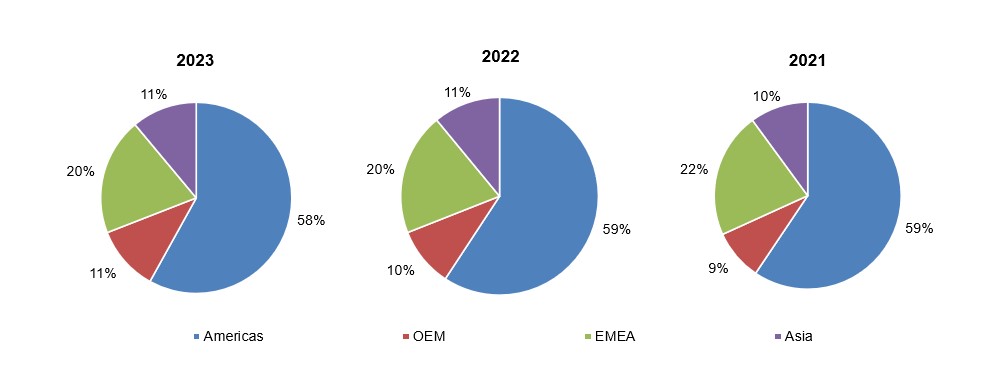
The following charts depict our net revenues by reportable operating segment as a percentage of our total consolidated net revenues for the years ended December 31, 2023, 2022 and 2021:
OUR PRODUCTS
Our product categories within our geographic segments include vascular access, anesthesia, interventional, surgical, interventional urology, respiratory and urology. Each of these categories and the key products sold therein
are described in more detail below.
Vascular Access: Our Vascular Access product category offers devices that facilitate a variety of critical care therapies and other applications with a focus on helping reduce vascular-related complications. These products primarily consist of our Arrow branded catheters, catheter navigation and tip positioning systems and our intraosseous, or in the bone, access systems.
Our catheters are used in a wide range of procedures, including the administration of intravenous therapies, the measurement of blood pressure and the withdrawal of blood samples through a single puncture site. Many of our catheters provide antimicrobial and antithrombogenic protection technology that has been shown to reduce the risk of catheter related bloodstream infections and microbial colonization and thrombus accumulation on catheter surfaces.
Our intraosseous access systems are designed for the delivery of medications and fluids when intravenous access is difficult to obtain in emergent, urgent or medically necessary cases. Our products offer a method for vascular access that can be administered quickly and effectively in the hospital and pre-hospital environments and include the EZ-IO Intraosseous Vascular Access System and Arrow FAST1 Sternal Intraosseous Infusion System.
Interventional: Our Interventional product category offers devices that facilitate a variety of applications to diagnose and deliver treatment of coronary and peripheral vascular disease. These products primarily consist of a variety of coronary catheters, structural heart support devices, peripheral intervention products and mechanical circulatory support platform used by interventional cardiologists, interventional radiologists and vascular surgeons. Clinical benefits of our products include increased vein and artery access, post-procedure closure, and increased support during complex medical procedures. Our primary product offerings consist of a portfolio of Arrow branded intra-aortic balloon pumps and catheters, GuideLiner, Turnpike and TrapLiner catheters, the MANTA Vascular Closure device and Arrow OnControl powered bone biopsy system.
Anesthesia: Our Anesthesia product category is comprised of airway, pain management and hemostatic product lines that support hospital, emergency medicine and military channels.
Our airway management products and related devices are designed to enable use of standard and advanced anesthesia techniques in both pre-hospital emergency and hospital settings. Our key products include laryngoscopes, supraglottic airways, endotracheal tubes and atomization devices, which are branded under our LMA, Rusch and MAD trade names.
Our pain management product line includes epidurals, catheters and disposable pain pumps for regional anesthesia, designed to improve patients’ post-operative pain experience, which are branded under our Arrow trade name.
Our hemostatic products accelerate the body's natural clotting cascade and are used in trauma situations where bleeding is difficult to control. The portfolio consists of external hemostats used by first responders, interventional products used in the catheter lab, and trauma products used by trauma surgeons, which are branded under our QuikClot trade name.
Surgical: Our Surgical product category consists of single-use and reusable devices designed for use in a variety of surgical procedures. These products primarily consist of metal and polymer ligating clips, fascial closure surgical systems used in laparoscopic surgical procedures, percutaneous surgical systems, a powered bariatric stapler, and other surgical instruments used in Ear, Nose and Throat and Cardio-Vascular and Thoracic procedures. Our significant surgical brands include Weck, MiniLap, Pleur-Evac, Deknatel, KMedic, Pilling and Titan SGS.
Interventional Urology: Our Interventional Urology product category includes the UroLift System, a minimally invasive technology for treating lower urinary tract symptoms due to benign prostatic hyperplasia, or BPH. The UroLift System involves the placement of permanent implants, typically through a transurethral outpatient procedure, that hold the prostate lobes apart to relieve compression on the urethra without cutting, heating or removing prostate tissue. In 2023, we expanded our product portfolio with the acquisition of Palette Life Sciences AB (“Palette”), which adds a portfolio of hyaluronic acid gel-based products primarily utilized in the treatment of urological diseases, including Barrigel, a rectal spacing product used in connection with radiation therapy treatment of prostate cancer. Our Interventional Urology product portfolio is most heavily weighted in our Americas segment.
Respiratory: Our respiratory products are used in a variety of care settings and primarily consist of humidification and oxygen therapy products. This product category previously included aerosol therapy, spirometry
and ventilation management products, as well as certain other oxygen therapy products, all of which were included in the Respiratory business divestiture.
Urology: Our urology product portfolio provides bladder management for patients in the hospital and individuals in the home care markets. The product portfolio consists principally of a wide range of catheters (including Foley and intermittent), urine collectors, catheterization accessories and products for operative endourology, which are marketed under the Teleflex and Rusch brand names. Our urology product portfolio is most heavily weighted in our EMEA segment.
OUR MARKETS
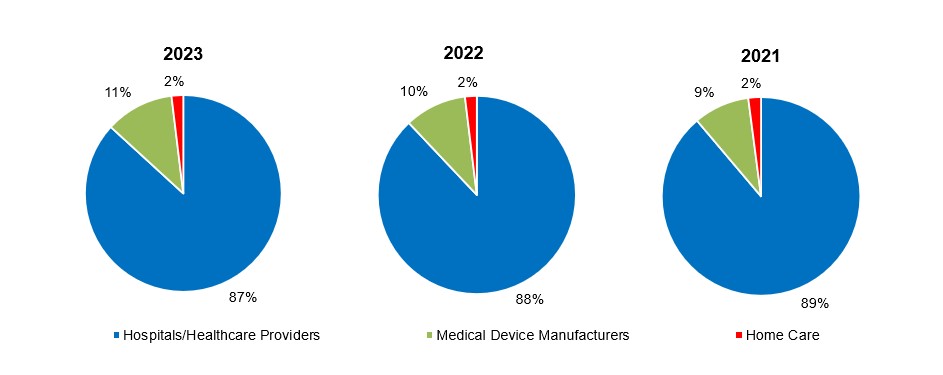
We generally serve three end-markets: hospitals and healthcare providers, medical device manufacturers and home care. These markets are affected by a number of factors, including demographics, utilization and reimbursement patterns. The following charts depict the percentage of net revenues for the years ended December 31, 2023, 2022 and 2021 derived from each of our end markets:
GOVERNMENT REGULATION
We are subject to comprehensive government regulation both within and outside the U.S. relating to the development, manufacture, sale and distribution of our products.
Regulation of Medical Devices in the U.S.
All of our medical devices manufactured or distributed in the U.S. are subject to requirements set forth by the Federal Food, Drug, and Cosmetic Act (“FDC Act”) and regulations promulgated by the FDA under the FDC Act, which are enforced by the FDA. The FDA and, in some cases, other government agencies administer requirements for the methods used in, and the facilities and controls used for, the design, manufacture, packaging, labeling, storage, installation, servicing, marketing, importing and exporting of all finished devices intended for human use. Additional FDA requirements include premarket clearance and approval, advertising and promotion, distribution and post-market surveillance of our medical devices and establishment of registration and device listing for our facilities.
Unless an exemption, pre-amendment grandfather status (that is, medical devices legally marketed in the U.S. before May 28, 1976) or FDA enforcement discretion applies, each medical device that we market in the U.S. must first receive either clearance as a Class I or, typically, a Class II device (after submitting a premarket notification (“510(k)”) or approval as a Class III device (after filing a premarket approval application (“PMA”)) from the FDA pursuant to the FDC Act. To obtain 510(k) clearance, a manufacturer must demonstrate to the FDA that the proposed device is substantially equivalent to a legally marketed device (a 510(k)-cleared device, a pre-amendment device for which FDA has not called for PMAs or a device with a de novo authorization), referred to as the "predicate device." Substantial equivalence is established by the applicant showing that the proposed device has the same intended use as the predicate device, and it either has the same technological characteristics or has been shown to be equally safe and effective and does not raise different questions of safety and effectiveness as compared to the predicate device. The FDA’s 510(k) clearance process requires regulatory competence to execute and usually takes four to nine months, but it can last longer. A device that is not eligible for the 510(k) process because there is no predicate device may be reviewed by the FDA through the de novo process (the process for
granting marketing authorization when no substantially equivalent device exists) if the FDA agrees it is a low to moderate risk device. A device that is not exempt from premarket review and is not eligible for 510(k) clearance or de novo authorization is categorized as Class III and must follow the PMA approval pathway, which requires proof of the safety and effectiveness of the device to the FDA’s satisfaction. The process of obtaining PMA approval also requires specific regulatory competence and is more costly, lengthy and uncertain than the 510(k) or de novo processes. The PMA process generally takes from one to three years or even longer. Our portfolio of existing products and pipeline of potential new products consist primarily of Class I (510(k) exempt) and Class II devices that require 510(k) clearance, although a few are 510(k)-exempt. In addition, certain modifications made to devices after they receive clearance or approval may require a new 510(k) clearance or approval of a PMA or PMA supplement. We cannot be sure that 510(k) clearance or PMA approval will be obtained in a timely matter if at all for any device that we propose to market.
A clinical trial is almost always required to support a PMA application and is sometimes required for a 510(k) clearance or a de novo authorization. The sponsor of a clinical trial must comply with and conduct the study in accordance with the applicable federal regulations, including the FDA’s requirements for investigational device exemption (“IDE”) requirements and good clinical practice (“GCP”). Clinical trials must also be approved, and are subject to continuing oversight, by an institutional review board ("IRB"), which is an appropriately constituted group that has been formally designated to review biomedical research involving human subjects and which has the authority to approve, require modifications to, or disapprove research to protect the rights, safety, and welfare of human research subjects. The FDA may order the temporary or permanent hold or discontinuation of a clinical trial at any time, or impose other sanctions, if it believes that the clinical trial either is not being conducted in accordance with FDA requirements or presents an unacceptable risk to the clinical trial subjects. An IRB may also require the clinical trial to be halted at a given clinical trial site for failure to comply with the IRB’s requirements or to adequately ensure the protection of human subjects, or may impose other conditions. Conducting medical device clinical trials is a complex and costly activity and frequently requires the use of outsourced resources that specialize in planning, conducting and/or monitoring the clinical trial for the medical device manufacturer.
A device placed on the market must comply with numerous regulatory requirements. Those regulatory requirements include, but are not limited to, the following:
•device listing and establishment registration;
•adherence to the Quality System Regulation (“QSR”), which requires stringent design, testing, control, documentation, complaint handling and other quality assurance procedures;
•labeling, including advertising and promotion, requirements;
•unique device identifier (“UDI”) requirements for device labels, packaging, and, for certain reusable devices, direct marking of certain reusable devices and for submission of information to FDA’s Global Unique Device Identification Database (“GUDID”);
•prohibitions against the promotion of off-label uses or indications;
•adverse event and malfunction reporting (Medical Device Reports or "MDRs");
•post-approval restrictions or conditions, potentially including post-approval clinical trials or other required testing;
•post-market surveillance requirements;
•the FDA’s recall authority, whereby it can require or request the recall of products from the market; and
•reporting and documentation of voluntary corrections or removals.
Certain of our medical devices are sold in kits that include a drug component, such as lidocaine. These types of kits are generally regulated as combination products within the Center for Devices and Radiological Health ("CDRH") under the device regulations because the device provides the primary mode of action of the kit. Although the kit as a whole is regulated as a medical device, it may be subject to certain drug requirements such as current good manufacturing practices (“cGMPs”) and adverse drug experience reporting requirements, to the extent applicable to the drug-component repackaging activities and subject to inspection to verify compliance with cGMPs as well as other regulatory requirements.
Our manufacturing facilities, as well as those of certain of our suppliers, are subject to periodic and for-cause inspections by FDA personnel to verify compliance with the QSR (21 CFR Part 820) as well as other regulatory requirements. Similar inspections and audits are performed by Notified Bodies to verify compliance to applicable
ISO standards (e.g. ISO 13485:2016), by auditing organizations under the Medical Device Single Audit Program ("MDSAP") applicable to regulatory requirements of Australia, Brazil, Canada, Japan and the U.S., and/or by regulatory authorities to verify compliance with medical device regulations and requirements from the countries in which we distribute product. If the FDA were to find that we or one or more of our suppliers have failed to comply with applicable regulations, it could institute a wide variety of enforcement actions, ranging from issuance of a warning or untitled letter to more severe sanctions, such as product recalls or seizures, civil penalties, consent decrees, injunctions, criminal prosecution, operating restrictions, partial suspension or total shutdown of production, refusal to permit importation or exportation, refusal to grant, or delays in granting, clearances or approvals or withdrawal or suspension of existing clearances or approvals. The FDA also has the authority under certain circumstances to request repair, replacement or refund of the cost of any medical device manufactured or distributed by us. Any of these actions could have an adverse effect on our business.
Regulation of Medical Devices Outside of the U.S.
Medical device laws also are in effect in many of the markets outside of the U.S. in which we do business. These laws range from comprehensive device approval requirements for some or all of our products to requests for product data or certifications. Inspection of and controls over manufacturing, as well as monitoring of device-related adverse events, are components of most of these regulatory systems. Manufacturing certification requirements and audits through the MDSAP program or other regulatory authority inspections also apply. In addition, the European Union (“EU”) has adopted the EU Medical Device Regulation (the “EU MDR”), which imposes stricter requirements for the marketing and sale of medical devices as compared to the predecessor Medical Device Directive (the "EU MDD"), including in the area of clinical evaluation requirements, quality systems, economic operators and post-market surveillance. The EU MDR went into effect in May 2021. As of the effective date, new and modified devices must be certified under, and be compliant with, the EU MDR. Devices that previously satisfied EU MDD requirements can continue to be marketed in the EU, subject to certain limitations, until the expiration of their current EU MDD certifications, originally to be no later than May 2024, but certain EU MDR requirements went into effect for such devices in May 2021. In February 2023, the European Parliament and Council approved an amendment to extend the EU MDR certification deadline for currently marketed devices past May 2024, with December 2027 as the new deadline for highest-risk devices and December 2028 for lower-risk devices. We will need to obtain new certifications under the EU MDR for medical devices previously authorized under the EU MDD. As a result, Teleflex will incur expenditures in connection with the new registration of medical devices that previously had been registered under the MDD. Failure to obtain EU MDR certifications prior to the expiration of existing EU MDD certifications may limit our ability to sell certain products in the EU until EU MDR certification is obtained. Failure to meet the applicable EU MDR requirements could adversely impact our business in the EU and other regions that tie their product registrations to the EU requirements.
Healthcare Laws
We are subject to various federal, state and local laws in the U.S. targeting fraud and abuse in the healthcare industry. These laws prohibit us from, among other things, soliciting, offering, receiving or paying any remuneration to induce the referral or use of any item or service reimbursable under Medicare, Medicaid or other federally or state financed healthcare programs. Violations of these laws are punishable by imprisonment, criminal fines, civil monetary penalties and exclusion from participation in federal healthcare programs. In addition, we are subject to federal and state false claims laws in the U.S. that prohibit the submission of false payment claims under Medicare, Medicaid or other federally or state funded programs. Certain marketing practices, such as off-label promotion, and violations of federal anti-kickback laws may also constitute violations of these laws.
In addition, we are subject to various federal and state reporting and disclosure requirements related to the healthcare industry. Rules issued by the Centers for Medicare & Medicaid Services ("CMS") require us to collect and report information on payments or transfers of value to physicians, physician assistants, nurse practitioners, clinical nurse specialists, certified registered nurse anesthetists, certified nurse-midwives and teaching hospitals, as well as investment interests held by physicians and their immediate family members. The reported data is available to the public on the CMS website. Failure to submit required information may result in civil monetary penalties. In addition, several states now require medical device companies to report expenses relating to the marketing and promotion of device products and to report gifts and payments to individual physicians in these states. Other states prohibit various other marketing-related activities. The federal government and certain other states require the posting of information relating to clinical studies and their outcomes. The shifting commercial compliance environment and the need to build and maintain robust and expandable systems to comply with the different compliance and/or reporting requirements among a number of jurisdictions increases the possibility that a
healthcare company may violate one or more of the requirements, resulting in increased compliance costs that could adversely impact our results of operations.
Further, the Patient Protection and Affordable Care Act, as amended by the Health Care and Education Reconciliation Act (collectively, the “Affordable Care Act”), imposes regulatory mandates and other measures designed to contain the cost of healthcare, in addition to annual reporting and disclosure requirements on device manufacturers for any “transfer of value” made or distributed to physicians or teaching hospitals. Violations of these laws are punishable by a range of fines, penalties and other sanctions.
Other Regulatory Requirements
We are also subject to the U.S. Foreign Corrupt Practices Act and similar anti-bribery laws applicable in jurisdictions outside the U.S. that generally prohibit companies and their intermediaries from improperly offering or paying anything of value to non-U.S. government officials for the purpose of obtaining or retaining business. Because of the predominance of government-sponsored healthcare systems around the world, most of our customer relationships outside of the U.S. are with government entities and are therefore subject to such anti-bribery laws. Our policies mandate compliance with these anti-bribery laws. We operate in many parts of the world that have experienced government corruption to some degree, and in certain circumstances, strict compliance with anti-bribery laws may conflict with local customs and practices. In the sale, delivery and servicing of our medical devices and software outside of the U.S., we must also comply with various export control and trade embargo laws and regulations, including those administered by the Department of Treasury’s Office of Foreign Assets Control (“OFAC”) and the Department of Commerce’s Bureau of Industry and Security (“BIS”) which may require licenses or other authorizations for transactions relating to certain countries and/or with certain individuals identified by the U.S. government. Despite our global trade and compliance program, our internal control policies and procedures may not always protect us from reckless or criminal acts committed by our employees, distributors or other agents. Violations of these requirements are punishable by criminal or civil sanctions, including substantial fines and imprisonment.
COMPETITION
The medical device industry is highly competitive. We compete with many companies, ranging from small start-up enterprises to companies that are larger and more established than us and have access to significantly greater financial resources. Furthermore, extensive product research and development and rapid technological advances characterize the market in which we compete. We must continue to develop and acquire new products and technologies for our businesses to remain competitive. We believe that we compete primarily on the basis of clinical superiority and innovative features that enhance patient benefit, product reliability, performance, customer and sales support, and cost-effectiveness.
SALES AND MARKETING
Our product sales are made directly to hospitals, healthcare providers, distributors and to original equipment manufacturers of medical devices through our own sales forces, independent representatives and independent distributor networks.
BACKLOG
Most of our products are sold to hospitals or healthcare providers on orders calling for delivery within a few days or weeks, with longer order times for products sold to medical device manufacturers. Therefore, our backlog of orders is not indicative of revenues to be anticipated in any future 12-month period.
PATENTS AND TRADEMARKS
We own a portfolio of patents, patents pending and trademarks. We also license various patents and trademarks. Patents for individual products extend for varying periods based upon the date of patent filing or grant and the legal term of patents in the various countries where patent protection is obtained. Trademark rights may potentially extend for longer periods of time and are dependent upon national laws and use of the marks. All product names throughout this document are trademarks owned by, or licensed to, us or our subsidiaries. Although these have been of value and are expected to continue to be of value in the future, we do not consider any single patent or trademark, except for the Teleflex name and the Arrow and UroLift brands, to be essential to the operation of our business.
SUPPLIERS AND MATERIALS
Materials used in the manufacture and sterilization of our products are purchased from a large number of suppliers in diverse geographic locations. We are not dependent on any single supplier for a substantial amount of the materials used, the components supplied and the sterilization services provided for our overall operations. Most of the materials, components and sterilization services we utilize are available from multiple sources, and where practical, we attempt to identify alternative suppliers. However, our ability to establish alternate sources of supply of materials and sterilization services may be delayed due to FDA and other regulatory authority requirements regarding the manufacture and sterilization of our products. Volatility in commodity prices, and freight costs, can have a significant impact on the cost of producing and supplying certain of our products.
RESEARCH AND DEVELOPMENT
We are engaged in both internal and external research and development. Our research and development efforts support our strategic objectives to provide innovative new, safe and effective products that enhance clinical value by reducing infections, improving patient and clinician safety, enhancing patient outcomes and enabling less invasive procedures.
We also acquire or license products and technologies that are consistent with our strategic objectives and enhance our ability to provide a full range of product and service options to our customers.
SEASONALITY
Portions of our revenues are subject to seasonal fluctuations. Incidence of flu and other disease patterns and, to a lesser extent, the frequency of elective medical procedures affect revenues related to single-use products. Historically, we have experienced higher sales in the fourth quarter as a result of these factors.
HUMAN CAPITAL
As of December 31, 2023, we employed approximately 14,500 employees, including 4,000 employees in the U.S. and 10,500 employees in 34 other countries around the world. Our global supply chain employees make up 54% of the total employee population and are located primarily in Mexico, Malaysia and the Czech Republic. Our commercial organization comprises 27% of the global employee base. The remaining 19% of employees work in various corporate functions, based in each of our locations.
We believe our employees are a significant differentiating factor and play a critical role in our ability to deliver on our commitments to patients and execute our strategy to our customers and shareholders. Our management team places significant focus and attention on matters affecting our people, particularly our commitment to our Core Values, capability development, total rewards and diversity, as well as how each employee experiences our culture.
Culture
The culture of our organization is critical to the human capital we attract, develop and retain and who, in turn, contribute to the results and success of our organization. Our culture is framed by our Core Values – building trust, entrepreneurial spirit and making our workplace fun, with people at the center of all we do. We strive to develop and sustain our culture by embedding these values in all aspects of our organization, including our human capital strategies.
Diversity, Equity, and Inclusion
At Teleflex, our Core Values define our company, shape our culture, guide our business practices, and direct the way we interact with our stakeholders. Rooted in our Core Values, diversity, equity, and inclusion (DEI) plays an essential role in fulfilling our company core purpose to improve the health and quality of peoples’ lives. Through embedding the principles of DEI into our activities, decisions, governance, innovations, and culture, we contribute to the achievement of accessible, equitable and sustainable healthcare for all.
DEI initiatives in Teleflex are supported by our Global DEI Council, composed of senior leadership from across the organization, and our four Regional DEI Councils in each of our U.S. & Canada, Latin America, EMEA, and Asia Pacific regions. The Regional DEI Councils are representative of employees from all levels, functions, and regions, acting as a guiding hub of perspectives and experiences to enrich the importance of DEI in Teleflex.
Within our Regional DEI Councils, each of our Employee Resources Groups (ERGs) are represented by a member of their leadership committee to share the progress, knowledge, and initiatives from their respective ERG.
Our ERG footprint extends to each of our four regions, providing our people with employee-driven communities that focus on initiatives such as supporting working parents and caregivers, coordinating mentorship and development opportunities, promoting cultural awareness and understanding, and connecting employees with shared experiences, interests or backgrounds.
We continue our efforts to cultivate a diverse workforce that reflects the communities in which we work and serve. These efforts are supported through engaging and partnering with local organizations, educational institutions and recruiting firms for a variety of opportunities in Teleflex including vacancies, co-op placements and internships. In partnering with local organizations, we are better able to address how we can best serve and support marginalized populations in our communities.
We collect and regularly review several measures of diversity within our global workforce. Some illustrative and notable highlights of our new hires from the January to December 2023 period are as follows:
•At 55%, females made up the majority of our new hires globally;
•Of the 3,812 total global hires, 44% were aged 20-29, followed by 28% aged 30-39 and 15% aged 40-49; and
•In the US, approximately 50% of our new hires represented minority ethnicities including Black (24%), Asian (12%), and Hispanic (9%).
Talent Management, Development and Learning
We are committed to providing our employees with opportunities for growth, development, and career advancement and to building a high-performance culture that supports our Core Values throughout the employee lifecycle. We have a clear talent management process that provides regular coaching check-ins between employees and their managers to review the employee’s developmental objectives and career progression. We also regularly review our talent portfolio and succession plans to ensure we can deliver on our company strategy.
In addition, we offer a number of internal educational and training resources to employees throughout our organization. Among these resources is the Teleflex Academy, a curriculum that provides learning opportunities for our employees to further develop their skills and receive training across broad subject areas such as leadership; communications; diversity, equity, and inclusion; sales; customer service; and business acumen.
Total Rewards
Our commitment to our employees is to provide fair, equitable and competitive compensation and benefits packages to all employees globally, regardless of gender, age or ethnicity. To that end we continuously review and calibrate employee roles and responsibilities to ensure we are offering equal pay for equal work, and we actively manage our global compensation and benefit programs to ensure we can attract and retain the critical human capital we need to continue to deliver on our commitments to employees, customers, patients and shareholders. We believe our compensation and benefits offering is aligned to competitive market pay levels and, along with our culture and Core Values, acts to incentivize the right behaviors and actions to achieve the best results for the organization. We structure our compensation to include a mix of pay components of base salary, short-term cash incentives and long-term incentives. We offer employees health, welfare and retirement benefits and have implemented policies addressing paid time off, flexible work schedules, employee assistance, parental leave and family benefits, among others.
In 2021 and 2023, we performed an in-depth pay equity analysis on the pay practices within our organization. As part of that analysis on our compensation programs, no systemic gender bias was identified and within the United States, no systemic ethnicity bias was identified. We continue to explore where we can expand our pay equity analyses in the jurisdictions in which we operate. We conduct pay equity analyses on a regular, periodic basis to ensure we continue to align to our commitments and Core Values.
Environmental, Health and Safety
Our Environmental Health and Safety (EHS) vision is to protect the safety and health of Teleflex personnel and the environments in which we operate. We have a vested interest in protecting our most valuable assets – our employees. Everyone is a steward of EHS, fostering a culture of being actively responsible in all our operations. We remain fully committed to complying with all relevant EHS legislation and to achieving our vision. We have and will continue to expend resources to construct, maintain, operate, and improve our facilities across the globe for environmental, health, safety and sustainability of our operations for the protection and benefit of our employees and others. Further, we understand that our environment is both complex and delicate, and we prioritize managing and limiting the impact our business has on the environment as part of our Zero Harm Culture. As we continue to
review our commitments to environmental sustainability, we have initiated programs to track and lower our consumption of energy, water and gas as well as reduce waste and the use of hazardous materials. In addition, we have developed an EHS program focused in the areas of training our personnel with respect to, deploying and auditing global EHS standards as well as other programs to engage our employees on EHS initiatives.
ENVIRONMENTAL
We are subject to various environmental laws and regulations both within and outside the U.S. Our operations, like those of other medical device companies, involve the use of substances regulated under environmental laws, primarily in manufacturing and sterilization processes. While we continue to devote resources to compliance with existing environmental laws and regulations, we cannot ensure that our costs of complying with current or future environmental protection, health and safety laws and regulations, including, without limitation, those related to climate change, will not exceed our estimates or will not have a material adverse effect on our business, financial condition, results of operations and cash flows. Further, we cannot ensure that we will not be subject to environmental claims for personal injury or cleanup in the future based on our past, present or future business activities.
INVESTOR INFORMATION
We are subject to the reporting requirements of the Securities Exchange Act of 1934, as amended (the “Exchange Act”). Therefore, we file reports, proxy statements and other information with the Securities and Exchange Commission (SEC). The SEC maintains a website (http://www.sec.gov) that contains reports, proxy and information statements and other information regarding issuers that file electronically with the SEC.
You can access financial and other information about us in the Investors section of our website, which can be accessed at www.teleflex.com. We make available through our website, free of charge, copies of our annual report on Form 10-K, quarterly reports on Form 10-Q, current reports on Form 8-K and amendments to those reports filed with or furnished to the SEC under Section 13(a) or 15(d) of the Exchange Act as soon as reasonably practicable after electronically filing or furnishing such material to the SEC. The information on our website is not part of this Annual Report on Form 10-K. The reference to our website address is intended to be an inactive textual reference only.
We are a Delaware corporation incorporated in 1943. Our executive offices are located at 550 East Swedesford Road, Suite 400, Wayne, PA 19087.
INFORMATION ABOUT OUR EXECUTIVE OFFICERS
The names and ages of our executive officers and the positions and offices held by each such officer are as follows:
| | | | | | | | | | | | | | |
| Name | | Age | | Positions and Offices with Company |
| Liam J. Kelly | | 57 | | Chairman, President and Chief Executive Officer |
| Thomas E. Powell | | 62 | | Executive Vice President and Chief Financial Officer |
| Cameron P. Hicks | | 59 | | Corporate Vice President, Human Resources and Communications |
| Daniel V. Logue | | 50 | | Corporate Vice President, General Counsel and Secretary |
| Jay White | | 50 | | Corporate Vice President and President, Global Commercial |
| James Winters | | 51 | | Corporate Vice President, Manufacturing and Supply Chain |
Mr. Kelly has been our President and Chief Executive Officer since January 2018 and has been Chairman of our Board of Directors since May 2020. From May 2016 to December 31, 2017, Mr. Kelly served as our President and Chief Operating Officer. From April 2015 to April 2016, he served as Executive Vice President and Chief Operating Officer. From April 2014 to April 2015, Mr. Kelly served as Executive Vice President and President, Americas. From June 2012 to April 2014 Mr. Kelly served as Executive Vice President and President, International. He also has held several positions with regard to our EMEA segment, including President from June 2011 to June 2012, Executive Vice President from November 2009 to June 2011, and Vice President of Marketing from April 2009 to November 2009. Prior to joining Teleflex, Mr. Kelly held various senior level positions with Hill-Rom Holdings, Inc., a medical device company, from October 2002 to April 2009, serving as its Vice President of International Marketing and R&D from August 2006 to February 2009.
Mr. Powell has been our Executive Vice President and Chief Financial Officer since February 2013. From March 2012 to February 2013, Mr. Powell was Senior Vice President and Chief Financial Officer. He joined Teleflex
in August 2011 as Senior Vice President, Global Finance. Prior to joining Teleflex, Mr. Powell served as Chief Financial Officer and Treasurer of Tomotherapy Incorporated, a medical device company, from June 2009 until June 2011. In 2008, he served as Chief Financial Officer of Textura Corporation, a software provider. From April 2001 until January 2008, Mr. Powell was employed by Midway Games, Inc., a software provider, serving as its Executive Vice President, Chief Financial Officer and Treasurer from September 2001 until January 2008. Mr. Powell has also held leadership positions with Dade Behring, Inc., PepsiCo, Bain & Company, Tenneco Inc. and Arthur Andersen & Company.
Mr. Hicks has been our Corporate Vice President, Human Resources and Communications since April 2013. Prior to joining Teleflex, Mr. Hicks served as Executive Vice President of Human Resources & Organizational Effectiveness for Harlan Laboratories, Inc., a private global provider of pre-clinical and non-clinical research services, from July 2010 to March 2013. From April 1990 to January 2010, Mr. Hicks held various leadership roles with MDS Inc., a provider of products and services for the development of drugs and the diagnosis and treatment of disease, including Senior Vice President of Human Resources for MDS’ global Pharma Services division from November 2000 to January 2010.
Mr. Logue has been our Corporate Vice President, General Counsel and Secretary since January 2021. Mr. Logue joined Teleflex in 2004 and previously held the positions of Deputy General Counsel from February 2017 to December 2020, Associate General Counsel from March 2013 to January 2017 and Assistant General Counsel from June 2004 to February 2013. Prior to joining Teleflex, Mr. Logue was an associate at the law firm of Pepper Hamilton LLP (now Troutman Pepper Hamilton Sanders LLP) from September 1999 to June 2004.
Mr. White has been our Corporate Vice President and President, Global Commercial since February 2021. From February 2017 to January 2021, Mr. White served as our President, The Americas, and from December 2013 to January 2017 he served as President and General Manager, Vascular. From January 2013 to November 2013, Mr. White served as our President and General Manager, Surgical. Prior to that, he served as our Vice President and General Manager, Surgical from January 2010 to December 2012. Mr. White joined Teleflex in March 2005 as our Director of Marketing, North America. Prior to joining Teleflex, Mr. White worked at Covidien plc (now part of Medtronic plc) where he held senior leadership positions in sales and marketing over a five-year period.
Mr. Winters has been our Corporate Vice President, Manufacturing and Supply Chain since February 2020. He previously held the position of Vice President, Global Manufacturing from March 2018 to January 2020. Prior to joining Teleflex, Mr. Winters held various senior management and operational roles with the DePuy Synthes division of Johnson & Johnson, a healthcare company, from August 2005 to February 2018. Most recently, Mr. Winters served as Vice President of Global Manufacturing for Global Joint Reconstruction for DePuy Synthes from February 2015 to February 2018. Prior to that, Mr. Winters served as Plant Manager for the DePuy Synthes Ireland Manufacturing Operation.
Our officers are elected annually by our board of directors. Each officer serves at the discretion of the board.
ITEM 1A. RISK FACTORS
In addition to the other information set forth in this Annual Report on Form 10-K, you should carefully consider the following factors which could have a material adverse effect on our business, financial condition, results of operations, cash flows or stock price. The risks below are not the only risks we face. Additional risks and uncertainties not currently known to us or that we currently deem to be immaterial may also adversely affect our business, financial condition, results of operations or stock price.
Risks Relating to our Business and Operations
We face strong competition. Our failure to successfully develop and market new products could adversely affect our business.
The medical device industry is highly competitive. We compete with many domestic and foreign medical device companies ranging from small start-up enterprises that might sell only a single or limited number of competitive products or compete only in a specific market segment, to companies that are larger and more established than us, have a broad range of competitive products, participate in numerous markets and have access to significantly greater financial and marketing resources than we do. We also face competition from providers of alternative medical therapies, such as pharmaceutical companies.
In addition, the medical device industry is characterized by extensive product research and development and rapid technological advances. The future success of our business will depend, in part, on our ability to design and
manufacture new products and enhance existing products. Our product development efforts may require us to make substantial investments. There can be no assurance that we will be able to successfully develop new products, enhance existing products or achieve market acceptance of our products, due to, among other things, our inability to:
•identify viable new products;
•maintain sufficient liquidity to fund our investments in research and development and product acquisitions;
•obtain adequate intellectual property protection;
•gain market acceptance of new products; or
•successfully obtain regulatory approvals.
In addition, our competitors currently may be developing, or may develop in the future, products that provide better features, clinical outcomes or economic value than those that we currently offer or subsequently develop. Our failure to successfully develop and market new products or enhance existing products, and to compete successfully with others in the medical device industry, could have a material adverse effect on our business, financial condition and results of operations.
Our customers depend on third party coverage and reimbursements, and the failure of healthcare programs to provide sufficient coverage and reimbursement for our medical products could adversely affect us.
The ability of our customers to obtain coverage and reimbursement for our products is important to our business. Demand for many of our existing and new medical products is, and will continue to be, affected by the extent to which government healthcare programs and private health insurers reimburse our customers for patients’ medical expenses in the countries where we do business. Even when we develop or acquire a promising new product, demand for the product may be limited unless reimbursement approval is obtained from private and government third party payors. Internationally, healthcare reimbursement systems vary significantly. In some countries, medical centers are constrained by fixed budgets, regardless of the volume and nature of patient treatment. Other countries require application for, and approval of, government or third party reimbursement. Without both favorable coverage determinations by, and the financial support of, government and third party insurers, the market for many of our medical products would be adversely affected. In this regard, we cannot be sure that third party payors will maintain the current level of coverage and reimbursement to our customers for use of our existing products. Adverse coverage determinations, including reductions in the amount of reimbursement, could harm our business by discouraging customers’ selection of, and reducing the prices they are willing to pay for, our products.
In addition, as a result of their purchasing power, third party payors have implemented and are continuing to implement cost cutting measures such as seeking discounts, price reductions or other incentives from medical products suppliers and imposing limitations on coverage and reimbursement for medical technologies and procedures. These trends could compel us to reduce prices for our products and could cause a decrease in the size of the market or a potential increase in competition that could negatively affect our business, financial condition and results of operations.
We are subject to extensive government regulation, which may require us to incur significant expenses to ensure compliance. Our failure to comply with those regulations could have a material adverse effect on our business, results of operations, financial condition and cash flows.
Our products are medical devices and are subject to extensive regulation in the U.S. by the FDA and by comparable government agencies in other countries. The regulations govern, among other things, the development, design, clinical testing, premarket clearance and approval, manufacturing, labeling, importing and exporting and sale and marketing of many of our products. Moreover, these regulations are subject to future change.
In the U.S., before we can market a new medical device, or a new use of, or claim for, or significant modification to, an existing product, we generally must first receive either 510(k) clearance or de novo authorization or approval of a premarket approval application, or PMA, from the FDA. Similarly, most major markets for medical devices outside the U.S. also require clearance, approval, authorization or compliance with certain standards before a product can be commercially marketed. In the EU, the EU MDR went into effect in May 2021 and includes significant additional pre- and post-market requirements. The process of obtaining regulatory clearances and approvals to market a medical device, particularly from the FDA and certain foreign government authorities, can be costly and time consuming, and clearances and approvals might not be granted for new products on a timely basis,
if at all. In addition, once a device has been cleared or approved, a new clearance or approval may be required before the device may be modified or its labeling changed. Furthermore, the FDA or a foreign government authority may make its review and clearance or approval process more rigorous, which could require us to generate additional clinical or other data, and expend more time and effort, in obtaining future product clearances or approvals. The regulatory clearance and approval process may result in, among other things, delayed realization of product revenues, substantial additional costs or limitations on indicated uses of products, any one of which could have a material adverse effect on our financial condition and results of operations. Even after a product has received marketing approval or clearance, such product approval or clearance can be withdrawn or limited due to unforeseen problems with the device or issues relating to its application, or the FDA or a foreign government authority may change the classification of a product, which could require additional clinical studies and new marketing submissions.
Failure to comply with applicable regulations could lead to adverse effects on our business, which could include:
•partial suspension or total shutdown of manufacturing;
•product shortages;
•delays in product manufacturing;
•warning or untitled letters;
•fines or civil penalties;
•delays in or restrictions on obtaining new regulatory clearances or approvals;
•withdrawal or suspension of required clearances, approvals or licenses;
•product seizures or recalls;
•injunctions;
•criminal prosecution;
•advisories or other field actions;
•operating restrictions; and
•prohibitions against exporting of products to, or importing products from, countries outside the U.S.
We could be required to expend significant financial and human resources to remediate failures to comply with applicable regulations and quality assurance guidelines. In addition, civil and criminal penalties, including exclusion under Medicaid or Medicare, could result from certain regulatory violations. Any one or more of these events could have a material adverse effect on our business, financial condition and results of operations.
Medical devices are cleared or approved for one or more specific intended uses and performance claims must be adequately substantiated. Promoting a device for a use outside of the cleared or approved intended use or population, that is, an off-label use, or making false, misleading or unsubstantiated claims could result in government enforcement action.
Furthermore, our facilities are subject to periodic inspection by the FDA and other federal, state and foreign government authorities, which require manufacturers of medical devices to adhere to certain regulations, including the FDA’s QSR, which requires, among other things, periodic audits, design controls, quality control testing and documentation procedures, as well as complaint evaluations and investigation. In addition, any facilities assembling kits that include drug components and are registered as drug repackaging establishments are also subject to current good manufacturing practices requirements for drugs. The FDA also requires the reporting of certain adverse events and product malfunctions and requires the reporting of certain recalls or other field safety corrective actions for medical devices. Issues identified through such inspections and reports may result in FDA enforcement action through any of the actions discussed above. Moreover, issues identified through such inspections and reports may require significant resources to resolve.
We are subject to healthcare fraud and abuse laws, regulation and enforcement; our failure to comply with those laws could have a material adverse effect on our results of operations and financial condition.
We are subject to healthcare fraud and abuse regulation and enforcement by the federal government and the governments of those states and foreign countries in which we conduct our business. The laws that may affect our ability to operate include:
•the federal healthcare anti-kickback statute, which, among other things, prohibits persons from knowingly and willfully offering or paying remuneration, one purpose of which is to induce either the referral of an individual for, or the purchase, order or recommendation of, any good or service for which payment may be made under federal healthcare programs such as Medicare and Medicaid, or soliciting payment for such referrals, purchases, orders and recommendations;
•federal false claims laws which, among other things, prohibit individuals or entities from knowingly presenting, or causing to be presented, false or fraudulent claims for payment from the federal government, including Medicare, Medicaid or other third-party payors;
•the federal Health Insurance Portability and Accountability Act of 1996 (“HIPAA”), which prohibits schemes to defraud any healthcare benefit program and false statements relating to healthcare matters; and
•state law equivalents of each of the above federal laws, such as anti-kickback and false claims laws which may apply to items or services reimbursed by any third-party payor, including commercial insurers.
If our operations are found to be in violation of any of these laws or any other government regulations, we may be subject to penalties, including civil and criminal penalties, damages, fines, the curtailment or restructuring of our operations, the exclusion from participation in federal and state healthcare programs and imprisonment of personnel, any of which could adversely affect our ability to operate our business and our financial results. The risk of our being found to have violated these laws is increased by the fact that many of them have not been fully interpreted by the regulatory authorities or the courts, and their provisions are open to a variety of interpretations.
Further, the Affordable Care Act, through the Physician Payments Sunshine Act, imposes annual reporting and disclosure requirements on device manufacturers for any “transfer of value” made or distributed to physicians or teaching hospitals, physician assistants, nurse practitioners, clinical nurse specialists, certified registered nurse anesthetists (including anesthesiology assistants) and certified nurse-midwives. The reported information is made publicly available in a searchable format. In addition, device manufacturers are required to report and disclose any ownership or investment interests held by physicians and their immediate family members during the preceding calendar year. Failure to submit required information may result in civil monetary penalties for each payment, transfer of value or ownership or investment interests not reported in an annual submission, up to an aggregate of $150,000 per year (and up to an aggregate of $1 million per year for “knowing failures”).
There are also certain states, including Connecticut, Massachusetts, and Vermont, that require device manufacturers to track and report payments or transfers of value provided to certain health care providers and health care entities. In addition, some states, such as California, Connecticut, Nevada and Massachusetts, mandate implementation of compliance programs that include restrictions on certain interactions and items of value that may be provided to health care providers, as well as the tracking and reporting of certain items of value, compensation for consulting and other services, and other remuneration to healthcare providers. Further, we are subject to a law in Vermont that imposes a ban on providing certain items of value and payments to health care providers. The shifting commercial compliance environment and the need to build and maintain robust and expandable systems to comply with the different compliance and/or reporting requirements among a number of jurisdictions increases the possibility that we may inadvertently violate one or more of the requirements, resulting in increased compliance costs that could adversely impact our results of operations.
We may not be successful in achieving expected operating efficiencies and sustaining or improving operating expense reductions, and may experience business disruptions associated with restructuring, facility consolidations, realignment, cost reduction and other strategic initiatives.
Over the past several years we have implemented a number of restructuring, realignment and cost reduction initiatives, including facility consolidations, organizational realignments and reductions in our workforce, and we may engage in similar efforts in the future. While we have realized some efficiencies from these initiatives, we may not realize the benefits of these or future initiatives to the extent we anticipated. Further, such benefits may be realized later than expected, and the ongoing difficulties in implementing these measures may be greater than anticipated, which could cause us to incur additional costs or result in business disruptions. In addition, if these measures are not successful or sustainable, we may be compelled to undertake additional restructuring, realignment and cost reduction efforts, which could result in significant additional charges. Moreover, if our restructuring, realignment and cost reduction efforts prove ineffective, our ability to achieve our strategic and business plan goals may be adversely affected.
As part of our efforts to increase operating efficiencies, we have implemented a number of initiatives over the past several years to consolidate our enterprise resource planning, or ERP, systems. In addition, we currently are in
the early stages of a multi-year phased conversion to upgrade our global ERP system to mitigate the risks associated with our vendor's planned end of support for the current version of our existing ERP system. This conversion will represent a substantial undertaking and require the investment of significant personnel and financial resources. To date, we have not experienced any significant disruptions to our business or operations in connection with these initiatives. However, as we continue our efforts to upgrade and further consolidate our ERP systems, we could experience business disruptions, which could adversely affect customer relationships and divert the attention of management away from daily operations. In addition, any delays in the implementation of these initiatives could cause us to incur additional unexpected costs. Should we experience such difficulties, our business, cash flows and results of operations could be adversely affected.
Disruptions in sterilization of our products or regulatory initiatives further restricting the use of ethylene oxide in sterilization facilities could adversely affect our results of operations and financial condition.
Many of our products require sterilization prior to sale. A common method for sterilizing medical products involves the use of ethylene oxide, which is listed as a hazardous air pollutant under the Clean Air Act, as amended, and emissions of which are regulated by the U.S. Environmental Protection Agency ("EPA") and other regulatory authorities. Companies in the sterilization industry may face private litigation that could result in financial difficulties that could ultimately make it difficult or undesirable for such companies to continue in the sterilization business. In addition, sterilization activities are subject to substantial governmental oversight and attention that could disrupt their operations. One of our contract sterilizers, Sterigenics U.S., LLC, uses ethylene oxide in its sterilization process, including at its facilities in Smyrna, Cobb County, Georgia and Santa Teresa, New Mexico, which have sterilized some of our vascular, surgical, intermittent catheter and OEM products. In recent years, Sterigenics' operations at both its Smyrna and Santa Teresa facilities have been subject to legal proceedings related to the facilities' use of ethylene oxide in their sterilization operations. While both plants are currently operating normally, should their operations be suspended or adversely affected, our ability to provide affected products to our customers could be impaired if we are unable to utilize alternate facilities and sources for sterilization services.
In addition, in 2019, the attorneys general of 15 states and the District of Columbia sent a letter to the EPA urging that the EPA promptly propose and finalize stricter standards for ethylene oxide emissions. Subsequently, the EPA solicited information and comments from the public on proposed revisions to regulations regarding ethylene oxide emissions and collected information from commercial sterilizers about ethylene oxide sterilization processes and emissions. In April 2023, the EPA released a proposed rule under the Clean Air Act that would require commercial sterilizers to install pollution control equipment to reduce ethylene oxide emissions and implement methods to continuously monitor emissions and report results to the EPA. According to the terms of an August 2023 consent decree entered by the U.S. District Court for the District of Columbia, the EPA must issue the final rule by March 1, 2024, and contract sterilizers are anticipated to have 18 months to come into compliance. Failure of our contract sterilizers to achieve compliance with the final rule by the deadline would significantly impair our ability to provide sufficient quantities of sterilized products to our customers and compel us to seek sterilization alternatives that do not entail the use of ethylene oxide. We cannot assure that we would be able to identify such alternatives. In the event we were to experience any disruptions in our ability to sterilize our products, whether due to capacity constraints or regulatory or other impediments (including, among other things, regulatory initiatives directed generally to sterilization facilities that utilize ethylene oxide), or we are unable to transition to alternative facilities in a timely or cost effective manner in the event one or more of the facilities we use is affected, we could experience a material adverse impact with respect to our results of operations and financial condition.
A significant portion of our U.S. revenues is derived from sales to distributors, and “destocking” activity by these distributors can adversely affect our revenues and results of operations.
A significant portion of our revenues in the U.S. is derived from sales to distributors, which, in turn, sell our products to hospitals and other health care institutions. From time to time, these distributors may decide to reduce their levels of inventory with regard to certain of our products, a practice we refer to as “destocking.” A distributor's decision to reduce inventory levels with respect to our products may be based on a number of factors, such as distributor expectations regarding demand for a particular product, distributor buying decisions (including decisions to purchase competing products), changes in distributor policies regarding the maintenance of inventory levels, economic conditions and other factors. Following such instances of reduced purchases, distributors may revert to previous purchasing levels; nevertheless, we cannot assure that distributors will, in fact, increase purchases of our products in this manner. A decline in the level of product purchases by our U.S. distributors in the future could have a material adverse effect on our revenues and results of operations during a reporting period, and an extended decline in such product purchases could have a longer term material adverse effect.
We may incur material losses and costs as a result of product liability and warranty claims, as well as product recalls, any of which may adversely affect our results of operations and financial condition. Furthermore, our reputation as a medical device company may be damaged if one or more of our products are, or are alleged to be, defective.
Our businesses expose us to potential product liability risks related to the design, manufacture, labeling and marketing of our products. In particular, our medical device products are often used in surgical and intensive care settings for procedures involving seriously ill patients. In addition, many of our products are designed to be implanted in the human body for varying periods of time. Product defects or inadequate disclosure of product-related risks with respect to products we manufacture or sell could result in patient injury or death. Product liability and warranty claims often involve very large or indeterminate amounts, including punitive damages. The magnitude of potential losses from product liability lawsuits may remain unknown for substantial periods of time, and the related legal defense costs may be significant. We could experience material warranty or product liability losses in the future and incur significant costs to defend these claims.
In addition, if any of our products are, or are alleged to be, defective, we may voluntarily conduct, or be required by regulatory authorities to conduct, a recall of that product. In the event of a recall, we may lose sales and be exposed to individual or class-action litigation claims. Moreover, negative publicity regarding a quality or safety issue, whether accurate or inaccurate, could harm our reputation, decrease demand for our products, lead to product withdrawals or impair our ability to successfully launch and market our products in the future. Product liability, warranty and recall costs may have a material adverse effect on our business, financial condition, results of operations and cash flows.
Volatility in domestic and global financial markets could adversely impact our results of operations, financial condition and liquidity.
We are subject to risks arising from adverse changes in general domestic and global economic conditions. The economic slowdown and disruption of credit markets that occurred several years ago led to recessionary conditions and depressed levels of consumer and commercial spending, resulting in reductions, delays or cancellations of purchases of our products and services. We cannot predict the duration or extent of any economic recovery or the extent to which our customers will return to more typical spending behaviors. The continuation in a number of markets of weak economic growth, constricted credit, public sector austerity measures in response to public budget deficits and foreign currency volatility, particularly with respect to the euro, could have a material adverse effect on our results of operations, financial condition and liquidity.
Although we maintain allowances for doubtful accounts to cover the estimated losses which may occur when customers cannot make their required payments, we cannot assure that the loss rate will not increase in the future given the volatility in the worldwide economy. If our allowance for doubtful accounts is insufficient to address receivables we ultimately determine are uncollectible, we would be required to incur additional charges, which could materially adversely affect our results of operations. Moreover, our inability to collect outstanding receivables could adversely affect our financial condition and cash flow from operations.
In addition, adverse economic and financial market conditions may result in future impairment charges with respect to our goodwill and other intangible assets, which would not directly affect our liquidity but could have a material adverse effect on our reported financial results.
Our strategic initiatives, including acquisitions, may not produce the intended growth in revenue and operating income, which could have a material adverse effect on our operating results.
Our strategic initiatives include making significant investments designed to achieve revenue growth and to enable us to meet or exceed margin improvement targets. If we do not achieve the expected benefits from these investments or otherwise fail to execute on our strategic initiatives, we may not achieve the growth improvement we are targeting, and our results of operations may be adversely affected.
In addition, as part of our strategy for growth, we have made, and may continue to make, acquisitions and divestitures and enter into strategic alliances such as joint ventures and joint development agreements. However, we may not be able to identify suitable acquisition candidates, complete acquisitions or integrate acquisitions successfully, and our joint ventures or strategic alliances may not prove to be successful. In this regard, acquisitions involve numerous risks, including difficulties in the integration of acquired operations, technologies, services and products and the diversion of management’s attention from other business concerns. Moreover, the products and technologies that we acquire may not be successful or may require us to devote significantly greater development, marketing and other resources, as well as significantly greater investments, than we anticipated. We could also
experience negative effects on our results of operations and financial condition from acquisition-related charges, amortization of intangible assets, asset impairment charges and other matters that could arise in connection with the acquisition of a company or business, including matters related to internal control over financial reporting and regulatory compliance, as well as the short-term effects of increased costs on results of operations. Although our management will endeavor to evaluate the risks inherent in any particular transaction, there can be no assurance that we will identify all such risks or the magnitude of the risks. In addition, prior acquisitions have resulted, and future acquisitions could result, in the incurrence of substantial additional indebtedness and expenditures. Future acquisitions may also result in potentially dilutive issuances of equity securities. There can be no assurance that difficulties encountered in connection with acquisitions will not have a material adverse effect on our business, financial condition and results of operations.
In connection with certain of our completed acquisitions, we have agreed to pay consideration that is contingent upon the achievement of specified objectives, such as receipt of regulatory approval, commercialization of a product or achievement of sales targets. As of the acquisition date, we record a contingent liability representing the estimated fair value of the contingent consideration we expect to pay. On a quarterly basis, we reassess these obligations and, in the event our estimate of the fair value of the contingent consideration changes, we record increases or decreases in the fair value as an adjustment to operating earnings, which could have a material impact on our results of operations. As of December 31, 2023, we accrued $39.5 million of contingent consideration related to completed business combinations, most of which related to Standard Bariatrics Inc. and Palette. In addition, actual payments may differ materially from the amount of the contingent liability, which could have a material impact on our results of operations, cash flows and liquidity. For information regarding assumptions related to our contingent consideration liabilities, see “Critical Accounting Policies and Estimates” under Item 7, Management’s Discussion and Analysis of Financial Condition and Results of Operations included in this Annual Report on Form 10-K. For additional information regarding our acquisitions, see Note 4 to the consolidated financial statements included in this Annual Report on Form 10-K.
Our results of operations and financial condition may be adversely affected by public health epidemics or pandemics, as occurred with respect to the recent COVID-19 epidemic and pandemic.
We are subject to risks associated with public health threats, such as the recent COVID-19 epidemic and pandemic. As with COVID-19, such events could significantly impact economic activity and markets around the world and, as a result, have negative effects on our operations, financial performance and cash flows. Such effects would depend on various factors, including, but not limited, to: the occurrence, spread, duration and severity of any outbreaks; governmental, business and individuals’ actions that may be taken in response to an epidemic or pandemic (including restrictions on travel, transport and workforce pressures, and deferrals or postponements of elective procedures); the impact of such a crisis, and actions taken in response thereto, on global and regional economies, travel and economic activity; the availability of federal, state, local or non-U.S. funding programs; general economic uncertainty in key global markets and financial market volatility; global economic conditions and levels of economic growth; and the timing and pace of recovery as such a crisis subsides, which could be impacted by a number of factors, including limited provider capacity to perform procedures using our products that were deferred as a result of the epidemic or pandemic.
These and other impacts of epidemics or pandemics could have the effect of heightening many of the other risks described herein. We might not be able to predict or respond to all impacts on a timely basis to prevent near- or long-term adverse impacts to our results. However, these effects could have an adverse impact on our liquidity, capital resources, operations and business and those of the third parties on which we rely, and such impact could be material.
Health care reform may have a material adverse effect on our industry and our business.
Political, economic and regulatory developments have effected fundamental changes in the healthcare industry. The Affordable Care Act substantially changed the way health care is financed by both government and private insurers. It also encourages improvements in the quality of health care products and services and significantly impacts the U.S. pharmaceutical and medical device industries. Among other things, the Affordable Care Act:
•established a new Patient-Centered Outcomes Research Institute to oversee, identify priorities in and conduct comparative clinical effectiveness research;
•implemented payment system reforms, including a national pilot program to encourage hospitals, physicians and other providers to improve the coordination, quality and efficiency of certain health care services through bundled payment models; and
•created an independent payment advisory board that will submit recommendations to reduce Medicare spending if projected Medicare spending exceeds a specified growth rate.
We cannot predict at this time the full impact of the Affordable Care Act or other healthcare reform measures that may be adopted in the future on our financial condition, results of operations and cash flows. In this regard, several legislative initiatives to repeal and replace the Affordable Care Act were proposed, but not adopted in 2017. However, U.S. tax legislation adopted in December 2017 and commonly referred to as the Tax Cuts and Jobs Act ("TCJA") eliminated the individual mandate under the Affordable Care Act, which has resulted in increased uncertainty regarding insurance premium prices for participants in insurance exchanges under the act, and may have other effects. While several recent legal challenges to the Affordable Care Act have been unsuccessful, further challenges may be mounted in the future. The nature and effect of any modification or repeal of, or legislative substitution for, the Affordable Care Act, or any court decision regarding the act's validity, is uncertain, and we cannot predict the effect that any of these events would have on the longer-term viability of the act, or on our financial condition, results of operations or cash flows.
We are subject to risks associated with our non-U.S. operations.
We have significant manufacturing and distribution facilities, research and development facilities, sales personnel and customer support operations in a number of countries outside the U.S., including Belgium, the Czech Republic, Ireland, Malaysia and Mexico. In addition, a significant portion of our non-U.S. revenues are derived from sales to third party distributors. As of December 31, 2023, 72% of our full-time employees were employed in countries outside of the U.S., and 58% of our net property, plant and equipment was located outside the U.S. In addition, for the years ended December 31, 2023, 2022 and 2021, 37%, 36% and 37%, respectively, of our net revenues (based on the Teleflex entity generating the sale) were derived from operations outside the U.S.
Our international operations are subject to risks inherent in doing business outside the U.S., including:
•exchange controls, currency restrictions and fluctuations in currency values;
•trade protection measures, tariffs and other duties, especially in light of trade disputes between the U.S. and several foreign countries, including China;
•potentially costly and burdensome import or export requirements;
•laws and business practices that favor local companies;
•changes in foreign medical reimbursement policies and procedures;
•subsidies or increased access to capital for firms that currently are or may emerge as competitors in countries in which we have operations;
•substantial non-U.S. tax liabilities, including potentially negative consequences resulting from changes in tax laws;
•restrictions and taxes related to the repatriation of non-U.S. earnings;
•differing labor regulations;
•additional U.S. and foreign government controls or regulations;
•the impact of the United Kingdom's departure from the European Union, commonly referred to as "Brexit";
•public health epidemics;
•difficulties in the protection of intellectual property; and
•unsettled political and economic conditions and possible terrorist attacks against American interests.
In addition, the U.S. Foreign Corrupt Practices Act (the “FCPA”) prohibits companies and their intermediaries from making improper payments to non-U.S. officials for the purpose of obtaining or retaining business. Similar anti-bribery laws are in effect in several foreign jurisdictions. The FCPA also imposes accounting standards and requirements on publicly traded U.S. corporations and their foreign affiliates, which, among other things, are intended to prevent the diversion of corporate funds to the payment of bribes and other improper payments to government officials, and to prevent the establishment of “off the books” slush funds from which such improper payments can be made. Because of the predominance of government-sponsored health care systems around the world, many of our customer relationships outside of the U.S. are with government entities and are therefore subject to such anti-bribery laws. Our policies mandate compliance with these anti-bribery laws. However, we operate in many parts of the world that have experienced government corruption to some degree. Despite meaningful measures that we undertake to facilitate lawful conduct, which include training and compliance programs and internal control policies and procedures, we may not always prevent reckless or criminal acts by our employees,
distributors or other agents. In addition, we may be exposed to liability due to pre-acquisition conduct of employees, distributors or other agents of businesses or operations we acquire. Violations of anti-bribery laws, or allegations of such violations, could disrupt our operations, involve significant management distraction and have a material adverse effect on our business, financial condition, results of operations and cash flows. We also could be subject to severe penalties and other adverse consequences, including criminal and civil penalties, disgorgement, substantial expenditures related to further enhancements to our procedures, policies and controls, personnel changes and other remedial actions, as well as harm to our reputation.
Furthermore, we are subject to the export controls and economic embargo rules and regulations of the U.S., including the Export Administration Regulations and trade sanctions against embargoed countries, which are administered by the Office of Foreign Assets Control within the Department of the Treasury, as well as other laws and regulations administered by the Department of Commerce. These regulations limit our ability to market, sell, distribute or otherwise transfer our products or technology to prohibited countries or persons. While we train our employees and contractually obligate our distributors to comply with these regulations, we cannot assure that a violation will not occur, whether knowingly or inadvertently. Failure to comply with these rules and regulations may result in substantial civil and criminal penalties, including fines and the disgorgement of profits, the imposition of a court-appointed monitor, the denial of export privileges and debarment from participation in U.S. government contracts, any of which could have a material adverse effect on our international operations or on our business, results of operations, financial condition and cash flows.
Additionally, in connection with the ongoing conflict between Russia and Ukraine, the U.S. government has imposed enhanced export controls on certain products and sanctions on certain industry sectors and parties in Russia. Although our sales into Russia did not constitute a material portion of our total revenue in 2023, further escalation of geopolitical tensions, including as a result of the imposition of additional economic sanctions, could have a broader impact that expands into other markets where we do business, which could adversely affect our business and/or our supply chain, business partners or customers in the broader region.
Foreign currency exchange rate, commodity price and interest rate fluctuations may adversely affect our results.
We are exposed to a variety of market risks, including the effects of changes in foreign currency exchange rates, commodity prices and interest rates. Products manufactured in, and sold into, foreign markets represent a significant portion of our operations. Our consolidated financial statements reflect translation of financial statements denominated in non-U.S. currencies to U.S. dollars, our reporting currency, as well as the foreign currency exchange gains and losses resulting from the remeasurement of assets and liabilities and from transactions denominated in currencies other than the primary currency of the country in which the entity operates, which we refer to as "non-functional currencies." A strengthening or weakening of the U.S. dollar in relation to the foreign currencies of the countries in which we sell or manufacture our products, such as the euro, will affect our U.S. dollar-reported revenue and income. Although we have entered into forward contracts with several major financial institutions to hedge a portion of our monetary assets and liabilities and projected cash flows denominated in non-functional currencies in order to reduce the effects of currency rate fluctuations, changes in the relative values of currencies may, in some instances, have a significant effect on our results of operations.
Many of our products have significant plastic resin content. We also use quantities of other commodities, such as aluminum and steel. Increases in the prices of these commodities could increase the costs of our products and services. We may not be able to pass on these costs to our customers, particularly with respect to those products we sell under group purchase agreements, which could have a material adverse effect on our results of operations and cash flows.
Increases in interest rates may adversely affect the financial health of our customers and suppliers, thereby adversely affecting their ability to buy our products and supply the components or raw materials we need. In addition, our borrowing costs have been adversely affected by recent interest rate increases and could be further affected if interest rates continue to increase. Any of these events could have a material adverse effect on our financial condition, results of operations and cash flows.
Fluctuations in our effective tax rate and changes to tax laws may adversely affect us.
As a global company, we are subject to taxation in numerous countries, states and other jurisdictions. Our effective tax rate is derived from a combination of applicable tax rates in the various countries, states and other jurisdictions in which we operate. In preparing our financial statements, we estimate the amount of tax that will become payable in each of these jurisdictions. Our effective tax rate may, however, differ from the estimated amount
due to numerous factors, including a change in the mix of our profitability from country to country. Further, many countries continue to consider changes in their tax laws by implementing new initiatives such as the Organization for Economic Co-operation and Development’s Pillar Two global minimum tax, which will likely impact the amount of taxes that multinational companies such as Teleflex pay in the future. Various countries have already enacted or are in the process of incorporating the Pillar Two framework within their tax laws. While we continue to monitor these changes and their potential implications, the aggressive nature of the timeline set by the OECD for adoption of this framework, the lack of detailed guidance provided to date and the complexities surrounding its implementation may mean that all implications for business may not have been fully analyzed or understood before rules are finalized. Any of these factors could cause us to experience an effective tax rate significantly different from previous periods or our current expectations, which could have an adverse effect on our business, financial condition, results of operations and cash flows.
An interruption in our manufacturing or distribution operations or our supply of raw materials may adversely affect our business.
Many of our key products are manufactured at or distributed from single locations, and the availability of alternate facilities is limited. If operations at one or more of our facilities is suspended due to natural disasters or other events, including, without limitation, those due to climate change, we may not be able to timely manufacture or distribute one or more of our products at previous levels or at all. Furthermore, our ability to establish replacement facilities or to substitute suppliers may be delayed due to regulations and requirements of the FDA and other regulatory authorities regarding the manufacture of our products. In addition, in the event of delays or cancellations in shipments of raw materials by our suppliers, we may not be able to timely manufacture or supply the affected products at previous levels or at all. The manufacture of our products is highly exacting and complex, due in part to strict regulatory requirements. Problems in the manufacturing process, including equipment malfunction, failure to follow specific protocols and procedures, defective raw materials and environmental factors, could lead to delays in product releases, product shortages, unanticipated costs, lost revenues and damage to our reputation. A failure to identify and address manufacturing problems prior to the release of products to our customers may also result in quality or safety issues. A reduction or interruption in manufacturing or distribution, or our inability to secure suitable alternative sources of raw materials or components or finished goods used in our kits, could have a material adverse effect on our business, results of operations, financial condition and cash flows.
Our ability to attract, train, develop and retain key employees is important to our success.
Our success depends, in part, on our ability to continue to retain key personnel, including our executive officers and other members of our senior management team. Our success also depends, in part, on our ability to attract, train, develop and retain other key employees, including research and development, sales, marketing and operations personnel. We may experience difficulties in retaining executives and other employees due to many factors, including:
•the intense competition for skilled personnel in our industry;
•fluctuations in global economic and industry conditions;
•changes in our organizational structure;
•our restructuring initiatives;
•competitors’ hiring practices; and
•the effectiveness of our compensation programs.
Our inability to attract, train, develop and retain such personnel could have an adverse effect on our business, results of operations, financial condition and cash flows.
Our failure to maintain strong relationships with physicians and other health care professionals could adversely affect us.
We depend on our ability to maintain strong working relationships with physicians and other healthcare professionals in connection with research and development for some of our products. We rely on these professionals to provide us with considerable knowledge and advice regarding the development and use of these products. Physicians assist us as researchers, product consultants, inventors and public speakers. If we fail to maintain our working relationships with physicians and, as a result, no longer have the benefit of their knowledge and advice, our products may not be developed in a manner that is responsive to the needs and expectations of the professionals who use and support our products, which could have a material adverse effect on our business, financial condition, results of operations and cash flows.
Our technology is important to our success, and our failure to protect our intellectual property rights could put us at a competitive disadvantage.
We rely on the patent, trademark, copyright and trade secret laws of the U.S. and other countries to protect our proprietary rights. Although we own numerous U.S. and foreign patents and have submitted numerous patent applications, we cannot be assured that any pending patent applications will issue, or that any patents, issued or pending, will provide us with any competitive advantage or will not be challenged, invalidated or circumvented by third parties. In addition, we rely on confidentiality and non-disclosure agreements with employees and take other measures to protect our know-how and trade secrets. The steps we have taken may not prevent unauthorized use of our technology by competitors or other persons who may copy or otherwise obtain and use these products or technology, particularly in foreign countries where the laws may not protect our proprietary rights to the same extent as in the U.S. We cannot assure that current and former employees, contractors and other parties will not breach their confidentiality agreements with us, misappropriate proprietary information, copy or otherwise obtain and use our information and proprietary technology without authorization or otherwise infringe on our intellectual property rights. Our inability to protect our proprietary technology could adversely affect our business, financial condition, results of operations and cash flows. Moreover, there can be no assurance that others will not independently develop know-how and trade secrets comparable to ours or develop better technology than our own, which could reduce or eliminate any competitive advantage we have developed.
Our products or processes may infringe the intellectual property rights of others, which may cause us to pay unexpected litigation costs or damages or prevent us from selling our products.
We cannot be certain that our products do not and will not infringe issued patents or other intellectual property rights of third parties. We may be subject to legal proceedings and claims in the ordinary course of our business, including claims of alleged infringement of the intellectual property rights of third parties. Any such claims, whether or not meritorious, could result in litigation and divert the efforts of our personnel. If we are found liable for infringement, we may be compelled to enter into licensing agreements (which may not be available on acceptable terms or at all) or to pay damages or cease making or selling certain products. We may need to redesign some of our products or processes to avoid future infringement liability. Any of the foregoing events could be detrimental to our business.
Other pending and future litigation may involve significant costs and adversely affect our business.
We are party to various lawsuits and claims arising in the normal course of business involving, among other things, contracts, intellectual property, import and export regulations, and employment and environmental matters. The defense of these lawsuits may divert our management’s attention and may involve significant legal expenses. In addition, we may be required to pay damage awards or settlements, or become subject to injunctions or other equitable remedies, that could have a material adverse effect on our financial condition and results of operations. While we do not believe that any litigation in which we are currently engaged would have such an adverse effect, the outcome of litigation, including regulatory matters, is often difficult to predict, and we cannot assure that the outcome of pending or future litigation will not have a material adverse effect on our business, financial condition, results of operations or cash flows.
Disruption of critical information systems or material breaches in the security of our systems may adversely affect our business and customer relationships.
We rely on information technology systems to process, transmit, and store electronic information in our day-to-day operations. We also rely on our technology infrastructure, among other functions, to enable us to interact with customers and suppliers, fulfill orders, generate invoices, collect and make payments, ship products, provide support to customers, fulfill contractual obligations and otherwise perform business functions. Our internal information technology systems, as well as those systems maintained by third-party providers, may be subjected to computer viruses or other malicious codes, unauthorized access attempts, and cyber-attacks, any of which could result in data leaks or otherwise compromise our confidential or proprietary information and disrupt our operations. Cyber-attacks are becoming more sophisticated and frequent, and in some cases have caused significant harm. Although we have taken numerous measures to protect our information systems and enhance data security, we cannot assure that these measures will prevent security breaches that could have a significant impact on our business, reputation and financial results. If we fail to monitor, maintain or protect our information technology systems and data integrity effectively or fail to anticipate, plan for or manage significant disruptions to these systems, we could, among other things, lose customers, have difficulty preventing fraud, have disputes with customers, physicians and other health care professionals, be subject to regulatory sanctions or penalties, incur
expenses, lose revenues or suffer other adverse consequences. Any of these events could have a material adverse effect on our business, results of operations, financial condition or cash flows.
Our operations expose us to the risk of material environmental and health and safety liabilities.
We are subject to numerous foreign, federal, state and local environmental protection and health and safety laws governing, among other things:
•the generation, storage, use and transportation of hazardous materials;
•emissions or discharges of substances into the environment;
•the impacts of industrial operations on climate change; and
•the health and safety of our employees.
These laws and regulations are complex, change frequently and have tended to become more stringent over time. We cannot provide assurance that our costs of complying with current or future environmental protection and health and safety laws, or our liabilities arising from past or future releases of, or exposures to, hazardous substances, which may include claims for personal injury or cleanup, will not exceed our estimates or will not adversely affect our financial condition and results of operations.
The effects of climate change or legal, regulatory or market measures intended to address climate change could adversely affect our business, results of operations, financial condition and cash flows.
Risks associated with climate change are subject to increasing societal, regulatory and political focus in the U.S. and globally. While the effects of climate change in the near- and long-term are difficult to predict, shifts in weather patterns caused by climate change are expected to increase the frequency, severity and duration of certain adverse weather conditions and natural disasters, such as hurricanes, tornadoes, earthquakes, wildfires, droughts, extreme temperatures or flooding, which could cause more significant business and supply chain interruptions, damage to our products and facilities as well as the infrastructure of hospitals, medical care facilities and other customers, reduced workforce availability, increased costs of raw materials and components, increased liabilities, and decreased revenues than what we have experienced in the past from such events. In addition, increased public concern over climate change could result in new legal or regulatory requirements designed to mitigate the effects of climate change, which could include the adoption of more stringent environmental laws and regulations or stricter enforcement of existing laws and regulations, which could result in increased compliance burdens and costs to meet the regulatory obligations as well as adverse impacts on raw material sourcing, manufacturing operations and the distribution of our products. Any such developments could have a material adverse effect on our business, results of operations, financial condition and cash flows.
Our workforce covered by collective bargaining and similar agreements could cause interruptions in our provision of products and services.
As of December 31, 2023, 6% of our employees in the U.S. and in other countries were covered by union contracts or collective bargaining arrangements. It is likely that a portion of our workforce will remain covered by collective bargaining and similar agreements for the foreseeable future. Strikes or work stoppages could occur that would adversely impact our relationships with our customers and our ability to conduct our business.
Risks Relating to our Financing Arrangements
Our substantial indebtedness could adversely affect our business, financial condition or results of operations.
As of December 31, 2023, we had total consolidated indebtedness of $1.8 billion.
Our substantial level of indebtedness increases the risk that we may be unable to generate cash sufficient to satisfy our debt obligations. It could also have significant effects on our business. For example, it could:
•increase our vulnerability to general adverse economic and industry conditions;
•require us to dedicate a substantial portion of our cash flow from operations to payments on our indebtedness, thereby reducing the availability of our cash flow to fund capital expenditures, research and development efforts and other general corporate expenditures;
•limit our ability to borrow additional funds for general corporate purposes;
•limit our flexibility in planning for, or reacting to, changes in our business and the industry in which we operate;
•restrict us from pursuing business opportunities; and
•place us at a disadvantage compared to competitors that have less indebtedness.
If we do not generate sufficient cash flow from operations or if future borrowings are not available to us in an amount sufficient to pay our indebtedness when due or to fund our other liquidity needs, we may be forced to:
•refinance all or a portion of our indebtedness;
•sell assets;
•reduce or delay capital expenditures; or
•seek to raise additional capital.
We may not be able to effect any of these actions on commercially reasonable terms or at all. Our ability to refinance our indebtedness will depend on our financial condition at the time, the restrictions in the instruments governing our outstanding indebtedness and other factors, including market conditions.
Our inability to generate sufficient cash flow to satisfy our debt service obligations, or to refinance or restructure our obligations on commercially reasonable terms or at all, could have a material adverse effect on our business, financial condition and results of operations.
Our debt agreements impose restrictions on our business, which could prevent us from pursuing business opportunities and taking other desirable corporate actions, and may adversely affect our ability to respond to changes in our business and manage our operations.
Our senior credit agreement and the indentures governing our 4.625% senior notes due 2027 (the "2027 Notes") and our 4.25% Senior Notes due 2028 (the "2028 Notes" and, together with the 2027 Notes, the "Senior Notes") contain covenants that, among other things, impose significant restrictions on our business. The restrictions that these covenants place on us and our restricted subsidiaries collectively include limitations on our and their ability to, among other things:
•incur additional indebtedness or issue preferred stock or otherwise disqualified stock;
•create liens;
•pay dividends, make investments or make other restricted payments;
•sell assets;
•merge, consolidate, sell or otherwise dispose of all or substantially all of our assets; and
•enter into transactions with our affiliates.
In addition, our senior credit agreement also contains financial covenants, including covenants requiring maintenance of a consolidated leverage ratio, a secured leverage ratio and a consolidated interest coverage ratio, calculated in accordance with the terms of the senior credit agreement. A breach of any covenants under any one or more of our debt agreements could result in a default, which if not cured or waived, could result in the acceleration of all of our debt. In addition, any debt agreements we enter into in the future may further limit our ability to enter into certain types of transactions.
Under our cross-currency swap agreements, a meaningful decline in the U.S. dollar to euro exchange rate could have a material adverse effect on our cash flows.
In 2019 and 2023, we entered into cross-currency swap agreements with several financial institutions to hedge against the effect of variability in the U.S. dollar to euro exchange rate; the 2023 swap agreements were entered into following the maturation in October 2023 of cross-currency swap agreements we entered into in 2018. The swap agreements require an exchange of the notional amounts between us and the counterparties upon expiration or earlier termination of the agreements. If, at the expiration or earlier termination of the swap agreements, the U.S. dollar to euro exchange rate has declined from the rate in effect on the execution date, we are required to pay the counterparties an amount equal to the excess of the U.S. dollar value over the euro principal amount (we and the counterparties have agreed to a net settlement with regard to the exchange of the notional amounts at the date of expiration or earlier termination of the agreements). In the event of a significant decline in the U.S. dollar to euro exchange rate, our payment obligations to the counterparties could have a material adverse effect on our cash flows. In this regard, if, at the expiration or earlier termination of our swap agreements, the U.S. dollar to euro exchange rate has declined by 10% from the rate in effect at the inception of our agreements, we would be required to pay approximately $75 million to the counterparties in respect of the notional settlement. To the extent we enter
into additional cross-currency swap agreements, a decline in the relevant exchange rates could further adversely affect our cash flows.
Risks Relating to Ownership of our Common Stock
We may issue additional shares of our common stock or instruments convertible into our common stock, which could cause the price of our common stock to decline.
We are not restricted from issuing additional shares of our common stock or other instruments convertible into our common stock. As of December 31, 2023, we had outstanding approximately 47.0 million shares of our common stock, options to purchase 1.3 million shares of our common stock (of which approximately 1.0 million were vested as of that date), restricted stock units covering 0.2 million shares of our common stock (which are expected to vest over the next three years), performance stock units covering a maximum of 85,772 shares of our common stock (which are expected to vest over the next three years and depend on our performance with regard to specified financial measures and market performance of our common stock compared to designated public companies) and 120 shares of our common stock to be distributed from our deferred compensation plan. As of December 31, 2023, 3.9 million shares of our common stock were reserved for issuance upon the exercise of stock options. We cannot predict the size of future issuances or the effect, if any, that they may have on the market price for our common stock.
If we issue additional shares of our common stock or instruments convertible into our common stock, such issuances may materially and adversely affect the price of our common stock. Furthermore, our issuance of shares upon the exercise of some or all of the outstanding stock options, as well as the vesting of restricted stock units and some or all of the performance stock units will dilute the ownership interests of existing stockholders, and the subsequent sale in the public market of such shares of our common stock could adversely affect prevailing market prices of our common stock.
We may not pay dividends on our common stock in the future.
Holders of our common stock are entitled to receive dividends only as our board of directors may declare out of funds legally available for such payments. The declaration and payment of future dividends to holders of our common stock will be at the discretion of our board of directors and will depend upon many factors, including our financial condition, earnings, requirements under covenants in our debt instruments, legal requirements and other factors as our board of directors deems relevant. We cannot assure that our cash dividend will not be reduced, or eliminated, in the future.
Certain provisions of our corporate governing documents, Delaware law and our Senior Notes could discourage, delay, or prevent a merger or acquisition.
Provisions of our certificate of incorporation and bylaws could impede a merger, takeover or other business combination involving us or discourage a potential acquirer from making a tender offer for our common stock. For example, our certificate of incorporation authorizes our board of directors to determine the number of shares in a series, the consideration, dividend rights, liquidation preferences, terms of redemption, conversion or exchange rights and voting rights, if any, of unissued series of preferred stock, without any vote or action by our stockholders. Thus, our board of directors can authorize and issue shares of preferred stock with voting or conversion rights that could adversely affect the voting or other rights of holders of our common stock. We are also subject to Section 203 of the Delaware General Corporation Law, which imposes restrictions on mergers and other business combinations between us and any holder of 15% or more of our common stock. These provisions could have the effect of delaying or deterring a third party from acquiring us even if an acquisition might be in the best interest of our stockholders, and accordingly could reduce the market price of our common stock.
Certain provisions in the indentures governing the Senior Notes could make it more difficult or more expensive for a third party to acquire us. Upon an acquisition event that constitutes a “change of control,” as defined in the indentures governing the Senior Notes, coupled with a downgrade in the ratings of the Senior Notes, holders of such notes will have the right to require us to purchase their notes in cash. Our obligations under the Senior Notes could increase the cost of acquiring us or otherwise discourage a third party from acquiring us or removing incumbent management, and accordingly could cause a reduction in the market price of our common stock.
ITEM 1B. UNRESOLVED STAFF COMMENTS
Not applicable.
ITEM 1C. CYBERSECURITY
Cyberattacks continue to evolve in sophistication and frequency. Among other things, an attack could impair our ability to interact with customers and suppliers, fulfill orders, generate invoices, collect and make payments, ship products, provide support to customers, fulfill contractual obligations and otherwise perform business functions.
Management has implemented a program (“Program”), which is part of our overall Enterprise Risk Management system, focused on the assessment, identification, and management of material risks resulting from cybersecurity threats. The Program was developed and is managed by our Vice President of Information Security and Privacy (CISSP, CISM and CISA) with oversight from the Chief Information Officer. Both leaders collectively have over 50 years of technology risk and cybersecurity work experience supporting multiple life science organizations.
Industry standard frameworks including International Organization of Standardization (ISO)/27001 and National Institute of Standards and Technology (NIST) are the foundation of the Program, which includes but is not limited to the fundamental security principles of least privilege access, event monitoring, vulnerability management, education, third-party risk management and incident response. The Program leverages external subject-matter experts that assist with identifying and remediating security risks present in our environment through threat hunting and vulnerability/control testing with a focus on the latest attack vectors. These external experts bring to bear risk mitigation tactics based on current threats observed across multiple organizations with similar risk profiles.
Key Program activities include:
•Annual risk assessment to evaluate our profile against cyber risk threats;
•Global policies based on the guiding principles of security by design and least-privilege access;
•Maintenance of a critical incident response plan and simulation programs, which include procedures to comply with material security incident reporting requirements in collaboration with key members of Executive Management;
•A communication framework designed to ensure that the individuals managing the Program are informed about, and in position to monitor the prevention, detection, mitigation, and remediation of, cybersecurity incidents;
•Internal and external security assessments and testing to determine our susceptibility to compromise, lateral movement, privilege escalation and overall cybersecurity internal control posture;
•Routine phishing simulations to identify areas for control enhancement and additional training;
•Periodic end-user security training and cyber-threat awareness;
•Suite of tools and processes to minimize the risk of security compromise in addition to detect controls alerting of potential malicious activity; and
•Review and approval process focused on evaluating cybersecurity posture and internal controls relating to third party service providers.
The Audit Committee of the Board of Directors receives an update from the members of management referenced above on our security posture on at least an annual basis, and more often as needed. The Audit Committee provides oversight as to the status of our cybersecurity apparatus and overall Program management (including with respect to the identification and implementation of planned security enhancements), while also advising on risk mitigation activities to address the latest threats.
To date, we have not experienced any known cybersecurity incidents that have materially affected or are reasonably likely to materially affect us in the future, including our business strategy, results of operations, or financial condition.
ITEM 2. PROPERTIES
We own or lease approximately 90 properties consisting of manufacturing plants, engineering and research centers, distribution warehouses, offices and other facilities. We believe that the properties are maintained in good operating condition and are suitable for their intended use. In general, our facilities meet current operating requirements for the activities currently conducted within the facilities.
Our major facilities (those with 50,000 or greater square feet) at December 31, 2023 are as follows:
| | | | | | | | | | | | | | | | | | | | |
| Location | | Primary use | | Square Footage | | Owned or Leased |
| Olive Branch, MS | | Distribution warehouse | | 627,000 | | Leased |
| Kamunting, Malaysia | | Manufacturing | | 286,000 | | Owned |
| Tecate Mexico | | Manufacturing | | 172,000 | | Owned |
| Chihuahua, Mexico | | Manufacturing | | 153,000 | | Owned |
| Maple Grove, MN | | Manufacturing | | 129,000 | | Owned |
| Morrisville, NC | | Office administration | | 121,000 | | Leased |
| Zdar Nad Sazauou, Czech Republic | | Manufacturing | | 108,000 | | Owned |
| Trenton, GA | | Manufacturing | | 102,000 | | Owned |
| Chihuahua, Mexico | | Manufacturing | | 100,000 | | Leased |
| Hradec Kralove, Czech Republic | | Manufacturing | | 92,000 | | Owned |
| Chelmsford, MA | | Manufacturing | | 91,000 | | Leased |
| Kulim, Malaysia | | Manufacturing | | 90,000 | | Owned |
| Jaffrey, NH | | Manufacturing | | 81,000 | | Owned |
| Kamunting, Malaysia | | Manufacturing | | 77,000 | | Leased |
| Pleasanton, CA | | Office administration | | 76,000 | | Leased |
| Nuevo Laredo, Mexico | | Manufacturing | | 71,000 | | Leased |
| Chihuahua, Mexico | | Manufacturing | | 63,000 | | Owned |
| Reading, PA | | Engineering and research | | 63,000 | | Leased |
| Limerick, Ireland | | Manufacturing | | 58,000 | | Owned |
| Mansfield, MA | | Manufacturing | | 57,000 | | Leased |
| Plymouth, MN | | Manufacturing | | 55,000 | | Leased |
| Wayne, PA | | Office administration | | 52,000 | | Leased |
| | | | | | |
| | | | | | |
| | | | | | |
Operations in each of our business segments are conducted at locations both in and outside of the U.S. Of the facilities listed above, with the exception of Plymouth, MN, Jaffrey, NH, Mansfield, MA, Trenton, GA, and Limerick, Ireland, which are used solely for the OEM segment, our facilities generally serve more than one business segment and are often used for multiple purposes, such as administrative/sales, manufacturing and warehousing/distribution.
In addition to the properties listed above, we own or lease approximately 650,000 square feet of additional warehousing, manufacturing and office space worldwide.
ITEM 3. LEGAL PROCEEDINGS
We are party to various lawsuits and claims arising in the normal course of business. These lawsuits and claims include actions involving product liability and product warranty, intellectual property, contracts, employment and environmental matters. As of December 31, 2023 and 2022, we accrued liabilities of $0.8 million and $0.5 million respectively, in connection with these matters, representing our best estimate of the cost within the range of estimated possible loss that will be incurred to resolve these matters. Based on information currently available, advice of counsel, established reserves and other resources, we do not believe that any such actions are likely to be, individually or in the aggregate, material to our business, financial condition, results of operations or cash flows. However, in the event of unexpected further developments, it is possible that the ultimate resolution of these matters, or other similar matters, if unfavorable, may be materially adverse to our business, financial condition, results of operations or cash flows. See Note 17 to the consolidated financial statements included in this Annual Report on Form 10-K for additional information.
ITEM 4. MINE SAFETY DISCLOSURES
Not applicable.
PART II
ITEM 5. MARKET FOR REGISTRANT’S COMMON EQUITY, RELATED STOCKHOLDER MATTERS AND ISSUER PURCHASES OF EQUITY SECURITIES
Our common stock is listed on the New York Stock Exchange under the symbol “TFX.” As of February 20, 2024, we had 353 holders of record of our common stock. A substantially greater number of holders of our common stock are beneficial owners whose shares are held by brokers and other financial institutions for the accounts of beneficial owners.
Stock Performance Graph
The following graph provides a comparison of five year cumulative total stockholder returns of Teleflex common stock, the Standard & Poor’s (S&P) 500 Stock Index and the S&P 500 Healthcare Equipment & Supply Index. The annual changes for the five-year period shown on the graph are based on the assumption that $100 had been invested in Teleflex common stock and each index on December 31, 2018 and that all dividends were reinvested.
MARKET PERFORMANCE | | | | | | | | | | | | | | | | | | | | | | | | | | | | | | | | | | | | | | |
| Company / Index | | 2018 | | 2019 | | 2020 | | 2021 | | 2022 | | 2023 |
| Teleflex Incorporated | | 100.00 | | 146.26 | | 160.52 | | 128.59 | | 98.23 | | 98.70 |
| S&P 500 Index | | 100.00 | | 131.49 | | 155.68 | | 200.37 | | 164.08 | | 207.21 |
S&P 500 Healthcare Equipment & Supply Index | | 100.00 | | 129.60 | | 153.97 | | 184.61 | | 145.61 | | 159.51 |
ITEM 6. RESERVED
Not applicable.
ITEM 7. MANAGEMENT’S DISCUSSION AND ANALYSIS OF FINANCIAL CONDITION AND RESULTS OF OPERATIONS
Overview
We are a global provider of medical technology products focused on enhancing clinical benefits, improving patient and provider safety and reducing total procedural costs. We primarily design, develop, manufacture and supply medical devices used by hospitals and healthcare providers for common diagnostic and therapeutic
procedures in critical care and surgical applications. Approximately 94% of our net revenues come from single-use medical devices. We market and sell our products worldwide through a combination of our direct sales force and distributors. Because our products are used in numerous markets and for a variety of procedures, we are not dependent upon any one end-market or procedure. We are focused on achieving consistent, sustainable and profitable growth by increasing our market share and improving our operating efficiencies.
We evaluate our portfolio of products and businesses on an ongoing basis to ensure alignment with our overall objectives. Based on our evaluation, we may seek to optimize utilization of our facilities through restructuring initiatives designed to further reduce our cost base and enhance our competitive position. In addition, we may continue to explore opportunities to expand the size of our business and improve our margins through a combination of acquisitions and distributor to direct sales conversions, which generally involve our elimination of a distributor from the sales channel, either by acquiring the distributor or terminating the distributor relationship (in some instances, the conversions involve our acquisition or termination of a master distributor and the continued sale of our products through sub-distributors). Our distributor to direct sales conversions are designed to facilitate improved product pricing and more direct access to the end users of our products within the sales channel. Further, we may identify opportunities to expand our margins through strategic divestitures of existing businesses and product lines that no longer meet our objectives.
Acquisition
On October 10, 2023, we completed the acquisition of Palette, a privately held medical device company that sells a portfolio of hyaluronic acid gel-based products primarily utilized in the treatment of urology diseases including a rectal spacing product used in connection with radiation therapy treatment of prostate cancer. The fair value of consideration transferred was $621.9 million, consisting of net cash payments of $594.9 million and $27.0 million in estimated fair value of contingent consideration. The contingent consideration liability represents the estimated fair value of our obligations, under the acquisition agreement, to make two milestone payments up to $50 million, in aggregate, if certain commercial milestones are met. The acquisition was financed using borrowings under our revolving credit facility and cash on hand. See Note 4 to the consolidated financial statements included in this Annual Report on Form 10-K for additional information.
Divestiture
On May 15, 2021, we entered into a definitive agreement to sell certain product lines within our global respiratory product portfolio to Medline for consideration of $286.0 million, reduced by $12 million in working capital not transferring to Medline (the "Respiratory business divestiture"). In connection with the Respiratory business divestiture, we also entered into several ancillary agreements with Medline to help facilitate the transfer of the business, which provide for transition support, quality, supply and manufacturing services, including a manufacturing and supply transition agreement (the "MSTA").
On June 28, 2021, we completed the initial phase of the Respiratory business divestiture, pursuant to which we received cash proceeds of $259.0 million. On December 4, 2023, we completed the second and final phase of the Respiratory business divestiture with the transfer of certain additional manufacturing assets to Medline resulting in $15.0 million in additional cash proceeds and the recognition of a gain on sale of $4.4 million.
Pension termination
In May 2023, our Board of Directors approved the termination of the Teleflex Incorporated Retirement Income Plan (the “TRIP”), a U.S. defined benefit plan, effective as of August 1, 2023. The TRIP is subject to the Employee Retirement Income Security Act of 1974, as amended (“ERISA”), and is intended to be tax-qualified under Section 401(a) of the Internal Revenue Code of 1986, as amended (“Code”). Participation in and accrual of benefits under the TRIP have been frozen since 2012, and, as of December 31, 2023, the TRIP assets exceeded the liabilities. In June 2023, we notified participants of our intent to terminate the TRIP and requested a determination letter from the Internal Revenue Services (“IRS”) stating that the TRIP satisfies the requirements, in form, to be tax-qualified under Code Section 401(a) upon termination. In September 2023, a notice of benefits was sent to participants, beneficiaries and alternate payees in connection with the proposed termination. Participants, beneficiaries and alternate payees who had not started their TRIP benefits were offered the opportunity to elect to receive their benefits in the form of a lump sum distribution in connection with the termination of the TRIP or to commence their benefits in the form of monthly annuity payments in accordance with TRIP terms. Because the TRIP is an ERISA plan, the termination is subject to approval by the Pension Benefit Guaranty Corporation (“PBGC”). In September 2023, we filed a termination notice with the PBGC for approval. After the termination has been approved by the PBGC, one or more annuity contracts with a qualifying insurer(s) will be purchased to provide TRIP benefits that
have not already been distributed. While we expect to proceed with the termination, we may decide not to proceed for certain reasons including, for example, if the cost to terminate the TRIP exceeds our current expectations. Should the Company proceed with the termination, participants, beneficiaries, and alternate payees will each receive the full value of their benefit under the TRIP, paid either from TRIP assets or from an annuity contract purchase as described under this paragraph.
Upon settlement of the TRIP, we are required to remeasure the plan assets and obligation and will recognize a settlement loss for the recognition of the unrecognized losses in accumulated other comprehensive income including the effects of the remeasurement. In December 2023, we recognized a settlement charge of $45.2 million resulting from payments to eligible participants who elected the lump sum distribution option. As of December 31, 2023, the pre-tax accumulated other comprehensive loss related to the TRIP was approximately $150.5 million. We expect to recognize a settlement charge upon annuitization of the TRIP benefits, which we expect to occur during 2024. We also continue to evaluate our options with respect to TRIP plan assets in excess of liabilities ("surplus plan assets") remaining upon settlement of the TRIP. We may contribute any surplus plan assets to a qualified defined contribution savings plan, which would result in a charge equal to the surplus plan assets at the contribution date. As of December 31, 2023, the surplus plan assets were $26.3 million.
Economic and other factors impacting our business
Our operations, supply chain, contractors, suppliers, customers and other business partners are impacted by various global macroeconomic factors. During 2023, we continued to experience elevated levels of overall cost inflation, specifically within materials and services, and we continue to monitor the impacts stemming from increases in interest rates and volatile exchange rates driven by monetary policy decisions of central banks as well as ongoing geopolitical conflicts. Moreover, the healthcare industry has been impacted by a transition in the delivery, or site of service, where healthcare services are being performed and staffing shortages at healthcare facilities that could impact the demand for our products in the future.
In the latter part of 2023, we began to experience stabilization with respect to some of the macroeconomic and other factors discussed above, including but not limited to lower logistics and distribution cost inflation and a decrease in staffing shortages at healthcare facilities. In addition, we have implemented various measures designed to mitigate the future impacts of these factors impacting our business. Due to the dynamic nature of the macroeconomic and other factors discussed above, we cannot accurately predict the extent, duration, or our ability to offset the impact of these factors or the related effects on our business, results of operations, financial condition and cash flows.
Results of Operations
As used in this discussion, "new products" are products for which commercial sales have commenced within the past 36 months, and “existing products” are products for which commercial sales commenced more than 36 months ago. Discussion of results of operations items that reference the effect of one or more acquired businesses (except as noted below with respect to acquired distributors) generally reflects the impact of the acquisitions within the first 12 months following the date of the acquisition. In addition to increases and decreases in the per unit selling prices of our products to our customers, our discussion of the impact of product price increases and decreases also reflects the impact on the pricing of our products resulting from any elimination of distributors, either through acquisition or termination of the distributor, from the sales channel. All dollar amounts in tables are presented in millions unless otherwise noted.
For a discussion of our results of operations comparison for 2022 and 2021, refer to our Annual Report on Form 10-K for the fiscal year ended December 31, 2022 filed on February 23, 2023.
Comparison of 2023 and 2022
Revenues | | | | | | | | | | | | | |
| 2023 | | 2022 | | |
| Net Revenues | $ | 2,974.5 | | | $ | 2,791.0 | | | |
Net revenues for the year ended December 31, 2023 increased by $183.5 million, or 6.6%, compared to the prior year, primarily due to a $149.2 million increase in sales of new products, price increases and net revenues generated by the acquired Palette and Standard Bariatrics businesses, partially offset by a $61.0 million decrease in sales volume of existing products. The increase in sales of new products and the decrease in sales of volumes of existing products primarily reflect the conversion to the next generation of an existing product.
Gross profit | | | | | | | | | | | | | |
| | 2023 | | 2022 | | |
| |
Gross profit | $ | 1,646.9 | | | $ | 1,531.1 | | | |
Percentage of revenues | 55.4 | % | | 54.9 | % | | |
For the year ended December 31, 2023, gross margin increased 50 basis points, or 0.9%, compared to the prior year period, primarily due to price increases, benefits from cost improvement initiatives and lower logistics and distribution related costs, partially offset by continued cost inflation from macro-economic factors, specifically with respect to raw materials, and an unfavorable impact on manufacturing productivity due to constraints in raw material supply.
On April 4, 2023, one of our Mexican subsidiaries received a notification from the Mexican Federal Tax Administration Service (“SAT”) setting forth its preliminary findings with respect to a foreign trade operations audit carried out by SAT for the period from July 1, 2017 to June 6, 2019. The preliminary findings stated that our Mexican subsidiary did not evidence the export of goods temporarily imported under Mexico’s Manufacturing, Maquila and Export Services Industries Program (“IMMEX Program”), therefore triggering the potential obligation for payment of import duties, value added tax, customs processing fees and other fines and penalties, which may cause an adverse impact on our gross profit in the future. In response to the notification, our Mexican subsidiary has requested that the matter be referred to the Procuraduría de la Defensa del Contribuyente, or “PRODECON,” (local tax ombudsperson) to help facilitate the process. In June 2023, SAT was provided with the appropriate documentation evidencing the export of the goods in accordance with the requirements of the IMMEX Program.
While we cannot predict with certainty the outcome of this audit, based on currently known information, we do not believe a loss is either probable or estimable. Accordingly, no loss contingency has been recorded in our financial statements as of December 31, 2023 related to this matter. However, if the final resolution of the matter is not favorable to us, our Mexican subsidiary may be required to make payment of certain import duties, fines and surcharges, which could be material.
Selling, general and administrative | | | | | | | | | | | | | |
| | 2023 | | 2022 | | |
| |
Selling, general and administrative | $ | 929.9 | | | $ | 863.7 | | | |
Percentage of revenues | 31.3 | % | | 30.9 | % | | |
Selling, general and administrative expenses increased $66.2 million for the year ended December 31, 2023, compared to the prior year period, primarily due to higher sales expenses across certain of our product portfolios, higher operating expenses incurred by the acquired Palette and Standard Bariatrics businesses, higher performance related employee benefit costs, higher transaction costs stemming from our acquisition of Palette and higher IT related costs. The increases in selling, general and administrative expenses were partially offset by a decrease in contingent consideration expense resulting from changes in the estimated fair value of our contingent consideration liabilities.
Research and development | | | | | | | | | | | | | |
| | 2023 | | 2022 | | |
| |
Research and development | $ | 154.4 | | | $ | 153.8 | | | |
Percentage of revenues | 5.2 | % | | 5.5 | % | | |
Research and development expenses increased $0.6 million for the year ended December 31, 2023, compared to the prior year, which was primarily attributable to higher project spend within certain of our product portfolios and expenses incurred by Standard Bariatrics, partially offset by lower expenses related to the European Union Medical Device Regulation related costs.
Pension Settlement Charge
| | | | | | | | | | | | | |
| | 2023 | | 2022 | | |
| |
Pension settlement charge | $ | 45.2 | | | $ | — | | | |
| | | | | |
During the year ended December 31, 2023, we recognized a settlement charge of $45.2 million related to our plan to terminate the TRIP resulting from payments to eligible participants who elected a lump sum distribution.
Restructuring and impairment charges
2023 Restructuring Plan
During the fourth quarter of 2023, we initiated a new restructuring plan, which primarily involves the integration of Palette into Teleflex and workforce reductions designed to improve operating performance across the organization by creating efficiencies that align with evolving market demands and our strategy to enhance long-term value creation (the “2023 restructuring plan”). We estimate that we will incur $15 million to $19 million in aggregate pre-tax restructuring and restructuring related charges in connection with the 2023 restructuring plan. We expect this plan will be substantially completed by the end of 2024.
We expect to begin realizing plan-related savings in 2024 and expect to achieve annual pre-tax savings of $29 million to $35 million once the plan is fully implemented.
2023 Footprint Realignment Plan
In September 2023, we initiated a restructuring plan primarily involving the relocation of certain manufacturing operations to existing lower-cost locations, the outsourcing of certain manufacturing processes and related workforce reductions (the "2023 Footprint realignment plan"). We estimate that we will incur $11 million to $15 million in aggregate pre-tax restructuring and restructuring related charges in connection with the 2023 Footprint Realignment plan. We expect this plan will be substantially completed by the end of 2027.
We expect to begin realizing plan-related savings in 2024 and expect to achieve annual pre-tax savings of $2 million to $4 million once the plan is fully implemented.
2022 Restructuring plan
In November 2022, we initiated a strategic restructuring plan designed to improve operating performance and position the organization to deliver long-term durable growth by creating efficiencies that align with our high growth strategic objectives (the “2022 Restructuring plan”). The plan is substantially complete and as a result, we expect future restructuring expenses associated with the plan, if any, to be immaterial.
Respiratory divestiture plan
In 2021, in connection with the Respiratory business divestiture, we committed to a restructuring plan designed to separate the manufacturing operations that will be transferred to Medline from those that will remain with Teleflex, which includes related workforce reductions (the “Respiratory divestiture plan”). The plan is substantially complete and as a result, we expect future restructuring expenses associated with the plan, if any, to be immaterial.
The following table provides information regarding restructuring charges we have incurred with respect to each of our restructuring programs, as well as impairment charges, for the years ended December 31, 2023 and 2022. The restructuring charges listed in the table primarily consist of termination benefits.
| | | | | | | | | | | | | |
| | 2023 | | 2022 | | |
| |
| | | | | |
2023 Restructuring plan | $ | 12.5 | | | $ | — | | | |
2023 Footprint Realignment Plan | 1.5 | | | — | | | |
| 2022 Restructuring plan | 3.1 | | | 15.5 | | | |
| Respiratory divestiture plan | (0.9) | | | 0.6 | | | |
| | | | | |
| | | | | |
| | | | | |
| | | | | |
| | | | | |
| Other restructuring programs | (0.6) | | | 2.7 | | | |
Impairment charges (1) | — | | | 1.5 | | | |
| Total | $ | 15.6 | | | $ | 20.3 | | | |
(1)For the year ended December 31, 2022, we recorded impairment charges of $1.5 million related to our decision to abandon certain assets.
Interest income and expense | | | | | | | | | | | | | |
| 2023 | | 2022 | | |
| |
Interest expense | $ | 85.1 | | | $ | 54.3 | | | |
Average interest rate on debt during the year | 4.4 | % | | 2.8 | % | | |
Interest income | $ | (12.8) | | | $ | (0.9) | | | |
The increase in interest expense for the year ended December 31, 2023 compared to the prior year was primarily due to a higher average interest rate resulting from increases in interest rates associated with our variable interest rate debt instruments and an increase in average debt outstanding.
Interest income for the year ended December 31, 2023 increased compared to the prior year primarily due to higher investments in time deposits and money market mutual funds.
Gain on sale of assets and business | | | | | | | | | | | | | |
| | 2023 | | 2022 | | |
| |
Gain on sale of assets and business | $ | 4.4 | | | $ | 6.5 | | | |
During the year ended December 31, 2023, we recognized a gain related to the second phase of the Respiratory divestiture. During the year ended December 31, 2022, we recognized a gain related to a sale of a building.
Loss on extinguishment of debt | | | | | | | | | | | | | |
| 2023 | | 2022 | | |
| |
Loss on extinguishment of debt | $ | — | | | $ | 0.5 | | | |
During the year ended December 31, 2022 we recognized a $0.5 million loss on extinguishment of debt due to the write off of unamortized deferring financing costs related to the amendment of our senior credit facility.
Taxes on income from continuing operations | | | | | | | | | | | | | |
| | 2023 | | 2022 | | |
Effective income tax rate | 17.6 | % | | 18.6 | % | | |
The effective income tax rate for 2023 was 17.6% compared to 18.6% for 2022. The effective income tax rate for 2023 reflects the impact of deferred charges resulting from a legal entity rationalization and the impact of a non-taxable contingent consideration adjustment recognized in connection with a decrease in the estimated fair value of our contingent consideration liabilities. Additionally, the effective income tax rate for 2023 reflects a tax benefit associated with the TRIP pension settlement charge. The effective income tax rate for 2022 reflects tax expense resulting from a deferred charge relating to the 2022 Restructuring Plan. The effective income tax rates for both 2023 and 2022 reflect tax expense resulting from a U.S. law effective in 2022 requiring capitalization of certain research and development expenditures. Additionally, the effective income tax rates for both 2023 and 2022 reflect a net excess tax benefit related to share-based compensation and a tax benefit from research and development tax credits.
During 2023, a significant number of individual Member States of the EU enacted legislation to establish a 15% global minimum tax in accordance with the Pillar Two EU directive. We continue to evaluate the impact the laws will have on our consolidated results of operations, but based on legislation currently enacted, we do not expect the laws to have a material effect on our consolidated financial statements.
Segment Results
Segment Net Revenues
| | | | | | | | | | | | | | | | | | | | | | | |
| | Year Ended December 31, | | | | % Increase/(Decrease) |
| | 2023 | | 2022 | | | | | | 2023 vs 2022 | | |
| | | | | |
| Americas | $ | 1,715.4 | | | $ | 1,653.7 | | | | | | | 3.7 | | | |
| EMEA | 586.2 | | | 558.4 | | | | | | | 5.0 | | | |
| Asia | 346.9 | | | 306.3 | | | | | | | 13.2 | | | |
| OEM | 326.0 | | | 272.6 | | | | | | | 19.6 | | | |
| Segment Net Revenues | $ | 2,974.5 | | | $ | 2,791.0 | | | | | | | 6.6 | | | |
Segment Operating Profit
| | | | | | | | | | | | | | | | | | | | | | | |
| | Year Ended December 31, | | | | % Increase/(Decrease) |
| | 2023 | | 2022 | | | | | | 2023 vs 2022 | | |
| | | | | |
| Americas | $ | 453.1 | | | $ | 452.0 | | | | | | | 0.2 | | | |
| EMEA | 52.2 | | | 42.5 | | | | | | | 22.9 | | | |
| Asia | 90.1 | | | 82.8 | | | | | | | 8.8 | | | |
| OEM | 86.2 | | | 65.4 | | | | | | | 31.9 | | | |
Segment Operating Profit (1) | $ | 681.6 | | | $ | 642.7 | | | | | | | 6.1 | | | |
(1)See Note 18 to the consolidated financial statements included in this Annual Report on Form 10-K for a reconciliation of segment operating profit to our consolidated income from continuing operations before interest, loss on extinguishment of debt and taxes.
Americas
Americas net revenues for the year ended December 31, 2023 increased $61.7 million, or 3.7%, compared to the prior year, which was primarily attributable to a $125.1 million increase in sales of new products, price increases and net revenues generated by the acquired Palette and Standard Bariatrics businesses, partially offset by a $114.5 million decrease in sales volume of existing products. The increase in sales of new products and the decrease in sales of volumes of existing products primarily reflect the conversion to the next generation of an existing product.
Americas operating profit for the year ended December 31, 2023 increased $1.1 million, or 0.2%, compared to the prior year, which was primarily attributable to an increase in gross profit resulting from higher sales and price increases and a decrease in contingent consideration expense resulting from changes in the estimated fair value of our contingent consideration liabilities, partially offset by an increase in sales expenses to support higher sales and an increase in operating expenses incurred by the acquired Palette and Standard Bariatrics businesses.
EMEA
EMEA net revenues for the year ended December 31, 2023 increased $27.8 million, or 5.0%, compared to the prior year, which was primarily attributable to $12.1 million in favorable fluctuations in foreign currency exchange rates, price increases and an increase in sales of new products.
EMEA operating profit for the year ended December 31, 2023 increased $9.7 million, or 22.9%, compared to the prior year, which was primarily attributable to lower expenses related to the European Union Medical Device Regulation within research and development expenses and favorable fluctuations in foreign currency exchange rates, partially offset by an increase in sales expenses to support higher sales.
Asia
Asia net revenues for the year ended December 31, 2023 increased $40.6 million, or 13.2%, compared to the prior year, which was primarily attributable to a $25.5 million increase in sales volume of existing products and an $18.8 million increase in sales of new products, partially offset by unfavorable fluctuations in foreign currency exchange rates.
Asia operating profit for the year ended December 31, 2023 increased $7.3 million, or 8.8%, compared to the prior year, which was primarily attributable to an increase in gross profit resulting from higher sales, partially offset by unfavorable fluctuations in foreign currency exchange rates and an increase in sales expenses to support higher sales.
OEM
OEM net revenues for the year ended December 31, 2023 increased $53.4 million, or 19.6%, compared to the prior year, which was primarily attributable to a $28.3 million increase in sales volume of existing products and price increases.
OEM operating profit for the year ended December 31, 2023 increased $20.8 million, or 31.9%, compared to the prior year, which was primarily attributable to an increase in gross profit resulting from price increases and higher sales, partially offset by higher research and development expenses.
Liquidity and Capital Resources
We assess our liquidity in terms of our ability to generate cash to fund our operating, investing and financing activities. Our principal source of liquidity is our cash flows provided by operating activities. Our cash flows provided by operating activities are reduced by cash used to, among other things, fulfill contractual obligations for minimum lease payments under noncancellable operating leases, which often extend beyond one year; the weighted average remaining lease term of our operating lease portfolio is 7.0 years. Our cash flows provided by operating activities are also reduced by cash used for unconditional legally binding commitments to purchase goods or services (i.e., purchase obligations), which are primarily related to inventory expected to be purchased within one year.
Other significant factors that affect our overall management of liquidity include contractual obligations such as scheduled principal and interest payments with respect to outstanding indebtedness and tax on deemed repatriation of non-U.S. earnings, which will be paid annually over the next three years. We may also be obligated to make payments for contingent consideration due to past acquisitions, the timing and amount of which may be uncertain, and the magnitude of which can vary from year to year. Other significant factors that affect our liquidity include certain actions controlled by management such as capital expenditures, acquisitions, and dividends. See Note 10, Note 12 and Note 15 to the consolidated financial statements included in this Annual Report on Form 10-K for additional information.
We believe our cash flow from operations, available cash and cash equivalents and borrowings under our revolving credit facility (which is provided for under the Credit Agreement) and accounts receivable securitization facility will enable us to fund our operating requirements, capital expenditures and debt obligations for the next 12 months and the foreseeable future.
Of our $222.8 million of cash and cash equivalents at December 31, 2023, $196.7 million was held at non-U.S. subsidiaries. We manage our worldwide cash requirements by monitoring the funds available among our subsidiaries and determining the extent to which we can access those funds on a cost effective basis.
In October 2023, the agreements related to our cross-currency swaps entered into in 2018 matured resulting in $43.0 million in cash settlement proceeds. On October 2, 2023, we executed new cross-currency swap agreements with six different financial institution counterparties to hedge against the effect of variability in the U.S. dollar to euro exchange rate (the "2023 Cross-currency swap agreements"). Under the terms of the new swap agreements, we notionally exchanged $500 million at an interest rate of 4.63% for €474.7 million at an interest rate of 3.05%. The 2023 Cross-currency swap agreements, which expire on October 4, 2025, are designated as net investment hedges and require an exchange of the notional amounts upon expiration or the earlier termination of the agreements.
In December 2023, we entered into a zero cost foreign exchange collar contract that aligns with the notional amount and expiration date of the 2023 Cross-currency swaps. We sold a put option with a lower strike price and bought a call option with a higher strike price to manage the foreign exchange risk related to the final settlement of the $500 million notional cross currency swaps. Upon the execution of the zero cost foreign exchange collar contract, we have de-designated the existing $500 million notional cross-currency swaps and re-designated the combined $500 million notional cross currency swaps and zero cost collar into a new hedging instrument. At re-designation, the existing $500 million notional cross-currency swaps were off-market due to changes in foreign exchange rates and interest rates. The off-market value due to interest rates will be amortized ratably into earnings through October 2025 and the off-market value due to foreign exchange rates will remain in accumulated other comprehensive income until the underlying net investment is sold. The combined cross-currency swaps and zero cost collar has been designated as a net investment hedge for accounting purposes.
Under the terms of our outstanding Euro cross-currency swap agreements, we notionally exchanged in the aggregate $750 million for €693.9 million. The swap agreements begin to expire in March 2024. We and the counterparties have agreed to effect the exchange through a net settlement. As a result, we may be required to pay (or be entitled to receive) an amount equal to the difference, on the expiration or earlier termination dates, between
the U.S. dollar equivalent of the €693.9 million notional amount and the $750 million notional amount. If, at the expiration or earlier termination of the swap agreements, the U.S. dollar to euro exchange rate has increased or decreased by 10% from the rate in effect at the inception of these agreements, we would either receive an aggregate payment of approximately $34.4 million from the counterparties or be required to make an aggregate payment of approximately $75 million to the counterparties in respect of the notional settlement. As of December 31, 2023, we had $16.5 million in current assets and $31.3 million in non-current liabilities related to the fair value of our cross-currency swap agreements. The swap agreements entail risk that the counterparties will not fulfill their obligations under the agreements. However, we believe the risk is reduced because we have entered into separate agreements with different counterparties, all of which are large, well-established financial institutions.
We may at any time, from time to time, repurchase our outstanding debt securities in open market purchases, via tender offers or in privately negotiated transactions, exchange transactions or otherwise, at such price or prices as we deem appropriate. Such purchases or exchanges, if any, will depend on prevailing market conditions, our liquidity requirements, contractual restrictions and other factors and may be commenced or suspended at any time.
Summarized Financial Information – Obligor Group
The 2027 Notes are issued by Teleflex Incorporated (the “Parent Company”), and payment of the Parent Company's obligations under the 2027 Notes is guaranteed, jointly and severally, by an enumerated group of the Parent Company’s subsidiaries (each, a “Guarantor Subsidiary” and collectively, the “Guarantor Subsidiaries”). The guarantees are full and unconditional, subject to certain customary release provisions. Each Guarantor Subsidiary is directly or indirectly 100% owned by the Parent Company. Summarized financial information for the Parent and Guarantor Subsidiaries (collectively, the “Obligor Group”) as of and for the year ended December 31, 2023 is as follows:
| | | | | | | | | | | |
| Year Ended December 31, 2023 |
| |
| Obligor Group | Intercompany | Obligor Group (excluding intercompany) |
| Net revenue | $ | 2,128.2 | | $ | 262.5 | | $ | 1,865.7 | |
| Cost of goods sold | 1,363.3 | | 366.4 | | 996.9 | |
| Gross profit | 764.9 | | (103.9) | | 868.8 | |
| Income from continuing operations | 260.7 | | 181.9 | | 78.8 | |
| Net income | 259.5 | | 181.9 | | 77.6 | |
| | | | | | | | | | | |
| December 31, 2023 |
| |
| Obligor Group | Intercompany | Obligor Group (excluding intercompany) |
| Total current assets | $ | 927.9 | | $ | 222.1 | | $ | 705.8 | |
| Total assets | 3,500.2 | | 1,720.4 | | 1,779.8 | |
| Total current liabilities | 1,131.4 | | 872.2 | | 259.2 | |
| Total liabilities | 5,120.8 | | 2,877.1 | | 2,243.7 | |
The same accounting policies as described in Note 1 to the consolidated financial statements included in our Annual Report on Form 10-K for the year ended December 31, 2023 are used by the Parent Company and each of its subsidiaries in connection with the summarized financial information presented above. The Intercompany column in the table above represents transactions between and among the Obligor Group and non-guarantor subsidiaries (i.e., those subsidiaries of the Parent Company that have not guaranteed payment of the 2027 Notes). Obligor investments in non-guarantor subsidiaries and any related activity are excluded from the financial information presented above.
See "Financing Arrangements" below as well as Note 10 and Note 11 to the consolidated financial statements included in this Annual Report on Form 10-K for further information related to our borrowings and financial instruments.
Cash Flows
The following table provides a summary of our cash flows for the periods presented: | | | | | | | | | | | | | |
| Year Ended December 31, |
| 2023 | | 2022 | | |
| |
Cash flows from continuing operations provided by (used in): | | | | | |
Operating activities | $ | 511.7 | | | $ | 342.8 | | | |
Investing activities | (621.2) | | | (259.4) | | | |
Financing activities | 38.5 | | | (217.5) | | | |
Cash flows (used in) provided by discontinued operations | (1.0) | | | 0.8 | | | |
Effect of exchange rate changes on cash and cash equivalents | 2.8 | | | (19.8) | | | |
Decrease in cash and cash equivalents | $ | (69.2) | | | $ | (153.1) | | | |
Cash Flow from Operating Activities
Net cash provided by operating activities from continuing operations was $511.7 million during 2023, and $342.8 million during 2022. The $168.9 million increase was primarily attributable to lower tax payments, favorable changes in working capital and favorable operating results. The favorable changes in working capital were primarily driven by lower inventory purchases stemming from the build up of inventory in the prior year due to elevated global supply chain volatility.
Cash Flow from Investing Activities
Net cash used in investing activities from continuing operations was $621.2 million during 2023, which primarily consisted of $603.9 million in net payments for businesses and intangibles acquired, primarily related to the Palette acquisition, and $91.4 million of capital expenditures, partially offset by $63.1 million in net interest proceeds on swaps designated as net investment hedges and $15.0 million in proceeds from the second phase of the Respiratory divestiture.
Cash Flow from Financing Activities
Net cash provided by financing activities from continuing operations was $38.5 million during 2023, which primarily consisted of $101.3 million in net proceeds from borrowings resulting from a $600 million draw on our Senior Credit facility to fund the acquisition of Palette, partially offset by payments against the Senior Credit facility. Net cash provided by financing activities for the year also reflects $63.9 million in dividend payments.
For a discussion of our cash flow comparison for 2022 and 2021, refer to our Annual Report on Form 10-K for the fiscal year ended December 31, 2022 filed on February 23, 2023.
Free Cash Flow
Free cash flow is a non-GAAP financial measure and is calculated by subtracting capital expenditures from cash provided by operating activities from continuing operations. This financial measure is used in addition to and in conjunction with results presented in accordance with generally accepted accounting principles in the U.S., or GAAP, and should not be considered a substitute for net cash provided by operating activities from continuing operations, the most comparable GAAP financial measure. Management believes that free cash flow is a useful measure to investors because it facilitates an assessment of funds available to satisfy current and future obligations, pay dividends and fund acquisitions. We also use this financial measure for internal managerial purposes and to evaluate period-to-period comparisons. Free cash flow is not a measure of cash available for discretionary expenditures since we have certain non-discretionary obligations, such as debt service, that are not deducted from the measure. We strongly encourage investors to review our financial statements and publicly-filed reports in their entirety and not to rely on any single financial measure. The following is a reconciliation of free cash flow to the most comparable GAAP measure.
| | | | | | | | | | | | | |
| | 2023 | | 2022 | | |
| |
Net cash provided by operating activities from continuing operations | $ | 511.7 | | | $ | 342.8 | | | |
Less: Capital expenditures | 91.5 | | | 79.2 | | | |
Free cash flow | $ | 420.2 | | | $ | 263.6 | | | |
Financing Arrangements
Senior credit facility
On November 4, 2022, we amended and restated our existing credit agreement by entering into a Third Amended and Restated Credit Agreement (the “Credit Agreement”) which provides for a five-year revolving credit facility of $1.0 billion and a term loan facility of $500.0 million. The obligations under the Credit Agreement are guaranteed (subject to certain exceptions and limitations) by substantially all of our material domestic subsidiaries. The obligations under the Credit Agreement are secured, subject to certain exceptions and limitations, by a lien on substantially all of the assets owned by us and each guarantor. The maturity date of the revolving credit facility and the term loan facility under the Credit Agreement is November 4, 2027.
At our option, loans under the Credit Agreement will bear interest at a rate equal to adjusted Term Secured Overnight Lending Rate (SOFR) plus an applicable margin ranging from 1.125% to 2.00% or at an alternate base rate, which is defined as the highest of (i) the “Prime Rate” in the U.S. last quoted by The Wall Street Journal, (ii) 0.50% above the greater of the federal funds rate and the rate comprised of both overnight federal funds and overnight eurodollar transactions denominated in Dollars and (iii) 1.00% above the Term SOFR Rate for a one month interest period, plus an applicable margin ranging from 0.125% to 1.00%, in each case subject to adjustments based on our total net leverage ratio. Overdue loans will bear interest at the rate otherwise applicable to such loans plus 2.00%.
At December 31, 2023, we had $262.0 million in borrowings outstanding and $0.9 million in outstanding standby letters of credit under our $1.0 billion revolving credit facility.
The Credit Agreement contains customary representations and warranties and covenants that, in each case, subject to certain exceptions, qualifications and thresholds, (a) place limitations on us and our subsidiaries regarding the incurrence of additional indebtedness, additional liens, fundamental changes, dispositions of property, investments and acquisitions, dividends and other restricted payments, transactions with affiliates, restrictive agreements, changes in lines of business and swap agreements, and (b) require us and our subsidiaries to comply with sanction laws and other laws and agreements, to deliver financial information and certain other information and give notice of certain events, to maintain their existence and good standing, to pay their other obligations, to permit the administrative agent and the lenders to inspect their books and property, to use the proceeds of the Credit Agreement only for certain permitted purposes and to provide collateral in the future. Subject to certain exceptions, we are required to maintain a maximum total net leverage ratio of 4.50 to 1.00. We are further required to maintain a minimum interest coverage ratio of 3.50 to 1.00. As of December 31, 2023, we were in compliance with the covenants in the Credit Agreement.
2027 and 2028 Senior Notes
As of December 31, 2023, the outstanding principal amount of our 2027 Notes and 2028 Notes (collectively the "Senior Notes") was $500 million, respectively. The indenture governing the Senior Notes contains covenants that, among other things among other things and subject to certain exceptions, limit or restrict our ability, and the ability of our subsidiaries, to create liens; consolidate, merge or dispose of certain assets; and enter into sale leaseback transactions. The obligations under the Senior Notes are fully and unconditionally guaranteed, jointly and severally, by each of our existing and future 100% owned domestic subsidiaries that are a guarantor or other obligor under the Credit Agreement and by certain of our other 100% owned domestic subsidiaries. As of December 31, 2023, we were in compliance with all of the terms of our Senior Notes.
Accounts receivable securitization
We have an accounts receivable securitization facility under which we sell an undivided interest in domestic accounts receivable for consideration of up to $75 million to a commercial paper conduit. As of December 31, 2023 and 2022, we borrowed the maximum amount available of $75 million under this facility. This facility is utilized to provide increased flexibility in funding short term working capital requirements. The agreement governing the accounts receivable securitization facility contains certain covenants and termination events. An occurrence of an event of default or a termination event under this facility may give rise to the right of our counterparty to terminate this facility. As of December 31, 2023, we were in compliance with the covenants and none of the termination events had occurred.
For additional information regarding our indebtedness, see Note 10 to the consolidated financial statements included in this Annual Report on Form 10-K.
Critical Accounting Policies and Estimates
The preparation of consolidated financial statements in conformity with GAAP requires management to make estimates and assumptions that affect the reported amounts of assets and liabilities and disclosure of contingent assets and liabilities at the date of the financial statements and the reported amounts of revenues and expenses during the reporting period. Actual results could differ materially from the amounts derived from those estimates and assumptions.
We have identified the following as critical accounting estimates, which are defined as those that are reflective of significant judgments and uncertainties, are the most pervasive and important to the presentation of our financial condition and results of operations and could potentially result in materially different results under different assumptions and conditions. The following discussion should be considered in conjunction with the description of our accounting policies in Note 1 to the consolidated financial statements in this Annual Report on Form 10-K.
Inventory Utilization
Inventories are valued at the lower of cost or net realizable value. Factors utilized in the determination of estimated net realizable value and whether a reserve is required include (i) current sales data and historical return rates, (ii) estimates of future demand, (iii) competitive pricing pressures, (iv) new product introductions, (v) product expiration dates, and (vi) component and packaging obsolescence.
We review the net realizable value of inventory each reporting period and adjust as necessary. We regularly compare inventory quantities on hand against historical usage or forecasts related to specific items in order to evaluate obsolescence and excessive quantities. In assessing historical usage, we also qualitatively assess business trends to evaluate the reasonableness of using historical information in estimating future usage. Our inventory reserve was $54.3 million and $47.1 million at December 31, 2023 and 2022, respectively.
Long-Lived Assets
We assess the remaining useful life and recoverability of long-lived assets whenever events or circumstances indicate the carrying value of an asset may not be recoverable. For example, such an assessment may be initiated if, as a result of a change in expectations, we believe it is more likely than not that the asset will be sold or disposed of significantly before the end of its useful life or if an adverse change occurs in the business employing the asset. Significant judgments in this area involve determining whether such events or circumstances have occurred and determining the appropriate asset group requiring evaluation. The recoverability evaluation is based on various analyses, including undiscounted cash flow projections, which involve significant management judgment. Any impairment loss, if indicated, equals the amount by which the carrying amount of the asset exceeds the estimated fair value of the asset.
The increased use and the recent FDA approval of glucagon-like peptide 1 ("GLP-1") products for the treatment of chronic weight management has impacted the demand for bariatric surgery procedures and our Titan SGS product line acquired as part of our 2022 acquisition of Standard Bariatrics Inc. Although the long term impact on bariatric procedures from GLP-1 products is uncertain, to the extent GLP-1 products reduce the long term demand for bariatrics surgery procedures and cause their prevalence to differ significantly from management’s expectations, we ultimately may find it necessary to recognize future impairment charges with respect to the related assets, which could be material.
Goodwill and Other Intangible Assets
Intangible assets include indefinite-lived assets (such as goodwill, certain trade names and in-process research and development ("IPR&D")), as well as finite-lived intangibles (such as trade names that do not have indefinite lives, customer relationships, intellectual property, distribution rights and non-competition agreements) and are, generally, obtained through acquisition. Intangible assets acquired in a business combination are measured at fair value and we allocate any excess purchase price over the fair value of the net tangible and intangible assets acquired in a business combination to goodwill. Considerable management judgment is necessary in making the assumptions used in the estimated fair value of intangible assets acquired in a business combination.
The costs of finite-lived intangibles are amortized to expense over their estimated useful life. Determining the useful life of an intangible asset requires considerable judgment as different types of intangible assets typically will have different useful lives. Goodwill and other indefinite-lived intangible assets are not amortized; we test these
assets annually for impairment during the fourth quarter, using the first day of the quarter as the measurement date, or earlier upon the occurrence of certain events or substantive changes in circumstances that indicate an impairment may have occurred. Such conditions may include an economic downturn in a geographic market or a change in the assessment of future operations.
Goodwill
Goodwill impairment assessments are performed at a reporting unit level. For purposes of this assessment, our reporting units are our operating segments, or, in certain cases, a business one level below our operating segments. As the fair values of our reporting units are more likely than not greater than the carrying values, no impairment was recorded as a result of the annual goodwill impairment testing performed during the fourth quarter of 2023.
In applying the goodwill impairment test, we may assess qualitative factors to determine whether it is more likely than not that the fair value of a reporting unit is less than its carrying value. Qualitative factors may include, but are not limited to, macroeconomic conditions, industry conditions, the competitive environment, changes in the market for our products and services, regulatory and political developments, and entity specific factors such as strategies and financial performance. If, after completing the qualitative assessment, we determine it is more likely than not that the fair value of a reporting unit is less than its carrying value, we proceed to a quantitative impairment test described below. Alternatively, we may test goodwill for impairment through the quantitative impairment test without conducting the qualitative analysis.
Under a quantitative impairment test we compare the fair value of a reporting unit to the carrying value. We calculate the fair value of the reporting unit using a combination of two methods; one which estimates the discounted cash flows of the reporting unit based on projected earnings in the future (the Income Approach) and one which is based on revenue and EBITDA of similar businesses to those of the reporting unit in actual transactions (the Market Approach). If the fair value of the reporting unit exceeds the carrying value, there is no impairment. If the reporting unit carrying value exceeds the fair value, we recognize an impairment loss based on the amount the carrying value of the reporting unit exceeds its fair value.
The more significant judgments and assumptions in determining fair value using in the Income Approach include (1) the amount and timing of expected future cash flows, which are based primarily on our estimates of future sales, operating income, industry trends and the regulatory environment of the individual reporting units, (2) the expected long-term growth rates for each of our reporting units, which approximate the expected long-term growth rate of the global economy and of the medical device industry, and (3) the discount rates that are used to estimate the present value of the future cash flows, which are based on an assessment of the risk inherent in the future cash flows of the respective reporting units along with various market based inputs. The more significant judgments and assumptions used in the Market Approach include (1) determination of appropriate revenue and EBITDA multiples used to estimate a reporting unit’s fair value and (2) the selection of appropriate comparable companies to be used for purposes of determining those multiples. There were no changes to the underlying methods used in 2023 as compared to the valuations of our reporting units in the past several years.
Our expected future growth rates estimated for purposes of the goodwill impairment test are based on our estimates of future sales, operating income and cash flow and are consistent with our internal budgets and business plans, which reflect a modest amount of core revenue growth coupled with the successful launch of new products each year; the effect of these growth indicators more than offset volume losses from products that are expected to reach the end of their life cycle. Changes in assumptions underlying the Income Approach could cause a reporting unit's carrying value to exceed its fair value. While we believe our assumed growth rates of sales and cash flows are reasonable, the possibility remains that the revenue growth of a reporting unit may not be as high as expected, and, as a result, the estimated fair value of that reporting unit may decline. In this regard, if our strategy and new products are not successful and we do not achieve anticipated core revenue growth in the future with respect to a reporting unit, the goodwill in the reporting unit may become impaired and, in such case, we may incur material impairment charges. Moreover, changes in revenue and EBITDA multiples in actual transactions from those historically present could result in an assessment that a reporting unit’s carrying value exceeds its fair value, in which case we also may incur material impairment charges.
Other Intangible Assets
Intangible assets are assets acquired that lack physical substance and that meet the specified criteria for recognition apart from goodwill. Management tests indefinite-lived intangible assets for impairment annually, and more frequently if events or changes in circumstances indicate that an impairment may have occurred. Similar to the goodwill impairment test process, we may assess qualitative factors to determine whether it is more likely than not that the fair value of an indefinite-lived intangible asset is less than its carrying value. If, after completing the
qualitative assessment, we determine it is more likely than not that the fair value of the indefinite-lived intangible asset is greater than its carrying amount, the asset is not impaired. If we conclude it is more likely than not that the fair value of the indefinite-lived intangible asset is less than the carrying value, we then proceed to a quantitative impairment test, which consists of a comparison of the fair value of the intangible asset to its carrying amount. Alternatively, we may elect to forgo the qualitative analysis and test the indefinite-lived intangible asset for impairment through the quantitative impairment test.
In connection with intangible assets acquired in a business combination and quantitative impairment tests, we determine the estimated fair value using various methods under the Income Approach. The more significant judgments and assumptions used in the valuation of intangible assets may include revenue growth rates, royalty rate, obsolescence factor, distributor margin, discount rates, attrition rate, and EBITDA margin. Each of these factors and assumptions can significantly impact the value of the intangible asset.
We did not record any impairment charges related to intangible assets during the years ended December 31, 2023 and December 31, 2022. See "Restructuring and impairment charges" within "Result of Operations" above as well as Note 4 to the consolidated financial statements included in this Annual Report on Form 10-K for additional information on these charges.
Contingent Consideration Liabilities
In connection with an acquisition, we may be required to pay future consideration that is contingent upon the achievement of specified objectives, such as receipt of regulatory approval, commercialization of a product or achievement of sales targets. In a business combination, we record a contingent liability, as of the acquisition date, representing the estimated fair value of the contingent consideration we expect to pay. We determined the fair value of the contingent consideration liabilities related to the Palette and Standard Bariatrics acquisitions, which represented most of our contingent consideration liabilities at December 31, 2023, using a Monte Carlo valuation approach, which simulates future revenues during the earn out-period using management's best estimates. We determined the fair value of our other contingent consideration liabilities using a discounted cash flow analysis. Significant judgment is required in determining the assumptions used to calculate the fair value of the contingent consideration. Increases in projected revenues and probabilities of payment may result in significantly higher fair value measurements; decreases in these items may have the opposite effect. Increases in discount rates in the periods prior to payment may result in significantly lower fair value measurements; decreases may have the opposite effect. See Note 12 to the consolidated financial statements included in this Annual Report on Form 10-K for additional information.
We remeasure our contingent consideration liabilities each reporting period and recognize the change in the liabilities' fair value within selling, general and administrative expenses in our consolidated statement of income. As of December 31, 2023 and 2022, we accrued $39.5 million and $44.0 million of contingent consideration, respectively, related to completed business combinations.
If the transaction is determined to be an asset acquisition rather than a business combination, a contingent consideration liability is recognized when the specified objective is deemed probable and is estimable.
Income Taxes
Our annual provision for income taxes and determination of the deferred tax assets and liabilities require management to assess uncertainties, make judgments regarding outcomes and utilize estimates. The difficulties inherent in such assessments, judgments and estimates are particularly challenging because we conduct a broad range of operations around the world, subjecting us to complex tax regulations in numerous international jurisdictions. As a result, we are at times subject to tax audits, disputes with tax authorities and potential litigation, the outcome of which is uncertain. In connection with its estimates of our tax assets and liabilities, management must, among other things, make judgments about the outcome of these uncertain matters.
Deferred tax assets and liabilities are measured and recorded using currently enacted tax rates that are expected to apply to taxable income in the years in which differences between the financial statement carrying amounts of existing assets and liabilities and their tax bases are recovered or settled. The likelihood of a material change in our expected realization of these assets is dependent on future taxable income, our ability to use foreign tax credit carryforwards and carrybacks, final U.S. and non-U.S. tax settlements, changes in tax law, and the effectiveness of our tax planning strategies in the various relevant jurisdictions. While management believes that its judgments and interpretations regarding income taxes are appropriate, significant differences in actual experience may require future adjustments to our tax assets and liabilities, which could be material.
In assessing the realizability of our deferred tax assets, we evaluate positive and negative evidence and use judgments regarding past and future events, including results of operations and available tax planning strategies that could be implemented to realize the deferred tax assets. Based on this assessment, we determine when it is more likely than not that all or some portion of our deferred tax assets may not be realized, in which case we apply a valuation allowance to offset the amount of such deferred tax assets. To the extent facts and circumstances change in the future, adjustments to the valuation allowances may be required. The valuation allowance for deferred tax assets of $95.7 million and $91.5 million at December 31, 2023 and 2022, respectively, relates principally to the uncertainty of the utilization of tax loss and credit carryforwards in various jurisdictions.
Significant judgment is required in determining income tax provisions and in evaluating tax positions. We establish additional provisions for income taxes when, despite the belief that tax positions are supportable, there remain certain positions that do not meet the minimum probability threshold, which is a tax position that is more likely than not to be sustained upon examination by the applicable taxing authority. In the normal course of business, we are examined by various federal, state and non-U.S. tax authorities. We regularly assess the potential outcomes of these examinations and any future examinations for the current or prior years in determining the adequacy of our provision for income taxes. We adjust the income tax provision, the current tax liability and deferred taxes in any period in which we become aware of facts that necessitate an adjustment. We are currently under examination in Germany and Italy. The ultimate outcome of these examinations could result in increases or decreases to our recorded tax liabilities, which would affect our financial results. See Note 15 to the consolidated financial statements in this Annual Report on Form 10-K for additional information regarding our uncertain tax positions.
New Accounting Standards
See Note 2 to the consolidated financial statements included in this Annual Report on Form 10-K for a discussion of recently issued accounting standards, including estimated effects, if any, of the adoption of those standards on our consolidated financial statements.
ITEM 7A. QUANTITATIVE AND QUALITATIVE DISCLOSURES ABOUT MARKET RISK
We are exposed to certain financial risks, specifically fluctuations in market interest rates, foreign currency exchange rates and, to a lesser extent, commodity prices. We address these risks through a risk management program that includes the use of derivative financial instruments. We do not enter into derivative instruments for trading or speculative purposes. We manage our exposure to counterparty risk on derivative instruments by entering into contracts with a diversified group of major financial institutions and by actively monitoring outstanding positions.
We also are exposed to changes in the market trading price of our common stock as it influences the valuation of stock options and their effect on earnings.
Interest Rate Risk
We are exposed to changes in interest rates as a result of our borrowing activities and our cash balances. The table below provides information regarding the interest rates by year of maturity for our fixed and variable rate debt obligations. Variable interest rates on the revolving credit facility and the term loan facility on December 31, 2023 were determined using a base rate of the adjusted Term SOFR plus the applicable spread. The variable interest rate on the accounts receivable securitization facility was based on Bloomberg Short-Term Bank Yield Index plus the applicable spread.
| | | | | | | | | | | | | | | | | | | | | | | | | | | | | | | | | | | | | | | | | |
| Year of Maturity | | | | |
| 2024 | | 2025 | | 2026 | | 2027 | | 2028 | | Thereafter | | Total |
| |
| Fixed rate debt | $ | — | | | $ | — | | | $ | — | | | $ | 500.0 | | | $ | 500.0 | | | $ | — | | | $ | 1,000.0 | |
| Average interest rate | — | % | | — | % | | — | % | | 4.625 | % | | 4.250 | % | | — | % | | 4.438 | % |
| Variable rate debt | $ | 87.5 | | | $ | 25.0 | | | $ | 25.0 | | | $ | 687.0 | | | $ | — | | | $ | — | | | $ | 824.5 | |
| Average interest rate | 6.392 | % | | 6.706 | % | | 6.706 | % | | 6.706 | % | | — | % | | — | % | | 6.673 | % |
A change of 1.0% in variable interest rates would increase or decrease annual interest expense by $8.2 million based on our outstanding debt as of December 31, 2023.
Foreign Currency Risk
The global nature of our operations exposes us to foreign currency risks. These risks include exposure from the effect of fluctuating exchange rates on payables and receivables as well as intercompany loans relating to transactions that are denominated in currencies other than a location’s functional currency and exposure that arises from translating the results of our worldwide operations to the U.S. dollar at exchange rates that have fluctuated from the beginning of a reporting period. Our principal currency exposures relate to the Euro, Chinese Renminbi, Mexican Peso, Malaysia Ringgit, Swedish Krona, Canadian Dollar, Czech Koruna, and British Pound. We utilize foreign currency forward exchange contracts and cross-currency interest rate swap contracts to attempt to minimize our exposure to these risks. Gains and losses on these contracts substantially offset losses and gains on the underlying hedged transactions.
As of December 31, 2023, the total notional amount for the foreign currency forward exchange contracts and cross-currency interest rates swap contracts, expressed in U.S. dollars, was $429.1 million and $770.0 million, respectively. A sensitivity analysis of changes in fair value of these contracts outstanding as of December 31, 2023, while not predictive in nature, indicated that a hypothetical 10% increase/decrease in the value of the U.S. dollar against all currencies would increase the fair value of these contracts by $63.7 million and decrease the fair value of these contracts by $61.6 million, respectively, the majority of which relates to the cross-currency interest rate swap contracts.
See Note 11 to the consolidated financial statements included in this Annual Report on Form 10-K for information regarding the accounting treatment of our foreign currency forward exchange contracts and cross-currency interest rates swap contracts.
ITEM 8. FINANCIAL STATEMENTS AND SUPPLEMENTARY DATA
The financial statements and supplementary data required by this Item are included herein, commencing on page F-1.
ITEM 9. CHANGES IN AND DISAGREEMENTS WITH ACCOUNTANTS ON ACCOUNTING AND FINANCIAL DISCLOSURE
None.
ITEM 9A. CONTROLS AND PROCEDURES
(a) Evaluation of Disclosure Controls and Procedures
Our management, with the participation of our Chief Executive Officer and Chief Financial Officer, evaluated the effectiveness of our disclosure controls and procedures as of the end of the period covered by this report. Based on that evaluation, the Chief Executive Officer and Chief Financial Officer concluded that our disclosure controls and procedures as of the end of the period covered by this report were functioning effectively to provide reasonable assurance that the information required to be disclosed by us in reports filed under the Securities Exchange Act of 1934 is (i) recorded, processed, summarized and reported within the time periods specified in the SEC’s rules and forms and (ii) accumulated and communicated to our management, including the Chief Executive Officer and Chief Financial Officer, as appropriate to allow timely decisions regarding disclosure. A controls system cannot provide absolute assurance, however, that the objectives of the controls system are met, and no evaluation of controls can provide absolute assurance that all control issues and instances of fraud, if any, within a company have been detected. We acquired Palette on October 10, 2023. Consistent with the guidance provided by the staff of the Securities and Exchange Commission, management has excluded Palette from its assessment of the effectiveness of our internal control over financial reporting as of December 31, 2023. The net revenues attributable to Palette from the date of acquisition through December 31, 2023, represent, in the aggregate, less than 1% of our consolidated net revenues for the year then ended, and the total assets (excluding goodwill and intangible assets) attributable to Palette represent, in the aggregate, 1% of our consolidated total assets as of December 31, 2023.
(b) Management’s Report on Internal Control Over Financial Reporting
Our management’s report on internal control over financial reporting is set forth on page F-2 of this Annual Report on Form 10-K and is incorporated by reference herein.
(c) Change in Internal Control over Financial Reporting
No change in our internal control over financial reporting occurred during our most recent fiscal quarter that has materially affected, or is reasonably likely to materially affect, our internal control over financial reporting. In connection with our acquisition of Palette, we are in the process of evaluating the acquired company's internal controls to determine the extent to which modifications to Palette's internal controls would be appropriate.
ITEM 9B. OTHER INFORMATION
Rule 10b5-1 Trading Plans
During the quarter ended December 31, 2023, none of our directors or executive officers entered into, modified or terminated, contracts, instructions or written plans for the sale or purchase of our securities that were intended to satisfy the affirmative defense conditions of Rule 10b5-1.
Legal Settlement
As previously disclosed, on June 26, 2023, a putative class action complaint captioned Ayers v. Kelly, C.A. No. 2023-0655-SG (Del. Ch.) was filed in the Court of Chancery of the State of Delaware (the “Court”) against our Board and the Company (the “Action”). The plaintiff alleged in the complaint that the fixing of the record date more than 60 days before the Company’s annual meeting held on May 5, 2023 (the “Annual Meeting”) violated Section 213(a) of the Delaware General Corporation Law (“DGCL”) and breached the directors’ fiduciary duties. According to the complaint, because the record date allegedly violated Section 213(a) of the DGCL, the actions taken at the Annual Meeting were invalid. On July 14, 2023, the parties filed a stipulation dismissing the directors as defendants in the Action.
On August 10, 2023, the Company filed a petition in the Court (the “Section 205 Petition”) seeking judicial validation pursuant to Section 205 of the DGCL of two actions approved by stockholders at the Annual Meeting, an amendment to the Company’s Certificate of Incorporation to eliminate supermajority voting provisions (the “Charter Amendment”) and the adoption of a stock incentive plan (the “2023 Plan”).
On September 18, 2023, the Court held a hearing on the Section 205 Petition. Following oral argument, the Court entered an Order and Final Judgment declaring valid and effective the Charter Amendment and 2023 Plan as of the date of the Annual Meeting pursuant to 8 Del. C. § 205 (the “Final Order”).
After the Court entered the Final Order on the Section 205 Petition, on October 4, 2023 the Court entered an Order dismissing the Action. The Action was related to, but independent of, the Section 205 Petition and was dismissed as moot upon validation of the Section 205 Petition. The Action was dismissed with prejudice as to the plaintiff named in the Action and was deemed resolved by the Company, other than resolving an anticipated application for an award of attorneys’ fees and reimbursement of expenses from the Action by plaintiff’s attorneys (a “Mootness Fee”). Without admitting any fault or wrongdoing, the Company agreed to pay $300,000 in attorneys’ fees and expenses to the plaintiff’s counsel in the Action as the Mootness Fee to resolve this matter.
On February 20, 2024, the Court entered an order closing the case (the “February Order”), subject to the Company filing an affidavit with the Court confirming compliance with the Court’s February Order. In entering the February Order, the Court did not review, and did not pass judgment on, the payment of these attorneys’ fees and expenses.
ITEM 9C. DISCLOSURE REGARDING FOREIGN JURISDICTIONS THAT PREVENT INSPECTIONS
None.
PART III
ITEM 10. DIRECTORS, EXECUTIVE OFFICERS AND CORPORATE GOVERNANCE
For the information required by this Item 10 with respect to our Executive Officers, see Part I, Item 1. of this report. For the other information required by this Item 10, see “Election Of Directors,” “Nominees for Election to the Board of Directors,” “Corporate Governance” and “Section 16(a) Beneficial Ownership Reporting Compliance,” in the Proxy Statement for our 2024 Annual Meeting, which information is incorporated herein by reference. The Proxy Statement for our 2024 Annual Meeting will be filed within 120 days after the end of the fiscal year covered by this Annual Report on Form 10-K.
ITEM 11. EXECUTIVE COMPENSATION
For the information required by this Item 11, see “Compensation Discussion and Analysis,” “Compensation Committee Report,” and “Executive Compensation” in the Proxy Statement for our 2024 Annual Meeting, which information is incorporated herein by reference.
ITEM 12. SECURITY OWNERSHIP OF CERTAIN BENEFICIAL OWNERS AND MANAGEMENT AND RELATED STOCKHOLDER MATTERS
For the information required by this Item 12 with respect to beneficial ownership of our common stock, see “Security Ownership of Certain Beneficial Owners and Management” in the Proxy Statement for our 2024 Annual Meeting, which information is incorporated herein by reference.
The following table sets forth certain information as of December 31, 2023 regarding our equity plans:
| | | | | | | | | | | | | | | | | | | | |
| Plan Category | | Number of Securities to be Issued Upon Exercise of Outstanding Options, Warrants, and Rights (1) | | Weighted-Average
Exercise Price of
Outstanding Options,
Warrants, and Rights | | Number of Securities Remaining Available for Future Issuance
Under Equity Compensation
Plans (Excluding Securities Reflected in Column (A)) |
| | | (A) | | (B) | | (C) |
Equity compensation plans approved by security holders | | 1,293,775 | | $239.55 | | 3,939,853 |
(1) The number of securities in column (A) exclude 85,772 shares of common stock underlying performance stock units if maximum performance levels are achieved; the actual number of shares, if any, to be issued with respect to the performance stock units will be based on performance with respect to specified financial and relative stock price measures.
ITEM 13. CERTAIN RELATIONSHIPS AND RELATED TRANSACTIONS, AND DIRECTOR INDEPENDENCE
For the information required by this Item 13, see “Certain Transactions” and “Corporate Governance” in the Proxy Statement for our 2024 Annual Meeting, which information is incorporated herein by reference.
ITEM 14. PRINCIPAL ACCOUNTING FEES AND SERVICES
For the information required by this Item 14, see “Audit and Non-Audit Fees” and “Audit Committee Pre-Approval Procedures” in the Proxy Statement for our 2024 Annual Meeting, which information is incorporated herein by reference.
PART IV
ITEM 15. EXHIBITS, FINANCIAL STATEMENT SCHEDULES
(a)Consolidated Financial Statements:
The Index to Consolidated Financial Statements and Schedule is set forth on page F-1 of this Annual Report on Form 10-K.
(b)Exhibits:
The following exhibits are filed as part of, or incorporated by reference into, this report (unless otherwise
indicated, the file number with respect to each filed document is 1-5353): | | | | | | | | |
| Exhibit No. | | Description |
| *3.1 | — | |
*3.2 | — | |
| | |
| | |
| | |
| *4.1.1 | — | |
| *4.1.2 | — | |
| *4.1.3 | — | |
| *4.1.4 | — | |
*4.1.5 | | Ninth Supplemental Indenture, dated November 7, 2022, by and among Standard Bariatrics, Inc., Traverse Vascular, Inc., the Company and Computershare Trust Company, N.A. (as successor to Wells Fargo Bank, National Association) (incorporated by reference to Exhibit 4.1.5 to the Company's Form 10-K filed on February 23, 2023). |
| *4.1.6 | — | |
| *4.2.1 | — | |
| *4.2.2 | — | |
| *4.2.3 | — | |
| *4.2.4 | — | |
4.3 | — | |
^10.1 | — | |
| ^*10.2.1 | — | |
| ^*10.2.2 | — | |
| ^*10.3.1 | — | |
| ^*10.3.2 | — | |
| | | | | | | | |
| Exhibit No. | | Description |
^*10.3.3 | — | |
| ^*10.4.1 | — | |
| ^*10.4.2 | — | |
| ^*10.5 | — | |
| ^*10.6 | — | |
| | |
| ^*10.7 | — | |
| ^*10.8 | — | |
| ^*10.9 | — | |
| ^*10.10 | — | |
| ^*10.11 | — | |
| ^*10.12 | — | |
| ^*10.13 | — | |
| ^*10.14 | — | |
| ^*10.15 | — | |
| ^*10.16 | — | |
| ^*10.17 | — | |
| ^*10.18 | — | |
| ^*10.19 | — | |
| *10.20 | — | Third Amended and Restated Credit Agreement, dated November 4, 2022, among the Company, JPMorgan Chase Bank, N.A., as administrative agent, Bank of America, N.A., PNC Bank, National Association, Wells Fargo Bank, National Association and HSBC Securities (USA) INC., as co-syndication agents, the guarantors party thereto, the lenders party thereto and each other party thereto (incorporated by reference to Exhibit 10.1 to the Company’s Form 8-K filed on November 10, 2022). |
| | |
| | |
| | |
| ^*10.21 | — | |
| | | | | | | | |
| Exhibit No. | | Description |
^10.22 | — | |
^10.23 | — | |
^10.24 | — | |
| 21 | — | |
*22 | — | |
| 23 | — | |
| 31.1 | — | |
| 31.2 | — | |
| 32.1 | — | |
| 32.2 | — | |
^97 | — | |
| 101.1 | — | The following materials from our Annual Report on Form 10-K for the year ended December 31, 2023, formatted in XBRL (eXtensible Business Reporting Language): (i) the Consolidated Statements of Income for the years ended December 31, 2023, December 31, 2022 and December 31, 2021; (ii) the Consolidated Statements of Comprehensive Income for the years ended December 31, 2023, December 31, 2022 and December 31, 2021; (iii) the Consolidated Balance Sheets as of December 31, 2023 and December 31, 2022; (iv) the Consolidated Statements of Cash Flows for the years ended December 31, 2023, December 31, 2022 and December 31, 2021; (v) the Consolidated Statements of Changes in Equity for the years ended December 31, 2023, December 31, 2022 and December 31, 2021; and (vi) Notes to Consolidated Financial Statements. |
| 104.1 | — | The cover page of the Company’s Annual Report on Form 10-K for the year ended December 31, 2023, formatted in inline XBRL (included in Exhibit 101.1). |
_____________________________________________________
* Previously filed with the Securities and Exchange Commission as part of the filing indicated and incorporated herein by reference.
^ Indicates management contract or compensatory plan or arrangement required to be filed pursuant to Item 15(b) of this report.
ITEM 16. FORM 10-K SUMMARY
Registrants may voluntarily include a summary of information required by Form 10-K under this Item 16. We have elected not to include such summary information.
SIGNATURES
Pursuant to the requirements of Section 13 or 15(d) of the Securities Exchange Act of 1934, the registrant has duly caused this Annual Report to be signed on its behalf by the undersigned, thereunto duly authorized as of the date indicated below. | | | | | | | | | | | |
| TELEFLEX INCORPORATED |
| | |
| By: | | /s/ Liam J. Kelly |
| | | Liam J. Kelly |
| | | Chairman, President and Chief Executive Officer
|
Pursuant to the requirements of the Securities Exchange Act of 1934, this report has been signed below by the following persons on behalf of the registrant and in the capacities and as of the date indicated below.
| | | | | | | | | | | | | | | | | |
| By: | /s/ Liam J. Kelly | | By: | | /s/ Thomas E. Powell |
| Liam J. Kelly | | | | Thomas E. Powell |
| Chairman, President, Chief Executive Officer and Director | | | | Executive Vice President and Chief Financial Officer |
| (Principal Executive Officer) | | | | (Principal Financial Officer) |
| | | | | |
| | | By: | | /s/ John R. Deren |
| | | | | John R. Deren |
| | | | | Corporate Vice President and Chief Accounting Officer |
| | | | | (Principal Accounting Officer) |
| | | | | | | | | | | | | | | | | | | | |
| By: | | /s/ Dr. Stephen K. Klasko | | By: | | /s/ Candace H. Duncan |
| | Dr. Stephen K. Klasko
Director | | | | Candace H. Duncan
Director |
| By: | | /s/ Andrew A. Krakauer | | By: | | /s/ Gretchen R. Haggerty |
| | Andrew A. Krakauer
Director | | | | Gretchen R. Haggerty Director |
| By: | | /s/ Neena M. Patil | | By: | | /s/ John C. Heinmiller |
| | Neena M. Patil
Director | | | | John C. Heinmiller
Director |
| By: | | /s/ Stuart A. Randle | | By: | | /s/ Jaewon Ryu |
| | Stuart A. Randle
Director | | | | Dr. Jaewon Ryu Director |
| | | | | | |
Dated: February 23, 2024
TELEFLEX INCORPORATED
INDEX TO CONSOLIDATED FINANCIAL STATEMENTS
| | | | | |
| | Page |
| Management's Report on Internal Control over Financial Reporting | |
Report of Independent Registered Public Accounting Firm (PCAOB ID 238) | |
Consolidated Statements of Income for the years ended December 31, 2023, 2022 and 2021 | |
Consolidated Statements of Comprehensive Income for the years ended December 31, 2023, 2022 and 2021 | |
Consolidated Balance Sheets as of December 31, 2023 and 2022 | |
Consolidated Statements of Cash Flows for the years ended December 31, 2023, 2022 and 2021 | |
Consolidated Statements of Changes in Shareholders' Equity as of and for the years ended December 31, 2023, 2022 and 2021 | |
| Notes to Consolidated Financial Statements | |
| |
FINANCIAL STATEMENT SCHEDULE
| | | | | |
| | Page |
Schedule II Valuation and qualifying accounts as of and for the years ended December 31, 2023, 2022 and 2021 | |
MANAGEMENT’S REPORT ON INTERNAL CONTROL OVER FINANCIAL REPORTING
The management of Teleflex Incorporated and its subsidiaries (the “Company”) is responsible for establishing and maintaining adequate internal control over financial reporting. Internal control over financial reporting is a process designed by, or under the supervision of our Chief Executive Officer and Chief Financial Officer and effected by the Company's board of directors, management and other personnel, to provide reasonable assurance regarding the reliability of financial reporting and the preparation of financial statements for external purposes in accordance with generally accepted accounting principles. A company’s internal control over financial reporting includes those policies and procedures that pertain to the maintenance of records that, in reasonable detail, accurately and fairly reflect the transactions and dispositions of the assets of the company; provide reasonable assurance that transactions are recorded as necessary to permit preparation of financial statements in accordance with generally accepted accounting principles, and that receipts and expenditures of the company are being made only in accordance with authorizations of management and directors of the company; and provide reasonable assurance regarding prevention or timely detection of unauthorized acquisition, use, or disposition of the company’s assets that could have a material effect on the financial statements.
Because of its inherent limitations, internal control over financial reporting may not prevent or detect misstatements. Also, projections of any evaluation of effectiveness to future periods are subject to the risk that controls may become inadequate because of changes in conditions, or that the degree of compliance with the policies or procedures may deteriorate.
Management assessed the effectiveness of the Company’s internal control over financial reporting as of December 31, 2023. In making this assessment, management used the framework established in Internal Control — Integrated Framework (2013) issued by the Committee of Sponsoring Organizations of the Treadway Commission (COSO). As a result of this assessment and based on the criteria in the COSO framework, management has concluded that, as of December 31, 2023, the Company’s internal control over financial reporting was effective.
The Company acquired Palette Life Sciences AB ("Palette") on October 10, 2023. Management has excluded Palette from its assessment of internal control over financial reporting as of December 31, 2023. The net revenues attributable to Palette from the date of acquisition through December 31, 2023, represent, in the aggregate, less than 1% of our consolidated net revenues for the year then ended and total assets (excluding goodwill and intangible assets) attributable to Palette represent, in the aggregate, 1% of our consolidated total assets as of December 31, 2023.
The effectiveness of the Company’s internal control over financial reporting as of December 31, 2023 has been audited by PricewaterhouseCoopers LLP, an independent registered public accounting firm, as stated in their report which appears herein.
| | | | | | | | |
| /s/ Liam J. Kelly | | /s/ Thomas E. Powell |
Liam J. Kelly
Chairman, President and Chief Executive Officer | | Thomas E. Powell Executive Vice President and Chief Financial Officer |
February 23, 2024
Report of Independent Registered Public Accounting Firm
To the Board of Directors and Shareholders of Teleflex Incorporated
Opinions on the Financial Statements and Internal Control over Financial Reporting
We have audited the consolidated financial statements, including the related notes and financial statement schedule, of Teleflex Incorporated and its subsidiaries (the “Company”) as listed in the accompanying index (collectively referred to as the “consolidated financial statements”). We also have audited the Company's internal control over financial reporting as of December 31, 2023, based on criteria established in Internal Control - Integrated Framework (2013) issued by the Committee of Sponsoring Organizations of the Treadway Commission (COSO).
In our opinion, the consolidated financial statements referred to above present fairly, in all material respects, the financial position of the Company as of December 31, 2023 and 2022 and the results of its operations and its cash flows for each of the three years in the period ended December 31, 2023 in conformity with accounting principles generally accepted in the United States of America. Also in our opinion, the Company maintained, in all material respects, effective internal control over financial reporting as of December 31, 2023 based on criteria established in Internal Control - Integrated Framework (2013) issued by the COSO.
Basis for Opinions
The Company's management is responsible for these consolidated financial statements, for maintaining effective internal control over financial reporting, and for its assessment of the effectiveness of internal control over financial reporting, included in the accompanying Management’s Report on Internal Control over Financial Reporting. Our responsibility is to express opinions on the Company’s consolidated financial statements and on the Company's internal control over financial reporting based on our audits. We are a public accounting firm registered with the Public Company Accounting Oversight Board (United States) (PCAOB) and are required to be independent with respect to the Company in accordance with the U.S. federal securities laws and the applicable rules and regulations of the Securities and Exchange Commission and the PCAOB.
We conducted our audits in accordance with the standards of the PCAOB. Those standards require that we plan and perform the audits to obtain reasonable assurance about whether the consolidated financial statements are free of material misstatement, whether due to error or fraud, and whether effective internal control over financial reporting was maintained in all material respects.
Our audits of the consolidated financial statements included performing procedures to assess the risks of material misstatement of the consolidated financial statements, whether due to error or fraud, and performing procedures that respond to those risks. Such procedures included examining, on a test basis, evidence regarding the amounts and disclosures in the consolidated financial statements. Our audits also included evaluating the accounting principles used and significant estimates made by management, as well as evaluating the overall presentation of the consolidated financial statements. Our audit of internal control over financial reporting included obtaining an understanding of internal control over financial reporting, assessing the risk that a material weakness exists, and testing and evaluating the design and operating effectiveness of internal control based on the assessed risk. Our audits also included performing such other procedures as we considered necessary in the circumstances. We believe that our audits provide a reasonable basis for our opinions.
As described in Management’s Report on Internal Control over Financial Reporting, management has excluded Palette Life Sciences, AB (“Palette”) from its assessment of internal control over financial reporting as of December 31, 2023 because it was acquired by the Company in a purchase business combination during 2023. We have also excluded Palette from our audit of internal control over financial reporting. Palette is a wholly-owned subsidiary whose total assets and total revenues excluded from management’s assessment and our audit of internal control over financial reporting represent 1% and less than 1%, respectively, of the related consolidated financial statement amounts as of and for the year ended December 31, 2023.
Definition and Limitations of Internal Control over Financial Reporting
A company’s internal control over financial reporting is a process designed to provide reasonable assurance regarding the reliability of financial reporting and the preparation of financial statements for external purposes in accordance with generally accepted accounting principles. A company’s internal control over financial reporting includes those policies and procedures that (i) pertain to the maintenance of records that, in reasonable detail, accurately and fairly reflect the transactions and dispositions of the assets of the company; (ii) provide reasonable
assurance that transactions are recorded as necessary to permit preparation of financial statements in accordance with generally accepted accounting principles, and that receipts and expenditures of the company are being made only in accordance with authorizations of management and directors of the company; and (iii) provide reasonable assurance regarding prevention or timely detection of unauthorized acquisition, use, or disposition of the company’s assets that could have a material effect on the financial statements.
Because of its inherent limitations, internal control over financial reporting may not prevent or detect misstatements. Also, projections of any evaluation of effectiveness to future periods are subject to the risk that controls may become inadequate because of changes in conditions, or that the degree of compliance with the policies or procedures may deteriorate.
Critical Audit Matters
The critical audit matter communicated below is a matter arising from the current period audit of the consolidated financial statements that was communicated or required to be communicated to the audit committee and that (i) relates to accounts or disclosures that are material to the consolidated financial statements and (ii) involved our especially challenging, subjective, or complex judgments. The communication of critical audit matters does not alter in any way our opinion on the consolidated financial statements, taken as a whole, and we are not, by communicating the critical audit matter below, providing a separate opinion on the critical audit matter or on the accounts or disclosures to which it relates.
Acquisition of Palette - Valuation of Intellectual Property and Trade Names Intangible Assets
As described in Note 4 to the consolidated financial statements, the Company completed the acquisition of Palette on October 10, 2023. The fair value of consideration transferred was $621.9 million, consisting of net cash payments of $594.9 million and $27.0 million in estimated fair value of contingent consideration. Of the identifiable intangible assets acquired, $264.0 million of intellectual property and $40.5 million of trade names intangible assets were recorded. As disclosed by management, intangible assets acquired in a business combination are measured at fair value using various methods under the income approach. The more significant judgments and assumptions used in the valuation of intangible assets may include revenue growth rates, royalty rate, obsolescence factor, distributor margin, discount rates, and EBITDA margin.
The principal considerations for our determination that performing procedures relating to the valuation of intellectual property and trade names intangible assets related to the acquisition of Palette is a critical audit matter are (i) the significant judgment by management when developing the fair value estimates of the intellectual property and trade names intangible assets; (ii) a high degree of auditor judgment, subjectivity, and effort in performing procedures and evaluating management’s significant assumptions related to the revenue growth rates, royalty rate, obsolescence factor, distributor margin, discount rate, and EBITDA margin used to value the intellectual property intangible asset, and the revenue growth rates, royalty rate, and discount rate used to value the trade names intangible asset; and (iii) the audit effort involved the use of professionals with specialized skill and knowledge.
Addressing the matter involved performing procedures and evaluating audit evidence in connection with forming our overall opinion on the consolidated financial statements. These procedures included testing the effectiveness of controls relating to the acquisition accounting, including controls over management’s valuation of the intellectual property and trade names intangible assets related to the acquisition. These procedures also included, among others (i) reading the purchase agreement and (ii) testing management’s process for developing the fair value estimates of the intellectual property and trade names intangible assets. Testing management’s process included evaluating the appropriateness of the income approach, testing the completeness and accuracy of underlying data used in the income approach, and evaluating the reasonableness of the aforementioned significant assumptions. Evaluating management’s assumptions related to the revenue growth rates and EBITDA margin involved considering the current and past performance of the Palette business, the consistency with economic and industry data, and whether these assumptions were consistent with evidence obtained in other areas of the audit. Professionals with specialized skill and knowledge were used to assist in evaluating the appropriateness of the income approach and the reasonableness of the royalty rate, obsolescence factor, distributor margin, and discount rate assumptions used to value the intellectual property intangible asset and the royalty rate and discount rate assumptions used to value the trade names intangible asset.
/s/ PricewaterhouseCoopers LLP
Philadelphia, Pennsylvania
February 23, 2024
We have served as the Company’s auditor since 1962.
TELEFLEX INCORPORATED
CONSOLIDATED STATEMENTS OF INCOME | | | | | | | | | | | | | | | | | |
| | Year Ended December 31, |
| | 2023 | | 2022 | | 2021 |
| (Dollars and shares in thousands, except per share) |
Net revenues | $ | 2,974,489 | | | $ | 2,791,041 | | | $ | 2,809,563 | |
Cost of goods sold | 1,327,558 | | | 1,259,954 | | | 1,259,961 | |
Gross profit | 1,646,931 | | | 1,531,087 | | | 1,549,602 | |
Selling, general and administrative expenses | 929,867 | | | 863,748 | | | 860,085 | |
Research and development expenses | 154,351 | | | 153,819 | | | 130,841 | |
Pension settlement charge | 45,244 | | | — | | | — | |
| Restructuring and impairment charges | 15,604 | | | 20,299 | | | 21,738 | |
| Gain on sale of assets and business | (4,448) | | | (6,504) | | | (91,157) | |
| Income from continuing operations before interest, loss on extinguishment of debt and taxes | 506,313 | | | 499,725 | | | 628,095 | |
Interest expense | 85,082 | | | 54,264 | | | 56,969 | |
Interest income | (12,781) | | | (912) | | | (1,328) | |
| Loss on extinguishment of debt | — | | | 454 | | | 12,986 | |
| Income from continuing operations before taxes | 434,012 | | | 445,919 | | | 559,468 | |
| Taxes on income from continuing operations | 76,440 | | | 83,003 | | | 74,349 | |
| Income from continuing operations | 357,572 | | | 362,916 | | | 485,119 | |
Operating (loss) income from discontinued operations | (1,608) | | | 260 | | | 331 | |
(Benefit) taxes on operating loss from discontinued operations | (364) | | | 37 | | | 76 | |
(Loss) income from discontinued operations | (1,244) | | | 223 | | | 255 | |
| Net income | $ | 356,328 | | | $ | 363,139 | | | $ | 485,374 | |
| Earnings per share: | | | | | |
| Basic: | | | | | |
| Income from continuing operations | $ | 7.61 | | | $ | 7.74 | | | $ | 10.37 | |
(Loss) income from discontinued operations | (0.03) | | | — | | | 0.01 | |
| Net income | $ | 7.58 | | | $ | 7.74 | | | $ | 10.38 | |
Diluted: | | | | | |
| Income from continuing operations | $ | 7.56 | | | $ | 7.67 | | | $ | 10.23 | |
(Loss) income from discontinued operations | (0.03) | | | 0.01 | | | — | |
| Net income | $ | 7.53 | | | $ | 7.68 | | | $ | 10.23 | |
| | | | | |
| Weighted average shares outstanding: | | | | | |
| Basic | 46,981 | | | 46,898 | | | 46,774 | |
| Diluted | 47,304 | | | 47,309 | | | 47,427 | |
The accompanying notes are an integral part of the consolidated financial statements.
TELEFLEX INCORPORATED
CONSOLIDATED STATEMENTS OF COMPREHENSIVE INCOME | | | | | | | | | | | | | | | | | |
| Year Ended December 31, |
| | 2023 | | 2022 | | 2021 |
| | (Dollars in thousands) |
Net income | $ | 356,328 | | | $ | 363,139 | | | $ | 485,374 | |
Other comprehensive income, net of tax: | | | | | |
Foreign currency: | | | | | |
Foreign currency translation adjustments, net of tax of $7,182, $(6,634) and $(5,563), respectively | 44,902 | | | (62,904) | | | (63,191) | |
Foreign currency translation, net of tax | 44,902 | | | (62,904) | | | (63,191) | |
Pension and other postretirement benefits plans: | | | | | |
Prior service cost recognized in net periodic cost, net of tax of $233, $232 and $232, respectively | (775) | | | (785) | | | (780) | |
Unamortized gain (loss) arising during the period, net of tax of $(2,284), $850 and $(1,671), respectively | 7,922 | | | (3,649) | | | 5,582 | |
Plan settlement charge, net of tax of $(10,352), $0 and $0, respectively | 34,892 | | | — | | | — | |
Net loss recognized in net periodic cost, net of tax of $(1,844), $(1,778) and $(1,988), respectively | 6,145 | | | 5,882 | | | 6,555 | |
Foreign currency translation, net of tax of $145, $(366) and $(238), respectively | (434) | | | 1,043 | | | 610 | |
Pension and other postretirement benefits plans adjustment, net of tax | 47,750 | | | 2,491 | | | 11,967 | |
Derivatives qualifying as hedges: | | | | | |
Unrealized gain on derivatives arising during the period, net of tax $123, $(551) and $(27), respectively | 8,314 | | | 7,179 | | | 351 | |
Reclassification adjustment on derivatives included in net income, net of tax of $385, $203 and $62, respectively | (11,849) | | | (3,329) | | | 1,212 | |
Derivatives qualifying as hedges, net of tax | (3,535) | | | 3,850 | | | 1,563 | |
| | | | | |
| | | | | |
| | | | | |
| | | | | |
Other comprehensive income (loss), net of tax | 89,117 | | | (56,563) | | | (49,661) | |
Comprehensive income | $ | 445,445 | | | $ | 306,576 | | | $ | 435,713 | |
The accompanying notes are an integral part of the consolidated financial statements.
TELEFLEX INCORPORATED
CONSOLIDATED BALANCE SHEETS | | | | | | | | | | | |
| December 31, |
| 2023 | | 2022 |
| (Dollars and shares in thousands, except per share) |
| ASSETS |
Current assets | | | |
Cash and cash equivalents | $ | 222,848 | | | $ | 292,034 | |
Accounts receivable, net | 443,467 | | | 408,834 | |
Inventories | 626,216 | | | 578,507 | |
Prepaid expenses and other current assets | 107,471 | | | 125,084 | |
Prepaid taxes | 7,404 | | | 6,524 | |
| | | |
| Total current assets | 1,407,406 | | | 1,410,983 | |
Property, plant and equipment, net | 479,913 | | | 447,205 | |
| Operating lease assets | 123,521 | | | 131,211 | |
Goodwill | 2,914,055 | | | 2,536,730 | |
Intangibles assets, net | 2,501,960 | | | 2,306,165 | |
| | | |
Deferred tax assets | 6,748 | | | 6,402 | |
Other assets | 98,943 | | | 89,367 | |
| Total assets | $ | 7,532,546 | | | $ | 6,928,063 | |
| LIABILITIES AND EQUITY | | | |
| Current liabilities | | | |
Current borrowings | $ | 87,500 | | | $ | 87,500 | |
Accounts payable | 132,247 | | | 126,807 | |
Accrued expenses | 146,880 | | | 140,644 | |
| | | |
Payroll and benefit-related liabilities | 146,535 | | | 133,092 | |
Accrued interest | 5,583 | | | 5,332 | |
Income taxes payable | 41,453 | | | 24,736 | |
Other current liabilities | 46,547 | | | 63,381 | |
| Total current liabilities | 606,745 | | | 581,492 | |
Long-term borrowings | 1,727,572 | | | 1,624,023 | |
Deferred tax liabilities | 456,080 | | | 388,886 | |
Pension and postretirement benefit liabilities | 23,989 | | | 31,394 | |
Noncurrent liability for uncertain tax positions | 3,370 | | | 5,805 | |
| | | |
| Noncurrent operating lease liabilities | 111,300 | | | 120,437 | |
Other liabilities | 162,502 | | | 154,058 | |
| Total liabilities | 3,091,558 | | | 2,906,095 | |
| Commitments and contingencies | | | |
| | | |
| | | |
| Shareholders’ equity | | | |
Common shares, $1 par value Issued: 2023 — 48,046 shares; 2022 — 47,957 shares | 48,046 | | | 47,957 | |
Additional paid-in capital | 749,712 | | | 715,118 | |
Retained earnings | 4,109,736 | | | 3,817,304 | |
Accumulated other comprehensive loss | (314,405) | | | (403,522) | |
| | 4,593,089 | | | 4,176,857 | |
Less: Treasury stock, at cost | 152,101 | | | 154,889 | |
| Total shareholders' equity | 4,440,988 | | | 4,021,968 | |
| | | |
| | | |
| Total liabilities and shareholders' equity | $ | 7,532,546 | | | $ | 6,928,063 | |
The accompanying notes are an integral part of the consolidated financial statements.
TELEFLEX INCORPORATED
CONSOLIDATED STATEMENTS OF CASH FLOWS | | | | | | | | | | | | | | | | | |
| | Year Ended December 31, |
| | 2023 | | 2022 | | 2021 |
| | (Dollars in thousands) |
| Cash flows from operating activities of continuing operations: | | | | | |
| Net income | $ | 356,328 | | | $ | 363,139 | | | $ | 485,374 | |
| Adjustments to reconcile net income to net cash provided by operating activities: | | | | | |
Loss (income) from discontinued operations | 1,244 | | | (223) | | | (255) | |
| Depreciation expense | 68,144 | | | 66,502 | | | 71,758 | |
| Intangible asset amortization expense | 173,974 | | | 164,088 | | | 165,604 | |
| Deferred financing costs and debt discount amortization expense | 3,400 | | | 4,053 | | | 4,493 | |
| | | | | |
| Loss on extinguishment of debt | — | | | 454 | | | 12,986 | |
| Pension settlement charge | 45,244 | | | — | | | — | |
| Fair value step up of acquired inventory sold | 1,536 | | | — | | | 3,993 | |
| Changes in contingent consideration | (27,243) | | | 2,350 | | | 8,475 | |
| Assets impairment charges | — | | | 1,497 | | | 6,739 | |
| | | | | |
| Stock-based compensation | 31,465 | | | 27,224 | | | 22,937 | |
| Gain on sale of assets and business | (4,448) | | | (6,504) | | | (91,157) | |
| | | | | |
| Deferred income taxes, net | (13,046) | | | (13,008) | | | (110,239) | |
| Payments for contingent consideration | (289) | | | (3,016) | | | (230) | |
| Interest benefit on swaps designated as net investment hedges | (18,814) | | | (20,880) | | | (19,296) | |
| Other | 5,960 | | | (2,906) | | | (36,388) | |
| Changes in operating assets and liabilities, net of effects of acquisitions and disposals: | | | | | |
| Accounts receivable | (15,763) | | | (38,459) | | | (600) | |
| Inventories | (41,068) | | | (110,686) | | | (11,138) | |
| Prepaid expenses and other current assets | (11,420) | | | 13,420 | | | (28,410) | |
| Accounts payable, accrued expenses and other liabilities | (31,258) | | | (24,786) | | | 94,020 | |
| Income taxes | (12,263) | | | (79,453) | | | 73,473 | |
| Net cash provided by operating activities from continuing operations | 511,683 | | | 342,806 | | | 652,139 | |
| Cash flows from investing activities of continuing operations: | | | | | |
| Expenditures for property, plant and equipment | (91,442) | | | (79,190) | | | (71,618) | |
| Payments for businesses and intangibles acquired, net of cash acquired | (603,920) | | | (198,429) | | | (4,590) | |
| Proceeds from sales of business and assets | 15,000 | | | 12,434 | | | 224,909 | |
| | | | | |
| Net interest proceeds on swaps designated as net investment hedges | 63,134 | | | 20,775 | | | 19,154 | |
| Proceeds from sales of investments | 7,300 | | | 7,300 | | | 7,300 | |
| Purchase of investments | (11,300) | | | (22,300) | | | (18,418) | |
| Net cash (used in) provided by investing activities from continuing operations | (621,228) | | | (259,410) | | | 156,737 | |
| Cash flows from financing activities of continuing operations: | | | | | |
| Proceeds from new borrowings | 646,000 | | | 744,250 | | | 400,000 | |
| Reduction in borrowings | (544,750) | | | (884,500) | | | (1,034,500) | |
| Debt extinguishment, issuance and amendment fees | — | | | (5,200) | | | (9,774) | |
| | | | | |
| Net proceeds from share based compensation plans and the related tax impacts | 5,190 | | | (4,308) | | | 12,451 | |
| Payments for contingent consideration | (4,004) | | | (3,959) | | | (31,448) | |
| Dividends paid | (63,896) | | | (63,789) | | | (63,648) | |
| Proceeds from sale of treasury stock | — | | | — | | | 11,097 | |
Net cash provided by (used in) financing activities from continuing operations | 38,540 | | | (217,506) | | | (715,822) | |
| Cash flows from discontinued operations: | | | | | |
| Net cash used in operating activities | (1,045) | | | (665) | | | (720) | |
| Net cash provided by investing activities | — | | | 1,469 | | | — | |
Net cash (used in) provided by discontinued operations | (1,045) | | | 804 | | | (720) | |
| Effect of exchange rate changes on cash and cash equivalents | 2,864 | | | (19,744) | | | (23,130) | |
| Net (decrease) increase in cash and cash equivalents | (69,186) | | | (153,050) | | | 69,204 | |
| Cash and cash equivalents at the beginning of the year | 292,034 | | | 445,084 | | | 375,880 | |
| Cash and cash equivalents at the end of the year | $ | 222,848 | | | $ | 292,034 | | | $ | 445,084 | |
The accompanying notes are an integral part of the consolidated financial statements.
TELEFLEX INCORPORATED
CONSOLIDATED STATEMENTS OF CHANGES IN SHAREHOLDERS' EQUITY | | | | | | | | | | | | | | | | | | | | | | | | | | | | | | | | | | | | | | | | | | | | | | | |
| Common Stock | | Additional Paid in Capital | | Retained Earnings | | Accumulated
Other Comprehensive
Loss (income) | | Treasury Stock | | Total Shareholders' Equity |
| | Shares | | Dollars | | | | | Shares | | Dollars | |
| | (Dollars and shares in thousands, except per share amounts) |
| Balance at December 31, 2020 | 47,812 | | | $ | 47,812 | | | $ | 652,305 | | | $ | 3,096,228 | | | $ | (297,298) | | | 1,132 | | | $ | (162,590) | | | $ | 3,336,457 | |
| | | | | | | | | | | | | | | |
Net income | | | | | | | 485,374 | | | | | | | | | 485,374 | |
Cash dividends ($1.36 per share) | | | | | | | (63,648) | | | | | | | | | (63,648) | |
| Other comprehensive loss | | | | | | | | | (49,661) | | | | | | | (49,661) | |
| | | | | | | | | | | | | | | |
| Shares issued under compensation plans | 117 | | | 117 | | | 33,989 | | | | | | | (31) | | | 347 | | | 34,453 | |
| Treasury stock reissued | — | | | — | | | 6,349 | | | | | | | (28) | | | 4,748 | | | 11,097 | |
Deferred compensation | | | | | 447 | | | | | | | (4) | | | 229 | | | 676 | |
| Balance at December 31, 2021 | 47,929 | | | 47,929 | | | 693,090 | | | 3,517,954 | | | (346,959) | | | 1,069 | | | (157,266) | | | 3,754,748 | |
Net income | | | | | | | 363,139 | | | | | | | | | 363,139 | |
Cash dividends ($1.36 per share) | | | | | | | (63,789) | | | | | | | | | (63,789) | |
| Other comprehensive income | | | | | | | | | (56,563) | | | | | | | (56,563) | |
Shares issued under compensation plans | 28 | | | 28 | | | 21,930 | | | | | | | (32) | | | 1,544 | | | 23,502 | |
| | | | | | | | | | | | | | | |
Deferred compensation | | | | | 98 | | | | | | | (5) | | | 833 | | | 931 | |
| Balance at December 31, 2022 | 47,957 | | | 47,957 | | | 715,118 | | | 3,817,304 | | | (403,522) | | | 1,032 | | | (154,889) | | | 4,021,968 | |
| | | | | | | | | | | | | | | |
| Net income | | | | | | | 356,328 | | | | | | | | | 356,328 | |
Cash dividends ($1.36 per share) | | | | | | | (63,896) | | | | | | | | | (63,896) | |
| Other comprehensive income | | | | | | | | | 89,117 | | | | | | | 89,117 | |
| | | | | | | | | | | | | | | |
| Shares issued under compensation plans | 89 | | | 89 | | | 34,270 | | | | | | | (21) | | | 2,787 | | | 37,146 | |
| | | | | | | | | | | | | | | |
| Deferred compensation | | | | | 324 | | | | | | | (5) | | | 1 | | | 325 | |
| Balance at December 31, 2023 | 48,046 | | | $ | 48,046 | | | $ | 749,712 | | | $ | 4,109,736 | | | $ | (314,405) | | | 1,006 | | | $ | (152,101) | | | $ | 4,440,988 | |
The accompanying notes are an integral part of the consolidated financial statements.
TELEFLEX INCORPORATED
NOTES TO CONSOLIDATED FINANCIAL STATEMENTS
(all tabular amounts in thousands unless otherwise noted)
Note 1 — Summary of significant accounting policies
Consolidation: The consolidated financial statements include the accounts of Teleflex Incorporated and its subsidiaries (referred to herein as “we,” “us,” “our” and “Teleflex"). Intercompany transactions are eliminated in consolidation. These consolidated financial statements have been prepared in conformity with accounting principles generally accepted in the United States of America ("GAAP") and reflect management’s estimates and assumptions that affect the recorded amounts.
Use of estimates: The preparation of financial statements in conformity with GAAP requires management to make estimates and assumptions that affect the reported amounts of assets and liabilities and disclosure of contingent assets and liabilities at the date of the financial statements and the reported amounts of net revenues and expenses during the reporting period. Accordingly, actual results could differ from those estimates.
Cash and cash equivalents: All highly liquid debt instruments with an original maturity of three months or less are classified as cash equivalents. The carrying value of cash equivalents approximates the current market value.
Accounts receivable: Accounts receivable represent amounts due from customers related to the sale of products and provision of services. Our allowance for credit losses is maintained for trade accounts receivable based on the expected collectability of accounts receivable and losses expected to be incurred over the life of our receivables. Considerations to determine credit losses include our historical collection experience, the length of time an account is outstanding, the financial position of the customer, information provided by credit rating services, as well as the consideration of events or circumstances indicating historic collection rates may not be indicative of future collectability. The allowance for credit losses as of December 31, 2023 and December 31, 2022 was $9.5 million and $8.6 million, respectively. The current portion of the allowance for credit losses, which was $5.5 million and $4.9 million as of December 31, 2023 and December 31, 2022, respectively, was recognized as a reduction of accounts receivable, net.
Inventories: Inventories are valued at the lower of cost or net realizable value. The cost of our inventories is determined using the first in, first out cost method. Elements of cost in inventory include raw materials, direct labor, and manufacturing overhead. In estimating net realizable value, we evaluate inventory for excess and obsolete quantities based on estimated usage and sales, among other factors.
Property, plant and equipment: Property, plant and equipment are stated at cost, net of accumulated depreciation. Costs incurred to develop internal-use computer software during the application development stage generally are capitalized. Costs of enhancements to internal-use computer software are capitalized, provided that these enhancements result in additional functionality. Other additions and those improvements which increase the capacity or lengthen the useful lives of the assets are also capitalized. Composite useful lives for categories of property, plant and equipment, which are depreciated on a straight-line basis, are as follows: buildings — 30 years; machinery and equipment — 3 to 15 years; computer equipment and software — 3 to 10 years. Leasehold improvements are depreciated over the lesser of the useful lives of the leasehold improvements or the remaining lease term. Repairs and maintenance costs are expensed as incurred.
Goodwill and other intangible assets: Goodwill and other indefinite-lived intangible assets are not amortized but are tested for impairment annually during the fourth quarter or more frequently if events or changes in circumstances indicate that an impairment may exist. Impairment losses, if any, are included in income from operations. The goodwill impairment test is applied to each of our reporting units. For purposes of this assessment, a reporting unit is an operating segment, or a business one level below an operating segment (also known as a component) if discrete financial information is prepared for that business and regularly reviewed by segment management. However, separate components are aggregated as a single reporting unit if they have similar economic characteristics.
In performing the goodwill impairment test, we may assess qualitative factors to determine whether it is more likely than not that the fair value of a reporting unit is less than its carrying value. Qualitative factors may include, but are not limited to, macroeconomic conditions, industry conditions, the competitive environment, changes in the market for our products and services, regulatory and political developments, and entity specific factors such as strategies and financial performance. If, after completing the qualitative assessment, we determine it is more likely than not that the fair value of a reporting unit is less than its carrying value, we proceed to a quantitative impairment
TELEFLEX INCORPORATED
NOTES TO CONSOLIDATED FINANCIAL STATEMENTS — (Continued)
test, described below. Alternatively, we may elect to bypass the qualitative assessment and perform the quantitative impairment test. Under a quantitative impairment test, we compare the fair value of a reporting unit to its carrying value. If the reporting unit fair value exceeds the carrying value, there is no impairment. If the reporting unit carrying value exceeds the fair value, we recognize an impairment loss based on the amount the carrying value of the reporting unit exceeds its fair value. We did not record a goodwill impairment charge for the year ended December 31, 2023.
Our intangible assets consist of customer relationships, intellectual property, distribution rights, in-process research and development ("IPR&D"), trade names and non-competition agreements. We define IPR&D as the value of technology acquired for which the related projects have substance and are incomplete. IPR&D acquired in a business acquisition is recognized at fair value and is required to be capitalized as an indefinite-lived intangible asset until completion of the IPR&D project or upon abandonment. Upon completion of the development project (generally when regulatory approval to market the product that utilizes the technology is obtained), an impairment assessment is performed prior to amortizing the asset over its estimated useful life. If the IPR&D projects are abandoned, the related IPR&D assets would be written off.
We test our indefinite-lived intangible assets for impairment annually, or more frequently if events or changes in circumstances indicate that an impairment may have occurred. Similar to the goodwill impairment test process, we may elect to perform a qualitative assessment. If, after completing the qualitative assessment, we determine it is more likely than not that the fair value of the indefinite-lived intangible asset is greater than its carrying amount, the asset is not impaired. If we conclude it is more likely than not that the fair value of the indefinite-lived intangible asset is less than the carrying value, we then proceed to a quantitative impairment test, which consists of a comparison of the fair value of the intangible asset to its carrying amount.
Intangible assets that do not have indefinite lives, consisting of intellectual property, customer relationships, distribution rights, certain trade names and non-competition agreements, are amortized over their estimated useful lives, which are as follows: intellectual property, 5 to 20 years; customer relationships, 8 to 27 years; distribution rights, 10 years; trade names, 15 to 30 years. The weighted average remaining amortization period with respect to our intangible assets is approximately 14 years. We periodically evaluate the reasonableness of the useful lives of these assets.
Long-lived assets: We assess the remaining useful life and recoverability of long-lived assets whenever events or changes in circumstances indicate the carrying value of an asset may not be recoverable. The assessment is based on various analyses, including undiscounted cash flow and profitability projections that incorporate, as applicable, the impact of the asset on the existing business. Therefore, the evaluation involves significant management judgment. Any impairment loss, if indicated, is measured as the amount by which the carrying amount of the asset exceeds the estimated fair value of the asset.
Foreign currency translation: Assets and liabilities of subsidiaries with non-United States dollar denominated functional currencies are translated into United States dollars at the rates of exchange at the balance sheet date; income and expenses are translated at the average rates of exchange prevailing during the year. The translation adjustments are reported as a component of accumulated other comprehensive loss.
Derivative financial instruments: We use derivative financial instruments primarily for purposes of hedging exposures to fluctuations in foreign currency exchange rates. All instruments are entered into for other than trading purposes. All derivatives are recognized on the balance sheet at fair value. Changes in the fair value of derivatives are recorded in the consolidated statement of comprehensive income as other comprehensive income (loss), if the instrument is designated as part of a hedge transaction. Gains or losses on derivative instruments reported in other comprehensive income (loss) are reclassified to the consolidated statement of income in the period in which earnings are affected by the underlying hedged item. Gains or losses on derivative instruments representing hedge ineffectiveness or hedge components excluded from the assessment of effectiveness, if any, are recognized in the consolidated statement of income for the period in which such gains and losses occur. If the hedging relationship ceases to be highly effective or it becomes probable that an expected transaction will no longer occur, gains or losses on the derivative instrument are recorded in the consolidated statement of income for the period in which either such event occurs. For non-designated derivatives, gains and losses are reported as selling, general and administrative expenses in the consolidated statement of income. Cash flows from derivatives are recognized in the consolidated statements of cash flows in a manner consistent with the recognition of the underlying transactions.
Share-based compensation: We estimate the fair value of share-based awards on the date of grant using an option pricing model. The value of the portion of the award that is ultimately expected to vest, which is derived, in
TELEFLEX INCORPORATED
NOTES TO CONSOLIDATED FINANCIAL STATEMENTS — (Continued)
part, following consideration of estimated forfeitures, is recognized as expense over the requisite service periods. Share-based compensation expense related to stock options is measured using a Black-Scholes option pricing model that takes into account subjective and complex assumptions with respect to the expected life of the options, volatility, risk-free interest rate and expected dividend yield. The expected life of options granted is derived from the vesting period of the award, as well as historical exercise behavior, and represents the period of time that options granted are expected to be outstanding. Expected volatility is based on a blend of historical volatility and implied volatility derived from publicly traded options to purchase our common stock, which we believe is more reflective of market conditions and a better indicator of expected volatility than would be the case if we only used historical volatility. The risk-free interest rate is the implied yield currently available on United States (or "U.S.") Treasury zero-coupon issues with a remaining term equal to the expected life of the option. Forfeitures are estimated at the time of grant based on management’s expectations regarding the extent to which awards ultimately will vest and are adjusted for actual forfeitures when they occur.
Income taxes: The provision for income taxes is determined using the asset and liability approach of accounting for income taxes. Under this approach, deferred tax assets and liabilities are recognized to reflect the future tax consequences attributable to the differences between the financial statement carrying amounts of existing assets and liabilities and their tax bases, and to reflect operating loss and tax credit carryforwards. The provision for income taxes represents income taxes paid or payable for the current year plus the change in deferred taxes during the year. Provision has been made for income taxes on unremitted earnings of subsidiaries and affiliates, except to the extent that such earnings are deemed to be permanently reinvested.
Significant judgment is required in determining income tax provisions and in evaluating tax positions. We establish additional provisions for income taxes when, despite the belief that tax positions are supportable, there remain certain positions that do not meet the minimum probability threshold, which is a tax position that is more likely than not to be sustained upon examination by the applicable taxing authority. In the normal course of business, we are examined by various federal, state and non-U.S. tax authorities. We regularly assess the potential outcomes of these examinations and any future examinations for the current or prior years in determining the adequacy of our provision for income taxes. Interest accrued with respect to unrecognized tax benefits and income tax related penalties are both included in taxes on income from continuing operations. We periodically assess the likelihood and amount of potential adjustments and adjust the income tax provision, the current tax liability and deferred taxes in the period in which the facts that give rise to an adjustment become known.
Pensions and other postretirement benefits: We provide a range of benefits to eligible employees and retired employees, including benefits available pursuant to pension and postretirement healthcare benefits plans. We record annual amounts relating to these plans based on calculations which include various actuarial assumptions such as discount rates, expected rates of return on plan assets, compensation increases, turnover rates and healthcare cost trend rates. We review our actuarial assumptions on an annual basis and make modifications to the assumptions based on current rates and trends when appropriate. The effect of the modifications is generally amortized over future periods.
Restructuring costs: We primarily recognize employee termination benefits when payment becomes probable and reasonably estimable because they are provided under an ongoing benefit arrangement and are based on existing plans, historical experience and negotiated settlements of prior plans. Termination benefits provided under one-time termination benefits arrangements, if any, are recognized upon communication to the employee. We recognize charges ratably over the future service period if the employee is required to render service until termination. Other restructuring costs may include facility closure, employee relocation, equipment relocation and outplacement costs and are recognized in the period they are incurred.
Contingent consideration related to business acquisitions: In connection with business acquisitions, we may be required to pay future consideration that is contingent upon the achievement of specified objectives such as receipt of regulatory approval, commercialization of a product or achievement of sales targets. In a business combination, we record a contingent liability, as of the acquisition date, representing the estimated fair value of the contingent consideration that we expect to pay. We remeasure the fair value of our contingent consideration arrangements each reporting period and, based on new developments, record changes in fair value until either the contingent consideration obligation is satisfied through payment upon the achievement of, or the obligation no longer exists due to the failure to achieve, the specified objectives. The change in the fair value is recorded in selling, general and administrative expenses in the consolidated statement of income. A contingent consideration payment is classified as a financing activity in the consolidated statement of cash flows to the extent it was recorded as a liability as of the acquisition date. Any additional amount paid in excess of the amount initially accrued is classified as an operating activity in the consolidated statement of cash flows.
TELEFLEX INCORPORATED
NOTES TO CONSOLIDATED FINANCIAL STATEMENTS — (Continued)
If the transaction is determined to be an asset acquisition rather than a business combination, a contingent consideration liability is recognized when the specified objective is deemed probable and is estimable.
Revenue recognition: We primarily generate revenue from the sale of medical devices including single use disposable devices and, to a lesser extent, reusable devices, instruments and capital equipment. Revenue is recognized when obligations under the terms of a contract with our customer are satisfied; this occurs upon the transfer of control of the products. Generally, transfer of control to the customer occurs at the point in time when our products are shipped from the manufacturing or distribution facility. For the OEM segment, most revenue is recognized over time because the OEM segment generates revenue from the sale of custom products that have no alternative use and we have an enforceable right to payment to the extent that performance has been completed. We market and sell products through our direct sales force and distributors to customers within the following end markets: (1) hospitals and healthcare providers; (2) other medical device manufacturers; and (3) home care providers, which represented 87%, 11% and 2% of our consolidated net revenues, respectively, for the year ended December 31, 2023. Revenue is measured as the amount of consideration we expect to receive in exchange for transferring goods. With respect to the custom products sold in the OEM segment, revenue is measured using the units produced output method. Payment is generally due 30 days from the date of invoice.
We have made the following revenue accounting policy elections and elected to use certain practical expedients: (1) we account for amounts collected from customers for sales and other taxes, net of related amounts remitted to tax authorities; (2) we do not adjust the promised amount of consideration for the effects of a significant financing component because, at contract inception, we expect the period between the time when we transfer a promised good or service to the customer and the time when the customer pays for that good or service will be one year or less; (3) we expense costs to obtain a contract as they are incurred if the expected period of benefit, and therefore the amortization period, is one year or less; (4) we account for shipping and handling activities that occur after control transfers to the customer as a fulfillment cost rather than an additional promised service; (5) we classify shipping and handling costs within cost of goods sold; and (6) with respect to the OEM segment, we have applied the practical expedient to exclude disclosure of remaining performance obligations as the contracts typically have a term of one year or less.
The amount of consideration we receive and revenue we recognize varies as a result of changes in customer sales incentives, including discounts and rebates, and returns offered to customers. The estimate of revenue is adjusted upon the earlier of the following events: (i) the most likely amount of consideration expected to be received changes or (ii) the consideration becomes fixed. Our policy is to accept returns only in cases in which the product is defective and covered under our standard warranty provisions. When we give customers the right to return products, we estimate the expected returns based on an analysis of historical experience. The liability for returns and allowances was $22.2 million and $17.9 million as of December 31, 2023 and 2022, respectively. In estimating customer rebates, we consider the lag time between the point of sale and the payment of the customer’s rebate claim, customer-specific trend analyses, contractual commitments, including stated rebate rates, historical experience with respect to specific customers (as we have a history of providing similar rebates on similar products to similar customers) and other relevant information. The reserve for customer incentive programs, including customer rebates, was $26.7 million and $29.0 million at December 31, 2023 and 2022, respectively. We expect the amounts subject to the reserve as of December 31, 2023 to be paid within 90 days subsequent to period-end.
Leases: We have made an accounting policy election not to apply the lease accounting recognition provisions to short term leases (leases with a lease term of 12 months or less that do not include an option to purchase the underlying asset that the lessee is reasonably certain to exercise); instead, we will recognize the lease payments for short term leases on a straight-line basis over the lease term. We have made an accounting policy election to not separate lease and non-lease components and instead will account for each separate lease component and the non-lease components associated with that lease component as a single lease component.
Note 2 — Recently issued accounting standards
In November 2023, the Financial Accounting Standard Board ("FASB") issued new guidance designed to improve reportable segment disclosure requirements, primarily through enhanced disclosures about significant expenses per segment. The guidance is effective for all fiscal years beginning after December 15, 2023, and for interim periods beginning after December 15, 2024. The new standard must be adopted on a retrospective basis and early adoption is permitted. We are currently evaluating this guidance to determine its impact on our consolidated financial statements.
TELEFLEX INCORPORATED
NOTES TO CONSOLIDATED FINANCIAL STATEMENTS — (Continued)
In December 2023, the FASB issued new guidance designed to improve income tax disclosure requirements, primarily through increased disaggregation disclosures within the effective tax rate reconciliation as well as enhanced disclosures on income taxes paid. The guidance is effective for all fiscal years beginning after December 15, 2024. The new standard can be adopted on a prospective basis with an option to be adopted retrospectively and early adoption is permitted. We are currently evaluating this guidance to determine its impact on our consolidated financial statements.
From time to time, new accounting guidance issued by the FASB or other standard setting bodies is adopted as of the specified effective date or, when permitted by the guidance and as determined by us, as of an earlier date. We have assessed recently issued guidance that is not yet effective, except as noted above, and believe the new guidance that we have assessed will not have a material impact on our results of operations, cash flows or financial position.
Note 3 - Net revenues
The following table disaggregates revenue by global product category for the years ended December 31, 2023, 2022 and 2021.
| | | | | | | | | | | | | | | | | | | |
| Year Ended December 31, |
| 2023 | | 2022 | | 2021 | | |
| |
| Vascular access | $ | 708,044 | | | $ | 683,612 | | | $ | 700,240 | | | |
| Anesthesia | 389,957 | | | 388,890 | | | 380,140 | | | |
| Interventional | 511,434 | | | 445,018 | | | 427,500 | | | |
| Surgical | 427,359 | | | 392,917 | | | 377,756 | | | |
| Interventional urology | 319,785 | | | 322,832 | | | 341,661 | | | |
| OEM | 326,008 | | | 272,624 | | | 245,681 | | | |
Other (1) | 291,902 | | | 285,148 | | | 336,585 | | | |
Net revenues (2) | $ | 2,974,489 | | | $ | 2,791,041 | | | $ | 2,809,563 | | | |
(1) Includes revenues generated from sales of our respiratory and urology products (other than interventional urology products). Certain product lines within the respiratory product category were sold during 2021. See Note 4 for additional information related to the Respiratory business divestiture.
(2) The product categories listed above are presented on a global basis, while each of our reportable segments other than the OEM reportable segment are defined based on the geographic location of its operations; the OEM reportable segment operates globally. Each of the geographically based reportable segments includes net revenues from each of the non-OEM product categories listed above.
Note 4 —Acquisitions and Divestiture
2023 acquisition
On October 10, 2023, we completed the acquisition of Palette Life Sciences AB (“Palette”), a privately held medical device company that sells a portfolio of hyaluronic acid gel-based products primarily utilized in the treatment of urology diseases including a rectal spacing product used in connection with radiation therapy treatment of prostate cancer. The acquisition complements our interventional urology product portfolio. The fair value of consideration transferred was $621.9 million, consisting of net cash payments of $594.9 million and $27.0 million in estimated fair value of contingent consideration. The contingent consideration liability represents the estimated fair value of our obligations, under the acquisition agreement, to make two milestone payments up to $50 million in aggregate if certain commercial milestones are met. The milestone payments are based on net sales growth over the two-year period beginning January 1, 2024. The fair value of the contingent consideration was estimated using a Monte Carlo valuation approach. See Note 12 for additional information on the fair value measurement of the contingent consideration. The acquisition was financed using borrowings under our revolving credit facility and cash on hand.
TELEFLEX INCORPORATED
NOTES TO CONSOLIDATED FINANCIAL STATEMENTS — (Continued)
The following table presents the fair value of the assets acquired and liabilities assumed with respect to the Palette acquisition:
| | | | | |
| Assets | |
Accounts receivable | $ | 8,898 | |
| Inventories | 5,750 | |
| Other current assets | 897 | |
| Current assets | 15,545 | |
| |
| Property, plant and equipment, net | 2,180 | |
| Intangible assets | 333,500 | |
| Goodwill | 357,025 | |
| Deferred tax assets | 2,026 | |
| Other assets | 1,557 | |
| Noncurrent assets | 696,288 | |
| |
| Total assets | 711,833 | |
| Liabilities | |
| Current liabilities | 18,683 | |
| Deferred tax liabilities | 69,389 | |
| Other liabilities | 1,909 | |
| Liabilities | 89,981 | |
| Net assets acquired | $ | 621,852 | |
The goodwill resulting from the Palette acquisition primarily reflects synergies currently expected to be realized from the integration of the acquired business and is not tax deductible. See Note 17 for additional detail regarding a liability established as part of the Palette acquisition related to certain foreign tax liabilities that had not been properly recognized and paid by Palette prior to our acquisition.
The following table sets forth the components of identifiable intangible assets acquired and the ranges of the useful lives as of the date of the Palette acquisition:
| | | | | | | | | | | |
| Fair value | | Useful life (years) |
| Intellectual property | $ | 264,000 | | | 12 |
| Trade names | 40,500 | | | 25 |
| Customer relationships | 29,000 | | | 15 |
For the year ended December 31, 2023, we incurred $10.6 million in transaction expenses associated with the Palette acquisition, which are included in selling, general and administrative expenses in the consolidated statement of income. We are continuing to evaluate the fair value of the acquired assets and liabilities assumed in connection with the acquisition. Additionally, the purchase accounting for this acquisition remains incomplete with respect to the consideration transferred as we have not reached an agreement on the closing statement adjustments with the seller. Adjustments during the measurement period will be recognized in the reporting period when they are settled.
The following unaudited pro forma combined financial presentation of Net income and Earnings per share for the years ended December 31, 2023 and 2022, respectively, gives effect to the Palette acquisition as if it was completed at the beginning of the earliest period presented. Revenues are not significant to the periods presented and have not been included. The pro forma information is presented for informational purposes only and is not necessarily indicative of the results of operations that actually would have occurred under our ownership and management.
TELEFLEX INCORPORATED
NOTES TO CONSOLIDATED FINANCIAL STATEMENTS — (Continued)
| | | | | | | | | | | |
| Year Ended December 31, |
| 2023 | | 2022 |
| (Unaudited) |
| Net income | $ | 310,356 | | | $ | 282,425 | |
Basic earnings per share: | | | |
| Net income | $ | 6.61 | | | $ | 6.02 | |
Diluted earnings per share: | | | |
| Net income | $ | 6.56 | | | $ | 5.97 | |
| | | |
| | | |
| | | |
The unaudited pro forma combined financial information presented above includes the accounting effects of the Palette acquisition, including, to the extent applicable, amortization charges from acquired intangible assets; interest expense associated with borrowings to finance the acquisition; the revaluation of inventory; and the related tax effects. The unaudited pro forma financial information also includes non-recurring charges specifically related to the Palette acquisition. For the year ended December 31, 2023 we recognized a post acquisition pre-tax operating loss of $5.6 million related to Palette.
2022 acquisition
On September 27, 2022, we completed the acquisition of Standard Bariatrics, Inc. (“Standard Bariatrics”), a privately-held medical device company that commercialized a powered stapling technology for bariatric surgery that complements our surgical product portfolio. The acquisition included an initial cash purchase price of $173 million, with the potential to make three milestone payments up to $130 million upon achievement of certain commercial milestones. The purchase price was allocated based on the fair values of the assets and liabilities, including goodwill of $71.4 million and intangible assets of $154.5 million.
Divestiture
On May 15, 2021, we entered into a definitive agreement to sell certain product lines within our global respiratory product portfolio (the "Divested respiratory business") to Medline Industries, Inc. (“Medline”) for consideration of $286.0 million, reduced by $12.0 million in working capital not transferring to Medline, which is subject to customary post close adjustments (the "Respiratory business divestiture"). In connection with the Respiratory business divestiture, we also entered into several ancillary agreements with Medline to help facilitate the transfer of the business, which provide for transition support, quality, supply and manufacturing services, including a manufacturing and supply transition agreement (the "MSTA").
On June 28, 2021, we completed the initial phase of the Respiratory business divestiture, pursuant to which we received cash proceeds of $259.0 million. On December 4, 2023 we completed the second and final phase of the Respiratory business divestiture with the transfer of certain additional manufacturing assets to Medline, which resulted in $15.0 million of additional cash proceeds and the recognition of a gain on sale of $4.4 million.
Net revenues attributable to our divested respiratory business recognized prior to the Respiratory business divestiture are included within each of our geographic segments and were $60.7 million for the year ended December 31, 2021. Net revenues attributed to services provided to Medline in accordance with the MSTA, which are presented within our Americas reporting segment, were $75.7 million, $79.1 million and $51.1 million for the years ended December 31, 2023, 2022 and 2021, respectively.
Supplemental cash flow information
| | | | | | | | | | | | | | | | | |
| Year Ended December 31, |
| 2023 | | 2022 | | 2021 |
| |
| Non cash investing and financing activities of continuing operations: | | | | | |
| Acquisition of businesses | $ | 27,000 | | | $ | 43,168 | | | $ | — | |
TELEFLEX INCORPORATED
NOTES TO CONSOLIDATED FINANCIAL STATEMENTS — (Continued)
Note 5 — Restructuring and impairment charges
2023 Restructuring plan
During the fourth quarter of 2023, we initiated a new restructuring plan, which primarily involves the integration of Palette into Teleflex and workforce reductions designed to improve operating performance across the organization by creating efficiencies that align with evolving market demands and our strategy to enhance long-term value creation (the “2023 restructuring plan”). These actions are expected to be substantially completed by the end of 2024.
The following table provides a summary of the cost estimates by major type of expense associated with the 2023 restructuring plan:
| | | | | |
| Total estimated amount expected to be incurred |
Plan expense estimates: | (Dollars in millions) |
| |
| |
Restructuring charges (1) | $12 million to $15 million |
Restructuring related charges (2) | $3 million to $4 million |
Total restructuring and restructuring related charges | $15 million to $19 million |
(1) Substantially all of the charges consist of employee termination benefit cost.
(2) Restructuring related charges represent costs that are directly related to the program and consist primarily of retention bonuses offered to certain employees expected to remain with our company after completion of the program, which will result in cash outlays and most of which are expected to be made in 2025. Substantially all of the restructuring related charges are expected to be recognized within selling, general and administrative expenses.
For the year ended December 31, 2023, we incurred $0.7 million in restructuring related charges in connection with the 2023 restructuring plan, which were recognized in selling, general and administrative expenses.
2023 Footprint Realignment plan
In September 2023, we initiated a restructuring plan primarily involving the relocation of certain manufacturing operations to existing lower-cost locations, the outsourcing of certain manufacturing processes and related workforce reductions (the "2023 Footprint realignment plan"). These actions are expected to be substantially completed by the end of 2027. The following table provides a summary of our estimates of restructuring and restructuring related charges by major type of expense associated with the 2023 Footprint realignment plan:
| | | | | |
| Total estimated amount expected to be incurred |
| Plan expense estimates: | (Dollars in millions) |
Restructuring charges (1) | $4 million to $6 million |
Restructuring related charges (2) | $7 million to $9 million |
| Total restructuring and restructuring related charges | $11 million to $15 million |
(1) Substantially all of the charges consist of employee termination benefit costs.
(2)Restructuring related charges represent costs that are directly related to the 2023 Footprint realignment plan and principally constitute costs to transfer manufacturing operations to existing lower-cost locations and project management costs. Substantially all of these charges are expected to be recognized within cost of goods sold.
We expect substantially all of the restructuring and restructuring related charges will result in future cash outlays, the majority of which will be made between 2024 and 2025. Additionally, we expect to incur $2 million to $3 million in aggregate capital expenditures under the plan, which are expected to be incurred mostly in 2024.
For the years ended December 31, 2023, we incurred $0.1 million, in pre-tax restructuring related charges, all of which were recognized in cost of goods sold.
2022 restructuring plan
In November 2022, we initiated a strategic restructuring plan designed to improve operating performance and position the organization to deliver long-term durable growth by creating efficiencies that align with our high growth strategic objectives (the “2022 restructuring plan”). The plan is substantially complete and as a result, we expect future restructuring expenses associated with the plan, if any, to be immaterial.
Respiratory divestiture plan
During 2021 and in connection with the Respiratory business divestiture, we committed to a restructuring plan designed to separate the manufacturing operations to be transferred to Medline from those that will remain with
TELEFLEX INCORPORATED
NOTES TO CONSOLIDATED FINANCIAL STATEMENTS — (Continued)
Teleflex, which includes related workforce reductions (the “Respiratory divestiture plan”). The plan includes expanding certain of our existing locations to accommodate the transfer of capacity from the sites being transferred to Medline and replicating the manufacturing processes at alternate existing locations. The plan is substantially complete and as a result, we expect future restructuring expenses associated with the plan, if any, to be immaterial.
The following table summarizes the restructuring reserve activity related to our 2023 Restructuring plan and 2023 Footprint realignment plan:
| | | | | | | | | | | |
| 2023 Restructuring plan | | 2023 Footprint realignment plan |
| | | |
| | | |
| | | |
| | | |
| | | |
Accruals | $ | 12,535 | | | $ | 1,451 | |
| Cash payments | (114) | | | (108) | |
| Foreign currency translation and other | 20 | | | — | |
Balance at December 31, 2023 (1) | $ | 12,441 | | | $ | 1,343 | |
(1)The restructuring reserves as of December 31, 2023 consisted mainly of accruals related to termination benefits. Other costs (facility closure, employee relocation, equipment relocation and outplacement costs) were expensed and paid in the same period.
The restructuring and impairment charges recognized for the years ended December 31, 2023, 2022, and 2021 consisted of the following:
| | | | | | | | | | | | | | | | | |
| 2023 |
| Termination benefits | | Other Costs (1) | | Total |
| |
| 2023 Restructuring plan | $ | 12,535 | | | $ | — | | | $ | 12,535 | |
| 2023 Footprint realignment plan | 1,451 | | | — | | | 1,451 | |
| 2022 Restructuring plan | 2,759 | | | 369 | | | 3,128 | |
| Respiratory divestiture plan | (946) | | | 17 | | | (929) | |
| | | | | |
| | | | | |
Other restructuring programs (2) | (1,015) | | | 434 | | | (581) | |
| | | | | |
| | | | | |
| Total restructuring and impairment charges | $ | 14,784 | | | $ | 820 | | | $ | 15,604 | |
| | | | | | | | | | | | | | | | | |
| 2022 |
| Termination benefits | | Other Costs (1) | | Total |
| |
| 2022 Restructuring plan | $ | 15,465 | | | $ | 58 | | | $ | 15,523 | |
| Respiratory divestiture plan | 504 | | | 74 | | | 578 | |
| 2019 Footprint realignment plan | (1,120) | | | 133 | | | (987) | |
| 2018 Footprint realignment plan | 1,230 | | | 846 | | | 2,076 | |
Other restructuring programs (2) | 1,306 | | | 306 | | | 1,612 | |
| Total restructuring charges | 17,385 | | | 1,417 | | | 18,802 | |
| Asset impairment charges | — | | | 1,497 | | | 1,497 | |
| Total restructuring and impairment charges | $ | 17,385 | | | $ | 2,914 | | | $ | 20,299 | |
| | | | | | | | | | | | | | | | | |
| 2021 |
| Termination benefits | | Other Costs (1) | | Total |
| |
| Respiratory divestiture plan | $ | 2,687 | | | $ | 7 | | | $ | 2,694 | |
| 2021 Restructuring plan | 7,280 | | | 77 | | | 7,357 | |
| 2019 Footprint realignment plan | (111) | | | 364 | | | 253 | |
| 2018 Footprint realignment plan | 2,335 | | | 141 | | | 2,476 | |
Other restructuring programs (3) | (429) | | | 2,648 | | | 2,219 | |
| Total restructuring charges | 11,762 | | | 3,237 | | | 14,999 | |
| Asset impairment charges | — | | | 6,739 | | | 6,739 | |
| Total restructuring and impairment charges | $ | 11,762 | | | $ | 9,976 | | | $ | 21,738 | |
(1)Includes facility closure, contract termination and other exit costs.
(2)Includes activity primarily related to a restructuring plan initiated in the first quarter of 2022 that is designed to relocate manufacturing operations at certain of our facilities (the "2022 Manufacturing relocation plan") and our 2014, 2018, and 2019 Footprint realignment plans.
(3)Includes the 2020 Workforce reduction plan and the 2014 Footprint realignment plan.
TELEFLEX INCORPORATED
NOTES TO CONSOLIDATED FINANCIAL STATEMENTS — (Continued)
Impairment Charges
For the year ended December 31, 2022, we recorded impairment charges of $1.5 million related to our decision to abandon certain assets. For the year ended December 31, 2021, we recorded impairment charges of $6.7 million related to our decision to abandon intellectual property and other assets primarily associated with our respiratory product portfolio that was not transferred to Medline as part of the Respiratory business divestiture.
Note 6 — Inventories
Inventories at December 31, 2023 and 2022 consist of the following:
| | | | | | | | | | | |
| | 2023 | | 2022 |
| |
Raw materials | $ | 179,517 | | | $ | 186,641 | |
| Work-in-process | 111,132 | | | 98,993 | |
| Finished goods | 335,567 | | | 292,873 | |
| Inventories | $ | 626,216 | | | $ | 578,507 | |
Note 7 — Property, plant and equipment
The major classes of property, plant and equipment, at cost, at December 31, 2023 and 2022 were as follows:
| | | | | | | | | | | |
| 2023 | | 2022 |
| |
Land, buildings and leasehold improvements | $ | 284,604 | | | $ | 272,578 | |
| Machinery and equipment | 459,268 | | | 462,447 | |
| Computer equipment and software | 214,573 | | | 192,785 | |
| Construction in progress | 94,633 | | | 76,077 | |
| 1,053,078 | | | 1,003,887 | |
| Less: Accumulated depreciation | (573,165) | | | (556,682) | |
| Property, plant and equipment, net | $ | 479,913 | | | $ | 447,205 | |
Note 8 — Goodwill and other intangible assets
Changes in the carrying amount of goodwill, by reportable operating segment, for the years ended December 31, 2023 and 2022 were as follows:
| | | | | | | | | | | | | | | | | | | | | | | | | | | | | | |
| | Americas | | | EMEA | | Asia | | OEM | | Total |
| |
Balance as of December 31, 2021 | | | | | | | | | | |
Goodwill | $ | 2,008,352 | | | | $ | 492,149 | | | $ | 223,819 | | | $ | 112,010 | | | $ | 2,836,330 | |
Accumulated impairment losses | (332,128) | | | | — | | | — | | | — | | | (332,128) | |
| 1,676,224 | | | | 492,149 | | | 223,819 | | | 112,010 | | | 2,504,202 | |
| | | | | | | | | | |
| Goodwill related to acquisitions | 53,970 | | | | 7,281 | | | 10,169 | | | — | | | 71,420 | |
Translation and other adjustments | 899 | | | | (30,906) | | | (8,885) | | | — | | | (38,892) | |
Balance as of December 31, 2022 | 1,731,093 | | | | 468,524 | | | 225,103 | | | 112,010 | | | 2,536,730 | |
| | | | | | | | | | |
| Goodwill related to acquisitions | 333,462 | | | | 4,284 | | | 19,279 | | | — | | | 357,025 | |
| Translation and other adjustments | 3,517 | | | | 14,936 | | | 1,847 | | | — | | | 20,300 | |
| Balance as of December 31, 2023 | $ | 2,068,072 | | | | $ | 487,744 | | | $ | 246,229 | | | $ | 112,010 | | | $ | 2,914,055 | |
TELEFLEX INCORPORATED
NOTES TO CONSOLIDATED FINANCIAL STATEMENTS — (Continued)
Intangible assets at December 31, 2023 and 2022 consisted of the following:
| | | | | | | | | | | | | | | | | | | | | | | |
| | Gross Carrying Amount | | Accumulated Amortization |
| | 2023 | | 2022 | | 2023 | | 2022 |
| |
| Customer relationships | $ | 1,363,839 | | | $ | 1,328,539 | | | $ | (561,753) | | | $ | (497,335) | |
| In-process research and development | 27,476 | | | 27,075 | | | — | | | — | |
| Intellectual property | 1,890,957 | | | 1,599,355 | | | (745,094) | | | (646,643) | |
| Distribution rights | 23,301 | | | 23,115 | | | (22,048) | | | (21,090) | |
| Trade names | 610,146 | | | 564,023 | | | (84,864) | | | (71,128) | |
| Non-compete agreements | 21,934 | | | 21,429 | | | (21,934) | | | (21,175) | |
| | $ | 3,937,653 | | | $ | 3,563,536 | | | $ | (1,435,693) | | | $ | (1,257,371) | |
As of December 31, 2023, trade names having a carrying value of $231.3 million are considered indefinite-lived. Acquired IPR&D is indefinite-lived until the completion of the related development project, at which point amortization of the carrying value of the technology will commence.
Amortization expense related to intangible assets was $174.0 million, $164.1 million, and $165.6 million for the years ended December 31, 2023, 2022 and 2021, respectively. The estimated annual amortization expense for each of the five succeeding years is as follows:
| | | | | |
| |
| 2024 | $ | 228,000 | |
| 2025 | 218,500 | |
| 2026 | 215,600 | |
| 2027 | 212,800 | |
| 2028 | 208,400 | |
Note 9 — Leases
We have operating leases for various types of properties, consisting of manufacturing plants, engineering and research centers, distribution warehouses, offices and other facilities, and equipment used in operations. Some leases provide us with an option, exercisable at our sole discretion, to terminate the lease or extend the lease term for one or more years. When measuring assets and liabilities arising from a lease that provides us with an option to extend the lease term, we take into account payments to be made in the optional extension period when it is reasonably certain that we will exercise the option. Total lease cost (all of which related to operating leases) was $31.1 million, $30.8 million and $32.6 million for the years ended December 31, 2023, 2022 and 2021, respectively.
Maturities of lease liabilities | | | | | |
| December 31, 2023 |
| |
| 2024 | $ | 23,959 | |
| 2025 | 22,604 | |
| 2026 | 21,692 | |
| 2027 | 20,297 | |
| 2028 | 18,868 | |
| 2029 and thereafter | 45,298 | |
| Total lease payments | 152,718 | |
| Less: interest | (21,917) | |
| Present value of lease liabilities | $ | 130,801 | |
TELEFLEX INCORPORATED
NOTES TO CONSOLIDATED FINANCIAL STATEMENTS — (Continued)
Supplemental information | | | | | | | | | | | |
| December 31, 2023 | | December 31, 2022 |
| | | |
Total lease liabilities (1) | $ | 130,801 | | $ | 139,894 |
| Cash paid for amounts included in the measurement of lease liabilities within operating cash flows | $ | 26,938 | | $ | 28,308 |
| Right of use assets obtained in exchange for operating lease obligations | $ | 12,145 | | $ | 25,202 |
| Weighted average remaining lease term | 7.0 years | | 7.9 years |
| Weighted average discount rate | 4.4 | % | | 4.2 | % |
(1) The current portion of the operating lease liability is included in other current liabilities.
Note 10 — Borrowings
Our borrowings at December 31, 2023 and 2022 were as follows:
| | | | | | | | | | | |
| 2023 | | 2022 |
| |
| Senior Credit Facility: | | | |
Revolving credit facility, at a rate of 6.71% at December 31, 2023, and 5.80% at December 31, 2022, due 2027 | $ | 262,000 | | | $ | 148,250 | |
Term loan facility, at a rate of 6.71% at December 31, 2023 and 5.80% at December 31 2022, due 2027 | 487,500 | | | 500,000 | |
| | | |
4.625% Senior Notes due 2027 | 500,000 | | | 500,000 | |
4.25% Senior Notes due 2028 | 500,000 | | | 500,000 | |
Securitization program, at a rate of 6.34% at December 31, 2023 and 5.11% at December 31, 2022 | 75,000 | | | 75,000 | |
| | 1,824,500 | | | 1,723,250 | |
| Less: Unamortized debt issuance costs | (9,428) | | | (11,727) | |
| | 1,815,072 | | | 1,711,523 | |
| Current portion of borrowings | (87,500) | | | (87,500) | |
| Long-term borrowings | $ | 1,727,572 | | | $ | 1,624,023 | |
Senior credit facility
In 2022, we amended and restated our existing credit agreement by entering into a Third Amended and Restated Credit Agreement (the “Credit Agreement”) which provides for a five-year revolving credit facility of $1.0 billion and a term loan facility of $500.0 million. The obligations under the Credit Agreement are guaranteed (subject to certain exceptions and limitations) by substantially all of our material domestic subsidiaries. The obligations under the Credit Agreement are secured, subject to certain exceptions and limitations, by a lien on substantially all of the assets owned by us and each guarantor. The maturity date of the revolving credit facility and the term loan facility under the Credit Agreement is November 4, 2027.
At our option, loans under the Credit Agreement will bear interest at a rate equal to adjusted Term SOFR plus an applicable margin ranging from 1.125% to 2.00% or at an alternate base rate, which is defined as the highest of (i) the “Prime Rate” in the U.S. last quoted by The Wall Street Journal, (ii) 0.50% above the greater of the federal funds rate and the rate comprised of both overnight federal funds and overnight eurodollar transactions denominated in Dollars and (iii) 1.00% above the Term SOFR Rate for a one month interest period, plus an applicable margin ranging from 0.125% to 1.00%, in each case subject to adjustments based on our total net leverage ratio. Overdue loans will bear interest at the rate otherwise applicable to such loans plus 2.00%.
The obligations to extend credit under the Credit Agreement are subject to customary conditions for transactions of this type.
The Credit Agreement contains customary representations and warranties and covenants that, in each case, subject to certain exceptions, qualifications and thresholds, (a) place limitations on us and our subsidiaries regarding the incurrence of additional indebtedness, additional liens, fundamental changes, dispositions of property, investments and acquisitions, dividends and other restricted payments, transactions with affiliates, restrictive agreements, changes in lines of business and swap agreements, and (b) require us and our subsidiaries to comply with sanction laws and other laws and agreements, to deliver financial information and certain other information and
TELEFLEX INCORPORATED
NOTES TO CONSOLIDATED FINANCIAL STATEMENTS — (Continued)
give notice of certain events, to maintain their existence and good standing, to pay their other obligations, to permit the administrative agent and the lenders to inspect their books and property, to use the proceeds of the Credit Agreement only for certain permitted purposes and to provide collateral in the future. Subject to certain exceptions, we are required to maintain a maximum total net leverage ratio of 4.50 to 1.00. We are further required to maintain a minimum interest coverage ratio of 3.50 to 1.00.
4.625% Senior notes due 2027
In 2017, we issued $500.0 million of 4.625% Senior Notes due 2027 (the "2027 Notes"). We pay interest on the 2027 Notes semi-annually on May 15 and November 15, commencing on May 15, 2018, at a rate of 4.625% per year. The 2027 Notes mature on November 15, 2027 unless earlier redeemed by us at our option, as described below, or purchased by us at the holder’s option under specified circumstances following a Change of Control or Asset Sale (each as defined in the indenture related to the 2027 Notes), coupled with a downgrade in the ratings of the 2027 Notes, or upon our election to exercise our optional redemption rights, as described below. We incurred transaction fees of $7.9 million, including underwriters’ discounts and commissions, in connection with the offering of the 2027 Notes, which were recorded on the consolidated balance sheet as a reduction to long-term borrowings and are being amortized over the term of the 2027 Notes. We used the net proceeds from the offering to repay borrowings under our revolving credit facility.
Our obligations under the 2027 Notes are fully and unconditionally guaranteed, jointly and severally, by each of our existing and future 100% owned domestic subsidiaries that is a guarantor or other obligor under the Credit Agreement and by certain of our other 100% owned domestic subsidiaries.
We may, on one or more occasions, redeem some or all of the 2027 Notes at a redemption price of 102.313% of the principal amount of the 2027 Notes subject to redemption, declining, in annual increments of 0.771%, to 100% of the principal amount on November 15, 2025, plus accrued and unpaid interest.
The indenture relating to the 2027 Notes contains covenants that, among other things and subject to certain exceptions, limit or restrict our ability to create liens; merge, consolidate, sell or otherwise dispose of all or substantially all of our assets; or enter into sale leaseback transactions.
4.25% Senior Notes due 2028
In 2020, we issued $500.0 million of 4.25% Senior Notes due 2028 (the "2028 Notes"). We pay interest on the 2028 Notes semi-annually on June 1 and December 1, commencing on December 1, 2020, at a rate of 4.25% per year. The 2028 Notes mature on June 1, 2028 unless earlier redeemed at our option, as described below, or purchased at the holder’s option under specified circumstances following a Change of Control or Event of Default (each as defined in the indenture related to the 2028 Notes), coupled with a downgrade in the ratings of the 2028 Notes, or upon our election to exercise its optional redemption rights, as described below. We incurred transaction fees of $8.5 million, including underwriters’ discounts and commissions, in connection with the offering of the 2028 Notes, which were recorded on the consolidated balance sheet as a reduction to long-term borrowings and are being amortized over the term of the 2028 Notes. We used the net proceeds from the offering to repay borrowings under our revolving credit facility.
Our obligations under the 2028 Notes are fully and unconditionally guaranteed, jointly and severally, by each of our existing and future 100% owned domestic subsidiaries that is a guarantor or other obligor under the Credit Agreement and by certain of our other 100% owned domestic subsidiaries.
We may, on one or more occasions, redeem some or all of the 2028 Notes at a redemption price of 102.125% of the principal amount of the 2028 Notes subject to redemption, declining, in annual increments of 1.0625%, to 100% of the principal amount on June 1, 2025, plus accrued and unpaid interest.
The indenture relating to the 2028 Notes contains covenants that, among other things, limit or restrict our ability, and the ability of our subsidiaries, to create liens; merge, consolidate, sell or otherwise dispose of all or substantially all of our assets; and enter into sale leaseback transactions.
Securitization program
We have an accounts receivable securitization facility under which accounts receivable of certain domestic subsidiaries are sold on a non-recourse basis to a special purpose entity (“SPE”), which is a bankruptcy-remote, consolidated subsidiary of Teleflex. Accordingly, the assets of the SPE are not available to satisfy the obligations of Teleflex or any of its subsidiaries. The SPE sells undivided interests in those receivables to an asset backed
TELEFLEX INCORPORATED
NOTES TO CONSOLIDATED FINANCIAL STATEMENTS — (Continued)
commercial paper conduit for consideration of up to the maximum available capacity. This facility is utilized from time to time to provide increased flexibility in funding short term working capital requirements. The agreement governing the accounts receivable securitization facility contains certain covenants and termination events. An occurrence of an event of default or a termination event under this facility may give rise to the right of its counterparty to terminate this facility. As of December 31, 2023, we were in compliance with the covenants, and none of the termination events had occurred. As of December 31, 2023 and 2022, we had $75.0 million (the maximum amount available) of outstanding borrowings under our accounts receivable securitization facility.
Fair value of long-term debt
To determine the fair value of our debt for which quoted prices are not available, we use a discounted cash flow technique that incorporates a market interest yield curve with adjustments for duration, optionality and risk profile. Our implied credit rating is a factor in determining the market interest yield curve. The following table provides the fair value of our debt as of December 31, 2023 and 2022, which is valued based on Level 2 inputs within the hierarchy used to measure fair value (see Note 12 for further information):
| | | | | | | | | | | |
| |
| December 31, 2023 | | December 31, 2022 |
| |
| | | |
| Fair value of debt | $ | 1,838,993 | | | $ | 1,674,232 | |
Debt Maturities
As of December 31, 2023, the aggregate amounts of long-term debt, demand loans and debt under our securitization program that will mature during each of the next four years and thereafter were as follows:
| | | | | |
| |
| 2024 | $ | 87,500 | |
| 2025 | 25,000 | |
| 2026 | 25,000 | |
| 2027 | 1,187,000 | |
| 2028 and thereafter | 500,000 | |
Supplemental cash flow information | | | | | | | | | | | | | | | | | |
| Year Ended December 31, |
| 2023 | | 2022 | | 2021 |
| |
| Cash interest paid | $ | 100,218 | | | $ | 70,918 | | | $ | 73,598 | |
Note 11 — Financial instruments
Foreign currency forward contracts
We use derivative instruments for risk management purposes. Foreign currency forward contracts designated as cash flow hedges are used to manage foreign currency transaction exposure. Foreign currency forward contracts not designated as hedges for accounting purposes are used to manage exposure related to near term foreign currency denominated monetary assets and liabilities. We enter into the non-designated foreign currency forward contracts for periods consistent with the currency exposures, which generally approximate one month. For the years ended December 31, 2023 and 2022, we recognized losses related to non-designated foreign currency forward contracts of $3.2 million and $3.0 million, respectively.
The total notional amount for all open foreign currency forward contracts designated as cash flow hedges as of December 31, 2023 and 2022 was $234.1 million and $184.8 million, respectively. The total notional amount for all open non-designated foreign currency forward contracts as of December 31, 2023 and 2022 was $195.0 million and $152.9 million, respectively. All open foreign currency forward contracts as of December 31, 2023 have durations of 12 months or less.
Cross-currency interest rate swaps
During 2019, we entered into cross-currency swap agreements with five different financial institution counterparties to hedge against the effect of variability in the U.S. dollar to euro exchange rate. Under the terms of the cross-currency swap agreements, we have notionally exchanged $250 million at an annual interest rate of 4.88% for €219.2 million at an annual interest rate of 2.46%. The swap agreements are designed as net investment hedges and expire on March 4, 2024.
TELEFLEX INCORPORATED
NOTES TO CONSOLIDATED FINANCIAL STATEMENTS — (Continued)
During 2018, we entered into cross-currency swap agreements with six different financial institution counterparties to hedge against the effect of variability in the U.S. dollar to euro exchange rate (the "2018 Cross-currency swaps"). Under the terms of the cross-currency swap agreements, we have notionally exchanged $500 million at an annual interest rate of 4.63% for €433.9 million at an annual interest rate of 1.94%. The swap agreements are designated as net investment hedges.
On October 4, 2023, the agreements related to our 2018 Cross-currency swap matured resulting in $43.0 million in cash settlement proceeds. On October 2, 2023, we executed new cross-currency swap agreements with six different financial institution counterparties to hedge against the effect of variability in the U.S. dollar to euro exchange rate, ("the 2023 Cross-currency swaps"). Under the terms of the cross-currency swap agreements, we have notionally exchanged $500 million at an annual interest rate of 4.63% for €474.7 million at an annual interest rate of 3.05%. The swap agreements are designated as net investment hedges and expire on October 4, 2025.
In December 2023, we entered into a zero cost foreign exchange collar contract that aligns with the notional amount and expiration date of the 2023 Cross-currency swaps. We sold a put option with a lower strike price and bought a call option with a higher strike price to manage the foreign exchange risk related to the final settlement of the $500 million notional cross currency swaps. Upon the execution of the zero cost foreign exchange collar contract, we have de-designated the existing $500 million notional cross-currency swaps and re-designated the combined $500 million notional cross currency swaps and zero cost collar into a new hedging instrument. At re-designation, the existing $500 million notional cross-currency swaps were off-market due to changes in foreign exchange rates and interest rates. The off-market value due to interest rates will be amortized ratably into earnings through October 2025 and the off-market value due to foreign exchange rates will remain in accumulated other comprehensive income until the underlying net investment is sold. The combined cross-currency swaps and zero cost collar has been designated as a net investment hedge for accounting purposes.
The swap agreements described above require an exchange of the notional amounts upon expiration or earlier termination of the agreements. We and the counterparties have agreed to effect the exchange through a net settlement.
The cross-currency swaps are marked to market at each reporting date and any changes in fair value are recognized as a component of accumulated other comprehensive income (loss) ("AOCI") while the accrued interest is recognized in interest expense in the statement of operations. The following table summarizes the foreign exchange gains and losses recognized within AOCI and the interest benefit recognized within interest expense related to cross currency swaps for the years ended December 31, 2023 and December 31, 2022:
| | | | | | | | | | | |
| December 31, 2023 | | December 31, 2022 |
Foreign exchange (losses) gains | $ | (24,210) | | | $ | 22,399 | |
| Interest benefit | 18,814 | | | 20,880 | |
TELEFLEX INCORPORATED
NOTES TO CONSOLIDATED FINANCIAL STATEMENTS — (Continued)
Balance sheet presentation
The following table presents the locations in the consolidated balance sheets and fair value of derivative instruments as of December 31, 2023 and 2022:
| | | | | | | | | | | |
| December 31, 2023 | | December 31, 2022 |
| |
| Asset derivatives: | | | |
| Designated foreign currency forward contracts | $ | 1,629 | | | $ | 3,154 | |
| Non-designated foreign currency forward contracts | 937 | | | 41 | |
| Cross-currency interest rate swap | 16,883 | | | 48,503 | |
| Prepaid expenses and other current assets | 19,449 | | | 51,698 | |
| Cross-currency interest rate swap | — | | | 11,912 | |
| Other assets | — | | | 11,912 | |
| Total asset derivatives | $ | 19,449 | | | $ | 63,610 | |
| Liability derivatives: | | | |
| Designated foreign currency forward contracts | $ | 1,866 | | | $ | 983 | |
| Non-designated foreign currency forward contracts | 1,340 | | | 477 | |
| | | |
| Other current liabilities | 3,206 | | | 1,460 | |
| Cross-currency interest rate swap | 32,097 | | | — | |
| Other liabilities | 32,097 | | | — | |
| Total liability derivatives | $ | 35,303 | | | $ | 1,460 | |
See Note 13 for information on the location and amount of gains and losses attributable to derivatives that were reclassified from AOCI to expense (income), net of tax.
For the years ended December 31, 2023, 2022 and 2021, there was no ineffectiveness related to our hedging derivatives.
Note 12 — Fair value measurement
Fair value is the price that would be received from the sale of an asset or paid to transfer a liability, using assumptions that market participants would use in pricing an asset or liability. Under GAAP, there is a three-level hierarchy of the inputs (i.e., assumptions that market participants would use in pricing an asset or liability) used to measure fair value. The categorization within the valuation hierarchy is based on the lowest level of input that is significant to the entire fair value measurement.
The levels of inputs within the hierarchy used to measure fair value are as follows:
Level 1 — inputs to the fair value measurement that are quoted prices (unadjusted) in active markets for identical assets or liabilities.
Level 2 — inputs to the fair value measurement that include quoted prices for similar assets or liabilities in active markets; quoted prices for identical or similar assets or liabilities in markets that are not active; inputs other than quoted prices that are observable for the asset or liability; and inputs that are derived principally from or corroborated by observable market data by correlation or other means.
Level 3 — inputs to the fair value measurement that are unobservable inputs for the asset or liability.
The following tables provide information regarding our financial assets and liabilities measured at fair value on a recurring basis as of December 31, 2023 and 2022:
| | | | | | | | | | | | | | | | | | | | | | | |
| Basis of fair value measurement |
| December 31, 2023 | | (Level 1) | | (Level 2) | | (Level 3) |
| |
| Investments in marketable securities | $ | 5,306 | | | $ | 5,306 | | | $ | — | | | $ | — | |
| Derivative assets | 19,449 | | | — | | | 19,449 | | | — | |
| Derivative liabilities | 35,303 | | | — | | | 35,303 | | | — | |
| Contingent consideration liabilities | 39,486 | | | — | | | — | | | 39,486 | |
TELEFLEX INCORPORATED
NOTES TO CONSOLIDATED FINANCIAL STATEMENTS — (Continued)
| | | | | | | | | | | | | | | | | | | | | | | |
| Basis of fair value measurement |
| December 31, 2022 | | (Level 1) | | (Level 2) | | (Level 3) |
| |
| Investments in marketable securities | $ | 10,097 | | | $ | 10,097 | | | $ | — | | | $ | — | |
| Derivative assets | 63,610 | | | — | | | 63,610 | | | — | |
| Derivative liabilities | 1,460 | | | — | | | 1,460 | | | — | |
| Contingent consideration liabilities | 44,022 | | | — | | | — | | | 44,022 | |
There were no transfers of financial assets or liabilities into or out of Level 3 within the fair value hierarchy during the years ended December 31, 2023 or 2022.
Valuation Techniques
Our financial assets valued based upon Level 1 inputs are comprised of investments in marketable securities held in trust, which are available to satisfy benefit obligations under Company benefit plans and other arrangements. The investment assets of the trust are valued using quoted market prices.
Our financial assets and liabilities valued based upon Level 2 inputs are comprised of foreign currency forward contracts and cross-currency interest rate swap agreements. We use foreign currency forward contracts and cross-currency interest rate swap agreements to manage foreign currency transaction exposure as well as exposure to foreign currency denominated monetary assets and liabilities. We measure the fair value of the foreign currency forward and cross-currency swap agreements by calculating the amount required to enter into offsetting contracts with similar remaining maturities, based on quoted market prices, and taking into account the creditworthiness of the counterparties.
Our financial liabilities valued based upon Level 3 inputs are comprised of contingent consideration arrangements pertaining to our acquisitions.
Contingent consideration
Contingent consideration liabilities, which primarily consist of payment obligations that are contingent upon the achievement of revenue-based goals, but also can be based on other milestones such as regulatory approvals, are remeasured to fair value each reporting period using assumptions including revenue growth rates (based on internal operational budgets and long-range strategic plans), revenue volatility, discount rates, probability of payment and projected payment dates.
We determine the fair value of certain contingent consideration liabilities using a Monte Carlo simulation (which involves a simulation of future revenues during the earn-out period using management's best estimates) or discounted cash flow analysis. Increases in projected revenues, estimated cash flows and probabilities of payment may result in significantly higher fair value measurements; decreases in these items may have the opposite effect. Increases in the discount rates in periods prior to payment may result in significantly lower fair value measurements and decreases in the discount rates may have the opposite effect. As of December 31, 2023, the maximum amount we could be required to pay under the contingent consideration arrangements related to the Palette and Standard Bariatrics acquisitions was $177.0 million.
The table below provides additional information regarding the valuation technique and inputs used in determining the fair value of our significant contingent consideration liabilities.
| | | | | | | | | | | | | | | | | | | | |
| Contingent Consideration Liability | | Valuation Technique | | Unobservable Input | | Range (Weighted average) |
| | | | | | |
| | | | | | |
| | | | | | |
| Revenue-based | | | | | | |
| | Monte Carlo simulation | | Revenue volatility | | 15.1% - 20.3% (18.8%) |
| | | | Risk free rate | | Cost of debt structure |
| | | | Projected year of payment | | 2025 - 2026 |
| | | | | | |
| | | | | | |
| | | | | | |
| | | | | | |
TELEFLEX INCORPORATED
NOTES TO CONSOLIDATED FINANCIAL STATEMENTS — (Continued)
The following table provides information regarding changes in our contingent consideration liabilities for the years ended December 31, 2023 and 2022:
| | | | | | | | | | | |
| Contingent consideration |
| 2023 | | 2022 |
| |
| Beginning balance – January 1 | $ | 44,022 | | | $ | 9,814 | |
| Initial estimate upon acquisition | 27,000 | | | 38,800 | |
| Payments | (4,293) | | | (6,975) | |
| Revaluations and other adjustments | (27,243) | | | 2,350 | |
| Translation adjustment | — | | | 33 | |
| Ending balance – December 31 | $ | 39,486 | | | $ | 44,022 | |
Note 13 — Shareholders' equity
Our authorized capital is comprised of 200 million common shares, $1 par value, and 500,000 preference shares. No preference shares have been outstanding during the last three years.
Basic earnings per share is computed by dividing net income by the weighted average number of common shares outstanding during the period. Diluted earnings per share is computed in the same manner except that the weighted average number of shares is increased to include dilutive securities. The following table provides a reconciliation of basic to diluted weighted average shares outstanding:
| | | | | | | | | | | | | | | | | |
| | 2023 | | 2022 | | 2021 |
| |
| Basic | 46,981 | | | 46,898 | | | 46,774 | |
| Dilutive effect of share based awards | 323 | | | 411 | | | 653 | |
| | | | | |
| Diluted | 47,304 | | | 47,309 | | | 47,427 | |
Weighted average shares that were antidilutive and therefore excluded from the calculation of diluted earnings per share were 0.7 million, 0.5 million, and 0.1 million for the years ended December 31, 2023, 2022, and 2021, respectively.
The following table provides information relating to the changes in accumulated other comprehensive income (loss), net of tax, for each of the years ended December 31, 2023 and 2022:
| | | | | | | | | | | | | | | | | | | | | | | |
| | Cash Flow Hedges | | Pension and Other Postretirement Benefit Plans | | Foreign Currency Translation Adjustment | | Accumulated Other Comprehensive Income (Loss) |
| |
| Balance at December 31, 2021 | $ | 1,081 | | | $ | (138,290) | | | $ | (209,750) | | | $ | (346,959) | |
Other comprehensive income (loss) before reclassifications | 7,179 | | | (2,606) | | | (62,904) | | | (58,331) | |
Amounts reclassified from accumulated other comprehensive income | (3,329) | | | 5,097 | | | — | | | 1,768 | |
Net current-year other comprehensive income (loss) | 3,850 | | | 2,491 | | | (62,904) | | | (56,563) | |
| | | | | | | |
| Balance at December 31, 2022 | 4,931 | | | (135,799) | | | (272,654) | | | (403,522) | |
Other comprehensive income before reclassifications | 8,314 | | | 42,380 | | | 44,902 | | | 95,596 | |
Amounts reclassified from accumulated other comprehensive income | (11,849) | | | 5,370 | | | — | | | (6,479) | |
Net current-year other comprehensive (loss) income | (3,535) | | | 47,750 | | | 44,902 | | | 89,117 | |
| | | | | | | |
| Balance at December 31, 2023 | $ | 1,396 | | | $ | (88,049) | | | $ | (227,752) | | | $ | (314,405) | |
The following table provides information relating to the (gains) losses recognized in the statements of income including the reclassifications of losses (gains) in accumulated other comprehensive (loss) income into expense/
TELEFLEX INCORPORATED
NOTES TO CONSOLIDATED FINANCIAL STATEMENTS — (Continued)
(income), net of tax, for the years ended December 31, 2023, 2022 and 2021:
| | | | | | | | | | | | | | | | | |
| Year Ended December 31, |
| 2023 | | 2022 | | 2021 |
| (Gains) losses on designated foreign exchange forward contracts: |
| Cost of goods sold | $ | (12,234) | | | $ | (3,532) | | | $ | 1,150 | |
| Total before tax | (12,234) | | | (3,532) | | | 1,150 | |
| Taxes expense | 385 | | | 203 | | | 62 | |
| Net of tax | (11,849) | | | (3,329) | | | 1,212 | |
|
| | | | | |
| | | | | |
| | | | | |
| | | | | |
| Amortization of pension and other postretirement benefits items: |
Actuarial losses (1) | 7,989 | | | 7,660 | | | 8,543 | |
Prior-service credits (1) | (1,008) | | | (1,017) | | | (1,012) | |
| | | | | |
| Total before tax | 6,981 | | | 6,643 | | | 7,531 | |
| Tax benefit | (1,611) | | | (1,546) | | | (1,756) | |
| Net of tax | 5,370 | | | 5,097 | | | 5,775 | |
| Impact on income from continuing operations, net of tax | $ | (6,479) | | | $ | 1,768 | | | $ | 6,987 | |
(1)These accumulated other comprehensive (loss) income components are included in the computation of net benefit cost of pension and other postretirement benefit plans (see Note 16 for additional information).
Note 14 — Stock compensation plans
In May 2023, our stockholders approved the Teleflex Incorporated 2023 Stock Incentive Plan (the “2023 Plan”), which replaced our 2014 Stock Incentive Plan (the “2014 Plan”), under which stock options, restricted stock awards and performance share units (“PSUs”) previously were granted. The 2023 Plan provides for several different kinds of awards, including stock options, stock appreciation rights, stock awards, stock unit awards and other stock-based awards to directors, officers and key employees. Under the 2023 Plan, the Company is authorized to issue up to 4.3 million shares of common stock, subject to adjustment in accordance with special share counting rules in the 2023 Plan that, among other things, (i) count shares underlying a stock option or stock appreciation right (each, an "option award") as one share and each share underlying any other type of award (a "stock award") as 2.6 shares, (ii) increases the shares the Company is authorized to issue by one or 2.6 shares for each share underlying an option award or stock award, respectively, under the 2014 Plan and our 2008 Stock Incentive Plan (the "2018 Plan" and, together with the 2014 Plan, the "Prior Plans") that have been cancelled, expired, settled in cash or forfeited after December 31, 2022 and (iii) decrease the number of shares the Company is authorized to issue by one share and 2.6 shares for each share underlying an option award or stock award, respectively, granted under the Prior Plans between January 1, 2023 and the May 5, 2023 adoption of the 2023 Plan by the Company's stockholders. Options granted under the 2023 Plan have an exercise price equal to the closing price of the Company's common stock on the date of the grant. In 2023, the Company granted incentive and non-qualified options to purchase 189,388 shares of common stock and granted restricted stock units representing 98,201 shares of common stock under the 2023 Plan.
Under our equity incentive program, we issue PSUs designed to further incentivize to our senior management with respect to the achievement of our long term financial objectives. The PSU component of the equity incentive program is designed to provide shares of our common stock to the holder based upon our achievement of certain financial performance criteria during a designated performance period of three years. The number of shares to be awarded under the PSUs granted are subject to modification based upon our total stockholder return relative to a designated group of public companies. Assuming target performance is achieved, a total of 34,256 shares of common stock would be issuable in respect of the PSUs granted and a maximum of 85,772 shares would be issuable in respect of such PSUs upon achievement of maximum performance levels. The following table summarizes the share-based compensation activity:
| | | | | | | | | | | | | | | | | |
| 2023 | | 2022 | | 2021 |
| |
| Share-based compensation expense | $ | 31,465 | | | $ | 27,224 | | | $ | 22,937 | |
| Total income tax benefit recognized for share-based compensation arrangements | 7,820 | | | 6,824 | | | 10,912 | |
| Net excess tax benefit | 1,351 | | | 1,292 | | | 6,355 | |
TELEFLEX INCORPORATED
NOTES TO CONSOLIDATED FINANCIAL STATEMENTS — (Continued)
The unrecognized compensation expense for all awards granted in 2023 as of the grant date was $41.5 million, which will be recognized over the vesting period of the awards. As of December 31, 2023, 3,939,853 shares were available for future grants under the Plan.
Option Awards
The fair value of options granted in 2023, 2022 and 2021 was estimated at the date of grant using a Black-Scholes option pricing model. The following weighted-average assumptions were used:
| | | | | | | | | | | | | | | | | |
| | 2023 | | 2022 | | 2021 |
| Risk-free interest rate | 4.13 | % | | 1.56 | % | | 0.67 | % |
| Expected life of option | 5.07 years | | 5.03 years | | 5.01 years |
| Expected dividend yield | 0.57 | % | | 0.41 | % | | 0.34 | % |
| Expected volatility | 31.42 | % | | 30.09 | % | | 30.03 | % |
The following table summarizes the option activity during 2023:
| | | | | | | | | | | | | | | | | | | | | | | |
| Shares Subject to Options | | Weighted Average Exercise Price | | Weighted Average Remaining Contractual Life In Years | | Aggregate Intrinsic Value |
| | | | | | | |
| Outstanding, beginning of the year | 1,228,848 | | | $ | 230.58 | | | | | |
| Granted | 189,388 | | | 238.92 | | | | | |
| Exercised | (99,799) | | | 108.19 | | | | | |
| Forfeited or expired | (24,662) | | | 319.20 | | | | | |
| Outstanding, end of the year | 1,293,775 | | | 239.55 | | | 4.7 | | $ | 55,105 | |
| Exercisable, end of the year | 988,794 | | | $ | 226.34 | | | 3.5 | | $ | 52,939 | |
The weighted average grant date fair value for options granted during 2023, 2022 and 2021 was $76.46, $88.92 and $103.87, respectively. The total intrinsic value of options exercised during 2023, 2022 and 2021 was $13.5 million, $5.0 million and $27.4 million, respectively.
We recorded $11.8 million of expense related to options during 2023, which is included in cost of goods sold or selling, general and administrative expenses. As of December 31, 2023, the unamortized share-based compensation cost related to non-vested stock options, net of expected forfeitures, was $14.9 million, which is expected to be recognized over a weighted-average period of 1.6 years. Authorized but unissued shares of our common stock are issued upon exercises of options.
Stock Awards
The fair value of PSUs granted were determined using a Monte Carlo simulation valuation model. The grant date fair value for the 2023 awards was $244.08.
The fair value for restricted stock units granted in 2023, 2022 and 2021 was estimated at the date of grant based on the market price for the underlying stock on the grant date discounted for the risk free interest rate and the present value of expected dividends over the vesting period. The following weighted-average assumptions were used:
| | | | | | | | | | | | | | | | | |
| 2023 | | 2022 | | 2021 |
| Risk-free interest rate | 4.53 | % | | 1.57 | % | | 0.28 | % |
| Expected dividend yield | 0.57 | % | | 0.42 | % | | 0.34 | % |
TELEFLEX INCORPORATED
NOTES TO CONSOLIDATED FINANCIAL STATEMENTS — (Continued)
The following table summarizes the non-vested restricted stock unit activity during 2023:
| | | | | | | | | | | | | | | | | | | | | | | |
| Number of Non-Vested Shares | | Weighted Average Grant-Date Fair Value | | Weighted Average Remaining Contractual Life | | Aggregate Intrinsic Value |
| | | | | | | |
| Outstanding, beginning of the year | 147,968 | | | $ | 349.42 | | | | | |
| Granted | 98,201 | | | 235.14 | | | | | |
| Vested | (34,623) | | | 346.01 | | | | | |
| Forfeited | (21,046) | | | 318.02 | | | | | |
| Outstanding, end of the year | 190,500 | | | $ | 294.63 | | | 1.4 | | $ | 47,709 | |
We issued 98,201, 85,780 and 59,210 of non-vested restricted stock units in 2023, 2022 and 2021, respectively, the majority of which provide for vesting as to all underlying shares on the third anniversary of the grant date. The weighted average grant-date fair value for non-vested restricted stock units granted during 2023, 2022 and 2021 was $235.14, $323.35 and $398.59, respectively.
We recorded $16.8 million of expense related to stock awards during 2023, which is included in cost of goods sold or selling, general and administrative expenses. As of December 31, 2023, the unamortized share-based compensation cost related to non-vested restricted stock units, net of estimated forfeitures, was $21.2 million, which is expected to be recognized over a weighted-average period of 1.4 years. We use treasury stock to provide shares of common stock in connection with vesting of the stock awards.
Note 15 — Income taxes
The following table summarizes the components of the provision for income taxes from continuing operations:
| | | | | | | | | | | | | | | | | |
| 2023 | | 2022 | | 2021 |
| |
| Current: | | | | | |
| Federal | $ | 51,717 | | | $ | 32,798 | | | $ | 134,336 | |
| State | 8,266 | | | 8,747 | | | 16,970 | |
| Non-U.S. | 30,408 | | | 56,442 | | | 35,399 | |
| Deferred: | | | | | |
| Federal | (24,396) | | | (27,528) | | | (85,272) | |
| State | 5,439 | | | 10,116 | | | (16,933) | |
| Non-U.S. | 5,006 | | | 2,428 | | | (10,151) | |
| $ | 76,440 | | | $ | 83,003 | | | $ | 74,349 | |
At December 31, 2023, the cumulative unremitted earnings of subsidiaries outside the U.S. that are considered non-permanently reinvested and for which taxes have been provided approximated $1.4 billion. At December 31, 2023, the cumulative unremitted earnings of subsidiaries outside the U.S. that are considered permanently reinvested approximated $0.3 billion. Earnings considered permanently reinvested are expected to be reinvested indefinitely and, as a result, no additional deferred tax liability has been recognized with regard to these earnings.
The following table summarizes the U.S. and non-U.S. components of income from continuing operations before taxes:
| | | | | | | | | | | | | | | | | |
| 2023 | | 2022 | | 2021 |
| |
| U.S. | $ | 45,363 | | | $ | 164,151 | | | $ | 209,231 | |
| Non-U.S. | 388,649 | | | 281,768 | | | 350,237 | |
| $ | 434,012 | | | $ | 445,919 | | | $ | 559,468 | |
Reconciliations between the statutory federal income tax rate and the effective income tax rate are as follows:
| | | | | | | | | | | | | | | | | |
| 2023 | | 2022 | | 2021 |
| Federal statutory rate | 21.0 | % | | 21.0 | % | | 21.0 | % |
| Tax effect of international items | (6.1) | | | (4.6) | | | (6.0) | |
Legal entity rationalization - deferred taxes | 5.7 | | | — | | | — | |
| Excess tax benefits related to share-based compensation | (0.3) | | | (0.3) | | | (1.1) | |
| State taxes, net of federal benefit | 0.4 | | | 3.4 | | | 0.1 | |
| Uncertain tax contingencies | (0.6) | | | (0.4) | | | (0.1) | |
| Contingent consideration | (1.3) | | | 0.1 | | | 0.2 | |
| | | | | |
| Research and development tax credit | (1.3) | | | (1.0) | | | (0.8) | |
| Other, net | 0.1 | | | 0.5 | | | — | |
| 17.6 | % | | 18.6 | % | | 13.3 | % |
The effective income tax rate for 2023 was 17.6% compared to 18.6% for 2022. The effective income tax rate for 2023 reflects the impact of deferred charges resulting from a legal entity rationalization and the impact of a non-taxable contingent consideration adjustment recognized in connection with a decrease in the estimated fair value of our contingent consideration liabilities. Additionally, the effective income tax rate for 2023 reflects a tax benefit associated with the TRIP pension settlement charge. The effective income tax rate for 2022 reflects tax expense resulting from a deferred charge relating to the 2022 Restructuring Plan. The effective income tax rates for both 2023 and 2022 reflect tax expense resulting from a U.S. law effective in 2022 requiring capitalization of certain research and development expenditures. Additionally, the effective income tax rates for both 2023 and 2022 reflect a net excess tax benefit related to share-based compensation and a tax benefit from research and development tax credits.
We are routinely subject to examinations by various taxing authorities. In conjunction with these examinations and as a regular practice, we establish and adjust reserves with respect to its uncertain tax positions to address developments related to those positions. We realized a net benefit of $2.3 million, $2.0 million and $0.8 million in 2023, 2022 and 2021 respectively, as a result of reducing our reserves with respect to uncertain tax positions, principally due to the expiration of a number of applicable statutes of limitations.
The following table summarizes significant components of our deferred tax assets and liabilities at December 31, 2023 and 2022:
| | | | | | | | | | | |
| 2023 | | 2022 |
| |
| Deferred tax assets: | | | |
| Tax loss and credit carryforwards | $ | 114,147 | | | $ | 110,857 | |
| Lease Liabilities | 30,397 | | | 32,339 | |
| Pension | — | | | 1,163 | |
| Reserves and accruals | 72,040 | | | 64,498 | |
| Other | 33,472 | | | 24,013 | |
| Less: valuation allowances | (95,747) | | | (91,531) | |
| Total deferred tax assets | 154,309 | | | 141,339 | |
| Deferred tax liabilities: | | | |
| Property, plant and equipment | 34,852 | | | 25,427 | |
| Intangibles — stock acquisitions | 462,559 | | | 379,298 | |
| Unremitted non-U.S. earnings | 61,734 | | | 67,833 | |
| Lease Assets | 30,397 | | | 32,339 | |
| Other | 14,099 | | | 18,926 | |
| Total deferred tax liabilities | 603,641 | | | 523,823 | |
| Net deferred tax liability | $ | (449,332) | | | $ | (382,484) | |
Under the tax laws of various jurisdictions in which we operate, deductions or credits that cannot be fully utilized for tax purposes during the current year may be carried forward, subject to statutory limitations, to reduce taxable
income or taxes payable in a future tax year. At December 31, 2023, the tax effect of such carryforwards approximated $114.1 million. Of this amount, $21.2 million has no expiration date, $6.6 million expires after 2023 but before the end of 2028 and $86.3 million expires after 2028. A portion of these carryforwards consists of tax losses and credits obtained by us as a result of acquisitions; the utilization of these carryforwards is subject to an annual limitation imposed by Section 382 of the Internal Revenue Code of 1986, as amended (the "Code"), which limits a company’s ability to deduct prior net operating losses following a more than 50 percent change in ownership. It is not expected that the Section 382 limitation will prevent us ultimately from utilizing the applicable loss carryforwards. The determination of state net operating loss carryforwards is dependent upon the U.S. subsidiaries’ taxable income or loss, the state’s proportion of each subsidiary's taxable net income and the application of state laws, which can change from year to year and impact the amount of such carryforward.
The valuation allowance for deferred tax assets of $95.7 million and $91.5 million at December 31, 2023 and 2022, respectively, relates principally to the uncertainty of our ability to utilize certain deferred tax assets, primarily tax loss and credit carryforwards in various jurisdictions. The valuation allowance was calculated in accordance with applicable accounting standards, which require that a valuation allowance be established and maintained when it is “more likely than not” that all or a portion of deferred tax assets will not be realized.
Uncertain Tax Positions: The following table is a reconciliation of the beginning and ending balances for liabilities associated with unrecognized tax benefits for the years ended December 31, 2023, 2022 and 2021:
| | | | | | | | | | | | | | | | | |
| 2023 | | 2022 | | 2021 |
| |
Balance at January 1 | $ | 4,260 | | | $ | 6,105 | | | $ | 7,230 | |
Increase in unrecognized tax benefits related to prior years | — | | | 215 | | | — | |
Decrease in unrecognized tax benefits related to prior years | — | | | (761) | | | — | |
| | | | | |
| | | | | |
Reductions in unrecognized tax benefits due to lapse of applicable statute of limitations | (2,287) | | | (1,117) | | | (956) | |
(Decrease) increase in unrecognized tax benefits due to foreign currency translation | 47 | | | (182) | | | (169) | |
Balance at December 31 | $ | 2,020 | | | $ | 4,260 | | | $ | 6,105 | |
The total liabilities associated with the unrecognized tax benefits that, if recognized, would impact the effective tax rate for continuing operations, were $1.3 million at December 31, 2023.
We accrue interest and penalties associated with unrecognized tax benefits in income tax expense in the consolidated statements of income, and the corresponding liability is included in the consolidated balance sheets. The net interest expense (benefit) and penalties reflected in income from continuing operations for the year ended December 31, 2023 was $0.1 million and $(0.6) million, respectively; for the year ended December 31, 2022 was $0.2 million and $(0.2) million, respectively; and for the year ended December 31, 2021 was $0.2 million and $(0.3) million, respectively. The liabilities in the consolidated balance sheets for interest and penalties at December 31, 2023 were $0.4 million and $1.0 million, respectively, and at December 31, 2022 were $0.6 million and $1.5 million, respectively.
The taxable years for which the applicable statute of limitations remains open by major tax jurisdictions are as follows:
| | | | | | | | | | | |
| | Beginning | | Ending |
| U.S. | 2020 | | 2023 |
| Canada | 2019 | | 2023 |
| China | 2018 | | 2023 |
| Czech Republic | 2020 | | 2023 |
| France | 2021 | | 2023 |
| Germany | 2011 | | 2023 |
| India | 2015 | | 2023 |
| Ireland | 2019 | | 2023 |
| Italy | 2018 | | 2023 |
| Malaysia | 2017 | | 2023 |
| Singapore | 2019 | | 2023 |
We are routinely subject to income tax examinations by various taxing authorities. As of December 31, 2023, the most significant tax examinations in process were in Germany and Italy. The date at which these examinations may be concluded and the ultimate outcome of the examinations are uncertain. As a result of the uncertain outcome of these ongoing examinations, future examinations or the expiration of statutes of limitation, it is reasonably possible that the related unrecognized tax benefits for tax positions taken could materially change from those recorded as liabilities at December 31, 2023. Due to the potential for resolution of certain examinations, and the expiration of various statutes of limitations, it is reasonably possible that our unrecognized tax benefits may change within the next year by a range of zero to $0.7 million.
Supplemental cash flow information | | | | | | | | | | | | | | | | | |
| Year Ended December 31, |
| 2023 | | 2022 | | 2021 |
| |
| Income taxes paid, net of refunds | $ | 114,211 | | | $ | 162,046 | | | $ | 108,609 | |
Note 16 — Pension and other postretirement benefits
We have a number of defined benefit pension and postretirement plans covering eligible U.S. and non-U.S. employees. The defined benefit pension plans are noncontributory. The benefits under these plans are based primarily on years of service and employees’ pay near retirement. Our funding policy for U.S. plans is to contribute annually, at a minimum, amounts required by applicable laws and regulations. Obligations under non-U.S. plans are systematically provided for by depositing funds with trustees or by book reserves. As of December 31, 2023, no further benefits are being accrued under the U.S. defined benefit pension plans and the other postretirement benefit plans, other than certain postretirement benefit plans covering employees subject to a collective bargaining agreement.
In May 2023, our Board of Directors approved the termination of the Teleflex Incorporated Retirement Income Plan (the “TRIP”), a U.S. defined benefit plan, effective as of August 1, 2023. The TRIP is subject to the Employee Retirement Income Security Act of 1974, as amended (“ERISA”), and is intended to be tax-qualified under Section 401(a) of the Code. Participation in and accrual of benefits under the TRIP have been frozen since 2012, and, as of December 31, 2023, the TRIP assets exceeded the liabilities. In June 2023, we notified participants of our intent to terminate the TRIP and requested a determination letter from the Internal Revenue Services (“IRS”) stating that the TRIP satisfies the requirements, in form, to be tax-qualified under Code Section 401(a) upon termination. In September 2023, a notice of benefits was sent to participants, beneficiaries and alternate payees in connection with the proposed termination. Participants, beneficiaries and alternate payees who had not started their TRIP benefits were offered the opportunity to elect to receive their benefits in the form of a lump sum distribution in connection with the termination of the TRIP or to commence their benefits in the form of monthly annuity payments in accordance with TRIP terms. Because the TRIP is an ERISA plan, the termination is subject to approval by the Pension Benefit Guaranty Corporation (“PBGC”). In September 2023, we filed a termination notice with the PBGC for approval. After the termination has been approved by the PBGC, one or more annuity contracts with a qualifying insurer(s) will be purchased to provide TRIP benefits that have not already been distributed. While we expect to proceed with the termination, we may decide not to proceed for certain reasons including, for example, if the cost to terminate the TRIP exceeds our current expectations. Should the Company proceed with the termination, participants, beneficiaries, and alternate payees will each receive the full value of their benefit under the TRIP, paid either from TRIP assets or from an annuity contract purchase as described under this paragraph.
Upon settlement of the TRIP, we are required to remeasure the plan assets and obligation and will recognize a settlement loss for the recognition of the unrecognized losses in accumulated other comprehensive income including the effects of the remeasurement. In December 2023, we recognized a settlement charge of $45.2 million resulting from payments to eligible participants who elected the lump sum distribution option. As of December 31, 2023, the pre-tax accumulated other comprehensive loss related to the TRIP was approximately $150.5 million.
Teleflex and certain of our subsidiaries provide medical, dental and life insurance benefits to pensioners or their survivors. The associated plans are unfunded and approved claims are paid from our funds.
The following table provides information regarding the components of the net benefit (income) expense of the pension and postretirement benefit plans for the years ended December 31, 2023, 2022 and 2021:
| | | | | | | | | | | | | | | | | | | | | | | | | | | | | | | | | | | |
| Pension | | Other Benefits |
| 2023 | | 2022 | | 2021 | | 2023 | | 2022 | | 2021 |
| |
| Service cost | $ | 1,435 | | | $ | 1,346 | | | $ | 1,467 | | | $ | — | | | $ | — | | | $ | — | |
| Interest cost | 17,297 | | | 10,776 | | | 9,272 | | | 824 | | | 477 | | | 418 | |
| Expected return on plan assets | (25,277) | | | (25,776) | | | (30,726) | | | — | | | — | | | — | |
| Net amortization and deferral | 8,536 | | | 7,900 | | | 8,589 | | | (1,564) | | | (1,258) | | | (1,058) | |
| | | | | | | | | | | |
| Settlements | 45,244 | | | — | | | — | | | — | | | — | | | — | |
Net benefit expense (income) | $ | 47,235 | | | $ | (5,754) | | | $ | (11,398) | | | $ | (740) | | | $ | (781) | | | $ | (640) | |
| | | | | | | | | | | |
Net benefit expense (income) is primarily included in selling, general and administrative expenses within the consolidated statements of income.
The following table provides the weighted average assumptions for U.S. and foreign plans used in determining net benefit cost:
| | | | | | | | | | | | | | | | | | | | | | | | | | | | | | | | | | | |
| Pension | | Other Benefits |
| 2023 | | 2022 | | 2021 | | 2023 | | 2022 | | 2021 |
| Discount rate | 5.1 | % | | 2.8 | % | | 2.5 | % | | 5.1 | % | | 2.7 | % | | 2.3 | % |
| Rate of return | 7.3 | % | | 5.6 | % | | 6.7 | % | | | | | | |
| Initial healthcare trend rate | | | | | | | 6.1 | % | | 6.4 | % | | 6.8 | % |
| Ultimate healthcare trend rate | | | | | | | 4.5 | % | | 4.5 | % | | 4.5 | % |
The following table provides summarized information with respect to the pension and postretirement benefit plans, measured as of December 31, 2023 and 2022:
| | | | | | | | | | | | | | | | | | | | | | | |
| Pension | | Other Benefits |
| 2023 | | 2022 | | 2023 | | 2022 |
| | | |
| |
| Benefit obligation, beginning of year | $ | 356,757 | | | $ | 474,674 | | | $ | 18,620 | | | $ | 26,804 | |
| Service cost | 1,435 | | | 1,346 | | | — | | | — | |
| Interest cost | 17,297 | | | 10,776 | | | 824 | | | 477 | |
| | | | | | | |
Actuarial loss (gain) | 11,557 | | | (104,558) | | | (508) | | | (6,223) | |
| Currency translation | 1,067 | | | (3,030) | | | — | | | — | |
| Benefits paid | (21,208) | | | (21,472) | | | (1,910) | | | (2,491) | |
| Liability gain due to settlement | (15,272) | | | — | | | — | | | — | |
| Medicare Part D reimbursement | — | | | — | | | (3) | | | 53 | |
| Plan amendments | — | | | — | | | (7,488) | | | — | |
| | | | | | | |
| Settlements | (73,932) | | | — | | | — | | | — | |
| Administrative costs | (2,304) | | | (979) | | | — | | | — | |
| Projected benefit obligation, end of year | 275,397 | | | 356,757 | | | 9,535 | | | 18,620 | |
| Fair value of plan assets, beginning of year | 357,270 | | | 469,793 | | | | | |
| Actual return on plan assets | 23,740 | | | (89,506) | | | | | |
| Contributions | 1,276 | | | 1,464 | | | | | |
| Benefits paid | (95,139) | | | (21,472) | | | | | |
| | | | | | | |
| Administrative costs | (2,304) | | | (979) | | | | | |
| Currency translation | 670 | | | (2,030) | | | | | |
| Fair value of plan assets, end of year | 285,513 | | | 357,270 | | | | | |
| Funded status, end of year | $ | 10,116 | | | $ | 513 | | | $ | (9,535) | | | $ | (18,620) | |
The actuarial loss for pension for the year ended December 31, 2023 was primarily due to a decrease in the discount rate used to measure the obligation, offset by demographic gains. The actuarial gain for pension for the
year ended December 31, 2022 was primarily due to an increase in the discount rate used to measure the obligation.
The accumulated benefit obligations (ABO) and the projected benefit obligations (PBO) for plans with ABO and PBO in excess of plan assets were $262.6 million and $263.2 million, respectively, at December 31, 2023 and $345.5 million and $346.0 million respectively, at December 31, 2022. The fair value of plan assets for plans with PBO and ABO in excess of plan assets were $272.3 million and $345.7 million, respectively, at December 31, 2023 and December 31, 2022, respectively.
The following table sets forth the amounts recognized in the consolidated balance sheet with respect to the pension and postretirement plans:
| | | | | | | | | | | | | | | | | | | | | | | |
| Pension | | Other Benefits |
| 2023 | | 2022 | | 2023 | | 2022 |
| |
| Other assets | $ | 27,370 | | | $ | 16,870 | | | $ | — | | | $ | — | |
| Payroll and benefit-related liabilities | (1,439) | | | (1,408) | | | (1,361) | | | (2,175) | |
| Pension and postretirement benefit liabilities | (15,815) | | | (14,949) | | | (8,174) | | | (16,445) | |
| Accumulated other comprehensive loss (gain) | 164,139 | | | 219,555 | | | (14,244) | | | (7,812) | |
| $ | 174,255 | | | $ | 220,068 | | | $ | (23,779) | | | $ | (26,432) | |
The following tables set forth the amounts recognized in accumulated other comprehensive income with respect to the plans:
| | | | | | | | | | | | | | | | | | | | | | | |
| Pension |
| Prior Service Cost | | Net Loss or (Gain) | | Deferred Taxes | | Accumulated Other Comprehensive
Loss, Net of Tax |
| |
| Balance at December 31, 2021 | $ | 200 | | | $ | 217,939 | | | $ | (77,273) | | | $ | 140,866 | |
Reclassification adjustments related to components of Net Periodic Benefit Cost recognized during the period: | | | | | | | |
| Net amortization and deferral | — | | | (7,900) | | | 1,832 | | | (6,068) | |
| | | | | | | |
| Amounts arising during the period: | | | | | | | |
| Actuarial changes in benefit obligation | — | | | 10,724 | | | (2,271) | | | 8,453 | |
| | | | | | | |
| | | | | | | |
| Impact of currency translation | — | | | (1,408) | | | 365 | | | (1,043) | |
| Balance at December 31, 2022 | 200 | | | 219,355 | | | (77,347) | | | 142,208 | |
Reclassification adjustments related to components of Net Periodic Benefit Cost recognized during the period: | | | | | | | |
| Net amortization and deferral | (9) | | | (8,527) | | | 1,961 | | | (6,575) | |
| | | | | | | |
| Amounts arising during the period: | | | | | | | |
| Actuarial changes in benefit obligation | — | | | (47,453) | | | 10,805 | | | (36,648) | |
| | | | | | | |
| | | | | | | |
| | | | | | | |
| Impact of currency translation | — | | | 573 | | | (139) | | | 434 | |
| Balance at December 31, 2023 | $ | 191 | | | $ | 163,948 | | | $ | (64,720) | | | $ | 99,419 | |
| | | | | | | | | | | | | | | | | | | | | | | |
| Other Benefits |
| Prior Service Cost | | Net (Gain) or Loss | | Deferred Taxes | | Accumulated Other Comprehensive
Loss, Net of Tax |
| |
| Balance at December 31, 2021 | $ | (3,652) | | | $ | 805 | | | $ | 271 | | | $ | (2,576) | |
Reclassification adjustments related to components of Net Periodic Benefit Cost recognized during the period: | | | | | | | |
| Net amortization and deferral | 1,017 | | | 241 | | | (287) | | | 971 | |
| | | | | | | |
| Amounts arising during the period: | | | | | | | |
| Actuarial changes in benefit obligation | — | | | (6,223) | | | 1,419 | | | (4,804) | |
| | | | | | | |
| Balance at December 31, 2022 | (2,635) | | | (5,177) | | | 1,403 | | | (6,409) | |
Reclassification adjustments related to components of Net Periodic Benefit Cost recognized during the period: | | | | | | | |
| Net amortization and deferral | 1,017 | | | 547 | | | (359) | | | 1,205 | |
| | | | | | | |
| Amounts arising during the period: | | | | | | | |
| Actuarial changes in benefit obligation | — | | | (7,996) | | | 1,830 | | | (6,166) | |
| | | | | | | |
| | | | | | | |
| Balance at December 31, 2023 | $ | (1,618) | | | $ | (12,626) | | | $ | 2,874 | | | $ | (11,370) | |
The following table provides the weighted average assumptions for U.S. and foreign plans used in determining benefit obligations:
| | | | | | | | | | | | | | | | | | | | | | | |
| Pension | | Other Benefits |
| 2023 | | 2022 | | 2023 | | 2022 |
| Discount rate | 4.7 | % | | 5.1 | % | | 5.0 | % | | 5.1 | % |
| Rate of compensation increase | 3.0 | % | | 3.0 | % | | | | |
| Initial healthcare trend rate | | | | | 6.6 | % | | 5.9 | % |
| Ultimate healthcare trend rate | | | | | 4.5 | % | | 4.5 | % |
The discount rate represents the interest rate used to determine the present value of future cash flows currently expected to be required to settle the pension and other benefit obligations. The weighted average discount rates for U.S. pension plans and other benefit plans of 4.81% and 4.97%, respectively, were established by comparing the projection of expected benefit payments to the AA Above Median yield curve as of December 31, 2023. The expected benefit payments are discounted by each corresponding discount rate on the yield curve. For payments beyond 30 years, we extend the curve assuming that the discount rate derived in year 30 is extended to the end of the plan’s payment expectations. Once the present value of the string of benefit payments is established, we determine the single rate on the yield curve that, when applied to all obligations of the plan, will exactly match the previously determined present value.
As part of the evaluation of pension and other postretirement assumptions, we applied assumptions for mortality and healthcare cost trends that incorporate generational white and blue collar mortality trends. In determining its benefit obligations, we used generational tables that take into consideration increases in plan participant longevity.
Our assumption for the expected return on plan assets is primarily based on the determination of an expected return for its current portfolio. This determination is made using assumptions for return and volatility of the portfolio. Asset class assumptions are set using a combination of empirical and forward-looking analysis. To the extent historical results have been affected by unsustainable trends or events, the effects of those trends are quantified and removed. We apply a variety of models for filtering historical data and isolating the fundamental characteristics of asset classes. These models provide empirical return estimates for each asset class, which are then reviewed and combined with a qualitative assessment of long term relationships between asset classes before a return estimate is finalized. The qualitative analysis is intended to provide an additional means for addressing the effect of unrealistic or unsustainable short-term valuations or trends, resulting in return levels and behavior we believe are more likely to prevail over long periods. Effective in 2023, we changed the expected return on plan assets of the U.S. pension plans from 7.40% to 4.81% due to modifications to the investment strategy in order to reflect expected return assumptions based on recent capital market movements.
The accumulated benefit obligation for all U.S. and foreign defined benefit pension plans was $274.9 million and $356.3 million for 2023 and 2022, respectively. All of the pension plans had accumulated benefit obligations in excess of their respective plan assets as of December 31, 2023 and 2022, with the exception of one foreign plan that had plan assets of $1.0 million and $0.8 million in excess of the accumulated benefit obligation as of December 31, 2023 and 2022, respectively.
Our investment objective is to achieve an enhanced long-term rate of return on plan assets, subject to a prudent level of portfolio risk, for the purpose of enhancing the availability of benefits for participants. These investments are comprised of fixed income mutual funds. Our target allocation percentage is 100% fixed-income securities. Fixed-income funds are held for diversification relative to equities and as a partial hedge of interest rate risk with respect to plan liabilities. The plans may also hold cash to meet liquidity requirements. Actual performance may not be consistent with the respective investment strategies. Investment risks and returns are measured and monitored on an ongoing basis through annual liability measurements and investment portfolio reviews to determine whether the asset allocation targets continue to represent an appropriate balance of expected risk and reward.
The following table provides the fair values of the pension plan assets at December 31, 2023 by asset category:
| | | | | | | | | | | | | | | | | | | | | | | | | | |
| | Fair Value Measurements |
| Asset Category (a) | | Total | | Quoted Prices in Active Markets for Identical Assets (Level 1) | | Significant Observable Inputs (Level 2) | | Significant Unobservable Inputs (Level 3) |
| | |
| Cash | | $ | 909 | | | $ | 909 | | | $ | — | | | $ | — | |
| Money market funds | | 4,424 | | | 4,424 | | | — | | | — | |
| | | | | | | | |
| | | | | | | | |
| | | | | | | | |
| | | | | | | | |
| | | | | | | | |
| | | | | | | | |
| Fixed income securities: | | | | | | | | |
| Intermediate duration fund (e) | | 193,674 | | | 193,674 | | | — | | | — | |
| Long duration bond fund (f) | | 1,357 | | | 1,357 | | | — | | | — | |
| | | | | | | | |
| | | | | | | | |
| | | | | | | | |
| Corporate, government and foreign bonds | | 72,037 | | | — | | | 72,037 | | | — | |
| Absolute return credit fund (i) | | 317 | | | — | | | 317 | | | — | |
| | | | | | | | |
| Other types of investments: | | | | | | | | |
| | | | | | | | |
| | | | | | | | |
| | | | | | | | |
| | | | | | | | |
| Contract with insurance company (k) | | 12,795 | | | — | | | — | | | 12,795 | |
| | | | | | | | |
| Total investments at fair value | | $ | 285,513 | | | $ | 200,364 | | | $ | 72,354 | | | $ | 12,795 | |
| | | | | | | | |
| Total | | $ | 285,513 | | | | | | | |
The following table provides the fair values of the pension plan assets at December 31, 2022 by asset category:
| | | | | | | | | | | | | | | | | | | | | | | | | | |
| | | Fair Value Measurements |
| Asset Category (a) | | Total | | Quoted Prices in Active Markets for Identical Assets (Level 1) | | Significant Observable Inputs (Level 2) | | Significant Unobservable Inputs (Level 3) |
| | |
| Cash | | $ | 769 | | | $ | 769 | | | $ | — | | | $ | — | |
| Money market funds | | 13 | | | 13 | | | — | | | — | |
| Equity securities: | | | | | | | | |
| Managed volatility (b) | | 46,721 | | | 46,721 | | | — | | | — | |
| U.S. small/mid-cap equity (c) | | 6,054 | | | 6,054 | | | — | | | — | |
| World equity (excluding U.S.) (d) | | 28,159 | | | 28,159 | | | — | | | — | |
| | | | | | | | |
| | | | | | | | |
| | | | | | | | |
| | | | | | | | |
| Fixed income securities: | | | | | | | | |
| Intermediate duration fund (e) | | 105,865 | | | 105,865 | | | — | | | — | |
| Long duration bond fund (f) | | 87,018 | | | 87,018 | | | — | | | — | |
| | | | | | | | |
| | | | | | | | |
| Corporate bond fund (g) | | 6,092 | | | 6,092 | | | — | | | — | |
| | | | | | | | |
| Emerging markets debt fund (h) | | 6,284 | | | 6,284 | | | — | | | — | |
| Corporate, government and foreign bonds | | 58,572 | | | — | | | 58,572 | | | — | |
| Absolute return credit fund (i) | | 427 | | | — | | | 427 | | | — | |
| Asset backed – home loans | | 153 | | | — | | | 153 | | | — | |
| Other types of investments: | | | | | | | | |
Structured credit (j) | | 29 | | | 29 | | | | | — | |
| | | | | | | | |
| | | | | | | | |
| | | | | | | | |
| Contract with insurance company (k) | | 11,114 | | | — | | | — | | | 11,114 | |
| | | | | | | | |
| Total investments at fair value | | $ | 357,270 | | | $ | 287,004 | | | $ | 59,152 | | | $ | 11,114 | |
| | | | | | | | |
| Total | | $ | 357,270 | | | | | | | |
(a)Information on asset categories described in notes (b)-(l) is derived from prospectuses and other material provided by the respective funds comprising the respective asset categories.
(b)This category comprises mutual funds that invest in securities of U.S. and non-U.S. companies of all capitalization ranges that exhibit relatively low volatility.
(c)This category comprises a mutual fund that invests at least 80% of its net assets in equity securities of small and mid-sized companies. The fund invests in common stocks or exchange traded funds holding common stock of U.S. companies with market capitalizations in the range of companies in the Russell 2500 Index.
(d)This category comprises a mutual fund that invests at least 80% of its net assets in equity securities of foreign companies. These securities may include common stocks, preferred stocks, warrants, exchange traded funds based on an international equity index, derivative instruments whose value is based on an international equity index and derivative instruments whose value is based on an underlying equity security or a basket of equity securities. The fund invests in securities of foreign issuers located in developed and emerging market countries. However, the fund will not invest more than 35% of its assets in the common stocks or other equity securities of issuers located in emerging market countries.
(e)This category comprises a mutual fund that invests in instruments or derivatives having economic characteristics similar to fixed income securities. The fund invests in investment grade fixed income instruments, including U.S. and foreign corporate obligations, fixed income securities issued by sovereigns or agencies in both developed and emerging foreign markets, debt obligations issued by governments or other municipalities, and securities issued or guaranteed by the U.S. Government and its agencies. The fund will seek to maintain an effective average duration between three and ten years, and uses derivative instruments, including interest rate swap agreements and credit default swaps, for the purpose of managing the overall duration and yield curve exposure of the Fund’s portfolio of fixed income securities.
(f)This category comprises a mutual fund that invests in instruments or derivatives having economic characteristics similar to fixed income securities. The fund invests in investment grade fixed income instruments, including securities issued or guaranteed by the U.S. Government and its agencies and instrumentalities, corporate bonds, asset-backed securities, exchange traded funds, mortgage-backed securities and collateralized mortgage-backed securities. The fund invests primarily in long duration government and corporate fixed income securities, and uses derivative instruments, including interest rate swap agreements and Treasury futures contracts, for the purpose of managing the overall duration and yield curve exposure of the Fund’s portfolio of fixed income securities.
(g)This category comprises funds that invest primarily in higher-yielding fixed income securities, including corporate bonds and debentures, convertible and preferred securities and zero coupon obligations.
(h)This category comprises a mutual fund that invests at least 80% of its net assets in fixed income securities of emerging market issuers, primarily in U.S. dollar-denominated debt of foreign governments, government-related and corporate issuers in emerging market countries and entities organized to restructure the debt of those issuers.
(i)This category comprises a mutual fund that invests primarily in investment grade bonds and similar fixed income and floating rate securities.
(j)This category comprises a fund that invests primarily in collateralized debt obligations and other structured credit vehicles and may include fixed income securities, loan participations, credit-linked notes, medium-term notes, pooled investment vehicles and derivative instruments.
(k)This category comprises the asset established out of an agreement to purchase a bulk-annuity policy from an insurer to fully cover the liabilities for members of the pension plan. The asset value is based on the fair value of the contract as determined by the insurance company using inputs that are not observable.
Our contributions to U.S. and foreign pension plans during 2024 are expected to be approximately $1.4 million. Contributions to postretirement healthcare plans during 2024 are expected to be approximately $1.4 million.
The following table provides information about the expected benefit payments under its U.S. and foreign plans for each of the five succeeding years and the aggregate of the five years thereafter:
| | | | | | | | | | | |
| Pension | | Other Benefits |
| |
| 2024 | $ | 23,044 | | | $ | 1,360 | |
| 2025 | 21,870 | | | 1,346 | |
| 2026 | 21,751 | | | 990 | |
| 2027 | 21,346 | | | 728 | |
| 2028 | 21,066 | | | 673 | |
| Years 2029 — 2033 | 99,009 | | | 2,761 | |
We maintain a number of defined contribution savings plans covering eligible U.S. and non-U.S. employees. We partially match employee contributions. Costs related to these plans were $26.1 million, $24.3 million and $23.2 million for 2023, 2022 and 2021, respectively.
Note 17 — Commitments and contingent liabilities
Environmental: We are subject to contingencies as a result of environmental laws and regulations that in the future may require us to take further action to correct the effects on the environment of prior disposal practices or releases of chemical or petroleum substances by us or other parties. Much of this liability results from the U.S. Comprehensive Environmental Response, Compensation and Liability Act, often referred to as Superfund, the U.S. Resource Conservation and Recovery Act and similar state laws. These laws require us to undertake certain investigative and remedial activities at sites where we conduct or once conducted operations or at sites where Company-generated waste was disposed.
Remediation activities vary substantially in duration and cost from site to site. The nature of these activities, and their associated costs, depend on the mix of unique site characteristics, evolving remediation technologies, the regulatory agencies involved and their enforcement policies, as well as the presence or absence of other potentially responsible parties. At December 31, 2023 and 2022, we have recorded $2.5 million in accrued liabilities and $3.8 million and $3.2 million, respectively in other liabilities relating to these matters. Considerable uncertainty exists with respect to these liabilities, and if adverse changes in circumstances occur, potential liability may exceed the amount accrued as of December 31, 2023. The time frame over which the accrued amounts may be paid out, based on past history, is estimated to be 10-15 years.
Legal matters: We are a party to various lawsuits and claims arising in the normal course of business. These lawsuits and claims include actions involving product liability, intellectual property, employment, environmental and other matters. As of December 31, 2023 and 2022, we have recorded accrued liabilities of $0.8 million and $0.5 million, respectively, in connection with such contingencies, representing our best estimate of the cost within the range of estimated possible losses that will be incurred to resolve these matters.
Other: In 2015, the Italian parliament enacted legislation that, among other things, imposed a “payback” measure on medical device companies that supply goods and services to the Italian National Healthcare System. Under the measure, companies are required to make payments to the Italian government if medical device expenditures in a given year exceed regional expenditure ceilings established for that year. The payment amounts are calculated based on the amount by which the regional ceilings for the given year were exceeded. Considerable
uncertainty exists related to the enforceability of and implementation process for the payback law. In response to decrees issued by the Italian Ministry of Health, the various Italian regions issued invoices to medical device companies, including Teleflex, under the payback measure in the fourth quarter of 2022 seeking payment with respect to excess expenditures for the years 2015 through 2018. Following the issuance of the invoices, we and numerous other medical device companies filed appeals with the Italian administrative courts challenging the enforceability of the payback measure, which appeals remain pending. As of December 31, 2023, our reserve for this matter is $14.5 million, of which, $3.2 million was recorded as a reduction of revenue for 2023. If the payback was to ultimately be enforced in its existing form, we estimate that we would be required to remit payments in excess of our current reserve of up to $22.9 million.
On April 4, 2023, one of our Mexican subsidiaries received a notification from the Mexican Federal Tax Administration Service (“SAT”) setting forth its preliminary findings with respect to a foreign trade operations audit carried out by SAT for the period from July 1, 2017 to June 6, 2019. The preliminary findings stated that our Mexican subsidiary did not evidence the export of goods temporarily imported under Mexico’s Manufacturing, Maquila and Export Services Industries Program (“IMMEX Program”), therefore triggering the potential obligation for payment of import duties, value added tax, customs processing fees and other fines and penalties, which may cause an adverse impact on our gross profit in the future. In response to the notification, our Mexican subsidiary has requested that the matter be referred to the Procuraduría de la Defensa del Contribuyente, or “PRODECON,” (local tax ombudsperson) to help facilitate the process. In June 2023, SAT was provided with the appropriate documentation evidencing the export of the goods in accordance with the requirements of the IMMEX Program.
While we cannot predict with certainty the outcome of this audit, based on currently known information, we do not believe a loss is either probable or estimable. Accordingly, no loss contingency has been recorded in our financial statements as of December 31, 2023 related to this matter. However, if the final resolution of the matter is not favorable to us, our Mexican subsidiary may be required to make payment of certain import duties, fines and surcharges, which could be material.
As part of our acquisition of Palette, we identified certain foreign tax liabilities that had not been properly recognized and paid by Palette prior to our acquisition. As part of our acquisition accounting, we have established a liability of $3.5 million, representing our best estimate of the outstanding tax liabilities including interest as of December 31, 2023. Subsequent to year end we requested the relevant foreign tax authority to re-assess Palette’s previously filed tax returns for the related periods. If the tax authority disagrees with the basis for our request for reassessment of the previously filed returns and we are unsuccessful in defending our position, we may be required to pay an amount in excess of our current established liability, which could be material.
Note 18 — Business segments and other information
An operating segment is a component (a) that engages in business activities from which it may earn revenues and incur expenses, (b) whose operating results are regularly reviewed by the chief operating decision maker to make decisions about resources to be allocated to the segment and to assess its performance, and (c) for which discrete financial information is available. We do not evaluate our operating segments using discrete asset information.
We have four reportable segments: Americas, EMEA (Europe, the Middle East and Africa), Asia (Asia Pacific) and OEM (Original Equipment Manufacturer and Development Services).
Our reportable segments, other than the OEM segment, design, manufacture and distribute medical devices primarily used in critical care and surgical applications and generally serve two end-markets: hospitals and healthcare providers, and home health. The products of these segments are most widely used in the acute care setting for a range of diagnostic and therapeutic procedures and in general and specialty surgical applications. The OEM segment designs, manufactures and supplies devices and instruments for other medical device manufacturers.
The following tables present our segment results for the years ended December 31, 2023, 2022 and 2021:
| | | | | | | | | | | | | | | | | |
| | Year Ended December 31, |
| | 2023 | | 2022 | | 2021 |
| |
| Americas | $ | 1,715,331 | | | $ | 1,653,724 | | | $ | 1,659,309 | |
| EMEA | 586,245 | | | 558,373 | | | 606,807 | |
| Asia | 346,905 | | | 306,320 | | | 297,766 | |
| OEM | 326,008 | | | 272,624 | | | 245,681 | |
| Net revenues | $ | 2,974,489 | | | $ | 2,791,041 | | | $ | 2,809,563 | |
| | | | | | | | | | | | | | | | | |
| Year Ended December 31, |
| 2023 | | 2022 | | 2021 |
| |
| Americas | $ | 453,062 | | | $ | 452,030 | | | $ | 424,225 | |
| EMEA | 52,190 | | | 42,465 | | | 94,865 | |
| Asia | 90,095 | | | 82,786 | | | 84,648 | |
| OEM | 86,206 | | | 65,379 | | | 56,210 | |
Total segment operating profit (1) | 681,553 | | | 642,660 | | | 659,948 | |
Unallocated expenses (2) | (175,240) | | | (142,935) | | | (31,853) | |
Income from continuing operations before interest, loss on extinguishment of debt and taxes | $ | 506,313 | | | $ | 499,725 | | | $ | 628,095 | |
(1) Segment operating profit includes segment net revenues from external customers reduced by its standard cost of goods sold, adjusted for fixed manufacturing cost absorption variances, selling, general and administrative expenses, research and development expenses and an allocation of corporate expenses. Commencing on January 1, 2022, all corporate expenses are allocated amongst the segments in proportion to the respective amounts of net revenues. The change in the measure of segment operating profit does not impact period over period comparability because the change was immaterial. For the year ended December 31, 2021, corporate expenses were allocated among the segments in proportion to the respective amounts of one of several items (such as sales, numbers of employees, and amount of time spent), depending on the category of expense involved.
(2) Unallocated expenses primarily include manufacturing variances other than fixed manufacturing cost absorption variances, restructuring and impairment charges, gain on sale of business and settlement charges related to our plan to terminate the TRIP, as described in Note 16.
| | | | | | | | | | | | | | | | | |
| | Year Ended December 31, |
| | 2023 | | 2022 | | 2021 |
| |
| Americas | $ | 169,059 | | | $ | 162,898 | | | $ | 164,102 | |
| EMEA | 43,669 | | | 39,957 | | | 45,022 | |
| Asia | 11,328 | | | 10,107 | | | 11,140 | |
| OEM | 18,062 | | | 17,628 | | | 17,098 | |
| Consolidated depreciation and amortization | $ | 242,118 | | | $ | 230,590 | | | $ | 237,362 | |
Geographic data
The following tables provide total net revenues and total net property, plant and equipment by geographic region for the years ended December 31, 2023, 2022 and 2021 and as of December 31, 2023 and 2022, respectively.
| | | | | | | | | | | | | | | | | |
| Year Ended December 31, |
| 2023 | | 2022 | | 2021 |
| |
| Net revenues (based on selling location): | | | | | |
| U.S. | $ | 1,879,898 | | | $ | 1,786,467 | | | $ | 1,769,488 | |
| Europe | 665,185 | | | 622,343 | | | 665,000 | |
| Asia Pacific | 307,513 | | | 270,749 | | | 263,022 | |
| All other | 121,893 | | | 111,482 | | | 112,053 | |
| $ | 2,974,489 | | | $ | 2,791,041 | | | $ | 2,809,563 | |
| | | | | |
| | | | | | | | | | | | | | | | | |
| | | As of December 31, |
| Net property, plant and equipment: | | | 2023 | | 2022 |
| U.S. | | | $ | 200,969 | | | $ | 193,618 | |
| Malaysia | | | 71,947 | | | 73,441 | |
| Mexico | | | 112,339 | | | 82,334 | |
| All other | | | 94,658 | | | 97,812 | |
| | | $ | 479,913 | | | $ | 447,205 | |
TELEFLEX INCORPORATED
SCHEDULE II — VALUATION AND QUALIFYING ACCOUNTS
(Dollars in thousands)
ALLOWANCE FOR DOUBTFUL ACCOUNTS
| | | | | | | | | | | | | | | | | | | | | | | | | | | | | | |
| Balance at Beginning of Year | | | Additions (reversals) Charged to Income | | Accounts Receivable Write-offs | | Translation and Other | | Balance at End of Year |
| December 31, 2023 | $ | 8,562 | | | | $ | 1,893 | | | $ | (1,604) | | | $ | 605 | | | $ | 9,456 | |
| December 31, 2022 | $ | 10,799 | | | | $ | (786) | | | $ | (1,750) | | | $ | 299 | | | $ | 8,562 | |
| December 31, 2021 | $ | 12,875 | | | | $ | 1,542 | | | $ | (3,001) | | | $ | (617) | | | $ | 10,799 | |
DEFERRED TAX ASSET VALUATION ALLOWANCE
| | | | | | | | | | | | | | | | | | | | | | | | | | | | | |
| Balance at Beginning of Year | | Additions Charged to Expense | | Reductions Credited to Expense | | Translation and Other | | Balance at End of Year |
| December 31, 2023 | $ | 91,531 | | | $ | 4,799 | | | $ | (4,937) | | | $ | 4,354 | | | $ | 95,747 | |
| December 31, 2022 | $ | 143,177 | | | $ | 8,489 | | | $ | (59,520) | | | $ | (615) | | | $ | 91,531 | |
| December 31, 2021 | $ | 155,008 | | | $ | 7,770 | | | $ | (15,384) | | | $ | (4,217) | | | $ | 143,177 | |
DocumentExhibit 4.3
DESCRIPTION OF SECURITIES
REGISTERED UNDER SECTION 12 OF THE
SECURITIES EXCHANGE ACT OF 1934
Teleflex Incorporated (“Teleflex,” “we,” “us” or “our”) has one class of securities registered under Section 12 of the Securities Exchange Act of 1934, as amended: our common stock, par value $1.00 per share.
The following summary description of our common stock is based on the provisions of our restated certificate of incorporation, as amended (the “Certificate of Incorporation”), as well as our amended and restated bylaws (the “Bylaws”) and the applicable provisions of the Delaware General Corporation Law (the “DGCL”). This information is qualified entirely by reference to the applicable provisions of the Certificate of Incorporation, the Bylaws and the DGCL. The Certificate of Incorporation and Bylaws have previously been filed as exhibits with the Securities and Exchange Commission.
Capital Stock
We are authorized to issue two hundred million five hundred thousand (200,500,000) shares of capital stock, of which (a) five hundred thousand (500,000) are preference stock, par value $1.00 per share, issuable in series and (b) two hundred million (200,000,000) are common stock, par value $1.00 per share.
Common Stock
Voting. Common stockholders shall have the right at every meeting of stockholders to one vote for every share standing in the name of such stockholder on our books that is entitled to vote at such meeting. Common stockholders do not have cumulative voting rights.
Dividends and Other Distributions. Holders of our common stock shall be entitled to receive such dividends as may be declared by our board of directors from time to time, except that we will not declare, pay or set apart for payment any dividend on shares of our common stock (other than dividends payable in shares of our common stock). or directly or indirectly make any distribution on, redeem, purchase or otherwise acquire any such shares, if at the time of such action we are in default with respect to any dividend payable on or any sinking fund or purchase fund requirement relative to shares of our preference stock.
Distribution on Dissolution. In the event of our voluntary or involuntary liquidation, holders of our common stock shall be entitled to receive pro rata all of our remaining assets available for distribution to its stockholders after all amounts to which the holders of our preference stock are entitled have been paid or set aside in cash for payment.
Other Rights. Our common stock does not carry any preemptive rights enabling a holder to subscribe for, or receive shares of, any class of our common stock or any other securities convertible into shares of any class of our common stock. There are no redemption rights or sinking fund provisions applicable to our common stock.
Anti-takeover Effects of Provisions of Delaware Law and Charter Documents
Delaware Anti-Takeover Law
We are subject to Section 203 of the DGCL (“Section 203”). Section 203 generally prohibits a public Delaware corporation from engaging in a “business combination” with an “interested stockholder” for a period of three years after the date of the transaction in which the person became an interested stockholder, unless:
•prior to the date of the transaction, the board of directors of the corporation approved either the business combination or the transaction which resulted in the stockholder becoming an interested stockholder;
•the interested stockholder owned at least 85% of the voting stock of the corporation outstanding upon consummation of the transaction, excluding for purposes of determining the number of
shares outstanding (a) shares owned by persons who are directors and also officers and (b) shares owned by employee stock plans in which employee participants do not have the right to determine confidentially whether shares held subject to the plan will be tendered in a tender or exchange offer; or
•on or subsequent to the consummation of the transaction, the business combination is approved by the board and authorized at an annual or special meeting of stockholders, and not by written consent, by the affirmative vote of at least 66 2/3% of the outstanding voting stock which is not owned by the interested stockholder.
Section 203 defines a business combination to include:
•any merger or consolidation involving the corporation and the interested stockholder;
•any sale, transfer, pledge or other disposition involving the interested stockholder of 10% or more of the assets of the corporation;
•subject to exceptions, any transaction involving the corporation that has the effect of increasing the proportionate share of the stock of any class or series of the corporation beneficially owned by the interested stockholder;
•subject to exceptions, any transaction that results in the issuance or transfer by the corporation of any stock of the corporation to the interested stockholder; and
•the receipt by the interested stockholder of the benefit of any loans, advances, guarantees, pledges or other financial benefits provided by or through the corporation.
In general, Section 203 defines an interested stockholder as any entity or person beneficially owning 15% or more of the outstanding voting stock of the corporation and any entity or person affiliated with or controlling or controlled by the entity or person.
Certificate of Incorporation and Bylaws
Our Bylaws provide that beginning at the annual meeting of our stockholders held in 2023, our board shall consist of one class of directors each of who is elected for a one-year term expiring at the next succeeding annual meeting of stockholders (with the terms of the directors elected at our 2021 and 2022 annual meetings of stockholders, who were elected for three-year terms expiring in 2024 and 2025, respectively, to expire at the respective annual meetings held in those years)
The Certificate of Incorporation authorizes our board of directors to issue preferred stock from time to time, in one or more classes or series, without stockholder approval.
These and other provisions contained in the Certificate of Incorporation and Bylaws could delay or discourage transactions involving an actual or potential change in control of us or our management, including transactions in which stockholders might otherwise receive a premium for their shares over then current prices. Such provisions could also limit the ability of stockholders to remove current management or approve transactions that stockholders may deem to be in their best interests and could adversely affect the price of our common stock.
Transfer Agent and Registrar
The transfer agent and registrar for our common stock is American Stock Transfer & Trust Company, LLC. The transfer agent and registrar’s address is 6201 15th Avenue, Brooklyn, New York 11219.
Listing on the New York Stock Exchange
Our common stock is listed on the New York Stock Exchange under the symbol TFX.
ex101tripplan2023restate

TELEFLEX INCORPORATED RETIREMENT INCOME PLAN (As Amended and Restated Effective August 1, 2023) FLEX NC RATED I ENT N E N s ended d estated f cti e ugust , 23)
i TABLE OF CONTENTS Page ARTICLE I DEFINITIONS ......................................................................................................... 3 1.1 “Accrued Benefit ................................................................................................ 3 1.2 “Accumulated Contributions ............................................................................... 3 1.3 “Actuarial Definitions .......................................................................................... 4 1.4 “Administrative Committee ................................................................................. 4 1.5 “Aggregation Group ........................................................................................... 5 1.6 “Annuity Starting Date ........................................................................................ 5 1.7 “Arrow Berks Participant .................................................................................... 5 1.8 “Arrow Hourly Participant ................................................................................... 6 1.9 “Arrow Salaried Participant ................................................................................ 6 1.10 “Average Monthly Compensation ....................................................................... 6 1.11 “Beneficiary ........................................................................................................ 6 1.12 “Board of Directors ............................................................................................. 7 1.13 “Break-in-Service ............................................................................................... 7 1.14 “Code ................................................................................................................. 8 1.15 “Committee ........................................................................................................ 8 1.16 “Compensation .................................................................................................. 8 1.17 “Continuous Service ..........................................................................................10 1.18 “Covered Compensation ...................................................................................11 1.19 “Credited Service ..............................................................................................11 1.20 “Defined Benefit Plan ........................................................................................12 1.21 “Defined Contribution Plan ................................................................................12 1.22 “Determination Date ..........................................................................................12 1.23 “Early Retirement Date......................................................................................12 1.24 “Effective Date ..................................................................................................12 1.25 “Employee.........................................................................................................13 1.26 “Employer .........................................................................................................13 1.27 “ERISA ..............................................................................................................14 1.28 “Five-Percent Owner .........................................................................................14 1.29 “Former Key Employee .....................................................................................14 1.30 “Fund ................................................................................................................14 1.31 “Highly Compensated Employee .......................................................................14 1.32 “Hour of Service ................................................................................................14 1.33 “Hourly Participant ............................................................................................16
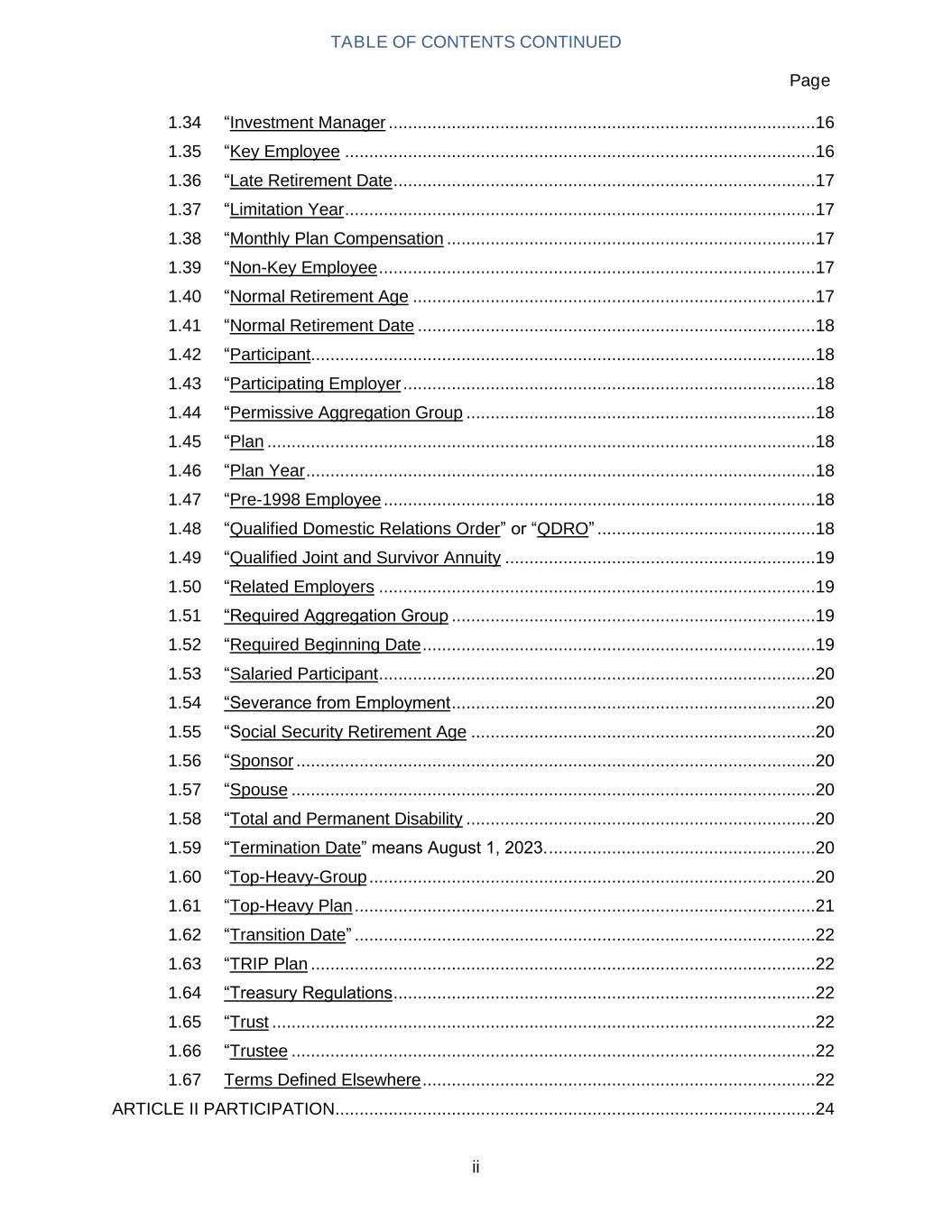
ii TABLE OF CONTENTS CONTINUED Page 1.34 “Investment Manager ........................................................................................16 1.35 “Key Employee .................................................................................................16 1.36 “Late Retirement Date .......................................................................................17 1.37 “Limitation Year .................................................................................................17 1.38 “Monthly Plan Compensation ............................................................................17 1.39 “Non-Key Employee ..........................................................................................17 1.40 “Normal Retirement Age ...................................................................................17 1.41 “Normal Retirement Date ..................................................................................18 1.42 “Participant........................................................................................................18 1.43 “Participating Employer .....................................................................................18 1.44 “Permissive Aggregation Group ........................................................................18 1.45 “Plan .................................................................................................................18 1.46 “Plan Year .........................................................................................................18 1.47 “Pre-1998 Employee .........................................................................................18 1.48 “Qualified Domestic Relations Order” or “QDRO” .............................................18 1.49 “Qualified Joint and Survivor Annuity ................................................................19 1.50 “Related Employers ..........................................................................................19 1.51 “Required Aggregation Group ...........................................................................19 1.52 “Required Beginning Date .................................................................................19 1.53 “Salaried Participant ..........................................................................................20 1.54 “Severance from Employment ...........................................................................20 1.55 “Social Security Retirement Age .......................................................................20 1.56 “Sponsor ...........................................................................................................20 1.57 “Spouse ............................................................................................................20 1.58 “Total and Permanent Disability ........................................................................20 1.59 “Termination Date” means August 1, 2023. .......................................................20 1.60 “Top-Heavy-Group ............................................................................................20 1.61 “Top-Heavy Plan ...............................................................................................21 1.62 “Transition Date” ...............................................................................................22 1.63 “TRIP Plan ........................................................................................................22 1.64 “Treasury Regulations .......................................................................................22 1.65 “Trust ................................................................................................................22 1.66 “Trustee ............................................................................................................22 1.67 Terms Defined Elsewhere .................................................................................22 ARTICLE II PARTICIPATION ...................................................................................................24
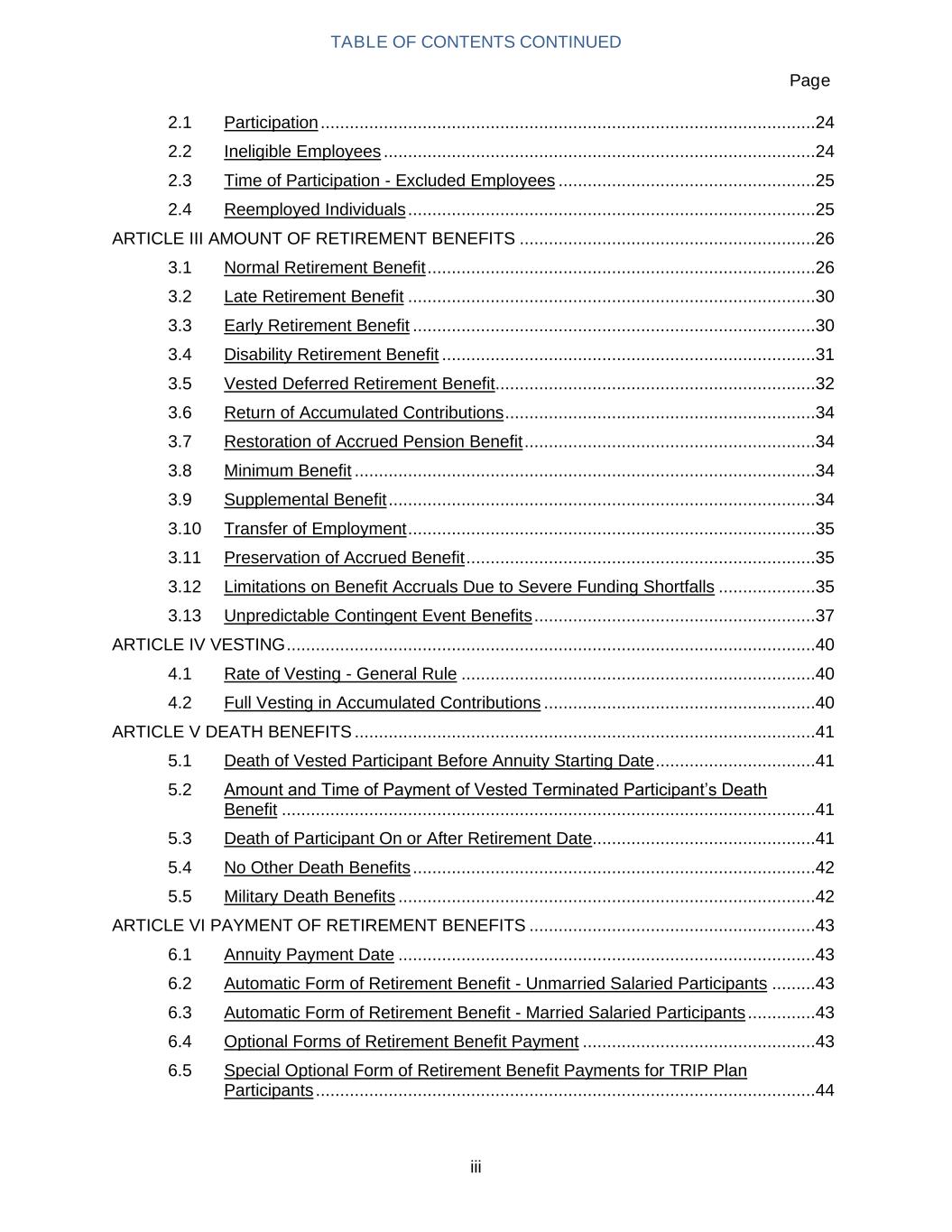
iii TABLE OF CONTENTS CONTINUED Page 2.1 Participation ......................................................................................................24 2.2 Ineligible Employees .........................................................................................24 2.3 Time of Participation - Excluded Employees .....................................................25 2.4 Reemployed Individuals ....................................................................................25 ARTICLE III AMOUNT OF RETIREMENT BENEFITS .............................................................26 3.1 Normal Retirement Benefit ................................................................................26 3.2 Late Retirement Benefit ....................................................................................30 3.3 Early Retirement Benefit ...................................................................................30 3.4 Disability Retirement Benefit .............................................................................31 3.5 Vested Deferred Retirement Benefit..................................................................32 3.6 Return of Accumulated Contributions ................................................................34 3.7 Restoration of Accrued Pension Benefit ............................................................34 3.8 Minimum Benefit ...............................................................................................34 3.9 Supplemental Benefit ........................................................................................34 3.10 Transfer of Employment ....................................................................................35 3.11 Preservation of Accrued Benefit ........................................................................35 3.12 Limitations on Benefit Accruals Due to Severe Funding Shortfalls ....................35 3.13 Unpredictable Contingent Event Benefits ..........................................................37 ARTICLE IV VESTING .............................................................................................................40 4.1 Rate of Vesting - General Rule .........................................................................40 4.2 Full Vesting in Accumulated Contributions ........................................................40 ARTICLE V DEATH BENEFITS ...............................................................................................41 5.1 Death of Vested Participant Before Annuity Starting Date .................................41 5.2 Amount and Time of Payment of Vested Terminated Participant’s Death Benefit ..............................................................................................................41 5.3 Death of Participant On or After Retirement Date..............................................41 5.4 No Other Death Benefits ...................................................................................42 5.5 Military Death Benefits ......................................................................................42 ARTICLE VI PAYMENT OF RETIREMENT BENEFITS ...........................................................43 6.1 Annuity Payment Date ......................................................................................43 6.2 Automatic Form of Retirement Benefit - Unmarried Salaried Participants .........43 6.3 Automatic Form of Retirement Benefit - Married Salaried Participants ..............43 6.4 Optional Forms of Retirement Benefit Payment ................................................43 6.5 Special Optional Form of Retirement Benefit Payments for TRIP Plan Participants .......................................................................................................44
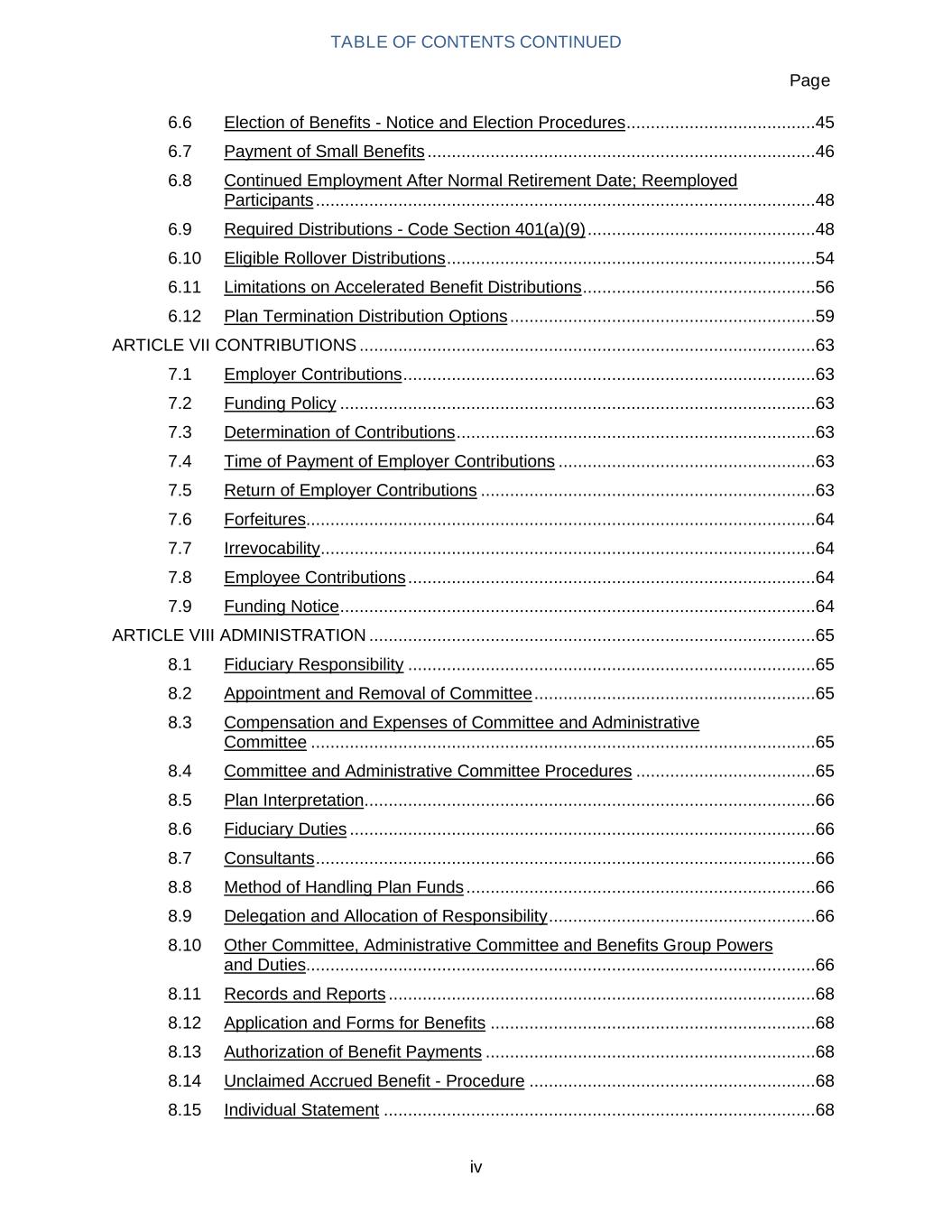
iv TABLE OF CONTENTS CONTINUED Page 6.6 Election of Benefits - Notice and Election Procedures .......................................45 6.7 Payment of Small Benefits ................................................................................46 6.8 Continued Employment After Normal Retirement Date; Reemployed Participants .......................................................................................................48 6.9 Required Distributions - Code Section 401(a)(9) ...............................................48 6.10 Eligible Rollover Distributions ............................................................................54 6.11 Limitations on Accelerated Benefit Distributions ................................................56 6.12 Plan Termination Distribution Options ...............................................................59 ARTICLE VII CONTRIBUTIONS ..............................................................................................63 7.1 Employer Contributions .....................................................................................63 7.2 Funding Policy ..................................................................................................63 7.3 Determination of Contributions ..........................................................................63 7.4 Time of Payment of Employer Contributions .....................................................63 7.5 Return of Employer Contributions .....................................................................63 7.6 Forfeitures.........................................................................................................64 7.7 Irrevocability ......................................................................................................64 7.8 Employee Contributions ....................................................................................64 7.9 Funding Notice ..................................................................................................64 ARTICLE VIII ADMINISTRATION ............................................................................................65 8.1 Fiduciary Responsibility ....................................................................................65 8.2 Appointment and Removal of Committee ..........................................................65 8.3 Compensation and Expenses of Committee and Administrative Committee ........................................................................................................65 8.4 Committee and Administrative Committee Procedures .....................................65 8.5 Plan Interpretation .............................................................................................66 8.6 Fiduciary Duties ................................................................................................66 8.7 Consultants .......................................................................................................66 8.8 Method of Handling Plan Funds ........................................................................66 8.9 Delegation and Allocation of Responsibility .......................................................66 8.10 Other Committee, Administrative Committee and Benefits Group Powers and Duties.........................................................................................................66 8.11 Records and Reports ........................................................................................68 8.12 Application and Forms for Benefits ...................................................................68 8.13 Authorization of Benefit Payments ....................................................................68 8.14 Unclaimed Accrued Benefit - Procedure ...........................................................68 8.15 Individual Statement .........................................................................................68
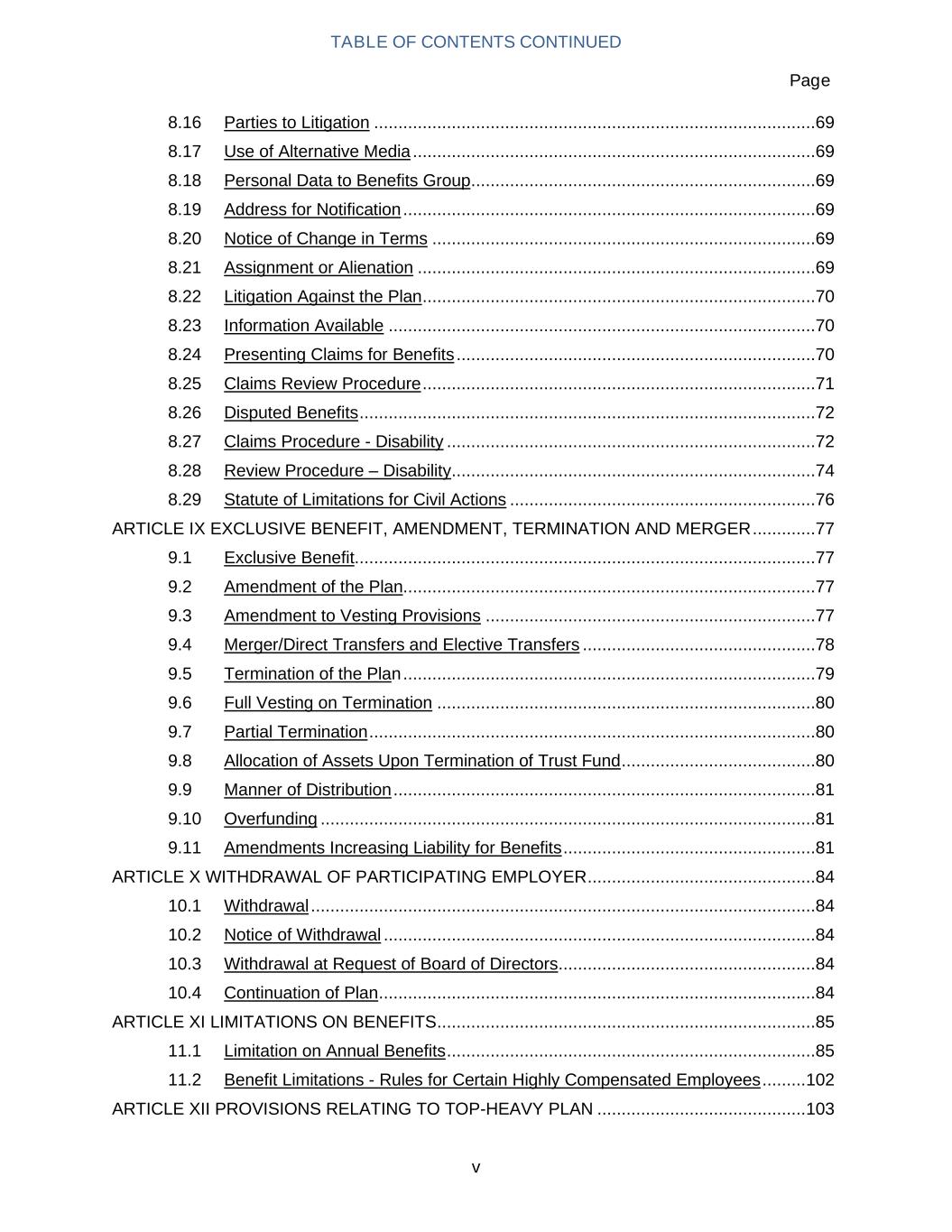
v TABLE OF CONTENTS CONTINUED Page 8.16 Parties to Litigation ...........................................................................................69 8.17 Use of Alternative Media ...................................................................................69 8.18 Personal Data to Benefits Group .......................................................................69 8.19 Address for Notification .....................................................................................69 8.20 Notice of Change in Terms ...............................................................................69 8.21 Assignment or Alienation ..................................................................................69 8.22 Litigation Against the Plan .................................................................................70 8.23 Information Available ........................................................................................70 8.24 Presenting Claims for Benefits ..........................................................................70 8.25 Claims Review Procedure .................................................................................71 8.26 Disputed Benefits ..............................................................................................72 8.27 Claims Procedure - Disability ............................................................................72 8.28 Review Procedure – Disability ...........................................................................74 8.29 Statute of Limitations for Civil Actions ...............................................................76 ARTICLE IX EXCLUSIVE BENEFIT, AMENDMENT, TERMINATION AND MERGER .............77 9.1 Exclusive Benefit...............................................................................................77 9.2 Amendment of the Plan.....................................................................................77 9.3 Amendment to Vesting Provisions ....................................................................77 9.4 Merger/Direct Transfers and Elective Transfers ................................................78 9.5 Termination of the Plan .....................................................................................79 9.6 Full Vesting on Termination ..............................................................................80 9.7 Partial Termination ............................................................................................80 9.8 Allocation of Assets Upon Termination of Trust Fund ........................................80 9.9 Manner of Distribution .......................................................................................81 9.10 Overfunding ......................................................................................................81 9.11 Amendments Increasing Liability for Benefits ....................................................81 ARTICLE X WITHDRAWAL OF PARTICIPATING EMPLOYER ...............................................84 10.1 Withdrawal ........................................................................................................84 10.2 Notice of Withdrawal .........................................................................................84 10.3 Withdrawal at Request of Board of Directors .....................................................84 10.4 Continuation of Plan ..........................................................................................84 ARTICLE XI LIMITATIONS ON BENEFITS ..............................................................................85 11.1 Limitation on Annual Benefits ............................................................................85 11.2 Benefit Limitations - Rules for Certain Highly Compensated Employees ......... 102 ARTICLE XII PROVISIONS RELATING TO TOP-HEAVY PLAN ........................................... 103
vi TABLE OF CONTENTS CONTINUED Page 12.1 Top-Heavy Requirement ................................................................................. 103 12.2 Minimum Vesting Requirement ....................................................................... 103 12.3 Minimum Benefit Requirement ........................................................................ 104 12.4 Change in Top-Heavy Status .......................................................................... 105 ARTICLE XIII VETERANS’ REEMPLOYMENT RIGHTS ........................................................ 106 13.1 USERRA ......................................................................................................... 106 13.2 Crediting Service............................................................................................. 106 13.3 Compensation ................................................................................................. 106 13.4 Qualified Military Service ................................................................................. 107 13.5 Earnings and Forfeitures ................................................................................. 107 ARTICLE XIV MISCELLANEOUS .......................................................................................... 108 14.1 Limited Purpose of Plan .................................................................................. 108 14.2 Non-alienation ................................................................................................. 108 14.3 Facility of Payment .......................................................................................... 108 14.4 Effect of Return of Benefit Checks .................................................................. 108 14.5 Impossibility of Diversion ................................................................................. 108 14.6 Unclaimed Benefits ......................................................................................... 109 14.7 Construction .................................................................................................... 109 14.8 Governing Law ................................................................................................ 109 14.9 Contingent Effectiveness of Plan Amendment and Restatement ..................... 109 APPENDIX A .................................................................................................................. A-1 APPENDIX B .................................................................................................................. B-1 APPENDIX C .................................................................................................................. C-1 APPENDIX D .................................................................................................................. D-1 APPENDIX E .................................................................................................................. E-1 APPENDIX F .................................................................................................................. F-1 APPENDIX G .................................................................................................................. G-1 APPENDIX H .................................................................................................................. H-1 APPENDIX I ................................................................................................................... I-1
1 TELEFLEX INCORPORATED RETIREMENT INCOME PLAN (As Amended and Restated Effective August 1, 2023) Teleflex Incorporated (the “Sponsor”) hereby amends the Teleflex Incorporated Retirement Income Plan, formerly known as the Teleflex Incorporated Salaried Employees’ Pension Plan (the “Plan”), to reflect and effectuate its termination, effective as of August 1, 2023 (the “Termination Date”), to comply with all tax qualification requirements effective and applicable through the Termination Date including such requirements in the Consolidated Appropriations Act, 2020, including the SECURE Act provisions, the Coronavirus, Aid, Relief and Economic Security (CARES) Act, the Consolidated Appropriations Act, 2021, and the Consolidated Appropriations Act of 2023, including the SECURE 2.0 Act of 2022, as applicable, and to make certain discretionary changes. Accordingly, the Sponsor hereby amends and restates the Plan in its entirety, generally effective as of the Termination Date, unless otherwise stated herein. To the extent any Participant, Alternate Payee or designated Beneficiary does not elect to receive a single lump sum payment in connection with the termination, as permitted under Section 6.12 of the Plan, the Plan shall make a distribution to any such Participant, Alternate Payee or designated Beneficiary in the form of a nontransferable annuity contract pursuant to Sections 6.12 and 9.9 of the Plan. All former employees and participants in a plan that is merged with and into the Plan (“Merged Plan”) whose employment or active participation in the Merged Plan terminated prior to the date of such plan’s merger into this Plan, their Spouses, Beneficiaries, and anyone else claiming through them shall, except as otherwise expressly provided to the contrary herein or in any prior Merged Plan document, have the amount of their benefit, and their right, if any, to receive such benefit determined pursuant to the terms and conditions of the applicable Merged Plan as in effect at the time of Severance from Employment or cessation of active participation. If benefit payments commenced to any such individual prior to the date such plan merged with and into this Plan, the time and manner of payment of such benefits shall, except as otherwise expressly provided to the contrary herein or in any prior Merged Plan document, be determined pursuant to the terms and conditions of the applicable Merged Plan as in effect at the time benefits commenced. BACKGROUND INFORMATION The Teleflex Incorporated Salaried Employees’ Pension Plan was originally effective as of July 1, 1966. Effective as of January 1, 1998, the Teleflex Incorporated Retirement Income Plan was merged with and into the Plan and the name of the Plan was changed to the Teleflex Incorporated Retirement Income Plan. The Plan has been routinely amended on a timely basis to comply with all applicable laws and required statutory changes and was most recently restated effective as of January 1, 2014 to comply with the requirements reflected in the 2013 Cumulative List of Changes in Plan Qualification Requirements provided in Internal Revenue Service Notice 2013-84 in connection with its submission to the Internal Revenue Service for a determination letter concerning its tax qualified status. The Sponsor established the Teleflex Incorporated Hourly Employees’ Pension Plan (“Hourly Employees’ Plan”) effective as of January 1, 1985. The Hourly Employees’ Plan was merged

2 with and into the Plan effective as of December 31, 2008. Arrow International, Inc. (“Arrow”) adopted the Retirement Plan for Salaried Employees (“Arrow Salaried Plan”) effective as of September 1, 1978. The Arrow Salaried Plan was merged with and into the Plan effective as of August 31, 2008. Arrow also adopted the Retirement Plan for Hourly-Rated Employees of the North Carolina and New Jersey Plants of Arrow International, Inc. (“Arrow Hourly Plan”), effective as of September 1, 1976. Effective as of September 1, 1997, the name of the Arrow Hourly Plan was changed to the Retirement Plan for Hourly-Rated Employees of Arrow International, Inc. The Arrow Hourly Plan was also merged with and into the Plan effective as of August 31, 2008. In addition, Arrow adopted the Retirement Plan for Hourly Rated Employees of at the Berks County, PA Locations of Arrow International, Inc. (“Arrow Berks Plan”), effective as of September 1, 1975. The Arrow Berks Plan was also merged with and into the Plan effective as of August 31, 2008. The Plan was amended effective as of March 22, 2011, by the Purchase Agreement whereby the Sponsor sold its Marine business unit to Marine Acquisition Corp. (the “Purchase Agreement”). Pursuant to the terms of the Purchase Agreement: (i) effective as of March 22, 2011, Marine assumed of all of the liabilities under the Plan with respect to certain participants specified in Section 5.4(h)(i) of the Purchase Agreement who were current or former employees of the Marine business unit (“Marine Participants”), (ii) effective as of March 22, 2011 (or such earlier date set forth in the Plan), the Marine Participants ceased to accrue any additional benefits under the Plan, and (iii) all assets in the Plan attributable to the benefits of the Marine Participants (whether or not vested) and related liabilities were required to be transferred to a defined benefit plan established by Marine as soon as practicable following Marine’s establishment of the defined benefit plan. The transfer to the Marine Acquisition Corp. Retirement Income Plan occurred on June 30, 2011, and following this transfer, no Marine Participant is entitled to a benefit from or to continue participation in, the Plan. Except as otherwise provided in Appendix H, no additional benefits accrued under the Plan after December 31, 2008. Further, no additional benefits accrued under the Plan after December 31, 2012. The Plan is terminated effective as of the Termination Date.

3 ARTICLE I DEFINITIONS The following words and phrases as used herein have the following meanings unless a different meaning is plainly required by the context: 1.1 “Accrued Benefit” means: 1.1.1 The accrued benefit of a Salaried Participant expressed in terms of a monthly single life annuity (or a single life annuity with payments guaranteed for five years for a Pre-1998 Employee) beginning at his Normal Retirement Date determined under Section 3.1, or his Late Retirement Date determined under Section 3.2, on the basis of the Participant’s Credited Service as a Participant to the date as of which the computation is made. 1.1.2 The accrued benefit of an Hourly Participant is the retirement benefit that a Participant would receive at his Normal Retirement Date based on the benefit formula set forth in the applicable Schedule to Appendix E. 1.1.3 The accrued benefit of an Arrow Salaried Participant as of any date is the amount of annual Benefit (as defined in Appendix F) earned to such date, payable as a single life annuity beginning at the Participant’s Normal Retirement Date (or immediately, if the Participant has passed his Normal Retirement Date), calculated in accordance with Section 5.1 of Appendix F. 1.1.4 The accrued benefit of an Arrow Hourly Participant as of any date is the amount of annual Benefit (as defined in Appendix G) earned to such date, payable as a single life annuity beginning at the Participant’s Normal Retirement Date (or immediately, if the Participant has passed his Normal Retirement Date), calculated in accordance with Section 5.1 of Appendix G. 1.1.5 The accrued benefit of an Arrow Berks Participant as of any date is the amount of annual Benefit earned to such date, payable as a single life annuity beginning at the Participant’s Normal Retirement Date (or immediately, if the Participant has passed his Normal Retirement Date), calculated in accordance with Section 5.1 of Appendix H. For purposes of determining whether the Plan is a Top-Heavy Plan, the Accrued Benefit of a current Employee shall be determined as if he had a Severance from Employment on the Determination Date. The actuarial assumptions used to determine the present value of Accrued Benefits for the purpose of the Top-Heavy test shall be those set forth in Appendix B for Salaried Participants and those set forth in Appendix E, F, G, or H, as applicable, for other Participants. Notwithstanding any provision of the Plan to the contrary, except as otherwise provided in an Appendix or as required by applicable law, no Participant shall accrue any additional benefit under the Plan after December 31, 2008. No Arrow Berks Participant shall accrue any additional benefit under the Plan after December 31, 2012. 1.2 “Accumulated Contributions” means the sum of a Salaried Participant’s contributions made under the Plan before July 1, 1982, or repaid pursuant to Section 3.7, and interest credited thereon up to the date benefit payments begin under the Plan. The rates of

4 interest credited upon such contributions shall be determined by the Committee, provided that the rate of interest shall not be less than 7%, compounded annually, for each Plan Year prior to January 1, 1988 and for each Plan Year thereafter, 120% of the Federal mid-term rate as in effect under Section 1274 of the Code for January of the relevant Plan Year, compounded annually. 1.3 “Actuarial Definitions” 1.3.1 “Actuarial Equivalent” or “Actuarially Equivalent”: 1.3.1.1 For Salaried Participants, shall mean the equivalent actuarial value of the automatic form of benefit for unmarried Participants, as described in Section 6.2, determined based upon the advice of the Plan’s enrolled actuary using the factors and assumptions listed in Appendix B, attached hereto and made a part hereof; 1.3.1.2 For Hourly Participants, shall have the meaning set forth in Appendix E, attached hereto and made a part hereof; 1.3.1.3 For Arrow Salaried Participants, shall have the meaning set forth in Appendix F, attached hereto and made a part hereof; 1.3.1.4 For Arrow Hourly Participants, shall have the meaning set forth in Appendix G, attached hereto and made a part hereof; and 1.3.1.5 For Arrow Berks Participants, shall have the meaning set forth in Appendix H, attached hereto and made a part hereof. 1.3.2 For purposes of determining the amount of a Participant’s lump sum distribution or the present value of a Participant’s Accrued Benefit, the “Actuarial Equivalent” of such benefit shall be calculated using the “Applicable Interest Rate” and the “Applicable Mortality Table.” 1.3.2.1 The “Applicable Interest Rate” is the adjusted first, second and third segment rates applied under rules similar to the rules of Code Section 430(h)(2)(C) (determined without regard to the 24-month averaging provided under Code Section 430(h)(2)(D)(i)) for the November preceding the first day of the Plan Year in which the date of the distribution occurs or such other time as the Secretary of the Treasury may by regulations prescribe. 1.3.2.2 The “Applicable Mortality Table” shall be the applicable Code Section 417(e)(3) mortality table. 1.4 “Administrative Committee” means the person or persons or entity appointed by the Committee or the Board of Directors from time to time to oversee the administration of the Plan. Prior to the date the Transition Date: 1.4.1 The Administrative Committee shall be the Financial Benefit Plans Committee or such other committee appointed by the Committee or the Board of Directors which shall oversee the administration of the Plan in accordance with its authority under the

5 benefit plan governance structure approved by the Compensation Committee of the Board of Directors, as amended from time to time, or any successor theretoto; and 1.4.2 The Chief Human Resources Officer and employees of the Corporate Benefits Department of the Sponsor (collectively the “Benefits Group”) have been appointed to assist in the day-to-day administration of the Plan in accordance with their authority under the benefit plan governance structure approved by the Compensation Committee of the Board of Directors, as amended from time to time. Effective on and after the Transition Date, the Administrative Committee and Benefits Group shall be the insurer(s) selected in connection with the termination of the Plan who takes over the administration of Accrued Benefits under an annuity contract purchased from such insurer(s). 1.5 “Aggregation Group” means: 1.5.1 A Required Aggregation Group, or 1.5.2 A Permissive Aggregation Group 1.6 “Annuity Starting Date” means: 1.6.1 With respect to an amount payable by the Plan as an annuity, for: 1.6.1.1 A Salaried Participant electing an Early, Normal, Late or Disability Retirement Benefit, the first day of the first month for which the retiring Salaried Participant receives an annuity payment, 1.6.1.2 The surviving Spouse or other Beneficiary of a deceased Salaried Participant who died having met the requirements for an Early, Normal, Late or Disability Retirement Benefit but who had not reached his Annuity Starting Date, the first day of the month following the date of the Salaried Participant’s death, or 1.6.1.3 The surviving Spouse of a deceased Salaried Participant who died before having reached his “Earliest Retirement Age,” as defined under Section 417 of the Code, but who had a vested interest in his Accrued Benefit under Section 4.1, the Salaried Participant’s Earliest Retirement Age. 1.6.2 In the case of any benefit not payable in the form of an annuity, the first day on which all events have occurred which entitle the Participant to such benefit, including, where applicable, an election to receive the benefit in a non-annuity form. The Annuity Starting Date for a Participant other than a Salaried Participant shall have the meaning set forth in the Appendix applicable to the Participant. 1.7 “Arrow Berks Participant” means a Participant, as defined in Appendix H, who was a Participant in the Retirement Plan for Hourly Rated Employees at the Berks County, PA Locations of Arrow International, Inc. (“Arrow Berks Plan”) prior to the merger of the Arrow Berks Plan with and into the Plan effective as of August 31, 2008 and/or who is eligible to participate in the Plan pursuant to Appendix H hereto. The Plan benefit to which an Arrow Berks Participant is entitled shall be determined in accordance with the Plan and Appendix H

6 hereto. An individual who is an Arrow Berks Participant and who ceases to be an Employee shall nonetheless remain an Arrow Berks Participant for purposes of benefit payments only, until all amounts due him from the Plan have been paid. Notwithstanding any other provision of the Plan to the contrary, no Employee shall become an Arrow Berks Participant after December 31, 2012. 1.8 “Arrow Hourly Participant” means a Participant who was a Participant in the Retirement Plan for Hourly-Rated Employees of Arrow International, Inc. (“Arrow Hourly Plan”) prior to the merger of the Arrow Hourly Plan with and into the Plan effective as of August 31, 2008 and/or who is eligible to participate in the Plan pursuant to Appendix G hereto. The Plan benefit to which an Arrow Hourly Participant is entitled shall be determined in accordance with the Plan and Appendix G hereto. An individual who is an Arrow Hourly Participant and who ceases to be an Employee shall nonetheless remain an Arrow Hourly Participant for purposes of benefit payments only, until all amounts due him from the Plan have been paid. Notwithstanding any other provision of the Plan to the contrary, no Employee whose initial date of hire by a Participating Company described in Appendix G hereto is on or after October 1, 2007, may become an Arrow Hourly Participant or accrue benefits under the Arrow Hourly Plan or Plan. 1.9 “Arrow Salaried Participant” means a Participant who was a participant in the Retirement Plan for Salaried Employees of Arrow International, Inc. (“Arrow Salaried Plan”) prior to the merger of the Arrow Salaried with and into the Plan effective as of August 31, 2008 and/or who is eligible to participate in the Plan pursuant to Appendix F hereto. The Plan benefit to which an Arrow Salaried Participant is entitled shall be determined in accordance with the Plan and Appendix F. hereto. An individual who is an Arrow Salaried Participant and who ceases to be an Employee shall nonetheless remain an Arrow Salaried Participant for purposes of benefit payments only, until all amounts due him from the Plan have been paid. Notwithstanding any other provision of the Plan to the contrary, no Employee whose initial date of hire by a Participating Company described in Appendix F hereto is on or after October 1, 2007, may become an Arrow Salaried Participant or accrue benefits under the Arrow Salaried Plan or Plan. 1.10 “Average Monthly Compensation” means the Monthly Compensation of a Salaried Participant who participated in the TRIP Plan before its merger into the Plan, averaged over the 60 consecutive months that produce the highest average during the 120 month period, or the number of months as an Employee if less than 120, ending prior to the Salaried Participant’s date of Severance from Employment, date of death, or December 31, 2008, whichever is applicable. As used in this Section 1.10, “Monthly Compensation” means the Compensation (determined under Section 1.16.1.1) paid to a Salaried Participant in a Plan Year for services rendered to the Employer divided by the number of full months that the Salaried Participant was employed during the Plan Year by the Employer, subject to the limits of Code Section 401(a)(17). Subject to Article XIII, a Salaried Participant on an approved leave of absence shall be deemed to have received remuneration during his period of absence equal to his basic rate of pay in effect immediately prior to such absence. 1.11 “Beneficiary” means: 1.11.1 The Participant’s Spouse,

7 1.11.2 The person, persons or trust designated by the Participant, with the consent of the Participant’s Spouse if the Participant is married, as direct or contingent beneficiary in a manner prescribed by the Benefits Group, or 1.11.3 If the Participant has no Spouse and has made no effective Beneficiary designation, the Participant’s estate. A married Participant may designate a person, persons or trust other than his Spouse as Beneficiary, provided that such Spouse consents in writing in a manner prescribed by the Administrative Committee. The Spouse’s consent must be witnessed by a notary public and must be limited to and acknowledge the specific non-Spouse Beneficiary(ies) (including any class of Beneficiaries) designated by the Participant. If the Participant wishes to subsequently change Beneficiary(ies), the consent of the Spouse must be obtained again. Spousal consent shall not be required if the Participant establishes to the satisfaction of the Administrative Committee that the consent cannot be obtained because the Spouse cannot be located or because of such other circumstances as the Secretary of the Treasury may prescribe by regulations. A subsequent Spouse of a Participant shall not be bound by a consent executed by any previous Spouse of the Participant. Any prior designation of a Beneficiary shall be revocable at the election of the Participant at any time in the manner and form prescribed by the Administrative Committee until the payment commencement date. The number of revocations shall not be limited. If more than one Beneficiary is designated by the Participant, such Beneficiaries who survive the Participant shall share equally in any death benefit unless the Participant indicates to the contrary, in writing. If a Beneficiary predeceases the Participant, such deceased Beneficiary shall not share in any death benefit and those Beneficiaries who survive the Participant shall share in any death benefit equally, or, if different, in the proportions designated by the Participant. A Beneficiary’s right to information or data concerning the Plan does not arise until the Beneficiary first becomes entitled to receive a benefit under the Plan. The entry of a decree of divorce shall not automatically revoke a prior written election of a Participant naming such divorced Spouse as a Beneficiary. Except as provided to the contrary under a QDRO: (i) a Participant may, subsequent to a divorce, designate someone other than his former Spouse as Beneficiary; and (ii) if a divorced Participant remarries, the new Spouse shall have all of the rights of a Spouse as set forth herein and any prior written Beneficiary designation by the Participant shall be automatically revoked and subject to the rights of the subsequent Spouse. If an Alternate Payee under a QDRO should die before payment of the benefit assigned to the Alternate Payee occurs, the portion of the Accrued Benefit assigned to the Alternate Payee shall revert to the Participant unless the QDRO permits the Alternate Payee to designate a Beneficiary and a Beneficiary has in fact been designated to whom the benefit may be paid. “Alternate Payee” means any spouse, former spouse, child, or other dependent of a Participant recognized by a QDRO as having a right to receive all, or a portion of, the Participant’s vested benefit under the Plan. 1.12 “Board of Directors” means the Board of Directors of the Sponsor or any committee thereof. 1.13 “Break-in-Service” means, with respect to Salaried Participants: 1.13.1 For the purpose of Article II, relating to eligibility to participate in the Plan, a 12 consecutive month period, measured from the date an Employee is first credited with

8 an Hour of Service or any anniversary thereof (or his reemployment commencement date or any anniversary thereof), within which the Employee is not credited with more than 500 Hours of Service; and 1.13.2 For the purpose of Article IV, relating to vesting, a Plan Year within which an individual is not credited with more than 500 Hours of Service; provided that any Break-in-Service occurring during the July 1, 1997 to December 31, 1997 Plan Year shall be disregarded. “Break-in-Service” with respect to a Participant other than a Salaried Participant shall have the meaning set forth in Appendix E, F, G, or H, as applicable to that Participant. 1.14 “Code” means the Internal Revenue Code of 1986, as amended. 1.15 “Committee” means the person, persons or entity appointed to administer the Plan. Prior to the date the Transition Date, the Committee is the Teleflex Incorporated Benefits Policy Committee or any successor thereto. Effective on and after the Transition Date, the Committee shall be the insurer(s) selected in connection with the termination of the Plan who takes over the administration of Accrued Benefits under an annuity contract purchased from such insurer(s). The Committee shall be the “administrator” and “named fiduciary” of the Plan, as those terms are defined by ERISA. 1.16 “Compensation” 1.16.1 General Rule. 1.16.1.1 Salaried Participants. Compensation means, except as otherwise provided in this Section 1.16.1.1, remuneration paid to a Salaried Participant for services rendered to the Employer. Such remuneration shall include regular or base pay, bonuses, commissions, overtime pay, shift differentials, double-time pay, adjustments, amounts paid for time missed due to holidays, vacations, personal days, jury duty, sick leave and funeral leave, short- term disability pay, payments made as a result of opting out of medical coverage, amounts deferred under a nonqualified deferred compensation plan, and Elective Contributions made by the Employer on the Salaried Participant’s behalf. “Elective Contributions” are amounts excludible from the Salaried Participant’s gross income under Code Section 402(e)(3) (relating to a Code Section 401(k) arrangement), Code Section 402(h) (relating to a Simplified Employee Pension), Code Section 125 (relating to a cafeteria plan), Code Section 403(b) (relating to a tax-sheltered annuity), and Code Section 132(f)(4) (relating to a qualified transportation fringe benefit plan). Effective January 1, 2009, if Salaried Participants’ Compensation under the Plan was not frozen effective for Plan Years beginning after 2008, Compensation would also include any differential wage payments (as defined in Code Section 3401(h)(2)) from the Employer, as required by Code Section 414(u)(12), as amended by the Heroes Earnings Assistance and Relief Tax Act of 2008 (the “HEART Act”). Compensation does not include employer contributions to benefit plans, fringe benefits, severance pay, expense reimbursements, tuition reimbursements, relocation expenses, the taxable portion of life insurance coverage, car allowances, personal use of employer aircraft, income recognized on the exercise of a stock option or the vesting of a restricted stock award, payments received while an Employee from a

9 nonqualified deferred compensation plan and any other special pay arrangements. For Plan Years beginning on and after January 1, 2002, amounts referenced under Code Section 125 include any amounts not available to a Salaried Participant in cash in lieu of group health coverage because the Salaried Participant is unable to certify that he has other health coverage. An amount will be treated as an amount under Code Section 125 only if the Employer does not request or collect information regarding the Salaried Participant’s other health coverage as part of the enrollment process for the health plan. For any self- employed individual Compensation shall mean earned income, as defined in Code Section 401(c)(2). For Plan Years beginning on and after January 1, 2008, Compensation shall include Post-Severance Compensation paid by the later of: (i) two and one-half (2½) months (or such other period as extended by subsequent Treasury Regulations or other published guidance) after Severance from Employment with the Employer; or (ii) the end of the Plan Year that includes the date of the Salaried Participant’s Severance from Employment with the Employer. “Post- Severance Compensation” means payments that would have been included in the definition of Compensation if they were paid prior to the Salaried Participant’s Severance from Employment and the payments are: (a) regular Compensation for services during the Salaried Participant’s regular working hours, Compensation for services outside the Salaried Participant’s regular working hours (such as overtime or shift differential), commissions, bonuses, or other similar compensation, if the payments would have been paid to the Salaried Participant if the Salaried Participant had continued in employment with the Employer; (b) for accrued bona fide sick, vacation or other leave, but only if the Salaried Participant would have been able to use the leave if employment had continued; or (c) received by a Salaried Participant pursuant to a nonqualified unfunded deferred compensation plan, but only if the payment would have been paid to the Salaried Participant at the same time if the Salaried Participant had continued in employment with the Employer and only to the extent the payment is includible in the Salaried Participant’s gross income. Any payments not described in the preceding sentence are not considered Post-Severance Compensation if paid after Severance from Employment, except for payments (1) to an individual who does not currently perform services for the Employer by reason of Qualified Military Service (within the meaning of Code Section 414(u)(1)) to the extent the payments do not exceed the amounts the individual would have received if the individual had continued to perform services for the Employer; or (2) to any Participant who is permanently and totally disabled for a fixed or determinable period, as determined by the Administrative Committee. For purposes of this Section 1.16.1.1, “permanently and totally disabled” means that the individual is unable to engage in any substantial gainful activity by reason of any medically determinable physical or mental impairment which can be expected to result in death or which has lasted or can be expected to last for a continuous period of not less than 12 months. Back pay, within the meaning of Treasury Regulations Section 1.415(c)-2(g)(8), shall be treated as Compensation for the Limitation Year to which the back pay
10 relates to the extent the back pay represents an amount that would otherwise be Compensation. Salaried Participants’ Compensation for Plan purposes is frozen effective December 31, 2008. 1.16.1.2 Hourly Participants. Compensation means Limitation Compensation, as defined in Appendix E. 1.16.1.3 Arrow Salaried Participants. Compensation means Average Annual Compensation, as defined in Appendix F. 1.16.1.4 Arrow Hourly Participants. Compensation means Average Annual Compensation, as defined in Appendix G. 1.16.1.5 Arrow Berks Participants. Compensation means Average Annual Compensation, as defined in Appendix H. 1.16.2 Compensation Limitation. In addition to other applicable limits set forth in the Plan, the annual Compensation of each Employee taken into account in determining benefit accruals under the Plan shall not exceed the “Compensation Limitation.” The Compensation Limitation for Plan Years beginning after December 31, 2001 is $200,000 and the Compensation Limitation for Plan Years beginning after December 31, 2011 is $250,000. The Compensation Limitation shall be adjusted for cost-of-living increases in accordance with Section 401(a)(17)(B) of the Code. The cost-of-living adjustment in effect for a calendar year applies to annual Compensation for any period, not exceeding 12 months, over which Compensation is determined (the “Determination Period”) that begins with or within such calendar year. If a Determination Period consists of fewer than 12 months, the Compensation Limitation will be multiplied by a fraction, the numerator of which is the number of months in the Determination Period and the denominator of which is 12. If Compensation in any prior Determination Period is taken into account in determining an Employee’s benefits accruing in the current Plan Year, the Compensation for that prior Determination Period is subject to the Compensation Limit in effect for that prior Determination Period. Any increase in the Compensation Limit shall not apply to former Employees. 1.17 “Continuous Service” means, with respect to Salaried Participants: 1.17.1 For periods ending before July 1, 1982, a period of employment that was Continuous Service under the terms of the Plan as in effect before July 1, 1982; and 1.17.2 For periods beginning on or after July 1, 1982, a period of employment with the Employer beginning on the first day of the month in which his date of hire occurs and ending on the date of his Break-in-Service. 1.17.3 The following rules shall also apply in determining a Salaried Participant’s Continuous Service for all purposes under the Plan, unless indicated otherwise: 1.17.3.1 If an Employee quits, retires, is discharged, or is placed on permanent layoff, and within 12 months thereafter returns to service and is credited with an Hour of Service, his Continuous Service shall be computed as though his service had not been severed;

11 1.17.3.2 If an Employee is absent from service and while so absent quits, retires, is discharged, or is placed on permanent layoff, and within 12 months after the first date upon which he is absent from service, returns to service and is credited with an Hour of Service, his Continuous Service shall be computed as though his service had not been severed; 1.17.3.3 All of an Employee’s nonsuccessive periods of service, including the period of service after a Break-in-Service if the Salaried Participant was vested in his Accrued Benefit or if the Salaried Participant has not incurred five or more consecutive Breaks in Service, shall be aggregated, and less than full years of service (whether or not consecutive) shall also be aggregated; 1.17.3.4 An Employee reemployed by the Employer in accordance with Chapter 43 of Title 38 of the United States Code, shall be treated as though he had been actively performing services for the Employer during such Employee’s period of Qualified Military Service (as defined in Section 414(u)(5) of the Code); 1.17.3.5 For purposes of determining whether or not an Employee is eligible to participate in the Plan, and whether or not benefits under the Plan are vested, years of Continuous Service shall include periods as a Leased Employee, including the one-year period on the basis of which the individual is deemed to be a Leased Employee; and 1.17.3.6 A Participant shall be not credited with any additional years of Continuous Service after December 31, 2008; provided, however, that, if a Participant experienced a Severance from Employment pursuant to the 2009 Voluntary Early Retirement Plan, the Participant was credited with two (2) additional years of Continuous Service. 1.18 “Covered Compensation” means, with respect to any Salaried Participant, the average (without indexing) of the contribution and benefit bases in effect under Section 230 of the Social Security Act for each calendar year in the 35-year period ending with the calendar year in which the Salaried Participant reaches his Social Security Retirement Age. In determining a Salaried Participant’s Covered Compensation for any Plan Year, the contribution and benefit bases in effect at the beginning of such Plan Year shall be assumed to continue in effect for all subsequent Plan Years. 1.19 “Credited Service” means, with respect to Salaried Participants: 1.19.1 For periods ending before July 1, 1982, a period of employment that was a period of Credited Service under the terms of the Plan as in effect before July 1, 1982; and 1.19.2 For periods beginning on or after July 1, 1982, the period of an Employee’s Continuous Service measured from the date he begins to participate in the Plan; provided that Credited Service shall not include periods of Continuous Service credited under Sections 1.17.3.1 and 1.17.3.2 for a period of time when a Participant was on a layoff. 1.19.3 Except as provided otherwise in Section 3.1.6, a Salaried Participant’s Credited Service under the TRIP Plan through December 31, 1997 shall count as Credited Service under this Plan.

12 1.19.4 Notwithstanding any provision of the Plan to the contrary, the following individuals shall receive no additional Credited Service for benefit accrual purposes for any period of employment after January 31, 2004, provided that service for periods of employment after such date shall continue to be credited for eligibility and vesting purposes: 1.19.4.1 Employees of Weck Surgical employed at Research Triangle Park, North Carolina; 1.19.4.2 Salaried Exempt and Salaried Non-Exempt Employees of TFX Medical employed at Jaffrey, New Hampshire; and 1.19.4.3 Sales Representatives of Pilling Surgical employed at Horsham, Pennsylvania who were hired on or after December 23, 1993 and before March 28, 1997. 1.19.5 Notwithstanding any provision of the Plan to the contrary, except as otherwise provided in Section 1.17.3.6, no Participant shall receive additional Credited Service for benefit accrual purposes for any period of employment after December 31, 2008. 1.20 “Defined Benefit Plan” means any employee pension plan maintained by the Employer that is qualified under Section 401(a) of the Code and is not a Defined Contribution Plan. 1.21 “Defined Contribution Plan” means an employee pension plan maintained by the Employer that is qualified under Section 401(a) of the Code and provides for an individual account for each Participant and for benefits based solely on the amount contributed to the Participant’s account, and any income, expenses, gains and losses, and any forfeitures from accounts of other Participants that may be allocated to such Participant’s account. 1.22 “Determination Date” means: 1.22.1 If the Plan is not included in an Aggregation Group, the last day of the preceding Plan Year; or 1.22.2 If the Plan is included in an Aggregation Group, the Determination Date as determined under Section 1.22.1 that falls within the same calendar year of each other plan included in such Aggregation Group. 1.23 “Early Retirement Date” means the last day of any month coincident with or following a Salaried Participant’s reaching age 60, but not age 65, and after he has been credited with 10 years of Continuous Service. If a Salaried Participant experienced a Severance from Employment pursuant to the 2009 Voluntary Early Retirement Plan, the Participant was credited with two (2) additional years of age and the requirement that the Salaried Participant be credited with 10 years of Continuous Service in order to reach an Early Retirement Date is not applicable. The Early Retirement Date, if applicable, for an Hourly Participant, Arrow Salaried Participant, Arrow Hourly Participant, or an Arrow Berks Participant is set forth in Appendix E, F, G, or H hereto, respectively. 1.24 “Effective Date” means August 1, 2023, except where otherwise provided herein or as required by applicable legislation. The original effective date of the Plan was July 1, 1966.

13 With respect to any Participating Employer adopting the Plan after the Effective Date, the Effective Date shall be the date of adoption unless another date is specified. 1.25 “Employee” means, except as otherwise defined in an Appendix hereto: 1.25.1 An individual who is employed by the Employer and whose earnings are reported on a Form W-2; 1.25.2 An individual who is not employed by an Employer but is required to be treated as a Leased Employee (as defined in Section 2.2.5); provided that if the total number of Leased Employees constitutes 20% or less of the Employer’s non-highly compensated work force, within the meaning of Section 414(a)(5)(c)(ii) of the Code, the term “Employee” shall not include those Leased Employees covered by a “safe harbor” plan described in Section 414(n)(5)(i) of the Code; and 1.25.3 When required by context under Section 1.32 for purposes of crediting Hours of Service, a former Employee. The term “Employee” shall not include any individual providing services to an Employer as an independent contractor. An individual excluded from participation by reason of independent contractor or Leased Employee status, if determined by the Employer, a court, a governmental agency, or in accordance with law to be a common law employee of the Employer, shall be recharacterized as an Employee under the Plan as of the date of such determination, unless an earlier date is necessary to preserve the tax qualified status of the Plan. Notwithstanding such general recharacterization, such person shall not be considered an eligible Employee for purposes of Plan participation, except and to the extent necessary to preserve the tax qualified status of the Plan. Effective January 1, 2009, to the extent the Plan is not frozen, any individual in Qualified Military Service (as defined in Code Section 414(u)) who is receiving differential wage payments (as defined in Code Section 3401(h)(2)) from the Employer shall be treated as an “Employee” of the Employer solely for purposes of providing contributions, benefits and service credit with respect to such Qualified Military Service, as applicable. Notwithstanding the foregoing, except as otherwise provided in an applicable Appendix or required by applicable law, nothing in this provision shall be interpreted to require any benefit accruals under this Plan for Salaried Participants, Hourly Participants, Arrow Salaried Participants or Arrow Hourly Participants after December 31, 2008 or any additional benefit accruals under the Plan for Arrow Berks Participants after December 31, 2012. 1.26 “Employer” means the Sponsor and Participating Employers. If the Employer is a member of a group of Related Employers, the term “Employer” includes the Related Employers for purposes of crediting Hours of Service, applying the participation test of Code Section 401(a)(26) and the coverage test of Code Section 410(b), determining Years of Service and Breaks in Service, applying the limitations of Section 11.1, applying the Top Heavy rules of Article XII, the definitions of Employee, Highly Compensated Employee, Leased Employee and Severance from Employment, and for any other purpose as required by the Code or by the Plan. However, only the Sponsor and Participating Employers may contribute to the Plan and only eligible Employees employed by the Sponsor or a Participating Employer are eligible to participate in this Plan. Unless otherwise provided, service with a Related Employer prior to the date that it either adopted the Plan or became a Related Employer shall not be counted for any purpose under the Plan.

14 1.27 “ERISA” means the Employee Retirement Income Security Act of 1974, as amended. 1.28 “Five-Percent Owner” means any Employee who owns (or is considered as owning within the meaning of Section 318 of the Code) more than 5% of the outstanding stock of the Employer, or stock possessing more than 5% of the total combined voting power of all stock of any Employer. For purposes of this Section 1.28, Section 318(a)(2)(C) of the Code shall be applied by substituting “5%” for “50%” each time it appears therein. 1.29 “Former Key Employee” means an Employee who is a Non-Key Employee with respect to the Plan for the Plan Year if such Employee was a Key Employee with respect to the Plan for any prior Plan Year. 1.30 “Fund” means the assets and all income, gains and losses thereon held by the Trustee under the trust agreement for the exclusive benefit of Participants, their surviving Spouses, and their Beneficiaries. 1.31 “Highly Compensated Employee” means any Employee who: 1.31.1 Was a Five-Percent Owner at any time during the Plan Year or the preceding Plan Year; or 1.31.2 For the preceding Plan Year: 1.31.2.1 Received more than $85,000 ($135,000 for the Plan Year beginning January 1, 2023) in Compensation from the Employer (or such higher amount as adjusted pursuant to Code Section 414(q)(1)); and 1.31.2.2 If the Employer elects, was in the top-paid group of employees (within the meaning of Code Section 414(q)(4)) for such preceding year. Highly Compensated Employees also include highly compensated former Employees. A highly compensated former Employee includes any Employee who has had a Severance from Employment (or was deemed to have a Severance from Employment) prior to the current or preceding Plan Year, performs no Service for the Employer during such Plan Year, and was a highly compensated active Employee for either the severance year or any Plan Year ending on or after the Employee’s 55th birthday in accordance with the rules for determining Highly Compensated Employee status in effect for that determination year and in accordance with applicable Treasury Regulations and Internal Revenue Service Notice 97-45. For purposes of this Section, “Compensation” means Compensation as defined in Section 11.1.1.2, and Related Employers shall be treated as a single employer with the Employer. The determination of who is a Highly Compensated Employee shall be made in accordance with Code Section 414(q) and the Treasury Regulations promulgated thereunder. 1.32 “Hour of Service” means, except as otherwise set forth in an Appendix hereto, with respect to employment with the Employer: 1.32.1 Each hour for which the Employer, either directly or indirectly, pays an Employee, or for which the Employee is entitled to payment for the performance of duties for the

15 Employer. The Plan shall credit Hours of Service under this Section 1.32.1 to the Employee for the computation period in which the Employee performs the duties, irrespective of when paid; 1.32.2 Each hour for which the Employer, either directly or indirectly, pays an Employee, or for which the Employee is entitled to payment (irrespectively of whether the employment relationship is terminated), for reasons other than the performance of duties during a computation period, such as leaves of absence, vacation, holiday, sick leave, illness, incapacity (including disability), layoff, jury duty or military duty. There shall be excluded from the foregoing those periods during which payments are made or due under a plan maintained solely for the purpose of complying with applicable workers’ compensation, unemployment compensation, or disability insurance laws. An Hour of Service shall not be credited where an employee is being reimbursed solely for medical or medically related expenses. The Plan shall not credit more than 501 Hours of Service under this Section 1.32.2 to an Employee on account of any single continuous period during which the Employee does not perform any duties (whether or not such period occurs during a single computation period). The Plan shall credit Hours of Service under this Section 1.32.2 in accordance with the rules of paragraphs (b) and (c) of Department of Labor Regulations Section 2530.200b-2, which the Plan, by this reference, specifically incorporates in full within this Section 1.32.2; and 1.32.3 Each hour for back pay, irrespective of mitigation of damages, to which the Employer has agreed or for which the Employee has received an award. The Plan shall credit Hours of Service under this Section 1.32.3 to the Employee for the computation period(s) to which the award or the agreement pertains rather than for the computation period in which the award, agreement or payment is made. The Plan shall not credit an Hour of Service under more than one of the above subsections of Section 1.32. A computation period for purposes of this Section 1.32 is the Plan Year, Continuous Service period, Break-in-Service period or other period, as determined under the Plan provision for which the Plan is measuring an Employee’s Hours of Service. The Benefits Group will resolve any ambiguity with respect to the crediting of an Hour of Service in favor of the Employee. Except as otherwise provided in an Appendix to the Plan, the Plan shall credit every Employee with Hours of Service on the basis of the “actual” method; provided that with respect to an Employee for whom hours of employment are not normally recorded, the Plan may, in accordance with rules applied in a uniform and nondiscriminatory manner, elect to credit Hours of Service using one or more of the following equivalencies: Basis upon Which Records Are Maintained Credit Granted to Individual For Period Shift actual hours for full shift Day 10 Hours of Service Week 45 Hours of Service Semi-monthly period 95 Hours of Service Month 190 Hours of Service
16 For purposes of this Plan, the “actual” method means the determination of Hours of Service from records of hours worked and hours for which the Employer makes payment or for which payment is due from the Employer. Hours of Service will be credited for employment with other members of a group of Related Employers of which the Employer is a member. Hours of Service will also be credited for any individual considered an Employee for purposes of this Plan to the extent required under Code Sections 414(n) or 414(o) and the Treasury Regulations promulgated thereunder. Solely for purposes of determining whether the Employee incurs a Break-in-Service under any provision of this Plan, the Plan shall credit Hours of Service during an Employee’s unpaid absence period due to maternity or paternity leave in accordance with this paragraph. The Plan shall consider an Employee on maternity or paternity leave if the Employee’s absence is due to the Employee’s pregnancy, the birth of the Employee’s child, the placement with the Employee of an adopted child, or the care of the Employee’s child immediately following the child’s birth or placement. The Plan shall credit only the number of Hours of Service (up to five hundred one (501) Hours of Service) necessary to prevent an Employee’s Break-in-Service. The Plan shall credit all Hours of Service described in this paragraph to the computation period in which the absence period begins or, if the Employee does not need these Hours of Service to prevent a Break-in-Service in the computation period in which his absence period begins, the Plan shall credit these Hours of Service to the immediately following computation period. Further, if required by the Family and Medical Leave Act, time on a leave of absence, whether or not paid, shall count in determining service and Hours of Service. 1.33 “Hourly Participant” means a Participant who was a participant in the Teleflex Incorporated Hourly Employees’ Pension Plan (“Hourly Employees’ Plan”) prior to the merger of the Hourly Employees’ Plan with and into the Plan effective as of December 31, 2008 and/or who is eligible to participate in the Plan pursuant to Appendix E hereto. The Plan benefit to which an Hourly Participant is entitled shall be determined in accordance with the Plan and Appendix E hereto. An individual who is an Hourly Participant and who ceases to be an Employee shall nonetheless remain an Hourly Participant for purposes of benefit payments only, until all amounts due him from the Plan have been paid. Notwithstanding any other provision of the Plan to the contrary, no Employee whose initial date of hire is on or after January 1, 2006 (July 1, 2006 with respect to an Employee who is a member of UAW Local 644 (Marine - Limerick, PA) and who is covered by a collective bargaining agreement between the Employer and UAW Local 644), may become an Hourly Participant or accrue benefits under the Hourly Employees’ Plan or Plan. Except as otherwise provided in Appendix E, no Hourly Participant shall accrue an additional benefit under the Plan after December 31, 2008. 1.34 “Investment Manager” means a person or organization who is appointed to direct the investment of all or part of the Fund, and who is either registered in good standing as an Investment Adviser under the Investment Advisers Act of 1940, a bank (as defined in the Investment Advisers Act of 1940), or an insurance company qualified to perform investment management services under the laws of more than one state of the United States, and who has acknowledged in writing that he or it is a fiduciary with respect to the Plan. 1.35 “Key Employee” means any Employee or former Employee (whether living or deceased) who, at any time during the Plan Year that includes the Determination Date, is (or was):

17 1.35.1 An officer of the Employer having annual compensation greater than $215,000 (as adjusted under Section 416(i)(1) of the Code for Plan Years beginning after January 1, 2023); 1.35.2 A Five-Percent Owner; or 1.35.3 A one-percent owner of the Employer having annual compensation of more than $150,000. For this purpose, annual compensation means compensation within the meaning of Section 415(c)(3) of the Code. The determination of who is a Key Employee shall be made in accordance with Section 416(i)(1) of the Code and applicable Treasury Regulations and other guidance of general applicability issued thereunder. For purposes of determining ownership in the Employer under this Section, the employer aggregation rules of Sections 414(b), 414(c) and 414(m) of the Code shall not apply. 1.36 “Late Retirement Date” means the actual date of the Participant’s Severance from Employment after the Participant’s Normal Retirement Date or the day on which a Participant elects to commence receipt of his Plan benefit for any other reason after his Normal Retirement Date, but not later than the Participant’s Required Beginning Date. 1.37 “Limitation Year” means the Plan Year. 1.38 “Monthly Plan Compensation” means, prior to January 1, 1998, a Salaried Participant’s monthly rate of base earnings for each Plan Year effective as of the May 1 preceding the beginning of such Plan Year, including amounts the Salaried Participant elects to have his Employer or an Employer that is not a Related Employer contribute to a cash or deferred arrangement, but excluding overtime pay, bonuses, employer contributions to or payments under this or any other employee benefit plan to which the Employer contributes, and like forms of additional compensation; provided, however, that if a Salaried Participant is compensated at a weekly rate, his monthly rate shall be deemed to be 4-1/3 times his weekly rate. A Salaried Participant’s rate of base earnings on any May 1 during a period of absence that does not interrupt his Continuous Service or Credited Service shall be deemed to be equal to his rate as of the May 1 next preceding the beginning of such period of absence. Effective January 1, 1998, Monthly Plan Compensation means the Compensation paid to a Salaried Participant in a Plan Year for services rendered to an Employer divided by the number of full months that the Salaried Participant was employed during the Plan Year by the Employer, subject to the limits of Section 401(a)(17) of the Code. Notwithstanding the foregoing, no Monthly Plan Compensation after December 31, 2008, shall be taken into account in determining a Salaried Participant’s Accrued Benefit. 1.39 “Non-Key Employee” means a Participant in the Plan (including a Beneficiary of such Participant) who is not a Key Employee with respect to the Plan for the Plan Year. 1.40 “Normal Retirement Age” means, except as otherwise provided in an Appendix hereto, age 65. Notwithstanding the foregoing, the Normal Retirement Age of a Salaried Participant who is employed by an Employer as a pilot shall be age 60. If a Participant experienced a Severance from Employment pursuant to the 2009 Voluntary Early Retirement Plan, the Participant was credited with two (2) additional years of age for all Plan purposes.

18 1.41 “Normal Retirement Date” means, except as otherwise provided in an Appendix hereto, the last day of the month in which a Participant reaches Normal Retirement Age. 1.42 “Participant” means a Salaried Participant, Hourly Participant, Arrow Salaried Participant, Arrow Hourly Participant, and an Arrow Berks Participant. 1.43 “Participating Employer” means any subsidiary or affiliated organization of the Sponsor electing to participate in the Plan with the consent of the Committee. A list of such Participating Employers applicable to Salaried Participants is set forth in Appendix A, attached hereto and made a part hereof, as it may be updated from time to time. 1.44 “Permissive Aggregation Group” means: 1.44.1 Each plan of the Employer included in a Required Aggregation Group; and 1.44.2 Each other plan of the Employer if the group of plans consisting of such plan and the plan or plans described in Section 1.44.1, when considered as a single plan, meets the requirements of Sections 401(a)(4) and 410 of the Code. 1.45 “Plan” means the Teleflex Incorporated Retirement Income Plan as set forth in this document and the related trust agreement pursuant to which the Trust is maintained. 1.46 “Plan Year” means the 12-month period ending each December 31. 1.47 “Pre-1998 Employee” means an individual who was an Employee on December 31, 1997 and was either a Salaried Participant on such date or who was eligible on such date to become a Salaried Participant once the requirements of Section 2.1 were met. 1.48 “Qualified Domestic Relations Order” or “QDRO” means a judgment, decree or order (including approval of a property settlement agreement) made pursuant to a state domestic relations law (including community property law) or, effective January 1, 2023, issued by or under the laws of an Indian tribal government, a subdivision of such an Indian tribal government, or an agency or instrumentality of either, which relates to the provision of child support, alimony payments, or marital property rights to an Alternate Payee and which: 1.48.1 Creates or recognizes the existence of an Alternate Payee’s right to, or assigns to an Alternate Payee the right to, receive all or a portion of the benefits payable to a Participant under this Plan; 1.48.2 Specifies: (i) the name and last known mailing address (if any) of the Participant and each Alternate Payee covered by the order; (ii) the amount or percentage of the Participant’s Plan benefits to be paid to any Alternate Payee, or the manner in which such amount or percentage is to be determined; (iii) the number of payments or the period to which the order applies; (iv) each plan to which the order relates; and (v) any other information as required under Code Section 414(p); and 1.48.3 Does not require the Plan to: 1.48.3.1 Provide any type or form of benefit or any option not otherwise provided under the Plan;
19 1.48.3.2 Pay benefits to any Alternate Payee prior to the earliest age that the affected Participant could have received payment of his or her Accrued Benefit under the Plan (whether for reasons of disability or other termination of employment), except that the fact that the Participant may not have terminated his or her employment shall be disregarded; 1.48.3.3 Provide increased benefits (determined on the basis of actuarial value); or 1.48.3.4 Pay benefits to an Alternate payee that are required to be paid to another Alternate Payee under a prior QDRO. A domestic relations order that otherwise satisfies the requirements for a QDRO will not fail to be a QDRO solely because the order is issued after, or revises, another domestic relations order or QDRO or solely because of the time at which the order is issued, including issuance after the Participant’s death. 1.49 “Qualified Joint and Survivor Annuity” means, except as otherwise provided in an Appendix hereto, an annuity for the life of the Participant followed immediately thereafter by a survivor annuity for the life of his Spouse. Except as otherwise provided in an Appendix hereto, the survivor annuity shall be 50% of the amount of the annuity payable during the joint lives of the Participant and his Spouse. The amount payable under the Qualified Joint and Survivor Annuity shall in any event be the Actuarial Equivalent of the Participant’s Accrued Benefit payable in the automatic form of benefit for an unmarried Participant (“qualified annuity” with respect to an Hourly Participant). If, pursuant to a QDRO, more than one individual is a designated Spouse, the amount of the survivor annuity payable under this Section 1.49 shall not exceed the amount that would be paid if there were only one surviving Spouse. 1.50 “Related Employers” means a controlled group of corporations (as defined in Code Section 414(b)), trades or business (whether or not incorporated) which are under common control (as defined in Code Section 414(c)), or an affiliated service group (as defined in Code Sections 414(m) and (o)). 1.51 “Required Aggregation Group” means: 1.51.1 Each plan of the Employer in which a Key Employee participated (regardless of whether such plan has been terminated) during the five Plan Years ending on the Determination Date; and 1.51.2 Each other plan of the Employer that enables any plan described in Section 1.50.1 to meet the requirements of Section 401(a)(4) or Section 410 of the Code, including any such plan terminated within the five-year period ending on the Determination Date. 1.52 “Required Beginning Date” means April 1 of the calendar year following the later of: 1.52.1 The calendar year in which the Participant reaches age 70½; or 1.52.2 The calendar year in which the Participant has a Severance from Employment; provided, that this Section 1.51.2 shall not apply in the case of a Participant who is
20 a Five-Percent Owner with respect to the Plan Year ending with the calendar year in which the Participant attains age 70½. Once distributions have begun to a Five-Percent Owner under Section 6.9, they must continue to be distributed, even if the Participant ceases to be a Five- Percent Owner in a subsequent year. 1.53 “Salaried Participant” means an Employee who has met the eligibility requirements of Article II and has begun to participate in the Plan. An individual who is a Salaried Participant and who ceases to be an Employee shall nonetheless remain a Salaried Participant for purposes of benefit payments only, until all amounts due him from the Plan have been paid. Notwithstanding any other provision of the Plan to the contrary, no Employee whose initial date of hire is on or after January 1, 2006, may become a Salaried Participant in the Plan or accrue benefits under the Plan. Further, except as otherwise provided in the Plan, no Salaried Participant shall accrue an additional benefit under the Plan after December 31, 2008. 1.54 “Severance from Employment” means an Employee’s separation from service with the Employer such that the Employee no longer has an employment relationship with the Employer. 1.55 “Social Security Retirement Age” means the age used as the retirement age under Section 216(l) of the Social Security Act, except that such Section shall be applied without regard to the age increase factor, and as if the early retirement age under Section 216(l)(2) of such Act were 62. 1.56 “Sponsor” means Teleflex Incorporated. 1.57 “Spouse” means, except as otherwise provided in an Appendix hereto, a Participant’s lawful spouse at his Annuity Starting Date or Required Beginning Date or, if earlier, his date of death; provided that a former Spouse shall be treated as the Spouse or surviving Spouse to the extent provided under a QDRO. To the extent that the Plan treats a former Spouse of a Participant as the Spouse of such Participant for purposes of Sections 401(a)(11) and 417 of the Code pursuant to a QDRO, the actual Spouse of such Participant shall not be treated as the Spouse of such Participant for such purposes. For purposes of clarification and not limitation, effective as of June 26, 2013, the Participant’s lawful spouse shall be determined under the law of the State or foreign jurisdiction where the Participant and spouse were married. 1.58 “Total and Permanent Disability” means, except as otherwise provided in an Appendix hereto, a medically determinable disability of a permanent nature such that the Participant is entitled to and receiving disability benefits under the Social Security Act or under the Employer’s long-term salary continuation program. Notwithstanding any other provision of the Plan to the contrary, no Participant shall be deemed to have a Total and Permanent Disability or determined to be Totally and Permanently Disabled for purposes of the Plan after the Termination Date. 1.59 “Termination Date” means August 1, 2023. 1.60 “Top-Heavy-Group” means an Aggregation Group in which, as of the Determination Date, the sum of: 1.60.1 The aggregate of the account balances of Key Employees under all Defined Contribution Plans included in such Aggregation Group; and
21 1.60.2 The aggregate of the present value of cumulative accrued benefits for Key Employees under all Defined Benefit Plans included in such Aggregation Group, exceeds 60% of the sum of such aggregates determined for all Employees. 1.61 “Top-Heavy Plan” means, for a Plan Year, the Plan if the Top Heavy ratio as of the Determination Date exceeds 60%. The Top Heavy ratio is a fraction, the numerator of which is the sum of the present value of Accrued Benefits of all Key Employees as of the Determination Date and the contributions due as of the Determination Date, and the denominator of which is a similar sum determined for all Employees. The Administrative Committee shall calculate the Top Heavy ratio without regard to the Accrued Benefit of any Non-Key Employee who was formerly a Key Employee. The Administrative Committee shall calculate the Top Heavy ratio by disregarding the Accrued Benefit (including distributions, if any, of the Accrued Benefit) of an individual who has not received credit for at least one Hour of Service with an Employer during the one-year period ending on the Determination Date in such calculation. In addition, the Administrative Committee shall calculate the Top Heavy ratio by including any part of any Accrued Benefit distributed by reason of Severance from Employment, death or Total and Permanent Disability (Disability with respect to Hourly Participants) in the one-year period ending on the Determination Date and, for all other events, the five-year period ending on the Determination Date. The Administrative Committee shall determine the present value of Accrued Benefits as of the most recent valuation date for computing minimum funding costs falling within the twelve month period ending on the Determination Date, whether or not the actuary performs a valuation that year, except as Code Section 416 and the Treasury Regulations require for the first and second Plan Year of the Plan. The Administrative Committee shall calculate the Top Heavy ratio, including the extent to which it must take into account distributions, rollovers, and transfers, in accordance with Code Section 416 and the Treasury Regulations thereunder. If the Employer maintains other qualified plans (including a simplified employee pension plan), the Plan is Top Heavy only if it is part of the Required Aggregation Group, and the Top Heavy ratio for both the Required Aggregation Group and the Permissive Aggregation Group exceeds 60%. The Administrative Committee shall calculate the Top Heavy ratio in the same manner as required by the first paragraph of this Section, taking into account all plans within the Aggregation Group. To the extent the Administrative Committee must take into account distributions to a Participant, the Administrative Committee shall include distributions from a terminated plan that would have been part of the Required Aggregation Group if it were in existence on the Determination Date. The Administrative Committee shall calculate the present value of accrued benefits and the other amounts the Administrative Committee must take into account under qualified plans included within the group in accordance with the terms of those plans, Code Section 416 and the Treasury Regulations thereunder. If an aggregated plan does not have a valuation date coinciding with the Determination Date, the Administrative Committee shall value the accrued benefits or accounts in the aggregated plan as of the most recent valuation date falling within the twelve-month period ending on the Determination Date except as required by Code Section 416 and applicable Treasury Regulations. The Administrative Committee shall calculate the Top Heavy ratio with reference to the Determination Dates that fall within the same calendar year. The accrued benefit of a Participant other than a Key Employee shall be determined under the method, if any, that uniformly applies for accrual purposes under all defined benefit plans maintained by the Employer; or if there is no such method, then as if such benefit accrued not
22 more rapidly than the slowest accrual rate permitted under the fractional rule of Code Section 411(b)(1)(C). For purposes of valuing Accrued Benefits under the Plan and accrued benefits under any other defined benefit plan taken into account in the Top Heavy ratio, the Administrative Committee shall use the actuarial assumptions stated in Section 1.3. 1.62 “Transition Date” means the date the insurer(s) selected in connection with the termination of the Plan takes over the administration of Accrued Benefits under an annuity contract purchased from such insurer(s). 1.63 “TRIP Plan” means the plan formerly known as the “Teleflex Incorporated Retirement Income Plan,” that was merged into the Plan effective January 1, 1998. 1.64 “Treasury Regulations” means regulations promulgated under the Code by the Secretary of the Treasury, as amended from time to time. 1.65 “Trust” means the legal entity created by the trust agreement between the Sponsor and the Trustee, fixing the rights and liabilities with respect to controlling and managing the Fund for the purposes of the Plan. 1.66 “Trustee” means the trustee or any successor trustee or trustees hereafter designated by the Committee and named in the trust agreement or any amendment thereto. 1.67 Terms Defined Elsewhere. Adjusted funding target attainment percentage or AFTAP ................................... Section 3.12.5.1 Alternate Payee ........................................................................................................ Section 1.11 Annual Benefit..................................................................................................... Section 11.1.1.1 Appropriate Integration Level ................................................................................... Section 3.1.4 Benefits Group ........................................................................................................ Section 1.4.2 Claimant.................................................................................................................... Section 8.24 Compensation ..................................................................................................... Section 11.1.1.2 Defined Benefit Plan ........................................................................................... Section 11.1.1.3 Defined Contribution Plan ................................................................................... Section 11.1.1.4 Direct Rollover .................................................................................................... Section 6.10.2.4 Distributee ........................................................................................................... Section 6.10.2.3 Distribution Calendar Year .................................................................................... Section 6.9.1.2 Early Retirement Benefit ............................................................................................. Section 3.3 Elective Transfer ......................................................................................................... Section 9.4 Eligible Cost-of Living Index ............................................................................ Section 6.9.1.1.5.1 Eligible Retirement Plan ...................................................................................... Section 6.10.2.2 Eligible Rollover Distribution ................................................................................ Section 6.10.2.1 Employer ............................................................................................................. Section 11.1.1.5 High Three-Year Average Compensation............................................................ Section 11.1.1.6 Late Retirement Benefit .............................................................................................. Section 3.2 Limitation Year .................................................................................................... Section 11.1.1.7 Normal Retirement Benefit .......................................................................................... Section 3.1 PBGC Maximum Benefit Guarantee Amount ...................................................... Section 6.11.7.1 Predecessor Employer ........................................................................................ Section 11.1.1.8 Post-Severance Compensation ............................. Sections 1.16.1.1, 11.1.1.2.1.5 and 11.1.1.2.5
23 Prohibited Payment ............................................................................................. Section 6.11.7.2 Projected Annual Benefit ..................................................................................... Section 11.1.1.9 Qualified Optional Survivor Annuity .......................................................................... Section 6.4.4 Section 436 Measurement Date .......................................................................... Section 3.12.5.2 Termination Distribution Options ......................................................................... Section 6.12.4.1 Termination Election Period ................................................................................... Section 6.12.3 Transfer Account ......................................................................................................... Section 9.4 Unpredictable Contingent Event ................................................................................ Section 3.13 Unpredictable Contingent Event Benefit .................................................................... Section 3.13 Unrestricted Portion of the Benefit....................................................................... Section 6.11.7.3 Year of Top Heavy Service ....................................................................................... Section 12.3 Years of Service ................................................................................................ Section 11.1.1.10

24 ARTICLE II PARTICIPATION The provisions of this Article II apply only with respect to Employees of an Employer who are eligible to become Salaried Participants. The eligibility and participation provisions applicable to other Employees are set forth in Appendix E, F, G, or H hereto, as applicable. 2.1 Participation. 2.1.1 Prior to January 1, 2004, except as provided in Section 2.2, each eligible Employee shall become a Salaried Participant in the Plan as of the first day of the Plan Year coincident with or immediately following the day he is first credited with six months of Continuous Service and has reached age 20½. Except as provided in Section 2.2, each eligible Employee whose initial date of hire is on or after January 1, 2004 but prior to January 1, 2006, shall become a Salaried Participant in the Plan as of the earlier of (i) the first day of January or (ii) the first day of July coincident with or immediately following the day he is first credited with six months of Continuous Service and has reached age 21. In no event will an Employee whose initial date of hire occurs on or after January 1, 2006, become a Salaried Participant in the Plan. 2.1.2 Notwithstanding any provision of the Plan to the contrary, after January 31, 2004, no Employee of Weck Surgical employed at Research Triangle Park, North Carolina, no Salaried Exempt and no Salaried Non-Exempt Employee of TFX Medical employed at Jaffrey, New Hampshire, and no sales representative of Pilling Surgical employed at Horsham, Pennsylvania shall become a new Salaried Participant in the Plan. 2.1.3 A Salaried Participant shall cease his participation in the Plan at such time as he no longer has any right to benefits under the Plan. 2.2 Ineligible Employees. The following individuals shall be ineligible to become a Salaried Participant in the Plan: 2.2.1 An Employee who is employed by an entity that is not an Employer; 2.2.2 An Employee of an Employer who does not work at the locations listed in Appendix A; 2.2.3 Except as to an Employee at a location listed in Appendix A where hourly paid Employees are eligible to participate, an Employee other than individual who is employed by the Employer on a salaried basis or who is classified as a salaried Employee of the Employer; 2.2.4 An Employee who is a member of a unit of Employees as to which there is evidence that retirement benefits were the subject of good faith collective bargaining, unless a collective bargaining agreement covering those Employees provides for their participation in the Plan; 2.2.5 An Employee who is a Leased Employees, defined as any person who is not an Employee and who provides services to the Employer if: (i) such services are provided

25 pursuant to an agreement between the Employer and any other person or entity; (ii) such person has performed services for the Employer on a substantially full-time basis for a period of at least one year; and (iii) such services are performed under the primary direction or control of the Employer; 2.2.6 An Employee who is a non-resident alien and who has no income from sources within the United States; 2.2.7 An individual who has been classified by an Employer as an independent contractor, notwithstanding a contrary determination by any court or governmental agency; 2.2.8 An individual who has been classified by an Employer as a per diem employee, intern or special project employee; 2.2.9 An Employee who is a member of a class of Employees who are excluded from participation in the Plan, as specified in Appendix A; 2.2.10 An Employee who has agreed in writing that he is not entitled to participate in the Plan; 2.2.11 An Employee whose terms and conditions of employment do not provide for participation in or entitlement to benefits under the Plan; and 2.2.12 An Employee whose initial date of hire is on or after January 1, 2006. With the exception of the Employees listed in Section 2.2.12, the Benefits Group shall interpret the list of persons who are ineligible to participate in the Plan, as set forth above, to comply with Code Section 410(a)(1). 2.3 Time of Participation - Excluded Employees. An Employee whose initial date of hire is prior to January 1, 2006, and who otherwise would be eligible to be a Salaried Participant in the Plan, but is excluded because of the application of any provision of Section 2.2 (other than Section 2.2.12), shall become a Salaried Participant as of the first day of the month coincident with or next following the date upon which the applicable provision of Section 2.2 (other than Section 2.2.12) ceases to apply. A Salaried Participant who becomes subject to any provision of Section 2.2 (other than 2.2.12) shall cease to accrue Credited Service as of the last day of the month ending with or within which, any such provision becomes applicable. 2.4 Reemployed Individuals. A Salaried Participant who is reemployed by an Employer as an eligible Employee under Sections 2.1 and 2.2 following a Break-in-Service shall again become entitled to participate in the Plan and accrue Credited Service (prior to December 31, 2008 or such later date required by applicable law) as of the first day of the month coincident with or next following the date he is reemployed. With respect to Participants other than Salaried Participants, the provisions regarding participation following reemployment are set forth in Appendix E, F, G, or H, as applicable.
26 ARTICLE III AMOUNT OF RETIREMENT BENEFITS 3.1 Normal Retirement Benefit. A Salaried Participant who has a Severance from Employment on his Normal Retirement Date shall be entitled to a “Normal Retirement Benefit” in the amount of the greatest of (i) his Accrued Benefit calculated under Sections 3.1.1, 3.1.2, 3.1.3 and 3.1.4 as of his Normal Retirement Date, (ii) the flat rate benefit calculated under Section 3.1.5 as of his Normal Retirement Date, or (iii) the minimum benefit under Section 3.8 as of his Normal Retirement Date. Notwithstanding the foregoing, a Salaried Participant who formerly participated in the TRIP Plan and who has a Severance from Employment on or after his Normal Retirement Date shall be entitled to a “Normal Retirement Benefit” in the amount of his Accrued Benefit as calculated under Section 3.1.6. A Participant’s Normal Retirement Benefit shall be payable in accordance with Article VI and a Participant must have a Severance from Employment in order to commence receipt of his Plan benefit. The Normal Retirement Benefit of a Participant who is not a Salaried Participant shall be determined pursuant to the Appendix applicable to such Participant. Notwithstanding the preceding, except as otherwise provided in the Plan, an Appendix or required by applicable law, no Participant shall accrue any additional benefit under the Plan after December 31, 2008. Effective as of the Transition Date, Severance from Employment is no longer required to start a Normal Retirement Benefit. 3.1.1 Participation Before July 1, 1982. The Accrued Benefit for each year of participation before July 1, 1982 shall equal the sum of the amounts determined under Sections 3.1.1.1 and 3.1.1.2 below: 3.1.1.1 In the case of a Salaried Participant who was a Salaried Participant on July 1, 1979 and who made contributions to the Plan for the month of June 1979, a past service Accrued Benefit equal to the product of Section 3.1.1.1.1 and 3.1.1.1.2 below, where: 3.1.1.1.1 Is the Salaried Participant’s Credited Service on July 1, 1979, and 3.1.1.1.2 Is the sum of 3.1.1.1.2.1 and 3.1.1.1.2.2: 3.1.1.1.2.1 1% of the Salaried Participant’s Monthly Plan Compensation for the Plan Year beginning July 1, 1979, and 3.1.1.1.2.2 1% of the Salaried Participant’s Monthly Plan Compensation for the Plan Year beginning July 1, 1979 that is in excess of $550, if any; provided, however, that if the Salaried Participant’s Monthly Plan Compensation averaged over the five years immediately preceding the date of his Severance from Employment is less than his Monthly Plan Compensation for the Plan Year beginning July 1, 1979, such average shall be used in determining this portion of the Participant’s Accrued Benefit; and 3.1.1.2 A monthly pension for each Plan Year beginning with July 1, 1979 and ending on June 30, 1982, where the monthly pension for each such year shall be determined as the product of 3.1.1.2.1 and 3.1.1.2.2 below:

27 3.1.1.2.1 4.16667%, and 3.1.1.2.2 The contributions made by the Salaried Participant for each such Plan Year. 3.1.2 Participation After June 30, 1982 and Before July 1, 1989. The Accrued Benefit for each year of participation after June 30, 1982 and before July 1, 1989 shall equal the product of 3.1.2.1 and 3.1.2.2 below, where: 3.1.2.1 Is the Salaried Participant’s Credited Service for each such Plan Year, and 3.1.2.2 Is the sum of: 3.1.2.2.1 1% of the Salaried Participant’s Monthly Plan Compensation for each such Plan Year, and 3.1.2.2.2 1% of the Salaried Participant’s Monthly Plan Compensation for each such Plan Year that is in excess of $550, if any. 3.1.3 Participation After June 30, 1989 and Before January 1, 1998. The Accrued Benefit for each year of participation after June 30, 1989 and before January 1, 1998 (including the short Plan Year from July 1, 1997 through December 31, 1997) shall equal the amount determined under Section 3.1.3.1 or the amount determined under Section 3.1.3.2 below, whichever is applicable, multiplied by a fraction, the numerator of which is the number of months the Salaried Participant was an Employee eligible to accrue Credited Service and the denominator of which is 12: 3.1.3.1 In the case of a Salaried Participant whose Credited Service at the beginning of any such Plan Year is less than 35 years, an Accrued Benefit equal to the sum of 3.1.3.1.1 and 3.1.3.1.2 below: 3.1.3.1.1 1.375% of the Salaried Participant’s Monthly Plan Compensation for the Plan Year up to $880, and 3.1.3.1.2 2.000% of the Salaried Participant’s Monthly Plan Compensation for the Plan Year in excess of’ $880, if any. 3.1.3.2 In the case of a Salaried Participant whose Credited Service at the beginning of any such Plan Year is equal to 35 years or more, an Accrued Benefit equal to 1.833% of such Salaried Participant’s Monthly Plan Compensation for the Plan Year. 3.1.4 Participation After December 31, 1997. The Accrued Benefit of a Salaried Participant for each year of participation beginning after December 31, 1997 shall equal the amount determined under Section 3.1.4.1 or the amount determined under Section 3.1.4.2 below, whichever is applicable, multiplied by a fraction, the numerator of which is the number of months the Salaried Participant was an Employee eligible to accrue Credited Service and the denominator of which is 12:

28 3.1.4.1 In the case of a Salaried Participant whose Credited Service at the beginning of any such Plan Year is less than 35 years, an Accrued Benefit equal to the sum of 3.1.4.1.1 and 3.1.4.1.2 below: 3.1.4.1.1 1.375% of the Salaried Participant’s Monthly Plan Compensation for the prior Plan Year up to one-twelfth of the Appropriate Integration Level, and 3.1.4.1.2 2.000% of the Salaried Participant’s Monthly Plan Compensation for the prior Plan Year in excess of one-twelfth of the Appropriate Integration Level, if any. 3.1.4.2 In the case of a Salaried Participant whose Credited Service at the beginning of any such Plan Year is equal to 35 years or more, an Accrued Benefit equal to 1.8333% of such Salaried Participant’s Monthly Plan Compensation for the prior Plan Year. For purposes of this Section 3.1.4, the “Appropriate Integration Level” for a Salaried Participant who is a Pre-1998 Employee shall be as set forth in Appendix C. The “Appropriate Integration Level” for all other Salaried Participants shall be as set forth in Appendix D. 3.1.5 Flat Rate Benefit. In no event shall the Accrued Benefit of a Salaried Participant who commences receipt of his Plan benefit on or after his Normal Retirement Date be less than $12.00 multiplied by the Salaried Participant’s years of Credited Service on the date of the Participant’s Severance from Employment. 3.1.6 TRIP Plan Participants. 3.1.6.1 The Accrued Benefit of a Salaried Participant who formerly participated in the TRIP Plan and who was employed on December 31, 1997 by Mal Tool & Engineering, Cepco, Inc. or STS/Klock shall be the greatest of (i) the sum of the Salaried Participant’s accrued benefit under the TRIP Plan as of December 31, 1997 and the Salaried Participant’s Accrued Benefit calculated under Section 3.1.4, (ii) the flat rate benefit calculated under Section 3.1.5, or (iii) the TRIP Plan Benefit calculated under Section 3.1.6.3 below. Such a Salaried Participant’s credited service under the TRIP Plan shall not count as Credited Service under this Plan for purposes of Section 3.1.1, Section 3.1.2 or Section 3.1.3. 3.1.6.2 The Accrued Benefit of a Salaried Participant who formerly participated in the TRIP Plan who was employed on December 31, 1997 by Weck Closure Systems or Pilling-Weck Surgical Instruments shall be the greater of (i) the sum of the Salaried Participant’s accrued benefit under the TRIP Plan as of December 31, 1997 and the Salaried Participant’s accrued benefit calculated under Section 3.1.4, or (ii) the flat rate benefit calculated under Section 3.1.5. Such a Salaried Participant’s credited service under the TRIP Plan shall not count as Credited Service under this Plan for purposes of Section 3.1.1, Section 3.1.2 or Section 3.1.3.
29 3.1.6.3 A Salaried Participant’s TRIP Plan Benefit shall equal the sum of the amounts determined under 3.1.6.3.1 and 3.1.6.3.2 below, subject to 3.1.6.3.3 and 3.1.6.3.4 below: 3.1.6.3.1 1.05% of the lesser of the Salaried Participant’s Average Monthly Compensation or one-twelfth of his Covered Compensation determined on the date of his Severance from Employment, multiplied by his Credited Service to a maximum of 40 years; and 3.1.6.3.2 1.5% of the excess, if any, of the Salaried Participant’s Average Monthly Compensation over one-twelfth of his Covered Compensation determined on the date of his Severance from Employment, multiplied by his Credited Service to a maximum of 40 years. 3.1.6.3.3 For a Participant with compensation for a plan year prior to June 30, 1994 in excess of $150,000, in no event shall such Salaried Participant’s benefit determined according to Section 3.1.6.3.1 and 3.1.6.3.2 above be less than the sum of: (i) the Salaried Participant’s accrued benefit on June 30, 1994, frozen in accordance with Treasury Regulations Section 1.401(a)(4)-13; and (ii) the Salaried Participant’s accrued benefit determined using the benefit formula applicable on or after July 1, 1994, with respect to Credited Service earned on or after July 1, 1994. 3.1.6.3.4 In no event shall a Salaried Participant’s benefit determined according to Section 3.1.6.3.1 and 3.1.6.3.2 above be less than the Salaried Participant’s accrued benefit as of July 31, 1989 (June 30, 1989 for employees who met the description in Code Section 414(q)(1)(B) as of June 30, 1989) under Section 5.1 of the TRIP Plan in effect on July 31, 1989. 3.1.7 Notwithstanding any provision of the Plan to the contrary, the following individuals shall receive no additional Credited Service for benefit accrual purposes for any period of employment after January 31, 2004: 3.1.7.1 Employees of Weck Surgical employed at Research Triangle Park, North Carolina; 3.1.7.2 Salaried Exempt and Salaried Non-Exempt Employees of TFX Medical employed at Jaffrey, New Hampshire; and 3.1.7.3 Sales Representatives of Pilling Surgical employed at Horsham, Pennsylvania (formerly Fort Washington, Pennsylvania) who were hired after December 23, 1993 and before March 28, 1997. 3.1.8 Notwithstanding any provision of the Plan to the contrary, except as otherwise provided in an Appendix or required by applicable law, no individuals shall receive additional Credited Service for benefit accrual purposes for any period of employment after December 31, 2008.

30 3.2 Late Retirement Benefit. A Salaried Participant who commences receipt of his Plan benefit after his Severance from Employment and on his Late Retirement Date shall be entitled to a “Late Retirement Benefit” equal to the greater of his Accrued Benefit calculated to his Late Retirement Date, as determined under Section 3.1, or the Actuarial Equivalent of his Normal Retirement Benefit on his Late Retirement Date. Except as set forth in Section 6.8 or 6.12, a Participant must have a Severance from Employment in order to commence receipt of his Plan benefit. Effective as of the Transition Date, Severance from Employment is no longer required to start a Late Retirement Benefit. In the case of a Participant whose Late Retirement Benefit commences in a calendar year after the calendar year in which the Participant attains age 70½, the Participant’s Accrued Benefit shall be actuarially increased to take into account the period after age 70½ in which the Participant does not receive any benefits under the Plan. The actuarial increase shall be computed (using the assumptions in Section 1.3) beginning on the April 1 following the calendar year in which the Participant attains age 70½ and ending on the date benefits commence in an amount sufficient to satisfy Code Section 401(a)(9). The Trustee shall pay a Participant’s Late Retirement Benefit in accordance with Article VI. The Late Retirement Benefit of a Participant who is not a Salaried Participant, if any, shall be determined pursuant to the Appendix applicable to such Participant. 3.3 Early Retirement Benefit. 3.3.1 General Rule. The “Early Retirement Benefit” payable to a Salaried Participant who has a Severance from Employment on an Early Retirement Date shall equal his Accrued Benefit, based on the Salaried Participant’s Credited Service at his Early Retirement Date. At the Salaried Participant’s option, such retirement benefit shall be payable either beginning on his Normal Retirement Date without reduction, or beginning as of an Annuity Starting Date coincident with or subsequent to his Early Retirement Date and prior to his Normal Retirement Date. In the event the Salaried Participant elects to have payments begin before his Normal Retirement Date, the rate of the payments shall be reduced by 5/9 of 1% for each month by which his Annuity Starting Date precedes his Normal Retirement Date. The Early Retirement Benefit of a Participant who is not a Salaried Participant, if any, shall be determined pursuant to the Appendix applicable to such Participant. Effective as of the Transition Date, Severance from Employment is no longer required to start an Early Retirement Benefit. 3.3.2 Weck TRIP Plan Participants. Notwithstanding Section 3.3.1, a Salaried Participant who was employed by Weck Closure Systems or Pilling-Weck Surgical Instruments and was a participant in the TRIP Plan on December 31, 1997 and who has a Severance from Employment after attaining age 55 and being credited with 10 years of Continuous Service, may irrevocably elect to have his benefit payments begin as of the first day of any month after his Severance from Employment date and before attaining age 60. Such benefit payment shall be based on the Salaried Participant’s Accrued Benefit under the TRIP Plan as of December 31, 1997, reduced by .35% for each month that the Salaried Participant’s Annuity Starting Date precedes his Normal Retirement Date. Once a Salaried Participant making such an election attains age 60, his benefit payments will be based on the greater of (a) the amount described in the preceding sentence, and (b) the amount the Salaried Participant would have been entitled to under Section 3.3.1 had payment of his benefit commenced at age 60. If a Salaried Participant entitled to elect the commencement of payments prior to age 60 under this Section 3.3.2 does not make such an election, but does elect to have payments begin
31 between age 60 and his Normal Retirement Date, his benefit payments will be based on the greater of (a) the Salaried Participant’s Accrued Benefit under the TRIP Plan as of December 31, 1997, reduced by .35% for each month that the Salaried Participant’s Annuity Starting Date precedes his Normal Retirement Date, and (b) the amount the Salaried Participant is entitled to under Section 3.3.1. 3.3.3 Mal Tool TRIP Plan Participants. Notwithstanding Section 3.3.1, a Salaried Participant who was employed by Mal Tool & Engineering, Cepco, Inc. or STS/Klock and was a participant in the TRIP Plan on December 31, 1997 and who has a Severance from Employment after attaining age 55 and being credited with 10 Years of Continuous Service, may irrevocably elect to have his benefit payments begin as of the first day of any month after his Severance from Employment date and before attaining age 60. Such benefit payments shall be based on the Salaried Participant’s TRIP Plan Benefit, as calculated under Section 3.1.6.3, reduced by .35% for each month that the Salaried Participant’s Annuity Starting Date precedes his Normal Retirement Date. Once a Salaried Participant making such an election attains age 60, his benefit payments will be based on the greater of (a) the amount described in the preceding sentence, or (b) the amount the Salaried Participant would have been entitled to under Section 3.3.1 had payment of his benefit commenced at age 60. If a Salaried Participant entitled to elect the commencement of payments prior to age 60 under this Section 3.3.3 does not make such an election, but does elect to have payments begin between age 60 and his Normal Retirement Date, his benefit payments will be based on the greater of (a) the Salaried Participant’s TRIP Plan Benefit, as calculated under Section 3.1.6.3, reduced by .35% for each month that the Salaried Participant’s Annuity Starting Date precedes his Normal Retirement Date, and (b) the amount the Salaried Participant is entitled to under Section 3.3.1. 3.4 Disability Retirement Benefit. 3.4.1 The Disability Retirement Benefit payable to a Salaried Participant who experiences a Severance from Employment due to a Total and Permanent Disability before his Normal Retirement Date and before the Termination Date, but after he has been credited with two or more years of Credited Service, is a benefit beginning on his Normal Retirement Date equal to the Accrued Benefit the Salaried Participant would have received had he remained employed by the Participating Employer during such time as he is Totally and Permanently Disabled. For purposes of computing a Salaried Participant’s Accrued Benefit under this Section 3.4.1, he shall receive credit for Continuous Service and Credited Service for the period of his Total and Permanent Disability and it shall be assumed that such Salaried Participant’s Monthly Plan Compensation during his period of Total and Permanent Disability is that in effect immediately before the beginning of the Total and Permanent Disability; provided, however, that a Salaried Participant will receive no credit for Continuous Service or Credited Service after December 31, 2008, and no Monthly Plan Compensation after December 31, 2008 shall be taken into account in determining the Participant’s Plan benefit. Such benefit shall be payable in accordance with Article VI. In the event such Salaried Participant (a) ceases to have a Total and Permanent Disability before his Normal Retirement Date and is not thereafter reemployed by the Participating Employer, (b) dies before his Normal Retirement Date, or (c) elects to begin receiving an Early Retirement Benefit, the Salaried Participant’s Continuous Service and Credited Service shall be determined as of the date such Salaried Participant ceases to be Totally and Permanently Disabled, dies or begins to receive his Early Retirement Benefit (or December 31, 2008, if earlier), and his further benefit entitlement, if any, shall be based upon such Continuous Service and Credited Service. The Disability Retirement Benefit of a Participant who is not a Salaried Participant, if any, shall be determined pursuant to the Appendix applicable to such Participant.
32 3.4.2 In lieu of the benefit accrual under Section 3.4.1, a Salaried Participant who experiences a Severance from Employment due to a Total and Permanent Disability before his Normal Retirement Date, but after he has been credited with 10 or more years of Continuous Service, may elect to receive a reduced benefit, determined as provided in Section 3.3.1, 3.3.2 or 3.3.3, as applicable, beginning on the first day of any month following the month in which he reaches age 60, if he is then Totally and Permanently Disabled. For purposes of computing a Salaried Participant’s Accrued Benefit under this Section 3.4.2, he shall receive credit for Continuous Service and Credited Service for the period of his Total and Permanent Disability up to the month payment of the reduced benefit begins, and it shall be assumed that such Salaried Participant’s Monthly Plan Compensation during his period of Total and Permanent Disability is that in effect immediately before the beginning of the Total and Permanent Disability; provided, however, that a Salaried Participant will receive no credit for Continuous Service or Credited Service after December 31, 2008, and no Monthly Plan Compensation after December 31, 2008 shall be taken into account in determining the Participant’s Plan benefit. Such benefit shall be payable in accordance with Article VI. In the event such Salaried Participant ceases to be Totally and Permanently Disabled before his Annuity Starting Date and is not thereafter reemployed by the Employer, or dies or elects to begin receiving an Early Retirement Benefit, the Salaried Participant’s Continuous Service and Credited Service shall be determined as of the date such Salaried Participant ceases to be Totally and Permanently Disabled, dies or begins to receive his Early Retirement Benefit (or December 31, 2008, if earlier), and his further benefit entitlement, if any, shall be based upon such Continuous Service and Credited Service. If a Salaried Participant receiving benefit payments hereunder ceases to be Totally and Permanently Disabled before his Normal Retirement Date and is not thereafter reemployed by the Employer, such Salaried Participant’s Continuous Service and Credited Service shall be determined as of the one year anniversary of the date of the Salaried Participant’s last benefit payment hereunder (or December 31, 2008, if earlier). In addition, such Salaried Participant’s benefit payments hereunder shall be discontinued until he again qualifies for a benefit and his retirement benefit, if any, shall be adjusted in accordance with Section 6.8, if he again becomes an eligible Employee. 3.5 Vested Deferred Retirement Benefit. A Salaried Participant who experiences a Severance from Employment before his Normal Retirement Date for any reason other than early retirement, death or Total and Permanent Disability, and who has not been credited with 10 years of Continuous Service, shall be entitled to begin receiving payment of his Accrued Benefit at his Normal Retirement Date. A Salaried Participant who experiences a Severance from Employment before his Normal Retirement Date for any reason other than early retirement, death or Total and Permanent Disability, and who has been credited with 10 or more years of Continuous Service, shall be entitled to a benefit equal to the amount determined under Section 3.5.1 or Section 3.5.2, as the Salaried Participant shall elect. Vested terminated Salaried Participants who were participants in the TRIP Plan on December 31, 1997 shall also be entitled to elect benefit payments as provided in Section 3.5.3 or 3.5.4, as applicable. Any benefit under this Section 3.5 shall be paid in accordance with Article VI. The Vested Deferred Retirement Benefit of a Participant who is not a Salaried Participant, if any, shall be determined pursuant to the Appendix applicable to such Participant. Effective as of the Transition Date, a Participant in not required to have a Severance from Employment to commence receipt of his or her vested Accrued Benefit under this Section 3.5; provided, however, that the Participant must satisfy any other requirements in this Section 3.5 to commence receipt of his or her vested Accrued Benefit. 3.5.1 The Salaried Participant’s Accrued Benefit, beginning on the first day of any month following the month in which he reaches age 60, reduced as provided in Section 3.3.1, or

33 3.5.2 A lump sum payment equal to the amount of such Salaried Participant’s Accumulated Contributions on the date of his Severance from Employment, plus a net remaining monthly benefit beginning on the first day of any month following the month in which he reaches age 60, as the Salaried Participant elects. The amount of such net remaining monthly benefit shall be the excess, if any, of the amount determined under Section 3.5.2.1 below, over the amount determined under Section 3.5.2.2 below, with such excess multiplied by the percentage determined under Section 3.5.2.3 below: 3.5.2.1 The Salaried Participant’s Accrued Benefit on the date of his Severance from Employment. 3.5.2.2 The pension value of the Salaried Participant’s Accumulated Contributions, which shall be the continued product of 3.5.2.2.1, 3.5.2.2.2 and 3.5.2.2.3 below: 3.5.2.2.1 The Salaried Participant’s Accumulated Contributions as of the last day of the Plan Year in which his Severance from Employment occurs, accrued to the Salaried Participant’s Normal Retirement Date at 5% interest, per year, compounded annually. 3.5.2.2.2 The interest rate prescribed in Section 1.3. 3.5.2.2.3 1/12. 3.5.2.3 100% minus 5/9 of 1% for each month by which the start of the net remaining monthly benefit precedes the Salaried Participant’s Normal Retirement Date. 3.5.3 Weck TRIP Plan Participants. A vested terminated or retired Salaried Participant who was employed by Weck Closure Systems or Pilling-Weck Surgical Instruments and was a participant in the TRIP Plan on December 31, 1997, may irrevocably elect to have his benefit payments begin as of the first day of any month after he has attained age 55 and before his Normal Retirement Date. Such benefit payment shall be based on the Salaried Participant’s Accrued Benefit under the TRIP Plan as of December 31, 1997, reduced for commencement prior to his Normal Retirement Date in accordance with the actuarial factors used under the TRIP Plan at December 31, 1997, as described in Appendix B. If such a Salaried Participant has been credited with 10 years of Continuous Service and elects to have payments commence before he attains age 60, upon his attainment of age 60 his benefit payments will be based on the greater of (a) the amount described in the preceding sentence, and (b) the amount the Salaried Participant would have been entitled to under Section 3.5.1 or Section 3.5.2 had his benefit commenced at age 60. If such a Salaried Participant has been credited with 10 years of Continuous Service and elects to have payments commence on or after he attains age 60 and before his Normal Retirement Date, his benefit payments will be based on the greater of (a) the Salaried Participant’s Accrued Benefit under the TRIP Plan as of December 31, 1997, reduced for commencement prior to his Normal Retirement Date in accordance with the actuarial factors used under the TRIP Plan at December 31, 1997, as described in Appendix B, and (b) the amount the Salaried Participant is entitled to under Section 3.5.1 or Section 3.5.2. 3.5.4 Mal Tool TRIP Plan Participants. A vested terminated or retired Salaried Participant who was employed by Mal Tool & Engineering, Cepco, Inc. or STS/Klock and was a participant in the TRIP Plan on December 31, 1997, may irrevocably elect to have his

34 benefit payments begin as of the first day of any month after he has attained age 55 and before his Normal Retirement Date. Such benefit payment shall be based on the Salaried Participant’s TRIP Plan Benefit, as calculated under Section 3.1.6.3, reduced for commencement prior to his Normal Retirement Date in accordance with the actuarial factors used under the TRIP Plan at December 31, 1997, as described in Appendix B. If such a Salaried Participant has been credited with 10 years of Continuous Service and elects to have payments commence before he attains age 60, upon his attainment of age 60 his benefit payments will be based on the greater of (a) the amount described in the preceding sentence, and (b) the amount the Salaried Participant would have been entitled to under Section 3.5.1 or Section 3.5.2 had his benefit commenced at age 60. If such a Salaried Participant has been credited with 10 years of Continuous Service and elects to have payments commence on or after he attains age 60 and before his Normal Retirement Date, his benefit payments will be based on the greater of (a) the Salaried Participant’s TRIP Plan Benefit, as calculated under Section 3.1.6.3, reduced for commencement prior to his Normal Retirement Date in accordance with the actuarial factors used under the TRIP Plan at December 31, 1997, as described in Appendix B, and (b) the amount the Salaried Participant is entitled to under Section 3.5.1 or Section 3.5.2. 3.6 Return of Accumulated Contributions. An individual who was a Salaried Participant in the Plan on June 30, 1982 and who experiences a Severance from Employment before his Normal Retirement Date for any reason other than death or Total and Permanent Disability before he has been credited with five years of Continuous Service shall be entitled to receive only the amount of his Accumulated Contributions in a lump sum within six months following such Severance from Employment. 3.7 Restoration of Accrued Pension Benefit. If in connection with his Severance from Employment, a Salaried Participant receives a lump sum distribution of his Accumulated Contributions in accordance with Section 3.6, and such Salaried Participant later returns to employment with the Employer prior to the Termination Date and again becomes eligible to participate in the Plan, he may repay the full amount of the lump sum distribution of his Accumulated Contributions he received at the earlier Severance from Employment, plus an amount equal to the interest rate in effect under the definition of Accumulated Contributions in Section 1.2, compounded annually from the date of the distribution to the date of the repayment. The Administrative Committee shall determine the period for repayment; provided that any such period shall not end earlier than the fifth anniversary of the Salaried Participant’s Break-in- Service, as described in Section 1.13. In such event, the Salaried Participant’s Continuous Service, Credited Service and Accrued Benefit, determined at the earlier Severance from Employment, shall be restored. 3.8 Minimum Benefit. This Section applies to a Salaried Participant who has Accumulated Contributions under the Plan and who becomes eligible to elect an Early Retirement Date or reaches his Normal Retirement Date. Such Salaried Participant’s minimum benefit under the Plan shall be equal to the Salaried Participant’s Accumulated Contributions, minus the sum of amounts paid to such Salaried Participant, his surviving Spouse, or other Beneficiary under all other Sections of this Article III or Article V. The minimum benefit shall be paid to the Salaried Participant’s Beneficiary in accordance with Section 6.4. 3.9 Supplemental Benefit. The monthly benefit of a Participant set forth in Appendix I hereto (“Supplement Eligible Participant” or “SEP”) includes the sum of the “Participant Monthly Supplemental Benefit” (or “Participant MSB”) and a “Spouse Monthly Supplemental Benefit” (or “Spouse MSB”), if any, set forth in Appendix I for the Participant (collectively, the “Supplemental Benefit”). The Spouse MSB set forth in Appendix I for a SEP, if any, is payable
35 only for the SEP’s Spouse who is his or her Spouse on the date of his or her Severance of Employment, if any (“SEP Spouse”). 3.9.1 If a SEP Spouse, if any, dies before the SEP, the SEP’s monthly Supplemental Benefit shall be reduced by the amount of the Spouse MSB set forth in Appendix I for the SEP beginning as soon administratively practicable following the date that the Administrative Committee is notified of the SEP Spouse’s death. 3.9.2 If a SEP dies before the SEP Spouse, beginning with the first month following the month in which the SEP dies, the SEP Spouse shall be eligible for a monthly benefit payment in the amount of the Spouse MSB set forth in Appendix I. Such monthly benefit shall be payable for the SEP Spouse’s lifetime and no such benefit shall be payable for any month following the month in which the SEP Spouse dies. The Spouse MSB shall be paid to the surviving SEP Spouse beginning as soon as administrative practicable following the date that the Administrative Committee is notified of the SEP’s death and, if applicable, shall be added to any other monthly benefit payable to the SEP Spouse under the Plan. 3.9.3 If the marriage of a SEP and SEP Spouse terminates for a reason other than the death of the SEP or SEP Spouse, then except as provided in a QDRO, the termination of the marriage shall not impact the Supplemental Benefit payable to the SEP, and the SEP Spouse shall not be eligible for any Supplemental Benefit. To the extent provided by a QDRO, beginning as soon as administratively practicable following the date that the QDRO is determined to be a “qualified” domestic relations order, the SEP’s monthly Supplemental Benefit shall be reduced by the amount of the Spouse MSB set forth in Appendix I and that Spouse MSB shall be payable to the SEP Spouse, as an Alternate Payee, for the SEP Spouse’s lifetime. 3.9.4 No benefit shall be paid under this Section 3.9 to a Participant who is only entitled to a vested deferred retirement benefit under 3.5. 3.9.5 No benefit shall be paid under this Section 3.9 to a Salaried Participant with a Severance from Employment date after December 31, 2001, and no benefit shall be paid under this Section 3.9 to a Participant whose participation in the Plan began on January 1, 1998 based on his employment with Mal Tool & Engineering, Cepco, Inc., STS/Klock, Weck Closure Systems or Pilling-Weck Surgical Instruments, or to any other Participant hired after such date by these Participating Employers. 3.10 Transfer of Employment. Prior to January 1, 2009, upon the transfer of an ineligible Employee whose initial date of hire was before January 1, 2006 (July 1, 2006 with respect to an Employee who is a member of UAW Local 644 (Marine - Limerick, PA) to a status such that the Employee is eligible to be a Salaried Participant in the Plan, the Employee shall be eligible to be a Salaried Participant in the Plan on the first day of the month coincident with or immediately following the date on which the Employee’s status changed. 3.11 Preservation of Accrued Benefit. In no event shall the Accrued Benefit of a Salaried Participant who was a Salaried Participant in the Plan as of July 1, 1989 be less than the Accrued Benefit of such Salaried Participant under the Plan immediately before such date. 3.12 Limitations on Benefit Accruals Due to Severe Funding Shortfalls. The provisions set forth in this Section 3.12 are effective as of January 1, 2008, and shall be interpreted and administered in accordance with Code Section 436 and Treasury Regulations

36 Section 1.436-1. However, notwithstanding any provision in this Section 3.12, there are no additional benefit accruals under the Plan for Salaried Participants, Hourly Participants, Arrow Salaried Participants or Arrow Hourly Participants after December 31, 2008, and no additional benefit accruals under the Plan for Arrow Berks Participants after December 31, 2012. 3.12.1 Notwithstanding any other provisions of the Plan, if the Plan’s AFTAP for a Plan Year is less than 60%, benefit accruals under the Plan shall cease as of the applicable Section 436 Measurement Date. Any prohibition on benefit accruals under this Section 3.12.1 and Code Section 436(e) as a result of the actuary’s certification that the Plan’s AFTAP for the Plan Year is less than 60% is effective as of the date of such certification. 3.12.2 The limitation on benefit accruals ceases to apply with respect to a Plan Year (effective as of the first day of the Plan Year) if the Employer makes a contribution (in addition to any minimum required contribution under Code Section 430) equal to the amount sufficient to result in an AFTAP for the Plan Year of 60% if the contribution (and any prior contribution made pursuant to Code Section 436 for the Plan Year) is included as part of the Plan assets and the funding target takes into account the adjustments described in Treasury Regulations Sections 1.436-1(g)(2)(iii)(A) or (g)(5)(i)(B), whichever applies. Further, any prohibition on benefit accruals under Section 3.12.1 and Code Section 436(e) ceases to be effective on the date the actuary issues a certification that the Plan’s AFTAP for the Plan Year is at least 60%. 3.12.3 Benefit accruals that are limited under Section 3.12.1 shall resume prospectively as of the Section 436 Measurement Date on which the limitation in Section 3.12.1 no longer applies (based on Credited Service, Years of Benefit Accrual Service, or Years of Benefit Service, as applicable, on or after such Section 436 Measurement Date); provided, however, that there shall be no benefit accruals under the Plan for Salaried Participants, Hourly Participants, Arrow Salaried Participants or Arrow Hourly Participants after December 31, 2008, and no benefit accruals under the Plan for Arrow Berks Participants after December 31, 2012. The Plan will comply with the rules relating to partial years of participation and the prohibition on double proration under Department of Labor Regulations Section 2530.204-2(c) and (d). 3.12.4 Benefit accruals that were not permitted under the Plan pursuant to Section 3.12.1 shall not be credited under the Plan upon expiration of such limitation. 3.12.5 Definitions. For purposes of this Section 3.12 and Sections 3.13, 6.11 and 9.11, the following definitions shall apply: 3.12.5.1 Adjusted funding target attainment percentage or AFTAP. Except as otherwise provided in Treasury Regulations Section 1.436-1(j)(1), the adjusted funding target attainment percentage for a Plan Year is the fraction (expressed as a percentage): 3.12.5.1.1 The numerator of which is the adjusted Plan assets for the Plan Year, as determined under Treasury Regulations Section 1.436-1(j)(1)(ii); and 3.12.5.1.2 The denominator of which is the adjusted funding target for the Plan Year, as determined under Treasury Regulations Section 1.436-1(j)(1)(iii).
37 Notwithstanding the above, for any period during which a presumption under Code Section 436(h) and Treasury Regulations Sections 1.436-1(h)(1), (2), or (3) applies to the Plan, the limitations applicable under Sections 3.12, 3.13, 6.11 and 9.11 of the Plan are applied as if the AFTAP for the Plan Year were the presumed AFTAP determined in accordance with Code Section 436(h) and Treasury Regulations Sections 1.436-1(h)(1), (2), or (3), as applicable, updated to take into account certain Unpredictable Contingent Event Benefits, as defined in Section 3.13.1, and Plan amendments in accordance with Code Section 436 and Treasury Regulations Section 1.436-1(g). In addition, for purposes of determining whether the accrual limitation under Section 3.12.1 applies to the Plan and/or whether the limitations on accelerated benefit distributions in Section 6.11.1 or 6.11.3 apply to payments under a social security leveling option, within the meaning of Code section 436(j)(3)(C)(i), if applicable, the AFTAP for a Plan Year shall be determined in accordance with the “Special Rules for Certain Years” under Code Section 436(j)(3) and Treasury Regulations or other published guidance thereunder issued by the Internal Revenue Service (except as provided under section 203(b) of the Preservation of Access to Care for Medicare Beneficiaries and Pension Relief Act of 2010, if applicable). 3.12.5.2 Section 436 Measurement Date. Except as otherwise provided in Code Section 436 and the Treasury Regulations issued thereunder, the Section 436 Measurement Date is the date used to determine whether the limitations of Code Sections 436(d) and (e) apply or cease to apply and for calculations with respect to certain limitations, as determined in accordance with Treasury Regulations Section 1.436-1(j)(8). 3.13 Unpredictable Contingent Event Benefits. The provisions set forth in this Section 3.13 are effective as of January 1, 2008, and shall be interpreted and administered in accordance with Code Section 436 and Treasury Regulations Section 1.436-1. However, notwithstanding any provision in this Section 3.13, there are no additional benefit accruals under the Plan for Salaried Participants, Hourly Participants, Arrow Salaried Participants or Arrow Hourly Participants after December 31, 2008, and no additional benefit accruals under the Plan for Arrow Berks Participants after December 31, 2012. 3.13.1 Notwithstanding any provisions of the Plan to the contrary, if a Participant is entitled to an Unpredictable Contingent Event Benefit payable with respect to any Unpredictable Contingent Event occurring during any Plan Year, such benefit will not be paid if the AFTAP (as defined in Section 3.12.5.1 of the Plan) for such Plan Year is: 3.13.1.1 Less than 60%; or 3.13.1.2 60% or more but would be less than 60% if it were redetermined by applying an actuarial assumption that the likelihood of the occurrence of the Unpredictable Contingent Event during the Plan Year is 100%. An “Unpredictable Contingent Event” is (i) a plant shutdown (or a similar event, as determined by the Secretary of the Treasury) or (ii) an event (including the absence of an event) other than the attainment of any age, performance of any service, receipt or derivation of Compensation, or occurrence of death or disability. An “Unpredictable Contingent Event Benefit” is a benefit or
38 increase in benefits to the extent the benefit or increase would not be payable but for the occurrence of an Unpredictable Contingent Event. 3.13.2 The limitation on payment of an Unpredictable Contingent Event Benefit ceases to apply with respect to an Unpredictable Contingent Event Benefit attributable to an Unpredictable Contingent Event occurring during a Plan Year (effective as of the first day of the Plan Year), if the Employer makes a contribution (in addition to any minimum required contribution under Code Section 430) with respect to that Unpredictable Contingent Event equal to: 3.13.2.1 With respect to Section 3.13.1.1, above, the amount of the increase in the funding target of the Plan (under Code Section 430) for the Plan Year if the benefits attributable to the Unpredictable Contingent Event were included in determining the funding target; and 3.13.2.2 With respect to Section 3.13.1.2, above, the amount sufficient to result in an AFTAP of 60% if the contribution (and any prior contribution made pursuant to Code Section 436 for the Plan Year) is included as part of the Plan assets and the funding target takes into account the adjustments described in Treasury Regulations Sections 1.436-1(g)(2)(iii)(A), (g)(3)(ii)(A), or (g)(5)(i)(B), whichever applies. If the Employer makes a contribution with respect to an Unpredictable Contingent Event, all Unpredictable Contingent Event Benefits with respect to that Unpredictable Contingent Event will be paid, including Unpredictable Contingent Event Benefits for periods prior to the contribution. 3.13.3 If Unpredictable Contingent Event Benefits with respect to an Unpredictable Contingent Event that occurs during a Plan Year are not permitted to be paid after the occurrence of the event because of the limitations in this Section 3.13 but are permitted to be paid later in the Plan Year as a result of the Employer’s contribution under Section 3.13.2 or pursuant to the actuary’s certification of the AFTAP for the Plan Year that satisfies the requirements of Treasury Regulations Section 1.436-1(g)(5)(ii)(B), those Unpredictable Contingent Event Benefits will become payable, retroactive to the period the benefits would have been payable under the terms of the Plan. If the Unpredictable Contingent Event Benefits do not become payable during the Plan Year in accordance with the preceding sentence, the Plan is treated as if it does not provide for those Unpredictable Contingent Event Benefits. However, all or part of the Unpredictable Contingent Event Benefits can be restored pursuant to an amendment that satisfies Section 9.11. 3.13.4 During any period in which none of the presumptions under Section 3.15 of the Plan apply to the Plan and the Plan’s actuary has not yet issued a certification of the Plan’s AFTAP for the Plan Year, if applicable, the limitations in Section 3.13.1 shall be based on the inclusive presumed AFTAP for the Plan, calculated in accordance with the rules of Treasury Regulations Section 1.436-1(g)(2)(iii). 3.14 See Section 101(j) of ERISA for rules requiring the Benefits Group or Administrative Committee to provide a written notice to Participants and Beneficiaries within 30 days after certain specified dates if the Plan has become subject to a limitation described in Sections 3.13.1, 6.11.1, 6.11.2, 6.11.3.

39 3.15 If a limitation under Section 3.12, 3.13, 6.11 or 9.11 applied to the Plan on the last day of the preceding Plan Year, then, commencing on the first day of the current Plan Year and continuing until the Plan’s actuary issues a certification of the AFTAP for the Plan for the current Plan year or, if earlier, the date set forth in 3.15.3 or 3.15.4 applies to the Plan: 3.15.1 The AFTAP of the Plan for the current Plan Year is presumed to be the AFTAP in effect on the last day of the preceding Plan Year; and 3.15.2 The first day of the current Plan Year is a Section 436 Measurement Date. 3.15.3 If the Plan’s actuary has not issued a certification of the AFTAP for the Plan Year before the first day of the fourth month of the Plan Year and the Plan’s AFTAP for the preceding Plan Year was either at least 60% percent but less than 70% or at least 80% but less than 90%, or is described in Section 1.436-1(h)(2)(ii) of the Treasury Regulations, then, commencing on the first day of the fourth month of the current Plan Year and continuing until the Plan’s actuary issues a certification of the AFTAP for the Plan for the current Plan Year, or, if earlier, the date Section 3.15.4 applies to the Plan: 3.15.3.1 The AFTAP of the Plan for the current Plan Year is presumed to be the Plan’s AFTAP for the preceding Plan Year reduced by 10 percentage points; and 3.15.3.2 The first day of the fourth month of the current Plan Year is a Section 436 Measurement Date. 3.15.4 If the Plan’s actuary has not issued a certification of the AFTAP for the Plan Year before the first day of the tenth month of the Plan Year (or if the Plan’s actuary has issued a range certification for the Plan Year pursuant to Section 1.436-1(h)(4)(ii) of the Treasury Regulations but has not issued a certification of the specific AFTAP for the plan by the last day of the Plan Year), then, commencing on the first day of the tenth month of the current Plan Year and continuing through the end of the Plan Year: 3.15.4.1 The AFTAP of the Plan for the current Plan Year is presumed to be less than 60%; and 3.15.4.2 The first day of the tenth month of the current Plan Year is a Section 436 Measurement Date.

40 ARTICLE IV VESTING 4.1 Rate of Vesting - General Rule. A Salaried Participant shall have no vested interest in his Accrued Benefit until he has been credited with five years of Continuous Service, at which time he shall have a 100% vested interest in his Accrued Benefit. In any event, a Salaried Participant shall have a 100% vested interest in his Accrued Benefit upon reaching his Normal Retirement Age while employed by the Employer. The Committee or its delegate may determine whether and to what extent service with an acquired, constituent or predecessor company, or service with another company from which a plant or business is acquired, shall be deemed to be Continuous Service for purposes of Plan. Further, the Committee or its delegate shall have the authority to accelerate the vesting of a Participant, except for a Participant who is a Section 16 Officer, as defined in Rule 16a-1 issued under the Securities Exchange Act of 1934, so long as such acceleration satisfies the requirements of Code Section 401(a)(4) and the Treasury Regulations thereunder. Further, to the extent a divestiture agreement that has been approved by the Board or its delegate provides for the acceleration of vesting for certain Participants, the Plan shall be treated as being amended pursuant to the terms of such divestiture agreement with respect to such Participants. The vesting provisions applicable to the Accrued Benefit of a Participant who is not a Salaried Participant shall be determined pursuant to the Appendix applicable to such Participant. To the extent not already vested, the Accrued Benefits of Participants who are actively employed by the Employer or one of its Related Employers on the Termination Date, shall become 100% vested on that date. 4.2 Full Vesting in Accumulated Contributions. A Salaried Participant shall be 100% vested in his Accumulated Contributions at all times.

41 ARTICLE V DEATH BENEFITS 5.1 Death of Vested Participant Before Annuity Starting Date. If a Salaried Participant having a vested interest in his Accrued Benefit, dies before his Annuity Starting Date, and such Salaried Participant is married on his date of death, except as otherwise provided in Section 6.9, his surviving Spouse shall receive a death benefit as provided in Section 5.2. The death benefit provisions applicable with respect to a Participant who is not a Salaried Participant shall be determined pursuant to the Appendix applicable to such Participant. 5.2 Amount and Time of Payment of Vested Terminated Participant’s Death Benefit. 5.2.1 The monthly death benefit payable under Section 5.1 to the Spouse of a Salaried Participant who dies before his first possible Annuity Starting Date shall be equal to the amount of the survivor annuity the Spouse would have received if the Salaried Participant had died the day after having begun to receive payments as of his first possible Annuity Starting Date having elected to receive his benefit in the form of a Qualified Joint and Survivor Annuity. Subject to the lump sum payment provisions of Section 6.7, the benefit shall be payable for the life of the Spouse beginning on the Spouse’s Annuity Starting Date under Section 1.6.3. 5.2.2 The monthly death benefit payable under Section 5.1 to the Spouse of a Salaried Participant who dies on or after his first possible Annuity Starting Date shall be equal to the amount of the survivor annuity the Spouse would have received if the Salaried Participant had elected to receive his benefit in the form of a Qualified Joint and Survivor Annuity on the day before his death. Subject to the lump sum payment provisions of Section 6.7, the benefit shall be payable for the life of the Spouse beginning on the date of the Salaried Participant’s death. 5.3 Death of Participant On or After Retirement Date. Upon the death of any Participant on or after the Annuity Starting Date, whether or not the Participant had actually received the first payment of his benefit, the death benefit, if any, payable to the Participant’s Beneficiary (including a joint annuitant) shall be determined in accordance with the form of payment selected by the Participant. 5.3.1 If upon the last to occur of (A) the death of a Salaried Participant who elected a Qualified Joint and Survivor Annuity form of benefit, or (B) the death of such Salaried Participant’s Spouse, the total of the benefit payments to the Salaried Participant and his Spouse are less than the amount of such Salaried Participant’s Accumulated Contributions, the Beneficiary designated by the last to die of the Salaried Participant and his Spouse shall receive a benefit, in the form of a lump sum, equal to the Salaried Participant’s Accumulated Contributions reduced by the aggregate amount of the benefit payments to the Salaried Participant and his Spouse. 5.3.2 If upon the death of a Salaried Participant who has elected the monthly payments for life of the Participant form of benefit described in Section 6.2, and if the number of benefit payments to such Salaried Participant is less than 60, such Salaried Participant’s Beneficiary shall receive a benefit in the form of a lump sum, in an amount equal to the amount of such Salaried Participant’s benefit payments multiplied by 60 and reduced by the aggregate amount of such benefit payments to the Salaried Participant.

42 5.3.3 If upon the death of a surviving Spouse receiving benefit payments pursuant to Section 5.1, the aggregate amount of such benefit payments is less than the amount of such Salaried Participant’s Accumulated Contributions on the date of his death, the Salaried Participant’s Beneficiary shall receive a benefit in the form of a lump sum, in an amount equal to such Salaried Participant’s Accumulated Contributions on the date of his death reduced by the aggregate amount of benefit payments to the Salaried Participant and Salaried Participant’s surviving Spouse. 5.4 No Other Death Benefits. Except as provided in this Article V or in accordance with a form of benefit elected under Article VI, no death benefits shall be payable with respect to a Salaried Participant’s Accrued Benefit under the Plan. 5.5 Military Death Benefits. In addition to the rights under Code Section 414(u) provided by the provisions of this Plan, in the case of a Participant who dies on or after January 1, 2007, while performing Qualified Military Service (as defined in Code Section 414(u)), the survivors of the Participant shall be entitled to any additional benefits (other than benefit accruals relating to the period of Qualified Military Service as provided by Code Section 414(u)) that are provided under the Plan assuming the Participant resumed and then terminated employment on account of death. However, the foregoing sentence shall not provide any additional benefit accruals, and the deemed resumption of employment of the Participant shall be applied only to determine the eligibility of a Beneficiary for any pre-retirement death benefits, and only to the extent required by applicable guidance, as incorporated herein.

43 ARTICLE VI PAYMENT OF RETIREMENT BENEFITS 6.1 Annuity Payment Date. Any benefit due a Participant, surviving Spouse or other Beneficiary under this Article VI shall begin no later than 60 days following the close of the Plan Year in which occurs the latest of: 6.1.1 The Participant’s Normal Retirement Date; 6.1.2 The tenth anniversary of the year in which the Participant commenced participation in the Plan; or 6.1.3 Prior to the Transition Date, the Participant’s actual Severance from Employment. Notwithstanding the above, except as provided in Sections 6.6 and 6.7, a Participant, surviving Spouse or other Beneficiary must file a claim for benefits before payment of his Accrued Benefit will commence and a failure to file a claim for benefits shall be deemed to be an election not to commence payment of the Accrued Benefit. However, payment shall begin to be made no later than the Participant’s Required Beginning Date in accordance with Section 6.9. 6.2 Automatic Form of Retirement Benefit - Unmarried Salaried Participants. The automatic form of retirement benefit for an unmarried Salaried Participant shall be an annuity for the life of the Salaried Participant continuing until the last payment due before his death (single life annuity with payments guaranteed for five years for a Pre-1998 Employee). This is the “normal form” of benefit for a Salaried Participant. Subject to the notice and election procedures of Section 6.6, except as provided in Section 6.7, such a Salaried Participant may elect an optional form of payment under Section 6.4. The automatic form of benefit for an unmarried Participant who is not a Salaried Participant shall be determined pursuant to the Appendix applicable to such Participant. 6.3 Automatic Form of Retirement Benefit - Married Salaried Participants. The automatic form of retirement benefit for a married Salaried Participant shall be a Qualified Joint and Survivor Annuity. Except as provided in Section 6.7, such a Salaried Participant may elect an optional form of benefit under Section 6.4. The Salaried Participant’s election of an optional form of benefit will be valid only if his Spouse consents to his election in writing, signed before a notary public, pursuant to the notice and election procedures set forth in Section 6.6. The automatic form of benefit for a married Participant who is not a Salaried Participant shall be determined pursuant to the Appendix applicable to such Participant. 6.4 Optional Forms of Retirement Benefit Payment. Subject to the notice and election procedures in Section 6.6, except as provided in Section 6.7, a Salaried Participant may elect one of the following forms of benefit payment in lieu of the automatic form of benefit payment provided for in Section 6.2 or Section 6.3, each of which shall be the Actuarial Equivalent, as defined in Section 1.3, of the automatic form of benefit payment for an unmarried Salaried Participant, as described in Section 6.2: 6.4.1 An annuity for the life of the Salaried Participant;
44 6.4.2 A joint and survivor annuity providing an annuity for the life of the Salaried Participant with either 50%, 66-2/3% or 100% of such benefit (as elected by the Salaried Participant) continuing after his death for the remaining lifetime of his Beneficiary; or 6.4.3 An annuity for the life of the Salaried Participant, with payments to the Salaried Participant and his Beneficiary (or the estate of the last of the two to survive) guaranteed for a period of 5 or 10 years. 6.4.4 For Plan Years beginning after December 31, 2007, a Salaried Participant may elect a Qualified Optional Survivor Annuity. A “Qualified Optional Survivor Annuity” is: 6.4.4.1 A joint life annuity payable for the life of the Salaried Participant, with continuation of payments as a survivor annuity for the remaining life of a surviving Spouse at a rate of seventy-five percent (75%) of the rate payable during the Salaried Participant’s lifetime; and 6.4.4.2 The Actuarial Equivalent of the automatic form of benefit payment for an unmarried Salaried Participant, as described in Section 6.2. The Qualified Optional Survivor Annuity is the actuarially equivalent to the Qualified Joint and Survivor Annuity described in Section 6.3. Therefore, Spousal consent is not required for a Salaried Participant to waive the Qualified Joint and Survivor Annuity and elect the Qualified Optional Survivor Annuity. No benefit may be elected for a period extending beyond the life expectancy, on the Annuity Starting Date, of a Salaried Participant and his Beneficiary. In addition, the Actuarial Equivalent present value of the benefit payable to the Salaried Participant must be more than 50% of the Actuarial Equivalent present value of the benefit payable to him and his Beneficiary unless his Beneficiary is his Spouse. Effective as of the later of the Transition Date or 180 days from the date this Plan document is executed, the joint and survivor annuity providing an annuity for the life of the Salaried Participant with 66-2/3% of such benefit continuing after his death for the remaining lifetime of his Beneficiary in Section 6.4.2 and an annuity for the life of the Salaried Participant, with payments to the Salaried Participant and his Beneficiary (or the estate of the last of the two to survive) guaranteed for a period of 5 years in Section 6.4.3 are eliminated shall no longer be offered. The optional forms of benefit for a Participant who is not a Salaried Participant shall be determined pursuant to the Appendix applicable to such Participant. 6.5 Special Optional Form of Retirement Benefit Payments for TRIP Plan Participants. A Salaried Participant who was a TRIP Plan participant may elect, subject to the notice and election procedures in Section 6.6, and in lieu of one of the automatic forms of benefit and optional forms of benefit described above, the additional optional form of benefit described below, which shall be the actuarial equivalent (using the 1983 Group Annuity Mortality Tables for males, set back one year for retirees and five years for beneficiaries and an interest rate of 7 ½%) of the automatic form of benefit payment for an unmarried Salaried Participant, as described in Section 6.2:

45 6.5.1 A retirement benefit payable for the life of the Salaried Participant, but in the event of the death of the Salaried Participant prior to the receipt of retirement benefits at least equal to the lump sum value of the Salaried Participant’s automatic form of benefit, calculated as of the Annuity Starting Date in accordance with Section 1.3, the excess of that lump sum value over the retirement benefit received by the Salaried Participant shall be paid to the Salaried Participant’s Beneficiary. 6.6 Election of Benefits - Notice and Election Procedures. 6.6.1 Initial Notice and Election. Not earlier than 180 days, but not later than 30 days (or seven days if the 30-day period is waived by the Participant and the Participant’s Spouse, if applicable), before the Participant’s Annuity Starting Date, the Benefits Group shall provide a notice to a Participant who is eligible to make a distribution election under the Plan. The notice shall describe the terms and conditions of the automatic form of benefit (“qualified annuity” with respect to Hourly Participants) payable to him, explain the optional forms of benefit available under the Plan, including the eligibility conditions, material features and relative values of those options, explain the Participant’s right to make, and the financial effect of, an election to waive the automatic form of benefit (“qualified annuity” with respect to Hourly Participants), explain the rights of the Participant’s Spouse (if the Participant is married), explain the Participant’s right to make, and the effect of, a revocation of a previous election to waive the automatic form of benefit (“qualified annuity” with respect to Hourly Participants), and, except as provided in Section 6.7, explain the Participant’s right to defer distribution until his Required Beginning Date in a manner that would satisfy the notice requirements of Code Section 417(a)(3) and Treasury Regulations Section 1.417(a)(3)-1. Notices shall also include a description of how much larger benefits will be if the commencement of distribution is deferred. The notice shall advise the Participant that his benefit shall be paid in the automatic form (“qualified annuity” with respect to Hourly Participants) unless within the election period before his Annuity Starting Date, he notifies the Benefits Group of an election to receive a different form of benefit, and, if he is married: 6.6.1.1 His Spouse (to whom the survivor annuity is payable under the Qualified Joint and Survivor Annuity) consents in writing to the waiver election; 6.6.1.2 The Spouse’s consent acknowledges the effect of the waiver election and is witnessed by a notary public; 6.6.1.3 The Spouse consents to the alternate form of payment designated by the Participant or to any change in that designated form of payment; and 6.6.1.4 Unless the Spouse is the Participant’s sole primary Beneficiary, the Spouse consents to the Participant’s Beneficiary designation or to any change in the Participant’s Beneficiary designation. The Spouse’s consent to a waiver of the Qualified Joint and Survivor Annuity is irrevocable unless the Participant revokes the waiver election. The Spouse may execute a blanket consent to any form of payment designation or to any Beneficiary designation made by the Participant, if the blanket consent acknowledges the Spouse’s right to limit that consent to a specific designation but, in writing, waives such right.
46 The Benefits Group may accept as valid a waiver election which does not satisfy the spousal consent requirements of this Section if the Benefits Group establishes the Participant does not have a Spouse, the Benefits Group is not able to locate the Participant’s Spouse, or other circumstances exist under which the Secretary of the Treasury will excuse the consent requirement. If the Participant’s Spouse is legally incompetent to give consent, the Spouse’s legal guardian (even if the guardian is the Participant) may give consent. Also, if the Participant is legally separated or has been abandoned (within the meaning of local law) and the Participant has a court order to such effect, Spousal consent is not required unless a QDRO provides otherwise. Any consent necessary under this Section shall be valid only with respect to a Spouse who signs the consent, or, in the event of a deemed permissible election, the designated Spouse (if any). Additionally, a Participant may revoke a prior waiver without the consent of his Spouse at any time before the Annuity Starting Date. The number of revocations shall not be limited. Any new wavier or change of the terms of a specific consent shall require a new Spousal consent. 6.6.2 Election Period; Extension of Election Period. A Participant’s election period under this Section 6.6 shall be the 180-day period ending on his Annuity Starting Date. If, by not later than the day before his Annuity Starting Date, the Participant notifies the Benefits Group in writing, in accordance with the procedures established by the Benefits Group, as amended from time to time, of an election not to take the Qualified Joint and Survivor Annuity, and, if applicable, his Spouse has consented to such election, his benefit shall be paid in the alternate form selected by the Participant. However, if by not later than the day before his Annuity Starting Date, the Participant requests the Benefits Group to furnish him with additional information relating to the effect of the Qualified Joint and Survivor Annuity, the election period under this Section 6.6.2 shall be extended and his Annuity Starting Date shall be postponed to a date not later than 180 days following the furnishing to him of the additional information. 6.6.3 Change of Election - Optional Form of Benefit. Any Participant electing an optional form of benefit may revoke such election and file a new election with the Benefits Group at any time prior to the Participant’s Annuity Starting Date. Upon the Participant’s Annuity Starting Date, his election shall become irrevocable. 6.7 Payment of Small Benefits. 6.7.1 Payment Before Annuity Starting Date. If the Actuarial Equivalent present value of the vested Accrued Benefit payable to a Participant or to the surviving Spouse or other Beneficiary of a vested Participant who dies before his Annuity Starting Date, does not exceed $5,000 ($7,000 effective as of January 1, 2024), the only form of payment for such benefit is a single lump sum payment. Such payment shall be made without the consent of the Participant’s Spouse or the surviving Spouse or other Beneficiary, as applicable, and shall fully discharge all Plan liabilities with respect to such benefit. Prior to the Transition Date a Participant must experience a Severance from Employment to receive a payment of his vested Accrued Benefit. 6.7.1.1 If a Participant experiences a Severance from Employment for any reason, and the Actuarial Equivalent present value of the Participant’s vested Accrued Benefit is $1,000 or less and the Participant does not make an affirmative election to have such amount paid directly to an Eligible Retirement Plan in accordance with Section 6.10 of the Plan, such amount shall be paid directly to the Participant in a cash lump sum. A payment made pursuant to this

47 Section 6.7.1.1 will fully discharge all Plan liabilities with respect to the Participant’s Accrued Benefit. 6.7.1.2 If the Actuarial Equivalent present value of a Participant’s vested Accrued Benefit is more than $1,000 and does not exceed $5,000 ($7,000 effective as of January 1, 2024) and the Participant does not affirmatively elect to have such amount paid directly to him, or to an Eligible Retirement Plan in accordance with Section 6.10 of the Plan, effective on and after the Termination Date, the Participant shall be treated as a “missing participant” within the meaning of Section 4050(b)(1) of ERISA. A payment made pursuant to this Section 6.7.1.2 will fully discharge all Plan liabilities with respect to the Participant’s Accrued Benefit. 6.7.1.3 Notwithstanding Sections 6.7.1.1 and 6.7.1.2, the Benefits Group shall direct the Trustee to make a cash lump sum payment to a surviving Spouse or other Beneficiary of a vested Participant who dies before his Annuity Starting Date, equal to the Actuarial Equivalent present value of the benefit payable to that surviving Spouse or other Beneficiary, if the Actuarial Equivalent present value does not exceed $5,000 ($7,000 effective as of January 1, 2024), without the consent of the surviving Spouse or other Beneficiary. Such payment shall be made as soon as feasible after the Participant’s death and will fully discharge all Plan liabilities with respect to such benefit. 6.7.2 Deemed Cash-Outs. 6.7.2.1 Salaried Participants. If a Salaried Participant has a one year Break-in-Service and the Actuarial Equivalent present value of his vested Accrued Benefit is zero, the Participant shall be deemed to have received a cash-out distribution of his entire vested Accrued Benefit on the date of the one year Break-in-Service. 6.7.2.2 Hourly Participants. An Hourly Participant who has no vested interest in his Accrued Benefit at the time of his Severance from Employment shall be deemed to receive a cash-out distribution of his entire vested Accrued Benefit in the amount of $0 as of the date of such Severance from Employment. 6.7.2.3 Arrow Salaried Participants. The deemed cash-out provisions in Section 6.4 of Appendix F apply to Arrow Salaried Participants. 6.7.2.4 Arrow Hourly Participants. The deemed cash-out provisions in Section 6.3 of Appendix G apply to Arrow Hourly Participants. 6.7.2.5 Arrow Berks Participants. The deemed cash-out provisions in Section 6.3 of Appendix H apply to Arrow Berks Participants. 6.7.3 Disregard Prior Service. If a Participant receives a lump-sum distribution under Section 6.7.1 and is subsequently reemployed, his prior service shall be disregarded in any subsequent determination of his Accrued Benefit under the Plan, to the extent permissible under Section 411(a)(7) of the Code and Treasury Regulations thereunder. Notwithstanding the preceding sentence, if a nonvested Participant who receives a lump-sum distribution of $0 under Section 6.7.2 subsequently resumes employment with the Employer or a
48 Related Employer before he has incurred five consecutive one-year Breaks in Service, his prior service shall not be disregarded in subsequent determinations of his Accrued Benefit. 6.8 Continued Employment After Normal Retirement Date; Reemployed Participants. Any Salaried Participant who (a) continues in employment after his Normal Retirement Date, or (b) having experienced a Severance from Employment and begun to receive benefits hereunder, is subsequently reemployed as an Employee shall not be entitled to payment of benefits while so employed or reemployed. Prior to January 1, 2009, such a Salaried Participant shall be eligible to accumulate additional Credited Service and, upon his subsequent Severance from Employment, his benefit shall be recomputed based upon his aggregate Credited Service. In the case of a Salaried Participant who is reemployed, retirement benefit payments shall be redetermined as of the subsequent Severance from Employment in accordance with the form of benefit payment in effect prior to the Salaried Participant’s reemployment and adjusted to reflect the increase, if any, in benefits attributable to Credited Service after reemployment. The rules of this Section shall be applied consistent with the provisions of 29 CFR Section 2530.203-3 issued by the United States Department of Labor, which provisions are incorporated herein by reference. With respect to Participants other than Salaried Participants, the provisions regarding reemployment and suspension of benefits are set forth in Appendix E, F, G or H, as applicable. Effective on and after the Transition Date, the Late Retirement Benefit of a Participant who continues to be employed after Normal Retirement Date shall be no less than the Actuarial Equivalent of his or her Normal Retirement Benefit reduced by his or her accruals pursuant to Code Section 411(b)(1)(H)(i) and any distributions after his or her Normal Retirement Date in accordance with the applicable Treasury Regulations; provided, however, that any such actuarial adjustments to the Accrued Benefits of Participants who continue to be employed after Normal Retirement Date shall be only for periods beginning on and after the Transition Date and no actuarial adjustments shall be made retroactively. In addition, effective on and after the Transition Date, if a retired Participant becomes reemployed after payment of his or her Accrued Benefit has commenced, the Plan does not apply the suspension of benefits rule and his or her monthly retirement benefit payments shall continue. A Participant whose benefit payments were suspended prior to the Transition Date pursuant to this Plan Section 6.8 or an Appendix to the Plan as then in effect shall be eligible to elect to commence or resume payment of his or her Accrued Benefit after the Transition Date even if he or she continues to perform services for the Employer or receives payment for vacation, holiday, illness, incapacity including disability, layoff, jury duty, military duty or leave of absence for 40 or more Hours of Service (eight (8) or more days of employment or separate work shifts) in any calendar month thereafter or if he or she is reemployed after having attained Normal Retirement Age, and is entitled to benefit payments hereunder. 6.9 Required Distributions - Code Section 401(a)(9). 6.9.1 Minimum Distribution Requirements for Participants. Any Participant may elect to defer commencement of benefit distributions until no later than his Required Beginning Date. If any distribution commencement date described under the Plan, either by Plan provision or by Participant election (or nonelection), is later than the Participant’s Required Beginning Date, the Benefits Group shall direct the Trustee to make a distribution to the Participant on the Participant’s Required Beginning Date. A mandatory distribution at the Participant’s Required Beginning Date will be in the automatic form set forth in Section 6.2 or 6.3, as applicable according to the Plan’s records as of the Required Beginning Date, unless the Participant, pursuant to the provisions of this Article VI, makes a valid election to receive an
49 alternative form of payment. The Benefits Group may not direct the Trustee to distribute the Participant’s vested Accrued Benefit, nor may the Participant elect to have the Trustee distribute his vested Accrued Benefit, under a method of payment which, as of the Required Beginning Date, does not satisfy the minimum distribution requirements under Code Section 401(a)(9) and any applicable proposed or final Treasury Regulations. The Plan will apply the minimum distribution requirements of Code Section 401(a)(9) in accordance with the Treasury Regulations under Code Section 401(a)(9), notwithstanding any provision of the Plan to the contrary. 6.9.1.1 Annuity Distributions. An annuity distribution made to the Participant pursuant to this Article VI or an Appendix hereto must satisfy all of the following requirements: 6.9.1.1.1 The periodic payment intervals under the annuity may not be longer than one year. 6.9.1.1.2 The distribution period must not exceed the life (or joint lives) of the Participant and his designated Beneficiary (as determined in accordance with the requirements of Code Section 401(a)(9) and applicable Treasury Regulations), or a period certain not longer than the period described in Section 6.9.1.6 or 6.9.2. 6.9.1.1.3 The annuity does not recalculate the life expectancy of a Participant or Spouse more frequently than annually and does not recalculate the life expectancy of a non-Spouse Beneficiary. 6.9.1.1.4 Once payments have begun over a period, the Participant or Beneficiary may not change the period, even if the period is shorter than the maximum period permitted under Code Section 401(a)(9), unless: 6.9.1.1.4.1 The modification occurs when the Participant has had a Severance from Employment or in connection with a Plan termination; 6.9.1.1.4.2 The payment period before the modification is a period certain without life contingencies; or 6.9.1.1.4.3 The annuity payments after the modification are paid under a Qualified Joint and Survivor Annuity over the joint lives of the Participant and a designated Beneficiary, the Participant’s Spouse is the sole designated Beneficiary, and the modification occurs in connection with the Participant’s becoming married to such Spouse; and all of the following conditions are satisfied: 6.9.1.1.4.4 The future payments after the modification satisfy the requirements of Code Section 401(a)(9), the Treasury Regulations under Code Section 401(a)(9), and this Section 6.9 (determined by treating the date of the change as a new Annuity

50 Starting Date and the actuarial present value of the remaining payments prior to the modification as the entire interest of the Participant); 6.9.1.1.4.5 For purposes of Code Sections 415 and 417, the modification is treated as a new Annuity Starting Date; 6.9.1.1.4.6 After taking into account the modification, the annuity (including all past and future payments) satisfies the requirements of Code Section 415 (determined at the original Annuity Starting Date, using the interest rate and mortality tables applicable to such date); and 6.9.1.1.4.7 The end point of the period certain, if any, for any modified payment period is not later than the end point available to the Participant at the original Annuity Starting Date under Code Section 401(a)(9) and this Section 6.9. 6.9.1.1.5 The payments are nonincreasing or increase only as follows: 6.9.1.1.5.1 By an annual percentage increase that does not exceed the percentage increase in an index described in Treasury Regulations Section 1.401(a)(9)-6(A-14)(b)(2), (b)(3), or (b)(4) (an “Eligible Cost-of-Living Index”) for a 12-month period ending in the year during which the increase occurs or a prior year; 6.9.1.1.5.2 By a percentage increase that occurs at specified times and does not exceed the cumulative total of annual percentage increases in an Eligible Cost-of-Living Index since the Annuity Starting Date, or if later, the date of the most recent percentage increase; 6.9.1.1.5.3 By a constant percentage of less than 5% per year, applied not less frequently than annually; 6.9.1.1.5.4 As a result of dividend or other payments that result from actuarial gains, provided: 6.9.1.1.5.4.1 Actuarial gain is measured not less frequently than annually; 6.9.1.1.5.4.2 The resulting dividend or other payments are either paid no later than the year following the year for which the actuarial experience is measured or paid in the same form as the payment of the annuity over the remaining period of the annuity (beginning no later than the year following the year for which the actuarial experience is measured);

51 6.9.1.1.5.4.3 The actuarial gain taken into account is limited to actuarial gain from investment experience; 6.9.1.1.5.4.4 The assumed interest rate used to calculate such actuarial gains is not less than 3%; and 6.9.1.1.5.4.5 The annuity payments are not increased by a constant percentage as described in Section 6.9.1.1.5.3; 6.9.1.1.5.5 To the extent of the reduction in the amount of the Participant’s payments to provide for a survivor benefit upon death, but only if there is no longer a survivor benefit because the Beneficiary whose life was being used to determine the distribution period dies or is no longer the Participant’s Beneficiary pursuant to a QDRO; 6.9.1.1.5.6 To provide a final payment upon the Participant’s death not greater than the excess of the actuarial present value of the Participant’s Accrued Benefit (within the meaning of Code Section 411(a)(7)) calculated as of the Annuity Starting Date using the Applicable Interest Rate and the Applicable Mortality Table (or, if greater, the total amount of Employee contributions) over the total payments before the Participant’s death; 6.9.1.1.5.7 To allow a Beneficiary to convert the survivor portion of a joint and survivor annuity into a single sum distribution upon the Participant’s death; or 6.9.1.1.5.8 To pay increased benefits that result from a Plan amendment. 6.9.1.2 Limitation on Distribution Periods. As of the first Distribution Calendar Year, distributions to a Participant, if not made in a single sum, may be made only over one of the following periods: 6.9.1.2.1 The life of the Participant; 6.9.1.2.2 The joint lives of the Participant and a designated Beneficiary; 6.9.1.2.3 A period certain not extending beyond the life expectancy of the Participant; or 6.9.1.2.4 A period certain not extending beyond the joint life and last survivor expectancy of the Participant and a designated Beneficiary. A “Distribution Calendar Year” is a calendar year for which a minimum distribution is required. For distributions beginning before the Participant’s
52 death, the first Distribution Calendar Year is the calendar year immediately preceding the calendar year which contains the Participant’s Required Beginning Date. For distributions beginning after the Participant’s death, the first Distribution Calendar Year is the calendar year in which distributions are required to begin pursuant to Section 6.9.2.2 or 6.9.2.3. 6.9.1.3 Form of Distribution. Unless the Participant's interest is distributed in the form of an annuity purchased from an insurance company or in a single sum on or before the Required Beginning Date, as of the first Distribution Calendar Year distributions will be made in accordance with Sections 6.9.1.1, 6.9.1.4, 6.9.1.5, 6.9.1.6, or 6.9.2. If the Participant's interest is distributed in the form of an annuity purchased from an insurance company, distributions thereunder will be made in accordance with the requirements of Code Section 401(a)(9) and Section 1.401(a)(9) of the Treasury Regulations. Any part of the Participant's interest which is in the form of an individual account described in Code Section 414(k) will be distributed in a manner satisfying the requirements of Code Section 401(a)(9) and Section 1.401(a)(9) of the Treasury Regulations that apply to individual accounts. 6.9.1.4 Amount Required to be Distributed by Required Beginning Date. The amount that must be distributed by the Participant’s Required Beginning Date (or, if the Participant dies before distributions begin, the date distributions are required to begin under Section 6.9.2.2 or 6.9.2.3) is the payment for one payment interval. The second payment need not be made until the end of the next payment interval, even if the second payment interval occurs in the calendar year following the year in which the Required Beginning Date occurs. Payment intervals are the periods for which payments are received under the annuity, e.g., bi-monthly, monthly, semi-annually, or annually. All of the Participant’s benefit accruals as of the last day of the first Distribution Calendar Year will be included in the calculation of the amount of the annuity payments for payment intervals ending on or after the Participant’s Required Beginning Date. 6.9.1.5 Additional Accruals. Any additional benefits accruing to the Participant in a calendar year after the first Distribution Calendar Year will be distributed beginning with the first payment interval ending in the calendar year immediately following the calendar year in which such amount accrues. The Annuity Starting Date and form of distribution commenced by the Required Beginning Date applies to the distribution of these additional accruals, unless the Participant, if a Salaried Participant, elects otherwise pursuant to the benefit options described in Section 6.4, and if not a Salaried Participant, elects otherwise pursuant to Appendix E, F, G, or H, as applicable, and that election otherwise complies with the minimum distribution requirements of this Section 6.9.1. An additional accrual includes any portion of the Participant’s Accrued Benefit which becomes nonforfeitable during the applicable calendar year. 6.9.1.6 Period Certain Annuities. Unless the Participant’s Spouse is the sole designated Beneficiary and the form of distribution is a period certain and no life annuity, the period certain for an annuity distribution commencing during the Participant’s lifetime may not exceed the applicable distribution period for the Participant under the Uniform Lifetime Table set forth in Treasury
53 Regulations Section 1.401(a)(9)-9, Q&A-2, for the calendar year that contains the Annuity Starting Date. If the Annuity Starting Date precedes the year in which the Participant reaches age 70, the applicable distribution period for the Participant is the distribution period for age 70 under the Uniform Lifetime Table set forth in Treasury Regulations Section 1.401(a)(9)-9, Q&A-2, plus the excess of age 70 over the age of the Participant as of the Participant’s birthday in the year that contains the Annuity Starting Date. If the Participant’s Spouse is the Participant’s sole designated Beneficiary and the form of distribution is a period certain and no life annuity, the period certain may not exceed the longer of the Participant’s applicable distribution period, as determined under this Section 6.9.1.6, or the joint life and last survivor expectancy of the Participant and the Participant’s Spouse as determined under the Joint and Last Survivor Table set forth in Treasury Regulations Section 1.401(a)(9)-9, Q&A-3, using the Participant’s and Spouse’s attained ages as of the Participant’s and Spouse’s birthdays in the calendar year that contains the Annuity Starting Date. 6.9.1.7 Nonannuity Distributions. A lump sum distribution made on or before a Participant’s Required Beginning Date of his entire nonforfeitable Accrued Benefit under the Plan, if available, satisfies the minimum distribution requirements of this Section 6.9.1. Furthermore, a lump sum payment of additional accruals, as described in Section 6.9.1.3, no later than the end of the first payment interval ending in the calendar year immediately following the calendar year in which such amount accrues, satisfies the minimum distribution requirements of this Section 6.9.1. 6.9.2 Minimum Distribution Requirements For Death Benefits Payable to Beneficiaries. The method of distribution to the Participant’s Beneficiary must satisfy Code Section 401(a)(9) and the applicable Treasury Regulations. 6.9.2.1 If the Participant dies after distribution of their interest has begun in the form of an annuity meeting the requirements of this Section 6.9, the remaining portion of such interest must be distributed at least as rapidly as under the method of payment being used prior to the Participant’s death. 6.9.2.2 If the Participant dies before distribution of his interest begins, the method of payment to the Beneficiary must provide for completion of payment over a period not exceeding: (i) five (5) years after the date of the Participant’s death (with payment completed by December 31 of the calendar year in which occurs the 5th anniversary of the Participant’s date of death); or (ii) if the Beneficiary is a designated Beneficiary (within the meaning of Treasury Regulations Section 1.401(a)(9)-4) over the designated Beneficiary’s life or over a period certain not greater than the Beneficiary’s life expectancy. The Benefits Group shall not direct payment over a period described in clause (ii) unless the Trustee shall commence payment to the designated Beneficiary no later than December 31 following the close of the calendar year in which the Participant’s death occurred or, if later, and the designated Beneficiary is the Participant’s surviving Spouse, the December 31 of the calendar year in which the Participant would have attained age 70½. The Benefits Group must use the life expectancy tables under Treasury Regulations Section 1.401(a)(9)-9 for purposes of applying this Section 6.9.2.2. An annuity distribution to the designated Beneficiary, whether directly from the Fund or in the form of a nontransferable annuity
54 contract, satisfies clause (ii) of this Section 6.9.2.2. if the annuity satisfies the minimum distribution requirements of Section 6.9.1., but applying Section 6.9.1.4. as follows: (1) the Distribution Calendar Years applicable to the designated Beneficiary are the calendar year in which benefits must commence under clause (ii) of this Section 6.9.2.2 and all subsequent calendar years; and (2) the payment for the first payment interval under Section 6.9.1.4 is due by the December 31 described in clause (ii) of this Section 6.9.2.2. A lump sum distribution to the Beneficiary made no later than the date described in clause (i) of this Section 6.9.2.2. satisfies these minimum distribution requirements. In the case of a nonannuity distribution to a designated Beneficiary, the Plan satisfies the requirements of this Section 6.9.2.2. if the distribution method satisfies the minimum distribution requirements applicable to individual accounts, as determined under Code Section 401(a)(9) and applicable Treasury Regulations, and the first minimum distribution occurs no later than the December 31 described in clause (ii) of this Section 6.9.2.2.. The Benefits Group shall apply this Section 6.9.2.2.. by treating any amount paid to the Participant’s child, which becomes payable to the Participant’s surviving Spouse upon the child’s attaining the age of majority, as paid to the Participant’s surviving Spouse. 6.9.3 Special Rules. The Benefits Group, only upon the Participant’s written request or, in the case of a distribution described in Section 6.9.2, only upon the written request of the Participant’s Spouse, may recalculate the applicable life expectancy period for purposes of calculating the minimum distribution applicable to a Distribution Calendar Year following the first Distribution Calendar Year. The Participant must make a recalculation election not later than his Required Beginning Date. A surviving Spouse must make a recalculation election no later than the December 31 date described in 6.9.2.3.1. A recalculation election applicable to a joint life expectancy payment, where the survivor is a non-Spouse Beneficiary, may not take into account any adjustment to any life expectancy other than the Participant’s life expectancy, as prescribed by applicable Treasury Regulations under Code Section 401(a)(9). In the absence of a recalculation election, the Plan does not permit recalculation of the applicable life expectancy factor. 6.9.4 Payments to a Surviving Child. Payments made to a Participant’s surviving child until the child reaches the age of majority (or dies, if earlier) shall be treated as if such payments were made to the surviving Spouse to the extent the payments become payable to the surviving Spouse upon cessation of the payments to the child. For purposes of this Section, a child shall be treated as having not reached the age of majority if the child has not completed a specified course of education and is under the age of 26. In addition, a child who is disabled within the meaning of Code Section 72(m)(7) when the child reaches the age of majority shall be treated as having not reached the age of majority so long as the child continues to be disabled. 6.10 Eligible Rollover Distributions. 6.10.1 Notwithstanding any provision of the Plan to the contrary that would otherwise limit a Distributee’s election under this Article, a Distributee may elect, at the time and in the manner prescribed by the Benefits Group, to have any portion of an Eligible Rollover Distribution (but not less than $500) paid directly to an Eligible Retirement Plan specified by the Distributee in a Direct Rollover. The Benefits Group may establish rules and procedures governing the processing of Direct Rollovers and limiting the amount or number of such Direct Rollovers in accordance with applicable Treasury Regulations. Distributions not transferred to
55 an Eligible Retirement Plan in a Direct Rollover shall be subject to income tax withholding as provided under the Code and applicable state and local laws, if any. If a Participant elects to have a portion of an Eligible Rollover Distribution transferred to an Eligible Retirement Plan pursuant to this Section 6.10, the portion not transferred to an Eligible Retirement Plan shall be distributed to the Participant in the same form of benefit as the portion of the distribution that was transferred to an Eligible Retirement Plan. 6.10.2 Definitions. 6.10.2.1 “Eligible Rollover Distribution:” An Eligible Rollover Distribution is any distribution of all or any portion of the balance to the credit of the Distributee, except that an Eligible Rollover Distribution does not include: (a) any distribution that is one of a series of substantially equal periodic payments (not less frequently than annually) made for life (or life expectancy) of the Distributee or the joint lives (or joint life expectancies) of the Distributee and the Distributee's designated beneficiary, or for a specified period of ten years or more; (b) any distribution to the extent such distribution is required under Code Section 401(a)(9); (c) any hardship distribution; (d) the portion of any distribution that is not includible in gross income (determined without regard to the exclusion for net unrealized appreciation with respect to employer securities received in certain distributions); and (e) any other distribution(s) that is reasonably expected to total less than $200 during a year. Notwithstanding the foregoing, any portion of a distribution after December 31, 2001 that consists of after-tax contributions which are not includible in gross income may be transferred to: (1) an individual retirement account or annuity described in Code Sections 408(a) or (b); or (2) a qualified defined contribution plan described in Code Sections 401(a) or 403(a) (through a direct trustee-to-trustee transfer) that agrees to separately account for amounts so transferred (and any related earnings), including separately accounting for the portion of such distribution that is includible in gross income and the portion of such distribution which is not so includible. In addition, the portion of any distribution on and after January 1, 2007 that consists of after-tax contributions which are not includible in gross income may be transferred (in a direct trustee-to-trustee transfer) to a qualified defined benefit plan or a Code Section 403(b) tax-sheltered annuity that agrees to separately account for amounts so transferred (and the earnings thereon), including separately accounting for the portion of such distribution that is includible in gross income and the portion of such distribution which is not so includible. 6.10.2.2 “Eligible Retirement Plan:” An Eligible Retirement Plan is an individual retirement account described in Code Section 408(a), an individual retirement annuity described in Code Section 408(b), an annuity plan described in Code Section 403(a), a qualified trust described in Code Section 401(a), an annuity contract described in Code Section 403(b), and an eligible plan under Code Section 457(b) which is maintained by a state, political subdivision of a state, or any agency or instrumentality of a state or political subdivision of a state and which agrees to separately account for amounts transferred into such plan from this Plan, and which accepts the Distributee's Eligible Rollover Distribution. In addition, for Plan Years beginning on and after January 1, 2008, an Eligible Retirement Plan includes a Roth IRA, subject to the restrictions that apply to rollovers from a traditional IRA into a Roth IRA. However, the Benefits Group is not responsible for assuring a recipient is eligible to make a rollover to a Roth
56 IRA. This definition of Eligible Retirement Plan shall also apply in the case of a distribution to a surviving Spouse, or to a Spouse or former Spouse who is the Alternate Payee under a QDRO. 6.10.2.3 “Distributee:” A Distributee includes an Employee or former Employee. In addition, the Employee’s or former Employee’s surviving Spouse and the Employee’s or former Employee's Spouse or former Spouse who is the Alternate Payee under a QDRO are Distributees with regard to the interest of the Spouse or former Spouse. Effective for distributions on and after January 1, 2007, a Distributee also includes the Participant’s non-Spouse Beneficiary. 6.10.2.4 “Direct Rollover:” A Direct Rollover is a payment by the Plan to the Eligible Retirement Plan specified by the Distributee. In the case of a non- Spouse Beneficiary, a Direct Rollover may be made only to an IRA that is established on behalf of the designated Beneficiary and that will be treated as an inherited IRA pursuant to the provisions of Code Section 402(c)(1). Also, in this case, the determination of any minimum required distribution under Code Section 401(a)(9) that is ineligible for rollover shall be made in accordance with Notice 2007-7, Q&A-17 and 18. 6.11 Limitations on Accelerated Benefit Distributions. The provisions set forth in this Section 6.11 shall be interpreted and administered in accordance with Code Section 436 and Treasury Regulations Section 1.436-1. 6.11.1 If the Plan’s AFTAP (as defined in Section 3.12.5.1 of the Plan) for a Plan Year is less than 60%, a Participant or Beneficiary may not elect, and the Plan shall not pay, a single sum payment or other optional form of benefit that includes a Prohibited Payment with an Annuity Starting Date on or after the applicable Section 436 Measurement Date (as defined in Section 3.12.5.2 of the Plan), and the Plan shall not make any payment for the purchase of an irrevocable commitment from an insurer to pay benefits or any other payment or transfer that is a Prohibited Payment. The “Annuity Starting Date” for purposes of this Section 6.11 shall be the date determined in accordance with Treasury Regulations Section 1.436- 1(j)(2). The limitation set forth in this Section 6.11.1 does not apply to any payment of a benefit which under Code Section 411(a)(11) may be immediately distributed without the consent of the Participant. 6.11.2 A Participant or Beneficiary may not elect, and the Plan shall not pay, a single sum payment or other optional form of benefit that includes a Prohibited Payment with an Annuity Starting Date that occurs during any period in which the Sponsor is a debtor in a case under Title 11, United States Code, or similar Federal or State law; provided, however, that this restriction shall not apply to payments made within a Plan Year with an Annuity Starting Date that occurs on or after the date on which the Plan’s actuary certifies that the Plan’s AFTAP for that Plan Year is not less than 100%. In addition, during such period in which the Sponsor is a debtor in a case under Title 11, United States Code, or similar Federal or State law, the Plan shall not make any payment for the purchase of an irrevocable commitment from an insurer to pay benefits or any other payment or transfer that is a Prohibited Payment, except for payments that occur on a date within a Plan Year that is on or after the date on which the Plan’s actuary certifies that the Plan’s AFTAP for that Plan Year is not less than 100%. The limitation set forth in this Section 6.11.2 does not apply to any payment of a benefit which under Code Section 411(a)(11) may be immediately distributed without the consent of the Participant.
57 6.11.3 If the Plan’s AFTAP for a Plan Year is at least 60% but is less than 80%, a Participant or Beneficiary may not elect, and the Plan will not pay, a single sum payment or other optional form of benefit that includes a Prohibited Payment with an Annuity Starting Date on or after the applicable 436 Measurement Date, and the Plan shall not make any payment for the purchase of an irrevocable commitment from an insurer to pay benefits or any other payment or transfer that is a Prohibited Payment, unless the present value (determined in accordance with Code Section 417(e)(3)) of the portion of the benefit that is being paid in a Prohibited Payment (as determined under Treasury Regulations Section 1.436-1(d)(3)(iii)(B)) does not exceed the lesser of: 6.11.3.1 50% of the present value (determined in accordance with Code Section 417(e)(3)) of the benefit payable in the optional form of benefit that includes the Prohibited Payment; or 6.11.3.2 100% of the PBGC Maximum Benefit Guarantee Amount. If an optional form of benefit that is otherwise available under the Plan is not available as of the Annuity Starting Date pursuant to this Section 6.11.3, a Participant or Beneficiary may elect to: 6.11.3.3 Receive payment of the Unrestricted Portion of the Benefit at that Annuity Starting Date, determined by treating the Unrestricted Portion of the Benefit as if it were the Participant’s or Beneficiary’s entire benefit; 6.11.3.4 Commence receipt of his entire Plan benefit in any optional form of benefit available under the Plan at the same Annuity Starting Date that satisfies this Section 6.11.3; or 6.11.3.5 Delay commencement of benefit payments in accordance with the terms of the Plan and applicable qualification requirements of the Code, including Code Sections 411(a)(11) and 401(a)(9). The limitation set forth in this Section 6.11.3 does not apply to any payment of a benefit which under Code Section 411(a)(11) may be immediately distributed without the consent of the Participant. If a Participant or Beneficiary elects to receive payment of the Unrestricted Portion of the Benefit pursuant to Section 6.11.3.3, the Participant or Beneficiary may elect to receive payment of the remainder of his Plan benefit in any optional form of benefit at that Annuity Starting Date available under the Plan that would not have included a Prohibited Payment if that optional form applied to the Participant’s or Beneficiary’s entire benefit. If a Prohibited Payment (or series of Prohibited Payments under a single optional form of benefit) is made with respect to a Participant pursuant to this Section 6.11.3., no additional Prohibited Payment may be made with respect to that Participant during any period of consecutive Plan Years for which Prohibited Payments are limited under Sections 6.11.1, 6.11.2, or 6.11.3. For this purpose, a Participant and any Beneficiary on his behalf (including an Alternate Payee) shall be treated as one Participant. If the Accrued Benefit of a Participant is allocated to such an Alternate Payee and one or more other persons, the amount under Section 6.11.3.1 or 2., as applicable, shall be allocated among such persons in the same manner as the Accrued Benefit is allocated unless the QDRO provides otherwise.
58 6.11.4 If a limitation on Prohibited Payments under Section 6.11.1, 6.11.2 or 6.11.3 applied to the Plan as of a Section 436 Measurement Date, but hat limit no longer applies to the Plan as of a later Section 436 Measurement Date, then that limitation does not apply to benefits with Annuity Starting Date that are on or after that later Section 436 Measurement Date. 6.11.5 If a Participant or Beneficiary requests a distribution in an optional form of benefit that includes a Prohibited Payment that is not permitted to be paid under 6.11.1, 6.11.2 or 6.11.3, the Participant or Beneficiary has the right to delay commencement of benefit payments in accordance with the terms of the Plan and applicable qualification requirements of the Code, including Code Sections 411(a)(11) and 401(a)(9). 6.11.6 Except as otherwise provided in Treasury Regulations Section 1.436- 1(d), (g) and (h), the limitations in Sections 6.11.1, 6.11.2 and 6.11.3 apply for distributions with Annuity Starting Dates on and after the date of the actuary’s certification of the AFTAP for the Plan Year. 6.11.7 The limitations in Sections 6.11.1, 6.11.2 and 6.11.3 do not apply to Prohibited Payments that are made to carry out the termination of the Plan in accordance with applicable law. Any other limitations under Code Section 436 do not cease to apply as a result of termination of the Plan. 6.11.8 Definitions. For purposes of this Section 6.11, the following definitions shall apply: 6.11.8.1 PBGC Maximum Benefit Guarantee Amount. The present value (determined under guidance prescribed by the PBGC, using the interest and mortality assumptions under Code Section 417(e)) of the maximum benefit guarantee with respect to a Participant (based on the Participant’s age or the Beneficiary’s age at the Annuity Starting Date) under Section 4022 of ERISA for the year in which the Annuity Starting Date occurs. 6.11.8.2 Prohibited Payment. A Prohibited Payment is: 6.11.8.2.1 Any payment for a month in excess of the monthly amount paid under a single life annuity (plus any Social Security supplements described in the last sentence of Code Section 411(a)(9)) to a Participant or Beneficiary whose Annuity Starting Date occurs during any period that a limitation under Section 6.11.1, 6.11.2, or 6.11.3 is in effect; 6.11.8.2.2 Any payment for the purchase of an irrevocable commitment from an insurer to pay benefits; 6.11.8.2.3 Any transfer of assets and liabilities to another plan maintained by the same Employer (or any other employer required to be aggregated with the Employer under Code Sections 414(b), (c), (m) or (o)) that is made in order to avoid or terminate the application of Code Section 436 benefit limitations; and

59 6.11.8.2.4 Any other amount that is identified as a Prohibited Payment by the Commissioner of Internal Revenue. Notwithstanding any provision of the Plan to the contrary, “Prohibited Payment” shall mean “Prohibited Payment” as defined in Treasury Regulations Section 1.436-1(j)(6), which is hereby incorporated into the Plan. 6.11.8.3 Unrestricted Portion of the Benefit. With respect to any optional form of benefit, 50% of the amount payable under the optional form of benefit. However, if an optional form of benefit is a Prohibited Payment because of a Social Security leveling feature (as defined in Treasury Regulations Section 1.411(d)-3(g)(16)) or a refund of employee contributions feature (as defined in Treasury Regulations Section 1.411(d)-3(g)(11)), the Unrestricted Portion of the Benefit is the optional form of benefit that would apply if the Participant’s or Beneficiary’s Accrued Benefit was 50% smaller. Notwithstanding the foregoing, the present value of the Unrestricted Portion of the Benefit with respect to an optional form of benefit (determined in accordance with Code Section 417(e)) cannot exceed the PBGC Maximum Benefit Guarantee Amount. 6.11.9 Notwithstanding any provision in this Section 6.11, there are no additional benefit accruals under the Plan for Salaried Participants, Hourly Participants, Arrow Salaried Participants or Arrow Hourly Participants after December 31, 2008, and no additional benefit accruals under the Plan for Arrow Berks Participants after December 31, 2012. 6.12 Plan Termination Distribution Options. In connection with the termination of the Plan, a Covered Individual, as defined below, will be offered a one-time opportunity to elect to receive the Actuarially Equivalent lump sum present value of the entirety of his or her vested Accrued Benefit in the form of a single lump sum payment regardless of the amount of the lump sum or such other Termination Distribution Option as required by law and as set for in this Section 6.12. Such lump sum distribution shall completely discharge the Plan’s obligation to provide any other benefit to the Participant, Participant’s Spouse or any other Beneficiary. 6.12.1 Covered Individuals. Unless otherwise excluded under Section 6.12.2 below, a “Covered Individual” shall mean any Individual who, as of September 1, 2023, has not begun receiving benefit payments and who falls within one of the following categories: 6.12.1.1 An active Participant; 6.12.1.2 A vested terminated Participant who has not reached his or her Required Beginning Date; 6.12.1.3 A Surviving Spouse or other designated Beneficiary of a deceased Participant who is entitled to a death benefit under Article V or an applicable Appendix of the Plan and who is otherwise entitled to defer payment of such death benefit; or 6.12.1.4 An Alternate Payee under a separate interest QDRO. 6.12.2 Ineligible Individuals. The following individuals are not eligible for the Termination Distribution Options:
60 6.12.2.1 Any Participant, surviving Spouse, Beneficiary or Alternate Payee who, prior to December 1, 2023, has commenced benefit payments; 6.12.2.2 Any Participant or Alternate Payee under a shared interest QDRO; and 6.12.2.3 Any Participant whose Accrued Benefit under the Plan is subject to a pending QDRO as of December 1, 2023; 6.12.2.4 Any vested terminated Participant who is over his or her Required Beginning Date; 6.12.2.5 Any Participant or Beneficiary who is unable to be located on or before the end of the Termination Election Period, as defined below. 6.12.3 Duration of the Termination Election Period. The period during which a Covered Individual may elect a Termination Distribution Option (the “Termination Election Period”) shall run from September 1, 2023 or such other date that the Administrative Committee provides distribution election forms to Covered Individuals to October 13, 2023, subject to the discretion of the Administrative Committee to extend the end date to any later date on or prior to December 1, 2023, as necessary or advisable for administrative reasons to fully review and process completed election forms for distributions to be effective as of a December 1, 2023 Annuity Starting Date. 6.12.4 Termination Distribution Options. 6.12.4.1 During the Termination Election Period, subject to applicable spousal consent requirements under Section 6.6, the Plan shall offer the following “Termination Distribution Options” calculated with an Annuity Starting Date of December 1, 2023: 6.12.4.1.1 Covered Individuals may elect to receive the Actuarial Equivalent of the present value of their Accrued Benefit in a single lump sum payment. If this present value does not exceed $5,000, this shall be the only form of payment available and shall be paid as soon as administratively practicable following the end of the Termination Election Period. 6.12.4.1.2 In lieu of the lump sum payment in 6.12.4.1.1., above, Covered Individuals may elect payment of an immediate annuity in the automatic form or any optional form otherwise applicable to them under the Plan if such Covered Individual is eligible to retire (which, for this purpose, includes each Covered Individual who is eligible to retire on an Early, Normal or Late/Postponed basis, regardless of whether the Participant is an active Participant or a terminated vested Participant). If a Covered Individual is not eligible to retire as of December 1, 2023, the Termination Distribution Options in addition to a single lump sum shall be a single life annuity (5-Year Certain & Life Annuity for a Pre-1998 Employee or an Hourly Participant’s benefit set forth in Schedule 8A of Appendix E to the Plan) for the Participant if the Participant is not married or, if the Participant is married, only a 50% qualified joint and survivor

61 annuity with the Participant’s Spouse (100% qualified joint and survivor annuity with the Participant’s Spouse for a Salaried Participant who was employed by Mal Tool & Engineering, Cepco, Inc. or STS/Klock and was a participant in the TRIP Plan on December 31, 1997 or a 50% Joint and Survivor Annuity with the Participant’s Spouse with 5 Years Certain for an Hourly Participant’s benefit set forth in Schedule 8A to Appendix E to the Plan) or a 75% qualified optional survivor annuity with the Participant’s Spouse. 6.12.4.2 If a Covered Individual cannot be located or does not elect to receive his or her vested Accrued Benefit in one of the Termination Distribution Options as of the last day of the Termination Election Period, in accordance with the timing and election procedures established by the Administrative Committee, he or she will be treated as having elected to have the Administrative Committee purchase a deferred annuity on his or her behalf that protects the Participant’s distribution rights under the Plan. 6.12.5 Eligible Rollover Distribution. Any lump sum paid under this Section shall be deemed an eligible rollover distribution under Section 6.10, but only to the extent permitted by Code Section 401(a)(9). 6.12.6 Actuarial Equivalent. 6.12.6.1 For Covered Individuals who are eligible to retire (which, for this purpose, includes each Covered Individual who is eligible to retire on an Early, Normal, or Late/Postponed basis, regardless of whether the Participant is an active Participant or a terminated vested Participant) as of December 1, 2023, (i) Termination Option benefits payable in the form of an annuity shall be calculated using the Plan’s factors for early retirement adjustment and the Plan’s factors for determining Actuarially Equivalent benefits; and (ii) Termination Option benefits payable in the form of a lump sum shall be calculated using the Applicable Interest Rate and the Applicable Mortality Table as of an Annuity Starting Date of December 1, 2023. The lump sum amount will be the greater of: (a) the Normal Retirement Benefit times a lump sum factor deferred to Normal Retirement Age; and (b) the annuity amount taking into account the Plan’s factors for early retirement applicable to the Covered Individual’s benefit times the immediate lump sum factor. For purposes of the Termination Options in subsections (i) and (ii) of this Section 6.12.6.1., the Applicable Interest Rate shall use rates published as of the October of the Plan Year preceding the Termination Date; provided, however, if the present value of a Covered Individual’s Accrued Benefit does not exceed $5,000, the Applicable Interest Rate shall use rates published as of the October or November of the Plan Year preceding the Termination Date, whichever results in the greater benefit. 6.12.6.2 For Covered Individuals who are not eligible to retire as of December 1, 2023, (i) Termination Option benefits payable in the form of an annuity shall be calculated using the Applicable Interest Rate and Applicable Mortality Table for both early commencement adjustment and for optional form adjustment; and (ii) Termination Option benefits payable in the form of a lump sum shall be calculated using the Applicable Interest Rate and the Applicable Mortality Table, calculated on a deferred to Normal Retirement Date basis. For

62 purposes of the Termination Options in subsections (i) and (ii) of this Section 6.12.6.2., the Applicable Interest Rate shall use rates published as of the October of the Plan Year preceding the Termination Date; provided, however, if the present value of a Covered Individual’s Accrued Benefit does not exceed $5,000, the Applicable Interest Rate shall use rates published as of the October or November of the Plan Year preceding the Termination Date, whichever results in the greater benefit. 6.12.7 Spouse’s or Designate Beneficiary’s Death Benefit. If a Covered Individual is married and does not make an election during the Termination Election Period, or makes an election during the Termination Election Period but dies on or before the last day of the Termination Election Period, unless the Spouse is himself or herself a Covered Individual under this Section 6.12 and makes a valid election during the Termination Election Period, the Preretirement Spouse’s Benefit shall be payable only as a survivor annuity or a small benefit cash out under Section 6.7. If a Covered Individual makes an election during the Termination Election Period and dies after the last day of the Termination Election Period, but prior to the payment of his or her Accrued Benefit, the Covered Individual’s benefit shall be paid according to his or her election to either the Participant’s Spouse or other designated Beneficiary or, if none, in accordance with Section 1.11.

63 ARTICLE VII CONTRIBUTIONS 7.1 Employer Contributions. The Employer shall make the contributions required to fund the cost of the benefits provided by this Plan. The Employer intend to make such contributions as are necessary to fund the Plan in accordance with the minimum funding standards of the Code. Contributions by the Employer are conditioned upon their deductibility under the Code for federal income tax purposes. Notwithstanding any provision of the Plan to the contrary, no Employer shall make further contributions to the Plan after the Termination Date, except to the extent necessary to provide the Plan with assets sufficient to satisfy all vested Accrued Benefit liabilities or to satisfy any minimum funding obligation arising prior to the Plan’s Termination Date. 7.2 Funding Policy. The Committee shall be responsible for ascertaining the projected financial needs of the Plan in order to provide for the payment of benefits described in the Plan and for establishing a funding policy which it reasonably believes will provide the Plan with the funds to satisfy those needs. The Committee shall have no responsibility for any refusal by any Employer to make contributions, except that the Committee shall give appropriate recognition to the reduced contributions in determining the ongoing funding policy of the Plan. The Committee’s authority to establish the Plan’s funding policy shall include the authority to allocate among the Trustees all of the contributions of the Employer, and all accumulated earnings thereon, whether such contributions have already been made or are made in the future. The Committee shall have the right at any time and from time to time to change the method of funding benefits hereunder. The Committee shall communicate periodically, as it deems appropriate, to the Trustee and to any Plan Investment Manager, the Plan’s short-term and long-term financial needs so that the investment policy can be coordinated with the Plan’s financial requirements. 7.3 Determination of Contributions. The Committee shall determine the amount of contributions the Employer must make to the Trust under the terms of the Plan. In this regard, the Committee may place full reliance upon all reports, opinions, tables, valuations, certificates and computations the actuary furnishes the Committee. 7.4 Time of Payment of Employer Contributions. The Employer shall make its contribution to the Trustee within the time prescribed by the Code or applicable Treasury Regulations. 7.5 Return of Employer Contributions. Notwithstanding Section 9.1 of the Plan: 7.5.1 In the case of a contribution made by the Employer by a mistake of fact, such contribution may be returned to the Employer within one year after its payment. 7.5.2 All Employer contributions to the Plan are conditioned on the allowance of their deductibility for federal income tax purposes under the Code. If the deduction of a contribution is disallowed by the Internal Revenue Service, to the extent of disallowance, the contribution may be returned to the Employer within one year after the disallowance. 7.5.3 Any amounts returned under this Section shall be disposed of as directed by the Committee through uniform and nondiscriminatory rules. The Trustee shall not increase the amount of any contribution returnable under this Section for any earnings

64 attributable to the contribution, but the Trustee shall decrease the Employer contribution returnable for any losses attributable to it. All returns under this Section 7.5 shall be limited in amount, circumstance, and timing as required by Section 403(c) of ERISA, and no such return shall be made if, solely on account of such return, the Plan would cease to be a qualified plan under Code Section 401(a). 7.6 Forfeitures. Any forfeitures during a year arising from a Participant’s Severance from Employment or otherwise before the termination of the Plan shall be used to reduce the applicable Employers’ contributions under the Plan for following years and shall not increase any benefit otherwise payable hereunder. 7.7 Irrevocability. The Employer shall have no right, title or interest in the contributions made to the Trustee and no part of the Fund shall revert to the Sponsor or any Participating Employer except that, upon termination of the Plan and after satisfaction of all fixed and contingent liabilities or obligations to persons entitled to benefits upon termination of the Plan and any final administrative expenses of the Plan or the termination process, any fund or property remaining in the Fund may, subject to the discretion of the Employer, be transferred to a qualified replacement plan or treated as otherwise permitted under the Code prior to reverting to the Employer. 7.8 Employee Contributions. The Plan does not permit nor require contributions from Participants. 7.9 Funding Notice. For Plan Years beginning on and after January 1, 2008 or such later date required by applicable law, Department of Labor Regulations or other guidance, if the Employer fails to make an installment or other payment required to meet the minimum funding standard to the Plan within 60 days following the due date for such installment, the Benefits Group must notify all Plan Participants and Beneficiaries, including Alternate Payees, in accordance with ERISA Section 101(f). However, if the Employer has filed a waiver request with respect to the Plan Year that includes the required installment, no notice is required unless the waiver request is denied, in which case the Benefits Group must provide notice within 60 days after the date of the denial.

65 ARTICLE VIII ADMINISTRATION 8.1 Fiduciary Responsibility. The Plan shall be administered by the Committee, which shall be the Plan’s “named fiduciary” and “administrator,” as those terms are defined by ERISA, and its agent designated to receive service of process. All matters relating to the administration of the Plan, including the duties imposed upon the Plan administrator by law, except those duties relating to the control or management of Plan assets, shall be the responsibility of the Committee, Administrative Committee, or Benefits Group, in accordance with their authority under the benefit plan governance structure approved by the Compensation Committee of the Board of Directors, as amended from time to time. All matters relating to the control or management of Plan assets shall, except to the extent delegated in accordance with the trust agreement, be the sole and exclusive responsibility of the Trustee. The Trustee shall be responsible to ensure that contributions are made to the Trust only to the extent required by the terms of the Trust or applicable law. It is intended under this Plan and the Trust that each fiduciary shall be responsible for the proper exercise of its own powers, duties, responsibilities, and obligations under this Plan and the Trust and shall not be responsible for any act or failure to act of another fiduciary. No fiduciary guarantees the Fund in any manner against investment loss or depreciation in asset value. 8.2 Appointment and Removal of Committee. The Committee shall consist of three or more persons who shall be appointed and may be removed by the Board of Directors. Persons appointed to the Committee may be, but need not be, employees of the Employer. Any Committee member may resign by giving written notice to the Board of Directors, which notice shall be effective 30 days after delivery. A Committee member may be removed by the Board of Directors by written notice to such Committee member, which notice shall be effective upon delivery. In the event of any vacancies on the Committee, the remaining Committee members then in office shall constitute the Committee and shall have full power to act and exercise all powers of the Committee described in this Article VIII. The Board of Directors shall promptly select a successor following the resignation or removal of any Committee member, if necessary to maintain a Committee of at least three persons. 8.3 Compensation and Expenses of Committee and Administrative Committee. Members of the Committee and Administrative Committee who are employees of the Employer shall serve without compensation. Members of the Committee and Administrative Committee who are not employees of the Employer may be paid reasonable compensation for services rendered to the Plan. Such compensation, if any, and all usual and reasonable expenses of the Committee and Administrative Committee may be paid in whole or in part by the Employer, and any expenses not paid by the Employer shall be paid by the Trustee out of the principal or income of the Fund. 8.4 Committee and Administrative Committee Procedures. The Committee and Administrative Committee may enact such rules and regulations for the conduct of their business and for the administration of the Plan as they shall deem necessary or appropriate. To the extent permitted by their by-laws, the Committee and Administrative Committee may act either at meetings at which a majority of its members are present or by a writing signed by a majority of its members without the holding of a meeting. Records shall be kept of the actions of the Committee and Administrative Committee. No Employee who is a Participant in the Plan shall vote upon, or take an active role in resolving, any question affecting only his Accrued Benefit.

66 8.5 Plan Interpretation. The Committee shall have the duty and authority to interpret the provisions of the Plan and to decide any dispute that may arise regarding the rights of Participants thereunder and, in general, to direct the administration of the Plan. Any such determination shall apply uniformly to all persons similarly situated and shall be binding and conclusive upon all interested persons. The Committee shall have the authority to deviate from the literal terms of the Plan to the extent the Committee shall determine to be necessary or appropriate to operate the Plan in compliance with the provisions of applicable law. When making a determination or calculation, the Committee shall be entitled to rely upon information furnished by a Participant or Beneficiary, the Employer, the legal counsel of the Employer, or the Trustee. The Plan is terminated effective as of August 1, 2023. 8.6 Fiduciary Duties. In performing their duties, all fiduciaries with respect to the Plan shall act solely in the interest of the Participants and their Beneficiaries, and: 8.6.1 For the exclusive purpose of providing benefits to the Participants and their Beneficiaries; 8.6.2 With the care, skill, prudence and diligence under the circumstances then prevailing that a prudent man acting in like capacity and familiar with such matters would use in the conduct of an enterprise of like character and with like aims; 8.6.3 To the extent a fiduciary possesses and exercises investment responsibilities, by diversifying the investments of the Fund so as to minimize the risk of large losses, unless under the circumstances it is clearly prudent not to do so; and 8.6.4 In accordance with the documents and instruments governing the Plan insofar as such documents and instruments are consistent with the provisions of Title I of ERISA 8.7 Consultants. The Committee, Administrative Committee, and Benefits Group may, and to the extent necessary for the preparation of required reports shall, employ accountants, actuaries, attorneys and other consultants or advisors. The fees charged by such accountants, actuaries, attorneys and other consultants or advisors shall be paid from the Fund unless paid by the Employer. 8.8 Method of Handling Plan Funds. No Committee, Administrative Committee, or Benefits Group member shall, at any time, handle any assets of the Fund, except that all payments to the Fund shall be made by the officer of the Employer charged with that responsibility by such Employer. All payments from the Fund shall be made by the Trustee. 8.9 Delegation and Allocation of Responsibility. The Committee may delegate any Plan administrative responsibility to any employee of the Employer or any committee of such employees and may allocate any of its responsibilities to such committee, subject to the terms of the Committee’s authority as chartered by the Board of Directors. In the event of any such delegation or allocation the Committee shall establish procedures for the thorough and frequent review of the performance of such duties. Persons to whom responsibilities have been delegated may not delegate to others any discretionary authority or discretionary control with respect to the management or administration of the Plan. 8.10 Other Committee, Administrative Committee and Benefits Group Powers and Duties. The Committee, Administrative Committee and/or Benefits Group have the following powers and duties in accordance with their authority under the benefit plan governance

67 structure approved by the Compensation Committee of the Board of Directors, as amended from time to time: 8.10.1 To determine the rights of eligibility of an Employee to participate in the Plan, the value of a Participant’s Accrued Benefit and the vested percentage of each Participant’s Accrued Benefit; 8.10.2 To adopt and enforce rules of procedure and regulations necessary for the proper and efficient administration of the Plan, provided the rules are not inconsistent with the terms of the Plan and the Trust; 8.10.3 To interpret and construe all terms, provisions, conditions and limitations of the Plan and the rules and regulations it adopts (including the discretionary authority to interpret the Plan documents, without limitation and issues of fact) and to reconcile any inconsistency or supply any omitted detail that may appear in the Plan in such manner and to such extent as the Committee, Administrative Committee and/or Benefits Group shall deem necessary and proper to effectuate the Plan; 8.10.4 To direct the Trustee with respect to the crediting and distribution of the Trust; 8.10.5 To review and render decisions respecting a claim for (or denial of a claim for) a benefit under the Plan; 8.10.6 To furnish the Employer with information which the Employer may require for tax or other purposes; 8.10.7 To enlist or engage the services of employees of the Employer and other agents to assist it with the performance of any of its duties, as the Committee Administrative Committee and/or Benefits Group determines advisable; 8.10.8 To engage the services of an Investment Manager or Managers (as defined in ERISA Section 3(38)), each of whom shall have full power and authority to manage, acquire or dispose (or direct the Trustee with respect to acquisition or disposition) of any Plan asset under its control, to remove any Investment Manager, and to appoint a successor if so desired; 8.10.9 To ensure compliance with the minimum funding standards; 8.10.10 To authorize any one of its members, or its secretary, to sign on its behalf any notices, directions, applications, certificates, consents, approvals, waivers, letters or other documents, such authority being evidenced by an instrument signed by all members and filed with the Trustee; 8.10.11 To amend the Plan pursuant to Section 9.2 with the approval of the Board of Directors if the amendment relates to or otherwise impacts the compensation of Section 16 Officers, as defined in Rule 16a-1 issued under the Securities Exchange Act of 1934; and 8.10.12 As permitted by the Employee Plans Compliance Resolution System (“EPCRS”) issued by the Internal Revenue Service, as in effect from time to time, (1) to
68 voluntarily correct any Plan qualification failure, including, but not limited to failures involving Plan operation, impermissible discrimination in favor of Highly Compensated Employees, the specific terms of the Plan document, or demographic failures; (2) implement any correction methodology permitted under EPCRS; and (3) negotiate the terms of a compliance statement or a closing agreement proposed by the Internal Revenue Service with respect to correction of a Plan qualification failure. 8.11 Records and Reports. The Benefits Group shall exercise such authority and responsibility as it deems appropriate in order to comply with ERISA and regulations issued thereunder relating to records of a Participant’s Service, Accrued Benefit and the percentage of such Accrued Benefit that is vested under the Plan, notifications to Participants, registration with the Internal Revenue Service, and annual reports to the Department of Labor. 8.12 Application and Forms for Benefits. The Benefits Group may require a Participant or Beneficiary to complete and file with the Benefits Group an application for a benefit and all other forms approved by the Benefits Group, and to furnish all pertinent information requested by the Benefits Group. The Benefits Group may rely upon all such information so furnished it, including the Participant’s or Beneficiary’s current mailing address. 8.13 Authorization of Benefit Payments. The Benefits Group shall issue directions to the Trustee concerning all benefits that are to be paid from the Fund pursuant to the provisions of the Plan, and warrants that all such directions are in accordance with this Plan. 8.14 Unclaimed Accrued Benefit - Procedure. It shall be the sole duty and responsibility of a Participant or Beneficiary to keep the Employer, Committee, Administrative Committee, or Benefits Group apprised of his whereabouts and of his most current mailing address. If any benefit to be paid under the Plan is unclaimed, within such time period as the Administrative Committee shall prescribe, it shall be forfeited and applied to reduce future costs. However, if the payee later files a claim for that benefit before his benefit has been escheated under applicable law and if that claim is approved, the forfeited benefit will be restored. If a forfeited benefit is restored, the Administrative Committee shall direct the Trustee to distribute the Participant's or Beneficiary's restored Accrued Benefit in accordance with Article VI as if the Participant's employment terminated in the Plan Year in which the Administrative Committee restores the forfeited Accrued Benefit. 8.15 Individual Statement. As determined by the Benefits Group in its discretion, the Benefits Group shall furnish to the Participant (or Beneficiary of such deceased Participant) an individual statement reflecting the value of his Accrued Benefit. In addition, subject to the requirements of ERISA, the Benefits Group shall provide to any Participant or Beneficiary of a deceased Participant who so requests in writing, a statement indicating the total value of his Accrued Benefit and the vested portion of such Accrued Benefit, if any. The Benefits Group shall also furnish a written statement to any Participant who has a Severance from Employment during the Plan Year and is entitled to a deferred vested benefit under the Plan as of the end of the Plan Year, if no retirement benefits have been paid with respect to such Participant during the Plan Year. No Participant, except a member of the Committee, the Administrative Committee, Benefits Group and their designees, shall have the right to inspect the records reflecting the Accrued Benefit of any other Participant. Notwithstanding the above, effective January 1, 2008, at least one time every three Plan Years, the Benefits Group shall provide each Participant with a vested Accrued Benefit and who is employed by the Employer at the time the statement is to be furnished, a pension benefit statement that indicates, on the basis of the latest information available, the total benefits accrued and the vested benefits, if any, that

69 have accrued or the earliest date on which benefits will become vested. The statement must be written in a manner calculated to be understood by the average Plan Participant and may be delivered in a manner and otherwise satisfy the requirements of ERISA Section 105(a). Further, for each Plan Year beginning on and after January 1, 2008, the Benefits Group shall prepare and distribute a Plan funding notice that satisfies the requirements of ERISA Section 101(f) and applicable regulations thereunder. 8.16 Parties to Litigation. Except as otherwise provided by ERISA, only the Employer, the Committee and the Trustee shall be necessary parties to any court proceeding involving the Plan, any fiduciary of the Plan, the Trustee or the Fund. No Participant, or Beneficiary, shall be entitled to any notice of process unless required by ERISA. Any final judgment entered in any proceeding shall be conclusive upon the Employer, the Committee, the Administrative Committee, Benefits Group, the Trustee, Participants and Beneficiaries. 8.17 Use of Alternative Media. The Committee, Administrative Committee and Benefits Group may include in any process or procedure for administering the Plan, the use of alternative media, including, but not limited to, telephonic, facsimile, computer or other such electronic means as available. Use of such alternative media shall be deemed to satisfy any Plan provision requiring a “written” document or an instrument to be signed “in writing” to the extent permissible under the Code, ERISA and applicable regulations. 8.18 Personal Data to Benefits Group. Each Participant and each Beneficiary of a deceased Participant must furnish to the Benefits Group such evidence, data or information as the Benefits Group considers necessary or desirable for the purpose of administering the Plan and shall otherwise cooperate fully with the Benefits Group in the administration of the Plan. The provisions of this Plan are effective for the benefit of each Participant upon the condition precedent that each Participant will furnish promptly full, true and complete evidence, data and information when requested by the Benefits Group, provided the Benefits Group shall advise each Participant of the effect of his failure to comply with its request. The Benefits Group in its sole discretion may defer benefit commencement until all of the information it requests is provided. 8.19 Address for Notification. Each Participant and each Beneficiary of a deceased Participant shall file with the Benefits Group from time to time, in writing, his post office address and any change of post office address. Any communication, statement or notice addressed to a Participant, or Beneficiary, at his last post office address filed with the Benefits Group, or as shown on the records of the Employer, shall bind the Participant, or Beneficiary, for all purposes of this Plan. 8.20 Notice of Change in Terms. The Benefits Group, within the time prescribed by ERISA and the applicable regulations, shall furnish all Participants and Beneficiaries a summary description of any material amendment to the Plan or notice of discontinuance of the Plan and all other information required by ERISA to be furnished without charge. 8.21 Assignment or Alienation. Subject to Code Section 414(p) relating to QDROs, neither a Participant nor a Beneficiary shall anticipate, assign or alienate (either at law or in equity) any benefit provided under the Plan, and the Trustee shall not recognize any such anticipation, assignment or alienation. Furthermore, a benefit under the Plan is not subject to attachment, garnishment, levy, execution, or other legal or equitable process, including the claims of any trustee in bankruptcy or other representative of the Participant or Beneficiary in such action.

70 8.22 Litigation Against the Plan. If any legal action filed against the Trustee, the Sponsor, the Employer, the Committee, the Administrative Committee, the Benefits Group, or any member or members of the Board of Directors, Committee, Administrative Committee or Benefits Group, by or on behalf of any Participant or Beneficiary, results adversely to the Participant or to the Beneficiary, the Trustee shall reimburse itself, the Sponsor, the Employer, the Committee, the Administrative Committee, the Benefits Group, or any member or members of the Board of Directors, Committee, Administrative Committee or Benefits Group all costs and fees expended by it or them by surcharging all costs and fees against the sums payable under the Plan to the Participant or to the Beneficiary, but only to the extent a court of competent jurisdiction specifically authorizes and directs any such surcharges and only to the extent Code Section 401(a)(13) does not prohibit any such surcharges. 8.23 Information Available. Any Participant in the Plan or any Beneficiary may, during reasonable business hours, examine copies of the Plan description, latest annual report, any bargaining agreement, this Plan and Trust, and any contract or any other instrument under which the Plan was established or is operated. The Benefits Group shall maintain all of the items listed in this Section in its offices, or in such other place or places as it may designate from time to time in order to comply with the regulations issued under ERISA. Upon the written request of a Participant or Beneficiary, the Benefits Group shall furnish him with a copy of any item listed in this Section. The Benefits Group may make a reasonable charge to the requesting person for the copy so furnished. 8.24 Presenting Claims for Benefits. This Section applies to all claims except for those related to the determination of a Total and Permanent Disability (or Disability or Total Disability for purposes of an Hourly Participant, as applicable). Any Participant, Alternate Payee or other person claiming under a deceased Participant, such as a surviving Spouse or Beneficiary, (“Claimant”) may submit written application to the Benefits Group for the payment of any benefit asserted to be due him under the Plan. Such application shall set forth the nature of the claim and such other information as the Benefits Group may reasonably request. Promptly upon the receipt of any application required by this Section, the Benefits Group shall determine whether or not the Claimant is entitled to a benefit hereunder and, if so, the amount thereof and shall notify the Claimant of its findings. If a claim is wholly or partially denied, the Benefits Group shall so notify the Claimant within 90 days after receipt of the claim by the Benefits Group, unless special circumstances require an extension of time for processing the claim. If such an extension of time for processing is required, written notice of the extension shall be furnished to the Claimant prior to the end of the initial 90-day period. In no event shall such extension exceed a period of 90 days from the end of such initial period. The extension notice shall indicate the special circumstances requiring an extension of time and the date by which the Benefits Group expects to render its final decision. Notice of the Benefits Group’s decision to deny a claim in whole or in part shall be set forth in a manner calculated to be understood by the Claimant and shall contain the following: 8.24.1 The specific reason or reasons for the denial; 8.24.2 Specific reference to the pertinent Plan provisions on which the denial is based; 8.24.3 A description of any additional material or information necessary for the Claimant to perfect the claim and an explanation of why such material or information is necessary; and

71 8.24.4 An explanation of the claims review procedure set forth in Section 8.25 hereof, including an explanation that any appeal the Claimant wishes to make of the adverse determination must be made in writing to the Administrative Committee within 60 days after receipt of the Benefit Group’s notice of denial of benefits; 8.24.5 An explanation that the Claimant’s failure to appeal the action to the Administrative Committee in writing within the 60-day period will render the Benefits Group’s determination final, binding and conclusive; and 8.24.6 An explanation that, if an adverse benefit determination is made on appeal, the Claimant has a right to bring a civil action under Section 502(a) of ERISA. The Benefits Group’s notice of denial of benefits shall also identify the address to which the Claimant may forward his appeal. If notice of denial is not furnished, and if the claim is not granted within the period of time set forth above, the claim shall be deemed denied for purposes of proceeding to the review stage described in Section 8.25. 8.25 Claims Review Procedure. If an application filed under Section 8.24 above shall result in a denial by the Benefits Group of the benefit applied for, either in whole or in part, such Claimant shall have the right, to be exercised by written application filed with the Administrative Committee within 60 days after receipt of notice of the denial of his application or, if no such notice has been given, within 60 days after the application is deemed denied under Section 8.24, to request the review of his application and of his entitlement to the benefit applied for. Such request for review may contain such additional information and comments as the Claimant may wish to present. Within 60 days after receipt of any such request for review, the Administrative Committee shall reconsider the application for the benefit in light of such additional information and comments as the Claimant may have presented, and if the Claimant shall have so requested, the Administrative Committee, in its sole and absolute discretion, shall determine whether to grant the request for a hearing. If a hearing is held, the Claimant and/or his duly authorized representative, shall be entitled to present to the Administrative Committee all facts, evidence, witnesses and/or legal arguments which the Claimant feels are necessary for a full and fair review of his claim. The Administrative Committee may have counsel present at said hearing and shall be entitled to call such individuals as witnesses, including the Claimant, as it feels are necessary to fully present all of the facts of the matter. The terms and conditions pursuant to which any such hearing may be conducted, and any evidentiary matters, shall be determined by the Administrative Committee in its sole discretion. The Administrative Committee shall also permit the Claimant or his designated representative to review pertinent documents in its possession, including copies of the Plan document and information provided by the Employer relating to the Claimant’s entitlement to such benefit. The Administrative Committee shall make a final determination with respect to the Claimant’s application for review as soon as practicable, and in any event not later than 60 days after receipt of the aforesaid request for review, except that under special circumstances, such as the necessity for holding a hearing, such 60-day period may be extended to the extent necessary, but in no event beyond the expiration of 120 days after receipt by the Administrative Committee of such request for review. If such an extension of time for review is required because of special circumstances, written notice of the extension shall be furnished to the Claimant prior to the commencement of the extension. Notice of such final determination of the Administrative
72 Committee shall be furnished to the Claimant in writing, in a manner calculated to be understood by him, and shall set forth: 8.25.1 The specific reason or reasons for the decision; 8.25.2 Specific reference to pertinent Plan provisions on which the decision is based; 8.25.3 A statement that the Claimant is entitled to receive, upon request and free of charge, reasonable access to and copies of, all documents, records and other information relevant to the Claimant’s claim for benefits, and 8.25.4 A statement of the Claimant’s right to bring action under ERISA, if applicable. If such final determination is favorable to the Claimant, it shall be binding and conclusive. If such final determination is adverse to such Claimant, it shall be binding and conclusive unless the Claimant notifies the Administrative Committee within 90 days after the mailing or delivery to him by the Administrative Committee of its determination that he intends to institute legal proceedings challenging the determination of the Administrative Committee, and actually institutes such legal proceeding within 180 days after such mailing or delivery. If the Administrative Committee’s decision on review is not furnished within the time period set forth above, the claim shall be deemed wholly denied on review on the latest date the Claimant should have received notice of an adverse benefits determination. 8.26 Disputed Benefits. If any dispute shall arise between a Participant, or other person claiming under a Participant, and the Administrative Committee after the review of a claim for benefits, or in the event any dispute shall develop as to the person to whom the payment of any benefit under the Plan shall be made, the Trustee may withhold the payment of all or any part of the benefits payable hereunder to the Participant, or other person claiming under the Participant, until such dispute has been resolved by a court of competent jurisdiction or settled by the parties involved. 8.27 Claims Procedure - Disability. This Section applies to claims related to the determination of a Total and Permanent Disability (or Disability or Total Disability for purposes of an Hourly Participant, as applicable). Notwithstanding any provision of this Article VIII to the contrary, the Benefits Group and Administrative Committee shall comply with and follow the applicable Department of Labor Regulations for claims involving a determination of Total and Permanent Disability or benefits related to Total and Permanent Disability. If a Claimant believes he or she is being denied any rights or benefits under the Plan with respect to the determination of whether a Participant is Total and Permanent Disabled (or Disability or Total Disability for purposes of an Hourly Participant, as applicable), such Claimant may file a claim in writing with the Benefits Group. If any such claim is denied, the Benefits Group will notify the Claimant in writing or electronically of the adverse benefit determination. Such notification shall be written in a culturally and linguistically appropriate manner calculated to be understood by the Claimant, and will contain the following: 8.27.1 Specific reason or reasons for the adverse benefit determination;

73 8.27.2 Specific reference to pertinent Plan provisions upon which the adverse benefit determination is based; 8.27.3 A description of any additional material or information necessary for such person to perfect the claim and an explanation of why such material or information is necessary; 8.27.4 An explanation of the Plan’s review procedure and the time limits applicable to such procedure, including a statement of the person’s right to bring a civil action under Section 502(a) of ERISA following an adverse benefit determination on review; 8.27.5 A discussion of the decision, including an explanation of the basis for disagreeing with or not following: 8.27.5.1 The views presented by the Claimant to the Plan of health care professionals treating the Claimant and vocational professionals who evaluated the Claimant; 8.27.5.2 The views of medical or vocational experts whose advice was obtained on behalf of the Plan in connection with a Claimant’s adverse benefit determination, without regard to whether the advice was relied upon in making the benefit determination; and 8.27.5.3 A disability determination regarding the Claimant presented by the Claimant to the Plan made by the Social Security Administration; 8.27.6 Either the specific internal rules, guidelines, protocols, standards or other similar criteria of the Plan relied upon in making the adverse determination or, alternatively, a statement that such rules, guidelines, protocols, standards or other similar criteria do not exist; 8.27.7 If the denial is based on medical necessity, experimental or investigational treatment or a similar exclusion or limit, the notice shall include either an explanation of the scientific or clinical judgment for the determination, applying the terms of the Plan to the Claimant’s medical condition, or a statement that such explanation will be provided free of charge upon request; and 8.27.8 A statement that the Claimant is entitled to receive, upon request and free of charge, reasonable access to, and copies of, all documents, records, and other information Relevant to the Claimant’s claim for benefits. A document, record or other item is deemed to be “Relevant” if: (i) such item was used in making the claim determination or was submitted in the course of the claim even if the item was not relied upon in making the determination; (ii) such item demonstrates compliance with the administrative processes and safeguards that confirm that benefit conclusions are made consistently and in accordance with Plan documents and procedures; or (iii) provides any information regarding a policy or guidance regarding the claim denial, regardless as to whether such policy or guidance was used in the claim determination. Such notification of the Plan’s adverse benefit determination will be given within a reasonable period of time, but not later than 45 days after receipt of the claim by the Plan. This period may be extended by the Plan for up to 30 days, provided that the Benefits Group both determines

74 that such an extension is necessary due to matters beyond the control of the Plan and notifies the Claimant prior to the end of the initial 45-day period of the circumstances requiring the extension of time and the date by which the Plan expects to make a decision. If, prior to the end of the first 30-day extension period, the Benefits Group determines that, due to matters beyond the control of the Plan, a decision cannot be made within the extension period, the period for making the determination may be extended for up to an additional 30 days, provided that the Benefits Group notifies the Claimant prior to the end of the first 30-day extension period of the circumstances requiring the extension and the date as of which the Plan expects to make a decision. All extension notices shall specifically explain the standards on which entitlement to a benefit is based, any unresolved issues that prevent a decision to be made on the claim and the additional information needed to resolve the issues. The Claimant shall be given at least 45 days to provide the necessary information. If notification, as described above, is not given within the applicable time period, the claim will be considered denied as of the last day of such period and the Claimant may request an internal review of his or her claim. In addition, if notification, as described above, is not given within the applicable time period or the Plan fails to strictly adhere to all of the requirements in Department of Labor Regulations Section 2560.503-1 applicable to disability claims, the Claimant is deemed to have exhausted the administrative remedies available under the Plan with respect to the disability claim and, except as provided in Department of Labor Regulations Section 2560.503- 1(l)(2)(ii), is entitled to pursue any available remedies under ERISA Section 502(a) 8.28 Review Procedure – Disability. This Section applies to the review of any claims related to the determination of a disability. Within 180 days after the date on which a Claimant receives a written or electronic notice of an adverse disability benefit determination (or, if applicable, within 180 days after the date on which the claim is deemed denied) such person may file a written request with the Administrative Committee for a review of the denied claim, submit written issues, comments, documents, records or other information relating to the claim to the Administrative Committee, and, upon request, and free of charge, be provided reasonable access to and copies of all documents, records and other information Relevant to the claim. In addition, for a disability claim denial, the claims appeal process must also: 8.28.1 Provide for a review that takes into account all comments, documents, records and other information submitted by the Claimant relating to the claim, without regard to whether such information was submitted or considered in the initial benefit determination; 8.28.2 Provide that the review on appeal does not take into consideration the initial claim determination and that the review be completed by a named fiduciary of the Plan that is neither the individual that made the original claim denial or the subordinate of such individual; 8.28.3 If the decision is based in any way on medical judgment, including any decisions based on whether the treatment, drug or other item is not medically necessary, experimental or investigational, the named fiduciary will consult with a health care professional knowledgeable about such matters and such health care professional is not permitted to be an individual that was initially consulted with respect to the claim or the subordinate of such individual; and 8.28.4 Identify the medical or vocational experts that were consulted with regard to the claim, regardless as to whether their advice was relied upon in making the determination.

75 The Administrative Committee shall review the Claimant’s appeal and notify the Claimant of its determination within a reasonable period of time, but not later than 45 days after receipt of the Claimant’s request for review. Should the Administrative Committee determine that special circumstances (such as the need to hold a hearing) require an extension of time for processing the appeal, the Administrative Committee shall notify the Claimant of the extension before the end of the initial 45 day period. The notice must include the circumstances that require the extension and the date by which a decision will be made. The extension may not exceed 45 days from the end of the initial 45-day period. If the claim is denied, in whole or in part, on appeal, the Administrative Committee will notify the Claimant of its decision on the adverse benefit determination on review electronically or in writing. Such notification will be written in a manner calculated to be understood by such person and will contain: 8.28.5 Specific reason or reasons for the adverse benefit determination; 8.28.6 Specific reference to pertinent Plan provisions upon which the adverse benefit determination is based; 8.28.7 A statement that the person is entitled to receive, upon request and free of charge, reasonable access to, and copies of, all documents, records and other information relevant to the claim for benefits; 8.28.8 A statement describing any voluntary appeal procedures offered by the Plan, a statement of the Claimant’s right to bring an action under Section 502(a) of ERISA, and a description of any applicable contractual limitations period that applies to the Claimant’s right to bring such an action, including the calendar date on which the contractual limitations period expires for the claim; 8.28.9 A discussion of the decision, including an explanation of the basis for disagreeing with or not following: 8.28.9.1 The views presented by the Claimant to the Plan of health care professionals treating the Claimant and vocational professionals who evaluated the Claimant; 8.28.9.2 The views of medical or vocational experts whose advice was obtained on behalf of the Plan in connection with a Claimant’s adverse benefit determination, without regard to whether the advice was relied upon in making the benefit determination; and 8.28.9.3 A disability determination regarding the Claimant presented by the Claimant to the Plan made by the Social Security Administration; 8.28.10 Either the specific internal rules, guidelines, protocols, standards or other similar criteria of the Plan relied upon in making the adverse determination or, alternatively, a statement that such rules, guidelines, protocols, standards or other similar criteria do not exist; and 8.28.11 If the denial is based on medical necessity, experimental or investigational treatment or a similar exclusion or limit, the notice shall include either an explanation of the scientific or clinical judgment for the determination, applying the terms of the

76 Plan to the Claimant’s medical condition, or a statement that such explanation will be provided free of charge upon request. If the decision on review is not made within the applicable time period, the claim appeal will be considered denied. The Administrative Committee may permit additional voluntary levels of appeal. In addition to the above, the Administrative Committee must provide a Claimant, free of charge, any new or additional evidence considered, relied upon, or generated by the Administrative Committee (or at the direction of the Administrative Committee) in connection with the claim appeal. Any such evidence will be provided as soon as possible and sufficiently in advance of the date on which the Administrative Committee’s notice of its decision on a Claimant’s claim appeal must be provided so that the Claimant has a reasonable opportunity to respond prior to that date. In addition, if the Administrative Committee’s claim appeal decision is based on a new or additional rationale from the initial claim decision, the Claimant will be provided, free of charge, with the rationale as soon as possible and sufficiently in advance of the date on which the Administrative Committee’s notice of its decision on the Claimant’s claim appeal must be provided so that the Claimant has a reasonable opportunity to respond prior to that date. 8.29 Statute of Limitations for Civil Actions. Participants and other Claimants will not be entitled to challenge the Benefits Group’s (or their delegate’s) denial of a claim for benefits in judicial or administrative proceedings without first filing a written request for reconsideration of the claim by the Administrative Committee in accordance with the claim review procedure set out in the foregoing provisions of this Article VIII. If any judicial or administrative proceeding is undertaken, the evidence presented will be strictly limited to the evidence timely presented to the Administrative Committee in connection with such claim review procedure. For purposes of filing any civil action against the Plan upon the exhaustion of all other available administrative remedies, including under Section 502(a) of ERISA, legal action may be brought no later than one year from the date of completion of the Plan’s claims appeal process, or if earlier, one year from the date the Claimant became entitled thereto or, if later, knew or should have known that such claim existed. Effective as of the Termination Date, any such judicial or administrative action or proceeding must be filed within one year after the earlier of (i) the Administrative Committee’s (or its delegate’s) final written decision with respect to such claim review, or (ii) the date of the issuance of the Notice of Plan Benefits in connection with the termination of the Plan.

77 ARTICLE IX EXCLUSIVE BENEFIT, AMENDMENT, TERMINATION AND MERGER 9.1 Exclusive Benefit. Except as otherwise provided in the Plan, the Employer shall have no beneficial interest in any asset of the Trust and no part of any asset in the Trust may ever revert to or be repaid to the Employer, either directly or indirectly; nor prior to the satisfaction of all liabilities with respect to the Participants and their Beneficiaries under the Plan, shall any part of the corpus or income of the Trust Fund, or any asset of the Trust, be (at any time) used for, or diverted to, purposes other than the exclusive benefit of the Participants or their Beneficiaries. Upon termination of the Plan and after satisfaction of all fixed and contingent liabilities or obligations to persons entitled to benefits upon termination of the Plan and any final administrative expenses of the Plan or the termination process, any fund or property remaining in the Fund may, subject to the discretion of the Employer, be transferred to a qualified replacement plan or treated as otherwise permitted under the Code prior to reverting to the Employer. 9.2 Amendment of the Plan. The Plan may be amended at any time and from time to time by the Board of Directors. The Plan may also be amended at any time and from time to time by the Committee (with the approval of the Board of Directors if the amendment relates to or otherwise impacts the compensation of Section 16 Officers, as defined in Rule 16a-1 issued under the Securities Exchange Act of 1934). The Administrative Committee also has the authority to amend the Plan to the extent such amendments are (i) required by law or (ii) do not result in a material increase in the Employer’s contributions to or the cost of maintaining the Plan, including without limitation merging Employer sponsored retirement plans and adding covered locations to the Plan. No amendment shall divest any vested interest of any Participant, surviving Spouse, or other Beneficiary, and no amendment shall be effective unless the Plan shall continue to be for the exclusive benefit of the Participants, surviving Spouses, and other Beneficiaries. In addition, no amendment shall decrease any Participant’s Accrued Benefit, eliminate or reduce any benefit subsidy or early retirement benefit, or eliminate any optional form of benefit except in accordance with Section 411(d)(6) and Section 412(c)(8) of the Code. In addition to the above, if the Employer makes an alternative deficit reduction contribution pursuant to Code Section 412(l)(12) and ERISA Section 302(d)(12), any amendment to the Plan will satisfy the requirements of Code Section 412(l)(12)(B) and ERISA Section 302(d)(12). All amendments to the Plan shall be in writing. No oral representation shall act to amend the Plan in any manner or at any time. 9.3 Amendment to Vesting Provisions. The Board of Directors has the right to amend the vesting provisions of the Plan at any time. In addition, the Committee (or the Administrative Committee pursuant to a delegation by the Committee) has the right to amend the vesting provisions of the Plan at any time unless the amendment relates to or otherwise impacts the compensation of Section 16 Officers, as defined in Rule 16a-1 issued under the Securities Exchange Act of 1934. However, the Administrative Committee and Benefits Group shall not apply any such amended vesting schedule to reduce the vested percentage of any Participant's Accrued Benefit derived from Employer contributions (determined as of the later of the date the Employer adopts the amendment, or the date the amendment becomes effective)

78 to a percentage less than the vested percentage computed under the Plan without regard to the amendment. An amended vesting schedule shall apply to a Participant only if the Participant receives credit for at least one Hour of Service after the new schedule becomes effective. If the Employer makes a permissible amendment to the vesting provisions of the Plan, each Salaried Participant having at least three (3) Plan Years of service with the Employer, and each Hourly Participant, Arrow Salaried Participant, Arrow Hourly Participant, and Arrow Berks Participants with at least three Years of Vesting Service, may elect to have the percentage of his vested Accrued Benefit computed under the Plan without regard to the amendment. For Participants who do not have at least one Hour of Service on any Plan Year beginning after December 31, 1988, the election described in the preceding sentence applies only to Participants having at least five (5) Plan Years of service with the Employer. The Participant must file his election with the Benefits Group within 60 days of the latest of (a) the adoption of the amendment; (b) the effective date of the amendment; or (c) the Participant's receipt of a copy of the amendment. The Benefits Group, as soon as practicable, shall forward to each affected Participant a true copy of any amendment to the vesting provisions, together with an explanation of the effect of the amendment, the appropriate form upon which the Participant may make an election to remain under the vesting provisions provided under the Plan prior to the amendment, and notice of the time within which the Participant must make an election to remain under the prior vesting provisions. The election described in this Section does not apply to a Participant if the amended vesting provisions provide for vesting at least as rapid at all times as the vesting provisions in effect prior to the amendment. For purposes of this Section, an amendment to the vesting provisions of the Plan includes any Plan amendment which directly or indirectly affects the computation of the vested percentage of an Employee's rights to his Employer derived Accrued Benefit. 9.4 Merger/Direct Transfers and Elective Transfers. The Administrative Committee shall not consent to, or be a party to, any merger or consolidation with another plan, or to a transfer of assets or liabilities to another plan, unless immediately after the merger, consolidation or transfer, the surviving plan provides each Participant a benefit equal to or greater than the benefit each Participant would have received had the Plan terminated immediately before the merger, consolidation or transfer. The Trustee possesses the specific authority to enter into merger agreements or agreements for the direct transfer of assets with the trustee of other retirement plans described in Code Section 401(a), and to accept the direct transfer of plan assets, or to transfer Plan assets as a party to any such agreement, upon the consent or direction of the Administrative Committee. If permitted by the Administrative Committee in its discretion, the Trustee may accept a direct transfer of plan assets on behalf of an Employee prior to the date the Employee becomes a Participant in the Plan. If the Trustee accepts such a direct transfer of plan assets, the Benefits Group and Trustee shall treat the Employee as a Participant for all purposes of the Plan, except the Employee shall not accrue benefits until he actually becomes a Participant in the Plan. Unless a transfer of assets to this Plan is an Elective Transfer, the Plan will preserve all Code Section 411(d)(6) protected benefits with respect to the transferred assets, in the manner described in Section 9.2. A transfer is an “Elective Transfer” if: (a) the transfer satisfies the first paragraph of this Section; (b) the transfer is voluntary, under a fully informed election by the Participant; (c) the Participant has an alternative that retains his Code Section 411(d)(6) protected benefits (including an option to leave his benefit in the transferor plan, if that plan is not terminating); (d) the transfer satisfies the applicable spousal consent requirements of the Code; (e) the transferor plan satisfies the joint and survivor notice requirements of the Code, if

79 the Participant's transferred benefit is subject to those requirements; (f) the Participant has a right to immediate distribution from the transferor plan, in lieu of the Elective Transfer; (g) the transferred benefit is at least the greater of the single sum distribution provided by the transferor plan for which the Participant is eligible or the present value of the Participant's accrued benefit under the transferor plan payable at that plan's normal retirement age; (h) the Participant has a 100% vested interest in the transferred benefit; and (i) the transfer otherwise satisfies applicable Treasury Regulations. If this Plan accepts an Elective Transfer from a defined contribution plan, the Plan guarantees a benefit derived from that Elective Transfer equal to the value of the transferred amount, expressed as an annual benefit payable at Normal Retirement Age in the normal form of benefit. The Trustee shall distribute this guaranteed benefit attributable to the Elective Transfer at the same time and in the same manner as it distributes the Participant's Accrued Benefit, and the Administrative Committee shall treat the guaranteed benefit as part of the Participant's Accrued Benefit for purposes of valuing the Participant's Accrued Benefit under any consent or election requirements provided in the Plan. An Elective Transfer may occur between qualified plans of any type. The Trustee shall hold, administer and distribute any transferred assets as a part of the Trust Fund, and the Trustee shall maintain a separate “Transfer Account” for the benefit of the Employee on whose behalf the Trustee accepted the transfer in order to reflect the value of the transferred assets. Furthermore, a merger or direct transfer described in this Section of the Plan is not a termination for purposes of the special distribution provisions described in this Section. 9.5 Termination of the Plan. The Sponsor, through action of its Board of Directors, shall have the right, at any time, to suspend or discontinue its contributions under the Plan, and to terminate, at any time, this Plan and the Trust. The Plan shall terminate upon the first to occur of the following: 9.5.1 The date terminated by action of the Sponsor. 9.5.2 The date the Sponsor shall be judicially declared bankrupt or insolvent. 9.5.3 The dissolution, merger, consolidation or reorganization of the Sponsor, or the sale by the Sponsor of all or substantially all of its assets, unless the successor or purchaser makes provision to continue the Plan, in which event the successor or purchaser must substitute itself as the Sponsor under this Plan. The Plan may also be terminated by the Committee (with the approval of the Board of Directors if the amendment relates to or otherwise impacts the compensation of Section 16 Officers, as defined in Rule 16a-1 issued under the Securities Exchange Act of 1934). Benefits payable in annuity form may be provided by an annuity contract purchased from an insurance company. The terms of such annuity contract shall prohibit the cash surrender of the annuity contract and shall make the payments due under the annuity contract non-assignable. The distribution of such annuity contract, and any lump sum option in lieu of the entirety of a participant’s future annuity payments prior the purchase of the annuity contract, shall be in complete discharge of the Plan’s liability to the Participant accepting the annuity contract. In addition to the above, while each Participating Employer intends to continue the Plan indefinitely, each reserves the right to terminate or partially terminate the Plan at any time as to its Employees and former Employees. If the Plan is terminated or partially terminated by a
80 Participating Employer, assets shall be allocated to the Accrued Benefits of affected Participants in the manner prescribed in Section 9.8. No Employees of the Participating Employer shall thereafter be admitted to the Plan as new Participants, and no Participating Employer shall make further contributions to the Fund, except as may be required by law. The Plan is terminated effective as of August 1, 2023. 9.6 Full Vesting on Termination. Notwithstanding any other provision of the Plan to the contrary, upon either full or partial termination of the Plan, an affected Participant’s right to his Accrued Benefit shall be 100% vested. 9.7 Partial Termination. Upon termination of the Plan with respect to a group of Participants which constitutes a partial termination of the Plan, the Trustee shall allocate and segregate for the benefit of the Employees then or theretofore employed by the Employer with respect to which the Plan is being terminated the proportionate interest of such Participants in the Fund. Such proportionate interest shall be determined by the actuary. The actuary shall make this determination on the basis of the contributions made by the Employer, the provisions of this Article and such other considerations as the actuary deems appropriate. The fiduciaries shall have no responsibility with respect to the determination of any such proportionate interest. The funds so allocated and segregated shall be used by the Trustee to pay benefits to or on behalf of Participants in accordance with Section 9.8. 9.8 Allocation of Assets Upon Termination of Trust Fund. If any Participating Employer terminates the Plan with respect to some or all Participants employed by it, the Benefits Group shall first determine the date of distribution, if any, and the value of Plan assets allocable to such Participants. Subject to provision for expense of administration of liquidation, the Benefits Group, with the advice of the Plan’s enrolled actuary, shall determine amounts allocable with respect to each affected Participant, surviving Spouse, and other Beneficiary. Such allocation shall be made among the affected Participants, surviving Spouses, and other Beneficiaries in the following order: 9.8.1 To that portion of a Participant’s benefit, if any, derived from his Accumulated Contributions; 9.8.2 In the case of benefits payable as an annuity: 9.8.2.1 If the benefit of a Participant, surviving Spouse, or other Beneficiary was in pay status as of the beginning of the three year period ending on the termination date of the Plan, to each such benefit, based on the provisions of the Plan (as in effect during the five year period ending on such date) under which the benefit would be the least; or 9.8.2.2 If a benefit (other than a benefit described in Section 9.8.2.1) would have been in pay status as of the beginning of such three year period and if the benefits had begun (in the normal form of annuity under the Plan) as of the beginning of such period, to each such benefit based on the provisions of the Plan (as in effect during the five year period ending on such date) under which such benefit would be the least.

81 For purposes of Section 9.8.2.1, the lowest benefit in pay status during a three year period shall be considered the benefit in pay status for such period. 9.8.3 Any remaining assets shall be allocated: 9.8.3.1 To all other benefits (if any) of individuals under the Plan guaranteed under Section 4022 of ERISA (without regard to Section 4022(b)(5) of ERISA); 9.8.3.2 To the additional benefits (if any) which would be determined under Section 9.8.3.1 if Section 4022(b)(6) of ERISA did not apply; 9.8.3.3 To all other nonforfeitable benefits under the Plan; and 9.8.3.4 To all Accrued Benefits under the Plan. If the Fund is insufficient to provide in full for any of the classes set forth above, the assets remaining shall be applied proportionately among Participants, surviving Spouses, and other Beneficiaries of that class and nothing shall be applied to any subsequent class. The above priorities and allocation of assets shall be determined in accordance with Section 4044 of ERISA. Any residual assets of the Plan remaining after the allocations described above in this Section 9.8 may, subject to the discretion of the Administrative Committee, be transferred to a qualified replacement plan or treated as otherwise permitted under the Code prior to being distributed to the Employer, provided all liabilities of the Plan to Participants and their Beneficiaries have been satisfied. 9.9 Manner of Distribution. Subject to the foregoing provisions of this Article IX, any distribution after termination of the Plan may be made, in whole or in part, to the extent that no discrimination in value results, in cash, in securities or other assets in kind (based on their fair market value as of the date of distribution), or in nontransferable annuity contracts providing for pensions in accordance with Articles III, V and VI, as the Benefits Group in its discretion shall determine. 9.10 Overfunding. If there are assets remaining after satisfying all liabilities to Participants and Beneficiaries upon termination of the Plan and payment of any final administrative expenses of the Plan or the termination process, any fund or property remaining in the Trust Fund may, subject to the discretion of the Employer, be transferred to a qualified replacement plan or treated as otherwise permitted under the Code prior to reverting to the Employer. 9.11 Amendments Increasing Liability for Benefits. The provisions set forth in this Section 9.11 are effective as of January 1, 2008, and shall be interpreted and administered in accordance with Code Section 436 and Treasury Regulations Section 1.436-1. However, notwithstanding any provision in this Section 9.11, there are no additional benefit accruals under the Plan for Salaried Participants, Hourly Participants, Arrow Salaried Participants or Arrow Hourly Participants after December 31, 2008 and no additional benefit accruals under the Plan for Arrow Berks Participants after December 31, 2012.
82 9.11.1 No amendment to the Plan that has the effect of increasing liabilities of the Plan by reason of increases in benefits, establishment of new benefits, changing the rate of benefit accrual, or changing the rate at which benefits become nonforfeitable may take effect during a Plan Year if the AFTAP (as defined in Section 3.12.5.1 of the Plan) for the Plan Year is: 9.11.1.1 Less than 80%; or 9.11.1.2 80% or more but would be less than 80% if the benefits attributable to the amendment were taken into account in determining the AFTAP. 9.11.2 The limitation on Plan amendments ceases to apply with respect to an amendment if the participating Employer makes a contribution (in addition to any minimum required contribution under Code Section 430) equal to: 9.11.2.1 With respect to Section 9.11.1.1, above, the amount of the increase in the funding target of the Plan (under Code Section 430) for the Plan Year if the liabilities attributable to the amendment were included in determining the funding target; and 9.11.2.2 With respect to Section 9.11.1.2, above, the amount sufficient to result in an AFTAP of 80% if the contribution (and any prior contribution made pursuant to Code Section 436 for the Plan Year) is included as part of the Plan assets and the funding target takes into account the adjustments described in Treasury Regulations Sections 1.436-1(g)(2)(iii)(A), (g)(3)(ii)(A), or (g)(5)(i)(B), whichever applies. An amendment which is permitted to take effect because the participating Employer makes the applicable contribution set forth above will be effective as of the first day of the Plan Year or, if later, the effective date of the amendment. 9.11.3 The limitation on amendments set forth in Section 9.11.1 shall not apply to an amendment: 9.11.3.1 If the contribution required under Section 9.11.2 is zero because the amendment increases benefits solely for future periods; 9.11.3.2 That provides for an increase in benefits under a formula that is not based on a Participant’s Compensation, but only if the rate of increase in benefits does not exceed the contemporaneous rate of increase in average wages of Participants covered by the amendment. The rate of increase in average wages will be determined in accordance Treasury Regulations Section 1.436-1(c)(4)(i); 9.11.3.3 That provides for (or a pre-existing Plan provision results in) a mandatory increase in the vesting of benefits under the Code or ERISA, to the extent the increase in vesting is necessary to enable the Plan to continue to satisfy the requirements to be a qualified plan under the Code; or 9.11.3.4 In accordance with guidance issued by the Commissioner of Internal Revenue.

83 9.11.4 If a Plan amendment does not take effect as of the effective date of the amendment because of the limitations in this Section 9.11, but is permitted to take effect later in the same Plan Year as a result of a participating Employer’s contribution under Section 9.11.2 or pursuant to the actuary’s certification of the AFTAP for the Plan Year that satisfies the requirements of Treasury Regulations Section 1.436-1(g)(5)(ii)(C), the amendment will automatically take effect as of the first day of the Plan Year (or, if later, the original effective date of the amendment). If the amendment cannot take effect during the Plan Year, it must be treated as if it was never adopted, unless the amendment provides otherwise. 9.11.5 If benefit accruals under the Plan are required to cease pursuant to Section 3.12, the Plan will not be amended in a manner that would increase the liabilities of the Plan by reason of an increase in benefits or establishment of new benefits even if such amendment would otherwise be permissible under Sections 9.11.2 or 9.11.3.1. 9.11.6 During any period in which none of the presumptions under Section 3.15 of the Plan apply to the Plan and the Plan’s actuary has not yet issued a certification of the Plan’s AFTAP for the Plan Year, if applicable, the limitations in Section 9.11.1 shall be based on the inclusive presumed AFTAP for the Plan, calculated in accordance with the rules of Treasury Regulations Section 1.436-1(g)(2)(iii).

84 ARTICLE X WITHDRAWAL OF PARTICIPATING EMPLOYER 10.1 Withdrawal. Each Participating Employer may elect, with the consent of the Committee, to cause a withdrawal from the Plan of that share of Plan assets allocable to the benefits of Participants employed by it, their surviving Spouses, and other Beneficiaries. After the effective date of such a withdrawal, the provisions of the Plan shall continue to be effective (with such amendments as may thereafter be made from time to time by the withdrawing Employer) as a separate plan for the exclusive benefit of the Participants employed by the withdrawing Participating Employer, their surviving Spouses, and other Beneficiaries, as to which the withdrawing Participating Employer shall succeed to all the rights, powers and duties of the Sponsor under the Plan. In such case, the board of directors of the withdrawing Participating Employer shall succeed to all the rights, powers, and duties of the Board of Directors under the Plan, and the board of directors of the withdrawing Participating Employer shall appoint a committee to administer the separate plan after the effective date of the withdrawal. 10.2 Notice of Withdrawal. Whenever any Participating Employer shall elect to cause a withdrawal from the Plan with respect to its Employees, it shall, by action of its board of directors, file notice in writing with the Committee and the Trustee of its election, and, upon the consent of the Committee to such withdrawal, shall direct the Trustee or a successor trustee named by such withdrawing Participating Employer to hold as a separate trust the amount of assets that the Plan actuary shall certify to the Committee and the Trustee, or successor, to be allocable to the benefits of Participants employed by the withdrawing Participating Employer, their surviving Spouses, and other Beneficiaries. Such separate plan and trust initially shall have the same provisions as the Plan and the trust agreement for the Trust under the Plan, except as otherwise provided in Section 10.1. 10.3 Withdrawal at Request of Board of Directors. In the event that the Board of Directors shall determine that a Participating Employer shall no longer participate in the Plan, such Participating Employer shall withdraw from the Plan in the manner provided in Section 10.1 and Section 10.2 within six months after notice of such determination is given. 10.4 Continuation of Plan. Neither the withdrawal from the Plan nor the termination thereof by a Participating Employer pursuant to the provisions of Article IX and Article X shall affect in any manner the continuance of the Plan with respect to any other Employer, and all the terms and conditions of the Plan shall continue to be applicable to such Employer and its Employees as if such withdrawal or termination had not taken place.
85 ARTICLE XI LIMITATIONS ON BENEFITS 11.1 Limitation on Annual Benefits. 11.1.1 Definitions. For purposes of this Section 11.1, the following definitions and rules of interpretation shall apply: 11.1.1.1 Annual Benefit. The Participant’s retirement benefit attributable to Employer contributions (including any portion of such benefit payable to an Alternate Payee under a QDRO, payable annually in the form of a straight life annuity (with no ancillary benefits) under a Defined Benefit Plan subject to Code Section 415(b). The Annual Benefit excludes any benefits attributable to Employee contributions, rollover contributions, or assets transferred from a qualified plan that was not maintained by the Employer. However, effective for Limitation Years beginning on or after July 1, 2007, the determination of the Annual Benefit shall take into account social security supplements described in Code Section 411(a)(9) and benefits transferred from another defined benefit plan, other than transfers of distributable benefits pursuant to Treasury Regulations Section 1.411(d)-4, Q&A-3. Except as provided below, for Limitation Years beginning before July 1, 2007, the Annual Benefit payable in a form other than a straight life annuity must be adjusted to an actuarial equivalent straight life annuity before applying the limitations of this Section 11.1. For Limitation Years beginning on or after July 1, 2007, except as provided below, if the Participant’s Annual Benefit is payable in a form other than a straight life annuity, the Annual Benefit shall be adjusted to an actuarially equivalent straight life annuity that begins at the same time as such other form of benefit and is payable on the first day of each month, before applying the limitations of this Section 11.1. In addition, for Limitation Years beginning on or after July 1, 2007, for a Participant who has or will have distributions commencing at more than one Annuity Starting Date, the Annual Benefit shall be determined as of each such Annuity Starting Date (and shall satisfy the limitations of this Section 11.1 as of each such date), actuarially adjusting for past and future distributions of benefits commencing at the other Annuity Starting Date(s). For this purpose, the determination of whether a new Annuity Starting Date has occurred shall be made without regard to Treasury Regulations Section 1.401(a)-20, Q&A-10(d) and with regard to Treasury Regulations Sections1.415(b)-1(b)(1)(iii)(B) and (C). No actuarial adjustment to the Annual Benefit is required for: (i) survivor benefits payable to a surviving Spouse under a Qualified Joint and Survivor Annuity to the extent such benefits would not be payable if the Participant’s Annual Benefit were paid in another form; (ii) benefits that are not directly related to retirement benefits (such as a qualified disability benefit, preretirement incidental death benefits, and post-retirement medical benefits); or (iii) effective for Limitation Years beginning on and after July 1, 2007, the inclusion in the form of benefit of an automatic benefit increase feature, provided the form of benefit is not subject to Code Section 417(e)(3) and would otherwise satisfy the limitations of this Section 11.1, and the Plan provides that the amount payable under the form of
86 benefit in any Limitation Year shall not exceed the limits of this Section 11.1 applicable at the Annuity Starting Date, as increased in subsequent years pursuant to Code Section 415(d). For this purpose, an automatic benefit increase feature is included in a form of benefit if the form of benefit provides for automatic, periodic increases to the benefits paid in that form. The Benefits Group shall determine actuarial equivalence under this Section 11.1.1.1 in accordance with the following: 11.1.1.1.1 Distributions Beginning After December 31, 2001 and Before January 1, 2004. The actuarially equivalent straight life annuity is equal to the annual amount of the straight life annuity commencing at the same Annuity Starting Date that has the same actuarial present value as the Participant’s form of benefit, computed using whichever of the following produces the greater amount: (a) (i) with respect to Salaried Participants, the Plan’s interest rate and mortality table specified in Section 1.3 for adjusting benefits in the same form; (ii) with respect to Hourly Participants, the Plan interest rate and mortality table specified in Appendix E or a Schedule thereto for adjusting benefits in the same form; and (iii) with respect to Arrow Salaried Participants, the Plan’s interest rate and mortality table specified in Appendix F for adjusting benefits in the same form; (iv) with respect to Arrow Hourly Participants, the Plan’s interest rate and mortality table specified in Appendix G for adjusting benefits in the same form; and (v) with respect to Arrow Berks Participants, the Plan’s interest rate and mortality table specified in Appendix H for adjusting benefits in the same form; and (b) a 5% interest rate assumption and the Applicable Mortality Table for that Annuity Starting Date. Notwithstanding the foregoing, to determine actuarial equivalence under this Section 11.1.1.1 for a benefit that is in a form other than a straight life annuity and that is subject to Code Section 417(e)(3), the Applicable Interest Rate shall be substituted for “a 5% interest rate assumption” in the preceding sentence. 11.1.1.1.2 Distributions Beginning in Years After December 31, 2003. 11.1.1.1.2.1 Benefit Forms Not Subject to Code Section 417(e)(3). The straight life annuity that is the actuarial equivalent to the Participant’s form of benefit shall be determined under this Section 11.1.1.1.2.1 if the form of the Participant’s benefit is a non-decreasing annuity (other than a straight life annuity) payable for a period of not less than the life of the Participant (or, in the case of a qualified pre-retirement survivor annuity, the life of the surviving Spouse), or an annuity that decreases during the life of the Participant merely because of the death of the survivor annuitant (but only if the reduction is not below fifty percent (50%) of the benefit payable before the death of the survivor annuitant) or the cessation or reduction of Social Security supplements or qualified disability payments (as defined in Code Section 401(a)(11)).
87 11.1.1.1.2.1.1 For Limitation Years beginning before July 1, 2007, the actuarial equivalent straight life annuity is equal to the annual amount of the straight life annuity commencing at the same Annuity Starting Date that has the same actuarial present value as the Participant’s form of benefit computed using whichever of the following produces the greater amount: (I) (i) with respect to Salaried Participants, the Plan’s interest rate and mortality table specified in Section 1.3 for adjusting benefits in the same form; (ii) with respect to Hourly Participants, the Plan interest rate and mortality table specified in Appendix E or a Schedule thereto for adjusting benefits in the same form; and (iii) with respect to Arrow Salaried Participants, the Plan’s interest rate and mortality table specified in Appendix F for adjusting benefits in the same form; (iv) with respect to Arrow Hourly Participants, the Plan’s interest rate and mortality table specified in Appendix G for adjusting benefits in the same form; and (v) with respect to Arrow Berks Participants, the Plan’s interest rate and mortality table specified in Appendix H for adjusting benefits in the same form; and (II) a 5% interest rate assumption and the Applicable Mortality Table for that Annuity Starting Date. 11.1.1.1.2.1.2 For Limitation Years beginning on or after July 1, 2007, the actuarially equivalent straight life annuity is equal to the greater of: (I) the annual amount of the straight life annuity (if any) payable to the Participant under the Plan commencing at the same Annuity Starting Date as the Participant’s form of benefit; and (II) the annual amount of the straight life annuity commencing at the same Annuity Starting Date that has the same actuarial present value as the Participant’s form of benefit computed using a 5% interest rate assumption and the Applicable Mortality Table in effect prior to January 1, 2008 for the Annuity Starting Date. 11.1.1.1.2.2 Benefit Forms Subject to Code Section 417(e)(3). The straight life annuity that is actuarially equivalent to the Participant’s form of benefit shall be determined under this Section 11.1.1.1.2.2 if the form of the Participant’s benefit is other than a benefit form described in Section 11.1.1.1.2.1. 11.1.1.1.2.2.1 Annuity Starting Dates in Plan Years beginning on or after January 1, 2004 and before January 1, 2006. The actuarially equivalent straight life annuity is equal to the annual amount of the straight life annuity commencing at the same Annuity Starting Date that has the same actuarial present value as the Participant’s form of benefit computed using whichever of the following produces the greater annual amount: (I) (i) with respect to Salaried Participants, the Plan’s interest rate and mortality table specified in Section 1.3 for adjusting benefits in the same form; (ii) with respect to Hourly Participants, the Plan interest rate and mortality table specified in
88 Appendix E or a Schedule thereto for adjusting benefits in the same form; and (iii) with respect to Arrow Salaried Participants, the Plan’s interest rate and mortality table specified in Appendix F for adjusting benefits in the same form; (iv) with respect to Arrow Hourly Participants, the Plan’s interest rate and mortality table specified in Appendix G for adjusting benefits in the same form; and (v) with respect to Arrow Berks Participants, the Plan’s interest rate and mortality table specified in Appendix H for adjusting benefits in the same form; and (II) a 5.5% interest rate assumption and the Applicable Mortality Table. Notwithstanding the foregoing, if the Annuity Starting Date is on or after January 1, 2004 and before December 31, 2004, the application of this Section 11.1.1.1.2.2.1 shall not cause the amount payable under the Participant’s form of benefit to be less than the benefit calculated under the Plan, taking into account the limitations of this Section 11.1, except that the actuarially equivalent straight life annuity is equal to the annual amount of the straight life annuity commencing at the same Annuity Starting Date that has the same actuarial present value as the Participant’s form of benefit, computed using whichever of the following produces the greatest annual amount: (A) (i) with respect to Salaried Participants, the Plan’s interest rate and mortality table specified in Section 1.3; (ii) with respect to Hourly Participants, the Plan interest rate and mortality table specified in Appendix E or a Schedule thereto; and (iii) with respect to Arrow Salaried Participants, the Plan’s interest rate and mortality table specified in Appendix F; (iv) with respect to Arrow Hourly Participants, the Plan’s interest rate and mortality table specified in Appendix G; and (v) with respect to Arrow Berks Participants, the Plan’s interest rate and mortality table specified in Appendix H; (B) the Applicable Interest Rate and the Applicable Mortality Table; and (C) the Applicable Interest Rate (as in effect on the last day of the last Plan Year beginning before January 1, 2004, under provisions of the Plan then adopted and in effect) and the Applicable Mortality Table. 11.1.1.1.2.2.2 Annuity Starting Dates in Plan Years beginning after December 31, 2005. The actuarially equivalent straight life annuity is equal to the annual amount of the straight life annuity commencing at the same Annuity Starting Date that has the same actuarial present value as the Participant’s form of benefit, computed using: (I) (i) with respect to Salaried Participants, the Plan’s interest rate and mortality table specified in Section 1.3 for adjusting benefits in the same form; (ii) with respect to Hourly Participants, the Plan interest rate and mortality table specified in Appendix E or a Schedule thereto for adjusting benefits in the same form; and (iii) with respect to Arrow Salaried Participants, the Plan’s interest rate and mortality table specified in Appendix F for adjusting benefits in the same form; (iv) with respect to Arrow Hourly Participants, the Plan’s interest rate and
89 mortality table specified in Appendix G for adjusting benefits in the same form; and (v) with respect to Arrow Berks Participants, the Plan’s interest rate and mortality table specified in Appendix H for adjusting benefits in the same form; (II) the interest rate assumption specified in Code Section 415(b)(2)(E)(ii)(I) (currently 5.5.%) and the Applicable Mortality Table in effect prior to January 1, 2008; or (III) the Applicable Mortality Table in effect prior to January 1, 2008 and the Applicable Interest Rate, divided by 1.05, whichever produces the greatest benefit. 11.1.1.2 Compensation. 11.1.1.2.1 Salaried Participants. Except as otherwise provided in an Appendix hereto, Compensation with respect to the Limitation Year means the Participant’s wages, salaries, fees for professional services and other amounts received for personal services actually rendered in the course of employment with the Employer maintaining the Plan to the extent that the amounts are includible in gross income (including, but not limited to, commissions paid salesmen, compensation for services on the basis of percentage of profits, commissions on insurance premiums, tips and bonuses.) A Compensation payment includes Compensation paid by the Employer to an Employee through another person under the common paymaster provisions of Code Sections 3121(s) and 3306(p). However, Compensation does not include: 11.1.1.2.1.1 Employer contributions (other than amounts excludible from the Employee’s gross income under Code Section 402(e)(3) (relating to a Code Section 401(k) arrangement), Code Section 402(h) (relating to a Simplified Employee Pension), Code Section 403(b) (relating to a tax-sheltered annuity), Code Section 408(p) (relating to a Simple Retirement Account), Code Section 125 (relating to a cafeteria plan), Code Section 132(f)(4) (relating to qualified transportation fringe benefits, effective for Limitation Years beginning after December 31, 2000), or Code Section 457(b) (collectively “Elective Contributions”)) to the extent such contributions are not includible in the Employee’s gross income for the taxable year in which contributed, and any distributions (whether or not includible in gross income when distributed) from a plan of deferred compensation (whether or not qualified), other than amounts received during the year by a Participant pursuant to a nonqualified unfunded deferred compensation plan, which shall be included in Compensation, but only to the extent includible in gross income; 11.1.1.2.1.2 Amounts realized from the exercise of a nonqualified stock option, or when restricted stock (or property) held by an Employee either becomes freely transferable or is no longer subject to a substantial risk of forfeiture;

90 11.1.1.2.1.3 Amounts realized from the sale, exchange or other disposition of stock acquired under a qualified stock option; 11.1.1.2.1.4 Other amounts which receive special tax benefits, such as premiums for group term life insurance (but only to the extent that the premiums are not includible in the gross income of the Employee and are not salary reduction amounts that are described in Code Section 403(b)), or contributions made by an Employer (whether or not under a salary reduction agreement) towards the purchase of an annuity contract described in Code Section 403(b) (whether or not the contributions are excludible from the gross income of the Employee), other than Elective Contributions; and 11.1.1.2.1.5 Other items of remuneration that are similar to any of the items listed in 11.1.1.2.1.1 through 11.1.1.2.1.4, above. For Plan Years and Limitation Years beginning on and after January 1, 2002, amounts referenced under Code Section 125 include any amounts not available to a Participant in cash in lieu of group health coverage because the Participant is unable to certify that he has other health coverage. An amount will be treated as an amount under Code Section 125 only if the Employer does not request or collect information regarding the Participant’s other health coverage as part of the enrollment process for the health plan. For any self-employed individual Compensation shall mean earned income, as defined in Code Section 401(c)(2). For Limitation Years beginning on and after January 1, 2008, Compensation shall include Post-Severance Compensation paid by the later of: (i) two and one-half (2½) months (or such other period as extended by subsequent Treasury Regulations or other published guidance) after Severance from Employment with the Employer; or (ii) the end of the Limitation Year that includes the date of the Employee’s Severance from Employment with the Participating Employer. “Post-Severance Compensation” means payments that would have been included in the definition of Compensation if they were paid prior to the Employee’s Severance from Employment and the payments are: (a) regular Compensation for Services during the Participant’s regular working hours, Compensation for Services outside the Participant’s regular working hours (such as overtime or shift differential), commissions, bonuses, or other similar compensation, if the payments would have been paid to the Employee if the Employee had continued in employment with the Employer; (b) for accrued bona fide sick, vacation or other leave, but only if the Participant would have been able to use the leave if employment had continued; or (c) received by an Employee pursuant to a nonqualified unfunded deferred compensation plan,
91 but only if the payment would have been paid to the Employee at the same time if the Employee had continued in employment with the Employer and only to the extent the payment is includible in the Employee’s gross income. Any payments not described in the preceding sentence are not considered Post-Severance Compensation if paid after Severance from Employment, except for payments (1) to an individual who does not currently perform services for the Employer by reason of Qualified Military Service (within the meaning of Code Section 414(u)(1)) to the extent these payments do not exceed the amounts the individual would have received if the individual had continued to perform services for the Employer; or (2) to any Participant who is permanently and totally disabled for a fixed or determinable period, as determined by the Benefits Group. For purposes of this Section 11.1.1.2, “permanently and totally disabled” means that the individual is unable to engage in any substantial gainful activity by reason of any medically determinable physical or mental impairment which can be expected to result in death or which has lasted or can be expected to last for a continuous period of not less than 12 months. Effective January 1, 2009, if Salaried Participants’ Compensation under the Plan was not frozen effective for Plan Years beginning after 2008, Compensation would also include any differential wage payments (as defined in Code Section 3401(h)(2)) from the Employer, as required by Code Section 414(u)(12), as amended by the HEART Act. Back pay, within the meaning of Treasury Regulations Section 1.415(c)-2(g)(8), shall be treated as Compensation for the Limitation Year to which the back pay relates to the extent the back pay represents an amount that would otherwise be Compensation. 11.1.1.2.2 Hourly Participants. Compensation shall mean Limitation Compensation, as defined in Appendix E. 11.1.1.2.3 Arrow Salaried Participants. Compensation shall mean Limitation Compensation, as defined in Appendix F. 11.1.1.2.4 Arrow Hourly Participants. Compensation shall mean Limitation Compensation, as defined in Appendix G. 11.1.1.2.5 Arrow Berks Participants. Compensation with respect to a Limitation Year means wages within the meaning of Code Section 3401(a) (for purposes of income tax withholding at the source), plus Elective Contributions. For purposes of this Section 11.1.1.2.5, “Elective Contributions” are amounts that would be included in an Employee’s wages but for an election under Code Sections 402(e)(3), 402(h)(1)(B), 402(k), 125 (a), 132(f)(4) (relating to qualified transportation fringe benefits, effective for Limitation Years beginning after December

92 31, 2000), or Code Section 457(b). However, any rules that limit the remuneration included in wages based on the nature or location of the employment or the services performed are disregarded for purposes of determining an Employee’s Compensation. For Plan Years and Limitation Years beginning on and after September 1, 2002, amounts referenced under Code Section 125 include any amounts not available to a Participant in cash in lieu of group health coverage because the Participant is unable to certify that he has other health coverage. An amount will be treated as an amount under Code Section 125 only if an Employer does not request or collect information regarding the Participant’s other health coverage as part of the enrollment process for the health plan. For any self-employed individual Compensation shall mean earned income, as defined in Code Section 401(c)(2). For Limitation Years beginning on and after September 1, 2007, Compensation shall not be greater than the limit under Code Section 401(a)(17) that applies to that year. For Limitation Years beginning on and after August 1, 2007, Compensation shall include Post-Severance Compensation paid by the later of: (A) two and one-half (2½) months (or such other period as extended by subsequent regulations or other published guidance) after Severance from Employment with the Employer; or (B) the end of the Limitation Year that includes the date of the Employee’s Severance from Employment with the Employer. “Post-Severance Compensation” means payments that would have been included in the definition of Compensation if they were paid prior to the Employee’s Severance from Employment and the payments are: (i) regular Compensation for services during the Participant’s regular working hours, Compensation for services outside the Participant’s regular working hours (such as overtime or shift differential), commissions, bonuses, or other similar compensation, if the payments would have been paid to the Employee if the Employee had continued in employment with the Employer; (ii) for accrued bona fide sick, vacation or other leave, but only if the Participant would have been able to use the leave if employment had continued; or (iii) received by an Employee pursuant to a nonqualified unfunded deferred compensation plan, but only if the payment would have been paid to the Employee at the same time if the Employee had continued in employment with the Employer and only to the extent the payment is includible in the Employee’s gross income. Any payments not described in the preceding sentence are not considered Post-Severance Compensation if paid after Severance from Employment, except for payments (I) to an individual who does not currently perform services for an Employer by reason of Qualified Military Service (within the meaning of Code Section 414(u)(1)) to the extent these payments do not exceed the amounts the individual would have received if the individual had continued to perform services for the Employer; or (II) to any Employee who is permanently and totally disabled for a fixed or determinable period, as determined by the Committee. For purposes of this Section 5.9(a)(5), “permanently and totally disabled” means that the individual is unable to engage in any substantial gainful activity by reason of any medically determinable physical or mental impairment which can be expected to
93 result in death or which has lasted or can be expected to last for a continuous period of not less than 12 months. Back pay, within the meaning of treasury regulations section 1.415(c)- 2(g)(8), shall be treated as Compensation for the Limitation Year to which the back pay relates to the extent the back pay represents an amount that would otherwise be Compensation. 11.1.1.3 Defined Benefit Plan. A retirement plan that does not provide for individual accounts for Employer contributions. The Benefits Group shall treat all Defined Benefit Plans (whether or not terminated) maintained by the Employer as a single plan. 11.1.1.4 Defined Contribution Plan. A retirement plan that provides for an individual account for each participant and for benefits based solely on the amount contributed to the participant’s account, and any income, expenses, gains, and losses, and any forfeitures of accounts of other participants that the plan may allocate to such participant’s account. Solely for purposes of this Section 11.1 (except for the $10,000 minimum benefit limitation of Section 11.1.2.4), the Benefits Group shall treat Employee contributions made to any Defined Benefit Plan maintained by a Participating Employer as a separate Defined Contribution Plan. The Benefits Group shall also treat as a Defined Contribution Plan an individual medical account (as defined in Code Section 415(1)(2)) included as part of a Defined Benefit Plan maintained by a Participating Employer and a welfare benefit fund under Code Section 419(e) maintained by an Employer to the extent there are post-retirement medical benefits allocated to the separate account of a key employee (as defined in Code Section 419A(d)(3)). The Benefits Group shall treat all Defined Contribution Plans (whether or not terminated) maintained by an Employer as a single plan. 11.1.1.5 Employer. The Employer that adopts this Plan and any Related Employers. Solely for purposes of applying the limitations of this Section 11.1, the Benefits Group shall determine Related Employers by modifying Code Sections 414(b) and (c) in accordance with Code Section 415(h). 11.1.1.6 High Three-Year Average Compensation. The average of the Participant’s Compensation for the three (3) consecutive Years of Service (or, if the Participant has less than three (3) consecutive Years of Service, the Participant’s longest consecutive period of service, including fractions of years, but not less than one year) with the Employer that produces the highest average. Effective for Limitation Years beginning on or after July 1, 2007, in the case of a Participant who is rehired by the Employer after a Severance from Employment, the Participant’s High Three-Year Average Compensation shall be calculated by excluding all years for which the Participant performs no services for and receives no Compensation from the Employer (the break period) and by treating the years immediately preceding and following the break period as consecutive. In addition, effective for Limitation Years beginning on or after July 1, 2007, a Participant’s Compensation for a Year of Service shall not include Compensation in excess of the limitation under Code Section 401(a)(17) that is in effect for the calendar year in which such Year of Service begins

94 11.1.1.7 Limitation Year. The Plan Year. If the Limitation Year is amended to a different 12 consecutive month period, the new Limitation Year must begin on a date within the Limitation Year in which the amendment is made. 11.1.1.8 Predecessor Employer. If the Plan, as maintained by the Employer, provides a benefit which a Participant accrued while performing services for a former employer, the former employer is a Predecessor Employer with respect to the Participant. A former entity that antedates the Employer is also a Predecessor Employer with respect to a Participant if, under the facts and circumstances, the Employer constitutes a continuation of all or a portion of the trade or business of the former entity. 11.1.1.9 Projected Annual Benefit. The annual benefit (adjusted to an actuarially equivalent straight life annuity if the plan expresses such benefit in a form other than a straight life annuity or qualified joint and survivor annuity) to which a Participant would be entitled under a Defined Benefit Plan on the assumptions that he continues employment until the normal retirement age (or current age, if that is later) thereunder, that his Compensation continues at the same rate as in effect for the Limitation Year under consideration until such age, and that all other relevant factors used to determine benefits under the Defined Benefit Plan remain constant as of the current Limitation Year for all future Limitation Years. 11.1.1.10 Year of Service. 11.1.1.10.1 Salaried Participants. A 12 consecutive month period measured from the date an Employee is first credited with an Hour of Service or any anniversary thereof (or his reemployment commencement date or any anniversary thereof), but only if the Plan is in existence for such Year of Service and the Participant is a Participant in the Plan at least one day during that Year of Service. 11.1.1.10.2 Hourly Participants. A Year of Vesting Service, as determined under Section 3.2 of Appendix E, but only if the Plan is in existence for such Year of Vesting Service and the Participant is a Participant in the Plan at least one day during that Year of Vesting Service. 11.1.1.10.3 Arrow Salaried Participants. A Year of Benefit Service, as determined under Section 1.38 of Appendix F, but only if the Plan is in existence for such Year of Benefit Service and the Participant is a Participant in the Plan at least one day during that Year of Benefit Service. 11.1.1.10.4 Arrow Hourly Participants. A Year of Benefit Service, as determined under Section 1.38 of Appendix G, but only if the Plan is in existence for such Year of Benefit Service and the Participant is a Participant in the Plan at least one day during that Year of Benefit Service.

95 11.1.1.10.5 Arrow Berks Participants. A Year of Benefit Service, as determined under Section 1.33 of Appendix H, but only if the Plan is in existence for such Year of Benefit Service and the Participant is a Participant in the Plan at least one day during that Year of Benefit Service. If the Participant receives credit for only a partial Year of Service, he will receive credit for only a partial Year of Service for purposes of the limitations of this Section 11.1. For any other Defined Benefit Plan taken into account, a Year of Service is each accrual computation period for which the Participant receives credit for at least the number of Hours of Service (or period of service, if the Defined Benefit Plan uses elapsed time) necessary to accrue a benefit for that accrual computation period and the eligibility conditions of the Defined Benefit Plan include the Participant as a participant in that plan on at least one day of that accrual computation period. If the Employee satisfies the conditions described in the previous sentence, he will receive credit for a Year of Service (or a partial Year of Service, if applicable) equal to the amount of benefit accrual service (computed to fractional parts of a year) credited under that Defined Benefit Plan for the accrual computation period. A Participant receives credit for a Year of Service under another Defined Benefit Plan only if the Defined Benefit Plan was established no later than the last day of the accrual computation period to which the Year of Service relates. The Participant will not receive credit for more than one Year of Service under this paragraph with respect to the same 12-month period. 11.1.2 Limitation on Annual Benefit. A Participant’s Annual Benefit payable at any time within a Limitation Year may not exceed the limitations of this Section 11.1.2, even if the benefit formula under the Plan would produce a greater Annual Benefit. 11.1.2.1 General Rule. Effective for Limitation Years ending after December 31, 2001, with respect to Participants who are credited with an Hour of Service after such date, a Participant’s Annual Benefit may not exceed the lesser of $160,000 (as automatically adjusted under Code Section 415(d), effective January 1 of each year, as published in the Internal Revenue Bulletin), payable in the form of a straight life annuity (the “Dollar Limitation”); or 100% of the Participant’s “High Three-Year Average Compensation,” payable in the form of a straight life annuity (the “Compensation Limitation”). If a Participant is rehired after a Severance from Employment, the Compensation Limitation is the greater of 100% of the Participant’s High Three-Year Average Compensation, as determined prior to the Severance from Employment, or 100% of the Participant’s High Three-Year Average Compensation, as determined after the Severance from Employment. Effective for Annuity Starting Dates in Limitation Years ending after December 31, 2001, the Dollar Limitation shall be adjusted if the Participant’s Annuity Starting Date is before age 62 or after age 65. If the Annuity Starting Date is before age 62, the Dollar Limitation shall be adjusted under Section 11.1.2.2. If the Annuity Starting Date is after age 65, the Dollar Limitation shall be adjusted under Section 11.1.2.3. However, no adjustment shall be made to the Dollar
96 Limitation to reflect the probability of a Participant’s death between the Annuity Starting Date and age 62 or between age 65 and the Annuity Starting Date, as applicable, if benefits are not forfeited upon the death of the Participant prior to the Annuity Starting Date. To the extent benefits are forfeited upon death before the Annuity Starting Date, such an adjustment shall be made. For this purpose, no forfeiture shall be treated as occurring upon the Participant’s death if the Plan does not charge Participants for providing a qualified preretirement survivor annuity, as defined in Code Section 417(c), upon the Participant’s death. 11.1.2.2 Annuity Starting Date Prior To Age 62. The following rules apply if distribution of a Participant's Annual Benefit commences prior to his attaining age 62: 11.1.2.2.1 Limitation Years beginning before July 1, 2007. The Dollar Limitation for the Participant’s Annuity Starting Date is the annual amount of a benefit payable in the form of a straight life annuity commencing at the Participant’s Annuity Starting Date that is the actuarial equivalent of the Dollar Limitation (adjusted under Section 11.1.2.5 for years of participation less than 10, if required) with actuarial equivalence computed using whichever of the following produces the smaller annual amount: (a) (i) with respect to Salaried Participants, the Plan’s interest rate and mortality table specified in Section 1.3 for adjusting benefits in the same form; (ii) with respect to Hourly Participants, the Plan interest rate and mortality table specified in Appendix E or a Schedule thereto for adjusting benefits in the same form; and (iii) with respect to Arrow Salaried Participants, the Plan’s interest rate and mortality table specified in Appendix F for adjusting benefits in the same form; (iv) with respect to Arrow Hourly Participants, the Plan’s interest rate and mortality table specified in Appendix G for adjusting benefits in the same form; and (v) with respect to Arrow Berks Participants, the Plan’s interest rate and mortality table specified in Appendix H for adjusting benefits in the same form; or (b) a 5% interest rate assumption and the Applicable Mortality Table. 11.1.2.2.2 Limitation Years beginning on and after July 1, 2007. 11.1.2.2.2.1 If the Plan does not have an immediately commencing straight life annuity payable at both age 62 and the age of benefit commencement, the Dollar Limitation for the Participant’s Annuity Starting Date is the annual amount of a benefit payable in the form of a straight life annuity commencing at the Participant’s Annuity Starting Date that is the actuarial equivalent of the Dollar Limitation (adjusted under Section 11.1.2.5 for years of participation less than 10, if required) with actuarial equivalence computed using a 5% interest rate assumption and the Applicable Mortality Table in effect prior to January 1, 2008 for the Annuity Starting Date (and expressing the Participant’s age based on completed calendar months as of the Annuity Starting Date).
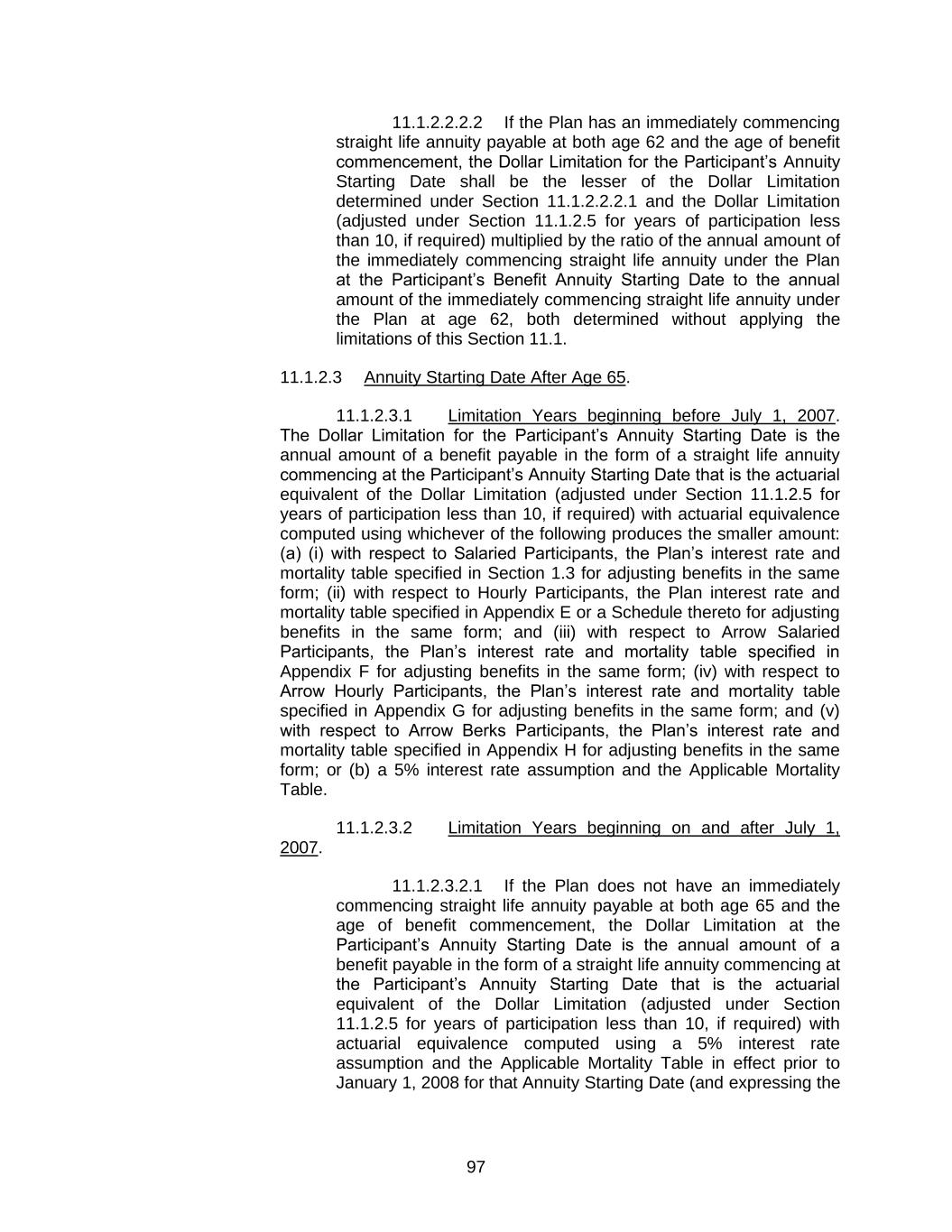
97 11.1.2.2.2.2 If the Plan has an immediately commencing straight life annuity payable at both age 62 and the age of benefit commencement, the Dollar Limitation for the Participant’s Annuity Starting Date shall be the lesser of the Dollar Limitation determined under Section 11.1.2.2.2.1 and the Dollar Limitation (adjusted under Section 11.1.2.5 for years of participation less than 10, if required) multiplied by the ratio of the annual amount of the immediately commencing straight life annuity under the Plan at the Participant’s Benefit Annuity Starting Date to the annual amount of the immediately commencing straight life annuity under the Plan at age 62, both determined without applying the limitations of this Section 11.1. 11.1.2.3 Annuity Starting Date After Age 65. 11.1.2.3.1 Limitation Years beginning before July 1, 2007. The Dollar Limitation for the Participant’s Annuity Starting Date is the annual amount of a benefit payable in the form of a straight life annuity commencing at the Participant’s Annuity Starting Date that is the actuarial equivalent of the Dollar Limitation (adjusted under Section 11.1.2.5 for years of participation less than 10, if required) with actuarial equivalence computed using whichever of the following produces the smaller amount: (a) (i) with respect to Salaried Participants, the Plan’s interest rate and mortality table specified in Section 1.3 for adjusting benefits in the same form; (ii) with respect to Hourly Participants, the Plan interest rate and mortality table specified in Appendix E or a Schedule thereto for adjusting benefits in the same form; and (iii) with respect to Arrow Salaried Participants, the Plan’s interest rate and mortality table specified in Appendix F for adjusting benefits in the same form; (iv) with respect to Arrow Hourly Participants, the Plan’s interest rate and mortality table specified in Appendix G for adjusting benefits in the same form; and (v) with respect to Arrow Berks Participants, the Plan’s interest rate and mortality table specified in Appendix H for adjusting benefits in the same form; or (b) a 5% interest rate assumption and the Applicable Mortality Table. 11.1.2.3.2 Limitation Years beginning on and after July 1, 2007. 11.1.2.3.2.1 If the Plan does not have an immediately commencing straight life annuity payable at both age 65 and the age of benefit commencement, the Dollar Limitation at the Participant’s Annuity Starting Date is the annual amount of a benefit payable in the form of a straight life annuity commencing at the Participant’s Annuity Starting Date that is the actuarial equivalent of the Dollar Limitation (adjusted under Section 11.1.2.5 for years of participation less than 10, if required) with actuarial equivalence computed using a 5% interest rate assumption and the Applicable Mortality Table in effect prior to January 1, 2008 for that Annuity Starting Date (and expressing the
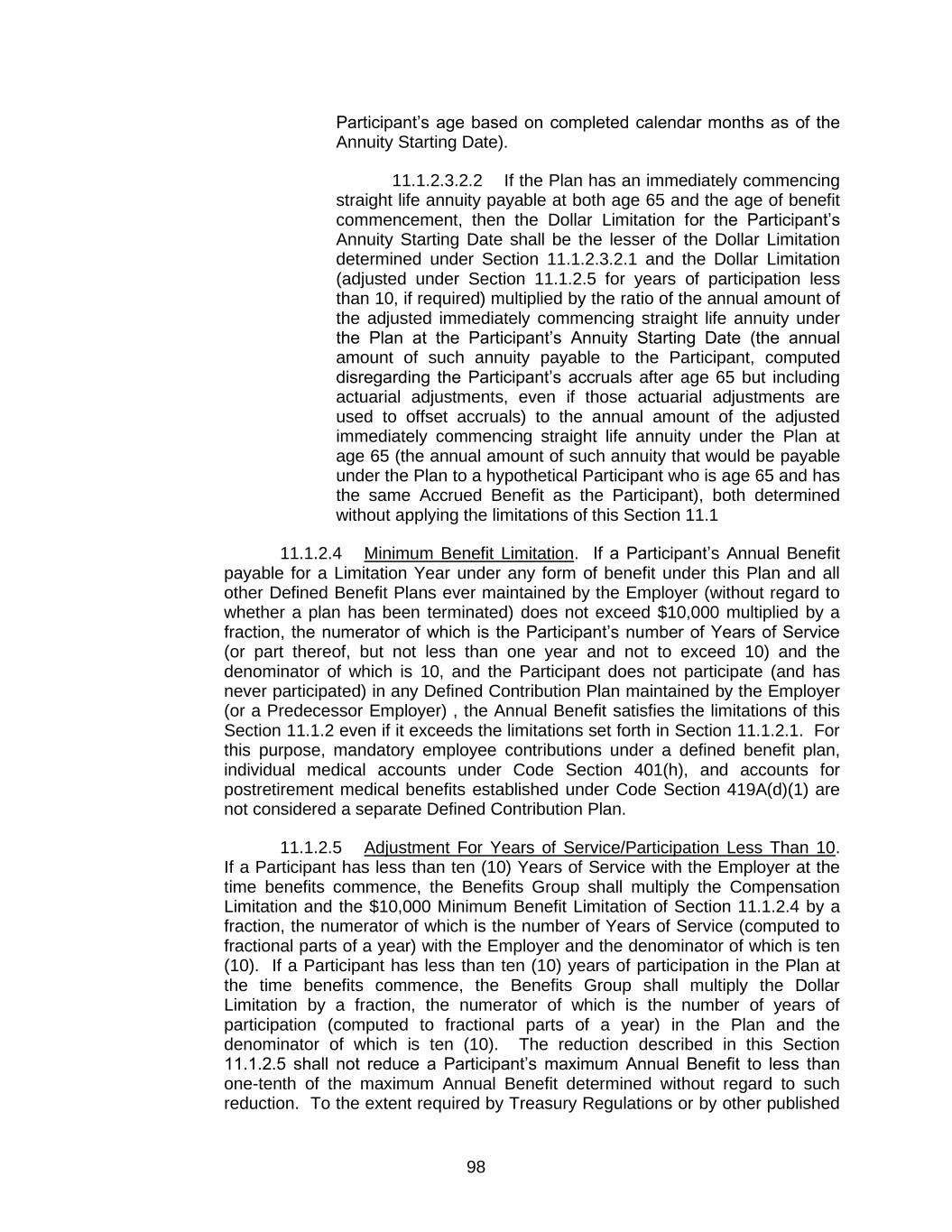
98 Participant’s age based on completed calendar months as of the Annuity Starting Date). 11.1.2.3.2.2 If the Plan has an immediately commencing straight life annuity payable at both age 65 and the age of benefit commencement, then the Dollar Limitation for the Participant’s Annuity Starting Date shall be the lesser of the Dollar Limitation determined under Section 11.1.2.3.2.1 and the Dollar Limitation (adjusted under Section 11.1.2.5 for years of participation less than 10, if required) multiplied by the ratio of the annual amount of the adjusted immediately commencing straight life annuity under the Plan at the Participant’s Annuity Starting Date (the annual amount of such annuity payable to the Participant, computed disregarding the Participant’s accruals after age 65 but including actuarial adjustments, even if those actuarial adjustments are used to offset accruals) to the annual amount of the adjusted immediately commencing straight life annuity under the Plan at age 65 (the annual amount of such annuity that would be payable under the Plan to a hypothetical Participant who is age 65 and has the same Accrued Benefit as the Participant), both determined without applying the limitations of this Section 11.1 11.1.2.4 Minimum Benefit Limitation. If a Participant’s Annual Benefit payable for a Limitation Year under any form of benefit under this Plan and all other Defined Benefit Plans ever maintained by the Employer (without regard to whether a plan has been terminated) does not exceed $10,000 multiplied by a fraction, the numerator of which is the Participant’s number of Years of Service (or part thereof, but not less than one year and not to exceed 10) and the denominator of which is 10, and the Participant does not participate (and has never participated) in any Defined Contribution Plan maintained by the Employer (or a Predecessor Employer) , the Annual Benefit satisfies the limitations of this Section 11.1.2 even if it exceeds the limitations set forth in Section 11.1.2.1. For this purpose, mandatory employee contributions under a defined benefit plan, individual medical accounts under Code Section 401(h), and accounts for postretirement medical benefits established under Code Section 419A(d)(1) are not considered a separate Defined Contribution Plan. 11.1.2.5 Adjustment For Years of Service/Participation Less Than 10. If a Participant has less than ten (10) Years of Service with the Employer at the time benefits commence, the Benefits Group shall multiply the Compensation Limitation and the $10,000 Minimum Benefit Limitation of Section 11.1.2.4 by a fraction, the numerator of which is the number of Years of Service (computed to fractional parts of a year) with the Employer and the denominator of which is ten (10). If a Participant has less than ten (10) years of participation in the Plan at the time benefits commence, the Benefits Group shall multiply the Dollar Limitation by a fraction, the numerator of which is the number of years of participation (computed to fractional parts of a year) in the Plan and the denominator of which is ten (10). The reduction described in this Section 11.1.2.5 shall not reduce a Participant’s maximum Annual Benefit to less than one-tenth of the maximum Annual Benefit determined without regard to such reduction. To the extent required by Treasury Regulations or by other published

99 Internal Revenue Service guidance, the Committee shall apply the reduction of this Section 11.1.2.5 separately to each change in the benefit structure of the Plan. 11.1.2.6 Adjustments To Dollar Limitation. The Dollar Limitation of this Section 11.1 2 shall be automatically adjusted under Code Section 415(d), effective January 1 of each year, as published in the Internal Revenue Bulletin. The adjusted Dollar Limitation is applicable to the Limitation Year ending with or within the calendar year of the date of the adjustment; provided, however, that effective for Limitation Years beginning on and after July 1, 2007, a Participant’s benefits shall not reflect the adjusted limit before January 1 of that calendar year. 11.1.2.7 Current Accrued Benefit Exception. Notwithstanding anything in this Section 11.1 to the contrary, the maximum Annual Benefit for any individual who was a Participant as of the first day of the Limitation Year beginning after December 31, 1986, in one or more Defined Benefit Plans maintained by a Participating Employer on May 6, 1986, shall not be less than the Current Accrued Benefit for all such Defined Benefit Plans. The “Current Accrued Benefit” shall mean a Participant’s Accrued Benefit under the Plan, and under all other Defined Benefit Plans maintained by the Employer, determined as if the Participant had experienced a Severance from Employment as of the close of the last Limitation Year beginning before January 1, 1987, when expressed as an Annual Benefit within the meaning of Code Section 415(b)(2). In determining the amount of a Participant’s Current Accrued Benefit, any change in the terms and conditions of the Plan after May 5, 1986, and any cost of living adjustment occurring after May 5, 1986, shall be disregarded. This Section applies only if the Plan and any other Defined Benefit Plans individually and in the aggregate satisfied the requirements of Code Section 415 for all Limitation Years beginning before January 1, 1987. 11.1.2.8 Application Of Limitations. A Participant’s Accrued Benefit at any time may not exceed the applicable limitation under this Section 11.1.2. The Benefits Group shall calculate the Participant’s normal retirement pension without regard to the limitations of this Section 11.1.2 and then apply these limitations (as reduced, if applicable, pursuant to Section 11.1.3) to the determination of the Participant’s Accrued Benefit. 11.1.2.9 Aggregation Rules. For purposes of this Section 11.1, all qualified Defined Benefit Plans (whether terminated or not) ever maintained by the Employer shall be treated as one Defined Benefit Plan, and all qualified Defined Contribution Plans (whether terminated or not) ever maintained by the Employer shall be treated as one Defined Contribution Plan. The rules under Code Section 415(j) shall apply as appropriate for purposes of this Section 11.1 for Limitation Years that begin on or after July 1, 2007. In no event shall a Participant’s benefit be double counted in the application of these aggregation rules. The limitations of this Section 11.1 shall be determined and applied taking into account the aggregation rules provided herein, and the aggregation rules not otherwise provided in this Section 11.1, as incorporated by reference from Treasury Regulations Section 1.415(f)-1. However, any increase in benefits resulting from the application of such rules in effect as of the Limitation Year beginning on or after July 1, 2007, shall apply only to Participants who have

100 completed at least one (1) Hour of Service with the Employer after the last day of Limitation Year that ends just before the Limitation Year that begins on or after July 1, 2007. 11.1.2.10 Special Rule for Pre-2000 Annuity Starting Dates. With respect to a Participant who has an Annuity Starting Date prior to the first Limitation Year commencing on or after January 1, 2000, his benefit shall continue to be subject to the maximum Annual Benefit limits and the provisions of the Plan that were in effect at his Annuity Starting Date, and shall not be increased due to the repeal of Code Section 415(e). 11.1.2.11 Special Rule for New Benefit Limits Under EGTRRA. Any benefit increases resulting from the increase in the limitations of Code Section 415(b) effective for Limitation Years ending after December 31, 2001 shall be provided to all Employees participating in the Plan who have one Hour of Service on or after the first day of the first Limitation Year ending after December 31, 2001. 11.1.2.12 2007 Grandfather Provisions. The application of the provisions of this Section 11.1 effective as of the first Limitation Year on or after July 1, 2007, shall not cause the maximum Annual Benefit for any Participant to be less than the Participant’s accrued benefit under all the Defined Benefit Plans of the Participating Employer (or a predecessor) as of the end of the last Limitation Year beginning before July 1, 2007, under provisions of the Plan or plans that were both adopted and in effect before April 5, 2007. The preceding sentence applies only if the provisions of such Defined Benefit Plans that were both adopted and in effect before April 5, 2007 satisfied the applicable requirements of statutory provisions, Treasury Regulations, and other published guidance relating to Code Section 415 in effect as of the end of the last Limitation Year beginning before July 1, 2007, as described in Treasury Regulations Section 1.415(a)-1(g)(4). In addition, the Plan will not be treated as failing to satisfy the limitations of Code Section 415 merely because the definition of Compensation for a Limitation Year as used for purposes of the limitations of this Section 11.1 reflects compensation for a Plan Year that is in excess of the annual compensation limit under Code Section 401(a)(17) that applies to that Plan Year. 11.1.2.13 Benefits Under Terminated Plans. If a Defined Benefit Plan maintained by the Employer has terminated with sufficient assets for the payment of benefit liabilities of all participants and a participant in the plan has not yet commenced benefits under the plan, the benefits provided pursuant to the annuities purchased to provide the Participant’s benefits under the terminated Defined Benefit Plan at each possible Annuity Starting Date shall be taken into account in applying the limitations of this Section 11.1. If there are not sufficient assets for the payment of all participants’ benefit liabilities, the benefits taken into account shall be the benefits that are actually provided to the Participant under the terminated plan. 11.1.2.14 Benefits Transferred from the Plan. If a participant’s benefits under a Defined Benefit Plan maintained by the Employer are transferred to another Defined Benefit Plan maintained by the Employer and the transfer is not a transfer of distributable benefits pursuant to Treasury Regulations Section
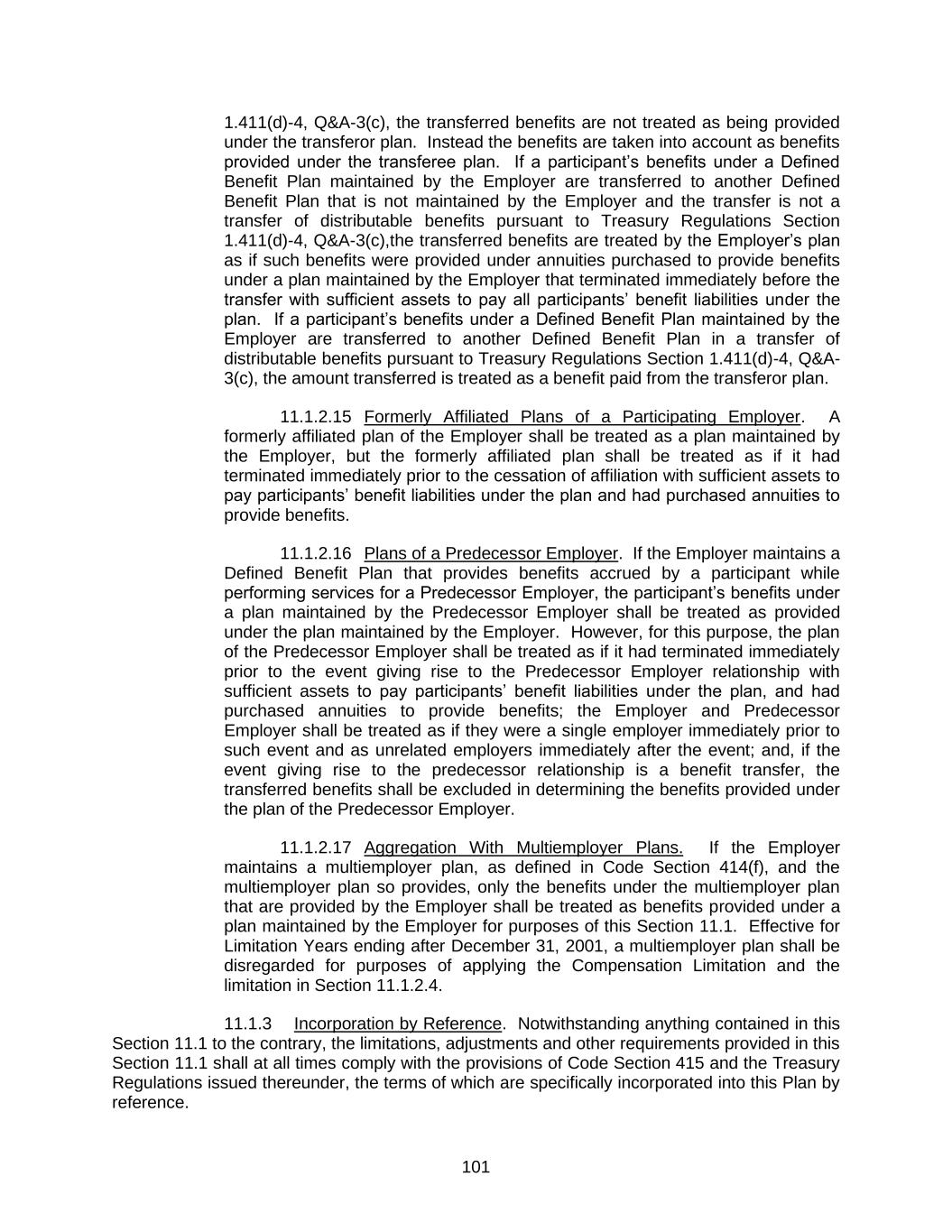
101 1.411(d)-4, Q&A-3(c), the transferred benefits are not treated as being provided under the transferor plan. Instead the benefits are taken into account as benefits provided under the transferee plan. If a participant’s benefits under a Defined Benefit Plan maintained by the Employer are transferred to another Defined Benefit Plan that is not maintained by the Employer and the transfer is not a transfer of distributable benefits pursuant to Treasury Regulations Section 1.411(d)-4, Q&A-3(c),the transferred benefits are treated by the Employer’s plan as if such benefits were provided under annuities purchased to provide benefits under a plan maintained by the Employer that terminated immediately before the transfer with sufficient assets to pay all participants’ benefit liabilities under the plan. If a participant’s benefits under a Defined Benefit Plan maintained by the Employer are transferred to another Defined Benefit Plan in a transfer of distributable benefits pursuant to Treasury Regulations Section 1.411(d)-4, Q&A- 3(c), the amount transferred is treated as a benefit paid from the transferor plan. 11.1.2.15 Formerly Affiliated Plans of a Participating Employer. A formerly affiliated plan of the Employer shall be treated as a plan maintained by the Employer, but the formerly affiliated plan shall be treated as if it had terminated immediately prior to the cessation of affiliation with sufficient assets to pay participants’ benefit liabilities under the plan and had purchased annuities to provide benefits. 11.1.2.16 Plans of a Predecessor Employer. If the Employer maintains a Defined Benefit Plan that provides benefits accrued by a participant while performing services for a Predecessor Employer, the participant’s benefits under a plan maintained by the Predecessor Employer shall be treated as provided under the plan maintained by the Employer. However, for this purpose, the plan of the Predecessor Employer shall be treated as if it had terminated immediately prior to the event giving rise to the Predecessor Employer relationship with sufficient assets to pay participants’ benefit liabilities under the plan, and had purchased annuities to provide benefits; the Employer and Predecessor Employer shall be treated as if they were a single employer immediately prior to such event and as unrelated employers immediately after the event; and, if the event giving rise to the predecessor relationship is a benefit transfer, the transferred benefits shall be excluded in determining the benefits provided under the plan of the Predecessor Employer. 11.1.2.17 Aggregation With Multiemployer Plans. If the Employer maintains a multiemployer plan, as defined in Code Section 414(f), and the multiemployer plan so provides, only the benefits under the multiemployer plan that are provided by the Employer shall be treated as benefits provided under a plan maintained by the Employer for purposes of this Section 11.1. Effective for Limitation Years ending after December 31, 2001, a multiemployer plan shall be disregarded for purposes of applying the Compensation Limitation and the limitation in Section 11.1.2.4. 11.1.3 Incorporation by Reference. Notwithstanding anything contained in this Section 11.1 to the contrary, the limitations, adjustments and other requirements provided in this Section 11.1 shall at all times comply with the provisions of Code Section 415 and the Treasury Regulations issued thereunder, the terms of which are specifically incorporated into this Plan by reference.

102 11.1.4 Repeal of Provision. Should Congress provide by statute, or the Internal Revenue Service provide by regulation or ruling, that any or all of the conditions set forth in this Section 11.1 are no longer necessary for the Plan to meet the requirements of Section 401 or other applicable provisions of the Code then in effect, such conditions shall immediately become void and shall no longer apply, without the necessity of further amendment to the Plan. 11.2 Benefit Limitations - Rules for Certain Highly Compensated Employees. If the Plan is terminated, the benefit due any Participant or former Participant who is one of the 25 highest paid Highly Compensated Employees shall be restricted in the manner set forth in Section 11.2.1 and Section 11.2.2. 11.2.1 Benefit Restriction. The benefit payable shall be limited to a benefit that is nondiscriminatory under Section 401(a)(4) of the Code. 11.2.2 Distribution Restriction. The annual payment shall be restricted to an amount equal to the payments that would be made on behalf of such Participant under a single life annuity that is the Actuarial Equivalent of the sum of the Participant’s Accrued Benefit and the Participant’s other benefits, as defined below. 11.2.3 Definition of “Benefits”. For purposes of this Section, the term “benefits” shall include loans in excess of the amounts set forth in Section 72(p)(2)(A) of the Code, any periodic income, any withdrawal values payable to a living Participant, and any death benefits not provided for by insurance on the Participant’s life. 11.2.4 Restrictions Not Applicable. The restrictions described in this Section 11.2 shall not apply if: 11.2.4.1 After payment to a Participant described in this Section 11.2 of all benefits described in Section 11.2.3, the value of Plan assets equals or exceeds 110% of the value of the Plan’s current liabilities, as defined in Section 412(l)(7) of the Code; or 11.2.4.2 The value of the benefits described in Section 11.2.3 for a Participant described in this Section 11.2 is less than 1% of the value of the Plan’s current liabilities. Should Congress provide by statute, or the Internal Revenue Service provide by regulation or ruling, that any or all of the conditions set forth in this Section 11.2 are no longer necessary for the Plan to meet the requirements of Section 401 or other applicable provisions of the Code then in effect, such conditions shall immediately become void and shall no longer apply, without the necessity of further amendment to the Plan.
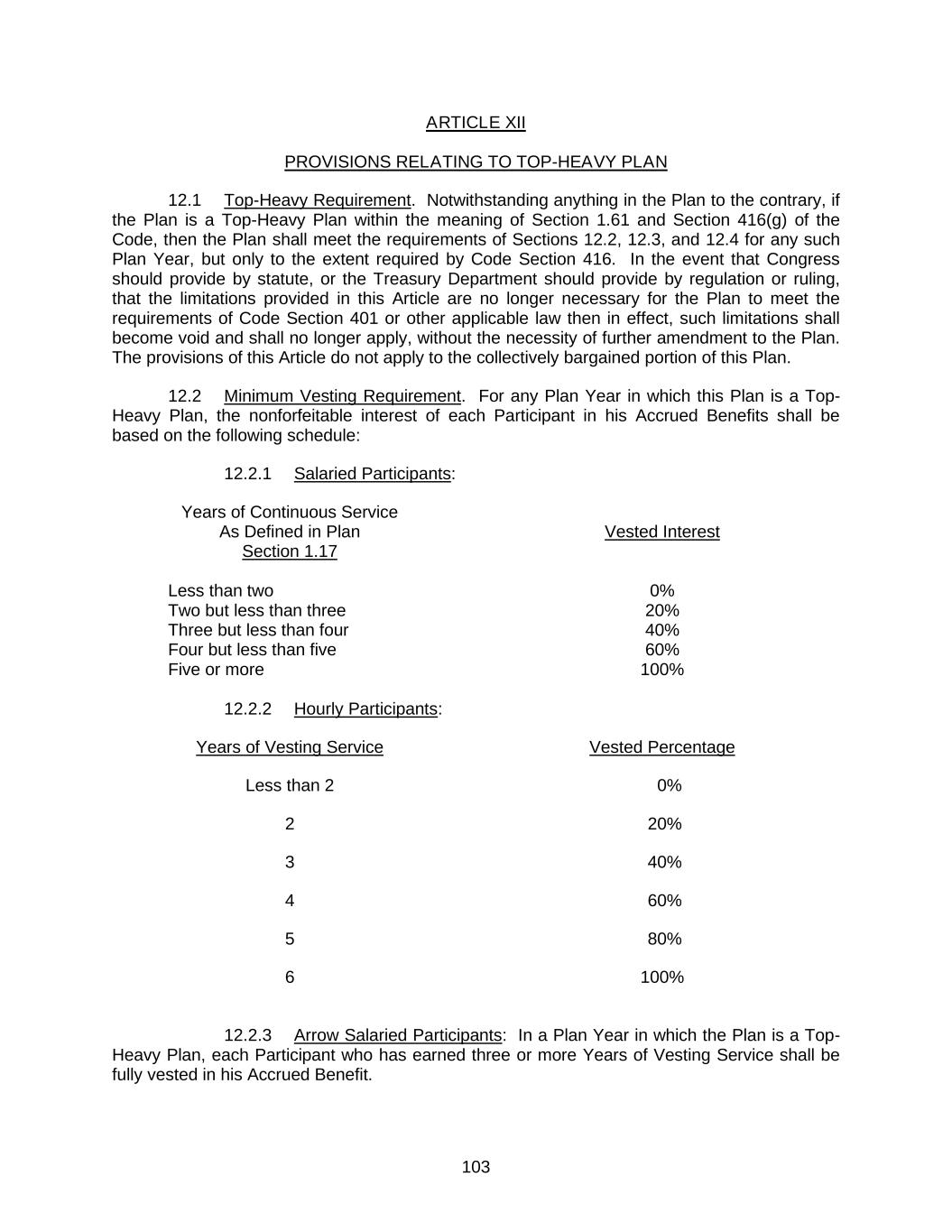
103 ARTICLE XII PROVISIONS RELATING TO TOP-HEAVY PLAN 12.1 Top-Heavy Requirement. Notwithstanding anything in the Plan to the contrary, if the Plan is a Top-Heavy Plan within the meaning of Section 1.61 and Section 416(g) of the Code, then the Plan shall meet the requirements of Sections 12.2, 12.3, and 12.4 for any such Plan Year, but only to the extent required by Code Section 416. In the event that Congress should provide by statute, or the Treasury Department should provide by regulation or ruling, that the limitations provided in this Article are no longer necessary for the Plan to meet the requirements of Code Section 401 or other applicable law then in effect, such limitations shall become void and shall no longer apply, without the necessity of further amendment to the Plan. The provisions of this Article do not apply to the collectively bargained portion of this Plan. 12.2 Minimum Vesting Requirement. For any Plan Year in which this Plan is a Top- Heavy Plan, the nonforfeitable interest of each Participant in his Accrued Benefits shall be based on the following schedule: 12.2.1 Salaried Participants: Years of Continuous Service As Defined in Plan Section 1.17 Vested Interest Less than two 0% Two but less than three 20% Three but less than four 40% Four but less than five 60% Five or more 100% 12.2.2 Hourly Participants: Years of Vesting Service Vested Percentage Less than 2 0% 2 20% 3 40% 4 60% 5 80% 6 100% 12.2.3 Arrow Salaried Participants: In a Plan Year in which the Plan is a Top- Heavy Plan, each Participant who has earned three or more Years of Vesting Service shall be fully vested in his Accrued Benefit.

104 12.2.4 Arrow Hourly Participants: In a Plan Year in which the Plan is a Top- Heavy Plan, each Participant who has earned three or more Years of Vesting Service shall be fully vested in his Accrued Benefit. 12.2.5 Arrow Berks Participants: In a Plan Year in which the Plan is a Top- Heavy Plan, each Participant who has earned three or more Years of Vesting Service shall be fully vested in his Accrued Benefit. The vesting schedules set forth in this Section 12.2 do not apply to the Accrued Benefit of any Employee who does not have an Hour of Service after the Plan has initially become Top Heavy. 12.3 Minimum Benefit Requirement. If this Plan is Top Heavy in any Plan Year, the Plan guarantees a minimum benefit to each Non-Key Employee who is a Participant eligible for such benefit as provided in this Article XII. A Participant’s Top Heavy minimum benefit is an annual benefit, payable as a straight life annuity commencing at his Normal Retirement Age equal to the Participant's average Compensation (as defined in Section 11.1.1.2) for the period of consecutive years (not exceeding five) during which the Participant had the greatest aggregate Compensation from the Employer, multiplied by the applicable percentage equal to 2% multiplied by the number (not exceeding 10) of Years of Top Heavy Service as a Non-Key Employee Participant in the Plan. When determining whether years are consecutive for purposes of averaging Compensation, the Benefits Group shall disregard years for which the Participant does not complete at least 1,000 Hours of Service. A “Year of Top Heavy Service” is a Plan Year in which the Plan is Top Heavy and: (i) with respect to a Salaried Participant, the Participant is credited with a year of Credited Service; (ii) with respect an Hourly Participant, the Participant is credited with 1,000 Hours of Service; and (iii) with respect to an Arrow Salaried Participant, Arrow Hourly Participant, or an Arrow Berks Participant, a 12-consecutive-month period that begins on a Participant’s Employment Date or Reemployment Date (whichever is applicable), or on any anniversary of such date, in which a Participant completes 1,000 or more Hours of Service. If a Non-Key Employee participates in this Plan and in a Top Heavy Defined Contribution Plan included in the Required Aggregation Group, the minimum benefits shall be provided under the Top Heavy Defined Contribution Plan. No accrual shall be provided pursuant to this paragraph for a Plan Year in which the Plan does not benefit any Key Employee or former Key Employee. A Participant under this Section shall include an Employee who is otherwise eligible to participate in the Plan, but who receives no accrual or a partial accrual because of the level of his Compensation, because he is not employed on the last day of the accrual computation period, or because the Plan is integrated with Social Security. If the accrual computation period does not coincide with the Plan Year, a minimum benefit accrues with respect to each accrual computation period falling wholly or partly in a Plan Year in which the Top Heavy minimum benefit requirement applies. If a Participant accrues an additional benefit for a Plan Year by reason of this Section, the Participant’s Accrued Benefit shall never be less than the Accrued Benefit determined at the end of that Plan Year, irrespective of whether the Plan is a Top Heavy plan for any subsequent Plan Year. The Employer shall not impute Social Security benefits to determine whether the Plan has satisfied the Top Heavy minimum benefit requirement for a Participant, nor shall the Plan offset a Participant’s Social Security benefit from his Accrued Benefit attributable to the Top Heavy minimum benefit requirement.

105 No additional benefit accruals shall be provided pursuant to this Section 12.3 above to the extent that the total accruals on behalf of the Participant attributable to Employer contributions will provide a benefit expressed as a life annuity commencing at Normal Retirement Age that equals or exceeds 20% of the Participant’s average Compensation (as defined in Section 11.1.1.2) for the period of consecutive years (not exceeding five) during which the Participant had the greatest aggregate Compensation from the Employer. If the form of benefit is other than a single life annuity, the Non-Key Employee must receive an amount that is the Actuarial Equivalent of the minimum single life annuity benefit. If the benefit commences at a date other than at Normal Retirement Age, the Non-Key Employee must receive at least an amount that is the Actuarial Equivalent of the minimum single life annuity benefit commencing at Normal Retirement Age. 12.4 Change in Top-Heavy Status. If the Plan becomes a Top-Heavy Plan and subsequently ceases to be a Top-Heavy Plan, the vesting schedule in Section 12.2 shall continue to apply in determining the vested percentage of the Accrued Benefit of: (i) any Salaried Participant who had at least three years of Credited Service as of the last day of the last Plan Year in which the Plan was a Top-Heavy Plan; (ii) any Hourly Participant who had at least three Years of Vesting Service as of the July 31 of the last Plan Year in which the Plan was a Top-Heavy Plan; and (iii) any Arrow Salaried Participant, Arrow Hourly Participant, or Arrow Berks Participant who had a least three Years of Vesting Service as of the last day of the last Plan Year in which the Plan was a Top-Heavy Plan. For all other Participants, the vesting schedule in Section 12.2 shall apply only to their Accrued Benefits as of such last day.

106 ARTICLE XIII VETERANS’ REEMPLOYMENT RIGHTS 13.1 USERRA. Notwithstanding any provision of the Plan to the contrary, contributions, benefits and service credit with respect to Qualified Military Service will be provided in accordance with Section 414(u) of the Code. 13.2 Crediting Service. 13.2.1 An Employee reemployed by the Employer in accordance with Chapter 43 of Title 38 of the United States Code shall be treated as not having incurred a Break-in- Service by reason of such Employee’s period of Qualified Military Service. 13.2.2 Upon reemployment by the Employer in accordance with Chapter 43 of Title 38 of the United States Code, an Employee’s period of Qualified Military Service: 13.2.2.1 With respect to Salaried Participants shall be deemed Continuous Service. 13.2.2.2 With respect to Hourly Participants, shall be counted for purposes of determining such Employee’s and/or Participant’s Years of Vesting Service and Years of Benefit Accrual Service. 13.2.2.3 With respect to Arrow Salaried Participants, shall be counted for purposes of determining such Employee’s and/or Participant’s Years of Vesting Service and Years of Benefit Service. 13.2.2.4 With respect to Arrow Hourly Participants, shall be counted for purposes of determining such Employee’s and/or Participant’s Years of Vesting Service and Years of Benefit Service. 13.2.2.5 With respect to Arrow Berks Participants, shall be counted for purposes of determining such Employee’s and/or Participant’s Years of Vesting Service and Years of Benefit Service. 13.3 Compensation. An Employee who is in Qualified Military Service shall be treated as receiving compensation from the Employer during such period of Qualified Military Service equal to: 13.3.1 The Compensation the Employee would have received during such period if the Employee were not in Qualified Military Service, determined based on the rate of pay the Employee would have received from the Employer but for absence during the period of Qualified Military Service; or 13.3.2 If the Compensation the Employee would have received during such period was not reasonably certain, the Employee’s average compensation from the Employer during the 12-month period immediately preceding the Qualified Military Service (or, if shorter, the period of employment immediately preceding the Qualified Military Service).

107 13.4 Qualified Military Service. For purposes of the Plan, the term “Qualified Military Service” means any service in the “uniformed services” (as defined in Chapter 43 of Title 38 of the United States Code) by any Employee if such Employee is entitled to reemployment rights under such Chapter with respect to such service. 13.5 Earnings and Forfeitures. Nothing in this Article XIII shall be construed as requiring: 13.5.1 Any crediting of earnings to an Employee with respect to any contribution before such contribution is actually made; or 13.5.2 The allocation of any forfeiture with respect to the period of an Employee’s Qualified Military Service.

108 ARTICLE XIV MISCELLANEOUS 14.1 Limited Purpose of Plan. Nothing contained in the Plan shall be deemed to give any Participant or other Employee the right to be continued as an Employee, nor shall it interfere with the right of the Employer to discharge or otherwise deal with him without regard to the existence of the Plan and without liability for any claim for any payment whatsoever except to the extent expressly provided for in the Plan. Each Employer expressly reserves the right to discharge any Employee whenever in its judgment its best interests so require. 14.2 Non-alienation. No benefit payable under the Plan shall be subject in any manner to anticipation, assignment, or voluntary or involuntary alienation. This Section shall not preclude the Trustee from complying with the terms of a QDRO. 14.3 Facility of Payment. If the Benefits Group, in its sole discretion, deems a Participant, surviving Spouse, or other Beneficiary who is entitled to receive any payment hereunder to be incompetent to receive the same by reason of age, illness or any infirmity or incapacity of any kind, the Benefits Group may direct the Trustee to apply such payment directly for the benefit of such person, or to make payment to any person selected by the Benefits Group to disburse the same for the benefit of the Participant, surviving Spouse, or other Beneficiary. Payments made pursuant to this Section shall operate as a discharge, to the extent thereof, of all liabilities of the Employer, the Board of Directors, the Committee, the Administrative Committee, the Benefits Group, the Trustee and the Fund to the person for whose benefit the payments are made. Effective on and after the Termination Date, any person whose benefit is payable in a lump sum pursuant Section 6.7.1. and who does not affirmatively elect to have such amount paid directly to him, or to an Eligible Retirement Plan, as applicable, shall be treated as a “missing participant” within the meaning of Section 4050(b)(1) of ERISA and payment of the benefit to the Pension Benefit Guaranty Corporation upon close-out of the Plan termination will fully discharge all Plan liabilities with respect to the benefit. 14.4 Effect of Return of Benefit Checks. Each person entitled to benefits under this Plan shall furnish the Benefits Group with the address to which his benefit checks shall be mailed. If any benefit check mailed by regular United States mail to the last address appearing on the Benefits Group’s records is returned because the addressee is not found at that address, the mailing of benefit checks shall stop. Thereafter, if the Benefits Group receives written notice of the proper address of the person entitled to receive such benefit checks and is furnished with evidence satisfactory to the Benefits Group that such person is living, all amounts then due but unpaid shall be forwarded to such person. 14.5 Impossibility of Diversion. 14.5.1 General Rule. All Plan assets shall be held as part of the Fund, until paid to satisfy allowable Plan expenses or to provide benefits to Participants, surviving Spouses and other Beneficiaries. Except as provided in Sections 7.5 or 7.7 or Article IX, it shall be impossible for any part of the Fund to be used for, or diverted to, purposes other than for the exclusive benefit of Participants, surviving Spouses, or other Beneficiaries under the Plan or the payment of reasonable expenses of the administration of the Plan. The reasonable expenses incident to the operation of the Plan shall be paid out of the Fund, but the Employer in its discretion may determine at any time to pay part or all thereof directly. Any such determination shall not require the Employer to pay the same or other expenses at any other time. In no event

109 will any expenses for settlor functions in connection with the termination of the Plan be paid from the Fund. 14.5.2 Special Rule; Return of Contributions. It is intended that the Plan and the Fund shall continue to qualify under Section 401(a) of the Code. Therefore, Section 14.5.1 shall be subject to the following provisions: 14.5.2.1 Contributions are conditioned upon their deductibility under Section 404 of the Code; the entire contribution attributable to any Plan Year as to which deductibility is disallowed may be recovered, to the extent of the amount of the disallowance, within one year after the disallowance. Nondeductible contributions that are treated as de minimis pursuant to Revenue Procedure 90- 49 shall be returned to the Participating Employer within one year of the date of the Plan actuary’s certification of such nondeductibility. 14.5.2.2 In the case of a contribution which is made in whole or in part by reason of a mistake of fact, so much of such contribution as is attributable to the mistake of fact shall be returnable to the Participating Employer upon demand by the Committee, upon presentation of evidence of the mistake of fact to the Trustee and of calculations as to the impact of such mistake. Demand and repayment must be effectuated within one year after the payment of the contribution to which the mistake applies. Income and gains attributable to the excess contributions may not be recovered by the Participating Employer. Losses attributable to such contribution shall reduce the amount the Participating Employer may recover. 14.6 Unclaimed Benefits. If a Participant, surviving Spouse, or other Beneficiary to whom a benefit is payable under the Plan cannot be located following a reasonable effort to do so by the Benefits Group, such benefit shall be forfeited but shall be reinstated if a claim therefor is filed by the Participant, surviving Spouse, or other Beneficiary. 14.7 Construction. The masculine gender includes the feminine and the singular may include the plural, and vice versa, unless the context clearly indicates otherwise. 14.8 Governing Law. Except to the extent such laws are superseded by ERISA, the laws of the Commonwealth of Pennsylvania shall govern. 14.9 Contingent Effectiveness of Plan Amendment and Restatement. The effectiveness of the Plan as amended and restated, including but not limited to the contributions made by the Employer, shall be subject to and contingent upon a determination by the District Director of Internal Revenue that the Plan continues to be qualified under the applicable provisions of the Code. If the District Director determines that the amendment and restatement does adversely affect the prior qualification of the Plan under the applicable Sections of the Code, then, upon notice to the Trustee, the Board of Directors shall have the right further to amend the Plan or to rescind the amendment and restatement. [SIGNATURE BLOCK FOLLOWS ON NEXT PAGE]

This Teleflex Incorporated Retirement Income Plan has been executed on the date set forth below effective as of August 1, 2023 or such other date stated herein. TELEFLEX INCORPORATED o, wy Mj Matt Howald Title:_ Vice President, Treasurer Date:_June /¢ 2023
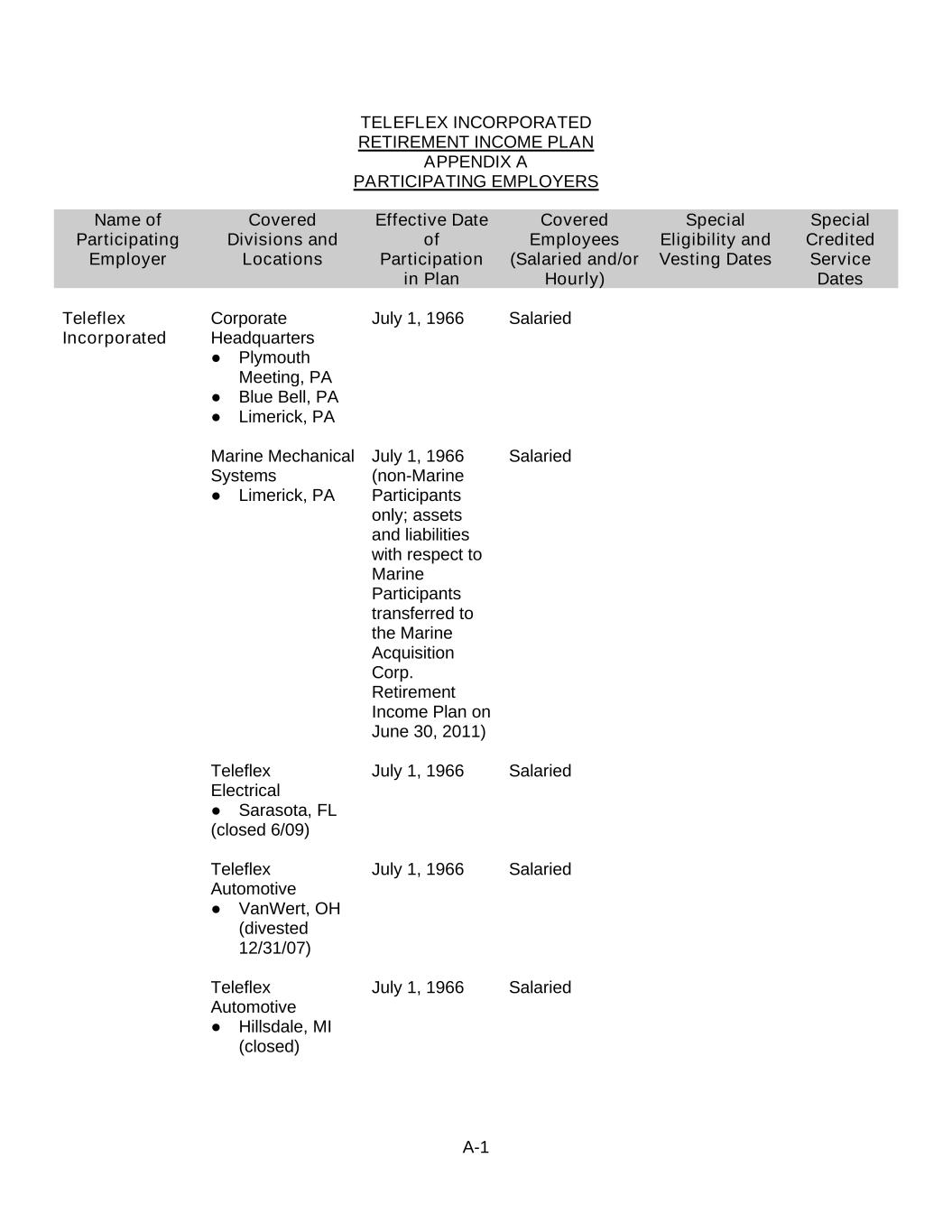
A-1 TELEFLEX INCORPORATED RETIREMENT INCOME PLAN APPENDIX A PARTICIPATING EMPLOYERS Name of Participating Employer Covered Divisions and Locations Effective Date of Participation in Plan Covered Employees (Salaried and/or Hourly) Special Eligibility and Vesting Dates Special Credited Service Dates Teleflex Incorporated Corporate Headquarters ● Plymouth Meeting, PA ● Blue Bell, PA ● Limerick, PA July 1, 1966 Salaried Marine Mechanical Systems ● Limerick, PA July 1, 1966 (non-Marine Participants only; assets and liabilities with respect to Marine Participants transferred to the Marine Acquisition Corp. Retirement Income Plan on June 30, 2011) Salaried Teleflex Electrical ● Sarasota, FL (closed 6/09) July 1, 1966 Salaried Teleflex Automotive ● VanWert, OH (divested 12/31/07) July 1, 1966 Salaried Teleflex Automotive ● Hillsdale, MI (closed) July 1, 1966 Salaried
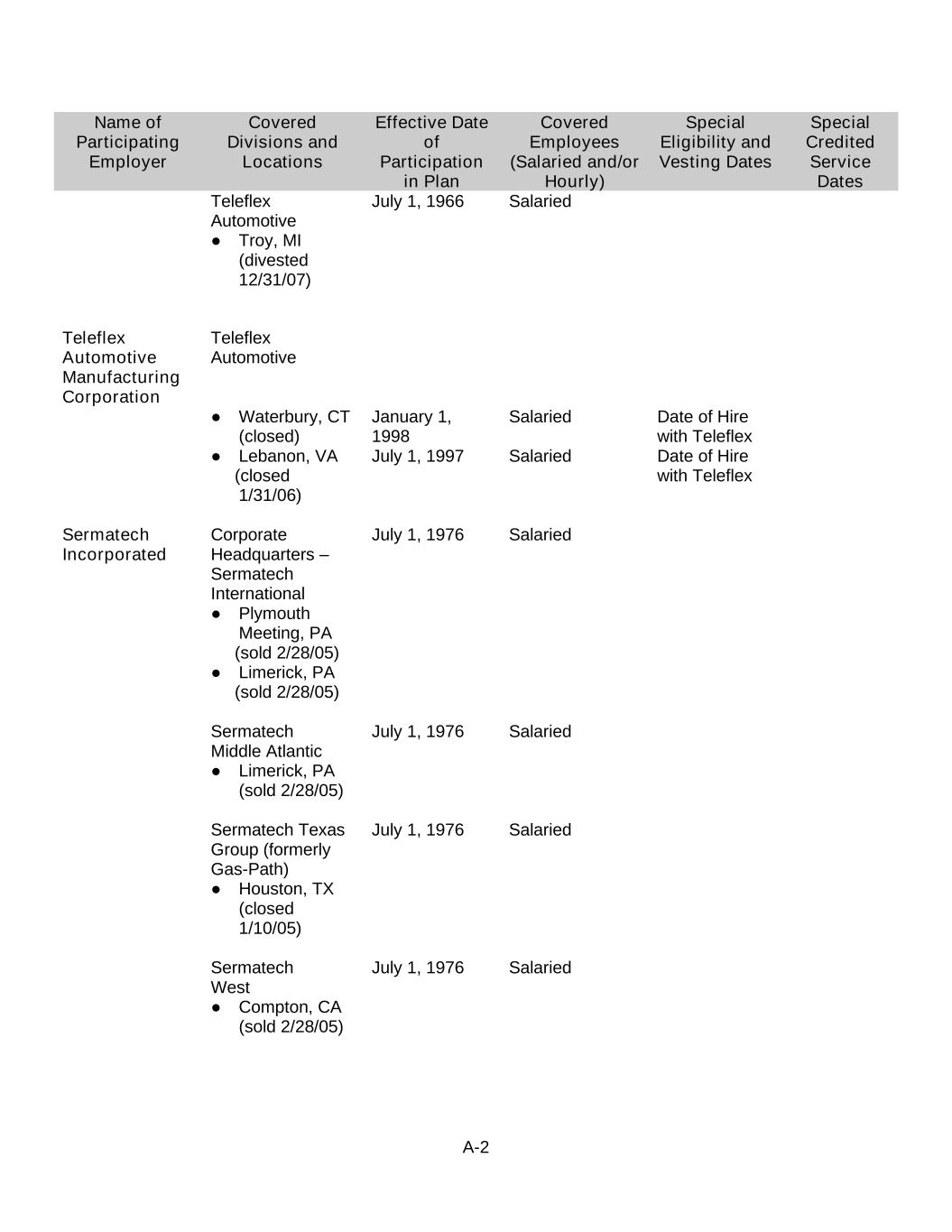
A-2 Name of Participating Employer Covered Divisions and Locations Effective Date of Participation in Plan Covered Employees (Salaried and/or Hourly) Special Eligibility and Vesting Dates Special Credited Service Dates Teleflex Automotive ● Troy, MI (divested 12/31/07) July 1, 1966 Salaried Teleflex Automotive Manufacturing Corporation Teleflex Automotive ● Waterbury, CT (closed) January 1, 1998 Salaried Date of Hire with Teleflex ● Lebanon, VA (closed 1/31/06) July 1, 1997 Salaried Date of Hire with Teleflex Sermatech Incorporated Corporate Headquarters – Sermatech International ● Plymouth Meeting, PA (sold 2/28/05) ● Limerick, PA (sold 2/28/05) July 1, 1976 Salaried Sermatech Middle Atlantic ● Limerick, PA (sold 2/28/05) July 1, 1976 Salaried Sermatech Texas Group (formerly Gas-Path) ● Houston, TX (closed 1/10/05) July 1, 1976 Salaried Sermatech West ● Compton, CA (sold 2/28/05) July 1, 1976 Salaried
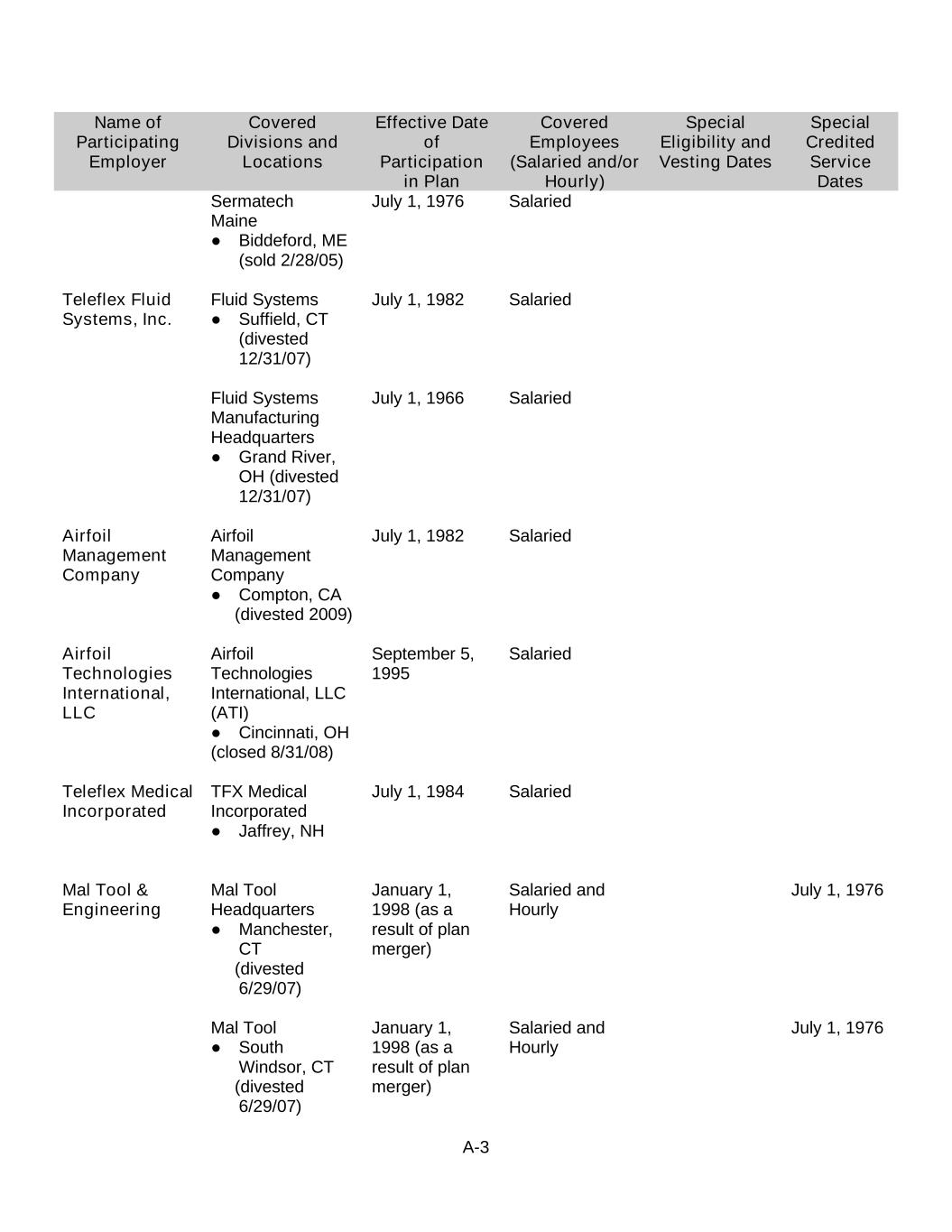
A-3 Name of Participating Employer Covered Divisions and Locations Effective Date of Participation in Plan Covered Employees (Salaried and/or Hourly) Special Eligibility and Vesting Dates Special Credited Service Dates Sermatech Maine ● Biddeford, ME (sold 2/28/05) July 1, 1976 Salaried Teleflex Fluid Systems, Inc. Fluid Systems ● Suffield, CT (divested 12/31/07) July 1, 1982 Salaried Fluid Systems Manufacturing Headquarters ● Grand River, OH (divested 12/31/07) July 1, 1966 Salaried Airfoil Management Company Airfoil Management Company ● Compton, CA (divested 2009) July 1, 1982 Salaried Airfoil Technologies International, LLC Airfoil Technologies International, LLC (ATI) ● Cincinnati, OH (closed 8/31/08) September 5, 1995 Salaried Teleflex Medical Incorporated TFX Medical Incorporated ● Jaffrey, NH July 1, 1984 Salaried Mal Tool & Engineering Mal Tool Headquarters ● Manchester, CT (divested 6/29/07) January 1, 1998 (as a result of plan merger) Salaried and Hourly July 1, 1976 Mal Tool ● South Windsor, CT (divested 6/29/07) January 1, 1998 (as a result of plan merger) Salaried and Hourly July 1, 1976
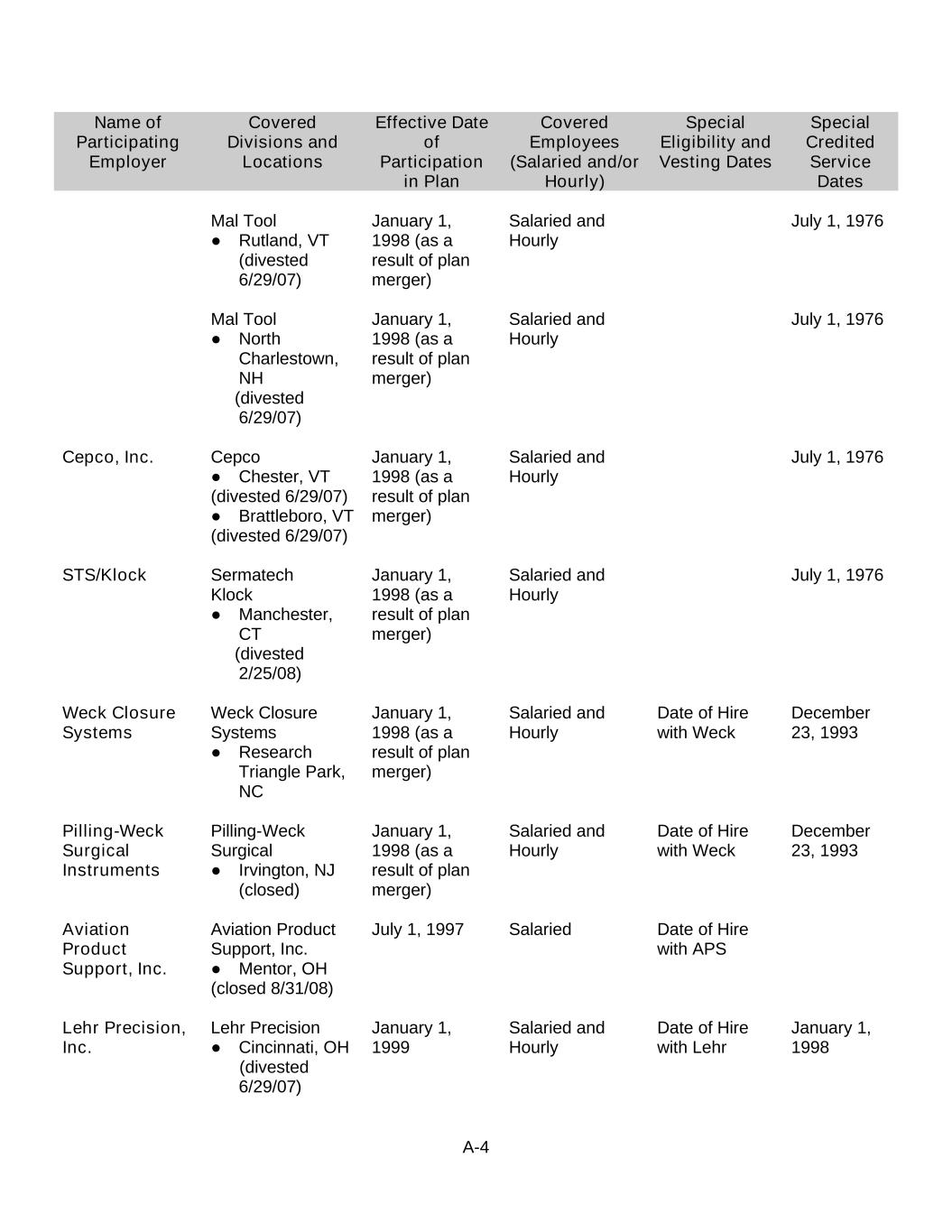
A-4 Name of Participating Employer Covered Divisions and Locations Effective Date of Participation in Plan Covered Employees (Salaried and/or Hourly) Special Eligibility and Vesting Dates Special Credited Service Dates Mal Tool ● Rutland, VT (divested 6/29/07) January 1, 1998 (as a result of plan merger) Salaried and Hourly July 1, 1976 Mal Tool ● North Charlestown, NH (divested 6/29/07) January 1, 1998 (as a result of plan merger) Salaried and Hourly July 1, 1976 Cepco, Inc. Cepco ● Chester, VT (divested 6/29/07) ● Brattleboro, VT (divested 6/29/07) January 1, 1998 (as a result of plan merger) Salaried and Hourly July 1, 1976 STS/Klock Sermatech Klock ● Manchester, CT (divested 2/25/08) January 1, 1998 (as a result of plan merger) Salaried and Hourly July 1, 1976 Weck Closure Systems Weck Closure Systems ● Research Triangle Park, NC January 1, 1998 (as a result of plan merger) Salaried and Hourly Date of Hire with Weck December 23, 1993 Pilling-Weck Surgical Instruments Pilling-Weck Surgical ● Irvington, NJ (closed) January 1, 1998 (as a result of plan merger) Salaried and Hourly Date of Hire with Weck December 23, 1993 Aviation Product Support, Inc. Aviation Product Support, Inc. ● Mentor, OH (closed 8/31/08) July 1, 1997 Salaried Date of Hire with APS Lehr Precision, Inc. Lehr Precision ● Cincinnati, OH (divested 6/29/07) January 1, 1999 Salaried and Hourly Date of Hire with Lehr January 1, 1998
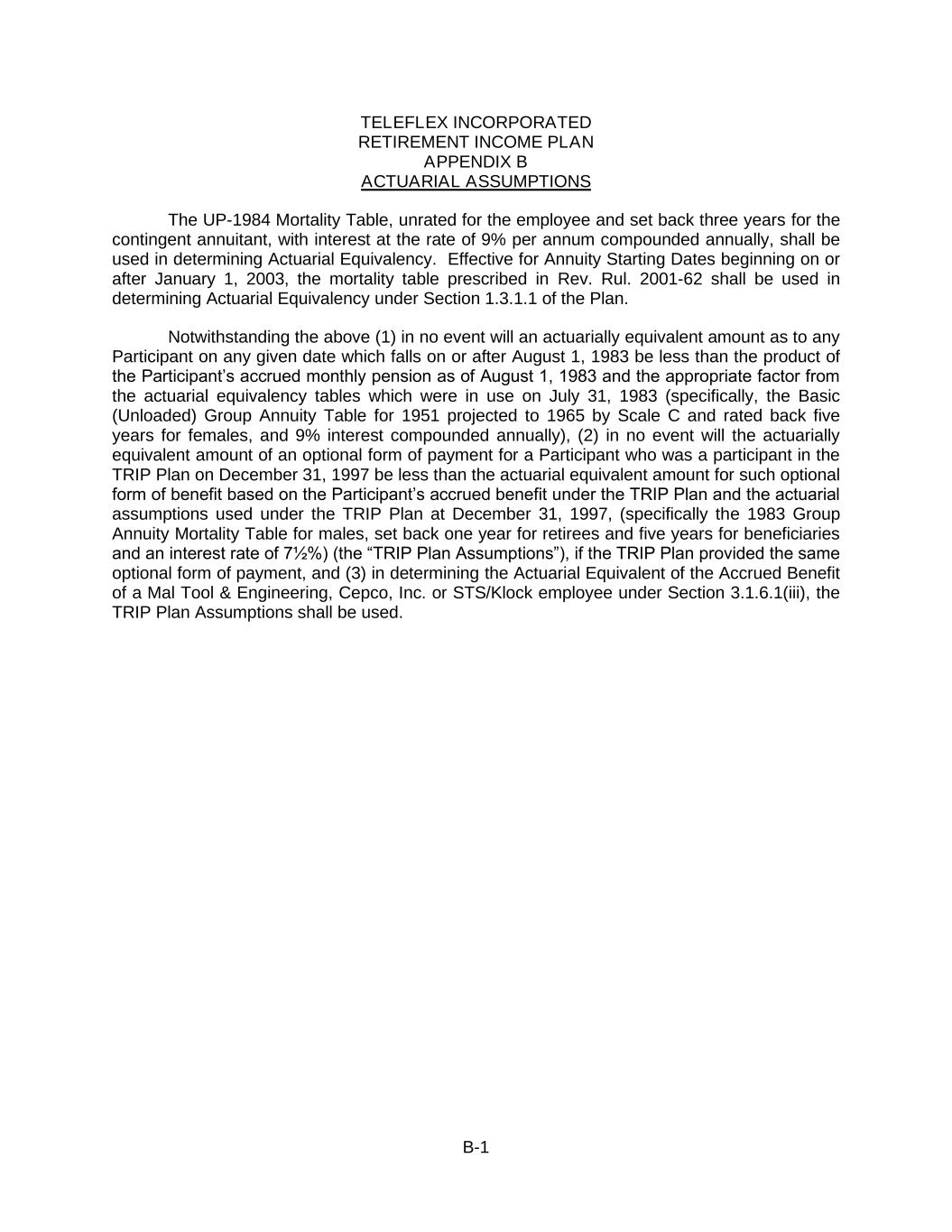
B-1 TELEFLEX INCORPORATED RETIREMENT INCOME PLAN APPENDIX B ACTUARIAL ASSUMPTIONS The UP-1984 Mortality Table, unrated for the employee and set back three years for the contingent annuitant, with interest at the rate of 9% per annum compounded annually, shall be used in determining Actuarial Equivalency. Effective for Annuity Starting Dates beginning on or after January 1, 2003, the mortality table prescribed in Rev. Rul. 2001-62 shall be used in determining Actuarial Equivalency under Section 1.3.1.1 of the Plan. Notwithstanding the above (1) in no event will an actuarially equivalent amount as to any Participant on any given date which falls on or after August 1, 1983 be less than the product of the Participant’s accrued monthly pension as of August 1, 1983 and the appropriate factor from the actuarial equivalency tables which were in use on July 31, 1983 (specifically, the Basic (Unloaded) Group Annuity Table for 1951 projected to 1965 by Scale C and rated back five years for females, and 9% interest compounded annually), (2) in no event will the actuarially equivalent amount of an optional form of payment for a Participant who was a participant in the TRIP Plan on December 31, 1997 be less than the actuarial equivalent amount for such optional form of benefit based on the Participant’s accrued benefit under the TRIP Plan and the actuarial assumptions used under the TRIP Plan at December 31, 1997, (specifically the 1983 Group Annuity Mortality Table for males, set back one year for retirees and five years for beneficiaries and an interest rate of 7½%) (the “TRIP Plan Assumptions”), if the TRIP Plan provided the same optional form of payment, and (3) in determining the Actuarial Equivalent of the Accrued Benefit of a Mal Tool & Engineering, Cepco, Inc. or STS/Klock employee under Section 3.1.6.1(iii), the TRIP Plan Assumptions shall be used.
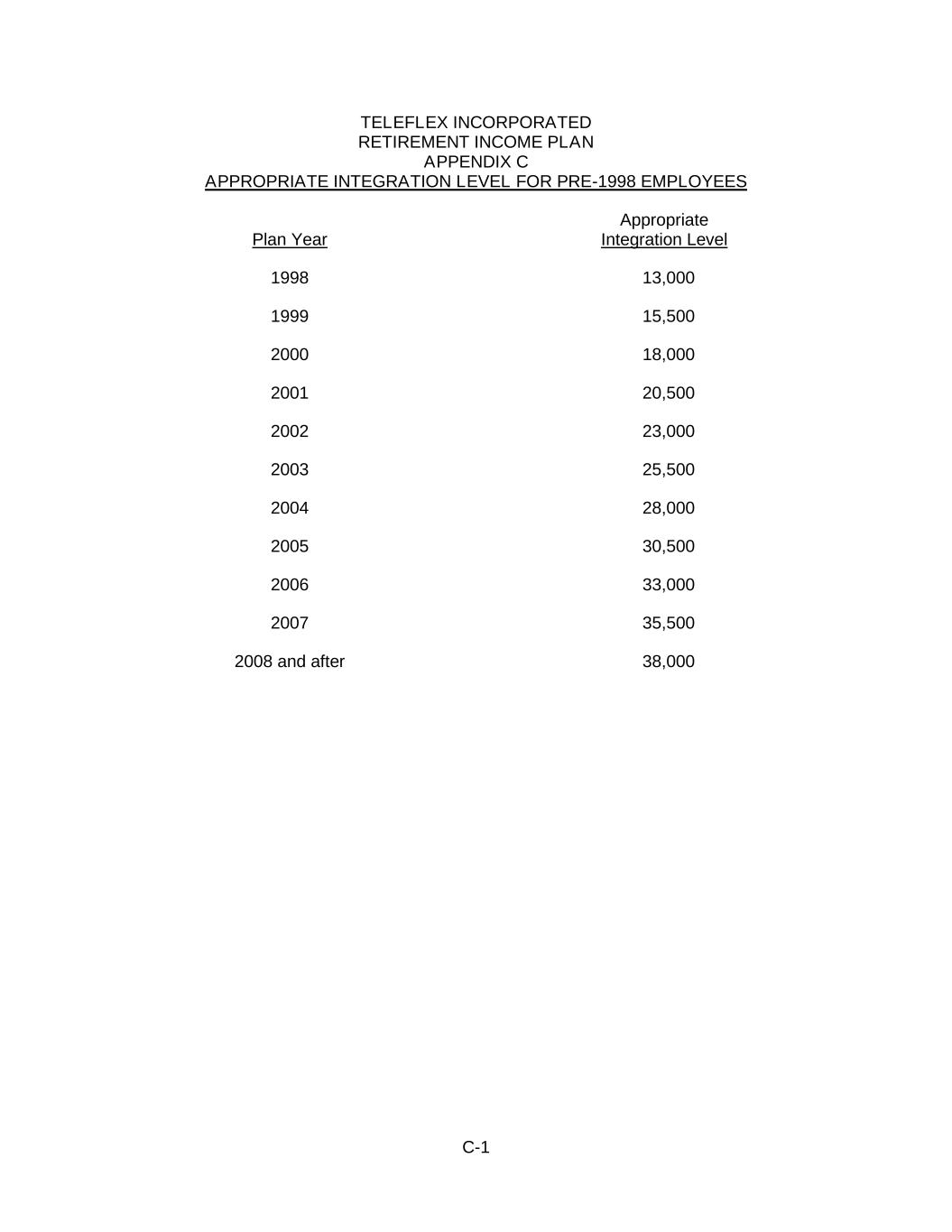
C-1 TELEFLEX INCORPORATED RETIREMENT INCOME PLAN APPENDIX C APPROPRIATE INTEGRATION LEVEL FOR PRE-1998 EMPLOYEES Plan Year Appropriate Integration Level 1998 13,000 1999 15,500 2000 18,000 2001 20,500 2002 23,000 2003 25,500 2004 28,000 2005 30,500 2006 33,000 2007 35,500 2008 and after 38,000
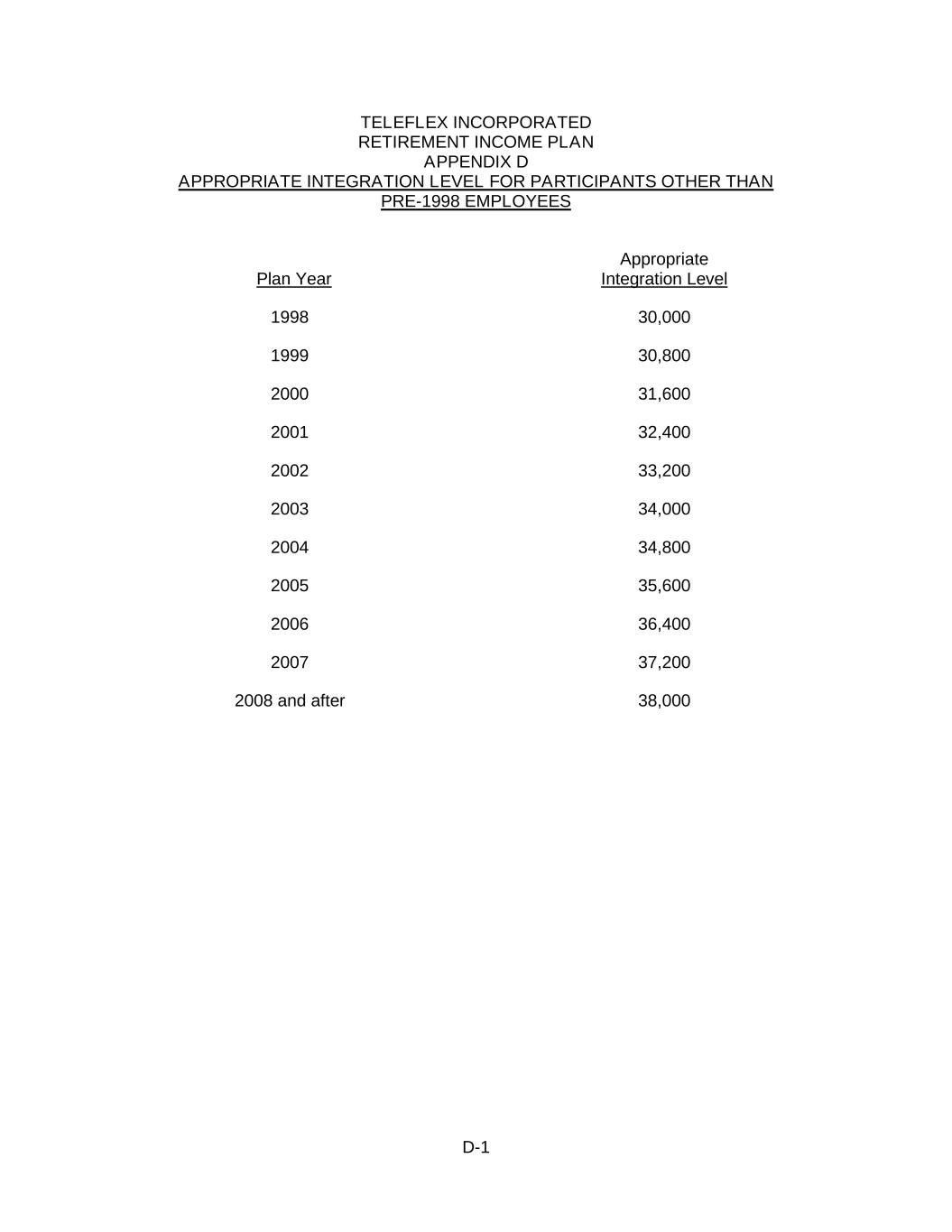
D-1 TELEFLEX INCORPORATED RETIREMENT INCOME PLAN APPENDIX D APPROPRIATE INTEGRATION LEVEL FOR PARTICIPANTS OTHER THAN PRE-1998 EMPLOYEES Plan Year Appropriate Integration Level 1998 30,000 1999 30,800 2000 31,600 2001 32,400 2002 33,200 2003 34,000 2004 34,800 2005 35,600 2006 36,400 2007 37,200 2008 and after 38,000

E-1 TELEFLEX INCORPORATED RETIREMENT INCOME PLAN APPENDIX E TELEFLEX INCORPORATED HOURLY EMPLOYEES’ PENSION PLAN ARTICLE I INTRODUCTION The provisions in this Appendix E apply with respect to Participants in the Teleflex Incorporated Hourly Employees’ Pension Plan (“Hourly Employees’ Plan”) before its merger with and into the Plan effective as of December 31, 2008. The provisions in this Appendix E shall continue to apply on and after the Plan’s Termination Date (August 1, 2023) to Eligible Employees and Participants eligible for the benefits described in this Appendix E. Except for the provisions set forth in this Appendix E, the Plan provisions, including terms defined therein, shall apply with respect to Participants eligible for the benefits described in this Appendix E. ARTICLE II DEFINITIONS Terms used but not defined in this Appendix E shall have the meaning set forth in the Plan. Except with respect to the references to Articles and Sections of the Plan herein, references in this Appendix E to Articles and Section numbers are references to the Articles and Sections in this Appendix E. 2.1 “Actuarial Equivalent” means, unless otherwise provided in an applicable Schedule, the amount computed on the basis of the Applicable Interest Rate and according to the Applicable Mortality Table. 2.2 “Adjustment Factor” means the cost of living adjustment factor prescribed by the Secretary of the Treasury under Section 415(d) of the Code, as applied to such items and in such manner as the Secretary shall provide. 2.3 “Annuity Starting Date” means the first day of the first period for which an amount is paid as an annuity or in any other form. 2.4 “Compensation” or “Limitation Compensation” means wages within the meaning of Section 3401(a) of the Code and all other payments of compensation to an Employee by the Employer (in the course of the trade or business of the Employer) for which the Employer is required to furnish the Employee with a written statement under Section 6041(d), 6051(a)(3), or 6052 of the Code, determined without regard to any rules under Section 3401(a) that limit the remuneration included in wages based on the nature or location of the employment or the services performed, plus amounts that would be paid to the Employee during the year but for the Employee's election under a cash or deferred arrangement described in Section 401(k) of the Code, a cafeteria plan described in Section 125 of the Code, a simplified employee pension described in Section 402(h) of the Code, a qualified transportation fringe benefit plan under Section 132(f) of the Code, an annuity program described in Section 403(b) of the Code, or a government plan described in Section 457 of the Code. Any reference in this Appendix E to Compensation is a reference to the definition in this Section, unless the Appendix reference specifies a modification to this definition. Except as
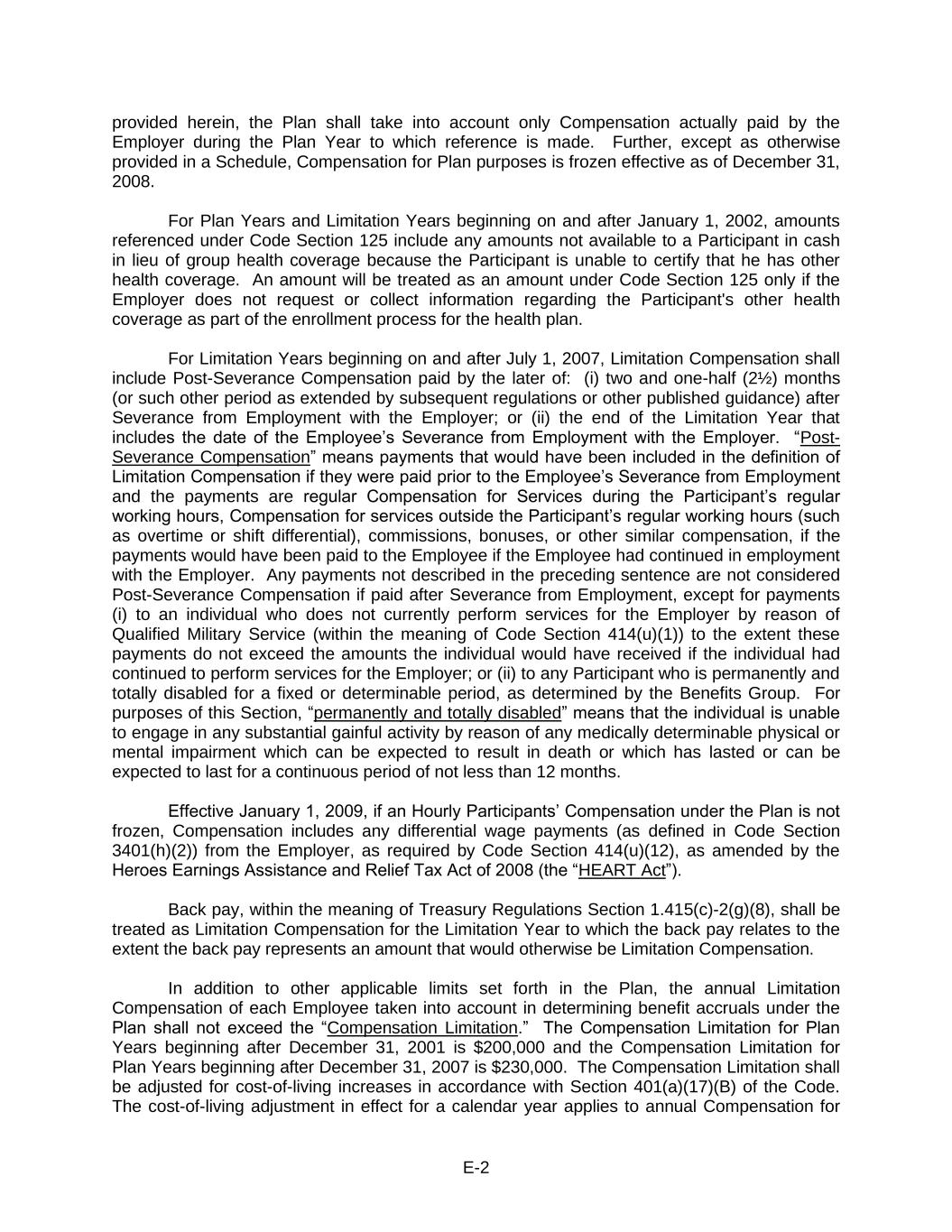
E-2 provided herein, the Plan shall take into account only Compensation actually paid by the Employer during the Plan Year to which reference is made. Further, except as otherwise provided in a Schedule, Compensation for Plan purposes is frozen effective as of December 31, 2008. For Plan Years and Limitation Years beginning on and after January 1, 2002, amounts referenced under Code Section 125 include any amounts not available to a Participant in cash in lieu of group health coverage because the Participant is unable to certify that he has other health coverage. An amount will be treated as an amount under Code Section 125 only if the Employer does not request or collect information regarding the Participant's other health coverage as part of the enrollment process for the health plan. For Limitation Years beginning on and after July 1, 2007, Limitation Compensation shall include Post-Severance Compensation paid by the later of: (i) two and one-half (2½) months (or such other period as extended by subsequent regulations or other published guidance) after Severance from Employment with the Employer; or (ii) the end of the Limitation Year that includes the date of the Employee’s Severance from Employment with the Employer. “Post- Severance Compensation” means payments that would have been included in the definition of Limitation Compensation if they were paid prior to the Employee’s Severance from Employment and the payments are regular Compensation for Services during the Participant’s regular working hours, Compensation for services outside the Participant’s regular working hours (such as overtime or shift differential), commissions, bonuses, or other similar compensation, if the payments would have been paid to the Employee if the Employee had continued in employment with the Employer. Any payments not described in the preceding sentence are not considered Post-Severance Compensation if paid after Severance from Employment, except for payments (i) to an individual who does not currently perform services for the Employer by reason of Qualified Military Service (within the meaning of Code Section 414(u)(1)) to the extent these payments do not exceed the amounts the individual would have received if the individual had continued to perform services for the Employer; or (ii) to any Participant who is permanently and totally disabled for a fixed or determinable period, as determined by the Benefits Group. For purposes of this Section, “permanently and totally disabled” means that the individual is unable to engage in any substantial gainful activity by reason of any medically determinable physical or mental impairment which can be expected to result in death or which has lasted or can be expected to last for a continuous period of not less than 12 months. Effective January 1, 2009, if an Hourly Participants’ Compensation under the Plan is not frozen, Compensation includes any differential wage payments (as defined in Code Section 3401(h)(2)) from the Employer, as required by Code Section 414(u)(12), as amended by the Heroes Earnings Assistance and Relief Tax Act of 2008 (the “HEART Act”). Back pay, within the meaning of Treasury Regulations Section 1.415(c)-2(g)(8), shall be treated as Limitation Compensation for the Limitation Year to which the back pay relates to the extent the back pay represents an amount that would otherwise be Limitation Compensation. In addition to other applicable limits set forth in the Plan, the annual Limitation Compensation of each Employee taken into account in determining benefit accruals under the Plan shall not exceed the “Compensation Limitation.” The Compensation Limitation for Plan Years beginning after December 31, 2001 is $200,000 and the Compensation Limitation for Plan Years beginning after December 31, 2007 is $230,000. The Compensation Limitation shall be adjusted for cost-of-living increases in accordance with Section 401(a)(17)(B) of the Code. The cost-of-living adjustment in effect for a calendar year applies to annual Compensation for

E-3 any period, not exceeding 12 months, over which Compensation is determined (the “Determination Period”) that begins with or within such calendar year. If a Determination Period consists of fewer than 12 months, the Compensation Limitation will be multiplied by a fraction, the numerator of which is the number of months in the Determination Period and the denominator of which is 12. If Compensation in any prior Determination Period is taken into account in determining an Employee’s benefits accruing in the current Plan Year, the Compensation for that prior Determination Period is subject to the Compensation Limit in effect for that prior Determination Period. Any increase in the Compensation Limit shall not apply to former Employees. 2.5 “Early Retirement Date” means, unless otherwise provided in an applicable Schedule, the first day of any month (prior to the Normal Retirement Date) coinciding with or following the date on which a Participant attains age 60 and has completed at least 10 Years of Vesting Service. 2.6 “Effective Retirement Date” means a Participant’s Normal Retirement Date, unless the Participant elects early retirement pursuant to Section 5.3 of this Appendix E, in which case it shall mean the Participant’s Early Retirement Date, or the Participant commences benefit payments after his Normal Retirement Date in accordance with Section 5.4 of this Appendix E, in which case it shall mean the Participant’s Postponed Retirement Date. 2.7 “Eligible Employee” means any Employee whose initial date of hire is prior to January 1, 2006 (July 1, 2006 with respect to an Employee who is a member of UAW Local 644 (Marine - Limerick, PA) and who is covered by a collective bargaining agreement between the Employer and UAW Local 644), and who is eligible to participate in the Plan in accordance with the terms of this Appendix E based on the terms of a Schedule. Effective January 1, 2009, to the extent the Plan is not frozen, any individual in Qualified Military Service (as defined in Code Section 414(u)) who is receiving differential wage payments (as defined in Code Section 3401(h)(2)) from the Employer shall be treated as an “Employee” of the Employer solely for purposes of providing contributions, benefits and service credit with respect to such Qualified Military Service, as applicable. 2.8 “Life Annuity” means an annual benefit payable for the annuitant’s lifetime only in monthly installments. At the annuitant’s death, all benefit payments cease. Except as otherwise set forth in a Schedule to this Appendix E, a Life Annuity is the normal form of benefit under the Plan for Hourly Participants, as described in Section 5.5 of this Appendix E. 2.9 “Normal Retirement Date” means the first day of the month coinciding with or next following the date on which a Participant attains his Normal Retirement Age. 2.10 “Participant” means an Eligible Employee who is or becomes covered under the Plan pursuant to Section 4.1 of this Appendix E and who has not yet reached his Effective Retirement Date or terminated participation in accordance with Section 4.2 of this Appendix E. Where appropriate, “Participant” also includes an individual who is no longer an Eligible Employee but retains a right to a benefit under the Plan. 2.11 “Postponed Retirement Date” means the first day of the month following the date on which a Participant has a Severance from Employment after such Participant’s Normal Retirement Date or the first day of any month on which a Participant elects to commence receipt of his Plan benefit for any other reason after his Normal Retirement Date, but not before the

E-4 Participant’s Severance from Employment and not later than the Participant’s Required Beginning Date. 2.12 “Schedule” means a schedule supplemental to this Appendix E setting forth the eligibility requirements, retirement benefits (including provisions for early retirement), vesting provisions, and/or other provisions applicable to a group or groups of Eligible Employees. ARTICLE III SERVICE 3.1 “Year of Benefit Accrual Service” shall have the meaning given such term in the applicable Schedule. The Committee or its delegate may determine, in accordance with any agreements and/or resolutions of the Board of Directors, and subject to any applicable laws or regulations, whether and to what extent service with an acquired, constituent or predecessor company, or service with another company from which a plant or business is acquired, shall be deemed to be a Year of Benefit Accrual Service under the Plan and the applicable Schedule. Except as otherwise provided in a Schedule attached hereto and incorporated herein or as required by applicable law or a collective bargaining agreement, no Employee or Participant shall be credited with any Years of Benefit Accrual Service under the Plan after December 31, 2008. 3.2 “Year of Vesting Service” (a) “Year of Vesting Service” means each full 12 consecutive month period included in an Employee’s Period of Service as determined below: (1) If an Employee quits, retires, or is discharged, and within 12 months thereafter is credited with an Hour of Service, his Years of Vesting Service shall be computed as though his employment had not been severed; and (2) If an Employee is absent from service for any reason other than those described in (a)(1), above, and while so absent quits, retires, or is discharged, and within 12 months after the first date upon which he is absent from service is credited with an Hour of Service, his Years of Vesting Service shall be computed as though his employment had not been severed. (b) If a Participant has a Period of Severance, and is thereafter reemployed, the Employee shall be credited with all Years of Vesting Service prior to the Employee’s Period of Severance if, when the Employee left employment, he was eligible for a vested pension hereunder, or if the number of his consecutive Breaks in Service during the Period of Severance, was less than the greater of five (5) or his prior Years of Vesting Service. (c) The Committee or its delegate may, in accordance with any agreements and/or resolutions of the Board of Directors, and subject to any applicable laws or regulations, whether and to what extent service with an acquired, constituent or predecessor company, or service with another company from which a plant or business is acquired, shall be deemed to be a Year of Vesting Service under the Plan and the applicable Schedule. Further, the Committee or its delegate shall have the authority to

E-5 accelerate the vesting of a Participant so long as such acceleration satisfies the requirements of Code Section 401(a)(4) and the Treasury Regulations thereunder. (d) In addition to the definitions set forth in other Sections of this Appendix E, the following definitions shall apply: (1) “Break-in-Service” means a 12 consecutive month period beginning on an Employee’s Severance from Service Date (and each anniversary thereof) during which an Employee does not perform an Hour of Service. However, in the case of an Employee who is absent from work for any period by reason of: (i) The pregnancy of the Employee; (ii) The birth of a child of the Employee; (iii) The placement of a child with the Employee in connection with the adoption of such child by the Employee; or (iv) The care of a child for a period beginning immediately following such birth or placement, the 12 consecutive month period beginning on the first anniversary of the first date of such absence shall not constitute a Break-in-Service. (2) “Employment Commencement Date” means the date upon which an Employee is first credited with an Hour of Service. (3) “Period of Service” means the period between the Employee’s Employment Commencement Date or Reemployment Commencement Date, as applicable, and the Employee’s Severance from Service Date. (4) “Period of Severance” means the period between an Employee’s Severance from Service Date and his Reemployment Commencement Date. (5) “Reemployment Commencement Date” means the date upon which an Employee is first credited with an Hour of Service following a Severance from Service Date or Break-in-Service. (6) “Severance from Service Date” means the date upon which an Employee severs his service with the Employer and its Related Employers, which date shall be the earlier of: (i) The date upon which the Employee quits, retires, is discharged, or dies; or (ii) The first anniversary of the date of such Employee’s absence from service for any other reason.

E-6 ARTICLE IV EMPLOYEE PARTICIPATION 4.1 Eligibility Requirements. An Eligible Employee shall become a Participant upon the date set forth in the applicable Schedule. Notwithstanding the foregoing or any other provision in the Plan or this Appendix E and its Schedules to the contrary, no Employee whose initial date of hire with the Employer is on or after January 1, 2006 (July 1, 2006 with respect to an Employee who is a member of UAW Local 644 (Marine - Limerick, PA) and who is covered by a collective bargaining agreement between the Employer and UAW Local 644), is eligible to become a Participant or, except as provided in a Schedule, accrue benefits under the Plan. 4.2 Termination of Participation. A Participant shall cease active participation in the Plan as of the earlier of (a) his Severance from Employment, or (b) such time as he has a Break-in-Service; provided, if after such Break-in-Service he again becomes an active Eligible Employee, he shall again become an active Participant as of the first day on which he again satisfies the Eligibility Requirements. Nothing in this Section shall permit the duplication of benefits. A Participant shall cease his participation in the Plan at such time as he no longer has any right to benefits under the Plan. ARTICLE V RETIREMENT BENEFITS 5.1 Participants Retiring on Their Normal Retirement Dates. A Participant who has a Severance from Employment on his Normal Retirement Date shall be entitled to a Normal Retirement Benefit, payable in the form of a Life Annuity, determined on the basis specified in the Schedule applicable to the Participant. Notwithstanding any provision of the Plan, this Appendix or a Schedule hereto to the contrary, effective as of the Transition Date, Severance from Employment is no longer required to start a Normal Retirement Benefit. No benefit payments shall commence prior to a Participant’s Normal Retirement Date unless he elects in writing to commence receipt of his benefit on an Early Retirement Date in accordance with Section 6.6 of the Plan during the 180-day period ending on his Annuity Starting Date, except as provided in Section 6.7 of the Plan and in Article VII of this Appendix E. In addition, prior to the Transition Date, no benefit payments shall commence prior to a Participant’s Severance from Employment. Effective as of the Transition Date, Severance from Employment is no longer required to commence benefit payments. Anything in the Plan to the contrary notwithstanding, the annual Normal Retirement Benefit payable to a vested terminated Participant who was a participant in the Teleflex Incorporated Pension Plan for Production and Maintenance Employees of the Aerospace Nuclear Group (the “Aerospace/ Nuclear Plan”) shall be the accrued benefit as merged into the Hourly Employees’ Plan as of December 31, 1994 (the “Merger Date”). The form, timing, and amount of benefit payments to any such Participant shall be determined in accordance with the terms and conditions of the Aerospace/Nuclear Plan as of the Merger Date insofar as such terms and conditions do not contravene Section 401(a) of the Code or any Treasury Regulations thereunder as they may be amended from time to time. Benefit payments to any participant in the Aerospace/Nuclear Plan who was already in pay status as of the Merger Date shall continue to said participant uninterrupted in the same form and amount as under the Aerospace/Nuclear Plan. Except as otherwise specified under this Section 5.1 of this Appendix
E-7 E, the Hourly Employees’ Plan shall be retroactively applicable to January 1, 1989 to the Aerospace/Nuclear Plan. 5.2 Early Retirement. A Participant who has experienced a Severance from Employment may commence receipt of his Plan benefit on an Early Retirement Date. A Participant eligible for early retirement under this Section 5.2 of this Appendix E may elect early commencement of retirement benefits under Section 5.3 of this Appendix E. Except as provided in Section 6.7.1 or 6.7.2.2 of the Plan, no distribution shall be made prior to the Participant’s Required Beginning Date without his written consent. 5.3 Early Commencement of Retirement Benefits. If a Participant has experienced a Severance from Employment, he may elect to receive, in lieu of a retirement benefit commencing on his Normal Retirement Date, a benefit commencing on an Early Retirement Date and before his Normal Retirement Date (an “Early Retirement Benefit”). The amount of any such Early Retirement Benefit shall be determined in accordance with the terms of the applicable Schedule and shall not be less than the reduced Normal Retirement Benefit to which the Participant was entitled as of his Early Retirement Date (or, if earlier, his Severance from Employment or December 31, 2008). Notwithstanding any provision of the Plan, this Appendix or a Schedule hereto to the contrary, effective as of the Transition Date, Severance from Employment is no longer required to start an Early Retirement Benefit. 5.4 Postponed Retirement. A Participant who remains in employment with the Employer after his or her Normal Retirement Date shall not receive any retirement benefits hereunder as long as he is so employed. Upon such Participant’s Severance from Employment, he shall receive a “Postponed Retirement Benefit” computed in accordance with the applicable Schedule based upon Years of Accrual Service to his Postponed Retirement Date or, if greater and payments are not suspended pursuant to Section 5.8 of this Appendix E, the Actuarial Equivalent of his Normal Retirement Benefit on his Postponed Retirement Date. A Participant must have a Severance from Employment in order to commence receipt of his Plan benefit. Notwithstanding any provision of the Plan, this Appendix or a Schedule hereto to the contrary, effective as of the Transition Date, effective as of the Transition Date, Severance from Employment is no longer required to start a Postponed Retirement Benefit. 5.5 Normal Form of Benefit. Except as otherwise set forth in a Schedule to this Appendix E, the normal form of retirement benefit under the Plan shall be a Life Annuity. 5.6 Qualified Annuity. Except as otherwise provided in Section 6.7, unless a Participant elects a different optional form of benefit in accordance with Section 6.6 of the Plan, a Participant’s Accrued Benefit shall be paid in the form of a qualified annuity. (a) A qualified annuity for an unmarried Participant means a Life Annuity. (b) A qualified annuity for a married Participant means a Qualified Joint and Survivor Annuity. 5.7 Optional Forms of Payment. (a) Each Participant who has made an election under Section 6.6 of the Plan not to receive his benefits in the form of a qualified annuity may elect, subject to the rules of (b), below, and to the requirements of Article VI of the Plan, to receive his benefits in an amount which is the Actuarial Equivalent of the Normal Retirement Benefit
E-8 in an annuity form in Section 8.1(e). However, such annuity may not be in any form that will provide for payments over a period extending beyond either the life of the Participant (or over the lives of the Participant and his designated Beneficiary) or the life expectancy of the Participant (or the life expectancy of the Participant and his designated Beneficiary). (b) Rules Governing Election of an Optional Form: No survivor annuity election under this Section 5.7 of Appendix E shall be effective unless: (i) The Beneficiary is living on the Participant’s Annuity Starting Date; and (ii) The Participant’s death occurs after his Annuity Starting Date. After the first annuity payment check is negotiated, no election may be changed, and no new Spouse or other Beneficiary may be substituted for the designated Beneficiary determined on the Annuity Starting Date. 5.8 Suspension of Benefits and Reemployment of Persons Receiving Retirement Benefits (a) Prior to the Transition Date (i.e., the date the insurer selected in connection with the termination of the Plan takes over the administration of Accrued Benefits under an annuity contract purchased from such insure), benefits in pay status shall be suspended for each calendar month during which the Employee completes at least 40 Hours of Service with the Employer or an Affiliate (“ERISA Section 203(a)(3)(B) service”). Normal Retirement Benefits shall be suspended for an Employee who has reached Normal Retirement Age and has not yet received benefits but continues in ERISA Section 203(a)(3)(B) service. Effective on and after the Transition Date, the Postponed Retirement Benefit of a Participant who continues to be employed after Normal Retirement Date shall not be less than the Actuarial Equivalent of his or her Normal Retirement Benefit reduced by his or her accruals pursuant to Code Section 411(b)(1)(H)(i) and any distributions after his or her Normal Retirement Date in accordance with the applicable Treasury Regulations; provided, however, that any such actuarial adjustments to the Accrued Benefits of Participants who continue to be employed after Normal Retirement Date shall be only for periods beginning on and after the Transition Date and no actuarial adjustments shall be made retroactively. In addition, effective on and after the Transition Date, if a retired Participant becomes reemployed after payment of his or her Accrued Benefit has commenced, the Plan does not apply the suspension of benefits rule and his or her monthly retirement benefit payments shall continue. A Participant whose benefit payments were suspended prior to the Transition Date pursuant to Section 5.8 of the Plan as then in effect shall be eligible to elect to commence or resume payment of his or her Accrued Benefit after the Transition Date even if he or she continues to perform ERSIA Section 203(a)(3)(B) service or if he or she is reemployed after having attained Normal Retirement Age. (b) If benefit payments have been suspended, payments shall resume no later than the first day of the third calendar month after the calendar month in which the Employee ceases to be employed for purposes of ERISA Section 203(a)(3)(B) service. The initial payment upon resumption shall include the payment scheduled to occur in the calendar month when payments resume and any amounts withheld during the period

E-9 between the cessation of ERISA Section 203(a)(3)(B) service and the resumption of payments. The Participant’s benefits shall also be actuarially increased to take into account any period after age 70½ during which the Participant was not receiving any benefits under the Plan. (c) No payment shall be withheld by the Plan pursuant to this Section 5.8 of Appendix E unless the Plan notifies the Employee by personal delivery or first class mail during the first calendar month or payroll period in which the Plan withholds payments that his benefits are suspended. Such notifications shall contain a description of the specific reasons why benefit payments are being suspended, a description of the Plan provision relating to the suspension of payments, a copy of such provisions, and a statement to the effect that applicable Department of Labor regulations may be found in 29 C.F.R. Section 2530.203-3. In addition, the notice shall inform the Employee of the Plan’s procedures for affording a review of the suspension of benefits. Requests for such reviews may be considered in accordance with the claims procedure adopted by the Plan pursuant to Section 503 of ERISA and applicable regulations. (d) This Section 5.8 of Appendix E does not apply to the minimum benefit to which the Participant is entitled under the provisions of Article XII of the Plan. (e) In the case of a retiree whose benefits are suspended upon his return to employment with the Employer subsequent to his Effective Retirement Date, his retirement benefits upon the termination of his period of reemployment shall be computed in accordance with the applicable provisions of the Plan as if he were then first retired. However, his retirement benefits shall be reduced on an actuarial basis for the amount of the benefits he previously received. In no event shall the retirement benefits payable upon termination of his period of reemployment be less than the retirement benefits previously paid, adjusted to reflect any change in the form of benefits. 5.9 Calculation of Benefits of Reemployed Participants. A reemployed Participant who has a Severance from Employment with a vested Accrued Benefit and who has not received any retirement benefits under the Plan shall upon his subsequent Severance from Employment receive benefits amounting to the greater of the following: (a) The sum of: (i) The benefits from the previous employment period calculated using the benefit formula and Years of Accrual Service for the applicable previous employment period; plus (ii) The benefits, deemed to be fully vested regardless of length of service, from the latest employment period calculated using only Years of Accrual Service for the latest employment period; or (b) An amount based on the provisions of this Article V of Appendix E for the total Years of Accrual Service during all employment periods. Payment of the benefits so calculated may be made to the Participant in any of the optional forms provided for in the Plan at the time of his Severance from Employment.

E-10 Notwithstanding any provision of the Plan, this Appendix or a Schedule hereto to the contrary, effective as of the Transition Date, Severance from Employment is no longer required to start an Early, Normal or Postponed Retirement Benefit. ARTICLE VI VESTING ON SEVERANCE FROM EMPLOYMENT PRIOR TO RETIREMENT If a Participant’s has a Severance from Employment (under circumstances other than death or retirement) after satisfying the requirement for vesting of benefits specified in the applicable Schedule and on and after the date specified in such Schedule, he shall be entitled to a retirement benefit, commencing on his Normal Retirement Date, computed in accordance with Article V of this Appendix E, up to the time of his Severance from Employment, based upon his Years of Accrual Service. Except as provided in Section 6.7 of the Plan, no distribution shall be made prior to the Participant’s Normal Retirement Date without his written consent. A Participant’s Accrued Benefit shall become fully vested if he reaches his Normal Retirement Age while in the employ of the Employer or an Affiliate. Such benefit shall become payable commencing on his Effective Retirement Date. To the extent not already vested, the Accrued Benefits of Participants who are actively employed by the Employer or one of its Related Employers on the Termination Date, shall become 100% vested on that date. ARTICLE VII BENEFITS ON DEATH PRIOR TO COMMENCEMENT OF RETIREMENT INCOME 7.1 Qualified Preretirement Survivor Annuity. (a) The provisions of this Section 7.1 shall apply to any Participant with a vested Accrued Benefit, who dies before his Annuity Starting Date. No death benefits shall be payable under the Plan to any unmarried Participant who dies prior to his Early, Normal or Postponed Retirement Date. (b) If a Participant described in Section 7.1(a) dies after his Earliest Retirement Age, the Participant’s surviving Spouse shall receive the survivor annuity that would have been payable if the Participant had retired with an immediate Qualified Joint and Survivor Annuity on the day before the Participant’s date of death. (c) If a Participant described in Section 7.1(a) dies on or before his Earliest Retirement Age, the Participant’s surviving Spouse shall receive the survivor annuity that would be payable if the Participant had: (i) Experienced a Severance from Employment on his date of death (or his actual Severance from Employment date, if earlier); (ii) Survived to his Earliest Retirement Age;

E-11 (iii) Commenced receiving benefits in the form of an immediate Qualified Joint and Survivor Annuity at his Earliest Retirement Age; and (iv) Died on the day after his Earliest Retirement Age. 7.2 Definitions. (a) “Earliest Retirement Age” means the earliest age at which, under this Appendix E and the applicable Schedule, the Participant could elect to begin receiving retirement benefits, based on his actual Years of Vesting Service at death. (b) “Qualified Preretirement Survivor Annuity” means the annuity benefit payable to a Participant’s surviving Spouse under Section 7.1(b) or (c). 7.3 Commencement of Payments. Except as otherwise provided in Section 7.1(c), benefits payable under this Article VII of Appendix E shall commence as soon as practicable after the Participant’s death; provided, however, that the Spouse must consent to the commencement of benefits before the Participant would have reached age 65. If the Spouse postpones the commencement of benefits, the assumed retirement date for the purpose of calculating benefits shall be the date the Spouse elects to commence benefits but no later than the date the Participant would have reached age 65. Notwithstanding the foregoing, if the lump sum value of such benefit is not greater than $5,000, such lump sum amount shall be distributed as soon as practicable following the Participant’s death, and no other benefit shall be payable under this Article VII of Appendix E. 7.4 No Other Death Benefits. Except as provided in this Article VII of Appendix E, no benefits shall be payable under this Plan in the event of the death of a Participant prior to his Annuity Starting Date. ARTICLE VIII DISTRIBUTION REQUIREMENTS 8.1 Limits on Settlement Options. Distributions, if not made in a lump sum, may only be made over one of the following periods (or a combination thereof): (a) The life of the Participant; (b) The joint lives of the Participant and his designated Beneficiary; (c) A period certain not extending beyond the life expectancy of the Participant; (d) A period certain not extending beyond the joint and last survivor expectancy of the Participant and his designated Beneficiary; and (e) In accordance with the above legal parameters and except as provided in a Schedule attached hereto, a Participant may elect one of the following optional forms of payment: (i) A Life Annuity;
E-12 (ii) A joint life annuity payable for the life of the Participant, with continuation of payments as a survivor annuity for the remaining life of the Participant’s Beneficiary at a rate of 50% of the rate payable during the Participant’s lifetime; or (iii) for Plan Years beginning after December 31, 2007, a Participant may elect a “Qualified Optional Survivor Annuity.” A Qualified Optional Survivor Annuity is: (1) A joint life annuity payable for the life of the Participant, with continuation of payments as a survivor annuity for the remaining life of a surviving Spouse at a rate of 75% of the rate payable during the Participant’s lifetime; and (2) The Actuarial Equivalent of the Life Annuity. If the Qualified Optional Survivor Annuity is not actuarially equivalent to the Qualified Joint and Survivor Annuity, Spousal consent is required for a Participant to waive the Qualified Joint and Survivor Annuity and elect the Qualified Optional Survivor Annuity. For purposes of this Section 8.1, life expectancies shall not be redetermined.
Effective January 1, 1985 1A-1 Schedule No. 1A Sermatech - Supplemental to Teleflex Incorporated Hourly Employees’ Pension Plan (For Southeast and Southwest Division) (1) Eligibility for Participation Each hourly-paid Eligible Employee of Sermatech International Incorporated in its Southeast and Southwest Division (“Participating Employer”) becomes a Participant as of his date of hire with the Participating Employer. No Employee of the Participating Employer whose date of hire is on or after January 1, 2006 shall become a Participant. (2) Retirement Benefits and Benefits on Death (a) The amount of monthly retirement benefit to be provided for each Participant who experiences a Severance from Employment on his Normal Retirement Date shall be equal to his Accrued Benefit (herein called his “Normal Retirement Benefit”). A Participant’s Accrued Benefit is based on a retirement benefit formula equal to the monthly dollar amount indicated below for each Year of Benefit Accrual Service and fraction thereof: Date of Participant’s Severance from Employment Monthly Amount Before July 1, 1997 $13 On or after July 1, 1997 $15 “Benefit Accrual Service” means an individual’s period of employment with the Participating Employer beginning on his date of hire and ending on the date he incurs a Break- In-Service, credited at the rate of 1/10 of a Year of Benefit Accrual Service for each 170 straight- time Hours of Service; provided that an individual shall not be credited with more than one Year of Benefit Accrual Service in a Plan Year. Except as required by applicable law or a collective bargaining agreement, an individual shall not be credited with any additional Years of Benefit Accrual Service after December 31, 2008. As a result, except to the extent required by applicable law or a collective bargaining agreement, no Participant shall accrue any additional benefits under the Plan after December 31, 2008. The Normal Retirement Benefit of each Participant shall not be less than the largest periodic benefit that would have been payable to the Participant upon Severance from Employment at or prior to Normal Retirement Age under the Plan exclusive of social security supplements, premiums on disability or term insurance, and the value of disability benefits not in excess of the Normal Retirement Benefit. For purposes of comparing periodic benefits in the same form, commencing prior to and at Normal Retirement Age, the greater benefit is determined by converting the benefit payable prior to Normal Retirement Age into the same form of annuity benefit payable at Normal Retirement Age and comparing the amount of such annuity payments. (b) A Participant who experiences a Severance from Employment before his Normal Retirement Date may elect to receive his Accrued Benefit beginning on his Normal Retirement Date (or Postponed Retirement Date). Alternatively, the Participant may elect to receive payment of an “Early Retirement Benefit” commencing on his Early Retirement Date equal to the greater of (1) his Accrued Benefit reduced by 1/15th for each of the first five (5) years and

1A-2 1/30th for each of the next five (5) years and reduced actuarially for each additional year thereafter that the first day of the month on which his Early Retirement Benefit commences precedes his Normal Retirement Date, or (2) the Actuarial Equivalent of his Accrued Benefit if such benefit is distributed in a form other than a nondecreasing life annuity payable for a period not less than the life of such Participant. (c) A Participant may elect to defer commencement of his Plan benefit until his Postponed Retirement Date. A Participant who commences receipt of his Plan benefit on a Postponed Retirement Date will receive a “Postponed Retirement Benefit” equal to the greater of (1) his Accrued Benefit as of his Postponed Retirement Date, or (2) the Actuarial Equivalent of his Normal Retirement Benefit on his Postponed Retirement Date. Prior to the Transition Date, a Participant must have a Severance from Employment in order to commence receipt of his Plan benefit. Effective as of the Transition Date, Severance from Employment is no longer required for a Participant to commence receipt of his Plan benefit. (d) In the event a married Participant duly elects pursuant to Section 6.6 of the Plan not to receive his benefit in the form of a Qualified Joint and Survivor Annuity, or if such Participant is not married, in the form of a Life Annuity, the Benefits Group, pursuant to the election of the Participant, shall direct the Trustee to distribute to a Participant or his Beneficiary an amount which is the Actuarial Equivalent of the monthly retirement benefit provided in Section 2(a) above in an annuity. However, such annuity may not be in any form that will provide for payments over a period extending beyond either the life of the Participant (or the lives of the Participant and his designated Beneficiary) or the life expectancy of the Participant (or the life expectancy of the Participant and his designated Beneficiary). (e) In the event the Actuarial Equivalent Section of the Plan is amended, the Actuarial Equivalent of a Participant’s Accrued Benefit on or after the date of change shall be the greater of (1) the Actuarial Equivalent of the Accrued Benefit as of the date of the change computed on the old basis, or (2) the Actuarial Equivalent of the total Accrued Benefit computed on the new basis. (3) Vesting of Benefits A Participant will vest upon completing five (5) Years of Vesting Service. To the extent not already vested, the Accrued Benefits of Participants who are actively employed by the Employer or one of its Related Employers on the Termination Date, shall become 100% vested on that date. (4) Other Provisions Provisions not covered by this Schedule may be determined by reference to the Plan and Appendix E thereto.
Effective July 1, 1997 2A-1 Schedule No. 2A Automotive Manufacturing - Supplemental to Teleflex Incorporated Hourly Employees’ Pension Plan (For Hillsdale, Michigan) (1) Eligibility for Participation Each hourly-paid Eligible Employee of the Sponsor in its Hillsdale, Michigan location becomes a Participant as of the later of July 1, 1997 or his date of hire with the Sponsor. Except as otherwise provided in another Schedule to this Appendix E, no Employee of the Sponsor whose date of hire is on or after January 1, 2006 shall become a Participant. (2) Retirement Benefits and Benefits on Death (a) The amount of monthly retirement benefit to be provided for each Participant who experiences a Severance from Employment on his Normal Retirement Date shall be equal to his Accrued Benefit (herein called his “Normal Retirement Benefit”). A Participant’s Accrued Benefit is based on a retirement benefit formula equal to $15 for each Year of Benefit Accrual Service and fraction thereof. “Benefit Accrual Service” means an individual’s period of employment with the Sponsor beginning on his date of hire and ending on the date he incurs a Break-In-Service, credited at the rate of 1/10 of a Year of Benefit Accrual Service for each 170 straight-time Hours of Service; provided that an individual shall not be credited with more than one Year of Benefit Accrual Service in a Plan Year. Except to the extent required by applicable law or a collective bargaining agreement, an individual shall not be credited with any additional Years of Benefit Accrual Service after December 31, 2008. As a result, except as required by applicable law or a collective bargaining agreement, no Participant shall accrue any additional benefits under the Plan after December 31, 2008. The Normal Retirement Benefit of each Participant shall not be less than the largest periodic benefit that would have been payable to the Participant upon Severance from Employment at or prior to Normal Retirement Age under the Plan exclusive of social security supplements, premiums on disability or term insurance, and the value of disability benefits not in excess of the Normal Retirement Benefit. For purposes of comparing periodic benefits in the same form, commencing prior to and at Normal Retirement Age, the greater benefit is determined by converting the benefit payable prior to Normal Retirement Age into the same form of annuity benefit payable at Normal Retirement Age and comparing the amount of such annuity payments. (b) A Participant who experiences a Severance from Employment before his Normal Retirement Date may elect to receive his Accrued Benefit beginning on his Normal Retirement Date (or Postponed Retirement Date). Alternatively, the Participant may elect to receive payment of an “Early Retirement Benefit” commencing on his Early Retirement Date equal to the greater of (1) his Accrued Benefit reduced by 1/15th for each of the first five (5) years and 1/30th for each of the next five (5) years and reduced actuarially for each additional year thereafter that the first day of the month on which his Early Retirement Benefit commences precedes his Normal Retirement Date, or (2) the Actuarial Equivalent of his Accrued Benefit if such benefit is distributed in a form other than a nondecreasing life annuity payable for a period not less than the life of such Participant.

2A-2 (c) A Participant may elect to defer commencement of his Plan benefit until his Postponed Retirement Date. A Participant who commences receipt of his Plan benefit on a Postponed Retirement Date will receive a “Postponed Retirement Benefit” equal to the greater of (1) his Accrued Benefit as of his Postponed Retirement Date, or (2) the Actuarial Equivalent of his Normal Retirement Benefit on his Postponed Retirement Date. Prior to the Transition Date, a Participant must have a Severance from Employment in order to commence receipt of his Plan benefit. Effective as of the Transition Date, Severance from Employment is no longer required for a Participant to commence receipt of his Plan benefit. (d) In the event a married Participant duly elects pursuant to Section 6.6 of the Plan not to receive his benefit in the form of a Qualified Joint and Survivor Annuity, or if such Participant is not married, in the form of a Life Annuity, the Benefits Group, pursuant to the election of the Participant, shall direct the Trustee to distribute to a Participant or his Beneficiary an amount which is the Actuarial Equivalent of the monthly retirement benefit provided in Section 2(a) above in an annuity. However, such annuity may not be in any form that will provide for payments over a period extending beyond either the life of the Participant (or the lives of the Participant and his designated Beneficiary) or the life expectancy of the Participant (or the life expectancy of the Participant and his designated Beneficiary). (e) In the event the Actuarial Equivalent Section of the Plan is amended, the Actuarial Equivalent of a Participant’s Accrued Benefit on or after the date of change shall be the greater of (1) the Actuarial Equivalent of the Accrued Benefit as of the date of the change computed on the old basis, or (2) the Actuarial Equivalent of the total Accrued Benefit computed on the new basis. (3) Vesting of Benefits A Participant will vest upon completing five (5) Years of Vesting Service. To the extent not already vested, the Accrued Benefits of Participants who are actively employed by the Employer or one of its Related Employers on the Termination Date, shall become 100% vested on that date. (4) Prior Service Eligible Employees under this Schedule No. 2A shall receive credit for all service with the Employer since their most recent date of hire for purposes of eligibility to participate in, and vesting in benefits accrued under the Plan. Such Eligible Employees shall receive credit for service with the Hillsdale, Michigan facility of the Sponsor on or after July 1, 1997 for purposes of benefit accrual under the Plan. (5) Other Provisions Provisions not covered by this Schedule may be determined by reference to the Plan and Appendix E thereto.

Effective July 1, 1997 3A-1 Schedule No. 3A Automotive - Supplemental to Teleflex Incorporated Hourly Employees’ Pension Plan (For Automotive-Lebanon, VA) (1) Eligibility for Participation Each hourly-paid Eligible Employee of Teleflex Automotive Manufacturing Corporation in its Lebanon, Virginia location (“Participating Employer”) becomes a Participant as of the later of July 1, 1997 or his date of hire with the Participating Employer. No Employee of the Participating Employer whose date of hire is on or after January 1, 2006 shall become a Participant. (2) Retirement Benefits and Benefits on Death (a) The amount of monthly retirement benefit to be provided for each Participant who experiences a Severance from Employment on his Normal Retirement Date shall be equal to his Accrued Benefit (herein called his “Normal Retirement Benefit”). A Participant’s Accrued Benefit is based on a retirement benefit formula equal to $15 for each Year of Benefit Accrual Service and fraction thereof. “Benefit Accrual Service” means an individual’s period of employment with the Participating Employer beginning on his date of hire and ending on the date he incurs a Break- In-Service, credited at the rate of 1/10 of a Year of Benefit Accrual Service for each 170 straight- time Hours of Service; provided that an individual shall not be credited with more than one Year of Benefit Accrual Service in a Plan Year. Except to the extent required by applicable law or a collective bargaining agreement, an individual shall not be credited with any additional Years of Benefit Accrual Service after December 31, 2008. As a result, except as required by applicable law or a collective bargaining agreement, no Participant shall accrue any additional benefits under the Plan after December 31, 2008. The Normal Retirement Benefit of each Participant shall not be less than the largest periodic benefit that would have been payable to the Participant upon Severance from Employment at or prior to Normal Retirement Age under the Plan exclusive of social security supplements, premiums on disability or term insurance, and the value of disability benefits not in excess of the Normal Retirement Benefit. For purposes of comparing periodic benefits in the same form, commencing prior to and at Normal Retirement Age, the greater benefit is determined by converting the benefit payable prior to Normal Retirement Age into the same form of annuity benefit payable at Normal Retirement Age and comparing the amount of such annuity payments. (b) A Participant who experiences a Severance from Employment before his Normal Retirement Date may elect to receive his Accrued Benefit beginning on his Normal Retirement Date (or Postponed Retirement Date). Alternatively, the Participant may elect to receive payment of an “Early Retirement Benefit” commencing on his Early Retirement Date equal to the greater of (1) his Accrued Benefit reduced by 1/15th for each of the first five (5) years and 1/30th for each of the next five (5) years and reduced actuarially for each additional year thereafter that the first day of the month on which his Early Retirement Benefit commences precedes his Normal Retirement Date, or (2) the Actuarial Equivalent of his Accrued Benefit if
3A-2 such benefit is distributed in a form other than a nondecreasing life annuity payable for a period not less than the life of such Participant. (c) A Participant may elect to defer commencement of his Plan benefit until his Postponed Retirement Date. A Participant who commences receipt of his Plan benefit on a Postponed Retirement Date will receive a “Postponed Retirement Benefit” equal to the greater of (1) his Accrued Benefit as of his Postponed Retirement Date, or (2) the Actuarial Equivalent of his Normal Retirement Benefit on his Postponed Retirement Date. Prior to the Transition Date, a Participant must have a Severance from Employment in order to commence receipt of his Plan benefit. Effective as of the Transition Date, Severance from Employment is no longer required for a Participant to commence receipt of his Plan benefit. (d) In the event a married Participant duly elects pursuant to Section 6.6 of the Plan not to receive his benefit in the form of a Qualified Joint and Survivor Annuity, or if such Participant is not married, in the form of a Life Annuity, the Benefits Group, pursuant to the election of the Participant, shall direct the Trustee to distribute to a Participant or his Beneficiary an amount which is the Actuarial Equivalent of the monthly retirement benefit provided in Section 2(a) above in an annuity. However, such annuity may not be in any form that will provide for payments over a period extending beyond either the life of the Participant (or the lives of the Participant and his designated Beneficiary) or the life expectancy of the Participant (or the life expectancy of the Participant and his designated Beneficiary). (e) In the event the Actuarial Equivalent Section of the Plan is amended, the Actuarial Equivalent of a Participant’s Accrued Benefit on or after the date of change shall be the greater of (1) the Actuarial Equivalent of the Accrued Benefit as of the date of the change computed on the old basis, or (2) the Actuarial Equivalent of the total Accrued Benefit computed on the new basis. (3) Vesting of Benefits A Participant will vest upon completing five (5) Years of Vesting Service. To the extent not already vested, the Accrued Benefits of Participants who are actively employed by the Employer or one of its Related Employers on the Termination Date, shall become 100% vested on that date. (4) Prior Service Eligible Employees under this Schedule No. 3A shall receive credit for all service with the Employer since their most recent date of hire for purposes of eligibility to participate in, and vesting in benefits accrued under the Plan. Such Eligible Employees shall receive credit for service with the Participating Employer on or after July 1, 1997 for purposes of benefit accrual under the Plan. (5) Other Provisions Provisions not covered by this Schedule may be determined by reference to the Plan and Appendix E thereto.
Effective January 26, 1998 4A-1 Schedule No. 4A/Aviation Product Support - Supplemental to Teleflex Incorporated Hourly Employees’ Pension Plan (For Aviation Product Support - Employees in Mentor, OH represented by P.A.C.E. Local 5-0826) (1) Eligibility for Participation Each hourly-paid Eligible Employee of Aviation Product Support, Inc. in the Mentor, Ohio Plant (“Participating Employer”) represented by P.A.C.E. Local 5-0826 becomes a Participant as of the later of his date of hire with the Participating Employer or January 26, 1998. No Employee of the Participating Employer whose date of hire is on or after January 1, 2006 shall become a Participant. (2) Retirement Benefits and Benefits on Death (a) The amount of monthly retirement benefit to be provided for each Participant who experiences a Severance from Employment on his Normal Retirement Date shall be equal to his Accrued Benefit (herein called his “Normal Retirement Benefit”). A Participant’s Accrued Benefit is based on a retirement benefit formula equal to the monthly dollar amount indicated below for each Year of Benefit Accrual Service and fraction thereof: Participant’s Severance from Employment Date Monthly Amount From January 26, 1998 - January 31, 2000 $18 On or after February 1, 2000 $19 On or after February 1, 2001 $21 On or after February 1, 2002 $22 On or after February 1, 2003 $23 On or after February 1, 2004 $24 “Benefit Accrual Service” means an individual’s period of employment with the Participating Employer beginning on his date of hire and ending on the date he incurs a Break- In-Service, credited at the rate of 1/10 of a Year of Benefit Accrual Service for each 170 straight- time Hours of Service; provided that an individual shall not be credited with more than one Year of Benefit Accrual Service in a Plan Year. Except to the extent required by applicable law or a collective bargaining agreement, an individual shall not be credited with any additional Years of Benefit Accrual Service after December 31, 2008. As a result, except as required by applicable law or a collective bargaining agreement, no Participant shall accrue any additional benefits under the Plan after December 31, 2008. The Normal Retirement Benefit of each Participant shall not be less than the largest periodic benefit that would have been payable to the Participant upon Severance from Employment at or prior to Normal Retirement Age under the Plan exclusive of social security supplements, premiums on disability or term insurance, and the value of disability benefits not in excess of the Normal Retirement Benefit. For purposes of comparing periodic benefits in the same form, commencing prior to and at Normal Retirement Age, the greater benefit is

4A-2 determined by converting the benefit payable prior to Normal Retirement Age into the same form of annuity benefit payable at Normal Retirement Age and comparing the amount of such annuity payments. (b) A Participant who experiences a Severance from Employment before his Normal Retirement Date may elect to receive his Accrued Benefit beginning on his Normal Retirement Date (or Postponed Retirement Date). Alternatively, the Participant may elect to receive payment of an “Early Retirement Benefit” commencing on his Early Retirement Date equal to the greater of (1) his Accrued Benefit reduced by 1/15th for each of the first five (5) years and 1/30th for each of the next five (5) years and reduced actuarially for each additional year thereafter that the first day of the month on which his Early Retirement Benefit commences precedes his Normal Retirement Date, or (2) the Actuarial Equivalent of his Accrued Benefit if such benefit is distributed in a form other than a nondecreasing life annuity payable for a period not less than the life of such Participant. (c) A Participant may elect to defer commencement of his Plan benefit until his Postponed Retirement Date. A Participant who commences receipt of his Plan benefit on a Postponed Retirement Date will receive a “Postponed Retirement Benefit” equal to the greater of (1) his Accrued Benefit as of his Postponed Retirement Date, or (2) the Actuarial Equivalent of his Normal Retirement Benefit on his Postponed Retirement Date. Prior to the Transition Date, a Participant must have a Severance from Employment in order to commence receipt of his Plan benefit. Effective as of the Transition Date, Severance from Employment is no longer required for a Participant to commence receipt of his Plan benefit. (d) In the event a married Participant duly elects pursuant to Section 6.6 of the Plan not to receive his benefit in the form of a Qualified Joint and Survivor Annuity, or if such Participant is not married, in the form of a Life Annuity, the Benefits Group, pursuant to the election of the Participant, shall direct the Trustee to distribute to a Participant or his Beneficiary an amount which is the Actuarial Equivalent of the monthly retirement benefit provided in Section 2(a) above in an annuity. However, such annuity may not be in any form that will provide for payments over a period extending beyond either the life of the Participant (or the lives of the Participant and his designated Beneficiary) or the life expectancy of the Participant (or the life expectancy of the Participant and his designated Beneficiary). (e) In the event the Actuarial Equivalent Section of the Plan is amended, the Actuarial Equivalent of a Participant’s Accrued Benefit on or after the date of change shall be the greater of (1) the Actuarial Equivalent of the Accrued Benefit as of the date of the change computed on the old basis, or (2) the Actuarial Equivalent of the total Accrued Benefit computed on the new basis. (3) Vesting of Benefits A Participant will vest upon completing five (5) Years of Vesting Service. To the extent not already vested, the Accrued Benefits of Participants who are actively employed by the Employer or one of its Related Employers on the Termination Date, shall become 100% vested on that date.

4A-3 (4) Prior Service Eligible Employees under this Schedule No. 4A shall receive credit for all service with the Employer since their most recent date of hire for purposes of vesting in benefits accrued under the Plan. Such Eligible Employees shall receive credit for service with the Participating Employer from the later of his date of hire or January 1, 1990 for purposes of benefit accrual under the Plan. (5) Other Provisions Provisions not covered by this Schedule may be determined by reference to the Plan and Appendix E thereto.
Effective January 1, 1999 5A-1 Schedule No. 5A Sermatech Gas-Path Supplemental to Teleflex Incorporated Hourly Employees’ Pension Plan (For Sermatech Gas-Path Houston, TX) (1) Eligibility for Participation Each hourly-paid Eligible Employee of Gas-Path Technology, Inc. in its Houston, Texas location (“Participating Employer”) becomes a Participant as of the later of January 1, 1999 or his date of hire with the Participating Employer. No Employee of the Participating Employer whose date of hire is on or after January 1, 2006 shall become a Participant. (2) Retirement Benefits and Benefits on Death (a) The amount of monthly retirement benefit to be provided for each Participant who experiences a Severance from Employment on his Normal Retirement Date shall be equal to his Accrued Benefit (herein called his “Normal Retirement Benefit”). A Participant’s Accrued Benefit is based on a retirement benefit formula equal to $15 for each Year of Benefit Accrual Service and fraction thereof. “Benefit Accrual Service” means an individual’s period of employment with the Participating Employer beginning on his date of hire and ending on the date he incurs a Break- In-Service, credited at the rate of 1/10 of a Year of Benefit Accrual Service for each 170 straight- time Hours of Service; provided that an individual shall not be credited with more than one Year of Benefit Accrual Service in a Plan Year. Except to the extent required by applicable law or a collective bargaining agreement, an individual shall not be credited with any additional Years of Benefit Accrual Service after December 31, 2008. As a result, except as required by applicable law or a collective bargaining agreement, no Participant shall accrue any additional benefits under the Plan after December 31, 2008. The Normal Retirement Benefit of each Participant shall not be less than the largest periodic benefit that would have been payable to the Participant upon Severance from Employment at or prior to Normal Retirement Age under the Plan exclusive of social security supplements, premiums on disability or term insurance, and the value of disability benefits not in excess of the Normal Retirement Benefit. For purposes of comparing periodic benefits in the same form, commencing prior to and at Normal Retirement Age, the greater benefit is determined by converting the benefit payable prior to Normal Retirement Age into the same form of annuity benefit payable at Normal Retirement Age and comparing the amount of such annuity payments. (b) A Participant who experiences a Severance from Employment before his Normal Retirement Date may elect to receive his Accrued Benefit beginning on his Normal Retirement Date (or Postponed Retirement Date). Alternatively, the Participant may elect to receive payment of an “Early Retirement Benefit” commencing on his Early Retirement Date equal to the greater of (1) his Accrued Benefit reduced by 1/15th for each of the first five (5) years and 1/30th for each of the next five (5) years and reduced actuarially for each additional year thereafter that the first day of the month on which his Early Retirement Benefit commences precedes his Normal Retirement Date, or (2) the Actuarial Equivalent of his Accrued Benefit if such benefit is distributed in a form other than a nondecreasing life annuity payable for a period not less than the life of such Participant.

5A-2 (c) A Participant may elect to defer commencement of his Plan benefit until his Postponed Retirement Date. A Participant who commences receipt of his Plan benefit on a Postponed Retirement Date will receive a “Postponed Retirement Benefit” equal to the greater of (1) his Accrued Benefit as of his Postponed Retirement Date, or (2) the Actuarial Equivalent of his Normal Retirement Benefit on his Postponed Retirement Date. Prior to the Transition Date, a Participant must have a Severance from Employment in order to commence receipt of his Plan benefit. Effective as of the Transition Date, Severance from Employment is no longer required for a Participant to commence receipt of his Plan benefit. (d) In the event a married Participant duly elects pursuant to Section 6.6 of the Plan not to receive his benefit in the form of a Qualified Joint and Survivor Annuity, or if such Participant is not married, in the form of a Life Annuity, the Benefits Group, pursuant to the election of the Participant, shall direct the Trustee to distribute to a Participant or his Beneficiary an amount which is the Actuarial Equivalent of the monthly retirement benefit provided in Section 2(a) above in an annuity. However, such annuity may not be in any form that will provide for payments over a period extending beyond either the life of the Participant (or the lives of the Participant and his designated Beneficiary) or the life expectancy of the Participant (or the life expectancy of the Participant and his designated Beneficiary). (e) In the event the Actuarial Equivalent Section of the Plan is amended, the Actuarial Equivalent of a Participant’s Accrued Benefit on or after the date of change shall be the greater of (1) the Actuarial Equivalent of the Accrued Benefit as of the date of the change computed on the old basis, or (2) the Actuarial Equivalent of the total Accrued Benefit computed on the new basis. (3) Vesting of Benefits A Participant will vest upon completing five (5) Years of Vesting Service. To the extent not already vested, the Accrued Benefits of Participants who are actively employed by the Employer or one of its Related Employers on the Termination Date, shall become 100% vested on that date. (4) Prior Service Eligible Employees under this Schedule No. 5A shall receive credit for all service with the Employer since their most recent date of hire for purposes of eligibility to participate in, and vesting in benefits accrued under the Plan. Such Eligible Employees shall receive credit for service with the Participating Employer on or after January 1, 1999 for purposes of benefit accrual under the Plan. (5) Other Provisions Provisions not covered by this Schedule may be determined by reference to the Plan and Appendix E thereto.

Effective January 1, 1999 6A-1 Schedule No. 6A Teleflex Fluid Systems, Inc. Supplemental to Teleflex Incorporated Hourly Employees’ Pension Plan (For Teleflex Fluid Systems, Inc. Suffield, CT) (1) Eligibility for Participation Each hourly-paid Eligible Employee of Teleflex Fluid Systems, Inc. in its Suffield, Connecticut location (“Participating Employer”) becomes a Participant as of the later of January 1, 1999 or his date of hire with the Participating Employer. No Employee of the Participating Employer whose date of hire is on or after January 1, 2006 shall become a Participant. (2) Retirement Benefits and Benefits on Death (a) The amount of monthly retirement benefit to be provided for each Participant who experiences a Severance from Employment on his Normal Retirement Date shall be equal to his Accrued Benefit (herein called his “Normal Retirement Benefit”). A Participant’s Accrued Benefit is based on a retirement benefit formula equal to $15 for each Year of Benefit Accrual Service and fraction thereof. “Benefit Accrual Service” means an individual’s period of employment with the Participating Employer beginning on his date of hire and ending on the date he incurs a Break- In-Service, credited at the rate of 1/10 of a Year of Benefit Accrual Service for each 170 straight- time Hours of Service; provided that an individual shall not be credited with more than one Year of Benefit Accrual Service in a Plan Year. Except to the extent required by applicable law or a collective bargaining agreement, an individual shall not be credited with any additional Years of Benefit Accrual Service after December 31, 2008. As a result, except as required by applicable law or a collective bargaining agreement, no Participant shall accrue any additional benefits under the Plan after December 31, 2008. The Normal Retirement Benefit of each Participant shall not be less than the largest periodic benefit that would have been payable to the Participant upon Severance from Employment at or prior to Normal Retirement Age under the Plan exclusive of social security supplements, premiums on disability or term insurance, and the value of disability benefits not in excess of the Normal Retirement Benefit. For purposes of comparing periodic benefits in the same form, commencing prior to and at Normal Retirement Age, the greater benefit is determined by converting the benefit payable prior to Normal Retirement Age into the same form of annuity benefit payable at Normal Retirement Age and comparing the amount of such annuity payments. (b) A Participant who experiences a Severance from Employment before his Normal Retirement Date may elect to receive his Accrued Benefit beginning on his Normal Retirement Date (or Postponed Retirement Date). Alternatively, the Participant may elect to receive payment of an “Early Retirement Benefit” commencing on his Early Retirement Date equal to the greater of (1) his Accrued Benefit reduced by 1/15th for each of the first five (5) years and 1/30th for each of the next five (5) years and reduced actuarially for each additional year thereafter that the first day of the month on which his Early Retirement Benefit commences precedes his Normal Retirement Date, or (2) the Actuarial Equivalent of his Accrued Benefit if such benefit is distributed in a form other than a nondecreasing life annuity payable for a period not less than the life of such Participant.

6A-2 (c) A Participant may elect to defer commencement of his Plan benefit until his Postponed Retirement Date. A Participant who commences receipt of his Plan benefit on a Postponed Retirement Date will receive a “Postponed Retirement Benefit” equal to the greater of (1) his Accrued Benefit as of his Postponed Retirement Date, or (2) the Actuarial Equivalent of his Normal Retirement Benefit on his Postponed Retirement Date. Prior to the Transition Date, a Participant must have a Severance from Employment in order to commence receipt of his Plan benefit. Effective as of the Transition Date, Severance from Employment is no longer required for a Participant to commence receipt of his Plan benefit. (d) In the event a married Participant duly elects pursuant to Section 6.6 of the Plan not to receive his benefit in the form of a Qualified Joint and Survivor Annuity, or if such Participant is not married, in the form of a Life Annuity, the Benefits Group, pursuant to the election of the Participant, shall direct the Trustee to distribute to a Participant or his Beneficiary an amount which is the Actuarial Equivalent of the monthly retirement benefit provided in Section 2(a) above in an annuity. However, such annuity may not be in any form that will provide for payments over a period extending beyond either the life of the Participant (or the lives of the Participant and his designated Beneficiary) or the life expectancy of the Participant (or the life expectancy of the Participant and his designated Beneficiary). (e) In the event the Actuarial Equivalent Section of the Plan is amended, the Actuarial Equivalent of a Participant’s Accrued Benefit on or after the date of change shall be the greater of (1) the Actuarial Equivalent of the Accrued Benefit as of the date of the change computed on the old basis, or (2) the Actuarial Equivalent of the total Accrued Benefit computed on the new basis. (3) Vesting of Benefits A Participant will vest upon completing five (5) Years of Vesting Service. To the extent not already vested, the Accrued Benefits of Participants who are actively employed by the Employer or one of its Related Employers on the Termination Date, shall become 100% vested on that date. (4) Prior Service Eligible Employees under this Schedule No. 6A shall receive credit for all service with the Employer since their most recent date of hire for purposes of eligibility to participate in, and vesting in benefits accrued under the Plan. Such Eligible Employees shall receive credit for service with the Participating Employer on or after January 1, 1999 for purposes of benefit accrual under the Plan. (5) Other Provisions Provisions not covered by this Schedule may be determined by reference to the Plan and Appendix E thereto.
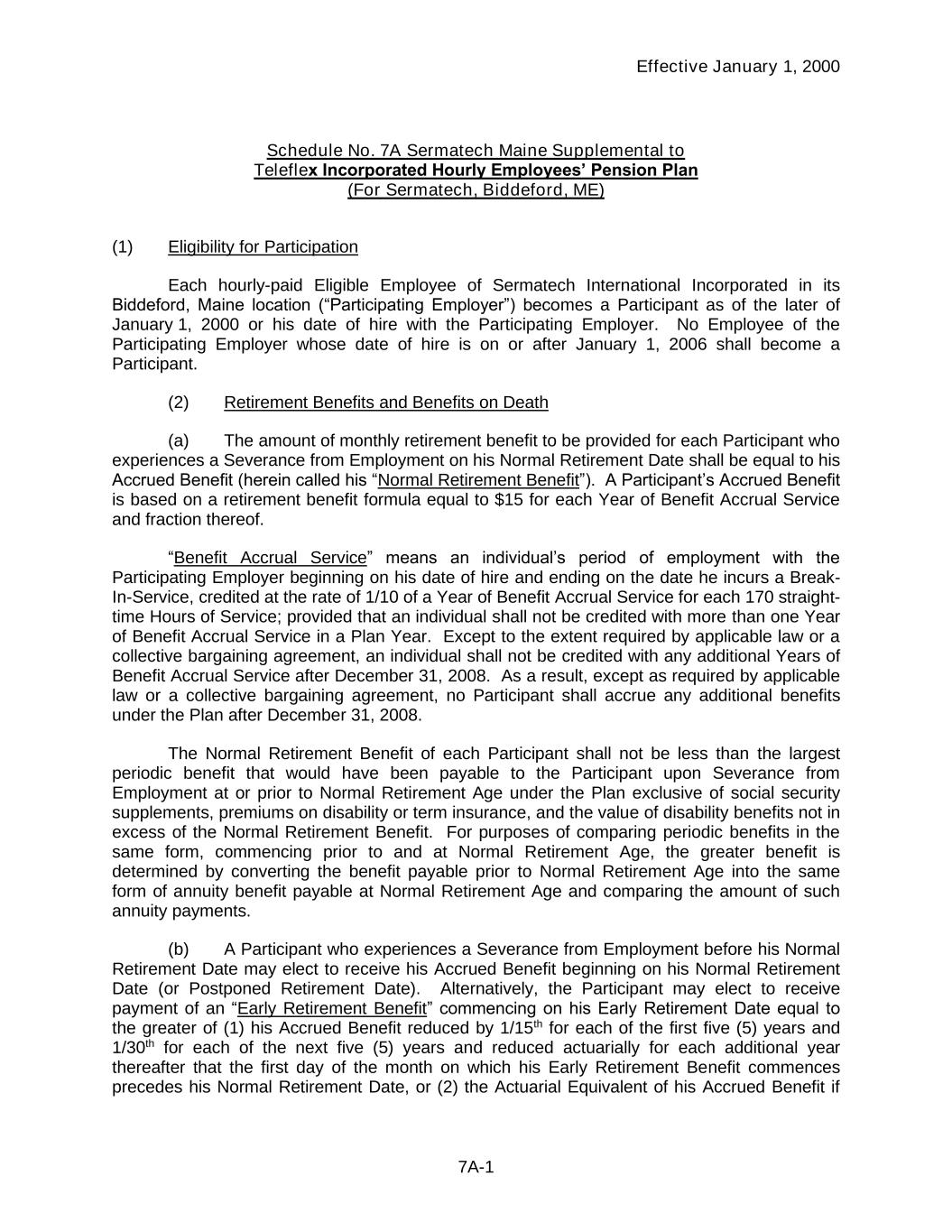
Effective January 1, 2000 7A-1 Schedule No. 7A Sermatech Maine Supplemental to Teleflex Incorporated Hourly Employees’ Pension Plan (For Sermatech, Biddeford, ME) (1) Eligibility for Participation Each hourly-paid Eligible Employee of Sermatech International Incorporated in its Biddeford, Maine location (“Participating Employer”) becomes a Participant as of the later of January 1, 2000 or his date of hire with the Participating Employer. No Employee of the Participating Employer whose date of hire is on or after January 1, 2006 shall become a Participant. (2) Retirement Benefits and Benefits on Death (a) The amount of monthly retirement benefit to be provided for each Participant who experiences a Severance from Employment on his Normal Retirement Date shall be equal to his Accrued Benefit (herein called his “Normal Retirement Benefit”). A Participant’s Accrued Benefit is based on a retirement benefit formula equal to $15 for each Year of Benefit Accrual Service and fraction thereof. “Benefit Accrual Service” means an individual’s period of employment with the Participating Employer beginning on his date of hire and ending on the date he incurs a Break- In-Service, credited at the rate of 1/10 of a Year of Benefit Accrual Service for each 170 straight- time Hours of Service; provided that an individual shall not be credited with more than one Year of Benefit Accrual Service in a Plan Year. Except to the extent required by applicable law or a collective bargaining agreement, an individual shall not be credited with any additional Years of Benefit Accrual Service after December 31, 2008. As a result, except as required by applicable law or a collective bargaining agreement, no Participant shall accrue any additional benefits under the Plan after December 31, 2008. The Normal Retirement Benefit of each Participant shall not be less than the largest periodic benefit that would have been payable to the Participant upon Severance from Employment at or prior to Normal Retirement Age under the Plan exclusive of social security supplements, premiums on disability or term insurance, and the value of disability benefits not in excess of the Normal Retirement Benefit. For purposes of comparing periodic benefits in the same form, commencing prior to and at Normal Retirement Age, the greater benefit is determined by converting the benefit payable prior to Normal Retirement Age into the same form of annuity benefit payable at Normal Retirement Age and comparing the amount of such annuity payments. (b) A Participant who experiences a Severance from Employment before his Normal Retirement Date may elect to receive his Accrued Benefit beginning on his Normal Retirement Date (or Postponed Retirement Date). Alternatively, the Participant may elect to receive payment of an “Early Retirement Benefit” commencing on his Early Retirement Date equal to the greater of (1) his Accrued Benefit reduced by 1/15th for each of the first five (5) years and 1/30th for each of the next five (5) years and reduced actuarially for each additional year thereafter that the first day of the month on which his Early Retirement Benefit commences precedes his Normal Retirement Date, or (2) the Actuarial Equivalent of his Accrued Benefit if

7A-2 such benefit is distributed in a form other than a nondecreasing life annuity payable for a period not less than the life of such Participant. (c) A Participant may elect to defer commencement of his Plan benefit until his Postponed Retirement Date. A Participant who commences receipt of his Plan benefit on a Postponed Retirement Date will receive a “Postponed Retirement Benefit” equal to the greater of (1) his Accrued Benefit as of his Postponed Retirement Date, or (2) the Actuarial Equivalent of his Normal Retirement Benefit on his Postponed Retirement Date. Prior to the Transition Date, a Participant must have a Severance from Employment in order to commence receipt of his Plan benefit. Effective as of the Transition Date, Severance from Employment is no longer required for a Participant to commence receipt of his Plan benefit. (d) In the event a married Participant duly elects pursuant to Section 6.6 of the Plan not to receive his benefit in the form of a Qualified Joint and Survivor Annuity, or if such Participant is not married, in the form of a Life Annuity, the Benefits Group, pursuant to the election of the Participant, shall direct the Trustee to distribute to a Participant or his Beneficiary an amount which is the Actuarial Equivalent of the monthly retirement benefit provided in Section 2(a) above in an annuity. However, such annuity may not be in any form that will provide for payments over a period extending beyond either the life of the Participant (or the lives of the Participant and his designated Beneficiary) or the life expectancy of the Participant (or the life expectancy of the Participant and his designated Beneficiary). (e) In the event the Actuarial Equivalent Section of the Plan is amended, the Actuarial Equivalent of a Participant’s Accrued Benefit on or after the date of change shall be the greater of (1) the Actuarial Equivalent of the Accrued Benefit as of the date of the change computed on the old basis, or (2) the Actuarial Equivalent of the total Accrued Benefit computed on the new basis. (3) Vesting of Benefits A Participant will vest upon completing five (5) Years of Vesting Service. To the extent not already vested, the Accrued Benefits of Participants who are actively employed by the Employer or one of its Related Employers on the Termination Date, shall become 100% vested on that date. (4) Prior Service Eligible Employees under this Schedule No. 7A shall receive credit for all service with the Employer since their most recent date of hire for purposes of eligibility to participate in, and vesting in benefits accrued under the Plan. Such Eligible Employees shall receive credit for service with the Participating Employer on or after January 1, 2000 for purposes of benefit accrual under the Plan. (5) Other Provisions Provisions not covered by this Schedule may be determined by reference to the Plan and Appendix E thereto.

Effective June 30, 2001 8A-1 Schedule No. 8A Morse Controls Division Supplemental to Teleflex Incorporated Hourly Employees’ Pension Plan (For Morse Controls Division Retirement Plan) Effective July 2, 1999, all benefit accruals ceased under the Retirement Plan for Hourly Employees, Morse Controls Division IMO Industries Inc. (the “Morse Plan”). Effective June 30, 2001, the Morse Plan was merged into and with the Hourly Employees’ Plan. This Schedule attempts to catalogue and preserve the benefits, rights and features unique to the Morse Plan. All such benefits, rights and features which are required to be preserved under section 411(d)(6) of the Code or the terms of such merged plan shall be so preserved. The provisions of this Schedule shall replace and supersede all similar provisions contained in the Plan proper and shall only apply to those Participants covered by this Schedule. (1) Eligibility for Participation Only a participant in the Morse Plan as of June 30, 2001 shall be a Participant in the Plan as set forth in Appendix E and this Schedule 8A. No Employee of the Employer whose date of hire is on or after January 1, 2006 shall become a Participant. (2) Definitions For the purpose of this Schedule only: (a) “Actuarial Equivalent” shall mean (for purposes other than lump sum calculations) a benefit of equivalent value, computed on the basis of the following actuarial assumptions: Interest - Five and one-half percent (5½%) per annum. Mortality - UP 1984 Mortality Table. (b) “Early Retirement Date” shall mean the first day of any month following a Participant’s completion of 10 years of Years of Vesting Service and the Participant’s attainment of age 55. (c) “Total Disability” or “Totally Disabled” means complete disability by bodily or mental injury or disease so as to be prevented thereby from engaging in any occupation or employment for remuneration or profit, provided, such Total Disability shall have continued for a period of at least 21 consecutive weeks, and in the opinion of a qualified physician, will be permanent and continuous during the remainder of the Participant’s life, and provided, such Total Disability: (i) Was not contracted, suffered or incurred while the Participant was engaged in, or did not result from his having engaged in, a criminal enterprise; (ii) Did not result from his habitual drunkenness or addiction to narcotics; (iii) Did not result from an intentionally self-inflicted injury;
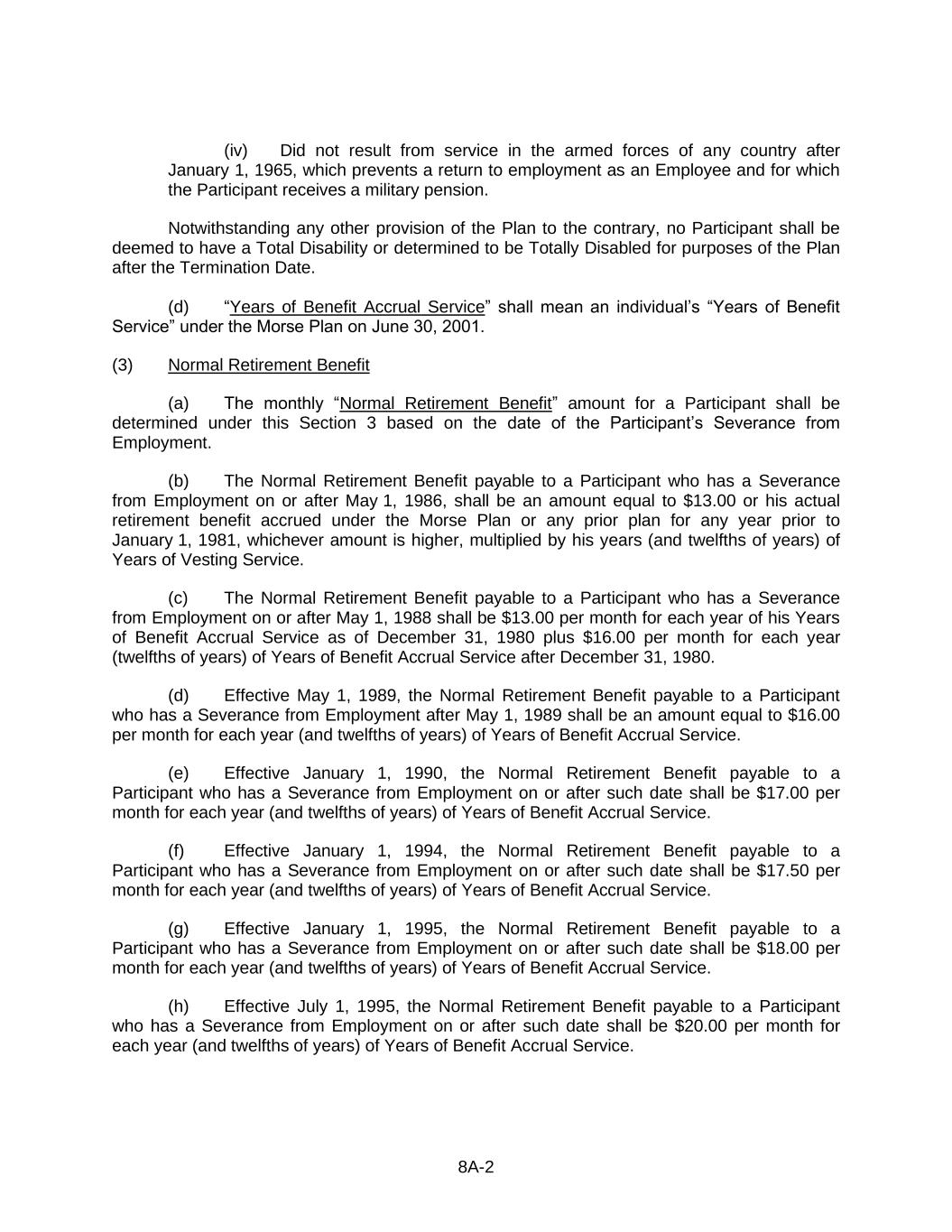
8A-2 (iv) Did not result from service in the armed forces of any country after January 1, 1965, which prevents a return to employment as an Employee and for which the Participant receives a military pension. Notwithstanding any other provision of the Plan to the contrary, no Participant shall be deemed to have a Total Disability or determined to be Totally Disabled for purposes of the Plan after the Termination Date. (d) “Years of Benefit Accrual Service” shall mean an individual’s “Years of Benefit Service” under the Morse Plan on June 30, 2001. (3) Normal Retirement Benefit (a) The monthly “Normal Retirement Benefit” amount for a Participant shall be determined under this Section 3 based on the date of the Participant’s Severance from Employment. (b) The Normal Retirement Benefit payable to a Participant who has a Severance from Employment on or after May 1, 1986, shall be an amount equal to $13.00 or his actual retirement benefit accrued under the Morse Plan or any prior plan for any year prior to January 1, 1981, whichever amount is higher, multiplied by his years (and twelfths of years) of Years of Vesting Service. (c) The Normal Retirement Benefit payable to a Participant who has a Severance from Employment on or after May 1, 1988 shall be $13.00 per month for each year of his Years of Benefit Accrual Service as of December 31, 1980 plus $16.00 per month for each year (twelfths of years) of Years of Benefit Accrual Service after December 31, 1980. (d) Effective May 1, 1989, the Normal Retirement Benefit payable to a Participant who has a Severance from Employment after May 1, 1989 shall be an amount equal to $16.00 per month for each year (and twelfths of years) of Years of Benefit Accrual Service. (e) Effective January 1, 1990, the Normal Retirement Benefit payable to a Participant who has a Severance from Employment on or after such date shall be $17.00 per month for each year (and twelfths of years) of Years of Benefit Accrual Service. (f) Effective January 1, 1994, the Normal Retirement Benefit payable to a Participant who has a Severance from Employment on or after such date shall be $17.50 per month for each year (and twelfths of years) of Years of Benefit Accrual Service. (g) Effective January 1, 1995, the Normal Retirement Benefit payable to a Participant who has a Severance from Employment on or after such date shall be $18.00 per month for each year (and twelfths of years) of Years of Benefit Accrual Service. (h) Effective July 1, 1995, the Normal Retirement Benefit payable to a Participant who has a Severance from Employment on or after such date shall be $20.00 per month for each year (and twelfths of years) of Years of Benefit Accrual Service.
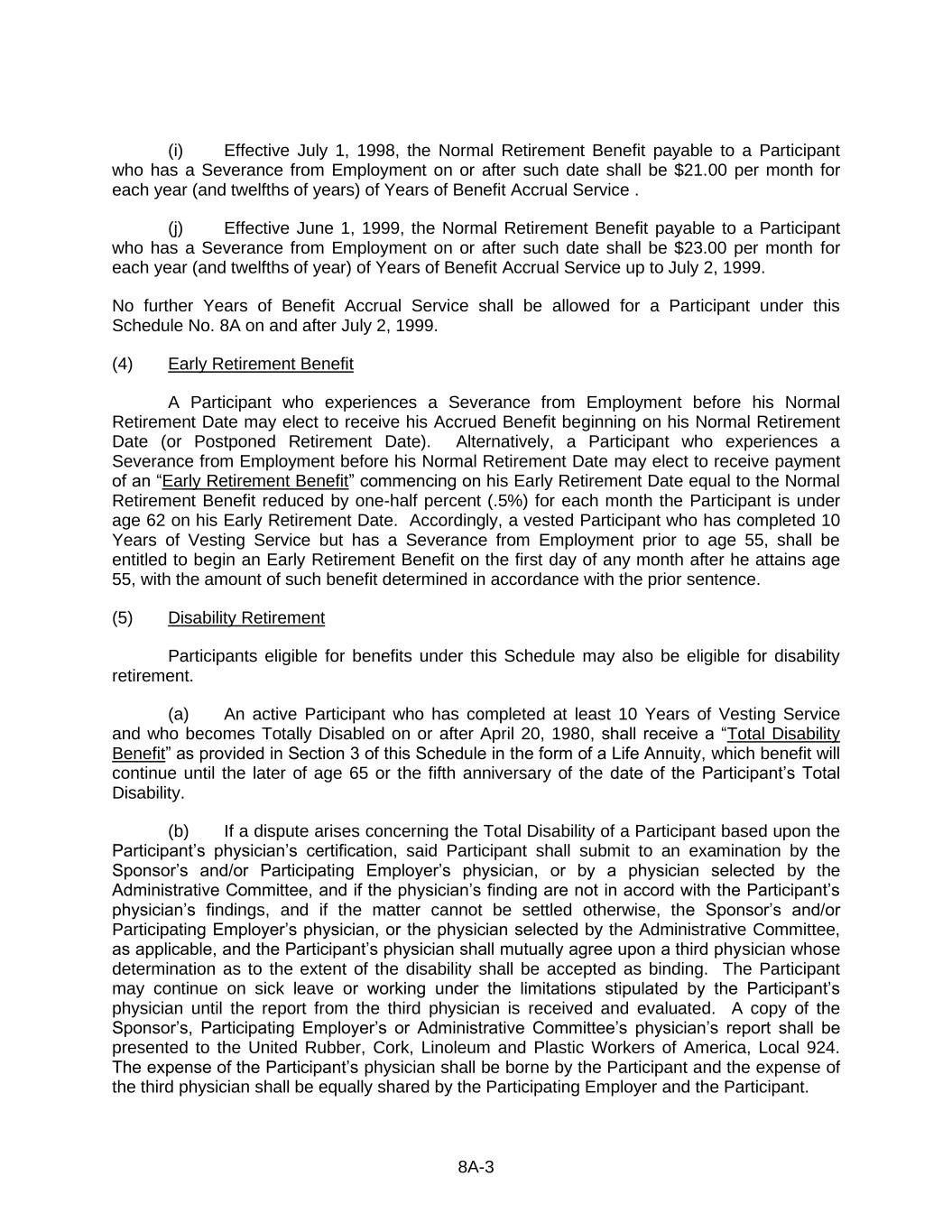
8A-3 (i) Effective July 1, 1998, the Normal Retirement Benefit payable to a Participant who has a Severance from Employment on or after such date shall be $21.00 per month for each year (and twelfths of years) of Years of Benefit Accrual Service . (j) Effective June 1, 1999, the Normal Retirement Benefit payable to a Participant who has a Severance from Employment on or after such date shall be $23.00 per month for each year (and twelfths of year) of Years of Benefit Accrual Service up to July 2, 1999. No further Years of Benefit Accrual Service shall be allowed for a Participant under this Schedule No. 8A on and after July 2, 1999. (4) Early Retirement Benefit A Participant who experiences a Severance from Employment before his Normal Retirement Date may elect to receive his Accrued Benefit beginning on his Normal Retirement Date (or Postponed Retirement Date). Alternatively, a Participant who experiences a Severance from Employment before his Normal Retirement Date may elect to receive payment of an “Early Retirement Benefit” commencing on his Early Retirement Date equal to the Normal Retirement Benefit reduced by one-half percent (.5%) for each month the Participant is under age 62 on his Early Retirement Date. Accordingly, a vested Participant who has completed 10 Years of Vesting Service but has a Severance from Employment prior to age 55, shall be entitled to begin an Early Retirement Benefit on the first day of any month after he attains age 55, with the amount of such benefit determined in accordance with the prior sentence. (5) Disability Retirement Participants eligible for benefits under this Schedule may also be eligible for disability retirement. (a) An active Participant who has completed at least 10 Years of Vesting Service and who becomes Totally Disabled on or after April 20, 1980, shall receive a “Total Disability Benefit” as provided in Section 3 of this Schedule in the form of a Life Annuity, which benefit will continue until the later of age 65 or the fifth anniversary of the date of the Participant’s Total Disability. (b) If a dispute arises concerning the Total Disability of a Participant based upon the Participant’s physician’s certification, said Participant shall submit to an examination by the Sponsor’s and/or Participating Employer’s physician, or by a physician selected by the Administrative Committee, and if the physician’s finding are not in accord with the Participant’s physician’s findings, and if the matter cannot be settled otherwise, the Sponsor’s and/or Participating Employer’s physician, or the physician selected by the Administrative Committee, as applicable, and the Participant’s physician shall mutually agree upon a third physician whose determination as to the extent of the disability shall be accepted as binding. The Participant may continue on sick leave or working under the limitations stipulated by the Participant’s physician until the report from the third physician is received and evaluated. A copy of the Sponsor’s, Participating Employer’s or Administrative Committee’s physician’s report shall be presented to the United Rubber, Cork, Linoleum and Plastic Workers of America, Local 924. The expense of the Participant’s physician shall be borne by the Participant and the expense of the third physician shall be equally shared by the Participating Employer and the Participant.

8A-4 (c) If the Total Disability of a Participant receiving a Total Disability Benefit ceases before his Severance from Employment on or before his Normal Retirement Date, his monthly Total Disability Benefit will cease. If he hereafter again becomes an active Participant, his Years of Service prior to his disability will be reinstated. (d) On his Normal Retirement Date, a Participant receiving a Total Disability Benefit will be retired in accordance with Section 3 of this Schedule. Upon his retirement, he shall be entitled to receive his Accrued Benefit, which shall not be offset by the Actuarial Equivalent amount of the Total Disability Benefit that he received prior to his Normal Retirement Date. (e) The Annuity Starting Date of a Participant who is eligible to receive a Total Disability Benefit is the date that his benefits commence to be paid in accordance with paragraph (d) above. The auxiliary Total Disability Benefit shall be disregarded in determining the Annuity Starting Date of the Participant. (f) If a Participant who receives a Total Disability Benefit under this Section is determined by the Social Security Administration not to be eligible to receive disability benefits under the Social Security Act, then the Participant is eligible to receive a temporary benefit not to exceed $400.00 per month (but, otherwise equal to his Normal Retirement Benefit at the time his disability payments commence) payable upon commencement of the Participant’s Total Disability Benefit until the Participant attains age 65 or until the Participant becomes eligible for Federal Social Security Benefits (either for disability or for age, at the full rate). Upon fulfillment of these conditions this temporary benefit shall cease. (6) Vesting of Benefits A Participant will vest upon completing five (5) Years of Vesting Service. To the extent not already vested, the Accrued Benefits of Participants who are actively employed by the Employer or one of its Related Employers on the Termination Date, shall become 100% vested on that date. (7) Normal Form of Benefit The normal form of benefit for Participants covered by this Schedule No. 8A shall be: (a) For an unmarried Participant, a Life Annuity, with 60 monthly payments guaranteed to be paid to the Participant and his Beneficiary. (b) For a married Participant, a Qualified Joint and Survivor Annuity, with 60 monthly payments (in the amount to be received by the Participant) guaranteed to be paid to the Participant, and his Spouse and Beneficiary. (8) Optional Forms of Payment In addition to the forms of payment provided under Section 7 of this Schedule, above, a Participant may elect to receive his benefit in one of the following optional forms, provided the procedures for electing an optional form under Section 6.6 of the Plan are satisfied: (a) A monthly income payable for the lifetime of a Participant with 10 or 15 years of payments guaranteed, as elected by the Participant. If the Participant dies prior to the

8A-5 expiration of the 10 or 15 year period, such payments shall be continued to the Participant’s Beneficiary to complete the balance of the guarantee period. (b) A monthly income payable for the lifetime of the Participant and continuing thereafter in an amount equally as great, to the Participant’s Spouse for the lifetime of said Spouse with 60 payments guaranteed. (c) A monthly income payable for the lifetime of the Participant and continuing thereafter in an amount one-half or equally as great, as elected by the Participant, to the Participant’s Beneficiary with 60 payments guaranteed. (d) For a benefit commencing before the retirement age of the Participant established under the Social Security Act, the Participant may elect a converted portion of his Normal Retirement Benefit to begin on his Effective Retirement Date and which shall provide for payment at a certain rate prior to the first day on which he shall be entitled (upon proper application) to receive his primary old age Social Security insurance benefit, regardless of actuarial reduction on account of commencement of such Social Security benefit prior to the retirement age established under the Social Security Act for the Participant, and at a reduced rate thereafter, such Normal Retirement Benefit to be the Actuarial Equivalent of the benefit provided for him under Section 3, above, and calculated so that the difference in amounts payable before and after the first day on which he shall be entitled to receive such Social Security benefit shall equal as nearly as possible the estimated old age insurance benefit payable under the Social Security law to the member commencing on such first day. (e) In no event may any form of payment provided above exceed the greater of: (i) the life of the Participant; (ii) the life of the Participant and his Spouse; (iii) a period certain not exceeding the Participant’s life expectancy; or (iv) a period certain not exceeding the joint life expectancy of the Participant and his Spouse or Beneficiary, whichever is applicable. Such life expectancy or joint life expectancy shall be determined in accordance with regulations under Section 401(a)(9) of the Code. The availability of any form of benefit shall be subject to any limitations contained in Section 401(a)(9) of the Code and any Treasury Regulations promulgated thereunder and notwithstanding any provisions in this Plan to the contrary, in no event will a distribution be permitted which would violate the terms of Section 401(a)(9) and the Treasury Regulations promulgated thereunder. (9) Other Provisions Provisions not covered by this Schedule may be determined by reference to the Plan and Appendix E thereto.

Effective June 30, 2001 9A-1 Schedule No. 9A Teleflex UAW Local 1039 Retirement Plan - Supplemental to Teleflex Incorporated Hourly Employees’ Pension Plan (For UAW Local 1039 Plan) On January 22, 1996, all benefit accruals ceased under the Teleflex UAW Local 1039 Retirement Plan (the “Local 1039 Plan”). Effective June 30, 2001, the Local 1039 Plan was merged into and with the Hourly Employees’ Plan. This Schedule attempts to catalogue and preserve the benefits, rights and features unique to the Local 1039 Plan. All such benefits, rights and features which are required to be preserved under section 411(d)(6) of the Code or the terms of such merged plan shall be so preserved. The provisions of this Schedule shall replace and supersede all similar provisions contained in the Plan and shall only apply to those Participants covered by this Schedule. (1) Eligibility for Participation Only a participant in the Local 1039 Plan on June 30, 2001 shall be a Participant in the Plan as set forth in Appendix E and this Schedule 9A. No Employee of the Employer whose date of hire is on or after January 1, 2006 shall become a Participant. (2) Definitions For the purpose of this Schedule only: (a) “Actuarial Equivalent” shall mean the equivalent actuarial value of the normal form of benefit for unmarried Participants, as described in Section 6.2 of the Plan, determined based upon the advice of the Plan’s actuary using the following factors and assumptions: The UP-1984 Mortality Table, unrated for the employee and set back three years for the co-pensioner, with interest at the rate of 8% per annum compounded annually, shall be used in determining actuarial equivalency; provided, however, that in no event will an actuarially equivalent amount as to any Participant on any given date that falls on or after August 1, 1983 be less than the product of the Participant’s accrued monthly pension as of August 1, 1983 and the appropriate factor from the actuarial equivalency tables that were in use on July 31, 1983, specifically the Basic (Unloaded) Group Annuity Table for 1951 projected to 1965 by Scale C and rated back five years for females, and 8% interest compounded annually. These factors and assumptions shall be at least as favorable to the Participant as the factors and assumptions listed in Table I of the Local 1039 Plan, as restated effective February 26, 1976. (b) “Early Retirement Date” shall mean the last day of any month coincident with or following a Participant’s completion of 10 years of Years of Vesting Service and the Participant’s attainment of age 55. (c) “Total and Permanent Disability” shall mean the total and permanent incapacity of an Employee after he has been credited with 10 years of Vesting Service, but prior to his Normal Retirement Date, and which entitles him to disability benefits under the Social Security Act as then in effect. Notwithstanding any other provision of the Plan to the contrary, no
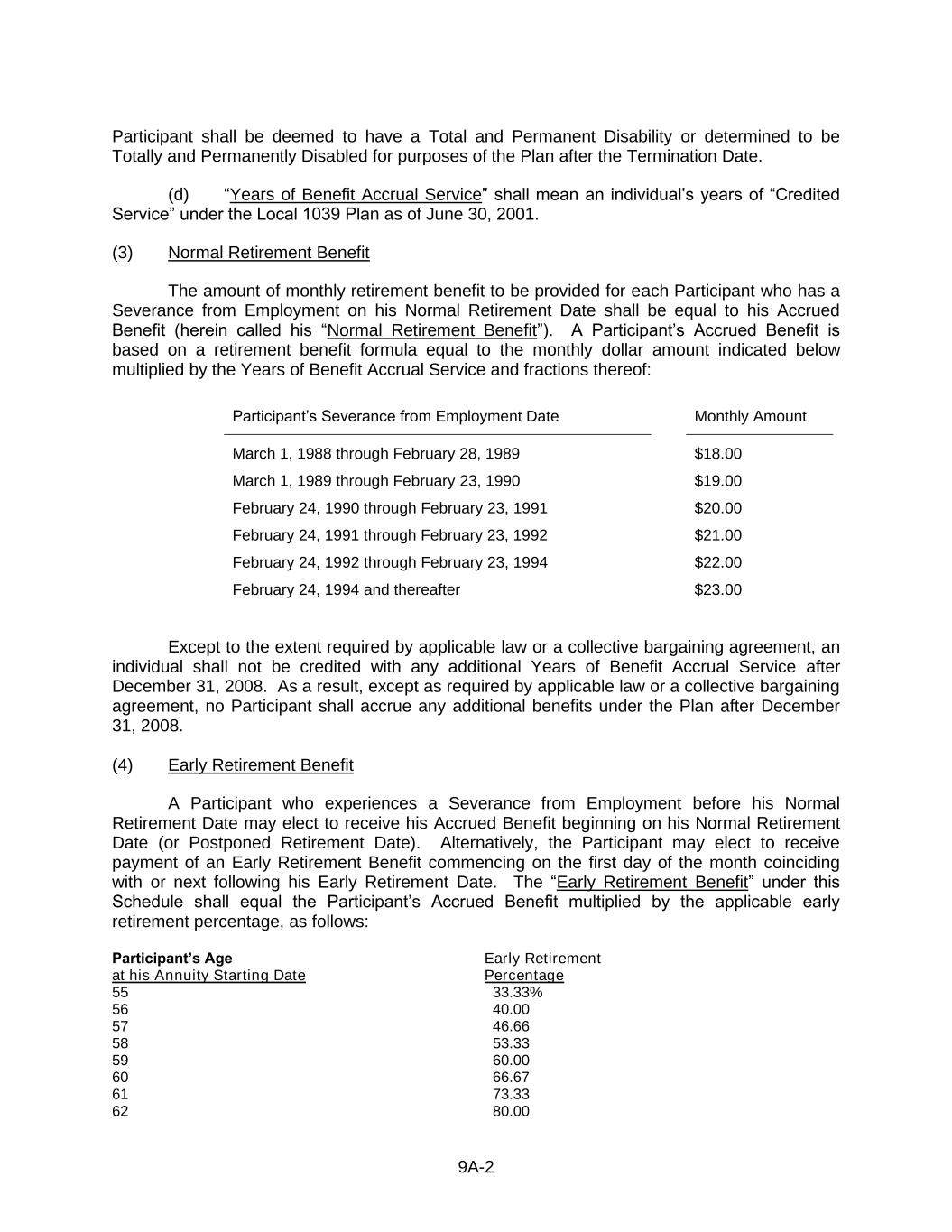
9A-2 Participant shall be deemed to have a Total and Permanent Disability or determined to be Totally and Permanently Disabled for purposes of the Plan after the Termination Date. (d) “Years of Benefit Accrual Service” shall mean an individual’s years of “Credited Service” under the Local 1039 Plan as of June 30, 2001. (3) Normal Retirement Benefit The amount of monthly retirement benefit to be provided for each Participant who has a Severance from Employment on his Normal Retirement Date shall be equal to his Accrued Benefit (herein called his “Normal Retirement Benefit”). A Participant’s Accrued Benefit is based on a retirement benefit formula equal to the monthly dollar amount indicated below multiplied by the Years of Benefit Accrual Service and fractions thereof: Participant’s Severance from Employment Date Monthly Amount March 1, 1988 through February 28, 1989 $18.00 March 1, 1989 through February 23, 1990 $19.00 February 24, 1990 through February 23, 1991 $20.00 February 24, 1991 through February 23, 1992 $21.00 February 24, 1992 through February 23, 1994 $22.00 February 24, 1994 and thereafter $23.00 Except to the extent required by applicable law or a collective bargaining agreement, an individual shall not be credited with any additional Years of Benefit Accrual Service after December 31, 2008. As a result, except as required by applicable law or a collective bargaining agreement, no Participant shall accrue any additional benefits under the Plan after December 31, 2008. (4) Early Retirement Benefit A Participant who experiences a Severance from Employment before his Normal Retirement Date may elect to receive his Accrued Benefit beginning on his Normal Retirement Date (or Postponed Retirement Date). Alternatively, the Participant may elect to receive payment of an Early Retirement Benefit commencing on the first day of the month coinciding with or next following his Early Retirement Date. The “Early Retirement Benefit” under this Schedule shall equal the Participant’s Accrued Benefit multiplied by the applicable early retirement percentage, as follows: Participant’s Age at his Annuity Starting Date Early Retirement Percentage 55 33.33% 56 40.00 57 46.66 58 53.33 59 60.00 60 66.67 61 73.33 62 80.00

9A-3 63 86.67 64 93.33 65 100.00 For each additional full month of age attained at his Annuity Starting Date, the applicable early retirement percentage shall be determined by a straight-line interpolation from the early retirement percentage applicable to the next lower age to the early retirement percentage applicable to the next higher age in the above table, rounded to the nearest 1/100 of 1%. A vested Participant who has completed 10 Years of Vesting Service but has a Severance from Employment prior to age 55, shall be entitled to begin an Early Retirement Benefit on the first day of any month after he attains age 55, with the amount of such benefit determined in accordance with this Section 4. (5) Disability Retirement Benefit and Other Benefits Participants eligible for benefits under this Schedule may also be eligible for other benefits under this Plan. (a) Disability Retirement Benefit. The “Disability Retirement Benefit” payable to a Participant who incurs a Total and Permanent Disability while he is an active employee of the Employer shall be his Accrued Benefit based on his Years of Benefit Accrual Service up to his Severance from Employment date due to such Total and Permanent Disability and the rate applicable to him under Section 3 of this Schedule based upon his Severance from Employment date. Payment of such Disability Retirement Benefit shall begin as of the Participant’s Annuity Starting Date, which shall be the first day of the month following the later of: (i) The date the Participant begins to receive disability benefits under the federal Social Security Act as in effect at the time of the Participant’s Severance from Employment due to his Total and Permanent Disability; or (ii) The approval by the Administrative Committee of the Participant’s application for a Disability Retirement Benefit under the Plan, and shall continue until the date such Participant ceases to receive disability benefits under the federal Social Security Act; provided that if such Participant continues to receive benefits under this provision until he reaches age 65, such benefits hereunder will continue for the remainder of the Participant’s life. Effective on and after the Termination Date, if a Participant does not continue to receive benefits under this provision until he reaches age 65, any benefits to which the Participant later becomes entitled under the Plan and this Appendix E, Schedule 9A will not be reduced on an Actuarially Equivalent basis in recognition of any Disability Retirement Benefit which he or she received under the Plan and this Appendix E, Schedule 9A. Disability Retirement Benefits shall not be paid in any month for which the Participant receives illness or injury benefits under any program maintained by the Employer. (b) Mutually Satisfactory Retirement Benefit. A Participant who has five (5) Years of Vesting Service and who has a Severance from Employment at the request of the Employer prior to the Termination Date, with his or her consent, shall be entitled to a benefit for each month during which he is not entitled to an unreduced primary insurance amount under the federal Social Security Act, beginning on the first day of the month following his Severance from Employment and ending on the first to occur of the Participant’s Normal Retirement Date or his

9A-4 death, equal to the Participant’s Accrued Benefit based on his Years of Accrual Service up to the date of his Severance from Employment, multiplied by two. For each month in such period during which the Participant is entitled to an unreduced primary insurance amount under the federal Social Security Act, such Participant shall be entitled to a benefit equal to his Accrued Benefit based on his Years of Benefit Accrual Service up to the date of his Severance from Employment. (c) Supplemental Benefits. A Participant and his or her Spouse set forth in Appendix I may be entitled to a Supplemental Benefit described in Section 3.9 of the Plan Such a Participant had to have a Severance from Employment on or after his Early Retirement Date or Normal Retirement Date or due to a Total and Permanent Disability. (6) Vesting of Benefits A Participant will vest upon completing five (5) Years of Vesting Service. A Participant who experienced a Severance from Employment on the date the Employer’s Aerospace/Defense Division was sold to Triumph Controls Systems, Inc. shall also be vested. To the extent not already vested, the Accrued Benefits of Participants who are actively employed by the Employer or one of its Related Employers on the Termination Date, shall become 100% vested on that date. (7) Spousal Benefits (a) If a Participant retires on or after an Early Retirement Date, the amount of the Participant’s monthly benefit under a Qualified Joint and Survivor Annuity shall be determined as follows: Multiply the Participant’s benefit determined under Section 3 or 4 of this Schedule, as applicable, By 95%, increased by 1/2 of 1% for each year in excess of five (5) years that the age of the Participant’s Spouse exceeds the Participant’s age, with both ages determined as of the birthday nearer the Participant’s Annuity Starting Date, to a maximum of 100%, or decreased by 1/2 of 1% for each year in excess of five (5) years that the age of the Participant’s spouse is less than the Participant’s age, with both ages determined as of the birthday nearer the Participant’s Annuity Starting Date. (b) Qualified Preretirement Survivor Annuity. The amount of a Qualified Preretirement Survivor Annuity (“QPSA”) payable to a Participant who has a Severance from Employment on or after an Early Retirement Date shall be determined based on the amount of the Qualified Joint and Survivor Annuity the Participant would be entitled to in accordance with Section 7(a) of this Schedule. To be eligible to receive a QPSA, a Spouse must have been married to a Participant throughout the three month period ending with the date of the Participant’s death.

(8) Other Provisions Provisions not covered by this Schedule may be determined by reference to the Plan and Appendix E thereto. 9A-5 - ) ther r vi i ns r vi i ns t ered t i chedule ay t r i ed y f ce t t l n d ppendix reto.

Effective June 30, 2001 10A-1 Schedule No. 10A Teleflex Incorporated Pension Plan for Employees Represented by PACE Local 5-0524 - Supplemental to Teleflex Incorporated Hourly Employees’ Pension Plan (For PACE Plan) Effective June 30, 2001, the Teleflex Incorporated Pension Plan for Employees Represented by PACE Local 5-0524 (the “PACE Plan”) was merged into and with the Hourly Employees’ Plan. This Schedule attempts to catalogue and preserve the benefits, rights and features unique to the PACE Plan. All such benefits, rights and features which are required to be preserved under section 411(d)(6) of the Code or the terms of such merged plan shall be so preserved. The provisions of this Schedule shall replace and supersede all similar provisions contained in the Plan and shall only apply to those Participants covered by this Schedule. (1) Eligibility for Participation An Eligible Employee in the Teleflex Incorporated Automotive Division in Van Wert, Ohio (“Participating Employer”) who is represented for collective bargaining purposes by the Union shall become a Participant as of the later of June 30, 2001 or his date of hire as such. No Employee of the Participating Employer whose date of hire is on or after January 1, 2006 shall become a Participant. (2) Definitions For the purpose of this Schedule only: (a) “Early Retirement Date” shall mean the last day of any month coincident with or following a Participant’s attainment of age sixty 60, but not sixty-five 65, after being credited with ten 10 Years of Vesting Service. (b) “Hours of Service” shall mean the definition set forth in the Plan augmented by the following additional terms: A Participant who is absent from employment with the Employer because of illness or injury sustained in the course of employment with the Employer and with respect to which he receives workers’ compensation benefits shall be credited with Hours of Service at the rate of eight (8) hours for each working day of such absence, not to exceed 40 hours for each week, during the period he normally would have been scheduled to work for the Employer during such period of absence, provided he returns to employment with the Employer within 90 days after final payment of statutory compensation for such illness or injury or within 90 days after the end of the period used in calculating a lump sum payment with respect to statutory compensation. A Participant who is the full-time president of the Union and who is compensated by the Union for such duties shall be credited with Hours of Service at the rate of eight (8) hours for each working day, not to exceed 40 hours for each week, during the period he is full-time president of the Union. A Participant who is absent from employment in connection with the business of the Union pursuant to an agreement between the Employer and the Union shall be credited with Hours of Service at the rate of eight (8) hours for each working day of such absence, not to exceed 40 hours for each week, during the period of such absence, provided:
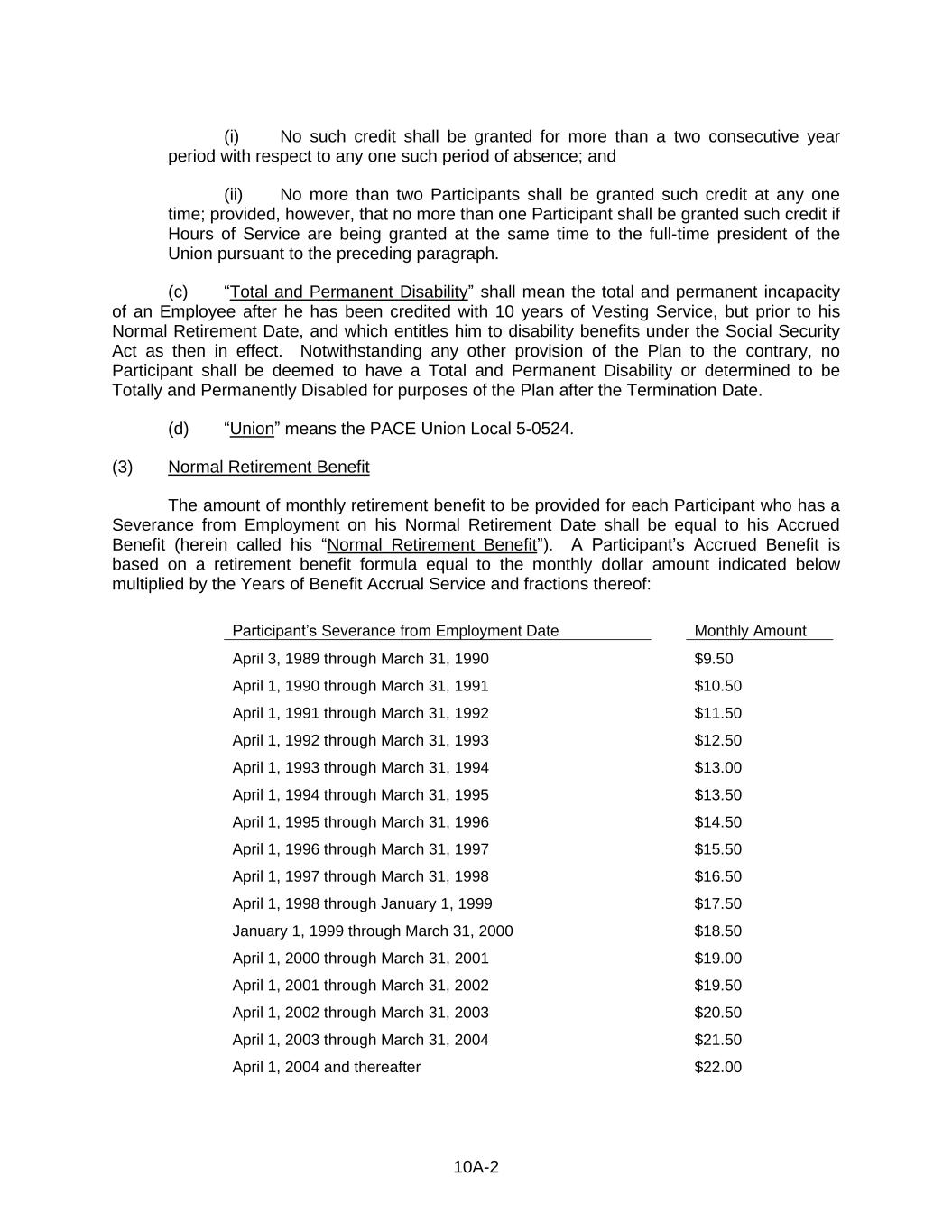
10A-2 (i) No such credit shall be granted for more than a two consecutive year period with respect to any one such period of absence; and (ii) No more than two Participants shall be granted such credit at any one time; provided, however, that no more than one Participant shall be granted such credit if Hours of Service are being granted at the same time to the full-time president of the Union pursuant to the preceding paragraph. (c) “Total and Permanent Disability” shall mean the total and permanent incapacity of an Employee after he has been credited with 10 years of Vesting Service, but prior to his Normal Retirement Date, and which entitles him to disability benefits under the Social Security Act as then in effect. Notwithstanding any other provision of the Plan to the contrary, no Participant shall be deemed to have a Total and Permanent Disability or determined to be Totally and Permanently Disabled for purposes of the Plan after the Termination Date. (d) “Union” means the PACE Union Local 5-0524. (3) Normal Retirement Benefit The amount of monthly retirement benefit to be provided for each Participant who has a Severance from Employment on his Normal Retirement Date shall be equal to his Accrued Benefit (herein called his “Normal Retirement Benefit”). A Participant’s Accrued Benefit is based on a retirement benefit formula equal to the monthly dollar amount indicated below multiplied by the Years of Benefit Accrual Service and fractions thereof: Participant’s Severance from Employment Date Monthly Amount April 3, 1989 through March 31, 1990 $9.50 April 1, 1990 through March 31, 1991 $10.50 April 1, 1991 through March 31, 1992 $11.50 April 1, 1992 through March 31, 1993 $12.50 April 1, 1993 through March 31, 1994 $13.00 April 1, 1994 through March 31, 1995 $13.50 April 1, 1995 through March 31, 1996 $14.50 April 1, 1996 through March 31, 1997 $15.50 April 1, 1997 through March 31, 1998 $16.50 April 1, 1998 through January 1, 1999 $17.50 January 1, 1999 through March 31, 2000 $18.50 April 1, 2000 through March 31, 2001 $19.00 April 1, 2001 through March 31, 2002 $19.50 April 1, 2002 through March 31, 2003 $20.50 April 1, 2003 through March 31, 2004 $21.50 April 1, 2004 and thereafter $22.00
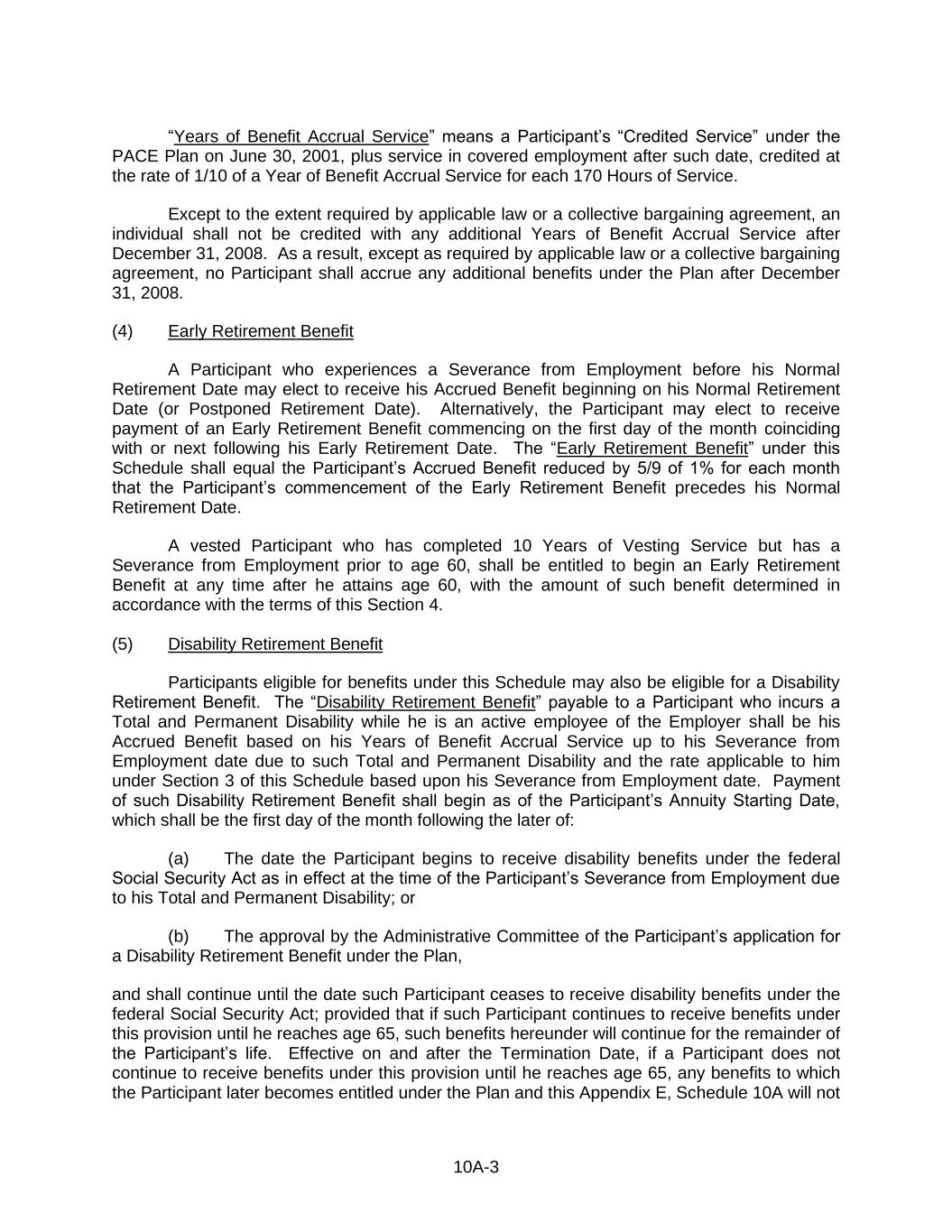
10A-3 “Years of Benefit Accrual Service” means a Participant’s “Credited Service” under the PACE Plan on June 30, 2001, plus service in covered employment after such date, credited at the rate of 1/10 of a Year of Benefit Accrual Service for each 170 Hours of Service. Except to the extent required by applicable law or a collective bargaining agreement, an individual shall not be credited with any additional Years of Benefit Accrual Service after December 31, 2008. As a result, except as required by applicable law or a collective bargaining agreement, no Participant shall accrue any additional benefits under the Plan after December 31, 2008. (4) Early Retirement Benefit A Participant who experiences a Severance from Employment before his Normal Retirement Date may elect to receive his Accrued Benefit beginning on his Normal Retirement Date (or Postponed Retirement Date). Alternatively, the Participant may elect to receive payment of an Early Retirement Benefit commencing on the first day of the month coinciding with or next following his Early Retirement Date. The “Early Retirement Benefit” under this Schedule shall equal the Participant’s Accrued Benefit reduced by 5/9 of 1% for each month that the Participant’s commencement of the Early Retirement Benefit precedes his Normal Retirement Date. A vested Participant who has completed 10 Years of Vesting Service but has a Severance from Employment prior to age 60, shall be entitled to begin an Early Retirement Benefit at any time after he attains age 60, with the amount of such benefit determined in accordance with the terms of this Section 4. (5) Disability Retirement Benefit Participants eligible for benefits under this Schedule may also be eligible for a Disability Retirement Benefit. The “Disability Retirement Benefit” payable to a Participant who incurs a Total and Permanent Disability while he is an active employee of the Employer shall be his Accrued Benefit based on his Years of Benefit Accrual Service up to his Severance from Employment date due to such Total and Permanent Disability and the rate applicable to him under Section 3 of this Schedule based upon his Severance from Employment date. Payment of such Disability Retirement Benefit shall begin as of the Participant’s Annuity Starting Date, which shall be the first day of the month following the later of: (a) The date the Participant begins to receive disability benefits under the federal Social Security Act as in effect at the time of the Participant’s Severance from Employment due to his Total and Permanent Disability; or (b) The approval by the Administrative Committee of the Participant’s application for a Disability Retirement Benefit under the Plan, and shall continue until the date such Participant ceases to receive disability benefits under the federal Social Security Act; provided that if such Participant continues to receive benefits under this provision until he reaches age 65, such benefits hereunder will continue for the remainder of the Participant’s life. Effective on and after the Termination Date, if a Participant does not continue to receive benefits under this provision until he reaches age 65, any benefits to which the Participant later becomes entitled under the Plan and this Appendix E, Schedule 10A will not

10A-4 be reduced on an Actuarially Equivalent basis in recognition of any Disability Retirement Benefit which he or she received under the Plan and this Appendix E, Schedule 10A. Disability Retirement Benefits shall not be paid in any month for which the Participant receives illness or injury benefits under any program maintained by the Employer, or for which such Participant is covered under a medical insurance program maintained by the Employer and, pursuant to such coverage, the Employer pays a premium for the Participant for such month. (6) Form of Benefit The amount of the monthly payment to a Participant under the Qualified Joint and Survivor Annuity shall be determined as follows: Multiplying the Participant’s benefit determined under Section 3 or 4 of this Schedule, as applicable By The applicable factor listed in Table 1 attached to this Schedule. (7) Vesting of Benefits A Participant will vest upon completing five (5) Years of Vesting Service. To the extent not already vested, the Accrued Benefits of Participants who are actively employed by the Employer or one of its Related Employers on the Termination Date, shall become 100% vested on that date. (8) Death Benefits The surviving Spouse of a Participant covered by this Schedule shall only be eligible for the death benefit provided under Article VII of Appendix E, if such Spouse was married to the Participant throughout the one-year period ending on the Participant’s date of death. (9) Other Provisions Provisions not covered by this Schedule may be determined by reference to the Plan and Appendix E thereto.
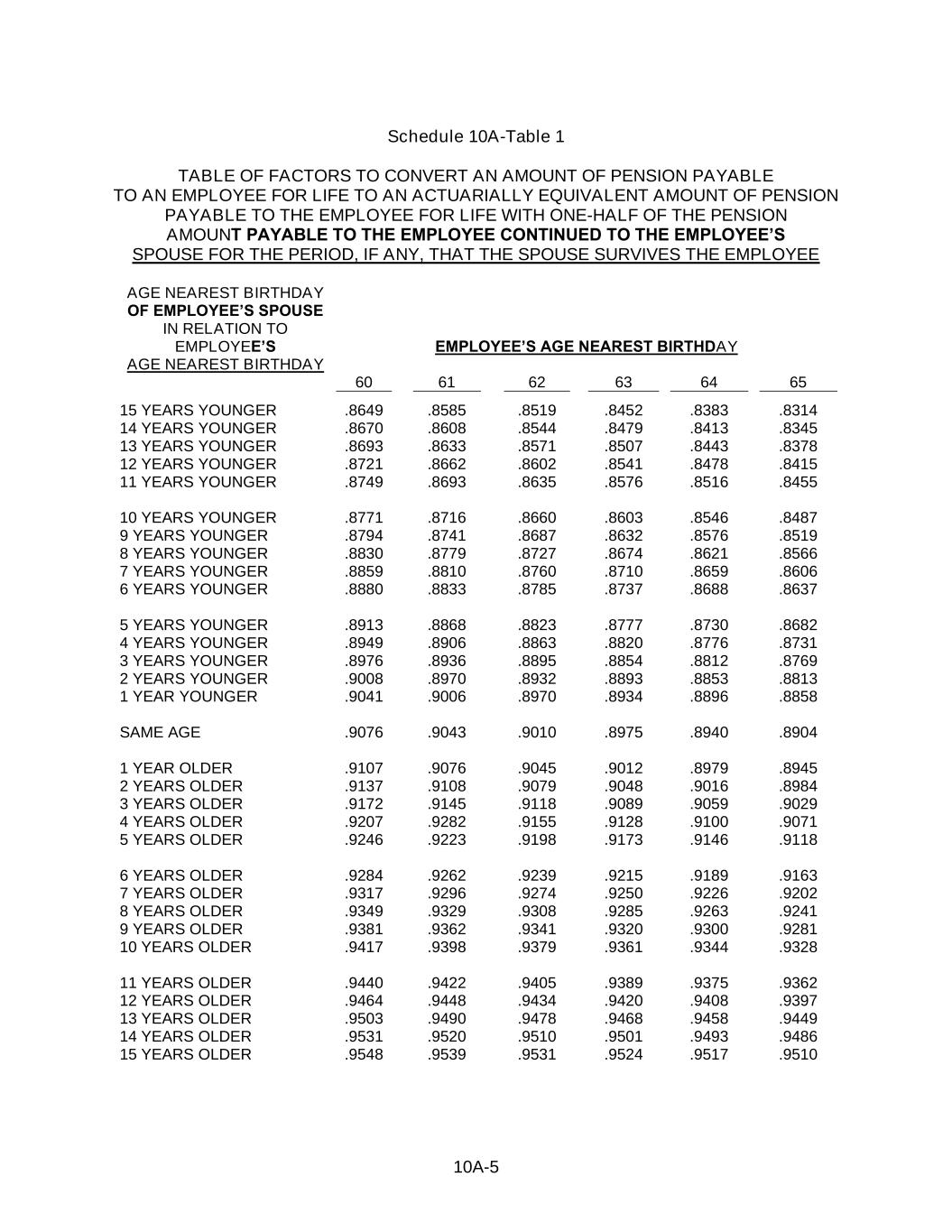
10A-5 Schedule 10A-Table 1 TABLE OF FACTORS TO CONVERT AN AMOUNT OF PENSION PAYABLE TO AN EMPLOYEE FOR LIFE TO AN ACTUARIALLY EQUIVALENT AMOUNT OF PENSION PAYABLE TO THE EMPLOYEE FOR LIFE WITH ONE-HALF OF THE PENSION AMOUNT PAYABLE TO THE EMPLOYEE CONTINUED TO THE EMPLOYEE’S SPOUSE FOR THE PERIOD, IF ANY, THAT THE SPOUSE SURVIVES THE EMPLOYEE AGE NEAREST BIRTHDAY OF EMPLOYEE’S SPOUSE IN RELATION TO EMPLOYEE’S AGE NEAREST BIRTHDAY EMPLOYEE’S AGE NEAREST BIRTHDAY 60 61 62 63 64 65 15 YEARS YOUNGER .8649 .8585 .8519 .8452 .8383 .8314 14 YEARS YOUNGER .8670 .8608 .8544 .8479 .8413 .8345 13 YEARS YOUNGER .8693 .8633 .8571 .8507 .8443 .8378 12 YEARS YOUNGER .8721 .8662 .8602 .8541 .8478 .8415 11 YEARS YOUNGER .8749 .8693 .8635 .8576 .8516 .8455 10 YEARS YOUNGER .8771 .8716 .8660 .8603 .8546 .8487 9 YEARS YOUNGER .8794 .8741 .8687 .8632 .8576 .8519 8 YEARS YOUNGER .8830 .8779 .8727 .8674 .8621 .8566 7 YEARS YOUNGER .8859 .8810 .8760 .8710 .8659 .8606 6 YEARS YOUNGER .8880 .8833 .8785 .8737 .8688 .8637 5 YEARS YOUNGER .8913 .8868 .8823 .8777 .8730 .8682 4 YEARS YOUNGER .8949 .8906 .8863 .8820 .8776 .8731 3 YEARS YOUNGER .8976 .8936 .8895 .8854 .8812 .8769 2 YEARS YOUNGER .9008 .8970 .8932 .8893 .8853 .8813 1 YEAR YOUNGER .9041 .9006 .8970 .8934 .8896 .8858 SAME AGE .9076 .9043 .9010 .8975 .8940 .8904 1 YEAR OLDER .9107 .9076 .9045 .9012 .8979 .8945 2 YEARS OLDER .9137 .9108 .9079 .9048 .9016 .8984 3 YEARS OLDER .9172 .9145 .9118 .9089 .9059 .9029 4 YEARS OLDER .9207 .9282 .9155 .9128 .9100 .9071 5 YEARS OLDER .9246 .9223 .9198 .9173 .9146 .9118 6 YEARS OLDER .9284 .9262 .9239 .9215 .9189 .9163 7 YEARS OLDER .9317 .9296 .9274 .9250 .9226 .9202 8 YEARS OLDER .9349 .9329 .9308 .9285 .9263 .9241 9 YEARS OLDER .9381 .9362 .9341 .9320 .9300 .9281 10 YEARS OLDER .9417 .9398 .9379 .9361 .9344 .9328 11 YEARS OLDER .9440 .9422 .9405 .9389 .9375 .9362 12 YEARS OLDER .9464 .9448 .9434 .9420 .9408 .9397 13 YEARS OLDER .9503 .9490 .9478 .9468 .9458 .9449 14 YEARS OLDER .9531 .9520 .9510 .9501 .9493 .9486 15 YEARS OLDER .9548 .9539 .9531 .9524 .9517 .9510
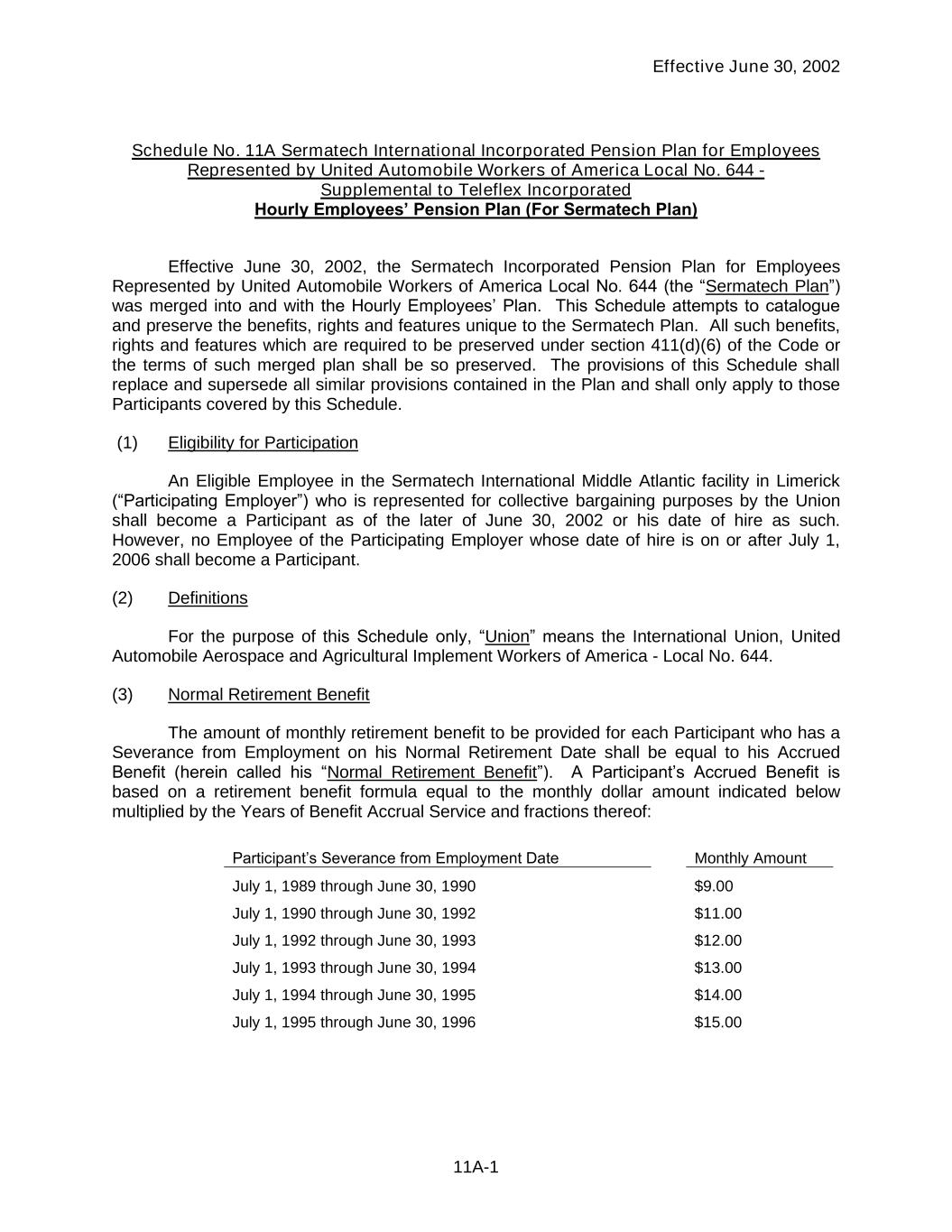
Effective June 30, 2002 11A-1 Schedule No. 11A Sermatech International Incorporated Pension Plan for Employees Represented by United Automobile Workers of America Local No. 644 - Supplemental to Teleflex Incorporated Hourly Employees’ Pension Plan (For Sermatech Plan) Effective June 30, 2002, the Sermatech Incorporated Pension Plan for Employees Represented by United Automobile Workers of America Local No. 644 (the “Sermatech Plan”) was merged into and with the Hourly Employees’ Plan. This Schedule attempts to catalogue and preserve the benefits, rights and features unique to the Sermatech Plan. All such benefits, rights and features which are required to be preserved under section 411(d)(6) of the Code or the terms of such merged plan shall be so preserved. The provisions of this Schedule shall replace and supersede all similar provisions contained in the Plan and shall only apply to those Participants covered by this Schedule. (1) Eligibility for Participation An Eligible Employee in the Sermatech International Middle Atlantic facility in Limerick (“Participating Employer”) who is represented for collective bargaining purposes by the Union shall become a Participant as of the later of June 30, 2002 or his date of hire as such. However, no Employee of the Participating Employer whose date of hire is on or after July 1, 2006 shall become a Participant. (2) Definitions For the purpose of this Schedule only, “Union” means the International Union, United Automobile Aerospace and Agricultural Implement Workers of America - Local No. 644. (3) Normal Retirement Benefit The amount of monthly retirement benefit to be provided for each Participant who has a Severance from Employment on his Normal Retirement Date shall be equal to his Accrued Benefit (herein called his “Normal Retirement Benefit”). A Participant’s Accrued Benefit is based on a retirement benefit formula equal to the monthly dollar amount indicated below multiplied by the Years of Benefit Accrual Service and fractions thereof: Participant’s Severance from Employment Date Monthly Amount July 1, 1989 through June 30, 1990 $9.00 July 1, 1990 through June 30, 1992 $11.00 July 1, 1992 through June 30, 1993 $12.00 July 1, 1993 through June 30, 1994 $13.00 July 1, 1994 through June 30, 1995 $14.00 July 1, 1995 through June 30, 1996 $15.00
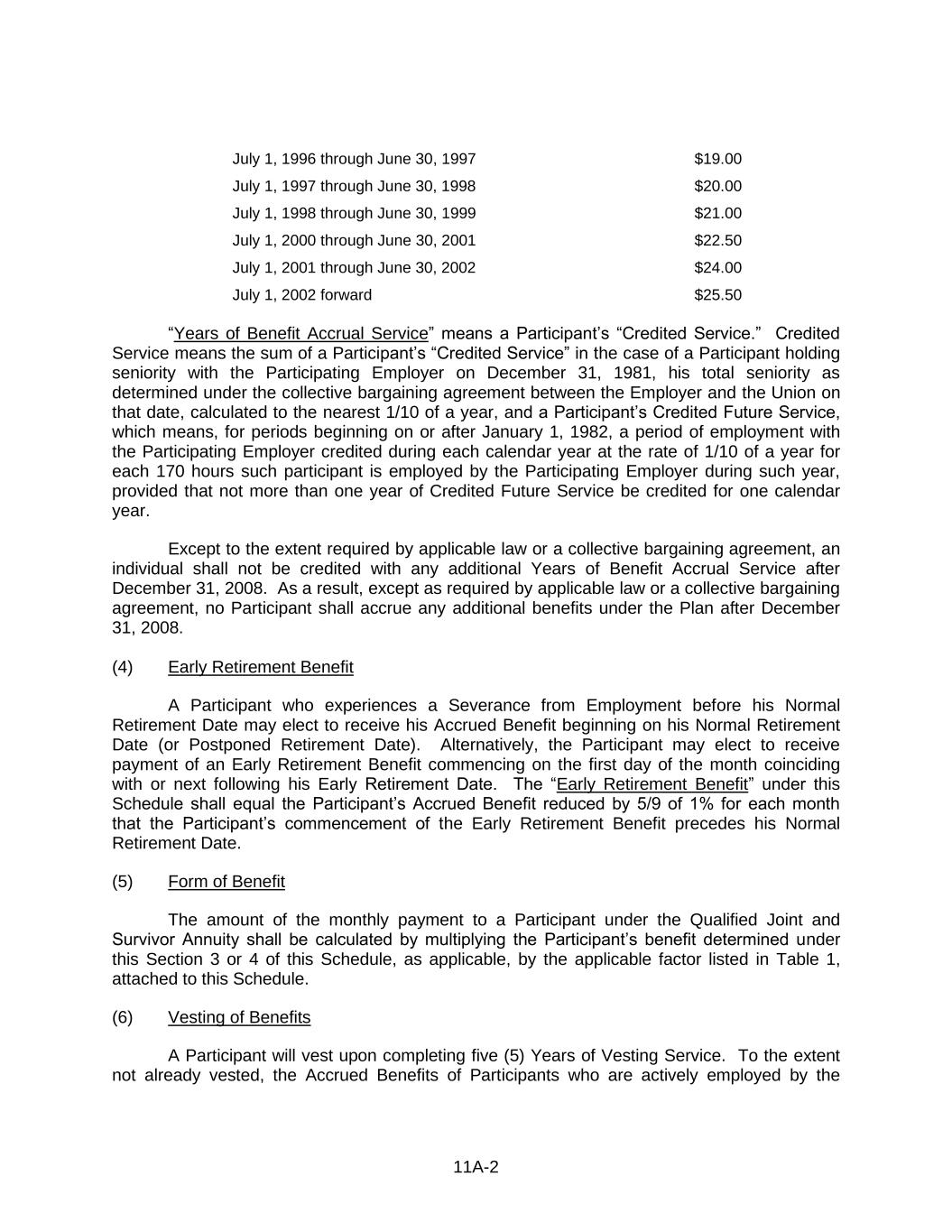
11A-2 July 1, 1996 through June 30, 1997 $19.00 July 1, 1997 through June 30, 1998 $20.00 July 1, 1998 through June 30, 1999 $21.00 July 1, 2000 through June 30, 2001 $22.50 July 1, 2001 through June 30, 2002 $24.00 July 1, 2002 forward $25.50 “Years of Benefit Accrual Service” means a Participant’s “Credited Service.” Credited Service means the sum of a Participant’s “Credited Service” in the case of a Participant holding seniority with the Participating Employer on December 31, 1981, his total seniority as determined under the collective bargaining agreement between the Employer and the Union on that date, calculated to the nearest 1/10 of a year, and a Participant’s Credited Future Service, which means, for periods beginning on or after January 1, 1982, a period of employment with the Participating Employer credited during each calendar year at the rate of 1/10 of a year for each 170 hours such participant is employed by the Participating Employer during such year, provided that not more than one year of Credited Future Service be credited for one calendar year. Except to the extent required by applicable law or a collective bargaining agreement, an individual shall not be credited with any additional Years of Benefit Accrual Service after December 31, 2008. As a result, except as required by applicable law or a collective bargaining agreement, no Participant shall accrue any additional benefits under the Plan after December 31, 2008. (4) Early Retirement Benefit A Participant who experiences a Severance from Employment before his Normal Retirement Date may elect to receive his Accrued Benefit beginning on his Normal Retirement Date (or Postponed Retirement Date). Alternatively, the Participant may elect to receive payment of an Early Retirement Benefit commencing on the first day of the month coinciding with or next following his Early Retirement Date. The “Early Retirement Benefit” under this Schedule shall equal the Participant’s Accrued Benefit reduced by 5/9 of 1% for each month that the Participant’s commencement of the Early Retirement Benefit precedes his Normal Retirement Date. (5) Form of Benefit The amount of the monthly payment to a Participant under the Qualified Joint and Survivor Annuity shall be calculated by multiplying the Participant’s benefit determined under this Section 3 or 4 of this Schedule, as applicable, by the applicable factor listed in Table 1, attached to this Schedule. (6) Vesting of Benefits A Participant will vest upon completing five (5) Years of Vesting Service. To the extent not already vested, the Accrued Benefits of Participants who are actively employed by the

11A-3 Employer or one of its Related Employers on the Termination Date, shall become 100% vested on that date. (7) Other Provisions Provisions not covered by this Schedule may be determined by reference to the Plan and Appendix E thereto.
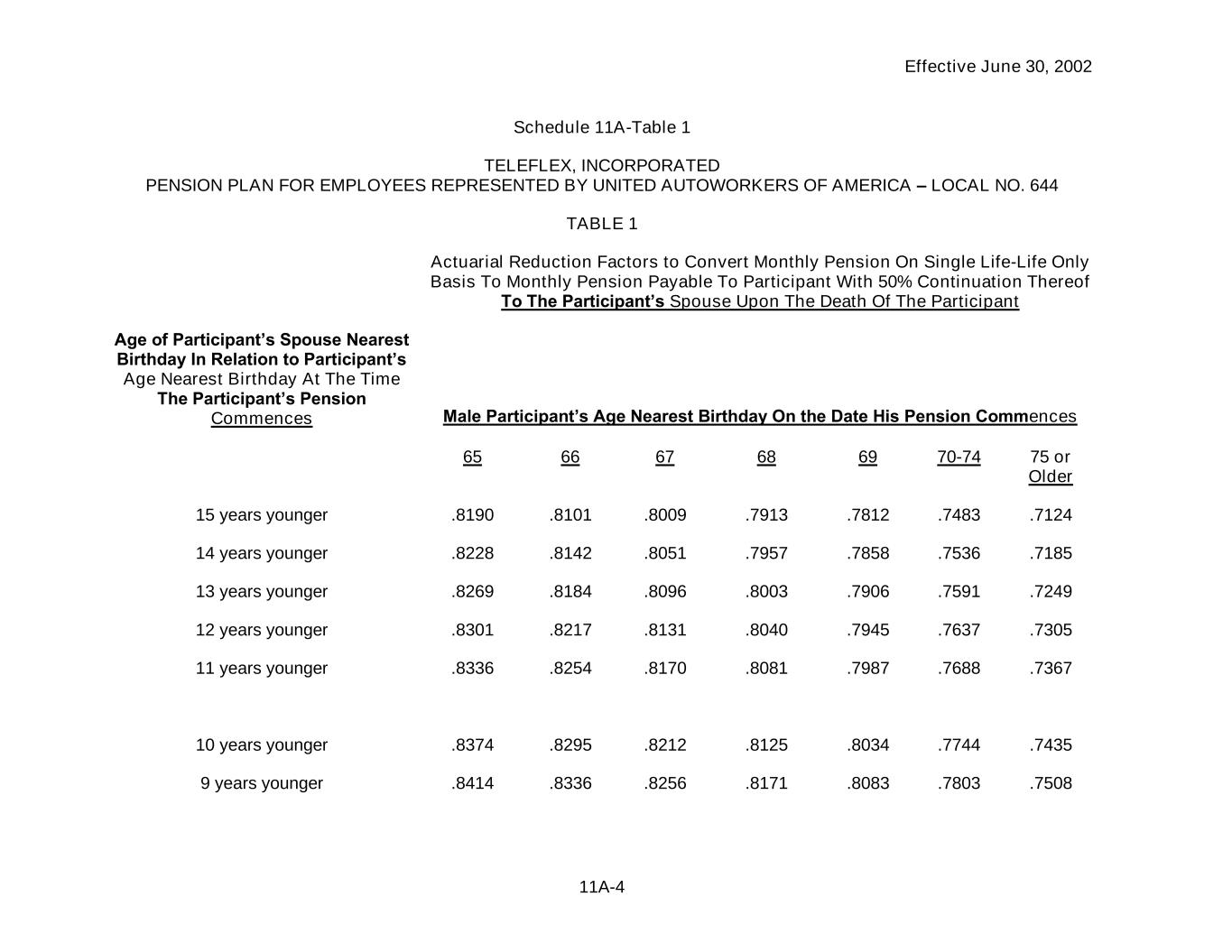
Effective June 30, 2002 11A-4 Schedule 11A-Table 1 TELEFLEX, INCORPORATED PENSION PLAN FOR EMPLOYEES REPRESENTED BY UNITED AUTOWORKERS OF AMERICA – LOCAL NO. 644 TABLE 1 Actuarial Reduction Factors to Convert Monthly Pension On Single Life-Life Only Basis To Monthly Pension Payable To Participant With 50% Continuation Thereof To The Participant’s Spouse Upon The Death Of The Participant Age of Participant’s Spouse Nearest Birthday In Relation to Participant’s Age Nearest Birthday At The Time The Participant’s Pension Commences Male Participant’s Age Nearest Birthday On the Date His Pension Commences 65 66 67 68 69 70-74 75 or Older 15 years younger .8190 .8101 .8009 .7913 .7812 .7483 .7124 14 years younger .8228 .8142 .8051 .7957 .7858 .7536 .7185 13 years younger .8269 .8184 .8096 .8003 .7906 .7591 .7249 12 years younger .8301 .8217 .8131 .8040 .7945 .7637 .7305 11 years younger .8336 .8254 .8170 .8081 .7987 .7688 .7367 10 years younger .8374 .8295 .8212 .8125 .8034 .7744 .7435 9 years younger .8414 .8336 .8256 .8171 .8083 .7803 .7508
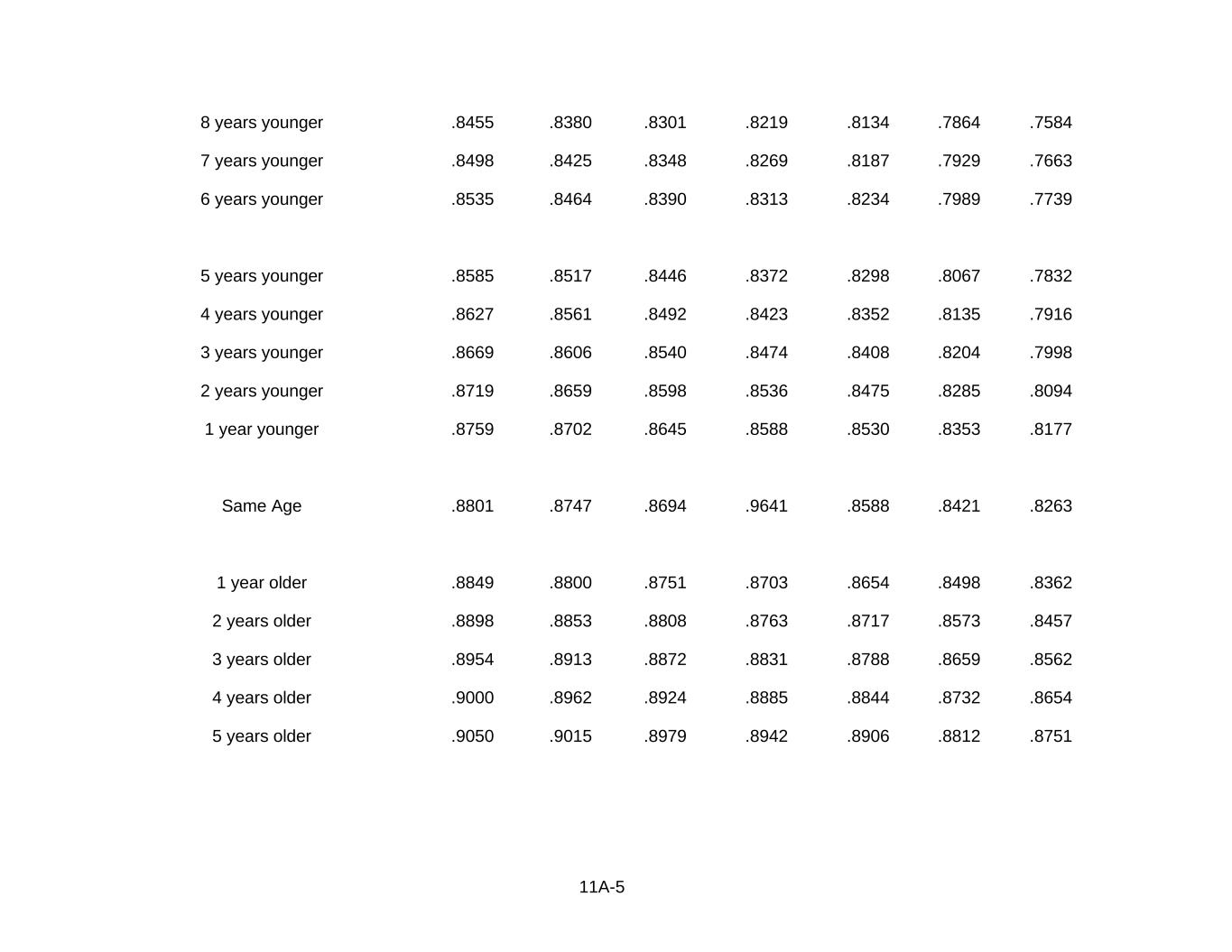
11A-5 8 years younger .8455 .8380 .8301 .8219 .8134 .7864 .7584 7 years younger .8498 .8425 .8348 .8269 .8187 .7929 .7663 6 years younger .8535 .8464 .8390 .8313 .8234 .7989 .7739 5 years younger .8585 .8517 .8446 .8372 .8298 .8067 .7832 4 years younger .8627 .8561 .8492 .8423 .8352 .8135 .7916 3 years younger .8669 .8606 .8540 .8474 .8408 .8204 .7998 2 years younger .8719 .8659 .8598 .8536 .8475 .8285 .8094 1 year younger .8759 .8702 .8645 .8588 .8530 .8353 .8177 Same Age .8801 .8747 .8694 .9641 .8588 .8421 .8263 1 year older .8849 .8800 .8751 .8703 .8654 .8498 .8362 2 years older .8898 .8853 .8808 .8763 .8717 .8573 .8457 3 years older .8954 .8913 .8872 .8831 .8788 .8659 .8562 4 years older .9000 .8962 .8924 .8885 .8844 .8732 .8654 5 years older .9050 .9015 .8979 .8942 .8906 .8812 .8751
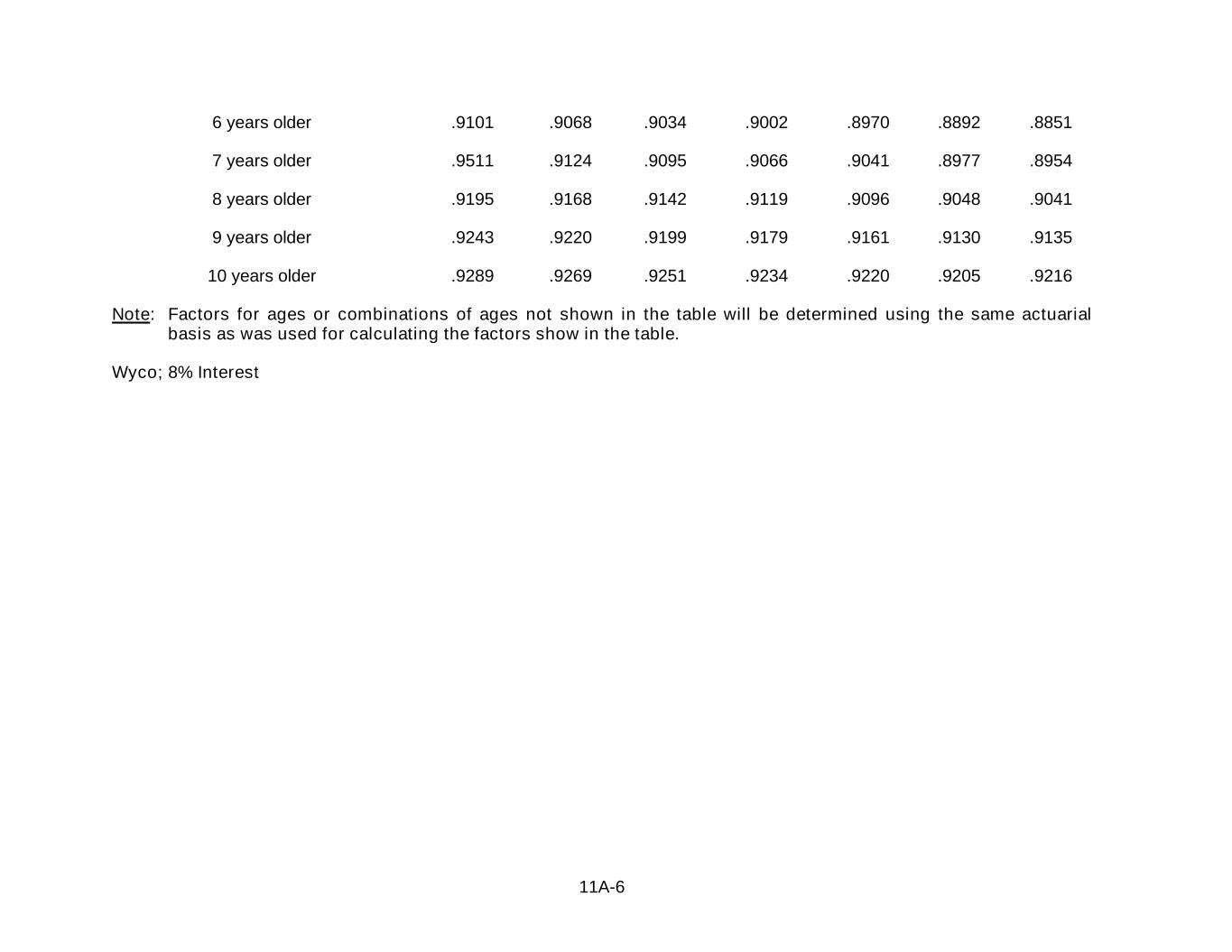
11A-6 6 years older .9101 .9068 .9034 .9002 .8970 .8892 .8851 7 years older .9511 .9124 .9095 .9066 .9041 .8977 .8954 8 years older .9195 .9168 .9142 .9119 .9096 .9048 .9041 9 years older .9243 .9220 .9199 .9179 .9161 .9130 .9135 10 years older .9289 .9269 .9251 .9234 .9220 .9205 .9216 Note: Factors for ages or combinations of ages not shown in the table will be determined using the same actuarial basis as was used for calculating the factors show in the table. Wyco; 8% Interest
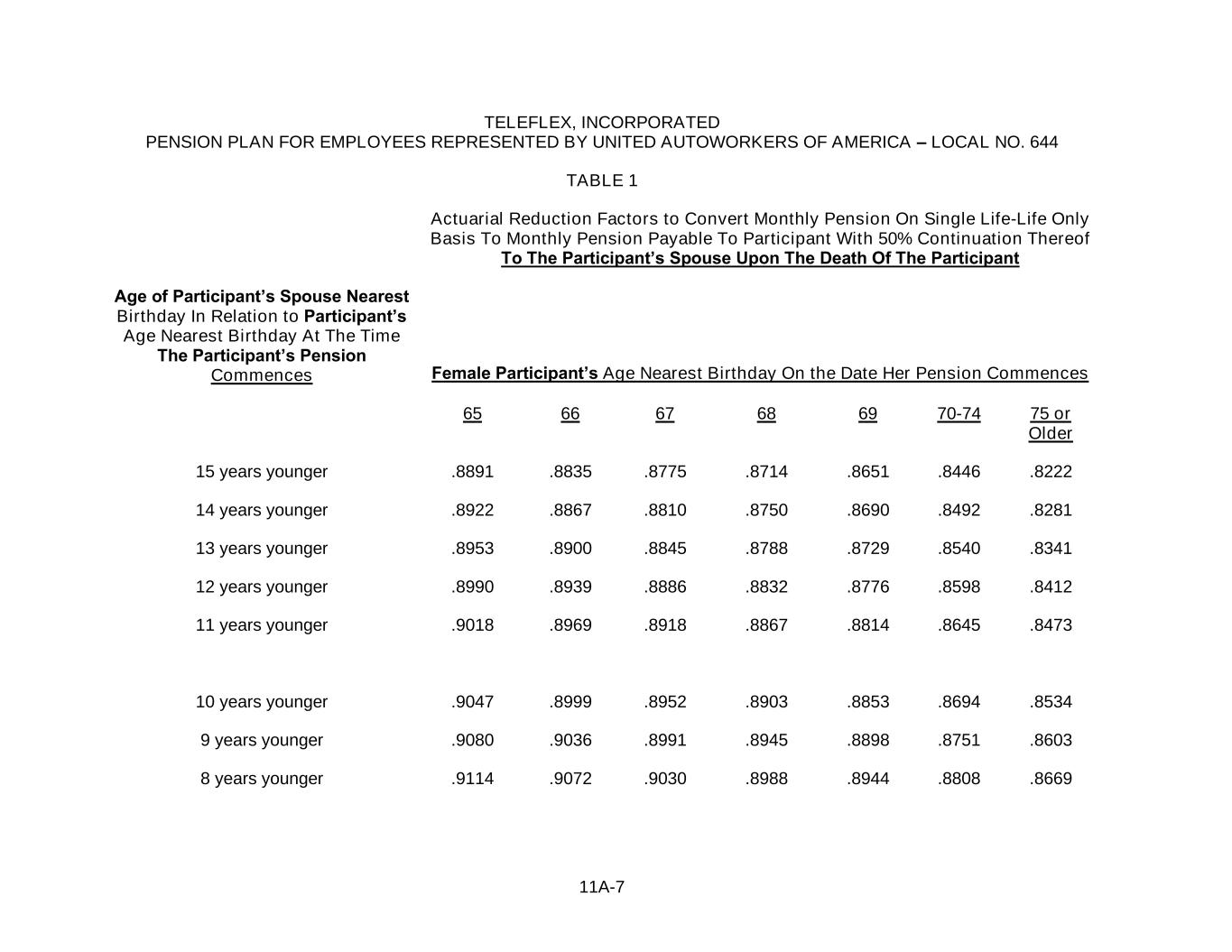
11A-7 TELEFLEX, INCORPORATED PENSION PLAN FOR EMPLOYEES REPRESENTED BY UNITED AUTOWORKERS OF AMERICA – LOCAL NO. 644 TABLE 1 Actuarial Reduction Factors to Convert Monthly Pension On Single Life-Life Only Basis To Monthly Pension Payable To Participant With 50% Continuation Thereof To The Participant’s Spouse Upon The Death Of The Participant Age of Participant’s Spouse Nearest Birthday In Relation to Participant’s Age Nearest Birthday At The Time The Participant’s Pension Commences Female Participant’s Age Nearest Birthday On the Date Her Pension Commences 65 66 67 68 69 70-74 75 or Older 15 years younger .8891 .8835 .8775 .8714 .8651 .8446 .8222 14 years younger .8922 .8867 .8810 .8750 .8690 .8492 .8281 13 years younger .8953 .8900 .8845 .8788 .8729 .8540 .8341 12 years younger .8990 .8939 .8886 .8832 .8776 .8598 .8412 11 years younger .9018 .8969 .8918 .8867 .8814 .8645 .8473 10 years younger .9047 .8999 .8952 .8903 .8853 .8694 .8534 9 years younger .9080 .9036 .8991 .8945 .8898 .8751 .8603 8 years younger .9114 .9072 .9030 .8988 .8944 .8808 .8669
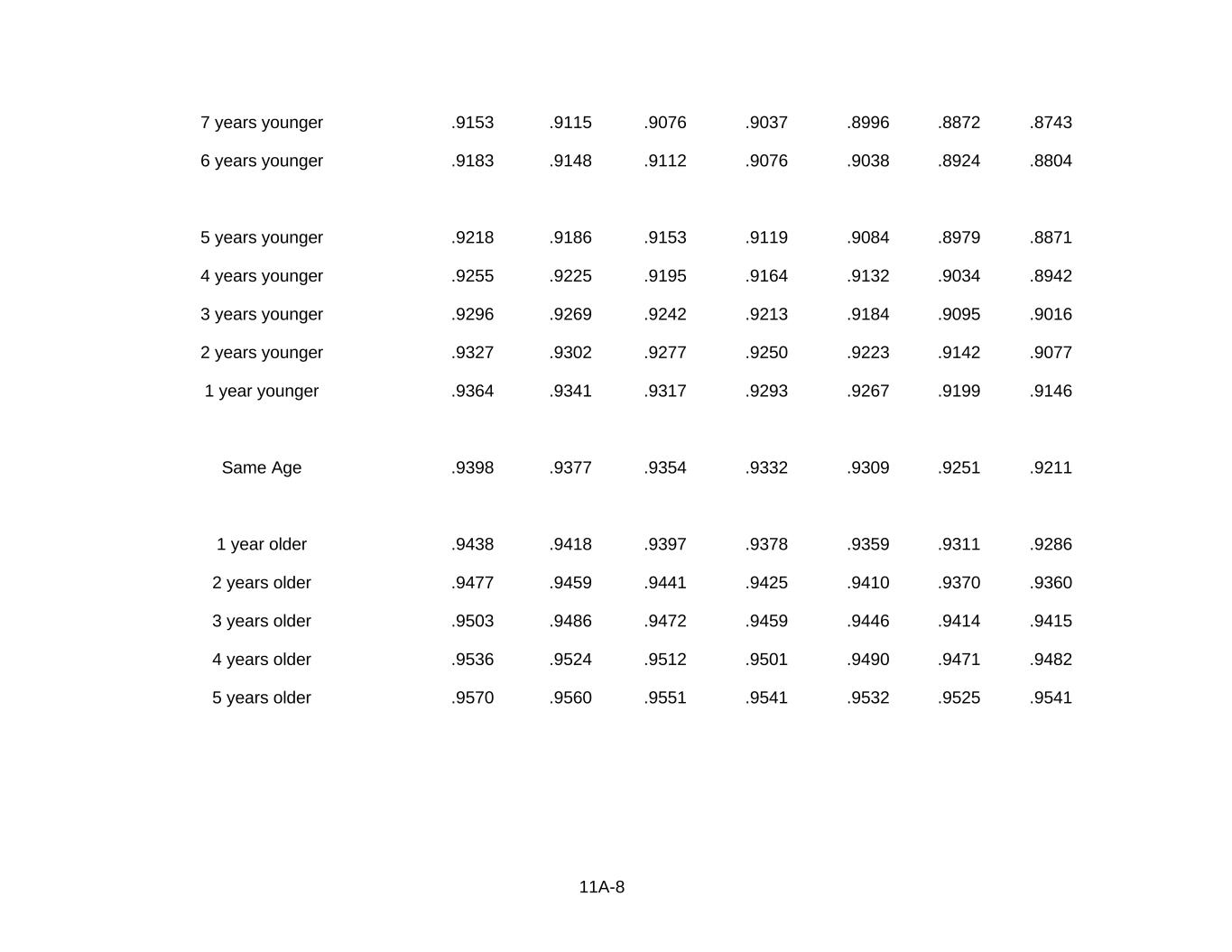
11A-8 7 years younger .9153 .9115 .9076 .9037 .8996 .8872 .8743 6 years younger .9183 .9148 .9112 .9076 .9038 .8924 .8804 5 years younger .9218 .9186 .9153 .9119 .9084 .8979 .8871 4 years younger .9255 .9225 .9195 .9164 .9132 .9034 .8942 3 years younger .9296 .9269 .9242 .9213 .9184 .9095 .9016 2 years younger .9327 .9302 .9277 .9250 .9223 .9142 .9077 1 year younger .9364 .9341 .9317 .9293 .9267 .9199 .9146 Same Age .9398 .9377 .9354 .9332 .9309 .9251 .9211 1 year older .9438 .9418 .9397 .9378 .9359 .9311 .9286 2 years older .9477 .9459 .9441 .9425 .9410 .9370 .9360 3 years older .9503 .9486 .9472 .9459 .9446 .9414 .9415 4 years older .9536 .9524 .9512 .9501 .9490 .9471 .9482 5 years older .9570 .9560 .9551 .9541 .9532 .9525 .9541

11A-9 6 years older .9593 .9584 .9575 .9567 .9562 .9565 .9583 7 years older .9628 .9621 .9614 .9608 .9606 .9617 .9634 8 years older .9656 .9549 .9645 .9643 .9645 .9660 .9676 9 years older .9682 .9678 .9677 .9678 .9682 .9699 .9713 10 years older .9708 .9707 .9708 .9712 .9719 .9733 .9745 Note: Factors for ages or combinations of ages not shown in the table will be determined using the same actuarial basis as was used for calculating the factors shown in the table. Wyco; 8% Interest
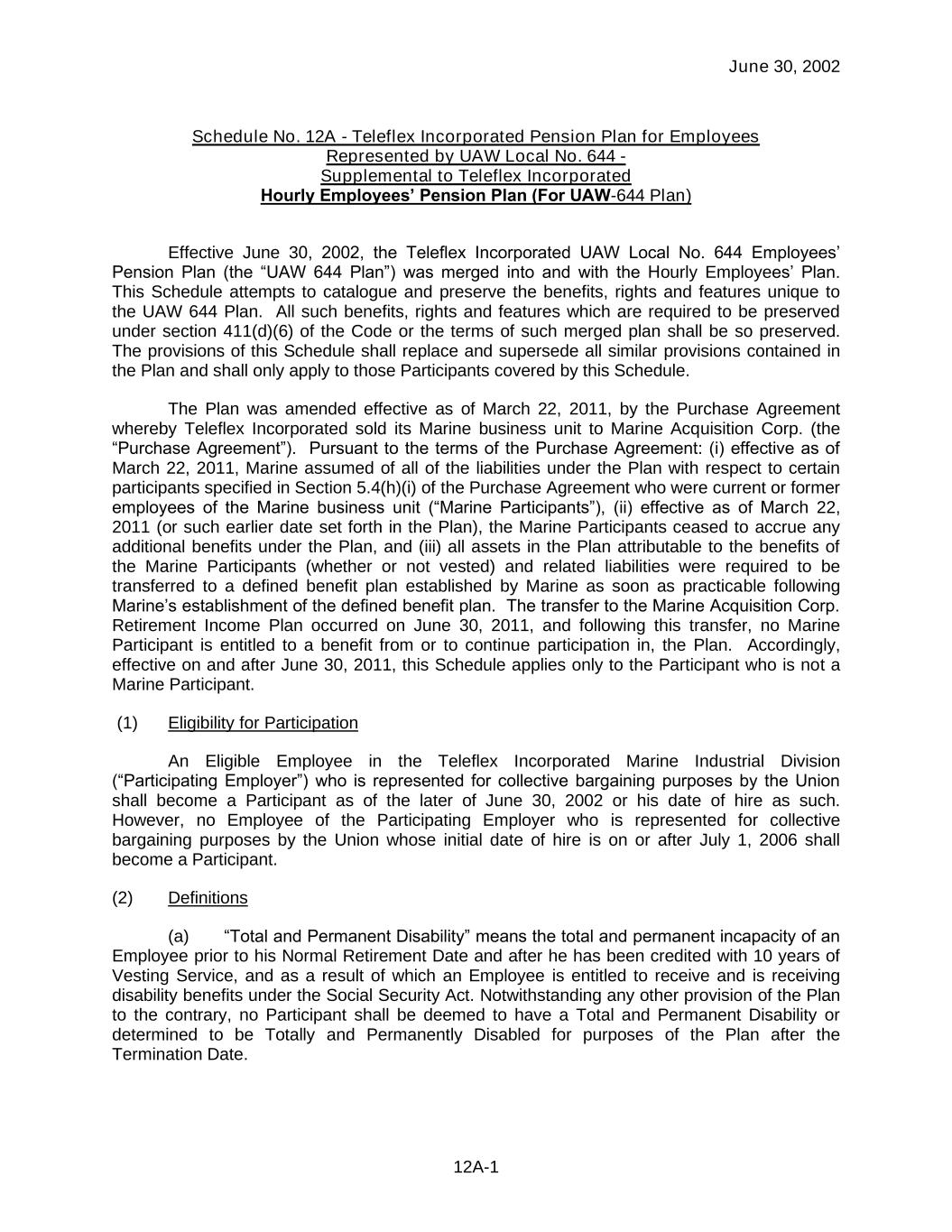
June 30, 2002 12A-1 Schedule No. 12A - Teleflex Incorporated Pension Plan for Employees Represented by UAW Local No. 644 - Supplemental to Teleflex Incorporated Hourly Employees’ Pension Plan (For UAW-644 Plan) Effective June 30, 2002, the Teleflex Incorporated UAW Local No. 644 Employees’ Pension Plan (the “UAW 644 Plan”) was merged into and with the Hourly Employees’ Plan. This Schedule attempts to catalogue and preserve the benefits, rights and features unique to the UAW 644 Plan. All such benefits, rights and features which are required to be preserved under section 411(d)(6) of the Code or the terms of such merged plan shall be so preserved. The provisions of this Schedule shall replace and supersede all similar provisions contained in the Plan and shall only apply to those Participants covered by this Schedule. The Plan was amended effective as of March 22, 2011, by the Purchase Agreement whereby Teleflex Incorporated sold its Marine business unit to Marine Acquisition Corp. (the “Purchase Agreement”). Pursuant to the terms of the Purchase Agreement: (i) effective as of March 22, 2011, Marine assumed of all of the liabilities under the Plan with respect to certain participants specified in Section 5.4(h)(i) of the Purchase Agreement who were current or former employees of the Marine business unit (“Marine Participants”), (ii) effective as of March 22, 2011 (or such earlier date set forth in the Plan), the Marine Participants ceased to accrue any additional benefits under the Plan, and (iii) all assets in the Plan attributable to the benefits of the Marine Participants (whether or not vested) and related liabilities were required to be transferred to a defined benefit plan established by Marine as soon as practicable following Marine’s establishment of the defined benefit plan. The transfer to the Marine Acquisition Corp. Retirement Income Plan occurred on June 30, 2011, and following this transfer, no Marine Participant is entitled to a benefit from or to continue participation in, the Plan. Accordingly, effective on and after June 30, 2011, this Schedule applies only to the Participant who is not a Marine Participant. (1) Eligibility for Participation An Eligible Employee in the Teleflex Incorporated Marine Industrial Division (“Participating Employer”) who is represented for collective bargaining purposes by the Union shall become a Participant as of the later of June 30, 2002 or his date of hire as such. However, no Employee of the Participating Employer who is represented for collective bargaining purposes by the Union whose initial date of hire is on or after July 1, 2006 shall become a Participant. (2) Definitions (a) “Total and Permanent Disability” means the total and permanent incapacity of an Employee prior to his Normal Retirement Date and after he has been credited with 10 years of Vesting Service, and as a result of which an Employee is entitled to receive and is receiving disability benefits under the Social Security Act. Notwithstanding any other provision of the Plan to the contrary, no Participant shall be deemed to have a Total and Permanent Disability or determined to be Totally and Permanently Disabled for purposes of the Plan after the Termination Date.

June 30, 2002 12A-2 (b) “Union” means the International Union, United Automobile, Aerospace and Agricultural Implement Workers of America - Local No. 644. (3) Retirement Benefit The amount of monthly retirement benefit to be provided for each Participant who retires on his Normal Retirement Date shall be equal to his Accrued Benefit (herein called his Normal Retirement Benefit). A Participant’s Accrued Benefit is based on a retirement benefit formula equal to the monthly dollar amount indicated below multiplied by the Years of Benefit Accrual Service and fractions thereof:
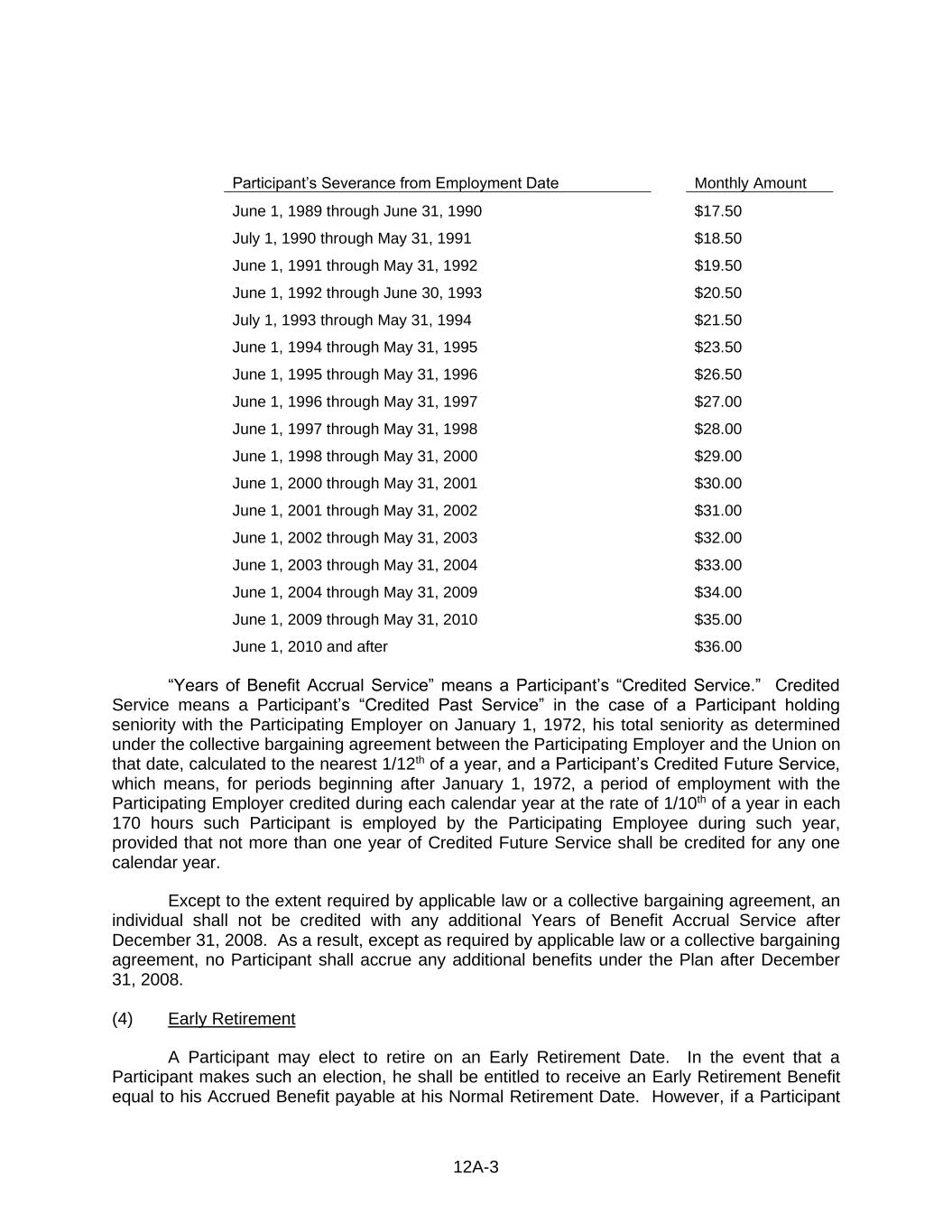
12A-3 Participant’s Severance from Employment Date Monthly Amount June 1, 1989 through June 31, 1990 $17.50 July 1, 1990 through May 31, 1991 $18.50 June 1, 1991 through May 31, 1992 $19.50 June 1, 1992 through June 30, 1993 $20.50 July 1, 1993 through May 31, 1994 $21.50 June 1, 1994 through May 31, 1995 $23.50 June 1, 1995 through May 31, 1996 $26.50 June 1, 1996 through May 31, 1997 $27.00 June 1, 1997 through May 31, 1998 $28.00 June 1, 1998 through May 31, 2000 $29.00 June 1, 2000 through May 31, 2001 $30.00 June 1, 2001 through May 31, 2002 $31.00 June 1, 2002 through May 31, 2003 $32.00 June 1, 2003 through May 31, 2004 $33.00 June 1, 2004 through May 31, 2009 $34.00 June 1, 2009 through May 31, 2010 $35.00 June 1, 2010 and after $36.00 “Years of Benefit Accrual Service” means a Participant’s “Credited Service.” Credited Service means a Participant’s “Credited Past Service” in the case of a Participant holding seniority with the Participating Employer on January 1, 1972, his total seniority as determined under the collective bargaining agreement between the Participating Employer and the Union on that date, calculated to the nearest 1/12th of a year, and a Participant’s Credited Future Service, which means, for periods beginning after January 1, 1972, a period of employment with the Participating Employer credited during each calendar year at the rate of 1/10th of a year in each 170 hours such Participant is employed by the Participating Employee during such year, provided that not more than one year of Credited Future Service shall be credited for any one calendar year. Except to the extent required by applicable law or a collective bargaining agreement, an individual shall not be credited with any additional Years of Benefit Accrual Service after December 31, 2008. As a result, except as required by applicable law or a collective bargaining agreement, no Participant shall accrue any additional benefits under the Plan after December 31, 2008. (4) Early Retirement A Participant may elect to retire on an Early Retirement Date. In the event that a Participant makes such an election, he shall be entitled to receive an Early Retirement Benefit equal to his Accrued Benefit payable at his Normal Retirement Date. However, if a Participant
12A-4 so elects, he may receive payment of an Early Retirement Benefit commencing on the first day of the month coinciding with or next following his Early Retirement Date. This Early Retirement Benefit under this Schedule, shall equal the Participant’s Accrued Benefit reduced by 1/2 of 1% for each month that the Participant’s commencement of the Early Retirement Benefit precedes his Normal Retirement Date. (5) Disability Retirement Benefit The disability retirement benefit payable to a Participant who incurs a Total and Permanent Disability shall be his Accrued Benefit based on his years of Credited Service up the date he has a Severance from Employment due to such disability. Payment of such disability benefit shall begin as of the first day of the month following the later of: (a) The date the Participant begins to receive disability benefits under the Federal Social Security Act as in effect at the time of such disability retirement, or (b) The approval by the Administrative Committee of the Participant’s application for disability retirement under the Plan, and shall continue until the date such Participant ceases to receive disability benefits under the Federal Social Security Act; provided that if such Participant continues to receive benefits until he reaches age 65, such benefits hereunder will continue for the remainder of the Participant’s life. Effective on and after the Termination Date, if a Participant does not continue to receive benefits under this provision until he reaches age 65, any benefits to which the Participant later becomes entitled under the Plan and this Appendix E, Schedule 12A will not be reduced on an Actuarially Equivalent basis in recognition of any Disability Retirement Benefit which he or she received under the Plan and this Appendix E, Schedule 12A. Disability benefits shall not be paid in any month for which the Participant receives illness or injury benefits under any program maintained by the Employer. Notwithstanding any other provision of the Plan to the contrary, no Participant shall be deemed to have a Total and Permanent Disability or determined to be Totally and Permanently Disabled for purposes of the Plan after the Termination Date. (6) Form of Benefit The amount of the monthly payment to a Participant under the Qualified Joint and Survivor Annuity shall be calculated by multiplying the Participant’s benefit determined under Section 3 or 4 of this Schedule, as applicable, by the applicable factor listed in Table 1, attached to the end of this Schedule. (7) Vesting of Benefits on Ceasing to be an Employee A Participant will vest upon completing five (5) Years of Vesting Service. A Participant’s interest in his Accrued Benefit shall in any case become 100% vested if, while employed by the Employer, he reaches his Normal Retirement Date, dies or sustains a Total and Permanent Disability. To the extent not already vested, the Accrued Benefits of Participants who are actively employed by the Employer or one of its Related Employers on the Termination Date, shall become 100% vested on that date.

12A-5 (8) Death Benefits The surviving Spouse of a Participant covered by this Schedule shall only be eligible for the death benefit provided under Article VII of Appendix E, if such Spouse was married to the Participant throughout the three-month period ending on the Participant’s date of death. (9) Qualified Joint and Survivor Annuity (a) For a married Participant who retires on or after his Early Retirement Date or Normal Retirement Date, the product of (i) and (ii) below, paid in the form of a monthly joint and survivor annuity that provides an annuity for the life of the Participant’s surviving Spouse equal to 50% of the annuity payable during the joint lives of the Participant and his Spouse: (i) The Participant’s Accrued Benefit determined under Section (3) , (4) or (5) above, as applicable; (ii) 90%, increased by ½ of 1% for each year in excess of five years that the age of the Participant’s Spouse exceeds the Participant’s age, with both ages determined as of the birthday nearer the Participant’s retirement date, to a maximum of 100%, or decreased by ½ of 1% for each year in excess of five years that the age of the Participant’s Spouse is less than the Participant’s age, with both ages determined as of the birthday nearer the Participant’s retirement date; (b) For a married Participant who experiences a Severance from Employment prior to his Early Retirement Date or Normal Retirement Date due to a Total and Permanent Disability or for any other reason, the Participant’s Accrued Benefit paid in the form of a monthly joint and survivor annuity that is the Actuarial Equivalent of the normal form of benefit for an unmarried Participant, and that provides an annuity for the life of the Participant’s surviving Spouse equal to 50% of the annuity payable during the joint lives of the Participant and his Spouse. (10) Supplemental Benefits A Participant and his or her Spouse set forth in Appendix I may be entitled to a Supplemental Benefit described in Section 3.9 of the Plan Such a Participant had to have a Severance from Employment on or after his Early Retirement Date or Normal Retirement Date or due to a Total and Permanent Disability. (11) Other Provisions Provisions not covered by this Schedule may be determined by reference to the Plan and Appendix E thereto.

12A-6 Schedule 12A-Table 1 TABLE OF FACTORS TO CONVERT AN AMOUNT OF PENSION PAYABLE TO AN EMPLOYEE FOR LIFE TO AN ACTUARIALLY EQUIVALENT AMOUNT OF PENSION PAYABLE TO THE EMPLOYEE FOR LIFE WITH ONE-HALF OF THE PENSION AMOUNT PAYABLE TO THE EMPLOYEE CONTINUED TO THE EMPLOYEE’S SPOUSE FOR THE PERIOD, IF ANY, THAT THE SPOUSE SURVIVES THE EMPLOYEE A. If ages of spouse and Participant are 5 years or less apart: 90% B. If spouse if more than 5 years older than Participant: 90% increased by ½ of 1% (.005) for each year in excess of 5 years that the age of the spouse exceeds the age of the Participant (up to a maximum of 100%). C. If spouse if more than 5 years younger than Participant: 90% decreased by ½ of 1% (.005) for each year in excess of 5 years that the age of the Spouse is less the age of the Participant. For purposes of the above, the Participant’s and Spouse’s age nearest his or her birthday is used.

Effective July 31, 2002 13A-1 Schedule No. 13A DeCouper Industries, Inc. U.A.W. Retirement Income Plan Represented by the International Union, Automobile, Aerospace and Agricultural Implement Workers of America, No. 540 and Local 1155 - Supplemental to Teleflex Incorporated Hourly Employees’ Pension Plan (For PACE Plan) Effective July 31, 2002, the DeCouper Industries, Inc. U.A.W. Retirement Income Plan (the “DeCouper Plan”) was merged into and with the Hourly Employees’ Plan. This Schedule attempts to catalogue and preserve the benefits, rights and features unique to the DeCouper Plan. All such benefits, rights and features which are required to be preserved under section 411(d)(6) of the Code or the terms of such merged plan shall be so preserved. The provisions of this Schedule shall replace and supersede all similar provisions contained in the Plan and shall only apply to those Participants covered by this Schedule. (1) Eligibility for Participation An Eligible Employee in the Warren, Michigan facility of DeCouper Industries, Inc. (“Participating Employer”) who is represented for collective bargaining purposes by the Union shall become a Participant as of the later of July 31, 2002 or his date of hire as such. No Employee of the Participating Employer whose date of hire is on or after January 1, 2006 shall become a Participant. (2) Definitions For the purpose of this Schedule only: (a) “Disability” shall mean the total and permanent incapacity of an Employee after he has been credited with 10 years of Vesting Service, but prior to his Normal Retirement Date, and which entitles him to disability benefits under the Social Security Act as then in effect. Notwithstanding any other provision of the Plan to the contrary, no Participant shall be deemed to have a Disability or determined to be Disabled for purposes of the Plan after the Termination Date. (b) “Union” means the International Union, United Automobile, Aerospace and Agricultural Implement Workers of America, No. 540 and Local 1155. (3) Accrued Benefit “Accrued Benefit” means the monthly amount payable to the Participant on his Normal Retirement Date in the form of a Life Annuity determined on the basis of such Participant’s Years of Benefit Service as of the date of determination, in an amount determined under the provisions shown below: (a) Participants employed by Thomas Die and Stamping, Inc. (i) Three Dollars and Fifty Cents ($3.50) multiplied by Years of Benefit Service if such Participant’s Severance from Employment date occurred prior to August 1, 1980.
13A-2 (ii) Four Dollars ($4.00) multiplied by Years of Benefit Service if such Participant’s Severance from Employment date occurred on or after August 1, 1980 but prior to June 1, 1987. (iii) Five Dollars ($5.00) multiplied by Years of Benefit Service if such Participant’s Severance from Employment date occurred on or after June 1, 1987 but prior to June 1, 1988. (iv) Six Dollars ($6.00) multiplied by Years of Benefit Service if such Participant’s Severance from Employment date is on or after June 1, 1988 but prior to June 1, 1989. (v) Seven Dollars ($7.00) multiplied by Years of Benefit Service if such Participant’s Severance from Employment date is on or after June 1, 1989 but prior to June 1, 1990. (vi) Eight Dollars ($8.00) multiplied by Years of Benefit Service if such Participant’s Severance from Employment date is on or after June 1, 1990 but prior to June 1, 1991. (vii) Nine Dollars ($9.00) multiplied by Years of Benefit Service if such Participant’s Severance from Employment date is on or after June 1, 1991 but prior to June 1, 1992. (viii) Ten Dollars ($10.00) multiplied by Years of Benefit Service if such Participant’s Severance from Employment date is on or after June 1, 1992. (ix) Twelve Dollars ($12.00) multiplied by Years of Benefit Service if such Participant’s Severance from Employment date is on or after June 1, 1999. (x) Thirteen Dollars ($13.00) multiplied by Years of Benefit Service if such Participant’s Severance from Employment date is on or after June 1, 2002. In addition, a Participant who was covered under the Prior Plan shall receive a lump sum payment equal to his Prior Plan Profit Sharing Account, if any. Such lump sum payment equal to the Prior Plan Profit Sharing Account shall also be available to such Participants as an in- service benefit. An in-service payment may be elected by the Participant with the in-service payment date being the first day of the second month following the date the Benefits Group receives proper application from such Participant. Except to the extent required by applicable law or a collective bargaining agreement, an individual shall not be credited with any additional Years of Benefit Accrual Service after December 31, 2008. As a result, except as required by applicable law or a collective bargaining agreement, no Participant shall accrue any additional benefits under the Plan after December 31, 2008. (b) Participants employed by the Stamping Services Division U.A.W. Retirement Income Plan: (i) Three Dollars ($3.00) multiplied by Years of Benefit Service if such Participant’s Severance from Employment date is prior to August 1, 1977.
13A-3 (ii) Four Dollars ($4.00) multiplied by Years of Benefit Service if such Participant’s Severance from Employment date occurred on or after August 1, 1977 but prior to August 1, 1980. (iii) Four Dollars and Fifty Cents ($4.50) multiplied by Years of Benefit Service if such Participant’s Severance from Employment date occurred on or after August 1, 1980 but prior to August 1, 1981. (iv) Five Dollars ($5.00) multiplied by Years of Benefit Service if such Participant’s Severance from Employment date occurred on or after August 1, 1981 but prior to August 1, 1985. (v) Six Dollars ($6.00) multiplied by Years of Benefit Service if such Participant’s Severance from Employment date occurred on or after August 1, 1985 but prior to August 1, 1986. (vi) Six Dollars and Fifty Cents ($6.50) multiplied by Years of Benefit Service if such Participant’s Severance from Employment date occurred on or after August 1, 1986 but prior to August 1, 1987. (vii) Seven Dollars ($7.00) multiplied by Years of Benefit Service if such Participant’s Severance from Employment date occurred on or after August 1, 1987 but prior to March 31, 1988. (viii) Five Dollars ($5.00) multiplied by Years of Benefit Service after April 1, 1988 but prior to March 31, 1989. (ix) Six Dollars ($6.00) multiplied by Years of Benefit Service after April 1, 1989 but prior to March 31, 1990. (x) Seven Dollars ($7.00) multiplied by Years of Benefit Service after April 1, 1990 but prior to March 31, 1991. (xi) Eight Dollars ($8.00) multiplied by Years of Benefit Service after April, 1 1991 but prior to March 31, 1992. (xii) Nine Dollars ($9.00) multiplied by Years of Benefit Service after April 1, 1992 but prior to March 31, 1993. (xiii) Ten Dollars ($10.00) multiplied by Years of Benefit Service after April 1, 1993. (xiv) Eleven Dollars ($11.00) multiplied by Years of Benefit Service after April 1, 1996. (xv) Twelve Dollars ($12.00) multiplied by Years of Benefit Service after April 1, 1997. (xvi) Thirteen Dollars ($13.00) multiplied by Years of Benefit Service after April 1, 2000.
13A-4 (xvii) Fourteen Dollars ($14.00) multiplied by Years of Benefit Service after April 1, 2001. (xviii) Fifteen Dollars ($15.00) multiplied by Years of Benefit Service after April 1, 2002. Except to the extent required by applicable law or a collective bargaining agreement, an individual shall not be credited with any additional Years of Benefit Accrual Service after December 31, 2008. As a result, except as required by applicable law or a collective bargaining agreement, no Participant shall accrue any additional benefits under the Plan after December 31, 2008. (c) Participants employed by the Handi-Vet Division U.A.W. Retirement Income Plan: (i) Two Dollars and Fifty Cents ($2.50) multiplied by Years of Benefit Service earned prior to April 1, 1988. (ii) Five Dollars ($5.00) multiplied by Years of Benefit Service after April 1, 1988 but prior to March 31, 1989. (iii) Six Dollars ($6.00) multiplied by Years of Benefit Service after April 1, 1989 but prior to March 31, 1990. (iv) Seven Dollars ($7.00) multiplied by Years of Benefit Service after April 1, 1990 but prior to March 31, 1991. (v) Eight Dollars ($8.00) multiplied by Years of Benefit Service after April 1, 1991 but prior to March 31, 1992. (vi) Nine Dollars ($9.00) multiplied by Years of Benefit Service after April 1, 1992 but prior to March 31, 1993. (vii) Ten Dollars ($10.00) multiplied by Years of Benefit Service after April 1, 1993 but prior to March 31, 1996. (viii) Eleven Dollars ($11.00) multiplied by Years of Benefit Service after April 1, 1996 but prior to March 31, 1997. (ix) Twelve Dollars ($12.00) multiplied by Years of Benefit Service after April 1, 1997 but prior to March 31, 2000. (x) Thirteen Dollars ($13.00) multiplied by Years of Benefit Service after April 1, 2000 but prior to March 31, 2001. (xi) Fourteen Dollars ($14.00) multiplied by Years of Benefit Service after April 1, 2001 but prior to March 31, 2002. (xii) Fifteen Dollars ($15.00) multiplied by Years of Benefit Service after April 1, 2002 but prior to March 31, 2003.
13A-5 Except to the extent required by applicable law or a collective bargaining agreement, an individual shall not be credited with any additional Years of Benefit Accrual Service after December 31, 2008. As a result, except as required by applicable law or a collective bargaining agreement, no Participant shall accrue any additional benefits under the Plan after December 31, 2008. (d) Other DeCouper Employees: (i) Service prior to August 1, 1987: $4.00. (ii) Service prior to August 1, 1988: $5.00. (iii) Six Dollars ($6.00) multiplied by Years of Benefit Service after April, 1989 but prior to March 31, 1990. (iv) Seven Dollars ($7.00) multiplied by Years of Benefit Service after April 1, 1990 but prior to March 31, 1991. (v) Eight Dollars ($8.00) multiplied by Years of Benefit Service after April, 1991 but prior to March 31, 1992. (vi) Nine Dollars ($9.00) multiplied by Years of Benefit Service after April 1,1992 but prior to March 31, 1993. (vii) Ten Dollars ($10.00) multiplied by Years of Benefit Service after April 1, 1993 but prior to March 31, 1996. (viii) Eleven Dollars ($11.00) multiplied by Years of Benefit Service after April 1, 1996 but prior to March 31, 1997. (ix) Twelve Dollars ($12.00) multiplied by Years of Benefit Service after April 1, 1997 but prior to March 31, 2000. (x) Thirteen Dollars ($13.00) multiplied by Years of Benefit Service after April 1, 2000 but prior to March 31, 2001. (xi) Fourteen Dollars ($14.00) multiplied by Years of Benefit Service after April 1, 2001 but prior to March 31, 2002. (xii) Fifteen Dollars ($15.00) multiplied by Years of Benefit Service after April 1, 2002 but prior to March 31, 2003. Except to the extent required by applicable law or a collective bargaining agreement, an individual shall not be credited with any additional Years of Benefit Accrual Service after December 31, 2008. As a result, except as required by applicable law or a collective bargaining agreement, no Participant shall accrue any additional benefits under the Plan after December 31, 2008.
13A-6 (4) Normal Retirement Benefits A Participant who has reached his Normal Retirement Date, who is not receiving Disability Benefits and who either (a) is an Eligible Employee as of his Normal Retirement Date or (b) was credited: (a) In either the Plan Year in which his Normal Retirement Date occurs or in one of the two Plan Years immediately preceding the Plan Year in which his Normal Retirement Date occurs, with at least one-tenth of a Year of Benefit Service; or (b) In the Plan Year in which his Normal Retirement Date occurs or in the Plan Year immediately preceding the Plan Year in which his Normal Retirement Date occurs, with at least half the number of Hours of Service required for him to be credited with a Year of Vesting Service for such Plan Year, shall be entitled to a Normal Retirement Benefit equal to his Accrued Benefit. If the Participant has experienced a Severance from Employment, the Participant may elect, in accordance with Section 6.6 of the Plan, to commence receipt of his Normal Retirement Benefit on his Normal Retirement Date or the first day of any month following his Normal Retirement Date (such later date being a Postponed Retirement Date and such benefit being a Postponed Retirement Benefit). (5) Early Retirement Benefits A Participant with at least 10 Years of Vesting Service or 10 Years of Benefit Service who has attained age 60 but who experiences a Severance from Employment before his Normal Retirement Date and who is not receiving a Disability Retirement Benefit may elect to receive his Accrued Benefit beginning on his Normal Retirement Date (or Postponed Retirement Date). Alternatively, the Participant may elect to receive payment of an Early Retirement Benefit commencing on the first day of the month coinciding with or next following the later of his Early Retirement Date or 30 days after the date the Benefits Group receives the Participant’s election to commence benefits, but no later than his Normal Retirement Date (in which case the benefit will be a Normal Retirement Benefit). The “Early Retirement Benefit” under this Schedule shall equal the Participant’s Accrued Benefit reduced by one-half of one percent (.5%) for each full month by which that the Participant’s commencement of the Early Retirement Benefit precedes his Normal Retirement Date. (6) Disability Retirement Benefits A Participant with at least 10 Years of Vesting Service or ten 10 Years of Benefit Service who incurs a Disability, without fulfilling the requirements of Section (4) or (5) of this Schedule, above, and who has been credited with at least one Year of Benefit Service since the end of any period of three or more consecutive calendar years in which he was not credited with at least one-tenth of a Year of Benefit Service, shall entitled to a Disability Retirement Benefit if he has a Severance from Employment on account of Disability. A Participant may elect, in accordance with Section 6.6 of the Plan, to commence receipt of a “Disability Retirement Benefit” on the first day of any month coinciding with or next following the later of his Severance from Employment on account of Disability or 30 days after the date the Benefits Group receives the Participant’s election to commence benefits, but no later than his Normal Retirement Date (in which case the benefit will be a Normal Retirement Benefit),

13A-7 provided he provides proof of Disability satisfactory to the Benefits Group. The Benefits Group may require proof of a Participant’s continued Disability prior to the Participant’s 65th birthday at intervals of not less than 12 months. If a Participant has been married for at least 12 months as of his Annuity Starting Date, his Disability Retirement Benefit shall be paid in the form of a Qualified Joint and Survivor Pension in the amount described below, unless the Participant waives payment in that form in accordance with Section 6.6 of the Plan and his Spouse consents. If a Participant has not been married for at least 12 months as of his Annuity Starting Date (or if he has waived payment of his Disability Retirement Benefit in the form of a Qualified Joint and Survivor Annuity in accordance with Section 6.6 of the Plan) and his Spouse has consented, his Disability Retirement Benefits shall be paid in the form of a monthly amount equal to his Accrued Benefit, payable until the first to occur of the Participant’s death or his attainment of age 65. If the first to occur is the Participant’s death, the last Disability Retirement Benefit payment shall be made as of the month in which his death occurs. If the first to occur is the Participant’s attainment of age 65, monthly payments beginning the month after the Participant attains age 65 shall be made as follows: (a) If the Participant has not been married at least 12 months as of the date he attains age 65, Disability Retirement Benefits after he attains age 65 shall be paid in the form of the Single Life Annuity equal to his Accrued Benefit. (b) If the Participant has been married at least 12 months as of the date he attains age 65, Disability Retirement Benefits after he attains age 65 shall be paid in the form of a Qualified Joint and Survivor Annuity which is the Actuarial Equivalent of his Accrued Benefit. Notwithstanding the foregoing, a Participant’s Disability Retirement Benefit shall cease as of the first day of the month next following the earlier of his death or his recovery from his Disability before his Normal Retirement Date. If a Participant recovers from his Disability before his Normal Retirement Date, any Plan benefits that later become payable shall be reduced by the Actuarial Equivalent of any Disability Retirement Benefits previously paid. (7) Severance from Employment With Right to a Deferred Retirement Benefit Upon his Severance from Employment, a Participant who is credited with at least five (5) Years of Vesting Service (if the person is credited with at least one Hour of Service on or after August 1, 1989) or ten (10) Years of Vesting Service (if the person is not credited with at least one Hour of Service on or after August 1, 1989) but does not satisfy the requirements of Sections (4), (5) or (6) of this Schedule, above, shall be entitled to a Plan benefit commencing (a) any time on or after his Normal Retirement Date (but no later than his Required Beginning Date) if he is credited with fewer than 10 Years of Vesting Service and fewer than 10 Years of Benefit Service, such benefit being a Normal Retirement Benefit or Postponed Retirement Benefit, as applicable, or (b) any time after attaining age 60 if he is credited with at least 10 Years of Vesting Service or 10 Years of Benefit Service, such benefit being an Early Retirement Benefit computed in accordance with Section (5) of this Schedule, above. (8) Non-Duplication of Benefits with DeCouper Industries Inc. If a Participant receives benefits from any other defined benefit pension plan (or such other retirement plan as the Administrative Committee shall designate) other than the DeCouper

13A-8 Industries, Inc. U.A.W. Retirement Income Plan, and if the computation of the Participant’s Plan benefit under this Schedule includes any Benefit Service for any years, which years (the Common Years) are also included in determining the Participant’s benefits under such other defined benefit pension plan (or years during which the Participant was accruing benefits under another retirement plan designated by the Benefits Group), except as otherwise provided by the Employer and attached as an exhibit to the Plan, the Participant’s Plan benefit under this Schedule shall be the Participant’s Accrued Benefit, determined in accordance with Section 3 of this Schedule, reduced by the lesser of (i) such portions of the Participant’s benefits from such other plan as are attributable to the Common Years or (ii) such portions of the Participant’s Accrued Benefit under the Plan as are attributable to such Common Years, as determined by the Benefits Group. (9) Form of Benefit Benefits under the Plan and this Schedule shall be payable as follows, except for Disability Retirement Benefits, which shall be payable as provided in Section 6 of this Schedule: (a) A Participant who is married on the date payment of his Plan benefit commences shall automatically receive his Plan benefit in the form of a Qualified Joint and Survivor Annuity unless the Participant validly waives the Qualified Joint and Survivor Annuity and elects an optional form of payment set forth in Section 10 of this Schedule in accordance with Section 6.6 of the Plan. (b) A Participant who, as of the date payment of his Plan benefits commences is not married shall automatically receive his Plan benefit in the form of a Life Annuity, unless such Participant waives the Life Annuity and elects an optional form of payment set forth in Section 10 of this Schedule in accordance with Section 6.6 of the Plan. (10) Optional Forms of Payment A Participant may elect to receive his Plan benefit under this Schedule in the form of a reduced monthly pension payable to the Participant during his lifetime, and upon the Participant’s death, provided the Participant’s Beneficiary survives him, monthly payments shall be made to the Participant’s Beneficiary for the Beneficiary’s life in a monthly amount equal to 50% of the monthly payments previously made to the Participant. The amount of this optional form of payment shall be determined as an amount equal to 85% of the Participant’s Accrued Benefit payable at Normal Retirement if the Participant’s age and his eligible Spouse’s age are the same (age for purposes hereof being the age at his last birthday prior to the Annuity Starting Date). Such percentage shall be increased by one-half of one percent (1/2%), up to a maximum of 100% for each twelve (12) months that the Spouse’s age exceeds the Participant’s age and shall be decreased by one-half of one percent (1/2%) for each twelve (12) months that the Spouse’s age is less than the Participant’s age. A Participant may not elect an optional form of payment providing monthly benefits to a Beneficiary other than his Spouse unless (1) the Participant has waived the automatic form of benefit applicable to him and has obtained Spousal consent, (2) if the payment of the Participant’s benefit commenced prior to August 1, 1989, the Actuarial Equivalent of the payments expected to be made to the Participant was more than 50% of the Actuarial Equivalent of the Participant’s Accrued Benefit, and (3) if the payment of the Participant’s Plan benefit commences on or after August 1, 1989, the optional form is payable over a period not extending beyond the life expectancy of the Participant or the joint and last survivor life

13A-9 expectancy of the Participant and an individual Beneficiary designated by the Participant, measured as of the Required Beginning Date which period shall not be longer than the period permitted under the minimum distribution incidental benefit requirement of the Treasury Regulations under Code Section 401(a)(9). (11) Effect of Pensioner Resuming Employment If, prior to the Transition Date, a Participant receiving benefit payments resumes employment with an Employer or a Related Employer, payment of his Plan benefits shall be discontinued for each month that such Participant earns 40 or more Hours of Service. Determination of said employment status shall be made in the sole discretion of the Administrative Committee under such rules and procedures as may from time to time be established by the Administrative Committee. In the event a Participant’s Plan benefit payments are suspended, the Administrative Committee shall give such Participant notification of his rights, offset such Participant’s future Plan benefits and recommence payment of such Participant’s Plan benefit in a manner determined in its sole discretion subject to any requirements imposed by law. Effective on and after the Transition Date, if a Participant receiving benefit payments resumes employment with an Employer or a Related Employer, the Plan does not apply the suspension of benefits rule and his or her monthly retirement benefit payments shall continue. A Participant whose benefit payments were suspended prior to the Transition Date pursuant to this Schedule 13-A, Section (11) as then in effect shall be eligible to elect to commence or resume payment of his or her Accrued Benefit after the Transition Date even if he or she continues to perform ERSIA Section 203(a)(3)(B) service or if he or she is reemployed after having attained Normal Retirement Age. Notwithstanding any provision in the Plan to the contrary, the amount of a Participant’s Plan benefits which is attributable to Years of Benefit Service that accrued while a Participant is receiving Plan benefit payments will be reduced (but not below zero) by the Actuarial Equivalent of the Plan benefit paid while a Participant is credited with Years of Benefit Service. (12) Vesting of Benefits A Participant will vest upon completing five (5) Years of Vesting Service. To the extent not already vested, the Accrued Benefits of Participants who are actively employed by the Employer or one of its Related Employers on the Termination Date, shall become 100% vested on that date. (14) Other Provisions Provisions not covered by this Schedule may be determined by reference to the Plan and Appendix E thereto. 015184.000055 4885-9369-6102.4

F-1 TELEFLEX INCORPORATED RETIREMENT INCOME PLAN APPENDIX F RETIREMENT PLAN FOR SALARIED EMPLOYEES OF ARROW INTERNATIONAL, INC. The provisions in this Appendix F apply with respect to Participants in the Retirement Plan for Salaried Employees of Arrow International, Inc. (“Arrow Salaried Plan”) before its merger with and into the Plan effective as of August 31, 2008. The provisions in this Appendix F shall continue to apply on and after the Plan’s Termination Date (August 1, 2023) to Participants eligible for the benefits described in this Appendix F. Except for the provisions set forth in Appendix F, the Plan provisions, including terms defined therein, shall apply with respect to Participants eligible for the benefits described in this Appendix F. ARTICLE I DEFINITIONS Terms used but not defined in this Appendix F shall have the meaning set forth in the Plan. Except with respect to the references to Articles and Sections of the Plan herein, references in this Appendix F to Articles and Section numbers are references to the Articles and Sections in this Appendix F. 1.1 “Active Participant” shall mean a Participant who is an Employee in the Covered Class. 1.2 “Actuarial Equivalent” or “Actuarially Equivalent” shall mean of equal actuarial value on the basis of the assumptions and factors described in Schedule A. 1.3 “Age” shall mean, for any individual, his age on his last birthday, except that an individual attains Age 70 1/2 on the corresponding date in the sixth calendar month following the month on which his 70th birthday falls (or the last day of such month if there is no corresponding date therein). 1.4 “Annual Compensation” shall mean: (a) Effective for any Plan Year beginning on or after September 1, 2001 and prior to September 1, 2005, the total wages paid to a Participant by a Participating Company which must be taken into account for purposes of income tax withholding at the source, increased by (a) any elective contributions to a Participating Company’s plan under Sections 125, 132(f), 402(g)(3), 402(h), and 403(b) of the Code, and reduced by the dollar amount or value of each of the following: reimbursements and other expense allowances, fringe benefits (both cash and non-cash), moving expenses, deferred compensation, and welfare benefits. (b) Effective September 1, 2005, the total wages paid to a Participant by a Participating Company from the following sources: base salary, bonuses, and commissions paid to a Participant by a Participating Company, increased by any elective contributions to a Participating Company’s plan under sections 125, 132(f), 402(g)(3), 402(h), and 403(b) of the Code.

F-2 (c) For Participants on short term disability, Annual Compensation received from a Participating Company’s general assets shall be included in calculating Annual Compensation, while short term disability benefits paid by a third-party shall not be included in calculating Annual Compensation. (d) Participants employed by an acquired company shall have their Annual Compensation in the year of acquisition calculated by pro-rating the entire calendar year’s pay using a fraction in which the denominator is 12 and the numerator is the number of months in the calendar year from the acquisition date to the end of the calendar year. In general, all Annual Compensation up to a Participant’s actual Severance from Employment (or December 31, 2008, if earlier) shall be taken into account in calculating benefits. However, in the case of a Participant who does not have any period of employment on or after September 1, 1988, Annual Compensation received after the Participant’s Normal Retirement Date shall not be taken into account in calculating benefits under this Plan. In calculating a Disabled Participant’s benefit, it will be assumed that the Participant’s Annual Compensation has continued unchanged from his Severance from Employment on account of Total and Permanent Disability to his Normal Retirement Date (or December 31, 2008, if earlier). Notwithstanding the foregoing, effective September 1, 2004, Annual Compensation shall exclude amounts included in the taxable income of the Participant as a result of the grant of a non-qualified stock option by a Participating Company or a 50% Related Employer, amounts realized from the exercise of a non-qualified stock option (or incentive stock option to the extent such exercise is taxable) or from stock or property which is currently taxable under section 83 of the Code, and such other extraordinary items includable in the taxable income of the Participant. Effective January 1, 2009, if Participants’ Annual Compensation under the Plan was not frozen effective as of December 31, 2008, Annual Compensation would also include any differential wage payments (as defined in Code Section 3401(h)(2)) from the Employer, as required by Code Section 414(u)(12), as amended by the Heroes Earnings Assistance and Relief Tax Act of 2008 (the “HEART Act”). 1.5 “Annuity Starting Date” shall have the meaning set forth in Treasury Regulations Section 1.401(a)-20, Q&A-10 (the first day of the first period for which an amount is paid as an annuity or any other form). 1.6 “Average Annual Compensation” shall mean: (a) Prior to September 1, 2005, Average Monthly Compensation multiplied by 12. (b) Effective September 1, 2005: (i) For a Participant with an Employment Date prior to September 1, 2005, the greater of:

F-3 (A) The Participant’s Average Monthly Compensation multiplied by 12; or (B) The average of the Participant’s Annual Compensation, calculated on calendar year basis, during the five consecutive calendar years in the final 10 (or fewer) consecutive calendar years of employment as an Employee which yield the highest average. For purposes of this Paragraph, nonconsecutive calendar years interrupted by periods in which the Participant is not an Employee shall be treated as consecutive. If a Participant does not have five full consecutive calendar years of employment as an Employee, his Average Annual Compensation shall be the amount determined by averaging Annual Compensation, calculated on calendar year basis, during the period in which he is an Employee. (ii) For a Participant with an Employment Date on or after September 1, 2005, the average of the Participant’s Annual Compensation, calculated on calendar year basis, during the five consecutive calendar years in the final 10 (or fewer) consecutive calendar years of employment as an Employee which yield the highest average. For purposes of this Paragraph, nonconsecutive calendar years interrupted by periods in which the Participant is not an Employee shall be treated as consecutive. If a Participant does not have five full consecutive calendar years of employment as an Employee, his Average Annual Compensation shall be the amount determined by averaging Annual Compensation, calculated on calendar year basis, during the period in which he is an Employee. 1.7 “Average Monthly Compensation” shall mean the average of a Participant’s monthly compensation during the 60 consecutive months in the final 120 (or fewer) consecutive months of employment as an Employee (or as of December 31, 2008, if earlier) which yield the highest average. For purposes of this Paragraph, nonconsecutive months interrupted by periods in which the Participant is not an Employee shall be treated as consecutive. If a Participant does not have 60 full consecutive months of employment as an Employee, his Average Monthly Compensation shall be the amount determined by averaging Monthly Compensation during the period in which he is an Employee. 1.8 “Benefit” shall mean the amount to which a Participant shall become entitled, is entitled to or is receiving under the Plan in accordance with the terms of this Appendix F. 1.9 “Board of Directors” shall mean the Board of Directors of the Sponsor or any committee thereof. 1.10 “Break-in-Service” shall mean a twelve-consecutive month Period of Severance, as further defined in Article III. 1.11 “Committee” or “Retirement Committee” shall mean the Teleflex Incorporated Benefits Policy Committee. 1.12 “Computation Period” shall mean for any Employee the 12-month period beginning on the Employee’s Employment or Reemployment Date or on any anniversary of such date, and ending on the day before the anniversary thereof.

F-4 1.13 “Covered Class” shall mean the class consisting of each Employee who (a) is employed by a Participating Company; (b) receives a regular stated salary from the Participating Company, other than a pension, severance pay, retainer or fee under a contract, and who is not paid on an hourly or piecework basis; (c) is not covered by a collective bargaining agreement, unless such agreement specifically provides for participation hereunder; and (d) is not covered by another qualified defined benefit pension plan to which the Participating Company makes contributions. An Employee who is such solely by reason of being a leased employee within the meaning of section 414(n) or 414(o) of the Code shall not be in the Covered Class. The determination of whether an Employee is in the Covered Class shall be made by the Benefits Group on a uniform basis consistent with the intent expressed hereunder. 1.14 “Disability Retirement Date” shall mean the first day of the month next following the date on which a Participant who has been credited with five or more Years of Vesting Service suffers a Total and Permanent Disability which has resulted in his Severance from Employment with a Participating Company and all Related Employers. A Participant shall not have a Disability Retirement Date unless he has been credited with five or more Years of Vesting Service. 1.15 “Disabled Participant” shall mean a Participant who has a Disability Retirement Date and who has not ceased to be a Disabled Participant pursuant to Section 4.4(b). 1.16 “Early Retirement Age” shall mean for any Participant the later of (a) the Participant’s 55th birthday and (b) the date on which the Participant completes 10 Years of Benefit Service. For a former employee of Kontron, “Early Retirement Age” shall be defined as described in Schedule C. 1.17 “Early Retirement Date” shall mean the first day of any month (prior to a Participant’s Normal Retirement Date) following the date on which a Participant attains Early Retirement Age. 1.18 “Employee” shall mean an individual who is classified as an employee by a Participating Company or a Related Employer, including officers, shareholders, or directors who are employees, but excluding (a) independent contractors, whether or not such persons are later determined to be common-law employees by a court or an administrative agency, and (b) employees who are nonresident aliens (within the meaning of section 7701(b)(1)(B) of the Code) and who receive no earned income (within the meaning of section 911(d)(2) of the Code) from a Participating Company or a Related Employer which constitutes income from sources within the United States (within the meaning of section 861(a)(3) of the Code). Effective January 1, 2009, to the extent the Plan is not frozen, any individual in Qualified Military Service (as defined in Code Section 414(u)) who is receiving differential wage payments (as defined in Code Section 3401(h)(2)) from the Employer shall be treated as an “Employee” of the Employer solely for purposes of providing contributions, benefits and service credit with respect to such Qualified Military Service, as applicable. Notwithstanding the foregoing, nothing in this provision shall be interpreted to require any benefit accruals under the Plan and this Appendix F after December 31, 2008. 1.19 “Employment Date” shall mean the date on which an Employee first performs an Hour of Service for a Participating Company, a Predecessor Company, or a Related Employer. The Employment Date of an Employee at Arrow’s New Jersey Plant shall not be earlier than April 1, 1987, and at all other locations shall not be earlier than September 1, 1975.

F-5 1.20 “Late Retirement Date” shall mean the first day of the month next following the date on which a Participant experiences a Severance from Employment with a Participating Company and all Related Employers after the Participant’s Normal Retirement Date or the first day of any month on which a Participant elects to commence receipt of his Plan benefit for any other reason after his Normal Retirement Date, but not before the Participant’s Severance from Employment and not later than the Participant’s Required Beginning Date. Effective as of the Transition Date, Severance from Employment is no longer required to start a Late Retirement Benefit. 1.21 “Mandatory Benefit Commencement Date” shall mean the Participant’s Required Beginning Date, as defined in Section 1.51 of the Plan. 1.22 “1989 Section 401(a)(17) Employee” shall mean any Participant whose accrued benefit as of August 31, 1989 (calculated under the Arrow Salaried Plan as in effect on August 31, 1989) was based on annual compensation of more than $200,000. 1.23 “1994 Section 401(a)(17) Employee” shall mean any Participant whose accrued benefit as of the last day of the 1989, 1990, 1991, 1992, or 1993 Plan Year (calculated under the Arrow Salaried Plan as in effect on such date) was based on annual compensation of more than $150,000. 1.24 “Normal Retirement Age” shall mean for any Participant the later of (a) his 65th birthday and (b) the fifth anniversary of the date on which he commenced participation in the Plan. 1.25 “Normal Retirement Date” shall mean the first day of the month next following the date on which a Participant attains Normal Retirement Age. 1.26 “Participant” shall mean an individual who is an Active Participant, a former Active Participant receiving benefits under the Plan, a former Active Participant who has a present or future right to receive benefits under the Plan, or an Employee who was once an Active Participant and has been transferred out of the Covered Class. 1.27 “Participating Company” shall mean Arrow and each Related Employer which is authorized by the Committee to adopt the Plan by action of its board of directors or other governing body (as reflected in Schedule D). 1.28 “Period of Severance” shall mean the period of time commencing on an Employee’s Severance Date and ending on the date on which the Employee is again entitled to be credited with an Hour of Service described in Section 1.32 of the Plan. Notwithstanding the foregoing, a Period of Severance shall not occur as a result of (a) Total and Permanent Disability; (b) an authorized leave of absence for a period not exceeding one year for any reason in accordance with the uniform policy established by the Committee; (c) temporary layoff of less than one year duration; or (d) absence due to involuntary service (or voluntary service in a time of national emergency) in any uniformed services of the United States. 1.29 “Plan Year” shall mean the 12-month period ending each December 31; prior to the merger of the Arrow Salaried Plan with and into the Plan, a 12-month period which shall commence each September 1 and end on the next following August 31.

F-6 1.30 “Predecessor Company” shall mean each business entity that is a predecessor in interest to Arrow, whether due to change of name, merger, consolidation, asset acquisition, or stock acquisition. 1.31 “Present Value” shall mean, in relation to a benefit that is expressed as a monthly or annual annuity, the Actuarial Equivalent single-sum value of such benefit as of any given date, determined in accordance with Schedule A. 1.32 “Reemployment Date” shall mean the first day, following a Break-in-Service, on which an Employee performs an Hour of Service. 1.33 “Severance Date” shall mean the date, as recorded on the records of a Participating Company or a Related Employer, on which an employee of such company quits, retires, is discharged, or dies, or, if earlier, the first anniversary of the first day of a period during which the employee remains absent from service with a Participating Company and all Related Employers (with or without pay) for any other reason, (excluding Total and Permanent Disability), including but not limited to, by reason of vacation, holiday, layoff or leave of absence except as expressly provided otherwise in the Plan and/or this Appendix F. 1.34 “Spouse” shall mean the person to whom a Participant is legally married on any date of reference. 1.35 “Total and Permanent Disability” shall mean a disability for which a Participant is receiving benefits under a long-term disability program sponsored by a Participating Company or a Related Employer, or, if the Participant is denied benefits solely because of a pre-existing condition, or if the Participant does not participate in the long-term disability plan, then a disability for which the Participant qualifies to receive disability benefits under the federal Social Security Act. The Administrative Committee or its delegee may require such proof of Total and Permanent Disability as it sees fit. Notwithstanding any other provision of the Plan to the contrary, no Participant shall be deemed to have a Total and Permanent Disability or determined to be Totally and Permanently Disabled for purposes of the Plan after the Termination Date. 1.36 “Year of Eligibility Service” shall mean, for any Employee in the Covered Class, a credit used to determine his eligibility to become an Active Participant. An Employee in the Covered Class shall be credited with a Year of Eligibility Service as of the close of the 12- consecutive-month period that begins on his Employment Commencement Date if he is credited with 1,000 or more Hours of Service during such period. An Employee in the Covered Class who is not credited with 1,000 or more Hours of Service during such period shall be credited with a Year of Eligibility Service as of the close of the first Plan Year in which he is credited with 1,000 or more Hours of Service. An Employee shall earn Years of Eligibility Service for all employment with Therex Corporation, Arrow-Therex Corporation or Shamie Management Corporation (renamed Arrow Infusion Corporation) prior to September 1, 1996. An Employee shall be credited with Hours of Service toward a Year of Eligibility Service for any period beginning after August 4, 1993 during which he is absent from work on unpaid leave under the Family and Medical Leave Act of 1993. No Employee whose initial date of hire is on or after October 1, 2007, is eligible to become a Participant in the Plan. 1.37 “Years of Benefit Service” or “Benefit Service” shall mean the number of Computation Periods counted with respect to determining a Participant’s Accrued Benefit under

F-7 the Plan, as further described in Article III. A Participant shall not be credited with any Benefit Service or Years of Benefit Service after December 31, 2008. 1.38 “Years of Vesting Service” or “Vesting Service” shall mean the number of Computation Periods counted with respect to determining a Participant’s vested status under the Plan, as further described in Article III. ARTICLE II PARTICIPATION 2.1 Date of Participation. Prior to October 1, 2007, each Employee in the Covered Class shall become a Participant on the September 1 or March 1 next following the date on which he attains Age 21 and completes one Year of Eligibility Service. Notwithstanding the preceding, no Employee shall become a Participant in the Plan effective as of September 30, 2008. As a result, no Employee whose initial date of hire by a Participating Company is on or after October 1, 2007 shall become a Participant in the Plan. 2.2 Participation After Reemployment. (a) A Participant who has a Severance Date and who is later reemployed as an Employee shall resume his participation in the Plan as of his Reemployment Date. (b) If an Employee completes the age and service requirements for participation in the Plan but has a Severance from Employment before becoming a Participant, he shall become a Participant in the Plan on the September 1 or March 1 immediately following his Reemployment Date, if he is reemployed as an Employee before he has a Break-in-Service. If such an individual is reemployed after he has a Break-in-Service, he shall be treated as a new Employee for purposes of this Plan. (c) If an Employee has a Severance from Employment before completing the age and service requirements for participation in the Plan and then is reemployed, he shall be treated as a new Employee for purposes of this Plan. ARTICLE III VESTING SERVICE AND BENEFIT SERVICE 3.1 Service for Vesting. (a) An Employee in a Covered Class shall earn Years of Vesting Service for all employment with a Participating Company, Predecessor Companies, and Related Employers with which he is credited after Age 18. Years of Vesting Service shall be calculated from the employee’s Employment Date or Reemployment Date to the Severance Date, subject to the rules set forth below. (b) An Employee shall earn Years of Vesting Service calculated from the Employee’s Employment Date or Reemployment Date for all employment with the Strato/Infusaid division of Pfizer, Inc. prior to July 16, 1997.

F-8 (c) An Employee shall earn Years of Vesting Service calculated from the Employee’s Employment Date or Reemployment Date for all employment by the Cardiac Assist division of C.R. Bard, Inc. prior to December 1, 1998. (d) An Employee shall earn Years of Vesting Service calculated from the Employee’s Employment Date or Reemployment Date for all employment by Kontron, Inc. prior to September 1, 1996. (e) An Employee shall earn Years of Vesting Service calculated from the Employee’s Employment Date or Reemployment Date for all employment Therex Corporation, Arrow-Therex Corporation or Shamie Management Corporation (renamed Arrow Infusion Corporation) prior to September 1, 1996. (f) An Employee in a Covered Class on September 1, 1975 under the plan in effect immediately prior to this Plan is credited with additional Years of Vesting Service for any period of employment under Rockwell International or TMW prior to September 1, 1975. (g) An Employee of Arrow at the New Jersey Plant is credited with additional Years of Vesting Service for any period of employment with the Arrow not included in 3.1(a) and any period with Johnson & Johnson prior to his Employment Date. (h) If an Employee experiences a Severance from Employment by reason of a quit, discharge, or retirement and then is reemployed by a Participating Company or a Related Employer before he incurs a Break-in-Service, the Employee shall earn credit toward a Year of Vesting Service for all of his Period of Severance. (i) If an Employee experiences a Severance from Employment by reason of quit, discharge, or retirement during an absence from service for 12 months or less for any reason other than a quit, discharge, or retirement, and if he is then reemployed by a Participating Company or a Related Employer within 12 months of the date on which he was first absent from service, he shall earn credit toward a Year of Vesting Service for his Period of Severance. (j) An Employee shall be credited with Hours of Service toward a Year of Vesting Service for any period beginning after August 4, 1993 during which he is absent from work on unpaid leave under the Family and Medical Leave Act of 1993. (k) An Employee shall be credited with Years of Vesting Service for all employment with The Stepic Medical Distribution Company prior to September 1, 2003. 3.2 Benefit Service for Benefit Accrual. (a) Prior to a December 31, 2008, a Participant shall earn a Year of Benefit Service for each Year of Vesting Service earned after his Employment Date while he is a Participant and he is employed with a Participating Company in a Covered Class. For purposes of this Section and Section 3.3, the period during which an individual would have been a Participant but for the service requirement for participation under Article II shall be treated as a period during which he was a Participant. Except to the extent required by applicable law, a Participant shall not earn any additional Years of Benefit Service after December 31, 2008.

F-9 (b) A Participant shall earn Years of Benefit Service until the earliest of: (i) Transfer to a job classification in which he is not eligible to participate in the Plan, as modified by this Appendix F; (ii) Transfer to a Related Employer that is not a Participating Company the Plan, as modified by this Appendix F; or (iii) Severance from Employment with a Participating Company and all Related Employers for any reason except Total and Permanent Disability. Except to the extent required by applicable law, a Participant shall not earn any additional Years of Benefit Service after December 31, 2008. (c) If a Participant is reemployed by a Participating Company or a Related Employer before he incurs a Break-in-Service, and if his Period of Severance commenced with a quit, discharge, or retirement, he shall not earn Years of Benefit Service for any portion of his Period of Severance. (d) An Employee shall earn Years of Benefit Service for all employment Therex Corporation, Arrow-Therex Corporation or Shamie Management Corporation (renamed Arrow Infusion Corporation) prior to September 1, 1996. (e) A Participant shall not be credited with any Hours of Service toward a Year of Benefit Service for a period during which he is absent from work on unpaid leave under the Family and Medical Leave Act of 1993. (f) A former Employee of The Stepic Medical Distribution Company shall earn Years of Benefit Service from the later of the Employee’s Employment Date or September 1, 2003. 3.3 Partial Years. Years of Vesting Service and Years of Benefit Service shall be calculated on the basis of completed months, with a “completed month” meaning the period from a given day of the month through the day preceding that day in the next month. An additional full month shall be awarded for any portion of a month of employment beyond a completed month. 3.4 Breaks-in-Service. (a) A Break-in-Service shall be a Severance from Employment with a Participating Company or a Related Employer for a 12-consecutive-month period which begins on an Employee’s Severance Date (or on any anniversary of that date) and ends on the day before the anniversary thereof. (b) Solely for the purpose for determining when an Employee’s Severance Date occurs, an absence for one or more of the following reasons shall not be considered a Severance from Employment: (i) Layoff for a period not in excess of one year;

F-10 (ii) Leave of absence with the approval of the Administrative Committee for a period not in excess of one year, unless such period is extended by the Administrative Committee; (iii) Military service such that the Employee meets the requirements for coverage under USERRA or such that his right to reemployment is protected by any other law; or (iv) Unpaid leave under the Family and Medical Leave Act of 1993 for a period beginning on or after August 5, 1993. (c) If an Employee is absent from work beyond the first anniversary of the first day on which he is absent by reason of pregnancy, childbirth, or adoption or for purposes of the care of his child immediately after birth or adoption, the 12-consecutive- month period beginning on the first anniversary of the first day of such absence shall be neither a Break-in-Service nor a Year of Vesting Service. 3.5 Effect of Break-in-Service. (a) A Participant who has a vested interest in his Accrued Benefit and who incurs a Break-in-Service shall have his Years of Vesting Service and Benefit Service before his Severance Date aggregated with any Years of Vesting Service and Benefit Service he may later earn. However, except to the extent required by applicable law, a Participant shall not earn any Years of Benefit Service after December 31, 2008. (b) A Participant who does not have a vested interest in his Accrued Benefit shall have his Years of Vesting Service and Benefit Service before his Severance Date aggregated with any Years of Vesting Service and Benefit Service he may later earn if, as of his Reemployment Date, the number of his consecutive Breaks-in-Service is less than the greater of: (i) The number of Years of Vesting Service he had earned prior to his Severance Date; or (ii) Five. If the Participant does not meet this requirement, he shall receive no credit for the Years of Vesting Service and Benefit Service he has earned before his Severance Date. 3.6 Effect of Cash-Out. Section 3.5 notwithstanding, a Participant who receives a single-sum distribution pursuant to Section 6.7 of the Plan, or elects to have the amount of his single-sum distribution transferred in a direct rollover pursuant to Section 6.10 of the Plan, shall immediately lose all credit for the Years of Benefit Service attributable to the single-sum distribution. ARTICLE IV ELIGIBILITY FOR RETIREMENT BENEFITS 4.1 Normal Retirement. A Participant who is employed by a Participating Company or a Related Employer when he attains Normal Retirement Age shall immediately become fully

F-11 vested in his Accrued Benefit and shall be eligible for a Normal Retirement Benefit if he experiences a Severance from Employment on his Normal Retirement Date. Normal Retirement Benefits shall be distributed in accordance with the provisions of Articles V and VII of this Appendix F and Article VI of the Plan. Effective as of the Transition Date, Severance from Employment is no longer required to start a Normal Retirement Benefit. 4.2 Late Retirement. A Participant who continues his employment with a Participating Company or a Related Employer beyond his Normal Retirement Date shall continue to accrue benefits until the earlier of his Late Retirement Date or December 31, 2008 (or such later date required by applicable law). Such a Participant shall be eligible for a Late Retirement Benefit on his Late Retirement Date. In addition, a Participant who has a vested Accrued Benefit and has experienced a Severance from Employment may elect to commence receiving payment of a Late Retirement Benefit on a Late Retirement Date. Except as otherwise provided in Section 6.9 of the Plan, Late Retirement Benefits shall be distributed in accordance with the provisions of Articles V and VII of this Appendix F and Article VI of the Plan. Effective as of the Transition Date, Severance from Employment is no longer required to start a Late Retirement Benefit. 4.3 Early Retirement. If a Participant has experienced a Severance from Employment, he may elect to commence receipt of an Early Retirement Benefit on an Early Retirement Date. Early Retirement Benefits shall be distributed in accordance with the provisions of Articles V and VII of this Appendix F and Article VI of the Plan. Effective as of the Transition Date, Severance from Employment is no longer required to start an Early Retirement Benefit. Except as provided in Section 6.7.1 or 6.7.2.2 of the Plan, no distribution shall be made prior to the Participant’s Required Beginning Date without his written consent 4.4 Disability Retirement. (a) A Participant who has a Disability Retirement Date shall continue to be credited with Years of Benefit Service as set forth in Article III while he remains a Disabled Participant. However a Disabled Participant shall not be credited with additional Years of Benefit Service after December 31, 2008. A Disabled Participant shall be entitled to a Benefit under Section 4.1, 4.2, 4.3 or 6.2 of this Appendix F, whichever is applicable, determined as if the Participant had a Severance Date on the date he ceases to be a Disabled Participant under Subsection (b) of this Section 4.4. (b) A Participant will cease to be a Disabled Participant on the earliest of the date on which he: (i) Reaches his Normal Retirement Date; (ii) Ceases to suffer from a Total and Permanent Disability; (iii) Dies; or (iv) Is eligible for and elects to receive payment of his Benefit under any other provision of the Plan.

F-12 (c) When a Disabled Participant ceases to be such (or on December 31, 2008 or such later date required by applicable law, if earlier), he shall cease to be credited with Years of Benefit Service, and he shall be entitled to a Benefit (or death Benefit) under the other provisions of the Plan, applied as if he had a Severance Date on the date he ceased to be a Disabled Participant. ARTICLE V CALCULATION OF BENEFITS 5.1 Accrued Benefit and Benefit Formula. (a) (i) A Participant’s “Accrued Benefit” is an annual pension, payable monthly, in the form of a single life annuity commencing at his Normal Retirement Date equal to one and one quarter percent (1.25%) of the Participant’s Average Annual Compensation as of the date of determination multiplied by the Participant’s Years of Benefit Service as of the date of determination; provided, however, that for Participants who do not have any Accrued Benefits earned on or after September 1, 1999, the Accrued Benefit calculated under this Section 5.1 shall not exceed a maximum annual Accrued Benefit of $25,000. (ii) The amount of a Participant’s Accrued Benefit may be affected by the provisions of the following Subsections and by Articles XI, XII and/or XIII of the Plan. (iii) Except as otherwise required by applicable law, a Participant shall not be credited with any additional Years of Benefit Service and his Average Annual Compensation will not change after December 31, 2008. As a result, except to the extent required by applicable law, no Participant shall accrue any additional Benefit under the Plan after December 31, 2008. (b) A 1989 Section 401(a)(17) Employee’s Accrued Benefit shall not be less than the greater of (i) or (ii): (i) The sum of: (A) The 1989 Section 401(a)(17) Employee’s accrued benefit as of August 31, 1989 under the Arrow Salaried Plan as in effect on August 31, 1989; and (B) The amount determined under the Plan’s benefit formula set forth in this Appendix F when only the Years of Benefit Service earned by the 1989 Section 401(a)(17) Employee after August 31, 1989 are taken into account; or (ii) The amount determined under the Plan’s benefit formula set forth in this Appendix F when all Years of Credited Service earned by the 1989 Section 401(a)(17) Employee are taken into account. In calculating the August 31, 1989 accrued benefit under paragraph (i)(A), the provisions of Section 11.1 of the Plan shall be applied as if the 1989 Section 401(a)(17) Employee terminated employment on August 31, 1989. The August 31, 1989 accrued

F-13 benefit shall not at any time increase because of cost-of-living increases in the dollar limit of Section 11.1.2.1 of the Plan that occur after August 31, 1989 or because of an adjustment under Section 11.1.2.5 of the Plan. (c) A 1994 Section 401(a)(17) Employee’s Accrued Benefit shall not be less than the greater of (i) or (ii): (i) The sum of: (A) The 1994 Section 401(a)(17) Employee’s accrued benefit as of August 31, 1994 under the Arrow Salaried Plan as in effect on August 31, 1994; and (B) The amount determined under the Plan’s benefit formula set forth in this Appendix F when only the Years of Credited Service earned by the 1994 Section 401(a)(17) Employee after August 31, 1994 are taken into account; or (ii) The amount determined under the Plan’s benefit formula set forth in this Appendix F when all Years of Credited Service earned by the 1994 Section 401(a)(17) Employee are taken into account. In calculating the August 31, 1994 accrued benefit under paragraph (i)(A), the provisions of Section 11.1 of the Plan shall be applied as if the 1994 Section 401(a)(17) Employee terminated employment on August 31, 1994. The August 31, 1994 accrued benefit shall not at any time increase because of cost-of-living increases in the dollar limit of Section 11.1.2.1 of the Plan that occur after August 31, 1994 or because of an adjustment under Section 11.1.2.5 of the Plan. (d) Notwithstanding the above, an Employee who was a former participant in the Pension Plan for Employees of Kontron, Incorporated, or an employee of Arrow Interventional hired on or after September 1, 1996 but before September 1, 1999 shall be entitled the annual benefit described in Schedule C of this Appendix F. 5.2 Normal Retirement Benefit. A Participant who experiences a Severance from Employment on his Normal Retirement Date shall be entitled to a “Normal Retirement Benefit” in the amount of his Accrued Benefit. The Participant may elect, in accordance with Section 6.6 of the Plan, to commence receipt of his Normal Retirement Benefit on his Normal Retirement Date. 5.3 Late Retirement Benefit. (a) A Participant who elects, in accordance with Section 6.6 of the Plan, to commence receipt of his Benefit after his Severance from Employment and on his Late Retirement Date shall be entitled to a “Late Retirement Benefit” that is equal to the greater of: (i) The Participant’s Accrued Benefit as of his Late Retirement Date; or
F-14 (ii) The Participant’s Accrued Benefit as of his Normal Retirement Date, Actuarially increased to take into account the period after Normal Retirement Date during which the Participant did not receive benefit payments. Notwithstanding the above, except to the extent required by applicable law, no Participant shall accrue any additional Benefit under the Plan after December 31, 2008. A Participant must have a Severance from Employment in order to commence receipt of his Plan benefit. In addition, notwithstanding any provision of the Plan or this Appendix to the contrary, effective as of the Transition Date, Severance from Employment is not required for a Participant to commence payment of his Accrued Benefit. (b) If a Participant’s Late Retirement Benefit commences in a calendar year after the calendar year in which he attains Age 70½, his Accrued Benefit shall be Actuarially increased to take into account the period after Age 70½ during which the Participant did not receive benefits. The Actuarial increase shall be computed (using the applicable assumptions in Schedule A) beginning on the April 1 following the calendar year in which the Participant attains age 70½ and ending on the date benefits commence in an amount sufficient to satisfy Code Section 401(a)(9). 5.4 Early Retirement Benefit. A Participant who has experienced a Severance from Employment and is eligible for an Early Retirement Benefit may elect, in accordance with Section 6.6 of the Plan, to receive either of the following: (a) An annual pension, payable monthly equal to the Participant’s Accrued Benefit as of his Early Retirement Date, reduced by 1/180 for each of the first 60 full calendar months and by 1/360 for each of the next 60 full calendar months by which the Participant’s chosen benefit commencement date precedes his Normal Retirement Date (an “Early Retirement Benefit”). (b) A deferred, unreduced annual pension, payable monthly equal to the Participant’s Accrued Benefit as of his Early Retirement Date, with payment commencing at his Normal Retirement Date or Late Retirement Date. Notwithstanding the foregoing, a Participant who experienced a Severance from Employment on or between November 10, 2004 and January 31, 2005 pursuant to Arrow’s Early Retirement Incentive Program shall be entitled to receive an annual pension, payable monthly beginning on such Participant’s chosen benefit commencement date, equal to the Participant’s Accrued Benefit as of his Early Retirement Date without reduction for early commencement of benefits, as if the Participant benefit commencement date is his Normal Retirement Date. 5.5 Disability Retirement. (a) A Participant who has a Disability Retirement Date shall be entitled to a Benefit under Section 4.1, 4.2, 4.3 or 6.2 of this Appendix F, whichever is applicable, determined as if the Participant had a Severance Date on the date he ceases to be a Disabled Participant under Section 4.4(b), and may elect, in accordance with Section 6.6 of the Plan, to receive an Early, Normal or Late Retirement Benefit, as applicable.

F-15 (b) In the event of the death of a Disabled Participant prior to the commencement of his Benefit, survivor’s benefits shall be paid only in accordance with the other provisions of this Article V. 5.6 Reemployed Participants. If a Participant has a Severance from Employment, incurs a Break-in-Service, and then is reemployed by a Participating Company or a Related Employer in such a capacity that he again becomes a Participant, his future Benefit shall be calculated as follows: (a) If the reemployed Participant had a vested interest in his Accrued Benefit as of his Severance Date, he shall retain his right to the vested portion of his pre- severance Accrued Benefit. Any additional Benefit to which he is entitled for the period of his reemployment shall be calculated on the basis of his Years of Benefit Service and Average Monthly Compensation (effective September 1, 2005, Average Annual Compensation) for the period of reemployment (or through December 31, 2008, if earlier). (b) If the reemployed Participant did not have a vested interest in his Accrued Benefit as of his Severance Date, and if he subsequently becomes eligible for a Benefit pursuant to Article IV or VI of this Appendix F, his Benefit for his period of reemployment, calculated on the basis of his Years of Benefit Service and Average Monthly Compensation (effective September 1, 2005, Average Annual Compensation) during such period (or through December 31, 2008, if earlier), shall be added to any Benefit to which he may be entitled by reason of Years of Benefit Service earned prior to his Severance Date (if such Years of Benefit Service are retained under Section 3.5). Notwithstanding the above, except to the extent required by applicable law, no reemployed Participant shall accrue any additional Benefit under the Plan after December 31, 2008. 5.7 Death Before Commencement of Benefits. (a) If a vested Participant dies prior to the commencement of his benefits, his Spouse shall be entitled to the surviving Spouse’s benefit described in Section 5.7. If such a Participant has no Spouse at his death, his benefits hereunder shall be forfeited. (b) If a non-vested Participant dies prior to the commencement of his benefits, the Participant’s benefits shall be forfeited. 5.8 Surviving Spouse’s Benefit. (a) In the event of the death of a Participant who: (i) Has been credited with at least one Hour of Service after August 22, 1984; (ii) Has a surviving Spouse; (iii) Has any vested interest in his Accrued Benefit; and (iv) Dies before beginning to receive Benefit from this Plan, such Participant’s surviving Spouse shall receive a survivor’s benefit.

F-16 (b) The benefit payable under this Section shall be a annual pension, payable monthly for the surviving Spouse’s life commencing on the first day of any month when the Participant could have elected to receive immediate retirement benefits, but not later than the date that would have been the Participant’s Normal Retirement Date, as elected in writing by the Spouse; or, if the Participant dies on or after his Normal Retirement Date, commencing on the first day of the month following the month in which he dies. The benefit shall be equal to the benefit such Spouse would have received if the Participant: (i) Had experienced a Severance from Employment on the earlier of (A) the date of his death or (B) the date of his actual Severance from Employment; (ii) Had survived to the benefit commencement date described in (i); (iii) Had then begun to receive an immediate retirement benefit in the form of a joint and 50% survivor annuity with his Spouse as the Beneficiary; and (iv) Had died on the following day. 5.9 Death Benefit After Retirement. Upon the death of a Participant after his Severance from Employment and the commencement of his benefits, his Beneficiary shall be entitled to receive any amount which may be payable under the form of benefit in effect or under any annuity contract which has been distributed to provide the Benefit to which the Participant was entitled hereunder. 5.10 Suspension of Benefits. (a) Prior to the Transition Date (i.e., the date the insurer selected in connection with the termination of the Plan takes over the administration of Accrued Benefit under an annuity contract purchased from such insurer), in the event that a Participant is employed in “qualified reemployment” (as defined in Subsection (b)) after payment of his Benefit commences, the benefits otherwise payable to the Participant shall be suspended for each calendar month of qualified reemployment, except as may be required to comply with Section 6.9 of the Plan. If the Participant is reemployed by a Participating Company or a Related Employer under any other circumstances, the benefits being paid to the Participant shall continue. (b) A Participant is employed in “qualified reemployment” if, after his Severance from Employment with a Participating Company and all Related Employers, he is reemployed by a Participating Company or a Related Employer in such a capacity that he receives pay for or is entitled to be paid for at least 40 Hours of Service (not including Hours of Service credited as a result of back pay) during a calendar month. (c) (i) A Participant receiving benefits under the Plan shall be required to give notice to the Benefits Group of any employment relationship he has with a Participating Company or a Related Employer. The Benefits Group shall have the right to use all reasonable efforts to determine whether such employment constitutes qualified reemployment. The Benefits Group shall also have the right
F-17 to require the Participant to provide information sufficient to prove that such employment does not constitute qualified reemployment. (ii) A Participant may ask the Benefits Group in writing to determine whether specific contemplated employment constitutes qualified reemployment. The Benefits Group shall respond to such a request in writing within 60 days of the date on which it receives the request. (d) If a Participant’s benefits are being suspended because he is employed in qualified reemployment, the Benefits Group shall notify the Participant of this during the first month in which the suspension occurs. Notification shall be by personal delivery or first-class mail. (e) (i) If a Participant’s benefits have been suspended, benefit payments shall resume no later than the first day of the third month following the month in which the Participant’s qualified reemployment ceases (or, if later, the first day of the month following the date on which the Benefits Group receives the Participant’s notice that his qualified reemployment has ceased). (ii) When benefit payments resume, the first payment shall include payment for the current month and for all previous months since the cessation of the Participant’s qualified reemployment. (iii) When benefit payments resume, the Benefits Group shall reduce the Participant’s payments by an amount equal to any benefits paid to the Participant with respect to a month during which he was engaged in qualified reemployment. However, the reduction in any benefit payment (other than the first payment) shall not exceed twenty-five percent (25%) of the total payment. (iv) If a Participant’s benefit payments are being reduced as provided in paragraph (iii), the Benefits Group shall notify the Participant of this, in writing, when payments resume. (f) Under this Plan, benefit commencement is conditioned upon Severance from Employment with a Participating Company and all Related Employers. Therefore, except as may be required to comply with Section 6.9 of the Plan, no benefits shall be payable to a Participant who continues his employment with a Participating Company or a Related Employer beyond his Normal Retirement Date. The Benefits Group shall notify the Participant of this “suspension” of his benefits during the month in which his Normal Retirement Date occurs. (g) Effective on and after the date the Transition Date, if a retired Participant becomes reemployed after payment of his or her Accrued Benefit has commenced, the Plan does not apply the suspension of benefits rule and his or her monthly retirement benefit payments shall continue. A Participant whose benefit payments were suspended prior to the Transition Date pursuant to this Section 5.10 as then in effect shall be eligible to elect to commence or resume payment of his or her Accrued Benefit after the Transition Date even if he or she receives pay for or is entitled to be paid for at least 40 Hours of Service (not including Hours of Service credited as a result of back pay) during a calendar month or if he or she is reemployed after having attained Normal Retirement Age.

F-18 ARTICLE VI VESTING AND VESTED BENEFITS 6.1 Nonforfeitable Amounts. (a) A Participant shall be vested in his Accrued Benefit if he has earned five or more Years of Vesting Service. If a Participant has earned fewer than five Years of Vesting Service, he shall not be vested in his Accrued Benefit. Notwithstanding the above, a former Participant of the Pension Plan for Employees of Kontron, Incorporated, and an employee of Arrow Interventional hired on or after September 1, 1996 but before September 1, 1999 shall be vested as described in Schedule C. (b) Notwithstanding the foregoing, a Participant who is an Employee shall have a 100% nonforfeitable interest in his Accrued Benefit upon the later of (i) the date on which he attains Age 65 or (ii) the 5th anniversary of his commencement of participation in the Plan. (c) To the extent not already vested, the Accrued Benefits of Participants who are actively employed by the Employer or one of its Related Employers on the Termination Date, shall become 100% vested on that date. 6.2 Vested Participant. (a) A Participant who has a Severance from Employment with a Participating Company and all Related Employers before his Early Retirement Date or Normal Retirement Date shall nevertheless be eligible for a benefit from the Plan if he is vested in his Accrued Benefit. If the Participant is not vested, he shall forfeit his Accrued Benefit. (b) Payment of a Participant’s vested benefit shall commence on the Participant’s Normal Retirement Date unless (i) the benefit is cashed out (as provided in Section 6.3 of this Appendix F and Section 6.7 of the Plan) or (ii) the Participant elects an earlier or later benefit commencement date in accordance with Subsection (c). (c) A terminated vested Participant (or, after the Transition Date, a vested Participant regardless of whether the Participant has experienced a Severance from Employment) who has 10 or more Years of Vesting Service may elect to have his vested benefit payments commence: (i) On the first day of the month coincident with or next following the later of (A) his 55th birthday or (B) his Severance Date (or, after the Transition Date, the first day of the month coincident with or next following his 55th birthday); or (ii) On the first day of any month after that, up to his Required Beginning Date. (d) If a terminated vested Participant (or, after the Transition Date, a vested Participant regardless of whether the Participant has experienced a Severance from
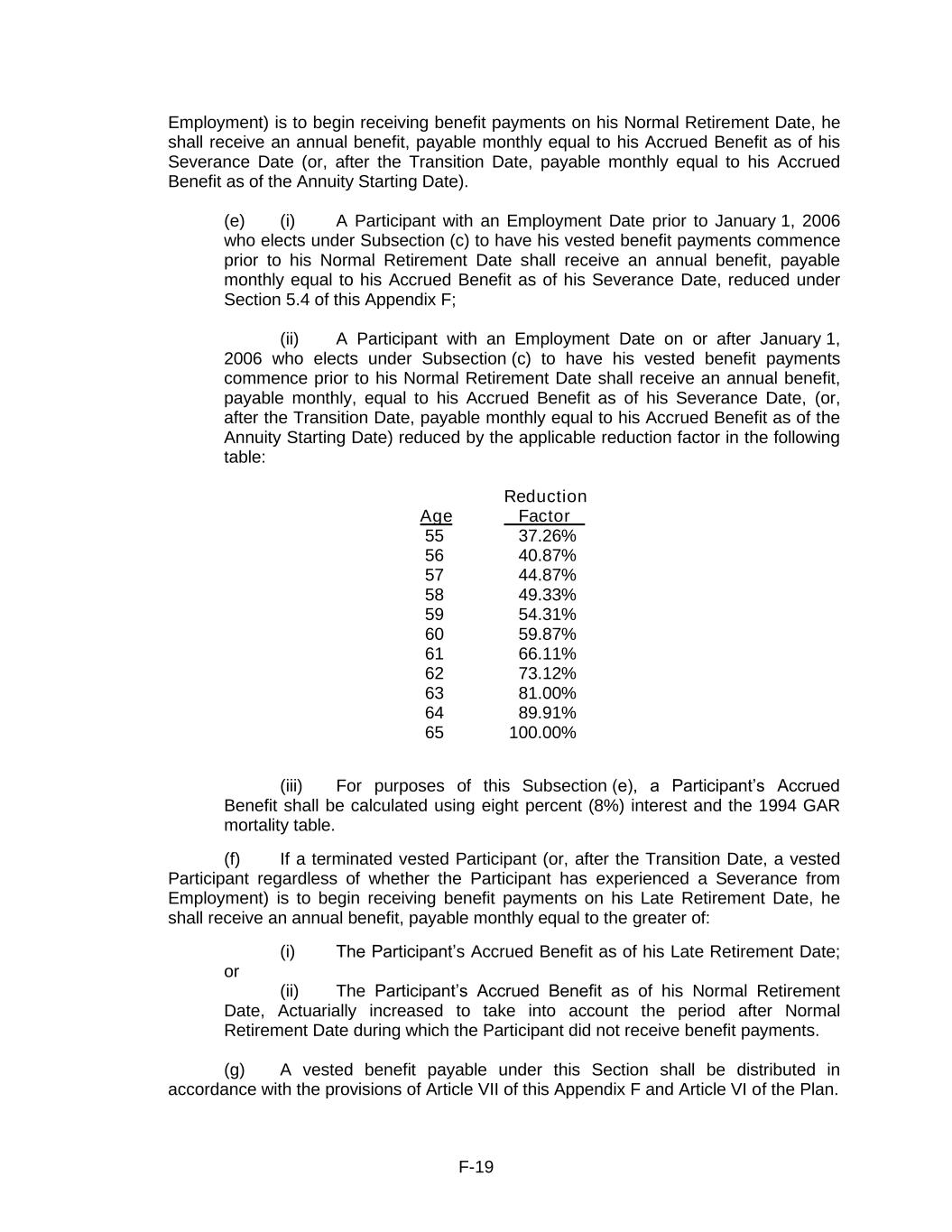
F-19 Employment) is to begin receiving benefit payments on his Normal Retirement Date, he shall receive an annual benefit, payable monthly equal to his Accrued Benefit as of his Severance Date (or, after the Transition Date, payable monthly equal to his Accrued Benefit as of the Annuity Starting Date). (e) (i) A Participant with an Employment Date prior to January 1, 2006 who elects under Subsection (c) to have his vested benefit payments commence prior to his Normal Retirement Date shall receive an annual benefit, payable monthly equal to his Accrued Benefit as of his Severance Date, reduced under Section 5.4 of this Appendix F; (ii) A Participant with an Employment Date on or after January 1, 2006 who elects under Subsection (c) to have his vested benefit payments commence prior to his Normal Retirement Date shall receive an annual benefit, payable monthly, equal to his Accrued Benefit as of his Severance Date, (or, after the Transition Date, payable monthly equal to his Accrued Benefit as of the Annuity Starting Date) reduced by the applicable reduction factor in the following table: Reduction Age Factor 55 37.26% 56 40.87% 57 44.87% 58 49.33% 59 54.31% 60 59.87% 61 66.11% 62 73.12% 63 81.00% 64 89.91% 65 100.00% (iii) For purposes of this Subsection (e), a Participant’s Accrued Benefit shall be calculated using eight percent (8%) interest and the 1994 GAR mortality table. (f) If a terminated vested Participant (or, after the Transition Date, a vested Participant regardless of whether the Participant has experienced a Severance from Employment) is to begin receiving benefit payments on his Late Retirement Date, he shall receive an annual benefit, payable monthly equal to the greater of: (i) The Participant’s Accrued Benefit as of his Late Retirement Date; or (ii) The Participant’s Accrued Benefit as of his Normal Retirement Date, Actuarially increased to take into account the period after Normal Retirement Date during which the Participant did not receive benefit payments. (g) A vested benefit payable under this Section shall be distributed in accordance with the provisions of Article VII of this Appendix F and Article VI of the Plan.

F-20 6.3 Cash-Outs of Small Benefits. If the Present Value of a terminated Participant’s vested benefit is $5,000 or less, the vested benefit shall be distributed in a single-sum payment (i.e., “cashed out”), as provided in Section 6.7 of the Plan. 6.4 Deemed Cash-Out. A Participant who experiences a Severance from Employment with a Participating Company and all Related Employers before he is vested in his Accrued Benefit shall be deemed to have received a complete distribution of his Accrued Benefit on his Severance Date. However, if he is subsequently reemployed by a Participating Company or a Related Employer before he incurs five consecutive Breaks-in-Service, his Accrued Benefit shall immediately be restored. ARTICLE VII PAYMENT OF BENEFITS The provisions of this Article VII of Appendix F are applied in conjunction with the provisions of Article VI of the Plan, where applicable. 7.1 Mandatory Benefit Commencement. Section 6.9 of the Plan sets forth the provisions regarding required minimum distributions under Code Section 401(a)(9) and shall override any distribution options or provisions under the Plan which are inconsistent with Code Section 401(a)(9). 7.2 Additional Distribution Rules. (a) The provisions set forth in Section 6.1 of the Plan apply to the distribution of a Participant’s Benefit. (b) (i) Except when benefits are paid in a single sum, benefits shall be paid monthly in an amount equal to the benefit calculated under the Plan, subject to an Actuarial Equivalent adjustment for form of benefit under this Article VII of Appendix F. (ii) At the direction of the Administrative Committee, benefits payable in annuity form may be provided by an annuity contract purchased from an insurance company. The terms of such annuity contract shall prohibit the cash surrender of the annuity contract and shall make the payments due under the annuity contract non-assignable. The distribution of such annuity contract shall be in complete discharge of the Plan’s liability to the Participant accepting the annuity contract. 7.3 Automatic Form of Benefit. (a) The automatic form of benefit for a Participant who has a Spouse shall be a Qualified Joint and Survivor Annuity. (b) The automatic form of benefit for a Participant who has no Spouse shall be a single life annuity, with equal monthly installments payable to the Participant for his lifetime. This is the “normal form” of benefit.

F-21 7.4 Optional Forms of Benefit. (a) A Participant’s pension shall be paid in his automatic form of benefit unless the Participant elects to receive one of the optional forms of benefit described below. Any such election shall be made in accordance with the provisions of Section 6.6 of the Plan. (b) The optional forms of benefit available under this Appendix F are: (i) A single life annuity, with equal monthly installments payable to the Participant for his lifetime; (ii) A joint and survivor annuity with the Participant’s designated Beneficiary, payable in monthly installments to the Participant for his lifetime and with one hundred percent (100%) of the amount of such monthly installment payable after the death of the Participant to the Participant’s designated Beneficiary, if then living, for the life of the designated Beneficiary. The foregoing notwithstanding, if the Beneficiary named by the Participant is a person other than the Participant’s Spouse, the percentage payable to such Beneficiary under the joint and survivor annuity may not at any time exceed the applicable percentage given in Schedule A; (iii) A joint and survivor annuity with the Participant’s designated Beneficiary, payable in monthly installments to the Participant for his lifetime and with seventy five percent (75%) of the amount of such monthly installment payable after the death of the Participant to the Participant’s designated Beneficiary, if then living, for the life of the designated Beneficiary. The foregoing notwithstanding, if the Beneficiary named by the Participant is a person other than the Participant’s Spouse, the percentage payable to such Beneficiary under the joint and survivor annuity may not at any time exceed the applicable percentage given in Schedule A; (iv) A 10-year certain and life annuity, with equal monthly installments payable to the Participant for his lifetime, and with 120 monthly payments guaranteed; provided, however, that a Participant may not elect this form of benefit if the period certain will exceed the applicable period given in Schedule A; (v) The portion of a Participant’s Accrued Benefit under the Pension Plan for Employees of Kontron, Incorporated prior to September 1, 1996, and the portion of a Participant’s Accrued Benefit earned under the Plan prior to September 1, 1999 by former employees of Kontron, Incorporated, and former employees of Arrow Interventional hired on or after September 1, 1996 but before September 1, 1999 shall be paid in a form permitted in Schedule C. (c) A Participant shall have the right to elect a direct rollover in accordance with Section 6.10 of the Plan if he is to receive an Eligible Rollover Distribution. (d) Notwithstanding the above, for Plan Years beginning after December 31, 2007, a Participant may elect a Qualified Optional Survivor Annuity. A “Qualified Optional Survivor Annuity” is: (i) A joint life annuity payable for the life of the Participant, with continuation of payments as a survivor annuity for the remaining life of a
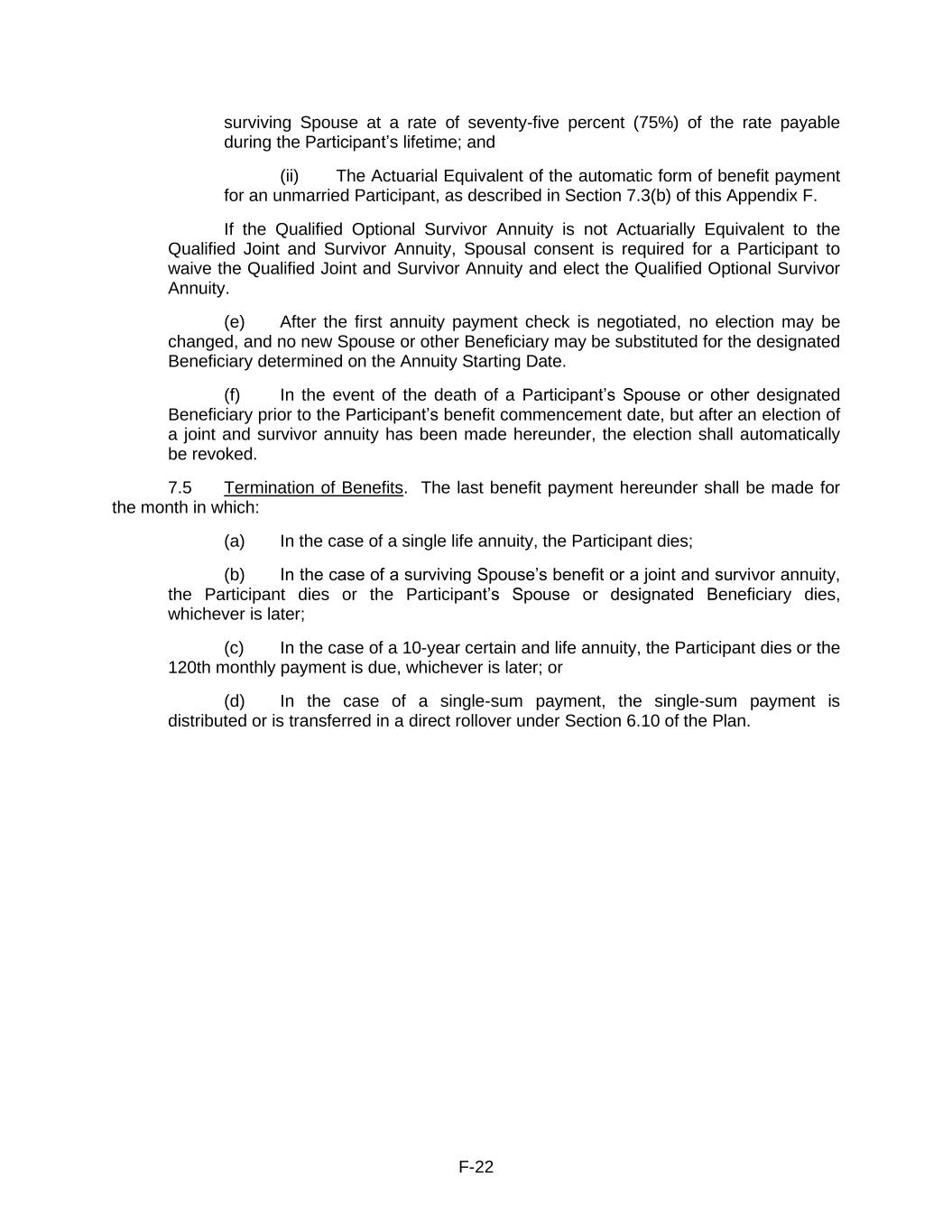
F-22 surviving Spouse at a rate of seventy-five percent (75%) of the rate payable during the Participant’s lifetime; and (ii) The Actuarial Equivalent of the automatic form of benefit payment for an unmarried Participant, as described in Section 7.3(b) of this Appendix F. If the Qualified Optional Survivor Annuity is not Actuarially Equivalent to the Qualified Joint and Survivor Annuity, Spousal consent is required for a Participant to waive the Qualified Joint and Survivor Annuity and elect the Qualified Optional Survivor Annuity. (e) After the first annuity payment check is negotiated, no election may be changed, and no new Spouse or other Beneficiary may be substituted for the designated Beneficiary determined on the Annuity Starting Date. (f) In the event of the death of a Participant’s Spouse or other designated Beneficiary prior to the Participant’s benefit commencement date, but after an election of a joint and survivor annuity has been made hereunder, the election shall automatically be revoked. 7.5 Termination of Benefits. The last benefit payment hereunder shall be made for the month in which: (a) In the case of a single life annuity, the Participant dies; (b) In the case of a surviving Spouse’s benefit or a joint and survivor annuity, the Participant dies or the Participant’s Spouse or designated Beneficiary dies, whichever is later; (c) In the case of a 10-year certain and life annuity, the Participant dies or the 120th monthly payment is due, whichever is later; or (d) In the case of a single-sum payment, the single-sum payment is distributed or is transferred in a direct rollover under Section 6.10 of the Plan.

F-23 SCHEDULE A Actuarial Equivalent Factors and Assumptions Effective September 1, 2005, unless Otherwise Noted Effective September 1, 2005, notwithstanding any other provision of this Schedule A to the contrary, Actuarial Equivalence (for purposes other than lump sums) shall be determined on the following generally applicable basis: (a) Interest Assumption: 8% compounded annually. (b) Mortality Assumption for a Participant: the 1994 GAR mortality table, based on age nearest birthday. (c) Mortality Assumption for a Beneficiary: the 1994 GAR mortality table, based on age nearest birthday. The following exceptions apply: 1. For the purpose of determining whether the Plan is Top-Heavy: (a) Interest Assumption: 5% per annum, compound. (b) Mortality Assumption: As above. 2. For the purpose of determining lump sum values for payment: (a) Interest Assumption: Applicable Interest Rate (b) Mortality Assumption: Applicable Mortality Table. (c) Age at Retirement: Age 65, or current Age if older, or current Age if the Benefit is already in pay-status, or when a deceased Participant would have first been eligible to retire. (d) Form of Benefit: Straight life annuity, or actual form of payment elected if already in pay-status. 3. For the purpose of determining the benefit payable before the Normal Retirement Date and/or payable in a form other than straight life: (a) The benefit shall first be adjusted based on the number of months, if any, by which commencement of payment precedes the Normal Retirement Date, using the basis specified in the Plan. For commencement more than 120 months before the Normal Retirement Date (if elected by a surviving Spouse), the generally applicable basis shall be used to find the Actuarial Equivalent of the benefit that would be payable commencing 120 months before the Normal Retirement Date; for this purpose the number of months shall be recognized by linear interpolation.

F-24 (b) The benefit shall then be adjusted for payment in a form other than straight life, if applicable, determined by the following generally applicable basis: (i) Interest Assumption: 8% compounded annually. (ii) Mortality Assumption for a Participant: the 1994 GAR mortality table (iii) Mortality Assumption for a Beneficiary: the 1994 GAR mortality table 4. For the purpose of determining the increase in the Accrued Benefit as of the Normal Retirement Date to the Late Retirement Date, Actuarial Equivalence shall be determined by the following basis: (a) For the period (if any) between Normal Retirement Date and September 1, 2005: (i) Interest Assumption: 7% per annum, compound (ii) Mortality Assumption for a Participant: The UP-1984 Table, based on age nearest birthday. (b) For the period after September 1, 2005: (i) Interest Assumption: 8% compounded annually. (ii) Mortality Assumption for a Participant: the 1994 GAR mortality table
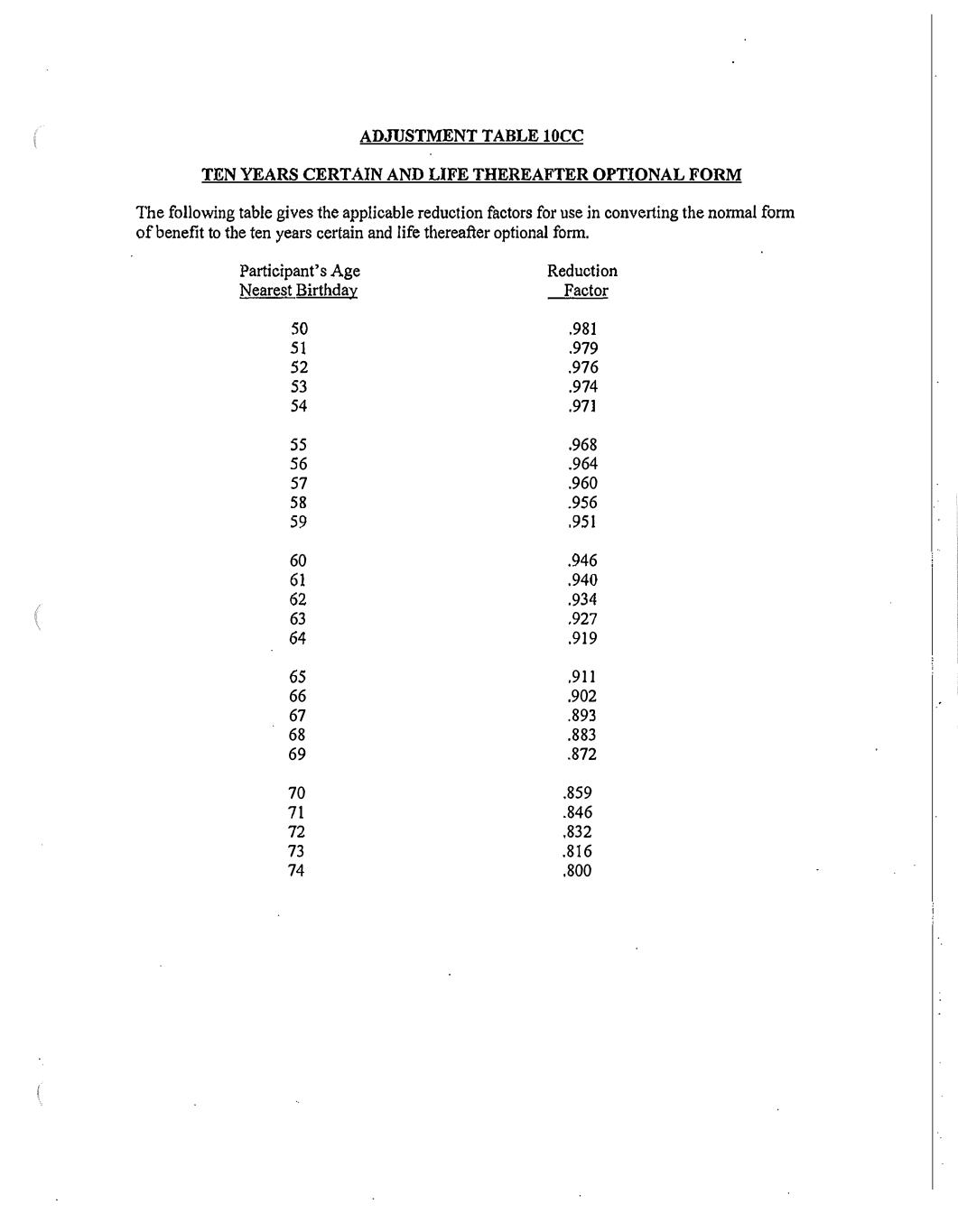
ADJUSTMENT TABLE 10cc TEN YEARS CERTAIN AND LIFE THEREAFTER OPTIONAL FORM The following table gives the applicable reduction factors for use jn converting the normal form of benefit to the ten years certain and life thereafter optional form. Participant's Age Reduction Nearest Birthday Factor 50 .981 51 .979 52 .976 53 .974 54 .971 55 .968 56 .964 57 .960 58 .956 59 .951 60 .946 61 .940 62 .934 63 .927 64 .919 65 .911 66 .902 67 .893 68 .883 69 .872 70 .859 71 .846 72 .832 73 .816 74 .800
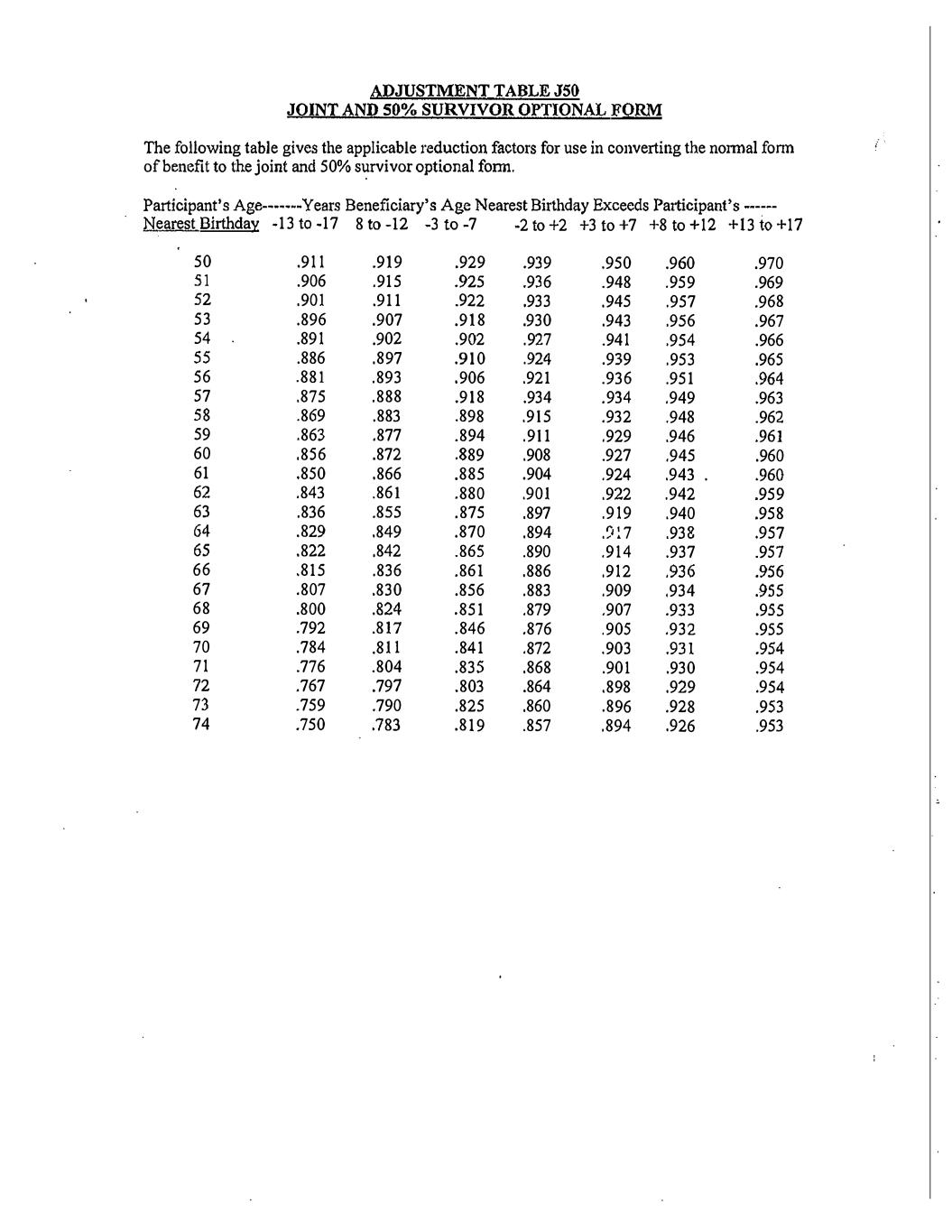
ADJUSTMENT TABLE J50 JOINT AND 50% SURVIVOR OPTIONAL FORM The following table gives the applicable reduction factors for use in converting the nonnal fonn of benefit to the joint and 50% survivor optional form. Participant's Age-------Years Beneficiary's Age Nearest Birthday Exceeds Participant's ------ Nearest Birthday -13 to -17 8 to -12 -3 to -7 -2 to +2 +3 to +7 +8 to +12 +13 io +17 50 .911 .919 .929 .939 .950 .960 .970 51 .906 .915 .925 .936 .948 .959 .969 52 .901 .911 .922 .933 .945 .957 .968 53 .896 .907 .918 .930 .943 .956 .967 54 .891 .902 .902 .927 .941 .954 .966 55 .886 .897 .910 .924 .939 .953 .965 56 .881 .893 .906 .921 .936 .951 .964 57 .875 .888 .918 .934 .934 .949 .963 58 .869 .883 .898 .915 .932 .948 .962 59 .863 .877 .894 .911 .929 .946 .961 60 .856 .872 .889 .908 .927 .945 .960 61 .850 .866 .885 . 904 .924 .943 .960 62 .843 .861 .880 .901 .922 .942 .959 63 .836 .855 .875 .897 .919 .940 .958 64 .829 ,849 .870 .894 .9! 7 .938 .957 65 .822 .842 .865 .890 .914 .937 .957 66 .815 .836 .861 .886 .912 .936 .956 67 .807 .830 .856 .883 .909 ,934 .955 68 .800 .824 .851 .879 .907 .933 .955 69 .792 .817 .846 .876 .905 .932 .955 70 .784 .811 .841 .872 .903 .931 .954 71 .776 .804 .835 .868 .901 .930 .954 72 .767 .797 .803 .864 .898 .929 .954 73 .759 .790 .825 .860 .896 .928 .953 74 .750 .783 .819 .857 .894 .926 .953
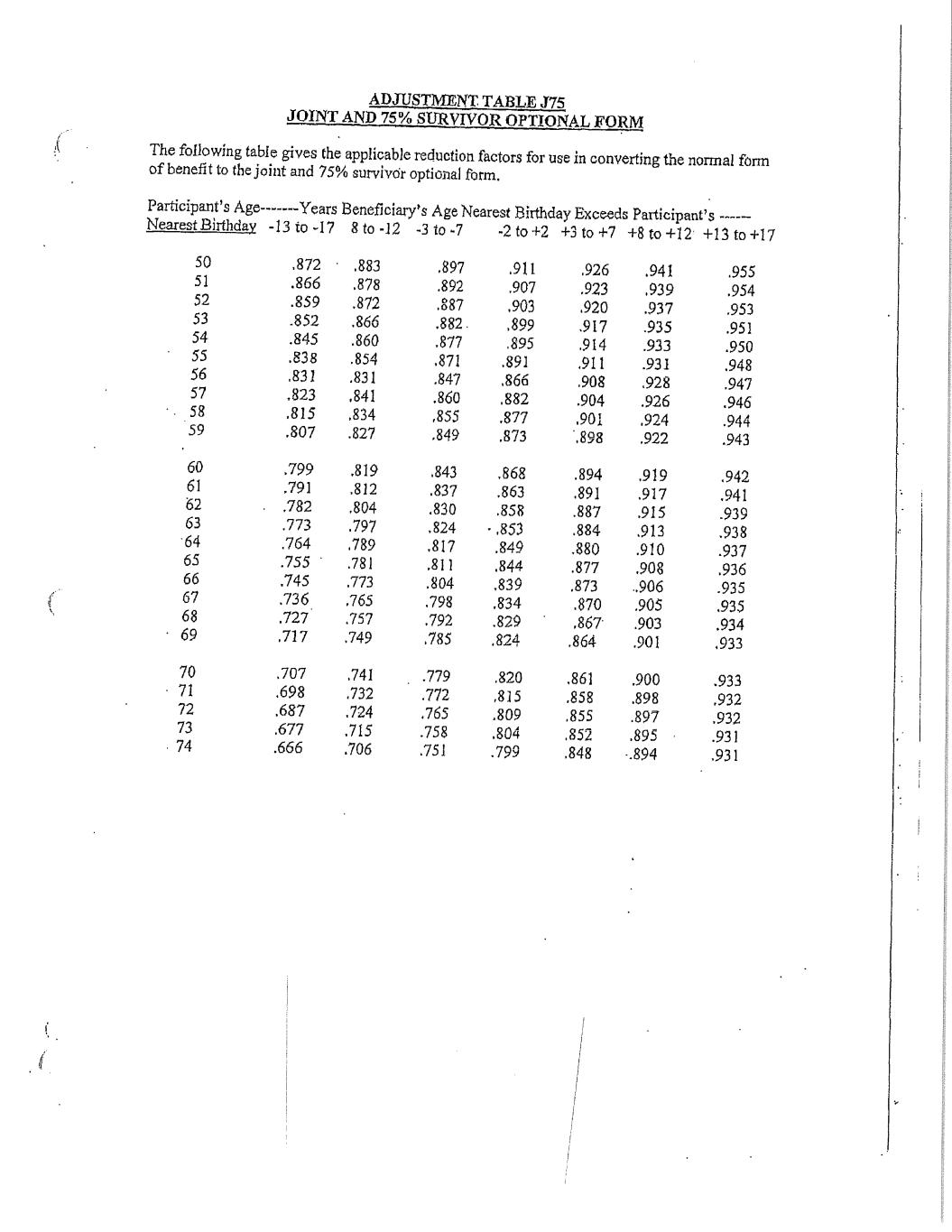
i g , ADJUSTMENT. TABLE J75 JOINT AND 75% SURVIVOR OPTIONAL FORM The following table gives the applicable reduction factors for use in converting the normal form of benefit to the joint and 75% survivor optional form, Participant's Age-------Years Beneficiary’s Age Nearest Birthday Exceeds Participant’s ----~- Nearest Birthday -13t0-17 8to-l2 -3t0+7 “2tot2 +3to+7 +8 to+12° +13 to +17 50 872 883 897 O11 926 94] 955 5] 866 878 892 907 923 939 954 52 859 872 887 903 920 937 953 53 -852 866 882. 899 17 935 95) 54 845 .860 877 895 O14 933 950 55 838 .854 871 89] Jl 931 948 56 83] 831 847 866 908 928 947 57 823 84] .860 882 904 926 946 *. 58 815 834 1855 877 901 1924 944 59 807 827 1849 873 898 922 943 60 799 819 843 868 894 O19 942 61 79] 812 837 863 89] 917 94] 62 - 782 804 830 858 887 515 939 63 773 797 824 - 853 884 913 938 64 764 789 817 849 880 910 937 65 755° 78) 81] 844 877 908 936 66 745 773 804 839 873 906 935 67 736 765 .798 834 .870 903 935 68 727 757 792 829 © 867 903 934 * 69 17 749 ,785 824 864 901 933 70 707 741 _ 179 820 861 900 933 71 698 .732 172 815 858 898 932 72 687 724 765 809 855 897 932 73 677 1S 758 804 852 895 - 93] - 74 666 706 754 799 848 -.894 931
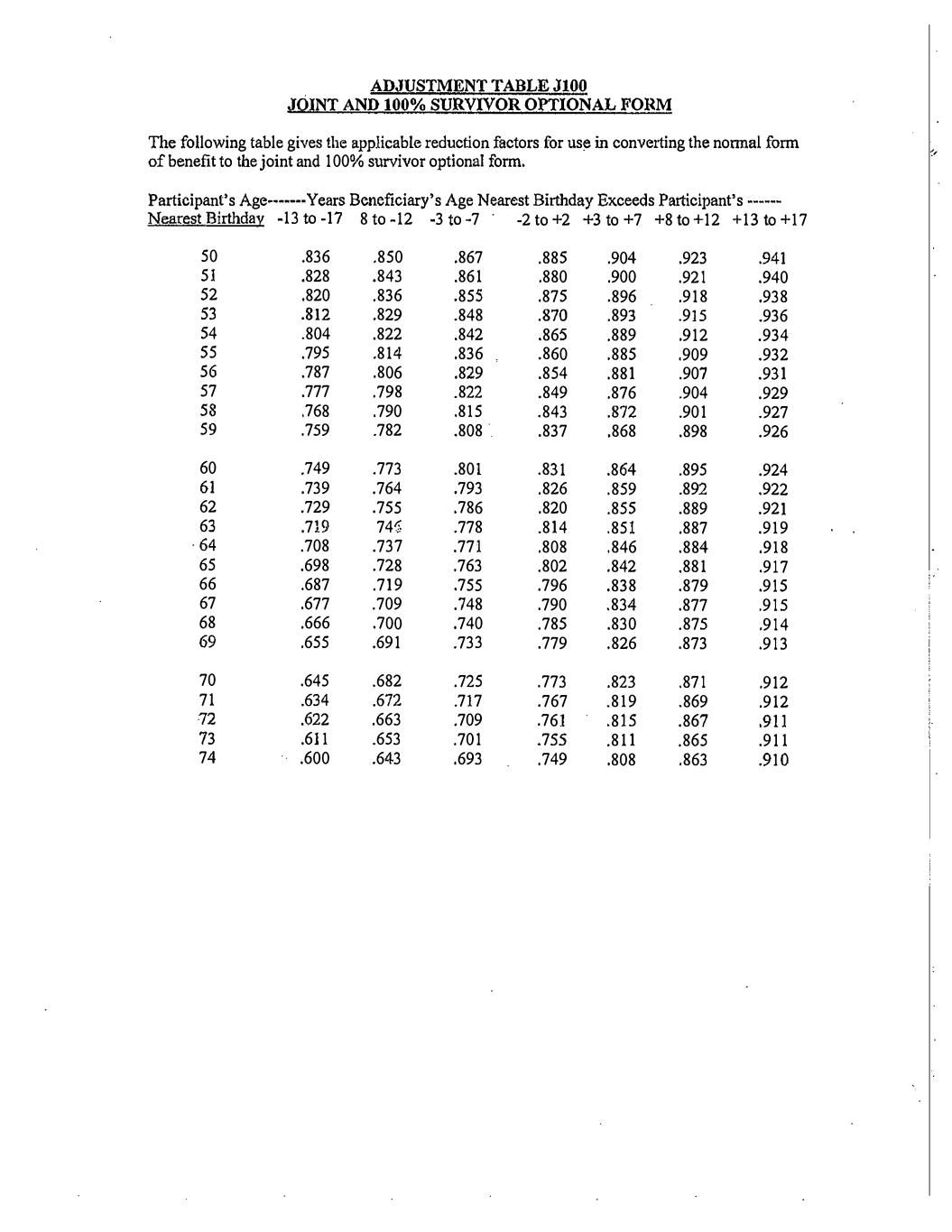
ADJUSTMENT TABLE JlOO JOINT AND 100% SURVIVOR OPTIONAL FORM The following table gives the applicable reduction factors for us� in converting the nonnal form ., of benefit to the joint and 100% survivor optional form. Participant's Age .. ----· Years Beneficiary's Age Nearest Birthday Exceeds Participant's ------ Nearest Birthday -13 to -17 8 to -12 -3 to -7 -2 to +2 +3 to +7 +8 to +12 +13 to +17 50 .836 .850 .867 .885 .904 .923 .941 51 .828 .843 .861 .880 .900 .921 .940 52 .820 .836 .85S .875 .896 .918 .938 53 .812 .829 .848 .870 .893 .915 .936 54 .804 .822 .842 .865 .889 .912 .934 55 .795 .814 .836 .860 .885 .909 .932 56 .787 .806 .829 .854 .881 .907 .931 57 .777 .798 .822 .849 .876 .904 .929 58 ,768 . 790 .815 .843 .872 .901 .927 59 .759 .782 .808 ·. .837 .868 .898 .926 60 .749 .773 .801 .831 .864 .895 .924 61 .739 .764 .793 .826 .859 .892 .922 62 .729 .755 .786 .820 .855 .889 .921 63 .719 741 .778 .814 .851 .887 .919 · 64 .708 .737 .771 .808 .846 .884 .918 65 .698 .728 .763 .802 .842 .881 .917 !' 66 .687 .719 .755 .796 .838 .879 .915 67 .677 .709 .748 .790 .834 .877 .915 68 .666 .700 .740 .785 .830 .875 .914 69 .655 .691 .733 .779 .826 .873 .913 70 .645 .682 .725 .773 .823 .871 .912 71 .634 .672 .717 .767 .819 .869 .912 72 .622 .663 .709 .761 .815 .867 ,911 73 .611 .653 .701 .755 .811 .865 .911 74 .600 .643 .693 .749 .808 .863 .910

F-25 SCHEDULE B ADJUSTMENTS TO CERTAIN BENEFITS If the Arrow Salaried Plan satisfies the requirements of Section 1.401(a)(4)-13(d) of the Treasury Regulations for a fresh-start as of the last day of the last Plan Year beginning before January 1, 1994, then, any other provisions of the Plan notwithstanding, any section 401(a)(17) employee’s accrued benefit, frozen in accordance with Section 1.401(a)(4)-13 of the Treasury Regulations as of a fresh-start date, is adjusted to reflect increases in the employee’s compensation after the fresh-start date. However, this adjustment may be made only if the adjustment will not cause the plan to fail to satisfy the consistency requirement of Section 1.401(a)(4)-13(c) of the Treasury Regulations, as modified by Section 1.401(a)(17)-1(e) of the Proposed Treasury Regulations. In determining a section 401(a)(17) employee’s accrued benefit in any Plan Year beginning on or after January 1, 1994, the portion of the employee’s frozen accrued benefit attributable to Plan Years beginning before January 1, 1994 will be determined in accordance with Method A for statutory section 401(a)(17) employees and Method B for section 401(a)(17) employees other than statutory section 401(a)(17) employees. A statutory section 401(a)(17) employee shall mean an employee whose current accrued benefit as of a date on or after the first day of the first Plan Year beginning on or after January 1, 1994 is based on compensation for a year beginning prior to the first day of the first Plan Year beginning on or after January 1, 1989 that exceeded $200,000. A section 401(a)(17) employee shall mean an employee whose current accrued benefit as of a date on or after the first day of the first Plan Year beginning on or after January 1, 1994 is based on compensation for a year beginning prior to the first day of the first Plan Year beginning on or after January 1, 1994 that exceeded $150,000. Method A (statutory section 401(a)(17) employees): Step 1: Determine each statutory section 401(a)(17) employee’s accrued benefit as of the last day of the last Plan Year beginning before January 1, 1989, frozen in accordance with Section 1.401(a)(4)-13 of the Treasury Regulations. Step 2: Adjust the amount in step 1 up through the last day of the last Plan Year beginning before the first Plan Year beginning on or after January 1, 1994 under the method provided under the Plan for increasing the amount in step 1 to take into account increases in compensation in Plan Years beginning on or after January 1, 1989. However, if the Plan does not provide for such increases, the amount in step 2 shall be equal to the amount in step 1. Step 3: Determine the statutory section 401(a)(17) employee’s accrued benefit as of the last day of the last Plan Year beginning before January 1, 1994, frozen in accordance with Section 1.401(a)(4)-13 of the Treasury Regulations. Step 4: Subtract the amount determined in step 2 from the amount determined in step 3. Step 5: Adjust the amount in step 4 by multiplying it by the following fraction (not less than 1). The numerator of the fraction is the statutory section 401(a)(17) employee’s average compensation determined for the current year (as limited by section
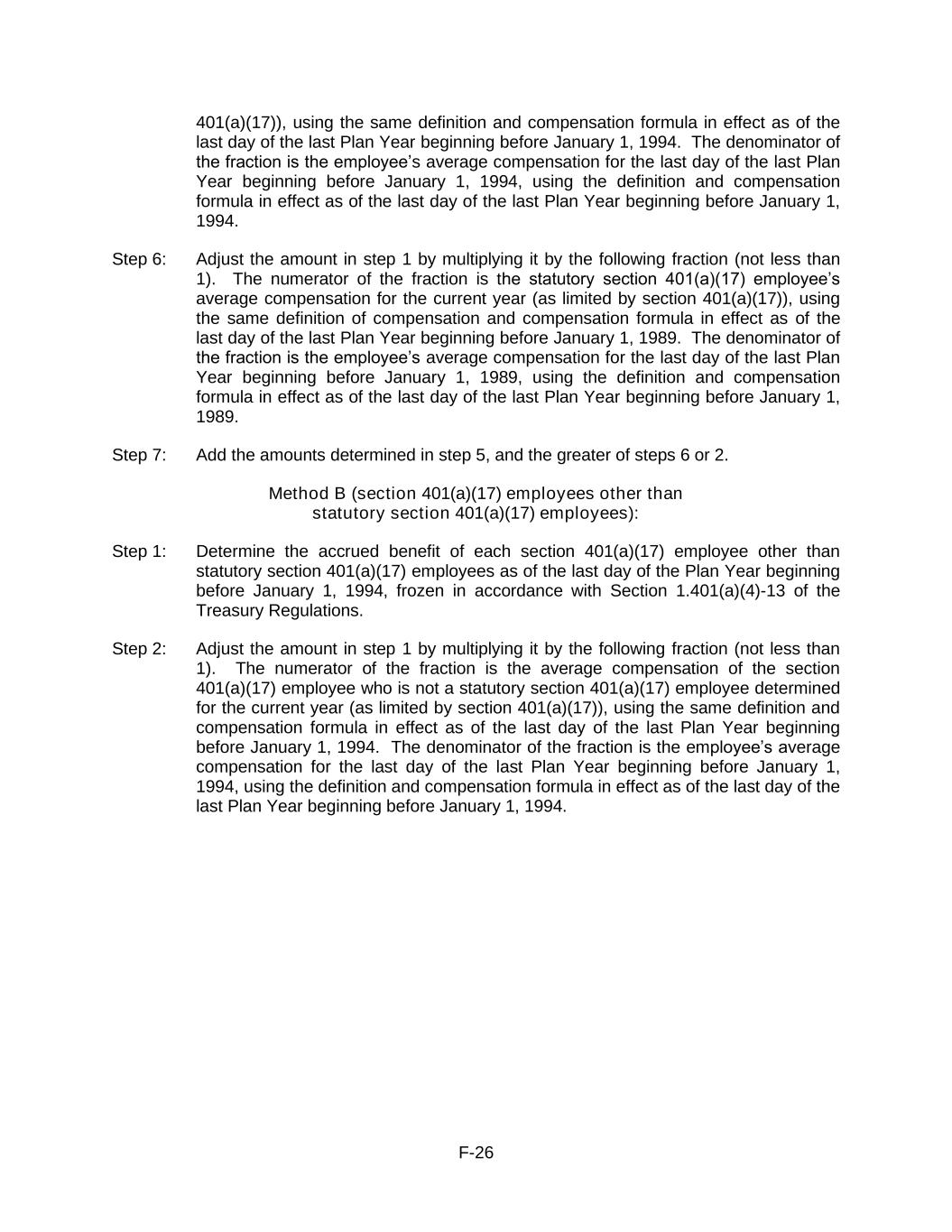
F-26 401(a)(17)), using the same definition and compensation formula in effect as of the last day of the last Plan Year beginning before January 1, 1994. The denominator of the fraction is the employee’s average compensation for the last day of the last Plan Year beginning before January 1, 1994, using the definition and compensation formula in effect as of the last day of the last Plan Year beginning before January 1, 1994. Step 6: Adjust the amount in step 1 by multiplying it by the following fraction (not less than 1). The numerator of the fraction is the statutory section 401(a)(17) employee’s average compensation for the current year (as limited by section 401(a)(17)), using the same definition of compensation and compensation formula in effect as of the last day of the last Plan Year beginning before January 1, 1989. The denominator of the fraction is the employee’s average compensation for the last day of the last Plan Year beginning before January 1, 1989, using the definition and compensation formula in effect as of the last day of the last Plan Year beginning before January 1, 1989. Step 7: Add the amounts determined in step 5, and the greater of steps 6 or 2. Method B (section 401(a)(17) employees other than statutory section 401(a)(17) employees): Step 1: Determine the accrued benefit of each section 401(a)(17) employee other than statutory section 401(a)(17) employees as of the last day of the Plan Year beginning before January 1, 1994, frozen in accordance with Section 1.401(a)(4)-13 of the Treasury Regulations. Step 2: Adjust the amount in step 1 by multiplying it by the following fraction (not less than 1). The numerator of the fraction is the average compensation of the section 401(a)(17) employee who is not a statutory section 401(a)(17) employee determined for the current year (as limited by section 401(a)(17)), using the same definition and compensation formula in effect as of the last day of the last Plan Year beginning before January 1, 1994. The denominator of the fraction is the employee’s average compensation for the last day of the last Plan Year beginning before January 1, 1994, using the definition and compensation formula in effect as of the last day of the last Plan Year beginning before January 1, 1994.
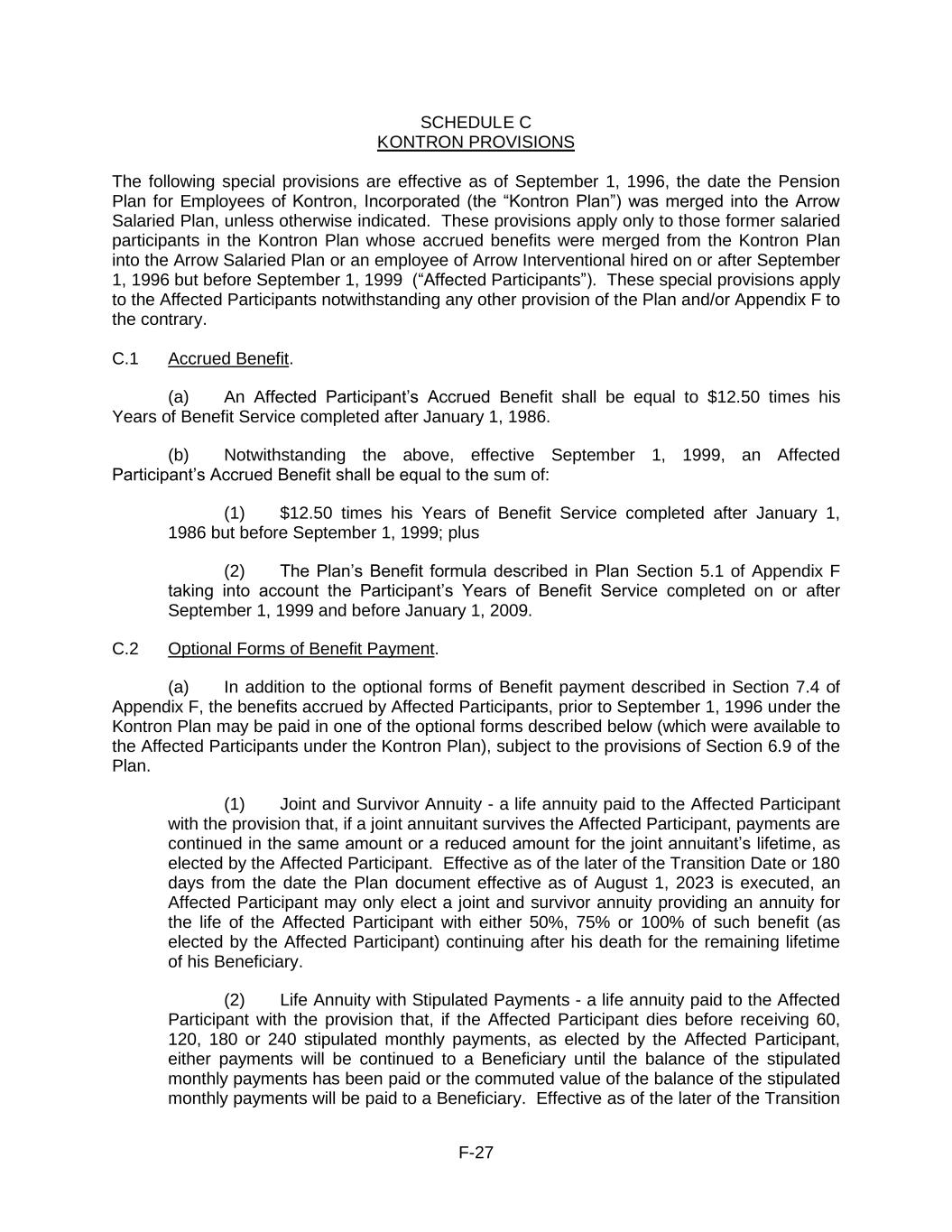
F-27 SCHEDULE C KONTRON PROVISIONS The following special provisions are effective as of September 1, 1996, the date the Pension Plan for Employees of Kontron, Incorporated (the “Kontron Plan”) was merged into the Arrow Salaried Plan, unless otherwise indicated. These provisions apply only to those former salaried participants in the Kontron Plan whose accrued benefits were merged from the Kontron Plan into the Arrow Salaried Plan or an employee of Arrow Interventional hired on or after September 1, 1996 but before September 1, 1999 (“Affected Participants”). These special provisions apply to the Affected Participants notwithstanding any other provision of the Plan and/or Appendix F to the contrary. C.1 Accrued Benefit. (a) An Affected Participant’s Accrued Benefit shall be equal to $12.50 times his Years of Benefit Service completed after January 1, 1986. (b) Notwithstanding the above, effective September 1, 1999, an Affected Participant’s Accrued Benefit shall be equal to the sum of: (1) $12.50 times his Years of Benefit Service completed after January 1, 1986 but before September 1, 1999; plus (2) The Plan’s Benefit formula described in Plan Section 5.1 of Appendix F taking into account the Participant’s Years of Benefit Service completed on or after September 1, 1999 and before January 1, 2009. C.2 Optional Forms of Benefit Payment. (a) In addition to the optional forms of Benefit payment described in Section 7.4 of Appendix F, the benefits accrued by Affected Participants, prior to September 1, 1996 under the Kontron Plan may be paid in one of the optional forms described below (which were available to the Affected Participants under the Kontron Plan), subject to the provisions of Section 6.9 of the Plan. (1) Joint and Survivor Annuity - a life annuity paid to the Affected Participant with the provision that, if a joint annuitant survives the Affected Participant, payments are continued in the same amount or a reduced amount for the joint annuitant’s lifetime, as elected by the Affected Participant. Effective as of the later of the Transition Date or 180 days from the date the Plan document effective as of August 1, 2023 is executed, an Affected Participant may only elect a joint and survivor annuity providing an annuity for the life of the Affected Participant with either 50%, 75% or 100% of such benefit (as elected by the Affected Participant) continuing after his death for the remaining lifetime of his Beneficiary. (2) Life Annuity with Stipulated Payments - a life annuity paid to the Affected Participant with the provision that, if the Affected Participant dies before receiving 60, 120, 180 or 240 stipulated monthly payments, as elected by the Affected Participant, either payments will be continued to a Beneficiary until the balance of the stipulated monthly payments has been paid or the commuted value of the balance of the stipulated monthly payments will be paid to a Beneficiary. Effective as of the later of the Transition
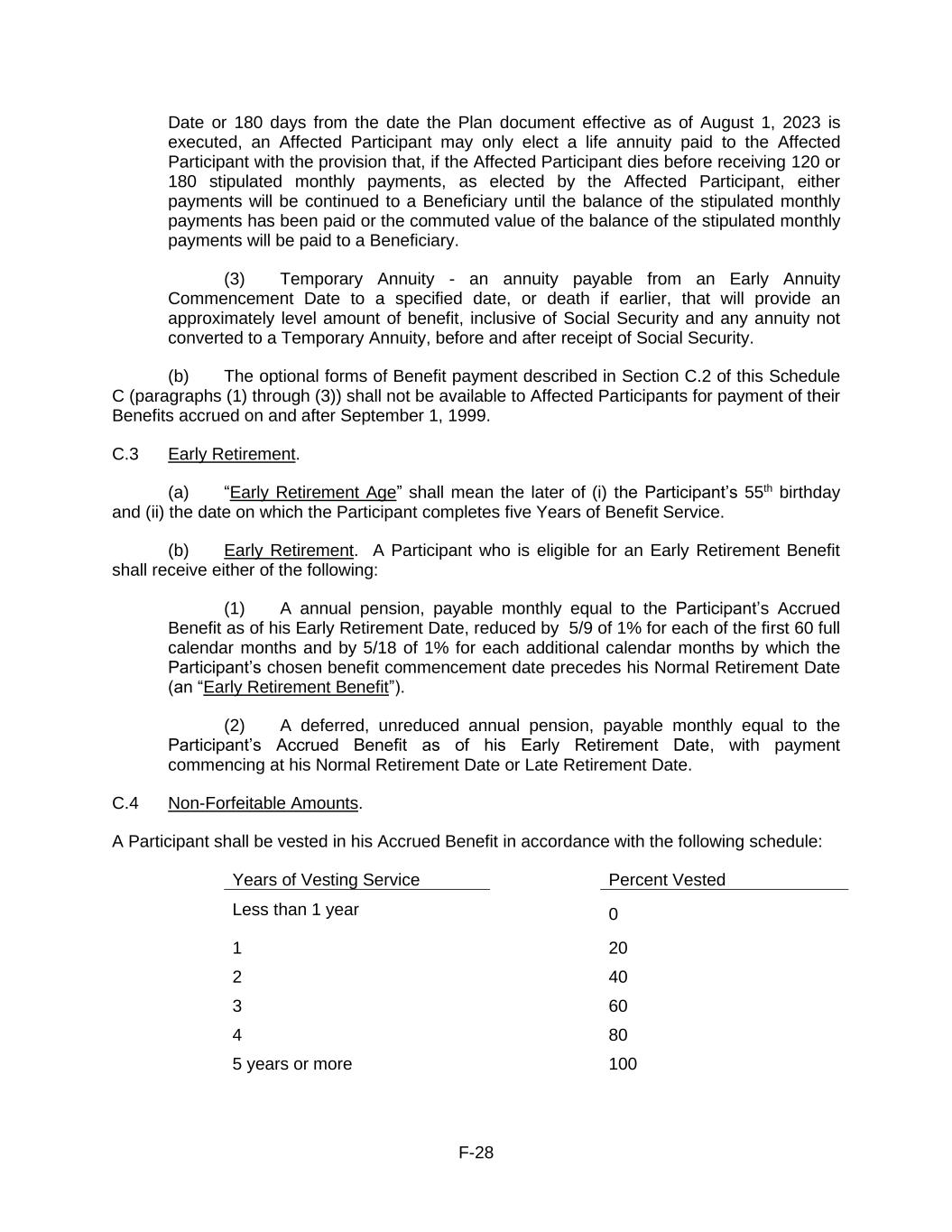
F-28 Date or 180 days from the date the Plan document effective as of August 1, 2023 is executed, an Affected Participant may only elect a life annuity paid to the Affected Participant with the provision that, if the Affected Participant dies before receiving 120 or 180 stipulated monthly payments, as elected by the Affected Participant, either payments will be continued to a Beneficiary until the balance of the stipulated monthly payments has been paid or the commuted value of the balance of the stipulated monthly payments will be paid to a Beneficiary. (3) Temporary Annuity - an annuity payable from an Early Annuity Commencement Date to a specified date, or death if earlier, that will provide an approximately level amount of benefit, inclusive of Social Security and any annuity not converted to a Temporary Annuity, before and after receipt of Social Security. (b) The optional forms of Benefit payment described in Section C.2 of this Schedule C (paragraphs (1) through (3)) shall not be available to Affected Participants for payment of their Benefits accrued on and after September 1, 1999. C.3 Early Retirement. (a) “Early Retirement Age” shall mean the later of (i) the Participant’s 55th birthday and (ii) the date on which the Participant completes five Years of Benefit Service. (b) Early Retirement. A Participant who is eligible for an Early Retirement Benefit shall receive either of the following: (1) A annual pension, payable monthly equal to the Participant’s Accrued Benefit as of his Early Retirement Date, reduced by 5/9 of 1% for each of the first 60 full calendar months and by 5/18 of 1% for each additional calendar months by which the Participant’s chosen benefit commencement date precedes his Normal Retirement Date (an “Early Retirement Benefit”). (2) A deferred, unreduced annual pension, payable monthly equal to the Participant’s Accrued Benefit as of his Early Retirement Date, with payment commencing at his Normal Retirement Date or Late Retirement Date. C.4 Non-Forfeitable Amounts. A Participant shall be vested in his Accrued Benefit in accordance with the following schedule: Years of Vesting Service Percent Vested Less than 1 year 0 1 20 2 40 3 60 4 80 5 years or more 100

F-29 SCHEDULE D PARTICIPATING COMPANIES Arrow Interventional, Inc. - effective September 1, 1999 Arrow Therex Corporation - effective May 1, 1980 The Stepic Medical Distribution Company - effective September 1, 2003 015184.000055 4894-0609-3670.3

G-1 TELEFLEX INCORPORATED RETIREMENT INCOME PLAN APPENDIX G RETIREMENT PLAN FOR HOURLY-RATED EMPLOYEES OF ARROW INTERNATIONAL, INC. The provisions in this Appendix G apply with respect to Participants in the Retirement Plan for Hourly-Rated Employees of Arrow International, Inc. (“Arrow Hourly Plan”) before its merger with and into the Plan effective as of August 31, 2008. The provisions in this Appendix G shall continue to apply on and after the Plan’s Termination Date (August 1, 2023) to Participants eligible for the benefits described in this Appendix G. Except for the provisions set forth in Appendix G, the Plan provisions, including terms defined therein, shall apply with respect to Participants eligible for the benefits described in this Appendix G. ARTICLE I DEFINITIONS Terms used but not defined in this Appendix G shall have the meaning set forth in the Plan. Except with respect to the references to Articles and Sections of the Plan herein, references in this Appendix G to Articles and Section numbers are references to the Articles and Sections in this Appendix G. 1.1 “Active Participant” shall mean a Participant who is an Employee in the Covered Class. 1.2 “Actuarial Equivalent” or “Actuarially Equivalent” shall mean of equal actuarial value on the basis of the assumptions and factors described in Schedule A. 1.3 “Age” shall mean, for any individual, his age on his last birthday, except that an individual attains Age 70 1/2 on the corresponding date in the sixth calendar month following the month on which his 70th birthday falls (or the last day of such month if there is no corresponding date therein). 1.4 “Annual Compensation” shall mean: (a) Effective for any Plan Year beginning on or after September 1, 2001 and prior to September 1, 2005, for a given calendar month, the total wages paid to a Participant by a Participating Company which must be taken into account for purposes of income tax withholding at the source, increased by (a) any elective contributions to a Participating Company’s plan under Sections 125, 132(f), 402(g)(3), 402(h), and 403(b) of the Code, and reduced by the dollar amount or value of each of the following: reimbursements and other expense allowances, fringe benefits (both cash and non- cash), moving expenses, deferred compensation, and welfare benefits. (b) Effective September 1, 2005, the total wages paid to a Participant by a Participating Company from the following sources: regularly hourly rate of pay, bonuses, overtime, and commissions paid to a Participant by a Participating Company, increased by any elective contributions to a Participating Company’s plan under sections 125, 132(f), 402(g)(3), 402(h), and 403(b) of the Code.

G-2 (c) For Participants on short term disability, Annual Compensation received from a Participating Company’s general assets shall be included in calculating Annual Compensation, while short term disability benefits paid by a third-party shall not be included in calculating Annual Compensation. (d) Participants employed by an acquired company shall have their Annual Compensation in the year of acquisition calculated by pro-rating the entire calendar year’s pay using a fraction in which the denominator is 12 and the numerator is the number of months in the calendar year from the acquisition date to the end of the calendar year. In general, all Annual Compensation up to a Participant’s actual Severance from Employment (or December 31, 2008, if earlier) shall be taken into account in calculating benefits. However, in the case of a Participant who does not have any period of employment on or after September 1, 1988, Annual Compensation received after the Participant’s Normal Retirement Date shall not be taken into account in calculating benefits under this Plan. In calculating a Disabled Participant’s benefit, it will be assumed that the Participant’s Annual Compensation has continued unchanged from his Severance from Employment on account of Total and Permanent Disability to his Normal Retirement Date (or December 31, 2008, if earlier). Notwithstanding the foregoing, effective September 1, 2004, Annual Compensation shall exclude amounts included in the taxable income of the Participant as a result of the grant of a non-qualified stock option by a Participating Company or a 50% Related Employer, amounts realized from the exercise of a non-qualified stock option (or incentive stock option to the extent such exercise is taxable) or from stock or property which is currently taxable under section 83 of the Code, and such other extraordinary items includable in the taxable income of the Participant. Effective January 1, 2009, if Participants’ Annual Compensation under the Plan was not frozen effective as of December 31, 2008, Annual Compensation would also include any differential wage payments (as defined in Code Section 3401(h)(2)) from the Employer, as required by Code Section 414(u)(12), as amended by the Heroes Earnings Assistance and Relief Tax Act of 2008 (the “HEART Act”). 1.5 “Annuity Starting Date” shall have the meaning set forth in Treasury Regulations Section 1.401(a)-20, Q&A-10 (the first day of the first period for which an amount is paid as an annuity or any other form). 1.6 “Average Annual Compensation” shall mean: (a) Prior to September 1, 2005, Average Monthly Compensation multiplied by 12. (b) Effective September 1, 2005: (i) For a Participant with an Employment Date prior to September 1, 2005, the greater of:

G-3 (A) The Participant’s Average Monthly Compensation multiplied by 12; or (B) The average of the Participant’s Annual Compensation, calculated on calendar year basis, during the five consecutive calendar years in the final 10 (or fewer) consecutive calendar years of employment as an Employee which yield the highest average. For purposes of this Paragraph, nonconsecutive calendar years interrupted by periods in which the Participant is not an Employee shall be treated as consecutive. If a Participant does not have five full consecutive calendar years of employment as an Employee, his Average Annual Compensation shall be the amount determined by averaging Annual Compensation, calculated on calendar year basis, during the period in which he is an Employee. (ii) For a Participant with an Employment Date on or after September 1, 2005, the average of the Participant’s Annual Compensation, calculated on calendar year basis, during the five consecutive calendar years in the final 10 (or fewer) consecutive calendar years of employment as an Employee which yield the highest average. For purposes of this Paragraph, nonconsecutive calendar years interrupted by periods in which the Participant is not an Employee shall be treated as consecutive. If a Participant does not have five full consecutive calendar years of employment as an Employee, his Average Annual Compensation shall be the amount determined by averaging Annual Compensation, calculated on calendar year basis, during the period in which he is an Employee. 1.7 “Average Monthly Compensation” shall mean the average of a Participant’s monthly compensation during the 60 consecutive months in the final 120 (or fewer) consecutive months of employment as an Employee (or as of December 31, 2008 if earlier) which yield the highest average. For purposes of this Paragraph, nonconsecutive months interrupted by periods in which the Participant is not an Employee shall be treated as consecutive. If a Participant does not have 60 full consecutive months of employment as an Employee, his Average Monthly Compensation shall be the amount determined by averaging Monthly Compensation during the period in which he is an Employee. 1.8 “Benefit” shall mean the amount to which a Participant shall become entitled, is entitled to or is receiving under the Plan in accordance with the terms of this Appendix G. 1.9 “Board of Directors” shall mean the Board of Directors of the Sponsor or any committee thereof. 1.10 “Break-in-Service” shall mean a twelve-consecutive month Period of Severance, as further defined in Article III. 1.11 “Committee” or “Retirement Committee” shall mean the Teleflex Incorporated Benefits Policy Committee. 1.12 “Computation Period” shall mean for any Employee the 12-month period beginning on the Employee’s Employment or Reemployment Date or on any anniversary of such date, and ending on the day before the anniversary thereof.

G-4 1.13 “Covered Class” shall mean the class consisting of each Employee who (a) is either (i) regularly employed by Arrow at its North Carolina plant; (ii) regularly employed by Arrow at its New Jersey plant; (iii) regularly employed by Arrow at its Massachusetts plant, or (iv) regularly employed by a Participating Company at a designated plant, if any; (b) receives compensation from a Participating Company on a stated hourly basis, other than a pension, severance pay, retainer or fee under a contract; (c) is not covered by a collective bargaining agreement, unless such agreement specifically provides for participation hereunder; and (d) is not covered by another qualified defined benefit pension plan to which a Participating Company makes contributions. An Employee who is such solely by reason of being a leased employee within the meaning of section 414(n) or 414(o) of the Code shall not be in the Covered Class. The determination of whether an Employee is in the Covered Class shall be made by the Benefits Group on a uniform basis consistent with the intent expressed hereunder. 1.14 “Disability Retirement Date” shall mean the first day of the month next following the date on which a Participant who has been credited with five or more Years of Vesting Service suffers a Total and Permanent Disability which has resulted in his Severance from Employment with a Participating Company and all Related Employers. A Participant shall not have a Disability Retirement Date unless he has been credited with five or more Years of Vesting Service. 1.15 “Disabled Participant” shall mean a Participant who has a Disability Retirement Date and who has not ceased to be a Disabled Participant pursuant to Section 4.4(c). 1.16 “Early Retirement Age” shall mean for any Participant the later of (a) the Participant’s 55th birthday and (b) the date on which the Participant completes 10 Years of Benefit Service. For a former employee of Kontron, “Early Retirement Age” shall be defined as described in Schedule C. 1.17 “Early Retirement Date” shall mean the first day of any month (prior to a Participant’s Normal Retirement Date) following the date on which a Participant attains Early Retirement Age. 1.18 “Employee” shall mean an individual who is classified as an employee by a Participating Company or a Related Employer, including officers, shareholders, or directors who are employees, but excluding (a) independent contractors, whether or not such persons are later determined to be common-law employees by a court or an administrative agency, and (b) employees who are nonresident aliens (within the meaning of section 7701(b)(1)(B) of the Code) and who receive no earned income (within the meaning of section 911(d)(2) of the Code) from a Participating Company or a Related Employer which constitutes income from sources within the United States (within the meaning of section 861(a)(3) of the Code). Effective January 1, 2009, to the extent the Plan is not frozen, any individual in Qualified Military Service (as defined in Code Section 414(u)) who is receiving differential wage payments (as defined in Code Section 3401(h)(2)) from the Employer shall be treated as an “Employee” of the Employer solely for purposes of providing contributions, benefits and service credit with respect to such Qualified Military Service, as applicable. Notwithstanding the foregoing, nothing in this provision shall be interpreted to require any benefit accruals under the Plan and this Appendix G after December 31, 2008.
G-5 1.19 “Employment Date” shall mean the date on which an Employee first performs an Hour of Service for a Participating Company, a Predecessor Company, or a Related Employer. The Employment Date of an Employee at Arrow’s New Jersey Plant shall not be earlier than April 1, 1987, and at all other locations shall not be earlier than September 1, 1975. 1.20 “Late Retirement Date” shall mean the first day of the month next following the date on which a Participant experiences a Severance from Employment with a Participating Company and all Related Employers after the Participant’s Normal Retirement Date or the first day of any month on which a Participant elects to commence receipt of his Plan benefit for any other reason after his Normal Retirement Date, but not before the Participant’s Severance from Employment and not later than the Participant’s Required Beginning Date. Effective as of the Transition Date, Severance from Employment is no longer required to start a Late Retirement Benefit. 1.21 “Mandatory Benefit Commencement Date” shall mean the Participant’s Required Beginning Date, as defined in Section 1.51 of the Plan. 1.22 “1989 Section 401(a)(17) Employee” shall mean any Participant whose accrued benefit as of August 31, 1989 (calculated under the Arrow Hourly Plan as in effect on August 31, 1989) was based on annual compensation of more than $200,000. 1.23 “1994 Section 401(a)(17) Employee” shall mean any Participant whose accrued benefit as of the last day of the 1989, 1990, 1991, 1992, or 1993 Plan Year (calculated under the Arrow Hourly Plan as in effect on such date) was based on annual compensation of more than $150,000. 1.24 “Normal Retirement Age” shall mean for any Participant the later of (a) his 65th birthday and (b) the fifth anniversary of the date on which he commenced participation in the Plan. 1.25 “Normal Retirement Date” shall mean the first day of the month next following the date on which a Participant attains Normal Retirement Age. 1.26 “Participant” shall mean an individual who is an Active Participant, a former Active Participant receiving benefits under the Plan, a former Active Participant who has a present or future right to receive benefits under the Plan, or an Employee who was once an Active Participant and has been transferred out of the Covered Class. 1.27 “Participating Company” shall mean Arrow and each Related Employer which is authorized by the Committee to adopt the Plan by action of its board of directors or other governing body (as reflected in Schedule D). 1.28 “Period of Severance” shall mean the period of time commencing on an Employee’s Severance Date and ending on the date on which the Employee is again entitled to be credited with an Hour of Service described in Section 1.32 of the Plan. Notwithstanding the foregoing, a Period of Severance shall not occur as a result of (a) for New Jersey Participants, Total and Permanent Disability; (b) for North Carolina Participants, illness or disability of up to one year; (c) an authorized leave of absence for a period not exceeding one year for any reason in accordance with the uniform policy established by the Committee; (d) temporary layoff of less than one year duration; or (e) absence due to involuntary service (or voluntary service in a time of national emergency) in any uniformed services of the United States.
G-6 1.29 “Plan Year” shall mean the 12-month period ending each December 31; prior to the merger of the Arrow Hourly Plan with and into the Plan, a 12-month period which shall commence each September 1 and end on the next following August 31. 1.30 “Predecessor Company” shall mean each business entity that is a predecessor in interest to Arrow, whether due to change of name, merger, consolidation, asset acquisition, or stock acquisition. 1.31 “Present Value” shall mean, in relation to a benefit that is expressed as a monthly or annual annuity, the Actuarial Equivalent single-sum value of such benefit as of any given date, determined in accordance with Schedule A. 1.32 “Reemployment Date” shall mean the first day, following a Break-in-Service, on which an Employee performs an Hour of Service. 1.33 “Severance Date” shall mean the date, as recorded on the records of a Participating Company or a Related Employer, on which an employee of such company quits, retires, is discharged, or dies, or, if earlier, the first anniversary of the first day of a period during which the employee remains absent from service with a Participating Company and all Related Employers (with or without pay) for any other reason, (excluding Total and Permanent Disability), including but not limited to, by reason of vacation, holiday, layoff or leave of absence except as expressly provided otherwise in the Plan and/or this Appendix G. 1.34 “Spouse” shall mean the person to whom a Participant is legally married on any date of reference. 1.35 “Total and Permanent Disability” shall mean a disability for which a Participant is receiving benefits under a long-term disability program sponsored by a Participating Company or a Related Employer, or, if the Participant does not participate in a long-term disability plan or is denied benefits solely because of a preexisting condition, for which a Participant qualifies for and receives disability benefits under the federal Social Security Act. The Administrative Committee or its delegee may require such proof of Total and Permanent Disability as it sees fit. Notwithstanding any other provision of the Plan to the contrary, no Participant shall be deemed to have a Total and Permanent Disability or determined to be Totally and Permanently Disabled for purposes of the Plan after the Termination Date. 1.36 “Year of Eligibility Service” shall mean, for any Employee in the Covered Class, a credit used to determine his eligibility to become an Active Participant. An Employee in the Covered Class shall be credited with a Year of Eligibility Service as of the close of the 12- consecutive-month period that begins on his Employment Commencement Date if he is credited with 1,000 or more Hours of Service during such period. An Employee in the Covered Class who is not credited with 1,000 or more Hours of Service during such period shall be credited with a Year of Eligibility Service as of the close of the first Plan Year in which he is credited with 1,000 or more Hours of Service. An Employee shall earn Years of Eligibility Service for all employment with Therex Corporation, Arrow-Therex Corporation and Arrow Therex Limited Partnership prior to September 1, 1996. An Employee shall be credited with Hours of Service toward a Year of Eligibility Service for any period beginning after August 4, 1993 during which he is absent from work on unpaid leave under the Family and Medical Leave Act of 1993. No Employee whose initial date of hire is on or after October 1, 2007, is eligible to become a Participant in the Plan.

G-7 1.37 “Years of Benefit Service” or “Benefit Service” shall mean the number of full and partial Computation Periods counted with respect to determining a Participant’s Accrued Benefit under the Plan, as further described in Article III. A Participant shall not be credited with any Benefit Service or Years of Benefit Service after December 31, 2008. 1.38 “Years of Vesting Service” or “Vesting Service” shall mean the number of Computation Periods counted with respect to determining a Participant’s vested status under the Plan, as further described in Article III. ARTICLE II PARTICIPATION 2.1 Date of Participation. Prior to October 1, 2007, each Employee in the Covered Class shall become a Participant on the first day of the Plan Year in which he completes one Year of Eligibility Service. Notwithstanding the preceding, no Employee shall become a Participant in the Plan effective as of September 30, 2008. As a result, no Employee whose initial date of hire by a Participating Company is on or after October 1, 2007 shall become a Participant in the Plan. 2.2 Participation After Reemployment. (a) A Participant who has a Severance Date and who is later reemployed as an Employee shall resume his participation in the Plan as of his Reemployment Date. (b) If an Employee completes the service requirement for participation in the Plan but has a Severance from Employment before becoming a Participant, he shall become a Participant in the Plan on the first day immediately following his Reemployment Date, if he is reemployed as an Employee before he has a Break-in- Service. If such an individual is reemployed after he has a Break-in-Service, he shall be treated as a new Employee for purposes of this Plan. (c) If an Employee has a Severance from Employment before completing the service requirement for participation in the Plan and then is reemployed, he shall be treated as a new Employee for purposes of this Plan. ARTICLE III VESTING SERVICE AND BENEFIT SERVICE 3.1 Service for Vesting. (a) An Employee in a Covered Class shall earn Years of Vesting Service for all employment with a Participating Company, Predecessor Companies, and Related Employers with which he is credited after September 1, 1975. Years of Vesting Service shall be calculated from the employee’s Employment Date or Reemployment Date to the Severance Date, subject to the rules set forth below. (b) An Employee shall earn Years of Vesting Service for all employment with the Strato/Infusaid division of Pfizer, Inc. prior to July 16, 1997.

G-8 (c) An Employee shall earn Years of Vesting Service for all employment by the Cardiac Assist division of C.R. Bard, Inc. prior to December 1, 1998. (d) An Employee shall earn Years of Vesting Service for all employment by Johnson & Johnson prior to the employee’s Employment Date. (e) An Employee shall earn Years of Vesting Service for all employment by Kontron, Inc. prior to September 1, 1996. (f) An Employee shall earn Years of Vesting Service for all employment with Therex Corporation, Arrow-Therex Corporation and Arrow Therex Limited Partnership prior to September 1, 1996. (g) If an Employee experiences a Severance from Employment by reason of a quit, discharge, or retirement and then is reemployed by a Participating Company or a Related Employer before he incurs a Break-in-Service, the Employee shall earn credit toward a Year of Vesting Service for all of his Period of Severance. (h) If an Employee experiences a Severance from Employment by reason of quit, discharge, or retirement during an absence from service for 12 months or less for any reason other than a quit, discharge, or retirement, and if he is then reemployed by a Participating Company or a Related Employer within 12 months of the date on which he was first absent from service, he shall earn credit toward a Year of Vesting Service for his Period of Severance. (i) An Employee shall be credited with Hours of Service toward a Year of Vesting Service for any period beginning after August 4, 1993 during which he is absent from work on unpaid leave under the Family and Medical Leave Act of 1993. (j) An Employee shall be credited with Years of Vesting Service for all employment with The Stepic Medical Distribution Company prior to September 1, 2003. 3.2 Benefit Service for Benefit Accrual. (a) Prior to a December 31, 2008, a Participant shall earn a Year of Benefit Service for each Year of Vesting Service earned after September 1, 1975 while he is a Participant and he is employed with a Participating Company in a Covered Class. For purposes of this Section and Section 3.3, the period during which an individual would have been a Participant but for the service requirement for participation under Article II shall be treated as a period during which he was a Participant. Except to the extent required by applicable law, a Participant shall not earn any additional Years of Benefit Service after December 31, 2008. (b) A Participant shall earn Years of Benefit Service until the earliest of: (i) Transfer to a job classification in which he is not eligible to participate in the Plan, as modified by this Appendix G; (ii) Transfer to a Related Employer that is not a Participating Company in the Plan, as modified by this Appendix G; or

G-9 (iii) Severance from Employment with a Participating Company and all Related Employers for any reason except Total and Permanent Disability. Except to the extent required by applicable law, a Participant shall not earn any additional Years of Benefit Service after December 31, 2008. (c) If a Participant is reemployed by a Participating Company or a Related Employer before he incurs a Break-in-Service, and if his Period of Severance commenced with a quit, discharge, or retirement, he shall not earn Years of Benefit Service for any portion of his Period of Severance. (d) An Employee shall earn Years of Benefit Service for all employment with Therex Corporation, Arrow-Therex Corporation and Arrow Therex Limited Partnership prior to September 1, 1996. (e) A Participant shall not be credited with any Hours of Service toward a Year of Benefit Service for a period during which he is absent from work on unpaid leave under the Family and Medical Leave Act of 1993. (f) A former Employee of The Stepic Medical Distribution Company shall earn Years of Benefit Service from the later of the Employee’s Employment Date or September 1, 2003. 3.3 Partial Years. Years of Vesting Service and Years of Benefit Service shall be calculated on the basis of completed months, with a “completed month” meaning the period from a given day of the month through the day preceding that day in the next month. An additional full month shall be awarded for any portion of a month of employment beyond a completed month. 3.4 Breaks-in-Service. (a) A Break-in-Service shall be a Severance from Employment with a Participating Company or a Related Employer for a 12-consecutive-month period which begins on an Employee’s Severance Date (or on any anniversary of that date) and ends on the day before the anniversary thereof. (b) Solely for the purpose for determining when an Employee’s Severance Date occurs, an absence for one or more of the following reasons shall not be considered a Severance from Employment: (i) Layoff for a period not in excess of one year; (ii) Leave of absence with the approval of the Administrative Committee for a period not in excess of one year, unless such period is extended by the Administrative Committee; (iii) Military service such that the Employee meets the requirements for coverage under USERRA or such that his right to reemployment is protected by any other law; or
G-10 (iv) Unpaid leave under the Family and Medical Leave Act of 1993 for a period beginning on or after August 5, 1993. (c) If an Employee is absent from work beyond the first anniversary of the first day on which he is absent by reason of pregnancy, childbirth, or adoption or for purposes of the care of his child immediately after birth or adoption, the 12-consecutive- month period beginning on the first anniversary of the first day of such absence shall be neither a Break-in-Service nor a Year of Vesting Service. 3.5 Effect of Break-in-Service. (a) A Participant who has a vested interest in his Accrued Benefit and who incurs a Break-in-Service shall have his Years of Vesting Service and Benefit Service before his Severance Date aggregated with any Years of Vesting Service and Benefit Service he may later earn. However, except to the extent required by applicable law, a Participant shall not earn any Years of Benefit Service after December 31, 2008. (b) A Participant who does not have a vested interest in his Accrued Benefit shall have his Years of Vesting Service and Benefit Service before his Severance Date aggregated with any Years of Vesting Service and Benefit Service he may later earn if, as of his Reemployment Date, the number of his consecutive Breaks-in-Service is less than the greater of: (i) The number of Years of Vesting Service he had earned prior to his Severance Date; or (ii) Five. If the Participant does not meet this requirement, he shall receive no credit for the Years of Vesting Service and Benefit Service he has earned before his Severance Date. 3.6 Effect of Cash-Out. Section 3.5 notwithstanding, a Participant who receives a single-sum distribution pursuant to Section 6.7 of the Plan, or elects to have the amount of his single-sum distribution transferred in a direct rollover pursuant to Section 6.10 of the Plan, shall immediately lose all credit for the Years of Benefit Service attributable to the single-sum distribution. ARTICLE IV ELIGIBILITY FOR RETIREMENT BENEFITS 4.1 Normal Retirement. A Participant who is employed by a Participating Company or a Related Employer when he attains Normal Retirement Age shall immediately become fully vested in his Accrued Benefit and shall be eligible for a Normal Retirement Benefit if he experiences a Severance from Employment on his Normal Retirement Date. Normal Retirement Benefits shall be distributed in accordance with the provisions of Articles V and VII of this Appendix G and Article VI of the Plan. Effective as of the Transition Date, Severance from Employment is no longer required to start a Normal Retirement Benefit.

G-11 4.2 Late Retirement. A Participant who continues his employment with a Participating Company or a Related Employer beyond his Normal Retirement Date shall continue to accrue benefits until the earlier of his Late Retirement Date or December 31, 2008 (or such later date required by applicable law). Such a Participant shall be eligible for a Late Retirement Benefit on his Late Retirement Date. In addition, a Participant who has a vested Accrued Benefit and has experienced a Severance from Employment may elect to commence receiving payment of a Late Retirement Benefit on a Late Retirement Date. Except as otherwise provided in Section 6.9 of the Plan, Late Retirement Benefits shall be distributed in accordance with the provisions of Articles V and VII of this Appendix G and Article VI of the Plan. Effective as of the Transition Date, Severance from Employment is no longer required to start a Late Retirement Benefit. 4.3 Early Retirement. If a Participant has experienced a Severance from Employment, he may elect to commence receipt of an Early Retirement Benefit on an Early Retirement Date. Early Retirement Benefits shall be distributed in accordance with the provisions of Articles V and VII of this Appendix G and Article VI of the Plan. Effective as of the Transition Date, Severance from Employment is no longer required to start an Early Retirement Benefit. Except as provided in Section 6.7.1 or 6.7.2.2 of the Plan, no distribution shall be made prior to the Participant’s Required Beginning Date without his written consent 4.4 Disability Retirement. (a) A Disabled Participant employed by Arrow at the New Jersey plant or the Massachusetts plant who has a Disability Retirement Date shall continue to be credited with Years of Benefit Service as set forth in Article III while he remains a Disabled Participant. However a Disabled Participant shall not be credited with additional Years of Benefit Service after December 31, 2008. A Disabled Participant shall be entitled to a Benefit under Section 4.1, 4.2, 4.3 or 6.2 of this Appendix G, whichever is applicable, determined as if the Participant had a Severance Date on the date he ceases to be a Disabled Participant under Subsection (c) of this Section. (b) Notwithstanding the above, a Disabled Participant employed at the North Carolina facility may elect to begin receiving a Disability Retirement Benefit on his Disability Retirement Date instead of beginning to receive Benefit payments on his Early, Normal or Late Retirement Date. Disability Retirement Benefits shall be distributed in accordance with the provisions of Articles V and VII of this Appendix G and Article VI of the Plan. (c) A Participant will cease to be a Disabled Participant on the earliest of the date on which he: (i) Reaches his Normal Retirement Date; (ii) Ceases to suffer from a Total and Permanent Disability; (iii) Dies; or (iv) Is eligible for and elects to receive payment of his Benefits under any other provision of the Plan.

G-12 (d) When a Disabled Participant described in Subsection (a) of this Section ceases to be such (or on December 31, 2008 or such later date required by applicable law, if earlier), he shall cease to be credited with Years of Benefit Service, and he shall be entitled to a Benefit (or death Benefit) under the other provisions of the Plan, applied as if he had a Severance Date on the date he ceased to be a Disabled Participant. ARTICLE V CALCULATION OF BENEFITS 5.1 Accrued Benefit and Benefit Formula. (a) (i) A Participant’s “Accrued Benefit” is an annual pension, payable monthly, in the form of a single life annuity commencing at his Normal Retirement Date equal to one percent (1%) of the Participant’s Average Annual Compensation as of the date of determination multiplied by the Participant’s Years of Benefit Service; provided, however, that the Accrued Benefit calculated under this Section 5.1 shall not exceed a maximum annual Accrued Benefit of $25,000. (ii) The amount of a Participant’s Accrued Benefit may be affected by the provisions of the following Subsections and by Articles XI, XII and/or XIII of the Plan. (iii) Except as otherwise required by applicable law, a Participant shall not be credited with any additional Years of Benefit Service and his Average Annual Compensation will not change after December 31, 2008. As a result, except to the extent required by applicable law, no Participant shall accrue any additional Benefit under the Plan after December 31, 2008. (b) A 1989 Section 401(a)(17) Employee’s Accrued Benefit shall not be less than the greater of (i) or (ii): (i) The sum of: (A) The 1989 Section 401(a)(17) Employee’s accrued benefit as of August 31, 1989 under the Arrow Hourly Plan as in effect on August 31, 1989; and (B) The amount determined under the Plan’s benefit formula set forth in this Appendix G when only the Years of Benefit Service earned by the 1989 Section 401(a)(17) Employee after August 31, 1989 are taken into account; or (ii) The amount determined under the Plan’s benefit formula set forth in this Appendix G when all Years of Credited Service earned by the 1989 Section 401(a)(17) Employee are taken into account. In calculating the August 31, 1989 accrued benefit under paragraph (i)(A), the provisions of Section 11.1 of the Plan shall be applied as if the 1989 Section 401(a)(17)

G-13 Employee terminated employment on August 31, 1989. The August 31, 1989 accrued benefit shall not at any time increase because of cost-of-living increases in the dollar limit of Section 11.1.2.1 of the Plan that occur after August 31, 1989 or because of an adjustment under Section 11.1.2.5 of the Plan. (c) A 1994 Section 401(a)(17) Employee’s Accrued Benefit shall not be less than the greater of (i) or (ii): (i) The sum of: (A) The 1994 Section 401(a)(17) Employee’s accrued benefit as of August 31, 1994 under the Arrow Hourly Plan as in effect on August 31, 1994; and (B) The amount determined under the Plan’s benefit formula set forth in this Appendix G when only the Years of Credited Service earned by the 1994 Section 401(a)(17) Employee after August 31, 1994 are taken into account; or (ii) The amount determined under the Plan’s benefit formula set forth in this Appendix G when all Years of Credited Service earned by the 1994 Section 401(a)(17) Employee are taken into account. In calculating the August 31, 1994 accrued benefit under paragraph (1)(A), the provisions of Section 11.1 of the Plan shall be applied as if the 1994 Section 401(a)(17) Employee terminated employment on August 31, 1994. The August 31, 1994 accrued benefit shall not at any time increase because of cost-of-living increases in the dollar limit of Section 11.1.2.1 of the Plan that occur after August 31, 1994 or because of an adjustment under Section 11.1.2.5 of the Plan. (d) Notwithstanding the above, an Employee who was a former participant in the Pension Plan for Employees of Kontron, Incorporated, or an employee of Arrow Interventional hired on or after September 1, 1996 but before September 1, 1999 shall be entitled the annual benefit described in Schedule C of this Appendix G. 5.2 Normal Retirement Benefit. A Participant who experiences a Severance from Employment on his Normal Retirement Date shall be entitled to a “Normal Retirement Benefit” in the amount of his Accrued Benefit. The Participant may elect, in accordance with Section 6.6 of the Plan, to commence receipt of his Normal Retirement Benefit on his Normal Retirement Date. 5.3 Late Retirement Benefit. (a) A Participant who elects, in accordance with Section 6.6 of the Plan, to commence receipt of his Benefit after his Severance from Employment and on his Late Retirement Date shall be entitled to a “Late Retirement Benefit” that is equal to the greater of: (i) The Participant’s Accrued Benefit as of his Late Retirement Date; or

G-14 (ii) The Participant’s Accrued Benefit as of his Normal Retirement Date, Actuarially increased to take into account the period after Normal Retirement Date during which the Participant did not receive benefit payments. Notwithstanding the above, except to the extent required by applicable law, no Participant shall accrue any additional Benefit under the Plan after December 31, 2008. In addition, notwithstanding any provision of the Plan or this Appendix to the contrary, effective as of the Transition Date, Severance from Employment is not required for a Participant to commence payment of his Accrued Benefit. (b) If a Participant’s Late Retirement Benefit commences in a calendar year after the calendar year in which he attains Age 70½, his Accrued Benefit shall be Actuarially increased to take into account the period after Age 70½ during which the Participant did not receive benefits. The Actuarial increase shall be computed (using the applicable assumptions in Schedule A) beginning on the April 1 following the calendar year in which the Participant attains age 70½ and ending on the date benefits commence in an amount sufficient to satisfy Code Section 401(a)(9). 5.4 Early Retirement Benefit. A Participant who has experienced a Severance from Employment and is eligible for an Early Retirement Benefit may elect, in accordance with Section 6.6 of the Plan, to receive either of the following: (a) An annual pension, payable monthly equal to the Participant’s Accrued Benefit as of his Early Retirement Date, reduced by 1/180 for each of the first 60 full calendar months and by 1/360 for each of the next 60 full calendar months by which the Participant’s chosen benefit commencement date precedes his Normal Retirement Date (an “Early Retirement Benefit”). (b) A deferred, unreduced annual pension, payable monthly equal to the Participant’s Accrued Benefit as of his Early Retirement Date, with payment commencing at his Normal Retirement Date or Late Retirement Date. 5.5 Disability Retirement. (a) A Participant who has a Disability Retirement Date shall be entitled to a Benefit under Section 4.1, 4.2, 4.3 or 6.2 of this Appendix G, whichever is applicable, determined as if the Participant had a Severance Date on the date he ceases to be a Disabled Participant under Section 4.4(b), and may elect, in accordance with Section 6.6 of the Plan, to receive an Early, Normal or Late Retirement Benefit, as applicable (and to the extent eligible with respect to an Early Retirement Benefit). (b) Notwithstanding the above, a Participant employed at the North Carolina facility who is eligible for a Disability Retirement Benefit may elect, in accordance with Section 6.6 of the Plan to receive either of the following: (i) An immediate annual pension, payable monthly equal to his Accrued Benefit as of his Disability Retirement Date (a “Disability Retirement Benefit”); or

G-15 (ii) An annual pension, payable monthly commencing on his Early Retirement Date, if he is eligible for an Early Retirement Benefit, with his Accrued Benefit determined as of his Disability Retirement Date; (iii) A deferred annual pension, payable monthly commencing on his Normal Retirement Date or Late Retirement Date with his Accrued Benefit determined as of his Disability Retirement Date. (c) In the event of the death of a Disabled Participant prior to the commencement of his Benefit, survivor’s benefits shall be paid only in accordance with the other provisions of this Article V. 5.6 Reemployed Participants. If a Participant has a Severance from Employment, incurs a Break-in-Service, and then is reemployed by a Participating Company or a Related Employer in such a capacity that he again becomes a Participant, his future Benefit shall be calculated as follows: (a) If the reemployed Participant had a vested interest in his Accrued Benefit as of his Severance Date, he shall retain his right to the vested portion of his pre- severance Accrued Benefit. Any additional Benefit to which he is entitled for the period of his reemployment shall be calculated on the basis of his Years of Benefit Service and Average Monthly Compensation (effective September 1, 2005, Average Annual Compensation) for the period of reemployment (or through December 31, 2008, if earlier). (b) If the reemployed Participant did not have a vested interest in his Accrued Benefit as of his Severance Date, and if he subsequently becomes eligible for a Benefit pursuant to Article IV or VI of this Appendix G, his Benefit for his period of reemployment, calculated on the basis of his Years of Benefit Service and Average Monthly Compensation (effective September 1, 2005, Average Annual Compensation) during such period (or through December 31, 2008, if earlier), shall be added to any Benefit to which he may be entitled by reason of Years of Benefit Service earned prior to his Severance Date (if such Years of Benefit Service are retained under Section 3.5). Notwithstanding the above, except to the extent required by applicable law, no reemployed Participant shall accrue any additional Benefit under the Plan after December 31, 2008. 5.7 Death Before Commencement of Benefits. (a) If a vested Participant dies prior to the commencement of his benefits, his Spouse shall be entitled to the surviving Spouse’s benefit described in Section 5.8. If such a Participant has no Spouse at his death, his benefits hereunder shall be forfeited. (b) If a non-vested Participant dies prior to the commencement of his benefits, the Participant’s benefits shall be forfeited. 5.8 Surviving Spouse’s Benefit. (a) In the event of the death of a Participant who:

G-16 (i) Has been credited with at least one Hour of Service after August 22, 1984; (ii) Has a surviving Spouse; (iii) Has any vested interest in his Accrued Benefit; and (iv) Dies before beginning to receive Benefits from this Plan, such Participant’s surviving Spouse shall receive a survivor’s benefit. (b) The benefit payable under this Section shall be a annual pension, payable monthly for the surviving Spouse’s life commencing on the first day of any month when the Participant could have elected to receive immediate retirement benefits, but not later than the date that would have been the Participant’s Normal Retirement Date, as elected in writing by the Spouse; or, if the Participant dies on or after his Normal Retirement Date, commencing on the first day of the month following the month in which he dies. The benefit shall be equal to the benefit such Spouse would have received if the Participant: (i) Had experienced a Severance from Employment on the earlier of (A) the date of his death or (B) the date of his actual Severance from Employment; (ii) Had survived to the benefit commencement date described in (i); (iii) Had then begun to receive an immediate retirement benefit in the form of a joint and 50% survivor annuity with his Spouse as the Beneficiary; and (iv) Had died on the following day. 5.9 Death Benefit After Retirement. Upon the death of a Participant after his Severance from Employment and the commencement of his benefits, his Beneficiary shall be entitled to receive any amount which may be payable under the form of benefit in effect or under any annuity contract which has been distributed to provide the Benefit to which the Participant was entitled hereunder. 5.10 Suspension of Benefits. (a) Prior to the Transition Date (i.e., the date the insurer selected in connection with the termination of the Plan takes over the administration of Accrued Benefits under an annuity contract purchased from such insurer), in the event that a Participant is employed in “qualified reemployment” (as defined in Subsection (b)) after payment of his Benefit commences, the benefits otherwise payable to the Participant shall be suspended for each calendar month of qualified reemployment, except as may be required to comply with Section 6.9 of the Plan. If the Participant is reemployed by a Participating Company or a Related Employer under any other circumstances, the benefits being paid to the Participant shall continue. (b) A Participant is employed in “qualified reemployment” if, after his Severance from Employment with a Participating Company and all Related Employers, he is reemployed by a Participating Company or a Related Employer in such a capacity

G-17 that he receives pay for or is entitled to be paid for at least 40 Hours of Service (not including Hours of Service credited as a result of back pay) during a calendar month. (c) (i) A Participant receiving benefits under the Plan shall be required to give notice to the Benefits Group of any employment relationship he has with a Participating Company or a Related Employer. The Benefits Group shall have the right to use all reasonable efforts to determine whether such employment constitutes qualified reemployment. The Benefits Group shall also have the right to require the Participant to provide information sufficient to prove that such employment does not constitute qualified reemployment. (ii) A Participant may ask the Benefits Group in writing to determine whether specific contemplated employment constitutes qualified reemployment. The Benefits Group shall respond to such a request in writing within 60 days of the date on which it receives the request. (d) If a Participant’s benefits are being suspended because he is employed in qualified reemployment, the Benefits Group shall notify the Participant of this during the first month in which the suspension occurs. Notification shall be by personal delivery or first-class mail. (e) (i) If a Participant’s benefits have been suspended, benefit payments shall resume no later than the first day of the third month following the month in which the Participant’s qualified reemployment ceases (or, if later, the first day of the month following the date on which the Benefits Group receives the Participant’s notice that his qualified reemployment has ceased). (ii) When benefit payments resume, the first payment shall include payment for the current month and for all previous months since the cessation of the Participant’s qualified reemployment. (iii) When benefit payments resume, the Benefits Group shall reduce the Participant’s payments by an amount equal to any benefits paid to the Participant with respect to a month during which he was engaged in qualified reemployment. However, the reduction in any benefit payment (other than the first payment) shall not exceed twenty-five percent (25%) of the total payment. (iv) If a Participant’s benefit payments are being reduced as provided in paragraph (iii), the Benefit Group shall notify the Participant of this, in writing, when payments resume. (f) Under this Plan, benefit commencement is conditioned upon Severance from Employment with a Participating Company and all Related Employers. Therefore, except as may be required to comply with Section 6.9 of the Plan, no benefits shall be payable to a Participant who continues his employment with a Participating Company or a Related Employer beyond his Normal Retirement Date. The Benefits Group shall notify the Participant of this “suspension” of his benefits during the month in which his Normal Retirement Date occurs. (g) Effective on and after the date the Transition Date, if a retired Participant becomes reemployed after payment of his or her Accrued Benefit has commenced, the

G-18 Plan does not apply the suspension of benefits rule and his or her monthly retirement benefit payments shall continue. A Participant whose benefit payments were suspended prior to the Transition Date pursuant to this Section 5.10 as then in effect shall be eligible to elect to commence or resume payment of his or her Accrued Benefit after the Transition Date even if he or she receives pay for or is entitled to be paid for at least 40 Hours of Service (not including Hours of Service credited as a result of back pay) during a calendar month or if he or she is reemployed after having attained Normal Retirement Age. ARTICLE VI VESTING AND VESTED BENEFITS 6.1 Nonforfeitable Amounts. (a) A Participant shall be vested in his Accrued Benefit if he has earned five or more Years of Vesting Service. If a Participant has earned fewer than five Years of Vesting Service, he shall not be vested in his Accrued Benefit. Notwithstanding the above, a former Participant of the Pension Plan for Employees of Kontron, Incorporated, and an employee of Arrow Interventional hired on or after September 1, 1996 but before September 1, 1999 shall be vested as described in Schedule C. (b) Notwithstanding the foregoing, a Participant who is an Employee shall have a 100% nonforfeitable interest in his Accrued Benefit upon the later of (i) the date on which he attains Age 65 or (ii) the 5th anniversary of his commencement of participation in the Plan. (c) To the extent not already vested, the Accrued Benefits of Participants who are actively employed by the Employer or one of its Related Employers on the Termination Date, shall become 100% vested on that date. 6.2 Vested Participant. (a) A Participant who has a Severance from Employment with a Participating Company and all Related Employers before his Early Retirement Date or Normal Retirement Date shall nevertheless be eligible for a benefit from the Plan if he is vested in his Accrued Benefit. If the Participant is not vested, he shall forfeit his Accrued Benefit. (b) Payment of a Participant’s vested benefit shall commence on the Participant’s Normal Retirement Date unless (i) the benefit is cashed out (as provided in Section 6.3 of this Appendix G and Section 6.7 of the Plan) or (ii) the Participant elects an earlier or later benefit commencement date in accordance with Subsection (c). (c) A terminated vested Participant (or, after the Transition Date, a vested Participant regardless of whether the Participant has experienced a Severance from Employment) who has 10 or more Years of Vesting Service may elect to have his vested benefit payments commence: (i) On the first day of the month coincident with or next following the later of (A) his 55th birthday or (B) his Severance Date (or, after the Transition
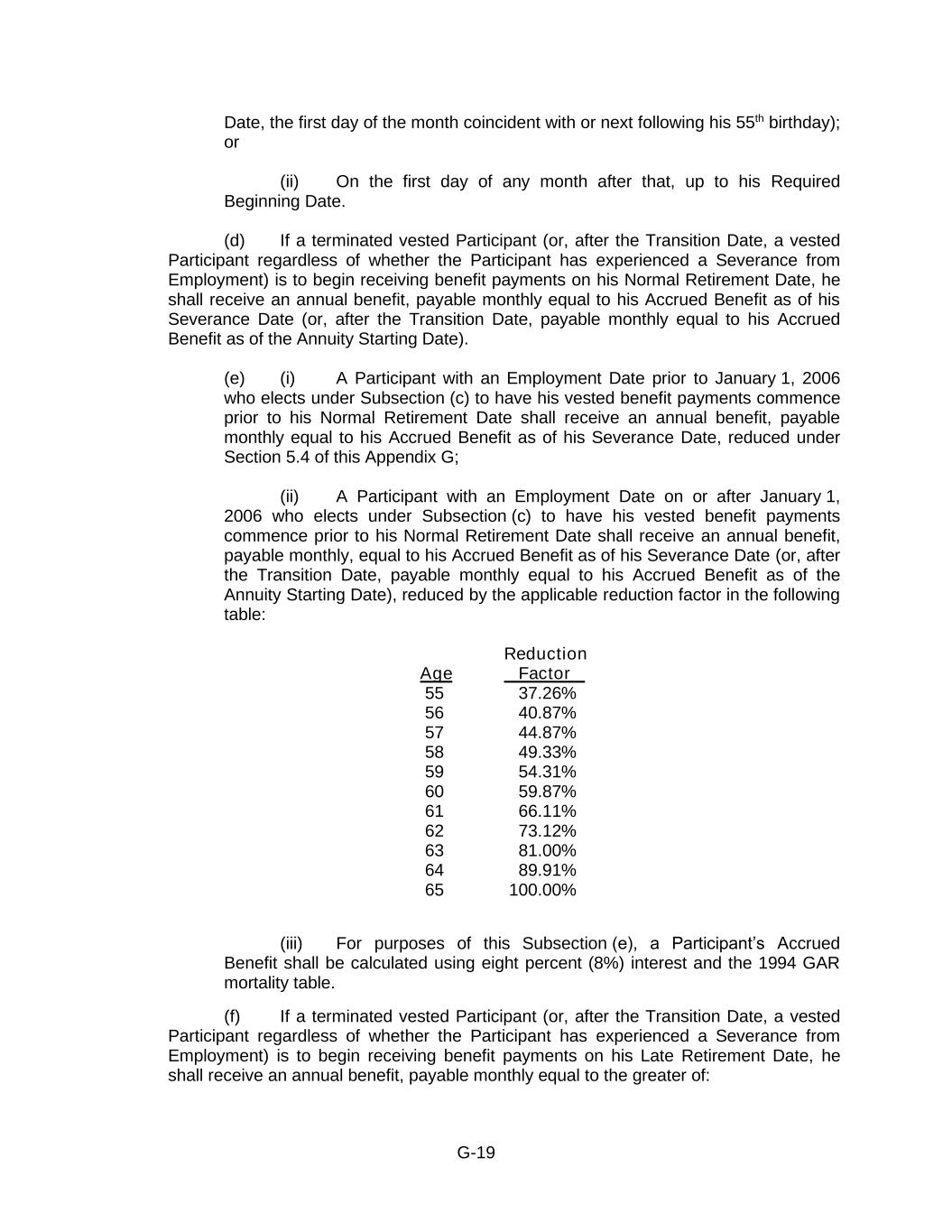
G-19 Date, the first day of the month coincident with or next following his 55th birthday); or (ii) On the first day of any month after that, up to his Required Beginning Date. (d) If a terminated vested Participant (or, after the Transition Date, a vested Participant regardless of whether the Participant has experienced a Severance from Employment) is to begin receiving benefit payments on his Normal Retirement Date, he shall receive an annual benefit, payable monthly equal to his Accrued Benefit as of his Severance Date (or, after the Transition Date, payable monthly equal to his Accrued Benefit as of the Annuity Starting Date). (e) (i) A Participant with an Employment Date prior to January 1, 2006 who elects under Subsection (c) to have his vested benefit payments commence prior to his Normal Retirement Date shall receive an annual benefit, payable monthly equal to his Accrued Benefit as of his Severance Date, reduced under Section 5.4 of this Appendix G; (ii) A Participant with an Employment Date on or after January 1, 2006 who elects under Subsection (c) to have his vested benefit payments commence prior to his Normal Retirement Date shall receive an annual benefit, payable monthly, equal to his Accrued Benefit as of his Severance Date (or, after the Transition Date, payable monthly equal to his Accrued Benefit as of the Annuity Starting Date), reduced by the applicable reduction factor in the following table: Reduction Age Factor 55 37.26% 56 40.87% 57 44.87% 58 49.33% 59 54.31% 60 59.87% 61 66.11% 62 73.12% 63 81.00% 64 89.91% 65 100.00% (iii) For purposes of this Subsection (e), a Participant’s Accrued Benefit shall be calculated using eight percent (8%) interest and the 1994 GAR mortality table. (f) If a terminated vested Participant (or, after the Transition Date, a vested Participant regardless of whether the Participant has experienced a Severance from Employment) is to begin receiving benefit payments on his Late Retirement Date, he shall receive an annual benefit, payable monthly equal to the greater of:

G-20 (i) The Participant’s Accrued Benefit as of his Late Retirement Date; or (ii) The Participant’s Accrued Benefit as of his Normal Retirement Date, Actuarially increased to take into account the period after Normal Retirement Date during which the Participant did not receive benefit payments. (g) A vested benefit payable under this Section shall be distributed in accordance with the provisions of Article VII of this Appendix G and Article VI of the Plan. 6.3 Cash-Outs of Small Benefits. If the Present Value of a terminated Participant’s vested benefit is $5,000 or less, the vested benefit shall be distributed in a single-sum payment (i.e., “cashed out”), as provided in Section 6.7 of the Plan. 6.4 Deemed Cash-Out. A Participant who experiences a Severance from Employment with a Participating Company and all Related Employers before he is vested in his Accrued Benefit shall be deemed to have received a complete distribution of his Accrued Benefit on his Severance Date. However, if he is subsequently reemployed by a Participating Company or a Related Employer before he incurs five consecutive Breaks-in-Service, his Accrued Benefit shall immediately be restored. ARTICLE VII PAYMENT OF BENEFITS The provisions of this Article VII of this Appendix G are applied in conjunction with the provisions of Article VI of the Plan, where applicable. 7.1 Mandatory Benefit Commencement. Section 6.9 of the Plan sets forth the provisions regarding required minimum distributions under Code Section 401(a)(9) and shall override any distribution options or provisions under the Plan which are inconsistent with Code Section 401(a)(9). 7.2 Additional Distribution Rules. (a) The provisions set forth in Section 6.1 of the Plan apply to the distribution of a Participant’s Benefit. (b) (i) Except when benefits are paid in a single sum, benefits shall be paid monthly in an amount equal to the benefit calculated under the Plan, subject to an Actuarial Equivalent adjustment for form of benefit under this Article VII of Appendix G. (ii) At the direction of the Administrative Committee, benefits payable in annuity form may be provided by an annuity contract purchased from an insurance company. The terms of such annuity contract shall prohibit the cash surrender of the annuity contract and shall make the payments due under the annuity contract non-assignable. The distribution of such annuity contract shall be in complete discharge of the Plan’s liability to the Participant accepting the annuity contract. 7.3 Automatic Form of Benefit.

G-21 (a) The automatic form of benefit for a Participant who has a Spouse shall be a Qualified Joint and Survivor Annuity. (b) The automatic form of benefit for a Participant who has no Spouse shall be a single life annuity, with equal monthly installments payable to the Participant for his lifetime. This is the “normal form” of benefit. 7.4 Optional Forms of Benefit. (a) A Participant’s pension shall be paid in his automatic form of benefit unless the Participant elects to receive one of the optional forms of benefit described below. Any such election shall be made in accordance with the provisions of Section 6.6 of the Plan. (b) The optional forms of benefit available under this Appendix G are: (i) A single life annuity, with equal monthly installments payable to the Participant for his lifetime; (ii) A joint and survivor annuity with the Participant’s designated Beneficiary, payable in monthly installments to the Participant for his lifetime and with one hundred percent (100%) of the amount of such monthly installment payable after the death of the Participant to the Participant’s designated Beneficiary, if then living, for the life of the designated Beneficiary. The foregoing notwithstanding, if the Beneficiary named by the Participant is a person other than the Participant’s Spouse, the percentage payable to such Beneficiary under the joint and survivor annuity may not at any time exceed the applicable percentage given in Schedule A; (iii) A joint and survivor annuity with the Participant’s designated Beneficiary, payable in monthly installments to the Participant for his lifetime and with seventy five percent (75%) of the amount of such monthly installment payable after the death of the Participant to the Participant’s designated Beneficiary, if then living, for the life of the designated Beneficiary. The foregoing notwithstanding, if the Beneficiary named by the Participant is a person other than the Participant’s Spouse, the percentage payable to such Beneficiary under the joint and survivor annuity may not at any time exceed the applicable percentage given in Schedule A; (iv) A 10-year certain and life annuity, with equal monthly installments payable to the Participant for his lifetime, and with 120 monthly payments guaranteed; provided, however, that a Participant may not elect this form of benefit if the period certain will exceed the applicable period given in Schedule A; (v) The portion of a Participant’s Accrued Benefit under the Pension Plan for Employees of Kontron, Incorporated prior to September 1, 1996, and the portion of a Participant’s Accrued Benefit earned under the Plan prior to September 1, 1999 by former employees of Kontron, Incorporated, and former employees of Arrow Interventional hired on or after September 1, 1996 but before September 1, 1999 shall be paid in a form permitted in Schedule C. (c) A Participant shall have the right to elect a direct rollover in accordance with Section 6.10 of the Plan if he is to receive an Eligible Rollover Distribution.
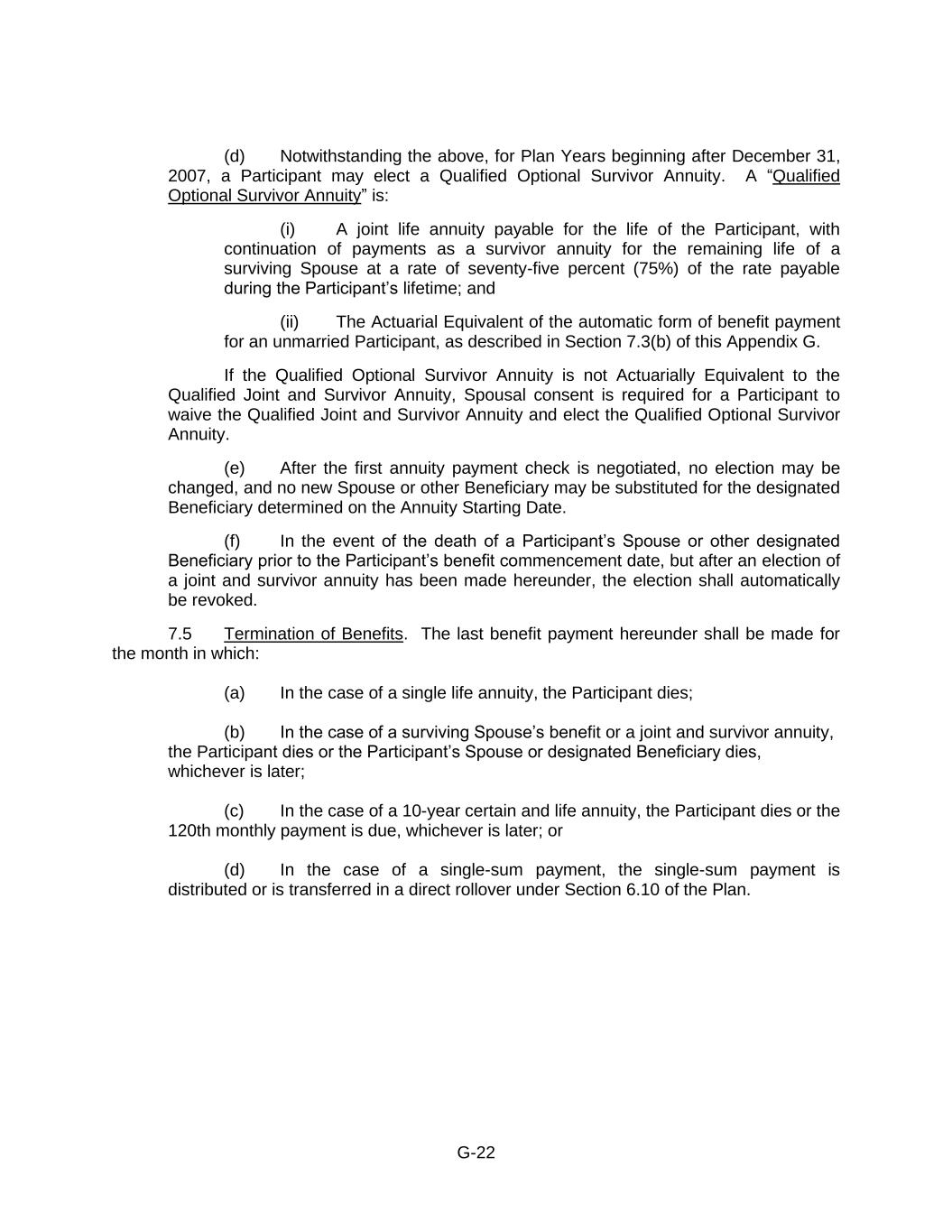
G-22 (d) Notwithstanding the above, for Plan Years beginning after December 31, 2007, a Participant may elect a Qualified Optional Survivor Annuity. A “Qualified Optional Survivor Annuity” is: (i) A joint life annuity payable for the life of the Participant, with continuation of payments as a survivor annuity for the remaining life of a surviving Spouse at a rate of seventy-five percent (75%) of the rate payable during the Participant’s lifetime; and (ii) The Actuarial Equivalent of the automatic form of benefit payment for an unmarried Participant, as described in Section 7.3(b) of this Appendix G. If the Qualified Optional Survivor Annuity is not Actuarially Equivalent to the Qualified Joint and Survivor Annuity, Spousal consent is required for a Participant to waive the Qualified Joint and Survivor Annuity and elect the Qualified Optional Survivor Annuity. (e) After the first annuity payment check is negotiated, no election may be changed, and no new Spouse or other Beneficiary may be substituted for the designated Beneficiary determined on the Annuity Starting Date. (f) In the event of the death of a Participant’s Spouse or other designated Beneficiary prior to the Participant’s benefit commencement date, but after an election of a joint and survivor annuity has been made hereunder, the election shall automatically be revoked. 7.5 Termination of Benefits. The last benefit payment hereunder shall be made for the month in which: (a) In the case of a single life annuity, the Participant dies; (b) In the case of a surviving Spouse’s benefit or a joint and survivor annuity, the Participant dies or the Participant’s Spouse or designated Beneficiary dies, whichever is later; (c) In the case of a 10-year certain and life annuity, the Participant dies or the 120th monthly payment is due, whichever is later; or (d) In the case of a single-sum payment, the single-sum payment is distributed or is transferred in a direct rollover under Section 6.10 of the Plan.
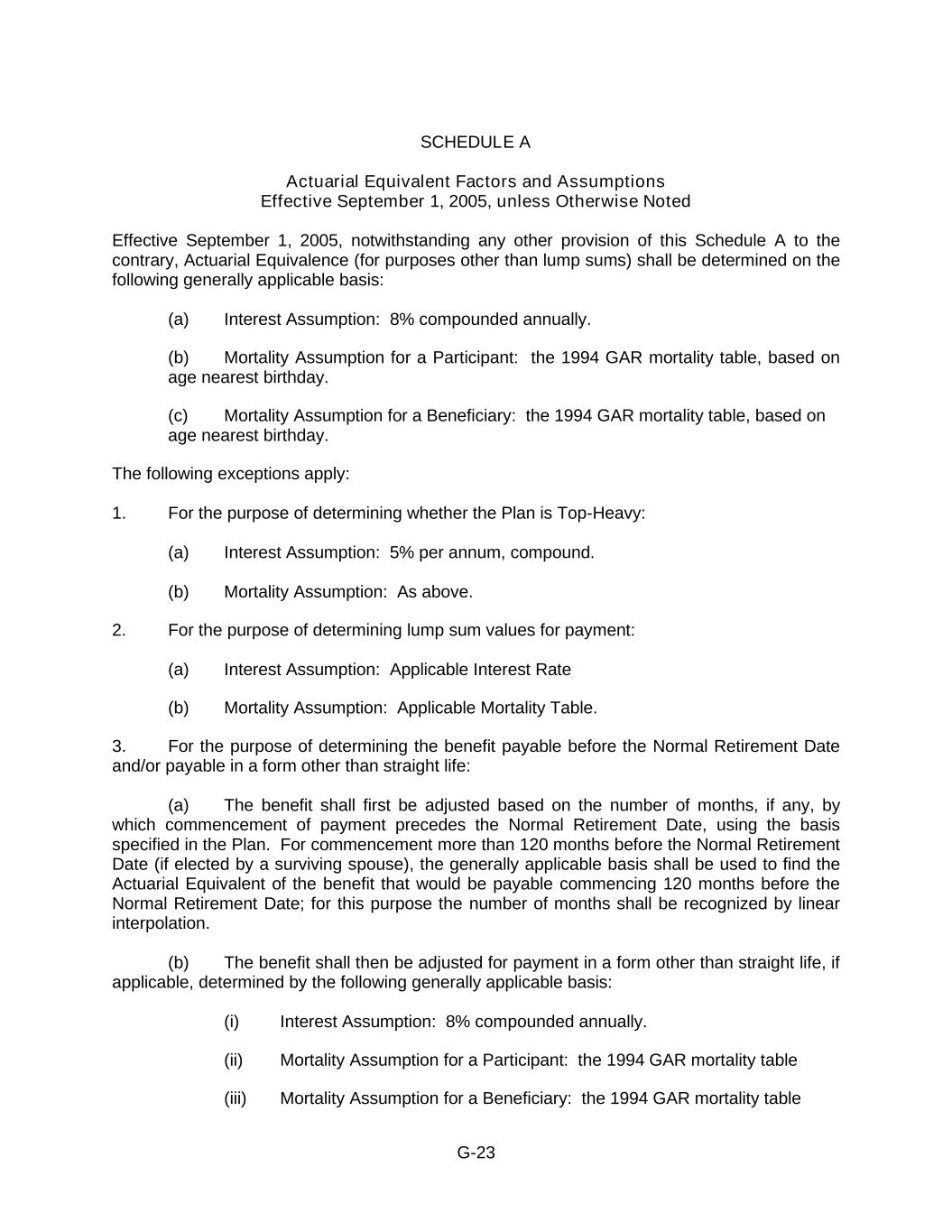
G-23 SCHEDULE A Actuarial Equivalent Factors and Assumptions Effective September 1, 2005, unless Otherwise Noted Effective September 1, 2005, notwithstanding any other provision of this Schedule A to the contrary, Actuarial Equivalence (for purposes other than lump sums) shall be determined on the following generally applicable basis: (a) Interest Assumption: 8% compounded annually. (b) Mortality Assumption for a Participant: the 1994 GAR mortality table, based on age nearest birthday. (c) Mortality Assumption for a Beneficiary: the 1994 GAR mortality table, based on age nearest birthday. The following exceptions apply: 1. For the purpose of determining whether the Plan is Top-Heavy: (a) Interest Assumption: 5% per annum, compound. (b) Mortality Assumption: As above. 2. For the purpose of determining lump sum values for payment: (a) Interest Assumption: Applicable Interest Rate (b) Mortality Assumption: Applicable Mortality Table. 3. For the purpose of determining the benefit payable before the Normal Retirement Date and/or payable in a form other than straight life: (a) The benefit shall first be adjusted based on the number of months, if any, by which commencement of payment precedes the Normal Retirement Date, using the basis specified in the Plan. For commencement more than 120 months before the Normal Retirement Date (if elected by a surviving spouse), the generally applicable basis shall be used to find the Actuarial Equivalent of the benefit that would be payable commencing 120 months before the Normal Retirement Date; for this purpose the number of months shall be recognized by linear interpolation. (b) The benefit shall then be adjusted for payment in a form other than straight life, if applicable, determined by the following generally applicable basis: (i) Interest Assumption: 8% compounded annually. (ii) Mortality Assumption for a Participant: the 1994 GAR mortality table (iii) Mortality Assumption for a Beneficiary: the 1994 GAR mortality table

G-24 4. For the purpose of determining the increase in the Accrued Benefit as of the Normal Retirement Date to the Late Retirement Date, Actuarial Equivalence shall be determined by the following basis: (a) For the period (if any) between Normal Retirement Date and September 1, 2005: (i) Interest Assumption: 7% per annum, compound (ii) Mortality Assumption for a Participant: The UP-1984 Table, based on age nearest birthday. (b) For the period after September 1, 2005: (i) Interest Assumption: 8% compounded annually. (ii) Mortality Assumption for a Participant: the 1994 GAR mortality table
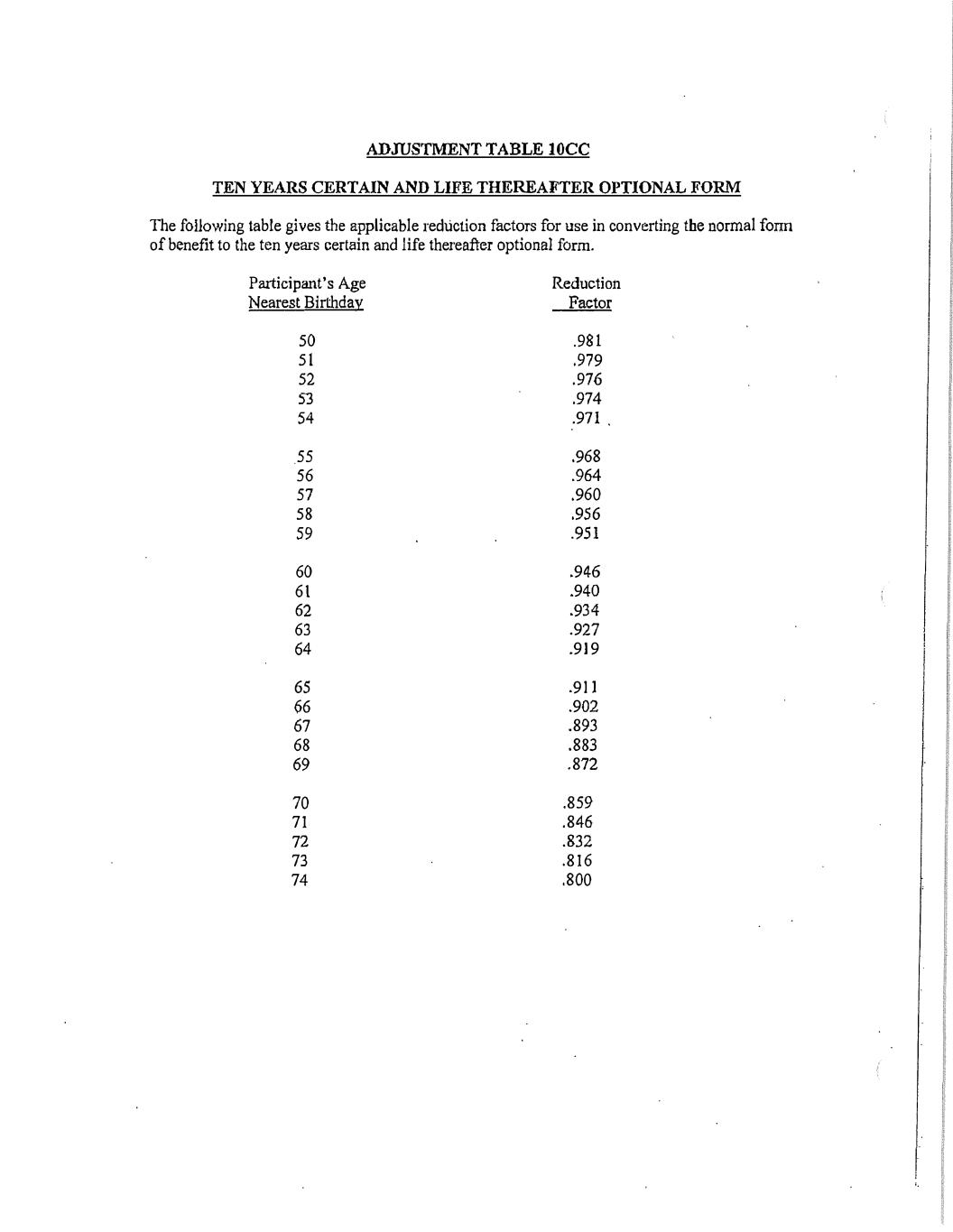
ADJUSTMENT TABLE 10cc TEN YEARS CERTAIN AND LIFE THEREAFTER OPTIONAL FORM The fol!owing table gives the applicable reduction factors for use in converting the normal fonn of benefit to the ten years certain and life thereafter optional form. Participant's Age Reduction Nearest Birthday Factor 50 .981 51 .979 52 .976 53 .974 54 .971. 55 .968 56 .964 57 .960 58 .956 59 .951 60 .946 61 .940 62 .934 63 .927 64 .919 65 .911 66 .902 67 .893 68 .883 69 .872 70 .859 71 .846 72 .832 73 .816 74 .800
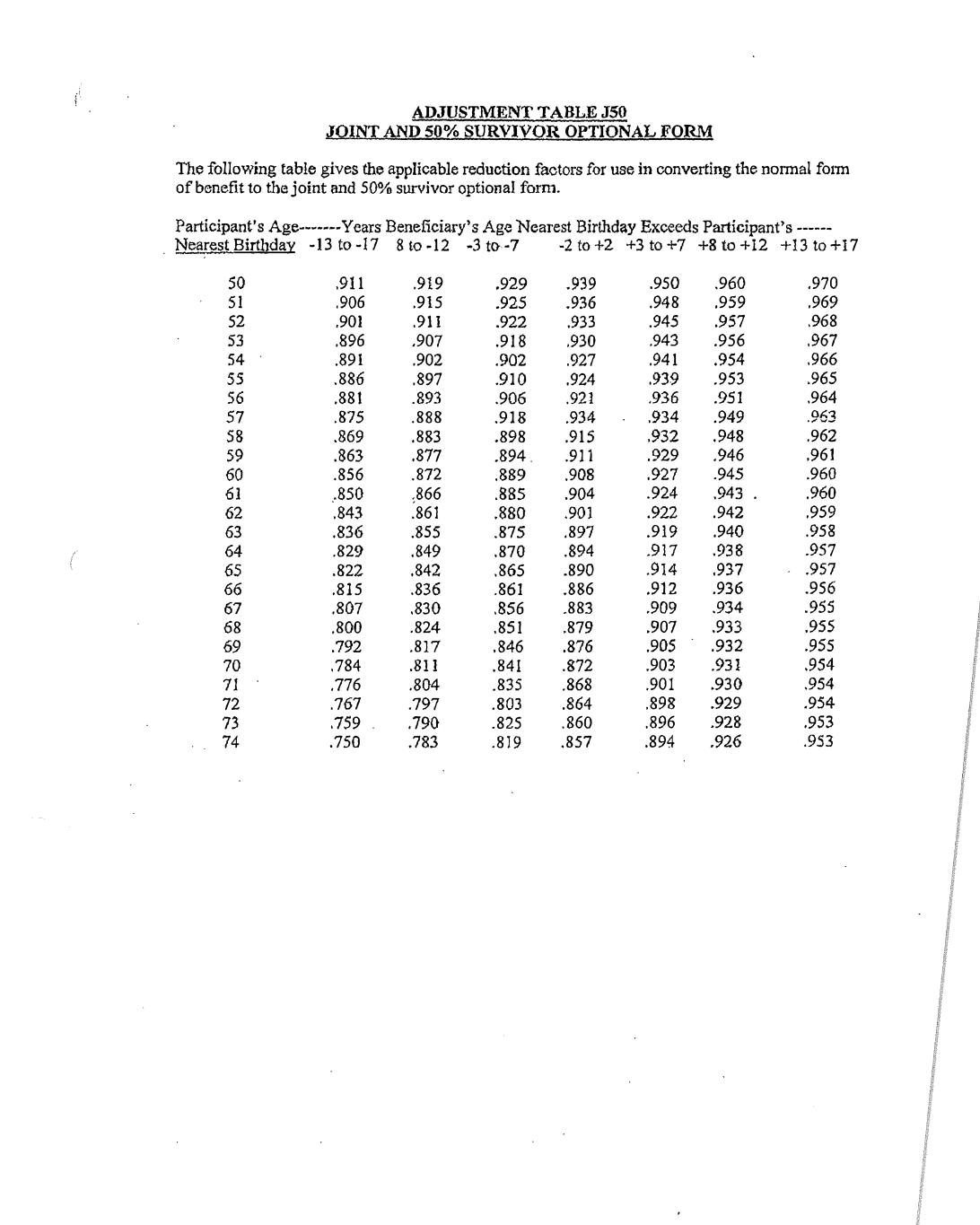
ADJUSTMENT TABLE J50 JOINT AND 50% SURVIVOR OPTIONAL FORM The following table gives the applicable reduction factors for use in converting the normal fo1m of benefit to the joint and 50% survivor optional form. Participant's Age------· Years Beneficiary's Age Nearest Birthday Exceeds Participant> s ------ . Nearest Birthday -13 to -17 8 to -12 -3 tc,.-7 -2 to +2 +3 to +7 +8 to +12 +13 to +17 50 .911 .919 .929 .939 .950 .960 .970 51 .906 .915 .925 .936 .948 .959 .969 52 .901 .91 I .922 .933 .945 .957 .968 53 .896 .907 .918 ,930 .943 .956 ,967 54 .891 .902 .902 .927 .941 .954 .966 55 .886 .897 .910 .924 .939 .953 .965 56 .881 .893 .906 .921 .936 .951 .964 57 .875 .888 .918 .934 .934 .949 Ok� .... -w- 58 .869 .883 .898 .915 .932 .948 .962 59 .863 .877 .894. .911 .929 .946 .961 60 .856 .872 .889 .908 .927 .945 .960 61 .850 :866 .885 .904 . 924 .943 .960 62 .843 .861 .880 .901 .922 .942 .959 63 .836 .855 .875 .897 .919 .940 .958 64 .829 .849 .870 .894 .917 .938 .957 65 .822 .842 .865 .890 .914 .937 .957 66 .815 .836 .861 .886 .912 .936 .956 67 .807 .830 .856 .883 .909 .934 .955 68 .800 .824 .851 .879 .907 .933 .955 69 .792 .817 .846 .876 .905 .932 .955 70 .784 .81 I .841 .872 .903 .931 .954 71 .776 .804 .835 .868 .901 .930 .954 72 .767 .797 .803 .864 .898 .929 .954 73 .759 .790 .825 .860 .896 .928 .953 74 .750 .783 .819 .857 .894 .926 .953
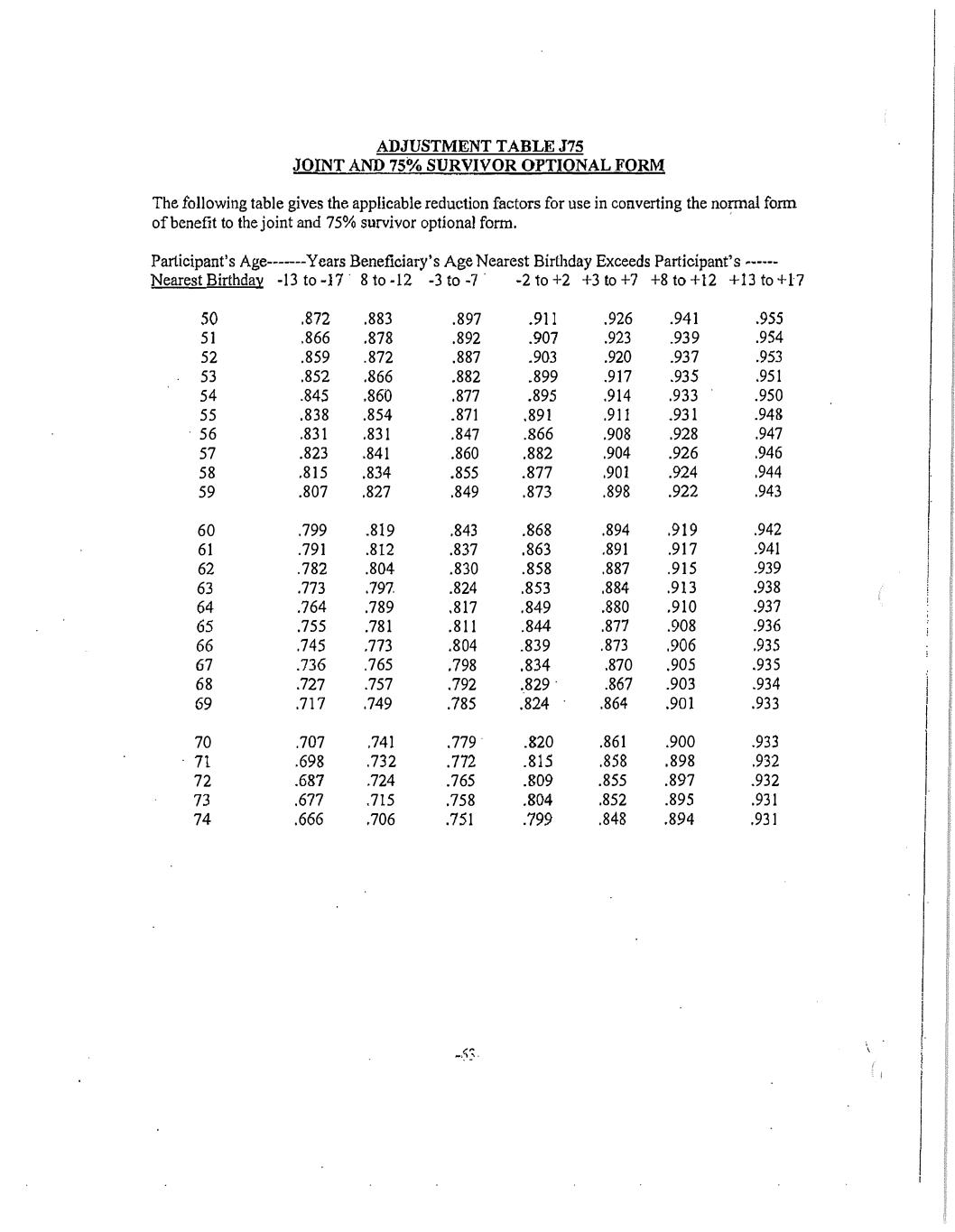
ADJUSTMENT TABLE J75 JOINT AND 75% SURVIVOR OPTIONAL FORM The following table gives the applicable reduction factors for use in converting the no�al form of benefit to the joint and 75% survivor optional fonn. Participant's Age------Years Beneficiary's Age Nearest Birthday Exceeds Participant's---·-· Nearest Birthday -13 to -17 · 8 to -12 -3 to -7 -2 to +2 +3 to +7 +8 to +12 +13 to +17 50 .872 .883 .897 .911 .926 .941 .955 51 ,866 .878 .892 .907 .923 .939 .954 52 .859 .872 .887 .903 .920 .937 .953 53 .852 .866 .882 .899 .917 .935 .951 54 .845 .860 ,877 .895 .914 .933 .950 55 .838 .854 .871 .891 .911 .931 .948 · 56 .831 .831 .847 .866 .908 .928 .947 57 .823 .841 .860 .882 .904 .926 .946 58 .815 .834 .855 .877 .901 .924 .944 59 .807 .827 .849 .873 .898 .922 .943 60 .799 .819 .843 .868 .894 .919 .942 61 .791 .812 .837 .863 .891 .917 .941 62 .782 .804 .830 .858 .887 .915 .939 63 .773 .797. .824 .853 ,884 .913 .938 64 .764 .789 .817 .849 .880 .910 .937 65 .755 .781 .811 .844 .877 .908 .936 66 .745 .773 .804 .839 .873 .906 .935 67 .736 .765 .798 .834 .870 .905 .935 68 .727 .757 .792 .829 .867 .903 .934 69 .717 .749 .785 .824 .864 .901 .933 70 .707 .741 .779 .820 .861 .900 .933 . 71 .698 .732 .772 .815 .858 .898 .932 72 .687 .724 .765 .809 .855 .897 .932 73 .677 .715 .758 .804 ,852 .895 .931 74 .666 .706 .751 .799 .848 .894 .931 XXXXWWWWWWW WWWWXXXX XXXXXXXXX X ΞΞΞΞΞΞΞΞΞ
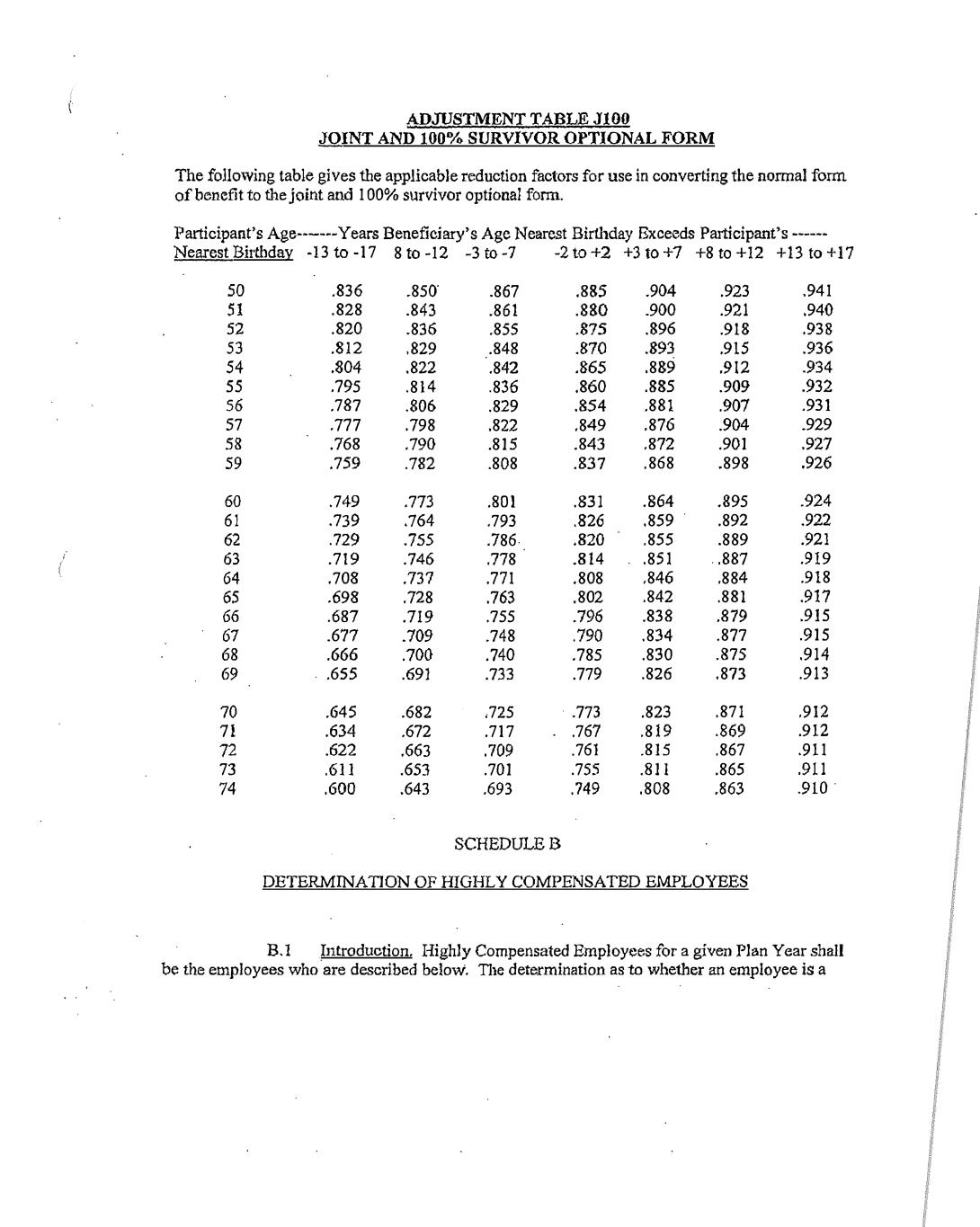
ADJUSTMENT TABLE J100 JOINT AND 100% SURVIVOR OPTIONAL FORM The following table gives the applicable reduction factors for use in converting the normal fonn of benefit to the joint and 100% survivor optional fonn. Participant's Age------Years Beneficiary's Age Nearest Birthday Exceeds Participant's------ Nearest Birthday -13 to -17 8 to -12 -3 to-7 -2to+2 +3to+7 +8to+12 +13to+17 so .836 .850- .867 .885 .904 .923 .941 51 .828 .843 .861 .880 .900 .921 .940 52 .820 .836 .855 .875 .896 .918 .938 53 .812 .829 .848 .870 .893 .915 .936 54 .804 .822 .842 .865 .889 .912 .934 55 .795 .814 .836 .860 .885 .909 .932 56 .787 .806 .829 .854 .881 .907 .931 57 .777 .798 .822 .849 .876 .904 .929 58 .768 .790 .815 .843 .872 .901 .927 59 .759 .782 .808 .837 .868 .898 .926 60 .749 .773 .801 .831 .864 .895 .924 61 .739 .764 .793 .826 .859 .892 .922 62 .729 .755 .786- .820 .855 .889 .921 63 .719 .746 .778 .814 .851 .. 887 .919 64 .708 .737 .771 .808 ,846 .884 .918 65 .698 .728 .763 .802 .842 .881 .917 66 .687 .719 .755 .796 .838 .879 .915 67 .677 .709 .748 .790 .834 .877 .915 68 .666 .700 .740 .785 .830 .875 .914 69 .. 655 .691 .733 .779 .826 .873 .913 70 .645 .682 ;725 .773 .823 .871 .912 71 .634 .672 .717 .767 .819 .869 .912 72 .622 .663 .709 .761 .815 .867 .911 73 .611 .653 .701 .7S5 .811 .865 .911 74 .600 .643 .693 .749 .808 ,863 .910" SCHEDULEB DETERMINATION OF HIGHLY COMPENSATED EMPLOYEES B.1 Introduction. Highly Compensated Employees for a given Plan Year shall be the employees who ·are described below. The determination as to whether an employee is a

G-25 SCHEDULE B ADJUSTMENTS TO CERTAIN BENEFITS If the Arrow Hourly Plan satisfies the requirements of Section 1.401(a)(4)-13(d) of the Treasury Regulations for a fresh-start as of the last day of the last Plan Year beginning before January 1, 1994, then, any other provisions of the plan notwithstanding, any section 401(a)(17) employee’s accrued benefit, frozen in accordance with Section 1.401(a)(4)-13 of the Treasury Regulations as of a fresh-start date, is adjusted to reflect increases in the employee’s compensation after the fresh-start date. However, this adjustment may be made only if the adjustment will not cause the plan to fail to satisfy the consistency requirement of Section 1.401(a)(4)-13(c) of the Treasury Regulations, as modified by Section 1.401(a)(17)-1(e) of the Proposed Treasury Regulations. In determining a section 401(a)(17) employee’s accrued benefit in any Plan Year beginning on or after January 1, 1994, the portion of the employee’s frozen accrued benefit attributable to Plan Years beginning before January 1, 1994 will be determined in accordance with Method A for statutory section 401(a)(17) employees and Method B for section 401(a)(17) employees other than statutory section 401(a)(17) employees. A statutory section 401(a)(17) employee shall mean an employee whose current accrued benefit as of a date on or after the first day of the first Plan Year beginning on or after January 1, 1994 is based on compensation for a year beginning prior to the first day of the first Plan Year beginning on or after January 1, 1989 that exceeded $200,000. A section 401(a)(17) employee shall mean an employee whose current accrued benefit as of a date on or after the first day of the first Plan Year beginning on or after January 1, 1994 is based on compensation for a year beginning prior to the first day of the first Plan Year beginning on or after January 1, 1994 that exceeded $150,000. Method A (statutory section 401(a)(17) employees): Step 1: Determine each statutory section 401(a)(17) employee’s accrued benefit as of the last day of the last Plan Year beginning before January 1, 1989, frozen in accordance with Section 1.401(a)(4)-13 of the Treasury Regulations. Step 2: Adjust the amount in step 1 up through the last day of the last Plan Year beginning before the first Plan Year beginning on or after January 1, 1994 under the method provided under the plan for increasing the amount in step 1 to take into account increases in compensation in Plan Years beginning on or after January 1, 1989. However, if the plan does not provide for such increases, the amount in step 2 shall be equal to the amount in step 1. Step 3: Determine the statutory section 401(a)(17) employee’s accrued benefit as of the last day of the last Plan Year beginning before January 1, 1994, frozen in accordance with Section 1.401(a)(4)-13 of the Treasury Regulations. Step 4: Subtract the amount determined in step 2 from the amount determined in step 3. Step 5: Adjust the amount in step 4 by multiplying it by the following fraction (not less than 1). The numerator of the fraction is the statutory section 401(a)(17) employee’s average compensation determined for the current year (as limited by section
G-26 401(a)(17)), using the same definition and compensation formula in effect as of the last day of the last Plan Year beginning before January 1, 1994. The denominator of the fraction is the employee’s average compensation for the last day of the last Plan Year beginning before January 1, 1994, using the definition and compensation formula in effect as of the last day of the last Plan Year beginning before January 1, 1994. Step 6: Adjust the amount in step 1 by multiplying it by the following fraction (not less than 1). The numerator of the fraction is the statutory section 401(a)(17) employee’s average compensation for the current year (as limited by section 401(a)(17)), using the same definition of compensation and compensation formula in effect as of the last day of the last Plan Year beginning before January 1, 1989. The denominator of the fraction is the employee’s average compensation for the last day of the last Plan Year beginning before January 1, 1989, using the definition and compensation formula in effect as of the last day of the last Plan Year beginning before January 1, 1989. Step 7: Add the amounts determined in step 5, and the greater of steps 6 or 2. Method B (section 401(a)(17) employees other than statutory section 401(a)(17) employees): Step 1: Determine the accrued benefit of each section 401(a)(17) employee other than statutory section 401(a)(17) employees as of the last day of the Plan Year beginning before January 1, 1994, frozen in accordance with Section 1.401(a)(4)-13 of the Treasury Regulations. Step 2: Adjust the amount in step 1 by multiplying it by the following fraction (not less than 1). The numerator of the fraction is the average compensation of the section 401(a)(17) employee who is not a statutory section 401(a)(17) employee determined for the current year (as limited by section 401(a)(17)), using the same definition and compensation formula in effect as of the last day of the last Plan Year beginning before January 1, 1994. The denominator of the fraction is the employee’s average compensation for the last day of the last Plan Year beginning before January 1, 1994, using the definition and compensation formula in effect as of the last day of the last Plan Year beginning before January 1, 1994.
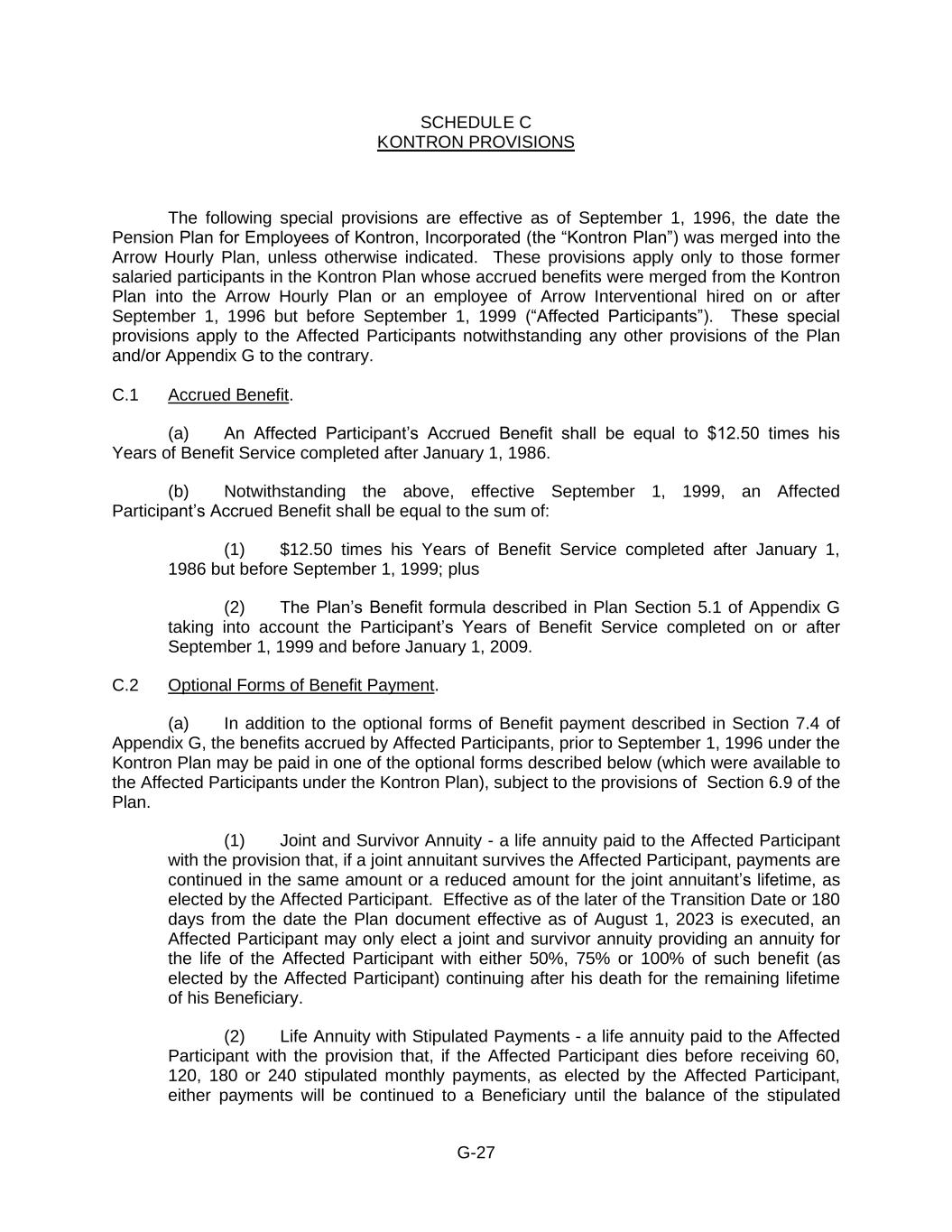
G-27 SCHEDULE C KONTRON PROVISIONS The following special provisions are effective as of September 1, 1996, the date the Pension Plan for Employees of Kontron, Incorporated (the “Kontron Plan”) was merged into the Arrow Hourly Plan, unless otherwise indicated. These provisions apply only to those former salaried participants in the Kontron Plan whose accrued benefits were merged from the Kontron Plan into the Arrow Hourly Plan or an employee of Arrow Interventional hired on or after September 1, 1996 but before September 1, 1999 (“Affected Participants”). These special provisions apply to the Affected Participants notwithstanding any other provisions of the Plan and/or Appendix G to the contrary. C.1 Accrued Benefit. (a) An Affected Participant’s Accrued Benefit shall be equal to $12.50 times his Years of Benefit Service completed after January 1, 1986. (b) Notwithstanding the above, effective September 1, 1999, an Affected Participant’s Accrued Benefit shall be equal to the sum of: (1) $12.50 times his Years of Benefit Service completed after January 1, 1986 but before September 1, 1999; plus (2) The Plan’s Benefit formula described in Plan Section 5.1 of Appendix G taking into account the Participant’s Years of Benefit Service completed on or after September 1, 1999 and before January 1, 2009. C.2 Optional Forms of Benefit Payment. (a) In addition to the optional forms of Benefit payment described in Section 7.4 of Appendix G, the benefits accrued by Affected Participants, prior to September 1, 1996 under the Kontron Plan may be paid in one of the optional forms described below (which were available to the Affected Participants under the Kontron Plan), subject to the provisions of Section 6.9 of the Plan. (1) Joint and Survivor Annuity - a life annuity paid to the Affected Participant with the provision that, if a joint annuitant survives the Affected Participant, payments are continued in the same amount or a reduced amount for the joint annuitant’s lifetime, as elected by the Affected Participant. Effective as of the later of the Transition Date or 180 days from the date the Plan document effective as of August 1, 2023 is executed, an Affected Participant may only elect a joint and survivor annuity providing an annuity for the life of the Affected Participant with either 50%, 75% or 100% of such benefit (as elected by the Affected Participant) continuing after his death for the remaining lifetime of his Beneficiary. (2) Life Annuity with Stipulated Payments - a life annuity paid to the Affected Participant with the provision that, if the Affected Participant dies before receiving 60, 120, 180 or 240 stipulated monthly payments, as elected by the Affected Participant, either payments will be continued to a Beneficiary until the balance of the stipulated
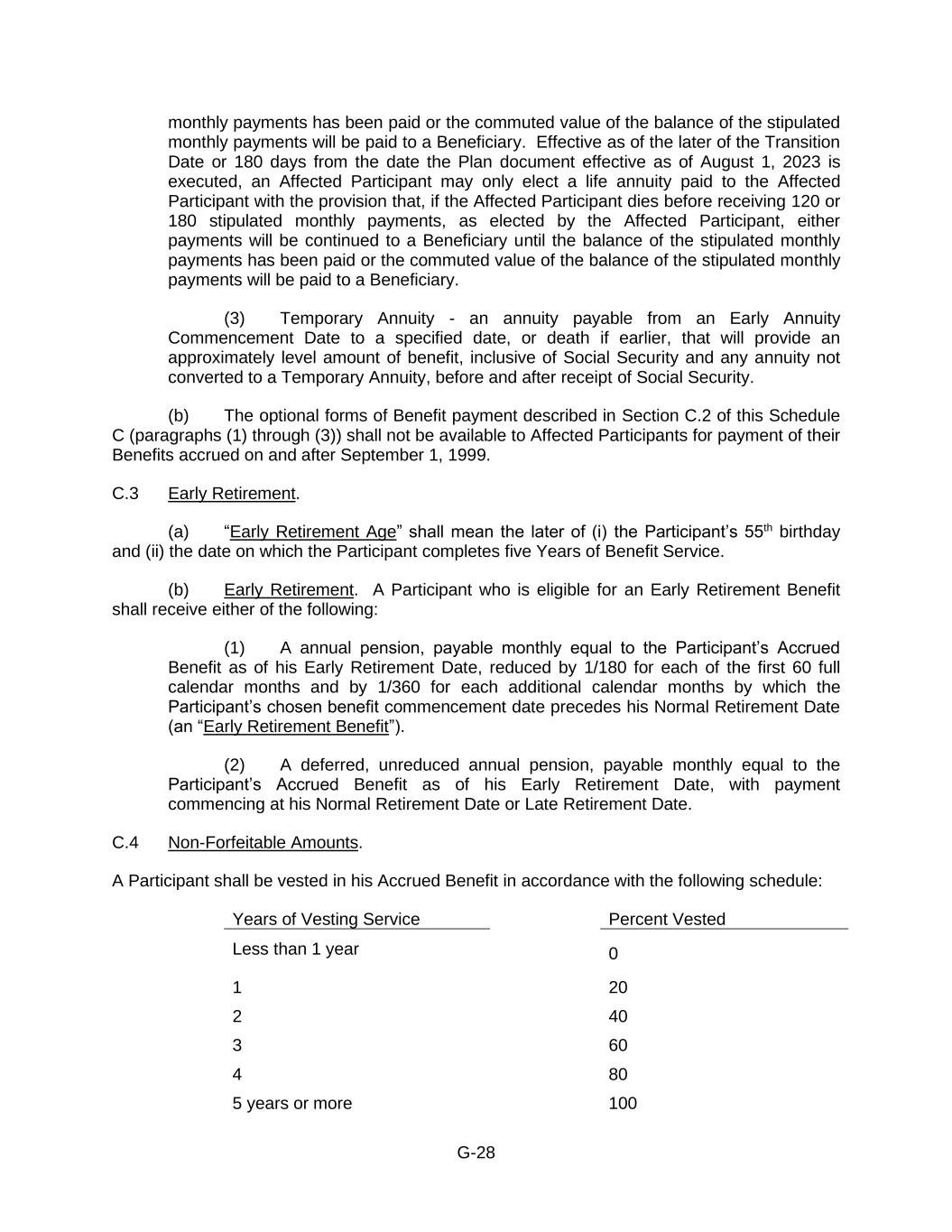
G-28 monthly payments has been paid or the commuted value of the balance of the stipulated monthly payments will be paid to a Beneficiary. Effective as of the later of the Transition Date or 180 days from the date the Plan document effective as of August 1, 2023 is executed, an Affected Participant may only elect a life annuity paid to the Affected Participant with the provision that, if the Affected Participant dies before receiving 120 or 180 stipulated monthly payments, as elected by the Affected Participant, either payments will be continued to a Beneficiary until the balance of the stipulated monthly payments has been paid or the commuted value of the balance of the stipulated monthly payments will be paid to a Beneficiary. (3) Temporary Annuity - an annuity payable from an Early Annuity Commencement Date to a specified date, or death if earlier, that will provide an approximately level amount of benefit, inclusive of Social Security and any annuity not converted to a Temporary Annuity, before and after receipt of Social Security. (b) The optional forms of Benefit payment described in Section C.2 of this Schedule C (paragraphs (1) through (3)) shall not be available to Affected Participants for payment of their Benefits accrued on and after September 1, 1999. C.3 Early Retirement. (a) “Early Retirement Age” shall mean the later of (i) the Participant’s 55th birthday and (ii) the date on which the Participant completes five Years of Benefit Service. (b) Early Retirement. A Participant who is eligible for an Early Retirement Benefit shall receive either of the following: (1) A annual pension, payable monthly equal to the Participant’s Accrued Benefit as of his Early Retirement Date, reduced by 1/180 for each of the first 60 full calendar months and by 1/360 for each additional calendar months by which the Participant’s chosen benefit commencement date precedes his Normal Retirement Date (an “Early Retirement Benefit”). (2) A deferred, unreduced annual pension, payable monthly equal to the Participant’s Accrued Benefit as of his Early Retirement Date, with payment commencing at his Normal Retirement Date or Late Retirement Date. C.4 Non-Forfeitable Amounts. A Participant shall be vested in his Accrued Benefit in accordance with the following schedule: Years of Vesting Service Percent Vested Less than 1 year 0 1 20 2 40 3 60 4 80 5 years or more 100

G-29 SCHEDULE D PARTICIPATING COMPANIES Arrow Interventional, Inc. - effective September 1, 1999 Arrow Therex Corporation - effective May 1, 1980 The Stepic Medical Distribution Company - effective September 1, 2003 015184.000055 4860-5294-4486.3

H-1 TELEFLEX INCORPORATED RETIREMENT INCOME PLAN APPENDIX H RETIREMENT PLAN FOR HOURLY RATED EMPLOYEES AT THE BERKS COUNTY, PA LOCATIONS OF ARROW INTERNATIONAL, INC. The provisions in this Appendix H apply with respect to Participants in the Retirement Plan for Hourly Rated Employees at the Berks County, PA Locations of Arrow International, Inc. (“Arrow Berks Plan”) before its merger with and into the Plan effective as of August 31, 2008. The provisions in this Appendix H shall continue to apply on and after the Plan’s Termination Date (August 1, 2023) to Participants eligible for the benefits described in this Appendix H. Except for the provisions set forth in Appendix H, the Plan provisions, including terms defined therein, shall apply with respect to Participants eligible for the benefits described in this Appendix H. ARTICLE I DEFINITIONS Terms used but not defined in this Appendix H shall have the meaning set forth in the Plan. Except with respect to the references to Articles and Sections of the Plan herein, references in this Appendix H to Articles and Section numbers are references to the Articles and Sections in this Appendix H. 1.1 “Active Participant” shall mean a Participant who is an Employee in the Covered Class. 1.2. “Actuarial Equivalent” shall mean having or that which has equal actuarial value based on the assumptions and factors described in Schedule A. “Actuarially” shall mean performed by use of the assumptions and factors described in Schedule A. 1.3 “Age” shall mean, for any individual, his age on his last birthday, except that an individual attains Age 70 1/2 on the corresponding date in the sixth calendar month following the month on which his 70th birthday falls (or the last day of such month if there is no corresponding date therein). 1.4 “Annual Compensation” shall mean, for any Active Participant, effective September 1, 2001, for a given calendar month, the total wages paid to a Participant by a Participating Company which must be taken into account for purposes of income tax withholding at the source, increased by (a) any elective contributions to a Participating Company’s plan under sections 125, 132(f), 402(g)(3), 402(h), and 403(b) of the Code, and reduced by the dollar amount or value of each of the following: reimbursements and other expense allowances, fringe benefits (both cash and non-cash), moving expenses, deferred compensation, and welfare benefits. In general, all Annual Compensation up to a Participant’s actual Severance from Employment (or December 31, 2012, if earlier) shall be taken into account in calculating benefits. However, in the case of a Participant who does not have any period of employment on or after September 1, 1988, Annual Compensation received after the Participant’s Normal Retirement Date shall not be taken into account in calculating benefits under this Plan.

H-2 In calculating a Disabled Participant’s benefit, it will be assumed that the Participant’s Annual Compensation has continued unchanged from his Severance from Employment (or December 31, 2012, if earlier) on account of Total and Permanent Disability to his Normal Retirement Date (or December 31, 2012, if earlier). Effective January 1, 2009 through December 31, 2012, Annual Compensation also include any differential wage payments (as defined in Code Section 3401(h)(2)) from the Employer, as required by Code Section 414(u)(12), as amended by the Heroes Earnings Assistance and Relief Tax Act of 2008 (the “HEART Act”). 1.5 “Annuity Starting Date” shall have the meaning set forth in Treasury Regulations Section 1.401(a)-20, Q&A-10 (the first day of the first period for which an amount is paid as an annuity or any other form). 1.6 “Board of Directors” shall mean the Board of Directors of the Sponsor or any committee thereof. 1.7 “Break-in-Service” shall mean a twelve-consecutive month Period of Severance. 1.8 “Collective Bargaining Agreement” shall mean at any time the labor agreement between the Arrow and the Union that is then in effect. 1.9 “Committee” or “Retirement Committee” shall mean the Teleflex Incorporated Benefits Policy Committee. 1.10 “Computation Period” shall mean for any Employee the 12-month period beginning on the Employee’s Employment or Reemployment Date or on any anniversary of such date, and ending on the day before the anniversary thereof. 1.11 “Covered Class” shall mean the class consisting of each Employee who (a) is regularly employed by Arrow at a Berks County, Pennsylvania plant, or by any Participating Company at a designated plant; (b) receives compensation from the Participating Company, on a stated hourly basis other than a pension, severance pay, retainer or fee under a contract, and who is not paid on an hourly or piecework basis; (c) is not covered by a collective bargaining agreement, unless such agreement specifically provides for participation hereunder; and (d) is not covered by another qualified defined benefit pension plan to which the Participating Company makes contributions. An Employee who is such solely by reason of being a leased employee within the meaning of section 414(n) or 414(o) of the Code shall not be in the Covered Class. The determination of whether an Employee is in the Covered Class shall be made by the Benefits Group on a uniform basis consistent with the intent expressed hereunder. 1.12 “Disability Retirement Date” shall mean the first day of the month coincident with or next following the date (prior to the Participant’s Normal Retirement Date) on which a Participant who has been credited with five or more Years of Vesting Service experiences a Severance from Employment with a Participating Company and all Related Employers as a result of his Total and Permanent Disability. A Participant shall not have a Disability Retirement Date unless he has been credited with five or more Years of Vesting Service.
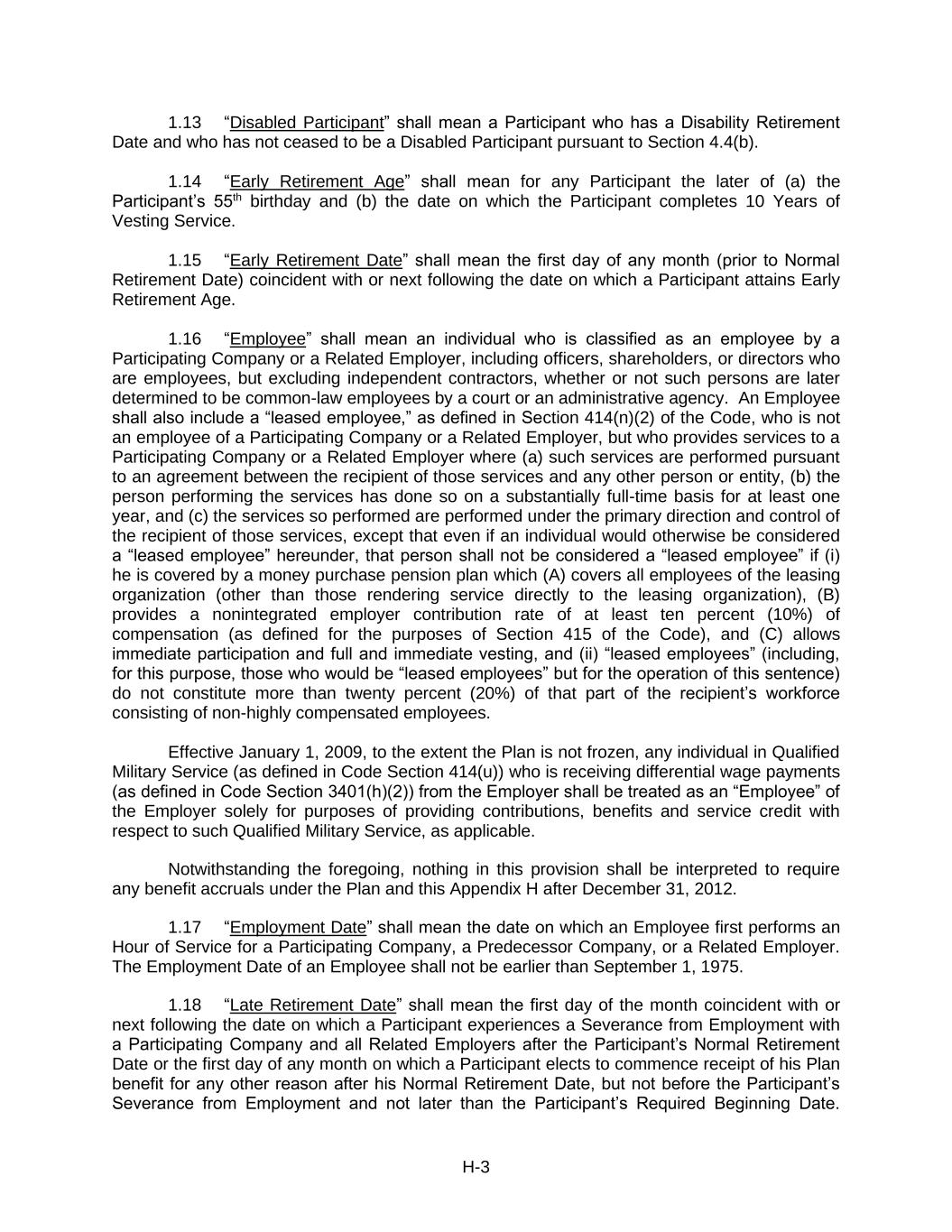
H-3 1.13 “Disabled Participant” shall mean a Participant who has a Disability Retirement Date and who has not ceased to be a Disabled Participant pursuant to Section 4.4(b). 1.14 “Early Retirement Age” shall mean for any Participant the later of (a) the Participant’s 55th birthday and (b) the date on which the Participant completes 10 Years of Vesting Service. 1.15 “Early Retirement Date” shall mean the first day of any month (prior to Normal Retirement Date) coincident with or next following the date on which a Participant attains Early Retirement Age. 1.16 “Employee” shall mean an individual who is classified as an employee by a Participating Company or a Related Employer, including officers, shareholders, or directors who are employees, but excluding independent contractors, whether or not such persons are later determined to be common-law employees by a court or an administrative agency. An Employee shall also include a “leased employee,” as defined in Section 414(n)(2) of the Code, who is not an employee of a Participating Company or a Related Employer, but who provides services to a Participating Company or a Related Employer where (a) such services are performed pursuant to an agreement between the recipient of those services and any other person or entity, (b) the person performing the services has done so on a substantially full-time basis for at least one year, and (c) the services so performed are performed under the primary direction and control of the recipient of those services, except that even if an individual would otherwise be considered a “leased employee” hereunder, that person shall not be considered a “leased employee” if (i) he is covered by a money purchase pension plan which (A) covers all employees of the leasing organization (other than those rendering service directly to the leasing organization), (B) provides a nonintegrated employer contribution rate of at least ten percent (10%) of compensation (as defined for the purposes of Section 415 of the Code), and (C) allows immediate participation and full and immediate vesting, and (ii) “leased employees” (including, for this purpose, those who would be “leased employees” but for the operation of this sentence) do not constitute more than twenty percent (20%) of that part of the recipient’s workforce consisting of non-highly compensated employees. Effective January 1, 2009, to the extent the Plan is not frozen, any individual in Qualified Military Service (as defined in Code Section 414(u)) who is receiving differential wage payments (as defined in Code Section 3401(h)(2)) from the Employer shall be treated as an “Employee” of the Employer solely for purposes of providing contributions, benefits and service credit with respect to such Qualified Military Service, as applicable. Notwithstanding the foregoing, nothing in this provision shall be interpreted to require any benefit accruals under the Plan and this Appendix H after December 31, 2012. 1.17 “Employment Date” shall mean the date on which an Employee first performs an Hour of Service for a Participating Company, a Predecessor Company, or a Related Employer. The Employment Date of an Employee shall not be earlier than September 1, 1975. 1.18 “Late Retirement Date” shall mean the first day of the month coincident with or next following the date on which a Participant experiences a Severance from Employment with a Participating Company and all Related Employers after the Participant’s Normal Retirement Date or the first day of any month on which a Participant elects to commence receipt of his Plan benefit for any other reason after his Normal Retirement Date, but not before the Participant’s Severance from Employment and not later than the Participant’s Required Beginning Date.

H-4 Effective as of the Transition Date, Severance from Employment is no longer required to start a Late Retirement Benefit. 1.19 “Mandatory Benefit Commencement Date” shall mean the Participant’s Required Beginning Date, as defined in Section 1.51 of the Plan. 1.20 “Normal Retirement Age” shall mean for any Participant the later of (a) his 65th birthday and (b) the fifth anniversary of the date on which he commenced participation in the Plan. 1.21 “Normal Retirement Date” shall mean the first day of the month next coincident with or next following the date on which a Participant attains Normal Retirement Age. 1.22 “Participant” shall mean an individual who is an Active Participant, a former Active Participant receiving benefits under the Plan, a former Active Participant who has a present or future right to receive benefits under the Plan, or an Employee who was once an Active Participant and has been transferred out of the Covered Class. 1.23 “Participating Company” shall mean Arrow and each Related Employer which is authorized by the Committee to adopt the Plan by action of its board of directors or other governing body. 1.24 “Period of Severance” shall mean the period of time commencing on an Employee’s Severance Date and ending on the date on which the Employee is again entitled to be credited with an Hour of Service described in Section 1.32 of the Plan. Notwithstanding the foregoing, a Period of Severance shall not occur as a result of (a) for New Jersey Participants, Total and Permanent Disability; (b) for North Carolina Participants, illness or disability of up to one year; (c) an authorized leave of absence for a period not exceeding one year for any reason in accordance with the uniform policy established by the Committee; or (d) temporary layoff of less than one year duration; or (e) absence due to involuntary service (or voluntary service in a time of national emergency) in any uniformed services of the United States. 1.25 “Plan Year” shall mean the 12-month period ending each December 31; prior to the merger of the Arrow Berks Plan with and into the Plan, a 12-month period which shall commence each September 1 and end on the next following August 31. 1.26 “Predecessor Company” shall mean each business entity that is a predecessor in interest to Arrow, whether due to change of name, merger, consolidation, asset acquisition, or stock acquisition. 1.27 “Present Value” shall mean, in relation to a benefit that is expressed as a monthly or annual annuity, the Actuarial Equivalent single-sum value of such benefit as of any given date, determined in accordance with Schedule A. 1.28 “Reemployment Date” shall mean the first day, following a Break-in-Service, on which an Employee performs an Hour of Service. 1.29 “Severance Date” shall mean the date, as recorded on the records of a Participating Company or a Related Employer, on which an employee of such company quits, retires, is discharged, or dies, or, if earlier, the first anniversary of the first day of a period during which the employee remains absent from service with a Participating Company and all Related

H-5 Employers (with or without pay) for any other reason, (excluding leave of absence) including but not limited to by reason of vacation, holiday or layoff; or if earlier the third year anniversary of a leave of absence, except as expressly provided otherwise in the Plan and/or this Appendix H. 1.30 “Spouse” shall mean the person to whom a Participant is legally married on any date of reference. 1.31 “Total and Permanent Disability” shall mean a disability of a nature that enables a Participant to qualify for and to receive disability benefits under the federal Social Security Act. The Administrative Committee or its delegee may require such proof of Total and Permanent Disability as it sees fit. For purposes of the Plan, a Participant’s Total and Permanent Disability ends on the day preceding the earlier of: (a) the date the Participant is reemployed by a Participating Company or a Participating Company’s Related Employer, (b) the date the Participant is no longer eligible for disability benefits under the federal Social Security Act, and (c) the Participant’s Normal Retirement Date. Notwithstanding any other provision of the Plan to the contrary, no Participant shall be deemed to have a Total and Permanent Disability or determined to be Totally and Permanently Disabled for purposes of the Plan after the Termination Date. 1.32 “Union” shall mean the United Steelworkers of America, AFL-CIO, CLC. 1.33 “Years of Benefit Service” or “Benefit Service” shall mean the number of Computation Periods counted with respect to determining a Participant’s Accrued Benefit under the Plan, as further described in Article III. A Participant shall not be credited with any Benefit Service or Years of Benefit Service after December 31, 2012. 1.34 “Years of Vesting Service” or “Vesting Service” shall mean the number of Computation Periods counted with respect to determining a Participant’s vested status under the Plan, as further described in Article III. ARTICLE II PARTICIPATION 2.1 Date of Participation. (a) Prior to December 31, 2012, each Employee in the Covered Class shall become an Active Participant on the first date on which he is in the Covered Class. (b) A Participant who has a Severance Date and who is later reemployed as an Employee in the Covered Class shall become an Active Participant as of the date on which he first again completes an Hour of Service in the Covered Class. (c) If an Employee participated in another qualified defined benefit plan of a Participating Company immediately prior to becoming a member of the Covered Class, prior to January 1, 2013, such Employee became an Active Participant on the first day of the Plan Year coincident with or next following the date on which he became a member of the Covered Class. Such Employee remained an active participant in the preceding defined benefit plan until last day of the Plan Year in which he transferred into the Covered Class.

H-6 (d) If a Participant transfers from being a member of the Covered Class to being a member of the covered class of another defined benefit plan of a Participating Company, such Participant shall continue to be an Active Participant in the Plan until the last day of the Plan Year in which he transferred out of the Covered Class. Notwithstanding the preceding, no Employee shall become a Participant in the Plan after December 31, 2012. ARTICLE III VESTING SERVICE AND BENEFIT SERVICE 3.1 Service for Vesting. (a) An Employee shall earn Years of Vesting Service for all employment with a Participating Company, Predecessor Companies, and Related Employers. Years of Vesting Service shall be calculated from the employee’s Employment Date or Reemployment Date to the Severance Date, subject to the rules set forth below. (b) If an Employee experiences a Severance from Employment by reason of a quit, discharge, or retirement and then is reemployed by a Participating Company or a Related Employer before he incurs a Break-in-Service, the Employee shall earn credit toward a Year of Vesting Service for all of his Period of Severance. (c) If an Employee experiences a Severance from Employment by reason of quit, discharge, or retirement during an absence from service for 12 months or less for any reason other than a quit, discharge, or retirement, and if he is then reemployed by a Participating Company or a Related Employer within 12 months of the date on which he was first absent from service, he shall earn credit toward a Year of Vesting Service for his Period of Severance. (d) An Employee shall be credited with service toward a Year of Vesting Service for any period beginning after August 4, 1993 during which he is absent from work on unpaid leave under the Family and Medical Leave Act of 1993. (e) An Employee shall be credited with service toward a Year of Vesting Service in the first or second year following a leave from a Participating Company for maternity or paternity reasons for which the Employee would otherwise lose a Year of Vesting Service because of this absence. (f) An Employee shall be credited with an additional Year(s) of Vesting Service equal to the period of service with which he was credited for purposes of benefit accrual as a participant under the defined benefit plan sponsored by Rockwell International or Textile Machine Works. (g) For purposes of determining an Employee’s total Years of Vesting Service, all Vesting Service (whether or not successive) shall be aggregated.

H-7 3.2 Benefit Service. (a) Prior to January 1, 2013, a Participant shall earn a Year of Benefit Service for each Year of Vesting Service earned (except for any Period of Vesting Service earned solely due to Section 3.1(c)) while he is a Participant and he is employed with a Participating Company in a Covered Class. A Participant shall not earn any additional Years of Benefit Service after December 31, 2012. Notwithstanding the foregoing, effective January 1, 2014, for purposes of determining a Participant’s Years of Benefit Service, employment with a Participating Company in a Covered Class (determined without respect to Section 1.11(c)) prior to September 1, 1975 will be taken into account. (b) A Participant shall earn Years of Benefit Service until the earliest of: (i) Transfer to a job classification in which he is not eligible to participate in the Plan, as modified by this Appendix H; (ii) Transfer to a Related Employer which has not adopted this Plan, as modified by this Appendix H, or (iii) Severance from Employment with a Participating Company and all Related Employers; notwithstanding the foregoing, in the event of a layoff, a Participant shall earn Years of Benefit Service for an additional twelve months from the date of such layoff. Except to the extent required by applicable law, a Participant shall not earn any additional Years of Benefit Service after December 31, 2012. (c) If a Participant is reemployed by a Participating Company or a Related Employer before he incurs a Break-in-Service, and if his Period of Severance commenced with a quit, discharge, or retirement, he shall not earn Years of Benefit Service for any portion of his Period of Severance. (d) A Participant shall not be credited with any service toward a Year of Benefit Service for a period during which he is absent from work on unpaid leave under the Family and Medical Leave Act of 1993. (e) An Employee shall be credited with an additional Year(s) of Benefit Service equal to the period of service with which he was credited for purposes of benefit accrual as a participant under the defined benefit plan sponsored by Rockwell International or Textile Machine Works. (f) For purposes of determining an Employee’s total Periods of Benefit Service, all Periods of Benefit Service (whether or not successive) shall be aggregated. 3.3 Partial Years. Years of Vesting Service and Years of Benefit Service shall be calculated on the basis of completed months, with a “completed month” meaning the period from a given day of the month through the day preceding that day in the next month. An additional full month shall be awarded for any portion of a month of employment beyond a completed month.

H-8 3.4 Effect of Break-in-Service. (a) A Participant who has a vested interest in his Accrued Benefit and who incurs a Break-in-Service shall have his Years of Vesting Service and Benefit Service before his Severance Date aggregated with any Years of Vesting Service and Benefit Service he may later earn. However, a Participant shall not earn any Years of Benefit Service after December 31, 2012. (b) A Participant who does not have a vested interest in his Accrued Benefit shall have his Years of Vesting Service and Benefit Service before his Severance Date aggregated with any Years of Vesting Service and Benefit Service he may later earn if, as of his Reemployment Date, the number of his consecutive Breaks-in-Service is less than the greater of: (i) The number of Years of Vesting Service he had earned prior to his Severance Date; or (ii) Five. If the Participant does not meet this requirement, he shall receive no credit for the Years of Vesting Service and Benefit Service he has earned before his Severance Date. 3.5 Effect of Cash-Out. Section 3.4 notwithstanding, a Participant who receives a single-sum distribution pursuant to Section 6.7 of the Plan, or elects to have the amount of his single-sum distribution transferred in a direct rollover pursuant to Section 6.10 of the Plan, shall immediately lose all credit for the Years of Benefit Service attributable to the single-sum distribution. ARTICLE IV ELIGIBILITY FOR RETIREMENT BENEFITS 4.1 Normal Retirement. A Participant who is employed by a Participating Company or a Related Employer when he attains Normal Retirement Age shall immediately become fully vested in his Accrued Benefit and shall be eligible for a Normal Retirement Benefit if he experiences a Severance from Employment on his Normal Retirement Date. Normal Retirement Benefits shall be distributed in accordance with the provisions of Articles V and VII of this Appendix H and Article VI of the Plan. Effective as of the Transition Date, Severance from Employment is no longer required to start a Normal Retirement Benefit. 4.2 Late Retirement. A Participant who continues his employment with a Participating Company or a Related Employer beyond his Normal Retirement Date shall continue to accrue benefits until the earlier of his Late Retirement Date or December 31, 2012 (or such later date required by applicable law). Such a Participant shall be eligible for a Late Retirement Benefit on his Late Retirement Date. In addition, a Participant who has a vested Accrued Benefit and has experienced a Severance from Employment may elect to commence receiving payment of a Late Retirement Benefit on a Late Retirement Date. Except as otherwise provided in Section 6.9 of the Plan, Late Retirement Benefits shall be distributed in accordance with the provisions of Articles V and VII of this Appendix H and Article VI of the

H-9 Plan. Effective as of the Transition Date, Severance from Employment is no longer required to start a Late Retirement Benefit. 4.3 Early Retirement. If a Participant has experienced a Severance from Employment, he may elect to commence receipt of an Early Retirement Benefit on an Early Retirement Date. Early Retirement Benefits shall be distributed in accordance with the provisions of Articles V and VII of this Appendix H and Article VI of the Plan. Effective as of the Transition Date, Severance from Employment is no longer required to start an Early Retirement Benefit. Except as provided in Section 6.7.1 or 6.7.2.2 of the Plan, no distribution shall be made prior to the Participant’s Required Beginning Date without his written consent 4.4 Disability Retirement. (a) A Disabled Participant who has a Disability Retirement Date at a time when the Actuarial Equivalent single sum value of his vested Accrued Benefit exceeds $5,000 may elect to begin receiving a Disability Retirement Benefit commencing on the first day of the month coincident with or next following his Disability Retirement Date and ending on the date he ceases to be a Disabled Participant as described in Section 4.4(b). (b) A Participant will cease to be a Disabled Participant on the earliest of the date on which he: (i) Reaches his Normal Retirement Date; (ii) Ceases to suffer from a Total and Permanent Disability; or (iii) Dies. ARTICLE V CALCULATION OF BENEFITS 5.1 Accrued Benefit and Benefit Formula. (a) A Participant’s “Accrued Benefit” is a monthly pension in the form of a single life annuity commencing at his Normal Retirement Date which is equal to: (i) For retirements on and after October 1, 1994 but before October 1, 1995, the Participant’s Years of Benefit Service multiplied by $20.00, increasing to $20.25 on September 1, 2003, and increasing to $20.75 on September 1, 2006; (ii) For retirements on and after October 1, 1995, but before October 1, 1996, $20.50 multiplied by the Participant’s Years of Benefit Service, increasing to $20.75 on September 1, 2003, and increasing to $21.25 on September 1, 2006; (iii) For retirements on and after October 1, 1996 but before September 7, 1997, the Participant’s Years of Benefit Service multiplied by
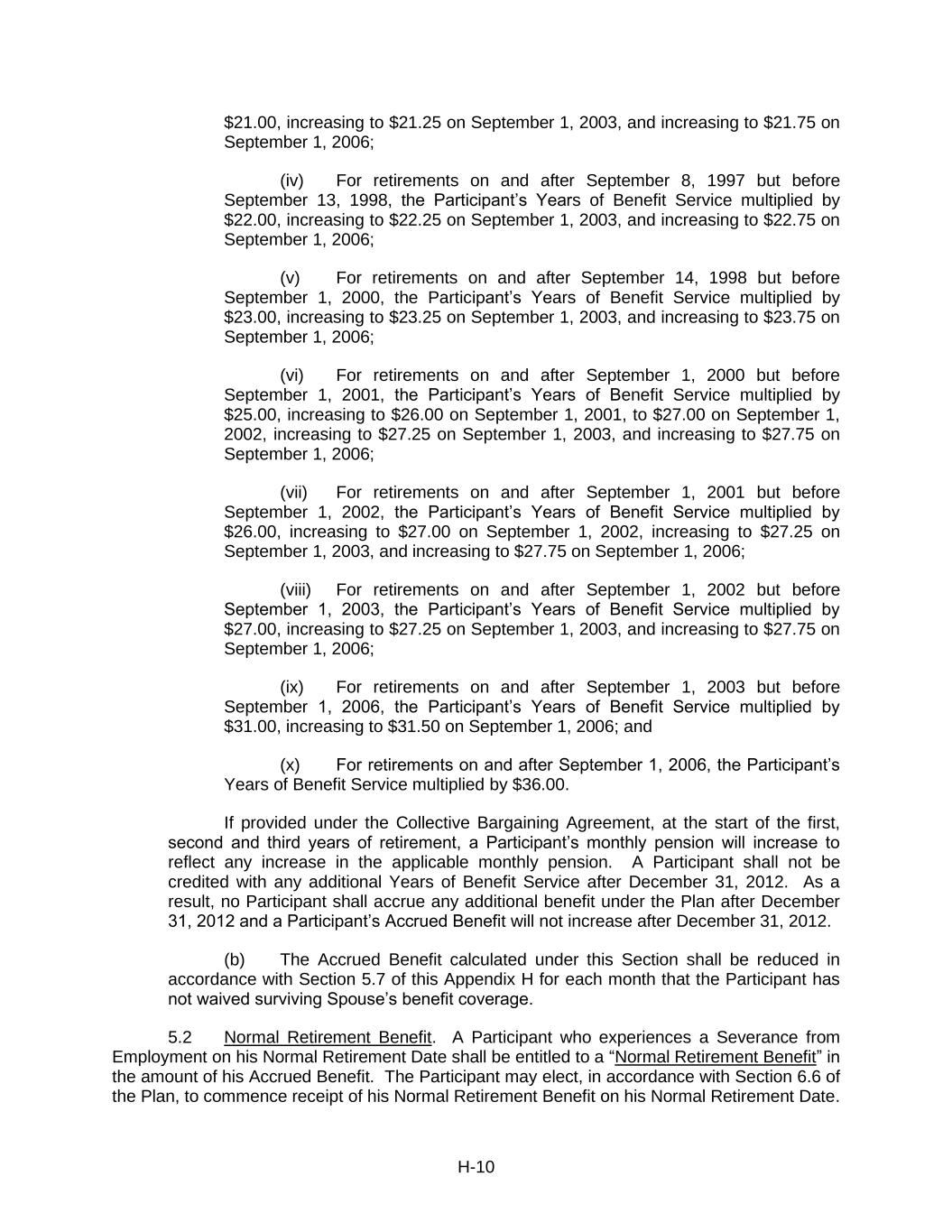
H-10 $21.00, increasing to $21.25 on September 1, 2003, and increasing to $21.75 on September 1, 2006; (iv) For retirements on and after September 8, 1997 but before September 13, 1998, the Participant’s Years of Benefit Service multiplied by $22.00, increasing to $22.25 on September 1, 2003, and increasing to $22.75 on September 1, 2006; (v) For retirements on and after September 14, 1998 but before September 1, 2000, the Participant’s Years of Benefit Service multiplied by $23.00, increasing to $23.25 on September 1, 2003, and increasing to $23.75 on September 1, 2006; (vi) For retirements on and after September 1, 2000 but before September 1, 2001, the Participant’s Years of Benefit Service multiplied by $25.00, increasing to $26.00 on September 1, 2001, to $27.00 on September 1, 2002, increasing to $27.25 on September 1, 2003, and increasing to $27.75 on September 1, 2006; (vii) For retirements on and after September 1, 2001 but before September 1, 2002, the Participant’s Years of Benefit Service multiplied by $26.00, increasing to $27.00 on September 1, 2002, increasing to $27.25 on September 1, 2003, and increasing to $27.75 on September 1, 2006; (viii) For retirements on and after September 1, 2002 but before September 1, 2003, the Participant’s Years of Benefit Service multiplied by $27.00, increasing to $27.25 on September 1, 2003, and increasing to $27.75 on September 1, 2006; (ix) For retirements on and after September 1, 2003 but before September 1, 2006, the Participant’s Years of Benefit Service multiplied by $31.00, increasing to $31.50 on September 1, 2006; and (x) For retirements on and after September 1, 2006, the Participant’s Years of Benefit Service multiplied by $36.00. If provided under the Collective Bargaining Agreement, at the start of the first, second and third years of retirement, a Participant’s monthly pension will increase to reflect any increase in the applicable monthly pension. A Participant shall not be credited with any additional Years of Benefit Service after December 31, 2012. As a result, no Participant shall accrue any additional benefit under the Plan after December 31, 2012 and a Participant’s Accrued Benefit will not increase after December 31, 2012. (b) The Accrued Benefit calculated under this Section shall be reduced in accordance with Section 5.7 of this Appendix H for each month that the Participant has not waived surviving Spouse’s benefit coverage. 5.2 Normal Retirement Benefit. A Participant who experiences a Severance from Employment on his Normal Retirement Date shall be entitled to a “Normal Retirement Benefit” in the amount of his Accrued Benefit. The Participant may elect, in accordance with Section 6.6 of the Plan, to commence receipt of his Normal Retirement Benefit on his Normal Retirement Date.
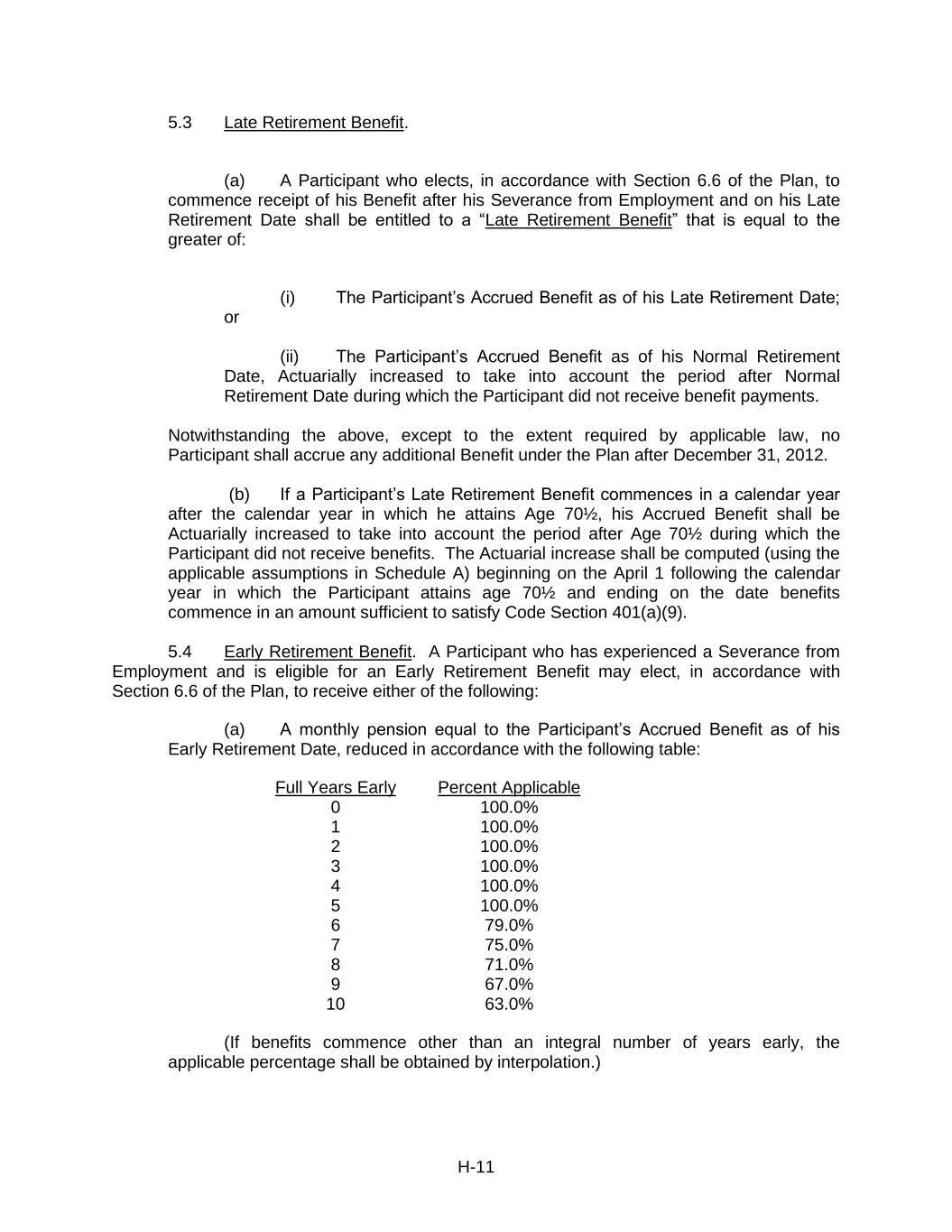
H-11 5.3 Late Retirement Benefit. (a) A Participant who elects, in accordance with Section 6.6 of the Plan, to commence receipt of his Benefit after his Severance from Employment and on his Late Retirement Date shall be entitled to a “Late Retirement Benefit” that is equal to the greater of: (i) The Participant’s Accrued Benefit as of his Late Retirement Date; or (ii) The Participant’s Accrued Benefit as of his Normal Retirement Date, Actuarially increased to take into account the period after Normal Retirement Date during which the Participant did not receive benefit payments. Notwithstanding the above, except to the extent required by applicable law, no Participant shall accrue any additional Benefit under the Plan after December 31, 2012. (b) If a Participant’s Late Retirement Benefit commences in a calendar year after the calendar year in which he attains Age 70½, his Accrued Benefit shall be Actuarially increased to take into account the period after Age 70½ during which the Participant did not receive benefits. The Actuarial increase shall be computed (using the applicable assumptions in Schedule A) beginning on the April 1 following the calendar year in which the Participant attains age 70½ and ending on the date benefits commence in an amount sufficient to satisfy Code Section 401(a)(9). 5.4 Early Retirement Benefit. A Participant who has experienced a Severance from Employment and is eligible for an Early Retirement Benefit may elect, in accordance with Section 6.6 of the Plan, to receive either of the following: (a) A monthly pension equal to the Participant’s Accrued Benefit as of his Early Retirement Date, reduced in accordance with the following table: Full Years Early Percent Applicable 0 100.0% 1 100.0% 2 100.0% 3 100.0% 4 100.0% 5 100.0% 6 79.0% 7 75.0% 8 71.0% 9 67.0% 10 63.0% (If benefits commence other than an integral number of years early, the applicable percentage shall be obtained by interpolation.)

H-12 Effective as of September 1, 2006: (b) A deferred, unreduced monthly pension equal to the Participant’s Accrued Benefit as of his Early Retirement Date, with payment commencing at his Normal Retirement Date or Late Retirement Date. (c) A Participant who is eligible for and elects to receive an Early Retirement Benefit and has a Severance from Employment at Age 60 or older shall receive an additional $850 per month commencing on his Early Retirement Date and continuing until the earlier of the expiration of twenty-four months or until the Participant receives 80% of his Social Security benefit. 5.5 Disability Retirement Benefit. (a) A Participant who is eligible for a Disability Retirement Benefit may elect, in accordance with Section 6.6 of the Plan, to receive one of the following: (i) An immediate monthly pension equal to his Accrued Benefit as of his Disability Retirement Date (a “Disability Retirement Benefit”) payable in the form of a single life annuity, and not reduced to reflect commencement prior to the Participant’s Normal Retirement Date; (ii) A monthly pension commencing on his Early Retirement Date, if he is eligible for an Early Retirement Benefit, with his Accrued Benefit determined as of his Disability Retirement Date; or (iii) A deferred monthly pension commencing on his Normal Retirement Date or Late Retirement Date, with his Accrued Benefit determined as of his Disability Retirement Date. (b) If a Participant who is eligible for a Disability Retirement Benefit elects to receive a Disability Retirement Benefit, payment of the Disability Retirement Benefit will continue until the Participant’s Normal Retirement Age or, if earlier, the date the Participant ceases to be a Disabled Participant. If payment of the Participant’s Disability Retirement Benefit continues until his Normal Retirement Age, the Participant may elect to receive any form of payment available to the Participant under the Plan and this Appendix H beginning on his Normal Retirement Date. If payment of a Participant’s Disability Retirement Benefit ceases before the Participant’s Normal Retirement Date and the Participant does not return to employment with a Participating Company or a Participating Company’s Related Employer, the Participant’s Severance Date will be treated as the date he ceases to be eligible for a Disability Retirement Benefit and the Participant may elect, in accordance with Section 6.6 of the Plan, to receive an Early, Normal or Late Retirement Benefit, as applicable (and to the extent eligible with respect to an Early Retirement Benefit). (c) In the event of the death of a Disabled Participant prior to the commencement of his Benefit, survivor’s benefits shall be paid only in accordance with the other provisions of this Article V. 5.6 Transfers. An Employee of a Participating Company or a Related Employer who is eligible for benefits under Article IV and who has been transferred to or from an eligible classification (as described in Section 2.1) shall have his benefit calculated on the basis of his

H-13 Years of Benefit Service and the benefit formula in effect under Section 5.1 as of the date of his Severance from Employment with a Participating Company and all Related Employers (or December 31, 2012, if earlier). 5.7 Death Before Commencement of Benefits. (a) If a vested Participant dies prior to the commencement of his benefits, his Spouse shall be entitled to the surviving Spouse’s benefit described in Section 5.8. If such a Participant has no Spouse at his death, his benefits hereunder shall be forfeited. (b) If a non-vested Participant dies prior to the commencement of his benefits, the Participant’s benefits shall be forfeited. 5.8 Surviving Spouse’s Benefit. (a) In the event of the death of a Participant who: (i) Has been credited with at least one Hour of Service after August 22, 1984; (ii) Has a surviving Spouse; (iii) has any vested interest in his Accrued Benefit, and (iv) Dies before beginning to receive benefits from this Plan, such Participant’s surviving Spouse shall receive a survivor’s benefit. (b) The benefit payable under this Section shall be a monthly pension for the surviving Spouse’s life commencing on the first day of any month when the Participant could have elected to receive immediate retirement benefits, but not later than the date that would have been the Participant’s Normal Retirement Date, as elected in writing by the Spouse; or, if the Participant dies on or after his Normal Retirement Date, commencing on the first day of the month following the month in which he dies. The benefit shall be equal to the benefit such Spouse would have received if the Participant: (i) Had experienced a Severance from Employment on the earliest of (A) the date of his death, (B) the date of his actual Severance from Employment or (C) December 31, 2012; (ii) Had survived to the benefit commencement date described in (i); (iii) Had then begun to receive an immediate retirement benefit in the form of a joint and 50% survivor annuity with his Spouse as the Beneficiary; and (iv) Had died on the following day. (c) The consent of a surviving Spouse to the payment of death benefits under the Plan to a Beneficiary other than the surviving Spouse shall be made in accordance with Section 6.6 of the Plan.

H-14 5.9 Death Benefit After Retirement. Upon the death of a Participant after his Severance from Employment and the commencement of his benefits, his Beneficiary shall be entitled to receive any amount which may be payable under the form of benefit in effect or under any annuity contract which has been distributed to provide the benefits to which the Participant was entitled hereunder. 5.10 Suspension of Benefits. (a) Prior to the Transition Date (i.e., the date the insurer selected in connection with the termination of the Plan takes over the administration of Accrued Benefits under an annuity contract purchased from such insurer), in the event that a Participant is employed in “qualified reemployment” (as defined in Subsection (b)) after his benefits commence, the benefits otherwise payable to the Participant shall be suspended for each calendar month of qualified reemployment, except as may be required to comply with Section 6.9 of the Plan. If the Participant is reemployed by a Participating Company or a Related Employer under any other circumstances, the benefits being paid to the Participant shall continue. (b) A Participant is employed in “qualified reemployment” if, after his Severance from Employment with a Participating Company and all Related Employers, he is reemployed by a Participating Company or a Related Employer in such a capacity that he receives pay for or is entitled to be paid for at least 40 Hours of Service (not including Hours of Service credited as a result of back pay) during a calendar month. (c) (i) A Participant receiving benefits under the Plan shall be required to give notice to the Benefits Group of any employment relationship he has with a Participating Company or a Related Employer. The Benefits Group shall have the right to use all reasonable efforts to determine whether such employment constitutes qualified reemployment. The Benefits Group shall also have the right to require the Participant to provide information sufficient to prove that such employment does not constitute qualified reemployment. (ii) A Participant may ask the Benefits Group in writing to determine whether specific contemplated employment constitutes qualified reemployment. The Benefits Group shall respond to such a request in writing within 60 days of the date on which it receives the request. (d) If a Participant’s benefits are being suspended because he is employed in qualified reemployment, the Benefits Group shall notify the Participant of this during the first month in which the suspension occurs. Notification shall be by personal delivery or first-class mail. (e) (i) If a Participant’s benefits have been suspended, benefit payments shall resume no later than the first day of the third month following the month in which the Participant’s qualified reemployment ceases (or, if later, the first day of the month following the date on which the Benefits Group receives the Participant’s notice that his qualified reemployment has ceased). (ii) When benefit payments resume, the first payment shall include payment for the current month and for all previous months since the cessation of the Participant’s qualified reemployment.
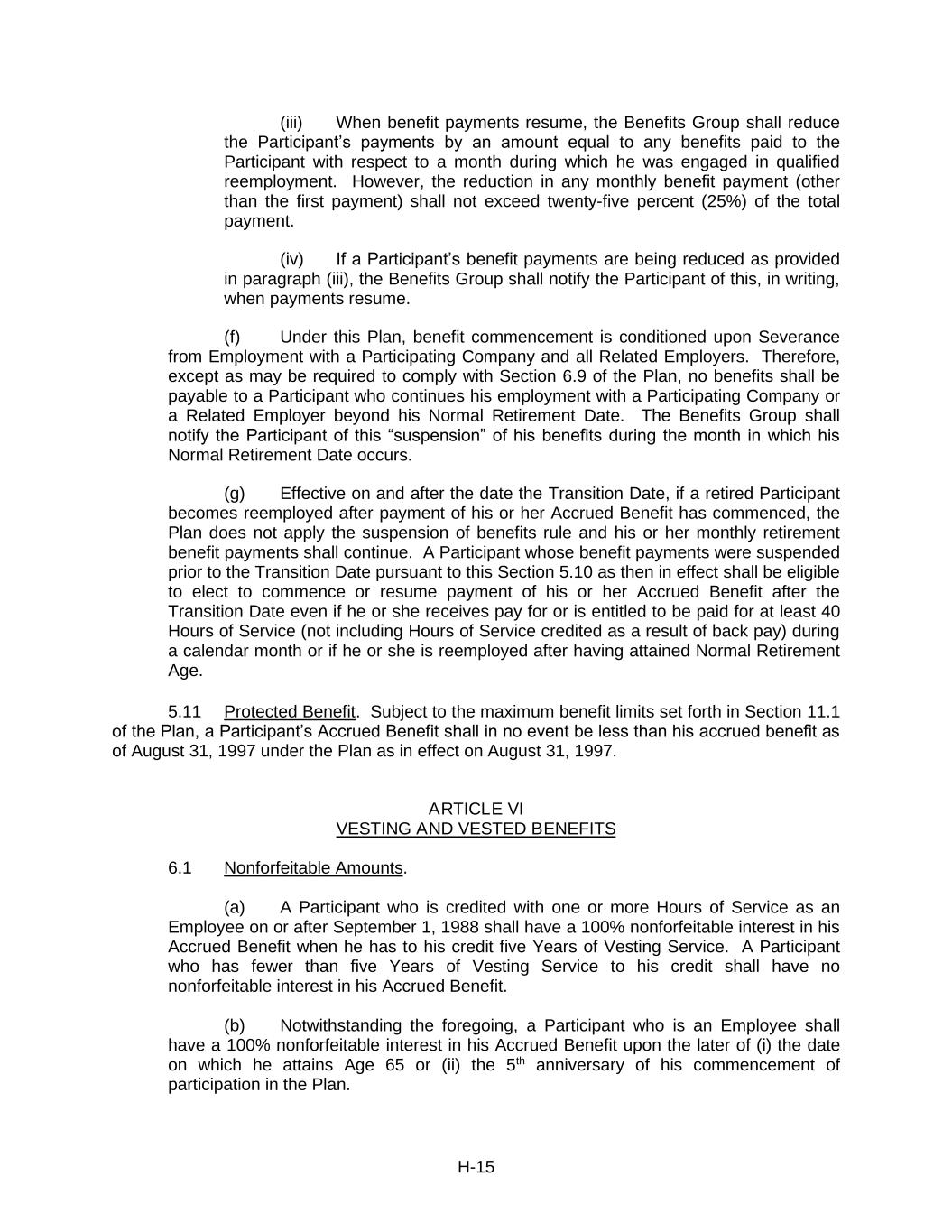
H-15 (iii) When benefit payments resume, the Benefits Group shall reduce the Participant’s payments by an amount equal to any benefits paid to the Participant with respect to a month during which he was engaged in qualified reemployment. However, the reduction in any monthly benefit payment (other than the first payment) shall not exceed twenty-five percent (25%) of the total payment. (iv) If a Participant’s benefit payments are being reduced as provided in paragraph (iii), the Benefits Group shall notify the Participant of this, in writing, when payments resume. (f) Under this Plan, benefit commencement is conditioned upon Severance from Employment with a Participating Company and all Related Employers. Therefore, except as may be required to comply with Section 6.9 of the Plan, no benefits shall be payable to a Participant who continues his employment with a Participating Company or a Related Employer beyond his Normal Retirement Date. The Benefits Group shall notify the Participant of this “suspension” of his benefits during the month in which his Normal Retirement Date occurs. (g) Effective on and after the date the Transition Date, if a retired Participant becomes reemployed after payment of his or her Accrued Benefit has commenced, the Plan does not apply the suspension of benefits rule and his or her monthly retirement benefit payments shall continue. A Participant whose benefit payments were suspended prior to the Transition Date pursuant to this Section 5.10 as then in effect shall be eligible to elect to commence or resume payment of his or her Accrued Benefit after the Transition Date even if he or she receives pay for or is entitled to be paid for at least 40 Hours of Service (not including Hours of Service credited as a result of back pay) during a calendar month or if he or she is reemployed after having attained Normal Retirement Age. 5.11 Protected Benefit. Subject to the maximum benefit limits set forth in Section 11.1 of the Plan, a Participant’s Accrued Benefit shall in no event be less than his accrued benefit as of August 31, 1997 under the Plan as in effect on August 31, 1997. ARTICLE VI VESTING AND VESTED BENEFITS 6.1 Nonforfeitable Amounts. (a) A Participant who is credited with one or more Hours of Service as an Employee on or after September 1, 1988 shall have a 100% nonforfeitable interest in his Accrued Benefit when he has to his credit five Years of Vesting Service. A Participant who has fewer than five Years of Vesting Service to his credit shall have no nonforfeitable interest in his Accrued Benefit. (b) Notwithstanding the foregoing, a Participant who is an Employee shall have a 100% nonforfeitable interest in his Accrued Benefit upon the later of (i) the date on which he attains Age 65 or (ii) the 5th anniversary of his commencement of participation in the Plan.

H-16 (c) To the extent not already vested, the Accrued Benefits of Participants who are actively employed by the Employer or one of its Related Employers on the Termination Date, shall become 100% vested on that date. 6.2 Cash-Outs of Small Benefits. If the Present Value of a terminated Participant’s vested benefit is $5,000 or less, the vested benefit shall be distributed in a single-sum payment (i.e., “cashed out”), as provided in Section 6.7 of the Plan. 6.3 Deemed Cash-Out. A Participant who experiences a Severance from Employment with a Participating Company and all Related Employers before he is vested in his Accrued Benefit shall be deemed to have received a complete distribution of his Accrued Benefit on his Severance Date. However, if he is subsequently reemployed by a Participating Company or a Related Employer before he incurs five consecutive Breaks-in-Service, his Accrued Benefit shall immediately be restored. ARTICLE VII PAYMENT OF BENEFITS The provisions of this Article VII of this Appendix H are applied in conjunction with the provisions of Article VI of the Plan, where applicable. 7.1 Mandatory Benefit Commencement. Section 6.9 of the Plan sets forth the provisions regarding required minimum distributions under Code Section 401(a)(9) and shall override any distribution options or provisions under the Plan which are inconsistent with Code Section 401(a)(9). Notwithstanding any provision of the Plan or this Appendix to the contrary, effective as of the Transition Date, Severance from Employment is not required for a Participant to commence payment of his Accrued Benefit. 7.2 Additional Distribution Rules. (a) The provisions set forth in Section 6.1 of the Plan apply to the distribution of a Participant’s Benefit. (b) The provisions set forth in Section 6.9 of the Plan apply to the distribution of a Participant’s Benefit. (c) (i) Except when benefits are paid in a single sum, benefits shall be paid monthly in an amount equal to the benefit calculated under the Plan, subject to an Actuarial Equivalent adjustment for form of benefit under this Article VII of Appendix H. (ii) At the direction of the Administrative Committee, benefits payable in annuity form may be provided by an annuity contract purchased from an insurance company. The terms of such annuity contract shall prohibit the cash surrender of the annuity contract and shall make the payments due under the annuity contract non-assignable. The distribution of such annuity contract shall be in complete discharge of the Plan’s liability to the Participant accepting the annuity contract.

H-17 7.3 Automatic Form of Benefit. (a) The automatic form of benefit for a Participant who has a Spouse shall be a Qualified Joint and Survivor Annuity. (b) The automatic form of benefit for a Participant who has no Spouse shall be a single life annuity, with equal monthly installments payable to the Participant for his lifetime. This is the “normal form” of benefit. 7.4 Optional Forms of Benefit. (a) A Participant’s pension shall be paid in his automatic form of benefit unless the Participant elects to receive one of the optional forms of benefit described below. Any such election shall be made in accordance with the provisions of Section 6.6 of the Plan. (b) The optional forms of benefit available under this Appendix H are: (i) A single life annuity, with equal monthly installments payable to the Participant for his lifetime; (ii) A joint and survivor annuity with the Participant’s Spouse, payable in monthly installments to the Participant for his lifetime and with seventy-five percent (75%) of the amount of such monthly installment payable after the death of the Participant to the Participant’s Spouse, if then living, for the life of the Spouse; (iii) A joint and survivor annuity with the Participant’s Spouse, payable in monthly installments to the Participant for his lifetime and with one hundred percent (100%) of the amount of such monthly installment payable after the death of the Participant to the Participant’s Spouse, if then living, for the life of the Spouse; or (iv) A 10-year certain and life annuity, with equal monthly installments payable to the Participant for his lifetime, and with 120 monthly payments guaranteed; provided, however, that a Participant may not elect this form of benefit if the period certain will exceed the applicable period given in Schedule A. (c) Notwithstanding the above, for Plan Years beginning after December 31, 2007, a Participant may elect a Qualified Optional Survivor Annuity. A “Qualified Optional Survivor Annuity” is: (i) A joint life annuity payable for the life of the Participant, with continuation of payments as a survivor annuity for the remaining life of a surviving Spouse at a rate of seventy-five percent (75%) of the rate payable during the Participant’s lifetime; and (ii) The Actuarial Equivalent of the automatic form of benefit payment for an unmarried Participant, as described in Section 7.3(b) of this Appendix H. If the Qualified Optional Survivor Annuity is not Actuarially Equivalent to the Qualified Joint and Survivor Annuity, Spousal consent is required for a Participant to waive the Qualified Joint and Survivor Annuity and elect the Qualified Optional Survivor Annuity.
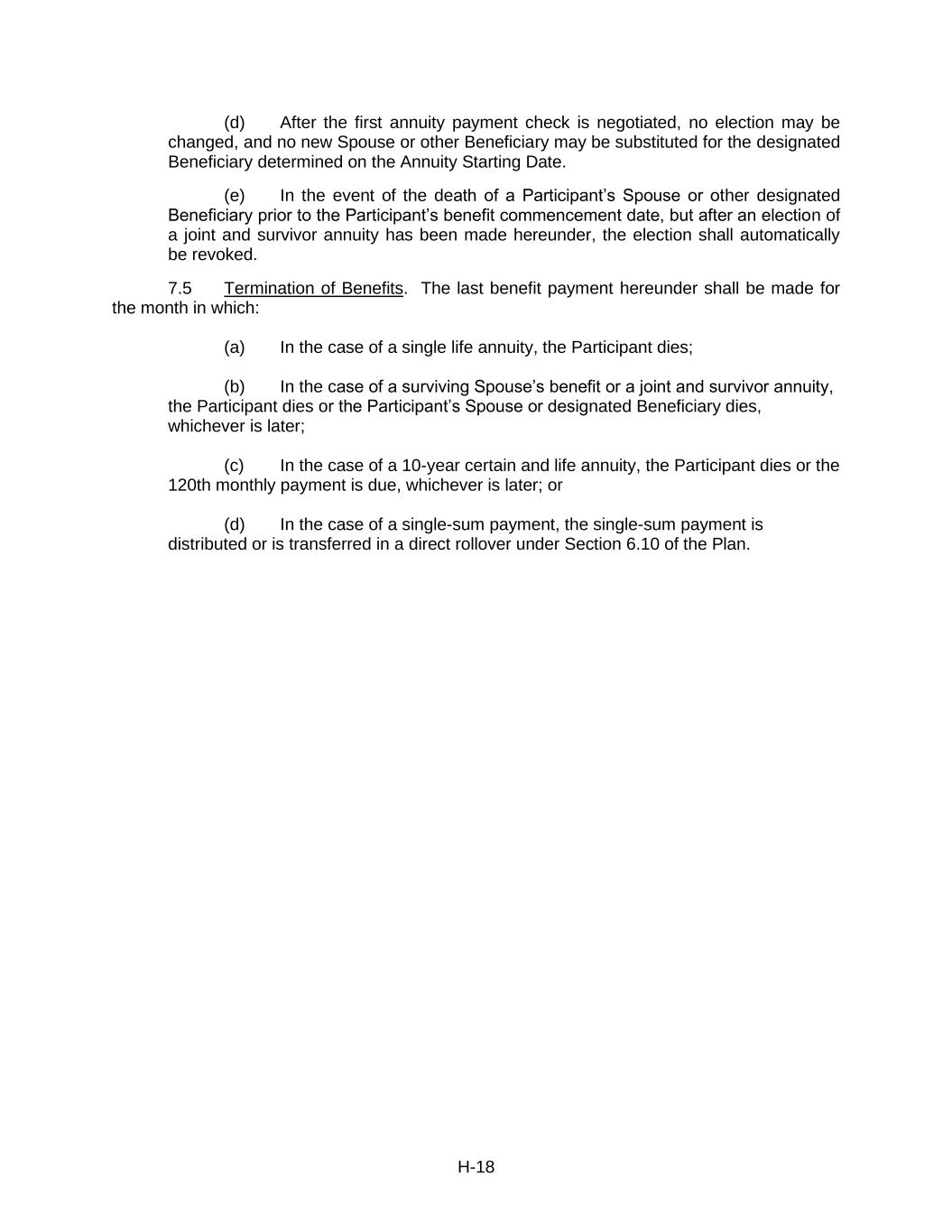
H-18 (d) After the first annuity payment check is negotiated, no election may be changed, and no new Spouse or other Beneficiary may be substituted for the designated Beneficiary determined on the Annuity Starting Date. (e) In the event of the death of a Participant’s Spouse or other designated Beneficiary prior to the Participant’s benefit commencement date, but after an election of a joint and survivor annuity has been made hereunder, the election shall automatically be revoked. 7.5 Termination of Benefits. The last benefit payment hereunder shall be made for the month in which: (a) In the case of a single life annuity, the Participant dies; (b) In the case of a surviving Spouse’s benefit or a joint and survivor annuity, the Participant dies or the Participant’s Spouse or designated Beneficiary dies, whichever is later; (c) In the case of a 10-year certain and life annuity, the Participant dies or the 120th monthly payment is due, whichever is later; or (d) In the case of a single-sum payment, the single-sum payment is distributed or is transferred in a direct rollover under Section 6.10 of the Plan.
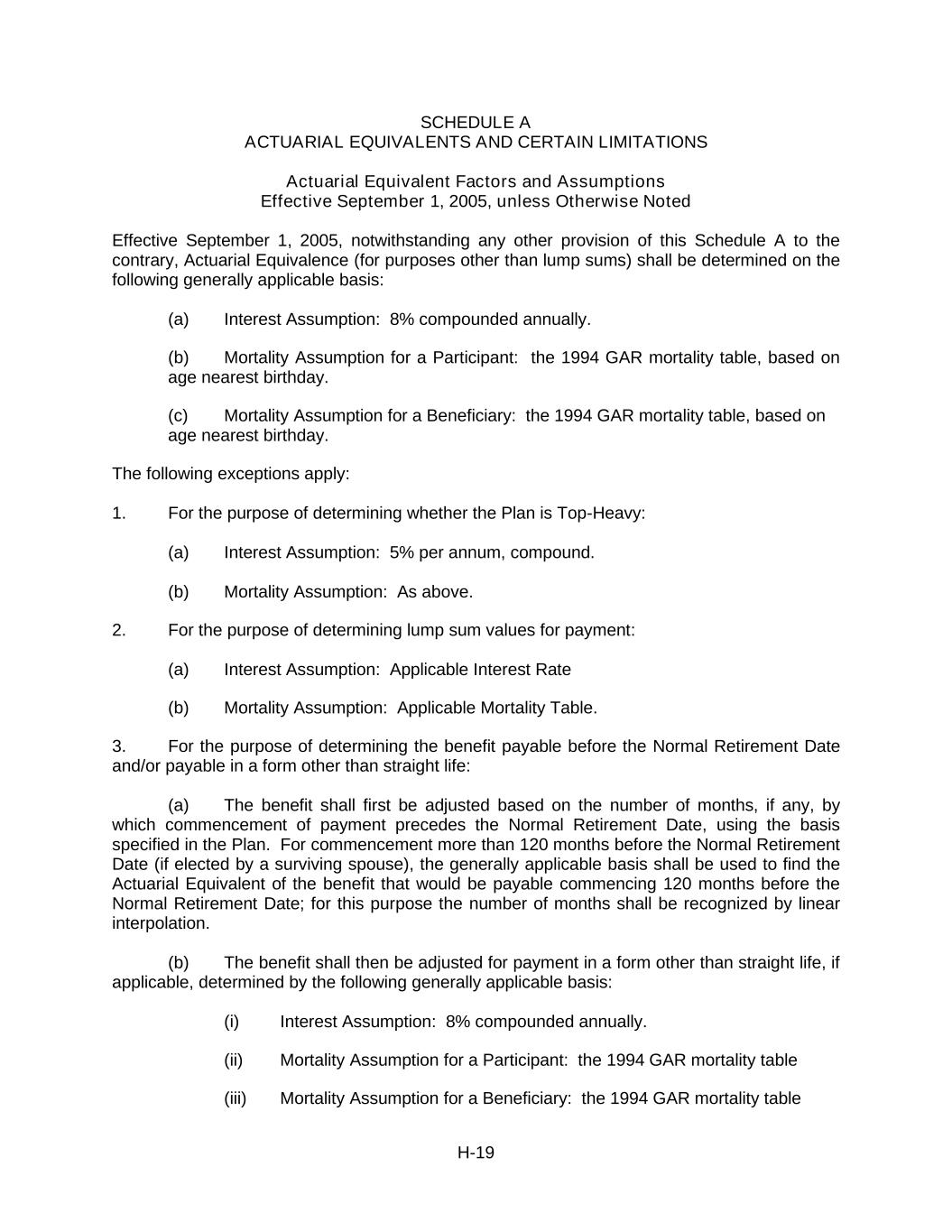
H-19 SCHEDULE A ACTUARIAL EQUIVALENTS AND CERTAIN LIMITATIONS Actuarial Equivalent Factors and Assumptions Effective September 1, 2005, unless Otherwise Noted Effective September 1, 2005, notwithstanding any other provision of this Schedule A to the contrary, Actuarial Equivalence (for purposes other than lump sums) shall be determined on the following generally applicable basis: (a) Interest Assumption: 8% compounded annually. (b) Mortality Assumption for a Participant: the 1994 GAR mortality table, based on age nearest birthday. (c) Mortality Assumption for a Beneficiary: the 1994 GAR mortality table, based on age nearest birthday. The following exceptions apply: 1. For the purpose of determining whether the Plan is Top-Heavy: (a) Interest Assumption: 5% per annum, compound. (b) Mortality Assumption: As above. 2. For the purpose of determining lump sum values for payment: (a) Interest Assumption: Applicable Interest Rate (b) Mortality Assumption: Applicable Mortality Table. 3. For the purpose of determining the benefit payable before the Normal Retirement Date and/or payable in a form other than straight life: (a) The benefit shall first be adjusted based on the number of months, if any, by which commencement of payment precedes the Normal Retirement Date, using the basis specified in the Plan. For commencement more than 120 months before the Normal Retirement Date (if elected by a surviving spouse), the generally applicable basis shall be used to find the Actuarial Equivalent of the benefit that would be payable commencing 120 months before the Normal Retirement Date; for this purpose the number of months shall be recognized by linear interpolation. (b) The benefit shall then be adjusted for payment in a form other than straight life, if applicable, determined by the following generally applicable basis: (i) Interest Assumption: 8% compounded annually. (ii) Mortality Assumption for a Participant: the 1994 GAR mortality table (iii) Mortality Assumption for a Beneficiary: the 1994 GAR mortality table

H-20 4. For the purpose of determining the increase in the Accrued Benefit as of the Normal Retirement Date to the Late Retirement Date, Actuarial Equivalence shall be determined by the following basis: (a) For the period (if any) between Normal Retirement Date and September 1, 2005: (i) Interest Assumption: 7% per annum, compound (ii) Mortality Assumption for a Participant: The UP-1984 Table, based on age nearest birthday. (b) For the period after September 1, 2005: (i) Interest Assumption: 8% compounded annually. (ii) Mortality Assumption for a Participant: the 1994 GAR mortality table 015184.000055 4858-2048-8294.3
ADJUSTMENT TABLE 10cc TEN YEARS CERTAlN AND LlFE THEREAFTER OPTIONAL FORM The following table gives the applicable reduction factors for use in converting the normal form of benefit to the ten years certain and life thereafter optional fonn. Participant's Age Reduction Nearest Birthday - Factor . 50 . 981 51 .979. 52 .976 53 .974 54 .971 55 .968 56 .964 57 .960 58 .956 59 .951 60 .946 61 .940 62 .934 63 .927 64 .919 65 .911 66 .902 67 .893 68 .883 69 .872

859 846 832 816 800 70 71 72 73 74 1 .859 . 46 . 32 .816 . 0

ADJUSTMENT TABLE JSO JOINT AND 50% SURVIVOR OPTIONAL FORM The following table gives the applicable reduction factors for use in converting the normal form of benefit to the joint and 50% survivor optional form. Participant's Age------Years Beneficiary's Age Nearest Birthday Exceeds Participant's------ Nearest Birthda)'. -13 to -17 8 to -12 -3 to -7 -2to+2 +3to+7 +8to+12 +13to·+17 50 .911 .919 .929 .939 .950 .960 .970 51 .906 .915 .925 .936 .948 .959 .969 52 .901 .9ll .922 .933 .945 .957 .968 .53 .896 .907 .918 .930 .943 .956 .967 54 .891 .902 .902 .927 .941 .954 .966 55 .886 .897 .910 .924 .939 .953 .965 56 .881 .893 .906 .921 .936 .951 .964 57 .875 .888 .918 .934 .934 .949 .963 58 .869 .883 .898 .915 .932 .948 .962 59 .863 .877 .894 .91 I .929 .946 .961 60 .856 .872 ,889 .908 .927 .945 .960 61 .850 .866 .885 .904 .924 .943 . .960 62 .843 .861 .880 .901 .922 .942 .959 63 .836 .855 .875 .897 .919 .940 .958 64 .829 .849 .870 .894 .917 .938 .957 65 .822 .842 .865 .890 .914 .937 .957 66 .815 .836 .861 ,886 .912 .936 .956 67 .807 .830 .856 .883 .909 .934 .955 68 .800 .824 .851 .879 .907 .933 .955 69 .792 .817 .846 .876 .905 .932 .955 70 .784 .811 .841 .872 .903 .931 .954 71 .776 .804 .835 .868 .901 .. 930 .954 72 .767 .797 .803 .864 .898 .929 .954 73 .759 .790 .825 .860 .896 .928 .953 74 .750 .783 .819 .857 .894 .926 .953
t\ \r,.- ( ADJUSTMENT TABLE J75 JOINT AND 75% SURVIVOR .OPTIONAL FORM The following table gives the applicable reduction factors for use in converting the normal form of benefit to the joint and 75% survivor optional fo1m. Participant's Age-------Years Beneficiary's Age Nearest Birthday Exceeds Participant's------ Nearest Birthday 50 51 52 53 54 55 56 57 58 59 60 61 62 63 64 65 66 67 68 69 70 71 -13 to-17 .872 .866 .859 ·,852 .845 .838 ,831 .823 .815 ,807 .799 .791 .782 .773 .764 .755 .745 .736 .727 .717 .707 .698 8 to -12 -3 to -7 .883 .897 .878 .892 .872 · .887 .866 .882 .860 .877 .854 .871 .831 .847 .841 .860 .834 .855 .827 .849 .819 .843 .812 .837 .804 .830 .797 .824 .789 .817 .781 .811 .773 .804 .765 .798 .757 .792 .749 .785 .741 .779 .732 .772 -2to+2 +3to+7 +8to+l2 +13to+17 .911 .926 .941 .955 .907 .923. .939 .954 .903 .920 .937 .953 .899 .917 .935 .951 .895 .914 .933 .950 .891 .911 .931 .948 .866 .908 .928 .947 .882 .904 .926 .946 .877 .901 .924- .944 .873 .898 .922 .943 .868 .894 .919 .942 ,863 .891 .917 .941 .858 .887 .915 .939 .853 .884 .913 .938 .849 .880 .910 .937 .844 .877 .908 .936 .839 .873 .906 .935 .834 .870 .905 .935 .829 .867 .903 .934 .824 .864 .901 .933 .820 .861 .900 .933 .815 .858 .898 .932

72 3 74 687 677: 666 .724 715 .706 .765 .758 751 .809 804 .799 855 852 848 897 . 895 894 932 931 931 2 73 .687 .6 7 .6 6 . 4 .715 . 6 5 . 8 .751 .8 9 .804 .7 .8 5 .897 .8S2 . 895 .848 .894 .932 .931 .931 !.
ADJUSTMENT TABLE JI0O JOINT AND 100% SURVIVOR OPTIONAL FORM The following table gives the applicable reduction factors for use in converting the normal fonn of benefit to the joint and 100% survivor optional form. Participant's Age---··· Years Beneficiary's Age Nearest Birthday Exceeds Participant's ------ Nearest Birthday -13 to -17 8 to -12 -3 to -7 -2 to +2 +3 to +7 +8 to +12 +13 to +17 50 .836 .850 .867 .885 .904 .923 .941 51 .828 .843 .861 .880 .900 .921 .940 52 .820 .836 .855 .875 .896 .918 .938 . . 53 .. 812 .829 .848 .870 .893 .915 .936 54 .804 .822 .842 .865 .889 .912 .934 55 .795 .814 .836 .860 .885 .909 ,932 56 ,787 .806 .829 .854 .881 .907 .931 57 .777 .798 .822 .849 .876 .904 .929 58 .768 .790 .815 .843 .872 .901 .927 59 .759 ,782 ,808 .837 .868 .898 .926 60 .749 .773 .801 .831 .864 .895 .924 61 .739 .764 .793 .826 .859 .892 .922 62 .729 .755 .786 .820 .855 .889 .921 63 .719 .746 .778 .814 .851 .887 .919 64 .708 .737 .771 .808 .846 .884 .918 65 .698 .728 .763 .802 .842 .88 I .917 66 .687 .719 .755 .796 .838 .879 .915 67 .677 .709 .748 .790 .834 .877 .915 68 .666 .700 .740 .785 .830 .875 .914 69 .655 .691 ,733 .779 .826 .873 .913 70 .645 .682 .725 .773 .823 .871 .912 71 .634 .672 .717 .767 .819 .869 .912 J .\, I-
ADJUSTMENT TABLE JlOO JOINT AND 100% SURVIVOR OPTIONAL FORM The following table gives the applicable reduction factors for use in converting the normal form of benefit to the joint and 100% survivor optional form. Participant's Age------Years Beneficiary's Age Nearest Birthday Exceeds Participant's ------ Nearest Birthday -13 to -17 8 to - 12 -3 to -7 -2 to +2 +3 to +7 +8 to +12 +13 to +17 50 ,836 .850 .867 .885 ,904 .923 .941 51 .828 ,843 ,861 .880 ,900 .921 .940 52 .820 .836 ,855 .875 .896 .918 .938 .. 53 .. 812 .829 .848 .870 .893 .915 .936 54 ,804 .822 .842 .865 .889 .912 .934 55 .795 .814 .836 .860 .885 .909 ,932 56 ,787 .806 .829 .854 .881 .907 .931 57 .777 .798 .822 .849 .876 .904 .929 58 .768 .790 .815 .843 .872 .901 .927 59 .759 ,782 ,808 ,837 ,868 .898 .926 60 .749 .773 .801 .831 .864 .895 .924 61 .739 .764 .793 .826 .859 ,892 .922 62 .729 .755 .786 .820 .855 .889 .921 63 .719 .746 .778 .814 ,851 ,887 .919 64 .708 .737 .771 .808 .846 .8-84 ,918 65 .698 .728 .763 .802 ,842 .88I .917 66 .687 .719 .755 .796 ,838 .879 .915 67 .677 .709 .748 ,790 .834 .877 .915 68 .666 .700 .740 .785 .830 .875 .914 69 .655 .691 ,733 .779 ,826 .873 .913 70 .645 .682 .725 ,773 .823 .871 .912 71 .634 .672 .717 .767 .819 .869 .912 I •I.
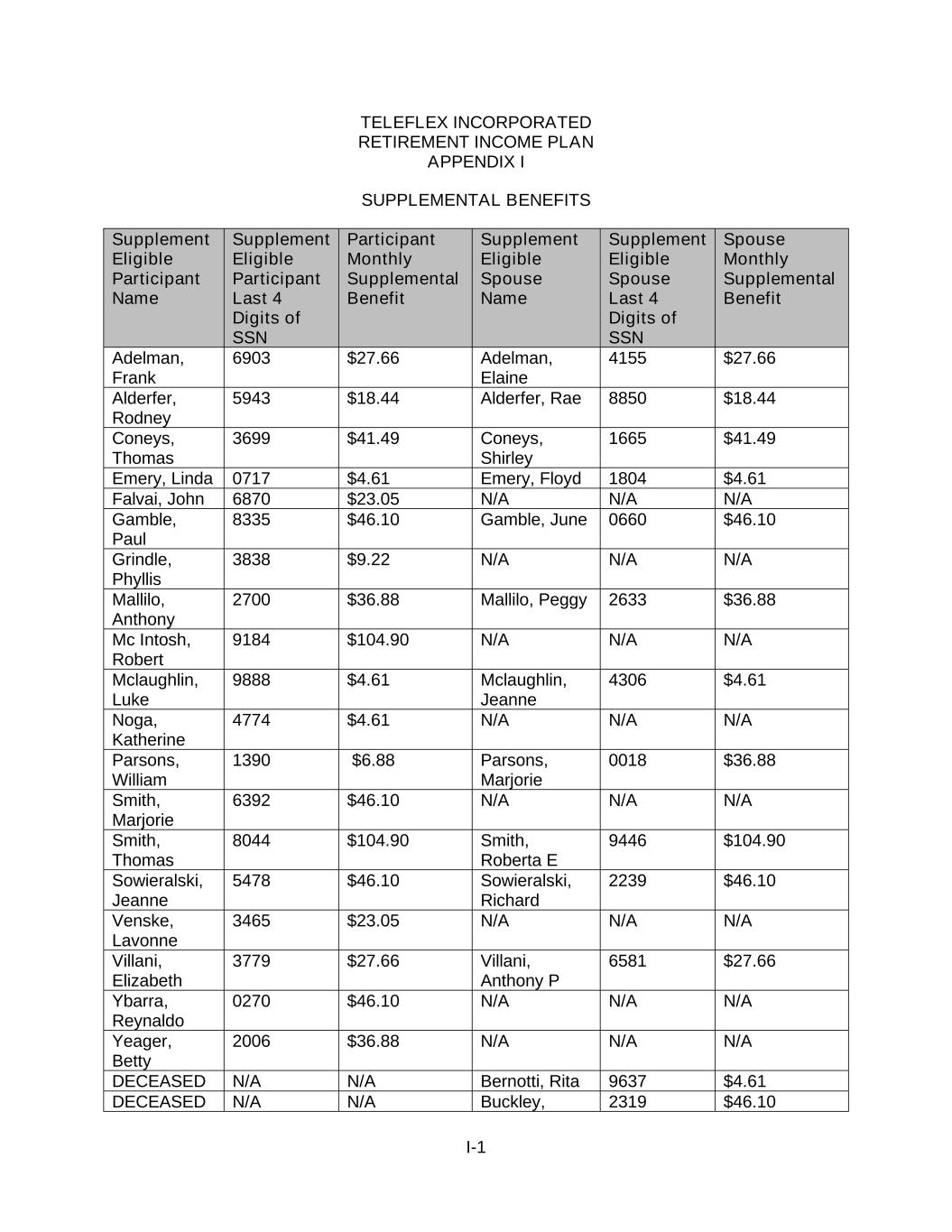
I-1 TELEFLEX INCORPORATED RETIREMENT INCOME PLAN APPENDIX I SUPPLEMENTAL BENEFITS Supplement Eligible Participant Name Supplement Eligible Participant Last 4 Digits of SSN Participant Monthly Supplemental Benefit Supplement Eligible Spouse Name Supplement Eligible Spouse Last 4 Digits of SSN Spouse Monthly Supplemental Benefit Adelman, Frank 6903 $27.66 Adelman, Elaine 4155 $27.66 Alderfer, Rodney 5943 $18.44 Alderfer, Rae 8850 $18.44 Coneys, Thomas 3699 $41.49 Coneys, Shirley 1665 $41.49 Emery, Linda 0717 $4.61 Emery, Floyd 1804 $4.61 Falvai, John 6870 $23.05 N/A N/A N/A Gamble, Paul 8335 $46.10 Gamble, June 0660 $46.10 Grindle, Phyllis 3838 $9.22 N/A N/A N/A Mallilo, Anthony 2700 $36.88 Mallilo, Peggy 2633 $36.88 Mc Intosh, Robert 9184 $104.90 N/A N/A N/A Mclaughlin, Luke 9888 $4.61 Mclaughlin, Jeanne 4306 $4.61 Noga, Katherine 4774 $4.61 N/A N/A N/A Parsons, William 1390 $6.88 Parsons, Marjorie 0018 $36.88 Smith, Marjorie 6392 $46.10 N/A N/A N/A Smith, Thomas 8044 $104.90 Smith, Roberta E 9446 $104.90 Sowieralski, Jeanne 5478 $46.10 Sowieralski, Richard 2239 $46.10 Venske, Lavonne 3465 $23.05 N/A N/A N/A Villani, Elizabeth 3779 $27.66 Villani, Anthony P 6581 $27.66 Ybarra, Reynaldo 0270 $46.10 N/A N/A N/A Yeager, Betty 2006 $36.88 N/A N/A N/A DECEASED N/A N/A Bernotti, Rita 9637 $4.61 DECEASED N/A N/A Buckley, 2319 $46.10
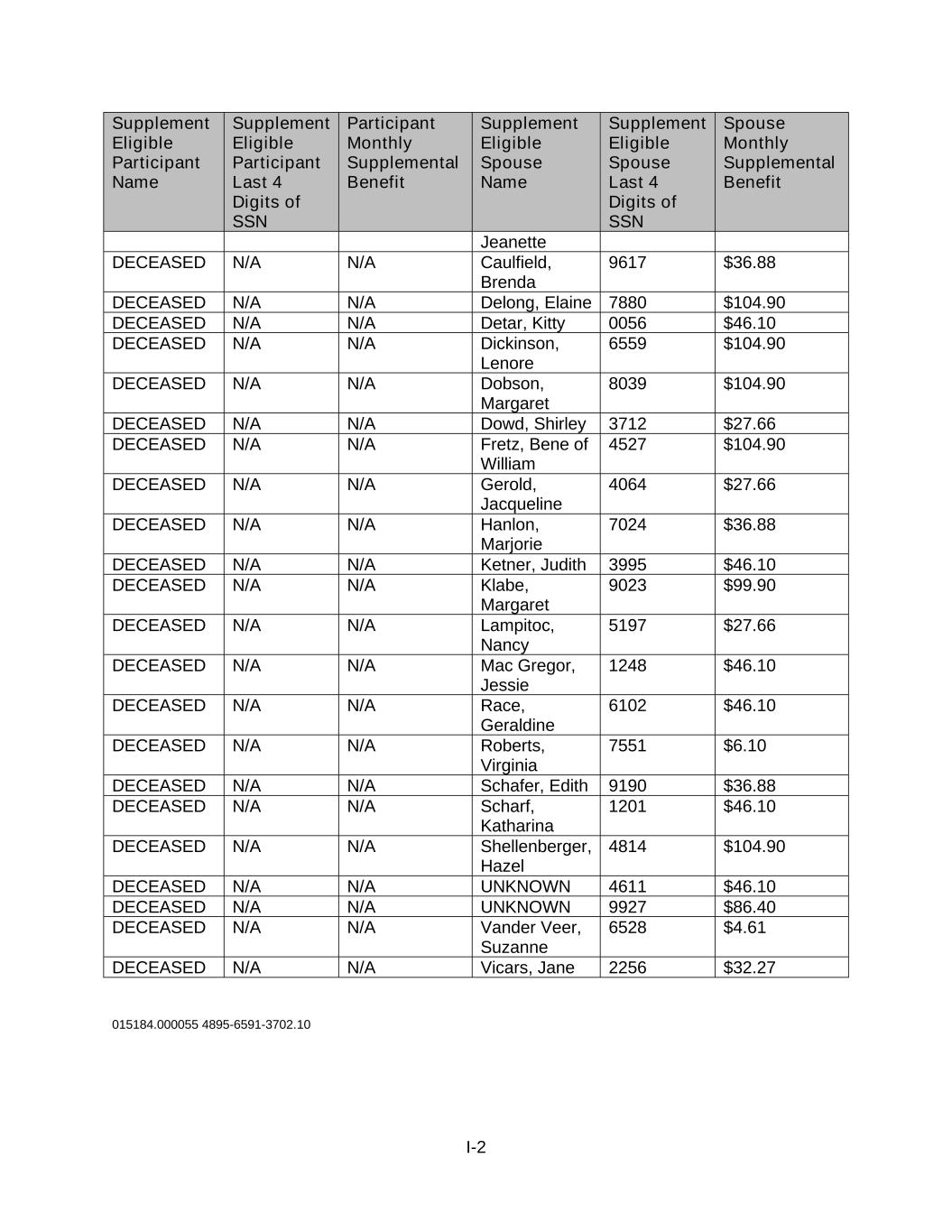
I-2 Supplement Eligible Participant Name Supplement Eligible Participant Last 4 Digits of SSN Participant Monthly Supplemental Benefit Supplement Eligible Spouse Name Supplement Eligible Spouse Last 4 Digits of SSN Spouse Monthly Supplemental Benefit Jeanette DECEASED N/A N/A Caulfield, Brenda 9617 $36.88 DECEASED N/A N/A Delong, Elaine 7880 $104.90 DECEASED N/A N/A Detar, Kitty 0056 $46.10 DECEASED N/A N/A Dickinson, Lenore 6559 $104.90 DECEASED N/A N/A Dobson, Margaret 8039 $104.90 DECEASED N/A N/A Dowd, Shirley 3712 $27.66 DECEASED N/A N/A Fretz, Bene of William 4527 $104.90 DECEASED N/A N/A Gerold, Jacqueline 4064 $27.66 DECEASED N/A N/A Hanlon, Marjorie 7024 $36.88 DECEASED N/A N/A Ketner, Judith 3995 $46.10 DECEASED N/A N/A Klabe, Margaret 9023 $99.90 DECEASED N/A N/A Lampitoc, Nancy 5197 $27.66 DECEASED N/A N/A Mac Gregor, Jessie 1248 $46.10 DECEASED N/A N/A Race, Geraldine 6102 $46.10 DECEASED N/A N/A Roberts, Virginia 7551 $6.10 DECEASED N/A N/A Schafer, Edith 9190 $36.88 DECEASED N/A N/A Scharf, Katharina 1201 $46.10 DECEASED N/A N/A Shellenberger, Hazel 4814 $104.90 DECEASED N/A N/A UNKNOWN 4611 $46.10 DECEASED N/A N/A UNKNOWN 9927 $86.40 DECEASED N/A N/A Vander Veer, Suzanne 6528 $4.61 DECEASED N/A N/A Vicars, Jane 2256 $32.27 015184.000055 4895-6591-3702.10
DocumentExhibit 10.22
TELEFLEX INCORPORATED 2023 STOCK INCENTIVE PLAN
NONQUALIFIED STOCK OPTION AGREEMENT
THIS NONQUALIFIED STOCK OPTION AGREEMENT (this “Agreement”) is made as of the Grant Date (set forth below) between Teleflex Incorporated (the “Company”) and the individual below (referred to herein as “Participant”):
Terms used in this Agreement with initial capital letters without definition are defined in the Teleflex Incorporated 2023 Stock Incentive Plan (the “Plan”) and have the same meaning in this Agreement.
1.Option Shares. On the Grant Date, the Company hereby grants to Participant the option (the “Option”) to purchase, in the aggregate, the number shares of the Company’s common stock, par value $1.00 per share (the “Shares”) set forth below, pursuant and subject to the terms of the Plan, a copy of which has been delivered or made available to Participant and is incorporated herein by reference. The Option granted hereby is a Nonqualified Stock Option.
2.Exercise Price. The purchase price per Share upon exercise of the Option is:
3.Vesting. Subject to the terms of the Plan, provided that Participant continues to be an Employee, Consultant or Non-Employee Director of the Company or a Subsidiary or other Affiliate, the Option shall vest and become exercisable (i.e., Shares may be purchased) according to the following schedule:
(a)on the 1st anniversary of the Grant Date, one-third of the Option vests and becomes exercisable (i.e., one-third of the total number of Shares may be purchased);
(b)on the 2nd anniversary of the Grant Date, an additional one-third of the Option vests and becomes exercisable (i.e., an additional one-third of the total number of Shares may be purchased); and
(c)on the 3rd anniversary of the Grant Date, the final one-third of the Option vests and becomes exercisable (i.e., the Option may be exercised in full; the remaining one-third of the total number of Shares may be purchased).
Except as otherwise set forth herein or in the Plan, the Option shall expire on the 10th anniversary of the Grant Date (the “Grant Expiration Date”), and, from and after such date, shall not be exercisable with respect to any vested portion as to which the Option has not been exercised.
The number of Shares, the exercise price thereof and the rights granted under this Agreement are subject to adjustment and modification as provided in the Plan. The total number of Shares referred to in this Section means, at any relevant time, the number of shares stated in Section 1 hereof as such number shall then have been adjusted pursuant to the Plan. Notwithstanding the foregoing, in the event of a Change of Control prior to Participant’s Termination of Employment, the Option becomes fully vested and exercisable.
4.Termination of Employment.
(a)In General. If Participant’s Termination of Employment occurs for a reason other than Participant’s death, Disability or Retirement:
(i)any portion of the Option that has not vested as of the date of Termination of Employment will automatically be canceled and forfeited and Participant shall not be entitled to any further rights in respect thereof; and
(ii)Participant will have 90 days from the date of Termination of Employment or until the Grant Expiration Date, whichever period is shorter, to exercise any portion of the Option that is vested and exercisable as of the date of Termination of Employment.
Notwithstanding any provision of the Plan to the contrary, if Participant is an Employee on the Grant Date and Participant’s employment with the Company and its Affiliates as an Employee terminates but Participant continues to provide services to the Company and its Affiliates in a Consultant or Non-employee Director capacity immediately following such termination of employment, (i) the change in status from Employee to Consultant or Non-employee Director shall not be treated as a Termination of Employment for purposes of this Agreement; and (ii) Participant shall be treated as having a Termination of Employment for purposes of this Agreement upon the date Participant ceases to be a Consultant (i.e., the date the applicable consulting agreement terminates) or the date Participant ceases to be a Non-employee Director (i.e., the date of termination from membership on the Board), as applicable. If Participant’s status changes from Employee to Consultant or Non-employee Director, the terms of this Agreement and the terms of the Plan applicable to Options awarded to Employees shall continue to apply to the Option (e.g., if Participant becomes a Non-employee Director the terms of the Plan applicable to Options awarded to Non-employee Directors do not become applicable to the Option).
Notwithstanding the above, if the Termination of Employment is a Termination for Cause, as determined by the Administrator, any outstanding and unexercised portion of the Option shall be immediately canceled as of the date of the Termination of Employment.
(b)Death or Disability. If Participant’s Termination of Employment occurs due to Participant’s death or Disability:
(i)any portion of the Option that has not vested as of the date of Termination of Employment shall vest in full as of the date of Participant’s death or Disability; and
(ii)the Option (including any portion that vested pursuant to subsection (b)(i)) shall remain exercisable for a period of one year after such Termination of Employment or until the Grant Expiration Date, whichever period is shorter.
(c)Retirement. If Participant’s Termination of Employment occurs due to Participant’s Retirement:
(i)any portion of the Option that has not vested as of the date of Termination of Employment will become ratably vested (rounded up or down to the nearest whole Share) based upon the full months of the total vesting period elapsed from the Grant Date to the end of the month in which the Termination of Employment due to Retirement occurs over the total number of months in such period; provided, however, that, in the case of a Retirement due to a voluntary Termination of Employment, the terms of this subsection (c)(i) shall not apply with respect to any Option granted less than six months prior to the effective date of such Termination of Employment; and
(ii)the Option, to the extent vested and exercisable as of the date of Termination of Employment (including any portion of the Option that is ratably vested pursuant to subsection (c)(i)), shall remain exercisable for a period of five years after the date of the Termination of Employment or until the Grant Expiration Date, whichever period is shorter.
5.Method of Exercise and Payment of Price.
(a)Method of Exercise. At any time when all or a portion of the Option is exercisable under the Plan and this Agreement, some or all of the exercisable portion of the Option may be exercised from time to time by written notice to the Company, or such other method of exercise as may be specified by the Company, including without limitation, exercise by electronic means on the web site of the Company’s third-party equity plan administrator, which will:
(i)state the number of Shares with respect to which the Option is being exercised; and
(ii)if the Option is being exercised by anyone other than Participant, if not already provided, be accompanied by proof satisfactory to counsel for the Company of the right of such person or persons to exercise the Option under the Plan and all applicable laws and regulations.
(b)Payment of Price. The full exercise price for the portion of the Option being exercised shall be paid to the Company as provided below:
(i)in cash;
(ii)by check or wire transfer (denominated in U.S. Dollars);
(iii)subject to any conditions or limitations established by the Administrator, other Shares which:
(A)have been owned by Participant for more than six months on the date of surrender (unless this condition is waived by the Administrator); and
(B)have a Fair Market Value on the date of surrender equal to or greater than the aggregate exercise price of the Shares as to which said Option shall be exercised (it being agreed that the excess of the Fair Market Value over the aggregate exercise price shall be refunded to Participant in cash);
(iv)subject to any conditions or limitations established by the Administrator, by the Company’s retention of the number of Shares otherwise issuable upon exercise of the Option at least equal to the exercise price (it being agreed that any excess of the Fair Market Value of the retained Shares over the aggregate exercise price shall be refunded to Participant in cash);
(v)consideration received by the Company under a broker-assisted sale and remittance program acceptable to the Administrator; or
(vi)any combination of the foregoing methods of payment.
6.Transfer; Representatives; Successors and Assigns. The Option shall be transferable only at Participant’s death, by Participant’s will or pursuant to the laws of descent and distribution. During Participant’s lifetime, the Option may not be exercised by anyone other than Participant or, in the event of Participant’s incapacity, Participant’s legal representative. In the event of Participant’s death, the Option may be exercised by Participant’s legal representative or legatee(s) under Participant’s will. Except as expressly set forth in this Section 6, the Option may not be sold, pledged, assigned, hypothecated, transferred or disposed of in any manner, including, but not limited to, any attempted assignment or transfer in connection with the settlement of marital property or other rights incident to a divorce or dissolution, and any such attempted sale, assignment or transfer shall be of no effect prior to the date an Award is vested and settled. The terms of this Agreement shall be binding upon the executors, representatives, administrators, successors and permitted assigns of Participant.
7.Restrictions on Exercise. The Option is subject to all restrictions in this Agreement and/or in the Plan. As a condition of any exercise of the Option, the Company may require Participant or their successor to make any representation and warranty to comply with any applicable law or regulation or to confirm any factual matters reasonably requested by the Company.
8.Privileges of Stock Ownership. Participant (and Participant’s designated beneficiary) shall not have any of the rights of a shareholder with respect to any of the Shares (e.g., the rights to vote and receive dividends) until the Shares are issued to Participant following the exercise of all or part of the Option.
9.Governing Law/Venue. This Agreement shall be governed by the laws of the State of Delaware, without regard to principles of conflicts of law, except to the extent superseded by the laws of the United States of America. The parties agree and acknowledge that the laws of the State of Delaware bear a substantial relationship to the parties and/or this Agreement and that the Option and benefits granted herein would not be granted without the governance of this Agreement by the laws of the State of Delaware. In addition, all legal actions or proceedings relating to this Agreement shall be brought exclusively in state or federal courts located in the Commonwealth of Pennsylvania and the parties executing this Agreement hereby consent to the personal jurisdiction of such courts. In the event that it becomes necessary for the Company to institute legal proceedings under this Agreement, Participant shall be responsible to the Company for all costs and reasonable legal fees incurred by the Company with regard to such proceedings. Any provision of this Agreement which is determined by a court of competent jurisdiction to be invalid or unenforceable should be construed or limited in a manner that is valid and enforceable and that comes closest to the business objectives intended by such provision, without invalidating or rendering unenforceable the remaining provisions of this Agreement.
10.Interpretation and Administration. The parties agree that the interpretation of this Agreement shall rest exclusively and completely within the sole discretion of the Administrator. The parties
agree to be bound by the decisions of the Administrator with regard to the interpretation of this Agreement and with regard to any and all matters set forth in this Agreement. The Administrator may delegate its functions under this Agreement to an officer of the Company designated by the Administrator (hereinafter the “designee”). In fulfilling its responsibilities hereunder, the Administrator or its designee may rely upon documents, written statements of the parties or such other material as the Administrator or its designee deems appropriate. The parties agree that there is no right to be heard or to appear before the Administrator or its designee and that any decision of the Administrator or its designee relating to this Agreement shall be final and binding unless such decision is arbitrary and capricious.
11.Electronic Delivery and Consent to Electronic Participation. The Company may, in its sole discretion, decide to deliver any documents related to the Option grant hereunder and participation in the Plan or future Options that may be granted under the Plan by electronic means. Participant hereby consents to receive such documents by electronic delivery and to participate in the Plan through an on-line or electronic system established and maintained by the Company or another third party designated by the Company, including the acceptance of option grants and the execution of option agreements through electronic signature.
12.Notices. All notices, requests, consents and other communications required or provided hereunder shall be in writing and, if to the Company, shall be delivered or mailed to its principal office, and, if to Participant, shall be delivered either personally or mailed to the address of Participant appearing on the books and records of the Company.
13.Prompt Acceptance of Agreement. The Option grant evidenced by this Agreement shall, at the discretion of the Administrator, be forfeited if this Agreement is not manually executed and returned to the Company, or electronically executed by Participant by indicating Participant’s acceptance of this Agreement in accordance with the acceptance procedures set forth on the Company’s third-party equity plan administrator’s web site, within 90 days of the Grant Date.
14.Entire Agreement. This Agreement, together with the Plan, contains the entire agreement between the parties with respect to the subject matter hereof and supersedes all prior agreements, written or oral, with respect thereto. In the event of any conflict between the provisions of this Agreement and the Plan, the provisions of the Plan shall control.
15.Amendment. This Agreement may not be modified, supplemented or otherwise amended other than pursuant to a written agreement between Company and Participant.
16.No Third-Party Beneficiary. This Agreement is made for the benefit of the Company and any Subsidiary or other Affiliate employing Participant during the term hereof.
17.Participant Acknowledgements. In accepting the Option, Participant acknowledges and agrees that:
(a)Any notice period mandated under Applicable Law shall not be treated as service for the purpose of determining the vesting of the Option; and Participant’s right to vesting of the Option after termination of service, if any, will be measured by the date of termination of Participant’s active service and will not be extended by any notice period mandated under Applicable Law. Subject to the foregoing and the provisions of the Plan, the Company, in its sole discretion, shall determine whether Participant’s service has terminated and the effective date of such termination.
(b)The Plan is established voluntarily by the Company. It is discretionary in nature, and it may be modified, amended, suspended or terminated by the Company at any time, unless otherwise provided in the Plan and this Agreement.
(c)The grant of the Option is voluntary and occasional and does not create any contractual or other right to receive future grants of options or other Awards, or benefits in lieu of options or other Awards, even if options or other Awards have been granted repeatedly in the past. All decisions with respect to future Option grants or other Award grants, if any, will be at the sole discretion of the Company.
(d)Neither this Agreement nor Participant’s participation in the Plan (i) constitutes a contract of employment or guarantee of employment of Participant for any length of time; (ii) creates a right to further service with the Company, a Subsidiary or another Affiliate; or (iii) shall limit or interfere in any way with the right of the Company, a Subsidiary or another Affiliate to terminate Participant’s service at any time, with or without Cause, subject to Applicable Law.
(e)Participant is voluntarily participating in the Plan.
(f)The Option is (i) an extraordinary item that does not constitute compensation of any kind for service of any kind rendered to the Company or any Affiliate, and which is outside the scope of Participant’s employment contract, if any; and (ii) not part of normal or expected compensation or salary for any purpose, including, but not limited to, calculating any severance, resignation, termination, redundancy, end-of-service payments, bonuses, long-service options, pension or retirement benefits or similar payments.
(g)The future value of the underlying Shares is unknown and cannot be predicted with certainty. The value of the Shares may increase or decrease.
(h)No claim or entitlement to compensation or damages arises from termination of the Option or diminution in value of the Option or Shares and Participant irrevocably releases the Company and any Affiliates from any such claim that may arise. If, notwithstanding the foregoing, any such claim is found by a court of competent jurisdiction to have arisen then, by signing this Agreement, Participant shall be deemed irrevocably to have waived Participant’s entitlement to pursue such a claim.
18.Counterparts. This Agreement may be executed in one or more counterparts, each of which shall be deemed an original, but all of which together shall constitute one and the same instrument.
19.Right of Set-Off. By accepting this Option, Participant consents to a deduction from, and set-off against, any amounts owed to Participant by the Company or any Subsidiary or other Affiliate from time to time (including, but not limited to, amounts owed to Participant as wages, severance payments or other fringe benefits) to the extent of the amounts owed to the Company or any Subsidiary or other Affiliate under this Agreement.
20.Withholding Tax.
(a)Generally. Participant is liable and responsible for all taxes owed in connection with the exercise of the Option, regardless of any action the Company takes with respect to any tax withholding obligations that arise in connection with the Option.
(b)Payment of Withholding Taxes. Concurrently with the payment of the exercise price pursuant to Section 5 hereof, Participant is required to arrange for the satisfaction of the minimum amount of any domestic or foreign tax withholding obligation, whether national, federal, state or local, including any employment tax obligation (the “Tax Withholding Obligation”) in a manner acceptable to the Company. Any manner provided for in Section 5(b) hereof shall be deemed an acceptable manner to satisfy the Tax Withholding Obligation unless otherwise determined by the Company.
21.No Representations Regarding Tax Treatment or Consequences. Participant acknowledges and agrees that (a) the Company has made no warranties or representations to Participant with respect to the tax treatment or consequences (including, but not limited to, income tax treatment or consequences) related to the Option granted under this Agreement or the treatment or consequences of any tax withholding in connection with the exercise of the Option granted under this Agreement; (b) the Company does not commit to structure the terms of the grant or any other aspect of the Option to reduce or eliminate Participant’s tax liability or any Tax Withholding Obligations; and (c) Participant is in no manner relying on the Company or its representatives for an assessment of such tax treatment or consequences. Participant further acknowledges that there may be adverse tax consequences upon disposition of the Shares acquired pursuant to the exercise of the Option and that Participant has been advised that they should consult with their own attorney, accountant and/or tax advisor regarding the consequences thereof. Participant also acknowledges that (y) the Company has no responsibility to structure the Option or the exercise of the Option or to take or refrain from taking any other actions in order to achieve a certain tax result for Participant; and (z) there may be adverse tax consequences upon the vesting or exercise of the Option or disposition of the underlying Shares and that Participant has been advised to consult a tax advisor prior to such vesting, settlement or disposition.
22.Headings. Section and subsection headings contained in this Agreement are inserted for the convenience of reference only. Section and subsection headings shall not be deemed to be a part of this Agreement for any purpose, and they shall not in any way define or affect the meaning, construction or scope of any of the provisions hereof.
23.Acceptance. Participant acknowledges receipt of a copy of the Plan and this Agreement. Participant has read and understands the terms and provisions thereof and accepts the Option subject to all of the terms and conditions of the Plan and this Agreement.
24.Data Privacy.
(a)Participant voluntarily and explicitly consents to the collection, use, disclosure and transfer to the United States and other jurisdictions, in electronic or other form, of their personal data as described in this Agreement and any other award materials by and among, as applicable, the Company and any Subsidiaries or other Affiliates for the exclusive purpose of implementing, administering, and managing Participant’s participation in the Plan. If Participant does not choose to participate in the Plan, their employment status or service with the Company and any Subsidiaries or other Affiliates will not be adversely affected.
(b)Participant understands that the Company and any Subsidiaries or other Affiliates may collect, hold, process and disclose, certain personal information about Participant, including, but not limited to, Participant’s name, home address and telephone number, date of birth, social insurance number or other identification number, salary, nationality, job title, any Shares or directorships held in the Company or any Affiliate, details of all equity awards or any other entitlement to Shares awarded, canceled, exercised, vested, unvested or outstanding in their favor, for the purposes of implementing, administering and managing the Plan (the “Data”).
(c)Participant further understands that the Company and its Affiliates may transfer the Data among themselves as necessary for the purpose of implementation, management and administration of the Plan, and that the Company and its Affiliates may each further transfer the Data to any third parties assisting the Company in the implementation, administration and management of the Plan. Participant understands that these recipients of the Data may be located in the United States or elsewhere, and that the recipient’s country (e.g., the United States) may have different, including less stringent, data privacy laws and protections than Participant’s country. Participant understands that they may request a list with the names and addresses of any potential recipients of the Data by contacting the Company. Participant authorizes such recipients to receive, possess, use, retain and transfer the Data, in electronic or other form, for the purposes of implementing, administering and managing their participation in the Plan, including any requisite transfer of such Data as may be required to a broker or other third party with whom the Participant may elect to deposit any Shares.
(d)Participant agrees and acknowledges that (i) the Data will be held only as long as is necessary to implement, administer and manage the Plan; (ii) Participant may, at any time, view the Data, request additional information about the storage and processing of the Data, require any necessary amendments to the Data, or refuse or withdraw consent to the use and transfer of the Data, without cost, by delivering such revocation or withdrawal of consent in writing to the Company; and (iii) refusal or withdrawal of consent may affect Participant’s ability to participate in the Plan thereafter (including the right to retain the Option).
25.Country-Specific Terms, Conditions, and Notices. Notwithstanding any provisions in this Agreement, the Option shall be subject to any special terms and conditions set forth in any appendix to this Agreement for Participant’s country (the “Appendix”). Moreover, if Participant relocates to one of the countries included in the Appendix, the special terms and conditions for such country will apply to Participant unless determined otherwise by the Company.
| | | | | |
TELEFLEX INCORPORATED |
|
|
By: |
|
|
|
Name: |
|
|
|
Title: |
|
| | |
| Accepted by: |
|
| Participant |
| 4888-5685-2044.2 |
APPENDIX TO
TELEFLEX INCORPORATED 2023 STOCK INCENTIVE PLAN
NONQUALIFIED STOCK OPTION AGREEMENT
FOR NON-US PARTICIPANTS
This Appendix includes additional notifications, terms and conditions that govern the Non-Qualified Stock Option Award granted to Participant under the Plan if Participant resides in one of the countries listed below. Capitalized terms used but not defined in this Appendix have the meanings set forth in the Plan and/or this Agreement.
Participant understands and agrees that the Company strongly recommends that Participant not rely on the information herein as the only source of information relating to the consequences of participation in the Plan because applicable rules and regulations regularly change, sometimes on a retroactive basis, and the information may be out of date at the time the Non-Qualified Stock Option Award vests under the Plan and this Agreement.
Participant further understands and agrees that if Participant is a citizen or resident of a country other than the one in which Participant is working as of the Grant Date, transfers employment after the Grant Date of the Non-Qualified Stock Option Award, or is considered a resident of another country for Applicable Law purposes, the information contained herein may not apply to Participant, and the Company shall, in its discretion, determine to what extent the terms and conditions contained herein shall apply.
BRAZIL
Terms and Conditions
Nature of Grant
The following provisions supplement Section 15 of this Agreement.
By accepting this Non-Qualified Stock Option Award, Participant acknowledges, understands and agrees that (i) Participant is making an investment decision, (ii) Participant will be entitled to vest in the Non-Qualified Stock Option Award, and receive Shares pursuant to the Non-Qualified Stock Option Award, only if the vesting conditions are met and any necessary services are rendered by Participant between the Grant Date and the vesting date, and (iii) the value of the underlying Shares is not fixed and may increase or decrease without compensation to Participant.
Compliance with Law
By accepting this Non-Qualified Stock Option Award, Participant acknowledges, understands and agrees to comply with applicable Brazilian laws and to pay any and all applicable taxes associated with the acquisition of the Shares, the receipt of any dividends, and the sale of Shares acquired under the Plan.
Notifications
Exchange Control Information
If Participant is a resident or is domiciled in Brazil, Participant will be required to submit an annual declaration of assets and rights held outside of Brazil, including any Shares acquired under the Plan, to the Central Bank of Brazil if the aggregate value of such assets and rights equals or exceeds US$100,000. Foreign individuals holding Brazilian visas are considered Brazilian residents for purposes of this reporting requirement and must declare at least the assets held abroad that were acquired subsequent to the date of admittance as a resident of Brazil.
Tax on Financial Transaction
If Participant repatriates the proceeds from the sale of Shares or receipt of any cash dividends and converts the funds into local currency, Participant may be subject to the Tax on Financial Transactions. It is Participant’s responsibility to pay any applicable Tax on Financial Transactions arising from participation in the Plan. Participant should consult with Participant’s personal tax advisor for additional details.
CHILE
Notifications
Exchange Control Information
Participant is not required to repatriate funds obtained from the sale of Shares or the receipt of any dividends. However, if Participant decides to repatriate such funds, Participant must do so through the Formal Exchange Market if the amount of the funds exceeds US$10,000. In such case, Participant must report the payment to a commercial bank or registered foreign exchange office receiving the funds.
If Participant’s aggregate investments held outside of Chile meets or exceeds US$5,000,000 (including the value of Shares received under the Plan), Participant must report the status of such investments quarterly to the Central Bank. Annex 3.1 of Chapter XII of the Foreign Exchange Regulations must be used to file this report.
Please note that exchange control regulations in Chile are subject to change. Participant should consult with his or her personal legal advisor regarding any exchange control obligations that Participant may have prior to receiving proceeds from the sale of Shares or from the receipt of dividends paid on Shares.
Securities Law Information
The offer of the Non-Qualified Stock Option Award constitutes a private offering in Chile effective as of the Grant Date. The offer of the Non-Qualified Stock Option Award is made subject to general ruling n° 336 of the Commission for the Financial Market (Comisión para el Mercado Financiero, “CMF”). The offer refers to securities not registered at the securities registry or at the foreign securities registry of the CMF, and, therefore, such securities are not subject to oversight of the CMF. Given that the Non-Qualified Stock Option Award is not registered in Chile, the Company is not required to provide information about the Non-Qualified Stock Option Award or Shares in Chile. Unless the Non-Qualified Stock Option Award and/or the Shares are registered with the CMF, a public offering of such securities cannot be made in Chile.
Foreign Asset/Account Reporting Information
The Chilean Internal Revenue Service (“CIRS”) requires Chilean residents to report the details of their foreign investments on an annual basis. Further, if Participant wishes to receive a credit against Participant’s Chilean income taxes for any taxes paid abroad, Participant must also report the payment of taxes abroad to the CIRS. These reports must be submitted electronically through the CIRS website at www.sii.cl in accordance with applicable deadlines. In addition, Shares acquired upon settlement of the Non-Qualified Stock Option Award must be registered with the CIRS’s Foreign Investment Registry.
COLOMBIA
Terms and Conditions
Labor Law Acknowledgement
By accepting this Non-Qualified Stock Option Award, Participant acknowledges that pursuant to Article 128 of the Columbia Labor Code, the Plan and related benefits do not constitute a component of “salary” for any purposes. Therefore, the Non-Qualified Stock Option Award and related benefits will not be included and/or considered for purposes of calculating any and all labor benefits, including but not limited to legal/fringe benefits, vacations, indemnities, payroll taxes and social insurance contributions.
Securities Law Information
The Shares are not and will not be registered in the Colombian registry of publicly traded securities (Registro Nacional de Valores y Emisores) and therefore the Shares may not be offered to the public in Colombia. Nothing in this Agreement should be construed as the making of a public offer of securities in Colombia.
Notifications
Exchange Control Notification
Investments in assets located outside of Colombia (including the Shares) are subject to registration with the Central Bank (Banco de la República) as a foreign investment held abroad, regardless of value. Further, upon the sale of any Shares that have been registered with the Central Bank, the registration must be cancelled by March 31 of the year following the sale. You may be subject to fines for failing to cancel such registration.
All payments for investment originating in Colombia (and the liquidation of such investments) must be transferred through the Colombian foreign exchange market (e.g., local banks), which includes the obligation of correctly completing and filing the appropriate foreign exchange form (declaración de cambio).
Foreign Asset/Account Reporting Notification
An annual informative return must be filed with the Colombian Tax Office detailing any assets held abroad (including Shares acquired under the Plan). If the individual value of any of these assets exceeds a certain threshold, each asset must be described in detail, including the jurisdiction in which it is located, its nature and its value.
NEW ZEALAND
Notification
Securities Law Notice. The Participant is being offered an opportunity to participate in the Plan. In compliance with New Zealand securities law, the Participant is hereby notified that all documents related to the Plan have either been provided to the Participant or are available via the website or hard copy.
A copy of the above documents will be provided to the Participant, free of charge, on written request to the Company.
Notwithstanding any other provisions of the Plan, every covenant or other provisions set out in exclusion under Schedule 1 of the New Zealand Financial Markets Conduct Act 2013 ("FMCA") or in an exemption or modification granted from time to time by the Financial Markets Authority in respect of the Plan or which applies to the Plan pursuant to its powers under the FMCA and required to be included in the Plan in order for that exclusion, exemption or modification to have full effect, is deemed to be contained in the Plan. To the extent that any covenant or other provision deemed by this clause to be contained in the Plan is inconsistent with any other provision in the Plan, the deemed covenant or other provision will prevail.
The Participant is encouraged to read the provided materials carefully before making a decision whether to participate in the Plan. The Participant should consult a tax advisor for specific information concerning personal tax situation with regard to Plan participation.
Warning. If the Company runs into financial difficulties and is wound up, the Participant will be paid only after all creditors and holders of preference Shares have been paid. The Participant may lose some or all of his or her investment.
New Zealand law normally requires people who offer financial products to give information to investors before they invest. This information is designed to help investors to make an informed decision.
The usual rules do not apply to this offer because it is made under an equity incentive plan.
As a result, the Participant may not be given all the information usually required. The Participant will also have fewer other legal protections for this investment.
The Participant has a right, upon request, to receive from the Company free of charge, a copy (or electronic copy) of the Company’s relevant financial statements for the most recently completed financial year and the auditor’s report. The relevant financial statements are those of the Company and its Subsidiaries prepared in accordance with US GAAP for the most recently completed accounting period. Please address any such requests to Global Compensation.
The Participant is encouraged to ask questions, read all documents carefully, and seek independent financial advice before committing himself or herself.
015184.000077 4882-7508-5390.2
DocumentExhibit 10.23
TELEFLEX INCORPORATED 2014 STOCK INCENTIVE PLAN
RESTRICTED STOCK UNIT AWARD AGREEMENT
THIS RESTRICTED STOCK UNIT AWARD AGREEMENT (this “Agreement”) is made as of the Grant Date (set forth below) between Teleflex Incorporated (the “Company”) and the individual below (referred to herein as “Participant”):
Terms used in this Agreement with initial capital letters without definition are defined in the Teleflex Incorporated 2014 Stock Incentive Plan (the “Plan”) and have the same meaning in this Agreement.
1.Restricted Stock Unit Award. On the Grant Date, the Company hereby grants to Participant a Stock Award consisting of, in the aggregate, the number of restricted Stock Units set forth below. Each Stock Unit represents the right to receive one share of the Company’s common stock, par value $1.00 per share (the “Shares”), pursuant and subject to the terms of this Agreement and the Plan, a copy of which has been delivered or made available to Participant and is incorporated herein by reference. The Stock Award is hereinafter referred to as the “Restricted Stock Unit Award.” The number of Stock Units and the rights granted under this Agreement are subject to adjustment and modification as provided in the Plan. Accordingly, the total number of Stock Units referred to in this Section means, at any relevant time, the number of Stock Units stated below as such number shall then have been adjusted pursuant to the Plan.
| | | | | |
| Number of Restricted Stock Units: | |
2.Vesting. Subject to the terms of the Plan, the Restricted Stock Unit Award shall become 100% vested on _________________ (the “Vesting Date”), unless Participant has a Termination of Employment prior to such date. Notwithstanding the foregoing, in the event of a Change of Control prior to both the Vesting Date and Participant’s Termination of Employment, the Restricted Stock Unit Award shall vest in full.
3.Termination of Employment. Except as otherwise set forth in the Plan or this Agreement:
(a)In General. If Participant’s Termination of Employment occurs before the Vesting Date for a reason other than Participant’s death, Disability or Retirement: (i) the Restricted Stock Unit Award will automatically be canceled and forfeited on the date of Participant’s Termination of Employment and Participant shall not be entitled to any further rights in respect thereof and (ii) the Company’s obligation with respect to the Restricted Stock Unit Award shall terminate and be of no further force or effect.
Notwithstanding any provision of the Plan to the contrary, if Participant is an Employee on the Grant Date and Participant’s employment with the Company and its Affiliates as an Employee terminates but Participant continues to provide services to the Company and its Affiliates in a Consultant or Non-employee Director capacity immediately following such termination of employment, (i) the change in employment status from Employee to Consultant or Non-employee Director shall not be treated as a Termination of Employment for purposes of this Agreement; and (ii) Participant shall be treated as having a Termination of Employment for purposes of this Agreement upon the date Participant ceases to be a Consultant (i.e., the date the applicable consulting agreement terminates) or the date Participant ceases to be a Non-employee Director (i.e., the date of termination from membership on the Board), as applicable. If Participant’s status changes from Employee to Consultant or Non-employee Director, the terms of this Agreement and the terms of the Plan applicable to Stock Awards awarded to Employees shall continue to apply to the Restricted Stock Unit Award (e.g., if Participant becomes a Non-employee Director the terms of the Plan applicable to Stock Awards awarded to Non-employee Directors do not become applicable to the Restricted Stock Unit Award).
(b)Death or Disability. If Participant’s Termination of Employment occurs due to Participant’s death or Disability before the Vesting Date, the Restricted Stock Unit Award shall become vested in full effective as of the date of such Termination of Employment.
(c)Retirement. If Participant’s Termination of Employment occurs due to Participant’s Retirement before the Vesting Date, the Restricted Stock Unit Award will become vested on the date of Participant’s Termination of Employment on a prorated basis (rounded up or down to the nearest whole Share) based upon the full months between the Grant Date and the end of the month in which the Termination of Employment due to Retirement occurs divided by 36, provided, however, that in the case of a Retirement due to a voluntary Termination of Employment, the terms of this subsection (c) shall not apply with respect to any Restricted Stock Unit Award granted less than six months prior to the effective date of such Termination of Employment.
4.No Shareholder Rights. The Restricted Stock Unit Award is a contractual obligation of the Company to issue shares to the Participant upon vesting, subject to the terms and conditions in the Plan and this Agreement. As a result and notwithstanding anything set forth herein or in the Plan to the contrary, Participant (and Participant’s designated beneficiary) shall have no rights as a shareholder of the Company with respect to the Shares until the date the Restricted Stock Unit Award is vested and, therefore, among other things, shall not be entitled to receive any cash dividends paid on the Shares before the Restricted Stock Unit Award is vested (i.e., there are no accumulated unpaid dividends to which a Participant (or beneficiary) is entitled upon the vesting of the Restricted Stock Unit Award) or to any voting rights in respect of the Shares until the Restricted Stock Unit Award is vested and then, after the Restricted Stock Unit Award is vested, the Participant (or beneficiary) shall have such rights only to the extent the Restricted Stock Unit Award is vested.
5.Issuance of Shares. Unless Participant has elected to defer receipt of Shares under the Teleflex Incorporated Deferred Compensation Plan (“Deferred Compensation Plan”), upon the vesting of the Restricted Stock Unit Award, and in any event no later than March 15 of the calendar year following the calendar year in which such vesting occurs, Participant (or Participant’s designated beneficiary in the event of Participant’s death) shall be issued Shares equal to the number of Stock Units stated in Section 1 hereof multiplied by the percentage of the Restricted Stock Unit Award that is vested. The Company may elect to have such Shares issued pursuant to an electronic transfer to Participant’s (or Participant’s designated beneficiary’s in the event of Participant’s death) brokerage account or pursuant to a stock certificate or certificates registered in Participant’s (or Participant’s designated beneficiary’s in the event of Participant’s death) name representing such Shares. If Participant has elected to defer receipt of Shares under the Deferred Compensation Plan, upon the vesting of the Restricted Stock Unit Award, Shares equal to the number of Stock Units stated in Section 1 hereof multiplied by the percentage of the Restricted Stock Unit Award that is vested shall be credited to Participant’s account under the Deferred Compensation Plan and shall thereafter be governed by the terms of the Deferred Compensation Plan.
6.Non-Transferability. The Restricted Stock Unit Award may not be sold, pledged, assigned, hypothecated, transferred or disposed of in any manner other than by beneficiary designation, will or by the laws of descent or distribution, including, but not limited to, any attempted assignment or transfer in connection with the settlement of marital property or other rights incident to a divorce or dissolution, and any such attempted sale, assignment or transfer shall be of no effect prior to the date the Restricted Stock Unit Award is vested and settled in accordance with the terms hereof.
7.Governing Law/Venue. This Agreement shall be governed by the laws of the State of Delaware, without regard to principles of conflicts of law, except to the extent superseded by the laws of the United States of America. The parties agree and acknowledge that the laws of the State of Delaware bear a substantial relationship to the parties and/or this Agreement and that the Restricted Stock Unit Award and benefits granted herein would not be granted without the governance of this Agreement by the laws of the State of Delaware. In addition, all legal actions or proceedings relating to this Agreement shall be brought exclusively in state or federal courts located in the Commonwealth of Pennsylvania and the parties executing this Agreement hereby consent to the personal jurisdiction of such courts. In the event that it becomes necessary for the Company to institute legal proceedings under this Agreement, Participant shall be
responsible to the Company for all costs and reasonable legal fees incurred by the Company with regard to such proceedings. Any provision of this Agreement which is determined by a court of competent jurisdiction to be invalid or unenforceable should be construed or limited in a manner that is valid and enforceable and that comes closest to the business objectives intended by such provision, without invalidating or rendering unenforceable the remaining provisions of this Agreement.
8.Interpretation and Administration. The parties agree that the interpretation of this Agreement shall rest exclusively and completely within the sole discretion of the Administrator. The parties agree to be bound by the decisions of the Administrator with regard to the interpretation of this Agreement and with regard to any and all matters set forth in this Agreement. The Administrator may delegate its functions under this Agreement to an officer of the Company designated by the Administrator (hereinafter the “designee”). In fulfilling its responsibilities hereunder, the Administrator or its designee may rely upon documents, written statements of the parties or such other material as the Administrator or its designee deems appropriate. The parties agree that there is no right to be heard or to appear before the Administrator or its designee and that any decision of the Administrator or its designee relating to this Agreement shall be final and binding unless such decision is arbitrary and capricious.
9.Electronic Delivery and Consent to Electronic Participation. The Company may, in its sole discretion, decide to deliver any documents related to the Restricted Stock Unit Award grant hereunder and participation in the Plan or future Stock Awards that may be granted under the Plan by electronic means. Participant hereby consents to receive such documents by electronic delivery and to participate in the Plan through an on-line or electronic system established and maintained by the Company or another third party designated by the Company, including the acceptance of Stock Award grants and the execution of Stock Award grant agreements through electronic signature. Participant agrees that the foregoing online or electronic participation in the Plan shall have the same force and effect as documentation executed in hardcopy written form.
10.Notices. All notices, requests, consents and other communications required or provided hereunder shall be in writing and, if to the Company, shall be delivered or mailed to its principal office, and, if to Participant, shall be delivered either personally or mailed to the address of Participant appearing on the books and records of the Company.
11.Prompt Acceptance of Agreement. The Restricted Stock Unit Award evidenced by this Agreement shall, at the discretion of the Administrator, be forfeited if this Agreement is not manually executed and returned to the Company, or electronically executed by Participant by indicating Participant’s acceptance of this Agreement in accordance with the acceptance procedures set forth on the Company’s third-party equity plan administrator’s web site, within 90 days of the Grant Date.
12.Entire Agreement. This Agreement, together with the Plan, contains the entire agreement between the parties with respect to the subject matter hereof and supersedes all prior agreements, written or oral, with respect thereto. In the event of any conflict between the provisions of this Agreement and the Plan, the provisions of the Plan shall control.
13.Amendment. This Agreement may not be modified, supplemented or otherwise amended other than pursuant to a written agreement between Company and Participant.
14.No Third-Party Beneficiary. This Agreement is made for the benefit of the Company and any Subsidiary or other Affiliate employing Participant during the term hereof.
15.Participant Acknowledgements. In accepting the Restricted Stock Unit Award, Participant acknowledges and agrees that:
(a)Any notice period mandated under Applicable Law shall not be treated as service for the purpose of determining the vesting of the Restricted Stock Unit Award; and Participant’s right to vesting of Shares in settlement of the Restricted Stock Unit Award after termination of service, if any, will be measured by the date of termination of Participant’s active service and will not be extended by any notice period mandated under Applicable Law. Subject to the foregoing and the provisions of the Plan, the Company, in its sole discretion, shall determine whether Participant’s service has terminated and the effective date of such termination.
(b)The Plan is established voluntarily by the Company. It is discretionary in nature and it may be modified, amended, suspended or terminated by the Company at any time, unless otherwise provided in the Plan and this Agreement.
(c)The grant of the Restricted Stock Unit Award is voluntary and occasional and does not create any contractual or other right to receive future grants of restricted stock unit awards or other Awards, or benefits in lieu of restricted stock unit awards or other Awards, even if restricted stock unit awards or other Awards have been granted repeatedly in the past. All decisions with respect to future restricted stock unit award grants or other Award grants, if any, will be at the sole discretion of the Company.
(d)Neither this Agreement nor Participant’s participation in the Plan (i) constitutes a contract of employment or guarantee of employment of Participant for any length of time; (ii) creates a right to further service with the Company, a Subsidiary or another Affiliate; or (iii) shall limit or interfere in any way with the right of the Company, a Subsidiary or another Affiliate to terminate Participant’s service at any time, with or without Cause, subject to Applicable Law.
(e)Participant is voluntarily participating in the Plan.
(f)The Restricted Stock Unit Award is (i) an extraordinary item that does not constitute compensation of any kind for service of any kind rendered to the Company or any Affiliate, and which is outside the scope of Participant’s employment contract, if any; and (ii) not part of normal or expected compensation or salary for any purpose, including, but not limited to, calculating any severance, resignation, termination, redundancy, end-of-service payments, bonuses, long-service options, pension or retirement benefits or similar payments.
(g)The future value of the underlying Shares is unknown and cannot be predicted with certainty. The value of the Shares may increase or decrease.
(h)No claim or entitlement to compensation or damages arises from termination of the Restricted Stock Unit Award or diminution in value of the Restricted Stock Unit Award or Shares and Participant irrevocably releases the Company and any Affiliates from any such claim that may arise. If, notwithstanding the foregoing, any such claim is found by a court of competent jurisdiction to have arisen then, by signing this Agreement, Participant shall be deemed irrevocably to have waived Participant’s entitlement to pursue such a claim.
16.Counterparts. This Agreement may be executed in one or more counterparts, each of which shall be deemed an original, but all of which together shall constitute one and the same instrument.
17.Right of Set-Off. By accepting this Restricted Stock Unit Award, Participant consents to a deduction from, and set-off against, any amounts owed to Participant by the Company or any Affiliate from time to time (including, but not limited to, amounts owed to Participant as wages, severance payments or other fringe benefits) to the extent of the amounts owed to the Company or Affiliate under this Agreement.
18.Withholding Tax.
(a)Generally. Participant is liable and responsible for all taxes owed in connection with the Restricted Stock Unit Award, regardless of any action the Company takes with respect to any tax withholding obligations that arise in connection with the Restricted Stock Unit Award.
(b)Payment of Withholding Taxes. Prior to any event in connection with the Restricted Stock Unit Award (e.g., vesting) that the Company determines may result in any domestic or foreign tax withholding obligation, whether national, federal, state or local, including any employment tax obligation (the “Tax Withholding Obligation”), Participant is required to arrange for the satisfaction of the minimum amount of such Tax Withholding Obligation in a manner acceptable to the Company. Unless Participant elects to satisfy the Tax Withholding Obligation by an alternative means that is then permitted by the Company, Participant’s acceptance of this Agreement constitutes Participant’s instruction and authorization to the Company to withhold on Participant’s behalf the number of Shares from those Shares issuable to Participant under this Restricted Stock Unit Award as the Company determines to be sufficient to satisfy the Tax Withholding Obligation as and when any such Tax Withholding Obligation becomes due. In the case of any amounts withheld for taxes pursuant to this provision in the form of Shares, the amount withheld shall not exceed the minimum required by applicable law and regulations.
19.No Representations Regarding Tax Treatment or Consequences. Participant acknowledges and agrees that (a) the Company has made no representations or warranties to Participant with respect to the tax treatment or consequences (including, but not limited to, income tax treatment or consequences) related to the Restricted Stock Unit Award granted under this Agreement or the treatment or consequences of any tax withholding in connection with the vesting of the Restricted Stock Unit Award; (b) the Company does not commit to structure the terms of the grant or any other aspect of the Restricted Stock Unit Award to reduce or eliminate Participant’s tax liability or any Tax Withholding Obligations; and (c) Participant is in no manner relying on the Company or its representatives for an assessment of such tax treatment or consequences. Participant also acknowledges that (y) the Company has no responsibility to structure the Restricted Stock Unit Award or the vesting of the Restricted Stock Unit Award or to take or refrain from taking any other actions in order to achieve a certain tax result for Participant; and (z) there may be adverse tax consequences upon the vesting or settlement of the Restricted Stock Unit Award or disposition of the underlying Shares and that Participant has been advised to consult a tax advisor prior to such vesting, settlement or disposition..
20.Headings. Section and subsection headings contained in this Agreement are inserted for the convenience of reference only. Section and subsection headings shall not be deemed to be a part of this Agreement for any purpose, and they shall not in any way define or affect the meaning, construction or scope of any of the provisions hereof.
21.Acceptance. Participant acknowledges receipt of a copy of the Plan and this Agreement. Participant has read and understands the terms and provisions thereof, and accepts the Restricted Stock Unit Award subject to all of the terms and conditions of the Plan and this Agreement.
22.Data Privacy.
(a)Participant voluntarily consents to the collection, use, disclosure and transfer to the United States and other jurisdictions, in electronic or other form, of his or her personal data as described in this Agreement and any other award materials by and among, as applicable, the Company and any Subsidiaries or other Affiliates for the exclusive purpose of implementing, administering, and managing his or her participation in the Plan. If Participant does not choose to participate in the Plan, his or her employment status or service with the Company and any Subsidiaries or other Affiliates will not be adversely affected.
(b)Participant understands that the Company and any Subsidiaries or other Affiliates may collect, maintain, process and disclose, certain personal information about him or her, including, but not limited to, his or her name, home address and telephone number, date of birth, social insurance number or other identification number, salary, nationality, job title, any Shares or directorships held in the Company or
any Affiliate, details of all equity awards or any other entitlement to Shares awarded, canceled, exercised, vested, unvested or outstanding in his or her favor, for the exclusive purpose of implementing, administering and, managing the Plan (the “Data”).
(c)Participant understands that Data will be transferred to one or more service provider(s) selected by the Company, which may assist the Company with the implementation, administration and management of the Plan. Participant understands that the recipients of the Data may be located in the United States or elsewhere, and that the recipient’s country (e.g., the United States) may have different, including less stringent, data privacy laws and protections than his or her country. Participant understands that if he or she resides outside the United States, he or she may request a list with the names and addresses of any potential recipients of the Data by contacting his or her local human resources representative. Participant authorizes the Company and any other possible recipients that may assist the Company (presently or in the future) with implementing, administering and managing the Plan to receive, possess, use, retain and transfer the Data, in electronic or other form, for the sole purpose of implementing, administering and managing his or her participation in the Plan.
(d)Participant understands that Data will be held only as long as is necessary to implement, administer and manage his or her participation in the Plan, including to maintain records regarding participation. Participant understands that if he or she resides in certain jurisdictions, to the extent required by Applicable Law, he or she may, at any time, request access to Data, request additional information about the storage and processing of Data, require any necessary amendments to Data or refuse or withdraw the consents given by accepting the Restricted Stock Unit Award, in any case without cost, by contacting in writing his or her local human resources representative. Further, Participant understands that he or she is providing these consents on a purely voluntary basis. If Participant does not consent or if he or she later seeks to revoke his or her consent, his or her engagement as a service provider with the Company and any Subsidiaries or other Affiliates will not be adversely affected; the only consequence of refusing or withdrawing his or her consent is that the Company will not be able to grant Participant an Award under the Plan or administer or maintain this Restricted Stock Unit Award. Therefore, Participant understands that refusing or withdrawing his or her consent may affect his or her ability to participate in the Plan (including the right to retain the Restricted Stock Unit Award). Participant understands that he or she may contact his or her local human resources representative for more information on the consequences of his or her refusal to consent or withdrawal of consent.
23.Country-Specific Terms, Conditions, and Notices. Notwithstanding any provisions in this Agreement, the Restricted Stock Unit Award shall be subject to any special terms and conditions set forth in any appendix to this Agreement for Participant’s country (the “Appendix”). Moreover, if Participant relocates to one of the countries included in the Appendix, the special terms and conditions for such country will apply to Participant unless determined otherwise by the Company.
| | | | | |
TELEFLEX INCORPORATED |
|
|
By: |
|
|
|
Name: |
|
|
|
Title: |
|
| | |
| Accepted by: |
|
| Participant |
| 4888-5685-2044.2 |
APPENDIX TO
TELEFLEX INCORPORATED 2014 STOCK INCENTIVE PLAN
RESTRICTED STOCK UNIT AWARD AGREEMENT
FOR NON-US PARTICIPANTS
This Appendix includes additional notifications, terms and conditions that govern the Restricted Stock Unit Award granted to Participant under the Plan if Participant resides in one of the countries listed below. Capitalized terms used but not defined in this Appendix have the meanings set forth in the Plan and/or this Agreement.
Participant understands and agrees that the Company strongly recommends that Participant not rely on the information herein as the only source of information relating to the consequences of participation in the Plan because applicable rules and regulations regularly change, sometimes on a retroactive basis, and the information may be out of date at the time the Restricted Stock Unit Award vests under the Plan and this Agreement.
Participant further understands and agrees that if Participant is a citizen or resident of a country other than the one in which Participant is working as of the Grant Date, transfers employment after the Grant Date of the Restricted Stock Unit Award, or is considered a resident of another country for Applicable Law purposes, the information contained herein may not apply to Participant, and the Company shall, in its discretion, determine to what extent the terms and conditions contained herein shall apply.
BRAZIL
Terms and Conditions
Nature of Grant
The following provisions supplement Section 15 of this Agreement.
By accepting this Restricted Stock Unit Award, Participant acknowledges, understands and agrees that (i) Participant is making an investment decision, (ii) Participant will be entitled to vest in the Restricted Stock Unit Award, and receive Shares pursuant to the Restricted Stock Unit Award, only if the vesting conditions are met and any necessary services are rendered by Participant between the Grant Date and the vesting date, and (iii) the value of the underlying Shares is not fixed and may increase or decrease without compensation to Participant.
Compliance with Law
By accepting this Restricted Stock Unit Award, Participant acknowledges, understands and agrees to comply with applicable Brazilian laws and to pay any and all applicable taxes associated with the acquisition of the Shares, the receipt of any dividends, and the sale of Shares acquired under the Plan.
Notifications
Exchange Control Information
If Participant is a resident or is domiciled in Brazil, Participant will be required to submit an annual declaration of assets and rights held outside of Brazil, including any Shares acquired under the Plan, to the Central Bank of Brazil if the aggregate value of such assets and rights equals or exceeds US$100,000. Foreign individuals holding Brazilian visas are considered Brazilian residents for purposes of this reporting requirement and must declare at least the assets held abroad that were acquired subsequent to the date of admittance as a resident of Brazil.
Tax on Financial Transaction
If Participant repatriates the proceeds from the sale of Shares or receipt of any cash dividends and converts the funds into local currency, Participant may be subject to the Tax on Financial Transactions. It is Participant’s responsibility to pay any applicable Tax on Financial Transactions arising from participation in the Plan. Participant should consult with Participant’s personal tax advisor for additional details.
CHILE
Notifications
Exchange Control Information
Participant is not required to repatriate funds obtained from the sale of Shares or the receipt of any dividends. However, if Participant decides to repatriate such funds, Participant must do so through the Formal Exchange Market if the amount of the funds exceeds US$10,000. In such case, Participant must report the payment to a commercial bank or registered foreign exchange office receiving the funds.
If Participant’s aggregate investments held outside of Chile meets or exceeds US$5,000,000 (including the value of Shares received under the Plan), Participant must report the status of such investments quarterly to the Central Bank. Annex 3.1 of Chapter XII of the Foreign Exchange Regulations must be used to file this report.
Please note that exchange control regulations in Chile are subject to change. Participant should consult with his or her personal legal advisor regarding any exchange control obligations that Participant may have prior to receiving proceeds from the sale of Shares or from the receipt of dividends paid on Shares.
Securities Law Information
The offer of the Restricted Stock Unit Award constitutes a private offering in Chile effective as of the Grant Date. The offer of the Restricted Stock Unit Award is made subject to general ruling n° 336 of the Commission for the Financial Market (Comisión para el Mercado Financiero, “CMF”). The offer refers to securities not registered at the securities registry or at the foreign securities registry of the CMF, and, therefore, such securities are not subject to oversight of the CMF. Given that the Restricted Stock Unit Award is not registered in Chile, the Company is not required to provide information about the Restricted Stock Unit Award or Shares in Chile. Unless the Restricted Stock Unit Award and/or the Shares are registered with the CMF, a public offering of such securities cannot be made in Chile.
Foreign Asset/Account Reporting Information
The Chilean Internal Revenue Service (“CIRS”) requires Chilean residents to report the details of their foreign investments on an annual basis. Further, if Participant wishes to receive a credit against Participant’s Chilean income taxes for any taxes paid abroad, Participant must also report the payment of taxes abroad to the CIRS. These reports must be submitted electronically through the CIRS website at www.sii.cl in accordance with applicable deadlines. In addition, Shares acquired upon settlement of the Restricted Stock Unit Award must be registered with the CIRS’s Foreign Investment Registry.
COLOMBIA
Terms and Conditions
Labor Law Acknowledgement
By accepting this Restricted Stock Unit Award, Participant acknowledges that pursuant to Article 128 of the Columbia Labor Code, the Plan and related benefits do not constitute a component of “salary” for any purposes. Therefore, the Restricted Stock Unit Award and related benefits will not be included and/or considered for purposes of calculating any and all labor benefits, including but not limited to legal/fringe benefits, vacations, indemnities, payroll taxes and social insurance contributions.
Securities Law Information
The Shares are not and will not be registered in the Colombian registry of publicly traded securities (Registro Nacional de Valores y Emisores) and therefore the Shares may not be offered to the public in Colombia. Nothing in this Agreement should be construed as the making of a public offer of securities in Colombia.
Notifications
Exchange Control Notification
Investments in assets located outside of Colombia (including the Shares) are subject to registration with the Central Bank (Banco de la República) as a foreign investment held abroad, regardless of value. Further, upon the sale of any Shares that have been registered with the Central Bank, the registration must be cancelled by March 31 of the year following the sale. You may be subject to fines for failing to cancel such registration.
All payments for investment originating in Colombia (and the liquidation of such investments) must be transferred through the Colombian foreign exchange market (e.g., local banks), which includes the obligation of correctly completing and filing the appropriate foreign exchange form (declaración de cambio).
Foreign Asset/Account Reporting Notification
An annual informative return must be filed with the Colombian Tax Office detailing any assets held abroad (including Shares acquired under the Plan). If the individual value of any of these assets exceeds a certain
threshold, each asset must be described in detail, including the jurisdiction in which it is located, its nature and its value.
NEW ZEALAND
Notification
Securities Law Notice. The Participant is being offered an opportunity to participate in the Plan. In compliance with New Zealand securities law, the Participant is hereby notified that all documents related to the Plan have either been provided to the Participant or are available via the website or hard copy.
A copy of the above documents will be provided to the Participant, free of charge, on written request to the Company.
Notwithstanding any other provisions of the Plan, every covenant or other provisions set out in exclusion under Schedule 1 of the New Zealand Financial Markets Conduct Act 2013 ("FMCA") or in an exemption or modification granted from time to time by the Financial Markets Authority in respect of the Plan or which applies to the Plan pursuant to its powers under the FMCA and required to be included in the Plan in order for that exclusion, exemption or modification to have full effect, is deemed to be contained in the Plan. To the extent that any covenant or other provision deemed by this clause to be contained in the Plan is inconsistent with any other provision in the Plan, the deemed covenant or other provision will prevail.
The Participant is encouraged to read the provided materials carefully before making a decision whether to participate in the Plan. The Participant should consult a tax advisor for specific information concerning personal tax situation with regard to Plan participation.
Warning. If the Company runs into financial difficulties and is wound up, the Participant will be paid only after all creditors and holders of preference Shares have been paid. The Participant may lose some or all of his or her investment.
New Zealand law normally requires people who offer financial products to give information to investors before they invest. This information is designed to help investors to make an informed decision.
The usual rules do not apply to this offer because it is made under an equity incentive plan.
As a result, the Participant may not be given all the information usually required. The Participant will also have fewer other legal protections for this investment.
The Participant has a right, upon request, to receive from the Company free of charge, a copy (or electronic copy) of the Company’s relevant financial statements for the most recently completed financial year and the auditor’s report. The relevant financial statements are those of the Company and its Subsidiaries prepared in accordance with US GAAP for the most recently completed accounting period. Please address any such requests to Global Compensation.
The Participant is encouraged to ask questions, read all documents carefully, and seek independent financial advice before committing himself or herself.
015184.000077 4882-7508-5390.2
DocumentExhibit 10.24
TELEFLEX INCORPORATED 2023 STOCK INCENTIVE PLAN
PERFORMANCE STOCK UNIT AWARD AGREEMENT
THIS PERFORMANCE STOCK UNIT AWARD AGREEMENT (this “Agreement”) is made as of the Grant Date (set forth below) between Teleflex Incorporated (the “Company”) and the individual below (referred to herein as “Participant”):
Terms used in this Agreement with initial capital letters without definition are defined in the Teleflex Incorporated 2023 Stock Incentive Plan (the “Plan”) and have the same meaning in this Agreement.
1. Performance Stock Unit Award. On the Grant Date, the Company hereby grants to Participant a Stock Unit Award consisting of, in the aggregate, the target number of Stock Units set forth below (the “Target Award”). The number of Stock Units the Participant actually earns shall be determined by the level of achievement of the Performance Criteria set forth in Section 2 below over the period from January 1, YEAR to December 31, YEAR (the “Award Period”). Each Stock Unit represents the right to receive one share of the Company’s common stock, par value $1.00 per share (the “Shares”), pursuant and subject to the terms of this Agreement and the Plan, a copy of which has been delivered or made available to Participant and is incorporated herein by reference. The Stock Award is hereinafter referred to as the “Performance Stock Unit Award” or “PSU Award.” The number of Stock Units and the rights granted under this Agreement are subject to adjustment and modification as provided in the Plan. Accordingly, the total number of Stock Units referred to in this Section means, at any relevant time, the number of Stock Units stated below, as such number shall then have been adjusted pursuant to the Plan.
| | | | | |
| Target Number of Stock Units: | |
2. Performance Goals. In connection with determining the number of Stock Units earned under the PSU Award, the Plan Administrator has selected and established in writing certain performance criteria (the “Performance Goals”) as set forth in the YEAR-YEAR Statement of Performance Goals (the “Statement”) attached hereto. The Participant may earn all or a portion of the Target Award up to a maximum award (calculated as set forth in the Statement) based upon achievement of the Performance Goals. The number of Stock Units earned by the Participant for the Award Period will be determined at the end of the Award Period and calculated based on the level of achievement of the Performance Goals during each annual Performance Period (as defined under the Statement) (with such methodology referred to as “Annual Banking”). All determinations of whether Performance Goals have been achieved, the number of Stock Units earned by the Participant, and all other matters related to this Section 2 shall be made by the Administrator in its sole discretion.
Within thirty (30) days after completion of the Company’s financial statements for the final year of the Award Period, the Administrator will review and determine (a) whether, and to what extent, the Performance Goals for each Performance Period have been achieved, and (b) the number of Stock Units that the Participant shall earn, if any, subject to compliance with the requirements of Section 3 and 4. Such determination shall be final, conclusive and binding on the Participant and on all other persons, to the maximum extent permitted by law.
3. Vesting. The Stock Units are subject to forfeiture until they vest. The PSU Award, determined in accordance with Section 2, shall vest on ____________________ (the “Vesting Date”), unless the Participant has a Termination of Employment prior to such date. The period from the Grant Date to the Vesting Date is the “Vesting Period.” Notwithstanding the foregoing, in the event of a Change of Control prior to both the Vesting Date and Participant’s Termination of Employment, the PSU Award shall vest in full as if all Performance Goals necessary to obtain the Target Award were satisfied, without any proration based
on the portion of the Vesting Period, Award Period or applicable Performance Period that has expired as of the date of such Change of Control.
4. Termination of Employment. Except as otherwise set forth in the Plan or this Agreement:
(a) In General. If Participant’s Termination of Employment occurs prior to the Vesting Date for a reason other than Participant’s death, Disability or Retirement: (i) the PSU Award will automatically be canceled and forfeited on the date of Participant’s Termination of Employment, and Participant shall not be entitled to any further rights in respect thereof; and (ii) the Company’s obligation with respect to the PSU Award shall terminate and be of no further force or effect.
Notwithstanding any provision of the Plan to the contrary, if Participant is an Employee on the Grant Date and Participant’s employment with the Company and its Affiliates as an Employee terminates but Participant continues to provide services to the Company and its Affiliates in a Consultant or Non-employee Director capacity immediately following such termination of employment, (i) the change in employment status from Employee to Consultant or Non-employee Director shall not be treated as a Termination of Employment for purposes of this Agreement; and (ii) Participant shall be treated as having a Termination of Employment for purposes of this Agreement upon the date Participant ceases to be a Consultant (i.e., the date the applicable consulting agreement terminates) or the date Participant ceases to be a Non-employee Director (i.e., the date of termination from membership on the Board), as applicable. If Participant’s status changes from Employee to Consultant or Non-employee Director, the terms of this Agreement and the terms of the Plan applicable to Stock Awards awarded to Employees shall continue to apply to the Performance Stock Unit Award (e.g., if Participant becomes a Non-employee Director the terms of the Plan applicable to Stock Awards awarded to Non-employee Directors do not become applicable to the Performance Stock Unit Award).
(b) Death or Disability. If Participant’s Termination of Employment occurs due to Participant’s death or Disability before the Vesting Date set forth under Section 3, the PSU Award shall become vested in full effective as of the date of such Termination of Employment. The PSU Award that vests under this subsection (b) will equal the amount of the Target Award and will settle in accordance with the provisions of Section 6 of this Agreement.
(c) Retirement. If Participant’s Termination of Employment occurs due to Participant’s Retirement before the Vesting Date set forth under Section 3, the PSU Award will vest on a pro-rata basis as of the Participant’s Termination of Employment as follows: the total number of Stock Units to which the Participant will be entitled will equal the number of Stock Units determined in accordance with the level of attainment of the Performance Goals, based upon actual performance as of the end of each Performance Period multiplied by the following fraction: (i) the numerator shall be the number of full months that the Participant was employed or providing services during the Vesting Period prior to the Termination of Employment; and (ii) the denominator shall be the total number of months in the Vesting Period. Any Shares represented by the pro-rated Stock Units that vest under this Section will settle on the Settlement Date that would have applied under the original schedule set forth in Section 6 of this Agreement.
Notwithstanding the foregoing, the rights granted under subsections (b) and (c) of this Section 4 shall not apply with respect to any Termination of Employment that becomes effective prior to June 30, YEAR.
5. No Shareholder Rights. The PSU Award is a contractual obligation of the Company to issue shares to the Participant in accordance with the terms and conditions in the Plan and this Agreement. As a result and notwithstanding anything set forth herein or in the Plan to the contrary, Participant (and Participant’s designated beneficiary) shall have no rights as a shareholder of the Company with respect to the Shares until the date on which such Shares are issued to the Participant in settlement of the PSU Award. Therefore, among other things, the Participant (or beneficiary) shall not be entitled to receive any cash dividends paid on the Shares before the date on which the Shares are issued in settlement of the PSU Award (i.e., there are no accumulated unpaid dividends to which a Participant (or beneficiary) is entitled when the
Shares are issued in settlement of the PSU Award) or to any voting rights in respect of the Shares until the date on which such Shares are issued to the Participant (or beneficiary) in settlement of the PSU Award.
6. Issuance of Shares. Unless Participant has elected to defer receipt of Shares under the Teleflex Incorporated Deferred Compensation Plan (“Deferred Compensation Plan”), as soon as administratively practicable following the Vesting Date (or such other vesting date in the event of a Change in Control or the Participant’s death or Disability), and in any event no later than March 15 of the calendar year following the calendar year in which such vesting occurs, Participant (or Participant’s designated beneficiary in the event of Participant’s death) shall be issued Shares equal to the number of vested Stock Units as determined under this Agreement. The Company may elect to have such Shares issued pursuant to an electronic transfer to Participant’s (or Participant’s beneficiary) brokerage account or pursuant to a stock certificate or certificates registered in Participant’s (or Participant’s beneficiary) name representing such Shares. The date of such delivery of Shares is hereinafter referred to as the “Settlement Date”). If Participant has elected to defer receipt of Shares under the Deferred Compensation Plan, upon the vesting of the PSU Award, Shares equal to the number of vested Stock Units as determined under this Agreement shall be credited to Participant’s account under the Deferred Compensation Plan and shall thereafter be governed by the terms of the Deferred Compensation Plan.
7. Non-Transferability. The PSU Award may not be sold, pledged, assigned, hypothecated, transferred or disposed of in any manner other than by beneficiary designation, will or by the laws of descent or distribution, including, but not limited to, any attempted assignment or transfer in connection with the settlement of marital property or other rights incident to a divorce or dissolution, and any such attempted sale, assignment or transfer shall be of no effect prior to the date the PSU Award is vested and settled in accordance with the terms hereof.
8. Governing Law/Venue. This Agreement shall be governed by the laws of the State of Delaware, without regard to principles of conflicts of law, except to the extent superseded by the laws of the United States of America. The parties agree and acknowledge that the laws of the State of Delaware bear a substantial relationship to the parties and/or this Agreement and that the PSU Award and benefits granted herein would not be granted without the governance of this Agreement by the laws of the State of Delaware. In addition, all legal actions or proceedings relating to this Agreement shall be brought exclusively in state or federal courts located in the Commonwealth of Pennsylvania and the parties executing this Agreement hereby consent to the personal jurisdiction of such courts. In the event that it becomes necessary for the Company to institute legal proceedings under this Agreement, Participant shall be responsible to the Company for all costs and reasonable legal fees incurred by the Company with regard to such proceedings. Any provision of this Agreement which is determined by a court of competent jurisdiction to be invalid or unenforceable should be construed or limited in a manner that is valid and enforceable and that comes closest to the business objectives intended by such provision, without invalidating or rendering unenforceable the remaining provisions of this Agreement.
9. Interpretation and Administration. The parties agree that the interpretation of this Agreement shall rest exclusively and completely within the sole discretion of the Administrator. The parties agree to be bound by the decisions of the Administrator with regard to the interpretation of this Agreement and with regard to any and all matters set forth in this Agreement. The Administrator may delegate its functions under this Agreement to an officer of the Company designated by the Administrator (hereinafter the “designee”). In fulfilling its responsibilities hereunder, the Administrator or its designee may rely upon documents, written statements of the parties or such other material as the Administrator or its designee deems appropriate. The parties agree that there is no right to be heard or to appear before the Administrator or its designee and that any decision of the Administrator or its designee relating to this Agreement shall be final and binding unless such decision is arbitrary and capricious.
10. Electronic Delivery and Consent to Electronic Participation. The Company may, in its sole discretion, decide to deliver any documents related to the PSU Award granted hereunder and participation in the Plan, or future Stock Unit Awards that may be granted under the Plan, by electronic means. Participant hereby consents to receive such documents by electronic delivery and to participate in the Plan through an on-line or electronic system established and maintained by the Company or another third party designated by the Company, including the acceptance of Stock Unit Award grants and the execution of Stock Unit Award
grant agreements through electronic signature. Participant agrees that the foregoing online or electronic participation in the Plan shall have the same force and effect as documentation executed in hardcopy written form.
11. Notices. All notices, requests, consents and other communications required or provided hereunder shall be in writing and, if to the Company, shall be delivered or mailed to its principal office, and, if to Participant, shall be delivered either personally or mailed to the address of Participant appearing on the books and records of the Company.
12. Prompt Acceptance of Agreement. The PSU Award evidenced by this Agreement shall, at the discretion of the Administrator, be forfeited if this Agreement is not manually executed and returned to the Company, or electronically executed by Participant by indicating Participant’s acceptance of this Agreement in accordance with the acceptance procedures set forth on the Company’s third-party equity plan administrator’s web site, within 90 days of the Grant Date.
13. Entire Agreement. This Agreement, together with the Plan, contains the entire agreement between the parties with respect to the subject matter hereof and supersedes all prior agreements, written or oral, with respect thereto. In the event of any conflict between the provisions of this Agreement and the Plan, the provisions of the Plan shall control.
14. Amendment. This Agreement may not be modified, supplemented or otherwise amended other than pursuant to a written agreement between Company and Participant.
15. No Third-Party Beneficiary. This Agreement is made for the benefit of the Company and any Subsidiary or other Affiliate employing Participant during the term hereof.
16. Participant Acknowledgements. In accepting the Performance Stock Unit Award, Participant acknowledges and agrees that:
(a)Any notice period mandated under Applicable Law shall not be treated as service for the purpose of determining the vesting of the Performance Stock Unit Award; and Participant’s right to vesting of Shares in settlement of the Performance Stock Unit Award after termination of service, if any, will be measured by the date of termination of Participant’s active service and will not be extended by any notice period mandated under Applicable Law. Subject to the foregoing and the provisions of the Plan, the Company, in its sole discretion, shall determine whether Participant’s service has terminated and the effective date of such termination.
(b)The Plan is established voluntarily by the Company. It is discretionary in nature, and it may be modified, amended, suspended or terminated by the Company at any time, unless otherwise provided in the Plan and this Agreement.
(c)The grant of the Performance Stock Unit Award is voluntary and occasional and does not create any contractual or other right to receive future grants of performance stock unit awards or other Awards or benefits in lieu of performance stock unit awards or other Awards, even if performance stock unit awards or other Awards have been granted repeatedly in the past. All decisions with respect to future performance stock unit award grants or other Award grants, if any, will be at the sole discretion of the Company.
(d)Neither this Agreement nor Participant’s participation in the Plan (i) constitutes a contract of employment or guarantee of employment of Participant for any length of time; (ii) creates a right to further service with the Company, a Subsidiary or another Affiliate; or (iii) shall limit or interfere in any way with the right of the Company, a Subsidiary or another Affiliate to terminate Participant’s service at any time, with or without Cause, subject to Applicable Law.
(e)Participant is voluntarily participating in the Plan.
(f)The Performance Stock Unit Award is (i) an extraordinary item that does not constitute compensation of any kind for service of any kind rendered to the Company or any Affiliate, and
which is outside the scope of Participant’s employment contract, if any; and (ii) not part of normal or expected compensation or salary for any purpose, including, but not limited to, calculating any severance, resignation, termination, redundancy, end-of-service payments, bonuses, long-service options, pension or retirement benefits or similar payments.
(g)The future value of the underlying Shares is unknown and cannot be predicted with certainty. The value of the Shares may increase or decrease.
(h)No claim or entitlement to compensation or damages arises from termination of the Performance Stock Unit Award or diminution in value of the Performance Stock Unit Award or Shares and Participant irrevocably releases the Company and any Affiliates from any such claim that may arise. If, notwithstanding the foregoing, any such claim is found by a court of competent jurisdiction to have arisen then, by signing this Agreement, Participant shall be deemed irrevocably to have waived Participant’s entitlement to pursue such a claim.
17. Counterparts. This Agreement may be executed in one or more counterparts, each of which shall be deemed an original, but all of which together shall constitute one and the same instrument.
18. Right of Set-Off. By accepting this PSU Award, Participant consents to a deduction from, and set-off against, any amounts owed to Participant by the Company or any Affiliate from time to time (including, but not limited to, amounts owed to Participant as wages, severance payments or other fringe benefits) to the extent of the amounts owed to the Company or Affiliate under this Agreement.
19. Withholding Tax.
(a) Generally. Participant is liable and responsible for all taxes owed in connection with the PSU Award, regardless of any action the Company takes with respect to any tax withholding obligations that arise in connection with the PSU Award.
(b) Payment of Withholding Taxes. Prior to any event in connection with the PSU Award (e.g., vesting) that the Company determines may result in any tax withholding obligation, Participant is required to arrange for the satisfaction of the minimum amount of any tax withholding obligation, whether national, federal, state or local, including any employment tax obligation (the “Tax Withholding Obligation”), in a manner acceptable to the Company. Unless Participant elects to satisfy the Tax Withholding Obligation by an alternative means that is then permitted by the Company, Participant’s acceptance of this Agreement constitutes Participant’s instruction and authorization to the Company to withhold on Participant’s behalf the number of Shares from those Shares issuable to Participant under this PSU Award as the Company determines to be sufficient to satisfy the Tax Withholding Obligation as and when any such Tax Withholding Obligation becomes due. In the case of any amounts withheld for taxes pursuant to this provision in the form of Shares, the amount withheld shall not exceed the minimum required by applicable law and regulations.
20. No Representations Regarding Tax Treatment or Consequences. Participant acknowledges and agrees that (a) the Company has made no representations or warranties to Participant with respect to the tax treatment or consequences (including, but not limited to, income tax treatment or consequences) related to the PSU Award granted under this Agreement or the treatment or consequences of any tax withholding in connection with the vesting of the PSU Award; (b) the Company does not commit to structure the terms of the grant or any other aspect of the PSU Award to reduce or eliminate Participant’s tax liability or any Tax Withholding Obligations; and (c) Participant is in no manner relying on the Company or its representatives for an assessment of such tax treatment or consequences. Participant also acknowledges that (y) the Company has no responsibility to structure the PSU Award or the vesting of the PSU Award or to take or refrain from taking any other actions in order to achieve a certain tax result for Participant; and (z) there may be adverse tax consequences upon the vesting or settlement of the PSU Award or disposition of the underlying Shares and that Participant has been advised to consult a tax advisor prior to such vesting, settlement or disposition.
21. Headings. Section and subsection headings contained in this Agreement are inserted for the convenience of reference only. Section and subsection headings shall not be deemed to be a part of this
Agreement for any purpose, and they shall not in any way define or affect the meaning, construction or scope of any of the provisions hereof.
22. Acceptance. Participant acknowledges receipt of a copy of the Plan and this Agreement. Participant has read and understands the terms and provisions thereof and accepts the PSU Award subject to all of the terms and conditions of the Plan and this Agreement.
23. Data Privacy.
(a)Participant voluntarily and explicitly consents to the collection, use, disclosure and transfer to the United States and other jurisdictions, in electronic or other form, of their personal data as described in this Agreement and any other award materials by and among, as applicable, the Company and any Subsidiaries or other Affiliates for the exclusive purpose of implementing, administering, and managing Participant’s participation in the Plan. If Participant does not choose to participate in the Plan, their employment status or service with the Company and any Subsidiaries or other Affiliates will not be adversely affected.
(b)Participant understands that the Company and any Subsidiaries or other Affiliates may collect, hold, process and disclose, certain personal information about him or her, including, but not limited to, his or her name, home address and telephone number, date of birth, social insurance number or other identification number, salary, nationality, job title, any Shares or directorships held in the Company or any Affiliate, details of all equity awards or any other entitlement to Shares awarded, canceled, exercised, vested, unvested or outstanding in their favor, for the purposes of implementing, administering and, managing the Plan (the “Data”).
(c)Participant further understands that the Company and its Affiliates may transfer the Data among themselves as necessary for the purpose of implementation, management and administration of the Plan, and that the Company and its Affiliates may each further transfer the Data to any third parties assisting the Company in the implementation, administration and management of the Plan. Participant understands that these recipients of the Data may be located in the United States or elsewhere, and that the recipient’s country (e.g., the United States) may have different, including less stringent, data privacy laws and protections than Participant’s country. Participant understands that they may request a list with the names and addresses of any potential recipients of the Data by contacting the Company. Participant authorizes such recipients to receive, possess, use, retain and transfer the Data, in electronic or other form, for the purposes of implementing, administering and managing their participation in the Plan, including any requisite transfer of such Data as may be required to a broker or other third party with whom the Participant may elect to deposit any Shares.
(d)Participant acknowledges and agrees that: (i) the Data will be held only as long as is necessary to implement, administer and manage the Plan; (ii) Participant may, at any time, view the Data, request additional information about the storage and processing of the Data, require any necessary amendments to the Data or refuse or withdraw consent to the use and transfer of the Data, without cost, by delivering such revocation or withdrawal of consent in writing to the Company; and (iii) refusal or withdrawal of consent may affect Participant’s ability to participate in the Plan thereafter (including the right to retain the Performance Stock Unit Award).
24. Country-Specific Terms, Conditions, and Notices. Notwithstanding any provisions in this Agreement, the Performance Stock Unit Award shall be subject to any special terms and conditions set forth in any appendix to this Agreement for Participant’s country (the “Appendix”). Moreover, if Participant relocates to one of the countries included in the Appendix, the special terms and conditions for such country will apply to Participant unless determined otherwise by the Company.
| | | | | |
TELEFLEX INCORPORATED |
|
|
By: |
|
|
|
Name: |
|
|
|
Title: |
|
| | |
| Accepted by: |
|
| Participant |
| 4888-5685-2044.2 |
APPENDIX TO
TELEFLEX INCORPORATED 2023 STOCK INCENTIVE PLAN
PERFORMANCE STOCK UNIT AWARD AGREEMENT
FOR NON-US PARTICIPANTS
This Appendix includes additional notifications, terms and conditions that govern the Performance Stock Unit Award granted to Participant under the Plan if Participant resides in one of the countries listed below. Capitalized terms used but not defined in this Appendix have the meanings set forth in the Plan and/or this Agreement.
Participant understands and agrees that the Company strongly recommends that Participant not rely on the information herein as the only source of information relating to the consequences of participation in the Plan because applicable rules and regulations regularly change, sometimes on a retroactive basis, and the information may be out of date at the time the Performance Stock Unit Award vests under the Plan and this Agreement.
Participant further understands and agrees that if Participant is a citizen or resident of a country other than the one in which Participant is working as of the Grant Date, transfers employment after the Grant Date of the Performance Stock Unit Award, or is considered a resident of another country for Applicable Law purposes, the information contained herein may not apply to Participant, and the Company shall, in its discretion, determine to what extent the terms and conditions contained herein shall apply.
BRAZIL
Terms and Conditions
Nature of Grant
The following provisions supplement Section 15 of this Agreement.
By accepting this Performance Stock Unit Award, Participant acknowledges, understands and agrees that (i) Participant is making an investment decision, (ii) Participant will be entitled to vest in the Performance Stock Unit Award, and receive Shares pursuant to the Performance Stock Unit Award, only if the vesting conditions are met and any necessary services are rendered by Participant between the Grant Date and the vesting date, and (iii) the value of the underlying Shares is not fixed and may increase or decrease without compensation to Participant.
Compliance with Law
By accepting this Performance Stock Unit Award, Participant acknowledges, understands and agrees to comply with applicable Brazilian laws and to pay any and all applicable taxes associated with the acquisition of the Shares, the receipt of any dividends, and the sale of Shares acquired under the Plan.
Notifications
Exchange Control Information
If Participant is a resident or is domiciled in Brazil, Participant will be required to submit an annual declaration of assets and rights held outside of Brazil, including any Shares acquired under the Plan, to the Central Bank of Brazil if the aggregate value of such assets and rights equals or exceeds US$100,000. Foreign individuals holding Brazilian visas are considered Brazilian residents for purposes of this reporting requirement and must declare at least the assets held abroad that were acquired subsequent to the date of admittance as a resident of Brazil.
Tax on Financial Transaction
If Participant repatriates the proceeds from the sale of Shares or receipt of any cash dividends and converts the funds into local currency, Participant may be subject to the Tax on Financial Transactions. It is
Participant’s responsibility to pay any applicable Tax on Financial Transactions arising from participation in the Plan. Participant should consult with Participant’s personal tax advisor for additional details.
CHILE
Notifications
Exchange Control Information
Participant is not required to repatriate funds obtained from the sale of Shares or the receipt of any dividends. However, if Participant decides to repatriate such funds, Participant must do so through the Formal Exchange Market if the amount of the funds exceeds US$10,000. In such case, Participant must report the payment to a commercial bank or registered foreign exchange office receiving the funds.
If Participant’s aggregate investments held outside of Chile meets or exceeds US$5,000,000 (including the value of Shares received under the Plan), Participant must report the status of such investments quarterly to the Central Bank. Annex 3.1 of Chapter XII of the Foreign Exchange Regulations must be used to file this report.
Please note that exchange control regulations in Chile are subject to change. Participant should consult with his or her personal legal advisor regarding any exchange control obligations that Participant may have prior to receiving proceeds from the sale of Shares or from the receipt of dividends paid on Shares.
Securities Law Information
The offer of the Performance Stock Unit Award constitutes a private offering in Chile effective as of the Grant Date. The offer of the Performance Stock Unit Award is made subject to general ruling n° 336 of the Commission for the Financial Market (Comisión para el Mercado Financiero, “CMF”). The offer refers to securities not registered at the securities registry or at the foreign securities registry of the CMF, and, therefore, such securities are not subject to oversight of the CMF. Given that the Performance Stock Unit Award is not registered in Chile, the Company is not required to provide information about the Performance Stock Unit Award or Shares in Chile. Unless the Performance Stock Unit Award and/or the Shares are registered with the CMF, a public offering of such securities cannot be made in Chile.
Foreign Asset/Account Reporting Information
The Chilean Internal Revenue Service (“CIRS”) requires Chilean residents to report the details of their foreign investments on an annual basis. Further, if Participant wishes to receive a credit against Participant’s Chilean income taxes for any taxes paid abroad, Participant must also report the payment of taxes abroad to the CIRS. These reports must be submitted electronically through the CIRS website at www.sii.cl in accordance with applicable deadlines. In addition, Shares acquired upon settlement of the Performance Stock Unit Award must be registered with the CIRS’s Foreign Investment Registry.
COLOMBIA
Terms and Conditions
Labor Law Acknowledgement
By accepting this Performance Stock Unit Award, Participant acknowledges that pursuant to Article 128 of the Columbia Labor Code, the Plan and related benefits do not constitute a component of “salary” for any purposes. Therefore, the Performance Stock Unit Award and related benefits will not be included and/or considered for purposes of calculating any and all labor benefits, including but not limited to legal/fringe benefits, vacations, indemnities, payroll taxes and social insurance contributions.
Securities Law Information
The Shares are not and will not be registered in the Colombian registry of publicly traded securities (Registro Nacional de Valores y Emisores) and therefore the Shares may not be offered to the public in Colombia. Nothing in this Agreement should be construed as the making of a public offer of securities in Colombia.
Notifications
Exchange Control Notification
Investments in assets located outside of Colombia (including the Shares) are subject to registration with the Central Bank (Banco de la República) as a foreign investment held abroad, regardless of value. Further, upon the sale of any Shares that have been registered with the Central Bank, the registration must be cancelled by March 31 of the year following the sale. You may be subject to fines for failing to cancel such registration.
All payments for investment originating in Colombia (and the liquidation of such investments) must be transferred through the Colombian foreign exchange market (e.g., local banks), which includes the obligation of correctly completing and filing the appropriate foreign exchange form (declaración de cambio).
Foreign Asset/Account Reporting Notification
An annual informative return must be filed with the Colombian Tax Office detailing any assets held abroad (including Shares acquired under the Plan). If the individual value of any of these assets exceeds a certain threshold, each asset must be described in detail, including the jurisdiction in which it is located, its nature and its value.
NEW ZEALAND
Notification
Securities Law Notice. The Participant is being offered an opportunity to participate in the Plan. In compliance with New Zealand securities law, the Participant is hereby notified that all documents related to the Plan have either been provided to the Participant or are available via the website or hard copy.
A copy of the above documents will be provided to the Participant, free of charge, on written request to the Company.
Notwithstanding any other provisions of the Plan, every covenant or other provisions set out in exclusion under Schedule 1 of the New Zealand Financial Markets Conduct Act 2013 ("FMCA") or in an exemption or modification granted from time to time by the Financial Markets Authority in respect of the Plan or which applies to the Plan pursuant to its powers under the FMCA and required to be included in the Plan in order for that exclusion, exemption or modification to have full effect, is deemed to be contained in the Plan. To the extent that any covenant or other provision deemed by this clause to be contained in the Plan is inconsistent with any other provision in the Plan, the deemed covenant or other provision will prevail.
The Participant is encouraged to read the provided materials carefully before making a decision whether to participate in the Plan. The Participant should consult a tax advisor for specific information concerning personal tax situation with regard to Plan participation.
Warning. If the Company runs into financial difficulties and is wound up, the Participant will be paid only after all creditors and holders of preference Shares have been paid. The Participant may lose some or all of his or her investment.
New Zealand law normally requires people who offer financial products to give information to investors before they invest. This information is designed to help investors to make an informed decision.
The usual rules do not apply to this offer because it is made under an equity incentive plan.
As a result, the Participant may not be given all the information usually required. The Participant will also have fewer other legal protections for this investment.
The Participant has a right, upon request, to receive from the Company free of charge, a copy (or electronic copy) of the Company’s relevant financial statements for the most recently completed financial year and the auditor’s report. The relevant financial statements are those of the Company and its Subsidiaries prepared in accordance with US GAAP for the most recently completed accounting period. Please address any such requests to Global Compensation.
The Participant is encouraged to ask questions, read all documents carefully, and seek independent financial advice before committing himself or herself.
Teleflex Incorporated Performance Stock Unit Award Program
2024-2026 Statement of Performance Goals
This Statement of Performance Goals (the “Statement”) applies to the Performance Share Unit Award (“PSU Award”) granted to the Participant on the Grant Date as evidenced by the Performance Share Unit Award Agreement between the Company and the Participant (the “Agreement”). Capitalized terms used in this Statement that are not specifically defined in this Statement have the meanings assigned to them in the Agreement or in the Plan, as applicable.
1. Performance Goals Overview
The Company uses three metrics to determine the amount of the Stock Units granted under the 2024-2026 Performance Stock Unit Award Program:
• Constant Currency Revenue Growth,
• Adjusted Earnings per Share, and
• Relative Total Shareholder Return.
Sixty percent (60%) of the PSU Award shall be based on the level of Constant Currency Revenue Growth (CCRG) achieved during the applicable Performance Period. Forty percent (40%) of the PSU Award shall be based on the level of Adjusted Earnings Per Share (AEPS) achieved during the applicable Performance Period. The PSU Award will then be further modified based on the level of Relative Total Shareholder Return (RTSR) achieved during the Award Period.
2. Award Period; Annual Banking Each Performance Period
The Award Period covers the three-year period beginning January 1, 2024 and ending on December 31, 2026.
The Administrator will use a methodology called Annual Banking to calculate the PSU Award for the Award Period. In applying the Annual Banking methodology, the Administrator will determine the total number of Stock Units earned at the end of each of three discrete one-year performance periods (each a “Performance Period”). The first Performance Period will begin January 1, 2024 and end December 31, 2024. The second Performance Period will begin January 1, 2025 and end December 31, 2025. The third Performance Period will begin January 1, 2026 and end December 31, 2026.
3. Calculation of Stock Units
The number of Stock Units, if any, earned under the Agreement (the PSU Award) shall equal: (a) the sum of (i) the CCRG Stock Units (as described under item 4 below) and (ii) the AEPSG Stock Units (as described under Item 5 below); multiplied by (b) the RTSR Modifier (as described under Item 7 below).
4. Constant Currency Revenue Growth Performance Goal
For purposes of this Statement and the Agreement, the following definitions apply:
Constant Currency Revenue means the consolidated revenues of the Company for the year in question, adjusted to eliminate the impact of foreign currency fluctuations.
Constant Currency Revenue Growth or CCRG means the growth in Constant Currency Revenue for the applicable Performance Period, subject to the Additional Adjustments set forth below.
CCRG Performance Percentage is the percentage, as set forth in the below table, representing the level of attainment of the Constant Currency Revenue Growth performance goal set forth in the below table.
| | | | | |
| Performance Level | CCRG Performance Percentage |
| Below Threshold | 0% |
| Threshold | 25% |
| | Linearly interpolate between 25% and 100% |
| Target CCRG | 100% |
| | Linearly interpolate between 100% and 200% |
| Maximum | 200% |
CCRG Stock Units means the total number of Stock Units earned during the Award Period calculated by totaling the number of Stock Units earned each Performance Period (Annual Banking), which is determined each Performance Period by reference to the Constant Currency Revenue Growth Performance Goal which shall equal 60% of the number of Stock Units in the Target Award multiplied by the CCRG Performance Percentage.
Target CCRG means the Constant Currently Revenue Growth target level as of the end of the applicable Performance Period as established by the Administrator prior to the Grant Date and communicated to the Participant.
5. Earnings Per Share Growth Performance Goal
For purposes of this Statement and the Agreement, the following definitions apply:
Adjusted Earnings Per Share means the Company’s publicly reported adjusted earnings per share results for the year in question, determined in accordance with the Company’s Non-GAAP Policy, as in effect on the Grant Date.
Adjusted Earnings Per Share Growth or AEPSG means the average of the year-over-year growth in Earnings Per Share for each of the three fiscal years included within the Performance Period, subject to the Additional Adjustments set forth below.
AEPSG Performance Percentage means the percentage, as set forth in the below table, representing the level of attainment of the Adjusted Earnings Per Share Growth performance goal set forth in the below table.
| | | | | |
| Performance Level | AEPSG Performance Percentage |
| Below Threshold | 0% |
| Threshold | 25% |
| | Linearly interpolate between 25% and 100% |
| Target AOPG | 100% |
| | Linearly interpolate between 100% and 200% |
| Maximum | 200% |
AEPSG Stock Units means the number of Stock Units calculated by reference to the Adjusted Earnings Per Share Growth Performance Goal which shall equal 40% of the number of Stock Units in the Target Award multiplied by the AEPSG Performance Percentage.
Target AEPS Growth means the Adjusted Earnings Per Share Growth target level as of the end of the Performance Period as established by the Administrator prior to the Grant Date and communicated to the Participant.
6. Additional Adjustments
Pro Forma Adjustments for Acquisitions and Divestitures
• Except as set forth below with respect to distributor go-direct transactions, in the event the Company acquires any third party or all or substantially all of the assets of any third party (an “Acquired Business”) during a Performance Period, CCRG and AEPSG for the year in which such acquisition occurs shall be calculated on a pro forma basis to include the actual results of the Acquired Business, and interest expense related to the purchase price for the Acquired Business, within the Company’s financial results for (a) any interim period prior to the acquisition date for the year in which the acquisition occurs and (b) the year preceding the year in which the acquisition occurs. In the event contingent consideration payments (a “Contingent Consideration Payment”) are made during a Performance Period with respect to an Acquired Business that is acquired during that Performance Period, AEPSG for the year in which such Contingent Consideration Payment is made shall be calculated on a pro forma basis to include interest expense related to such Contingent Consideration Payment for both the current and preceding year.
• In the event the Company divests any of its businesses (a “Divested Business”) during a Performance Period, CCRG and SEPSG for the year in which such divestiture occurs shall be calculated on a pro forma basis to exclude the actual results of the Divested Business from the Company’s financial results, and include interest savings related to the proceeds from the Divested Business, for (a) any interim period prior to the divestiture date for the year in which the divestiture occurs and (b) the year preceding the year in which the divestiture occurs. In the event a Contingent Consideration Payment is received during a Performance Period with respect to a Divested Business that is divested during that Performance Period, AEPSG for the year in which such Contingent Consideration Payment is received shall be calculated on a pro forma basis to include interest savings related to such Contingent Consideration Payment for both the current and preceding years.
• No adjustments to the calculation of CCRG or AEPSG shall be made with respect to acquisitions of existing distributors of the Company’s products completed during a Performance Period in the furtherance of the Company’s “distributor-to-direct” strategy.
Changes in Accounting Rules and Applicable Laws
• Actual CCRG and AEPSG results shall be adjusted to eliminate the impact of any changes in accounting rules or the application thereof and changes in applicable laws, to the extent not contemplated as part of the Company’s longer-term business plan.
7. Relative Total Shareholder Return (rTSR) Performance Goal
For purposes of this Statement and the Agreement, the following definitions apply:
Relative Total Shareholder Return or rTSR means the percentile rank of the Company’s Total Shareholder Return as compared to (but not included in) the Total Shareholder Returns of all members.
Total Shareholder Return means, with respect to each of the Company’s common stock and the common stock of each of the members of the Peer Group (set forth in Item 8 below), a rate of return reflecting stock price appreciation from the beginning of the Award Period through the end of the Award Period. For purposes of calculating Total Shareholder Return for each of the Company and the members of the Peer Group, the beginning stock price will be based on the average of the twenty (20) trading days immediately prior to the first day of the Award Period on the principal stock exchange on which the stock then traded and the ending stock price will be based on the average of the twenty (20) trading days immediately prior to the last day of the Award Period on the principal stock exchange on which the stock then trades.
Determination and Application of rTSR Modifier. The total number of Stock Units that become earned pursuant to Section 4 and Section 5 of this Statement (i.e., the sum of the CCRG Stock Units and the AEPSG Stock Units) shall be adjusted, either upwards or downwards, in accordance with the tables below based on the Company’s rTSR Percentile Ranking for the Award Period as follows:
| | | | | | | | | | | | | | | | | | | | | | | |
rTSR Modifier | Payout as % of PSU Award | |
rTSR Percentile Rank | Multiplier | Below Threshold | Threshold to Target | Target | Target to Maximum | Maximum | |
Below 25th Quartile | -25% | 0% | 25% to 75% | 75% | 75% to 150% | 150% |
|
Between 25th and 40th Percentile | -25% to 0% | 0% | 25% to 75% | 75% to 100% | 100% to 150% | 150% to 200% |
|
Between >40th Percentile and 60th Percentile | 0% | 0% | 25% to 100% | 100% | 100% to 200% | 200% |
|
Between >60th Percentile and 75th Percentile | 0% to 25% | 0% | 20% to 100% | 100% to 125% | 125% to 200% | 200% to 250% |
|
| 75th Percentile and Above | 25% | 0% | 25% to 125% | 125% | 125% to 250% | 250% |
|
Limitation. In the event absolute Total Shareholder Return for the Award Period is negative (i.e. TSR is lower at the end of the Award Period than at the beginning of the Award Period), the number of Stock Units earned under the PSU Award is capped at 100% of the Target Award.
8. 2024-2026 Performance Peer Group (the “Peer Group”)
For purposes of determining the RTSR Modifier as set forth in this Statement, Teleflex Incorporated’s performance will be compared to the performance of a specified Peer Group. The entities in the Peer Group are as listed below:
In terms of mandatory adjustments to the Peer Group during the Award Period : (i) if any member of the Peer Group files for bankruptcy and/or liquidation or is operating under bankruptcy protection, then such entity will remain in the Peer Group, but RTSR for the Award Period will be calculated as if such entity achieved Total Shareholder Return of -100%; (ii) if, by the last day of the Award Period, any member of the Peer Group has been acquired and/or is no longer existing as a public company that is traded on its primary stock exchange (other than for the reasons as described in (i) above), then such entity will not remain in the Peer Group, and RTSR for the Award Period will be calculated as if such entity had never been a member of the Peer Group; and (iii) except as otherwise described in subsection (i) and (ii) above, for purposes of this Statement of Performance Goals, for
each member of the Peer Group, such entity shall include any entity which, as a result of a reorganization of the Peer Group member, is a successor to all or substantially all of the primary business of the Peer Group member at end of the Award Period.
9. Effects of Tax Reform
In the event of unanticipated, material tax reform within the three-year Award Period, the metric targets and bookends for the impacted years would be recalculated for the purpose of PSU performance determination. A material tax reform is defined as a change in tax law enacted during the Award Period which would cause the AEPSG Performance Percentage attainment to increase/decrease by at least 10% compared to AEPSG Performance Percentage attainment had the tax law not been enacted.
Any adjustment of metric targets and bookends would be in good faith by the Compensation Committee to prevent inappropriate dilution or enlargement of the AEPSG Performance Percentage attainment resulting from the impact of the material tax reform.
4892-3826-9262.2
Document | | | | | | | | |
| | Exhibit 21 |
| | |
| Subsidiaries of Teleflex Incorporated |
| as of December 31, 2023 |
| | |
| | Entity Name | Jurisdiction of Formation |
| 1 | 1902 Federal Road, LLC | Delaware |
| 2 | Arrow Internacional de Chihuahua, S.A. de C.V. | Mexico |
| 3 | Arrow Internacional de Mexico, S.A. de C.V. | Mexico |
| 4 | Arrow International CR, a.s. | Czech Republic |
| 5 | Arrow International LLC 1 | Delaware |
| 6 | Arrow Interventional, Inc. | Delaware |
| 7 | Distribuidora Arrow, S.A. de C.V. | Mexico |
| 8 | Essential Medical LLC | Delaware |
| 9 | Hudson Respiratory Care Tecate, S. de R.L. de C.V. | Mexico |
| 10 | ICOR AB 2 | Sweden |
| 11 | Inmed Manufacturing Sdn. Bhd. | Malaysia |
| 12 | Medical Innovation B.V. | Netherlands |
| 13 | NeoTract, Inc. | Delaware |
| 14 | Palette Life Sciences AB | Sweden |
| 15 | Palette Life Sciences Australia Pty. Ltd. | Australia |
| 16 | Palette Life Sciences, Inc. | Delaware |
| 17 | Palette Life Science Japan k.k. | Japan |
| 18 | PLS Agreement AB | Sweden |
| 19 | PT Teleflex Indonesia | Indonesia |
| 20 | Pyng Medical Corp. | Canada |
| 21 | Rusch Asia Pacific Sdn. Bhd. 3 | Malaysia |
| 22 | Rüsch Austria GmbH | Austria |
| 23 | Rusch Uruguay Ltda. | Uruguay |
| 24 | Standard Bariatrics, Inc. | Delaware |
| 25 | T.K. India Private Ltd. | India |
| 26 | Teleflex Commercial Designated Activity Company | Ireland |
| 27 | Teleflex Development Unlimited Company | Ireland |
| 28 | Teleflex Funding LLC | Delaware |
| 29 | Teleflex Global Holdings LLC 4 | Delaware |
| 30 | Teleflex Global Investments LTD | Jersey |
| 31 | Teleflex Global Services LLC | Delaware |
| 32 | Teleflex Interventional U BV | Netherlands |
| 33 | Teleflex Korea Ltd. | South Korea |
| 34 | Teleflex Life Sciences General Partner LLC | Delaware |
| 35 | Teleflex Life Sciences Limited | Malta |
| 36 | Teleflex Life Sciences LLC | Delaware |
| 37 | Teleflex Life Sciences II LLC | Delaware |
| 38 | Teleflex Life Sciences Pte. Ltd. 5 | Singapore |
| 39 | Teleflex Life Sciences Unlimited Company6 | Ireland |
| | | | | | | | |
| 40 | Teleflex LLC | Delaware |
| 41 | Teleflex Lux Holding S.à r.l. | Luxembourg |
| 42 | Teleflex Manufacturing Unlimited Company | Ireland |
| 43 | Teleflex Medical (Proprietary) Limited7 | South Africa |
| 44 | Teleflex Medical (Thailand) Ltd. | Thailand |
| 45 | Teleflex Medical Arabia for Maintenance | Saudi Arabia |
| 46 | Teleflex Medical Asia Pte. Ltd.8 | Singapore |
| 47 | Teleflex Medical Australia Pty Ltd9 | Australia |
| 48 | Teleflex Medical B.V.10 | Belgium |
| 49 | Teleflex Medical B.V. | Netherlands |
| 50 | Teleflex Medical Canada Inc.11 | Canada |
| 51 | Teleflex Medical Chile SpA | Chile |
| 52 | Teleflex Medical Colombia S.A.S. | Colombia |
| 53 | Teleflex Medical de Mexico, S. de R.L. de C.V. | Mexico |
| 54 | Teleflex Medical Devices LLC | Delaware |
| 55 | Teleflex Medical Devices S.à r.l. | Luxembourg |
| 56 | Teleflex Medical Europe Limited | Ireland |
| 57 | Teleflex Medical GmbH | Germany |
| 58 | Teleflex Medical GmbH12 | Switzerland |
| 59 | Teleflex Medical Hellas s.a.13 | Greece |
| 60 | Teleflex Medical Incorporated14 | California |
| 61 | Teleflex Medical Japan, Ltd.15 | Japan |
| 62 | Teleflex Medical New Zealand16 | New Zealand |
| 63 | Teleflex Medical OEM LLC | Delaware |
| 64 | Teleflex Medical Philippines Inc. | Philippines |
| 65 | Teleflex Medical Private Limited | India |
| 66 | Teleflex Medical S.r.l. | Italy |
| 67 | Teleflex Medical SAS17 | France |
| 68 | Teleflex Medical Sdn. Bhd.18 | Malaysia |
| 69 | Teleflex Medical Taiwan Ltd. | Taiwan |
| 70 | Teleflex Medical Technology Ltd | Cyprus |
| 71 | Teleflex Medical Trading (Shanghai) Co., Ltd. | China |
| 72 | Teleflex Medical Tuttlingen GmbH19 | Germany |
| 73 | Teleflex Medical, S.A.20 | Spain |
| 74 | Teleflex Medical, s.r.o. | Czech Republic |
| 75 | Teleflex Medical, s.r.o.21 | Slovakia |
| 76 | Teleflex New Investments Ltd | Jersey |
| 77 | Teleflex Polska sp. z o.o. | Poland |
| 78 | Teleflex Production Unlimited Company | Ireland |
| 79 | Teleflex Properties Ireland Limited | Ireland |
| 80 | Teleflex Properties Ireland II Limited | Ireland |
| 81 | Teleflex Research S.à r.l. | Luxembourg |
| 82 | Teleflex Supply Chain Management (Shanghai) Co. Ltd. | China |
| 83 | Teleflex Urology Limited22 | Ireland |
| 84 | TFX Aviation Inc.23 | California |
| | | | | | | | |
| 85 | TFX Engineering Ltd. | Bermuda |
| 86 | TFX Group Limited | United Kingdom |
| 87 | TFX Holding GmbH | Germany |
| 88 | TFX International SAS24 | France |
| 89 | TFX North America Inc. | Delaware |
| 90 | The Laryngeal Mask Company (Malaysia) Sdn. Bhd. | Malaysia |
| 91 | The Laryngeal Mask Company Limited | Seychelles |
| 92 | Tradehosp Comercio de Produtos Para Saude LTD. | Brazil |
| 93 | Traverse Vascular, Inc. | Delaware |
| 94 | Truphatek Holdings (1993) Limited | Israel |
| 95 | Truphatek International Limited | Israel |
| 96 | Truphatek Product Resources India Private Limited | India |
| 97 | Vascular Solutions LLC25 | Minnesota |
| 98 | VCT Investments, Inc. | Delaware |
| 99 | WIRUTEC Rüsch Medical Vertriebs GmbH | Germany |
| 100 | Z-Medica, LLC | Delaware |
| 101 | Z-Medica Acquisition, Inc. | Delaware |
| 102 | Zeus Buyer, L.P. | Delaware |
1.Formerly Arrow International, Inc.
2.Formerly Steamer Holding AB
3.Formerly Inmed (Malaysia) Holdings Sdn. Berhad
4.Formerly IH Holding LLC
5.Formerly Teleflex Holding Singapore Pte. Ltd.
6.Formerly Teleflex Life Sciences
7.Formerly Arrow Africa (Pty) Limited
8.Formerly Pilling Weck (Asia) PTE Ltd. and Rusch-Pilling (Asia) PTE LTD.
9.Formerly LMA PacMed Pty Ltd
10.Formerly Teleflex Medical BVBA and W. Pabisch NV
11.Formerly GFI Control Systems Inc. and Teleflex Holding Company Ltd.
12.Formerly Arrow Swiss GmbH
13.Formerly Arrow Hellas A.E.E.
14.Formerly Hudson Respiratory Care Inc.
15.Formerly Arrow Japan, Ltd.
16.Formerly LMA NZ Limited
17.Formerly Rusch Pilling S.A.
18.Formerly Rusch Sdn. Berhad
19.Formerly KMedic Europe GmbH
20.Formerly Rusch Medica Espana SA
21.Formerly Arrow Slovensko Piešt’any s.r.o.
22.Formerly Davik Limited
23.Formerly Telair International Incorporated and The Talley Corporation
24.Formerly Rusch International SA
25.Formerly Vascular Solutions, Inc.
DocumentCONSENT OF INDEPENDENT REGISTERED PUBLIC ACCOUNTING FIRM
We hereby consent to the incorporation by reference in the Registration Statements on Form S-8 (Nos. 033-53385, 333-77601, 333-101005, 333-120245, 333-127103, 333-157518, 333-199665, and 333-275299) of Teleflex Incorporated of our report dated February 23, 2024 relating to the financial statements, financial statement schedule and the effectiveness of internal control over financial reporting, which appears in this Form 10-K.
/s/ PricewaterhouseCoopers LLP
Philadelphia, Pennsylvania
February 23, 2024
DocumentExhibit 31.1
CERTIFICATION OF CHIEF EXECUTIVE OFFICER
I, Liam J. Kelly, certify that:
1. I have reviewed this annual report on Form 10-K of Teleflex Incorporated;
2. Based on my knowledge, this report does not contain any untrue statement of a material fact or omit to state a material fact necessary to make the statements made, in light of the circumstances under which such statements were made, not misleading with respect to the period covered by this report;
3. Based on my knowledge, the financial statements, and other financial information included in this report, fairly present in all material respects the financial condition, results of operations and cash flows of the registrant as of, and for, the periods presented in this report;
4. The registrant's other certifying officer and I are responsible for establishing and maintaining disclosure controls and procedures (as defined in Exchange Act Rules 13a-15(e) and 15d-15(e)) and internal control over financial reporting (as defined in Exchange Act Rules 13a-15(f) and 15d-15(f)) for the registrant and have:
a. designed such disclosure controls and procedures, or caused such disclosure controls and procedures to be designed under our supervision, to ensure that material information relating to the registrant, including its consolidated subsidiaries, is made known to us by others within those entities, particularly during the period in which this report is being prepared;
b. designed such internal control over financial reporting, or caused such internal control over financial reporting to be designed under our supervision, to provide reasonable assurance regarding the reliability of financial reporting and the preparation of financial statements for external purposes in accordance with generally accepted accounting principles;
c. evaluated the effectiveness of the registrant's disclosure controls and procedures and presented in this report our conclusions about the effectiveness of the disclosure controls and procedures, as of the end of the period covered by this report based on such evaluation; and
d. disclosed in this report any change in the registrant's internal control over financial reporting that occurred during the registrant's most recent fiscal quarter (the registrant's fourth fiscal quarter in the case of an annual report) that has materially affected, or is reasonably likely to materially affect, the registrant's internal control over financial reporting; and
5. The registrant's other certifying officer and I have disclosed, based on our most recent evaluation of internal control over financial reporting, to the registrant's auditors and the audit committee of the registrant's board of directors (or persons performing the equivalent functions):
a. all significant deficiencies and material weaknesses in the design or operation of internal control over financial reporting which are reasonably likely to adversely affect the registrant's ability to record, process, summarize and report financial information; and
b. any fraud, whether or not material, that involves management or other employees who have a significant role in the registrant's internal control over financial reporting.
| | | | | |
| Date: February 23, 2024 | /s/ Liam J. Kelly |
| | Liam J. Kelly
|
| | Chairman, President and Chief Executive Officer
|
DocumentExhibit 31.2
CERTIFICATION OF CHIEF FINANCIAL OFFICER
I, Thomas E. Powell, certify that:
1. I have reviewed this annual report on Form 10-K of Teleflex Incorporated;
2. Based on my knowledge, this report does not contain any untrue statement of a material fact or omit to state a material fact necessary to make the statements made, in light of the circumstances under which such statements were made, not misleading with respect to the period covered by this report;
3. Based on my knowledge, the financial statements, and other financial information included in this report, fairly present in all material respects the financial condition, results of operations and cash flows of the registrant as of, and for, the periods presented in this report;
4. The registrant's other certifying officer and I are responsible for establishing and maintaining disclosure controls and procedures (as defined in Exchange Act Rules 13a-15(e) and 15d-15(e)) and internal control over financial reporting (as defined in Exchange Act Rules 13a-15(f) and 15d-15(f)) for the registrant and have:
a. designed such disclosure controls and procedures, or caused such disclosure controls and procedures to be designed under our supervision, to ensure that material information relating to the registrant, including its consolidated subsidiaries, is made known to us by others within those entities, particularly during the period in which this report is being prepared;
b. designed such internal control over financial reporting, or caused such internal control over financial reporting to be designed under our supervision, to provide reasonable assurance regarding the reliability of financial reporting and the preparation of financial statements for external purposes in accordance with generally accepted accounting principles;
c. evaluated the effectiveness of the registrant's disclosure controls and procedures and presented in this report our conclusions about the effectiveness of the disclosure controls and procedures, as of the end of the period covered by this report based on such evaluation; and
d. disclosed in this report any change in the registrant's internal control over financial reporting that occurred during the registrant's most recent fiscal quarter (the registrant's fourth fiscal quarter in the case of an annual report) that has materially affected, or is reasonably likely to materially affect, the registrant's internal control over financial reporting; and
5. The registrant's other certifying officer and I have disclosed, based on our most recent evaluation of internal control over financial reporting, to the registrant's auditors and the audit committee of the registrant's board of directors (or persons performing the equivalent functions):
a. all significant deficiencies and material weaknesses in the design or operation of internal control over financial reporting which are reasonably likely to adversely affect the registrant's ability to record, process, summarize and report financial information; and
b. any fraud, whether or not material, that involves management or other employees who have a significant role in the registrant's internal control over financial reporting.
| | | | | |
| Date: February 23, 2024 | /s/ Thomas E. Powell |
| | Thomas E. Powell |
| | Executive Vice President and Chief Financial Officer |
DocumentExhibit 32.1
CERTIFICATION PURSUANT TO 18 U.S.C. SECTION 1350
AS ADOPTED PURSUANT TO SECTION 906 OF
THE SARBANES-OXLEY ACT OF 2002
In connection with the Annual Report of Teleflex Incorporated (the “Company”) on Form 10-K for the year ended December 31, 2023, as filed with the Securities and Exchange Commission on the date hereof (the “Report”), I, Liam J. Kelly, President and Chief Executive Officer of the Company, certify, pursuant to 18 U.S.C. §1350, as adopted pursuant to §906 of the Sarbanes-Oxley Act of 2002, that:
(1) The Report fully complies with the requirements of Section 13(a) or 15(d) of the Securities Exchange Act of 1934; and
(2) The information contained in the Report fairly presents, in all material respects, the financial condition and results of operations of the Company.
| | | | | |
| Date: February 23, 2024 | /s/ Liam J. Kelly |
| | Liam J. Kelly
|
| | Chairman, President and Chief Executive Officer
|
DocumentExhibit 32.2
CERTIFICATION PURSUANT TO 18 U.S.C. SECTION 1350
AS ADOPTED PURSUANT TO SECTION 906 OF
THE SARBANES-OXLEY ACT OF 2002
In connection with the Annual Report of Teleflex Incorporated (the “Company”) on Form 10-K for the year ended December 31, 2023, as filed with the Securities and Exchange Commission on the date hereof (the “Report”), I, Thomas E. Powell, Executive Vice President and Chief Financial Officer, certify, pursuant to 18 U.S.C. §1350, as adopted pursuant to §906 of the Sarbanes-Oxley Act of 2002, that:
(1) The Report fully complies with the requirements of Section 13(a) or 15(d) of the Securities Exchange Act of 1934; and
(2) The information contained in the Report fairly presents, in all material respects, the financial condition and results of operations of the Company.
| | | | | |
| Date: February 23, 2024 | /s/ Thomas E. Powell |
| | Thomas E. Powell |
| | Executive Vice President and Chief Financial Officer |
DocumentExhibit 97
TELEFLEX INCORPORATED
Incentive Compensation Clawback Policy
Adopted on October 31, 2023
1.Overview. The Board of Directors (the “Board”) of Teleflex Incorporated (the “Company”) has adopted this Incentive Compensation Clawback Policy (the “Policy”) which requires the recoupment of certain incentive-based compensation in accordance with the terms herein and is intended to comply with Section 303A.14 of The New York Stock Exchange Listed Company Manual, as such section may be amended from time to time (the “Listing Rules”). Capitalized terms not otherwise defined herein shall have the meanings assigned to such terms under Section 12 of this Policy.
2.Interpretation and Administration. The Compensation Committee (the “Committee”) of the Board shall have full authority to interpret and enforce the Policy; provided, however, that the Policy shall be interpreted in a manner consistent with its intent to meet the requirements of the Listing Rules. As further set forth in Section 10 below, this Policy is intended to supplement any other clawback policies and procedures that the Company may have in place from time to time pursuant to other applicable law, plans, policies or agreements.
3.Covered Executives. The Policy applies to each current and former Executive Officer of the Company who serves or served as an Executive Officer at any time during a performance period in respect of which Incentive Compensation is Received, to the extent that any portion of such Incentive Compensation is (a) Received by the Executive Officer during the last three completed Fiscal Years or any applicable Transition Period preceding the date that the Company is required to prepare a Restatement (regardless of whether any such Restatement is actually filed) and (b) determined to have included Erroneously Awarded Compensation. For purposes of determining the relevant recovery period referenced in the preceding clause (a), the date that the Company is required to prepare a Restatement under the Policy is the earlier to occur of (i) the date that the Board, a committee of the Board, or the officer or officers of the Company authorized to take such action if Board action is not required, concludes, or reasonably should have concluded, that the Company is required to prepare a Restatement or (ii) the date a court, regulator, or other legally authorized body directs the Company to prepare a Restatement. Executive Officers subject to this Policy pursuant to this Section 3 are referred to herein as “Covered Executives.”
4.Recovery of Erroneously Awarded Compensation. If any Erroneously Awarded Compensation is Received by a Covered Executive, the Company shall reasonably promptly take steps to recover such Erroneously Awarded Compensation in a manner described under Section 5 of this Policy.
5.Forms of Recovery. The Committee shall determine, in its sole discretion and in a manner that effectuates the purpose of the Listing Rules, one or more methods for recovering any Erroneously Awarded Compensation hereunder in accordance with Section 4 above, which may include, without limitation: (a) requiring cash reimbursement; (b) seeking recovery or forfeiture of any gain realized on the vesting, exercise, settlement, sale, transfer or other disposition of any equity-based awards; (c) offsetting the amount to be recouped from any compensation otherwise owed by the Company to the Covered Executive; (d) cancelling outstanding vested or unvested equity awards; or (e) taking any other remedial and recovery action permitted by law, as determined by the Committee. To the extent the Covered Executive refuses to pay to the Company an amount equal to the Erroneously Awarded Compensation, the Company shall have the right to sue for repayment and/or enforce the Covered Executive’s
obligation to make payment through the reduction or cancellation of outstanding and future compensation. Any reduction, cancellation or forfeiture of compensation shall be done in compliance with Section 409A of the Internal Revenue Code of 1986, as amended, and the regulations promulgated thereunder.
6.No Indemnification. The Company shall not indemnify any Covered Executive against the loss of any Erroneously Awarded Compensation for which the Committee has determined to seek recoupment pursuant to this Policy.
7.Exceptions to the Recovery Requirement. Notwithstanding anything in this Policy to the contrary, Erroneously Awarded Compensation need not be recovered pursuant to this Policy if the Committee (or, if the Committee is not composed solely of Independent Directors, a majority of the Independent Directors serving on the Board) determines that recovery would be impracticable as a result of any of the following:
(a)the direct expense paid to a third party to assist in enforcing the Policy would exceed the amount to be recovered; provided that, before concluding that it would be impracticable to recover any amount of Erroneously Awarded Compensation based on expense of enforcement, the Company must make a reasonable attempt to recover such Erroneously Awarded Compensation, document such reasonable attempt(s) to recover, and provide that documentation to the Exchange; or
(b)recovery would likely cause an otherwise tax-qualified retirement plan, under which benefits are broadly available to employees of the Company, to fail to meet the requirements of 26 U.S.C. 401(a)(13) or 26 U.S.C. 411(a) and the regulations thereunder.
8.Committee Determination Final. Any determination by the Committee with respect to the Policy shall be final, conclusive and binding on all interested parties.
9.Amendment. The Policy may be amended by the Committee from time to time, to the extent permitted under the Listing Rules.
10.Non-Exclusivity. Nothing in the Policy shall be viewed as limiting the right of the Company or the Committee to pursue additional remedies or recoupment under or as required by any similar policy adopted by the Company or under the Company’s compensation plans, award agreements, employment agreements or similar agreements or the applicable provisions of any law, rule or regulation which may require or permit recoupment to a greater degree or with respect to additional compensation as compared to this Policy (but without duplication as to any recoupment already made with respect to Erroneously Awarded Compensation pursuant to this Policy). This Policy shall be interpreted in all respects to comply with the Listing Rules.
11.Successors. The Policy shall be binding and enforceable against all Covered Executives and their beneficiaries, heirs, executors, administrators or other legal representatives.
12.Defined Terms.
“Covered Executives” shall have the meaning set forth in Section 3 of this Policy.
“Erroneously Awarded Compensation” shall mean the amount of Incentive Compensation actually Received that exceeds the amount of Incentive Compensation that otherwise would have been Received had it been determined based on the restated amounts, and computed without regard to any taxes paid. For Incentive Compensation based on stock price or total shareholder return, where the amount of erroneously awarded Incentive Compensation is not subject to mathematical recalculation directly from the information in a Restatement:
(A)The calculation of Erroneously Awarded Compensation shall be based on a reasonable estimate of the effect of the Restatement on the stock price or total shareholder return upon which the Incentive Compensation was Received; and
(B)The Company shall maintain documentation of the determination of that reasonable estimate and provide such documentation to the Exchange.
“Exchange” shall mean The New York Stock Exchange.
“Executive Officer” shall mean officers of the Company as defined by Rule 16a-1(f) of the Securities Exchange Act of 1934, as amended.
“Financial Reporting Measures” shall mean measures that are determined and presented in accordance with the accounting principles used in preparing the Company’s financial statements, and any measures that are derived wholly or in part from such measures, including, without limitation, stock price and total shareholder return (in each case, regardless of whether such measures are presented within the Company’s financial statements or included in a filing with the Securities and Exchange Commission).
“Fiscal Year” shall mean the Company’s fiscal year; provided that a Transition Period between the last day of the Company’s previous fiscal year end and the first day of its new fiscal year that comprises a period of nine to 12 months will be deemed a completed fiscal year.
“Incentive Compensation” shall mean any compensation (whether cash or equity-based) that is granted, earned, or vested based wholly or in part upon the attainment of a Financial Reporting Measure, and may include, but shall not be limited to, performance bonuses and long-term incentive awards such as stock options, stock appreciation rights, restricted stock, restricted stock units, performance share units or other equity-based awards. For the avoidance of doubt, Incentive Compensation does not include (i) awards that are granted, earned and vest exclusively upon completion of a specified employment period, without any performance condition, and (ii) bonus awards that are discretionary or based on subjective goals or goals unrelated to Financial Reporting Measures. Notwithstanding the foregoing, compensation amounts shall not be considered “Incentive Compensation” for purposes of the Policy unless such compensation is Received (1) while the Company has a class of securities listed on a national securities exchange or a national securities association and (2) on or after October 2, 2023, the effective date of the Listing Rules.
“Independent Director” shall mean a director who is determined by the Board to be “independent” for Board or Committee membership, as applicable, under the rules of the Exchange, as of any determination date.
“Listing Rules” shall have the meaning set forth in Section 1 of this Policy.
Incentive Compensation shall be deemed “Received” in the Company’s fiscal period during which the Financial Reporting Measure specified in the Incentive Compensation award is attained, even if the payment or grant of the Incentive Compensation occurs after the end of that period.
“Restatement” shall mean an accounting restatement due to the material noncompliance of the Company with any financial reporting requirement under the securities laws, including any required accounting restatement to correct an error in previously issued financial statements that is material to the Company’s previously issued financial statements, or
that would result in a material misstatement if the error were corrected in the current period or left uncorrected in the current period.
“Transition Period” shall mean any transition period that results from a change in the Company’s Fiscal Year within or immediately following the three completed Fiscal Years immediately preceding the Company’s requirement to prepare a Restatement.