gpn-2023123100011233602023FYfalseP3YP5Yhttp://fasb.org/us-gaap/2023#GainLossOnSaleOfBusiness11111http://fasb.org/us-gaap/2023#OtherAssetsNoncurrenthttp://fasb.org/us-gaap/2023#OtherAssetsNoncurrenthttp://fasb.org/us-gaap/2023#PropertyPlantAndEquipmentAndFinanceLeaseRightOfUseAssetAfterAccumulatedDepreciationAndAmortizationhttp://fasb.org/us-gaap/2023#PropertyPlantAndEquipmentAndFinanceLeaseRightOfUseAssetAfterAccumulatedDepreciationAndAmortizationhttp://fasb.org/us-gaap/2023#AccountsPayableAndAccruedLiabilitiesCurrenthttp://fasb.org/us-gaap/2023#AccountsPayableAndAccruedLiabilitiesCurrenthttp://fasb.org/us-gaap/2023#OtherLiabilitiesNoncurrenthttp://fasb.org/us-gaap/2023#OtherLiabilitiesNoncurrenthttp://fasb.org/us-gaap/2023#LongTermDebtAndCapitalLeaseObligationsCurrenthttp://fasb.org/us-gaap/2023#LongTermDebtAndCapitalLeaseObligationsCurrenthttp://fasb.org/us-gaap/2023#LongTermDebtAndCapitalLeaseObligationshttp://fasb.org/us-gaap/2023#LongTermDebtAndCapitalLeaseObligations.0071421P3YP4YP1YP1YP3YP4YP2Y00011233602023-01-012023-12-310001123360us-gaap:CommonStockMember2023-01-012023-12-310001123360gpn:A4875SeniorNotesDue2031Member2023-01-012023-12-3100011233602023-06-30iso4217:USD00011233602024-02-12xbrli:shares00011233602022-01-012022-12-3100011233602021-01-012021-12-31iso4217:USDxbrli:shares00011233602023-12-3100011233602022-12-3100011233602021-12-3100011233602020-12-310001123360us-gaap:CommonStockMember2022-12-310001123360us-gaap:AdditionalPaidInCapitalMember2022-12-310001123360us-gaap:RetainedEarningsMember2022-12-310001123360us-gaap:AccumulatedOtherComprehensiveIncomeMember2022-12-310001123360us-gaap:ParentMember2022-12-310001123360us-gaap:NoncontrollingInterestMember2022-12-310001123360gpn:EquityIncludingTemporaryEquityMember2022-12-310001123360us-gaap:RetainedEarningsMember2023-01-012023-12-310001123360us-gaap:ParentMember2023-01-012023-12-310001123360us-gaap:NoncontrollingInterestMember2023-01-012023-12-310001123360gpn:EquityIncludingTemporaryEquityMember2023-01-012023-12-310001123360us-gaap:AccumulatedOtherComprehensiveIncomeMember2023-01-012023-12-310001123360us-gaap:CommonStockMember2023-01-012023-12-310001123360us-gaap:AdditionalPaidInCapitalMember2023-01-012023-12-310001123360us-gaap:CommonStockMember2023-12-310001123360us-gaap:AdditionalPaidInCapitalMember2023-12-310001123360us-gaap:RetainedEarningsMember2023-12-310001123360us-gaap:AccumulatedOtherComprehensiveIncomeMember2023-12-310001123360us-gaap:ParentMember2023-12-310001123360us-gaap:NoncontrollingInterestMember2023-12-310001123360gpn:EquityIncludingTemporaryEquityMember2023-12-310001123360us-gaap:CommonStockMember2021-12-310001123360us-gaap:AdditionalPaidInCapitalMember2021-12-310001123360us-gaap:RetainedEarningsMember2021-12-310001123360us-gaap:AccumulatedOtherComprehensiveIncomeMember2021-12-310001123360us-gaap:ParentMember2021-12-310001123360us-gaap:NoncontrollingInterestMember2021-12-310001123360us-gaap:RetainedEarningsMember2022-01-012022-12-310001123360us-gaap:ParentMember2022-01-012022-12-310001123360us-gaap:NoncontrollingInterestMember2022-01-012022-12-310001123360us-gaap:AccumulatedOtherComprehensiveIncomeMember2022-01-012022-12-310001123360us-gaap:CommonStockMember2022-01-012022-12-310001123360us-gaap:AdditionalPaidInCapitalMember2022-01-012022-12-310001123360us-gaap:CommonStockMember2020-12-310001123360us-gaap:AdditionalPaidInCapitalMember2020-12-310001123360us-gaap:RetainedEarningsMember2020-12-310001123360us-gaap:AccumulatedOtherComprehensiveIncomeMember2020-12-310001123360us-gaap:ParentMember2020-12-310001123360us-gaap:NoncontrollingInterestMember2020-12-310001123360us-gaap:RetainedEarningsMember2021-01-012021-12-310001123360us-gaap:ParentMember2021-01-012021-12-310001123360us-gaap:NoncontrollingInterestMember2021-01-012021-12-310001123360us-gaap:AccumulatedOtherComprehensiveIncomeMember2021-01-012021-12-310001123360us-gaap:CommonStockMember2021-01-012021-12-310001123360us-gaap:AdditionalPaidInCapitalMember2021-01-012021-12-31gpn:segment0001123360gpn:EightFinancialInstitutionsMemberus-gaap:CashAndCashEquivalentsMembergpn:FinancialInstitutionConcentrationRiskMember2023-01-012023-12-31xbrli:pure0001123360srt:MinimumMember2023-12-310001123360srt:MaximumMember2023-12-310001123360srt:MinimumMembergpn:InternalUseSoftwareMember2023-12-310001123360srt:MaximumMembergpn:InternalUseSoftwareMember2023-12-310001123360gpn:ConsumerBusinessMemberus-gaap:DisposalGroupHeldforsaleNotDiscontinuedOperationsMember2022-04-012022-06-300001123360gpn:InternalUseSoftwareMember2023-12-310001123360gpn:InternalUseSoftwareMember2022-12-310001123360gpn:InternalUseSoftwareMember2023-01-012023-12-310001123360gpn:InternalUseSoftwareMember2022-01-012022-12-310001123360gpn:InternalUseSoftwareMember2021-01-012021-12-310001123360us-gaap:NotesReceivableMember2023-12-310001123360us-gaap:NotesReceivableMember2023-01-012023-12-310001123360gpn:ChinaUnionPayDataCoLtdMember2023-12-310001123360gpn:EVOPaymentsIncMember2023-03-242023-03-240001123360gpn:EVOPaymentsIncMembergpn:RepaymentOfUnsecuredRevolvingCreditFacilityMember2023-03-242023-03-240001123360gpn:CertainAcquireeTransactionExpensesAndOtherLiabilitiesMembergpn:EVOPaymentsIncMember2023-03-242023-03-240001123360gpn:EVOPaymentsIncMember2023-03-240001123360gpn:EVOPaymentsIncMember2023-03-242023-12-310001123360gpn:EVOPaymentsIncMember2023-12-310001123360gpn:MerchantSolutionsSegmentMember2023-12-310001123360gpn:EVOPaymentsIncMemberus-gaap:CustomerRelatedIntangibleAssetsMember2023-03-240001123360gpn:EVOPaymentsIncMemberus-gaap:CustomerRelatedIntangibleAssetsMember2023-03-242023-03-240001123360us-gaap:ContractBasedIntangibleAssetsMembergpn:EVOPaymentsIncMember2023-03-240001123360us-gaap:ContractBasedIntangibleAssetsMembergpn:EVOPaymentsIncMember2023-03-242023-03-240001123360us-gaap:TechnologyBasedIntangibleAssetsMembergpn:EVOPaymentsIncMember2023-03-240001123360us-gaap:TechnologyBasedIntangibleAssetsMembergpn:EVOPaymentsIncMember2023-03-242023-03-240001123360us-gaap:TrademarksAndTradeNamesMembergpn:EVOPaymentsIncMember2023-03-240001123360us-gaap:TrademarksAndTradeNamesMembergpn:EVOPaymentsIncMember2023-03-242023-03-240001123360gpn:EVOPaymentsIncMember2023-01-012023-12-310001123360gpn:ZegoMember2021-06-102021-06-100001123360gpn:ZegoMember2023-12-310001123360gpn:ZegoMembergpn:MerchantSolutionsSegmentMember2023-01-012023-12-310001123360gpn:ZegoMemberus-gaap:CustomerRelatedIntangibleAssetsMember2023-03-240001123360gpn:ZegoMemberus-gaap:CustomerRelatedIntangibleAssetsMember2023-03-242023-03-240001123360gpn:ZegoMemberus-gaap:ContractBasedIntangibleAssetsMember2023-03-240001123360gpn:ZegoMemberus-gaap:ContractBasedIntangibleAssetsMember2023-03-242023-03-240001123360gpn:ZegoMemberus-gaap:TechnologyBasedIntangibleAssetsMember2023-03-240001123360gpn:ZegoMemberus-gaap:TechnologyBasedIntangibleAssetsMember2023-03-242023-03-240001123360gpn:ZegoMemberus-gaap:TrademarksAndTradeNamesMember2023-03-240001123360gpn:ZegoMemberus-gaap:TrademarksAndTradeNamesMember2023-03-242023-03-240001123360gpn:ZegoMember2023-03-240001123360gpn:ZegoMember2023-03-242023-03-240001123360us-gaap:SeriesOfIndividuallyImmaterialBusinessAcquisitionsMember2021-01-012021-12-310001123360us-gaap:SeriesOfIndividuallyImmaterialBusinessAcquisitionsMember2021-12-310001123360us-gaap:DisposalGroupDisposedOfBySaleNotDiscontinuedOperationsMembergpn:GamingBusinessMember2023-04-010001123360us-gaap:DisposalGroupDisposedOfBySaleNotDiscontinuedOperationsMemberus-gaap:LoansAndFinanceReceivablesMembergpn:GamingBusinessMember2023-04-010001123360us-gaap:DisposalGroupDisposedOfBySaleNotDiscontinuedOperationsMembergpn:GamingBusinessMember2023-01-012023-12-310001123360us-gaap:DisposalGroupDisposedOfBySaleNotDiscontinuedOperationsMembergpn:ConsumerBusinessMember2023-04-260001123360us-gaap:DisposalGroupDisposedOfBySaleNotDiscontinuedOperationsMembergpn:ConsumerBusinessMemberus-gaap:LoansAndFinanceReceivablesMember2023-04-260001123360us-gaap:DisposalGroupDisposedOfBySaleNotDiscontinuedOperationsMembergpn:ConsumerBusinessMember2022-01-012022-12-310001123360us-gaap:DisposalGroupDisposedOfBySaleNotDiscontinuedOperationsMembergpn:ConsumerBusinessMember2022-12-310001123360us-gaap:DisposalGroupDisposedOfBySaleNotDiscontinuedOperationsMembergpn:ConsumerBusinessMember2023-01-012023-12-310001123360gpn:FirstLienSecuredTermLoanFacilityMemberus-gaap:DisposalGroupDisposedOfBySaleNotDiscontinuedOperationsMembergpn:ConsumerBusinessMember2023-04-262023-04-260001123360gpn:FirstLienSecuredTermLoanFacilityMemberus-gaap:DisposalGroupDisposedOfBySaleNotDiscontinuedOperationsMembergpn:ConsumerBusinessMember2023-04-260001123360gpn:SecondLienSecuredTermLoanFacilityMemberus-gaap:DisposalGroupDisposedOfBySaleNotDiscontinuedOperationsMembergpn:ConsumerBusinessMember2023-04-262023-04-260001123360gpn:SecondLienSecuredTermLoanFacilityMemberus-gaap:DisposalGroupDisposedOfBySaleNotDiscontinuedOperationsMembergpn:ConsumerBusinessMember2023-04-260001123360us-gaap:DisposalGroupDisposedOfBySaleNotDiscontinuedOperationsMembergpn:ConsumerBusinessMembergpn:FirstLienSecuredRevolvingFacilityMember2023-04-262023-04-260001123360us-gaap:DisposalGroupDisposedOfBySaleNotDiscontinuedOperationsMembergpn:ConsumerBusinessMembergpn:FirstLienSecuredRevolvingFacilityMember2023-04-260001123360gpn:UnsecuredPromissoryNoteMemberus-gaap:DisposalGroupDisposedOfBySaleNotDiscontinuedOperationsMembergpn:ConsumerBusinessMember2023-04-260001123360us-gaap:DisposalGroupHeldforsaleNotDiscontinuedOperationsMembergpn:ConsumerAndGamingBusinessesMember2022-12-310001123360us-gaap:DisposalGroupDisposedOfBySaleNotDiscontinuedOperationsMembergpn:MerchantSolutionsMember2022-04-292022-04-290001123360us-gaap:DisposalGroupDisposedOfBySaleNotDiscontinuedOperationsMembergpn:MerchantSolutionsMember2022-01-012022-12-310001123360srt:AmericasMembergpn:MerchantSolutionsSegmentMemberus-gaap:OperatingSegmentsMember2023-01-012023-12-310001123360srt:AmericasMembergpn:IssuerSolutionsSegmentMemberus-gaap:OperatingSegmentsMember2023-01-012023-12-310001123360srt:AmericasMembergpn:ConsumerSolutionsSegmentMemberus-gaap:OperatingSegmentsMember2023-01-012023-12-310001123360srt:AmericasMemberus-gaap:IntersegmentEliminationMember2023-01-012023-12-310001123360srt:AmericasMember2023-01-012023-12-310001123360gpn:MerchantSolutionsSegmentMembersrt:EuropeMemberus-gaap:OperatingSegmentsMember2023-01-012023-12-310001123360srt:EuropeMembergpn:IssuerSolutionsSegmentMemberus-gaap:OperatingSegmentsMember2023-01-012023-12-310001123360srt:EuropeMembergpn:ConsumerSolutionsSegmentMemberus-gaap:OperatingSegmentsMember2023-01-012023-12-310001123360us-gaap:IntersegmentEliminationMembersrt:EuropeMember2023-01-012023-12-310001123360srt:EuropeMember2023-01-012023-12-310001123360gpn:MerchantSolutionsSegmentMemberus-gaap:OperatingSegmentsMembersrt:AsiaPacificMember2023-01-012023-12-310001123360gpn:IssuerSolutionsSegmentMemberus-gaap:OperatingSegmentsMembersrt:AsiaPacificMember2023-01-012023-12-310001123360gpn:ConsumerSolutionsSegmentMemberus-gaap:OperatingSegmentsMembersrt:AsiaPacificMember2023-01-012023-12-310001123360us-gaap:IntersegmentEliminationMembersrt:AsiaPacificMember2023-01-012023-12-310001123360srt:AsiaPacificMember2023-01-012023-12-310001123360gpn:MerchantSolutionsSegmentMemberus-gaap:OperatingSegmentsMember2023-01-012023-12-310001123360gpn:IssuerSolutionsSegmentMemberus-gaap:OperatingSegmentsMember2023-01-012023-12-310001123360gpn:ConsumerSolutionsSegmentMemberus-gaap:OperatingSegmentsMember2023-01-012023-12-310001123360us-gaap:IntersegmentEliminationMember2023-01-012023-12-310001123360srt:AmericasMembergpn:MerchantSolutionsSegmentMemberus-gaap:OperatingSegmentsMember2022-01-012022-12-310001123360srt:AmericasMembergpn:IssuerSolutionsSegmentMemberus-gaap:OperatingSegmentsMember2022-01-012022-12-310001123360srt:AmericasMembergpn:ConsumerSolutionsSegmentMemberus-gaap:OperatingSegmentsMember2022-01-012022-12-310001123360srt:AmericasMemberus-gaap:IntersegmentEliminationMember2022-01-012022-12-310001123360srt:AmericasMember2022-01-012022-12-310001123360gpn:MerchantSolutionsSegmentMembersrt:EuropeMemberus-gaap:OperatingSegmentsMember2022-01-012022-12-310001123360srt:EuropeMembergpn:IssuerSolutionsSegmentMemberus-gaap:OperatingSegmentsMember2022-01-012022-12-310001123360srt:EuropeMembergpn:ConsumerSolutionsSegmentMemberus-gaap:OperatingSegmentsMember2022-01-012022-12-310001123360us-gaap:IntersegmentEliminationMembersrt:EuropeMember2022-01-012022-12-310001123360srt:EuropeMember2022-01-012022-12-310001123360gpn:MerchantSolutionsSegmentMemberus-gaap:OperatingSegmentsMembersrt:AsiaPacificMember2022-01-012022-12-310001123360gpn:IssuerSolutionsSegmentMemberus-gaap:OperatingSegmentsMembersrt:AsiaPacificMember2022-01-012022-12-310001123360gpn:ConsumerSolutionsSegmentMemberus-gaap:OperatingSegmentsMembersrt:AsiaPacificMember2022-01-012022-12-310001123360us-gaap:IntersegmentEliminationMembersrt:AsiaPacificMember2022-01-012022-12-310001123360srt:AsiaPacificMember2022-01-012022-12-310001123360gpn:MerchantSolutionsSegmentMemberus-gaap:OperatingSegmentsMember2022-01-012022-12-310001123360gpn:IssuerSolutionsSegmentMemberus-gaap:OperatingSegmentsMember2022-01-012022-12-310001123360gpn:ConsumerSolutionsSegmentMemberus-gaap:OperatingSegmentsMember2022-01-012022-12-310001123360us-gaap:IntersegmentEliminationMember2022-01-012022-12-310001123360srt:AmericasMembergpn:MerchantSolutionsSegmentMemberus-gaap:OperatingSegmentsMember2021-01-012021-12-310001123360srt:AmericasMembergpn:IssuerSolutionsSegmentMemberus-gaap:OperatingSegmentsMember2021-01-012021-12-310001123360srt:AmericasMembergpn:ConsumerSolutionsSegmentMemberus-gaap:OperatingSegmentsMember2021-01-012021-12-310001123360srt:AmericasMemberus-gaap:IntersegmentEliminationMember2021-01-012021-12-310001123360srt:AmericasMember2021-01-012021-12-310001123360gpn:MerchantSolutionsSegmentMembersrt:EuropeMemberus-gaap:OperatingSegmentsMember2021-01-012021-12-310001123360srt:EuropeMembergpn:IssuerSolutionsSegmentMemberus-gaap:OperatingSegmentsMember2021-01-012021-12-310001123360srt:EuropeMembergpn:ConsumerSolutionsSegmentMemberus-gaap:OperatingSegmentsMember2021-01-012021-12-310001123360us-gaap:IntersegmentEliminationMembersrt:EuropeMember2021-01-012021-12-310001123360srt:EuropeMember2021-01-012021-12-310001123360gpn:MerchantSolutionsSegmentMemberus-gaap:OperatingSegmentsMembersrt:AsiaPacificMember2021-01-012021-12-310001123360gpn:IssuerSolutionsSegmentMemberus-gaap:OperatingSegmentsMembersrt:AsiaPacificMember2021-01-012021-12-310001123360gpn:ConsumerSolutionsSegmentMemberus-gaap:OperatingSegmentsMembersrt:AsiaPacificMember2021-01-012021-12-310001123360us-gaap:IntersegmentEliminationMembersrt:AsiaPacificMember2021-01-012021-12-310001123360srt:AsiaPacificMember2021-01-012021-12-310001123360gpn:MerchantSolutionsSegmentMemberus-gaap:OperatingSegmentsMember2021-01-012021-12-310001123360gpn:IssuerSolutionsSegmentMemberus-gaap:OperatingSegmentsMember2021-01-012021-12-310001123360gpn:ConsumerSolutionsSegmentMemberus-gaap:OperatingSegmentsMember2021-01-012021-12-310001123360us-gaap:IntersegmentEliminationMember2021-01-012021-12-310001123360gpn:MerchantSolutionsSegmentMembergpn:RelationshipLedMemberus-gaap:OperatingSegmentsMember2023-01-012023-12-310001123360gpn:MerchantSolutionsSegmentMembergpn:RelationshipLedMemberus-gaap:OperatingSegmentsMember2022-01-012022-12-310001123360gpn:MerchantSolutionsSegmentMembergpn:RelationshipLedMemberus-gaap:OperatingSegmentsMember2021-01-012021-12-310001123360us-gaap:TechnologyServiceMembergpn:MerchantSolutionsSegmentMemberus-gaap:OperatingSegmentsMember2023-01-012023-12-310001123360us-gaap:TechnologyServiceMembergpn:MerchantSolutionsSegmentMemberus-gaap:OperatingSegmentsMember2022-01-012022-12-310001123360us-gaap:TechnologyServiceMembergpn:MerchantSolutionsSegmentMemberus-gaap:OperatingSegmentsMember2021-01-012021-12-310001123360gpn:ObtainContractMember2023-12-310001123360gpn:ObtainContractMember2022-12-310001123360gpn:FulfillContractMember2023-12-310001123360gpn:FulfillContractMember2022-12-3100011233602024-01-012023-12-3100011233602025-01-012023-12-3100011233602026-01-012023-12-3100011233602027-01-012023-12-3100011233602028-01-012023-12-3100011233602029-01-012023-12-310001123360us-gaap:SoftwareDevelopmentMembersrt:MinimumMember2023-12-310001123360us-gaap:SoftwareDevelopmentMembersrt:MaximumMember2023-12-310001123360us-gaap:SoftwareDevelopmentMember2023-12-310001123360us-gaap:SoftwareDevelopmentMember2022-12-310001123360us-gaap:EquipmentMembersrt:MinimumMember2023-12-310001123360srt:MaximumMemberus-gaap:EquipmentMember2023-12-310001123360us-gaap:EquipmentMember2023-12-310001123360us-gaap:EquipmentMember2022-12-310001123360srt:MaximumMemberus-gaap:BuildingMember2023-12-310001123360us-gaap:BuildingMember2023-12-310001123360us-gaap:BuildingMember2022-12-310001123360us-gaap:LeaseholdImprovementsMembersrt:MinimumMember2023-12-310001123360srt:MaximumMemberus-gaap:LeaseholdImprovementsMember2023-12-310001123360us-gaap:LeaseholdImprovementsMember2023-12-310001123360us-gaap:LeaseholdImprovementsMember2022-12-310001123360us-gaap:FurnitureAndFixturesMembersrt:MinimumMember2023-12-310001123360srt:MaximumMemberus-gaap:FurnitureAndFixturesMember2023-12-310001123360us-gaap:FurnitureAndFixturesMember2023-12-310001123360us-gaap:FurnitureAndFixturesMember2022-12-310001123360us-gaap:LandMember2023-12-310001123360us-gaap:LandMember2022-12-310001123360us-gaap:ConstructionInProgressMember2023-12-310001123360us-gaap:ConstructionInProgressMember2022-12-310001123360us-gaap:CustomerRelatedIntangibleAssetsMember2023-12-310001123360us-gaap:CustomerRelatedIntangibleAssetsMember2022-12-310001123360us-gaap:TechnologyBasedIntangibleAssetsMember2023-12-310001123360us-gaap:TechnologyBasedIntangibleAssetsMember2022-12-310001123360us-gaap:ContractBasedIntangibleAssetsMember2023-12-310001123360us-gaap:ContractBasedIntangibleAssetsMember2022-12-310001123360us-gaap:TrademarksAndTradeNamesMember2023-12-310001123360us-gaap:TrademarksAndTradeNamesMember2022-12-310001123360gpn:MerchantSolutionsSegmentMember2020-12-310001123360gpn:IssuerSolutionsSegmentMember2020-12-310001123360gpn:ConsumerSolutionsSegmentMember2020-12-310001123360gpn:MerchantSolutionsSegmentMember2021-01-012021-12-310001123360gpn:IssuerSolutionsSegmentMember2021-01-012021-12-310001123360gpn:ConsumerSolutionsSegmentMember2021-01-012021-12-310001123360gpn:MerchantSolutionsSegmentMember2021-12-310001123360gpn:IssuerSolutionsSegmentMember2021-12-310001123360gpn:ConsumerSolutionsSegmentMember2021-12-310001123360gpn:MerchantSolutionsSegmentMember2022-01-012022-12-310001123360gpn:IssuerSolutionsSegmentMember2022-01-012022-12-310001123360gpn:ConsumerSolutionsSegmentMember2022-01-012022-12-310001123360gpn:MerchantSolutionsSegmentMember2022-12-310001123360gpn:IssuerSolutionsSegmentMember2022-12-310001123360gpn:ConsumerSolutionsSegmentMember2022-12-310001123360gpn:MerchantSolutionsSegmentMember2023-01-012023-12-310001123360gpn:IssuerSolutionsSegmentMember2023-01-012023-12-310001123360gpn:ConsumerSolutionsSegmentMember2023-01-012023-12-310001123360gpn:IssuerSolutionsSegmentMember2023-12-310001123360gpn:ConsumerSolutionsSegmentMember2023-12-310001123360gpn:ConsumerBusinessMemberus-gaap:DisposalGroupHeldforsaleNotDiscontinuedOperationsMember2022-01-012022-12-310001123360us-gaap:CustomerRelatedIntangibleAssetsMember2023-01-012023-12-310001123360us-gaap:TechnologyBasedIntangibleAssetsMember2023-01-012023-12-310001123360us-gaap:ContractBasedIntangibleAssetsMember2023-01-012023-12-310001123360us-gaap:TrademarksAndTradeNamesMember2023-01-012023-12-310001123360us-gaap:CustomerRelatedIntangibleAssetsMember2021-01-012021-12-310001123360us-gaap:TechnologyBasedIntangibleAssetsMember2021-01-012021-12-310001123360us-gaap:ContractBasedIntangibleAssetsMember2021-01-012021-12-310001123360us-gaap:TrademarksAndTradeNamesMember2021-01-012021-12-310001123360us-gaap:LandAndBuildingMember2023-12-310001123360us-gaap:LandAndBuildingMember2022-12-310001123360us-gaap:ComputerEquipmentMember2023-12-310001123360us-gaap:ComputerEquipmentMember2022-12-310001123360us-gaap:PropertyPlantAndEquipmentOtherTypesMember2023-12-310001123360us-gaap:PropertyPlantAndEquipmentOtherTypesMember2022-12-310001123360gpn:OtherEquipmentMember2023-12-310001123360gpn:OtherEquipmentMember2022-12-310001123360us-gaap:SellingGeneralAndAdministrativeExpensesMember2023-01-012023-12-310001123360us-gaap:CostOfSalesMember2023-01-012023-12-310001123360us-gaap:SellingGeneralAndAdministrativeExpensesMember2022-01-012022-12-310001123360us-gaap:CostOfSalesMember2022-01-012022-12-310001123360us-gaap:SellingGeneralAndAdministrativeExpensesMember2021-01-012021-12-310001123360us-gaap:CostOfSalesMember2021-01-012021-12-310001123360gpn:VisaIncSeriesBAndCConvertiblePreferredSharesMember2016-06-210001123360gpn:VisaIncSeriesBAndCConvertiblePreferredSharesMembersrt:MinimumMember2016-06-210001123360gpn:VisaIncSeriesBAndCConvertiblePreferredSharesMember2022-01-012022-12-310001123360gpn:VisaIncSeriesBAndCConvertiblePreferredSharesMember2023-12-310001123360gpn:VisaClassACommonSharesMember2023-12-310001123360gpn:VisaClassACommonSharesMember2023-11-012023-11-300001123360us-gaap:SeniorNotesMembergpn:A3.750SeniorNotesdueJune012023Member2023-12-310001123360us-gaap:SeniorNotesMembergpn:A3.750SeniorNotesdueJune012023Member2022-12-310001123360us-gaap:SeniorNotesMembergpn:A4.000SeniorNotesdueJune012023Member2023-12-310001123360us-gaap:SeniorNotesMembergpn:A4.000SeniorNotesdueJune012023Member2022-12-310001123360us-gaap:SeniorNotesMembergpn:A1500SeniorNotesDueNovember152024Member2023-12-310001123360us-gaap:SeniorNotesMembergpn:A1500SeniorNotesDueNovember152024Member2022-12-310001123360gpn:A2.650SeniorNotesdueFebruary152025Memberus-gaap:SeniorNotesMember2023-12-310001123360gpn:A2.650SeniorNotesdueFebruary152025Memberus-gaap:SeniorNotesMember2022-12-310001123360gpn:A1200SeniorNotesDueMarch012026Memberus-gaap:SeniorNotesMember2023-12-310001123360gpn:A1200SeniorNotesDueMarch012026Memberus-gaap:SeniorNotesMember2022-12-310001123360gpn:A4.800SeniorNotesdueApril012026Memberus-gaap:SeniorNotesMember2023-12-310001123360gpn:A4.800SeniorNotesdueApril012026Memberus-gaap:SeniorNotesMember2022-12-310001123360us-gaap:SeniorNotesMembergpn:A2150SeniorNotesDueJanuary152027Member2023-12-310001123360us-gaap:SeniorNotesMembergpn:A2150SeniorNotesDueJanuary152027Member2022-12-310001123360us-gaap:SeniorNotesMembergpn:A4950SeniorNotesDueAugust152027Member2023-12-310001123360us-gaap:SeniorNotesMembergpn:A4950SeniorNotesDueAugust152027Member2022-12-310001123360us-gaap:SeniorNotesMembergpn:A4.450SeniorNotesdueJune012028Member2023-12-310001123360us-gaap:SeniorNotesMembergpn:A4.450SeniorNotesdueJune012028Member2022-12-310001123360us-gaap:SeniorNotesMembergpn:A3.200SeniorNotesdueAugust152029Member2023-12-310001123360us-gaap:SeniorNotesMembergpn:A3.200SeniorNotesdueAugust152029Member2022-12-310001123360us-gaap:SeniorNotesMembergpn:A5300SeniorNotesDueAugust152029Member2023-12-310001123360us-gaap:SeniorNotesMembergpn:A5300SeniorNotesDueAugust152029Member2022-12-310001123360gpn:A2.900SeniorNotesdueMay152030Memberus-gaap:SeniorNotesMember2023-12-310001123360gpn:A2.900SeniorNotesdueMay152030Memberus-gaap:SeniorNotesMember2022-12-310001123360gpn:A2900SeniorNotesDueNovember152031Memberus-gaap:SeniorNotesMember2023-12-310001123360gpn:A2900SeniorNotesDueNovember152031Memberus-gaap:SeniorNotesMember2022-12-310001123360us-gaap:SeniorNotesMembergpn:A5400SeniorNotesDueAugust152032Member2023-12-310001123360us-gaap:SeniorNotesMembergpn:A5400SeniorNotesDueAugust152032Member2022-12-310001123360gpn:A4.150SeniorNotesdueAugust152049Memberus-gaap:SeniorNotesMember2023-12-310001123360gpn:A4.150SeniorNotesdueAugust152049Memberus-gaap:SeniorNotesMember2022-12-310001123360us-gaap:SeniorNotesMembergpn:A5950SeniorNotesDueAugust152052Member2023-12-310001123360us-gaap:SeniorNotesMembergpn:A5950SeniorNotesDueAugust152052Member2022-12-310001123360gpn:A4875SeniorNotesDueMarch172031Memberus-gaap:SeniorNotesMember2023-12-310001123360gpn:A4875SeniorNotesDueMarch172031Memberus-gaap:SeniorNotesMember2022-12-310001123360us-gaap:ConvertibleDebtMembergpn:A1000ConvertibleNotesDueAugust152029Member2023-12-310001123360us-gaap:ConvertibleDebtMembergpn:A1000ConvertibleNotesDueAugust152029Member2022-12-310001123360us-gaap:RevolvingCreditFacilityMemberus-gaap:LineOfCreditMember2023-12-310001123360us-gaap:RevolvingCreditFacilityMemberus-gaap:LineOfCreditMember2022-12-310001123360gpn:CommercialPaperNotesMemberus-gaap:CommercialPaperMember2023-12-310001123360gpn:CommercialPaperNotesMemberus-gaap:CommercialPaperMember2022-12-310001123360gpn:OtherLongTermDebtMember2023-12-310001123360gpn:OtherLongTermDebtMember2022-12-310001123360gpn:SeniorNotesAndConvertibleNotesMember2023-12-310001123360us-gaap:SeniorNotesMember2022-12-310001123360us-gaap:SecuredDebtMember2022-12-310001123360us-gaap:UnsecuredDebtMembergpn:UnsecuredRevolvingCreditFacilityMember2023-12-310001123360us-gaap:LineOfCreditMember2022-12-310001123360us-gaap:SeniorNotesMembergpn:SeniorUnsecuredNotesMember2023-12-310001123360gpn:A4875SeniorNotesDueMarch172031Memberus-gaap:SeniorNotesMember2023-03-17iso4217:EUR0001123360gpn:A4875SeniorNotesDueMarch172031Memberus-gaap:SeniorNotesMember2023-03-172023-03-170001123360us-gaap:SeniorNotesMembergpn:SeniorUnsecuredNotesMember2022-08-220001123360us-gaap:SeniorNotesMembergpn:A4950SeniorNotesDueAugust152027Member2022-08-220001123360us-gaap:SeniorNotesMembergpn:A5300SeniorNotesDueAugust152029Member2022-08-220001123360us-gaap:SeniorNotesMembergpn:A5400SeniorNotesDueAugust152032Member2022-08-220001123360us-gaap:SeniorNotesMembergpn:A5950SeniorNotesDueAugust152052Member2022-08-220001123360us-gaap:SeniorNotesMembergpn:SeniorUnsecuredNotesMember2021-11-220001123360us-gaap:SeniorNotesMembergpn:A1500SeniorNotesDueNovember152024Member2021-11-220001123360us-gaap:SeniorNotesMembergpn:A2150SeniorNotesDueJanuary152027Member2021-11-220001123360gpn:A2900SeniorNotesDueNovember152031Memberus-gaap:SeniorNotesMember2021-11-220001123360gpn:A1200SeniorNotesDueMarch012026Memberus-gaap:SeniorNotesMember2021-02-260001123360us-gaap:SeniorNotesMembergpn:A3.800SeniorNotesdueApril012021Member2021-02-260001123360gpn:A2.900SeniorNotesdueMay152030Memberus-gaap:SeniorNotesMember2021-02-260001123360us-gaap:SeniorNotesMembergpn:SeniorUnsecuredNotesMember2021-02-260001123360us-gaap:SecuredDebtMembergpn:TermLoanB2Member2023-12-310001123360us-gaap:SeniorNotesMembergpn:SeniorUnsecuredNotesMember2019-09-300001123360us-gaap:SeniorNotesMembergpn:A3.800SeniorNotesdueApril012021Member2019-09-300001123360us-gaap:SeniorNotesMembergpn:A3.750SeniorNotesdueJune012023Member2019-09-300001123360us-gaap:SeniorNotesMembergpn:A4.000SeniorNotesdueJune012023Member2019-09-300001123360gpn:A4.800SeniorNotesdueApril012026Memberus-gaap:SeniorNotesMember2019-09-300001123360us-gaap:SeniorNotesMembergpn:A4.450SeniorNotesdueJune012028Member2019-09-300001123360us-gaap:SeniorNotesMember2023-01-012023-12-310001123360us-gaap:SeniorNotesMember2022-01-012022-12-310001123360us-gaap:SeniorNotesMember2021-01-012021-12-310001123360gpn:ConvertibleSeniorUnsecuredNotesDueAugust2029Memberus-gaap:ConvertibleDebtMember2022-08-080001123360gpn:ConvertibleSeniorUnsecuredNotesDueAugust2029Memberus-gaap:ConvertibleDebtMember2023-01-012023-12-310001123360gpn:ConvertibleSeniorUnsecuredNotesDueAugust2029Memberus-gaap:ConvertibleDebtMember2023-12-310001123360gpn:ConvertibleSeniorUnsecuredNotesDueAugust2029Memberus-gaap:ConvertibleDebtMember2022-08-082022-08-080001123360us-gaap:RevolvingCreditFacilityMemberus-gaap:LineOfCreditMembergpn:BankOfAmericaNARevolvingCreditFacilityMember2022-08-190001123360us-gaap:RevolvingCreditFacilityMemberus-gaap:LineOfCreditMembergpn:BankOfAmericaNARevolvingCreditFacilityMemberus-gaap:BaseRateMember2022-08-192022-08-190001123360us-gaap:RevolvingCreditFacilityMemberus-gaap:LineOfCreditMembergpn:CreditSpreadAdjustmentOrAlternativeCurrencyTermRateMembergpn:BankOfAmericaNARevolvingCreditFacilityMember2022-08-192022-08-190001123360us-gaap:RevolvingCreditFacilityMemberus-gaap:LineOfCreditMembergpn:BankOfAmericaNARevolvingCreditFacilityMembergpn:CreditSpreadAdjustmentOrAlternativeCurrencyTermFloorRateMember2022-08-192022-08-190001123360gpn:DailyFloatingSecuredOvernightFinancingRateMemberus-gaap:RevolvingCreditFacilityMemberus-gaap:LineOfCreditMembergpn:BankOfAmericaNARevolvingCreditFacilityMember2022-08-192022-08-190001123360us-gaap:RevolvingCreditFacilityMemberus-gaap:LineOfCreditMembergpn:BankOfAmericaNARevolvingCreditFacilityMembergpn:DailyFloatingSecuredOvernightFinancingCreditAdjustmentRateMember2022-08-192022-08-190001123360us-gaap:RevolvingCreditFacilityMemberus-gaap:LineOfCreditMembergpn:AlternativeCurrencyRateFloorMembergpn:BankOfAmericaNARevolvingCreditFacilityMember2022-08-192022-08-190001123360us-gaap:RevolvingCreditFacilityMemberus-gaap:LineOfCreditMembergpn:BankOfAmericaNARevolvingCreditFacilityMembersrt:MinimumMember2022-08-192022-08-190001123360srt:MaximumMemberus-gaap:RevolvingCreditFacilityMemberus-gaap:LineOfCreditMembergpn:BankOfAmericaNARevolvingCreditFacilityMember2022-08-192022-08-190001123360us-gaap:RevolvingCreditFacilityMemberus-gaap:LineOfCreditMembergpn:BankOfAmericaNARevolvingCreditFacilityMembersrt:MinimumMember2023-01-012023-12-310001123360srt:MaximumMemberus-gaap:RevolvingCreditFacilityMemberus-gaap:LineOfCreditMembergpn:BankOfAmericaNARevolvingCreditFacilityMember2023-01-012023-12-310001123360us-gaap:LetterOfCreditMemberus-gaap:LineOfCreditMembergpn:BankOfAmericaNARevolvingCreditFacilityMember2023-12-310001123360us-gaap:RevolvingCreditFacilityMemberus-gaap:LineOfCreditMembergpn:BankOfAmericaNARevolvingCreditFacilityMember2023-12-310001123360us-gaap:StandbyLettersOfCreditMemberus-gaap:LineOfCreditMembergpn:BankOfAmericaNARevolvingCreditFacilityMember2023-12-310001123360gpn:CommercialPaperNotesMemberus-gaap:CommercialPaperMember2023-01-310001123360gpn:CommercialPaperNotesMemberus-gaap:CommercialPaperMember2023-01-012023-01-310001123360us-gaap:RevolvingCreditFacilityMemberus-gaap:UnsecuredDebtMembergpn:PriorCreditFacilityUnsecuredTermLoanFacilityMember2022-08-180001123360gpn:PriorCreditFacilityUnsecuredRevolvingCreditFacilityMemberus-gaap:RevolvingCreditFacilityMemberus-gaap:UnsecuredDebtMember2022-08-180001123360us-gaap:BridgeLoanMembergpn:BridgeFacilityMember2022-08-010001123360us-gaap:BridgeLoanMembergpn:BridgeFacilityMember2022-08-012022-08-010001123360us-gaap:BridgeLoanMembergpn:BridgeFacilityMember2023-12-310001123360us-gaap:BridgeLoanMembergpn:BridgeFacilityMember2023-01-012023-12-310001123360us-gaap:SeniorNotesMember2023-12-310001123360us-gaap:SeniorNotesMemberus-gaap:FairValueInputsLevel1Member2023-12-310001123360us-gaap:ConvertibleDebtMember2023-12-310001123360us-gaap:FairValueInputsLevel3Memberus-gaap:ConvertibleDebtMember2023-12-310001123360us-gaap:ScenarioPlanMember2023-01-012023-12-31gpn:consecutiveQuarter0001123360us-gaap:ScenarioPlanMember2023-12-310001123360us-gaap:LineOfCreditMember2023-01-012023-12-310001123360us-gaap:LineOfCreditMember2023-12-310001123360us-gaap:DesignatedAsHedgingInstrumentMember2023-01-012023-12-310001123360us-gaap:InterestRateSwapMemberus-gaap:CashFlowHedgingMember2023-12-310001123360us-gaap:InterestRateSwapMemberus-gaap:UnsecuredDebtMembergpn:UnsecuredRevolvingCreditFacilityOutstandingUnderPriorCreditFacilityMember2022-08-012022-08-310001123360us-gaap:InterestRateSwapMember2022-08-012022-08-310001123360us-gaap:InterestRateSwapMemberus-gaap:DesignatedAsHedgingInstrumentMember2023-12-310001123360us-gaap:InterestRateSwapMemberus-gaap:DesignatedAsHedgingInstrumentMember2022-12-310001123360us-gaap:InterestRateSwapMember2023-12-310001123360us-gaap:ForeignCountryMemberus-gaap:ValuationAllowanceOperatingLossCarryforwardsMember2021-01-012021-12-310001123360us-gaap:ForeignCountryMemberus-gaap:ValuationAllowanceTaxCreditCarryforwardMember2021-01-012021-12-310001123360us-gaap:StateAndLocalJurisdictionMemberus-gaap:ValuationAllowanceTaxCreditCarryforwardMember2021-01-012021-12-310001123360us-gaap:ValuationAllowanceOperatingLossCarryforwardsMemberus-gaap:DomesticCountryMember2021-01-012021-12-310001123360us-gaap:ForeignCountryMemberus-gaap:ValuationAllowanceOperatingLossCarryforwardsMember2022-01-012022-12-310001123360us-gaap:ForeignCountryMemberus-gaap:ValuationAllowanceTaxCreditCarryforwardMember2022-01-012022-12-310001123360us-gaap:StateAndLocalJurisdictionMemberus-gaap:ValuationAllowanceTaxCreditCarryforwardMember2022-01-012022-12-310001123360us-gaap:ValuationAllowanceOperatingLossCarryforwardsMemberus-gaap:DomesticCountryMember2022-01-012022-12-310001123360us-gaap:ForeignCountryMemberus-gaap:ValuationAllowanceOperatingLossCarryforwardsMember2023-01-012023-12-310001123360us-gaap:ForeignCountryMemberus-gaap:ValuationAllowanceTaxCreditCarryforwardMember2023-01-012023-12-310001123360us-gaap:StateAndLocalJurisdictionMemberus-gaap:ValuationAllowanceTaxCreditCarryforwardMember2023-01-012023-12-310001123360us-gaap:StateAndLocalJurisdictionMembergpn:ValuationAllowanceForStateInterestLimitationMember2023-01-012023-12-310001123360us-gaap:ValuationAllowanceOperatingLossCarryforwardsMemberus-gaap:DomesticCountryMember2023-01-012023-12-310001123360us-gaap:ForeignCountryMember2023-12-310001123360us-gaap:DomesticCountryMember2023-12-3100011233602021-02-100001123360us-gaap:SubsequentEventMember2024-01-250001123360us-gaap:SubsequentEventMember2024-01-252024-01-250001123360gpn:StockOptionPlan2011Member2023-12-310001123360us-gaap:RestrictedStockMembersrt:MinimumMember2023-01-012023-12-310001123360srt:MaximumMemberus-gaap:RestrictedStockMember2023-01-012023-12-310001123360gpn:PerformanceUnitsMember2023-12-310001123360gpn:PerformanceUnitsMembersrt:MinimumMember2023-01-012023-12-310001123360srt:MaximumMembergpn:PerformanceUnitsMember2023-01-012023-12-310001123360gpn:RestrictedStockAwardsandPerformanceUnitsMember2020-12-310001123360gpn:RestrictedStockAwardsandPerformanceUnitsMember2021-01-012021-12-310001123360gpn:RestrictedStockAwardsandPerformanceUnitsMember2021-12-310001123360gpn:RestrictedStockAwardsandPerformanceUnitsMember2022-01-012022-12-310001123360gpn:RestrictedStockAwardsandPerformanceUnitsMember2022-12-310001123360gpn:RestrictedStockAwardsandPerformanceUnitsMember2023-01-012023-12-310001123360gpn:RestrictedStockAwardsandPerformanceUnitsMember2023-12-310001123360us-gaap:EmployeeStockOptionMember2023-12-310001123360us-gaap:EmployeeStockOptionMember2023-01-012023-12-310001123360gpn:GrantedFiscal2015Memberus-gaap:EmployeeStockOptionMembersrt:MinimumMember2023-01-012023-12-310001123360gpn:GrantedFiscal2015Membersrt:MaximumMemberus-gaap:EmployeeStockOptionMember2023-01-012023-12-310001123360us-gaap:EmployeeStockOptionMember2020-12-310001123360us-gaap:EmployeeStockOptionMember2020-01-012020-12-310001123360us-gaap:EmployeeStockOptionMember2021-01-012021-12-310001123360us-gaap:EmployeeStockOptionMember2021-12-310001123360us-gaap:EmployeeStockOptionMember2022-01-012022-12-310001123360us-gaap:EmployeeStockOptionMember2022-12-310001123360us-gaap:EmployeeStockOptionMembergpn:StockOptionPlan2011Member2023-01-012023-12-310001123360us-gaap:EmployeeStockOptionMembergpn:StockOptionPlan2011Member2022-01-012022-12-310001123360us-gaap:EmployeeStockOptionMembergpn:StockOptionPlan2011Member2021-01-012021-12-310001123360gpn:ComerciaGlobalPaymentsEntidadDePageSLMember2023-01-012023-12-310001123360gpn:MajorityOwnedSubsidiaryMember2023-12-310001123360gpn:MajorityOwnedSubsidiaryMembercountry:ES2023-01-012023-12-31gpn:subsidiary0001123360gpn:ComerciaGlobalPaymentsEntidadDePageSLMember2021-01-012021-12-310001123360gpn:NoncontrollingInterestShareholderMembergpn:ComerciaGlobalPaymentsEntidadDePageSLMember2021-01-012021-12-310001123360gpn:MajorityOwnedSubsidiaryMember2021-01-012021-12-310001123360gpn:MajorityOwnedSubsidiaryMember2020-12-310001123360gpn:MajorityOwnedSubsidiaryMember2021-12-310001123360gpn:CentrumElektronicznychUslugPlatniczychEServiceSpZOoMember2023-12-310001123360gpn:NBGPayMember2023-12-310001123360gpn:PagosYServiciosSAMember2023-12-310001123360us-gaap:AccumulatedTranslationAdjustmentMember2020-12-310001123360us-gaap:AccumulatedGainLossNetCashFlowHedgeParentMember2020-12-310001123360us-gaap:AccumulatedDefinedBenefitPlansAdjustmentMember2020-12-310001123360us-gaap:AccumulatedTranslationAdjustmentMember2021-01-012021-12-310001123360us-gaap:AccumulatedGainLossNetCashFlowHedgeParentMember2021-01-012021-12-310001123360us-gaap:AccumulatedDefinedBenefitPlansAdjustmentMember2021-01-012021-12-310001123360us-gaap:AccumulatedTranslationAdjustmentMember2021-12-310001123360us-gaap:AccumulatedGainLossNetCashFlowHedgeParentMember2021-12-310001123360us-gaap:AccumulatedDefinedBenefitPlansAdjustmentMember2021-12-310001123360us-gaap:AccumulatedTranslationAdjustmentMember2022-01-012022-12-310001123360us-gaap:AccumulatedGainLossNetCashFlowHedgeParentMember2022-01-012022-12-310001123360us-gaap:AccumulatedDefinedBenefitPlansAdjustmentMember2022-01-012022-12-310001123360us-gaap:AccumulatedTranslationAdjustmentMember2022-12-310001123360us-gaap:AccumulatedGainLossNetCashFlowHedgeParentMember2022-12-310001123360us-gaap:AccumulatedDefinedBenefitPlansAdjustmentMember2022-12-310001123360us-gaap:AccumulatedTranslationAdjustmentMember2023-01-012023-12-310001123360us-gaap:AccumulatedGainLossNetCashFlowHedgeParentMember2023-01-012023-12-310001123360us-gaap:AccumulatedDefinedBenefitPlansAdjustmentMember2023-01-012023-12-310001123360us-gaap:AccumulatedTranslationAdjustmentMember2023-12-310001123360us-gaap:AccumulatedGainLossNetCashFlowHedgeParentMember2023-12-310001123360us-gaap:AccumulatedDefinedBenefitPlansAdjustmentMember2023-12-310001123360us-gaap:CorporateNonSegmentMember2023-01-012023-12-310001123360us-gaap:CorporateNonSegmentMember2022-01-012022-12-310001123360us-gaap:CorporateNonSegmentMember2021-01-012021-12-310001123360country:USus-gaap:SalesRevenueNetMemberus-gaap:GeographicConcentrationRiskMember2023-01-012023-12-310001123360country:USus-gaap:SalesRevenueNetMemberus-gaap:GeographicConcentrationRiskMember2022-01-012022-12-310001123360country:USus-gaap:SalesRevenueNetMemberus-gaap:GeographicConcentrationRiskMember2021-01-012021-12-310001123360country:US2023-12-310001123360country:US2022-12-310001123360us-gaap:NonUsMember2023-12-310001123360us-gaap:NonUsMember2022-12-310001123360us-gaap:AllowanceForCreditLossMember2020-12-310001123360us-gaap:AllowanceForCreditLossMember2021-01-012021-12-310001123360us-gaap:AllowanceForCreditLossMember2021-12-310001123360us-gaap:AllowanceForCreditLossMember2022-01-012022-12-310001123360us-gaap:AllowanceForCreditLossMember2022-12-310001123360us-gaap:AllowanceForCreditLossMember2023-01-012023-12-310001123360us-gaap:AllowanceForCreditLossMember2023-12-310001123360gpn:AllowanceForUncollectibleCustomersLiabilitySettlementAssetsMember2020-12-310001123360gpn:AllowanceForUncollectibleCustomersLiabilitySettlementAssetsMember2021-01-012021-12-310001123360gpn:AllowanceForUncollectibleCustomersLiabilitySettlementAssetsMember2021-12-310001123360gpn:AllowanceForUncollectibleCustomersLiabilitySettlementAssetsMember2022-01-012022-12-310001123360gpn:AllowanceForUncollectibleCustomersLiabilitySettlementAssetsMember2022-12-310001123360gpn:AllowanceForUncollectibleCustomersLiabilitySettlementAssetsMember2023-01-012023-12-310001123360gpn:AllowanceForUncollectibleCustomersLiabilitySettlementAssetsMember2023-12-310001123360gpn:SECSchedule1209AllowanceSalesMember2020-12-310001123360gpn:SECSchedule1209AllowanceSalesMember2021-01-012021-12-310001123360gpn:SECSchedule1209AllowanceSalesMember2021-12-310001123360gpn:SECSchedule1209AllowanceSalesMember2022-01-012022-12-310001123360gpn:SECSchedule1209AllowanceSalesMember2022-12-310001123360gpn:SECSchedule1209AllowanceSalesMember2023-01-012023-12-310001123360gpn:SECSchedule1209AllowanceSalesMember2023-12-310001123360gpn:AllowanceForUncollectibleCustomersLiabilityCheckGuaranteeProcessingServicesMember2020-12-310001123360gpn:AllowanceForUncollectibleCustomersLiabilityCheckGuaranteeProcessingServicesMember2021-01-012021-12-310001123360gpn:AllowanceForUncollectibleCustomersLiabilityCheckGuaranteeProcessingServicesMember2021-12-310001123360gpn:AllowanceForUncollectibleCustomersLiabilityCheckGuaranteeProcessingServicesMember2022-01-012022-12-310001123360gpn:AllowanceForUncollectibleCustomersLiabilityCheckGuaranteeProcessingServicesMember2022-12-310001123360gpn:AllowanceForUncollectibleCustomersLiabilityCheckGuaranteeProcessingServicesMember2023-01-012023-12-310001123360gpn:AllowanceForUncollectibleCustomersLiabilityCheckGuaranteeProcessingServicesMember2023-12-310001123360gpn:SECSchedule1209ContractContingenciesandProcessingErrorsMember2020-12-310001123360gpn:SECSchedule1209ContractContingenciesandProcessingErrorsMember2021-01-012021-12-310001123360gpn:SECSchedule1209ContractContingenciesandProcessingErrorsMember2021-12-310001123360gpn:SECSchedule1209ContractContingenciesandProcessingErrorsMember2022-01-012022-12-310001123360gpn:SECSchedule1209ContractContingenciesandProcessingErrorsMember2022-12-310001123360gpn:SECSchedule1209ContractContingenciesandProcessingErrorsMember2023-01-012023-12-310001123360gpn:SECSchedule1209ContractContingenciesandProcessingErrorsMember2023-12-310001123360gpn:SECSchedule1209AllowanceCardholderLossesMember2020-12-310001123360gpn:SECSchedule1209AllowanceCardholderLossesMember2021-01-012021-12-310001123360gpn:SECSchedule1209AllowanceCardholderLossesMember2021-12-310001123360gpn:SECSchedule1209AllowanceCardholderLossesMember2022-01-012022-12-310001123360gpn:SECSchedule1209AllowanceCardholderLossesMember2022-12-310001123360gpn:SECSchedule1209AllowanceCardholderLossesMember2023-01-012023-12-310001123360gpn:SECSchedule1209AllowanceCardholderLossesMember2023-12-310001123360us-gaap:ValuationAllowanceOfDeferredTaxAssetsMember2020-12-310001123360us-gaap:ValuationAllowanceOfDeferredTaxAssetsMember2021-01-012021-12-310001123360us-gaap:ValuationAllowanceOfDeferredTaxAssetsMember2021-12-310001123360us-gaap:ValuationAllowanceOfDeferredTaxAssetsMember2022-01-012022-12-310001123360us-gaap:ValuationAllowanceOfDeferredTaxAssetsMember2022-12-310001123360us-gaap:ValuationAllowanceOfDeferredTaxAssetsMember2023-01-012023-12-310001123360us-gaap:ValuationAllowanceOfDeferredTaxAssetsMember2023-12-310001123360us-gaap:AllowanceForNotesReceivableMember2022-12-310001123360us-gaap:AllowanceForNotesReceivableMember2023-01-012023-12-310001123360us-gaap:AllowanceForNotesReceivableMember2023-12-3100011233602023-10-012023-12-31
UNITED STATES
SECURITIES AND EXCHANGE COMMISSION
Washington, D.C. 20549
FORM 10-K
☒ ANNUAL REPORT PURSUANT TO SECTION 13 OR 15(d) OF THE
SECURITIES EXCHANGE ACT OF 1934
For the fiscal year ended December 31, 2023
OR
☐ TRANSITION REPORT PURSUANT TO SECTION 13 OR 15(d) OF THE
SECURITIES EXCHANGE ACT OF 1934
For the transition period from to
Commission File No. 001-16111
GLOBAL PAYMENTS INC.
(Exact name of registrant as specified in charter) | | | | | | | | |
| Georgia | | 58-2567903 |
(State or other jurisdiction of incorporation or organization) | | (I.R.S. Employer
Identification No.) |
| | | | | | | | | | | | | | | | | | | | |
3550 Lenox Road, Atlanta, Georgia | | 30326 |
| (Address of principal executive offices) | | (Zip Code) |
Registrant's telephone number, including area code: 770-829-8000
Securities registered pursuant to Section 12(b) of the Act: | | | | | | | | | | | | | | |
| Title of each class | | Trading symbol | | Name of each exchange on which registered |
| Common Stock, No Par Value | | GPN | | New York Stock Exchange |
| 4.875% Senior Notes due 2031 | | GPN31A | | New York Stock Exchange |
Securities registered pursuant to Section 12(g) of the Act:
NONE
Indicate by check mark if the registrant is a well-known seasoned issuer, as defined in Rule 405 of the Securities Act. Yes ☒ No ☐
Indicate by check mark if the registrant is not required to file reports pursuant to Section 13 or 15(d) of the Act. Yes ☐ No ☒
Indicate by check mark whether the registrant (1) has filed all reports required to be filed by Section 13 or 15(d) of the Securities Exchange Act of 1934 during the preceding 12 months (or for such shorter period that the registrant was required to file such reports), and (2) has been subject to such filing requirements for the past 90 days. Yes ☒ No ☐
Indicate by check mark whether the registrant has submitted electronically every Interactive Data File required to be submitted pursuant to Rule 405 of Regulation S-T (§ 232.405 of this chapter) during the preceding 12 months (or for such shorter period that the registrant was required to submit such files). Yes ☒ No ☐
Indicate by check mark whether the registrant is a large accelerated filer, an accelerated filer, a non-accelerated filer, a smaller reporting company or an emerging growth company. See the definitions of “large accelerated filer,” “accelerated filer,” “smaller reporting company” and “emerging growth company" in Rule 12b-2 of the Exchange Act.
Large accelerated filer ☒ Accelerated filer ☐
Non-accelerated filer ☐ Smaller reporting company ☐
Emerging growth company ☐
If an emerging growth company, indicate by check mark if the registrant has elected not to use the extended transition period for complying with any new or revised financial accounting standards provided pursuant to Section 13(a) of the Exchange Act. ☐
Indicate by check mark whether the registrant has filed a report on and attestation to its management's assessment of the effectiveness of its internal control over financial reporting under Section 404(b) of the Sarbanes-Oxley Act (15 U.S.C. 7262(b)) by the registered public accounting firm that prepared or issued its audit report ☒
If securities are registered pursuant to Section 12(b) of the Act, indicate by check mark whether the financial statements of the registrant included in the filing reflect the correction of an error to previously issued financial statements ☐
Indicate by check mark whether any of those error corrections are restatements that required a recovery analysis of incentive-based compensation received by any of the registrant’s executive officers during the relevant recovery period pursuant to §240.10D-1(b). ☐
Indicate by check mark whether the registrant is a shell company (as defined in Rule 12b-2 of the Act). Yes ☐ No ☒
The aggregate market value of the voting and non-voting common equity held by non-affiliates computed by reference to the price at which the common equity was last sold, or the average bid and asked price of such common equity, as of the last business day of the registrant's most recently completed second fiscal quarter was $25,440,604,840. The number of shares of the registrant's common stock outstanding at February 12, 2024 was 257,984,986 shares.
DOCUMENTS INCORPORATED BY REFERENCE
Specifically identified portions of the registrant's proxy statement for the 2024 annual meeting of shareholders are incorporated by reference in Part III.
GLOBAL PAYMENTS INC.
2023 ANNUAL REPORT ON FORM 10-K | | | | | | | | | | | |
| | | | Page |
| PART I |
| ITEM 1. | | | |
| ITEM 1A. | | | |
| ITEM 1C. | | | |
| ITEM 2. | | | |
| ITEM 3. | | | |
| PART II |
| ITEM 5. | | | |
| ITEM 6. | | | |
| ITEM 7. | | | |
| ITEM 7A. | | | |
| ITEM 8. | | | |
| ITEM 9. | | | |
| ITEM 9A. | | | |
| ITEM 9B. | | | |
| ITEM 9C. | | | |
| PART III |
| ITEM 10. | | | |
| ITEM 11. | | | |
| ITEM 12. | | | |
| ITEM 13. | | | |
| ITEM 14. | | | |
| PART IV |
| ITEM 15. | | | |
| | | |
CAUTIONARY NOTICE REGARDING FORWARD-LOOKING STATEMENTS
Some of the statements we use in this report, and in some of the documents we incorporate by reference in this report, contain forward-looking statements concerning our business operations, economic performance and financial condition, including in particular: our business strategy and means to implement the strategy; measures of future results of operations, such as revenues, expenses, operating margins, income tax rates, and earnings per share; other operating metrics such as shares outstanding and capital expenditures; statements we make regarding guidance and projected financial results for the year 2024; the effects of general economic conditions on our business; statements about the benefits of our acquisitions or divestitures, including future financial and operating results and the completion and expected timing of our acquisitions or completion of anticipated benefits or strategic initiatives; our success and timing in developing and introducing new services and expanding our business; and other statements regarding our future financial performance and the company’s plans, objectives, expectations and intentions. You can sometimes identify forward-looking statements by our use of the words "believes," "anticipates," "expects," "intends," "plan," "forecast," "guidance" and similar expressions. For these statements, we claim the protection of the safe harbor for forward-looking statements contained in the Private Securities Litigation Reform Act of 1995.
Although we believe that the plans and expectations reflected in or suggested by our forward-looking statements are reasonable, those statements are based on a number of assumptions, estimates, projections or plans that are inherently subject to significant risks, uncertainties and contingencies, many of which are beyond our control, cannot be foreseen and reflect future business decisions. Accordingly, we cannot guarantee that our plans and expectations will be achieved. Our actual revenues, revenue growth rates and margins, and other results of operations could differ materially from those anticipated in our forward-looking statements as a result of many known and unknown factors, many of which are beyond our ability to predict or control. Important factors that may otherwise cause actual events or results to differ materially from those anticipated by such forward-looking statements or historical performance include, among others, the effects of global economic, political, market, health and social events or other conditions; foreign currency exchange, inflation and rising interest rate risks; difficulties, delays and higher than anticipated costs related to integrating the businesses of acquired companies, including with respect to implementing controls to prevent a material security breach of any internal systems or to successfully manage credit and fraud risks in business units; the effect of a security breach or operational failure on our business; failing to comply with the applicable requirements of Visa, Mastercard or other payment networks or card schemes or changes in those requirements; the ability to maintain Visa and Mastercard registration and financial institution sponsorship; the ability to retain, develop and hire key personnel; the diversion of management’s attention from ongoing business operations; the continued availability of capital and financing; increased competition in the markets in which we operate and our ability to increase our market share in existing markets and expand into new markets; our ability to safeguard our data; risks associated with our indebtedness; our ability to meet environmental, social and governance targets, goals and commitments; the potential effects of climate change, including natural disasters; the effects of new or changes in current laws, regulations, credit card association rules or other industry standards on us or our partners and customers, including privacy and cybersecurity laws and regulations; and other events beyond our control, and other factors presented in "Item 1A - Risk Factors" of this Annual Report on Form 10-K and subsequent filings we make with the Securities and Exchange Commissions ("SEC"), which we advise you to review.
These cautionary statements qualify all of our forward-looking statements, and you are cautioned not to place undue reliance on these forward-looking statements. Our forward-looking statements speak only as of the date they are made and should not be relied upon as representing our plans and expectations as of any subsequent date. While we may elect to update or revise forward-looking statements at some time in the future, we specifically disclaim any obligation to publicly release the results of any revisions to our forward-looking statements, except as required by law.
PART I
ITEM 1- BUSINESS
Global Payments Inc. and its consolidated subsidiaries are referred to collectively as "Global Payments," the "Company," "we," "our" or "us," unless the context requires otherwise.
Introduction
We are a leading payments technology company delivering innovative software and services to our customers globally, with worldwide reach spanning North America, Europe, Asia-Pacific and Latin America. Our technologies, services and team member expertise allow us to provide a broad range of solutions that enable our customers to operate their businesses more efficiently across a variety of channels around the world. Headquartered in Georgia with approximately 27,000 team members worldwide, Global Payments is a Fortune 500 company and is a member of the S&P 500. Our common stock is traded on the New York Stock Exchange under the symbol "GPN."
Business Segments
We operate in two reportable segments: Merchant Solutions and Issuer Solutions. During the second quarter of 2023, we completed the sale of the consumer portion of our Netspend business, which comprised our former Consumer Solutions segment. See "Note 18—Segment Information" in the notes to the accompanying consolidated financial statements for additional information about our segments, including revenues, operating income and depreciation and amortization by segment as well as financial information about geographic areas in which we operate.
Recent Business Acquisitions and Dispositions
Acquisition of EVO Payments, Inc.
On March 24, 2023, we completed the acquisition of EVO Payments, Inc. (“EVO”) for total purchase consideration of approximately $4 billion. EVO is a payment technology and services provider, offering payment solutions to merchants ranging from small and middle market enterprises to multinational companies and organizations across the Americas and Europe. The acquisition aligns with our technology-enabled payments strategy, expands our geographic presence in attractive markets and augments our business-to-business ("B2B") software and payment solutions business.
Disposition of Consumer Business
On April 26, 2023, we completed the sale of the consumer portion of our Netspend business for approximately $1 billion. The disposition further aligns our businesses with our strategy to focus on our core corporate customers, including merchants, financial institutions, software partners and technology leaders. Prior to disposition, the consumer business comprised our former Consumer Solutions segment and provided general purpose reloadable ("GPR") prepaid debit and payroll cards, demand deposit accounts and other financial service solutions to the underbanked and other consumers and businesses in the United States.
Disposition of Gaming Business
On April 1, 2023, we completed the sale of our gaming business for approximately $400 million. The disposition further aligns our businesses with our strategy to focus on our core corporate customers. Prior to disposition, the gaming business offered a comprehensive suite of solutions, including credit and debit card cash advance, cashless advance, iGaming solutions, traditional and digital check processing and other services specific to the gaming market in North America.
See "Note 2—Acquisitions" and “Note 3—Business Dispositions” in the notes to the accompanying consolidated financial statements for further discussion of these and other recent transactions.
Merchant Solutions Segment
Through our Merchant Solutions segment, we provide payments technology and software solutions to customers globally. Our payment technology solutions are similar around the world in that we enable our customers to accept card, check and digital-based payments. Our comprehensive offerings include, but are not limited to, authorization, settlement and funding services, customer support, chargeback resolution, terminal rental, sales and deployment, payment security services, consolidated billing and reporting.
In addition, we offer a wide array of enterprise software solutions that streamline business operations to customers in numerous vertical markets. We also provide a variety of value-added solutions and services, including specialty point-of-sale software, analytics and customer engagement, human capital management and payroll and reporting that assist our customers with driving demand and operating their businesses more efficiently.
Our value proposition is to provide distinctive high-quality, responsive and secure services to all of our customers. We distribute our Merchant Solutions services globally through multiple technology-enabled and relationship-led distribution channels and target customers in many vertical markets located throughout North America, Europe, Asia-Pacific and Latin America. The majority of our revenues is generated by services priced as a percentage of transaction value or a specified fee per transaction, depending on the payment type or the market. We also earn software subscription and licensing fees, as well as other fees for specific value-added services, which may be unrelated to the number or value of transactions.
Distribution Channels
In the Merchant Solutions segment, we actively market and provide our payment services, enterprise software solutions and other value-added services directly to our customers through a variety of technology-enabled and relationship-led distribution channels.
Technology-Enabled. Our technology-enabled distribution channel includes integrated and vertical market software solutions and ecommerce and omnichannel solutions, each as described below. Many of our payment solutions are technology-enabled in that they incorporate or are incorporated into innovative, technology-driven solutions, including enterprise software solutions, designed to enable merchants to better manage their businesses. Our technology-enabled solutions represent a substantial component of our revenues.
Integrated Solutions. Our integrated solutions provide advanced payments technology that is embedded into business management software solutions owned by our technology partners who operate in numerous vertical markets, primarily in North America. We grow our integrated solutions business when new or existing merchants enable payments services through enterprise software solutions sold by our partners, both new and existing.
Vertical Markets Software Solutions. Our vertical markets software solutions provide advanced payments technology that is integrated into business enterprise software solutions that we own. We distribute our vertical markets software solutions primarily through the following businesses:
•ACTIVE Network. Through ACTIVE Network, we deliver cloud-based enterprise software, including payment technology solutions, to event organizers in the communities, government services and health and fitness markets.
•AdvancedMD. Through AdvancedMD, we provide cloud-based enterprise solutions to small-to-medium sized ambulatory care physician practices in the United States.
•Education Solutions. We offer integrated payment solutions specifically designed for all levels of educational institutions. For colleges and universities, we offer integrated commerce software and payment solutions, as well as a variety of additional value added services. For institutions serving kindergarten through 12th grade levels, we provide ecommerce and in-person payments and cafeteria POS and back-office management solutions.
•Xenial. Through Xenial, we offer cloud-based enterprise software and hardware solutions that integrate with our payment services and other business applications to the restaurant and hospitality and stadium and event venue vertical markets.
•Zego. Through Zego, we offer a comprehensive resident experience management software and digital commerce solutions to property managers, primarily in the United States.
Ecommerce and Omnichannel. We offer ecommerce and omnichannel solutions that seamlessly blend payment gateway services, retail payment acceptance infrastructure and payment technology service capabilities through a unified commerce platform to allow merchants and partners to accept various payment methods through any channel. We sell ecommerce and omnichannel solutions to customers of all sizes, from small businesses accepting payments in a single country to payment facilitators, enterprise and multinational partners and merchants that have complex payment needs and operate retail and online businesses in multiple countries.
Relationship-Led. Through our relationship-led direct sales forces worldwide, as well as financial institution and other referral partnerships, we offer our payments technology services, software and other value-added solutions directly to customers across numerous verticals in the markets we serve. Although our primary focus is on building high-quality, direct relationships with merchants, we also provide our services to merchants through independent sales organizations ("ISOs") and financial institutions.
Credit and Debit Card Transaction Processing
Credit and debit card transaction processing includes processing the world's major international card brands, including, among others, American Express, Discover Card ("Discover"), JCB, Mastercard, UnionPay International and Visa, as well as certain domestic debit networks, such as Interac in Canada. Credit and debit networks establish uniform regulations that govern much of the payment card industry. During a typical payment transaction, the merchant and the card issuer do not interface directly with each other, but instead rely on payments technology companies, such as Global Payments, to facilitate transaction processing services, including authorization, electronic draft capture, file transfers to facilitate funds settlement and certain exception-based, back-office support services such as chargeback resolution.
We process funds settlement under two models: a sponsorship model and a direct membership model. Under the sponsorship model, member clearing financial institutions ("Members") sponsor us and require our adherence to the standards of the networks. In these markets, we have sponsorship or depository and clearing agreements with financial institution sponsors. These agreements allow us to route transactions under the Members' control and identification numbers to clear card transactions through Mastercard and Visa. In this model, the standards of the card networks restrict us from performing funds settlement or accessing merchant settlement funds, and instead, require that these funds be in the possession of the Member until the merchant has been funded.
Under the direct membership model, we are direct members in various payment networks, allowing us to process and fund transactions without third-party sponsorship. Under this model, we route and clear transactions directly through the card brand’s network and are not restricted from performing funds settlement. Otherwise, we process these transactions similarly to how we process transactions in the sponsorship model. We are required to adhere to the standards of the various networks in which we are direct members. We maintain relationships with financial institutions, which may also serve as our Member sponsors for other card brands or in other markets, to assist with funds settlement.
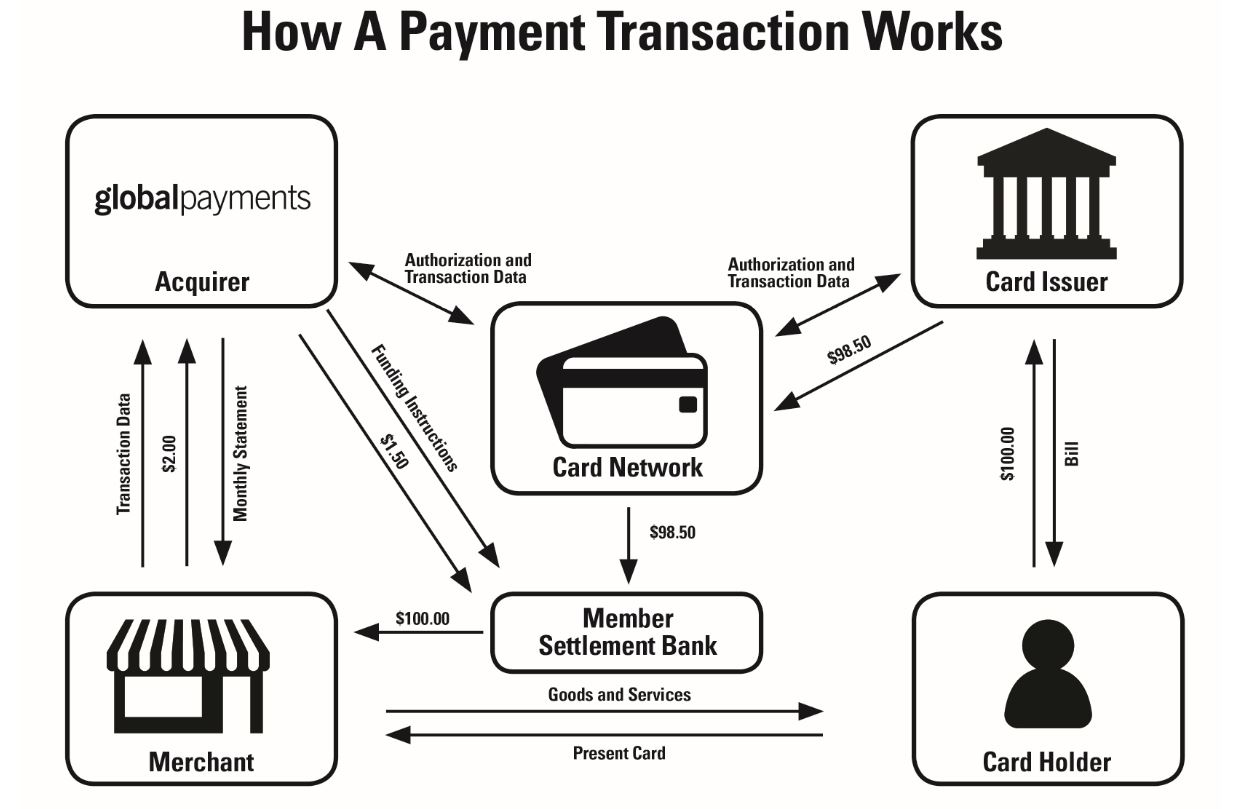
How a Card Transaction Works
A typical payment transaction begins when a cardholder presents a card for payment to a merchant at which time card and transaction information, such as the card identification number, transaction date and transaction amount, is captured and transmitted to our network. The information is captured by a point-of-sale ("POS") terminal card reader or mobile device card reader, which may be sold or leased to the merchant and serviced by us, or through a POS device or ecommerce portal by one of a number of services that we offer directly or through a value-added reseller.
After the card and transaction information is captured, the POS device or ecommerce portal automatically connects to our network through the internet or other communication channel in order to receive authorization of the transaction. For a credit card transaction, authorization services generally refer to the process in which the card issuer indicates whether a particular credit card is authentic and whether the impending transaction amount will cause the cardholder to exceed defined credit limits. In a debit card transaction, we obtain authorization for the transaction from the card issuer through the payment network verifying that the cardholder has access to sufficient funds for the transaction amount.
As an illustration, shown below in the sponsorship model, on a $100.00 card transaction the card issuer may fund the Member, our sponsor, (indirectly through the card network) $98.50 after retaining $1.50 referred to as an interchange fee. The card issuer would seek reimbursement of $100.00 from the cardholder in the cardholder's monthly credit card statement.
The Member would, in turn, pay the merchant $100.00. The net settlement after this transaction would require us to advance the $1.50 interchange fee to the Member. After the end of the month, we would bill the merchant a percentage, also known as the merchant discount, of the transaction amount to cover the full amount of the interchange fee and our fee from the transaction. Assuming the merchant discount in the above example is 2%, we bill the merchant $2.00 after the end of the month for the transaction, reimburse ourselves for $1.50 in interchange fees and retain $0.50 as our fee for the transaction. Under some arrangements, we remit the net amount of $98.00 to the merchant, rather than funding the full $100.00 and subsequently billing the merchant at the end of the month.
Discount rates vary based on negotiations with merchants and the economic characteristics of transactions and take many forms, such as interchange plus our fee or a bundled rate that includes all fees. Interchange rates also vary based on the economic characteristics of individual transactions. Accordingly, our fee per transaction varies across our merchant base and is subject to change based on changes in discount rates and interchange rates. Our profit on a transaction reflects the merchant discount less interchange fees, payment network fees and operating expenses, including systems costs to process the transaction and commissions paid to our sales force or external partner. Payment network fees are charged by the card brands, in part, based on the value of transactions processed through their networks.
Issuer Solutions Segment
Through our Issuer Solutions segment, we provide solutions that enable financial institutions and other financial service providers to manage their card portfolios, reduce technical complexity and overhead and offer a seamless experience for cardholders on a single platform. In addition, we provide flexible commercial payments, accounts payable and electronic payment alternatives solutions that support B2B payment processes for businesses and governments. We also offer complementary services, including account management and servicing, fraud solution services, analytics and business intelligence, cards, statements and correspondence, customer contact solutions and risk management solutions. Additionally, our Issuer Solutions segment provides B2B payment services and other financial service solutions marketed to businesses, including software-as-a-service (“SaaS”) offerings that automate key procurement processes, provide invoice capture, coding and approval, and enable virtual cards and integrated payments options across a variety of key vertical markets.
Issuer Solutions segment revenues are primarily derived from long-term processing contracts with financial institutions and other financial services providers. Payment processing services revenues are generated primarily from charges based on
the number of accounts on file, transactions and authorizations processed, statements generated and/or mailed, managed services, cards embossed and mailed, and other processing services for cardholder accounts on file. Most of these customer contracts have prescribed annual minimums, penalties for early termination, and service level agreements that may affect contractual fees if specified service levels are not achieved. Issuer Solutions segment revenues also include software subscription, licensing fees, loyalty redemption services and professional services.
Industry Overview
The payments technology industry provides financial institutions, businesses and consumers with payment processing services, merchant acceptance solutions and related information and other value-added services. The industry continues to grow as a result of wider merchant acceptance and increased use of credit and debit cards, advances in payment solutions and processing technology and migration to ecommerce, omnichannel and contactless payment solutions. The proliferation of credit and debit cards, as well as other digital payment solutions, has made the acceptance of digital payments a necessity for many businesses, regardless of size, in order to remain competitive. Certain macroeconomic drivers, such as the COVID-19 pandemic, have further accelerated the use of digital payments, the need for development of technologies and digital-based solutions and the expansion of ecommerce, omnichannel and contactless payment solutions. The increased use of cards and the availability of more sophisticated technology services to all market segments have resulted in an increasingly competitive and specialized industry.
Strategy
We seek to leverage the adoption of, and transition to, card and digital-based payments by expanding our share in our existing markets through our distribution channels and service innovation, as well as through acquisitions to improve our offerings and scale. We also seek to enter new markets through acquisitions, alliances and joint ventures in selected markets around the world. We intend to continue to invest in and leverage our technology infrastructure and capabilities to increase our penetration in existing markets.
Consistent with this focus, we continue to operate our business in accordance with the following strategic framework:
•Leading with technology and innovation to deepen our competitive advantages;
•Further scaling the four pillars of our strategy: software-driven focus, ecommerce and omnichannel solutions, exposure to faster growth markets and B2B payments;
•Delivering commerce enablement solutions globally to broaden our leading position as a sales-driven, product-led company;
•Providing frictionless, best-in-class customer experiences, creating longer-term relationships;
•Nurturing our culture, values and diversity, equity and inclusion initiatives to attract, retain and motivate exceptional team members; and
•Supporting our communities as a socially responsible company with purpose and understanding.
Competitive Strengths
We believe that our competitive strengths include the following:
•Technology Solutions - We provide innovative technology-based solutions, including enterprise software and other ecommerce enablement solutions, that enable our customers to operate their businesses more efficiently, increase sales and simplify the payments process, regardless of the channel through which the transaction occurs. We believe our robust technology solutions will continue to differentiate us in the marketplace and position us for continued growth.
•Global Footprint and Distribution - Our worldwide presence allows us to focus our investments on markets with promising gross domestic product fundamentals and favorable secular trends, makes us more attractive to certain customers with international operations and exposes us to emerging innovations that we can adopt globally, while diversifying our economic risk.
•Scalable Operating Environment and Technology Infrastructure - We operate with a multi-channel, global technology infrastructure that provides scalable and innovative service offerings and a consistent service experience to our merchants, customers, financial institutions and other partners worldwide, while also driving sustainable operating efficiencies.
•Strong, Long-lasting Partner Relationships - We have established strong, long-lasting relationships with many financial institutions, enterprise software providers, value-added resellers and other technology-based payment service providers, which enable us to deliver a set of diverse solutions to our customers.
•Disciplined Acquisition Approach - Our proven track record for selectively and successfully sourcing, completing acquisitions and integrating acquired businesses in existing and new markets positions us well for future growth and as an attractive partner for potential acquisition targets.
Competition
In each of our business segments, we compete with a large variety of companies - financial institutions, financial technology companies, traditional payment providers, new market entrants, and others, both large and small. The markets for the services we provide are highly fragmented and competitive. Many of these providers compete with us across our segments, markets and geographies. Some of these competitors possess greater financial, sales and marketing resources than we do. We expect each of our segments to become more competitive over time, as advances in technology enable new entrants, barriers to entry fall and existing providers expand their services, both operationally and geographically.
Our Merchant Solutions segment competes with financial institutions, merchant acquirers and other financial technology companies who provide businesses with merchant acquiring and related services. In the United States, we compete with a large number of providers, including but not limited to Fiserv, Inc. ("Fiserv"), Worldpay, LLC ("Worldpay"), Chase Paymentech Solutions, LLC, Elavon, Inc., a subsidiary of U.S. Bancorp, Bank of America Merchant Services, Wells Fargo Merchant Services, Toast, Inc., Stripe, Inc., Shopify Inc. and Block Inc. While these are our primary competitors in the merchant acquiring space, our vertically focused businesses in the United States compete with numerous other providers in their respective verticals.
Internationally, financial institutions remain the primary providers of payment technology services to merchants, although the outsourcing of these services to third-party service providers is becoming more prevalent. We compete outside the U.S. with financial institutions in the markets in which we operate, as well as both large providers (such as Worldpay, Worldline, Nexi) and new entrants (such as Adyen, Block and Stripe). We have seen competition internationally increase and expect that trend to continue as new companies enter our markets and existing competitors expand or consolidate their product lines and services.
Our Issuer Solutions segment encounters competition from other third-party payment card processors, the card brands, core banking platform providers, independent software vendors, B2B providers, and various other firms that deliver services to payment card issuers in the markets we serve, as well as financial institutions who provide such services in-house. Our competitors in this segment include, but are not limited to Fiserv, FIS, Marqeta, Nexi, Worldline, i2c, Bill.com, AvidExchange, Billtrust, Adyen, Stripe and Zeta. We expect the number of competitors in this segment to continue to expand.
See the section titled “Risk Factors - Risks Related to Our Business Model and Operations” for further information on the competitive and continuously evolving markets we serve.
Safeguarding Our Business
In order to provide our services, we process and store sensitive business information and personal information, which may include credit and debit card numbers, bank account numbers, social security numbers, driver’s license numbers, names and addresses, and other types of personal information or sensitive business information. Some of this information is also processed and stored by financial institutions, merchants and other entities, as well as third-party service providers to whom we outsource certain functions and other agents, which we refer to collectively as our associated third parties. We may have responsibility to the card networks, financial institutions, and in some instances, our merchants, ISOs and/or individuals, for our failure or the failure of our associated third-party service providers (as applicable) to protect this information.
For a further discussion of our approach to cybersecurity, see "Item 1C - Cybersecurity."
Intellectual Property
Our intellectual property is an important part of our strategy to be a leading provider of payment technology and software solutions. We use a combination of internal policies, intellectual property laws and contractual provisions to protect our proprietary technologies and brands. In addition, to protect our various brands, we seek and maintain registration of U.S. and international patents, copyrights, trade secrets, trademarks, service marks and domain names that align with our brand strategy. We also enforce our trademarks against potential sources of misunderstanding that could harm our brand and ability to compete. In addition to using our intellectual property in our own operations, we grant licenses to certain of our customers to use our intellectual property.
Human Capital Management
Team Member Population
We currently do business around the world, with approximately 27,000 team members living and working in 35 countries. As of December 31, 2023, approximately 59% of our workforce resided in the Americas, 19% in Europe and 22% in Asia Pacific. Many of our team members are highly skilled in technical areas specific to payment technology and software solutions.
Our overall workforce strategies are developed and managed by our Chief Human Resources Officer, who reports to our President and CEO. More broadly, the board of directors and the Compensation Committee of our board of directors ("Compensation Committee") provide oversight on certain culture and human management topics, including diversity, equity and inclusion (“DEI”) and succession plans for critical talent. We regularly engage with our team members through a variety of forums, including periodic surveys, to help us understand their perspectives related to workplace culture, engagement, inclusion, talent management and well-being and to inform our human capital strategies and initiatives. The results of these interactions are also leveraged to further develop our talent management initiatives. Moreover, the board of directors also reviews critical feedback and receives updates on management’s plans in response thereto.
Talent Management and Retention
We place an emphasis on attracting and retaining diverse team members and having a workforce that reflects the communities in which we work and live around the world. To that end, we have implemented programs and initiatives focused on enriching new hire experiences, developing team members through extensive training and professional development opportunities, including mentorship and leadership programs, promoting team members’ wellness and safety, and providing flexible work arrangements. Furthermore, we offer comprehensive and competitive pay and benefits packages, including paid parental leave, team member assistance, savings and retirement programs and equity-based awards that vest over a period of time to support retention of key contributors. We also strive to celebrate and recognize the efforts of our team members through a combination of programs, including team appreciation activities and awards programs to honor top performers and notable contributors. Over the past several years, we have also made significant investments in modernizing our operating environments and technologies to include cloud-based systems and collaboration tools that support day-to-day engagement and execution.
Health and Well-being
The success of our business is connected to the well-being of our team members. Accordingly, we are committed to the health, safety and wellness of our team members worldwide, and we provide team members with various health and wellness programs and benefits, including employee education and assistance programs that focus on physical, financial, family, social and emotional resources.
Diversity, Equity and Inclusion
We remain committed to addressing the ever-changing needs of our team members and finding new ways to continuously enhance our culture. Our DEI strategy, led by our Chief Diversity Officer and our Chief Human Resources Officer, reflects the shift in our current workforce, changing business landscape and potential talent and is anchored by three pillars: Leadership Accountability, Inclusive Capability and Engagement. To further engrain our DEI strategy in the organization, we have established various Employee Resource Groups and diversity action teams, led by senior leaders throughout our company. These groups and teams are critical drivers in fostering organizational change, establishing dedicated focus on DEI priorities and managing the DEI program beyond our corporate function. We continue to include social and racial equity in our conversations, and aim to equip and empower our leaders with the right tools and training to lead effectively. Our Compensation Committee assists the board of directors in overseeing the Company’s DEI initiatives.
Employee Growth and Development
Our strategy to develop and retain the best talent includes an emphasis on team member development and training. We provide a variety of training and development opportunities to team members globally, including our online training platform that contains a vast array of tools and application resources for all team members to build learning experiences and skills. In order to help our team members strengthen the skills and behaviors needed for career advancement, our performance management program enables team members to drive their development with a focus on growth, performance, and well-being through regular meetings with their leaders.
Government Regulation
Various aspects of our business are subject to regulation and supervision under federal, state and local laws in the United States and foreign laws, regulations and rules. Many of these regulations and laws are evolving and their applicability and scope, as interpreted by courts and regulators, remain uncertain. These regulations and laws involve a variety of matters, including privacy and information security, data and personal information protection, money-transmission and payment instrument laws and regulations, consumer protection laws, anti-money laundering and anti-corruption laws, tax, environmental sustainability (including climate change) and human rights. In addition, we are subject to rules promulgated by the various payment networks, including Nacha, American Express, Discover, Interac, Mastercard and Visa.
Set forth below is a brief summary of some of the significant laws and regulations that apply to us. These descriptions are not exhaustive, and these laws, regulations and rules frequently change and are increasing in number. We are currently in compliance in all material respects with applicable existing legal and regulatory requirements and do not expect that maintaining compliance with these regulations will have a material effect on our capital expenditures, earnings or competitive and financial positions. For additional information about government regulation and laws applicable to our business and the potential risks associated with future changes in laws or regulations, see "Item 1A - Risk Factors" of this Annual Report on Form 10-K, including the risk factor titled "Legal, Regulatory Compliance and Tax Risks."
Dodd-Frank Act
The Dodd-Frank Wall Street Reform and Consumer Protection Act of 2010 (the "Dodd-Frank Act") restricts the amounts of debit card fees that certain institutions can charge merchants. Pursuant to regulations promulgated by the Federal Reserve Board, debit interchange rates for card issuers with assets of $10 billion or more are capped at $0.21 per transaction and an ad valorem component of 5 basis points to reflect a portion of the issuer's fraud losses plus, for qualifying issuers, an additional $0.01 per transaction in debit interchange for fraud prevention costs.
In addition, the Dodd-Frank Act limits the ability of payment card networks to impose certain restrictions because it allows merchants to: (i) set minimum dollar amounts (not to exceed $10) for the acceptance of a credit card (and allows federal governmental entities and institutions of higher education to set maximum amounts for the acceptance of credit cards) and (ii) provide discounts or incentives to encourage consumers to pay with cash, checks, debit cards or credit cards.
The rules also contain prohibitions on network exclusivity and merchant routing restrictions that require a card issuer to enable at least two unaffiliated networks on each debit card, prohibit card networks from entering into exclusivity arrangements and restrict the ability of issuers or networks to mandate transaction routing requirements. The prohibition on network exclusivity has not significantly affected our ability to pass on network fees and other costs to our customers, nor do we expect it to in the future.
Consumer Protection
The Dodd-Frank Act also created the Consumer Financial Protection Bureau ("CFPB"), which has responsibility for enforcing federal consumer protection laws, and the Financial Stability Oversight Council, which has the authority to determine whether any nonbank financial company, such as us, should be supervised by the Board of Governors of the Federal Reserve System (the "Federal Reserve") on the ground that it is "systemically important" to the U.S. financial system. Accordingly, we may be subject to additional systemic risk-related oversight in the future.
The CFPB has significant authority to regulate consumer financial products in the U.S., including consumer payments, and similar products. The FTC, state attorneys general and similar regulatory agencies in other jurisdictions may have broad consumer protection mandates that could result in the promulgation and interpretation of rules and regulations that may affect our business.
Furthermore, certain of our businesses are regulated as money transmitters or otherwise require licensing in one or more states or jurisdictions, subjecting us to various licensing, supervisory and other requirements.
Financial Institution Regulations
Because we provide digital payment processing services to banks and other financial institutions, we are subject to examination by the Federal Financial Institutions Examination Council (the "FFIEC"), an interagency body comprised primarily of federal banking regulators, and we are also subject to supervision or examination, as may be applicable, by various state and international financial regulatory agencies that supervise and regulate the financial institutions for which we provide digital payment processing and other payment related services. The FFIEC examines large data processors in order to identify and mitigate risks associated with systemically significant service providers, including specifically the risks they may pose to the banking industry.
Certain of our subsidiaries hold payment institution ("PI") licenses. These subsidiaries are subject to regulation and oversight in the jurisdictions in which they operate. As a result of the acquisition of EVO, we have added PI licenses in Poland, Greece and Germany, in addition to those previously held in Spain, Malta and the Czech Republic as well as similar licenses in the United Kingdom. As a PI, each subsidiary is subject to regulation and oversight in the applicable jurisdiction, which includes, among other obligations, a requirement to maintain specific regulatory capital and adhere to certain rules regarding the conduct and operation of their business, including the revised Payment Services Directive 2 and the forthcoming requirements under the Digital Operational Resilience Act and reporting obligations in respect of Central Electronic System of Payment Information.
Privacy, Information Security and Other Business Practices Regulation
Aspects of our business are subject, directly or indirectly, to privacy and data protection regulations in the United States, the United Kingdom, the European Union ("EU") and elsewhere. In most of the countries in which we operate, these laws impose requirements on the manner in which personal information can be collected, processed, stored and shared. They also impose requirements, which vary materially by jurisdiction, in the event of a personal data breach.
Compliance with the data protection regulations applicable to us or our customers requires increasing resources devoted to monitoring changes and developing solutions for our affected businesses. Maintaining compliance over time could require substantive technology infrastructure and process changes across many of the Company’s businesses. Noncompliance with the EU General Data Protection Regulation (“GDPR”), the Gramm-Leach-Bliley Act ("GLBA"), the California Privacy Rights Act, the U.S. Health Insurance Portability and Accountability Act of 1996 or similar regulations could lead to substantial regulatory fines and penalties, or in some cases, damages resulting from private causes of action. Evolving data localization requirements may affect how we provide services to customers in regions like the EU and Asia-Pacific. Additionally, evolving sector-specific regulations that affect the payments industry may introduce overlap or conflict with data privacy regulations, and these conflicts in regulatory requirements may affect our operations.
We also rely upon third parties to facilitate or enable our business activities and require that they are similarly in compliance with applicable regulations. Such third parties include suppliers and other partners.
New regulations (including the EU Artificial Intelligence Regulation and new state laws in the United States or a possible federal privacy law) and new interpretations of existing regulations, such as the Federal Trade Commission ("FTC") Act, GLBA, and the GDPR, could create new privacy rights for individuals and new obligations for companies handling personal information. These regulations could limit our ability to use and share personal or other data and increase costs related to compliance. In addition, emerging technologies including innovations in machine learning and artificial intelligence are expected to continue to drive regulation targeted to the specific risks anticipated from these technologies.
As our portfolio of services evolves, we may offer more services outside of our traditional business-to-business interaction context. As we interact directly with consumers, in conjunction with our existing customers and partners or directly on our own behalf, our compliance obligations under privacy regulations may expand.
Anti-Money Laundering, Anti-Corruption and Sanctions Regulations
In many countries, we are legally or contractually required to comply with the anti-money laundering laws and regulations, such as, in the United States, the Bank Secrecy Act, as amended by the USA PATRIOT Act, and similar laws of
other countries, which require that customer identifying information be obtained and verified. In some countries, we are directly subject to these requirements; in other countries, we have contractually agreed to assist our sponsor financial institutions with their obligation to comply with anti-money laundering requirements that apply to them. In addition, we and our sponsor financial institutions are subject to the laws and regulations, enforced by the Office of Foreign Assets Control, that prohibit U.S. persons from engaging in transactions with certain prohibited persons or entities. Similar requirements apply in other countries. We have developed procedures and controls that are designed to monitor and address legal and regulatory requirements and developments and that allow our customers to protect against having direct business dealings with such prohibited countries, individuals or entities.
We are subject to anti-corruption laws and regulations, including the U.S. Foreign Corrupt Practices Act (“FCPA”) and similar laws outside of the U.S., such as the U.K. Bribery Act, that prohibit the making or offering of improper payments to foreign government officials and political figures. The FCPA has a broad reach and requires maintenance of appropriate records and adequate internal controls to prevent and detect possible FCPA violations.
State Wage Payment Laws and Regulations
The use of payroll card programs as a means for an employer to remit wages or other compensation to its employees or independent contractors is governed by state labor laws related to wage payments, which laws are subject to change. The paycard portion of our business includes payroll cards and convenience checks and is designed to allow employers to comply with applicable state wage and hour laws. Most states permit the use of payroll cards as a method of paying wages to employees, either through statutory provisions allowing such use or, in the absence of specific statutory guidance, the adoption by state labor departments of formal or informal policies allowing for their use. Nearly every state allowing payroll cards places certain requirements and/or restrictions on their use as a wage payment method, the most common of which involve obtaining the prior written consent of the employee or independent contractors, limitations on fees and disclosure requirements.
Recently, some states have begun to regulate earned wage access products, including, for example by enacting new laws requiring licensure of earned wage access providers and/or requiring fee restrictions on the products, or by including earned wage access products in existing lending laws, which could also result in licensure requirements and/or fee limitations. States could also potentially regulate these products under existing wage and hour laws related to the assignment of wages. We may be subject to additional requirements and limitations under federal or state lending laws as a result of new interpretations, formal guidance or additional regulations relating to earned wage access products.
Escheat Laws
We are subject to unclaimed or abandoned property state laws in the United States and in certain foreign countries that require us to transfer to certain government authorities the unclaimed property of others that we hold when that property has been unclaimed for a certain period of time. Moreover, we are subject to audit by state and foreign regulatory authorities with regard to our escheatment practices.
Debt Collection and Credit Reporting Laws
Portions of our business may be subject to the Fair Debt Collection Practices Act, the Fair Credit Reporting Act ("FCRA") and similar state laws. These debt collection laws are designed to eliminate abusive, deceptive and unfair debt collection practices and may require licensing at the state level. The FCRA regulates the use and reporting of consumer credit information and also imposes disclosure requirements on entities that take adverse action based on information obtained from credit reporting agencies.
Telephone Consumer Protection Act
We are subject to the Telephone Consumer Protection Act ("TCPA") and various state laws to the extent we place telephone calls and short message service ("SMS") messages to customers and consumers. The TCPA regulates certain telephone calls and SMS messages placed using automatic telephone dialing systems or artificial or prerecorded voices.
Other
In addition, there are other laws, rules or regulations that may directly affect us or the activities of our merchant customers and in some cases may subject us to investigations, fees, fines and disgorgement of funds in the event we are deemed to have aided and abetted or otherwise provided the means and instrumentalities to facilitate the illegal activities of a merchant through our payment processing services.
Sustainability
Certain governments around the world are adopting laws and regulations pertaining to sustainability performance, transparency and reporting. Regulators in Europe and the U.S. have also focused efforts on increased disclosure related to climate change and mitigation efforts. The EU recently adopted the European Sustainability Reporting Standards and the Corporate Sustainability Reporting Directive that will impose disclosure of the risks and opportunities arising from social and environmental issues, and on the effect of companies’ activities on people and the environment. In October 2023, California adopted new carbon and climate-related reporting requirements for large public and private companies doing business in the state. Further, the SEC has included in its regulatory agenda potential rulemaking on climate change disclosures that, if adopted, could significantly increase compliance burdens and associated regulatory costs and complexity. International sustainability disclosure standards have also been produced (and further standards will be produced) under the auspices of the International Sustainability Standards Board, which some countries (such as the United Kingdom) have indicated they may incorporate into sustainability disclosure standards required of certain companies
We are monitoring proposed and pending climate legislation for effect and are also working to continually ensure that our sustainability agenda is integrated into our overall business strategy. As part of our annual sustainability reporting, we provide additional information about our approach to sustainability matters in our Global Responsibility Report (which is not incorporated herein), which is available in the investor relations section of our website at www.globalpayments.com.
Where to Find More Information
We file annual and quarterly reports, proxy statements and other information with the SEC. You may read and print materials that we have filed with the SEC from its website at www.sec.gov. In addition, certain of our SEC filings, including our annual reports on Form 10-K, our quarterly reports on Form 10-Q, our current reports on Form 8-K and amendments to them can be viewed and printed, free of charge, from the investor relations section of our website at www.globalpaymentsinc.com as soon as reasonably practicable after such material is electronically filed with or furnished to the SEC.
Certain materials relating to our corporate governance, including our codes of ethics applicable to our directors, senior financial officers and other employees, and our Global Responsibility Report are also available in the investor relations section of our website. Copies of our filings, specified exhibits and corporate governance materials are also available, free of charge, by writing us using the address on the cover of this Annual Report on Form 10-K. You may also telephone our investor relations office directly at (770) 829-8478. We are not including the information on our website as a part of, or incorporating it by reference into, this Annual Report on Form 10-K.
ITEM 1A - RISK FACTORS
An investment in our common stock involves a high degree of risk. You should consider carefully the following risks and other information contained in this Annual Report on Form 10-K and other SEC filings before you decide whether to buy our common stock. The risks identified below are not all encompassing but should be considered in establishing an opinion of our future operations. If any of the events or conditions contemplated by the following discussion of risks should occur, our business, financial condition, liquidity, results of operations and/or cash flows could suffer significantly.
Risks Factors Summary
The following is a summary of the principal risks that could materially and adversely affect our business, financial condition, liquidity, results of operations and/or cash flows.
Risks Related to Our Business Model and Operations
•Our inability to protect our systems and data from continually evolving cybersecurity threats or other technological risks could adversely affect our ability to deliver our services; damage our reputation among our customers, card issuers, financial institutions, card networks, partners and cardholders; adversely affect our continued card network registration or membership and financial institution sponsorship; and expose us to penalties, fines, liabilities, legal claims and defense costs.
•Software and hardware defects, failures, undetected errors, and development delays could affect our ability to deliver our services, damage customer relations, expose us to liability and have an adverse effect on our business, financial condition and results of operations.
•Our systems or our third-party providers' systems may fail, which could interrupt our service, cause us to lose business, increase our costs and expose us to liability.
•The payments technology industry is highly competitive and highly innovative, and some of our competitors have greater financial and operational resources than we do, which may give them an advantage with respect to the pricing of services offered to customers and the ability to develop new and disruptive technologies.
•In order to remain competitive and to continue to increase our revenues and earnings, we must continually and quickly update our services, a process that could result in higher costs and the loss of revenues, earnings and customers if the new services do not perform as intended or are not accepted in the marketplace.
•Our revenues from the sale of services to merchants that accept Visa and Mastercard are dependent upon our continued Visa and Mastercard registrations, financial institution sponsorship and, in some cases, continued membership in certain card networks.
•We rely on various financial institutions to provide clearing services in connection with our settlement activities. If we are unable to maintain clearing services with these financial institutions and are unable to find a replacement, our business may be adversely affected.
•Increased merchant, referral partner, ISO or payment facilitator attrition could cause our financial results to decline.
•Our future growth depends in part on the continued expansion within markets in which we already operate, the emergence of new markets, and the continued availability of alliance relationships and strategic acquisition opportunities.
•There may be a decline in the use of cards and other digital payments as a payment mechanism for consumers or other adverse developments with respect to the card industry in general.
•Consolidation among financial institutions or among retail customers, including the merger of our customers with entities that are not our customers or the sale of portfolios by our customers to entities that are not our customers, could affect our financial condition, results of operations and cash flows.
•If we do not renew or renegotiate our agreements on favorable terms with our customers within the Issuer Solutions segment, our business will suffer. The timing of the conversions or deconversions of card portfolios could also affect our revenues and expenses.
•We incur chargeback losses when our merchants refuse or cannot reimburse us for chargebacks resolved in favor of their customers. Any increase in chargebacks not paid by our merchants could adversely affect our business, financial condition, results of operations and cash flows.
•Fraud by merchants or others and losses from overdrawn cardholder accounts could have an adverse effect on our financial condition, results of operations and cash flows.
•Increases in card network fees may result in the loss of customers and/or a reduction in our earnings.
•The integration and conversion of our acquired operations or other future acquisitions, if any, could result in increased operating costs if the anticipated synergies of operating these businesses as one are not achieved, a loss of strategic opportunities if management is distracted by the integration process, and a loss of customers if our service levels drop during or following the integration process.
•Our inability to complete certain divestitures or the effects of divesting a business could have a material adverse effect on our business and financial results.
Legal, Regulatory Compliance and Tax Risks
•Our business is subject to government regulation and oversight. Any new implementation of or changes made to laws, regulations or other industry standards affecting our business in any of the geographic regions in which we operate may require significant development and compliance efforts or have an unfavorable effect on our ability to continue to offer certain services, or on our financial results and our cash flows.
•New or revised tax regulations, unfavorable resolution of tax contingencies or changes to enacted tax rates could adversely affect our tax expense.
•Our risk management policies and procedures may not be fully effective in mitigating our risk exposure in all market environments or against all types of risk.
Financial Risks
•We are subject to risks associated with changes in interest rates or currency exchange rates, which could adversely affect our business, financial condition, results of operations and cash flows, and we may not effectively hedge against these risks.
•A downgrade in the ratings of our debt could restrict our ability to access the debt capital markets and increase our interest costs.
•Failure to maintain effective internal controls in accordance with Section 404 of the Sarbanes-Oxley Act could have a material adverse effect on our business.
Intellectual Property Risks
•We may not be able to successfully manage our intellectual property and may be subject to infringement claims.
Risks Related to Our Capital Structure
•Our substantial indebtedness could adversely affect us and limit our business flexibility.
•We may not be able to raise additional funds to finance our future capital needs.
•Our balance sheet includes significant amounts of goodwill and other intangible assets. The impairment of a portion of these assets could negatively affect our business, financial condition and results of operations.
•We may not be able to, or we may decide not to, pay dividends or repurchase shares at a level anticipated by our shareholders, which could reduce shareholder returns.
Risks Related to General Economic Conditions
•We are subject to economic and geopolitical risk, health and social events or conditions, the business cycles and credit risk of our customers and the overall level of consumer, business and government spending, which could negatively affect our business, financial condition, results of operations and cash flows.
General Risk Factors
•If we lose key personnel or are unable to attract and hire additional qualified personnel as we grow, our business could be adversely affected.
•The costs and effects of pending and future litigation, investigations or similar matters, or adverse facts and developments related thereto, could materially affect our business, financial condition, results of operations and cash flows.
Risks Related to Our Business Model and Operations
Our inability to protect our systems and data from continually evolving cybersecurity threats or other technological risks could adversely affect our ability to deliver our services; damage our reputation among our customers, card issuers, financial institutions, card networks, partners and cardholders; adversely affect our continued card network registration or membership and financial institution sponsorship; and expose us to penalties, fines, liabilities, legal claims and defense costs.
In order to provide our services, we process and store sensitive business and personal information, which may include credit and debit card numbers, bank account numbers, social security numbers, driver’s license numbers, names and addresses, and other types of personal information or sensitive business information. Some of this information is also processed and stored by financial institutions, merchants and other entities, as well as third-party service providers to whom we outsource certain functions and other agents, such as independent consultants and auditors, which we refer to collectively as our associated third parties. We may have responsibility to the card networks, financial institutions, regulators, and in some instances, our merchants, ISOs and/or individuals, for our failure or the failure of our associated third parties (as applicable) to protect this information.
We are a regular target of malicious third-party attempts to identify and exploit system vulnerabilities, and/or penetrate or bypass our security measures, in order to gain unauthorized access to our networks and systems or those of our associated third parties. Such attempts at unauthorized access can lead, and occasionally have led, to the compromise of sensitive, business, personal or confidential information. To mitigate these risks, we follow a defense-in-depth model for cybersecurity, meaning we proactively seek to employ multiple methods at different layers to defend our systems against intrusion and attack and to protect the data we possess. We have adopted policies and procedures, involving an incident response plan and both the board of directors and management oversight of cybersecurity risks, that we believe are designed to facilitate the identification, assessment and management of those risks including any risks that have the potential to be material. Our information security program establishes technical, physical and administrative controls to maintain the confidentiality, integrity and availability of our information and technical assets. However, we cannot provide any assurance that these cybersecurity risk management processes will be fully complied with or effective and we cannot be certain that these measures or other will always be successful or will always be sufficient to counter, or to rapidly detect, contain, and remediate, all current and emerging technology threats.
More particularly, our computer systems and/or our associated third parties’ computer systems have been, and we expect will continue to be, targeted for penetration on a regular basis, and our data protection measures may not prevent unauthorized access. The techniques used to obtain unauthorized access, disable or degrade service or sabotage systems change frequently, are often difficult to detect and continually evolve and become more sophisticated. Threats to our systems and our associated third parties’ systems can derive from human error, fraud or malice on the part of employees or third parties, including state-sponsored organizations with significant financial and technological resources. In addition, we have experienced and may continue to experience errors, interruptions or delays from computer viruses and other malware or vulnerabilities that could infect our systems or those of our associated third parties. Denial of service, ransomware or other attacks could be launched against us for a variety of purposes, including to interfere with our services or create a diversion for other malicious activities. Our defensive measures may not prevent downtime, unauthorized access or use of sensitive data. We have experienced such incidents in the past, and we cannot guarantee that we will be able to anticipate or detect all attacks or vulnerabilities or implement adequate preventative measures in the future. While we maintain first- and third-party insurance coverage that may cover certain aspects of cyber risks, such insurance coverage may be insufficient to cover all losses. Companies we acquire may require implementation of additional cyber defense methods to align with our standards and, as a result, there may be a period
of heightened risk between the acquisition date and the completion of such implementation. Furthermore, certain of our third-party relationships are subject to our vendor management program and are governed by written contracts. We believe we have designed our risk identification, assessment, and management processes and procedures to account for cybersecurity risks associated with our use of third-party service providers; however, we do not control the actions of our associated third parties, and any problems experienced by these third parties, including those resulting from breakdowns or other disruptions in the services provided by such parties or cyberattacks, targeted attacks against our employees and associated third parties and security breaches, could adversely affect our ability to service our customers or otherwise conduct our business.
In addition, we impose contractual requirements on our counterparties, including vendors and other third parties, related to the use and security of personal data and other confidential information, along with compliance with applicable privacy and security laws. We cannot provide any assurance that these contractual requirements related to those who have access to this data will be followed or will be adequate to prevent the misuse of this data. We have occasionally received notifications from vendors and other third parties regarding the exposure of or unauthorized access to our data stored on their information systems, and any future misuse or compromise of personal information stored on those systems, or any other failure by a vendor or other third party to abide by our contractual requirements, could expose us to regulatory fines, third-party liability, protracted and costly litigation and, with respect to misuse of the personal information of our customers, lost revenue and reputational harm.
Any type of security breach, attack or misuse of data described above or otherwise, whether experienced by us or an associated vendor or other third party, could harm our reputation; deter existing and prospective customers from using our services or from making digital payments generally; increase our operating expenses in order to contain and remediate the incident; expose us to unanticipated or uninsured liability; disrupt our operations (including potential service interruptions); distract our management; increase our risk of litigation or regulatory scrutiny; result in the imposition of penalties and fines under state, federal and foreign laws or by the card networks; and adversely affect our continued card network registration or membership and financial institution sponsorship. Removal from the networks' lists of Payment Card Industry Data Security Standard compliant service providers could mean that existing customers, sales partners or other third parties could cease using or referring others to our services. Also, prospective merchant customers, financial institutions, sales partners or other third parties could choose to terminate negotiations with us, or delay or choose not to consider us for their processing needs. In addition, the card networks could refuse to allow us to process through their networks. Any of the foregoing could adversely affect our business, financial condition or results of operation.
Software and hardware defects, failures, undetected errors, and development delays could affect our ability to deliver our services, damage customer relations, expose us to liability and have an adverse effect on our business, financial condition and results of operations.
Our core services are based on software and computing systems that may encounter development delays, and the underlying software may contain undetected errors, viruses, defects or vulnerabilities. The hardware infrastructure on which our systems run may have a faulty component or fail. Defects in our software services, underlying hardware, or errors or delays in our processing of digital transactions could result in additional development costs, diversion of technical and other resources from our other development efforts, and could result in loss of credibility with current or potential customers, harm to our reputation and exposure to liability claims.
In instances in which we rely on third-party software, our services are occasionally affected by defects, viruses, vulnerabilities, security incidents or other failures that take place at the vendor level. Depending on the circumstances, a vendor failure could cause delays, disruption or data loss or damage, and therefore cause harm to our credibility, reputation or financial condition. In addition, our insurance may not be adequate to compensate us for all losses or failures that may occur.
Our systems or our third-party providers' systems may fail, which could interrupt our service, cause us to lose business, increase our costs and expose us to liability.
We depend on the efficient and uninterrupted operation of our computer systems, software, data centers and telecommunications networks, as well as the systems and services of third parties. A system outage or data loss could have a material adverse effect on our business, financial condition, results of operations and cash flows. Not only could we suffer damage to our reputation in the event of a system outage or data loss, but we could also be liable to third parties. Many of our contractual agreements with financial institutions and certain other customers require the payment of penalties if we do not meet certain operating standards. Our systems and operations or those of our third-party providers could be exposed to damage or interruption from, among other things, fire; climate-related events, including extreme weather events; natural disasters; pandemics; power loss; telecommunications failure; terrorist acts; war; unauthorized entry; malicious attack; human error; hardware failure; and computer viruses or other defects. We have been and continue to be exposed to defects in our systems or those of third parties, errors or delays in the processing of payment transactions, telecommunications failures, or other difficulties (including those related to system relocation), which could result in loss of revenues, loss of customers, loss of
merchant and cardholder data, harm to our business or reputation, exposure to fraud losses or other liabilities, negative publicity, additional operating and development costs, litigation expenses, fines and other sanctions imposed by card networks or regulators, and/or diversion of technical and other resources. There is also a risk that third-party suppliers of hardware and infrastructure required to support our employee productivity or our suppliers could be affected by supply chain disruptions, such as manufacturing and shipping delays. An extended supply chain disruption could also affect the delivery of our services.
The payments technology industry is highly competitive and highly innovative, and some of our competitors have greater financial and operational resources than we do, which may give them an advantage with respect to the pricing of services offered to customers and the ability to develop new and disruptive technologies.
We operate in the payments technology industry, which is highly competitive and highly innovative. In this industry, our primary competitors include other independent payment processors, credit card processing firms, third-party card processing software institutions, as well as financial institutions, ISOs, payment facilitators, prepaid programs managers and, potentially, card networks. Some of our current and potential competitors may be larger than we are and have greater financial and operational resources or brand recognition than we have. Our competitors that are financial institutions or subsidiaries of financial institutions do not incur the costs associated with being sponsored by a direct member for participation in the card networks, as we do in certain jurisdictions, and may be able to settle transactions more quickly for merchants than we can. These financial institutions may also provide payment processing services to merchants at lower margins or at a loss in order to generate banking fees from the merchants. It is also possible that larger financial institutions, including some who are customers of ours, could decide to perform in-house some or all of the services that we currently provide or could provide. These attributes may provide them with a competitive advantage in the market.
Furthermore, we are facing increasing competition from nontraditional competitors, including new entrant technology companies, who offer certain innovations in payment methods. Some of these competitors utilize proprietary software and service solutions. Some of these nontraditional competitors have significant financial resources and robust networks and are highly regarded by consumers. In addition, some nontraditional competitors, such as private companies or startup companies, may be less risk averse than we are and, therefore, may be able to respond more quickly to market demands. These competitors may compete in ways that minimize or remove the role of traditional card networks, acquirers, issuers and processors in the digital payments process. If these nontraditional competitors gain a greater share of total digital payments transactions, it could have an adverse effect on our business, financial condition, results of operations and cash flows.
In order to remain competitive and to continue to increase our revenues and earnings, we must continually and quickly update our services, a process that could result in higher costs and the loss of revenues, earnings and customers if the new services do not perform as intended or are not accepted in the marketplace.
The payments technology industry in which we compete is characterized by rapid technological change, new product introductions, evolving industry standards and changing customer needs. In order to remain competitive, we are continually involved in a number of projects, including the development of new platforms, products, mobile payment applications, ecommerce services and other new offerings emerging in the payments technology industry. These projects carry the risks associated with any development effort, including cost overruns, delays in delivery and performance problems, which could in turn lead to impairment of long-lived assets associated with projects. In the payments technology markets, these risks are even more acute. Any delay in the delivery of new services or the failure to differentiate our services could render our services less desirable to customers, or possibly even obsolete. Furthermore, as the market for alternative payment processing services evolves, it may develop too rapidly or not rapidly enough for us to recover the costs we have incurred in developing new services targeted at this market.
In addition, certain of the services we deliver to the payments technology market are designed to process very complex transactions and deliver reports and other information on those transactions, all at very high volumes and processing speeds. Any failure to deliver an effective, accurate, compliant and secure product or any performance issue that arises with a new product or service could result in significant processing or reporting errors or other losses. We rely in part on third parties, including some of our competitors and potential competitors, for the development of and access to new technologies. If development efforts are required or if promised new services are not delivered timely to our customers or do not perform as anticipated, we could incur higher costs, a loss of revenues and lower earnings and cash flows.
Our revenues from the sale of services to merchants that accept Visa and Mastercard are dependent upon our continued Visa and Mastercard registrations, financial institution sponsorship and, in some cases, continued membership in certain card networks.
In order to provide our Visa and Mastercard transaction processing services, we must be either a direct member or registered as a merchant processor or service provider of Visa and Mastercard, respectively. Registration as a merchant processor or service provider is dependent upon our being sponsored by Members of each organization in certain jurisdictions. If our sponsor financial institution in any market should stop providing sponsorship for us, we would need to find another financial institution to provide those services or we would need to attain direct membership with the card networks, either of which could prove to be difficult and expensive. Relatedly, transitioning to a new sponsor financial institution requires technical development work, which takes time. If we were unable to find a replacement financial institution to provide sponsorship or attain direct membership or unable to transition to a new sponsor financial institution in a timely manner, we may no longer be able to provide processing services to affected customers and potential customers in that market, which would negatively affect our revenues, earnings and cash flows. Furthermore, some agreements with our financial institution sponsors give them substantial discretion in approving certain aspects of our business practices, including our solicitation, application and qualification procedures for merchants and the terms of our agreements with merchants. Our sponsors' discretionary actions under these agreements could have a material adverse effect on our business, financial condition and results of operations. In connection with direct membership, the rules and regulations of various card associations and networks prescribe certain capital requirements. Any increase in the capital level required would limit our use of capital for other purposes.
The termination of our registration, or any changes in the rules of Visa or Mastercard or any other network that would impair our registration or prevent us from providing services to our customers, could require us to stop providing payment processing services or prevent us from successfully submitting transactions to such network, which would make it impossible for us to conduct our business on its current scale. The rules of the card networks may be influenced by card issuers, and some of those issuers also provide acquiring services and may be our competitors. If we fail to comply with the applicable requirements of the card networks, the card networks could seek to fine us, suspend us or terminate our registrations or membership. The termination of our registrations or our membership or our status as a service provider or a merchant processor, or any changes in card association or other network rules or standards, including interpretation and implementation of the rules or standards, that increase the cost of doing business or limit our ability to provide transaction processing services to our customers, could have a material adverse effect on our business, financial condition, results of operations and cash flows. If a merchant fails to comply with the applicable requirements of the card associations and networks, we, the merchant or, in some cases the ISO, could be subject to a variety of fines or penalties that may be levied by the card associations or networks. If we cannot collect or pursue collection of such amounts from the applicable merchant or, in some cases the ISO, we may have to bear the cost of such fines or penalties, resulting in lower earnings for us.
We rely on various financial institutions to provide clearing services in connection with our settlement activities. If we are unable to maintain clearing services with these financial institutions and are unable to find a replacement, our business may be adversely affected.
We rely on various financial institutions to provide clearing services in connection with our settlement activities. If such financial institutions should stop providing clearing services, we would have to find other financial institutions to provide those services. If we were unable to find a replacement financial institution we may no longer be able to provide processing services to certain customers, which could negatively affect our financial condition, results of operations and cash flows.
Increased merchant, referral partner, ISO or payment facilitator attrition could cause our financial results to decline.
We experience attrition in merchant credit and debit card processing volume resulting from several factors, including merchant closures, loss of merchant accounts to our competitors, unsuccessful contract renewal negotiations and account closures that we initiate for various reasons, such as heightened credit risks or contract breaches by merchants. Our referral partners are a significant source of new business. If a referral partner switches to another transaction processor, terminates our services, internalizes payment processing functions that we perform, merges with or is acquired by one of our competitors, or shuts down or becomes insolvent, we may no longer receive new merchant referrals from such referral partner, and we risk losing existing merchants that were originally enrolled by the referral partner. We cannot predict the level of attrition in the future and it could increase. Higher than expected attrition could negatively affect our results, which could have a material adverse effect on our business, financial condition, results of operations and cash flows.
Our future growth depends in part on the continued expansion within markets in which we already operate, the emergence of new markets, and the continued availability of alliance relationships and strategic acquisition opportunities.
Our future growth and profitability depend upon our continued expansion within the markets in which we currently operate, the further expansion of these markets, the emergence of other markets for payment technology and software solutions and our ability to penetrate these markets. As part of our strategy to achieve this expansion, we look for acquisition opportunities, investments and alliance relationships with other businesses, including referral partners, ISOs and other financial institutions, that will allow us to increase our market penetration, technological capabilities, product offerings and distribution capabilities. We may not be able to successfully identify suitable acquisition, investment and alliance candidates in the future, and if we do, they may not provide us with the value and benefits we anticipate, which may inhibit our growth prospects and adversely affect our business, financial condition and results of operations.
Our expansion into new markets is also dependent upon our ability to apply our existing technology or to develop new applications to meet the particular service needs of each new market. We may not have adequate financial or technological resources to develop effective and secure services and distribution channels that will satisfy the demands of these new markets. If we fail to expand into new and existing markets for payment technology and software solutions, we may not be able to continue to grow our revenues and earnings.
Our ability to acquire other businesses or technologies, make strategic investments or integrate acquired businesses effectively may also be impaired by a variety of factors including adverse financial conditions, trade tensions and increased global scrutiny of foreign investments. A number of countries, including the U.S. and countries in Europe and the Asia-Pacific region, are considering or have adopted restrictions on foreign investments. Governments may continue to adopt or tighten economic sanctions, tariffs or trade restrictions of this nature, and such restrictions could negatively affect our business and financial results.
Furthermore, our future success will depend, in part, upon our ability to manage our expanded business, which could pose substantial challenges for our management, including challenges related to the management and monitoring of new operations and associated costs and complexity. We may also face increased scrutiny from governmental authorities if we become a larger business.
There may be a decline in the use of cards and other digital payments as a payment mechanism for consumers or other adverse developments with respect to the card industry in general.
If consumers do not continue to use credit, debit or other digital payment methods of the type we process as a payment mechanism for their transactions or if there is a change in the mix of payments between cash, checks, credit cards and debit cards, that is adverse to us, it could have a material adverse effect on our business, financial condition, results of operations and cash flows. Consumer credit risk may make it more difficult or expensive for consumers to gain access to credit facilities such as credit cards. Regulatory changes may result in financial institutions seeking to charge their customers additional fees for use of credit or debit cards. Such fees may result in decreased use of credit or debit cards by cardholders. In each case, our business, financial condition, results of operations and cash flows could be adversely affected.
Consolidation among financial institutions or among retail customers, including the merger of our customers with entities that are not our customers or the sale of portfolios by our customers to entities that are not our customers, could materially affect our financial condition, results of operations and cash flows.
Consolidation among financial institutions, particularly in the area of credit card operations, and consolidation in the retail industry, is a risk that could negatively affect our existing customer agreements and future revenues. In addition, consolidation among financial institutions has led to an increasingly concentrated customer base, which results in a changing mix toward larger customers. Continued consolidation among financial institutions could increase the bargaining power of our current and future customers and further increase our customer concentration. Consolidation among financial institutions and retail customers and the resulting loss of any significant number of customers by us could have a material adverse effect on our financial condition, results of operations and cash flows.
If we do not renew or renegotiate our agreements on favorable terms with our customers within the Issuer Solutions segment, our business will suffer. The timing of the conversions or deconversions of card portfolios could also affect our revenues and expenses.
A significant amount of our Issuer Solutions segment revenues is derived from long-term contracts with large financial institutions and other financial service providers. The financial position of these customers and their willingness to pay for our
services are affected by general market conditions, competitive pressures and operating margins within their industries. When our long-term contracts near expiration, the renewal or renegotiation of the contract presents our customers with the opportunity to consider other providers, transition all or a portion of the services we provide in-house or seek lower rates for our services. Additionally, as we modernize the technology platform we use to deliver services, some Issuer Solutions customers may not be agreeable to our modernization effort and may choose to end their contracts prematurely, or not renew their contracts as a result. The loss of our contracts with existing customers or renegotiation of contracts at reduced rates or with fewer services could have a material adverse effect on our financial condition, results of operations and cash flows.
In addition, the timing of the conversion of card portfolios of new payment processing customers to our processing systems and the deconversion of existing customers to other systems could affect our revenues and expenses. Due to a variety of factors, conversions and deconversions may not occur as scheduled, and this may have a material adverse effect on our financial condition, results of operations and cash flows.
We incur chargeback losses when our merchants refuse or cannot reimburse us for chargebacks resolved in favor of their customers. Any increase in chargebacks not paid by our merchants could adversely affect our business, financial condition, results of operations and cash flows.
In the event a dispute between a cardholder and a merchant is not resolved in favor of the merchant, the transaction is normally charged back to the merchant and the purchase price is credited or otherwise refunded to the cardholder. If we are unable to collect such amounts from the merchant's account or reserve account (if applicable), or if the merchant refuses or is unable, due to closure, bankruptcy or other reasons, to reimburse us for a chargeback, we may bear the loss for the amount of the refund paid to the cardholder. The risk of chargebacks is typically greater with those merchants that promise future delivery of goods and services rather than delivering goods or rendering services at the time of payment. We may experience significant losses from chargebacks in the future. Any increase in chargebacks not paid by our merchants could have a material adverse effect on our business, financial condition, results of operations and cash flows. We have policies to manage merchant-related credit risk and attempt to mitigate such risk by requiring collateral and monitoring transaction activity. Notwithstanding our programs and policies for managing credit risk, it is possible that a default on such obligations by one or more of our merchants could have a material adverse effect on our business.
Fraud by merchants or others and losses from overdrawn cardholder accounts could have an adverse effect on our financial condition, results of operations and cash flows.
We have potential liability for fraudulent digital payment transactions or credits initiated by merchants or others. Criminals are using increasingly sophisticated methods to engage in illegal activities such as counterfeiting and fraud. Failure to effectively manage risk and prevent fraud could increase our chargeback losses or cause us to incur other liabilities. It is possible that incidents of fraud could increase in the future. Increases in chargebacks or other liabilities could have a material adverse effect on our financial condition, results of operations and cash flows.
The accompanying consolidated financial statements reflect management’s estimates and assumptions related to allowances for transaction and credit losses utilizing the most currently available information. Actual losses could differ materially from those estimates.
Increases in card network fees may result in the loss of customers and/or a reduction in our earnings.
From time-to-time, the card networks, including Visa and Mastercard, increase the fees that they charge processors. We often pass these increases along to our merchant customers; however, if merchants do not accept these increases, this strategy might result in the loss of customers to our competitors, thereby reducing our revenues and earnings. If competitive practices prevent us from passing along the higher fees to our merchant customers in the future, we may have to absorb all or a portion of such increases, thereby reducing our earnings.
The integration and conversion of our acquired operations or other future acquisitions, if any, could result in increased operating costs if the anticipated synergies of operating these businesses as one are not achieved, a loss of strategic opportunities if management is distracted by the integration process, and a loss of customers if our service levels drop during or following the integration process.
The acquisition, integration, and conversion of businesses and the formation or operation of alliances or joint ventures and other partnering arrangements involve a number of risks. Core risks are in the area of valuation (negotiating a fair price for the business based on sometimes limited diligence) and integration and conversion (managing the complex process of integrating
the acquired company's people, services, information security and technology and other assets to realize the projected value of the acquired company and the synergies projected to be realized in connection with the acquisition). In addition, international acquisitions and alliances often involve additional or increased risks, including, for example: managing geographically separated organizations, systems, and facilities; integrating personnel with diverse business backgrounds and organizational cultures; complying with foreign regulatory requirements; fluctuations in currency exchange rates; enforcement of intellectual property rights in some foreign countries; difficulty entering new foreign markets due to, among other things, regulatory licensure, customer acceptance and business knowledge of those new markets; and general economic and political conditions.
If the integration and conversion process does not proceed smoothly, the following factors, among others, could reduce our revenues and earnings, increase our operating costs, and result in us not achieving projected synergies:
•If we are unable to successfully integrate the benefits plans, duties and responsibilities, and other factors of interest to the management and employees of the acquired business, we could lose employees to our competitors in the region, which could significantly affect our ability to operate the business and complete the integration;
•If the integration process causes any delays with the delivery of our services, or the quality of those services, we could lose customers to our competitors;
•The acquisition may otherwise cause disruption to the acquired company’s business and operations and relationships with financial institution sponsors, customers, merchants, employees and other partners;
•The acquisition and the related integration could divert the attention of our management from other strategic matters including possible acquisitions and alliances, planning for new product development or expansion into new markets for payments technology and software solutions; and
•The costs related to the integration of the acquired company’s business and operations into ours may be greater than anticipated.
Our inability to complete certain divestitures or the effects of divesting a business could have a material adverse effect on our business and financial results.
From time-to-time, we may divest businesses that do not meet our strategic objectives.
We may not be able to complete desired divestitures on terms favorable to us. Losses on the sales of, or lost operating income from, those businesses could negatively affect our profitability and margins. Moreover, we have incurred and in the future may incur asset impairment charges related to potential divestitures that reduce our profitability.
Our divestiture activities may also present financial, managerial, and operational risks. Those risks include diversion of management attention from our other businesses, difficulties separating personnel and systems, possible need for providing transition services to buyers, adverse effects on existing business relationships with suppliers and customers and indemnities and potential disputes with the buyers. Any of these factors could adversely affect our financial condition and results of operations.
Legal, Regulatory Compliance and Tax Risks
Our business is subject to government regulation and oversight. Any new implementation of or changes made to laws, regulations or other industry standards affecting our business in any of the geographic regions in which we operate may require significant development and compliance efforts or have an unfavorable effect on our ability to continue to offer certain services, or on our financial results and our cash flows.
As a payments technology company, our business is affected by laws and complex regulations and examinations that affect us and our industry in the countries in which we operate. Regulation and proposed regulation of the payments industry have continued to increase significantly in recent years. Failure to comply with regulations or guidelines may result in the suspension or revocation of a license or registration, the limitation, suspension or termination of service, and the imposition of civil and criminal penalties, including fines, or may cause customers or potential customers to be reluctant to do business with us, any of which could have an adverse effect on our financial condition.
Interchange fees are subject to intense legal, regulatory and legislative scrutiny worldwide. For instance, the Dodd-Frank Act restricts the amounts of debit card fees that certain issuing institutions can charge merchants and allows merchants to set minimum amounts for the acceptance of credit cards and to offer discounts for different payment methods. These types of restrictions could negatively affect the number of debit transactions, which would adversely affect our business. The Dodd-Frank Act also created the CFPB, which has responsibility for enforcing federal consumer protection laws, and the Financial Stability Oversight Council, which has the authority to determine whether any nonbank financial company, like us, should be supervised by the Board of Governors of the Federal Reserve on the ground that it is "systemically important" to the U.S. financial system. Any such designation would result in increased regulatory burdens on our business, which increases our risk profile and may have an adverse effect on our business, financial condition, results of operations and cash flows.
Because we directly or indirectly offer or provide financial services to consumers, we are subject to prohibitions against unfair, deceptive, or abusive acts or practices under the Dodd-Frank Act. More generally, all persons engaged in commerce, including, but not limited to, us and our merchant and financial institution customers, are subject to Section 5 of the FTC Act prohibiting unfair or deceptive acts or practices ("UDAP"). We also have businesses that are subject to credit reporting and debt collection laws and regulations in the U.S. Various federal and state regulatory enforcement agencies, including the FTC, the CFPB and the states’ attorneys general, may seek to take action against nonbanks that engage in UDAP or violate other laws, rules or regulations and, to the extent we are in violation of these laws, rules or regulations or are processing payments for a merchant that may be in violation of these laws, rules or regulations, we may be subject to enforcement actions and as a result may incur losses and liabilities.
We are also subject to examination by the FFIEC as a result of our provision of data processing services to financial institutions. As the regulatory environment remains unpredictable and subject to rapid change, new obligations could increase the cost and complexity of compliance. Evolving regulations also increase the risk of investigations, fines, nonmonetary penalties and litigation. Because of our services in relation to the banking industry, much of our business is obligated, either under law or via contracts with our customers, to comply with anti-money laundering regulations. Noncompliance with these regulations could lead to substantial regulatory fines and penalties or damages from private causes of action. The effect of the regulations could be detrimental to our financial condition.
In addition, we and our sponsor financial institutions are subject to the laws and regulations enforced by the Office of Foreign Assets Control, which prohibit U.S. persons from engaging in transactions with certain prohibited persons or entities. Similar requirements apply in other countries. Furthermore, certain of our businesses are regulated as money transmitters or otherwise require licensing in one or more states or jurisdictions, subjecting us to various licensing, supervisory and other requirements.
Continuing developments in privacy and data protection regulation globally, combined with the rapid pace of technology innovation, have created risks and operational challenges for many of our business activities as described in "Item 1 - Business." It is possible that these laws may be interpreted and applied in a manner that is inconsistent with our data privacy practices or operations model, which could result in potential liability for fines, damages or a need to incur substantial costs to modify our operations. Compliance with these laws and regulations can be costly and time consuming, adding a layer of complexity to business practices and innovation. As with other regulatory schemes, our failure to comply could result in public or private enforcement action and accompanying litigation costs, losses, fines and penalties, which could adversely affect our business, financial condition, results of operations and cash flows.
In addition, U.S. banking agencies and the SEC have adopted or proposed enhanced cyber risk management standards that could apply to us and our financial institution clients and that would address cyber risk governance and management, management of internal and external dependencies, and incident response, cyber resilience and situational awareness. Several states and foreign countries also have adopted or proposed new privacy and cybersecurity laws targeting these issues. Legislation and regulations on cybersecurity, data privacy and data localization may compel us to enhance or modify our systems, invest in new systems or alter our business practices or our policies on data governance and privacy. If any of these outcomes were to occur, our operational costs could increase significantly.
The rise in the use of generative artificial intelligence has dramatically altered the corporate landscape. Incorporating artificial intelligence, including machine learning technologies, into our businesses presents numerous risks and uncertainties. Furthermore, the global regulatory framework has not kept pace with the rapid developments in the generative artificial intelligence technology field, creating uncertainties regarding compliance with upcoming laws and regulations. Beyond legal considerations in the development and deployment of these models there exists an ethical consideration given the potential risk of generating misleading or harmful content. The unpredictable nature of outputs further amplifies this risk, potentially leading to unintended consequences and biases. Additionally, the absence of clear requirements pertaining to explainability and the data used to train these models, introduces the risk of intellectual property disputes, including the inability to protect or potential infringement claims regarding the artificially generated content. We are exploring opportunities to expand our portfolio with artificial intelligence capabilities to strengthen our market position, amplify our teams' capabilities, and enhance our customers'
experiences. If we are unsuccessful in doing so, we may have a competitive disadvantage in developing new products and operating our business and our customers may prefer different solutions.
Changes to legal rules and regulations, or interpretation or enforcement thereof, even if not directed at us, may require significant efforts to change our systems and services and may require changes to how we price our services to customers, adversely affecting our business. Even an inadvertent failure to comply with laws and regulations, as well as rapidly evolving social expectations of corporate fairness, could damage our business or our reputation. As varying or conflicting regulations come into existence across the jurisdictions in which we operate, we may have difficulty aligning our operations to comply with all applicable laws.
New or revised tax regulations, unfavorable resolution of tax contingencies or changes to enacted tax rates could adversely affect our tax expense.
Changes in tax laws or their interpretations could result in changes to enacted tax rates and may require complex computations to be performed that were not previously required, significant judgments to be made in interpretation of the new or revised tax regulations and significant estimates in calculations, as well as the preparation and analysis of information not previously relevant or regularly produced. Future changes in enacted tax rates could negatively affect our results of operations.
In December 2022, the EU Member States formally adopted the EU’s Pillar Two Directive, which generally provides for a minimum effective tax rate of 15%, as established by the Organization for Economic Co-operation and Development Pillar Two Framework. The EU effective dates are January 1, 2024, and January 1, 2025, for different aspects of the directive. A significant number of other countries are expected to implement similar legislation with varying effective dates in the future. We are continuing to evaluate the potential effect on future periods of the Pillar Two Framework, pending legislative adoption by additional individual countries; however, we do not expect the directive to have a material effect on our financial condition or results of operations.
Our tax returns and positions are subject to review and audit by federal, state, local and international taxing authorities. An unfavorable outcome to a tax audit could result in higher tax expense, thereby negatively affecting our results of operations and cash flows. We have recognized estimated liabilities on the balance sheet for material known tax exposures relating to deductions, transactions and other matters involving some uncertainty as to the proper tax treatment of the item. These liabilities reflect what we believe to be reasonable assumptions as to the likely final resolution of each issue if raised by a taxing authority. While we believe that the liabilities are adequate to cover reasonably expected tax risks, there can be no assurance that, in all instances, an issue raised by a tax authority will be finally resolved at a financial amount not significantly more than any related liability on the balance sheet.
Our risk management policies and procedures may not be fully effective in mitigating our risk exposure in all market environments or against all types of risk.
We operate in a rapidly changing industry. Accordingly, our risk management policies and procedures may not be fully effective to identify, monitor and manage our risks. If our policies and procedures are not fully effective or if we are not always successful in identifying and mitigating all risks to which we are or may become exposed, we may suffer uninsured liability, harm to our reputation or be subject to litigation or regulatory actions that could have a material adverse effect on our business, financial condition, results of operations and cash flows.
Financial Risks
We are subject to risks associated with changes in interest rates or currency exchange rates, which could adversely affect our business, financial condition, results of operations and cash flows, and we may not effectively hedge against these risks.
A portion of our indebtedness bears interest at a variable rate, and we may incur additional variable-rate indebtedness in the future. Elevated interest rates could increase our cost of debt, and reduce our operating cash flows, limit options to refinance existing debt on favorable terms or at all, and could hinder our ability to fund our operations, capital expenditures, acquisitions, share repurchases or dividends.
We are also subject to risks related to the changes in currency exchange rates as a result of our investments in foreign operations and from revenues generated in currencies other than our reporting currency, the U.S. dollar. Revenues and profits generated by international operations will increase or decrease compared to prior periods as a result of changes in currency exchange rates. Volatility in currency exchange rates has affected and may continue to affect our financial results.
In certain of the jurisdictions in which we operate, we may become subject to exchange control regulations that might restrict or prohibit the conversion of our foreign currencies into U.S. dollars or limit our ability to freely move currency in or out of particular jurisdictions. The occurrence of any of these factors could decrease the value of revenues we receive from our international operations and have a material adverse effect on our business.
We may seek to reduce our exposure to fluctuations in interest rates or currency exchange rates through the use of hedging arrangements. To the extent that we hedge our interest rate or currency exchange rate exposures, we forgo the benefits we would otherwise experience if interest rates or currency exchange rates were to change in our favor. Developing an effective strategy for dealing with movements in interest rates and currency exchange rates is complex, and no strategy can completely insulate us from risks associated with such fluctuations. In addition, a counterparty to the arrangement could default on its obligation, thereby exposing us to credit risk. We may have to repay certain costs, such as transaction fees or breakage costs, if we terminate these arrangements.
A downgrade in the ratings of our debt could restrict our ability to access the debt capital markets and increase our interest costs.
We currently maintain investment credit ratings with nationally recognized statistical rating organizations. Unfavorable changes in the ratings that these rating agencies assign to our debt may ultimately negatively affect our access to the debt capital markets and increase the costs we incur to borrow funds. If ratings for our debt fall below investment grade, our access to the capital markets could become restricted, and our relationships with certain customers of our Issuer Solutions segment could also be affected. Future tightening in the credit markets and a reduced level of liquidity in many financial markets due to turmoil in the financial and banking industries could affect our access to the debt capital markets or the price we pay to issue debt. Additionally, our revolving credit facility includes an increase in interest rates if the ratings for our debt are downgraded.
Failure to maintain effective internal controls in accordance with Section 404 of the Sarbanes-Oxley Act could have a material adverse effect on our business.
Section 404 of the Sarbanes-Oxley Act requires us to evaluate annually the effectiveness of our internal control over financial reporting as of the end of each year and to include a management report assessing the effectiveness of our internal control over financial reporting in our annual report. If we fail to maintain the adequacy of our internal controls, we may not be able to ensure that we can conclude on an ongoing basis that we have effective internal control over financial reporting. Furthermore, this assessment may be complicated by any acquisitions we have completed or may complete.
In certain markets, including, without limitation, China, Greece and Spain, our member sponsors perform payment processing operations and related support services pursuant to services agreements. We expect that the member sponsors will continue to provide these services until such time as we may integrate these functions into our operations. Accordingly, we rely on our member sponsors to provide financial data, such as amounts billed to merchants, to assist us with compiling our accounting records. As such, our internal control over financial reporting could be materially affected, or is reasonably likely to be materially affected, by the internal control and procedures of our member sponsors in these markets.
While we continue to dedicate resources and management time to ensure that we have effective internal control over financial reporting, failure to achieve and maintain an effective internal control environment could have a material adverse effect on our ability to timely generate accurate financial statements in conformity with accounting principles generally accepted in the United States, on the market's perception of our business and on our stock price.
Intellectual Property Risks
We may not be able to successfully manage our intellectual property and may be subject to infringement claims.
We rely on a combination of contractual rights and copyright, trademark, patent and trade secret laws to establish and protect our proprietary technology. Despite our efforts to protect our intellectual property, third parties may infringe or misappropriate our intellectual property or may develop software or technology that competes with ours. Our competitors may independently develop similar technology, duplicate our services or design around our intellectual property rights. We may have to litigate to enforce and protect our intellectual property rights, trade secrets and know-how or to determine their scope, validity or enforceability, which is expensive and could cause a diversion of resources and may not prove to be successful. The loss of intellectual property protection or the inability to secure or enforce intellectual property protection could harm our business and ability to compete.
We may also be subject to costly litigation in the event our services and technology are alleged to infringe upon another party’s proprietary rights. Third parties may have, or may eventually be issued, patents that could be infringed by our services or technology. Any of these third parties could make a claim of infringement against us with respect to our services or technology. We may also be subject to claims by third parties for breach of copyright, trademark or license usage rights. Any such claims and any resulting litigation could subject us to significant litigation costs and potential liability for damages. An adverse determination in any litigation of this type could limit our ability to use the intellectual property subject to these claims and require us to design around a third party’s intellectual property, which may not be possible, or to license alternative technology from another party, which may be costly. In addition, such litigation is often time consuming and expensive to defend and could result in the diversion of the time and attention of our employees.
Risks Related to Our Capital Structure
Our substantial indebtedness could adversely affect us and limit our business flexibility.
We have a significant amount of indebtedness and may incur other debt in the future. Our level of debt and the covenants to which we agreed could have negative consequences for us, including, among other things, (1) requiring us to dedicate a large portion of our cash flow from operations to servicing and repayment of the debt; (2) limiting funds available for strategic initiatives and opportunities, working capital and other general corporate needs; and (3) limiting our ability to incur certain kinds or amounts of additional indebtedness, which could restrict our flexibility to react to changes in our business, our industry and economic conditions.
If we are unable to generate sufficient cash flow from operations in the future to service our debt, we may be required, among other things, to seek additional financing in the debt or equity markets, refinance or restructure all or a portion of our indebtedness, sell selected assets or reduce or delay planned capital, operating or investment expenditures. Such measures may not be sufficient to enable us to service our debt, which could result in us defaulting on our obligations.
We may not be able to raise additional funds to finance our future capital needs.
We may need to raise additional funds to finance our future capital needs, including developing new services and technologies or to fund future acquisitions or operating needs. If we raise additional funds through the sale of equity securities, these transactions may dilute the value of our outstanding common stock. We may also decide to issue securities, including debt securities that have rights, preferences and privileges senior to our common stock. We may not be able to raise additional funds on terms favorable to us or at all. If financing is not available or is not available on acceptable terms, we may be unable to fund our future needs. This may prevent us from increasing our market share, capitalizing on new business opportunities or remaining competitive in our industry. In addition, adverse economic conditions or any downgrades in our credit ratings could affect our ability to obtain additional financing in the future and could negatively affect the terms of any such financing.
Our balance sheet includes significant amounts of goodwill and other intangible assets. The impairment of a portion of these assets could negatively affect our business, financial condition and results of operations.
As a result of our acquisitions, a significant portion of our total assets are intangible assets (including goodwill). Goodwill and intangible assets, net of amortization, together accounted for approximately 73% of our total assets as of December 31, 2023. We expect to engage in additional acquisition activity from time-to-time, which may result in our recognition of additional intangible assets, including goodwill. We evaluate on a regular basis whether all or a portion of our goodwill and other intangible assets may be impaired. Under current accounting rules, any determination that impairment has occurred would require us to record an impairment charge, which would negatively affect our earnings. An impairment of a portion of our goodwill or other intangible assets could have a material adverse effect on our business, financial condition and results of operations.
We may not be able to, or we may decide not to, pay dividends or repurchase shares at a level anticipated by our shareholders, which could reduce shareholder returns.
The extent to which we pay dividends on our common stock and repurchase our common stock in the future is at the discretion of our board of directors and will depend on, among other factors, our results of operations, financial condition, capital requirements and such other factors as our board of directors deems relevant. No assurance can be given that we will be able to or will choose to continue to pay dividends or repurchase shares in the foreseeable future.
Risks Related to General Economic Conditions
We are subject to economic and geopolitical risk, health and social events or conditions, the business cycles and credit risk of our customers and the overall level of consumer, business and government spending, which could negatively affect our business, financial condition, results of operations and cash flows.
The global payments technology industry depends heavily on the overall level of consumer, business and government spending. We are exposed to general economic conditions, including but not limited to, recessions, inflation, rising interest rates, high unemployment, currency fluctuations, and rising energy prices, that affect consumer confidence, discretionary income and changes in consumer purchasing and spending habits. Adverse economic conditions have at times affected and may continue to negatively affect our financial performance by reducing the number or average purchase amount of transactions made using digital payments. A reduction in the amount of consumer spending could result in a decrease in our revenues and profits. If our merchants make fewer sales to consumers using digital payments, or consumers using digital payments spend less per transaction, we will have fewer transactions to process or lower transaction amounts, each of which would contribute to lower revenues. Additionally, credit card issuers may reduce credit limits and become more selective in their card issuance practices. When such conditions arise, we evaluate where we may be able to implement cost-saving measures, including those related to headcount and discretionary expenses. While economic conditions have shown moderate improvement in recent months, any of these developments could have a material adverse effect on our financial condition and results of operations.
Adverse macroeconomic conditions in any of our markets could force merchants, financial institutions or other customers to cease operations or petition for bankruptcy protection, resulting in lower revenue and earnings for us and greater exposure to potential credit losses and future transaction declines. We also have a certain amount of fixed costs, including rent, debt service, and salaries, which could limit our ability to quickly adjust costs and respond to changes in our business and the economy. Changes in economic conditions could also adversely affect our future revenues and profits and have a materially adverse effect on our business, financial condition, results of operations and cash flows.
In most markets, we collect our fees from our merchants on the first day after the monthly billing period, which results in the build-up of substantial receivable from our customers. If a merchant were to go out of business during the billing period, we may be unable to collect such fees, which could negatively affect our business, financial condition, results of operations and cash flows.
In addition, our business, growth, financial condition or results of operations could be materially adversely affected by public health emergencies, such as the COVID-19 pandemic, political and economic instability or changes in a country’s or region’s economic conditions, changes in laws or regulations or in the interpretation of existing laws or regulations, whether caused by a change in government or otherwise, increased difficulty of conducting business in a country or region due to actual or potential political or military conflict or action by the United States or foreign governments that may restrict our ability to transact business in a foreign country or with certain foreign individuals or entities.
Risks associated with heightened geopolitical and economic instability, include among others, reduction in consumer, government or corporate spending, international sanctions, embargoes, heightened inflation and actions taken by central banks to counter inflation, volatility in global financial markets, increased cyber disruptions or attacks, higher supply chain costs and increased tensions between countries in which we may operate, which could result in charges related to the recoverability of assets, including financial assets, long-lived assets and goodwill, and other losses, and could adversely affect our financial condition and results of operations.
Climate-related events, including extreme weather events and natural disasters and their effects on critical infrastructure in the U.S. or internationally, could have adverse effects on our operations, customers or third-party suppliers. Furthermore, our shareholders, customers and other stakeholders have begun to consider how corporations are addressing sustainability matters, which include environmental and corporate responsibility issues. Government regulators, investors, customers and the general public are increasingly focused on sustainability practices and disclosures, and views on this topic are diverse and rapidly changing. These shifts in investing priorities may result in adverse effects on the trading price of the Company's common stock if investors determine that the Company has not made sufficient progress on sustainability matters. Furthermore, developing and acting on these initiatives, and collecting, measuring and reporting related information and metrics can be costly, difficult and time consuming, and are subject to evolving reporting standards and/or contractual obligations. The standards and laws by which sustainability efforts are tracked and measured are in many cases new, have not been harmonized, and continue to evolve.
We could also face potential negative sustainability related publicity in traditional media or social media if shareholders or other stakeholders determine that we have not adequately considered or addressed sustainability and governance matters. We have been the recipient of proposals from shareholders to promote their corporate responsibility positions, and we may receive
other such proposals in the future. Such proposals may not be in the long-term interests of the Company or our shareholders and may divert management’s attention away from operational matters or create the impression that our practices are inadequate.
General Risk Factors
If we lose key personnel or are unable to attract and hire additional qualified personnel as we grow, our business could be adversely affected.
All of our businesses function at the intersection of rapidly changing technological, social, economic and regulatory developments that require a wide ranging set of expertise and intellectual capital. To successfully compete and grow, we must recruit, develop, retain and motivate personnel who can provide the needed expertise across the entire spectrum of intellectual capital needs. In addition, we must develop our personnel to fulfill succession plans capable of maintaining continuity in the midst of the inevitable unpredictability of human capital. However, the market for qualified personnel is extremely competitive, and we may not succeed in recruiting additional personnel or may fail to effectively replace current personnel who depart with qualified or effective successors. We cannot be assured that key personnel, including executive officers, will continue to be employed or that we will be able to attract and retain qualified personnel in the future. Failure to retain, develop or attract key personnel could disrupt our operations and adversely affect our business and future success, which could have a material adverse effect on our business, financial condition, results of operations and cash flows.
The costs and effects of pending and future litigation, investigations or similar matters, or adverse facts and developments related thereto, could materially affect our business, financial condition, results of operations and cash flows.
We are from time-to-time involved in various litigation matters and governmental or regulatory investigations or similar matters arising out of our current or future business. Our insurance or indemnities may not cover all claims that may be asserted against us, and any claims asserted against us, regardless of merit or eventual outcome, may harm our reputation. Litigation could be costly, time-consuming and divert attention of management from daily operational needs. Furthermore, there is no guarantee that we will be successful in defending ourselves in pending or future litigation or similar matters under various laws. Should the ultimate judgments or settlements in any pending or future litigation or investigation significantly exceed our insurance coverage, such judgments could have a material adverse effect on our business, financial condition, results of operations and cash flows.
ITEM 1C - CYBERSECURITY
Processes for the Identification, Assessment, and Management of Material Risks from Cybersecurity Threats
Although Global Payments is unable to eliminate all risks associated with cybersecurity threats and we cannot provide full assurance that our cybersecurity risk management processes will be fully complied with or effective, we have adopted policies and procedures that are designed to facilitate the identification, assessment, and management of those risks, including any such risks that have the potential to be material.
We use multiple mechanisms to identify risks associated with cybersecurity threats, including but not limited to the following:
•Our information security program describes three levels of risk assessment exercises to be performed or obtained on a periodic basis by the Information Security function, ranging from enterprise-level to system-level risk assessments;
•Our Information Security function also includes a threat intelligence team that performs continual threat monitoring activities;
•Our Business Technology Services function includes teams that provide architectural review, security advisory, and application testing services in connection with the development of new products, applications, and integrations;
•Our Internal Audit function performs annual reviews designed to evaluate selected systems’ compliance with our information security program and/or recognized external control frameworks;
•Independent consultants and auditors evaluate selected systems and applications on an annual basis; and
•All team members are empowered to submit self-identified information security risks for analysis by our internal risk management professionals.
Cybersecurity risks identified through any of the foregoing mechanisms and submitted to our governance, risk, and compliance platform are assessed by our internal risk management professionals, in collaboration with appropriate subject-matter experts ("SMEs"), pursuant to standards established by our Enterprise Risk Management ("ERM") organization. Our internal risk management professionals work with the SMEs and other stakeholders to establish remediation plans for identified information security risks and to determine when risk acceptance might be a reasonable and appropriate solution. Issues relating to cybersecurity identified by Internal Audit are reported to the Technology Committee of our board of directors ("Technology Committee").
Our ERM organization, under the supervision of the Chief Risk Officer, leads our efforts to consider and assess threats to the Company and the risks that result therefrom, including cybersecurity threats and related risks. With support from Information Security, Legal, and the Privacy Office, ERM conducts periodic evaluations of our information security posture, manages regular meetings with the executive leadership team to discuss risk levels across the company, and maintains and monitors risk tolerances and escalation criteria that drive executive and the board of director communications, as further described in our disclosures related to the board of directors oversight of material risks associated with cybersecurity threats.
We manage risks associated with cybersecurity threats first and foremost through our information security program. We have implemented a comprehensive, layered security approach, across our computing environment, that is designed to facilitate the reduction of cybersecurity risk through the establishment of technical, physical and administrative controls oriented towards the maintenance of the confidentiality, integrity and availability of our information and technical assets. The structure of the information security program is informed by the NIST Cybersecurity Framework, and the program includes controls designed to facilitate the compliance of our cardholder data environments with PCI-DSS. The information security program is under the responsibility of the Chief Information Security Officer ("CISO"), while governance and oversight is provided by the Technology Committee as set forth in the Technology Committee Charter. The CISO is responsible for the strategy, execution and administration of the program and reports directly to the Chief Information Officer ("CIO"), while also maintaining reporting lines to the Technology Committee, its chair and the full board of directors. We have also established a Management Risk Committee ("MRC"), composed primarily of executive management, that is responsible for identifying, assessing, prioritizing and monitoring action plans to mitigate key risks. The MRC meets regularly.
To encourage alignment on risk identification, assessment, and management objectives throughout all levels of the company, we have implemented a security education and awareness program that is designed to reinforce key behaviors that
facilitate risk reduction and inform team members about the material cybersecurity risks facing our organization. We also include periodic training on information security to the board of directors.
Identification, Assessment, and Management of Third-Party Cybersecurity Risks
We have designed our risk identification, assessment, and management processes and procedures to account for cybersecurity risks associated with our use of third-party service providers. In addition to performing periodic assessments of vendors that include evaluating those vendors for cybersecurity risks, we endeavor to reduce supply chain cybersecurity risks by: (1) seeking to impose contractual requirements on our counterparties related to the use and security of personal data and other confidential information, as well as compliance with applicable privacy and security laws, wherever required by law to do so; and (2) requiring new software integrations and connectivity with vendors to undergo an architectural review process that involves consultation with the information security function and other relevant stakeholders. Moreover, critical vendors receive periodic comprehensive risk assessments conducted by the vendor management office (a team within ERM), in collaboration with Information Security and our Business Resiliency Governance ("BRG") team, that include a focus on the vendor’s cybersecurity practices.
Evaluation, Categorization, and Escalation of Cybersecurity Incidents
Our information security program includes an incident response plan, which establishes (1) a framework for classifying security incidents according to their severity level, taking into account the nature and scope of the incident; and (2) protocols for the escalation of incidents, including to the attention of the Technology Committee as appropriate. The incident response plan is approved annually by the board of directors. We maintain a Global Security Operations Center ("GSOC"), staffed 24/7, and a Global Critical Incident Management ("GCIM") team, and the roles and responsibilities of the GSOC and GCIM in the incident response context are established by the incident response plan, as well as in associated playbooks and other procedural documentation. On an annual basis, we retain an outside consultant to develop and administer a simulation of a cybersecurity incident designed to test our response capabilities and capacity for effective cross-functional coordination in the wake of an incident and to inform management and the Technology Committee of the results of the exercise. We maintain a business resiliency program, overseen by BRG, that is designed to facilitate our ability to respond, recover and resume services in the event of an incident that causes an operational disruption.
Discussion of Material Cybersecurity Risks and Incidents
We have not experienced any material cybersecurity incidents in the past calendar years and the expenses we have incurred from cybersecurity incidents during that period were immaterial. We have not identified risks from known cybersecurity threats, including as a result of any prior cybersecurity incidents, that have materially affected us, including our operations, business strategy, results of operations, or financial condition. We face risks from cybersecurity threats that, if realized, are reasonably likely to materially affect us, including our operations, business strategy, results of operations, or financial condition. For a full discussion of cybersecurity risks, see the section entitled "Risk Factors" in Item 1A.
Board and Management Oversight of Risks Associated with Cybersecurity Threats
The Technology Committee provides the board of director-level oversight of our information technology and information security practices and cyber-risk profile and serves as a liaison between our board of directors and the CISO and the Chief Privacy Officer with respect to such matters. The Technology Committee reviews our key initiatives and practices relating to information technology, information security, cybersecurity, disaster recovery, business continuity, data privacy and data governance, and monitors compliance with regulatory requirements and industry standards. The Technology Committee helps to ensure that our strategic business goals are aligned with our technology strategy and infrastructure and that management has adequate support for the Company's internal technology and information security needs.
At every regular meeting of the Technology Committee, the CISO provides the Technology Committee with updates and changes to the state, strategy and risks related to the information security program as well as other security news and topics. Further, the Technology Committee and Audit Committee receive quarterly reports from the Chief Risk Officer regarding our risk exposure related to significant information technology and information security practices.
The CISO and CIO meet regularly with the chair of the Technology Committee outside of committee meetings. In addition, the board of directors regularly receives information about these topics from the chair of the Technology Committee, the CIO, and management, and the board of directors is apprised directly of incidents as appropriate, pursuant to our incident response plan.
ITEM 2 - PROPERTIES
We have properties located within the various global geographic markets in which we conduct business. Our properties include office space and data centers, most of which we lease. We believe that all of our properties are suitable and adequate for our business as presently conducted. See "Note 7—Leases" in the notes to the accompanying consolidated financial statements for further discussion of our leases.
ITEM 3 - LEGAL PROCEEDINGS
We are party to a number of claims and lawsuits incidental to our business. In our opinion, the liabilities, if any, that may ultimately result from the outcome of such matters, individually or in the aggregate, are not expected to have a material adverse effect on our financial position, liquidity, results of operations or cash flows.
PART II
ITEM 5 - MARKET FOR REGISTRANT'S COMMON EQUITY, RELATED STOCKHOLDER MATTERS AND ISSUER PURCHASES OF EQUITY SECURITIES
Our common stock trades on the New York Stock Exchange under the ticker symbol "GPN." As of February 12, 2024, there were 11,706 shareholders of record.
Equity Compensation Plan Information
The information regarding our compensation plans under which equity securities are authorized for issuance is set forth in "Item 12—Security Ownership of Certain Beneficial Owners and Management and Related Stockholder Matters" of this Annual Report.
Stock Performance Graph
The following graph compares our cumulative shareholder returns with the Standard & Poor's ("S&P") 500 Index and the S&P 500 Financials Index for the years ended December 31, 2023, 2022, 2021, 2020, and 2019. The line graph assumes the investment of $100 in our common stock, the S&P 500 Index and the S&P 500 Financials Index on December 31, 2018 and assumes reinvestment of all dividends.
Global Payments was reclassified by S&P to the Financials sector of the S&P 500 from the Information Technology sector under the revised Global Industry Classification Standard (GICS®) structure in March 2023. We are reflecting this sector change in the performance graph below to be consistent with the revised classification.
COMPARISON OF 5 YEAR CUMULATIVE TOTAL RETURN*
Among Global Payments Inc., the S&P 500 Index and the S&P 500 Financials Index
*$100 invested on December 31, 2018 in stock or index, including reinvestment of dividends.
Fiscal year ending December 31
Copyright© 2023 Standard & Poor's, a division of S&P Global. All rights reserved. | | | | | | | | | | | | | | | | | | | | | | |
| | Global
Payments | | S&P 500
Index | | | | S&P 500
Financials Index |
| | | | | | | | |
| December 31, 2018 | | $ | 100.00 | | | $ | 100.00 | | | | | $ | 100.00 | |
| December 31, 2019 | | $ | 177.25 | | | $ | 131.49 | | | | | $ | 132.13 | |
| December 31, 2020 | | $ | 210.10 | | | $ | 155.68 | | | | | $ | 129.89 | |
| December 31, 2021 | | $ | 132.55 | | | $ | 200.37 | | | | | $ | 175.40 | |
| December 31, 2022 | | $ | 98.22 | | | $ | 164.08 | | | | | $ | 156.92 | |
| December 31, 2023 | | $ | 126.72 | | | $ | 207.21 | | | | | $ | 175.99 | |
Recent Sales of Unregistered Securities
There were no unregistered sales of equity securities during the year ended December 31, 2023.
Issuer Purchases of Equity Securities
Information about the shares of our common stock that we repurchased during the quarter ended December 31, 2023 is set forth below:
| | | | | | | | | | | | | | | | | | | | | | | |
| Period | Total Number of Shares Purchased (1) | | Approximate Average Price Paid per Share, excluding commission | | Total Number of
Shares Purchased as Part of
Publicly Announced
Plans or Programs | | Maximum Number (or Approximate Dollar Value) of Shares that May Yet Be Purchased Under the Plans or Programs (2) |
| | | | | | | |
| | | | | | | (in millions) |
| | | | | | | |
| October 1-31, 2023 | 6,215 | | | $ | 115.44 | | | — | | | $ | — | |
| November 1-30, 2023 | 2,652 | | | 110.31 | | | — | | | — | |
| December 1-31, 2023 | 4,389 | | | 117.92 | | | — | | | — | |
| Total | 13,256 | | | $ | 109.38 | | | — | | | $ | 1,090.2 | |
(1)Our board of directors authorized us to repurchase shares of our common stock through any combination of Rule 10b5-1 open-market repurchase plans, accelerated share repurchase plans, discretionary open-market purchases or privately negotiated transactions.
During the quarter ended December 31, 2023, pursuant to our employee incentive plans, we withheld 13,256 shares at an average price per share of $115.24 in order to satisfy employees' tax withholding and payment obligations in connection with the vesting of awards of restricted stock.
(2)As of December 31, 2023, the approximate dollar value of shares that may yet be purchased under our share repurchase program was $1,090.2 million. On January 25, 2024, our board of directors approved an increase to our existing share repurchase program authorization, which raised the total available authorization to $2.0 billion. The authorizations by our board of directors do not expire, but could be revoked at any time. In addition, we are not required by any of our board of directors' authorizations or otherwise to complete any repurchases by any specific time or at all.
ITEM 6 - [RESERVED]
ITEM 7 - MANAGEMENT'S DISCUSSION AND ANALYSIS OF FINANCIAL CONDITION AND RESULTS OF OPERATIONS
The following discussion and analysis of our financial condition and results of operations should be read in conjunction with "Item 8 - Financial Statements and Supplementary Data." This discussion and analysis contains forward-looking statements about our plans and expectations of what may happen in the future. Forward-looking statements are based on a number of assumptions and estimates that are inherently subject to significant risks and uncertainties, and our actual results could differ materially from the results anticipated by our forward-looking statements as a result of many known and unknown factors, including but not limited to, those discussed in "Item 1A - Risk Factors." See "Cautionary Notice Regarding Forward-Looking Statements" located above in "Item 1 - Business."
We operate in two reportable segments: Merchant Solutions and Issuer Solutions. During the second quarter of 2023, we completed the sale of the consumer portion of our Netspend business, which comprised our former Consumer Solutions segment. Our consolidated financial statements include the results of our former Consumer Solutions segment for periods prior to disposition. See "Note 18—Segment Information" in the notes to the accompanying consolidated financial statements for additional information about our segments.
Discussions of our results of operations for the year ended December 31, 2022 compared to the year ended December 31, 2021 that have been omitted under this item can be found in "Part II, Item 7 - Management's Discussion and Analysis of Financial Condition and Results of Operations" in our Annual Report on Form 10-K for the year ended December 31, 2022, which was filed with the United States Securities and Exchange Commission on February 17, 2023.
Executive Overview
We are a leading payments technology company delivering innovative software and services to our customers globally. Our technologies, services and team member expertise allow us to provide a broad range of solutions that enable our customers to operate their businesses more efficiently across a variety of channels around the world.
We have grown organically, as well as through acquisitions, and we continue to invest in new and innovative technology solutions, infrastructure to support our growing business and the ongoing consolidation and enhancement of our operating platforms. These investments include new product development and innovation to further enhance and differentiate our suite of technology and cloud-based solutions available to customers, along with migration of certain underlying technology platforms to cloud environments to enhance performance, improve speed to market and drive cost efficiencies. We also continue to execute on integration and other activities, such as combining business operations, streamlining technology infrastructure, eliminating duplicative corporate and operational support structures and realizing scale efficiencies.
We have furthered our business strategy through several recent key transactions during 2023 as follows:
•We completed the acquisition of EVO Payments, Inc. (“EVO”) for total purchase consideration of $4.3 billion. EVO is a payment technology and services provider, offering payment solutions to merchants ranging from small and middle market enterprises to multinational companies and organizations across the Americas and Europe. The cash portion of the purchase consideration was funded through cash on hand and borrowings from our revolving credit facility.
•We completed the sale of the consumer portion of our Netspend business for approximately $1 billion. In connection with the sale, we provided $675 million of seller financing and a five-year $50 million secured revolving facility that became available from the date of closing of the sale. We also completed the sale of our gaming business for approximately $400 million.
•Our capital structure initiatives during 2023 included the issuance of Euro-denominated senior notes and the launch of a commercial paper program:
◦We issued €800 million aggregate principal amount of 4.875% senior unsecured notes due March 2031 and received net proceeds of €790.6 million, or $843.6 million based on the exchange rate on the issuance date. The net proceeds from the offering were used for general corporate purposes.
◦We established a $2.0 billion commercial paper program under which we may issue senior unsecured commercial paper notes with maturities of up to 397 days from the date of issue as a cost effective means of satisfying our short-term liquidity needs.
Highlights related to our financial condition at December 31, 2023, and results of operations for the year then ended, include the following:
•Consolidated revenues for the year ended December 31, 2023 increased to $9,654.4 million, compared to $8,975.5 million for the prior year. The increase in consolidated revenues was primarily due to an increase in transaction volumes, including from the recently acquired EVO business, partially offset by the effects on revenue of the divested businesses.
•Merchant Solutions and Issuer Solutions segment operating income and operating margin for the year ended December 31, 2023 increased compared to the prior year primarily due to the favorable effect of increases in revenues, since certain fixed costs do not vary with revenues, and continued expense management.
•Consolidated operating income for the year ended December 31, 2023 included the favorable effects of the increase in revenues as compared to the prior year, partially offset by an increase in expenses primarily related to the acquisition of EVO. Consolidated operating income for the year ended December 31, 2023 also included the effects of a loss on the sale of our consumer business, which was partially offset by a gain on the sale of our gaming business.
Continuing and Emerging Trends
The payments technology industry continues to evolve and grow worldwide and as a result, certain large payment technology companies, including us, have expanded operations globally by pursuing acquisitions and creating alliances and joint ventures. We expect to continue to expand into new markets and pursue additional acquisitions and joint ventures in existing markets to increase our scale and improve our competitiveness.
The industry continues to grow globally as a result of wider merchant acceptance and increased use of credit and debit cards, advances in payment processing technology and migration to ecommerce, omnichannel and contactless payment solutions. The proliferation of credit and debit cards, as well as other digital payment solutions, has made the acceptance of digital payments a virtual necessity for many businesses, regardless of size, in order to remain competitive. Furthermore, the expanding digitization of the economy and availability and access to financial services increases the demand for cards and digital payment solutions, which in turn drives growth in acceptance and transaction volumes.
The use of digital payment solutions, the need for development of technologies and digital-based solutions and expansion of ecommerce, omnichannel and contactless payment solutions has accelerated. We believe that the number of digital payment transactions will continue to grow and that an increasing percentage of these will be facilitated through emerging technologies. As a result, we expect an increasing portion of our future capital investment will be allocated to support the development of new and emerging technologies, including technology modernization, innovation and integration through strategic partnerships.
We also believe new markets will continue to develop and expand in areas that have been previously dominated by paper-based transactions. We expect industries such as education, government and healthcare, as well as recurring payments and B2B payments, to continue to see transactions migrate to digital-based solutions. We anticipate that the continued development of new services and technologies, the emergence of new vertical markets and continued expansion of technology-enabled ecommerce and omnichannel solutions, including expanded scale and market reach through new innovative cloud-based capabilities and strategic partnerships, will be a factor in the growth of our business and our revenues in the future. Furthermore, due to its benefits and growth potential, we anticipate the increased exploration of use of artificial intelligence in the payments industry.
For a further discussion of trends, uncertainties and other factors that could affect our continuing operating results, see the section entitled "Risk Factors" in Item 1A.
Macroeconomic Effects and Other Global Conditions
Risks Related to Macroeconomic Conditions
We are exposed to general economic conditions, including currency fluctuations, inflation, rising interest rates and other conditions that affect the overall level of consumer, business and government spending, which could negatively affect our financial performance.
Certain of our operations are conducted in foreign currencies. Consequently, a portion of our revenues and expenses has been and may continue to be affected by fluctuations in foreign currency exchange rates. A strengthening of the U.S. dollar or other significant fluctuations in foreign currency exchange rates could result in an adverse effect on our future financial results; however, we are unable to predict the extent of the potential effect on our financial results.
We have sought to reduce our interest rate risk through issuance of fixed rate debt in place of variable rate debt, including the effect of interest rate swap hedging arrangements to convert a significant portion of the eligible variable rate borrowings under our revolving credit facility to a fixed rate. However, inflationary pressure or interest rate fluctuations have affected and could continue to affect our business and financial performance as a result of higher costs and/or lower consumer spending. In addition, continued inflation or a rise in interest rates could result in an adverse effect on our future financial results and the recoverability of assets. However, as the future magnitude, duration and effects of these conditions are difficult to predict at this time, we are unable to predict the extent of the potential effect on our financial results.
In addition, failures of several financial institutions in the first quarter of 2023, including Silicon Valley Bank and Credit Suisse, have created some uncertainty in the global financial markets and a greater focus on the potential failure of other banks in the future. Although we do not have exposure to and did not experience losses as a result of these failures, we regularly maintain cash balances with financial institutions in excess of the Federal Deposit Insurance Corporation insurance limit or the equivalent outside the U.S. A disruption in financial markets could impair our banking partners, which could affect our ability to access our cash or cash equivalents, our ability to provide settlement services or our customers' ability to access their existing cash to fulfill their payment obligations to us. The occurrence of these events could negatively affect our business, financial condition and results of operations.
When adverse macroeconomic conditions arise, we evaluate where we may be able to implement cost-saving measures, including those related to headcount and discretionary expenses. While economic conditions have shown moderate improvement in recent months, a downturn in macroeconomic conditions could have an adverse effect on our financial condition and results of operations.
Other Global Conditions
We continue to evaluate the potential effects on our business from health and social events, including pandemics like the COVID-19 pandemic. Although the COVID-19 pandemic has subsided, it caused an economic slowdown and other macroeconomic effects in the U.S. and other markets in which we operate. The global macroeconomic effects of the pandemic may persist for an indefinite period.
We also continue to evaluate the potential effects on our business from heightened geopolitical and economic instability or increased difficulty of conducting business in a country or region due to actual or potential political or military conflict or action, such as those arising from recent global events, which have increased the level of economic and political uncertainty in various regions of the world. Although we have not experienced significant exposure or adverse effects on our business and financial results to date, the extent to which these events could affect the global economy and our operations is difficult to predict at this time. However, a significant escalation, expansion of the scope or continuation of the related economic disruptions could have an adverse effect on our business and financial results.
For a further discussion of trends, uncertainties and other factors that could affect our continuing operating results, see the section entitled "Risk Factors" in Item 1A.
Results of Operations
Revenues
Merchant Solutions. The majority of our Merchant Solutions segment revenues is generated by services priced as a percentage of transaction value or a specified fee per transaction, depending on card type or industry vertical. We also earn software subscription and licensing fees, as well as other fees for specific value-added services that may be unrelated to the number or value of transactions. These revenues depend upon a number of factors, such as demand for and price of our services, the technological competitiveness of our offerings, our reputation for providing timely and reliable service, competition within our industry and general economic conditions.
We provide payment technology and software solutions to customers and fund settlement either directly, in markets where we have direct membership with the payment networks, or through our relationship with a member financial institution in markets where we are sponsored. Revenues are generally recognized as billed to the customer, net of interchange fees and payment network fees. We market our services through a variety of relationship-led and technology-enabled distribution channels, including a direct sales force, trade associations, agent and enterprise software providers and referral arrangements with value-added resellers ("VARs"). We also sell services to ISOs, payment facilitators and financial institutions. In certain of these arrangements, the ISO, financial institution or other external partner receives a share of the customer profitability in the form of a monthly residual payment, which is reflected as a component of selling, general and administrative expenses in the accompanying consolidated statements of income.
Issuer Solutions. Issuer Solutions segment revenues are primarily derived from long-term processing contracts with financial institutions and other financial services providers. Payment processing services revenues are generated primarily from charges based on the number of accounts on file, transactions and authorizations processed, statements generated and/or mailed, managed services, cards embossed and mailed, and other processing services for cardholder accounts on file. Most of these customer contracts have prescribed annual minimums, penalties for early termination, and service level agreements that may affect contractual fees if specific service levels are not achieved. Issuer Solutions revenues also include loyalty redemption services, professional services, and fees from B2B payments services and other financial service solutions marketed to businesses, including software-as-a-service (“SaaS”) offerings that automate key procurement processes, provide invoice capture, coding and approval, and enable virtual cards and integrated payments options across a variety of key vertical markets.
Consumer Solutions. During the second quarter of 2023, we completed the sale of the consumer portion of our Netspend business, which comprised our former Consumer Solutions segment. For the periods prior to disposition, our Consumer Solutions arrangements included a stand-ready performance obligation to provide account access and facilitate purchase transactions. Revenues principally consisted of fees collected from cardholders and fees generated by cardholder activity in connection with the programs that we managed. Customers were typically charged a fee for each purchase transaction made using their cards, unless the customer was on a monthly or annual service plan, in which case the customer was instead charged
a monthly or annual subscription fee, as applicable. Customers were also charged a monthly maintenance fee after a specified period of inactivity. We also charged fees associated with additional services offered in connection with our accounts, including the use of overdraft features, a variety of bill payment options, card replacement, foreign exchange and card-to-card transfers of funds initiated through our call centers. Revenues were recognized net of fees charged by the payment networks for services they provided in processing transactions routed through them.
Operating Expenses
Cost of Service. Cost of service consists primarily of salaries, wages and related expenses paid to operations and technology-related personnel, including those who monitor our transaction processing systems and settlement functions; the cost of transaction processing systems, including third-party services; the cost of network telecommunications capability; depreciation and occupancy costs associated with the facilities supporting these functions; amortization of intangible assets; costs to fulfill customer contracts; provisions for operating losses; and, when applicable, integration costs.
Selling, General and Administrative Expenses. Selling, general and administrative expenses consist primarily of salaries, wages, commissions and related expenses paid to sales personnel, customer support functions other than those supporting revenues, administrative employees and management; share-based compensation; costs to obtain customer contracts; residuals paid to ISOs; fees paid to VARs, independent contractors and other third parties; other selling expenses; occupancy costs of leased space directly related to these functions; advertising costs; and, when applicable, acquisition and integration costs.
Operating Income and Operating Margin
For the purpose of discussing segment operations, we refer to "operating income," which is calculated by subtracting segment direct expenses from segment revenues. Overhead and shared expenses, including share-based compensation, are not allocated to segment operations; they are reported in the caption "Corporate." Impairment of goodwill and gains or losses on business dispositions are also not included in determining segment operating income. In addition, in discussing segment operations we refer to "operating margin," which is calculated by dividing segment operating income by segment revenues.
Equity in Income of Equity Method Investments
We have equity method investments, including a 45% interest in China UnionPay Data Co., Ltd., which we account for using the equity method of accounting. Equity in income of equity method investments reflects our proportional share of earnings from these investments.
Year Ended December 31, 2023 Compared to Year Ended December 31, 2022
The following table sets forth key selected financial data for the years ended December 31, 2023 and 2022, this data as a percentage of total revenues, and the changes between periods in dollars and as a percentage of the prior-period amount. The income statement data for the years ended December 31, 2023 and 2022 is derived from the accompanying consolidated financial statements included in "Item 8 - Financial Statements and Supplementary Data."
| | | | | | | | | | | | | | | | | | | | | | | | | | | | | | | | | | | |
| Year Ended December 31, | | Year Ended December 31, | | | | |
| (dollar amounts in thousands) | 2023 | | % of Revenue(1) | | 2022 | | % of Revenue(1) | | Change | | % Change |
Revenues(2): | | | | | | | | | | | |
| Merchant Solutions | $ | 7,151,793 | | 74.1 | % | | $ | 6,204,917 | | 69.1 | % | | $ | 946,876 | | 15.3 | % |
| Issuer Solutions | 2,398,870 | | 24.8 | % | | 2,245,623 | | 25.0 | % | | 153,247 | | 6.8 | % |
| Consumer Solutions | 182,740 | | 1.9 | % | | 620,482 | | 6.9 | % | | (437,742) | | (70.5) | % |
| Intersegment eliminations | (78,984) | | (0.8) | % | | (95,507) | | (1.1) | % | | 16,523 | | (17.3) | % |
| Consolidated revenues | $ | 9,654,419 | | 100.0 | % | | $ | 8,975,515 | | 100.0 | % | | $ | 678,904 | | 7.6 | % |
| | | | | | | | | | | |
Consolidated operating expenses(2): | | | | | | | | | | | |
| Cost of service | $ | 3,727,521 | | 38.6 | % | | $ | 3,778,617 | | 42.1 | % | | $ | (51,096) | | (1.4) | % |
| Selling, general and administrative | 4,073,768 | | 42.2 | % | | 3,524,578 | | 39.3 | % | | 549,190 | | 15.6 | % |
Impairment of goodwill(3) | — | | — | % | | 833,075 | | 9.3 | % | | (833,075) | | NM |
| Net loss on business dispositions | 136,744 | | 1.4 | % | | 199,094 | | 2.2 | % | | (62,350) | | (31.3) | % |
| Operating expenses | $ | 7,938,033 | | 82.2 | % | | $ | 8,335,364 | | 92.9 | % | | $ | (397,331) | | (4.8) | % |
| | | | | | | | | | | |
Operating income (loss)(2): | | | | | | | | | | | |
| Merchant Solutions | $ | 2,345,255 | | 24.3 | % | | $ | 2,040,255 | | 22.7 | % | | $ | 305,000 | | 14.9 | % |
| Issuer Solutions | 409,807 | | 4.2 | % | | 356,215 | | 4.0 | % | | 53,592 | | 15.0 | % |
| Consumer Solutions | (3,908) | | — | % | | 53,594 | | 0.6 | % | | (57,502) | | (107.3) | % |
| Corporate | (898,024) | | (9.3) | % | | (777,744) | | (8.7) | % | | (120,280) | | 15.5 | % |
Impairment of goodwill(3) | — | | — | % | | (833,075) | | (9.3) | % | | 833,075 | | NM |
| Net loss on business dispositions | (136,744) | | (1.4) | % | | (199,094) | | (2.2) | % | | 62,350 | | (31.3) | % |
| Operating income | $ | 1,716,386 | | 17.8 | % | | $ | 640,151 | | 7.1 | % | | $ | 1,076,235 | | 168.1 | % |
| | | | | | | | | | | |
Operating margin(2): | | | | | | | | | | | |
| Merchant Solutions | 32.8 | % | | | | 32.9 | % | | | | (0.1) | % | | |
| Issuer Solutions | 17.1 | % | | | | 15.9 | % | | | | 1.2 | % | | |
| Consumer Solutions | (2.1) | % | | | | 8.6 | % | | | | (10.7) | % | | |
NM = Not meaningful
(1) Percentage amounts may not sum to the total due to rounding.
(2) Revenues, consolidated operating expenses, operating income and operating margin reflect the effects of acquired businesses from the respective acquisition dates and the effects of divested businesses through the respective disposal dates. See “Note 2—Acquisitions” and “Note 3—Business Dispositions” for further discussion.
Operating income included acquisition and integration expenses of $341.9 million and $259.2 million for the years ended December 31, 2023 and 2022, respectively, which were primarily included within Corporate expenses. For the years ended December 31, 2023 and 2022, operating loss for Corporate also included $18.5 million and $47.1 million, respectively, of other charges related to facilities exit activities.
(3) For the year ended December 31, 2022, consolidated operating income included an $833.1 million goodwill impairment charge related to our former Business and Consumer Solutions reporting unit. See “Note 6—Goodwill and Other Intangible Assets” for further discussion.
Revenues
Consolidated revenues for the year ended December 31, 2023 increased by 7.6% to $9,654.4 million, compared to $8,975.5 million for the prior year. The increase in revenues was primarily due to an increase in transaction volumes, including from the EVO business acquired in 2023.
Merchant Solutions Segment. Revenues from our Merchant Solutions segment for the year ended December 31, 2023 increased by 15.3% to $7,151.8 million, compared to $6,204.9 million for the prior year. The increase in revenues was primarily due to an increase in transaction volumes, including from the EVO business, and growth in subscription and software revenue.
Issuer Solutions Segment. Revenues from our Issuer Solutions segment for the year ended December 31, 2023 increased by 6.8% to $2,398.9 million, compared to $2,245.6 million for the prior year. The increase in revenues was primarily due to an increase in transaction volumes.
Operating Expenses
Cost of Service. Cost of service for the year ended December 31, 2023 was $3,727.5 million, compared to $3,778.6 million for the prior year. Cost of service as a percentage of revenues decreased to 38.6% for the year ended December 31, 2023, compared to 42.1% for the prior year. Compared to the prior year, cost of service for the year ended December 31, 2023 decreased primarily due to continued prudent expense management and inclusion of costs related to the divested businesses for only a portion of the current year. These favorable effects were partially offset by the inclusion of costs for the EVO business, including the related amortization of acquired intangibles. Cost of service included amortization of acquired intangibles of $1,318.5 million and $1,263.0 million for the years ended December 31, 2023 and 2022, respectively.
Selling, General and Administrative Expenses. Selling, general and administrative expenses for the year ended December 31, 2023 increased by 15.6% to $4,073.8 million, compared to $3,524.6 million for the prior year. Selling, general and administrative expenses as a percentage of revenues was 42.2% for the year ended December 31, 2023, compared to 39.3% for the prior year. The increase in selling, general and administrative expenses was primarily due to an increase in variable selling and other costs related to the increase in revenues and the inclusion of costs for the EVO business. In addition, the increase was driven by the effects of higher acquisition and integration expenses, related primarily to the acquisition of EVO, and higher compensation and benefits costs, including an increase in share-based compensation expense for retirement eligible executives and our previous CEO, whose departure was announced on May 1, 2023.
Selling, general and administrative expenses included acquisition and integration expenses of $341.4 million and $258.0 million for the years ended December 31, 2023 and 2022, respectively. Share-based compensation expense was $209.0 million and $163.3 million for the years ended December 31, 2023 and 2022, respectively.
Corporate. Corporate expenses for the year ended December 31, 2023 were $898.0 million, compared to $777.7 million for the prior year. The increase for the year ended December 31, 2023 was primarily due to the increase in acquisition and integration and compensation expenses, partially offset by lower charges related to facilities exit activities in the current year.
Operating Income and Operating Margin
Consolidated operating income for the year ended December 31, 2023 was $1,716.4 million, compared to $640.2 million for the prior year. Consolidated operating income and operating margin for the year ended December 31, 2023 compared to the prior year included the favorable effects of the increase in revenues, since certain fixed costs do not vary with revenues, prudent expense management and lower charges related to facilities exit activities as described above. These effects were partially offset by higher acquisition and integration expenses, amortization of acquired intangibles and compensation expenses as described above. Consolidated operating income for the year ended December 31, 2023 also included the effects of a $106.9 million gain on the sale of our gaming business and a $243.6 million loss on the sale of our consumer business.
Consolidated operating income and operating margin for the year ended December 31, 2022 included the unfavorable effects of an $833.1 million goodwill impairment charge related to our former Business and Consumer Solutions reporting unit and a $127.2 million loss related to the sale of our Merchant Solutions business in Russia. We also recognized charges within loss on business dispositions in our consolidated statement of income of $71.9 million during the year ended December 31, 2022 to reduce the consumer business disposal group to estimated fair value less costs to sell.
Segment Operating Income and Operating Margin
In our Merchant Solutions segment, operating income and operating margin for the year ended December 31, 2023 increased compared to the prior year primarily due to the favorable effect of the increase in revenues, since certain fixed costs do not vary with revenues, and continued expense management. These favorable effects were partially offset by incremental expenses related to continued investment in products, innovation and our technology environments. In addition, the inclusion of EVO had an unfavorable effect on the Merchant Solutions operating margin for the year ended December 31, 2023 as compared to the prior year.
In our Issuer Solutions segment, operating income and operating margin for the year ended December 31, 2023 increased compared to the prior year primarily due to the favorable effect of the increase in revenues, since certain fixed costs do not vary with revenues, and continued expense management.
Other Income/Expense, Net
Interest and other income for the year ended December 31, 2023 increased to $113.7 million, compared to $33.6 million for the prior year, primarily due to interest income associated with the new seller financing notes receivable of $58.3 million recognized during the year ended December 31, 2023. Other income for the year ended December 31, 2022 included a gain of $13.2 million recognized in connection with the release and conversion of a portion of our Visa convertible preferred shares. See "Note 8—Other Assets" in the notes to the accompanying consolidated financial statements for further discussion of this transaction.
Interest and other expense for the year ended December 31, 2023 increased to $660.2 million, compared to $449.4 million for the prior year, nearly equally affected by an increase in our average outstanding borrowings and higher average interest rates on outstanding borrowings. In addition, during the year ended December 31, 2023, we incurred a noncash charge of $15.2 million for the estimated future credit losses on the new seller financing notes receivable. Interest expense for the year ended December 31, 2022 included fees and charges incurred in connection with financing activities that occurred during 2022, including $17.3 million related to commitment fees associated with bridge financing for the EVO acquisition.
Income Tax Expense
Our effective income tax rates for the years ended December 31, 2023 and 2022 were 17.9% and 74.3%, respectively. The effective tax rate for the year ended December 31, 2023 reflects recognition of a gain on the dispositions of our consumer and gaming businesses for income tax reporting purposes, while an aggregate net loss on the dispositions was recognized for financial reporting purposes. This was partially offset by the favorable effect on the rate of foreign interest income not subject to tax, tax credits, the foreign-derived intangible income deduction, and the realization of built in losses on corporate restructurings.
The effective tax rate for the year ended December 31, 2022 included the unfavorable effects of the goodwill impairment charge and loss on the sale of our Merchant Solutions business in Russia, for which no tax benefit was recognized, partially offset by the remeasurement of state deferred taxes to reflect enacted tax law changes.
On August 16, 2022, the U.S. government enacted the Inflation Reduction Act into law, which, among other things, implemented a 15% corporate alternative minimum tax based on global adjusted financial statement income and a 1% excise tax on share repurchases effective beginning January 1, 2023. We do not expect the corporate alternative minimum tax will have a material effect on our reported results, cash flows or financial position. During the year ended December 31, 2023, we reflected excise tax of $3.9 million within equity as part of the cost of common stock repurchased, net of share issuances, during the period.
In December 2022, the EU Member States formally adopted the Pillar Two Directive, which generally provides for a minimum effective tax rate of 15%, as established by the Organization for Economic Co-operation and Development Pillar Two Framework. The EU effective dates are January 1, 2024, and January 1, 2025, for different aspects of the directive. A significant number of other countries are expected to also implement similar legislation with varying effective dates in the future. We are continuing to evaluate the potential effect on future periods of the Pillar Two Framework, pending legislative adoption by additional individual countries.
Equity in Income of Equity Method Investments
Equity in income of equity method investments decreased to $67.9 million compared to $85.7 million for the prior year. Equity in income of equity method investments for the year ended December 31, 2022 included $18.8 million in gains on the sale of certain equity method investments that did not recur in the current year.
Net Income Attributable to Global Payments
Net income attributable to Global Payments was $986.2 million compared to $111.5 million for the prior year, reflecting the changes noted above.
Diluted Earnings per Share
Diluted earnings per share was $3.77 compared to $0.40 for the prior year. Diluted earnings per share for the year ended December 31, 2023 reflects the changes in net income and a decrease in the weighted-average number of shares outstanding.
Liquidity and Capital Resources
We have numerous sources of capital, including cash on hand and cash flows generated from operations as well as various sources of financing. In the ordinary course of our business, a significant portion of our liquidity comes from operating cash flows and borrowings, including the capacity under our revolving credit facility.
Our capital allocation priorities are to make planned capital investments in our business, to pursue acquisitions that meet our corporate objectives, to pay dividends, to pay principal and interest on our outstanding debt and to repurchase shares of our common stock. Our significant contractual cash requirements also include ongoing payments for lease liabilities and contractual obligations related to service arrangements with suppliers for fixed or minimum amounts, which primarily relate to software, technology infrastructure and related services. Commitments under our borrowing arrangements are further described in "Note 9—Long-Term Debt and Lines of Credit" in the notes to the accompanying consolidated financial statements and below under "Long-Term Debt and Lines of Credit." For additional information regarding our other cash commitments and contractual obligations, see "Note 7—Leases" and “Note 19—Commitments and Contingencies” in the notes to the accompanying consolidated financial statements.
Our capital plan objectives are to support our operational needs and strategic plan for long-term growth while optimizing our cost of capital and financial position. To supplement cash from operating activities, we use a combination of bank financing, such as borrowings under our credit facilities, commercial paper program and senior note issuances, for general corporate purposes and to fund acquisitions. Our commercial paper program, established during the first quarter of 2023, provides a cost effective means of addressing our short-term liquidity needs and is backstopped by our revolving credit agreement, in that the amount of commercial paper notes outstanding cannot exceed the undrawn portion of our revolving credit facility. Finally, specialized lines of credit are also used in certain of our markets to fund merchant settlement prior to receipt of funds from the card networks.
We regularly evaluate our liquidity and capital position relative to cash requirements, and we may elect to raise additional funds in the future through the issuance of debt or equity or by other means. Accumulated cash balances are invested in high-quality, marketable short-term instruments. We believe that our current and projected sources of liquidity will be sufficient to meet our projected liquidity requirements associated with our operations for the near and long term.
At December 31, 2023, we had cash and cash equivalents totaling $2,088.9 million. Of this amount, we considered $703.3 million to be available for general purposes, of which $64.3 million is undistributed foreign earnings considered to be indefinitely reinvested outside the United States. The available cash of $703.3 million does not include the following: (i) settlement-related cash balances, (ii) funds held as collateral for merchant losses ("Merchant Reserves") and (iii) funds held for customers. Settlement-related cash balances represent funds that we hold when the incoming amount from the card networks precedes the funding obligation to the merchant. Settlement-related cash balances are not restricted in their use; however, these funds are generally paid out in satisfaction of settlement processing obligations the following day. Merchant Reserves serve as collateral to minimize contingent liabilities associated with any losses that may occur under the merchant's agreement. While this cash is not restricted in its use, we believe that designating this cash as a Merchant Reserve strengthens our fiduciary standing with our member sponsors. Funds held for customers, which are not restricted in their use, include amounts collected before the corresponding obligation is due to be settled to or at the direction of our customers.
We also had restricted cash of $167.2 million as of December 31, 2023, representing amounts deposited by customers for prepaid card transactions and funds held as a liquidity reserve. These balances are subject to local regulatory restrictions requiring appropriate segregation and restriction in their use.
Operating activities provided net cash of $2,248.7 million and $2,244.0 million for the years ended December 31, 2023 and 2022, respectively, which reflect net income adjusted for noncash items, including depreciation, amortization and the provision for credit losses, charges associated with the net loss on business dispositions and facility exit charges and changes in operating assets and liabilities. The increase in cash flows from operating activities from the prior year was due to fluctuations in operating results and related assets and liabilities that are affected primarily by timing of month-end and transaction volume, including changes in settlement processing assets and obligations and accounts payable and other liability balances.
We used net cash in investing activities of $4,361.1 million and $675.5 million during the years ended December 31, 2023 and 2022, respectively. Cash used for investing activities primarily represents cash used to fund acquisitions, net of cash and restricted cash acquired, and capital expenditures. During the years ended December 31, 2023 and 2022, we used cash of $4,225.6 million and $68.8 million, respectively, for acquisitions. We made capital expenditures of $658.1 million and $615.7 million during the years ended December 31, 2023 and 2022, respectively. These investments include software and hardware to support the development of new technologies, infrastructure to support our growing business and the consolidation and enhancement of our operating platforms. These investments also include new product development and innovation to further enhance and differentiate our suite of technology and cloud-based solutions available to customers. We expect to continue to make significant capital investments in the business, and we anticipate capital expenditures to grow at a similar rate as our revenue growth during the year ending December 31, 2024. Additionally, investing cash flows for the year ended December 31, 2023 includes the net effect on cash from the sale of our consumer and gaming businesses, cash received from the sale of investments in Visa common shares of $42.1 million and the issuance and subsequent repayment of a $50.0 million secured revolving credit facility available from the date of the sale to the purchasers of the consumer business. Investing cash flows for the year ended December 31, 2022 includes the net effect on cash from the sale of our Merchant Solutions business in Russia and cash received from the sale of investments in Visa common shares of $13.2 million and equity method investments of $19.9 million.
Financing activities include borrowings and repayments made under our various debt arrangements, as well as borrowings and repayments made under specialized lines of credit to fund daily settlement activities. Our borrowing arrangements are further described in "Note 9—Long-Term Debt and Lines of Credit" in the notes to the accompanying consolidated financial statements and below under "Long-Term Debt and Lines of Credit." Financing activities also include cash flows associated with common stock repurchase programs and share-based compensation programs, cash distributions made to our shareholders and cash contributions from and distributions to noncontrolling interests. Financing activities provided net cash of $2,141.1 million during the year ended December 31, 2023, and we used net cash in financing activities of $1,376.7 million during the year ended December 31, 2022.
Proceeds from long-term debt were $10,336.9 million and $9,812.3 million for the years ended December 31, 2023 and 2022, respectively. Repayments of long-term debt were $9,099.9 million and $7,895.1 million for the years ended December 31, 2023 and 2022, respectively. Proceeds from and repayments of long-term debt consist of borrowings and repayments that we make with available cash, from time-to-time, under our revolving credit facility, as well as scheduled principal repayments we make on our term loans, finance leases and other vendor financing arrangements. During the year ended December 31, 2023, we also had net borrowings of $1,371.6 million under our commercial paper program. See section "Long-Term Debt and Lines of Credit" below for further discussion of our recent debt transactions.
Activity under our settlement lines of credit is affected primarily by timing of month-end and transaction volume. During the years ended December 31, 2023 and 2022, we had net borrowings of settlement lines of credit of $220.7 million and $285.6 million, respectively.
We repurchase our common stock mainly through open market repurchase plans and, at times, through accelerated share repurchase ("ASR") programs. During the years ended December 31, 2023 and 2022, we used $418.3 million and $2,921.3 million, respectively, to repurchase shares of our common stock. As of December 31, 2023, the remaining amount available under our share repurchase program was $1,090.2 million.
We paid dividends to our common shareholders in the amounts of $260.4 million and $274.0 million during the years ended December 31, 2023 and 2022, respectively. We made distributions to noncontrolling interests in the amount of $33.0 million and $23.0 million during the years ended December 31, 2023 and 2022, respectively.
Long-Term Debt and Lines of Credit
Senior Notes
We have $10.8 billion in aggregate principal amount of senior unsecured notes, which mature at various dates ranging from November 2024 to August 2052. Interest on the senior notes is payable annually or semi-annually at various dates. Each series of the senior notes is redeemable, at our option, in whole or in part, at any time and from time-to-time at the redemption prices set forth in the related indenture.
On March 17, 2023, we issued €800 million aggregate principal amount of 4.875% senior unsecured notes due March 2031 and received net proceeds of €790.6 million, or $843.6 million based on the exchange rate on the issuance date. We issued the senior notes at a discount of $2.8 million, and we incurred debt issuance costs of $7.2 million, including underwriting fees, fees for professional services and registration fees, which were capitalized and reflected as a reduction of the related carrying amount of the notes in our consolidated balance sheet. Interest on the senior unsecured notes is payable annually in arrears on March 17 of each year, commencing March 17, 2024. The notes are unsecured and unsubordinated indebtedness and rank equally in right of payment with all of our other outstanding unsecured and unsubordinated indebtedness. The net proceeds from the offering were used for general corporate purposes.
On August 22, 2022, we issued $2.5 billion aggregate principal amount of senior unsecured notes consisting of the following: (i) $500.0 million aggregate principal amount of 4.950% senior notes due August 2027; (ii) $500.0 million aggregate principal amount of 5.300% senior notes due August 2029; (iii) $750.0 million aggregate principal amount of 5.400% senior notes due August 2032; and (iv) $750.0 million aggregate principal amount of 5.950% senior notes due August 2052. We issued the senior notes at a total discount of $5.2 million, and we incurred debt issuance costs of $24.8 million, including underwriting fees, fees for professional services and registration fees, which were capitalized and reflected as a reduction of the related carrying amount of the notes in our consolidated balance sheet. Interest on the senior unsecured notes is payable semi-annually in arrears on February 15 and August 15 of each year, commencing February 15, 2023. The notes are unsecured and unsubordinated indebtedness and rank equally in right of payment with all of our other outstanding unsecured and unsubordinated indebtedness. The net proceeds from the offering were used to refinance the outstanding indebtedness under our credit facility, to make cash payments and pay transaction fees and expenses in connection with the acquisition of EVO and for general corporate purposes.
On November 22, 2021, we issued $2.0 billion aggregate principal amount of senior unsecured notes consisting of the following: (i) $500.0 million aggregate principal amount of 1.500% senior notes due November 2024; (ii) $750.0 million aggregate principal amount of 2.150% senior notes due January 2027; and (iii) $750.0 million aggregate principal amount of 2.900% senior notes due November 2031. We incurred debt issuance costs of approximately $14.4 million, including underwriting fees, fees for professional services and registration fees, which were capitalized and reflected as a reduction of the related carrying amount of the notes in our consolidated balance sheet. Interest on the senior unsecured notes is payable semi-annually in arrears on May 15 and November 15 for the 2024 and 2031 notes and January 15 and July 15 on the 2027 note, commencing May 15, 2022 for the 2024 note and the 2031 note and July 15, 2022 for the 2027 note. The notes are unsecured and unsubordinated indebtedness and rank equally in right of payment with all of our other outstanding unsecured and unsubordinated indebtedness. We used the net proceeds from the offering to repay the outstanding indebtedness under our prior credit facility and for general corporate purposes.
On February 26, 2021, we issued $1.1 billion aggregate principal amount of 1.200% senior unsecured notes due March 2026. We incurred debt issuance costs of approximately $8.6 million, including underwriting fees, fees for professional services and registration fees, which were capitalized and reflected as a reduction of the related carrying amount of the notes in our consolidated balance sheet. Interest on the notes is payable semi-annually in arrears on March 1 and September 1 of each year, commencing September 1, 2021. The notes are unsecured and unsubordinated indebtedness and rank equally in right of payment with all of our other outstanding unsecured and unsubordinated indebtedness. We used the net proceeds from this offering to fund the redemption in full of the 3.800% senior unsecured notes due April 2021, to repay a portion of the outstanding indebtedness under our prior credit facility and for general corporate purposes.
We have $1.0 billion in aggregate principal amount of 2.900% senior unsecured notes due May 2030. Interest on the notes is payable semi-annually in arrears on May 15 and November 15 of each year, commencing November 15, 2020. The notes are unsecured and unsubordinated indebtedness and rank equally in right of payment with all of our other outstanding unsecured and unsubordinated indebtedness. We issued the senior notes at a total discount of $3.3 million and capitalized related debt issuance costs of $8.4 million.
We have $3.0 billion in aggregate principal amount of senior unsecured notes consisting of the following: (i) $1.0 billion aggregate principal amount of 2.650% senior notes due 2025; (ii) $1.25 billion aggregate principal amount of 3.200% senior notes due 2029; and (iii) $750.0 million aggregate principal amount of 4.150% senior notes due 2049. Interest on the senior notes is payable semi-annually in arrears on each February 15 and August 15, beginning on February 15, 2020. Each series of the senior notes is redeemable, at our option, in whole or in part, at any time and from time-to-time at the redemption prices set forth in the related indenture. We issued the senior notes at a total discount of $6.1 million and capitalized related debt issuance costs of $29.6 million.
In addition, in connection with our merger with Total System Services, Inc. ("TSYS") in September 2019 (the "TSYS Merger"), we assumed $3.0 billion aggregate principal amount of senior unsecured notes of TSYS, consisting of the following: (i) $750.0 million aggregate principal amount of 3.800% senior notes due 2021, which were redeemed in February 2021; (ii) $550.0 million aggregate principal amount of 3.750% senior notes due 2023, which were redeemed in June 2023; (iii) $550.0 million aggregate principal amount of 4.000% senior notes due 2023, which were redeemed in June 2023; (iv) $750 million aggregate principal amount of 4.800% senior notes due 2026; and (v) $450 million aggregate principal amount of 4.450% senior notes due 2028. For the 4.800% senior notes due 2026, interest is payable semi-annually each April 1 and October 1. For the 4.450% senior notes due 2028, interest is payable semi-annually each June 1 and December 1. The difference between the acquisition-date fair value and face value of senior notes assumed in the TSYS Merger is recognized over the terms of the respective notes as a reduction of interest expense. The amortization of this fair value adjustment was $15.7 million and $27.4 million for the years ended December 31, 2023 and 2022, respectively.
Convertible Notes
We have $1.5 billion in aggregate principal amount of 1.000% convertible notes due 2029, which were issued on August 8, 2022 in a private placement pursuant to an investment agreement with Silver Lake Partners. The net proceeds from this offering were approximately $1.44 billion, reflecting an issuance discount of $37.5 million and $20.4 million of debt issuance costs, which were capitalized and reflected as a reduction of the related carrying amount of the convertible notes in our consolidated balance sheet.
Interest on the notes is payable semi-annually in arrears on February 15 and August 15 of each year, beginning on February 15, 2023, to the holders of record on the preceding February 1 and August 1, respectively.
The notes are convertible at the option of the holder at any time after the date that is 18 months after issuance (or earlier, upon the occurrence of certain corporate events) until the scheduled trading day prior to the maturity date. The notes are convertible into cash and shares of our common stock based on a conversion rate of 7.1421 shares of common stock per $1,000 principal amount of the convertible notes (which is equal to a conversion price of approximately $140.01 per share), subject to customary anti-dilution and other adjustments upon the occurrence of certain events. Upon conversion, the principal amount of, and interest due on, the convertible notes are required to be settled in cash and any other amounts may be settled in shares, cash or a combination of shares and cash at our election.
The notes are not redeemable by us. If certain corporate events that constitute a fundamental change (as defined in the indenture governing the notes) occur, any holder of the notes may require that we repurchase all or any portion of their notes for cash at a purchase price of par plus accrued and unpaid interest to, but excluding, the repurchase date. In addition, if certain corporate events that constitute a make-whole fundamental change (as defined in the indenture governing the notes) occur, then the conversion rate will in certain circumstances be increased for a specified period of time. The notes include customary covenants for notes of this type, as well as customary events of default, which may result in the acceleration of the maturity of the convertible notes.
On August 8, 2022, in connection with the issuance of the notes, we entered into privately negotiated capped call transactions with certain financial institutions to cover, subject to customary adjustments, the number of shares of common stock initially underlying the notes. The economic effect of the capped call transactions is to hedge the potential dilutive effect upon conversion of the notes, or offset our cash obligation if the cash settlement option is elected, up to a cap price determined based on a hedging period that commenced on August 9, 2022 and concluded on August 25, 2022. The capped call had an initial strike price of $140.67 per share and a cap price of $229.26 per share. The capped call transactions meet the accounting criteria to be reflected in stockholders’ equity and not accounted for as derivatives. The cost of $302.4 million incurred in connection with the capped call transactions was reflected as a reduction to paid-in-capital in our consolidated balance sheet at December 31, 2022, net of applicable income taxes.
Revolving Credit Facility
On August 19, 2022, we entered into a revolving credit agreement with Bank of America, N.A., as administrative agent, and a syndicate of financial institutions, as lenders and other agents. The revolving credit agreement provides for an unsubordinated unsecured $5.75 billion revolving credit facility. We capitalized debt issuance costs of $12.3 million in connection with the issuance under the revolving credit facility. The revolving credit facility matures in August 2027. Borrowings under the revolving credit facility may be repaid prior to maturity without premium or penalty, subject to payment of certain customary expenses of lenders and customary notice provisions.
Borrowings under the revolving credit facility are available to be made in US dollars, euros, sterling, Canadian dollars and, subject to certain conditions, certain other currencies at our option. Borrowings under the revolving credit facility will bear interest, at our option, at a rate equal to (i) for Secured Overnight Financing Rate ("SOFR") based currencies or certain alternative currencies, a secured overnight financing rate (subject to a 0.00% floor) plus a 0.10% credit spread adjustment or an alternative currency term rate (subject to a 0.00% floor), as applicable, (ii) for US dollar borrowings, a base rate, (iii) for US dollar borrowings, a daily floating secured overnight financing rate (subject to a 0.00% floor on or after January 1, 2023) plus a 0.10% credit spread adjustment or (iv) for certain alternative currencies, a daily alternative currency rate (subject to a 0.00% floor), in each case, plus an applicable margin. The applicable margin for borrowings under the revolving credit facility will range from 1.125% to 1.875% depending on our credit rating. In addition, we are required to pay a quarterly commitment fee with respect to the unused portion of the revolving credit facility at an applicable rate per annum ranging from 0.125% to 0.300% depending on our credit rating.
We may issue standby letters of credit of up to $250.0 million in the aggregate under the revolving credit facility. Outstanding letters of credit under the revolving credit facility reduce the amount of borrowings available to us. The amounts available to borrow under the revolving credit facility are also determined by a financial leverage covenant. As of December 31, 2023, there were borrowings of $1,570.0 million outstanding under the revolving credit facility with an interest rate of 6.84%, and the total available commitments under the revolving credit facility were $2.8 billion.
Commercial Paper
In January 2023, we established a $2.0 billion commercial paper program under which we may issue senior unsecured commercial paper notes with maturities of up to 397 days from the date of issue. The program is backstopped by our revolving credit agreement, in that the amount of commercial paper notes outstanding cannot exceed the undrawn portion of our revolving credit facility. As such, we could draw on the revolving credit facility to repay commercial paper notes that cannot be rolled over or refinanced with similar debt.
Commercial paper notes are expected to be issued at a discount from par, or they may bear interest, each at commercial paper market rates dictated by market conditions at the time of their issuance. The proceeds from issuances of commercial paper notes will be used primarily for general corporate purposes but may also be used for acquisitions, to pay dividends, for debt refinancing or for other purposes.
As of December 31, 2023, we had net borrowings under our commercial paper program of $1,371.6 million outstanding with a weighted average annual interest rate of 6.06%.
Prior Credit Facility
Prior to the revolving credit facility, we were party to a prior credit facility agreement with Bank of America, N.A., as administrative agent, and a syndicate of financial institutions, as lenders and other agents (as amended from time-to-time). The prior credit facility provided for a senior unsecured $2.0 billion term loan facility and a senior unsecured $3.0 billion revolving credit facility. In August 2022, all borrowings outstanding and other amounts due under the prior credit facility were repaid and the prior credit facility was terminated.
Bridge Facility
On August 1, 2022, in connection with our entry into the EVO merger agreement, we obtained commitments for a $4.3 billion, 364-day senior unsecured bridge facility. Upon the execution of permanent financing, including the issuance of our senior unsecured notes and entry into the revolving credit facility described above, the aggregate commitments under the bridge facility were reduced to zero and terminated.
Compliance with Covenants
The convertible notes include customary covenants and events of default for convertible notes of this type. The revolving credit agreement contains customary affirmative covenants and restrictive covenants, including, among others, financial covenants based on net leverage and interest coverage ratios, and customary events of default. The required leverage ratio was increased to 4.50 to 1.00 as a result of the acquisition of EVO, and will gradually step-down over eight quarters to the original required ratio of 3.75 to 1.00. As of December 31, 2023, the required leverage ratio is 4.50 to 1.00, and the required interest coverage ratio is 3.00 to 1.00. We were in compliance with all applicable covenants as of December 31, 2023.
Settlement Lines of Credit
In various markets where we do business, we have specialized lines of credit, that are restricted for use in funding settlement. The settlement lines of credit generally have variable interest rates, are subject to annual review and are denominated in local currency but may, in some cases, facilitate borrowings in multiple currencies. For certain of our lines of credit, the available credit is increased by the amount of cash we have on deposit in specific accounts with the lender. Accordingly, the amount of the outstanding lines of credit may exceed the stated credit limit. As of December 31, 2023, a total of $88.5 million of cash on deposit was used to determine the available credit.
As of December 31, 2023, we had $981.2 million outstanding under these lines of credit with additional capacity to fund settlement of $1,852.5 million. During the year ended December 31, 2023, the maximum and average outstanding balances under these lines of credit were $1,506.5 million and $515.7 million, respectively. The weighted-average interest rate on these borrowings was 5.95% at December 31, 2023.
See "Note 9—Long-Term Debt and Lines of Credit" in the notes to the accompanying consolidated financial statements for further information about our borrowing agreements.
BIN/ICA Agreements
In certain markets, we enter into sponsorship or depository and processing agreements with banks. These agreements allow us to use the banks' identification numbers, referred to as Bank Identification Number ("BIN") for Visa transactions and Interbank Card Association ("ICA") number for Mastercard transactions, to clear credit card transactions through Visa and Mastercard. Certain of such agreements contain financial covenants, and we were in compliance with all such covenants as of December 31, 2023.
Critical Accounting Estimates
Our consolidated financial statements have been prepared in accordance with accounting principles generally accepted in the United States, which often require the judgment of management in the selection and application of certain accounting principles and methods. We consider the following accounting policies and estimates to be critical to understanding our consolidated financial statements because the application of these policies requires significant judgment on the part of management, and as a result, actual future developments may be different from those expected at the time that we make these important judgments. We have discussed these critical accounting policies and estimates with the audit committee of the board of directors.
Accounting estimates necessarily require subjective determinations about future events and conditions. Therefore, the following descriptions of our critical accounting estimates are forward-looking statements, and actual results could differ materially from the results anticipated by these forward-looking statements. You should read the following in conjunction with "Note 1—Basis of Presentation and Summary of Significant Accounting Policies" to the accompanying consolidated financial statements and the risk factors contained in "Item 1A - Risk Factors" in this Annual Report.
Business Combinations
From time-to-time, we make strategic acquisitions that may have a material effect on our consolidated results of operations and financial position. The measurement principle for the assets acquired and the liabilities assumed in a business combination is at estimated fair value as of the acquisition date, with certain exceptions. The excess of the total consideration transferred over the amount of the net identifiable assets acquired determined in accordance with the measurement guidance for such items is recognized as goodwill.
The estimates we use to determine the fair value of long-lived assets, such as intangible assets, can be complex and require significant judgments. We use information available to us to make fair value determinations, and we engage independent valuation specialists, when necessary, to assist in the fair value determination of significant acquired long-lived assets. The estimated fair values of customer-related and contract-based intangible assets are generally determined using the income approach, which is based on projected cash flows discounted to their present value using discount rates that consider the timing and risk of the forecasted cash flows. The discount rates used represent a risk adjusted market participant weighted-average cost of capital, derived using customary market metrics. These measures of fair value also require considerable judgments about future events, including forecasted revenue growth rates, forecasted customer attrition rates, contract renewal estimates and technology changes. Acquired technologies are generally valued using the replacement cost method, which requires us to estimate the costs to construct an asset of equivalent utility at prices available at the time of the valuation analysis, with adjustments in value for physical deterioration and functional and economic obsolescence. Trademarks and trade names are generally valued using the "relief-from-royalty" approach. This method assumes that trademarks and trade names have value to the extent that their owner is relieved of the obligation to pay royalties for the benefits received from them. This method requires us to estimate the future revenues for the related asset, the appropriate royalty rate and the weighted-average cost of capital. This measure of fair value requires considerable judgment about the value a market participant would be willing to pay in order to achieve the benefits associated with the trademark or trade name.
While we use our best estimates and assumptions to determine the fair values of the assets acquired and the liabilities assumed, our estimates are inherently uncertain and subject to refinement. As a result, during the measurement period, which may be up to one year from the acquisition date, we make adjustments to the assets acquired and liabilities assumed. Upon the conclusion of the measurement period, any subsequent adjustments are recognized in our consolidated statements of income. We are also required to estimate the useful lives of intangible assets to determine the period over which to recognize the amount of acquisition-related intangible assets as an expense. We periodically review the estimated useful lives assigned to our intangible assets to determine whether such estimated useful lives continue to be appropriate.
Goodwill, intangibles and other long-lived assets are also regularly evaluated for impairment, which requires the use of significant estimates and assumptions as further described below. A change in estimated fair value could result in an impairment charge, which could be material to our consolidated financial statements.
Goodwill
We test goodwill for impairment at the reporting unit level annually (in the fourth quarter) and more often if an event occurs or circumstances change that indicate the fair value of a reporting unit is below its carrying amount. We have the option of performing a qualitative assessment of impairment to determine whether any further quantitative assessment for impairment is necessary. The election of whether or not to perform a qualitative assessment is made annually and may vary by reporting unit. Factors we consider in the qualitative assessment include general macroeconomic conditions, industry and market conditions, cost factors, overall financial performance of our reporting units, events or changes affecting the composition or carrying amount of the net assets of our reporting units, our share price, and other relevant entity-specific events. If we elect to bypass the qualitative assessment or if we determine, on the basis of qualitative factors, that the fair value of the reporting unit is more likely than not less than the carrying amount, a quantitative test would be required.
When applying the quantitative assessment, we determine the fair value of our reporting units based on a weighted average of multiple valuation techniques, principally a combination of an income approach and a market approach. The income approach calculates a value based upon the present value of estimated future cash flows, while the market approach uses earnings multiples of similarly situated guideline public companies. Determining the fair value of a reporting unit involves judgment and the use of significant estimates and assumptions, which include assumptions regarding the revenue growth rates and operating margins used to calculate estimated future cash flows, risk-adjusted discount rates and future economic and market conditions.
During the second quarter of 2022, the sustained decline in our share price and increases in discount rates, primarily resulting from increased economic uncertainty, indicated a potential decline in fair value and triggered a requirement to evaluate our Issuer Solutions and former Business and Consumer Solutions reporting units for potential impairment as of June 30, 2022. Furthermore, the estimated sales price for the consumer business portion of our former Business and Consumer Solutions reporting unit also indicated a potential decline in fair value as of June 30, 2022. We determined on the basis of the quantitative assessment that the fair value of our Issuer Solutions reporting unit was still greater than its carrying amount, indicating no impairment. Based on the quantitative assessment of our former Business and Consumer Solutions reporting unit, including consideration of the consumer business disposal group and the remaining assets of the reporting unit, we recognized a goodwill impairment charge of $833.1 million in our consolidated statement of income during the three months ended June 30, 2022.
We regularly monitor any changes in the business and evaluate whether such changes affect the determination of our reporting units. During the third quarter of 2022, as a result of the pending divestiture of our consumer business and changes in how our business is managed, we realigned the businesses previously comprising our former Business and Consumer Solutions segment to include the B2B portion within our Issuer Solutions segment and the consumer portion forming our Consumer Solutions segment. In connection with the change in presentation of segment information, the B2B portion of our former Business and Consumer Solutions reporting unit was realigned into the Issuer Solutions reporting unit, including a reallocation of goodwill. During the second quarter of 2023, we completed the sale of our consumer business. In addition, during 2023, we realigned our reporting units based on organizational changes and the acquired operations of EVO. There were no significant changes in the methodology used to assess goodwill for potential impairment during the year ended December 31, 2023.
As of October 1, 2023, our reporting units consisted of the following: North America Payments Solutions, Vertical Market Software Solutions, Europe Merchant Solutions, Spain Merchant Solutions, Asia-Pacific Merchant Solutions, Latin America Merchant Solutions and Issuer Solutions. As of October 1, 2023, we performed a quantitative assessment of impairment for our Issuer Solutions, Asia-Pacific Merchant Solutions and Latin America Merchant Solutions reporting units and a qualitative assessment for all other reporting units. We determined on the basis of the quantitative assessments of our Issuer Solutions, Asia-Pacific Merchant Solutions and Latin America Merchant Solutions reporting units that the fair value of each reporting unit was greater than its respective carrying amount, indicating no impairment. Additionally, we determined on the basis of the qualitative factors that the fair value of other reporting units was not more likely than not less than the respective carrying amounts. We believe that the fair value of each of our reporting units is substantially in excess of its carrying amount, except for our Latin America Merchant Solutions reporting unit, which has smaller excess compared to the other reporting units since it was recently acquired in connection with the EVO acquisition, and our Issuer Solutions reporting unit, whose fair value exceeded its carrying amount by approximately 4% as of October 1, 2023.
We continue to closely monitor developments related to global events and macroeconomic conditions. The future magnitude, duration and effects of these events and conditions are difficult to predict at this time, and it is reasonably possible that future developments could have a negative effect on the estimates and assumptions utilized in our goodwill impairment assessments and could result in material impairment charges in future periods.
Intangible and Long-lived Assets
We regularly evaluate whether events and circumstances have occurred that indicate the carrying amount of property and equipment, lease right-of-use assets and finite-life intangible assets may not be recoverable. When factors indicate that these long-lived assets should be evaluated for possible impairment, we assess the potential impairment by determining whether the carrying amount of such long-lived assets will be recovered through the future undiscounted cash flows expected from use of the asset and its eventual disposition. The evaluation is performed at the asset group level, which is the lowest level of identifiable cash flows. If the carrying amount of the asset group is determined to be not recoverable and exceeds its fair value, an impairment loss is recognized, measured as the difference between the fair value and the carrying amount. Fair values are determined based on quoted market prices or discounted cash flow analysis as applicable.
As a result of actions taken during the years ended December 31, 2023 and 2022 to reduce our facility footprint in certain markets around the world, we recognized charges of $6.0 million and $30.4 million, respectively, primarily related to certain lease right-of-use assets, leasehold improvements, furniture and fixtures and equipment to reduce the carrying amount of each asset group to estimated fair value.
We classify an asset or business as a held for sale disposal group if we have committed to a plan to sell the asset or business within one year and are actively marketing the asset or business in its current condition for a price that is reasonable in comparison to its estimated fair value. Disposal groups held for sale are reported at the lower of carrying amount or fair value less costs to sell. Subsequent changes to the estimated selling price of an asset or disposal group held for sale are recognized as gains or losses in our consolidated statement of income and any subsequent gains are limited to the cumulative losses previously recognized. During the years ended December 31, 2023 and 2022, we recognized net losses of $243.6 million and $71.9 million, respectively, on the consumer business disposition to reduce the carrying amount of the consumer disposal group to estimated fair value less costs to sell, including the effects of incremental negotiated closing adjustments, changes in the estimated fair value of the seller financing and the effects of the final tax structure of the transaction. In addition, we recognized a $106.9 million gain on the sale of the gaming business in our consolidated statement of income during the year ended December 31, 2023.
Capitalization of Internal-Use Software Costs
We develop software that is used in providing services to customers. Capitalization of internal-use software costs, primarily associated with operating platforms, occurs when we have completed the preliminary project stage, management authorizes the project, management commits to funding the project, it is probable the project will be completed and the project will be used to perform the function intended. The preliminary project stage consists of the conceptual formulation of alternatives, the evaluation of alternatives, the determination of existence of needed technology and the final selection of alternatives. Costs incurred during the preliminary project stage are recognized as expense as incurred. Currently unforeseen circumstances in software development, such as a significant change in the manner in which the software is intended to be used, obsolescence or a significant reduction in revenues due to customer attrition, could require us to implement alternative plans with respect to a particular effort, which could result, and from time-to-time has resulted, in an impairment charge related to previously capitalized software development costs. The carrying amount of internal-use software, including work-in-progress, at December 31, 2023 was $1,080.7 million. Costs capitalized during the year ended December 31, 2023 totaled $337.8 million.
In addition, we capitalize implementation costs associated with cloud computing arrangements that are service contracts following the same internal-use software capitalization criteria. Our cloud computing arrangements involve services we use to support certain internal corporate functions as well as technology associated with revenue-generating activities. We regularly evaluate whether events or circumstances have occurred that indicate the carrying amount of the capitalized implementation costs may not be recoverable. As of December 31, 2023, capitalized implementation costs, net of accumulated amortization, were $206.5 million and are presented within other noncurrent assets in the consolidated balance sheets. Costs capitalized during the year ended December 31, 2023 totaled $66.2 million.
There were no significant changes in the accounting methodology used for capitalization of internal-use software during the year ended December 31, 2023.
Revenue Recognition
In accordance with Accounting Standards Codification Topic 606, Revenue from Contracts with Customers ("ASC 606"), we apply judgment in the determination of performance obligations, in particular related to large customer contracts within the Issuer Solutions segment. Performance obligations in a contract are identified based on the goods or services that will be transferred to the customer that are both capable of being distinct, whereby the customer can benefit from the service either on its own or together with other resources that are readily available from third parties or from us, and are distinct in the context of the contract, whereby the transfer of the services is separately identifiable from other promises in the contract. To the extent a contract includes multiple promised services, we must apply judgment to determine whether promised services are capable of being distinct and are distinct in the context of the contract. If these criteria are not met, the promised services are combined and accounted for as a single performance obligation. In addition, a single performance obligation may comprise a series of distinct goods or services that are substantially the same and that have the same pattern of transfer to the customer.
Income Taxes
We determine our provision for income taxes using management's judgments, estimates and interpretation and application of complex tax laws in each of the jurisdictions in which we operate. Judgment is also required in assessing the timing and amounts of deductible and taxable items. Such differences in timing result in deferred tax assets and liabilities in our consolidated balance sheet.
We believe our tax return positions are fully supportable; however, we recognize the benefit for tax positions only when it is more likely than not that the position will be sustained based on its technical merits. Issues raised by a tax authority may be resolved at an amount different than the related benefit recognized. When facts and circumstances change (including an effective settlement of an issue or statute of limitations expiration), the effect is recognized in the period of change. The unrecognized tax benefits that exist at December 31, 2023 would affect our provision for income taxes in the future, if recognized.
Judgment is required to determine whether or not some portion or all of our deferred tax assets will not be realized. To the extent that we determine that we will not realize the benefit of some or all of our deferred tax assets, these deferred tax assets are adjusted via a valuation allowance through our provision for income taxes in the period in which this determination is made.
See "Note 12—Income Tax" in the notes to the accompanying consolidated financial statements for further information regarding the changes in the amount of unrecognized tax benefits and deferred tax valuation allowances during the year ended December 31, 2023.
Redeemable noncontrolling interests
Redeemable noncontrolling interests in our subsidiaries in Poland, Greece, and Chile relate to the portion of equity in each of those subsidiaries not attributable, directly or indirectly, to us, which is redeemable upon the occurrence of an event that is not solely within our control. The redeemable noncontrolling interest for each subsidiary is reflected at the higher of: (i) the initial carrying amount, increased or decreased for the noncontrolling interest's share of comprehensive income (loss), capital contributions and distributions or (ii) the redemption price. Estimates of redemption price are based on projected operating performance of each subsidiary, including key assumptions - revenue growth rates, current and expected market conditions and weighted-average cost of capital. Refer to “Note 16—Noncontrolling Interests” in the notes to the accompanying consolidated financial statements for further information.
Effect of New Accounting Pronouncements and Recently Issued Accounting Pronouncements Not Yet Adopted
From time-to-time, new accounting pronouncements are issued by the Financial Accounting Standards Board or other standards setting bodies that may affect our current and/or future financial statements. See "Note 1—Basis of Presentation and Summary of Significant Accounting Policies" in the notes to the accompanying consolidated financial statements for a discussion of recently adopted accounting pronouncements and recently issued accounting pronouncements not yet adopted.
ITEM 7A - QUANTITATIVE AND QUALITATIVE DISCLOSURES ABOUT MARKET RISK
Foreign Currency Exchange Rate Risk
Certain of our operations are conducted in foreign currencies. Consequently, a portion of our revenues and expenses may be affected by fluctuations in foreign currency exchange rates. For the year ended December 31, 2023, currency exchange rate fluctuations increased our consolidated revenues by approximately $6.1 million and increased our operating income by approximately $8.6 million compared to the prior year, calculated by converting revenues and operating income, respectively, for the current year, excluding revenues and operating income from current year acquisitions, in local currencies using exchange rates for the prior year.
Generally, the functional currency of our various subsidiaries is their local currency. We are exposed to currency fluctuations on transactions that are not denominated in the functional currency. Gains and losses on such transactions are included in determining net income for the period. We seek to mitigate our foreign currency risk through timely settlement of transactions and cash flow matching, when possible. For the year ended December 31, 2023, our transaction gains and losses were insignificant.
Additionally, we are affected by currency fluctuations in our funds settlement process on merchant payment, chargeback and card network settlement transactions that are not denominated in the currency of the underlying credit or debit card transaction. Gains and losses on these transactions are included in revenues for the period.
We are also affected by fluctuations in exchange rates on our investments in foreign operations. Relative to our net investment in foreign operations, the assets and liabilities of subsidiaries whose functional currency is a foreign currency are translated at the period-end rate of exchange. The resulting translation adjustment is recognized as a component of other comprehensive income and is included in shareholders' equity. We have designated our aggregate €800 million Euro-denominated senior notes due March 2031 as a hedge of our net investment in our Euro-denominated operations. The purpose of the net investment hedge is to offset the volatility of our net investment in our Euro-denominated operations due to changes in foreign currency exchange rates, and the foreign currency remeasurement gains and losses associated with the Euro-denominated senior notes are presented within the same components of other comprehensive income and accumulated comprehensive income.
Transaction gains and losses on intercompany balances of a long-term investment nature are also recognized as a component of other comprehensive income. When a foreign subsidiary is divested in its entirety, the associated accumulated foreign currency translation gains or losses are reclassified from the separate component of equity into our consolidated statement of income.
Interest Rate Risk
We are exposed to market risk related to changes in interest rates on certain of our long-term borrowings and cash investments. We invest our excess cash in securities that we believe are highly liquid and marketable in the short term. These investments earn a floating rate of interest and are not held for trading or other speculative purposes.
We have an unsubordinated unsecured $5.75 billion revolving credit facility, as well as a $2.0 billion commercial paper program and various lines of credit that we use to fund settlement in certain of our markets, each of which bears interest at rates that are based on market rates and fluctuate accordingly. As of December 31, 2023, the amount outstanding under these variable-rate debt arrangements and settlement lines of credit was $3,922.4 million.
The interest earned on our invested cash and the interest paid on a portion of our debt are based on variable interest rates; therefore, the exposure of our net income to a change in interest rates is partially mitigated as an increase in rates would increase both interest income and interest expense, and a reduction in rates would decrease both interest income and interest expense. Under our current policies, we may selectively use derivative instruments, such as interest rate swaps or forward rate agreements, to manage all or a portion of our exposure to interest rate changes. We have entered into interest rate swaps that reduce a portion of our exposure to market interest rate risk on certain of our variable-rate debt as discussed in "Note 10—Derivatives and Hedging Instruments" in the notes to our accompanying consolidated financial statements.
Based on balances outstanding under variable-rate debt agreements and invested cash balances at December 31, 2023, a hypothetical increase of 50 basis points in applicable interest rates as of December 31, 2023 would increase our annual interest expense by approximately $11.6 million and increase our annual interest income by approximately $4.8 million.
ITEM 8 - FINANCIAL STATEMENTS AND SUPPLEMENTARY DATA
REPORT OF INDEPENDENT REGISTERED PUBLIC ACCOUNTING FIRM
To the shareholders and the Board of Directors of Global Payments Inc.
Opinion on the Financial Statements
We have audited the accompanying consolidated balance sheets of Global Payments Inc. and subsidiaries (the "Company") as of December 31, 2023 and 2022, the related consolidated statements of income, comprehensive income, changes in equity, and cash flows, for each of the three years in the period ended December 31, 2023, and the related notes and the schedule listed in the Index at Item 15 (collectively referred to as the "financial statements"). In our opinion, the financial statements present fairly, in all material respects, the financial position of the Company as of December 31, 2023 and 2022, and the results of its operations and its cash flows for each of the three years in the period ended December 31, 2023, in conformity with accounting principles generally accepted in the United States of America.
We have also audited, in accordance with the standards of the Public Company Accounting Oversight Board (United States) (PCAOB), the Company's internal control over financial reporting as of December 31, 2023, based on criteria established in Internal Control - Integrated Framework (2013) issued by the Committee of Sponsoring Organizations of the Treadway Commission and our report dated February 14, 2024, expressed an unqualified opinion on the Company's internal control over financial reporting.
Basis for Opinion
These financial statements are the responsibility of the Company's management. Our responsibility is to express an opinion on the Company's financial statements based on our audits. We are a public accounting firm registered with the PCAOB and are required to be independent with respect to the Company in accordance with the U.S. federal securities laws and the applicable rules and regulations of the Securities and Exchange Commission and the PCAOB.
We conducted our audits in accordance with the standards of the PCAOB. Those standards require that we plan and perform the audit to obtain reasonable assurance about whether the financial statements are free of material misstatement, whether due to error or fraud. Our audits included performing procedures to assess the risks of material misstatement of the financial statements, whether due to error or fraud, and performing procedures that respond to those risks. Such procedures included examining, on a test basis, evidence regarding the amounts and disclosures in the financial statements. Our audits also included evaluating the accounting principles used and significant estimates made by management, as well as evaluating the overall presentation of the financial statements. We believe that our audits provide a reasonable basis for our opinion.
Critical Audit Matters
The critical audit matters communicated below are matters arising from the current-period audit of the financial statements that were communicated or required to be communicated to the audit committee and that (1) relate to accounts or disclosures that are material to the financial statements and (2) involved our especially challenging, subjective, or complex judgments. The communication of critical audit matters does not alter in any way our opinion on the financial statements, taken as a whole, and we are not, by communicating the critical audit matters below, providing separate opinions on the critical audit matters or on the accounts or disclosures to which they relate.
Revenue Recognition - Issuer Solutions - Refer to Notes 1 and 4 to the financial statements.
Critical Audit Matter Description
The Company enters into long-term revenue contracts with its Issuer Solutions customers. Issuer Solutions customer contracts may include multiple promises, including processing services, loyalty redemption services and professional services to financial institutions and other financial services providers. The Company has determined that the processing services and loyalty redemption services represent stand-ready performance obligations comprising a series of distinct days of services that are substantially the same and have the same pattern of transfer to the customer. Professional services representing performance obligations are satisfied over time.
We identified the determination of performance obligations for Issuer Solutions revenue contracts as a critical audit matter, given the judgment required to determine whether any unusual and/or complex terms within the contract are identified and
evaluated appropriately. A high degree of auditor judgment was required to evaluate the Company's identification of the performance obligations in the contract.
How the Critical Audit Matter Was Addressed in the Audit
Our audit procedures related to the Company's Issuer Solutions revenue transactions, specifically its identification of the performance obligations in contracts with its customers, included the following, among others:
•We evaluated the effectiveness of controls over Issuer Solutions contract revenues, including controls over the identification of performance obligations.
•We selected a sample of Issuer Solutions contracts and evaluated whether the performance obligations were appropriately identified in each of the selected contracts, including whether the promised services are capable of being distinct and are distinct in the context of the contract.
Revenues - Payment processing solutions and services - Refer to Note 1 to the financial statements.
Critical Audit Matter Description
The Company's revenues from its payment processing solutions and services consist of activity-based fees made up of a significant volume of low-dollar transactions, sourced from multiple systems and applications. The processing of transactions and recording of revenues is highly automated and is based on contractual terms with merchants, financial institutions, financial service providers, payment networks, and other parties.
We identified payment processing solutions and services revenues as a critical audit matter given the increased extent of effort, including the need for us to involve professionals with expertise in information technology (IT), to identify, test, and evaluate the Company's systems, software applications, and automated controls.
How the Critical Audit Matter Was Addressed in the Audit
Our audit procedures related to the Company's systems to process payment services revenues included the following, among others:
•With the assistance of our IT specialists, we:
◦Identified the significant systems used to process revenue transactions and tested the general IT controls over each of these systems, including testing of user access controls, change management controls, and IT operations controls.
◦Tested system interface controls and automated controls within the relevant revenue streams, as well as the controls designed to ensure the accuracy and completeness of revenues.
•We tested controls within the relevant revenue business processes, including those in place to reconcile the various reports extracted from the IT systems to the Company’s general ledger.
•We evaluated trends in recorded revenues, including interchange fees and payment network fees.
•For a sample of revenue transactions, we tested selected transactions by agreeing the amounts of revenue recognized to source documents and tested the mathematical accuracy of the recorded revenues.
•We developed independent expectations of certain revenue streams and compared these to amounts recorded by the Company.
/s/ Deloitte & Touche LLP
Atlanta, Georgia
February 14, 2024
We have served as the Company's auditor since 2002.
REPORT OF INDEPENDENT REGISTERED PUBLIC ACCOUNTING FIRM
To the shareholders and the Board of Directors of Global Payments Inc.
Opinion on Internal Control over Financial Reporting
We have audited the internal control over financial reporting of Global Payments Inc. and subsidiaries (the "Company") as of December 31, 2023, based on criteria established in Internal Control - Integrated Framework (2013) issued by the Committee of Sponsoring Organizations of the Treadway Commission (COSO). In our opinion, the Company maintained, in all material respects, effective internal control over financial reporting as of December 31, 2023, based on criteria established in Internal Control - Integrated Framework (2013) issued by COSO.
We have also audited, in accordance with the standards of the Public Company Accounting Oversight Board (United States) (PCAOB), the consolidated financial statements as of and for the year ended December 31, 2023, of the Company and our report dated February 14, 2024, expressed an unqualified opinion on those financial statements.
Basis for Opinion
The Company’s management is responsible for maintaining effective internal control over financial reporting and for its assessment of the effectiveness of internal control over financial reporting, included in the accompanying Management's Report on Internal Control over Financial Reporting. Our responsibility is to express an opinion on the Company’s internal control over financial reporting based on our audit. We are a public accounting firm registered with the PCAOB and are required to be independent with respect to the Company in accordance with the U.S. federal securities laws and the applicable rules and regulations of the Securities and Exchange Commission and the PCAOB.
We conducted our audit in accordance with the standards of the PCAOB. Those standards require that we plan and perform the audit to obtain reasonable assurance about whether effective internal control over financial reporting was maintained in all material respects. Our audit included obtaining an understanding of internal control over financial reporting, assessing the risk that a material weakness exists, testing and evaluating the design and operating effectiveness of internal control based on the assessed risk, and performing such other procedures as we considered necessary in the circumstances. We believe that our audit provides a reasonable basis for our opinion.
Definition and Limitations of Internal Control over Financial Reporting
A company’s internal control over financial reporting is a process designed to provide reasonable assurance regarding the reliability of financial reporting and the preparation of financial statements for external purposes in accordance with generally accepted accounting principles. A company’s internal control over financial reporting includes those policies and procedures that (1) pertain to the maintenance of records that, in reasonable detail, accurately and fairly reflect the transactions and dispositions of the assets of the company; (2) provide reasonable assurance that transactions are recorded as necessary to permit preparation of financial statements in accordance with generally accepted accounting principles, and that receipts and expenditures of the company are being made only in accordance with authorizations of management and directors of the company; and (3) provide reasonable assurance regarding prevention or timely detection of unauthorized acquisition, use, or disposition of the company’s assets that could have a material effect on the financial statements.
Because of its inherent limitations, internal control over financial reporting may not prevent or detect misstatements. Also, projections of any evaluation of effectiveness to future periods are subject to the risk that controls may become inadequate because of changes in conditions, or that the degree of compliance with the policies or procedures may deteriorate.
/s/ Deloitte & Touche LLP
Atlanta, Georgia
February 14, 2024
GLOBAL PAYMENTS INC.
CONSOLIDATED STATEMENTS OF INCOME
(in thousands, except per share data)
| | | | | | | | | | | | | | | | | |
| Years Ended December 31, |
| 2023 | | 2022 | | 2021 |
| | | | | |
| Revenues | $ | 9,654,419 | | | $ | 8,975,515 | | | $ | 8,523,762 | |
| Operating expenses: | | | | | |
Cost of service | 3,727,521 | | | 3,778,617 | | | 3,773,725 | |
Selling, general and administrative | 4,073,768 | | | 3,524,578 | | | 3,391,161 | |
| Impairment of goodwill | — | | | 833,075 | | | — | |
| Net loss on business dispositions | 136,744 | | | 199,094 | | | — | |
| | 7,938,033 | | | 8,335,364 | | | 7,164,886 | |
| | | | | |
| Operating income | 1,716,386 | | | 640,151 | | | 1,358,876 | |
| | | | | |
| Interest and other income | 113,711 | | | 33,604 | | | 19,320 | |
| Interest and other expense | (660,150) | | | (449,433) | | | (333,651) | |
| | (546,439) | | | (415,829) | | | (314,331) | |
| | | | | |
| Income before income taxes and equity in income of equity method investments | 1,169,947 | | | 224,322 | | | 1,044,545 | |
| Income tax expense | 209,020 | | | 166,694 | | | 169,034 | |
| Income before equity in income of equity method investments | 960,927 | | | 57,628 | | | 875,511 | |
| Equity in income of equity method investments, net of tax | 67,896 | | | 85,685 | | | 112,353 | |
| Net income | 1,028,823 | | | 143,313 | | | 987,864 | |
| Net income attributable to noncontrolling interests | (42,590) | | | (31,820) | | | (22,404) | |
| Net income attributable to Global Payments | $ | 986,233 | | | $ | 111,493 | | | $ | 965,460 | |
| | | | | |
| Earnings per share attributable to Global Payments: | | | | | |
| Basic earnings per share | $ | 3.78 | | | $ | 0.41 | | | $ | 3.30 | |
| Diluted earnings per share | $ | 3.77 | | | $ | 0.40 | | | $ | 3.29 | |
See Notes to Consolidated Financial Statements.
GLOBAL PAYMENTS INC.
CONSOLIDATED STATEMENTS OF COMPREHENSIVE INCOME
(in thousands)
| | | | | | | | | | | | | | | | | |
| Years Ended December 31, |
| 2023 | | 2022 | | 2021 |
| | | | | |
| Net income | $ | 1,028,823 | | | $ | 143,313 | | | $ | 987,864 | |
| Other comprehensive income (loss): | | | | | |
| Foreign currency translation adjustments | 211,310 | | | (276,559) | | | (79,550) | |
| Reclassification of accumulated foreign currency translation losses to net loss as a result of the sale of a foreign entity | — | | | 62,925 | | | — | |
| Income tax benefit related to foreign currency translation adjustments | 4,131 | | | 2,698 | | | 455 | |
| Net unrealized gains (losses) on hedging activities | (19,683) | | | 12,915 | | | 3,425 | |
| Reclassification of net unrealized (gains) losses on hedging activities to interest expense | (4,609) | | | 21,327 | | | 40,094 | |
| Income tax benefit (expense) related to hedging activities | 5,853 | | | (8,172) | | | (10,466) | |
| Other, net of tax | 439 | | | (222) | | | 3,760 | |
| Other comprehensive income (loss) | 197,441 | | | (185,088) | | | (42,282) | |
| Comprehensive income (loss) | 1,226,264 | | | (41,775) | | | 945,582 | |
| Comprehensive income attributable to noncontrolling interests | 92,987 | | | 18,519 | | | 12,123 | |
| Comprehensive income (loss) attributable to Global Payments | $ | 1,133,277 | | | $ | (60,294) | | | $ | 933,459 | |
See Notes to Consolidated Financial Statements.
GLOBAL PAYMENTS INC.
CONSOLIDATED BALANCE SHEETS
(in thousands, except share data) | | | | | | | | | | | |
| | December 31, 2023 | | December 31, 2022 |
| | | |
| ASSETS | | | |
| Current assets: | | | |
| Cash and cash equivalents | $ | 2,088,887 | | | $ | 1,997,566 | |
| Accounts receivable, net | 1,120,078 | | | 998,332 | |
| Settlement processing assets | 4,097,417 | | | 2,519,114 | |
| Current assets held for sale | 6,451 | | | 138,815 | |
| Prepaid expenses and other current assets | 760,926 | | | 660,321 | |
| Total current assets | 8,073,759 | | | 6,314,148 | |
| Goodwill | 26,743,523 | | | 23,320,736 | |
| Other intangible assets, net | 10,168,046 | | | 9,658,374 | |
| Property and equipment, net | 2,190,005 | | | 1,838,809 | |
| Deferred income taxes | 111,712 | | | 37,907 | |
| Noncurrent assets held for sale | 327 | | | 1,295,799 | |
| Notes receivable | 713,123 | | | — | |
| Other noncurrent assets | 2,569,691 | | | 2,343,241 | |
| Total assets | $ | 50,570,186 | | | $ | 44,809,014 | |
| LIABILITIES AND EQUITY | | | |
| Current liabilities: | | | |
| Settlement lines of credit | $ | 981,244 | | | $ | 747,111 | |
| Current portion of long-term debt | 620,585 | | | 1,169,330 | |
| Accounts payable and accrued liabilities | 2,823,638 | | | 2,442,560 | |
| Settlement processing obligations | 3,698,921 | | | 2,413,799 | |
| Current liabilities held for sale | 1,341 | | | 125,891 | |
| Total current liabilities | 8,125,729 | | | 6,898,691 | |
| Long-term debt | 15,692,297 | | | 12,289,248 | |
| Deferred income taxes | 2,242,105 | | | 2,428,412 | |
| Noncurrent liabilities held for sale | — | | | 4,478 | |
| Other noncurrent liabilities | 722,540 | | | 647,975 | |
| Total liabilities | 26,782,671 | | | 22,268,804 | |
| Commitments and contingencies | | | |
| Redeemable noncontrolling interests | 507,965 | | | — | |
| Equity: | | | |
Preferred stock, no par value; 5,000,000 shares authorized and none issued | — | | | — | |
Common stock, no par value; 400,000,000 shares authorized at December 31, 2023 and 2022; 260,382,746 shares issued and outstanding at December 31, 2023 and 263,081,872 shares issued and outstanding at December 31, 2022 | — | | | — | |
| Paid-in capital | 19,800,953 | | | 19,978,095 | |
| Retained earnings | 3,457,182 | | | 2,731,380 | |
| Accumulated other comprehensive loss | (258,925) | | | (405,969) | |
| Total Global Payments shareholders’ equity | 22,999,210 | | | 22,303,506 | |
| Nonredeemable noncontrolling interests | 280,340 | | | 236,704 | |
| Total equity | 23,279,550 | | | 22,540,210 | |
| Total liabilities, redeemable noncontrolling interests and equity | $ | 50,570,186 | | | $ | 44,809,014 | |
See Notes to Consolidated Financial Statements.
GLOBAL PAYMENTS INC.
CONSOLIDATED STATEMENTS OF CASH FLOWS
(in thousands) | | | | | | | | | | | | | | | | | |
| Years Ended December 31, |
| 2023 | | 2022 | | 2021 |
| | | | | |
| Cash flows from operating activities: | | | | | |
| Net income | $ | 1,028,823 | | | $ | 143,313 | | | $ | 987,864 | |
| Adjustments to reconcile net income to net cash provided by operating activities: | | | | | |
| Depreciation and amortization of property and equipment | 458,157 | | | 399,486 | | | 396,342 | |
| Amortization of acquired intangibles | 1,318,535 | | | 1,262,969 | | | 1,295,042 | |
| Amortization of capitalized contract costs | 123,405 | | | 109,701 | | | 93,328 | |
| Share-based compensation expense | 208,994 | | | 163,261 | | | 180,779 | |
| Provision for operating losses and credit losses | 97,103 | | | 116,879 | | | 90,208 | |
| Noncash lease expense | 65,307 | | | 78,935 | | | 107,775 | |
| Deferred income taxes | (499,974) | | | (315,495) | | | (189,050) | |
| Equity in income of equity method investments, net of tax | (67,896) | | | (85,685) | | | (112,353) | |
| Facilities exit charges | 5,994 | | | 30,437 | | | 51,349 | |
| Distributions received on investments | 18,267 | | | 45,521 | | | 36,914 | |
| Impairment of goodwill | — | | | 833,075 | | | — | |
| Net loss on business dispositions | 136,744 | | | 199,094 | | | — | |
| Other, net | 18,545 | | | 993 | | | 10,810 | |
| Changes in operating assets and liabilities, net of the effects of business combinations: | | | | | |
| Accounts receivable | (78,647) | | | (111,974) | | | (165,543) | |
| Settlement processing assets and obligations, net | (345,898) | | | (313,333) | | | 128,584 | |
| Prepaid expenses and other assets | (289,826) | | | (295,980) | | | (264,009) | |
| Accounts payable and other liabilities | 51,108 | | | (17,157) | | | 132,785 | |
| Net cash provided by operating activities | 2,248,741 | | | 2,244,040 | | | 2,780,825 | |
| Cash flows from investing activities: | | | | | |
| Business combinations and other acquisitions, net of cash and restricted cash acquired | (4,225,610) | | | (65,672) | | | (1,811,432) | |
| Capital expenditures | (658,142) | | | (615,652) | | | (493,216) | |
| Issuance of notes receivable | (50,000) | | | — | | | — | |
| Repayment of notes receivable | 50,000 | | | — | | | — | |
| Net cash from sales of businesses | 479,067 | | | (29,755) | | | — | |
| Proceeds from sale of investments | 42,135 | | | 33,046 | | | — | |
| Other, net | 1,438 | | | 2,496 | | | 10,822 | |
| Net cash used in investing activities | (4,361,112) | | | (675,537) | | | (2,293,826) | |
| Cash flows from financing activities: | | | | | |
| Net borrowings from settlement lines of credit | 220,682 | | | 285,644 | | | 149,528 | |
| Net borrowings from commercial paper notes | 1,367,859 | | | — | | | — | |
| Proceeds from long-term debt | 10,336,850 | | | 9,812,289 | | | 7,057,668 | |
| Repayments of long-term debt | (9,099,938) | | | (7,895,131) | | | (4,826,769) | |
| Payments of debt issuance costs | (12,735) | | | (48,635) | | | (21,320) | |
| Repurchases of common stock | (418,272) | | | (2,921,307) | | | (2,533,629) | |
| Proceeds from stock issued under share-based compensation plans | 60,345 | | | 44,127 | | | 49,545 | |
| Common stock repurchased - share-based compensation plans | (41,225) | | | (38,601) | | | (90,649) | |
| Distributions to noncontrolling interests | (32,997) | | | (23,031) | | | — | |
Proceeds and contributions from noncontrolling interests | 26,205 | | | — | | | 69,987 | |
| Payment of contingent consideration in business combination | (5,222) | | | (15,726) | | | — | |
| Purchase of capped calls related to issuance of convertible notes | — | | | (302,375) | | | — | |
| Dividends paid | (260,431) | | | (273,955) | | | (259,726) | |
| Net cash provided by (used in) financing activities | 2,141,121 | | | (1,376,701) | | | (405,365) | |
| Effect of exchange rate changes on cash, cash equivalents and restricted cash | 12,519 | | | (99,219) | | | (48,382) | |
| Increase in cash, cash equivalents and restricted cash | 41,269 | | | 92,583 | | | 33,252 | |
| Cash, cash equivalents and restricted cash, beginning of the period | 2,215,606 | | | 2,123,023 | | | 2,089,771 | |
| Cash, cash equivalents and restricted cash, end of the period | $ | 2,256,875 | | | $ | 2,215,606 | | | $ | 2,123,023 | |
See Notes to Consolidated Financial Statements.
GLOBAL PAYMENTS INC.
CONSOLIDATED STATEMENTS OF CHANGES IN EQUITY
(in thousands, except per share data)
| | | | | | | | | | | | | | | | | | | | | | | | | | | | | | | | | | | | | | | | | | | | | | | |
| Shareholders' Equity | | |
| | Number of Shares | | Paid-in Capital | | Retained Earnings | | Accumulated Other Comprehensive Loss | | Total Global Payments Shareholders’ Equity | | Nonredeemable Noncontrolling Interests | | Total Equity | | Redeemable Noncontrolling Interests |
| | | | | | | | | | | | | | | |
| Balance at December 31, 2022 | 263,082 | | | $ | 19,978,095 | | | $ | 2,731,380 | | | $ | (405,969) | | | $ | 22,303,506 | | | $ | 236,704 | | | $ | 22,540,210 | | | $ | — | |
| Net income | | | | | 986,233 | | | | | 986,233 | | | 41,104 | | | 1,027,337 | | | 1,486 | |
| Other comprehensive income | | | | | | | 147,044 | | | 147,044 | | | 8,745 | | | 155,789 | | | 41,652 | |
| Stock issued under share-based compensation plans | 1,733 | | | 60,345 | | | | | | | 60,345 | | | | | 60,345 | | | |
| Common stock repurchased - share-based compensation plans | (367) | | | (41,011) | | | | | | | (41,011) | | | | | (41,011) | | | |
| Share-based compensation expense | | | 208,994 | | | | | | | 208,994 | | | | | 208,994 | | | |
| Redeemable noncontrolling interests acquired in a business combination | | | | | | | | | — | | | | | — | | | 471,119 | |
| Share-based awards granted in connection with a business combination | | | 2,484 | | | | | | | 2,484 | | | | | 2,484 | | | |
| Repurchases of common stock | (4,065) | | | (413,667) | | | | | | | (413,667) | | | | | (413,667) | | | |
| Distributions to noncontrolling interests | | | | | | | | | — | | | (26,705) | | | (26,705) | | | (6,292) | |
| Sale of subsidiary shares to noncontrolling interest | | | 5,713 | | | | | | | 5,713 | | | 20,492 | | | 26,205 | | | |
Cash dividends declared ($1.00 per common share) | | | | | (260,431) | | | | | (260,431) | | | | | (260,431) | | | |
| Balance at December 31, 2023 | 260,383 | | | $ | 19,800,953 | | | $ | 3,457,182 | | | $ | (258,925) | | | $ | 22,999,210 | | | $ | 280,340 | | | $ | 23,279,550 | | | $ | 507,965 | |
| | | | | | | | | | | | | | | | | | | | | | | | | | | | | | | | | | | | | | | | | |
| Shareholders' Equity |
| | Number of Shares | | Paid-in Capital | | Retained Earnings | | Accumulated Other Comprehensive Loss | | Total Global Payments Shareholders’ Equity | | Nonredeemable Noncontrolling Interests | | Total Equity |
| | | | | | | | | | | | | |
| Balance at December 31, 2021 | 284,750 | | | $ | 22,880,261 | | | $ | 2,982,122 | | | $ | (234,182) | | | $ | 25,628,201 | | | $ | 241,216 | | | $ | 25,869,417 | |
| Net income | | | | | 111,493 | | | | | 111,493 | | | 31,820 | | | 143,313 | |
| Other comprehensive loss | | | | | | | (171,787) | | | (171,787) | | | (13,301) | | | (185,088) | |
| Stock issued under share-based compensation plans | 1,883 | | | 44,127 | | | | | | | 44,127 | | | | | 44,127 | |
| Common stock repurchased - share-based compensation plans | (285) | | | (38,423) | | | | | | | (38,423) | | | | | (38,423) | |
| Share-based compensation expense | | | 163,261 | | | | | | | 163,261 | | | | | 163,261 | |
| Repurchases of common stock | (23,266) | | | (2,841,534) | | | (88,280) | | | | | (2,929,814) | | | | | (2,929,814) | |
Distributions to noncontrolling interests | | | | | | | | | — | | | (23,031) | | | (23,031) | |
Purchase of capped calls related to issuance of convertible notes, net of taxes of $72,778 | | | (229,597) | | | | | | | (229,597) | | | | | (229,597) | |
Cash dividends declared ($1.00 per common share) | | | | | (273,955) | | | | | (273,955) | | | | | (273,955) | |
| Balance at December 31, 2022 | 263,082 | | | $ | 19,978,095 | | | $ | 2,731,380 | | | $ | (405,969) | | | $ | 22,303,506 | | | $ | 236,704 | | | $ | 22,540,210 | |
See Notes to Consolidated Financial Statements.
GLOBAL PAYMENTS INC.
CONSOLIDATED STATEMENTS OF CHANGES IN EQUITY
(in thousands, except per share data)
| | | | | | | | | | | | | | | | | | | | | | | | | | | | | | | | | | | | | | | | | |
| Shareholders' Equity |
| | Number of Shares | | Paid-in Capital | | Retained Earnings | | Accumulated Other Comprehensive Loss | | Total Global Payments Shareholders’ Equity | | Nonredeemable Noncontrolling Interests | | Total Equity |
| | | | | | | | | | | | | |
| Balance at December 31, 2020 | 298,332 | | | $ | 24,963,769 | | | $ | 2,570,874 | | | $ | (202,273) | | | $ | 27,332,370 | | | $ | 154,674 | | | $ | 27,487,044 | |
| Net income | | | | | 965,460 | | | | | 965,460 | | | 22,404 | | | 987,864 | |
| Other comprehensive loss | | | | | | | (32,001) | | | (32,001) | | | (10,281) | | | (42,282) | |
| Stock issued under share-based compensation plans | 2,085 | | | 49,545 | | | | | | | 49,545 | | | | | 49,545 | |
| Common stock repurchased - share-based compensation plans | (498) | | | (90,165) | | | | | | | (90,165) | | | | | (90,165) | |
| Share-based compensation expense | | | 180,779 | | | | | | | 180,779 | | | | | 180,779 | |
| Contributions from noncontrolling interests | | | | | | | | | — | | | 69,987 | | | 69,987 | |
| Change in ownership attributable to a noncontrolling interest | | | (4,524) | | | | | 92 | | | (4,432) | | | 4,432 | | | — | |
| Repurchases of common stock | (15,169) | | | (2,219,143) | | | (294,486) | | | | | (2,513,629) | | | | | (2,513,629) | |
Cash dividends declared ($0.89 per common share) | | | | | (259,726) | | | | | (259,726) | | | | | (259,726) | |
| Balance at December 31, 2021 | 284,750 | | | $ | 22,880,261 | | | $ | 2,982,122 | | | $ | (234,182) | | | $ | 25,628,201 | | | $ | 241,216 | | | $ | 25,869,417 | |
See Notes to Consolidated Financial Statements.
NOTES TO CONSOLIDATED FINANCIAL STATEMENTS
NOTE 1—BASIS OF PRESENTATION AND SUMMARY OF SIGNIFICANT ACCOUNTING POLICIES
Business, consolidation and presentation— We are a leading payments technology company delivering innovative software and services to our customers globally. Our technologies, services and team member expertise allow us to provide a broad range of solutions that enable our customers to operate their businesses more efficiently across a variety of channels around the world. Global Payments Inc. and its consolidated subsidiaries are referred to herein collectively as "Global Payments," the "Company," "we," "our" or "us," unless the context requires otherwise.
We operate in two reportable segments: Merchant Solutions and Issuer Solutions. As described in "Note 3—Business Dispositions," during the second quarter of 2023, we completed the sale of the consumer portion of our Netspend business, which comprised our former Consumer Solutions segment. Our consolidated financial statements include the results of our former Consumer Solutions segment for periods prior to disposition. See "Note 18—Segment Information" in the notes to the accompanying consolidated financial statements for additional information about our segments.
These consolidated financial statements include our accounts and those of our majority-owned subsidiaries, and all intercompany balances and transactions have been eliminated in consolidation. Investments in entities that we do not control are accounted for using the equity or cost method, based on whether or not we have the ability to exercise significant influence over operating and financial policies. These consolidated financial statements have been prepared in accordance with accounting principles generally accepted in the United States ("GAAP").
Use of estimates— The preparation of financial statements in conformity with GAAP requires management to make certain estimates and assumptions that affect the reported amounts of assets and liabilities and disclosures of contingent assets and liabilities at the date of the financial statements, as well as the reported amounts of revenues and expenses during the reported period. Actual results could differ materially from those estimates. In particular, uncertainty resulting from global events and other macroeconomic conditions are difficult to predict at this time, and the ultimate effect could result in additional charges related to the recoverability of assets, including financial assets, long-lived assets and goodwill and other losses. These consolidated financial statements reflect the financial statement effects based upon management’s estimates and assumptions utilizing the most currently available information.
Recently adopted accounting pronouncements
Accounting Standards Update ("ASU") 2021-08— In October 2021, the Financial Accounting Standards Board ("FASB") issued ASU 2021-08, "Business Combinations (Topic 805): Accounting for Contract Assets and Contract Liabilities from Contracts with Customers." We elected to early adopt ASU 2021-08 during the year ended December 31, 2022, with application to any business combinations for which the acquisition date occurred after January 1, 2022. Prior to the adoption of this update, an acquirer generally recognized assets acquired and liabilities assumed in a business combination, including contract assets and contract liabilities arising from revenue contracts with customers and other similar contracts that are accounted for in accordance with Accounting Standards Codification ("ASC") Topic 606, Revenue from Contracts with Customers ("Topic 606" or "ASC 606"), at fair value on the acquisition date. ASU 2021-08 requires that an entity recognize and measure contract assets and contract liabilities acquired in a business combination in accordance with Topic 606. At the acquisition date, an acquirer should account for the related revenue contracts in accordance with Topic 606 as if it had originated the contracts, which should generally result in an acquirer recognizing and measuring the acquired contract assets and contract liabilities consistent with how they were recognized and measured in the acquiree’s financial statements. This update also provides certain practical expedients for acquirers when recognizing and measuring acquired contract assets and contract liabilities from revenue contracts in a business combination.
ASU 2020-04— In March 2020, the FASB issued ASU 2020-04, "Reference Rate Reform (Topic 848): Facilitation of the Effects of Reference Rate Reform on Financial Reporting," which provides optional expedients and exceptions to contracts, hedging relationships, and other transactions affected by reference rate reform if certain criteria are met. The amendments in this update apply only to contracts, hedging relationships, and other transactions that reference London Inter-bank Offered Rate ("LIBOR") or another reference rate expected to be discontinued because of reference rate reform. The amendments in this update also include a general principle that permits an entity to consider contract modifications due to reference rate reform to be an event that does not require contract remeasurement at the modification date or reassessment of a previous accounting
determination. If elected, the optional expedients for contract modifications must be applied consistently for all eligible contracts or eligible transactions within the relevant ASC Topic or Industry Subtopic that contains the guidance that otherwise would be required to be applied. The amendments in this update were effective upon issuance and, as further updated by ASU 2022-06, “Reference Rate Reform (Topic 848): Deferral of the Sunset Date of Topic 848,” may be applied prospectively to contract modifications made and hedging relationships entered into or evaluated on or before December 31, 2024. We elected to apply the expedients under ASU 2020-04 to a debt facility amendment completed in December 2021, the application of which did not result in any effect on our consolidated financial statements. As a result of changes in our debt structure during 2022, which did not qualify for the optional expedients under ASU 2020-04, we no longer have any significant indebtedness or borrowings that bear interest at a variable rate based on LIBOR. Therefore, we do not expect the discontinuance of LIBOR or the related effects of ASU 2020-04 will have a material effect on our consolidated financial statements. See "Note 9—Long-Term Debt and Lines of Credit" in the notes to the accompanying consolidated financial statements for further information about our borrowing agreements.
ASU 2019-12— In December 2019, the FASB issued ASU 2019-12, "Income Taxes (Topic 740): Simplifying the Accounting for Income Taxes," which is intended to enhance and simplify various aspects of the accounting for income taxes. The amendments in this update remove certain exceptions to the general principles in ASC Topic 740 related to the approach for intraperiod tax allocation, the methodology for calculating income taxes in an interim period and the recognition of deferred tax liabilities for outside basis differences. ASU 2019-12 also clarifies and amends existing guidance to improve consistency in application of the accounting for franchise taxes, enacted changes in tax laws or rates and transactions that result in a step-up in the tax basis of goodwill. The adoption of ASU 2019-12 on January 1, 2021 did not have a material effect on our consolidated financial statements.
Revenue recognition— At contract inception, we assess the goods and services promised in our contracts with customers and identify a performance obligation for each promise to transfer to the customer a good or service that is distinct. In accordance with ASC 606, we recognize revenue when a customer obtains control of promised services. The amount of revenue recognized reflects the consideration to which we expect to be entitled to receive in exchange for these services.
Merchant Solutions. Our customers in the Merchant Solutions segment contract with us for payment services, which we provide in exchange for consideration for completed transactions. Our payment solutions are similar around the world in that we enable our customers to accept card, check and digital-based payments. Our comprehensive offerings include, but are not limited to, authorization, settlement and funding services, customer support, chargeback resolution, payment security services, consolidated billing and reporting. In addition, we may sell or lease point-of-sale terminals or other equipment to customers.
For our payment services, the nature of our promise to the customer is that we stand ready to process transactions the customer requests on a daily basis over the contract term. Since the timing and quantity of transactions to be processed by us is not determinable, we view payment services to comprise an obligation to stand ready to process as many transactions as the customer requests. Under a stand-ready obligation, the evaluation of the nature of our performance obligation is focused on each time increment rather than the underlying activities. Therefore, we view payment services to comprise a series of distinct days of service that are substantially the same and have the same pattern of transfer to the customer. Accordingly, the promise to stand ready is accounted for as a single series performance obligation.
In order to provide our payment services, we route and clear each transaction through the applicable payment network. We obtain authorization for the transaction and request funds settlement from the card issuing financial institution through the payment network. When third parties are involved in the transfer of goods or services to our customer, we consider the nature of each specific promised good or service and apply judgment to determine whether we control the good or service before it is transferred to the customer or whether we are acting as an agent of the third party. To determine whether or not we control the good or service before it is transferred to the customer, we assess indicators including which party is primarily responsible for fulfillment and which party has discretion in determining pricing for the good or service, as well as other considerations. Based on our assessment of these indicators, we have concluded that our promise to our customer to provide our payment services is distinct from the services provided by the card issuing financial institutions and payment networks in connection with payment transactions. We do not have the ability to direct the use of and obtain substantially all of the benefits of the services provided by the card issuing financial institutions and payment networks before those services are transferred to our customer, and on that basis, we do not control those services prior to being transferred to our customer. As a result, we present our revenues net of the interchange fees retained by the card issuing financial institutions and the fees charged by the payment networks.
The majority of our payment services are priced as a percentage of transaction value or a specified fee per transaction, depending on the card type. We also charge other per occurrence fees for specific services that may be unrelated to the number of transactions or transaction value.
Given the nature of the promise and the underlying fees based on unknown quantities or outcomes of services to be performed over the contract term, the total consideration is determined to be variable consideration. The variable consideration for our payment service is usage-based and, therefore, it specifically relates to our efforts to satisfy our payment services performance obligation. The variability is satisfied each day the service is provided to the customer. We directly ascribe variable fees to the distinct day of service to which it relates, and we consider the services performed each day in order to ascribe the appropriate amount of total fees to that day. Therefore, we measure revenues for our payment service on a daily basis based on the services that are performed on that day.
Certain of our technology-enabled customer arrangements contain multiple promises, such as payment services, perpetual software licenses, software-as-a-service ("SaaS"), maintenance, installation services, training and equipment, each of which is evaluated to determine whether it represents a separate performance obligation. SaaS arrangements are generally offered on a subscription basis, providing the customers with access to the SaaS platform along with general support and maintenance services. Because these promised services within our SaaS arrangements are delivered concurrently over the contract term, we account for these promises as if they are a single performance obligation that includes a series of distinct services with the same pattern of transfer to the customer. In addition, certain implementation services are not considered distinct from the SaaS and are recognized over the expected period of benefit.
Once we determine the performance obligations and the transaction price, including an estimate of any variable consideration, we then allocate the transaction price to each performance obligation in the contract using a relative standalone selling price method. We determine standalone selling price based on the price at which the good or service is sold separately. If the standalone selling price is not observable through past transactions, we estimate the standalone selling price by considering all reasonably available information, including market conditions, trends or other company- or customer-specific factors.
Substantially all of the performance obligations within our SaaS arrangements described above are satisfied over time. We satisfy the combined SaaS performance obligation by standing ready to provide access to the SaaS. Consideration for SaaS arrangements may consist of fixed or usage-based fees. Revenue is recognized over the period for which the services are provided or by directly ascribing any variable fees to the distinct day of service based on the services that are performed on that day. The performance obligations associated with equipment sales, perpetual software licenses and certain professional services are generally satisfied at a point in time when they are transferred to the customer. For certain other professional services that represent separate performance obligations, we generally use the input method and recognize revenue based on the number of hours incurred or services performed to date in relation to the total services expected to be required to satisfy the performance obligation.
Issuer Solutions. Issuer Solutions segment revenues are primarily derived from long-term contracts with financial institutions and other financial service providers. Issuer Solutions customer contracts typically include an obligation to provide processing services to financial institutions and other financial services providers. Payment processing services revenues are generated primarily from charges based on the number of accounts on file, transactions and authorizations processed, statements generated and/or mailed, managed services, cards embossed and mailed, and other processing services for cardholder accounts on file. Most of the customer contracts have prescribed annual minimums, penalties for early termination, and service level agreements that may affect contractual fees if specific service levels are not achieved. We have determined that these processing services represent a stand-ready obligation comprising a series of distinct days of services that are substantially the same and have the same pattern of transfer to the customer.
Issuer Solutions contracts may also include additional performance obligations relating to loyalty redemption services and other professional services. Similar to processing services, we have determined that loyalty redemption services represent a stand-ready obligation comprising a series of distinct days of service that are substantially the same and have the same pattern of transfer to the customer.
To the extent a contract includes multiple promised services, we must apply judgment to determine whether promised services are capable of being distinct and are distinct in the context of the contract. If these criteria for being distinct are not met, the promised services are combined and accounted for as a single performance obligation.
The performance obligations to provide processing services and loyalty redemption services include variable consideration. The variable consideration for our services is usage-based and, therefore, it specifically relates to our efforts to satisfy our services performance obligation. The variability is satisfied each day the service is provided to the customer. We directly ascribe variable fees to the distinct day of service to which it relates, and we consider the services performed each day in order to ascribe the appropriate amount of total fees to that day. Therefore, we measure revenues for our services on a daily basis based on the services that are performed on that day.
Professional services performance obligations are satisfied over time. For professional services, we recognize revenue based on the labor hours incurred for time and materials projects or on a straight-line basis for fixed-fee projects.
In some cases, we pay certain of our customers a signing incentive at contract inception or renewal. Consideration paid to customers is accounted for as a reduction of the transaction price and recognized as a reduction in revenues as the related services are provided to the customer, typically over the contract term. The deferred portion of consideration paid to customers is classified within other assets in our consolidated balance sheets.
Other Issuer Solutions customer arrangements provide business-to-business ("B2B") payment services, consisting of a stand-ready obligation to process financial transactions for which revenue is recognized on a daily basis based on the services that are performed on that day. Customer contracts may also include subscription based SaaS arrangements that automate key procurement processes and enable virtual cards and integrated payments options, for which revenue is recognized over time on a ratable basis over the contract term beginning on the date that the services are first made available to the customer.
Consumer Solutions. During the second quarter of 2023, we completed the sale of the consumer portion of our Netspend business, which comprised our former Consumer Solutions segment. For the periods prior to disposition, our Consumer Solutions arrangements included a stand-ready performance obligation to provide account access and facilitate purchase transactions. Revenues principally consisted of fees collected from cardholders and fees generated by cardholder activity in connection with the programs that we managed. Customers were typically charged a fee for each purchase transaction made using their cards, unless the customer was on a monthly or annual service plan, in which case the customer was instead charged a monthly or annual subscription fee, as applicable. Customers were also charged a monthly maintenance fee after a specified period of inactivity. We also charged fees associated with additional services offered in connection with our accounts, including the use of overdraft features, a variety of bill payment options, card replacement, foreign exchange and card-to-card transfers of funds initiated through our call centers.
We determined that we had a right to consideration from a customer in an amount that corresponded directly with our performance completed to date. As a result, we recognized revenue in the amount to which we had a right to invoice. Revenues were recognized net of fees charged by the payment networks for services they provided in processing transactions routed through them.
Cash, cash equivalents and restricted cash— Cash and cash equivalents include cash on hand and all liquid investments with a maturity of three months or less when purchased. We consider certain portions of our cash and cash equivalents to be unrestricted but not available for general purposes. The amount of cash that we consider to be available for general purposes, $703.3 million and $713.0 million as of December 31, 2023 and 2022, respectively, does not include the following: (i) settlement-related cash balances, (ii) funds held as collateral for merchant losses ("Merchant Reserves") and (iii) funds held for customers. Settlement-related cash balances represent funds that we hold when the incoming amount from the card networks precedes the funding obligation to the merchant. Settlement-related cash balances are not restricted in their use; however, these funds are generally paid out in satisfaction of a processing obligation the following day. Merchant Reserves serve as collateral to minimize contingent liabilities associated with any losses that may occur under the merchant agreement. We recognize a corresponding liability in settlement processing assets and settlement processing obligations in our consolidated balance sheets. While this cash is not restricted in its use, we believe that designating this cash as Merchant Reserves strengthens our fiduciary standing with financial institutions that sponsor us. Funds held for customers, which are not restricted in their use, include amounts collected before the corresponding obligation is due to be settled to or at the direction of our customers.
Restricted cash includes amounts that cannot be withdrawn or used for general operating activities under legal or regulatory restrictions. Restricted cash consists of amounts deposited by customers for prepaid card transactions and funds held as a liquidity reserve that are subject to local regulatory restrictions requiring appropriate segregation and restriction in their use. Restricted cash is included in prepaid expenses and other current assets in the consolidated balance sheets with a corresponding liability in accounts payable and accrued liabilities.
We regularly maintain cash balances with financial institutions in excess of the Federal Deposit Insurance Corporation insurance limit or the equivalent outside the U.S. As of December 31, 2023, approximately 75% of our total balance of cash and cash equivalents was held within a small group of financial institutions, primarily large money center banks. Although we currently believe that the financial institutions with whom we do business will be able to fulfill their commitments to us, there is no assurance that those institutions will be able to continue to do so. We have not experienced any losses associated with our balances in such accounts for the year ended December 31, 2023, 2022 or 2021.
A reconciliation of the amounts of cash and cash equivalents and restricted cash in the consolidated balance sheets to the amount in the consolidated statements of cash flows is as follows:
| | | | | | | | | | | |
| December 31, |
| 2023 | | 2022 |
| | | |
| (in thousands) |
| | | |
| Cash and cash equivalents | $ | 2,088,887 | | | $ | 1,997,566 | |
| Restricted cash | 167,190 | | | 147,422 | |
| Cash included in assets held for sale | 798 | | | 70,618 | |
| Cash, cash equivalents and restricted cash shown in the statement of cash flows | $ | 2,256,875 | | | $ | 2,215,606 | |
Accounts receivable, contract assets and contract liabilities— A contract with a customer creates legal rights and obligations. As we perform under customer contracts, our right to consideration that is unconditional is considered to be accounts receivable. If our right to consideration for such performance is contingent upon a future event or satisfaction of additional performance obligations, the amount of revenues we have recognized in excess of the amount we have billed to the customer is recognized as a contract asset. Contract liabilities represent consideration received from customers in excess of revenues recognized. Contract assets and liabilities are presented net at the individual contract level in the consolidated balance sheet and are classified as current or noncurrent based on the nature of the underlying contractual rights and obligations.
Allowance for credit losses on accounts receivable— We are exposed to credit losses on accounts receivable balances. We utilize a combination of aging and loss-rate methods to develop an estimate of current expected credit losses, depending on the nature and risk profile of the underlying asset pool. A broad range of information is considered in the estimation process, including historical loss information adjusted for current conditions and expectations of future trends. The estimation process also includes consideration of qualitative and quantitative risk factors associated with the age of asset balances, expected timing of payment, contract terms and conditions, changes in specific customer risk profiles or mix of customers, geographic risk, industry or economic trends and relevant environmental factors. Accounts receivable is presented net of an allowance for credit losses of $19.0 million and $21.0 million as of December 31, 2023 and 2022, respectively, including $3.3 million presented within assets held for sale in the consolidated balance sheet as of December 31, 2022 as further discussed in "Note 3—Business Dispositions."
The measurement of the allowance for credit losses on accounts receivable is recognized through credit loss expense and is included as a component of selling, general and administrative expense in our consolidated statements of income. We recognized credit loss expense of $23.3 million, $15.0 million and $12.8 million for the years ended December 31, 2023, 2022 and 2021, respectively. Write-offs are recognized in the period in which the asset is deemed to be uncollectible. Recoveries are recognized when received as a direct credit to the credit loss expense.
Revenues are recognized net of estimated billing adjustments. Adjustments to customer invoices are charged against the allowance for billing adjustments.
Contract costs— We capitalize certain costs to obtain contracts with customers, including employee sales commissions and fees to business partners. At contract inception, we capitalize costs incurred that we expect to recover and that would not have been incurred if the contract had not been obtained. In certain instances in which costs related to obtaining customers are incurred after the inception of the customer contract, such costs are capitalized as the corresponding liability is recognized. We also capitalize certain costs incurred to fulfill our contracts with customers that (i) relate directly to the contract, (ii) are expected to generate resources that will be used to satisfy our performance obligation under the contract and (iii) are expected to be recovered through revenues generated under the contract. Capitalized costs to obtain and to fulfill contracts are included in other noncurrent assets.
Contract costs are amortized to operating expense in our consolidated statements of income on a systematic basis consistent with the transfer to the customer of the goods or services to which the asset relates. Amortization of capitalized costs to obtain customer contracts is included in selling, general and administrative expenses in the consolidated statements of income, while amortization of capitalized costs to fulfill customer contracts is included in cost of services. We utilize a straight-line or proportional amortization method depending upon which method best depicts the pattern of transfer of the goods or services to the customer. We amortize these assets over the expected period of benefit, which, based on the factors noted above, is typically three to seven years. In order to determine the appropriate amortization period for capitalized contract costs, we consider a combination of factors, including customer attrition rates, estimated terms of customer relationships, the useful lives of technology we use to provide goods and services to our customers, whether future contract renewals are expected and if there is any incremental commission expected to be paid associated with a contract renewal. Costs to obtain a contract with an expected period of benefit of one year or less are recognized as an expense when incurred. We evaluate contract costs for impairment by comparing, on a pooled basis, the expected future net cash flows from underlying customer relationships to the carrying amount of the capitalized contract costs.
Up-front distributor and partner payments— We capitalize certain up-front contractual payments to third-party distributors and partners and recognize the capitalized amount as expense ratably over the period of benefit, which is generally the contract period. If the contract requires the distributor or partner to perform specific acts and no other conditions exist for the distributor or partner to earn or retain the up-front payment, then we recognize the capitalized amount as an expense when the performance conditions have been met. Up-front distributor and partner payments are classified in our consolidated balance sheets within prepaid expenses and other current assets and other noncurrent assets and the related expense is reported within selling, general and administrative expenses in our consolidated statements of income.
Settlement processing assets and obligations— Funds settlement refers to the process in our Merchant Solutions segment of transferring funds between card issuers and merchants for merchant sales and credits processed on our systems. We use our internal network to provide funding instructions to financial institutions that in turn fund the merchants. We process funds settlement under two models, a sponsorship model and a direct membership model.
Under the sponsorship model, we are designated as an independent sales organization by Mastercard and Visa, which means that member clearing banks ("Member") sponsor us and require our adherence to the standards of the payment networks. In certain markets, we have sponsorship or depository and clearing agreements with financial institution sponsors. These agreements allow us to route transactions under the Members' control and identification numbers to clear credit card transactions through Mastercard and Visa. In this model, the standards of the payment networks restrict us from performing funds settlement or accessing merchant settlement funds, and, instead, require that these funds be in the possession of the Member until the merchant is funded.
Under the direct membership model, we are members in various payment networks, allowing us to process and fund transactions without third-party sponsorship. In this model, we route and clear transactions directly through the card brand’s network and are not restricted from performing funds settlement. Otherwise, we process these transactions similarly to how we process transactions in the sponsorship model. We are required to adhere to the standards of the payment networks in which we are direct members. We maintain relationships with financial institutions, which may also serve as our Member sponsors for other card brands or in other markets, to assist with funds settlement.
Timing differences, interchange fees, merchant reserves and exception items cause differences between the amount received from the payment networks and the amount funded to the merchants. These intermediary balances arising in our settlement process are reflected as settlement processing assets and obligations in our consolidated balance sheets.
Settlement processing assets and obligations include the following components:
•Interchange reimbursement. Our receivable from merchants for the portion of the discount fee related to reimbursement of the interchange fee.
•Receivable from Members. Our receivable from the Members for transactions in which we have advanced funding to the Members to fund merchants in advance of receipt of funding from payment networks.
•Receivable from networks. Our receivable from a payment network for transactions processed on behalf of merchants where we are a direct member of that particular network.
•Exception items. Items such as customer chargeback amounts received from merchants.
•Merchant Reserves. Reserves held to minimize contingent liabilities associated with losses that may occur under the merchant agreement.
•Liability to Members. Our liability to the Members for transactions that have not yet been funded to the merchants.
•Liability to merchants. Our liability to merchants for transactions that have been processed but not yet funded where we are a direct member of a particular payment network.
•Allowance for credit and other merchant losses on settlement assets. Allowances, charges or expected credit losses on chargebacks, merchant fraud or other merchant-related reason.
We apply offsetting to our settlement processing assets and obligations where a right of setoff exists. In the sponsorship model, we apply offsetting by Member agreement because the Member is ultimately responsible for funds settlement. With these Member transactions, we do not have access to the gross proceeds of the receivable from the payment networks and, thus, do not have a direct obligation or any ability to satisfy the payable to fund the merchant. In these situations, we apply offsetting to determine a net position for each Member agreement. If that net position is an asset, we reflect the net amount in settlement processing assets in our consolidated balance sheet. If that net position is a liability, we reflect the net amount in settlement processing obligations in our consolidated balance sheet. In the direct membership model, offsetting is not applied, and the individual components are presented as an asset or obligation based on the nature of that component.
Allowance for credit and other merchant losses on settlement assets— Our merchant customers are liable for any charges or losses that occur under the merchant agreement. We have a risk of loss in our card processing services associated with the liability to collect amounts from merchant customers for any charges properly reversed by the card issuing financial institutions. We are therefore exposed to credit losses on these settlement processing assets. We utilize a combination of aging and loss-rate methods to develop an estimate of current expected credit losses, depending on the nature and risk profile of the underlying asset pool. A broad range of information is considered in the estimation process, including historical loss information adjusted for current conditions and expectations of future trends. The estimation process also includes consideration of qualitative and quantitative risk factors associated with the age of asset balances, expected timing of payment, contract terms and conditions, changes in specific customer risk profiles or mix of customers, geographic risk, industry or economic trends and relevant environmental factors. We require cash deposits, guarantees, letters of credit and other types of collateral from certain merchants to minimize the risk of loss, and we also utilize a number of systems and procedures to manage merchant risk. The allowance for credit losses on settlement processing assets was $9.7 million and $2.3 million as of December 31, 2023 and 2022, respectively.
The measurement of the allowance for credit losses on settlement assets is recognized through credit loss expense and is included as a component of cost of service in our consolidated statements of income. We recognized credit loss expense of $19.2 million, $13.0 million and $3.6 million for the years ended December 31, 2023, 2022 and 2021, respectively. Write-offs
are recognized in the period in which the asset is deemed to be uncollectible. Recoveries are recognized when received as a direct credit to the credit loss expense.
Additionally, when we are not able to collect these amounts from merchants due to merchant fraud, insolvency, bankruptcy or any other reason, we may be liable for the reversed charges. We recognize an estimated liability for merchant losses comprised of estimated incurred but not reported losses, which is included in accrued liabilities in our consolidated balance sheet. The provision for merchant losses is included as a component of cost of service in our consolidated statements of income.
Reserve for contract contingencies and processing errors— A significant number of our customer contracts in our Issuer Solutions segment contain service level agreements that can result in performance penalties payable by us if we do not meet contractually required service levels. We recognize an accrual for estimated performance penalties and processing errors. When providing for these accruals, we consider such factors as our history of incurring performance penalties and processing errors, actual contractual penalty charge rates in our contracts, progress towards milestones and known processing errors. These accruals are included in accrued liabilities in our consolidated balance sheets. Depending on the nature of item, transaction processing provisions are either included as a reduction of the transaction price and recognized as a reduction in revenues as the related services are provided to the customer, or recognized as a component of cost of service, in our consolidated statements of income.
Reserve for cardholder losses— Through services offered in our former Consumer Solutions segment, we were exposed to losses due to cardholder fraud, payment defaults and other forms of cardholder activity as well as losses due to nonperformance of third parties who received cardholder funds for transmittal to the issuing financial institutions. We established a reserve for losses we estimated would arise from processing customer transactions, debit card overdrafts, chargebacks for unauthorized card use and merchant-related chargebacks due to nondelivery of goods and services. These reserves were established based upon historical loss and recovery rates and cardholder activity for which specific losses could be identified. Prior to the disposition of our consumer business, the provision for cardholder losses was included as a component of cost of service in our consolidated statements of income.
Property and equipment— Property and equipment are stated at cost less accumulated depreciation and amortization. Depreciation and amortization are generally calculated using the straight-line method. Leasehold improvements are amortized over the lesser of the remaining term of the lease and the useful life of the asset.
We develop software that is used to provide services to customers. Capitalization of internal-use software costs, primarily associated with operating platforms, occurs when we have completed the preliminary project stage, management authorizes the project, management commits to funding the project, it is probable the project will be completed and the project will be used to perform the function intended. Costs incurred during the preliminary project stage are recognized as expense as incurred. Capitalized internal-use software is amortized over its estimated useful life, which is typically five to ten years, in a manner that best reflects the pattern of economic use of the assets.
Goodwill— We test goodwill for impairment at the reporting unit level annually (in the fourth quarter) and more often if an event occurs or circumstances change that indicate the fair value of a reporting unit is below its carrying amount. We have the option of performing a qualitative assessment of impairment to determine whether any further quantitative assessment for impairment is necessary. The election of whether or not to perform a qualitative assessment is made annually and may vary by reporting unit.
Factors we consider in the qualitative assessment include general macroeconomic conditions, industry and market conditions, cost factors, overall financial performance of our reporting units, events or changes affecting the composition or carrying amount of the net assets of our reporting units, our share price, and other relevant entity-specific events. If we elect to bypass the qualitative assessment or if we determine, on the basis of qualitative factors, that the fair value of the reporting unit is more likely than not less than the carrying amount, a quantitative test would be required. The quantitative assessment compares the estimated fair value of the reporting unit to its carrying amount, and recognizes an impairment loss for the amount by which a reporting unit’s carrying amount exceeds its estimated fair value, without exceeding the total amount of goodwill allocated to that reporting unit.
During the second quarter of 2022, a sustained decline in our share price and increases in discount rates, primarily resulting from increased economic uncertainty, indicated a potential decline in fair value and triggered a requirement to evaluate our Issuer Solutions and former Business and Consumer Solutions reporting units for potential impairment as of June 30, 2022. Furthermore, the estimated sales price for the consumer business portion of our former Business and Consumer Solutions reporting unit also indicated a potential decline in fair value as of June 30, 2022. We determined on the basis of the quantitative assessment that the fair value of our Issuer Solutions reporting unit was still greater than its carrying amount as of June 30, 2022, indicating no impairment. Based on the quantitative assessment of our former Business and Consumer Solutions reporting unit, including consideration of the consumer business disposal group and the remaining assets of the reporting unit, we recognized a goodwill impairment charge of $833.1 million in our consolidated statement of income during the three months ended June 30, 2022. The estimated fair value used in the goodwill impairment assessment was considered to be a nonrecurring Level 3 measurement of the valuation hierarchy.
During the third quarter of 2022, as a result of the pending divestiture of our consumer business and changes in how our business is managed, we realigned the businesses previously comprising our former Business and Consumer Solutions segment to include the B2B portion within our Issuer Solutions segment and the consumer portion forming our Consumer Solutions segment. In connection with the change in presentation of segment information, the B2B portion of our former Business and Consumer Solutions reporting unit was realigned into the Issuer Solutions reporting unit, including a reallocation of goodwill. During the second quarter of 2023, we completed the sale of our consumer business. In addition, during 2023, we realigned our reporting units based on organizational changes and the acquired operations of EVO.
As of October 1, 2023, our reporting units consisted of the following: North America Payments Solutions, Vertical Market Software Solutions, Europe Merchant Solutions, Spain Merchant Solutions, Asia-Pacific Merchant Solutions, Latin America Merchant Solutions and Issuer Solutions. As of October 1, 2023, we performed a quantitative assessment of impairment for our Issuer Solutions, Asia-Pacific Merchant Solutions and Latin America Merchant Solutions reporting units and a qualitative assessment for all other reporting units. We determined on the basis of the quantitative assessments of our Issuer Solutions, Asia-Pacific Merchant Solutions and Latin America Merchant Solutions reporting units that the fair value of each reporting unit was greater than its respective carrying amount, indicating no impairment. Additionally, we determined on the basis of the qualitative factors that the fair value of other reporting units was not more likely than not less than the respective carrying amounts.
Other intangible assets— Other intangible assets include customer-related intangible assets (such as customer lists, merchant contracts and referral agreements), contract-based intangible assets (such as noncompete agreements, distributor agreements and processing rights), acquired technologies, trademarks and trade names associated with business combinations. These assets are amortized over their estimated useful lives. The useful lives for customer-related intangible assets are determined based primarily on forecasted cash flows, which include estimates for the revenues, expenses, and customer attrition associated with the assets. The useful lives of contract-based intangible assets are equal to the terms of the agreements. The useful lives of acquired technologies are based on an estimate of the period over which we expect to receive economic benefit. The useful lives of amortizable trademarks and trade names are based on an estimate of the period over which we will earn revenues for the related assets, including contemplation of any future plans to use the trademarks and trade names in the applicable markets.
We use the straight-line method of amortization for our amortizable acquired technologies, trademarks and trade names and certain contract-based intangible assets. Amortization for most of our customer-related intangible assets and certain contract-based intangible assets is determined using an accelerated method. Under this accelerated method, the first step in determining the amortization expense for any period is that we divide the expected cash flows for that period that were used in determining the acquisition-date fair value of the asset by the expected total cash flows over the estimated life of the asset. We then multiply that ratio by the initial carrying amount of the asset to arrive at the amortization expense for that period. If the cash flow patterns that we experience differ significantly from our initial estimates, we adjust the amortization schedule prospectively. We believe that our accelerated method reflects the expected pattern of the benefit to be derived.
Implementation costs incurred in a cloud computing arrangement— We capitalize implementation costs associated with cloud computing arrangements that are service contracts, and we amortize these capitalized implementation costs to expense on a straight-line basis over the term of the applicable hosting arrangement. Our cloud computing arrangements involve services we use to support certain internal corporate functions as well as technology associated with revenue-generating activities. As of December 31, 2023 and 2022, capitalized implementation costs, net of accumulated amortization, were $206.5 million and $142.9 million, respectively, and are presented within other noncurrent assets in the consolidated balance sheets. Amortization expense for the years ended December 31, 2023, 2022 and 2021 was $3.8 million, $3.1 million and $3.0 million, respectively, and is presented in the same line item in the consolidated statements of income as the expense for the associated cloud services arrangement.
Leases— We evaluate each of our lease and service arrangements at inception to determine if the arrangement is, or contains, a lease and the appropriate classification of each identified lease. A lease exists if we obtain substantially all of the economic benefits of, and have the right to control the use of, an asset for a period of time. Right-of-use assets represent our right to use an underlying asset for the lease term, and lease liabilities represent our obligation to make lease payments arising from the lease agreement. We recognize right-of-use assets and lease liabilities at the lease commencement date based on the present values of fixed lease payments over the term of the lease. Right-of-use assets may also be adjusted to reflect any prepayments made or any incentive payments received. Operating lease costs and depreciation expense for finance leases are recognized as expense on a straight-line basis over the lease term. We consider a termination or renewal option in the determination of the lease term when it is reasonably certain that we will exercise that option. Because our leases generally do not provide a readily determinable implicit interest rate, we use an incremental borrowing rate to measure the lease liability and associated right-of-use asset at the lease commencement date. The incremental borrowing rate used is a fully collateralized rate that considers our credit rating, market conditions and the term of the lease at the lease commencement date. We have made an accounting policy election to not recognize assets or liabilities for leases with a term of less than 12 months and to account for all components in a lease arrangement as a single combined lease component for all asset classes with the exception of computer equipment, for which we account for lease and nonlease components separately.
Impairment of long-lived assets— We regularly evaluate whether events and circumstances have occurred that indicate the carrying amount of property and equipment, capitalized software, lease right-of-use assets and finite-life intangible assets may not be recoverable. When factors indicate that these long-lived assets should be evaluated for possible impairment, we assess the potential impairment by determining whether the carrying amount of such long-lived assets will be recovered through the future undiscounted cash flows expected from use of the asset and its eventual disposition. The evaluation is performed at the asset group level, which is the lowest level of identifiable cash flows. If the carrying amount of the asset group is determined to be not recoverable, a write-down to fair value is recognized. Fair values are determined based on quoted market prices or discounted cash flow analysis as applicable. We regularly evaluate whether events and circumstances have occurred that indicate the useful lives of property and equipment and finite-life intangible assets may warrant revision.
Assets held for sale— We classify an asset or business as a held for sale disposal group if we have committed to a plan to sell the asset or business within one year and are actively marketing the asset or business in its current condition for a price that is reasonable in comparison to its estimated fair value. Disposal groups held for sale are reported at the lower of carrying amount or fair value less costs to sell. Long-lived assets classified as held for sale are not subject to depreciation or amortization, and both the assets and any liabilities directly associated with the disposal group are presented net within separate current and noncurrent held for sale line items in our consolidated balance sheet. Subsequent changes to the estimated selling price of an asset or disposal group held for sale are recognized as gains or losses in our consolidated statement of income and any subsequent gains are limited to the cumulative losses previously recognized.
Notes receivable and allowance for credit losses— During 2023, we provided seller financing in connection with the sale of our former consumer and gaming businesses. We classify notes receivable as held for investment based on the intent and ability to hold for the foreseeable future or until maturity or payoff, and the notes are presented at amortized cost within notes receivable in our consolidated balance sheet. Interest income is recognized using the effective interest method, which includes the accretion of the difference between the fair value at inception and the face value of the notes.
We are exposed to credit losses on the notes. We utilize a probability-of-default and loss given default method to develop an estimate of current expected credit losses applied at the loan level. A variety of factors are considered to estimate the expected credit loss, including the probability of default (representing the probability the asset will default within a given time
frame), the loss given default (representing the percentage of the asset that is not expected to be collected due to default), leverage ratios, interest rates, market and industry data, and forecasts that affect the collectibility of the reported amount. The estimation process also includes consideration of qualitative and quantitative risk factors associated with expected timing of payment, industry trends and current and anticipated future economic conditions. Expected credit losses are estimated over the life of the loans, adjusted for expected prepayments when appropriate. Notes receivable are presented net of an allowance for credit losses of $15.2 million as of December 31, 2023. We recognized a noncash credit loss of $15.2 million for the year ended December 31, 2023, which is included as a component of interest and other expenses in our consolidated statements of income.
Equity method investments— We have certain investments, including a 45% interest in China UnionPay Data Co., Ltd. that we account for using the equity method of accounting. Equity method investments are recognized initially at cost and subsequently adjusted for our portion of equity in earnings, cash contributions and distributions, and foreign currency translation adjustments. As of December 31, 2023 and 2022, we had total equity method investments of $989.6 million and $957.2 million, respectively, presented within other noncurrent assets in the consolidated balance sheets.
Accrued buyout liability— Certain of our Merchant Solutions salespersons in the United States are paid residual commissions based on the profitability generated by certain merchant customers. We have the right, but not the obligation, to buy out some or all of these commissions and intend to do so periodically. Such purchases of the commissions are at a fixed multiple of the last 12 months of commissions. Because of our intent and ability to execute purchases of the residual commissions, and the mutual understanding between us and our salespersons, we have accounted for this deferred compensation arrangement pursuant to the substantive nature of the plan. Therefore, we recognize a liability for the amount that we would have to pay (the "settlement cost") to buy out related commissions in their entirety from vested salespersons, and an estimated amount for unvested salespersons based on their progress towards vesting and the expected percentage that will become vested. As the liability increases over the first year of the related merchant contract, we recognize a related asset. Subsequent changes in the estimated accrued buyout liability due to merchant attrition, same-store sales growth or contraction and changes in profitability are included in selling, general and administrative expense in the consolidated statements of income. The classification of the accrued buyout liability between current and noncurrent in the consolidated balance sheet is based upon our estimate of the amount of the accrued buyout liability that we reasonably expect to pay over the next 12 months.
Income taxes— Deferred income taxes are determined based on the difference between the financial statement and tax bases of assets and liabilities using enacted tax laws and rates. A valuation allowance is provided when it is more likely than not that some portion or all of the deferred tax assets will not be realized.
We periodically assess our tax exposures related to periods that are open to examination. Based on the latest available information, we evaluate our tax positions to determine whether the position will more likely than not be sustained upon examination by the U.S. Internal Revenue Service or other taxing authorities. If we do not reach a more-likely-than-not determination, no benefit is recognized. If we determine that the tax position is more likely than not to be sustained, we recognize the largest amount of benefit that is more likely than not to be realized when the tax position is settled. We present interest and penalties related to unrecognized income tax benefits in interest and other expense and selling, general and administrative expenses, respectively, in our consolidated statements of income.
Derivative instruments— We may use interest rate swaps or other derivative instruments to manage a portion of our exposure to the variability in interest rates. Our objective in managing our exposure to fluctuation in interest rates is to better control this element of cost and to mitigate the earnings and cash flow volatility associated with changes in applicable rates. We have established policies and procedures that encompass risk-management philosophy and objectives, guidelines for derivative instrument usage, counterparty credit approval, and the monitoring and reporting of derivative activity. We do not use derivative instruments for speculation.
At inception, we formally designate and document instruments that qualify for hedge accounting of underlying exposures. When qualified for hedge accounting, these financial instruments are recognized at fair value in our consolidated balance sheets, and changes in fair value are recognized as a component of other comprehensive income (loss) and included in accumulated other comprehensive loss within equity in our consolidated balance sheets. Cash flows resulting from settlements are presented as a component of cash flows from operating activities within our consolidated statements of cash flows.
We formally assess, both at inception and at least quarterly, whether the financial instruments used in hedging transactions are effective at offsetting changes in cash flows of the related underlying exposure. Fluctuations in the value of these instruments generally are offset by changes in the forecasted cash flows of the underlying exposures being hedged. This offset is driven by the high degree of effectiveness between the exposure being hedged and the hedging instrument. We designated each of our active interest rate swap agreements as a cash flow hedge of interest payments on variable rate borrowings.
In addition, we designated our Euro-denominated senior notes as a hedge of our net investment in our Euro-denominated operations. The purpose of the net investment hedge is to offset the volatility of our net investment in our Euro-denominated operations due to changes in foreign currency exchange rates. The foreign currency remeasurement gains and losses associated with the Euro-denominated senior notes and our Euro-denominated operations are presented within the same components of other comprehensive income and accumulated comprehensive income.
See "Note 10—Derivatives and Hedging Instruments" for more information about our derivative instruments.
Fair value measurements— Fair value is defined as the price that would be received to sell an asset or paid to transfer a liability in an orderly transaction between market participants at the reporting date. GAAP establishes a fair value hierarchy that categorizes the inputs to valuation techniques into three broad levels. Level 1 inputs utilize quoted prices in active markets for identical assets or liabilities. Level 2 inputs are based on other observable market data, such as quoted prices for similar assets and liabilities, and inputs other than quoted prices that are observable such as interest rates and yield curves. Level 3 inputs are developed from unobservable data reflecting our assumptions and include situations where there is little or no market activity for the asset or liability.
Fair value of financial instruments— The carrying amounts of cash and cash equivalents, restricted cash, receivables, settlement lines of credit, accounts payable and accrued liabilities approximate their fair value given the short-term nature of these items.
The estimated fair value of our senior notes was based on quoted market prices in an active market and is considered to be a Level 1 measurement of the valuation hierarchy. The estimated fair value of our convertible notes was based on a lattice pricing model and is considered to be a Level 3 measurement of the valuation hierarchy. Certain of our long-term debt arrangements include variable interest rates. The fair value of long-term debt with variable interest rates was determined using Level 2 inputs, and approximated carrying amount, exclusive of debt issuance costs. The fair values of our swap agreements were determined based on the present value of the estimated future net cash flows using implied rates in the applicable yield curve as of the valuation date and classified within Level 2 of the valuation hierarchy. See "Note 9—Long-Term Debt and Lines of Credit" and "Note 10—Derivatives and Hedging Instruments" for further information.
The estimated fair value of our notes receivable was based on a discounted cash flow approach and is considered to be a Level 3 measurement of the valuation hierarchy. See "Note 3—Business Dispositions" for further information.
We also have investments in equity instruments without readily determinable fair values. As permitted, we have elected a measurement alternative for equity instruments that do not have readily determinable fair values. Under such alternative, these instruments are measured at cost plus or minus any changes resulting from observable price changes in orderly transactions for an identical or similar investment of the same issuer less any impairments. Any resulting change in carrying amount would be reflected in net income.
Redeemable Noncontrolling Interests— Redeemable noncontrolling interests refers to noncontrolling interests that are redeemable upon the occurrence of an event that is not solely within our control and is reported in the mezzanine section between total liabilities and shareholders' equity, as temporary equity in our consolidated balance sheets. The redeemable noncontrolling interests for each subsidiary are adjusted each reporting period to the higher of: (i) the initial carrying amount, increased or decreased for the noncontrolling interest's share of comprehensive income (loss), capital contributions and distributions or (ii) the redemption price. Certain of our redeemable noncontrolling interests are redeemable at fair value and are considered to be a Level 3 measurement of the valuation hierarchy. Refer to "Note 16—Noncontrolling Interests," for further information.
Foreign currencies— We have significant operations in a number of foreign subsidiaries whose functional currency is the local currency. The assets and liabilities of subsidiaries whose functional currency is a foreign currency are translated into the reporting currency at the period-end rate of exchange. Income statement items are translated at the weighted-average rates prevailing during the period. The resulting translation adjustment is presented as a component of other comprehensive income and is included in accumulated comprehensive income within equity in our consolidated balance sheets.
Gains and losses on transactions denominated in currencies other than the functional currency are generally included in determining net income for the period. For the years ended December 31, 2023, 2022 and 2021, our transaction gains and losses were insignificant. Transaction gains and losses on intercompany balances of a long-term investment nature are presented as a component of other comprehensive income (loss) and included in accumulated comprehensive income (loss) within equity in our consolidated balance sheets. When a foreign subsidiary is divested in its entirety, the associated accumulated foreign currency translation gains or losses are reclassified from the separate component of equity into our consolidated statement of income.
Earnings per share— Basic earnings per share ("EPS") is computed by dividing net income attributable to Global Payments by the weighted-average number of shares outstanding during the period. Earnings available to common shareholders is the same as net income attributable to Global Payments for all periods presented.
Diluted EPS is computed by dividing net income attributable to Global Payments by the weighted-average number of shares outstanding during the period, including the effect of share-based awards, convertible notes or other potential securities that would have a dilutive effect on EPS. All stock options with an exercise price lower than the average market share price of our common stock for the period are assumed to have a dilutive effect on EPS. The dilutive share base for the years ended December 31, 2023, 2022 and 2021 excluded approximately 191,353, 700,119 and 234,813, respectively, shares related to stock options that would have an antidilutive effect on the computation of diluted earnings per share.
The effect of the potential shares needed to settle the conversion spread on our convertible notes is included in diluted EPS if the effect is dilutive. The effect depends on the market share price of our common stock at the time of conversion and would be dilutive if the average market share price of our common stock for the period exceeds the conversion price. For the years ended December 31, 2023 and 2022, the convertible notes were not included in the computation of diluted EPS as the effect would have been anti-dilutive. Furthermore, the effect of the related capped call transactions is not included in the computation of diluted EPS as it is always anti-dilutive.
The following table sets forth the computation of the diluted weighted-average number of shares outstanding for all periods presented:
| | | | | | | | | | | | | | | | | |
| Years Ended December 31, |
| 2023 | | 2022 | | 2021 |
| | | | | |
| (in thousands) |
| | | | | |
| Basic weighted-average number of shares outstanding | 261,126 | | | 275,191 | | | 292,655 | |
Plus: Dilutive effect of stock options and other share-based awards | 572 | | | 385 | | | 1,014 | |
| Diluted weighted-average number of shares outstanding | 261,698 | | | 275,576 | | | 293,669 | |
Repurchased shares— We account for the retirement of repurchased shares using the par value method under which the repurchase price is charged to paid-in capital up to the amount of the original issue proceeds of those shares. When the repurchase price is greater than the original issue proceeds, the excess is charged to retained earnings. We use a last-in, first-out cost flow assumption to identify the original issue proceeds of the shares repurchased.
Recently issued accounting pronouncement not yet adopted
ASU 2023-07 - In November 2023, the FASB issued ASU 2023-07, "Segment Reporting (Topic 280): Improvements to Reportable Segment Disclosures," which updates reportable segment disclosure requirements, primarily through enhanced disclosures about significant segment expenses, inclusion of all annual disclosures in interim periods and disclosure of the title and position of the chief operating decision maker. The amendments in this update are effective for fiscal years beginning after December 15, 2023, and for interim periods within fiscal years beginning after December 15, 2024. Early adoption is permitted. The amendments should be applied retrospectively to all prior periods presented in the financial statements. We are evaluating how the enhanced disclosure requirements of ASU 2023-07 will affect our presentation, and we will include the incremental disclosures upon the effective date.
ASU 2023-09 - In December 2023, the FASB issued ASU 2023-09, "Income Taxes (Topic 740): Improvement to Income Tax Disclosures," which is intended to enhance the transparency and decision usefulness of income tax information through improvements to income tax disclosures, primarily related to the rate reconciliation and income taxes paid information. The amendments in this update are effective for fiscal years beginning after December 15, 2024. Early adoption is permitted. The amendments should be applied on a prospective basis with the option to apply the standard retrospectively. We are evaluating how the enhanced disclosure requirements of ASU 2023-09 will affect our presentation, and we will include the incremental disclosures upon the effective date.
NOTE 2— ACQUISITIONS
EVO Payments, Inc.
On March 24, 2023, we acquired all of the outstanding common stock of EVO Payments, Inc. (“EVO”). EVO is a payment technology and services provider, offering payment solutions to merchants ranging from small and middle market enterprises to multinational companies and organizations across the Americas and Europe. The acquisition aligns with our technology-enabled payments strategy, expands our geographic presence in attractive markets and augments our business-to-business software and payment solutions business.
Total purchase consideration was $4.3 billion, which consisted of the following (in thousands):
| | | | | |
Cash paid to EVO shareholders (1) | $ | 3,273,951 | |
Cash paid for equity awards attributable to purchase consideration (2) | 58,510 | |
Value of replacement awards attributable to purchase consideration (3) | 2,484 | |
| Total purchase consideration transferred to EVO shareholders | 3,334,945 | |
| Repayment of EVO's unsecured revolving credit facility (including accrued interest and fees) | 665,557 | |
Payment of certain acquiree transaction costs and other liabilities on behalf of EVO (4) | 269,118 | |
| Total purchase consideration | $ | 4,269,620 | |
(1) Holders of EVO common stock, convertible preferred stock and common units received $34 for each share of EVO common stock held at the effective time of the transaction.
(2) Pursuant to the merger agreement, we cash settled vested options and certain unvested equity awards of EVO equity award holders.
(3) Pursuant to the merger agreement, we granted equity awards for approximately 0.3 million shares of Global Payments common stock to certain EVO equity award holders. Each such replacement award is subject to the same terms and conditions (including vesting and exercisability) that applied to the corresponding EVO equity award. We apportioned the fair value of the replacement awards between purchase consideration (the portion attributable to pre-acquisition services in relation to the total vesting term of the award) and amounts to be recognized in periods following the acquisition as share-based compensation expense over the requisite service period of the replacement awards.
(4) Certain acquiree transaction costs and liabilities, including amounts outstanding under EVO’s tax receivable agreement, were required to be repaid by us upon consummation of the acquisition.
The cash portion of the purchase consideration was funded through cash on hand and borrowings under our revolving credit facility.
We accounted for the EVO acquisition as a business combination, which generally requires that we recognize the assets acquired and liabilities assumed at fair value as of the acquisition date. The provisional estimated acquisition-date fair values of major classes of assets acquired and liabilities assumed, including a reconciliation to the total purchase consideration, were as follows:
| | | | | | | | | | | | | | | | | |
| Provisional Amounts at Acquisition Date | | Measurement-period Adjustments | | Provisional Amounts at December 31, 2023 |
| | | | | |
| (in thousands) |
| Cash and cash equivalents | $ | 324,859 | | | $ | — | | | $ | 324,859 | |
| Accounts receivable | 105,680 | | | (54,210) | | | 51,470 | |
| Settlement processing assets | 125,061 | | | 9,651 | | | 134,712 | |
| Deferred income tax assets | 15,464 | | | 1,124 | | | 16,588 | |
| Property and equipment | 83,540 | | | (11,518) | | | 72,022 | |
| Identifiable intangible assets | 1,208,400 | | | 270,595 | | | 1,478,995 | |
| Other assets | 157,166 | | | (9,276) | | | 147,890 | |
| Accounts payable and accrued liabilities | (277,800) | | | (8,897) | | | (286,697) | |
| Settlement lines of credit | (11,371) | | | 3,784 | | | (7,587) | |
| Settlement processing obligations | (199,161) | | | 35,626 | | | (163,535) | |
| Deferred income tax liabilities | (168,098) | | | (80,558) | | | (248,656) | |
| Other liabilities | (58,089) | | | (4,518) | | | (62,607) | |
| Total identifiable net assets | 1,305,651 | | | 151,803 | | | 1,457,454 | |
| Redeemable noncontrolling interests | (556,070) | | | 84,951 | | | (471,119) | |
| Goodwill | 3,520,039 | | | (236,754) | | | 3,283,285 | |
| Total purchase consideration | $ | 4,269,620 | | | $ | — | | | $ | 4,269,620 | |
As of December 31, 2023, we considered these amounts to be provisional because we were still in the process of gathering and reviewing information to support the valuations of the assets acquired, liabilities assumed and related tax positions. During the year ended December 31, 2023, we made measurement-period adjustments as shown in the table above, and the effects of the measurement-period adjustments on our consolidated statements of income for the year ended December 31, 2023 were not material.
Goodwill arising from the acquisition was included in the Merchant Solutions segment as of December 31, 2023 and was attributable to expected growth opportunities, potential synergies from combining the acquired business into our existing businesses and an assembled workforce. We expect that approximately $1.1 billion of the goodwill from this acquisition will be deductible for income tax purposes.
The following table reflects the provisional estimated acquisition-date fair values of the identified intangible assets of EVO and their respective weighted-average estimated amortization periods:
| | | | | | | | | | | |
| Estimated Fair Value | | Weighted-Average Estimated Amortization Periods |
| (in thousands) | | (years) |
| Customer-related intangible assets | $ | 916,000 | | | 11 |
| Contract-based intangible assets | 470,000 | | | 12 |
| Acquired technologies | 86,995 | | | 7 |
| Trademarks and trade names | 6,000 | | | 2 |
| Total estimated identifiable intangible assets | $ | 1,478,995 | | | 11 |
From the acquisition date through December 31, 2023, the acquired operations of EVO contributed less than 10% to our consolidated revenues and operating income. The historical revenue and earnings of EVO were not material for the purpose of presenting pro forma information. In addition, transaction costs associated with this business combination were not material.
Zego
On June 10, 2021, we acquired Zego, a real estate technology company that provides comprehensive resident experience management software and digital commerce solutions to property managers, primarily in the United States, for cash consideration of approximately $933 million, which we funded with cash on hand and by drawing on our revolving credit facility. We accounted for this transaction as a business combination, which generally requires that we recognize the assets acquired and liabilities assumed at fair value as of the acquisition date. The final estimated acquisition-date fair values of major classes of assets acquired and liabilities assumed, including a reconciliation to the total purchase consideration, were as follows (in thousands):
| | | | | |
| Cash and cash equivalents | $ | 67,374 | |
| Accounts receivable | 1,017 | |
| Identifiable intangible assets | 473,000 | |
| Property and equipment | 575 | |
| Other assets | 9,051 | |
| Accounts payable and accrued liabilities | (71,006) | |
| Deferred income tax liabilities | (10,749) | |
| Other liabilities | (8,010) | |
| Total identifiable net assets | 461,252 | |
| Goodwill | 471,994 | |
| Total purchase consideration | $ | 933,246 | |
Goodwill of $472.0 million arising from the acquisition, included in the Merchant Solutions segment, is attributable to expected growth opportunities, potential synergies from combining our existing businesses and an assembled workforce. Substantially all of the goodwill is deductible for income tax purposes.
The following table reflects the estimated fair values of the identified intangible assets of Zego and their respective weighted-average estimated amortization periods:
| | | | | | | | | | | |
| Estimated Fair Value | | Weighted-Average Estimated Amortization Periods |
| (in thousands) | | (years) |
| Customer-related intangible assets | $ | 208,000 | | | 13 |
| Contract-based intangible assets | 119,000 | | | 20 |
| Acquired technologies | 124,000 | | | 6 |
| Trademarks and trade names | 22,000 | | | 15 |
| Total estimated identifiable intangible assets | $ | 473,000 | | | 14 |
Other Business Acquisitions
During the years ended December 31, 2023, 2022 and 2021, we completed other business acquisitions that were insignificant, individually and in the aggregate, to the consolidated financial statements. During the year ended December 31, 2021, we paid an aggregate purchase price of $963 million for such business acquisitions. The assets acquired and liabilities assumed in the 2021 acquisitions were recognized based on the estimated fair values, including intangible assets of $438 million and goodwill of $514 million. See "Note 6—Goodwill and Other Intangible Assets" for the aggregate allocation of goodwill to the respective segments. The operating results of each acquisition have been included in the consolidated financial statements since the respective acquisition dates.
Valuation of Identified Intangible Assets
For the acquisitions discussed above, the estimated fair values of customer-related and contract-based intangible assets were generally determined using the income approach, which was based on projected cash flows discounted to their present value using discount rates that consider the timing and risk of the forecasted cash flows. The discount rates used represented a risk adjusted market participant weighted-average cost of capital, derived using customary market metrics. Acquired technologies were valued using the replacement cost method, which required us to estimate the costs to construct an asset of equivalent utility at prices available at the time of the valuation analysis, with adjustments in value for physical deterioration and functional and economic obsolescence. Trademarks and trade names were valued using the "relief-from-royalty" approach. This method assumes that trademarks and trade names have value to the extent that their owner is relieved of the obligation to pay royalties for the benefits received from them. This method required us to estimate the future revenues for the related assets, the appropriate royalty rate and the weighted-average cost of capital.
NOTE 3—BUSINESS DISPOSITIONS
Gaming Business - On April 1, 2023, we completed the sale of our gaming business for approximately $400 million, subject to certain closing adjustments. The gaming business was included in our Merchant Solutions segment prior to disposition, and had been presented as held for sale in our consolidated balance sheet since December 31, 2022. In connection with the sale, we provided $32 million of seller financing as described below. We recognized a gain on sale of $106.9 million during the year ended December 31, 2023 presented within net loss on business dispositions in the consolidated statements of income.
Consumer Business - On April 26, 2023, we completed the sale of the consumer portion of our Netspend business for approximately $1 billion, subject to certain closing adjustments. The consumer business comprised our former Consumer Solutions segment prior to disposition, and had been presented as held for sale with certain adjustments to report the disposal group at fair value less costs to sell in our consolidated balance sheet since June 30, 2022. In connection with the sale, we provided $675 million of seller financing as described below. As further discussed in "Note 1—Summary of Significant Accounting Policies," we recognized a goodwill impairment charge of $833.1 million during the year ended December 31, 2022 related to our former Business and Consumer Solutions reporting unit. We also recognized charges within net loss on business dispositions in our consolidated statements of income of $71.9 million during the year ended December 31, 2022 to reduce the
disposal group to estimated fair value less costs to sell, which related primarily to estimated costs to sell and changes in the estimated fair value of the fixed rate seller financing commitment. We recognized an incremental loss on business dispositions in our consolidated statement of income of $243.6 million during the year ended December 31, 2023, which included the effects of incremental negotiated closing adjustments, changes in the estimated fair value of the seller financing and the effects of the final tax structure of the transaction.
Notes Receivable and Allowance for Credit Losses
In connection with the sale of our consumer business, we provided seller financing consisting of the following: (1) a first lien seven-year secured term loan facility with an aggregate principal amount of $350 million bearing interest at a fixed annual rate of 9.0%, including 3.5% payable quarterly in cash and 5.5% settled quarterly via the issuance of additional paid-in-kind ("PIK") notes with the same terms as the original notes until December 2024, after which interest will be payable quarterly in cash along with quarterly principal payments of $4.375 million with the remaining balance due at maturity; and (2) a second lien twenty-five year secured term loan facility with an aggregate principal amount of $325 million bearing interest at a fixed annual rate of 13.0% PIK due at maturity. The aggregate fair value of the first and second lien term loans upon the closing of the transaction was $653.9 million, calculated using a discounted cash flow approach. In addition, we provided the purchasers a five-year $50 million secured revolving facility available from the date of closing of the sale, bearing interest at a fixed annual rate of 9.0% payable quarterly in cash. There was no outstanding balance on the revolving facility as of December 31, 2023. In connection with the sale of our gaming business, we also provided seller financing consisting of an unsecured promissory note due April 1, 2030 with an aggregate principal amount of $32 million bearing interest at a fixed annual rate of 11.0%.
We recognized interest income related to these notes of $58.3 million during the year ended December 31, 2023, as a component of interest and other income in the consolidated statement of income. The issuance of the notes in connection with the sale transactions was a noncash investing activity in our consolidated statement of cash flows for the year ended December 31, 2023.
As of December 31, 2023, there was an aggregate principal amount of $753.5 million outstanding on the notes, including PIK, and the notes are presented net of the allowance for credit losses of $15.2 million within notes receivable in our consolidated balance sheet. The estimated fair value of the notes receivable was $735.6 million as of December 31, 2023. The estimated fair value of notes receivable was based on a discounted cash flow approach and is considered to be a Level 3 measurement of the valuation hierarchy.
Assets and Liabilities Held for Sale - The assets and liabilities of our consumer and gaming businesses were classified as held for sale in our consolidated balance sheets as of December 31, 2022. The major classes of assets presented as held for sale in the consolidated balance sheet as of December 31, 2022, included cash of $70.6 million, accounts receivable of $18.4 million, other current assets of $42.3 million, goodwill of $529.5 million, other intangible assets of $717.9 million, property and equipment of $82.9 million, other noncurrent assets of $44.9 million and an asset group valuation allowance of $71.9 million. The major classes of liabilities presented as held for sale in the consolidated balance sheet as of December 31, 2022 included accounts payable and accrued liabilities of $125.9 million and other noncurrent liabilities of $4.5 million.
Sale of Merchant Solutions Business in Russia - We sold our Merchant Solutions business in Russia effective April 29, 2022 for cash proceeds of $9 million. During the year ended December 31, 2022, we recognized a loss of $127.2 million associated with the sale, comprised of the difference between the consideration received and the net carrying amount of the business and the reclassification of $62.9 million of associated accumulated foreign currency translation losses from the separate component of equity. The loss was presented within net loss on business dispositions in our consolidated statement of income.
NOTE 4—REVENUES
The following tables present a disaggregation of our revenues from contracts with customers by geography for each of our reportable segments for the years ended December 31, 2023, 2022 and 2021:
| | | | | | | | | | | | | | | | | | | | | | | | | | | | | |
| Year Ended December 31, 2023 |
| Merchant Solutions | | Issuer Solutions | | Consumer Solutions | | Intersegment Eliminations | | Total |
| | | | | | | | | |
| (in thousands) |
| | | | | | | | | |
| Americas | $ | 5,867,308 | | | $ | 1,849,638 | | | $ | 182,740 | | | $ | (37,094) | | | $ | 7,862,592 | |
| Europe | 1,023,546 | | | 507,342 | | | — | | | — | | | 1,530,888 | |
| Asia Pacific | 260,939 | | | 41,890 | | | — | | | (41,890) | | | 260,939 | |
| $ | 7,151,793 | | | $ | 2,398,870 | | | $ | 182,740 | | | $ | (78,984) | | | $ | 9,654,419 | |
| | | | | | | | | | | | | | | | | | | | | | | | | | | | | |
| Year Ended December 31, 2022 |
| Merchant Solutions | | Issuer Solutions | | Consumer Solutions | | Intersegment Eliminations | | Total |
| | | | | | | | | |
| (in thousands) |
| | | | | | | | | |
| Americas | $ | 5,236,728 | | | $ | 1,739,620 | | | $ | 620,482 | | | $ | (58,916) | | | $ | 7,537,914 | |
| Europe | 720,660 | | | 469,412 | | | — | | | — | | | 1,190,072 | |
| Asia Pacific | 247,529 | | | 36,591 | | | — | | | (36,591) | | | 247,529 | |
| $ | 6,204,917 | | | $ | 2,245,623 | | | $ | 620,482 | | | $ | (95,507) | | | $ | 8,975,515 | |
| | | | | | | | | | | | | | | | | | | | | | | | | | | | | |
| Year Ended December 31, 2021 |
| Merchant Solutions | | Issuer Solutions | | Consumer Solutions | | Intersegment Eliminations | | Total |
| | | | | | | | | |
| (in thousands) |
| | | | | | | | | |
| Americas | $ | 4,735,505 | | | $ | 1,644,765 | | | $ | 783,625 | | | $ | (65,781) | | | $ | 7,098,114 | |
| Europe | 684,760 | | | 495,597 | | | — | | | — | | | 1,180,357 | |
| Asia Pacific | 245,292 | | | 25,385 | | | — | | | (25,386) | | | 245,291 | |
| $ | 5,665,557 | | | $ | 2,165,747 | | | $ | 783,625 | | | $ | (91,167) | | | $ | 8,523,762 | |
The following table presents a disaggregation of our Merchant Solutions segment revenues by distribution channel for the years ended December 31, 2023, 2022 and 2021: | | | | | | | | | | | | | | | | | |
| 2023 | | 2022 | | 2021 |
| | | | | |
| (in thousands) |
| | | | | |
| Relationship-led | $ | 3,738,536 | | | $ | 3,189,046 | | | $ | 3,031,873 | |
| Technology-enabled | 3,413,257 | | | 3,015,871 | | | 2,633,684 | |
| $ | 7,151,793 | | | $ | 6,204,917 | | | $ | 5,665,557 | |
ASC 606 requires that we determine for each customer arrangement whether revenue should be recognized at a point in time or over time. For the years ended December 31, 2023, 2022 and 2021, substantially all of our revenues were recognized over time.
Supplemental balance sheet information related to contracts from customers as of December 31, 2023 and 2022 was as follows:
| | | | | | | | | | | | | | | | | |
| Balance Sheet Location | | December 31, 2023 | | December 31, 2022 |
| | | | | |
| | | (in thousands) |
| | | | | |
| Assets: | | | | | |
Capitalized costs to obtain customer contracts, net | Other noncurrent assets | | $ | 360,684 | | | $ | 329,785 | |
Capitalized costs to fulfill customer contracts, net | Other noncurrent assets | | 197,355 | | | 152,520 | |
| | | | | |
| Liabilities: | | | | | |
| Contract liabilities, net (current) | Accounts payable and accrued liabilities | | 229,686 | | | 226,254 | |
| Contract liabilities, net (noncurrent) | Other noncurrent liabilities | | 54,246 | | | 45,613 | |
Net contract assets were not material at December 31, 2023 or December 31, 2022. Revenue recognized for the years ended December 31, 2023 and 2022 from contract liability balances at the beginning of each period was $199.7 million and $209.4 million, respectively.
ASC 606 requires disclosure of the aggregate amount of the transaction price allocated to unsatisfied performance obligations. The purpose of this disclosure is to provide additional information about the amounts and expected timing of revenue to be recognized from the remaining performance obligations in our existing contracts. The following table includes estimated revenue expected to be recognized in the future related to performance obligations that are unsatisfied or partially unsatisfied at December 31, 2023. However, as permitted, we have elected to exclude from this disclosure any contracts with an original duration of one year or less and any variable consideration that meets specified criteria. Accordingly, the total amount of unsatisfied or partially unsatisfied performance obligations related to processing services is significantly higher than the amounts disclosed in the table below (in thousands):
| | | | | |
| Year ending December 31, | |
| 2024 | $ | 1,099,271 | |
| 2025 | 878,093 | |
| 2026 | 700,407 | |
| 2027 | 536,018 | |
| 2028 | 275,222 | |
| 2029 and thereafter | 332,279 | |
| Total | $ | 3,821,290 | |
NOTE 5—PROPERTY AND EQUIPMENT
As of December 31, 2023 and 2022, property and equipment consisted of the following:
| | | | | | | | | | | | | | | | | |
| | Range of Depreciable Lives | | 2023 | | 2022 |
| | | | | |
| (Years) | | (in thousands) |
| | | | | |
| Software | 5-10 | | $ | 1,937,440 | | | $ | 1,523,220 | |
| Equipment | 3-20 | | 969,164 | | | 776,203 | |
| Buildings | 40 | | 191,715 | | | 189,586 | |
| Leasehold improvements | 5-15 | | 120,964 | | | 117,275 | |
| Furniture and fixtures | 5-10 | | 104,474 | | | 88,548 | |
| Land | | | 11,821 | | | 9,834 | |
| | | 3,335,578 | | | 2,704,666 | |
| Less accumulated depreciation and amortization | | | (1,800,382) | | | (1,367,860) | |
| Work-in-progress | | | 654,809 | | | 502,003 | |
| | | $ | 2,190,005 | | | $ | 1,838,809 | |
As a result of actions taken during the years ended December 31, 2023, 2022 and 2021 to reduce our facility footprint in certain markets around the world, we recognized charges of $1.6 million, $7.5 million and $9.2 million, respectively, in selling, general and administrative expenses in our consolidated statement of income, primarily related to certain leasehold improvements, furniture and fixtures and equipment, to reduce the carrying amount of each asset group to the estimated fair value.
NOTE 6—GOODWILL AND OTHER INTANGIBLE ASSETS
As of December 31, 2023 and 2022, goodwill and other intangible assets consisted of the following:
| | | | | | | | | | | |
| | 2023 | | 2022 |
| | | |
| | (in thousands) |
| | | |
| Goodwill | $ | 26,743,523 | | | $ | 23,320,736 | |
| Other intangible assets: | | | |
| Customer-related intangible assets | $ | 10,653,036 | | | $ | 9,524,922 | |
| Acquired technologies | 3,005,576 | | | 2,863,731 | |
| Contract-based intangible assets | 2,254,273 | | | 1,741,321 | |
| Trademarks and trade names | 1,074,631 | | | 1,067,745 | |
| 16,987,516 | | | 15,197,719 | |
| Less accumulated amortization: | | | |
| Customer-related intangible assets | 3,866,686 | | | 3,155,838 | |
| Acquired technologies | 2,047,330 | | | 1,692,762 | |
| Contract-based intangible assets | 309,886 | | | 197,478 | |
| Trademarks and trade names | 595,568 | | | 493,267 | |
| 6,819,470 | | | 5,539,345 | |
| $ | 10,168,046 | | | $ | 9,658,374 | |
The following table sets forth the changes by reportable segment in the carrying amount of goodwill for the years ended December 31, 2023, 2022 and 2021:
| | | | | | | | | | | | | | | | | | | | | | | |
| Merchant Solutions | | Issuer Solutions | | Consumer Solutions | | Total |
| | | | | | | |
| (in thousands) |
| | | | | | | |
| Balance at December 31, 2020 | $ | 13,548,690 | | | $ | 9,481,183 | | | $ | 841,578 | | | $ | 23,871,451 | |
| Goodwill acquired | 557,044 | | | 431,797 | | | — | | | 988,841 | |
| Effect of foreign currency translation | (36,192) | | | (4,826) | | | — | | | (41,018) | |
| Measurement-period adjustments | (5,860) | | | (140) | | | — | | | (6,000) | |
| Balance at December 31, 2021 | 14,063,682 | | | 9,908,014 | | | 841,578 | | | 24,813,274 | |
| Goodwill acquired | 3,296 | | | — | | | — | | | 3,296 | |
| Effect of foreign currency translation | (66,251) | | | (29,009) | | | — | | | (95,260) | |
Goodwill derecognized in connection with the sale of a business (1) | (17,719) | | | — | | | — | | | (17,719) | |
Impairment of goodwill (2) | — | | | — | | | (833,075) | | | (833,075) | |
Reallocation of accumulated impairment losses due to change in reporting units (2) | — | | | (357,933) | | | 357,933 | | | — | |
Reclassification of goodwill to assets held for sale (3) | (163,105) | | | — | | | (366,436) | | | (529,541) | |
| Measurement-period adjustments | (2,958) | | | (17,281) | | | — | | | (20,239) | |
| Balance at December 31, 2022 | 13,816,945 | | | 9,503,791 | | | — | | | 23,320,736 | |
| Goodwill acquired | 3,283,285 | | | — | | | — | | | 3,283,285 | |
| Effect of foreign currency translation | 126,835 | | | 12,904 | | | — | | | 139,739 | |
| Measurement-period adjustments | (237) | | | — | | | — | | | (237) | |
| Balance at December 31, 2023 | $ | 17,226,828 | | | $ | 9,516,695 | | | $ | — | | | $ | 26,743,523 | |
(1) Reflects goodwill derecognized in connection with the sale of our Merchant Solutions business in Russia. See “Note 3—Business Dispositions” for further discussion.
(2) Reflects a goodwill impairment charge related to our former Business and Consumer Solutions reporting unit. In connection with the change in presentation of segment information during the year ended December 31, 2022, accumulated impairment losses associated with our former Business and Consumer Solutions reporting unit were reallocated to our new reporting units based on relative fair value. See "Note 1— Summary of Significant Accounting Policies" for further discussion.
(3) Reflects the reclassification of goodwill in connection with the presentation of the consumer and gaming businesses as held for sale. See “Note 3—Business Dispositions” for further discussion.
Accumulated impairment losses for goodwill as of December 31, 2023 were $357.9 million. Accumulated impairment losses for goodwill as of December 31, 2022 were $833.1 million, of which $475.2 million related to assets held for sale.
Customer-related intangible assets, acquired technologies, contract-based intangible assets, and trademarks and trade names acquired during the year ended December 31, 2023 had weighted-average amortization periods of 10.8 years, 6.3 years, 12.0 years, and 2.0 years, respectively. Customer-related intangible assets, acquired technologies, contract-based intangible assets, and trademarks and trade names acquired during the year ended December 31, 2021 had weighted-average amortization periods of 11.9 years, 6.0 years, 18.5 years, and 15.0 years, respectively. Amortization expense of acquired intangibles was $1,318.5 million for the year ended December 31, 2023, $1,263.0 million for the year ended December 31, 2022 and $1,295.0 million for the year ended December 31, 2021.
The estimated amortization expense of acquired intangibles as of December 31, 2023 for the next five years, calculated using the currency exchange rate at the date of acquisition, if applicable, is as follows (in thousands):
| | | | | |
| 2024 | $ | 1,348,934 | |
| 2025 | 1,268,360 | |
| 2026 | 1,121,414 | |
| 2027 | 890,245 | |
| 2028 | 820,752 | |
NOTE 7—LEASES
Our leases consist primarily of operating real estate leases for office space and data centers in the markets in which we conduct business. We also have operating and finance leases for computer and other equipment. Many of our leases include escalating rental payments and incentives, as well as termination and renewal options. Certain of our lease agreements provide that we pay the cost of property taxes, insurance and maintenance.
As of December 31, 2023 and 2022, right-of-use assets and lease liabilities consisted of the following:
| | | | | | | | | | | | | | | | | | | | |
| | Balance Sheet Location | | December 31, 2023 | | December 31, 2022 |
| | | | | | |
| | | | (in thousands) |
| | | | | | |
| Assets: | | | | | | |
| Operating lease right-of-use assets: | | | | | | |
| Real estate | | Other noncurrent assets | | $ | 340,061 | | | $ | 336,993 | |
| Computer equipment | | Other noncurrent assets | | 5,352 | | | 22,763 | |
| Other | | Other noncurrent assets | | 302 | | | 727 | |
| Total operating lease right-of-use-assets | | | | $ | 345,715 | | | $ | 360,483 | |
| | | | | | |
| Finance lease right-of-use assets: | | | | | | |
| Computer equipment | | Property and equipment, net | | $ | 11,168 | | | $ | 7,280 | |
| Other equipment | | Property and equipment, net | | 52,264 | | | 53,410 | |
| Other | | Property and equipment, net | | 6,634 | | | 6,090 | |
| | | | 70,066 | | | 66,780 | |
| Less accumulated depreciation: | | | | | | |
| Computer equipment | | Property and equipment, net | | (4,361) | | | (3,331) | |
| Other equipment | | Property and equipment, net | | (38,338) | | | (29,052) | |
| Other | | Property and equipment, net | | (4,497) | | | (2,884) | |
| Total accumulated depreciation | | | | (47,196) | | | (35,267) | |
| Total finance lease right-of-use assets | | | | 22,870 | | | 31,513 | |
Total right-of-use assets(1) | | | | $ | 368,585 | | | $ | 391,996 | |
| | | | | | |
| Liabilities: | | | | | | |
| Operating lease liabilities (current) | | Accounts payable and accrued liabilities | | $ | 81,696 | | | $ | 80,208 | |
| Operating lease liabilities (noncurrent) | | Other noncurrent liabilities | | 411,227 | | | 439,580 | |
| Finance lease liabilities (current) | | Current portion of long-term debt | | 12,055 | | | 12,883 | |
| Finance lease liabilities (noncurrent) | | Long-term debt | | 12,470 | | | 19,552 | |
| Total lease liabilities | | | | $ | 517,448 | | | $ | 552,223 | |
(1) As of December 31, 2023 and 2022, approximately 70% and 73%, respectively, of our right-of-use assets were located in the United States.
The weighted-average remaining lease term for operating and finance leases at December 31, 2023 was 8.4 years and 3.2 years, respectively. The weighted-average remaining lease term for operating and finance leases at December 31, 2022 was 8.8 years and 2.7 years, respectively. As of December 31, 2023, the weighted-average discount rate used in the measurement of operating and finance lease liabilities was 4.0% and 3.7%, respectively. As of December 31, 2022, the weighted-average discount rate used in the measurement of operating and finance lease liabilities was 3.3% and 3.4%, respectively.
As of December 31, 2023, maturities of lease liabilities were as follows:
| | | | | | | | | | | | | | |
| | Operating Leases | | Finance Leases |
| | | | |
| | (in thousands) |
| | | | |
| Year ending December 31, | | | | |
| 2024 | | $ | 99,422 | | | $ | 13,128 | |
| 2025 | | 88,193 | | | 7,369 | |
| 2026 | | 77,240 | | | 2,955 | |
| 2027 | | 63,918 | | | 1,585 | |
| 2028 | | 56,802 | | | 835 | |
| 2029 and thereafter | | 187,213 | | | — | |
| Total lease payments | | 572,788 | | | 25,872 | |
| Imputed interest | | (79,865) | | | (1,347) | |
| Total lease liabilities | | $ | 492,923 | | | $ | 24,525 | |
Operating lease costs in our consolidated statement of income for the year ended December 31, 2023 were $101.6 million, including $81.6 million in selling, general and administrative expenses and $20.0 million in cost of services. Total lease costs for the year ended December 31, 2023 include variable lease costs of $19.1 million, which are primarily comprised of the cost of property taxes, insurance and maintenance. Finance lease costs for the year ended December 31, 2023 were $14.1 million, including $13.2 million of amortization on right-of use assets and $0.9 million of interest on lease liabilities. Lease costs for leases with a term of less than 12 months were not material for the year ended December 31, 2023.
Operating lease costs in our consolidated statement of income for the year ended December 31, 2022 were $137.8 million, including $105.7 million in selling, general and administrative expenses and $32.1 million in cost of services. Total lease costs for the year ended December 31, 2022 include variable lease costs of $21.0 million, which are primarily comprised of the cost of property taxes, insurance and maintenance. Finance lease costs for the year ended December 31, 2022 were $18.1 million, including $16.7 million of amortization on right-of use assets and $1.4 million of interest on lease liabilities. Lease costs for leases with a term of less than 12 months were not material for the year ended December 31, 2022.
Operating lease costs in our consolidated statement of income for the year ended December 31, 2021 were $195.6 million, including $157.4 million in selling, general and administrative expenses and $38.2 million in cost of services. Total lease costs for the year ended December 31, 2021 include variable lease costs of $18.1 million, which are primarily comprised of the cost of property taxes, insurance and maintenance. Finance lease costs for the year ended December 31, 2021 were $20.5 million, including $18.4 million of amortization on right-of use assets and $2.2 million of interest on lease liabilities. Lease costs for leases with a term of less than 12 months were not material for the year ended December 31, 2021.
Opportunities were identified during the years ended December 31, 2023, 2022 and 2021 to reduce our facility footprint in certain markets around the world. In conjunction with the actions taken to exit certain leased facilities, we assessed the respective asset groups for impairment by comparing the carrying amount of the assets associated with the leased facilities to the discounted cash flows from estimated sublease payments. As a result, we recognized charges of $4.4 million, $22.9 million and $42.1 million in selling, general and administrative expenses in our consolidated statements of income for the years ended December 31, 2023, 2022 and 2021, respectively.
Cash paid for amounts included in the measurement of operating lease liabilities for the years ended December 31, 2023, 2022 and 2021 was $101.7 million, $120.7 million and $123.6 million, respectively, which are included as a component of cash provided by operating activities in the consolidated statements of cash flows. Operating lease liabilities arising from obtaining new or modified right-of-use assets, net of reductions resulting from certain lease modifications, were $31.2 million, $25.8 million and $200.1 million for the years ended December 31, 2023, 2022 and 2021, respectively. Cash paid for amounts included in the measurement of finance lease liabilities that is included as a component of cash used in financing activities in the consolidated statements of cash flows was $12.9 million, $21.2 million and $22.6 million for the years ended December 31,
2023, 2022 and 2021, respectively. Finance lease liabilities arising from obtaining new or modified right-of-use assets, net of reductions resulting from certain lease modifications, were $4.4 million, $8.2 million and $7.9 million for the years ended December 31, 2023, 2022 and 2021, respectively.
In connection with the EVO acquisition completed during the year ended December 31, 2023, we acquired right-of-use assets and assumed lease liabilities for operating leases of $41.3 million. In connection with business dispositions completed during the year ended December 31, 2023, we disposed of right-of-use assets and lease liabilities for operating leases of $4.9 million and $4.9 million, respectively. In connection with acquisitions completed during the year ended December 31, 2021, we acquired right-of-use assets and assumed lease liabilities for operating and finance leases of $8.8 million and $5.8 million, respectively.
During the years ended December 31, 2023 and 2022, we entered into agreements to acquire hardware, software and related services, including the purchase of certain assets previously leased. During the year ended December 31, 2023, the reduction in operating and finance lease liabilities arising from the termination of the related right-of-use assets was $10.3 million and $0.1 million, respectively. During the year ended December 31, 2022, the reduction in operating and finance lease liabilities arising from the termination of the related right-of-use assets was $44.2 million and $9.7 million, respectively.
NOTE 8 - OTHER ASSETS
Visa Preferred Shares
Through certain of our subsidiaries in Europe, we were a member and shareholder of Visa Europe Limited ("Visa Europe"). On June 21, 2016, Visa Inc. ("Visa") acquired all of the membership interests in Visa Europe, and we received consideration in the form of cash and Series B and C convertible preferred shares of Visa. We assigned the preferred shares received a value of zero based on transfer restrictions, Visa's ability to adjust the conversion rate and the estimation uncertainty associated with those factors. Based on the outcome of any current or potential litigation involving Visa Europe in the United Kingdom and elsewhere in Europe, the conversion rate of the preferred shares could be adjusted down such that the number of Visa common shares we receive could be as low as zero.
The Series B and C convertible preferred shares become convertible in stages based on developments in the litigation and become fully convertible no later than 2028 (subject to a holdback to cover any then pending claims). In July 2022, in connection with the second mandatory release assessment, a portion of the Series B and C convertible preferred shares was converted by Visa representing approximately one quarter of the original potential conversion rate. We recognized a gain of $13.2 million reported in interest and other income in our consolidated statement of income for the year ended December 31, 2022 based on the fair value of the shares received and subsequently sold. The remaining Series B and C convertible preferred shares continue to be carried at an assigned value of zero based on the aforementioned factors.
Through the acquisition of EVO in 2023, we obtained Series A and C convertible preferred shares of Visa. The Series C preferred shares are carried at an assigned value of zero based on the aforementioned factors. The Series A convertible preferred shares were not restricted and were convertible into a fixed number of Visa Class A common shares. In November 2023, the Series A convertible preferred shares were converted into a fixed number of Visa Class A common shares and sold for cash proceeds of $42.1 million. Prior to sale, the Visa Class A common shares were presented at fair value in our consolidated balance sheet with changes in fair value recognized in interest and other income in our consolidated statement of income.
NOTE 9—LONG-TERM DEBT AND LINES OF CREDIT
As of December 31, 2023 and 2022, long-term debt consisted of the following:
| | | | | | | | | | | |
| December 31, 2023 | | December 31, 2022 |
| | | |
| (in thousands) |
| | | |
| Long-term Debt | | | |
3.750% senior notes due June 1, 2023 | $ | — | | | $ | 552,113 | |
4.000% senior notes due June 1, 2023 | — | | | 552,747 | |
1.500% senior notes due November 15, 2024 | 499,143 | | | 498,164 | |
2.650% senior notes due February 15, 2025 | 998,172 | | | 996,485 | |
1.200% senior notes due March 1, 2026 | 1,095,848 | | | 1,093,932 | |
4.800% senior notes due April 1, 2026 | 775,425 | | | 786,724 | |
2.150% senior notes due January 15, 2027 | 746,196 | | | 744,945 | |
4.950% senior notes due August 15, 2027 | 496,444 | | | 495,463 | |
4.450% senior notes due June 1, 2028 | 469,406 | | | 473,800 | |
3.200% senior notes due August 15, 2029 | 1,241,169 | | | 1,239,588 | |
5.300% senior notes due August 15, 2029 | 496,063 | | | 495,362 | |
2.900% senior notes due May 15, 2030 | 992,537 | | | 991,367 | |
2.900% senior notes due November 15, 2031 | 743,394 | | | 742,555 | |
5.400% senior notes due August 15, 2032 | 742,908 | | | 742,085 | |
4.150% senior notes due August 15, 2049 | 740,860 | | | 740,503 | |
5.950% senior notes due August 15, 2052 | 738,576 | | | 738,177 | |
4.875% senior notes due March 17, 2031 | 873,747 | | | — | |
1.000% convertible notes due August 15, 2029 | 1,453,493 | | | 1,445,225 | |
| Revolving credit facility | 1,570,000 | | | — | |
| Commercial paper notes | 1,371,639 | | | — | |
| Finance lease liabilities | 24,525 | | | 32,435 | |
| Other borrowings | 243,337 | | | 96,908 | |
| Total long-term debt | 16,312,882 | | | 13,458,578 | |
| Less current portion | 620,585 | | | 1,169,330 | |
| Long-term debt, excluding current portion | $ | 15,692,297 | | | $ | 12,289,248 | |
The carrying amounts of our senior notes and convertible notes in the table above are presented net of unamortized discount and unamortized debt issuance costs, as applicable. At December 31, 2023, the unamortized discount on senior notes and convertible notes was $46.1 million, and unamortized debt issuance costs on senior notes and convertible notes was $78.4 million. At December 31, 2022, the unamortized discount on senior notes and convertible notes was $50.8 million, and unamortized debt issuance costs on our senior notes and convertible notes were $85.4 million. The portion of unamortized debt issuance costs related to revolving credit facilities is included in other noncurrent assets. At December 31, 2023 and 2022, unamortized debt issuance costs on the unsecured revolving credit facility were $18.5 million and $23.5 million, respectively. The amortization of debt discounts and debt issuance costs is recognized as an increase to interest expense over the terms of the respective debt instruments. Amortization of discounts and debt issuance costs was $27.0 million, $20.5 million and $14.4 million, respectively, for years ended December 31, 2023, 2022 and 2021.
At December 31, 2023, future maturities of long-term debt (excluding finance lease liabilities) are as follows by year (in thousands):
| | | | | |
| Year ending December 31, | |
| 2024 | $ | 610,114 | |
| 2025 | 1,049,113 | |
| 2026 | 1,885,419 | |
| 2027 | 4,226,578 | |
| 2028 | 462,962 | |
| 2029 and thereafter | 8,133,894 | |
| Total | $ | 16,368,080 | |
See "Note 7—Leases" for more information about our finance lease liabilities, including maturities.
Senior Notes
We have $10.8 billion in aggregate principal amount of senior unsecured notes outstanding, as presented in the table above, which are comprised of senior notes issued in 2023, 2022, 2021, 2020 and 2019, and senior notes assumed in our merger with Total System Services, Inc. ("TSYS") in September 2019 (the "TSYS Merger"). Interest on the senior notes is payable annually or semi-annually at various dates. Each series of the senior notes is redeemable, at our option, in whole or in part, at any time and from time-to-time at the redemption prices set forth in the related indenture.
On March 17, 2023, we issued €800 million aggregate principal amount of 4.875% senior unsecured notes due March 2031 and received net proceeds of €790.6 million, or $843.6 million based on the exchange rate on the issuance date. We issued the senior notes at a discount of $2.8 million, and we incurred debt issuance costs of $7.2 million, including underwriting fees, professional services fees and registration fees, which were capitalized and reflected as a reduction of the related carrying amount of the notes in our consolidated balance sheet. Interest on the senior unsecured notes is payable annually in arrears on March 17 of each year, commencing March 17, 2024. The notes are unsecured and unsubordinated indebtedness and rank equally in right of payment with all of our other outstanding unsecured and unsubordinated indebtedness. The net proceeds from the offering were used for general corporate purposes.
On August 22, 2022, we issued $2.5 billion aggregate principal amount of senior unsecured notes consisting of the following: (i) $500.0 million aggregate principal amount of 4.950% senior notes due August 2027; (ii) $500.0 million aggregate principal amount of 5.300% senior notes due August 2029; (iii) $750.0 million aggregate principal amount of 5.400% senior notes due August 2032; and (iv) $750.0 million aggregate principal amount of 5.950% senior notes due August 2052. We issued the senior notes at a total discount of $5.2 million, and we incurred debt issuance costs of $24.8 million, including underwriting fees, fees for professional services and registration fees, which were capitalized and reflected as a reduction of the related carrying amount of the notes in our consolidated balance sheet. Interest on the senior unsecured notes is payable semi-annually in arrears on February 15 and August 15 of each year, commencing February 15, 2023. The notes are unsecured and unsubordinated indebtedness and rank equally in right of payment with all of our other outstanding unsecured and unsubordinated indebtedness. The net proceeds from the offering were used to refinance the outstanding indebtedness under our credit facility, to make cash payments and pay transaction fees and expenses in connection with the acquisition of EVO and for general corporate purposes.
On November 22, 2021, we issued $2.0 billion aggregate principal amount of senior unsecured notes consisting of the following: (i) $500.0 million aggregate principal amount of 1.500% senior notes due November 2024; (ii) $750.0 million aggregate principal amount of 2.150% senior notes due January 2027; and (iii) $750.0 million aggregate principal amount of 2.900% senior notes due November 2031. We incurred debt issuance costs of approximately $14.4 million, including underwriting fees, fees for professional services and registration fees, which were capitalized and reflected as a reduction of the related carrying amount of the notes in our consolidated balance sheet. Interest on the senior unsecured notes is payable semi-annually in arrears on May 15 and November 15 for the 2024 and 2031 notes and January 15 and July 15 on the 2027 note, commencing May 15, 2022 for the 2024 note and the 2031 note and July 15, 2022 for the 2027 note. The notes are unsecured and unsubordinated indebtedness and rank equally in right of payment with all of our other outstanding unsecured and
unsubordinated indebtedness. We used the net proceeds from the offering to repay the outstanding indebtedness under our prior credit facility and for general corporate purposes.
On February 26, 2021, we issued $1.1 billion aggregate principal amount of 1.200% senior unsecured notes due March 2026. We incurred debt issuance costs of approximately $8.6 million, including underwriting fees, fees for professional services and registration fees, which were capitalized and reflected as a reduction of the related carrying amount of the notes in our consolidated balance sheet. Interest on the notes is payable semi-annually in arrears on March 1 and September 1 of each year, commencing September 1, 2021. The notes are unsecured and unsubordinated indebtedness and rank equally in right of payment with all of our other outstanding unsecured and unsubordinated indebtedness. We used the net proceeds from this offering to fund the redemption in full of the 3.800% senior unsecured notes due April 2021, to repay a portion of the outstanding indebtedness under our prior credit facility and for general corporate purposes.
We have $1.0 billion in aggregate principal amount of 2.900% senior unsecured notes due May 2030. Interest on the notes is payable semi-annually in arrears on May 15 and November 15 of each year, commencing November 15, 2020. The notes are unsecured and unsubordinated indebtedness and rank equally in right of payment with all of our other outstanding unsecured and unsubordinated indebtedness. We issued the senior notes at a total discount of $3.3 million and capitalized related debt issuance costs of $8.4 million.
We have $3.0 billion in aggregate principal amount of senior unsecured notes, consisting of the following: (i) $1.0 billion aggregate principal amount of 2.650% senior notes due 2025; (ii) $1.25 billion aggregate principal amount of 3.200% senior notes due 2029; and (iii) $750.0 million aggregate principal amount of 4.150% senior notes due 2049. Interest on the senior notes is payable semi-annually in arrears on each February 15 and August 15, beginning on February 15, 2020. Each series of the senior notes is redeemable, at our option, in whole or in part, at any time and from time-to-time at the redemption prices set forth in the related indenture. We issued the senior notes at a total discount of $6.1 million and capitalized related debt issuance costs of $29.6 million.
In addition, in connection with the TSYS Merger, we assumed $3.0 billion aggregate principal amount of senior unsecured notes of TSYS, consisting of the following: (i) $750.0 million aggregate principal amount of 3.800% senior notes due 2021, which were redeemed in February 2021; (ii) $550.0 million aggregate principal amount of 3.750% senior notes due 2023, which were redeemed in June 2023; (iii) $550.0 million aggregate principal amount of 4.000% senior notes due 2023, which were redeemed in June 2023; (iv) $750 million aggregate principal amount of 4.800% senior notes due 2026; and (v) $450 million aggregate principal amount of 4.450% senior notes due 2028. For the 4.800% senior notes due 2026, interest is payable semi-annually each April 1 and October 1. For the 4.450% senior notes due 2028, interest is payable semi-annually each June 1 and December 1. The difference between the acquisition-date fair value and face value of senior notes assumed in the TSYS Merger is recognized over the terms of the respective notes as a reduction of interest expense. The amortization of this fair value adjustment was $15.7 million, $27.4 million, and $29.6 million for the years ended December 31, 2023, 2022 and 2021, respectively.
Convertible Notes
On August 8, 2022, we issued $1.5 billion in aggregate principal amount of 1.000% convertible unsecured senior notes due August 2029 in a private placement pursuant to an investment agreement with Silver Lake Partners. The net proceeds from this offering were approximately $1.44 billion, reflecting an issuance discount of $37.5 million and $20.4 million of debt issuance costs, which were capitalized and reflected as a reduction of the related carrying amount of the convertible notes in our consolidated balance sheet. Interest on the convertible notes is payable semi-annually in arrears on February 15 and August 15 of each year, beginning on February 15, 2023, to the holders of record on the preceding February 1 and August 1, respectively.
The notes are convertible at the option of the holder at any time after the date that is 18 months after issuance (or earlier, upon the occurrence of certain corporate events) until the scheduled trading day prior to the maturity date. The notes are convertible into cash and shares of our common stock based on a conversion rate of 7.1421 shares of common stock per $1,000 principal amount of the convertible notes (which is equal to a conversion price of approximately $140.01 per share), subject to customary anti-dilution and other adjustments upon the occurrence of certain events. Upon conversion, the principal amount of, and interest due on, the convertible notes are required to be settled in cash and any other amounts may be settled in shares, cash or a combination of shares and cash at our election.
The notes are not redeemable by us. If certain corporate events that constitute a fundamental change (as defined in the indenture governing the notes) occur, any holder of the notes may require that we repurchase all or any portion of their notes for cash at a purchase price of par plus accrued and unpaid interest to, but excluding, the repurchase date. In addition, if certain corporate events that constitute a make-whole fundamental change (as defined in the indenture governing the notes) occur, then the conversion rate will in certain circumstances be increased for a specified period of time. The notes include customary covenants for notes of this type, as well as customary events of default, which may result in the acceleration of the maturity of the convertible notes.
On August 8, 2022, in connection with the issuance of the notes, we entered into privately negotiated capped call transactions with certain financial institutions to cover, subject to customary adjustments, the number of shares of common stock initially underlying the notes. The economic effect of the capped call transactions is to hedge the potential dilutive effect upon conversion of the notes, or offset our cash obligation if the cash settlement option is elected, up to a cap price determined based on a hedging period that commenced on August 9, 2022 and concluded on August 25, 2022. The capped call had an initial strike price of $140.67 per share and a cap price of $229.26 per share. The capped call transactions meet the accounting criteria to be reflected in stockholders’ equity and not accounted for as derivatives. The cost of $302.4 million incurred in connection with the capped call transactions was reflected as a reduction to paid-in-capital in our consolidated balance sheet at December 31, 2022, net of applicable income taxes.
Revolving Credit Facility
On August 19, 2022, we entered into a credit agreement with Bank of America, N.A., as administrative agent, and a syndicate of financial institutions, as lenders and other agents. The revolving credit agreement provides for an unsubordinated unsecured $5.75 billion revolving credit facility. We capitalized debt issuance costs of $12.3 million in connection with the issuances under the revolving credit facility. The revolving credit facility matures in August 2027. Borrowings under the revolving credit facility may be repaid prior to maturity without premium or penalty, subject to payment of certain customary expenses of lenders and customary notice provisions.
Borrowings under the revolving credit facility will be available to be made in US dollars, euros, sterling, Canadian dollars and, subject to certain conditions, certain other currencies at our option. Borrowings under the revolving credit facility will bear interest, at our option, at a rate equal to (i) for SOFR based currencies or certain alternative currencies, a secured overnight financing rate (subject to a 0.00% floor) plus a 0.10% credit spread adjustment or an alternative currency term rate (subject to a 0.00% floor), as applicable, (ii) for US dollar borrowings, a base rate, (iii) for US dollar borrowings, a daily floating secured overnight financing rate (subject to a 0.00% floor on or after January 1, 2023) plus a 0.10% credit spread adjustment or (iv) for certain alternative currencies, a daily alternative currency rate (subject to a 0.00% floor), in each case, plus an applicable margin. The applicable margin for borrowings under the revolving credit facility will range from 1.125% to 1.875% depending on our credit rating. In addition, we are required to pay a quarterly commitment fee with respect to the unused portion of the revolving credit facility at an applicable rate per annum ranging from 0.125% to 0.300% depending on our credit rating.
We may issue standby letters of credit of up to $250 million in the aggregate under the revolving credit facility. Outstanding letters of credit under the revolving credit facility reduce the amount of borrowings available to us. The amounts available to borrow under the revolving credit facility are also determined by a financial leverage covenant. As of December 31, 2023, there were borrowings of $1,570.0 million outstanding under the revolving credit facility with an interest rate of 6.84%, and the total available commitments under the revolving credit facility were $2.8 billion.
Commercial Paper
In January 2023, we established a $2.0 billion commercial paper program under which we may issue senior unsecured commercial paper notes with maturities of up to 397 days from the date of issue. Commercial paper notes are expected to be issued at a discount from par, or they may bear interest, each at commercial paper market rates dictated by market conditions at the time of their issuance. The proceeds from issuances of commercial paper notes will be used primarily for general corporate purposes but may also be used for acquisitions, to pay dividends, for debt refinancing or for other purposes.
As of December 31, 2023, we had net borrowings under our commercial paper program of $1,371.6 million outstanding, presented within long-term debt in our consolidated balance sheet based on our intent and ability to continually refinance on a
long-term basis, with a weighted average annual interest rate of 6.06%. The commercial program is backstopped by our revolving credit agreement, in that the amount of commercial paper notes outstanding cannot exceed the undrawn portion of our revolving credit facility. As such, we could draw on the revolving credit facility to repay commercial paper notes that cannot be rolled over or refinanced with similar debt.
Prior Credit Facility
Prior to the revolving credit facility, we were party to a prior credit facility agreement with Bank of America, N.A., as administrative agent, and a syndicate of financial institutions, as lenders and other agents (as amended from time-to-time). The prior credit facility provided for a senior unsecured $2.0 billion term loan facility and a senior unsecured $3.0 billion revolving credit facility. In August 2022, all borrowings outstanding and other amounts due under the prior credit facility were repaid and the prior credit facility was terminated.
Bridge Facility
On August 1, 2022, in connection with our entry into the EVO merger agreement, we obtained commitments for a $4.3 billion, 364-day senior unsecured bridge facility. Upon the execution of permanent financing, including the issuance of our senior unsecured notes and entry into the revolving credit facility described above, the aggregate commitments under the bridge facility were reduced to zero and terminated. For the year ended December 31, 2022, we recognized expense of $17.3 million related to commitment fees associated with the bridge facility, which was presented within interest and other expense in our consolidated statement of income.
Fair Value of Long-Term Debt
As of December 31, 2023, our senior notes had a total carrying amount of $11.6 billion and an estimated fair value of $11.1 billion. The estimated fair value of our senior notes was based on quoted market prices in an active market and is considered to be a Level 1 measurement of the valuation hierarchy.
As of December 31, 2023, our convertible notes had a total carrying amount of $1.5 billion and an estimated fair value of $1.7 billion. The estimated fair value of our convertible notes was based on a lattice pricing model and is considered to be a Level 3 measurement of the valuation hierarchy.
The fair value of other long-term debt approximated its carrying amount at December 31, 2023.
Compliance with Covenants
The convertible notes include customary covenants and events of default for convertible notes of this type. The revolving credit agreement contains customary affirmative covenants and restrictive covenants, including, among others, financial covenants based on net leverage and interest coverage ratios, and customary events of default. The required leverage ratio was increased to 4.50 to 1.00 as a result of the acquisition of EVO, and will gradually step-down over eight quarters to the original required ratio of 3.75 to 1.00. As of December 31, 2023, the required leverage ratio is 4.50 to 1.00, and the required interest coverage ratio is 3.00 to 1.00. We were in compliance with all applicable covenants as of December 31, 2023.
Settlement Lines of Credit
In various markets where our Merchant Solutions segment does business, we have specialized lines of credit, which are restricted for use in funding settlement. The settlement lines of credit generally have variable interest rates, are subject to annual review and are denominated in local currency but may, in some cases, facilitate borrowings in multiple currencies. For certain of our lines of credit, the available credit is increased by the amount of cash we have on deposit in specific accounts with the lender. Accordingly, the amount of the outstanding line of credit may exceed the stated credit limit. As of December 31, 2023, a total of $88.5 million of cash on deposit was used to determine the available credit.
As of December 31, 2023, we had $981.2 million outstanding under these lines of credit with additional capacity to fund settlement of $1,852.5 million. During the year ended December 31, 2023, the maximum and average outstanding balances under these lines of credit were $1,506.5 million and $515.7 million, respectively. The weighted-average interest rate on these borrowings was 5.95% at December 31, 2023.
Interest Expense
Interest expense was $629.8 million, $437.0 million and $328.0 million for the years ended December 31, 2023, 2022 and 2021, respectively.
NOTE 10—DERIVATIVES AND HEDGING INSTRUMENTS
Net Investment Hedge
We have designated our aggregate €800 million Euro-denominated senior notes due March 2031 as a hedge of our net investment in our Euro-denominated operations. The purpose of the net investment hedge is to reduce the volatility of our net investment in our Euro-denominated operations due to changes in foreign currency exchange rates.
Investments in foreign operations with functional currencies other than the reporting currency are subject to foreign currency risk as the assets and liabilities of these subsidiaries are translated into the reporting currency at the period-end rate of exchange with the resulting foreign currency translation adjustment presented as a component of other comprehensive income and included in accumulated comprehensive income within equity in our consolidated balance sheets. Under net investment hedge accounting, the foreign currency remeasurement gains and losses associated with the Euro-denominated senior notes are presented within the same components of other comprehensive income and accumulated comprehensive income, partially offsetting the foreign currency translation adjustment for our foreign subsidiaries.
We recognized a loss on the net investment hedge of $27.0 million within foreign currency translation adjustments in other comprehensive income in our consolidated statements of comprehensive income during the year ended December 31, 2023.
Interest Rate Swaps
We have interest rate swap agreements with financial institutions to hedge changes in cash flows attributable to interest rate risk on a portion of our variable-rate debt instruments. In the first quarter of 2023, we entered into new interest rate swap agreements with an aggregate notional amount of $1.5 billion to convert eligible borrowings under our revolving credit facility from a floating term Secured Overnight Financing Rate to a fixed rate. Net amounts to be received or paid under the swap agreements were reflected as adjustments to interest expense. Since we had designated the interest rate swap agreements as cash flow hedges, unrealized gains or losses resulting from adjusting the swaps to fair value are recognized as components of other comprehensive income. The fair values of our interest rate swaps were determined based on the present value of the estimated future net cash flows using implied rates in the applicable yield curve as of the valuation date. These derivative instruments were classified within Level 2 of the valuation hierarchy.
In August 2022, in connection with entry into the revolving credit agreement and repayment of amounts outstanding under our prior credit facility, we terminated and settled our interest rate swap agreements existing at that time. The termination resulted in the recognition of a net gain of $1.2 million, including the reclassification of $0.5 million of accumulated losses from the separate component of equity. The net gain was presented in interest and other expense in our consolidated statement of income for the year ended December 31, 2022.
Upon issuance of our senior unsecured notes in August 2019, we made settlement payments of $48.3 million related to the termination of forward-starting interest rate swap agreements designated as cash flow hedges, for which the effective portion of the unrealized losses on the swaps was included in other comprehensive loss. We have and will continue to reclassify the effective portion of the realized loss from accumulated other comprehensive loss into interest expense over the terms of the related senior notes.
The table below presents information about our interest rate swaps, designated as cash flow hedges, included in the consolidated balance sheets:
| | | | | | | | | | | | | | | | | | | | | | | | | | | | | | | | |
| | | | | | | | Fair Values |
| Derivative Financial Instruments | | Balance Sheet Location | | Weighted-Average Fixed Rate of Interest at December 31, 2023 | | Ranges of Maturity Dates at December 31, 2023 | | December 31, 2023 | | December 31, 2022 |
| | | | | | | | | | |
| | | | | | | | (in thousands) |
| | | | | | | | | | |
Interest rate swaps (Notional of $1.5 billion at December 31, 2023) | | Other noncurrent liabilities | | 4.26 | % | | April 17, 2027 - August 17, 2027 | | $ | 28,187 | | | $ | — | |
The table below presents the effects of our interest rate swaps on the consolidated statements of income and statements of comprehensive income for the years ended December 31, 2023, 2022 and 2021:
| | | | | | | | | | | | | | | | | |
| Years Ended December 31, |
| 2023 | | 2022 | | 2021 |
| | | | | |
| (in thousands) |
| | | | | |
| Net unrealized gains (losses) recognized in other comprehensive loss | $ | (19,683) | | | $ | 12,915 | | | $ | 3,425 | |
| Net unrealized gains (losses) reclassified out of other comprehensive loss to interest expense | $ | 4,609 | | | $ | (21,327) | | | $ | (40,094) | |
As of December 31, 2023, the amount of net unrealized gains in accumulated other comprehensive loss related to our interest rate swaps that is expected to be reclassified into interest expense during the next 12 months was approximately $1.9 million.
NOTE 11—ACCOUNTS PAYABLE AND ACCRUED LIABILITIES
As of December 31, 2023 and 2022, accounts payable and accrued liabilities consisted of the following:
| | | | | | | | | | | |
| | 2023 | | 2022 |
| | | |
| | (in thousands) |
| | | |
| Funds held for customers | $ | 817,180 | | | $ | 768,227 | |
| Trade accounts payable | 290,437 | | | 229,436 | |
| Compensation and benefits | 276,441 | | | 209,630 | |
| Payment network fees | 246,102 | | | 210,347 | |
| Contract liabilities | 229,686 | | | 226,254 | |
| Interest | 166,039 | | | 128,308 | |
| Income taxes | 139,825 | | | 61,949 | |
| Third-party commissions | 93,387 | | | 95,192 | |
| Operating leases | 81,696 | | | 80,208 | |
| Miscellaneous taxes and withholdings | 59,601 | | | 42,198 | |
| Third-party processing fees | 29,593 | | | 25,509 | |
| Audit and legal | 22,748 | | | 28,548 | |
| Unclaimed property | 22,560 | | | 31,734 | |
Current portion of accrued buyout liability(1) | 13,719 | | | 16,116 | |
| Other | 334,624 | | | 288,904 | |
| $ | 2,823,638 | | | $ | 2,442,560 | |
(1) The noncurrent portion of accrued buyout liability of $69.1 million and $45.4 million is included in other noncurrent liabilities in the consolidated balance sheets as of December 31, 2023 and 2022, respectively.
NOTE 12—INCOME TAX
The income tax expense for the years ended December 31, 2023, 2022 and 2021 consisted of the following:
| | | | | | | | | | | | | | | | | |
| Years Ended December 31, |
| 2023 | | 2022 | | 2021 |
| | | | | |
| (in thousands) |
| | | | | |
| Current income tax expense (benefit): | | | | | |
| Federal | $ | 399,900 | | | $ | 277,120 | | | $ | 195,804 | |
| State | 98,224 | | | 68,120 | | | 58,772 | |
| Foreign | 209,955 | | | 125,580 | | | 103,781 | |
| | 708,079 | | | 470,820 | | | 358,357 | |
| Deferred income tax expense (benefit): | | | | | |
| Federal | (330,647) | | | (235,727) | | | (178,666) | |
| State | (84,729) | | | (41,770) | | | (18,500) | |
| Foreign | (83,683) | | | (26,629) | | | 7,843 | |
| | (499,059) | | | (304,126) | | | (189,323) | |
| $ | 209,020 | | | $ | 166,694 | | | $ | 169,034 | |
Income tax expense allocated to noncontrolling interests was $12.9 million, $9.8 million and $6.8 million for the years ended December 31, 2023, 2022 and 2021, respectively.
The following table presents income (loss) before income taxes for the years ended December 31, 2023, 2022 and 2021:
| | | | | | | | | | | | | | | | | | | |
| Years Ended December 31, |
| 2023 | | | | 2022 | | 2021 |
| | | | | | | |
| (in thousands) |
| | | | | | | |
| United States | $ | 597,969 | | | | | $ | (189,030) | | | $ | 537,586 | |
| Foreign | 571,978 | | | | | 413,352 | | | 506,959 | |
| $ | 1,169,947 | | | | | $ | 224,322 | | | $ | 1,044,545 | |
Approximately $64.3 million of our undistributed foreign earnings are considered to be indefinitely reinvested outside the United States as of December 31, 2023. Because those earnings are considered to be indefinitely reinvested, no deferred income taxes have been provided thereon. If we were to make a distribution of any portion of those earnings in the form of dividends or otherwise, any such amounts would be subject to withholding taxes payable to various foreign jurisdictions; however, the amounts would not be subject to any additional U.S. income tax.
Our effective tax rates for the years ended December 31, 2023, 2022 and 2021 differ from the federal statutory rate for those periods as follows:
| | | | | | | | | | | | | | | | | |
| Years Ended December 31, |
| 2023 | | 2022 | | 2021 |
| | | | | |
| Federal U.S. statutory rate | 21.0 | % | | 21.0 | % | | 21.0 | % |
| Net gain on dispositions and liquidations | 4.3 | | | 12.1 | | | — | |
| Foreign inclusion, net of foreign tax credits | 3.4 | | | 8.2 | | | 1.0 | |
| Foreign income taxes | 2.2 | | | 1.4 | | | 0.3 | |
| State income taxes, net of federal income tax benefit | 0.9 | | | 9.0 | | | 3.4 | |
| Nondeductible executive compensation | 0.9 | | | 4.7 | | | 1.0 | |
| Share-based compensation expense | 0.9 | | | 2.0 | | | (0.2) | |
| Deemed royalty | 0.7 | | | 1.2 | | | — | |
| Uncertain tax positions | 0.5 | | | (0.7) | | | (0.3) | |
| Goodwill impairment | — | | | 78.0 | | | — | |
| Equity method investment partnership income | (0.1) | | | 0.1 | | | 0.9 | |
| Valuation allowance | (0.4) | | | (0.2) | | | (1.7) | |
| Foreign-derived intangible income deduction | (3.8) | | | (12.4) | | | (1.9) | |
| Tax credits | (3.8) | | | (19.5) | | | (3.3) | |
| Foreign interest income not subject to tax | (9.5) | | | (29.9) | | | (4.2) | |
| Other | 0.7 | | | (0.7) | | | 0.2 | |
| Effective tax rate | 17.9 | % | | 74.3 | % | | 16.2 | % |
Deferred income taxes are determined based on the difference between the financial statement and tax bases of assets and liabilities using enacted tax laws and rates. Deferred income taxes as of December 31, 2023 and 2022 reflect the effect of temporary differences between the amounts of assets and liabilities for financial accounting and income tax purposes. As of December 31, 2023 and 2022, principal components of deferred tax items were as follows:
| | | | | | | | | | | |
| 2023 | | 2022 |
| | | |
| (in thousands) |
| | | |
| Deferred income tax assets: | | | |
| Research and development costs | $ | 267,098 | | | $ | 148,023 | |
| Foreign net operating loss carryforwards | 187,247 | | | 129,882 | |
| Credits | 144,053 | | | 48,930 | |
| Financial instruments | 91,032 | | | 92,477 | |
| Lease liabilities | 89,645 | | | 106,884 | |
| Accrued expenses | 54,478 | | | 44,819 | |
| Share-based compensation expense | 42,376 | | | 41,344 | |
| Domestic net operating loss carryforwards | 34,121 | | | 31,160 | |
| Other | 72,484 | | | 68,258 | |
| 982,534 | | | 711,777 | |
| Valuation allowance | (211,049) | | | (110,043) | |
| 771,485 | | | 601,734 | |
| Deferred tax liabilities: | | | |
| Acquired intangibles | 2,200,082 | | | 2,376,564 | |
| Property and equipment | 398,439 | | | 363,457 | |
| Partnership interests | 238,139 | | | 145,776 | |
| Right-of-use assets | 59,124 | | | 69,773 | |
| Other | 6,094 | | | 36,669 | |
| 2,901,878 | | | 2,992,239 | |
| Net deferred income tax liability | $ | 2,130,393 | | | $ | 2,390,505 | |
The net deferred income taxes reflected in our consolidated balance sheets as of December 31, 2023 and 2022 are as follows:
| | | | | | | | | | | |
| 2023 | | 2022 |
| | | |
| (in thousands) |
| | | |
| Noncurrent deferred income tax asset | $ | (111,712) | | | $ | (37,907) | |
| Noncurrent deferred income tax liability | 2,242,105 | | | 2,428,412 | |
| Net deferred income tax liability | $ | 2,130,393 | | | $ | 2,390,505 | |
A valuation allowance is provided against deferred tax assets when it is more likely than not that some portion or all of the deferred tax assets will not be realized. Changes to our valuation allowance during the years ended December 31, 2023, 2022 and 2021 are summarized below (in thousands):
| | | | | |
| Balance at December 31, 2020 | $ | (132,531) | |
| Allowance for foreign net operating losses | 5,804 | |
| Allowance for foreign tax credits | 12,656 | |
| Allowance for state tax credits | (1,995) | |
| Allowance for domestic net operating losses | 3,807 | |
| Balance at December 31, 2021 | (112,259) | |
| Allowance for foreign net operating losses | (122) | |
| Allowance for foreign tax credits | 60 | |
| Allowance for state tax credits | 2,282 | |
| Allowance for domestic net operating losses | (4) | |
| Balance at December 31, 2022 | (110,043) | |
| Allowance for foreign net operating losses | (674) | |
| Allowance for foreign tax credits | (101,271) | |
| Allowance for state tax credits | 3,079 | |
| Allowance for state interest limitation | (2,335) | |
| Allowance for domestic net operating losses | 195 | |
| Balance at December 31, 2023 | $ | (211,049) | |
The change in the valuation allowance for the year ended December 31, 2023 is primarily related to anticipatory foreign tax credits and state interest deduction carryforwards recorded in acquisition accounting offset by recognition of state tax credit carryforwards determined more likely than not to be realized. The decrease in the valuation allowance for the year ended December 31, 2022 is primarily related to the utilization of state tax credit carryforwards. The decrease in the valuation allowance for the year ended December 31, 2021 is primarily related to the foreign net operating loss carryforwards and the foreign tax credit carryforwards which the Company determined are more likely than not to be realized.
Foreign net operating loss carryforwards of $109.4 million will expire between December 31, 2024 and December 31, 2043, if not utilized. Foreign net operating loss carryforwards of $77.8 million have indefinite carryforward periods. Domestic net operating loss carryforwards of $34.1 million and tax credit carryforwards of $66.5 million will expire between December 31, 2024 and December 31, 2043, if not utilized.
We conduct business globally and file income tax returns in the U.S. federal jurisdiction and various state and foreign jurisdictions. In the normal course of business, we are subject to examination by taxing authorities around the world. We are no longer subject to state income tax examinations for years ended on or before December 31, 2014, U.S. federal income tax examinations for years ended on or before December 31, 2016 and U.K. corporation tax examinations for years ended on or before December 31, 2019.
A reconciliation of the beginning and ending amounts of unrecognized income tax benefits, excluding penalties and interest, for the years ended December 31, 2023, 2022 and 2021 is as follows:
| | | | | | | | | | | | | | | | | |
| Years Ended December 31, |
| 2023 | | 2022 | | 2021 |
| | | | | |
| (in thousands) |
| | | | | |
| Balance at the beginning of the year | $ | 31,315 | | | $ | 34,905 | | | $ | 39,408 | |
| Additions related to acquisitions | 4,054 | | | — | | | 387 | |
| Reductions for income tax positions of prior years | (887) | | | (8,301) | | | (10,875) | |
| Settlements with income tax authorities | (988) | | | (3,245) | | | (2,137) | |
| Additions for income tax positions of prior years | 1,809 | | | 911 | | | 2,289 | |
| Additions based on income tax positions related to the current year | 7,926 | | | 7,045 | | | 5,833 | |
| Balance at the end of the year | $ | 43,229 | | | $ | 31,315 | | | $ | 34,905 | |
As of December 31, 2023, the total amount of gross unrecognized income tax benefits that, if recognized, would affect the provision for income taxes is $40.9 million.
NOTE 13—SHAREHOLDERS’ EQUITY
We repurchase our common stock mainly through open market repurchase plans and, at times, through accelerated share repurchase ("ASR") programs. Information about shares repurchased and retired was as follows for the years ended December 31, 2023, 2022 and 2021:
| | | | | | | | | | | | | | | | | |
| Years Ended December 31, |
| 2023 | | 2022 | | 2021 |
| | | | | |
| (in thousands, except per share amounts) |
| | | | | |
| Number of shares repurchased and retired | 4,065 | | | 23,266 | | | 15,169 | |
| Cost of shares repurchased, including commissions and applicable excise taxes | $ | 413,667 | | | $ | 2,929,814 | | | $ | 2,513,629 | |
| Average cost per share | $ | 101.77 | | | $ | 125.93 | | | $ | 165.72 | |
The share repurchase activity for the year ended December 31, 2021 included the repurchase of 2,491,161 shares at an average price of $200.71 per share under an ASR agreement we entered into on February 10, 2021 with a financial institution to repurchase an aggregate of $500 million of our common stock during the ASR program purchase period, which ended on March 31, 2021.
On August 16, 2022, the U.S. government enacted the Inflation Reduction Act into law, which, among other things, implemented a 1% excise tax on share repurchases effective beginning January 1, 2023. During the year ended December 31, 2023, we reflected excise taxes of $3.9 million within equity as part of the cost of common stock repurchased, net of share issuances, during the period.
As of December 31, 2023, the amount available under our share repurchase program was $1,090.2 million. On January 25, 2024, our board of directors approved an increase to our existing share repurchase program authorization, which raised the total available authorization to $2.0 billion.
On January 25, 2024, our board of directors declared a cash dividend of $0.25 per share payable on March 29, 2024 to common shareholders of record on March 15, 2024.
NOTE 14—SHARE-BASED AWARDS AND OPTIONS
We have granted nonqualified stock options, restricted stock and performance unit awards to key employees, officers and directors under a long-term incentive plan, which permits grants of equity to employees, officers, directors and consultants. A total of 14.0 million shares of our common stock has been reserved and made available for issuance pursuant to awards granted under the plan.
The following table summarizes share-based compensation expense and the related income tax benefit recognized for our share-based awards and stock options:
| | | | | | | | | | | | | | | | | |
| Years Ended December 31, |
| 2023 | | 2022 | | 2021 |
| | | | | |
| (in thousands) |
| | | | | |
| Share-based compensation expense | $ | 208,994 | | | $ | 163,261 | | | $ | 180,779 | |
| Income tax benefit | $ | 48,446 | | | $ | 38,059 | | | $ | 42,870 | |
Restricted Stock
Restricted stock awards vest in approximately equal annual installments, generally on each of the first three or four anniversaries of the grant date or, in some cases, in one installment on the third anniversary of the grant date, in either case subject to the holder's continued service on each applicable vesting date. Restricted shares cannot be sold or transferred until they have vested. The grant date fair value of restricted stock awards, which is based on the quoted market value of our common stock on the grant date, is recognized as share-based compensation expense on a straight-line basis over the vesting period. Our restricted stock agreements provide for accelerated vesting under certain conditions.
Performance Units
Certain of our executives have been granted performance-based restricted stock units ("performance units") that, after a performance period, may convert on a 1-for-1 basis into shares of our common stock based upon the level of achievement of certain pre-established performance measures during the performance period and subject to the holders' continued service on the vesting date. The Compensation Committee of our board of directors ("Compensation Committee") establishes performance measures and may set a range of possible performance-based outcomes for performance units. The performance periods generally range from one to three years. Performance units are converted into shares of common stock only after the Compensation Committee certifies the level of achievement against the performance measures. Our performance unit agreements provide for accelerated vesting under certain conditions.
For these awards, we recognize compensation expense on a straight-line basis over the applicable performance or service period using the grant date fair value of the award and the number of shares expected to be earned according to the level of achievement of performance measures. When the estimated number of common shares expected to be earned is changed during the performance period, we make a cumulative adjustment to share-based compensation expense based on the revised estimate. The performance periods for awards granted generally range from one to three years.
The following table summarizes the changes in unvested restricted stock awards and performance units for the years ended December 31, 2023, 2022 and 2021:
| | | | | | | | | | | | | | |
| | Shares | | Weighted-Average
Grant-Date
Fair Value |
| | | | |
| | (in thousands) | | |
| | | | |
| Unvested at December 31, 2020 | | 1,546 | | | $176.71 |
| Granted | | 1,465 | | | 192.19 |
| Vested | | (1,263) | | | 154.06 |
| Forfeited | | (108) | | | 181.61 |
| Unvested at December 31, 2021 | | 1,640 | | | 184.90 |
| Granted | | 1,496 | | | 137.51 |
| Vested | | (756) | | | 170.79 |
| Forfeited | | (235) | | | 164.06 |
| Unvested at December 31, 2022 | | 2,145 | | | 159.04 |
| Replacement Awards | | 202 | | | 98.44 |
| Granted | | 1,322 | | | 112.81 |
| Vested | | (1,041) | | | 157.33 |
| Forfeited | | (147) | | | 128.18 |
| Unvested at December 31, 2023 | | 2,481 | | | $131.41 |
The total fair value of restricted stock and performance units vested was $163.8 million, $129.2 million and $194.6 million for the years ended December 31, 2023, 2022 and 2021, respectively.
For restricted stock and performance units, we recognized compensation expense of $186.9 million, $151.5 million and $167.3 million for the years ended December 31, 2023, 2022 and 2021, respectively. As of December 31, 2023, there was $156.0 million of unrecognized compensation expense related to unvested restricted stock awards and performance units that we expect to recognize over a weighted-average period of 1.7 years.
Stock Options
Stock options are granted with an exercise price equal to 100% of fair market value of our common stock on the date of grant and have a term of ten years. Stock options vest in equal installments, generally on each of the first three or four anniversaries of the grant date, subject to the holder's continued service on each applicable vesting date. Our stock option agreements provide for accelerated vesting under certain conditions.
The following table summarizes changes in stock option activity for the years ended December 31, 2023, 2022 and 2021:
| | | | | | | | | | | | | | | | | | | | | | | |
| Options | | Weighted-Average Exercise Price | | Weighted-Average Remaining Contractual Term | | Aggregate Intrinsic Value |
| | | | | | | |
| (in thousands) | | | | (years) | | (in millions) |
| | | | | | | |
| Outstanding at December 31, 2020 | 1,253 | | | $93.66 | | 6.3 | | $152.6 |
| Granted | 112 | | | 196.06 | | | | |
| Forfeited | (1) | | | 113.48 | | | | |
| Exercised | (192) | | | 68.42 | | | | 24.1 |
| Outstanding at December 31, 2021 | 1,172 | | | 107.44 | | 5.8 | | 47.4 |
| Granted | 154 | | | 136.02 | | | | |
| Forfeited | (89) | | | 147.65 | | | | |
| Exercised | (98) | | | 65.69 | | | | 5.5 |
| Outstanding at December 31, 2022 | 1,139 | | | 111.75 | | 5.4 | | 17.3 |
| Replacement Awards | 142 | | | 98.44 | | | | |
| Granted | 233 | | | 110.83 | | | | |
| Forfeited | (297) | | | 155.35 | | | | |
| Exercised | (296) | | | 89.08 | | | | 9.4 |
| Outstanding at December 31, 2023 | 921 | | | $99.54 | | 5.0 | | $32.1 |
| | | | | | | |
| Options vested and exercisable at December 31, 2023 | 647 | | | $96.41 | | 3.6 | | $25.3 |
We recognized compensation expense for stock options of $17.0 million, $6.4 million and $7.9 million during the years ended December 31, 2023, 2022 and 2021, respectively. As of December 31, 2023, we had $5.7 million of unrecognized compensation expense related to unvested stock options that we expect to recognize over a weighted-average period of 1.8 years.
The weighted-average grant-date fair value of stock options granted, including replacement awards granted in connection with the EVO acquisition, during the years ended December 31, 2023, 2022 and 2021 was $46.17, $48.88 and $65.99, respectively. Fair value was estimated on the date of grant using the Black-Scholes valuation model with the following weighted-average assumptions:
| | | | | | | | | | | | | | | | | |
| Years Ended December 31, |
| 2023 | | 2022 | | 2021 |
| | | | | |
| Risk-free interest rate | 3.84% | | 1.87% | | 0.59% |
| Expected volatility | 45% | | 40% | | 40% |
| Dividend yield | 0.81% | | 0.56% | | 0.44% |
| Expected term (years) | 5 | | 5 | | 5 |
The risk-free interest rate was based on the yield of a zero coupon U.S. Treasury security with a maturity equal to the expected life of the option from the date of the grant. Our assumption on expected volatility was based on our historical volatility. The dividend yield assumption was determined using our average stock price over the preceding year and the annualized amount of our most current quarterly dividend per share. We based our assumptions on the expected term of the options on our analysis of the historical exercise patterns of the options and our assumption on the future exercise pattern of options.
NOTE 15—SUPPLEMENTAL CASH FLOW INFORMATION
Supplemental cash flow disclosures for the years ended December 31, 2023, 2022 and 2021 are as follows:
| | | | | | | | | | | | | | | | | | | |
| Years Ended December 31, |
| | 2023 | | | | 2022 | | 2021 |
| | | | | | | |
| | (in thousands) |
| | | | | | | |
| Income taxes paid, net of refunds | $ | 640,784 | | | | | $ | 431,148 | | | $ | 295,534 | |
| Interest paid | $ | 603,486 | | | | | $ | 350,075 | | | $ | 335,481 | |
NOTE 16—NONCONTROLLING INTERESTS
The following table presents the reconciliation of net income attributable to noncontrolling interests to comprehensive income attributable to noncontrolling interests for the years ended December 31, 2023, 2022 and 2021:
| | | | | | | | | | | | | | | | | | | |
| Years Ended December 31, |
| 2023 | | | | 2022 | | 2021 |
| | | | | | | |
| (in thousands) |
| | | | | | | |
| Net income attributable to noncontrolling interests | $ | 42,590 | | | | | $ | 31,820 | | | $ | 22,404 | |
Foreign currency translation attributable to noncontrolling interests | 50,397 | | | | | (13,301) | | | (10,281) | |
Comprehensive income attributable to noncontrolling interests | $ | 92,987 | | | | | $ | 18,519 | | | $ | 12,123 | |
During the year ended December 31, 2023, we received $26.2 million from a noncontrolling shareholder in exchange for a 20% ownership interest in one of our majority-owned subsidiaries in Spain, which resulted in a reallocation between equity attributable to Global Payments and equity attributable to noncontrolling interests.
During the year ended December 31, 2021, Global Payments and noncontrolling shareholders made contributions of $209.6 million and $70.0 million, respectively, to certain of our majority-owned subsidiaries based on each shareholder's proportionate ownership, primarily to fund acquisitions that closed in the fourth quarter of 2021. The contributions from the noncontrolling shareholders were reflected as an increase to noncontrolling interests in the consolidated balance sheet. In addition, we increased our controlling financial interest in one of our majority-owned subsidiaries from 51% to 55%, which resulted in a reallocation between equity attributable to noncontrolling interests and total equity attributable to Global Payments.
Redeemable Noncontrolling Interests
Through the acquisition of EVO, the portions of equity in our consolidated subsidiaries in Poland, Greece and Chile that are not attributable, directly or indirectly, to us, are redeemable upon the occurrence of an event that is not solely within our control.
We own 66% of our subsidiary in Poland, 51% of our subsidiary in Greece and 50.1% of our subsidiary in Chile. Under the shareholder agreements, the minority shareholders have the option to compel us to purchase their shares at a price per share based on the fair value of the shares, or under certain circumstances for our subsidiary in Greece, at a price determined by calculations stipulated in the shareholder agreement. The option held by the minority shareholder in Poland expired on January 1, 2024 and the redeemable noncontrolling interest in Poland will be reclassified to noncontrolling interest in the consolidated balance sheet as of January 1, 2024. The other options have no expiration date.
Because the exercise of each of these redemption options is not solely within our control, the redeemable noncontrolling interests are presented in the mezzanine section between total liabilities and shareholders’ equity, as temporary equity, in our consolidated balance sheet as of December 31, 2023. The redeemable noncontrolling interest for each subsidiary is reflected at the higher of: (i) the initial carrying amount, increased or decreased for the noncontrolling interest's share of comprehensive income (loss), capital contributions and distributions or (ii) the redemption price. Estimates of redemption price are based on projected operating performance of each subsidiary, including key assumptions - revenue growth rates, current and expected market conditions and weighted-average cost of capital. Each of the redeemable noncontrolling interests was presented at the respective carrying amount as of December 31, 2023, and no adjustments to estimated redemption price were recognized during the year ended December 31, 2023.
NOTE 17—ACCUMULATED OTHER COMPREHENSIVE LOSS
The changes in the accumulated balances for each component of other comprehensive income (loss) were as follows for the years ended December 31, 2023, 2022 and 2021:
| | | | | | | | | | | | | | | | | | | | | | | |
| Foreign Currency Translation | | Net Unrealized Gains (Losses) on Hedging Activities | | Other | | Accumulated Other Comprehensive Loss |
| | | | | | | |
| (in thousands) |
| | | | | | | |
| Balance at December 31, 2020 | $ | (114,227) | | | $ | (81,543) | | | $ | (6,503) | | | $ | (202,273) | |
| Other comprehensive income (loss) | (68,814) | | | 33,053 | | | 3,760 | | | (32,001) | |
| Effect of change in ownership to a noncontrolling interest | 92 | | | — | | | — | | | 92 | |
| Balance at December 31, 2021 | (182,949) | | | (48,490) | | | (2,743) | | | (234,182) | |
| Other comprehensive income (loss) | (197,635) | | | 26,070 | | | (222) | | | (171,787) | |
| Balance at December 31, 2022 | (380,584) | | | (22,420) | | | (2,965) | | | (405,969) | |
| Other comprehensive income (loss) | 165,044 | | | (18,439) | | | 439 | | | 147,044 | |
| Balance at December 31, 2023 | $ | (215,540) | | | $ | (40,859) | | | $ | (2,526) | | | $ | (258,925) | |
Other comprehensive income (loss) attributable to noncontrolling interests, which relates only to foreign currency translation, was $50.4 million, $(13.3) million and $(10.3) million for the years ended December 31, 2023, 2022 and 2021, respectively.
NOTE 18—SEGMENT INFORMATION
Information About Profit and Assets
We operate in two reportable segments: Merchant Solutions and Issuer Solutions. As described in "Note 3—Business Dispositions," during the second quarter of 2023, we completed the sale of the consumer portion of our Netspend business, which comprised our former Consumer Solutions segment. Our former Consumer Solutions segment is presented below for periods prior to disposition.
Our Merchant Solutions payment technology is similar around the world in that we enable our customers to accept card and other digital-based payments. Through this segment, our offerings include, but are not limited to, authorization, settlement and funding services, customer support, chargeback resolution, terminal rental, sales and deployment, payment security services, consolidated billing and on-line reporting. In addition, we offer a wide array of enterprise software solutions that streamline business operations to customers in numerous vertical markets. We also provide a variety of value-added solutions and services, including specialty point-of-sale software, analytics and customer engagement, human capital management and payroll and reporting that assist our customers with driving demand and operating their businesses more efficiently.
Through our Issuer Solutions segment, we provide financial institutions and retailers technologies to manage their card portfolios, reduce technical complexity and overhead and offer a seamless experience for cardholders on a single platform. In addition, we provide flexible commercial payments, accounts payable and electronic payment alternative solutions that support B2B payment processes for businesses and governments. We also offer complementary services including account management and servicing, fraud solution services, analytics and business intelligence, cards, statements and correspondence, customer contact services and risk management solutions. Additionally, our Issuer Solutions segment provides B2B payment services and other financial service solutions marketed to businesses, including SaaS offerings that automate key procurement processes, provide invoice capture, coding and approval, and enable virtual cards and integrated payments options across a variety of key vertical markets.
Through our former Consumer Solutions segment, we provided general purpose reloadable prepaid debit and payroll cards, demand deposit accounts and other financial service solutions to the underbanked and other consumers and businesses in the United States.
We evaluate performance and allocate resources based on the operating income of each operating segment. The operating income of each operating segment includes the revenues of the segment less expenses that are directly related to those revenues. Operating overhead, shared costs and share-based compensation costs are included in Corporate. Impairment of goodwill and gains or losses on business dispositions are not included in determining segment operating income. Interest and other income, interest and other expense, income tax expense and equity in income of equity method investments are not allocated to the individual segments. We do not evaluate the performance of or allocate resources to our operating segments using asset data. The accounting policies of the reportable operating segments are the same as those described in the Summary of Significant Accounting Policies in "Note 1—Basis of Presentation and Summary of Significant Accounting Policies."
Information on segments and reconciliations to consolidated revenues, consolidated operating income and consolidated depreciation and amortization was as follows:
| | | | | | | | | | | | | | | | | |
| Years Ended December 31, |
| 2023 | | 2022 | | 2021 |
| | | | | |
| (in thousands) |
| | | | | |
Revenues(1): | | | | | |
| Merchant Solutions | $ | 7,151,793 | | | $ | 6,204,917 | | | $ | 5,665,557 | |
| Issuer Solutions | 2,398,870 | | | 2,245,623 | | | 2,165,747 | |
| Consumer Solutions | 182,740 | | | 620,482 | | | 783,625 | |
| Intersegment eliminations | (78,984) | | | (95,507) | | | (91,167) | |
Consolidated revenues | $ | 9,654,419 | | | $ | 8,975,515 | | | $ | 8,523,762 | |
| | | | | |
Operating income (loss)(1): | | | | | |
| Merchant Solutions | $ | 2,345,255 | | | $ | 2,040,255 | | | $ | 1,725,990 | |
| Issuer Solutions | 409,807 | | | 356,215 | | | 333,355 | |
| Consumer Solutions | (3,908) | | | 53,594 | | | 135,541 | |
| Corporate | (898,024) | | | (777,744) | | | (836,010) | |
| Impairment of goodwill | — | | | (833,075) | | | — | |
| Net loss on business dispositions | (136,744) | | | (199,094) | | | — | |
Consolidated operating income | $ | 1,716,386 | | | $ | 640,151 | | | $ | 1,358,876 | |
| | | | | |
Depreciation and amortization(1): | | | | | |
| Merchant Solutions | $ | 1,109,186 | | | $ | 981,297 | | | $ | 993,228 | |
| Issuer Solutions | 646,118 | | | 623,755 | | | 589,394 | |
| Consumer Solutions | — | | | 35,773 | | | 76,018 | |
| Corporate | 21,388 | | | 21,630 | | | 32,744 | |
Consolidated depreciation and amortization | $ | 1,776,692 | | | $ | 1,662,455 | | | $ | 1,691,384 | |
(1) Revenues, operating income and depreciation and amortization reflect the effects of acquired businesses from the respective acquisition dates and the effects of divested businesses through the respective disposal dates. See “Note 2—Acquisition” and “Note 3—Business Dispositions” for further discussion.
During the years ended December 31, 2023, 2022 and 2021, operating income included acquisition and integration expenses of $341.9 million, $259.2 million, and $340.4 million, respectively, which were primarily included within Corporate expenses. During the years ended December 31, 2023, 2022 and 2021, operating loss for Corporate also included $18.5 million, $47.1 million, and $56.8 million, respectively, of other charges related to facilities exit activities.
Entity-Wide Information
As a percentage of our total consolidated revenues, revenues from external customers in the United States were 76% for the year ended December 31, 2023, 80% for the year ended December 31, 2022, and 79% for the year ended December 31, 2021. Revenues from external customers are attributed to individual countries based on the location of the customer arrangements. Our results of operations and our financial condition are not significantly reliant upon any single customer.
Long-lived assets, excluding goodwill and other intangible assets, by location as of December 31, 2023 and 2022 were as follows:
| | | | | | | | | | | |
| | 2023 | | 2022 |
| | | |
| (in thousands) |
| | | |
| United States | $ | 1,672,532 | | | $ | 1,313,290 | |
| Foreign countries | 517,473 | | | 525,519 | |
| $ | 2,190,005 | | | $ | 1,838,809 | |
NOTE 19—COMMITMENTS AND CONTINGENCIES
Purchase Obligations
We have contractual obligations related to service arrangements with suppliers for fixed or minimum amounts. Future minimum payments at December 31, 2023 for purchase obligations were as follows (in thousands):
| | | | | |
| Year ending December 31: | |
| 2024 | $ | 425,892 | |
| 2025 | 361,578 | |
| 2026 | 288,002 | |
| 2027 | 247,581 | |
| 2028 | 223,190 | |
| 2029 and thereafter | 384,340 | |
| Total future minimum payments | $ | 1,930,583 | |
During the year ended December 31, 2023, we entered into agreements to acquire hardware, software and related services, of which $182.2 million was financed utilizing under two to five-year vendor financing arrangements. Certain of the agreements included the purchase of assets previously leased.
During the year ended December 31, 2022, we entered into new agreements to acquire hardware, software and related services, of which $112.0 million was financed utilizing two-year supplier financing arrangements. One of the agreements included the purchase of certain assets previously leased. The reduction in operating and finance lease liabilities arising from the termination of the related right-of-use assets was $44.2 million and $9.7 million, respectively.
Legal Matters
We are party to a number of claims and lawsuits incidental to our business. In our opinion, the liabilities, if any, which may ultimately result from the outcome of such matters, individually or in the aggregate, are not expected to have a material adverse effect on our financial position, liquidity, results of operations or cash flows.
Operating Taxes
We are subject to certain taxes that are not derived based on earnings (e.g., sales, gross receipts, property, value-added and other business taxes). During the course of operations, we must interpret the meaning of various operating tax regulations in the United States and in the foreign jurisdictions in which we do business. We are subject to ongoing audits in certain jurisdictions, and taxing authorities in those various jurisdictions may arrive at different interpretations of applicable tax laws and regulations which could result in the payment of additional taxes in those jurisdictions.
BIN/ICA Agreements
In certain markets, we enter into sponsorship or depository and processing agreements with banks. These agreements allow us to use the banks' identification numbers, referred to as Bank Identification Number ("BIN") for Visa transactions and an Interbank Card Association ("ICA") number for Mastercard transactions, to clear credit card transactions through Visa and Mastercard. Certain of these agreements contain financial covenants, and we were in compliance with all such covenants as of December 31, 2023.
GLOBAL PAYMENTS INC.
SCHEDULE II
Valuation & Qualifying Accounts
(in thousands)
| | | | | | | | | | | | | | | | | | | | | | | | | | |
| (a) | | (b) | | (c) | | (d) | | (e) |
| Description | | Balance at Beginning of Period | | Additions: Charged to Costs and Expenses(2) | | Deductions: Uncollectible Accounts Write-Offs (Recoveries) | | Balance at End of Period |
| | | | | | | | |
| Allowance for credit losses - accounts receivable | | | | | | | | |
| December 31, 2021 | | $ | 20,608 | | | $ | 12,835 | | | $ | 16,054 | | | $ | 17,389 | |
| December 31, 2022 | | $ | 17,389 | | | $ | 14,951 | | | $ | 11,320 | | | $ | 21,020 | |
December 31, 2023 (3) | | $ | 21,020 | | | $ | 23,267 | | | $ | 25,282 | | | $ | 19,005 | |
| | | | | | | | |
Allowance for credit losses - settlement assets (1) | | | | | | | | |
| December 31, 2021 | | $ | 6,171 | | | $ | 3,553 | | | $ | 6,750 | | | $ | 2,974 | |
| December 31, 2022 | | $ | 2,974 | | | $ | 12,984 | | | $ | 13,671 | | | $ | 2,287 | |
| December 31, 2023 | | $ | 2,287 | | | $ | 19,242 | | | $ | 11,799 | | | $ | 9,730 | |
| | | | | | | | |
| Reserve for sales allowances | | | | | | | | |
| December 31, 2021 | | $ | 10,871 | | | $ | 16,881 | | | $ | 19,236 | | | $ | 8,516 | |
| December 31, 2022 | | $ | 8,516 | | | $ | 24,517 | | | $ | 25,073 | | | $ | 7,960 | |
| December 31, 2023 | | $ | 7,960 | | | $ | 29,498 | | | $ | 28,425 | | | $ | 9,033 | |
| | | | | | | | |
| Allowance for credit and operating losses - check guarantee | | | | | | | | |
| December 31, 2021 | | $ | 2,102 | | | $ | 10,160 | | | $ | 9,725 | | | $ | 2,536 | |
| December 31, 2022 | | $ | 2,536 | | | $ | 12,291 | | | $ | 11,383 | | | $ | 3,444 | |
December 31, 2023 (3) | | $ | 3,444 | | | $ | 3,074 | | | $ | 6,518 | | | $ | — | |
| | | | | | | | |
| Reserve for contract contingencies and processing errors | | | | | | | | |
| December 31, 2021 | | $ | 3,589 | | | $ | 734 | | | $ | 2,986 | | | $ | 1,337 | |
| December 31, 2022 | | $ | 1,337 | | | $ | 1,212 | | | $ | 972 | | | $ | 1,577 | |
| December 31, 2023 | | $ | 1,577 | | | $ | 3,194 | | | $ | 3,158 | | | $ | 1,613 | |
| | | | | | | | |
| Reserve for cardholder losses | | | | | | | | |
| December 31, 2021 | | $ | 10,075 | | | $ | 62,751 | | | $ | 62,769 | | | $ | 10,058 | |
| December 31, 2022 | | $ | 10,058 | | | $ | 58,673 | | | $ | 58,541 | | | $ | 10,190 | |
December 31, 2023 (3) | | $ | 10,190 | | | $ | 15,861 | | | $ | 26,051 | | | $ | — | |
| | | | | | | | |
| Deferred income tax asset valuation allowance | | | | | | | | |
| December 31, 2021 | | $ | 132,531 | | | $ | (20,272) | | | $ | — | | | $ | 112,259 | |
| December 31, 2022 | | $ | 112,259 | | | $ | (2,216) | | | $ | — | | | $ | 110,043 | |
| December 31, 2023 | | $ | 110,043 | | | $ | 104,280 | | | $ | 3,274 | | | $ | 211,049 | |
| | | | | | | | |
| Allowance for credit losses - notes receivable | | | | | | | | |
| December 31, 2023 | | $ | — | | | $ | 15,245 | | | $ | — | | | $ | 15,245 | |
(1) Included in settlement processing obligations.
(2) In addition to amounts charged to costs and expenses, amounts in this column include additions, as applicable, resulting from business combinations.
(3) Includes certain amounts related to our consumer and gaming business disposal groups that were presented as held for sale in the consolidated balance sheet as of December 31, 2022. During the second quarter of 2023, we completed the sale of our gaming business and the consumer portion of our Netspend business. The results relating to our consumer and gaming business are included for the periods prior to disposition, and the amounts divested are included in the deductions column above.
ITEM 9 - CHANGES IN AND DISAGREEMENTS WITH ACCOUNTANTS ON ACCOUNTING AND FINANCIAL DISCLOSURE
None.
ITEM 9A - CONTROLS AND PROCEDURES
Evaluation of Disclosure Controls and Procedures
As of December 31, 2023, management carried out, under the supervision and with the participation of our principal executive officer and principal financial officer, an evaluation of the effectiveness of the design and operation of our disclosure controls and procedures (as defined in Rules 13a-15(e) and 15d-15(e) under the Securities Exchange Act of 1934). Based on this evaluation, our principal executive officer and principal financial officer concluded that, as of December 31, 2023, our disclosure controls and procedures were effective in ensuring that information required to be disclosed by us in the reports that we file or submit under the Securities Exchange Act of 1934, as amended, is recorded, processed, summarized and reported within the time periods specified in applicable rules and forms and are designed to ensure that information required to be disclosed in those reports is accumulated and communicated to management, including our principal executive and principal financial officers, as appropriate to allow timely decisions regarding required disclosure.
Management's Report on Internal Control over Financial Reporting
Our management team is responsible for establishing and maintaining adequate internal control over financial reporting as defined in Rules 13a-15(f) and 15d-15(f) under the Securities Exchange Act of 1934. Our management assessed the effectiveness of our internal control over financial reporting as of December 31, 2023. In making this assessment, our management used the criteria set forth by the Committee of Sponsoring Organizations of the Treadway Commission the Internal Control — Integrated Framework (2013).
Based on the results of its evaluation, management believes that as of December 31, 2023, our internal control over financial reporting is effective based on those criteria. Because of its inherent limitations, internal control over financial reporting may not prevent or detect all misstatements. Projections of any evaluation of effectiveness to future periods are subject to the risk that controls may become inadequate because of changes in conditions or that the degree of compliance with the policies or procedures may deteriorate. Internal control over financial reporting cannot provide absolute assurance of achieving financial reporting objectives because of its inherent limitations. Internal control over financial reporting is a process that involves human diligence and compliance and is subject to lapses in judgment and breakdowns resulting from human failures. Internal control over financial reporting also can be circumvented by collusion or improper management override. Due to such limitations, there is a risk that material misstatements may not be prevented or detected on a timely basis by internal control over financial reporting. However, these inherent limitations are known features of the financial reporting process. Therefore, it is possible to design into the process safeguards to reduce, though not eliminate, such risk.
Attestation Report of Public Accounting Firm
Deloitte & Touche LLP has issued an attestation report on our internal control over financial reporting, which is included herein as the Report of Independent Registered Public Accounting Firm under "Item 8 - Financial Statements and Supplementary Data" for the year ended December 31, 2023.
Changes in Internal Control over Financial Reporting
There were no changes in our internal control over financial reporting during the quarter ended December 31, 2023 that materially affected, or are reasonably likely to materially affect, our internal control over financial reporting. Our assessment of the effectiveness of our internal control over financial reporting as of December 31, 2023 includes the acquired operations of EVO.
ITEM 9B - OTHER INFORMATION
(c) Director and Officer Trading Plans and Arrangements
During the quarter ended December 31, 2023, none of our directors or officers notified us that they adopted, modified or terminated any Rule 10b5-1 trading arrangement or any non-Rule 10b5-1 trading arrangement as defined in Item 408(a) of Regulation S-K.
ITEM 9C - DISCLOSURE REGARDING FOREIGN JURISDICTIONS THAT PREVENT INSPECTIONS
Not Applicable.
PART III
ITEM 10 - DIRECTORS, EXECUTIVE OFFICERS AND CORPORATE GOVERNANCE
We incorporate by reference in this Item 10 information about our directors, executive officers and our corporate governance contained under the headings "Proposal 1: Election of Directors," "Biographical Information About Our Executive Officers" and "Delinquent Section 16(a) Reports" from our proxy statement to be delivered in connection with our 2024 Annual Meeting of Shareholders to be held on April 25, 2024 ("2024 Proxy Statement").
We have adopted codes of ethics that apply to our senior financial officers. The senior financial officers include our Chief Executive Officer, Chief Financial Officer, Chief Accounting Officer, Controller or persons performing similar functions. The code of ethics is available in the investor relations section of our website at www.globalpaymentsinc.com and as indicated in the section entitled "Where To Find Additional Information" in Part I to this Annual Report. We intend to satisfy the disclosure requirement under Item 5.05 of Form 8-K regarding an amendment to, or a waiver from, a provision of our code of ethics by posting such information on our website at the address and location set forth above.
ITEM 11 - EXECUTIVE COMPENSATION
We incorporate by reference in this Item 11 the information relating to executive and director compensation and the report of the Compensation Committee contained under the headings "Compensation Discussion and Analysis" and "Board and Corporate Governance-Director Compensation" from our 2024 Proxy Statement.
ITEM 12 - SECURITY OWNERSHIP OF CERTAIN BENEFICIAL OWNERS AND MANAGEMENT AND RELATED STOCKHOLDER MATTERS
We incorporate by reference in this Item 12 the information relating to ownership of our common stock by certain persons contained under the headings "Common Stock Ownership-Common Stock Ownership by Management" and "Common Stock Ownership-Common Stock Ownership by Non-Management Shareholders" from our 2024 Proxy Statement.
The following table provides certain information as of December 31, 2023 concerning the shares of our common stock that may be issued under existing equity compensation plans. For more information on these plans, see "Note 14—Share-Based Awards and Options" in the notes to the accompanying consolidated financial statements.
| | | | | | | | | | | | | | | | | |
| Plan category | Number of securities to be issued upon exercise of outstanding options, warrants and rights (a) | | Weighted-average exercise price of outstanding options, warrants and rights (b) | | Number of securities remaining available for future issuance under equity compensation plans (excluding securities reflected in column (a)) (c) |
| Equity compensation plans approved by security holders | 646,708 | | | $ | 96.41 | | | 30,209,753 | |
| Equity compensation plans not approved by security holders | — | | | — | | | — | |
| Total | 646,708 | | | $ | 96.41 | | | 30,209,753 | |
The number of securities remaining available for future issuance under equity compensation plans reflected in column (c) above includes 6,273,259 shares authorized for issuance under our 2011 Amended and Restated Incentive Plan (the "2011 Incentive Plan"), all of which are available for issuance pursuant to grants of full-value stock awards, 906,381 shares authorized under our 2000 Employee Stock Purchase Plan (the "2000 ESPP"), 13,554,740 shares authorized under our Total System Services 2017 Omnibus Plan, 7,331,435 shares authorized under our Total System Services 2012 Omnibus Plan, 1,541,327 shares authorized under our Total System Services 2007 Omnibus Plan and 602,611 shares authorized under our Amended and Restated NetSpend Holdings, Inc. 2004 Equity Incentive Plan for Options and Restricted Shares Assumed by Total System Services. We intend to issue future shares under the 2011 Incentive Plan and the 2000 ESPP only.
ITEM 13 - CERTAIN RELATIONSHIPS AND RELATED TRANSACTIONS, AND DIRECTOR INDEPENDENCE
We incorporate by reference in this Item 13 the information regarding certain relationships and related transactions between us and our affiliates and the independence of our directors contained under the headings "Additional Information-Relationships and Related Party Transactions" and "Board and Corporate Governance-Board Independence" from our 2024 Proxy Statement.
ITEM 14 - PRINCIPAL ACCOUNTANT FEES AND SERVICES
We incorporate by reference in this Item 14 the information regarding principal accounting fees and services contained under the heading "Proposal Three: Ratification of Reappointment of Auditors" from our 2024 Proxy Statement.
PART IV
ITEM 15 - EXHIBITS AND FINANCIAL STATEMENT SCHEDULES
The following documents are filed as part of this Annual Report on Form 10-K:
(1) Consolidated Financial Statements
Our consolidated financial statements listed below are set forth in "Item 8 - Financial Statements and Supplementary Data" of this Annual Report on Form 10-K:
| | | | | |
| Page Number |
Reports of Independent Registered Public Accounting Firm (PCAOB ID 34) | |
| Consolidated Statements of Income for the years ended December 31, 2023, 2022 and 2021 | |
| Consolidated Statements of Comprehensive Income for the years ended December 31, 2023, 2022 and 2021 | |
| Consolidated Balance Sheets as of December 31, 2023 and 2022 | |
| Consolidated Statements of Cash Flows for the years ended December 31, 2023, 2022 and 2021 | |
| Consolidated Statements of Changes in Equity for the years ended December 31, 2023, 2022 and 2021 | |
Notes to Consolidated Financial Statements | |
(2) Financial Statement Schedules | | | | | |
| Page Number |
| Schedule II, Valuation and Qualifying Accounts | |
All other schedules to our consolidated financial statements have been omitted because they are not required under the related instruction or are inapplicable, or because we have included the required information in our consolidated financial statements or related notes.
(3) Exhibits
The following exhibits either (i) are filed with this Annual Report on Form 10-K or (ii) have previously been filed with the SEC and are incorporated in this Item 15 by reference to those prior filings.
| | | | | |
| Exhibit No. | Description |
| 2.1† | |
| 3.1 | |
| 3.2 | |
| | | | | |
| 3.3 | |
| 4.1 | |
| 4.2 | |
| 4.3 | Form of Notes (included in Exhibit 4.2). |
| 4.4 | |
| 4.5 | |
| 4.6 | |
| 4.7* | |
| 4.8 | |
| 4.9 | Form of Global Note (included in Exhibit 4.8). |
| 4.10 | |
| 4.11 | Form of Global Note representing the 1.200% Senior Notes due 2026 (included in Exhibit 4.10). |
| 4.12 | |
| 4.13 | Form of Global Note representing the Notes (included in Exhibit 4.12) |
| 4.14 | |
| 4.15 | Form of 1.00% Convertible Senior Notes due 2029 (included in Exhibit 4.14) |
| 4.16 | |
| 4.17 | |
| 4.18 | Form of Global Note representing the Notes (included in Exhibit 4.17) |
| 4.19 | |
| 4.20 | Supplemental Indenture No. 6, dated as of March 17, 2023, between Global Payments Inc., U.S. Bank National Association, as trustee, Elavon Financial Services DAC, UK Branch, as initial paying agent, and U.S. Bank Trust Company, National Association, as initial securities registrar and transfer agent, incorporated by reference to Exhibit 4.2 to the Company’s Current Report on Form 8-K filed on March 17, 2023. |
| 4.21 | Form of Global Note representing the Notes (included in Exhibit 4.20) |
| 10.1+ | |
| 10.2+ | |
| 10.3+ | |
| 10.4+ | |
| | | | | |
| 10.5+ | |
| 10.6+ | |
| 10.7+ | |
| 10.8+ | |
| 10.9+ | |
| 10.10+ | |
| 10.11+ | |
| 10.12+ | |
| 10.13+ | |
| 10.14+ | |
| 10.15+ | |
| 10.16+ | |
| 10.17+ | |
| 10.18+ | |
| 10.19+ | |
| 10.20+ | |
| 10.21+* | |
| 10.22+ | |
| 10.23+ | |
| 10.24+ | |
| 10.25+ | |
| 10.26+ | |
| | | | | |
| 10.27+ | |
| 10.28+ | |
| 10.29+ | |
| 10.30+ | |
| 10.31+ | |
| 10.32+ | |
| 10.33+ | |
| 10.34+ | |
| 10.35+ | |
| 10.36+ | |
| 10.37+ | |
| 10.38+ | |
| 10.39+ | Credit Agreement, dated as of August 19, 2022, among Global Payments Inc., as borrower, the other borrowers party thereto, Bank of America, N.A., as administrative agent and an L/C Issuer and the other lenders and L/C Issuers party thereto, incorporated by reference to Exhibit 10.1 to the Company's Current Report on Form 8-K filed on August 22, 2022 |
| 21.1* | |
| 23.1* | |
| 24.1* | |
| 31.1* | |
| 31.2* | |
| 32.1* | |
| 97* | |
| 101.1* | The following financial information from the Annual Report on Form 10-K for the year ended December 31, 2023, formatted in Inline XBRL (eXtensible Business Reporting Language) and filed electronically herewith: (i) the Consolidated Statements of Income; (ii) the Consolidated Statements of Comprehensive Income; (iii) the Consolidated Balance Sheets; (iv) the Consolidated Statements of Cash Flows; (v) the Consolidated Statements of Changes in Equity; and (vi) the Notes to Consolidated Financial Statements. |
| 104* | Cover Page Interactive Data File (formatted as Inline XBRL and contained in Exhibit 101). |
| | | | | | | | |
| * | | Filed herewith. |
| + | | Management contract or compensatory plan or arrangement. |
| † | | Pursuant to Item 601(b)(2) of Regulation S-K, certain schedules have been omitted. The registrant hereby agrees to furnish supplementally a copy of any omitted schedule to the Securities and Exchange Commission upon request. |
(b) Exhibits | | | | | |
| Page Number |
| Index to Exhibits | |
(c) Financial Statement Schedules
See Item 15(2) above.
SIGNATURES
Pursuant to the requirements of Section 13 or 15(d) of the Securities Exchange Act of 1934, Global Payments Inc. has duly caused this report to be signed on its behalf by the undersigned, thereunto duly authorized, on February 14, 2024.
| | | | | |
| GLOBAL PAYMENTS INC. |
| |
| By: | /s/ Cameron M. Bready |
| Cameron M. Bready |
| Chief Executive Officer |
| (Principal Executive Officer) |
| |
| By: | /s/ Joshua J. Whipple |
| Joshua J. Whipple |
| Senior Executive Vice President and Chief Financial Officer |
| (Principal Financial Officer) |
|
| By: | /s/ David M. Sheffield |
| David M. Sheffield |
| Executive Vice President and Chief Accounting Officer |
| (Principal Accounting Officer) |
Pursuant to the requirements of the Securities Exchange Act of 1934, this report has been signed below by the following persons on behalf of Global Payments Inc. and in the capacities and on the dates indicated.
| | | | | | | | | | | | | | | | | |
| Signature | | Title | | Date |
| | | | | |
| /s/ M. Troy Woods* | | Chairman of the Board | | February 14, 2024 |
| M. Troy Woods |
| | | | | |
| /s/ Connie D. McDaniel* | | Lead Independent Director | | February 14, 2024 |
| Connie D. McDaniel | |
| | | | | |
| /s/ F. Thaddeus Arroyo* | | Director | | February 14, 2024 |
| F. Thaddeus Arroyo | |
| | | | | |
| /s/ Robert H.B. Baldwin, Jr.* | | Director | | February 14, 2024 |
| Robert H.B. Baldwin, Jr. |
| | | | | |
| /s/ John G. Bruno* | | Director | | February 14, 2024 |
| John G. Bruno | |
| | | | | |
| /s/ Joia M. Johnson* | | Director | | February 14, 2024 |
| Joia M. Johnson |
| | | | | |
| /s/ Ruth Ann Marshall* | | Director | | February 14, 2024 |
| Ruth Ann Marshall |
| | | | | |
| /s/ Kirsten Kliphouse* | | Director | | February 14, 2024 |
| Kirsten Kliphouse |
| | | | | |
| /s/ Joseph Osnoss* | | Director | | February 14, 2024 |
| Joseph Osnoss | |
| | | | | |
| /s/ William B. Plummer* | | Director | | February 14, 2024 |
| William B. Plummer |
| | | | | |
| /s/ John T. Turner* | | Director | | February 14, 2024 |
| John T. Turner |
| | | | | |
| /s/ Cameron M. Bready | | Director | | February 14, 2024 |
| Cameron M. Bready |
| | | | | |
| *By: | /s/ Cameron M. Bready | | Attorney-in-fact | | February 14, 2024 |
| Cameron M. Bready |
DocumentExhibit 4.7
DESCRIPTION OF REGISTRANT’S SECURITIES
REGISTERED PURSUANT TO SECTION 12 OF THE
SECURITIES EXCHANGE ACT OF 1934
DESCRIPTION OF COMMON STOCK
The following description of the common stock of Global Payments Inc. (the “Company”) is based upon the Company’s amended and restated articles of incorporation (the “Articles of Incorporation”) and applicable provisions of law. We have summarized certain portions of the Articles of Incorporation and the Company’s bylaws below. The summary is not complete and is subject to, and is qualified in its entirety by express reference to, the provisions of the Articles of Incorporation and bylaws, each of which is filed as an exhibit to the Annual Report on Form 10-K of which this Exhibit 4.7 is a part.
Authorized Capital Stock
Under the Articles of Incorporation, the Company’s authorized capital stock consists of 400,000,000 shares of common stock, no par value, and 5,000,000 shares of preferred stock, no par value. All outstanding shares of the Company’s capital stock are fully paid and non-assessable.
Common Stock
Dividend Rights
Holders of the Company’s common stock are entitled to receive dividends as and when declared by the Company’s board of directors in its discretion, payable out of any of the Company’s assets at the time legally available for the payment of dividends in accordance with the Official Code of Georgia.
Voting Rights
Each holder of a share of Company common stock is entitled to one vote. Directors will be elected by a majority of votes cast, except that where the number of nominees exceeds the number of directors to be elected at a meeting as of the meeting’s record date, then each director will be elected by a plurality of the votes cast. Pursuant to the Company's bylaws, action on other matters is approved if votes cast in favor of the action exceed the votes cast opposing the action, unless the Official Code of Georgia or the Articles of Incorporation provide otherwise. If the Company issues preferred stock, holders of such stock may possess voting rights.
Liquidation Rights
Holders of Company common stock are entitled to receive the net assets of the Company upon dissolution.
Preemptive Rights
The Company’s common shareholders are not entitled to any preemptive rights to purchase or receive any shares of the Company stock, any obligation convertible into or exchangeable for shares of Company stock or any warrants, options, or rights to purchase or subscribe for any convertible or exchangeable obligation. The Company’s board of directors, at its discretion, may issue such stock or other securities to any party and on terms it deems advisable.
Preferred Stock
The Articles of Incorporation permit the Company’s board of directors to issue up to 5,000,000 shares of preferred stock (none of which are outstanding) in one or more series. The Company’s board of directors is vested with the
authority to divide preferred stock into classes or series and to fix and determine the relative rights, preferences, qualifications, and limitation of the shares of any class or series so established.
The issuance of preferred stock could adversely affect the rights of holders of common stock.
Miscellaneous
The Articles of Incorporation contain no restrictions on the alienability of the Company’s common stock. The Company’s common stock is traded on the New York Stock Exchange under the symbol “GPN.”
Certain Anti-Takeover Provisions
Certain provisions of the Articles of Incorporation, the bylaws and the Official Code of Georgia could make it more difficult to consummate an acquisition of control of the Company by means of a tender offer, a proxy fight, open market purchases or otherwise in a transaction not approved by the Company’s board of directors, regardless of whether the Company’s shareholders support the transaction. The summary of the provisions set forth below does not purport to be complete and is qualified in its entirety by reference to the Articles of Incorporation, the Company’s bylaws and the Official Code of Georgia.
Business Combination
In general, the business combination statute set forth in Sections 14-2-1131 through 14-2-1133 of the Official Code of Georgia prohibits a purchaser who acquires 10% or more of the outstanding voting stock of the Company, an “interested shareholder,” from completing a business combination with the Company for five years unless (1) prior to the time the person becomes an interested shareholder, the Company’s board of directors approved either the business combination or the transaction which resulted in the person becoming an interested shareholder, (2) after the completion of the transaction in which the person becomes an interested shareholder, the interested shareholder holds at least 90% of the voting stock of the Company, excluding for purposes of determining the number of shares outstanding, those shares owned by (i) persons who are directors or officers of the Company or their affiliates or associates, (ii) subsidiaries of the Company, and (iii) specific employee benefit plans, or (3) after the shareholder becomes an interested shareholder, the shareholder acquires additional shares such that the shareholder becomes the holder of at least 90% of the voting stock of the Company, excluding for purposes of determining the number of shares outstanding, those shares owned by (i) persons who are directors or officers of the Company or their affiliates or associates, (ii) subsidiaries of the Company, and (iii) specific employee benefit plans, and the business combination was approved by the holders of a majority of the Company’s stock entitled to vote on the transaction (excluding shares owned by the persons described in (i), (ii) and (iii) above or by the interested shareholder). The Company has elected to be governed by these provisions of the Official Code of Georgia with respect to business combinations with interested shareholders.
Advance Notice Provision
At any annual meeting of shareholders, the business to be conducted, including the nomination of candidates to be elected as directors of the Company, is limited to business brought before the meeting by or at the direction of the Company’s board of directors, or a shareholder who has given timely written notice to the Company’s secretary of its intention to bring such business before the meeting. A shareholder must give notice that is received at the Company’s principal executive offices in writing not less than 120 days nor more than 150 calendar days before the first anniversary of the date the Company distributed its proxy statement to shareholders in connection with the previous year’s annual meeting. However, if the annual meeting is scheduled to be held on a date more than 30 calendar days earlier than or 60 calendar days after the anniversary of the previous year’s annual meeting, notice by the shareholder in order to be timely must be received not later than the later of 120 days prior to the annual meeting or the close of business on the fifth day following the day on which public announcement is first made of the date of the annual meeting. In the case of a special meeting of shareholders at which directors are to be elected, a shareholder must give notice to nominate a director not later than the close of business on the 120th day prior to such special meeting or the fifth day following the day on which public announcement is first made of the date of the special meeting and the fact that directors are to be elected at such meeting. A shareholder’s notice must also contain certain information specified in the Company’s bylaws. A majority of the votes entitled to be cast on a matter at a meeting shall constitute a quorum except as otherwise required by law.
Special Meetings
A special meeting of the Company’s shareholders may be called by (1) the board of directors, (2) the chairman of the board of directors, (3) the chief executive officer or (4) the holders of at least 15% of the votes entitled to be cast at such special meeting.
Additional Authorized Shares of Capital Stock
The additional shares of authorized common stock and preferred stock available for issuance under the Company’s articles of incorporation could be issued at such times, under such circumstances and with such terms and conditions as to impede a change in control.
Limitation of Liability; Indemnification
The Articles of Incorporation contain certain provisions permitted under the Official Code of Georgia relating to the liability of directors. These provisions eliminate a director’s personal liability to the Company and its shareholders for monetary damages for any action taken, or any failure to take any action, except liability for:
•any appropriation, in violation of his or her duties, of any business opportunity of the Company;
•acts or omissions not in good faith or which involve intentional misconduct or a knowing violation of law;
•the types of liability specified in Section 14-2-832 of the Official Code of Georgia; and
•any transaction from which the director derives an improper personal benefit.
These provisions may have the effect of reducing the likelihood of derivative litigation against directors and may discourage or deter shareholders or the Company from bringing a lawsuit against the Company’s directors. However, these provisions do not limit or eliminate the Company’s rights or those of any shareholder to seek non-monetary relief, such as an injunction or rescission, in the event of a breach of a director’s fiduciary duty. Also, these provisions will not alter a director’s liability under federal securities laws.
The Company’s bylaws also provide that the Company must indemnify its directors and officers to the fullest extent permitted by Georgia law, and the bylaws provide that the Company must advance expenses, as incurred, to its directors and officers in connection with a legal proceeding to the fullest extent permitted by Georgia law, subject to very limited exceptions. These rights are deemed to have fully vested at the time the indemnitee assumes his or her position with the Company and will continue as to an indemnitee who has ceased to be a director or officer and will inure to the benefit of the indemnitee’s heirs, executors and administrators.
Document
EMPLOYMENT AGREEMENT
This EMPLOYMENT AGREEMENT (this “Agreement”) is made and entered into this 29th day of July 2020 by and between Global Payments Inc., a Georgia corporation (the “Company”), and Andréa Carter (“Executive”).
BACKGROUND
Executive shall serve as Senior Executive Vice President, Chief Human Resources Officer. Executive and the Company desire to memorialize the terms of such employment in this Agreement. In addition, the Compensation Committee of the Board of Directors of the Company (the “Committee”) has determined that it is in the best interests of the Company and its stockholders to assure that the Company will have the continued dedication of Executive, notwithstanding the possibility, threat or occurrence of a Change in Control (as defined in § 6). As it is desired and anticipated that Executive will continue to be employed and provide services for the Company’s successor for some period of time following a Change in Control, one purpose of this Agreement is to provide Executive with compensation and benefits arrangements which ensure that the compensation and benefits expectations of Executive will be satisfied and which are competitive with those of other corporations. Therefore, in order to accomplish these objectives, the Committee has caused the Company to enter into this Agreement. This Agreement supersedes any prior agreement or other communication (oral or written) regarding Executive’s employment, except as otherwise provided in § 17 of this Agreement.
NOW THEREFORE, in consideration of the foregoing and of the mutual covenants and agreements set forth in this Agreement, and other good and valuable consideration, the receipt and sufficiency of which are hereby acknowledged, the Company and Executive agree as follows:
§ 1. Effective Date. This Agreement is effective as of July 29, 2020 (the “Effective Date”).
§ 2. Employment. Executive is hereby employed as Senior Executive Vice President, Chief Human Resources Officer as of the Effective Date. In such capacity, Executive shall have the duties and responsibilities commensurate with such position as shall be assigned to her by the Chief Executive Officer of the Company (the “Chief Executive Officer”).
§ 3. Employment Period. Subject to § 7, Executive’s initial Employment Period pursuant to this Agreement shall be the period which starts on the Effective Date and ends on the third (3rd) anniversary thereof; provided, Executive’s Employment Period shall automatically be extended for one (1) additional year on the second (2nd) anniversary of the Effective Date and on each subsequent anniversary of the Effective Date unless either the Company or Executive provides notice (in accordance with § 17(f)) before such anniversary date that there will be no such extension. Executive’s initial Employment Period and any subsequent extension of the initial Employment Period shall be referred to collectively as Executive’s “Employment Period.” A failure to extend Executive’s Employment Period shall not be treated for any reason whatsoever as a termination of Executive’s employment under § 7 unless the Company provides notice that there will be no such extension following a Change in Control and Executive’s Employment Period would as a result of such notice end before the second (2nd) anniversary of the date of such Change in Control, in which case Executive shall have the right to resign effective at any time during the ninety (90) day period which starts on the date of such notice, and the date her resignation is effective shall be treated as a termination for Good Reason pursuant to § 7(c) of this Agreement and she shall receive all benefits called for under § 8(b) of this Agreement.
§ 4. Extent of Service. During the Employment Period, Executive shall render her services to the Company (or to any successor, including a successor following a Change in Control) in conformity with professional standards, in a prudent and workmanlike manner and in a manner consistent with the obligations imposed on officers of corporations under applicable law. Executive shall promote the interests of the Company and its subsidiaries in carrying out Executive’s duties and shall not deliberately take any action which could, or fail to take any action which failure could, reasonably be expected to have a material adverse effect upon the business of the Company or any of its subsidiaries or any of their respective affiliates. Executive agrees to devote her business time, attention, skill and efforts exclusively to the faithful performance of her duties hereunder (both before and after a Change in Control); provided, however, that it shall not be a violation of this Agreement for Executive to (a) devote reasonable periods of time to charitable and community activities and, with the approval of the Chief Executive Officer, industry or professional activities; (b) manage or participate in personal business interests and investments, so long as such activities do not, in the judgment of the Chief Executive Officer, materially interfere with the performance of Executive’s responsibilities under this Agreement and comply with all Company policies and codes and all of Executive covenants and agreements; and/or (c) subject to the approval of the Committee, serve as a director, trustee, or member of a committee of any organization involving no conflict of interest with the interests of the Company so long as such activities do not, in the judgment of the Chief Executive Officer, materially interfere with the performance of Executive’s responsibilities under this Agreement and comply with all Company policies and codes and all of Executive’s covenants and agreements.
§ 5. Compensation and Benefits.
(a) Base Salary. During the Employment Period, the Company will pay to Executive a base salary in the amount of U.S. $400,000 per year (the “Base Salary”), payable in equal bi-weekly or other installments as provided under the Company’s standard payroll practices in effect for senior executives from time to time. Executive’s Base Salary will be reviewed at least annually and, subject to approval of the Committee, the Company may increase Executive’s Base Salary from time to time. The periodic review of Executive’s salary by the Committee will consider, among other things, Executive’s own performance and the Company’s performance.
(b) Incentive and Savings Plans. During the Employment Period, Executive shall be entitled to participate in all incentive, retirement and savings plans, practices, policies and programs applicable generally to employees of the Company at the senior executive level, excluding the Chief Executive Officer. Certain executive programs will be made available on a selective basis at the discretion of the Chief Executive Officer, the Board of Directors of the Company (the “Board”) or the Committee. Without limiting the foregoing, the following shall apply:
(i) Annual Bonus. Executive will have an annual bonus opportunity for each fiscal year of the Company based on the achievement of financial and performance objectives set by the Committee (“Bonus Opportunity”). The annual Bonus Opportunity and specific performance and financial objectives will be set forth in Executive’s individual performance and incentive plan for each fiscal year. Executive’s annual Bonus Opportunity at target levels for any year shall not be less than 60% of her then-current Base Salary for such year (the “Target Bonus Opportunity”). Executive must be an active employee on the date the annual bonuses are paid on a Company-wide basis in order to be eligible to receive any bonus payment (except as otherwise expressly provided in § 8), unless (A) Executive’s employment terminates following a failure to extend her Employment Period in accordance with § 3, (B) her employment terminates at or after the end of the applicable fiscal year and (C) she satisfies all or substantially all of the performance requirements (other than continued service) for a bonus for such fiscal year, in which event she shall be eligible for a bonus as determined by the Committee, and such bonus, if any, shall be paid no later than two and one-half (2½) months after the end of such fiscal year.
(ii) Equity Awards. Executive will be eligible to participate in the Company’s Amended and Restated 2011 Incentive Plan (the “2011 Plan”) and any successor to such plan in accordance with the terms and conditions of the 2011 Plan and any successor to such plan. The Company may, from time to time, upon approval by the Committee, grant to Executive options to purchase shares of Company Common Stock, stock appreciation rights, restricted Company Common Stock, restricted stock units, performance shares, and/or performance units and/or other Company Common Stock related grants as a long-term incentive for performance.
(c) Welfare Benefit Plans. During the Employment Period, Executive and Executive’s family shall be eligible for participation in, and shall be eligible to receive all benefits under, the welfare benefit plans, practices, policies and programs provided by the Company, including, without limitation, medical, prescription, dental, disability, employee life, group life, accidental death and travel accident insurance plans and programs on the same basis as similarly situated executives of the Company (the “Welfare Plans”).
(d) Expenses. During the Employment Period, Executive shall be entitled to receive prompt reimbursement for all reasonable business expenses incurred by Executive in accordance with the policies, practices and procedures of the Company; provided, however, (i) the amount of such expenses eligible for reimbursement in any calendar year shall not affect the expenses eligible for reimbursement in another calendar year, (ii) no such reimbursement may be exchanged or liquidated for another payment or benefit, and (iii) any reimbursements of such expenses shall be made as soon as practicable under the circumstances but in any event no later than the end of the calendar year following the calendar year in which the related expenses are incurred.
(e) Additional Benefits. During the Employment Period, Executive shall be offered the opportunity to receive or participate in any additional benefits provided to similarly situated executives of the Company in accordance with, and subject to the eligibility requirements of, the plans, practices, programs and policies of the Company and applicable laws and regulations. Executive also shall be provided with vacation entitlements in accordance with the Company’s policy as in effect from time to time.
§ 6. Change in Control.
(a) For the purposes of this Agreement, a “Change in Control” shall mean the occurrence of any of the following events after the Effective Date:
(i) The acquisition by any individual, entity or group (within the meaning of § 13(d)(3) or § 14(d)(2) of the Securities Exchange Act of 1934, as amended (the “Exchange Act”)) (a “Person”) of beneficial ownership (within the meaning of Rule 13d-3 promulgated under the Exchange Act) of thirty-five percent (35%) or more of the combined voting power of the then-outstanding voting securities of the Company entitled to vote generally in the election of directors (the “Outstanding Company Voting Securities”); provided, however, that for purposes of this subsection (i), the following acquisitions shall not constitute a Change in Control: (A) any acquisition by a Person who is on the Effective Date the beneficial owner of thirty-five percent (35%) or more of the Outstanding Company Voting Securities, (B) any acquisition directly from the Company, (C) any acquisition by the Company which reduces the number of Outstanding Company Voting Securities and thereby results in any person having beneficial ownership of more than thirty-five percent (35%) of the Outstanding Company Voting Securities, (D) any acquisition by any employee benefit plan (or related trust) sponsored or maintained by the Company or any corporation controlled by the Company, or (E) any acquisition by any
corporation pursuant to a transaction which meets the requirements of clauses (A), (B) and (C) of subsection (ii) of this § 6; or
(ii) Consummation of a reorganization, merger or consolidation or sale or other disposition of all or substantially all of the assets of the Company (a “Business Combination”), in each case, unless, following such Business Combination, (A) all or substantially all of the individuals and entities who were the beneficial owners, respectively, of the outstanding shares of the Company’s common stock (the “Outstanding Company Common Stock”) and Outstanding Company Voting Securities immediately prior to such Business Combination (individually, a “Company Owner”) beneficially own, directly or indirectly, more than fifty percent (50%) of, respectively, the then-outstanding shares of common stock and the combined voting power of the then-outstanding voting securities entitled to vote generally in the election of directors, as the case may be, of the corporation resulting from such Business Combination (including, without limitation, a corporation which as a result of such transaction owns the Company or all or substantially all of the Company’s assets either directly or through one or more subsidiaries) in substantially the same proportions as each Company Owner’s ownership, immediately prior to such Business Combination, of the Outstanding Company Common Stock and Outstanding Company Voting Securities, as the case may be, (B) no Person (excluding any Company Owner, the Company or any employee benefit plan (or related trust) of the Company or such corporation resulting from such Business Combination) beneficially owns, directly or indirectly, thirty-five percent (35%) or more of the combined voting power of the then- outstanding voting securities of such corporation, and (C) at least a majority of the members of the board of directors (or, for a noncorporate entity, equivalent body or committee) of the entity resulting from such Business Combination were Incumbent Directors (as defined below) at the time of the execution of the initial agreement, or of the action of the Board, providing for such Business Combination; or
(iii) A majority of the individuals who, as of the Effective Date, constitute the Board (the “Incumbent Directors”) are replaced within a twelve (12) month period; provided, however, that, for purposes of this § 6(a)(iii), any individual who becomes a member of the Board subsequent to the Effective Date whose election, or nomination for election by the Company’s stockholders, was approved by a vote of at least a majority of those individuals who are members of the Board and who were also Incumbent Directors (or deemed to be such pursuant to this proviso) shall be considered Incumbent Directors; provided, further, that any individual who was elected to the Board as a result of an election contest with respect to the election or removal of directors or other actual or threatened solicitation of proxies or consents by or on behalf of any “person” (such term for purposes of this definition being as defined in § 3(a)(9) of the Exchange Act, and as used in § 13(d)(3) and § 14(d)(2) of the Exchange Act) other than the Incumbent Directors shall not be considered an Incumbent Director.
(b) For purposes of this Agreement, a “§ 409A Change in Control” shall mean a “Change in Control” which also constitutes a change in ownership or effective control of the Company or a change in the ownership of a substantial portion of the assets of the Company, all within the meaning of § 409A of the Internal Revenue Code of 1986, as amended (the “Code”).
§ 7. Termination of Employment.
(a) Death, Retirement or Disability. Executive’s employment and the Employment Period shall terminate automatically upon Executive’s death or Retirement. For purposes of this Agreement, “Retirement” shall mean Executive’s voluntary resignation of employment on or after attaining age fifty-five (55) with at least ten (10) years of service. If the Committee determines in good faith that the Disability of Executive has occurred (pursuant to the definition of Disability set forth in this § 7(a)), the Company may give to Executive written notice of its intention to terminate Executive’s employment. In
such event, Executive’s employment with the Company shall terminate effective on the thirtieth (30th) day after receipt of such written notice by Executive (the “Disability Effective Date”), provided that, within the thirty (30) days after such receipt, Executive shall not have returned to full-time performance of Executive’s duties. For purposes of this Agreement, “Disability” shall mean the inability of Executive, as determined by the Committee, to substantially perform the essential functions of her regular duties and responsibilities with or without reasonable accommodation, due to a medically determinable physical or mental illness or other disability which has lasted (or can reasonably be expected to last) for a substantially continuous period of at least six (6) consecutive months.
(b) Termination by the Company With or Without Cause. The Company may terminate Executive’s employment with or without Cause. For all purposes under this Agreement, “Cause” shall mean a determination by the Committee that:
(i) Executive has failed to perform substantially Executive’s duties and responsibilities under this Agreement (other than any such failure resulting from incapacity due to physical or mental illness, and specifically excluding any failure by Executive, after reasonable efforts, to meet reasonable performance expectations), after a written demand for substantial performance is delivered to Executive by the Chief Executive Officer or the Chairman of the Committee which specifically identifies the manner in which such person believes that Executive has failed to substantially perform Executive’s duties and responsibilities and which has not been cured to the reasonable satisfaction of such person within ten (10) business days of the written demand delivered to Executive; or
(ii) Executive engaged in any act of fraud, misappropriation, embezzlement or similar dishonest or wrongful act, including, without limitation, any violation of the Sarbanes- Oxley Act or similar laws or legal standards, but excluding for this purpose any non-criminal violation of Sarbanes-Oxley or similar laws or legal standards that has no significant adverse impact on the Company or its reputation and does not involve dishonesty or render Executive ineligible for any licensing, bonding or insurance coverage or for employment or engagement in any Company work or activity; or
(iii) Executive has engaged in the abuse of alcohol, prescription drugs or any substance which materially interferes with Executive’s ability to perform Executive’s duties and responsibilities under this Agreement or Executive has engaged in the use of illegal drugs; or
(iv) Executive has violated any laws, agreements or written Company policies or codes prohibiting employment discrimination, harassment, conflicts of interest, retaliation, competition with the Company, solicitation of Company customers or employees on behalf of anyone other than Company, improper use or disclosure of Trade Secrets, Confidential Information or other proprietary information of the Company; or
(v) Executive has committed, been convicted for, or entered a plea of guilty or nolo contendere (or any plea of similar substance or effect) to, a felony or a crime involving dishonesty or other moral turpitude.
(c) Resignation by Executive. Executive may resign for “Good Reason” or no reason. For all purposes under this Agreement, “Good Reason” shall mean the occurrence of any of the following circumstances without the written consent of Executive:
i.a material adverse reduction in Executive’s position, duties or responsibilities; or
ii.a reduction by the Company: (A) in Executive’s Base Salary as in effect on the Effective Date or as the same may be increased from time to time (unless a similar reduction is made in the salary of similarly situated senior executives); (B) in Executive’s Target Bonus Opportunity below the minimum set forth in § 5(b)(i) (unless a similar reduction is made in the bonus opportunity of similarly situated senior executives); or (C) in the benefits pursuant to the Welfare Plans (unless a similar reduction is made in the benefits of similarly situated senior executives); or
iii.any failure by the Company to comply with and satisfy § 16(c); or
iv.a requirement that Executive be based in any office or location other than in the greater metropolitan area of Atlanta, Georgia; or
v.any material breach by the Company of the terms of this Agreement.
Notwithstanding the foregoing, no event or act or omission shall constitute “Good Reason” under this § 7(c) unless (x) Executive in accordance with § 17(f) provides notice of such event or act or omission to the Committee no later than thirty (30) days after Executive has knowledge of such event or act or omission, (y) the Committee fails to remedy such event or act or omission within thirty (30) days of the receipt of such notice (the “Cure Period”) and (z) Executive resigns effective no later than ninety (90) days after the end of the Cure Period.
(d) Notice of Termination. Any termination by the Company or resignation by Executive shall be communicated by Notice of Termination to the other party hereto given in accordance with § 17(f). For purposes of this Agreement, a “Notice of Termination” means a written notice which (i) states the specific termination provision in this Agreement relied upon, (ii) to the extent applicable, sets forth in reasonable detail the facts and circumstances claimed to provide a basis for termination of Executive’s employment under the provision so indicated and (iii) specifies the applicable Date of Termination. The failure by Executive or the Company to set forth in the Notice of Termination any fact or circumstance which contributes to a showing of Good Reason or Cause shall not waive any right of Executive or the Company, respectively, hereunder or preclude Executive or the Company, respectively, from asserting such fact or circumstance in enforcing Executive’s or the Company’s rights hereunder.
(e) Date of Termination, Separation from Service and Applicable Pay Date.
(i) “Date of Termination” means (1) if Executive resigns for Good Reason, the date specified in the Notice of Termination, provided that (A) the Committee may specify any earlier Date of Termination and (B) the Date of Termination specified in the notice shall not be less than sixty (60) days after the date of delivery of the notice if the resignation is for Good Reason following a Change in Control, (2) if Executive’s employment is terminated by the Company other than by reason of Disability, the date of receipt of the Notice of Termination, or any later date specified therein, or (3) if Executive’s employment is terminated by reason of death, Disability or Retirement, the Date of Termination will be the date of death or Retirement, or the Disability Effective Date, as the case may be.
(ii) “Separation from Service” means a “separation from service” within the meaning of § 409A of the Code which occurs in connection with Executive’s termination of employment, and the Company and Executive acknowledge and agree that such a “separation from service” may come before, after or coincide with Executive’s Date of Termination.
(iii) “Applicable Pay Date” means the date that Executive has a Separation from Service (which date shall be referred to as the “Immediate Pay Date”) or, if the Company
determines that making a payment or providing a benefit to Executive on the Immediate Pay Date would require the Company to report all or any part of such payment or benefit to the Internal Revenue Service as subject to taxation under § 409A of the Code, the date that is six (6) months and one (1) day after the date Executive has a Separation from Service (which date shall be referred to as the “Delayed Pay Date”).
§ 8. Obligations of the Company upon Termination.
(a) Prior to a Change in Control: Resignation by Executive for Good Reason; Termination by the Company Other Than for Cause, Death or Disability. If, prior to a Change in Control or on or after the second (2nd) anniversary of the date of a Change in Control, the Company terminates Executive’s employment other than for Cause, death or Disability or Executive resigns for Good Reason, then (and with respect to the payments and benefits described in clauses (ii) through (x) of this § 8(a), only if Executive executes (and does not revoke) a Release in substantially the form of Exhibit A hereto (the “Release”) within sixty (60) days of the Date of Termination):
(i) the Company will pay to Executive in a lump sum in cash within thirty (30) days after the Date of Termination the sum of (A) Executive’s Base Salary (as in effect on the Date of Termination) earned through the Date of Termination to the extent not theretofore paid, (B) Executive’s business expenses for which reimbursement has been requested pursuant to the Company’s expense reimbursement policy but which have not been reimbursed before Executive’s applicable Date of Termination and (C) Executive’s Annual Bonus, if any, earned for the fiscal year immediately preceding the fiscal year in which the Date of Termination occurs, if such bonus has been certified as payable by the Committee but has not been paid before the Date of Termination (the sum of the amounts described in clauses (A), (B) and (C) shall be referred to as the “Accrued Obligations”); and
(ii) (A) if the Applicable Pay Date is the Delayed Pay Date, the Company will pay Executive on the Delayed Pay Date a lump sum equal to the amount of the Base Salary (as in effect on the Date of Termination or, if Executive terminates employment pursuant to § 7(c)(ii) upon a reduction in Executive’s Base Salary, as in effect immediately prior to such reduction in Base Salary) Executive would have earned if Executive had been continuously employed by Company from the Date of Termination until the Delayed Pay Date or (B) if the Applicable Pay Date is the Immediate Pay Date, the Company will continue to pay Executive an amount equal to her monthly Base Salary (as in effect on the Date of Termination or, if Executive terminates employment pursuant to § 7(c)(ii) upon a reduction in Executive’s Base Salary, as in effect immediately prior to such reduction in Base Salary) until payments begin under § 8(a)(iii) without any duplication of payments between this § 8(a)(ii) and § 8(a)(iii); and
(iii) commencing on the seven (7)-month anniversary of the date Executive has a Separation from Service, the Company will continue to pay Executive an amount equal to Executive’s monthly Base Salary (as in effect on the Date of Termination or, if Executive terminates employment pursuant to § 7(c)(ii) upon a reduction in Executive’s Base Salary, as in effect immediately prior to such reduction in Base Salary), payable in equal monthly or more frequent installments in accordance with the Company’s then standard payroll practices for a period of twelve (12) consecutive months; and
(iv) as additional severance (and not in lieu of any bonus for the fiscal year in which the Date of Termination occurs), the Company will pay Executive a lump sum equal to one and one-half (1½) times the amount of Executive’s Target Bonus Opportunity (as in effect on the Date of Termination or, if Executive terminates employment pursuant to § 7(c)(ii) as in effect
immediately prior to such reduction in Executive’s Target Bonus Opportunity) on the date that is nine (9) months and one (1) day after the date of Executive’s Separation from Service; and
(v) the Company shall pay to Executive a lump sum cash amount within sixty (60) days following the Date of Termination equal to the product of (A) eighteen (18) multiplied by (B) one hundred percent (100%) of the monthly premiums for continuation of health care coverage under the Company’s group health plan for purposes of continuation coverage under § 4980B of the Code (“COBRA”) with respect to the maximum level of coverage in effect for Executive and her spouse and dependents as of immediately prior to the Date of Termination; and
(vi) the Company will pay Executive a pro-rated annual bonus for the fiscal- year in which the Date of Termination occurs equal to (i) the amount Executive would have earned, if any, under § 5(b)(i) for the year of termination based on actual financial performance for such fiscal year, times (ii) a fraction, the numerator of which is the number of full months in the fiscal year preceding the Date of Termination and the denominator of which is twelve (12); provided that such bonus shall be paid only if the pre-established performance targets are in fact certified by the Committee to have been met, and such bonus shall be paid in a single lump sum cash payment no later than two and one-half (2½) months after the end of the fiscal year in which the bonus is earned; provided further that if Executive terminates employment pursuant to § 7(c)(ii) upon a reduction in Executive’s Target Bonus Opportunity, such prorated bonus shall be calculated based on Executive’s Target Bonus Opportunity as in effect immediately prior to such reduction in Executive’s Target Bonus Opportunity; and
(vii) all restricted Company Common Stock or units which represent shares of Company Common Stock, excluding those that are subject to performance conditions (“Restricted Stock”), granted to and held by Executive as of the Date of Termination will become immediately vested as of the Date of Termination and, in the case of units, shall be settled within sixty (60) days following the Date of Termination (or any later date required by § 409A of the Code); and
(viii) all options to acquire Company Common Stock or appreciation rights with respect to shares of Company Common Stock (“Options”) granted to and held by Executive as of the Date of Termination that would have become vested (by lapse of time) within the twenty-four (24) month period immediately following the Date of Termination had Executive remained employed during such period will become immediately vested as of the Date of Termination; and
(ix) all vested but unexercised Options granted to and held by Executive as of the Date of Termination (including those with accelerated vesting pursuant to § 8(a)(viii)) shall remain exercisable through the earlier of (A) the original expiration date of the Option, (B) the ninetieth (90th) day following the Date of Termination, or (C) the date that is the tenth (10th) anniversary of the original date of grant of the Option; and
(x) any restricted Company Common Stock or units which represent shares of Company Common Stock contingent on the satisfaction of the related performance requirements (“Performance Restricted Stock”) granted to and held by Executive as of the Date of Termination shall be treated as follows:
(1) If the Date of Termination occurs during the first year of a Performance Cycle (as defined in the applicable award agreement), a portion of the total shares of Company Common Stock subject to such award, pro-rated based on the number of days elapsed in the Performance Cycle as of the Date of Termination, shall vest assuming target levels of performance, and such award shall be settled no later than two and one-
half (2½) months after the Date of Termination (or any later date required by § 409A of the Code); and
(2) If the Date of Termination occurs after the first year of a Performance Cycle, a portion of the total shares of Company Common Stock subject to such award, pro-rated based on the number of days elapsed in the Performance Cycle as of the Date of Termination (it being understood that proration shall not apply if the Date of Termination occurs after the end of the Performance Cycle but prior to the settlement date of the award), shall vest based on actual performance at the end of the full Performance Cycle, and such award shall be settled no later than two and one-half (2½) months after the end of the Performance Cycle (or any later date required by § 409A of the Code);
provided, however, if Executive is Retirement-eligible on the Date of Termination, such Performance Restricted Stock shall be treated in accordance with § 8(d)(v)(1) and not this § 8(a)(x); and
(xi) to the extent not theretofore paid or provided, the Company will timely pay or provide to Executive pursuant to the timing rules of the controlling terms of any plan, program, policy, practice, contract or agreement of the Company any other amounts or benefits, including but not limited to, previously earned but unpaid annual incentive awards, previously earned but unpaid long-term incentive awards, and properly documented and approved but unpaid business expenses, required to be paid or provided or which Executive is eligible to receive under any such plan, program, policy or practice or contract or agreement of the Company (such other amounts and benefits shall be hereinafter referred to as the “Other Benefits”);
(b) After or in Connection with a Change in Control: Resignation by Executive for Good Reason; Termination by the Company Other Than for Cause, Death or Disability. If there occurs a Change in Control and the Company terminates Executive’s employment other than for Cause, death or Disability before the second (2nd) anniversary of such Change in Control or Executive resigns for Good Reason before the second (2nd) anniversary of such Change in Control, then (and with respect to the payments and benefits described in clauses (ii) through (ix) of this § 8(b), only if Executive executes (and does not revoke) the Release within sixty (60) days of the Date of Termination):
(i) the Company (or its successor) shall pay to Executive the Accrued Obligations in a lump sum in cash within thirty (30) days after the Date of Termination; and
(ii) the Company (or its successor) will pay Executive two (2) times the amount of Base Salary (as in effect on the Date of Termination or, if Executive terminates employment pursuant to § 7(c)(ii) as in effect immediately prior to such reduction in Base Salary). If the Change in Control is a § 409A Change in Control, the two (2) times Base Salary amount payable under this § 8(b)(ii) will be paid in a single lump sum on the Applicable Pay Date. However, if the Change in Control is not a § 409A Change in Control, the two (2) times Base Salary amount payable under this § 8(b)(ii) will be paid in three (3) parts—
(A) the first part will be paid in the amount and at the time and in form called for in § 8(a)(ii),
(B) the second part will be paid in the amount and at the time and in the form called for in § 8(a)(iii), and
(C) the balance will be paid in a single lump sum on the date that is nine (9) months and one (1) day after the date of Executive’s Separation from Service; and
(iii) as additional severance (and not in lieu of any bonus for the fiscal year in which the Date of Termination occurs), the Company (or its successor) will pay Executive a lump sum equal to two (2) times the amount of Executive’s Target Bonus Opportunity (as in effect on the Date of Termination or, if Executive terminates employment pursuant to § 7(c)(ii) as in effect immediately prior to such reduction in Executive’s Target Bonus Opportunity) on the date that is nine (9) months and one (1) day after the date of Executive’s Separation from Service; and
(iv) the Company shall pay to Executive a lump sum cash amount within sixty (60) days following the Date of Termination equal to the product of (A) eighteen (18) multiplied by (B) one hundred percent (100%) of the monthly premiums for continuation of health care coverage under the Company’s group health plan for purposes of continuation coverage under COBRA with respect to the maximum level of coverage in effect for Executive and her spouse and dependents as of immediately prior to the Date of Termination; and
(v) Executive will be entitled to a pro-rated bonus under § 5(b)(i) for the fiscal year in which the Date of Termination occurs, the amount and timing of which shall depend upon when the Date of Termination occurs, as follows:
(1) if the Date of Termination occurs before the end of the fiscal year in which the Change in Control occurred, the pro-rated bonus will equal (i) one hundred percent (100%) of Executive’s Target Bonus Opportunity (as in effect on the Date of Termination or, if Executive terminates employment pursuant to § 7(c)(ii) upon a reduction in Executive’s Target Bonus Opportunity, as in effect immediately prior to such reduction in Executive’s Target Bonus Opportunity), times (ii) a fraction, the numerator of which is the number of full months in the fiscal year preceding the Date of Termination and the denominator of which is twelve (12), and such pro-rated bonus shall be paid no later than two and one-half (2½) months after the end of the Company’s fiscal year which includes Executive’s Date of Termination or
(2) if the Date of Termination occurs during a fiscal year that began after the Change in Control occurred, the pro-rated bonus (based on the number of full months in the fiscal year preceding the Date of Termination as described in § 8(b)(v)(1)) will be based on actual performance results as certified by the Committee at the end of the fiscal year and will be paid to Executive no later than two and one-half (2½) months after the end of the Company’s fiscal year which includes Executive’s Date of Termination; provided that if Executive terminates employment pursuant to § 7(c)(ii) upon a reduction in Executive’s Target Bonus Opportunity, such prorated bonus shall be calculated based on Executive’s Target Bonus Opportunity as in effect immediately prior to such reduction in Executive’s Target Bonus Opportunity; and
(vi) all Restricted Stock granted to and held by Executive as of the Date of Termination will become immediately vested as of the Date of Termination and, in the case of units, shall be settled within sixty (60) days following the Date of Termination (or any later date required by § 409A of the Code); and
(vii) all Options granted to and held by Executive as of the Date of Termination will become immediately vested and exercisable as of the Date of Termination; and
(viii) all vested but unexercised Options granted to and held by Executive as of the Date of Termination (including those with accelerated vesting pursuant to § 8(b)(vii)) will remain exercisable through the earlier of (A) the original expiration date of the Option, or (B) the
ninetieth (90th) day following the Date of Termination, or (C) the date that is the tenth (10th) anniversary of the original date of grant of the Option; and
(ix) any Performance Restricted Stock granted to and held by Executive as of the Date of Termination shall be treated as follows:
(1) If the Date of Termination occurs during the first year of a Performance Cycle, the award shall vest in full (without proration) assuming target levels of performance, and such award shall be settled no later than two and one-half (2½) months after the Date of Termination (or any later date required by § 409A of the Code); and
(2) If the Date of Termination occurs after the first year of a Performance Cycle, the award shall vest in full (without proration) based on actual performance at the end of the full Performance Cycle, and such award shall be settled no later than two and one-half (2½) months after the end of the Performance Cycle (or any later date required by § 409A of the Code);
provided, however, if Executive is Retirement-eligible on the Date of Termination, such Performance Restricted Stock shall be treated in accordance with § 8(d)(iv)(1) and not this § 8(b)(ix); and
(x) to the extent not theretofore paid or provided, the Company will timely pay or provide to Executive her Other Benefits pursuant to the timing rules of the controlling terms of any plan, program, policy, practice, contract or agreement of the Company.
(c) In Anticipation of a Change in Control: Termination by the Company Other Than for Cause, Death or Disability or Resignation by Executive for Good Reason. If Executive’s employment is terminated by the Company other than for Cause, death or Disability or Executive resigns for Good Reason after the issuance of press release or a filing is made with the Securities and Exchange Commission regarding a transaction which could lead to a Change in Control and there is a Change in Control as a result of the consummation of such transaction no later than nine (9) months and one (1) day after the date of Executive’s Separation from Service, then
(i) Executive will continue to be eligible to receive her benefits under § 8(a) in the amount and form and at the time provided in § 8(a), but
(ii) Executive will in addition receive the benefits described in § 8(b), if greater, as if her employment had been terminated without Cause or she had resigned for Good Reason at the consummation of such Change in Control, provided Executive immediately following the Change in Control shall have timely executed and not revoked the Release described in § 8(b), and, further provided
(1) there will under no circumstances be any duplication whatsoever of any payments or benefits between this § 8(c)(ii) and § 8(c)(i);
(2) the additional severance benefits provided under § 8(b)(ii)(C) will be paid in a single lump sum on the date that is nine (9) months and one (1) day after the date of Executive’s Separation from Service;
(3) the severance benefits provided under § 8(b)(iii) will be paid in lieu of the severance benefits contemplated by § 8(a)(iv) in a single lump sum on the date that is nine (9) months and one (1) day after the date of Executive’s Separation from Service;
(4) if the Change in Control occurs before the date the pro- rated annual bonus provided under § 8(a)(vi) is scheduled to be paid, then Executive will be entitled to the greater of either the pro-rated annual bonus determined and paid under § 8(a)(vi) or the pro-rated bonus determined under § 8(b)(v)(1) but paid in the form and at the time called for under § 8(a)(vi);
(5) any outstanding Options granted to and held by Executive as of the Date of Termination which failed to vest under § 8(a)(viii) will vest under § 8(b)(vii) at the Change in Control, and the date of the Change in Control will be treated under § 8(b)(viii) as Executive’s Date of Termination; and
(6) if the Change in Control occurs before settlement of Performance Restricted Shares granted to and held by Executive as of the Date of Termination, Executive will be entitled to the number of shares of Company Common Stock to be delivered under § 8(b)(ix), which will be delivered in the form and at the time such shares of Company Common Stock are otherwise scheduled to be delivered under § 8(a)(x).
(d) Death, Disability or Retirement. Upon the Date of Termination due to Executive’s death, Disability or Retirement:
(i) the Company shall pay to Executive the Accrued Obligations in a lump sum in cash within thirty (30) days after the Date of Termination; and
(ii) all Restricted Stock granted to and held by Executive as of the Date of Termination will become immediately vested as of the Date of Termination and, in the case of units, shall be settled within sixty (60) days following the Date of Termination (or any later date required by § 409A of the Code); and
(iii) all Options granted to and held by Executive as of the Date of Termination will become immediately vested and exercisable as of the Date of Termination; and
(iv) all vested but unexercised Options granted to and held by Executive as of the Date of Termination (including those with accelerated vesting pursuant to the foregoing sentence) shall remain exercisable through the earliest of (A) the original expiration date of the Option, (B) the ninetieth (90th) day following the Date of Termination or such longer period as specified in the plan document governing the applicable award, or (C) the date that is the 10th anniversary of the original date of grant of the Option; and
(v) any grant of Performance Restricted Stock granted to and held by Executive as of the Date of Termination shall be treated as follows:
(1) in the case of termination on account of Retirement only, the award shall vest in full (without proration) based on actual performance at the end of the full Performance Cycle, and such award shall be settled no later than two and one-half (2½) months after the end of the Performance Cycle (or any later date required by § 409A of the Code); or
(2) in the case of termination on account of death or Disability only, the award shall vest in full (without proration) assuming target levels of performance, and such award shall be settled no later than two and one-half (2½) months after the Date of Termination (or any later date required by § 409A of the Code); and
(vi) for the period of months required by COBRA after the Date ofTermination due to Executive’s death, Disability or Retirement, Executive or her dependents shall have the right to elect continuation of healthcare coverage under the Company’s group plan (if allowed by the plan) in accordance with COBRA, provided Executive or her dependents shall pay the entire cost of such coverage; and
(vii) to the extent not theretofore paid or provided, the Company will timely pay or provide to Executive her Other Benefits pursuant to the timing rules of the controlling terms of any plan, program, policy, practice, contract or agreement of the Company. The term Other Benefits as used in this § 8(d) shall include, without limitation, and Executive or her estate and/or beneficiaries shall be entitled to receive, benefits under such plans, programs, practices and policies relating to death, disability or retirement benefits, if any, as are applicable to Executive on the Date of Termination.
(e) Cause or Voluntary Resignation without Good Reason. Regardless of whether or not a Change in Control shall have occurred, if Executive’s employment is terminated for Cause, or if Executive voluntarily resigns without Good Reason, the Company’s obligations under this Agreement to Executive shall terminate, other than for payment of Accrued Obligations and the timely payment or provision of Other Benefits. Accrued Obligations shall be paid to Executive in a lump sum in cash within thirty (30) days after the Date of Termination. For the period required by COBRA after the Date of Termination for Cause or for the voluntary resignation by Executive, Executive shall have the right to elect continuation of healthcare coverage under the Company’s group plan in accordance with COBRA, provided Executive shall pay the entire cost of such coverage.
(f) Full Settlement. Subject to § 17(d), the payments and benefits provided under this § 8 shall be in full satisfaction of the obligations of the Company and its affiliates to Executive under this Agreement or any other plan, agreement, policy or arrangement of the Company and its affiliates upon her termination of employment.
§ 9. Non-exclusivity of Rights. Nothing in this Agreement shall prevent or limit Executive’s continuing or future participation in any plan, program, policy or practice provided by the Company and for which Executive may qualify, nor, subject to § 17(d), shall anything herein limit or otherwise affect such rights as Executive may have under any contract or agreement with the Company. Amounts which are vested benefits or which Executive is otherwise entitled to receive under any plan, policy, practice or program of or any contract or agreement with the Company at or subsequent to the Date of Termination shall be payable in accordance with such plan, policy, practice or program or contract or agreement except as explicitly modified by this Agreement.
§ 10. Treatment of Certain Payments.
(a) Anything in the Agreement to the contrary notwithstanding, in the event the Accounting Firm (as defined below) shall determine that receipt of all Payments (as defined below) would subject Executive to the excise tax under § 4999 of the Code, the Accounting Firm shall determine whether to reduce any of the Payments paid or payable pursuant to the Agreement (the “Agreement Payments”) so that the Parachute Value (as defined below) of all Payments, in the aggregate, equals the Safe Harbor Amount (as defined below). The Agreement Payments shall be so reduced only if the Accounting Firm determines that Executive would have a greater Net After-Tax Receipt (as defined below) of aggregate Payments if the Agreement Payments were so reduced. If the Accounting Firm determines that Executive would not have a greater Net After-Tax Receipt of aggregate Payments if the Agreement Payments were so reduced, Executive shall receive all Agreement Payments to which Executive is entitled hereunder.
(b) If the Accounting Firm determines that Agreement Payments should be reduced so that the Parachute Value of all Payments, in the aggregate, equals the Safe Harbor Amount, the Company shall promptly give Executive notice to that effect and a copy of the detailed calculation thereof. All determinations made by the Accounting Firm under this § 10 shall be binding upon the Company and Executive and shall be made as soon as reasonably practicable and in no event later than fifteen (15) days following the Date of Termination. For purposes of reducing the Agreement Payments so that the Parachute Value of all Payments, in the aggregate, equals the Safe Harbor Amount, only amounts payable under the Agreement (and no other Payments) shall be reduced. The reduction of the amounts payable hereunder, if applicable, shall be made by reducing the payments and benefits in the following order: (i) cash payments that may not be valued under Treas. Reg. § 1.280G-1, Q&A-24(c)(“24(c)”), (ii) equity-based payments that may not be valued under 24(c), (iii) cash payments that may be valued under 24(c), (iv) equity-based payments that may be valued under 24(c) and (v) other types of benefits. With respect to each category of the foregoing, such reduction shall occur first with respect to amounts that are not “deferred compensation” within the meaning of § 409A of the Code and next with respect to payments that are deferred compensation, in each case, beginning with payments or benefits that are to be paid the farthest in time from the Accounting Firm’s determination. All fees and expenses of the Accounting Firm shall be borne solely by the Company.
(c) As a result of the uncertainty in the application of § 4999 of the Code at the time of the initial determination by the Accounting Firm hereunder, it is possible that amounts will have been paid or distributed by the Company to or for the benefit of Executive pursuant to this Agreement that should not have been so paid or distributed (each, an “Overpayment”) or that additional amounts that will have not been paid or distributed by the Company to or for the benefit of Executive pursuant to this Agreement could have been so paid or distributed (each, an “Underpayment”). In the event that the Accounting Firm, based upon the assertion of a deficiency by the Internal Revenue Service against the Company or Executive that the Accounting Firm believes has a high probability of success determines that an Overpayment has been made, any such Overpayment paid or distributed by the Company to or for the benefit of Executive shall be repaid by Executive to the Company (as applicable) together with interest at the applicable federal rate provided for in § 7872(f)(2) of the Code; provided, however, that no such repayment shall be required if and to the extent such deemed repayment would not either reduce the amount on which Executive is subject to tax under § 1 and § 4999 of the Code or generate a refund of such taxes. In the event that the Accounting Firm, based upon controlling precedent or substantial authority, determines that an Underpayment has occurred, any such Underpayment shall be promptly paid by the Company to or for the benefit of Executive together with interest at the applicable federal rate provided for in § 7872(f)(2) of the Code.
(d) To the extent requested by Executive, the Company shall cooperate with Executive in good faith in valuing, and the Accounting Firm shall take into account the value of, services provided or to be provided by Executive (including, without limitation, Executive’s agreeing to refrain from performing services pursuant to a covenant not to compete or similar covenant) before, on or after the date of a change in ownership or control of the Company (within the meaning of Q&A-2(b) of the final regulations under § 280G of the Code), such that payments in respect of such services may be considered reasonable compensation within the meaning of Q&A-9 and Q&A-40 to Q&A-44 of the final regulations under § 280G of the Code and/or exempt from the definition of the term “parachute payment” within the meaning of Q&A-2(a) of the final regulations under § 280G of the Code in accordance with Q&A-5(a) of the final regulations under § 280G of the Code.
(e) The following terms shall have the following meanings for purposes of this § 10:
(i) “Accounting Firm” shall mean a nationally recognized certified public accounting firm or other professional organization that is a certified public accounting firm recognized as an expert in determinations and calculations for purposes of § 280G of the Code
that is selected by the Company prior to a Change in Control for purposes of making the applicable determinations hereunder and is reasonably acceptable to Executive, which firm shall not, without Executive’s consent, be a firm serving as accountant or auditor for the individual, entity or group effecting the Change in Control.
(ii) “Net After-Tax Receipt” shall mean the present value (as determined in accordance with § 280G(b)(2)(A)(ii) and § 280G(d)(4) of the Code) of a Payment net of all taxes imposed on Executive with respect thereto under § 1 and § 4999 of the Code and under applicable state and local laws, determined by applying the highest marginal rate under § 1 of the Code and under state and local laws which applied to Executive’s taxable income for the immediately preceding taxable year, or such other rate(s) as the Accounting Firm determines to be likely to apply to Executive in the relevant tax year(s).
(iii) “Parachute Value” of a Payment shall mean the present value as of the date of the change in control for purposes of § 280G of the Code of the portion of such Payment that constitutes a “parachute payment” under § 280G(b)(2) of the Code, as determined by the Accounting Firm for purposes of determining whether and to what extent the excise tax under § 4999 of the Code will apply to such Payment
.
(iv) “Payment” shall mean any payment or distribution in the nature of compensation (within the meaning of § 280G(b)(2) of the Code) to or for the benefit of Executive, whether paid or payable pursuant to the Agreement or otherwise.
(v) “Safe Harbor Amount” shall mean 2.99 times Executive’s “base amount,” within the meaning of § 280G(b)(3) of the Code.
(f) The provisions of this § 10 shall survive the expiration of the Agreement.
§ 11. Costs of Enforcement. In no event shall Executive be obligated to seek other employment by way of mitigation of the amounts payable to Executive under any of the provisions of this Agreement and such amounts shall not be reduced whether or not Executive obtains other employment. In any action taken in good faith relating to the enforcement of this Agreement or any provision herein, including any arbitration provision in § 14, Executive shall be entitled to be paid any and all costs and expenses incurred by her in enforcing or establishing her rights thereunder, including, without limitation, reasonable attorneys’ fees, and whether or not incurred in trial, bankruptcy or appellate proceedings, but only if Executive is successful on at least one material issue raised in the enforcement proceeding. Any costs or expenses that otherwise meet the requirements for reimbursement under this § 11 shall be reimbursed within one hundred and twenty (120) days of submission by Executive of a request for reimbursement, but in no event later than the last day of Executive’s taxable year following the taxable year in which Executive becomes entitled to such reimbursement by reason of being successful on at least one material issue (provided a request for reimbursement has been made).
§ 12. Representations and Warranties. Executive hereby represents and warrants to the Company that Executive is not a party to, or otherwise subject to, any covenant not to compete with any person or entity other than a contract with her current employer, a copy of which has been provided to the Company.
§ 13. Restrictions on Conduct of Executive.
(a) General. Executive and the Company understand and agree that the purpose of the provisions of this § 13 is to protect legitimate business interests of the Company, as more fully described below, and is not intended to eliminate Executive’s post-employment competition with the Company per
se, nor is it intended to impair or infringe upon Executive’s right to work, earn a living, or acquire and possess property from the fruits of her labor. Executive hereby acknowledges that the post- employment restrictions set forth in this § 13 are reasonable and that they do not, and will not, unduly impair her ability to earn a living after the termination of this Agreement. Therefore, subject to the limitations of reasonableness imposed by law, Executive shall be subject to the restrictions set forth in this § 13. For the purposes of this § 13, “Company” shall be deemed to include the Company and all its parents, affiliates, subsidiaries and successors.
(b) Definitions. The following terms used in this § 13 shall have the meanings assigned to them below, which definitions shall apply to both the singular and the plural forms of such terms:
“Competitive Position” means any employment with a Competitor in which Executive has duties for such Competitor that relate to Competitive Services.
“Competitive Services” means services competitive with the business activities engaged in by the Company or an affiliate as of the date of termination of Grantee’s employment for any reason or any earlier date of an alleged breach by Grantee of the restrictions in § 13 hereof, which include, but are not limited to, the provision of products and services to facilitate or assist with the movement in electronic commerce of payment and financial information, merchant acquiring, demand deposit accounts and other financial service solutions to the underbanked and other consumers and businesses, payment solutions to card issuers, and software, payroll and processing solutions.
“Competitor” means any individual, corporation, partnership, joint venture, limited liability company, association, or other entity or enterprise which is engaged, wholly or in part, in Competitive Services.
“Confidential Information” means all information regarding the Company, its activities, business or clients that is the subject of reasonable efforts by the Company to maintain its confidentiality and that is not generally disclosed by practice or authority to persons not employed by the Company, but that does not rise to the level of a Trade Secret. “Confidential Information” shall include, but is not limited to, financial plans and data concerning the Company; management planning information; business plans; operational methods; market studies; marketing plans or strategies; product development techniques or plans; lists of current or prospective customers; details of customer contracts; current and anticipated customer requirements; past, current and planned research and development; business acquisition plans; and new personnel acquisition plans. “Confidential Information” shall not include information that has become generally available to the public by the act of one who has the right to disclose such information without violating any right or privilege of the Company. This definition shall not limit any definition of “confidential information” or any equivalent term under state or federal law.
“Determination Date” means the date of termination of Executive’s employment with the Company for any reason whatsoever or any earlier date of an alleged breach of the Restrictive Covenants by Executive.
“Person” means any individual or any corporation, partnership, joint venture, limited liability company, association or other entity or enterprise.
“Principal or Representative” means a principal, owner, partner, shareholder, joint venturer, investor, member, trustee, director, officer, manager, employee, agent, representative or consultant.
“Protected Customers” means any Person to whom the Company has sold or provided its products or services during the twelve (12) months prior to the Determination Date.
“Protected Employees” means employees of the Company who were employed by the Company at any time within six (6) months prior to the Determination Date.
“Restricted Period” means the Employment Period and a period extending two (2) years from the termination of Executive’s employment with the Company.
“Restricted Territory” means the area in which the Company or an affiliate conducts business, which includes without limitation the entire United States and its territories and possessions.
“Restrictive Covenants” means the restrictive covenants contained in § 13(c) hereof.
“Trade Secret” means all information, without regard to form, including, but not limited to, technical or non-technical data, a formula, a pattern, a compilation, a program, a device, a method, a technique, a drawing, a process, financial data, financial plans, product plans, distribution lists or a list of actual or potential customers, advertisers or suppliers which is not commonly known by or available to the public and which information: (A) derives economic value, actual or potential, from not being generally known to, and not being readily ascertainable by proper means by, other persons who can obtain economic value from its disclosure or use; and (B) is the subject of efforts that are reasonable under the circumstances to maintain its secrecy. Without limiting the foregoing, Trade Secret means any item of Confidential Information that constitutes a “trade secret” under the common law or applicable state law.
(c) Restrictive Covenants.
(i) Restriction on Disclosure and Use of Confidential Information and Trade Secrets. Executive understands and agrees that the Confidential Information and Trade Secrets constitute valuable assets of the Company and its affiliated entities, and may not be converted to Executive’s own use. Accordingly, Executive hereby agrees that Executive shall not, directly or indirectly, at any time during the Employment Period or at any time following the end of the Employment Period for any reason reveal, divulge, or disclose to any Person not expressly authorized by the Company any Confidential Information, and Executive shall not, directly or indirectly, at any time during the Employment Period or at any time following the end of the Employment Period for any reason use or make use of any Confidential Information in connection with any business activity other than that of the Company. Throughout the term of this Agreement and at all times after the date that this Agreement terminates for any reason, Executive shall not directly or indirectly transmit or disclose any Trade Secret of the Company to any Person, and shall not make use of any such Trade Secret, directly or indirectly, for himself or for others, without the prior written consent of the Company. The parties acknowledge and agree that this Agreement is not intended to, and does not, alter either the Company’s rights or Executive’s obligations under any state or federal statutory or common law regarding trade secrets and unfair trade practices.
Executive understands that nothing in this § 13 or this Agreement prohibits or limits Executive from: (i) disclosing information that is required to be disclosed by law, court order or other valid and appropriate legal process; provided, however, that in the event such disclosure is required by law, Executive shall provide the Company with prompt notice of such requirement so that the Company may seek an appropriate protective order prior to any such required disclosure by Executive; (ii) reporting possible violations of federal, state, or local law or regulation to any governmental agency or entity, or from making other disclosures that are protected under the whistleblower provisions of federal, state, or local law or regulation, and Executive shall not need the prior authorization of the Company to make any such reports or disclosures and shall not be required to notify the Company that Executive has made such reports or disclosures; (iii) disclosing a trade secret (as defined by 18 U.S.C. § 1839) in confidence to a federal, state, or
local government official, either directly or indirectly, or to an attorney, in either event solely for the purpose of reporting or investigating a suspected violation of law; or (iv) disclosing a trade secret (as defined by 18 U.S.C. § 1839) in a complaint or other document filed in a lawsuit or other proceeding, if such filing is made under seal and that Executive shall not be held civilly or criminally liable for disclosures covered by clauses (iii) or (iv).
(ii) Non-solicitation of Protected Employees. Executive understands and agrees that the relationship between the Company and each of its Protected Employees constitutes a valuable asset of the Company and may not be converted to Executive’s own use. Accordingly,Executive hereby agrees that during the Restricted Period Executive shall not directly or indirectly on Executive’s own behalf or as a Principal or Representative of any Person or otherwise solicit or induce any Protected Employee with whom Executive worked or otherwise had material contact through her employment with the Company to terminate his or her employment relationship with the Company or to enter into employment with any other Person.
(iii) Restriction on Relationships with Protected Customers. Executive understands and agrees that the relationship between the Company and each of its Protected Customers constitutes a valuable asset of the Company and may not be converted to Executive’s own use. Accordingly, Executive hereby agrees that, during the Restricted Period, Executive shall not, without the prior written consent of the Company, directly or indirectly, on Executive’s own behalf or as a Principal or Representative of any Person, solicit, divert, take away or attempt to solicit, divert or take away a Protected Customer for the purpose of providing or selling Competitive Services; provided, however, that the prohibition of this covenant shall apply only to Protected Customers with whom Executive had Material Contact on the Company’s behalf during the twelve (12) months immediately preceding the termination of her employment hereunder. For purposes of this Agreement, Executive shall be deemed to have “Material Contact” with a Protected Customer if she had business dealings with the Protected Customer on the Company’s behalf.
(iv) Non-competition with the Company. The parties acknowledge: (A) that Executive’s services under this Agreement require special expertise and talent in the provision of Competitive Services and that Executive will have substantial contacts with customers, suppliers, advertisers and vendors of the Company; (B) that pursuant to this Agreement, Executive will be placed in a position of trust and responsibility and she will have access to a substantial amount of Confidential Information and Trade Secrets and that the Company is placing her in such position and giving her access to such information in reliance upon her agreement not to compete with the Company during the Restricted Period; (C) that due to her management duties, Executive will be the repository of a substantial portion of the goodwill of the Company and would have an unfair advantage in competing with the Company; (D) that due to Executive’s special experience and talent, the loss of Executive’s services to the Company under this Agreement cannot reasonably or adequately be compensated solely by damages in an action at law; (E) that Executive is capable of competing with the Company; and (F) that Executive is capable of obtaining gainful, lucrative and desirable employment that does not violate the restrictions contained in this Agreement. In consideration of the compensation and benefits being paid and to be paid by the Company to Executive hereunder, Executive hereby agrees that, during the Restricted Period, Executive will not, without prior written consent of the Company, directly or indirectly seek or obtain a Competitive Position in the Restricted Territory; provided, however, that (1) the provisions of this Agreement shall not be deemed to prohibit the ownership by Executive of any securities of the Company or its affiliated entities or not more than five percent (5%) of any class of securities of any corporation having a class of securities registered pursuant to the Exchange Act; (2) for purposes of this § 13(c)(iv) only, the Restricted Period shall be reduced to eighteen (18) months if Executive’s employment is terminated by Company or Executive pursuant to §
8(a) (Prior to a Change in Control: Resignation by Executive for Good Reason; Termination by the Company Other Than for Cause, Death or Disability); and (3) this § 13(c)(iv) shall lapse and terminate at the end of the Employment Period if the Company gives notice to Executive pursuant to § 3 that this Agreement will not be
(d) Enforcement of Restrictive Covenants.
(i) Rights and Remedies Upon Breach. In the event Executive breaches, or threatens to commit a breach of, any of the provisions of the Restrictive Covenants, the Company shall have the following rights and remedies, which shall be independent of any others and severally enforceable, and shall be in addition to, and not in lieu of, any other rights and remedies available to the Company at law or in equity:
(1) the right and remedy to enjoin, preliminarily and permanently, Executive from violating the Restrictive Covenants and to have the Restrictive Covenants specifically enforced by any court of competent jurisdiction, it being agreed that any breach or threatened breach of the Restrictive Covenants would cause irreparable injury to the Company and that money damages would not provide an adequate remedy to the Company;
(2) the right and remedy to require Executive to account for and pay over to the Company all compensation, profits, monies, accruals, increments or other benefits derived or received by Executive as the result of any transactions constituting a breach of the Restrictive Covenants; and
(3) the right and remedy to cease paying and to the return of any termination-related payments or benefits (other than the Accrued Obligations or Other Benefits) if Executive violates any of the Restrictive Covenants and fails to remedy such violation to the reasonable satisfaction of the Chief Executive Officer within ten (10) days of written notice of such violation.
(ii) Severability of Covenants. Executive acknowledges and agrees that the Restrictive Covenants are reasonable and valid in time and scope and in all other respects. The covenants set forth in this Agreement shall be considered and construed as separate and independent covenants. Should any part or provision of any covenant be held invalid, void or unenforceable in any court of competent jurisdiction, such invalidity, voidness or unenforceability shall not render invalid, void or unenforceable any other part or provision of this Agreement. If any portion of the foregoing provisions is found to be invalid or unenforceable by a court of competent jurisdiction because its duration, the territory, the definition of activities or the definition of information covered is considered to be invalid or unreasonable in scope, the invalid or unreasonable term shall be redefined, or a new enforceable term provided, such that the intent of the Company and Executive in agreeing to the provisions of this Agreement will not be impaired and the provision in question shall be enforceable to the fullest extent of the applicable laws. This § 13 shall survive the expiration or termination of this Agreement, provided, however, that the non-competition covenants set forth in § 13(c)(iv) shall not survive and shall terminate at the end of the Employment Period if the Company gives notice to Executive pursuant to § 3 that this Agreement will not be extended.
§ 14. Arbitration. Any claim or dispute arising under this Agreement (other than under § 13) shall be subject to arbitration, and prior to commencing any court action, the parties agree that they shall arbitrate all such controversies. The arbitration shall be conducted in Atlanta, Georgia, in accordance with the Employment Dispute Rules of the American Arbitration Association and the Federal Arbitration Act,
9 U.S.C. §1, et. seq. The arbitrator(s) shall be authorized to award both liquidated and actual damages, in addition to injunctive relief, but no punitive damages. The arbitrator(s) shall also award attorney’s fees and costs, without regard to any restriction on the amount of such award under Georgia or other applicable law, as required under § 11. Such an award shall be binding and conclusive upon the parties hereto, subject to 9 U.S.C. § 10. Each party shall have the right to have the award made the judgment of a court of competent jurisdiction.
Initials of parties as to this § 14:
Company:
Executive:
§ 15. Rabbi Trust. In order to ensure the payment of the severance benefit provided for in §§ 8(b)(ii) and (iii) of this Agreement, immediately following the commencement of any action by a third party with the aim of effecting a Change in Control, or the publicly announced threat by a third party to commence any such action, the Company shall fully fund through the Global Payments Inc. Benefit Security Trust, or similar “rabbi trust” the amount of the severance payment that would have been paid to Executive under §§ 8(b)(ii) and (iii) if the Date of Termination had occurred on the date of commencement, or publicly-announced threat of commencement, of such action by the third party; provided, however, that the trust shall not be funded if the funding thereof would result in taxable income to Executive by reason of § 409A(b) of the Code; and provided, further, in no event shall any trust assets at any time be located or transferred outside of the United States, within the meaning of § 409A(b) of the Code. Amounts shall be paid to Executive from such trust as provided under this Agreement and the trust. The right of Executive to receive payments under this Agreement shall be an unsecured claim against the general assets of the Company and Executive shall have no rights in or against any specific assets of the Company. Finally, nothing in this § 15 shall relieve the Company of any liabilities under this Agreement to the extent such liabilities are not satisfied by a trust described in this § 15.
§ 16. Assignment and Successors.
(a) This Agreement is personal to Executive and without the prior written consent of the Company shall not be assignable by Executive otherwise than by will or the laws of descent and distribution. This Agreement shall inure to the benefit of and be enforceable by Executive’s legal representatives.
(b) This Agreement shall inure to the benefit of and be binding upon the Company and its successors and assigns.
(c) The Company will require any successor (whether direct or indirect, by purchase, merger, consolidation or otherwise) to all or substantially all of the business and/or assets of the Company to assume expressly and agree to perform this Agreement in the same manner and to the same extent that the Company would be required to perform it if no such succession had taken place. As used in this Agreement, “Company” shall mean the Company as hereinbefore defined and any successor to its business and/or assets as aforesaid which assumes and agrees to perform this Agreement by operation of law, or otherwise.
§ 17. Miscellaneous.
(a) Waiver. Failure of either party to insist, in one or more instances, on performance by the other in strict accordance with the terms and conditions of this Agreement shall not be deemed a waiver or relinquishment of any right granted in this Agreement or of the future performance of any such term or
condition or of any other term or condition of this Agreement, unless such waiver is contained in a writing signed by the party making the waiver.
(b) Severability. If any provision or covenant, or any part thereof, of this Agreement should be held by any court to be invalid, illegal or unenforceable, either in whole or in part, such invalidity, illegality or unenforceability shall not affect the validity, legality or enforceability of the remaining provisions or covenants, or any part thereof, of this Agreement, all of which shall remain in full force and effect.
(c) Other Agents. Nothing in this Agreement is to be interpreted as limiting the Company from employing other personnel on such terms and conditions as may be satisfactory to it.
(d) Entire Agreement. This Agreement contains the entire agreement between the Company and Executive with respect to the subject matter hereof and, from and after the Effective Date, this Agreement shall supersede any other agreement (oral or written) between the Company and Executive with respect to the subject matter hereof.
(e) Governing Law. Except to the extent preempted by federal law, and without regard to conflict of laws principles, the laws of the State of Georgia shall govern this Agreement in all respects, whether as to its validity, construction, capacity, performance or otherwise.
(f) Notices. All notices, requests, demands and other communications required or permitted hereunder shall be in writing and shall be deemed to have been duly given if delivered or three (3) days after mailing if mailed, first class, certified mail, postage prepaid:
To Company: Global Payments Inc.
3550 Lenox Road
Suite 3000
Atlanta, Georgia 30326
Office of the Corporate Secretary
To Executive: At her current address or last known address on file with the Company
Any party may change the address to which notices, requests, demands and other communications shall be delivered or mailed by giving notice thereof to the other party in the same manner provided herein.
(g) Indemnification. The Company shall indemnify Executive to the maximum extent permitted under the Company’s bylaws. Subject to reasonable availability of such insurance coverage and subject to applicable laws and regulations, a directors’ and officers’ liability insurance policy (or policies) shall be maintained, during the Employment Period and for six (6) years thereafter, providing coverage that is no less favorable to Executive than the coverage provided to any other present officer or director of the Company and, following a Change in Control, the coverage shall be no less favorable to Executive than the coverage provided as of the date of the Change in Control.
(h) Amendments and Modifications. This Agreement may be amended or modified only by a writing signed by the Company and Executive, which makes specific reference to this Agreement.
(i) § 409A.
(i) The Company and Executive intend no payments to be made and no benefits to be provided under this Agreement will be subject to taxation under § 409A of the Code and that the terms of this Agreement will be interpreted in good faith in a manner which is intended to
minimize the risk that Executive will be subject to tax under § 409A of the Code with respect to any such payments or benefits, and the Company and Executive agree to cooperate fully and in good faith with one another to seek to minimize such risk. In no event may Executive, directly or indirectly, designate the calendar year of any payment under this Agreement, and to the extent required by § 409A of the Code, any payment that may be paid in more than one taxable year (depending on the time that Executive executes the Release) shall be paid in the later taxable year.
(ii) Items eligible for expense reimbursement under the terms of this Agreement shall be reimbursed in a manner intended to qualify for an exemption under § 409A of the Code, which shall include implementing the following limitations with respect to reimbursements: (A) the amount of such expenses eligible for reimbursement in any calendar year shall not affect the expenses eligible for reimbursement in another calendar year, (B) no such reimbursement may be exchanged or liquidated for another payment or benefit, (C) any reimbursements of such expenses shall be made as soon as practicable under the circumstances but in any event no later than the end of the calendar year following the calendar in which the related expenses were incurred and (D) the Company’s obligation to make reimbursements or to provide in-kind benefits that constitute deferred compensation under § 409A of the Code shall not extend beyond Executive’s lifetime or, if later, the end of the twenty (20) year period which starts on the Effective Date.
(iii) Any payments that qualify for the “short-term deferral” exception, the separation pay exception or another exception under § 409A of the Code shall be paid under the applicable exception. The Company and Executive agree that each installment of payments and benefits provided under this Agreement shall be treated as a separate identified payment for purposes of § 409A of the Code and that neither the Company nor Executive shall have the right to accelerate or defer the delivery of any such payments or benefits if a determination is made in good faith that any such acceleration or deferral would present a risk that Executive would be subject to any tax under § 409A of the Code; provided, however, to the extent permitted by § 409A of the Code, if the Applicable Pay Date is the Delayed Pay Date and Executive dies before such Delayed Pay Date, then any payments or benefits due on the Delayed Pay Date will be made within thirty (30) days following Executive’s death (or, if earlier on the Delayed Pay Date). Notwithstanding any other provision of this Agreement to the contrary, if Executive is considered a “specified employee” for purposes of § 409A of the Code (as determined in accordance with the methodology established by the Company and its affiliates as in effect on the date of Executive’s Separation from Service), any payment that constitutes nonqualified deferred compensation within the meaning of § 409A of the Code that is otherwise due to Executive under this Agreement during the six (6) month period immediately following Executive’s Separation from Service on account of Executive’s Separation from Service shall be accumulated and paid to Executive on the Delayed Pay Date, to the extent necessary to prevent the imposition of tax penalties on Executive under § 409A of the Code. If Executive dies during the postponement period, the amounts and entitlements delayed on account of § 409A of the Code shall be paid to the personal representative of her estate on the first to occur of the Delayed Pay Date or thirty (30) days after the date of Executive’s death.
(iv) Executive acknowledges and agrees that nothing in this Agreement shall be construed as a guarantee or indemnity by the Company for the tax consequences to the payments and benefits called for under this Agreement, including any tax consequences under § 409A of the Code, and Executive agrees that Executive shall be responsible for paying all taxes due with respect to such payments made and benefits provided to Executive.
(j) Tax Withholding. The Company may withhold from any amounts payable under this Agreement such federal, state, local or foreign taxes as shall be required to be withheld pursuant to any applicable law or regulation.
(k) References; Construction. All references to sections (§) in this Agreement shall be to sections (§) of this Agreement except as expressly set forth in this Agreement. The section headings used in this Agreement are included solely for convenience and shall not affect, or be used in connection with, the interpretation hereof. For purposes of this Agreement, the term “including” shall mean “including, without limitation.”
(l) Accounting Discrepancies. Executive shall be subject to any policy adopted by the Company which is applicable to senior executives of the Company generally and which requires restitution by such an executive with respect to any payment made or benefit provided to, or on behalf of, such an executive, the calculation of which is based in whole or in part on accounting discrepancies or erroneous financial information.
(m) Survivability. The provisions of this Agreement that by their terms call for performance subsequent to the termination of either Executive’s employment or this Agreement (including the terms of §§ 8, 10, 13 and 17(g)) shall so survive such termination.
[Signature Page Follows]
IN WITNESS WHEREOF, the Company and Executive hereto have duly executed and delivered this Employment Agreement as of the date first above written.
GLOBAL PAYMENTS INC.
| | | | | |
| By: | /s/ Jeffrey S. Sloan |
| Name: | Jeffrey S. Sloan |
| Title: | Chief Executive Officer |
| |
| EXECUTIVE: |
| /s/ Andréa Carter |
| Andréa Carter |
LIST OF SUBSIDIARIES
| | | | | |
| NAME | JURISDICTION OF ORGANIZATION |
| Advanced MD, Inc. | Delaware |
| Cayan LLC | Delaware |
| Central Payment Co., LLC | Delaware |
Centrum Elektronicznych Usług Płatniczych eService Sp. z.o.o. (1) | Poland |
Comercia Global Payments Entidad de Pago, S.L.(2) | Spain |
| Como America - UK Ltd | United Kingdom |
| EVO Merchant Services, LLC | Delaware |
| EVO Payments International GmbH | Germany |
| EVO Payments Mexico, S. DE R.L. DE C.V. | Mexico |
| EVO Payments UK Ltd. | United Kingdom |
| Global Payments Bermuda, Ltd. | Bermuda |
| Global Payments Direct, Inc. | New York |
| Global Payments Europe s.r.o. | Czech Republic |
| GPUK LLP | United Kingdom |
| Heartland Payment Systems, LLC | Delaware |
| Heartland Payroll Solutions, Inc. | Delaware |
| MineralTree, Inc. | Delaware |
| Netspend Holdings, Inc. | Delaware |
| Paylease LLC d/b/a Zego | Delaware |
| Total System Services LLC | Delaware |
| TouchNet Information Systems, Inc. | Kansas |
| TSYS Acquiring Solutions, LLC | Delaware |
| TSYS Card Tech Limited | England |
| TSYS Merchant Solutions, LLC | Delaware |
| Xenial, Inc. | Delaware |
(1) Centrum Elektronicznych Usług Płatniczych eService Sp. z.o.o. has a shareholder unrelated to Global Payments Inc. that owns a 34% noncontrolling interest.
(2) Comercia Global Payments Entidad de Pago, S.L. has a shareholder unrelated to Global Payments Inc. that owns a 20% noncontrolling interest.
* This list omits subsidiaries, which, considered in the aggregate as of the Company's most recently completed year, would not constitute a "significant subsidiary" as defined in Rule 1-02(w) of Regulation S-X.
Document
CONSENT OF INDEPENDENT REGISTERED PUBLIC ACCOUNTING FIRM
We consent to the incorporation by reference in Registration Statement No. 333-266621 on Form S-3 and Registration Statement Nos. 333-270840, 333-169436, 333-177026, and 333-232545 on Form S-8 of our reports dated February 14, 2024, relating to the consolidated financial statements of Global Payments Inc. and subsidiaries (the "Company") and the effectiveness of the Company's internal control over financial reporting appearing in this Annual Report on Form 10-K for the year ended December 31, 2023.
/s/ Deloitte & Touche LLP
Atlanta, Georgia
February 14, 2024
DocumentPOWER OF ATTORNEY
KNOW ALL MEN BY THESE PRESENTS, that the person whose signature appears below hereby constitutes and appoints Cameron M. Bready his or her attorney-in-fact and agent, with full power of substitution and resubstitution in any and all capacities, to sign the Annual Report on Form 10-K of Global Payments Inc. for the year ended December 31, 2023, and any amendment thereto, and to file the same, with exhibits thereto and other documents in connection therewith, with the Securities and Exchange Commission, granting unto such attorney-in-fact and agent full power and authority to do and perform each and every act and thing requisite and necessary in connection with such matters and hereby ratifying and confirming all that such attorney-in-fact and agent or his substitute or substitutes may do or cause to be done by virtue hereof.
| | | | | |
| /s/ M. Troy Woods | Chairman of the Board |
| M. Troy Woods |
| |
| /s/ Connie D. McDaniel | Lead Independent Director |
| Connie D. McDaniel |
| |
| /s/ F. Thaddeus Arroyo | Director |
| F. Thaddeus Arroyo |
| |
| /s/ Robert H.B. Baldwin, Jr. | Director |
| Robert H.B. Baldwin, Jr. |
| |
| /s/ John G. Bruno | Director |
| John G. Bruno |
| |
| /s/ Joia M. Johnson | Director |
| Joia M. Johnson |
| |
| /s/ Ruth Ann Marshall | Director |
| Ruth Ann Marshall |
| |
| /s/ Kirsten Kliphouse | Director |
| Kirsten Kliphouse |
| |
| /s/ Joseph Osnoss | Director |
| Joseph Osnoss |
| |
| /s/ William B. Plummer | Director |
| William B. Plummer |
| |
| /s/ John T. Turner | Director |
| John T. Turner |
Document
CERTIFICATION PURSUANT TO
RULE 13a-14(a) OF THE SECURITIES EXCHANGE ACT OF 1934,
AS ADOPTED PURSUANT TO
SECTION 302 OF THE SARBANES-OXLEY ACT OF 2002
I, Cameron M. Bready, certify that:
1.I have reviewed this Annual Report on Form 10-K of Global Payments Inc.;
2.Based on my knowledge, this report does not contain any untrue statement of a material fact or omit to state a material fact necessary to make the statements made, in light of the circumstances under which such statements were made, not misleading with respect to the period covered by this report;
3.Based on my knowledge, the financial statements, and other financial information included in this report, fairly present in all material respects the financial condition, results of operations and cash flows of the registrant as of, and for, the periods presented in this report;
4.The registrant’s other certifying officer and I are responsible for establishing and maintaining disclosure controls and procedures (as defined in Exchange Act Rules 13a–15(e) and 15d–15(e)) and internal control over financial reporting (as defined in Exchange Act Rules 13a-15(f) and 15d-15(f)) for the registrant and have:
a)designed such disclosure controls and procedures, or caused such disclosure controls and procedures to be designed under our supervision, to ensure that material information relating to the registrant, including its consolidated subsidiaries, is made known to us by others within those entities, particularly during the period in which this report is being prepared;
b)designed such internal control over financial reporting, or caused such internal control over financial reporting to be designed under our supervision, to provide reasonable assurance regarding the reliability of financial reporting and the preparation of financial statements for external purposes in accordance with generally accepted accounting principles;
c)evaluated the effectiveness of the registrant’s disclosure controls and procedures and presented in this report our conclusions about the effectiveness of the disclosure controls and procedures, as of the end of the period covered by this report based on such evaluation; and
d)disclosed in this report any change in the registrant’s internal control over financial reporting that occurred during the registrant’s most recent fiscal quarter that has materially affected, or is reasonably likely to materially affect, the registrant’s internal control over financial reporting; and
5.The registrant’s other certifying officer and I have disclosed, based on our most recent evaluation of internal control over financial reporting, to the registrant’s auditors and the audit committee of the registrant’s board of directors (or persons performing the equivalent functions):
a)all significant deficiencies and material weaknesses in the design or operation of internal control over financial reporting which are reasonably likely to adversely affect the registrant’s ability to record, process, summarize and report financial information; and
b)any fraud, whether or not material, that involves management or other employees who have a significant role in the registrant’s internal control over financial reporting.
| | | | | | | | |
| | By: /s/ Cameron M. Bready |
Date: | February 14, 2024 | |
| | Cameron M. Bready |
| | Principal Executive Officer |
Document
CERTIFICATION PURSUANT TO
RULE 13a-14(a) OF THE SECURITIES EXCHANGE ACT OF 1934,
AS ADOPTED PURSUANT TO
SECTION 302 OF THE SARBANES-OXLEY ACT OF 2002
I, Joshua J. Whipple, certify that:
1.I have reviewed this Annual Report on Form 10-K of Global Payments Inc.;
2.Based on my knowledge, this report does not contain any untrue statement of a material fact or omit to state a material fact necessary to make the statements made, in light of the circumstances under which such statements were made, not misleading with respect to the period covered by this report;
3.Based on my knowledge, the financial statements, and other financial information included in this report, fairly present in all material respects the financial condition, results of operations and cash flows of the registrant as of, and for, the periods presented in this report;
4.The registrant’s other certifying officer and I are responsible for establishing and maintaining disclosure controls and procedures (as defined in Exchange Act Rules 13a–15(e) and 15d–15(e)) and internal control over financial reporting (as defined in Exchange Act Rules 13a-15(f) and 15d-15(f)) for the registrant and have:
a)designed such disclosure controls and procedures, or caused such disclosure controls and procedures to be designed under our supervision, to ensure that material information relating to the registrant, including its consolidated subsidiaries, is made known to us by others within those entities, particularly during the period in which this report is being prepared;
b)designed such internal control over financial reporting, or caused such internal control over financial reporting to be designed under our supervision, to provide reasonable assurance regarding the reliability of financial reporting and the preparation of financial statements for external purposes in accordance with generally accepted accounting principles;
c)evaluated the effectiveness of the registrant’s disclosure controls and procedures and presented in this report our conclusions about the effectiveness of the disclosure controls and procedures, as of the end of the period covered by this report based on such evaluation; and
d)disclosed in this report any change in the registrant’s internal control over financial reporting that occurred during the registrant’s most recent fiscal quarter that has materially affected, or is reasonably likely to materially affect, the registrant’s internal control over financial reporting; and
5.The registrant’s other certifying officer and I have disclosed, based on our most recent evaluation of internal control over financial reporting, to the registrant’s auditors and the audit committee of the registrant’s board of directors (or persons performing the equivalent functions):
a)all significant deficiencies and material weaknesses in the design or operation of internal control over financial reporting which are reasonably likely to adversely affect the registrant’s ability to record, process, summarize and report financial information; and
b)any fraud, whether or not material, that involves management or other employees who have a significant role in the registrant’s internal control over financial reporting.
| | | | | | | | |
| | By: /s/ Joshua J. Whipple |
Date: | February 14, 2024 | |
| | Joshua J. Whipple |
| | Principal Financial Officer |
Document
CERTIFICATION PURSUANT TO 18 U.S.C. SECTION 1350,
AS ADOPTED PURSUANT TO
§ 906 OF THE SARBANES-OXLEY ACT OF 2002
In connection with the Annual Report of Global Payments Inc. on Form 10-K for the year ended December 31, 2023 as filed with the Securities and Exchange Commission on the date hereof (the "Report"), the undersigned, Cameron M. Bready and Joshua J. Whipple certify, pursuant to 18 U.S.C. § 1350, as adopted pursuant to § 906 of the Sarbanes-Oxley Act of 2002, that:
1) The Report fully complies with the requirements of Section 13(a) or 15(d) of the Securities Exchange Act of 1934; and
2) The information contained in the Report fairly presents, in all material respects, the financial condition and results of operations of Global Payments Inc.
| | | | | | | | | | | | | | | | | |
| /s/ Cameron M. Bready | | | /s/ Joshua J. Whipple | |
| Cameron M. Bready
Principal Executive Officer
Global Payments Inc. | | | Joshua J. Whipple
Chief Financial Officer
Global Payments Inc. | |
| February 14, 2024 | | | February 14, 2024 | |
A signed original of this written statement required by Section 906 has been provided to Global Payments Inc. and will be retained by Global Payments Inc. and furnished to the Securities and Exchange Commission upon request.
DocumentGLOBAL PAYMENTS INC.
INCENTIVE COMPENSATION RECOVERY POLICY
This Incentive Compensation Recovery Policy (“Policy”) contains the following sections:
1.0 General
2.0 Definitions
3.0 Statement of Policy
4.0 Certain Exceptions
5.0 No Indemnification
6.0 Public Disclosures
7.0 Application to Other Persons
8.0 Enforcement
1.0 General
1.1 Global Payments Inc. (the “Company”) has adopted this Policy in accordance with the applicable listing standards of The New York Stock Exchange (the “NYSE”) and Rule 10D-1 under the Securities Exchange Act of 1934, as amended (the “Exchange Act”), which require listed companies to adopt and comply with a compensation recovery policy. To the extent this Policy is in any manner deemed inconsistent with such rules, this Policy shall be treated as retroactively amended to be compliant with such rules.
1.2 The effective date of this Policy is December 1, 2023 (the “Effective Date”).
2.0 Definitions
The following words and phrases shall have the following meanings for purposes of this Policy:
2.1 Accounting Restatement. An “Accounting Restatement” includes any required accounting restatement to correct an error in previously issued financial statements that is material to the previously issued financial statements, or that would result in a material misstatement if the error were corrected in the current period or left uncorrected in the current period.
2.2 Board. The “Board” means the Board of Directors of the Company.
2.3 Compensation Committee. The “Compensation Committee” means the Compensation Committee of the Board.
2.4 Erroneously Awarded Compensation. “Erroneously Awarded Compensation” is the amount of Incentive-Based Compensation Received that exceeds the amount of Incentive-Based Compensation that otherwise would have been Received had it been determined based on the restated amounts, and must be computed without regard to any taxes paid. For Incentive-Based Compensation based on stock price or total stockholder return (“TSR”), where the amount of Erroneously Awarded Compensation is not subject to mathematical recalculation directly from the information in an Accounting Restatement:
i.The amount shall be based on a reasonable estimate of the effect of the Accounting Restatement on the stock price or TSR upon which the Incentive-Based Compensation was Received; and
ii.The Company shall maintain documentation of the determination of that reasonable estimate and provide such documentation to the NYSE.
2.5 Executive Officer. The term “Executive Officer” means the Company’s principal executive officer, president, principal financial officer, principal accounting officer (or if there is no such accounting officer, the controller), any vice president of the Company in charge of a principal business unit, division, or function (such as sales, administration, or finance), any other officer who performs a policy-making function, or any other person who performs similar policy-making functions for the Company. Executive officers of any parent or subsidiary of the Company are deemed “Executive Officers” if they perform such policy-making functions for the Company. Executive Officers include, but are not limited to, the officers identified as executive officers by the Company in the Company’s filings with the SEC pursuant to Item 401(b) of Regulation S-K and the officers required to file reports under Section 16 of the Exchange Act.
2.6 Financial Reporting Measure. A “Financial Reporting Measure” is any measure that is determined and presented in accordance with the accounting principles used in preparing the Company’s financial statements, and any measure that is derived wholly or in part from such measure, including non-GAAP measures. Stock price and TSR are also Financial Reporting Measures. A Financial Reporting Measure need not be presented within the Company’s financial statements or included in a filing with the SEC.
2.7 Incentive-Based Compensation. The term “Incentive-Based Compensation” means any compensation that is granted, earned, or vested based wholly or in part upon the attainment of a Financial Reporting Measure. Please refer to Appendix A to this Policy for a list of examples of Incentive-Based Compensation.
2.8 Received. Incentive-Based Compensation is deemed “Received” in the Company’s fiscal period during which the Financial Reporting Measure specified in the Incentive-Based Compensation award is attained, even if the payment or grant of the Incentive-Based Compensation occurs after the end of that period.
2.9 SEC. “SEC” means the United States Securities and Exchange Commission.
3.0 Statement of Policy
3.1 In the event that the Company is required to prepare an Accounting Restatement due to the material noncompliance of the Company with any financial reporting requirement under U.S. Federal securities laws, the Company will recover reasonably promptly the amount of all Erroneously Awarded Compensation Received by a person:
i.After beginning service as an Executive Officer;
ii.Who served as an Executive Officer at any time during the performance period for that Incentive-Based Compensation;
iii.While the Company has a listed class of securities; and
iv.During the three completed fiscal years immediately preceding the date that the Company is required to prepare the Accounting Restatement and any transition period (that results from a change in the Company’s fiscal year) within or immediately following those three completed fiscal years. For purposes of this Policy, a transition period between the last day of the Company’s previous fiscal year and the first day of its new fiscal year that comprises a period of nine to twelve months would be deemed a completed fiscal year.
The Compensation Committee shall determine the repayment schedule for each amount of Erroneously Awarded Compensation in a manner that complies with the “reasonably promptly” requirement. Such determination shall be consistent with any applicable legal guidance, by the SEC, judicial opinion or otherwise. The determination of “reasonably promptly” may vary from case to case and the Compensation Committee is authorized to adopt additional rules to further describe what repayment schedules satisfy this requirement.
3.2 Notwithstanding the foregoing, this Policy shall only apply to Incentive-Based Compensation Received on or after the Effective Date.
3.3 The Company’s obligation to recover Erroneously Awarded Compensation pursuant to this Policy is not dependent on when the restated financial statements are filed.
3.4 For purposes of determining the relevant recovery period under this Policy, the date that the Company is required to prepare an Accounting Restatement is the earliest to occur of:
i.The date the Board, a committee of the Board, or the officer or officers of the Company authorized to take such action if Board action is not required, concludes, or reasonably should have concluded, that the Company is required to prepare an Accounting Restatement; or
ii.The date a court, regulator, or other legally authorized body directs the Company to prepare an Accounting Restatement.
4.0 Certain Exceptions
4.1 The Company must recover Erroneously Awarded Compensation in compliance with this Policy except to the extent that the conditions of paragraphs (i), (ii) or (iii) in this Section 4.1 are met, and the Compensation Committee, or in the absence of such a committee, a majority of the independent directors serving on the Board, has determined that recovery would be impracticable.
i.The direct expense paid to a third party to assist in enforcing this Policy would exceed the amount to be recovered. Before concluding that it would be impracticable to recover any amount of Erroneously Awarded Compensation based on expense of enforcement, the Company shall make a reasonable attempt to recover such Erroneously Awarded Compensation, document such reasonable attempt(s) to recover, and provide that documentation to the NYSE.
ii.Recovery would violate home country law where that law was adopted prior to November 28, 2022. Before concluding that it would be impractical to recover any amount of Erroneously Awarded Compensation based on violation of home country law, the Company shall obtain an opinion of home country counsel,
acceptable to the NYSE, that recovery would result in such a violation, and must provide such opinion to the NYSE.
iii.Recovery would likely cause an otherwise tax-qualified retirement plan, under which benefits are broadly available to employees of the Company, to fail to meet the requirements of 26 U.S.C. 401(a)(13) or 26 U.S.C. 411(a) and regulations thereunder.
5.0 No Indemnification
5.1 The Company shall not indemnify any Executive Officer or former Executive Officer against the loss of Erroneously Awarded Compensation pursuant to this Policy.
6.0 Public Disclosures
6.1 The Company shall file all disclosures with respect to this Policy in accordance with the requirements of the U.S. Federal securities laws, including the disclosure required by the applicable SEC filings.
7.0 Application to Other Persons
7.1 In addition to the Executive Officers and former Executive Officers, this Policy shall apply to any other employee of the Company or its subsidiaries designated by the Compensation Committee or the Board as a person covered by this Policy by prior written notice to the employee (“Other Covered Person”).
7.2 Unless otherwise determined by the Compensation Committee or the Board, this Policy shall apply to an Other Covered Person as if such individual was an Executive Officer during the relevant periods described in Section 3.1.
7.3 The Compensation Committee or the Board may, in its discretion, limit recovery of Erroneously Awarded Compensation from an Other Covered Person to situations in which an Accounting Restatement was caused or contributed to by the Other Covered Person’s fraud, willful misconduct or gross negligence.
7.4 In addition, the Compensation Committee or the Board shall have discretion as to (i) whether to seek to recover Erroneously Awarded Compensation from an Other Covered Person, (ii) the amount of the Erroneously Awarded Compensation to be recovered from an Other Covered Person, and (iii) the method of recovering any such Erroneously Awarded Compensation from an Other Covered Person. In exercising such discretion, the Compensation Committee or the Board may take into account such considerations as it deems appropriate, including whether the assertion of a claim may violate applicable law or prejudice the interests of the Company in any way.
8.0 Interpretation; Enforcement
8.1 The Compensation Committee shall have full authority to interpret and enforce the Policy to the fullest extent permitted by law.
8.2 The Compensation Committee shall determine, in its sole discretion, the appropriate means to seek recovery of any Erroneously Awarded Compensation, which may include, without limitation: (a) requiring cash reimbursement; (b) seeking recovery or forfeiture of any gain realized on the vesting, exercise, settlement, sale, transfer or other disposition of any equity-based awards; (c) offsetting the amount to be recouped from any compensation otherwise owed by the Company to the Executive
Officer; (d) canceling outstanding vested or unvested equity awards; or (e) taking any other remedial and recovery action permitted by law, as determined by the Compensation Committee.
8.3 To the extent an Executive Officer, former Executive Officer or Other Covered Person refuses to pay to the Company any Erroneously Awarded Compensation, the Company shall have the right to sue for repayment or, to the extent legally permitted, to enforce such person’s obligation to make payment by withholding unpaid or future compensation.
8.4 As between the Company and any Executive Officer, former Executive Officer or Other Covered Person, if applicable, any determination by the Compensation Committee or the Board with respect to this Policy shall be final, conclusive, and binding on all interested parties.
9.0 Non-Exclusivity
9.1 Nothing in this Policy shall be viewed as limiting the right of the Company or the Compensation Committee to pursue recoupment under or as provided by the Company’s plans, awards, policies or agreements or the applicable provisions of any law, rule or regulation (including, without limitation, Section 304 of the Sarbanes-Oxley Act of 2002).
10.0 Policy Controls
10.1 If the requirement to recover Erroneously Awarded Compensation is triggered under this Policy, then, in the event of any actual or alleged conflict between the provisions of this Policy and the provisions of a similar clause or provision in any of the Company’s plans, awards, policies or agreements, this Policy shall be controlling and determinative; provided that, if such other plan, award, policy or agreement provides that a greater amount of compensation shall be subject to clawback, the provisions of such other plan, award, policy or agreement shall apply to the amount in excess of the amount subject to clawback under this Policy.
11.0 Amendment
11.1 The Compensation Committee may amend this Policy, provided that any such amendment does not cause this Policy to violate applicable listing standards of the NYSE or Rule 10D-1 under the Exchange Act.
APPENDIX A
Examples of Incentive-Based Compensation
Examples of compensation that constitutes Incentive-Based Compensation for purposes of this Policy include, but are not limited to, the following:
•Non-equity incentive plan awards earned based wholly or in part on satisfying a Financial Reporting Measure performance goal.
•Bonuses paid from a “bonus pool,” the size of which is determined based wholly or in part on satisfying a Financial Reporting Measure performance goal.
•Other cash awards based wholly or in part on satisfying a Financial Reporting Measure performance goal.
•Restricted stock, restricted stock units, performance share units, stock options, and stock appreciation rights that are granted or become vested based wholly or in part on satisfying a Financial Reporting Measure performance goal.
•Proceeds received upon the sale of shares acquired through an incentive plan that were granted or vested based wholly or in part on satisfying a Financial Reporting Measure performance goal.
Examples of compensation that does not constitute Incentive-Based Compensation for purposes of this Policy include the following:
•Salaries (other than salary increases earned wholly or in part based on the attainment of a Financial Reporting Measure).
•Bonuses paid solely at the discretion of the Compensation Committee or Board that are not paid from a bonus pool the size of which is determined based wholly or in part on satisfying a Financial Reporting Measure performance goal.
•Bonuses paid solely upon satisfying one or more subjective standards (e.g., demonstrated leadership) and/or completion of a specified employment period.
•Non-equity incentive plan awards earned solely upon satisfying one or more strategic measures (e.g., consummating a merger or divestiture) or operational measures (e.g., opening a specified number of stores, completion of a project, or increase in market share).
•Equity awards for which the grant is not contingent upon achieving any Financial Reporting Measure performance goal and vesting is contingent solely upon completion of a specified employment period and/or attaining one or more non-Financial Reporting Measures.