UNITED STATES
SECURITIES AND EXCHANGE COMMISSION
WASHINGTON, D.C. 20549
FORM
OR
For the fiscal year ended
OR
OR
Date of event requiring this shell company report:
For the transition period from _____________ to _____________.
Commission file number:
(Exact Name of Registrant as Specified in its Charter)
N/A
(Translation of Registrant’s Name into English)
(Jurisdiction of Incorporation or Organization)
(Address of Principal Executive Offices)
Tel:
(Name, Telephone, and/or Facsimile number and Address of Company Contact Person)
Securities registered or to be registered pursuant to Section 12(b) of the Act:
| Title of Each Class | Trading Symbol(s) | Name of Each Exchange on Which Registered | ||
Securities registered or to be registered pursuant to Section 12(g) of the Act:
None
(Title of Class)
Securities for which there is a reporting obligation pursuant to Section 15(d) of the Act:
None
(Title of Class)
Indicate the number of outstanding shares of each of the issuer’s classes of capital or common stock as of the close of the period covered by the annual report.
An aggregate of
Indicate by check mark if the registrant is a
well-known seasoned issuer, as defined in Rule 405 of the Securities Act. Yes ☐
If this report is an annual or transition report,
indicate by check mark if the registrant is not required to file reports pursuant to Section 13 or 15(d) of the Securities Exchange Act
of 1934. Yes ☐
Indicate by check mark whether the registrant:
(1) has filed all reports required to be filed by Section 13 or 15(d) of the Securities Exchange Act of 1934 during the preceding 12
months (or for such shorter period that the registrant was required to file such reports), and (2) has been subject to such filing requirements
for the past 90 days. Yes ☐
Indicate by check mark whether the registrant
has submitted electronically every Interactive Data File required to be submitted pursuant to Rule 405 of Regulation S-T (§232.405
of this chapter) during the preceding 12 months (or for such shorter period that the registrant was required to submit such files).
Indicate by check mark whether the registrant is a large accelerated filer, an accelerated filer, a non-accelerated filer, or an emerging growth company. See definition of “large accelerated filer,” accelerated filer,” and “emerging growth company” in Rule 12b-2 of the Exchange Act.
| Large accelerated filer | ☐ | Accelerated filer | ☐ |
| ☒ | Emerging growth company |
If an emerging growth company that prepares its financial statements in accordance with U.S. GAAP, indicate by check mark if the registrant has elected not to use the extended transition period for complying with any new or revised financial accounting standards provided pursuant to Section 13(a) of the Exchange Act. ☐
| † | The term “new or revised financial accounting standard” refers to any update issued by the Financial Accounting Standards Board to its Accounting Standards Codification after April 5, 2012. |
Indicate by check mark whether the registrant
has filed a report on and attestation to its management’s assessment of the effectiveness of its internal control over financial
reporting under Section 404(b) of the Sarbanes-Oxley Act (15 U.S.C. 7262(b)) by the registered public accounting firm that prepared or
issued its audit report.
If securities are registered pursuant to Section
12(b) of the Act, indicate by check mark whether the financial statements of the registrant included in the filing reflect the correction
of an error to previously issued financial statements.
Indicate by check mark whether any of those error corrections are restatements that required a recovery analysis of incentive-based compensation received by any of the registrant’s executive officers during the relevant recovery period pursuant to § 240.10D-1(b). ☐
Indicate by check mark which basis of accounting the registrant has used to prepare the financial statements included in this filing:
| U.S. GAAP ☐ | ☒ | Other ☐ |
| * | If “Other” has been checked in response to the previous question, indicate by check mark which financial statement item the registrant has elected to follow. Item 17 ☐ Item 18 ☐ |
If this is an annual report, indicate by check
mark whether the registrant is a shell company (as defined in Rule 12b-2 of the Exchange Act). Yes ☐
No
(APPLICABLE ONLY TO ISSUERS INVOLVED IN BANKRUPTCY PROCEEDINGS DURING THE PAST FIVE YEARS)
Indicate by check mark whether the registrant has filed all documents and reports required to be filed by Sections 12, 13 or 15(d) of the Securities Exchange Act of 1934 subsequent to the distribution of securities under a plan confirmed by a court. Yes ☐ No ☐
TABLE OF CONTENTS
i
INTRODUCTION
Except where the context otherwise indicates and for the purpose of this annual report only:
| ● | “Antalpha” refers to Antalpha Holdings Limited, a limited liability company organized under the laws of the British Virgin Islands, and/or its subsidiaries, Antalpha Technologies Limited, Antalpha Technologies Holdings Limited and Antalpha Platform Technologies Limited; |
| ● | “China” or “PRC” refers to the People’s Republic of China and only when this annual report refers to specific laws and regulations adopted by the PRC, excludes Hong Kong, Macau and Taiwan; |
| ● | “IFRS” refers to the International Financial Reporting Standards as issued by the International Accounting Standards Board; |
| ● | “Metalpha,” “we,” “us,” “our company” or “our” refers to Metalpha Technology Holding Limited and its subsidiaries; |
| ● | “Meta Rich” refers to Meta Rich Limited, a limited liability company organized under the laws of the British Virgin Islands and a wholly owned subsidiary of Sweet Lollipop; |
| ● | “Metalpha HK” refers to Metalpha Holding (HK) Limited (formerly known as Longyun International Holdings Limited), a limited liability company organized under the laws of Hong Kong and a wholly owned subsidiary of Sweet Lollipop; |
| ● | “PCAOB” refers to the Public Company Accounting Oversight Board; |
| ● | “RMB” or “Renminbi” refers to the legal currency of China; |
| ● | “SEC” refers to the U.S. Securities and Exchange Commission; |
| ● | “SFC” refers to Securities and Futures Commission of Hong Kong; |
| ● | “shares,” “Shares,” or “Ordinary Shares” refers to the ordinary shares, par value US$0.0001 per share, of Metalpha Technology Holding Limited; |
| ● | “Sweet Lollipop” refers to Sweet Lollipop Co., Ltd., a limited liability company organized under the laws of the British Virgin Islands and a wholly-owned subsidiary of Metalpha Technology Holding Limited; and |
| ● | “U.S. dollars,” “US$,” “$,” or “dollars” refers to the legal currency of the United States. |
Our reporting currency is U.S. dollars. This annual report contains translations of certain foreign currency amounts into U.S. dollars for the convenience of the reader. Unless otherwise stated, the conversions between U.S. dollars and Hong Kong dollars were made at the rate of HK$7.8499 to US$1.00, the exchange rate on March 31, 2023 set forth in the H.10 statistical release of The Board of Governors of the Federal Reserve Board. We make no representation that any Hong Kong dollars or U.S. dollar amounts could have been, or could be, converted into U.S. dollars or Hong Kong dollars, as the case may be, at any particular rate, or at all. Any discrepancies in any table between totals and sums of amounts listed therein are due to rounding.
ii
FORWARD-LOOKING INFORMATION
This annual report on Form 20-F contains “forward-looking statements” within the meaning of Section 27A of the Securities Act of 1933, as amended (the “Securities Act”), and Section 21E of the Securities Exchange Act of 1934, as amended (the “Exchange Act”), that involve substantial risks and uncertainties. These statements involve known and unknown risks, uncertainties, and other factors, including those listed under “Item 3. Key Information—D. Risk Factors,” that may cause our actual results, performance, or achievements to be materially different from those expressed or implied by the forward-looking statements.
You can identify some of these forward-looking statements by words or phrases such as “may,” “will,” “expect,” “anticipate,” “aim,” “estimate,” “intend,” “plan,” “believe,” “is/are likely to,” “potential,” “continue,” or other similar expressions. We have based these forward-looking statements largely on our current expectations and projections about future events that we believe may affect our financial condition, results of operations, business strategy, and financial needs. These forward-looking statements include statements relating to:
| ● | future financial and operating results, including revenue, income, expenditures, cash balances, and other financial items; |
| ● | our ability to execute our growth, expansion, and acquisition strategies, including our ability to meet our goals; |
| ● | anticipated trends, growth rates, and challenges in our business, the crypto economy, the price and market capitalization of crypto assets and in the markets in which we operate; |
| ● | market acceptance of our products and services; |
| ● | current and future economic and political conditions; |
| ● | our ability to compete in an industry with low barriers to entry; |
| ● | our capital requirements and our ability to raise any additional financing which we may require; |
| ● | our ability to stay in compliance with laws and regulations that currently apply or become applicable to our business both in the United States and internationally given the highly evolving and uncertain regulatory landscape; |
| ● | our ability to protect our intellectual property rights and secure the right to use other intellectual property that we deem to be essential or desirable to the conduct of our business; |
| ● | our ability to hire and retain qualified management personnel and key employees in order to enable us to develop our business; |
| ● | our ability to retain the services of key personnel; |
| ● | overall industry and market performance; and |
| ● | other assumptions described in this annual report underlying or relating to any forward-looking statements. |
These forward-looking statements involve various risks and uncertainties. Although we believe that our expectations expressed in these forward-looking statements are reasonable, our expectations may later be found to be incorrect. Our actual results could be materially different from our expectations. Other sections of this annual report include additional factors that could adversely impact our business and financial performance. Moreover, we operate in an evolving environment. New risk factors and uncertainties emerge from time to time and it is not possible for our management to predict all risk factors and uncertainties, nor can we assess the impact of all factors on our business or the extent to which any factor, or combination of factors, may cause actual results to differ materially from those contained in any forward-looking statements. You should read thoroughly this annual report and the documents that we refer to with the understanding that our actual future results may be materially different from, or worse than, what we expect. We qualify all of our forward-looking statements by these cautionary statements.
The forward-looking statements made in this annual report relate only to events or information as of the date on which the statements are made in this annual report. Except as required by law, we undertake no obligation to update or revise publicly any forward-looking statements, whether as a result of new information, future events, or otherwise, after the date on which the statements are made or to reflect the occurrence of unanticipated events. You should read this annual report and the documents that we refer to in this annual report and exhibits to this annual report completely and with the understanding that our actual future results may be materially different from what we expect.
You should not rely upon forward-looking statements as predictions of future events. We undertake no obligation to update or revise any forward-looking statements, whether as a result of new information, future events or otherwise.
iii
PART I
ITEM 1. IDENTITY OF DIRECTORS, SENIOR MANAGEMENT AND ADVISERS
Not Applicable.
ITEM 2. OFFER STATISTICS AND EXPECTED TIMETABLE
Not Applicable.
ITEM 3. KEY INFORMATION
Corporate Structure
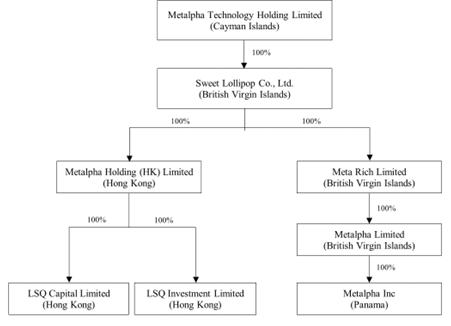
Metalpha Technology Holding Limited is a Cayman Islands holding company. It does not engage in operations itself but rather conducts its operations through its subsidiaries incorporated in the British Virgin Islands, Panama and Hong Kong.
The following diagram illustrates our corporate structure as of the date of this annual report, including our significant subsidiaries.
A. [Reserved]
B. Capitalization and Indebtedness
Not Applicable.
C. Reasons for the Offer and Use of Proceeds
Not Applicable.
D. Risk Factors
1
Summary of Risk Factors
Investing in our Ordinary Shares involves significant risks. You should carefully consider all of the information in this annual report before making an investment in our Ordinary Shares. Below please find a summary of the principal risks we face, organized under relevant headings. These risks are discussed more fully below in this section.
Risks Relating to Our Business and Industry
Risks and uncertainties related to our business and industries include, but are not limited to, the following:
| ● | We have a limited operating history and are subject to the risks encountered by early-stage companies; |
| ● | We may need additional capital to fund our future operations and, if it is not available when needed, we may need to reduce our planned expansion and marketing efforts, which may reduce our income; |
| ● | Our auditor has indicated that there is a substantial doubt about our ability to continue as a going concern. |
| ● | Our wealth management business is subject to customer concentration risk; |
| ● | We rely on certain related party for products subscription and any shortage or interruption in subscription could slow our growth and reduce our profitability; |
| ● | Our business operations significantly depend on several key partners in the crypto industry for trading and asset custody. If these key partners experience operational disruptions due to mismanagement or regulatory sanctions resulting from non-compliance, their services may be interrupted or we may lose our assets which materially and adversely affect our business operations, financial condition and future growth; |
| ● | It may be or become illegal to acquire, own, hold, sell or use cryptocurrencies, participate in the blockchain, or transfer or utilize similar cryptocurrency assets in international markets where we operate due to adverse changes in the regulatory and policy environment in different jurisdictions; and |
| ● | The loss or destruction of private keys required to access any digital assets held by us may be irreversible. If we are unable to access our private keys or if we experience a hack or other data loss relating to our ability to access any digital assets, it could cause regulatory scrutiny, reputational harm, and other losses. |
Risks Related to Doing Business in Jurisdictions Where We Operate
Risks and uncertainties related doing business in jurisdictions we operate include, but are not limited to, the following:
| ● | A downturn in the Hong Kong, China or global economy, and economic and political policies of China could materially and adversely affect our business and financial condition; |
| ● | The Hong Kong legal system embodies uncertainties which could limit the legal protections available to us; |
| ● | Hong Kong laws and regulations related to the cryptocurrency business is still under development and subject to significant changes, and any potential changes in the legal and regulatory landscape may adversely affect our business financial condition and future expansion; |
| ● | Hong Kong regulatory requirement of prior approval for transfer of shares in excess of certain threshold may restrict future takeovers and other transactions; and |
| ● | You may experience difficulties in effecting service of legal process, enforcing foreign judgments, or bringing actions in China against us or our management named in this annual report based on foreign laws. It may also be difficult for you or overseas regulators to conduct investigations or collect evidence within China. |
2
Risks Relating to Our Ordinary Shares and the Trading Market
Risks and uncertainties related to our Ordinary Shares and the trading market include, but are not limited to, the following:
| ● | If we become directly subject to the scrutiny, criticism, and negative publicity involving U.S.-listed Chinese companies, we may have to expend significant resources to investigate and resolve the matter which could harm our business operations, stock price and reputation; |
| ● | Recent joint statement by the SEC and the PCAOB, rule changes by Nasdaq, and the Holding Foreign Companies Accountable Act all call for additional and more stringent criteria to be applied to emerging market companies upon assessing the qualification of their auditors, especially the non-U.S. auditors who are not inspected by the PCAOB. These developments could add uncertainties to our continued listing or future offerings of our securities in the U.S.; |
| ● | The market price of our Ordinary Shares may be volatile or may decline regardless of our operating performance; |
| ● | If we cannot continue to satisfy listing requirements and other rules of Nasdaq Capital Market, although we exempt from certain corporate governance standards applicable to U.S. issuers as a Foreign Private Issuer, our securities may be delisted, which could negatively impact the price of our securities and your ability to sell them; and |
| ● | We have a substantial number of warrants outstanding. The exercise of our outstanding warrants can have a dilutive effect on our Ordinary Shares. |
Risks Relating to Our Business and Industry
We have a limited operating history and are subject to the risks encountered by early-stage companies.
The PRC operating entities had been in business since October 2014 until all business operations in mainland China were ceased and sold to third parties in March 2023. We have been a provider of wealth management services since December 2021.
As a fairly new operation, our business strategies and model are constantly being tested by the market. As such, our business may be subject to significant fluctuations in operating results.
Accordingly, you should consider our prospects in light of the costs, uncertainties, delays, and difficulties frequently encountered by companies with a limited operating history. In particular, you should consider that there is a significant risk that:
| ● | Our ability to introduce and manage the development of new wealth management business; |
| ● | We may require additional capital to develop and expand our operations, which may not be available to us when we require such additional capital; |
| ● | Our wealth management business is subject to customer concentration risk; |
| ● | Our marketing and growth strategy may not be successful; and |
| ● | Our business may be subject to significant fluctuations in operating results. |
Our future growth will depend substantially on our ability to address these and the other risks described in this annual report. If the operating entities do not successfully address these risks, their, and consequentially, our business would be significantly harmed.
3
We may need additional capital to fund our future operations and, if it is not available when needed, we may need to reduce our planned expansion and marketing efforts, which may reduce our income.
We believe that our existing working capital and cash available from operations will enable us to meet our working capital requirements for at least the next 12 months. However, if cash from our future operations is insufficient, or if cash is used for acquisitions or other currently unanticipated purposes, we may need additional capital. In addition, if we fail to generate sufficient net income from our business, it may continue to expend significant amounts of capital. As a result, we could be required to raise additional capital. To the extent that we raise additional capital through the sale of equity or convertible debt securities, the issuance of such securities could result in dilution of the shares held by existing shareholders. If additional funds are raised through the issuance of debt or equity securities, such securities may provide the holders certain rights, preferences, and privileges senior to those of shareholders holding our Ordinary Shares, and the terms of any such debt securities could impose restrictions on the operating entities’ operations. We cannot assure you that additional capital, if required, will be available on acceptable terms, or at all. If we are unable to obtain sufficient amounts of additional capital, we may be required to reduce our scope of planned product development and marketing efforts, which could harm our business, financial condition and operating results.
Our auditor has indicated that there is a substantial doubt about our ability to continue as a going concern.
To date, we had net loss for the year, accumulated deficits and cash used in operating activities. For the fiscal year ended March 31, 2023, we recorded loss for the year of $20.2 million and net cash used in operating activities of $1.1 million. As of March 31, 2023, we had an aggregate accumulated deficit of $40.2 million. We anticipate that we will continue to report losses as well as negative operating cash flow. As a result of these net losses and other factors, our independent auditor issued an audit opinion with respect to our financial statements for the three years ended March 31, 2023 that indicated that there is a substantial doubt about our ability to continue as a going concern. Our financial statements have been prepared assuming we will continue as a going concern, which contemplates the realization of assets and the satisfaction of liabilities in the normal course of business. These audited consolidated financial statements do not include any adjustments relating to the recovery of the recorded assets or the classification of the liabilities that might be necessary should we be unable to continue as a going concern.
There can be no assurance that we will ever be able to achieve or sustain profitability or positive cash flow. Our ability to continue as a going concern is dependent upon improving operational efficiency and cost reductions, generating sufficient cash flow from operations and obtaining additional capital and financing. If our ability to generate cash flow from operations is delayed or reduced and we are unable to raise additional funding from other sources, we may be unable to continue in business.
Our success depends substantially on the continued retention of certain key personnel and our ability to hire and retain qualified personnel in the future to support our growth and execute our business strategy.
If our senior executives or other key personnel are unable or unwilling to continue in their present positions, our business may be disrupted and its financial condition and results of operations may be materially and adversely affected. While we depend on the abilities and participation of our current management team generally, we rely particularly upon our consultant team, consisting of 11 consultants. The loss of the services of our consultant team for any reason could significantly adversely impact our business and results of operations. Competition for senior management and senior technology personnel is intense and the pool of qualified candidates is very limited. We cannot assure you that the services of our senior executives, consultant team and other key personnel will continue to be available to us, or that we will be able to find a suitable replacement if any of them were to leave.
We rely on certain related party for products subscription and any shortage or interruption in subscription could slow our growth and reduce our profitability.
Antalpha is a substantial shareholder of the Company and hence it is a related party of the Company. Antalpha is one of our key customers who subscribe to our issued cryptocurrency derivative products. For the fiscal year ended March 31, 2023, the aggregate notional amount of products we issued was approximately $382 million, among which Antalpha subscribed to products with a notional amount of approximately $326 million, accounting for approximately 85.6% of the total amount for the same fiscal year.
4
In addition, Antalpha provides significant support to our operations through its subsidiaries. These subsidiaries deliver technical management services and customer referral services, contributing significantly to our business growth and operational efficiency.
If our relationship with Antalpha deteriorates for any reason, Antalpha may slow down or even stop subscriptions to our products and/or terminate the services provided to us through its subsidiaries. As a result, our business, results of operations, financial condition and prospects could be materially and adversely affected.
Our wealth management business is subject to customer concentration risk.
For the fiscal year ended March 31, 2023, the aggregate notional amount of the products we issued was approximately $382 million, among which our top three customers subscribed to products of an aggregate notional amount of approximately $360 million, representing approximately 94.2% of the total amount for the same fiscal year. Our largest customer, Antalpha, subscribed to products with a notional amount of approximately $326 million, accounting for approximately 85.6% of the total amount for the same fiscal year. There is no assurance that we will be able to maintain or expand our relationships with our top customers, or that they will continue to subscribe to our products in current subscription amounts or at all. If our top customers significantly reduce or even cease their subscriptions to our products, we may not be able to timely find alternative customers with comparable subscription amounts, or at all, and we may experience a significant decline in our income as a result. Moreover, the business and financial condition of our top customers may deteriorate, which may materially and adversely affect their subscriptions to our products. Any of the foregoing, if materializes, may materially and adversely affect our business, results of operations and financial condition.
The acceptance and widespread use of digital assets are subject to a variety of factors beyond our control. A decline in the acceptance and use of digital assets may adversely affect the investment in our securities.
Digital assets have only recently become accepted as a means of payment for goods and services by certain major retail and commercial outlets. There is currently limited use of digital assets, such as Bitcoin, in the retail and commercial markets, thus contributing to price volatility that could adversely affect an investment in our securities. In contrast, a significant portion of demand for digital assets is generated by speculators and investors seeking to profit from the short- or long-term holding of tokens. The relative lack of acceptance and use of digital assets in the retail and commercial markets, or a reduction of such use, limits the ability of end users to use digital assets to pay for goods and services. Such lack of acceptance or contraction in acceptance or use of digital assets may increase the price volatility or affect the value of digital assets we acquire or hold, which could materially and adversely affect our business operations, financial performance and prospects, as well as the investment in our securities.
Our business operations significantly depend on several key partners in the crypto industry for trading and asset custody. If these key partners experience operational disruptions due to fraud, security failures, mismanagement or regulatory sanctions resulting from non-compliance, their services may be interrupted or we may lose our assets which materially and adversely affect our business operations, financial condition and future growth.
Operational disruptions of crypto asset trading venues and asset custody providers due to fraud, business failures, hackers or malware, or regulatory sanctions may reduce confidence in the crypto assets market and result in our loss of assets which could have a material adverse effect on our business operations, financial condition and future growth.
In particular, Binance serves as our primary trading service provider with the majority of our hedging trades taking place on their platform. Simultaneously, Binance also acts as a crucial subscriber to our products. In June 2023, the SEC leveled legal charges against two of the largest exchanges, Binance and Coinbase, consecutively. Both lawsuits involve the listing and trading of tokens deemed by the SEC as unregistered securities, and the claim that the profit and pledge services offered by both exchanges also violate securities law. In the allegations against Binance, the SEC further extended the scope of the charges, asserting that the exchange engaged in settlement trading and mixed client funds between its domestic and overseas entities. If the legal proceedings between Binance and the SEC result unfavorably for Binance, rendering it incapable of providing trading services or leading to significant asset losses, it may have a severe adverse impact on our business.
5
We are subject to a highly evolving regulatory landscape and any adverse changes to, or our failure to comply with, any laws and regulations could adversely affect our business, reputation, prospects or operations.
Until recently, relatively little regulatory attention has been directed toward the crypto assets market by U.S. federal and state governments, non-U.S. governments and self-regulatory agencies. As crypto assets have grown in popularity and in market size, the U.S. regulatory regime - namely the Federal Reserve Board, U.S. Congress and certain U.S. agencies (e.g., the SEC, the U.S. Commodity Futures Trading Commission (the “CFTC”), the Financial Crimes Enforcement Network (the “FinCEN”) and the Federal Bureau of Investigation), and local and foreign governmental organizations, consumer agencies and public advocacy groups have been examining the operations of crypto networks, users and platforms, with a focus on how crypto assets can be used to launder the proceeds of illegal activities, fund criminal or terrorist enterprises, and the safety and soundness of platforms and other service providers that hold crypto assets for users. Many of these entities have called for heightened regulatory oversight, and have issued consumer advisories describing the risks posed by crypto assets to users and investors. For instance, in March 2022, Federal Reserve Chair Jerome Powell expressed the need for regulation to prevent “cryptocurrencies from serving as a vehicle for terrorist finance and just general criminal behavior.” On March 8, 2022, President Biden announced an executive order on cryptocurrencies which seeks to establish a unified federal regulatory regime for cryptocurrencies. The complexity and evolving nature of our business and the significant uncertainty surrounding the regulation of the crypto assets industry requires us to exercise our judgment as to whether certain laws, rules, and regulations apply to us, and it is possible that governmental bodies and regulators may disagree with our conclusions. To the extent we have not complied with such laws, rules and regulations, we could be subject to significant fines, revocation of licenses, limitations on our products and services, reputational harm, and other regulatory consequences, each of which may be significant and could adversely affect our business, operating results, and financial condition.
Additionally, the recent bankruptcy filings of FTX, the third largest digital asset exchange by volume at the time of its filing, and its affiliated hedge fund Alameda Research LLC, in addition to other bankruptcy filings of crypto companies throughout calendar year 2022, will likely attract heightened regulatory scrutiny from U.S. regulatory agencies such as the SEC and CFTC. Increasing regulation and regulatory scrutiny may result in additional costs for us and our management having to devote increased time and attention to regulatory matters, change aspects of our business or result in limits on the utility of Bitcoin. In addition, regulatory developments and/or our business activities may require us to comply with certain regulatory regimes. Increasingly strict legal and regulatory requirements and any regulatory investigations and enforcement may result in changes to our business, as well as increased costs, supervision and examination. Moreover, new laws, regulations, or interpretations may result in additional litigation, regulatory investigations, and enforcement or other actions. Adverse changes to, or our failure to comply with, any laws and regulations may have, an adverse effect on our reputation and brand and our business, operating results, and financial condition.
In addition, cryptocurrencies may be used by market participants for black market transactions, to conduct fraud, money laundering and terrorism-funding, tax evasion, economic sanction evasion or other illegal activities. As a result, governments may seek to regulate, restrict, control or ban the mining, using, holding and transferring of cryptocurrencies. We may not be able to eliminate all instances where other parties use cryptocurrencies in money laundering or other illegal or improper activities. We cannot assure you that we will successfully detect and prevent all money laundering or other illegal or improper activities which may adversely affect our reputation, business, financial condition and results of operations.
Any failure to obtain or renew any required approvals, licenses, permits or certifications could materially and adversely affect our business and results of operations.
As of the date of this annual report, the entirety of our cryptocurrency business is operated outside of mainland China and the United States. In accordance with the laws and regulations in the jurisdictions in which we operate, we may be required to maintain various approvals, licenses, permits and certifications in order to operate our cryptocurrency business. Complying with such laws and regulations may require substantial expense, and any non-compliance may expose us to liability. In the event of non-compliance, we may have to incur significant expenses and divert substantial management time to rectify the incidents. In the future, if we fail to obtain all the necessary approvals, licenses, permits and certifications, we may be subject to fines or the suspension of operations of any business that do not have all the requisite approvals, licenses, permits and certifications, which could materially and adversely affect our business and results of operations. We may also experience adverse publicity arising from non-compliance with government regulations, which would negatively impact our reputation.
6
We have adopted the development strategy to focus on the expansion of our business products of issuing cryptocurrency derivative products in international markets. As such, we are subject to regulations applicable to operators of cryptocurrency business and derivative products business in these jurisdictions. To our best knowledge, we do not believe we need to obtain relevant governmental approval and license required for issuing cryptocurrency derivative products to customers in these jurisdictions. However, we cannot assure you that we will be able to obtain, maintain or renew any required government approval, permit, licenses for our future operations on commercially reasonable terms and in a timely manner or at all. Failure to maintain or renew these government approvals, permit or licenses for our international operations may cause us to suspend or terminate our cryptocurrency derivative product operations in such jurisdictions, and may subject us to regulatory investigations or legal proceedings and fines in these jurisdictions, which could disrupt our international operations and materially and adversely affect our business, financial condition and results of operations.
More broadly, we cannot assure you that we will be able to fulfill all the conditions necessary to obtain the required government approvals in the jurisdictions where we operate, or that relevant government officials in these jurisdictions will always, if ever, exercise their discretion in our favor, or that we will be able to adapt to any new laws, regulations or policies. There may also be delays on the part of government authorities in reviewing our applications and granting approvals, whether due to the lack of administrative resources or the imposition of new rules, regulations, government policies or their implementation, interpretation and enforcement, or for no discernible reason at all. If we are unable to obtain, or experience material delays in obtaining, necessary government approvals, our operations may be substantially disrupted, which could materially and adversely affect our business, financial condition and results of operations.
We may face several risks due to disruptions in the crypto asset markets, including but not limited to the risk from depreciation in our stock price, loss of customer demand, financing risk, risk of increased losses or impairments in our investments or other assets, risks of legal proceedings and government investigations, and risks from price declines or price volatility of crypto assets.
In the first half of 2022, some of the well-known crypto asset market participants, including Celsius Network, Voyager Digital Ltd. and Three Arrows Capital, declared bankruptcy, resulting in a loss of confidence in participants of the digital asset ecosystem and negative publicity surrounding digital assets more broadly. In November 2022, FTX, the third largest digital asset exchange by volume at the time, halted customer withdrawals and shortly thereafter, FTX and its subsidiaries filed for bankruptcy.
In response to these events, the digital asset markets have experienced extreme price volatility and several other entities in the digital asset industry have been, and may continue to be, negatively affected, further undermining confidence in the digital assets markets. These events have also negatively impacted the liquidity of the digital assets markets as certain entities affiliated with FTX engaged in significant trading activity. If the liquidity of the digital assets markets continues to be negatively impacted by these events, digital asset prices may continue to experience significant volatility and confidence in the digital asset markets may be further undermined. These events are continuing to develop and it is not possible to predict at this time all of the risks that they may pose to us or on the digital asset industry as a whole.
We had no direct exposure to FTX or any of the above-mentioned cryptocurrency companies. We do not have material assets that may not be recovered or may otherwise be lost or misappropriated due to the bankruptcies. However, the failure or insolvency of large exchanges like FTX may cause decreases in the prices of cryptocurrencies and investor confidence in the ecosystem, which could adversely affect investments in our products. The high volatility and downturns in cryptocurrency prices generally do not directly impact our business, and heightened volatility in cryptocurrency prices can even increase our trading profits. However, high volatility and downturns in cryptocurrency prices may impact our customers’ confidence in the market, thereby adversely affecting our operations and financial condition. We will timely adjust our strategies to expand our business and optimize our operating efficiency in the current dynamic market conditions.
7
We cannot assure that the price of cryptocurrencies will remain high enough to sustain our operation or that the price of cryptocurrencies will not decline significantly in the future. Fluctuations in the price of cryptocurrencies have had and are expected to continue to have an immediate impact on the trading price of our Ordinary Shares even before our financial performance is affected, if at all. To the extent investors view our Ordinary Shares as linked to the value of our cryptocurrency derivative product services, the decline of cryptocurrency value may have a material adverse effect on the market value of our Ordinary Shares.
In addition, a perceived lack of stability in the digital asset exchange market and the closure or temporary shutdown of digital asset exchanges due to business failure, hackers or malware, government-mandated regulation, or fraud, may reduce confidence in digital asset networks and result in greater volatility in cryptocurrency values. These potential consequences of a digital asset exchange’s failure could adversely affect an investment in us or the loss of customer demand for our products and services with respect to our cryptocurrency business.
As of the date of this annual report, we are not subject to any legal proceedings or government investigations in the United States or in other jurisdictions. However, in the past, following periods of volatility in the market price of a company’s securities, securities class-action litigation has often been brought against that company. We may become involved in this type of litigation in the future. Litigation of this type may be expensive to defend and may divert our management’s attention and resources from the operation of our business.
Political or economic crises may result in large-scale sales of digital assets, which could cause a reduction in the value of some or all digital assets and adversely affect the investment in our securities.
As a relatively new alternative to fiat currencies that are backed by central governments, digital assets are subject to supply and demand forces based upon the desirability of an alternative and decentralized means of buying and selling goods and services. It is also unclear how such supply and demand will be impacted by geopolitical events. Nevertheless, political or economic crises may result in large-scale acquisitions or sales of digital assets either globally or locally. Large-scale sales of digital assets would cause a reduction in their value and could adversely affect the investment in our securities.
Changes in digital asset networks and blockchain vulnerabilities could adversely affect the investment in our securities.
Various technical issues and changes in the underlying digital asset networks or blockchains may adversely affect the value of digital assets and could adversely affect the investment in our securities, including:
| ● | changes to the protocols and software of digital asset networks, which are proposed by network contributors and could alter the properties and functionality of the networks; |
| ● | updates to the blockchain’s structure, such as block size or transaction limitations, which could impact transaction speed and overall network functionality, and in extreme cases, could lead to a “hard fork”, creating incompatible blockchain implementations; |
| ● | the lack of guaranteed financial incentives for contributors to maintain and develop the open-source digital asset networks, which could lead to failures in monitoring and upgrading the network; |
| ● | potential manipulation of the blockchain by persons gain control of more than 50% of the network’s processing power; |
| ● | significant reductions in the aggregate processing power or hashrate on any digital asset network, which could lead to delays in transaction confirmations; |
| ● | insufficient award of award of digital assets for solving blocks and transaction fees, which could impact the network’s functionality |
8
The recent disruption in the crypto asset markets may harm our reputation.
Due to the recent disruption in the crypto asset markets, our customer, suppliers and other business partners may deem our business to be risky and lose confidence in entering into business transactions with us. It may be difficult for us to reach the same business terms with such business partners like we did before. For example, our suppliers may require more deposits or advance payments from us.
In addition, additional regulations may subject us to investigation, administrative or regulatory proceedings, and civil or criminal litigations, all of which could harm our reputation and affect our business operation and the value of our Ordinary Shares. If we have difficulties to comply with such additional regulatory and registration requirements, we may have to cease certain or all of our operations. As of the date of this annual report, there is no material impact on our operations or financial conditions associated with any reputational harm that we may face in light of the recent disruption in the crypto asset markets. However, there is no guarantee that there will not be any material adverse effect on our business, financial condition and results of operations associated with the reputational harm that we may face in light of the recent disruption in the crypto asset markets.
Our offering of wealth management services may be subject to U.S. jurisdiction if it is not able to avoid offering or selling cryptocurrency derivative products to U.S. customers. Additionally, the offering of wealth management services may be deemed as securities offerings in other jurisdictions where it is offered.
To the extent that we are appropriately restricting U.S. persons from obtaining our cryptocurrency derivative products, such business should not be subject to U.S. securities laws. However, whether we are effective in avoiding U.S. jurisdiction by actually not offering or selling our cryptocurrency derivative products to U.S. customers would depend on, among others, the existence and effectiveness of measures adopted in practice against U.S. persons obtaining its services, such as screening mechanisms and/or contractual restrictions over transfers of the contracts to U.S. persons in the secondary market. If certain U.S. customers, or customers from other jurisdictions where our offering of cryptocurrency derivative products may be deemed as securities offerings, end up obtaining access to our cryptocurrency derivative products, and we have not registered the offering of such products, we may be deemed in breach of applicable securities laws. Such breach may result in sizable fines, reputational harms, restrictions of certain businesses, and materially adversely affect our business operation and financial conditions.
Because there has been limited precedent set for financial accounting for cryptocurrencies, the determinations that we have made for how to account for cryptocurrency-related transactions may be subject to change.
The accounting rules and regulations that we must comply with are complex and subject to interpretation by the International Accounting Standards Board, or the IASB, the SEC, and various bodies formed to promulgate and interpret appropriate accounting principles. A change in these principles or interpretations could have a significant effect on our reported financial results, and may even affect the reporting of transactions completed before the announcement or effectiveness of a change. Further, there has been limited precedents for the financial accounting of cryptocurrencies and related valuation and revenue recognition, and no official guidance has been provided by the IASB or the SEC. As such, there remains significant uncertainty on how companies can account for cryptocurrency transactions, cryptocurrencies, and related income. Uncertainties in or changes to in regulatory or financial accounting standards could result in the need to changing our accounting methods and restate our financial statements and impair our ability to provide timely and accurate financial information, which could adversely affect our financial statements, result in a loss of investor confidence, and more generally impact our business, operating results, and financial condition.
9
The loss or destruction of private keys required to access any digital assets held by us may be irreversible. If we are unable to access our private keys or if we experience a hack or other data loss relating to our ability to access any digital assets, it could cause regulatory scrutiny, reputational harm, and other losses.
Cryptocurrencies are generally controllable only by the possessor of the unique private key relating to the digital wallet in which the digital assets are held. While blockchain protocols typically require public addresses to be published when used in a transaction, private keys must be safeguarded and kept private in order to prevent a third party from accessing the digital assets held in such a wallet. We will publish the public key relating to digital wallets in use when we verify the receipt of transfers and disseminate such information into the network, but we will need to safeguard the private keys relating to such digital wallets. We safeguard and keep private the private keys relating to our digital assets by primarily utilizing enterprise multi-signature storage solution provided by an established third-party digital asset financial services platform.
To the extent that any of the private keys relating to our wallets containing digital assets held by us is lost, destroyed, or otherwise compromised or unavailable, and no backup of the private key is accessible, we will be unable to access digital assets held in the related wallet. Furthermore, as currently our digital wallet is maintained by a third-party digital asset financial services platform, we cannot provide assurance that our wallet will not be hacked or compromised, or that any information leakage and data security breach of such platform will not compromise the security of our digital wallet. Digital assets and blockchain technologies have been, and may in the future be, subject to security breaches, hacking, or other malicious activities. Any loss of private keys relating to, or hack or other compromise of, digital wallets used to store our digital assets could subject us to significant financial losses, and we may be unable to distribute mining rewards to customers of our mining pool services, or adequately compensate our customers for damages caused by such security breach. As such, any loss of private keys due to a hack, employee or service provider misconduct or error, or other compromise by third parties could hurt our brand and reputation, result in significant losses, and adversely impact our business, results of operations and/or financial condition.
We may not have adequate sources of recovery if the cryptocurrencies held by us are lost, stolen or destroyed, which could have a material adverse effect on our business, financial condition and results of operations.
Our portfolio of digital assets is held under the custodianship of various cryptocurrency service providers, including but not limited to Binance, Ceffu, Cobo and Antalpha. We believe that the security procedures that the cryptocurrency service providers utilize, such as issuing username, password, hardware tokens and manual review of the transactions inflow and outflow, are reasonably designed to safeguard the cryptocurrencies from theft, loss, destruction or other issues relating to hackers and technological attack. Nevertheless, the security procedures cannot guarantee the prevention of any loss due to a security breach, software defect or act of God that may be borne by us. If such cryptocurrencies are lost, stolen or destroyed under circumstances rendering a third party liable to us, we may not have the financial resources or insurance sufficient to satisfy any or all of our claims against the third party, or have the ability to retrieve, restore or replace the lost, stolen or destroyed cryptocurrencies due to governing network protocols and the strength of the cryptographic systems associated with such cryptocurrencies. To the extent that we are unable to recover on any of our claims against any such third party, such loss could have a material adverse effect on our business, financial condition and results of operations.
If such services are commercially available, we will consider adding regulated banks, rather than solely relying on crypto custodian, as the custodian for a material amount of our cryptocurrencies. Obtaining cryptocurrency custody services from a regulated bank may confer benefits such as improved security and reduced fraud. Nevertheless, until now, banks have generally declined to provide custody services for cryptocurrencies and other virtual assets, due to the absence of clarity on permissibility and on regulators’ views of these activities generally. On July 22, 2020, the U.S. Office of the Comptroller of the Currency released publicly an interpretive letter confirming the authority of a national bank to provide cryptocurrency custody services for customers, providing that a national bank engaging in such activities should develop and implement those activities consistent with sound risk management practices and align them with the bank’s overall business plans and strategies as set forth in the guidance. On January 27, 2023, the Board of Governors of the Federal Reserve System released publicly a policy statement to interpret section 9(13) of the Federal Reserve Act, clarifying that the state member banks are not prohibited under the policy from providing safekeeping services for crypto-assets in a custodial capacity, if such activities are conducted in a safe and sound manner and in compliance with consumer, anti-money-laundering, and anti-terrorist-financing laws. However, it will take time for banks to start offering cryptocurrencies custodian services, and before then, we may have to continue to rely on crypto custodians for our crypto custodian needs.
10
A particular digital asset’s status as a “security” in any relevant jurisdiction is subject to a high degree of uncertainty, and if we are unable to properly characterize a digital asset, we may be subject to regulatory scrutiny, investigations, fines, and other penalties, which may adversely affect our business, results of operations and/or financial condition.
The SEC and its staff have taken the position that certain digital assets fall within the definition of a “security” under the U.S. federal securities laws. The legal test for determining whether any given digital asset is a security is a highly complex, fact-driven analysis that evolves over time, and the outcome is difficult to predict. The SEC generally does not provide advance guidance or confirmation on the status of any particular digital asset as a security. Additionally, the SEC’s views in this area have evolved over time, and it is difficult to predict the direction or timing of any continuing evolution. Furthermore, it is also possible that a change in the governing administration or the appointment of new SEC commissioners could substantially impact the views of the SEC and its staff. Public statements by senior officials at the SEC indicate that the SEC does not intend to take the position that Bitcoin or Ethereum, in their current form, are securities. However, Bitcoin and Ethereum are the only digital assets as to which senior officials at the SEC have publicly expressed such a view. Such statements are not official policy statements by the SEC and reflect only the speakers’ views, which are not binding on the SEC or any other agency or court, and cannot be generalized to any other digital asset, such as Dogecoin. With respect to all other digital assets, there is currently no certainty under the applicable legal test that such assets are not securities, notwithstanding the conclusions we may draw based on our assessment regarding the likelihood that a particular digital asset could be deemed a “security” under applicable laws. Similarly, though the SEC’s Strategic Hub for Innovation and Financial Technology published a framework for analyzing whether any given digital asset is a security in April 2019, this framework is also not a rule, regulation or statement of the SEC and is not binding on the SEC.
Several foreign jurisdictions have taken a broad-based approach to classifying digital assets as “securities,” while other foreign jurisdictions have adopted a narrower approach. As a result, certain digital assets may be deemed to be a “security” under the laws of some jurisdictions but not others. Various foreign jurisdictions may, in the future, adopt additional laws, regulations, or directives that affect the characterization of digital assets as “securities.”
The classification of a digital asset as a security under applicable law has wide-ranging implications for the regulatory obligations that flow from the offer, sale, trading, and clearing of such assets. For example, a digital asset that is a security in the United States may generally only be offered or sold in the United States pursuant to a registration statement filed with the SEC or in an offering that qualifies for an exemption from registration. Persons that effect transactions in digital assets that are securities in the United States may be subject to registration with the SEC as a “broker” or “dealer.” Platforms that bring together purchasers and sellers to trade digital assets that are securities in the United States are generally subject to registration as national securities exchanges, or must qualify for an exemption, such as by being operated by a registered broker-dealer as an alternative trading system (“ATS”), in compliance with rules for ATSs. Persons facilitating clearing and settlement of securities may be subject to registration with the SEC as a clearing agency. Foreign jurisdictions may have similar licensing, registration, and qualification requirements.
We have adopted risk-based policies and procedures to analyze whether the digital assets that we hold and sell for our own account could be deemed to be a “security” under applicable laws. Our policies and procedures do not constitute a legal standard, but rather represent our management’s assessment, based on advice of our securities counsel, regarding the likelihood that a particular digital asset could be deemed a “security” under applicable laws. Regardless of our conclusions, we could be subject to legal or regulatory action in the event the SEC, a foreign regulatory authority, or a court were to determine that a digital asset currently held by us is a “security” under applicable laws. If the digital assets mined and held by us are deemed as securities, it could limit distributions, transfers, or other actions involving such digital assets in the global markets.
Because cryptocurrencies may be determined to be investment securities, we may inadvertently violate the Investment Company Act of 1940, as amended, and we may incur substantial losses and become subject to such act as a result.
We believe that we are not engaged in the business of investing, reinvesting, or trading in securities, and we do not hold ourselves out as being engaged in those activities. However, under the Investment Company Act of 1940, as amended (the “Investment Company Act”), a company may be deemed an investment company under section 3(a)(1)(C) thereof if the value of its investment securities is more than 40% of its total assets (exclusive of government securities and cash items) on an unconsolidated basis.
11
The cryptocurrency we own, acquire may be deemed an investment security by the SEC, although we do not believe any of the cryptocurrencies we own, acquire are securities.
Current and future legislation and the SEC rulemaking and other regulatory developments, including interpretations released by a regulatory authority, may impact the manner in which cryptocurrencies are treated for classification and clearing purposes. The SEC’s July 25, 2017 Report expressed its view that digital assets may be securities depending on the facts and circumstances. As of the date of this prospectus, we are not aware of any rules that have been proposed to regulate cryptocurrencies as securities. We cannot be certain as to how future regulatory developments will impact the treatment of cryptocurrency under the applicable U.S. federal or state laws. Such additional registrations may result in extraordinary, non-recurring expenses, thereby materially and adversely impacting an investment in us. If we determine not to comply with such additional regulatory and registration requirements, we may seek to cease certain of our operations. Any such action may adversely affect an investment in us.
Classification as an investment company under the Investment Company Act requires registration with the SEC. If an investment company fails to register, it would have to stop doing almost all business, and its contracts would become voidable. Registration is time consuming and restrictive and would require a restructuring of our operations, and we would be very constrained in the kind of business we could do as a registered investment company. Furthermore, we would become subject to substantial regulation concerning management, operations, transactions with affiliated persons and portfolio composition, and would need to file reports under the Investment Company Act regime. The cost of such compliance would result in substantial additional expenses, and the failure to complete the required registration would have a materially adverse impact to conduct our operations.
We do not maintain insurance for our digital assets, which may expose us and our shareholders to the risk of loss of our digital assets, and there will be limited rights of legal recourse available to us to recover our losses.
We do not maintain insurance for the digital assets held by us. Banking institutions will not accept our digital assets, and they are therefore not insured by the Federal Deposit Insurance Corporation or the Securities Investor Protection Corporation. Therefore, we may suffer loss with respect to our digital assets which is not covered by insurance, and we may not be able to recover any of our carried value in these digital assets if they are lost or stolen or suffer significant and sustained reduction in conversion spot price. If we are not otherwise able to recover damages from a malicious actor in connection with these losses, our business, results of operations and share price may be adversely affected.
We may not be able to adequately protect our intellectual property rights, and our competitors may be able to offer similar products and services, which would harm our competitive position.
Our success depends in part upon our intellectual property rights. The algorithms we use in providing the wealth management services are all self-developed. As of March 31, 2023, we held three domain names relating to our business, including our current and previous corporate websites. As of March 31, 2023, the affiliates of our shareholder, Antalpha, held 21 registered trademarks and 33 pending trademark applications and the relevant rights to the logo of Metalpha in various jurisdictions, including Hong Kong, China Taiwan, Bangladesh, Europe and the United States, among others. We have use and other relevant rights related to the “Metalpha” registered trademark and logo for our business operations. We rely primarily on trademark, copyright, service mark and trade secret laws, confidentiality procedures, license agreements and contractual provisions to establish and protect our proprietary rights over our products, procedures, algorithms and services. Other persons, including our competitors, could copy or otherwise obtain and use our technology without authorization, or develop similar intellectual property independently, and thus may be able to duplicate our products and services or design around any intellectual property rights we hold. We may also pursue the registration of our domain names, trademarks and service marks in various jurisdictions, including the United States. Although the protection afforded by copyright, trade secret and trademark law, written agreements and common law may provide some advantages, these statutory protections along with non-disclosure agreements with their employees may not be adequate to enable us to protect our intellectual property. Moreover, the intellectual property laws in certain jurisdictions are not considered as strong as comparable laws in the United States or the European Union. The enforcement of intellectual property rights in certain jurisdictions is difficult and, if we seek to commence litigation against any alleged infringer, there is no assurance that they will prevail. We cannot assure you that we will be able to protect our proprietary rights.
12
We face risks related to natural disasters, health epidemics, and other outbreaks, including the COVID-19 pandemic, which could significantly disrupt our operations.
Our business could be materially and adversely affected by natural disasters, health epidemics, or calamities. Fire, floods, typhoons, earthquakes, power loss, telecommunications failures, break-ins, war, riots, terrorist attacks, or similar events may give rise to server interruptions, breakdowns, system failures, technology platform failures, or Internet failures, which could cause the loss or corruption of data or malfunctions of software or hardware as well as adversely affect our ability to provide products and services.
Our business could also be adversely affected by the effects of epidemics. In recent years, there have been breakouts of epidemics around the world, such as Ebola virus disease, H1N1 flu, avian flu and the COVID-19 pandemic. Our business operations could be disrupted if any of their employees gets or is suspected of getting infected, since it could require its employees to be quarantined and/or its offices to be closed and disinfected. In addition, our results of operations could be adversely affected to the extent that any of these epidemics harms the global economy in general.
Our management and compliance personnel have limited experience handling a listed cryptocurrency-related services company, and our compliance program has a recent history only.
Our management and compliance personnel have limited experience in handling regulatory and compliance matters relating to a listed cryptocurrency-related services company. Our key compliance documents and compliance programs, such as anti-money laundering and know-your-client procedures, also have a recent history only. We believe that we have measures designed to limit our counterparty risks. In order to further limit our exposure to counterparty risk, we adopted a two-pronged strategy. First, we carefully select our counterparties and only partner with industry-leading entities renowned for their robust operations, strong capabilities and impeccable reputation. Second, to mitigate the concentration risk, we strategically opt to work with multiple counterparties rather than relying on a single entity. Moreover, we also have a dedicated team of compliance experts and all of our significant business decisions are made following in-depth consultations with legal advisors and industry veterans. While we have been devoting a substantial amount of time and resources to various compliance initiatives and risk management measures, we cannot assure you the practical application and effectiveness of our compliance program and risk management measures, nor that there will not be a failure in detecting regulatory compliance issues or managing risk exposure, which may adversely affect our reputation, business, financial condition and results of operations.
Risks Related to Doing Business in Jurisdictions We Operate
A downturn in the Hong Kong, China or global economy, and economic and political policies of China could materially and adversely affect our business and financial condition.
A substantial part of our operations are located in Hong Kong. Accordingly, our business, prospects, financial condition and results of operations may be influenced to a significant degree by political, economic and social conditions in Hong Kong and China generally and by continued economic growth in Hong Kong and China as a whole. The Chinese economy differs from the economies of most developed countries in many respects, including the amount of government involvement, level of development, growth rate, control of foreign exchange and allocation of resources. While the Chinese economy has experienced significant growth over the past decades, growth has been uneven, both geographically and among various sectors of the economy. The Chinese government has implemented various measures to encourage economic growth and guide the allocation of resources. Some of these measures may benefit the overall Chinese economy, but may have a negative effect on us.
Economic conditions in Hong Kong and China are sensitive to global economic conditions. Any prolonged slowdown in the global or Chinese economy may affect potential clients’ confidence in financial market as a whole and have a negative impact on our business, results of operations and financial condition. Additionally, continued turbulence in the international markets may adversely affect our ability to access the capital markets to meet liquidity needs.
13
The Hong Kong legal system embodies uncertainties which could limit the legal protections available to us.
Hong Kong is a Special Administrative Region of the PRC. Following British colonial rule from 1842 to 1997, China assumed sovereignty under the “one country, two systems” principle. The Hong Kong Special Administrative Region’s constitutional document, the Basic Law, ensures that the current political situation will remain in effect for 50 years. Hong Kong has enjoyed the freedom to function in a high degree of autonomy for its affairs, including currencies, immigration and custom, independent judiciary system and parliamentary system. On July 14, 2020, the United States signed an executive order to end the special status enjoyed by Hong Kong post-1997. As the autonomy currently enjoyed were compromised, it could potentially impact Hong Kong’s common law legal system and may in turn bring about uncertainty in, for example, the enforcement of our contractual rights. This could, in turn, materially and adversely affect our business and operation. Additionally, intellectual property rights and confidentiality protections in Hong Kong may not be as effective as in the United States or other countries. Accordingly, we cannot predict the effect of future developments in the Hong Kong legal system, including the promulgation of new laws, changes to existing laws or the interpretation or enforcement thereof, or the pre-emption of local regulations by national laws. These uncertainties could limit the legal protections available to us, including our ability to enforce our agreements with our clients.
Hong Kong laws and regulations related to the cryptocurrency business is still under development and subject to significant changes, and any potential changes in the legal and regulatory landscape may adversely affect our business financial condition and future expansion.
We are headquartered in Hong Kong, where we predominantly rely on the exemptions for trading cryptocurrency derivative products with seasoned professional investors to conduct our cryptocurrency business. Nevertheless, we cannot assure you that Hong Kong regulatory authorities will not tighten or even revoke these exemptions. If these exemptions are tightened or revoked, we may not be able to continue to expand our customer base, and our business model may be materially and adversely affected. We will closely monitor the potential changes in exemptions available to us and laws and regulations related to the cryptocurrency business in Hong Kong.
Hong Kong regulatory requirement of prior approval for any company or individual becoming a “substantial shareholder” may restrict future takeovers and other transactions.
Section 132 of Securities and Futures Ordinance (Cap. 157 of the laws of Hong Kong) (the “SFO”) requires prior approval from the HKSFC for any company or individual to become a substantial shareholder of an SFC-licensed company in Hong Kong. Under the SFO, a person will be a “substantial shareholder” of a licensed company if he, either alone or with associates, has an interest in or is entitled to control the exercise of the voting power of more than 10% of the total number of issued shares of the licensed company, or exercises control of 35% or more of the voting power of a company that controls more than 10% of the voting power of the licensed company. Further, all potential parties who will be new substantial shareholder(s) of the HKSFC-licensed subsidiaries are required to seek prior approval from the HKSFC. This regulatory requirement may discourage, delay or prevent a change in control of our Company, which could deprive our shareholders the opportunity to receive a premium for their shares as part of a future sale and may reduce the price of our shares upon the consummation of a future proposed business combination.
You may experience difficulties in effecting service of legal process, enforcing foreign judgments, or bringing actions in China against us or our management named in this annual report based on foreign laws. It may also be difficult for you or overseas regulators to conduct investigations or collect evidence within China.
We are a company incorporated under the laws of the Cayman Islands. We conduct most of our cryptocurrency-based operations in Hong Kong through our subsidiaries, and almost all of our assets are located in Hong Kong. In addition, two of our directors reside in mainland China for a significant portion of the time. As a result, it may be difficult for you to effect service of process upon us or those persons inside mainland China. In addition, there is uncertainty as to whether the courts of the Cayman Islands or Hong Kong would recognize or enforce judgments of U.S. courts against us, or such persons predicated upon the civil liability provisions of the securities laws of the U.S. or any state. It may also be difficult for you or overseas regulators to conduct investigations or collect evidence in Hong Kong. The inability for an overseas securities regulator to directly conduct investigation or evidence collection activities in Hong Kong may further increase difficulties faced by you in protecting your interests.
14
Risks Relating to Our Ordinary Shares and the Trading Market
If we become directly subject to the scrutiny, criticism, and negative publicity involving U.S.-listed Chinese companies, we may have to expend significant resources to investigate and resolve the matter which could harm our business operations, stock price and reputation.
U.S. public companies with the majority of their operations in China have faced extensive scrutiny, criticism and negative publicity from investors, financial commentators and regulatory agencies like the SEC. Much of the criticism has centered around financial and accounting irregularities, the absence of effective internal financial controls, inadequate or non-compliant corporate governance policies and in numerous cases, fraud allegations. Such negative publicity has led to sharp decreases in the stock value of many U.S. listed Chinese companies, with some becoming virtually worthless. These companies are often subject to shareholder lawsuits, SEC enforcement actions and both internal and external investigations into the allegations.
We have taken proactive steps to address these concerns. In March 2023, we divested all our operations in mainland China. However, due to our past operational history in mainland China, we may be perceived as a Chinese company, which may subject us to the negative effects of sector-wide scrutiny even though we no longer operate in mainland China. Although we have taken significant measures to distance ourselves from these risks, it remains unclear what the enduring impact of this widespread scrutiny, criticism and negative publicity will have on us, our business and our stock price. If we become the subject of any unfavorable allegations, regardless of whether they prove to be true or not, we would need to expend considerable resources investigating such allegations and defending ourselves. Such efforts would be costly and time-consuming and could potentially divert management attention away from our growth strategy. Furthermore, if such allegations turn out to be substantiated, our business operations would be materially and adversely affected, which could lead to a significant decline in the value of our stock.
The disclosures in our reports and other filings with the SEC and our other public pronouncements are not subject to the scrutiny of any regulatory bodies in the PRC or Hong Kong.
We are regulated by the SEC and our reports and other filings with the SEC are subject to SEC review in accordance with the rules and regulations promulgated by the SEC under the Securities Act and the Exchange Act. Our SEC reports and other disclosure and public pronouncements are not subject to the review or scrutiny of any PRC or Hong Kong regulatory authority. For example, the disclosure in our SEC reports and other filings are not subject to the review by the China Securities Regulatory Commission or the HKSFC. Accordingly, you should review our SEC reports, filings, and our other public pronouncements with the understanding that no local regulator has done any review of us, our SEC reports, other filings, or any of our other public pronouncements.
Recent joint statement by the SEC and the PCAOB, rule changes by Nasdaq, and the Holding Foreign Companies Accountable Act all call for additional and more stringent criteria to be applied to emerging market companies upon assessing the qualification of their auditors, especially the non-U.S. auditors who are not inspected by the PCAOB. These developments could add uncertainties to our continued listing or future offerings of our securities in the United States.
Pursuant to the Holding Foreign Companies Accountable Act, or the HFCA Act, if the SEC determines that a company retains a foreign accounting firm that cannot be subject to inspections by the Public Company Accounting Oversight Board, or the PCAOB, for two consecutive years, the SEC will prohibit its securities from being traded on a national securities exchange or in the over-the-counter trading market in the United States. On December 16, 2021, the PCAOB issued a report relaying to the SEC its determinations that it was unable to inspect or investigate completely registered public accounting firms in mainland China and Hong Kong. In March 2022, the SEC issued its first “Conclusive list of issuers identified under the HFCA Act” indicating that those companies were formally subject to the delisting provisions.
On August 26, 2022, the PCAOB signed with the CSRC, and the Ministry of Finance of the PRC a Statement of Protocol, which gives the PCAOB sole discretion to select the firms, audit engagements and potential violations it inspects and investigates and put in place procedures for PCAOB inspectors and investigators to view complete audit work papers with all information included and for the PCAOB to retain information as needed. On December 15, 2022, the PCAOB issued a report that vacated its December 16, 2021 determination and removed mainland China and Hong Kong from the list of jurisdictions where it was unable to inspect or investigate completely registered public accounting firms. Each year, the PCAOB will determine whether it can inspect and investigate completely audit firms in mainland China and Hong Kong, among other jurisdictions.
15
Our auditor, the independent registered public accounting firm that issues the audit report contained in this annual report, as an auditor of companies that are traded publicly in the United States and a firm registered with the PCAOB, is subject to laws in the United States pursuant to which the PCAOB conducts regular inspections to assess its compliance with the applicable professional standards. Our auditor is headquartered in San Mateo, California, and has been inspected by the PCAOB on a regular basis with the last inspection in November 2021. We cannot assure you whether Nasdaq or regulatory authorities would apply additional and more stringent criteria to us since we are an emerging growth company and the majority of our operations are conducted in Hong Kong. If the PCAOB determines in the future that it no longer has full access to inspect and investigate our auditor, or another independent registered public accounting firm we may engage in the future to issue an audit report on our financial statements filed with the SEC, we may be identified as a Commission-Identified Issuer following the filing of the annual report on Form 20-F for the relevant fiscal year. There can be no assurance that we would not be identified as a Commission-Identified Issuer for any future fiscal year, and if we were so identified for two consecutive years, we would become subject to the prohibition on trading under the HFCA Act.
We do not intend to pay dividends for the foreseeable future.
We currently intend to retain any future earnings to finance the operation and expansion of our business, and we do not expect to declare or pay any dividends in the foreseeable future. As a result, you may only receive a return on your investment in our Ordinary Shares if the market price of our Ordinary Shares increases.
If securities or industry analysts do not publish research or reports about our business, or if they publish a negative report regarding our Ordinary Shares, the price of our Ordinary Shares and trading volume could decline.
The trading market for our Ordinary Shares may depend in part on the research and reports that industry or securities analysts publish about us or our business. We do not have any control over these analysts. If one or more of the analysts who cover us downgrade us, the price of our Ordinary Shares would likely decline. If one or more of these analysts cease coverage of our Company or fail to regularly publish reports on us, we could lose visibility in the financial markets, which could cause the price of our Ordinary Shares and the trading volume to decline.
If we fail to implement and maintain an effective system of internal controls, we may be unable to accurately or timely report our results of operations or prevent fraud, and investor confidence and the market price of our Ordinary Shares may be materially and adversely affected.
Our independent registered public accounting firm is currently not required to conduct an audit of our internal control over financial reporting. In the course of auditing our consolidated financial statements as of March 31, 2022, our management has not received from our independent registered public accounting firm any report regarding deficiencies in our internal controls over financial reporting. As a small-scale company, we are in the process of establishing and improving our internal controls. Upon our independent registered public accounting firm’s suggestions, with the development of our business and the increase of our financial personnel, we will improve our internal control management from the following aspects:
| ● | internal environment: Our internal environment affects the formulation of our business management objectives. We plan to take the following measures to improve the Company’s governance structure: (a) improve our governance structure, including the establishment of internal institutions and the allocation of powers and responsibilities, (b) improve our human resources related policies, and (c) strengthen our corporate culture; |
| ● | risk assessment: We will prepare specific assessments and strategic plans for potential risks, including risk tolerance determination, risks identification, and risk analysis and risk response; |
| ● | control systems: We plan to establish and improve (a) our authorization and approval control system to provide reasonable assurance that transaction receipts and expenditures of our Company are being made only in accordance with the authorization of our management and directors, (b) our accounting control system to maintain our records that, in reasonable detail, to accurately reflect the transactions and dispositions of our assets, and to permit preparation of consolidated financial statements in accordance with GAAP, (c) our property protection control to provide reasonable assurance regarding prevention or timely detection of the unauthorized acquisition, use or disposition of our Company’s assets that could have a material effect on the consolidated financial statements (d) our budget control system, (e) operation analysis and control system, and (f) our major risk early warning and emergency handling mechanism; |
16
| ● | information communication: An effective information communication system, within which our financial status and financial operation can be accurately and effectively disclosed in the financial report to our management is important for our internal control over financial reporting. We plan to establish an information communication mechanism to ensure smooth communication between the management and the Company’s external and internal personnel, including communication with our stakeholders, authorities, auditors, and suppliers; and |
| ● | internal supervision: we plan to conduct internal inspections regarding our internal controls, and make timely improvements to internal control deficiencies that we may find during the inspection. |
Our failure to discover and address any material weaknesses could result in inaccuracies in our financial statements and could also impair our ability to comply with applicable financial reporting requirements and related regulatory filings on a timely basis. As a result, our business, financial condition, results of operations, and prospects, as well as the trading price of our Ordinary Shares, may be materially and adversely affected. Moreover, ineffective internal control over financial reporting significantly hinders our ability to prevent fraud.
We are a public company in the United States subject to the Sarbanes-Oxley Act of 2002. Section 404 of the Sarbanes-Oxley Act of 2002, or Section 404, requires that we include a report from management on our internal control over financial reporting in this annual report on Form 20-F. In addition, we are no longer an “emerging growth company” as such term is defined in Jumpstart Our Business Startups Act of 2012, or the JOBS Act, and our independent registered public accounting firm may be required attest to and report on the effectiveness of our internal control over financial reporting, depending on whether we are an accelerated filer. In addition, as a public company, our reporting obligations may place a significant strain on our management, operational and financial resources and systems for the foreseeable future. We may be unable to timely complete our evaluation testing and any required remediation.
During the course of documenting and testing our internal control procedures, in order to satisfy the requirements of Section 404, we may identify additional or other weaknesses and deficiencies in our internal control over financial reporting. In addition, if we fail to maintain the adequacy of our internal control over financial reporting, as these standards are modified, supplemented or amended from time to time, we may not be able to conclude on an ongoing basis that we have effective internal control over financial reporting in accordance with Section 404. Generally speaking, if we fail to achieve and maintain an effective internal control environment, we could suffer material misstatements in our financial statements and fail to meet our reporting obligations, which would likely cause investors to lose confidence in our reported financial information. This could in turn limit our access to capital markets, harm our results of operations and lead to a decline in the trading price of our Ordinary Shares. Additionally, ineffective internal control over financial reporting could expose us to increased risk of fraud or misuse of corporate assets and subject us to potential delisting from the stock exchange on which we list, regulatory investigations and civil or criminal sanctions.
For more information regarding our internal controls, please see “Item 15. Controls and Procedures.”
We will incur increased costs as a result of being a public company.
As a public company, we expect to incur significant legal, accounting and other expenses that we did not incur as a private company. The Sarbanes-Oxley Act of 2002, as well as rules subsequently implemented by the SEC and the Nasdaq Capital Market, impose various requirements on the corporate governance practices of public companies. We expect these rules and regulations to increase our legal and financial compliance costs and to make some corporate activities more time-consuming and costly. For example, operating as a public company makes it more difficult and more expensive for us to obtain director and officer liability insurance, and we may be required to accept reduced policy limits and coverage or incur substantially higher costs to obtain the same or similar coverage. In addition, we will incur additional costs associated with our public company reporting requirements. We are currently evaluating and monitoring developments with respect to these rules and regulations, and we cannot predict or estimate with any degree of certainty the amount of additional costs we may incur or the timing of such costs.
17
If we cease to qualify as a foreign private issuer, we would be required to comply fully with the reporting requirements of the Exchange Act applicable to U.S. domestic issuers, and we would incur significant additional legal, accounting and other expenses that we would not incur as a foreign private issuer.
As a foreign private issuer, we are exempt from the rules under the Exchange Act prescribing the furnishing and content of proxy statements, and our officers, directors and principal shareholders will be exempt from the reporting and short-swing profit recovery provisions contained in Section 16 of the Exchange Act. In addition, we are not required under the Exchange Act to file periodic reports and financial statements with the SEC as frequently or as promptly as United States domestic issuers, and we are not required to disclose in our periodic reports all of the information that United States domestic issuers are required to disclose. While we currently qualify as a foreign private issuer, we may cease to qualify as a foreign private issuer in the future.
As a foreign private issuer, we are permitted to, and we may rely on exemptions from certain Nasdaq Capital Market corporate governance standards applicable to U.S. issuers. This may afford less protection to holders of our Ordinary Shares.
As a foreign private issuer, we are permitted to take advantage of certain provisions in the Nasdaq Capital Market listing rules that allow us to follow Cayman Islands law for certain governance matters. Certain corporate governance practices in the Cayman Islands may differ significantly from corporate governance listing standards as, except for general fiduciary duties and duties of care, Cayman Islands law has no corporate governance regime which prescribes specific corporate governance standards. We may follow Cayman Islands corporate governance practices in lieu of the corporate governance requirements of the Nasdaq Capital Market in respect of the following. Cayman law does not require that we make our interim results available to shareholders, although as a Nasdaq listed company, we are required to publicly file interim results for the first six months of our fiscal year. Furthermore, Nasdaq Listing Rule 5635 generally provides that shareholder approval is required of U.S. domestic companies listed on the Nasdaq Capital Market prior to issuance (or potential issuance) of securities (i) equaling 20% or more of the company’s common stock or voting power for less than the greater of market or book value (ii) resulting in a change of control of the company; (iii) which is being issued pursuant to a stock option or purchase plan to be established or materially amended or other equity compensation arrangement made or materially amended; and (iv) in connection with the acquisition of the stock or assets of another company under certain conditions. However, Nasdaq Listing Rule 5615(a)(3)(A) permits foreign private issuers to follow their home country practice rather than these shareholder approval requirements, and the Cayman Islands do not require shareholder approval prior to any of the foregoing types of issuances. The Company has chosen to follow its home country practices with respect to the requirements set forth under Nasdaq Listing Rules 5635(a), 5635(b), 5635(c), and 5635(d), and therefore is not required to obtain shareholder approval prior to (1) the acquisition of stock or assets of another company, (2) the issuance of 20% or more of its outstanding ordinary shares, (3) the issuance of securities pursuant to a stock option or purchase plan to be established or materially amended or other equity compensation arrangement made or materially amended, and (4) the issuance of securities when the issuance or potential issuance will result in a change of control of the Company. Also, Nasdaq Listing Rule 5605(b)(1) requires listed companies to have, among other things, a majority of its board members be independent. As a foreign private issuer, however, we are permitted to, and we may follow home country practice in lieu of the above requirements, or we may choose to comply with the above requirement within one year of listing. The corporate governance practice in our home country, the Cayman Islands, does not require a majority of our board to consist of independent directors. Currently, a majority of our board members are independent. However, we may consider following home country practice in lieu of the requirements under Nasdaq Listing Rules with respect to certain corporate governance standards. Since a majority of our board of directors may not consist of independent directors, fewer board members may be exercising independent judgment and the level of board oversight on the management of our Company may decrease as a result. In addition, the Nasdaq listing rules also require U.S. domestic issuers to have a compensation committee, a nominating/corporate governance committee composed entirely of independent directors, and an audit committee with a minimum of three members. We, as a foreign private issuer, are not subject to these requirements. We may consider following home country practice in lieu of the requirements under Nasdaq listing rules with respect to certain corporate governance standards. Therefore, our shareholders may be afforded less protection than they otherwise would have under corporate governance listing standards applicable to U.S. domestic issuers. For more information regarding our corporate governance, please see “Item 16G. Corporate Governance.”
18
The market price of our Ordinary Shares may be volatile or may decline regardless of our operating performance.
The market price of our Ordinary Shares may fluctuate significantly in response to numerous factors, many of which are beyond our control, including:
| ● | actual or anticipated fluctuations in our income and other operating results; |
| ● | the financial projections we may provide to the public, any changes in these projections or our failure to meet these projections; |
| ● | actions of securities analysts who initiate or maintain coverage of us, changes in financial estimates by any securities analysts who follow our company, or our failure to meet these estimates or the expectations of investors; |
| ● | announcements by us or our competitors of significant services or features, technical innovations, acquisitions, strategic partnerships, joint ventures, or capital commitments; |
| ● | price and volume fluctuations in the overall stock market, including as a result of trends in the economy as a whole; |
| ● | lawsuits threatened or filed against us; and |
| ● | other events or factors, including those resulting from war or incidents of terrorism, or responses to these events. |
In addition, the stock markets have experienced extreme price and volume fluctuations that have affected and continue to affect the market prices of equity securities of many companies. Stock prices of many companies have fluctuated in a manner unrelated or disproportionate to the operating performance of those companies. In the past, stockholders have filed securities class action litigation following periods of market volatility. If we were to become involved in securities litigation, it could subject us to substantial costs, divert resources and the attention of management from our business, and adversely affect our business.
If we cannot continue to satisfy listing requirements and other rules of Nasdaq Capital Market, although we exempt from certain corporate governance standards applicable to U.S. issuers as a Foreign Private Issuer, our securities may be delisted, which could negatively impact the price of our securities and your ability to sell them.
Our Ordinary Shares are listed on the Nasdaq Capital Market. We cannot assure you that our Ordinary Shares will continue to be listed on the Nasdaq Capital Market. In order to maintain our listing on the Nasdaq Capital Market, we are required to comply with certain rules of Nasdaq Capital Market, including those regarding minimum shareholder’s equity, minimum share price, and certain corporate governance requirements. We may not be able to continue to satisfy continuing listing requirements and other applicable rules of the Nasdaq Capital Market. If we are unable to satisfy the Nasdaq Capital Market criteria for maintaining our listing, our securities could be subject to delisting.
We received a written notification on September 21, 2022 from the Nasdaq Listing Qualifications Department that we were not in compliance with the minimum bid price requirement set forth under the Nasdaq Listing Rule 5550(a)(2), or the Minimum Bid Price Requirement, as the closing bid price of our Ordinary Shares was below $1.00 per share for a period of 30 consecutive business days. We were provided 180 calendar days, or until March 20, 2023, to regain compliance with the Minimum Bid Price Requirement. In accordance with Nasdaq Listing Rule 5810(c)(3)(A), to regain compliance, our Ordinary Shares must have a closing bid price of at least $1.00 per share for a minimum of 10 consecutive business days. On March 31, 2023, we received a notice from Nasdaq notifying us that we regained compliance with the Minimum Bid Price Requirement when the closing bid price of the Company’s Ordinary Shares maintained $1.00 per share or greater for 19 consecutive business days. In the event that we lose compliance with Nasdaq Listing Rule 5550(a)(2) again and do not regain compliance prior to the expiration of the compliance period, we will receive written notification that our securities are subject to delisting. At that time, we may appeal the delisting determination to a hearings panel pursuant to the procedures set forth in the applicable Nasdaq Listing Rules.
19
We received a written notification on August 13, 2023 from the Nasdaq Listing Qualification Department stating that, as a result of not having timely filed this annual report on Form 20-F, we were not in compliance with Nasdaq Listing Rule 5250(c)(1), which requires timely filing of all periodic financial reports with the SEC. On November 1, 2023, we obtained an extension from Nasdaq permitting us to regain compliance with Nasdaq Listing Rule 5250(c)(1) provided we file this annual report on Form 20-F on or before February 12, 2024. We believe that we will regain compliance with Nasdaq Listing Rule 5250(c)(1) after the filing of this annual report.
If we fail to meet any of Nasdaq’s listing standards, our securities may be delisted from the Nasdaq Capital Market. If the Nasdaq Capital Market subsequently delists our securities from trading, we could face significant consequences, including:
| ● | a limited availability for market quotations for our securities; |
| ● | reduced liquidity with respect to our securities; |
| ● | a determination that our ordinary share is a “penny stock,” which will require brokers trading in our ordinary shares to adhere to more stringent rules and possibly result in a reduced level of trading activity in the secondary trading market for our ordinary shares; |
| ● | limited amount of news and analyst coverage; and |
| ● | a decreased ability to issue additional securities or obtain additional financing in the future. |
We have granted, and may continue to grant, share incentive awards, which may result in increased share-based compensation expenses.
As of March 31, 2023, we had warrants issued and outstanding to purchase an aggregate of 32,600,000 Ordinary Shares. The issuance of shares of Ordinary Shares upon exercise of outstanding warrants could result in substantial dilution to our shareholders. On June 30, 2022, our Company implemented our 2022 Share Incentive Plan to foster the success of our Company and to increase shareholder value by providing an additional means, through the grant of awards to attract, motivate, retain and reward selected employees and other eligible persons, and to enhance the alignment of the interests of such selected participants with the interests of our shareholders. An aggregate of 3,300,000 Ordinary Shares are reserved for issuance under the 2022 Share Incentive Plan. Any future grants will result in more stock-based compensation expenses and additional dilution.
We believe the granting of share incentive awards is of significant importance to our ability to attract and retain our management, employees and consultants, and we will continue to grant stock incentive awards to our management, employees and consultants in the future. As a result, our expenses associated with share-based compensation may increase, which may have an adverse effect on our results of operations. In addition, the granting, vesting and exercise of the awards under these stock incentive plans will have a dilutive effect on your shareholding in our Company.
Anti-takeover provisions in our second amended and restated memorandum and articles of association may discourage, delay or prevent a change in control.
Some provisions of our second amended and restated memorandum and articles of association, which became effective on November 15, 2022, prior to the date of this report, may discourage, delay or prevent a change in control of our Company or management that shareholders may consider favorable, including, among other things, the following:
| ● | provisions that authorize our board of directors to issue shares with preferred, deferred or other special rights or restrictions without any further vote or action by our shareholders; and |
| ● | provisions that restrict the ability of our shareholders to call meetings and to propose special matters for consideration at shareholder meetings. |
20
Our board of directors may decline to register transfers of Ordinary Shares in certain circumstances.
Our board of directors may, in its sole discretion, decline to register any transfer of any ordinary share which is not fully paid up or on which we have a lien. Our directors may also decline to register any transfer of any share unless (i) the instrument of transfer is lodged with us, accompanied by the certificate for the shares to which it relates and such other evidence as our board of directors may reasonably require to show the right of the transferor to make the transfer; (ii) the instrument of transfer is in respect of only one class of shares; (iii) the instrument of transfer is properly stamped, if required; (iv) in the case of a transfer to joint holders, the number of joint holders to whom the share is to be transferred does not exceed four; (v) the shares conceded are free of any lien in favor of us; or (vi) a fee of such maximum sum as Nasdaq Capital Market may determine to be payable, or such lesser sum as our board of directors may from time to time require, is paid to us in respect thereof.
If our directors refuse to register a transfer they shall, within one month after the date on which the instrument of transfer was lodged, send to each of the transferor and the transferee notice of such refusal. The registration of transfers may, on 14 days’ notice being given by advertisement in such one or more newspapers or by electronic means, be suspended and the register closed at such times and for such periods as our board of directors may from time to time determine, provided, however, that the registration of transfers shall not be suspended nor the register closed for more than 30 days in any year.
This, however, is unlikely to affect market transactions of the Ordinary Shares held by our public shareholders. Since our Ordinary Shares are listed, the legal title to such Ordinary Shares and the registration details of those Ordinary Shares in the Company’s register of members remain with the Depository Trust Company. All market transactions with respect to those Ordinary Shares are carried out without the need for any kind of registration by the directors, as the market transactions are all conducted through the Depository Trust Company systems.
The laws of the Cayman Islands may not provide our shareholders with benefits comparable to those provided to shareholders of corporations incorporated in the United States.
Our corporate affairs are governed by our amended and restated memorandum and articles of association, by the Companies Law (2021 Revision) of the Cayman Islands, and by the common law of the Cayman Islands. The rights of shareholders to take action against our directors, actions by minority shareholders, and the fiduciary responsibilities of our directors to us under Cayman Islands law are to a large extent governed by the common law of the Cayman Islands. The common law in the Cayman Islands is derived in part from comparatively limited judicial precedent in the Cayman Islands and from English common law. Decisions of the Privy Council (which is the final Court of Appeal for British overseas territories such as the Cayman Islands) are binding on a court in the Cayman Islands. Decisions of the English courts, and particularly the Supreme Court and the Court of Appeal are generally of persuasive authority but are not binding in the courts of the Cayman Islands. Decisions of courts in other Commonwealth jurisdictions are similarly of persuasive but not binding authority. The rights of our shareholders and the fiduciary responsibilities of our directors under Cayman Islands law are not as clearly established as they would be under statutes or judicial precedents in the United States. In particular, the Cayman Islands has a less developed body of securities laws relative to the United States. Therefore, our public shareholders may have more difficulty protecting their interests in the face of actions by our management, directors or controlling shareholders than would shareholders of a corporation incorporated in a jurisdiction in the United States.
You may be unable to present proposals before annual general meetings or extraordinary general meetings not called by shareholders.
Cayman Islands law provides shareholders with only limited rights to requisition a general meeting, and does not provide shareholders with any right to put any proposal before a general meeting. However, these rights may be provided in a company’s articles of association. Our articles of association allow our shareholders holding shares representing in aggregate not less than 10% of our voting share capital in issue, to requisition a general meeting of our shareholders, in which case our directors are obliged to call such meeting. Advance notice of at least 21 clear days is required for the convening of our annual general shareholders’ meeting and at least 14 clear days’ notice any other general meeting of our shareholders. A quorum required for a meeting of shareholders consists of at least one shareholder present or by proxy, representing not less than one-third in nominal value of the total issued voting shares in our Company.
21
If we are classified as a passive foreign investment company (“PFIC”), United States taxpayers who own our Ordinary Shares may be subject to adverse United States federal income tax consequences.
A non-U.S. corporation generally will be treated as a PFIC for U.S. federal income tax purposes if either (i) at least 75% of its gross income in a taxable year, including its pro rata share of the gross income of any corporation in which it is considered to own at least 25% of the shares by value, is passive income or (ii) at least 50% of its assets in a taxable year (ordinarily determined based on fair market value and averaged quarterly over the year), including its pro rata share of the assets of any corporation in which it is considered to own at least 25% of the shares by value, are held for the production of, or produce, passive income. Passive income generally includes dividends, interest, rents and royalties (other than rents or royalties derived from the active conduct of a trade or business), and gains from the disposition of passive assets.
Based on our analysis of our income, assets, activities and market capitalization, we believe that we were a PFIC for our taxable year ended March 31, 2023. However, the determination of whether a non-U.S. corporation is a PFIC is a fact-intensive determination made on an annual basis and the applicable law is subject to varying interpretation. In particular, the characterization of our assets as active or passive may depend in part on our current and intended future business plans, which are subject to change. In addition, the total value of our assets for PFIC testing purposes may be determined in part by reference to the market price of Ordinary Shares from time to time, which may fluctuate considerably. As a result, there can be no assurance with respect to our status as a PFIC for any taxable year, and our U.S. counsel expresses no opinion with respect to our PFIC status for any taxable year.
For a more detailed discussion of the application of the PFIC rules to us and the consequences to U.S. taxpayers if we were determined to be a PFIC, see “Item 10. Additional Information—E. Taxation—United States Federal Income Taxation—Passive Foreign Investment Company Rules.”
ITEM 4. INFORMATION ON THE COMPANY
A. History and Development of the Company
We are not an operating company but a Cayman Islands holding company. Prior to March 2023, we, through PRC operating entities, operated supply chain management services. Currently, we are a provider of wealth management services.
We were incorporated in the Cayman Islands on June 19, 2015. Our wholly-owned subsidiary, Sweet Lollipop, was incorporated in the British Virgin Islands on May 8, 2014. Metalpha HK was incorporated in Hong Kong on May 2, 2015. Metalpha Limited was incorporated in the British Virgin Islands on October 29, 2021. In November 2022, we changed our corporate name from Dragon Victory International Limited to Metalpha Technology Holding Limited.
On August 22, 2019, we incorporated a wholly owned subsidiary, Zhejiang Shengqian Business Consulting Co., Ltd. (“Shengqian”). We dissolved Shengqian on August 19, 2021.
On April 1, 2021, Hangzhou Longyun Network Technology Co., Ltd., a company previously controlled and beneficially owned by an indirect wholly owned subsidiary of our Company by means of a series of contractual arrangements, entered into an equity transfer agreement with Mr. Qiang Huang, who owned 100% of the equity interests in Hangzhou Xuzhihang Supply Chain Management Co., Ltd. (“Xuzhihang”), a limited liability company organized under the laws of the PRC. Xuzhihang provides supply chain management and other logistics related services. Pursuant to the equity transfer agreement, Mr. Qiang Huang transferred 60% of the equity interests in Xuzhihang to Long Yun for a consideration of RMB600,000.
22
On June 28, 2021, we, through Sweet Lollipop, formed a wholly owned subsidiary, Meta Rich Limited (“Meta Rich”), in the British Virgin Islands.
On July 7, 2021, we, through Metalpha HK, formed a wholly owned subsidiary, LSQ Capital Limited, in Hong Kong.
On October 29, 2021, Meta Rich, together with Antalpha, formed Metalpha Limited. Meta Rich held 51%, and Antalpha held 49%, of the equity interests in Metalpha Limited. On November 28, 2022, we entered into a sale and purchase agreement with Antalpha Technologies Limited, Antalpha Technologies Holdings Limited (“Antalpha Tech”) and Meta Rich to acquire 49% equity interest held by Antalpha in Metalpha Limited. The total consideration is US$2,500,000, satisfied by the allotment and issuance of 2,500,000 Ordinary Shares of the Company to Antalpha Tech. The deal was closed in November 2022 and Metalpha Limited is now a wholly-owned subsidiary of the Company.
On December 29, 2021, we, through Meta Rich, formed a wholly owned subsidiary, Radiant Alpha Limited (“Radiant Alpha”), in the British Virgin Islands. We disposed of Radiant Alpha on September 21, 2022.
On March 18, 2022, we, through Metalpha HK, formed a wholly owned subsidiary, LSQ Investment Limited (“LSQ Investment”), in Hong Kong.
On November 28, 2022, we entered into a securities subscription and warrant purchase agreement (the “Antalpha Purchase Agreement”) with Antalpha Tech. Pursuant to this Antalpha Purchase Agreement, Antalpha Tech subscribed for and purchased 4,500,000 Ordinary Shares of the Company. Antalpha was also granted a type A warrant to purchase up to 4,500,000 Ordinary Shares (the “Type A Warrant”) and a type B warrant to purchase up to 3,000,000 Ordinary Shares (the “Type B Warrant”), upon the terms and conditions in the Antalpha Purchase Agreement, the Type A Warrant and the Type B Warrant.
On January 20, 2023, our board of directors approved our plan to discontinue and cease all business operations in mainland China (collectively, the “Mainland China Business”), which were conducted through certain operating entities in the PRC, and to dispose of the Mainland China Business by selling it to one or more third parties (the “Disposition”). On February 20, 2023, Metalpha HK, Limin Liu and Wei Wang entered into a sale and purchase agreement with Yang Xu and Liqing Zheng (collectively, the “Purchasers”), to sell all the interest in the PRC operating entities to the Purchasers and to discontinue the Mainland China Business. The aggregate consideration was US$1.00, which had been approved and authorized by our board of directors. Upon the completion of the Disposition on March 31, 2023, we discontinued and ceased the Mainland China Business and terminated the VIE structure.
In February 2023, our board of directors approved and authorized a share repurchase program (the “Share Repurchase Program”), to buy back our Ordinary Shares from the open market for an aggregate purchase price of no more than US$5,000,000. The purpose of the Share Repurchase Program is to reduce our issued share capital. The Share Repurchase Program will last a period of twelve months upon the date on which it was approved.
Our principal executive offices are located at Suite 1508, Central Plaza, 18 Harbour Road, Wan Chai, Hong Kong, China, and our phone number is +852-35652922. We maintain a corporate website at http://www.metalpha.net/. The information contained in, or accessible from, our website or any other website does not constitute a part of this report. We have appointed Cogency Global Inc., with its address at 122 East 42nd Street, 18th Floor, New York, NY 10168 to serve as our agent to receive service of process.
The SEC maintains a website at www.sec.gov that contains reports, proxy and information statements, and other information regarding issuers that file electronically with the SEC using its EDGAR system.
23
B. Business Overview
Overview
Our primary business operation centers around wealth management services, which we offer through our subsidiaries. We initiated digital asset-based wealth management services in December 2021 and generate income primarily from the execution of cryptocurrency-related transactions, which includes the issuance of derivative products to over-the-counter (OTC) clients and our proprietary trading activities. In the fiscal year ended March 31, 2023, we partnered with a leading crypto exchange to provide crypto derivative market making services for our clients, facilitating the trading of crypto derivative products. In addition, to meet their diverse wealth management demands, we also offer certain clients traditional financial derivative products. For the fiscal years ended March 31, 2021, 2022 and 2023, income from our wealth management services accounted for nil, 5.7% and 93.8% of our total income for the same fiscal years, respectively.
Moreover, our Hong Kong subsidiary LSQ Capital Limited, is licensed by SFC to provide asset management services in Hong Kong. For the fiscal year ended March 31, 2023, we did not generate any revenue or income from such asset management services. As we further develop and expand this business, we anticipate generating revenue or income from the asset management services in the future.
Before the completion of the Disposition in March 2023, we, through certain operating entities in the PRC, also provided the supply chain management platform services to several auto parts suppliers and one auto parts logistics company in China. By providing supply chain management platform services to auto parts suppliers, we generated revenue from transaction fees paid to them, as a certain percentage of fees based on the aggregate amounts of purchase payments from such auto parts suppliers. For the fiscal years ended March 31, 2021, 2022 and 2023, 100.0%, 94.3% and 6.2% of the business income generated was from the supply chain management platform services, respectively.
The Wealth Management Services
Since December 2021, we have embarked on our digital asset-based wealth management business, aiming to provide structured derivative products and related services to institutional investors and high-net-worth individuals interested in cryptocurrency investment. By closely observing market trends and understanding customer needs, we have crafted a range of unique structured derivative products for potential clients in the market. These derivatives are based on mainstream cryptocurrencies such as Bitcoin, Ethereum, Tether tokens, USD Coin and more. Compared to direct purchases of cryptocurrencies, these structured investment products offer risk-adjusted returns, shielding customers from the substantial volatility typically associated with the cryptocurrency market. After issuing these structured derivative products to our clients, we ensure risk hedging of our trading positions through several industry trading platforms. This approach prevents us from forming a large one-sided position due to issued products, thereby protecting our results of operations from unilateral market fluctuations.
In the fiscal year ended March 31, 2023, we partnered with a leading crypto exchange to provide crypto derivative market making services for our clients, facilitating the trading of crypto derivative products. In addition, to meet their diverse wealth management demands, we also offer certain clients traditional financial derivative products.
We recognize the fair value change of (i) trading of digital assets and derivative contracts and (ii) investment in trusts as our income from our wealth management business. Income from such business was nil, $122,711 and $5.7 million for the fiscal years ended March 31, 2021, 2022 and 2023, respectively.
The Securities Advising and Asset Management Business
Our Hong Kong subsidiary, LSQ Capital Limited, provides securities advising and asset management services to customers in Hong Kong. LSQ Capital Limited holds the Type 4 (Advising on Securities) and Type 9 (Asset Management) licenses as per the SFC regulations. We are currently pursuing a Type 1 (Dealing in Securities) license. In December 2023, LSQ Capital Limited successfully obtained an uplift to its existing Type 4 license from the SFC, which enables it to issue analysis and reports on virtual assets to qualified investors in addition to offering securities advising services. Our securities advising and asset management business is at early stage and we did not generate revenue or income from such business for the fiscal year ended March 31, 2023.
24
In April 2023, we partnered with NextGen Digital Venture Limited in managing the Next Generation Fund I SP, or the Fund. The Fund focuses on structured investments in the suite of products offered by Grayscale Investments LLC, or Grayscale, a leading crypto asset manager in the world. The Fund will strategically make direct investments in Grayscale’s investment products and indirect investments in structured derivatives products related to Grayscale’s investment products. This innovative approach provides institutions, family offices and high-net-worth individuals with compliant and indirect access to the cryptocurrency market.
In May 2023, the Fund achieved a significant milestone by securing a substantial $5.0 million anchor investment from a leading crypto company and as a result of this investment, the size of the Fund reached $20.0 million.
Discontinued Business – The Supply Chain Management Platform Services
We previously provided supply chain management platform services in mainland China. This platform, launched in May 2019, served as an integrated online hub for transaction data management, shipping and handling information management, and transaction financing, catering to auto parts suppliers, auto repair shops, and logistics companies. Our operations in mainland China were ceased in January 2023 and fully divested by March 2023.
Marketing
Our clientele for our wealth management services comprises institutional investors and high-net-worth individuals who meet the criteria of professional investors. Given the compliance requirements and our client demographic, we do not, and cannot, advertise our business to the public. Our marketing efforts have therefore been focused solely on promoting our company itself through limited online channels, without referring specifically to our digital asset-based operations. Looking ahead, under the guidance of our legal team, we will continue to market our company within the confines of legality and compliance, without explicitly advertising our cryptocurrency-related activities.
Strategy
Our business strategies for the cryptocurrency derivative product services are constantly being tested by the market.
The current business strategies of cryptocurrency derivative product services are: (1) keeping up with the fast-paced evolution of the digital currency industry and the web3 industry; (2) Catering primarily to large institutions and high net worth individuals within the cryptocurrency world.
| (1) | Keeping up with the fast-paced evolution of the digital currency industry and the web3 industry. The past three years have seen significant growth in the cryptocurrency and web3 sectors, despite several challenging circumstances. Cryptocurrencies are increasingly recognized within traditional finance, and major internet companies such as Facebook have shown significant interest in web3. However, the industry has been shaken by certain adverse events, including the collapse of industry giants like FTX and Luna. Furthermore, regulatory bodies such as the SEC have been increasingly scrutinizing major platforms like Binance and Coinbase, leading to ongoing investigations and lawsuits. These incidents have caused considerable market volatility and uncertainty. Despite these setbacks, we anticipate the industry’s upward trend to persist for decades to come, providing numerous opportunities for fresh business development. To navigate these complexities, we have assembled a team of professionals from conventional financial and internet companies. This allows us to leverage our technical prowess and industry experience to capitalize on less mature areas of the cryptocurrency sector, and respond effectively to the industry’s challenges, thereby maintaining a competitive edge. |
| (2) | Catering primarily to large institutions and high-net-worth individuals within the cryptocurrency world. Unlike other cryptocurrency enterprises that primarily cater to retail individuals, we have always maintained that our ideal clientele comprises large institutions and affluent individuals within the cryptocurrency sphere. These institutional clients appreciate the fixed returns and risk mitigation our products offer, and are more likely to recognize our trading and product design capabilities. In addition, prioritizing high-net-worth clients echoes proven strategies from the traditional financial structured product sector. Given that our company is in its early stages with a growing team, we can more effectively service a select number of institutional clients with our current staffing levels. |
25
Regulations
This section summarizes the principal regulations in relevant jurisdictions related to our business.
Regulation on Cryptocurrency Related Services in the British Virgin Islands
The British Virgin Islands adopts the Financial Action Task Force’s (“FATF”) definition of virtual asset, which is a digital representation of value that can be digitally traded or transferred and can be used for payment or investment purpose, but does not include digital representations of fiat currencies.
Existing Financial Service Legislation in the British Virgin Islands
The British Virgin Islands has not developed a specific regulatory framework for virtual assets (“VA”). The British Virgin Islands Financial Service Commission (“FSC”), which is the main regulator for virtual assets, published the Guidance on Regulation of Virtual Assets on July 10, 2020 (the “Guidance”), in accordance with which licensing, authorization or approval for virtual assets shall be considered under existing financial service legislation. Under the existing financial service legislation, virtual asset products may be captured from regulatory perspective in one of two ways:
| ● | Regulated Activities – At Initial Issue Investments |
The FSC has confirmed that virtual assets and virtual assets-related products used as a means of payment for goods and services which provide the purchaser with an ability to only purchase goods and services would not be captured by financial service legislation. However, where a virtual asset product or service provides a benefit or right beyond a medium of exchange, it may be captured under the Securities and Investment Business Act of the British Virgin Islands (as amended) (the “SIBA”).
The SIBA provides that no person shall carry on “investment business” of any kind in or from within the British Virgin Islands unless licensed or authorised by the FSC to carry on such investment business unless otherwise excluded under Schedule 2. In case that the virtual asset related products constitute, including but not limited to, the mutual fund, shares or interests in an entity, debentures, instruments giving entitlement to shares, interests or debentures, certificates representing investments, options, futures, contracts for differences, long-term insurance contracts, and rights and interests in investments, the initial issuance of the same is likely to subject to the SIBA and, therefore, licence, authorisation and approval is required.
| ● | Regulated Activities – After Issuance |
After issuance, activities involving virtual assets and virtual asset-related products that may be considered regulated activity and therefore require licensing in accordance with the following legislations:
| ● | SIBA |
When a virtual asset product fits the definition of an investment, persons carrying on an investment business activity will require a licence. The following two conditions must be satisfied to determine whether a licence is required (1) whether the product satisfies the definition of an “investment” as outlined above under “Regulated Activities – At Initial Issue Investments” above; and (2) provided the definition of “investment” is met, an assessment is required to determine whether the investment activity is captured and not excluded pursuant to the SIBA.
| ● | Financial and Money Service Act (as amended) (“FMSA”) |
The FMSA provides that licensing, registration and supervision of persons carrying on financing business and “money” services business in or from within the British Virgin Islands. “Money” is defined in the Regulatory Code (as amended) of the British Virgin Islands as including notes and coins; postal orders; cheques of any kind, including travellers’ cheques; bankers’ drafts and other payable orders; and money deposited in an account; in each case, in any currency. “Coin” is defined in the Interpretation Act (as amended) of the British Virgin Islands to mean any coin that is legally current in the British Virgin Islands. Given the definitions outlined above, the transmission of virtual assets or virtual asset related products would not require a money services business licence. However, considering the impending launch of the Sandbox (as defined below), the views and guidance of the FSC should first be secured before proceeding with the activity in or from within the British Virgin Islands.
26
Financial Services (Regulatory Sandbox) Regulations(as amended) of the British Virgin Islands
Notwithstanding the existing financial service legislation, the FSC also introduces the Financial Services (Regulatory Sandbox) Regulations(as amended) (the “Sandbox Regulations”) in the British Virgin Islands to launch a regulatory sandbox designated to support and facilitate innovation in the financial technology sector and allow businesses to trail new products and services which amount to “innovative FinTech” (the “Sandbox”), for a limited period, without the need to apply for a licence to conduct financial service business in the British Virgin Islands. Pursuant to the Sandbox Regulations, “innovative FinTech” is defined as the “development or implementation of a new system, mechanism, idea, method, or other arrangement through the use of technology to create, enhance or promote a product or service with respect to the conduct or provision of a financial services business”. The Sandbox is open to a (i) BVI business company; (ii) a foreign company; (iii) a limited partnership; (iv) a micro business company; (v) the licensee; and (vi) any other person that the FSC wishes to consider for participating in the Sandbox. In approving an applicant as a Sandbox participant, the FSC must be satisfied that:
| ● | it has received all requisite information and documents from the applicant |
| ● | the applicant is fit and proper |
| ● | the granting of approval is not against the public interest |
The maximum period permitted under the Sandbox Regulations is 18 months; although, an application to extend this by up to 6 months may be submitted to the FSC (by no later than 30 days before the end of the period). At the end of a Sandbox participant’s period, the participant may elect to either apply to become a fully licensed entity under applicable BVI regulatory legislation, or cease its Sandbox operations. The FSC may revoke a Sandbox participant’s approval to participate in the Sandbox in certain circumstances as specified in the Sandbox Regulations.
The ML/TF/PF (defined below) Regime in the British Virgin Islands
The British Virgin Islands, as an international finance centre, remains committed to the global fight against money laundering (“ML”), terrorist financing (“TF”) and proliferation financing (“PF”) by ensuring that it is in compliance with FATF’s International Standards on Combatting Money Laundering and the Financing of Terrorism and Proliferation (the “FATF Recommendations”). Under the ML/TF/PF regime in the British Virgin Islands, in conducting “relevant business”, a relevant person shall comply with certain obligations, including but not limited to maintaining identification procedures, record keeping procedures, internal reporting procedures and internal control and communication procedures, and taking appropriate measures to make employees aware of the legislations and providing training for employees, before forming a business relationship or carrying out a one-off transaction with or for another person. The virtual assets provider service is not within the scope of “relevant business” for the time being.
However, in response to FATF’s Recommendation 16 prescribing that originating virtual asset service providers must obtain, and hold required accurate originator information along with the required beneficiary information on virtual asset transfers, the FSC has solicited public consultations on the amendments to the Anti-money Laundering Regulations and Anti-money Laundering and Terrorist Financing Code of Practice (the “AML Consultation Papers”) since July 2022. The AML Consultation Papers contain provisions pertaining to the identification, verification, production, record keeping and other relevant obligations relating to the business of carrying on or providing virtual asset service within the meaning of the Virtual Assets Service Providers Act (as amended) of the British Virgin Islands, when a transaction involves virtual assets valued at $1,000 or more.
27
Regulation on Cryptocurrency Related Services in Hong Kong
Currently, there is no specific legislative framework in Hong Kong which regulates VA and therefore no single regulatory body governs such VAs. However, a number of financial regulators have issued guidance relating to VAs, including the SFC and the Hong Kong Monetary Authority (the “HKMA”).
Securities and Futures Commission
Entities conducting activities relating to VAs where the relevant VA fits the definition of “securities” or “futures contracts” under the Securities and Futures Ordinance (Cap. 571) of Hong Kong (the “SFO”) are subject to the offering or marketing restrictions, licensing and registration requirements therein and must comply with the anti-money laundering (“AML”) and counter-terrorist financing (“CTF”) requirements under the Anti-Money Laundering and Counter-Terrorist Financing Ordinance of Hong Kong (Cap. 615) (the “AMLO”). The vast majority of VAs (such as Bitcoin) do not fit the definition of “securities” or “futures contracts”, but the SFC has imposed specific regulatory requirements on VA portfolio managers and distributors of VAs.
On November 1, 2018, the SFC published a Statement on Regulatory Framework for Virtual Assets Portfolio Managers, Fund Distributors and Trading Platform Operators (the “Regulatory Framework Statement”). The Regulatory Framework Statement brings portfolio manager and distributors of funds dealing with VAs under the SFC’s regulation and seeks to imposes further regulatory requirements on such licensed corporations that the SFC currently regulates.
On October 4 2019, the SFC published a Proforma Terms and Conditions for Licensed Corporations which Manager Portfolios that Invest in Virtual Assets (the “Terms and Conditions”). The Terms and Conditions apply to licensed corporations which manage or plan to manage funds (or portfolio of funds) with a stated investment objective to invest in VAs or an intention to invest 10% or more of the gross asset value of the fund in VAs. The Terms and Conditions plans to subject the VA fund managers to the same regulatory requirements irrespective of whether the VAs under their management constitute “securities” or “futures contract” and sets forth principles that are based on existing requirements under the rules and guidelines published by the SFC but are adapted to address the particular risks related to VAs, including restrictions on distribution of any VA fund, custody of assets and disclosure or reporting requirements.
On January 28 2022, the SFC and the HKMA issued a Joint Circular on Intermediaries’ Virtual Asset-Related Activities (the “Joint Circular”). The Joint Circular replaces the Regulatory Framework Statement on distribution of VA funds. The Joint Circular applies to intermediaries that wish to engage in the distribution of VA-related products and the provision of VA dealing and advisory services. The Joint Circular sets out new requirements (such as additional investor protection measures) and reminds intermediaries of the existing requirements that apply to the relevant activities:
| ● | Distribution of VA-related products - intermediaries distributing VA-related products considered to be complex products should comply with the SFC’s requirements governing the sale of complex products, including ensuring the suitability of VA-related products. Intermediaries should also observe additional investor protection measures on the distribution of VA-related products, including selling restrictions and VA knowledge test. Intermediaries are further expected to comply with additional regulatory requirements when distributing VA-related products, including requirements related to selling restrictions, suitability obligations, VA-related derivative product, financial accommodation, information to clients and warning statements. |
| ● | Provision of VA dealing services – intermediaries should only partner with SFC-licensed VA trading platforms for the provision of VA dealing services and should only provide such services to professional investors. Intermediaries are expected to comply with all regulatory requirements imposed by the SFC and the HKMA when providing dealing services and should only provide such services to existing clients to which they provide services in Type 1 (dealing in securities) regulated activities. |
28
| ● | Provision of VA advisory services – intermediaries are expected to comply with all regulatory requirements imposed by the SFC and the HKMA when providing advisory services and should only provide such services to existing clients to which they provide services in Type 1 (dealing in securities) or Type 4 (advising on securities) regulated activities. |
Hong Kong Monetary Authority
On January 12 2022, the HKMA released a Discussion Paper on Crypto-Assets and Stablecoins (the “Discussion Paper”). The Discussion Paper proposes to bring activities related to payment-related stablecoins into the licensing regime under the Payment Systems and Stored Valued Facilities Ordinance (Cap.584) of Hong Kong. The new licensing regime will adopt a risk-based and proportionate approach and will focus on payment-related stablecoins at the initial state and will require an HKMA licence for carrying out stablecoin-related activities in Hong Kong and actively marketing of such activities to the public in Hong Kong. The HKMA intends to introduce the new regime no later than year 2023 or 2024.
On January 28 2022, the HKMA published a Circular on Regulatory Approaches to Authorised Institutions’ Interface with Virtual Assets and Virtual Asset Service Providers (the “HKMA Circular”). The HKMA Circular requires an authorised institution to:
| ● | ensure any VA-related activities that it intends to engage in will not breach any applicable laws and regulations in Hong Kong or any other relevant jurisdictions; |
| ● | undertake risk assessments to identify and understand the associated risks, including to prudential supervision risks, AML/CTF and financial crime risk and investor protection risks involved in the authorised institutions’ conducting VA-related activities; and |
| ● | discuss with the HKMA and other applicable regulators and obtain the HKMA’s feedback on the adequacy of their risk-management controls before launching relevant products or services. |
New Licensing Regime for Virtual Asset Exchanges
Following a consultation process which started in November 2020, the Hong Kong government introduced the Anti-Money Laundering and Counter-Terrorist Financing (Amendment) Bill 2022 (the “AMLO Amendment”) on 6 July 2022. The AMLO Amendment introduces changes to the AMLO, including the introduction of a licensing regime for virtual asset service providers (“VASP”) and imposing statutory AML/CTF obligations on VASPs in Hong Kong.
Under the new licensing regime introduced by the AMLO Amendment, any person carrying on a business of providing VA services in Hong Kong, or holding themselves out as doing so, will need to be licensed as a VASP by the SFC. It will also be an offence for a person to actively market any VA service it provides outside Hong Kong to the public in Hong Kong without a VASP licence.
The AMLO Amendment defines VA as a digital representation of value that:
| ● | is expressed as a unit of account or a store of economic value; either: |
| - | functions (or is intended to function) as a medium of exchange accepted by the public as payment for goods or services or for the discharge of debt, or for investment purposes; or |
| - | provides rights, eligibility or access to vote on the management, administration or governance of the affairs in connection with any cryptographically secured digital representation of value; and |
| ● | can be transferred, stored or traded electronically. |
29
The AMLO Amendment defines VA services as only including the operation of an VA exchange, which is defined as the provision of services through means of electronic facility
| ● | whereby: |
| - | offers to sell or purchase VAs are regularly made or accepted in a way that forms or results in binding transaction; or |
| - | persons are regularly introduced, identified to other persons in order that they may negotiate or conclude, or with the reasonable expectation that they will negotiate or conclude sales or purchases of VAs in a way that forms or results in a binding transaction; and |
| ● | where client money or client VA comes into direct or indirect possession of the person providing such service. |
The definition of VA service may be expanded by the Secretary for Financial Services and the Treasury through notice published in the Gazette.
The VASP licensing regime under the AMLO Amendment came into effect on June 1, 2023.
The SFC is the key regulator under the VASP licensing regime and will be responsible for assessing licensing applications and supervising licensed VASPs. Applicants for VASP licence must satisfy certain requirements, including corporate structure and location, financial resources, fit and proper and premises approval. Once licensed, a VASP will subject to certain AML/CTF requirements and other ongoing obligations for investor protection purposes.
Regulations relating to Labor and Social Welfare of Hong Kong
Our employees in Hong Kong are subject to the Hong Kong Employment Ordinance (the “EO”). The EO is the main employment legislation in Hong Kong, providing for certain minimum benefits and protections, including:
| ● | paid annual leave; |
| ● | paid sick leave; |
| ● | paid maternity leave; and |
| ● | compensation payments in certain cases of severance, unfair dismissal or termination after long service. |
Subject to limited exceptions, the EO applies to all employees working in Hong Kong, regardless of their nationality. Other mandatory laws that are likely to apply to the employment relationship with our Hong Kong employees include the following:
| ● | The Personal Data (Privacy) Ordinance. This ordinance regulates an employer’s collection or surveillance, use and disclosure of an employee’s personal data (including personal data contained in e-mails and phone calls). |
| ● | Mandatory Provident Fund Schemes Ordinance. Subject to limited exceptions, this ordinance requires employers in Hong Kong to enroll employees in a Mandatory Provident Fund Scheme, to which the employer and employee must make certain contributions. Foreign nationals are exempt if they are posted in Hong Kong to work for a period not exceeding 13 months or belong to a retirement scheme outside of Hong Kong. In certain cases, a Hong Kong national working outside of Hong Kong may still be subject to this ordinance if the employment has sufficient connection with Hong Kong. |
| ● | Occupational Safety and Health Ordinance. This ordinance imposes a duty on all employers, as far as is reasonably practical, to ensure the safety and health in the workplace of its employees. The Occupational Safety and Health Ordinance covers most industrial and non-industrial workplaces in Hong Kong. |
30
| ● | Employees’ Compensation Ordinance. If an employee suffers injury arising out of and in the course of employment in Hong Kong (or overseas, if the travel is authorized by the employer), the employer is usually liable to compensate the employee under the Employees’ Compensation Ordinance. Eligible family members of an employee killed in an accident at work may also be entitled to compensation. If an employer carries on business in Hong Kong, its employees are protected under the ordinance. All employers are required to maintain valid employees’ compensation insurance policies to cover their liabilities under the ordinance and at common law. |
| ● | Sex Discrimination Ordinance, Disability Discrimination Ordinance, Family Status Discrimination Ordinance and Race Discrimination Ordinance. All four of these ordinances legislate against various forms of discrimination. |
| ● | Labour Tribunal Ordinance. This ordinance empowers the Labour Tribunal to hear and resolve disputes relating to employment contracts as well as alleged breaches of the Employment Ordinance. It potentially covers disputes involving foreign nationals or Hong Kong residents working abroad. |
Seasonality
Currently, our business operations do not experience any seasonality.
Employees
As of March 31, 2023, we had an aggregate of 14 employees, all of which are full-time employees. In addition, we are further supported by a team of 11 consultants. As of March 31, 2021 and 2022, we had an aggregate of 43 and 49 employees, respectively.
The following table sets forth a breakdown of our employees by function as of March 31, 2023:
| As of March 31, 2023 | ||||||||
| Functions: | Number | % of Total | ||||||
| Management | 4 | 28.6 | ||||||
| Sales | 1 | 7.1 | ||||||
| Technical support | 2 | 14.3 | ||||||
| Operations | 6 | 42.9 | ||||||
| General and administrative | 1 | 7.1 | ||||||
| Total | 14 | 100.0 | ||||||
None of our employees are represented by a labor union. We have not experienced any work stoppages, and we consider our relations with our employees to be good. We compensate our employees with basic salaries. As required by Hong Kong laws and regulations, we participated in Mandatory Provident Fund plans for our employees.
Intellectual Property
As of March 31, 2023, Antalpha Tech, held 21 registered trademarks, 33 pending trademark applications and rights to the logo of Metalpha in various regions, including Hong Kong, China Taiwan, Bangladesh, Europe and the United States, among others. We have use and other relevant rights related to the “Metalpha” registered trademark and logo for our business operations.
As of March 31, 2023, we held three domain names relating to our business, including our corporate website, www.metalpha.net and previous corporate website www.divintinc.com.
31
Foreign Private Issuer Status
We are a foreign private issuer within the meaning of the rules under the Exchange Act. As such, even after we no longer qualify as an emerging growth company, as long as we qualify as a foreign private issuer under the Exchange Act we are exempt from certain provisions of the Exchange Act that are applicable to U.S. domestic public companies. For example:
| ● | we are not required to provide as many Exchange Act reports, or as frequently, as a domestic public company; |
| ● | for interim reporting, we are permitted to comply solely with our home country requirements, which are less rigorous than the rules that apply to domestic public companies; |
| ● | we are not required to provide the same level of disclosure on certain issues, such as executive compensation; |
| ● | we are exempt from provisions of Regulation FD aimed at preventing issuers from making selective disclosures of material information; |
| ● | we are not required to comply with the sections of the Exchange Act regulating the solicitation of proxies, consents or authorizations in respect of a security registered under the Exchange Act; and |
| ● | we are not required to comply with Section 16 of the Exchange Act requiring insiders to file public reports of their share ownership and trading activities and establishing insider liability for profits realized from any “short-swing” trading transaction. |
C. Organizational Structure
The following diagram illustrates our corporate structure, including our significant subsidiaries, as of the date of this annual report:
Investors are purchasing their interest in the holding company in the Cayman Islands, Metalpha Technology Holding Limited. The operations are conducted through its subsidiaries.
D. Property, Plants and Equipment
The address of our principal executive office is Suite 1508, Central Plaza, 18 Harbour Road, Wan Chai, Hong Kong, China, where we lease office space of approximately 1,202 square feet, pursuant to a lease agreement with a third party, for the period from September 1, 2021 to August 31, 2024. The monthly rent is HKD63,706 and the monthly service charge is HKD12,260.40.
32
ITEM 4A. UNRESOLVED STAFF COMMENTS
None.
ITEM 5. OPERATING AND FINANCIAL REVIEW AND PROSPECTS
A. Operating Results
Overview
Historically, a significant majority of our revenue was generated from the supply chain management business, which was operated by certain operating entities in the PRC. By providing supply chain management platform services to auto parts suppliers, we generated revenue from transaction fees paid to them, as a certain percentage of fees based on the aggregate amounts of purchase payments from such auto parts suppliers. For the fiscal years ended March 31, 2021, 2022 and 2023, 100.0%, 94.3% and 6.2% of the total business income generated was from the supply chain management platform services, respectively.
Upon the completion of the Disposition in March 2023, we discontinued and ceased the supply chain management business and terminated the VIE structure. Currently, we provide wealth management services to customers through our subsidiaries. We began offering these services in December 2021 and generated income primarily from the execution of cryptocurrency-related transactions, including the issuance of derivative products to OTC clients and our proprietary trading activities. For the fiscal years ended March 31, 2021, 2022 and 2023, nil, 5.7% and 93.8% of the total business income generated was from our wealth management services, respectively.
For the fiscal years ended March 31, 2021, 2022 and 2023, our income from the continuing operation was nil, US$122,711 and US$5.7 million, respectively, and loss for the year from continuing operation amounted to US$2.3 million, US$11.2 million and US$11.9 million, respectively.
Factors Affecting Our Results of Operations
In the course of our operations, our performance is influenced by several key factors. Below are the principal factors that we believe significantly impact our results of operations.
Trends and Volatility in the Crypto Industry
The trends and volatility in the crypto industry have a direct bearing on our results of operations. The value of our products and the underlying cryptocurrencies are subject to market conditions. A downturn in market prices of cryptocurrencies or increased volatility may impact our customers’ willingness to purchase our products, subsequently affecting our revenue, income and profits. See “Item 3. Key Information—D. Risk Factors—Risks Relating to Our Business and Industry—We may face several risks due to disruptions in the crypto asset markets, including but not limited to the risk from depreciation in our stock price, loss of customer demand, financing risk, risk of increased losses or impairments in our investments or other assets, risks of legal proceedings and government investigations, and risks from price declines or price volatility of crypto assets.”
Our Risk and Portfolio Management Capabilities
Our results of operations are largely dependent on our ability to effectively manage the market risks in our trading portfolio. Leveraging our consultants’ extensive experience in the crypto industry, we have effectively executed our risk-hedging trading strategies in our daily operation. However, market conditions can change rapidly and we may not be able to adjust our trading strategies in a timely manner, which may impact our results of operations.
Our Relationships with Certain Key Customers
We generate a significant amount of income from certain key customers. For the fiscal year ended March 31, 2023, the aggregate notional amount of the products we issued was approximately $382 million, among which our top three customers subscribed to products of an aggregate notional amount of approximately $326 million, representing approximately 85.6% of the total amount for the same fiscal year. If our relationships with such top customers deteriorate, they may significantly reduce or even cease their purchase of our products, which could materially impact our results of operations. See “Item 3. Key Information—D. Risk Factors—Risks Relating to Our Business and Industry— Our wealth management business is subject to customer concentration risk.”
33
Our Ability to Acquire Qualified New Customers
Our growth also depends on our ability to acquire new customers. Currently, our clientele for our wealth management services comprises institutional investors and high-net-worth individuals who meet the criteria of professional investors. We plan to constantly tap into new markets and attract and retain new customers to maintain our business growth. However, given the compliance requirements and our client demographic, we do not, and cannot, advertise our business to the public. Our marketing campaigns may not be effective in attracting new customers and there is no assurance that existing customers will stay with us. We may also incur significant expenses in connection with our branding and marketing efforts to acquire new customers and retain existing ones. Our results of operations may be adversely affected if we fail to acquire qualified new customers.
Our Partnerships with Key Service Providers in the Crypto Industry
Our business operations depend on several key partners in the crypto industry for trading and asset custody, such as Binance and Deribit. Our portfolio of digital assets is held under the custodianship of these key partners. The state of our partnerships with these key service providers directly affects the availability of our products and underlying digital assets, which may impact our results of operations.
Key Line Items Affecting Our Results of Operations
Income
The following table sets forth our income generated from continuing operation for the periods indicated:
| For the fiscal year ended March 31, | ||||||||||||
| 2023 | 2022 | 2021 | ||||||||||
| US$ | US$ (restated) |
US$ (restated) |
||||||||||
| Income from digital asset business | ||||||||||||
| - Unrealized fair value change of trading of digital assets and derivative contracts | 5,288,523 | 122,711 | - | |||||||||
| - Unrealized fair value change on investment in trusts | 403,533 | - | - | |||||||||
| Net fair value change in digital assets | 5,692,056 | 122,711 | - | |||||||||
We disposed of the Mainland China Business in March 2023 and continue to operate wealth management business.
We started the wealth management business in December 2021. For such business, we generate income primarily from the execution of cryptocurrency-related transactions, including the issuance of derivative products to OTC clients and income from our proprietary trading activities. For the fiscal years ended March 31, 2021, 2022 and 2023, income from our wealth management services was nil, $122,711 and $5.7 million, respectively.
Cost of Income
Cost of income for continuing operation consists of commission to traders and technical support fees. For the fiscal years ended March 31, 2021, 2022 and 2023, our cost of income for continuing operation was nil, $75,785 and $3.7 million, respectively.
34
Selling and Promotion Expenses
Selling and promotion expenses for continuing operation consist primarily of marketing and promotional expenditures for acquiring deals from customers. For the fiscal years ended March 31, 2021, 2022 and 2023, our selling and promotion expenses for continuing operation was nil, $57,883 and $39,799, respectively.
Share Purchase Warrants Expenses
Share purchase warrants expenses for continuing operation represent the expenses in relation to the issuance of warrants to certain consultants, employees and Antalpha in the fiscal years ended March 31, 2022 and 2023. For the fiscal years ended March 31, 2021, 2022 and 2023, our share purchase warrants expenses for continuing operation was nil, $6.1 million and $10.2 million, respectively.
General and Administrative Expenses
General and administrative expenses for continuing operation consist primarily of share-based compensation, the professional fees paid to legal advisors, consultants and the auditor, wages and benefits for our general and administrative personnel, director fees in relation to compensation and incentives paid for services rendered by our directors, insurance costs and depreciation of right-of-use assets. For the fiscal years ended March 31, 2021, 2022 and 2023, our general and administrative expenses for continuing operation was $639,795, $3.2 million and $3.5 million, respectively.
Results of Operations
The following table sets forth a summary of our consolidated results of operations for the periods presented, both in absolute amount and as a percentage of our income from principal activities for the years presented. This information should be read together with our consolidated financial statements and related notes included elsewhere in this annual report. The results of operations in any period are not necessarily indicative of our future results.
35
| For the fiscal year ended March 31, | ||||||||||||||||||||||||
| 2023 | 2022 | 2021 | ||||||||||||||||||||||
| US$ | % | US$ | % | US$ | % | |||||||||||||||||||
| (restated) | (restated) | |||||||||||||||||||||||
| Income from wealth management business | 5,692,056 | 100.0 | 122,711 | 100.0 | - | - | ||||||||||||||||||
| Cost of income | (3,671,398 | ) | (64.5 | ) | (75,785 | ) | (61.8 | ) | - | - | ||||||||||||||
| Selling and promotion | (39,799 | ) | (0.7 | ) | (57,883 | ) | (47.2 | ) | - | - | ||||||||||||||
| Share purchase warrants expenses | (10,176,995 | ) | (178.8 | ) | (6,063,086 | ) | (4,940.9 | ) | - | - | ||||||||||||||
| General and administrative | (3,536,092 | ) | (62.1 | ) | (3,238,964 | ) | (2,639.5 | ) | (639,795 | ) | N/A | |||||||||||||
| Operating loss | (11,732,228 | ) | (206.1 | ) | (9,313,007 | ) | (7,589.4 | ) | (639,795 | ) | N/A | |||||||||||||
| Other income | 40,588 | 0.7 | 32,372 | 26.4 | 783 | N/A | ||||||||||||||||||
| Other expenses | (1,199 | ) | (0.0 | ) | (4,058 | ) | (3.3 | ) | (59,578 | ) | N/A | |||||||||||||
| Finance costs | (8,464 | ) | (0.1 | ) | (1,941,894 | ) | (1,582.5 | ) | (1,606,887 | ) | N/A | |||||||||||||
| Total other income and expenses, net | 30,925 | 0.5 | (1,913,580 | ) | (1,559.4 | ) | (1,665,682 | ) | N/A | |||||||||||||||
| Loss before income tax expense from continuing operation | (11,701,303 | ) | (205.6 | ) | (11,226,587 | ) | (9,148.8 | ) | (2,305,477 | ) | N/A | |||||||||||||
| Income tax expense | (218,035 | ) | (3.8 | ) | (8,061 | ) | (6.6 | ) | - | - | ||||||||||||||
| Loss for the year from continuing operation | (11,919,338 | ) | (209.4 | ) | (11,234,648 | ) | (9,155.4 | ) | (2,305,477 | ) | N/A | |||||||||||||
| Discontinued operation | ||||||||||||||||||||||||
| Loss from discontinued operation | (9,763,190 | ) | (171.5 | ) | (3,193,385 | ) | (2,602.4 | ) | (2,905,242 | ) | N/A | |||||||||||||
| Gain on disposal of discontinued operation | 1,515,177 | 26.6 | - | - | - | - | ||||||||||||||||||
| Total loss from discontinued operation | (8,248,013 | ) | (144.9 | ) | (3,193,385 | ) | (2,602.4 | ) | (2,905,242 | ) | N/A | |||||||||||||
| Loss for the year | (20,167,351 | ) | (354.3 | ) | (14,428,033 | ) | (11,757.7 | ) | (5,210,719 | ) | N/A | |||||||||||||
| Other comprehensive (loss) income | ||||||||||||||||||||||||
| Foreign operations – foreign currency translation differences | (279,484 | ) | (4.9 | ) | 602,104 | 490.7 | 292,714 | N/A | ||||||||||||||||
| Total comprehensive loss for the year | (20,446,835 | ) | (359.2 | ) | (13,825,929 | ) | (11,267.1 | ) | (4,918,005 | ) | N/A | |||||||||||||
| Loss for the year attributable to owners of the Company: | ||||||||||||||||||||||||
| Loss from continuing operation | (12,308,656 | ) | (216.2 | ) | (11,254,638 | ) | (9,171.7 | ) | (2,305,477 | ) | N/A | |||||||||||||
| Loss from discontinued operation | (8,248,013 | ) | (144.9 | ) | (3,185,001 | ) | (2,595.5 | ) | (2,841,333 | ) | N/A | |||||||||||||
| Loss attributable to owners of the Company | (20,556,669 | ) | (361.1 | ) | (14,439,639 | ) | (11,767.2 | ) | (5,146,810 | ) | N/A | |||||||||||||
| Profit for the year attributable to non-controlling interests | ||||||||||||||||||||||||
| Profit from continuing operation | 389,318 | 6.8 | 19,990 | 16.3 | - | - | ||||||||||||||||||
| Loss from discontinued operation | - | - | (8,384 | ) | (6.8 | ) | (63,909 | ) | N/A | |||||||||||||||
| Profit attributable to owners of non-controlling interests | 389,318 | 6.8 | 11,606 | 9.5 | (63,909 | ) | N/A | |||||||||||||||||
| (20,167,351 | ) | (354.3 | ) | (14,428,033 | ) | (11,757.7 | ) | (5,210,719 | ) | N/A | ||||||||||||||
| Total comprehensive (loss) income for the year attributable to: | ||||||||||||||||||||||||
| Owners of the Company | (20,836,153 | ) | (366.1 | ) | (13,837,535 | ) | (11,276.5 | ) | (4,854,096 | ) | N/A | |||||||||||||
| Non-controlling interests | 389,318 | 6.8 | 11,606 | 9.5 | (63,909 | ) | N/A | |||||||||||||||||
| (20,446,835 | ) | (359.2 | ) | (13,825,929 | ) | (11,267.1 | ) | (4,918,005 | ) | N/A | ||||||||||||||
| Loss per share attributable to owners of the Company -basic and diluted | ||||||||||||||||||||||||
| - continuing operation | (0.44 | ) | (0.0 | ) | (0.62 | ) | (0.0 | ) | (0.20 | ) | N/A | |||||||||||||
| - discontinued operation | (0.31 | ) | (0.0 | ) | (0.17 | ) | (0.0 | ) | (0.25 | ) | N/A | |||||||||||||
| - owners of the Company | (0.75 | ) | (0.0 | ) | (0.79 | ) | (0.0 | ) | (0.45 | ) | N/A | |||||||||||||
| Weighted average number of shares outstanding | ||||||||||||||||||||||||
| - basic and diluted | 26,990,679 | 474.2 | 18,299,309 | 14,912.5 | 11,650,205 | N/A | ||||||||||||||||||
36
Fiscal Year ended March 31, 2023 Compared to Fiscal Year ended March 31, 2022
Income
Our income generated from continuing wealth management business increased significantly from $0.1 million for the fiscal year ended March 31, 2022 to $5.7 million for the fiscal year ended March 31, 2023, primarily because (i) we did not generate revenue from the continuing business until such business was started in December 2021 and (ii) we secured more wealth management deals from our customers for the fiscal year ended March 31, 2023, along with the development of the continuing business.
Cost of Income
Our income generated from continuing wealth management business increased significantly from $75,785 for the fiscal year ended March 31, 2022 to $3.7 million for the fiscal year ended March 31, 2023, which was generally in line with the growth in income generated from such continuing operation.
Selling and Promotion Expenses
Our selling and promotion expenses for continuing operation remained relatively stable at $39,799 for the fiscal year ended March 31, 2023, as compared to $57,883 for the fiscal year ended March 31, 2022.
Share Purchase Warrants Expenses
Our share purchase warrants expenses for continuing operation were $10.2 million for the fiscal year ended March 31, 2023, mainly in relation to issuance of warrants to certain consultants pursuant to the May 2022 Consulting Agreement (defined below), to certain of our employees in May 2022 and to Antalpha in November 2022. Our share purchase warrants expenses for continuing operation were $6.1 million for the fiscal year ended March 31, 2022, mainly in relation to issuance of warrants to certain senior management and directors pursuant to the August 2021 Consulting Agreement (defined below) and October 2021 Consulting Agreement (defined below) with these personnel. See “Item 10. Additional Information—C. Material Contracts.”
General and Administrative Expenses
Our general and administrative expenses from continuing operation remained relatively stable at $3.5 million for the fiscal year ended March 31, 2023, as compared to $3.2 million for the fiscal year ended March 31, 2022.
Discontinued Operation
We recorded loss from discontinued operation of $3.2 million and $9.8 million for the fiscal years ended March 31, 2022 and 2023, respectively.
We recorded gain on disposal of discontinued operation of $1.5 million for the fiscal year ended March 31, 2023, mainly in relation to the Disposition on March 31, 2023.
Net Loss
As a result of the foregoing, we recorded a net loss of $20.2 million for the fiscal year ended March 31, 2023, as compared to a net loss of $14.4 million for the fiscal year ended March 31, 2022.
Fiscal Year ended March 31, 2022 Compared to Fiscal Year ended March 31, 2021
Income and Cost of Income
We started the wealth management business in December 2021. Accordingly, we did not generate income or incur cost of income from the wealth management business in the fiscal year ended March 31, 2021.
For the fiscal year ended March 31, 2022, our income generated from continuing wealth management business was $0.1 million and our cost of income from such business was $75,785.
37
Selling and Promotion Expenses and Share Purchase Warrants Expenses
We did not incur selling and promotion expenses or share purchase warrants expenses from continuing operation for the fiscal year ended March 31, 2021. For the fiscal year ended March 31, 2022, our selling and promotion expenses and share purchase warrants expenses from continuing operation amounted to $57,883 and $6.1 million, respectively.
General and Administrative Expenses
Our general and administrative expenses from continuing operation increased significantly from $0.6 million for the fiscal year ended March 31, 2021 to $3.2 million for the fiscal year ended March 31, 2022, primarily due to the increase of board size from five directors to nine directors, the incentives granted to directors who contributed to achieving our performance targets and engagement of more experienced professionals.
Finance Costs
We recorded finance costs from continuing operation of $1.6 million and $1.9 million for the fiscal years ended March 31, 2021 and 2022, respectively, mainly in relation to amortization of debt issuance and interest of lease liabilities.
Discontinued Operation
We recorded loss from discontinued operation of $2.9 million and $3.2 million for the fiscal years ended March 31, 2021 and 2022, respectively.
Net Loss
As a result of the foregoing, we recorded a net loss of $14.4 million for the fiscal year ended March 31, 2022, as compared to a net loss of $5.2 million for the fiscal year ended March 31, 2021.
B. Liquidity and Capital Resources
Cash Flows
The following table sets forth a summary of our cash flows for the periods presented:
| For the Fiscal Year Ended March 31, | ||||||||||||
| 2023 | 2022 | 2021 | ||||||||||
| US$ | ||||||||||||
| (restated) | (restated) | |||||||||||
| Net cash used in operating activities | (1,140,324 | ) | (4,794,979 | ) | (3,102,525 | ) | ||||||
| Net cash (used in)/generated from investing activities | (20,423 | ) | 348,106 | 1,292,890 | ||||||||
| Net cash generated from financing activities | 2,595,088 | 8,994,777 | 3,025,391 | |||||||||
| Net increase of cash and cash equivalents | 1,434,341 | 4,547,904 | 1,215,756 | |||||||||
| Effect of foreign currency translation | 26,783 | (243,451 | ) | (249,144 | ) | |||||||
| Cash and cash equivalents at beginning of the year | 5,286,991 | 982,538 | 15,926 | |||||||||
| Cash and cash equivalents at end of the year | 6,748,115 | 5,286,991 | 982,538 | |||||||||
Our cash and cash equivalents consist of cash, bank deposits and other currency of value. As of March 31, 2021, 2022, and 2023, our cash and cash equivalents were $1.0 million, $5.3 million and $6.7 million, respectively. Our prepayments and other receivables as of March 31, 2021, 2022 and 2023 was $5.5 million, $0.5 million and $0.2 million respectively. We expect that substantially all of our future income will be denominated in USD.
Operating Activities
Net cash used in operating activities for continuing operation for the fiscal year ended March 31, 2023 was $0.8 million. The net cash outflow for continuing operation was primarily attributable to our loss before income tax expense from continuing operating of $11.7 million, adjusted by (i) certain non-cash items, primarily comprising (a) share purchase warrants expenses of $10.2 million, (b) income from wealth management business of $5.7 million, (c) cost of income of $2.3 million and (d) share-based compensation of $1.0 million; and (ii) changes in working capital, primarily comprising (a) an increase in payable to customers of $2.4 million, (b) an increase in accounts and other payables of $0.3 million and (c) a decrease in prepayments and other receivables of $0.2 million. Net cash used in operating activities for discontinued operation for the fiscal year ended March 31, 2023 was $0.4 million.
38
Net cash used in operating activities for continuing operation for the fiscal year ended March 31, 2022 was $0.4 million. The net cash outflow for continuing operation was primarily attributable to our loss before income tax expense from continuing operating of $11.2 million, adjusted by (i) certain non-cash items, primarily comprising (a) share purchase warrants expenses of $6.1 million, (b) finance costs of $1.9 million and (c) shared-based compensation of $1.5 million; and (ii) changes in working capital, primarily comprising (a) an increase in accounts and other payables of $1.2 million and (b) an increase in prepayments and other receivables of $0.1 million. Net cash used in operating activities for discontinued operation for the fiscal year ended March 31, 2022 was $4.4 million.
Net cash used in operating activities for continuing operation for the fiscal year ended March 31, 2021 was $0.7 million. The net cash outflow for continuing operation was primarily attributable to our loss before income tax expense from continuing operation of $2.3 million, adjusted by (i) certain non-cash items, primarily comprising finance costs of $1.6 million; and (ii) changes in working capital, primarily comprising a decrease in accounts and other payables of $19,132. Net cash used in operating activities for discontinued operation for the fiscal year ended March 31, 2021 was $2.4 million.
Investing Activities
Net cash used in investing activities for continuing operation for the fiscal year ended March 31, 2023 was $55,971, primarily due to the disposal of subsidiaries of $70,736, partially offset by interest received of $17,925. Net cash generated from investing activities for discontinued operation for the fiscal year ended March 31, 2023 was $35,548.
Net cash generated from investing activities for continuing operation for the fiscal year ended March 31, 2022 was $5,948, due to disposal of property and equipment of $4,463 and interest received of $1,485. Net cash generated from investing activities for discontinued operation for the fiscal year ended March 31, 2022 was $0.3 million.
Net cash generated from investing activities for continuing operation for the fiscal year ended March 31, 2021 was $783, due to disposal of property and equipment. Net cash generated from investing activities for discontinued operation for the fiscal year ended March 31, 2021 was $1.3 million.
Financing Activities
Net cash generated from financing activities for continuing operation for the fiscal year ended March 31, 2023 was $2.7 million, primarily due to proceeds from shares issued on private placement of $3.3 million, partially offset by the repurchase of shares of $0.4 million and the payment of principal portion of lease liabilities of $0.2 million. Net cash used in financing activities for discontinued operation for the fiscal year ended March 31, 2023 was $0.1 million.
Net cash generated from financing activities for continuing operation for the fiscal year ended March 31, 2022 was $5.4 million, primarily due to the proceeds from shares issued on private placement of $4.0 million and proceeds from issuance of convertible debentures of $1.8 million despite of increase in related party payable of $0.3 million. Net cash generated from financing activities for discontinued operation for the fiscal year ended March 31, 2022 was $3.6 million.
Net cash generated from financing activities for continuing operation for the fiscal year ended March 31, 2021 was $3.1 million, due to proceeds from issuance of convertible debentures. Net cash used in financing activities for discontinued operation for the fiscal year ended March 31, 2021 was $69,609.
Material Cash Requirements
Capital Expenditures
Our capital expenditure was nil, nil, and nil for the fiscal years ended March 31, 2021, 2022, and 2023, respectively. We intend to fund our future capital expenditures, if any, with our existing cash balance and cash flow from operating activities. We will continue to make capital expenditures to meet the expected growth of our business.
39
Lease Liabilities
As of March 31, 2023, the Company had leased buildings used for its operations. The following table sets forth a breakdown of the carrying amounts of lease liabilities as of the dates indicated.
| As of March 31, 2023 | ||||
| US$ | ||||
| Lease Liabilities | ||||
| Current | 93,166 | |||
| Non-current | 40,113 | |||
| Total | 133,279 | |||
For the fiscal years ended March 31, 2021, 2022 and 2023, we incurred lease payments of $69,609, $0.1 million and $0.2 million, respectively. The substantial increase in rental expenses was due to the new leased offices in Hong Kong and mainland China.
For the fiscal years ended March 31, 2021, 2022, and 2023, we incurred interest of lease liabilities of nil, $3,091 and $8,464, respectively.
There have been no material changes to our contractual obligations since March 31, 2023.
C. Research and Development, Patents and Licenses, etc.
See “Item 4. Information on the Company—B. Business Overview—Intellectual Property.”
D. Trend Information
In the first half of 2022, some of the well-known crypto asset market participants, including Celsius Network, Voyager Digital Ltd. and Three Arrows Capital, declared bankruptcy, resulting in a loss of confidence in participants of the digital asset ecosystem and negative publicity surrounding digital assets more broadly. In November 2022, FTX, the third largest digital asset exchange by volume at the time, halted customer withdrawals and shortly thereafter, FTX and its subsidiaries filed for bankruptcy.
In response to these events, the digital asset markets have experienced extreme price volatility and several other entities in the digital asset industry have been, and may continue to be, negatively affected, further undermining confidence in the digital assets markets. These events have also negatively impacted the liquidity of the digital assets markets as certain entities affiliated with FTX engaged in significant trading activity. If the liquidity of the digital assets markets continues to be negatively impacted by these events, digital asset prices may continue to experience significant volatility and confidence in the digital asset markets may be further undermined. These events are continuing to develop and it is not possible to predict at this time all of the risks that they may pose to us or on the digital asset industry as a whole.
We had no direct exposure to FTX or any of the above-mentioned cryptocurrency companies. We do not have material assets that may not be recovered or may otherwise be lost or misappropriated due to the bankruptcies. However, the failure or insolvency of large exchanges like FTX may cause decreases in the prices of cryptocurrencies and investor confidence in the ecosystem, which could adversely affect investments in our products. High volatility and downturns in cryptocurrency prices may impact our customers’ confidence in the market, thereby adversely affecting our operations and financial condition. We will timely adjust our strategies to expand our business and optimize our operating efficiency in the current dynamic market conditions.
40
E. Critical Accounting Estimates
Critical Accounting Policies, Estimates and Judgments
The consolidated financial statements of our Company have been prepared in accordance with IFRS. This basis of accounting involves the application of accrual accounting and consequently, revenue and gains are recognized when earned, and expenses and losses are recognized when incurred. Our consolidated financial statements are expressed in U.S. dollars.
The accompanying consolidated financial statements include the accounts of our Company and significant subsidiaries on a consolidated basis. We also include subsidiaries over which a direct or indirect legal or effective control exists and for which we are deemed to direct the significant activities and has the obligation to absorb the losses or benefits of the entities. All intercompany accounts, balances and transactions with consolidated entities have been eliminated.
The preparation of financial statements in conformity with IFRS requires that management make estimates and assumptions that affect the reported amounts of assets and liabilities and disclosure of contingent assets and liabilities at the date of the financial statements and reported amounts of revenue and expenses during the reporting period. Actual results could differ from those estimates.
Digital Assets
Digital assets are held mainly for the purposes of trading in the ordinary course of our wealth management business.
Digital assets are held mainly for the purposes of both trading for another token and entering a derivative contract in which such digital tokens are provided as margin in the ordinary course of our wealth management business.
Digital assets held in our digital asset wallets primarily comprise digital assets that are prefunded by and traded with, but not yet withdrawn by counterparties (or “customers”) under Digital Asset Trading Agreements (“DATA”).
Digital assets obtained from counterparties are recorded as digital assets of our Company (see below for the measurement) which can be used in our ordinary business, with a corresponding liability recorded due to the counterparties (under “digital assets payables” measured at fair value through profit or loss in current liabilities). Upon maturity of the financing arrangements, we transfer the digital assets at a rate stipulated in the DATA to the counterparty’s wallet and the related digital assets and liabilities due to the counterparty is derecognized.
Our digital asset portfolio mainly comprises cryptocurrencies and since we actively trade cryptocurrencies, purchasing them with a view to their resale in the near future, and generating a profit from fluctuations in the price. We apply the guidance in IAS 2 for commodity broker-traders and measures the digital assets at fair value less costs to sell. We consider there are no significant “costs to sell” digital assets and hence measurement of digital assets is based on their fair values with changes in fair values recognized in profit or loss in the period of the changes.
Fair Value
Fair value is the price that would be received to sell an asset or paid to transfer a liability in an orderly transaction between market participants at the measurement date, regardless of whether that price is directly observable or estimated using another valuation technique. In estimating the fair value of an asset or a liability, we take into account the characteristics of the asset or liability which market participants would take into account when pricing the asset or liability at the measurement date. Fair value for measurement and/or disclosure purposes in these financial statements is determined on such a basis.
41
In addition, for financial reporting purposes, fair value measurements are categorized into Level 1, 2 or 3 based on the degree to which the inputs to the fair value measurements are observable and the significance of the inputs to the fair value measurement in its entirety, which are described as follows:
Level 1 – inputs are quoted prices (unadjusted) in active markets for identical assets or liabilities that the entity can access at the measurement date;
Level 2 – inputs are inputs, other than quoted prices included within Level 1, that are observable for the asset or liability, either directly or indirectly; and
Level 3 – inputs are unobservable inputs for the asset or liability.
Our policy is to recognize transfers into and transfers out of any of the three levels as of the date of the event or change in circumstances that caused the transfer.
The following table summarizes our assets and liabilities that are measured at fair value on a recurring basis and are categorized using the fair value hierarchy:
| (i) | Disclosures of level in fair value hierarchy: |
| Fair value measurements using | ||||||||||||||||
| Description | Level 1 | Level 2 | Level 3 | Total | ||||||||||||
| US$ | US$ | US$ | US$ | |||||||||||||
| As of March 31, 2023 | ||||||||||||||||
| Investment in trusts | 2,722,517 | - | - | 2,722,517 | ||||||||||||
| Restricted digital assets | 5,110,220 | - | - | 5,110,220 | ||||||||||||
| Digital assets | 41,113,238 | - | - | 41,113,238 | ||||||||||||
| Digital assets payable | - | - | (11,329,287 | ) | (11,329,287 | ) | ||||||||||
| Digital assets payable – related party | - | - | (22,854,211 | ) | (22,854,211 | ) | ||||||||||
| Total | 48,945,975 | - | (34,183,498 | ) | 14,762,477 | |||||||||||
| As of March 31, 2022 | ||||||||||||||||
| Digital assets | 8,438,027 | - | - | 8,438,027 | ||||||||||||
| Digital assets payable – related party | - | - | (6,200,109 | ) | (6,200,109 | ) | ||||||||||
| Total | 8,438,027 | - | (6,200,109 | ) | 2,237,918 | |||||||||||
| (ii) | Disclosures of valuation process used by the Company and valuation techniques and inputs used in fair value measurements as of March 31, 2023 and 2022: |
Our directors are responsible for the fair value measurements of assets and liabilities required for financial reporting purposes, including level 3 fair value measurements.
For level 3 fair value measurements, we will normally engage external valuation experts with the recognized professional qualifications and recent experience to perform the valuations.
Our digital assets payables and share purchase warrants are revalued as of March 31, 2023 by an independent professional qualified valuer, who has the recent experience in the categories of digital assets payables being valued.
The digital assets are measured at level 1 fair value. The determination of fair value hierarchy level for valuation of the digital assets would depend on whether the underlying digital assets is traded in an active market.
The fair value of the digital assets payables are determined based on the Binomial Option Pricing Model and Black-Scholes Pricing Model. The significant unobservable inputs under Binomial Option Pricing Model mainly include risk free rate of range from 3.80% to 9.32% (2022: range from 3.54% to 4.26%) and expected volatility of range from 24.02% to 101.58% (2022: from 22.18% to 46.89%). The significant unobservable inputs under Black-Scholes Pricing Model mainly include risk free rate of range from 4.78% to 9.01% (2022: from 4.78% to 6.89%) and expected volatility of range from 39.11% to 68.10% (2022: 37.56%). The fair value increases with the increase in the risk free rate or expected volatility.
There were no transfers between levels 2 and 3 for recurring fair value measurements during the fiscal years ended March 31, 2022 and 2023.
42
During the fiscal years ended March 31, 2023 and 2022, there were no changes in the valuation techniques used.
Our directors consider that the carrying amounts of our financial assets and financial liabilities approximate their respective fair values due to the relatively short-term maturity of these financial instruments.
The fair values of our lease liabilities are determined by using the discounted cash flows method using discount rate that reflects our borrowing rate as of the end of the reporting period. The own non-performance risk as of March 31, 2023 and 2022 was assessed to be insignificant.
Income
Wealth Management Business
We participate in wealth management business and earn profits, at a point in time, when executing buy and sell orders on various exchanges.
We present trading income from wealth management business that primarily represents trading margin arising from trading various digital assets and net gain or loss from remeasurement of digital assets and digital assets payable. We are exposed to net trading gains or losses from holding digital assets for trading up to the point when a trade (to buy or sell digital assets) with a customer is concluded with fixed terms of trade with respect to the type, unit and price of digital assets.
Supply Chain Management Business
We previously generated platform fees through the supply chain management platform service through certain PRC entities which had been disposed during the fiscal year ended March 31, 2023. The transaction price is determined based on a percentage of the aggregate amounts of purchase payments to our partnered auto parts suppliers. We recognize revenue when the procured auto parts have been transferred to and accepted by the customers as our Company’s performance obligation is completed at a point in time.
43
ITEM 6. DIRECTORS, SENIOR MANAGEMENT AND EMPLOYEES
A. Directors and Senior Management
Set forth below is information concerning our directors, executive officers and other key employees.
| Name | Age | Position(s) | ||
| Limin Liu | 54 | Chief Executive Officer, Chairman of the Board of Directors, and Director | ||
| Xiaohua Gu | 52 | Chief Financial Officer | ||
| Ming Ni | 42 | Chief Operating Officer and Director | ||
| Bingzhong Wang | 42 | President and Director | ||
| Wei Wang | 54 | Director | ||
| Bin Liu | 51 | Independent Director | ||
| Jingxin Tian | 45 | Independent Director | ||
| Kim Fung Lai | 59 | Independent Director | ||
| Sen Lin | 49 | Independent Director | ||
| Kiyohiro Kawayanagi | 56 | Independent Director |
The following is a brief biography of each of our executive officers and directors:
Mr. Limin Liu has served as our CEO, Chairman of the Board of Directors, and director since August 21, 2019. From July 2014 to June 2019, Mr. Liu served as the Global Lead of Department of Financial Service Industry of Huawei Technologies Co., Ltd. From 2006 to 2014, Mr. Liu served as the vice president for sales and technology of Beijing Futong Dongfang Technology Co., Ltd. From 1994 to 2006, Mr. Liu worked at IBM China subsequently as an engineer, business representative, and director of sales. Mr. Liu graduated from Zhejiang University in 1993 with a major in motor control.
Mr. Xiaohua Gu has been our CFO since August 1, 2016. Mr. Gu is well suited for this position with more than 10 years of experience in financial auditing and accounting. Mr. Gu has been the CFO of Long Yun since October 2015. From July 2006 to February 2010, Mr. Gu was the Hangzhou branch manager of the KPMG Consulting (China) CO., Ltd. From March 2010 to February 2012, Mr. Gu was the partner of RichLink International Investment Co., Ltd. From March 2012 to present, Mr. Gu has been a Director of China Education Group, Associate Director of HEP CPA Shanghai Branch and a Director of Hailiang Education Group Inc. Mr. Gu holds a Master’s Degree in Newcastle University and a Master’s Degree in Finance in Leeds Metropolitan University.
Mr. Ming Ni has served as our COO and director since December 9, 2021. Mr. Ni has been a private investor since September 2020. From October 2018 to August 2020, Mr. Ni served as the vice president of 36Kr Group, a technology, media, and telecom company focusing on media and technology reports. From January 2016 to September 2018, Mr. Ni served as an executive director of Huarong International Financial Holdings, an investment company focusing on direct investment and asset management. Mr. Ni obtained his bachelor’s degree in Physics from Nanjing University in 2005, a master’s degree in Actuary and Investment Science from The Hong Kong Polytechnic University in 2008, and a master’s degree in Financial Mathematics and Statistics from The Hong Kong University of Science and Technology in 2010.
Mr. Bingzhong Wang has served as our director since December 9, 2021. Mr. Wang has extensive experience in financial investment and corporation management. He currently serves as a director at multiple companies including LSQ Investment Management Limited, Metalpha BVI, and Natural Selection Capital Holdings Limited. From July 2017 to October 2020, Mr. Wang has served as the chief executive officer and an executive director at Loto Interactive Limited, a Hong Kong listed company mainly engaged in the provision of data analysis and storage services. Mr. Wang has served as an independent director at Peking University Resources (Holdings) Co., Ltd., a Hong Kong-based investment holding company principally engaged in sales of information products and real property-related businesses, since December 2021. Mr. Wang received his bachelor’s degree in Computer Science from Nanjing University in 2005 and his MBA degree from Hong Kong University of Science and Technology in 2013.
Mr. Wei Wang has served as our director since August 21, 2019. Mr. Wang has served as the general manager of Zhejiang Getai Curtain Wall Decoration Engineering Co., Ltd. since January 2014. From February 1991 to December 2013, Mr. Wang worked in the Fire Department of Hangzhou City. Mr. Wang received a bachelor’s degree in business management from Party School of the Central Committee of C.P.C. in 2000.
44
Mr. Bin Liu has served as our director since September 4, 2019. Mr. Liu has over 20 years of experience in accounting, finance, and capital markets. Mr. Liu has been a deputy manager of Beijing Houyi Capital Management Co., Ltd., a private equity fund headquartered in Beijing, since July 2019. From September 2017 to June 2019, Mr. Liu served as deputy manager at Jianwen Financial Holding Co., Ltd. From February 2003 to August 2017, Mr. Liu worked as an official at Shanghai Securities Regulatory Bureau. From January 2002 to February 2003, Mr. Liu served as financial manager at Winsan (Shanghai) Industrial Corporation Ltd. From July 1996 to December 2001, Mr. Liu served as a partner and manager at Beijing Zhongtian Huazheng Accounting Firm. Mr. Liu received his bachelor’s degree in finance from Liaoning University in 1996. Mr. Liu also holds two master’s degree: a degree in banking from Chinese Academy of Social Sciences in 1999 and another degree in law from Fudan University in 2010.
Ms. Jingxin Tian has served as our director since June 3, 2019. Ms. Tian has been a partner of Jingsh Law Firm, a law firm headquartered in Beijing with more than 40 branch offices in China, since 2016, and serves as the director of construction biddings department of the firm. Ms. Tian has over 13 years of experience as a litigation and transaction lawyer, especially in areas including legal risk management and dispute resolution. Ms. Tian also serves as member of mergers, acquisitions, reorganizations, and financially-distressed assets committee of Beijing Lawyers Association, member of Chinese Society of International Law, and arbitrator of Hainan International Arbitration Court of China. Ms. Tian received a bachelor’s degree in law from Capital University of Economics and Business in China, and a master degree in civil and business law from University of Chinese Academy of Sciences.
Mr. Kim Fung Lai has served as our director since December 9, 2021. Mr. Lai has been in the financial investment industry since 1996. Mr. Lai served as an independent director at Goldstone Investment Group Limited, a Hong Kong listed investment holding company, from September 2020 to May 2023. He has also been an independent director at AVIC International Capital (Hong Kong), an investment management institution. From July 2017 to August 2020, Mr. Lai served as the chief executive officer and an executive director at DTXS Silk Road Investment Holdings Company Limited, a Hong Kong listed investment company specializing in the finance, culture, and tourism industries. As one of the founders of Hong Kong China Tourism Financial Investment Holdings Co., Ltd., a wholly-owned subsidiary of Hong Kong China Tourism Group (“HKCTG”), Mr. Lai served in multiple management positions at HKCTG from 1998 to July 2017. Mr. Lai is a founding director of China Mergers & Acquisitions Association (Hong Kong) and serves as Chair of the Industrial Development Committee at the Hong Kong Society of Artificial Intelligence and Robotics. He is also a senior member of both the Chartered Institute of Bankers and the Hong Kong Institute of Bankers. Mr. Lai received his MBA degree from the University of Exeter in 1996 and his master’s degree in Advanced Accounting from the City University of Hong Kong in 2000.
Mr. Sen Lin has served as our director since December 9, 2021. Mr. Lin has over 18 years of experience in accounting and auditing. Since March 2021, Mr. Lin has served as the chief financial officer at Shenzhen Thunderstone Technology Co., Ltd., a company focusing on the research and development, production, and sales of electronic cigarettes. He has been an independent non-executive director since July 2017 at Loto Interactive Limited, a Hong Kong listed company mainly engaged in the provision of data analysis and storage services. From October 2020 to February 2021, Mr. Lin served as a partner at ONEWO Space-Tech Service Co., Ltd., a real property service provider. From June 2017 to April 2019, Mr. Lin served as the chief financial officer of 7Road Holdings Limited, a China-based investment holding company focusing on the development and operation of online games. From November 2006 to January 2017, he also served as the chief financial officer of Palm Commerce Information Technology (China) Co., Ltd., a company focusing on the development and operation of lottery software. From February 2001 to November 2006, Mr. Lin served as a manager of PricewaterhouseCoopers, and he became a certified public accountant in China in 2010. Mr. Lin received his bachelor’s degree in international business administration from Central University of Finance and Economics in 1998 and an EMBA degree from China Europe International Business School in 2011.
Mr. Kiyohiro Kawayanagi has served as our director since May 6, 2022. Mr. Kawayanagi has served as the Chief Executive Officer and Chairman of the board of directors of Pomelo Acquisition Corporation Limited, a blank check company incorporated as a Cayman Islands exempted company, since May 2021. Mr. Kawayanagi has been a founding partner of Bit World Japan Investment Limited, a Japanese investment firm, focusing on telecommunications, media, and technology areas, since its inception in March 2018. Prior to that, from March 2016 to March 2018, Mr. Kawayanagi served as a Managing Director for Zhongzhi Industry Investment Co., Ltd., a Beijing-based Chinese Private Equity Fund, and a Partner at Shanghai Honghao Investment Consulting Co., Ltd., an integrated consulting company, from December 2014 to February 2016. He also served as a Managing Director at Shanghai Fuson Hi-Tech (Group) Co., Ltd., a Shanghai-based Chinese investment firm, from April 2013 to November 2014. Mr. Kawayanagi served as the Assistant Director for DAIWA Securities Co., Ltd., the second largest investment bank in Japan, from June 2004 to April 2013, and served as an Associate Manager for NIKKO Securities Co., Ltd., the third largest investment bank in Japan, from April 1994 to December 1999. Mr. Kawayanagi received an MBA from the University of Arizona in 2004, and his bachelor’s degree in law from Waseda University in Japan in March 1994. Mr. Kawayanagi became a member of the Securities Analysts Association of Japan in October 1998.
45
Board Diversity
The table below provides certain information regarding the diversity of our board of directors as of the date of this annual report.
| Board Diversity Matrix | ||||
| Country of Principal Executive Offices: | Hong Kong | |||
| Foreign Private Issuer | Yes | |||
| Disclosure Prohibited under Home Country Law | No | |||
| Total Number of Directors | 9 | |||
| Female | Male | Non-Binary | Did
Not Disclose Gender | |
| Part I: Gender Identity | ||||
| Directors | 1 | 8 | 0 | 0 |
| Part II: Demographic Background | ||||
| Underrepresented Individual in Home Country Jurisdiction | 0 | |||
| LGBTQ+ | 0 | |||
| Did Not Disclose Demographic Background | 1 | |||
Family Relationships
There is no family relationship among any of our directors or executive officers.
B. Compensation of Directors and Executive Officers
For the fiscal year ended March 31, 2023, we paid an aggregate amount of $588,072 in cash as compensation to our directors and executive officers.
The operating entities in the PRC are required by PRC laws and regulations to make contributions equal to certain percentages of each employee’s salary for his or her retirement benefit, medical insurance benefits, housing funds, unemployment and other statutory benefits. Before the Disposition in March 2023, the operating entities in the PRC paid retirement and similar benefits for the relevant officers and directors in the fiscal year ended March 31, 2023.
On June 30, 2022, the Company implemented its 2022 Performance Incentive Plan (the “Plan”) to foster the success of the Company and to increase shareholder value by providing an additional means, through the grant of awards to attract, motivate, retain and reward selected employees and other eligible persons, and to enhance the alignment of the interests of such selected participants with the interests of the Company’s shareholders. The Plan and a form of Share Unit Award Agreement have been approved by the Board of Directors of the Company for use in connection with the grant of share units of the Company to be issued under the Plan. Under the Plan, an aggregate of 3,300,000 Ordinary Shares are reserved for issuance for purposes of the Plan, subject to adjustments as contemplated by the Plan. All of the 3,300,000 Ordinary Shares have been issued under the Plan as of the date of this annual report. The Company has elected to follow home country practice instead of Nasdaq Listing Rule 5635(c).
C. Board Practices
Pursuant to our amended and restated articles of association, the minimum number of directors shall consist of not less than one person unless otherwise determined by the shareholders in a general meeting. Unless removed or re-appointed, each director shall be appointed for a term expiring at the next-following annual general meeting, if any is held. At any annual general meeting held, our directors will be elected by a majority vote of shareholders eligible to vote at that meeting. At each annual general meeting, each director so elected shall hold office for a one-year term and until the election of their respective successors in office or removed.
46
Board of Directors
Our board of directors currently consists of nine directors, including five independent directors. A director is not required to hold any shares in our Company to qualify to serve as a director. Subject to any separate requirement for Audit Committee’s (as defined in our articles of association) approval under applicable law or the listing rules of Nasdaq Capital Market, a director may vote with respect to any contract, transaction or arrangement in which he or she is materially interested provided the nature of the interest is disclosed prior to its consideration and as long as he has not been disqualified by the chairman of the relevant board meeting. All of the directors will serve until and will stand for re-election on the date of the next annual general meeting, unless resigned or otherwise removed prior to such date.
Committees of the Board of Directors
We have established three committees under the board of directors: an audit committee, a compensation committee and a nominating and corporate governance committee. We have adopted a charter for each of the three committees. Each committee’s members and functions are described below.
Audit Committee
Our audit committee consists of Mr. Bin Liu, Mr. Sen Lin, Mr. Kiyohiro Kawayanagi and Ms. Jingxin Tian. Mr. Sen Lin is the chairman of our audit committee. We have determined that Mr. Bin Liu, Mr. Sen Lin, Mr. Kiyohiro Kawayanagi, and Ms. Jingxin Tian satisfy the “independence” requirements of Section 5605(c)(2) of the Nasdaq Listing Rules and Rule 10A-3 under the Securities Exchange Act. Our board also has determined that Mr. Bin Liu qualifies as an audit committee financial expert within the meaning of the SEC rules or possesses financial sophistication within the meaning of the Nasdaq Listing Rules. The audit committee oversees our accounting and financial reporting processes and the audits of the financial statements of our Company. The audit committee is responsible for, among other things:
| ● | appointing the independent auditors and pre-approving all auditing and non-auditing services permitted to be performed by the independent auditors; |
| ● | reviewing with the independent auditors any audit problems or difficulties and management’s response; |
| ● | discussing the annual audited financial statements with management and the independent auditors; |
| ● | reviewing the adequacy and effectiveness of our accounting and internal control policies and procedures and any steps taken to monitor and control major financial risk exposures; |
| ● | reviewing and approving all proposed related party transactions; |
| ● | meeting separately and periodically with management and the independent auditors; and |
| ● | monitoring compliance with our code of business conduct and ethics, including reviewing the adequacy and effectiveness of our procedures to ensure proper compliance. |
Compensation Committee
Our compensation committee consists of Mr. Bin Liu, Mr. Kiyohiro Kawayanagi, Mr. Kim Fung Lai and Ms. Jingxin Tian. Ms. Tian is the chairperson of our compensation committee. We have determined that Mr. Bin Liu, Mr. Kiyohiro Kawayanagi, Mr. Kim Fung Lai and Ms. Jingxin Tian satisfy the “independence” requirements of Section 5605(c)(2) of the Nasdaq Listing Rules and Rule 10A-3 under the Securities Exchange Act. The compensation committee assists the board in reviewing and approving the compensation structure, including all forms of compensation, relating to our directors and executive officers. Our chief executive officer may not be present at any committee meeting during which his compensation is deliberated. The compensation committee is responsible for, among other things:
| ● | reviewing and approving to the board with respect to the total compensation package for our most senior executive officers; |
| ● | approving and overseeing the total compensation package for our executives other than the most senior executive officers; |
47
| ● | reviewing and recommending to the board with respect to the compensation of our directors; |
| ● | reviewing periodically and approving any long-term incentive compensation or equity plans; |
| ● | selecting compensation consultants, legal counsel or other advisors after taking into consideration all factors relevant to that person’s independence from management; and |
| ● | programs or similar arrangements, annual bonuses, employee pension, and welfare benefit plans. |
Nominating and Corporate Governance Committee
Our nominating and corporate governance committee consists of Mr. Bin Liu, Mr. Sen Lin, Mr. Kim Fung Lai, Mr. Kiyohiro Kawayanagi and Ms. Jingxin Tian. Ms. Tian is the chairperson of our nominating and corporate governance committee. We have determined that Mr. Bin Liu, Mr. Sen Lin, Mr. Kim Fung Lai, Mr. Kiyohiro Kawayanagi and Ms. Jingxin Tian satisfy the “independence” requirements of Section 5605(c)(2) of the Nasdaq Listing Rules and Rule 10A-3 under the Securities Exchange Act. The nominating and corporate governance committee assists the board of directors in selecting individuals qualified to become our directors and in determining the composition of the board and its committees. The nominating and corporate governance committee is responsible for, among other things:
| ● | identifying and recommending nominees for election or re-election to our board of directors or for appointment to fill any vacancy; |
| ● | reviewing annually with our board of directors its current composition in light of the characteristics of independence, age, skills, experience and availability of service to us; |
| ● | identifying and recommending to our board the directors to serve as members of committees; |
| ● | advising the board periodically with respect to significant developments in the law and practice of corporate governance as well as our compliance with applicable laws and regulations, and making recommendations to our board of directors on all matters of corporate governance and on any corrective action to be taken; and |
| ● | monitoring compliance with our code of business conduct and ethics, including reviewing the adequacy and effectiveness of our procedures to ensure proper compliance. |
Director Independence
Our board of directors reviewed the materiality of any relationship that each of our proposed directors has with us, either directly or indirectly. Based on this review, it is determined that Bin Liu, Sen Lin, Kim Fung Lai, Kiyohiro Kawayanagi, and Jingxin Tian satisfy the “independence” requirements of Section 5605(c)(2) of the Nasdaq Listing Rules.
Terms of Directors and Officers
Our officers are elected by and serve at the discretion of the board of directors and the shareholders voting by ordinary resolution.
48
Employment Agreements
We have entered into employment agreements with each of our executive officers, where each is employed for a specified time period, which will be automatically extended for successive one-year terms unless either party gives the other party a three-month prior written notice to terminate the employment prior to the expiration of such one-year term or unless terminated earlier pursuant to the terms of such employment agreements. We may terminate the employment for cause, at any time, without notice or remuneration, for certain acts of the executive officer, including but not limited to the commitments of any serious or persistent breach or non-observance of the terms and conditions of the employment, conviction of a criminal offense, willful disobedience of a lawful and reasonable order, fraud or dishonesty, receipt of bribery, or severe neglect of his or her duties. An executive officer may terminate his or her employment at any time with a three-month prior written notice to the Company or by payment of three months’ salary in lieu of notice. Each executive officer has agreed to hold, both during and after the employment agreement expires, in strict confidence and not to use or disclose to any person, corporation or other entity without written consent, any confidential information.
D. Employees
See “Item 4. Information on the Company—B. Business Overview—Employees.”
E. Share Ownership
The following table sets forth information with respect to the beneficial ownership of our ordinary shares as of the date of this annual report by:
| ● | each of our directors and executive officers; and |
| ● | each person known to us to beneficially own more than 5% of our ordinary shares. |
The calculations in the table below are based on there being 36,948,371 ordinary shares issued and outstanding as of the date of this annual report.
Beneficial ownership is determined in accordance with the rules and regulations of the SEC. In computing the number of shares beneficially owned by a person and the percentage ownership of that person, we have included shares that the person has the right to acquire within 60 days, including through the exercise of any option, warrant or other right or the conversion of any other security. These shares, however, are not included in the computation of the percentage ownership of any other person.
| Name of Beneficial Owners | Number of Ordinary Shares | Percentage of Total Ordinary Shares | Percentage of Aggregate Voting Power (8) | |||||||||
| Directors and Executive Officers†: | ||||||||||||
| Limin Liu (1) | 1,408,120 | 3.8 | % | 3.8 | % | |||||||
| Xiaohua Gu | 50,000 | 0.1 | % | 0.1 | % | |||||||
| Ming Ni (2) | 1,600,000 | 4.2 | % | 4.2 | % | |||||||
| Bingzhong Wang (3) | 2,400,000 | 6.3 | % | 6.3 | % | |||||||
| Wei Wang (4) | 800,000 | 2.2 | % | 2.2 | % | |||||||
| Bin Liu | — | — | — | |||||||||
| Jingxin Tian | — | — | — | |||||||||
| Kim Fung Lai | — | — | — | |||||||||
| Sen Lin | — | — | — | |||||||||
| Kiyohiro Kawayanagi | — | — | — | |||||||||
| All directors and executive officers as a group (10 individuals) | 6,258,120 | 16.9 | % | 16.9 | % | |||||||
| 5% Shareholders: | ||||||||||||
| Antalpha (5) | 5,875,000 | 15.4 | % | 15.4 | % | |||||||
| LSQ Investment Fund SPC-Disruptive Opportunity Fund II SP | 4,014,553 | 10.9 | % | 10.9 | % | |||||||
| Folius Digital Opportunities Master Fund Ltd. (6) | 3,819,008 | 10.3 | % | 10.3 | % | |||||||
| Xianqun Hu (7) | 3,940,000 | 9.9 | % | 9.9 | % | |||||||
| (1) | Consists of (i) 380,000 Ordinary Shares held by Mr. Liming Liu, (ii) 788,120 Ordinary Shares held by PERFECTKL HOLDING CO., LIMITED, a company solely owned by Mr. Liming Liu and (iii) 240,000 Ordinary Shares upon exercise of the warrants issued to Mr. Liming Liu pursuant to a securities subscription and warrant purchase agreement among Mr. Liming Liu, our Company and certain other parties dated June 30, 2022 within 60 days from the date of this annual report. |
| (2) | Consists of (i) 800,000 Ordinary Shares and (ii) 800,000 Ordinary Shares issuable upon exercise of the warrants issued to Mr. Ming Ni pursuant to a securities subscription and warrant purchase agreement among Mr. Ming Ni, our Company and certain other parties dated June 30, 2022 within 60 days from the date of this annual report. Information set forth above is based upon Mr. Ming Ni’s Schedule 13D/A filed with the SEC on January 22, 2024. |
49
| (3) | Consists of (i) 1,200,000 Ordinary Shares and (ii) 1,200,000 Ordinary Shares issuable upon exercise of the warrants issued to Mr. Bingzhong Wang pursuant to a securities subscription and warrant purchase agreement among Mr. Bingzhong Wang, our Company and certain other parties dated June 30, 2022 within 60 days from the date of this annual report. Information set forth above is based upon Mr. Bingzhong Wang’s Schedule 13D filed with the SEC on June 7, 2023. |
| (4) | Consists of 800,000 Ordinary Shares held by White Knight Limited, a company solely owned by Mr. Wei Wang. |
| (5) | Consists of (i) 4,750,000 Ordinary Shares held by Antalpha and its affiliates and (ii) 1,125,000 Ordinary Shares issuable upon exercise of a type A warrant to purchase up to an aggregate of 4,500,000 Ordinary Shares, issued to Antalpha’s affiliate pursuant to the Antalpha Agreement; within 60 days from the date of this annual report. Information set forth above is based upon Antalpha’s Schedule 13D filing with the SEC on January 10, 2023. The principal business office of Antalpha is at 8 Kallang Avenue, Aperia Tower 1, #04-02, Singapore, 339509. |
| (6) | The principal business office of Folius Digital Opportunities Master Fund Ltd. is at c/o Harneys Fiduciary (Cayman) Limited, 4th Floor, Harbour Place, 103 South Church Street, Grand Cayman, PO Box 10240, KY1-1002, Cayman Islands. Information set forth above is based upon the Schedule 13G/A filed with the SEC on December 4, 2023. |
| (7) | Consists of (i) 520,000 Ordinary Shares; (ii) 900,000 Ordinary Shares issuable upon exercise of the warrants issued to Mr. Xianqun Hu pursuant to a consulting agreement among Mr. Xianqun Hu, our Company and three other consultants dated October 27, 2021 within 60 days from the date of this annual report; and (iii) 1,920,000 Ordinary Shares issuable upon exercise of the warrants issued to Mr. Xianqun Hu pursuant to a securities subscription and warrant purchase agreement among Mr. Xianqun Hu, our Company and certain other parties dated June 30, 2022 within 60 days from the date of this annual report. Information set forth above is based upon Mr. Xianqun Hu’s Schedule 13G filed with the SEC on December 18, 2023 and the record on our shareholder register as of the date of this annual report. |
| (8) | For each person included in this column, percentage of voting power is calculated by dividing the voting power beneficially owned by such person by the voting power of all of our Ordinary Shares as a single class. |
| † | Unless otherwise indicated, the address of our directors and executive officers is Suite 1508, Central Plaza, 18 Harbour Road, Wan Chai, Hong Kong, China. |
As of the date of this annual report, none of our existing shareholders have different voting rights from other shareholders. We are currently not aware of any arrangement that may, at a subsequent date, result in a change of control of our company.
F. Disclosure of a Registrant’s Action to Recover Erroneously Awarded Compensation
Not applicable.
ITEM 7. MAJOR SHAREHOLDERS AND RELATED PARTY TRANSACTIONS
A. Major Shareholders
Please refer to “Item 6. Directors, Senior Management and Employees—E. Share Ownership.”
B. Related Party Transactions
Transactions with Antalpha
Our substantial shareholder, Antalpha, is one of our key customers who subscribe to our issued cryptocurrency derivative products. In addition, Antalpha provides significant support to our operations through its subsidiaries within its group. These subsidiaries deliver technical management services and customer introduction services, contributing significantly to our business growth and operational efficiency.
For the fiscal year ended March 31, 2023, the aggregate value of derivative products entered with Antalpha is around $249.7 million while the derivative products expired to Antalpha is around $255.9 million.
As of March 31, 2022 and 2023, we had digital assets payables of $6.2 million and $21.1 million, respectively, to Antalpha. As of March 31, 2023, we had payables to customer of $4.6 million to Antalpha.
50
Other Transactions with Related Parties
Another substantial shareholder of our Company, as well as certain of our directors or their affiliates, are our customers who subscribe to our issued cryptocurrency derivative products. For the fiscal year ended March 31, 2023, the aggregate value of derivative products entered with such related customers is around $9.5 million while the derivative products expired to such related customers is around $4.9 million. As of March 31, 2023, we had digital assets payables of $1.7 million and payables to customer of $0.5 million to an affiliate of one of our directors. As of March 31, 2023, we had payables to customer of $5.2 million to a substantial shareholder of our Company.
As of March 31, 2022, we had loan receivables of $2.2 million due from and interest income of $80,294 derived from Hangzhou Yuao Venture Capital Co., Ltd. As of March 31, 2023, we did not have any loan receivables due from or interest income derived from Hangzhou Yuao Venture Capital Co., Ltd.
As of March 31, 2022, we had payables to certain related parties in an aggregate amount of $322,752, consisting primarily of rent, working capital advances and borrowings. As of March 31, 2023, we did not have any outstanding payables due to such related parties.
Employment Agreements
See “Item 6. Directors, Senior Management and Employees—C. Board Practices—Employment Agreements.”
C. Interests of Experts and Counsel
Not applicable.
ITEM 8. FINANCIAL INFORMATION
A. Consolidated Statements and Other Financial Information
See “Item 18. Financial Statements,” which contains our financial statements prepared in accordance with IFRS.
Legal Proceedings
We are not currently a party to any litigation the outcome of which, if determined adversely to us, would individually or in the aggregate be reasonably expected to have a material adverse effect on our business, operating results, cash flows or financial condition.
Dividend Policy
We intend to keep any future earnings to finance the expansion of our business, and we do not anticipate that any cash dividends will be paid in the foreseeable future.
Under Cayman Islands law, a Cayman Islands company may pay a dividend on its shares out of either profit or share premium amount, provided that in no circumstances may a dividend be paid if this would result in the Company being unable to pay its debts due in the ordinary course of business.
If we determine to pay dividends on any of our Ordinary Shares in the future, as a holding company, we will be dependent on receipt of funds from our BVI subsidiary, Sweet Lollipop. Cash dividends, if any, on our Ordinary Shares will be paid in U.S. dollars.
B. Significant Changes
Except as disclosed elsewhere in this annual report on Form 20-F, we have not experienced any significant changes since the date of our audited consolidated financial statements included in this annual report.
51
ITEM 9. THE OFFER AND LISTING
A. Offering and Listing Details
Our Ordinary Shares are listed on the Nasdaq Capital Market under the symbol “MATH.” Our Ordinary Shares began trading on October 20, 2017.
B. Plan of Distribution
Not applicable.
C. Markets
Our Ordinary Shares, have been listed on the Nasdaq Capital Market since October 20, 2017 and currently trade under the symbol “MATH.”
D. Selling Shareholders
Not applicable.
E. Dilution
Not applicable.
F. Expenses of the Issue
Not applicable.
ITEM 10. ADDITIONAL INFORMATION
A. Share Capital
Not applicable.
B. Memorandum and Articles of Association
We are an exempted company with limited liability, incorporated under the laws of the Cayman Islands, and our affairs are governed by our second Amended and Restated Memorandum and Articles of Association, as amended and restated from time to time, and the Companies Act (Revised) of the Cayman Islands, which we refer to as the Companies Act below, and the common law of the Cayman Islands.
We file our second amended and restated memorandum and articles of association as Exhibit 1.1 to this annual report on Form 20-F.
C. Material Contracts
August 2021 Securities Purchase Agreement
On August 9, 2021, the Company entered into a Securities Purchase Agreement (the “August 2021 SPA”) with LSQ Investment Fund SPC-Disruptive Opportunity Fund II SP, a Cayman Islands Segregated Portfolio Company (“LSQ”), and certain other purchasers (the “Purchasers”) listed in Schedule A to the August 2021 SPA. In November 2021, the Company issued 4,100,000 Ordinary Shares to LSQ for an aggregate purchase price of $4,100,000 pursuant to the August 2021 SPA and in reliance on Rule 902 of Regulation S promulgated under the Securities Act.
52
On March 3, 2022, the Company, LSQ and the Purchasers entered into Amendment No.1 to Securities Purchase Agreement to extend the closing deadline applicable to the Purchasers. Pursuant to the Amendment to the August 2021 SPA, the closing applicable to the Purchasers will occur no later than 12 months following the effective date of the Registration Statements (as defined in the August 2021 SPA) covering the resale of all of the Purchaser’s Subscribed Shares (as defined in the August 2021 SPA).
August 2021 Consulting Agreement
On August 6, 2021, the Company entered into a Consulting and Warrant Issuance Agreement (the “August 2021 Consulting Agreement”) with Natural Selection Capital Holdings Limited, a Cayman company of which Mr. Bingzhong Wang is the sole shareholder, and Mr. Ming Ni. Pursuant to the August 2021 Consulting Agreement, Natural Selection Capital Holdings Limited and Mr. Ni agreed to provide certain services to the Company in connection with the development and ultimate transformation of the business of the Company into a blockchain-related business, and the Company agreed to, among other things, issue warrants to Natural Selection Capital Holdings Limited in four equal tranches to purchase an aggregate of 14,000,000 Ordinary Shares (the “Consulting Company Warrants”). The Consulting Company Warrants will become exercisable on the later of (i) the one-year anniversary of the issuance and (ii) the applicable vesting dates, with exercise prices between $1 and $2.5 per share, and will expire on the 10th anniversary from the date on which they become exercisable (each, a “Consulting Company Warrant Expiry Date”). The Company issued the warrants to Natural Selection Capital Holdings Limited on October 29, 2021.
The Company agreed to, among other things, issue warrants to Mr. Ni to purchase an aggregate of 2,000,000 Ordinary Shares (the “Ni Warrants”, together with the Consulting Company Warrants, the “August Consulting Warrants”). The Ni Warrants would become exercisable once issued, with an exercise price that is the lower of (i) $1.5 per share and (ii) 88% of the lowest daily volume-weighted average price of the ordinary shares for the 10-trading-day period immediately prior to the exercise of the August Consulting Warrants, and would expire five years after issuance. On November 30, 2021, the Issuer issued the Ni Warrants to Mr. Ni.
On August 6, 2021, the Company entered into a Registration Rights Agreement (the “2021 Registration Rights Agreement”) with LSQ, the Purchasers, Natural Selection Capital Holdings Limited, and Mr. Ni Ming.
On March 3, 2022, the Company, LSQ, the Purchasers, Natural Selection Capital Holdings Limited, and Mr. Ni, entered into Amendment No.1 to 2021 Registration Rights Agreement (the “Amendment to 2021 RRA”) to extend the Effectiveness Deadline and the Filing Deadline (as defined in the 2021 Registration Rights Agreement). Pursuant to the Amendment to 2021 RRA, the Effectiveness Deadline for the 2nd Closing Registration Statement (as defined in the 2021 Registration Rights Agreement) will be no later than the calendar day that is no later than 16 months from the date of the 2021 Registration Rights Agreement.
On January 26, 2023, the Company, Natural Selection Capital Holdings Limited and Mr. Ni entered into an amendment agreement to the August 2021 Consulting Agreement, to, among others, change each and all the Consulting Company Warrant Expiry Date to August 6, 2031.
October 2021 Consulting Agreement
On October 27, 2021, the Company entered into a Consulting and Warrant Issuance Agreement (the “October 2021 Consulting Agreement”) with Xianqun Hu, Ying Cai, Jiarui Li, and Ailing Zhang (collectively, the “Consultants” and each a “Consultant”). Pursuant to the October 2021 Consulting Agreement, the Consultants agreed to provide certain services to the Company in connection with the business operation of a joint venture company which will be formed by the Company and an industry leader (the “Joint Venture”, Metalpha BVI). The services to be provided by the Consultants, include, among other things, the following: (i) establishing a proprietary system for cryptocurrency derivatives trading; (ii) designing different structure products for use in trading with counterparties; (iii) optimizing internal pricing and dynamic hedging models; (iv) ongoing monitoring and improving of the proprietary system to maximize the return of invested capital and grow the size of proprietary assets; (v) assisting in the hiring process and establishment of a team for the development of the Joint Venture; and (vi) providing industry expertise to help shape the Joint Venture’s long-term strategy.
53
Pursuant to the October 2021 Consulting Agreement, the Company agreed to issue (i) warrants to Xianqun Hu to purchase an aggregate of 900,000 Ordinary Shares (the “2021 Hu Warrants”), (ii) warrants to Ying Cai to purchase an aggregate of 300,000 Ordinary Shares (the “Cai Warrants”), (iii) warrants to Jiarui Li to purchase an aggregate of 300,000 Ordinary Shares (the “Li Warrants”), and (iv) warrants to Ailing Zhang to purchase an aggregate of 300,000 Ordinary Shares (the “Zhang Warrants,” together with the 2021 Hu Warrants, the Cai Warrants, and the Li Warrants, the “October 2021 Consulting Warrants”).
The October 2021 Consulting Warrants will become exercisable once issued, with an exercise price that is the lower of (i) $1.5 per share and (ii) 88% of the lowest daily volume-weighted average price of the Ordinary Shares for the 10-trading-day period immediately prior to the exercise of the October Consulting Warrants, and will expire five years after issuance.
In connection with the August 2021 SPA, the August 2021 Consulting Agreement, and the October 2021 Consulting Agreement, the Company filed a registration statement on Form F-3 dated December 27, 2021, to register the Ordinary Shares to be issued pursuant to the August 2021 SPA and the Ordinary Shares issuable upon exercise of the August Consulting Warrants and October Consulting Warrants for resale. The registration statement on Form F-3 did not become effective, which was declared abandoned by the Division of Corporation Finance for the SEC on December 30, 2022.
Employee Warrant Issuance Agreements
On May 10, 2022, the Company entered into an employee warrant issuance agreement with Yingjun Zhou, to further incentivize the Employee’s services to be rendered under and pursuant to an employment contract, dated March 2, 2022, between LSQ Capital Limited, a subsidiary of the Company, and Yingjun Zhou (the “Employee Warrant Issuance Agreement”).
Pursuant to the Employee Warrant Issuance Agreement, the Company agreed to issue warrants to Yingjun Zhou to purchase an aggregate of 200,000 Ordinary Shares of the Company (the “Employee Warrants”).
The Employee Warrants will become exercisable once issued, with an exercise price that is the lower of (i) $1.5 per share and (ii) 88% of the lowest daily volume-weighted average price of the Ordinary Shares for the 10-trading-day period immediately prior to the exercise of the Employee Warrants, and will expire five years after issuance.
In addition, the Company also agreed that, as soon as practicable, and in no event later than 60 days after the execution of the Employee Warrants pursuant to the Employee Warrant Issuance Agreement, the Company shall file with the SEC (at the Company’s sole cost and expense) a registration statement, which shall be on Form F-3, if eligible, registering the resale of the Ordinary Shares issuable upon exercise of the Employee Warrants.
May 2022 Consulting Agreement
On May 26, 2022, the Company entered into a consulting and warrant issuance agreement (the “May 2022 Consulting Agreement”) with Jing Hu, Sek Yee Khor, and Jiaping Sun (collectively, the “2022 Consultants”, and each, a “2022 Consultant”). Pursuant to the May 2022 Consulting Agreement, the 2022 Consultants agreed to provide certain services to the Company in connection with the business operation of a joint venture company formed by the Company and Antalpha The services to be provided by the 2022 Consultants, include, among other things, the following: (1) establishing a proprietary system for cryptocurrency derivatives trading; (2) designing different structure products for use in trading with counterparties; (3) optimizing internal pricing and dynamic hedging models; (4) ongoing monitoring and improving of the proprietary system to maximize the return of invested capital and grow the size of proprietary assets; (5) assisting in the hiring process and establishment of a team for the development of the Metalpha BVI; and (6) providing industry expertise to help shape the Metalpha BVI’s long-term strategy.
54
Pursuant to the May 2022 Consulting Agreement, the Company agreed to issue (i) warrants to Jing Hu to purchase an aggregate of 200,000 Ordinary Shares (the “2022 Hu Warrants”), (ii) warrants to Sek Yee Khor to purchase an aggregate of 200,000 Ordinary Shares (the “Khor Warrants”), and (iii) warrants to Jiaping Sun to purchase an aggregate of 100,000 Ordinary Shares (the “Sun Warrants”; the Sun Warrants, together with the 2022 Hu Warrants and the Khor Warrants, the “2022 Consulting Warrants”).
The 2022 Consulting Warrants will become exercisable once issued, with an exercise price that is the lower of (i) $1.5 per share and (ii) 88% of the lowest daily volume-weighted average price of the Ordinary Shares for the 10-trading-day period immediately prior to the exercise of the 2022 Consulting Warrants, and will expire five years after issuance.
In addition, the Company also agreed that, as soon as practicable, and in no event later than 60 days after the execution of the 2022 Consulting Warrants pursuant to the Consulting Agreement, the Company shall file with the “SEC (at the Company’s sole cost and expense) a registration statement, which shall be on Form F-3, if eligible, registering the resale of the Ordinary Shares issuable upon exercise of the 2022 Consulting Warrants.
June 2022 Private Placement Agreement
On June 30, 2022, the Company entered into a securities subscription and warrant purchase agreement (the “June 2022 Private Placement Agreement”) with certain investors, including directors and senior members of management of the Company (collectively, the “Purchasers”, and each, a “Purchaser”). Pursuant to the June 2022 Private Placement Agreement, each Purchaser agrees to subscribe for and purchase, and the Company agrees to issue and sell:
| ● | such number of Ordinary Shares (the “Subscription Shares”) calculated by dividing (i) the purchase price paid by such Purchaser to the Company, as set forth in Schedule A of the June 2023 Private Placement Agreement, by (ii) the per share purchase price (the “Per Share Purchase Price”) that is the higher of (a) US$1.00 and (b) 88% of the lowest daily dollar volume-weighted average price of the Ordinary Shares on the Nasdaq Capital Market (as reported by Bloomberg) during the last 10 trading days immediately preceding the execution date of the 2022 June Private Placement Agreement; and |
| ● | certain warrants (the “Subscription Warrants”) to purchase an aggregate number of Ordinary Shares that equals twice the number of the Subscription Shares. |
The aggregate purchase price payable by all of the Purchasers will be no more than US$3,300,000.
The Subscription Warrants are exercisable after vesting, in whole or in part, by the Purchaser within a period of five years, commencing on the date of the issuance of the Subscription Warrants. The vesting of the Subscription Warrants will be conditioned on the attainment of the performance goals of the Company and any other vesting schedule/conditions as set forth in the terms of the Subscription Warrants.
November 2022 Sale and Purchase Agreement and Antalpha Purchase Agreement
On November 28, 2022, the Company entered into a sale and purchase agreement with Antalpha Technologies Limited, Antalpha Technologies Holdings Limited (“Antalpha Tech”) and Meta Rich to acquire 49% equity interest held by Antalpha Technologies Limited in Metalpha Limited. The total consideration is US$2,500,000, satisfied by the allotment and issuance of 2,500,000 Ordinary Shares to Antalpha Tech. The deal was closed in November 2022 and Metalpha Limited is now a wholly-owned subsidiary of the Company.
On November 28, 2022, the Company and Antalpha Tech entered into a securities subscription and warrant purchase agreement (the “Antalpha Purchase Agreement”), pursuant to which Antalpha Tech agreed to subscribe for, and the Company agreed to issue to Antalpha Tech, (i) 4,500,000 Ordinary Shares (the “Subscription Shares”); (ii) a type A warrant to purchase up to 4,500,000 Ordinary Shares (the “Type A Warrant”), and (iii) a type B warrant to purchase up to 3,000,000 Ordinary Shares (the “Type B Warrant”), for an aggregate consideration of US$4,500,000.
| ● | Subscription Shares. The sale and subscription of the Subscription Shares will be completed in up to four (4) tranches, on a date that is no later than 180 days, 365 days, 545 days and 730 days from the signing date of the Antalpha Purchase Agreement, respectively, upon the fulfillment of the closing conditions set forth in the Antalpha Purchase Agreement. As of the date of this annual report, 25% of the Subscription Shares, or 1,125,000 Ordinary Shares have been issued. |
55
| ● | Type A Warrant. The Type A Warrant was issued by the Company on November 28, 2022. The Type A Warrant shall vest in tranches at the same rate and in the same proportion as the issuance and allotment of the Subscription Shares upon each closing thereof as set out in the Antalpha Purchase Agreement. Upon vesting, the Type A Warrant is exercisable at an exercise price of US$1.00 per Ordinary Share. The Type A Warrant shall expire on the fifth (5th) anniversary of the date of issuance. |
| ● | Type B Warrant. The Type B Warrant was issued by the Company on November 28, 2022. The Type B Warrant shall vest in tranches at the same rate and in the same proportion as the issuance and allotment of the Subscription Shares upon each closing thereof as set out in the Antalpha Purchase Agreement. |
| ● | Pre-emptive Rights. Subject to certain exceptions set forth in the Antalpha Purchase Agreement, if the Company proposes to issue, grant or sell any equity securities within five years since the date of the Antalpha Purchase Agreement, Antalpha Tech shall have the right to elect to purchase up to 40% of the total number of new securities to be issued by the Company. Antalpha Tech shall exercise its pre-emptive rights within 20 calendar days after receipt of a written issuance notice given by our Company, which sets forth the price, amount and other terms on which such new securities are proposed to be issued, granted or sold. |
February 2023 Sale and Purchase Agreement
On February 20, 2023, Metalpha HK, Mr. Limin Liu and Mr. Wei Wang entered into a sale and purchase agreement (the “SPA”) with Yang Xu and Liqing Zheng (collectively, the “Purchasers”). Pursuant to the SPA, the Purchasers will, at an aggregate consideration of US$1.00, purchase:
| ● | from Metalpha HK, the entire registered and issued share capital of Hangzhou Dacheng Investment Management Co., Ltd., an indirect wholly-owned subsidiary of the Company then; and |
| ● | from Mr. Limin Liu and Mr. Wei Wang, the entire registered and issued share capital of Hangzhou Longyun Network Technology Co., Ltd., a company controlled and beneficially owned by Hangzhou Dacheng Investment Management Co., Ltd. by means of a series of contractual arrangements. |
The above transaction was proposed to implement the Company’s decision to discontinue its business in mainland China and was closed in March 2023.
We have not entered into any material contracts other than in the ordinary course of business and other than those described in this section and in “Item 4. Information on the Company” or elsewhere in this annual report.
D. Exchange Controls
Not appliable.
E. Taxation
The following summary of the Cayman Islands and U.S. federal income tax considerations of an investment in the Ordinary Shares is based upon laws and relevant interpretations thereof in effect as of the date of this annual report, all of which are subject to change. This summary does not deal with all possible tax considerations relating to an investment in the Ordinary Shares, such as the tax considerations under U.S. state and local tax laws or under the tax laws of jurisdictions other than the Cayman Islands and the United States.
The 2017 Tax Act signed on December 22, 2017, may have changed the tax consequences to U.S. shareholders that own, or are considered to own, as a result of the attribution rules, 10% or more of the voting power or value of the stock of a non-U.S. corporation (a “10% U.S. shareholder”) under the U.S. Federal income tax law applicable to owners of U.S. controlled foreign corporations (“CFCs”). We do not believe any of our shareholders, or of our subsidiaries, were CFCs, and the 2017 Tax Act had no impact for the fiscal years ended March 31, 2022, 2021, and 2020. We are an exempted company incorporated in the Cayman Islands and conduct our primary business operations through a BVI subsidiary.
56
Cayman Islands Taxation
The Cayman Islands currently levies no taxes on individuals or corporations based upon profits, income, gains or appreciation, and there is no taxation in the nature of inheritance tax or estate duty. There are no other taxes likely to be material to us or holders of our Ordinary Shares levied by the government of the Cayman Islands, except for stamp duties which may be applicable on instruments executed in, or after execution brought within the jurisdiction of the Cayman Islands. The Cayman Islands are not party to any double tax treaties that are applicable to any payments made to or by our Company. There are no exchange control regulations or currency restrictions in the Cayman Islands.
Payments of dividends and capital in respect of Ordinary Shares will not be subject to taxation in the Cayman Islands and no withholding will be required on the payment of a dividend or capital to any holder of Ordinary Shares, nor will gains derived from the disposal of Ordinary Shares be subject to Cayman Islands income or corporation tax.
United States Federal Income Tax Considerations
The following is a discussion of certain material U.S. federal income tax considerations generally applicable to the acquisition, ownership, and disposition of Ordinary Shares by a “U.S. Holder.” This discussion applies only to Ordinary Shares that are held by a U.S. Holder as “capital assets” within the meaning of Section 1221 of the Code (generally, property held for investment). This discussion does not describe all U.S. federal income tax considerations that may be relevant to a U.S. Holder in light of such U.S. Holder’s particular circumstances, nor does it address any state, local, or non-U.S. tax considerations, any non-income tax (such as gift or estate tax) considerations, the alternative minimum tax, the special tax accounting rules under Section 451(b) of the Code, the Medicare contribution tax on net investment income, or any tax consequences that may be relevant to U.S. Holders that are subject to special tax rules, including, without limitation:
| ● | banks or other financial institutions; |
| ● | insurance companies; |
| ● | mutual funds; |
| ● | pension or retirement plans; |
| ● | S corporations; |
| ● | broker or dealers in securities or currencies; |
| ● | traders in securities that elect mark-to-market treatment; |
| ● | regulated investment companies; |
| ● | real estate investment trusts; |
| ● | trusts or estates; |
| ● | tax-exempt organizations (including private foundations); |
57
| ● | persons that hold Ordinary Shares as part of a “straddle,” “hedge,” “conversion,” “synthetic security,” “constructive sale,” or other integrated transaction for U.S. federal income tax purposes; |
| ● | persons that have a functional currency other than the U.S. dollar; |
| ● | certain U.S. expatriates or former long-term residents of the United States; |
| ● | persons owning (directly, indirectly, or constructively) 5% (by vote or value) or more of our stock; |
| ● | persons that acquired Ordinary Shares pursuant to an exercise of employee stock options or otherwise as compensation; |
| ● | partnerships or other entities or arrangements treated as pass-through entities for U.S. federal income tax purposes and investors in such entities; |
| ● | “controlled foreign corporations” within the meaning of Section 957(a) of the Code; |
| ● | “passive foreign investment companies” within the meaning of Section 1297(a) of the Code; and |
| ● | corporations that accumulate earnings to avoid U.S. federal income tax. |
If a partnership (including an entity or arrangement treated as a partnership for U.S. federal income tax purposes) holds Ordinary Shares, the tax treatment of a partner in such partnership generally will depend on the status of the partner and the activities of the partnership and the partner. Partnerships holding Ordinary Shares should consult their tax advisors regarding the tax consequences in their particular circumstances.
This discussion is based on the Code, the U.S. Treasury regulations promulgated thereunder, administrative rulings, and judicial decisions, all as currently in effect and all of which are subject to change or differing interpretation, possibly with retroactive effect. Any such change or differing interpretation could alter the tax consequences described herein. Furthermore, there can be no assurance that the Internal Revenue Service (the “IRS”) will not challenge the tax considerations described herein and that a court will not sustain such challenge.
For purposes of this discussion, a “U.S. Holder” is a beneficial owner of Ordinary Shares, that is, for U.S. federal income tax purposes:
| ● | an individual who is a U.S. citizen or resident of the United States; |
| ● | a corporation (including an entity treated as a corporation for U.S. federal income tax purposes) created or organized in or under the laws of the United States, any state thereof, or the District of Columbia; |
| ● | an estate the income of which is subject to U.S. federal income taxation regardless of its source; or |
| ● | a trust (i) if a court within the United States is able to exercise primary supervision over the administration of the trust and one or more “United States persons” within the meaning of Section 7701(a)(30) of the Code have the authority to control all substantial decisions of the trust or (B) that has in effect a valid election under applicable U.S. Treasury regulations to be treated as a United States person. |
THIS DISCUSSION IS FOR GENERAL INFORMATIONAL PURPOSES ONLY AND IS NOT TAX ADVICE. U.S. HOLDERS SHOULD CONSULT THEIR TAX ADVISORS REGARDING THE TAX CONSEQUENCES OF THE ACQUISTION, OWNERSHIP, AND DISPOSITION OF ORDINARY SHARES IN THEIR PARTICULAR CIRCUMSTANCES.
58
Distributions on Ordinary Shares
Subject to the PFIC rules discussed below under “—Passive Foreign Investment Company Rules,” distributions on Ordinary Shares generally will be taxable as a dividend for U.S. federal income tax purposes to the extent paid from our current or accumulated earnings and profits, as determined under U.S. federal income tax principles. Such distributions in excess of our current and accumulated earnings and profits will constitute a return of capital that will be applied against and reduce (but not below zero) the applicable U.S. Holder’s adjusted tax basis in its Ordinary Shares. Any remaining excess will be treated as gain realized on the sale or other taxable disposition of the Ordinary Shares and will be treated as described below under “—Sale or Other Taxable Disposition of Ordinary Shares.” The amount of any such distributions will include any amounts required to be withheld by us (or another applicable withholding agent) in respect of any non-U.S. taxes. Any such amount treated as a dividend will be treated as foreign-source dividend income. Any such dividends received by a corporate U.S. Holder generally will not qualify for the dividends-received deduction generally allowed to U.S. corporations in respect of dividends received from other U.S. corporations. With respect to non-corporate U.S. Holders, any such dividends generally will be taxed at currently preferential long-term capital gains rates only if (i) Ordinary Shares are readily tradable on an established securities market in the United States or we are eligible for benefits under an applicable tax treaty with the United States, (ii) we are not treated as a PFIC with respect to the applicable U.S. Holder at the time the dividend was paid or in the preceding year, and (iii) certain holding period and other requirements are met. Any such dividends paid in a currency other than the U.S. dollar generally will be the U.S. dollar amount calculated by reference to the exchange rate in effect on the date of actual or constructive receipt, regardless of whether the payment is in fact converted into U.S. dollars at that time. A U.S. Holder may have foreign currency gain or loss if the dividend is converted into U.S. dollars after the date of actual or constructive receipt.
As noted above and subject to applicable limitations, taxing jurisdictions other than the United States may withhold taxes from distributions on Ordinary Shares, and a U.S. Holder may be eligible for a reduced rate of withholding to the extent there is an applicable tax treaty between the applicable taxing jurisdiction and the United States and/or may be eligible for a foreign tax credit against the U.S. Holder’s U.S. federal income tax liability. Recently issued U.S. Treasury regulations, which apply to foreign taxes paid or accrued in taxable years beginning on or after December 28, 2021, may in some circumstances prohibit a U.S. Holder from claiming a foreign tax credit with respect to certain foreign taxes that are not creditable under applicable tax treaties. In lieu of claiming a foreign tax credit, a U.S. Holder may, at such U.S. Holder’s election, deduct foreign taxes in computing such U.S. Holder’s taxable income, subject to generally applicable limitations under U.S. tax law. An election to deduct foreign taxes in lieu of claiming a foreign tax credit applies to all foreign taxes paid or accrued in the taxable year in which such election is made. The foreign tax credit rules are complex and U.S. Holders should consult their tax advisers regarding the application of such rules, including the creditability of foreign taxes, in their particular circumstances.
Sale or Other Taxable Disposition of Ordinary Shares
Subject to the PFIC rules discussed below under “—Passive Foreign Investment Company Rules,” upon any sale or other taxable disposition of Ordinary Shares, a U.S. Holder generally will recognize gain or loss in an amount equal to the difference, if any, between (i) the sum of (A) the amount of cash and (B) the fair market value of any other property received in such sale or disposition and (ii) the U.S. Holder’s adjusted tax basis in the Ordinary Shares. Any such gain or loss generally will be capital gain or loss and will be long-term capital gain or loss if the U.S. Holder’s holding period for such Ordinary Shares exceeds one year. Long-term capital gain recognized by non-corporate U.S. Holders generally will be taxed at currently preferential long-term capital gains rates. The deductibility of capital losses is subject to limitations. For foreign tax credit purposes, any such gain or loss generally will be treated as U.S. source gain or loss.
If the consideration received by a U.S. Holder upon a sale or other taxable disposition of Ordinary Shares is not paid in U.S. dollars, the amount realized will be the U.S. dollar value of such payment calculated by reference to the exchange rate in effect on the date of such sale or disposition. A U.S. Holder may have foreign currency gain or loss to the extent of the difference, if any, between (i) the U.S. dollar value of such payment on the date of such sale or disposition and (ii) the U.S. dollar value of such payment calculated by reference to the exchange rate in effect on the date of settlement.
U.S. Holders should consult their tax advisors regarding the tax consequences of a sale or other taxable disposition of Ordinary Shares, including the creditability of foreign taxes imposed on such sale or disposition by a taxing jurisdiction other than the United States, in their particular circumstances.
59
Passive Foreign Investment Company Rules
The U.S. federal income tax treatment of U.S. Holders could be materially different from that described above if we are treated as a PFIC for U.S. federal income tax purposes. A non-U.S. corporation generally will be treated as a PFIC for U.S. federal income tax purposes if either (i) at least 75% of its gross income in a taxable year, including its pro rata share of the gross income of any corporation in which it is considered to own at least 25% of the shares by value, is passive income or (ii) at least 50% of its assets in a taxable year (ordinarily determined based on fair market value and averaged quarterly over the year), including its pro rata share of the assets of any corporation in which it is considered to own at least 25% of the shares by value, are held for the production of, or produce, passive income. Passive income generally includes dividends, interest, rents and royalties (other than rents or royalties derived from the active conduct of a trade or business), and gains from the disposition of passive assets.
Based on our analysis of our income, assets, activities and market capitalization, we believe that we were a PFIC for our taxable year ended March 31, 2023. However, the determination of whether a non-U.S. corporation is a PFIC is a fact-intensive determination made on an annual basis and the applicable law is subject to varying interpretation. In particular, the characterization of our assets as active or passive may depend in part on our current and intended future business plans, which are subject to change. In addition, the total value of our assets for PFIC testing purposes may be determined in part by reference to the market price of Ordinary Shares from time to time, which may fluctuate considerably. As a result, there can be no assurance with respect to our status as a PFIC for any taxable year, and our U.S. counsel expresses no opinion with respect to our PFIC status for any taxable year.
Although PFIC status is generally determined annually, if we are determined to be a PFIC for any taxable year (or portion thereof) that is included in the holding period of a U.S. Holder in its Ordinary Shares and the U.S. Holder did not make either a mark-to-market election or a qualifying electing fund (“QEF”) election, which are referred to collectively as the “PFIC Elections” for purposes of this discussion, for the first taxable year in which we are treated as a PFIC, and in which the U.S. Holder held (or was deemed to hold) Ordinary Shares, or the U.S. Holder does not otherwise make a purging election, as described below, the U.S. Holder generally will be subject to special and adverse rules with respect to (i) any gain recognized by the U.S. Holder on the sale or other taxable disposition of its Ordinary Shares and (ii) any “excess distribution” made to the U.S. Holder (generally, any distributions to the U.S. Holder during a taxable year of the U.S. Holder that are greater than 125% of the average annual distributions received by the U.S. Holder in respect of its Ordinary Shares during the three preceding taxable years of the U.S. Holder or, if shorter, the U.S. Holder’s holding period in its Ordinary Shares).
Under these rules:
| ● | the U.S. Holder’s gain or excess distribution will be allocated ratably over the U.S. Holder’s holding period in its Ordinary Shares; |
| ● | the amount allocated to the U.S. Holder’s taxable year in which the U.S. Holder recognized the gain or received the excess distribution, and to any period in the U.S. Holder’s holding period before the first day of the first taxable year in which we are treated as a PFIC, will be taxed as ordinary income; |
| ● | the amount allocated to other taxable years (or portions thereof) of the U.S. Holder and included in the U.S. Holder’s holding period will be taxed at the highest tax rate in effect for that year and applicable to the U.S. Holder; and |
| ● | an additional tax equal to the interest charge generally applicable to underpayments of tax will be imposed on the U.S. Holder with respect to the tax attributable to each such other taxable year of the U.S. Holder. |
PFIC Elections
If we are treated as a PFIC and Ordinary Shares constitute “marketable stock,” a U.S. Holder may avoid the adverse PFIC tax consequences discussed above if such U.S. Holder makes a mark-to-market election with respect to its Ordinary Shares for the first taxable year in which the U.S. Holder holds (or is deemed to hold) the Ordinary Shares and each subsequent taxable year. Such U.S. Holder generally will include for each of its taxable years as ordinary income the excess, if any, of the fair market value of its Ordinary Shares at the end of such year over its adjusted tax basis in its Ordinary Shares. The U.S. Holder also will recognize an ordinary loss in respect of the excess, if any, of its adjusted tax basis in its Ordinary Shares over the fair market value of its Ordinary Shares at the end of its taxable year (but only to the extent of the net amount of previously included income as a result of the mark-to-market election). The U.S. Holder’s adjusted tax basis in its Ordinary Shares will be adjusted to reflect any such income or loss amounts, and any further gain recognized on a sale or other taxable disposition of its Ordinary Shares will be treated as ordinary income.
60
The mark-to-market election is available only for “marketable stock,” generally, stock that is regularly traded on a national securities exchange that is registered with the Securities and Exchange Commission, including the Nasdaq (on which Ordinary Shares are currently listed), or on a foreign exchange or market that the IRS determines has rules sufficient to ensure that the market price represents a legitimate and sound fair market value. As such, such election generally will not apply to any of our non-U.S. subsidiaries, unless the shares in such subsidiaries are themselves “marketable stock.” As such, U.S. Holders may continue to be subject to the adverse PFIC tax consequences discussed above with respect to any lower-tier PFICs, as discussed below, notwithstanding their mark-to-market election with respect to Ordinary Shares.
If made, a mark-to-market election would be effective for the taxable year for which the election was made and for all subsequent taxable years unless Ordinary Shares cease to qualify as “marketable stock” for purposes of the PFIC rules or the IRS consents to the revocation of the election. U.S. Holders should consult their tax advisors regarding the availability and tax consequences of a mark-to-market election with respect to Ordinary Shares in their particular circumstances.
The tax consequences that would apply if we were a PFIC and a U.S. Holder made a valid QEF election would also be different from the adverse PFIC tax consequences described above. In order to comply with the requirements of a QEF election, however, a U.S. Holder generally must receive a PFIC Annual Information Statement from us and we do not currently intend to provide the information necessary for U.S. Holders to make or maintain a QEF election. As such, U.S. Holders should assume that a QEF election will not be available with respect to Ordinary Shares.
If we are treated as a PFIC and a U.S. Holder failed or was unable to timely make a PFIC Election for prior periods, the U.S. Holder might seek to make a purging election to rid its Ordinary Shares of the PFIC taint. Under the purging election, the U.S. Holder will be deemed to have sold its Ordinary Shares at their fair market value and any gain recognized on such deemed sale will be treated as an excess distribution, as described above. As a result of the purging election, the U.S. Holder will have a new adjusted tax basis and holding period in the Ordinary Shares solely for purposes of the PFIC rules.
Related PFIC Rules
If we are treated as a PFIC and, at any time, has a non-U.S. subsidiary that is treated as a PFIC, a U.S. Holder generally would be deemed to own a proportionate amount of the shares of such lower-tier PFIC, and generally could incur liability for the deferred tax and interest charge described above if we receive a distribution from, or sell or otherwise dispose of all or part of our interest in, such lower-tier PFIC, or the U.S. Holder otherwise was deemed to have sold or otherwise disposed of an interest in such lower-tier PFIC. U.S. Holders should consult their tax advisors regarding the application of the lower-tier PFIC rules in their particular circumstances.
A U.S. Holder that owns (or is deemed to own) shares in a PFIC during any taxable year may have to file an IRS Form 8621 (whether or not a QEF election or a mark-to-market election is made) and to provide such other information as may be required by the U.S. Treasury Department. Failure to do so, if required, will extend the statute of limitations applicable to such U.S. Holder until such required information is furnished to the IRS and could result in penalties.
THE PFIC RULES ARE VERY COMPLEX AND U.S. HOLDERS SHOULD CONSULT THEIR TAX ADVISORS REGARDING THE APPLICATION OF SUCH RULES IN THEIR PARTICULAR CIRCUMSTANCES.
61
Information Reporting and Backup Withholding
Payments of dividends and sales proceeds that are made within the United States or through certain U.S.-related financial intermediaries are subject to information reporting, and may be subject to backup withholding, unless (i) the U.S. Holder is a corporation or other exempt recipient or (ii) in the case of backup withholding, the U.S. Holder provides a correct taxpayer identification number and certifies that it is not subject to backup withholding.
Backup withholding is not an additional tax. The amount of any backup withholding from a payment to a U.S. Holder will be allowed as a credit against the U.S. Holder’s U.S. federal income tax liability and may entitle the U.S. Holder to a refund, provided that the required information is timely furnished to the IRS.
U.S. Holders should consult their tax advisors regarding the information reporting requirements and the application of the backup withholding rules in their particular circumstances.
THIS DISCUSSION IS FOR GENERAL INFORMATIONAL PURPOSES ONLY AND IS NOT TAX ADVICE. U.S. HOLDERS SHOULD CONSULT THEIR TAX ADVISORS REGARDING THE U.S. FEDERAL, STATE, AND LOCAL AND NON-U.S. INCOME AND NON-INCOME TAX CONSEQUENCES OF THE ACQUISITION, OWNERSHIP, AND DISPOSITION OF ORDINARY SHARES, INCLUDING THE IMPACT OF ANY POTENTIAL CHANGE IN LAW, IN THEIR PARTICULAR CIRCUMSTANCES.
F. Dividends and Paying Agents
Not applicable.
G. Statement by Experts
Not applicable.
H. Documents on Display
We are subject to the periodic reporting and other informational requirements of the Exchange Act. Under the Exchange Act, we are required to file reports and other information with the SEC. Specifically, we are required to file annually a Form 20-F within four months after the end of each fiscal year. Copies of reports and other information, when so filed, may be inspected without charge and may be obtained at prescribed rates at the public reference facilities maintained by the SEC at Judiciary Plaza, 100 F Street, N.E., Washington, D.C. 20549. The public may obtain information regarding the Washington, D.C. Public Reference Room by calling the SEC at 1-800-SEC-0330. The SEC also maintains a web site at http://www.sec.gov that contains reports, proxy and information statements, and other information regarding registrants that make electronic filings with the SEC using its EDGAR system. As a foreign private issuer, we are exempt from the rules of the Exchange Act prescribing, among other things, the furnishing and content of proxy statements to shareholders, and our executive officers, directors and principal shareholders are exempt from the reporting and short-swing profit recovery provisions contained in Section 16 of the Exchange Act.
In accordance with Rule 5250(d) of the Nasdaq Listing Rules, we will post this annual report on Form 20-F on our website www.dvintinc.com. In addition, we will provide hardcopies of our annual report free of charge to upon request.
I. Subsidiary Information
For a list of our subsidiaries, see “Item 4. Information on the Company—C. Organizational Structure.”
J. Annual Report to Security Holders
Not applicable.
62
ITEM 11. QUANTITATIVE AND QUALITATIVE DISCLOSURES ABOUT MARKET RISK
You should read the following information in conjunction with “Item 5. Operating and Financial Review and Prospects,” “Item 3. Key Information—D. Risk Factors,” and our consolidated financial statements, including the related notes thereto, which are included elsewhere in this annual report on Form 20-F. The following discussion about our financial risk management activities includes “forward-looking statements” that involve risks and uncertainties. Actual results could differ materially from those projected in these forward-looking statements.
Foreign Exchange Risk
Our reporting currency is U.S. dollars, which is the functional currency of our Company and Hong Kong subsidiaries. The functional currency of the PRC operating subsidiaries, which had been sold during the Disposition in March 2023, is RMB. In general, for consolidation purposes, we translate assets and liabilities into U.S. dollars using the applicable exchange rates prevailing at the balance sheet date, and the statement of income is translated at average exchange rates during the reporting period. Adjustments resulting from the translation of their financial statements are recorded as accumulated other comprehensive income.
We have minimal exposure to foreign currency risk as most of our business transactions, assets and liabilities are principally denominated in our functional currencies. As Hong Kong dollar is pegged to the United States dollar, we consider the risk of movements in exchange rates between Hong Kong dollars and United States dollars to be insignificant.
In addition, limited hedging options are available in the jurisdictions in which we operate to reduce our exposure to exchange rate fluctuations. We did not have any foreign currency investments hedged by currency borrowings or other hedging instruments in the fiscal years ended March 31, 2021, 2022, and 2023. While we may decide to enter into hedging transactions in the future, the availability and effectiveness of these hedges may be limited and we may not be able to adequately hedge our exposure or at all. We will monitor our foreign currency exposure closely and will consider hedging significant foreign currency exposure should the need arise.
Credit Risk
Our credit risk is primarily attributable to our loan receivables, deposits and other receivables, and cash and cash equivalents. In order to minimize credit risk, our directors have designated a team to be responsible for the determination of credit limits, credit approvals and other monitoring procedures. In addition, our directors review the recoverable amount of each individual debt regularly to ensure that adequate impairment losses are recognized for irrecoverable debts. The credit risk on cash and cash equivalents are limited because the counterparties are banks with high credit-ratings assigned by international credit-rating agencies. In this regard, we consider that our credit risk is significantly reduced.
We have no significant concentration on credit risk, with exposure spread over a number of our counterparties.
Since we mainly maintain certain of our digital assets in accounts with third-party exchanges, we may be exposed to significant losses if any of the exchanges experiences outages or becomes unavailable. To mitigate such risks, we only create accounts with the exchanges with good reputation.
Price Risk
Digital assets that we deal with in our trading activities are digital assets such as Bitcoin (“BTC”) and Ethereum (“ETH”) which can be traded in a number of public exchanges.
Our exposure to price risk arises from digital assets and digital assets payables which are both measured on a fair value basis. In particular, our operating results may depend upon the market price of BTC and ETH, as well as other digital assets. Digital asset prices have fluctuated significantly from time to time. There is no assurance that digital asset prices will reflect historical trends.
The price risk of digital assets arising from trading of digital assets business is partially offset by remeasurement of digital assets payables representing the obligations to deliver digital assets held by us in the customers’ accounts to the customers under the respective trading and lending arrangements with us.
Risks Associated with the Storage and Protection of Digital Assets
We primarily stored our digital assets in cryptocurrency exchanges to facilitate our proprietary trading in digital assets business. Due to lack of insurance for our digital assets, any disruptions or closures of cryptocurrency exchanges, as well as potential cyberattacks or cyberthefts, could result in substantial losses for us.
63
Investment Risk Related to Trading of Digital Assets
We have implemented quantitative trading strategies for our investment in digital assets. The investment performance primarily relies on market liquidity and strategies effectiveness and reliability of the system. Our strategies have the potential to generate profits over time, but they are also vulnerable to significant losses during unforeseen and extreme catastrophes. Furthermore, trading in this asset carries inherent risks, such as defective algorithms, hacking, liquidation resulting from significant market fluctuations, and counterparty risks. We closely monitor market liquidity using a systematic alerting process. However, during extreme market conditions, there is a possibility of experiencing significant mark-to-market losses.
We have established a unique risk management system to continuously examine the success of our strategies and employ data analytics to assess and adjust such strategies. We continuously monitor the trading systems to detect any abnormalities.
Concentration Risk
As of March 31, 2023 and 2022, we had one counterparty who accounted for more than 10% of our digital assets payable. As of March 31, 2023 and 2022, we had two counterparties and no counterparty who accounted for more than 10% of our payable to customers, respectively.
Money Laundering Risk
Digital assets are capable of being traded directly between entities via decentralized networks that facilitate anonymous transactions. These transactions give rise to complicated technical challenges concerning matters including asset ownership and the identification of the parties involved. We have established anti-money laundering and know-your-customer policies and procedures for client onboarding and execute such policies and procedures for continuous monitoring, review and reporting during our transactions with clients.
Liquidity Risk
Liquidity risk is the risk that we will encounter difficulty in meeting obligations associated with our financial liabilities that are settled by delivering cash or another financial asset. We monitor our liquidity risk and maintain a level of cash and bank balances deemed adequate by management to finance our operations and to mitigate the effects of fluctuations in cash flows.
Inflation Risk
In recent years, inflation has not had a material impact on our results of operations. According to the National Bureau of Statistics of China, the consumer price index in China increased by 2.0%, 0.9% and 2.5% in 2022, 2021 and 2020 respectively. Although we have not in the past been materially affected by inflation since our inception, we can provide no assurance that we will not be affected in the future by higher rates of inflation in China. If inflation rises, it may materially and adversely affect our business.
ITEM 12. DESCRIPTION OF SECURITIES OTHER THAN EQUITY SECURITIES
A. Debt Securities
Not applicable.
B. Warrants and Rights
Not applicable.
C. Other Securities
Not applicable.
D. American Depositary Shares
Not applicable.
64
PART II
ITEM 13. DEFAULTS, DIVIDEND ARREARAGES AND DELINQUENCIES
None.
ITEM 14. MATERIAL MODIFICATIONS TO THE RIGHTS OF SECURITY HOLDERS AND USE OF PROCEEDS
Material Modifications to the Rights of Security Holders
See “Item 10. Additional Information” for a description of the rights of securities holders, which remain unchanged.
ITEM 15. CONTROLS AND PROCEDURES
Disclosure Controls and Procedures
Under the supervision and with the participation of our management, including our chief executive officer and our chief financial officer, we carried out an evaluation of the effectiveness of our disclosure controls and procedures, which is defined in Rules 13a-15(e) of the Exchange Act, as of March 31, 2023. Based on that evaluation, our chief executive officer and chief financial officer concluded that our disclosure controls and procedures as of March 31, 2023 were not effective in ensuring that material information required to be disclosed in this annual report is recorded, processed, summarized and reported to them for assessment, and required disclosure is made within the time period specified in the rules and forms of the SEC, due to the lack of qualified internal accounting personnel with sufficient knowledge of the IFRS and SEC reporting standard. We have started to undertake steps to remediate the material weakness in our disclosure controls and procedures as set forth below.
Management’s Annual Report on Internal Control over Financial Reporting
Our management is responsible for establishing and maintaining adequate internal control over financial reporting as defined in Rules 13a-15(f) and 15d-15(f) under the Securities Exchange Act of 1934, as amended. Our internal control over financial reporting is a process designed to provide reasonable assurance regarding the reliability of our financial reporting and the preparation of financial statements for external purposes in accordance with IFRS and includes those policies and procedures that (1) pertain to the maintenance of records that, in reasonable detail, accurately and fairly reflect the transactions and dispositions of the assets of our Company; (2) provide reasonable assurance that transactions are recorded as necessary to permit preparation of consolidated financial statements in accordance with IFRS, and that receipts and expenditures of our Company are being made only in accordance with authorizations of our management and directors; and (3) provide reasonable assurance regarding prevention or timely detection of the unauthorized acquisition, use or disposition of our Company’s assets that could have a material effect on the consolidated financial statements.
Because of its inherent limitations, internal control over financial reporting may not prevent or detect all potential misstatements. Also, projections of any evaluation of effectiveness to future periods are subject to the risks that controls may become inadequate because of changes in conditions, or that the degree of compliance with the policies or procedures may deteriorate.
As required by Section 404 of the Sarbanes-Oxley Act of 2002 and related rules as promulgated by the SEC, our management, including our chief executive officer and chief financial officer, assessed the effectiveness of internal control over financial reporting as of March 31, 2022 using the criteria set forth in the report “Internal Control—Integrated Framework (2013)” published by the Committee of Sponsoring Organizations of the Treadway Commission. As a small-scale company, we are in the process of establishing and improving our internal controls. Upon our independent registered public accounting firm’s suggestions, with the development of our business and the increase of our financial personnel, we will improve our internal control management from the following aspects:
(1) Internal environment: Our internal environment affects the formulation of our business management objectives. We plan to take the following measures to improve the Company’s governance structure: (a) improve our governance structure, including the establishment of internal institutions and the allocation of powers and responsibilities, (b) improve our human resources related policies, and (c) strengthen our corporate culture.
65
(2) Risk assessment: We will prepare specific assessments and strategic plans for potential risks, including risk tolerance determination, risks identification, and risk analysis and risk response;
(3) Control systems: We plan to establish and improve (a) our authorization and approval control system to provide reasonable assurance that transaction receipts and expenditures of our Company are being made only in accordance with the authorization of our management and directors, (b) our accounting control system to maintain our records that, in reasonable detail, to accurately reflect the transactions and dispositions of our assets, and to permit preparation of consolidated financial statements in accordance with IFRS, (c) our property protection control to provide reasonable assurance regarding prevention or timely detection of the unauthorized acquisition, use or disposition of our Company’s assets that could have a material effect on the consolidated financial statements (d) our budget control system, (e) operation analysis and control system, and (f) our major risk early warning and emergency handling mechanism;
(4) Information communication: An effective information communication system, within which our financial status and financial operation can be accurately and effectively disclosed in the financial report to our management is important for our internal control over financial reporting. We plan to establish an information communication mechanism to ensure smooth communication between the management and the Company’s external and internal personnel, including communication with our stakeholders, authorities, auditors, and suppliers.
(5) Internal supervision: we plan to conduct internal inspections regarding our internal controls, and make timely improvements to internal control deficiencies that we may find during the inspection.
We ceased to qualify as an “emerging growth company” pursuant to the JOBS Act on March 31, 2023. However, since our public float was not over $75 million on September 30, 2022, we are a non-accelerated filer and exempted from the auditor attestation requirement under Section 404 of the Sarbanes-Oxley Act of 2002 for the assessment of our internal control over financial reporting for the fiscal year ended March 31, 2023.
Attestation Report of the Registered Public Accounting Firm
This annual report on Form 20-F does not include an attestation report of the Company’s registered public accounting firm due to rules of the SEC where domestic and foreign registrants that are non-accelerated filers, which we are, are not required to provide the auditor attestation report.
Changes in Internal Control over Financial Reporting
There were no changes in our internal controls over financial reporting that occurred during the period covered by this annual report on Form 20-F that have materially affected, or are reasonably likely to materially affect, our internal control over financial reporting.
ITEM 16. RESERVED
ITEM 16A. AUDIT COMMITTEE FINANCIAL EXPERT
Our board of directors has determined that Mr. Bin Liu is the audit committee financial expert, who possesses financial sophistication and expertise within the meaning of the Nasdaq Listing Rules and SEC rules.
ITEM 16B. CODE OF ETHICS
Our board of directors has adopted a code of ethics that applies to all of the directors, officers, and employees of our Company, whether they work for the Company on a full-time, part-time, consultative or temporary basis. We have filed our code of business conduct and ethics as Exhibit 99.1 to our registration statement on Form F-1 (File Number 333-214932), as amended, initially filed with the SEC on December 6, 2016.
66
ITEM 16C. PRINCIPAL ACCOUNTANT FEES AND SERVICES
The following table sets forth the aggregate fees by categories specified below in connection with certain professional services rendered by our principal external auditors, for the periods indicated.
| For the fiscal year ended March 31, | ||||||||
| 2023 | 2022 | |||||||
| US$ | US$ | |||||||
| Audit fees (1) | 100,000 | 100,000 | ||||||
| Audit-related fees (2) | 30,000 | 8,000 | ||||||
| Tax fees (3) | — | — | ||||||
| All other fees (4) | — | — | ||||||
| Total | 130,000 | 108,000 | ||||||
| (1) | “Audit fees” means the aggregate fees billed for each of the fiscal years for professional services rendered by our principal accountant for the audit of our annual financial statements or services that are normally provided by the accountant in connection with statutory and regulatory filings or engagements for those fiscal years. |
| (2) | “Audit-related fees” means the aggregate fees billed for professional services rendered by our principal accountant for the assurance and related services, which mainly included the audit and review of financial statements and are not reported under “Audit fees” above. |
| (3) | “Tax fees” means the aggregate fees billed for professional services rendered by our principal accountant for tax compliance, tax advice and tax planning. |
| (4) | “Other fees” means the aggregate fees incurred in each of the fiscal years listed for the professional tax services rendered by our principal accountant other than services reported under “Audit fees,” “Audit-related fees” and “Tax fees.” |
The policy of our audit committee is to pre-approve all audit and non-audit services provided by our independent auditor including audit services, audit-related services, tax services and other services.
ITEM 16D. EXEMPTIONS FROM THE LISTING STANDARDS FOR AUDIT COMMITTEES
Not applicable.
ITEM 16E. PURCHASES OF EQUITY SECURITIES BY THE ISSUER AND AFFILIATED PURCHASERS
The following table sets forth a summary of our repurchase of our Ordinary Shares made for the fiscal year ended March 31, 2023:
| Period | Total Number of Ordinary Shares Purchased | Average Price Paid Per Ordinary Share (US$) | Total Number of Ordinary Shares Purchased as Part of Publicly Announced Program | Maximum Number of Ordinary Shares that May Yet Be Purchased Under the Program | ||||||||||||
| (February 21, 2023—February 28, 2023) | - | - | - | 5,000,000 | ||||||||||||
| (March 1, 2023—March 31, 2023) | 329,582 | 1.0529 | 329,582 | 4,670,418 | ||||||||||||
ITEM 16F. CHANGE IN REGISTRANT’S CERTIFYING ACCOUNTANT
Not applicable.
67
ITEM 16G. CORPORATE GOVERNANCE
As a Cayman Islands company listed on the Nasdaq Capital Market, we are subject to the Nasdaq Capital Market corporate governance listing standards. However, Nasdaq Capital Market rules permit a foreign private issuer like us to follow the corporate governance practices of its home country. Certain corporate governance practices in the Cayman Islands, which is our home country, may differ significantly from the Nasdaq Capital Market corporate governance listing standards.
Nasdaq Listing Rule 5635 generally provides that shareholder approval is required of U.S. domestic companies listed on the Nasdaq Capital Market prior to issuance (or potential issuance) of securities (i) equaling 20% or more of the company’s common stock or voting power for less than the greater of market or book value (ii) resulting in a change of control of the company; (iii) which is being issued pursuant to a stock option or purchase plan to be established or materially amended or other equity compensation arrangement made or materially amended; and (iv) in connection with the acquisition of the stock or assets of another company under certain conditions. Notwithstanding this general requirement, Nasdaq Listing Rule 5615(a)(3)(A) permits foreign private issuers to follow their home country practice rather than these shareholder approval requirements. The Cayman Islands do not require shareholder approval prior to any of the foregoing types of issuances. The Company, therefore, is not required to obtain such shareholder approval prior to entering into a transaction with the potential to issue securities as described above. Specifically, the Board of Directors of the Company has elected to follow the Company’s home country rules and be exempt from the requirements to obtain shareholder approval for (1) the issuance of securities in connection with the acquisition of stock or assets of another company under Nasdaq Listing Rule 5635(a), (2) the issuance of 20% or more of its outstanding ordinary shares under Nasdaq Listing Rule 5635(d), (3) the issuance of securities when the issuance or potential issuance will result in a change of control of the Company under Nasdaq Listing Rule 5635(b), and (4) the issuance of securities pursuant to a stock option or purchase plan to be established or materially amended or other equity compensation arrangement made or materially amended under Nasdaq Listing Rule 5635(c).
Nasdaq Listing Rule 5605(b)(1) requires listed companies to have, among other things, a majority of its board members be independent. As a foreign private issuer, however, we are permitted to, and we may follow home country practice in lieu of the above requirements, or we may choose to comply with the above requirement within one year of listing. The corporate governance practice in our home country, the Cayman Islands, does not require a majority of our board to consist of independent directors. Currently, a majority of our board members are independent. However, if we change our board composition such that independent directors do not constitute a majority of our board of directors, our shareholders may be afforded less protection than they would otherwise enjoy under Nasdaq’s corporate governance requirements applicable to U.S. domestic issuers. See “Item 3. Key Information—D. Risk Factors— Risks Relating to Our Ordinary Shares and the Trading Market—As a foreign private issuer, we are permitted to, and we may rely on exemptions from certain Nasdaq Capital Market corporate governance standards applicable to U.S. issuers. This may afford less protection to holders of our Ordinary Shares.”
Other than those described above, there are no significant differences between our corporate governance practices and those followed by U.S. domestic companies under Nasdaq Capital Market corporate governance listing standards.
ITEM 16H. MINE SAFETY DISCLOSURE
Not applicable.
ITEM 16I. DISCLOSURE REGARDING FOREIGN JURISDICTIONS THAT PREVENT INSPECTIONS
Not applicable.
ITEM 16J. INSIDER TRADING POLICIES
Not applicable.
ITEM 16K. CYBERSECURITY
Not applicable.
68
PART III
ITEM 17. FINANCIAL STATEMENTS
We have elected to provide financial statements pursuant to Item 18.
ITEM 18. FINANCIAL STATEMENTS
The consolidated financial statements of Metalpha Technology Holding Limited and its subsidiaries are included at the end of this annual report.
ITEM 19. EXHIBITS
EXHIBIT INDEX
69
| * | Filed with this annual report on Form 20-F. |
| ** | Furnished with this annual report on Form 20-F. |
70
SIGNATURES
The registrant hereby certifies that it meets all of the requirements for filing on Form 20-F and that it has duly caused and authorized the undersigned to sign this annual report on its behalf.
| Metalpha Technology Holding Limited | |||
| By: | /s/ Limin Liu | ||
| Name: | Limin Liu | ||
| Title: | Chief Executive Officer and Chairman of the Board | ||
Date: February 12, 2024
71
INDEX TO FINANCIAL STATEMENTS
METALPHA TECHNOLOGY HOLDING
LIMITED (FORMERLY KNOWN AS
DRAGON VICTORY INTERNATIONAL LIMITED)
F-1

REPORT OF INDEPENDENT REGISTERED PUBLIC ACCOUNTING FIRM
| To: | The Board of Directors and Shareholders of |
| Metalpha Technology Holding Limited (formerly known as Dragon Victory International Limited) |
Opinion on the Financial Statements
We have audited the accompanying consolidated statements of financial position of Metalpha Technology Holding Limited (formerly known as Dragon Victory International Limited) (the “Company”) as of March 31, 2023 and 2022, and the related consolidated statements of profit or loss and comprehensive loss, changes in equity, and cash flows for each of the years in the three-year period ended March 31, 2023, and the related notes (collectively referred to as the “financial statements”). In our opinion, the financial statements present fairly, in all material respects, the financial position of the Company as of March 31, 2023 and 2022, and the results of its operations and its cash flows for each of the years in the three-year period ended March 31, 2023, in conformity with International Financial Reporting Standards as issued by the International Accounting Standards Board.
Substantial Doubt about the Company’s Ability to Continue as a Going Concern
The accompanying financial statements have been prepared assuming that the Company will continue as a going concern. As discussed in Note 4 to the financial statements, the Company had net loss for the year, accumulated deficits, cash used in operating activities that raise substantial doubt about its ability to continue as a going concern. Management’s plans in regard to these matters are also described in Note 4. The financial statements do not include any adjustments that might result from the outcome of this uncertainty.
Basis for Opinion
These financial statements are the responsibility of the Company’s management. Our responsibility is to express an opinion on the Company’s financial statements based on our audits. We are a public accounting firm registered with the Public Company Accounting Oversight Board (United States) (PCAOB) and are required to be independent with respect to the Company in accordance with the U.S. federal securities laws and the applicable rules and regulations of the Securities and Exchange Commission and the PCAOB.
We conducted our audits in accordance with the standards of the PCAOB. Those standards require that we plan and perform the audit to obtain reasonable assurance about whether the financial statements are free of material misstatement, whether due to error or fraud. The Company is not required to have, nor were we engaged to perform, an audit of its internal control over financial reporting. As part of our audits, we are required to obtain an understanding of internal control over financial reporting, but not for the purpose of expressing an opinion on the effectiveness of the Company’s internal control over financial reporting. Accordingly, we express no such opinion.
Our audits included performing procedures to assess the risks of material misstatement of the financial statements, whether due to error or fraud, and performing procedures that respond to those risks. Such procedures included examining, on a test basis, evidence regarding the amounts and disclosures in the financial statements. Our audits also included evaluating the accounting principles used and significant estimates made by management, as well as evaluating the overall presentation of the financial statements. We believe that our audits provide a reasonable basis for our opinion.
Critical Audit Matters
The critical audit matters communicated below are matters arising from the current period audit of the financial statements that were communicated or required to be communicated to the audit committee and that: (1) relate to accounts or disclosures that are material to the financial statements and (2) involved our especially challenging, subjective, or complex judgments. The communication of critical audit matters does not alter in any way our opinion on the financial statements, taken as a whole, and we are not, by communicating the critical audit matters below, providing separate opinions on the critical audit matters or on the accounts or disclosures to which they relate.
F-2
Accounting of digital asset transactions and balances
We assessed the accounting for digital assets transactions and balances as a critical audit matter. As described in Note 11, 14 and 17 to the financial statements, as of March 31, 2023, the Company’s digital assets transactions and balances were an amount that was quantitatively material to the financial statements as a whole, and the account are subject to estimation, judgment, and complex calculations. IFRSs do not specifically address accounting for digital assets. Accordingly, management needs to apply judgements in determining appropriate accounting policies based on the existing accounting framework and the facts and circumstances of the Company’s digital assets.
The audit engagement team addressed this critical accounting matter by (i) testing management’s reconciliations of wallet balances as at year end between the operating system and accounting system; (ii) understanding and evaluating the accounting policies adopted by management for its digital assets based on the business arrangements with respective counterparties; (iii) circularizing independent audit confirmations to counterparties to confirm account balances at the year end; and (iv) testing the fair value of digital assets adopted by management to external data quoted in the primary exchange market.
/s/ WWC, P.C.
Certified Public Accountants
PCAOB ID No.
We have served as the Company’s auditor since June 29, 2016.
February 12, 2024

F-3
Metalpha Technology Holding Limited
(formerly known as Dragon Victory International Limited)
Consolidated statements of financial position
As of March 31, 2023 and 2022
(Stated in U.S. Dollars, except for the number of shares)
| Note | 2023 | 2022 | |||||||||
| Assets | |||||||||||
| Non-current assets | |||||||||||
| Property and equipment, net | 5 | ||||||||||
| Right-of-use assets, net | 6 | ||||||||||
| Rental deposits | |||||||||||
| Total non-current assets | |||||||||||
| Current assets | |||||||||||
| Loans receivables | 8 | ||||||||||
| Investment in trusts | 9 | ||||||||||
| Prepayments and other receivables, net | 10 | ||||||||||
| Restricted digital assets | 11 | ||||||||||
| Digital assets | 11 | ||||||||||
| Cash and cash equivalents | 12 | ||||||||||
| Total current assets | |||||||||||
| Total assets | |||||||||||
| Equity | |||||||||||
| Share capital | 13 | ||||||||||
| Additional paid-in capital | 13 | ||||||||||
| Treasury shares | 13 | ( | ) | ||||||||
| Statutory reserves | 13 | ||||||||||
| Other reserves | 13 | ||||||||||
| Accumulated deficit | 13 | ( | ) | ( | ) | ||||||
| Accumulated other comprehensive (loss) income | 13 | ( | ) | ||||||||
| Equity attributable to owners of the Company | |||||||||||
| Non-controlling interests | 13 | ||||||||||
| Total equity | |||||||||||
| Liabilities | |||||||||||
| Non-current liabilities | |||||||||||
| Lease liabilities – non-current | 6 | ||||||||||
| Total non-current liabilities | |||||||||||
| Current liabilities | |||||||||||
| Digital assets payable | 14 | ||||||||||
| Digital assets payable – related party | 14 | ||||||||||
| Payable to customers | 15 | ||||||||||
| Payable to customers – related party | 15 | ||||||||||
| Accounts and other payables | 16 | ||||||||||
| Taxes payable | |||||||||||
| Lease liabilities | 6 | ||||||||||
| Total current liabilities | |||||||||||
| Total liabilities | |||||||||||
| Total liabilities and equity | |||||||||||
The accompanying notes form an integral part of these financial statements.
F-4
Metalpha Technology Holding Limited
(formerly known as Dragon Victory International Limited)
Consolidated statements of profit or loss and comprehensive loss
For the years ended March 31, 2023, 2022 and 2021
(Stated in U.S. Dollars, except for the number of shares)
| Note | 2023 | 2022 | 2021 | |||||||||||||
| (restated) | (restated) | |||||||||||||||
| Income from digital asset business | 17 | |||||||||||||||
| Cost of income | 18 | ( | ) | ( | ) | |||||||||||
| Selling and promotion expenses | ( | ) | ( | ) | ||||||||||||
| Share purchase warrants expenses | 13 | ( | ) | ( | ) | |||||||||||
| General and administrative expenses | 19 | ( | ) | ( | ) | ( | ) | |||||||||
| Operating loss | ( | ) | ( | ) | ( | ) | ||||||||||
| Other income | 20 | |||||||||||||||
| Other expenses | ( | ) | ( | ) | ( | ) | ||||||||||
| Finance costs | 21 | ( | ) | ( | ) | ( | ) | |||||||||
| Total other income and expense, net | ( | ) | ( | ) | ||||||||||||
| Loss before income tax expense from continuing operation | ( | ) | ( | ) | ( | ) | ||||||||||
| Income tax expense | 22 | ( | ) | ( | ) | |||||||||||
| Loss for the year from continuing operation | ( | ) | ( | ) | ( | ) | ||||||||||
| Discontinued operation | ||||||||||||||||
| Loss from discontinued operation | 24 | ( | ) | ( | ) | ( | ) | |||||||||
| Gain on disposal of discontinued operation | 24 | |||||||||||||||
| Total loss from discontinued operation | ( | ) | ( | ) | ( | ) | ||||||||||
| Loss for the year | ( | ) | ( | ) | ( | ) | ||||||||||
| Other comprehensive (loss) income | ||||||||||||||||
| Foreign operations – foreign currency translation differences | ( | ) | ||||||||||||||
| Total comprehensive loss for the year | ( | ) | ( | ) | ( | ) | ||||||||||
| Loss for the year attributable to owners of the Company: | ||||||||||||||||
| Loss from continuing operation | ( | ) | ( | ) | ( | ) | ||||||||||
| Loss from discontinued operation | ( | ) | ( | ) | ( | ) | ||||||||||
| Loss attributable to owners of the Company | ( | ) | ( | ) | ( | ) | ||||||||||
| Profit for the year attributable to non-controlling interests | ||||||||||||||||
| Profit from continuing operation | ||||||||||||||||
| Loss from discontinued operation | ( | ) | ( | ) | ||||||||||||
| Profit attributable to owners of non-controlling interests | ( | ) | ||||||||||||||
| ( | ) | ( | ) | ( | ) | |||||||||||
| Total comprehensive (loss) income for the year attributable to: | ||||||||||||||||
| Owners of the Company | ( | ) | ( | ) | ( | ) | ||||||||||
| Non-controlling interests | ( | ) | ||||||||||||||
| ( | ) | ( | ) | ( | ) | |||||||||||
| Loss per share attributable to owners of the Company - basic and diluted | ||||||||||||||||
| 25 | ( | ) | ( | ) | ( | ) | ||||||||||
| 25 | ( | ) | ( | ) | ( | ) | ||||||||||
| 25 | ( | ) | ( | ) | ( | ) | ||||||||||
| Weighted average number of shares outstanding | ||||||||||||||||
| 25 | ||||||||||||||||
The accompanying notes form an integral part of these financial statements.
F-5
Metalpha Technology Holding Limited
(formerly known as Dragon Victory International Limited)
Consolidated statements of changes in equity
For the years ended March 31, 2023, 2022 and 2021
(Stated in U.S. Dollars, except for the number of shares)
| Available to the equity holders of the Company | |||||||||||||||||||||||||||||||||||||||||||||||
| Ordinary shares | |||||||||||||||||||||||||||||||||||||||||||||||
| Note | Number of shares | Amount | Additional paid- in capital | Shares to be issued | Treasury shares | Statutory reserves | Other reserves | Accumulated deficit | Accumulated other comprehensive (loss) income | Non-controlling interests | Total equity | ||||||||||||||||||||||||||||||||||||
| Balances at April 1, 2020 | ( | ) | ( | ) | ( | ) | |||||||||||||||||||||||||||||||||||||||||
| Loss for the year | — | — | ( | ) | ( | ) | ( | ) | |||||||||||||||||||||||||||||||||||||||
| Conversion of convertible debentures into ordinary shares | |||||||||||||||||||||||||||||||||||||||||||||||
| Cumulative translation adjustment | — | — | |||||||||||||||||||||||||||||||||||||||||||||
| Balances at March 31, 2021 | ( | ) | ( | ) | ( | ) | |||||||||||||||||||||||||||||||||||||||||
| (Loss) profit for the year | — | — | ( | ) | ( | ) | |||||||||||||||||||||||||||||||||||||||||
| Issue share purchase warrants | 13 | — | — | ||||||||||||||||||||||||||||||||||||||||||||
| Conversion of convertible debentures into ordinary shares | ( | ) | |||||||||||||||||||||||||||||||||||||||||||||
| Ordinary shares issued under employee plans | |||||||||||||||||||||||||||||||||||||||||||||||
| Shares issued on private placement | |||||||||||||||||||||||||||||||||||||||||||||||
| Contribution from non-controlling shareholder in a subsidiary | — | — | |||||||||||||||||||||||||||||||||||||||||||||
| Acquisition of a subsidiary | — | — | |||||||||||||||||||||||||||||||||||||||||||||
| Changes in non-controlling interest due to changes in ownership of partially owned subsidiary | 13 | — | — | ( | ) | ||||||||||||||||||||||||||||||||||||||||||
| Cumulative translation adjustment | — | — | |||||||||||||||||||||||||||||||||||||||||||||
| Balances at March 31, 2022 | ( | ) | |||||||||||||||||||||||||||||||||||||||||||||
| (Loss) profit for the year | — | — | ( | ) | ( | ) | |||||||||||||||||||||||||||||||||||||||||
| Issue share purchase warrants | 13 | — | — | ||||||||||||||||||||||||||||||||||||||||||||
| Shares issued on private placement | 13 | ||||||||||||||||||||||||||||||||||||||||||||||
| Equity-settled share-based payments under share award scheme | 13 | — | — | — | — | ||||||||||||||||||||||||||||||||||||||||||
| Ordinary shares issued under employee plans | 13 | ( | ) | — | |||||||||||||||||||||||||||||||||||||||||||
| Acquisition of non-controlling interests | 13 | ( | ) | ||||||||||||||||||||||||||||||||||||||||||||
| Disposal of subsidiaries | 24 | — | — | ( | ) | ||||||||||||||||||||||||||||||||||||||||||
| Share repurchase | 13 | ( | ) | ( | ) | ||||||||||||||||||||||||||||||||||||||||||
| Deregistration of subsidiary | — | — | |||||||||||||||||||||||||||||||||||||||||||||
| Cumulative translation adjustment | — | — | — | ( | ) | ( | ) | ||||||||||||||||||||||||||||||||||||||||
| Balances at March 31, 2023 | ( | ) | ( | ) | ( | ) | |||||||||||||||||||||||||||||||||||||||||
The accompanying notes form an integral part of these consolidated financial statements.
F-6
Metalpha Technology Holding Limited
(formerly known as Dragon Victory International Limited)
Consolidated statements of cash flows
For the years ended March 31, 2023 and 2022
(Stated in U.S. Dollars)
| 2023 | 2022 | 2021 | ||||||||||
| (restated) | (restated) | |||||||||||
| Cash flows from operating activities | ||||||||||||
| Loss before income tax | ( | ) | ( | ) | ( | ) | ||||||
| Add: net loss from discontinued operation | ||||||||||||
| Loss before income tax from continuing operation | ( | ) | ( | ) | ( | ) | ||||||
| Adjustments for: | ||||||||||||
| Interest income | ( | ) | ( | ) | ( | ) | ||||||
| Finance costs | ||||||||||||
| Income from digital asset business | ( | ) | ( | ) | ||||||||
| Cost of income | — | |||||||||||
| Depreciation of property and equipment | ||||||||||||
| Depreciation of right of use assets | ||||||||||||
| Share-based compensation | ||||||||||||
| Share purchase warrants expenses | ||||||||||||
| Impairment on goodwill | ||||||||||||
| Changes in assets and liabilities | ||||||||||||
| Decrease in prepayments and other receivables | ||||||||||||
| Increase (decrease) in accounts and other payables | ( | ) | ||||||||||
| Increase in payable to customers | — | — | ||||||||||
| Net cash used in operating activities – continuing operation | ( | ) | ( | ) | ( | ) | ||||||
| Net cash used in operating activities – discontinued operation | ( | ) | ( | ) | ( | ) | ||||||
| Net cash used in operating activities | ( | ) | ( | ) | ( | ) | ||||||
| Cash flows from investing activities | ||||||||||||
| Disposal of property and equipment | ||||||||||||
| Proceeds from purchase of property and equipment | ( | ) | ||||||||||
| Interest received | ||||||||||||
| Disposal of subsidiaries | ( | ) | ||||||||||
| Net cash (used in) generated from investing activities – continuing operation | ( | ) | ||||||||||
| Net cash generated from investing activities – discontinued operation | ||||||||||||
| Net cash (used in) generated from investing activities | ( | ) | ||||||||||
| Cash flows from financing activities | ||||||||||||
| Proceeds from shares issued on private placement | ||||||||||||
| Proceeds from issuance of convertible debentures, net | ||||||||||||
| Repurchase of shares | ( | ) | ||||||||||
| Increase in related party payable | ( | ) | ||||||||||
| Payment of principal portion of lease liabilities | ( | ) | ( | ) | ||||||||
| Interest paid | ( | ) | ( | ) | ||||||||
| Net cash generated from financing activities – continuing operation | ||||||||||||
| Net cash (used in) generated from by financing activities – discontinued operation | ( | ) | ( | ) | ||||||||
| Net cash generated from financing activities | ||||||||||||
| Net increase of cash and cash equivalents | ||||||||||||
| Effect of foreign currency translation | ( | ) | ( | ) | ||||||||
| Cash and cash equivalents – beginning of year | ||||||||||||
| Cash and cash equivalents – end of year | ||||||||||||
Significant non-cash transactions
Non-cash investing and financing activities for the years ended March 31, 2023 and 2022, as disclosed in the notes, are:
| (i) | Capitalization of US$110,206 (2022: US$427,672) in right of use assets and US$110,206 (2022: US$427,672) in lease liabilities (note 5). |
| (ii) | Issuance of ordinary shares of the Company of 2,500,000 shares valued US$0.0001 each to acquire 49% non-controlling interests of a subsidiary of the Company on November 30, 2023. |
The accompanying notes form an integral part of these financial statements.
F-7
Metalpha Technology Holding Limited
(formerly known as Dragon Victory International Limited)
Notes to the consolidated financial statements
1. Overview of the Company
Metalpha Technology Holding Limited (“the Company”), formerly known as Dragon Victory International Limited, was formed in the Cayman Islands on July 19, 2015. The Company mainly operates in proprietary trading of digital assets and digital assets related derivative contracts in Hong Kong, through its British Virgin Islands subsidiary, Metalpha Limited (“Metalpha”).
On September 21,
2022, the Company transferred
On November 15, 2022, the shareholders of the Company approved the change of the name of the Company from “Dragon Victory International Limited” to “Metalpha Technology Holding Limited”.
On November 28,
2022, the Company entered into a sale and purchase agreement with Antalpha to purchase
On February 20,
2023, Metalpha Holding (HK) Limited (“Metalpha HK”), an indirect wholly-owned subsidiary of the Company, Limin Liu and Wei
Wang (as the registered nominee shareholders of HangZhou Longyun Network Technology Co., Ltd (“HangZhou Longyun”)) entered
into a sale and purchase agreement (“SPA”) with two related parties, Yang Xu and Liqing Zheng (collectively, the “Purchasers”,
employee of the subsidiaries of HangZhou Longyun). Pursuant to the SPA, the Purchasers agreed to purchase the entire equity interest of
Hangzhou Dacheng Investment Management Co., Ltd. (“Hangzhou Dacheng”) from Metalpha HK, and the entire equity interest of
Hangzhou Longyun from Limin Liu and Wei Wang (the “Transaction”). The Transaction was proposed to implement the Company’s
decision to discontinue the operation in Mainland China. The transaction was completed on March 31, 2023. The net deficit of the disposal
group was US$
F-8
| Place of incorporation |
Issued share | Principal | Percentage
of shareholding% |
|||||||||||
| Company | and operation | capital | activities | Direct | Indirect | |||||||||
| Sweet Lollipop Co., Ltd. | % | |||||||||||||
| Metalpha Holding (HK) Limited (formerly known as “Long Yun International Holdings Limited”) | % | |||||||||||||
| HangZhou Longyun Network Technology Co., Ltd (“HangZhou Longyun”)(1) | ||||||||||||||
| Hangzhou Dacheng Investment Management Co., Ltd. (“Hangzhou Dacheng”)(1) | ||||||||||||||
| Dacheng Liantong Zhejiang Information Technology Co., Ltd (“Dacheng Liantong”)(1) | ||||||||||||||
| Hangzhou Xuzhihang Supply Chain Management Co., Ltd. (“Hangzhou Xuzhihang”)(1) | ||||||||||||||
| Meta Rich Limited | % | |||||||||||||
| LSQ Capital Limited | % | |||||||||||||
| Metalpha Limited (“Metalpha”)(2) | % | |||||||||||||
| LSQ Investment Limited | % | |||||||||||||
| Hangzhou Taikexi Dacheng Automobile Technology Service Co. Ltd.(“Taikexi”)(1) | ||||||||||||||
| Shenzhen Guanpeng International Technology Co. Ltd (“Guanpeng”)(3) | ||||||||||||||
Note:
| (1) | |
| (2) | |
| (3) |
F-9
2. Basis of preparation
| 2.1 | Basis of compliance |
The financial statements have been prepared in accordance with International Financial Reporting Standards (“IFRSs”) as issued by the International Accounting Standards Board (“IASB”).
The financial statements were approved for issuance by the Company’s Board of Directors on February 12, 2024.
| 2.2 | Basis of measurement |
The financial statements have been prepared under the historical cost convention, except for investment in trusts, digital assets and digital assets payables which are measured at fair value through profit or loss as described in the accounting policies below.
| 2.3 | Functional and presentation currency |
These financial statements are presented in United States dollars (US$), which is the Company and Hong Kong subsidiaries’ functional currency.
The functional currency of the PRC subsidiaries, which had been disposed during the year as discussed in note 24, is Renminbi (“RMB”); all entries from these entities are presented in the Company’s presentational currency of US$. Where the subsidiaries’ functional currency is different from the parent, the assets and liabilities presented are translated at the closing rate as of the statement of financial position date. Income and expenses are translated at average exchange rates (unless this average is not a reasonable approximation of the cumulative effect of the rates prevailing on the transaction dates, in which case income and expenses are translated at the rate on the dates of the transactions).
| 2.4 | Use of estimates and judgements |
The preparation of the financial statements requires management to make judgements, estimates and assumptions that affect the application of accounting policies and the reported amounts of assets, liabilities, income and expenses. Actual results may differ from these estimates.
Estimates and underlying assumptions are reviewed on an ongoing basis. Revisions to accounting estimates are recognized in the period in which the estimates are revised and in any future periods affected.
Information about estimation uncertainties that have a significant risk of resulting in a material adjustment within the next financial year are included the following:
| (a) | Accounting of digital assets transactions and balances |
IFRSs do not specifically address accounting for digital assets. Accordingly, for the preparation of the Company’s consolidated financial statements, management needs to apply judgment in determining appropriate accounting policies based on the existing accounting framework and the facts and circumstances of the Company’s proprietary trading of digital assets business.
The Company’s digital assets portfolio mainly comprises cryptocurrencies. According to the business model of the Company’s activities and the characteristics of each of the relevant digital assets, the Company’s digital assets are accounted for as inventories measured at fair value less costs to sell on the consolidated statement of financial position while the respective digital assets obtained (under “digital assets payables”) from counterparties are measure at fair value through profit or loss.
Furthermore, in determining fair values, management needs to apply judgment to identify the relevant available markets, and to consider accessibility to and activity within cryptocurrency markets in order to identify the primary digital asset markets for the Company.
F-10
| (b) | Impairment allowances for other receivables and loan receivables |
The loss allowances for other receivables and loans receivables are based on assumptions about the risk of default and expected loss rates. The Company uses judgment in making these assumptions and selecting the inputs to the impairment calculation, based on the Company’s past history, existing market conditions as well as forward looking estimates at the end of each reporting period.
| (c) | Determination of share-based payments |
The estimation of share-based payments (including warrants and stock options) requires the selection of an appropriate valuation model and consideration as to the inputs necessary for the valuation model chosen. The model used by the Company is the Black-Scholes valuation model at the date of the grant. The Company makes estimates as to the risk-free interest rate, volatility, the expected life of the warrants and weighted average fair value per warrant, as applicable. The expected volatility is based on the average volatility of share prices of the Company over the period of the expected life of the applicable warrants and stock options. The expected life is based on historical data. These estimates may not necessarily be indicative of future actual patterns. Refer to note 13 and note 27(f) for more details on the valuation model and relevant significant inputs.
3. Significant accounting policies
The accounting policies set out below have been applied consistently by the Company to the years presented in these financial statements.
| 3.1 | Basis of consolidation |
The consolidated financial statements include the financial statements of the Company and its subsidiaries for the years ended March 31, 2023, 2022 and 2021. A subsidiary is an entity (including a structured entity), directly or indirectly, controlled by the Company. Control is achieved when the Company is exposed, or has rights, to variable returns from its involvement with the investee and has the ability to affect those returns through its power over the investee (i.e., existing rights that give the Company the current ability to direct the relevant activities of the investee).
When the Company has, directly or indirectly, less than a majority of the voting or similar rights of an investee, the Company considers all relevant facts and circumstances in assessing whether it has power over an investee, including:
(a) the contractual arrangement with the other vote holders of the investee;
(b) rights arising from other contractual arrangements; and
(c) the Company’s voting rights and potential voting rights.
The financial statements of the subsidiaries are prepared for the same reporting period as the Company, using consistent accounting policies. The results of subsidiaries are consolidated from the date on which the Company obtains control, and continue to be consolidated until the date that such control ceases. Profit or loss and each component of other comprehensive income are attributed to the owners of the parent of the Company and to the non-controlling interests, even if this results in the non-controlling interests having a deficit balance. All intra-group assets and liabilities, equity, income, expenses and cash flows relating to transactions between members of the Company are eliminated in full on consolidation.
The Company reassesses whether or not it controls an investee if facts and circumstances indicate that there are changes to one or more of the three elements of control described above. A change in the ownership interest of a subsidiary, without a loss of control, is accounted for as an equity transaction. If the Company loses control over a subsidiary, it derecognizes (i) the assets (including goodwill) and liabilities of the subsidiary, (ii) the carrying amount of any non-controlling interest and (iii) the cumulative translation differences recorded in equity; and recognizes (i) the fair value of the consideration received, (ii) the fair value of any investment retained and (iii) any resulting surplus or deficit in profit or loss. The Company’s share of components previously recognized in other comprehensive income is reclassified to profit or loss or retained profits, as appropriate, on the same basis as would be required if the Company had directly disposed of the related assets or liabilities.
F-11
| 3.2 | Discontinued operation |
A discontinued operation is a component of the entity that has been disposed of or is classified as held for sale and that represents a separate major line of business or geographical area of operations, or is part of a single coordinated plan to dispose of a separate major line of business or geographical area of operations, or is a subsidiary acquired exclusively with a view to resale. The results of discontinued operation are presented separately in the consolidated statement of profit or loss and comprehensive loss, consolidated statement of financial position and consolidated statements of cash flows. Please refer to note 24 for the details.
| 3.3 | Foreign currencies |
Transactions in foreign currencies are translated into the functional currency of the Company at exchange rates at the date of the transactions. Monetary assets and liabilities denominated in foreign currencies at the end of the reporting period are translated into the functional currency at the exchange rate on that date. The foreign currency gain or loss on monetary items is the difference between amortized cost in the functional currency at the beginning of the year, adjusted for effective interest and payments during the year, and the amortized cost in foreign currency translated at the exchange rate at the end of the year.
Non-monetary assets and liabilities denominated in foreign currencies that are measured at fair value are translated to the functional currency at the exchange rate at the date that the fair value was determined. Non-monetary items in a foreign currency that are measured in terms of historical cost are translated using the exchange rate at the date of the transaction. Foreign currency differences arising from translation are recognized in profit or loss.
| 3.4 | Financial instruments |
Financial assets
| (i) | Classification |
The Company classifies its financial assets in the following measurement categories:
| ● | those to be measured subsequently at fair value through profit or loss, and |
| ● | those to be measured at amortized cost. |
The classification depends on the entity’s business model for managing the financial assets and the contractual terms of the cash flows.
For assets measured at fair value, gains and losses will be recorded in profit or loss.
The Company reclassifies debt instruments when and only when its business model for managing those assets changes.
| (ii) | Recognition and derecognition |
Regular way purchases and sales of financial assets are recognized on trade-date, the date on which the Company commits to purchase or sell the asset. Financial assets are derecognized when the rights to receive cash flows from the financial assets have expired or have been transferred and the Company has transferred substantially all the risks and rewards of ownership.
F-12
| (iii) | Measurement |
At initial recognition, the Company measures a financial asset at its fair value plus, in the case of a financial not at fair value through profit or loss, transaction costs that are directly attributable to the acquisition of the financial asset. Transaction costs of financial assets carried at fair value through profit or loss are expensed in profit or loss.
The subsequent measurement of financial assets depends on their classification as follows:
Financial assets at amortized cost (debt instruments)
Financial assets at amortized cost are subsequently measured using the effective interest method and are subject to impairment. Gains and losses are recognized in the statement of profit or loss when the asset is derecognized, modified or impaired.
Financial assets at fair value through profit or loss
Financial assets at fair value through profit or loss are carried in the statement of financial position at fair value with net changes in fair value recognized in the statement of profit or loss. This category includes derivative instruments and equity investments which the Company had not irrevocably elected to classify at fair value through other comprehensive income. Dividends on equity investments classified as financial assets at fair value through profit or loss are also recognized as other income in the statement of profit or loss when the right of payment has been established, it is probable that the economic benefits associated with the dividend will flow to the Company and the amount of the dividend can be measured reliably.
| (iv) | Derecognition of financial assets |
A financial asset (or, where applicable, a part of a financial asset or part of a group of similar financial assets) is primarily derecognized (i.e., removed from the Company’s consolidated statement of financial position) when:
| ● | the rights to receive cash flows from the asset have expired; or |
| ● | the Company has transferred its rights to receive cash flows from the asset or has assumed an obligation to pay the received cash flows in full without material delay to a third party under a “pass-through” arrangement; and either (a) the Company has transferred substantially all the risks and rewards of the asset, or (b) the Company has neither transferred nor retained substantially all the risks and rewards of the asset, but has transferred control of the asset. |
When the Company has transferred its rights to receive cash flows from an asset or has entered into a pass-through arrangement, it evaluates if, and to what extent, it has retained the risk and rewards of ownership of the asset. When it has neither transferred nor retained substantially all the risks and rewards of the asset nor transferred control of the asset, the Company continues to recognize the transferred asset to the extent of the Company’s continuing involvement. In that case, the Company also recognizes an associated liability. The transferred asset and the associated liability are measured on a basis that reflects the rights and obligations that the Company has retained. Continuing involvement that takes the form of a guarantee over the transferred asset is measured at the lower of the original carrying amount of the asset and the maximum amount of consideration that the Company could be required to repay.
F-13
| (v) | Impairment |
The Company assesses on a forward-looking basis the expected credit losses associated with its debt instruments carried at amortized cost. The impairment methodology applied depends on whether there has been a significant increase in credit risk.
For other receivables and loan receivables, a general approach is applied.
Financial liabilities
| (i) | Initial recognition and measurement |
Financial liabilities are classified, at initial recognition, as financial liabilities at fair value through profit or loss, loans and borrowings, payables, or as derivatives designated as hedging instruments in an effective hedge, as appropriate.
All financial liabilities are recognized initially at fair value and, in the case of loans and borrowings and payables, net of directly attributable transaction costs.
The Company’s financial liabilities include accounts and other payables and lease liabilities.
| (ii) | Subsequent measurement |
The subsequent measurement of financial liabilities depends on their classification as follows:
Financial liabilities at amortized cost (loans and borrowings)
After initial recognition, accounts and other payables and lease liabilities are subsequently measured at amortized cost, using the effective interest rate method unless the effect of discounting would be immaterial, in which case they are stated at cost. Gains and losses are recognized in the statement of profit or loss when the liabilities are derecognized as well as through the effective interest rate amortization process. Amortized cost is calculated by taking into account any discount or premium on acquisition and fees or costs that are an integral part of the effective interest rate. The effective interest rate amortization is included in finance costs in the statements of profit or loss.
F-14
| (iii) | Derecognition of financial liabilities |
A financial liability is derecognized when the obligation under the liability is discharged or cancelled, or expires.
When an existing financial liability is replaced by another from the same lender on substantially different terms, or the terms of an existing liability are substantially modified, such an exchange or modification is treated as a derecognition of the original liability and a recognition of a new liability, and the difference between the respective carrying amounts is recognized in the statement of profit or loss.
Offsetting
Financial assets and financial liabilities are off-set and the net amount presented in the statement of financial position when, and only when, the Company currently has a legally enforceable right to set off the amounts and it intends either to settle them on a net basis or to realize the asset and settle the liability simultaneously.
| 3.5 | Impairment |
| (i) | Non-derivative financial assets |
The Company recognizes loss allowances for expected credit losses (“ECL”) on financial assets measured at amortized cost.
General approach
The Company applies the general approach to provide for ECL on all other financial instruments. Under the general approach, the loss allowance is measured at an amount equal to 12-month ECLs at initial recognition.
At each reporting date, the Company assesses whether the credit risk of a financial instrument has increased significantly since initial recognition. When credit risk has increased significantly since initial recognition, loss allowance is measured at an amount equal to lifetime ECL.
When determining whether the credit risk of financial assets have increased significantly since initial recognition and when estimating ECL, the Company considers reasonable and supportable information that is relevant and available without undue cost or effort. This includes both quantitative and qualitative information and analysis, based on the Company’s historical experience and informed credit assessment that includes forward-looking information.
F-15
Measurement of ECLs
The Company decided to assess the ECL of the financial asset at amortized cost based on the discounted product of exposure at default (‘EAD’), probability of default (‘PD’) and loss given default (‘LGD’) as defined below:
| ● | EAD is based on the trade receivable amounts that the Company expects to be owed at the time of default. This represents the carrying value of the trade receivable. |
| ● | PD represents the likelihood of a buyer defaulting on its financial obligation, either over the next 12 months or over the remaining lifetime of the obligation. |
| ● | LGD represents the Company’s expectation of the extent of loss on a defaulted exposure. LGD is expressed as a percentage loss per unit of exposure at the time of default. |
The ECL is computed by multiplying EAD, PD, LGD for each category. The PD and LGD are developed by utilizing historical default studies and publicly available data.
Credit-impaired financial assets
At each reporting date, the Company assesses whether financial assets carried at amortized cost are credit-impaired. A financial asset is ‘credit-impaired’ when one or more events that have a detrimental impact on the estimated future cash flows of the financial asset have occurred.
Evidence that a financial asset is credit-impaired includes the following observable data:
| ● | significant financial difficulty of the borrower or issuer; |
| ● | a breach of contract such as a default after negotiation; |
| ● | the restructuring of a loan or advance by the Company on terms that the Company would not consider otherwise; or |
| ● | it is probable that the borrower will enter bankruptcy or other financial reorganization. |
Presentation of allowance for ECLs in the statement of financial position
Loss allowances for financial assets measured at amortized cost are deducted from the gross carrying amount of these assets.
Write-off
The gross carrying amount of a financial asset is written off (either partially or in full) to the extent that there is no realistic prospect of recovery. This is generally the case when the Company determines that the debtor does not have assets or sources of income that could generate sufficient cash flows to repay the amounts subject to the write-off. However, financial assets that are written off could still be subject to enforcement activities in order to comply with the Company’s procedures for recovery of amounts due.
F-16
| (ii) | Non-financial assets |
The carrying amounts of the Company’s non-financial assets are reviewed at each reporting date to determine whether there is any indication of impairment. If any such indication exists, then the asset’s recoverable amount is estimated. An impairment loss is recognized if the carrying amount of an asset or its related cash-generating unit (CGU) exceeds its estimated recoverable amount.
The recoverable amount of an asset or CGU is the greater of its value in use and its fair value less costs to sell. In assessing value in use, the estimated future cash flows are discounted to their present value using a pre-tax discount rate that reflects current market assessments of the time value of money and the risks specific to the asset or CGU. For the purpose of impairment testing, assets that cannot be tested individually are 欲combined together into the smallest Company of assets that generates cash inflows from continuing use that are largely independent of the cash inflows of other assets or CGUs. Impairment losses are recognized in profit or loss.
Impairment losses recognized in prior periods are assessed at each reporting date for any indications that the loss has decreased or no longer exists. An impairment loss is reversed if there has been a change in the estimates used to determine the recoverable amount. An impairment loss is reversed only to the extent that the asset’s carrying amount does not exceed the carrying amount that would have been determined, net of depreciation or amortization, if no impairment loss had been recognized.
| 3.6 | Property and equipment |
Property and equipment are stated at cost less accumulated depreciation and any accumulated impairment losses. The cost of an item of property and equipment comprises its purchase price and any directly attributable costs of bringing the asset to its working condition and location for its intended use.
Subsequent costs are included in the asset’s carrying amount or recognized as a separate asset, as appropriate, only when it is probable that future economic benefits associated with the item will flow to the Company and the cost of the item can be measured reliably. The carrying amount of any component accounted for a separate asset is derecognized when replaced. All other repairs and maintenance are charged to profit or loss during the financial period in which they are incurred.
Depreciation is calculated using the straight-line method to allocate their cost, net of their residual values, over their estimated useful lives. The principal annual rates used for this purpose are as follows:
| ● | Computer Equipment |
| ● | Office Equipment |
| ● | Motor Vehicle |
Depreciation methods, useful lives and residual values are reviewed at the end of each reporting period and adjusted if appropriate.
An item of property and equipment including any significant part initially recognized is derecognized upon disposal or when no future economic benefits are expected from its use or disposal. Any gain or loss on disposal or retirement recognized in the statement of profit or loss in the year the asset is derecognized is the difference between the net sales proceeds and the carrying amount of the relevant asset.
| 3.7 | Leases |
At inception of a contract, the Company assesses whether a contract is, or contains, a lease. A contract is, or contains, a lease if the contract conveys the right to control the use of an identified asset for a period of time in exchange for consideration.
At commencement or on modification of a contract that contains a lease component, the Company allocates the consideration in the contract to each lease component on the basis of its relative stand-alone prices. However, for the leases of property the Company has elected not to separate non-lease components and account for the lease and non-lease components as a single lease component.
F-17
The Company recognizes a right-of-use asset and a lease liability at the lease commencement date. The right-of-use asset is initially measured at cost, which comprises the initial amount of the lease liability adjusted for any lease payments made at or before the commencement date, plus any initial direct costs incurred and an estimate of costs to dismantle and remove the underlying asset or to restore the underlying asset or the site on which it is located, less any lease incentives received.
The right-of-use asset is subsequently depreciated using the straight-line method from the commencement date to the end of the lease term, unless the lease transfers ownership of the underlying asset to the Company by the end of the lease term or the cost of the right-of-use asset reflects that the Company will exercise a purchase option. In that case the right-of-use asset will be depreciated over the useful life of the underlying asset, which is determined on the same basis as those of property and equipment. In addition, the right-of-use asset is periodically reduced by impairment losses, if any, and adjusted for certain remeasurements of the lease liability.
The lease liability is initially measured at the present value of the lease payments that are not paid at the commencement date, discounted using the interest rate implicit in the lease or, if that rate cannot be readily determined, the Company’s incremental borrowing rate. Generally, the Company uses its incremental borrowing rate as the discount rate.
The Company determines its incremental borrowing rate by obtaining interest rates from various external financing sources and makes certain adjustments to reflect the terms of the lease and type of the asset leased.
Lease payments included in the measurement of the lease liability comprise the following:
| ● | fixed payments, including in-substance fixed payments; |
| ● | variable lease payments that depend on an index or a rate, initially measured using the index or rate as of the commencement date; |
| ● | amounts expected to be payable under a residual value guarantee; and |
| ● | the exercise price under a purchase option that the Company is reasonably certain to exercise, lease payments in an optional renewal period if the Company is reasonably certain to exercise an extension option, and penalties for early termination of a lease unless the Company is reasonably certain not to terminate early. |
The lease liability is measured at amortized cost using the effective interest method. It is remeasured when there is a change in future lease payments arising from a change in an index or rate, if there is a change in the Company’s estimate of the amount expected to be payable under a residual value guarantee, if the Company changes its assessment of whether it will exercise a purchase, extension or termination option or if there is a revised in-substance fixed lease payment.
When the lease liability is remeasured in this way, a corresponding adjustment is made to the carrying amount of the right-of-use asset, or is recorded in profit or loss if the carrying amount of the right-of-use asset has been reduced to zero.
Short-term leases and leases of low-value assets
The Company has elected not to recognize right-of-use assets and lease liabilities for leases of low-value assets and short-term leases. The Company recognizes the lease payments associated with these leases as an expense on a straight-line basis over the lease term.
F-18
| 3.8 | Investment in derivative contracts |
The Company holds and invests in derivative contracts for the purposes of trading in the ordinary course of the Company’s digital assets business.
A derivative contract is initially recognized at its fair value on the date the contract is entered into and is subsequently carried at its fair value. The derivative contracts are generally placed on the third-party exchanges institution to earn from the changes in the fair value over the period. The changes in fair value of futures will be recognized as fair value changes of derivative contracts in the consolidated statements of profit or loss and comprehensive loss.
| 3.9 | Digital assets |
Digital assets are held mainly for the purposes of trading in the ordinary course of the Company’s digital assets trading business in the OTC market.
Digital assets are held mainly for the purposes of both trading for another token and entering an derivative contract in which such digital tokens are provided as margin in the ordinary course of the Company’s digital assets business.
Digital assets held in the Company’s digital asset wallets primarily comprise digital assets that are prefunded by and traded with, but not yet withdrawn by counterparties (or “customers”) under Digital Asset Trading Agreements (“DATA”).
Digital assets obtained from counterparties are recorded as digital assets of the Company (see below for the measurement) which can be used in the Company’s ordinary business, with a corresponding liability recorded due to the counterparties (under “Digital assets payables” measured at fair value through profit or loss in current liabilities). Upon maturity of the financing arrangements, the Company transfers the digital assets at a rate stipulated in the DATA to the counterparty’s wallet and the related digital assets and liability due to the counterparty is derecognized.
The Company’s digital asset portfolio mainly comprises cryptocurrencies and since the Company actively trades cryptocurrencies, purchasing them with a view to their resale in the near future, and generating a profit from fluctuations in the price, the Company applies the guidance in IAS 2 for commodity broker-traders and measures the digital assets at fair value less costs to sell. The Company considers there are no significant “costs to sell” digital assets and hence measurement of digital assets is based on their fair values with changes in fair values recognized in profit or loss in the period of the changes.
See note 27(f) for estimation of fair value in respect of the digital assets and digital assets payables.
F-19
| 3.10 | Cash and cash equivalents |
For the purpose of the consolidated statements of cash flows, cash and cash equivalents comprise cash on hand and demand deposits, and short term highly liquid investments that are readily convertible into known amounts of cash, are subject to an insignificant risk of changes in value.
| 3.11 | Share-based payments |
The Company operates a share-based payment scheme (in the form of warrant shares and share options) for the purpose of providing incentives and rewards to eligible participants who contribute to the success of the Company’s operations. Under such schemes, consultants providing similar services with employees and services providers of the Company may receive equity instruments as remuneration for their services rendered (“equity-settled transactions”). Besides, the Company also gives investors the right, but not the obligation, to buy the Company shares on or by a certain date, at a specified price under the scheme (in the form of written call option).
Share purchase warrants and share options
The fair value of the share purchase warrants and share options granted to employees and consultants providing similar services in exchange for the grant of the warrants is recognized as an expense with a corresponding increase in share-based warrants reserve. The total amount to be expensed is determined by reference to the fair value of the share purchase warrants granted. The total amount to be expensed is determined by reference to the fair value of the share options granted:
| ● | including any market performance conditions (e.g. the Company’s share price), | |
| ● | excluding the impact of any service and non-market performance vesting conditions (e.g. profitability, sales growth targets and remaining an employee of the entity over a specified time period), and | |
| ● | including the impact of any non-vesting conditions (e.g. the requirement for employees to save or hold shares for a specified period of time). |
The total expense is recognized over the vesting period, which is the period over which all the specified vesting conditions are to be satisfied. At the end of each period, the entity revises its estimates of the number of warrants that are expected to vest based on the non-market vesting and service conditions. Warrant shares will recognize the impact of the revision to original estimates, if any, in profit or loss, with a corresponding adjustment to equity.
The warrant reserve presents the proceeds from issuance of warrants, net of issue costs. Warrant reserve is non-distributable and will be transferred to additional paid-in capital account upon exercise of warrants.
F-20
| 3.12 | Share capital |
Ordinary shares
Ordinary shares are classified as equity. Incremental costs directly attributable to the issue of ordinary shares are recognized as a deduction from equity, net of any tax effects.
| 3.13 | Repurchase of shares |
Where any Group company purchases the Company’s equity share capital (treasury shares), the consideration paid, including any directly attributable incremental cost (net of income taxes) is recorded as a deduction from equity attributable to the Company’s equity holders as a treasury share reserve until the shares are cancelled, reissued or disposed of. When such shares are subsequently sold or reissued, any consideration received, net of any directly attributable incremental transaction costs and the related income tax effect, the nominal amount is reversed from the treasury share reserve, with any remaining difference to the total transaction value being recognized in additional paid-in capital.
| 3.14 | Loss per share |
The Company presents basic and diluted earnings per share data for its ordinary shares. Basic earnings per share is calculated by dividing the profit or loss attributable to ordinary shareholders of the Company by the weighted-average number of ordinary shares outstanding during the year, adjusted for own shares held. Diluted earnings per share is determined by adjusting the profit or loss attributable to ordinary shareholders and the weighted-average number of ordinary shares outstanding, adjusted for own shares held, for the effects of all dilutive potential ordinary shares, which comprise share options granted to employees and share purchase warrants granted to consultants. Diluted earnings per share considers the impact of potentially dilutive securities except in periods in which there is a loss because the inclusion of the potential common shares would have an anti-dilutive effect.
| 3.15 | Additional paid-in capital |
Amount subscribed for common stock in excess of nominal value.
| 3.16 | Digital assets payables |
Digital assets payables are derivative contracts which are initially recognised at fair value on the date a derivative contract is entered into and are subsequently remeasured to their fair value at the end of each reporting period.
The derivative contracts are held for trading and do not qualify for hedge accounting. Changes in the fair value of any derivative instrument that does not qualify for hedge accounting are recognised immediately in profit or loss and included in “income from digital assets business”. Trading derivatives are classified as a current asset or liability.
F-21
Digital assets payables are removed from the consolidated statement of financial position when the obligation specified in the contract is discharged, cancelled or expired. The difference between the carrying amount of the liability that has been extinguished or transferred to another party and the consideration paid, including any non-cash assets transferred or liabilities assumed, is recognized in profit or loss.
Digital assets payables are classified as current liabilities unless the Company has an unconditional right to defer settlement of the liability for at least 12 months after the reporting period.
| 3.17 | Income |
Supply chain management platform service fee
The Company generates platform fees through its supply chain management platform service through its PRC subsidiaries which had been disposed during the year. The transaction price is determined based on a percentage of the aggregate amounts of purchase payments to our partnered auto parts suppliers. The Company recognizes revenue when the procured auto parts have been transferred to and accepted by the customers as the Company’s performance obligation is completed at a point in time.
Proprietary trading of digital assets and derivative contracts
The Company participated in proprietary trading and earned profits, at a point in time, when executing buy and sell orders on various exchanges.
The Company presents trading income from digital assets trading business that primarily represent trading margin arising from trading various digital assets and net gain or loss from remeasurement of digital assets and digital assets payable. The Company is exposed to net trading gains or losses from holding digital assets for trading up to the point when a trade (to buy or sell digital assets) with customer is concluded with fixed terms of trade with respect to the type, unit and price of digital assets.
| 3.18 | Cost of income |
Cost of income comprises of commission to traders and technical support fee for the trading of digital assets business.
| 3.19 | Selling and promotion expenses |
Selling and promotion expenses comprise of marketing and promotional expenditures.
| 3.20 | General and administrative expenses |
General and administrative costs mainly comprise of legal fees, professional fees, consultancy fees, staff costs and depreciation.
| 3.21 | Finance costs |
Finance costs comprise amortization of debt issuance cost and interest of lease liabilities.
F-22
| 3.22 | Interest income |
Interest income is presented as finance income where it is earned from financial institutions that are held for cash management purposes.
Interest income is calculated by applying the effective interest rate to the gross carrying amount of a financial asset except for financial assets that subsequently become credit-impaired. For credit-impaired financial assets the effective interest rate is applied to the net carrying amount of the financial asset (after deduction of the loss allowance).
| 3.23 | Income tax |
Income tax expense comprises current and deferred tax. Current tax and deferred tax are recognized in profit or loss except to the extent that it relates to a business combination, or items recognized directly in equity or in comprehensive loss.
Current tax is the expected tax payable or receivable on the taxable income or loss for the period, using tax rates enacted or substantively enacted at the reporting date.
Deferred tax is recognized in respect of temporary differences between the carrying amounts of assets and liabilities for financial reporting purposes and the amounts used for taxation purposes. Deferred tax is not recognized for the following temporary differences: the initial recognition of assets or liabilities in a transaction that is not a business combination and that affects neither accounting nor taxable profit or loss, and differences relating to investments in subsidiaries to the extent that the Company is able to control the timing of the reversal of the temporary difference and it is probable that they will not reverse in the foreseeable future.
The measurement of deferred taxes reflects the tax consequences that would follow the manner in which the Company expects, at the end of the reporting period, to recover or settle the carrying amount of its assets and liabilities. Deferred tax is measured at the tax rates that are expected to be applied to temporary differences when they reverse, based on the laws that have been enacted or substantively enacted by the reporting date.
Deferred tax assets and liabilities are offset if there is a legally enforceable right to offset current tax liabilities and assets, and they relate to taxes levied by the same tax authority on the same taxable entity, or on different tax entities, but they intend to settle current tax liabilities and assets on a net basis or their tax assets and liabilities will be realized simultaneously.
A deferred tax asset is recognized for unused tax losses, tax credits and deductible temporary differences, to the extent that it is probable that future taxable profits will be available against which they can be utilized. Deferred tax assets are reviewed at each reporting date and are reduced to the extent that it is no longer probable that the related tax benefit will be realized.
In determining the amount of current and deferred tax, the Company takes into account the impact of uncertain tax positions and whether additional taxes and interest may be due. New information may become available that causes the Company to change its judgement regarding the adequacy of existing tax liabilities; such changes to tax liabilities will impact tax expense in the period that such a determination is made.
F-23
| 3.24 | Employee benefits |
| (i) | Short-term employee benefits |
Short-term employee benefits are expensed as the related service is provided. A liability is recognized for the amount expected to be paid if the Company has a present legal or constructive obligation to pay this amount as a result of past service provided by the employee and the obligation can be estimated reliably.
| (ii) | Defined contribution plans |
Obligations for contributions to defined contribution plans are expensed as the related service is provided. Prepaid contributions are recognized as an asset to the extent that a cash refund or a reduction in future payments is available.
| 3.25 | Operating segment and geographic information |
An operating segment is a component of an entity:
| ● | that engages in business activities from which it may earn revenues and incur expenses (including revenues and expenses relating to transactions with other components of the same entity); |
| ● | whose operating results are regularly reviewed by the entity’s chief operating decision maker to make decisions about resources to be allocated to the segment and assess its performance; and |
| ● | for which discrete financial information is available. |
The assessment of reportable segments is based upon having similar economic characteristics and if the operating segments are similar in the following respects:
| ● | the nature of the products and services; |
| ● | the nature of the production processes; |
| ● | the type or class of customer for their products and services; |
| ● | the methods used to distribute their products or provide their services; and |
| ● | if applicable, the nature of the regulatory environment, for example, banking, insurance, or public utilities. |
Reportable segments are distinguished due to their differences in their operations and economics. They are managed separately because they require different business, technological, and marketing strategies.
The Company’s CEO is considered
to be the Company’s Chief Operating Decision Maker (“CODM”). The CODM reviews non-financial information, for purposes
of allocating resources. Based on the internal financial information provided to the CODM, the Company has determined that the identified
operating segment as
The CODM evaluates the assets and liabilities despite disaggregated financial information being available, the accounting policies used in the determination of the segment amounts are the same as those used in the preparation of the Company’s financial statements.
F-24
| 3.26 | Related parties |
A related party is a person or entity that is related to the Company.
| (A) | A person or a close member of that person’s family is related to the Company if that person: |
| (i) | has control or joint control over the Company; |
| (ii) | has significant influence over the Company; or |
| (iii) | is a member of the key management personnel of the Company or of a parent of the Company. |
| (B) | An entity is related to the Company if any of the following conditions applies: |
| (i) | The entity and the Company are members of the same group (which means that each parent, subsidiary and fellow subsidiary is related to the others); |
| (ii) | One entity is an associate or joint venture of the other entity (or an associate or joint venture of a member of a group of which the other entity is a member); |
| (iii) | Both entities are joint ventures of the same third party; |
| (iv) | One entity is a joint venture of a third entity and the other entity is an associate of the third entity; |
| (v) | The entity is a post-employment benefit plan for the benefit of employees of either the Group or an entity related to the Company. If the Company is itself such a plan, the sponsoring employers are also related to the Company; |
| (vi) | The entity is controlled or jointly controlled by a person identified in (A); |
| (vii) | A person identified in (A)(i) has significant influence over the entity or is a member of the key management personnel of the entity (or of a parent of the entity); or |
| (viii) | The entity, or any member of a group of which it is a part, provides key management personnel services to the Company or to a parent of the Group. |
| 3.27 | Provisions |
Provisions are recognized when the Company has a present legal or constructive obligation as a result of past events, it is probable that an outflow of resources will be required to settle the obligation and the amount can be reliably estimated. Provisions are not recognized for future operating losses.
Where there are a number of similar obligations, the likelihood that an outflow will be required in settlement is determined by considering the class of obligations as a whole. A provision is recognized even if the likelihood of an outflow with respect to any one item included in the same class of obligations may be small.
Provisions are measured at the present value of management’s best estimate of the expenditure required to settle the present obligation at the end of the reporting period. The discount rate used to determine the present value is a pre-tax rate that reflects current market assessments of the time value of money and the risks specific to the liability. The increase in the provision due to the passage of time is recognized as interest expense.
| 3.28 | New standards and interpretations not adopted |
At the date of authorization of these financial statements, the Company has not adopted the new and revised IFRS and amendments to IFRS that have been issued but are not yet effective to them. The Company does not anticipate that the adoption of these new and revised IFRS pronouncements in future periods will have a material impact on the Company’s financial statements in the period of their initial adoption.
The Company has not applied the new IFRSs that have been issued but are not yet effective. The application of those new IFRSs will not have a material impact on the financial statements of the Company.
F-25
4. Liquidity and going concern
As of March 31, 2023, the Company had net loss for the year, accumulated deficits, and cash used in operating activities that raise substantial doubt about its ability to continue as a going concern. Management plans to continue to focus on improving operational efficiency and cost reductions. In parallel, the Company continually monitors its capital structure and operating plans and evaluates various potential funding alternatives that may be needed in order to finance the Company’s business development activities, general and administrative expenses and growth strategy. These alternatives include external borrowings, raising funds through public equity or debt markets.
The accompanying audited consolidated financial statements have been prepared assuming the Company will continue as a going concern, which contemplates the realization of assets and the satisfaction of liabilities in the normal course of business. These audited consolidated financial statements do not include any adjustments relating to the recovery of the recorded assets or the classification of the liabilities that might be necessary should the Company be unable to continue as a going concern.
5. Property and equipment, net
| Computer | ||||||||||||
| and | ||||||||||||
| equipment | Automobiles | Total | ||||||||||
| US$ | US$ | US$ | ||||||||||
| Cost | ||||||||||||
| As of April 1, 2021 | ||||||||||||
| Additions | ||||||||||||
| Acquisition of subsidiary (note 23) | ||||||||||||
| Exchange realignment | ||||||||||||
| As of March 31, 2022 | ||||||||||||
| Additions | ||||||||||||
| Disposal | ( |
) | ( |
) | ( |
) | ||||||
| Disposal of subsidiaries (note 24) | ( |
) | ( |
) | ( |
) | ||||||
| Exchange realignment | ||||||||||||
| As of March 31, 2023 | ||||||||||||
| Accumulated depreciation | ||||||||||||
| As of April 1, 2021 | ||||||||||||
| Depreciation for the year | ||||||||||||
| Exchange realignment | ( |
) | ( |
) | ( |
) | ||||||
| As of March 31, 2022 | ||||||||||||
| Depreciation for the year | ||||||||||||
| Disposal | ( |
) | ( |
) | ( |
) | ||||||
| Disposal of subsidiaries (note 24) | ( |
) | ( |
) | ( |
) | ||||||
| Exchange realignment | ( |
) | ( |
) | ||||||||
| As of March 31, 2023 | ||||||||||||
| Net carrying amount | ||||||||||||
| As of March 31, 2023 | ||||||||||||
| As of March 31, 2022 | ||||||||||||
F-26
6. Right-of-use assets and lease liabilities
| (a) | Right-of-use assets |
| 2023 | 2022 | |||||||
| US$ | US$ | |||||||
| Land and buildings | ||||||||
| Cost: | ||||||||
| At beginning of year | ||||||||
| Addition during the year | ||||||||
| Exchange realignment | ( |
) | ||||||
| Disposal of subsidiaries (note 24) | ( |
) | ||||||
| At end of year | ||||||||
| Accumulated depreciation: | ||||||||
| At beginning of year | ||||||||
| Depreciation for the year | ||||||||
| Exchange realignment | ( |
) | ||||||
| Disposal of subsidiaries (note 24) | ( |
) | ||||||
| At end of year | ||||||||
| Net carrying amount | ||||||||
| (b) | Lease liabilities |
| 2023 | 2022 | |||||||
| US$ | US$ | |||||||
| At beginning of year | ||||||||
| Additions to lease liabilities | ||||||||
| Interest charged | ||||||||
| Payment made | ( |
) | ( |
) | ||||
| Exchange realignment | ||||||||
| Disposal of subsidiaries (note 24) | ( |
) | ||||||
| At end of year | ||||||||
Represented by:
| 2023 | 2022 | |||||||
| US$ | US$ | |||||||
| Current liabilities | ||||||||
| Non-current liabilities | ||||||||
| Total | ||||||||
The effective interest rate applied
to the lease liabilities recognized in the statement of financial position was
F-27
| Lease liabilities | ||||
| US$ | ||||
| Balance as of April 1, 2021 | ||||
| Changes from financing cash flow | ||||
| Lease payment | ( |
) | ||
| Interest paid | ||||
| Total changes from financing cash flow | ( |
) | ||
| Other changes | ||||
| New leases | ||||
| Exchange realignments | ||||
| Total other changes | ||||
| Balance as of March 31, 2022 | ||||
| Changes from financing cash flow | ||||
| Lease payment | ( |
) | ||
| Interest paid | ||||
| Total changes from financing cash flow | ( |
) | ||
| Other changes | ||||
| New leases | ||||
| Disposal of subsidiaries (note 24) | ( |
) | ||
| Exchange realignments | ||||
| Total other changes | ( |
) | ||
| Balance as of March 31, 2023 | ||||
7. Goodwill
As of March 31, 2023, cost
of goodwill amounted to US$
8. Loans receivables
| 2023 | 2022 | |||||||
| US$ | US$ | |||||||
| Loans to third parties (note (a)) | ||||||||
| Loans to related parties (note (b)) | ||||||||
| Total | ||||||||
Notes:
| (a) |
|
| (b) |
| (c) | During the year ended March 31, 2023, all the loan receivables arising from the Company’s PRC subsidiaries were impaired and included in the discontinued operation. |
F-28
9. Investment in trusts
The Company invested in Grayscale
Bitcoin Trust (“GBTC”). As of March 31, 2023, the Company held
10. Prepayments and other receivables, net
| 2023 | 2022 | |||||||
| US$ | US$ | |||||||
| Advance to service providers | ||||||||
| Prepaid tax | ||||||||
| Prepaid insurance | ||||||||
| Receivables from Bsset Technology Limited (“Bsset”) | ||||||||
| Others | ||||||||
| Total | ||||||||
| Allowance for expected credit losses | ( |
) | ( |
) | ||||
| Prepayments and other receivables after allowance for expected credit losses | ||||||||
Note:
| (a) | On March 28, 2023, the Company’s subsidiary, Metalpha, entered an investment agreement with Bsset. According to the investment agreement, Metalpha transferred approximately US$ |
| 2023 | 2022 | |||||||
| US$ | US$ | |||||||
| As of April 1 | ||||||||
| Additions | ||||||||
| Disposal of subsidiaries | ( | ) | ||||||
| Exchange realignments | ||||||||
| As of March 31 | ||||||||
11. Digital assets
| 2023 | 2022 | |||||||
| US$ | US$ | |||||||
| Digital assets held on exchange institutions | ||||||||
| Digital assets held on exchange institutions - restricted | ||||||||
| Total | ||||||||
The digital assets held on third party exchange institutions are measured at fair value. They represented a balance represented balance of digital assets attributable to the Company held in shared wallets of the third-party exchanges. The balance is measured at fair value through profit or loss. The Company pledged digital assets as collateral of derivative contracts entered as of March 31, 2023.
F-29
12. Cash and cash equivalents
| 2023 | 2022 | |||||||
| US$ | US$ | |||||||
| Bank balances | ||||||||
The cash and cash equivalents
of US$ (2022: US$
As of March 31, 2023 and 2022,
the cash and cash equivalents of US$
13. Equity
| a. | Share capital and additional paid-in capital |
The addition of share capital and additional paid-in capital represented:
| (i) | The issuance of |
| (ii) | The issuance of |
| (iii) | The issuance of |
| b. | Warrants reserves |
Warrants are issued to management team and consultants on trading of digital assets business as an incentive to boost overall performance of the company.
| Number of warrants outstanding | Weighted average exercise price | Fair value charged to profit or loss/ year end amount | ||||||||||
| US$ | US$ | |||||||||||
| Balance – April 1, 2021 | ||||||||||||
| Issued for the year | ||||||||||||
| Balance – March 31, 2022 | ||||||||||||
| Addition for the year | ||||||||||||
| Balance – March 31, 2023 | ||||||||||||
On October 27, 2021, the Company issued
| (ii) | 3,500,000 share purchase warrants exercisable at $1.50 per share; and |
| (iii) | 7,000,000 share purchase warrants exercisable at $2.50 per share. |
F-30
On November 30, 2021, the Company issued
On May 10, 2022, the Company issued
On May 26, 2022, the Company issued
In July 2022, the Company issued
On November 2022, the Company issued
On November 2022, the Company issued
The Company’s share purchase warrants are revalued as of March 31, 2023 by independent professional qualified valuer by using binomial option pricing models.
| As
of March 31, 2023 |
As
of March 31, 2022 |
|||||||
| Risk-free interest rate | ||||||||
| Expected life of warrants | ||||||||
| Volatility | ||||||||
| Weighted average fair value per warrant (US$) |
| Warrants outstanding | Fair value at issue date | Fair value charged for current year | Exercise price | Remaining life | ||||||||||||||||
| Expiry Date | US$ | US$ | US$ | (years) | ||||||||||||||||
| October 29, 2031 | ||||||||||||||||||||
| October 29, 2031 | ||||||||||||||||||||
| October 29, 2031 | ||||||||||||||||||||
| October 27, 2026 | ||||||||||||||||||||
| October 29, 2026 | ||||||||||||||||||||
| May 10, 2027 | ||||||||||||||||||||
| May 26, 2027 | ||||||||||||||||||||
| July 22, 2027 | ||||||||||||||||||||
| July 25, 2027 | ||||||||||||||||||||
| July 26, 2027 | ||||||||||||||||||||
| July 27, 2027 | ||||||||||||||||||||
| July 28, 2027 | ||||||||||||||||||||
| November 28, 2027 | ||||||||||||||||||||
| November 28, 2027 | ||||||||||||||||||||
| November 28, 2027 | ||||||||||||||||||||
| November 28, 2027 | ||||||||||||||||||||
| November 28, 2032 | ||||||||||||||||||||
| November 28, 2032 | ||||||||||||||||||||
| November 28, 2032 | ||||||||||||||||||||
| November 28, 2032 | ||||||||||||||||||||
| November 28, 2032 | ||||||||||||||||||||
| November 28, 2032 | ||||||||||||||||||||
| Total | ||||||||||||||||||||
F-31
| (c) | Share award plan |
On
June 30, 2022, the Company implemented its 2022 Performance Incentive Plan (“Plan”) to foster the success of the Company
and to increase shareholder value by providing an additional means, through the grant of awards to attract, motivate, retain and reward
selected employees and other eligible persons, and to enhance the alignment of the interests of such selected participants with the interests
of the Company’s shareholders.
| Number of share award grant | ||||||||
| 2023 | 2022 | |||||||
| As of April 1 | ||||||||
| Issued during the year | ||||||||
| Exercised during the year | ( | ) | ||||||
| As of March 31 | ||||||||
The fair value of the share awards was calculated based on the market price of the Company’s shares at the respective grant date. The fair value of the share options granted during the year was US$
| (d) | Non-controlling interests |
| Taikexi | Shenzhen Guanpeng | Dacheng Liantong | Hangzhou Xuzhihang | Metalpha | Total | |||||||||||||||||||
| US$ | US$ | US$ | US$ | US$ | US$ | |||||||||||||||||||
| As of April 1, 2020 | ( | ) | ( | ) | ( | ) | ( | ) | ||||||||||||||||
| Loss for the year | ( | ) | ( | ) | ( | ) | ( | ) | ||||||||||||||||
| As of March 31, 2021 | ( | ) | ( | ) | ( | ) | ( | ) | ||||||||||||||||
| (Loss) profit for the year | ( | ) | ( | ) | ||||||||||||||||||||
| Contribution from non-controlling shareholder in a subsidiary | ||||||||||||||||||||||||
| Acquisition of a subsidiary | ||||||||||||||||||||||||
| Changes in non-controlling interest due to changes in ownership of partially owned subsidiary | ||||||||||||||||||||||||
| As of March 31, 2022 | ( | ) | ( | ) | ||||||||||||||||||||
| Profit for the year | ||||||||||||||||||||||||
| Disposal of subsidiaries | ( | ) | ||||||||||||||||||||||
| Acquisition of non-controlling interests | ( | ) | ( | ) | ||||||||||||||||||||
| As of March 31, 2023 | ||||||||||||||||||||||||
F-32
Acquisition of non-controlling interests
On November 11, 2022, the Company entered into an agreement with Antalpha to acquire the remaining
| (e) | Statutory reserves |
As stipulated by the relevant laws
and regulations applicable to China’s foreign investment enterprises, the Company’s PRC subsidiaries, which had been disposed
during the year, are required to maintain a statutory surplus reserve which is non-distributable. Appropriations to such reserves are
made out of net profit after tax of the statutory financial statements of the PRC subsidiaries at the amounts determined by their respective
boards of directors annually up to
| (f) | Accumulated deficit |
The accumulated deficit comprises the cumulative net profit and losses for the year recognized in the consolidated statements of profit or loss.
| (g) | Accumulated other comprehensive (loss) income |
Accumulated other comprehensive (loss) income represents the foreign currency translation difference arising from the translation of the financial statements of companies within the Company from their functional currency to the Company’s presentation currency.
| (h) | Treasury shares |
On March 15, 2023, the Company repurchased
14. Digital assets payable
| 2023 | 2022 | |||||||
| US$ | US$ | |||||||
| Digital assets payables to: | ||||||||
| Related parties (note 28) | ||||||||
| Third party payables | ||||||||
| Cryptocurrency exchange | ||||||||
| Total | ||||||||
| Digital assets payable | ||||||||
| 2023 | 2022 | |||||||
| US$ | US$ | |||||||
| As of April 1 | ||||||||
| Entered during the year | ||||||||
| Settled during the year | ( |
) | ( |
) | ||||
| Unrealized fair value loss (gain) | ( |
) | ||||||
| As of March 31 | ||||||||
F-33
15. Payable to customers
| 2023 | 2022 | |||||||
| US$ | US$ | |||||||
| Payables to customers: | ||||||||
| Related parties (note 28) | ||||||||
| Third party payables | ||||||||
| Total | ||||||||
16. Accounts and other payables
| 2023 | 2022 | |||||||
| US$ | US$ | |||||||
| Account payables (note (a)) | ||||||||
| Commission payables | ||||||||
| Technical cost payables | ||||||||
| Other payables and accrued charges | ||||||||
| Wages payables (note (b)) | ||||||||
| Amount due to related parties (note (c)) | ||||||||
| Total | ||||||||
Note:
| (a) | |
| (b) | |
| (c) | |
| (d) | Other payables are non-interest-bearing and are expected to be settled within one year. |
F-34
17. Income from digital asset business
| 2023 | 2022 | 2021 | ||||||||||
| US$ | US$ | US$ | ||||||||||
| (restated) | (restated) | |||||||||||
| Unrealized fair value change of trading of digital assets and derivative contracts (note (a)) | ||||||||||||
| Unrealized fair value change on investment in trusts | ||||||||||||
| Net fair value change in digital assets business | ||||||||||||
Note:
| (a) |
18. Cost of income
| 2023 | 2022 | 2021 | ||||||||||
| US$ | US$ | US$ | ||||||||||
| (restated) | (restated) | |||||||||||
| Commission to traders (note (a)) | ||||||||||||
| Transaction fee | ||||||||||||
| Technical support fees (note (b)) | ||||||||||||
| Total | ||||||||||||
Note:
| (a) | |
| (b) |
F-35
19. General and administrative
| 2023 | 2022 | 2021 | ||||||||||
| US$ | US$ | US$ | ||||||||||
| (restated) | (restated) | |||||||||||
| Professional fees | ||||||||||||
| Wages and benefits | ||||||||||||
| Director fees | ||||||||||||
| Travelling expenses | ||||||||||||
| Depreciation of property and equipment | ||||||||||||
| Depreciation of right of use assets | ||||||||||||
| Meals and entertainment | ||||||||||||
| Share-based compensation | ||||||||||||
| Office expenses | ||||||||||||
| Insurance costs | ||||||||||||
| Other | ||||||||||||
| Total | ||||||||||||
20. Other income
| 2023 | 2022 | 2021 | ||||||||||
| US$ | US$ | US$ | ||||||||||
| (restated) | (restated) | |||||||||||
| Interest income from financial institutions | ||||||||||||
| Government subsidies (note (a)) | ||||||||||||
| Gain on exchange difference | ||||||||||||
| Total | ||||||||||||
Note:
| (a) |
21. Finance costs
| 2023 | 2022 | 2021 | ||||||||||
| US$ | US$ | US$ | ||||||||||
| (restated) | (restated) | |||||||||||
| Interest expense | ||||||||||||
| Lease expense | ||||||||||||
| Total finance costs | ||||||||||||
F-36
22. Income tax expense
The Company is formed in the Cayman Islands and is not subject to tax on its income or capital gains. In addition, upon payments of dividends by the Company to its shareholders, no Cayman Islands withholding tax is imposed.
The Company’s subsidiary formed in the British Virgin Island is not subject to tax on its income or capital gains. In addition, upon payments of dividends by the Company to its shareholders, no British Virgin Island withholding tax is imposed.
The
Company’s subsidiary formed in Hong Kong is subject to Hong Kong profits tax, which is calculated in accordance with the two-tiered
profits tax rates regime. The applicable tax rate for the first HK$
| 2023 | 2022 | 2021 | ||||||||||
| US$ | US$ | US$ | ||||||||||
| (restated) | (restated) | |||||||||||
| Income tax expense | ||||||||||||
| Current tax expense | ||||||||||||
| Reconciliation of effective tax rate | ||||||||||||
| Loss from continuing operation before income tax | ( | ) | ( | ) | ( | ) | ||||||
| Tax calculated at domestic tax rates applicable to respective profits (2023, 2022 and 2021: | ( | ) | ( | ) | ( | ) | ||||||
| Effect of non-taxable income | ( | ) | ( | ) | ||||||||
| Tax effect of tax loss not recognized | ||||||||||||
| Income tax expense | ||||||||||||
23. Business combination
Acquisition of Hangzhou Xu Zhihang
On
March 30, 2022, Dacheng Liantong, a variable interest entity and deemed subsidiary of the Company entered into an equity transfer agreement
with two independent parties (“the seller”), being the shareholders of Hangzhou Xuzhihang, to acquire
F-37
| US$ | ||||
| Total purchase price (for | ||||
| Fair value of identifiable assets and liabilities of the acquired equity interest: | ||||
| Cash and bank balances | ||||
| Trade and other receivables | ||||
| Property and equipment, net | ||||
| Total identifiable assets | ||||
| Total liabilities assumed | ( | ) | ||
| Less: non-controlling interest identified | ||||
| Total fair value of identifiable assets as of acquisition date | ||||
| Goodwill | ||||
The fair value of assets acquired and liabilities assumed approximately the gross contractual amounts.
| US$ | ||||
| Purchase consideration | ( |
) | ||
| Cash and bank balances | ||||
| Net cash outflow | ( |
) | ||
24. Discontinued operation
In February 2023, the Company
entered into a sale and purchase agreement with Yang Xu and Liqing Zheng (the “Purchaser”) to dispose
F-38
| (a) | Details of the disposal of discontinued operation |
| As of March 31, 2023 | ||||
| US$ | ||||
| Assets | ||||
| Non-current assets | ||||
| Property and equipment, net | ||||
| Right-of-use assets, net | ||||
| Total non-current assets | ||||
| Current assets | ||||
| Other receivables | ||||
| Cash and cash equivalents | ||||
| Total current assets | ||||
| Total assets | ||||
| Liabilities | ||||
| Non-current liabilities | ||||
| Lease liabilities | ( | ) | ||
| Total non-current liabilities | ( | ) | ||
| Current liabilities | ||||
| Other payables | ( | ) | ||
| Tax payable | ( | ) | ||
| Lease liabilities | ( | ) | ||
| Total current liabilities | ( | ) | ||
| Total liabilities | ( | ) | ||
| Net deficit of the disposal group | ( | ) | ||
F-39
| (b) |
| As of March 31, 2023 | ||||
| US$ | ||||
| Gain on disposal of discontinued operation: | ||||
| Consideration | ||||
| Carrying amount of net liabilities sold | ||||
| Derecognition of non-controlling interests | ( | ) | ||
| Gain on disposal of discontinued operation | ||||
| (c) |
| For the year ended March 31, 2023 | ||||
| Net cash outflow arising from the disposal group: | US$ | |||
| Cash consideration received | ||||
| Cash and cash equivalents | ( | ) | ||
| Net cash outflow from the disposal group | ( | ) | ||
| For the year ended March 31, 2023 | For the year ended March 31, 2022 | For the year ended March 31, 2021 | ||||||||||
| Net cash inflow (outflow) arising on disposal group: | US$ | US$ | US$ | |||||||||
| Net cash used in operating activities | ( | ) | ( | ) | ( | ) | ||||||
| Net cash generated from investing activities | ||||||||||||
| Net cash (used in) generated from financing activities | ( | ) | ( | ) | ||||||||
| Net cash outflow from discontinued operation | ( | ) | ( | ) | ( | ) | ||||||
F-40
| (d) | Financial performance and cash flow information of discontinued operation |
| For the years ended March 31, | ||||||||||||
| 2023 | 2022 | 2021 | ||||||||||
| US$ | US$ | US$ | ||||||||||
| Revenue | ||||||||||||
| Cost of revenue | ( | ) | ( | ) | ||||||||
| Selling and promotion | ( | ) | ( | ) | ( | ) | ||||||
| General and administrative | ( | ) | ( | ) | ( | ) | ||||||
| Operating loss | ( | ) | ( | ) | ( | ) | ||||||
| Other income | ||||||||||||
| Other expense | ( | ) | ( | ) | ( | ) | ||||||
| Interest income | ||||||||||||
| Finance costs | ( | ) | ( | ) | ||||||||
| Loss before income tax | ( | ) | ( | ) | ( | ) | ||||||
| Income tax expenses | ( | ) | ||||||||||
| Loss for the year from discontinued operation | ( | ) | ( | ) | ( | ) | ||||||
| Other comprehensive (loss) income | ||||||||||||
| Foreign operations – foreign currency translation differences | ( | ) | ( | ) | ||||||||
| Total comprehensive loss for the year from discontinued operation | ( | ) | ( | ) | ( | ) | ||||||
| Total comprehensive loss for the year attributable to owners of the Company | ||||||||||||
| Total comprehensive loss from discontinued operation | ( | ) | ( | ) | ( | ) | ||||||
| Total comprehensive loss for the year attributable to non-controlling interests | ||||||||||||
| Total comprehensive loss from discontinued operation | ( | ) | ( | ) | ||||||||
| Total comprehensive loss for the year from discontinued operation | ( | ) | ( | ) | ( | ) | ||||||
F-41
25. Loss per share attributable to owners of the Company
The basic loss per share is calculated as the loss for the year attributable to owners of the Company divided by the weighted average number of ordinary shares of the Company in issue during the year.
The diluted loss per share is calculated as the loss for the year attributable to owners of the Company divided by the weighted average number of ordinary shares used in the calculation which is the weighted average number of ordinary shares in issue plus the number of shares held under the share purchase warrants (2022: ).
The Company had no potentially dilutive ordinary shares in issue during the year.
For the years
ended March 31, 2023, the Company had
F-42
26. Operating segment
Operating segments are identified on the basis of internal reports about components of the Company that are regularly reviewed by the Chief Operating Decision Maker (“CODM”) for the purpose of resource allocation and performance assessment.
Segment results, assets and liabilities include items directly attributable to a segment as well as those that can be allocated on a reasonable basis.
As of and for the year ended March 31, 2023
During the year ended March 31, 2023, the Company disposed the supply chain management and other logistics related services segment. Management has therefore determined that the only continuing operation segment is trading of proprietary digital assets and derivative contracts segment.
The trading of proprietary digital assets and derivative contracts segment’s results is equivalent to the Company’s results from continuing operation which are disclosed in the statement of profit or loss and comprehensive loss. The supply chain management and other logistics related services segment has been classified as a discontinued operation and the Company has not disclosed the results within the segment disclosures.
As of and for the year ended March 31, 2022
Management has determined that the only continuing operation segment is trading of proprietary digital assets and derivative contracts segment during the year ended March 31, 2022.
The following provides the financial position of the Company’s operating segments as of March 31, 2022. The Longyun operating segment reflects the Company’s crowdfunding and incubation business. The Dacheng Liantong operating segment reflects the Company’s business of platform services. The Metalpha operating segment reflects the Company’s business of proprietary trading of digital assets.
F-43
| Metalpha | Longyun | Dacheng Liantong | Other | Total | ||||||||||||||||
| US$ | US$ | US$ | US$ | US$ | ||||||||||||||||
| Current assets | ||||||||||||||||||||
| Non-current assets | ||||||||||||||||||||
| Total assets | ||||||||||||||||||||
| Current liabilities | ( | ) | ( | ) | ( | ) | ( | ) | ( | ) | ||||||||||
| Non-current liabilities | ( | ) | ( | ) | ||||||||||||||||
| Total liabilities | ) | ( | ) | ( | ) | ( | ) | ( | ) | |||||||||||
| Net assets | ||||||||||||||||||||
Geographical information
Income
For the years ended March 31, 2023, 2022 and 2021, the income from continuing operation of the Company is mainly generated from Hong Kong.
The revenue information of continuing operation above is based on the location of the customers’ country of incorporation.
Non-current assets
As of March 31, 2023, all non-current assets of the Company are based in Hong Kong, while, it based on PRC and Hong Kong as of March 31, 2022, respectively.
F-44
27. Financial risk management
Exposure to credit risk, foreign currency risks, price risk, fair value and liquidity arises in the normal course of the Company’s business. The Company has formal risk management policies and guidelines that set out its overall business strategies, its tolerance of risk and general risk management philosophy and has established processes to monitor and control its exposure to such risks in a timely manner. The Company reviews its risk management processes regularly to ensure the Company’s policy guidelines are adhered to.
| (a) | Credit risk |
The Company’s maximum exposure to credit risk in the event that counterparties fail to perform their obligations in relation to each class of recognized financial assets is the carrying amounts of those assets as stated in the consolidated statements of financial position. The Company’s credit risk is primarily attributable to its loan receivables, deposits and other receivables, and cash and cash equivalents. In order to minimize credit risk, the directors of the Company have delegated a team to be responsible for the determination of credit limits, credit approvals and other monitoring procedures. In addition, the directors of the Company review the recoverable amount of each individual debt regularly to ensure that adequate impairment losses are recognized for irrecoverable debts. The credit risk on cash and cash equivalents are limited because the counterparties are banks with high credit-ratings assigned by international credit-rating agencies. In this regard, the directors of the Company consider that the Company’s credit risk is significantly reduced.
The Company has no significant concentration on credit risk, with exposure spread over a number of counterparties.
Since the Company mainly maintains certain of its digital assets in accounts with the third party exchange, the Company may be exposed to significant losses if the exchange experiences outages or becomes unavailable. To mitigate such risks, the Company only establishes accounts with the exchange that have a good reputation.
| (b) | Foreign currency risk |
The Company has minimal exposure to foreign currency risk as most of its business transactions, assets and liabilities are principally denominated in the functional currencies of the Company entities.
As Hong Kong dollar is pegged to the United States dollar, the Company considers the risk of movements in exchange rates between Hong Kong dollars and United States dollars to be insignificant.
The Company currently does not have a foreign currency hedging policy in respect of foreign currency transactions, assets and liabilities. The Company will monitor its foreign currency exposure closely and will consider hedging significant foreign currency exposure should the need arise.
F-45
| (c) | Price risk |
Digital assets that the Company deals with in its trading activities are digital assets such as Bitcoin (“BTC”) and Ethereum (“ETH”) which can be traded in a number of public exchanges.
Company’s exposure to price risk arises from digital assets and digital assets payables which are both measured on a fair value basis. In particular, the Company’s operating result may depend upon the market price of BTC and ETH, as well as other digital assets. Digital asset prices have fluctuated significantly from time to time. There is no assurance that digital asset prices will reflect historical trends.
The price risk of digital assets arising from trading of digital assets business is partially offset by remeasurement of digital assets payables representing the obligations to deliver digital assets held by the Company in the customers’ accounts to the customers under the respective trading and lending arrangements with the Company.
| (d) | Risks associated with the storage and protection of digital assets |
The Company primarily stored its digital assets in cryptocurrency exchanges to facilitate its proprietary trading in digital assets business.
Due to the lack of an insurance policy for its digital assets, any disruptions or closures of cryptocurrency exchanges, as well as potential cyber-attacks or thefts, could result in substantial losses for the Company.
| (e) | Investment risk related to trading of digital assets |
The Company implemented quantitative trading strategies for its investment in digital assets. The investment performance primarily relies on market liquidity and strategies effectiveness and reliability of the system. The Company’s strategies have the potential to generate profits over time, but they are also vulnerable to significant losses during unforeseen and extreme catastrophes. Furthermore, trading in this asset carries inherent risks, such as defective algorithms, hacking, liquidation resulting from significant market fluctuations, and counterparty risks. The Company closely monitors market liquidity using a systematic alerting process. However, during extreme market conditions, there is a possibility of experiencing significant mark-to-market losses.
The Company possesses a unique risk management system that continuously examines the success of the strategies and employs data analytics to assess and adjust them. The Company continuously monitors the trading systems, to detect any abnormalities.
| (f) | Fair value |
Fair value is the price that would be received to sell an asset or paid to transfer a liability in an orderly transaction between market participants at the measurement date, regardless of whether that price is directly observable or estimated using another valuation technique. In estimating the fair value of an asset or a liability, the Company takes into account the characteristics of the asset or liability which market participants would take into account when pricing the asset or liability at the measurement date. Fair value for measurement and/or disclosure purposes in these financial statements is determined on such a basis.
F-46
In addition, for financial reporting purposes, fair value measurements are categorized into Level 1, 2 or 3 based on the degree to which the inputs to the fair value measurements are observable and the significance of the inputs to the fair value measurement in its entirety, which are described as follows:
Level 1 inputs are quoted prices (unadjusted) in active markets for identical assets or liabilities that the entity can access at the measurement date;
Level 2 inputs are inputs, other than quoted prices included within Level 1, that are observable for the asset or liability, either directly or indirectly; and
Level 3 inputs are unobservable inputs for the asset or liability.
The Company’s policy is to recognize transfers into and transfers out of any of the three levels as of the date of the event or change in circumstances that caused the transfer.
| Fair value measurements using | ||||||||||||||||
| Description | Level 1 | Level 2 | Level 3 | Total | ||||||||||||
| US$ | US$ | US$ | US$ | |||||||||||||
| As of March 31, 2023 | ||||||||||||||||
| Investment in trusts | ||||||||||||||||
| Restricted digital assets | ||||||||||||||||
| Digital assets | ||||||||||||||||
| Digital assets payable | ( | ) | ( | ) | ||||||||||||
| Digital assets payable – related party | ( | ) | ( | ) | ||||||||||||
| Total | ( | ) | ||||||||||||||
| As of March 31, 2022 | ||||||||||||||||
| Digital assets | ||||||||||||||||
| Digital assets payable – related party | ( | ) | ( | ) | ||||||||||||
| Total | ( | ) | ||||||||||||||
Movement of respective assets and liabilities that are measured at fair value was shown below:
(ii) Disclosures of valuation process used by the Company and valuation techniques and inputs used in fair value measurements as of March 31, 2023 and 2022:
The directors of the Company are responsible for the fair value measurements of assets and liabilities required for financial reporting purposes, including level 3 fair value measurements.
For level 3 fair value measurements, the Company will normally engage external valuation experts with the recognized professional qualifications and recent experience to perform the valuations.
The Company’s digital assets payables and share purchase warrants are revalued as of March 31, 2023 by independent professional qualified valuer, who has the recent experience in the categories of digital assets payables being valued.
F-47
The digital assets are measured at level 1 fair value. The determination of fair value hierarchy level for valuation of the digital assets would depend on whether the underlying digital assets is traded in an active market.
The fair value of the digital assets
payables are determined based on the Binomial Option Pricing Model and Black-Scholes Pricing Model. The significant unobservable inputs
under Binomial Option Pricing Model mainly include risk free rate of range from
Please refer to note 13 for the key unobservable inputs used in valuation of share purchase warrants.
There were no transfers between levels 2 and 3 for recurring fair value measurements during the year ended March 31, 2023 (2022: ).
During the year ended March 31, 2023, there were no changes in the valuation techniques used (2022: ).
The directors of the Company consider that the carrying amounts of Company’s financial assets and financial liabilities approximate their respective fair values due to the relatively short-term maturity of these financial instruments.
The fair values of the Company’s lease liabilities are determined by using the discounted cash flows method using a discount rate that reflects the issuer’s borrowing rate as of the end of the reporting period. The own non-performance risk as of March 31, 2023 and 2022 was assessed to be insignificant.
| (e) | Concentration risk |
As of March 31, 2023 and 2022,
the Company had one counterparty who accounted for more than
As of March 31, 2023 and 2022,
the Company had two counterparties and no counterparty who accounted for more than
| (f) | Anti-money laundering risk |
Digital assets are capable of being traded directly between entities via decentralized networks that facilitate anonymous transactions. These transactions give rise to complicated technical challenges concerning matters including asset ownership and the identification of the parties involved. The Company established policies and procedures for AML and Know-Your-Customer (“KYC”) that are applied through continuous monitoring, review, and reporting and are initiated during the client onboarding process in order to mitigate such risks.
| (g) | Liquidity risk |
Liquidity risk is the risk that the Company will encounter difficulty in meeting obligations associated with its financial liabilities that are settled by delivering cash or another financial asset.
The Company monitors its liquidity risk and maintains a level of cash and bank balances deemed adequate by management to finance the Company’s operations and to mitigate the effects of fluctuations in cash flows.
| Within 1 year | Over 1 year | Total | ||||||||||
| US$ | US$ | US$ | ||||||||||
| As of March 31, 2023 | ||||||||||||
| Non-derivative financial liabilities | ||||||||||||
| Account and other payables | ||||||||||||
| Lease liabilities | ||||||||||||
| Total | ||||||||||||
| As of March 31, 2022 | ||||||||||||
| Non-derivative financial liabilities | ||||||||||||
| Accounts and other payables | ||||||||||||
| Lease liabilities | ||||||||||||
| Total | ||||||||||||
F-48
| (h) | Capital management |
The Company’s primary objective when managing capital is to safeguard the Company’s ability to continue as a going concern in order to provide returns for shareholders and benefits for other stakeholders and to maintain or adjust the capital structure to reduce the cost of capital. In order to maintain or adjust the capital structure, the Company may adjust the amount of dividends paid to shareholders, return capital to shareholders and issue new shares. The Company’s overall strategy remains unchanged from prior year.
The Company monitors capital on the basis of the gearing ratio. This ratio is calculated as total liabilities divided by total assets. The gearing ratio as of March 31, 2023 was
The business plans of the Company mainly depend on maintaining sufficient funding to meet its expenditure requirements. The Company currently relies on funding from a variety of sources including equity financing.
In response to the above, the Company regularly reviews its major funding positions to ensure that it has adequate financial resources in meeting its financial obligations and relevant regulatory requirements of the group entities and seeks to diversify its funding sources as appropriate.
28. Related party balances and transactions
| Name | Relationship | |
| Hongyu Zhang | ||
| Limin Liu | ||
| Bingzhong Wang | ||
| Ming Ni | ||
| Mangyue Sun | ||
| Liqing Zheng | ||
| Yang Xu | ||
| Fang Qin | ||
| Mrs. Wang | ||
| HangZhou TianQi Network Technology Co. Ltd. | ||
| Hangzhou Yuao Venture Capital Co., Ltd | ||
| Zhejiang Getai Curtain Wall Decoration Engineering Co., Ltd. | ||
| Antalpha | ||
| LSQ Investment Fund SPC - Next Generation Fund I SP | ||
| Antpool Technologies Limited |
F-49
| For the years ended March 31, | ||||||||
| 2023 | 2022 | |||||||
| Continuing operation | US$ | US$ | ||||||
| a. Derivative products transactions | ||||||||
| Derivative products entered with Antalpha | ||||||||
| Derivative products expired to Antalpha | ( | ) | ( | ) | ||||
| Derivative products entered with Mrs. Wang | ||||||||
| Derivative products expired to Mrs. Wang | ( | ) | ||||||
| Derivative products entered with Ming Ni | ||||||||
| Derivative products expired to Ming Ni | ( | ) | ||||||
| Derivative products entered with LSQ Investment Fund SPC - Next Generation Fund I SP | ||||||||
| Derivative products expired to LSQ Investment Fund SPC - Next Generation Fund I SP | ( | ) | ||||||
| b. Digital assets payables | ||||||||
| Antalpha | ||||||||
| Mrs. Wang | ||||||||
| Total | ||||||||
| c. Payables to customer | ||||||||
| Antalpha Technologies Limited | ||||||||
| Antpool Technologies Limited | ||||||||
| Mrs. Wang | ||||||||
| LSQ Investment Fund SPC - Next Generation Fund I SP | ||||||||
| Total | ||||||||
| Discontinued operation | ||||||||
| a. Interest income derived from: | ||||||||
| Hangzhou Yuao Venture Capital Co., Ltd | ||||||||
| b. Loan receivables – related parties | ||||||||
| Hangzhou Yuao Venture Capital Co., Ltd | ||||||||
| c. Business transaction | ||||||||
| Consideration on the disposal of business to Liqing Zheng and Yang Xu | ||||||||
| dd. Other related parties payables | ||||||||
| HangZhou TianQi Network Technology Co. Ltd. | ||||||||
| Zhejiang Getai Curtain Wall Decoration Engineering Co., Ltd. | ||||||||
| Mangyue Sun | ||||||||
| Fang Qin | ||||||||
| Total | ||||||||
Note:
| (a) | Outstanding payables to Hongyu Zhang, Hangzhou Qianlu Information Techonology Co. Ltd., Limin Liu, Zhejiang Getai Curtain Wall Decoration Engineering Co., Ltd., Mangyue Sun, and Fang Qin consist of working capital advances and borrowings. |
| (b) | Outstanding payable to HangZhou TianQi Network Technology Co. Ltd. consists of rent owed. |
| (c) | All amounts are due on demand, non-interest bearing and unsecured. |
29. Comparative figures
The disposal of the disposal group was completed during the year ended March 31, 2023 as set out in note 23 of the notes to the consolidated financial statements. The financial results of the disposal group were presented as “Loss for the year from discontinued operation” on a net basis. Comparative figures for the year ended March 31, 2022 and 2021 have been restated accordingly.
30. Subsequent events
The Company evaluated all events and transactions that occurred after March 31, 2023 up through February 12, 2024, which is the date that these consolidated financial statements are available to be issued, and there were no other material subsequent events that require disclosure in these consolidated financial statements.
F-50

