hmy-20230630False00010235142023FY00010235142022-07-012023-06-300001023514dei:BusinessContactMember2022-07-012023-06-300001023514exch:XNYS2022-07-012023-06-300001023514sic:Z8880exch:XNYS2022-07-012023-06-3000010235142023-06-30xbrli:sharesiso4217:ZAR00010235142021-07-012022-06-3000010235142020-07-012021-06-30iso4217:ZARxbrli:shares00010235142022-06-300001023514ifrs-full:IssuedCapitalMember2020-06-300001023514ifrs-full:RetainedEarningsMember2020-06-300001023514ifrs-full:OtherReservesMember2020-06-300001023514ifrs-full:NoncontrollingInterestsMember2020-06-3000010235142020-06-300001023514ifrs-full:IssuedCapitalMember2020-07-012021-06-300001023514ifrs-full:OtherReservesMember2020-07-012021-06-300001023514ifrs-full:NoncontrollingInterestsMember2020-07-012021-06-300001023514ifrs-full:RetainedEarningsMember2020-07-012021-06-300001023514ifrs-full:IssuedCapitalMember2021-06-300001023514ifrs-full:RetainedEarningsMember2021-06-300001023514ifrs-full:OtherReservesMember2021-06-300001023514ifrs-full:NoncontrollingInterestsMember2021-06-3000010235142021-06-300001023514ifrs-full:IssuedCapitalMember2021-07-012022-06-300001023514ifrs-full:OtherReservesMember2021-07-012022-06-300001023514ifrs-full:RetainedEarningsMember2021-07-012022-06-300001023514ifrs-full:NoncontrollingInterestsMember2021-07-012022-06-300001023514ifrs-full:IssuedCapitalMember2022-06-300001023514ifrs-full:RetainedEarningsMember2022-06-300001023514ifrs-full:OtherReservesMember2022-06-300001023514ifrs-full:NoncontrollingInterestsMember2022-06-300001023514ifrs-full:IssuedCapitalMember2022-07-012023-06-300001023514ifrs-full:OtherReservesMember2022-07-012023-06-300001023514ifrs-full:RetainedEarningsMember2022-07-012023-06-300001023514ifrs-full:NoncontrollingInterestsMember2022-07-012023-06-300001023514ifrs-full:IssuedCapitalMember2023-06-300001023514ifrs-full:RetainedEarningsMember2023-06-300001023514ifrs-full:OtherReservesMember2023-06-300001023514ifrs-full:NoncontrollingInterestsMember2023-06-300001023514hmy:GoldMember2022-07-012023-06-300001023514hmy:GoldMember2021-07-012022-06-300001023514hmy:GoldMember2020-07-012021-06-300001023514hmy:SilverMember2022-07-012023-06-300001023514hmy:SilverMember2021-07-012022-06-300001023514hmy:SilverMember2020-07-012021-06-300001023514hmy:UraniumMember2022-07-012023-06-300001023514hmy:UraniumMember2021-07-012022-06-300001023514hmy:UraniumMember2020-07-012021-06-300001023514hmy:CommoditiesMember2022-07-012023-06-300001023514hmy:CommoditiesMember2021-07-012022-06-300001023514hmy:CommoditiesMember2020-07-012021-06-300001023514hmy:TollTreatmentsMember2022-07-012023-06-300001023514hmy:TollTreatmentsMember2021-07-012022-06-300001023514hmy:TollTreatmentsMember2020-07-012021-06-30iso4217:USDhmy:Ounceiso4217:ZARutr:kgiso4217:USDutr:lbiso4217:ZARiso4217:USDxbrli:pure0001023514hmy:BambananiMember2021-07-012022-06-30utr:kg0001023514hmy:HiddenValleyMember2022-07-012023-06-300001023514hmy:BambananiMember2021-07-012022-06-300001023514hmy:HiddenValleyMember2021-07-012022-06-300001023514hmy:MineWasteSolutionsMember2021-07-012022-06-300001023514hmy:MponengMember2021-07-012022-06-300001023514hmy:BambananiMember2022-01-012022-06-300001023514hmy:VaalRiverClosureMember2021-07-012022-06-300001023514hmy:TshepongNorthMember2022-07-012023-06-300001023514hmy:TshepongNorthMember2021-07-012022-06-300001023514hmy:TshepongNorthMember2020-07-012021-06-300001023514hmy:TshepongSouthMember2022-07-012023-06-300001023514hmy:TshepongSouthMember2021-07-012022-06-300001023514hmy:TshepongSouthMember2020-07-012021-06-300001023514hmy:MoabKhotsongMember2022-07-012023-06-300001023514hmy:MoabKhotsongMember2021-07-012022-06-300001023514hmy:MoabKhotsongMember2020-07-012021-06-300001023514hmy:KusasalethuMember2022-07-012023-06-300001023514hmy:KusasalethuMember2021-07-012022-06-300001023514hmy:KusasalethuMember2020-07-012021-06-300001023514hmy:BambananiMember2022-07-012023-06-300001023514hmy:BambananiMember2020-07-012021-06-300001023514hmy:Target3Member2022-07-012023-06-300001023514hmy:Target3Member2021-07-012022-06-300001023514hmy:Target3Member2020-07-012021-06-300001023514hmy:TshepongSouthMember2022-06-300001023514hmy:TshepongSouthMember2021-06-300001023514hmy:TshepongSouthMemberhmy:LifeofminePlanMember2022-06-300001023514hmy:ResourceBaseMemberhmy:TshepongSouthMember2022-06-300001023514hmy:TshepongNorthMember2022-06-300001023514hmy:TshepongNorthMember2021-06-300001023514hmy:TshepongOLOMMember2022-06-300001023514hmy:TshepongOLOMMember2021-06-300001023514hmy:TshepongNorthMemberhmy:LifeofminePlanMember2022-06-300001023514hmy:ResourceBaseMemberhmy:TshepongNorthMember2022-06-300001023514hmy:MoabKhotsongMember2022-06-300001023514hmy:MoabKhotsongMember2021-06-300001023514hmy:MoabKhotsongMemberhmy:LifeofminePlanMember2022-06-300001023514hmy:ResourceBaseMemberhmy:MoabKhotsongMember2022-06-300001023514hmy:KusasalethuMemberhmy:LifeofminePlanMember2022-06-300001023514hmy:ResourceBaseMemberhmy:KusasalethuMember2022-06-300001023514hmy:KusasalethuMember2022-06-300001023514hmy:BambananiMember2021-12-310001023514hmy:BambananiMember2022-06-300001023514ifrs-full:NotLaterThanOneYearMember2021-12-31iso4217:USDutr:oz0001023514hmy:BambananiMemberhmy:LifeofminePlanMember2022-06-300001023514hmy:ResourceBaseMemberhmy:BambananiMember2022-06-300001023514hmy:TshepongSouthMemberhmy:LifeofminePlanMember2021-06-300001023514hmy:ResourceBaseMemberhmy:TshepongSouthMember2021-06-300001023514hmy:TshepongNorthMemberhmy:LifeofminePlanMember2021-06-300001023514hmy:ResourceBaseMemberhmy:TshepongNorthMember2021-06-300001023514hmy:BambananiMemberhmy:LifeofminePlanMember2021-06-300001023514hmy:ResourceBaseMemberhmy:BambananiMember2021-06-300001023514hmy:BambananiMember2021-06-300001023514hmy:Target3Member2021-06-300001023514hmy:Target3Memberhmy:LifeofminePlanMember2021-06-300001023514hmy:ResourceBaseMemberhmy:Target3Member2021-06-300001023514hmy:EvaCopperMemberhmy:US400MillionFacilitySustainabilityLinkedMember2022-07-012023-06-30iso4217:USD0001023514hmy:EquityLinkedDepositsMember2022-07-012023-06-300001023514hmy:OtherProvisions1Member2022-07-012023-06-300001023514hmy:OtherProvisions1Member2021-07-012022-06-300001023514hmy:OtherProvisions1Member2020-07-012021-06-300001023514ifrs-full:ProvisionForDecommissioningRestorationAndRehabilitationCostsMember2022-07-012023-06-300001023514ifrs-full:ProvisionForDecommissioningRestorationAndRehabilitationCostsMember2021-07-012022-06-300001023514ifrs-full:ProvisionForDecommissioningRestorationAndRehabilitationCostsMember2020-07-012021-06-300001023514hmy:MiningProductsMemberifrs-full:CountryOfDomicileMember2022-07-012023-06-300001023514hmy:MiningProductsMemberifrs-full:CountryOfDomicileMember2021-07-012022-06-300001023514hmy:MiningProductsMemberifrs-full:CountryOfDomicileMember2020-07-012021-06-300001023514hmy:NonMiningProductsMemberifrs-full:CountryOfDomicileMember2022-07-012023-06-300001023514hmy:NonMiningProductsMemberifrs-full:CountryOfDomicileMember2021-07-012022-06-300001023514hmy:NonMiningProductsMemberifrs-full:CountryOfDomicileMember2020-07-012021-06-300001023514ifrs-full:CountryOfDomicileMember2022-07-012023-06-300001023514ifrs-full:CountryOfDomicileMember2021-07-012022-06-300001023514ifrs-full:CountryOfDomicileMember2020-07-012021-06-300001023514hmy:AustralianEntitiesAndPNGOperationMember2021-07-012022-06-300001023514hmy:AustralianEntitiesAndPNGOperationMember2022-07-012023-06-300001023514hmy:AustralianEntitiesAndPNGOperationMember2020-07-012021-06-300001023514hmy:MponengMemberifrs-full:CountryOfDomicileMember2022-07-012023-06-300001023514hmy:MponengMemberifrs-full:CountryOfDomicileMember2021-07-012022-06-300001023514hmy:MoabKhotsongMemberifrs-full:CountryOfDomicileMember2022-07-012023-06-300001023514hmy:MoabKhotsongMemberifrs-full:CountryOfDomicileMember2021-07-012022-06-300001023514hmy:MponengMemberhmy:UnredeemedCapitalExpendituresRelatedToTemporaryDifferencesDeferredTaxMember2023-06-300001023514srt:ParentCompanyMember2022-07-012023-06-300001023514srt:ParentCompanyMember2021-07-012022-06-300001023514srt:ParentCompanyMember2020-07-012021-06-300001023514hmy:FreegoldMember2022-07-012023-06-300001023514hmy:FreegoldMember2021-07-012022-06-300001023514hmy:FreegoldMember2020-07-012021-06-300001023514hmy:RandfonteinEstatesLimitedMember2022-07-012023-06-300001023514hmy:RandfonteinEstatesLimitedMember2021-07-012022-06-300001023514hmy:RandfonteinEstatesLimitedMember2020-07-012021-06-300001023514hmy:KalgoldMember2022-07-012023-06-300001023514hmy:KalgoldMember2021-07-012022-06-300001023514hmy:KalgoldMember2020-07-012021-06-300001023514hmy:MoabKhotsongMember2022-07-012023-06-300001023514hmy:MoabKhotsongMember2021-07-012022-06-300001023514hmy:MoabKhotsongMember2020-07-012021-06-300001023514hmy:MponengMember2022-07-012023-06-300001023514hmy:MponengMember2021-07-012022-06-300001023514hmy:MponengMember2020-07-012021-06-300001023514hmy:TemporaryDifferencesExcludingHedgeAccountedDerivativesMember2022-07-012023-06-300001023514hmy:TemporaryDifferencesExcludingHedgeAccountedDerivativesMember2021-07-012022-06-300001023514hmy:TemporaryDifferencesExcludingHedgeAccountedDerivativesMember2020-07-012021-06-300001023514ifrs-full:PropertyPlantAndEquipmentMember2022-07-012023-06-300001023514ifrs-full:PropertyPlantAndEquipmentMember2021-07-012022-06-300001023514ifrs-full:PropertyPlantAndEquipmentMember2020-07-012021-06-300001023514hmy:UnredeemedCapitalExpendituresRelatedToTemporaryDifferencesDeferredTaxMember2022-07-012023-06-300001023514hmy:UnredeemedCapitalExpendituresRelatedToTemporaryDifferencesDeferredTaxMember2021-07-012022-06-300001023514hmy:UnredeemedCapitalExpendituresRelatedToTemporaryDifferencesDeferredTaxMember2020-07-012021-06-300001023514hmy:AvgoldLimitedMember2021-07-012022-06-300001023514hmy:AvgoldLimitedMember2022-07-012023-06-300001023514hmy:AvgoldLimitedMember2020-07-012021-06-300001023514hmy:DeferredTaxAssetsGrossMember2023-06-300001023514hmy:DeferredTaxAssetsGrossMember2022-06-300001023514hmy:DeferredTaxAssetToBeRecoveredAfterMoreThan12MonthsGrossMember2023-06-300001023514hmy:DeferredTaxAssetToBeRecoveredAfterMoreThan12MonthsGrossMember2022-06-300001023514hmy:DeferredTaxAssetToBeRecoveredWithin12MonthsGrossMember2023-06-300001023514hmy:DeferredTaxAssetToBeRecoveredWithin12MonthsGrossMember2022-06-300001023514hmy:DeferredTaxLiabilitiesGrossMember2023-06-300001023514hmy:DeferredTaxLiabilitiesGrossMember2022-06-300001023514hmy:DeferredTaxLiabilityToBeRecoveredAfterMoreThan12MonthsGrossMember2023-06-300001023514hmy:DeferredTaxLiabilityToBeRecoveredAfterMoreThan12MonthsGrossMember2022-06-300001023514hmy:DeferredTaxLiabilityToBeRecoveredWithin12MonthsGrossMember2023-06-300001023514hmy:DeferredTaxLiabilityToBeRecoveredWithin12MonthsGrossMember2022-06-300001023514hmy:AmortisationAndDepreciationOfDeferredTaxMember2023-06-300001023514hmy:AmortisationAndDepreciationOfDeferredTaxMember2022-06-300001023514hmy:DerivativeFinancialInstrumentsTemporaryDifferencesMember2023-06-300001023514hmy:DerivativeFinancialInstrumentsTemporaryDifferencesMember2022-06-300001023514ifrs-full:OtherTemporaryDifferencesMember2023-06-300001023514ifrs-full:OtherTemporaryDifferencesMember2022-06-300001023514hmy:UnredeemedCapitalExpendituresRelatedToTemporaryDifferencesDeferredTaxMember2023-06-300001023514hmy:UnredeemedCapitalExpendituresRelatedToTemporaryDifferencesDeferredTaxMember2022-06-300001023514hmy:ExpenseProvisionsRelatedToTemporaryDifferencesDeferredTaxMember2023-06-300001023514hmy:ExpenseProvisionsRelatedToTemporaryDifferencesDeferredTaxMember2022-06-300001023514hmy:ContingentConsiderationLiabilityMember2023-06-300001023514hmy:ContingentConsiderationLiabilityMember2022-06-300001023514hmy:StreamingContractLiabilityMember2023-06-300001023514hmy:StreamingContractLiabilityMember2022-06-300001023514hmy:OtherDeferredTaxAssetsMember2023-06-300001023514hmy:OtherDeferredTaxAssetsMember2022-06-300001023514ifrs-full:UnusedTaxLossesMember2023-06-300001023514ifrs-full:UnusedTaxLossesMember2022-06-300001023514hmy:DeferredTaxAssetNotRecognisedRelatedTemporaryDifferencesMember2023-06-300001023514hmy:DeferredTaxAssetNotRecognisedRelatedTemporaryDifferencesMember2022-06-300001023514hmy:HiddenValleyMemberhmy:UnredeemedCapitalExpendituresRelatedToTemporaryDifferencesDeferredTaxMember2023-06-300001023514hmy:HiddenValleyMemberhmy:UnredeemedCapitalExpendituresRelatedToTemporaryDifferencesDeferredTaxMember2022-06-300001023514hmy:HiddenValleyMemberifrs-full:UnusedTaxLossesMember2023-06-300001023514hmy:HiddenValleyMemberifrs-full:UnusedTaxLossesMember2022-06-300001023514ifrs-full:ParentMember2023-06-300001023514ifrs-full:ParentMember2022-06-300001023514hmy:CGTLossesRelatedToTemporaryDifferencesMember2023-06-300001023514hmy:CGTLossesRelatedToTemporaryDifferencesMember2022-06-300001023514hmy:AvgoldLimitedMemberhmy:UnredeemedCapitalExpendituresRelatedToTemporaryDifferencesDeferredTaxMember2023-06-300001023514hmy:AvgoldLimitedMemberhmy:UnredeemedCapitalExpendituresRelatedToTemporaryDifferencesDeferredTaxMember2022-06-300001023514hmy:UnredeemedCapitalExpendituresRelatedToTemporaryDifferencesDeferredTaxMemberhmy:RandfonteinEstatesLimitedMember2023-06-300001023514hmy:UnredeemedCapitalExpendituresRelatedToTemporaryDifferencesDeferredTaxMemberhmy:RandfonteinEstatesLimitedMember2022-06-300001023514hmy:MponengMemberhmy:UnredeemedCapitalExpendituresRelatedToTemporaryDifferencesDeferredTaxMember2022-06-300001023514hmy:UnredeemedCapitalExpendituresRelatedToTemporaryDifferencesDeferredTaxMemberhmy:MineWasteSolutionsMember2023-06-300001023514hmy:UnredeemedCapitalExpendituresRelatedToTemporaryDifferencesDeferredTaxMemberhmy:MineWasteSolutionsMember2022-06-300001023514ifrs-full:UnusedTaxLossesMemberhmy:RandfonteinEstatesLimitedMember2023-06-300001023514ifrs-full:UnusedTaxLossesMemberhmy:RandfonteinEstatesLimitedMember2022-06-300001023514ifrs-full:UnusedTaxLossesMemberhmy:AvgoldLimitedMember2023-06-300001023514ifrs-full:UnusedTaxLossesMemberhmy:AvgoldLimitedMember2022-06-300001023514hmy:SisonkeEmployeeShareOwnershipPlanMember2021-07-012022-06-300001023514hmy:SisonkeEmployeeShareOwnershipPlanMember2020-07-012021-06-3000010235142022-02-252022-02-2500010235142022-04-112022-04-1100010235142021-04-192021-04-1900010235142022-08-292022-08-2900010235142022-10-172022-10-1700010235142021-10-182021-10-1800010235142023-10-162023-10-1600010235142023-08-292023-08-2900010235142023-08-152023-08-1500010235142022-08-112022-08-1100010235142021-08-102021-08-100001023514hmy:EvaCopperMember2022-07-012023-06-300001023514hmy:EvaCopperMember2022-12-160001023514ifrs-full:TopOfRangeMemberhmy:EvaCopperMember2022-10-060001023514hmy:EvaCopperMemberhmy:NominalDiscountRateMember2022-12-160001023514hmy:EvaCopperMemberifrs-full:BottomOfRangeMember2022-12-160001023514ifrs-full:TopOfRangeMemberhmy:EvaCopperMember2022-12-16hmy:ZAR_per_AUD0001023514hmy:EvaCopperMemberhmy:ProvisionalFairValueMember2022-12-160001023514hmy:EvaCopperMemberhmy:MeasurementPeriodAdjustmentMember2022-12-160001023514hmy:EvaCopperMemberhmy:FinalFairValueMember2022-12-160001023514hmy:MponengOperationsAndRelatedAssetsMember2020-09-300001023514hmy:MponengOperationsAndRelatedAssetsMember2020-10-010001023514hmy:MponengOperationsAndRelatedAssetsMember2020-10-012020-10-010001023514hmy:MponengOperationsAndRelatedAssetsMember2020-07-012021-06-300001023514ifrs-full:MiningAssetsMember2023-06-300001023514ifrs-full:MiningAssetsMember2022-06-300001023514ifrs-full:ConstructionInProgressMember2023-06-300001023514ifrs-full:ConstructionInProgressMember2022-06-300001023514hmy:UndevelopedPropertiesMember2023-06-300001023514hmy:UndevelopedPropertiesMember2022-06-300001023514hmy:OtherNonMiningAssetsMember2023-06-300001023514hmy:OtherNonMiningAssetsMember2022-06-300001023514ifrs-full:NotLaterThanOneYearMember2023-06-300001023514ifrs-full:NotLaterThanOneYearMember2022-06-300001023514ifrs-full:NotLaterThanOneYearMember2021-06-300001023514ifrs-full:LaterThanOneYearAndNotLaterThanTwoYearsMember2023-06-300001023514ifrs-full:LaterThanOneYearAndNotLaterThanTwoYearsMember2022-06-300001023514ifrs-full:LaterThanOneYearAndNotLaterThanTwoYearsMember2021-06-300001023514ifrs-full:LaterThanTwoYearsAndNotLaterThanThreeYearsMember2023-06-300001023514ifrs-full:LaterThanTwoYearsAndNotLaterThanThreeYearsMember2022-06-300001023514ifrs-full:LaterThanTwoYearsAndNotLaterThanThreeYearsMember2021-06-300001023514ifrs-full:LaterThanThreeYearsMember2023-06-300001023514ifrs-full:LaterThanThreeYearsMember2022-06-300001023514ifrs-full:LaterThanThreeYearsMember2021-06-30iso4217:PGKiso4217:USD0001023514hmy:UndergroundResourcesMemberhmy:SouthAfricanOperationsMember2022-06-300001023514hmy:UndergroundResourcesMemberhmy:SouthAfricanOperationsMember2021-06-300001023514hmy:SurfaceResourcesMemberhmy:SouthAfricanOperationsMember2022-06-300001023514hmy:SurfaceResourcesMemberhmy:SouthAfricanOperationsMember2021-06-300001023514hmy:HiddenValleyMemberhmy:SurfaceResourcesMember2022-06-300001023514hmy:HiddenValleyMemberhmy:SurfaceResourcesMember2021-06-300001023514ifrs-full:BottomOfRangeMemberhmy:SouthAfricanOperationsMember2023-06-300001023514ifrs-full:TopOfRangeMemberhmy:SouthAfricanOperationsMember2023-06-300001023514ifrs-full:BottomOfRangeMemberhmy:SouthAfricanOperationsMember2022-06-300001023514ifrs-full:TopOfRangeMemberhmy:SouthAfricanOperationsMember2022-06-300001023514ifrs-full:BottomOfRangeMemberhmy:SouthAfricanOperationsMember2021-06-300001023514ifrs-full:TopOfRangeMemberhmy:SouthAfricanOperationsMember2021-06-300001023514hmy:DoornkopMember2022-06-300001023514hmy:MponengMember2022-06-300001023514hmy:Target1Member2023-06-300001023514hmy:Target1Member2022-06-300001023514hmy:JoelMember2022-06-300001023514hmy:KusasalethuMember2023-06-300001023514hmy:MineWasteSolutionsMember2022-06-300001023514hmy:KalgoldMember2023-06-300001023514hmy:KalgoldMember2022-06-300001023514hmy:OtherSurfaceOperationsMember2022-06-300001023514hmy:HiddenValleyMember2022-06-300001023514hmy:CentralPlantReclamationMember2022-06-30hmy:basis_point0001023514ifrs-full:MiningAssetsMemberifrs-full:GrossCarryingAmountMember2022-06-300001023514ifrs-full:MiningAssetsMemberifrs-full:GrossCarryingAmountMember2021-06-300001023514ifrs-full:MiningAssetsMemberifrs-full:GrossCarryingAmountMember2022-07-012023-06-300001023514ifrs-full:MiningAssetsMemberifrs-full:GrossCarryingAmountMember2021-07-012022-06-300001023514ifrs-full:MiningAssetsMemberifrs-full:GrossCarryingAmountMember2023-06-300001023514ifrs-full:MiningAssetsMemberifrs-full:AccumulatedDepreciationAmortisationAndImpairmentMember2022-06-300001023514ifrs-full:MiningAssetsMemberifrs-full:AccumulatedDepreciationAmortisationAndImpairmentMember2021-06-300001023514ifrs-full:MiningAssetsMemberifrs-full:AccumulatedDepreciationAmortisationAndImpairmentMember2022-07-012023-06-300001023514ifrs-full:MiningAssetsMemberifrs-full:AccumulatedDepreciationAmortisationAndImpairmentMember2021-07-012022-06-300001023514ifrs-full:MiningAssetsMemberifrs-full:AccumulatedDepreciationAmortisationAndImpairmentMember2023-06-300001023514ifrs-full:MiningAssetsMemberhmy:HiddenValleyMemberifrs-full:GrossCarryingAmountMember2022-07-012023-06-300001023514ifrs-full:MiningAssetsMemberhmy:HiddenValleyMemberifrs-full:GrossCarryingAmountMember2021-07-012022-06-300001023514ifrs-full:MiningAssetsMemberhmy:HiddenValleyMember2022-07-012023-06-300001023514ifrs-full:MiningAssetsMemberhmy:HiddenValleyMember2021-07-012022-06-300001023514ifrs-full:MiningAssetsMemberhmy:KalgoldMember2023-06-300001023514ifrs-full:MiningAssetsMemberhmy:KalgoldMember2022-06-300001023514ifrs-full:MiningAssetsMemberhmy:HiddenValleyMember2023-06-300001023514ifrs-full:MiningAssetsMemberhmy:HiddenValleyMember2022-06-300001023514ifrs-full:MiningAssetsMemberhmy:KalgoldMember2022-07-012023-06-300001023514ifrs-full:MiningAssetsMemberhmy:KalgoldMember2021-07-012022-06-300001023514ifrs-full:GrossCarryingAmountMemberifrs-full:ConstructionInProgressMember2022-06-300001023514ifrs-full:GrossCarryingAmountMemberifrs-full:ConstructionInProgressMember2021-06-300001023514ifrs-full:GrossCarryingAmountMemberifrs-full:ConstructionInProgressMember2022-07-012023-06-300001023514ifrs-full:GrossCarryingAmountMemberifrs-full:ConstructionInProgressMember2021-07-012022-06-300001023514ifrs-full:GrossCarryingAmountMemberifrs-full:ConstructionInProgressMember2023-06-300001023514ifrs-full:ConstructionInProgressMemberifrs-full:AccumulatedDepreciationAmortisationAndImpairmentMember2022-06-300001023514ifrs-full:ConstructionInProgressMemberifrs-full:AccumulatedDepreciationAmortisationAndImpairmentMember2021-06-300001023514ifrs-full:ConstructionInProgressMemberifrs-full:AccumulatedDepreciationAmortisationAndImpairmentMember2022-07-012023-06-300001023514ifrs-full:ConstructionInProgressMemberifrs-full:AccumulatedDepreciationAmortisationAndImpairmentMember2021-07-012022-06-300001023514ifrs-full:ConstructionInProgressMemberifrs-full:AccumulatedDepreciationAmortisationAndImpairmentMember2023-06-300001023514ifrs-full:GrossCarryingAmountMemberhmy:MoabKhotsongGreatNoligwaMemberifrs-full:ConstructionInProgressMember2022-07-012023-06-300001023514ifrs-full:GrossCarryingAmountMemberhmy:MoabKhotsongGreatNoligwaMemberifrs-full:ConstructionInProgressMember2021-07-012022-06-300001023514hmy:MoabKhotsongZaaiplaatsMemberifrs-full:GrossCarryingAmountMemberifrs-full:ConstructionInProgressMember2022-07-012023-06-300001023514hmy:MoabKhotsongZaaiplaatsMemberifrs-full:GrossCarryingAmountMemberifrs-full:ConstructionInProgressMember2021-07-012022-06-300001023514hmy:DoornkopMemberifrs-full:GrossCarryingAmountMemberifrs-full:ConstructionInProgressMember2022-07-012023-06-300001023514hmy:DoornkopMemberifrs-full:GrossCarryingAmountMemberifrs-full:ConstructionInProgressMember2021-07-012022-06-300001023514hmy:MineWasteSolutionsKareerandTSFExpansionProjectMemberifrs-full:GrossCarryingAmountMemberifrs-full:ConstructionInProgressMember2022-07-012023-06-300001023514hmy:MineWasteSolutionsKareerandTSFExpansionProjectMemberifrs-full:GrossCarryingAmountMemberifrs-full:ConstructionInProgressMember2021-07-012022-06-300001023514ifrs-full:GrossCarryingAmountMemberifrs-full:ConstructionInProgressMemberhmy:TshepongNorthMember2021-07-012022-06-300001023514hmy:WafiGolpuJointOperationMember2022-07-012023-06-300001023514hmy:WafiGolpuJointOperationMember2021-07-012022-06-300001023514hmy:UndevelopedPropertiesMemberifrs-full:GrossCarryingAmountMember2022-06-300001023514hmy:UndevelopedPropertiesMemberifrs-full:GrossCarryingAmountMember2021-06-300001023514hmy:EvaCopperMemberhmy:UndevelopedPropertiesMemberifrs-full:GrossCarryingAmountMember2022-07-012023-06-300001023514hmy:EvaCopperMemberhmy:UndevelopedPropertiesMemberifrs-full:GrossCarryingAmountMember2021-07-012022-06-300001023514hmy:UndevelopedPropertiesMemberifrs-full:GrossCarryingAmountMember2022-07-012023-06-300001023514hmy:UndevelopedPropertiesMemberifrs-full:GrossCarryingAmountMember2021-07-012022-06-300001023514hmy:UndevelopedPropertiesMemberifrs-full:GrossCarryingAmountMember2023-06-300001023514hmy:UndevelopedPropertiesMemberifrs-full:AccumulatedDepreciationAmortisationAndImpairmentMember2022-06-300001023514hmy:UndevelopedPropertiesMemberifrs-full:AccumulatedDepreciationAmortisationAndImpairmentMember2021-06-300001023514hmy:UndevelopedPropertiesMemberifrs-full:AccumulatedDepreciationAmortisationAndImpairmentMember2022-07-012023-06-300001023514hmy:UndevelopedPropertiesMemberifrs-full:AccumulatedDepreciationAmortisationAndImpairmentMember2021-07-012022-06-300001023514hmy:UndevelopedPropertiesMemberifrs-full:AccumulatedDepreciationAmortisationAndImpairmentMember2023-06-300001023514ifrs-full:VehiclesMember2022-07-012023-06-300001023514ifrs-full:ComputerEquipmentMember2022-07-012023-06-300001023514hmy:FurnitureAndEquipmentMember2022-07-012023-06-300001023514hmy:OtherNonMiningAssetsMemberifrs-full:GrossCarryingAmountMember2022-06-300001023514hmy:OtherNonMiningAssetsMemberifrs-full:GrossCarryingAmountMember2021-06-300001023514hmy:OtherNonMiningAssetsMemberifrs-full:GrossCarryingAmountMember2022-07-012023-06-300001023514hmy:OtherNonMiningAssetsMemberifrs-full:GrossCarryingAmountMember2021-07-012022-06-300001023514hmy:OtherNonMiningAssetsMemberifrs-full:GrossCarryingAmountMember2023-06-300001023514hmy:OtherNonMiningAssetsMemberifrs-full:AccumulatedDepreciationAmortisationAndImpairmentMember2022-06-300001023514hmy:OtherNonMiningAssetsMemberifrs-full:AccumulatedDepreciationAmortisationAndImpairmentMember2021-06-300001023514hmy:OtherNonMiningAssetsMemberifrs-full:AccumulatedDepreciationAmortisationAndImpairmentMember2022-07-012023-06-300001023514hmy:OtherNonMiningAssetsMemberifrs-full:AccumulatedDepreciationAmortisationAndImpairmentMember2021-07-012022-06-300001023514hmy:OtherNonMiningAssetsMemberifrs-full:AccumulatedDepreciationAmortisationAndImpairmentMember2023-06-300001023514ifrs-full:ComputerSoftwareMember2022-07-012023-06-300001023514ifrs-full:GrossCarryingAmountMemberifrs-full:GoodwillMember2023-06-300001023514ifrs-full:GrossCarryingAmountMemberifrs-full:GoodwillMember2022-06-300001023514ifrs-full:GoodwillMemberifrs-full:AccumulatedDepreciationAmortisationAndImpairmentMember2022-06-300001023514ifrs-full:GoodwillMemberifrs-full:AccumulatedDepreciationAmortisationAndImpairmentMember2021-06-300001023514ifrs-full:GoodwillMemberifrs-full:AccumulatedDepreciationAmortisationAndImpairmentMember2022-07-012023-06-300001023514ifrs-full:GoodwillMemberifrs-full:AccumulatedDepreciationAmortisationAndImpairmentMember2021-07-012022-06-300001023514ifrs-full:GoodwillMemberifrs-full:AccumulatedDepreciationAmortisationAndImpairmentMember2023-06-300001023514ifrs-full:GoodwillMember2023-06-300001023514ifrs-full:GoodwillMember2022-06-300001023514hmy:EnvironmentalGuaranteesAndRehabilitationMember2023-06-300001023514hmy:EnvironmentalGuaranteesAndRehabilitationMember2022-06-300001023514hmy:SilicosisSettlementMember2023-06-300001023514hmy:SilicosisSettlementMember2022-06-300001023514hmy:PNGOperationsMember2023-06-300001023514hmy:PNGOperationsMember2022-06-300001023514hmy:OtherRestrictedCashMember2023-06-300001023514hmy:OtherRestrictedCashMember2022-06-300001023514hmy:RestrictedInvestmentsHeldByEnvironmentalTrustFundsMember2023-06-300001023514hmy:RestrictedInvestmentsHeldByEnvironmentalTrustFundsMember2022-06-300001023514hmy:RestrictedInvestmentsHeldBySocialTrustFundsMember2023-06-300001023514hmy:RestrictedInvestmentsHeldBySocialTrustFundsMember2022-06-300001023514hmy:RestrictedInvestmentsHeldByEnvironmentalTrustFundsFixedDepositsMember2023-06-300001023514hmy:RestrictedInvestmentsHeldByEnvironmentalTrustFundsFixedDepositsMember2022-06-300001023514hmy:RestrictedInvestmentsHeldByEnvironmentalTrustFundsCashAndCashEquivalentsMember2023-06-300001023514hmy:RestrictedInvestmentsHeldByEnvironmentalTrustFundsCashAndCashEquivalentsMember2022-06-300001023514hmy:RestrictedInvestmentsHeldByEnvironmentalTrustFundsEquitylinkedDepositsMember2023-06-300001023514hmy:RestrictedInvestmentsHeldByEnvironmentalTrustFundsEquitylinkedDepositsMember2022-06-300001023514hmy:RestrictedInvestmentsGovernmentBondsMember2023-06-300001023514hmy:RestrictedInvestmentsGovernmentBondsMember2022-06-300001023514ifrs-full:EquityInvestmentsMember2023-06-300001023514ifrs-full:EquityInvestmentsMember2022-06-300001023514hmy:RestrictedInvestmentsCollectiveInvestmentSchemeUnitTrustMember2023-06-300001023514hmy:RestrictedInvestmentsCollectiveInvestmentSchemeUnitTrustMember2022-06-300001023514hmy:RestrictedInvestmentsHeldByEnvironmentalTrustFundsMember2021-06-300001023514hmy:RestrictedInvestmentsHeldByEnvironmentalTrustFundsMember2022-07-012023-06-300001023514hmy:RestrictedInvestmentsHeldByEnvironmentalTrustFundsMember2021-07-012022-06-300001023514hmy:ARMBBEETrustMember2023-06-300001023514hmy:ARMBBEETrustMember2022-06-300001023514hmy:DebtInstrumentMember2023-06-300001023514hmy:DebtInstrumentMember2022-06-300001023514hmy:RandMutualAssuranceMember2023-06-300001023514hmy:RandMutualAssuranceMember2022-06-300001023514hmy:OtherInvestmentsMember2023-06-300001023514hmy:OtherInvestmentsMember2022-06-300001023514hmy:PamodziMember2023-06-300001023514hmy:PamodziMember2022-06-300001023514hmy:ARMBBEETrustMember2020-07-012021-06-300001023514hmy:ARMMember2022-07-012023-06-300001023514hmy:ARMBBEETrustMember2022-07-012023-06-300001023514hmy:ARMBBEETrustMember2021-07-012022-06-300001023514hmy:RandGoldHedgingContractsMember2023-06-300001023514hmy:USGoldHedgingContractsMember2023-06-300001023514hmy:USsilvercontractsMember2023-06-300001023514hmy:ForeignExchangeContractsMember2023-06-300001023514hmy:RandGoldHedgingContractsMember2022-07-012023-06-300001023514hmy:USGoldHedgingContractsMember2022-07-012023-06-300001023514hmy:USsilvercontractsMember2022-07-012023-06-300001023514hmy:ForeignExchangeContractsMember2022-07-012023-06-300001023514hmy:RandGoldHedgingContractsMember2022-06-300001023514hmy:USGoldHedgingContractsMember2022-06-300001023514hmy:USsilvercontractsMember2022-06-300001023514hmy:ForeignExchangeContractsMember2022-06-300001023514hmy:RandGoldHedgingContractsMember2021-07-012022-06-300001023514hmy:USGoldHedgingContractsMember2021-07-012022-06-300001023514hmy:USsilvercontractsMember2021-07-012022-06-300001023514hmy:ForeignExchangeContractsMember2021-07-012022-06-300001023514hmy:RandGoldHedgingContractsMember2020-07-012021-06-300001023514hmy:USGoldHedgingContractsMember2020-07-012021-06-300001023514hmy:USsilvercontractsMember2020-07-012021-06-300001023514hmy:ForeignExchangeContractsMember2020-07-012021-06-300001023514hmy:RandGoldDerivativeContractsMember2020-07-012021-06-300001023514ifrs-full:NotLaterThanThreeMonthsMemberhmy:ZeroCostCollarsMemberMember2023-06-300001023514hmy:ZeroCostCollarsMemberMemberifrs-full:LaterThanThreeMonthsAndNotLaterThanSixMonthsMember2023-06-300001023514hmy:ZeroCostCollarsMemberMemberhmy:LaterThanSixMonthsAndNotLaterThanNineMonthsMember2023-06-300001023514hmy:ZeroCostCollarsMemberMemberhmy:LaterThanNineMonthsAndNotLaterThanOneYearMember2023-06-300001023514hmy:ZeroCostCollarsMemberMemberhmy:LaterThanOneYearNotLaterThanOneYearThreeMonthsMember2023-06-300001023514hmy:LaterThanOneYearThreeMonthsNotLaterThanOneYearSixMonthsMemberhmy:ZeroCostCollarsMemberMember2023-06-300001023514hmy:ZeroCostCollarsMemberMemberhmy:LaterThanOneYearSixMonthsNotLaterThanOneYearNineMonthsMember2023-06-300001023514hmy:ZeroCostCollarsMemberMemberhmy:LaterthanOneYearNineMonthsNotLaterthanTwoYearsMember2023-06-300001023514hmy:ZeroCostCollarsMemberMember2023-06-300001023514ifrs-full:NotLaterThanThreeMonthsMemberhmy:ZeroCostCollarsMemberMemberifrs-full:BottomOfRangeMember2023-06-300001023514hmy:ZeroCostCollarsMemberMemberifrs-full:BottomOfRangeMemberifrs-full:LaterThanThreeMonthsAndNotLaterThanSixMonthsMember2023-06-300001023514hmy:ZeroCostCollarsMemberMemberifrs-full:BottomOfRangeMemberhmy:LaterThanSixMonthsAndNotLaterThanNineMonthsMember2023-06-300001023514hmy:ZeroCostCollarsMemberMemberhmy:LaterThanNineMonthsAndNotLaterThanOneYearMemberifrs-full:BottomOfRangeMember2023-06-300001023514hmy:ZeroCostCollarsMemberMemberhmy:LaterThanOneYearNotLaterThanOneYearThreeMonthsMemberifrs-full:BottomOfRangeMember2023-06-300001023514hmy:LaterThanOneYearThreeMonthsNotLaterThanOneYearSixMonthsMemberhmy:ZeroCostCollarsMemberMemberifrs-full:BottomOfRangeMember2023-06-300001023514hmy:ZeroCostCollarsMemberMemberifrs-full:BottomOfRangeMemberhmy:LaterThanOneYearSixMonthsNotLaterThanOneYearNineMonthsMember2023-06-300001023514hmy:ZeroCostCollarsMemberMemberifrs-full:BottomOfRangeMemberhmy:LaterthanOneYearNineMonthsNotLaterthanTwoYearsMember2023-06-300001023514hmy:ZeroCostCollarsMemberMemberifrs-full:BottomOfRangeMember2023-06-300001023514ifrs-full:NotLaterThanThreeMonthsMemberhmy:ZeroCostCollarsMemberMemberifrs-full:TopOfRangeMember2023-06-300001023514hmy:ZeroCostCollarsMemberMemberifrs-full:TopOfRangeMemberifrs-full:LaterThanThreeMonthsAndNotLaterThanSixMonthsMember2023-06-300001023514hmy:ZeroCostCollarsMemberMemberifrs-full:TopOfRangeMemberhmy:LaterThanSixMonthsAndNotLaterThanNineMonthsMember2023-06-300001023514hmy:ZeroCostCollarsMemberMemberhmy:LaterThanNineMonthsAndNotLaterThanOneYearMemberifrs-full:TopOfRangeMember2023-06-300001023514hmy:ZeroCostCollarsMemberMemberifrs-full:TopOfRangeMemberhmy:LaterThanOneYearNotLaterThanOneYearThreeMonthsMember2023-06-300001023514hmy:LaterThanOneYearThreeMonthsNotLaterThanOneYearSixMonthsMemberhmy:ZeroCostCollarsMemberMemberifrs-full:TopOfRangeMember2023-06-300001023514hmy:ZeroCostCollarsMemberMemberifrs-full:TopOfRangeMemberhmy:LaterThanOneYearSixMonthsNotLaterThanOneYearNineMonthsMember2023-06-300001023514hmy:ZeroCostCollarsMemberMemberifrs-full:TopOfRangeMemberhmy:LaterthanOneYearNineMonthsNotLaterthanTwoYearsMember2023-06-300001023514hmy:ZeroCostCollarsMemberMemberifrs-full:TopOfRangeMember2023-06-300001023514ifrs-full:NotLaterThanThreeMonthsMemberhmy:ForwardExchangeContractsMember2023-06-300001023514hmy:ForwardExchangeContractsMemberifrs-full:LaterThanThreeMonthsAndNotLaterThanSixMonthsMember2023-06-300001023514hmy:ForwardExchangeContractsMemberhmy:LaterThanSixMonthsAndNotLaterThanNineMonthsMember2023-06-300001023514hmy:ForwardExchangeContractsMemberhmy:LaterThanNineMonthsAndNotLaterThanOneYearMember2023-06-300001023514hmy:ForwardExchangeContractsMemberhmy:LaterThanOneYearNotLaterThanOneYearThreeMonthsMember2023-06-300001023514hmy:LaterThanOneYearThreeMonthsNotLaterThanOneYearSixMonthsMemberhmy:ForwardExchangeContractsMember2023-06-300001023514hmy:ForwardExchangeContractsMemberhmy:LaterThanOneYearSixMonthsNotLaterThanOneYearNineMonthsMember2023-06-300001023514hmy:ForwardExchangeContractsMemberhmy:LaterthanOneYearNineMonthsNotLaterthanTwoYearsMember2023-06-300001023514hmy:ForwardExchangeContractsMember2023-06-300001023514ifrs-full:NotLaterThanThreeMonthsMemberifrs-full:CashFlowHedgesMemberhmy:RandGoldHedgingContractsMember2023-06-30utr:oz0001023514ifrs-full:CashFlowHedgesMemberhmy:RandGoldHedgingContractsMemberifrs-full:LaterThanThreeMonthsAndNotLaterThanSixMonthsMember2023-06-300001023514ifrs-full:CashFlowHedgesMemberhmy:LaterThanSixMonthsAndNotLaterThanNineMonthsMemberhmy:RandGoldHedgingContractsMember2023-06-300001023514ifrs-full:CashFlowHedgesMemberhmy:LaterThanNineMonthsAndNotLaterThanOneYearMemberhmy:RandGoldHedgingContractsMember2023-06-300001023514ifrs-full:CashFlowHedgesMemberhmy:LaterThanOneYearNotLaterThanOneYearThreeMonthsMemberhmy:RandGoldHedgingContractsMember2023-06-300001023514hmy:LaterThanOneYearThreeMonthsNotLaterThanOneYearSixMonthsMemberifrs-full:CashFlowHedgesMemberhmy:RandGoldHedgingContractsMember2023-06-300001023514ifrs-full:CashFlowHedgesMemberhmy:LaterThanOneYearSixMonthsNotLaterThanOneYearNineMonthsMemberhmy:RandGoldHedgingContractsMember2023-06-300001023514ifrs-full:CashFlowHedgesMemberhmy:RandGoldHedgingContractsMemberhmy:LaterthanOneYearNineMonthsNotLaterthanTwoYearsMember2023-06-300001023514ifrs-full:CashFlowHedgesMemberhmy:RandGoldHedgingContractsMember2023-06-300001023514ifrs-full:NotLaterThanThreeMonthsMemberhmy:RandGoldHedgingContractsMember2023-06-300001023514hmy:RandGoldHedgingContractsMemberifrs-full:LaterThanThreeMonthsAndNotLaterThanSixMonthsMember2023-06-300001023514hmy:RandGoldHedgingContractsMemberhmy:LaterThanSixMonthsAndNotLaterThanNineMonthsMember2023-06-300001023514hmy:LaterThanNineMonthsAndNotLaterThanOneYearMemberhmy:RandGoldHedgingContractsMember2023-06-300001023514hmy:RandGoldHedgingContractsMemberhmy:LaterThanOneYearNotLaterThanOneYearThreeMonthsMember2023-06-300001023514hmy:LaterThanOneYearThreeMonthsNotLaterThanOneYearSixMonthsMemberhmy:RandGoldHedgingContractsMember2023-06-300001023514hmy:RandGoldHedgingContractsMemberhmy:LaterThanOneYearSixMonthsNotLaterThanOneYearNineMonthsMember2023-06-300001023514hmy:RandGoldHedgingContractsMemberhmy:LaterthanOneYearNineMonthsNotLaterthanTwoYearsMember2023-06-300001023514hmy:RandGoldHedgingContractsMember2023-06-300001023514ifrs-full:NotLaterThanThreeMonthsMemberhmy:USGoldHedgingContractsMemberifrs-full:CashFlowHedgesMember2023-06-300001023514hmy:USGoldHedgingContractsMemberifrs-full:CashFlowHedgesMemberifrs-full:LaterThanThreeMonthsAndNotLaterThanSixMonthsMember2023-06-300001023514hmy:USGoldHedgingContractsMemberifrs-full:CashFlowHedgesMemberhmy:LaterThanSixMonthsAndNotLaterThanNineMonthsMember2023-06-300001023514hmy:USGoldHedgingContractsMemberifrs-full:CashFlowHedgesMemberhmy:LaterThanNineMonthsAndNotLaterThanOneYearMember2023-06-300001023514hmy:USGoldHedgingContractsMemberifrs-full:CashFlowHedgesMemberhmy:LaterThanOneYearNotLaterThanOneYearThreeMonthsMember2023-06-300001023514hmy:LaterThanOneYearThreeMonthsNotLaterThanOneYearSixMonthsMemberhmy:USGoldHedgingContractsMemberifrs-full:CashFlowHedgesMember2023-06-300001023514hmy:USGoldHedgingContractsMemberifrs-full:CashFlowHedgesMemberhmy:LaterThanOneYearSixMonthsNotLaterThanOneYearNineMonthsMember2023-06-300001023514hmy:USGoldHedgingContractsMemberifrs-full:CashFlowHedgesMemberhmy:LaterthanOneYearNineMonthsNotLaterthanTwoYearsMember2023-06-300001023514hmy:USGoldHedgingContractsMemberifrs-full:CashFlowHedgesMember2023-06-300001023514ifrs-full:NotLaterThanThreeMonthsMemberhmy:USGoldHedgingContractsMember2023-06-300001023514hmy:USGoldHedgingContractsMemberifrs-full:LaterThanThreeMonthsAndNotLaterThanSixMonthsMember2023-06-300001023514hmy:USGoldHedgingContractsMemberhmy:LaterThanSixMonthsAndNotLaterThanNineMonthsMember2023-06-300001023514hmy:LaterThanNineMonthsAndNotLaterThanOneYearMemberhmy:USGoldHedgingContractsMember2023-06-300001023514hmy:LaterThanOneYearNotLaterThanOneYearThreeMonthsMemberhmy:USGoldHedgingContractsMember2023-06-300001023514hmy:LaterThanOneYearThreeMonthsNotLaterThanOneYearSixMonthsMemberhmy:USGoldHedgingContractsMember2023-06-300001023514hmy:USGoldHedgingContractsMemberhmy:LaterThanOneYearSixMonthsNotLaterThanOneYearNineMonthsMember2023-06-300001023514hmy:USGoldHedgingContractsMemberhmy:LaterthanOneYearNineMonthsNotLaterthanTwoYearsMember2023-06-300001023514hmy:USGoldHedgingContractsMember2023-06-300001023514ifrs-full:NotLaterThanThreeMonthsMemberhmy:TotalGoldMember2023-06-300001023514hmy:TotalGoldMemberifrs-full:LaterThanThreeMonthsAndNotLaterThanSixMonthsMember2023-06-300001023514hmy:TotalGoldMemberhmy:LaterThanSixMonthsAndNotLaterThanNineMonthsMember2023-06-300001023514hmy:LaterThanNineMonthsAndNotLaterThanOneYearMemberhmy:TotalGoldMember2023-06-300001023514hmy:LaterThanOneYearNotLaterThanOneYearThreeMonthsMemberhmy:TotalGoldMember2023-06-300001023514hmy:LaterThanOneYearThreeMonthsNotLaterThanOneYearSixMonthsMemberhmy:TotalGoldMember2023-06-300001023514hmy:TotalGoldMemberhmy:LaterThanOneYearSixMonthsNotLaterThanOneYearNineMonthsMember2023-06-300001023514hmy:TotalGoldMemberhmy:LaterthanOneYearNineMonthsNotLaterthanTwoYearsMember2023-06-300001023514hmy:TotalGoldMember2023-06-300001023514ifrs-full:NotLaterThanThreeMonthsMemberhmy:USsilvercontractsMember2023-06-300001023514hmy:USsilvercontractsMemberifrs-full:LaterThanThreeMonthsAndNotLaterThanSixMonthsMember2023-06-300001023514hmy:USsilvercontractsMemberhmy:LaterThanSixMonthsAndNotLaterThanNineMonthsMember2023-06-300001023514hmy:LaterThanNineMonthsAndNotLaterThanOneYearMemberhmy:USsilvercontractsMember2023-06-300001023514hmy:USsilvercontractsMemberhmy:LaterThanOneYearNotLaterThanOneYearThreeMonthsMember2023-06-300001023514hmy:LaterThanOneYearThreeMonthsNotLaterThanOneYearSixMonthsMemberhmy:USsilvercontractsMember2023-06-300001023514hmy:USsilvercontractsMemberhmy:LaterThanOneYearSixMonthsNotLaterThanOneYearNineMonthsMember2023-06-300001023514hmy:USsilvercontractsMemberhmy:LaterthanOneYearNineMonthsNotLaterthanTwoYearsMember2023-06-300001023514ifrs-full:NotLaterThanThreeMonthsMemberhmy:USsilvercontractsMemberifrs-full:BottomOfRangeMember2023-06-300001023514hmy:USsilvercontractsMemberifrs-full:BottomOfRangeMemberifrs-full:LaterThanThreeMonthsAndNotLaterThanSixMonthsMember2023-06-300001023514hmy:USsilvercontractsMemberifrs-full:BottomOfRangeMemberhmy:LaterThanSixMonthsAndNotLaterThanNineMonthsMember2023-06-300001023514hmy:LaterThanNineMonthsAndNotLaterThanOneYearMemberhmy:USsilvercontractsMemberifrs-full:BottomOfRangeMember2023-06-300001023514hmy:USsilvercontractsMemberhmy:LaterThanOneYearNotLaterThanOneYearThreeMonthsMemberifrs-full:BottomOfRangeMember2023-06-300001023514hmy:LaterThanOneYearThreeMonthsNotLaterThanOneYearSixMonthsMemberhmy:USsilvercontractsMemberifrs-full:BottomOfRangeMember2023-06-300001023514hmy:USsilvercontractsMemberifrs-full:BottomOfRangeMemberhmy:LaterThanOneYearSixMonthsNotLaterThanOneYearNineMonthsMember2023-06-300001023514hmy:USsilvercontractsMemberifrs-full:BottomOfRangeMemberhmy:LaterthanOneYearNineMonthsNotLaterthanTwoYearsMember2023-06-300001023514hmy:USsilvercontractsMemberifrs-full:BottomOfRangeMember2023-06-300001023514ifrs-full:NotLaterThanThreeMonthsMemberifrs-full:TopOfRangeMemberhmy:USsilvercontractsMember2023-06-300001023514ifrs-full:TopOfRangeMemberhmy:USsilvercontractsMemberifrs-full:LaterThanThreeMonthsAndNotLaterThanSixMonthsMember2023-06-300001023514ifrs-full:TopOfRangeMemberhmy:USsilvercontractsMemberhmy:LaterThanSixMonthsAndNotLaterThanNineMonthsMember2023-06-300001023514hmy:LaterThanNineMonthsAndNotLaterThanOneYearMemberifrs-full:TopOfRangeMemberhmy:USsilvercontractsMember2023-06-300001023514ifrs-full:TopOfRangeMemberhmy:USsilvercontractsMemberhmy:LaterThanOneYearNotLaterThanOneYearThreeMonthsMember2023-06-300001023514hmy:LaterThanOneYearThreeMonthsNotLaterThanOneYearSixMonthsMemberifrs-full:TopOfRangeMemberhmy:USsilvercontractsMember2023-06-300001023514ifrs-full:TopOfRangeMemberhmy:USsilvercontractsMemberhmy:LaterThanOneYearSixMonthsNotLaterThanOneYearNineMonthsMember2023-06-300001023514ifrs-full:TopOfRangeMemberhmy:USsilvercontractsMemberhmy:LaterthanOneYearNineMonthsNotLaterthanTwoYearsMember2023-06-300001023514ifrs-full:TopOfRangeMemberhmy:USsilvercontractsMember2023-06-300001023514ifrs-full:GrossCarryingAmountMemberhmy:TradereceivablesmetalsMember2023-06-300001023514ifrs-full:GrossCarryingAmountMemberhmy:TradereceivablesmetalsMember2022-06-300001023514hmy:OtherTradeReceivablesMemberifrs-full:GrossCarryingAmountMember2023-06-300001023514hmy:OtherTradeReceivablesMemberifrs-full:GrossCarryingAmountMember2022-06-300001023514ifrs-full:TradeReceivablesMember2023-06-300001023514ifrs-full:TradeReceivablesMember2022-06-300001023514ifrs-full:TradeReceivablesMember2021-06-300001023514ifrs-full:TradeReceivablesMember2022-07-012023-06-300001023514ifrs-full:TradeReceivablesMember2021-07-012022-06-300001023514ifrs-full:FinancialAssetsIndividuallyAssessedForCreditLossesMemberifrs-full:TradeReceivablesMemberifrs-full:GrossCarryingAmountMemberhmy:NeitherPastDueNorImpairedMember2023-06-300001023514ifrs-full:FinancialAssetsIndividuallyAssessedForCreditLossesMemberifrs-full:TradeReceivablesMemberhmy:NeitherPastDueNorImpairedMemberifrs-full:AccumulatedImpairmentMember2023-06-300001023514ifrs-full:CurrentMemberifrs-full:TradeReceivablesMemberifrs-full:GrossCarryingAmountMember2023-06-300001023514ifrs-full:CurrentMemberifrs-full:TradeReceivablesMemberifrs-full:AccumulatedImpairmentMember2023-06-300001023514ifrs-full:TradeReceivablesMemberifrs-full:GrossCarryingAmountMemberifrs-full:LaterThanOneMonthAndNotLaterThanTwoMonthsMember2023-06-300001023514ifrs-full:TradeReceivablesMemberifrs-full:LaterThanOneMonthAndNotLaterThanTwoMonthsMemberifrs-full:AccumulatedImpairmentMember2023-06-300001023514ifrs-full:LaterThanTwoMonthsAndNotLaterThanThreeMonthsMemberifrs-full:TradeReceivablesMemberifrs-full:GrossCarryingAmountMember2023-06-300001023514ifrs-full:LaterThanTwoMonthsAndNotLaterThanThreeMonthsMemberifrs-full:TradeReceivablesMemberifrs-full:AccumulatedImpairmentMember2023-06-300001023514ifrs-full:LaterThanThreeMonthsMemberifrs-full:TradeReceivablesMemberifrs-full:GrossCarryingAmountMember2023-06-300001023514ifrs-full:LaterThanThreeMonthsMemberifrs-full:TradeReceivablesMemberifrs-full:AccumulatedImpairmentMember2023-06-300001023514ifrs-full:TradeReceivablesMemberifrs-full:LaterThanOneYearMemberifrs-full:GrossCarryingAmountMember2023-06-300001023514ifrs-full:TradeReceivablesMemberifrs-full:LaterThanOneYearMemberifrs-full:AccumulatedImpairmentMember2023-06-300001023514ifrs-full:TradeReceivablesMemberifrs-full:GrossCarryingAmountMember2023-06-300001023514ifrs-full:TradeReceivablesMemberifrs-full:AccumulatedImpairmentMember2023-06-300001023514ifrs-full:FinancialAssetsIndividuallyAssessedForCreditLossesMemberifrs-full:TradeReceivablesMemberhmy:NotPastDueButImpairedMemberifrs-full:GrossCarryingAmountMember2022-06-300001023514ifrs-full:FinancialAssetsIndividuallyAssessedForCreditLossesMemberifrs-full:TradeReceivablesMemberhmy:NotPastDueButImpairedMemberifrs-full:AccumulatedImpairmentMember2022-06-300001023514ifrs-full:CurrentMemberifrs-full:TradeReceivablesMemberifrs-full:GrossCarryingAmountMember2022-06-300001023514ifrs-full:CurrentMemberifrs-full:TradeReceivablesMemberifrs-full:AccumulatedImpairmentMember2022-06-300001023514ifrs-full:TradeReceivablesMemberifrs-full:GrossCarryingAmountMemberifrs-full:LaterThanOneMonthAndNotLaterThanTwoMonthsMember2022-06-300001023514ifrs-full:TradeReceivablesMemberifrs-full:LaterThanOneMonthAndNotLaterThanTwoMonthsMemberifrs-full:AccumulatedImpairmentMember2022-06-300001023514ifrs-full:LaterThanTwoMonthsAndNotLaterThanThreeMonthsMemberifrs-full:TradeReceivablesMemberifrs-full:GrossCarryingAmountMember2022-06-300001023514ifrs-full:LaterThanTwoMonthsAndNotLaterThanThreeMonthsMemberifrs-full:TradeReceivablesMemberifrs-full:AccumulatedImpairmentMember2022-06-300001023514ifrs-full:LaterThanThreeMonthsMemberifrs-full:TradeReceivablesMemberifrs-full:GrossCarryingAmountMember2022-06-300001023514ifrs-full:LaterThanThreeMonthsMemberifrs-full:TradeReceivablesMemberifrs-full:AccumulatedImpairmentMember2022-06-300001023514ifrs-full:TradeReceivablesMemberifrs-full:LaterThanOneYearMemberifrs-full:GrossCarryingAmountMember2022-06-300001023514ifrs-full:TradeReceivablesMemberifrs-full:LaterThanOneYearMemberifrs-full:AccumulatedImpairmentMember2022-06-300001023514ifrs-full:TradeReceivablesMemberifrs-full:GrossCarryingAmountMember2022-06-300001023514ifrs-full:TradeReceivablesMemberifrs-full:AccumulatedImpairmentMember2022-06-300001023514hmy:PamodziMember2008-02-272008-02-270001023514hmy:PamodziMember2008-02-270001023514hmy:RandRefineryMember2022-07-012023-06-300001023514hmy:RandRefineryMember2021-07-012022-06-300001023514hmy:NewcrestMiningLimitedMemberhmy:WafiGolpuJointOperationMember2022-07-012023-06-300001023514hmy:PGStateMember2022-07-012023-06-300001023514hmy:WafiGolpuJointOperationMember2023-06-300001023514hmy:WafiGolpuJointOperationMember2022-06-300001023514ifrs-full:OrdinarySharesMember2023-06-300001023514ifrs-full:OrdinarySharesMember2022-06-300001023514ifrs-full:PreferenceSharesMember2023-06-300001023514ifrs-full:PreferenceSharesMember2022-06-300001023514ifrs-full:SubsidiariesMemberifrs-full:OrdinarySharesMemberhmy:LydenburgExplorationLimitedMember2023-06-300001023514ifrs-full:SubsidiariesMemberifrs-full:OrdinarySharesMemberhmy:LydenburgExplorationLimitedMember2022-06-300001023514hmy:ShareTrustControlledByTheEntityMemberifrs-full:OrdinarySharesMemberhmy:KalgoldShareTrustMember2023-06-300001023514hmy:ShareTrustControlledByTheEntityMemberifrs-full:OrdinarySharesMemberhmy:KalgoldShareTrustMember2022-06-300001023514ifrs-full:PreferenceSharesMemberhmy:ShareTrustControlledByTheEntityMemberhmy:HarmonyGoldCommunityTrustMember2023-06-300001023514ifrs-full:PreferenceSharesMemberhmy:ShareTrustControlledByTheEntityMemberhmy:HarmonyGoldCommunityTrustMember2022-06-300001023514hmy:AbelleLimitedMember2004-03-152004-03-150001023514hmy:AbelleLimitedMember2004-03-150001023514hmy:AfricanVanguardResourcesProprietaryLimitedMemberhmy:DoornkopSouthReefMember2010-03-192010-03-190001023514ifrs-full:ProvisionForDecommissioningRestorationAndRehabilitationCostsMembercountry:ZAifrs-full:NotLaterThanOneYearMember2022-07-012023-06-300001023514ifrs-full:ProvisionForDecommissioningRestorationAndRehabilitationCostsMembercountry:ZAifrs-full:NotLaterThanOneYearMember2021-07-012022-06-300001023514ifrs-full:ProvisionForDecommissioningRestorationAndRehabilitationCostsMembercountry:ZAifrs-full:NotLaterThanOneYearMember2020-07-012021-06-300001023514ifrs-full:ProvisionForDecommissioningRestorationAndRehabilitationCostsMembercountry:ZAifrs-full:LaterThanOneYearAndNotLaterThanTwoYearsMember2022-07-012023-06-300001023514ifrs-full:ProvisionForDecommissioningRestorationAndRehabilitationCostsMembercountry:ZAifrs-full:LaterThanOneYearAndNotLaterThanTwoYearsMember2021-07-012022-06-300001023514ifrs-full:ProvisionForDecommissioningRestorationAndRehabilitationCostsMembercountry:ZAifrs-full:LaterThanOneYearAndNotLaterThanTwoYearsMember2020-07-012021-06-300001023514ifrs-full:ProvisionForDecommissioningRestorationAndRehabilitationCostsMembercountry:ZAifrs-full:LaterThanTwoYearsAndNotLaterThanThreeYearsMember2022-07-012023-06-300001023514ifrs-full:ProvisionForDecommissioningRestorationAndRehabilitationCostsMembercountry:ZAhmy:LaterThanTwoYearsMember2021-07-012022-06-300001023514ifrs-full:ProvisionForDecommissioningRestorationAndRehabilitationCostsMembercountry:ZAhmy:LaterThanTwoYearsMember2020-07-012021-06-300001023514ifrs-full:LaterThanThreeYearsMemberifrs-full:ProvisionForDecommissioningRestorationAndRehabilitationCostsMembercountry:ZA2022-07-012023-06-300001023514ifrs-full:LaterThanOneYearAndNotLaterThanFiveYearsMemberifrs-full:ProvisionForDecommissioningRestorationAndRehabilitationCostsMembercountry:ZA2022-07-012023-06-300001023514ifrs-full:LaterThanOneYearAndNotLaterThanFiveYearsMemberifrs-full:ProvisionForDecommissioningRestorationAndRehabilitationCostsMembercountry:ZA2021-07-012022-06-300001023514ifrs-full:LaterThanOneYearAndNotLaterThanFiveYearsMemberifrs-full:ProvisionForDecommissioningRestorationAndRehabilitationCostsMembercountry:ZA2020-07-012021-06-300001023514ifrs-full:ProvisionForDecommissioningRestorationAndRehabilitationCostsMembercountry:ZAifrs-full:LaterThanFiveYearsAndNotLaterThanTenYearsMember2022-07-012023-06-300001023514ifrs-full:ProvisionForDecommissioningRestorationAndRehabilitationCostsMembercountry:ZAifrs-full:LaterThanFiveYearsAndNotLaterThanTenYearsMember2021-07-012022-06-300001023514ifrs-full:ProvisionForDecommissioningRestorationAndRehabilitationCostsMembercountry:ZAifrs-full:LaterThanFiveYearsAndNotLaterThanTenYearsMember2020-07-012021-06-300001023514ifrs-full:ProvisionForDecommissioningRestorationAndRehabilitationCostsMembercountry:ZAifrs-full:LaterThanTenYearsMember2022-07-012023-06-300001023514ifrs-full:ProvisionForDecommissioningRestorationAndRehabilitationCostsMembercountry:ZAifrs-full:LaterThanTenYearsMember2021-07-012022-06-300001023514ifrs-full:ProvisionForDecommissioningRestorationAndRehabilitationCostsMembercountry:ZAifrs-full:LaterThanTenYearsMember2020-07-012021-06-300001023514ifrs-full:ProvisionForDecommissioningRestorationAndRehabilitationCostsMemberhmy:PGMember2022-07-012023-06-300001023514ifrs-full:ProvisionForDecommissioningRestorationAndRehabilitationCostsMemberhmy:PGMember2021-07-012022-06-300001023514ifrs-full:ProvisionForDecommissioningRestorationAndRehabilitationCostsMemberhmy:PGMember2020-07-012021-06-300001023514ifrs-full:ProvisionForDecommissioningRestorationAndRehabilitationCostsMember2022-06-300001023514ifrs-full:ProvisionForDecommissioningRestorationAndRehabilitationCostsMember2021-06-300001023514ifrs-full:ProvisionForDecommissioningRestorationAndRehabilitationCostsMember2023-06-300001023514ifrs-full:ProvisionForDecommissioningRestorationAndRehabilitationCostsMemberhmy:PGMember2023-06-300001023514ifrs-full:ProvisionForDecommissioningRestorationAndRehabilitationCostsMemberhmy:PGMember2022-06-300001023514ifrs-full:LegalProceedingsProvisionMember2022-07-012023-06-300001023514ifrs-full:LegalProceedingsProvisionMember2021-07-012022-06-300001023514ifrs-full:LegalProceedingsProvisionMember2020-07-012021-06-300001023514ifrs-full:LegalProceedingsProvisionMember2023-06-300001023514hmy:AssumptionOfBenefitTakeUpRateMember2023-06-300001023514hmy:AssumptionOfBenefitTakeUpRateMember2022-06-300001023514hmy:AssumptionOfDiseasePrevalenceRateMember2023-06-300001023514hmy:AssumptionOfDiseasePrevalenceRateMember2022-06-300001023514hmy:AssumptionOfDiseaseProgressionRateMember2023-06-300001023514hmy:AssumptionOfDiseaseProgressionRateMember2022-06-300001023514hmy:AssumptionOfBenefitTakeUpRateMember2023-06-300001023514hmy:AssumptionOfBenefitTakeUpRateMember2022-06-300001023514hmy:ActuarialAssumptionOfLabourNumberMember2023-06-300001023514hmy:ActuarialAssumptionOfLabourNumberMember2022-06-300001023514hmy:ActuarialAssumptionOfDiseaseRiskMember2022-06-300001023514hmy:ActuarialAssumptionOfDiseaseRiskMember2023-06-300001023514hmy:AssumptionOfDiseaseProgressionRateMember2023-06-300001023514hmy:AssumptionOfDiseaseProgressionRateMember2022-06-300001023514hmy:CurrentEmployeesMember2023-06-300001023514hmy:CurrentEmployeesMember2022-06-300001023514hmy:RetiredEmployeesMember2023-06-300001023514hmy:RetiredEmployeesMember2022-06-300001023514ifrs-full:PresentValueOfDefinedBenefitObligationMember2022-07-012023-06-300001023514ifrs-full:PresentValueOfDefinedBenefitObligationMember2021-07-012022-06-300001023514ifrs-full:PresentValueOfDefinedBenefitObligationMember2023-06-300001023514ifrs-full:PresentValueOfDefinedBenefitObligationMember2022-06-300001023514ifrs-full:PlanAssetsMember2023-06-300001023514ifrs-full:PlanAssetsMember2022-06-300001023514ifrs-full:LaterThanOneYearAndNotLaterThanFiveYearsMember2023-06-300001023514ifrs-full:LaterThanOneYearAndNotLaterThanFiveYearsMember2022-06-300001023514ifrs-full:LaterThanFiveYearsMember2023-06-300001023514ifrs-full:LaterThanFiveYearsMember2022-06-300001023514ifrs-full:LeaseLiabilitiesMember2022-07-012023-06-300001023514ifrs-full:LeaseLiabilitiesMember2021-07-012022-06-300001023514hmy:ShorttermleasepaymentsMember2022-07-012023-06-300001023514hmy:ShorttermleasepaymentsMember2021-07-012022-06-300001023514hmy:LeasepaymentsoflowvalueassetsleasedMember2022-07-012023-06-300001023514hmy:LeasepaymentsoflowvalueassetsleasedMember2021-07-012022-06-300001023514hmy:VariableleasepaymentsMember2022-07-012023-06-300001023514hmy:VariableleasepaymentsMember2021-07-012022-06-300001023514hmy:TotalleasesMember2022-07-012023-06-300001023514hmy:TotalleasesMember2021-07-012022-06-300001023514hmy:MponengOperationsAndRelatedAssetsMember2023-06-300001023514hmy:MponengOperationsAndRelatedAssetsMember2022-06-300001023514hmy:MponengOperationsAndRelatedAssetsMember2021-06-300001023514hmy:EvaCopperMember2023-06-300001023514hmy:FrancoNevadaMember2020-10-010001023514ifrs-full:ParentMember2020-10-010001023514hmy:FrancoNevadaMember2022-07-012023-06-300001023514ifrs-full:TopOfRangeMemberhmy:FrancoNevadaMember2008-12-172008-12-170001023514hmy:FrancoNevadaMember2022-06-300001023514hmy:FrancoNevadaMember2021-06-300001023514hmy:FrancoNevadaMember2021-07-012022-06-300001023514hmy:FrancoNevadaMember2023-06-300001023514hmy:FrancoNevadaMember2020-10-012020-12-160001023514hmy:FrancoNevadaMember2020-12-172021-12-160001023514hmy:FrancoNevadaMember2021-12-172022-12-160001023514hmy:FrancoNevadaMember2022-12-172023-06-300001023514hmy:R25BillionFacilitySustainabilityLinkedMember2022-05-300001023514hmy:R25BillionFacilitySustainabilityLinkedMember2022-05-012022-05-300001023514hmy:R25BillionFacilitySustainabilityLinkedMemberhmy:JohannesburgInterbankAgreedRateJIBARMember2022-05-300001023514hmy:US400MillionFacilitySustainabilityLinkedMember2022-05-300001023514hmy:US400MillionFacilitySustainabilityLinkedMember2022-05-012022-05-300001023514hmy:US400MillionFacilitySustainabilityLinkedMemberhmy:TermLoanMember2022-05-300001023514hmy:SecuredOvernightFinancingRateSOFRMemberhmy:US400MillionFacilitySustainabilityLinkedMemberhmy:TermLoanMember2022-05-300001023514hmy:RCFMemberhmy:US400MillionFacilitySustainabilityLinkedMember2022-05-300001023514hmy:SecuredOvernightFinancingRateSOFRMemberhmy:RCFMemberhmy:US400MillionFacilitySustainabilityLinkedMember2022-05-300001023514hmy:R15BillionFacilityGreenTermLoanMember2022-05-300001023514hmy:R15BillionFacilityGreenTermLoanMember2022-05-012022-05-300001023514hmy:R15BillionFacilityGreenTermLoanMemberhmy:JohannesburgInterbankAgreedRateJIBARMember2022-05-300001023514hmy:R2BillionFacilitySecuredLoanMaturedMember2018-11-300001023514hmy:R2BillionFacilitySecuredLoanMaturedMember2018-11-012018-11-300001023514hmy:R2BillionFacilitySecuredLoanMaturedMemberhmy:TermLoanMember2018-11-300001023514hmy:R2BillionFacilitySecuredLoanMaturedMemberhmy:JohannesburgInterbankAgreedRateJIBARMemberhmy:TermLoanMember2018-11-300001023514hmy:RCFMemberhmy:R2BillionFacilitySecuredLoanMaturedMember2018-11-300001023514hmy:RCFMemberhmy:R2BillionFacilitySecuredLoanMaturedMemberhmy:JohannesburgInterbankAgreedRateJIBARMember2018-11-300001023514hmy:US400MillionFacilitySecuredLoanMaturedMember2019-09-300001023514hmy:US400MillionFacilitySecuredLoanMaturedMember2019-09-012019-09-300001023514hmy:RCFMemberhmy:US400MillionFacilitySecuredLoanMaturedMember2019-09-300001023514hmy:RCFMemberhmy:US400MillionFacilitySecuredLoanMaturedMemberhmy:LondonInterbankOfferedRateLIBOR1Member2019-09-300001023514hmy:US400MillionFacilitySecuredLoanMaturedMemberhmy:TermLoanMember2019-09-300001023514hmy:US400MillionFacilitySecuredLoanMaturedMemberhmy:LondonInterbankOfferedRateLIBOR1Memberhmy:TermLoanMember2019-09-300001023514hmy:US24millionWestpacSecuredLoanMember2018-07-310001023514hmy:US24millionWestpacSecuredLoanMember2018-07-012018-07-310001023514hmy:US24millionWestpacSecuredLoanMemberhmy:LondonInterbankOfferedRateLIBOR1Member2018-07-310001023514hmy:RandRCFUSRCFUSTermLoanMember2022-07-012023-06-30utr:t0001023514hmy:RandRCFUSRCFUSTermLoanMember2023-07-012024-06-300001023514hmy:RandRCFUSRCFUSTermLoanMember2024-07-012025-06-30hmy:megaliterhmy:Ratio0001023514hmy:R2BillionFacilitySecuredLoanMaturedMember2023-06-300001023514hmy:R2BillionFacilitySecuredLoanMaturedMember2022-06-300001023514hmy:R2BillionFacilitySecuredLoanMaturedMember2021-06-300001023514hmy:R2BillionFacilitySecuredLoanMaturedMember2022-07-012023-06-300001023514hmy:R2BillionFacilitySecuredLoanMaturedMember2021-07-012022-06-300001023514hmy:US24millionWestpacSecuredLoanMember2023-06-300001023514hmy:US24millionWestpacSecuredLoanMember2022-06-300001023514hmy:US24millionWestpacSecuredLoanMember2021-06-300001023514hmy:US24millionWestpacSecuredLoanMember2022-07-012023-06-300001023514hmy:US24millionWestpacSecuredLoanMember2021-07-012022-06-300001023514hmy:R25BillionFacilitySustainabilityLinkedMember2023-06-300001023514hmy:R25BillionFacilitySustainabilityLinkedMember2022-06-300001023514hmy:R25BillionFacilitySustainabilityLinkedMember2021-06-300001023514hmy:R25BillionFacilitySustainabilityLinkedMember2022-07-012023-06-300001023514hmy:R25BillionFacilitySustainabilityLinkedMember2021-07-012022-06-300001023514hmy:R15BillionFacilityGreenTermLoanMember2023-06-300001023514hmy:R15BillionFacilityGreenTermLoanMember2022-06-300001023514hmy:R15BillionFacilityGreenTermLoanMember2021-06-300001023514hmy:R15BillionFacilityGreenTermLoanMember2022-07-012023-06-300001023514hmy:R15BillionFacilityGreenTermLoanMember2021-07-012022-06-300001023514hmy:US400MillionFacilitySustainabilityLinkedMember2023-06-300001023514hmy:US400MillionFacilitySustainabilityLinkedMember2022-06-300001023514hmy:US400MillionFacilitySustainabilityLinkedMember2021-06-300001023514hmy:US400MillionFacilitySustainabilityLinkedMember2022-07-012023-06-300001023514hmy:US400MillionFacilitySustainabilityLinkedMember2021-07-012022-06-300001023514hmy:US400MillionFacilitySecuredLoanMaturedMember2023-06-300001023514hmy:US400MillionFacilitySecuredLoanMaturedMember2022-06-300001023514hmy:US400MillionFacilitySecuredLoanMaturedMember2021-06-300001023514hmy:US400MillionFacilitySecuredLoanMaturedMember2022-07-012023-06-300001023514hmy:US400MillionFacilitySecuredLoanMaturedMember2021-07-012022-06-300001023514ifrs-full:LaterThanOneYearMember2023-06-300001023514ifrs-full:LaterThanOneYearMember2022-06-300001023514hmy:R2BillionFacilitySecuredLoanMaturedMemberhmy:EffectiveInterestRateMember2023-06-300001023514hmy:R2BillionFacilitySecuredLoanMaturedMemberhmy:EffectiveInterestRateMember2022-06-300001023514hmy:EffectiveInterestRateMemberhmy:US24millionWestpacSecuredLoanMember2023-06-300001023514hmy:EffectiveInterestRateMemberhmy:US24millionWestpacSecuredLoanMember2022-06-300001023514hmy:US400MillionFacilitySecuredLoanMaturedMemberhmy:EffectiveInterestRateMember2023-06-300001023514hmy:US400MillionFacilitySecuredLoanMaturedMemberhmy:EffectiveInterestRateMember2022-06-300001023514hmy:R25BillionFacilitySustainabilityLinkedMemberhmy:EffectiveInterestRateMember2023-06-300001023514hmy:R25BillionFacilitySustainabilityLinkedMemberhmy:EffectiveInterestRateMember2022-06-300001023514hmy:EffectiveInterestRateMemberhmy:US400MillionFacilitySustainabilityLinkedMember2023-06-300001023514hmy:EffectiveInterestRateMemberhmy:US400MillionFacilitySustainabilityLinkedMember2022-06-300001023514hmy:TollTreatmentsMember2023-06-300001023514hmy:RestrictedInvestmentsHeldByEnvironmentalTrustFundsMember2020-07-012021-06-300001023514ifrs-full:LaterThanOneYearMember2021-06-300001023514ifrs-full:CountryOfDomicileMember2023-06-30hmy:numberOfEmployees0001023514ifrs-full:CountryOfDomicileMember2022-06-300001023514ifrs-full:ForeignCountriesMember2023-06-300001023514ifrs-full:ForeignCountriesMember2022-06-300001023514hmy:EvaCopperMember2023-06-300001023514hmy:EvaCopperMember2022-06-300001023514ifrs-full:BottomOfRangeMemberhmy:ManagementdeferredshareplanMember2019-09-182019-09-180001023514ifrs-full:TopOfRangeMemberhmy:ManagementdeferredshareplanMember2019-09-182019-09-180001023514hmy:ManagementdeferredshareplanMember2020-09-182020-09-180001023514ifrs-full:BottomOfRangeMemberhmy:ManagementdeferredshareplanMember2021-09-202021-09-200001023514ifrs-full:TopOfRangeMemberhmy:ManagementdeferredshareplanMember2021-09-202021-09-200001023514ifrs-full:BottomOfRangeMemberhmy:ManagementdeferredshareplanMember2022-09-192022-09-190001023514ifrs-full:TopOfRangeMemberhmy:ManagementdeferredshareplanMember2022-09-192022-09-190001023514hmy:September192022Memberifrs-full:BottomOfRangeMemberhmy:ManagementdeferredshareplanMember2022-09-192022-09-190001023514ifrs-full:TopOfRangeMemberhmy:September192022Memberhmy:ManagementdeferredshareplanMember2022-09-192022-09-190001023514hmy:September192022Memberifrs-full:BottomOfRangeMemberhmy:ManagementdeferredshareplanMember2022-09-190001023514ifrs-full:TopOfRangeMemberhmy:September192022Memberhmy:ManagementdeferredshareplanMember2022-09-190001023514hmy:OverthreeyearsMemberhmy:September192022Memberhmy:ManagementdeferredshareplanMember2022-09-192022-09-190001023514hmy:OverfiveyearsMemberhmy:September192022Memberhmy:ManagementdeferredshareplanMember2022-09-192022-09-190001023514hmy:SisonkeEmployeeShareOwnershipPlanMember2022-07-012023-06-300001023514hmy:ManagementdeferredshareplanMember2022-07-012023-06-300001023514hmy:ManagementdeferredshareplanMember2021-07-012022-06-300001023514ifrs-full:OrdinarySharesMemberhmy:ManagementdeferredshareplanMember2023-06-300001023514hmy:SisonkeEmployeeShareOwnershipPlanMemberhmy:ParticipationUnitsMember2019-01-152019-01-150001023514hmy:SisonkeEmployeeShareOwnershipPlanMemberhmy:ParticipationUnitsMember2022-06-300001023514hmy:SisonkeEmployeeShareOwnershipPlanMemberhmy:ParticipationUnitsMember2021-06-300001023514hmy:SisonkeEmployeeShareOwnershipPlanMemberhmy:ParticipationUnitsMember2022-07-012023-06-300001023514hmy:SisonkeEmployeeShareOwnershipPlanMemberhmy:ParticipationUnitsMember2021-07-012022-06-300001023514hmy:SisonkeEmployeeShareOwnershipPlanMemberhmy:ParticipationUnitsMember2023-06-300001023514hmy:SharebasedPaymentArrangementTrancheFive1Memberhmy:DSMemberhmy:ExecutiveDirectorsAndPrescribedOfficersMemberhmy:ManagementdeferredshareplanMember2022-07-012023-06-300001023514hmy:DSMemberhmy:SharebasedPaymentArrangementTrancheThree1Memberhmy:ExecutiveDirectorsAndPrescribedOfficersMemberhmy:ManagementdeferredshareplanMember2022-07-012023-06-300001023514hmy:ShareBasedPaymentArrangementTrancheTwo1Memberhmy:DSMemberhmy:ExecutiveDirectorsAndPrescribedOfficersMemberhmy:ManagementdeferredshareplanMember2022-07-012023-06-300001023514hmy:DSMemberhmy:ShareBasedPaymentArrangementTrancheOne1Memberhmy:ExecutiveDirectorsAndPrescribedOfficersMemberhmy:ManagementdeferredshareplanMember2022-07-012023-06-300001023514hmy:DSMemberhmy:ExecutiveDirectorsAndPrescribedOfficersMemberhmy:SharebasedPaymentArrangementTrancheFour1Memberhmy:ManagementdeferredshareplanMember2022-07-012023-06-300001023514hmy:OverthreeyearsMemberhmy:September182019Memberhmy:DSMemberhmy:ManagementdeferredshareplanMember2022-07-012023-06-300001023514hmy:OverthreeyearsMemberhmy:September182019Memberhmy:DSMemberhmy:ManagementdeferredshareplanMember2021-07-012022-06-300001023514hmy:OverthreeyearsMemberhmy:September182019Memberhmy:DSMemberhmy:ManagementdeferredshareplanMember2023-06-30hmy:year0001023514hmy:OverthreeyearsMemberhmy:September182019Memberhmy:DSMemberhmy:ManagementdeferredshareplanMember2022-06-300001023514hmy:OverfiveyearsMemberhmy:September182019Memberhmy:DSMemberhmy:ManagementdeferredshareplanMember2022-07-012023-06-300001023514hmy:OverfiveyearsMemberhmy:September182019Memberhmy:DSMemberhmy:ManagementdeferredshareplanMember2021-07-012022-06-300001023514hmy:OverfiveyearsMemberhmy:September182019Memberhmy:DSMemberhmy:ManagementdeferredshareplanMember2023-06-300001023514hmy:OverfiveyearsMemberhmy:September182019Memberhmy:DSMemberhmy:ManagementdeferredshareplanMember2022-06-300001023514hmy:OverthreeyearsMemberhmy:DSMemberhmy:September182020Memberhmy:ManagementdeferredshareplanMember2022-07-012023-06-300001023514hmy:OverthreeyearsMemberhmy:DSMemberhmy:September182020Memberhmy:ManagementdeferredshareplanMember2021-07-012022-06-300001023514hmy:OverthreeyearsMemberhmy:DSMemberhmy:September182020Memberhmy:ManagementdeferredshareplanMember2023-06-300001023514hmy:OverthreeyearsMemberhmy:DSMemberhmy:September182020Memberhmy:ManagementdeferredshareplanMember2022-06-300001023514hmy:OverfiveyearsMemberhmy:DSMemberhmy:September182020Memberhmy:ManagementdeferredshareplanMember2022-07-012023-06-300001023514hmy:OverfiveyearsMemberhmy:DSMemberhmy:September182020Memberhmy:ManagementdeferredshareplanMember2021-07-012022-06-300001023514hmy:OverfiveyearsMemberhmy:DSMemberhmy:September182020Memberhmy:ManagementdeferredshareplanMember2023-06-300001023514hmy:OverfiveyearsMemberhmy:DSMemberhmy:September182020Memberhmy:ManagementdeferredshareplanMember2022-06-300001023514hmy:OverthreeyearsMemberhmy:DSMemberhmy:September182021Memberhmy:ManagementdeferredshareplanMember2022-07-012023-06-300001023514hmy:OverthreeyearsMemberhmy:DSMemberhmy:September182021Memberhmy:ManagementdeferredshareplanMember2021-07-012022-06-300001023514hmy:OverthreeyearsMemberhmy:DSMemberhmy:September182021Memberhmy:ManagementdeferredshareplanMember2023-06-300001023514hmy:OverthreeyearsMemberhmy:DSMemberhmy:September182021Memberhmy:ManagementdeferredshareplanMember2022-06-300001023514hmy:OverfiveyearsMemberhmy:DSMemberhmy:September182021Memberhmy:ManagementdeferredshareplanMember2022-07-012023-06-300001023514hmy:OverfiveyearsMemberhmy:DSMemberhmy:September182021Memberhmy:ManagementdeferredshareplanMember2021-07-012022-06-300001023514hmy:OverfiveyearsMemberhmy:DSMemberhmy:September182021Memberhmy:ManagementdeferredshareplanMember2023-06-300001023514hmy:OverfiveyearsMemberhmy:DSMemberhmy:September182021Memberhmy:ManagementdeferredshareplanMember2022-06-300001023514hmy:DSMemberhmy:ManagementdeferredshareplanMember2022-06-300001023514hmy:DSMemberhmy:ManagementdeferredshareplanMember2021-06-300001023514hmy:DSMemberhmy:ManagementdeferredshareplanMember2022-07-012023-06-300001023514hmy:DSMemberhmy:ManagementdeferredshareplanMember2021-07-012022-06-300001023514hmy:DSMemberhmy:ManagementdeferredshareplanMember2023-06-300001023514hmy:OverthreeyearsMemberhmy:September182022Memberhmy:DSMemberhmy:ManagementdeferredshareplanMember2023-06-300001023514hmy:OverfiveyearsMemberhmy:September182022Memberhmy:DSMemberhmy:ManagementdeferredshareplanMember2023-06-300001023514hmy:ExecutiveDirectorMember2022-07-012023-06-300001023514hmy:NonExecutiveDirectorMember2022-07-012023-06-300001023514hmy:ExecutiveDirectorMember2021-07-012022-06-300001023514hmy:NonExecutiveDirectorMember2021-07-012022-06-300001023514hmy:Director1Memberhmy:PeterSteenkampDirectorMember2023-06-300001023514hmy:Director1Memberhmy:PeterSteenkampDirectorMember2022-06-300001023514hmy:BoipeloLekuboDirectorMemberhmy:Director1Member2023-06-300001023514hmy:BoipeloLekuboDirectorMemberhmy:Director1Member2022-06-300001023514hmy:HarryMashegoDirectorMemberhmy:Director1Member2023-06-300001023514hmy:HarryMashegoDirectorMemberhmy:Director1Member2022-06-300001023514hmy:BeyersNelPrescribedOfficerMemberhmy:Officer1Member2023-06-300001023514hmy:BeyersNelPrescribedOfficerMemberhmy:Officer1Member2022-06-300001023514hmy:MarianVanDerWaltPrescribedOfficerMemberhmy:Officer1Member2023-06-300001023514hmy:MarianVanDerWaltPrescribedOfficerMemberhmy:Officer1Member2022-06-300001023514hmy:Officer1Memberhmy:MelanieNaidooVermaakPrescribedOfficerMember2023-06-300001023514hmy:Officer1Memberhmy:MelanieNaidooVermaakPrescribedOfficerMember2022-06-300001023514hmy:Officer1Memberhmy:JohannesVanHeerdenPrescribedOfficerMember2023-06-300001023514hmy:Officer1Memberhmy:JohannesVanHeerdenPrescribedOfficerMember2022-06-300001023514hmy:DeputyChairmanMember2021-07-012022-06-300001023514ifrs-full:JointControlOrSignificantInfluenceMember2022-07-012023-06-300001023514ifrs-full:JointControlOrSignificantInfluenceMember2021-07-012022-06-300001023514hmy:Director1Member2022-07-012023-06-300001023514hmy:Director1Member2021-07-012022-06-300001023514ifrs-full:AssociatesMember2022-07-012023-06-300001023514ifrs-full:AssociatesMember2021-07-012022-06-300001023514hmy:SolarProjectsMember2023-06-300001023514hmy:ContingentLiabilityForGuaranteesAndSuretyshipsMember2023-06-300001023514hmy:ContingentLiabilityForGuaranteesAndSuretyshipsMember2022-06-300001023514hmy:ContingentLiabilityForEnvironmentalGuaranteesMember2023-06-300001023514hmy:ContingentLiabilityForEnvironmentalGuaranteesMember2022-06-300001023514ifrs-full:ContingentLiabilityForGuaranteesMember2023-06-300001023514ifrs-full:ContingentLiabilityForGuaranteesMember2022-06-300001023514hmy:RioTintoLimitedMember2008-12-012008-12-010001023514hmy:RioTintoLimitedMember2008-12-0100010235142008-12-010001023514hmy:WafiGolpuJointOperationMember2008-12-010001023514hmy:ContingentLiabilityForDecommissioningRestorationAndRehabilitationCostsPriorToEffectiveDateOfSaleMember2023-06-300001023514hmy:RandUraniumMemberhmy:ContingentLiabilityForDecommissioningRestorationAndRehabilitationCostsPriorToEffectiveDateOfSaleMember2023-06-300001023514hmy:ContingentLiabilityForRatesPayableMerafongMemberifrs-full:BottomOfRangeMember2023-06-300001023514ifrs-full:TopOfRangeMemberhmy:ContingentLiabilityForRatesPayableMerafongMember2023-06-300001023514hmy:ContingentLiabilityPayableForRatesHarmonyMember2023-06-300001023514hmy:RestrictedCashAndInvestmentsMemberifrs-full:FinancialAssetsAtAmortisedCostCategoryMember2023-06-300001023514hmy:RestrictedCashAndInvestmentsMemberifrs-full:InvestmentsInEquityInstrumentsMeasuredAtFairValueThroughOtherComprehensiveIncomeMember2023-06-300001023514hmy:RestrictedCashAndInvestmentsMemberifrs-full:FinancialAssetsAtFairValueThroughProfitOrLossCategoryMember2023-06-300001023514ifrs-full:FinancialAssetsAtAmortisedCostCategoryMemberhmy:OtherNoncurrentAssetsMember2023-06-300001023514ifrs-full:InvestmentsInEquityInstrumentsMeasuredAtFairValueThroughOtherComprehensiveIncomeMemberhmy:OtherNoncurrentAssetsMember2023-06-300001023514ifrs-full:FinancialAssetsAtFairValueThroughProfitOrLossCategoryMemberhmy:OtherNoncurrentAssetsMember2023-06-300001023514ifrs-full:CashFlowHedgesMemberhmy:DesignatedAsHedgingInstrument1Memberifrs-full:FinancialAssetsAtFairValueThroughProfitOrLossCategoryMemberhmy:NoncurrentDerivativeAssetsMember2023-06-300001023514hmy:Nondesignated1Memberifrs-full:FinancialAssetsAtFairValueThroughProfitOrLossCategoryMemberhmy:NoncurrentDerivativeAssetsMember2023-06-300001023514ifrs-full:CashFlowHedgesMemberhmy:DesignatedAsHedgingInstrument1Memberifrs-full:FinancialAssetsAtFairValueThroughProfitOrLossCategoryMemberhmy:NoncurrentDerivativeAssetsMemberhmy:RandGoldHedgingContractsMember2023-06-300001023514hmy:USGoldHedgingContractsMemberifrs-full:CashFlowHedgesMemberhmy:DesignatedAsHedgingInstrument1Memberifrs-full:FinancialAssetsAtFairValueThroughProfitOrLossCategoryMemberhmy:NoncurrentDerivativeAssetsMember2023-06-300001023514hmy:Nondesignated1Memberifrs-full:FinancialAssetsAtFairValueThroughProfitOrLossCategoryMemberhmy:ForeignExchangeContractsMemberhmy:NoncurrentDerivativeAssetsMember2023-06-300001023514hmy:Nondesignated1Memberhmy:USsilvercontractsMemberifrs-full:FinancialAssetsAtFairValueThroughProfitOrLossCategoryMemberhmy:NoncurrentDerivativeAssetsMember2023-06-300001023514ifrs-full:CashFlowHedgesMemberhmy:DesignatedAsHedgingInstrument1Memberhmy:CurrentDerivativeAssetsMemberifrs-full:FinancialAssetsAtFairValueThroughProfitOrLossCategoryMember2023-06-300001023514hmy:Nondesignated1Memberhmy:CurrentDerivativeAssetsMemberifrs-full:FinancialAssetsAtFairValueThroughProfitOrLossCategoryMember2023-06-300001023514ifrs-full:CashFlowHedgesMemberhmy:DesignatedAsHedgingInstrument1Memberhmy:CurrentDerivativeAssetsMemberifrs-full:FinancialAssetsAtFairValueThroughProfitOrLossCategoryMemberhmy:RandGoldHedgingContractsMember2023-06-300001023514hmy:USGoldHedgingContractsMemberifrs-full:CashFlowHedgesMemberhmy:DesignatedAsHedgingInstrument1Memberhmy:CurrentDerivativeAssetsMemberifrs-full:FinancialAssetsAtFairValueThroughProfitOrLossCategoryMember2023-06-300001023514hmy:Nondesignated1Memberhmy:CurrentDerivativeAssetsMemberifrs-full:FinancialAssetsAtFairValueThroughProfitOrLossCategoryMemberhmy:ForeignExchangeContractsMember2023-06-300001023514hmy:Nondesignated1Memberhmy:USsilvercontractsMemberhmy:CurrentDerivativeAssetsMemberifrs-full:FinancialAssetsAtFairValueThroughProfitOrLossCategoryMember2023-06-300001023514ifrs-full:TradeReceivablesMemberifrs-full:FinancialAssetsAtAmortisedCostCategoryMember2023-06-300001023514hmy:CashandCashEquivalents1Memberifrs-full:FinancialAssetsAtAmortisedCostCategoryMember2023-06-300001023514ifrs-full:CashFlowHedgesMemberhmy:NoncurrentDerivativeLiabilitiesMemberifrs-full:FinancialLiabilitiesAtFairValueThroughProfitOrLossCategoryMemberhmy:DesignatedAsHedgingInstrument1Member2023-06-300001023514hmy:Nondesignated1Memberhmy:NoncurrentDerivativeLiabilitiesMemberifrs-full:FinancialLiabilitiesAtFairValueThroughProfitOrLossCategoryMember2023-06-300001023514ifrs-full:CashFlowHedgesMemberhmy:NoncurrentDerivativeLiabilitiesMemberifrs-full:FinancialLiabilitiesAtFairValueThroughProfitOrLossCategoryMemberhmy:DesignatedAsHedgingInstrument1Memberhmy:RandGoldHedgingContractsMember2023-06-300001023514hmy:Nondesignated1Memberhmy:NoncurrentDerivativeLiabilitiesMemberifrs-full:FinancialLiabilitiesAtFairValueThroughProfitOrLossCategoryMemberhmy:ForeignExchangeContractsMember2023-06-300001023514hmy:CurrentDerivativeLiabilitiesMemberifrs-full:CashFlowHedgesMemberifrs-full:FinancialLiabilitiesAtFairValueThroughProfitOrLossCategoryMemberhmy:DesignatedAsHedgingInstrument1Member2023-06-300001023514hmy:CurrentDerivativeLiabilitiesMemberhmy:Nondesignated1Memberifrs-full:FinancialLiabilitiesAtFairValueThroughProfitOrLossCategoryMember2023-06-300001023514hmy:CurrentDerivativeLiabilitiesMemberifrs-full:CashFlowHedgesMemberifrs-full:FinancialLiabilitiesAtFairValueThroughProfitOrLossCategoryMemberhmy:DesignatedAsHedgingInstrument1Memberhmy:RandGoldHedgingContractsMember2023-06-300001023514hmy:CurrentDerivativeLiabilitiesMemberhmy:USGoldHedgingContractsMemberifrs-full:CashFlowHedgesMemberifrs-full:FinancialLiabilitiesAtFairValueThroughProfitOrLossCategoryMemberhmy:DesignatedAsHedgingInstrument1Member2023-06-300001023514hmy:CurrentDerivativeLiabilitiesMemberhmy:Nondesignated1Memberifrs-full:FinancialLiabilitiesAtFairValueThroughProfitOrLossCategoryMemberhmy:ForeignExchangeContractsMember2023-06-300001023514ifrs-full:FinancialLiabilitiesAtAmortisedCostCategoryMemberhmy:Borrowings1Member2023-06-300001023514ifrs-full:FinancialLiabilitiesAtFairValueThroughProfitOrLossCategoryMemberhmy:ContingentConsiderationLiabilityMember2023-06-300001023514hmy:OtherNoncurrentPayablesMemberifrs-full:FinancialLiabilitiesAtAmortisedCostCategoryMember2023-06-300001023514hmy:TradeAndOtherPayablesMemberifrs-full:FinancialLiabilitiesAtAmortisedCostCategoryMember2023-06-300001023514hmy:RestrictedCashAndInvestmentsMemberifrs-full:FinancialAssetsAtAmortisedCostCategoryMember2022-06-300001023514hmy:RestrictedCashAndInvestmentsMemberifrs-full:InvestmentsInEquityInstrumentsMeasuredAtFairValueThroughOtherComprehensiveIncomeMember2022-06-300001023514hmy:RestrictedCashAndInvestmentsMemberifrs-full:FinancialAssetsAtFairValueThroughProfitOrLossCategoryMember2022-06-300001023514ifrs-full:FinancialAssetsAtAmortisedCostCategoryMemberhmy:OtherNoncurrentAssetsMember2022-06-300001023514ifrs-full:InvestmentsInEquityInstrumentsMeasuredAtFairValueThroughOtherComprehensiveIncomeMemberhmy:OtherNoncurrentAssetsMember2022-06-300001023514ifrs-full:FinancialAssetsAtFairValueThroughProfitOrLossCategoryMemberhmy:OtherNoncurrentAssetsMember2022-06-300001023514ifrs-full:CashFlowHedgesMemberhmy:DesignatedAsHedgingInstrument1Memberifrs-full:FinancialAssetsAtFairValueThroughProfitOrLossCategoryMemberhmy:NoncurrentDerivativeAssetsMember2022-06-300001023514hmy:Nondesignated1Memberifrs-full:FinancialAssetsAtFairValueThroughProfitOrLossCategoryMemberhmy:NoncurrentDerivativeAssetsMember2022-06-300001023514ifrs-full:CashFlowHedgesMemberhmy:DesignatedAsHedgingInstrument1Memberifrs-full:FinancialAssetsAtFairValueThroughProfitOrLossCategoryMemberhmy:NoncurrentDerivativeAssetsMemberhmy:RandGoldHedgingContractsMember2022-06-300001023514hmy:USGoldHedgingContractsMemberifrs-full:CashFlowHedgesMemberhmy:DesignatedAsHedgingInstrument1Memberifrs-full:FinancialAssetsAtFairValueThroughProfitOrLossCategoryMemberhmy:NoncurrentDerivativeAssetsMember2022-06-300001023514hmy:Nondesignated1Memberhmy:USsilvercontractsMemberifrs-full:FinancialAssetsAtFairValueThroughProfitOrLossCategoryMemberhmy:NoncurrentDerivativeAssetsMember2022-06-300001023514ifrs-full:CashFlowHedgesMemberhmy:DesignatedAsHedgingInstrument1Memberhmy:CurrentDerivativeAssetsMemberifrs-full:FinancialAssetsAtFairValueThroughProfitOrLossCategoryMember2022-06-300001023514hmy:Nondesignated1Memberhmy:CurrentDerivativeAssetsMemberifrs-full:FinancialAssetsAtFairValueThroughProfitOrLossCategoryMember2022-06-300001023514ifrs-full:CashFlowHedgesMemberhmy:DesignatedAsHedgingInstrument1Memberhmy:CurrentDerivativeAssetsMemberifrs-full:FinancialAssetsAtFairValueThroughProfitOrLossCategoryMemberhmy:RandGoldHedgingContractsMember2022-06-300001023514hmy:USGoldHedgingContractsMemberifrs-full:CashFlowHedgesMemberhmy:DesignatedAsHedgingInstrument1Memberhmy:CurrentDerivativeAssetsMemberifrs-full:FinancialAssetsAtFairValueThroughProfitOrLossCategoryMember2022-06-300001023514hmy:Nondesignated1Memberhmy:CurrentDerivativeAssetsMemberifrs-full:FinancialAssetsAtFairValueThroughProfitOrLossCategoryMemberhmy:ForeignExchangeContractsMember2022-06-300001023514hmy:Nondesignated1Memberhmy:USsilvercontractsMemberhmy:CurrentDerivativeAssetsMemberifrs-full:FinancialAssetsAtFairValueThroughProfitOrLossCategoryMember2022-06-300001023514ifrs-full:TradeReceivablesMemberifrs-full:FinancialAssetsAtAmortisedCostCategoryMember2022-06-300001023514hmy:CashandCashEquivalents1Memberifrs-full:FinancialAssetsAtAmortisedCostCategoryMember2022-06-300001023514ifrs-full:CashFlowHedgesMemberhmy:NoncurrentDerivativeLiabilitiesMemberifrs-full:FinancialLiabilitiesAtFairValueThroughProfitOrLossCategoryMemberhmy:DesignatedAsHedgingInstrument1Member2022-06-300001023514ifrs-full:CashFlowHedgesMemberhmy:NoncurrentDerivativeLiabilitiesMemberifrs-full:FinancialLiabilitiesAtFairValueThroughProfitOrLossCategoryMemberhmy:DesignatedAsHedgingInstrument1Memberhmy:RandGoldHedgingContractsMember2022-06-300001023514hmy:CurrentDerivativeLiabilitiesMemberifrs-full:CashFlowHedgesMemberifrs-full:FinancialLiabilitiesAtFairValueThroughProfitOrLossCategoryMemberhmy:DesignatedAsHedgingInstrument1Member2022-06-300001023514hmy:CurrentDerivativeLiabilitiesMemberifrs-full:CashFlowHedgesMemberifrs-full:FinancialLiabilitiesAtFairValueThroughProfitOrLossCategoryMemberhmy:DesignatedAsHedgingInstrument1Memberhmy:RandGoldHedgingContractsMember2022-06-300001023514ifrs-full:FinancialLiabilitiesAtAmortisedCostCategoryMemberhmy:Borrowings1Member2022-06-300001023514ifrs-full:FinancialLiabilitiesAtFairValueThroughProfitOrLossCategoryMemberhmy:ContingentConsiderationLiabilityMember2022-06-300001023514hmy:OtherNoncurrentPayablesMemberifrs-full:FinancialLiabilitiesAtAmortisedCostCategoryMember2022-06-300001023514hmy:TradeAndOtherPayablesMemberifrs-full:FinancialLiabilitiesAtAmortisedCostCategoryMember2022-06-300001023514hmy:RandAgainstUSDMemberifrs-full:CurrencyRiskMemberhmy:Borrowings1Member2022-07-012023-06-300001023514hmy:RandAgainstUSDMemberifrs-full:CurrencyRiskMemberhmy:Borrowings1Member2021-07-012022-06-300001023514hmy:ContingentConsiderationLiabilityEvaMemberifrs-full:CurrencyRiskMemberhmy:USDagainstAUDMember2022-07-012023-06-300001023514ifrs-full:CurrencyRiskMemberhmy:FinancialAssetMemberhmy:USDagainstAUDMember2021-07-012022-06-300001023514hmy:RandAgainstUSDMemberifrs-full:CurrencyRiskMemberhmy:Borrowings1Member2023-06-300001023514hmy:RandAgainstUSDMemberifrs-full:CurrencyRiskMemberhmy:Borrowings1Member2022-06-300001023514hmy:RandAgainstUSDMemberifrs-full:CurrencyRiskMemberhmy:ContingentConsiderationLiabilityMember2023-06-300001023514hmy:RandAgainstUSDMemberifrs-full:CurrencyRiskMemberhmy:ContingentConsiderationLiabilityMember2022-06-300001023514hmy:RandAgainstUSDMemberifrs-full:CurrencyRiskMemberhmy:ContingentConsiderationLiabilityMember2022-07-012023-06-300001023514hmy:RandAgainstUSDMemberifrs-full:CurrencyRiskMemberhmy:ContingentConsiderationLiabilityMember2021-07-012022-06-300001023514hmy:ContingentConsiderationLiabilityEvaMemberifrs-full:CurrencyRiskMemberhmy:USDagainstAUDMember2023-06-300001023514hmy:ContingentConsiderationLiabilityEvaMemberifrs-full:CurrencyRiskMemberhmy:USDagainstAUDMember2022-07-012023-06-300001023514hmy:ContingentConsiderationLiabilityEvaMemberifrs-full:CurrencyRiskMemberhmy:USDagainstAUDMember2021-07-012022-06-300001023514hmy:RandAgainstUSDMemberifrs-full:CurrencyRiskMemberhmy:DerivativeFinancialInstrumentsMember2023-06-300001023514hmy:RandAgainstUSDMemberifrs-full:CurrencyRiskMemberhmy:DerivativeFinancialInstrumentsMember2022-06-300001023514hmy:RandAgainstUSDMemberifrs-full:CurrencyRiskMemberhmy:DerivativeFinancialInstrumentsMember2022-07-012023-06-300001023514hmy:RandAgainstUSDMemberifrs-full:CurrencyRiskMemberhmy:DerivativeFinancialInstrumentsMember2021-07-012022-06-300001023514ifrs-full:CurrencyRiskMemberhmy:FinancialAssetMemberhmy:USDagainstAUDMember2023-06-300001023514ifrs-full:CurrencyRiskMemberhmy:FinancialAssetMemberhmy:USDagainstAUDMember2022-06-300001023514ifrs-full:CurrencyRiskMemberhmy:FinancialAssetMemberhmy:USDagainstAUDMember2022-07-012023-06-30hmy:USD_per_AUD0001023514ifrs-full:CashFlowHedgesMemberhmy:RandGoldHedgingContractsMemberifrs-full:CommodityPriceRiskMember2022-07-012023-06-300001023514ifrs-full:CashFlowHedgesMemberhmy:RandGoldHedgingContractsMemberifrs-full:CommodityPriceRiskMember2021-07-012022-06-300001023514hmy:USGoldHedgingContractsMemberifrs-full:CashFlowHedgesMemberifrs-full:CommodityPriceRiskMember2022-07-012023-06-300001023514hmy:USGoldHedgingContractsMemberifrs-full:CashFlowHedgesMemberifrs-full:CommodityPriceRiskMember2021-07-012022-06-300001023514ifrs-full:OtherPriceRiskMember2022-07-012023-06-300001023514ifrs-full:OtherPriceRiskMember2021-07-012022-06-300001023514ifrs-full:InterestRateRiskMemberhmy:USDenominatedBorrowingsMember2022-07-012023-06-30hmy:Basis_points0001023514ifrs-full:InterestRateRiskMemberhmy:USDenominatedBorrowingsMember2021-07-012022-06-300001023514ifrs-full:InterestRateRiskMemberhmy:FinancialAssetMember2022-07-012023-06-300001023514ifrs-full:InterestRateRiskMemberhmy:FinancialAssetMember2021-07-012022-06-300001023514hmy:RestrictedInvestmentsCollectiveInvestmentSchemeCombinedUnitTrustMember2023-06-300001023514hmy:RestrictedInvestmentsCollectiveInvestmentSchemeCombinedUnitTrustMember2022-06-300001023514hmy:CreditRatingAAPlusMemberhmy:CashandCashEquivalents1Member2023-06-300001023514hmy:CreditRatingAAPlusMemberhmy:CashandCashEquivalents1Member2022-06-300001023514hmy:CreditRatingAPlusMemberhmy:CashandCashEquivalents1Member2023-06-300001023514hmy:CreditRatingAPlusMemberhmy:CashandCashEquivalents1Member2022-06-300001023514hmy:CashandCashEquivalents1Member2023-06-300001023514hmy:CashandCashEquivalents1Member2022-06-300001023514hmy:RestrictedCashAndInvestmentsMemberhmy:CreditRatingAAAMember2023-06-300001023514hmy:RestrictedCashAndInvestmentsMemberhmy:CreditRatingAAAMember2022-06-300001023514hmy:RestrictedCashAndInvestmentsMemberhmy:CreditRatingAAPlusMember2023-06-300001023514hmy:RestrictedCashAndInvestmentsMemberhmy:CreditRatingAAPlusMember2022-06-300001023514hmy:RestrictedCashAndInvestmentsMember2023-06-300001023514hmy:RestrictedCashAndInvestmentsMember2022-06-300001023514hmy:CreditRatingAAPlusMemberifrs-full:DerivativesMember2023-06-300001023514hmy:CreditRatingAAPlusMemberifrs-full:DerivativesMember2022-06-300001023514ifrs-full:DerivativesMemberhmy:CreditRatingAAMember2023-06-300001023514ifrs-full:DerivativesMemberhmy:CreditRatingAAMember2022-06-300001023514ifrs-full:DerivativesMemberhmy:CreditRatingAAMinusMember2023-06-300001023514ifrs-full:DerivativesMemberhmy:CreditRatingAAMinusMember2022-06-300001023514hmy:CreditRatingAPlusMemberifrs-full:DerivativesMember2023-06-300001023514hmy:CreditRatingAPlusMemberifrs-full:DerivativesMember2022-06-300001023514ifrs-full:DerivativesMember2023-06-300001023514ifrs-full:DerivativesMember2022-06-300001023514ifrs-full:LaterThanOneYearAndNotLaterThanFiveYearsMemberifrs-full:LiquidityRiskMember2023-06-300001023514ifrs-full:LaterThanOneYearAndNotLaterThanFiveYearsMemberifrs-full:LiquidityRiskMember2022-06-300001023514hmy:LaterThanSixYearsAndNotLaterThanTenYearsMemberifrs-full:LiquidityRiskMember2023-06-300001023514ifrs-full:LaterThanTenYearsAndNotLaterThanFifteenYearsMemberifrs-full:LiquidityRiskMember2023-06-300001023514ifrs-full:LiquidityRiskMemberifrs-full:LaterThanOneYearMember2023-06-300001023514ifrs-full:LiquidityRiskMemberifrs-full:LaterThanOneYearMember2022-06-300001023514ifrs-full:LiquidityRiskMemberifrs-full:NotLaterThanOneYearMember2023-06-300001023514ifrs-full:LiquidityRiskMemberifrs-full:NotLaterThanOneYearMember2022-06-300001023514ifrs-full:LiquidityRiskMemberhmy:NotLaterThanSixMonthsMember2023-06-300001023514ifrs-full:LiquidityRiskMemberhmy:NotLaterThanSixMonthsMember2022-06-300001023514ifrs-full:LaterThanSixMonthsAndNotLaterThanOneYearMemberifrs-full:LiquidityRiskMember2023-06-300001023514ifrs-full:LaterThanSixMonthsAndNotLaterThanOneYearMemberifrs-full:LiquidityRiskMember2022-06-300001023514ifrs-full:LiquidityRiskMemberifrs-full:LaterThanOneYearAndNotLaterThanTwoYearsMember2023-06-300001023514ifrs-full:LiquidityRiskMemberifrs-full:LaterThanOneYearAndNotLaterThanTwoYearsMember2022-06-300001023514ifrs-full:LaterThanTwoYearsAndNotLaterThanThreeYearsMemberifrs-full:LiquidityRiskMember2023-06-300001023514ifrs-full:LaterThanTwoYearsAndNotLaterThanThreeYearsMemberifrs-full:LiquidityRiskMember2022-06-300001023514ifrs-full:LiquidityRiskMemberhmy:ContingentConsiderationSettledWithin3To4YearsMember2023-06-300001023514hmy:BorrowingsFinalRepaymentOfCapitalMay2026Memberifrs-full:LiquidityRiskMember2023-06-300001023514hmy:BorrowingsFinalRepaymentOfCapitalMay2025Memberifrs-full:LiquidityRiskMember2022-06-300001023514ifrs-full:Level3OfFairValueHierarchyMemberifrs-full:FinancialAssetsAtFairValueThroughOtherComprehensiveIncomeCategoryMemberhmy:OtherNoncurrentAssetsMember2023-06-300001023514ifrs-full:Level3OfFairValueHierarchyMemberifrs-full:FinancialAssetsAtFairValueThroughOtherComprehensiveIncomeCategoryMemberhmy:OtherNoncurrentAssetsMember2022-06-300001023514ifrs-full:Level1OfFairValueHierarchyMemberhmy:RestrictedCashAndInvestmentsMemberifrs-full:FinancialAssetsAtFairValueThroughOtherComprehensiveIncomeCategoryMember2023-06-300001023514ifrs-full:Level1OfFairValueHierarchyMemberhmy:RestrictedCashAndInvestmentsMemberifrs-full:FinancialAssetsAtFairValueThroughOtherComprehensiveIncomeCategoryMember2022-06-300001023514ifrs-full:FinancialAssetsAtFairValueThroughProfitOrLossCategoryMemberhmy:RestrictedCashAndInvestmentsMemberifrs-full:Level2OfFairValueHierarchyMember2023-06-300001023514ifrs-full:FinancialAssetsAtFairValueThroughProfitOrLossCategoryMemberhmy:RestrictedCashAndInvestmentsMemberifrs-full:Level2OfFairValueHierarchyMember2022-06-300001023514ifrs-full:DerivativesMemberifrs-full:FinancialAssetsAtFairValueThroughProfitOrLossCategoryMemberifrs-full:Level2OfFairValueHierarchyMember2023-06-300001023514ifrs-full:DerivativesMemberifrs-full:FinancialAssetsAtFairValueThroughProfitOrLossCategoryMemberifrs-full:Level2OfFairValueHierarchyMember2022-06-300001023514ifrs-full:FinancialLiabilitiesAtFairValueThroughProfitOrLossCategoryMemberifrs-full:DerivativesMemberifrs-full:Level2OfFairValueHierarchyMember2023-06-300001023514ifrs-full:FinancialLiabilitiesAtFairValueThroughProfitOrLossCategoryMemberifrs-full:DerivativesMemberifrs-full:Level2OfFairValueHierarchyMember2022-06-300001023514ifrs-full:Level3OfFairValueHierarchyMemberifrs-full:FinancialAssetsAtFairValueThroughProfitOrLossCategoryMemberhmy:OtherNoncurrentAssetsMember2023-06-300001023514ifrs-full:Level3OfFairValueHierarchyMemberifrs-full:FinancialAssetsAtFairValueThroughProfitOrLossCategoryMemberhmy:OtherNoncurrentAssetsMember2022-06-300001023514ifrs-full:FinancialLiabilitiesAtFairValueThroughProfitOrLossCategoryMemberhmy:ContingentConsiderationLiabilityMemberifrs-full:Level3OfFairValueHierarchyMember2023-06-300001023514ifrs-full:FinancialLiabilitiesAtFairValueThroughProfitOrLossCategoryMemberhmy:ContingentConsiderationLiabilityMemberifrs-full:Level3OfFairValueHierarchyMember2022-06-300001023514hmy:ARMBBEETrustMemberifrs-full:Level3OfFairValueHierarchyMemberifrs-full:FinancialAssetsAtFairValueThroughProfitOrLossCategoryMemberhmy:OtherNoncurrentAssetsMember2023-06-300001023514hmy:ARMBBEETrustMemberifrs-full:Level3OfFairValueHierarchyMemberifrs-full:FinancialAssetsAtFairValueThroughProfitOrLossCategoryMemberhmy:OtherNoncurrentAssetsMember2022-06-300001023514hmy:ARMBBEETrustMemberifrs-full:Level3OfFairValueHierarchyMemberifrs-full:FairValueModelMemberhmy:OtherNoncurrentAssetsMember2022-07-012023-06-300001023514hmy:ARMBBEETrustMemberifrs-full:Level3OfFairValueHierarchyMemberifrs-full:FairValueModelMemberhmy:OtherNoncurrentAssetsMember2021-07-012022-06-300001023514hmy:ContingentConsiderationLiabilityMemberhmy:MponengMember2023-06-300001023514hmy:ContingentConsiderationLiabilityMemberhmy:MponengMember2022-06-300001023514ifrs-full:FinancialLiabilitiesAtFairValueThroughProfitOrLossCategoryMemberhmy:ContingentConsiderationLiabilityMemberifrs-full:Level3OfFairValueHierarchyMemberhmy:MponengOperationsAndRelatedAssetsMember2023-06-300001023514ifrs-full:FinancialLiabilitiesAtFairValueThroughProfitOrLossCategoryMemberhmy:ContingentConsiderationLiabilityMemberifrs-full:Level3OfFairValueHierarchyMemberhmy:MponengOperationsAndRelatedAssetsMember2022-06-300001023514hmy:AngloGoldAshantiMemberhmy:ContingentConsiderationLiabilityMemberifrs-full:FairValueModelMember2022-07-012023-06-300001023514hmy:AngloGoldAshantiMemberhmy:ContingentConsiderationLiabilityMemberifrs-full:FairValueModelMember2021-07-012022-06-300001023514hmy:EvaCopperMemberhmy:ContingentConsiderationLiabilityMember2023-06-300001023514hmy:US400MillionFacilitySustainabilityLinkedMember2023-07-032023-07-030001023514hmy:RCFMemberhmy:US400MillionFacilitySustainabilityLinkedMember2023-07-032023-07-030001023514hmy:RepaymentOfInterestPortionMemberhmy:US400MillionFacilitySustainabilityLinkedMember2023-07-032023-07-030001023514hmy:US400MillionFacilitySustainabilityLinkedMember2023-09-062023-09-060001023514hmy:RCFMemberhmy:US400MillionFacilitySustainabilityLinkedMember2023-09-062023-09-060001023514hmy:RepaymentOfInterestPortionMemberhmy:US400MillionFacilitySustainabilityLinkedMember2023-09-062023-09-060001023514hmy:US400MillionFacilitySustainabilityLinkedMember2023-09-082023-09-080001023514hmy:RCFMemberhmy:US400MillionFacilitySustainabilityLinkedMember2023-09-082023-09-080001023514hmy:RepaymentOfInterestPortionMemberhmy:US400MillionFacilitySustainabilityLinkedMember2023-09-082023-09-08hmy:product0001023514hmy:MoabKhotsongMemberifrs-full:OperatingSegmentsMemberifrs-full:CountryOfDomicileMember2022-07-012023-06-300001023514hmy:MoabKhotsongMemberifrs-full:OperatingSegmentsMemberifrs-full:CountryOfDomicileMember2021-07-012022-06-300001023514hmy:MoabKhotsongMemberifrs-full:OperatingSegmentsMemberifrs-full:CountryOfDomicileMember2020-07-012021-06-300001023514hmy:MoabKhotsongMemberifrs-full:OperatingSegmentsMemberifrs-full:CountryOfDomicileMember2023-06-300001023514hmy:MoabKhotsongMemberifrs-full:OperatingSegmentsMemberifrs-full:CountryOfDomicileMember2022-06-300001023514hmy:MoabKhotsongMemberifrs-full:OperatingSegmentsMemberifrs-full:CountryOfDomicileMember2021-06-300001023514ifrs-full:OperatingSegmentsMemberifrs-full:CountryOfDomicileMemberhmy:MponengMember2022-07-012023-06-300001023514ifrs-full:OperatingSegmentsMemberifrs-full:CountryOfDomicileMemberhmy:MponengMember2021-07-012022-06-300001023514ifrs-full:OperatingSegmentsMemberifrs-full:CountryOfDomicileMemberhmy:MponengMember2020-07-012021-06-300001023514ifrs-full:OperatingSegmentsMemberifrs-full:CountryOfDomicileMemberhmy:MponengMember2023-06-300001023514ifrs-full:OperatingSegmentsMemberifrs-full:CountryOfDomicileMemberhmy:MponengMember2022-06-300001023514ifrs-full:OperatingSegmentsMemberifrs-full:CountryOfDomicileMemberhmy:MponengMember2021-06-300001023514ifrs-full:OperatingSegmentsMemberhmy:TshepongNorthMemberifrs-full:CountryOfDomicileMember2022-07-012023-06-300001023514ifrs-full:OperatingSegmentsMemberhmy:TshepongNorthMemberifrs-full:CountryOfDomicileMember2021-07-012022-06-300001023514ifrs-full:OperatingSegmentsMemberhmy:TshepongNorthMemberifrs-full:CountryOfDomicileMember2020-07-012021-06-300001023514ifrs-full:OperatingSegmentsMemberhmy:TshepongNorthMemberifrs-full:CountryOfDomicileMember2023-06-300001023514ifrs-full:OperatingSegmentsMemberhmy:TshepongNorthMemberifrs-full:CountryOfDomicileMember2022-06-300001023514ifrs-full:OperatingSegmentsMemberhmy:TshepongNorthMemberifrs-full:CountryOfDomicileMember2021-06-300001023514ifrs-full:OperatingSegmentsMemberhmy:TshepongSouthMemberifrs-full:CountryOfDomicileMember2022-07-012023-06-300001023514ifrs-full:OperatingSegmentsMemberhmy:TshepongSouthMemberifrs-full:CountryOfDomicileMember2021-07-012022-06-300001023514ifrs-full:OperatingSegmentsMemberhmy:TshepongSouthMemberifrs-full:CountryOfDomicileMember2020-07-012021-06-300001023514ifrs-full:OperatingSegmentsMemberhmy:TshepongSouthMemberifrs-full:CountryOfDomicileMember2023-06-300001023514ifrs-full:OperatingSegmentsMemberhmy:TshepongSouthMemberifrs-full:CountryOfDomicileMember2022-06-300001023514ifrs-full:OperatingSegmentsMemberhmy:TshepongSouthMemberifrs-full:CountryOfDomicileMember2021-06-300001023514ifrs-full:OperatingSegmentsMemberifrs-full:CountryOfDomicileMemberhmy:DoornkopMember2022-07-012023-06-300001023514ifrs-full:OperatingSegmentsMemberifrs-full:CountryOfDomicileMemberhmy:DoornkopMember2021-07-012022-06-300001023514ifrs-full:OperatingSegmentsMemberifrs-full:CountryOfDomicileMemberhmy:DoornkopMember2020-07-012021-06-300001023514ifrs-full:OperatingSegmentsMemberifrs-full:CountryOfDomicileMemberhmy:DoornkopMember2023-06-300001023514ifrs-full:OperatingSegmentsMemberifrs-full:CountryOfDomicileMemberhmy:DoornkopMember2022-06-300001023514ifrs-full:OperatingSegmentsMemberifrs-full:CountryOfDomicileMemberhmy:DoornkopMember2021-06-300001023514hmy:JoelMemberifrs-full:OperatingSegmentsMemberifrs-full:CountryOfDomicileMember2022-07-012023-06-300001023514hmy:JoelMemberifrs-full:OperatingSegmentsMemberifrs-full:CountryOfDomicileMember2021-07-012022-06-300001023514hmy:JoelMemberifrs-full:OperatingSegmentsMemberifrs-full:CountryOfDomicileMember2020-07-012021-06-300001023514hmy:JoelMemberifrs-full:OperatingSegmentsMemberifrs-full:CountryOfDomicileMember2023-06-300001023514hmy:JoelMemberifrs-full:OperatingSegmentsMemberifrs-full:CountryOfDomicileMember2022-06-300001023514hmy:JoelMemberifrs-full:OperatingSegmentsMemberifrs-full:CountryOfDomicileMember2021-06-300001023514ifrs-full:OperatingSegmentsMemberifrs-full:CountryOfDomicileMemberhmy:Target1Member2022-07-012023-06-300001023514ifrs-full:OperatingSegmentsMemberifrs-full:CountryOfDomicileMemberhmy:Target1Member2021-07-012022-06-300001023514ifrs-full:OperatingSegmentsMemberifrs-full:CountryOfDomicileMemberhmy:Target1Member2020-07-012021-06-300001023514ifrs-full:OperatingSegmentsMemberifrs-full:CountryOfDomicileMemberhmy:Target1Member2023-06-300001023514ifrs-full:OperatingSegmentsMemberifrs-full:CountryOfDomicileMemberhmy:Target1Member2022-06-300001023514ifrs-full:OperatingSegmentsMemberifrs-full:CountryOfDomicileMemberhmy:Target1Member2021-06-300001023514hmy:KusasalethuMemberifrs-full:OperatingSegmentsMemberifrs-full:CountryOfDomicileMember2022-07-012023-06-300001023514hmy:KusasalethuMemberifrs-full:OperatingSegmentsMemberifrs-full:CountryOfDomicileMember2021-07-012022-06-300001023514hmy:KusasalethuMemberifrs-full:OperatingSegmentsMemberifrs-full:CountryOfDomicileMember2020-07-012021-06-300001023514hmy:KusasalethuMemberifrs-full:OperatingSegmentsMemberifrs-full:CountryOfDomicileMember2023-06-300001023514hmy:KusasalethuMemberifrs-full:OperatingSegmentsMemberifrs-full:CountryOfDomicileMember2022-06-300001023514hmy:KusasalethuMemberifrs-full:OperatingSegmentsMemberifrs-full:CountryOfDomicileMember2021-06-300001023514hmy:MasimongMemberifrs-full:OperatingSegmentsMemberifrs-full:CountryOfDomicileMember2022-07-012023-06-300001023514hmy:MasimongMemberifrs-full:OperatingSegmentsMemberifrs-full:CountryOfDomicileMember2021-07-012022-06-300001023514hmy:MasimongMemberifrs-full:OperatingSegmentsMemberifrs-full:CountryOfDomicileMember2020-07-012021-06-300001023514hmy:MasimongMemberifrs-full:OperatingSegmentsMemberifrs-full:CountryOfDomicileMember2023-06-300001023514hmy:MasimongMemberifrs-full:OperatingSegmentsMemberifrs-full:CountryOfDomicileMember2022-06-300001023514hmy:MasimongMemberifrs-full:OperatingSegmentsMemberifrs-full:CountryOfDomicileMember2021-06-300001023514hmy:BambananiMemberifrs-full:OperatingSegmentsMemberifrs-full:CountryOfDomicileMember2022-07-012023-06-300001023514hmy:BambananiMemberifrs-full:OperatingSegmentsMemberifrs-full:CountryOfDomicileMember2021-07-012022-06-300001023514hmy:BambananiMemberifrs-full:OperatingSegmentsMemberifrs-full:CountryOfDomicileMember2020-07-012021-06-300001023514hmy:BambananiMemberifrs-full:OperatingSegmentsMemberifrs-full:CountryOfDomicileMember2023-06-300001023514hmy:BambananiMemberifrs-full:OperatingSegmentsMemberifrs-full:CountryOfDomicileMember2022-06-300001023514hmy:BambananiMemberifrs-full:OperatingSegmentsMemberifrs-full:CountryOfDomicileMember2021-06-300001023514hmy:MineWasteSolutionsMemberifrs-full:OperatingSegmentsMemberifrs-full:CountryOfDomicileMember2022-07-012023-06-300001023514hmy:MineWasteSolutionsMemberifrs-full:OperatingSegmentsMemberifrs-full:CountryOfDomicileMember2021-07-012022-06-300001023514hmy:MineWasteSolutionsMemberifrs-full:OperatingSegmentsMemberifrs-full:CountryOfDomicileMember2020-07-012021-06-300001023514hmy:MineWasteSolutionsMemberifrs-full:OperatingSegmentsMemberifrs-full:CountryOfDomicileMember2023-06-300001023514hmy:MineWasteSolutionsMemberifrs-full:OperatingSegmentsMemberifrs-full:CountryOfDomicileMember2022-06-300001023514hmy:MineWasteSolutionsMemberifrs-full:OperatingSegmentsMemberifrs-full:CountryOfDomicileMember2021-06-300001023514ifrs-full:OperatingSegmentsMemberifrs-full:AllOtherSegmentsMemberifrs-full:CountryOfDomicileMember2022-07-012023-06-300001023514ifrs-full:OperatingSegmentsMemberifrs-full:AllOtherSegmentsMemberifrs-full:CountryOfDomicileMember2021-07-012022-06-300001023514ifrs-full:OperatingSegmentsMemberifrs-full:AllOtherSegmentsMemberifrs-full:CountryOfDomicileMember2020-07-012021-06-300001023514ifrs-full:OperatingSegmentsMemberifrs-full:AllOtherSegmentsMemberifrs-full:CountryOfDomicileMember2023-06-300001023514ifrs-full:OperatingSegmentsMemberifrs-full:AllOtherSegmentsMemberifrs-full:CountryOfDomicileMember2022-06-300001023514ifrs-full:OperatingSegmentsMemberifrs-full:AllOtherSegmentsMemberifrs-full:CountryOfDomicileMember2021-06-300001023514ifrs-full:OperatingSegmentsMemberifrs-full:CountryOfDomicileMember2022-07-012023-06-300001023514ifrs-full:OperatingSegmentsMemberifrs-full:CountryOfDomicileMember2021-07-012022-06-300001023514ifrs-full:OperatingSegmentsMemberifrs-full:CountryOfDomicileMember2020-07-012021-06-300001023514ifrs-full:OperatingSegmentsMemberifrs-full:CountryOfDomicileMember2023-06-300001023514ifrs-full:OperatingSegmentsMemberifrs-full:CountryOfDomicileMember2022-06-300001023514ifrs-full:OperatingSegmentsMemberifrs-full:CountryOfDomicileMember2021-06-300001023514ifrs-full:OperatingSegmentsMemberifrs-full:ForeignCountriesMemberhmy:HiddenValleyMember2022-07-012023-06-300001023514ifrs-full:OperatingSegmentsMemberifrs-full:ForeignCountriesMemberhmy:HiddenValleyMember2021-07-012022-06-300001023514ifrs-full:OperatingSegmentsMemberifrs-full:ForeignCountriesMemberhmy:HiddenValleyMember2020-07-012021-06-300001023514ifrs-full:OperatingSegmentsMemberifrs-full:ForeignCountriesMemberhmy:HiddenValleyMember2023-06-300001023514ifrs-full:OperatingSegmentsMemberifrs-full:ForeignCountriesMemberhmy:HiddenValleyMember2022-06-300001023514ifrs-full:OperatingSegmentsMemberifrs-full:ForeignCountriesMemberhmy:HiddenValleyMember2021-06-300001023514ifrs-full:OperatingSegmentsMemberifrs-full:ForeignCountriesMember2022-07-012023-06-300001023514ifrs-full:OperatingSegmentsMemberifrs-full:ForeignCountriesMember2021-07-012022-06-300001023514ifrs-full:OperatingSegmentsMemberifrs-full:ForeignCountriesMember2020-07-012021-06-300001023514ifrs-full:OperatingSegmentsMemberifrs-full:ForeignCountriesMember2023-06-300001023514ifrs-full:OperatingSegmentsMemberifrs-full:ForeignCountriesMember2022-06-300001023514ifrs-full:OperatingSegmentsMemberifrs-full:ForeignCountriesMember2021-06-300001023514ifrs-full:OperatingSegmentsMember2022-07-012023-06-300001023514ifrs-full:OperatingSegmentsMember2021-07-012022-06-300001023514ifrs-full:OperatingSegmentsMember2020-07-012021-06-300001023514ifrs-full:OperatingSegmentsMember2023-06-300001023514ifrs-full:OperatingSegmentsMember2022-06-300001023514ifrs-full:OperatingSegmentsMember2021-06-300001023514ifrs-full:MaterialReconcilingItemsMember2022-07-012023-06-300001023514ifrs-full:MaterialReconcilingItemsMember2021-07-012022-06-300001023514ifrs-full:MaterialReconcilingItemsMember2020-07-012021-06-300001023514ifrs-full:UnallocatedAmountsMember2023-06-300001023514ifrs-full:UnallocatedAmountsMember2022-06-300001023514ifrs-full:UnallocatedAmountsMember2021-06-300001023514hmy:EvaCopperMemberhmy:WafiGolpuJointOperationMemberifrs-full:ForeignCountriesMember2022-07-012023-06-300001023514hmy:WafiGolpuJointOperationMemberifrs-full:ForeignCountriesMember2021-07-012022-06-300001023514hmy:WafiGolpuJointOperationMemberifrs-full:ForeignCountriesMember2020-07-012021-06-300001023514hmy:SilverAndUraniumSalesMemberifrs-full:MaterialReconcilingItemsMember2022-07-012023-06-300001023514hmy:SilverAndUraniumSalesMemberifrs-full:MaterialReconcilingItemsMember2021-07-012022-06-300001023514hmy:SilverAndUraniumSalesMemberifrs-full:MaterialReconcilingItemsMember2020-07-012021-06-300001023514ifrs-full:MaterialReconcilingItemsMemberhmy:TollTreatmentsMember2022-07-012023-06-300001023514ifrs-full:MaterialReconcilingItemsMemberhmy:TollTreatmentsMember2021-07-012022-06-300001023514ifrs-full:MaterialReconcilingItemsMemberhmy:TollTreatmentsMember2020-07-012021-06-300001023514ifrs-full:UnallocatedAmountsMemberhmy:TollTreatmentsMember2022-07-012023-06-300001023514ifrs-full:UnallocatedAmountsMemberhmy:TollTreatmentsMember2021-07-012022-06-300001023514ifrs-full:UnallocatedAmountsMemberhmy:TollTreatmentsMember2020-07-012021-06-300001023514ifrs-full:UnallocatedAmountsMember2022-07-012023-06-300001023514ifrs-full:UnallocatedAmountsMember2021-07-012022-06-300001023514ifrs-full:UnallocatedAmountsMember2020-07-012021-06-300001023514ifrs-full:UnallocatedAmountsMemberifrs-full:MiningAssetsMember2023-06-300001023514ifrs-full:UnallocatedAmountsMemberifrs-full:MiningAssetsMember2022-06-300001023514ifrs-full:UnallocatedAmountsMemberifrs-full:MiningAssetsMember2021-06-300001023514ifrs-full:UnallocatedAmountsMemberhmy:UndevelopedPropertiesMember2023-06-300001023514ifrs-full:UnallocatedAmountsMemberhmy:UndevelopedPropertiesMember2022-06-300001023514ifrs-full:UnallocatedAmountsMemberhmy:UndevelopedPropertiesMember2021-06-300001023514ifrs-full:UnallocatedAmountsMemberhmy:OtherNonMiningAssetsMember2023-06-300001023514ifrs-full:UnallocatedAmountsMemberhmy:OtherNonMiningAssetsMember2022-06-300001023514ifrs-full:UnallocatedAmountsMemberhmy:OtherNonMiningAssetsMember2021-06-300001023514ifrs-full:UnallocatedAmountsMemberifrs-full:ConstructionInProgressMember2023-06-300001023514ifrs-full:UnallocatedAmountsMemberifrs-full:ConstructionInProgressMember2022-06-300001023514ifrs-full:UnallocatedAmountsMemberifrs-full:ConstructionInProgressMember2021-06-30
As filed with the Securities and Exchange Commission on October 31, 2023
UNITED STATES SECURITIES AND EXCHANGE COMMISSION
WASHINGTON, D.C. 20549
_______________________________
FORM 20-F
| | | | | |
☐ | REGISTRATION STATEMENT PURSUANT TO SECTION 12(b) OR (g) OF THE SECURITIES EXCHANGE ACT OF 1934 |
OR
| | | | | |
☑ | ANNUAL REPORT PURSUANT TO SECTION 13 OR 15(d) OF THE SECURITIES EXCHANGE ACT OF 1934 |
For the fiscal year ended June 30, 2023
OR
| | | | | |
☐ | TRANSITION REPORT PURSUANT TO SECTION 13 OR 15(d) OF THE SECURITIES EXCHANGE ACT OF 1934 |
OR
| | | | | |
☐ | SHELL COMPANY REPORT PURSUANT TO SECTION 13 OR 15(d) OF THE SECURITIES EXCHANGE ACT OF 1934 |
Date of event requiring this shell company report
For the transition period from___ to___
Commission file number: 001-31545
HARMONY GOLD MINING COMPANY LIMITED
(Exact name of registrant as specified in its charter)
Republic of South Africa
(Jurisdiction of incorporation or organization)
RANDFONTEIN OFFICE PARK, CNR WARD AVENUE AND MAIN REEF ROAD,
RANDFONTEIN, South Africa, 1759
(Address of principal executive offices)
Shela Mohatla, Group Company Secretary
Tel: +27 11 411 2359, shela.mohatla@harmony.co.za, fax: +27 11 696 9734,
Randfontein Office Park, CNR Ward Avenue and Main Reef Road, Randfontein, South Africa, 1759
(Name, Telephone, E-mail and/or Facsimile number and Address of Company Contact Person)
Securities registered or to be registered pursuant to Section 12(b) of the Act:
| | | | | | | | |
| Title of each class | Trading Symbol(s) | Name of Each Exchange on Which Registered |
Ordinary shares, with no par value per share* | n/a* | New York Stock Exchange* |
American Depositary Shares (as evidenced by American Depositary Receipts), each representing one ordinary share | HMY | New York Stock Exchange |
* Not for trading, but only in connection with the registration of American Depositary Shares, pursuant to the requirements of the Securities and Exchange Commission.
Securities registered or to be registered pursuant to Section 12(g) of the Act:
None
Securities for which there is a reporting obligation pursuant to Section 15(d) of the Act:
None
The number of outstanding shares of each of the issuer’s classes of capital or common stock as of the close of the last full fiscal year covered by this Annual Report was 618,071,972 ordinary shares, with no par value per share
Indicate by check mark if the registrant is a well-known seasoned issuer, as defined in Rule 405 of the Securities Act. Yes ☑ No ☐
If this report is an annual or transition report, indicate by check mark if the registrant is not required to file reports pursuant to Section 13 or 15(d) of the Securities Exchange Act of 1934. Yes ☐ No ☑
Note – Checking the box above will not relieve any registrant required to file reports pursuant to Section 13 or 15(d) of the Securities Exchange Act of 1934 from their obligations under those Sections.
Indicate by check mark whether the registrant (1) has filed all reports required to be filed by Section 13 or 15(d) of the Securities Exchange Act of 1934 during the preceding 12 months (or for such shorter period that the registrant was required to file such reports), and (2) has been subject to such filing requirements for the past 90 days. Yes ☑ No ☐
Indicate by check mark whether the registrant has submitted electronically and posted on its corporate Web site, if any, every Interactive Data File required to be submitted and posted pursuant to Rule 405 of Regulation S-T during the preceding 12 months (or for such shorter period that the registrant was required to submit and post such files). Yes ☑ No ☐
Indicate by check mark whether the registrant is a large accelerated filer, an accelerated filer, a non-accelerated filer, or an emerging growth company. See definition of “large accelerated filer," "accelerated filer,” and "emerging growth company" in Rule 12b-2 of the Exchange Act. | | | | | | | | | | | |
Large Accelerated Filer ☑ | Accelerated filer ☐ | Non-accelerated filer ☐ | Emerging growth company ☐ |
If an emerging growth company that prepares its financial statements in accordance with U.S. GAAP, indicate by check mark if the registrant has elected not to use the extended transition period for complying with any new or revised financial accounting standards† provided pursuant to Section 13(a) of the Exchange Act. ☐
† The term “new or revised financial accounting standard” refers to any update issued by the Financial Accounting Standards Board to its Accounting Standards Codification after April 5, 2012.
Indicate by check mark whether the registrant has filed a report on and attestation to its management’s assessment of the effectiveness of its internal control over financial reporting under Section 404(b) of the Sarbanes-Oxley Act (15 U.S.C. 7262(b)) by the registered public accounting firm that prepared or issued its audit report. ☑
If securities are registered pursuant to Section 12(b) of the Act, indicate by check mark whether the financial statements of the registrant included in the filing reflect the correction of an error to previously issued financial statements. ☐
Indicate by check mark whether any of those error corrections are restatements that required a recovery analysis of incentive- based compensation received by any of the registrant’s executive officers during the relevant recovery period pursuant to §240.10D-1(b). ☐
Indicate by check mark which basis of accounting the registrant has used to prepare the financial statements included in this filing: | | | | | | | | |
| US GAAP ☐ | International Financial Reporting Standards as issued by the International Accounting Standards Board ☑ | Other ☐ |
If “Other” has been checked in response to the previous question, indicate by check mark which financial statement item the registrant has elected to follow: Item 17 ☐ Item 18 ☐
If this is an annual report, indicate by check mark whether the registrant is a shell company (as defined in Rule 12b-2 of the Exchange Act). Yes ☐ No ☑
(APPLICABLE ONLY TO ISSUERS INVOLVED IN BANKRUPTCY PROCEEDINGS DURING THE PAST FIVE YEARS)
Indicate by check mark whether the registrant has filed all documents and reports required to be filed by Sections 12, 13 or 15(d) of the Securities Exchange Act of 1934 subsequent to the distribution of securities under a plan confirmed by a court. Yes ☐ No ☐
TABLE OF CONTENTS
This document comprises the annual report on Form 20-F for the year ended June 30, 2023 (“Harmony 2023 Form 20-F”) of Harmony Gold Mining Company Limited (“Harmony” or the “Company”). Certain of the information in the Harmony's 2023 suite of reports, including from its Integrated annual report 2023, Environmental, Social and Governance ("ESG") report 2023 as well as the Climate-related financial disclosures report 2023, included in Exhibit 15.1 (“Integrated Annual Report for the 20-F 2023”) is incorporated by reference into the Harmony 2023 Form 20-F, as specified elsewhere in this report, in accordance with Rule 12b-23(a) of the Securities Exchange Act of 1934, as amended (the “Exchange Act”). With the exception of the items so specified, the Integrated Annual Report for the 20-F 2023 is not deemed to be filed as part of the Harmony 2023 Form 20-F.
Only (i) the information included in the Harmony 2023 Form 20-F, (ii) the information in the Integrated Annual Report for the 20-F 2023 that is expressly incorporated by reference in the Harmony 2023 Form 20-F and (iii) the exhibits to the Harmony 2023 Form 20-F that are required to be filed pursuant to the Form 20-F (the “Exhibits”), shall be deemed to be filed with the Securities and Exchange Commission (“SEC”) for any purpose. Any information in the Integrated Annual Report for the 20-F 2023 which is not referenced in the Harmony 2023 Form 20-F or filed as an Exhibit, shall not be deemed to be so incorporated by reference.
Financial and other material information regarding Harmony is routinely posted on and accessible at the Harmony website, www.harmony.co.za. No material referred to in this annual report as being available on our website is incorporated by reference into, or forms any part of, this annual report. References herein to our website shall not be deemed to cause such incorporation.
USE OF TERMS AND CONVENTIONS IN THIS ANNUAL REPORT
Harmony Gold Mining Company Limited is a corporation organized under the laws of the Republic of South Africa. As used in this Harmony 2023 Form 20-F, unless the context otherwise requires, the terms “Harmony” and “Company” refer to Harmony Gold Mining Company Limited; the term “South Africa” refers to the Republic of South Africa; the terms “we”, “us” and “our” refer to Harmony and, as applicable, its direct and indirect subsidiaries as a “Group”.
In this annual report, references to “R”, “Rand” and “c”, “cents” are to the South African Rand, the lawful currency of South Africa, “A$” and “Australian dollars” refers to Australian dollars, “K” or “Kina” refers to Papua New Guinean Kina and references to “$”, “US$” and “US dollars” are to United States dollars.
This annual report contains information concerning our gold reserves. While this annual report has been prepared in accordance with United States Securities and Exchange Commission Regulation S-K 1300, it is based on assumptions which may prove to be incorrect. See Item 3: “Key Information - Risk Factors - Risks Related to Our Operations and Business - Estimations of our reserves are based on a number of assumptions, including mining and recovery factors, future cash costs of production, exchange rates, and relevant commodity prices; As a result, metals produced in future may differ from current estimates.”
This annual report contains descriptions of gold mining and the gold mining industry, including descriptions of geological formations and mining processes. We have explained some of these terms in the Glossary of Mining Terms included in this annual report. This glossary may assist you in understanding these terms.
All references to websites in this annual report are intended to be inactive textual reference for information only and information contained in or accessible through any such website does not form a part of this annual report.
PRESENTATION OF FINANCIAL INFORMATION
Harmony is a South African company and the majority of the Group operations are located in South Africa. Accordingly, our books of account are maintained in South African Rand and our annual financial statements are prepared in accordance with International Financial Reporting Standards (“IFRS”) as issued by the International Accounting Standards Board (“IASB”). This annual report includes our consolidated financial statements prepared in accordance with IFRS presented in the functional currency of the Company, being South African Rand. All financial information, except as otherwise noted, is stated in accordance with IFRS.
In this annual report, we also present “cash costs”, “cash costs per ounce”, “cash costs per kilogram”, “all-in sustaining costs”, “all-in sustaining costs per ounce”, and “all-in sustaining costs per kilogram”, which are non-GAAP measures. An investor should not consider these items in isolation or as alternatives to production costs, cost of sales or any other measure of financial performance presented in accordance with IFRS. The calculation of cash costs, cash costs per ounce/kilogram, all-in sustaining costs and all-in sustaining costs per ounce/kilogram, may vary significantly among gold mining companies and, by themselves, do not necessarily provide a basis for comparison with other gold mining companies. Nevertheless, Harmony believes that cash costs, cash costs per ounce/kilogram, all-in sustaining costs and all-in sustaining costs per ounce/kilogram are useful indicators to investors and management as they provide an indication of profitability, efficiency and cash flows, the trend in costs as the mining operations mature over time on a consistent basis and an internal benchmark of performance to allow for comparison against other mines, both within the Group and at other gold mining companies. For further information, see Item 5: “Operating and Financial Review and Prospects - Key factors affecting our results – Costs" and :- Reconciliation of Non-GAAP Measures”.
We have included the US dollar equivalent amounts of certain information and transactions in Rand, Kina and A$. Unless otherwise stated, we have translated assets and liabilities at the spot rate for the day, while the US$ equivalents of cash costs and all-in sustaining costs have been translated at the average rate for the year (R17.76 per US$1.00 for fiscal 2023 and R15.21 per US$1.00 for fiscal 2022). By including these US dollar equivalents in this annual report, we are not representing that the Rand, Kina and A$ amounts actually represent the US dollar amounts, as the case may be, or that these amounts could be converted at the rates indicated.
CAUTIONARY STATEMENT ABOUT FORWARD-LOOKING STATEMENTS
This annual report contains forward-looking statements within the meaning of the safe harbor provided by Section 21E of the Exchange Act and Section 27A of the Securities Act of 1933, as amended (the “Securities Act”), with respect to our financial condition, results of operations, business strategies, operating efficiencies, competitive positions, growth opportunities for existing services, plans and objectives of management, markets for stock and other matters.
These forward-looking statements, including, among others, those relating to our future business prospects, revenues, and the potential benefit of acquisitions (including statements regarding growth and cost savings) wherever they may occur in this annual report and the exhibits to this annual report, and including any climate change-related statements, targets and metrics, are necessarily estimates reflecting the best judgment of our senior management and involve a number of risks and uncertainties that could cause actual results to differ materially from those suggested by the forward-looking statements. As a consequence, these forward-looking statements should be considered in light of various important factors, including those set forth in this annual report. All statements other than statements of historical facts included in this report may be forward-looking statements. Forward-looking statements also often use words such as “will”, “forecast”, “potential”, “estimate”, “expect” and words of similar meaning. By their nature, forward-looking statements involve risk and uncertainty because they relate to future events and circumstances and should be considered in light of various important factors, including those set forth in this disclaimer. Readers are cautioned not to place undue reliance on such statements. Important factors that could cause actual results to differ materially from estimates or projections contained in the forward-looking statements include, without limitation:
•overall economic and business conditions in South Africa, Papua New Guinea, Australia and elsewhere;
•the impact from, and measures taken to address, the coronavirus disease ("Covid-19") pandemic and other contagious diseases, such as HIV and tuberculosis;
•high and rising inflation, supply chain issues, volatile commodity costs and other inflationary pressures exacerbated by the Russian invasion of Ukraine and subsequent sanctions;
•estimates of future earnings, and the sensitivity of earnings to gold and other metals prices;
•estimates of future gold and other metals production and sales;
•estimates of future cash costs;
•estimates of future cash flows, and the sensitivity of cash flows to gold and other metals prices;
•estimates of provision for silicosis settlement;
•increasing regulation of environmental and sustainability matters such as greenhouse gas (“GHG”) emission and climate change, and the impact of climate change on our operations;
•estimates of future tax liabilities under the Carbon Tax Act (as defined below);
•statements regarding future debt repayments;
•estimates of future capital expenditures;
•the success of our business strategy, exploration and development activities and other initiatives;
•future financial position, plans, strategies, objectives, capital expenditures, projected costs and anticipated cost savings and financing plans;
•estimates of reserves statements regarding future exploration results and the replacement of reserves;
•the ability to achieve anticipated efficiencies and other cost savings in connection with past and future acquisitions, as well as at existing operations;
•fluctuations in the market price of gold and other metals;
•the occurrence of hazards associated with underground and surface gold mining;
•the occurrence of labor disruptions related to industrial action or health and safety incidents;
•power cost increases as well as power stoppages, fluctuations and usage constraints;
•supply chain shortages and increases in the prices of production imports and the availability, terms and deployment of capital;
•our ability to hire and retain senior management, sufficiently technically-skilled employees, as well as our ability to achieve sufficient representation of historically disadvantaged persons in management positions or sufficient gender diversity in management positions or at Board level;
•our ability to comply with requirements that we operate in a sustainable manner and provide benefits to affected communities;
•potential liabilities related to occupational health diseases;
•changes in government regulation and the political environment, particularly tax and royalties, mining rights, health, safety, environmental regulation and business ownership including any interpretation thereof;
•court decisions affecting the mining industry, including, without limitation, regarding the interpretation of mining rights;
•our ability to protect our information technology and communication systems and the personal data we retain;
•risks related to the failure of internal controls;
•our ability to meet our environmental, social and corporate governance targets
•the outcome of pending or future litigation or regulatory proceedings;
•fluctuations in exchange rates and currency devaluations and other macroeconomic monetary policies;
•the adequacy of the Group’s insurance coverage;
•any further downgrade of South Africa's credit rating; and
•socio-economic or political instability in South Africa, Papua New Guinea and other countries in which we operate.
The foregoing factors and others described under “Risk Factors” should not be construed as exhaustive.
We undertake no obligation to update publicly or release any revisions to these forward-looking statements to reflect events or circumstances after the date of this annual report or to reflect the occurrence of unanticipated events, except as required by law. All subsequent written or oral forward-looking statements attributable to Harmony or any person acting on its behalf are qualified by the cautionary statements herein.
PART I
ITEM 1. IDENTITY OF DIRECTORS, SENIOR MANAGEMENT AND ADVISERS
Not applicable.
ITEM 2. OFFER STATISTICS AND EXPECTED TIMETABLE
Not applicable.
ITEM 3. KEY INFORMATION
A. [Reserved]
B. CAPITALIZATION AND INDEBTEDNESS
Not applicable.
C. REASONS FOR THE OFFER AND USE OF PROCEEDS
Not applicable.
D. RISK FACTORS
In addition to the other information included in this annual report and the exhibits, you should also carefully consider the following factors related to our ordinary shares and American Depositary Shares ("ADSs"). There may be additional risks that we do not currently know of or that we currently deem immaterial based on information currently available to us. Although we have a formal risk policy framework in place, the maintenance and development of which is undertaken on an ongoing basis so as to help management address systematic categories of risk associated with our business operations, any of these risks could have a material adverse effect on our business, financial condition or results of operations, leading to a decline in the trading price of our ordinary shares or our ADSs. The risks described below may, in retrospect, turn out to be incomplete and therefore may not be the only risks to which we are exposed. Additional risks and uncertainties not presently known to us or that we now believe are immaterial (and have therefore not been included), could also adversely affect our business, results of operations or financial condition. The order of presentation of the risk factors below does not indicate the likelihood of their occurrence or the magnitude or the significance of the individual risks.
Summary of Risk Factors
Risks Related to Our Industry
1.We are exposed to the impact of any significant decreases in the commodity prices on our production
2.The impact from, and measures taken to address the Covid-19 pandemic, as well as other infectious diseases, such as HIV/AIDS and tuberculosis, pose risks to us in terms of productivity and costs and may adversely affect our people, and may impact our business continuity, operating results, cash flows and financial condition
3.The nature of our mining operations presents safety risks
4.Mining companies face strong competition and industry consolidation
5.Laws governing health and safety affect our business and could impose significant costs and burdens
6.Since our labor force has substantial trade union participation, we face the risk of disruption from labor disputes and non-procedural industrial action resulting in loss of production and increased labor costs impacting negatively on production and financial results
7.Laws governing mineral rights affect our business and could impose significant costs and obligations; mineral rights in the countries in which we operate could be altered, suspended or canceled for a variety of reasons, including breaches in our obligations in respect of such mining rights
8.Our financial flexibility could be constrained by the Exchange Control Regulations of the countries in which we operate
Risks Related to Our Operations and Business
1.Risks associated with pumping water inflows from closed mines adjacent to our operations, including related closure liabilities, could adversely affect our operational results
2.Infrastructure constraints and aging infrastructure could adversely affect our operations
3.Disruptions to the supply of electricity and increases in the cost of power may adversely affect our results of operations and financial condition
4.Illegal mining and other criminal activity at our operations, including theft of gold and gold-bearing material, could pose a threat to the safety of employees, result in damage to property and could expose us to losses, business disruption and liability
5.Actual and potential shortages of production inputs and supply chain disruptions may affect our operational results
6.Fluctuations in insurance cost and availability could adversely affect our operating results and our insurance coverage may prove inadequate to satisfy future claims
7.We compete with mining and other companies for key human resources with critical skills and our inability to retain key personnel could have an adverse effect on our business
8.The use of contractors at certain of our operations may expose us to delays or suspensions in mining activities and increases in mining costs
9.We are dependent on a number of highly-integrated communication and IT systems, any disruption to which could have an adverse effect on our results of operations and financial condition
10.Estimations of our reserves are based on a number of assumptions, including mining and recovery factors, future cash costs of production, exchange rates, and the relevant commodity prices; as a result, metals produced in future may differ from current estimates
11.Our operations have limited proved and probable reserves; exploration for additional resources and reserves is speculative in nature, may be unsuccessful and involves many risks
12.We are subject to the risk of litigation, the causes and costs of which are not always known
13.The risk of unforeseen difficulties, delays or cost in implementing our business strategy and projects may lead to us not delivering the anticipated benefits of our strategy and projects; in addition, actual cash costs, capital expenditure, production and economic returns may differ significantly from those anticipated by feasibility studies for new development projects
Risks Related to ESG
1.Increasing scrutiny and changing expectations from our stakeholders, including communities, governments and non-governmental organization ("NGOs") as well as investors, lenders and other market participants, with respect to our ESG performance and policies may impose additional costs or expose us to additional risks
2.We are subject to extensive environmental regulations in the countries in which we operate
3.The socio-economic framework in the regions in which we operate may have an adverse effect on our operations and profits
4.Given the nature of mining and the type of mines we operate, we face a material risk of liability, delays and increased cash costs of production from environmental and industrial accidents and pollution compliance breaches
5.Mining companies are increasingly expected to provide benefits to affected communities; failure to comply with, and beyond, our legal obligations could result in legal suits, additional operational costs, investor divestment and impact our “social license to operate”, which could adversely impact our business, operating results and financial condition; we are finding increasing expectations on our business to provide social investment beyond our legal obligations especially as communities demand services and basic infrastructure from companies such as Harmony (where local government has failed the communities)
6.We may not be able to meet our ESG targets
7.Compliance with emerging climate change regulations could result in significant costs for us
8.Climate change may present physical risks to our operations and carbon tax projections may have serious financial implications to our business profitability and sustainability
9.The cost of occupational health care services and the potential liabilities related to occupational health diseases may increase in future and may be substantial
10.Our operations are subject to water use and other licenses, which could impose significant costs
11.Compliance with tailings management requirements and standards, and potential liabilities in the event of a failure to timely comply or an incident involving a tailings storage facility, could adversely impact our financial condition, results of operations and reputation
12.We may have exposure to rehabilitate potential groundwater and land pollution, which may include salination, and radiation contamination that may exist where we have operated or continue to operate; implementation of the financial provision regulations may require us to include provision in our financial statements for rehabilitation
13.Compliance with new and changing corporate governance and public disclosure requirements adds uncertainty to our compliance policies and increases our costs of compliance
Risks Related to Our Corporate and Financing Structure and Strategy
1.Our inability to maintain effective disclosure controls and procedures, and an effective system of internal control over financial reporting may have an adverse effect on investors’ confidence in the reliability of our financial statements and other disclosures
2.We may experience problems in identifying, financing and managing new acquisitions or other business combination transactions and integrating them with our existing operations; we may not have full management control over future joint venture partners
3.Certain factors may affect our ability to support the carrying value of our property, plant and equipment, and other assets on our balance sheet, resulting in impairments
4.Our ability to service our debt will depend on our future financial performance and other factors
5.We are subject to the imposition of various regulatory costs, such as mining taxes and royalties, changes to which may have a material adverse effect on our operations and profits; our operations and financial condition could also be adversely affected by policies and legislation related to greater state intervention in the mining and potentially the expropriation of mining assets without compensation
6.Sales of large quantities of our ordinary shares and ADSs, or the perception that these sales may occur, could adversely affect the prevailing market price of such securities
7.As we have a significant number of shares that may be issued in terms of the employee share schemes, our ordinary shares are subject to dilution
8.The continued status of South Africa’s credit rating as non-investment grade, as well as the recent grey-listing of South Africa by the Financial Action Task Force ("FATF"), may have an adverse effect on our ability to secure financing on favorable terms, or at all
9.We may not pay dividends or make similar payments to our shareholders in the future
Strategic and Market Risks
1.The profitability of our operations, and cash flows generated by those operations, are affected by changes in the price of gold and other metals; a fall in the gold price below our cash cost of production and capital expenditure required to maintain production for any sustained period may lead to losses and require us to curtail or suspend certain operations
2.Fluctuations in input production prices linked to commodities may adversely affect our operational results and financial condition
3.Foreign exchange fluctuations could have a material adverse effect on our operational results and financial condition
4.Fluctuations in the exchange rate of currencies may reduce the market value of our securities, as well as the market value of any dividends or distributions paid by us
5.Rising inflation, including as a result of Russia’s invasion of Ukraine, may have a material adverse effect on our business, operating results and financial condition
6.Investors may face liquidity risk in trading our ordinary shares on the JSE Limited
7.Shareholders outside South Africa may not be able to participate in future issues of securities (including ordinary shares)
8.Global, social, political and economic conditions could adversely affect the profitability of our operations
Other Regulatory and Legal Risks
1.Breaches in our information technology ("IT") security processes and violations of data protection laws may adversely impact our business activities and lead to public and private censure, regulatory penalties, fines and/or sanctions and may damage our reputation
2.Failure to comply with laws, regulations, codes and standards, policies and procedures or contractual obligations may lead to fines and penalties, loss of licenses or permits, may negatively affect our financial results, and adversely affect our reputation
3.Investors in the United States may have difficulty bringing actions, and enforcing judgments, against us, our directors and our executive officers based on the civil liabilities provisions of the federal securities laws or other laws of the United States or any state thereof
4.US securities laws do not require us to disclose as much information to investors as a US company is required to disclose, and investors may receive less information about us than they might otherwise receive from a comparable US company
Risks Related to Our Industry
We are exposed to the impact of any significant decreases in the commodity prices on our production
As a rule, we sell our gold and silver at the prevailing market price. In order to manage commodity price risk we maintain a commodity hedging program. Contracts entered into under this program manage variability of cash flows for up to 20% of the Group’s total production over a two-year period for gold and up to 50% for silver. Our remaining unhedged future production is not protected against decreases. If the gold or silver price should decrease significantly, our revenues may be materially adversely affected, which could materially adversely affect our operating results and financial condition.
The impact from, and measures taken to address the Covid-19 pandemic, as well as other infectious diseases, such as HIV/AIDS and tuberculosis, pose risks to us in terms of productivity and costs and may adversely affect our people, and may impact our business continuity, operating results, cash flows and financial condition
The advent of Covid-19 posed an adverse effect to production and sustainability with a greater threat of life to employees. Covid-19 remains a threat due to emergence of new variants which may be more infectious and/or more lethal. Our operations have been and may continue to be impacted by the Covid-19 pandemic. The continued spread of Covid-19 could continue to result in serious illness (including incapacity) or death of our employees and contractors.
These effects have been exacerbated by employees and contractors working in close proximity to each other in underground and surface mines and living in close quarters. In addition, certain underlying health conditions including conditions which compromise the immune system, such as HIV/AIDS and diabetes have worsened the outcomes among the individuals infected with Covid-19.
The World Health Organization (WHO) has downgraded Covid-19 from a global emergency to a country monitoring level. Harmony will continue to monitor local and global events in relation to the pandemic.
Although Covid-19 vaccines have been rolled out globally, including in the regions where we operate, uncertainties remain with respect to the emergence of new Covid-19 viral mutations and the efficacy of the Covid-19 vaccines currently available to address these new mutations. We note the emergence of the new sub-variant in the East, Central Europe and in the United States with a slight increase in infections and hospitalization. We therefore continue to monitor Covid-19 and remain diligent, as the threat remains.
Our operational costs have increased due to Covid-19 and we believe we will be required to continue to allocate financial resources on preventative measures such as vaccine rollouts, promotion and education. Any new measures may result in additional costs incurred or interference with management's and/or employees’ productivity.
Presently, most Covid-19 regulations have been repealed within the regions where we operate, including the wearing of masks, mass gatherings and travel restrictions in a move not uncommon globally signaling the lower risk identified around the virus.
Our property and business interruption insurance and liability may not cover or be sufficient to fully cover any of our losses resulting from public health emergencies and other events that could disrupt our operations, such as Covid-19. See “– Risks related to Our Operations and Business - Fluctuations in insurance cost and availability could adversely affect our operating results and our insurance coverage may prove inadequate to satisfy future claims”.
The full extent to which Covid-19 and other contagious diseases will impact our operational and financial performance, whether directly or indirectly, will depend on future developments, which are highly uncertain and cannot be predicted. Any disruption to production or increased operational costs as a result of Covid-19 or other contagious diseases could have a material adverse effect on our business, operating results and financial condition.
The nature of our mining operations presents safety risks
Mining, and particularly the conduct of activities underground, is an inherently risky activity, presenting potential health, safety, industrial, environmental and other risks for our operations, employees and communities within which we operate. These and other risks identified elsewhere in this annual report also could lead to the suspension and potential closure of operations for indeterminate periods. Safety risks, even in situations where no injuries occur, can have a material adverse effect on our results of operations and financial condition. See Item 4: “Information on the Company - Business Overview - Regulation - Health and Safety - South Africa” and “Integrated Annual Report for the 20-F 2023 – Social – Safety” and "– Health" on pages 170 to 179 and 180 to 187.
Mining companies face strong competition and industry consolidation
The mining industry is competitive in all of its phases. We compete with other mining companies and individuals for specialized equipment, components and supplies necessary for exploration and development, for mining claims and leases on exploration properties and for the acquisition of mining assets. These competitors may have greater financial resources, operational experience and technical capabilities than us. Competition may increase our cost of acquiring suitable claims, properties and assets, which could have a material adverse effect on our financial condition.
Further, industry consolidation may lead to increased competition due to lesser availability of mining and exploration assets. Similar consolidations in the form of acquisitions, business combinations, joint ventures, partnerships or other strategic relationships may continue in the future. The companies or alliances resulting from these transactions or any further consolidation involving our competitors may benefit from greater economies of scale as well as significantly larger and more diversified asset bases than us. In addition, following such transactions certain of our competitors may decide to sell specific mining assets increasing the availability of such assets in the market, which could adversely impact any sale process that we may undertake at the same time, including such sales processes taking longer to complete or not completing at all or not realizing the full value of the assets being disposed of.
Such developments could have a material adverse effect on our business, operating results and financial condition.
Laws governing health and safety affect our business and could impose significant costs and burdens
South Africa
In South Africa, the Mine Health and Safety Act, 29 of 1996 (“MHSA”), requires that employers implement various measures to ensure the safety and health of persons working at a mine as far as reasonably practicable. This obligation is extended to any contractor employees that may be working at a mine. These obligations include the identification and assessment of risk, implementation of codes of practice and standards setting out safe work procedures, proper and appropriate training, supervision, medical surveillance and the provision of safe equipment, machinery and personal protective equipment. Further, pursuant to the MHSA we must ensure compliance with various licenses, permissions or consents that have been issued to it pursuant to the various provisions of applicable legislation.
An employer may be subjected to significant penalties and/or administrative fines for non-compliance under the MHSA and other applicable legislation. Depending on the particular circumstances, litigation (criminal and/or civil) may, depending on the circumstances, be instituted against the employer in respect of an accident or incident which has resulted in the injury, death or occupational disease contracted by an employee (or contractor employee). In some of the jurisdictions in which we operate, the regulatory authority also issues closure notices for the operation or parts thereof, following the threat of potential occurrence of an injury or death. In the past, certain of our operations have also been temporarily suspended for safety reasons. Such closure notices or suspensions, if of sufficient magnitude, could have a material adverse effect on our business, operating results or financial condition. See Item 4: “Information on the Company - Business Overview - Regulation - Health and Safety - South Africa”.
In June 2022, the Minister of Mineral Resources and Energy ("Minister") released a draft Mine Health and Safety Amendment Bill 2022 (the "MHSA Amendment Bill") for public comment. The MHSA Amendment Bill would amend certain provisions of the MHSA. The Bill contains a number of provisions which, if enacted in their present form, could have a material adverse effect on our business, operating results and financial condition. The MHSA Amendment Bill provides for (among others things) an increase in the monetary value of the fines that may be imposed in respect of instances of non-compliance, more direct involvement of executives (particularly CEOs), stricter liability in instances of non-compliance, and changes to the obligations relating to training and the formulation of training programs.
Any further changes to the health and safety laws which increase the burden of compliance on the employer and impose higher penalties for non-compliance may result in us incurring further significant costs, which could have a material adverse effect on our business, operating results and financial condition. In addition, our reputation could be damaged by any significant governmental investigation or enforcement of health and safety laws, regulations, codes or standards, which could also have a material adverse effect on our business, operating results and financial condition.
Australia
In the State of Queensland, where our Eva Copper Project is situated, the safety of employees, contractors and third parties concerning mining operations is regulated by the Mining and Quarrying Safety and Health Act 1999 (Qld) (the "MQSH Act") and the Mining and Quarrying Safety and Health Regulation 2017 (the "MQSH Regulations"). Risk is effectively managed when all persons individually and as part of their respective workgroups and organizations take action to keep risk at an acceptable level, being the conduct of operations so that the level of risk from the operations is within acceptable limits and as low as reasonably achievable, taking into account the likelihood of injury and the severity of the injury.
Safety and health obligations are administered by site safety and health representatives elected by the workers at the mine site, site safety and health committees, District workers’ representatives and appointed inspectors, inspection officers and authorized officers with powers inter alia of site access, inspection and seizure.
Significant penalties may be imposed if safety and health obligations under the MQSH Act are not appropriately discharged. Any such penalties, if material, could have a material adverse effect on our business, operating results and financial condition. See Item 4: “Information on the Company – Business Overview – Regulation – Health and Safety – Australia”.
Papua New Guinea
In the Independent State of Papua New Guinea (“PNG”), the safety of employees, contractors and third parties at our mining operations is regulated by the PNG Mining (Safety) Act 1977 (the "PNG Mining (Safety) Act") and the Regulations issued thereunder. Pursuant to section 6(1)(e)(i) of the PNG Mining (Safety) Act, an inspector has the power to order the cessation of operations on any part of a mine for such unlimited time as he or she considers may be necessary to satisfy the safety provisions of the PNG Mining (Safety) Act. Such order for cessation can often result in lower or a total stoppage of production resulting in significant financial losses during and following the cessation.
Significant penalties may be imposed if safety and health obligations under the PNG Mining (Safety) Act are not appropriately discharged. Any such penalties, if material, could have a material adverse effect on our business, operating results and financial condition.
The mining regime in PNG, including the PNG Mining (Safety) Act and Regulations, is currently the subject of comprehensive ongoing review, which may result in changes which will affect our operations and projects in PNG. In 2021, the PNG Ministry of Mining’s Department of Mineral Policy and Geohazards Management (“DMPGM”) released a draft Mine and Works (Safety and Health) Bill 2021 (the "MWSH Bill") for consultation with industry groups. The Bill seeks to modernize the PNG mining safety regime, but contains provisions (including a very broad definition of ownership which includes the directors of the tenement holder and its parent companies) which are problematic for Harmony and other industry groups.
We continue to engage with the government of PNG (the “PNG Government”) and relevant regulators on these matters, indirectly through the offices of the PNG Chamber of Mines and Petroleum and directly with the PNG Mineral Resources
Authority (“PNG MRA”), the DMPGM and the PNG Chief Inspector of Mines. If enacted in its present form, the MWSH Bill will introduce provisions which could have a material adverse effect on our operations and projects in PNG, and our operating results or financial condition. See Item 4: “Information on the Company – Business Overview - Regulation - Health and Safety – Papua New Guinea”.
Since our labor force has substantial trade union participation, we face the risk of disruption from labor disputes and non-procedural industrial action resulting in loss of production and increased labor costs impacting negatively on production and financial results
South Africa
In South Africa, our labor force has substantial trade union participation. Despite a history of constructive engagement with labor unions, there are periods when various stakeholders are unable to agree on the dispute resolution processes. Disruptive activities on the part of labor, which normally differ in intensity, then become unavoidable. Due to the high level of union membership, which is about 95% among our employees, we are at risk of production stoppages for indefinite periods due to strikes and other disputes, especially wildcat strikes. Inter-union rivalry may increase the risk of labor relations instability. In addition, in South Africa, a variety of legacy issues such as housing, migrant labor, education, poor service delivery and youth unemployment can lead to communities and unions working together to create instability in and around mining operations.
On September 16, 2021, Harmony announced the acceptance of another three-year wage agreement by the unions, effective from July 1, 2021. The negotiations were concluded in a peaceful manner. However, we are not able to predict whether we will experience significant labor disputes in the future, nor what the financial impact of any such disputes may be. Any labor unrest and disruptions caused by such labor disputes could have a material adverse effect on our results of operations and financial condition. See Item 4: “Information on the Company – Business Overview – Regulation – Labor Relations”, “Integrated Annual Report for the 20-F 2023 – Social – Caring for our employees” on pages 188 to 196. South African employment law sets out minimum terms and conditions of employment for employees although these may be improved by agreements between us and the trade unions, prescribed minimum terms and conditions form the benchmark for all employment contracts. See “Integrated Annual Report for the 20-F 2023 – About Harmony – Our material matters” on page 46 to 51.
We are required to submit a report under South African employment law detailing the progress made towards achieving employment equity in the workplace. If this report is not submitted, we could incur substantial penalties.
Developments in South African employment law may increase our cash costs of production or alter our relationship with our employees and trade unions, which may have an adverse effect on our business, operating results and financial condition.
Australia
In Queensland, there are a number of well-established mining unions, particularly in the coal and energy sectors. At present, our Australian workforce is not unionized. However, if the Eva Copper Project moves into the development and operational phases, there is a risk that the level of unionization may rise significantly. This process of unionization may also be further prompted by the possible passage of a proposed Industrial Relations and Other Legislation Amendment Bill 2022 (Qld).
Increased unionization may give rise to increased costs or labor disruptions, which could have a material adverse effect on our results of operations and financial condition.
Papua New Guinea
In PNG, the workforce in our mining operations is not significantly unionized, and attempts to unionize have had little employee support. However, during the Covid-19 pandemic our PNG operations experienced limited non-procedural industrial action arising from adjustments to work rosters and incentive programs to align with mine health and Covid-19 quarantine measures.
Our PNG operations are also subject to disruption as a result of actions taken by landowners and occupants of the land within the area of impact of such operations, including the blockading of access routes to the operations. These disruptions generally arise as a result of grievances with regard to the non-distribution by the PNG Government to local communities of mine-derived royalties and other benefits, or in relation to the participation of local businesses in the provision of goods and services to the operations.
In the event that we experience industrial relations related interruptions at any of our operations or in other industries that impact our operations, or increased employment-related costs due to union or employee activity, these may have a material adverse effect on our business, production levels, operating costs, production targets, operating results, financial condition, reputation and future prospects. In addition, mining conditions can deteriorate during extended periods without production, such as during and after strikes; lower levels of mining activity can have a longer term impact on production levels and operating costs, which may affect our mines’ operating life, which could have a material adverse effect on our business, operating results and financial condition.
Laws governing mineral rights affect our business and could impose significant costs and obligations; mineral rights in the countries in which we operate could be altered, suspended or canceled for a variety of reasons, including breaches in our obligations in respect of such mining rights
Our operations in South Africa, Australia and PNG are subject to legislation regulating mineral rights. Certain of the Company’s properties may be subject to the rights or the asserted rights of various community stakeholders, including indigenous peoples. The presence of those stakeholders may therefore have an impact on our ability to develop or operate our mining interests.
South Africa
In South Africa, we are governed by the Mineral and Petroleum Resources Development Act, 28 of 2002 (“MPRDA”). See Item 4: “Information on the Company - Business Overview - Regulation - Mineral Rights - South Africa - MPRDA” for a description of the principal objectives set out in the MPRDA.
The MPRDA was promulgated as effective legislation on May 1, 2004 and transferred ownership of mineral resources to the South African people, with the South African government acting as custodian in order to, among other things, promote equitable access to the nation’s mineral resources by South Africans, expand opportunities to Historically Disadvantaged South Africans (“HDSAs”) who wish to participate in the South African mining industry and advance socio-economic development. We currently continue to comply with the requirements of the MPRDA. Any failure to comply with the conditions of our mining rights, whether intentional or unintentional, could have a material adverse effect on our operations and financial condition and could result in the cancellation or suspension of our mining rights.
The Department of Mineral Resources and Energy (“DMRE”) has indicated that certain amendments to the MPRDA would be made. To this end, the DMRE has already convened a MPRDA Review Summit which was held on July 13, 2023 where a number of stakeholders were invited and participated in preparatory discussions aimed at establishing what aspects of the current MPRDA legislation need to be amended. The DMRE has indicated that it intends circulating a Discussion Paper on proposed amendments by October 30, 2023 which will be followed by further consultation and discussion with all “industry partners” by November 30, 2023, with a view to commence with the drafting of the proposed MPRDA amendments by December 2023. More clarity on the impact of any suggested changes to the MPRDA would be obtained once the suggested MPRDA amendments have been circulated for public comment (probably in the first quarter of 2024).
There is a large degree of uncertainty regarding the changes that will be brought about should the Mineral and Petroleum Resources Development Amendment Bill, 2013 (the “MPRDA Bill”), which was introduced in 2013, be revived and made law. Among other things, the MPRDA Bill provides that applicants will no longer be able to rely on the “first come, first served” principle when submitting an application for a right, it seeks to require the consent of the Minister for the transfer of any interest in an unlisted company or any controlling interest in a listed company where such companies hold a prospecting right or mining right and to give the Minister broad discretionary powers to prescribe the levels of minerals required to be offered to domestic beneficiators for beneficiation. We cannot yet determine the full impact that the MPRDA Bill may have on our business and there can be no assurance that such changes will not have a material adverse effect on our operations and financial condition.
Regulations under the MPRDA
On March 27, 2020 the Minister published for implementation amendments to the regulations promulgated pursuant to the MPRDA in 2004 (the “MPRDA Regulations” and as amended the “Amended Regulations”). The Amended Regulations include the following notable changes:
•Mining right applicants must “meaningfully consult” with landowners, lawful occupiers and interested and affected parties in accordance with the procedures contemplated under the Environmental Impact Assessment Regulations, 2014 (the “EIA Regulations”). The office of the Regional Manager is permitted to participate as an observer in these processes.
•Mining right holders must, pursuant to their social and labor plans (“SLPs”), contribute to the socio-economic development in the areas in which they operate and labor sending areas (i.e. a local municipality which a majority of mine workers consider to be their primary residence). This requirement may impose obligations on mining right holder to effect measures in communities that are located far away from the mine and / or could give rise to some social issues.
•Although most of the provisions regulating environmental matters have been deleted from the Amended Regulations, those sections dealing with mine closure have been retained but have been amended to state that mine closure must be regulated pursuant to the National Environmental Management Act, 107 of 1998 (“NEMA”), the EIA Regulations and the Financial Provision Regulations, 2015 (as they may be amended). As discussed in Item 4: “Information on the Company – Business Overview – Regulation - Laws and Regulations Pertaining to Environmental Protection – South Africa” it is anticipated that the Financial Provision Regulations, 2015 will be replaced by revised regulations following further engagement with the mining industry.
•The appeal process in the MPRDA Regulations has been replaced with a more comprehensive procedure that includes specific time periods within which appellants, respondents and the competent authority must submit appeals, responses or consider appeals (as the case may be). Although there is no guarantee that the parties will comply with these time periods, the time periods are intended to hold the parties accountable and to ensure that appeals are resolved in a timely manner.
The Mining Charter
On September 27, 2018, the Minister published the Broad-Based Socio-Economic Empowerment Charter for the Mining and Minerals Industry, 2018 (“Mining Charter III”), on which date it also became effective, as amended by the notice published in the Government Gazette on December 19, 2018 and read with the Implementation Guidelines for the Broad Based Socio-Economic Empowerment Charter for the Mining and Minerals Industry, 2018 (“Implementation Guidelines”) published on the same date. It replaces, in their entirety, the original Mining Charter negotiated in 2002 and gazetted in 2004 (the "Original Charter") and the amended Charter gazetted in September 2010 (the “Amended Charter”).
Mining Charter III imposes new obligations and increased participation by HDSAs in relation to a mining company’s ownership, procurement of goods and services, enterprise and supplier development, human resource development and employment equity requirements. The first annual reporting for compliance with Mining Charter III was due on or before March 31, 2020, although on April 11, 2020, the Minister gazetted directions under the regulations of the Disaster Management Act as part of the measures to address, prevent and combat the spread of Covid-19, which extended the date for submission of the first annual report to June 1, 2020. Harmony submitted its first report under Mining Charter III within the specified deadline and has subsequently submitted its compliance report for the year ended December 31, 2021, as per the annual reporting requirement.
While the ownership requirement for HDSAs in relation to existing mining rights has not increased (provided that we met the 26% requirement under the Amended Charter), we may be required to comply with new HDSA ownership requirements in relation to any renewals, consolidations and transfers of our existing rights and any applications for new mining rights. The increased HDSA requirements in relation to employment equity, procurement of goods and services and enterprise and supplier development may result in additional costs being incurred by us, which could have a material adverse effect on our results of operations and financial condition.
While Mining Charter III was effective from September 27, 2018, many of its provisions are vague and untested despite the publication of the Implementation Guidelines. See Item 4: “Information on the Company - Business Overview - Regulation - Mineral Rights - South Africa - The Mining Charter”.
On March 26, 2019, the Minerals Council South Africa (previously the Chamber of Mines) (“MCSA”) filed an application for the judicial review and setting aside of certain clauses of Mining Charter III. The MCSA had engaged in ongoing attempts to reach a compromise with the Minister on certain provisions that are problematic for the industry, and which would be detrimental to its sustainability.
The application aligns with the MCSA’s previously stated view that most aspects of Mining Charter III represent a reasonable and workable framework. However, the MCSA’s application contends that Mining Charter III does not fully recognize the continuing consequences of previous empowerment transactions, particularly in relation to mining right renewals and transfers of such rights. In August 2020, the current Minister, Gwede Mantashe, withdrew his notice of appeal to the Supreme Court of Appeal in respect of the declaratory order issued in April 2018 by the High Court of South Africa (Gauteng Division). The declaratory order held that black economic empowerment (“BEE”) ownership transactions should continue to be recognized for regulatory certainty purposes and for the duration of the mining right – even where the BEE partner has sold or transferred part of or all its equity. The MCSA’s judicial review application was heard before a full bench of judges in May 2021. Judgment was handed down on September 21, 2021 (the "2021 Judgement") setting aside certain of the problematic provisions, while providing that the remainder of Mining Charter III should continue in force. In November 2021, the DMRE informed the National Assembly's Portfolio Committee on Mineral Resources and Energy that it did not intend to appeal the outcome of the 2021 Judgement, but instead will consider steps to achieve the empowerment objectives through legislative amendments to the MPRDA.
We cannot guarantee that we will meet all the targets set out by Mining Charter III. Should we breach any obligations in complying with the MPRDA or Mining Charter III, our existing mining rights in South Africa could be suspended or canceled by the Minister in accordance with the provisions of the MPRDA. It may also influence our ability to obtain any new mining rights. Any such suspension or cancellation could have a material adverse effect on our results of operations and financial condition.
Australia
In Australia, mining is regulated by the laws of the State in which the deposit is situated. Presently, our only mining activity in Australia is the Eva Copper Project, located in the State of Queensland. Mining in Queensland is regulated by the Mineral Resources Act 1989 (Qld) (the "Queensland MRA"), the Mineral and Energy Resources (Common Provisions) Act 2014, the MQSH Act, and the regulations, practice manual, operational policies and guidelines thereunder. See Item 4: “Information on the Company - Business Overview - Regulation - Mineral Rights - Australia”.
Generally, all mineral resources in Queensland are owned by the State of Queensland. These resources are managed by the Queensland Department of Resources. Under the Queensland MRA, the Department of Resources requires all large mining projects to apply for a resource authority, including mining leases, exploration permits and mineral development licenses. An exploration permit ("EP") allows the holder to carry out exploration activities to determine what minerals exist and their quality and quantity in or under land or in the waters or sea above such land, in accordance with agreed work programs and subject to compliance with prescribed security and financial obligations.
If the holder of an EP wishes to develop a mine to exploit discovered resources, application must be made for a mining lease. This entitles the holder to machine-mine specified minerals and carry out activities associated with mining, including infrastructure to support mining operations. The Queensland MRA, and mining tenements issued thereunder, contain provisions and conditions, the breach of which may result in the imposition of a fine, imprisonment or the cancellation of the tenement.
Should we breach any obligations in complying with the Queensland MRA or any other laws and regulations relating to our exploration and mining activities in Queensland, we could be subject to fines or other sanction our existing mining rights or our EP in Queensland could be suspended or cancelled, or we could be subject to fines or other sanction. Any such suspension, cancellation or sanction could have a material adverse effect on our results of operations and financial condition.
Papua New Guinea
In PNG, mining is primarily regulated by the PNG Mining Act 1992 (the “PNG Mining Act”) and the PNG Mining (Safety) Act and their respective Regulations. All minerals are owned by the Independent State of Papua New Guinea, which grants rights to explore for or mine such minerals under a concessionary tenement system. Types of tenement include: exploration license; mining lease; Special Mining Lease; alluvial mining lease; lease for mining purposes; and mining easement. See Item 4: "Information on the Company – Business Overview – Regulation - Mineral Rights - Papua New Guinea".
Since 2009, the mining regime in PNG has been the subject of a comprehensive ongoing review involving various PNG Government agencies. In addition to the review of applicable legislation, PNG mineral policy and mining-specific sector policies are also being reviewed and drafted, including a biodiversity offsets policy, a national oceans policy, a sustainable development policy, an involuntary relocation policy, a national content policy, and a mine closure policy and mining project rehabilitation and closure guideline.
Over that period, various draft revisions of the PNG Mining Act have been circulated for comment, most recently in 2018 and 2020. The most recent draft revisions include an increase in the royalty rate and changes to the terms of the PNG Government's option to acquire an interest in a mineral discovery, the percentage extent of such option, the consideration payable for it, and the contributions to be made by the PNG Government pursuant to it. Other proposed revisions include the introduction of a development levy and a waste fee, the introduction of an obligation to maintain production at minimum prescribed levels, a prohibition on non-local “fly-in, fly-out” employment practices, and the introduction of downstream processing obligations (including a national gold refinery and bullion bank). If enacted in their proposed form and applied to our operations and projects in PNG, the revisions will potentially affect those operations and projects and could have a material adverse effect on our business, operating results and financial condition.
In May 2019, Hon James Marape M.P. was appointed Prime Minister of PNG following a vote of no confidence in the previous Government. In September 2022, he was re-appointed as Prime Minister for a second term following a national general election. Since his appointment, the PNG Government has advocated a policy of "Take Back PNG", including a review and restructuring of resource laws so as to increase the PNG Government's share of the proceeds from mining, enhance landholder and provincial government equity participation in mining projects, and promote direct involvement in mining and exploration by a State-owned entity ("SOE").
On June 26, 2020 the Mining (Amendment) Act 2020 (the “PNG Mining (Amendment) Act”) was enacted, which requires the real-time provision of production and mineral sales data to the PNG MRA. The PNG Mining (Amendment) Act also amended the PNG Mining Act to provide that the PNG Government has the power to reserve land that is subject to an expired, cancelled, surrendered or relinquished tenement. Wholly or majority PNG-owned entities, including an SOE, then have a statutory priority in applying for a new tenement over the reserved land.
On July 16, 2020 a proposed Organic Law on Ownership and Development of Hydrocarbons and Minerals and the Commercialization of State Businesses (the “PNG Organic Law”) was tabled for reading in Parliament. The PNG Organic Law (if adopted) will materially alter the legislative and regulatory regime governing mining in PNG, including the transfer of ownership of minerals from the PNG Government to an SOE (which will not be subject to the PNG Mining Act or the regulation of the PNG MRA), and the transformation of the methodology of its participation in mining operations from a concessionary to a production sharing regime. The PNG Organic Law is silent on the form and content of the production sharing regime to be entered into, which arrangements it envisages will be negotiated by the SOE on a case-by-case basis.
It is presently uncertain if the PNG Organic Law will be adopted, or (if adopted) whether or how the PNG Organic Law will be applied to our current operations and projects in PNG. We continue to engage with the PNG Government and relevant regulators on these matters, indirectly through the offices of the PNG Chamber of Mines and Petroleum and directly with the PNG MRA and the DMPGM.
In August 2023, the PNG Department of Commerce and Industry presented a draft "Papua New Guinea National Content Policy for Resource Sectors 2023-2027", which policy is designed to encourage greater national participation and partnership in major resource investments in PNG. It has five key focus areas, namely domestic procurement of goods and services and supplier development; localization of employment opportunities; skilled workforce development; greater equity participation by PNG; and sustainable development of project impacted communities. It is presently uncertain the extent to which, and how, the proposed policy will be applied to our current operations and projects in PNG.
Due to this uncertainty, we are unable to express a view on the likely impact of the potential changes to the PNG mining regime, save to state that, if the presently proposed changes are adopted and applied to our operations and projects in PNG, they could have a material adverse effect on our business, operating results and financial condition.
PNG mining legislation and mining tenements contain provisions and conditions, the breach of which may result in the imposition of a fine, imprisonment or the cancellation of the tenement. Should we breach any obligations in complying with the PNG Mining Act or any other laws and regulations relating to our exploration and mining activities in PNG, our existing mining rights in PNG could be suspended or cancelled, or we could be subject to fines or other sanction. Any such suspension, cancellation or sanction could have a material adverse effect on our results of operations and financial condition.
Our financial flexibility could be constrained by the Exchange Control Regulations of the countries in which we operate
South Africa’s Exchange Control Regulations restrict the export of capital from South Africa. Transactions between South African residents (including companies) and non-residents (excluding residents of the Republic of Namibia and the Kingdoms of Lesotho and Eswatini, known collectively as the Common Monetary Area (“CMA”)) are subject to exchange controls enforced by South African Reserve Bank ("SARB"). While South African exchange controls have been relaxed in recent years, South African companies remain subject to restrictions on their ability to deploy capital outside of the CMA. As a result, our ability to raise and deploy capital outside the CMA is restricted. These restrictions could hinder our financial and strategic flexibility, particularly our ability to raise funds outside South Africa and could therefore have a material adverse effect on our business, operating results and financial condition.
Our operation in PNG (including the export of gold and the operation of approved offshore foreign currency accounts) are subject to the foreign exchange control and other directives of the Bank of Papua New Guinea. The withdrawal of existing approvals or the imposition of restrictions could potentially hinder our financial and strategic flexibility, and could have a material adverse effect on our business, operating results and financial condition.
Australia does not restrict the flow of currency into or out of the country. The Australian dollar is freely convertible. International supply and demand determine exchange rates. Official policy is not to defend any particular exchange rate level. Australian Reserve Bank intervention is minimal and occurs only to curb extreme foreign exchange market volatility. Only authorized foreign exchange dealers make foreign exchange transactions. As a result, our financial and strategic flexibility relating to foreign currency flows to and from Australia are not considered to be materially impacted and therefore it does not have a material adverse effect on our business, operating results and financial condition.
Risks Related to Our Operations and Business
Risks associated with pumping water inflows from closed mines adjacent to our operations, including related closure liabilities, could adversely affect our operational results
Certain of our mining operations in South Africa are adjacent to the mining operations of other companies. A mine closure can affect continued operations at an adjacent mine if appropriate preventative steps are not taken. In particular, this could include the ingress of underground water when pumping operations at the closed mine are suspended. This can result in damage to property, operational disruptions and additional pumping costs, which could adversely affect any one of our adjacent mining operations and, in turn could adversely affect our business, operating results and financial condition.
In connection with our acquisition in 2018 of the Moab Khotsong and Great Noligwa mines from AngloGold Ashanti Limited ("AngloGold"), together with other assets and related infrastructure (the “Moab Acquisition”), we acquired a two-thirds interest in the Margaret Water Company NPC ("Margaret Water") for all pumping and water-related infrastructure at its Margaret shaft. The shaft operates for the purpose of de-watering the Klerksdorp, Orkney, Stilfontein, Hartbeesfontein (“KOSH”) basin groundwater. This is to allow Moab Khotsong operations and the mine operated by Kopanang Gold Mining Company Proprietary Limited (the mining company holding the remaining one–third interest in Margaret Water Company and the only other mining company continuing operating in the area) to remain dry and to prevent flooding of operational areas. Therefore, it remains imperative for the shaft to continue pumping water.
Flooding and potential decant in the future resulting from a failure in pumping and water-related infrastructure could pose an unpredicted “force majeure” type event, which could result in financial liability for us, and could have an adverse impact on our results of operations and financial condition. Although studies indicate that we do not currently have a decant risk at our Doornkop and Kusasalethu operations, due to the interconnectivity, any long-term water management solution would require a regional strategy co-created with neighboring and inter-connected mines. Although we have installed water treatment plants at both sites for current treatment needs, which could serve as water plants for final decant should the situation arise, there can be no assurance that such plants will be sufficient to address such risks. There is also a flooding risk at operations assumed as part of our acquisition with effect on October 1, 2020 of the remainder of AngloGold’s South African business (the “Mponeng Acquisition”). This relates to the Mponeng mine, requiring the continuous pumping arrangement with Covalent Water Company (Pty) Limited (a wholly-owned subsidiary) to stay in place.
Obligations in respect of the pumping and treatment of extraneous water must also be addressed in connection with our final closure plans for each of our operations. We are responsible for these liabilities until a closure certificate is issued pursuant to the MPRDA and possibly thereafter under the NEMA. The occurrence of any of the risks discussed above could have an adverse effect on our operating results and financial condition. This liability is discussed in more details in Item 4: “Information on the Company – Business Overview – Regulation – Law and Regulations Pertaining to Environmental Protections in South Africa – NEMA”. See also “– We are subject to extensive environmental regulations in the countries in which we operate” below.
Infrastructure constraints and aging infrastructure could adversely affect our operations
Mining, processing, development and exploration activities depend on adequate infrastructure. Reliable rail, ports, roads, bridges, power sources, power transmission facilities and water supply are critical to the Company’s business operations and affect capital and operating costs. The infrastructure and services are often provided by third parties whose operational activities are outside the control of the Company.
Interference to the maintenance or provision of infrastructure, including by extreme weather conditions, scarcity of equipment, sabotage or social unrest, could impede our ability to deliver products on time and adversely affect our business results of operations and financial condition.
Once a shaft or a processing plant has reached the end of its intended lifespan, higher than normal maintenance and care is required. Maintaining this infrastructure requires skilled human resources, capital allocation, management and planned maintenance. Although we have implemented a comprehensive maintenance strategy, incidents resulting in production delays, increased costs or industrial accidents may occur. Such incidents may have an adverse effect on our operating results and financial condition.
Disruptions to the supply of electricity and increases in the cost of power may adversely affect our results of operations and financial condition
South Africa
In South Africa, each of our mining operations depends on electrical power generated largely from fossil fuels by the South African state utility, Eskom Holdings SOC Limited (“Eskom”), which holds a monopoly in the South African market. Electricity supply in South Africa has been constrained over the past decade and there have been multiple power disruptions as a result of continued poor generation performance and reliability. Eskom reintroduced national rotational power cuts ("load shedding") in December 2018. Load shedding continued at increasing rates from 2019 to date, increasing from 21 days in calendar year 2019 to 272 days up until the end of September 2023. Under load shedding, our South African operations are required to reduce power demand which can result in production losses. Load curtailment is the program for industrial customers who can manage their load, while load shedding is implemented for other customers. In fiscal 2022 and 2023, the electricity supply in South Africa continued to see substantial pressure, with Eskom instituting load curtailment ranging from Stage 1 to Stage 4 on multiple
occasions. During Stage 1 to Stage 4 we were required to reduce load by 10% to 20% respectively and thereafter we are forced to reduce all but essential loads, which allows for only critical processes to continue such as pumping and running the winders to remove people from underground.
Eskom’s aging infrastructure, its need to replace or upgrade its power generation fleet and its deferral of routine maintenance due to financial constraints, may adversely affect electricity supply in South Africa. A lack of plant availability was a major contributor to increased load curtailment in fiscal 2022 and fiscal 2023. In addition, Eskom’s ability to undertake necessary infrastructure and fleet upgrades, on commercially acceptable terms or otherwise, may be limited by the amount of debt it has outstanding and it is anticipated that more financing and reduction in debt will be required for financial sustainability. Any blackouts or other disruptions to power supply could have a material adverse effect on our business, operating results and financial condition.
Eskom’s inability to fully meet the country’s demand has led and may continue to lead to rolling blackouts, unscheduled power cuts and surveillance programs to ensure non-essential lighting and electricity appliances are powered off. There can be no assurance that Eskom’s efforts to protect the national electrical grid will prevent a complete national blackout.
Although management has been able to comply with the load shedding and curtailment requirements experienced in our 2023 fiscal year [and the first quarter of fiscal 2024 without incurring material production losses], there can be no guarantee that we will be able to comply with such curtailment requirements without incurring material production losses in the future.
In addition to supply constraints, severe weather events, labor unrest in South Africa has before, and may in future, disrupt the supply of coal to power stations operated by Eskom, or the operation of the power stations directly, and result in curtailed supply. For example, in February 2021, Cyclone Eloise caused extensive rainfall which, in turn, led to constraints in the quality and supply of coal, national power constraints and load curtailment.
In February 2019, the President of South Africa announced the vertical unbundling of Eskom. While full-state ownership will be maintained, the unbundling is expected to result in the separation of the Eskom’s generation, transmission and distribution functions into separate entities. The unbundling is currently underway for the legal separation of the transmission function and the generation and distribution functions are still to be unbundled. The transmission unbundling was planned to be completed by December 2021 and the distribution and generation functions by December 2022 but these dates have subsequently been pushed back. In July 2023, the National Energy Regulator of South Africa ("NERSA") approved the operating license for the National Transmission Company South Africa SOC Limited. The exact timing and impact of the vertical unbundling is not known but it may result in tariff increases, price instability and/or poor reliability in the supply of electricity. Poor reliability of the supply of electricity, instability in prices and a possible tariff increase above inflation are expected to continue through the unbundling process. Should we experience further power tariff increases, our business operating results and financial condition may be adversely impacted.
Eskom tariffs are determined through a consultative multi-year price determination application (“MYPD”) process, with occasional tariff increase adjustments under the Regulatory Clearing Account (“RCA”) mechanism. In the most recent MYPD process, NERSA, granted Eskom tariff increases of 8.1% (later adding an additional 0.7%) for the period 2020 to 2021 and 15.1% for the period 2021 to 2022 (after the initial approval of 5.2%). In February 2022, NERSA granted Eskom a 9.6% tariff increase for the period 2022 to 2023, which includes an RCA amount of R14 billion. The RCA figure may change however. For instance, NERSA appealed in August 2020 an earlier court ruling requiring R23 billion in revenue to be added to the 2021/2022 increase, and leave to appeal was granted in October 2020. In addition, NERSA also announced the approval of R3.9 billion from the RCA in costs incurred by Eskom over and above the previously regulated costs, applicable from April 2021. The recovery period from the consumer is yet to be determined. Moreover, Eskom has indicated that it is still assessing NERSA’s tariff increase of 9.6% for the period 2022 to 2023. On the basis of external economic advice, we are planning for 10% increases in both 2022/2023 and 2023/2024, but there can be no assurance that this will be adequate to meet our obligations under the tariffs as finally approved.
Increasing global demand for energy, concerns about nuclear power and the limited growth of new supply are also impacting the price and supply of energy. Various factors have resulted in increased demand or constrained supply and escalating oil and energy prices. These included, among others, the transition of emerging markets to higher energy consumption, actual and proposed pricing or taxation of carbon emissions, unrest and potential conflict in the Middle East as well as the recent armed conflict between Russia and Ukraine. In particular, the recent hostilities between Russia and Ukraine triggered the imposition of retaliatory measures, and could result in further measures in the future, by the United States, the EU, the United Kingdom, the North Atlantic Treaty Organization (“NATO”) and other jurisdictions against Russia. These and any additional measures, including sanctions or export controls, as well as any countermeasures taken by Russia or other jurisdictions, have led to, and may lead to additional, increases in oil and energy prices, given Russia’s role as a major global exporter of crude oil and natural gas.
Papua New Guinea
In PNG, power generation and distribution is supplied by the state utility, PNG Power Limited. This utility is severely financially constrained, with aging and poorly maintained infrastructure subject to disruptions in electrical power supply. Currently, our Hidden Valley mine and projects receive approximately 70% of their daily demand from PNG Power Limited, with the balance generated by the Hidden Valley mine's own diesel power station. Although the mine has the capacity to self-generate by means of diesel-generated power when required, the cost of this power will fluctuate with changes in the oil price. Furthermore, our ability to rely on our own generation is dependent on transport logistics and our ability to deliver sufficient volumes of fuel to the diesel power station.
Disruptions in electrical power and other energy supply or substantial increases in electricity tariffs or the cost of oil or natural gas could have a material adverse effect on our business, operating results and financial condition.
See Item 5: “Operating and Financial Review and Prospects – Operating Results – Key factors affecting our results - Electricity in South Africa.” and “Integrated Annual Report for the 20-F 2023 – Environment – Climate change, energy and emissions management” on pages 125 to 131.
Illegal mining and other criminal activity at our operations, including theft of gold and gold-bearing material, could pose a threat to the safety of employees, result in damage to property and could expose us to losses, business disruption and liability
The activities of illegal and artisanal miners, which include theft, has increased over the years and had become more violent and threatens both the safety of employees and sustainability of the mining industry. Artisanal and illegal miners are active on, or adjacent to, several of our properties, but are mostly active on surface the last year. Artisanal and illegal miners at times may lead to interference with our operations and results in conflict that presents a security threat to property and human life. The environmental, social, safety and health impacts of artisanal mining are frequently attributed to formal mining activity, and it is often assumed that artisanal-mined gold is channeled through large-scale mining operators, even though artisanal and large-scale miners have distinct supply chains. These misconceptions impact negatively on the reputation of the industry.
The activities of the illegal miners, which include theft, can cause damage to our properties, including by way of pollution, copper cable theft, underground fires, critical infrastructure damage, operational disruption, project delays or personal injury or death, for which we could potentially be held responsible. Illegal and artisanal mining could contribute to the depletion of mineral deposits, potentially making the future mining of such deposits uneconomic. Most illegal miners are found at abandoned shafts or old work places.
Illegal and artisanal mining (which may be by employees or third parties) is associated with a number of negative impacts, including environmental degradation and human rights abuse, such as forced labor, human trafficking, child labor, corruption, money laundering and other violent crimes in the communities and at the mines. Effective local government administration is often lacking in the locations where illegal and artisanal miners operate, due to rapid population growth and the lack of functioning structures, which can create a complex, unstable social environment. The disbandment of specialized South African Police Service ("SAPS") units has also left a huge gap in the apprehension of high-ranking criminals in the illicit gold trade.
The presence of illegal miners could lead to project delays and disputes regarding the development or operation of commercial gold deposits. In addition, illegal mining could lead to an increase in the level of organization and funding of criminal activity around some of our operations. Criminal activities such as trespassing, illegal and artisanal mining, and related sabotage, theft and vandalism could lead to damage to, and disruptions at, our operations.
Rising gold and copper prices may result in an increase in gold and copper thefts; moreover, incidences of illegal mining may escalate as a result of social and economic conditions. The occurrence of any of these events could have a material adverse effect on our financial condition on results of our operations.
Actual and potential shortages of production inputs and supply chain disruptions may affect our operational results
Our operational results may be affected by the availability and pricing of consumables such as fuel, chemical reagents, explosives, tires, steel and other essential production inputs. Issues with regards to availability of consumables may result from shortages, long lead times to deliver and supply chain disruptions, which could result in production delays and production shortfalls. We expect cost increases to continue in fiscal 2024 across our operations, including as a result of factors such as the price of oil, inflationary increases and labor costs. See “— Rising inflation, including as a result of Russia’s invasion of Ukraine, have had a material adverse effect on our business, operating results and financial condition”.
Our mining operations have experienced significant impacts from the widespread shortages of steel and chemical reagents throughout South Africa. These shortages can be attributed to the ongoing consequences of the power outages and unplanned breakdowns that resulted in issue of force majeures in fiscal 2023, as these affect optimal plant production output. Concurrently, the steel and chemical industry has witnessed a surge in protests related to wage concerns. This trend has affected major local steelmakers and retailers, making it challenging for them to meet the increased demand for steel. The national shortage of steel, primarily due to intermittent plant breakdowns and protest-related disruptions, is having adverse effects on numerous engineering companies within our extensive supply chain network, regardless of their size. Consequently, the availability of mining inputs, specifically steel and chemical reagents, is being adversely affected. Our suppliers of essential reagents such as sodium cyanide, hydrochloric acid, and caustic soda are similarly facing challenges in meeting our requirements due to ongoing plant breakdowns and disruptions associated with the power disruptions.
The pricing of consumables could continue to be significantly impacted by these challenges, particularly if shortages become more prevalent. Factors such as global supply and demand dynamics, governmental regulations including import parities on steel and chemical-related products, and industrial actions, may contribute to price fluctuations. A sustained interruption in the supply of these consumables would necessitate swift identification of alternative suppliers, potentially resulting in higher costs. Moreover, such interruptions could adversely affect our ability to pursue our development projects. Any significant increase in the prices of these consumables would escalate operating costs and have adverse effects on profitability. Consequently, this could impact our financial condition and results of operations.
Fluctuations in insurance cost and availability could adversely affect our operating results and our insurance coverage may prove inadequate to satisfy future claims
We have global insurance policies covering general liability, directors’ and officers’ liability, cyber-security, and accidental loss or material damage to our property, including resultant business interruption. The costs of maintaining adequate insurance coverage, continue to increase and may continue to do so in the future, thereby adversely affecting our operating results.
We have comprehensive third-party liability coverage, including for unforeseen sudden and accidental environmental liabilities, however we may also be subject to liability for pollution or other hazards against which we have not insured or cannot insure, including those for past mining activities. We also maintain property and liability insurance consistent with industry practice, but as with all insurance policies this insurance contains exclusions and limitations on coverage.
In addition, there can be no assurance that insurance will be available and at economically acceptable premiums. As a result, our insurance coverage may not cover claims against it relating to certain environmental or industrial accidents, pollution or public health emergencies, data protection and cybersecurity breaches and other events that could disrupt our operations, such as Covid-19, which could have a material adverse effect on our financial condition.
We compete with mining and other companies for key human resources with critical skills and our inability to retain key personnel could have an adverse effect on our business
The risk of losing senior management or being unable to hire and retain sufficient technically skilled employees or sufficient representation by HDSAs in management positions, or sufficient gender diversity in management positions or at Board level, may materially impact on our ability to achieve our objectives.
We compete with mining and other companies globally to attract and retain key human resources at all levels with the appropriate technical skills and operating and managerial experience necessary to continue operating our business. The need to recruit, develop and retain skilled employees is particularly critical with HDSAs and women in mining in South Africa, and the global shortage of key mining specialists, including geologists, mining engineers, mechanical and electrical engineers, metallurgists and skilled artisans has been exacerbated by increased mining activity across the globe. There can be no assurance that we will attract and retain skilled and experienced employees. Should we lose any of our key personnel, our business may be harmed and our operational results and financial condition could be adversely affected. See Item 4: “Information on the Company – Business Overview – Regulation – Labor Relations” and “Integrated Annual Report for the 20-F 2023 – Social – Caring for our employees” on pages 188 to 196.
Although it is presently uncertain the extent to which, and how, the PNG Department of Commerce and Industry’s draft Papua New Guinea National Content Policy for Resource Sectors 2023-2027 will be applied to our current operations and projects in PNG, if the localization of the workforce policy provisions are introduced, we believe that they would severely restrict the utilization of offshore-based “fly-in, fly out” expatriate employees, and potentially also result in a tightening of legislation around the granting of work permits and visas to foreign skilled employees. This would, in turn, adversely affect our ability in PNG to engage and retain appropriately skilled human resources, and could necessitate the application of additional resources to the construction or provision of housing for residential employees, and the recruiting and training of local landowners and landowner businesses, all of which may have an adverse effect on our business, operating results and financial condition.
The use of contractors at certain of our operations may expose us to delays or suspensions in mining activities and increases in mining costs
We use contractors at certain of our operations to mine and deliver ore to processing plants as well as for other purposes. At mines employing mining contractors, contracting costs represent a significant proportion of the total operating costs of these operations and we do not own all of the mining equipment.
Our operations could be disrupted, resulting in additional costs and liabilities, if the mining contractors at affected mines have financial difficulties, if a dispute arises in renegotiating a contract, or if there is a delay in replacing an existing contractor and its operating equipment to meet business needs at expected cost levels. Increases in contract mining rates, in the absence of associated productivity increases, will also have an adverse impact on our results of operations and financial condition.
Contractors can adversely affect our reputation, results of operations and financial condition by: our reduced control over those aspects of operations which are the responsibility of contractors; their failure to comply with applicable legal, human rights and regulatory requirements; their inability to manage their workforce to provide high quality services and a high level of productivity. This may result in us incurring liability to third parties due to the actions of contractors, which could have a material adverse effect on our business, operating results and financial condition.
Although it is presently uncertain the extent to which, and how, the PNG Department of Commerce and Industry’s draft “Papua New Guinea National Content Policy for Resource Sectors 2023-2027" will be applied to our current operations and projects in PNG, if these provisions are introduced, we believe they will prescribe increased levels of participation by locally-owned businesses in the provision of goods and services, which could adversely affect our ability in PNG to manage the costs of goods and services to our operations, which would, in turn, have an adverse effect on our business, operating results and financial condition.
We are dependent on a number of highly-integrated communication and IT systems, any disruption to which could have an adverse effect on our results of operations and financial condition
We utilize and rely on various internal and external IT systems to support our business activities. Damage or interruption of our IT systems, whether due to accidents, human error, natural events or malicious acts, may lead to disruptions to our business operations and/or essential data being irretrievably lost, exposed or damaged, thereby adversely affecting our business, operating results and financial condition.
Estimations of our reserves are based on a number of assumptions, including mining and recovery factors, future cash costs of production, exchange rates, and the relevant commodity prices; as a result, metals produced in future may differ from current estimates
The mineral reserve estimates in this annual report are estimates of the mill-delivered quantity and grade of metals in our deposits and stockpiles. They represent the amount of metals that we believe can be mined, processed and sold at prices sufficient to recover our estimated future cash costs of production, remaining investment and anticipated additional capital expenditures. Our mineral reserves are estimated based on a number of factors, which have been stated in accordance with the South African Code for the Reporting of Exploration Results, Mineral Resources and Mineral Reserves, 2016 edition (“SAMREC, 2016”). For the purposes of this report on Form 20-F, our Mineral Resources and Mineral Reserves have been classified in accordance with Item 1302(d)(1)(iii)(A) of Regulation S-K. Calculations of our mineral reserves are based on estimates of:
•future cash costs;
•future commodity prices;
•future currency exchange rates; and
•metallurgical and mining recovery rates.
These factors, which significantly impact mineral reserve estimates, are beyond our control. As a result, reserve estimates in this annual report should not be interpreted as assurances of the economic life of our gold and other precious metal deposits or the future profitability of operations.
Since these mineral reserves are estimates based on assumptions related to factors detailed above, should there be changes to any of these assumptions, we may in future need to revise these estimates. In particular, if our cash operating and production costs increase or the gold price decreases, recovering a portion of our mineral reserves may become uneconomical. This will lead, in turn, to a reduction in estimated reserves. Any reduction in our mineral reserves estimate could materially adversely affect our business, operating results and financial condition.
Our operations have limited proved and probable reserves; exploration for additional resources and reserves is speculative in nature, may be unsuccessful and involves many risks
Our operations have limited proved and probable reserves, and exploration and discovery of new resources and reserves are necessary to maintain current gold production levels at these operations. Exploration for gold and other precious metals is speculative in nature, may be unsuccessful and involves risks including those related to:
•locating orebodies;
•geological nature of the orebodies;
•identifying the metallurgical properties of orebodies;
•estimating the economic feasibility of mining orebodies;
•developing appropriate metallurgical processes;
•obtaining necessary governmental permits; and
•constructing mining and processing facilities at any site chosen for mining.
Our exploration efforts might not result in the discovery of mineralization, and any mineralization discovered might not result in an increase in resources or proved and probable reserves. To access additional resources and reserves, we will need to complete development projects successfully, including extensions to existing mines and, possibly, establishing new mines. Development projects would also be required to access any new mineralization discovered by exploration activities around the world. We typically use feasibility studies to determine whether to undertake significant development projects. These studies often require substantial expenditure. Feasibility studies include estimates of expected or anticipated economic returns, which are based on assumptions about:
•future gold and other metal prices;
•anticipated tonnage, grades and metallurgical characteristics of ore to be mined and processed;
•anticipated recovery rates of gold and other metals from the ore; and
•anticipated total costs of the project, including capital expenditure and cash costs.
All projects are subject to project study risk. There is no certainty or guarantee that a feasibility study, if undertaken, will be successfully concluded or that the project that is the subject of the study will satisfy our economic, technical, risk and other criteria in order to progress that project to development.
A failure in our ability to discover new resources and reserves, enhance existing resources and reserves or develop new operations in sufficient quantities to maintain or grow the current level of our resources and reserves could negatively affect our business, operating results and financial condition.
We are subject to the risk of litigation, the causes and costs of which are not always known
We are subject to litigation, arbitration and other legal proceedings arising in the normal course of business, and we may be involved in disputes that may result in litigation. Potential future litigation may arise from a variety of causes, including among other things, business activities, environmental, health and safety matters, share price volatility, unlawful community protest actions and failure to comply with disclosure obligations. The results of litigation, arbitration and other legal proceedings cannot
be predicted with certainty, but could include costly damage awards or settlements, fines, and the loss of licenses, concessions, or rights, among other things.
In the event of a dispute, we may be subject to the exclusive jurisdiction of foreign courts or may not be successful in subjecting foreign persons to the jurisdiction of courts in South Africa. An adverse or arbitrary decision of a foreign court could have a material adverse impact on our financial performance, cash flow and results of operations.
We are subject to numerous claims, including class actions or similar group claims relating to silicosis and other occupational health diseases, and could be subject to similar claims in the future. A settlement in the silicosis class action claims has been reached and a provision for silicosis has been made. A provision of R549 million has been recognized at June 30, 2023, for our potential cost to settle the silicosis and TB class actions that have been instituted against us in South Africa. Significant judgment was applied in estimating the costs that will be incurred to settle the silicosis class action claims and related expenditure and the final costs may differ from current cost estimates. Management believes the assumptions are appropriate, however changes in the assumptions may materially affect the provision and final costs of settlement. There can be no assurance that the ultimate resolution of this matter will not result in losses in excess of the recorded provision and the ultimate settlement may have a material adverse effect on our financial position. For further information, see Item 8: “Financial Information – Consolidated Statements and Other Financial Information – Legal Proceedings” and “Integrated Annual Report for the 20-F 2023 – Social – Health” on pages 180 to 187 for further information. See note 27 “Other Provisions – Provision for silicosis settlement” to our consolidated financial statements set forth beginning on page F-1.
It is possible that additional class actions and/or individual claims relating to silicosis and/or other occupational health diseases will be filed against us in the future. We will defend all and any subsequent claims as filed on their merits. Should we be unsuccessful in defending any such claims, or in otherwise favorably resolving perceived deficiencies in the national occupational disease compensation framework that were identified in the earlier decision by the Constitutional Court, such matters would have an adverse effect on our financial position, which could be material.
In PNG, it is proposed to utilize deep sea tailings placement (“DSTP”) as the tailings management method for the Wafi-Golpu Project, which method is authorized under the environment permit issued for the project. The grant of the permit is currently the subject of two judicial reviews, the first applied for in March 2021 by the previous Governor of the Morobe Province in PNG, who was opposed to DSTP, and the second in December 2022 by coastal villagers represented by the Centre for Environmental Law and Community Rights Inc. ("CELCOR"). The present Governor, who was appointed in September 2022, is not opposed to DSTP and has stated publicly that he intends to withdraw his proceedings, but has not yet done so. Notwithstanding the change of position of the Governor or the outcome of the judicial review instituted by CELCOR, it is possible that a class action or individual claim relating to DSTP may be filed against us in the future, which could have a material adverse impact on the Wafi-Golpu Project.
Should we be unable to resolve disputes favorably or to enforce our rights, this may have a material adverse impact on our financial performance, cash flow and results of operations.
The risk of unforeseen difficulties, delays or costs in implementing our business strategy and projects may lead to us not delivering the anticipated benefits of our strategy and projects; in addition, actual cash costs, capital expenditure, production and economic returns may differ significantly from those anticipated by feasibility studies for new development projects
The successful implementation of our business strategy and projects depends upon many factors, including those outside our control. For example, the successful management of costs will depend on prevailing market prices for input costs. The ability to grow our business will depend on the successful implementation of our existing and proposed projects and continued exploration success, as well as on the availability of attractive acquisition opportunities, all of which are subject to the relevant mining and company specific risks as outlined in these risk factors.
It can take a number of years from the initial feasibility study until development of a project is completed and, during that time, the economic feasibility of production may change. In addition, there are a number of inherent uncertainties in developing and constructing an extension to an existing mine or a new mine, including:
•availability and timing of necessary environmental and governmental permits;
•timing and cost of constructing mining and processing facilities, which can be considerable;
•availability and cost of skilled labor, power, water, fuel, mining equipment and other materials;
•accessibility of transportation and other infrastructure, particularly in remote locations;
•availability and cost of smelting and refining arrangements;
•availability of funds to finance construction and development activities; and
•spot and expected future commodity prices of metals including gold, silver, copper, uranium and molybdenum.
All of these factors, and others, could result in our actual cash costs, capital expenditures, production and economic returns differing materially from those anticipated by feasibility studies.
We currently maintain a range of focused exploration programs, concentrating mainly on a number of prospective known gold and copper mineralized areas in PNG, the Kraaipan Greenstone belt and the Witwatersrand area in South Africa.
In order to maintain or expand our operations and reserve base, we have sought, and may continue to seek to enter into joint ventures or to make acquisitions of primarily gold and copper producing companies or assets. For example, with effect on October 1, 2020, acquired the remainder of AngloGold’s South African business, including the Mponeng mine and MWS, in the Mponeng Acquisition. In October 2022, Harmony entered into an agreement with Copper Mountain Mining Corporation ("Copper Mountain"), to acquire its wholly-owned Eva Copper Project and its 2,295km2 exploration land package in Queensland, Australia. The acquisition was completed in December 2022. See “– Risks Related to Our Corporate and Financing Structure
and Strategy – We may experience problems in identifying, financing and managing new acquisitions or other business combination transactions and integrating them with our existing operations. We may not have full management control over future joint venture partners”. However, there is no assurance that any future development projects will extend the life of our existing mining operations or result in any new commercial mining operations. Unforeseen difficulties, delays or costs may adversely affect the successful implementation of our business strategy and projects, and such strategy and projects may not result in the anticipated benefits, which could have a material adverse effect on our results of operations, financial condition and prospects.
Risks Related to ESG
Increasing scrutiny and changing expectations from our stakeholders, including communities, governments and NGOs as well as investors, lenders and other market participants, with respect to our ESG performance and policies may impose additional costs or expose us to additional risks
Companies across all industries are facing increasing scrutiny related to ESG issues, including their internal ESG policies and governance practices. Investor advocacy groups, certain institutional investors, investment funds, lenders and other market participants are increasingly focused on ESG-related matters and in recent years have placed increasing importance on the environmental and social costs and impact of their investments. The increased focus and activism related to ESG and similar matters may hinder access to capital, as investors and lenders may decide to reallocate capital or to not commit capital as a result of their assessment of a company’s ESG practices. In addition, host communities, as well as certain governmental and non-government actors, are increasingly focused on a company’s ability to operate in a sustainable manner and to mitigate related risks, as well as the public commitments and quantitative metrics used to demonstrate performance and track progress.
For us, this includes, in particular, the safe operation of our mines, mitigating our impact to local environments and affected communities, reducing GHG emissions in line with our voluntary commitments, working to high ethical standards, maintaining a healthy work culture, protecting and promoting human rights, operating to acceptable levels of compliance and focusing on supplier credibility. If our performance fails to meet internal or adopted external ESG standards, or we otherwise fail to satisfy stakeholder expectations with respect to our commitments and performance, regardless of whether there is a legal requirement to do so, such failure could result in reputational damage to and litigation against us and our business, losing our license to operate, financial condition, and/or share price could be materially and adversely affected.
In addition to compliance with local laws and regulations, our operations are also increasingly subject to stakeholder expectations concerning the application of stringent internationally-recognized environmental, health and safety and social standards and benchmarks. The application of such standards could impose significant costs on us. Certain financial institutions from whom we borrow money may also require compliance with any of these standards, the subsequent deviation from which could prevent or adversely affect our financial condition, existing financing arrangements and ability to secure future financing.
We may be required to implement even more stringent ESG practices or standards to meet the expectations of existing and future stakeholders and, if we fail to achieve these objectives or to adhere to internal or adopted external standards, or are perceived to be insufficiently committed to addressing ESG concerns across all of our operations and activities, our reputation and brand image could be damaged. Further, we could lose the trust of our stakeholders (including governments, NGOs, investors, customers and employees) or be subject to litigation brought by those stakeholders and our business, financial condition and results of operations could be adversely impacted.
We are subject to extensive environmental regulations in the countries in which we operate
As a gold mining company, we are subject to extensive environmental regulation. These regulations relate to, among other things, the protection of the environment, pollution prevention, water management, adequate waste disposal practices, promoting biodiversity conservation measures, occupational health and safety, including mine safety, toxic substances and the closure of mining operations. We expect the trend of rising production costs due to compliance with environmental laws and regulations in South Africa, Australia and PNG to continue.
In particular, we face heightened pressures from stakeholders, who are increasingly focused on climate change, to prioritize energy efficiency in our operations, reduce our carbon footprint and improve water and other resource consumption, as well as to be transparent about how climate-related risks and opportunities are managed throughout the supply chain to foster and promote business resiliency, accountability and stakeholder value.
South Africa
In South Africa, the MPRDA and NEMA, along with various other environmental statutes, regulations and standards regulate the impact of our prospecting and mining operations on the environment. These statutes, regulations and standards are regularly updated, amended and supplemented, imposing additional obligations on mining companies to, among other things, minimize emissions, reduce, re-use and recycle waste and improve the quality of effluent and wastewater discharged from the operations. See Item 4: “Information on the Company – Business Overview – Regulation – Laws and Regulations Pertaining to Environmental Protection - South Africa – NEMA”.
Under the MPRDA, a mining title holder remains responsible for any environmental liability, pollution, ecological degradation, the pumping and treatment of extraneous water and the sustainable closure of mining operations until such time as the Minister issues a closure certificate. Notwithstanding this, the NEMA states that a mining right holder will remain responsible for these obligations even after a closure certificate is issued. In a recent High Court judgement (Ezulwini Mining Company (Pty) Ltd v Minister of Mineral Resources and Others), the court found that upon a proper interpretation of the relevant provisions of the MPRDA and NEMA, mining companies are obliged to continue to pump and treat extraneous water from their underground mining areas until authorized to cease pumping following the issuance of a closure certificate by the Minister.
In South Africa, until such time as a closure certificate is issued, a mining right holder is required to assess annually the environmental liabilities associated with the mining operation (including the pumping and treatment of extraneous water) and put
up financial provision for the rehabilitation, closure and ongoing post decommissioning management of negative environmental impacts. This financial provision may be released when the Minister issues a closure certificate. However, he or she may determine to retain a portion of the financial provision in perpetuity for any latent environmental liabilities.
The manner in which the amount of the financial provision is calculated may in future be regulated under the Financial Provision Regulations, 2015 (as they may be amended), which were published by the Minister of Environmental Affairs in November 2015. Prior to this, the amount of financial provision has been calculated pursuant to the Guideline Document for the Evaluation of the Quantum of Closure-related Financial Provision Provided by a Mine (the “DMRE Guidelines”) of the DMRE. The DMRE Guidelines were criticized for undervaluing the costs of environmental rehabilitation thus exposing the DMRE to potential liability in the event that the mining right holder was unable to fulfill its environmental obligations. The proposed Financial Provision Regulations, 2015 place an emphasis on post-closure water pumping and treatment and the need for upfront provision to be set aside for the management of these types of impacts.
The Financial Provision Regulations, 2015 sought to rectify the inadequacies of the DMRE Guidelines by, among other things, including preliminary and general costs in the financial provision calculations, imposing VAT (at 15%) on the total amount, prohibiting the withdrawal of trust funds for concurrent rehabilitation (even in circumstances where the financial provision exceeds the evaluated environmental liability) and ceding a portion of the funds to the Minister as security for possible latent and residual post-closure environmental impacts.
Compliance with these obligations would result in a significant increase in the required financial provision and, consequently, has been strongly opposed by the mining industry. In response to this opposition, the Department of Forestry, Fisheries and the Environment (“DFFE”), the competent authority for drafting the Financial Provision Regulations, 2015, undertook to engage further with mining industry and other stakeholders to amend or develop new financial provision regulations. Draft amendments to the Financial Provision Regulations, 2015 were published by the Minister of the DFFE ("Environment Minister") in May 2019, August 2021 and again in July 2022. We have submitted comments on these latest draft amendments in an effort to address some of the remaining issues. In light of this the ongoing consultation, the date by which mining companies are required to align their financial provision with the Financial Provision Regulations, 2015 was extended to September 19, 2023. On May 19, 2023, the Environment Minister published a further notice of her intention to extend further the period for mining companies to comply with the Financial Provision Regulations, 2015 to February 19, 2024. It is likely that the financial provision calculation will be more stringent than the calculations under the DMRE Guidelines and we may have to adjust our financial provision.
In addition, we may also face increased environmental costs should other mines in the vicinity fail to meet their obligations related to the pumping or treatment of water.
The adoption of these, or additional or more comprehensive and stringent requirements, particularly for the management of hazardous waste, pollution of ground and groundwater systems and duty to rehabilitate closed mines, may result in additional costs and liabilities, which could have a material adverse effect on our business, operating results and financial condition.
We continue to engage with the DFFE and the DMRE regarding matters relating to financial provision including the Financial Provision Regulations, 2015, as well as the adjustment of financial provision in respect of the mining operations. There are concerns about the ambiguity of the provisions and how they can be operationalized within the prescribed transitional time frames, which may result in misinterpretation, mis-application and potential disputes with the DFFE, any of which could have a material adverse effect on our business, operating results and financial condition. See note 26 “Provision for environmental rehabilitation” to our consolidated financial statements set forth beginning on page F-1.
Other key environmental legislation includes the South African National Water Act, 36 of 1998 (“NWA”), the National Environmental Management: Air Quality Act, 39 of 2004 (the "Air Quality Act"), the National Environmental Management: Waste Act, 59 of 2008 (the "Waste Act"), the National Nuclear Regulator Act, 47 of 1999, the National Environmental Management: Biodiversity Act, 10 of 2004, the National Heritage Resources Act, 25 of 1999, the Carbon Tax Act, 15 of 2019 (the “Carbon Tax Act”), and the MPRDA. The National Environmental Management Laws Amendment Act, 2 of 2022 (“NEMLAA”) was assented to on June 21, 2022. The majority of the provisions in NEMLAA came into effect on June 30, 2023, as determined by the Environment Minister. The NEMLAA contains numerous amendments to NEMA, many of which are intended to resolve several issues linked to the roll-out of the "One Environmental System" including the jurisdiction, responsibility and enforcement powers of the DFFE, DMRE and local authorities. The NEMLAA has been described as the most significant piece of environmental legislation since the implementation of the One Environmental System, bringing with it a major shift in South Africa’s environmental legislative landscape. One of the material amendments arising from the NEMLAA is that the Environmental Minister may prescribe that financial provision is set aside for activities which historically have not been required to put up financial rehabilitation including the reclamation of historic residue stockpiles and deposits.
In terms of the NEMLAA amendments, the financial provision retained by the Environment Minister must be transferred to an account administered by the Environment Minister or, where the financial provision is an insurance policy, the Environment Minister must access the funds. Harmony will have no right to regulate the way these funds are spent to rectify any latent and residual environmental impacts. Notwithstanding this, Harmony will remain liable for any such liabilities. If the latent and residual environmental liabilities do not materialize, there is no mechanism in terms of which the funds will be returned to the holder. See Item 4: “Information on the Company – Business Overview – Regulation – Laws and Regulations Pertaining to Environmental Protection - South Africa”.
Compliance with existing or new environmental legislation, which increases the burden of compliance or the penalties for non-compliance may cause us to incur further significant costs and could have a material adverse effect on our business, operating results and financial condition.
Australia
In the State of Queensland, mining operations are subject to the Environmental Protection 1994 Act (Qld) (the "Queensland EPA") and Environmental Protection Regulations 2019. The Queensland EPA and Regulations prescribe the preparation and assessment of environmental impact studies for purposes of the issuance of Environmental Authorities, which are assessed by the Queensland Department of Environment and Science. See Item 4: “Information on the Company – Business Overview – Regulation – Laws and Regulations Pertaining to Environmental Protection – Australia”.
Eva Copper Mining Pty Limited is the holder of an Environmental Authorization for the Eva Copper Project, issued under the Queensland EPA. The Environmental Authorization will be amended from time to time to align with project updates and optimizations.
In addition, various other environmental legislation applies, including the Commonwealth Environment Protection and Biodiversity Conservation Act 1999 (“EPBC Act”) and the National Greenhouse and Energy Reporting Act 2007(“NGER Act”).
The EPBC Act is administered by the Commonwealth Department of Climate Change, Energy, the Environment and Water (the "DCCEEW") and provides a legal framework to protect and manage unique plants, animals, habitats and places in Australia. Projects that could have a significant impact on Commonwealth protected matters must be referred to the Commonwealth Minister for Environment, who will determine whether the proposed action requires assessment and approval under the EPBC Act. The decision to refer a project under the EPBC Act is a self-assessment process. The Eva Project does not hold any approvals under the EPBC Act.
In 2021, a desktop assessment was completed which determined that the Eva Copper Project is unlikely to have a significant impact on Commonwealth matters of national environmental significance ("MNES") and therefore referral under the EPBC Act was not required. Referrals under the EPBC Act may be necessary to support future amendments and will be assessed and determined on a case-by-case basis.
The NGER Act establishes the NGER Scheme, which is a national framework for reporting greenhouse gas emissions, greenhouse gas projects and energy consumption and production by corporations in Australia. The NGER Act makes registration and reporting mandatory for corporations whose energy production, energy use or greenhouse gas emissions meet specified thresholds.
In addition to reporting obligations, the NGER Act introduces a mechanism (the “Safeguard Mechanism”) that provides a framework for Australia's largest emitters to measure, report and manage their emissions. It does this by requiring large facilities, whose net emissions exceed the Safeguard Mechanism threshold, to keep their emissions at or below emissions baselines. The Safeguard Mechanism applies to facilities with scope 1 covered emissions of more than 100,000 tonnes of carbon dioxide equivalent ("CO2-e") per year. Reforms to the Safeguard Mechanisms came into effect on July 1, 2023 which apply a decline rate to facilities’ baselines so that they are reduced predictably and gradually over time on a trajectory consistent with achieving Australia’s emission reduction targets of 43% below 2005 levels by 2030 and net zero by 2045.
As part of the feasibility study currently in progress, the Eva Copper Project is quantifying its predicted emissions under the NGER Act to determine the potential applicability of monitoring and reporting obligations and the Safeguard Mechanism.
Compliance with existing or new environmental legislation, which increases the burden of compliance or the penalties for non-compliance may cause us to incur further significant costs and could have a material adverse effect on our business, operating results and financial condition.
Papua New Guinea
Our PNG operations are subject to the PNG Environment Act 2000 (“PNG Environment Act”) and various related regulations and guidelines. The PNG Environment Act regulates discharges to air, land and water, and sets out the requirements for proponents to obtain an environment permit for the construction and operation of prescribed activities having the potential to cause environmental harm.
An Environmental impact Statement ("EIS") is required when projects are likely to have a significant adverse impact on the environment and other social or cultural heritage aspects. The PNG Government will use the EIS as the means to assess a project's impacts, in accordance with statutory processes, and decide whether the Environment Minister should grant approval in principle for the project under the PNG Environment Act. Thereafter, the Managing Director of the Conservation and Environment Protection Authority ("CEPA") may grant a Level 3 environment permit for the project.
In 2010, the PNG Government engaged the Scottish Association for Marine Science ("SAMS") to conduct an independent assessment of DSTP systems in PNG in 2010 with consideration to international best practice, and to prepare Draft General Guidelines for DSTP in PNG (SAMS 2010). These guidelines are referenced in the PNG Government’s Terms of Reference for an EIS for DSTP projects.
Compliance with existing or new environmental legislation, which increases the burden of compliance or the penalties for non-compliance may cause us to incur further significant costs and could have a material adverse effect on our business, operating results and financial condition.
A process of mining regime review is underway within PNG and a number of environmental matters are under consideration. These include a Mine Closure Policy and Mining Project Rehabilitation and Closure Guidelines (which include requirements for the provision of financial assurance for mine closure and rehabilitation costs), a Biodiversity Offsets Policy (which anticipates biodiversity offset payments to support biodiversity initiatives), and a National Oceans Policy. See Item 4: “Information on the Company – Business Overview – Regulation – Laws and Regulations pertaining to Environmental Protection – Papua New Guinea”.
Failure by Harmony to comply with the conditions of our mining rights and mineral rights legislation in any of the jurisdictions in which we operate may cause us to lose the right to mine, fail to acquire new rights to mine and may have a material adverse effect on our business, operating results and financial condition.
See "Integrated Annual Report for the 20-F 2023 – Environment – Environmental management and stewardship” on pages 113 to 119 for further discussion on the applicable legislation and our policies on environmental matters.
The socio-economic framework in the regions in which we operate may have an adverse effect on our operations and profits
We have operations in South Africa, Australia and PNG. As a result, changes to or instability in the social, economic or political environment in any of these countries or in countries proximate to them could affect an investment in us. Without limitation, political risks may include the following: political instability and terrorism; nationalization; change in legislative, regulatory or fiscal frameworks; renegotiation or nullification of existing contracts, leases, permits or other agreements; restrictions on repatriation of earnings or capital; changes in laws and policy; and socio-economic risks including civil unrest and criminality. The impact of future long-term health related issues may heighten social tensions and demands, as individuals look to the mining industry for job creation opportunities and other resources and benefits.
South Africa
In March 2019, the President of South Africa, Cyril Ramaphosa, announced in parliament that South Africa would move forward with the nationalization of the SARB. Since the announcement, there have been various contradictory statements made by government officials regarding the government’s plans to nationalize the SARB, which have created uncertainty around this issue, notwithstanding that the SARB’s independence is constitutionally guaranteed. Although statements of the African National Congress (“ANC”), the current ruling party, suggest that nationalizing the SARB is still part of their policy, it appears that the nationalization process has been put on hold and a final resolution of the matter is still pending.
Papua New Guinea
In PNG, the government of Prime Minister James Marape has advocated a policy of "Take Back PNG", intended to increase the PNG Government’s share of the proceeds from mining, enhance landholder and provincial government equity participation in mining projects and promote direct involvement in mining and exploration by State-owned enterprises. In addition to a comprehensive ongoing review of PNG’s mining regime, this policy has witnessed the passage of the Mining (Amendment) Act 2020 which empowers the PNG Government to reserve land that is subject to an expired, cancelled, surrendered or relinquished tenement, and the tabling of the PNG Organic Law, which envisages the transfer of ownership of minerals from the PNG Government to a SOE not subject to the PNG Mining Act.
It is difficult to predict the future political, social and economic environment in these countries, or any other country in which we operate save to state that any social, economic or political changes or instability may adversely affect the general business environment and our business, results of operations and financial condition, including the movement of funds into or out of South Africa and PNG.
Given the nature of mining and the type of mines we operate, we face a material risk of liability, delays and increased cash costs of production from environmental and industrial accidents and pollution compliance breaches
The business of gold mining involves significant risks and hazards, including environmental hazards and industrial accidents. In particular, hazards associated with underground mining include:
• rock bursts;
• seismic events;
• underground fires;
• cave-ins or fall-of-ground;
• discharges of gases and toxic chemicals;
• release of radioactive hazards;
• flooding or droughts;
• mining of pillars (integrity of shaft support structures may be compromised and cause increased seismicity);
• processing plant fire and explosion;
• critical equipment failures;
• inability to access methane filled shafts for rehabilitation;
• accidents and loss-of-life incidents; and
• other conditions resulting from drilling, blasting and the removal and processing of material from a deep-level mine.
Hazards associated with opencast mining (also known as open-pit mining) include:
• flooding of the open-pit;
• collapse of open-pit walls or slope failures;
• processing plant fire and explosion;
• accidents associated with operating large open-pit and rock transportation equipment;
• accidents associated with preparing and igniting of large-scale open-pit blasting operations; and
• major equipment failures.
Hazards associated with construction and operation of waste rock dumps and tailings storage facilities include:
• accidents associated with operating a waste dump and rock transportation;
• production disruptions caused by natural phenomena, such as floods and droughts and weather conditions, potentially exacerbated by climate change;
• dam, wall or slope failures; and
• contamination of ground or surface water.
We are at risk from any or all of these environmental and industrial hazards. In addition, the nature of our mining operations presents safety risks. Our operations are subject to health and safety regulations, which could impose additional costs and compliance requirements. We may face claims and liability for breaches, or alleged breaches, of such regulations and other applicable laws. Any legislative changes relating to financial provisions could add to the costs. The occurrence of any of these events could disrupt production, increase cash costs and, individually or in the aggregate, have a material adverse effect on our business, results of operations and our financial condition.
Mining companies are increasingly expected to provide benefits to affected communities; failure to comply with, and beyond, our legal obligations could result in legal suits, additional operational costs, investor divestment and impact our “social license to operate”, which could adversely impact our business, operating results and financial condition: we are finding increasing expectations on our business to provide social investment beyond our legal obligations especially as communities demand services and basic infrastructure from companies such as Harmony (where local government has failed the communities)
As a result of public concern about the perceived ill effects of economic globalization, businesses in general and large international companies such as our company, in particular, face increasing public scrutiny of their activities.
Like other mining companies, we are under pressure to demonstrate that while we seek a satisfactory return on investment for shareholders, other stakeholders including employees, contractors, regulators, communities surrounding the operations and the countries in which we operate, also benefit from our commercial activities. Such pressures tend to be particularly focused on companies whose activities are perceived to have a high impact on the social and physical environment. The potential consequences of these pressures include reputational damage, legal suits, social spending obligations and investor withdrawal. There is also increasing action by members of the general financial and investment communities, such as asset managers, sovereign wealth funds, public pension funds, universities and other groups, to promote improvements in ESG performance by us and others.
Existing and proposed mining operations are often located at or near existing towns and villages and other infrastructure, or natural water courses. The impacts of dust generation, waste storage, water quality or shortages may be immediate and directly adverse to those communities; poor environmental management practices, in particular, adverse changes in the supply or quality of water can result in community protest, regulatory sanctions or ultimately in the withdrawal of community and government support. While mining operations are intended to be designed to mitigate the impact on such communities and the environment, there can be no assurance that they will do so, and the occurrence of any of these events could disrupt production, increase cash costs and, individually or in the aggregate, have a material adverse effect on our business, results of operations and our financial condition.
Australia
Mining in Australia is subject to the Native Title Act 1993 (Cth) (the “Native Title Act”). Any "future act" on land or waters that will affect native title rights and cultural heritage interests is subject to native title processes intended to protect such rights and interests through a right to negotiate enabling affected parties to reach agreement on the terms of consent concerning the proposed future acts, including monetary compensation, employment and training, contracting opportunities and cultural heritage. These arrangements are captured in Indigenous Land Use Agreements, which are then registered with the National Native Title Tribunal.
Papua New Guinea
In PNG, we are required under the PNG Mining Act and PNG Environment Act to pay landowners compensation for any loss or damage sustained by them arising from our exploration or mining activities. In certain prescribed instances, the quantum of these payments is regulated, or otherwise is the subject of negotiation (and determination by a mine warden in the event of disagreement).
In addition, it is practice under the PNG mining regime for mining tenement holders to enter into a negotiated Memorandum of Agreement (“MOA”) (also referred to as a community development agreement) with the PNG Government, the affected provincial and local level governments, the affected landowner(s) and other stakeholder organizations regarding the sharing of benefits (e.g. royalties payable to the PNG Government) derived from the mining operations and other social performance objectives.
Under the Hidden Valley Mine MOA, which was executed in 2005, an agreed share of the royalties paid by us to the PNG Government in respect of our mining operations is allocated among Morobe Provincial and local level governments and landowner groups. Also, the Hidden Valley MOA contains agreed national content, localization and social performance plans, which address various aspects of procurement, business development, employment and training and other community support.
It will similarly be necessary to enter into a Wafi-Golpu MOA in the course of the permitting of the Wafi-Golpu Project.
Cultural heritage sites are protected under the PNG Conservation Areas Act 1978, which regulates the conservation of sites having particular historic, scientific and social importance in coordination with the provisions of environmental permits issued under the PNG Environment Act, and archaeological permits issued by the PNG National Museum and Art Gallery.
Delays in projects attributable to a lack of community support or community-related disruptions or delays can translate directly into a decrease in the value of a project or into an inability to bring the project to, or maintain, production. The cost of implementing these and other measures to support sustainable development could increase capital expenditure and operating costs and therefore adversely impact our reputation, business, operational results and financial condition. See "Integrated Annual Report for the 20-F 2023 – About Harmony – Our material matters" on pages 46 to 51 and "– Stakeholder engagement” on pages 52 to 57.
We may not be able to meet our ESG targets
We have announced a range of net zero and other ESG-related targets for the next five years, including environmental management, land rehabilitation, climate change, energy and emissions management, water use optimization, tailings and waste management, air quality, biodiversity and conservation, employee health and safety, wellness and healthcare, community empowerment, corporate social investment and corporate governance. We cannot guarantee that we will meet all these targets. For instance, the climate crisis cannot be addressed by Harmony, or any organization, on its own. Our progress is dependent not only on our own actions but on (i) the governments of the countries in which we operate, (ii) clear, early regulatory policy to help drive the change needed to meet our targets and (iii) actions of those in our value chain and wider society. Failure to meet these targets could have a material adverse effect on our business, operating results and financial condition, as well as pose reputational and litigation risks. See "Integrated Annual Report for the 20-F 2023 – Environment" set forth on pages 113 to 164.
Compliance with emerging climate change regulations could result in significant costs for us
Increased global awareness that GHGs contribute to climate change has resulted in legislative mechanisms obliging companies to report GHG emissions and implement measures to reduce GHG emissions and imposing penalties or taxes on GHG emissions. The manner in which these legislative mechanisms and sustainability measures will affect the Company are set out in more detail below.
Reporting GHG Emissions
In South Africa, the National Greenhouse Gas Emission Reporting Regulations require that we register our operations that involve fuel combustion activities associated with mining and quarrying in excess of 10MW as well as certain other activities associated with the mineral industry. We must report our GHG emissions and activity data in respect of these operations in accordance with the Technical Guidelines for Monitoring, Reporting and Verification of Greenhouse Gas Emissions by Industry (“Technical Guidelines”) for each of the relevant GHGs and the Intergovernmental Panel on Climate Change (“IPCC”), emission sources by March 31st of each year. The Technical Guidelines are a companion to the South African National GHG Regulations and describe the reporting methodology as specified in the Air Quality Act.
Reduction in GHGs
GHGs are emitted directly by our operations, as well as indirectly as a result of consuming electricity generated by external utilities. Emissions from electricity consumption are indirectly attributable to our operations.
A number of international measures seeking to mitigate or limit GHG emissions have been ratified by South Africa, Australia and PNG, including the Paris Agreement, a treaty negotiated at the Conference of the Parties of the UN Framework Convention on Climate Change in Paris in December 2015 (the “Paris Agreement”), pursuant to which member countries set out the manner and period in which they plan to reduce emissions. This commitment or “nationally-determined contribution” is informed by each member country’s circumstances.
Pursuant to South Africa’s nationally-determined contribution, GHG emissions will peak between 2020 and 2025, plateau from 2025 to 2035 and thereafter decline from 2036 onwards.
The Australian government has committed to reaching net zero emissions by 2050 and, in 2022, announced additional emissions reduction targets of 43% on 2005 levels by 2030.
PNG’s GHG emissions have historically been negligible. However, according to PNG’s nationally-determined contribution, economic development in PNG will see an increased reliance on fuel. The PNG Government therefore plans to reduce fossil fuel emissions in the electricity generation sector and transition to 100% renewable energy by 2030, provided that funding is available.
The Carbon Tax Act was enacted to assist South Africa in meeting its objectives under its nationally-determined contribution. The Carbon Tax Act came into effect on June 1, 2019 notwithstanding that the regulations required for implementation had not then been promulgated. Pursuant to the Carbon Tax Act, a party is liable to pay a carbon tax if it conducts an activity in South Africa resulting in GHG emissions above the threshold set out in Schedule 2 to the Carbon Tax Act. The tax is charged at a rate of R144 per tonne of GHG emissions generated by burning fossil fuels, unintentionally emitting GHGs during the extraction, processing, delivery and burning of fossil fuels for energy production, including from industrial plant and pipelines, and conducting manufacturing processes that chemically and physically transform materials.
The tonnage of GHGs in respect of these activities is determined by multiplying GHG emission factors contained in the Schedules to the Carbon Tax Act by the mass of fossil fuels or raw materials used or produced, as the case may be. Until December 31, 2025 the tax rate will be increased annually by the consumer price index (“CPI”) plus 2%. Thereafter, the rate will increase annually by the CPI.
In order to reduce the significant tax that results by multiplying the total tonnage of GHG by R144, the Carbon Tax Act makes provision for various “allowances” which could result in a decrease of the carbon tax payable by up to 95%. These allowances include:
• allowance for fossil fuel combustion;
• allowance for industrial process emissions;
• allowance in respect of fugitive emissions;
• a trade exposure allowance;
• a performance allowance;
• a carbon budget allowance; and
• an offset allowance.
These allowances reduce the effective carbon tax rate to between R6 and R48 per tonne of GHG. Pursuant to section 19 of the Carbon Tax Act, the South African Minister of Finance ("Minister of Finance") must make regulations regarding: the sub-sector GHG emissions intensity benchmark required in order to calculate the performance allowance; the manner in which the trade exposure allowance must be determined; and carbon offsets. To date, only the carbon offset regulations under the Carbon Tax Act have been promulgated, which set out the eligibility criteria for carbon offset projects, a procedure for taxpayers claiming the carbon offset allowance, and administration of the offset system. The South African National Treasury published amendments to the carbon offset regulations in March 2021, which among other things stated that the carbon offset regulations were amended to clarify that carbon credits from approved “clean development mechanism” projects issued under national registries will be eligible for carbon offsets. The intensity benchmark regulations and trade exposure regulations are still only in draft form. In respect of carbon budgets, the South African government has undertaken to consult with industry to ensure an “optimal combination” of mitigation actions that strike a balance between South Africa’s socio-economic imperatives, especially creating and preserving jobs, as well as the need to manage climate change impacts and contribute to global efforts to stabilize GHG concentrations.
On February 18, 2022, the DFFE introduced the Climate Change Bill, 9 of 2022 (the “2022 Climate Change Bill”), for public consultation. The 2022 Climate Change Bill would impose carbon budgets on entities in certain high-emitting industries, such as mining. It also requires companies, including Harmony, to submit pollution prevention plans covering the period from January 1, 2021 to December 31, 2025. The carbon budgets are intended to operate as statutory limits for CO2e emissions in excess of which may entail a fine, or other punitive measures. It is expected that the Carbon Tax Act will be aligned with the 2022 Climate Change Bill, such that it will set out the amount that companies will be required to pay for CO2e emissions exceeding the applicable carbon budget. Further, if the 2022 Climate Change Bill is enacted, it is expected that the South African government will phase out the current carbon budget allowance of 5% provided for under the Carbon Tax Act.
The first carbon tax payment for the period from June 1, 2019 to December 31, 2019 was originally due on July 31, 2020, but was extended to October 31, 2020 due to the Covid-19 pandemic. Carbon tax reporting and payment for 2020 was due on July 29, 2021, with details and requirements related to reporting available on the South African Revenue Service’s website.
Our tax liability due to the carbon tax has been provisionally estimated post 2030. However, at this time it is not possible to determine the ultimate impact of the Carbon Tax Act on the Company. Nevertheless, we have set our internal carbon price (for the South African operations) to match that of the carbon tax. We may also be liable for potential pass-through costs from our suppliers in the short term from increased fuel prices. Simultaneously with the introduction of the carbon tax under the Carbon Tax Act, a carbon fuel levy was introduced under the Customs and Excise Act 91 of 1964 ("Customs and Excise Tax"), as part of the current South African fuel levy regime. The carbon tax on liquid fuels will be imposed at the fuel source. It is estimated that the increased fuel price would be R0.13/liter. This will have an impact on our operational expenses.
The carbon tax poses a relatively low cost to us until December 31, 2025 after which it is anticipated that the “allowances” discussed above will be reduced and the tax will be increased. It is also anticipated that carbon taxes will be imposed on electricity usage generated from fossil fuels. The impact of the carbon tax on us arising from electricity usage after December 31, 2025 is estimated to range from R100m to R600m by 2030.
The new escalations incremental rate % increases, effective on a calendar year basis, are as follows and based on unmitigated projections:
•R159 in 2023 (up 10% from R144 in 2022)
•R190 in 2024 (20%)
•R236 in 2025 (24%)
•R308 in 2026 (30%)
•R347 in 2027 (13%)
•R385 in 2028 (10%)
•R424 in 2029 (10%)
•R462 in 2030 (9%).
Although these rates as well as the longer term assumptions have been built into our business plans, with a 300% absolute increase in the price of carbon over the next seven years, it is set to put significant pressure on our business.
The largest portion of GHG emissions is predominantly electricity-related, with electricity expenditure amounting to approximately 15% of our cash costs in South Africa. While cost management is clearly a strategic issue for us, of even greater importance is that energy supply be constant and reliable, given the implications of a loss of energy on both production and health and safety. Additional taxes on energy will affect us significantly, as will regulation that may include, among other things,
emission measurement and reduction, audit processes and human resource costs. There is some sentiment expressed by South African National Treasury that the taxes may be increased but this is not supported by regulation at present.
Assessments of the potential impact of future climate change regulation are still uncertain, given the wide scope of potential regulatory change in South Africa. Such regulatory initiatives and related costs could have a material adverse effect on the business, operating results and financial condition.
Climate Change legislation and policy
South Africa
As mentioned above, the DFFE published the 2022 Climate Change Bill for public consultation in response to the international commitments made under the Paris Agreement. It aims to address climate change in the long-term by aiming for a climate resilient and low carbon economy in South Africa. Comments on the 2022 Climate Change Bill were due on May 27, 2022. It is unclear when a new draft will be made available.
Australia
Australia has recently passed the Climate Change Act 2022 (Cth) which enacted the 2030 and 2050 targets in legislation. The Australian government has also progressed reforms in a number of sectors to align with its climate targets, including amendments to the Safeguard Mechanism, the primary tool to limit emissions from large emitting facilities. See “– We are subject to extensive environmental regulations in the countries in which we operate – Australia”. Such regulatory initiatives and related costs, while they are not expected to have significant impact in the near term, could have a material adverse effect on the business, operating results and financial condition in the future.
PNG
In PNG, the PNG Climate Change (Management) Act 2015 provides the regulatory framework with respect to climate change in PNG, and establishes PNG’s Climate Change and Development Authority as the coordinating entity for climate change related policies and actions across PNG and the designated National Authority under the UN Framework Convention on Climate Change. Implementation actions under this policy to date have been very limited, however in January 2021 the PNG Climate Change Fees and Charges came into effect which include taxes on carbon in fuel products and a Green Fee (a departure tax for non-residents leaving PNG), and in August 2022 a draft Climate Change (Management) (Carbon Markets) Regulation was circulated for discussion. Future implications of the climate change policy on our operations in PNG are still being established and while they are not expected to have significant impact in the near term, they may potentially have a material adverse effect on our business, operating results and financial condition in the future.
See "Integrated Annual Report for the 20-F 2023 – Environment – Environmental management and stewardship", and "– Climate change, energy and emissions management” on pages 113 to 119 and 125 to 131 for disclosure regarding our GHG emissions.
Climate change may present physical risks to our operations and carbon tax projections may have serious financial implications to our business profitability and sustainability
Our operations could be exposed to a number of physical risks posed by climate change, such as changes in rainfall, rising sea levels, reduced water availability, higher temperatures and more frequent extreme weather events. Events or conditions such as fires, flooding or inadequate water supplies could disrupt our mining and transport operations, mineral processing and rehabilitation efforts, create resource or energy shortages, damage property or equipment and increase health and safety risks. Such events or conditions could have other adverse effects on our workforce and on the communities around our mines, such as an increased risk of food insecurity, water scarcity and prevalence of disease. Each of these potential physical impacts of climate change could disrupt our operations and have a material adverse effect on our business, operating results and financial condition.
The cost of occupational health care services and the potential liabilities related to occupational health diseases may increase in future and may be substantial
Our operations are subject to health and safety regulations which could impose significant cost burdens.
South Africa
In South Africa, the MHSA imposes various duties on mines and grants the authorities broad powers to, among others, close mines which are unsafe or hazardous to the health of persons and order corrective action on health and safety matters.
There is a risk that the cost of providing health services, complying with applicable regulations, including the Compensation for Occupational Injuries and Diseases Act, 130 of 1993 ("COIDA"), and the Occupational Diseases in Mines and Works Act, 78 of 1973 ("ODMWA"), and implementing various programs could increase in future, depending on changes to underlying legislation, legal claims and the profile of our employees. This increased cost, should it transpire, could be substantial, but is currently indeterminate.
The Occupational Lung Disease Working Group (“Working Group”), was formed in fiscal 2014 to address issues relating to compensation and medical care for occupational lung disease in the South African gold mining industry. The Working Group, made up of African Rainbow Minerals Limited, Anglo American SA, AngloGold, Gold Fields Limited, Harmony and Sibanye Gold Limited, has had extensive engagements with a wide range of stakeholders since its formation, including government, organized labor, other mining companies and the legal representatives of claimants who have filed legal actions against the companies.
We have been subject to numerous claims, including class actions or similar group claims relating to silicosis and other occupational lung diseases, and could be subject to similar claims in the future. For instance, in May 2016, the High Court of
South Africa (Gauteng Division) certified a class action by current and former mine workers against gold mining companies in South Africa, including us.
The matter was subsequently settled in May 2018. The terms of the settlement are available on our website. Accordingly, the Tshiamiso Trust was created for purposes of administering the settlement funds. On January 31, 2020, the Working Group commenced the payment of their quarterly administration and benefit contributions to the Tshiamiso Trust to enable the trustees to settle benefits of eligible claimants. See Item 8: “Financial Information – Consolidated Statements and Other Financial Information – Legal Proceedings” and "Integrated Annual Report for the 20-F 2023 – Health” on pages 180 to 187 for further information. See note 27 “Other Provisions – Provision for silicosis settlement” to our consolidated financial statements set forth beginning on page F-1.
At June 30, 2023 the provision in our statement of financial position was R820 million. We believe that this remains a reasonable estimate of our share of the estimated cost in relation to the Working Group of the settlement of the class action claims and related costs. The final settlement costs and related expenditure may, however, be higher than the recorded provision depending on various factors, such as, among other things, differences in the number and profile of eligible claimants actually compensated compared to current estimates and fluctuations in foreign exchange rates.
Australia
Operations in the State of Queensland, where our Eva Copper Project is situated, are subject to similar duties and powers, including under the following laws and regulations: the MQSH Act and the MQSH Regulations.
We are not aware of any occupational health claims, including class actions or similar group claims, presently being made in relation to any of our operations in Queensland, but as a mining operator there is a risk we could be subject to such claims in the future. There is also a risk that the cost of providing health services, complying with applicable regulations, and implementing various programs could increase in future, depending on changes to underlying legislation, legal claims and the profile of our employees. This increased cost, should it transpire, could be substantial, but is currently indeterminate
Papua New Guinea
Operations in PNG are subject to similar duties and powers, including under the following laws and regulations: the PNG Mining (Safety) Act, the PNG Mining Safety Regulation 1935 (updated in 2006), the PNG Mining Act, the Industrial Safety, Health and Welfare Act 1961 (PNG), the Industrial Safety, Health and Welfare Regulations 1965 (PNG) and the PNG Environment Act. In June 2021, the PNG Ministry of Mining released the draft Mine & Works (Safety & Health) Bill 2021 which, if enacted in its present form, will repeal and replace the PNG Mining (Safety) Act.
We are not aware of any occupational health claims, including class actions or similar group claims, presently being made in relation to any of our operations in PNG, but as a mining operator there is a risk we could be subject to such claims in the future. There is also a risk that the cost of providing health services, complying with applicable regulations, and implementing various programs could increase in future, depending on changes to underlying legislation, legal claims and the profile of our employees. This increased cost, should it transpire, could be substantial, but is currently indeterminate.
If we or any of our subsidiaries in South Africa, Australia or PNG were to face a significant number of additional such claims and the claims were suitably established against it, the payments of compensation to the claimants could have a material adverse effect on our results of operations and financial condition. In addition, we may incur significant additional costs, including costs relating to the payment of fees, levies or other contributions in respect of compensatory or other funds established (if any), and expenditures arising out of our efforts to resolve any such claims or other potential actions, any of which could have a material adverse effect on our results of operations and financial condition.
Our operations are subject to water use and other licenses, which could impose significant costs
South Africa
Under the NWA a person may only undertake a “water use” subject to a water use license (and the conditions contained therein) issued under the NWA, a general authorization issued by the Minister of Water and Sanitation or in terms of a prior existing water use, such as a water permit issued under the NWA’s predecessor, Water Act, 54 of 1954 (“Water Act”). Persons undertaking water use under a general authorization or prior existing water use are required to register this use with the Department of Water and Sanitation (“DWS”) and are required to comply with the conditions contained in the published general authorization or any conditions contained in any prior existing water use (to the extent there are any).
Our South African operations are predominantly regulated under water permits issued pursuant to the Water Act, with some having been converted to water use licenses under the NWA. Notwithstanding this, the South African operations have elected to convert all prior existing water uses into water use licenses under the NWA to ensure these operations are carried out in accordance with current best practice and water quality standards. Submissions were made as early as 2003 and we have been working closely with the regional directors in the review process.
Some operations have received draft licenses for review and comment before finalization by the regional directors at the DWS. Kusasalethu and Kalgold received their final water use licenses. These licenses, however, contain conditions that are impossible to meet and, as a result, we have applied to amend the relevant conditions.
In future, when new water licenses are issued, we may need to implement alternate water management measures that may require significant cost implication for our business. We intend to work collaboratively with the regional departments and catchment management agencies (which are aimed at decentralizing water management and facilitating inclusive stewardship of water resources) to reach a sustainable outcome for both us and the water resource/environment.
Failing to comply with the conditions of a water use license may result in the competent authority issuing a compliance notice or directive to us instructing it to take measures to correct the non-compliance and, in some instances, to cease
operations pending the resolution of the non-compliance. In addition, failing to comply with a water use license is an offense that may result in prosecution. If we are successfully prosecuted, the court may impose fines, damages, director and employee liability and imprisonment.
Any of these could have a material effect on our business, operating results and financial condition.
In addition to the licensing requirements mentioned above, the NWA imposes a duty of care on us to take reasonable measures to prevent pollution or contamination of water resources. The nature and extent of the reasonable measures will depend on the circumstances of each case. If we fail to implement the measures required of it, a directive may be issued by the competent authority instructing us to implement certain measures within a prescribed period. Failing to comply with a directive is an offense and may result in prosecution and the penalties contemplated above. In addition, the competent authority could implement the necessary measures using its own methods and resources, and thereafter recoup the costs from us.
Any such environmental levy could have a material effect on our business, operating results and financial condition. In addition, the occurrence of Acid Mine Drainage ("AMD") at any of our mines could affect our ability to comply with our water use license requirements.
Obligations in respect of the pumping and treatment of extraneous water must also be addressed in connection with our final closure plans for each of our operations and we are responsible for these liabilities until a closure certificate is issued pursuant to the MPRDA and possibly thereafter under the NEMA. This liability is discussed in more details in Item 4: “Information on the Company – Business Overview – Regulation – Law and Regulations Pertaining to Environmental Protections in South Africa – NEMA”. Refer to "– Risks associated with pumping water inflows from closed mines adjacent to our operations, including related closure liabilities, could adversely affect our operational results".
Australia
Under the conditions of the mining leases for the Eva Copper Project, Eva Copper Mine Pty Limited is permitted to construct groundwater bores within the area subject to the mining leases.
To authorize the uptake of groundwater from a bore/borefield, a water license is required only if the bore is in an area where groundwater is managed (i.e. within an identified groundwater unit of a relevant water plan). This is not presently the case for the Eva Copper Project. If at any future stage the Project considers groundwater supply from any listed Great Artesian Basin groundwater management units, a water license will be required and we would be required to comply with the terms of such license.
Should we breach any obligations in complying with the provisions of any permit or license or any laws and regulations under which they were issued, our permit or license could be suspended or cancelled, or we could be subject to fines or other sanction. Any such suspension, cancellation or sanction could have a material adverse effect on our results of operations and financial condition.
Papua New Guinea
In PNG, the issuance of separate "waste discharge" and "water extraction" (water use) permits has now been abolished and, following the conclusion of the assessment process for a project, a single environment permit is issued by the Managing Director of CEPA under the provisions of the PNG Environment Act. The environment permit includes provisions for both water extraction and waste discharge. An annual administration fee is payable for this permit.
Should we breach any obligations in complying with the provisions of our environment permit or the PNG Environment Act, our permit could be suspended or cancelled, or we could be subject to fines or other sanction. Any such suspension, cancellation or sanction could have a material adverse effect on our results of operations and financial condition.
See "Integrated Annual Report for the 20-F 2023 – Environment – Water use” on pages 132 to 137.
Compliance with tailings management requirements and standards, and potential liabilities in the event of a failure to timely comply or an incident involving a tailings storage facility, could adversely impact our financial condition, results of operations and reputation
Mining companies face inherent risks in their management of uneconomical milled ore residue and water, known as tailings, which includes the operation of tailings storage facilities and other tailings disposal systems, like DSTP. Tailings storage facilities are engineered structures built for the containment of tailings, and DSTP facilities are engineered pipeline and mixing infrastructure for the placement of tailings in the sea.
We presently operate only tailings storage facilities, but DSTP is the approved tailings management system for the proposed Wafi-Golpu Project. The proposed use of DSTP facilities at the Wafi-Golpu Project may expose us to reputational risk.
The use of tailings storage facilities exposes us to certain risks, including the failure of a tailings dam due to events such as high rainfall, overtopping of the dam, piping or seepage failures. The potential occurrence of a dam failure at one of our tailings storage facilities could lead to the loss of human life and extensive property and environmental damage.
We maintain measures to manage the safety of our tailings storage facilities, including compliance with the International Council on Mining and Metals’ Tailings Governance Position Statement, our Code of Practice and undertakes routine reviews by independent consulting companies.
Although we have a tailings storage facility management system, the effectiveness of its designs, construction quality or regular monitoring cannot be guaranteed throughout its operations and it cannot be guaranteed that these measures will prevent the failure of one or more of its tailings dams or that such potential failure will be detected in advance. In addition, although we generally require our partners to maintain such systems, we cannot guarantee that our partners maintain similar safety
precautions or monitoring systems on their tailings storage facilities. There is no assurance that any safety measures implemented will prevent the failure of any tailings storage facility.
The failure of a tailings storage facility will lead to multiple legal proceedings and investigations, which could include securities class actions, criminal proceedings and public civil actions (against us or individuals) for significant amounts of damages. Furthermore, the elimination of the “conventional” practice of storing wet tailings (e.g. alternatively filtering, “dry” stacking and compacting the tailings) could require the research and development of new technologies, which could lead to additional large expenditures. As a result of the dam failure in Brazil in 2015 and 2019, and Canada in 2014 (neither of which are associated with us) or as a result of future dam failures, additional environmental and health and safety laws and regulations may be forthcoming globally, including in jurisdictions where we operate, which may ban the storage of wet tailings completely. In addition, changes in laws and regulations may impose more stringent conditions in connection with the construction of tailings dams, particularly with respect to upstream tailings dams which could also be made illegal. Further, we may see changes in the licensing process of projects and operations, the imposition of significant financial assurance requirements, and increased criminal and civil liability for companies, officers and contractors.
Furthermore, the unexpected failure of a dam at a tailings storage facility could lead to the need for a large expenditure on contingencies and on recovering the regions and people affected, extensive and permanent environmental damage and the payment of penalties, fines or other money damages. The occurrence of any of such risks could have a material adverse effect on our business, operating results and financial condition. See "Integrated Annual Report for the 20-F 2023 – Environment – Tailings and waste management” on pages 138 to 144.
We may have exposure to rehabilitate potential groundwater and land pollution, which may include salination, and radiation contamination that may exist where we have operated or continue to operate; implementation of the financial provision regulations may require us to include provision in our financial statements for rehabilitation
Due to the interconnected nature of mining operations at Doornkop, Kusasalethu, Mponeng, Mine Waste Solutions ("MWS") and Moab Khotsong, any proposed solution for potential flooding and decant risk posed by deep groundwater needs to comprise a regional solution supported by all mines located in the goldfields and the government in the event of legacy issues. As a result, the DMRE and affected mining companies are involved in developing a regional mine closure strategy. In view of the status of the Financial Provision Regulations, 2015, no reliable estimate can be made for any possible obligations or liabilities, which could be material and have an adverse impact on our financial condition.
See “—Risks Related to Our Industry - We are subject to extensive environmental regulations in the countries in which we operate”.
We are implementing the following steps to ensure that funds are available to top up our financial provision, if necessary:
• facilitating concurrent rehabilitation;
• re-purposing infrastructure and mining affected land; and
• accelerating mine closure rehabilitation where operations have reached the end of its geological life.
Currently, no provision for any potential liability has been made in our financial statements under the Financial Provision Regulations, 2015. If provision needs to be made, and is substantial, this could have a material adverse effect on our business, operating results and financial condition.
Compliance with new and changing corporate governance and public disclosure requirements adds uncertainty to our compliance policies and increases our costs of compliance
Laws, regulations and standards relating to accounting, corporate governance and public disclosure, “conflict minerals” and “responsible” gold, SEC regulations and other listing regulations applicable to us are subject to change and can create uncertainty for companies like us. New or changed laws, regulations, codes and standards could lack specificity or be subject to varying interpretations. Their application in practice may evolve over time as new guidance is provided by regulatory and governing bodies. This could result in continuing uncertainty on compliance matters and higher costs of compliance as a result of ongoing revisions to such governance standards.
We are committed to maintaining high standards of corporate governance and public disclosure, and our efforts to comply with evolving laws, regulations, codes and standards in this regard have resulted in, and are likely to continue to result in, increased general and administrative expenses, which could have a material adverse effect on our business, operating results and financial condition.
Risks Related to Our Corporate and Financing Structure and Strategy
Our inability to maintain effective disclosure controls and procedures, and an effective system of internal control over financial reporting may have an adverse effect on investors’ confidence in the reliability of our financial statements and other disclosures
Internal control over financial reporting is a process designed to provide reasonable assurance regarding the reliability of financial reporting and the preparation of the Company’s financial statements for external purposes in accordance with IFRS as issued by the IASB. Disclosure controls and procedures are designed to ensure that information required to be disclosed by a company in reports that it files or submits under the Exchange Act, is recorded, processed, summarized and reported within the time periods specified in the rules and forms of the SEC. We have invested in resources to manage the documentation and assessment of our system of disclosure controls and our internal control over financial reporting. However, a control system, no matter how well designed and operated, can provide only reasonable, not absolute, assurance with respect to the reliability of financial reporting, financial statement preparation and other disclosures. If we were unable to maintain effective disclosure controls and procedures as well as an effective system of internal control over financial reporting, investors may lose confidence
in the reliability of our financial statements, and this may have an adverse impact on investors’ abilities to make decisions about their investment in us. See Item 15: “Controls and Procedures”.
We may experience problems in identifying, financing and managing new acquisitions or other business combination transactions and integrating them with our existing operations; we may not have full management control over future joint venture partners
In order to maintain or expand our operations and reserve base, we have sought, and may continue to seek to enter into joint ventures or other business combination transactions or to make acquisitions of selected precious metal producing companies or assets. For example, with effect on October 1, 2020, acquired the remainder of AngloGold’s South African business, including the Mponeng mine and MWS, in the Mponeng Acquisition. In December 2022, Harmony acquired its Eva Copper Project in Queensland, Australia.
Acquiring new mining operations or entering into other business combination transactions involves a number of risks including:
•our ability to identify appropriate assets for acquisition and/or to negotiate an acquisition or combination on favorable terms;
•obtaining the financing necessary to complete future acquisitions;
•difficulties in assimilating the operations of the acquired business;
•the changing regulatory environment as it relates to the Mining Charter (as defined below) and the general policy uncertainty in South Africa;
•difficulties in maintaining our financial and strategic focus while integrating the acquired business;
•problems in implementing uniform quality, standards, controls, procedures and policies;
•management capacity, and skills to supplement that capacity, to integrate new assets and operations;
•increasing pressures on existing management to oversee an expanding company; and
•to the extent we acquire mining operations or enter into another business combination transaction outside South Africa, Australia or PNG, encountering difficulties relating to operating in countries in which we have not previously operated.
Any such acquisition or joint venture may change the scale of our business and operations and may expose us to new geographic, geological, political, social, operating, financial, legal, regulatory and contractual risks. Our ability to make successful acquisitions and any difficulties or time delays in achieving successful integration of any of such acquisitions could have a material adverse effect on our business, operating results and financial condition.
In addition, to the extent that we participate in the development of a project through a joint venture or other multi-party commercial structure, there could be disagreements, legal or otherwise or divergent interests or goals among the parties, which could jeopardize the success of the project, particularly if we do not have full management control over the joint venture. There can be no assurance that any joint venture will achieve the results intended and, as such, any joint venture could have a material adverse effect on our revenues, cash and other operating costs. See Item 5. “Operating and Financial Review and Prospects - Liquidity and Capital Resources - Cash flows from investing activities”.
Certain factors may affect our ability to support the carrying value of our property, plant and equipment, and other assets on our balance sheet, resulting in impairments
We review and test the carrying value of our assets when events or changes in circumstances suggest that this amount may not be recoverable and impairments may be recorded as a result of testing performed.
Our market capitalization on any reporting date is calculated on the basis of the price of our shares and ADSs on that date. Our shares and ADSs may trade in a wide range through the fiscal year depending on the changes in the market, including trader sentiment on various factors including gold price. Therefore, there may be times where our market capitalization is greater than the value of our net assets, or “book value”, and other times when our market capitalization is less than our book value. Where our market capitalization is less than our net asset or book value, this could indicate a potential impairment and we may be required to record an impairment charge in the relevant period.
At least on an annual basis for goodwill, and when there are indications that impairment of property, plant and equipment and other non-financial assets may have occurred, estimates of expected future cash flows for each group of assets are prepared in order to determine the recoverable amounts of each group of assets. These estimates are prepared at the lowest level at which identifiable cash flows are considered as being independent of the cash flows of other mining assets and liabilities. Expected future cash flows are inherently uncertain, and could materially change over time. Such cash flows are significantly affected by reserve and production estimates, together with economic factors such as spot and forward gold prices, discount rates, currency exchange rates, estimates of costs to produce reserves and future capital expenditures.
As at June 30, 2023, we had substantial amounts of property, plant and equipment and other assets on our consolidated balance sheet. There were no impairment charges relating to property, plant and equipment, and other assets recorded in fiscal 2023. If management is required to recognize impairment charges in the future, this could have a material adverse effect on our results of operations and financial condition.
Our ability to service our debt will depend on our future financial performance and other factors
Our ability to service our debt and maintain compliance with financial covenants depends on our financial performance, which in turn will be affected by our operating performance as well as by financial and other factors, and in particular the gold price, certain of which are beyond our control. Various financial and other factors may result in an increase in our indebtedness, which could adversely affect us in several respects, including:
•limiting our ability to access the capital markets;
•hindering our flexibility to plan for or react to changing market, industry or economic conditions;
•limiting the amount of cash flow available for future operations, acquisitions, dividends, or other uses, making us more vulnerable to economic or industry downturns, including interest rate increases;
•increasing the risk that we will need to sell assets, possibly on unfavorable terms, to meet payment obligations; or
•increasing the risk that we may not meet the financial covenants contained in our debt agreements or timely make all required debt payments.
The occurrence of any of these events could adversely affect our results of operations and our financial condition. See “ – The impact from, and measures taken to address the Covid-19 pandemic, as well as other infectious diseases, such as HIV/AIDS and tuberculosis, pose risks to us in terms of productivity and costs and may adversely affect our people, and may impact our business continuity, operating results, cash flows and financial condition.”
Our ability to service our debt also depends on the amount of our indebtedness. During fiscal 2023 we acquired the Eva Copper Project in Australia for a cash consideration of US$180 million. This was funded from undrawn debt facilities which increased our net debt level. Higher gold prices in the latter half of the year improved our cash flow and as a result we repaid a portion of the debt before the end of fiscal 2023.
In May 2022 we entered into a US$400 million sustainability-linked syndicated term and revolving credit facility, a R2.5 billion sustainability-linked revolving credit facility, as well as a R1.5 billion Green term loan. The first two facilities have a three-year term and include two extension options of one year each and the last facility has a six and one-half year term. The extension option on the US$400 million sustainability-linked loan was exercised during the year, extending the maturity date to May 2026. At June 30, 2023, US$200 million was drawn against the US$ facility but there was no amounts drawn against either of the Rand facilities. See Item 5: “Operating and Financial Review and Prospects - Liquidity and Capital Resources - Cash flows from financing activities” and “- Outstanding Credit Facilities and Other Borrowings”.
In the near term, we expect to manage our liquidity needs from cash generated by our operations, cash on hand, committed and unutilized facilities, as well as additional funding opportunities. However, if our cost of debt were to increase or if we were to encounter difficulties in obtaining financing in the future, our sources of funding may not match our financing needs, which could have a material adverse effect on our business, operating results and financial condition.
We are subject to the imposition of various regulatory costs, such as mining taxes and royalties, changes to which may have a material adverse effect on our operations and profits; our operations and financial condition could also be adversely affected by policies and legislation related to greater state intervention in the mining and potentially the expropriation of mining assets without compensation
With increasing resource nationalism in recent years, governments, communities, non-government organizations and trade unions in several jurisdictions have sought and, in some cases, have imposed greater participatory imposts on the mining industry. In South Africa, draft legislation has been proposed that would envisages greater state intervention in the mining industry, including the revision of existing royalties, the imposition of new taxes, an increase in the South African government’s holdings in mining companies and potentially the expropriation of mining assets without compensation. Such imposts, whether in the form of taxes, royalties and levies, interference in project management, mandatory social investment requirements, local content requirements or creeping expropriation, are an increasing feature of the global mining industry and could materially adversely affect our business, operating results and financial condition. See Item 4 "Business Overview - Land expropriation", "- Assessed losses", "- Base erosion and profit shifting" and "- Renewable energy".
Australia
Harmony Gold Australia Pty Ltd ("HGA") is the head company of the South-east Asia Group, and the holding company for the Harmony assets held in Australia and PNG. HGA acquired 100% of the shares in Copper Mountain in December 2022 which included acquisition of the Eva Copper Project in Queensland, Australia.
Australia operates a system of self-assessment with regard to taxation and the Australian Taxation Office ("ATO") accepts the information given in relevant filings and disclosure as complete and accurate. The ATO will review information provided if they have reason to think information provided is not complete or accurate or if a transaction is considered high risk.
We believe that the key risks in relation to the Australian operations are:
•Transfer pricing risk in relation to interest free loans advanced from HGA to its PNG subsidiaries and related parties: The appropriateness of the interest free nature of the loans is currently subject to an ATO review. Harmony has provided its response and analysis to the ATO pending feedback; and
•Ability to use tax losses inherited by Copper Mountain against taxable income of the Eva Copper Project once it reaches production: ATO is likely to review and assess whether the relevant business continuity tests are satisfied to allow these losses to be utilized and deducted against project income in the future.
Papua New Guinea
In PNG, taxes take a variety of forms.
Taxes on Group companies are governed by the PNG Income Tax Act 1959 ("PNG Income Tax Act") and the Goods and Services Tax Act 2003, while under the PNG Mining Act and the Mineral Resources Authority Act 2018, holders of mining leases must pay royalties to the PNG Government based on production (currently 2% of the net proceeds of sale of minerals).
In addition to the PNG Government’s entitlement to taxes and royalties, all tenement holders pay area-based rents and mining lease holders pay a mineral production levy (currently 0.5% of assessable income derived by a producer of minerals) to the PNG MRA. In addition, CEPA imposes "user pays" levies.
PNG exploration licenses each contain a condition that the PNG Government may, at any time prior to the commencement of mining, purchase an equitable interest of up to 30% in any mineral discovery arising from the license at a price pro rata to the accumulated exploration expenditure. The PNG Government has indicated that it intends to exercise the PNG Government's option in full in respect of the Wafi-Golpu Project.
Since 2009, the mining regime in PNG has been the subject of a comprehensive ongoing review involving various PNG Government agencies. Over that period, various draft revisions of the PNG Mining Act have been submitted to the PNG Chamber of Mines and Petroleum for its comments, most recently in 2018 and 2020. Proposed revisions include significant increases in the rate of royalties payable to the PNG Government, and changes to the terms governing the PNG Government's option to purchase an interest in a mineral discovery. If enacted and applied to our operations and projects in PNG, these revisions could have a material adverse effect on our business, operating results and financial condition. We continue to engage with the PNG Government and relevant regulators on these matters, indirectly through the offices of the PNG Chamber of Mines and Petroleum, and directly with the PNG MRA, the CEPA and the DMPGM.
A new Income Tax Act (to simplify and modernize the PNG income law) is in the process of being drafted and is expected to be passed in the 2024 budget, with an expected commencement date of January 1, 2025. If enacted, there will be a transition period of 13 months given to taxpayers to enable them to familiarize themselves with the new Income Tax Act and its requirements. The draft regulations are expected to ready in the first half of 2024 and will be circulated for consultation. The income tax act will include the introduction of a capital gains tax, which is expected to tax capital gains at a rate of 15%.
To date, the key outstanding issue is the transitional rules for treatment of existing Mining Capital and Exploration Expenditure, which rules are still to be written. We understand that these rules will be drafted and included in the final draft of the legislation that is currently in progress.
The effect of the proposals, measures and developments described above, as well as the imposition of additional restrictions, obligations, operational costs, taxes or royalty payments, could have a material adverse effect on Harmony’s business, operating results and financial condition.
Sales of large quantities of our ordinary shares and ADSs, or the perception that these sales may occur, could adversely affect the prevailing market price of such securities
The market price of our ordinary shares or ADSs could fall if large quantities of ordinary shares or ADSs are sold in the public market, or there is a perception in the marketplace that such sales could occur. Subject to applicable securities laws, holders of our ordinary shares or ADSs may decide to sell them at any time. The market price of our ordinary shares or ADSs could also fall as a result of any future offerings it makes of ordinary shares, ADSs or securities exchangeable or exercisable for our ordinary shares or ADSs, or the perception in the marketplace that these sales might occur. We may make such offerings of additional ADS rights, letters of allocation or similar securities from time to time in the future.
As we have a significant number of shares that may be issued in terms of the employee share schemes, our ordinary shares are subject to dilution
We have a Deferred Share Plan as part of our new Total Incentive Plan that came into effect in 2020. Our shareholders have authorized up to 25,000,000 shares of the issued share capital to be used for this plan.
As a result, shareholders’ equity interests in us are subject to dilution to the extent of the potential future exercises of the options through the share plan.
A new ESOP is being considered in collaboration with all stakeholders to further create and enhance shared value for all beneficiaries and will be implemented in 2024, subject to shareholder approval.
The continued status of South Africa’s credit rating as non-investment grade, as well as the recent grey-listing of South Africa by the Financial Action Task Force ("FATF"), may have an adverse effect on our ability to secure financing on favorable terms, or at all
Over the past several years, the slowing economy, rising sovereign debt, escalating labor disputes and the structural challenges facing the mining industry and other sectors have resulted in the downgrading of South Africa’s sovereign credit ratings.
Currently, South Africa’s sovereign credit is rated as non-investment grade: Fitch has assigned South Africa a sovereign credit rating of BB-, Moody’s has assigned South Africa a sovereign credit rating of Ba2 and S&P has assigned South Africa a sovereign credit rating of BB-. Most recently, on July 17, 2023, Fitch affirmed South Africa’s sovereign credit rating as BB- and maintained the outlook as stable; on April 1, 2022, Moody’s affirmed South Africa’s sovereign credit rating as Ba2 and upgraded the outlook to stable and on March 8, 2023, S&P affirmed South Africa’s sovereign credit rating as BB- and downgraded the outlook to stable.
In February 2023 the FATF, an inter-governmental body, published their 'Mutual Evaluation Report' that highlighted several shortcomings of the criminal justice system insofar it relates to the prosecution and conviction of commercial crimes as well as acts of money laundering. South Africa was classified as a country under increased monitoring (also referred to as "grey-listing").
The continued status of South Africa’s credit rating as non-investment grade and any downgrading by any of these agencies, as well as the grey-listing by the FATF may adversely affect the South African mining industry and our business, operating results and financial condition by making it more difficult to obtain external financing or could result in any such financing being available only at greater cost or on more restrictive terms than might otherwise be available.
We may not pay dividends or make similar payments to our shareholders in the future
Our dividend policy is to pay cash dividends only if funds are available for that purpose; specifically our policy is set at 20% of net free cash subject to future major capital expenditure and meeting solvency and liquidity requirements as well as current banking covenants. Whether funds are available depends on a variety of factors, including the amount of cash available, our capital expenditures and other current or future anticipated cash requirements existing at the time. Under South African law, we are only entitled to pay a dividend or similar payment to shareholders if we meet the solvency and liquidity tests set out in the Companies Act, 71 of 2008 (as amended) including its Regulations (the “Companies Act”), and our current Memorandum of Incorporation. Cash dividends or other similar payments may not be paid in the future. It should be noted that there is currently a 20% withholding tax on dividends declared by South African resident companies to non-resident shareholders or non-resident ADS holders.
In addition, our foreign shareholders face investment risk from currency exchange rate fluctuations affecting the market value of any dividends or distributions paid by us.
Strategic and Market Risks
The profitability of our operations, and cash flows generated by those operations, are affected by changes in the price of gold and other metals; a fall in the gold price below our cash cost of production and capital expenditure required to maintain production for any sustained period may lead to losses and require us to curtail or suspend certain operations
Substantially all of our revenues come from the sale of gold. Historically, the market price for gold has fluctuated widely and has been affected by numerous factors, over which we have no control, including:
•demand for gold for industrial uses, jewelry and investment;
•international or regional social, political and economic events and trends;
•strength or weakness of the US dollar (the currency in which gold prices generally are quoted) and of other currencies;
•monetary policies announced or implemented by central banks, including the US Federal Reserve;
•financial market expectations on the rate of inflation;
•changes in the supply of gold from production, divestment, scrap and hedging;
•interest rates;
•speculative activities;
•gold hedging or de-hedging by gold producers;
•actual or expected purchases and sales of gold bullion held by central banks or other large gold bullion holders or dealers; and
•production and cost levels for gold in major gold-producing nations, such as South Africa, China, the United States and Australia.
In addition, current demand and supply affects the price of gold, but not necessarily in the same manner as current demand and supply affect the prices of other commodities. Historically, gold has retained its value in relative terms against basic goods in times of inflation and monetary crisis. As a result, central banks, financial institutions and individuals hold large amounts of gold as a store of value and production in any given year constitutes a very small portion of the total potential supply of gold. However, as gold has historically been used as a hedge against unstable or lower economic performance, improved economic performance may have a negative impact on the price for gold. Since the potential supply of gold is large relative to mine production in any given year, normal variations in current production will not necessarily have a significant effect on the supply of gold or its price. Uncertainty in global economic conditions has impacted the price of gold significantly in the past and continued to do so in fiscal 2023. These include rising inflation countered by increased interest rates, subdued economic growth and possible recessions in major economies. In addition, the past three years have been affected by Covid-19 and certain geopolitical events, such as Russia’s invasion of Ukraine, which have resulted, and may continue to result, in increased volatility.
The volatility of gold prices is illustrated in the table, which shows the annual high, low and average of the afternoon London bullion market fixing price of gold in US dollars for each of the past ten years:
Annual gold price: 2013 - 2023 | | | | | | | | | | | |
| Price per ounce (US$) |
| Calendar year | High | Low | Average |
| 2013 | 1,694 | | 1,192 | | 1,411 | |
| 2014 | 1,385 | | 1,142 | | 1,266 | |
| 2015 | 1,296 | | 1,049 | | 1,160 | |
| 2016 | 1,366 | | 1,077 | | 1,251 | |
| 2017 | 1,346 | | 1,151 | | 1,253 | |
| 2018 | 1,355 | | 1,178 | | 1,268 | |
| 2019 | 1,546 | | 1,270 | | 1,393 | |
| 2020 | 2,067 | | 1,474 | | 1,770 | |
| 2021 | 1,943 | | 1,684 | | 1,799 | |
| 2022 | 2,039 | | 1,629 | | 1,800 | |
| 2023 (up to and including October 25, 2023) | 2,048 | | 1,811 | | 1,928 | |
There was a notable increase in the price of gold following the outbreak of Covid-19 and again after Russia’s invasion of Ukraine. See “- The impact from, and measures taken to address, the Covid-19 pandemic may adversely affect our people, and may impact our business continuity, operating results, cash flows and financial condition”. On October 25, 2023, the afternoon fixing price of gold on the London bullion market was US$1,983.
While the price volatility is difficult to predict, if gold prices should fall below our cash cost of production and capital expenditure required to sustain production and remain at these levels for any sustained period, we may record losses and be forced to curtail or suspend some or all of our operations, which could materially adversely affect our business, operating results and financial condition.
In addition, we would also have to assess the economic impact of low gold prices on our ability to recover any losses that may be incurred during that period and on our ability to maintain adequate reserves. The use of lower gold prices in reserve calculations and LOM plans could also result in material impairments of our investment in gold mining properties or a reduction in our reserve estimates and corresponding restatements of our reserves and increased amortization, reclamation and closure charges.
Fluctuations in input production prices linked to commodities may adversely affect our operational results and financial condition
Fuel, energy, and consumables, including diesel, heavy fuel oil, chemical reagents, explosives, tires, steel, and mining equipment, constitute a significant portion of the operating costs and capital expenditure for a mining company. In fiscal 2023, the price of oil has experienced a consistent downward trend, primarily due to weak export data from China and increased fuel stocks in the United States. These factors have put pressure on the market's demand growth, compounded by constrained production outputs from major oil producers.
The price of oil started at US$108.92 per barrel of Brent Crude in July 2022 and reached a low price of US$74.89 per barrel in June 2023, although from July 2023 the price of Brent crude oil increased. The price of steel fluctuated between a low of US$869 and a high of US$1,074 per tonne in fiscal 2023. It is important to note that our control over the costs of these consumables is limited, as many of them are directly or indirectly influenced by the price of oil and steel. Consequently, fluctuations in the oil and steel markets can significantly impact the pricing of these essential materials.
Fluctuations in oil and steel prices have a substantial impact on both operating costs and capital expenditure estimates. In the absence of other economic fluctuations, such price variations have the potential to cause significant changes in the overall expenditure estimates for new mining projects. In certain cases, these changes could render specific projects non-viable, which would have a material adverse effect on our business, operating results, and financial condition.
Foreign exchange fluctuations could have a material adverse effect on our operational results and financial condition
Gold is priced throughout the world in US dollars and, as a result, our revenue is realized in US dollars, but most of our operating costs are incurred in Rand and other non-US currencies, including the Australian dollar and Kina. From time to time, we may implement currency hedges intended to reduce exposure to changes in the foreign currency risk, which we started doing in fiscal 2016 and will continue as long as it remains part of our risk management policy. This hedging strategy is currently implemented up to 25% of our estimated exposure, and our unhedged foreign exchange exposure will continue to be subject to market fluctuations. Any significant and sustained appreciation of the Rand and other non-US currencies against the dollar will materially reduce our Rand revenues and overall net income, which could materially adversely affect our operating results and financial condition. See Item 11L – “Quantitative and Qualitative Disclosure about Market Risk”.
Fluctuations in the exchange rate of currencies may reduce the market value of our securities, as well as the market value of any dividends or distributions paid by us
We have historically declared all dividends in South African Rand. As a result, exchange rate movements may have affected the Australian dollar, the Kina and the US dollar value of these dividends, as well as of any other distributions paid by the Depositary to holders of ADSs.
Furthermore, our Memorandum of Incorporation allows for dividends and distributions to be declared in any currency at the discretion of the board of directors or the Company’s shareholders at a general meeting. If, and to the extent that, we opt to declare dividends and distributions in US dollars, exchange rate movements will not affect the US dollar value of any dividends or distributions. Nevertheless, the value of any dividend or distribution in Australian dollars, Kina, British pounds or South African Rand will continue to be affected. If, and to the extent that, dividends and distributions are declared in South African Rand in the future, exchange rate movements will continue to affect the Australian dollar, Kina, British pound and US dollar value of these dividends and distributions. This may reduce the value of the Company’s securities to investors. Additionally, the market value of our securities as expressed in Australian dollars, Kina, British pounds, US dollars and South African Rand will continue to fluctuate in part as a result of foreign exchange fluctuations.
Rising inflation, including as a result of Russia’s invasion of Ukraine, may have a material adverse effect on our business, operating results and financial condition
While inflation in South Africa has fluctuated in a narrow band in recent years, remaining within or just outside the inflation range of 3% - 6% set by the SARB, it began to increase significantly in the latter half of fiscal 2022. At the end of fiscal 2021, 2022 and 2023, inflation was 4.9%, 7.4% and 5.4%, respectively, in South Africa. Prolonged periods of inflation may impact our profitability by negatively impacting our fixed costs and expenses, including raw material, transportation and labor costs. If these increased costs are not offset by an increase in gold prices, they could have a material adverse effect on Harmony’s business, operating results and financial condition.
Geopolitical risks and conflicts around the world could further disrupt supply chains and create additional inflationary pressures. Specifically, Russia’s invasion of Ukraine has led to sanctions, travel bans, and asset or financial freezes being levied by the governments of the United States, the EU, the United Kingdom and other jurisdictions against Russian entities and individuals, with additional sanctions being proposed. These sanctions and other measures have had a significant impact on commodity prices, including increased oil, gas, steel and gold prices. The oil price is a driver of a number of input costs, including diesel and transport costs, while gas prices have an impact on power costs, and other commodity prices drive direct mining and processing costs. These inflationary pressures could also cause interest rates and the cost of borrowing to increase and could have a material adverse effect on the financial markets and economic conditions throughout the world. The extent and duration of the invasion, sanctions and resulting market disruptions are impossible to predict. Any inflationary impacts or disruptions caused by the invasion or resulting sanctions may have a material adverse effect on Harmony’s business, operating results and financial condition, and may magnify the impact of other risks described in this annual report.
At the end of fiscal 2021, 2022 and 2023, inflation was 5.0%, 6.6% and 5.7% (forecast) respectively, in PNG and 3.8%, 6.1% and 6.0% respectively, in Australia.
Our results of operations, profits and financial condition could be adversely affected to the extent that cost inflation is not offset by devaluation in operating currencies or an increase in the price of gold.
Investors may face liquidity risk in trading our ordinary shares on the JSE Limited
The primary listing of our ordinary shares is on the JSE Limited. Historically, the trading volumes and liquidity of shares listed on the JSE have been low relative to other major markets. The ability of a holder to sell a substantial number of our ordinary shares on the JSE in a timely manner, especially in a large block trade, may be restricted by this limited liquidity. See Item 9: “The Offer and Listing - Markets - The Securities Exchange in South Africa.”
Shareholders outside South Africa may not be able to participate in future issues of securities (including ordinary shares)
Securities laws of certain jurisdictions may restrict our ability to allow participation by certain shareholders in future issues of securities (including ordinary shares) carried out by us or an affiliate. In particular, holders of our securities who are located in the United States (including those who hold ordinary shares or ADSs) may not be able to participate in securities offerings by or on behalf of us unless a registration statement under the Securities Act is effective with respect to such securities or an exemption from the registration requirements of the Securities Act is available. Securities laws of certain other jurisdictions may also restrict our ability to allow the participation of all holders in such jurisdictions in future issues of securities. Holders who have a registered address or are resident in, or who are citizens of, countries other than South Africa should consult their professional advisors as to whether they require any governmental or other consents or approvals or need to observe any other formalities to enable them to participate in any offering of our securities.
Global, social, political and economic conditions could adversely affect the profitability of our operations
Our operations and performance depend on global economic conditions. Global economic conditions remain fragile with significant uncertainty regarding recovery prospects, level of recovery and long-term economic growth effects, and have been further adversely impacted by the Covid-19 pandemic. A global economic downturn may have follow-on effects on our business. These could include:
•key suppliers or contractors becoming insolvent, resulting in a break-down in the supply chain;
•a reduction in the availability of credit which may make it more difficult for us to obtain financing for our operations and capital expenditures or make that financing more costly;
•exposure to the liquidity and insolvency risks of our lenders and customers; or
•the availability of credit being reduced, which may make it more difficult for us to obtain financing for our operations and capital expenditure or make financing more expensive.
Coupled with the volatility of commodity prices as well as the rising trend of input costs, such factors could result in initiatives relating to strategic alignment, portfolio review, restructuring and cost-cutting, temporary or permanent shutdowns and
divestments. Further, sudden changes in a life-of-mine ("LOM") plan or the accelerated closure of a mine may result in the recognition of impairments and give rise to the recognition of liabilities that are not anticipated.
As a result of the geopolitical tensions and armed conflict between Russia and Ukraine due to the recent recognition by Russia of the independence of the self-proclaimed People’s Republics of Donetsk and Luhansk, in the Donbas region of Ukraine, followed by Russia’s military invasion of Ukraine, the governments of the United States, the EU, the United Kingdom and other jurisdictions announced the imposition of various sanctions against Russia. Despite the fact that we have limited commercial interests in Russia, Ukraine and the current areas of conflict, these and any additional sanctions or export controls, as well as any responses by Russia or other jurisdictions, have led to a sharp increase in oil and energy prices, which are important input costs for our business. Furthermore, the invasion of Ukraine and the retaliatory measures that have been taken, and could be taken in the future, by the United States, the EU, the United Kingdom and other jurisdictions have created global security concerns that could result in a regional or global conflict and otherwise have a lasting impact on regional and global economies, any or all of which could adversely affect our business.
In addition to the potentially adverse impact on the profitability of our operations, any uncertainty on global economic conditions may also increase volatility or negatively impact the market value of our securities. Any of these events could materially adversely affect our business, operating results and financial condition.
Other Regulatory and Legal Risks
Breaches in our IT security processes and violations of data protection laws may adversely impact our business activities and lead to public and private censure, regulatory penalties, fines and/or sanctions and may damage our reputation
We maintain global IT systems to support our business activities. Our IT systems may experience service outages that may adversely impact our business activities. This includes potential cybercrime and disruptive technologies. Our vulnerability to such cyber-attacks could also be increased due to a proportion of our employees working remotely. The sophistication and magnitude of cybersecurity incidents are growing and include malicious software, attempts to gain unauthorized access to data and other electronic security and protected information breaches that could lead to production downtimes, operational delays, the compromising of confidential or otherwise protected information, destruction or corruption of data, other manipulation or improper use of Harmony’s IT systems or financial losses from remedial actions.
A sharp increase in ransomware-related threats has also been recorded throughout the mining industry, with several high-profile organizations experiencing disruptions. The information security management system, or ISMS, protecting our IT systems may not prevent future malicious action, including denial-of-service attacks or fraud by individuals, groups or organizations resulting in the corruption of IT systems, theft of commercially sensitive data, including commercial price outlooks, mergers and acquisitions and divestment transactions, misappropriation of funds and disruptions to our business operations, the occurrence of any of which could have a material adverse effect on our business and results of operations.
South Africa’s comprehensive privacy law, the Protection of Personal Information Act, 4 of 2013 (the “POPIA”), became effective on July 1, 2020. All processing of personal information was required to comply with the POPIA’s provisions by July 1, 2021. Failure to comply with POPIA may lead to penalties and fines between R1 million – R10 million and/or imprisonment. We may also have insufficient insurance coverage for any data protection breaches, including concerning POPIA. See “– Risks Related to Our Operations and Business - Fluctuations in insurance cost and availability could adversely affect our operating results, and our insurance coverage may prove inadequate to satisfy future claims”.
In Australia, our data practices must comply with the Privacy Act 1988 (Cth) ("Australian Privacy Act") and state-based surveillance laws. The Australian Privacy Act regulates the way an individual’s personal information is handled. Under the Australian Privacy Act, there is a mandatory scheme requiring entities to report data breaches to the Office of the Australian Information Commissioner (“OAIC”) and affected individuals if the breach is likely to result in serious harm to an individual whose personal information is involved. Following a series of high profile data breaches in 2022 involving both government agencies and public companies, the Australian Parliament passed the Privacy Legislation Amendment (Enforcement and Other Measures) Act 2022, which introduced significantly increased penalties for serious and/or repeated privacy breaches and increased the OAIC’s ability to resolve breaches.
On May 25, 2018, the General Data Protection Regulation (“GDPR”) came into force. The GDPR is an EU-wide framework for protecting personal data being processed in or outside the EU based on certain application criteria. The GDPR enhances existing legal requirements through several new rules, including more substantial rights for data subjects’ cross-border transfer of information and mandatory data breach notification requirements, and increases penalties for non-compliance. Failure to comply with the GDPR may lead to a fine of up to four percent of a company’s worldwide turnover or up to €20 million.
The interpretation and application of consumer and data protection laws in South Africa, the United States, Australia, Papua New Guinea and elsewhere are ambiguous and evolving. It is possible that these laws may be interpreted and applied in a manner that is inconsistent with our data practices. Complying with these various laws is complex and could cause Harmony to incur substantial costs or require us to change our business practices in a manner adverse to our business.
Failure to comply with laws, regulations, codes and standards, policies and procedures or contractual obligations may lead to fines and penalties, loss of licenses or permits, may negatively affect our financial results, and adversely affect our reputation
We operate in multiple jurisdictions, including those with less developed political and regulatory environments, and within numerous and complex frameworks. Our governance and compliance processes may not prevent potential breaches of law, accounting principles or other governance practices.
Our Code of Conduct and Behavioral Code, among other policies and procedures, standards and guidance, and training thereon may not prevent instances of unethical or unlawful behavior, including bribery or corruption, nor do they guarantee compliance with legal and regulatory requirements, and breaches may not be detected by management.
To the extent that we suffer from any actual or alleged breach or breaches of relevant laws, including South African anti-bribery and corruption legislation or the US Foreign Corrupt Practices Act of 1977 under any circumstances, they may lead to investigations and examinations, fines, penalties, imprisonment of officers, litigation, and loss of operating licenses or permits, suspensions of operations, negative effects on our reported financial results and may damage our reputation. Such sanctions could have a material adverse impact on our business, operating results and financial condition.
Investors in the United States may have difficulty bringing actions, and enforcing judgments, against us, our directors and our executive officers based on the civil liabilities provisions of the federal securities laws or other laws of the United States or any state thereof
We are incorporated in South Africa. Each of our directors and executive officers (and our independent registered public accounting firm) resides outside the United States. Substantially all of the assets of these persons and substantially all our assets are located outside the United States. As a result, it may not be possible for investors to enforce a judgment against these persons or ourselves obtained in a court of the United States predicated upon the civil liability provisions of the federal securities or other laws of the United States or any state thereof. A foreign judgment is not directly enforceable in South Africa, but constitutes a cause of action which may be enforced by South African courts provided that:
•the court that pronounced the judgment had jurisdiction to entertain the case according to the principles recognized by South African law with reference to the jurisdiction of foreign courts;
•the judgment is final and conclusive;
•the judgment has not lapsed;
•the recognition and enforcement of the judgment by South African courts would not be contrary to public policy, including observance of the rules of natural justice which require that the documents initiating the United States proceeding were properly served on the defendant and that the defendant was given the right to be heard and represented by counsel in a free and fair trial before an impartial tribunal;
•the judgment does not involve the enforcement of a penal or revenue law; and
•the enforcement of the judgment is not otherwise precluded by the provisions of the Protection of Business Act 99 of 1978, as amended, of the Republic of South Africa.
US securities laws do not require us to disclose as much information to investors as a US company is required to disclose, and investors may receive less information about us than they might otherwise receive from a comparable US company
We are subject to the periodic reporting requirements of the SEC and the NYSE that apply to “foreign private issuers”. The periodic disclosure required of foreign private issuers under applicable rules is more limited than the periodic disclosure required of US issuers. Investors may receive less timely financial reports than they otherwise might receive from a comparable US company or from certain of our peers in the industry. This may have an adverse impact on investors’ abilities to make decisions about their investment in us.
ITEM 4. INFORMATION ON THE COMPANY
A. HISTORY AND DEVELOPMENT OF THE COMPANY
Harmony Gold Mining Company Limited is a public limited company incorporated in South Africa, with its registered office at Randfontein Office Park, Corner Main Reef Road and Ward Avenue, Randfontein, 1759, telephone number +27 11 411 2000. Harmony was incorporated and registered as a public limited company in South Africa under registration number 1950/038232/06 on August 25, 1950. Harmony Gold Mining Company Limited is the ultimate holding company of the Group.
IThe information set forth under the headings:
•“– Who we are ” on page 7 to 9;
•“– Our business model” on pages 13 to 16;
•“– Delivering profitable ounces – Operational performance” on pages 67 to 108; and
•“– Delivering profitable ounces – Exploration and projects” on pages 109 to 112
of the Integrated Annual Report for the 20-F 2023 is incorporated herein by reference. Also see note 21 “Investments in Associates” and note 22 “Investment in Joint Operations” of our consolidated financial statements, set forth beginning on page F-1.
For information concerning our principal capital expenditures currently in progress, including the distribution of these investments geographically and the method of financing, refer to Item 4: "Information on the Company – Business Overview –Capital Expenditures” and Item 5: “Operating and Financial Review and Prospects – Liquidity and Capital Resources”.
In fiscal 2023, we did not receive any public takeover offers by third parties or make any public takeover offers in respect of other companies’ shares.
The SEC maintains an internet site that contains reports, proxy and information statements, and other information regarding issuers that file electronically with the SEC (www.sec.gov). As a foreign private issuer, we are exempt from the rules under the
Exchange Act that prescribe the furnishing and content of proxy statements to shareholders. Our corporate website is www.harmony.co.za.
Recent Developments
Developments since June 30, 2023
•On July 3, 2023 a payment of US$24 million (R450 million), comprising US$20 million of capital and US$4 million of interest, was made on the US$300 million revolving credit facility under the US$400 Million Syndicated Facility.
•On August 29, 2023, a final dividend of 75 SA cents was declared, paid on October 16, 2023.
•On September 6, 2023 a payment of US$32 million (R600 million), comprising US$30 million of capital and US$2 million of interest, was made on the US$300 million revolving credit facility under the US$400 Million Syndicated Facility.
•On September 8, 2023 a payment of US$54 million (R994 million), comprising US$50 million of capital and US$4 million of interest, was made on the US$300 million revolving credit facility under the US$400 Million Syndicated Facility.
B. BUSINESS OVERVIEW
The information set forth under the headings:
•“– Who we are” on page 7 to 9;
•"– Our operations" on page 10 to 12;
•"– Our business model" on page 13 to 16;
•“– Our external operating environment” on pages 25 to 31;
•"– Our risks and opportunity profile" on pages 32 to 45;
•"– Our material matters" on page 46 to 51;
•"– Stakeholder engagement" on pages 52 to 57;
•“– Delivering profitable ounces – Operational performance” on pages 67 to 108
•“– Delivering profitable ounces – Exploration and projects” on pages 109 to 112;
•“– Environment" on pages 113 to 164; and
•“– Social” on pages 165 to 213
of the Integrated Annual Report for the 20-F 2023 is incorporated herein by reference.
Capital Expenditures
Capital expenditures for all operations and capitalized exploration incurred for fiscal 2023 amounted to R7,598 million, compared with R6,192 million in fiscal 2022. During fiscal 2023, capital expenditures at Hidden Valley accounted for 23% of the total, with Moab Khotsong for 15%, Mine Waste Solutions for 12%, Doornkop and Mponeng each at 9%. During fiscal 2022, capital expenditures at Tshepong North and Tshepong South accounted for 24% of the total, with Hidden Valley accounting for 20%, Moab Khotsong for 14% and Mponeng for 10%.
The focus of our capital expenditures in recent years has been underground development and plant improvement and upgrades. During fiscal 2023, the capital expenditure was funded from Harmony's cash generated by operations. See Item 5: “Operating and Financial Review and Prospects - Liquidity and Capital Resources”.
We have budgeted approximately R9,530 million, excluding capital allocated for renewables, for operational capital expenditures in fiscal 2024. We currently expect that our planned operational capital expenditures will be financed from cash generated by operations and new borrowings as needed. Details regarding the capital expenditure for each operation is included in the table below.
| | | | | |
| Capital expenditure budgeted for fiscal 2024 |
| (R’million) |
| South Africa | |
Moab Khotsong1 | 1,285 | |
| Mponeng | 932 | |
| Tshepong North | 494 | |
| Tshepong South | 540 | |
| Doornkop | 754 | |
| Joel | 236 | |
| Target 1 | 575 | |
| Kusasalethu | 266 | |
| Masimong | 87 | |
| Mine Waste Solutions | 1,548 | |
| Other - surface | 381 | |
| International | |
Hidden Valley2 | 2,432 | |
| Total operational capital expenditure | 9,530 | |
| Total capital expenditure | 9,530 | |
1 Includes capital expenditure for Zaaiplaats.
2 Includes capitalized stripping costs.
Regulation
Mineral Rights – South Africa
MPRDA
The MPRDA was promulgated as effective legislation on May 1, 2004 and is the primary legislation regulating the mining industry in South Africa. Pursuant to the MPRDA, the South African government is the custodian of South Africa’s mineral and petroleum resources and has a duty to administer these resources for the benefit of all South Africans. As a consequence, an owner of the surface rights has no claim to the minerals found in, on or under the surface of his or her land. The MPRDA extinguished private ownership of minerals. The DMRE is the government body which, through its regional offices, implements and administers the MPRDA.
Any person (including the owner of the surface rights) who wishes to exploit mineral resources in South Africa is required to first apply for and obtain the appropriate right under the MPRDA. The Minister is authorized to grant or refuse applications for rights under the MPRDA. Provided that an applicant meets all the requirements relating to the right for which the applicant has applied, the Minister is obliged to grant the right. Once the right is granted in terms of the MPRDA and registered in terms of the Mining Titles Registration Act, 16 of 1967, the holder holds a limited real right in respect of the mineral and the land to which such right relates.
In accordance with the MPRDA, the holder of a mining right must comply with the terms of the right, the provisions of the MPRDA, the environmental authorization (issued under the NEMA), the mining work program and the SLP approved as part of the right. The SLP relates to the obligations placed on the mining right holder to, among other things, train employees of the mine in accordance with prescribed training methodologies, achieve employment equity and human resource development in the mining company, improve housing and living conditions of employees and set up local economic development projects.
Compliance with each of the provisions of the MPRDA, environmental authorization, mining work program and SLP is monitored by submission of monthly, bi-annual and annual returns and reports by the holder of the right to the DMRE in accordance with the provisions of the MPRDA and the right. A prospecting or mining right can be suspended or canceled if the holder conducts mining operations in breach of the MPRDA, a term or condition of the right or an environmental management plan, or if the holder of the right submits false, incorrect or misleading information to the DMRE. The MPRDA sets out a process which must be followed before the Minister is entitled to suspend or cancel the prospecting or mining right.
We have been working on our program of licensing since 2004, which involved the compilation of a mineral assets register and the identification of all of our economic, mineral and mining rights. We actively carry out mining and exploration activities in all of our material mineral rights areas in South Africa. In the period following the MPRDA taking effect, we applied for and were granted conversion of all of our "old order" mining rights into "new order" mining rights in terms of the MPRDA.
Our strategy has been to secure all strategic mining rights on a region-by-region basis, which we have achieved as we have secured all “old order" mining rights and validated existing mining authorizations. All mining operations have valid mining rights in terms of the MPRDA and we now have to continue complying with the required monthly, annual and bi-annual reporting obligation to the DMRE.
On June 21, 2013, the Minister introduced the MPRDA Bill into Parliament. The DMRE briefed the National Assembly's Portfolio Committee on Mineral Resources in July 2013. The MPRDA Bill was passed by both the National Assembly and the
NCOP on March 27, 2014. In January 2015, the former President, Jacob Zuma, referred the MPRDA Bill back to Parliament for reconsideration and on November 1, 2016, the Portfolio Committee on Mineral Resources tabled non-substantial revisions to the MPRDA Bill in the National Assembly and a slightly revised version of the MPRDA Bill was passed by the National Assembly and referred to the NCOP. On March 3, 2017, the National Assembly passed certain minor amendments to the MPRDA Bill. The National Assembly referred the MPRDA Bill to the NCOP where the Select Committee received comments on the draft legislation. The chairperson of the Select Committee had targeted January or February of 2018 to pass the legislation. On February 16, 2018, the current President of South Africa, Cyril Ramaphosa, announced that the MPRDA Bill was at an advanced stage in Parliament. However, in August 2018, the Minister announced that, given certain concerns with the MPRDA Bill, his recommendation would be to withdraw it entirely. The South African Cabinet subsequently supported the Minister's proposal to withdraw the MPRDA Bill. While the MPRDA Bill was not formally withdrawn by Parliament, it lapsed on March 28, 2019. Although Parliament has the ability to revive a lapsed Bill, it seems unlikely that it will revive the MPRDA Bill given both the Minister's and Cabinet's support for its withdrawal.
Among other things, the MPRDA Bill, if promulgated, would achieve the following:
•Concentration of rights
The MPRDA Bill seeks to introduce a system whereby the Minister invites applications for prospecting rights, exploration rights, mining rights, technical co-operation permit, production rights and mining permits in respect of any area of land. Applicants for rights will no longer be able to rely on the "first come, first served" principle when submitting an application.
•Ownership of tailings created before May 1, 2004
The MPRDA provides that historic tailings are not regulated in terms of the MPRDA; however, the MPRDA Bill purports to amend the MPRDA so as to render historic tailings subject to regulation under the MPRDA, resulting in the South African government gaining custodianship of historic tailings.
•Transfers of interests in companies
The MPRDA Bill seeks to require the consent of the Minister for the transfer of any interest in an unlisted company or any controlling interest in a listed company where such companies hold a prospecting right or mining right.
•Mineral beneficiation
A key change is that the MPRDA Bill seeks to make it mandatory for the Minister to “initiate or promote the beneficiation of minerals and petroleum resources in the Republic of South Africa”. The MPRDA Bill affords the broad discretion over beneficiation, without providing any criteria under which such discretion should be exercised.
•Issue of a closure certificate
The MPRDA Bill envisages that a rights holder will remain liable for any latent or residual environmental and associated damage caused by prospecting and mining operations, even after (and notwithstanding) the issue of a closure certificate by the Minister. This means that a rights holder will no longer be indemnified from liability after the issue of a closure certificate.
There is a large degree of uncertainty regarding the changes that will be brought about in the unlikely event that the MPRDA Bill is revived and made law.
The Mining Charter
The South African government has identified the South African mining industry as a sector in which significant participation by HDSAs is required. One of the objects of the MPRDA is to substantially and meaningfully encourage HDSAs to enter the mineral and petroleum industries and to benefit from the exploitation of the nation’s mineral and petroleum resources. In terms of section 100 of the MPRDA, the Minister was empowered to develop a broad-based socio-economic charter in order to set the framework for targets and time periods for giving effect to these objectives.
Among other things, the Original Charter stated that mining companies agreed to achieve 26% HDSA ownership of South African mining industry assets within 10 years (i.e. by the end of 2014). Ownership could comprise active involvement, through HDSA-controlled companies (where HDSAs own at least 50% plus one share of the company and have management control), strategic joint ventures or partnerships (where HDSAs own at least 25% plus one vote of the joint venture or partnership interest and there is joint management and control), collective investment vehicles, the majority ownership of which is HDSA based, or passive involvement, particularly through broad-based vehicles such as employee stock option plans.
The Original Charter was subsequently amended by the Amended Charter which included targets and timelines for HDSA participation in procurement and enterprise development, beneficiation, employment equity, human resources development, mine community development, housing and living conditions, sustainable development and growth of the mining industry and reporting (monitoring and evaluation). It required mining companies to achieve the following, among other things, by no later than December 31, 2014:
•have a minimum effective HDSA ownership of 26%;
•procure a minimum of 40% of capital goods, 70% of services and 50% of consumer goods from HDSA suppliers (i.e. suppliers in which a minimum of 25% + one vote of their share capital must be owned by HDSAs) by 2014 (exclusive of non-discretionary procurement expenditure);
•ensure that multinational suppliers of capital goods contribute a minimum of 0.5% of their annual income generated from South African mining companies into a social development fund from 2010 towards the socio-economic development of South African communities;
•achieve a minimum of 40% HDSA demographic representation at executive management (board) level, senior management (executive committee) level, core and critical skills, middle management level and junior management level;
•invest up to 5% of annual payroll in essential skills development activities; and
•implement measures to improve the standards of housing and living conditions for mineworkers by converting or upgrading mineworkers’ hostels into family units, attaining an occupancy rate of one person per room and facilitating home ownership options for all mineworkers in consultation with organized labor.
In addition, mining companies were required to monitor and evaluate their compliance with the Amended Charter and submit annual compliance reports to the DMRE. The "scorecard" attached to the Amended Charter made provision for a phased-in approach for compliance with the above targets over the five year period ending on December 31, 2014. For measurement purposes, the scorecard allocated various weightings to the different elements of the Amended Charter. Failure to comply with the provisions of the Amended Charter would, according to its provisions, ostensibly amount to a breach of the MPRDA and could have resulted in the cancellation or suspension of a mining company’s mining rights.
In March 2015, the DMRE prepared an interim report of consolidated results of the self-assessment by reporting companies of compliance with the Amended Charter, reporting relatively broad compliance with the non-ownership requirements of the Amended Charter. However, the DMRE did not report the results of compliance with the HDSA ownership guidelines of the Amended Charter and noted that there was no consensus on certain principles applicable to the interpretation of the ownership element.
On March 31, 2015, the MCSA and the DMRE jointly agreed to approach the High Court of South Africa (Gauteng Division) to seek a declaratory order that would provide a ruling on the relevant legislation and the status of the Original Charter and the Amended Charter, including clarity on the status of previous empowerment (i.e., HDSA ownership) transactions concluded by mining companies and a determination on whether the ownership element of the Original Charter and the Amended Charter should be a continuous compliance requirement for the duration of the mining right as argued by the DMRE, or a once-off requirement as argued by the MSCA, on the “once empowered always empowered” principle. The MCSA and the DMRE filed papers in court (the "Main Application") and the matter was placed on the roll to be heard on March 15, 2016. On February 16, 2017, the High Court of South Africa (Gauteng Division) postponed the hearing of the application indefinitely to allow the MCSA and the South African government to engage in further discussion on this matter.
The Minister published the Broad-Based Black Socio-Economic Empowerment Charter for the South African Mining and Minerals Industry, 2017 ("2017 Mining Charter") which came into effect on June 15, 2017. The MCSA launched an urgent application in the High Court of South Africa (Gauteng Division) to interdict the implementation of the 2017 Mining Charter (the "Interdict Application") pending a judicial review application on the basis that it was unilaterally developed and imposed on the industry and that the process that was followed by the DMRE in developing the 2017 Mining Charter had been seriously flawed (the "2017 Review Application"). However, the Minister and the MCSA reached an agreement on September 13, 2017 under which the Interdict Application did not proceed as the Minister undertook to suspend the 2017 Mining Charter pending the outcome of the 2017 Review Application by the MCSA. The 2017 Review Application was subsequently indefinitely postponed by agreement between the DMRE and the MCSA on the basis that the MCSA had entered into a new round of discussions with the President of South Africa, Cyril Ramaphosa, and the Minister. On February 19, 2018, the High Court of South Africa (Gauteng Division) ordered that the DMRE and the MCSA also involve communities affected by mining activities in these new discussions relating to the 2017 Mining Charter.
When the 2017 Mining Charter was published, the MCSA re-enrolled the Main Application for hearing and the High Court of South Africa (Gauteng Division) hearing was held in December 2017.
On April 4, 2018, the High Court of South Africa (Gauteng Division) delivered its judgment (the "2018 Judgment"). The effect of the 2018 Judgement is that mining companies are not required to re-empower themselves after their HDSA shareholders have sold out and that the DMRE cannot rely on the provisions of the MPRDA to enforce compliance with the Amended Charter, unless the provisions which the DMRE seeks to enforce were made a term or condition of the mining right. The High Court of South Africa (Gauteng Division) also held that the Minister's promulgation of the Amended Charter did not occur in terms of or in compliance with the duty imposed under section 100(2) of the MPRDA and, as such, the terms of the Amended Charter can have legal consequences or significance only insofar as they are, by any means, reflected in the terms of conditions subject to which the Minister grants a mining right. It also brings the validity and enforceability of any subsequent mining charter into question unless it is legislatively authorized. On April 19, 2018, the DMRE filed a notice of intention to appeal the judgment of the High Court of South Africa (Gauteng Division), but later withdrew its appeal in August 2020.
On September 27, 2018, the Minister published the Mining Charter III on which date it also became effective, as amended by the notice published in the Government Gazette on December 19, 2018 and read with the Implementation Guidelines. It replaces, in their entirety, the Original Charter and the Amended Charter. Mining Charter III imposes new obligations and increased participation by HDSAs in relation to a mining company's ownership, procurement of goods and services, enterprise and supplier development, human resource development and employment equity requirements. The first annual reporting for compliance with Mining Charter III was on or before March 31, 2020, although on April 11, 2020, the Minister gazetted Directions under the regulations of the Disaster Management Act as part of the measures to address, prevent and combat the spread of Covid-19, which extended the date for submission of the first annual report to June 1, 2020. Harmony submitted its first report under Mining Charter III within the specified deadline, and has timeously submitted subsequent reports.
Some of the material changes introduced by Mining Charter III include:
•in relation to existing mining rights, the continuing consequences of historical BEE transactions will be recognized and existing right holders will not be required to increase their HDSA shareholding for the duration of their mining right in
circumstances where they either achieved and maintained 26% HDSA ownership or where they achieved the 26% HDSA ownership but their HDSA shareholder has since exited;
•in relation to the renewal and transfer of existing mining rights, historical BEE credentials will not be recognized and mining companies will be required to comply with the ownership requirements in relation to new mining rights (see below);
•in relation to new mining rights (granted after September 27, 2018) mining companies must have a minimum of 30% BEE shareholding distributed as follows: a minimum of 5% non-transferable carried interest to qualifying employees; a minimum of 5% non-transferable carried interest to host communities, or a minimum 5% equity equivalent benefit; and a minimum of 20% to a BEE entrepreneur, 5% of which must preferably be for women; "carried interest" is defined as "shares issued to qualifying employees and host communities at no cost to them and free of any encumbrances. The cost for the carried interest shall be recovered by a right holder from the development of the asset";
•applications for mining rights lodged and accepted prior to September 27, 2018, will be processed in terms of the Amended Charter (i.e. with a 26% HDSA ownership requirement) but with a further obligation to increase their HDSA shareholding to 30% within five years of the granting of the right;
•BEE shareholding may be concluded at holding company level, mining right level, on units of production, shares or assets and where it is concluded at any level other than mining right level, the flow-through principle will apply;
•the permitted beneficiation off-set of up to 11% against the HDSA ownership requirement contained in the Original Charter and Amended Charter has been reduced to 5% unless it was "claimed" prior to September 27, 2018;
•a minimum of 70% of total mining goods procurement spend (including non-discretionary expenditure) must be on South African manufactured goods, allocated amongst HDSA owned and controlled companies, women and youth owned and controlled companies and BEE compliant companies;
•a minimum of 80% of the total spend on services (including non-discretionary expenditure) must be sourced from South African companies, allocated among HDSA owned and controlled companies, women and youth owned and controlled companies and BEE compliant companies;
•mining companies must achieve a minimum representation of HDSAs in the following management positions: 50% on the Board of directors (20% of which must be women), 50% in executive (20% of which must be women), 60% in senior management (25% of which must be women); 60% in middle level (25% of which must be women); 70% in junior level (30% of which must be women) and 60% in core and critical skills. In addition; HDSAs with disabilities must constitute 1.5% of all employees;
•the Minister may, by notice in the Government Gazette, review Mining Charter III;
•the ownership and mine community development elements are ring-fenced and require 100% compliance at all times; and
•a mining rights holder that has not complied with the ownership element and falls between levels 6 and 8 of the Mining Charter scorecard shall be in breach of the MPRDA and its mining right may be suspended or canceled in accordance with the provisions of the MPRDA.
While Mining Charter III is now effective, there are transitional arrangements in relation to compliance with the procurement and the employment equity element targets.
On March 26, 2019, the MCSA instituted judicial review proceedings in High Court of South Africa (Gauteng Division) for an order reviewing and setting aside certain provisions of Mining Charter III. The provisions challenged by the MCSA relate to those which, among other things:
•provide that mining rights holders must at all times comply with the ownership requirements imposed under Mining Charter III;
•stipulate that the continuing consequences of historic empowerment transactions will not be recognized if existing mining rights are renewed or transferred to third parties;
•impose the procurement thresholds for goods and services; and
•indicate that the Minister may invoke the sanctions prescribed under the MPRDA, if a mineral right holder fails to comply with the threshold requirements imposed under the Charter.
The application aligns with the MCSA’s previously stated view that most aspects of the Mining Charter III represent a reasonable and workable framework. However, the MCSA’s application contended that Mining Charter III does not fully recognize the continuing consequences of previous empowerment transactions, particularly in relation to mining right renewals and transfers of such rights. According to the MCSA, this constitutes a breach of the declaratory order on the matter issued by the High Court of South Africa (Gauteng Division) in April 2018. On June 30, 2020, the High Court of South Africa (Gauteng Division) ordered that various mine-affected communities and trade unions be joined as parties to the MCSA's application. The MCSA's application was heard before a full bench of judges in May 2021. The 2021 Judgement was handed down on September 21, 2021, setting aside certain of the problematic provisions, while providing that the remainder of Mining Charter III should continue in force. In November 2021, the DMRE informed National Assembly's Portfolio Committee on Mineral Resources and Energy that it does not intend to appeal the outcome of the 2021 Judgment, but instead will consider steps to achieve the empowerment objectives through legislative amendments to the MPRDA.
The 2021 Judgement was discussed at the parliamentary mineral resources and energy committee meeting on March 18, 2022. The meeting involved various stakeholders such as labor unions and the MCSA to present their views on the 2021 Judgement. To date, there have been no developments with regards to the above-mentioned views of the stakeholders.
For details of our compliance in the regard, see “Integrated Annual Report for the 20-F 2023 – Governance – Mining Charter III” on pages 251 to 252.
Regulations under the MPRDA
On March 27, 2020 the Minister published for implementation amendments to the MPRDA Regulations (the “Amended Regulations”). The Amended Regulations include the following notable changes:
•Mining rights applicants must "meaningfully consult" with landowners, lawful occupiers and interested and affected parties in accordance with the procedures contemplated under the EIA Regulations. The office of the Regional Manager is permitted to participate as an observer in these processes.
•Mining rights holders must pursuant to their SLPs contribute to the socio-economic development in the areas in which they operate and "labor sending" areas (i.e. a local municipality which a majority of mine workers consider to be their primary residence). This requirement may impose obligations on mining rights holder to effect measures in communities that are located far away from the mine and / or could give rise to some social issues.
•Although most of the provisions regulating environmental matters have been deleted from the Amended Regulations, those sections dealing with mine closure have been retained but have been amended to state that mine closure must be regulated in terms of the NEMA, the EIA Regulations and the Financial Provision Regulations, 2015 (as they may be amended). As discussed below, it is anticipated that the Financial Provision Regulations, 2015 will be replaced by revised regulations following further engagement with the mining industry.
•The appeal process in the MPRDA Regulations has been replaced with a more comprehensive procedure that includes specific time periods within which appellants, respondents and the competent authority must submit appeals, responses or consider appeals (as the case may be). Although there is no guarantee that the parties will comply with these time periods, the time periods are intended to hold the parties accountable and to ensure that appeals are resolved in a timely manner.
The Royalty Act
The Mineral and Petroleum Royalty Act, 28 of 2008, and the Mineral and Petroleum Royalty Administration Act, 29 of 2008, were assented to on November 21, 2008 with the commencement date set as May 1, 2009. However, the date on which royalties became payable was deferred to March 1, 2010. Royalties are payable by the holders of mining rights to the government according to formula based on a defined earnings before interest and tax. This rate is then applied to a defined gross sales leviable amount to calculate the royalty amount due, with a minimum of 0.5% and a maximum of 5% for gold. For 2023, the average royalty rate for our South African operations was 1.27% of the gross sales leviable amount.
The BBBEE Act and the BBBEE Amendment Act
The BBBEE Act, 53 of 2003 (the "BBBEE Act"), which came into effect on April 21, 2004, established a national policy on broad-based black economic empowerment with the objective to (i) remedy historical racial imbalances in the South Africa economy and (ii) achieve economic transformation, by increasing the number of black people who participate in the mainstream South African economy. The BBBEE Act provides for various measures to promote BEE participation, including empowering the Minister of Trade and Industry to issue Codes of Good Practice (the "BBBEE Codes"), with which organs of state and public entities and parties interacting with them or obtaining rights and licenses from them would be required to comply. The BBBEE Codes were first published in 2007, and were revised in 2013 (although the revisions only came into effect in 2015). The BBBEE Codes sought to provide a standard framework, in the form of a "generic scorecard", for the measurement of BBBEE across all sectors and industries operating within the South African economy and sought to regularize such sectors and industries by providing clear and comprehensive criteria for the measurement of BBBEE.
On October 24, 2014, the BBBEE Amendment Act, 46 of 2013 (the “BBBEE Amendment Act”), came into effect. The BBBEE Amendment Act inserted a new provision in the BBBEE Act, whereby the BBBEE Act would trump the provisions of any other law in South Africa which conflicts with the provisions of the BBBEE Act, provided such conflicting law was in force immediately prior to the effective date of the BBBEE Amendment Act. The BBBEE Amendment Act also stipulates that this provision would only be effective one year after the BBBEE Amendment Act is brought into effect, on October 24, 2015. On October 27, 2015, the Minister of Trade and Industry published a government gazette notice declaring an exemption in favor of the DMRE from applying the requirements contained in section 10(1) of the BBBEE Act for a period of 12 months.
There has been some debate as to whether or to what extent the mining industry was subject to the BBBEE Act and the policies and codes provided for thereunder. The BBBEE Codes apply in the absence of sector specific codes which have been agreed to by interested and affected parties active within a specific sector. By way of background, various sectors within the South African economy may negotiate and agree Codes of Good Practice which would govern transformation in that specific sector. In addition, certain codes fall outside of the regulatory framework established by the BBBEE Act and BBBEE Codes promulgated by the Minister of Trade and Industry thereunder. One such sector is the mining industry, where the Original Charter, the Amended Charter and Mining Charter III (which we refer to generally in this section as the Mining Charter), govern the implementation of BBBEE, among other things, within the mining industry.
For purposes of the BBBEE Act, the Mining Charter is not a "sector code". It is not clear at this stage how the Mining Charter and BBBEE Codes relate to each other. The government may designate the Mining Charter as a sector code, in which case it will be under the auspices of the BBBEE Act. On the other hand, the Mining Charter may remain a stand-alone document under the auspices of the MPRDA and may be subject to the trumping provision, discussed above, to the extent that there is a conflict between the two. This uncertainty may be resolved through either government clarification or judicial attention. The exemption by the Minister of Trade and Industry can be read as confirmation that the Department of Trade and Industry regards the BBBEE Codes as “applicable” to the Mining Industry after the exemption was lifted on October 27, 2016.
On February 17, 2016, the Minister of Trade and Industry published a gazette notice which repealed and confirmed the validity of a number of sector codes. The omission of the Mining Charter from the notice can be interpreted as confirmation that the Mining Charter is not contemplated as a sector code. This supports the interpretation BBBEE Act did not intend to trump the Mining Charter. While it remains to be seen how this will be interpreted, it appears that the BBBEE Act and the BEE Codes will not overrule the Mining Charter in the future and, in any event, our view is that the DMRE is likely to continue implementing the
Mining Charter and it is unlikely that the DMRE will begin applying the BBBEE Act and BBBEE Codes in administering the MPRDA, since in order to do so will potentially require an amendment of the MPRDA.
Housing and Living Standards
On December 11, 2019 the Minister published the Housing and Living Conditions Standard for the Minerals Industry (the "Housing and Living Conditions Standard"). The purpose of the Housing and Living Conditions Standard is to ensure that mine employees are provided with adequate housing, healthcare services, balanced nutrition and water. The Housing and Living Conditions Standard repeals the previous iteration of the Housing and Living Conditions Standard from 2009 and applies to existing and new mining right holders. The underlying purpose of the Housing and Living Conditions Standard is to develop decent single and family housing units for mine employees and their families.
Mining right holders are required to develop, in consultation with organized labor, relevant municipalities and the DWS, a housing and living conditions plan taking into account various principles in giving effect to the above objectives including, engaging with all relevant stakeholders, ensuring equity in the implementation and administration of the housing of employees, providing employees with a range of housing options (such as subsidized rental, private ownership, living out allowances and government subsidized ownership) and ensuring that all housing facilities are developed or redeveloped with access to electricity, water and ablutions in accordance with the requisite norms and standards.
Resettlement Guidelines
The Minister published the draft Mine Community Resettlement Guidelines, 2019 (Draft Resettlement Guidelines) for public comment in December 2019. The Minister published the final Mine Community Resettlement Guidelines, 2022 ("Resettlement Guidelines") for implementation on March 30, 2022, on which date they also became effective. The Resettlement Guidelines apply to applicants and holders of mining rights, prospecting rights and mining permits pursuant to the MPRDA, which result in the displacement of parties. Resettlement is guided by several fundamental principles including meaningful consultation, gender equality, the avoidance of resettlement, where possible, rules concerning meetings and the protection of existing rights.
Applicants and holders of mining rights will need to make provision for a Resettlement Plan, Resettlement Action Plan and a Resettlement Agreement. The Resettlement Plan sets out the nature of the project, its expected impacts, the manner in which consultation will be implemented and the various cost implications for the resettlement. The Resettlement Action Plan sets out the specific steps that the holder will need to meet to implement the Resettlement Plan and the Resettlement Agreement records the commitments made by the holder. There are no specific requirements in the Resettlement Guidelines regarding the content of these agreements. However, all stakeholders should be engaged and commit to their respective obligations.
No mining activities may commence until such time as the Resettlement Agreement has been concluded. This includes agreement on the compensation that should be paid to affected parties. Any disputes between the parties regarding the Resettlement Agreement or associated plans, should be resolved between the parties. To the extent that the parties are unable to reach an amicable solution, only then should the Regional Manager-led process in section 54 of the MPRDA be invoked.
Geoscience Regulations
The Minister published the draft regulations to the Geoscience Act, 100 of 1993 (the "Geoscience Act") for public comment on March 4, 2021. On March 30, 2022, the Minister published the final version of the Geoscience Act Regulations, 2022 (the "Geoscience Regulations"), on which date they also became effective.
The Geoscience Regulations obligate the lodgment of geoscience data and information in respect of reconnaissance and prospecting with the Council for Geoscience ("CG"). The Geoscience Regulations require that the owners of onshore and offshore geoscience data and geoscience information must submit this information to the CG.
The Geoscience Regulations state that the lodgment of geoscience data and information should include several categories of information such as geology, geochemistry, borehole profile logs and physical borehole core, and geophysical data. The requirement to submit physical borehole material has been qualified to only be necessary upon a specific request by the CG as well the fact that physical core materials drilled for research purposes may only be discarded after obtaining consent from the CG. All physical materials recovered from boreholes drilled for infrastructure and development purposes can only be discarded after consultation with the CG.
In terms of the Geoscience Regulations, entities which hold historical information relating to onshore and offshore geoscience data and information are obliged to notify the CG that such data and information is in their possession within 18 months of the Geoscience Regulations coming into effect (i.e. by September 30, 2022). Following such notification, the CG, at its expense, must arrange to collect the data and/or information. Lastly, the Geoscience Regulations classify all geoscience data and information not related to prospecting and reconnaissance, preceding the coming into operation of these Geoscience Regulations, as historical data, and the same provisions and time described above will apply.
The Geoscience Regulations provide for the disclosure and accessibility of geoscience data, geoscience information, and prescribed services through digital and non-digital media as well as data requests that may be made directly to the CG. The Geoscience Regulations contain confidentiality provisions relating to geoscience data and information, which are consistent with the confidentiality provisions found in the MPRDA. However, the confidentiality provisions are subject to the provision that geoscience data or information relating to a prospecting permit or reconnaissance may not be disclosed until the permit has lapsed or been abandoned in line with section 30(5) of the MPRDA. Additionally, the Geoscience Regulations state that geoscience data and information not relating to reconnaissance or prospecting are considered confidential and will only be disclosed in limited circumstances.
Mineral Rights – Australia
In Australia, mining is regulated by the laws of the State in which the deposit is situated and the mining activity occurs. Our only current mining activity in Australia is the Eva Copper Project, located in the State of Queensland. Mining in Queensland is
regulated by the Queensland MRA, the Mineral and Energy Resources (Common Provisions) Act 2014, the Mining Quarrying Safety and Health Act 1999 (Qld), and the regulations, practice manual, operational policies and guidelines thereunder.
Generally, all mineral resources in Queensland are owned by the State of Queensland. These resources are managed by the Queensland Department of Resources. Under the Queensland MRA, the Department of Resources requires all large mining projects to apply for a resource authority, including mining leases, EPs and mineral development licenses. An EP allows the holder to carry out exploration activities to determine what minerals exist and their quality and quantity in or under land or in the waters or sea above such land, in accordance with agreed work programs and subject to compliance with prescribed security and financial obligations.
If the holder of an EP wishes to develop a mine to exploit discovered resources, application must be made for a mining lease. This entitles the holder to machine-mine specified minerals and carry out activities associated with mining, including infrastructure to support mining operations. The Queensland MRA and mining tenements issued thereunder contain provisions and conditions, the breach of which may result in the imposition of a fine, imprisonment or the cancellation of the tenement.
Mining in Queensland is also subject to the Native Title Act 1993 (Cth). Any "future act" on land or waters that will affect native title rights and interests is subject to native title processes intended to protect such rights and interests through a right to negotiate enabling affected parties to reach agreement on the terms of consent concerning the proposed future acts, including monetary compensation, employment and training, contracting opportunities and cultural heritage. These arrangements are captured in Indigenous Land Use Agreements, which are then registered with the National Native Title Tribunal.
Mineral Rights – Papua New Guinea
Mineral Rights in PNG are regulated by the PNG Mining Act. The PNG Mining Act stipulates that all minerals are the property of the PNG Government and, subject to the PNG Mining Act, all land is available for exploration and mining. The issuance and administration of mining tenements under the PNG Mining Act is effected through the offices of the PNG MRA established under the PNG Mineral Resources Authority Act 2018, and mining operations are administered by the Chief Inspector of Mines under the PNG Mining (Safety) Act. Mineral policy is administered by the Department of Mineral Policy and Geohazards Management, all three branches falling within the PNG Department of Mining. The permitting process can be very time consuming, and (subject to the applicable legislation) there is no assurance that a mining tenement will be granted or extended.
Mining tenements include:
•exploration licenses, issued for a term not exceeding two years, renewable on application for further two year terms subject to compliance with expenditure and other conditions. Each license contains a condition conferring on the PNG Government the right to make a single purchase up to 30% equitable interest in any mineral discovery under the license at a price pro rata to the accumulated exploration expenditure;
•mining leases, issued for a term not exceeding 20 years, renewable on application for up to ten years at the discretion of the PNG Minister for Mining after considering PNG Mining Advisory Board recommendations;
•Special Mining Leases, issued for a term not exceeding 40 years, renewable on application for up to twenty years at the discretion of the PNG Minister for Mining after considering PNG Mining Advisory Board recommendations and subject to the provisions of any mining development contract which may have been entered into between the PNG Government and the tenement holder;
•mining easements; and
•leases for mining purposes.
These tenements generally confer exclusive rights on the holder to exercise their rights thereunder. However, in PNG, citizens have the right to carry out non-mechanized mining of alluvial minerals on land owned by them, provided that an alluvial mining lease is obtained and provided there is not already a mining lease or Special Mining Lease over the subject land.
PNG exploration licenses contain a condition that the PNG Government may, at any time prior to the commencement of mining, acquire a participating interest of up to 30% in any mineral discovery at historical exploration cost. This condition confers on PNG or its nominee the option to take up a direct equity of participating interest in new mining projects. The PNG Government has indicated that it intends to exercise the PNG Government's option in full in respect of the Wafi-Golpu Project.
In addition, PNG mining legislation and mining tenements contain provisions and conditions, the breach of which may result in the imposition of a fine, imprisonment or the cancellation of the tenement.
Almost all land in PNG is owned by a person or group of persons under customary ownership, and is not generally overlaid by landowner title. The customary owners of the land have in some instances been formally identified through the work of the Land Titles Commission. However, there is often considerable difficulty in identifying landowners of a particular area of land because land ownership may arise from both contract and inheritance, and because of the absence of a formal written registration system.
Prior to commencing exploration, compensation for loss or damage must be agreed with the landowners. Prior to commencing mining, written agreements must be entered into with landowners dealing with compensation and, in company with the PNG Government as a party, a memorandum of agreement dealing with such other matters as the sharing of royalties and other mining benefits among and between landowner groups and Provincial and local government entities.
Along with standard corporate and other taxes and levies, mining companies must pay royalties to the PNG Government and a levy to the PNG MRA, based on production.
Health and Safety - South Africa
For many years, the safety of persons working in South African mines and quarries was controlled by the Mines and Works Act, 27 of 1956 and then by the Minerals Act, 50 of 1991, which was replaced by the MHSA. The objectives of the MHSA are:
•to protect the health and safety of persons at mines;
•to require employers and employees to identify hazards and eliminate, control and minimize the risks relating to health and safety at mines;
•to give effect to the public international law obligations of South Africa that concern health and safety at mines;
•to provide for employee participation in matters of health and safety through health and safety representatives and the health and safety committees at mines;
•to provide for effective monitoring of health and safety conditions at mines;
•to provide for enforcement of health and safety measures at mines;
•to provide for investigations and inquiries to improve health and safety at mines;
•to promote a culture of health and safety in the mining industry;
•to promote training in health and safety in the mining industry; and
•to promote co-operation and consultation on health and safety between the South African Government, employers, employees and their representatives.
One of the most important objectives of the MHSA is to protect the health and safety of all persons directly affected by the activities at mines and not merely the health and safety of employees. An employer is obliged, in terms of the MHSA and the regulations binding in terms thereof, to protect, as far as reasonably practicable, the health and safety of non-employees (such as visitors to a mine and the public who live in close proximity to the mine) and employees (which includes employees of independent contractors) performing work at a mine.
The word “employer” in section 102 of the MHSA is defined as the owner of the mine. In turn, an “owner” of a mine is defined to include: (i) the holder of the prospecting permit or mining authorization issued under the MPRDA; (ii) if a prospecting permit or mining authorization does not exist, the person for whom the activities in connection with the winning of a mineral are undertaken, but excluding an independent contractor; or (iii) the last person who worked the mine or that person’s successor in title.
The aforesaid subsection was amended by section 30(f) of the Mine Health and Safety Amendment Act, 74 of 2008 by substituting the term “Mineral and Petroleum Resources Development Act” for the term “Minerals Act.” Under the new system, mining authorizations do not exist. However, taking into account section 12 of the Interpretation Act 33 of 1957, the word “authorisation” must be substituted by the words “mining right or mining permit.” Accordingly, the holder of the “mining right or mining permit” is regarded as the employer for the purposes of the MHSA and the regulations binding thereunder. The employer therefore remains responsible to ensure that applicable provisions of the MHSA and the regulations binding in terms thereof, are complied with to ensure the health and safety of persons, as far as reasonably practicable and to prevent damage to property.
The MHSA prescribes, among other things, general and specific duties for employers and other persons, determines penalties for non-compliance with the MHSA and regulations thereunder, makes allowance for administrative fines to be issued for non-compliance with the MHSA and regulations thereunder, and provides for employee participation by requiring the appointment of health and safety representatives and the establishment of health and safety committees. The MHSA also entrenches the right of employees to refuse to work in dangerous conditions. The MHSA further places an obligation on employees to protect their own health and safety, as well as the health and safety of other persons.
See “Integrated Annual Report for the 20-F 2023 – Social – Caring for our employees” on pages 188 to 196 and "Integrated Annual Report for the 20-F 2023 – Social – Health and wellness” on pages 180 to 187.
The Mine Health and Safety Inspectorate ("MHSI") of the DMRE is responsible for the enforcement of the MHSA and the regulations binding in terms thereof. The DMRE also plays an important role in the promotion of health and safety at mines. The MHSI comprises of a Chief Inspector of Mines, Deputy General, Principal Inspectors of Mines for each region and various Senior Inspectors and Inspectors of Mines for each region. Should employers or employees fail to comply with their obligations under the MHSA, the MHSI may take a number of enforcement measures which may include the following:
•the issuing of statutory instructions (for example notices in terms of section 54 or section 55 of the MHSA) if an Inspector of Mines has reason to believe that any occurrence, practice or condition at a mine endangers the health and safety of any person at a mine, or alternatively if an Inspector of Mines has reason to believe that a provision of the MHSA has not been complied with. A notice in terms of section 54 of the MHSA, may halt all mining operations undertaken at a mine or part thereof. If a mine receives notices in terms of section 54 of the MHSA regularly, the production stoppages and the additional costs incurred as a result thereof will not only affect the production results of a mine but also the reputation and business of a mine. If, however, a notice in terms of section 54 of the MHSA has been issued unlawfully, the mine may appeal the said notice to the Chief Inspector of Mines. It must be noted that the aforesaid appeal does not suspend the operation of the notice issued in terms of section 54 of the MHSA. To suspend the operation of the notice in the above instance, a mine must lodge an urgent application to the Labour Court (being the court with jurisdiction) requesting the suspension of the operation of the notice issued in terms of section 54 of the MHSA, pending the outcome of the appeal to the Chief Inspector of Mines;
•the Chief Inspector of Mines may suspend or cancel certificates of competency issued in terms of the MHSA if the holder of that certificate is guilty of gross negligence or misconduct or has not complied with the MHSA or the regulations binding thereunder;
•a Principal Inspector of Mines may recommend prosecution to the National Director of Public Prosecutions if satisfied that there is sufficient admissible evidence that an offense has been committed. Any person convicted of an offence in terms of the MHSA may be issued with a fine or sentenced to imprisonment as may be prescribed; and
•a Principal Inspector of Mines may, after considering the recommendation of an Inspector of Mines and the written representations of the employer, impose an administrative fine for the failure to comply with, amongst others, the provisions of the MHSA and the regulations binding thereunder. In terms of Table 2 of Schedule 8 to the MHSA, the maximum administrative fine which may be imposed on an employer is one million Rand per transgression. The MHSA does not make provision for any internal appeal against an administrative fine which has been issued unlawfully. However, if a mine receives an administrative fine which has been issued unlawfully, the mine may lodge an application in the Labour Court (being the court with jurisdiction) to review the decision to impose an administrative fine.
Over and above the aforesaid, investigation and/or inquiry proceedings in terms of the MHSA are instituted by the MHSI following an accident or occurrence at a mine, which results in the death of any person.
In South Africa COIDA and ODMWA established two statutory systems for the payment of compensation for occupationally related injuries and certain occupationally related diseases. COIDA applies to the compensation of all occupational injuries (including payment of compensation in the event of the death of the injured employee), whether or not it occurs in or outside the mining industry. ODMWA applies to diseases which are defined as “compensatable diseases”, being primarily occupationally related lung diseases like silicosis.
COIDA indemnifies the employer against claims by the employee or his/her dependents for damages incurred as a result of occupational injuries and diseases. However, the Constitutional Court held in Mankayi v AngloGold Ashanti Limited 2011 (3) SA 237 (CC) that although COIDA applies to occupational diseases in general, COIDA does not apply in instances where the disease in question is a compensatable disease in terms of ODMWA and which was contracted as a result of the performance of “risk work” at a “controlled mine”. The Court further held that if an employee contracts a compensatable disease as defined in ODMWA, the employee would still be entitled to claim common law damages from the employer.
Health and Safety – Australia
In Queensland, where our Eva Copper Project is situated, the safety of employees, contractors and third parties concerning mining operations is regulated by the Mining and Quarrying Safety and Health Act 1999 (Qld) and the Mining and Quarrying Safety and Health Regulation 2017. Risk is effectively managed when all persons individually and as part of their respective workgroups and organizations take action to keep risk at an acceptable level, being the conduct of operations so that the level of risk from the operations is within acceptable limits and as low as reasonably achievable, taking into account the likelihood of injury and the severity of the injury.
The legislation places obligations on the operator of a mine, the site senior executive and others to ensure that, among other things, the risk to persons from operations is at an acceptable level and that safety and health management systems are developed and implemented. The legislation contemplates that operators and site senior executives will be assisted by site safety and health representatives elected by the workers at the mine site, site safety and health committees, District workers’ representatives and appointed inspectors, inspection officers and authorized officers with powers inter alia of site access, inspection and seizure.
Significant penalties may be imposed if safety and health obligations under the Act are not appropriately discharged.
Health and Safety – Papua New Guinea
PNG has a significant mining industry, and a developing system of occupational health and safety. The PNG Mining (Safety) Act is the principal legislation, which addresses a range of issues such as working hours, minimum safety and reporting requirements. Other legislation and regulations also apply.
The PNG Mining (Safety) Act and the Regulations issued thereunder are currently under review as part of the overall review of mining legislation in PNG. In June 2021, the DMPGM released the draft Mine & Works (Safety & Health) Bill 2021 and in June 2022, the PNG Minister for Mines released a draft Mine Health and Safety Amendment Bill 2022 for public comment. The Bill deals (among other matters) with the increase in monetary value of the fines which may be imposed in in respect of instances of non-compliance, the more direct involvement of executives (particularly CEOs), the imposition of stricter liability in respect of obligations under the Act, and changes to obligations relating to training and formulation of training programs. If enacted in its present form, the Bill will repeal and replace the PNG Mining (Safety) Act. The DMPGM proposed further one-on-one consultation with mining operations in 2023 but appears to have suspended the consultation process.
See above under "– Regulation – Mineral Rights – Papua New Guinea".
Harmony's operations and projects in PNG will potentially be affected by changes to PNG health and safety laws. Harmony continues to engage with the PNG Government through the offices of the Chamber of Mines and Petroleum of PNG, and directly with the PNG Minister for Mining and the Managing Director of the PNG MRA.
See “Integrated Annual Report for the 20-F 2023 – Social – Caring for our employees” on pages 188 to 196 and "Integrated Annual Report for the 20-F 2023 – Social – Health and wellness” on pages 180 to 187.
Laws and Regulations Pertaining to Environmental Protection - South Africa
In South Africa, environmental matters are regulated by national, provincial and municipal laws based on the competencies afforded to each of these spheres of government under South Africa's Constitution and relevant legislation. As a result, there are many statutes and by-laws that are applicable to construction, operation, decommissioning and closure of mining operations. The key legislation includes the NEMA, the NWA, the Air Quality Act, the National Environmental Management: Waste Act, 59 of
2008 (the "Waste Act"), the National Nuclear Regulator Act, 47 of 1999, the National Environmental Management: Biodiversity Act, 10 of 2004, the National Heritage Resources Act, 25 of 1999, the Carbon Tax Act and the MPRDA.
This legislation commonly requires businesses whose operations may have an impact on the environment to obtain permits, authorizations and other approvals for those operations. The rationale behind this is to ensure that companies with activities that are reasonably expected to have environmental impacts, can initially assess the extent of the environmental impacts from such activities, as well as to put reasonable and practicable mitigation measures in place to manage these impacts. In addition, businesses and authorities must monitor compliance to ensure that the requirements under the relevant permits, authorization and other approvals are achieved. In addition, the legislation may require compliance with standards or levels for which authorization is not required and impose a duty of care on businesses to ensure that reasonable measures are implemented to prevent pollution or environmental degradation from occurring, continuing or recurring.
NEMA
Section 24 of South Africa's Constitution is the cornerstone of South African environmental law. It affords every person the right to an environment that promotes their health and well-being and places an obligation on the state to create legislation and other instruments to give effect to this right taking into consideration the principles of sustainable development.
In accordance with this obligation, the Minister of Environmental Affairs and Tourism (as he was then) introduced the NEMA. The NEMA is “framework legislation”; that is, it provides the core principles and structures in terms of which all environmental legislation and decisions are interpreted, administered and applied. These principles include (but are not limited to) the principles of inter-generational equity, the polluter pays principle, the cradle to grave principle and the principle of sustainable development (the “Section 2 Principles”).
Listed Activities and competent authorities
The NEMA introduces environmental management tools aimed at ensuring that the Section 2 Principles are incorporated into all decisions that may have an effect on the environment. Chief among these tools is the environmental authorization process. Under section 24(1) of the NEMA, the Environment Minister may identify activities that may not commence without an environmental authorization (the “Listed Activities”).
The Environment Minister published the EIA Regulations and three lists of Listed Activities (the "Listing Notices"). The EIA Regulations contemplate two application processes for an environmental authorization: a "basic assessment" process and a "scoping and environmental impact assessment" process. The basic assessment is an abridged assessment process that considers the impacts of the proposed activity on the environment, while the scoping and environmental impact assessment is a much more detailed assessment that is reserved for those activities that are expected to have a greater impact on the environment. The activities listed in Listing Notices 1 and 3 trigger a basic assessment process, while the activities contained in Listing Notice 2 require the applicant to complete a scoping and environmental impact assessment. The period from the date of application until the granting or refusal of an environmental authorization should take no more than 300 days, excluding any appeal process that suspends the environmental authorization for the duration of the appeal. Due to departmental limitations and other hindering factors, the 300 day time period is not always adhered to.
The EIA Regulations and Listing Notices were published with effect from December 8, 2014, along with various amendments to the NEMA and the MPRDA pursuant to an agreement (referred to as the "One Environmental System”) concluded between the Environment Minister, the Minister of Mineral Resources and Energy and the Minister of Water and Sanitation as such ministries were then called. In terms of the One Environmental System, the DFFE is responsible for the creation of all legislation and regulation relating to the environment. The DMRE, however, is the competent authority responsible for implementing and enforcing this legislation as far as it directly relates to prospecting and mining activities, including the granting of environmental authorizations for these activities.
Prior to the One Environmental System, the powers and responsibilities of the DFFE and DMRE overlapped. Any person applying for a prospecting right, mining permit or mining right was required under the MPRDA to conduct an environmental impact assessment and obtain approval (referred to as an Environmental Management Programme or "EMPr") from the DMRE. To the extent that the proposed prospecting or mining activities also triggered any Listed Activities and prior versions of the EIA Regulations, an environmental authorization was required from the provincial environmental authorities. In practice, applicants for an EMPr and environmental authorization would conduct one environmental impact assessment and submit the final report to both the DMRE and provincial authority for their respective approvals. This dual system resulted in conflicting conditions with which the applicants were required to comply.
With effect from December 8, 2014, the DMRE became the competent authority in relation to all environmental matters directly related to prospecting, extraction and primary processing of mineral resources, including those ancillary Listed Activities associated with prospecting and mining operations previously governed by the provincial environmental authorities. Today, any person that seeks to obtain a prospecting right, mining permit or mining right must apply for an environmental authorization from the DMRE. This environmental authorization must be granted before a prospecting right, mining permit or mining right may be granted.
The NEMLAA was assented to on June 21, 2022. The majority of the provisions in NEMLAA came into effect on June 30, 2023, as determined by the Environment Minister. The NEMLAA will amend the Minister's jurisdiction to only include “mining activities” which refers "an activity which requires a permission, right, permit or consent under the MPRDA". This amendment may create uncertainty as to whether the Minister is the competent authority for ancillary activities for which a permission, right, permit or consent under the MPRDA is (in itself) not required.
The commencement of a Listed Activity without an environmental authorization is an offense but could possibly be corrected by submitting an application in terms of section 24G of the NEMA, which is an application for retrospective authorization. There is no guarantee that the competent authority will grant an environmental authorization in terms of this
process. They may instruct the applicant to rehabilitate the environment or take any other measures to rectify the unlawful conduct. Even if the authority agrees to grant an environmental authorization, it may only do so after the applicant has paid an administrative fine. The granting of an environmental authorization under section 24G does not absolve the applicant of potential criminal liability for commencing with an activity without the requisite authorization.
The NEMLAA introduced important changes to the section 24G process, extending the scope such that “successors in title” and “persons in control” of land on which a listed activity has commenced unlawfully are now permitted to submit rectification applications under section 24G. Prior to this amendment, only the person who commenced with the activity without the requisite approval was eligible to apply for rectification. Furthermore, the competent authority must now direct a person making a rectification application to cease undertaking the unlawful activity pending a decision on such application. The maximum quantum of the fine payable in terms of section 24G has also been increased from R5 million to R10 million. The NEMLAA also inserted a similar section into the Air Quality Act.
Financial provision
The NEMA requires applicants for environmental authorizations in respect of prospecting and mining to assess the environmental liabilities arising from their mining operations and to put up financial provision (in the form of cash, guarantees or certain insurance policies) to the satisfaction of the Minister. The amount of financial provision is assessed annually and, to the extent necessary, the financial provision is adjusted to the satisfaction of the Minister. If, at any point, the holder of environmental authorization fails to fulfill its obligations under the authorization or in terms of environmental laws, the Minister may call upon the financial provision to implement any necessary measures.
Prior to September 2, 2014, financial provision was regulated under section 41 of the MPRDA read with regulation 53 and 54 of the MPRDA Regulations. These sections and regulations required that a mining right applicant make financial provision for the rehabilitation of negative environmental impacts arising from their mining activities. The initial amount and subsequent increases thereof were determined in accordance with the DMRE Guidelines. Pursuant to the DMRE Guidelines and the MPRDA Regulations, the selected financial provision must cater for the actual costs associated with the premature closing, decommissioning and final closure and post closure management of residual and latent environmental impacts.
With effect from September 2, 2014, section 41 of the MPRDA was deleted and replaced with section 24P of the NEMA. Like section 41 of the MPRDA, section 24P of the NEMA states that the prospecting / mining right holder must annually assess their environmental liability in the prescribed manner and adjust the financial provision to the satisfaction of the Minister. The only material difference between section 41 of the MPRDA and section 24P of NEMA is that, in terms of the latter, the prospecting or mining right holder is required to maintain financial provision notwithstanding the issuing of a closure certificate by the Minister, while the former stated that the holder would be absolved of environmental liability once a closure certificate is used.
From September 2, 2014 until November 20, 2015, the amount of financial provision was calculated in accordance with the DMRE Guidelines as the Environment Minister had not published regulations in support of section 24P. The DMRE Guidelines were criticized for undervaluing the costs of environmental rehabilitation thus exposing the DMRE to potential liability if the mining right holder was unable to fulfill its environmental obligations.
On November 20, 2015, the Environment Minister published the Financial Provision Regulations, 2015. The Financial Provision Regulations, 2015 sought to rectify the inadequacies of the DMRE Guidelines by, among other things, including preliminary and general costs in the financial provision calculations, imposing VAT (at 15%) on the total amount, prohibiting the withdrawal of trust funds for concurrent rehabilitation (even in circumstances where the financial provision exceeds the evaluated environmental liability) and ceding a portion of the funds to the Minister as security for possible latent and residual post-closure environmental impacts.
Compliance with these obligations would have resulted in a significant increase in the required financial provision, and were consequently strongly opposed by the mining industry. In response to this opposition, the DFFE undertook to engage further with mining industry and other stakeholders to amend or develop new financial provision regulations. Draft amendments to the Financial Provision Regulations, 2015 were published by the Environment Minister in May 2019 and again on August 27, 2021. An amended draft incorporating certain comments submitted by Harmony was published on July 11, 2022. Harmony has submitted additional comments on these latest draft amendments to address some of the remaining issues. Considering the on-going consultation, the date by which mining companies are required to align their financial provision with the Financial Provision Regulations, 2015 has been extended to September 19, 2023, and which has been further extended until February, 2024.
Notwithstanding these on-going discussions, as stated above, the NEMLAA came into effect on June 30, 2023. The NEMLAA replaced section 24P of NEMA with two new sections: a new section 24P (financial provision for the remediation of environmental damage) which applies to mining and non-mining activities and section 24PA (financial provision for mining) which only relates to mining activities. In terms of the new section 24P, the Environment Minister can require that activities, other than mining are required to put up financial provision. Although the Environment Minister has not yet published such a list, it is anticipated that it would include the processing/reclamation of residue stockpiles and residue deposits created prior to May 1, 2004 which currently fall outside the scope of the definition of mining under the MPRDA and thus do not require financial provision.
The NEMLAA also restrict mining right holders’ ability to drawn down against their financial provision where there are more than 10 years before the final decommissioning and closure of the mine. This restriction does not take into consideration the actual environmental liability that may exist at the mine and sterilizes any surplus funds that a mining right holder may have in a rehabilitation trust. That is, these funds could only be used to offset any future increases in the holder’s environmental liability.
The financial provision must also be subjected to independent audits by the DMRE and the “review decision” must be published by Harmony.
Upon the suspension, cancellation, termination or lapsing of a prospecting or mining right, Harmony will have to comply with various regulatory requirements including applying for a closure certificate and will remain liable for compliance with the provisions of various relevant regulations, including any latent significant environmental impacts that manifest post-closure, notwithstanding the issuance of a closure certificate by the DMRE.
Until a closure certificate is granted, Harmony is required to obtain and maintain financial provision for rehabilitation. Upon the issuing of a closure certificate, the Minister may retain a portion of the financial provision for future latent and residual environmental liabilities. In terms of the NEMLAA amendments, the financial provision retained by the Minister must be transferred to an account administered by the Environment Minister or, where the financial provision is an insurance policy, the Environment Minister must access the funds. Harmony will have no right to regulate the way these funds are spent to rectify any latent and residual environmental impacts. Notwithstanding this, Harmony will remain liable for any such liabilities. If the latent and residual environmental liabilities do not materialize, there is no mechanism in terms of which the funds will be returned to the holder. See Item 5: "Operating and Financial Review and Prospects - Operating Results – Key factors affecting our results –Electricity in South Africa – Climate Change, Environmental Factors and Carbon tax" for a discussion regarding carbon tax.
Duty of care
NEMA imposes a statutory obligation on every person who has caused, is causing or is likely to cause significant contamination to take reasonable measures in relation thereto, failing which the director-general of the DFFE, the head of a province of the relevant environmental department, the director-general of the DMRE, or, since the NEMLAA, a municipal manager (collectively the "competent authority”) may issue a directive instructing a person to implement measures specified in the directive.
If the person fails to comply with the directive, the competent authority may apply to court for an order compelling various persons (including persons in control of the activities at the time the pollution / environmental degradation occurred, owners of property and persons who failed to prevent pollution / environmental degradation from occurring) to contribute towards the costs of effecting the reasonable measures. Amendments to the rights of the competent authority to delegate responsible activities under the NEMLAA have also been extended.
Enforcement
The NEMLAA extends the powers and responsibilities of environmental mineral and petroleum inspectors such that they have the same powers currently only afforded to environmental inspectors to conduct investigations, search and seizure operations.
The costs of preventing, controlling or remedying pollution, environmental degradation and consequent adverse health effects must be paid for by those responsible for harming the environment. This duty applies retrospectively and therefore includes contamination caused prior to 1998, when the NEMA came into effect.
Liabilities
A failure to comply with this duty to obtain or comply with an environmental authorization and other offenses may, upon successful prosecution, result in significant fines of up to R10 million and/or 10 years imprisonment being imposed. In addition, it may result in damages claims, obligations to rehabilitate the environment, paying the costs of the prosecution and even director and employee liability. Any person may use the relevant provisions in the NEMA to initiate the prosecution of an entity, its directors and/or employees in their personal capacity.
Waste management
Pursuant to section 19 of the Waste Act, the Minister is authorized to publish a list of waste management activities that are likely to have a detrimental effect on the environment. No one may commence or undertake a waste management activity except in accordance with the norms and standards created in terms of section 19(3) of the Waste Act or in terms of the provisions of a waste management license. The list of waste management activities that have, or are likely to have, a detrimental effect on the environment set out the various activities for which a waste management license is required. A basic assessment is required in respect of those activities listed in Category A, while a scoping and environmental impact assessment is required in respect of Category B listed activities. In respect of those activities listed in Category C, a waste management license is not required but the person seeking to undertake those activities must comply with published norms and standards.
Regulatory uncertainty exists regarding the management and re-processing of residue stockpiles and residue deposits created prior to May 1, 2004, being the date on which so-called “new order” and “old order” mining rights were created by the MPRDA. These residue deposits and residue stockpiles fall outside the scope of the MPRDA (and therefore outside the jurisdiction of the DMRE) and, as such, it is not possible to obtain a mining right or a mining permit over such residue stockpiles or deposits. Amendments were included in 2014 that sought to incorporate the reclamation of residue stockpiles and residue deposits within the scope of the Waste Act and within the jurisdiction of the DMRE. The amendments, however, are unclear and render it uncertain whether the DMRE or the DFFE is the competent authority in respect of these residue stockpiles and deposits. This may lead to possible legal challenges in circumstances where waste management licenses are obtained from the incorrect authority. The NEMLAA includes certain changes related to residue stockpiles and residue deposits. The definitions of each are inserted into NEMA, and both have the meaning assigned to them in section 1 of the MPRDA. The effect of the amendments is that residue stockpiles and residue deposits are now managed in terms of NEMA and are excluded from the scope of the Waste Act. This does not apply to residue stockpiles and residue deposits created prior to May 1, 2004 which fall outside of the definitions under the MPRDA. As a result, these residue stockpiles and deposits may fall within the scope of the broader definition of hazardous substances contemplated in the NEMLAA. These amendments under the NEMLAA are not yet in force.
Other waste management facilities constructed and/or operated by our operations may also be subject to licensing requirements, including hazardous waste disposal sites and central salvage yards.
In addition to licensing, mines must also comply with the management measures prescribed for residue stockpiles and deposits in the Regulations for Residue Stockpiles and Residue Deposits from a Prospecting, Mining, Exploration or Production Operation in GNR 632 of July 24, 2015. These regulations do not retrospectively apply to the management of existing stockpiles and deposits, provided they are in an approved EMPr. These regulations have notable cost implications for new residue stockpiles and deposits established after this date as they impose certain liner/barrier requirements for them.
The Waste Act also regulates contaminated land, whether or not the contamination occurred before the commencement of the Waste Act or at a different time from the actual activity that caused the contamination. Consequently, historic, as well as present or future arising, contaminated land which is identified as an investigation area by the environmental authorities, or which is notified as being contaminated by the landowner must be assessed and reported on. The direction of taking monitoring and management measures, or of undertaking site remediation, may follow depending on the level of risk associated with the contamination.
Failure to comply with the provisions of the Waste Act may result in penalties similar to those discussed under the NEMA above.
Water use and pollution
The NWA regulates the management and water quality of water resources, including watercourses, surface water, estuaries and aquifers to ensure the sustainability of all water resources in the interests of all water users.
The NWA defines a water use as:
•taking water from a water resource;
•storing water;
•impeding or diverting the flow of water in a watercourse;
•engaging in stream flow activities contemplated in the NWA;
•engaging in a controlled activity identified in terms of s37(1) of the NWA or declared in terms of s38(1);
•discharging waste or water containing waste into a water resource through a pipe, canal, sewer, sea outfall or other conduit;
•disposing of waste in a manner which may detrimentally impact on a water resource;
•disposing in any manner of water which contains waste from, or which has been heated in, any industrial or power generation process;
•altering the bed, banks, course or characteristics of a watercourse;
•removing, discharging or disposing of water found underground if it is necessary for the efficient continuation of an activity or for the safety of people; and
•using water for recreational purposes.
From a permitting perspective, water resources are regulated through the issuing of water use licenses, publishing of general authorizations and / or permitting persons to continue undertaking water uses that they were undertaking when the NWA came into effect in October 1998.
Most mining operations require a water use license in order to conduct their operations, particularly for activities relating to water abstraction, storage, effluent discharge, diversions, and facilities which have the potential to pollute groundwater resources. Water use licenses are difficult to obtain and usually involve a lengthy and delayed application process. Mines are also required to comply with the regulations which were specifically published for the use of water for mining and related activities in GN 704 of June 4, 1999. These regulations provide for limitations on the location of mining infrastructure and requirements for the separation of dirty and clean water systems and the design of certain water management infrastructure.
In addition to the permitting requirements, the NWA includes a duty of care similar to that discussed in the section above in respect of NEMA. Failure to comply with the NWA will result in penalties similar to those set out above in respect of NEMA.
Emissions
In South Africa, the National Greenhouse Gas Emission Reporting Regulations require that we register our operations that involve fuel combustion activities associated with mining and quarrying in excess of 10MW as well as certain other activities associated with the mineral industry. We must report our GHG emissions and activity data in respect of these operations in accordance with the Technical Guidelines for each of the relevant GHGs and the IPCC emission sources by March 31st of each year. The Technical Guidelines are a companion to the South African National GHG Regulations and describe the reporting methodology as specified in the Air Quality Act.
See Item 3: “Key Information - Risk Factors - Risks Related to ESG - Compliance with emerging climate change regulations and other sustainability measures could result in significant costs for us” for a discussion regarding the laws governing GHG emissions.
Carbon Tax Act
The South African government introduced a carbon tax under the Carbon Tax Act with effect from June 1, 2019. The Carbon Tax Act (together with the Customs and Excise Act, which contains provisions related to the administrative arrangements for the collection of carbon tax revenues by the South African Revenue Service) aims to reduce greenhouse gas emissions. For more information regarding the Carbon Tax Act, see Item 3: “Key Information - Risk Factors - Risks Related to ESG - Compliance with emerging climate change regulations and other sustainability measures could result in significant costs for us” and Item 5: "Operating and Financial Review and Prospects - Operating Results – Key factors affecting our results – Electricity in South Africa" and " – Climate Change, Environmental Factors and Carbon tax" for a discussion regarding carbon tax.
Laws and Regulations Pertaining to Environmental Protection – Australia
In Queensland, mining operations are subject to the Environmental Protection Act (Qld) 1994 and Environmental Protection Regulations 2019. The Act has as its object the protection of Queensland’s environment while allowing for development that improves the total quality of life, both now and in the future, in a way that maintains the ecological processes on which life depends (ecologically sustainable development). It includes the preparation and assessment of environmental impact studies under the Act, and the process of grant and administration of Environmental Authorities.
Eva Copper Mining Pty Limited is the holder of an issued Environmental Authority for the Eva Copper Project, which will be amended from time to time to align with project updates and optimizations. Harmony has developed a compliance and obligations database to assist in ensuring that environmental conditions, commitments, and obligations for the Eva Project are tracked and implemented.
In addition, various other environmental legislation applies, including the EPBC Act and the NGER Act.
The EPBC Act is administered by the Commonwealth Department of Climate Change, Energy, the Environment and Water and provides a legal framework to protect and manage unique plants, animals, habitats and places in Australia. Projects that could have a significant impact on Commonwealth protected matters, must be referred to the Commonwealth Minister for Environment who will determine whether the proposed action requires assessment and approval under the EPBC Act. The decision to refer a project under the EPBC Act is a self-assessment process. The Eva Project does not hold any approvals under the EPBC Act.
In 2021, a desktop assessment was completed which determined that the Eva Copper Project is unlikely to have a significant impact on Commonwealth matters of national environmental significance and therefore referral under the EPBC Act was not required. Referrals under the EPBC Act may be necessary to support future amendments and will be assessed and determined on a case-by-case basis.
The NGER Act establishes the legislative framework for the NGER Scheme which is a national framework for reporting greenhouse gas emissions, greenhouse gas projects and energy consumption and production by corporations in Australia. The NGER Act makes registration and reporting mandatory for corporations whose energy production, energy use or greenhouse gas emissions meet specified thresholds.
In addition to reporting obligations, the NGER Act introduces the Safeguard Mechanism which provides a framework for Australia's largest emitters to measure, report and manage their emissions. It does this by requiring large facilities, whose net emissions exceed the Safeguard threshold, to keep their emissions at or below emissions baselines. The Safeguard Mechanism applies to facilities with scope 1 covered emissions of more than 100,000 tonnes of carbon dioxide equivalent (CO2-e) per year. Reforms to the Safeguard Mechanisms came into effect on 1 July 2023 which apply a decline rate to facilities’ baselines so that they are reduced predictably and gradually over time on a trajectory consistent with achieving Australia’s emission reduction targets of 43% below 2005 levels by 2030 and net zero by 2050.
As part of the feasibility study currently in progress, the Eva Copper Project is quantifying its predicted emissions under the NGER Act to determine the potential applicability of monitoring and reporting obligations and the Safeguard Mechanism.
Laws and Regulations Pertaining to Environmental Protection – Papua New Guinea
The PNG Environment Act and various related regulations and guidelines regulate the impact of industry and other activities on the environment and sets out the environmental permitting requirements for developments, including mining projects. An environmental impact statement is required for activities that are likely to have a significant adverse impact on the environment and other social or cultural heritage aspects. This statement must be lodged with the PNG Conservation and Environment Protection Authority for assessment, which includes a public review and referral phase. For large projects, the review process may also involve an independent peer review.
The PNG Government will use the environmental impact statement as the means to assess a project's impacts, in accordance with statutory processes, and decide whether the Environment Minister should grant approval in principle for the project under the PNG Environment Act. Thereafter, the Managing Director Conservation and Environment Protection Authority may grant an environment permit for the activity.
Potential Changes to PNG Environment Laws
A process of mining regime review is underway within PNG and a number of environmental matters are under consideration. These include a Mine Closure Policy and Mining Project Rehabilitation and Closure Guidelines (which include requirements for the provision of financial assurance for mine closure and rehabilitation costs), a Biodiversity Offset Policy (which anticipates biodiversity offset payments to support biodiversity incentives) and a National Oceans Policy.
Harmony's operations and projects in PNG will potentially be affected by changes to PNG environmental laws, and Harmony continues to engage with the PNG Government on these matters through the offices of the PNG Chamber of Mines and Petroleum, and directly with CEPA and (in the case of mine closure) the PNG MRA.
Labor Relations
South Africa
Employee relations in South Africa are guided by the Labour Relations Act, 66 of 1995, as well as by the Employee Relations Framework Policy and mine-based recognition agreements. In South Africa, Harmony recognizes four labor unions (save for the Moab Khotsong and Target where the National Union of Metalworkers of South Africa ("NUMSA") is also recognized). As at fiscal year-end, these unions and their corresponding representation were as follows, namely the National Union of Mineworkers (at 53%); the Association of Mineworkers and Construction Union (at 28%); the United Association of South Africa (at 5%) NUMSA (6%) and Solidarity (at 2%). About 95% of our South African workforce is unionized, with the balance not belonging to a union. See “Integrated Annual Report for the 20-F 2023 – Social – Caring for our employees” on pages 188 to 196.
Australia
Employee relations in Australia are regulated by a combination of federal and state statutes that stipulate minimum standards and provide for collective bargaining and action. All employment contracts are based on the Australian Fair Work Act, 28 of 2009 and the National Employment Standards.
In Queensland, there are a number of well-established mining unions, particularly in the coal and energy sectors. At present, our Australian workforce is not unionized. However, if the Eva Copper Project moves into the development and operational phases, the level of unionization is expected to rise significantly. This process of unionization may also be further prompted by the possible passage of a proposed Industrial Relations and other Legislation Amendment Bill 2022 (Qld).
Papua New Guinea
Employee relations in PNG are regulated by the PNG Employment Act of 1978 and the PNG Employment of Non-Citizens Act 1978. Individual contracts are entered into, and the workforce is not unionized.
In PNG, wages are guided by independent market research that compares mining, oil and gas companies in the region. Industrial relations at Hidden Valley have been established through regular dialogue between management and employees via the Employee Relations Committee.
In addition, Hidden Valley mine employment is guided by the Employment and Training Plan appended to the Memorandum of Agreement (“MOA”) dated August 2005 between Morobe Consolidated Goldfields Limited, the PNG Government, provincial and local governments and the Landowner Association. The MOA requires that, as far as is reasonably possible, preference in training and employment is given to local and landowner candidates before individuals from other provinces or countries. Compliance with this agreement is a critical issue in maintaining Hidden Valley mine’s license to operate.
In PNG, the PNG Government is considering revisions of its local content policy. In August 2023, the Department of Commerce and Industry presented a draft “Papua New Guinea National Content Policy for Resource Sectors 2023-2027", which policy is designed to encourage greater national participation and partnership in major resource investments in PNG. It has five key focus areas, namely domestic procurement of goods and services and supplier development; localization of employment opportunities; skilled workforce development; greater equity participation by PNG; and sustainable development of project impacted communities. It is presently uncertain the extent to which, and how, the proposed policy will be applied to our current operations and projects in PNG.
Intellectual Property
Harmony is not dependent on intellectual property (including patents or licenses), industrial, commercial or financial contracts (including contracts with customers or suppliers) or new manufacturing processes for the conduct of its business as a whole.
Seasonality
Subject to other factors and unforeseen circumstances, in the third quarter production is generally lower than production during the rest of the year as a result of the ramp-up of operations after annual holiday production declines.
Raw Materials
Harmony uses chemicals, including cyanide, hydrochloric acid and caustic soda, as key reagents in the production of gold. These chemicals are available from a limited number of suppliers and with the exception of cyanide do not represent a material portion of the Company’s costs. Given the challenges associated with suppliers, aging production plants and reliability thereof, Harmony is currently experiencing continued interrupted supply of the foregoing stated reagents as well as other critical consumables utilized in the production of gold across our global operations. The latter has negatively impacted Harmony’s purchasing power and security of supply. As a result of sourcing from third-party raw materials suppliers importing consumables internationally, the security of supply is at a higher premium. Additionally, our stocking strategies account for potential lead time variation and supply constraints, thus minimizing the risk of changes in the marketplace. While commodity pricing is subject to volatility over time, we believe our contractual terms which include rise and fall clauses are dynamic enough to mitigate the market movement volatility.
However the war in Ukraine has caused significant disruption to financial and commodity markets. During fiscal 2023, prices for several hard and soft commodities had reached their highest levels in a decade or more, or in some cases had set records. Brent crude oil touched levels not seen since 2012 and copper advanced to its highest level ever. The higher cost for basic commodities used in our host countries and communities, and as key production inputs, could impact the costs of our raw materials. The impact on global supply chains from the conflict will become clearer over time. Item 3: "Key Information - Risk Factors – Strategic and Market Risks - Rising inflation, including as a result of Russia’s invasion of Ukraine, may have a material adverse effect on our business, operating results and financial condition”.
Land Expropriation
South Africa
In December 2017, during its national conference, the ANC resolved that as a matter of policy, the ANC should pursue the expropriation of land without compensation, provided that such expropriation is carried out without destabilizing the agricultural sector, endangering food security or undermining economic growth and job creation. In February 2018, the National Assembly assigned the Constitutional Review Committee (“CRC”), to review section 25 of South Africa’s Constitution and other relevant clauses to make it possible for the state to expropriate land in the public interest without compensation. On December 4, 2018, South Africa’s Parliament adopted the CRC’s report dated November 15, 2018 in which it recommended that section 25 of South Africa’s Constitution be amended to make explicit that expropriation of land without compensation is a legitimate option for land reform. On March 13, 2019, the CRC announced that the work to amend section 25 of South Africa’s Constitution would not be finished before the South African general elections in May 2019 and that consequently the matter would be taken up by Parliament after the elections. In the event that the CRC recommends a Constitutional amendment in favor of expropriation, various procedural milestones would need to occur, including a bill amending section 25 of the Constitution approved by a majority of the National Assembly as well as six of the nine provinces of the National Council of Provinces (“NCOP”) and signed by the President, among others. The legislative process to give effect to the proposed Constitutional amendment, has not yet been finalized. The National Assembly re-established the Ad-Hoc Committee tasked with initiating and introducing the legislation required to amend Section 25 of the Constitution in 2020. The Ad-Hoc Committee engaged in a public participation process which consisted of public hearings that took place from December 2019 to the end of February 2020. These public hearings were held in the nine provinces. The Ad-Hoc committee released the report on its findings on the public participation process on April 16, 2021. In a media statement on April 16, 2021, the Ad-Hoc committee advised that it had adopted the report and in a subsequent media statement on September 8, 2021, it advised that both the report and the Bill would be sent to the National Assembly for consideration.
The Draft Constitution Eighteenth Amendment Bill was published for comment at the end of 2019. The aim of the Draft Constitution Eighteenth Amendment Bill is to amend the Constitution of the Republic of South Africa, 1996 so as to provide that where land and any improvements thereon are expropriated for the purpose of land reform, the amount of compensation payable may be nil. The Draft Constitution Eighteenth Amendment Bill failed to receive the required two-thirds approval of the National Assembly in December 2021 and the proposed Amendment Bill is no longer being pursued.
In 2019, prior to the introduction of the Draft Constitution Eighteenth Amendment Bill, a draft expropriation bill (the “Draft Expropriation Bill”) was published for public comment by the South African Minister for Public Works (the “Minister for Public Works”), which would allow the state to expropriate land without compensation where doing so would be for a public purpose or in the public interest. In determining to expropriate land without compensation, this legislation would also require the consideration of “all relevant circumstances”, which include, among other things, whether the land is held purely for speculative purposes, is owned by the state or is abandoned. Following significant comments raised by the public on the Draft Expropriation Bill, in October 2020, a new draft expropriation bill (the “New Draft Expropriation Bill”) was introduced by the Minister for Public Works of South Africa. The New Draft Expropriation Bill was approved by the National Assembly on September 28, 2022. It has been referred to the NCOP for consideration, and the public was invited to comment and make written submissions on the New Draft Expropriation Bill by June 23, 2023. Once the New Draft Expropriation Bill has been considered by the NCOP in light of such comments and/or submissions, it will be referred to the President for ratification.
While the South African government has stated that it does not intend to nationalize mining assets or mining companies, certain political parties have stated publicly and in the media that the government should embark on a program of nationalization. For instance, the ANC has adopted two recommended approaches to interacting with the mining industry. While the ANC has rejected the possibility of mine nationalization for now, the first approach contemplates, among other things, greater state intervention in the mining industry, including the revision of existing royalties, the imposition of new taxes and an increase in the South African government’s holdings in mining companies. The second approach contemplates the South African government taking a more active role in the mining sector, including through the introduction of a state mining company to be involved in new projects either through partnerships or individually.
The proposed amendment to section 25 of South Africa’s Constitution or any legislation resulting in the expropriation of land or greater government intervention could disrupt our operations, which could have a material adverse effect on our business, operating results and financial condition.
The former President, Jacob Zuma, appointed the Davis Tax Committee to look into and review the current South African tax regime, including the mining tax regime. The committee’s first interim report on mining, which was released for public comment on August 13, 2015, proposed no changes to the royalty regime but recommended the discontinuation of the upfront capital expenditure write-off regime in favor of an accelerated capital expenditure depreciation regime. In addition, the report recommended retaining the so called “gold formula” for existing gold mines only, as new gold mines would be unlikely to be established in circumstances where profits are marginal or where gold mines would conduct mining of the type intended to be encouraged by the formula. The committee also recommended the phasing out of additional capital allowances available to gold mines in order to bring the gold mining corporate income tax regime in line with the tax system applicable to all taxpayers. In December 2016, following a period of public comment, the committee issued its second and final report to the Minister of Finance, which largely reaffirmed the committee’s initial recommendations. The final reports were published in November 2017. The South African National Treasury will continue to consider the committee’s final recommendations. It is not clear at this stage which, if any, of the recommendations will be adopted as legislation. Such legislation could, however, have a material adverse effect on our business, results of operations and financial condition.
On July 31, 2020, the South African National Treasury published for public comment the 2020 Draft Taxation Laws Amendments Bill which proposed, amongst others, amendments to disallow contract miners from benefiting from the accelerated capital expenditure allowance and the elimination of the Minister of Finance’s discretion to uplift the ring-fencing of capital expenditure per mine. Various stakeholders raised issues with the draft bill during the public consultation period. The Taxation Law Amendment Act, 23 of 2020 came into force on January 20, 2021. The amendments proposed in the Bill relating to contract miners and the Minister's discretion to uplift the ring-fencing of capital expenditure per mine were not included in the final Act.
On December 11, 2020, the Minister published the Housing and Living Conditions Standard, which requires us to revise our current housing and living condition plans in terms of its SLPs, which could result in increased costs. See Item 4: "Information on the Company – Business Overview – Regulation – Mining rights – South Africa – Housing and Living Standards".
Assessed Losses
In line with the 2020 Budget announcement, government broadened the corporate income tax base in terms of the Taxation Laws Amendment Act, No 20 of 2021, by restricting the offset of the balance of assessed losses carried forward to 80 per cent of taxable income, which came into effect for years of assessment ending on or after March 31, 2023.
To the extent that the balance of assessed loss exceeds 80 per cent of current-year taxable income, companies will be able to set off the higher of R1 million or 80 per cent of taxable income when calculating their tax liability. Stated differently, the assessed loss balance can be set off against 80 per cent of taxable income and the remainder remains deductible in future years. The remaining assessed loss that is not utilized in any given year may be carried forward indefinitely as previously. This limitation does not apply to assessed capital losses, which in most cases remain fully available for set-off against capital gains of the taxpayer.
In the case of mining companies, the legislation has been clarified to state that the deduction of the mining capital expenditure is calculated after the set-off of the assessed loss. The balance of unredeemed capital expenditure will be carried forward to the following year of assessment.
If the current year’s taxable income calculation results in an assessed loss before taking into account an assessed loss carried forward from the previous year of assessment, the loss limitation rule does not apply. In such a case the full amount of the current year’s assessed loss is added to the previous year’s assessed loss and the entire aggregate balance of assessed loss is carried forward to the following year of assessment.
Base Erosion and Profit Shifting
The South African Government is fully committed to implement the Inclusive Framework of the OECD relating to Base Erosion and Profit Shifting (“BEPS”) that were developed by the OECD/G20 countries even though it is not a member country on the basis that South Africa is an early adopter of the relevant measures. Consistent with this approach, it has not only implemented and strengthened the rules relating to the ability to deduct interest, but it has also widened the scope of the transfer pricing rules to include associated enterprises. In addition it also strengthened the laws relating to hybrid equity and hybrid interest and the returns from these instruments.
South Africa is also a signatory to the Multilateral Convention to Implement Tax Treaty related Measures to Prevent Base Erosion and Profit Shifting. In this context the so-called The Multilateral Instrument (“MLI”) was incorporated into South African tax law with effect from January 1, 2023. Among other things South Africa adopted the Principal Purpose Test to deal with treaty abuse.
In addition, South Africa also signed the so-called Pillar 1 and Pillar 2 proposals that are aimed to reduce opportunities for tax planning and tax avoidance for multinational entities by limiting tax competition and the place where taxes are in fact paid.
Effectively Pillar 1 aims to allocate business profits based on actual business activities in a specific country, whereas Pillar 2 aims to establish a minimum global tax rate of 15%. No specific legislation has been prepared yet, but it is expected that it will be introduced when the final proposals have been adopted.
Renewable Energy
South Africa is not only committed to reduce the carbon footprint consistent with the OECD Guidelines, but it has also introduced additional measures to increase the Carbon Tax over the next few years. In addition and to cater for constant loadshedding, it introduced measures to incentivize taxpayers to invest in renewable energy projects by allowing an allowance of up to 125% if the project is brought into use before March 1, 2025.
C. ORGANIZATIONAL STRUCTURE
Harmony is a holding company with its significant ownership interests organized as set forth in Exhibit 8.1 "Significant Subsidiaries of Harmony Gold Mining Company Limited”.
The information set forth under the heading:
•“– Who we are ” on page 7 to 9
of the Integrated Annual Report for the 20-F 2023 is incorporated herein by reference. Also see note 2.1 “Consolidation” of our consolidated financial statements, set forth beginning on page F-1.
D. PROPERTY, PLANT AND EQUIPMENT
The information set forth under the headings:
•“– Our Operations” on pages 10 to 12;
•“– Delivering profitable ounces – Operational performance” on pages 67 to 108; and
•“– Environment – Environmental management and stewardship” on pages 113 to 119.
of the Integrated Annual Report for the 20-F 2023 is incorporated herein by reference. Also see note 15 “Property, Plant and Equipment” and note 34 “Cash Generated by Operations” of our consolidated financial statements, set forth beginning on page F-1.
Also see Item 4: “Information on the Company - Business Overview - Regulation - Laws and Regulations Pertaining to Environmental Protection - South Africa”, “- Laws and Regulations Pertaining to Environmental Protection - Papua New Guinea" and “- Capital Expenditures” and Item 5: “Operating and Financial Review and Prospects - Liquidity and Capital Resources".
MINERAL RESOURCE AND MINERAL RESERVE SUMMARY DISCLOSURE
On October 31, 2018, the SEC adopted Subpart 1300 (17 CFR 229.1300) of Regulation S-K (“Regulation S-K 1300”) along with the amendments to related rules and guidance in order to modernize the property disclosure requirements for mining registrants under the Securities Act and the Securities Exchange Act. Registrants engaged in mining operations must comply with Regulation S-K 1300 for the first fiscal year beginning on or after January 1, 2022. Accordingly, Harmony is providing disclosure in compliance with Regulation S-K 1300 for its fiscal year ending June 30, 2023, and will continue to do so going forward. As part of its rule-making to modernize its disclosure requirements, the SEC rescinded Industry Guide 7, which accordingly is not applicable to Harmony’s current and future disclosures.
Mineral Resources and Mineral Reserves are estimates that contain inherent risk and depend upon geologic interpretation and statistical inferences drawn from drilling and sampling analysis, which may prove to be unreliable. For additional information on the risks and uncertainties associated with Harmony’s mining properties, see Item 3: "Key Information – Risk Factors".
Harmony’s South African operations include nine deep-level mines, an open pit mining operation and several surface retreatment facilities. Combined, these account for gold Mineral Resources (exclusive of Mineral Reserves) of 67.4 million ounces and gold Mineral Reserves of 20.2 million ounces at June 30, 2023.
Harmony has three underground mining operations in the West Rand: Doornkop, Kusasalethu and Mponeng. As at June 30, 2023, their combined Mineral Resources (exclusive of Mineral Reserves) were 29.7 million ounces and the combined Mineral Reserves were 4.1 million ounces. Harmony has one underground mining operation in the Klerksdorp goldfield: Moab Khotsong. As at June 30, 2023, the estimated Mineral Resources (exclusive of Mineral Reserves) were 4.6 million ounces and the estimated Mineral Reserves were 3.7 million ounces. Harmony has five underground mining operations in the Free State: Joel, Masimong, Tshepong South, Tshepong North, and Target 1. Target 3 is also situated in the Free State, but is currently held under care and maintenance. As at June 30, 2023, their combined estimated Mineral Resources (exclusive of Mineral Reserves) were 28.8 million ounces and the combined estimated Mineral Reserves were 2.7 million ounces.
Harmony has one open pit mine and several surface retreatment facilities in South Africa. These include: Kalgold, various surface sources in the Free State (including several tailings retreatment operations and waste rock dumps ("WRDs"), located largely in the vicinity of Welkom), marginal ore rock dumps and tailings (Mispah and Kop Paydam) associated with Moab Khotsong that are available for retreatment, Mine Waste Solutions, Vaal River and West Wits. As at June 30, 2023, their combined estimated Mineral Resources (exclusive of Mineral Reserves) were 4.2 million ounces and the combined estimated Mineral Reserves were 9.7 million ounces.
In PNG, Harmony has one wholly-owned open-pit, gold and silver mine: Hidden Valley, and a 50% interest in the Wafi-Golpu Project. As at June 30, 2023, our combined estimated gold and gold equivalent Mineral Resources (exclusive of Mineral Reserves) in PNG were 20.2 million ounces and the combined estimated Mineral Reserves were 19.2 million ounces.
In Australia, Harmony acquired the Eva Copper Project. As at June 30, 2023, our combined estimated gold and gold equivalent Mineral Resources (exclusive of Mineral Reserves) in Australia were 8.1 million ounces. The combined estimated Mineral Reserves may be declared once the feasibility study is concluded at the end of calendar 2024.
Locations of Properties
The following graphic sets out the geographical distribution of Harmony’s mining properties.
Maps showing the location of individual properties as well as infrastructure and licenses are shown in “—Individual Property Disclosure” below. All operations are 100 percent owned unless otherwise indicated.
The following table sets out the aggregate production of Harmony’s mining operations for the years ended June 30, 2023, 2022 and 2021.
| | | | | | | | | | | |
| Fiscal year ended June 30, |
| 2023 | 2022 | 2021 |
| Gold produced (kg) | 45,651 | 46,236 | 47,755 |
| Gold produced (000oz) | 1,468 | 1,487 | 1,535 |
Overview of Mining Properties and Operations
The following information is detailed for each material property in “—Individual Property Disclosure” below:
•the location of the properties;
•the type and amount of ownership interests;
•the identity of the operator or operators;
•titles, mineral rights, leases or options and acreage involved;
•the stages of the properties (exploration, development or production);
•key permit conditions;
•mine types and mineralization styles; and
•processing plants and other available facilities.
Methodology
Mineral Resources
A Mineral Resource is a concentration or occurrence of solid material of economic interest in or on the Earth’s crust in such form, grade or quality and quantity that there are reasonable prospects for eventual economic extraction. The location, quantity, grade, continuity and other geological characteristics of a Mineral Resource are known, estimated or interpreted from specific geological evidence and knowledge, including sampling.
An Inferred Mineral Resource is that part of a Mineral Resource for which quantity and grade or quality are estimated based on limited geological evidence and sampling. Geological evidence is sufficient to imply but not verify geological and grade or quality continuity. An Inferred Resource has a lower level of confidence than that applying to an Indicated Mineral Resource and must not be converted to a Mineral Reserve. It is reasonably expected that the majority of an Inferred Mineral Resource could be upgraded to an Indicated Mineral Resource with continued exploration.
An Indicated Mineral Resource is that part of a Mineral Resource for which quantity, grade or quality, densities, shape and physical characteristics are estimated with sufficient confidence to allow the application of modifying factors in sufficient detail to support mine planning and evaluation of the economic viability of the deposit. Geological evidence is derived from adequately detailed and reliable exploration, sampling and testing and is sufficient to assume geological and grade or quality continuity between points of observation.
A Measured Mineral Resource is that part of a Mineral Resource for which quantity, grade or quality, densities, shape, and physical characteristics are estimated with confidence sufficient to allow the application of modifying factors to support detailed mine planning and final evaluation of the economic viability of the deposit. Geological evidence is derived from detailed and reliable exploration, sampling and testing and is sufficient to confirm geological and grade or quality continuity between points of observation. A Measured Mineral Resource has a higher level of confidence than that applying to either an Indicated or an Inferred Mineral Resource. It may be converted to either a Proven Mineral Reserve or a Probable Mineral Reserve.
Mineral Resource estimation
To meet SAMREC, 2016’s requirements that this solid material reported as a Mineral Resource should have “reasonable and realistic prospects for eventual economic extraction”, Harmony has determined an appropriate cut-off grade which has been applied to the quantified mineralized body according to a process incorporating a long-term view on future economic modifying factors. In applying this process, Harmony uses a gold price of R920,000/kg to derive a cut-off grade to determine the Mineral Resources at each of its South African underground operations.
The estimation of Mineral Resources is based on geoscientific knowledge and borehole and sampling data (obtained by means of chip sampling on the reef horizon in a shaft-specific grid), with input from the company’s Ore Reserve managers, geologists and geostatistical staff. All sampling done is subject to quality assurance and quality control, as prescribed by SAMREC, 2016, to ensure data quality and accuracy. Each mine’s Mineral Resource is categorized – based on similarities in geology, facies, grade and structure, the orebody is divided into geozones. It is then blocked-out and ascribed an estimated value. A computerized geostatistical estimation process is used at all our mines.
To define that portion of a Measured and Indicated Mineral Resource that can be converted to a Proven and Probable Mineral Reserve, Harmony applies the concept of a cut-off grade. At our underground South African mines, this is done by defining the optimal cut-off as the lowest grade at which an orebody can be mined such that the total profits, under a specified set of mining parameters, are maximized. The cut-off grade is determined using the company’s Optimiser software, which requires the following as inputs:
•the database of Measured and Indicated Resource blocks (per shaft section);
•an assumed gold price which, for our Mineral Reserves, was taken as R825,000/kg;
•planned production rates;
•the mine recovery factor which is equivalent to the mine call factor multiplied by the plant recovery factor; and
•planned cash operating costs (Rand per tonne).
Rand per tonne cash operating costs are historically based but take cognizance of distinct changes in the cost environment such as restructuring, right-sizing, and other cost-reduction initiatives and, for below-infrastructure ounces, an estimate of capital expenditure.
In PNG, the block cave reserve at Golpu uses block cave optimization software to define the optimal mine plan and sequencing. The open-pit reserve at Hidden Valley is determined using the Whittle optimization program to guide the most efficient mine design given the commodity prices and cost inputs assumed.
Mineral Reserves represent that portion of the Measured and Indicated Mineral Resources above the cut-off grade in the LOM plan and are estimated after consideration of the factors affecting extraction, including mining, metallurgical, economic, marketing, legal, environmental, social and governmental factors. At our underground mines, the reported Mineral Reserves are accessible from existing infrastructure and/or infrastructure that is in the process of being developed.
A range of disciplines, including geology, survey, planning, mining engineering, rock engineering, metallurgy, financial management, human resources management and environmental management, are involved at each mine in the LOM planning process and the conversion of Mineral Resources into Mineral Reserves.
The modifying factors related to the ore flow that are used to convert Mineral Resources to Mineral Reserves through the LOM planning process are stated for each shaft. For these factors, historical information is used, except if there is a valid reason to do otherwise. As a result of the depth at which mining occurs and the resulting rock engineering requirements at our South African underground mines, some shafts include stope support pillars into the design of their mining layouts which accounts for discounts of 7% to 10%. A further 15% discount is applied as a LOM factor to provide for unpay and off-reef mining. In general, LOM plan extraction factors do not exceed 85% and are reflected in Mineral Reserves.
While there are some differences between the definition of SAMREC, 2016 and that of Regulation S-K 1300, only the Mineral Reserves at each of Harmony’s operations and advanced projects as at June 30, 2023 that qualify as Mineral Reserves for purposes of Regulation S-K 1300 are presented in the tables below.
Mineral Reserves
Modifying factors are considerations used to convert Mineral Resources to Mineral Reserves. These include, but are not restricted to, mining, processing, metallurgical, infrastructure, economic, marketing, legal, environmental, social and governmental factors. A Mineral Reserve is the economically mineable part of a Measured and/or Indicated Mineral Resource. It includes diluting materials and allowances for losses, which may occur when the material is mined or extracted and is defined by studies at prefeasibility or feasibility level as appropriate that include application of modifying factors. Such studies demonstrate that, at the time of reporting, extraction could reasonably be justified. The reference point at which Mineral Reserves are defined, usually the point where the ore is delivered to the processing plant, must be stated. It is important that in all situations where the reference point is different, such as for a saleable product, a clarifying statement is included to ensure that the reader is fully informed as to what is being reported.
A Probable Mineral Reserve is the economically mineable part of an Indicated, and in some circumstances, a Measured Mineral Resource. The confidence in the modifying factors applying to a Probable Mineral Reserve is lower than that applying to a Proven Mineral Reserve.
A Proven Mineral Reserve is the economically mineable part of a Measured Mineral Resource. A Proven Mineral Reserve implies a high degree of confidence in the modifying factors. A Scoping Study is an order of magnitude technical and economic study of the potential viability of Mineral Resources that includes appropriate assessments of realistically assumed modifying factors together with any other relevant operational factors that are necessary to demonstrate at the time of reporting that progress to a prefeasibility study can be reasonably justified.
A prefeasibility study is a comprehensive study of a range of options for the technical and economic viability of a mineral project that has advanced to a stage where a preferred mining method, in the case of underground mining, or the pit configuration, in the case of an open-pit, is established and an effective method of mineral processing is determined. It includes a financial analysis based on reasonable assumptions on the modifying factors and the evaluation of any other relevant factors which are sufficient for a competent person, acting reasonably, to determine if all or part of the Mineral Resource may be converted to a Mineral Reserve at the time of reporting. A prefeasibility study is at a lower confidence level than a feasibility study.
A feasibility study is a comprehensive technical and economic study of the selected development option for a mineral project that includes appropriately detailed assessments of applicable modifying factors together with any other relevant operational factors and detailed financial analysis that are necessary to demonstrate at the time of reporting that extraction is reasonably justified (economically mineable). The results of the study may reasonably serve as the basis for a final decision by a proponent or financial institution to proceed with, or finance, the development of the project. The confidence level of the study will be higher than that of a prefeasibility study.
For the reporting of Mineral Reserves the following parameters were applied:
•a gold price of US$1,582 per ounce;
•an exchange rate of R16.22 per US dollar;
•the above parameters resulting in a gold price of R825,000/kg for the South African assets;
•the Hidden Valley operation and Wafi-Golpu Project used prices of US$1,582/oz gold (“Au”), US$22.35/oz silver (“Ag”), US$ and US$3.70/lb copper (“Cu”) at an exchange rate of A$1.43 per US$;
•gold equivalent ounces are calculated assuming a US$1,582/oz Au, US$ 3.70/lb Cu and US$22.35/oz Ag with 100% recovery for all metals; and
•“gold equivalent” is computed as the value of Harmony's gold, silver and copper from all Mineral Resources/ Mineral Reserves classifications divided by the price of gold. All calculations are done using metal prices as stipulated.
Gold equivalent ounces
In instances where individual deposits may contain multiple valuable commodities with a reasonable expectation of being recovered (for example gold and copper in a single deposit) Harmony computes a gold equivalent to more easily assess the value of the deposit against gold-only mines. Harmony does this by calculating the value of each of the commodity, then dividing the product by the price of gold. For example, the gold equivalent of a gold and copper deposit would be calculated as follows: ((gold ounces x gold price per ounce) + (copper pounds x copper price per pound)) / gold price per ounce. All calculations are done using metal prices as stipulated above. Harmony assumes a 100% metallurgical recovery in its calculations unless otherwise stated.
Mineral Resources (exclusive of Mineral Reserves)
As at June 30, 2023, Harmony had aggregate attributable Measured and Indicated Resources (exclusive of Mineral Reserves) of approximately 44.2 million ounces of gold, 13.0 million ounces of gold equivalents, 30.3 thousand ounces of silver, 5.5 million pounds of copper, 71.5 million pounds of molybdenum and 44.4 million pounds of uranium.
| | | | | | | | | | | | | | | | | | | | | | | | | | | | | | | | | | | | | | |
| Operations | Measured Resources | Indicated Resources | Measured and Indicated Resources | Inferred Resources |
| Gold | Tonnes
(Mt) | Grade
(g/t) | Gold
(000kg) | Tonnes
(Mt) | Grade
(g/t) | Gold
(000kg) | Tonnes
(Mt) | Grade
(g/t) | Gold
(000kg) | Tonnes
(Mt) | Grade
(g/t) | Gold
(000kg) |
| South Africa underground | | |
| | | | | | | | | |
| Tshepong North | 11.920 | | 12.42 | | 147.989 | | 3.162 | | 10.28 | | 32.493 | | 15.082 | | 11.97 | | 180.481 | | 9.744 | | 10.20 | | 99.356 | |
| Tshepong South | 5.661 | | 13.02 | | 73.695 | | 6.680 | | 11.67 | | 77.950 | | 12.341 | | 12.29 | | 151.645 | | 25.090 | | 10.67 | | 267.678 | |
| Joel | 1.392 | | 9.83 | | 13.690 | | 2.940 | | 7.07 | | 20.802 | | 4.332 | | 7.96 | | 34.491 | | 0.762 | | 7.87 | | 6.001 | |
| Masimong | 2.017 | | 9.77 | | 19.712 | | 0.095 | | 6.83 | | 0.650 | | 2.112 | | 9.64 | | 20.362 | | 0.015 | | 9.62 | | 0.141 | |
| Target 1 | 4.745 | | 8.60 | | 40.795 | | 3.820 | | 7.09 | | 27.098 | | 8.564 | | 7.93 | | 67.893 | | 4.046 | | 5.68 | | 22.990 | |
| Target 3 | 0.601 | | 9.19 | | 5.530 | | 2.950 | | 10.17 | | 30.015 | | 3.551 | | 10.01 | | 35.545 | | 1.221 | | 8.66 | | 10.571 | |
| Doornkop | 17.334 | | 3.44 | | 59.656 | | 10.345 | | 2.86 | | 29.598 | | 27.679 | | 3.22 | | 89.254 | | 13.262 | | 4.53 | | 60.050 | |
| Kusasalethu | 0.189 | | 37.32 | | 7.045 | | 6.457 | | 10.11 | | 65.278 | | 6.646 | | 10.88 | | 72.323 | | 2.454 | | 8.85 | | 21.722 | |
| Moab Khotsong | 2.881 | | 18.34 | | 52.822 | | 3.122 | | 13.57 | | 42.361 | | 6.002 | | 15.86 | | 95.183 | | 2.549 | | 19.09 | | 48.663 | |
| Mponeng | 2.843 | | 17.99 | | 51.126 | | 18.632 | | 13.92 | | 259.408 | | 21.474 | | 14.46 | | 310.534 | | 31.520 | | 11.70 | | 368.729 | |
| Total South Africa underground | 49.582 | | 9.52 | | 472.059 | | 58.203 | | 10.06 | | 585.652 | | 107.785 | | 9.81 | | 1,057.711 | | 90.663 | | 9.99 | | 905.901 | |
| Kalgold | 3.474 | | 1.05 | | 3.634 | | 31.832 | | 1.20 | | 38.187 | | 35.306 | | 1.18 | | 41.821 | | 25.448 | | 0.34 | | 8.648 | |
| Tailings | | | | | | | | | | | | |
| Other Free State tailings | 82.788 | | 0.27 | | 22.487 | | — | | — | | — | | 82.788 | | 0.27 | | 22.487 | | 15.459 | | 0.19 | | 2.937 | |
| Phoenix | 19.530 | | 0.27 | | 5.188 | | — | | — | | — | | 19.530 | | 0.27 | | 5.188 | | — | | — | | — | |
| Central | — | | — | | — | | — | | — | | — | | — | | — | | — | | — | | — | | — | |
| Mine Waste Solutions | 54.061 | | 0.20 | | 10.902 | | 52.912 | | 0.24 | | 12.840 | | 106.973 | | 0.22 | | 23.741 | | 77.701 | | 0.13 | | 9.984 | |
| West Wits tailings | — | | — | | — | | 25.427 | | 0.32 | | 8.259 | | 25.427 | | 0.32 | | 8.259 | | — | | — | | — | |
| Total SA Tailings | 156.379 | | 0.25 | | 38.578 | | 78.339 | | 0.27 | | 21.099 | | 234.718 | | 0.25 | | 59.677 | | 93.160 | | 0.14 | | 12.921 | |
| Waste rock dumps | | | | | | | | | | | | |
| Free State WRD | — | | — | | — | | 0.802 | | 0.34 | | 0.274 | | 0.802 | | 0.34 | | 0.274 | | 17.095 | | 0.43 | | 7.354 | |
| Mine Waste Solutions | — | | — | | — | | 2.060 | | 0.30 | | 0.619 | | 2.060 | | 0.30 | | 0.619 | | 2.502 | | 0.24 | | 0.611 | |
| West Wits WRD | — | | — | | — | | 0.272 | | 0.37 | | 0.100 | | 0.272 | | 0.37 | | 0.100 | | — | | — | | — | |
Total SA Waste rock dumps | — | | — | | — | | 3.134 | | 0.32 | | 0.992 | | 3.134 | | 0.32 | | 0.992 | | 19.597 | | 0.41 | | 7.964 | |
| Total South Africa Surface (including Kalgold) | 159.853 | | 0.26 | | 42.212 | | 113.305 | | 0.53 | | 60.277 | | 273.158 | | 0.38 | | 102.489 | | 138.205 | | 0.21 | | 29.534 | |
| Total South Africa | 209.435 | | | 514.271 | | 171.508 | | | 645.930 | | 380.943 | | | 1,160.200 | | 228.869 | | | 935.435 | |
| Papua New Guinea¹ | | | | | | | | | | | | |
| Hidden Valley | 0.374 | | 0.21 | | 0.080 | | 28.548 | | 1.27 | | 36.394 | | 28.922 | | 1.26 | | 36.474 | | 0.913 | | 1.10 | | 1.042 | |
| Hamata | — | | — | | — | | 1.910 | | 1.80 | | 3.436 | | 1.910 | | 1.80 | | 3.436 | | 0.208 | | 1.44 | | 0.291 | |
| Wafi | — | | — | | — | | 54.000 | | 1.66 | | 89.000 | | 54.000 | | 1.66 | | 89.000 | | 20.000 | | 1.37 | | 26.000 | |
| Golpu | — | | — | | — | | 145.000 | | 0.54 | | 78.000 | | 145.000 | | 0.54 | | 78.000 | | 70.000 | | 0.62 | | 44.000 | |
| Nambonga | — | | — | | — | | — | | — | | — | | — | | — | | — | | 24.000 | | 0.69 | | 16.000 | |
| Kerimenge | — | | — | | — | | — | | — | | — | | — | | — | | — | | 16.397 | | 1.07 | | 17.582 | |
| Total Papua New Guinea | 0.374 | | 0.21 | | 0.080 | | 229.458 | | 0.90 | | 206.830 | | 229.832 | | 0.90 | | 206.910 | | 131.518 | | 0.80 | | 104.915 | |
| Australia | | | | | | | | | | | | |
| Little Eva | — | | — | | — | | 136.114 | | 0.07 | | 9.393 | | 136.114 | | 0.07 | | 9.393 | | 31.095 | | 0.06 | | 1.986 | |
| Bedford | — | | — | | — | | 2.658 | | 0.19 | | 0.498 | | 2.658 | | 0.19 | | 0.498 | | 1.527 | | 0.14 | | 0.219 | |
| Lady Clayre | — | | — | | — | | 5.097 | | 0.15 | | 0.761 | | 5.097 | | 0.15 | | 0.761 | | 1.141 | | 0.08 | | 0.097 | |
| Ivy Anne | — | | — | | — | | 5.202 | | 0.07 | | 0.382 | | 5.202 | | 0.07 | | 0.382 | | 1.163 | | 0.07 | | 0.078 | |
| Total Australia | — | | — | | — | | 149.071 | | 0.07 | | 11.034 | | 149.071 | | 0.07 | | 11.034 | | 34.927 | | 0.07 | | 2.380 | |
| Grand total | 209.809 | | | 514.350 | | 550.037 | | | 863.794 | | 759.846 | | | 1,378.144 | | 395.313 | | | 1,042.730 | |
| | | | | | | | | | | | | | | | | | | | | | | | | | | | | | | | | | | | | | |
| Other metals |
Papua New Guinea1 | Measured Resources | Indicated Resources | Measured and Indicated Resources | Inferred Resources |
| Silver | Tonnes(Mt) | Grade
(g/t) | silver (000kg) | Tonnes(Mt) | Grade
(g/t) | silver (000kg) | Tonnes(Mt) | Grade
(g/t) | silver (000kg) | Tonnes(Mt) | Grade
(g/t) | silver (000kg) |
| Hidden Valley | 0.374 | | 2.97 | | 1.111 | | 28.548 | | 17.45 | | 498.045 | | 28.922 | | 17.26 | | 499.156 | | 0.913 | | 23.33 | | 21.298 | |
| Golpu | — | | — | | — | | 145.000 | | 3.05 | | 442.000 | | 145.000 | | 3.05 | | 442.000 | | 70.000 | | 1.06 | | 74.000 | |
| Total | 0.374 | | 2.97 | | 1.111 | | 173.548 | | 5.42 | | 940.045 | | 173.922 | | 5.41 | | 941.156 | | 70.913 | | 1.34 | | 95.298 | |
| | | | | | | | | | | | |
| Copper | Tonnes(Mt) | % | Cu (000t) | Tonnes(Mt) | % | Cu (000t) | Tonnes(Mt) | % | Cu (000t) | Tonnes(Mt) | % | Cu (000t) |
| Golpu | — | | — | | — | | 145.000 | | 0.93 | | 1,350.000 | | 145.000 | | 0.93 | | 1,350.000 | | 70.000 | | 0.86 | | 600.000 | |
| Nambonga | — | | — | | — | | — | | — | | — | | — | | — | | — | | 24.000 | | 0.20 | | 46.949 | |
| Total | — | | — | | — | | 145.000 | | 0.93 | | 1,350.000 | | 145.000 | | 0.93 | | 1,350.000 | | 94.000 | | 0.69 | | 646.949 | |
| | | | | | | | | | | | |
| Molybdenum | Tons (Mt) | ppm | Mo (000t) | Tons (Mt) | ppm | Mo (000t) | Tons (Mt) | ppm | Mo (000t) | Tons (Mt) | ppm | Mo (000t) |
| Golpu | — | | — | | — | | 345.000 | | 94.00 | | 32.430 | | 345.000 | | 94.00 | | 32.430 | | 70.000 | | 72.00 | | 5.040 | |
| Total | — | | — | | — | | 345.000 | | 94.00 | | 32.430 | | 345.000 | | 94.00 | | 32.430 | | 70.000 | | 72.00 | | 5.040 | |
| | | | | | | | | | | | |
| Equivalents | | | | | | | | | | | | |
| Silver | Tonnes(Mt) | | silver (000kg) | Tonnes(Mt) | | silver (000kg) | Tonnes(Mt) | | silver (000kg) | Tonnes(Mt) | | silver (000kg) |
| Hidden Valley | 0.374 | | | 0.024 | | 28.548 | | | 7.029 | | 28.922 | | | 7.053 | | 0.913 | | | 0.316 | |
| | | | | | | | | | | | |
| Copper | Tons (Mt) | | Au eq (000kg) | Tons (Mt) | | Au eq
(000kg) | Tons (Mt) | | Au eq (000oz) | Tons (Mt) | | Au eq (000oz) |
| Golpu | — | | | — | | 145.000 | | | 208.444 | | 145.000 | | | 208.444 | | 70.000 | | | 96.203 | |
| Nambonga | — | | | — | | — | | | — | | — | | | — | | 24.000 | | | 7.527 | |
| Total | — | | | — | | 145.000 | | | 208.444 | | 145.000 | | | 208.444 | | 94.000 | | | 103.730 | |
| Total Silver and Copper as gold equivalents | 0.374 | | | 0.024 | | 173.548 | | | 215.473 | | 173.922 | | | 215.497 | | 94.913 | | | 104.046 | |
| Total PNG including gold equivalents | 0.374 | | | 0.104 | | 229.458 | | | 422.304 | | 229.832 | | | 422.407 | | 131.518 | | | 208.961 | |
| | | | | | | | | | | | |
| Australia | | | | | | | | | | | | |
| Copper | Tonnes(Mt) | % | Cu (000t) | Tonnes(Mt) | % | Cu (000t) | Tonnes(Mt) | % | Cu (000t) | Tonnes(Mt) | % | Cu (000t) |
| Little Eva | — | | — | | — | | 136.114 | 0.39 | 529.774 | 136.114 | 0.39 | 529.774 | 31.095 | 0.36 | 111.507 |
| Turkey Creek | — | | — | | — | | 25.417 | 0.45 | 114.821 | 25.417 | 0.45 | 114.821 | 2.473 | 0.40 | 9.810 |
| Blackard | — | | — | | — | | 82.538 | 0.45 | 374.485 | 82.538 | 0.45 | 374.485 | 33.591 | 0.43 | 145.667 |
| Scanlan | — | | — | | — | | 18.228 | 0.38 | 102.021 | 18.228 | 0.38 | 102.021 | 8.465 | 0.37 | 35.993 |
| Bedford | — | | — | | — | | 2.658 | 0.60 | 16.010 | 2.658 | 0.60 | 16.010 | 1.527 | 0.46 | 7.051 |
| Lady Clayre | — | | — | | — | | 5.097 | 0.38 | 19.245 | 5.097 | 0.38 | 19.245 | 1.141 | 0.37 | 4.178 |
| Ivy Anne | — | | — | | — | | 5.202 | 0.34 | 17.823 | 5.202 | 0.34 | 17.823 | 1.163 | 0.33 | 3.876 |
| Total Copper | — | — | — | 275.254 | 0.43 | 1174.178 | 275.254 | 0.43 | 1174.178 | 79.455 | 0.40 | 318.081 |
| | | | | | | | | | | | |
| Gold Equivalents | | | | | | | | | | | | |
| Copper: as gold equivalents | Tonnes (Mt) | | Au eq (000kg) | Tonnes (Mt) | | Au eq
(000kg) | Tonnes (Mt) | | Au eq (000kg) | Tonnes (Mt) | | Au eq (000kg |
| Little Eva | — | | | — | | 136.114 | | 84.944 | 136.114 | | 84.944 | 31.095 | | 17.889 |
| Turkey Creek | — | | | — | | 25.417 | | 18.409 | 25.417 | | 18.409 | 2.473 | | 1.573 |
| Blackard | — | | | — | | 82.538 | | 60.041 | 82.538 | | 60.041 | 33.591 | | 23.355 |
| Scanlan | — | | | — | | 18.228 | | 16.357 | 18.228 | | 16.357 | 8.465 | | 5.771 |
| Bedford | — | | | — | | 2.658 | | 2.581 | 2.658 | | 2.581 | 1.527 | | 1.118 |
| Lady Clayre | — | | | — | | 5.097 | | 3.096 | 5.097 | | 3.096 | 1.141 | | 0.681 |
| Ivy Anne | — | | | — | | 5.202 | | 2.852 | 5.202 | | 2.852 | 1.163 | | 0.606 |
| Total Copper as gold equivalents | — | | — | 275.254 | | 188.281 | 275.254 | | 188.281 | 79.455 | | 50.993 |
| Total AUSTRALIA (including gold equivalents) | — | | — | 275.254 | | 199.315 | 275.254 | | 199.315 | 79.455 | | 53.373 |
| | | | | | | | | | | | |
| Tonnes(Mt) | | Gold equivalents (000 kg) | Tonnes(Mt) | | Gold equivalents (000 kg) | Tonnes(Mt) | | Gold equivalents (000 kg) | Tonnes(Mt) | | Gold equivalents (000 kg) |
Total Harmony
including equivalents | 209.809 | | | 514.374 | | 676.220 | | | 1,267.549 | | 886.029 | | | 1,781.923 | | 439.842 | | | 1,197.769 | |
| | | | | | | | | | | | |
| Uranium | | | | | | | | | | | | |
| South Africa | Tonnes(Mt) | kg/t | U3O8 (Mkg) | Tonnes(Mt) | kg/t | U3O8 (Mkg) | Tonnes(Mt) | kg/t | U3O8 (Mkg) | Tonnes(Mt) | kg/t | U3O8 (Mkg) |
| Free State surface | — | | — | | — | | 82.788 | | 0.093 | | 7.699 | | 82.788 | | 0.093 | | 7.699 | | — | | — | | — | |
| Moab underground | — | | — | | — | | 6.002 | | 0.684 | | 4.106 | | 6.002 | | 0.684 | | 4.106 | | 2.549 | | 0.732 | | 1.866 | |
| Mine Waste Solutions | 54.061 | | 0.061 | | 3.272 | | 52.912 | | 0.096 | | 5.076 | | 106.973 | | 0.078 | | 8.349 | | 77.701 | | 0.039 | | 3.031 | |
| Total Uranium | 54.061 | | 0.061 | | 3.272 | | 141.702 | | 0.119 | | 16.882 | | 195.763 | | 0.103 | | 20.154 | | 80.250 | | 0.061 | | 4.898 | |
¹ Total attributable Gold equivalent ounces are calculated assuming a US$1,582/oz Au, US$3.70/lb Cu and US$22.35/oz Ag with 100% recovery for all metals.
Note: rounding of numbers may result in slight computational discrepancies.
Mineral Reserves
As at June 30, 2023, Harmony had aggregate attributable Proven and Probable Mineral Reserves of approximately 26.7 million ounces of gold, 12.6 million ounces of gold equivalents, 16.9 thousand ounces of silver, 5.4 million pounds of copper and 9.4 million pounds of uranium.
| | | | | | | | | | | | | | | | | | | | | | | | | | | | | |
| Operations | Proven Reserves | Probable Reserves | Total Mineral Reserves |
| Gold | Tonnes (Mt) | Grade (g/t) | Gold² (000kg) | Tonnes (Mt) | Grade (g/t) | Gold² (000kg) | Tonnes (Mt) | Grade (g/t) | Gold² (000kg) |
| South Africa underground | | |
| | |
| | |
|
Tshepong North | 2.997 | | 4.79 | | 14.341 | | 0.766 | | 5.73 | | 4.390 | | 3.763 | | 4.98 | | 18.731 | |
Tshepong South | 2.882 | | 7.79 | | 22.466 | | 0.563 | | 7.06 | | 3.972 | | 3.445 | | 7.67 | | 26.438 | |
| Masimong | 0.861 | | 4.77 | | 4.108 | | 0.131 | | 4.27 | | 0.559 | | 0.992 | | 4.71 | | 4.667 | |
| Joel | 2.933 | | 4.87 | | 14.284 | | 0.545 | | 4.33 | | 2.358 | | 3.478 | | 4.79 | | 16.642 | |
| Target 1 | 2.567 | | 4.38 | | 11.233 | | 1.242 | | 4.46 | | 5.539 | | 3.810 | | 4.40 | | 16.772 | |
| Doornkop South Reef | 5.203 | | 4.35 | | 22.651 | | 8.212 | | 4.44 | | 36.467 | | 13.414 | | 4.41 | | 59.118 | |
| Kusasalethu | 1.679 | | 7.44 | | 12.498 | | 0.061 | | 5.04 | | 0.309 | | 1.741 | | 7.36 | | 12.806 | |
Moab Khotsong including Zaaiplaats | 3.897 | | 7.80 | | 30.396 | | 9.447 | | 8.90 | | 84.106 | | 13.345 | | 8.58 | | 114.502 | |
| Mponeng | 2.678 | | 9.68 | | 25.929 | | 3.316 | | 8.87 | | 29.410 | | 5.994 | | 9.23 | | 55.340 | |
| Total South Africa underground | 25.698 | | 6.14 | | 157.907 | | 24.283 | | 6.88 | | 167.109 | | 49.980 | | 6.50 | | 325.016 | |
| South Africa Surface | | | | | | | | | |
| Kalgold | 5.384 | | 0.93 | | 4.991 | | 8.529 | | 0.85 | | 7.217 | | 13.913 | | 0.88 | | 12.208 | |
| Tailings | | | | | | | | | |
| Other Free State tailings | 86.527 | | 0.27 | | 23.410 | | 585.517 | | 0.22 | | 130.775 | | 672.044 | | 0.23 | | 154.186 | |
| Phoenix | 30.371 | | 0.28 | | 8.652 | | — | | — | | — | | 30.371 | | 0.28 | | 8.652 | |
| Central | — | | — | | — | | 45.087 | | 0.27 | | 11.964 | | 45.087 | | 0.27 | | 11.964 | |
| | | | | | | | | |
| | | | | | | | | |
| Mine Waste Solutions | 14.215 | | 0.27 | | 3.823 | | 381.126 | | 0.28 | | 105.832 | | 395.341 | | 0.28 | | 109.655 | |
| West Wits tailings | — | | — | | — | | 17.357 | | 0.32 | | 5.485 | | 17.357 | | 0.32 | | 5.485 | |
Total Tailings | 131.114 | | 0.27 | | 35.886 | | 1,029.088 | | 0.25 | | 254.056 | | 1,160.201 | | 0.25 | | 289.942 | |
Total South Africa Surface
(including Kalgold) | 136.498 | | 0.30 | | 40.877 | | 1,037.616 | | 0.25 | | 261.273 | | 1,174.114 | | 0.26 | | 302.149 | |
| Total South Africa | 162.195 | | | 198.783 | | 1,061.899 | | | 428.382 | | 1,224.094 | | | 627.165 | |
| Papua New Guinea | | | | | | | | | |
| Hidden Valley | 1.627 | | 0.97 | | 1.586 | | 17.600 | | 1.78 | | 31.352 | | 19.227 | | 1.71 | | 32.939 | |
| Hamata | — | | — | | — | | 0.158 | | 1.77 | | 0.280 | | 0.158 | | 1.77 | | 0.280 | |
| Golpu ¹ | — | | — | | — | | 200.000 | | 0.86 | | 171.000 | | 200.000 | | 0.86 | | 171.000 | |
| Total Papua New Guinea | 1.627 | | 0.97 | | 1.586 | | 217.758 | | 0.93 | | 202.632 | | 219.385 | | 0.93 | | 204.219 | |
| Australia | | | | | | | | | |
| Little Eva | — | | — | | — | | — | | — | | — | | — | | — | | — | |
| Bedford | — | | — | | — | | — | | — | | — | | — | | — | | — | |
| Lady Clayre | — | | — | | — | | — | | — | | — | | — | | — | | — | |
| Ivey Anne | — | | — | | — | | — | | — | | — | | — | | — | | — | |
| Total Australia | — | | — | | — | | — | | — | | — | | — | | — | | — | |
Total Harmony | 163.822 | | | 200.369 | | 1,279.657 | | | 631.014 | | 1,443.479 | | | 831.383 | |
| | | | | | | | | |
| Other metals | | | | | | | | | |
Papua New Guinea1 | Proven Reserves | Probable Reserves | Total Mineral Reserves |
| Silver | Tonnes (Mt) | Grade (g/t) | Ag2 (000kg) | Tonnes (Mt) | Grade (g/t) | Ag2 (000kg) | Tonnes (Mt) | Grade (g/t) | Ag2 (000kg) |
| Hidden Valley | 1.627 | | 21.20 | | 34.494 | | 17.600 | | 27.82 | | 489.694 | | 19.227 | | 27.26 | | 524.188 | |
| | | | | | | | | |
| Copper | Tonnes (Mt) | Grade (%) | Cu² (000t) | Tonnes (Mt) | Grade (%) | Cu² (000t) | Tonnes (Mt) | Grade (%) | Cu² (000t) |
| Golpu | — | | — | | — | | 200.000 | | 1.20 | 2,450.000 | | 200.0 | | 1.20 | 2,450.000 | |
| | | | | | | | | | | | | | | | | | | | | | | | | | | | | |
| Operations | Proven Reserves | Probable Reserves | Total Mineral Reserves |
| Gold equivalents | Tonnes (Mt) | | Au2 (000kg) | Tonnes (Mt) | | Au2 (000kg) | Tonnes (Mt) | | Au2 (000kg) |
| Silver | | |
| | |
| | |
|
| Hidden Valley | 1.627 | | | 0.487 | | 17.600 | | | 6.918 | | 19.227 | | | 7.406 | |
| Copper | | |
| | |
| | |
|
| Golpu¹ | — | | | — | | 200.000 | | | 384.793 | | 200.000 | | | 384.793 | |
| Total silver and copper as gold equivalents | 1.627 | | | 0.487 | | 217.600 | | | 391.711 | | 219.227 | | | 392.199 | |
| Total PNG including gold equivalents | 1.627 | | | 2.074 | | 217.758 | | | 594.344 | | 219.385 | | | 596.417 | |
| | | | | | | | | |
| | | | | | | | | |
| | | | | | | | | |
| | | | | | | | | |
| | | | | | | | | |
| | | | | | | | | |
| | | | | | | | | |
| | | | | | | | | |
| | | | | | | | | |
| | | | | | | | | |
| | | | | | | | | |
| | | | | | | | | |
| | | | | | | | | |
| | | | | | | | | |
| | | | | | | | | |
| | | | | | | | | |
| | | | | | | | | |
| | | | | | | | | |
| | | | | | | | | |
| | | | | | | | | |
| | | | | | | | | |
Total Harmony including equivalents | 163.822 | | | 200.857 | | 1,279.657 | | | 1,022.725 | | 1,443.479 | | | 1,223.582 | |
| South Africa | | | | | | | | | |
| Uranium | Tonnes (Mt) | Grade (kg/t) | U3O8² (Mkg) | Tonnes (Mt) | Grade (kg/t) | U3O8² (Mkg) | Tonnes (Mt) | Grade (kg/t) | U3O8² (Mkg) |
| Moab Khotsong underground | — | | — | | — | | 13.345 | | 0.32 | | 4.260 | | 13.345 | | 0.32 | | 4.260 | |
¹ Total attributable Gold equivalent ounces are calculated assuming a US$1,582/oz Au, US$3.70/lb Cu and US$22.35/oz Ag with 100% recovery for all metals.
² Metal figures are fully inclusive of all mining dilutions and gold losses, and are reported as mill-delivered tonnes and head grades. Metallurgical recovery factors have not been applied to the reserve figures.
Note: rounding of numbers may result in slight computational discrepancies.
As at June 30, 2023, Harmony’s attributable gold and gold equivalent Mineral Reserves were 39.3 million ounces of gold, a decrease from 39.8 million ounces at June 30, 2022. The year on year Mineral Reserve reconciliation is shown below.
| | | | | | | | |
| Description | (000kg) | Moz |
June 30, 2022 Gold and gold equivalents | 1,238 | 39.8 |
| Changes during fiscal 2023 |
| Mined | -53 | -1.7 |
| Other losses (geology, planning) | -19 | -0.6 |
| Reserve additions from Operations and Hidden Valley | 30 | 1.0 |
| Gold equivalents | 27 | 0.9 |
| June 30, 2023 Gold and gold equivalents | 1,224 | 39.3 |
Note: rounding of numbers may result in slight computational discrepancies.
MINERAL RESOURCE AND MINERAL RESERVE INDIVIDUAL PROPERTY DISCLOSURE
For more information about Harmony’s mines, including a summary of the Company’s mining rights and licenses refer to Item 4: "Information on the Company - Business Overview – Regulation”. For detailed information about Harmony’s mines, including the mining rights and licenses refer to the Technical Report Summary ("TRS") on each individual property, filed as an Exhibit to this annual report on Form 20-F.
Doornkop
Property Description
Doornkop is an underground gold mine located in the West Wits mining district southwest of Johannesburg, in the Gauteng Province. At longitude 27°47'26.55"E and latitude 26°13'03.2"S, the mine forms part of Harmony's West Rand (“West Wits”) operations. Doornkop is wholly-owned and operated by Harmony.
The following graphic illustrates the location of the Doornkop mine, along with certain infrastructure.
The Doornkop shaft complex is located south of Krugersdorp, 30km west of Johannesburg, in Gauteng Province, South Africa. The property lies between Sibanye Stillwater Limited’s Cooke 1 shaft and Durban Roodepoort Deep Limited. Doornkop form part of Harmony’s West Rand operations and extends to a maximum depth of approximately 2,000m below surface. Current mining operations extract the South Reef, with the Mineral Reserves being comprised entirely of this reef. Mineral Resources are comprised of the South Reef and the Kimberley Reef, and a limited (<0.5%) amount of the Main Reef.
There is no material litigation (including violations or fines) against Harmony that threatens its mineral rights, tenure, or operations.
Operational Infrastructure
Infrastructure in the region is well established, supporting the numerous operational gold mines in the area. The regional infrastructure includes national and provincial paved road networks, power transmission and distribution networks, water supply networks and communication infrastructure. Doornkop’s surface and underground infrastructure, including its power and water supplies, is sufficient for the current and planned production level requirements.
Doornkop’s main and vent shaft systems are currently exploiting the South Reef to approximately 2,000m below surface. The narrow South Reef is exploited by means of conventional stoping. The ore mined at Doornkop is processed at the mine’s carbon-in-pulp (“CIP”) plant, which is located adjacent to the shaft. Operations are powered by electricity from Eskom.
Doornkop is an established operation, and the currently available infrastructure is sufficient to support the mine plan. Doornkop is accessible via the national and provincial roads. The general layout of Doornkop infrastructure is displayed in the graphic below.
Geology
Doornkop is situated on the northwestern margin of the Witwatersrand Basin of South Africa, one of the most prominent gold provinces in the world. While there are several gold-bearing conglomerate reefs present within the mining right area, only the Kimberley Reef and South Reef are considered to have prospects for economic extraction at this stage.
In the West Rand Goldfield, the Kimberley Reefs include a number of different gold-bearing conglomerate horizons. At Doornkop, it is the Kimberley K9 Reef horizon which comprises the Mineral Resources along with the South Reef. The Kimberley K9 Reef rests on an unconformity and is a multi-pulse conglomerate which is divided into four cycles, each consisting of an upper conglomerate and a lower quartzite.
The South Reef comprises a basal conglomerate unit and a cycle of trough cross-bedded sediments. The South Reef is dominated by silicate phases such as quartz, carbon (seam and specks), as well as sulphide phases such as pyrite, pyrrhotite and chalcopyrite. While the upper cycles may carry some gold values, up to 95% of the gold present is located in the lower cycle.
Both the Kimberley Reef and the South Reef have been subjected to faulting and are intruded by a series of dykes and sills of various ages that cut across the reefs. The gold mineralization is interpreted to have succeeded a period of deep burial, fracturing, and alteration. The gold and other elements are believed to have precipitated through the reaction of hydrothermal fluids at high temperatures along the reef horizons.
History
Although exploration in the Doornkop area dates back to the early 1930s, and multiple phases of exploration and mining activities have taken place in the intervening years, the sinking of the Main and Ventilation Shafts at Doornkop only commenced in 1983. At the time, Doornkop was owned by Johannesburg Consolidated Industries Limited (“JCI”).
It was initially planned to mine both the Kimberley and the South Reefs. However, a decision was then taken by JCI to target the shallower Kimberley Reef only, mining it by mechanized methods. In addition, the deepening of the Main Shaft required to access to the South Reef was deferred. During 1989, the planned production rates from the Kimberley Reefs were achieved, but the anticipated grades were not recovered. Adverse geological structures were encountered, and the decrease in grades were attributed to difficulties associated with the mechanized mining methods resulting in dilution.
A review of the operation was undertaken in 1991, and the mining approach was changed to a more selective mining cut, targeting higher grade areas of Kimberley Reef only. In 1999, the deepening project was stopped, as a result of the low prevailing gold prices. The sub-vertical shaft sinking had been completed with the shaft bottom at 1,953m below surface. The deepening of the Main Shaft stopped at 1,340m below surface.
Harmony acquired Doornkop when it took over control of Randfontein Estates Limited ("REL"), in early 2000. Harmony continued mining the Kimberley Reef using mechanized mining methods, but revisited the work done toward extracting the South Reef. The mining method for the Kimberley Reef was subsequently changed to the conventional stoping approach, in order to extract a reduced tonnage at an improved grade.
Mineral Tenure
Refer to Item 4: “Information on the Company – Business Overview – Regulation – Mineral Rights – South Africa” above for a summary of the regulatory environment in South Africa.
The current mining right is held by REL, a wholly owned subsidiary of Harmony. The right encompasses an area of 2,941.02ha and was successfully converted, executed and registered as a new order mining right at the Mineral and Petroleum Resources Titles Office ("MPRTO"). As such, it is secured under Mining Authorisation number ML 13/97. The DMRE reference GP30/5/1/2/2/09MR was issued for a period of 30 years expiring on October 6, 2038, and Harmony has the exclusive right to renew the right.
A summary of the status of environmental permits and licenses issued as at June 30, 2023, related to Doornkop operation is presented in the table below.
| | | | | | | | | | | | | | |
| Permit / Licence | Reference No. | Issued By | Date Granted | Validity |
| Environmental Management Programme Report (“EMPr”) | GP30/5/1/2/2/(09) EM | DMRE | June 7, 2010 | LOM |
| Certificate of Registration (Nuclear) | 01/0025/06 | National Nuclear Regulator | May 31, 2003 | LOM |
| Water Use Permit | 33/2/323/24 | DWS | December 1, 1977 | LOM |
| Integrated WUL (Draft) | 16/2/7/C221/C024 | DWS | January 1, 2010 | LOM |
| ISO 14001 Certification | 631282 | BSI | Novemeber 1, 2021 | November 1, 2024 |
| Cyanide Management Certification | N/A | ICMC | April 1, 2021 | April 1, 2024 |
| Precious Metal Refining Licence | 1889/000251/66 | SA Diamond & Precious Metals Regulator | June 1, 2011 | June 1, 2024 |
| Environmental Authorisation for Water Treatment Plant | GP30/5/1/2/2/(09) EM | DMRE | August 1, 2016 | LOM |
| License to impound water in a dam with Safety risk | 12/2/C221/69 | DWS | July 17, 2009 | LOM |
Notes: BSI - British Standard Institute, ICMC - International Cyanide Management Code.
Mining Method
Doornkop is a deep level underground gold mine currently operating at depths ranging between 1,870m and 1,950m below surface.
The mining method used at Doornkop is conventional breast mining, in a sequential grid, also known as sequential grid mining (“SGM”).
Doornkop does not use backfill for the support of stopes. The SGM method makes use of dip pillars and reduced mining spans with pre-developed tunnels, aimed at controlling geotechnical stress.
The mining sequence at Doornkop is typically a V-shaped configuration, colloquially referred to as the “inverted Christmas tree”. An underhand face configuration is adopted when mining towards the west and an overhand face configuration when mining towards the east.
Primary development is done off-reef (in waste rock), while secondary development is done on-reef (in the mineralized zone).
Mineral Processing
Doornkop's gold processing facility has been in operation since the mid-1980s. The technology used to process the gold-bearing ore is well established and is suitable for the style of mineralization.
The milled ore from Doornkop follows a standard cyanide leach, CIP and electrowinning process in order to extract the gold bullion.
The plant is currently operating below its designed throughput capacity and in the past has operated at the throughput required to deliver the forecasted ounces of gold in the LOM.
Qualified Persons
The Qualified Person (“QP") preparing the TRS was employed on a full-time basis by Harmony. The QP's qualifications, areas of responsibility and personal inspection of the property are summarized in the graphic below.
| | | | | | | | | | | | | | |
| Qualified Person | Professional Organization | Qualification | TRS Section Responsibility | Personal Insp. |
Mr. H. Chirambadare | SACNASP | BSc. (Geol, Math), BSc. (Hons) Geol, GDE, MENG, MBA | All | Full time |
Exploration
Exploration at Doornkop has been focused on improving confidence in the geological model, as well as adding and upgrading additional Mineral Resources to the mine as existing Mineral Resources are depleted through mining. Over the years, geological data has been obtained through surface drilling, a seismic survey, underground drilling, underground channel (chip) sampling and geological mapping.
Surface exploration drilling has taken place over several different campaigns since exploration was initially undertaken in the 1930s. Surface drilling provides widely spaced initial grade and channel width information, upon which mine development decisions are based.
Underground exploration drilling is a continuous process which would have been in place since the operation commenced. The underground drilling provides geological information, which is used for the Mineral Resource estimates, as well as for mine planning purposes
Diamond core drilling was used for all underground drill holes. Diamond core drilling has been undertaken using hydraulic and pneumatic drill rigs.
Drilling and logging practices are based on the Harmony company standards, which have been in place since Harmony took over Doornkop
The QP is of the opinion that the quality and quantity of the exploration methods and information gathered is sufficient to support the estimation of Mineral Resources and Mineral Reserves.
Mineral Resource Estimate
The Mineral Resource estimate for Doornkop is considered to have reasonable prospects for economic extraction. The cut-off value for the Mineral Resources has been determined as 650cmg/t, based on the economic assumptions presented in the table below at the effective date of June 30, 2023.
| | | | | | | | |
| Description | Unit | Value |
| Gold price | US$/oz | 1,764 |
| FX rate | R:US$ | 16.22 |
| Gold price | R/kg | 920,000 |
| Plant recovery factor | % | 96.65 |
| Unit cost | R/t | 3,108 |
This cut-off value represents typical costs for the mining method and preliminary mining and metallurgical recovery assumptions.
The Mineral Resources were originally prepared, classified and reported according to the SAMREC, 2016. For the purposes of this report on Form 20-F, the Mineral Resources have been classified in accordance with Item 1302(d)(1)(iii)(A) of Regulation S-K. These Mineral Resources account for mining depletion recorded from July 2022 to June 2023. The Mineral Resource estimate, as at June 30, 2023, exclusive of the reported Mineral Reserves, is summarized in the table below.
| | | | | | | | | | | | | | | | | | | | | | | |
| Fiscal Year Ended June 30, | % Change |
| 2023 | 2022 |
| Mineral Resource Category | Tonnes (Mt) | Gold Grade (g/t) | Gold Content (kg) | Tonnes (Mt) | Gold Grade (g/t) | Gold Content (kg) |
| Measured | 17.334 | 3.44 | 59,656 | 18.202 | 3.54 | 64,492 | (7.5)% |
| Indicated | 10.345 | 2.86 | 29,598 | 10.528 | 2.97 | 31,245 | (5.3)% |
| Total / Ave. Measured + Indicated | 27.679 | 3.22 | 89,254 | 28.730 | 3.33 | 95,738 | (6.8)% |
| Inferred | 13.262 | 4.53 | 60,050 | 13.414 | 4.38 | 58,707 | 2.3% |
Notes
1.Mineral Resources are reported with an effective date of June 30, 2023 were originally prepared, classified and reported according to SAMREC, 2016. For the purposes of this TRS, the Mineral Resources have been classified in accordance with Item 1302(d)(1)(iii)(A) of Regulation S-K. The QP responsible for the estimate is Mr. H. Chirambadare, who is Ore Reserve Manager at Doornkop, and a Harmony employee.
2.The Mineral Resource tonnes are reported as in-situ with reasonable prospects for economic extraction.
3.No modifying factors or dilution sources have been included to in-situ Reserve which was subtracted from the SAMREC Resource in order to obtain the S-K 1300 Resource.
4.The Mineral Resources are reported using a cut-off value of 650 cmg/t determined at a 90% profit guidance, and a gold price of US$1,764/oz.
5.Tonnes are reported rounded to three decimal places. Gold values are rounded to zero decimal places.
6.Mineral Resources are exclusive of Mineral Reserves. Mineral Resources are not Mineral Reserves and do not necessarily demonstrate economic viability.
7.Rounding as required by reporting guidelines may result in apparent summation differences.
8.The Mineral Resource estimate is for Harmony’s 100% interest.
The reduction in Mineral resources is mainly as result if the increase in the resources cut-off grade from 638 cmg/t to 650 cmg/t.
Mineral Reserve Estimate
The Mineral Reserves were originally prepared, classified and reported according to SAMREC, 2016. For the purposes of this report on Form 20-F, the Mineral Reserves have been classified in accordance with Item 1302(d)(1)(iii)(A) of Regulation S-K. Mineral Reserves are derived from the Mineral Resources, a detailed business plan and the operational mine planning processes. Mine planning utilizes and takes into consideration historical technical parameters achieved. In addition, Mineral Resource conversion to Mineral Reserves considers certain modifying factors, dilution, ore losses, minimum mining widths, planned mine call and plant recovery factors.
The Mineral Reserve estimate, as at June 30, 2022 and 2023, is summarized in the table below.
| | | | | | | | | | | | | | | | | | | | | | | |
| | Fiscal Year Ended June 30, | |
| | 2023 | 2022 | |
| Mineral Reserve Category | Tonnes (Mt) | Gold Grade (g/t) | Gold Content (kg) | Tonnes (Mt) | Gold Grade (g/t) | Gold Content (kg) | % Change |
Proven | 5.203 | 4.35 | 22,651 | 5.876 | 4.46 | 26,179 | (13.5) | % |
| Probable | 8.212 | 4.44 | 36,467 | 7.924 | 4.29 | 33,988 | 7.3 | % |
Total / Ave. Proven + Probable | 13.414 | 4.41 | 59,118 | 13.799 | 4.36 | 60,167 | (1.7) | % |
Notes:
1.The Mineral Reserves were originally prepared, classified and reported according to SAMREC, 2016. For the purposes of this TRS, the Mineral Reserves have been classified in accordance with Item 1302(d)(1)(iii)(A) of Regulation S-K. The QP responsible for the estimate is Mr. H. Chirambadare, who is the Doornkop Ore Reserve Manager, and a Harmony employee.
2.Tonnes, grade, and gold content (oz) are declared as net delivered to the mills.
3.Figures are fully inclusive of all mining dilutions, gold losses and are reported as mill delivered tonnes and head grades. Metallurgical recovery factors have not been applied to the reserve figures.
4.Gold content is recovered gold content after taking into consideration the modifying factors.
5.Mineral Reserves are reported using a cut-off grade of 739cmg/t determined using a gold price of US$1.582/oz.
The increase in Mineral Reserves is due to long inclined borehole ("LIB") exploration drilling and on reef development which increased ore body confidence classification. LIB exploration drilling confirmed a flatter dipping reef which resulted in additional resources above infrastructure that were converted to reserves.
The table below presents a summary of the modifying factors used to convert the Mineral Resource to the Mineral Reserve for Doornkop. The modifying Factors are consistent with the modelling, planning and computing estimates used in determining the Mineral Reserves, which are also consistent with historical performance.
| | | | | | | | |
| Modifying Factor | Unit | Value |
| Relative Density | t/mᶟ | 2.77 |
| Stoping width | cm | 124.00 |
| Gully (dilution) | % | 5.05 |
| Off Reef | % | 2.62 |
| Waste to Reef | % | 0.33 |
| Flushing tons | % | 0.00 |
| Discrepancy | % | 16.37 |
| Mine Call Factor | % | 81.00 |
| Plant Recovery Factor | % | 96.65 |
| Mine Recovery Factor | % | 78.29 |
| Plant Call Factor | % | 100.00 |
| Mineral Reserve cut-off | cmg/t | 739.00 |
For additional information, see the TRS on each individual property, filed as an Exhibit of this annual report on Form 20-F.
Free State Surface Operations
Property Description
The Free State Surface Operations are located near the towns of Welkom and Virginia, Free State Province, South Africa. The operations reclaim and re-treat local surface tailings storage facilities (“TSFs”) and WRDs.
The Free State Surface Operations comprise Mineral Resources located in 26 TSFs and 9 WRDs; three of the TSFs are actively being mined and processed through two processing plants. The Free State Surface Operations comprise the following:
•Phoenix Project: this project is currently reclaiming two TSFs which are processed through the Saaiplaas Plant;
•Central Plant Reclamation. this operation is currently reclaiming one TSF which is processed through the Central Plant;
•Free Sate Tailings: this project is at pre-feasibility study ("PFS") level and will include the treatment of 21 TSFs. These TSFs will be processed through any of the plants; and
•WRDs located across Harmony's Free State mining operations.
The Free-State Surface Operations and their associated mineral rights are wholly owned by Harmony, except for the Phoenix Project. The Phoenix Project is 100% owned by Harmony’s BBBEE subsidiary, Tswelopele Beneficiation Operation (Pty) Limited, of which Harmony is a 76% shareholder (5% is held by the Harmony Community Trust).
The location of the TSFs situated between Welkom and Virginia is presented in figure below.
The location of the WRDs is presented in the figure below.
Phoenix Project is a tailings retreatment operation located approximately 6km north of the town of Virginia; it currently re-treats material from the Dam A (PB Dam A) and Dam 21 TSFs using the Saaiplaas Plant. The Saaiplaas Plant is located at latitude 28°03’37.68”S and longitude 26°53’14.59”E.
The Phoenix Project is nearing the end of its current ore sources and the next source that will be introduced is the FSS6 TSF.
The Central Plant Reclamation currently re-treats material from the FSS5 TSF using the Central Plant. The FSS5 TSF is located close to the southern edge of the town of Welkom, while the Central Plant is located approximately 7km southeast of the Saaiplaas Plant at a latitude of 28°02’8.36”S and a longitude of 26°52’8.99”E.
The Free State Tailings is currently at PFS stage. Although the results of the study completed in 2009 indicate a positive net present value, the project has not yet been commissioned. The project currently comprises the 21 TSFs.
There is no material litigation (including violations or fines) against Harmony that threatens its mineral rights, tenure, or operations.
Operational Infrastructure
The surrounding areas of Welkom and Virginia are well developed in terms of access and mining-related infrastructure supporting the numerous operational gold mines in the area. The regional infrastructure includes national and provincial paved road networks, power transmission and distribution networks, water supply networks and communication infrastructure.
Operations are powered by electricity from Eskom.
The Free State Surface Operations have adequate access to the infrastructure required to meet the planned LOM production schedules. In addition, all provisions and plans required for the Free State Tailings have been made. The surface infrastructure located in the vicinity of Welkom and Virginia is displayed in the graphic below.
Geology
Material contained in the TSFs and WRDs originates from deep level gold mines, operated by Harmony and other mining companies. The mining operations predominantly extract narrow, tabular gold-bearing conglomerate reefs, namely the Basal, B, Elsburg ("EA"), Dreyerskruil and Beatrix Reefs.
These reefs occur within the Archean Witwatersrand Basin which hosts the Witwatersrand Supergroup succession. The Basal Reef is located at the base of the Harmony Formation, within the Johannesburg Subgroup of the Central Rand Group (“CRG”). The B Reef is part of the Spec Bona Member at the base of the Aandenk Formation, within the Turffontein Subgroup of the CRG. The Beatrix Reef is part of the Earls Court Member of the Aandenk Formation, within the Turffontein Subgroup of the CRG. The EA and Dreyerskruil Reefs occur within the Eldorado Formation of the Turffontein Subgroup, capping the CRG in the Free State Goldfield.
The TSF material is the waste product of crushing, milling and gold extraction by carbon-in-leach (“CIL”) or CIP methods. As man-made deposits the TSFs are not the result of natural sedimentary processes. The grade of the TSFs is a function by the grade of the original reef sources, and the efficiency of the processing method at the time of treatment.
The WRDs comprise unconsolidated, untreated, low-grade gold-bearing rock extracted from underground workings during the mining process. These WRDs are also man-made and are not formed as a result of natural sedimentary processes. They exhibit no structure or continuity. The grade of the WRDs is a function of the grade of the original reef sources.
The most significant mineral in the TSFs and WRDs is quartz, which makes up more than 60% of the bulk mineral composition. The gold predominantly occurs in association with pyrite. Other minerals identified include silver, copper, iron oxide, nickel, bismuth, uranium, lead and zinc from the Basal, B, EA, Dreyerskruil and Beatrix conglomerates.
History
The Saaiplaas plant originally processed ore from Saaiplaas 1, 2 and 3 shafts. Saaiplaas 1 closed around 1980, Saaiplaas 2 around 1996, and Saaiplaas 3 around 2000. The Saaiplaas plant once also processed ore from the Erfdeel (now Masimong) shafts. With the decline of mining in the area, the plant was relegated to processing unmilled surface source material (waste) at a rate of 110,000tpm until July 2007. As all material currently processed by the plant is recovered by hydro-mining from old, desiccated slimes dams in the area, crushing or milling is not required. The ore-receiving silos were demolished in July 2007 when milling ceased.
Plant commissioning began for the Central Plant Reclamation in June 2017 with ramp-up to a capacity of 300,000t a month. Central Plant, which had previously processed WRDs, was converted into a tailings retreatment operation during 2016 and started treating TSF material only in fiscal 2017.
Mineral Tenure
Refer to Item 4: “Information on the Company – Business Overview – Regulation – Mineral Rights – South Africa” above for a summary of the regulatory environment in South Africa.
The mineral tenure of the Free State Surface Operations, under which the activity of reclaiming TSFs and WRDs are permitted, falls within the mining rights held by Harmony. The different mining right areas and associated TSFs and WRDs that form part of the Free State Surface Operations is detailed in the table below.
| | | | | | | | | | | | | | | | | |
| TSF Name | Licence Type | Reference No. | Effective Date | Expiry Date | Mineral |
Brand A (PB Dam A) | MR | 82 | December 11, 2007 | December 10, 2029 | Au |
| No. 21 (H3) | MR | 82 | December 11, 2007 | December 10, 2029 | Au |
| FSS3 | MR | 227 | December 11, 2007 | December 10, 2029 | Au |
| FSS5 | MR | 227 | December 11, 2007 | December 10, 2029 | Au |
| FSS6 | MR | 227 | December 11, 2007 | December 10, 2029 | Au |
| FSN6 | MR | 227 | December 11, 2007 | December 10, 2029 | Au |
| No. 32 | MR | 82 | December 11, 2007 | December 10, 2029 | Au |
FSS1 | MR | 227 | February 4, 2010 | December 10, 2029 | Au, Ag, Cu, Fe, Ni, Bi, U, Pb, Zn |
| FSS2 East and West | MR | 83/227 | December 11, 2007 | December 10, 2029 | Au |
| FSS4 | MR | 83 | December 11, 2007 | December 10, 2029 | Au |
| FSS7 | MR | 83 | December 11, 2007 | December 10, 2029 | Au |
| FSS8 East | MR | 82 | December 11, 2007 | December 10, 2029 | Au |
| FSS8 West |
| Brand D (PB Dam D) | MR | Welkom no MR | December 11, 2007 | December 10, 2029 | Au |
| Saaiplaas 1 | MR | 82 | December 11, 2007 | December 10, 2029 | Au |
| Saaiplaas 3 and 2 | MR | 82 | December 11, 2007 | December 10, 2029 | Au |
| Saaiplaas 5b | MR | 82 | December 11, 2007 | December 10, 2029 | Au |
| Saaiplaas 6 | MR | 82 | December 11, 2007 | December 10, 2029 | Au |
| No. 23 (Central Plant) | MR | 82 | December 11, 2007 | December 10, 2029 | Au |
| No. 30a | MR | 82 | December 11, 2007 | December 10, 2029 | Au |
| No. 33b | MR | 82 | December 11, 2007 | December 10, 2029 | Au |
| No. 34a | MR | 82 | December 11, 2007 | December 10, 2029 | Au |
| Target Slimes Dam | MR | 225 | December 12, 2013 | December 11, 2026 | Au, Ag, Cu, Fe, Ni, Bi, U, Pb, Zn |
| Pres Steyn 9 (Freddies 9) | MR | 226 | February 4, 2010 | February 3, 2040 | Au, Ag, Cu, Fe, Ni, Bi, U, Pb, Zn |
A summary of the status of environmental permits and licenses issued as at June 30, 2023 related to Free State Surface operations is presented in the table below.
| | | | | | | | | | | | | | | | | |
| Operation | Permit / Licence | Reference No. | Issued By | Date Granted | Validity |
| Phoenix Project | Atmospheric Air Emission Licence- Exemption | LDM/AEL/YMK/017 | Lejweleputswa District Municipality | November 5, 2018 | n/a |
| Water Permit | 1214N | DWS | n/a | LOM |
| Central Plant Reclamation | Atmospheric Air Emission Licence | LDM/AEL/YMK/012 | Lejweleputswa District Municipality | November 5, 2018 | November 6, 2023 |
| Water Permit | 1214N | DWS | n/a | LOM |
| General | Environmental Management Programme | FS30/5/1/2/3/2/1(82) EM | DMRE | March 12, 2010 | Valid |
Mining Method
The mining methods used at Free State Surface Operations is hydro-mining for the TSFs, and reclamation of WRDs using tracked dozers and front-end loaders (“FELs”).
The tailings material is reclaimed by blasting the TSF face with high pressure water, resulting in the slurry gravitating towards the pumping stations. Several hydraulic monitoring guns deliver high pressure water to the face of the TSF. The hydro-mining method allows for flexibility as the monitoring guns can be positioned to selectively reclaim the required areas in the TSF. The bench heights are constrained by the force delivered by the monitoring gun nozzle, taking safety measures into account.
For safety reasons, the top down method of hydro-mining is implemented. The gun is positioned at the top of the face, where it will cut downwards at a safe angle (a maximum angle of 45°). The horizontal distance between the cutting face and the bottom of the bench varies between 10m and 15m, depending on the bench angle. The track for the monitoring gun is located 2m from the cutting face, allowing for a safe angle of repose, taking geotechnical parameters into account.
The pump stations are located at the lowest point of the TSF, which ensures that the slurry material gravitates towards the pump stations, where it is then pumped to the processing plant.
With respect to WRD, dozers are positioned on top of the WRD. The dozers are used to create safe loading faces and blend the rock. The material is then loaded from the face onto trucks using FELs and transported to the relevant gold plants for processing. When loading is done at the bottom of the WRD, precaution must be taken to ensure that the face is not undercut.
This precaution measure is put in place to prevent rock falls from the dump. A slope with a maximum inclination angle of 15° is created towards the loading point, where the WRD material is pushed down. The slope angle is monitored and maintained on a continuous basis.
As a safety measure, two red indicating poles are located at the top of the dump in the area where the dozer is working. The dozer must not go beyond the indicating poles, and dozing does not take place vertically above a loading point where an FEL loading. A 30m advance is required between the dozer and the point vertically above an active loading point. As an additional safety consideration, operations at the WRDs take place during hours of daylight.
The WRD material is loaded onto rail hoppers using the FELs and transported to the relevant processing plant.
Mineral Processing
Two plants, namely the Central Plant and the Saaiplaas Plant, are currently dedicated to the processing of tailings material. Reclaimed tailings are pumped as slurry via pipelines and WRD material is transported on trucks, to the respective plants for processing.
The Saaiplaas Plant forms part of the Phoenix Project and is currently treating reclaimed tailings at a rate of 503ktpm from Brand A (PB Dam A) and Dam 21 TSFs.
Reclaimed tailings from FSS5 TSF are processed through the Central Plant at a rate of 320ktpm. The rate of treatment will remain unchanged for the duration of the LOM even when new TSFs form part of the feed to the plant.
The PFS proposes the processing of additional TSFs at both the following plants:
•Harmony One Plant: production will be ramped up in 300ktpm increments as the plant modules become available and the plant is repurposed in 2026, 2032 and 2041; and
•Target plant: this plant will be repurposed to 300ktpm tailings retreatment in 2028.
Qualified Persons
The QPs preparing the TRS were employed on a full-time basis by Harmony. The QPs’ qualifications, areas of responsibility and personal inspection of the property are summarized in the graphic below.
| | | | | | | | | | | | | | |
| Qualified Person | Professional Organization | Qualification | TRS Section Responsibility | Personal Insp. |
Mr. BJ. Selebogo | SAGC | MSCC, HND (MRM), Mine Survey CoC | All Sections | Full time |
Mr. D. Fourie | SAIMM | MSc. Eng, GDE | 6, 7, 9, 11, 12 | Full time |
Mr. T. Leonard | n/a | BSc. (Elec Eng), GCC | 5, 6, 7, 8, 11, 12, 19 | Full time |
Mr. TJ. Chuene | MMMA | NDip Extraction Metallurgy | 5, 10, 12, 13, 14, 15 | Full time |
Mr. E. Kleinhans | MMMA | B-Tech Metallurgy | 5, 10, 12, 13, 14, 15 | Full time |
Ms. M. Mbongo | n/a | B-Tech Cost & Man Acc | 18, 19 | Full time |
Mr. O. Moiloa | n/a | B-Tech Analytical Chemistry | 8 | Full time |
Mr. H. Mashaba | n/a | BSc. (Hon) Env Man | 17 | Full time |
Exploration
Various auger drilling and sampling campaigns have been undertaken and are on record from 2007 to 2020. Recent drilling of nine TSFs (including Saaiplaas Complex, FSS1, FSS4, FSN6, FSS6, FSS7) began in January 2017 and was completed February 2020.
WRDs cannot be explored using drilling as they are comprised of unconsolidated rock. Instead, they are sampled around the periphery using pitting.
A total of 248 drill holes were drilled into nine TSFs (including Saaiplaas Complex, FSS1, FSS4, FSN6, FSS6, FSS7) between January 2017 and February 2020. The purpose of the drilling was the determination of grade estimate.
The drilling and sampling methodology in use for Harmony’s Free State TSFs has been developed specifically for the challenges posed by these deposits and is aligned with industry best practice. An internal protocol is in place, and the drilling components are applied by contractors who are experienced in this specific methodology.
The drill hole samples are deemed to be representative as they provide both vertical and horizontal coverage of each TSF. Drill holes are positioned at regular intervals across the TSFs.
The data spacing, density and distribution is sufficient to support the estimation of Mineral Resources for the various TSFs.
WRDs are not explored using exploration methods due to their unconsolidated nature.
The QPs are of the opinion that the quality and quantity of the exploration methods and information gathered is sufficient to support the estimation of Mineral Resources and Mineral Reserves.
Mineral Resource Estimate
The Mineral Resources were originally prepared, classified and reported according to SAMREC, 2016. For the purposes of this report on Form 20-F, the Mineral Resources have been classified in accordance with Item 1302(d)(1)(iii)(A) of Regulation S-K. These Mineral Resources account for mining depletion recorded from July 2022 to June 2023.
The Mineral Resource estimate for TSF, as at June 30, 2023 exclusive of the reported Mineral Reserves, is summarized in the table below:
| | | | | | | | | | | | | | | | | | | | | | | | | | |
| | | Fiscal Year Ended June 30, | |
| | | 2023 | 2022 | |
| Mineral Resource Category | Operation / Project | Tonnes (Mt) | Gold Grade (g/t) | Gold Content (kg) | Tonnes (Mt) | Gold Grade
(g/t ) | Gold Content (kg) | % Change |
| Measured | Phoenix Project | 19.530 | 0.27 | 5,188 | 21.852 | 0.27 | 5,855 | (11) | % |
| | | | | | | |
| Free State Tailings | 82.788 | 0.27 | 22,487 | 82.788 | 0.27 | 22,487 | — | % |
| Sub Total / Ave. Measured | 102.318 | 0.27 | 27,676 | 104.640 | 0.27 | 28,342 | (2) | % |
| Indicated | Phoenix Project | — | — | — | — | — | — | — | % |
| | | | | | | |
| Free State Tailings | — | — | — | — | — | — | — | % |
| Sub Total / Ave. Indicated | — | — | — | — | — | — | — | % |
Total / Ave. Measured | | 102.318 | 0.27 | 27,676 | 104.640 | 0.27 | 28,342 | (2) | % |
| Free State Tailings | 15.459 | 0.19 | 2,937 | 15.459 | 0.19 | 2,937 | — | % |
| Total / Ave. Inferred | 15.459 | 0.19 | 2,937 | 15.459 | 0.19 | 2,937 | — | % |
Notes:
1.The Mineral Resources were originally prepared, classified and reported according to SAMREC, 2016. For the purposes of this TRS, the Mineral Reserves have been classified in accordance with Item 1302(d)(1)(iii)(A) of Regulation S-K. The QP responsible for the estimate is Mr. BJ. Selebogo, who is Ore Reserve Manager, and a Harmony employee.
2.The Mineral Resource tonnes are reported as in situ with reasonable prospects for economic extraction.
3.No cut-off grade has been applied for the estimation of Mineral Resources. Mineral Resource tonnes are reported based on a gold price of US$1,764/oz.
4.Tonnes are reported as million tonnes rounded to three decimal places. Gold values are rounded to zero decimal places.
5.Uranium content is not reported for any of the projects.
6.Metal content does not include allowances for processing losses.
7.Mineral Resources are exclusive of Mineral Reserves. Mineral Resources are not Mineral Reserves and do not necessarily demonstrate economic viability.
8.Rounding as required by reporting guidelines may result in apparent summation differences.
9.The Mineral Resource estimate is for Harmony’s 100% interest.
The change is as a result of estimation model and survey updates.
The Mineral Resource estimate for WRD, Mineral Resources as at June 30, 2023 (exclusive of the reported Mineral Reserves), is summarized in the table below:
| | | | | | | | | | | | | | | | | | | | | | | | | | |
| | Fiscal Year Ended June 30, | |
| | 2023 | 2022 | |
Mineral Resource Category | Operation / Project | Tonnes (Mt) | Gold Grade (g/t) | Gold Content (kg) | Tonnes (Mt) | Gold Grade (g/t) | Gold Content (kg) | % Change |
| | | | | | | | |
Indicated | n/a | 0.802 | 0.34 | 274 | 1.055 | | 0.39 | | 413 | | (33.7) | % |
| | | | | | | |
Inferred | n/a | 17.095 | 0.43 | 7354 | 16.950 | | 0.43 | | 7,292 | | 0.9 | % |
Notes:
1.The Mineral Resources were originally prepared, classified and reported according to SAMREC, 2016. For the purposes of this TRS, the Mineral Reserves have been classified in accordance with Item 1302(d)(1)(iii)(A) of Regulation S-K. The QP responsible for the estimate is Mr. BJ. Selebogo, who is Ore Reserve Manager, and a Harmony employee.
2.The Mineral Resource tonnes are reported as in situ with reasonable prospects for economic extraction.
3.No cut-off grade has been applied for the estimation of Mineral Resources. Mineral Resource tonnes are reported based on a gold price of US$1,764/oz.
4.Tonnes are reported as million tonnes rounded to three decimal places. Gold values are rounded to zero decimal places.
5.Uranium content is not reported for any of the projects.
6.Metal content does not include allowances for processing losses.
7.Mineral Resources are exclusive of Mineral Reserves. Mineral Resources are not Mineral Reserves and do not necessarily demonstrate economic viability.
8.Rounding as required by reporting guidelines may result in apparent summation differences.
9.The Mineral Resource estimate is for Harmony’s 100% interest.
The change is due to the depletion replaced with new WRDs.
Mineral Reserve Estimate
The Mineral Reserves were originally prepared, classified and reported according to SAMREC, 2016. For the purposes of this report on Form 20-F, the Mineral Reserves have been classified in accordance with Item 1302(d)(1)(iii)(A) of Regulation S-
K. Mineral Reserves are derived from the Mineral Resources, a detailed business plan and the operational planning processes. The planning team utilizes and takes into consideration historical technical parameters achieved. In addition, Mineral Resource conversion to Mineral Reserves considers certain modifying factors , plant call factor, and plant recovery factors.
The Mineral Reserve estimate for Free State Surface Operations, as at June 30, 2022 and 2023, is summarized in the table below.
There are no Mineral Reserves estimated for the WRDs.
| | | | | | | | | | | | | | | | | | | | | | | | | | |
| | | Fiscal Year Ended June 30, | |
| | | 2023 | 2022 | |
| Mineral Reserve Category | Operation / Project | Tonnes (Mt) | Gold Grade (g/t) | Gold Content (kg) | Tonnes (Mt) | Gold Grade (g/t) | Gold Content (kg) | % Change |
| Proven | Phoenix Project | 30.371 | | 0.28 | | 8,652 | | 36.519 | 0.29 | 10423 | (17) | % |
| | | | | | | |
| Free State Tailings | 86.527 | | 0.27 | | 23,410 | | 86.527 | | 0.27 | | 23,410 | | — | % |
| Sub Total / Ave Proven | 116.898 | | 0.27 | | 32,063 | | 123.046 | 0.27 | | 33,834 | | (5) | % |
Probable | Central Plant Reclamation | 45.087 | | 0.27 | | 11,964 | | 47.910 | | 0.27 | | 12844 | (7) | % |
| | | | | | | |
| Free State Tailings | 585.517 | | 0.22 | | 130,775 | | 578.727 | 0.22 | | 129266 | 1 | % |
| Sub Total / Ave Probable | 630.605 | | 0.23 | | 142,739 | | 626.637 | 0.23 | | 142110 | — | % |
Total / Ave Proven + Probable | 747.503 | | 0.23 | | 174,802 | | 749.683 | 0.23 | 175943 | (1) | % |
Notes:
1.The Mineral Reserves were originally prepared, classified and reported according to SAMREC, 2016. For the purposes of this TRS, the Mineral Reserves have been classified in accordance with Item 1302(d)(1)(iii)(A) of Regulation S-K. The QP responsible for the estimate is Mr. BJ. Selebogo, who is the Ore Reserve Manager, and a Harmony employee.
2.Tonnes, grade, and gold content (oz) are declared as net delivered to the mills.
3.Gold content is recovered gold after taking into consideration the modifying factors.
4.Mineral Reserves are reported using a cut-off grade of 0.157g/t and a gold price of US$1,582/oz.
5.Recovered gold (kg) is based on a conversion factor of 32.1507oz/kg.
The decrease in Mineral Reserves is mainly due to depletions.
The table below presents a summary of the modifying factors used to convert the Mineral Resource to the Mineral Reserve for the Free State Surface Operations. The modifying factors are consistent with the modelling, planning and computing estimates used in determining the Mineral Reserves, which are also consistent with historical performance.
| | | | | | | | | | | |
Operation / Project | Source | Cut-off Grade (g/t Au) | Plant Recovery (%) |
| Phoenix Project | No. 21 (H3) | 0.18 | 45.00 |
| Brand A (PB Dam A) | 0.18 | 45.00 |
| FSS6 | 0.18 | 45.00 |
| Central Plant Reclamation | FSS5 | 0.18 | 48.00 |
| FSS3 | 0.17 | 50.00 |
| Free State Tailings | Free State South 1 (FSS1) | 0.16 | 51.71 |
| Free State South 2 East & West (FSS2 E&W) | 0.16 | 51.71 |
| Free State South 4 (FSS4) | 0.16 | 51.71 |
| Free State South 7 (FSS7) | 0.17 | 48.67 |
| Free State South 8 (FSS8-E) | 0.16 | 51.71 |
| Free State South 8 (FSS8-W) | 0.16 | 51.71 |
| Free State North 6 (FSN6) | 0.19 | 43.32 |
| ARM (1+2+3+4)(Welkom Slimes Dam) | 0.16 | 45.00 |
| Brand D | 0.16 | 52.57 |
| Saaiplaas 1 | 0.16 | 52.57 |
| Saaiplaas 3 & 2 | 0.16 | 52.57 |
| Saaiplaas 5b | 0.16 | 52.57 |
| Saaiplaas 6 | 0.16 | 52.57 |
| No. 23 (Central Plant) | 0.16 | 52.57 |
| No. 30a | 0.17 | 52.57 |
| No. 33b | 0.16 | 48.97 |
| No. 34a | 0.17 | 52.57 |
| No. 32 | 0.16 | 49.89 |
| No 33A | 0.16 | 52.51 |
| Target Slimes Dam | — | 52.00 |
| Pres Steyn 9 (Freddies 9) | — | 52.00 |
For additional information, see the TRS on each individual property, filed as an Exhibit of this annual report on Form 20-F.
Joel
Property Description
Joel is located on the southern edge of the Witwatersrand Basin in the Free State Gold Field and lies 270km south southwest of Johannesburg at a longitude of 26°48'40"E and latitude 28°16'17"S. Joel is the most southern of the gold mines mined within the Harmony stable and is situated approximately 40km south of Welkom, 30km southeast of Virginia and 20km north of Theunissen. The mine has a common boundary with Beatrix Mine to the west of the mine property, but there are no underground connections between the two mines.
The following graphic illustrates the location of Joel, along with certain infrastructure.
Joel is an intermediate-depth underground gold mine that consists of two shaft complexes interconnected via a triple decline system, spanning four levels and mining at depths of 1,379m below mine datum (“BMD”). Joel currently has a LOM expectancy of seven years, which includes mining up to 137 level in a block of ground swapped with the neighboring Beatrix Mine.
There is no material litigation (including violations or fines) against Harmony that threatens its mineral rights, tenure, or operations.
Operational Infrastructure
The surrounding areas of Welkom and Virginia are well developed in terms of access and mining-related infrastructure supporting the numerous operational gold mines in the area. The regional infrastructure includes national and provincial paved road networks, power transmission and distribution networks, water supply networks and communication infrastructure.
Joel has two operational shaft complexes namely North Shaft and South Shaft, which service and support the mining operation as defined in the LOM plan. The Joel gold plant located near North Shaft was decommissioned in 2019. Joel ore is currently transported by truck to the Harmony One Plant, a distance of 40km away by road, where it is processed.
Operations are powered by electricity from Eskom.
Joel’s surface and underground infrastructure, including its power and water supplies, are sufficient for the LOM plan production requirements.
Geology
Joel is situated in the Free State Goldfield, on the southwestern margin of the Witwatersrand Basin of South Africa, one of the most prominent gold provinces in the world. The major gold bearing conglomerate reefs are mostly confined to the CRG of the Witwatersrand Supergroup.
The Free State Goldfield is structurally divided into two sections, cut by the north-south striking De Bron Fault, which has a downward vertical displacement to the west of about 1,500m in the region of Bambanani, as well as a dextral shift of 4km. This known lateral shift allows a reconstruction of the reefs to the west and east of the De Bron Fault. Several other major faults lie parallel to the De Bron Fault. Joel lies to the west of the De Bron Fault. Dips of the reef are mostly towards the east, averaging 30° but become steeper approaching the De Bron Fault. Between the east and west blocks lies the uplifted horst block of WRG sediments with no reef preserved.
The reef currently exploited at Joel is the Beatrix Reef, which covers approximately 90% of the mine. The other economic reefs are the VS5 Reef and the footwall reef (“Aandenk”) which cover the remaining 10% of Joel.
Mineralization is associated with the presence of medium to coarse, clast-supported oligomictic pebble horizons. The significant minerals in the deposit are pyrite (60%), quartz (35%) and garnets (5%) within medium to coarse, clast-supported oligomictic pebble horizons. Detrital carbon is also common.
History
Active prospecting in the area began on the farms Leeuwbult 580 and Leeuwfontein 256 in 1981. Construction of the twin-shaft system began in September 1985 and was completed by December 1987. Joel South was designed to be a fully trackless mining operation.
Previously known as HJ Joel Mine, its name was changed to Joel in 1998 when the then AngloGold was established. The mine’s name changed again to Taung in 1999 and finally reverted to Joel in January 2002 when the Freegold Joint Venture between Harmony and African Rainbow Minerals Limited Gold Division ("ARMGold") assumed responsibility for the operation.
Mineral Tenure
Refer to Item 4: “Information on the Company – Business Overview – Regulation – Mineral Rights – South Africa” above for a summary of the regulatory environment in South Africa.
The current mining rights (30/5/1/2/2/13 MR ) that encompasses an area of 2,166.92ha was successfully converted, executed and registered as a new order mining right at the MPRTO on August 6, 2010. The right was granted on December 3, 2007 for a period of 11 years, ending on December 2, 2018. The right further renewed in terms of section 24 (1) of the Mineral and Petroleum Resources Development Act on February 15, 2019 for a further 11 years, ending on February 14, 2030.
The following mining rights make up the full mining lease area of approximately 2,166.92ha:
•30/5/1/2/2/13 MR valid from February 15, 2019, to February 14, 2030.
A summary of the status of all environmental permits and licenses issued at the effective date related to Joel is presented in the table below.
Mining Method
| | | | | | | | | | | | | | |
| Permit / Licence | Reference No. | Issued By | Date Granted | Validity |
| Mining Right | FS 30/5/1/2/2/13 MR | DMRE | Feb 15, 2019 | 11 years |
| EMPr | FS 30/5/1/2/2/13 MR | DMRE | Mar 31, 2010 | LOM |
| Water Permit | 1459B (B33/2/340/116) | DWS | May 27, 1991 | LOM |
| Water Permit | 1460B (B33/2/340/116) | DWS | Mar 15, 1991 | LOM |
| Waste Disposal Permit | 1339N(B33/2/340/116/P35) | DWS | Sept 16, 1992 | LOM |
| Water Permit | 3M (B33/2/340/116) | DWS | May 27, 1991 | LOM |
| Sewage Treatment Permit | QC404.00.XR01 | DWS | Aug 20, 1986 | LOM |
| Water Permit | 1339N (B33/2/340/116) | DWS | Mar 15, 1991 | LOM |
| | | | |
| | | | |
| | | | |
| | | | |
| | | | |
Joel is an intermediate-depth underground gold mine that consists of two shaft complexes interconnected via a triple decline system, spanning four levels and mining at depths of up to 1,350m BMD. Joel currently has a LOM expectancy of seven years, which includes mining up to 137 level in a block of ground swapped with the neighboring Beatrix Mine.
Joel was originally designed to adopt trackless mechanized mining when production commenced at South Shaft, but in 1994 a decision was made to change to conventional mining mainly due to the high operating costs of trackless mining. Joel consists of two interconnected shaft complexes, the South Shaft complex which is the main operational shaft and the North Shaft which is available for hoisting ore.
Joel’s upper mining levels are in a mature phase of operation. The decline project development, from 129 to 137 levels, which started in 2011, is complete. This included mining up to 137 level and the Beatrix Mine block swap. The decline project to access the orebody from 137 level included two declines that were developed at 12° from 129 level – a chairlift decline and a conveyor belt decline. The belt, main tips and chairlifts have been completed. Primary footwall development is currently underway on 137 level and production from the 137 level E3 raise, 137 E4 raise and 137 E6 Raise is ongoing.
Joel has adopted conventional breast mining on a scattered grid (or scattered mining) which is tailored to the variable grades intersected as well as the associated rock-related hazards anticipated at this depth. Stoping panel stability in an intermediate stress environment may require additional stabilizing pillars be left to support the immediate hanging wall. These take the form of inter-panel crush pillars between neighboring mining panels.
The primary economic reef mined is the narrow tabular Beatrix Reef, accessed via conventional grid development. Mining consists of horizontal footwall development to access the reef horizon with inclined development on the reef plane to establish mining faces. Ore is cleared from the stopes through ore passes into the underlying cross-cuts.
Mineral Processing
The Joel gold plant designed and commissioned during the construction of the mine was decommissioned in fiscal 2009 and all ore mined at Joel is now processed at the Harmony One Plant.
Harmony One Plant is Harmony’s largest gold processing plant and processes underground ore from multiple shafts, as well as surface ore from nearby mine waste facilities. The plant was commissioned in 1986 and comprises three independent modules, each consisting of four feed silos, two run-of-mine ("ROM") mills, two conventional thickeners, cyanide leach, CIP absorption, elution, zinc precipitation and smelting. The plant CIP process reflects the technology which was current at the time of construction.
The Harmony One Plant has a steady state design capacity of 390ktpm with its conventional CIP flowsheet. The Harmony One plant is in good working condition and the equipment is also in good order with audits done on regular bases to check the operating performance of the plant.
Qualified Persons
The QPs preparing the TRS were employed on a full-time basis by Harmony. The QPs’ qualifications, areas of responsibility and personal inspection of the property are summarized in the graphic below.
| | | | | | | | | | | | | | |
| Qualified Person | Professional Organization | Qualification | TRS Section Responsibility | Personal Insp. |
| Ms. FO. Muthelo | SACNASP | BSc Hons (Geol) | All Sections | Full time |
| Ms. T. Stocks | N/A | B.Tech. (Cost & Man Acc) | 16, 18, 19 | Full time |
| Mr. M. Kilian | AMMSA | B. Tech (Min Eng) | 16 | Full time |
| Mr. K. Tose | AMMSA | BSc (Min Eng) | 13 | Full time |
| Mr. F. Mufara | MVSSA | BSc (Comp Sci) | 3, 17 | Full time |
| Ms. A. Sonandi | AMRE | Engineer Manager | 15 | Full time |
| | | | |
| | | | |
| | | | |
| | | | |
| | | | |
| | | | |
Exploration
Geological data has been obtained through initial surface drilling, followed by underground drilling, mapping and channel (chip) sampling.
Since the inception of Joel in 1986, 48 exploration drill holes have been drilled from surface. Forty of the holes were drilled by the previous owners of the mine and eight holes, totaling 10,800m, have been drilled during Harmony’s tenure.
Surface exploration drilling by Harmony began in 2010, with the eight planned holes and their associated deflections. The purpose was to determine the facies and value in 137 level for the extension of the shaft to 137 level because at that time little information was known about 137 level.
In 2019, five holes were drilled with the purpose to also explore for the VS5 boundary in the eastern side of the shaft in 129 level and to determine the facies and value towards 145 level for the extension of the shaft to 145 level.
Underground exploration drilling has been ongoing throughout the operational life of Joel as the mine deepens. Underground exploration drilling is undertaken to supplement the surface drilling on a closer grid spacing. Underground drilling is undertaken ahead of the face to determine the location of the reef, the grade and the presence of structure.
The underground infill drilling system is in place to improve data density in specific areas and are drilled from the underground development access drives. The drill hole spacing is typically every 25m along strike and 40m down dip, with higher density in the western limb of the asymmetric syncline to the north-west of the mine. The underground drill holes are short drill holes rarely exceeding 200m in length.
The QPs are of the opinion that the quality and quantity of the exploration methods and information gathered is sufficient to support the estimation of Mineral Resources and Mineral Reserves.
Mineral Resource Estimate
The Mineral Resource estimate at Joel is considered to have reasonable prospect for economic extraction by underground mining methods. This is demonstrated by the results of the cash flow for the mine. The cut-off grade for the Mineral Resource is determined at 558cmg/t gold based on the economic assumptions presented in the table below at the effective date of June 30, 2023.
| | | | | | | | |
| Description | Unit | Value |
| Gold Price | US$/oz | 1764 |
| Exchange Rate | Rand:US$ | 16.22 |
| Gold Price | Rand/kg | 920 000 |
| Plant Recovery Factor | % | 94.38 |
| Unit Cost | Rand/t | 3594 |
Note: Unit cost includes cash-operating cost, royalty and on-going development capital.
This cut-off value represents typical costs for the mining method and preliminary mining and metallurgical recovery assumptions.
The Mineral Resources were originally prepared, classified and reported according to SAMREC, 2016. For the purposes of this report on Form 20-F, the Mineral Resources have been classified in accordance with Item 1302(d)(1)(iii)(A) of Regulation S-K. These Mineral Resources account for mining depletion recorded from July 2022 to June 2023. The Mineral Resource estimate, as at June 30, 2023, exclusive of the reported Mineral Reserves is summarized in the table below.
| | | | | | | | | | | | | | | | | | | | | | | |
| Fiscal Year Ended June 30, | % Change |
| 2023 | 2022 |
| Mineral Resource Category | Tonnes (Mt) | Gold Grade (g/t) | Gold Content (kg) | Tonnes (Mt) | Gold Grade (g/t) | Gold Content (kg) |
| Measured | 1.392 | 9.83 | 13,690 | 1.650 | 9.17 | 15,138 | (9.6)% |
| Indicated | 2.940 | 7.07 | 20,802 | 2.794 | 6.92 | 19,336 | 7.6% |
| Total / Ave. Measured + Indicated | 4.332 | 7.96 | 34,491 | 4.444 | 7.76 | 34,474 | —% |
| Inferred | 0.762 | 7.87 | 6,001 | 7.043 | 5.11 | 35,954 | (83.3)% |
Notes:
1.Mineral Resources are reported with an effective date of June 30, 2023 were originally prepared, classified and reported according to SAMREC, 2016. For the purposes of this TRS, the Mineral Resources have been classified in accordance with Item 1302(d)(1)(iii)(A) of Regulation S-K. The Qualified Person responsible for the estimate is Ms. FO. Muthelo, who is Ore Reserve Manager at Joel, and a Harmony employee.
2.The Mineral Resource tonnes are reported as in-situ with reasonable prospects for economic extraction.
3.No modifying factors or dilution sources have been included to in-situ Reserve which was subtracted from the SAMREC Resource in order to obtain the S-K 1300 Resource.
4.4. The Mineral Resources are reported using a cut-off value of 558cmg/t determined at a 90% profit guidance, and a gold price of US$1,764/oz.
5.Tonnes are reported as rounded to three decimal places. Gold values are rounded to zero decimal places.
6.Mineral Resources are exclusive of Mineral Reserves. Mineral Resources are not Mineral Reserves and do not necessarily demonstrate economic viability.
7.Rounding as required by reporting guidelines may result in apparent summation differences.
8.The Mineral Resource estimate is for Harmony’s 100% interest.
Exploration drilling during fiscal 2023 confirmed the position of the VS5 boundary. The VS5 block is now being reported as minor reefs that do not form part of the Mineral Resources.
Mineral Reserve Estimate
The Mineral Reserves were originally prepared, classified and reported according to SAMREC, 2016. For the purposes of this report on Form 20-F, the Mineral Reserves have been classified in accordance with Item 1302(d)(1)(iii)(A) of Regulation S-K. Mineral Reserves are derived from the Mineral Resources, a detailed business plan and the operational mine planning processes. Mine planning utilizes and takes into consideration historical technical parameters achieved. In addition, Mineral Resource conversion to Mineral Reserves considers certain modifying factors, dilution, ore losses, minimum mining widths, planned mine call and plant recovery factors.
The Mineral Reserve estimate, as at June 30, 2022, and 2023, is summarized in the table below.
| | | | | | | | | | | | | | | | | | | | | | | |
| | Fiscal Year Ended June 30, | |
| | 2023 | 2022 | |
| Mineral Reserve Category | Tonnes (Mt) | Gold Grade (g/t) | Gold Content (kg) | Tonnes (Mt) | Gold Grade (g/t) | Gold Content (kg) | % Change |
Proven | 2.933 | 4.87 | 14,284 | 2.781 | 5.01 | 13,941 | 2.5 | % |
| Probable | 0.545 | 4.33 | 2,358 | 0.954 | 4.85 | 4,631 | (49.1) | % |
Total / Ave. Proven + Probable | 3.478 | 4.79 | 16,642 | 3.735 | 4.97 | 18,572 | (10.4) | % |
Notes:
1.The Mineral Reserves were originally prepared, classified and reported according to SAMREC, 2016. For the purposes of this TRS, the Mineral Reserves have been classified in accordance with Item 1302(d)(1)(iii)(A) of Regulation S-K. The Qualified Person responsible for the estimate is Ms. FO. Muthelo, who is the Joel Ore Reserve Manager, and a Harmony employee.
2.Tonnes, grade, and gold content (oz) are declared as net delivered to the mills.
3.Figures are fully inclusive of all mining dilutions, gold losses and are reported as mill delivered tonnes and head grades. Metallurgical recovery factors have not been applied to the reserve figures.
4.Gold content is recovered gold content after taking into consideration the modifying factors.
5.Mineral Reserves are reported using a cut-off grade of 915cmg/t determined using a gold price of US$1,582/oz gold.
The decrease in Mineral Reserves is mainly due to depletion and a decrease in grade to the far East of the mine as we approach the erosion channel associated with the VS5 boundary.
The table below presents a summary of the modifying factors used to convert the Mineral Resource to the Mineral Reserve for Joel. The modifying factors are consistent with the modelling, planning and computing estimates used in determining the Mineral Reserves, which are also consistent with historical performance.
| | | | | | | | |
| Modifying Factor | Unit | Value |
| Relative Density | t/m3 | 2.75 |
| Average Stoping Width | cm | 170 |
| Gully | % | 4.52 |
| Off reef | % | 1.09 |
| Waste to Reef | % | 7.30 |
| Flushing Tons | % | 0.00 |
| Discrepancy | % | 0.22 |
| Mine Call Factor (MCF) | % | 84 |
| Plant Recovery Factor (PRF) | % | 94.38 |
| Mine Recovery Factor | % | 79.28 |
| Plant Call Factor | % | 100 |
| Mineral Reserve Cut Off | cmg/t | 915 |
For additional information, see the TRS on each individual property, filed as an Exhibit of this annual report on Form 20-F.
Kalgold
Property Description
Kalgold is located at latitude 26°10.0’S and longitude 25°14.5’E, 55km southwest of Mahikeng, between Mahikeng and Stella, along the Mahikeng-Vryburg road (N18) in North West Province, South Africa. The Kalgold Mine is serviced by well-maintained sealed roads with good access to all nearby towns and cities. The mine is surrounded by farmland and the closest community is at Kraaipan, approximately 15km to the south of the mine. The Kalgold Mine has been in operation since 1995 and is the only significant mining operation in the region. Kalgold is wholly-owned and operated by Harmony.
The following graphic illustrates the location of the Kalgold mine, along with certain infrastructure.
Kalgold is a open-pit mining operation, extracting ore from a series of satellite orebodies.
There is no material litigation (including violations or fines) against the Company which threatens its mineral rights, tenure, or operations.
Operational Infrastructure
Infrastructure in the region is well established. The regional infrastructure includes national and provincial paved road networks, power transmission and distribution networks, water supply networks and communication infrastructure. Schools, clinics and hospitals are readily available in the surrounding areas. Operations are powered by electricity from Eskom.
Ore and waste material are transported separately, with ore being trucked from the pit to the plant ROM pad, and waste rock going to the mine's waste dumps. Marginal and low-grade ore is transported by truck and stockpiled for future processing. Kalgold has its own processing plant situated adjacent to the mine.
Kalgold is accessible via the provincial roads. The detailed surface infrastructural layout includes established haul roads for the transport of ore and waste, the waste dumps, and stockpiles for the associated pits.
The general layout of Kalgold infrastructure is displayed in the graphic below.
Geology
The Kalgold lode deposit is located within the geological terrane known as the Archaean Kraaipan Greenstone Belt ("KGB"). The KGB forms part of the Kaapvaal Craton of South Africa and comprises a linear belt of weakly metamorphosed mafic volcanic rocks with interbedded metasedimentary rocks and Banded Iron Formation (“BIF”). The belt extends in a roughly north/south direction over 250km from South Africa into southern Botswana.
The belt is intruded by several granitoid suites which range from tonalitic and trondhjemitic gneisses through to granodiorite-monzonite suites. There is a general paucity of outcrop owing to the variably developed weathering profile and to the Tertiary-to-Recent cover, including transported Kalahari sands. Due to the younger cover rocks and lack of surface exposure, the mineralization potential of the belt was poorly understood for many years.
The Kalgold lode deposit is accessed through five discrete mining areas, namely the D Zone, A Zone and A Zone south extension (Henry), Watertank, and Windmill pits. Watertank pit can be split into Watertank Main and North. Watertank North refers to the northern extension of the pit. The geology of the D Zone Pit is used as a benchmark for the other pits. The geology consists of mafic schist, which forms the immediate footwall, a BIF horizon as the main mineralized zone and a succession of clastic sediments consisting of shale, greywacke, and volcanic conglomerates as the hanging wall. Mining is currently taking place at the A Zone, Watertank, Henry and Windmill pits.
Mineralization at Kalgold is essentially strata bound to the BIF packages, resulting from intense silica, carbonate, sulphide, potassium alteration and metasomatic replacement of the BIF lenses. The mineralization is manifested primarily as quartz veined and sulphidized BIF, with sulphides dominated by pyrrhotite and pyrite. Gold predominantly occurs as small grains of native gold, in association with pyrrhotite and trace chalcopyrite and sphalerite.
History
Kalgold was previously known as Shamrock, formed in 1982 as a wholly owned exploration and development subsidiary of Shell.
Exploration of the Kraaipan Greenstone belt by Shell began in the 1980s. In 1994, West Rand Consolidated Mines (“WRCM”) acquired Shamrock. The company changed its name to Kalahari Goldridge Mining Company Limited ("Kalahari") in May 1996 and was listed on the Johannesburg Stock Exchange on October 14, 1996, via an issue of 18.4% of the shares of the company, as a dividend in specie, to shareholders of WRCM.
Harmony acquired Kalgold in July 1999.
Mineral Tenure
Refer to Item 4: “Information on the Company – Business Overview – Regulation – Mineral Rights – South Africa” above for a summary of the regulatory environment in South Africa.
The Kalgold mining right, which encompassed 615ha, was successfully converted, executed, and registered as a new order mining right on February 24, 2015, as MR12/2015 under Mining Right Protocol 574/2008. A Section 102, in terms of the MPRDA, to include portions of the farms Goldridge 632 IO and Ferndale 544 IO was executed on November 9, 2010, under Mining Right Protocol 774/2010.
The mining right now encompasses 988.23ha. The mining right was issued for a period of 30 years, expiring on August 27, 2038, and Kalgold has the exclusive right to renew the right for a further 30 years. The Kalgold mineral rights are held by Harmony. Under the MPRDA, Harmony is entitled to apply to renew the mining right on its expiry. At the effective date, Harmony was still preparing to re-submit the section 102 application refused by DMRE in 2021. These Prospecting Rights will be an extension to the current mining right.
Harmony is the holder of the following mining rights:
•NW30/5/1/2/2/77MR valid from August 28, 2008 to August 27, 2038; and
•NW30/5/1/1/2/863 and 1469PR. The section 102 application in terms of the MPRDA for the Prospecting Right to be incorporated as Kalgold mining right was not approved. A new Prospecting Right application will be lodged. The area is currently reserved, and the DMRE may not accept any other applications for the area.
A summary of the status of environmental permits and licenses issued as at June 30, 2023, related to Kalgold operation is presented in the table below.
| | | | | | | | | | | | | | |
| Permit / Licence | Reference No. | Issued By | Date Granted | Validity |
| Environmental Management Programme (Amendment) | NW30/5/1/2/2/77MR | DMR | March 8, 2022 | LOM |
| Environmental Authorisation | (NW) 30/5/1/2/3/2/1/77 EM | DMR | October 4, 2022 | LOM |
| Water Use Licence | 07/D41B/ABCGIJ/4754 | DWS | February 22, 2021 | LOM |
| Certificate of Registration Inflammable Liquids and Substances | FS/FLM 01/06/02/2023 | Ngaka Modiri Molema District Municipality | June 1, 2023 | 12 Months |
| Protected Trees Permit | 01-12-2020/24NW | DFFE | December 2, 2020 | December 2, 2025 |
| Atmospheric Emission Licence | NWPG/KALGOLDAEL 4.17/OCT2019 | DEDUCT | October 14, 2019 | September 1, 2024 |
| | | | |
| | | | |
| | | | |
| | | | |
| | | | |
Mining Method
Kalgold is an open-pit mining operation located in the geological terrane of the Archaean KGB. Gold mineralization is hosted by steeply dipping BIF interbedded with schist, shale, and greywacke. The nature of the orebody requires the selective mining of the ore blocks, defined by the east and west mineralized limbs, to separate the ROM destined ore, above the Mineral Reserve cut-off of 0.6g/t. Based on the gold grade, properties of the host rock, and shallow depth of mineralization, open pit mining is appropriate for Kalgold. The gold deposit is mined most cost effectively, using a modular approach with multiple small to medium open pits defined by mineralized zones.
Mineral Processing
Kalgold's gold processing facility has been in operation since 1996. The technology used to process the gold-bearing ore is well established and has proven to be suitable for the style of mineralization. Kalgold processes the ore using a well-established cyanide and CIL process for their recovery of gold. The average planned milling tonnages per month is 128.540ktpm at the planned feed grade of 1.06g/t. The plant is operating at its designed throughput capacity and has shown its ability to produce the forecasted ounces of gold at said capacity.
Qualified Persons
The QPs preparing the TRS were employed by Harmony. The QPs’ qualifications, areas of responsibility and personal inspection of the property are summarized in the graphic below.
| | | | | | | | | | | | | | |
| Qualified Person | Prof. Assoc. | Qualifications | TRS Section Responsibility | Personal Insp. |
Mr. T. Hewitt | GSSA Fellow (963219) , SACNASP (400069/01) | BSc Hons (Geology), GDE (Mining) | 1, 6, 7, 8, 9, 22 | Full time |
Mrs. B. van der Linden | n/a | B Com. (Hons) (Bank/Fin Mng.) | 1, 18, 19, 22 | Full time |
Mr. D. Fourie | SAIMM (706555) | MSc. Eng, GDE | 1, 11, 22 | Full time |
Mr. E. Malaola | SAGC(PMS0196), IMSSA | NHD Mine Surveying, Mine Surveyors CoC | 1, 9, 11.3 - 11.6, 12, 22 | Full time |
Mr. FP. Coetzee | ECSA Pr. Eng. (20100158), MMC | B Eng. Mining, MBA | 1, 13.3, 13.4, 22 | Full time |
Mr. J. Boshoff | SACNASP, SAIMM, GSSA | BSc. (Hons), MSc, MBA | 1, 9, 11.3 - 11.6, 12, 22 | Full time |
Mr. K. Le Bron | FSANIRE | M.Sc. Eng., GDE, AREC (COM), MAP, PGCE, Blasting Cert. | 1, 13.2, 22 | Full time |
Ms. N. Mogale | n/a | BSc Hons, Environmental Science with Geography and Environmental Management | 1, 4, 17, 22 | Full time |
Mr. N. Wessels | AMRE | B. Eng (Mech), GCC | 1, 15, 22 | Full time |
Ms. KN. Monaisa | AMMSA | B-Tech (Mining Engineering), MDP, MMC | 1, 13.3, 13.4, 23 | Full time |
Mr. R. Montshonyane | n/a | BTech: Engineering Metallurgy, BT10014 | 1, 10, 14, 22 | Full time |
Mr. R. Reid | Australian Institute of Geoscientists (FAIG: 3507) | BSc. Hons (Earth Science), Grad. DipSc. (GIS) | 1, 6, 11, 22 | Full time |
Mr. RF. Gaelejwe | SACNASP (400207/14) | BSc. Hons (Geol), PgDip, EMBA | All | Full time |
Mr. T. van Dyk | SACNASP, GSSA | BSc. Hons (Geology) | 1, 9, 11.3 - 11.6, 12, 22 | Full time |
Mr. W. De Wit | n/a | N.D.T. Mine Surveying, Mine Surveyors Certificate of Competency No 1605 | 1, 3, 5, 16.3 | Full time |
Exploration
In the period 2017 to 2019, definition and exploration drilling were undertaken over the Kalgold line of lode deposit. This exploration was aimed at validating and expanding the Mineral Resource estimate at that time. The drilling yielded significant extensions to the Mineral Resource area, expanding on the understanding of the deposit. The drilling results were analyzed and incorporated into the geological model to upgrade the Mineral Resource estimates, and in-fill the areas between the A Zone and Watertank mining pits, known as the Bridge Zone.
Further exploration drilling took place during 2022. The results from this exploration drilling extended the mineralized area beyond the current resource limits. The exploration drilling and the subsequent definition of the Mineral Resources are ongoing, and the intention is that the Mineral Resource estimate will be continuously updated as the data becomes available and incorporated into the model.
Exploratory worked planned to the south of the D zone was not completed as planned due to the pending prospecting right application. This drilling was intended to support the plant Feasibility Study, aimed at increasing the current milling and processing capacity.
The QPs are of the opinion that the drilling and survey processes, the geological and geotechnical logging and the sampling and assaying data is appropriate for the Kalgold modelled deposit and mineralization style.
Mineral Resource Estimate
The Mineral Resources at Kalgold are considered to have reasonable prospects of economic extraction by open pit mining methods. Kalgold is an on-going operation with a well-defined set of operating parameters and costs. These parameters are used to generate a series of open pit Mineral Resource shells based on various gold prices, to constrain the Mineral Resource block model for reporting purposes. At this stage the Windmill Zone model has no constraining Mineral Resource shell and is reported to an RL (reduced level). Based on the parameters presented in the table below, the cut-off grade reporting to the Kalgold Mineral Resources at the effective date of June 30, 2023, is 0.54g/t gold.
| | | | | | | | |
| Description | Unit | Value |
| Gold price | R/kg | 920,000 |
| Planned recovery factor | % | 86 |
| Mining costs | R/t | Modelled based on Andru mining rates |
| Processing costs | R/t | 263.00 |
| Plant throughput | ktpm | 130 |
| Planned dilution (Weighted planned per pit) | % | 9.3 |
This cut-off value represents typical costs for the mining method and preliminary mining and metallurgical recovery assumptions.
The Mineral Resources were originally prepared, classified and reported according to SAMREC, 2016. For the purposes of this report on Form 20-F, the Mineral Resources have been classified in accordance with Item 1302(d)(1)(iii)(A) of Regulation S-K. These Mineral Resources account for mining depletion recorded from July 2022 to June 2023.
The Mineral Resource estimate, as at June 30, 2023, exclusive of the reported Mineral Reserves, is summarized in the table below.
| | | | | | | | | | | | | | | | | | | | | | | |
| Fiscal Year Ended June 30, | % Change |
| 2023 | 2022 |
| Mineral Resource Category | Tonnes (Mt) | Gold Grade (g/t) | Gold Content (kg) | Tonnes (Mt) | Gold Grade (g/t) | Gold Content (kg) |
| Measured | 3.474 | 1.05 | 3,634 | 0.576 | 1.65 | 953 | 281.3% |
| Indicated | 31.832 | 1.20 | 38,187 | 33.099 | 1.09 | 35,970 | 6.2% |
| Total / Ave. Measured + Indicated | 35.306 | 1.18 | 41,821 | 33.675 | 1.10 | 36,923 | 13.3% |
| Inferred | 25.448 | 0.34 | 8,648 | 25.440 | 0.34 | 8,557 | 1.1% |
Notes:
1.Mineral Resources are reported with an effective date of June 30, 2023 were originally prepared, classified and reported according to SAMREC, 2016. For the purposes of this TRS, the Mineral Resources have been classified in accordance with Item 1302(d)(1)(iii)(A) of Regulation S-K. The Qualified Person responsible for the estimate is Mr. RF. Gaelejwe, who is Ore Reserve Manager at Kalgold, and a Harmony employee.
2.The Mineral Resource tonnes are reported as in-situ with reasonable prospects for economic extraction.
3.No modifying factors or dilution sources have been included to in-situ Reserve which was subtracted from the SAMREC Resource in order to obtain the S-K 1300 Resource.
4.The Mineral Resources are reported using a cut-off value of 0.54g/t and a gold price of US$1,764/oz; for an assumed plant throughput of 130ktpa. These parameters have been used to constrain the Mineral Resource shell.
5.Tonnes are reported as rounded to three decimal places. Gold values are rounded to zero decimal places.
6.Mineral Resources are exclusive of Mineral Reserves. Mineral Resources are not Mineral Reserves and do not necessarily demonstrate economic viability.
7.Rounding as required by reporting guidelines may result in apparent summation differences.
8.The inferred portion of the Mineral Resource includes the historical Surface tailings of 6 263Kg (0,201Moz)
9.The Mineral Resource estimate is for Harmony’s 100% interest.
The declared exclusive Mineral Resource estimate increased by 11% from 1.462Moz as at June 30, 2022 to 1.623Moz as at June 30, 2023. The increase is attributed to the change in operational Life of Mine strategy offsetting the impact of reporting pit shells depth constrained by increased mining costs.
Mineral Reserve Estimate
The Mineral Reserves were originally prepared, classified and reported according to SAMREC, 2016. For the purposes of this report on Form 20-F, the Mineral Reserves have been classified in accordance with Item 1302(d)(1)(iii)(A) of Regulation S-K. Mineral Reserves are derived from the Mineral Resources, a detailed business plan and the operational mine planning processes. Mine planning utilizes and takes into consideration historical technical parameters achieved. In addition, Mineral Resource conversion to Mineral Reserves considers certain modifying factors, dilution, ore losses, minimum mining widths, planned mine call and plant recovery factors.
The Mineral Reserve estimate, as at June 30, 2023, is summarized in the table below.
| | | | | | | | | | | | | | | | | | | | | | | |
| | Fiscal Year Ended June 30, | |
| | 2023 | 2022 | |
| Mineral Reserve Category | Tonnes (Mt) | Gold Grade (g/t) | Gold Content (kg) | Tonnes (Mt) | Gold Grade (g/t) | Gold Content (kg) | % Change |
Proven | 5.384 | 0.93 | 4,991 | 5.616 | 0.94 | 5,303 | (5.9) | % |
| Probable | 8.529 | 0.85 | 7,217 | 15.789 | 1.16 | 18,262 | (60.5) | % |
Total / Ave. Proven + Probable | 13.913 | 0.88 | 12,208 | 21.405 | 1.10 | 23,565 | (48.2) | % |
Notes:
1.The Mineral Reserves were originally prepared, classified and reported according to SAMREC, 2016. For the purposes of this TRS, the Mineral Reserves have been classified in accordance with Item 1302(d)(1)(iii)(A) of Regulation S-K. The Qualified Person responsible for the estimate is Mr. RF. Gaelejwe, who is the Kalgold Ore Reserve Manager, and a Harmony employee.
2.Tonnes, grade, and gold content are declared as net delivered to the mills.
3.Figures are fully inclusive of all mining dilutions, gold losses and are reported as mill delivered tonnes and head grades. Metallurgical recovery factors have not been applied to the reserve figures.
4.Gold content is recovered gold content after taking into consideration the modifying factors.
5.Mineral Reserves are reported using a cut-off grade of 0.60g/t determined using a gold price of US$1,582/oz gold.
The declared Mineral Reserve estimate decreased by 42% from 0.758Moz as at June 30, 2022 to 0.392Moz as at June 30, 2023. This difference is attributed to the exclusion of Watertank Main mining from LOM due to initial 130Ktpm and 170Ktpm LOM option plans being cashflow negative. This resulted in independent optimized access/ramping designs for A Zone and Watertank North, which excluded further waste and ore mining when compared to the previous integrated access/ramping system used for mining A Zone, Watertank Main and Watertank North.
The table below presents a summary of the modifying factors used to convert the Mineral Resource to the Mineral Reserve for Kalgold. The modifying factors are consistent with the modelling, planning and computing estimates used in determining the Mineral Reserves, which are also consistent with historical performance.
| | | | | | | | |
| Modifying Factor | Unit | Value |
| Mineral Reserve cut-off - Pit Mineral Reserves | g/t | 0.60 |
| MCF - Pit Mineral Reserves | % | 100 |
| Dilution - Pit Mineral Reserves | % | 9.3 (Weighted planned per pit) |
| Plant Recovery Factor - Pit Mineral Reserves | % | 86 |
| Plant Recovery Factor - Stockpile Mineral Reserves | % | 70 |
For additional information, see the TRS on each individual property, filed as an Exhibit of this annual report on Form 20-F.
Kusasalethu
Property Description
Kusasalethu is a deep level gold mine, operating at depths ranging between 2,800m and 3,300m BMD, extracting the Ventersdorp Contact Reef ("VCR") and located in the West Wits mining district, Gauteng Province. At longitude 27°21'32.91"E and latitude 26°27'16.23"S, the mine is approximately 70km southwest of Johannesburg and 15km south southwest of Carletonville and forms part of Harmony's West Wits operations. Kusasalethu is wholly-owned and operated by Harmony.
The following graphic illustrates the location of the Kusasalethu mine, along with certain infrastructure.
All relevant underground mining and surface right permits, and any other permit related to the work conducted on the property have been obtained and are valid. There are no known legal proceedings (including violations or fines) against Harmony, which threaten its mineral rights, tenure, or operations.
Operational Infrastructure
Infrastructure in the region is well established supporting the numerous operational gold mines in the area. The regional infrastructure includes national and provincial paved road networks, power transmission and distribution networks, water supply networks and communication infrastructure.
Kusasalethu comprises a twin-shaft system with two surface vertical shafts and two vertical sub-shafts. Ore is hoisted to surface and is delivered to the plant by road. Although Kusasalethu has its own processing plant situated adjacent to the mine, this plant does not treat the mine’s ore and only supplies backfill material for underground support purposes. The ore mined from Kusasalethu is processed at the Mponeng Plant, located adjacent to the Mponeng shaft approximately 17km away. Operations are powered by electricity from Eskom.
Kusasalethu is accessible via the national and provincial roads. The general layout of Kusasalethu infrastructure in relation to the neighboring Harmony mines is displayed in the graphic below.
Geology
Kusasalethu is located on the north-western margin of the Archean Witwatersrand Basin, one of the prominent gold provinces in the world. There are seven gold-bearing conglomerates within the mining right area, of which only the VCR is economically viable.
The VCR is a tabular, inclined, gold-bearing quartz pebble conglomerate of intermediate to high grade. It forms the base of the Ventersdorp Supergroup, which caps the CRG of the Witwatersrand Supergroup via an angular unconformity. This reef is characterized by its palaeomorphology, where a thick reef is preserved in the form of terraces separated stratigraphically by a thin inter-terrace slope reef.
The Kusasalethu mining right area is also intruded by dolerite sills and syenite dykes of different ages (Manzi et al., 2015). Many of these dykes strike north to north–northeast with thicknesses that vary from 1m to 90m.
History
Kusasalethu was previously known as Elandsrand Gold Mine when it was owned by AngloGold. The shaft system (i.e., the vertical twin shaft) together with the gold plant were commissioned in 1978.
In 2001, Harmony took control and ownership of Elandsrand Gold Mine and Deelkraal Gold Mine from AngloGold. The name Elandsrand was changed to Kusasalethu in 2010.
Kusasalethu is part of the West Wits mining district that includes the former Western Deep Levels shafts which include the Mponeng, TauTona and Savuka mines, all now also 100% owned by Harmony.
Mineral Tenure
Refer to Item 4: “Information on the Company – Business Overview – Regulation – Mineral Rights – South Africa” above for a summary of the regulatory environment in South Africa.
A single mining right covers Kusasalethu which was successfully converted, executed and registered as a new order mining right at the MPRTO. The principal mining right (GP30/5/1/2/2/(07) MR) covers an area of 7,000ha for the mining of gold. This mining right was granted on December 18, 2007, and, unless cancelled or suspended, will continue in force for 30 years ending December 17, 2037.
A section 102 application was submitted in 2018 to combine the contiguous farms Buffelsdoorn 143IQ and Deelkraal 142IQ, which increased the extent of the original mining right from 5,100ha to the current 7,000ha.
The following mining rights make up the full mining lease area of approximately 7,000ha:
•GP30/5/1/2/2(07) MR valid from December 18, 2007 to December 17, 2037.
A summary of the status of environmental permits and licenses issued as at June 30, 2022, related to Kusasalethu operation is presented in the table below.
| | | | | | | | | | | | | | |
| Permit / Licence | Reference No. | Issued By | Date Granted | Validity |
| EMPr | GP30/5/1/2/3/2/1(07) EM | DMRE | December 18, 2007 | LOM |
| Mining Right | GP30/5/1/2/2 (07)MR | DMRE | December 18, 2007 | December 17, 2037 |
| Water Use License | 08/C23J/AJFG/1019 | DWS | December 18, 2007 | December 17, 2037 |
| | | | |
| | | | |
| | | | |
| | | | |
| | | | |
| | | | |
Mining Method
Kusasalethu is a deep level underground gold mine, currently operating at depths ranging between 2,900m and 3,300m BMD. Access to the orebody is gained through a twin shaft system from surface to 73 level. The twin sub shaft system extends from 73 level to 115 level.
The VCR horizon is extracted at Kusasalethu, and mining is conducted over five levels (98 level to 113 level) using SGM techniques.
Due to the current mining depths at Kusasalethu, the SGM method with backfill and pre-conditioning is used. The SGM method is preferred due to the variability of the VCR orebody with respect to value, and the seismic risk associated with deep level mining. The mining sequence used for breast mining is a V-shaped configuration, colloquially referred to as the “inverted Christmas tree”. An underhand face configuration is adopted when mining towards the west, and an overhand face configuration when mining towards the east. The SGM method makes use of dip pillars and reduced mining spans with pre-developed tunnels, aimed at further control of stresses experienced during rock movement.
Primary development is done off-reef (in waste rock), while secondary development is done on-reef (in the mineralized zone).
Mineral Processing
The ore from Kusasalethu is processed at Mponeng’s gold processing facility which has been in operation since 1986. The technology used to process the gold-bearing ore is well established and suitable for the style of mineralization (i.e., VCR ore).
The ore milled at the Mponeng Plant follows a standard cyanide leach, CIP, and electrowinning process in order to extract the gold bullion. The plant is designed to process 95tph of ore. The plant capacity is well-matched to accommodate the total ore feed from Kusasalethu and Mponeng, and the gold produced is in line with the forecast ounces.
Qualified Persons
The QPs preparing the TRS were employed on a full-time basis by Harmony. The QPs’ qualifications, areas of responsibility and personal inspection of the property are summarized in the graphic below.
| | | | | | | | | | | | | | |
| Qualified Person | Professional Organization | Qualification | TRS Section Responsibility | Personal Insp. |
| Mr. JD. Ackermann | SAIMM | BSc (Geol) | 1, 2, 3, 4, 5, 7, 11, 12, 13, 15, 16, 17, 18, 19, 20, 21, 22, 23, 24, 25 | Full time |
| Mr. M. Hopwood | CIMA | BCom (Hons) Management Accounting; ACMA/CGMA | 16, 18, 19 | Full time |
| Ms. L. Makhuva | None | BSc (Hons) Environmental Management | 17 | Full time |
| Mr. JJ. Le Roux | None | BSc (Hons)(Geology | 6,7,8 | Full time |
| Mr. J. Williamson | None | Certificate in Mineral Resource Management | 13 | Full time |
| | | | |
| | | | |
| | | | |
| | | | |
| | | | |
| | | | |
Exploration
Exploration at Kusasalethu has mainly focused on improving confidence in the geological model, as well as adding and upgrading additional Mineral Resources to the mine to replace depletion. Geological data has been obtained through underground channel (chip) sampling, underground mapping and underground drilling. The close spaced underground data gathering was preceded by a surface geophysical seismic survey, as well as surface diamond core drilling. Exploration from underground platforms continues to improve geological confidence for the VCR.
Exploration work on the Kusasalethu mining right area commenced in the early 1940s as part of the Western Deep Levels evaluation program. The work was initially limited to surface platforms, where an extensive surface exploration program was conducted across the Western Deep Levels leases by Anglo American Corporation Limited (“AAC”).
As the underground areas were accessed, platforms were generated for underground drilling.
Underground exploration drilling has been on-going throughout the operational life of Kusasalethu. Most of the underground drill holes used in the estimation of the current Mineral Resources were drilled by AAC and AngloGold before Harmony acquired the mine.
The drilling of exploration holes is limited by the availability of sufficient drilling platforms or development ends. This however has a marginal effect on estimation, due to the limited amount of development being done on the mine.
During fiscal 2023 the mine drilled 12 underground exploration holes, totaling 2,085m at a capital cost of R4.3m.
The underground infill drilling system is in place to improve data density in specific areas and are drilled from the underground development access drives. Drilling and logging practices are based on the Harmony company standards, which have been in place since Harmony took over Kusasalethu in 2001.
The QPs are of the opinion that the quality and quantity of the exploration methods and information gathered is sufficient to support the estimation of Mineral Resources and Mineral Reserves.
Mineral Resource Estimate
The Mineral Resource estimate for Kusasalethu is considered to have reasonable prospects for economic extraction. This is demonstrated by the results of the cash flow for the mine. The cut-off value for the Mineral Resources is determined at 1,085cmg/t gold based on the economic assumptions presented in the table below at the effective date June 30, 2023.
| | | | | | | | |
| Description | Unit | Value |
| Gold Price | US$/oz | 1,764 |
| Exchange Rate | Rand:US$ | 16.22 |
| Gold Price | Rand/kg | 920,000 |
| Plant Recovery Factor | % | 95.5 |
| Unit Cost | Rand/t | 5,159 |
This cut-off value represents typical costs for the mining method and preliminary mining and metallurgical recovery assumptions.
The Mineral Resources were originally prepared, classified and reported according to the SAMREC, 2016. For the purposes of this report on Form 20-F, the Mineral Resources have been classified in accordance with Item 1302(d)(1)(iii)(A) of Regulation S-K. These Mineral Resources account for mining depletion recorded from July 2022 to June 2023. The Mineral Resource estimate, as at June 30, 2023, exclusive of the reported Mineral Reserves is summarized in the table below. The total Mineral Resource (excluding reserves) gold content estimate for 2023, decreased by 15%, from 110,166kg gold as at June 2022 to 94,044kg gold as at June 2023. The major difference in the reconciled Mineral Resources between June 2022 and June 2023 is attributed to a 4% increase in Mineral Resource cut off. This was directly driven by a 11% unit cost increase (from R4,655/t to R5,159/t) and only a 8% increase in the gold price used (R920/g versus R850/g). Further to this there was a decline in mineral inventory grade by 1% (964cmg/t to 971cmg/t).
| | | | | | | | | | | | | | | | | | | | | | | |
| Fiscal Year Ended June 30, | % Change |
| 2023 | 2022 |
| Mineral Resource Category | Tonnes (Mt) | Gold Grade (g/t) | Gold Content (kg) | Tonnes (Mt) | Gold Grade (g/t) | Gold Content (kg) |
| Measured | 0.189 | 37.32 | 7,045 | 0.990 | 13.03 | 12,906 | (45.4)% |
| Indicated | 6.457 | 10.11 | 65,278 | 8.545 | 9.28 | 79,333 | (17.7)% |
| Total / Ave. Measured + Indicated | 6.646 | 10.88 | 72,323 | 9.535 | 9.67 | 92,239 | (21.6)% |
| Inferred | 2.454 | 8.85 | 21,722 | 2.025 | 8.85 | 17,927 | 21.2% |
Notes:
1.Mineral Resources are reported with an effective date of June, 30 2023 were originally prepared, classified and reported according to SAMREC, 2016. For the purposes of this TRS, the Mineral Resources have been classified in accordance with Item 1302(d)(1)(iii)(A) of Regulation S-K. The Qualified Person responsible for the estimate is Mr. J. Ackerman, who is Ore Reserve Manager at Kusasalethu, and a Harmony employee.
2.The Mineral Resource tonnes are reported as in-situ with reasonable prospects for economic extraction.
3.No modifying factors or dilution sources have been included to in-situ Mineral Reserve which was subtracted from the SAMREC Resource in order to obtain the S-K 1300 Resource.
4.The Mineral Resources are reported using a cut-off value of 1,085cmg/t determined at a 90% profit guidance, and a gold price of US$1,764/oz.
5.Tonnes are reported rounded to three decimal places. Gold values are rounded to zero decimal places.
6.Mineral Resources are exclusive of Mineral Reserves. Mineral Resources are not Mineral Reserves and do not necessarily demonstrate economic viability.
7.Rounding as required by reporting guidelines may result in apparent summation differences.
8.The Mineral Resource estimate is for Harmony’s 100% interest.
Mineral Reserve Estimate
The Mineral Reserves were originally prepared, classified and reported according to SAMREC, 2016. For the purposes of this report on Form 20-F, the Mineral Reserves have been classified in accordance with Item 1302(d)(1)(iii)(A) of Regulation S-K.
Mineral Reserves are derived from the Mineral Resources, a detailed business plan and the operational mine planning processes. Mine planning utilizes and takes into consideration historical technical parameters achieved. In addition, Mineral Resource conversion to Mineral Reserves considers certain modifying factors, dilution, ore losses, minimum mining widths, planned mine call and plant recovery factors.
The Mineral Reserve estimate, as at June 30, 2022, and 2023, is summarized in the table below.
| | | | | | | | | | | | | | | | | | | | | | | |
| | Fiscal Year Ended June 30, | |
| | 2023 | 2022 | |
| Mineral Reserve Category | Tonnes (Mt) | Gold Grade (g/t) | Gold Content (kg) | Tonnes (Mt) | Gold Grade (g/t) | Gold Content (kg) | % Change |
Proven | 1.679 | 7.44 | 12,498 | 1.313 | 6.97 | 9,153 | 36.5 | % |
| Probable | 0.061 | 5.04 | 309 | 0.031 | 6.84 | 210 | 47.1 | % |
Total / Ave. Proven + Probable | 1.741 | 7.36 | 12,806 | 1.343 | 6.97 | 9,363 | 36.8 | % |
Notes:
1.The Mineral Reserves were originally prepared, classified and reported according to SAMREC, 2016. For the purposes of this TRS, the Mineral Reserves have been classified in accordance with Item 1302(d)(1)(iii)(A) of Regulation S-K. The QP responsible for the estimate is Mr. J. Ackerman, who is the Kusasalethu Ore Reserve Manager, and who is a Harmony employee.
2.Tonnes, grade, and gold content (oz) are declared as net delivered to the mills.
3.Figures are fully inclusive of all mining dilutions, gold losses and are reported as mill delivered tonnes and head grades. Metallurgical recovery factors have not been applied to the Mineral Reserve figures.
4.Gold content is recovered gold content after taking into consideration the modifying factors.
5.Mineral Reserves are reported using a cut-off grade of 1,100cmg/t determined using a gold price of US$1,582/oz gold.
The declared Mineral Reserve estimate increased from 9,363kg gold as at June 30, 2022 to 12,806kg gold as at June 30, 2023. The changes in the Kusasalethu Mineral Reserve estimate between June 30, 2022 and June 30, 2023 are attributed to an increase in the profitable mining plan by one year and nine months. Due to the incorporation of ground firmed up by drilling and redesigning some isolated blocks of ground.
The table below presents a summary of the modifying factors used to convert the Mineral Resource to the Mineral Reserve for Kusasalethu. The modifying factors are consistent with the modelling, planning and computing estimates used in determining the Mineral Reserves, which are also consistent with historical performance.
| | | | | | | | |
| Modifying Factor | Unit | Value |
| RD | t/m³ | 2.78 |
| Stoping Width | cm | 132.2 |
| Gully | % | 5.16 |
| Off Reef | % | 2.42 |
| Waste to Reef | % | 0.31 |
| Flushing | % | 0.18 |
| Discrepancy | % | 11.23 |
| Mine Call Factor | % | 85.92 |
| Plant Recovery Factor | % | 95.50 |
| Mine Recovery Factor | % | 82.05 |
| Plant Call Factor | % | 100.00 |
| Mineral Reserves Cut Off | cmg/t | 1,100 |
For additional information, see the TRS on each individual property, filed as an Exhibit of this annual report on Form 20-F.
Moab Khotsong
Property Description
Moab Khotsong comprises two operating underground deep level gold mines, namely the Moab Khotsong Mine and the Great Noligwa Mine. Moab Khotsong is sub-divided by major faults into three distinct geographical mining areas. These mining areas are referred to as Top Mine, accessed through Great Noligwa and Moab Khotsong shafts, Middle Mine, accessed through Moab Khotsong shaft, and Zaaiplaats, a Board approved project to be accessed through a decline system from Moab Khotsong.
At longitude 26°48'03.3"E and latitude 26°59'12.7"S, Moab Khotsong is approximately 180km from Johannesburg. The mine is located approximately 10km east of Orkney and directly south of the Vaal River, which forms the border between the North West and Free State provinces. Moab Khotsong is wholly-owned and operated by Harmony.
The following graphic illustrates the location of Moab Khotsong and the associated mines, along with certain infrastructure.
Moab Khotsong comprises the underground and surface assets associated with two mines, namely Moab Khotsong Mine and Great Noligwa Mine, which Harmony acquired from AngloGold in 2018. Both are deep level gold mines, operating at depths of between 2km and 3km. They are situated directly south of the Vaal River approximately 10km east of the town of Orkney, in the Free State Province of South Africa. The primary reef mined is the Vaal Reef ("VR"), with additional production being sourced from the C Reef.
Moab Khotsong is sub-divided by major faults into three distinct geographical mining areas. These are referred to as Top Mine, accessed through Great Noligwa shaft, Middle Mine, accessed through Moab Khotsong shaft, and Zaaiplaats, accessed through a decline system off the base of the Moab Khotsong shaft.
There is no material litigation (including violations or fines) against Harmony that threatens its mineral rights, tenure, or operations.
Operational Infrastructure
Infrastructure in the region is well established supporting the numerous operational gold mines in the area. The regional infrastructure includes national and provincial paved road networks, power transmission and distribution networks, water supply networks and communication infrastructure.
The operations are powered by electricity from Eskom, and they have the necessary water and power infrastructure to support their remaining lives, including Zaaiplaats.
Moab Khotsong Mine has a single vertical shaft. Great Noligwa Mine has a twin vertical shaft and a dedicated ore processing plant.
The infrastructural layout includes hoisting facilities; logistical support for ore handling, sampling, and transporting; the processing plant; waste rock facilities; tailings and leaching infrastructure; roads; water and power supply; ventilation and refrigeration systems; stores and workshop support; electrical supply; offices; housing and security.
The location of the surface infrastructure is displayed in the graphic below.
Geology
Moab Khotsong is situated within the Klerksdorp Goldfield on the western margin of the Witwatersrand Basin of South Africa, one of the most prominent gold provinces in the world. The major gold bearing conglomerate reefs are mostly confined to the CRG of the Witwatersrand Supergroup.
The CRG is up to 2,100m thick in the Vaal River area and the general orientation of the Witwatersrand Supergroup succession in this goldfield is interpreted as southwest-trending and southeast dipping. A series of northeast-trending faults
including the Buffelsdoorn, the Kromdraai, the Buffels East and the Jersey Faults, is a key feature of the Klerksdorp Goldfield and the key structural features at Moab Khotsong are related to this series of faults.
Moab Khotsong exploits gold mineralization occurring in the VR. This reef is stratigraphically located near the top of the Johannesburg Sub-group, within the CRG. The VR ranges in depth at Moab Khotsong from 1,500m BMD to 3,400m BMD. Gold mineralization also occurs in the stratigraphically higher C-Reef, which lies approximately 225m above the VR. However, the C-Reef typically contributes less than 5% to the mining production.
History
Great Noligwa Mine was developed by AAC and was originally known as Vaal River No. 8 Shaft. Work on Great Noligwa was initiated in 1968, and the mine produced its first gold in 1972. Great Noligwa reached its production peak of around 1,000koz per annum in the late 1990s and at present, mining activity at Great Noligwa Mine is concentrated on the extraction of pillars.
The Moab Khotsong Mine was developed by AngloGold and is the youngest of South Africa’s deep-level gold mines. It came into production in 2003 and has been continuously economically exploited since then. The Great Noligwa Mine was merged with Moab Khotsong Mine in 2014, and since the merger of the two mines, annual production has been in the order of 250koz of gold.
Harmony assumed ownership of Moab Khotsong in March 2018, and has since added the Zaaiplaats area to the Mineral Resources and Mineral Reserves. The inclusion of Zaaiplaats in the LOM plan has extended the life of Moab Khotsong for 22 years up to 2044 and the overall production is expected to be in the order of 200koz of gold per annum.
Mineral Tenure
Refer to Note 4: “Information on the Company – Business Overview – Regulation – Mineral Rights – South Africa” above for a summary of the regulatory environment in South Africa.
Harmony holds two mining rights, which have been successfully converted, executed and registered as new order mining rights at the MPRTO. These rights cover a total combined area of 10,991.13ha for the mining of gold, silver, nickel and uranium. Both mining rights are valid and remain effective unless cancelled or suspended. Under the MPRDA, Harmony is entitled to apply to review the mining right on its expiry.
Harmony’s Moab Khotsong mineral tenure comprises two mining rights covering approximately 10,991ha, namely:
•NW30/5/1/2/2/15 MR valid from September 12, 2007 to September 11, 2037; and
•NW30/5/1/1/2/16 MR valid from August 20, 2008 to August 19, 2038.
A summary of the status of environmental permits and licenses issued as at June 30, 2023 related to Moab Khotsong operation is presented in the table below.
| | | | | | | | | | | | | | | | | |
| Permit Holder | Permit / Licence | Reference No. | Issued By | Date Granted | Validity |
| Harmony | EMPr | NW30/5/1/2/2/15&16MR | DMRE | October 21, 2022 | LOM |
| Harmony | Atmospheric Emission Licence | AEL/FS/MKO- HGM/14/10/2019F | DFFE | January 29, 2021 | January 30, 2026 |
| Harmony | Waste Management Licence | NWP/WM/DK2/ 2018/04/01/02 | DARD | March 13, 2019 | LOM |
| Harmony | Water Use Licence | 08/C24B/AGJ/9799 | DWS | November 12, 2020 | November 12, 2040 |
Mining Method
The tabular nature of the orebody, along with its depth and structural complexity, dictates the mining method employed at Moab Khotsong. The primary mining method used at Moab Khotsong is conventional breast mining, on a scattered grid. This method, as opposed to the SGM, is necessitated by the complex geology at Moab Khotsong, which prevents the implementation of a strict mining sequence. Moab Khotsong makes extensive use of backfill for the support of stopes. The economic reef horizons of Top and Middle Mine are exploited between depths of 1,698m and 3,054m below surface.
Zaaiplaats is located between the elevations of 3,054m and 3,526m below surface. Zaaiplaats will be accessed by declines from the northeastern end of the Zaaiplaats property to take advantage of the existing access development in place.
The Scattered Mining makes use of pillars with a pre-developed grid of tunnels, aimed at providing geological information ahead of the mining face, in order to control geotechnical stress. The Geotechnical Engineering department provides detailed numerical modelling and guidance regarding the best mining practices to be applied to minimize the risk associated with seismicity.
Primary development is done off-reef (in waste rock), while secondary development is done on-reef (in the mineralized zone).
Mineral Processing
The gold processing facility at Great Noligwa has been in operation since the 1960s and is hence a well-established operation. The technology used to process the gold-bearing ore is well established, being used across the majority of South African gold operations and suitable for the style of mineralization. The milled ore follows a reverse gold leach method using an acid uranium leach, gold cyanide leach, CIP and electrowinning process in order to extract the gold bullion. The current plant
capacity is 260ktpm, or daily treatment rate of approximately 9,420tpd at 92% availability. The plant is operating below its designed throughput capacity and has the potential to process the additional ore planned from Zaaiplaats.
Qualified Persons
The QPs preparing the TRS were employed on a full-time basis by Harmony. The QPs’ qualifications, areas of responsibility and personal inspection of the property are summarized in the graphic below.
| | | | | | | | | | | | | | |
| Qualified Person | Professional Organization | Qualification | TRS Section Responsibility | Personal Insp. |
| Ms LB. Freese | SACNASP, GSSA | B.Sc. Hons (Geol), GDE (MRM) | All sections | Full time employed on the property |
| Mr VH. Esterhuizen | SACNASP | BSc Hons (Geol) | Mineral Resource | Full time employed on the property |
| | | | |
| | | | |
| | | | |
| | | | |
| | | | |
| | | | |
| | | | |
| | | | |
Exploration
Exploration at Moab Khotsong has focused on improving confidence in the geological model, as well as adding and upgrading additional Mineral Resources to the mine. Geological data has been obtained from an initial geophysical seismic survey and later through surface drilling, underground channel (chip) sampling, underground mapping and underground drilling.
The surface drill holes used in the estimation of the current Mineral Resources were drilled by AAC and AngloGold before Harmony acquired Moab Khotsong.
Underground exploration drilling has been on-going throughout the operational life of Moab Khotsong as the mine deepens. Underground drilling intersections are sampled where possible and, if acceptable and representative, are used in the estimation process. For estimation purposes 129 Surface and LIB intersections were used.
The QPs are of the opinion that the quality and quantity of the exploration methods and information gathered is sufficient to support the estimation of Mineral Resources and Mineral Reserves.
Mineral Resource Estimate
The Mineral Resource estimate for Moab Khotsong is considered to have reasonable prospects for economic extraction. The cut-off value for the Mineral Resources has been determined as 1,000cmg/t, based on the economic assumptions presented in the table below at the effective date of June 30, 2023.
| | | | | | | | |
| Description | Unit | Value |
| Gold Price | US$/oz | 1764 |
| Exchange Rate | Rand:US$ | 16.22 |
| Gold Price | Rand/kg | 920,000 |
| Plant Recovery Factor | % | 96.42 |
| Unit Cost | Rand/t | 5,285 |
This cut-off value represents typical costs for the mining method and preliminary mining and metallurgical recovery assumptions.
The Mineral Resources were originally prepared, classified and reported according to the SAMREC, 2016. For the purposes of this report on Form 20-F, the Mineral Resources have been classified in accordance with Item 1302(d)(1)(iii)(A) of Regulation S-K. These Mineral Resources account for mining depletion recorded from July 2022 to June 2023. The Mineral Resource estimate, as at June 30, 2023, exclusive of the reported Mineral Reserves is summarized in the table below.
| | | | | | | | | | | | | | | | | | | | | | | |
| Fiscal Year Ended June 30, | % Change |
| 2023 | 2022 |
| Mineral Resource Category | Tonnes (Mt) | Gold Grade (g/t) | Gold Content (kg) | Tonnes (Mt) | Gold Grade (g/t) | Gold Content (kg) |
| Measured | 2.881 | 18.34 | 52,822 | 2.331 | 17.64 | 41,110 | 28.5% |
| Indicated | 3.122 | 13.57 | 42,361 | 3.476 | 16.96 | 58,962 | (28.2)% |
| Total / Ave. Measured + Indicated | 6.002 | 15.86 | 95,183 | 5.807 | 17.23 | 100,072 | (4.9)% |
| Inferred | 2.549 | 19.09 | 48,663 | 2.555 | 19.09 | 48,762 | (0.2)% |
Notes:
1.The Mineral Resources were originally prepared, classified and reported according to SAMREC, 2016. For the purposes of this TRS, the Mineral Resources have been classified in accordance with Item 1302(d)(1)(iii)(A) of Regulation S-K. The QP responsible for the estimate is Ms LB.. Freese, who is the Ore Reserve Manager, and who is a Harmony employee.
2.The Mineral Resource tonnes are reported as in-situ with reasonable prospects for economic extraction.
3.Tonne measurements are reported in metric units. Gold grades are reported in grams per metric tonne.
4.The Mineral Resources are reported using a cut-off value of 1,000cmg/t determined at a 90% profit guidance, and a gold price of US$1,764/oz.
5.Tonnes are reported as million metric tonnes rounded to two decimal places. Gold values are rounded to zero decimal places.
6.Mineral Resources are exclusive of Mineral Reserves. Mineral Resources are not Mineral Reserves and do not necessarily demonstrate economic viability.
7.Rounding as required by reporting guidelines may result in apparent summation differences between metric tonnes, gold value and metal content.
8.The Mineral Resource estimate is for Harmony’s 100% interest.
The Mineral Resource estimate decreased due to a 3% decrease in the grade estimation in the Zaaiplaats project area based on new sampling information from above infrastructure on reef development.
Mineral Reserve Estimate
The Mineral Reserves were originally prepared, classified and reported according to SAMREC, 2016. For the purposes of this report on Form 20-F, the Mineral Reserves have been classified in accordance with Item 1302(d)(1)(iii)(A) of Regulation S-K.
Mineral Reserves are derived from the Mineral Resources, a detailed business plan and the operational mine planning processes. Mine planning utilizes and takes into consideration historical technical parameters achieved. In addition, Mineral Resource conversion to Mineral Reserves considers certain modifying factors, dilution, ore losses, minimum mining widths, planned mine call and plant recovery factors.
The Mineral Reserve estimate, as at June 30, 2022, and 2023, is summarized in the table below.
| | | | | | | | | | | | | | | | | | | | | | | |
| | Fiscal Year Ended June 30, | |
| | 2023 | 2022 | |
| Mineral Reserve Category | Tonnes (Mt) | Gold Grade (g/t) | Gold Content (kg) | Tonnes (Mt) | Gold Grade (g/t) | Gold Content (kg) | % Change |
Proven | 3.897 | 7.80 | 30,396 | 2.690 | 7.48 | 20,117 | 51.1 | % |
| Probable | 9.447 | 8.90 | 84,106 | 11.984 | 8.78 | 105,250 | (20.1) | % |
Total / Ave. Proven + Probable | 13.345 | 8.58 | 114,502 | 14.675 | 8.54 | 125,367 | (8.7) | % |
Notes:
1.The Mineral Reserves were originally prepared, classified and reported according to SAMREC, 2016. For the purposes of this TRS, the Mineral Reserves have been classified in accordance with Item 1302(d)(1)(iii)(A) of Regulation S-K. The QP responsible for the estimate is Ms LB. Freese, who is the Ore Reserve Manager, and who is a Harmony employee.
2.Tonnes, grade, and gold content (oz) are declared as net delivered to the mills.
3. Gold content (kg) is recovered gold content after taking into consideration the Modifying Factors.
4.Recovered gold (kg) is based on a conversion factor of 32.1507oz/kg.
5.Mineral Reserves are reported using a cut-off grade of 1,500cmg/t determined using a gold price of US$1,582/oz gold.
The decrease in Mineral Reserves is mainly due to depletion.
The table below presents a summary of the modifying factors used to convert the Mineral Resource to the Mineral Reserve for Moab Khotsong. The modifying factors are consistent with the modelling, planning and computing estimates used in determining the Mineral Reserves, which are also consistent with historical performance.
| | | | | | | | | | | | | | |
| Modifying Factor | Unit | Moab Khotsong | Zaaiplaats | Great Noligwa Shaft Pillars |
| Relative Density | t/m³ | 2.78t/m³ | 2.78t/m³ | 2.78t/m³ |
| Stoping width | cm | 174.0 | 154.0cm | 179.0cm |
| Gully | % | 10.42 | % | 10.10 | % | 11.48 | % |
| Off Reef | % | 15.48 | % | 12.00 | % | 15.72 | % |
| Waste to Reef | % | 11.43 | % | — | % | 25.63 | % |
| Flushing tons | % | 1.33 | % | 3.15 | % | — | % |
| Discrepancy | % | 24.43 | % | 18.70 | % | 24.43 | % |
| Mine Call Factor | % | 66.96 | % | 78.00 | % | 66.96 | % |
| Plant Recover Factor | % | 96.42 | % | 96.50 | % | 96.42 | % |
| Mine Recover Factor | % | 64.56 | % | 75.27 | % | 64.56 | % |
| Plant Call Factor | % | 100.00 | % | 100.00 | % | 100.00 | % |
| Mineral Reserve cut-off | cmg/t | 1,500 | 1,800 | 1,200 |
For additional information, see the TRS on each individual property, filed as an Exhibit of this annual report on Form 20-F.
Mponeng
Property Description
Mponeng is an underground gold producing mine located in the West Wits mining district south-west of Johannesburg, on the border between Gauteng and the North West Province. At longitude 27°25'53.62"E and latitude 26°26'12.27"S, the mine is approximately 65km from Johannesburg and 15km from Carletonville and forms part of Harmony's West Wits operations. Mponeng is wholly-owned and operated by Harmony.
The following graphic illustrates the location of the Mponeng mine, along with certain infrastructure.
Mponeng is the deepest mine in the world with development currently at 3,841m BMD. The primary reef mined is the VCR, and some limited mining from the Carbon Leader Reef ("CLR"), with future expansion planned on both the VCR and the CLR horizon. The original vertical twin shaft sinking from the surface commenced in 1981 and was commissioned along with the gold plant complex in 1986.
There is no material litigation (including violations or fines) against Harmony that threatens its mineral rights, tenure, or operations.
Operational Infrastructure
Infrastructure in the region is well established supporting the numerous operational gold mines in the area. The regional infrastructure includes national and provincial paved road networks, power transmission and distribution networks, water supply networks and communication infrastructure.
Mponeng comprises a twin-shaft system with two surface vertical shafts and two sub-vertical shafts. Ore and waste material are hoisted separately with ore being delivered to the plant by means of a conveyor belt and the waste rock going to the low-grade stockpile. Mponeng has its own processing plant situated adjacent to the mine. Operations are powered by electricity from Eskom.
Mponeng is accessible via the national and provincial roads. The general layout of Mponeng infrastructure in relation to the neighboring Harmony mines, TauTona and Savuka is displayed in the graphic below.
Geology
Mponeng is situated on the northwestern margin of the Witwatersrand Basin of South Africa, one of the prominent gold provinces in the world. There are seven gold-bearing conglomerates within the lease area, of which only the VCR and CLR are economically viable.
The VCR is a gold bearing quartz pebble conglomerate of intermediate to high grade. It forms the base of the Ventersdorp Supergroup, which caps the Witwatersrand Supergroup through an angular unconformity. A characteristic of this horizon is the pronounced palaeomorphology, where a thick reef is preserved in the form of terraces separated stratigraphically by a thin inter-terrace slope reef.
The CLR, historically mined at the adjacent Harmony wholly-owned TauTona and Savuka Mines, is reported as part of the Mponeng Mineral Resource. It is a c.20cm thick tabular, auriferous quartz pebble conglomerate. It lies 800-900m stratigraphically deeper than the VCR, near the base of the Johannesburg Subgroup of the CRG of the Witwatersrand Supergroup.
Both the VCR and the CLR have been subjected to faulting and are intruded by a series of igneous dykes and sills of various ages that cut across the reefs. The gold mineralization at Mponeng succeeded a period of deep burial, fracturing, and alteration. The gold and other elements are believed to have precipitated through the reaction of hydrothermal fluids at high temperatures along the reef horizons.
History
Mponeng was formerly known as Western Deep Levels South Shaft, or No.1 Shaft when AAC first owned the operation. The No. 1 South Shaft system (i.e., the vertical twin shaft) together with the gold plant were commissioned in 1986. The shaft system allowed access to the deeper VCR in the southern part of the lease area.
The name changed in 1999 to Mponeng and was 100% owned and operated until recently by AngloGold. As at October 1, 2020, Harmony took full control and ownership of Mponeng as part of the acquisition of AngloGold's South African business pursuant to the Mponeng Acquisition.
Mponeng is part of the West Wits mining district that includes the Savuka Mine (previously known as Western Deep Levels No.2 Shaft) and the TauTona Mine (previously known as Western Deep Levels No. 3 Shaft) (both now also 100% owned by Harmony). These two mines predominantly exploited the CLR within the lease area, which is now mostly mined out resulting in them being placed on care and maintenance in 2017. The Mineral Resources and Mineral Reserves for TauTona were transferred to Mponeng during the same year.
Mineral Tenure
Refer to Item 4: “Information on the Company – Business Overview – Regulation – Mineral Rights – South Africa” above for a summary of the regulatory environment in South Africa.
The following mining rights make up the full mining lease area of approximately 6,673ha:
•GP30/5/1/2/2(01) MR valid from February 14, 2006, to February 13, 2036; and
•GP30/5/1/2/2(248) MR (for Sand) valid from October 16, 2012, to October 15, 2023.
As part of the acquisition of AngloGold’s South African business, all mining rights related to Mponeng were transferred and are now held by Harmony. There are two mining rights that form the Mponeng area which were successfully converted, executed and registered at the MPRTO . The principal mining right (GP30/5/1/2/2(01) MR) covers an area of 6,477ha for the mining of gold, silver, nickel and uranium. This mining right, granted on February 14, 2006, unless cancelled or suspended will continue in force for 36 years ending February 13, 2036. The other mining right, GP30/5/1/2/2(248) MR, is planned to be incorporated into the principal mining right (GP30/5/1/2/2(01) MR.
The mining rights 01MR and 248MR were ceded from AngloGold to Golden Core, a wholly owned subsidiary of Harmony, on October 1, 2020 and were successfully registered in the Mining Titles Office on the June 14, 2021 as part of AngloGold’s sale of their last remaining South African assets to Harmony, including its West Wits Operations as part of the Mponeng Acquisition.
A section 102 Application in terms of the MPRDA was submitted previously by AngloGold in March 2017 to consolidate its West Wits mining rights into a single mining right (GP30/5/1/2/2(01) MR) ("AngloGold Application"). The AngloGold Application was approved by the DMRE in August 2020, but was, however, not implemented due to a change in circumstances as a result of the Mponeng Acquisition and will consequently be withdrawn by AngloGold. On February 15, 2022, Golden Core submitted an application in terms of section 102 of the MPRDA, substantively similar to the AngloGold Application, to consolidate the mining rights and mining right areas into a single mining right (GP30/5/1/2/2(01) MR) ("Golden Core Application"). The Golden Core Application is currently pending at the DMRE.
A summary of the status of environmental permits and licenses issued as at June 30, 2023 related to Mponeng’s operation is presented in the table below.
| | | | | | | | | | | | | | |
| Permit / Licence | Reference No. | Issued By | Date Granted | Validity |
| Environmental Management Programme (Amendment) | (GP) 30/5/1/2/3/2/1 (01) | DMRE | April 12, 2012 | LOM |
| Waste Management Licence | GAUT 002/09-10/W0011 | GDARD | June 22, 2015 | Expired July 2019. New application submitted. |
| Hazardous Waste Generator Certificate | GPG-01-513 | GDARD | July 14, 2015 | In perpetuity |
| Water Use Licence | 08/C23E/AEFGCEI/12157 | DWS | Licenced issued under Harmony Gold issued Septembr 2022 | 20 years |
| | | | |
| Certificate of Registration Inflammable Liquids and Substances | RP438/ptn5 | West Rand District Municipality | November 30, 2021 | Annually |
| | | | |
| | | | |
| | | | |
| | | | |
| | | | |
| | | | |
| | | | |
Mining Method
Mponeng is a deep level underground gold mine currently operating at depths ranging between 3,160m and 3,740m BMD, and currently the deepest mine in the world with development at 3,841m BMD. Potential future mining operations at Mponeng are expected to deepen the shaft bottom to 4,227m BMD. The reef portion currently being mined at Mponeng is accessible between 3,000 – 3,600m BMD.
There are two mining methods in practice at Mponeng. Historically, longwall mining was practiced at Mponeng until the breast mining method was used, aimed at reducing the occurrence of large seismic events. However, this has evolved to the SGM method with backfill support. The SGM method makes use of dip pillars and reduced mining spans with pre-developed tunnels, aimed at further control of stresses experienced in rock movement. While Mponeng’s business plan is based primarily on the SGM method, there are sections of the mine that are still operating using the breast mining method. The mining sequence is a V-shaped configuration, colloquially referred to as the “inverted Christmas tree”. An underhand face configuration is adopted when mining towards the west and an overhand face configuration when mining towards the east.
Mineral Processing
Mponeng's gold processing facility has been in operation since 1986. The technology used to process the gold-bearing ore is well established and is suitable for the style of mineralization (VCR and CLR ore). The current capacity of the plant is designed to process 95tph ore. The plant is operating below its designed throughput capacity and has shown its ability to produce the forecasted ounces of gold at said capacity.
Qualified Persons
The QPs preparing the TRS were employed on a full-time basis by Harmony. The QPs’ qualifications, areas of responsibility and personal inspection of the property are summarized in the graphic below.
| | | | | | | | | | | | | | |
| Qualified Person | Professional Organization | Qualification | TRS Section Responsibility | Personal Insp. |
| Mr. W. Oliver | SAGC (No. MS 0136) | GDE (Mining Engineering) Government Certificate of Competency in Mine Survey | Relevant information in the Executive Summary (Section 1), Section 2-5, 7.6-7.7, 11.2-13, 15-25. | Full time |
| Mr. G. Flitton | SACNASP (No. 4000/19/15) | BSc Hons (Geology)
GDE (Mineral Economics) | Relevant information in the Executive Summary (Section 1). | Full time |
| Mr. W. Beukes | SAGC (No. MS 0118) | NHD Mineral Resource Management | Relevant information in the Executive Summary (Section 1), | Full time |
| | | | |
| | | | |
| | | | |
| | | | |
| | | | |
| | | | |
| | | | |
| | | | |
Exploration
Exploration at Mponeng has mainly focused on improving confidence in the geological model, as well as adding and upgrading additional Mineral Resources to the mine. Geological data has been obtained through structured underground channel (chip) sampling, mapping and drilling. This underground detailed, closer spaced data gathering exercise has been preceded by surface exploration of the lease area using a historical geophysical seismic survey, as well as surface diamond core drilling.
Exploration from underground platforms is currently continuing for the VCR in the east and west of the current mining levels, between 3,500m and 3,700m below surface, to improve geological confidence.
Exploration of the VCR target areas west and east of the 126-level mining front continues for the 2023/2024 period. These will form part of the approved exploration campaign. These targets will generate the needed information in two areas, on the Booysens/Kimberley transition towards the east, ahead of the planned deepening extension areas and the area west of the Kimberley estimation domains.
Both areas are currently showing high levels of variability that will benefit from the additional information that will be generated for the completion of these exploration drill holes. VCR variability limits the forward confidence in the Mineral Resource estimation. More data collected can assist the QP define the zones of high variability.
Mponeng Mine infill exploration drilling of the VCR from 2022 to 2023 completed 2713m of drilling and increased confidence of the estimated ounces on the eastern area of the Booysens Shale footwall zone. For the 2023 to 2024 period an additional 5445m is planned to improve confidence of the Indicated Mineral Resource portions and continue to focus on the below 126 level project area.
The QPs are of the opinion that the quality and quantity of the exploration methods and information gathered is sufficient to support the estimation of Mineral Resources and Mineral Reserves.
Mineral Resource Estimate
The Mineral Resource estimate is reported in situ within the Mponeng lease area (which includes TauTona and Savuka), as determined through the analysis of the reasonable prospect for economic extraction by underground mining method. The cut-off value for the Mineral Resources is determined at 761cmg/t gold based on the economic assumptions presented in the table below at the effective date of June 30, 2023.
| | | | | | | | |
| Description | Unit | Value |
| Gold price | US$/oz | 1,764 |
| FX rate | Rand:US$ | 16.22 |
| Gold price | Rand/kg | 920,000 |
| Plant recovery factor | % | 98.0 |
| Unit cost | Rand/t | 5,547 |
Note: Unit cost includes cash operating cost, royalty and ongoing development capital.
This cut-off value represents typical costs for the mining method and preliminary mining and metallurgical recovery assumptions.
The Mineral Resources were originally prepared, classified and reported according to the SAMREC, 2016. For the purposes of this report on Form 20-F, the Mineral Resources have been classified in accordance with Item 1302(d)(1)(iii)(A) of Regulation S-K. These Mineral Resources account for mining depletion recorded from July 2022 to June 2023.
The Mineral Resource estimate, as at June 30, 2023, exclusive of the reported Mineral Reserves is summarized in the table below.
| | | | | | | | | | | | | | | | | | | | | | | |
| Fiscal Year Ended June 30, | % Change |
| 2023 | 2022 |
| Mineral Resource Category | Tonnes (Mt) | Gold Grade (g/t) | Gold Content (kg) | Tonnes (Mt) | Gold Grade (g/t) | Gold Content (kg) |
| Measured | 2.843 | 17.99 | 51,126 | 2.509 | 16.09 | 40,380 | 26.6% |
| Indicated | 18.632 | 13.92 | 259,408 | 18.335 | 13.96 | 255,945 | 1.4% |
| Total / Ave. Measured + Indicated | 21.474 | 14.46 | 310,534 | 20.844 | 14.22 | 296,324 | 4.8% |
| Inferred | 31.520 | 11.70 | 368,729 | 29.120 | 13.35 | 388,682 | (5.1)% |
Notes:
1.Mineral Resources are reported with an effective date of June 30, 2023 were originally prepared, classified and reported according to SAMREC, 2016. For the purposes of this TRS, the Mineral Resources have been classified in accordance with Item 1302(d)(1)(iii)(A) of Regulation S-K. The QP responsible for the estimate is Mr. WH. Olivier, who is Ore Reserve Manager at Mponeng, and a Harmony employee.
2.The Mineral Resource tonnes are reported as in-situ with reasonable prospects for economic extraction.
3.No modifying factors or dilution sources have been included to in-situ Reserve which was subtracted from the SAMREC Resource in order to obtain the S-K 1300 Resource.
4.The Mineral Resources are reported using a cut-off value of 761cmg/t determined at a 90% profit guidance, and a gold price of US$1,764/oz.
5.Tonnes are reported as rounded to three decimal places. Gold values are rounded to zero decimal places.
6.Mineral Resources are exclusive of Mineral Reserves. Mineral Resources are not Mineral Reserves and do not necessarily demonstrate economic viability.
7.Rounding as required by reporting guidelines may result in apparent summation differences.
8.The Mineral Resource estimate is for Harmony’s 100% interest.
The Mineral Resources increase is due to higher estimated gold content from the incorporation of higher grades received from underground sampling.
Mineral Reserve Estimate
The Mineral Reserves were originally prepared, classified and reported according to SAMREC, 2016. For the purposes of this report on Form 20-F, the Mineral Reserves have been classified in accordance with Item 1302(d)(1)(iii)(A) of Regulation S-K. Mineral Reserves are derived from the Mineral Resources, a detailed business plan and the operational mine planning processes. Mine planning utilizes and takes into consideration historical technical parameters achieved. In addition, Mineral Resource conversion to Mineral Reserves considers certain modifying factors, dilution, ore losses, minimum mining widths, planned mine call and plant recovery factors.
The Mineral Reserve estimate, as at June 30, 2022, and 2023, is summarized in the table below.
| | | | | | | | | | | | | | | | | | | | | | | |
| | Fiscal Year Ended June 30, | |
| | 2023 | 2022 | |
| Mineral Reserve Category | Tonnes (Mt) | Gold Grade (g/t) | Gold Content (kg) | Tonnes (Mt) | Gold Grade (g/t) | Gold Content (kg) | % Change |
Proven | 2,678 | 9.68 | 25,929 | 2.298 | 8.09 | 18,580 | 39.6 | % |
Probable | 3,316 | 8.87 | 29,410 | 4.290 | 9.12 | 39,122 | (24.8) | % |
Total/ Ave. Proven + Probable | 5,994 | 9.23 | 55,339 | 6.587 | 8.76 | 57,701 | (4.1) | % |
Notes:1.The Mineral Reserves were originally prepared, classified and reported according to SAMREC, 2016. For the purposes of this TRS, the Mineral Reserves have been classified in accordance with Item 1302(d)(1)(iii)(A) of Regulation S-K. The QP responsible for the estimate is Mr. WH. Olivier, who is the Mponeng Ore Reserve Manager, and a Harmony employee.
2.Tonnes, grade, and gold content are declared as net delivered to the mills.
3.Figures are fully inclusive of all mining dilutions, gold losses and are reported as mill delivered tonnes and head grades. Metallurgical recovery factors have not been applied to the reserve figures.
4.Gold content is recovered gold content after taking into consideration the modifying factors.
5.Mineral Reserves are reported using a cut-off grade of 971cmg/t determined using a gold price of US$1,582/oz gold.
The decrease in the Mineral Reserves is due principally to depletion, offset to some extent by a one-year extension to LOM.
The table below presents a summary of the modifying factors used to convert the Mineral Resource to the Mineral Reserve for Mponeng. The modifying factors are consistent with the modelling, planning and computing estimates used in determining the Mineral Reserves, which are also consistent with historical performance.
| | | | | | | | |
| Modifying Factor | Unit | Value |
| Relative Density | t/m³ | 2.71 |
| Stoping width | cm | 147.4 |
| Gully | % | 6.69 |
| Off Reef | % | 7.32 |
| Waste to Reef | % | 2.56 |
| Flushing tons | % | 8.77 |
| Discrepancy | % | 22.28 |
| Mine Call Factor | % | 80.75 |
| Plant Recover Factor | % | 98.00 |
| Mine Recover Factor | % | 79.25 |
| Plant Call Factor | % | 100.00 |
| Mineral Reserve cut-off | cmg/t | 971 |
For additional information, see the TRS on each individual property, filed as an Exhibit of this annual report on Form 20-F.
Target
Property Description
Target is an advanced, single-shaft, deep-level gold mine which has been operational for approximately 30 years. While most of the gold mineralization extracted comes from mechanized mining (massive mining techniques), conventional stoping is still employed for extraction of gold and also to de-stress areas ahead of mechanized mining. The mine is located in the Free State Province of South Africa, approximately 270km southwest of Johannesburg and 30km north of the town of Welkom. Target is wholly-owned and operated by Harmony.
The following graphic illustrates the location of the Target mine, along with certain infrastructure.
All relevant underground mining and surface right permits, and any other permit related to the work conducted on the property have been obtained and are valid. There are no known legal proceedings (including violations or fines) against Harmony, which threaten its mineral rights, tenure, or operations.
Operational Infrastructure
The surrounding areas of Welkom and Virginia are well developed in terms of access and mining-related infrastructure supporting the numerous operational gold mines in the area. The regional infrastructure includes national and provincial paved road networks, power transmission and distribution networks, water supply networks and communication infrastructure. Target’s surface and underground infrastructure, including its power and water supplies, are sufficient for the LOM plan production requirements.
Target includes a single underground mine constructed as an extension to the Loraine Gold Mine (“Loraine”) and uses a single shaft as access. The ore and development rock are hoisted together, with ore milled and processed at the Target Plant adjacent to the mine. Operations are powered by electricity from Eskom.
The Target mining area is well developed in terms of access and mining-related infrastructure. Access to the Target shafts (1, 2, 3 and 5) is via a well-maintained paved road. Adequately maintained roads is used to access other areas of the mine such as the explosives magazines, sewage works, slimes dam and the evaporation ponds. The area also has access to rail links and an airfield within proximity.
The surface infrastructure associated with Target is presented in the graphic below. 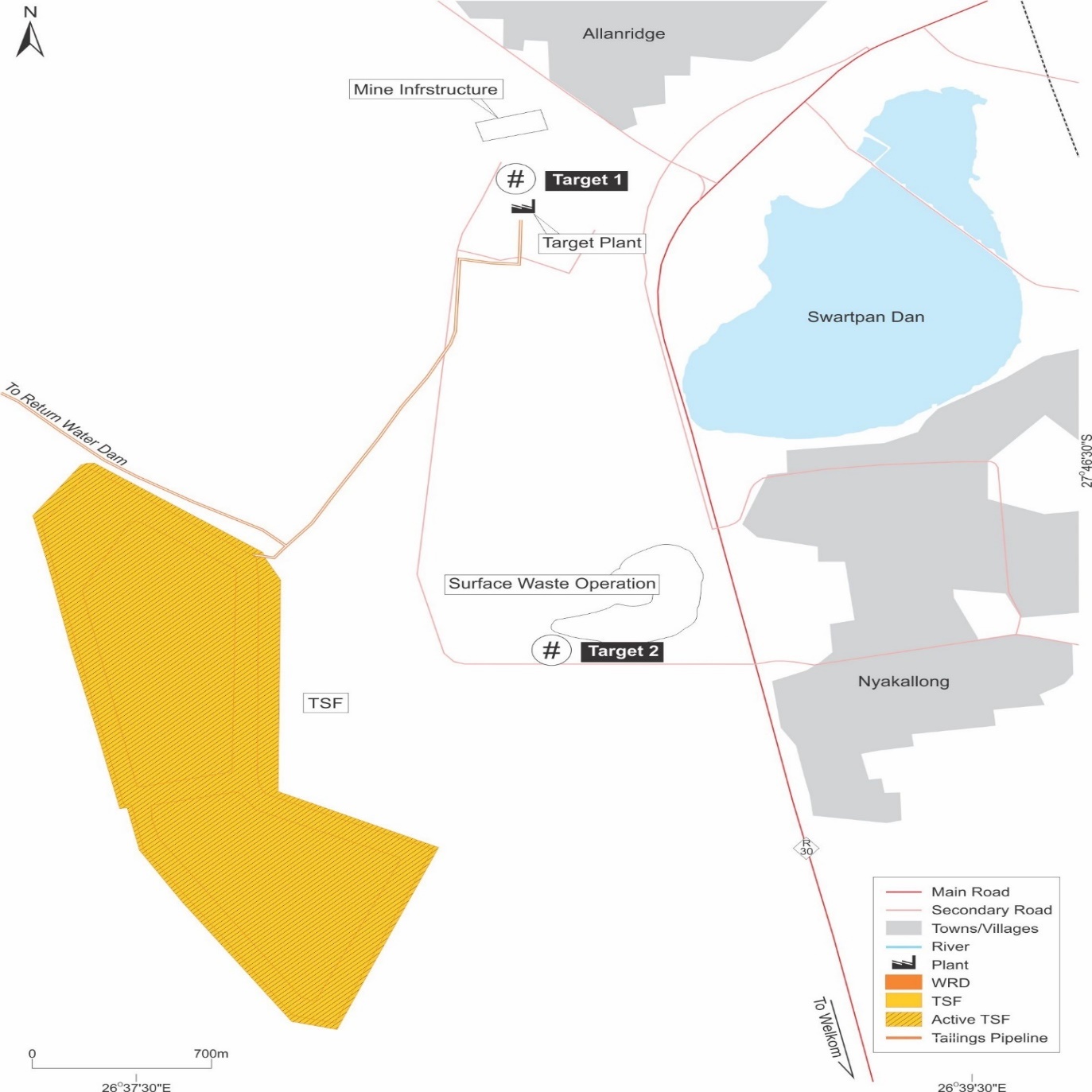
Geology
Target is situated on the north-western margin of the Witwatersrand Basin of South Africa, one of the prominent gold provinces in the world. The major gold bearing conglomerate reefs are mostly confined to the CRG of the Witwatersrand Supergroup.
Folding forms the major structural feature within the lease is and is manifested as an asymmetric syncline whose axis trends N15°W, with a general plunge of 10° to 12° north, although this is variable due to local structural features. The dip of the western limb of the syncline is often more than 55° eastwards. Numerous minor faults are also present.
These faults, with a displacement generally of less than 15m and traceable over a strike distance of less than 150m are too numerous to classify, however, it can be said that the eastern limb of the trough is less faulted than the western limb.
Gold mineralization currently exploited is hosted within a succession of EA and Dreyerskuil ("DK") quartz pebble conglomerate reefs hosted by the van den Heeversrust and Dreyerskuil (Uitkyk) Members of the Eldorado (Elsburg) Formation, respectively.
Additional mineralization occurs in the Big Pebble Reef of the underlying the Kimberley (formerly Aandenk) Formation. All these units are within the Turffontein Subgroup of the CRG. Mineralization is associated with the presence of medium to coarse, clast-supported oligomictic pebble horizons. The presence of allogenic (buckshot) pyrite and detrital carbon is also common.
History
Anglovaal Limited ("Anglovaal") previously held the mineral rights for the Target property. Target Exploration Company Limited ("Target Exploration Company"), a company formed by Anglovaal specifically for the purpose of exploration, later acquired this area. Options to the mineral rights north of Target were acquired by Sun Mining and Prospecting Company (Pty) Limited (“Sun”). The formation of Avgold Limited in 1996 was intended to further the gold mining and exploration interests of Anglovaal. Harmony acquired Target in 2002 by acquiring 100% of Avgold Limited's shares.
Mineral Tenure
Refer to Item 4: “Information on the Company – Business Overview – Regulation – Mineral Rights – South Africa” above for a summary of the regulatory environment in South Africa.
The current mining rights encompasses an area of 7,952.78ha. Harmony holds several mining rights for Target, which were successfully converted and executed as new order mining rights. Certain of these rights are still to be registered at the MPRTO.
The summary of mineral tenure and the approved mining rights include the following:
•FS30/5/1/2/2/14MR, which is valid from November 30, 2007, to December 29, 2025, and covers 4,237.00ha; and
•FS30/5/1/2/2/225MR, which is valid from December 12, 2013, to December 11, 2026, and 3,715.78ha.
A summary of the status of environmental permits and licenses issued as at June 30, 2022, related to Target is presented in the table below.
| | | | | | | | | | | | | | |
| Permit / Licence | Reference No. | Issued By | Date Granted | Validity |
| EMPr | FS 30/5/1/2/3/2/1(14) EM | DMRE | April 16, 2010 | LOM |
| Atmospheric Emission Licence | LDM/AEL/YMK/013 | Lejweleputswa District Municipality | November 5, 2018 | November 5, 2023 |
| Water Permit | 789N | DWS | November 4, 2008 | Valid pending issue of new license |
| Water Permit | 1046B | DWS | November 4, 2008 | Valid pending issue of new license |
Mining Method
The Target Mine deposit is made up of stacked mineralized multiple reef bands interbedded with quartzites and quartzwackes. The EA reefs are composited into thick mineralized packages to enable the application of massive open stoping mining method, while the Dreyerskuil Reefs are separated into thinner discrete horizons that enable narrow reef conventional mining method.
Target Mine is essentially a trackless mining operation with a combination of highly mechanized massive open stope mining, scattered mining and labor-intensive narrow reef stoping, the latter being more typical of South African gold mines’ conventional stoping.
The primary ore extraction method adopted at Target is massive mining of the thick mining horizons (EA1, EA3, EA7 and EA8) through a combination of scattered open stoping supplemented with the use of a 6%-cement backfill, and sub-level open stoping which does not make use of backfilling.
The balance of the ore is mined using a narrow reef mining ("NRM") method on the thinner Dreyerskuil Reefs, which does not make use of backfilling either.
Massive open stoping accounts for ±73% of the ore production with ±17% coming from conventional narrow reef stoping. The ±10% balance of production comes from trackless on-reef development sections.
Mineral Processing
The Target Plant was designed and commissioned in November 2001. The plant was designed to treat a total tonnage of 105ktpm with a potential to expand to 160ktpm for future demand. Currently the plant treats ore from Target and Target 2 waste dump.
Qualified Persons
The QPs preparing the TRS were employed on a full-time basis by Harmony. The QPs’ qualifications, areas of responsibility and personal inspection of the property are summarized in the graphic below.
| | | | | | | | | | | | | | |
| Qualified Person | Professional Organization | Qualification | TRS Section Responsibility | Personal Insp. |
Mr. S. Motlatla | SACNASP (No. 400451/14) | BSc. (Hons) Geol, GDE (Mining), Project Management Cert NQF Level 5 | All the sections | Full Time |
Mr. D. Fourie | SAIMM (No. 706555) | MSc. Min Eng, GDE (Mining) | 11 | Regular |
Mr. M. Ncube | SACNASP (No. 123075) | BSc. (Hons) Geol | 8, 9, 11 | Full Time |
Mr. L. Lochner | SANIRE | Rock Mechanics Cert | 13.1 - 13.2, 13.10 | Full Time |
Mr. M. Gxekwa | AMIHRP | Dip HR Man, PgDip. (Labour law) | 13.9 | Full Time |
Mr. J. van Heerden | AMRE | GCC Electrical | 13.7-13.8 | Full Time |
Mr. C. Radebe | MMMA | B.Tech Metallurgy | 14 | Full Time |
Mr. A. Relebona | n/a | BA (Hons) Env Sci | 17 | Regular |
Mr. D. Graham | n/a | B.Com (Bus & Man Accounting) | 18, 19 | Full Time |
Mr. E. Naude | n/a | MRM Certificate | 13 | Full Time |
Mr. J. van Deventer | SACNASP | BSc. (Hons) Geol | 6, 7 | Full Time |
Exploration
Geological data has been obtained through initial surface drilling, followed by underground drilling, mapping and channel (chip) sampling.
Initial surface drilling carried out during the 1980s, under the auspices of Sun, was designed to delineate the northward continuation of the synclinal axis, around which most of Loraine’s gold deposits are located. Following the incorporation of Target Exploration Company in 1990, a total of 17 drillholes and three long deflections from existing drillholes were drilled in three arrays parallel to the western margin, namely the Western, Central and Eastern arrays.
The Central Array targeted the EA Reefs, while the Western and Eastern arrays focused on definition of the proximal (steep west limb) and distal Kimberley and Basal Reefs, respectively.
The positive surface drilling results led to the construction of an underground drilling platform. Underground exploration drilling has been on-going throughout the operational life of Target as the mine deepens. Most of the underground drillholes are used in the geological modelling and estimation of the current Mineral Resources.
Underground diamond core drilling is conducted using hydraulic driven drill rigs, which typically drill BX core. Drill holes are typically short, rarely exceeding 300m in length.
Fans of drill holes are drilled from diamond drilling bays, which are developed at 50m intervals along the decline return airway (“RAW”) decline. The drilling fans consist of up to ten individual drill holes at inclinations ranging from -15° East to +30° West of vertical, or as dictated by local geological structures. Maximum drillhole lengths of 350m are required for complete Dreyerskuil intersections in the synclinal axis. Drill holes are stopped once the Ventersdorp lava has been intersected, or, in the case of flatter drill holes, once the trough axis has been identified and the drill hole is drilling parallel to the bedding.
The QPs are of the opinion that the quality and quantity of the exploration methods and information gathered is sufficient to support the estimation of Mineral Resources and Mineral Reserves.
Mineral Resource Estimate
The Mineral Resource estimate is reported in situ within the Target lease area, as determined through the analysis of the reasonable prospect for economic extraction by underground mining methods. The cut-off grade for the Mineral Resource is determined at 3.05g/t gold based on the economic assumptions presented in the table below at the effective date June 30, 2022.
| | | | | | | | |
| Description | Unit | Value |
| Gold Price | US$/oz | 1,764 |
| Exchange Rate | Rand:US$ | 16.22 |
| Gold Price | Rand/kg | 920,000 |
| Plant Recovery Factor | % | 94.78 |
| Unit Cost | Rand/t | 2,607 |
Note: Unit cost includes cash-operating cost, royalty and on-going development capital.
This cut-off value represents typical costs for the mining method and preliminary mining and metallurgical recovery assumptions.
The Mineral Resources were originally prepared, classified and reported according to the SAMREC, 2016. For the purposes of this report on Form 20-F, the Mineral Resources have been classified in accordance with Item 1302(d)(1)(iii)(A) of Regulation S-K. These Mineral Resources account for mining depletion recorded from July 2022 to June 2023.
The Mineral Resource estimate, as at June 30, 2023, exclusive of the reported Mineral Reserves is summarized in the table below.
| | | | | | | | | | | | | | | | | | | | | | | |
| Fiscal Year Ended June 30, | % Change |
| 2023 | 2022 |
| Mineral Resource Category | Tonnes (Mt) | Gold Grade (g/t) | Gold Content (kg) | Tonnes (Mt) | Gold Grade (g/t) | Gold Content (kg) |
| Measured | 4.745 | 8.60 | 40,795 | 4.374 | 8.89 | 38,860 | 5.0% |
| Indicated | 3.820 | 7.09 | 27,098 | 3.193 | 7.76 | 24,780 | 9.4% |
| Total / Ave. Measured + Indicated | 8.564 | 7.93 | 67,893 | 7.567 | 8.41 | 63,640 | 6.7% |
| Inferred | 4.046 | 5.68 | 22,990 | 4.028 | 5.96 | 24,007 | (4.2)% |
Notes:
1.Mineral Resources are reported with an effective date of June 30, 2023 were originally prepared, classified and reported according to SAMREC, 2016. For the purposes of this TRS, the Mineral Resources have been classified in accordance with Item 1302(d)(1)(iii)(A) of Regulation S-K. The Qualified Person responsible for the estimate is Mr. D. Fourie, who is Head of Department Geostatistician, and a Harmony employee.
2.The Mineral Resource tonnes are reported as in-situ with reasonable prospects for economic extraction.
3.No modifying factors or dilution sources have been included to in-situ Reserve which was subtracted from the SAMREC Resource in order to obtain the S-K 1300 Resource.
4.The Mineral Resources are reported using a cut-off grade of 3.05g/t determined at a 90% profit guidance, and a gold price of US$1,764/oz.
5.Tonnes are reported as rounded to three decimal places. Gold values are rounded to zero decimal places.
6.Mineral Resources are exclusive of Mineral Reserves. Mineral Resources are not Mineral Reserves and do not necessarily demonstrate economic viability.
7.Rounding as required by reporting guidelines may result in apparent summation differences.
8.The Mineral Resource estimate is for Harmony’s 100% interest.
Increase in the mineral resource was due to the updating of estimation variogram models for fiscal 2024.
Mineral Reserve Estimate
The Mineral Reserves were originally prepared, classified and reported according to SAMREC, 2016. For the purposes of this report on Form 20-F, the Mineral Reserves have been classified in accordance with Item 1302(d)(1)(iii)(A) of Regulation S-K. Mineral Reserves are derived from the Mineral Resources, a detailed business plan and the operational mine planning processes. Mine planning utilizes and takes into consideration historical technical parameters achieved. In addition, Mineral Resource conversion to Mineral Reserves considers certain modifying factors, dilution, ore losses, minimum mining widths, planned mine call and plant recovery factors.
The Mineral Reserve estimate, as at June 30, 2022 and 2023, is summarized in the table below.
| | | | | | | | | | | | | | | | | | | | | | | |
| | Fiscal Year Ended June 30, | |
| | 2023 | 2022 | |
| Mineral Reserve Category | Tonnes (Mt) | Gold Grade (g/t) | Gold Content (kg) | Tonnes (Mt) | Gold Grade (g/t) | Gold Content (kg) | % Change |
Proven | 2.567 | 4.38 | 11,233 | 2.722 | 4.32 | 11,744 | (4.4) | % |
| Probable | 1.242 | 4.46 | 5,539 | 1.726 | 4.11 | 7,096 | (21.9) | % |
Total / Ave. Proven + Probable | 3.810 | 4.40 | 16,772 | 4.447 | 4.24 | 18,840 | (11.0) | % |
Notes:
1.The Mineral Reserves were originally prepared, classified and reported according to SAMREC, 2016. For the purposes of this TRS, the Mineral Reserves have been classified in accordance with Item 1302(d)(1)(iii)(A) of Regulation S-K. The Qualified Person responsible for the estimate is Mr. S. Motlatla, who is the Target Ore Reserve Manager, and a Harmony employee.
2.Tonnes, grade, and gold content are declared as net delivered to the mills.
3.Figures are fully inclusive of all mining dilutions, gold losses and are reported as mill delivered tonnes and head grades. Metallurgical recovery factors have not been applied to the reserve figures.
4.Gold content is recovered gold content after taking into consideration the modifying factors.
5.The NRM Mineral Reserves are reported using a cut-off value of 941cmg/t determined using a gold price of US$1,582/oz. The massive open stoping Mineral Reserves are reported using a cut-off grade of 3.40g/t determined using a gold price of US$1,582/oz.
The decrease in Mineral Reserves is mainly due to omission of massive pillars which were previously earmarked for mining following geotechnical review of the ground conditions.
The table below presents a summary of the modifying factors used to convert the Mineral Resource to the Mineral Reserve for Target. The modifying factors are consistent with the modelling, planning and computing estimates used in determining the Mineral Reserves, which are also consistent with historical performance.
| | | | | | | | |
| Modifying Factor | Unit | Value |
| Relative Density | t/m3 | 2.71 |
| Average Stoping Width | cm | 180 |
| Mine Call Factor | % | 95 |
| Plant Recovery Factor | % | 95 |
| Mineral Reserve Paylimit - NRM | cmg/t | 941 |
| Mineral Reserve Cut-off - Massive Open Stoping | g/t | 3.40 |
| Mineral Reserve Cut-off - Development | g/t | 3.40 |
| Dilution - Massive Open Stoping | % | 6 |
For additional information, see the TRS on each individual property, filed as an Exhibit of this annual report on Form 20-F.
Tshepong North
Property Description
The Tshepong North comprise the underground and surface assets, situated between the towns of Welkom and Odendaalsrus in the Free State Province of South Africa. The mine is a moderate to deep-level gold mines, operating at depths of between 1.6km and 2.4km BMD.
The mine is located in the Free State Province of South Africa, approximately 250km southwest of Johannesburg and 15km to the north of the town of Welkom, situated at a latitude of 27°51’56.45”S and longitude of 26°42’45.15”E.
The following graphic illustrates the location of the Tshepong North, along with certain infrastructure.
The primary reef mined is the Basal Reef although the B reef mining has increased in the past 4 years from 8% to 32%.
All relevant underground mining and surface right permits, and any other permit related to the work conducted on the property have been obtained and are valid. There are no known legal proceedings (including violations or fines) against Harmony, which threaten its mineral rights, tenure, or operations.
Operational Infrastructure
The surrounding areas of Welkom and Odendaalsrus are well developed in terms of access and mining-related infrastructure, which supports the numerous operational gold mines in the area. The regional infrastructure includes national and provincial paved road networks, power transmission and distribution networks, water supply networks and communication infrastructure.
Tshepong North has a single shaft system with ore and waste being hoisted to surface through the main vertical shaft as well as a twin decline system from 66 level to 75 level with ore and waste being hoisted separate on a conveyor belt.
Tshepong North ore is transported, by rail, from the shaft to the Harmony One Plant in Welkom for processing.
Operations are powered by electricity from Eskom.
The surface infrastructure associated with Tshepong North is displayed in the graphic below.
Geology
Tshepong North is situated in the Free State Goldfield, on the southwestern margin of the Witwatersrand Basin of South Africa, one of the most prominent gold provinces in the world. The major gold bearing conglomerate reefs are mostly confined to the CRG of the Witwatersrand Supergroup.
The general orientation of the Witwatersrand Supergroup succession in this goldfield is interpreted as north-trending, within a syncline that is plunging to the north. The syncline has been divided by faults into the Odendaalsrus, Central Horst and Virginia sections. The Tshepong North mining right area is also affected by the Ophir and Dagbreek faults.
Tshepong North exploited primarily the Basal Reef, which occurs within the Harmony Formation of the Johannesburg Subgroup of the CRG.
Mineralization also occurs within the stratigraphically higher A and B reefs of the Kimberley (formerly Aandenk) Formation, within the Turffontein subgroup of the CRG. However, only the B Reef can be economically extracted.
Mineralization is associated with the presence of medium to coarse, clast-supported oligomictic pebble horizons. The presence of allogenic pyrite and detrital carbon is also common.
History
The Feasibility Study for the initial development of Tshepong North was concluded in 1984. Work to establish the site started in September 1984 and, by 1986, shaft sinking was underway. Sinking and equipping of the shaft were completed in 1991, with the mine being commissioned in November 1991.
The Tshepong South and Tshepong North were merged into the Tshepong Operations in 2017 and split into separate entities in 2023.
Mineral Tenure
Refer to Item 4: “Information on the Company – Business Overview – Regulation – Mineral Rights – South Africa” above for a summary of the regulatory environment in South Africa.
The current mining right for the Tshepong North encompasses an area of 10,798.74ha. Harmony holds several mining rights in the Free State goldfields which have been successfully converted and executed as new order mining rights, some of which are still to be registered at the MPRTO.
Tshepong North is wholly owned by Harmony, including the associated mineral rights. Harmony commenced acquiring the assets through the acquisition of AngloGold's Free State operations in 2001.
Mining at Tshepong North is carried out under the following mining right, covering both Tshepong North and Tshepong South:
•FS30/5/1/284MR, which is valid from December 11, 2007, to December 10, 2029, and covers an area of 10,798.74ha.
A summary of the status of environmental permits and licenses issued as at June 30, 2023, related to both Tshepong North and Tshepong South is presented in the table below.
| | | | | | | | | | | | | | |
Permit / Licence | Reference No. | Issued By | Date Granted | Validity |
| Environmental Management Programme | FS 30/5/1/2/3/2/1(84)EM | DMRE | April 16, 2010 | LOM |
| Environmental Management Updated | FS 30/5/1/2/2/84MR | DWAFEC | Pending Approval Submitted in 2019 | LOM |
| Water Permit 936B. Harmony. Free State Geduld Mines. Discharge of untreated effluents | B33/2/340/31 | DWAFEC | April 2, 1981 | LOM |
| Water Permit 870B. Harmony. Discharge of untreated effluents. | B33/2/340/25 | DWAFEC | May 27, 1991 | LOM |
| Water Permit 1214N. Free State Consolidated Gold Mine. Tshepong, Freddie’s and Phakisa shafts. | B33/2/340/12 | DWAFEC | Not indicated. | LOM |
| | | | |
| | | | |
| | | | |
| | | | |
| | | | |
| | | | |
Notes: DWAFEC - Department of Water Affairs, Forestry and Environmental Conservation.
Mining Method
Tshepong North mine may be classified as moderate to deep level underground gold mines currently operating at depths of up to 2,427m below surface.
SGM is the preferred mining method used at the Tshepong North. This method makes use of dip pillars and reduced mining spans with pre-developed tunnels, aimed at further control of stresses experienced in rock movement. The SGM sequence is a V-shaped configuration, colloquially referred to as the “inverted Christmas tree”.
The SGM mining methods are suitable for underground, narrow reef mining. A common feature of the SGM method is the layout of the primary and secondary development. Primary development is done off-reef (in waste rock), while secondary development is done on-reef (in the mineralized zone).
The SGM is employed for a deeper mining approach and offers various advantages, the critical one being increased safety. A noticeable characteristic of the SGM method is that mining from the raises is advanced in only one direction at a time, which is directed towards the stabilizing or regional pillars. This SGM mining sequence eliminates the creation of remnant pillars reducing the risk of seismicity.
While Tshepong North business plan is based primarily on the SGM methodology and sequencing, there are sections of the mine that are operating using the breast, undercut and open stoping mining methods.
Minor amounts of the B Reef that do not exceed 38% of the on-reef mined per annum, are extracted as an open stoping mining operation. Reason for mining at open stoping is as a result of the erratic nature of the channel width and the support design specific to B reef mining.
Mineral Processing
All ore mined at Tshepong North is processed at Harmony One Plant located west of Welkom. Harmony One Plant is Harmony’s largest gold processing plant and processes underground ore from multiple shafts, as well as surface ore from nearby mine waste facilities. The plant was commissioned in 1986 and comprises three independent modules, each consisting of four feed silos, two ROM mills, two conventional thickeners, cyanide leach, CIP adsorption, elution, zinc precipitation and smelting. The plant CIP process reflects the technology which was current at the time of construction.
The Harmony One Plant has a steady state design capacity of 390ktpm with its conventional CIP flowsheet. The Harmony One plant is in good working condition and the equipment is also in good order with audits done on regular bases to check the operating performance of the plant.
Qualified Persons
The QP preparing the TRS was employed on a full-time basis by Harmony. The QP's qualifications, areas of responsibility and personal inspection of the property are summarized in the graphic below.
| | | | | | | | | | | | | | |
| Qualified Person | Professional Organization | Qualification | TRS Section Responsibility | Personal Insp. |
| Mr. A. Louw | SACNASP | BSc. Hons. (Geohydro) | All Sections (Tshepong) | Full Time |
| | | | |
| | | | |
| | | | |
| | | | |
| | | | |
| | | | |
| | | | |
| | | | |
| | | | |
| | | | |
Exploration
Geological data has been obtained through initial surface drilling, followed by underground drilling, mapping and channel (chip) sampling.
Exploration from underground platforms is currently continuing for the Tshepong sub-75 development, to improve geological confidence.
Tshepong North is continuously undergoing B reef exploration drilling to identify any potential continuation of the current pay shoots connecting these mines. Footwall development began at Tshepong North during FY22 and will be used as a drilling platform to confirm and delineate the anticipated B Reef channel.
Underground exploration drilling has been ongoing throughout the operational life of Tshepong North as the mine deepens. Underground diamond core drilling is conducted using hydraulic driven and pneumatic drill rigs.
Fans of drill holes are drilled from diamond drilling bays, which are developed at 50m intervals along footwall developments ends (X/Cs) and 100m intervals along haulages and RAWs. The drilling fans consist of up to ten individual drill holes at inclinations ranging from -15° to +30° of vertical, or as dictated by local geological structures.
The underground infill drilling system is in place to improve data density in specific areas and are drilled from the underground development access drives.
Logging procedures are conducted as per the Harmony company standards, which are used on all surface and underground mines and are best practice and have been in place consistently since 2001.
The QP is of the opinion that the quality and quantity of the exploration methods and information gathered is sufficient to support the estimation of Mineral Resources and Mineral Reserves.
Mineral Resource Estimate
The Mineral Resource estimate for the Tshepong North is considered to have reasonable prospects for economic extraction. This is demonstrated by the results of the cash flow for the mines. The cut-off value for the Mineral Resources is determined at 700cmg/t for the gold based on the economic assumptions presented in the table below at the effective date June 30, 2023.
| | | | | | | | |
Tshepong North | | |
| Description | Unit | Value |
| Gold price | US$/oz | 1,764 |
| FX rate | Rand:US$ | 16.22 |
| Gold price | Rand/kg | 920,000 |
| Plant recovery factor | % | 95 |
| Unit cost | Rand/t | 4,075 |
Note: Unit cost includes cash operating cost, royalty and ongoing development capital
This cut-off values represents typical costs for the mining method and preliminary mining and metallurgical recovery assumptions.
The Mineral Resources were originally prepared, classified and reported according to the SAMREC, 2016. For the purposes of this report on Form 20-F, the Mineral Resources have been classified in accordance with Item 1302(d)(1)(iii)(A) of Regulation S-K. These Mineral Resources account for mining depletion recorded from July 2022 to June 2023.
The Mineral Resource estimate for Tshepong North, as at June 30, 2023, exclusive of the reported Mineral Reserves, is summarized in the table below.
| | | | | | | | | | | | | | | | | | | | | | | |
| Fiscal Year Ended June 30, | % Change |
| 2023 | 2022 |
| Mineral Resource Category | Tonnes (Mt) | Gold Grade (g/t) | Gold Content (kg) | Tonnes (Mt) | Gold Grade (g/t) | Gold Content (kg) |
| Measured | 11.920 | 12.42 | 147,989 | 12.484 | 12.13 | 151,437 | (2.3)% |
| Indicated | 3.162 | 10.28 | 32,493 | 3.977 | 10.20 | 40,575 | (19.9)% |
| Total / Ave. Measured + Indicated | 15.082 | 11.97 | 180,481 | 16.462 | 11.66 | 192,012 | (6.0)% |
| Inferred | 9.744 | 10.20 | 99,356 | 9.434 | 10.18 | 96,037 | 3.5% |
Notes:
1.Mineral Resources are reported with an effective date of June 30, 2023 were originally prepared, classified and reported according to SAMREC, 2016. For the purposes of this TRS, the Mineral Resources have been classified in accordance with Item 1302(d)(1)(iii)(A) of Regulation S-K. The QP responsible for the estimate is Mr. A. Louw, who is Ore Reserve Manager at Tshepong, and a Harmony employee.
2.The Mineral Resource tonnes are reported as in-situ with reasonable prospects for economic extraction.
3.No modifying factors or dilution sources have been included to in-situ Reserve which was subtracted from the SAMREC Resource in order to obtain the S-K 1300 Resource.
4.The Mineral Resources are reported using a cut-off value of 700cmg/t determined at a 90% profit guidance, and a gold price of US$1,582/oz.
5.Tonnes are reported as rounded to three decimal places. Gold values are rounded to zero decimal places.
6.Mineral Resources are exclusive of Mineral Reserves. Mineral Resources are not Mineral Reserves and do not necessarily demonstrate economic viability.
7.Rounding as required by reporting guidelines may result in apparent summation differences.
8.The Mineral Resource estimate is for Harmony’s 100% interest.
The decrease in the Mineral Resource is mainly due to increase in the the resource cut-off grade from 648cmgt to 700cmgt.
Mineral Reserve Estimate
The Mineral Reserves were originally prepared, classified and reported according to SAMREC, 2016. For the purposes of this report on Form 20-F, the Mineral Reserves have been classified in accordance with Item 1302(d)(1)(iii)(A) of Regulation S-K.
Mineral Reserves are derived from the Mineral Resources, a detailed business plan and the operational mine planning processes. Mine planning utilizes and takes into consideration historical technical parameters achieved. In addition, Mineral Resource conversion to Mineral Reserves considers certain modifying factors, dilution, ore losses, minimum mining widths, planned mine call and plant recovery factors.
The Mineral Reserve estimate for Tshepong North, as at June 30, 2022, and 2023, is summarized in the table below.
| | | | | | | | | | | | | | | | | | | | | | | |
| | Fiscal Year Ended June 30, | |
| | 2023 | 2022 | |
| Mineral Reserve Category | Tonnes (Mt) | Gold Grade (g/t) | Gold Content (kg) | Tonnes (Mt) | Gold Grade (g/t) | Gold Content (kg) | % Change |
Proven | 2.997 | 4.79 | 14,341 | 4.157 | 5.15 | 21,419 | (33.0) | % |
| Probable | 0.766 | 5.73 | 4,390 | 0.336 | 7.63 | 2,565 | 71.2 | % |
Total / Ave. Proven + Probable | 3.763 | 4.98 | 18,731 | 4.493 | 5.34 | 23,985 | (21.9) | % |
Notes:
1.The Mineral Reserves were originally prepared, classified and reported according to SAMREC, 2016. For the purposes of this TRS, the Mineral Reserves have been classified in accordance with Item 1302(d)(1)(iii)(A) of Regulation S-K. The QP responsible for the estimate is Mr. A. Louw, who is Ore Reserve Manager at Tshepong, and a Harmony employee.
2.Tonnes, grade, and gold content are declared as net delivered to the mills.
3.Figures are fully inclusive of all mining dilutions, gold losses and are reported as mill delivered tonnes and head grades. Metallurgical recovery factors have not been applied to the reserve figures.
4.Gold content has not taken metallurgical recovery factors into account.
5.Mineral Reserves are reported using a cut-off grade of 800cmg/t determined using a gold price of US$1,582/oz gold.
The decrease in Mineral Reserves is due to the increase in the reserve cut-off grade from 690cmgt to 800cmgt.
The table below presents a summary of the modifying factors used to convert the Mineral Resource to the Mineral Reserve for Tshepong North. The modifying factors are consistent with the modelling, planning and computing estimates used in determining the Mineral Reserves, which are also consistent with historical performance.
| | | | | | | | |
| Modifying Factor | Unit | Value |
| Relative Density | t/m3 | 2.72 |
| Stoping Width | cm | 118 |
| Gully | % | 8.90 |
| Off Reef | % | 4.81 |
| Waste to Reef | % | 0.80 |
| Flushing tons | % | 2.28 |
| Discrepancy | % | 5.06 |
| Mine Call Factor | % | 72.00 |
| Plant Recover Factor | % | 94.96 |
| Mine Recover Factor | % | 68.37 |
| Plant Call Factor | % | 100 |
| Mineral Reserve cut-off | cmg/t | 800 |
Notes: Development waste to reef, including the decline development.
For additional information, see the TRS on each individual property, filed as an Exhibit of this annual report on Form 20-F.
Tshepong South
Property Description
The Tshepong South mine comprises one operating underground gold mine namely “Tshepong South”. Tshepong South is a mature, moderate to deep-level underground operation using conventional underground mining methods to depths of 2,427m BMD. The mine utilizes the Tshepong North and Nyala shafts. Tshepong South’s success is greatly dependent on the services rendered via Nyala where four main compressors are commissioned and Tshepong South’s ore is being hoisted.
The mines are located in the Free State Province of South Africa, approximately 250km southwest of Johannesburg and 15km to the north of the town of Welkom.Tshepong South is situated adjacent to the south of Tshepong North, and is located at a latitude of 27°54’1.27”S and longitude of 26°43’30.05”E.
The following graphic illustrates the location of Tshepong South, along with certain infrastructure.
The primary reef mined is the Basal Reef, with additional gold mineralization being found in the B Reef and A Reef. The B Reef, which lies between 150m and 170m stratigraphically above the Basal Reef, contributes just less than 20% to the mining production at Tshepong South.
All relevant underground mining and surface right permits, and any other permit related to the work conducted on the property have been obtained and are valid. There are no known legal proceedings (including violations or fines) against Harmony, which threaten its mineral rights, tenure, or operations.
Operational Infrastructure
The surrounding areas of Welkom and Odendaalsrus are well developed in terms of access and mining-related infrastructure, which supports the numerous operational gold mines in the area. The regional infrastructure includes national and provincial paved road networks, power transmission and distribution networks, water supply networks and communication infrastructure.
Tshepong South operates a single vertical shaft for man and materials. Rock is transported from the underground working via a RailVeyorTM system to the Nyala Shaft for hoisting.
The Tshepong South ore is transported, by rail, from Nyala shaft to the Harmony One Plant in Welkom for processing.
Tshepong South is powered by electricity from Eskom.
The surface infrastructure associated with Tshepong South is displayed in the graphic below.
Geology
Tshepong South is situated in the Free State Goldfield, on the southwestern margin of the Witwatersrand Basin of South Africa, one of the most prominent gold provinces in the world. The major gold bearing conglomerate reefs are mostly confined to the CRG of the Witwatersrand Supergroup.
The general orientation of the Witwatersrand Supergroup succession in this goldfield is interpreted as north-trending, within a syncline that is plunging to the north. The syncline has been divided by faults into the Odendaalsrus, Central Horst and Virginia sections. The Tshepong South mining right area is also affected by the Tribute fault (~270m) and Arrarat Fault (~180m) to the far south-east of the shaft.
Tshepong South exploited primarily the Basal Reef, which occurs within the Harmony Formation of the Johannesburg Subgroup of the CRG.
Mineralization also occurs within the stratigraphically higher A and B reefs of the Kimberley (formerly Aandenk) Formation, within the Turffontein subgroup of the CRG. However, only the B Reef can be economically extracted.
Mineralization is associated with the presence of medium to coarse, clast-supported oligomictic pebble horizons. The presence of allogenic pyrite and detrital carbon is also common.
History
Tshepong South was formerly known as FSG 4, Freddies 4 and Phakisa. Tshepong South development commenced in October 1993 and shaft sinking was started in February 1994. In 1995, shaft sinking was halted on 59 Level due to the prevailing low gold price. Operations at Tshepong South recommenced in September 1996 and sinking was completed to 75 Level, before being halted again in 1999.
Harmony acquired Tshepong South as part of the acquisition from AngloGold Ashanti’s Free State operations (previously known as Freegold), which completed in September 2003. Sinking and equipping was completed to a depth of 2,427m in 2006.
Tshepong South and Tshepong North were merged into the Tshepong Operations by Harmony in 2017 and split into separate entities in 2023.
Mineral Tenure
Refer to Item 4: “Information on the Company – Business Overview – Regulation – Mineral Rights – South Africa” above for a summary of the regulatory environment in South Africa.
The current mining right for Tshepong South and Tshepong North encompasses an area of 10,798.74ha. Harmony holds several mining rights in the Free State goldfields which have been successfully converted and executed as new order mining rights, some of which are still to be registered at the MPRTO.
Tshepong South is wholly owned by Harmony, including the associated mineral rights. Harmony commenced acquiring the assets through the acquisition of AngloGold's Free State operations in 2001, together with ARMGold. ARMGold was subsequently incorporated into Harmony in 2003, giving Harmony 100% ownership and control of the Tshepong South.
Mining at Tshepong South is carried out under the following mining right, covering both Tshepong and Tshepong South:
•FS30/5/1/284MR, which is valid from 11 December 2007 to 10 December 2029 and covers an area of 10,798.74ha.
A summary of the status of environmental permits and licenses issued as at June 30, 2023, related to both Tshepong South and Tshepong North is presented in the table below.
| | | | | | | | | | | | | | |
| Permit / Licence | Reference No. | Issued By | Date Granted | Validity |
| Environmental Management Programme | FS 30/5/1/2/3/2/1(84)EM | DMRE | April 16, 2010 | LOM |
| Environmental Management Updated | FS 30/5/1/2/2/84MR | DWAFEC | Pending Approval Submitted in 2020 | LOM |
| Water Permit 936B. Harmony. Free State Geduld Mines. Discharge of untreated effluents | B33/2/340/31 | DWAFEC | April 2, 1981 | LOM |
| Water Permit 870B. Harmony. Discharge of untreated effluents. | B33/2/340/25 | DWAFEC | May 27, 1991 | LOM |
| Water Permit 1214N. Free State Consolidated Gold Mine. Tshepong, Freddie’s and Phakisa shafts. | B33/2/340/12 | DWAFEC | Not indicated. | LOM |
| | | | |
| | | | |
| | | | |
| | | | |
| | | | |
| | | | |
Mining Method
Tshepong South may be classified as moderate to deep level underground gold mine currently operating at depths of up to 2,427m below surface.
The orebody at Tshepong South Mine is broken up into blocks by geological structures with large throws. Due to the orebody being broken up into these small blocks, a Scattered mining method is used at Tshepong South Mine. Scattered mining is when mining is done between the major geological structures. The mine design criteria is based on the sequential grid mining method where the crosscuts are spaced at fixed distance of 160m however additional development can be required in some instances and/or crosscut spacing reduced/increased depending on the prevailing geological structures. Primary Waste Development is done ahead of the stoping front in the virgin stress environment.
Primary development is done off-reef (in waste rock), while secondary development is done on-reef (in the mineralized zone). In primary development, horizontal haulages are developed from the vertical shaft, extending to the extremities of the mining level. Inter-level spacing is the perpendicular distance between two consecutive level stations underground. Further
development is done at set intervals along the haulages towards the mineralized zones in the form of crosscuts. For secondary development, an inclined excavation that connects two levels is established, referred to a raise or winze, depending on the upwards or downwards direction of the development.
A key feature of Scattered mining is that the mine design includes pillars in the stoping areas that are designed to cave in a planned and controlled manner. These pillars are referred to as crush pillars and the dimensions of the pillars are determined by the geotechnical properties of the host rock. The use of crush pillars minimizes the risk of unpredicted collapse of stoping areas. These collapses can compromise the safety of mining operations and may lead to permanent closure of stoping panels or sterilization of ore.
Mineral Processing
All ore mined at Tshepong South is processed at Harmony One Plant located west of Welkom. Harmony One Plant is Harmony’s largest gold processing plant and processes underground ore from multiple shafts, as well as surface ore from nearby mine waste facilities. The plant was commissioned in 1986 and comprises three independent modules, each consisting of four feed silos, two ROM mills, two conventional thickeners, cyanide leach, CIP adsorption, elution, zinc precipitation and smelting. The plant CIP process reflects the technology which was current at the time of construction. Overall the plant has been operating with no significant challenges and target metallurgical recoveries have been achieved.
The Harmony One Plant has a steady state design capacity of 390ktpm with its conventional CIP flowsheet. The Harmony One plant is in good working condition and the equipment is also in good order with audits done on regular bases to check the operating performance of the plant.
Qualified Persons
The QP preparing the TRS is employed on a full-time basis by Harmony. The QP's qualifications, areas of responsibility and personal inspection of the property are summarized in the graphic below.
| | | | | | | | | | | | | | |
| Qualified Person | Professional Organization | Qualification | TRS Section Responsibility | Personal Insp. |
| Ms. B. Phetlhu | SACNASP | BTech. (Geol), M (Eng) | All Sections (Phakisa) | Full Time |
| | | | |
| | | | |
| | | | |
| | | | |
| | | | |
| | | | |
| | | | |
| | | | |
| | | | |
| | | | |
Exploration
Geological data has been obtained through initial surface drilling, followed by underground drilling, mapping and channel (chip) sampling. The underground infill drilling system is in place to improve data density in specific areas and are drilled from the underground development access drives.
Tshepong South is undergoing extensive B Reef exploration drilling to better delineate the continuation of the identified pay shoot running from Tshepong North into Tshepong South thus connecting these mines. The drilling will also improve the geological confidence of the B Reef. Footwall development began at the Tshepong South during fiscal 2022 and is continuously being utilized as a drilling platform to confirm and delineate the anticipated target B Reef channel.
Underground exploration drilling has been ongoing throughout the operational life of Tshepong South. Underground diamond core drilling is conducted using hydraulic driven and pneumatic drill rigs.
Fans of drill holes are drilled from diamond drilling bays, which are developed at 50m intervals along footwall development ends (X/Cs) and 100m intervals along haulages and RAWs. The drilling fans consist of up to ten individual drill holes at inclinations ranging from +5° to +90° of vertical, or as dictated by local geological structures.
The underground infill drilling system is in place to improve data density in specific areas and are drilled from the underground development access drives.
Logging procedures are conducted as per the Harmony company standards, which are used on all surface and underground mines and are best practice and have been in place consistently since 2001.
The QP is of the opinion that the quality and quantity of the exploration methods and information gathered is sufficient to support the estimation of Mineral Resources and Mineral Reserves.
Mineral Resource Estimate
The Mineral Resource estimate for the Tshepong South is considered to have reasonable prospects for economic extraction. This is demonstrated by the results of the cash flow for the mine. The cut-off value for the Mineral Resources is determined at 780cmg/t for the gold, based on the economic assumptions presented in the table below at the effective date June 30, 2023.
| | | | | | | | |
| Tshepong South | | |
| Description | Unit | Value |
| Gold price | US$/oz | 1,764 |
| FX rate | Rand:US$ | 16.22 |
| Gold price | Rand/kg | 920,000 |
| Plant recovery factor | % | 95,2 |
| Unit cost | Rand/t | 4,411 |
Note: Unit cost includes cash operating cost, royalty and ongoing development capital.
This cut-off values represents typical costs for the mining method and preliminary mining and metallurgical recovery assumptions.
The Mineral Resources were originally prepared, classified and reported according to the SAMREC, 2016. For the purposes of this report on Form 20-F, the Mineral Resources have been classified in accordance with Item 1302(d)(1)(iii)(A) of Regulation S-K. These Mineral Resources account for mining depletion recorded from July 2022 to June 2023.
The Mineral Resource estimate for Tshepong South, as at June 30, 2023, exclusive of the reported Mineral Reserves is summarized in the table below. There is a decrease in ounces due to the increase in geological discounts applied especially towards the Tribute fault area (East South), as new geological information became available.
| | | | | | | | | | | | | | | | | | | | | | | |
| Fiscal Year Ended June 30, | % Change |
| 2023 | 2022 |
| Mineral Resource Category | Tonnes (Mt) | Gold Grade (g/t) | Gold Content (kg) | Tonnes (Mt) | Gold Grade (g/t) | Gold Content (kg) |
| Measured | 5.661 | 13.02 | 73,695 | 4.741 | 13.25 | 62,797 | 17.4% |
| Indicated | 6.680 | 11.67 | 77,950 | 7.264 | 11.27 | 81,831 | (4.7)% |
| Total / Ave. Measured + Indicated | 12.341 | 12.29 | 151,645 | 12.005 | 12.05 | 144,627 | 4.9% |
| Inferred | 25.090 | 10.67 | 267,678 | 27.491 | 10.77 | 295,943 | (9.6)% |
Notes:
1.Mineral Resources are reported with an effective date of June 30, 2023 were originally prepared, classified and reported according to SAMREC, 2016. For the purposes of this TRS, the Mineral Resources have been classified in accordance with Item 1302(d)(1)(iii)(A) of Regulation S-K. The QP responsible for the estimate is Ms. B. Phetlhu, who is Ore Reserve Manager at Tshepong South, and a Harmony employee.
2.The Mineral Resource tonnes are reported as in-situ with reasonable prospects for economic extraction.
3.No modifying factors or dilution sources have been included to in-situ Reserve which was subtracted from the SAMREC Resource in order to obtain the S-K 1300 Resource.
4.The Mineral Resources are reported using a cut-off value of 780cmg/t determined at a 90% profit guidance, and a gold price of US$1,764/oz.
5.Tonnes are reported as rounded to three decimal places. Gold values are rounded to zero decimal places.
6.Mineral Resources are exclusive of Mineral Reserves. Mineral Resources are not Mineral Reserves and do not necessarily demonstrate economic viability.
7.Rounding as required by reporting guidelines may result in apparent summation differences.
8.The Mineral Resource estimate is for Harmony’s 100% interest.
Mineral Reserve Estimate
The Mineral Reserves were originally prepared, classified and reported according to SAMREC, 2016. For the purposes of this report on Form 20-F, the Mineral Reserves have been classified in accordance with Item 1302(d)(1)(iii)(A) of Regulation S-K.
Mineral Reserves are derived from the Mineral Resources, a detailed business plan and the operational mine planning processes. Mine planning utilizes and takes into consideration historical technical parameters achieved. In addition, Mineral Resource conversion to Mineral Reserves considers certain modifying factors, dilution, ore losses, minimum mining widths, planned mine call and plant recovery factors.
The Mineral Reserve estimate for Tshepong South, as at June 30, 2022, and 2023, is summarized in the table below. There is an increase in ounces as a result of an increase in Basal Reef grade as from the 34 line to the South of the mine as well as the increase in the B-Reef footprint to the north of the shaft. These additions mitigated but could not completely make up for the total decrease in Mineral Reserves due to depletion.
| | | | | | | | | | | | | | | | | | | | | | | |
| | Fiscal Year Ended June 30, | |
| | 2023 | 2022 | |
| Mineral Reserve Category | Tonnes (Mt) | Gold Grade (g/t) | Gold Content (kg) | Tonnes (Mt) | Gold Grade (g/t) | Gold Content (kg) | % Change |
Proven | 2.882 | 7.79 | 22,466 | 3.759 | 6.98 | 26,243 | (14.4) | % |
| Probable | 0.563 | 7.06 | 3,972 | 0.176 | 6.49 | 1,143 | 247.5 | % |
Total / Proven + Probable | 3.445 | 7.67 | 26,438 | 3.935 | 6.96 | 27,386 | (3.5) | % |
Notes:
1.The Mineral Reserves were originally prepared, classified and reported according to SAMREC, 2016. For the purposes of this TRS, the Mineral Reserves have been classified in accordance with Item 1302(d)(1)(iii)(A) of Regulation S-K. The QP responsible for the estimate is Ms. B. Phetlhu, who is Ore Reserve Manager at Tshepong South, and a Harmony employee.
2.Tonnes, grade, and gold content are declared as net delivered to the mills.
3.Figures are fully inclusive of all mining dilutions, gold losses and are reported as mill delivered tonnes and head grades. Metallurgical recovery factors have not been applied to the reserve figures.
4.Gold content has not taken metallurgical recovery factors into account.
5.Mineral Reserves are reported using a cut-off grade of 791cmg/t determined using a gold price of US$1,582/oz gold.
The table below presents a summary of the modifying factors used to convert the Mineral Resource to the Mineral Reserve for Tshepong South. The modifying factors are consistent with the modelling, planning and computing estimates used in determining the Mineral Reserves, which are also consistent with historical performance.
| | | | | | | | |
| Modifying Factor | Unit | Value |
| Relative Density | t/m3 | 2.72 | |
| Stoping Width | cm | 130 | |
| Gully | % | 6.9 | |
| Off Reef | % | 4.7 | |
| Waste to Reef | % | 0.23 | |
| Flushing tons | % | — | |
| Discrepancy | % | 11.1 | |
| Mine Call Factor | % | 83.0 | |
| Plant Recover Factor | % | 95 | |
| Mine Recover Factor | % | 79 | |
| Plant Call Factor | % | 100 | |
| Mineral Reserve cut-off | cmg/t | 791 | |
For additional information, see the TRS on each individual property, filed as an Exhibit of this annual report on Form 20-F.
Mine Waste Solutions
Property Description
Mine Waste Solutions is comprised of two distinct, geographically separated, operations namely the MWS Operation located on the Free State - North West provincial boundary, and the West Wits Operation situated in the West Rand Region of the Gauteng Province. Each operation will be discussed separately due to their geographical locations.
Mine Waste Solutions and its associated mineral rights are wholly owned by Harmony. Harmony acquired the assets as part of the transaction to take full ownership and control of AngloGold's remaining South African business, as of October 1, 2020.
The location of the MWS operation and the West Wits operation is presented in figure below.
The following graphic illustrates the location of the MWS Operation, along with certain infrastructure.
The following graphic illustrates the location of the West Wits Operation, along with certain infrastructure is
The MWS Operation is located in the Vaal River area, and straddles the Free State, North West provincial border of South Africa, close to the town of Klerksdorp. The MWS Gold Plant (26° 50’8.66”E; 26° 47’41.83”S) is situated close to the town of Stilfontein, while the TSFs and WRD for this operation are scattered over an area that stretches approximately 13.5km north to south and 14.0km east to west.
The West Wits Operation is situated in the West Rand Region of the Gauteng Province. The West Wits Operation is situated approximately 75km west of Johannesburg. The site is approximately 7km south of Carletonville. West Wits Operation occupies an area of 4,176ha in extent and is close to the boundary between Gauteng and North West Province.
The West Wits Operation reprocesses tailings from the Old North TSF dumps and waste rock from the Savuka WRD at the Savuka Plant (26° 25’20.31”E and 27° 24’11.30”S).
There is no material litigation (including violations or fines) against Harmony that threatens its mineral rights, tenure, or operations.
Operational Infrastructure
Infrastructure in the region is well established supporting the numerous operational gold mines in the area. The regional infrastructure includes national and provincial paved road networks, power transmission and distribution networks, water supply networks and communication infrastructure. Operations are powered by electricity from Eskom.
The MWS Operation is accessible from Johannesburg via the N12 national road and R502 regional road in Klerksdorp, North West. A large network of either tarred roads or well-maintained gravel roads exist between the tailing dams, WRDs and the MWS Plant that are scattered in the area. The West Wits Operations near Carletonville are accessible via the N12 national road and R500 regional road from Johannesburg.
The surface infrastructure associated with the MWS operation and the West Wits operation is presented in the graphic under "– Property Description" above.
Geology
Material contained in the TSFs and WRDs predominantly originates from deep level gold mines, operated by Harmony and others, mostly located in Klerksdorp and Carletonville. The West Wits mining operations predominantly extract tabular gold-bearing conglomeratic reefs, namely the CLR and VCR. The MWS Operation, however, mainly exploits TSFs and WRD derived from the VR.
The Witwatersrand reefs occur within the Archean Witwatersrand Basin which hosts the Witwatersrand Supergroup succession. The VCR horizon is located at the top of the Turffontein Subgroup of the CRG, capping the Witwatersrand Supergroup. The VR horizon is situated within the Krugersdorp Formation, in the Johannesburg Subgroup of the CRG. The CLR is situated near the base of the Johannesburg Subgroup.
The TSF material comprises previously treated residues of gold-bearing conglomeratic reefs processed by CIL. They are man-made “deposits” and are not the result of natural sedimentary processes. The grade of the TSFs is determined by the grade of the ore source at the time that they were processed, and the processing efficiency.
The WRDs are unconsolidated and are comprised of untreated, low grade, gold-bearing material from underground workings. The WRDs are also man-made deposits, with very little structure or continuity, and one in which the grade does not behave as a natural mineral deposit.
The most significant mineral in the TSFs and WRDs is quartz, which makes up more than 60% of the bulk mineral composition. The gold predominantly occurs in pyrite. Other minerals identified include uranium, iron oxide, titanium oxide and calcite from the VR, VCR and CLR conglomerates.
History
The MWS Operation commenced production in 1952 and was the original gold processing plant for the Stilfontein Gold Mine. Following the rise in the uranium price in the 1970s, the operation investigated uranium recovery from the Stilfontein Gold Mine’s gold tailings dams and commissioned the uranium plant in mid-1979. The plant operated until 1989, processing 29.4Mt of tailings and recovering 4.56t of U3O8. In 2003, the plant was converted into a gold tailings treatment operation and no further uranium was produced at that stage.
In 2007, First Uranium (Pty) Ltd (South Africa) ("First Uranium") acquired the MWS Operation with the purpose of treating the tailings dams for both gold and uranium. The second and third processing plants were commissioned between 2007 and 2012.
On July 20, 2012, the MWS Operation were acquired by AngloGold from First Uranium. The MWS uranium plant and flotation plants were commissioned in 2014, and were further reconfigured into a more efficient operation during 2016, as part of an optimization drive. In 2017, the uranium and flotation plants were discontinued resulting in MWS Operation again producing only gold.
On October 1, 2020, Harmony acquired all of AngloGold’s surface operations, including the MWS Operation.
The Savuka Plant was commissioned in 1961 and originally designed to treat ore from Savuka Mine and TauTona Mine. In 2015, upon the change in strategy to process the reef from the aforementioned shafts at Mponeng Plant, the plant was converted into a tailings and WRD treatment facility. The Savuka Plant treats tailings material from Savuka and Mponeng TSFs, and waste rock from the WRDs from the same operations. On October 1, 2020, Harmony acquired all of AngloGold’s South African business, including the surface assets which constitute the West Wits Operation.
Mineral Tenure
Refer to Item 4: “Information on the Company – Business Overview – Regulation – Mineral Rights – South Africa” above for a summary of the regulatory environment in South Africa.
The MWS Operation’s license to operate is covered by the Environmental Authorization under the National Environmental Management Act No. 107 of 1998. In terms of the current legislation, the MPRDA, a mining right is not required to reclaim TSFs.
Following the acquisition of MWS Operation, all relevant permits and licenses were acquired by Harmony and there is financial provision for rehabilitation liabilities for the MWS Operations, as well as the historic surface rights permits for MWS Operation. All of these permits are still valid. MWS no longer operates under any mining right. All relevant environmental and water-use permits are in place that cover the environmental, archaeological, and hydrological components of Mine Waste Solutions. All permits are audited regularly for compliance. The latest of EA is applicable to the Kareerand TSF expansion activities, issued to MWS in 2022. MWS is currently busy with an environmental authorization process to increase it piping capacity from Kareerand TSF to enable more return water to be pumped back to the MWS Plant and reclamation activities.
Mining Method
The mining methodologies adopted at Mine Waste Solutions entail the hydro-mining of the TSFs and reclamation of WRDs using FELs.
The TSF material is reclaimed using several hydraulic monitoring guns which deliver high-pressure water to the face. High pressure water is transferred to the monitoring guns observing the maximum design capacity of the equipment, limited to 40 bars. Typically, a 25m mining face length is achieved with a water pressure in the range of 27b to 30b.
The tailings material can be selectively mined based on the positioning of the monitoring guns. The TSF face is broken by the water pressure, resulting in the slurry gravitating towards the collection sumps that deliver the slurry to the pumping stations, which is then pumped via overland pipelines to the respective plant streams. The TSFs are fed into one of the three respective plant streams, which comprise the MWS Operation. The tailings material size is appropriate for high-pressure water to re-pulp the consolidated slimes to a slurry at a minimum relative density of around 1.45. No milling is required, as the material has previously been milled through the CIL plant treatment process.
Waste rock arises from underground development and is conveyed to large dumps where it is stockpiled. The grade values are inconsistently distributed amongst these rock deposits. Waste rock from off-reef development can also become contaminated during transport to surface by mineralized rock from unpay and marginal areas.
Tracked bulldozers are used on the top of WRDs during daylight hours, demarcated by surveyed markers, in accordance with safety standards. Vertical dozing operations are prohibited. During dozing operations, the geotechnical considerations and the materials’ natural angle of repose is adhered to, so as to maintain the WRD slope stability during loading operations.
Bulldozers are also used at the bottom of the WRDs to create a safe loading distance between the base of the WRD and the loading face. Loading measures take careful consideration of the existing dump design and ensures that extraction of the material is done safely. Front end loaders are used to load the dozed material into rail hoppers or trucks, which is transported to milling and mineral processing.
Mineral Processing
There are two plants, namely the MWS Gold Plant and the Savuka Gold Plant, which are dedicated to the processing of tailings material. Reclaimed tailings are pumped as slurry via pipelines to MWS and Savuka Gold Plants and WRD material is transported on trucks to the Mponeng Plant for processing.
The MWS Gold Plant is currently capable of processing 78,000tpd. This excludes Stream 4 which is planned for commissioning in 2024, at an expected capacity of 8,000tpd.
The Savuka Plant is a single process flow with a current processing capacity of 10,600tpd.
Qualified Persons
The QPs preparing the TRS were employed on a full-time basis by Harmony. The QPs’ qualifications, areas of responsibility and personal inspection of the property are summarized in the graphic below.
| | | | | | | | | | | | | | |
| Qualified Person | Professional Organization | Qualification | TRS Section Responsibility | Personal Insp. |
| Mr. BJ. Selebogo | SAGC | MSCC, HND (MRM), CoC Mine Survey | 11, 12, 13, 17, 20, 21, 22, 23 | Full time |
| Ms. MS. Maipushi | SACNASP | BSc. (Hons) Geol | 6, 7, 8, 9, 10, 11 | Full time |
| Mr. MR. Masakona | ECSA, MMMA, SAIMM | BSc. Eng (Chemical) | 13, 14, 15 | Full time |
| Mr. GM. Semoeng | N/A | BTech Met, Post Grad B Admin | 10, 14, 15 | Full time |
| Mr. C. Badashe | MMMA | Tailings Management | 13, 15 | Full time |
| Mr. SS. Selamolela | MMMA | NHD – Extraction Metallurgy | 13, 14, 15 | Full time |
| Mr. D. de Witt | SAICA | Hons BCom/MBA | 18, 19 | Full time |
| Ms. C. Labuschagne | N/A | B. Comm, MDP | 18, 19 | Full time |
| Ms. K. Sehularo | N/A | BA Geography and Environmental Management | 17 | Full time |
| Ms. N. Strydom | N/A | LLB H:Dip Corporate Law | 3, 17 | Full time |
| Mr. H. Mashaba | N/A | BSc. (Hons) Env Man | 17 | Full time |
| | | | |
| | | | |
| | | | |
| | | | |
| | | | |
| | | | |
Exploration
Prior to 2011, grade estimations for the TSFs were based on residue grades obtained from the process plants, as well as various sampling projects in selected areas. Most of these TSFs have since been re-sampled by means of an extensive auger drilling exercise which commenced in 2011. The remaining TSFs will be re-sampled once they go out of service and become dormant.
A total of 1,497 drill holes have been drilled in these TSFs between 2011 and present.
WRDs cannot be explored using drilling because they are comprised of unconsolidated rock. No drilling is undertaken on the MWS and West Wits WRDs.
The drilling and sampling methodology in use for Harmony’s TSFs has been developed specifically for the challenges posed by these deposits and is aligned with industry best practice. This protocol has been in place since 2011, and the drilling components are applied by contractors who are experienced in this specific methodology.
The drill hole samples are deemed to be representative as they provide both vertical and horizontal coverage of each TSF. Drill holes are positioned at regular intervals across the TSF.
The data spacing, density and distribution is sufficient to support the estimation of Mineral Resources for the various TSFs.
WRDs are not explored using exploration methods due to their unconsolidated nature.
The QPs are of the opinion that the quality and quantity of the exploration methods and information gathered is sufficient to support the estimation of Mineral Resources and Mineral Reserves.
Mineral Resource Estimate
The Mineral Resources were originally prepared, classified and reported according to the SAMREC, 2016. For the purposes of this report on Form 20-F, the Mineral Resources have been classified in accordance with Item 1302(d)(1)(iii)(A) of Regulation S-K. These Mineral Resources account for mining depletion recorded from July 2022 to June 2023.
The Mineral Resource estimate for the MWS Operation, as at June 30, 2023, exclusive of the reported Mineral Reserves, is summarized in the table below:
| | | | | | | | | | | | | | | | | | | | | | | | | | | | | | | | | | | | | | |
| | Fiscal Year Ended June 30, | |
| | | 2023 | 2022 | |
| | | | Grade | Metal Content | | Grade | Metal Content | |
| Mineral Resource Category | Source | Tonnes
(Mt) | Gold
(g/t) | U3O8 (kg/t) | Gold
(kg) | U3O8 (t) | Tonnes
(Mt) | Gold
(g/t) | U3O8 (kg/t) | Gold
(kg) | U3O8 (t) | %
Change |
| Measured | TSF | 54.061 | | 0.20 | | 0.061 | | 10,902 | | 3,272 | | 54.123 | | 0.20 | | 0.067 | | 11,012 | | 3,635 | | (1) | % |
| WRD | — | | — | | — | | — | | — | | — | | — | | — | | — | | — | | — | % |
| Sub Total / Ave. Measured | 54.061 | | 0.20 | | 0.061 | | 10,902 | | 3,272 | | 54.123 | | 0.20 | | 0.067 | | 11,012 | | 3,635 | | (1) | % |
| Indicated | TSF | 52.912 | | 0.24 | | 0.096 | | 12,840 | | 5,076 | | 113.045 | | 0.19 | | 0.075 | | 21,415 | | 8,489 | | (40) | % |
| WRD | 2.060 | | 0.30 | | — | | 619 | | — | | 2.461 | | 0.30 | | — | | 741 | | — | | (16) | % |
| Sub Total / Ave. Indicated | 54.972 | | 0.25 | | 0.096 | | 13,458 | | 5,076 | | 115.506 | | 0.19 | | 0.075 | | 22,156 | | 8,489 | | (39) | % |
| Total / Ave. Measured + Indicated | 109.033 | | 0.22 | | 0.078 | | 24,360 | | 8,348 | | 169.629 | | 0.20 | | 0.073 | | 33,168 | | 12,124 | | (27) | % |
| Inferred | TSF | 77.701 | | 0.13 | | 0.039 | | 9,984 | | 3,031 | | — | | — | | — | | — | | — | | — | % |
| WRD | 2.502 | | 0.24 | | — | | 611 | | — | | 2.520 | | 0.28 | | — | | 700 | | — | | (13) | % |
| Total / Ave Inferred | 80.203 | | 0.13 | | 0.038 | | 10,594 | | 3,031 | | 2.520 | | 0.28 | | — | | 700 | | — | | 1413 | % |
Notes:
1.The Mineral Resources were originally prepared, classified and reported according to SAMREC, 2016. For the purposes of this TRS, the Mineral Reserves have been classified in accordance with Item 1302(d)(1)(iii)(A) of Regulation S-K. The QP responsible for the estimate is Mr. BJ. Selebogo, who is Ore Reserve Manager, and a Harmony employee.
2.The Mineral Resource tonnes are reported as in-situ with reasonable prospects for economic extraction.
3.No cut-off grade has been applied for the estimation of Mineral Resources. Mineral Resource tonnes are reported based on a gold price of US$1,764/oz.
4.Tonnes are reported as million tonnes rounded to three decimal places. Gold values are rounded to zero decimal places.
5.Uranium content is reported as part of the MWS Mineral Resource estimate only.
6.Metal content does not include allowances for processing losses.
7.Mineral Resources are exclusive of Mineral Reserves. Mineral Resources are not Mineral Reserves and do not necessarily demonstrate economic viability.
8.Rounding as required by reporting guidelines may result in apparent summation differences .
9.The Mineral Resource estimate is for Harmony’s 100% interest.
Change as a result of estimation model and survey updates.
The Mineral Resource estimate for the West Wits Operation, as at June 30, 2022, and 2023, is summarized in the table below:
| | | | | | | | | | | | | | | | | | | | | | | | | | | | | | | | | | | | | | |
| | | Fiscal Year Ended June 30, | |
| | | 2023 | 2022 | |
| | | | Grade | Metal Content | | Grade | Metal Content | |
| Mineral Resource Category | Source | Tonnes
(Mt) | Gold
(g/t) | U3O8 (kg/t) | Gold
(kg) | U3O8 (t) | Tonnes
(Mt) | Gold
(g/t) | U3O8 (kg/t) | Gold
(kg) | U3O8 (t) | %
Change |
| Measured | TSF | — | | — | | — | | — | | — | | — | | — | | — | | — | | — | | — | % |
| WRD | — | | — | | — | | — | | — | | — | | — | | — | | — | | — | | — | % |
Sub Total / Ave. Measured | — | | — | | — | | — | | — | | — | | — | | — | | — | | — | | — | % |
| Indicated | TSF | 25.4 | | 0.32 | | — | | 8,259 | | — | | 22.9 | | 0.36 | | — | | 8,260 | | — | | — | % |
| WRD | 0.3 | | 0.37 | | — | | 100 | | — | | 1.1 | | 0.47 | | — | | 513 | | — | | (81) | % |
| Sub Total Indicated | 25.7 | | 0.33 | | — | | 8,359 | | — | | 24.0 | | 0.37 | | — | | 8,773 | | — | | (5) | % |
Total / Ave. Measured + Indicated | 25.7 | | 0.33 | | — | | 8,359 | | — | | 24.0 | | 0.37 | | — | | 8,773 | | — | | (5) | % |
| Inferred | TSF | — | | — | | — | | — | | — | | — | | — | | — | | — | | — | | — | % |
| WRD | — | | — | | — | | — | | — | | — | | — | | — | | — | | — | | — | % |
Total / Ave. Inferred | — | | — | | — | | — | | — | | — | | — | | — | | — | | — | | — | % |
Inclusion of additional dam compartment (L22) previously excluded.
Mineral Reserve Estimate
The Mineral Reserves were originally prepared, classified and reported according to SAMREC, 2016. For the purposes of this report on Form 20-F, the Mineral Reserves have been classified in accordance with Item 1302(d)(1)(iii)(A) of Regulation S-K.
Mineral Reserves are derived from the Mineral Resources, a detailed business plan and the operational planning processes. The planning team utilizes and takes into consideration historical technical parameters achieved. In addition, Mineral Resource conversion to Mineral Reserves considers certain modifying factors, plant call factor, and plant recovery factors.
The Mineral Reserve estimate for the MWS Operation, as at June 30, 2022, and 2023, is summarized in the table below:
| | | | | | | | | | | | | | | | | | | | | | | | | | |
| | | Fiscal Year Ended June 30, | |
| | | 2023 | 2022 | |
| Mineral Reserve Category | Source | Tonnes (Mt) | Gold Grade (g/t) | Gold Content (kg) | Tonnes (Mt) | Gold Grade (g/t) | Gold Content (kg) | % Change |
| Proven | TSF | 14.2 | 0.27 | 3,823 | 21.1 | 0.26 | 5,553 | (31.2) | % |
| | | | | | | |
| | | | | | | |
| Probable | TSF | 381.1 | 0.28 | 105,832 | 419.2 | 0.27 | 113,173 | (6.5) | % |
| | | | | | | |
| | | | | | | |
Total / Ave. Proven + Probable | 395.3 | 0.28 | 109,655 | 440.3 | 0.27 | 118,726 | (7.6) | % |
Notes:
1. The Mineral Reserves were originally prepared, classified and reported according to SAMREC, 2016. For the purposes of this TRS, the Mineral Reserves have been classified in accordance with Item 1302(d)(1)(iii)(A) of Regulation S-K. The QP responsible for the estimate is Mr. BJ. Selebogo, who is the Ore Reserve Manager, and a Harmony employee.
2. Tonnes, grade, and content are declared as net delivered to the mills.
3. Gold content is recovered gold after taking into consideration the modifying factors.
4. Mineral Reserves are reported using a cut-off grade of 0.235g/t and a gold price of US$1,582/oz.
5. Recovered gold (kg) is based on a conversion factor of 32.1507oz/kg.
Decrease due to estimation model update, change in the confidence classification resulting in the reduction of reserves in LOM.
The Mineral Reserve estimate for the West Wits Operation, as at June 30, 2022, and 2023, is summarized in the table below:
| | | | | | | | | | | | | | | | | | | | | | | | | | |
| | | Fiscal Year Ended June 30, | |
| | | 2023 | 2022 | |
| Mineral Reserve Category | Source | Milled Tonnes (Mt) | Grade
(g/t Au) | Content Au (kg) | Tonnes (Mt) | Gold Grade (g/t) | Gold Content (kg) | % Change |
| | | | | | | | |
| | | | | | | |
| | | | | | | |
| Probable | TSF | 17.4 | 0.32 | 5,485 | 19.3 | 0.33 | 6,288 | (12.8) | % |
Notes:
1. The Mineral Reserves were originally prepared, classified and reported according to SAMREC, 2016. For the purposes of this TRS, the Mineral Reserves have been classified in accordance with Item 1302(d)(1)(iii)(A) of Regulation S-K. The QP responsible for the estimate is Mr. BJ. Selebogo, who is the Ore Reserve Manager, and a Harmony employee.
2. Tonnes, grade, and gold content are declared as net delivered to the mills.
3. Gold content is recovered gold after taking into consideration the modifying factors.
4. Mineral Reserves are reported using a cut-off grade of 0.27g/t and a gold price of US$1,582/oz
5. Recovered gold (kg) is based on a conversion factor of 32.1507oz/kg.
Change due to the increase in the LoM processing volumes.
The tables below presents a summary of the modifying factors used to convert the Mineral Resource to the Mineral Reserve for the MWS Operation. The modifying factors are consistent with the modelling, planning and computing estimates used in determining the Mineral Reserves, which are also consistent with historical performance.
| | | | | | | | |
| Modifying Factor | Unit | Value |
| Gold Accounted For (“GAF”) - Grade Cut-off | g/t | 0.24 |
| Recovery Factor | % | 46.00 |
| Plant Call Factor | % | 100.00 |
| Dilution | % | N/A |
| Conversion factor | oz/kg | 32.1507 |
The tables below presents a summary of the modifying factors used to convert the Mineral Resource to the Mineral Reserve for the West Wits Operation. The modifying factors are consistent with the modelling, planning and computing estimates used in determining the Mineral Reserves, which are also consistent with historical performance.
| | | | | | | | |
| Modifying Factor | Unit | Value |
| GAF - Grade Cut-off | g/t | 0.27 |
| Recovery Factor | % | 42.0 |
| Mine Call Factor | % | 100.0 |
| Dilution | % | n/a |
For additional information, see the TRS on each individual property, filed as an Exhibit of this annual report on Form 20-F.
Hidden Valley
Property Description
The Hidden Valley mine is located in the Morobe Province of Papua New Guinea and is 100% owned and operated by Morobe Consolidated Goldfields Limited, a wholly-owned subsidiary of Harmony. Hidden Valley mine consists of the Hidden Valley Kaveroi open pit ("HVK") and Hamata open pit located approximately 6km apart and an ore processing facility in steep, heavily forested, mountainous terrain. The deposit is located at latitude 7°22”S and longitude 146°39E, approximately 20km southwest of Wau within Mining Lease ML151.
The following graphic illustrates the location of the Hidden Valley mine.
The mineral tenure is presented in the table below.
| | | | | | | | | | | | | | | | | |
Licence Holder | Licence Type | Reference No. | Effective Date | Expiry Date | Area (ha) |
| Morobe Consolidated Goldfields | Mining | ML151 | March 4, 2005 | March 3, 2030 | 4,098.29 |
Operational Infrastructure
Wau is the closest town, with an estimated population of 5,800 (2011 census). This town was the center of the gold rush in the 1920s and 1930s in the Morobe Goldfield. An airstrip is operational in the town. The nearest large town is Bulolo, with a population estimated at 20,000 in 2010. In the 1930s, this town was the center of gold dredging on the Bulolo River. The town has an airport, schools, clinics and hospitals. Forestry is currently the dominant industry in the area.
Lae is an urban area, a major transport hub, and a commercial, administrative, industrial, residential, and educational center for both the Morobe Province and PNG, with a population in 2011 (the most recent year for which PNG census data are available) of approximately 149,000.
The existing infrastructure located at the mine site is sufficient to support the current mine plan.
The surface infrastructure plan for the mine area is presented in the graphic below.
Geology
The Hidden Valley Kaveroi deposit is a vein-stockwork gold-silver deposit located in the southeast corner of the Wau Graben and is hosted by the Morobe Granodiorite. The Kaindi Metamorphics occur as a cap to the Hidden Valley Kaveroi Mineralization. It comprises grey-black and green-brown, variably carbonaceous, schistose, quartz-rich psammites and pelites that have undergone regional greenschist metamorphism and localized, higher grade contact metamorphism on intrusive contacts with Morobe Granodiorite. The granodiorite comprises two parts; an upper homogenous granodiorite of uniform texture cut by thin aplite dykes and feldspar porphyry dykes. Below the Hidden Valley Kaveroi fault is a lower, more heterogeneous unit comprising granodiorite, diorite, adamellite, tonalite and feldspar porphyry. The lower unit tends to contain gypsum veining, not regularly seen in the upper unit.
Numerous porphyry dykes of the Eddie Creek Suite intrude both the Kaindi Metamorphics and the Morobe Granodiorite. Porphyry composition varies from hornblende-biotite to feldspar-quartz phenocryst varieties. These bodies are not general mineralized but do commonly show some alteration.
Surficial weathering, mainly by downward percolation of oxygenated meteoric water, is variable over the gold-silver deposit due to lithological, alteration and structural discontinuities. The granodiorite is usually more deeply weathered than the metasediment of the two main rock units. At the Hidden Valley Kaveroi deposit, four distinct oxidation zones are recognized; an oxide zone, partial oxidation zone, a zone of fracture oxidation, and a fresh (primary) zone. However, the effects of supergene gold enrichment or depletion (if present) are minimal for the Hidden Valley Kaveroi deposit.
History
Gold was discovered in Hidden Valley Creek by W.H. Chapman in 1927 (Lowensteub, 1982), and worked until 1929. In 1945, stream alluvial gold samples were taken close to the Hidden Valley Kaveroi discovery outcrop, but the deposit remained hidden. In 1984, CRA Exploration (Pty) Ltd ("CRAE") discovered the Hidden Valley Kaveroi deposit when it carried out a regional stream sediment sampling program in the headwaters of the Upper Watut River, -80mesh sediment samples returned values of 54ppm gold. Mapping up the creeks revealed a landslide on the northern bank of Hidden Valley Creek had exposed altered and mineralized granodiorite with initial chip sampling returning 55m at 3.8ppm gold. Drilling commenced in 1985, with the third and fourth holes intersecting wide zones of mimineralizationCRA completed a Pre-Feasibility Study in 1989, and concluded the deposit was too marginal at that time to develop. In 1992, Placer Pacific Limited entered into a joint venture with CRAE but withdrew from the joint venture in 1993. In that time Placer drilled 13 holes and tested some adjacent targets. The project went through a hiatus until 1995, when CRA reviewed the project. In 1997, CRA (now known as Rio Tinto Limited) sold its interest in the Hidden Valley Kaveroi deposit to a wholly-owned subsidiary of Australian Gold Fields NL ("AGF"), which was subsequently placed into administration. Aurora Gold Limited ("Aurora") acquired the deposit from the administrators of AGF in September 1998. Aurora completed a pre-feasibility study on the project in 2002. Abelle Limited ("Abelle") obtained 100% ownership of the deposit in February 2003, following the merger of Abelle with Aurora.
Harmony effectively acquired 100% of Abelle on May 1, 2003. A Memorandum of Agreement between landowners and the PNG Government was signed on August 5, 2005, resulting in the mining lease for the Hidden Valley project being granted. Harmony commenced and completed a feasibility project on the deposit and commenced construction in 2008.
In August 2008, Harmony and Newcrest Mining Limited ("Newcrest") commenced a joint venture relationship in the Morobe Province of PNG, and the Hidden Valley Joint Venture was established as an unincorporated 50:50 joint venture between
Morobe Consolidated Goldfields Limited (Harmony) and Newcrest PNG1 Limited (Newcrest). The Hidden Valley mine (comprising HVK and Hamata open pits) has been in operation since 2009, and was officially opened in September 2010.
In October 2016, Harmony acquired Newcrest’s joint venture interest, and Morobe Consolidated Goldfields Limited took 100% ownership of the Hidden Valley mine.
Mineral Tenure
Hidden Valley operates within Mining Lease, ML151, and also within Mining Easement ME 82 and Lease for Mining Purposes LMP80. All tenements are registered in the name of Morobe Consolidated Goldfields Limited and are valid until 2030.
In accordance with the PNG Environment Act, an EIS was submitted to the Department of Environment and Conservation (now CEPA) in February 2004. The EIS was approved in January 2005, and Waste Discharge and Water Extraction permits issued. In October 2017, these permits were amalgamated as Environment Permit EP-L3(578).
In December 2020, Morobe Consolidated Goldfields Limited submitted an application to CEPA for a minor amendment to Environment Permit EP-L3(578), in support of the Stage 8 expansion, in accordance with the Environment (Prescribed Activities) Regulation 2002. An amendment to Environment Permit EP-L3(578) was issued by CEPA in March 2022.
The mine presently operates in accordance with the 41 conditions prescribed by Environment Permit EP-L3(578), which will expire on March 29, 2030. The existing environmental and tenure permits and licenses are summarized below.
In accordance with Environment Permit EP-L3(578), condition 4, Morobe Consolidated Goldfields Limited reviews and updates its Hidden Valley Environmental Management Plan (“EMP”) every three years. The most recent iteration of the EMP (2021-2024) was submitted to CEPA for approval in March 2022.
A summary of the status of environmental permits and tenements issued as at June 30, 2023, is presented in the table below.
| | | | | |
| Permit / Licence | Status |
| Mining Lease | ML151 current. Amended May 25, 2021. Expiry March 3, 2030. |
| Lease for Mining Purpose | LMP80 current. Amended May 25, 2021. Expiry March 3, 2030. |
| Mining Easement | ME82 current. Amended May 25, 2021. Expiry March 3, 2030. |
| Environment Permit EP-L3 (578) | Awarded October 2017. Amended March 2021. Expires March 2030. |
| EIS | Approved January 2005. |
| |
| |
| |
| |
Mining Method
Hidden Valley is an open pit gold-silver operation, operating conventional truck/excavator open pits and an ore-processing plant. Two separate open pits are currently in operation; the HVK pit and the Hamata pit. The HVK pit is the larger pit supplying the majority of the ore and is located some 6km from the processing plant. Hamata ore is predominately exhausted and is used for Tailings dam wall construction material. Hamata will be used for Tailing Storage Facility #2 once complete.
Mining operations employ conventional open pit mining techniques with back-hoe excavators and rigid dump trucks as the primary load and haul equipment. Front-end loaders are used for crusher feed and stockpile reclaim. A number of articulated smaller dump trucks are used for construction, and mining in Hamata. Mining bench configuration consists of 18m inter-berm heights, mined as 2 x 9m benches or 3 x 3m flitches (typically in ore).
Waste is disposed in engineered valley fill waste dumps, with toes keyed in and buttressed using competent non-acid producing rock. The construction of the Neikwiye valley toe buttress and underdrain network was completed in the 2018 fiscal year and waste rock will be disposed in this dump envelope through the remainder of the mine life. Similarly under drain construction and toe buttress will be completed in the Kaveroi Valley with selective placement to continue in this area for the LOM.
The Hidden Valley processing plant was designed to treat nominally 4.2Mtpa of gold/silver bearing ore although operational issues have prevented the plant reaching its design nameplate capacity. The processing plant treats gold/silver ore from the Hidden Valley, Kaveroi and Hamata deposits. Crushed ore is conveyed from the Hidden Valley pit via a 4.5km long overland pipe conveyor. Ore from the Hamata pit is trucked to the Hamata crushing station, located next to the Hidden Valley processing plant.
Tailings are stored in a TSF located to the southwest of the process plant. Dam-wall construction of the TSF is ongoing and largely constitutes placement of suitable oxide and fresh competent material sourced from mining in the Hamata pit. The processing inventory in this Mineral Reserve estimate is constrained by remaining TSF capacity. TFS1 has a remaining capacity of ~11.3Mt with TSF2 adding an additional 8.0Mt3 of capacity. The overall remaining TSF capacity is currently estimated at 19.3Mt.
Mineral Processing
The Hidden Valley CIL processing plant, located adjacent to the Hamata open pit, was commissioned in 2009. The Hidden Valley processing plant is designed to treat nominally 4.2Mtpa of gold bearing ore from three separate open pits. Three distinct ore types are to be treated through two alternate treatment routes:
•whole ore processing: used to process the blend containing ore from the Hamata deposit, and oxide, transitional and primary ore from the Hidden Valley and Kaveroi deposits; and
•primary ore processing: used when processing only the primary ore from the Hidden Valley and Kaveroi deposits.
The Hamata ore is typically a gold:silver ratio of 1:1 with varying sulphur grades from 0.5% to 5.0%. Transition and primary ores have a significantly higher silver content with a gold:silver ratio of 1:15. Transition sulphur averages 0.96% while primary ore has a sulphur grade of 1.81%.
Qualified Persons
The QPs preparing the TRS were employed on a full-time basis by Harmony. The QPs’ qualifications, areas of responsibility and personal inspection of the property are summarized in the graphic below.
| | | | | | | | | | | | | | |
| Qualified Person | Prof. Assoc. | Qualifications | TRS Section Responsibility | Personal Insp. |
| Mr. R. Reid | FAIG, MAusIMM | BSc.(Hons), Grad.Dip (Sc) | 3, 4, 5, 6, 7, 8, 9, 11 | Regular.
Last February 2023 |
| Mr. G. Job | FAusIMM | BSc. MSc (Min Econ) | 1, 2, 3, 15, 21, 22, 23 | Regular.
Last Febraury 2023 |
| Mr. D. Ross | MAusIMM (CP), RPEQ | BEng (Mining) | 12, 13 | Regular.
Last June 2023 |
| Mr. M. Swart | FAusIMM(CP), RPEQ | BMetEng, MBA | 10, 14 | Regular.
Last August 2023 |
| Ms. S. Watson | MAusIMM | MSc, BSc.(Hons) | 17 | Regular.
Last February 2023 |
| Mr. D. Hall | MAHRI & MAICD | Bachelor Commerce (HR & Industrial Psychology) | 17 | Regular.
Last April 2023 |
| Mr. M. Koehler | CAANZ | BBus Acc, Grad Dip (CA) | 16, 18, 19 | Regular
Last August 2021 |
| | | | |
| | | | |
| | | | |
| | | | |
| | | | |
| | | | |
| | | | |
Exploration
The Hidden Valley Kaveroi deposit has had a long history of exploration dating back to the 1980s. The amount of exploration carried out over the Hidden Valley area is significant, and the volume of the results is too large to enable detailed reporting herein.
A large mapping dataset exists from detailed work completed over the years. The geological model used in the Mineral Resource estimate has been based upon combined drill hole data and surface mapping that has been completed over time. Structural mapping in and around the site and within the open pits has been conducted on a number of occasions. Observations gathered during open pit mapping have been combined with more regional mapping work completed over time by site geologists and consultants to construct a robust geological model that will support the grade estimate.
Available regional government geophysical datasets include a 1000m spaced fixed-wing airborne magnetic survey, a 400m spaced helicopter airborne magnetic survey and a 2000m spaced fixed-wing gravity survey. Available company geophysical datasets include a 50m spaced helicopter airborne magnetic survey, some prospect-specific ground magnetic survey stations, and induced polarization surveys.
Regional stream sediment and "Ridge and Spur" soil sampling was completed by CRAE between 1983 and 1989. Additional soils and trenches were completed prior to and post the commencement of drilling. Drilling data and mining have superseded the information in the trenching programs.
Available geochemical sampling on ML151 includes a total of 24,844 surface samples. These are a mix of historical company data and Harmony collected sampling. Surface geochemical sampling techniques include soil (8,741), rock chip (12,468), wacker (2,033), auger (920) and stream sediment (245), plus some other less common techniques. Available assay suites for both historical company data and Harmony collected sampling vary widely, with assay suites generally extended to more elements in more modern times.
CRAE discovered Hidden Valley using stream sediment sampling campaign up the headwaters of the Upper Watut River in 1984. Sediment samples (-80mesh) returned values of 54ppm Au. No further information is available on the stream sediment sampling campaign. These data are not, however, used in geological modelling and Mineral Resource estimation.
Surface drilling completed to date included diamond core and reverse circulation (“RC”) drilling. Drilling was undertaken continuously between 2009 to 2012, with some minor additional drilling done since. Some targeted deeper RC holes and diamond holes have been drilled into the deposit during 2014 to 2022, with various degrees of success to close up the drill spacing. A total of 34,086 holes measuring 1,099,053m of drilling were used in the generation of the 2022 geology and domain mode. This includes both blast and RC operational grade control drilling. A total of 1,586 drill holes, comprising 275,491m of drilling was used in the Mineral Resource estimate. It should be noted that these numbers exclude grade control drilling. This drilling was not included in the Mineral Resource estimate due to sample support issues which would result from such closely spaced drilling.
The QPs are of the opinion that the quality and quantity of the exploration methods and information gathered is sufficient to support the estimation of Mineral Resources and Mineral Reserves.
Mineral Resource Estimate
The Mineral Resource estimate is reported in situ within the Hidden Valley lease area, as determined through the analysis of the reasonable prospect for economic extraction by opencut mining method. The cut-off value for the Mineral Resources is
determined at 0.60g/t gold based on the economic assumptions presented set forth in the table below at the effective date of June 30, 2023.
| | | | | | | | |
| Description | Unit | Value |
| Gold price | US$/oz | 1,546 |
| Silver price | US$/oz | 22.35 |
A$ FX rate | US$:A$ | 0.73 |
K FX rate | K:US$ | 3.5 |
Plant recovery factor – (ave of multi variate curve) | % | 88.0 |
| Unit cost | K/t | 10.21 |
Note: Unit cost includes cash operating cost, royalty and ongoing development capital.
This cut-off value represents typical costs for the mining method and preliminary mining and metallurgical recovery assumptions.
The Mineral Resources were originally prepared, classified and reported according to SAMREC, 2016. For the purposes of this report on Form 20-F, the Mineral Resources have been classified in accordance with Item 1302(d)(1)(iii)(A) of Regulation S-K. These Mineral Resources account for mining depletion recorded from July 2022 to June 2023. The apparent decrease in Resource tonnes is a product of the increased Reserve. The additional Reserves have been subtracted from the Resource numbers, which have also seen some depletion related to mining over the past year.
This cut-off value represents typical costs for the mining method and preliminary mining and metallurgical recovery assumptions.
The Mineral Resources were originally prepared, classified and reported according to SAMREC, 2016. For the purposes of this report on Form 20-F, the Mineral Resources have been classified in accordance with Item 1302(d)(1)(iii)(A) of Regulation S-K. These Mineral Resources account for mining depletion recorded from July 2022 to June 2023.
The Mineral Resource estimate, as at June 30, 2023, exclusive of the reported Mineral Reserves, is summarized in the table below.
| | | | | | | | | | | | | | | | | | | | | | | | | | | | | | | | | | | | | | |
| | Fiscal Year Ended June 30, | |
| | | 2023 | 2022 | |
| | | | Grade | Metal Content | | Grade | Metal Content | |
| Mineral Resource Category | Source | Tonnes
(Mt) | Gold
(g/t) | Silver (g/t) | Gold
(kg) | Silver (g/t) | Tonnes
(Mt) | Gold
(g/t) | Silver (g/t) | Gold
(kg) | Silver (g/t) | %
Change |
| Measured | HVK | — | | — | | — | | — | | — | | — | | — | | — | | — | | — | | — | % |
| Hamata | — | | — | | — | | — | | — | | — | | — | | — | | — | | — | | — | % |
| Sub Total / Ave. Measured | — | | — | | — | | — | | — | | — | | — | | — | | — | | — | | — | % |
| Indicated | HVK | 28.500 | | 1.26 | | 17.400 | | 36,000 | | 498,000 | | 32.986 | | 1.34 | | 21.970 | | 44,064 | | 724,693 | | (18) | % |
| Hamata | 1.900 | | 1.57 | | — | | 3,000 | | — | | 1.607 | | 1.97 | | — | | 47,228 | | 724,693 | | (94) | % |
| Sub Total / Ave. Indicated | 30.500 | | 1.28 | | 16.400 | | 39,000 | | 498,000 | | 34,592.000 | | 1.37 | | 21.970 | | 47,228 | | 724,693 | | (17) | % |
| Total / Ave. Measured + Indicated | 30.500 | | 1.28 | | 16.400 | | 39,000 | | 498,000 | | 34,592.000 | | 1.37 | | 21.970 | | 47,228 | | 724,693 | | (17) | % |
| Inferred | HVK | 0.900 | | 1.10 | | 23.300 | | 1,000 | | 21,000 | | 1.234 | | 1.21 | | 23.120 | | 1,489 | | 28,521 | | (33) | % |
| Hamata | 0.200 | | 1.44 | | — | | 300 | | — | | 0.190 | | 1.50 | | — | | 284 | | — | | 6 | % |
| Total / Ave Inferred | 1.100 | | 1.16 | | 18.700 | | 1,300 | | 21,000 | | 1.423 | | 1.25 | | 23.120 | | 1,773 | | 28,521 | | (27) | % |
Notes:
1.Mineral Resources are reported with an effective date of June 30, 2023 using the SAMREC Code, 2016. For the purposes of this TRS, the Mineral Resources have been classified in accordance with Item 1302(d)(1)(iii)(A) of Regulation S-K. The QP responsible for the estimate is Mr. R. Reid, Group Resource Geologist, and employee of Harmony PNG.
2.Mineral Resources are adjusted for mining depletion to end April 2023, with assumed production for May and June, 2023.
3.Measured Resources include surface stockpiles only.
4.Mineral Resources are reported on a 100% basis. Harmony holds a 100% interest.
5.Mineral Resources are reported exclusive of Mineral Reserves. Mineral Resources that are not Mineral Reserves do not have demonstrated economic viability.
6.Mineral Resources at HVK are reported assuming a bulk open pit mining metallurgical recovery for silver and gold by sulphide flotation. Mineral Resources are reported above a gold grade cut-off of 0.60g/t on the results of a profit algorithm; this equates to a marginal ore cut-off grade. The profit algorithm takes account of metal price, grade, ore processing route, recoveries and costs. Metal price assumptions are US$1,546/oz gold, US$22.35/oz silver and a 0.73 US$/A$ exchange rate. Adjustments to these figures will potentially impact upon the economic cut-off grade.
7.Tonnages are metric tonnes. Gold and silver ounces are estimates of metal contained in tonnages and do not include allowances for processing losses.
8.Rounding as required by reporting guidelines may result in apparent differences between tonnes, grade and contained metal content. Rounding is to three significant figures.
Mineral Reserve Estimate
The Mineral Reserves were originally prepared, classified and reported according to SAMREC, 2016. For the purposes of this report on Form 20-F, the Mineral Reserves have been classified in accordance with Item 1302(d)(1)(iii)(A) of Regulation S-K.
Mineral Reserves are derived from the Mineral Resources, a detailed business plan and the operational mine planning processes. Mine planning utilizes and takes into consideration historical technical parameters achieved. In addition, Mineral Resource conversion to Mineral Reserves considers certain modifying factors, dilution, ore losses, minimum mining widths, planned mine call factors.
The Mineral Reserve estimate, as at June 30, 2023, is summarized in the table below.
| | | | | | | | | | | | | | | | | | | | | | | | | | | | | | | | | | | | | | |
| | | Fiscal Year Ended June 30, | |
| | | 2023 | 2022 | |
| | | | Grade | Metal Content | | Grade | Metal Content | |
Mineral Reserve Category | Open Pit | Tonnes
(Mt) | Gold
(g/t) | Silver
(g/t) | Gold (Kg) | Silver (Kg) | Tonnes
(Mt) | Gold
(g/t) | Silver
(g/t) | Gold (Kg) | Silver (Kg) | %
Change |
Proven | HVK | 1.6 | | 0.98 | | 21.20 | | 1,600.00 | | 34,500 | | — | | 0.86 | | 18.32 | | 2,000.00 | | 47,000 | | (27) | % |
| Hamata | — | | — | | — | | — | | — | | — | | — | | — | | — | | — | | — | % |
Sub Total / Ave. Proven | 1.6 | | 0.98 | | 21.20 | | 1,600.00 | | 34,500 | | — | | 0.80 | | 18.32 | | 2,000.00 | | 47,000 | | (27) | % |
Probable | HVK | 17.6 | | 1.78 | | 27.82 | | 31,400.00 | | 489,700 | | — | | 1.78 | | 22.45 | | 29,000.00 | | 366,000 | | 34 | % |
| Hamata | 0.2 | | 1.90 | | — | | 300.00 | | — | | — | | 1.48 | | — | | 400.00 | | — | | — | % |
Sub Total Probable | 17.8 | | 1.79 | | 27.58 | | 31,700.00 | | 489,700 | | — | | 1.77 | | 22.45 | | 29,400.00 | | 366,000 | | 34 | % |
Total / Ave. Proven + Probable | 19.4 | | 1.72 | | 27.04 | | 33,300.00 | | 524,200 | | — | | 1.64 | | 21.97 | | 31,400.00 | | 413,000 | | 27 | % |
Notes:
1.Mineral Reserves are reported with an effective date of June 30, 2023, using the SAMREC Code, 2016. For the purposes of this TRS, the Mineral Reserves have been classified in accordance with Item 1302(d)(1)(iii)(A) of Regulation S-K. The QP responsible for the estimate is Mr. D. Ross, Group Mine Planning Engineer, and employee with Harmony PNG.
2.Mineral Resources are reported on a 100% basis. Harmony holds a 100% interest.
3.Mineral Reserves are reported using the following assumptions: open pit mining method, gold price of US$1,546/oz, silver price of US$22.35/oz at US$/A$ 0.73 exchange rate.
4.Not all “ore” as defined at the economic cut off reports to the Mineral Reserve due to the constrained tailing storage facility with some marginal grade ore material remaining on stockpile. The Proven Mineral Reserve is limited to stockpiles. Probable Mineral Reserve is derived from the Indicated Mineral Resource.
5.Gold and silver ounces are estimates of metal contained in tonnages and do not include allowances for processing losses.
6.Rounding as required by reporting guidelines may result in apparent differences between tonnes, grade and contained metal content. Rounding is to three significant figures.
The marginal increase in total Proven and Probable Mineral Reserve from 2022 to 2023 was primarily due to a pit redesign which included additional ore tonnes, offsetting depletion. The additional ore tonnes added to the pit design have been converted to Mineral Reserves in line with the additional realized TSF capacity.
| | | | | | | | |
| Modifying Factor | Unit | Value |
| Gold Price | US$/oz | 1,582 |
| Silver Price | US$/oz | 22.35 |
| Exchange Rate |
A$ : US$ | : | 0.70 |
K : US$ | : | 3.51 |
| Tonnage Recovery | % | 100 |
| Gold Grade Recovery |
HVK >2300mRL | % | 93 |
HVK < 2300mRL | % | 90 |
Hamata | % | |
For additional information, see the TRS on each individual property, filed as an Exhibit of this annual report on Form 20-F.
Wafi-Golpu
Property Description
The Wafi-Golpu Project is situated within the Morobe Province of PNG, approximately 65km southwest of Lae, the nearest commercial center. The Wafi-Golpu Project comprises the Golpu copper–gold porphyry deposit (“Golpu deposit”), the Wafi epithermal gold deposit ("Wafi deposit") and the Nambonga copper-gold porphyry deposit ("Nambonga deposit"). Mineral Resources and Mineral Reserves were estimated for the Golpu deposit. Additional Mineral Resources were estimated for the Wafi deposit and the Nambonga deposits however, these deposits are not currently included in the mine plan. No production has yet occurred at this property. The Wafi-Golpu Project is situated at a latitude of 6°51’46.63”S and longitude of 146°27’08.20”E.
The following graphic illustrates the location of the Wafi-Golpu Project.
The tenements are held by the Wafi Golpu Joint Venture ("WGJV") which is a 50%:50% unincorporated joint venture between Wafi Mining Limited ("Wafi Mining") and Newcrest PNG2 Limited ("Newcrest PNG2"), subsidiaries respectively of Harmony and Newcrest and together referred to as the "WGJV participants". The WGJV participants hold two exploration licenses ("ELs") covering a total area of 12,984 ha. The deposits are located within EL440, with a range of major surface facilities to be located on EL1105.
The WGJV participants also hold an environment permit for the project issued under the PNG Environment Act. The permit authorizes the utiliization of DSTP as the tailings management method for the Wafi-Golpu Project.
Both tenements were in good standing as at June 30, 2023. There is no material litigation (including violations or fines) that threatens its mineral rights, tenure, or operations. However, the grant of the permit is currently the subject of two judicial reviews, the first applied for in March 2021 by the previous Governor of the Morobe Province in PNG, who was opposed to DSTP, and the second in December 2022 by coastal villagers represented by the CELCOR. The present Governor, who was appointed in September 2022, is not opposed to DSTP and has stated publicly that he intends to withdraw his proceedings, but has not yet done so. Notwithstanding the change of position of the Governor or the outcome of the judicial review instituted by CELCOR, it is possible that a class action or individual claim relating to DSTP may be filed against us in the future, which could have a material adverse impact on the Wafi-Golpu Project. See Item 3: “Risk Factors - We are subject to the risk of litigation, the causes and costs of which are not always known”.
Operational Infrastructure
The closest major community is Lae. Lae is an urban area, a major transport hub, and a commercial, administrative, industrial, residential, and educational center for both the Morobe Province and PNG, with a population in 2011 (the most recent year for which PNG census data are available) of approximately 149,000.
The Wafi-Golpu Project is located in a mountainous area of PNG. A combination of roads and access tracks exist between Lae and the project site. However, the track components are suitable for four-wheel drive vehicles and purpose-built trucks only. During major rainfall events this access route may become closed to vehicular traffic.
Current access to the planned mine site is via a partly-sealed road from Lae to Timini, and a gravel road from Timini (Demakwa) to Wafi, with the trip taking about three to four hours depending on the weather. As part of project development, a new road (including bridges) (the "northern access road"), will be constructed, running from the Highlands highway to the mine site, and linking up with the current exploration access road. A private mine access road will be constructed from the intersection of the northern access road and the current exploration access road.
Commercial airlines operate flights between the national capital, Port Moresby, and Nadzab airport, which is approximately a one-hour drive by road from Lae. The Nadzab airstrip is sealed. Helicopter access to the mine site area is available, with a suitable area at the proposed mine site cleared for landing.
The Golpu project is a greenfield site that currently does not have any infrastructure to support the planned mining and processing operations. There is no effective local infrastructure with respect to power, water, and roads that are trafficable by vehicles other than all-wheel drive vehicles. Water supply for drilling was sourced from rivers, and power at the exploration camp (Wafi Camp) is locally generated. The surface infrastructure plan for the mine area is displayed in the graphic below, along with the start of the infrastructure corridor.
Geology
Wafi–Golpu is a complex, multiphase mineralized system comprising the:
•Golpu porphyry copper–gold deposit;
•Wafi epithermal gold deposit; and
•Nambonga porphyry gold–copper deposit.
The Golpu Intrusive Complex consists of multiple, hornblende-bearing diorite porphyries intruded into the host sedimentary lithologies. The porphyries are separated based on their spatial position and, where not texturally destroyed, into coarse hornblende-rich variants, feldspathic-rich units and porphyries containing quartz-eye inclusions. Intrusions range from small dykes to small stocks/bosses and apotheoses. Single intrusions pinch and swell vertically over tens of meters and form dykes, pipes and stocks.
The Wafi Diatreme complex is a roughly rectangular shaped feature, 800m by 400m at surface with steep, inward-dipping sides. The diatreme comprises intrusive and sedimentary breccias, volcaniclastic rocks and tuffs, and was intruded by several phases of unmineralized dacitic porphyries.
The Nambonga diorite porphyry stock is typically medium-grained, containing plagioclase and hornblende phenocrysts set in a feldspathic matrix. The diorite is cut by a late barren diorite phase at depth. The diorite has intruded lithologies of the Owen Stanley Metamorphic Complex, consisting of metasandstone and minor metaconglomerate.
History
Historical exploration dates back to 1977 and has included regional exploration sampling, geophysical surveys, geochemical sampling, reverse circulation and diamond core drilling.
CRAE identified mineralized float in a regional geochemical sampling program and discovered the outcropping mineralization of the Wafi A Zone near Mount Golpu in 1979. The Mt Wanion Exploration License (EL440) was granted in 1980. The discovery of the Golpu copper–gold porphyry deposit occurred in 1990.
Aurora acquired project ownership in 2001 and updated Wafi resource estimate on A Zone, B Zone and Link Zone in 2002. Completed check resource estimate at Wafi in 2002. Aurora merged with Abelle in 2003. An updated Wafi Mineral Resource estimate was completed in 2003.
Harmony acquired Abelle in 2004 and completed the Wafi–Golpu Concept Study. Resource estimates for selected deposits were updated in 2005, 2006 and 2007. The Golpu Standalone Pre-Feasibility Study, was completed 2007. The Wafi–Golpu Integrated Pre-Feasibility Study was completed 2007. The Nambonga porphyry was discovered in 2007.
In 2008, Harmony and Newcrest commenced a joint venture relationship in the Morobe Province of PNG, and the WGJV was established as an unincorporated 50:50 joint venture between Wafi Mining and Newcrest PNG2.
The Golpu Development Project Desktop Study was completed 2009. This was followed by the Wafi Concept Study (2010), the Wafi–Golpu Pre-Feasibility Study (2012), and the Wafi Golpu Pre-Feasibility Optimization Study (2014). Regional geological mapping and geological synthesis was completed in 2015, which led to a re-evaluation of the development approach and the Golpu Stage 2 Pre-Feasibility Study, completed in 2015. Golpu Feasibility Study was then completed 2016.
On August 25, 2016 the WGJV submitted a Special Mining Lease ("SML") application to the PNG MRA for an SML area including the Golpu, Wafi and Nambonga deposits. The SML application included a Proposal for Development, which incorporated the 2016 Feasibility Study report and supporting application documents such as a National Content Plan. Further data collection and technical assessment undertaken in 2016–2017. The Feasibility Study Update was completed in December 2017 and submitted to the PNG MRA in March 2018. Permitting negotiations for the grant of the SML application are ongoing.
An EIS was submitted to CEPA on June 25, 2018, and an environment permit for the Wafi-Golpu Project was issued on December 18, 2020.
Mineral Tenure
Refer to Item 4: “Information on the Company – Business Overview – Regulation – Mineral Rights – Papua New Guinea” above for a summary of the regulatory environment in PNG.
The WGJV holds two ELs covering a total area of 12,894ha, each of which is registered in the names of Wafi Mining and Newcrest PNG2. The deposits are all located within EL440, with a range of major surface facilities to be located on EL1105. The summary of mineral tenure is presented in the table below.
| | | | | | | | | | | | | | | | | |
License Holder | License Type | Reference No. | Effective Date | Expiry Date | Area (ha) |
Wafi Mining and Newcrest PNG2 Wafi Mining and Newcrest PNG2 | Exploration | EL440 | March 11, 2020 | March 10, 20221 | 9,501 |
Exploration | EL1105 | January 16, 2021 | February 25, 2023 | 3,393 |
Notes: 1. Renewal submitted on December 6, 2021.
Both tenements are in good standing and are currently under renewal. The WGJV participants lodged an application to extend the terms of EL440 for a further two years on December 6, 2021, in accordance with the requirements of the PNG Mining Act.
Each EL is subject to the condition that, “Subject to any agreement made under Section 17 of the Act, the State reserves the right to elect at any time, prior to the commencement of mining, to make a single purchase of up to 30% equitable interest in any mineral discovery arising from this license, at a price pro-rata to the accumulated exploration expenditure and then to contribute to further exploration and development in relation to the lease on a prorate basis unless otherwise agreed”. If the PNG State chooses to take-up its full 30% interest, the interest of each of Wafi Mining and Newcrest PNG 2 will become of a 35%.
The leases or permits required to develop and operate the Wafi-Golpu Project as at June 30, 2023 are presented in the table and summarized below:
•SML 10. For Block cave mines, Watut declines portal terrace, process plant terrace, Watut process plant, Nambonga decline portal terrace, waste rock storage facilities ("WRSFs"), Miapilli clay borrow pit, water treatment facilities, sedimentation dams, raw water dam, explosives magazine facilities, waste management facility, concrete batch plants, electrical substations, workshops and administration buildings, accommodation facility;
•LMP 100. For Finchif construction accommodation facility and power generation facilities;
•LMP 104. For Port facilities area (including concentrate filtration plant);
•LMP 105. For outfall area;
•ME 91. For Infrastructure corridor pipelines from the northern boundary of the SML application to Lae for pipelines and power transmission lines from the power generation facilities to the northern boundary of the SML;
•ME 92. For Mine access road;
•ME 93. For northern access road;
•ME 94. For wastewater discharge pipeline (for mine dewatering) to the Watut River and co-located raw water make-up pipeline;
•ME 96. For terrestrial tailings pipeline – Lae to Wagang; and
•ME 97. For component of outfall system, specifically the seawater intake and deep sea tailings placement outfall pipelines.
•ML 183. Northern Access Road Quarry
•ML 184. Madzim Gravel Pit
•ML 185. Lense Sibal Beamena Hard Rock Quarry
•ML 186. South Papas Gravel Pit
•ME 115. Madzim Gravel Pit Access Track
| | | | | |
| Permit / Licence | Status |
| EIR | Submitted May 2017, approved June 2017. |
| EIS | Submitted 2018. Approved November 2020. |
| Level 3 Environment Permit EP-L3 (767) | Approved December 2020. Valid for 50 years. |
| Environmental Management Plan | Submitted. Approved in EP-L3 (767) |
Mining Method
The proposed mining method is block caving on three levels, namely BC40, BC42 and BC44. The BC44 and BC42, underground services, and infrastructure areas are designed to a feasibility level of confidence. The BC40 cave footprint and thus extraction level layout are designed at a pre-feasibility confidence level. The infrastructure for BC40 is identical to that of BC44 and BC42 and is at a feasibility level of confidence. There will be no additional surface infrastructure for BC40.
Block caving was selected for the following reasons:
•orebody geometry and geotechnical conditions;
•high productivity, low operating cost mining method; and
•higher-value material located at depth can be accessed earlier in the mine plan.
The proposed mine plan uses technology conventional to block cave operations, including mine design and equipment. The mine is planned to operate 24 hours per day, every day of the year, apart from scheduled and unscheduled shutdowns.
Access to the mine workings will be via the Watut and Nambonga declines, with each generating waste rock that will either be used in construction activities, processed or deposited within the WRSFs. Block cave mining will not result in the production of waste rock because all material extracted from the block cave will be fed to the Watut process plant. Block cave mining will cause a subsidence zone of fractured rock to develop that will propagate to surface.
During caving operations, ore from the block cave drawpoints will be delivered by vehicles to an underground crusher. The crushed ore will then be conveyed to the surface. The ore conveyor emerging at the Watut declines portal terrace will continue overland for approximately 600m to deliver crushed ore to a coarse ore stockpile adjacent to the Watut process plant for processing.
Mineral Processing
The proposed Watut process plant will be a compact copper concentrator that is progressively built (in line with the profile of the mine ramp-up) to be capable of processing approximately 17Mtpa of crushed ore at peak capacity to produce a high-grade copper concentrate. The plant is designed to cater for the ore composition changes over the LOM, and blending is not expected to be required.
A two-stage ramp-up philosophy will be used. The plant will run intermittently (campaign treatment) and in 50% turndown mode for the first three years. During the mine ramp-up period, the total volume of the coarse ore stockpile and start-up stockpile will be used to maintain plant utilization as high as practicable, minimizing the number of plant stops.
Models for the two process flowsheet variations were derived from the validated base case flowsheets, using standard metal balance techniques per unit operation.
Qualified Persons
The QPs preparing the TRS were employed on a full-time basis by Harmony. The QPs’ qualifications, areas of responsibility and personal inspection of the property are summarized in the table below:
| | | | | | | | | | | | | | |
| Qualified Person | Prof. Assoc. | Qualifications | TRS Section Responsibility | Personal Insp. |
| Mr. R. Reid | FAIG, MAusIMM | BSc(Hons), Grad.Dip(Sc) | 3, 4, 5, 6, 7, 8, 9, 11 | Regular
Last Aug 2019 |
| Mr. G. Job | MAusIMM | BSc. MSc (Min Econ) | 1, 2, 3, 15, 21, 22, 23 | Regular, last 2020 |
| Caveman Consulting | N/A | N/A | 12, 13 | 2016 |
| Mr. M. Swart | FAusIMM, RPEQ, MIEPNG | BE (Met Eng), MBA | 10, 14 | None1 |
| Ms. S. Watson | MAusIMM | MSc, BSc. (Hons) | 17 | Regular |
| Mr. M. Koehler | CAANZ | BBus Acc, Grad Dip (CA) | 16, 18, 19 | None1 |
| | | | |
| | | | |
| | | | |
| | | | |
| | | | |
Notes: 1. Not deemed necessary as no plant nor infrastructure has yet been constructed on site.
Exploration
The Wafi-Golpu Project has had a long history of exploration dating back to the 1980s. The amount of exploration carried out over the Wafi-Golpu Project area is significant and the volume of the results are too large to enable detailed reporting herein. The exploration results that have been used in the estimation of the Mineral Resources are identified.
A number of mapping programs were conducted over the Wafi-Golpu Project area including 1:10,000 fact mapping of available outcrop. Mapping data and subsequent interpretations were used together with drill hole data to model the deposit geology and structure. A structural model for the Wafi–Golpu area was compiled in 2011.
Geophysical surveys were conducted as part of the early-stage exploration activities. The following surveys were conducted:
• CRAE,1985: Dipole-dipole IP/resistivity survey;
• CRAE/Elders, 1990: Moving loop time domain electromagnetic (“EM”) geophysical survey; and
• CRAE, 1991–1997: Aeromagnetic, ground magnetic, SP, IP, and CSAMT geophysical surveys
WGJV staff re-examined some of the geophysical data in 2018, as follows:
•the 1985 survey, conducted using 100m and 200m dipole spacing, was compiled and inverted in three-dimensions (“3D”). Generally high chargeability values were noted, and clearly defined the lithocap as a strong resistor above a relatively conductive zone of clay alteration; and
•the 1990 EM survey data were inverted in 3D and show a clear conductor that coincides with the top of the Golpu deposit. This conductor is probably due to sulphide veining which, unlike magnetite, has not been affected by late advanced argillic alteration.
CRAE completed ridge and spur sampling programs from 1980–1982. CRAE also conducted an initial trenching program comprising 102 trenches, varying in length from 1–1,840m, for a total 34,129m of trenching. Information from these programs was superseded by drill data.
Drilling completed to date included diamond core drilling and RC. A total of 791 drill holes (including wedges) were completed in the project area since 1983, comprising 285,757m of core drilling and 17,180m of RC drilling. No drilling has been conducted since the end of 2018.
The QPs are of the opinion that the quality and quantity of the exploration methods and information gathered is sufficient to support the estimation of Mineral Resources and Mineral Reserves.
Mineral Resource Estimate
The Mineral Resource estimate assumes a bulk mining underground extraction method such as block caving and metallurgical recovery for copper and gold by sulphide flotation.
The Mineral Resource estimate is reported based on mass mining by block cave with no internal selectivity. The 40m x 40m x 40m parent block size was an appropriate cell size for the planned bulk mining method. The shell did not represent a conceptual block cave footprint and associated draw column height of draw. However, it did represent the economic material potentially recoverable from a major block cave. The primary model was passed through a net smelter return ("NSR") calculation sheet and a breakeven value shell was generated at margin 0 to remove isolated projections and incorporate a small volume of internal waste.
The metallurgical recovery model was based on copper flotation with copper and gold recovered to concentrate. Extensive testwork was completed to establish algorithms developed from variability modelling. Metallurgical domains were based on both the host rock type and alteration style. Each metallurgical domain was assigned a recovery algorithm, typically subdivided based on Cu:S and Au:S ratios.
The NSR estimation was required only to establish the Mineral Resource reporting breakeven value shell. Mining and milling costs were based on a block caving mining method and milling through a copper concentrator. The breakeven value shell spatially constraining the grade model includes internal waste, and excluded isolated above-cut-off blocks, which reflected the potential bulk mining scenario. There was no revenue assumed from silver or molybdenum in the NSR estimate; however, these elements were estimated as part of the Mineral Resource estimation process as there may be potential for these metals to be recovered with minor circuit modifications or concentrate contract negotiations, and therefore included in future Mineral Resource estimates.
| | | | | | | | |
| Description | Unit | Value |
| Gold price | US$/oz | 1,200 |
| Copper price | US$/oz | 3.00 |
A$ FX rate | US$:A$ | 0.75 |
K FX rate | K:US$ | 3.10 |
| Plant recovery factor - calculated | % | Varies |
| | |
| | |
Note:
1 Unit cost includes cash operating cost, royalty and ongoing development capital.
The cut-off value is a NSR value that contains typical costs for the mining method and preliminary mining and metallurgical recovery assumptions.
The Mineral Resources were originally prepared, classified and reported according to SAMREC, 2016. For the purposes of this report on Form 20-F, the Mineral Resources have been classified in accordance with Item 1302(d)(1)(iii)(A) of Regulation S-K. There has been no mining at Wafi-Golpu.
The Mineral Resource estimate for Golpu, as at June 30, 2023, exclusive of the reported Mineral Reserves is summarized in the table below.
| | | | | | | | | | | | | | | | | | | | | | | | | | | | | | | | | | | | | | | | | | | | | | | |
| Fiscal Year Ended June 30, | |
| | 2023 | 2022 | |
| | | Grade | Metal Content | | Grade | Metal Content | |
| Mineral Resource Category | Tonnes
(Mt) | Gold
(g/t) | Copper
(%) | Silver (g/t) | Gold
(kg) | Copper (Mt) | Silver (Kg) | Tonnes
(Mt) | Gold
(g/t) | Copper
(%) | Silver (g/t) | Gold
(kg) | Copper (Mt) | Silver (Kg) | %
Change |
Measured | '- | '- | '- | '- | '- | '- | '- | '- | '- | '- | '- | '- | '- | '- | '- |
| Indicated | 145.0 | | 0.54 | | 0.90 | 1.26 | | 78,000.00 | | 1.35 | 182,826 | | 145.0 | | 0.54 | | 0.90 | | 1.26 | | 78,000 | | 1.350 | | 182,826 | | — | % |
| Total / Ave. Measured + Indicated | 145.0 | | 0.54 | | 0.90 | 1.26 | | 78,000.00 | | 1.35 | 182,826 | | 145.0 | | 0.54 | | 0.90 | | 1.26 | | 78,000 | | 1.350 | | 182,826 | | — | % |
| Inferred | 70.0 | | 0.62 | | 0.86 | 1.10 | | 44,000.00 | | 0.60 | 74,455 | | 70.0 | | 0.62 | | 0.86 | | 1.10 | | 44,000 | | 0.600 | | 74,455 | | — | % |
Notes:
1.Mineral Resources are reported with an effective date of June 30, 2023 using the SAMREC Code, 2016. For the purposes of this TRS, the Mineral Resources have been classified in accordance with Item 1302(d)(1)(iii)(A) of Regulation S-K. The QP responsible for the estimate is Mr. R. Reid, FAIG, MAusIMM, whose job title is Group Resource Geologist with Harmony Gold (PNG Services) Pty Limited.
2.Mineral Resources are reported on a 50% basis as Harmony holds a 50% interest in the WGJV.
3.Mineral Resources are reported exclusive of Mineral Reserves. Mineral Resources that are not Mineral Reserves do not have demonstrated economic viability.
4.Mineral Resources at Golpu are reported assuming a bulk mining underground extraction method and metallurgical recovery for copper and gold by sulphide flotation. Mineral Resources are reported above a NSR cut-off, which assumes a gold price of US$1,300/oz Au, a copper price of US$3.40/lb Cu, mining cost of US$8.37/t mined, processing cost of US$9.75/t processed, general and administrative (G&A) costs of US$4.17/t processed, copper concentrate treatment charge of US$100/dmt of concentrate, transport cost of US$33.50/wet tonne of concentrate, and copper refining charges of US$0.10/lb of recovered copper. Silver and molybdenum were not valued in the NSR cut-off; however, these elements were reported within the Mineral Resource as they were expected to be recovered with minor circuit modifications or concentrate contract negotiations. Over the life-of-mine, it is anticipated that copper recoveries will average 94% and gold recoveries will average 68%.
5.Metal contents reported do not include allowances for processing losses.
6.Rounding as required by reporting guidelines may result in apparent differences between tonnes, grade and contained metal content. Rounding is to three significant figures.
Mineral Resource estimate for Wafi, as at June 30, 2023, exclusive of the reported Mineral Reserves is summarized in the table below:
| | | | | | | | | | | | | | | | | | | | | | | |
| | Grade | Metal Content |
| Mineral Resource Category | Tonnes (Mt) | Gold (g/t) | Copper (%) | Silver (g/t) | Gold (kg) | Copper (Mt) | Silver (kg) |
| | | | | | | |
| | | | | | | |
| Total / Ave. Measured + Indicated | 54.000 | 1.66 | — | — | 89,000 | — | — |
| Inferred | 20.000 | 1.37 | — | — | 26,000 | — | — |
Notes:
1.Mineral Resources are reported with an effective date of June 30, 2023 using the SAMREC Code, 2016. For the purposes of this TRS, the Mineral Resources have been classified in accordance with Item 1302(d)(1)(iii)(A) of Regulation S-K. The Qualified Person responsible for the estimate is Mr. R. Reid, FAIG, MAusIMM, whose job title is Group Resource Geologist with Harmony Gold (PNG Services) Pty Limited.
2.Mineral Resources are reported on a 50% basis as Harmony holds a 50% interest in the WGJV.
3.Mineral Resources are reported exclusive of Mineral Reserves. Mineral Resources that are not Mineral Reserves do not have demonstrated economic viability.
4.Mineral Resources at Wafi are reported assuming open pit mining methods with limited internal selectivity, and a process method that is anticipated to be a combination of CIP and CIL operation, with a flotation sulphide recovery mill process. The estimates are reported at cut-offs of 0.4g/t Au for non-refractory gold mineralization ("NRG") and 0.9g/t Au for refractory gold mineralization ("RG"). Mineral Resources are constrained within a conceptual open pit shell that uses the following input assumptions: gold price of US$1,400/oz; mining costs of US$5.40/t mined, and process and general and administrative costs of US$17.30/t processed. Metallurgical recovery is estimated at 91% gold recovery NRG and minimum of 47% recovery for RG. Pit slope approximate overall angles range from 33° in oxidized material to 65° in fresh rock.
5.Metal contents reported do not include allowances for processing losses.
6.Rounding as required by reporting guidelines may result in apparent differences between tonnes, grade and contained metal content. Rounding is to three significant figures.
Mineral Resource estimate for Nambonga, as at June 30, 2023, exclusive of the reported Mineral Reserves is summarized below:
| | | | | | | | | | | | | | | | | | | | | | | |
| | Grade | Metal Content |
| Mineral Resource Category | Tonnes (Mt) | Gold (g/t) | Copper (%) | Silver (g/t) | Gold (kg) | Copper (Mt) | Silver (kg) |
| | | | | | | |
| | | | | | | |
| | | | | | | |
| Measured | — | — | — | — | — | — | — |
Indicated | — | — | — | — | — | — | — |
Total / Ave. Measured + Indicated | — | — | — | — | — | — | — |
| Inferred | 24.000 | 0.690 | 0.20 | — | 16,000 | 0.047 | — |
Notes:
1.Mineral Resources are reported with an effective date of June 30, 2023 using the SAMREC Code, 2016. For the purposes of this TRS, the Mineral Resources have been classified in accordance with Item 1302(d)(1)(iii)(A) of Regulation S-K. The Qualified Person responsible for the estimate is Mr. R. Reid, FAIG, MAusIMM, whose job title is Group Resource Geologist with Harmony Gold (PNG Services) Pty Limited.
2.Mineral Resources are reported on a 50% basis as Harmony holds a 50% interest in the WGJV.
3.Mineral Resources are reported exclusive of Mineral Reserves. Mineral Resources that are not Mineral Reserves do not have demonstrated economic viability.
4.Mineral Resources at Nambonga are reported assuming a bulk mining underground extraction method. The Mineral Resource is reported using an assumed 0.5g/t Au cut-off grade. This cut-off grade is based on the adjacent Golpu deposit as an analogue, assumes an overall mining, processing, and G&A operating cost estimate of about US$15.50/t, a gold price of US$1,300/oz, and a metallurgical recovery of 85% for gold. This equates to a cut-off grade of approximately 0.46g/t Au, based on gold only. Conceptual costs associated with copper and silver recovery were approximated as equivalent to 0.04g/t Au. The total cutoff grade for reporting purposes was 0.5g/t Au.
5.Metal contents reported do not include allowances for processing losses.
6.Rounding as required by reporting guidelines may result in apparent differences between tonnes, grade and contained metal content. Rounding is to three significant figures.
Mineral Reserve Estimate
The Mineral Reserves were originally prepared, classified and reported according to SAMREC, 2016. For the purposes of this report on Form 20-F, the Mineral Reserves have been classified in accordance with Item 1302(d)(1)(iii)(A) of Regulation S-K.
Mineral Reserves are derived from the Mineral Resources, a detailed business plan and the operational mine planning processes. Mine planning utilizes and takes into consideration historical technical parameters achieved. In addition, Mineral Resource conversion to Mineral Reserves considers certain modifying factors, dilution, ore losses, minimum mining widths, planned mine call and plant recovery factors.
The Mineral Reserve estimate for Golpu, as at June 30, 2022 and 2023, is summarized in the table below.
| | | | | | | | | | | | | | | | | | | | | | | | | | | | | | | | | | | | | | | | | | | | | | | |
| | Fiscal Year Ended June 30, | |
| | 2023 | 2022 | |
| | | Grade | Metal Content | | Grade | Metal
Content | |
Mineral Reserve Category | Tonnes
(Mt) | Gold
(g/t) | Copper
(%) | Silver
(g/t) | Gold (Kg) | Copper (Mt) | Silver (Kg) | Tonnes
(Mt) | Gold
(g/t) | Copper
(%) | Silver
(g/t) | Gold (Kg) | Copper
(Mt) | Silver (Kg) | %
Change |
| Proven | - | - | - | - | - | - | - | - | - | - | - | - | - | - | - |
Probable | 200.0 | | 0.86 | | 1.20 | | — | | 171,000.00 | | 2.45 | | — | | 200.0 | | 0.86 | | 1.20 | | — | | 171.00 | | 2.45 | | - | — | % |
Total / Ave. Proven + Probable | 200.0 | | 0.86 | | 1.20 | | — | | 171,000.00 | | 2.45 | | — | | 200.0 | | 0.86 | | 1.20 | | — | | 171.00 | | 2.45 | | - | — | % |
Notes:
1.Mineral Reserves are reported with an effective date of June 30, 2023, using the SAMREC Code, 2016. For the purposes of this TRS, the Mineral Reserves have been classified in accordance with Item 1302(d)(1)(iii)(A) of Regulation S-K. The QP responsible for the estimate is Caveman Consulting.
2.Mineral Reserves are reported on a 50% basis as Harmony holds a 50% interest in the WGJV.
3.Mineral Reserves are reported using the following assumptions: block cave mining method, gold price of US$1,200/oz Au, copper price of US$3.00/lb Cu, above a NSR cut-off of US$10/t (development), US$60/t (BC44), US$40/t (BC42), US$19.15/t (BC40), variable metallurgical recoveries by metallurgical domain. The total dilution is estimated to be about 17% with toppling contributing approximately 1.5%.
4.Tonnes, grade, and content are declared as net delivered to the mills. Metal contained in tonnages do not include allowances for processing losses.
5.Rounding as required by reporting guidelines may result in apparent differences between tonnes, grade and contained metal content. Rounding is to three significant figures.
The previous Mineral Reserve estimate for Golpu as at June 30, 2022) is identical to the Mineral Reserve estimate as at June 30, 2023 and therefore no reconciliation is required.
The modifying factors are presented in the table below:
| | | | | | | | |
| Modifying Factor | Unit | Value |
| Gold Price | US$/oz | 1,200 |
| Copper Price | US$/lb | 3.00 |
| Exchange Rate | | |
A$ : US$ | | 0.75 |
K : US$ | | 3.10 |
| NSR Cutoff | | |
Development | US$/t | 10.00 |
BC44 | US$/t | 60.00 |
BC42 | US$/t | 40.00 |
BC40 | US$/t | 19.15 |
| Metallurgical Recoveries (by Domain) | % | Various |
| Total Dilution | % | 17.00 |
Including Toppling | % | 1.50 |
There were no Mineral Reserves at Wafi or Nambonga.
For additional information, see the TRS on each individual property, filed as an Exhibit of this annual report on Form 20-F.
Eva Copper Project
Property Description
The Eva Copper Project is located in Queensland, Australia, 76 km by road northwest of Cloncurry (pop. 3,000), and 194 km by road from the regional mining center of Mount Isa (pop. 22,000). Access to the project from Cloncurry is via the sealed Burke Developmental Road which passes 8.5 km to the east of the proposed plant site, current access is via cattle station and exploration tracks. The planned site for the plant and major infrastructure is also 11 km north of the major Dugald River Zinc Mine, which is owned by MMG Limited (MMG). The Eva Copper Project is situated at a latitude of 19'51"26 S and 140'10"15 E.
All operations on site at this stage are exploratory and feasibility studies in nature with no mining having yet commenced. The operation is proposed as a large, open-pit copper-gold mining operation with an associated gravity and flotation processing plant. The project comprises the main Little Eva and Blackard open Resources and four smaller Resources, expected to deliver an ore mixture with a maximum of 25% native copper ore to a copper concentrator processing plant adjacent to the Little Eva and Turkey Creek pits.
The following graphic illustrates the location of the Eva Project.
Operational Infrastructure
There is no operational infrastructure on site beside access roads.
Geology
The Eva Copper Project is situated in the Mary Kathleen (“MK”) domain of the Mount Isa Province of Queensland, Australia, an area that has a history of mining dating back to the 1860s. The Mount Isa area hosts numerous base metal copper, zinc and lead deposits of global significance, including the Mount Isa, Ernest Henry, Century, Dugald River, Cannington and Selwyn deposits. The Eva Project is hosted by Proterozoic-aged, metamorphosed and poly-deformed marine sedimentary and volcanic rocks of the MK domain of the Eastern Fold Belt Inlier. Deformation, metamorphism and plutonic activity took place during the Isan Orogeny, approximately 1,600 to 1,500 million years ago.
There are twelve known mineral deposits in the project area, of which six have been included in the current mine plan. Mineral deposits are grouped into two types: copper-gold and copper only. There are five of the copper-gold deposits, four of which are in the mine plan. These deposits are classified as iron oxide copper-gold deposits, where mineralization is associated with regional-scale haematite and albite alteration (red-rock alteration) and localized magnetite alteration. Copper sulphide mineralization, primarily chalcopyrite with lesser bornite, occurs as veins, breccias, fracture fill and disseminations in mafic to intermediate volcanic or intrusive rocks. Gold is generally correlated with copper and is recovered in the copper concentrate. Mineralization appears to be localized and/or bounded by faults and other deformation-related structures,
All of the deposits have a 10m to 25m thick overlying zone of oxidation, where the rock is extensively weathered and copper sulphide minerals have been leached or converted to various oxide minerals that cannot be recovered by flotation. The
oxide zones are treated as waste, but tonnages and copper grades have been estimated and the oxide mineralization will be stockpiled separately. With the exception of the Turkey Creek deposit, the copper-only deposits commonly have a significant thickness of supergene material, where carbonate has been leached from the rock, reducing hardness and density and the copper occurs as native-copper, chalcocite and other low-sulphur copper species. The carbonate-leached zone is separated from the underlying sulphide zone by a thin transition zone. Each of these mineralogical zones has been modelled so that resources can be estimated for each and the appropriate metallurgical recoveries can be applied for reserve estimation.
History
The Eva Copper Project has a long history and has been held under various tenures by a variety of exploration and mining companies. Small-scale mining dating back to the early 1900s has occurred at deposits such as Little Eva, Bedford and Lady Clayre.
Early work on the project area was undertaken by Ausminda Pty. Ltd. and CRAE between 1990 and 1996. In 1996, Pasminco Limited (“Pasminco”) acquired the property and who undertook further exploration and drilling on the copper-only deposits. Pasminco excised and retained the Dugald River zinc deposit and sold the remainder of the tenements to Universal Resources (“URL”) in 2001. URL also purchased the tenement hosting the Ivy Ann deposit from Dominion Metals Pty. Ltd. and Pan Australian Resources NL. From 2001 to 2004, exploration work on the copper-only deposits was carried out under a joint venture between URL and Bolnisi Logistics (“Bolnisi”). URL focused its own 2001–2004 drilling on the Little Eva and Bedford copper-gold deposits. In 2004, URL acquired Bolnisi and completed a 2005 feasibility study on mining and processing a blend of sulphide ore from the Little Eva and Bedford deposits with native copper ore from the Blackard and Scanlan deposits.
In 2005 URL entered into a joint venture option agreement with Xstrata, where Xstrata had the right to explore the central area of the tenements. Xstrata completed some significant work, but elected not to proceed in January 2013. URL completed a second feasibility study between 2007 and 2009 based on the same blend of sulphide ore and native copper ore used in the 2005 study.
In December 2009, URL merged with Vulcan Resources Limited, under the name of Altona Mining Limited (“Altona”). In 2012 Altona completed a definitive feasibility study based on the copper-gold sulphide deposits, but excluding the native copper deposits. Mining Leases (“MLs”) and an Environmental Authority (“EA”) were granted in 2012 based on the 2009 definitive feasibility study mine plan. Altona completed additional drilling at the Bedford, Lady Clayre, Ivy Ann, Blackard, Legend and Scanlan deposits, and discovered and delineated major prospects at Turkey Creek, Anzac, Whitcher, Matchbox and Quamby from 2015 to 2016. An EA amendment was granted in 2016 based on the revised 2012 definitive feasibility study mine plan and the integration of Turkey Creek into that mine plan.
In 2018, Altona became a wholly owned subsidiary of Copper Mountain Mining Company (“CMMC”) and was renamed CMMPL. Harmony subsequently purchased the project from CMMC in 2022. In February 2023 Harmony commenced a confirmatory and expansion drilling program and other studies designed to progress the project to a decision to mine.
Mineral Tenure
Refer to Item 4: “Information on the Company – Business Overview – Regulation – Mineral Rights – Australia” above for a summary of the regulatory environment in Australia.
The Eva Copper Project consists of five MLs and one exploration permit for minerals (“EPM”). All six of the planned pits are located within the MLs, except for the Ivy Ann deposit, which lies within the EPM.
The MLs were granted in 2012 and are currently owned by the Company’s wholly-owned subsidiary Eva Copper Mine Pty. Ltd. (“ECMPL”). The MLs total area is 143km2 and are situated across from two pastoral lease holdings and within one Native Title determination area.
The following table sets forth relevant information in relation to Harmony’s MLs as at June 30, 2023. | | | | | | | | | | | | | | |
Number | Name | Granted | Expiry | Area (ha) |
90162 | Scanlan | Oct. 4, 2012 | Oct. 31, 2037 | 2 096.96 |
90163 | Longamundi | Oct. 4, 2012 | Oct. 31, 2037 | 1 411.29 |
90164 | Blackard | Nov. 13, 2012 | Nov. 30, 2037 | 5 131.07 |
90165 | Little Eva | Nov. 13, 2012 | Nov. 30, 2037 | 5 029.96 |
90166 | Village | Nov. 13, 2012 | Nov. 30, 2037 | 616.08 |
ECMPL holds the following EPM as at June 30, 2023, as presented in the table below. | | | | | | | | | | | | | | | | | |
| Number | Name | Holder | Granted | Expiry | Area (ha) |
| 25760 | King | ECMPL | Nov. 17, 2015 | Nov. 16, 2025 | 28,601 |
Harmony also holds 26 EPMs surrounding the MLs and in the broader Mount Isa region. These are held by the Company’s wholly-owned subsidiaries Roseby Copper Pty. Ltd. and Roseby Copper (South) Pty. Ltd. In addition, agreements exist with four pastoral landholders for both the MLs and key areas of activity in the surrounding EPMs.
Agreements exist with four pastoral landholders for both the MLs and key areas of activity in the surrounding EPMs:
•Coolullah Station, belonging to the North Australian Pastoral Company;
•Mt Roseby Station, belonging to Harold Henry McMillan;
•Dipvale Station, belonging to Grant and Anita Telford; and
•Hillside Station, belonging to the Cameron Creek Pastoral Company.
Queensland state legislation requires that, where significant disturbance will occur from exploration and mining activities, the license holder must reach an agreement for “Conduct and Compensation” with the pastoral leaseholder. Such agreements have been secured for all the MLs and those portions of the EPM where ground disturbance has occurred or is anticipated.
Mining Method
There is currently no mining occurring on the leases with all activities confined to exploratory and resource confirmation drilling. Additional work comprises geotechnical, metallurgical and hydrological drilling. Mining is to be via open pit methods using conventional drill and blast, excavators and trucks.
Mineral Processing
There is currently no processing occurring on the leases with all activities confined to exploratory and resource confirmation drilling. The feasibility study is considering a copper concentrator located close to the Little Eva deposit.
Feasibility studies are ongoing with the aim to declaring a Mineral Reserve upon completion of a successful feasibility study update.
Qualified Persons
The QPs preparing the TRS were employed on a full-time basis by Harmony. The QPs’ qualifications, areas of responsibility and personal inspection of the property are summarized in the table below:
| | | | | | | | | | | | | | |
| Qualified Person | Prof. Assoc. | Qualifications | TRS Section Responsibility | Personal Insp. |
| Mr R Reid | FAIG, MAusIMM | BSc(Hons), Grad.Dip(Sc) | 3, 4, 5, 6, 7, 8, 9, 11 | Regular
Last Sept 2023 |
| Mr G Job | FAusIMM | BSc. MSc (Min Econ) | 1, 2, 3, 15, 21, 22, 23 | Regular, last Sept 2023 |
TBA | | | 10, 14 | |
Exploration
Extensive geophysical surveying, primarily induced polarization over the copper deposit areas and electromagnetic or controlled source audio-frequency magnetotellurics (“CSAMT”) over the Dugald River zinc deposit host rocks, as well as gravity and magnetic surveys, were undertaken in the area by CRAE. All of the deposits subcrop and were initially identified by surface sampling and mapping. Airborne magnetic surveys over the project area are available from various government agencies. Satellite hyperspectral surveys have also been used with some success by various companies in the area.
CRAE's bedrock and soil geochemical programs outside the Roseby copper deposits were not systematic, with minimal assessment of gold mineralization and left most of the surrounding area untested by geochemical surveys. CRAE’s focus at the time was on the copper only (no gold containing) deposits due to their relatively high grades and the Little Eva and Lady Clayre areas were of secondary exploration interest. The Little Eva copper-gold prospect was drilled by CRAE to an inferred resource status, but the gold content was not assessed. The Lady Clayre prospect was also drilled by CRAE at the time, but no resource estimate was completed. Metallurgical sampling and testing were conducted at Blackard and Lady Clayre, but not at Little Eva.
Following the acquisition of the project from CRAE by Pasminco, drilling and sampling programs focused primarily on the Lady Clayre copper-gold sulphide prospect, Caroline (Lady Clayre East) and the copper-gold potential of the Mount Rose Bee Fault area. This drilling was insufficient to define a formal resource at either deposit. Pasminco also initiated a soil and rock sampling program designed to examine the Mount Rose Bee Fault and related splay faults. While this program detected widespread but weak copper-gold mineralization, generally in close spatial relationship with copper and gold soil geochemical anomalies, Pasminco divested the Roseby copper project before the exploration program was completed.
Xstrata conducted exploration in the central Roseby area under the terms of an option and earn-in agreement with Altona. Xstrata also completed deep drilling below the Little Eva, Blackard, Great Southern and Longamundi deposits demonstrating the presence of large mineralized systems. Xstrata also discovered a mineralized system under cover at Cabbage Tree Creek some 3km north of Little Eva. Xstrata has also completed extensive geochemical, rock sampling, mapping and geophysical surveys generating numerous targets, some of which have been subject to initial drill testing with positive results.
Altona carried out systematic soil geochemistry work over much of the claim area and this work was continued by CMMC. This work has established numerous copper-in-soils targets within the Eva Project tenure and surrounding EPM. Shallow drilling of these targets has established numerous mineralized positions with opportunities to established new copper and gold mineral resources.
Since acquiring the project, exploration by Harmony during the report period to June 30, 2023 has largely focused on drilling to improve orebody knowledge for the feasibility study. 124 holes for 17,044m were drilled with work streams including infrastructure sterilization, geotechnical, hydrology, resource definition and metallurgical test work.
Across the broader tenement package, greenfield work programs undertaken by Harmony includes:
•Completion of a regional magnetotelluric survey comprising 138 stations targeting an approximate 80km x 20km, north-south oriented zone, covering the Mt Rose Bee Fault;
•765 surface soil geochemical samples on EPM9611 at the Mt Michael Prospect.
The QPs are of the opinion that the quality and quantity of the exploration methods and information gathered is sufficient to support the estimation of Mineral Resources.
Mineral Resource Estimate
The Mineral Resource estimate for the Eva Project is considered to have reasonable prospects for economic extraction. Mineral Resources are reported at a 0.17% Cu cut-off by deposit type, based on the economic assumptions presented in the table below at the effective date of June 30, 2023. | | | | | | | | |
Description | Unit | Value |
Gold price | US$/oz | 1,582 |
Copper price | US$/lb | 5.50 |
FX rate | US$:A$ | 0.70 |
This cut-off value represents typical costs for the mining method and preliminary mining and metallurgical recovery assumptions.
Mineral Resources for the three largest deposits were prepared by SRK and Harmony personnel, based on all drilling conducted up to October 2019. The resource models from CMMC were audited and retained for the other deposits. The Mineral Resources were originally prepared, classified and reported according to the SAMREC, 2016. For the purposes of this report on Form 20-F, the Mineral Resources have been classified in accordance with Item 1302(d)(1)(iii)(A) of Regulation S-K. The Mineral Resource estimate, as at June 30, 2023, exclusive of Mineral Reserves (however no Mineral Reserve are declared), is summarized in the table below.
| | | | | | | | | | | | | | | | | | | | | | | | | | | | | | | | | | | | | | | | | | | | | | | |
| Fiscal Year Ended June 30, | |
| 2023 | 2022 | |
| | Grade | Metal Content | | Grade | Metal Content | |
| Mineral Resource Category | Tonnes
(Mt) | Gold
(g/t) | Copper
(%) | Silver
(g/t) | Gold (kg) | Copper (Mt) | Silver (kg) | Tonnes
(Mt) | Gold
(g/t) | Copper
(%) | Silver
(g/t) | Gold
(kg) | Copper (Mt) | Silver (kg) | %
Change |
| Measured | - | - | - | - | - | - | - | - | - | - | - | - | - | - | |
| Indicated | 275 | 0.04 | 0.43 | | 11316 | 1174 | | — | — | — | — | — | — | — | — |
| Total / Ave. Measured + Indicated | 275 | 0.04 | 0.43 | — | 11316 | 1174 | — | — | — | — | — | — | — | — | — |
| Inferred | 80 | 0.03 | 0.40 | | 2480 | 318 | | — | — | — | — | — | — | — | — |
Notes:
Resources are reported at a cut-off grade are based on approximate net smelter return values which equate to a copper grade of 0.17% Cu.
Mineral Resources:
1.The Mineral Reserves were originally prepared, classified and reported according to SAMREC, 2016 and CIM. For the purposes of this TRS, the Mineral Reserves have been classified in accordance with § 229.1302(d)(1)(iii)(A) (Item 1302(d)(1)(iii)(A) of Regulation S-K
2.Mineral Resources are exclusive of Mineral Reserves (however no Mineral Reserves are declared)
3.Mineral Resources are constrained within a Whittle pit shell generated with a copper price of $5.50/lb, a gold price of $1,582/oz and an exchange rate of AU$1.00 = US$0.70.
4.Density measurements were applied (ranges from 2.4 t/m3 to 3.0 t/m3).
5.Significant figures have been reduced to reflect uncertainty of estimations and therefore numbers may not add due to rounding.
Mineral Reserve Estimate
Not applicable
Mineral Reserve were declared by CMMC as report in their 43-101 2020 Feasibility Update.
During Harmony due diligence prior to acquiring the Project, a number of risks and opportunities were identified. Accordingly, upon purchase, Harmony planned and commenced a drilling program to expand and refine the Resource and commenced studies to test processing, infrastructure, water and power assumptions. Due to the significant potential change these studies may imply, it is deemed premature to release the Reserves. It is anticipated that these studies will be completed early 2024, upon which a Reserve may be declared.
Mineral Resource and Mineral Reserve Internal Controls Disclosure
Harmony’s Mineral Resources and Mineral Reserves estimates are subject to internal Competent Persons reviews administered by the Central Ore Reserve Management team and cyclically by external and independent experts.
Harmony’s Mineral Reserve is an outcome of the Company’s business planning process which runs annually. This process operates within a comprehensive framework where all inputs, including costs and capital requirements, are generated by the operation, and reviewed at a regional and corporate level within the Company, thereby providing confidence in the estimates.
Harmony follows an embedded process of third-party reviews to provide expert independent assurance regarding the Mineral Resources and Mineral Reserves estimates and compliance to the appropriate reporting codes.
In line with Harmony’s policy that each material operation will be reviewed by an independent third party on average no less than once every three years, or when triggered by a material new Mineral Resource and/or Mineral Reserve declaration, the following operations were subject to external review during 2023: Tshepong North, Tshepong South and Mine Waste Solutions. No material issues were identified in the estimation processes and LOM plans and Compliance Certificates have been issued by the independent consultants for these operations. The certificates state that the Mineral Resources and Mineral Reserves have been estimated and reported in accordance with SAMREC, 2016. Importantly, third-party audits are also configured to assist with continuous improvement regarding leading practice in Resources and Reserves estimation and reporting.
ITEM 4A. UNRESOLVED STAFF COMMENTS
Not applicable.
ITEM 5. OPERATING AND FINANCIAL REVIEW AND PROSPECTS
You should read the following discussion and analysis together with our consolidated financial statements, including the related notes, set forth beginning on page F-1.
A discussion of the changes in our financial condition and results of operations between the fiscal years ended June 30, 2021 and 2022, has been omitted from this Harmony 2023 Form 20-F, but may be found in Item 5: "Operating and Financial Review and Prospects", of the Harmony 2022 Form 20-F for the year ended June 30, 2022, filed with the SEC on October 31, 2022, which is available free of charge on the SEC’s website at www.sec.gov and our website at www.harmony.co.za.
Overview
Harmony is currently the largest producer of gold in South Africa and is furthermore an important producer in PNG. Our gold sales for fiscal 2023 were 45,690 kilograms of gold (1.47 million ounces of gold) and in fiscal 2023 we processed approximately 52.1 million tonnes of ore. As at June 30, 2023, our mining operations and projects reported total proved and probable Mineral Reserves of approximately 39.3 million gold and gold equivalent ounces, measured and indicated Mineral Resources (exclusive of Mineral Reserves) of approximately 99.4 million gold and gold equivalent ounces and inferred Mineral Resources (exclusive of Mineral Reserves) of approximately 38.4 million gold and gold equivalent ounces. For further information on the company’s Mineral Resources and Mineral Reserves, see Item 4: "Information on the Company - Property, Plant and Equipment - Mineral Resource and Mineral Reserve Summary Disclosure”.
Operating segments are reported in a manner consistent with the internal reporting provided to the CODM. See note 41 "Segment report" of our consolidated financial statements set forth beginning on page F-1 for further details.
For segment purposes, management distinguishes between “Underground” and “Surface”, with each shaft or group of shafts or open-pit mine managed by an operational team.
Our reportable segments are as follows:
•Doornkop, Joel, Kusasalethu, Masimong, Moab Khotsong, Target 1, Tshepong North and Tshepong South (from July 1, 2022), Mponeng, MWS, Bambanani (closed June 2022) and Hidden Valley; and
•all other surface operations, including those that treat historic sand dumps, WRDs and tailings dams, are grouped together under “All other surface operations”.
A. OPERATING RESULTS
Key factors affecting our results
Gold Prices
Most of our revenues are derived from the sale of gold. As a result, our operating results are directly related to the price of gold. Historically, the price of gold has fluctuated widely. The gold price is affected by numerous factors over which we do not have control, including for instance, Russia's invasion of Ukraine. See Item 3: “Key Information - Risk Factors - Strategic and Market Risks - The profitability of our operations, and cash flows generated by those operations, are affected by changes in the price of gold and other metals; a fall in the gold price below our cash cost of production and capital expenditure required to maintain production for any sustained period may lead to losses and require us to curtail or suspend certain operations”. As a general rule, we sell the majority of our gold produced at market prices to obtain the maximum benefit from increases in the prevailing gold price.
Since fiscal 2017, Harmony entered into derivative contracts to manage the variability in cash flows from the Group’s production, in order to create cash certainty and protect the Group against lower commodity prices. As at June 30, 2023 the limit set by the Board was for 20% of the production from gold over a 24-month period. As at June 30, 2023 the limit set by the Board
for silver is 50% of the exposure over a 24-month period. Management continues to top up these programs as and when opportunities arise to lock in attractive margins for the business, but are not required to maintain hedging at these levels.
A portion of the production of the South African operations is linked to Rand gold forward sale contracts. The Rand gold forward contracts have been designated as cash flow hedging instruments and hedge accounting is applied on these contracts. US$ gold forward sale contracts were entered into for the production of the Hidden Valley operation and have been designated as cash flow hedging instruments.
Harmony's indirect subsidiary, MWS, has a contract with Franco-Nevada Barbados ("Franco-Nevada"). The Franco-Nevada contract is a streaming agreement to purchase 25% of the gold production through MWS for a fixed amount of consideration until the balance of gold cap is delivered. The gold cap is a provision included in the contract, which stipulates the maximum quantity of gold to be sold to Franco-Nevada over the term of the contract. The consideration is determined as the lower of the quoted spot gold price as per the London Metals Exchange or US$400 per ounce, subject to an annual escalation adjustment. As the performance obligation to deliver gold is met, the contract liability unwinds into revenue.
Significant changes in the price of gold over a sustained period of time may lead us to increase or decrease our production in the near term.
Harmony’s Realized Gold Price
In fiscal 2023, the average gold price received by us was R1,032,646 per kilogram or $1,808/oz. This average gold price includes the net realized losses on the hedging instruments, where hedge accounting was applied.
The price of gold in US$ terms closed at US$1,920/oz on June 30, 2023, up from the closing price of US$1,807/oz on June 30, 2022. The range traded during the year reaffirms gold's safe haven status with investors during times of global uncertainty and market volatility. Despite the higher closing price, the average spot gold price received (that is, excluding the impact of hedging gains or losses) for the 2023 year was US$1,816/oz, which was unchanged from that of 2022 at US$1,815/oz.
Harmony is exposed to the impact of any significant decreases in the commodity prices on its production. This is mitigated to some extent by commodity derivatives and hedging arrangements, but as Harmony has limitations for the volume of forward sales, commodity derivatives or hedging arrangements it may enter into for its future production, it is exposed to the impact of decreases in the commodity prices on the remainder of its unhedged production. See Item 3: “Key Information - Risk Factors - Risk Related to Our Industry - We are exposed to the impact of any significant decreases in the commodity prices on our production", and “ - Strategic and Market Risks - The profitability of our operations, and cash flows generated by those operations, are affected by changes in the price of gold and other metals; a fall in the gold price below our cash cost of production and capital expenditure required to maintain production for any sustained period may lead to losses and require us to curtail or suspend certain operations”.
In addition to the US$ gold price, the gold price received is impacted by the exchange rate of the Rand and other non-US$ currencies to the US dollar. An appreciation of the Rand and other non-US$ currencies against the US dollar will result in a decrease in the revenue recorded, without considering the impact of the hedging instruments. Conversely, a depreciation of these currencies against the US dollar would result in an increase of revenue recorded. See Item 3: “Key Information - Risk Factors - Strategic and Market Risks - Foreign exchange fluctuations could have a material adverse effect on our operational results and financial condition”. During fiscal 2023, the exchange rate depreciated from R15.21/US$1 in fiscal 2022, to R17.76/US$1 in fiscal 2023. See "- Exchange Rates" below for a further discussion.
The following table sets out the average, the high and the low London Bullion Market price of gold and our average sales price during the past two fiscal years:
| | | | | | | | | | | | | |
| Fiscal Year Ended June 30, |
| 2023 | | 2022 | | |
| |
| Average (US$/oz) | 1,831 | | | 1,834 | | | |
| High (US$/oz) | 2,051 | | | 2,052 | | | |
| Low (US$/oz) | 1,622 | | | 1,726 | | | |
Harmony’s average sales price1 (US$/oz)) | 1,808 | | | 1,829 | | | |
Average exchange rate (R/US$) | 17.76 | | | 15.21 | | | |
Harmony’s average sales price1 (Rand/kilogram) | 1,032,646 | | | 894,218 | | | |
1Our average sales price differs from the average gold price due to the timing of our sales of gold within each year. In addition, the effect of hedge accounting i.e. realized gains/losses from the cash flow hedges have been included in revenue.
Costs
Our cash costs typically make up between 70% and 80% of our total costs (excluding impairments and disposal/loss on scrapping of assets). The remainder of our total costs consists primarily of exploration costs, employment termination costs, corporate and sundry expenditure, and amortization and depreciation. Our cash costs consist primarily of production costs. Production costs are incurred on labor, equipment, consumables and utilities. Labor costs are the largest component and typically comprise between 55% and 60% of our production costs.
Our US dollar translated costs are very sensitive to the exchange rate of the Rand and other non-US currencies to the US dollar. See "- Exchange Rates" below. Appreciation of the Rand and other non-US currencies against the US dollar increases working costs at our operations when those costs are translated into US dollars. See Item 3: “Key Information - Risk Factors - Strategic and Market Risks - Foreign exchange fluctuations could have a material adverse effect on our operational results and financial condition”.
All-in sustaining costs for the Group increased by 6.4% to R889,766 per kilogram in fiscal 2023 mainly due to inflationary increases in wages and salaries, increases in consumables as well as electricity tariff increases. Royalties increased due to a higher rate being applied due to higher profits, as well as the increased revenue base to which it is applied.
Our cash costs have increased from R701,024 per kilogram in fiscal 2022 to R735,634 per kilogram in fiscal 2023, mainly due to increased reagent prices, electricity costs, labor increases as well as additional diesel usage at Hidden Valley.
Management conducts a thorough review of costs at all operations to ensure that costs are properly managed and within budget. However, it should be noted that there are risks beyond our control such as safety stoppages, which would result in production being negatively affected while certain costs would still be incurred. This is discussed in more detail in Item 3: “Key Information - Risk Factors - Risks Related to ESG - Given the nature of mining and the type of gold mines we operate, we face a material risk of liability, delays and increased cash costs of production from environmental and industrial accidents and pollution compliance breaches” and “- Risks Related to Our Industry - The nature of our mining operations presents safety risks”. We are also exposed to price increases on electricity, which is regulated, as well as the implementation of other levies such as carbon tax. See Item 3: "Key Information - Risk Factors - Risks Related to Our Operations and Business - Disruptions to the supply of electricity and increases in the cost of power may adversely affect our results of operations and financial condition" and "- Risks Related to ESG - Compliance with emerging climate change regulations and other sustainability measures could result in significant costs for us".
We remain subject to risks related to the volatility of commodity prices, as well as potential shortage of supply and disruptions of supply chain due to geopolitical instability, including impacts of the conflict in Ukraine. See Item 3: "Key Information - Risk Factors - Risks Related to Our Industry - The impact from, and measures taken to address the Covid-19 pandemic, as well as other infectious diseases, such as HIV/AIDS and tuberculosis, pose risks to us in terms of productivity and costs and may adversely affect our people, and may impact our business continuity, operating results, cash flows and financial condition"- Strategic and Market Risks - Fluctuations in input production prices linked to commodities may adversely affect our operational results and financial condition" and "- Risks Related to Our Operations and Business - Actual and potential shortages of production inputs and supply chain disruptions may affect our operational results".
Production levels
In addition to gold prices, Harmony’s gold income in any year is also influenced by its level of gold production. Production levels are in turn influenced by grades, tonnages mined and processed through the plant, and metallurgical recoveries. Gold production decreased slightly between 2022 and 2023, from 1,486,517 ounces in 2022 to 1,467,715 ounces in 2023. For more information on our business and operations, see Item 4: “Information on the Company -– Business Overview” and “- Property, Plant and Equipment - Mineral Resource and Mineral Reserve Summary Disclosure”.
Exchange Rates
Our revenues are very sensitive to the exchange rate of the Rand and other non-US currencies to the US dollar. Since gold is generally sold in US dollars, most of our revenues are received in US dollars. Currently, the majority of our earnings are generated in South Africa. Appreciation of the Rand against the US dollar decreases our revenues, which serves to reduce operating margins and net income from our South African operations. Depreciation of the Rand against the US dollar increases the revenue, which serves to increase operating margins and net income from our South African operations. Accordingly, strengthening of the Rand generally results in poorer earnings for us if there is not a similar increase in the gold price.
The exchange rates obtained when converting US dollars to Rand are determined by foreign exchange markets, over which we have no control. The spot rate as at June 30, 2023 was R18.83 per US$1.00, compared with R16.27 per US$1.00 as at June 30, 2022, reflecting a depreciation of 16% of the Rand against the US dollar. The average exchange rate for fiscal 2023 was R17.76 per US$1.00, reflecting a depreciation of 17% of the Rand against the US dollar when compared with fiscal 2022. The average gold price received by us during fiscal 2023, before including the effect of the cash flow hedges, increased by R153,229 per kilogram to R1,036,682 per kilogram from R883,453 per kilogram during fiscal 2022.
The majority of our working costs are incurred in Rand and, as a result of this, any appreciation of the Rand against the US dollar would increase our working costs when translated into US dollars. Depreciation of the Rand against the US dollar would cause a decrease in our costs in US dollar terms. Similarly, at our international operations, appreciation of the Australia dollar or Kina against the US dollar would cause an increase in our costs in US dollar terms. See Item 3: “Key Information - Risk Factors - Strategic and Market Risks - Foreign exchange fluctuations could have a material adverse effect on our operational results and financial condition”.
We have several credit facilities and loans denominated in US dollars. This exposes us to the changes in the Rand against the US dollar, which would affect the borrowing amount as well as the interest recognized. This will also affect the cash flows when the borrowings are raised and repaid as well as at the time of the payments of the interest.
In fiscal 2023, the Rand weakened against the US and Australian dollar and closed at R18.83/US$1 (2022: R16.27/US$1) and R12.56/A$1 (2022: R11.25/A$1) respectively. Management believes this volatility could be a reflection of growing concern in market sentiment fears surrounding recessions in key economies and current and/or further geopolitical tensions. These movements in the currencies expose the Group's operations to foreign currency gains and losses on foreign-denominated receivables and liabilities, including derivatives. They also impact the Group’s translation of its international operating results and net assets into its Rand presentation currency, which resulted in a foreign exchange translation gain of R1,123 million for fiscal 2023 (2022: R742 million).
Harmony has entered into foreign exchange derivative contracts in the form of zero cost collars, which establish a minimum (floor) and maximum (cap) Rand/US dollar exchange rate at which to convert US dollars to Rand. The Group also uses forward exchange contracts to manage the risks. At June 30, 2023, the nominal amount of the derivative contracts was US$562 million and is over a two-year period with a weighted average cap price of US$1=R20.23 and weighted average floor price of
US$1=R18.25. Additionally, at June 30, 2023 Harmony had open forward exchange forward contracts which had a nominal amount of US$250 million spread over a two-year period at an average exchange rate of US$1 = R18.96.
The Bank of Papua New Guinea has been systematically allowed the Kina to weaken against the US dollar over several years. The Kina weakened by 0.4% and 1.4% in fiscal 2022 and fiscal 2023 respectively. Since the introduction of a 150 basis point trading band in June 2014, the Kina weakened by 47.5% against the US dollar as at June 30, 2023. Should the trading band continue and depending on the level the exchange rate is set at, it could have a negative impact on the results of the Hidden Valley operation, as well as the cost of development at Wafi-Golpu and other PNG exploration sites.
Geopolitical tensions
Our revenue may be affected by geopolitical factors. As a result of the geopolitical tensions and armed conflict between Russia and Ukraine due to Russia’s military invasion of Ukraine, the governments of the United States, the European Union (“EU”), the United Kingdom and other jurisdictions announced the imposition of various sanctions against Russia. Despite the fact that Harmony has limited commercial interests in Russia, Ukraine and the current areas of conflict, these and any additional sanctions or export controls, as well as any counter responses by Russia or other jurisdictions, have led to a sharp increase in oil and energy prices, which are important input costs for the Group’s business. Furthermore, the invasion of Ukraine and the retaliatory measures that have been taken, and could be taken in the future, by the United States, the EU, the United Kingdom, NATO and other jurisdictions have created global security concerns that could result in a regional or global conflict and otherwise have a lasting impact on regional and global economies, any or all of which could adversely affect our business. We are monitoring the developments in the armed conflict between Russia and Ukraine and their impact on various metrics such as gold price, cost of sales and capital equipment. See Item 3: "Key Information - Risk Factors - Strategic and Market Risks - Fluctuations in input production prices linked to commodities may adversely affect our operational results and financial condition” and “- Rising inflation, including as a result of Russia’s invasion of Ukraine, may have a material adverse effect on our business, operating results and financial condition”.
Inflation
Although inflation in South Africa was 5.4% at the end of fiscal 2023, down from 7.4% at the end of fiscal 2022, our operations continued to experience the impact thereof on input costs. The announcement by the energy regulator in South Africa, NERSA, of a 18.7% tariff hike in electricity is incorporated into the fiscal 2023/2024 budgeting and forecasting process. Working costs have increased considerably over the past several years resulting in significant cost pressures for the mining industry.
We have seen increases in consumable costs for our mining operations as a result of the global inflationary pressure experienced during fiscal 2023. This increase, combined with geopolitical risks and conflicts disrupting supply chains and further compounding inflationary pressure, will see continued increases through 2024. The impact of the reserve banks increasing interest rates during fiscal 2023 as a way of managing inflation is being felt, albeit slowly. The most significant increases in consumable costs have been seen on steel and general materials, chemicals and reagents, diesel and blasting and explosives costs.
On September 16, 2021, Harmony announced the acceptance of a three-year wage agreement by the unions, effective from July 2, 2021 to June 30, 2024. The agreement is applicable to 98% of Harmony employees. The total average wage increase negotiated is 7.8% in year one, 7.4% in year two and 7.0% in year three. There is still one year remaining on this wage agreement at the end of fiscal 2023.
The inflation rate in PNG at the end of fiscal 2022 was 5.5%, while inflation closed at 1.7% at the end of fiscal 2023.
Our profits and financial condition could be adversely affected if, increased costs due to inflation, are not offset by a concurrent devaluation of the Rand and other non-US currencies and/or an increase in the price of gold. See Item 3: “Key Information - Risk Factors - Strategic and Market Risks - Rising inflation, including as a result of Russia’s invasion of Ukraine, may have a material adverse effect on our business, operating results and financial condition”.
Covid-19
Although the disruption caused by Covid-19 has diminished significantly worldwide, we still maintain a precautionary approach to infectious disease control. We are actively monitoring and managing the supply of critical items to ensure that production is not affected, thereby ensuring we remain in a position to manage Covid-19 as part of normal day-to-day activities.
See Item 3: "Key Information - Risk Factors - Risk Related to Our Industry - The impact from, and measures taken to address the Covid-19 pandemic, as well as other infectious diseases, such as HIV/AIDS and tuberculosis, pose risks to us in terms of productivity and costs and may adversely affect our people, and may impact our business continuity, operating results, cash flows and financial condition", and note 4 "Impact of changes in global operating and economic environment" of our consolidated financial statements set forth beginning on page F-1 for further details.
South African Socio-Economic Environment
We are domiciled and listed in South Africa and the majority of our operations are in South Africa. As a result, we are subject to various economic, fiscal, monetary and political policies and factors that affect South African companies generally. See Item 3: “Key Information - Risk Factors - Risks Related to ESG - The socio-economic framework in the regions in which we operate may have an adverse effect on our operations and profits”.
In particular, South African companies are subject to exchange control limitations. While exchange controls have been relaxed in recent years, South African companies remain subject to restrictions on their ability to deploy capital outside of the Southern African Common Monetary Area. See Item 10: “Additional Information - Exchange Controls”.
We must also comply with the SLPs that have been developed for each of our South African operations. These SLPs are prepared in line with legislation governing the participation of HDSAs in mining assets.
We have been granted mining licenses under the MPRDA necessary for the conduct of our current operations. As such we have therefore already incurred expenses relating to HDSA participation. We believe the biggest challenge will lie in maintaining these licenses, as we will have a responsibility in respect of human resource development, procurement and local economic development. We are however unable to provide a specific amount of what the estimated cost of compliance will be, but we will continue to monitor these costs on an ongoing basis. See Item 4: "Information on the Company - Business Overview - Regulation - Mineral Rights - South Africa – The Mining Charter."
Electricity in South Africa
The South African state utility, Eskom, generates approximately 90% of the electricity used in South Africa and approximately 40% of the electricity used in Africa. Eskom generates, transmits and distributes electricity to industrial, mining, commercial, agricultural and residential customers and redistributors. During fiscal 2023, the electricity supply in South Africa remained constrained, with continued power interruptions (also referred to as load shedding). The power interruptions did not have a material impact on production at the underground operations during the current fiscal year but did have a negative impact on the surface waste rock dump volumes. Increasing global demand for energy, concerns about nuclear power and the limited growth of new supply are also impacting the price and supply of energy. Actual and proposed pricing, uncertainty around the implementation of carbon taxes as well as the potential through-flow of costs to the consumer from Eskom, unrest and potential conflict in the Middle East as well as the armed conflict between Russia and Ukraine, among other factors, has resulted in increased demand or constrained supply and escalating oil and energy prices.
The supply and demand for electricity is still very tight especially during the evening peak periods between 5:00 p.m. and 8:00 p.m. Harmony has signed up four sites in fiscal 2022, which provide pumping and/or ventilation services, to participate in a pilot from Eskom called Critical Peak Pricing. For a limited number of hours, when the electrical network is under pressure, Eskom notifies the operation that tariffs will be increased significantly. For the rest of the time there is a saving on energy tariffs compared to non-participating shafts. Harmony did not sign up for Critical Peak Pricing in fiscal 2023 due to limited benefits and operational changes that took place at the end of fiscal 2023. In addition to this, Harmony has renewed its contract agreement with an Energy Service Company (“ESCO”) to ensure that various energy saving projects are implemented and sustained.
The South African government remains committed to ensuring energy security for the country, through the roll-out of the independent power producer program as an integral part of the energy mix. It remains committed to ensuring the provision of reliable and sustainable electricity supply, as part of mitigating the risk of carbon emissions. In 2019 the South African President announced that Eskom would be unbundled into three wholly owned subsidiaries, being Generation, Transmission and Distribution to better manage the operations. The initial plan was for Transmission to be unbundled by December 31, 2021, with Generation and Distribution to follow in December 2022. Based on the latest information available from Eskom, the legally binding merger agreement to transfer its Transmissions division to its wholly-owned subsidiary was executed but is subject to the satisfaction of certain suspensive conditions. In July 2023, NERSA approved the license to operate the transmission system within the boundaries of South Africa. More recently, work to unbundle the company has hit several key milestones, with the Department of Public Enterprises ("DPE") hoping to have the process materially completed by March 2024. See Item 3: "Key Information - Risk Factors - Risks Related to Our Operations and Business - Disruptions to the supply of electricity and increases in the cost of power may adversely affect our results of operations and financial condition".
Renewable energy
Energy is the critical component of the country’s future policy mix. Future supply of electricity will be influenced by the extent to which renewables, primarily wind, are efficient, sustainable and ensure security of electricity supply at competitive economic prices.
Forecasts predict that renewable energy technologies, predominantly solar- and wind-based systems, will grow further in the coming decades, overcoming coal-based electricity around 2030 (International Energy Agency, 2015). South Africa is no exception and renewable energy has entered the country’s electricity landscape as a significant trend.
Discussions around other technologies, such as gas-to-power and nuclear energy, are also adding to this dynamic. Significant vested interests are still at play alongside substantial state support to maintain the domination of the coal industry over the electricity supply industry in South Africa. On August 12, 2021, the Minister released the exemption which raises the registration threshold for self-generation facilities from 1MW to 100MW. This allowed us to move forward with Phase 2 and Phase 3 of our solar power plans with limited restrictions, whereas Phase 1 required a lengthy approval process through the NERSA approval channels.
Harmony is also looking at its own energy security and decarbonization, as well as ways to managing the rising cost of energy supply. To this end, we have devised our phased decarbonization strategy which includes:
•Phase 1 - 30MW solar power, which is complete and has been commissioned in May 2023. It is expected to generate 70 gigawatt hours (Gwh) per annum;
•Phase 2 - 137MW solar energy, which will be installed at our longer-life mines. The procurement process for this is in process. It is expected to generate 316Gwh per annum and is expected to be completed in fiscal 2025;
•Phase 3 - 56MW of additional solar power;
•Phase 4 - 140MW of wheeling wind energy.
This will be facilitated through funding obtained including:
•Phase 1 was constructed by our independent power producer partners and consists of three 10MW solar plants in the Free State; we have a 15-year power purchase agreement in place for this project;
•R1.5 Billion Green Term Loan for phase 2 which closely matches the solar photovoltaic ("PV") projects expected cash flow and the expected energy cost savings.
All additional funding required will be drawn from our general facilities including:
•R2.5 Billion Syndicated Revolving Credit Facility; and
•US$400 million Syndicated Facility.
See Item 10: “Material Contracts - R1.5 Billion Green Term Loan” “– R2.5 Billion Syndicated Revolving Credit Facility”, and “- US$400 Syndicated Million Facility”. See also “– Governance – Social and ethics committee: Chairperson's report” on pages 249 to 250, “– Environment – Environmental management and stewardship” on pages 113 to 119 and Climate change, energy and emissions management" on page125 to 131 the Integrated Annual Report for the 20-F 2023.
Electricity tariffs
As a major electricity consumer and mostly being supplied by Eskom, Harmony is exposed to significant additional costs as a result of rising electricity tariffs. In March 2023, Eskom was granted a 18.7% tariff increase, which is effective from April 1, 2023. Eskom's unsustainable high debt and falling sales are likely to continue to contribute to further above-inflation tariff increases. This is likely to result in further self-generation activity by Eskom's customers, which could further weaken Eskom. Although a new MYPD should provide price stability, challenges remain. See Item 3: “Key Information - Risk Factors - Risks Related to Our Operations and Business - Disruptions to the supply of electricity and increases in the cost of power may adversely affect our results of operations and financial condition".
Energy efficiency
Harmony has worked closely with Eskom to manage electricity use and peak demand, underlining our commitment to reduce energy consumption. This includes demand-side management (“DSM”) strategies to reduce electricity consumption in peak periods; timing our pumping to coincide with cheaper off-peak periods, making more efficient use of Eskom tariffs that reward load-shifting, and improving the efficiency of pumping operations.
In 2016 Harmony contracted an ESCO to improve its energy management practices and aggressively mitigate the impact of higher-than-inflation electricity price increases on its operational costs. Energy management assists in maintaining the performance of implemented initiatives. This way Harmony focuses on continuously implementing new initiatives and technologies, while eliminating the risk of forfeiting the benefit of completed projects. Energy management has led to R1.7 billion (US$114 million) of saving on electricity over the contract period. For the 2023 fiscal year Harmony implemented 41 energy optimization projects resulting in an estimated energy saving of 295Gwh and a cost saving of R394 million (US$22 million).
We have implemented various energy efficiency projects in recent years. See "– Environment – Environmental management and stewardship” on pages 113 to 119 and "– Climate change, energy and emissions management" on pages 125 to 131 of the Integrated Annual Report for the 20-F 2023.
Climate Change, Environmental Factors and Carbon tax
Rising temperatures, changing rainfall patterns and severe weather conditions believed to be caused by climate change remain growing concerns for businesses, investors, broader society and governments. This has led to increased pressure on companies, including those in the mining sector, to reduce GHG emissions consistent with national commitments made by numerous countries under the Paris Agreement, to promote responsible corporate practices and to increase transparency about the risks and opportunities of transitioning to a low-carbon economy. Pressure from governments, investors and broader society for mining companies to improve environmental stewardship and reduce GHG emissions, both in terms of absolute emissions and in intensity of emissions per tonne mined, is likely to increase in the future. On June 1, 2019 the Carbon Tax Act became effective. The carbon tax has been designed to fix liability on the person who conducts an activity in South Africa that results in GHG emissions above a certain threshold. The carbon tax design requires the calculation of liability to be based on the sum of GHG emissions, which result from fuel combustion, industrial processes and fugitive emissions. Taxpayers must determine emissions in accordance with the reporting methodology approved by DFFE. The tax will be phased in over time. The first phase, which was originally expected to end on December 31, 2022, has been extended to December 31, 2025, is designed to largely be revenue-neutral in terms of its aggregated impact, given the complementary tax energy incentives and reduction or credit for the current electricity levy. Tax-free allowances will then change and fall away with the basic tax-free allowance (60%) being reduced and is likely to fall away from 2026 to 2030. In phase 2 the carbon offset allowance is due to increase by 5%, the trade exposure allowance from the current 10% and the carbon budget allowance could fall away.
The National Treasury announced an alternative increase structure which is expected to see the current carbon price (US$9 per tonne) increase to US$20 per tonne by 2026, US$30 per tonne by 2030 and finally US$120 per tonne by 2050.
Based on published legislation, commentary and governmental information, management believes that the carbon tax poses a low cost to Harmony until December 31, 2025. Gas emissions reported to the DFFE for a company’s National Greenhouse Gas Emission Reporting submission will be taxed at a base value of increasing from R320 to R552 per tonne of carbon dioxide equivalent (before allowances) making effective tax rate increase from R41 to R82 per tonne of carbon dioxide equivalent for years 2023 to 2025. From the second phase onwards, carbon tax might also affect the price of electricity. The impact of the carbon tax on the Company arising from electricity usage after December 31, 2025 has been modeled to grow over time as allowances are anticipated to fall away therefore progressively increasing from approximately R500m to R800m by the end of fiscal 2030.
Harmony has set its internal carbon price (for the South African operations) to match that of the proposed carbon tax. Harmony is also at risk due to potential pass-through costs from its suppliers in the short term from increased fuel prices. The carbon tax on liquid fuels will be imposed at the source. It is estimated that the increased fuel price would be R0.10/liter. This is expected to have an impact on the Company’s operational expenses.
Estimates are included in the life-of-mine plans and resource base models used for impairments and has affected the forecast profitability of all operations, and in some cases, the impact is significant.
Various regulators have released guidance or proposed regulations for required disclosures during the year. In June 2023, the International Sustainability Standards Board ("ISSB") issued its first two IFRS Sustainability Disclosure Standards, IFRS S1 General Requirements for Disclosure of Sustainability-related Financial Information and IFRS 2 Climate-related Disclosures. IFRS S1 and IFRS S2 are effective for annual reporting periods beginning on or after January 1, 2024. In March 2022, the SEC issued proposed rules that are intended to provide more consistent, comparable and reliable information so that investors can better evaluate the impact of climate-related matters on entities. The comment period on the proposed rules have closed and the SEC is evaluating comment letters received. The SEC’s proposed rules are expected to affect the information reported as “other information” by entities and may include specific requirements on assurance of certain ESG key performance indicators. However, the SEC’s proposal included certain disclosures in the financial statements. It is unknown at this stage if these will be retained in the final regulation.
See Item 3: "Key Information - Risk Factors - Risks Related to ESG - Compliance with emerging climate change regulations could result in significant costs for us" for further discussion on the potential impact.
Production
The information set forth under the headings, “– Delivering profitable ounces – Operational performance” on pages 67 to 108 of the Integrated Annual Report for the 20-F 2023 is incorporated herein by reference.
Results of Operations
Years Ended June 30, 2023 and 2022
Revenue
Revenue increased by R6,630 million to R49,275 million in fiscal 2023, compared to R42,645 million in fiscal 2022, mainly due to the increase in the average gold price received.
The average gold price received (including hedging) increased by 15.5% from R894,218 per kilogram in fiscal 2022 to R1,032,646 per kilogram. However, overall gold sales decreased by 1% from 46,153kg in fiscal 2022 to 45,690kg. The details of these changes are discussed below:
At Moab Khotsong, gold sold increased by 5.0% from 6,393 kilograms in fiscal 2022 to 6,715 kilograms in fiscal 2023, mainly due to the recovery grade increasing by 6.8% from 6.79g/t to 7.25g/t in fiscal 2023.
The Mponeng mine sold 7,480 kilograms, a 23.8% increase from the 6,041 kilograms sold in fiscal 2022, mainly as a result of a significant increase in the recovered grade (16.3%) from 7.25g/t to 8.43g/t in fiscal 2023. Ore milled increased by 5.2% in fiscal 2023.
At the end of fiscal 2022, a decision was taken to unbundle Tshepong Operations into Tshepong North and Tshepong South. The operations were right-sized to ensure smaller albeit more profitable mines.
•Tshepong North gold sold decreased by 10.7% from 3,799 kilograms in fiscal 2022 to 3,391 kilograms in fiscal 2023. This was driven by decreased tonnes milled of 19.5% mainly due to the planned restructuring that occurred which resulted in a reduction of production crews. This was partially offset by a 9.9% increase in recovered grade from 3.84g/t to 4.22g/t due to the planned focus on higher-grade panels.
•Tshepong South sold 7% more gold in fiscal 2023 (3,458 kilograms) compared to fiscal 2022 (3,231 kilograms). This was mainly due to a 20.2% increase in the recovery grade from 5.64g/t to 6.78g/t in fiscal 2023, offset by the 11.7% decrease in tonnes milled in fiscal 2023 to 506,000 tonnes (2022: 573,000 tonnes).
At Doornkop the gold sold increased by 22.2% from 3,464 kilograms in fiscal 2022 to 4,233 kilograms in fiscal 2023. Grade improved 19.0% to 4.69g/t in fiscal 2023 as compared to 3.94g/t in fiscal 2022 due to improved mining grades in the latter part of the year as well as mill clean-up operations during the first half of the year yielding better than expected plant recovery rates.
Joel had a 26.3% increase in gold sold from 1,555 kilograms in fiscal 2022 to 1,964 kilograms. This was due to a recovery grade of 4.48g/t in fiscal 2023, a 24.8% increase from 3.59g/t in fiscal 2022 mainly as a result of higher mining grades achieved during the year.
At Target 1, gold sold decreased by 31% from 1,821 kilograms in fiscal 2022 to 1,256 kilograms as a result of challenging mining conditions including pillar failure restricting access to high-grade ore, several power failures ultimately resulting in the flooding of certain areas and ventilation constraints. Ore milled was 365,000 tonnes in fiscal 2023, a decrease of 19.8% compared to fiscal 2022 with a lower recovered grade of 3.49g/t (2022: 3.96g/t).
At Kusasalethu, gold sold decreased by 24.1% to 3,481 kilograms from 4,586 kilograms in fiscal 2022 as a result of a 6.6% decrease in tonnes milled and the recovered grade decreasing by 18.9% from 7.52g/t in fiscal 2022 to 6.10g/t in fiscal 2023. This was caused mainly by delays in accessing some of the higher grade areas.
Gold sold at Masimong increased 3.6% from 1,911 kilograms in fiscal 2022 to 1,980 kilograms in fiscal 2023. This was mainly as a result of increased grade to 4.17g/t in fiscal 2023 from 3.93g/t. However tonnes milled decreased 3.3% from 486,000 tonnes to 470,000 tonnes in fiscal 2023.
The Bambanani mine was closed at June 30, 2022 and consequently did not contribute towards production of kilograms in fiscal 2023. Gold sold of 19 kilograms in fiscal 2023 related to inventory at the end of fiscal 2022 while gold sold in fiscal 2022 was 1,437 kilograms.
At Mine Waste Solutions gold sold decreased by 3.4% from 2,879 kilograms to 2,781 kilograms in fiscal 2023. This was as a result of a 1.6% decrease in the recovered grade, from 0.124g/t in fiscal 2022 to 0.122g/t. In addition, a 1.6% decrease in treated tonnes to 23,067,000 tonnes from 23,443,000 tonnes in fiscal 2022.
Phoenix operation saw a 10.1% increase in gold sold from 766 kilograms in fiscal 2022 to 843 kilograms in fiscal 2023. This was mainly as a result of an increase in grade of 8.9% from 0.123g/t in fiscal 2022 to 0.134g/t.
At Central Plant Reclamation, gold sold decreased 3.2% in fiscal 2023, from 591 kilograms to 572 kilograms due to marginal decrease in ore milled from 4,033 tonnes to 3,972 tonnes in fiscal 2023. The grade remained unchanged at 0.145g/t from fiscal 2022.
Gold sold at Savuka Tailings increased 16.1% from 509 kilograms in fiscal 2022 to 591 kilograms in fiscal 2023. This was mainly as a result of increased tonnes milled of 20.1% from 3,230 tonnes in fiscal 2022 to 3,880 tonnes. Recovered grade remained flat at 0.153g/t.
The gold sold from treating waste rock dumps decreased by 34.5% to 1,549 kilograms from 2,366 kilograms in fiscal 2022. This was mainly due to diminishing levels of waste rock available to be treated in certain areas resulting in lower tonnes milled in fiscal 2023 of 3,935 tonnes compared to 5,813 tonnes.
Kalgold's gold sold increased 1.8% from 1,142 kilograms to 1,163 kilograms in fiscal 2023. This was as a result of the 7.6% increase in grade achieved at the operation, increasing from 0.79g/t to 0.85g/t in fiscal 2023. This increase was offset by tonnes milled decreasing 3.8% from 1,432 tonnes in fiscal 2022 to 1,377 tonnes in fiscal 2023.
At Hidden Valley, gold sold increased 15.1% from 3,662 kilograms to 4,214 kilograms mainly as a result of an increase in tonnes milled to 3,846 tonnes in fiscal 2023, an increase of 19.1%.
Export Sales
All of our gold produced in South Africa during fiscal 2021 to 2023 was refined by Rand Refinery Proprietary Limited ("Rand Refinery"). Rand Refinery is owned by a consortium of the major gold producers in South Africa and Harmony holds a 10.4% interest at June 30, 2023. All of our gold and silver produced in PNG during fiscal 2021 to 2023 have been sold to the Australian Bullion Corporation.
Cost of sales
Cost of sales includes production costs, amortization and depreciation and other items, including employment termination and restructuring costs.
Production costs (cash costs/all-in sustaining costs)
The following table sets out, for our reportable segments, total kilograms produced and weighted average cash costs per kilogram and total kilograms sold and weighted average all-in sustaining costs per kilogram for fiscal 2022 and fiscal 2023:
| | | | | | | | | | | | | | | | | | | | | | | | | | | | | | | | |
| Year ended June 30, 2023 | Year ended June 30, 2022 | Percentage
(increase)/decrease |
| Cash costs | All-in sustaining costs | Cash costs | All-in sustaining costs | Cash
costs
per
kg | All-in
sustain-ing
costs per
kg |
| (kg pro-duced) | (R/kg) | (kg sold) | (R/kg) | (kg pro-duced) | (R/kg) | (kg sold) | (R/kg) |
| South Africa | | | | | | | | | | |
| Moab Khotsong | 6,668 | | 683,995 | | 6,715 | | 782,441 | | 6,508 | | 635,146 | | 6,393 | | 739,870 | | (8) | | (6) | |
| Mponeng | 7,449 | | 671,474 | | 7,480 | | 784,093 | | 6,086 | | 739,026 | | 6,041 | | 865,976 | | 9 | | 9 | |
Tshepong North | 3,354 | | 797,069 | | 3,391 | | 975,498 | | 3,793 | | 763,163 | | 3,799 | | 994,235 | | (4) | | 2 | |
Tshepong South | 3,431 | | 691,925 | | 3,458 | | 841,983 | | 3,229 | | 679,169 | | 3,231 | | 843,688 | | (2) | | — | |
| Doornkop | 4,213 | | 708,908 | | 4,233 | | 831,553 | | 3,444 | | 729,965 | | 3,464 | | 823,966 | | 3 | | (1) | |
| Joel | 1,947 | | 823,291 | | 1,964 | | 950,713 | | 1,556 | | 845,931 | | 1,555 | | 983,593 | | 3 | | 3 | |
| Target 1 | 1,275 | | 1,594,661 | | 1,256 | | 1,903,111 | | 1,800 | | 996,938 | | 1,821 | | 1,210,404 | | (60) | | (57) | |
| Kusasalethu | 3,460 | | 956,938 | | 3,481 | | 1,068,851 | | 4,567 | | 678,403 | | 4,586 | | 739,681 | | (41) | | (45) | |
| Masimong | 1,961 | | 871,508 | | 1,980 | | 925,703 | | 1,910 | | 789,912 | | 1,911 | | 845,299 | | (10) | | (10) | |
Bambanani(1) | — | | — | | 19 | | 827,789 | | 1,433 | | 807,652 | | 1,437 | | 851,977 | | 100 | | 3 | |
| MWS | 2,804 | | 649,264 | | 2,781 | | 721,034 | | 2,899 | | 549,621 | | 2,879 | | 608,952 | | (18) | | (18) | |
| All other surface operations | 4,719 | | 716,657 | | 4,718 | | 719,354 | | 5,304 | | 663,317 | | 5,374 | | 647,640 | | (8) | | (11) | |
| International | | | | | | | | | | |
| Hidden Valley | 4,370 | | 486,754 | | 4,214 | | 1,014,228 | | 3,707 | | 591,551 | | 3,662 | | 1,007,986 | | 18 | | (1) | |
| Total kg | 45,651 | | | 45,690 | | | 46,236 | | | 46,153 | | | | |
| | | | | | | | | | |
Weighted average(2) | | 735,634 | | | 889,766 | | | 701,024 | | | 835,891 | | (5) | | (6) | |
1 The Bambanani operation closed in June 2022.
2 The offsetting of the by-product income for management's reporting purposes has the effect of decreasing the cash costs and the all-in sustaining costs.
For further information about the use of Non-GAAP measures, see “Reconciliation of Non-GAAP Measures” below.
Our average cash costs increased by 4.9%, or R34,610 per kilogram, from R701,024 per kilogram in fiscal 2022 to R735,634 per kilogram in fiscal 2023. Cash costs per kilogram vary with the working costs per tonne (which are, in turn, affected by the number of tonnes processed) and grade of ore processed. Production costs increased by 5.3% from R33,099 million in fiscal 2022 to R34,866 million in fiscal 2023, mainly due to inflationary pressures on costs including labor, electricity and consumables costs. The continued conflict in Ukraine placed pressure on supply chains which were still recovering post Covid-19 and this created additional cost pressure. Further, increased electricity tariffs continue to inflate production costs year on year.
At Moab Khotsong, all-in sustaining cost increased by 5.8% from R739,870 per kilogram in fiscal 2022 to R782,441 per kilogram in fiscal 2023, mainly due to an increase in cash cost as a result of annual labor cost and electricity tariff increases as well as inflationary increases on consumables.
At Mponeng, all-in sustaining cost decreased by 9.5% from R865,976 per kilogram in fiscal 2022 to R784,093 per kilogram in fiscal 2023, mainly due to a significant improvement in gold production. Tonnes milled and recovery grade increased 5.2% and 16.3% respectively. This was mainly as a result of higher-than-anticipated average mining grades as well as good clean mining practices.
At Tshepong North, all-in sustaining cost decreased marginally by 1.9% from R994,235 per kilogram in fiscal 2022 to R975,498 per kilogram in fiscal 2023, mainly due to the planned decrease in capital expenditure as well as cash operating cost.
At Tshepong South, all-in sustaining cost remained relatively flat at R841,983 per kilogram in fiscal 2023, compared with R843,688 per kilogram in fiscal 2022, mainly due to an increase in production offsetting the increase in the base costs.
At Doornkop, all-in sustaining cost increased by 0.9% from R823,966 per kilogram in fiscal 2022 to R831,553 per kilogram in fiscal 2023. This was mainly due to annual wage increases and higher cost of consumables. Additional cost were incurred for compressed air generation and higher diesel expenditure. The increase in cash operating cost was however partially offset by an increase in gold production.
At Joel, all-in sustaining cost decreased by 3.3% from R983,593 per kilogram in fiscal 2022 to R950,713 per kilogram in fiscal 2023, mainly as a result of a 25.1% increase in gold production to 1,947 kilograms driven by a 24.8% increase in recovery grade. This is a result of higher mining grades achieved during fiscal 2023.
At Target 1, all-in sustaining costs increased significantly year on year by 57.2% from R1,210,404 per kilogram in fiscal 2022 to R1,903,111 per kilogram in fiscal 2023. This was as a result of lower gold production due to a number of issues at the operation during the year, including pillar failures in the high grade massive stopes, trackless vehicle availability as well as several power failures ultimately resulting in the flooding of certain areas of the operation. Ventilation constraints further compounded the challenges for the operation.
At Kusasalethu, all-in sustaining costs increased year on year by 44.5% from R739,681 per kilogram in fiscal 2022 to R1,068,851 per kilogram in fiscal 2023, mainly as a result of the 18.9% and 6.6% decrease in grade and tonnes milled respectively. This was caused by lower-than-anticipated grades in some of its very high-grade mining areas as well as numerous mining-related challenges that reflected in the recovered grade during fiscal 2023.
At Masimong, all-in sustaining cost increased by 9.5% from R845,299 per kilogram in fiscal 2022 to R925,703 per kilogram in fiscal 2023, mainly due to annual wage increases, electricity tariff increases as well as significant increases in consumables.
Bambanani mine was closed at the end of fiscal 2022 instead of the end of fiscal 2024 as higher seismicity compromised the mine's safe operation. No operational activities took place during fiscal 2023.
At MWS, all-in sustaining costs increased year on year by 18.4% from R608,952 per kilogram in fiscal 2022 to R721,034 per kilogram in fiscal 2023. This was mainly as a result of the increased chemicals costs, mainly cyanide, experienced during the year.
At Phoenix, all-in sustaining costs increased by 6.8% from R611,580 per kilogram in fiscal 2022 to R653,241 per kilogram in fiscal 2023. This was mainly as a result of the increased costs experienced during the year due to a significant increase in the cost of chemicals as well as annual labor and electricity increases. The increase in cash cost was however partially offset by higher gold production.
At Central Plant Reclamation, all-in sustaining cost increased by 19.5% from R529,591 per kilogram in fiscal 2022 to R633,098 per kilogram in fiscal 2023. This was mainly driven by the higher cost of chemicals as well as annual wage and electricity tariff increases.
At Savuka Tailings, all-in sustaining costs decreased year on year by 8.2% from R615,137 per kilogram in fiscal 2022 to R564,738 per kilogram in fiscal 2023. This was mainly due to a 16.1% increase in gold sold from 509 kilograms in fiscal 2022 to 591 kilograms in fiscal 2023.This also offset the higher cash operating cost, mainly as a result of higher cost of chemicals as well as annual labor and electricity increases.
At the waste rock dumps, all-in sustaining costs increased year on year by 21.9% from R705,642 per kilogram in fiscal 2022 to R859,974 per kilogram in fiscal 2023. The dumps realized a 33.5% decrease in production, from 2,319 kilograms in fiscal 2022 to 1,541 kilograms in fiscal 2023. This is a result of the diminishing levels of waste rock available to be treated in certain areas, resulting in lower tonnes milled for these operations in fiscal 2023, decreasing 32.3% to 3.9 million tonnes.
At Kalgold all-in sustaining cost increased slightly by 2.3% from R964,678 per kilogram in fiscal 2022 to R986,677 per kilogram in fiscal 2023, mainly as a result of a 5.6% increase in cash operating costs. This was as a result of higher cost of consumables, specifically diesel and chemicals compounded by the annual wage and electricity tariff increases.
At Hidden Valley, all-in sustaining cost was largely flat with an increase of 0.6% from R1,007,986 per kilogram in fiscal 2022 to R1,014,228 per kilogram in fiscal 2023.
Amortization and depreciation
Amortization and depreciation decreased from R3,683 million in fiscal 2022 to R3,454 million in fiscal 2023, primarily due to reduced carrying values of mining assets as a result of the impairment recognized in fiscal 2022. Additionally, the closure of Bambanani in June 2022 resulted in no depreciation in fiscal 2023 compared to R84 million in fiscal 2022.
Impairment of assets
No impairment charge was recorded in fiscal 2023 as compared to the impairment of R4,433 million in fiscal 2022. The results of the fiscal 2023 calculation, based on trigger assessment, resulted in headroom for the assets identified for testing, being Target 1, Kusasalethu and Kalgold. There were no reversal of impairments previously recognized during fiscal 2023 or 2022.
The Tshepong Operations were disaggregated into two separate cash generating units ("CGUs"), being the Tshepong North CGU and the Tshepong South (also known as the Phakisa section) CGU, for impairment testing at June 30, 2022. This is due to the decision taken during the fiscal 2023 budget process in June 2022 to reinvest in the two individual operations to maximize individual profitability following the change to Tshepong North's life-of-mine with the sub-75 decline project being halted. Based on the forward-looking nature of the impairment assessment, a separate impairment calculation was prepared for
each of the CGUs. A total impairment of R3,622 million was recognized on these CGUs in fiscal 2022, which is made up of the following:
•An impairment of R2,296 million on property, plant and equipment of Tshepong North was recognized at June 30, 2022. This was mainly as a result of increased cost for both production and capital expenditure and the increased post-tax discount rate of 11.7% (2021: 10.1% for Tshepong Operations). The recoverable amount was also affected by the reclassification of production for the sub-75 level from reserves in the life-of-mine plan to the resource base, which is subject to a higher discount rate of 13.7% (2021: 12.0%). The post-tax recoverable amount was determined to be R1 938 million.
•An impairment of R1,326 million on property, plant and equipment of Tshepong South was recognized at June 30, 2022. The individual life-of-mine plan included additional capital to address flexibility constraints at the operation. Costs also increased significantly as a result of inflationary pressures. The changes affected the discounted cash flows used to determine the recoverable amount of the operation. The post-tax recoverable amount, after the impact of a higher discount rate of 11.7% (2021: 10.1% for Tshepong Operations), was determined to be R1,645 million.
An impairment of R522 million on property, plant and equipment and goodwill of Moab Khotsong was recognized at June 30, 2022, of which R302 million related to goodwill. The updated life-of-mine plan included an increase in working and capital costs as a result of inflationary pressures. The updated life-of-mine plan also includes additional capital expenditure which relates to the Zaaiplaats project after finalization of its detailed design plan during fiscal 2022. This impacted the discounted cash flows used to determine the recoverable amount of the operation. The recoverable amount was further impacted by an increased post-tax discount rate of 10.4% (2021: 9.4%) which resulted in the post-tax recoverable amount decreasing to R3,748 million.
The impairment of property, plant and equipment on Kusasalethu was mainly as a result of the reduction in tonnes combined with a decrease in grade over the remainder of the operation's life, leading to a decrease in planned gold production. The reduction is due to an updated plan to mitigate safety risks that exist at the operation. These changes reduced the recoverable amount to R806 million and an impairment of R145 million was recognized.
During the December 2021 period, impairments of R144 million were recognized for property, plant and equipment and goodwill of Bambanani, of which R31 million related to goodwill. The impairment of goodwill and assets on Bambanani was as a result of a change in the life-of-mine plan, moving the closure of the mine forward from June, 2024 to June, 2022. This was as a result of increased seismicity at the operation and the related risk increasing as pillars were mined out. The post-tax recoverable amount of R36 million, at December 2021, was derived from the expected cash flows as per the life-of-mine plans. The recoverable amount of the operation was Rnil, as the operation was closed during June 2022.
Exploration expenditure
Exploration expenditure increased from R214 million in 2022 fiscal year to R506 million in 2023 fiscal year predominantly due to the feasibility study for the Eva Copper Project.
Gains/losses on derivatives
Losses on derivatives amounted to R194 million in fiscal 2023, compared to a gain of R53 million in fiscal 2022. Gains/losses on derivatives include the fair value movements of derivatives which have not been designated as hedging instruments for hedge accounting purposes or where hedge accounting has been discontinued, the amortization of day-one gains and losses for derivatives and the hedging ineffectiveness. The day-one adjustment arises from the difference between the contract price and market price on the day of the transaction. Factors affecting gains/losses on derivatives are discussed below.
(a) Foreign exchange derivatives
Harmony maintains a foreign exchange derivative program in the form of zero cost collars, which establish a floor and cap US$/Rand exchange rate at which to convert US dollars to Rand, and forward exchange contracts. As hedge accounting is not applied, the resulting gains and losses have been recorded in the income statement. In fiscal 2023, a loss amounting to R145 million was recorded compared to a loss of R16 million in fiscal 2022.
(b) US$ commodity contracts
Harmony maintains a derivative program for Hidden Valley by entering into commodity derivative contracts. The contracts comprise US$ gold forward sale derivative contracts as well as silver zero cost collars which establish a minimum (floor) and maximum (cap) silver sales price. Hedge accounting has been applied to US$ gold contracts and these are shown separately from the silver zero cost collars that are not hedge accounted. A gain of R25 million was recognized in revenue for fiscal 2023 compared to a loss of R105 million in fiscal 2022. The unamortized portion of day-one loss was R8 million in fiscal 2023, compared with R3 million in fiscal 2022. The gains and losses for the silver zero cost collars are recorded in gains/(losses) on derivatives in the income statement. In fiscal 2023, a gain on derivative of R21 million was recorded in the income statement compared to a gain of R114 million in fiscal 2022.
(c) Rand gold contracts
Harmony utilizes Rand gold forward sale derivative contracts to hedge the risk of lower Rand gold prices. Cash flow hedge accounting is applied to these contracts, resulting in the effective portion of the unrealized gains and losses being recorded in other comprehensive income (other reserves). The contracts that matured realized a gain of R602 million in fiscal 2022 compared to a loss of R209 million in fiscal 2023, which has been included in revenue.
During fiscal 2023 and 2022 a negligible amount of hedge ineffectiveness was experienced. The unamortized portion of the day-one loss increased from R28 million in fiscal 2022 to R110 million in fiscal 2023.
Foreign exchange translation gain/loss
A foreign exchange translation loss of R327 million was recorded during fiscal 2022 compared to a loss of R634 million in fiscal 2023. The loss in 2023 was predominantly caused by unfavorable translations on US dollar loan balances. The unfavorable translations on US dollar loans are attributable to the Rand weakening against the US dollar evidenced by a closing exchange rate of R18.83/US$1 (2022: R16.27/US$1). Also contributing to the loss for 2023 was the draw down of US$170 million (R2 919 million) during the year for the acquisition of the Eva Copper Project and other assets.
Other operating expenses
Other operating expenses increased to R268 million in fiscal 2023 from R1 million in fiscal 2022 principally as a result of the factors discussed below.
(a) Loss on scrapping of property, plant and equipment
A loss on scrapping of R182 million (2022: R7 million) was recorded in fiscal 2023. This related to the derecognition of property, plant and equipment that is no longer in use and no future economic benefits are expected from their use or disposal.
(b) Remeasurement of contingent consideration
A remeasurement of the contingent consideration liability of R64 million expense (2022: R61 million credit) relating to the change in the Mponeng operation’s production profile, which is based on its life-of-mine plan and the unwinding of the Eva Copper contingent consideration, which was recognized in December 2022.
(c) Silicosis settlement provision
During fiscal 2023, a credit of R183 million was recorded for the decrease in the liability for Harmony’s potential cost to settle the silicosis and TB class actions, compared to a R23 million expense in fiscal 2022, as a result of a change in the actuary model used as well as an increase in the discount rates.
(d) Insurance proceeds
During fiscal 2023, no insurance claim proceeds were received while in fiscal 2022 R83 million was received.
Acquisition-related costs
The cost of R214 million relates to acquisition of the Eva Copper assets in fiscal 2023. No such transactions were entered into during fiscal 2022.
Investment income
During fiscal 2023 investment income amounted to R663 million compared to R352 million in fiscal 2022. This was mainly due to higher interest rates experienced during fiscal 2023.
Finance costs
During fiscal 2023 finance costs amounted to R994 million compared to R718 million in fiscal 2022. The increase was mainly due to the higher US$ loan balance compared to fiscal 2022, as well as higher interest rates.
Income and mining taxes
In fiscal 2022, the tax rates for companies were 34% for mining income and 28% for non-mining income for South African companies. In fiscal 2023 the tax rates for companies was changed by the South African government to 33% for mining income and 27% for non-mining income. The income tax rate remained 30% for Australian companies and PNG mining companies.
Harmony’s effective income and mining tax rates for fiscal 2022 and 2023 are presented in the table below:
| | | | | | | | |
| Fiscal year ended June 30, |
| Income and mining tax | 2023 | 2022 |
| Effective income and mining tax rate | 26% | 4% |
The effective tax rate for fiscal 2023 was marginally lower than the mining statutory tax rate of 33% for Harmony and our subsidiaries as a whole, mainly due to the increases in current taxation resulting from increased revenue following from the higher gold prices experienced during fiscal 2023. Refer to note 12 "Taxation" of our consolidated financial statements beginning on page F-1 for the assumptions used. These changes, together with changes in the temporary differences, had the following impacts:
•The change in rates, with the majority increasing year on year at the individual company level (other than hedge accounted derivatives), resulted in a increase in the deferred tax expense and liability to the amount of R588 million (2022: R386 million decrease);
•Increase of temporary differences related to the carrying value of property, plant and equipment resulted in an increase of R377 million in the deferred tax expense (2022: R101 million decrease); and
•Unwinding of temporary differences related to unredeemed capital expenditure balances resulted in an increase of R169 million in the deferred tax expense (2022: R86 million)
Deferred tax rates for the South African operations are calculated based on estimates of the future profitability of each ring-fenced mine when temporary differences will reverse. The future profitability of each ring-fenced mine, in turn, is determined by reference to the life-of-mine plan for that operation, which is based on parameters such as the Group’s long-term view of the
US$ gold price and the Rand/US$ exchange rate, as well as the reserves declared for the operation. As some of these parameters are based on market indicators, they differ from one year to the next. In addition, the reserves may also increase or decrease based on updated or new geological information. Changes in the future profitability of each ring-fenced mine impact the deferred tax rates used to recognize temporary differences at these operations. The movement in deferred tax on temporary differences due to changes in estimated effective tax rates results primarily from the movement in the effective deferred tax rate at Harmony (includes Masimong), Freegold (includes Joel, Tshepong North and Tshepong South), Randfontein Estates (includes Doornkop and Kusasalethu), Moab Khotsong, Mponeng and Kalahari Goldridge Mining Company Limited ("Kalgold"). The deferred tax rates of the following companies increased in fiscal 2023: Harmony, from 25.1% to 26.4%; Freegold, from 7.0% to 11.4%; Randfontein Estates, from 8.7% to 10.5%; Moab Khotsong,from 14.7% to 16.7%; Mponeng, from 12.8% to 17.7%. Kalgold decreased from 18.7% to 17.1% in fiscal 2023.
South Africa. Generally, South Africa imposes tax on worldwide income (including capital gains) of all our South African incorporated tax resident entities at a rate of 27% (2022: 28%) on non-mining income. The South African entities pay taxes separately on mining income and non-mining income. The amount of our South African mining income tax is calculated on the basis of a gold mining formula that takes into account our total revenue and profits from, and capital expenditure for, mining operations in South Africa. 5% of total mining revenue is exempt from taxation in South Africa as a result of the application of the gold mining formula. The amount of revenue subject to taxation is calculated by deducting qualifying capital expenditure from taxable mining income. The amount by which taxable mining income exceeds 5% of mining revenue constitutes taxable mining income. We and our subsidiaries account for taxes separately that are determined in respect of each entity. Hence, South Africa does not make use of any Group basis of taxation.
Previously, Harmony was able to carry forward assessed losses indefinitely and offset the total accumulated balance against taxable income in the relevant year of assessment.
However, this has been amended from fiscal year 2023. Assessed losses utilized are limited to the higher of R1 million or 80% of taxable income, and the balance remaining will be carried forward to the following year of assessment. This essentially results in a minimum taxable income of 20%. The restriction on utilizing losses has be made on the basis that the calculation of the assessed loss restriction must be determined before any capital expenditure is deducted.
South Africa has a Controlled Foreign Company regime which effectively attributes certain types of passive income derived by offshore subsidiaries and imputes that income in taxable income as if it had been derived in South Africa under South African tax rules.
Australia. Generally, Australia also imposes tax on the worldwide income (including capital gains) of all of our Australian incorporated and tax resident entities. The current income tax rate for companies is 30%.
HGA and its wholly-owned Australian subsidiary companies are recognized and taxed as a single entity, called a consolidated Group. Under the Australian Tax Consolidation rules all of the Australian subsidiary companies are treated as divisions of the Head Company, HGA. As a result, inter-company transactions between group members are generally ignored for tax purposes. This allows the Group to transfer assets between group members without any tax consequences, and deems all tax losses to have been incurred by HGA.
PNG. PNG mining projects are taxed on a project basis. Therefore, each project is taxed as a separate entity, even though it may be one of a number of projects carried on by the same company. Capital development and exploration expenditure incurred in PNG is capitalized for tax purposes and can be deducted at 25% per annum on a diminishing value basis against project income, with the deduction being limited to the lesser of 25% of the diminished value or the income of the project for the year.
PNG mining companies are taxed at a rate of tax of 30%. Mining operations in PNG are subject to a 2% royalty and 0.5% Production Levy which are payable to the PNG Government.
Operating performance per Segment
For a further discussion on operating performance on a segment basis, refer to “– Delivering profitable ounces – Operational Performance – Performance by Operation” on pages 67 to 108 of the Integrated Annual Report for the 20-F 2023. Also refer to note 41 “Segment report” to our consolidated financial statements set forth beginning on page F-1.
Reconciliation of Non-GAAP Measures
The World Gold Council (“WGC”) published industry guidance in June 2013 (which was updated in November 2018) on the calculation of “all-in sustaining costs” and “all-in cost”, both of which are non-GAAP measures, and were developed to create a better understanding of the overall costs associated with producing gold. Although Harmony is not a member of the WGC, we started disclosing all-in sustaining costs in fiscal 2014. The all-in sustaining cost measure is an extension of the existing cash cost measure (referenced below) and incorporates costs related to sustaining production.The calculation of cash costs, cash costs per ounce/kilogram, all-in sustaining costs and all-in sustaining costs per ounce/kilogram may vary significantly among gold mining companies and, by themselves, do not necessarily provide a basis for comparison with other gold mining companies. Nevertheless, Harmony believes that cash costs and all-in sustaining costs are useful indicators to investors and management as they provide an indication of profitability, efficiency and cash flows, the trend in costs as the mining operations mature over time on a consistent basis and an internal benchmark of performance to allow for comparison against other mines, both within the Group and at other gold mining companies.
Our cash costs consist primarily of production costs and are expensed as incurred. The cash costs are incurred to access ore to produce current mined reserves. Cash costs do not include capital development costs, which are incurred to allow access to the orebody for future mining operations and are capitalized and amortized when the relevant reserves are mined.
Total cash costs include mine production costs, transport and refinery costs, applicable general and administrative costs, ore stockpiles, as well as ongoing environmental rehabilitation costs as well as transfers for stripping activities and costs associated with royalties. Employee termination costs are included, however employee termination costs associated with major restructuring and shaft closures are excluded. The costs associated with movements in production inventories are excluded from total cash costs. Gold ounces/kilograms produced are used as the denominator in the total cash costs per ounce/kilogram calculation.
All-in sustaining costs include mine production costs, transport and refinery costs, applicable general and administrative costs, costs associated with movements in production inventories, ore stockpiles, as well as ongoing environmental rehabilitation costs, transfers for stripping activities and costs associated with royalties. Employee termination costs are included, however employee termination costs associated with major restructuring and shaft closures are excluded. The following costs are also included: local economic development (“LED”) expenditure for continuing operations, corporate costs, sustaining exploration costs and sustaining capital expenditure including ongoing capital development (“OCD”) expenditure and rehabilitation accretion and amortization for continuing operations. Gold ounces/kilograms sold are used as the denominator in the all-in sustaining costs per ounce/kilogram calculation. Depreciation costs are excluded.
Changes in all-in sustaining costs per ounce/kilogram and cash costs per ounce/kilogram are affected by operational performance. In US dollar terms, these measures are also affected by the changes in the currency exchange rate between the Rand and the US dollar and, in the case of the PNG operations, the Kina. All-in sustaining costs, all-in sustaining costs per ounce/kilogram, total cash costs and total cash costs per ounce/kilogram are non-GAAP measures. These measures should not be considered by investors in isolation or as an alternative to production costs, cost of sales, or any other measure of financial performance calculated in accordance with IFRS. In addition, the calculation of these measures may vary from company to company and may not be comparable to other similarly titled measures of other companies. However, we believe that all-in sustaining costs per ounce/kilogram and cash costs per ounce/kilogram are useful indicators to investors and management of a mining company’s performance as they provide (i) an indication of the cash generating capacities of our mining operations, (ii) the trends in all-in sustaining costs and cash costs as the Company’s operations mature, (iii) a measure of a company’s performance, by comparison of cash costs per ounce/kilogram to the spot price of gold and (iv) an internal benchmark of performance to allow for comparison against other companies.
While recognizing the importance of reducing all-in sustaining costs and cash costs, our chief focus is on controlling and, where possible, reducing total costs, including overhead costs. We aim to control total unit costs per ounce/kilogram produced by maintaining our low total cost structure at our existing operations. We have been able to reduce total costs by implementing a management structure and philosophy that is focused on reducing management and administrative costs.
The following is a reconciliation of total all-in sustaining costs, as a non-GAAP measure, to the nearest comparable GAAP measure, cost of sales under IFRS:
| | | | | | | | | |
| Fiscal year ended June 30, |
| 2023 | 2022 | |
| (in R millions, except for ounce/kilogram amounts) |
| Total cost of sales - under IFRS | 39,535 | | 41,927 | | |
| Depreciation and amortization expense | (3,454) | | (3,683) | | |
| Rehabilitation costs | (32) | | (136) | | |
| Care and maintenance costs of restructured shafts | (227) | | (273) | | |
| Employment termination and restructuring costs | (597) | | (218) | | |
| Share-based payments | (51) | | (143) | | |
| Impairment | — | | (4,433) | | |
Toll treatment costs | (323) | | — | | |
| By-products credits | (1,325) | | (903) | | |
| Other | 364 | | 280 | | |
| Capitalized stripping | 1,514 | | 1,096 | | |
| LED expenditure | 189 | | 138 | | |
| Corporate, administration and other expenditure costs | 1,044 | | 1,041 | | |
| Capital expenditure (OCD) | 2,614 | | 2,826 | | |
| Capital expenditure (Exploration, abnormal expenditure and shaft capital) | 1,402 | | 1,058 | | |
| | | | |
| Total all-in sustaining costs | 40,653 | | 38,579 | | |
| Per kilogram calculation: | | | |
| Kilogram sold | 45,690 | | 46,153 | | |
| Total all-in sustaining costs per kilogram | 889,766 | | 835,891 | | |
| | | |
| Total all-in sustaining costs (US$ million) | 2,289 | | 2,536 | | |
| Per ounce calculation: | | | |
| Ounces sold | 1,468,966 | | 1,483,853 | | |
| Total all-in sustaining costs per ounce | 1,558 | | 1,709 | | |
The following is a reconciliation of total cash costs, as a non-GAAP measure, to the nearest comparable GAAP measure, cost of sales under IFRS:
| | | | | | | | | |
| | | |
| Fiscal year ended June 30, |
| 2023 | 2022 | |
| (in R millions, except for ounce/kilogram amounts) |
| Total cost of sales - under IFRS | 39,535 | | 41,297 | | |
| Depreciation and amortization expense | (3,454) | | (3,683) | | |
| Rehabilitation costs | (32) | | (136) | | |
| Care and maintenance costs of restructured shafts | (227) | | (273) | | |
| Employment termination and restructuring costs | (597) | | (218) | | |
| Share-based payments | (51) | | (143) | | |
| Impairment | — | | (4,433) | | |
| By-product revenue | (1,325) | | (903) | | |
| Other | (1,161) | | 8 | | |
| Gold and uranium inventory movement | 894 | | 267 | | |
| | | |
| Total cash costs | 33,582 | | 32,413 | | |
| | | |
| Per kilogram calculation: | | | |
| Kilograms produced | 45,651 | | 46,236 | | |
| Total cash costs per kilogram | 735,634 | | 701,024 | | |
| | | |
| Total cash costs (US$) | 1,890 | | 2,132 | | |
| | | |
Per ounce calculation:
Ounces produced | 1,467,715 | | 1,486,517 | | |
| Total cash costs per ounce | 1,288 | | 1,434 | | |
Within this report, our discussion and analysis is focused on the all-in sustaining costs and total cash costs measure.
B. LIQUIDITY AND CAPITAL RESOURCES
We centrally manage our funding and treasury policies. There are no legal or economic restrictions on the ability of our subsidiaries to transfer funds to us. We have generally funded our operations and our short-term and long-term liquidity requirements from: (i) cash generated from operations; (ii) credit facilities and other borrowings and (iii) sales of equity securities.
Harmony intends to finance its capital expenditure, other purchase obligations and debt repayment requirements in 2023 from cash on hand, cash flow from operations, and existing credit facilities.
| | | | | | | | |
| Fiscal year ended June 30, |
| 2023 | 2022 |
| | (R in millions) |
| Operating cash flows | 9,948 | | 6,924 | |
| Investing cash flows | (10,596) | | (6,200) | |
| Financing cash flows | 1,194 | | (1,151) | |
| Foreign exchange differences | (127) | | 56 | |
| Total cash flows | 419 | | (371) | |
Cash flows from operating activities
Net cash provided by operations is primarily affected by the quantities of gold sold, the gold price, the Rand/US$ exchange rate, cash costs per ounce and, in the case of the international operations, the Australian dollar and PNG Kina versus US dollar exchange rate. A significant adverse change in one or more of these parameters could materially reduce cash provided by operations as a source of liquidity. Net cash generated by operations increased from R6,924 million in fiscal 2022 to R9,948 million in fiscal 2023. This increase is mainly due to higher revenue generated through the year as a result of higher gold prices received.
Cash flows from investing activities
Net cash utilized by investing activities increased from R6,200 million in fiscal 2022 to R10,596 million in fiscal 2023. The increase principally relates to the Eva Copper acquisition (R2,996 million) that occurred during fiscal 2023 and an increase of R1,426 million in additions to property, plant and equipment.
Cash flows from financing activities
Financing activities generated R1,194 million in fiscal 2023, compared to cash utilized of R1,151 million in fiscal 2022. This was mainly due to borrowings raised and lower repayments in fiscal 2023. A total of R2,919 million was drawn down on the US$400 Million Syndicated Facility (defined below).
In fiscal 2023, borrowings repaid amounted to R2,071 million as compared to repayments of R3,601 million made during fiscal 2022. The draw down mentioned above was partially offset by the repayments made during the year, resulting in a net inflow on the borrowings of R1,548 million compared to the outflow of R544 million seen in fiscal 2022.
In fiscal 2023, a total dividend of R154 million (2022: R430 million) was recognized and relates primarily to the final dividend of 22 SA cents for the 2022 year, amounting to R136 million which was paid on October 17, 2022 (2021: 27 SA cents per share with payment of R167 million on October 18, 2021). The board did not declare an interim ordinary dividend for fiscal 2023 (2022: 40 SA cents per share totaling R247 million which was paid on April 11, 2022).
See note 32 “Borrowings", note 34 “Cash Generated by Operations” and note 40 "Subsequent events" to our consolidated financial statements set forth beginning on page F-1.
Outstanding Credit Facilities and Other Borrowings
On May 25, 2022 Harmony concluded a R1.5 billion six- and a- half-year term green loan facility with a syndicate of banks led by ABSA Bank Limited and Nedbank Limited (the "R1.5 Billion Green Term Loan"). The terms of the R1.5 Billion Green Term Loan provide that amounts borrowed may be used in respect of eligible green projects, which relate to the construction, development, acquisition, maintenance, and/or operation of renewable energy installations.
The R1.5 Billion Green Term Loan became available in four quarterly increments of R375 million starting in November 2022. During fiscal 2023, no draw down was made on the R1.5 Billion Green Term Loan.
The key terms of the R1.5 Billion Green Term Loan are:
Term facility: R1.5 billion
Margin: 2.65% over 3-month Johannesburg Interbank Average Rate ("JIBAR")
Maturity: Five and a half years
Security: Unsecured
On May 25, 2022 Harmony concluded a R2.5 billion sustainability-linked revolving credit facility with a syndicate of banks led by ABSA Bank Limited and Nedbank Limited (the “R2.5 Billion Syndicated Revolving Credit Facility”). Under the terms of the R2.5 Billion Syndicated Revolving Credit Facility all amounts borrowed must be used (i) in repayment of the R2 billion four-year syndicated term loan and revolving credit facility and (ii) for ongoing general corporate costs, working costs and working capital requirements of the Group. During April 2023 a 12-month extension was granted from May 2025.
At June 30, 2023, the full amount on the R2.5 Billion Syndicated Revolving Credit Facility facility was available.
The key terms of the R2.5 Billion Syndicated Revolving Credit Facility are:
Revolving facility: R2.5 billion
Margin on revolving facility: 2.4% over 3-month JIBAR
Maturity: Three years, plus one extension option for one year
Security: Unsecured
On May 25, 2022 Harmony and a syndicate of local and international lenders, which was jointly arranged by Nedbank Limited and ABSA Bank Limited, concluded a US$400 million sustainability-linked syndicated term loan facility (the “US$400 Million Syndicated Facility”) comprising a US$100 million term facility and a US$300 million revolving credit facility.
The US$400 Million Syndicated Facility is a sustainability-linked facility. Sustainability-linked metrics have been included into the agreement which would result in specific increases/decreases in the interest rate charged to the facility. During fiscal 2023, a total of US$300 million (R5,648 million) was drawn down on both the term loan facility and the revolving credit facility, which was used for the acquisition of Eva Copper.
The R2.5 Billion Syndicated Revolving Credit Facility and the US$400 Million Syndicated Facility are both sustainability-linked facilities. These facilities are linked to certain key performance indicators ("ESG KPIs") which will be measured annually for the current financial year as well as the next two financial years and will result in changes to interest rate margins. The rate will be adjusted annually by one basis point for each metric achieved (decrease) or not (increase), with these adjustments being cumulative over the three-year measuring period. The adjustments to interest rate margins for each financial year's ESG performance would impact the following financial year. The respective ESG KPIs are as follows:
| | | | | | | | | | | | | | | | | |
| KPI | Unit of Measurement | Scope | Sustainability performance targets |
| | | FY23 Targets | FY24 Targets | FY25 Targets |
| Greenhouse gas emissions | ‘000 tonnes of Scope 1 and Scope 2 CO2e emissions | All operations | 4,485 | 4,279 | 4,074 |
| Renewable Energy | Renewable energy consumption as % of total electricity consumed | SA operations | 2 | % | 8 | % | 20 | % |
| Water consumption | Potable water consumed (Mℓ) | SA operations | 20,453 | 19,833 | 19,436 |
Depending on Harmony's performance in relation to these ESG KPIs, the potential change in interest rate margin is as follows:
| | | | | | | | | | | |
| Cumulative benefit/penalty for each financial year (basis points) | FY23 | FY24 | FY25 |
| KPI | | | |
| Greenhouse gas emissions | 1 | | 2 | | 3 | |
| Renewable Energy | 1 | | 2 | | 3 | |
| Water consumption | 1 | | 2 | | 3 | |
We need to comply with certain debt covenants for the US$400 Million Syndicated Facility, the R2.5 Billion Syndicated Revolving Credit Facility and the R1.5 Billion Green Term Loan.
The debt covenant tests are as follows:
The Group’s interest cover ratio shall be more than five (EBITDA1/Total interest paid).
Leverage2 shall not be more than 2.5 times.
1 EBITDA as defined in the agreement excludes unusual items such as impairment and restructuring cost.
2 Leverage is defined as total net debt to EBITDA.
Debt covenants tests were performed for the loan facilities for both fiscal 2023 and 2022 and no breaches were noted. For fiscal 2023, the Group's interest cover ratio was 26 times (2022: 43.4 times), while the Group's leverage was 0.2 (2022: 0.1). Management believes that it is very likely that the covenant requirements will be met in the foreseeable future given the current earnings and interest levels.
Recently Retired Credit Facilities and Other Borrowings
On July 9, 2018, we entered into a four-year loan with Westpac Bank PNG Limited for the amount of US$24 million (R322 million) to finance the acquisition of fleet equipment for the Group's PNG operations (the "US$24 Million Westpac Loan"). The outstanding loan balance at June 30, 2022 of US$2 million (R25 million) was settled in July 2022 when the loan matured.
Current borrowings
Current borrowings at June 30, 2023 consist solely of accrued interest on the US$300 million revolving credit facility of US$6 million (R103 million). This was repaid on July 3, 2023.
Non-current borrowings
Non-current borrowings total R5,592 million at June 30, 2023. This is as a result of a US$300 million draw down under the US$400 Million Syndicated Facility. The amount owing consists of US$100 million on the term loan facility and US$200 million on the revolving credit facility.
Capital Expenditure
Total budgeted capital expenditures for fiscal 2024, excluding the capital outlay for renewable projects, are R9,530 million. See Item 4: “Information on the Company - Business Overview - Capital Expenditures” for details regarding the budgeted capital expenditures for each operation. We currently expect that our planned operating capital expenditures will be financed from operations, including use of our current facilities, as described in “-Outstanding Credit Facilities and Other Borrowings” above, and new borrowings as needed.
The following table sets forth our authorized capital expenditure as of June 30, 2023:
| | | | | |
| R’millions |
| |
Authorized and contracted for1 | 2,053 | |
Authorized but not yet contracted for2 | 8,525 | |
| Total | 10,578 | |
1 Including our share of the South-east Asia's capital expenditure of R160 million.
2 Including our share of the South-east Asia's capital expenditure of R1,625 million.
Total capital expenditure was R7,640 million in 2023, compared to R6,214 million in 2022. This represents a R1,426 million increase from 2022. This increase was mainly due to increases related to the ramping up of the Zaaiplaats and Kareerand projects of R537 million and R462 million, respectively, and capitalized stripping (R408 million) as a result of the Hidden Valley extension project, with stage 8 stripping activities underway.
Working Capital and Anticipated Financing Needs
The board believes that our working capital resources, by way of cash generated from operations, borrowings and existing cash on hand, are sufficient to meet our present working capital needs. The South African operations are generally expected to fund their capital internally. The R1.5 Billion Green Term Loan will largely fund Phase 2 of our solar PV projects at our South African mining operations which will be constructed during the next two years. The Wafi-Golpu Project in PNG and Eva Copper Project in Australia are, however, expected to require additional capital expenditure over the next two to five years and next four years respectively to complete construction, some of which will be funded from cash generated by operations and the balance by debt. We may also consider other options or structures to finance Harmony's portion of the Wafi-Golpu and the Eva Copper Project. For more information on our planned capital expenditures, see “-Capital Expenditure” above. Also see Item 3: “Key Information - Risk Factors - Risks Related to Our Operations and Business - Our operations have limited proved and probable reserves; exploration for additional resources and reserves is speculative in nature, may be unsuccessful and involves many risks”. Our board believes that we will have access to adequate financing on reasonable terms given our cash-based operations and modest leverage. Our ability to generate cash from operations could, however, be materially adversely affected by increases in cash costs, decreases in production, decreases in the price of gold and appreciation of the Rand and other non-US dollar currencies against the US dollar. In addition, South African companies are subject to significant exchange control limitations, which may impair our ability to fund overseas operations or guarantee credit facilities entered into by overseas subsidiaries. See Item 10: “Additional Information - Exchange Controls”.
The information set forth under the heading: “– Delivering profitable ounces – Operational performance” on pages 67 to 108 of the Integrated Annual Report for the 20-F 2023 is incorporated herein by reference. See also note 32 “Borrowings”, note 38 “Commitments and contingencies” and note 34 “Cash generated by operations” to our consolidated financial statements set forth beginning on page F-1.
Our contractual obligations and commercial commitments consist primarily of credit facilities, post-retirement health care and environmental obligations.
Contractual obligations and contingencies
The following table summarizes our contractual obligations as of June 30, 2023:
| | | | | | | | | | | | | | | | | |
| Payments Due by Period |
| Total | Less Than 12 Months July 1, 2023 to June 30, 2024 | 12-36 Months July 1, 2024 to June 30, 2026 | 36-60 Months July 1, 2026 To June 30, 2028 | After 60 Months Subsequent June 30, 2028 |
| (R’millions) | (R’millions) | (R’millions) | (R’millions) | (R’millions) |
| | | | | |
Bank facilities1 | 6,903 | | 812 | | 6,091 | | — | | — | |
Post-retirement health care2 | 264 | | — | | — | | — | | 264 | |
Environmental obligations3 | 7,930 | | — | | — | | — | | 7,930 | |
Silicosis settlement obligation4 | 696 | | 180 | | 270 | | 173 | | 73 | |
Contingent consideration5 | 1300 | 38 | | 265 | | 301 | | 696 | |
Streaming contract liability6 | 390 | | 285 | | 105 | | — | | — | |
| Total contractual obligations | 17,483 | | 1,315 | | 6,731 | | 474 | | 8,963 | |
1 See “- Liquidity and Capital Resources - Outstanding Credit Facilities and Other Borrowings” above. The amounts include the interest payable over the terms of the facilities. Where a variable rate is applicable, the rate at the reporting date has been used for the future periods.
2 This liability relates to post-retirement medical benefits of Freegold, Moab Khotsong and Mponeng employees at the time of acquisition as well as for former employees who retired prior to December 31, 1996 and is based on actuarial valuations conducted during fiscal 2023. See note 27 “Other provisions – Retirement benefit obligations” to our consolidated financial statements set forth beginning on page F-1.
3 We make provision for environmental rehabilitation costs and related liabilities based on management’s interpretations of current environmental and regulatory requirements. See note 26 “Provision for environmental rehabilitation” to our consolidated financial statements set forth beginning on page F-1.
4 This liability relates to potential cost of settling the silicosis and TB class actions that were instituted against the Group in South Africa. See Item 3: “Key Information - Risk Factors - Risks Related to ESG - The cost of occupational health care services and the potential liabilities related to occupational health diseases may increase in future and may be substantial” and note 27 “Other provisions” to our consolidated financial statements set forth beginning on page F-1.
5 The liability was included as part of the consideration transferred for the acquisition of the Mponeng operations and related assets and, as of fiscal 2023, Eva Copper. See note 14 "Acquisitions and business combinations" and note 29 "Contingent consideration" to our consolidated financial statements set forth beginning on page F-1.
6 The liability relates to the contractual obligation to deliver the stipulated gold ounces to Franco-Nevada over the remaining term of the agreement. See note 31 “Streaming arrangements” to our consolidated financial statements set forth beginning on page F-1.
Commercial Commitments
The following table provides details regarding our commercial commitments as of June 30, 2023:
| | | | | | | | | | | | | | | | | |
| Amount of Commitments Expiring by Period |
| | | | | |
| Total | Less Than 12 Months July 1, 2023 to June 30, 2024 | 12-36 Months July 1, 2024 to June 30, 2026 | 36-60 Months July 1, 2026 To June 30, 2028 | After 60 Months Subsequent June 30, 2028 |
| (R’millions) | (R’million) | (R’million) | (R’million) | (R’millions) |
| | | | | |
Guarantees1 | 1,000 | | — | | — | | — | | 1,000 | |
Capital commitments2 | 2,053 | | 2,053 | | — | | — | | — | |
| Total commitments expiring by period | 3,053 | | 2,053 | | — | | — | | 1,000 | |
1 R500 million of these guarantees relate to our environmental and rehabilitation obligation.
2 Capital commitments consist only of amounts committed to external suppliers, although a total of R10,578 million has been approved by the board for capital expenditures.
See note 38 “Commitments and contingencies” to our consolidated financial statements set forth beginning on page F-1.
Off-balance Sheet Arrangements
The Group does not have any off-balance sheet arrangements, as defined by the SEC for the purposes of the Form 20-F, that have or are reasonably likely to have a material current or future effect on the Group’s financial position or results of operations.
Recent Developments
See Item 4: “Information on the Company - History and Development of the Company - Recent Developments - Developments since June 30, 2023”.
Related Party Transactions
For a detailed discussion of related party transactions, see Item 7: "Related Party Transactions”.
Recent Accounting Pronouncements
Recently adopted accounting policies, as well as recent accounting pronouncements with the potential for impact on the consolidated financial statements, are described in note 2 “Accounting policies” to our consolidated financial statements set forth beginning on page F-1.
Accounting Policies
Harmony’s accounting policies are described in note 2 “Accounting policies” to our consolidated financial statements set forth beginning on page F-1.
Use of Estimates and Making of Assumptions
The preparation of the financial statements in conformity with IFRS requires management to make estimates and assumptions that affect the reported amounts of assets and liabilities as well as disclosure of contingent assets and liabilities at the date of the financial statements, and the reported amounts of revenues and expenses during the reporting period. Actual results could differ from those estimates. Some of our accounting policies require the application of significant judgment and estimates by management in selecting the appropriate assumptions for calculating financial estimates. By their nature, these judgments are subject to an inherent degree of uncertainty and are based on our historical experience, terms of existing contracts, management’s view on trends in the gold mining industry and information from outside sources.
Our critical accounting estimates and judgments are described in more detail in note 3 “Critical accounting estimates and judgments”, to our consolidated financial statements set forth beginning on page F-1. This discussion and analysis should be read in conjunction with such consolidated financial statements and the relevant notes.
C. RESEARCH AND DEVELOPMENT, PATENTS AND LICENSES, ETC.
Not applicable.
D. TREND INFORMATION
The information set forth under the heading: “– Delivering profitable ounces – Operational performance” on pages 67 to 108 of the Integrated Annual Report for the 20-F 2023 is incorporated herein by reference.
Other than as disclosed elsewhere in this annual report, we are not aware of any trends, uncertainties, demands, commitments or events for the year ended June 30, 2023 that are reasonably likely to have a material and adverse effect on our net revenues, income, profitability, liquidity or capital resources, or that would cause the disclosed financial information to be not necessarily indicative of future results of operations or financial conditions.
E. CRITICAL ACCOUNTING ESTIMATES
Not applicable
ITEM 6. DIRECTORS, SENIOR MANAGEMENT AND EMPLOYEES
A. DIRECTORS AND SENIOR MANAGEMENT
The information set forth under the heading:
•“– Our leadership” on pages 17 to 18
of the Integrated Annual Report for the 20-F 2023 is incorporated herein by reference.
B. COMPENSATION
The information set forth under the heading:
•“– Remuneration report” on pages 230 to 244
of the Integrated Annual Report for the 20-F 2023 is incorporated herein by reference.
C. BOARD PRACTICES
The information set forth under the headings:
•“– Corporate governance” on pages 214 to 225;
•“– Board committees” on pages 226 to 229
•“– Remuneration report” on pages 230 to 244 and
•“– Audit and risk committee: Chairperson’s report” on pages 245 to 248.
of the Integrated Annual Report for the 20-F 2023 is incorporated herein by reference.
D. EMPLOYEES
The information set forth under the heading:
•“– Caring for our employees” on pages 188 to 196
of the Integrated Annual Report for the 20-F 2023 is incorporated herein by reference.
E. SHARE OWNERSHIP
See note 37 “Related Parties” of our consolidated financial statements, set forth beginning on page F-1.
ITEM 7. MAJOR SHAREHOLDERS AND RELATED PARTY TRANSACTIONS
A. MAJOR SHAREHOLDERS
We are an independent gold producer, with no single shareholder exercising control. As of October 25, 2023, our issued share capital consisted of 619,924,711 ordinary shares. To our knowledge, (a) we are not directly or indirectly owned or controlled: (i) by another corporation; or (ii) by any foreign government, and (b) there are no arrangements (including any announced or expected takeover bid), the operation of which may at a subsequent date result in a change in our control.
The voting rights of our major shareholders do not differ from the voting rights of other holders of the same class of shares.
A list of the beneficial holders that hold 5% or more of our securities as of June 30, 2023 is set forth below:
| | | | | | | | |
| Holder | Number of shares | Percentage |
| | |
| Public Investment Corporation of South Africa | 78,348,620 | 12.68 | % |
African Rainbow Minerals Ltd1 | 74,665,545 | 12.08 | % |
| Van Eck Associates Corporation | 58,900,264 | 9.53 | % |
| Lingotto Investment Management, LLP | 36,144,127 | 5.85 | % |
| | |
1 Patrice Motsepe, our Chairman, has an indirect holding in African Rainbow Minerals Limited.
The table below shows the significant changes in the percentage ownership held by major shareholders, to the knowledge of Harmony's management, during the past three years.
| | | | | | | | | | | |
| Beneficial ownership as of June 30, 2023 |
| 2023 | 2022 | 2021 |
| % | % | % |
| Public Investment Corporation of South Africa | 12.68 | | 10.28 | | 7.77 | |
| African Rainbow Minerals Ltd | 12.08 | | 12.12 | | 12.12 | |
| Van Eck Associates Corporation | 9.53 | | 8.98 | | 9.16 | |
| Lingotto Investment Management, LLP | 5.85 | | 5.30 | | 4.08 | |
| | | |
| | | |
B. RELATED PARTY TRANSACTIONS
Between July 1, 2022 and June 30, 2023, none of the directors or major shareholders of Harmony or, to the knowledge of Harmony, their families, had an interest, directly or indirectly, in any transaction or in any proposed transaction that has affected or will materially affect Harmony or its subsidiaries, other than as stated in note 37 “Related Parties” of our consolidated financial statements, set forth beginning on page F-1. Also see note 18 (b) “Other non-current assets”, note 21 “Investments in Associates” and note 22 “Investment in Joint Operations” of our consolidated financial statements, set forth beginning on page F-1.
C. INTERESTS OF EXPERTS AND COUNSEL
Not applicable.
ITEM 8. FINANCIAL INFORMATION
A. CONSOLIDATED STATEMENTS AND OTHER FINANCIAL INFORMATION
Please refer to Item 18: "Financial Statements". For a discussion of our export sales, see Item 5: "Operating and Financial Review and Prospects”.
Legal Proceedings
None of our properties is the subject of pending material legal proceedings. We have been involved in a number of claims and legal and arbitration proceedings incidental to the normal conduct of our business, such as the ones described below.
Provision for silicosis settlement
A provision of R917 million was recognized during fiscal 2017 for Harmony’s potential cost to settle the silicosis and TB class actions that have been instituted against it in South Africa. At June 30, 2023 and June 30, 2022 the provision was R549 million and R820 million respectively. The decrease in fiscal 2023 is primarily due to a change in estimate (R183 million) resulting from a change in the actuary model for actual exit data and an adjustment to the take-up rate, as well as an increase in the discount rates. Repayments of R155 million were made during the year. This was partially offset by time value of money accretion (R67 million).
The provision recorded in the financial statements is subject to adjustment or reversal in the future, depending on a number of factors, including changes in benefit take-up.
See Item 3: “Key Information - Risk Factors - Risks related to ESG - The cost of occupational health care services and the potential liabilities related to occupational health diseases may increase in future and may be substantial” and to note 27 “Other Provisions - Provision for silicosis settlement” of our consolidated financial statements set forth beginning on page F-1.
Dividend Policy
Dividends are proposed by and approved by our board of directors based on our financial performance and compliance with applicable laws, including in respect of the solvency and liquidity test contemplated in the Companies Act. Dividends are recognized when declared by the board. Our board may exercise its discretion on an annual basis, taking into consideration the prevailing market conditions, balance sheet flexibility and future capital commitments of the Group. Our dividend policy is to pay a return of 20% on net free cash generated to shareholders. Under South African law, we may declare and pay dividends from any reserves included in total shareholder’s equity (including share capital and share premium) calculated in accordance with IFRS, subject to the solvency and liquidity test.
See Item 3: “Key Information – Risk Factors – Risks Related to Our Corporate and Financing Structure and Strategy – We may not pay dividends or make similar payments to our shareholders in the future” and “– Strategic and Market Risks – Fluctuations in the exchange rate of currencies may reduce the market value of our securities, as well as the market value of any dividends or distributions paid by us”. Also see Item 10: “Additional Information – Exchange Controls – Introduction”, "– Exchange Controls – Government Regulatory Considerations – Dividends”, “– Taxation - Certain South African Tax Considerations – Dividends” and “– Certain Material United States Federal Income Tax Considerations – Taxation of Dividends”.
B. SIGNIFICANT CHANGES
See Item 4: “Information on the Company - History and Development of the Company - Recent Developments -Developments since June 30, 2023.”
ITEM 9 THE OFFER AND LISTING
A. OFFER AND LISTING DETAILS
The principal trading market for our ordinary shares is the JSE, where they trade under the symbol "HAR". Our ordinary shares trade on the NYSE in the form of ADSs, under the symbol "HMY".
B. PLAN OF DISTRIBUTION
Not applicable.
C. MARKETS
The Securities Exchange in South Africa
The JSE is the premier stock exchange in Africa and is based in South Africa where it has operated as a marketplace for the trading of financial products for over 130 years.
The JSE connects buyers and sellers in a variety of financial markets that include equities and equity derivatives, commodity derivatives, currency derivatives and interest rate instruments. It is one of the top 20 exchanges in the world in terms of market capitalization and a member of the World Federation of Exchanges.
The market capitalization of the JSE equities index (FTSE/JSE Africa All Shares Index) was R6,500 billion (US$345 billion) at June 30, 2023. The JSE mining index (FTSE/JSE Precious Metals and Mining Index) market capitalization was R738 billion (US$39 billion)1 at June 30, 2023, 5.8% of the overall JSE market capitalization.
1 Source: JP Morgan
Strate Settlement
Under Strate Pty Limited, South Africa’s Central Securities Depository (“CSD”), there are essentially two types of clients: controlled and non-controlled. A controlled client is one who elects to keep his shares and cash with his broker and these shares are held in custody at the broker’s chosen Custodian Bank, the CSD Participant (“CSDP”). A non-controlled client is one who appoints his own CSDP to act as custodian on his behalf. Equity settlements take place on a contractual T+3 (where T= trade date) settlement cycle. Securities and funds become due for settlement three business days after the trade. Contractual settlement is a market convention embodied in the rules of the JSE which states that a client has a contractual obligation to cause a JSE trade to settle on settlement day. The JSE, in its capacity as Settlement Authority, ensures that all on-market trades entered into by two JSE member firms settle three days after the trade date.
D. SELLING SHAREHOLDERS
Not applicable.
E. DILUTION
Not applicable.
F. EXPENSES OF THE ISSUE
Not applicable.
ITEM 10. ADDITIONAL INFORMATION
A. SHARE CAPITAL
Not applicable.
B. MEMORANDUM OF INCORPORATION
Information on our Memorandum of Incorporation can be found in Exhibit 1.1 filed with this Harmony 2023 Form 20-F.
Voting Rights
There are no limitations imposed by South African law or by our charter on the right of non-resident or foreign owners to hold or vote our ordinary shares.
C. MATERIAL CONTRACTS
R1.5 Billion Green Term Loan
On May 25, 2022, Harmony and a syndicate of local and international lenders entered into a R1.5 billion six and a half year syndicated green term loan. The R1.5 Billion Green Term Loan matures in November 2028.
Under the terms of the R1.5 Billion Green Term Loan, funds borrowed must be used in respect of "eligible green projects", which relate to the construction, development, acquisition, maintenance, and/or operation of renewable energy installations.
The R1.5 Billion Green Term Loan bears interest at 2.65% over three-month JIBAR.
Harmony was permitted to draw down on the R1.5 Billion Green Term Loan commencing after November 2022. As at June 30, 2023, R0 million remained outstanding on the R1.5 Billion Green Term Loan.
US$400 Million Syndicated Facility
On May 25, 2022, Harmony and a syndicate of local and international lenders, which was jointly arranged by Nedbank Limited and ABSA Bank Limited, concluded the US$400 Million Syndicated Facility comprising a US$100 million term facility and a US$300 million revolving credit facility. The US$400 Million Syndicated Facility matures in May 2025.
Under the terms of the US$400 Million Syndicated Facility funds borrowed must be used (i) in repayment of the September 2019 US$400 million three-year syndicated term loan and revolving credit facility and (ii) for exploration activities, feasibility costs, capital costs, operational costs, other corporate expenses and other strategic objectives relating to the Group outside of South Africa.
The US$100 million term loan facility bears interest of 2.85% over the three-month SOFR; the US$300 million revolving credit facility bears interest of 2.7% over three month SOFR.
During fiscal 2023, US$170 million (R2,919 million) was drawn down on the US$400 Million Syndicated Facility. US$300 million (R5,592 million) remained outstanding as at June 30, 2023.
R2.5 Billion Syndicated Revolving Credit Facility
On May 25, 2022, Harmony and a syndicate of local and international lenders entered the R2.5 Billion Syndicated Revolving Credit Facility. The R2.5 Billion Syndicated Revolving Credit Facility matures in May 2025.
Under the terms of the R2.5 Billion Syndicated Revolving Credit Facility, funds borrowed must be used (i) in repayment of the November 2018 R2 billion four-year syndicated term loan and revolving credit facility and (ii) for ongoing general corporate costs, working costs and working capital requirements of the Group.
The R2.5 Billion Syndicated Revolving Credit Facility bears interest at 2.40% over three-month JIBAR.
As at June 30, 2023, R0 million was outstanding and R2.5 billion was available under the R2.5 Billion Syndicated Revolving Credit Facility.
US$24 Million Wespac Loan
On July 9, 2018, Harmony, as a borrower, entered into the US$24 Million Westpac Loan to finance its new fleet in Hidden Valley with Westpac - Bank - PNG - Limited. The US$24 Million Westpac Loan is repayable in quarterly installments and matures in July 2022.
The US$24 Million Westpac Loan bears interest at 3.20% over three-month LIBOR.
The US$24 Million Westpac Loan is secured by a cession and pledge of vehicles and machinery purchased.
During fiscal 2023 US$2 million (R26 million) was repaid on the US$24 Million Westpac Loan therefore settling the loan with the final payment.
Harmony Renewable Energy Projects
In June 2022, Harmony entered into three Power Purchase Agreements (the "PPA") and three Land Lease Agreements with Tshepong Photovoltaic (Pty) Ltd, Eland Photovoltaic (Pty) Ltd and Nyala Photovoltaic (Pty) Ltd ("collectively, the "seller"). The details of the agreements states that Photovoltaic generation facilities ("energy facilities") will be constructed by the seller on the land that Harmony will lease to the seller and the energy output produced by the facility will be sold exclusively to Freegold, a subsidiary of Harmony. The term of the PPA is for 15 years.
Harmony will purchase energy output produced by the energy facilities, and although there is a fixed rate per megawatt-hour ("MWh"), there is no fixed volume of power to be delivered. Thus all payments are variable based on consumption. Energy output rates are stipulated as between R838 per MWh to R930 per MWh as indexed annually.
As defined in the PPA, a bank guarantee is required to be issued on behalf of Freegold to the seller for an amount equal to three months’ worth of the estimated energy output payments as at financial close. Lombards Attorneys is responsible for issuing guarantees to the seller for the required amounts as stipulated in the PPA.
D. EXCHANGE CONTROLS
Introduction
The following is a general outline of South African exchange controls. Investors should consult a professional adviser pertaining to the exchange control implications of their particular investments.
The Republic of South Africa’s exchange control regulations provide for restrictions on the exportation of capital from a Common Monetary Area member, consisting of South Africa, the Republic of Namibia, the Kingdoms of Lesotho and Eswatini. Transactions between South African residents (including corporations) and foreigners are subject to these exchange controls, which are administered by the Financial Surveillance Department of the SARB.
Since 1995 a number of exchange control regulations have been relaxed with regard to both residents and non-residents. Following the initial reforms, ongoing relaxations have been introduced with the aim of achieving a macroprudential risk-based approach to the management of foreign exchange. The reforms are being made to, among other things, enable international firms to make investments through South Africa to the rest of Africa and to further enhance opportunities for offshore portfolio diversification for resident investors.
A considerable degree of flexibility is built into the system of exchange controls, and the SARB possesses substantial discretionary powers in approving or rejecting the applications that fall outside the authority granted to authorized dealers.
These comments relate to exchange controls in force at June 30, 2023. These controls are subject to change at any time, however, the government has previously announced most changes during the annual budget statement in February. It is not possible to predict whether existing exchange controls will be changed or relaxed by the South African government in the future. Investors are urged to consult a professional adviser as to the exchange control implications of their particular investments.
Government Regulatory Considerations
Shares
A foreign investor may invest freely in shares in a South African company, whether listed on the JSE or not, through normal banking channels against settlement in foreign currency or Rand from a non-resident Rand account. A foreign investor may also sell his or her share investment in a South African company and transfer the proceeds out of South Africa without restriction. However, when the Company is not listed on the JSE, the supporting confirmation must be provided to the SARB that the sale price of any shares reflects fair market value.
Under present South African exchange control regulations, our ordinary shares and ADSs are freely transferable outside the Common Monetary Area between non-residents of the Common Monetary Area. No prior SARB approval is required for the transfer of proceeds to South Africa, in respect of shares listed on the JSE, provided these funds enter the country through the normal banking channels. In addition, the proceeds from the sale of ordinary shares on the JSE on behalf of those holders of ordinary shares who are not residents of the Common Monetary Area are freely remittable to those holders. Share certificates and warrant certificates held by non-residents will be endorsed with the words “non-resident.”
Loans
Generally, the granting of loans to us or our subsidiaries, and our ability to borrow from non-South African sources and the repatriation of dividends, interest and royalties by us will be regulated by the Financial Surveillance Department of the SARB. If a foreign investor wishes to lend capital to a South African company, the prior approval of the SARB must be sought mainly in respect of the interest rate and terms of repayment applicable to such loan.
Interest on foreign loans is subject to a withholding tax of 15% and freely remittable abroad, provided the loans received prior approval from the SARB. However, this rate may be reduced depending on the applicability of a double taxation treaty.
Investments
We are required to seek approval from the SARB to use funds held in South Africa to make investments outside of South Africa.
Dividends
Dividends declared by a listed company are subject to a withholding tax of 20% and freely transferable out of South Africa from both trading and non-trading profits earned in South Africa through a major bank as agent for the SARB to non-resident shareholders. However, this rate may be reduced depending on the applicability of a double taxation treaty.
Where 75% or more of a South African company’s capital, voting power, power of control or earnings is directly or indirectly controlled by non-residents, such a company is designated an “affected person” by the SARB, and certain restrictions are placed on its ability to obtain local financial assistance. We are not, and have never been, designated an “affected person” by the SARB.
If an affected entity made use of local borrowing facilities, the affected entity must apply for SARB approval prior to remitting dividends offshore. As a general rule, an affected entity that has accumulated historical losses may not declare dividends out of current profits unless and until such time that the affected entity’s local borrowings do not exceed the local borrowing limit.
E. TAXATION
Certain South African Tax Considerations
The summary set out in this section is based on current law and our interpretation thereof. Amendments to the law may change the tax treatment of acquiring, holding or disposing of our ordinary shares or ADSs, as applicable, which changes may possibly occur on a retrospective basis. The following summary is not a comprehensive description of all of the tax considerations that may be relevant to a decision to purchase, own or dispose of our ordinary shares or ADSs, and does not cover the tax consequences that depend upon your particular tax circumstances. This summary is not intended to constitute tax advice. This summary does not address the foreign tax consequences for persons that are not residents of South Africa and specifically excludes the tax consequences for persons (a) who are not residents of South Africa whose holding of shares or ADSs is effectively connected with a permanent establishment in South Africa through which the holder carries on business activities, or (b) who is not the beneficial recipient of the dividends, or (c ) where the source of the transaction or dividends is deemed to be in South Africa. In addition, it does not cover the tax consequences for a holder that is not entitled to the benefits of the double taxation agreement concluded between the Republic of South Africa and the United States of America signed on February 17, 1997 (“US Treaty”). It also assumes that the holders hold the ordinary shares or ADSs on capital account (that is, for investment purposes) as opposed to on revenue account (that is for speculative purposes or as trading stock). The Supreme Court of Appeal in South Africa indicated that gains will be on revenue account if they are derived as part of a business in carrying out a scheme of profit making. We recommend that you consult your own tax adviser concerning the consequences of holding our ordinary shares or ADSs, as applicable, in your particular situation.
Dividends
With effect from April 1, 2012, South Africa introduced a Dividends Tax, which is a withholding tax on dividends effectively borne by the shareholder receiving the dividend. The rate at which Dividends Tax is levied is 20% effective from February 22, 2017 (previously 15%). Dividends Tax is imposed on, amongst others, non-resident shareholders, and it is withheld by the company declaring and paying the dividend to its shareholders or the regulated intermediary, as the case may be, as a withholding agent. Dividends Tax is not payable to the extent that the recipient is, amongst others, a South African resident company that has provided the relevant declaration and undertaking to the company declaring and paying the dividend.
Article 10 of the US Treaty provides that a dividend paid by a company that is a resident of South Africa for tax purposes to a resident of the US for tax purposes may be taxed in the US. Article 10 of the US Treaty further provides that such a dividend may also be taxed in South Africa. However, the tax charged in South Africa may not exceed 5% of the gross amount of the dividends if the beneficial owner is a company that holds directly at least 10% of the voting stock of the South African company paying the dividends. In all other cases, the US Treaty provides for a withholding tax of 15% of the gross amount of the dividends.
It is deemed that an amount will be derived by a person from a source within South Africa if the amount constitutes a dividend received by or accrued to that person. Residents of the US can make use of the lower rate as provided for in the US Treaty if the relevant declaration and undertaking are provided to Harmony or the regulated intermediary beforehand. The declaration and undertaking should be renewed after a five-year period effective from July 1, 2020. No time limitation will be imposed on the validity of the declarations and undertakings if a regulated intermediary applies the Financial Intelligence Centre legislation, the common reporting standard regulations in relation to the declarations or the agreement between the Government of South Africa and the Government of the US to improve International Tax Compliance and to Implement the US Foreign Account Tax Compliance Act.
Capital Gains Tax
Capital Gains Tax (“CGT”) was introduced in South Africa with effect from October 1, 2001. In the case of an individual, 40% in respect of years of assessment commencing March 1, 2016 (previously 33.3%) of the capital gain is included in the individual’s taxable income (effectively 18%) should the individual pay tax at the marginal rate of 45% from March 1, 2017. In the case of a corporate entity or trust, 80% in respect of years of assessment commencing March 1, 2016 of such gain is included in its taxable income (effectively a rate of 22.4% previously and currently 21.6% for years assessments ending on or after March 31, 2023 for a corporate entity and 36% for a trust). CGT is only applicable to non-residents if the proceeds from the sale are sourced in South Africa or are attributable to a permanent establishment of the non-resident shareholder. The US Treaty (which will prevail in the event of a conflict) provides that the US holder of ordinary shares or ADSs will not be subject to CGT if the assets have been held as capital assets, unless they are linked to a permanent establishment of such non-resident shareholder in South Africa. To the extent that shares or ADSs are held on revenue account, a similar principle applies with reference to the payment of income tax. Subject to Article 13 of the US Treaty (as indicated below) income tax is only payable to the extent that the gain is attributable to the carrying on of a business in South Africa through a permanent establishment situated in South Africa. The current corporate rate is equal to 27%. This changed the effective CGT rate of a corporate entity to 21.6%. Any gains realized on the disposal of equity shares are automatically deemed to be of a capital nature if the equity shares have been held for a continuous period of at least three years. Such provision applies automatically and is not elective. However, this deeming provision does not include an ADS.
Generally, the domestic laws of South Africa provide that an amount received or accrued in respect of the disposal of an asset that constitutes immovable property held by that person or any interest or right of whatever nature of that person to or in intellectual property where that property is situated in South Africa is deemed to have been sourced in South Africa and be subject to South African tax. It includes the disposal of any equity shares held by a person in a company if:
•80% or more of the market value of the equity shares, ownership or right to ownership or vested interest, as the case may be, at the time of disposal thereof is attributable directly or indirectly to immovable property held otherwise than as trading stock. This requirement will include rights to variable or fixed payments as consideration for the working of, or the right to work mineral deposits, sources and other natural resources in the South Africa; and
•the person directly or indirectly holds at least 20% of the equity shares in the company or ownership or right to ownership of the other entity.
The provisions of the US Treaty override the deemed source rules to the extent applicable. Article 13 of the US Treaty provides that South Africa is entitled to tax a gain that is attributable to the alienation of real property situated in South Africa, which concept includes the equivalent of a US real property interest, even if held through means of shares.
Securities Transfer Tax
Securities Transfer Tax (“STT”) is payable in respect of the transfer of any security issued by a South African company. STT is levied at a rate of 0.25% of the taxable amount of the security concerned (generally the market value). A security is defined to include a depository receipt in a company, in addition to shares in a company. STT is not payable on the issue of any security.
Although ADSs in respect of our shares are not listed on the JSE, reference is specifically made in the legislation to the transfer of depository receipts in a South African company. As a consequence, STT will therefore be payable on the transfer of ADSs. In addition, the process of depositing shares listed on the JSE in return for ADSs, or withdrawing such shares from the deposit facility, will attract STT as and when the shares are transferred to or from the depository institution.
STT is payable by the broker or participant if a transaction is effected through a stockbroker or an exchange participant, but it may be recovered from the person acquiring the beneficial ownership of the rights concerned. In other instances, STT is payable by the person acquiring beneficial ownership.
STT is also payable on the subsequent redemption or cancellation of shares or ADSs.
Interest
South Africa has imposed a withholding tax on interest paid by any person to or for the benefit of any foreign person to the extent that the interest is regarded as having been received or accrued from a source within South Africa at the rate of 15% with effect from March 1, 2015. In terms of the US Treaty this rate is reduced to zero. However, the rate may change to 5% or 10% once the US Treaty is renegotiated. US residents can only make use of the lower rate as provided for in the US Treaty if the relevant declaration and undertaking are provided to the company paying the interest. It was recently enacted that the declaration and undertaking should be renewed after a five-year period effective from July 1, 2020. No time limitation will be imposed on the validity of the declarations and undertakings if a regulated intermediary applies the Financial Intelligence Centre legislation, the common reporting standard regulations in relation to the declarations or the agreement between the Government of South Africa and the Government of the US to improve International Tax Compliance and to Implement the US Foreign Account Tax Compliance Act.
In terms of the latest proposals that are contained in the Taxation Laws Amendment Bill interest that is incurred by a holder of debt (lender) on a loan that the lender raised in order to acquire the debt issued by Harmony may no longer be deductible from a South African perspective unless a profit is made in the process in respect of the borrowing and on lending of funds as the South African Revenue Service indicated that it will withdraw Practice Note 31 that currently allows a taxpayer to deduct interest that it incurred up to the interest accrued unless in specific circumstances.
Withholding tax on Service Fees
There is no separate withholding tax on service fees. The monitoring of service fees is now dealt with on the basis that these types of arrangements must be reported to South African Revenue Service ("SARS"). Transactions between residents and non-residents must thus be reported if they relate to consultancy, construction, engineering, installation, logistical, managerial, supervisory, technical or training services, in circumstances where the expenditure exceeds or is anticipated to exceed R10 million in aggregate and does not otherwise qualify as remuneration.
Capitalization Shares
Capitalization shares or bonus shares issued to holders of shares in lieu of cash dividends do not constitute dividends and are currently not subject to Dividends Tax. However, these shares have a base cost of zero for income tax purposes.
Certain Material United States Federal Income Tax Considerations
The following is a discussion of certain material US federal income tax consequences of acquiring, holding and disposing of the ordinary shares (for purposes of this summary, references to the ordinary shares include the ADSs, unless the context otherwise requires).
You will be a “US holder” if you are a beneficial owner of ordinary shares and you are:
•an individual who is a citizen or resident of the United States;
•a corporation (or other entity taxable as a corporation for US federal income tax purposes) organized under the laws of the United States, any state thereof, or the District of Columbia;
•an estate whose income is subject to US federal income tax regardless of its source; or
•a trust if: (i) a US court can exercise primary supervision over the trust’s administration and one or more US persons are authorized to control all substantial decisions of the trust or (ii) it has a valid election in effect under applicable US Treasury regulations to be treated as a US person.
This summary only applies to US holders that hold ordinary shares or ADSs as capital assets. This summary is based on the US Internal Revenue Code of 1986, as amended, (the “Code”), its legislative history, existing and proposed US Treasury regulations, published Internal Revenue Service ("IRS") rulings, the US Treaty and court decisions that are now in effect, any and all of which are subject to differing interpretations and which could be materially and adversely changed. Any such change could apply retroactively and could affect the continued validity of this summary. This summary does not consider the potential effects, both adverse and beneficial, of any proposed legislation which, if enacted, could be applied, possibly on a retroactive basis, at any time.
This summary does not purport to be a comprehensive description of all of the tax considerations that may be relevant to a decision to purchase the ordinary shares. In particular, this summary deals only with US holders that will hold the ordinary shares as capital assets within the meaning of Section 1221 of the Code. It does not address considerations that may be relevant to you if you are an investor that is subject to special tax rules, such as a bank, real estate investment trust, regulated investment company, insurance company, dealer in securities or currencies, trader in securities or commodities that elects mark-to-market treatment, person that will hold the ordinary shares as a hedge against currency risk or as a position in a “straddle” or conversion transaction, tax-exempt organization, person whose “functional currency” is not the US dollar, person liable for alternative minimum tax, person required to accelerate the recognition of any item of gross income with respect to shares or ADSs as a result of such income being recognized on an applicable financial statement or a person who owns directly, indirectly or by attribution, at least 10% of our stock. This summary also does not address any aspect of US federal non-income tax laws, such as gift or estate tax laws, or state, local, or non-US tax laws, or, except as discussed below, any tax reporting obligations of a holder of our ordinary shares.
If a partnership (including for this purpose any entity treated as a partnership for US federal income tax purposes) is a beneficial owner of the ordinary shares, the US federal income tax treatment of a partner in the partnership generally will depend
on the status of the partner and the activities of the partnership. A holder of the ordinary shares that is a partnership and partners in such a partnership should consult their own tax advisors about the US federal income tax consequences of acquiring, holding, and disposing of the ordinary shares.
We believe that we will not be a passive foreign investment company (“PFIC”), for US federal income tax purposes for the current taxable year and do not expect to become a PFIC in the foreseeable future. However, we cannot assure you that we will not be considered a PFIC in the current or future years. If Harmony were to be treated as a PFIC, US holders of ordinary shares or ADSs would be required (i) to pay a special US addition to tax on certain distributions and gains on sale and (ii) to pay tax on any gain from the sale of ordinary shares or ADSs at ordinary income (rather than capital gains) rates in addition to paying the special addition to tax on this gain. Such holder may also be required to file IRS Form 8621. Additionally, dividends paid by Harmony would not be eligible for the reduced rate of tax described below under "- Taxation of Dividends". The remainder of this discussion assumes that Harmony is not a PFIC for US federal income tax purposes. You should consult your own tax advisers regarding the potential application of the PFIC regime.
Each prospective purchaser should consult his or her tax advisor with respect to the US federal, state, local and non-US tax consequences of acquiring, owning, or disposing of shares or ADSs.
US holders of ADSs
For US federal income tax purposes, a US holder of ADSs generally will be treated as the owner of the corresponding number of underlying ordinary shares held by The Bank of New York Mellon as depositary ("Depositary") for the ADSs, and references to ordinary shares in the following discussion refer also to ADSs representing the ordinary shares.
Deposits and withdrawals of ordinary shares by US holders in exchange for ADSs will in general not result in the realization of gain or loss for US federal income tax purposes. Your tax basis in withdrawn ordinary shares will be the same as your tax basis in the ADSs surrendered, and your holding period for the ordinary shares will include the holding period of the ADSs.
Taxation of Dividends
Distributions paid out of Harmony’s current or accumulated earnings and profits (as determined for US federal income tax purposes), before reduction for any South African withholding tax paid by Harmony with respect thereto, will generally be taxable to you as dividend income, and will not be eligible for the dividends received deduction allowed to corporations. Distributions that exceed Harmony’s current and accumulated earnings and profits will be treated as a non-taxable return of capital to the extent of your basis in the ordinary shares and thereafter as capital gain. However, we do not maintain calculations of our earnings and profits in accordance with US federal income tax accounting principles. You should therefore assume that any distribution by us with respect to the shares will be reported as ordinary dividend income. You should consult your own tax advisers with respect to the appropriate US federal income tax treatment of any distribution received from us.
Dividends paid by Harmony generally will be taxable to non-corporate US holders at the reduced rate normally applicable to long-term capital gains, provided that either (i) Harmony qualifies for the benefits of the US Treaty, or (ii) with respect to dividends paid on the ADSs, the ADSs are considered to be "readily tradable" on the NYSE, and certain other conditions are met. You will be eligible for this reduced rate only if you are an individual, and have held the ordinary shares or ADSs for more than 60 days during the 121 day period beginning 60 days before the ex-dividend date.
For US federal income tax purposes, the amount of any dividend paid in Rand will be included in income in a US dollar amount calculated by reference to the exchange rate in effect on the date the dividends are received by you or the Depositary (in the case of ADSs), regardless of whether they are converted into US dollars at that time. If you or the Depositary, as the case may be, convert dividends received in Rand into US dollars on the day they are received, you generally will not be required to recognize foreign currency gain or loss in respect of this dividend income.
Effect of South African Withholding Taxes
As discussed above in "- Taxation - Certain South African Tax Considerations - Dividends", under current law, South Africa imposes a withholding tax of 20% on dividends paid by Harmony. A US holder will generally be entitled, subject to certain limitations, to a foreign tax credit against its US federal income tax liability, or a deduction in computing its US federal taxable income, for South African income taxes withheld by Harmony.
US holders that receive payments subject to this withholding tax will be treated, for US federal income tax purposes, as having received the amount of South African taxes withheld by Harmony, and as then having paid over the withheld taxes to the South African taxing authorities. As a result of this rule, the amount of dividend income included in gross income for US federal income tax purposes by a US holder with respect to a payment of dividends may be greater than the amount of cash actually received (or receivable) by the US holder from Harmony with respect to the payment.
The rules governing foreign tax credits are complex. Recently issued final US Treasury regulations have imposed additional requirements that must be met for a foreign tax to be creditable and Harmony has not undertaken to determine whether such requirements will be met. Recently issued final US Treasury regulations have imposed additional requirements that must be met for a foreign tax to be creditable and Harmony has not undertaken to determine whether such requirements will be met. You should consult your tax adviser concerning the foreign tax credit implications of the payment of South African withholding taxes.
Taxation of a Sale or other Disposition
Upon a sale or other disposition of ordinary shares or ADSs, other than an exchange of ADSs for ordinary shares and vice versa, you will generally recognize US source capital gain or loss for US federal income tax purposes equal to the difference between the amount realized and your adjusted tax basis in the ordinary shares or ADSs. Your tax basis in an ordinary share or ADS will generally be its US dollar cost. This capital gain or loss will be long-term capital gain or loss if your holding period in the ordinary shares or ADSs exceeds one year. However, regardless of your actual holding period, any loss may be treated as long-
term capital loss to the extent you receive a dividend that qualifies for the reduced rate described above under " - Taxation of Dividends" and also exceeds 10% of your basis in the ordinary shares. The deductibility of capital losses is subject to significant limitations.
Foreign currency received on the sale or other disposition of an ordinary share will have a tax basis equal to its US dollar value on the settlement date. Foreign currency that is purchased will generally have a tax basis equal to the US dollar value of the foreign currency on the date of purchase. Any gain or loss recognized on a sale or other disposition of a foreign currency (including its use to purchase ordinary shares or upon exchange for US dollars) will be US source ordinary income or loss.
To the extent you incur STT in connection with a transfer or withdrawal of ordinary shares as described under "-Certain South African Tax Considerations - Securities Transfer Tax" above, such securities transfer tax will not be a creditable tax for US foreign tax credit purposes.
Information with Respect to Foreign Financial Assets
US holders of “specified foreign financial assets” with an aggregate value in excess of US$50,000 at the end of the taxable year, or US$75,000 at any time during the taxable year, are generally required to file an information report with respect to such assets with their tax returns. “Specified foreign financial assets” may include financial accounts maintained by foreign financial institutions, as well as the following, but only if they are not held in accounts maintained by financial institutions: (i) stocks and securities issued by non-United States persons, (ii) financial instruments and contracts held for investment that have non-United States issuers or counter parties and (iii) interests in foreign entities. US holders are urged to consult their tax advisors regarding the application of this reporting requirement to their ownership of the ordinary shares.
US Information Reporting and Backup Withholding Rules
Payments of dividends and other proceeds with respect to ordinary shares or ADSs by US persons will be reported to you and to the IRS as may be required under applicable regulations. Backup withholding may apply to these payments if you fail to provide an accurate taxpayer identification number or certification of exempt status or fail to comply with applicable certification requirements. Some holders are not subject to backup withholding. You should consult your tax adviser as to your qualification for an exemption from backup withholding and the procedure for obtaining an exemption.
F. DIVIDENDS AND PAYING AGENTS
Not applicable.
G. STATEMENT BY EXPERTS
Not applicable.
H. DOCUMENTS ON DISPLAY
Our current Memorandum of Incorporation may be examined at our principal place of business at: Randfontein Office Park, Corner of Main Reef Road and Ward Avenue, Randfontein, 1759, South Africa.
We file annual reports on Form 20-F with, and furnish periodic reports on Form 6-K to, the SEC. You can obtain access to the documents filed via the Electronic Data Gathering, Analysis, and Retrieval (EDGAR) system on the SEC’s website (http://www.sec.gov).
This Harmony 2023 Form 20-F reports information primarily regarding Harmony’s business, operations and financial information relating to the fiscal year ended June 30, 2023. For more recent updates regarding Harmony, you may inspect any reports, statements or other information that Harmony files with the SEC.
No material referred to in this annual report as being available on our website is incorporated by reference into, or forms any part of, this annual report. References herein to our website shall not be deemed to cause such incorporation.
I. SUBSIDIARY INFORMATION
Not applicable.
ITEM 11 QUANTITATIVE AND QUALITATIVE DISCLOSURES ABOUT MARKET RISK
The information set forth under the heading “Cautionary statement about forward-looking statements” on the inside front cover is incorporated herein by reference.
General
We are exposed to market risks, including credit risk, foreign currency risk, commodity price risk and interest rate risk associated with underlying assets, liabilities and anticipated transactions. Following periodic evaluation of these exposures, we may enter into derivative financial instruments to manage these exposures. We have policies in areas such as counterparty exposure and hedging practices, which have been approved by our audit and risk committee. We do not hold or issue derivative financial instruments for trading or speculative purposes.
We did not apply hedge accounting to incidental hedges held in the past.
In accordance with IFRS 9 - Financial Instruments, we account for our derivative financial instruments as hedging transactions if the following criteria are met:
•in the case of a hedge of an anticipated future transaction, there is a high probability that the transaction will occur, and
•in the case of a cash flow hedge, the hedging instrument is expected to be highly effective.
During fiscal 2023 and 2022, we designated all of the gold forward sales contracts as cash flow hedging instruments and applied hedge accounting to these transactions. See "- Commodity Price Sensitivity" below.
Foreign Currency Sensitivity
In the ordinary course of business, we enter into transactions denominated in foreign currencies (primarily US dollars, Australian dollars and PNG Kina). In addition, we incur investments and liabilities in US dollars, Australian dollars and PNG Kina from time to time. As a result, we are subject to transaction and translation exposure from fluctuations in foreign currency exchange rates.
Harmony enters into foreign exchange hedging contracts to manage these risks. This can take the form of zero cost collars, which establish a minimum (floor) and maximum (cap) Rand/US dollar exchange rate at which to convert the US dollars we receive on our gold sales to Rand or outright forward contracts that fix the forward exchange rate. At June 30, 2023, the nominal amount of the zero cost collars is US$562 million spread over a 24-month period with a weighted average cap price of US$1=R20.23 and weighted average floor price of US$1=R18.25. Additionally, at June 30, 2023 Harmony had open foreign exchange forward contracts which had a nominal amount of US$250 million spread over a 24-month period at an average exchange rate of US$1=R18.96.
Commodity Price Sensitivity
General
Our revenues and costs are very sensitive to the exchange rate of the Rand and other non-US currencies to the US dollar because our gold is sold in US dollars, but most of our operating costs are incurred in Rand and other non-US currencies. During fiscal 2023 and 2022, Harmony entered into forward sales to establish the sales price in advance of its future gold production, which includes the foreign exchange rate. See "- Foreign Currency Sensitivity" above.
The market price of gold has a significant effect on our results of operations, our ability to pay dividends and undertake capital expenditures, and the market price of our ordinary shares.
Gold prices have historically fluctuated widely and are affected by numerous industry factors over which we do not have any control. See Item 3: “Key Information - Risk Factors - Strategic and Market Risks - The profitability of our operations, and cash flows generated by those operations, are affected by changes in the price of gold and other metals; a fall in the gold price below our cash cost of production and capital expenditure required to sustain production for any sustained period may lead to losses and require us to curtail or suspend certain operations”. The aggregate effect of these factors, all of which are beyond our control, is impossible for us to predict.
Harmony’s Hedging Policy
As a general rule, we sell our gold production at market prices. However, commencing in fiscal 2017, Harmony entered into derivative contracts to manage the variability in cash flows from the Group’s production, in order to create cash certainty and protect the Group against lower commodity prices. See Item 5: “Operating and Financial Review and Prospects - Operating Results - Revenue".
Commodity Sales Agreements
At June 30, 2023, the open Rand gold forward sale contracts amounted to 552,000 ounces spread over 24 months at an average of R1,181,209/kg. The open US$ gold forward contracts amounted to 55,000 ounces spread over 24 months at an average of US$2,043/oz. The open US$ silver zero cost collars amounted to 1,540,000 ounces spread over 24 months with a weighted average floor of US$24.62/oz and a weighted average cap of US$27.50/oz.
At June 30, 2022, the open Rand gold forward sale contracts amounted to 378,000 ounces spread over 21 months at an average of R1,035,000/kg. The open US$ gold forward contracts amounted to 57,000 ounces spread over 21 months at an average of US$1,880/oz. The open US$ silver zero cost collars amounted to 950,000 ounces spread over 20 months with a weighted average floor of US$25.31/oz and a weighted average cap of US$28.27/oz.
Interest Rate Sensitivity
Our interest rate risk arises mainly from long-term borrowings. We have variable interest rate borrowings. Variable rate borrowings expose us to cash flow interest rate risk. Interest rate risk arising from long-term borrowings is offset by cash, restricted cash and restricted investments held at variable rates.
The sensitivity analysis was performed based on 88 basis points for all Rand denominated financial assets and 185 basis points for US$ denominated borrowings in fiscal 2022 as an indicator of the potential impact of interest rate changes to the Group. Management has reassessed this during fiscal 2023 to ensure that it is still a reasonable estimation of possible changes. In fiscal 2023, the analysis was performed on a sensitivity of 15 basis points for US$ denominated borrowings and 50 basis points for Rand denominated financial assets. The analysis assumes that all other variables remain constant.
Sensitivity analysis-borrowings
| | | | | | | | | | | | | | | |
| Fiscal year ended June 30, |
| 2023 | | 2022 | | |
| (R in millions) |
| | | | | |
| | | | | |
| | | | | |
| US$ denominated borrowings | | | | | |
Increase in 15 basis points (2022:185 basis points) | (9) | | | (59) | | | |
Decrease in 15 basis points (2022:185 basis points) | 9 | | | 59 | | | |
Sensitivity analysis - financial assets
| | | | | | | | | | | | | | | |
| Fiscal year ended June 30, |
| 2023 | | 2022 | | |
| (R in millions) |
Increase in 50 basis points (2022:88 basis points) | 34 | | | 59 | | | |
Decrease in 50 basis points (2022:88 basis points) | (34) | | | (59) | | | |
For further information on sensitivities, see note 39 “Financial Risk Management” to our consolidated financial statements set forth beginning on page F-1.
ITEM 12. DESCRIPTION OF SECURITIES OTHER THAN EQUITY SECURITIES
A. DEBT SECURITIES
Not applicable.
B. WARRANTS AND RIGHTS
Not applicable.
C. OTHER SECURITIES
Not applicable.
D. AMERICAN DEPOSITARY SHARES
On October 7, 2011, Harmony appointed Deutsche Bank Trust Company Americas in place of The Bank of New York Mellon as its Depositary for the ADSs evidenced by ADRs. A copy of our form of amended and restated deposit agreement (the “Deposit Agreement”) among the Depositary, owners and beneficial owners of ADRs and Harmony was filed with the SEC as an exhibit to our Form F-6 filed on September 30, 2009.
The Depositary collects fees for delivery and surrender of ADSs directly from investors depositing shares or surrendering ADSs for the purpose of withdrawal or from intermediaries acting for them. The Depositary collects fees for making distributions to investors by deducting those fees from the amounts distributed or by selling a portion of the distributable property to pay the fees.
The principal terms regarding fees and charges that an ADS holder might have to pay, as well as any fee and other payments made by the Depositary to us as part of the Deposit Agreement, are summarized below:
Fees and Expenses
| | | | | | | | |
| Persons depositing shares or withdrawing shares holders must pay: | | For: |
| | |
| $5.00 (or less) per 100 ADSs (or portion of 100 ADSs) | | • The execution and delivery of ADRs |
| | •The surrender of ADRs |
| | |
| $0.02 (or less) per ADS | | •Any cash distribution to you |
| | |
| A fee equivalent to the fee that would be payable if securities distributed to you had been shares and the shares had been deposited for issuance of ADSs | | •Distribution of securities distributed to holders of deposited securities which are distributed by the Depositary to ADR holders |
| | |
| Registration or transfer fees | | •Transfer and registration of equity shares on our share register to or from the name of the Depositary or its agent when you deposit or withdraw shares |
| | |
| Expenses of the Depositary | | •Cable, telex and facsimile transmissions (when expressly provided in the Deposit Agreement) |
| | •Converting foreign currency |
| | |
| Taxes and other governmental charges the Depositary or the custodian have to pay on any ADR or share underlying an ADR, for example, stock transfer taxes, stamp duty or withholding taxes | | •As necessary |
| | |
| Any charges incurred by the Depositary or its agents for servicing the deposited securities | | •As necessary |
In addition, ADR holders must pay any tax or other governmental charge payable by the Depositary or its custodian on any ADS or ADR, deposited security or distribution. If an ADR holder owes any tax or other governmental charge, the Depositary may:
•refuse to effect any transfer of such ADRs or any withdrawal of ADSs;
•withhold any dividends or other distributions; or
•sell part or all of the ADSs evidenced by such ADR,
and may apply dividends or other distributions or the proceeds of any sale in payment of the outstanding tax or other governmental charge. The ADR holder remains liable for any shortfall.
Fees and payments made by the Depositary
The Depositary has agreed to reimburse Harmony for expenses Harmony incurs that are related to the maintenance expenses of our ADR facility. The Depositary has agreed to pay the standard out-of-pocket maintenance costs for the ADRs, which consist of the expenses of printing and distributing dividend checks, electronic filing of US federal tax information, mailing required tax forms, stationery, postage, facsimile, and telephone calls. The amount of reimbursement available to Harmony is not necessarily tied to the amount of fees the Depositary collects from investors.
During the fiscal year ended June 30, 2023, Harmony received net direct and indirect payments of R17,203,304 from the Depositary.
PART II
ITEM 13 DEFAULTS, DIVIDEND ARREARAGES AND DELINQUENCIES
Not applicable.
ITEM 14 MATERIAL MODIFICATIONS TO THE RIGHTS OF SECURITY HOLDERS AND USE OF PROCEEDS
Not applicable.
ITEM 15 CONTROLS AND PROCEDURES
A. DISCLOSURE CONTROLS AND PROCEDURES
As of June 30, 2023, Harmony's management, with the participation of our Chief Executive Officer (“CEO”) and Financial Director (“FD”), carried out an evaluation, pursuant to Rule 13a-15 promulgated under the Exchange Act of the effectiveness of our “disclosure controls and procedures”. Based on the foregoing, our management, including the CEO and FD, concluded that our disclosure controls and procedures were effective as of June 30, 2023.
B. MANAGEMENT’S ANNUAL REPORT ON INTERNAL CONTROL OVER FINANCIAL REPORTING
Harmony's management is responsible for establishing and maintaining adequate internal control over financial reporting as defined in Rule 13a-15(f) under the Exchange Act. Under Section 404 of the Sarbanes-Oxley Act of 2002 (the "Sarbanes-Oxley Act"), management is required to assess the effectiveness of our internal control over financial reporting as of the end of each financial year and report, based on that assessment, whether Harmony's internal control over financial reporting is effective.
Harmony's internal control over financial reporting is a process designed under the supervision of the CEO and FD to provide reasonable assurance regarding the reliability of our financial reporting and the preparation of financial statements for external purposes in accordance with generally accepted accounting principles.
Harmony’s internal control over financial reporting includes those policies and procedures that (i) pertain to the maintenance of records that, in reasonable detail, accurately and fairly reflect the transactions and dispositions of the assets of the Company; (ii) provide reasonable assurance that transactions are recorded as necessary to permit preparation of financial statements in accordance with generally accepted accounting principles, and that receipts and expenditures of the Company are being made only in accordance with authorizations of management and directors of the Company; and (iii) provide reasonable assurance regarding prevention or timely detection of unauthorized acquisition, use, or disposition of the Company’s assets that could have a material effect on the financial statements.
Because of its inherent limitations, internal control over financial reporting may not prevent or detect misstatements. Therefore, even those systems determined to be effective can provide only reasonable assurance with respect to financial statement preparation and presentation. Also, projections of any evaluation of effectiveness to future periods are subject to the risk that controls may become inadequate because of changes in conditions, or that the degree of compliance with the policies or procedures may deteriorate.
Management assessed the effectiveness of Harmony's internal control over financial reporting as of June 30, 2023. In making this assessment, management used the criteria set forth by the Committee of Sponsoring Organizations of the Treadway Commission in "Internal Control – Integrated Framework (2013)". Based on this assessment, our management has determined that, as of June 30, 2023, Harmony's internal control over financial reporting was effective.
PricewaterhouseCoopers Inc., an independent registered public accounting firm, which has audited the consolidated financial statements included in this Annual Report, has issued an attestation report on the effectiveness of Harmony’s internal control over financial reporting as of June 30, 2023.
C. ATTESTATION REPORT OF THE REGISTERED PUBLIC ACCOUNTING FIRM
See report of PricewaterhouseCoopers Inc., an independent registered public accounting firm, which is included on page F-2 of exhibit 99.1. The consolidated financial statements, together with the report of PricewaterhouseCoopers Inc., are incorporated by reference to exhibit 99.1 and shall be deemed filed as part of the Harmony 2023 Form 20-F.
D. CHANGES IN INTERNAL CONTROL OVER FINANCIAL REPORTING
There has been no change in Harmony’s internal control over financial reporting that occurred during fiscal 2023 that has materially affected or is reasonably likely to materially affect, Harmony’s internal control over financial reporting.
ITEM 16A. AUDIT COMMITTEE FINANCIAL EXPERT
Mr. John Wetton, independent non-executive chairman of the audit and risk committee, is regarded as being the Company’s “audit committee financial expert” as defined by the rules of the SEC.
In addition, the audit and risk committee members through their collective experience meet a majority of the definitions of the SEC for an “audit committee financial expert” in both the private and public sectors. The members have served as directors and officers of numerous public companies and have over the years developed a strong knowledge and understanding of IFRS, overseeing the preparation, audit and evaluation of financial statements. We believe that the combined knowledge, skills and experience of the audit and risk committee, and their authority to engage outside experts as they deem appropriate to provide them with advice on matters related to their responsibilities, enable them, as a group and under the guidance of Mr. Wetton, to act effectively in the fulfillment of their tasks and responsibilities required under the Sarbanes-Oxley Act.
ITEM 16B. CODE OF ETHICS
The information set forth under the heading:
•“-Corporate governance” on pages 214 to 225 of the Integrated Annual Report for the 20-F 2023 is incorporated herein by reference.
ITEM 16C. PRINCIPAL ACCOUNTANT FEES AND SERVICES
A. AUDIT FEES
The following sets forth the aggregate fees billed for each of the last two fiscal years for professional fees to our principal accountants for the audit of the annual financial statements or for services normally provided by the accountant in connection with statutory and regulatory filings or engagements for those fiscal years. | | | | | | | | |
| Fiscal year ended June 30, 2022 | Rand | 45 million |
| Fiscal year ended June 30, 2023 | Rand | 51 million |
B. AUDIT-RELATED FEES
The following sets forth additional aggregate fees to those reported under “Audit Fees” in each of the last two fiscal years that were provided by the principal accountant that are reasonably related to the performance of the audit or review of the financial statements: | | | | | | | | |
| Fiscal year ended June 30, 2022 | Rand | 6 million |
| Fiscal year ended June 30, 2023 | Rand | 7 million |
Fees related to interim reviews.
C. TAX FEES
The following sets forth the aggregate fees billed in each of the last two fiscal years for professional services rendered by the principal accountant for tax compliance, tax advice and tax planning: | | | | | | | | |
| Fiscal year ended June 30, 2022 | Rand | — |
| Fiscal year ended June 30, 2023 | Rand | — |
Services comprised advice on disclosure for completion of certain tax returns.
D. ALL OTHER FEES
The following sets forth the aggregate fees billed in each of the last two fiscal years for products and services provided by the principal accountant not described above, including advisory services related to our Interactive Date File (XBRL information) in fiscal 2022: | | | | | | | | |
| Fiscal year ended June 30, 2022 | Rand | 1 million |
| Fiscal year ended June 30, 2023 | Rand | — |
E. AUDIT AND RISK COMMITTEE PRE-APPROVAL POLICIES AND PROCEDURES
Our audit and risk committee pre-approves our engagement of PricewaterhouseCoopers Inc. to render audit or non-audit services in terms of its non-audit services policy. All of the services described above were approved in terms of the Company’s delegation of authority framework and the audit and risk committee’s policy on non-audit services.
ITEM 16D. EXEMPTIONS FROM THE LISTING STANDARDS FOR AUDIT COMMITTEES
Not applicable.
ITEM 16E. PURCHASE OF EQUITY SECURITIES BY THE ISSUER AND AFFILIATED PURCHASERS
None.
ITEM 16F. CHANGE IN REGISTRANT’S CERTIFYING ACCOUNTANT
On June 27, 2022, Ernst & Young Inc. ("EY") was appointed by the Harmony Gold Mining Company Limited’s Board of Directors as the Company’s independent principal accountants for the financial year ending June 30, 2024 after a formal tender process to appoint a new independent registered public accounting firm. The appointment of EY was approved by Harmony’s shareholders at the AGM on November 29, 2022. PricewaterhouseCoopers Inc. ("PwC") will resign as independent principal accountants of the Group on conclusion of its responsibilities relating to the June 30, 2023 financial year audit, which is expected to conclude during December 2023.
The reports of PwC on the Company’s consolidated financial statements for the past two fiscal years did not contain an adverse opinion or a disclaimer of opinion, and were not qualified or modified as to uncertainty, audit scope, or accounting principles. In connection with the audits of the Company’s financial statements for each of the two fiscal years ended June 30, 2022 and 2023, there were (i) no disagreements with PwC, as that term is used in Item 16F(a)(1)(iv) of Form 20-F over any matters of accounting principles or practices, financial statement disclosure, or auditing scope or procedures, which, if not resolved to the satisfaction of PwC, would have caused PwC to make reference to the matter in their report and (ii) there were no “reportable events” as defined in Item 16F(a)(1)(v) of Form 20-F.
Harmony has provided PwC with a copy of the foregoing disclosure and has requested PwC to provide it with a letter addressed to the SEC stating whether or not PwC agrees with the above statements. A copy of such letter, dated October 31, 2023, in which PwC state they agree with such disclosure, is filed as an exhibit to this annual report on Form 20-F. See “Item 19: Exhibits to the Form 20-F—Exhibit 15.2. “Letter from PricewaterhouseCoopers Inc. to the Securities and Exchange Commission regarding a change in registrant's certifying accountant”.
ITEM 16G. CORPORATE GOVERNANCE
Significant ways in which Harmony’s corporate governance practices differ from practices followed by US domestic companies under the listing standards of the New York Stock Exchange ("NYSE").
Foreign private issuers, such as Harmony, must briefly highlight any significant ways in which their corporate governance practices differ from those followed by US domestic companies subject to the listing standards of the NYSE. Set out below is a brief summary of the significant differences.
US domestic companies are required to have a nominating/corporate governance committee and all members of this committee must be non-executive directors. The JSE Listing Requirements also require the appointment of such a committee, and stipulate that all members of this committee must be non-executive directors, the majority of whom must be independent. Harmony has a nomination committee comprised of four non-executive board members, three of whom are independent. The lead independent non-executive director serves as chairman of the nomination committee. For US domestic companies, all members of this committee are required to be independent. The current chairman of our board of directors, Dr Patrice Motsepe, is a member of the nomination committee and is also chairman of one of Harmony’s largest shareholders, African Rainbow Minerals Limited, and is thus not independent. He is, however, in terms of South African governance practices, permitted to be a member of the nomination committee.
US domestic companies are required to have a compensation committee composed entirely of independent directors. Harmony has appointed a remuneration committee, comprised of three independent non-executive board members.
The non-executive directors of US domestic companies must meet at regularly scheduled executive sessions without management. Although the JSE Listing Requirements do not require such meetings, the board meets without executives after each board meeting. The board also has unrestricted access to all company information, records, documents and property. Directors may, if necessary, take independent professional advice at the Company’s expense and non-executive directors have access to management and may meet separately with management, without the attendance of executive directors.
US domestic companies are required to have an audit committee composed entirely of independent directors. The Companies Act requires that the members of the audit committee be approved by shareholders on an annual basis at a company’s annual general meeting. Both the Companies Act and the JSE Listings Requirements require that the audit committee be composed entirely of independent directors. Harmony has appointed an audit and risk committee, currently comprising five non-executive directors, all of whom are independent, as defined under the Companies Act, the JSE Listings Requirements and the listing standards of the NYSE.
ITEM 16H. MINE SAFETY DISCLOSURE
Not applicable.
GLOSSARY OF MINING TERMS
The following explanations are not intended as technical definitions, but rather are intended to assist the general reader in understanding certain terms as used in this annual report.
Alluvial: the product of sedimentary processes in rivers, resulting in the deposition of alluvium (soil deposited by a river).
All-in sustaining costs: all-in sustaining costs include mine production costs, transport and refinery costs, applicable general and administrative costs, costs associated with movements in production inventories, ore stockpiles, as well as ongoing environmental rehabilitation costs as well as transfers for stripping activities and costs associated with royalties. Employee termination costs are included, however employee termination costs associated with major restructuring and shaft closures are excluded. The following costs are also included: LED expenditure for continuing operations, share-based payments for continuing operations, corporate costs, sustaining exploration costs and sustaining capital expenditure including OCD expenditure and rehabilitation accretion and amortization for continuing operations. Depreciation costs are excluded. All-in sustaining costs per ounce and per kilogram are attributable all-in sustaining costs divided by attributable ounces or kilograms of gold sold.
Auriferous: a substance that contains gold (Au).
Beneficiation: the process of adding value to gold products by transforming gold bullion into fabricated gold products.
By-products: Any products emanating from the core process of producing gold, including silver and uranium in South Africa and copper, silver and molybdenum in Papua New Guinea.
Carbon in leach (CIL): Gold is leached from a slurry of gold ore with cyanide in agitated tanks and adsorbed on to carbon granules in the same circuit. Granules are separated from the slurry and treated to remove the gold.
Carbon in pulp (CIP): Gold is leached conventionally from a slurry of gold ore with cyanide in agitated tanks. The leached slurry passes into the CIP circuit where carbon granules are mixed with the slurry and gold is absorbed onto the carbon. Granules are separated from the slurry and treated to remove gold.
Carbon in solution (CIS): a process similar to CIP except that the gold, which has been leached by the cyanide into solution, is separated by the process of filtration (solid/liquid separation). The solution is then pumped through six stages where the solution comes into contact with the activated carbon granules.
Cash costs: total cash costs include site costs for all mining, processing and administration, reduced by contributions from by-products and include royalties and production taxes. Depreciation, rehabilitation, corporate administration, retrenchment, capital and exploration costs are excluded. Total cash costs per ounce and per kilogram are attributable total cash costs divided by attributable ounces or kilogram of gold produced.
Conglomerate: a coarse-grained classic sedimentary rock, composed of rounded to sub-angular fragments larger than 2mm in diameter (granules, pebbles, cobbles, boulders) set in a fine-grained matrix of sand or silt, and commonly cemented by calcium carbonate, iron oxide, silica or hardened clay.
Cut-off grade: the grade (i.e. the concentration of metal or mineral in rock) that determines the destination of the material during mining. For purposes of establishing “prospects of economic extraction,” the cut-off grade is the grade that distinguishes material deemed to have no economic value (it will not be mined in underground mining or if mined in surface mining, its destination will be the waste dump) from material deemed to have economic value (its ultimate destination during mining will be a processing facility). Other terms used in similar fashion as cut-off grade include net smelter return, pay limit, and break-even stripping ratio.
Decline: an inclined underground access way.
Depletion: the decrease in quantity of ore in a deposit or property resulting from extraction or production.
Development: process of accessing an orebody through shafts or tunneling in underground mining.
Dilution: unmineralized rock that is by necessity, removed along with ore during the mining process that effectively lowers the overall grade of the ore.
Economically viable: when used in the context of Mineral Reserve determination, means that the qualified person has determined, using a discounted cash flow analysis, or has otherwise analytically determined, that extraction of the Mineral Reserve is economically viable under reasonable investment and market assumptions.
Electro-winning: the process of removing gold from solution by the action of electric currents.
Elution: removal of the gold from the activated carbon before the zinc precipitation stage.
Exploration: activities associated with ascertaining the existence, location, extent or quality of mineralized material, including economic and technical evaluations of mineralized material.
Fabricated gold: gold on which work has been performed to turn it into a product, such as jewelry, which differs from a pure investment product, such as a gold bullion bar.
Footwall: the underlying side of a fault, orebody or stope.
Forward sale: the sale of a commodity for delivery at a specified future date and price.
Gold reserves: the gold contained within proven and probable reserves on the basis of recoverable material (reported as mill delivered tons and head grade).
Gold produced: refined gold derived from the mining process, measure in ounces or kilograms in saleable form.
Grade: quantity of gold contained in a unit weight of gold-bearing material, generally expressed in ounces per short ton of ore or in kilograms per metric tonne.
Greenfield: a potential mining site of unknown quality.
Head grade: the grade of the ore as delivered to the metallurgical plant.
Indicated Mineral Resource: that part of a Mineral Resource for which quantity and grade or quality are estimated on the basis of adequate geological evidence and sampling. The level of geological certainty associated with an Indicated Mineral Resource is sufficient to allow a qualified person to apply modifying factors in sufficient detail to support mine planning and evaluation of the economic viability of the deposit. Because an Indicated Mineral Resource has a lower level of confidence than the level of confidence of a Measured Mineral Resource, an Indicated Mineral Resource may only be converted to a probable Mineral Reserve.
Inferred Mineral Resource: that part of a Mineral Resource for which quantity and grade or quality are estimated on the basis of limited geological evidence and sampling. The level of geological uncertainty associated with an Inferred Mineral Resource is too high to apply relevant technical and economic factors likely to influence the prospects of economic extraction in a manner useful for evaluation of economic viability. Because an Inferred Mineral Resource has the lowest level of geological confidence of all Mineral Resources, which prevents the application of the modifying factors in a manner useful for evaluation of economic viability, an Inferred Mineral Resource may not be considered when assessing the economic viability of a mining project and may not be converted to a Mineral Reserve.
Leaching: dissolution of gold from crushed or milled material, including reclaimed slime, prior to absorption on to activated carbon.
Level: the workings or tunnels of an underground mine that are on the same horizontal plane.
Measured Mineral Resource: that part of a Mineral Resource for which quantity and grade or quality are estimated on the basis of conclusive geological evidence and sampling. The level of geological certainty associated with a Measured Mineral Resource is sufficient to allow a qualified person to apply modifying factors, as defined in this section, in sufficient detail to support detailed mine planning and final evaluation of the economic viability of the deposit. Because a Measured Mineral Resource has a higher level of confidence than the level of confidence of either an Indicated Mineral Resource or an Inferred Mineral Resource, a Measured Mineral Resource may be converted to a Proven Mineral Reserve or to a Probable Mineral Reserve.
Measures: conversion factors from metric units to US units are provided below.
| | | | | | | | |
| Metric unit | | US equivalent |
| 1 tonne | = 1 t | = 1.10231 short tons |
| 1 gram | = 1 g | = 0.03215 ounces |
| 1 gram per tonne | = 1 g/t | = 0.02917 ounces per short ton |
| 1 kilogram per tonne | = 1 kg/t | = 29.16642 ounces per short ton |
| 1 kilometer | = 1 km | = 0.621371 miles |
| 1 meter | = 1 m | = 3.28084 feet |
| 1 centimeter | = 1 cm | = 0.3937 inches |
| 1 millimeter | = 1 mm | = 0.03937 inches |
| 1 hectare | = 1 ha | = 2.47105 acres |
Metallurgical plant: a processing plant used to treat ore and extract the contained gold.
Mill delivered tons: a quantity, expressed in tons, of ore delivered to the metallurgical plant.
Milling/mill: the comminution of the ore, although the term has come to cover the broad range of machinery inside the treatment plant where the gold is separated from the ore.
Mine Call Factor: the ratio, expressed as a percentage, of the total quantity of recovered and unrecovered mineral product after processing with the amount estimated in the ore based on sampling.
Mineralization: the presence of a target mineral in a mass of host rock.
Mineralized material: a mineralized body that has been delineated by appropriately spaced drilling and/or underground sampling to support a sufficient tonnage and average grade of metals to warrant further exploration. Such a deposit does not qualify as a reserve until a comprehensive evaluation based upon unit cost, grade, recoveries, and other material factors conclude legal and economic feasibility.
Mineral Reserves: an estimate of tonnage and grade or quality of Indicated and Measured Mineral Resources that, in the opinion of the qualified person, can be the basis of an economically viable project. More specifically, it is the economically mineable part of a Measured or Indicated Mineral Resource, which includes diluting materials and allowances for losses that may occur when the material is mined or extracted.
Mineral Resource: a concentration or occurrence of material of economic interest in or on the Earth’s crust in such form, grade or quality, and quantity that there are reasonable prospects for economic extraction. A Mineral Resource is a reasonable estimate of mineralization, taking into account relevant factors such as cut-off grade, likely mining dimensions, location or continuity, that, with the assumed and justifiable technical and economic conditions, is likely to, in whole or in part, become economically extractable. It is not merely an inventory of all mineralization drilled or sampled.
Modifying factors: the factors that a qualified person must apply to Indicated and Measured Mineral Resources and then evaluate in order to establish the economic viability of Mineral Reserves. A qualified person must apply and evaluate modifying factors to convert Measured and Indicated Mineral Resources to Proven and Probable Mineral Reserves. These factors include but are not restricted to: mining; processing; metallurgical; infrastructure; economic; marketing; legal; environmental compliance; plans, negotiations, or agreements with local individuals or groups; and governmental factors. The number, type and specific characteristics of the modifying factors applied will necessarily be a function of and depend upon the mineral, mine, property, or project.
Open-pit/Opencast/Open cut: mining in which the ore is extracted from a pit. The geometry of the pit may vary with the characteristics of the orebody.
Ore: a mixture of mineralized material from which at least one of the contained minerals can be mined and processed at an economic profit.
Ore grade: the average amount of gold contained in a ton of gold bearing ore expressed in ounces per ton or grams per tonne.
Orebody: a well-defined mass of mineralized material of sufficient mineral content to make extraction economically viable.
Ounce: one Troy ounce, which equals 31.1035 grams.
Overburden: the soil and rock that must be removed in order to expose an ore deposit.
Placer: a sedimentary deposit containing economic quantities of valuable minerals mainly formed in alluvial environments.
Pre-feasibility study: a comprehensive study of a range of options for the technical and economic viability of a mineral project that has advanced to a stage where a qualified person has determined (in the case of underground mining) a preferred mining method, or (in the case of surface mining) a pit configuration, and in all cases has determined an effective method of mineral processing and an effective plan to sell the product. A pre-feasibility study includes a financial analysis based on reasonable assumptions, based on appropriate testing, about the modifying factors and the evaluation of any other relevant factors that are sufficient for a qualified person to determine if all or part of the Indicated and Measured Mineral Resources may be converted to Mineral Reserves at the time of reporting. The financial analysis must have the level of detail necessary to demonstrate, at the time of reporting, that extraction is economically viable. A pre-feasibility study is less comprehensive and results in a lower confidence level than a feasibility study. A pre-feasibility study is more comprehensive and results in a higher confidence level than an initial assessment.
Precipitate: the solid product of chemical reaction by fluids such as the zinc precipitation referred to below.
Probable Mineral Reserves: the economically mineable part of an Indicated and, in some cases, a Measured Mineral Resource
Prospect: an area of land with insufficient data available on the mineralization to determine if it is economically recoverable, but warranting further investigation.
Prospecting license: an area for which permission to explore has been granted.
Proven Mineral Reserves: (i) quantity is computed from dimensions revealed in outcrops, trenches, workings or drill holes; grade and/or quality are computed from the results of detailed sampling; and (ii) the sites for inspection, sampling and measurement are spaced so closely and the geologic character is so well defined that size, shape, depth and mineral content of reserves are well-established.
Pyrite: a brassy-colored mineral of iron sulphide (compound of iron and sulfur).
Qualified Person: (i) a mineral industry professional with at least five years of relevant experience in the type of mineralization and type of deposit under consideration and in the specific type of activity that person is undertaking on behalf of the registrant and (ii) an eligible member or licensee in good standing of a recognized professional organization at the time the
technical report is prepared. Regulation S-K 1300 details further recognized professional organizations and also relevant experience.
Quartz: a mineral compound of silicon and oxygen.
Recovery grade: the actual grade of ore realized after the mining and treatment process.
Reef: a gold-bearing sedimentary horizon, normally a conglomerate band, which may contain economic levels of gold.
Refining: the final stage of metal production in which final impurities are removed from the molten metal by introducing air and fluxes. The impurities are removed as gases or slag.
Rehabilitation: the process of restoring mined land to a condition approximating its original state.
Sampling: taking small pieces of rock at intervals along exposed mineralization for assay (to determine the mineral content).
Shaft: a shaft provides principal access to the underground workings for transporting personnel, equipment, supplies, ore and waste. A shaft is also used for ventilation and as an auxiliary exit. It is equipped with a surface hoist system that lowers and raises conveyances for men, materials and ore in the shaft. A shaft generally has more than one conveyancing compartment.
Slimes: the finer fraction of tailings discharged from a processing plant after the valuable minerals have been recovered.
Slurry: a fluid comprising fine solids suspended in a solution (generally water containing additives).
Smelting: thermal processing whereby molten metal is liberated from beneficiated mineral or concentrate with impurities separating as lighter slag.
Spot price: the current price of a metal for immediate delivery.
Stockpile: a store of unprocessed ore.
Stope: the underground excavation within the orebody where the main gold production takes place.
Stripping: the process of removing overburden to expose ore.
Sulphide: a mineral characterized by the linkages of sulfur with a metal or semi-metal, such as pyrite, FeS.
Syncline: a basin-shaped fold.
Tailings: finely ground rock of low residual value from which valuable minerals have been extracted is discarded and stored in a designed dam facility.
Tailings dam (slimes dam): Dam facilities designed to store discarded tailings.
Ton: one ton is equal to 2,000 pounds (also known as a “short” ton).
Tonnage: quantities where the ton or tonne is an appropriate unit of measure. Typically used to measure reserves of gold-bearing material in situ or quantities of ore and waste material mined, transported or milled.
Tonne: one tonne is equal to 1,000 kilograms (also known as a “metric” tonne).
(in this Annual Report we have used metric tonnes unless specified otherwise and we may have used Ton(s) and Tonne(s) interchangeably)
Trend: the arrangement of a group of ore deposits or a geological feature or zone of similar grade occurring in a linear pattern.
Unconformity: the structural relationship between two groups of rock that are not in normal succession.
Waste: ore rock mined with an insufficient gold content to justify processing.
Waste rock: the non-mineralized rock and/or rock that generally cannot be mined economically that is hoisted to the surface for disposal on the surface normally close to the shaft on an allocated dump.
Yield: the actual grade of ore realized after the mining and treatment process.
Zinc precipitation: a chemical reaction using zinc dust that converts gold solution to a solid form for smelting into unrefined gold bars.
CERTAIN ABBREVIATIONS
| | | | | |
Ag | Silver |
Au | Gold |
| b | Barrs |
Bi | Bismuth |
| cm | Centimeter |
| cmg/t | Centimeter-grams per metric tonne |
Cu | Copper |
| dmt | Dry metric tonne |
| | | | | |
Fe | Iron |
| g | Gram |
| g/t | Grams per metric tonne |
| ha | Hectare |
| kg | Kilogram |
| kg/t | Kilogram per metric tonne |
| km | Kilometer |
km2 | Square kilometer |
| koz | Thousand troy ounces |
| ktpm | Thousand kilograms per month |
| lb | Pound |
| m | Meter |
| M | Million |
| mm | Millimeter |
| Moz | Million troy ounces |
| Mt | Million metric tonnes |
| Mtpa | Million metric tonnes per annum |
Ni | Nickel |
| oz | Troy ounce |
| oz/kg | Ounce per kilogram |
| ppm | Parts per million |
Pb | Lead |
R/kg | South African Rand per kilogram |
R/t | South African Rand per tonne |
| t | Metric tonne |
t/m3 | Metric tonne per cubic meter |
U | Uranium |
| US$/oz | United States dollars per troy ounce |
Zn | Zinc |
PART III
ITEM 17 FINANCIAL STATEMENTS
Not applicable.
ITEM 18 FINANCIAL STATEMENTS
The following consolidated financial statements, together with the report of PricewaterhouseCoopers Inc. Johannesburg, Republic of South Africa (PCAOB ID No. 1308), are incorporated by reference to exhibit 99.1 and shall be deemed filed as part of the Harmony 2023 Form 20-F:
•Index to Financial Statements;
•Report of Independent Registered Public Accounting Firm; and
•Consolidated Financial Statements.
ITEM 19. EXHIBITS
| | | | | |
| 4.2 | Common terms agreements for Harmony Gold Mining Company Limited with Nedbank Limited (acting through its Nedbank Corporate and Investment Banking division) (as Original Lender, Original Hedge Provider, Global coordinator and Bookrunner, Mandated Lead Arranger and Sustainability Coordinator) and Nedbank Limited (London Branch) (as Original Lender) and Absa Bank Limited (acting through its Corporate and Investment Banking Division) (as Original Lender, Original Hedge Provider, Global Goordinator and Bookrunner, Mandated Lead Arranger, Sustainability Coordinator, Sustainability Agent and Facility Agent) and Firstrand Bank Limited (acting through its Rand Merchant Bank Division) (as Mandated Lead Arranger, Original Hedge Provider and Original Lender) and J.P. Morgan Securities PLC (as Lead Arranger) and Citibank, N.A., South African branch (as Lead Arranger and Original Lender) and HSBC Bank PLC - Johannesburg branch (as Arranger and Original Lender) and State Bank of India (acting through its Johannesburg Branch) (as Mandated Lead Arranger and Original Lender) and JPMORGAN Chase Bank, N.A., London branch (Original Lender) and Project and Trade Finance core fund (as Original Lender) and Federated Hermes Project and Trade Finance Tender Fund (as Original Lender) and Federated Hermes Project and Trade Finance Master Fund (as Original Lender) and Bank of China Limited, Johannesburg branch (as Mandated Lead Arranger and Original Lender) and Goldman Sachs International Bank (as Original Lender) and Industrial Development Corporation of South Africa Limited (as Original Lender) and Investec Bank Limited (acting through its Investment Banking division: Corporate Solutions) (as Original Lender and Lead Arranger) and Ninety One SA Proprietary Limited (acting as agent and portfolio manager of Ninety One Assurance Limited) (as Original Lender) and HSBC Bank PLC (as Original Hedge Provider) and JPMORGAN Chase Bank, N.A. (as Original Hedge Provider) and Citibank N.A., London branch (as Original Hedge Provider). (incorporated by reference to Harmony’s Annual Report on Form 20-F for the fiscal year ended June 30, 2022, filed on October 31, 2022) |
| 4.3 | Revolving ZAR Facility Agreement, amongst Harmony Gold Mining Company Limited (as Borrower and (Obligors' Agent) with The Financial Institutions Listed on Schedule 1 and Absa Bank Limited (acting through its Corporate and Investment Banking division) (as Facility Agent) (incorporated by reference to Harmony’s Annual Report on Form 20-F for the fiscal year ended June 30, 2022, filed on October 31, 2022)
|
| 4.4 | Revolving USD Facility Agreement, amongst Harmony Gold Mining Company Limited (as Borrower and (Obligors' Agent) with The Financial Institutions Listed In Schedule 1 and Absa Bank Limited (acting through its Corporate and Investment Banking division) (as Facility Agent) (incorporated by reference to Harmony’s Annual Report on Form 20-F for the fiscal year ended June 30, 2022, filed on October 31, 2022)
|
| 4.5 | Term Facility A Agreement amongst Harmony Gold Mining Company Limited (as Borrower and Obligors' Agent) with The Financial Institutions Listed in Schedule 1 and Absa Bank Limited (acting through its Corporate and Investment Banking division) (as Facility Agent) (incorporated by reference to Harmony’s Annual Report on Form 20-F for the fiscal year ended June 30, 2022, filed on October 31, 2022)
|
| 4.6 | Term Facility B Agreement amongst Harmony Gold Mining Company Limited (as Borrower and Obligors' Agent) with The Financial Institutions Listed in Schedule 1 and Nedbank Limited (acting through its Nedbank Corporate and Investment Banking division) (as Sustainability Coordinator) and Absa Bank Limited (acting through its Corporate and Investment Banking division) (as Sustainability Agent, Sustainability Coordinator and Facility Agent) (incorporated by reference to Harmony’s Annual Report on Form 20-F for the fiscal year ended June 30, 2022, filed on October 31, 2022)
|
| | | | | |
| 4.7 |
|
4.8 |
|
4.9 |
|
4.10 | Target Group Companies collectively, (a) the Target Entity, (b) Copper Mountain Mining Pty Ltd (ACN 090 468 018), (c) CMMC Australia Pty Ltd (ACN 623 541 079), (d) Eva Copper Mine Pty Ltd (ACN 625 712 138), (e) Roseby Copper Pty Limited (ACN 067 584 409) and (f) Roseby Copper (South) Pty Limited (ACN 148 092 291), and Target Group Company means any of them.
|
| 8.1 |
|
| †12.1 |
|
| †12.2 |
|
| †13.1 |
|
| †13.2 |
|
| ††15.1 |
|
15.2 |
|
| 96.1 | |
96.2 |
|
96.3 |
|
96.4 |
|
96.5 |
|
96.6 |
|
96.7 |
|
| | | | | |
96.8 |
|
96.9 |
|
96.10 |
|
96.11 |
|
96.12 |
|
96.13 |
|
96.14 | |
| 99.1 |
|
† This certification will not be deemed “filed” for purposes of Section 18 of the of 1934, as amended (the “Exchange Act”), or otherwise subject to the liability of that section. Such certification will not be deemed to be incorporated by reference into any filing under the Securities Act of 1933, as amended (the “Securities Act”), or the Exchange Act, except to the extent that the Registrant specifically incorporates it by reference.
†† Certain of the information included in Exhibit 15.1 is incorporated by reference into the Harmony 2023 Form 20-F, as specified elsewhere in this report, in accordance with Rule 12b-23(a) of the Exchange Act. With the exception of the items so specified, the Integrated Annual Report for the 20-F 2023 is not deemed to be filed as part of Harmony 2023 Form 20-F.
| | | | | |
101.INS
| XBRL Instance Document
|
101.SCH
| XBRL Taxonomy Extension Schema Linkbase Document
|
101.CAL
| XBRL Taxonomy Extension Calculation Linkbase Document
|
101.DEF
| XBRL Taxonomy Extension Definition Linkbase Document
|
101.LAB
| XBRL Taxonomy Extension Label Linkbase Document
|
101.PRE
| XBRL Taxonomy Extension Presentation Linkbase Document
|
SIGNATURES
Pursuant to the requirements of Section 12 of the Exchange Act, we hereby certify that we meet all of the requirements for filing on Form 20-F and that we have duly caused this annual report to be signed on our behalf by the undersigned, thereunto duly authorized.
HARMONY GOLD MINING COMPANY LIMITED
By: /s/ Peter Steenkamp
Peter Steenkamp
Chief Executive Officer
Date: October 31, 2023
DocumentNOTICE OF ANNUAL GENERAL MEETING
| | | | | | | | |
| | |
| Notice is hereby given to shareholders that the annual general meeting (“AGM”) of Harmony Gold Mining Company Limited (“Harmony or Company”) will, as contemplated by section 63(2)(a) of the Companies Act 71 of 2008, as amended (“Act”) and clause 19 of the Company's memorandum of incorporation (“MOI”), be held entirely by electronic communication on Monday, 4 December 2023 at 11:00 (SA time), to conduct the business set out below and to consider, and adopt, if deemed fit, with or without modification, the ordinary and special resolutions set out in this Notice of AGM (“Notice”) | |
| | |
For more information about the online facility and the prescribed procedures and means of connecting thereto, please see the section titled “Electronic Participation” below in this Notice of AGM.
In terms of section 59(1)(a) and (b) of the Act, the board of directors of the Company (“Board”) has set the record date for the purpose of determining which shareholders of the Company are entitled to:
•receive this Notice of AGM (being the date on which a shareholder must be registered in the Company’s securities register to receive this Notice of AGM) as Friday, 20 October 2023; and
•participate in and vote at the AGM (being the date on which a shareholder must be registered in the Company’s securities register to participate in and vote at the AGM) as Friday, 24 November 2023. Accordingly, the last date to trade in order to participate in and vote at the meeting is Tuesday, 21 November 2023.
As the AGM will cater for Electronic Participation only, it will not be desirable nor practical for voting to take place by way of show of hands. Accordingly, the chairman has already determined that all voting will be by way of poll through the facility provided by the electronic online facilities. See further the section titled: “Electronic Participation” below in this Notice of AGM.
Presentation of annual financial statements
The audited consolidated annual financial statements of the Company, incorporating the reports of the auditors, the audit and risk committee, and the directors for the year ended 30 June 2023 will be presented to the shareholders of the Company at the AGM as required in terms of section 30(3)(d) of the Act, read with section 61(8)(a) of the Act.
The complete audited consolidated annual financial statements of the Company are available on Harmony’s website at www.har.co.za.
Presentation of group social and ethics committee report
In accordance with regulation 43(5)(c) of the Act, the social and ethics committee’s report in the Integrated annual report of the report to which this Notice of AGM is attached (and also available on Harmony’s website at www.har.co.za) will be presented to shareholders at the AGM.
Resolutions for consideration and adoption
1. Ordinary resolution number 1:
Re-election of a director
“RESOLVED THAT Dr Patrice Motsepe, who retires by rotation at this annual general meeting in accordance with the MOI, and who is eligible and available for re-election, be and is hereby re-elected as a director of the Company with immediate effect.” (See Dr Patrice Motsepe’s resumé below).
| | | | | | | | |
| | |
| Dr Patrice Motsepe was appointed non-independent non-executive chairman on 23 September 2003. In 1994 Dr Motsepe founded Future Mining which grew rapidly to become a successful contract mining company. He then formed ARMgold in 1997 which listed on the JSE in 2002.
Dr Motsepe led ARMgold into a merger with Avmin and Harmony Gold in 2003. Following the merger Avmin changed its name to African Rainbow Minerals (ARM) and he became the founder and Executive Chairman of ARM. He was voted South Africa’s Business Leader of the Year in 2002 by the chief executive officers of the top 100 companies in South Africa. In the same year, he was the winner of the Ernst & Young Best Entrepreneur of the Year Award.
In 2017 Forbes Magazine commemorated its 100th Anniversary and honoured Dr Motsepe as one of the “100 Greatest Living Business Minds” in the world alongside many prominent global business leaders. He is the only person living on the African continent to be recognised and honoured as one of the “100 Greatest Living Business Minds” in the world.
Dr Motsepe and his wife, Dr Precious Moloi-Motsepe joined the Giving Pledge in January 2013 which was started by Warren Buffett and Bill and Melinda Gates. Dr Motsepe committed to give half of the wealth, which is owned by the Motsepe family to the poor and for philanthropic purposes during his lifetime and that of his wife and beyond. In April 2019, Forbes Magazine stated that US$500 million was donated by the Motsepe family to the poor and for philanthropic purposes.
In March 2020 Dr Motsepe announced that his family, in partnership with companies and organisations that they are associated with, including ARM, pledge R1 billion (US$57 million) to assist with South Africa and Africa’s response to the challenges presented by the Covid-19 pandemic.
Dr Motsepe is a member of the Board of Trustees of the World Economic Forum (WEF), the Global Network Advisory Board of the WEF Centre for the Fourth Industrial Revolution and the WEF International Business Council (IBC) which is made up of 100 of the most highly respected and influential chief executives from all industries. He is also a member of the Harvard Global Advisory Council and the International Council on Mining and Metals (ICMM).
Dr Patrice Motsepe was a partner in one of the largest law firms in South Africa, Bowmans and was also a visiting attorney in the USA with the law firm, McGuireWoods.
Dr Motsepe is the founder and Chairman of Ubuntu-Botho Investments, African Rainbow Capital (ARC), African Rainbow Energy and Power (AREP) and UBI General Partner Proprietary Limited. He is also the Deputy Chairman of Sanlam and Chairman of Harmony Gold.
He is the President of CAF (Confederation of African Football) and Vice President of FIFA (Fédération Internationale de Football Association). He was previously Chairman of Mamelodi Sundowns Football Club.
See Harmony’s website for further detail. | |
| | |
The percentage of voting rights required for ordinary resolution number 1 to be adopted: more than 50% (fifty percent) of the voting rights exercised on the resolution by shareholders of the Company present at the AGM or represented by proxy and entitled to exercise voting rights on ordinary resolution number 1
.
2. Ordinary resolution number 2:
Re-election of a director
“RESOLVED THAT Peter Turner, who retires by rotation at this annual general meeting in accordance with the MOI, and who is eligible and available for re-election, be and is hereby re-elected as a director of the Company with immediate effect.” (See Peter Turner’s resumé below)
| | | | | | | | |
| | |
| Peter was appointed to the Harmony board on 19 February 2021. Peter has over forty years of experience in the mining industry in both open pit and deep-level underground mines. This wealth of experience was achieved through his tenures at AngloGold Ashanti Limited, Gold Fields Limited and Sibanye Stillwater Limited. He brings a wealth of expertise to the board, having managed and constructed mining operations throughout Africa (South Africa, Namibia, Mali, Tanzania and Ghana). | |
| | |
The percentage of voting rights required for ordinary resolution number 2 to be adopted: more than 50% (fifty percent) of the voting rights exercised on the resolution by shareholders of the Company present at the AGM or represented by proxy and entitled to exercise voting rights on ordinary resolution number 2.
3. Ordinary resolution number 3:
Re-election of director
“RESOLVED THAT John Wetton, who retires by rotation at this annual general meeting in accordance with the MOI, and who is eligible and available for re-election, be and is hereby re-elected as a director of the Company with immediate effect.” (See John Wetton’s resumé below).
| | | | | | | | |
| | |
| John was appointed to the board on 1 July 2011. He spent his professional career with Ernst & Young (EY) in the United Kingdom and South Africa mainly in corporate audit.
He attended several post qualification programmes including those presented by the University of Cape Town Graduate School of Business, Harvard Business School and Gordon Institute of Business Science.
When EY integrated globally, he had a business development role across sub-Saharan Africa and was also part of the team that led the strategic integration of EY’s practices and services throughout sub-Saharan Africa.
For several years he led EY’s mining group and acted as senior partner for many of the firm’s major mining and construction clients. He was a member of EY’s executive management committee (board) and was, until retirement, a member of the EY Africa Governance Board. | |
| | |
The percentage of voting rights required for ordinary resolution number 3 to be adopted: more than 50% (fifty percent) of the voting rights exercised on the resolution by shareholders of the Company present at the AGM or represented by proxy and entitled to exercise voting rights on ordinary resolution number 3.
4. Ordinary resolution number 4:
Re-election of audit and risk committee member
“RESOLVED THAT, subject to ordinary resolution number 3 being passed, John Wetton, who is a non-executive director of the Company, be and is hereby re-elected as a member of the Company’s audit and risk committee with immediate effect to hold office until the next AGM.” (See John Wetton’s resumé under ordinary resolution number 3).
The percentage of voting rights required for ordinary resolution number 4 to be adopted: more than 50% (fifty percent) of the voting rights exercised on the resolution by shareholders of the Company present at the AGM or represented by proxy and entitled to exercise voting rights on ordinary resolution number 4.
5. Ordinary resolution number 5:
Re-election of audit and risk committee member
“RESOLVED THAT Karabo Nondumo, who is a non-executive director of the Company, be and is hereby re-elected as a member of the Company’s audit and risk committee, with immediate effect, to hold office until the next AGM.” (See Karabo Nondumo’s resumé below).
| | | | | | | | |
| | |
| Karabo was appointed to the board on 3 May 2013. She is an entrepreneur who has interests in provision of Industrial supplies & Investments. She held Executive Head roles within Vodacom Business and Mergers & Acquisitions at Vodacom Group. She’s a previous CEO of AWCA Investment Holdings Limited. She was an associate as well as executive assistant to the chairman at Shanduka Group.
Karabo is a qualified Chartered Accountant and a member of the South African Institute of Chartered Accountants (SAICA) and African Women Chartered Accountants (AWCA). She has extensive experience in the Telecommunications, Financial Services and Mining sectors. She is an independent non-executive director of: Harmony Gold Mining Company Limited (Chair: social and ethics; member of nomination; investment; and audit and risk subcommittees); Sanlam Limited (Chair: social and ethics; member of risk and compliance; audit and actuarial, HR and nomination subcommittees); TCI-Tiso Proprietary Limited (Chair: finance and risk committee) and MTN Group Operating companies in Swaziland, Zambia, Uganda and Rwanda (Chair: audit and risk committee)
She is an advisory member of Senatla Capital and a trustee of Mabindu and Ubuntu-Botho Women’s Trusts.
Previous board roles include MTN Group Operating companies in Sudan and South Sudan, Brightrock Holdings Limited; Merafe Resources Limited; SA Express Airways SOC Limited; Rolfes Holdings Limited and Richards Bay Coal Terminal. | |
| | |
The percentage of voting rights required for ordinary resolution number 5 to be adopted: more than 50% (fifty percent) of the voting rights exercised on the resolution by shareholders of the Company present at the AGM or represented by proxy and entitled to exercise voting rights on ordinary resolution number 5.
6. Ordinary resolution number 6:
Re-election of audit and risk committee member
“RESOLVED THAT Given Sibiya, who is a non-executive director of the Company, be and is hereby re-elected as a member of the Company’s audit and risk committee, with immediate effect, to hold office until the next AGM.” (See Given Sibiya’s resumé below).
| | | | | | | | |
| | |
| Given was appointed to the board on 13 May 2019. She is a Chartered Accountant and until 31 August 2014 was Head: Internal Audit at SekelaXabiso Proprietary Limited. She has over 30 years’ experience in internal and external auditing, risk management, management consulting, corporate governance and forensic auditing. Prior to joining SekelaXabiso Proprietary Limited, she spent nine years at SizweNtsaluba VSP where she was Director: Forensics and where from 2005 she headed the Corporate Governance Services Division. She also worked for Anglo American Corporation as an internal auditor in the Group Audit Services Department from April 1994 to May 1996. Prior to that, she served articles at KPMG Aiken & Peat from 1991 to early 1994.
She has served as a member of the audit and risk committee for a number of entities, including as chairperson of the audit committee for Basil Read Holdings Limited, South African Express Airways SOC Limited and Brand South Africa. She currently serves as a non-executive director of Chapter Zero South Africa , as well as a non-executive board member of Ithala SOC Limited,, where she chairs both the audit and compliance committee and the social, ethics and sustainability committee. She was the audit committee chairperson of The Presidency until December 2022 and currently chairs the audit and risk committee of the Composers, Authors and Publishers Association (CAPASSO). | |
| | |
The percentage of voting rights required for ordinary resolution number 6 to be adopted: more than 50% (fifty percent) of the voting rights exercised on the resolution by shareholders of the Company present at the AGM or represented by proxy and entitled to exercise voting rights on ordinary resolution number 6.
7. Ordinary resolution number 7:
Re-election of audit and risk committee member
“RESOLVED THAT Bongani Nqwababa, who is a non-executive director of the Company, be and is hereby re-elected as a member of the Company’s audit and risk committee, with immediate effect, to hold office until the next AGM.” (See Bongani Nqwababa’s resumé below).
| | | | | | | | |
| | |
| Bongani was appointed to the board on 18 May 2022. He was Joint CEO of Sasol Limited. Prior to that, he was CFO and executive director at Sasol, Anglo American Platinum, Eskom and Shell Southern Africa.
He has over 30 years’ experience in the mining, petrochemicals, and energy sectors globally and in South Africa.
Bongani is currently an independent non-executive director of the Development Bank of Southern Africa (DBSA), Discovery Bank Limited and African Rainbow Minerals Limited. He is Chairman of Babcock Ntuthuko Engineering and Babcock Plant Services in South Africa. He previously served on the board of Old Mutual plc as an independent non-executive director and chaired the SARS Audit Committee. | |
| | |
The percentage of voting rights required for ordinary resolution number 7 to be adopted: more than 50% (fifty percent) of the voting rights exercised on the resolution by shareholders of the Company present at the AGM or represented by proxy and entitled to exercise voting rights on ordinary resolution number 7.
8. Ordinary resolution number 8:
Re-election of audit and risk committee member
“RESOLVED THAT Martin Prinsloo, who is a non-executive director of the Company, be and is hereby re-elected as a member of the Company’s audit and risk committee, with immediate effect, to hold office until the next AGM.” (See Martin Prinsloo’s resumé below).
| | | | | | | | |
| | |
| Martin was appointed to the board on 18 May 2022. He has 30 years of corporate, project and structured finance experience, including eight years as financial director (CFO) of a JSE-listed company. Martin’s early career progressed from KPMG through the Industrial Development Corporation after which he joined BoE Merchant Bank as director of Specialised Finance where he implemented several listing and funding transactions predominantly in the resources industry.
In 2003, he was appointed to Anglo Platinum as head of Corporate Finance and Business Development and acted in the capacity of executive head Finance (CFO) for just over a year before joining Royal Bafokeng Platinum as CFO in 2009. Martin invested into a private equity business, Fledge Capital in March 2019 and is also a non-executive director of a number of unlisted companies including Oasis Water Holdings Proprietary Limited. | |
| | |
The percentage of voting rights required for ordinary resolution number 8 to be adopted: more than 50% (fifty percent) of the voting rights exercised on the resolution by shareholders of the Company present at the AGM or represented by proxy and entitled to exercise voting rights on ordinary resolution number 8.
9. Ordinary resolution number 9:
Re-appointment of external auditors
“RESOLVED THAT Ernst & Young Incorporated be and is hereby reappointed as the external auditor of the Company to hold office from this AGM until conclusion of the next AGM.”
The percentage of voting rights required for ordinary resolution number 9 to be adopted: more than 50% (fifty percent) of the voting rights exercised on the resolution by shareholders of the Company present at the AGM or represented by proxy and entitled to exercise voting rights on ordinary resolution number 9.
10. Ordinary resolution number 10:
Approval of remuneration policy
“RESOLVED, as a non-binding advisory vote in accordance with the recommendations of King IV Report on Corporate Governance for South Africa, 2016 (“King IV”), that the remuneration policy of the Company, as set out in the Integrated annual report ( available on Harmony’s website at www.har.co.za), be and is hereby approved.”
As this matter is non-binding, no minimum voting threshold is needed. However, in the event that 25% (twenty five percent) or more of the voting rights exercised on ordinary resolution number 10 are against such resolution, the Company shall engage with dissenting shareholders and implement measures, in the manner set out in the remuneration policy read with King IV.
11. Ordinary resolution number 11:
Approval of the implementation report
“RESOLVED, as a non-binding advisory vote in accordance with the recommendations of King IV, that the implementation report of the Company, as set out in the Integrated annual report (available on Harmony’s website at www.har.co.za) be and is hereby approved.”
As this matter is non-binding, no minimum voting threshold is needed. However, in the event that 25% (twenty five percent) or more of the voting rights exercised on ordinary resolution number 11 are against such resolution, the Company shall engage with dissenting shareholders and implement measures, in the manner set out in the implementation report read with King IV.
12. Ordinary resolution number 12:
General authority to issue shares for cash
“RESOLVED THAT the Board be and is hereby authorised as a general authority to issue authorised but unissued shares in the capital of the Company (including the grant or issue of options or convertible securities that are convertible into an existing class of equity securities) for cash (or the extinction of a liability, obligation or commitment, restraint or settlement of expenses) on such terms and conditions as the Board may, from time to time, in its sole discretion deem fit, subject to the provisions of the Act and the Listings Requirements of the JSE Limited (“JSE Listings Requirements” and “JSE” respectively), provided that:
(a)the equity securities which are the subject of the issue for cash must be of a class already in issue, or where this is not the case, must be limited to such securities or rights that are convertible into a class already in issue;
(b)the equity securities must be issued to public shareholders, as defined in the JSE Listings Requirements, and subject to (e) below not to related parties;
(c)securities which are the subject of general issues for cash in the aggregate may not exceed 5% (five percent) of the Company’s shares in issue as at the date of this Notice of AGM, excluding treasury shares – the number of shares available for the issue of shares for cash will therefore be limited to 30 903 598 shares, provided that;
(i)this authority shall be valid until the Company’s next AGM or for 15 (fifteen) months from the date on which this resolution is passed, whichever period is shorter, subject to the requirements of the JSE and any other restrictions set out in this authority;
(ii)the calculation of the Company’s listed equity securities must be a factual assessment of the Company’s listed equity securities as at the date of this Notice of AGM, excluding treasury shares;
(iii)any equity securities issued for cash under this authority during the period contemplated in (i) shall be deducted from the number set out in (c); and
(iv)in the event of sub-division or consolidation of issued equity securities during the period contemplated in (i), the existing authority will be adjusted accordingly to represent the same allocation ratio;
(v)the maximum discount at which equity securities may be issued is 10% (ten percent) of the weighted average traded price of such equity securities measured over the 30 (thirty) business days prior to the date that the price of the issue is agreed between the Company and the party subscribing for the securities; and
(d)this approval expressly allows related parties to participate in a general issue for cash through a bookbuild process provided that –
(i) related parties may only participate with a maximum bid price at which they are prepared to take-up shares or at book close price. In the event of a maximum bid price and the book closes at a higher price, the relevant related party will be “out of the book” and not be allocated shares; and
(ii) equity securities must be allocated equitably “in the book” through the bookbuild process and the measures to be applied must be disclosed in the SENS announcement launching the bookbuild.
In terms of the JSE Listings Requirements, the passing of ordinary resolution number 12 requires the approval of at least a 75% (seventy five percent) majority of the votes cast by shareholders of the Company present at the AGM or represented by proxy at this AGM, and entitled to exercise voting rights on ordinary resolution number 12.
13. Special resolution number 1:
Approval of Financial Assistance in terms of section 45 of the Act
“RESOLVED THAT, in terms of section 45(3)(a)(ii) of the Act, the provision by the Company, at any time during the period of 2 (two) years from the date of passing of this special resolution, of any direct or indirect financial assistance, as contemplated in section 45 of the Act, to any one or more related or inter-related companies or corporations of the Company and/or to any one or more juristic persons who are members of any such related or inter-related company or corporation and/or to any one or more juristic persons related or inter-related to any such company, corporation or member, be and is hereby approved, provided that:
a. the identity of the recipient of such financial assistance, the form, nature and extent of such financial assistance and the terms and conditions under which such financial assistance is to be provided, are determined by the Board from time to time;
b. the Board may not authorise the Company to provide any financial assistance pursuant to this special resolution unless the Board fulfils all the requirements of section 45 of the Act, which it is required to fulfil in order to authorise the Company to provide such financial assistance; and
c. such financial assistance to a recipient is, in the opinion of the Board, required for the purpose of (i) meeting all or any of such recipient’s operating expenses (including capital expenditure), and/or (ii) funding the growth, expansion, reorganisation or restructuring of the businesses or operations of such recipient, and/or (iii) providing any form of financial assistance to such recipient for any other purpose which, in the opinion of the Board, is directly or indirectly in the interests of the Company.”
The percentage of voting rights required for special resolution number 1 to be adopted: at least 75% (seventy five percent) of the voting rights exercised in favour of the resolution by shareholders present at the AGM or represented by proxy and entitled to exercise voting rights on special resolution number 1.
Notice is hereby given to shareholders of the Company in terms of section 45(5) of the Act of a resolution adopted by the Board, authorising the Company to provide such direct or indirect financial assistance as specified in special resolution number 1 on the basis that:
a. by the time that this Notice of AGM is delivered to shareholders of the Company, the Board will have adopted a resolution (“Section 45 Board Resolution”) authorising the Company to provide, subject to the shareholders approving special resolution 1, at any time and from time to time during the period of 2 (two) years commencing on the date on which special resolution number 1 is adopted, any direct or indirect financial assistance as contemplated in section 45 of the Companies Act to any one or more related or inter-related companies or corporations of the Company and/or to any one or more juristic persons who are members of any such related or inter-related company or corporation and/or to any one or more juristic persons related to any such company, corporation or member;
b. the Section 45 Board Resolution will be effective only if and to the extent that special resolution number 1 is adopted by the shareholders of the Company, and the provision of any such direct or indirect financial assistance by the Company, pursuant to such resolution, will always be subject to the Board being satisfied that (i) immediately after providing such financial assistance, the Company will satisfy the solvency and liquidity test as referred to in section 45(3)(b)(i) of the Act, and that (ii) the terms under which such financial assistance is to be given are fair and reasonable to the Company as referred to in section 45(3)(b)(ii); and
c. in as much as the Section 45 Board Resolution contemplates that such financial assistance will in the aggregate exceed 1/10 (one tenth) of 1% (one percent) of the Company’s net worth at the date of adoption of such resolution, the Company hereby provides notice of the Section 45 Board Resolution to shareholders of the Company. Such notice will also be provided to any trade union representing any employees of the Company.
14. Special resolution number 2:
Pre-approval of non-executive directors’ remuneration
“RESOLVED, in terms of section 66(8), read with section 66(9) of the Act, that the Company be and is hereby authorised to pay the following annual remuneration to its non-executive directors for their services as non-executive directors (together with the value-added tax thereon, if applicable) for a period of (two) 2 years from the date of this AGM or until the non-executive directors’ remuneration is amended by way of special resolution of the shareholders, whichever comes first:
Directors’ remuneration (R’000)
| | | | | | | | | | | | | | | | | | | | | | | | | | | | | | | | | | | | | | | | | | | | | | | | | | | | | |
| Board | Committee |
| | | | | Attendance | | | | | | | | | | | | |
| Annual Retainer | Fee1 | Audit and risk | Social and ethics | Remuneration | Nomination | Investment | Technical |
| Chairman | Deputy chair | LID2 | Member | Member | Chair | Member | Chair | Member | Chair | Member | Chair | Member | Chair | Member | Chair | Member |
| Current | 1 794,0 | 660,1 | 591,0 | 395,9 | 31,2 | 384,3 | 193,5 | 269,2 | 146,6 | 269,2 | 146,6 | 269,2 | 146,6 | 269,2 | 146,6 | 269,2 | 146,6 |
| Proposed | 1 892,7 | 696,4 | 623,5 | 417,7 | 32,9 | 405,4 | 204,1 | 284,0 | 154,7 | 284,0 | 154,7 | 284,0 | 154,7 | 284,0 | 154,7 | 284,0 | 154,7 |
| Increase | 5,5% | 5,5% | 5,5% | 5,5% | 5,5% | 5,5% | 5,5% | 5,5% | 5,5% | 5,5% | 5,5% | 5,5% | 5,5% | 5,5% | 5,5% | 5,5% | 5,5% |
1 Only payable per board meeting attended.
2 Lead independent director.
Ad hoc fees: R22 455 ad hoc meeting/attendance to company business per day (5.5% increase).
The directors’ remuneration set out above excludes value-added tax which the Company is authorised to pay, in addition to the above directors’ remuneration, to those non-executive directors who are obliged to charge value added tax on their directors’ remuneration.
The percentage of voting rights required for special resolution number 2 to be adopted: at least 75% (seventy five percent) of the voting rights exercised on the resolution by shareholders of the Company present at the AGM or represented by proxy and entitled to exercise voting rights on special resolution number 2.
Electronic participation
In accordance with the provisions of the Act and the MOI, the AGM will be conducted entirely through electronic communication. The electronic meeting facilities will permit all participants to be able to communicate concurrently with each other without an intermediary, and to participate reasonably effectively in the meeting. Voting via the electronic facility will be the only method available to shareholders to vote their shares at the AGM.
Shareholders who wish to electronically participate in and/or vote at the AGM are required to complete the Electronic Participation Application Form attached hereto and email same to The Meeting Specialist Proprietary Limited (“TMS”) at proxy@tmsmeetings.co.za or contact them on +2781 711 4255/+2784 433 4836/ +2761 440 0654 as soon as possible, but in any event no later than 11:00 (SA time) on Thursday, 30 November 2023.
If shareholders who hold dematerialised shares without own name registration wish to participate in the AGM, they should instruct their central securities depository participant (“CSDP”) or broker to issue them with the necessary letter of representation to participate in the AGM, in the manner stipulated in their Custody Agreement. These instructions must be provided to the CSDP or broker by the cut-off time and date advised by the CSDP or broker, to accommodate such requests.
TMS will assist shareholders with the requirements for electronic participation in, and/or voting at the AGM. TMS is further obliged to validate (in correspondence with Harmony and, in particular, Harmony's transfer secretaries, JSE Investor Services Proprietary Limited (“Transfer Secretaries”) and shareholders’ CSDPs) each such shareholder’s entitlement to participate in and/or vote at the AGM, before providing it with the necessary means to access the AGM and/or the associated voting platform.
Shareholders will be liable for their own network charges in relation to electronic participation in and/ or voting at the AGM. Any such charges will not be for the account of the JSE, Harmony, the Transfer Secretaries and/or TMS.
None of Harmony, the Transfer Secretaries or TMS can be held accountable in the case of loss of network connectivity or other network failure due to insufficient airtime, internet connectivity, internet bandwidth and/or power outages which prevents any such Shareholder from participating in and/or voting at the AGM.
Shareholders are strongly encouraged to have a stable internet connection with sufficient bandwidth capabilities to participate in the AGM. Shareholders are strongly encouraged to submit their proxies beforehand, even if they intend to participate in the AGM, to ensure that their votes are counted in the event of any delays or disruptions to the shareholder’s network connectivity and/or loss of network connectivity by such shareholder during ay part of the AGM.
Identification, proxies and voting
Shareholders are reminded that:
•a shareholder eligible to participate in and vote at the AGM is entitled to appoint a proxy (or proxies) to participate in and vote at the AGM in place of the shareholder – shareholders are referred to the proxy form attached to this Notice of AGM in this regard;
•a proxy need not also be a shareholder of the Company;
•in terms of section 63(1) of the Act, any person participating in a meeting of shareholders must present reasonably satisfactory identification and the person presiding at the AGM must be reasonably satisfied that the right of any person to participate in and vote (whether as shareholder or as proxy for a shareholder) has been reasonably verified – acceptable forms of verification include a green bar-coded or smart card identification document issued by the South African Department of Home Affairs, a South African driver’s licence or a valid passport; and
•this Notice of AGM includes the attached form of proxy.
All beneficial owners whose shares have been dematerialised through a CSDP or broker, other than with “own name” registration, must provide their CSDP or broker with their voting instructions in terms of their custody agreement should they wish to vote at the AGM. Alternatively, they may request their CSDP or broker to provide them with a letter of representation, in terms of their custody agreements, should they wish to participate in the AGM.
Unless you advise your CSDP or broker, in terms of your agreement, by the cut-off time stipulated therein, that you wish to participate in the AGM or send a proxy to represent you, your CSDP or broker may assume that you do not wish to participate in the AGM or send a proxy.
Forms of proxy attached hereto must be dated and signed by the shareholder of the Company appointing a proxy and, for the sake of good order, are urged (but not required) to be submitted to the offices of the Transfer Secretaries by no later than 11:00 (SA time) on Thursday, 30 November 2023.
In compliance with section 58(8)(b)(i) of the Act, a summary of the rights of a shareholder to be represented by proxy is set out immediately below:
•An ordinary shareholder entitled participate in and vote at the AGM may appoint any individual (or individuals) as a proxy or proxies to participate in and vote at the AGM in the place of such shareholder. A proxy need not be a shareholder of the Company.
•A proxy appointment must be in writing, dated and signed by the shareholder of the Company appointing a proxy and, subject to the rights of a shareholder to revoke such appointment (as set out below), remains valid only until the end of the AGM.
•A proxy may delegate its authority to act on behalf of a shareholder of the Company to another person, subject to any restrictions set out in the instrument appointing the proxy.
•Irrespective of the form of instrument used to appoint a proxy, the appointment of a proxy is suspended at any time and to the extent that the shareholder of the Company who appointed such proxy chooses to act directly and in person in exercising any rights as a shareholder of the Company.
•Unless the proxy appointment expressly provides otherwise, the appointment of a proxy is revocable by the shareholder of the Company in question cancelling it in writing, or making a later inconsistent appointment of a proxy, and delivering a copy of the revocation instrument to the proxy and to the Company. The revocation of a proxy appointment constitutes a complete and final cancellation of the proxy’s authority to act on behalf of the shareholder of the Company as of the later of (a) the date stated in the revocation instrument, if any; and (b) the date on which the revocation instrument is delivered to the Company as required in the first sentence of this paragraph.
•If the instrument appointing the proxy or proxies has been delivered to the Company, as long as that appointment remains in effect, any notice required by the Act or the MOI to be delivered by the Company to the shareholder of the Company, must be delivered by the Company to (a) the shareholder of the Company, or (b) the proxy or proxies, if the shareholder of the Company has (i) directed the Company to do so in writing; and (ii) paid any reasonable fee charged by the Company for doing so.
Attention is also drawn to the notes to the form of proxy.
Completing a form of proxy does not preclude any shareholder of the Company from participating in the AGM.
By order of the Board
Harmony Gold Mining Company Limited
S Mohatla
Group company secretary
Randfontein
25 October 2023
Annual general meeting explanatory notes
Presentation of annual financial statements
At the AGM, the directors must present the annual financial statements for the year ended 30 June 2023 to shareholders as required in terms of section 30(3)(d) of the Act, together with the reports of the directors, audit and risk committee and the auditors.
Presentation of group social and ethics committee report
At the AGM, the social and ethics committee must report, through one of its members, on matters within its mandate as required in terms of Regulation 43(5)(c) of the Act.
Ordinary Resolution Number 1:
Re-election of a director
In accordance with the JSE Listings Requirements, the MOI, section 68(1) read with section 70(3)(b)(i) of the Act, Dr Patrice Motsepe’s appointment by the Board as a director of the Company must be confirmed at this AGM of the Company by a new election. (See Dr Patrice Motsepe’s resumé under ordinary resolution number 1).
Ordinary Resolution Number 2:
Re-election of a director
In accordance with the JSE Listings Requirements, the MOI, section 68(1) read with section 70(3)(b)(i) of the Act, Peter Turner’s appointment by the Board as a director of the Company must be confirmed at this AGM of the Company by a new election. (See Peter Turner’s resumé under ordinary resolution number 2).
Ordinary Resolutions Numbers 3:
Re-election of director
In accordance with the JSE Listings Requirements, the MOI, section 68(1) read with section 70(3)(b)(i) of the Act, John Wetton’s appointment by the Board as a director of the Company must be confirmed at this AGM of the Company by a new election. (See John Wetton’s resumé under ordinary resolution number 3).
Ordinary Resolutions Numbers 4 to 8:
Re-election of audit and risk committee
In terms of section 94(2) of the Act, a public company must, at each AGM, elect an audit committee comprising at least 3 (three) members who are directors and who meet the criteria of section 94(4) of the Act. Regulation 42 to the Act specifies that one third of the members of the audit committee must have appropriate academic qualifications or experience in the areas as listed in the regulation.
The Board is satisfied that the proposed members of the audit and risk committee meet all relevant requirements.
Ordinary Resolution Number 9:
Re-appointment of external auditors
Ernst & Young Incorporated has indicated its willingness to continue in office and ordinary resolution 9 proposes the reappointment of that firm as the Company’s auditors. Section 90(3) of the Act requires the designated audit partner to meet the criteria as set out in section 90(2) of the Act.
The Board is satisfied that both Ernst & Young Incorporated and the designated audit partner meet all relevant requirements.
Ordinary Resolution Number 10:
Remuneration policy
King IV recommends that the remuneration policy of the Company be submitted to shareholders for consideration and for an advisory, non-binding vote to give shareholders an opportunity to indicate their support for or opposition to the material provisions of the remuneration policy.
Ordinary Resolution Number 11:
Approval of Implementation report
King IV recommends that the implementation report of the Company be submitted to shareholders for consideration and for an advisory, non-binding vote to give shareholders an opportunity to indicate their support for or opposition to the material provisions of the implementation of the remuneration policy.
In the event that 25% (twenty-five percent) or more of the votes are cast against ordinary resolutions number 10 and/or 11, the company undertakes to engage with dissenting shareholders in the manner stipulated in the remuneration report read with King IV.
Ordinary Resolution Number 12:
General authority to issue shares for cash
Ordinary resolution number 12 seeks to give the directors authority to issue the Company’s listed securities for cash as permitted by the Act, the MOI and the JSE Listings Requirements.
The Board confirms that there is no specific intention to use this authority as at the date of this Notice of AGM, but considers it advantageous to have the flexibility to take advantage of any business opportunity that may arise in future.
Special Resolution Number 1:
Approval of financial assistance
In terms of section 45 of the Act, the Company may, amongst others, provide loans and other financial assistance to any one or more related or inter-related companies or corporations of the Company and/or to any one or more juristic persons who are members of any such related or inter-related company or corporation and/or to any one or more juristic persons related or inter-related to any such company, corporation or member. Shareholders are required to pass special resolution number 1 in order to grant the Board the authority to authorise the Company’s provision of such financial assistance, subject to the Board being satisfied that the Company meets the solvency and liquidity test (as per section 4 of the Act) and subject further to the financial assistance falling within the category of assistance mentioned in sub-paragraph (c) of special resolution number 1 above.
Special Resolution Number 2:
Pre-approval of non-executive directors’ remuneration
In terms of section 66(8) read with section 66(9) of the Act, companies may pay remuneration to directors for their services as directors unless otherwise provided by the MOI and on approval of shareholders by way of a special resolution. Executive directors are not specifically remunerated for their services as directors but as employees of the Company and, as such, the resolution, as included in this Notice of AGM, requests approval only for the remuneration paid to non-executive directors for their service as directors of the Company. The proposed fees are recommended for approval for a period of 2 (two) years from the date of this AGM or until such time as the non-executive directors’ remuneration is amended by way of special resolution of shareholders, whichever comes first.
General
Shareholders and proxies participating in the AGM are reminded that section 63(1) of the Act requires that reasonably satisfactory identification be presented for such shareholder or proxy to be allowed to participate in the AGM.
| | | | | |
To be completed by certificated
shareholders and dematerialised
shareholders with ‘own name
registration only | |
Harmony Gold Mining Company Limited (Incorporated in South Africa) (Registration number: 1950/038232/06)JSE share code: HAR ISIN: ZAE000015228 JSE share code: HAR NYSE: HMY (“Harmony” or the “Company”) |
For use by certificated shareholders and dematerialised shareholders with “own-name” registration who are unable to attend and vote at the AGM to be held entirely by electronic communication on Monday, 4 December 2023 at 11:00 (South African Standard Time) or at any adjournment thereof.
Dematerialised Shareholders without “own-name” registration must not complete this Form of Proxy but should timeously inform their nominee, or, if applicable, their CSDP or stockbroker of their intention to participate in and vote at the AGM electronically and request such nominee, CSDP or stockbroker to issue them with the necessary letter of representation to attend or provide such nominee, CSDP or stockbroker with their voting instructions should they not wish to attend the AGM electronically but wish to be represented by proxy at such meeting. Such shareholders must not return this Form of Proxy to the Transfer Secretaries.
Each Shareholder is entitled to appoint a proxy (who need not be a member of the Company) to attend, speak and vote in place of that Shareholder at the AGM. Please read the notes to this form of proxy below.
| | | | | |
| I/We (please print names in full) |
| of (address) |
| being the holder/s of | shares in the Company, do hereby appoint: |
| 1 | or, failing him/her |
| 2 | or, failing him/her |
The chairman of the annual general meeting, as my/our proxy to attend, speak and, on a poll or ballot, vote on my/our behalf at this annual general meeting of members or at any adjournment, and to vote or abstain from voting as follows on the ordinary and special resolutions to be proposed at such meeting:
| | | | | | | | | | | |
| ORDINARY RESOLUTIONS | For | Against | Abstain |
Ordinary Resolution Number 1: To re-elect Dr Patrice Motsepe as a director | | | |
Ordinary Resolution Number 2: To re-elect Peter Turner as a director | | | |
Ordinary Resolution Number 3: To re-elect John Wetton as a director | | | |
Ordinary Resolution Number 4: To re-elect John Wetton as a member of the audit and risk committee | | | |
Ordinary Resolution Number 5: To re-elect Karabo Nondumo as a member of the audit and risk committee | | | |
Ordinary Resolution Number 6: To re-elect Given Sibiya as a member of the audit and risk committee | | | |
Ordinary Resolution Number 7: To elect Bongani Nqwababa as a member of the audit and risk committee | | | |
Ordinary Resolution Number 8: To elect Martin Prinsloo as a member of the audit and risk committee | | | |
Ordinary Resolution Number 9: To reappoint the external auditors | | | |
Ordinary Resolution Number 10: To approve the remuneration policy | | | |
Ordinary Resolution Number 11: To approve the implementation report | | | |
Ordinary Resolution Number 12: To approve a general authority to issue shares for cash | | | |
| SPECIAL RESOLUTIONS | | | |
Special Resolution Number 1: To approve financial assistance in terms of section 45 of the Act | | | |
Special Resolution Number 2: To pre-approve non-executive directors’ remuneration | | | |
Please indicate with an ‘X’ in the appropriate spaces above how you wish your vote to be cast. If no indication is given, the proxy may vote or abstain as he/she sees fit.
| | | | | | | | | | | |
| Signed at | this | day of | 2023 |
| Signature |
| Assisted by me, where applicable (name and signature) |
Completed Forms of Proxy must be dated and signed by the shareholder appointing a proxy and must be lodged electronically with Transfer Secretaries. Shareholders are urged (but not required) to electronically deliver their completed Form of Proxy by no later than 11:00 (South African Standard Time) on Thursday, 30 November 2023 to meetingservices@jseinvestorservices.co.za.
Please read the notes and instructions on the reverse side.
NOTES TO FORM OF PROXY
1.A Form of Proxy is only to be completed by those shareholders who are:
a.registered holders of shares in certificated form; or
b.holders of dematerialised shares of the Company in their own name.
2.If you have already dematerialised your shares through a CSDP or broker and wish to participate in and vote at the AGM, you must request your CSDP or broker to provide you with a letter of representation or instruct your CSDP or broker to vote by proxy on your behalf in terms of the agreement entered into between yourself and your CSDP or broker.
3.A shareholder may insert the name of a proxy or the names of two alternative proxies of the shareholder’s choice in the space provided. The person whose name stands first on the Form of Proxy and who is present at the AGM will be entitled to act to the exclusion of those whose names follow.
4.On a poll, a shareholder who is present or represented by proxy will be entitled to that proportion of the total votes in the Company which the aggregate amount of the nominal value of the shares held by him/her bears to the aggregate amount of the nominal value of all the shares issued by the Company.
5.A shareholder’s instructions to the proxy must be indicated by inserting the relevant numbers of votes exercisable by the shareholder in the appropriate box. Failure to comply will be deemed to authorise the proxy to vote or to abstain from voting at the AGM as he/ she deems fit in respect of all the shareholder’s votes exercisable. A shareholder or the proxy is not obliged to use all the votes exercisable by the shareholder or by the proxy, but the total of votes cast and in respect of which abstention is recorded may not exceed the total of votes exercisable by the shareholder or by the proxy.
6.Forms of Proxy (enclosed) (enclosed) must be dated and signed by the shareholder appointing a proxy and must be lodged electronically with JSE Investor Services Proprietary Limited. Shareholders are urged (but not required) to electronically deliver their completed Form of Proxy by no later than 09:00 (South African Standard Time) on Thursday, 30 November 2023 to the offices of the Transfer Secretaries, JSE Investor Services Proprietary Limited, One Exchange Square, Gwen Lane, Sandown, Sandton, 2196 (PO Box 4844, Johannesburg, 2000 email: meetingservices@jseinvestorservices.co.za).
7.Completing and lodging this Form of Proxy will not preclude the relevant shareholder from electronically attending the AGM and speaking and voting electronically to the exclusion of any proxy appointed in terms hereof.
8.Documentary evidence establishing the authority of a person signing this Form of Proxy in a representative capacity or other legal capacity must be attached to this Form of Proxy, unless previously recorded by the Transfer Secretaries or waived by the chairman of the AGM.
9.The completion of blank spaces overleaf need not be initialled. Any alteration or correction made to this Form of Proxy must be initialled by the signatory(ies).
10.Despite the aforegoing, the chairman of the AGM may waive any formalities that would otherwise be a prerequisite for a valid proxy.
11.If any shares are jointly held, all joint shareholders must sign this Form of Proxy. If more than one of those shareholders is present at the AGM either electronically or by proxy, the person whose name appears first in the Register will be entitled to vote.
ELECTRONIC PARTICIPATION FORM
| | | | | |
Electronic participation in the Harmony
Gold Mining Company Limited electronic
annual general meeting to be held on
4 December 2023 | |
Harmony Gold Mining Company Limited (Incorporated in South Africa) (Registration number: 1950/038232/06)JSE share code: HAR ISIN: ZAE000015228 JSE share code: HAR NYSE: HMY (“Harmony” or the “Company”) |
•Shareholders or their proxies who wish to participate in the annual general meeting via electronic communication (“Participants”), must apply to the Company’s meeting scrutineers to do so by emailing the form below (“the application”) to the email address of the Company’s meeting scrutineers, The Meeting Specialist (Proprietary) Limited (“TMS”), by no later than 11:00 (SA time) on 30 November 2023. The email address is as follows: proxy@tmsmeetings.co.za
•Shareholders who have dematerialised their shares, other than those shareholders who have dematerialised their shares with ‘own name’ registration, should contact their Central Securities Depository Participant (“CSDP”) or broker in the manner and time stipulated in their agreement with their CSDP or Broker:
–to furnish them with their voting instructions; and
–in the event that they wish to participate in the meeting, to obtain the necessary authority to do so.
•Participants will be able to vote during the annual general meeting through an electronic participation platform. Such participants, should they wish to have their vote(s) counted at the annual general meeting, must provide TMS with the information requested below.
•Each shareholder, who has complied with the requirements below, will be contacted between 30 November and 4 December 2023 via email/mobile with a unique link to allow them to participate in the electronic annual general meeting.
•The cost of the participant’s phone call or data usage will be at his/her own expense and will be billed separately by his/her own telephone service provider.
•The cut-off time, for administrative purposes, to participate in the meeting will be 11:00am (SA time) on 30 November 2023.
•The participant’s unique access credentials will be forwarded to the email/mobile telephone provided below.
| | | | | |
| Name and surname of shareholder | |
| Name and surname of shareholder representative (if applicable) | |
| ID number of shareholder or representative | |
| Email address | |
| Mobile/cell number/Telephone number | |
Name of CSDP or Broker (if shares are held in dematerialised format) | |
| SCA number/Broker account number or Own name account number | |
| Number of shares | |
| Signature | |
By signing this form, I agree and consent to the processing of my personal information above for the purpose of participation in the general meeting.
Terms and conditions for participation at the Harmony Gold Mining Company Limited annual general meeting to be held on 4 December 2023 via electronic communication
•The cost of dialling in using a telecommunication line/webcast/web-streaming to participate in the annual general meeting is for the expense of the participant and will be billed separately by the participant’s own telephone service provider.
•The participant acknowledges that the telecommunication lines/webcast/web-streaming are provided by a third party and indemnifies Harmony Gold Mining Company Limited, the JSE Limited and TMS and/or their third-party service providers against any loss, injury, damage, penalty or claim arising in any way from the use or possession of the telecommunication lines/webcast/web-streaming, whether or not the problem is caused by any act or omission on the part of the participant or anyone else. In particular, but not exclusively, the participant acknowledges that he/she will have no claim against Harmony Gold Mining Company Limited, the JSE Limited and TMS and/or its third-party service providers, whether for consequential damages or otherwise, arising from the use of the telecommunication lines/webcast/web-streaming or any defect in it or from total or partial failure of the telecommunication lines/webcast/web-streaming and connections linking the telecommunication lines/ webcast/web-streaming to the annual general meeting.
•Participants will be able to vote during the annual general meeting through an electronic participation platform. Such participants, should they wish to have their vote(s) counted at the annual general meeting, must act in accordance with the requirements set out above.
•Once the participant has received the link, the onus to safeguard this information remains with the participant.
•The application will only be deemed successful if this application form has been fully completed and signed by the participant and delivered or emailed to TMS at proxy@tmsmeetings.co.za
| | | | | |
| Shareholder name: |
| Signature: |
| Date: |
Important: You are required to attach a copy of your identity document/driver’s licence/passport when submitting the application.
FORWARD-LOOKING STATEMENTS
This report contains forward-looking statements within the meaning of the safe harbour provided by section 21E of the Exchange Act and section 27A of the Securities Act of 1933, as amended (the Securities Act), with respect to our financial condition, results of operations, business strategies, operating efficiencies, competitive positions, growth opportunities for existing services, plans and objectives of management, markets for stock and other matters.
These forward-looking statements, including, among others, those relating to our future business prospects, revenues, and the potential benefit of acquisitions (including statements regarding growth and cost savings) wherever they may occur in this booklet, are necessarily estimates reflecting the best judgement of our senior management and involve a number of risks and uncertainties that could cause actual results to differ materially from those suggested by the forward-looking statements. As a consequence, these forward-looking statements should be considered in light of various important factors, including those set forth in our integrated annual report.
Important factors that could cause actual results to differ materially from estimates or projections contained in the forward-looking statements include, without limitation:
•Overall economic and business conditions in South Africa, Papua New Guinea, Australia and elsewhere
•The impact from, and measures taken to address, Covid-19 and other contagious diseases, such as HIV and tuberculosis
•High and rising inflation, supply chain issues, volatile commodity costs and other inflationary pressures exacerbated by the Russian invasion of Ukraine and subsequent sanctions
•Estimates of future earnings, and the sensitivity of earnings to gold and other metals prices
•Estimates of future gold and other metals production and sales
•Estimates of future cash costs
•Estimates of future cash flows, and the sensitivity of cash flows to gold and other metals prices
•Estimates of provision for silicosis settlement
•Increasing regulation of environmental and sustainability matters such as greenhouse gas emission and climate change, and the impact of climate change on our operations
•Estimates of future tax liabilities under the Carbon Tax Act (South Africa)
•Statements regarding future debt repayments
•Estimates of future capital expenditures
•The success of our business strategy, exploration and development activities and other initiatives
•Future financial position, plans, strategies, objectives, capital expenditures, projected costs and anticipated cost savings and financing plans
•Estimates of Reserves statements regarding future exploration results and the replacement of Reserves
•The ability to achieve anticipated efficiencies and other cost savings in connection with past and future acquisitions, as well as at existing operations
•Fluctuations in the market price of gold and other metals
•The occurrence of hazards associated with underground and surface gold mining
•The occurrence of labour disruptions related to industrial action or health and safety incidents
•Power cost increases as well as power stoppages, fluctuations and usage constraints
•Ageing infrastructure, unplanned breakdowns and stoppages that may delay production
•Increase costs and industrial accidents
•Supply chain shortages and increases in the prices of production imports and the availability, terms and deployment of capital
•Our ability to hire and retain senior management, sufficiently technically-skilled employees, as well as our ability to achieve sufficient representation of historically disadvantaged persons in management positions or sufficient gender diversity in management positions or at Board level
•Our ability to comply with requirements that we operate in a sustainable manner and provide benefits to affected communities
•Potential liabilities related to occupational health diseases
•Changes in government regulation and the political environment, particularly tax and royalties, mining rights, health, safety, environmental regulation and business ownership including any interpretation thereof
•Court decisions affecting the mining industry, including, without limitation, regarding the interpretation of mining rights
•Our ability to protect our information technology and communication systems and the personal data we retain
•Risks related to the failure of internal controls
•Our ability to meet our environmental, social and corporate governance targets
•The outcome of pending or future litigation or regulatory proceedings
•Fluctuations in exchange rates and currency devaluations and other macro-economic monetary policies, as well as the impact of South African exchange control regulations
•The adequacy of the group’s insurance coverage
•Any further downgrade of South Africa’s credit rating
•Socio-economic or political instability in South Africa, Papua New Guinea and other countries in which we operate
•Changes in technical and economic assumptions underlying our Mineral Reserves estimates
•Geotechnical challenges due to the ageing of certain mines and a trend toward mining deeper pits and more complex, often deeper underground deposits
•Actual or alleged breach or breaches in governance processes, fraud, bribery or corruption at our operations that leads to censure, penalties or negative reputational impacts.
The foregoing factors and others described under Our risk and opportunity profile in our Integrated Annual Report and our Form 20-F should not be construed as exhaustive. We undertake no obligation to update publicly or release any revisions to these forward-looking statements to reflect events or circumstances after the date of this annual report or to reflect the occurrence of unanticipated events, except as required by law. All subsequent written or oral forward-looking statements attributable to Harmony or any person acting on its behalf, are qualified by the cautionary statements herein.
The forward-looking financial information has not been reviewed and reported on by the company’s auditors.
ADMINISTRATIVE AND CONTACT DETAILS
Harmony Gold Mining Company Limited
Harmony was incorporated and registered as a public
company in South Africa on 25 August 1950
Registration number: 1950/038232/06
Corporate office
Randfontein Office Park
PO Box 2, Randfontein 1760, South Africa
Corner Main Reef Road and Ward Avenue,
Randfontein, 1759, South Africa
Telephone: +27 11 411 2000
Website: www.harmony.co.za
Directors
Dr PT Motsepe* (chairman)
KT Nondumo*^ (deputy chairman)
Dr M Msimang*^ (lead independent director)
PW Steenkamp** (chief executive officer)
BP Lekubo** (financial director)
Dr HE Mashego** (executive director)
B Nqwababa*^
VP Pillay*^
MJ Prinsloo*^
GR Sibiya*^
PL Turner *^
JL Wetton*^
* Non-executive
** Executive
^ Independent
Investor relations
Email: HarmonyIR@harmony.co.za
Telephone: +27 11 411 6073 or +27 82 746 4120
Website: www.harmony.co.za
Company Secretariat
Email: companysecretariat@harmony.co.za
Telephone: +27 11 411 2359
Transfer secretaries
JSE Investor Services South Africa (Proprietary) Limited
(Registration number 2000/007239/07)
19 Ameshoff Street, 13th Floor, Hollard House, Braamfontein
Johannesburg, South Africa
PO Box 4844, Johannesburg, 2000, South Africa
Email: info@jseinvestorservices.co.za
Telephone: +27 861 546 572 (South Africa)
Fax: +27 86 674 2450
American Depositary Receipts (ADRs)
Deutsche Bank Trust Company Americas
c/o American Stock Transfer and Trust Company
Operations Centre, 6201 15th Avenue, Brooklyn,
NY11219, United States
Email queries: db@astfinancial.com
Toll free (within US): +1 886 249 2593
Int: +1 718 921 8137
Fax: +1 718 921 8334
Sponsor
JP Morgan Equities South Africa (Proprietary) Limited
1 Fricker Road, corner Hurlingham Road, Illovo,
Johannesburg, 2196, South Africa
Private Bag X9936, Sandton, 2146, South Africa
Telephone: +27 11 507 0300
Fax: +27 11 507 0503
Trading symbols
JSE: HAR
NYSE: HMY
ISIN: ZAE 000015228
Share Sale Deed
Table of Contents
| | | | | | | | | | | | | | |
| 1 | Definitions and interpretations | 2 |
| 1.1 | Definitions | 2 |
| 1.2 | Interpretations | 13 |
| 1.3 | Business Day | 14 |
| 1.4 | Inclusive expressions | 14 |
| 1.5 | Deed components | 14 |
| 2 | Conditions for Completion | 14 |
| 2.1 | Conditions precedent | 14 |
| 2.2 | Notice | 15 |
| 2.3 | Reasonable endeavours | 15 |
| 2.4 | Waiver | 15 |
| 2.5 | Cut Off Date | 16 |
| 2.6 | No binding agreement for transfer | 16 |
| 3 | Termination | 16 |
| 3.1 | Termination by the Buyer | 16 |
| 3.2 | Termination by the Seller | 16 |
| 3.3 | Effect of termination | 17 |
| 3.4 | No other right to terminate or rescind | 17 |
| 4 | Sale and Purchase | 17 |
| 4.1 | Sale Shares and the Assets | 17 |
| 4.2 | Associated rights | 17 |
| 4.3 | Purchase Price | 17 |
| 4.4 | Actions on Completion | 18 |
| 4.5 | Title and risk | 18 |
| 4.6 | Completion Payment adjustment | 18 |
| 5 | Period Before Completion | 18 |
| 5.1 | Carrying on of business | 18 |
| 5.2 | Permitted acts | 19 |
| 5.3 | Access | 20 |
| 5.4 | Indebtedness | 20 |
| 5.5 | Financing | 21 |
| 5.6 | Target Entity a member of a Consolidated Group | 21 |
| 6 | Employees | 21 |
| 6.1 | Incentives | 21 |
| 6.2 | New employees and terminating employees | 21 |
| 6.3 | Restrictions on Seller | 22 |
| 6.4 | Restrictions on Buyer | 22 |
| 6.5 | Workers compensation | 22 |
| 6.6 | Excluded Employees | 23 |
| 7 | Completion | 23 |
| 7.1 | Time and Place | 23 |
| 7.2 | Completion | 23 |
| 7.3 | Notice to complete | 23 |
| 7.4 | Completion simultaneous | 23 |
| 7.5 | Post-Completion adjustment | 24 |
| 8 | Warranties | 25 |
| 8.1 | Warranties by the Seller | 25 |
| 8.2 | Independent Warranties | 25 |
| 8.3 | Reliance | 25 |
| 8.4 | Tax indemnity | 26 |
| | | | | | | | | | | | | | |
| 9 | Qualifications and Limitations on Claims | 26 |
| 9.1 | Disclosure | 26 |
| 9.2 | Awareness | 27 |
| 9.3 | No reliance | 27 |
| 9.4 | Opinions, estimates and forecasts | 28 |
| 9.5 | Maximum and minimum amounts | 28 |
| 9.6 | Time limits | 29 |
| 9.7 | Recovery under other rights and reimbursement | 29 |
| 9.8 | Mitigation of loss | 30 |
| 9.9 | Exclusions | 30 |
| 9.1 | General limitations | 30 |
| 9.11 | Buyer benefits | 31 |
| 9.12 | Sole remedy | 32 |
| 9.13 | Payments affecting the Purchase Price | 32 |
| 9.14 | Tax effect of Claims | 32 |
| 9.15 | Independent limitations | 33 |
| 10 | Procedures For Dealing With Claims | 33 |
| 10.1 | Notice of Claims | 33 |
| 10.2 | Third Party Claims | 34 |
| 10.3 | Tax Demands | 35 |
| 11 | Buyer Warranties | 36 |
| 11.1 | Buyer Warranties | 36 |
| 11.2 | Independent Warranties | 37 |
| 11.3 | Reliance | 37 |
| 11.4 | Notification | 37 |
| 12 | Period after Completion | 37 |
| 12.1 | Appointment of proxy | 37 |
| 12.2 | Access to records by Seller | 37 |
| 12.3 | Branding and phase out | 38 |
| 12.4 | Tax returns | 38 |
| 12.5 | Objections to Pre Completion Returns or the Straddle Returns | 40 |
| 12.6 | Resolution of tax disputes | 40 |
| 12.7 | Pre Completion Tax Events | 42 |
| 12.8 | Insurance | 42 |
| 13 | Confidentiality and Announcements | 42 |
| 13.1 | Confidentiality Agreement | 42 |
| 13.2 | Confidentiality | 43 |
| 14 | Duties, Costs and Expenses | 43 |
| 14.1 | Duties | 43 |
| 14.2 | Costs and expenses | 44 |
| 15 | GST | 44 |
| 15.1 | Definitions and interpretation | 44 |
| 15.2 | GST | 44 |
| 15.3 | Tax invoices | 45 |
| 15.4 | Reimbursement | 45 |
| 15.5 | Information, returns and accounting to end GST Group. | 45 |
| 15.6 | Supplies between former members of the GST Group | 45 |
| 16 | Notices | 46 |
| 16.1 | Form of Notice | 46 |
| 16.2 | How Notice must be given and when Notice is received | 46 |
| 16.3 | Notice must not be given by electronic communication. | 46 |
| 17 | General | 46 |
| 17.1 | Governing law and jurisdiction | 46 |
| | | | | | | | | | | | | | |
| 17.2 | Service of process | 47 |
| 17.3 | Invalidity and enforceability | 47 |
| 17.4 | Waiver | 47 |
| 17.5 | Variation | 47 |
| 17.6 | Assignment | 47 |
| 17.7 | Further action to be taken at each party’s own expense | 47 |
| 17.8 | Relationship of the parties | 47 |
| 17.9 | Exercise of rights | 48 |
| 17.1 | Remedies cumulative | 48 |
| 17.11 | Counterparts | 48 |
| 17.12 | No merger | 48 |
| 17.13 | Entire agreement | 48 |
| 17.14 | No reliance | 48 |
| 17.15 | Default Interest | 48 |
| 17.16 | Benefits held on trust | 49 |
| 17.17 | Attorneys | 49 |
| 17.18 | No withholdings | 49 |
| 17.19 | Deed | 50 |
| 18 | Guarantee by Buyer's Guarantor | 50 |
| 18.1 | Guarantee and indemnity | 50 |
| 18.2 | Principal obligations | 51 |
| 18.3 | Continuity | 51 |
| 18.4 | Liability unaffected by other events | 51 |
| 18.5 | Variation of rights and cumulative remedies | 52 |
| 18.6 | No withholdings | 52 |
| 18.7 | Currency | 52 |
| 18.8 | No set-off | 52 |
| | |
| Schedule 1 | |
| NOTICE DETAILS | 53 |
| | | | |
| Schedule 2 | |
| CONDITIONS | 54 |
| | | | |
| Schedule 3 | |
| WARRANTIES | 55 |
| | | | |
| Schedule 4 | |
| BUYER WARRANTIES | |
| | | | |
| Schedule 5 | |
| COMPLETION STEPS | 63 |
| | | | |
| Schedule 6 | |
| TENEMENTS | 70 |
| | | | |
| Schedule 7 | |
| PROPERTIES | 72 |
| | | | |
| | | | | | | | | | | | | | |
| Schedule 8 | |
| MATERIAL CONTRACTS | 73 |
| | | | |
| Schedule 9 | |
| CONTINGENT CONSIDERATION DEED | 86 |
| | | | |
| Schedule 10 | |
| TARGET GROUP COMPANIES | 87 |
| | | | |
| Signing page | 90 |
SHARE SALE DEED
Date 6 October 2022
Between the parties
Copper Mountain Mining Corporation
a company existing under the laws of the Province of British Columbia, 700 West Pender Street, Suite 1700, Vancouver, Canada V6C 1G8
(Seller)
Harmony Gold (Australia) Pty Limited
ACN 091 439 333 of Level 2, 189 Coronation Drive, Milton Queensland 4064
(Buyer)
Harmony Gold Mining Company Limited
(Registration number 1950/038232/06) of Randfontein Office Park, Cnr Main Reef Road and Ward Avenue, Randfontein 1759, South Africa
(Buyer's Guarantor)
Recitals 1 The Seller owns the Sale Shares.
2 The Seller has agreed to sell and the Buyer has agreed to buy the Sale Shares on the terms and conditions of this deed.
This deed witnesses as follows:
1 DEFINITIONS AND INTERPRETATION
1.1 Definitions
The meanings of the terms used in this deed are set out below.
| | | | | |
| Term | Meaning |
| |
| Aboriginal Heritage Acts | Aboriginal and Torres Strait Islander Heritage Protection Act 1984 (Cth) and Aboriginal Cultural Heritage Act 2003 (Qld). |
| |
| Agreed Announcements | 1 the announcement of the execution of this deed that may be made by the Seller, or a Seller Group Member, in the agreed form; and |
| 2 the announcement of the execution of this deed that may be made by the Buyer, or a Buyer Group Member, in the agreed form. |
| |
| ASIC | the Australian Securities and Investments Commission. |
| |
| Australian Exploration Portfolio | a district exploration tenure consisting of the Tenements listed in Part 2 – Exploration Tenements in Schedule 6. |
| |
| Authorisation | any approval, licence, consent, authority, exemption, declaration, waiver or permit given by a Governmental Agency, including any renewal or amendment. |
| |
| Business | the Eva Copper Project and the Australian Exploration Portfolio. |
| |
| Business Day | a day on which banks are open for business in Brisbane, Queensland, and Vancouver and Toronto, Canada, other than a Saturday, Sunday or public holiday in any of those cities. |
| |
| Business Records | all original and certified copies of the books, records, documents, information, accounts, Mining Information and data (whether machine readable or in printed form) in relation to the Target Group Companies owned by or in the possession of the Target Group Companies or the property of the Target Group Companies or owned by or in the possession of any other member of the Seller Group to the extent that they relate to the Target Group Companies, and any source material used to prepare them. |
| |
| Buyer Group | the Buyer and: |
| 1 prior to Completion, each of its Related Bodies Corporate (other than the Target Group Companies); and |
| 2 after Completion, each of its Related Bodies Corporate (including the Target Group Companies), |
| and Buyer Group Member means any member of the Buyer Group. |
| | | | | |
| Term | Meaning |
| |
| Buyer Group Representatives and Advisers | any representative or adviser of any Buyer Group Member and any Related Bodies Corporate of such representative or adviser (or any current or former director, officer or employee of any of them). |
| |
| Buyer Warranties | the representations and warranties in Schedule 4. |
| |
| Buyer’s Consolidated Group | the Consolidated Group of which the Buyer is a member. |
| |
| Buyer Specified Persons | any director or officer of the Buyer and each of the following individuals: |
| 1 Johannes van Heerden, Chief Executive Officer: South-East Asia; and |
| 2 Greg Job, Executive General Manager – Growth and Resource Development. |
| |
| Claim | any claim, demand, legal proceedings or cause of action, including any claim, demand, legal proceedings or cause of action under common law or under statute in any way relating to this deed or the Sale, including a claim, demand, legal proceedings or cause of action arising from a breach of Warranty or Buyer Warranty (as applicable). |
| |
| CMMC Debt | the indebtedness owing by the Target Entity to the Seller. |
| |
| Completion | completion of the sale and purchase of the Sale Shares under clause 7. |
| |
| Completion Adjustment Amount | the meaning given in clause 7.5(a) |
| |
| Completion Date | the date on which Completion occurs. |
| |
| Completion Payment | $170,000,000, |
| 1 plus an amount equal to the Surety Amount as at the Completion Date; and |
| 2 less an amount equal to all Employment Benefits (including Leave Benefits) that have accrued as at the Completion Date.
|
| |
| and where the Surety Amount or the Employment Benefits are expressed in non-US dollars, they will be converted into US dollars on the basis of the noon rate of exchange quoted by the U.S. Federal Reserve on the Business Day immediately preceding the Completion Date. |
| |
| Completion Steps | the steps that each party must carry out, which are set out in Schedule 5. |
| |
| Condition | a condition set out in the table in Schedule 2. |
| | | | | |
| Term | Meaning |
| |
| Confidentiality Agreement | the confidentiality agreement dated 24 May 2022 between Seller and the Buyer. |
| |
| Consolidated Group | a consolidated group or a MEC group as those terms are defined in section 995- 1 of the ITAA 1997. |
| |
| Contingent Consideration | up to: (a) $30,000,000 of further consideration that may be payable by the Buyer in respect of the Sale Shares in accordance with the Contingent Consideration Deed, being the NSR Excess Cashflow Payment (as defined in the Contingent Consideration Deed); and (b) $30,000,000 of further consideration that may be payable by the Buyer in respect of the Sale Shares in accordance with the Contingent Consideration Deed , being the New Resource Discovery Payment (as defined in the Contingent Consideration Deed). |
| |
| Contingent Consideration Deed | the contingent consideration deed to be entered into on Completion substantially in the form attached as Schedule 9. |
| |
| Corporations Act | Corporations Act 2001 (Cth). |
| |
| Cut Off Date | 28 February 2023, or such later date as may be agreed between the parties in writing; provided that, in the event that the Condition in item 2 of Schedule 2 is not satisfied by 28 February 2023, either the Seller or the Buyer may, in its sole discretion, extend the Cut Off Date up to 60 days by delivering notice in writing to the other party on or prior to the Cut Off Date, so long as the total extension of the Cut-Off Date is not more than 60 days. |
| |
| Data Room | the Seller’s “Copper Mountain Mining Corporation” virtual data room hosted by Firmex as it exists on 5 October 2022 at 11:45 PM (ET). |
| |
| Data Room Index | the index of documents Disclosed in the Data Room in the agreed form. |
| |
| Demand | a written notice of, or demand for, an amount payable. |
| |
| Disclosed | means fairly disclosed such that in the context of the disclosures: |
| 1 the significance of the information disclosed (including sufficient detail of the nature and scope of the matter on the face of such document) are such that it enables the Buyer to understand the nature and scope of its impact; and |
| 2 there is not omitted from the information disclosed any information which would have the effect of rendering the information so disclosed misleading in any material respect, |
| and Disclosure shall be construed accordingly. |
| |
| Disclosure Letter | a letter in the agreed form dated the date of this deed together with the attachments to that letter addressed by the Seller to the Buyer disclosing facts, matters and circumstances that are, or may be, inconsistent with the Warranties. |
| | | | | |
| Term | Meaning |
| |
| Disclosure Materials | 1 all documents and information referenced in the Data Room Index; |
| 2 all written answers given to written questions submitted by the Buyer, its representatives or advisers as part of the question and answer process, in the agreed form; |
| 3 the information set out in the Disclosure Letter; and |
| 4 all other information or documents (including the management presentations delivered to the Buyer) provided in writing (or electronically) to a Buyer Group Member by, or on behalf of, the Seller in respect of the Target Group Companies and the Business from the date of the Confidentiality Agreement. |
| |
| Dispute Notice | the meaning given in clause 7.5(b). |
| |
| Disputed Matters | the meaning given in clause 12.5(a). |
| |
| Disputing Action | in respect of a Tax Demand, any action to cause the Tax Demand to be withdrawn, reduced or postponed or to avoid, resist, object to, defend, appear against or compromise the Tax Demand and any judicial or administrative proceedings arising out of that action. |
| |
| DRQ | Department of Resources (Qld). |
| |
| Duty | any stamp, landholder, land rich, transaction or registration duty or similar charge imposed by any Governmental Agency and includes any interest, fine, penalty, charge or other amount imposed in respect of any of them, but excludes any Tax. |
| |
| Employees | 1 the employees of the Target Entity whose names are listed in the Employee Entitlement List, who remain employed by the Target Entity immediately before Completion; and |
| 2 any other individual who becomes employed by a Target Group Company between the date of this deed and Completion, |
| but excludes the Excluded Employees. |
| |
| Employee Entitlement List | a document appended to the Disclosure Letter setting out the following information for each Employee, which information must not be materially different to those terms Disclosed other than as a result of the passage of time: |
| 1 continuous period of service with the Seller Group; |
| 2 current annual remuneration (including entitlement to any Incentives); |
| 3 current annual superannuation contributions; |
| 4 redundancy and termination entitlements; and |
| 5 Leave Benefits. |
| |
| Employment Benefits | wages, salaries, incentive payments and benefits (including bonuses and/or retention benefits) and any other remuneration, allowances or benefit (including a superannuation benefit) payable or required to be provided to an Employee, other than Incentives. |
| | | | | |
| Term | Meaning |
| |
| Encumbrance | an interest or power: |
| 1 reserved in or over an interest in any asset; or |
| 2 created or otherwise arising in or over any interest in any asset under a security agreement, a bill of sale, mortgage, charge, lien, pledge, trust or power, by way of, or having similar commercial effect to, security for the payment of a debt, any other monetary obligation or the performance of any other obligation, and includes, but is not limited to: |
| 3 any agreement to grant or create any of the above; and |
| 4 a security interest within the meaning of section 12(1) of the PPSA. |
| |
| Environment | has the meaning given in the Environmental Act. |
| |
| Environmental Act | Environmental Protection Act 1994 (Qld). |
| |
| Environmental Law | any law (including all Authorisations) or provision of law relating to the Environment. |
| |
| ERC Amount | the estimated rehabilitation cost in respect of environmental authority EPML00899613, as decided under the Environmental Act, and which at the date of this deed is A$192,711.32 paid 100% in the form of a cash surety under the relevant Mining Act. |
| |
| Eva Copper Project | the Eva Copper Project being a proposed mine development located on the Tenements listed in Part 1 – Eva Tenements in Schedule 6 approximately 65 kilometres northwest of Cloncurry and approximately 95 kilometres from Mount Isa. |
| |
| Excluded Employees | Mike Westendorf and Joseph Tsoi. |
| |
| Excluded Person | 1 any Seller Group Member and any Seller Group Representative or Adviser; |
| 2 any current or former director, executive, officer or employee of or contractor to any Seller Group Member or any Seller Group Representative or Adviser; and |
| 3 any current or former director, executive, officer, employee of or contractor to the any of the Target Group Companies, |
| but not including the Seller solely in its capacity as Seller. |
| |
| Excluded Warranty | collectively: (a) Warranty 1 (Ownership and structure), (b) Warranty 2 (Power and authority), (c) Warranty 5(a) (Tenements), and (d) Warranty 16 (Accuracy of Information), except in respect of Warranty 16, Warranty 16 will only be an Excluded Warranty in respect of Warranty 1, Warranty 2 or Warranty 5(a). |
| |
| Excluded Warranty Claim | any claim, demand, legal proceedings or cause of action arising from a breach of an Excluded Warranty. |
| | | | | |
| Term | Meaning |
| |
| Exit Payment | the payment required to be made pursuant to clause 5.6 hereof and pursuant to section 721 35 of the ITAA 1997. |
| |
| Expert | is defined in clause 7.5(e). |
| |
| Financial Provisioning | any security, financial assurance, contribution and/or surety required to be provided to the State, the Scheme Manager and/or any other Governmental Agency in respect of a Tenement and/or an environmental authority for a Tenement under the Mining Act and/or the Environmental Act, including the ERC Amount. |
| |
| Forward-looking Information | is defined in clause 9.4(c). |
| |
| Governmental Agency | any government or governmental, administrative, monetary, fiscal or judicial body, department, commission, authority, tribunal, agency or entity in any part of the world. |
| |
| GST | goods and services tax or similar value added tax levied or imposed in Australia under the GST Law or otherwise on a supply. |
| |
| GST Act | A New Tax System (Goods and Services Tax) Act 1999 (Cth). |
| |
| GST Amount | is defined in clause 15.2(a). |
| |
| GST Group | has the same meaning given to that term in the GST Act. |
| |
| GST Law | has the same meaning given to that term in the GST Act. |
| |
| Head Company | the head company as that term is defined in section 995-1 of the ITAA 1997. |
| |
| Immediately Available Funds | cash, wire transfer or other electronic means of transfer of cleared funds into a bank account nominated in advance by the payee. |
| |
| Incentive | any short term incentive or long term incentive plan or scheme. |
| |
| ITAA 1997 | Income Tax Assessment Act 1997 (Cth). |
| |
| law | includes any law or legal requirement, including at common law, in equity, under any statute, regulation or by-law, any condition of any Authorisation (including a mining tenement granted under the Mining Act or an environmental authority issued under the Environmental Act), and any decision, directive, guidance, guideline or requirements of any Governmental Agency. |
| | | | | |
| Term | Meaning |
| |
| Leave Benefits | annual leave, long service leave, personal/carer’s leave, days in lieu and any other accrued but untaken leave. |
| |
| Legal Requirements | any present or future obligations arising under: |
| 1 legislations, regulations or by-laws; |
| 2 orders or requirements of Authorisations; and |
| 3 the terms and conditions of Governmental Agency approvals, |
| including any rights reserved or vested in any Governmental Agency by the terms of any instrument or grant affecting the Tenements. |
| |
| Loss | losses, liabilities, damages, costs, charges and expenses (including reasonable legal fees) and includes Taxes, Duties and Tax Costs. |
| |
| Management Accounts | the management accounts consisting of a profit and loss statement and balance sheet for the Target Entity, including the consolidated management accounts for the other Target Group Companies, as at the Management Accounts Date. |
| |
| Management Accounts Date | June 30, 2022. |
| |
| Material Adverse Effect | when used in a Warranty in relation to any Target Group Company, a material and adverse effect on the financial condition or operations of the Target Group Companies (taken as a whole) when compared to what the financial condition or operations of the Target Group Companies (taken as a whole) would be if the Warranty were true. |
| |
| Material Contracts | the contracts listed in Schedule 8. |
| |
| Mining Act | Mineral Resources Act 1989 (Qld), and if the context requires, the Mineral and Energy Resources (Common Provisions) Act 2014 (Qld) and Mineral and Energy Resources (Financial Provisioning Act) 2018 (Qld).
|
| |
| Mining Information | all plans, results, geological data, drawings, specifications, operating procedures and other technical data and information relating to the Tenements and which is owned by or in the possession or control of a Target Group Company or any other member of the Seller Group including all financial analysis, feasibility studies, scoping, magnetic surveys, drill logs, chips and core samples and residues for and from assaying and interpretation of geological, mineralogical, metallurgical data, legal agreements, correspondence with Governmental Agencies and third parties in respect of the relevant Tenements. |
| |
| Native Title Act | Native Title Act 1993 (Cth). |
| |
| Native Title Law | means any law applicable in Queensland relating to or applying to native title or claimed native title, including the Native Title Act, the Native Title (Queensland) Act 1993 (Qld), the Racial Discrimination Act 1975 (Cth) and any determination |
| | | | | |
| Term | Meaning |
| |
| made (including conditions imposed) by a competent entity under the Native Title Act. |
| |
| Nordic Bonds Agreement | the bond terms between Nordic Trustee and Seller dated 8 April 2021 in respect of $250,000,000 in senior secured bonds issued by Seller. |
| |
| Nordic Security Documents | collectively: (a) Specific Security Deed (Marketable Securities) between the Seller, Target Entity and Nordic Trustee dated 8 June 2021; (b) Guarantee and Indemnity between the Target Entity and Nordic Trustee dated 8 June 2021; (c) Guarantee and Indemnity between Eva Copper Mine Pty Ltd and Nordic Trustee dated 8 June 2021; (d) Guarantee and Indemnity between Copper Mountain Mining Pty Ltd and Nordic Trustee dated 8 June 2021; (e) General Security Agreement between the Seller and Nordic Trustee dated 8 June 2021; and (f) Share Transfer Form (in blank and undated) executed by the Seller in respect of the Sale Shares. |
| |
| Nordic Trustee | Nordic Trustee AS, a company existing under the laws of Norway with registration number 963 342 624. |
| |
| Notice | is defined in clause 16.1. |
| |
| Outstanding Incentives | the Seller Long Term Incentives to which an Employee is entitled immediately prior to Completion and that are not forfeited or terminated, particulars of which are set out in the Payment Schedule. |
| |
| Payer | is defined in clause 15.1(b). |
| |
| Payment Schedule | a schedule prepared by the Seller which sets out a list of the following as at Completion: |
| 1 each Employee entitled to an Outstanding Incentive; |
| 2 the number of Outstanding Incentives held by each relevant Employee; |
| 3 the amount to be paid per Outstanding Incentive held by each relevant Employee; and |
| 4 the total amount to be paid to each Employee in relation to their Outstanding Incentives. |
| |
| Permitted Encumbrance | 1 a PPS Register Security Interest registered in the ordinary course of
business; |
| 2 all Encumbrances existing over the Tenements recorded or registered in the register of resource authorities kept pursuant to section 197 of the Mineral and Energy Resources (Common Provisions) Act 2014 (Qld) as at the date of execution of this deed; |
| 3 every lien or retention of title arrangement securing the unpaid balance of purchase money for property acquired, or other liens, or Taxes, over services, in the ordinary course of business, where the amount secured is not overdue or is being diligently contested and is appropriately provisioned in the Management Accounts; |
| | | | | |
| Term | Meaning |
| 4 any Encumbrance in relation to personal property (as defined in the PPSA and to which that Act applies) that is created or provided for by: |
| a) a transfer of an Account or Chattel Paper; |
| b) a PPS Lease; or |
| c) a Commercial Consignment, |
| that is not a security interest within the meaning of section 12(1) of the PPSA; |
| 5 Legal Requirements; |
| 6 any Financial Provisioning or rehabilitation requirements owed to any Governmental Agency in accordance with the terms of the Tenements; |
| 7 in respect of the Tenements, the terms and conditions of the Tenements; |
| 8 reservations, limitations, provisos and conditions contained in any original grants of any of the Tenements and statutory exceptions to title; |
| 9 easements, rights-of-way, restrictions, servitudes, permits, conditions, covenants, exceptions, reservations and other similar encumbrances reserved or granted in respect of the Tenements or the Properties by a Governmental Agency; |
| 10 the existence of sites of Aboriginal heritage or cultural significance, except to the extent that the existence of such sites has been omitted from, or included in, the Disclosure Materials, in each case in breach of Warranty 16 (Accuracy of Information); |
| 11 the existence of claims in respect of native title rights, except to the extent that the existence of such claims has been omitted from, or included in, the Disclosure Materials, in each case in breach of Warranty 16 (Accuracy of Information); |
| 12 Taxes or royalties due and payable on or after Completion to any Governmental Agency, including the State Government Royalty; and |
| 13 any other Encumbrances Disclosed in the Disclosure Letter. |
| |
| In this definition, Account, Chattel Paper, PPS Lease and Commercial Consignment have the meanings given to those terms in the PPSA. |
| |
| PPSA | Personal Property Securities Act 2009 (Cth). |
| |
| PPS Register | the register established under the PPSA. |
| |
| Pre Completion Return | is defined in clause 12.4(a). |
| |
| Properties | the property and premises listed in Schedule 7. |
| |
| Purchase Price | the: |
| 1 Completion Payment, plus or minus any adjustments made in accordance with this deed (as applicable) including in accordance with clause 7.5; and |
| 2 Contingent Consideration. |
| |
| Related Body Corporate | has the meaning given in section 9 of the Corporations Act. |
| | | | | |
| Term | Meaning |
| |
| Sale | the sale and purchase of the Sale Shares in accordance with clause 4. |
| |
| Sale Shares | all of the issued share capital in the Target Entity. |
| |
| Security Interest | a security interest as defined in the PPSA. |
| |
| Seller Group | the Seller and each of its Related Bodies Corporate (other than the Target Group Companies) and Seller Group Member means any member of the Seller Group. |
| |
| Seller Group Name | is defined in clause 12.3(a). |
| |
| Seller Group Representative or Adviser | any representative or adviser of any Seller Group Member and any Related Bodies Corporate of such representative or adviser (or any current or former director, officer or employee of any of them). |
| |
| Seller Long Term Incentives | a long term incentive issued under (a) the Seller long term incentive plan effective June 9, 2022, (b) the Seller amended stock option plan effective June 13, 2011, (c) the Seller performance share unit plan effective April 25, 2019, as amended, or (d) the Seller restricted share unit plan effective March 8, 2019, as amended. |
| |
| Seller Specified Persons | each of the following individuals: |
| 1 Letitia Wong (EVP, Strategy & Corporate Development); and |
| 2 Gilmour Clausen (President and Chief Executive Officer). |
| |
| Seller’s Consolidated Group | the Consolidated Group of which the Seller and the Target Group Companies are members. |
| |
| Seller’s GST Group | the GST Group which includes the Seller as a member. |
| |
| Seller’s Head Company | the Head Company of the Seller’s Consolidated Group. |
| |
| SOFR | a rate per annum equal to the secured overnight financing rate as administered by the Federal Reserve Bank of New York (or a successor administrator of the secured overnight financing rate). |
| |
| State Government Royalty | the royalty payable annually by the applicable Target Group Company to the Queensland State Government under the Mining Act, the Mineral Resources Regulation 2013 (Qld) and the Taxation Administration Act 2001 (Qld). |
| |
| Straddle Return | is defined in clause 12.4(c). |
| | | | | |
| Term | Meaning |
| |
| Supplier | is defined in clause 15.1(a). |
| |
| Surety Amount | A$64,450, representing the aggregate of (a) A$60,250 in cash sureties advanced in respect of the Financial Provisioning obligations (in addition to the ERC Amount) of a Target Group Company, and (b) A$4,200 in cash security deposits advanced for office leases entered into by a Target Group Company. |
| |
| Target Entity | Copper Mountain Mining Australia Pty Ltd (ACN 622 566 910) of Ground Floor, 159 Coronation Drive, Milton, QLD 4064. |
| |
| Target Group Companies | collectively, (a) the Target Entity, (b) Copper Mountain Mining Pty Ltd (ACN 090 468 018), (c) CMMC Australia Pty Ltd (ACN 623 541 079), (d) Eva Copper Mine Pty Ltd (ACN 625 712 138), (e) Roseby Copper Pty Limited (ACN 067 584 409) and (f) Roseby Copper (South) Pty Limited (ACN 148 092 291), and Target Group Company means any of them. |
| |
| Tax | any tax, levy, royalty, charge, impost, fee, deduction, goods and services tax, compulsory loan or withholding, that is assessed, levied, imposed or collected by any Governmental Agency and includes any interest, fine, penalty, charge, fee or any other amount imposed on, or in respect of any of the above but excludes Duty. |
| |
| Tax Claim | any Claim in relation to Tax, Duty or a Tax Cost. |
| |
| Tax Cost | all costs, and expenses incurred in: |
| 1 managing an inquiry; or |
| 2 conducting any Disputing Action, |
| in each case in relation to a Tax Demand, but does not include any Tax. |
| |
| Tax Demand | 1 a Demand or assessment from a Governmental Agency requiring the payment of any Tax or Duty for which the Seller may be liable under this deed; |
| 2 any document received from a Governmental Agency administering any Tax or Duty assessing, imposing, claiming or indicating an intention to claim any Tax or Duty; |
| 3 a notice to a contributing member of a Consolidated Group given under section 721-15(5) or (5A) of the ITAA 1997; or |
| 4 lodgement of a tax return or a request for an amendment under a law about self-assessment of Tax. |
| |
| Tax Indemnity | the indemnity in clause 8.4. |
| |
| Tax Invoice | includes any document or record treated by the Commissioner of Taxation as a tax invoice or as a document entitling a recipient to an input tax credit. |
| |
| Tax Law | any law relating to either Tax or Duty as the context requires. |
| | | | | |
| Term | Meaning |
| |
| Tax Payor | is defined in clause 10.3(d). |
| |
| Tax Warranty | Warranty 15. |
| |
| Tenement | the tenements listed in Schedule 6, and any tenement or licence that is a successor, renewal, modification, extension or substitute for the whole or part of any such tenement or licence. |
| |
| Third Party | any person or entity (including a Governmental Agency) other than a Seller Group Member, a Buyer Group Member or the Target Group Companies. |
| |
| Third Party Claim | any Claim or Demand made or brought by a Third Party, other than a Tax Demand. |
| |
| Warranties | the representations and warranties in Schedule 3. |
| |
| Warranty Claim | any claim, demand, legal proceedings or cause of action arising from a breach of a Warranty. |
| |
| Workers Compensation Obligations | all workers compensation obligations in connection with the Target Group Companies, including administering workers compensation payments to Employees and managing return to work obligations in connection with Employees. |
| |
1.2 Interpretation
In this deed:
(a) headings and bold type are for convenience only and do not affect the interpretation of this deed;
(b) the singular includes the plural and the plural includes the singular;
(c) words of any gender include all genders;
(d) other parts of speech and grammatical forms of a word or phrase defined in this deed have a corresponding meaning;
(e) an expression importing a person includes any company, partnership, joint venture, association, corporation or other body corporate and any Governmental Agency as well as an individual;
(f) a reference to a clause, party, schedule, attachment or exhibit is a reference to a clause of, and a party, schedule, attachment or exhibit to, this deed;
(g) a reference to any legislation includes all delegated legislation made under it and amendments, consolidations, replacements or re-enactments of any of them;
(h) a reference to a document includes all amendments or supplements to, or replacements or novations of, that document;
(i) a reference to a party to a document includes that party’s successors and permitted assignees;
(j) a reference to a contract other than this deed includes a deed and any legally enforceable undertaking, agreement, arrangement or understanding, whether or not in writing;
(k) no provision of this deed will be construed adversely to a party because that party was responsible for the preparation of this deed or that provision;
(l) a reference to a body, other than a party to this deed (including an institute, association or authority), whether statutory or not:
(1) which ceases to exist; or
(2) whose powers or functions are transferred to another body,
is a reference to the body which replaces it or which substantially succeeds to its powers or functions;
(m) if a period of time is specified and dates from a given day or the day of an act or event, it is to be calculated exclusive of that day;
(n) a reference to a day is to be interpreted as the period of time commencing at midnight and ending 24 hours later;
(o) if an act prescribed under this deed to be done by a party on or by a given day is done after 5.00pm on that day, it is taken to be done on the next day;
(p) a reference to time is a reference to Australian Eastern Daylight Time, unless indicated otherwise;
(q) a reference to $, US$ or US dollar is to the currency of the United States of America unless denominated otherwise;
(r) a reference to A$ or Australian dollars is to the currency of Australia;
(s) an obligation to use reasonable endeavours does not require a party to incur a substantial commercial detriment or payment obligation; and
(t) a document in the ‘agreed form’ means a document in the form approved by the Buyer and the Seller as at the date of this deed and initialled by a representative of each of them for the purposes of identification.
1.3 Business Day
Where the day on or by which any thing is to be done is not a Business Day, that thing must be done on or by the next Business Day.
1.4 Inclusive expressions
Specifying anything in this deed after the words ‘include’ or ‘for example’ or similar expressions does not limit what else is included.
1.5 Deed components
This deed includes any schedule of or attachment to this deed.
2 CONDITIONS FOR COMPLETION
2.1 Conditions precedent
Clauses 4 and 7 do not become binding on the parties and are of no force or effect unless and until each of the Conditions have been satisfied or waived in accordance with clause 2.4.
2.2 Notice
Each party must promptly notify the others in writing if it becomes aware that any Condition has been satisfied or has become incapable of being satisfied.
2.3 Reasonable endeavours
(a) The Seller must use all reasonable endeavours to ensure that the Condition in item 1 of Schedule 2 is satisfied as expeditiously as possible and in any event on or before the Cut Off Date.
(b) The Buyer must use all reasonable endeavours to ensure that the Condition in item 2 of Schedule 2 is satisfied as expeditiously as possible and in any event on or before the Cut Off Date.
The Buyer and the Seller must provide all reasonable assistance to the other as is necessary to satisfy the Conditions.
(c) Without limiting this clause 2.3, each party must:
(1) promptly and, in any event in the case of the approval of item 2 of Schedule 2, within 10 Business Days following the date hereof, apply for the regulatory approvals it is responsible for (as referred to in clause 2.3(a) or 2.3(b)) including filing all notices and applications required in relation to those regulatory approvals;
(2) consult with the other party in good faith in relation to the form and content of any notices, applications and other information to be provided to any Governmental Agency in relation to those regulatory approvals before lodgement;
(3) promptly provide the other party with confirmation that any notices, applications and other information to be provided to any Governmental Agency in relation to those regulatory approvals have been lodged;
(4) respond to requests for information from the relevant Governmental Agencies at the earliest possible time; and
(5) keep the other party informed of progress in relation to those regulatory approvals (including in relation to any material matters raised by, or conditions or other arrangements proposed by, or to, any Governmental Agency in relation to a regulatory approvals) and provide the other party with all information reasonably requested in connection with the applications for, or progress of, the regulatory approvals.
2.4 Waiver
(a) A Condition may only be waived by a party who is named in the third column of the table in Schedule 2. For the avoidance of doubt, if no party is named in the third column of the table in Schedule 2, the Condition cannot be waived, and if more than one party is named in the third column of the table in Schedule 2, the Condition can only be waived by the agreement of all named parties.
(b) A party entitled to waive a Condition under this clause 2.4 may do so in its absolute discretion.
(c) A party that waives a Condition in accordance with this clause 2.4:
(1) must do so in writing to the other party; and
(2) is not prevented from bringing a Claim against the other party in respect of any breach of this deed that caused that Condition not to be satisfied.
2.5 Cut Off Date
Either the Buyer or the Seller may, by not less than 2 Business Days’ notice to the other, terminate this deed at any time before Completion if:
(a) the Conditions are not satisfied or waived in accordance with clause 2.4, by the Cut Off Date; or
(b) the Conditions become incapable of satisfaction or the Buyer and the Seller agree that any of the Conditions in Schedule 2 cannot be satisfied,
except where the relevant Condition has become incapable of satisfaction or has not been satisfied, as a direct result of a failure by the party seeking to terminate to comply with its obligations under this deed.
2.6 No binding agreement for transfer
For the avoidance of doubt, nothing in this deed will cause a binding agreement for the transfer of shares to arise unless and until the Conditions in Schedule 2 have been satisfied or waived in accordance with clause 2.4 and no person will obtain rights in relation to shares as a result of this deed unless and until those Conditions have been satisfied or waived.
3 TERMINATION
3.1 Termination by the Buyer
In addition to the circumstances described in clause 2.5 and clause 7.3(b), the Buyer may terminate this deed at any time before Completion by notice in writing to the Seller if:
(a) an order is made or an effective resolution is passed for the winding up or dissolution without winding up (otherwise than for the purposes of reconstruction or amalgamation) of the Seller or any of the Target Group Companies (other than where the order is set aside within 21 days);
(b) a receiver, receiver and manager, judicial manager, liquidator, administrator or like official is appointed over the whole or a substantial part of the undertaking or property of the Seller or any of the Target Group Companies; or
(c) a permanent injunction or other final and non-appealable order issued by any court of competent jurisdiction or Governmental Agency, or other material permanent legal restraint or prohibition, permanently restraining or enjoining or otherwise prohibiting the Sale is in effect.
3.2 Termination by the Seller
In addition to the circumstances described in clause 2.5 and clause 7.3(b), the Seller may terminate this deed at any time before Completion by notice in writing to the Buyer if:
(a) an order is made or an effective resolution is passed for the winding up or dissolution without winding up (otherwise than for the purposes of reconstruction or amalgamation) of the Buyer (other than where the order is set aside within 21 days);
(b) a receiver, receiver and manager, judicial manager, liquidator, administrator or like official is appointed over the whole or a substantial part of the undertaking or property of the Buyer;
(c) a permanent injunction or other final and non-appealable order issued by any court of competent jurisdiction or Governmental Agency, or other material
permanent legal restraint or prohibition, permanently restraining or enjoining or otherwise prohibiting the Sale is in effect; or
(d) Buyer Warranty 13 ceases to be true and accurate in all respects.
3.3 Effect of termination
If this deed is terminated under clause 2.5, this clause 3 or clause 7.3(b) or by the written agreement of the Buyer and the Seller, then:
(a) each party is released from its obligations to further perform its obligations under this deed, except those expressed to survive termination;
(b) each party retains the rights it has against the other in respect of any breach of this deed occurring before termination;
(c) the Buyer must return to the Seller all documents and other materials obtained from the Seller in accordance with the terms of the Confidentiality Agreement; and
(d) the rights and obligations of each party under each of the following clauses and schedules will continue independently from the other obligations of the parties and survive termination of this deed:
(1) clause 1 (Definitions and interpretation);
(2) clause 3 (Termination);
(3) clause 13 (Confidentiality and announcements);
(4) clause 14 (Duties, costs and expenses);
(5) clause 15 (GST); and
(6) clause 17 (General).
3.4 No other right to terminate or rescind
No party may terminate or rescind this deed (including on the grounds of any breach of Warranty or misrepresentation that occurs or becomes apparent before Completion) except as permitted under clause 2.5, this clause 3 or clause 7.3(b).
4 SALE AND PURCHASE
4.1 Sale Shares and the Assets
At the time and date of Completion determined under clause 7.1, the Seller must sell, and the Buyer must buy, the Sale Shares for the Purchase Price free and clear of all Encumbrances.
4.2 Associated rights
The Seller must sell the Sale Shares to the Buyer together with all rights:
(a) attached to them as at the date of this deed; and
(b) that accrue between the date of this deed and Completion.
4.3 Purchase Price
(a) The consideration for the sale of the Sale Shares is the payment by the Buyer of the Purchase Price.
(b) The Purchase Price will be paid as follows:
(1) the Completion Payment, payable by the Buyer on Completion in accordance with clause 4.4 and clause 7; and
(2) the Contingent Consideration, if any, payable by the Buyer in accordance with the Contingent Consideration Deed.
4.4 Actions on Completion
On Completion the Buyer must pay an amount equal to the Completion Payment subject to any other adjustments to the Purchase Price payable in accordance with this deed to the Seller.
4.5 Title and risk
Title to and risk in the Sale Shares passes to the Buyer on Completion.
4.6 Completion Payment adjustment
The Seller will, 5 Business Days prior to Completion, provide the Buyer with written notice of the aggregate amount equal to all Employment Benefits (including Leave Benefits) and the Surety Amount that will have accrued as at the Completion Date for purposes of the adjustment to the Completion Payment, together with reasonable supporting documentation.
5 PERIOD BEFORE COMPLETION
5.1 Carrying on of business
(a) Subject to clause 5.2, between the date of this deed and the earlier of Completion and termination of this deed, the Seller must ensure that:
(1) operations of the Target Group Companies are conducted in the ordinary and usual course consistent in all material respects with its usual business practices;
(2) no material changes are made to the nature or scale of any activity of the Target Group Companies, including those comprised in the Eva Copper Project; and
(3) the Target Group Companies do not undertake any business or operations other than:
(A) with respect to the Target Entity, as the holding company of any of the other Target Group Companies and business consistent with the business conducted by each of them as set out in this clause 5.1(a);
(B) with respect to each of Roseby Copper Pty Limited's and Roseby Copper (South) Pty Limited's business consistent with the business conducted by each of them as set out in this clause 5.1(a),
(C) with respect to Eva Copper Mine Pty Limited, the Eva Copper Project.
(b) Subject to clause 5.2, but without limiting clause 5.1(a), the Seller must ensure that the Target Group Companies do not:
(1) distribute or return any capital to its members;
(2) buy back any of their respective shares;
(3) pass a resolution for its winding up or dissolution;
(4) issue any shares, options or securities that are convertible into shares in the Target Group Companies, nor grant or create any rights to acquire such shares, options or securities;
(5) alter their respective constitutions;
(6) approve or effect the amendment, variation, cancellation or termination of any Material Contract, other than in the ordinary course;
(7) enter into or renew any contract that has a term or a renewed term of more than 12 months under which the expected annual expenditure will be in excess of A$1,000,000;
(8) create or permit to exist any Encumbrance, other than a Permitted Encumbrance, over any material assets of the Target Group Companies;
(9) sell, lease, license, transfer or otherwise dispose of any real property outside of the ordinary course of business;
(10) approve any capital expenditures which in aggregate exceeds A$1,000,000;
(11) agree to, or permit any failure to, settle any debt other than in accordance with its terms;
(12) consent to any material regulatory condition or obligation attaching to the Tenements, except where the material regulatory condition or regulation is required by law;
(13) make any material changes to the application for an Environmental Authority (EA) major amendment in respect of EPML00899613 for the Eva Copper Project or finalising the conditions that will apply to the EA with the Department of Environment and Science without the consent of the Buyer, not to be unreasonably conditioned, delayed or withheld;
(14) submit a proposed Progressive Rehabilitation and Closure Plan for the Eva Copper Project without the consent of the Buyer, not to be unreasonably conditioned, delayed or withheld;
(15) consent to any material regulatory condition or obligation attaching to the Authorisations, except where the material regulatory condition or regulation is required by law;
(16) remove any plant and equipment owned or leased by any Target Group Company;
(17) transfer any Employee of the Seller except the Excluded Employees;
(18) engage any new employee in any Target Group Company with total annual remuneration exceeding A$150,000, or change the terms of employment of any Employee;
(19) agree to do anything referred to in the preceding provisions of this clause 5.1(b); and
(20) make or change any election or choice in respect of any Tax that might reasonably be expected to impact the Tax position of the Target Entity or any of the other Target Group Companies.
5.2 Permitted acts
Nothing in clause 5.1 restricts the Seller or a Target Group Company from doing, or requires the Seller or a Target Group Company to prevent, any of the following permitted actions:
(a) any action permitted by this deed, including actions required under clause 5 or as Disclosed in the Disclosure Materials;
(b) any action the Seller deems necessary to reasonably and prudently respond to an emergency, disaster or crisis (including the COVID-19 pandemic), including the right to take forthwith any action in good faith to respond to any actual or reasonably anticipated effect on the Target Group Companies, the Business or the safety and integrity of the Employees;
(c) any action that is required by applicable law or any Governmental Agency (including as required to comply with laws, orders, directives, guidelines or recommendations by any Governmental Agency in connection with or in response to the COVID-19 pandemic), or otherwise necessary for the Seller or the Target Group Companies to meet their legal obligations or contractual obligations provided that any material contractual obligations have been Disclosed; or
(d) any action approved by the Buyer in writing, such approval not to be unreasonably withheld, conditioned or delayed.
5.3 Access
For the purposes of assisting the Buyer to understand the business of the Target Group Companies including the Eva Copper Project and to prepare for the transition to the Buyer’s normal working procedures, the Seller must procure that from the date of this deed until Completion the Buyer is to be given reasonable access during regular business hours on reasonable notice to:
(a) the Target Group Companies, including the Eva Copper Project and Business Records; and
(b) officers and senior employees of members of the Seller Group and the Target Group Companies to whom the Buyer reasonably requires access,
provided that:
(c) the Seller is not obliged to comply with this clause 5.3 to the extent that giving such access may pose a risk to the health and safety of any person, would cause material disruption to, or have a material adverse effect on, the day to day conduct of the Target Group Companies, including the Eva Copper Project or constitute a breach by a Seller Group Member or a Target Group Company of any applicable law or of the terms of any agreement to which it is party;
(d) the Seller shall be entitled to have a representative accompany the Buyer who is given access to the Eva Copper Project or to the officers or senior employees of the members of the Seller Group and the Target Entity; and
(e) the Buyer shall indemnify and hold harmless the Seller Group and the Seller Group Representatives or Advisors from and against any damages, losses, suits and liabilities that they may suffer as a result of damages to life, limb or property as a result of the actions of the Buyer Group Representatives or Advisors during such access by the Buyer and the Buyer Group Representatives or Advisors (absent gross negligence or wilful misconduct by the Seller Group, its employees or its representatives).
5.4 Indebtedness
(a) The Seller must procure that on or before Completion all indebtedness owed by the Target Entity or any other Target Group Company to any Seller Group Member (other than a Target Group Company), together with all interest accrued, is repaid in full or otherwise discharged and extinguished in full.
(b) The Buyer and the Seller agree to work cooperatively and in good faith prior to Completion to consider whether the CMMC Debt may be repaid immediately
following Completion by the Target Entity without any adverse Tax impact to the Buyer, the Seller or any of the Target Group Companies and, if they agree, to make any amendments to this Deed as may be reasonably required to reflect any agreed terms with respect to the foregoing. The Buyer and the Seller shall not be obliged to come to an agreement, and the Seller’s obligations in clause 5.4(a) will not be impacted by any failure of the Buyer and Seller to come to an agreement.
(c) Despite clause 5.1, the Seller may take, and may procure that the Target Entity and any other Target Group Company takes, such actions, including procuring that any Target Group Company executes any relevant agreements, as are necessary or reasonably required (determined by the Seller acting reasonably) to satisfy the Seller’s obligations to eliminate indebtedness under this clause 5.4, whether by netting off payables and receivables, assignment of receivables, forgiveness of payables, forgiveness of receivables or otherwise, in each case on terms reasonably acceptable to the Buyer.
5.5 Financing
Without limiting clause 3.2(d) or Buyer Warranty 13, the Buyer covenants and agrees that it shall take all reasonable steps to and shall ensure that at Completion it will have sufficient funds to pay the Purchase Price in Immediately Available Funds to the Seller in full. In the event that all or a portion of the funds to pay the Purchase Price will be provided by one or more third party financiers, the Buyer further covenants and agrees that it shall take all necessary steps, including complying with all covenants made to such financiers in connection with any such financing, and shall ensure that the commitments and documented financings of such third party financiers remain in place between the date of this deed and the Completion Date and that the Buyer will be able to draw on all such commitments immediately prior to Completion.
5.6 Target Entity a member of a Consolidated Group
The Seller must, not less than 14 Business Days before Completion (or other agreed date), notify or procure that the Seller’s Head Company notify the Buyer of any elections or choices made, or to be made, in forming the Seller’s Consolidated Group that the Seller reasonably considers will, or might reasonably be expected to, impact the Tax position of the Target Entity or any of the other Target Group Companies or the Buyer’s Consolidated Group.
6 EMPLOYEES
6.1 Incentives
(a) The Seller, subject to Completion occurring, must either pay all Outstanding Incentives held by an Employee or provide evidence to the satisfaction of the Buyer acting reasonably of the expiry or termination of such Outstanding Incentives held by an Employee, in each case on Completion in accordance with the terms of the applicable plan or entitlement.
(b) The Seller indemnifies each Buyer Group Member, and must pay on demand the amount of, any Loss suffered or incurred by any Buyer Group Member out of or in connection with any claim by an Employee in relation to any Outstanding Incentive, or in relation to any other Incentive to the extent that it relates to a period of employment prior to Completion.
6.2 New employees and terminating employees
If, before Completion:
(a) subject to any approval required by the Buyer under clause 5.1(b)(18), a new employee commences employment with a Target Group Company; or
(b) the employment of any Employee terminates for any reason, the Seller must, as soon as reasonably practicable:
(c) notify the Buyer of the identity of the relevant employee;
(d) specify whether the relevant employee is terminating or commencing employment; and
(e) identify the business area in which they did, or will, work.
6.3 Restrictions on Seller
(a) Subject to clause 6.3(b) below, the Seller must not, and must procure that the Seller Group Members and the Seller Group Representatives or Advisers do not, directly or indirectly for a period starting on the date of this deed and ending on the date 12 months after the date of this deed, induce or encourage any Employee to leave the employment of a Target Group Company or to work for or on behalf of any Seller Group Member.
(b) Clause 6.3(a) above does not prevent any Seller Group Member or any Seller Group Representative or Adviser from:
(1) advertising employment vacancies in any newspaper, website or other publication or through a recruitment agency, or advertising vacancies through internal job posting lists for the Seller Group circulated to Seller Group employees in the ordinary course of business (except where the advertisement or recruitment agency specifically targets employees of any Target Group Company) or interviewing and negotiating with any person responding to those advertisements; or
(2) employing any person who seeks employment with any Seller Group Members solely on his or her own initiative.
6.4 Restrictions on Buyer
(a) Subject to clause 6.4(b) below, the Buyer must not, and must procure that the Buyer Group Members and the Buyer Group Representatives and Advisers do not, directly or indirectly for a period starting on the date of this deed and ending on the date 12 months after the date of this deed, induce or encourage any employee of a Seller Group Member to leave the employment of any Seller Group Member or to work for or on behalf of any Buyer Group Member or Target Group Company.
(b) Clause 6.4(a) above does not prevent any Buyer Group Member or any Buyer Group Representative or Adviser from:
(1) advertising employment vacancies in any newspaper, website or other publication or through a recruitment agency (except where the advertisement or recruitment agency targets employees of any Seller Group Member) or interviewing and negotiating with any person responding to that advertisement; or
(2) employing any person who seeks employment any Buyer Group Member solely on his or her own initiative.
6.5 Workers compensation
(a) The Buyer and the Seller acknowledge that Copper Mountain Mining Pty Ltd is the current employer of the Employees and discharges all of the Workers Compensation Obligations.
(b) The Buyer and the Seller agree that the Seller will continue to discharge all of the Workers Compensation Obligations which arise out of claims made prior to Completion or relate to conduct prior to Completion, including the obligations which are imposed on the Seller.
(c) The Buyer indemnifies each Seller Group Member, and must pay on demand the amount of any Loss suffered or incurred by any Seller Group Member out of or in connection with the Workers Compensation Obligations which arise out of claims made after Completion or relate to conduct after Completion.
6.6 Excluded Employees
The Seller will procure that the employment of the Excluded Employees with the Target Group Companies terminates prior to Completion. The Seller agrees to indemnify the Buyer against any Loss suffered or incurred due to or accrued by an Excluded Employee prior to, on, or following the Completion Date, including as a result of the redundancy, or alleged redundancy of the Excluded Employee and the termination of employment of the Excluded Employee with any of the Target Group Companies.
7 COMPLETION
7.1 Time and Place
Subject to clause 3, Completion must take place at the office of Corrs Chambers Westgarth at Level 42, 111 Eagle Street, Brisbane, at 12:00pm on the day that is 3 Business Days after satisfaction or waiver of the Conditions, or such other place, time and date as the Seller and Buyer agree in writing.
7.2 Completion
(a) On or before Completion, each of the Buyer and Seller must carry out the Completion Steps referable to it in accordance with Schedule 5.
(b) Completion is taken to have occurred when each party has performed all its obligations under this clause 7 and Schedule 5.
7.3 Notice to complete
(a) If the Buyer or the Seller (Defaulting Party) fails to satisfy its obligations under clause 7.2 and Schedule 5 on the day and at the place and time for Completion determined under clause 7.1 then the other party (Notifying Party) may give the Defaulting Party a notice in writing requiring the Defaulting Party to satisfy those obligations within a period of 5 Business Days from the date of the notice and declaring time to be of the essence.
(b) If the Defaulting Party fails to satisfy those obligations within those 5 Business Days the Notifying Party may, without limitation to any other rights it may have, terminate this deed by giving written notice to the Defaulting Party.
7.4 Completion simultaneous
(a) Subject to clause 7.4(b), the actions to take place as contemplated by this clause 7 and Schedule 5 are interdependent and unless otherwise stated once performed are taken to have occurred simultaneously. If one action does not take place, then without prejudice to any rights available to any party as a consequence:
(1) there is no obligation on any party to undertake or perform any of the other actions;
(2) to the extent that such actions have already been undertaken, the parties must do everything reasonably required to reverse those actions; and
(3) the Seller and the Buyer must each return to the other all documents delivered to it under clause 7.2(a) and Schedule 5 and must each repay to the other all payments received by it under clause 7.2(a) and Schedule 5, without prejudice to any other rights any party may have in respect of that failure.
(b) The Buyer may, in its sole discretion, waive any or all of the actions that the Seller is required to perform under clause 2.1 of Schedule 5 and the Seller may, in its sole discretion, waive any or all of the actions that the Buyer is required to perform under clause 2.2 of Schedule 5.
7.5 Post-Completion adjustment
(a) As soon as practicable after Completion and in any event within 90 Business Days after the Completion Date, the Buyer must prepare and give to the Seller a statement, being a statement that details (i) all Employment Benefits paid or payable by the Buyer or the Target Group Companies that relate to the period prior to Completion that have not been deducted from the Completion Payment, and (ii) the Surety Amount as of the Completion Date to the extent it differs from the amount added to the Completion Payment, , in each case together with reasonable supporting documentation and detailing the net amount owing to the Buyer or the Seller as a result of such adjustments (Completion Adjustment Amount).
(b) Within 10 Business Days after receipt of the Completion Adjustment Amount under paragraph (a), the Seller may give a notice to the Buyer (Dispute Notice) that it does not agree with the amount of the Completion Adjustment Amount and must provide details of the reasons why, or grounds on which, it does not agree, together with reasonable supporting documentation. If the Seller does not deliver a Dispute Notice, the Seller or the Buyer, as applicable, must pay the Completion Adjustment Amount to the other within 10 Business Days following the deadline for the Seller to deliver a Dispute Notice. If the Seller gives a Dispute Notice, the Seller or the Buyer, as applicable, must pay the Completion Adjustment Amount or such other amount as agreed between the parties or determined by the Expert in accordance with this clause 7.5 within 10 Business Days of such agreement or determination.
(c) A Dispute Notice issued under paragraph (b) is not effective for any amount unless the aggregate amount in dispute is at least $20,000.
(d) If any Dispute Notice is given, the Seller and the Buyer must:
(1) each appoint a representative to meet and discuss the matters raised in the Dispute Notice; and
(2) ensure that its representative:
(A) meets with the other representative to discuss each matter raised in the Dispute Notice; and
(B) makes a genuine effort to negotiate in good faith an agreement on each such matter,
within 10 Business Days after the Dispute Notice is given.
(e) If a matter raised in a Dispute Notice is not agreed within the 10 Business Day period referred to in paragraph (d) then either party may by written notice require that all outstanding matters be referred to an independent accounting firm (Expert) for determination.
(f) If a notice is given under paragraph (e), the parties must appoint the Expert to determine the matters in dispute in accordance with this clause 7.5.
(g) The Seller and the Buyer must:
(1) sign whatever reasonable terms of engagement the Expert requires; and
(2) use reasonable endeavours to provide the Expert with any information reasonably required by the Expert.
(h) The Expert acts as an expert and not as an arbitrator and must resolve the matters raised in the Dispute Notice and must only consider the items in dispute submitted to it:
(1) having regard to the terms of this deed;
(2) according to whatever procedures the Expert decides, in the Expert's absolute discretion, but subject to the requirements of procedural fairness; and
(3) exercising the Expert's own skill, judgment and experience having regard to the material presented to it only and not any independent review.
(i) The Seller and the Buyer must each pay half of the costs of the Expert and its advisers, unless the Expert, in its absolute discretion, decides otherwise.
(j) The parties must use their respective reasonable endeavours to ensure that the Expert gives, within 20 Business Days after its appointment, a written decision to the parties.
(k) The Expert must give reasons for the decision.
(l) The Expert's decision is, in the absence of manifest error, final and binding on the parties.
8 WARRANTIES
8.1 Warranties by the Seller
Subject to the qualifications and limitations in clause 9, the Seller gives the Warranties in favour of the Buyer:
(a) in respect of each Warranty that is expressed to be given on a particular date, on that date; and
(b) in respect of each other Warranty, on the date of this deed and immediately before Completion.
8.2 Independent Warranties
Each of the Warranties is to be construed independently of the others and is not limited by reference to any other Warranty.
8.3 Reliance
The Seller acknowledges that the Buyer has entered into this deed and will complete this deed in reliance on the Warranties.
8.4 Tax indemnity
(a) The Seller indemnifies the Buyer against, and must pay the Buyer the amount of, any:
(1) Tax or Duty payable by any Target Group Company to the extent that Tax or Duty relates to any period, or part period, up to and including Completion, or to any act, matter, transaction or event occurring up to and including Completion; and
(2) Tax Costs reasonably incurred by or on behalf of any Target Group Company to the extent those Tax Costs arise from or relate to any of the matters for which the Seller is liable under clause 8.4(a)(1),
provided that the maximum aggregate liability of the Seller under this indemnity for Tax Costs cannot exceed an amount equal to 100% of the Purchase Price, and this indemnity will be the sole remedy of the Buyer and the Target Group Companies in respect of any such Tax, Duty or Tax Costs.
(b) Clauses 9.6, 9.8, 9.10(c), (e), (f), (h), (i), (j) and (m), 9.11, 9.12 and 9.13 shall apply in relation to any Tax Demand.
9 QUALIFICATIONS AND LIMITATIONS ON CLAIMS
9.1 Disclosure
(a) The Buyer acknowledges and agrees that the Seller has Disclosed against the Warranties, and the Buyer is aware of, and will be treated as having actual knowledge of, all facts, matters and circumstances that:
(1) are provided for or described in this deed;
(2) are disclosed in the Disclosure Materials; or
(3) would have been disclosed to the Buyer if it had conducted searches:
(A) on the day prior to the date of this deed of records available for public inspection maintained by ASIC, the PPS Register, registers maintained by any of the IP Australia, the who.is domain name data base, the land and water title registers maintained by Titles Queensland, the registers of environmental authorities, environmental actions and environmental notices kept by the Queensland Department of Environment and Science, , the Environmental Management Register and Contaminated Land Register, the Queensland Heritage Register maintained by the Department of Environment and Science, the Queensland resources authorities register kept under section 197 of the Mineral and Energy Resources (Common Provisions) Act 2014 (Qld) and the statutory registries maintained by the National Native Title Tribunal;
(B) on the date that is 10 days prior to the date of this deed for public inspection maintained by the High Court of Australia any Registry of the Federal Court, the Supreme Court and District Court (throughout Australia), the Land Court of Queensland, and the Planning and Environment Court of Queensland.
(b) So far as the Buyer is aware, there is no fact, matter, event or circumstance that exists as at the date of this deed that would entitle it to make a Warranty Claim.
(c) The Warranties are given subject to the Disclosures described in clause 9.1(a). A Warranty will not be regarded as being untrue by reason of facts, matters or circumstances that have been Disclosed under clause 9.1(a) and the Seller will have no liability under the Warranties to the extent that Disclosure is made against the Warranties under this clause 9.1.
(d) The Buyer must not make a Warranty Claim, and the Seller will not be in breach of a Warranty, if the facts, matters or circumstances giving rise to such Claim are Disclosed under clause 9.1(a).
9.2 Awareness
(a) Where a provision of this deed refers to ‘so far as the Seller is aware’ or a similar qualification as to the Seller’s awareness or knowledge, the Seller’s awareness is limited to and deemed only to include those facts, matters or circumstances of which a Seller Specified Person is actually aware as at the date of this deed or would have been aware had the Seller Specified Person made reasonable enquiries into the subject matter.
(b) Where a provision of this deed refers to ‘so far as the Buyer is aware’ or a similar qualification as to the Buyer’s awareness or knowledge, the Buyer’s awareness is limited to and deemed only to include those facts, matters or circumstances of which a Buyer Specified Person is actually aware as at the date of this deed or would have been aware had the Seller Specified Person made reasonable enquiries into the subject matter.
9.3 No reliance
(a) The Buyer represents and warrants to each Seller Group Member, that:
(1) except as set out in this deed (including the Warranties), at no time has:
(A) any Seller Group Member or any person on its behalf, made or given; or
(B) any Buyer Group Member relied on,
any representation, warranty, promise or undertaking (including in respect of the future financial performance or prospects of the Business, the Target Group Companies or otherwise);
(2) it has not relied on anything other than the provisions of this deed (including the Warranties) in agreeing to buy the Sale Shares, in particular, no representations, warranties, promises, undertakings, statements or conduct have:
(A) induced or influenced the Buyer to enter into, or agree to any terms or conditions of, this deed;
(B) been relied on in any way as being accurate by a Buyer Group Member;
(C) been warranted to a Buyer Group Member as being true; or
(D) been taken into account by the Buyer as being important to its decision to enter into, or agree to any or all of the terms of, this deed,
except as set out in this deed (including the Warranties);
(3) it has entered into this deed after inspection and investigation of the affairs of the Business, the Target Group Companies, including access to all the Disclosure Materials, and has had the opportunity to ask questions and receive answers from the Seller; and
(4) it has made, and it relies upon, its own searches, investigations, enquiries and evaluations in respect of the Eva Copper Project and the Target Group Companies, except to the extent expressly set out in this deed (including the Warranties).
(b) The Buyer acknowledges that the Seller has agreed to sell the Sale Shares and enters into this deed relying on the representations and warranties in this clause
9.3 and would not be prepared to sell the Sale Shares on any other basis.
9.4 Opinions, estimates and forecasts
The parties acknowledge that no Seller Group Member is under any obligation to provide any Buyer Group Member or its advisers with any information on the future financial performance or prospects of the Business or the Target Group Companies. If a Buyer Group Member has received opinions, estimates, projections, business plans or budget information in respect of the Business or the Target Group Companies, the Buyer acknowledges and agrees that:
(a) there are uncertainties inherent in attempting to make these estimates, projections, business plans and budgets and the Buyer is familiar with these uncertainties;
(b) the Buyer is taking full responsibility for making its own evaluation of the adequacy and accuracy of all estimates, projections, business plans and budgets furnished to it;
(c) the Seller has not made and is not making any warranty (including in the Warranties) in respect of any forecast, model, budget or other estimate, projection, business plan, statement of opinion or statement of intention (Forward-looking Information), whether being as to the accuracy of, or the reasonableness of any assumptions underlying such Forward-looking Information, provided to the Buyer or the Buyer Group Representatives and Advisers before the date of this deed, and the Buyer is not entering into this deed in reliance on, and may not rely on, any Forward-looking Information; and
(d) the Seller is not liable under any Claim arising out of or relating to any Forward- looking Information or other opinions, estimates, projections, business plans and budgets in respect of the Target Group Companies or the Business.
Nothing in this clause 9.4 limits or derogates from the Buyer’s representations and warranties in clause 9.3 or the Seller’s reliance on those representations and warranties.
9.5 Maximum and minimum amounts
(a) The Seller is not liable under a Warranty Claim unless the amount finally agreed or adjudicated to be payable in respect of that Claim:
(1) exceeds $500,000 of the Completion Payment; and
(2) either alone or together with the amount finally agreed or adjudicated to be payable in respect of other Claims that satisfy clause 9.5(a)(1) exceeds $1,000,000 of the Completion Payment (Deductable),
in which event, subject to clauses 9.5(b) and 9.5(c), the Seller is liable for all of that amount including the Deductable.
(b) The maximum aggregate amount that the Seller is required to pay in respect of:
(1) all Excluded Warranty Claims is limited to an amount equivalent to 100% of the Completion Payment; and
(2) all other Warranty Claims whenever made is limited to an amount equivalent to 40% of the Completion Payment,
provided that, for the avoidance of doubt, the maximum aggregate liability of the Seller for all Warranty Claims cannot exceed an amount equivalent to 100% of the Completion Payment.
(c) For the purposes of clause 9.5(a)(1):
(1) Claims arising out of separate sets of facts, matters or circumstances will not be treated as one Claim, even if each set of facts, matters or circumstances may be a breach of the same Warranty; and
(2) Claims of the same or similar nature arising out of the same or similar facts, matters and circumstances will be treated as one Claim.
9.6 Time limits
The Seller may only be liable under a Claim if:
(a) the Buyer notifies the Seller of the Claim in accordance with clause 10.1 and within:
(1) 5 years after the Completion Date in the case of a Tax Claim, Tax Demand or Excluded Warranty Claim; or
(2) 18 months after Completion in all other cases; and
(b) within 6 months of the date the Buyer notifies the Seller of the Claim under clause 10:
(1) the Claim has been agreed, compromised or settled; or
(2) the Buyer has issued and served legal proceedings against the Seller in respect of the Claim.
Except for any Claim by the Seller for a breach by the Buyer of its obligations under clause 12, the Buyer may only be liable under a Claim if the Seller notifies the Buyer of the Claim within 18 months after Completion. For the avoidance of doubt, this clause does not limit the right of the Seller to make any Claim in respect of the Contingent Consideration Deed and the payment of the Contingent Consideration or making any Claim after the date which is after the date which is 18 months after Completion in respect of a breach by the Buyer of any of its obligations under clause 12.
9.7 Recovery under other rights and reimbursement
(a) The Seller is not liable under a Claim for any Loss that a Buyer Group Member or a Target Group Company recovers or is compensated for by any other means, from another source whether by way of contract, indemnity or otherwise (including under a policy of insurance or from a Governmental Agency).
(b) Where after Completion a Buyer Group Member or any Target Group Company is, or would be likely to be entitled to recover, or be compensated for by any other means, from another source whether by way of contract, indemnity or otherwise (including under a policy of insurance or from a Governmental Agency), any sum in respect of any matter which could give rise to a Claim, the Buyer must:
(1) promptly notify the Seller of such right or entitlement (provided that such notification is not prohibited by or does not void or prejudice a right to be insured under an insurance policy); and
(2) take all reasonable steps to seek recovery of that sum (provided that this will not require a claim to be made under a policy of insurance if that policy requires that other rights of indemnity be pursued before insurance can be claimed under the policy); and
(3) keep the Seller notified of the conduct of such recovery.
The Buyer must not of its own initiative alter the terms of any existing or rolled over policy of insurance such that the provisions of clauses 9.7(b)(1) or 9.7(b)(2) apply when they would not otherwise.
(c) If, after the Seller has made a payment in respect of a Claim, a Buyer Group Member or a Target Group Company recovers or is compensated for by any other means, any Loss that gave rise to the Claim, the Buyer must immediately, and in any event within 10 Business Days, pay to the Seller as an increase in the Purchase Price, the lesser of:
(1) the amount of the Loss that was recovered or compensated for (net of all reasonable out-of-pocket costs and expenses incurred to recover such Loss); and
(2) the amount paid by the Seller in respect of the Claim.
9.8 Mitigation of loss
(a) The Buyer must:
(1) take, and procure that each other Buyer Group Member and the Target Group Companies take, all reasonable actions to mitigate any Loss that may give rise to a Claim; and
(2) not omit, and procure that no other Buyer Group Member or the Target Group Companies omit, to take any reasonable action that would mitigate any Loss that may give rise to a Claim.
(b) If the Buyer does not comply with clause 9.8(a) and compliance with clause 9.8(a) would have mitigated the Loss, the Seller is not liable for the amount by which the Loss would have been reduced.
9.9 Exclusions
(a) The Buyer acknowledges and agrees that:
(1) subject to any law to the contrary, all terms, statements, representations and warranties (except the Warranties), whether express, implied, written, oral, collateral, statutory or otherwise, are excluded and, to the maximum extent permitted by law, the Seller disavows all liability in relation to them; and
(2) the Buyer agrees that, to the maximum extent permitted by law, the Buyer agrees not to make, and waives any right it may have to make, any Claim against the Seller or any Excluded Person under any provision of the Corporations Act (including section 1041H of the Corporations Act), the Competition and Consumer Act 2010 (Cth), the Australian Securities and Investments Commission Act 2001 (Cth) or any similar provisions in the legislation of any State or Territory or the Commonwealth of Australia or in any other applicable law.
(b) To the maximum extent permitted by law, the Buyer undertakes to the Seller and to any person who was at the date of this deed an Excluded Person that neither it nor any Related Body Corporate will at any time make any Claim or Demand against any Excluded Person (other than the Seller) in respect of any matter arising in connection with this deed or any transaction contemplated by this deed, which occurred before, at or after Completion, including in respect of any breach of Warranty or any Claim under an indemnity.
9.10 General limitations
The Seller is not liable under a Claim for any Loss or amount to the extent that the Loss or amount:
(a) (provision): has been included as a specific provision, allowance, reserve or accrual in the Management Accounts;
(b) (contingent losses): is a contingent Loss, unless and until the Loss becomes an actual Loss and is due and payable;
(c) (breach) arises directly from the Buyer’s breach of this deed, bad faith or wilful misconduct;
(d) (pre Completion actions): arises from an act or omission by or on behalf of a Seller Group Member or a Target Group Company before Completion that was done or made:
(1) with the written consent of a Buyer Group Member; or
(2) at the direction or instruction of a Buyer Group Member;
(e) (post Completion conduct): arises from anything done or not done after Completion by or on behalf of a Buyer Group Member or the Target Group Companies;
(f) (promoted claims): arises from a Third Party Claim that is attributable to anything done or not done after Completion by or on behalf of a Buyer Group Member or the Target Entity that was calculated or intended to cause the Third Party Claim to be made;
(g) (change of law or interpretation): arises from:
(1) the enactment or amendment of any legislation or regulations;
(2) a change in the judicial or administrative interpretation of the law; or
(3) a change in the practice or policy of any Governmental Agency,
after the date of this deed, including legislation, regulations, amendments, interpretation, practice or policy that has a retrospective effect;
(h) (change in accounting policy): would not have arisen but for a change made by the Buyer or Target Group Company after Completion in any accounting policy or practice of a Buyer Group Member or the Target Group Companies that applied before Completion;
(i) (change in Eva Copper Project): would not have arisen but for a restructure or material alteration of the Eva Copper Project, after Completion;
(j) (change in Australian Exploration Portfolio): would not have arisen but for a restructure or material alteration of the Australian Exploration Portfolio, after Completion;
(k) (consequential loss): is a special loss or damage, indirect loss or damage, consequential loss or damage (including indirect loss of profits), or punitive loss or damage;
(l) (remediable loss): is remediable, provided it is remedied to the satisfaction of the Buyer, acting reasonably, within 30 Business Days after the Seller receives written notice of the Claim under clause 10.1(a); or
(m) (Duty): is an amount for which the Buyer is liable under clause 14.1.
The Buyer is not liable under a Claim for any Loss or amount to the extent that the Loss or amount is a special loss or damage, indirect loss or damage, consequential loss or damage (including indirect loss of profits), or punitive loss or damage.
9.11 Buyer benefits
In assessing any Loss recoverable by the Buyer as a result of any Claim, there must be taken into account any benefit accruing to the Buyer Group (including any amount of any relief, allowance, exemption, exclusion, set-off, deduction, loss, rebate, refund, right to
repayment or credit granted or available in respect of a Tax or Duty under any law obtained or obtainable by the Buyer Group and any amount by which any Tax for which the Buyer Group is or may be liable to be assessed or accountable is reduced or extinguished), arising directly from the matter that gives rise to that Claim.
9.12 Sole remedy
(a) To the extent permitted by law, it is the intention of the parties that the Buyer’s and Buyer Group’s sole remedies in connection with the Sale will be as set out in this deed.
(b) To the extent permitted by law, no Seller Group Member has any liability to a Buyer Group Member or the Target Group Companies:
(1) in connection with the Sale or the matters the subject of this deed or the Disclosure Materials; or
(2) resulting from or implied by conduct made in the course of communications or negotiations in respect of the Sale or the matters the subject of this deed or the Disclosure Materials,
under a Claim unless the Claim may be made under the terms of this deed or arises out of a statutory right or other claim that cannot be excluded by contract.
(c) To the extent permitted by law, the Buyer must not, and must procure that the Target Group Companies and the other Buyer Group Members do not, make a Claim:
(1) that the Buyer would not be entitled to make under this deed or that is otherwise inconsistent with the Buyer’s entitlement to make a Claim under this deed;
(2) against any current or former director, officer or employee of any Seller Group Member, other than where the Claim relates to actions for fraud or wilful misconduct; or
(3) against a Seller Group Member that is not a party to this deed,
and the Buyer acknowledges that to do so would be to seek to circumvent the parties’ intention expressed in clause 9.12(a).
9.13 Payments affecting the Purchase Price
(a) Any payment made by a Seller Group Member to a Buyer Group Member or the Target Group Companies in respect of any Claim will be in reduction of the Purchase Price.
(b) Any payment (including a reimbursement) made by a Buyer Group Member or the Target Group Companies to a Seller Group Member in respect of any Buyer Claim will be an increase in the Purchase Price.
(c) For the avoidance of doubt, the limitations set out in clause 9.5 shall be determined without regard to any adjustment to the Purchase Price made pursuant to this clause 9.13.
9.14 Tax effect of Claims
If a party (payor) is liable to pay an amount to another party (recipient) in respect of a Claim and that payment is treated as income under the Tax Law such that the payment increases the income tax payable by the recipient, or the Head Company of any Consolidated Group of which the recipient is a member, (collectively the recipient Group) under the Tax Law, then the payment must be grossed-up by such amount as is necessary to ensure that the net amount retained by the recipient Group after deduction of Tax or payment of the increased income tax equals the amount the recipient Group would have retained had the Tax or increased income tax not been payable, after taking
into account any benefits or relief relating to Tax of the kind referred to in clause 9.11 obtained or to be obtained by the Buyer Group in relation to such Claim or payment.
9.15 Independent limitations
Each qualification and limitation in this clause 9 is to be construed independently of the others and is not limited by any other qualification or limitation.
10 PROCEDURES FOR DEALING WITH CLAIMS
10.1 Notice of Claims
(a) (Actual Claims): The Buyer must notify the Seller in writing as soon as reasonably practicable after the Buyer has become aware of the facts giving rise to a Warranty Claim or Tax Demand, as applicable, if:
(1) it decides to make a Claim against the Seller that either alone or together with other Claims exceeds any applicable thresholds set out in clause 9.5(a); or
(2) a Third Party Claim or Tax Demand is made that may give rise to a Claim against the Seller.
(b) (Potential Claims) Without limiting clause 10.1(a), the Buyer must also notify the Seller in writing as soon as reasonably practicable after the Buyer has become aware of the facts giving rise to a Warranty Claim or Tax Demand, as applicable, if:
(1) the Buyer believes that it would be entitled to make a Claim against the Seller (whether or not such Claim would exceed the thresholds set out in clause 9.5(a)); or
(2) the Buyer becomes aware of any events, matters or circumstances (including any potential threatened Third Party Claim or Tax Demand) that may give rise to a Claim against the Seller, whether alone or with any other Claim or circumstances or with the passage of time.
(c) (Details required): The Buyer must include in each written notice given under clause 10.1(a) or 10.1(b) all relevant details (including, if known, the amount) then known to a Buyer Group Member or the Target Entity of:
(1) the Claim and if applicable, any other Claims that together with the Claim give rise to any applicable thresholds in clause 9.5(a) being exceeded;
(2) if applicable, the Third Party Claim or Tax Demand; and
(3) the events, matters or circumstances giving rise to the Claim.
(d) (Extracts): The Buyer must also include in each written notice given under clause 10.1(a) or 10.1(b) an extract of:
(1) any part of a Demand (including a Tax Demand) that identifies the liability or amount to which the Claim relates or other evidence of the amount of the Demand to which the Claim relates; and
(2) if available or relevant, any corresponding part of any adjustment sheet or other explanatory material issued by a Governmental Agency that specifies the basis for the Demand to which the Claim relates or other evidence of that basis.
(e) (Demands): The Buyer must provide a copy of any document referred to in clause 10.1(d) to the Seller as soon as practicable of receipt of that document by a Buyer Group Member or the Target Entity.
(f) (Developments): The Buyer must also, on an on-going basis, keep the Seller informed of all material developments in relation to the Claim notified under clause 10.1(a) or 10.1(b).
(g) (Access): For the purposes of the Seller obtaining additional information in respect of a potential Third Party Claim or Tax Demand or determining whether to assume the conduct of defence of a Third Party Claim under clause 10.2 or to contest a Tax Demand under clause 10.3, the Buyer must provide, and must procure that each Buyer Group Member and the Target Group Companies provide, the Seller with all reasonable assistance requested by it in relation to the Third Party Claim or Tax Demand (or potential Third Party Claim or Tax Demand) including providing, at the Seller’s cost, access to witnesses and documentary or other evidence relevant to the Tax Demand or the Disputing Action (or potential Third Party Claim or Tax Demand), allowing it and its legal advisers to inspect and take copies of all relevant books, records, files and documents, and providing it with reasonable access to the personnel, premises and chattels of the Buyer Group Members and the Target Group Companies.
(h) (Compliance): Without limiting any other provision of this deed or other right or remedy of the Seller, if the Buyer does not fully comply with this clause 10 in respect of a Claim, the Seller shall continue to be liable under the Claim except to the extent that the defence of such Claim is prejudiced by the failure of the Buyer to fully comply with this clause.
10.2 Third Party Claims
The following additional obligations apply in respect of the Third Party Claims.
(a) (No admission): The Buyer must not, and must ensure that the Target Group Companies and Buyer Group Members do not:
(1) accept, compromise or pay;
(2) agree to arbitrate, compromise or settle; or
(3) make any admission or take any action in relation to,
a Third Party Claim that may lead to liability on the part of the Seller under a Claim without the Seller’s prior written approval (which must not be unreasonably withheld or delayed).
(b) (Defence of claim): Following receipt of a written notice under clause 10.1(a) or 10.1(b) in respect of a Claim that arises from or involves or could potentially involve a Third Party Claim, the Seller may, by giving written notice to the Buyer within 20 Business Days from the date of the notice, assume the conduct of the defence of the Third Party Claim.
(c) (Seller assumes conduct): If the Seller advises the Buyer that it wishes to assume the conduct of the defence of the Third Party Claim under
clause 10.2(b):
(1) (indemnity) provided that the Seller provides the Buyer with an indemnity against all Loss that may result from such action, the Buyer must promptly take, and must procure that each Buyer Group Member and the Target Group Companies promptly take, at the cost of the Seller, all reasonable actions requested by the Seller to avoid, contest, compromise or defend the Third Party Claim, including using professional advisers nominated by the Seller and approved by the Buyer for this purpose;
(2) (access) the Buyer must provide, and must procure that each Buyer Group Member and the Target Group Companies provide, the Seller, at the Seller’s cost, with all reasonable assistance requested by it in relation to the Third Party Claim, including providing access to witnesses and documentary or other evidence relevant to the Third
Party Claim, allowing it and its legal advisers to inspect and take copies of all relevant books, records, files and documents, and providing it with reasonable access to the personnel, premises and chattels of the Seller Group Members and the Target Group Companies ; and
(3) (actions by the Seller) subject to clause 10.2(d), the Seller may take such actions as the Seller may decide about the Third Party Claim, including to negotiate, defend and/or settle the Third Party Claim and to instigate, conduct and/or settle a related counterclaim against that Third Party (and the term Third Party Claim as used in the balance of this clause includes that related counterclaim) and to recover costs incurred as a consequence of the Third Party Claim from any person.
(d) (Conduct of claim by Seller): If the Seller assumes the conduct of the defence of a Third Party Claim, in conducting any proceedings or actions in respect of that Third Party Claim the Seller must:
(1) act in good faith;
(2) liaise with the Buyer in relation to the defence of the Third Party Claim; and
(3) provide the Buyer with reasonable access to a copy of any notice, correspondence or other document relating to the Third Party Claim.
(e) (Buyer assumes conduct): If the Seller advises the Buyer that it does not wish to assume the conduct of the defence of the Third Party Claim or fails to provide written notice of its intention to assume the conduct of the Third Party Claim in accordance with clause 10.2(b), then the Buyer must procure that any Buyer Group Member or the Target Group Company that is conducting any proceedings or actions in respect of that Third Party Claim:
(1) acts in good faith;
(2) liaises with the Seller in relation to the defence of the Third Party Claim; and
(3) provides the Seller with reasonable access to a copy of any notice, correspondence or other document relating to the Third Party Claim.
10.3 Tax Demands
The following additional obligations apply in respect of Claims arising from or involving a Tax Demand.
(a) (No admission): The Buyer must not, and must ensure that the Target Group Companies and Buyer Group Members do not:
(1) accept, compromise or pay;
(2) agree to arbitrate, compromise or settle; or
(3) make any admission or take any action in relation to,
a Tax Demand that may lead to liability on the part of the Seller under a Claim without the prior written approval of the Seller (which must not be unreasonably withheld or delayed). However, the Buyer or any of the Target Group Companies may pay any Tax or Duty to a Governmental Agency by the due date for payment without affecting any of its rights under this deed.
(b) (Payment if not contesting a Tax Demand): If the Seller does not advise the Buyer that it wishes to contest the Tax Demand or fails to provide written notice of its intention to contest the Tax Demand in accordance with clause 10.3(c), then the Seller must pay in Immediately Available Funds and as a reduction in the Purchase Price the amount notified by the Buyer (as evidenced with
appropriate supporting documentation) within 3 Business Days after the later of the dates given by clause 10.3(c)(1) and clause 10.3(c)(2).
(c) (Contesting a Tax Demand): Following receipt of a written notice under clause
10.1 in respect of a Claim that arises from or involves a Tax Demand, the Seller may, by written notice to the Buyer by no later than the date that is the later of:
(1) 5 Business Days before the due date for payment to the Governmental Agency; or
(2) 15 Business Days after receipt of the written notice given by the Buyer under clause 10.1,
advise the Buyer that it wishes to contest the Tax Demand.
(d) (Procedure for contesting a Tax Demand): If the Seller advises the Buyer in writing that it wishes to contest the Tax or Duty the subject of the Tax Demand under clause 10.3(c) then:
(1) (Payment of Tax) the Seller must pay the Buyer, in Immediately Available Funds and as a reduction in the Purchase Price, so much of the Tax or Duty as is required by the relevant Governmental Agency to be paid while any action is being taken under this clause 10.3 by the date that is the later of 2 Business Days before the due date for payment to the Governmental Agency and 15 Business Days after receipt of the written notice given by the Buyer under clause 10.1; and
(2) (Objection to Tax Demand or Disputing Action) at the Seller’s written request and at the Seller’s cost, the Buyer must take, or procure that the person required to pay the Tax or Duty (Tax Payor) takes such Disputing Action in a timely manner in relation to the Tax Demand as the Seller may reasonably require.
(e) (Access): The Buyer must provide, and must procure that each Buyer Group Member and the Target Group Companies provide, the Seller with all reasonable assistance requested by it in relation to the Tax Demand including providing, at the Seller’s cost, access to witnesses and documentary or other evidence relevant to the Tax Demand or the Disputing Action, allowing it and its legal advisers to inspect and take copies of all relevant books, records, files and documents, and providing it with reasonable access to the personnel, premises and chattels of the Buyer Group Members and the Target Group Companies.
(f) (Conduct of proceedings by the Seller): If the Seller contests the Tax Duty the subject of a Tax Demand then the Buyer must, at the Seller’s cost, follow, and must procure that each Buyer Group Member and the Target Entity follows, all reasonable directions of the Seller relating to the conduct of any Disputing Action contemplated by this clause 10.3(f), including using professional advisers nominated by the Seller. In making any such directions, the Seller must:
(1) act in good faith;
(2) liaise with the Buyer in relation to conduct of Disputing Action contemplated by this clause 10.3(f); and
(3) provide the Buyer with reasonable access to a copy of any notice, correspondence or other document relating to that Disputing Action.
11 BUYER WARRANTIES
11.1 Buyer Warranties
The Buyer gives the Buyer Warranties in favour of the Seller on the date of this deed and the Buyer Warranties will be deemed to be repeated immediately before Completion,
except Buyer Warranty 13 which will be deemed to be repeated on each day between the date of this deed and the Completion Date (including at Completion).
11.2 Independent Warranties
Each of the Buyer Warranties is to be construed independently of the others and is not limited by reference to any other Buyer Warranty.
11.3 Reliance
The Buyer acknowledges that the Seller has entered into this deed and will complete this deed in reliance on the Buyer Warranties.
11.4 Notification
The Buyer must promptly notify the Seller in writing, and in any event within 1 Business Day, if at any time after the date of this deed the Buyer becomes aware that:
(a) Buyer Warranty 13 has ceased to be true and accurate; or
(b) an act or event has occurred that would or might reasonably be expected to result in Buyer Warranty 13 ceasing to be true and accurate at any time up to and including Completion,
and must also provide the Seller with details of that fact.
12 PERIOD AFTER COMPLETION
12.1 Appointment of proxy
(a) From Completion until the Sale Shares are registered in the name of the Buyer, the Seller must:
(1) appoint the Buyer as the sole proxy of the holders of Sale Shares to attend shareholders’ meetings and exercise the votes attaching to the Sale Shares;
(2) not attend and vote at any shareholders’ meetings; and
(3) take all other actions in the capacity of a registered holder of the Sale Shares as the Buyer directs in writing.
(b) The Seller indemnifies the Buyer against all Loss suffered or incurred by the Buyer arising out of the Seller's failure to implement any action referred to in clause 12.1(a).
(c) The Buyer indemnifies the Seller against all Loss suffered or incurred by the Seller arising out of the implementation of any action taken in accordance with the proxy referred to in clause 12.1(a).
12.2 Access to records by Seller
(a) The Buyer must procure that all Business Records are preserved in respect of the period ending on the Completion Date until the later of:
(1) 7 years from the Completion Date; and
(2) any date required by an applicable law.
(b) After Completion the Buyer must, on reasonable notice from the Seller:
(1) provide the Seller and its advisers with reasonable access to the Business Records and allow the Seller to inspect and obtain copies or certified copies of the Business Records at the Seller’s expense; and
(2) provide the Seller and its advisers with reasonable access to the personnel and premises of the Buyer Group Members and the Target Group Companies,
for the purpose of assisting the Seller Group Members to prepare tax returns, accounts and other financial statements which relate in whole or part to a period prior to Completion, or to discharge statutory obligations or comply with Tax, Duty or other Legal Requirements or to conduct legal or arbitration proceedings, in each case solely related to the transactions between the Buyer and the Seller contemplated by this deed.
(c) The Seller must reimburse the Buyer for its reasonable costs in retrieving any Business Records and making personnel and premises available under this clause 12.2.
(d) The Buyer is not obliged to waive legal professional privilege. The Seller must comply with any reasonable steps requested by the Buyer in writing to preserve confidentiality.
(e) The Buyer agrees that the Seller may retain copies of any Business Records that it may require to enable it to comply with any applicable law after the Completion Date.
12.3 Branding and phase out
(a) Subject to clause 12.3(b), on and from Completion, the Buyer must not, and must ensure that each Buyer Group Member and the Target Group Companies does not, use any trade mark, logo (either on its own or in combination with other material) get up or business, domain or company name containing any of:
(1) the word “Copper Mountain”; or
(2) any word, expression, letter, name, logo or mark that is similar to or likely to be confused with “Copper Mountain”,
(together, the Seller Group Name), including in any form that the Target Entity has used before Completion.
(b) Subject to clauses 12.3(c) and 12.3(d), the Seller agrees that it will not take any action against the Buyer or the Target Group Companies in respect of any breach of clause 12.3(a) in respect of the Seller Group Name during the period of up to 3 months after the Completion Date, provided that the Buyer has used all reasonable endeavours to avoid, or minimise the extent of, the breach and does not use the Seller Group Name in a manner that is inconsistent with its use before Completion.
(c) The Buyer must immediately discontinue, and procure that the Target Group Companies discontinue, any use of a Seller Group Name if such use would breach any law or if the breach gives rise to an offence under any law.
(d) The Seller may by not less than 5 Business Days’ notice to the Buyer withdraw its agreement in clause 12.3(b) if in its reasonable opinion any use referred to in clause 12.3(b) may adversely affect the Seller’s, or Seller Group Member’s reputation, or capacity to effectively protect the Seller Group Name.
12.4 Tax returns
(a) The Seller or the Seller’s Head Company will, at its own cost and expense, have the sole conduct and control of the preparation and filing of all Tax returns, forms or statements of, or relating to, the Target Group Companies, to the
extent they relate to any periods ending on or before the Completion Date (Pre Completion Return).
(b) The Buyer must provide to the Seller at its own cost all information and assistance reasonably required by the Seller (including reasonable access to the Employees and Business Records) in connection with the preparation of the Pre Completion Returns.
(c) The Buyer will, at its own cost and expense, have the sole control of the preparation and filing of all Tax returns, forms or statements of, or relating to, the Target Group Companies, for any period that includes, but does not end on or before the Completion Date, unless the Seller’s Head Company has the responsibility under the Tax Law to prepare and file such Tax returns, forms or statements, in which case the Seller’s Head Company will have the sole conduct and control of the preparation and filing of such Tax returns, forms or statements (Straddle Return).
(d) The Buyer must procure that each Straddle Return for which it has the sole control for preparing and filing:
(1) is prepared in a manner consistent with the requirements of any Tax Law, general accepted administrative practice and the past practice of the Target Group Companies, and must deliver each Straddle Return to the Seller as soon as it is available but no later than:
(A) in the case of a monthly return, five Business Days,
(B) in any other case, 20 Business Days
before it is due to be filed (taking into account any extension of time to file the Straddle Return which has been properly obtained) for the Seller’s review and comment; and
(2) is filed by the due date for filing (taking into account any extension of time to file the Straddle Return which has been properly obtained).
(e) The Seller must provide to the Buyer at its own cost all information and assistance reasonably required by the Buyer (including reasonable access to Seller Group employees and relevant Seller Group business records) in connection with the preparation of a Straddle Return for which the Buyer has sole control for preparing and filing.
(f) The Buyer must provide to the Seller or the Seller’s Head Company at the Seller’s own cost all information and assistance reasonably required by the Seller or the Seller’s Head Company (including reasonable access to Target Entity employees and Business Records) in connection with the preparation of a Straddle Return for which the Seller’s Head Company has sole control for preparing and filing.
(g) If the Buyer provides a written notice under clause 10.1 in respect of a Claim that arises from or involves a Tax Demand, then at all times from the date of receipt of that notice the provisions of clause 10.3 will apply to that Tax Demand or the Tax or Pre Completion Tax event the subject of that Tax Demand and not this clause 12.4.
(h) Clauses 12.4(a) to 12.4(f) do not apply to the extent that clause 15.6 applies.
(i) If there is a dispute in relation to a Straddle Return under clause 12.5 which is not resolved before the due date for filing the return, the Buyer must:
(1) file the Straddle Return as prepared by the Buyer (except to the extent that the Seller has obtained an opinion from a suitably qualified tax adviser that an item required by the Buyer in a Straddle Return is inconsistent with the law or generally accepted administrative practice of the relevant Governmental Agency, in which case the Buyer must amend the Straddle Return in accordance with that advice); and
(2) ensure that an amended return, which reflects the resolution of the disputed items under clause 12.5, is filed promptly after the disputed items are resolved (if required having regard to the terms of the resolution of the disputed items).
12.5 Objections to Pre Completion Returns or the Straddle Returns
(a) If the Buyer or the Seller objects to any items set out in the Pre Completion Return or the Straddle Return (as applicable) it must give notice in writing to the other (Dispute Notice) as soon as it is aware of the objection, but no later than 10 Business Days before the Pre Completion Return or Straddle Return (as applicable) is due to be filed (taking into account any extension of time to file the Straddle Return which has been properly obtained), setting out full details of the objection including:
(1) the items in dispute;
(2) as far as possible, the amount in dispute; and
(3) as far as possible, the adjustments or amendments to the Pre Completion Return or Straddle Return which they are seeking,
(Disputed Matters).
(b) If the Buyer or the Seller gives a Dispute Notice, the Buyer and Seller must enter into good faith negotiations and use all reasonable endeavours to agree on the Disputed Matters in dispute as quickly as possible.
(c) If the Buyer and Seller cannot resolve any such dispute within ten Business Days of the objection being notified (or such other period as they agree in writing), then the Buyer and Seller must appoint an Expert to determine the proper treatment of the Disputed Matters in accordance with clause 12.6.
(d) Despite the appointment or determination of an Expert under clause 12.5(c), the Buyer and Seller may, at any time, agree in writing the treatment of any or all of the Disputed Matters.
12.6 Resolution of tax disputes
(a) If a Disputed Matter is referred for determination by an Expert in accordance with clause 12.5, the Buyer and the Seller must use reasonable endeavours (including by exchanging details in relation to potential candidates) to agree on an independent person to be appointed as the Expert as soon as practicable. Failing agreement within 10 Business Days, the Seller will request the then Chair of the Resolution Institute (or its nominee) to nominate an independent person with appropriate qualifications, who must be a partner of PricewaterhouseCoopers, Deloitte, Ernst & Young or KPMG and have at least 10 years practical taxation advisory experience relevant to determining the Disputed Matter.
(b) Where the Chair of the Resolution Institute (or its nominee) is to nominate the Expert, the parties will sign or submit all documents and the Buyer and the Seller must each pay half of all the fees necessary to allow the Chair (or its nominee) to make such appointment.
(c) The appointment of the Expert under this clause will be on the following basis:
(1) the Expert must make the determination in accordance with the terms of this clause 12.6;
(2) the Expert will only consider the unresolved Disputed Matters;
(3) the Expert will act as an independent expert and not as an arbitrator;
(4) subject to the terms of this document, the Expert will decide the procedure to be followed;
(5) all correspondence between the Expert and a party must be in writing and copied to the other parties.
(6) unless the Buyer and the Seller both agree, the Expert may not request that the parties make, and no party may make, oral submissions;
(7) the Expert will be engaged on the basis that it will use its best endeavours to make a determination within the shortest possible time;
(8) the Expert is entitled to seek its own legal or other advice in relation to the Disputed Matters to the extent that it deems necessary to professionally discharge his / her duties as an independent expert;
(9) each party will bear its own legal and other costs (excluding the costs of the Expert process) in connection with the Expert process contemplated in this clause (and to the extent that the Expert seeks to allocate such costs differently, the parties will ensure that payments are made between them to give effect to this paragraph);
(10) unless otherwise determined by the Expert (taking into account the merits of each party’s position in relation to the Disputed Matters), the Buyer and the Seller must each pay half of the costs of the Expert (including the Expert’s fee and costs incurred by the Expert in connection with the Expert process);
(11) the Buyer and the Seller must keep all information disclosed during the Expert determination confidential on the terms of this document; and
(12) the Expert must issue a written determination containing reasons.
(d) The Seller and the Buyer must provide all information and assistance the Expert reasonably requests for the purposes of resolving the dispute, including providing the Expert with a copy of the Dispute Notice and this deed. The Buyer or the Seller:
(1) may make a submission to the Expert in respect of each of the Disputed Matters within 10 Business Days of appointment of an Expert, and must provide that submission to the other party on the same day the submission is provided to the Expert; and
(2) may make a response to the submission of the other party under clause 12.6(e)(1) within 10 Business Days of receipt of the submission (dealing with matters raised in that submission only).
(e) The procedures to be used by the Expert in determining the dispute will be as follows:
(1) the Expert will review the documents submitted by the Buyer and the Seller and have the opportunity to ask specific written questions of, or request specific historical documents from, either party to clarify the Expert’s understanding of the submissions; copies of any submission, response or document submitted to or by the Expert by or to the Buyer or the Seller as contemplated in this clause will be submitted by the Expert to the other party simultaneously or as soon as received, as the case may be; and
(2) in relation to questions asked of the Buyer or the Seller, the other party may submit to the Expert written dissent to any response submitted by the first party to the Expert within 3 Business Days of receiving a copy of the written response.
(f) Except as permitted or required by this clause, the Buyer and the Seller must not:
(1) communicate with the Expert (whether in writing or otherwise); or
(2) make any documents or matter known to the Expert, without the prior written consent of the other party.
(g) The decision of the Expert in relation to the Disputed Matters will, in the absence of manifest error, be conclusive and binding on all parties and the Pre Completion Return or Straddle Return (as applicable) will be deemed to be amended accordingly and will be final.
12.7 Pre Completion Tax Events
(a) The Buyer must ensure that no Buyer Group Member amends or seeks to amend any Tax Return of the Target Group Companies which were lodged before the Completion Date without the prior written consent of the Seller (such consent not to be unreasonably withheld or delayed).
(b) Except in relation to the preparation of Pre Completion Returns and Straddle Returns, from and after Completion the Buyer must, and must ensure that each Buyer Group Company will:
(1) not disclose any information or material to a Government Agency in relation to any event, act, matter or transaction or amount derived (or deemed to be derived) or expenditure incurred before, on, or as a result of, Completion (Pre Completion Tax Event) without the prior written consent of the Seller (which consent must not be unreasonably withheld or delayed), except as required by law;
(2) not make any admission of liability, or any agreement, compromise or settlement with a Governmental Agency in relation to a Pre Completion Tax Event without the prior written consent of the Seller (which consent must not be unreasonably withheld or delayed);
(3) co-operate with and assist the Seller in relation to any Pre Completion Tax Event; and
(4) promptly provide the Seller with copies of any correspondence with, or material provided to or by, a Governmental Agency and keep the Seller informed of any oral discussions with a Governmental Agency in relation to a Pre Completion Tax Event.
12.8 Insurance
The Buyer acknowledges and agrees that, from Completion, the Buyer will be responsible for arranging any and all insurance that is necessary or desirable in relation to the Target Group Companies.
13 CONFIDENTIALITY AND ANNOUNCEMENTS
13.1 Confidentiality Agreement
(a) Subject to clause 13.1(b), the parties acknowledge and agree that they continue to be bound by the Confidentiality Agreement after the date of this deed and up until Completion and that the Confidentiality Agreement will terminate on and from Completion.
(b) The Buyer and Seller may, or a Seller Group Member and Buyer Group Member may, make the Agreed Announcements.
(c) The Buyer and the Seller agree that clause 13.2 of this deed overrides the Confidentiality Agreement to the extent of any inconsistency.
13.2 Confidentiality
(a) Each party may divulge or disclose any information relating to another party, this deed or the terms of the Sale to the extent that:
(1) the disclosure is necessary to seek satisfaction of any of the Conditions or is required for a party to exercise its rights and perform its obligations under this deed, provided that the relevant person (including a Governmental Agency) is made aware of the confidential nature of the information and is requested to keep the information secret and confidential;
(2) the disclosure is required for use in legal proceedings regarding this deed or the Sale;
(3) the disclosure is required by applicable law or the rules of any recognised stock exchange on which the shares of a party or of a Related Body Corporate of a party are listed, provided that the party has to the extent practicable having regard to the required timing of the disclosure consulted with the other party as to the form and content of the disclosure;
(4) the disclosure is made by the party to its lawyers, accountants, investment bankers, consultants or professional advisers in connection with the purchase of the Sale Shares and the Assets under this deed;
(5) the disclosure is made in connection with the Buyer’s financing of the purchase of the Sale Shares and the Assets under this deed; or
(6) the other party has consented in writing before the disclosure.
(b) Notwithstanding clause 13.2(a), any Seller Group Member may provide periodic market updates in relation to the Business as it deems necessary.
(c) In addition to the right to disclose under clause 13.2(a), from Completion, the Buyer Group Members may disclose confidential information relating to the Target Group Companies and the Business except to the extent that such information relates to a Seller Group Member or its business.
(d) Nothing in this deed is to be construed as constituting the consent of a party, with respect to a Security Interest created by this deed, to the disclosure of the terms of this deed for the purpose of section 275(7) of the PPSA. No party who is the grantor of a Security Interest under this deed will, after the date of this deed, consent to the disclosure of the terms of this deed to an interested person for the purpose of section 275 of the PPSA.
(e) To the extent not prohibited by the PPSA, each party that is the grantor of a Security Interest under this deed waives its right to receive, and the secured party is not required to give, any notice otherwise required to be given by a secured party under section 157 (verification statements) or any other provision of the PPSA.
14 DUTIES, COSTS AND EXPENSES
14.1 Duties
(a) Notwithstanding any other provision of this deed, the Buyer must pay, and indemnify the Seller for, all Duty (including any fine, interest or penalty) in respect of the execution, delivery and performance of this deed, including, for the avoidance of doubt, in relation to the Sale, and any agreement, document or
transaction entered into, signed, evidenced or effected under this deed. For the avoidance of doubt, any such Duties are in addition to the Purchase Price.
(b) If a party other than the Buyer pays any Duty referred to in clause 14.1(a) (including any fine, interest or penalty), in whole or in part, the Buyer must reimburse the paying party without set-off or deduction immediately on demand.
14.2 Costs and expenses
(a) Unless otherwise provided for in this deed, each party must pay its own costs and expenses in respect of the negotiation, preparation, execution, delivery and registration of this deed and any other agreement or document entered into or signed under this deed.
(b) Any action to be taken by the Buyer or the Seller in performing its obligations under this deed must be taken at its own cost and expense unless otherwise provided in this deed.
15 GST
15.1 Definitions and interpretation
(a) Words used in this clause 15 that have a defined meaning in the GST Law have the same meaning as in the GST Law except that “Supplier” means a party who makes a supply whether on behalf of another entity or otherwise.
(b) “Payer” means a party who provides or is liable to provide consideration under this deed for a supply.
(c) Unless otherwise expressly stated, all consideration to be provided under any other provision of this deed is exclusive of GST. Any consideration that is specified to be inclusive of GST must not be taken into account in calculating the GST payable in relation to a supply for the purpose of this clause 15.
(d) A reference to supply is to a supply made under or in connection with this deed.
(e) A reference to GST payable by the Supplier includes any GST payable by the representative member of any GST group of which the Supplier (or the entity on whose behalf the Supplier is acting) is a member.
(f) A reference to input tax credits to which an entity is entitled includes any input tax credits to which the representative member of any GST group to which that entity may belong is entitled.
15.2 GST
(a) If the Supplier is or becomes liable to pay GST in respect of any supply, the Payer must pay an additional amount to the Supplier equal to the amount of that GST (GST Amount). The Payer must pay the GST Amount at the same time as the first part of any consideration is provided for that supply.
(b) If the GST Amount recovered by the Supplier from the Payer under clause 15.2(a) for a supply differs for any reason from the amount of GST paid or payable by the Supplier on that supply, then the Payer must pay to the Supplier on demand (or the Supplier credit the Payer with) the amount of that difference. If any adjustment event occurs in relation to a supply, the Supplier must give the Payer an adjustment note within 7 days after the date of the adjustment event.
15.3 Tax invoices
The Supplier must issue a Tax Invoice to the Payer of a supply before the Supplier is entitled to payment of the GST Amount.
15.4 Reimbursement
If either party is entitled under this deed to be reimbursed or indemnified by the other party for a cost or expense incurred in connection with this deed, the reimbursement or indemnity payment will be limited to the total amount paid or payable less any input tax credit to which an entity is entitled for an acquisition to which the amount relates.
15.5 Information, returns and accounting to end GST Group
After Completion:
(a) the Buyer must ensure that the Target Entity gives the representative member of the Seller’s GST Group on a timely basis, all information that the Target Entity holds that is needed to lodge any GST return; and
(b) the Seller must ensure that the representative member of the Seller’s GST Group:
(1) applies to the Commissioner of Taxation to revoke the approval of the Target Group Companies as members of the Seller’s GST Group from the Completion Date; and
(2) lodges the GST returns for the final tax period in which the Target Group Companies were members of the Seller’s GST Group and remits all amounts in respect of GST to the Commissioner of Taxation as and when required by the GST Law.
15.6 Supplies between former members of the GST Group
If:
(a) before Completion any Target Group Company is a member of the Seller’s GST Group;
(b) that Target Group Company has made a supply to, or has been the recipient of a supply made by, another member of the Seller’s GST Group;
(c) due to Completion that Target Group Company ceases to be eligible to be a member of the Seller’s GST Group;
(d) because the supply would have been to another member of the Seller’s GST Group, the supply would not have been treated as a taxable supply if it had been made while that Target Group Company was a member of the Seller’s GST Group;
(e) the supply is pursuant to an agreement made before Completion;
(f) that agreement does not contain a provision requiring the recipient to pay to the supplier any amount in respect of GST in addition to the consideration otherwise payable for the supply; and
(g) the consideration negotiated by the parties for the supply was not calculated to include GST, then
after Completion, the Seller (if the recipient of a taxable supply is not a Target Group Company) or the Buyer (if the recipient of a taxable supply is a Target Group Company) must ensure that the recipient of a taxable supply indemnifies the supplier of a taxable supply for any GST payable in respect of a supply and pays the amount of that GST in addition to the consideration for the supply.
16 NOTICES
16.1 Form of Notice
A notice or other communication to a party under this deed (Notice) must be:
(a) in writing and in English; and
(b) addressed to that party in accordance with the details nominated in Schedule 1 (or any alternative details nominated to the sending party by Notice).
16.2 How Notice must be given and when Notice is received
(a) A Notice must be given by one of the methods set out in the table below.
(b) A Notice is regarded as given and received at the time set out in the table below.
However, if this means the Notice would be regarded as given and received outside the period after 5.00pm (addressee’s time) on a Business Day (business hours period), then the Notice will instead be regarded as given and received at the start of the following business hours period.
| | | | | |
| Method of giving Notice | When Notice is regarded as given and received |
| |
| By hand to the nominated address | When delivered to the nominated address. |
| |
| By pre-paid post to the nominated address | At 9.00am (addressee’s time) on the fifth Business Day after the date of posting. |
| |
| By email to the nominated email address | When sent by the sender to the addressee’s email address (unless the sender receives a delivery failure notification indicating that the email has not been delivered to the addressee). |
16.3 Notice must not be given by electronic communication
A Notice must not be given by electronic means of communication (other than email as permitted in clause 16.2).
17 GENERAL
17.1 Governing law and jurisdiction
(a) This deed is governed by, and is to be construed in accordance with, the laws in force in Queensland, Australia.
(b) Each party irrevocably submits to the non-exclusive jurisdiction of courts exercising jurisdiction in Queensland, Australia and courts of appeal from them in respect of any proceedings arising out of or in connection with this deed. Each party irrevocably waives any objection to the venue of any legal process in these courts on the basis that the process has been brought in an inconvenient forum.
17.2 Service of process
Without preventing any other mode of service, any document in an action (including, any writ of summons or other originating process or any third or other party notice) may be served on any party by being delivered to or left for that party at its address for service of notices under clause 16.
17.3 Invalidity and enforceability
(a) If any provision of this deed is invalid under the law of any jurisdiction, the provision is enforceable in that jurisdiction to the extent that it is not invalid, whether it is in severable terms or not.
(b) Clause 17.3(a) does not apply where enforcement of the provision of this deed in accordance with clause 17.3(a) would materially affect the nature or effect of the parties’ obligations under this deed.
17.4 Waiver
(a) No party to this deed may rely on the words or conduct of any other party as a waiver of any right unless the waiver is in writing and signed by the party granting the waiver.
(b) In this clause 17.4:
(1) conduct includes delay in the exercise of a right;
(2) right means any right arising under or in connection with this deed and includes the right to rely on this clause; and
(3) waiver includes an election between rights and remedies, and conduct which might otherwise give rise to an estoppel.
(c) A provision of, or a right, discretion or authority created under, this deed may not be:
(1) waived except in writing signed by the party granting the waiver; and
(2) varied except in writing signed by the parties.
(d) A failure or delay in exercise, or partial exercise, of a power, right, authority, discretion or remedy arising from a breach of, or default under this deed does not result in a waiver of that right, power, authority, discretion or remedy.
17.5 Variation
A variation of any term of this deed must be in writing and signed by the parties.
17.6 Assignment
The rights arising out of or under this deed are not assignable by a party without the prior written consent of the other party.
17.7 Further action to be taken at each party’s own expense
Subject to clause 14, each party must, at its own expense, do all things and execute all documents necessary to give full effect to this deed and the transactions contemplated by it.
17.8 Relationship of the parties
(a) Nothing in this deed gives a party authority to bind any other party in any way.
(b) Nothing in this deed imposes any fiduciary duties on a party in relation to any other party.
17.9 Exercise of rights
(a) Unless expressly required by the terms of this deed, a party is not required to act reasonably in giving or withholding any consent or approval or exercising any other right, power, authority, discretion or remedy, under or in connection with this deed.
(b) A party may (without any requirement to act reasonably) impose conditions on the grant by it of any consent or approval, or any waiver of any right, power, authority, discretion or remedy, under or in connection with this deed. Any conditions must be complied with by the party relying on the consent, approval or waiver.
17.10 Remedies cumulative
Except as provided in this deed and permitted by law, the rights, powers and remedies provided in this deed are cumulative with and not exclusive to the rights, powers or remedies provided by law independently of this deed.
17.11 Counterparts
(a) This deed may be executed in any number of counterparts.
(b) All counterparts, taken together, constitute one instrument.
(c) A party may execute this deed by signing any counterpart.
(d) Signatures may be exchanged by e-mail. Each party agrees to be bound by its own electronic signature and that it accepts the electronic signature of the other parties.
17.12 No merger
The Warranties, Buyer Warranties, undertakings and indemnities in this deed will not merge on Completion.
17.13 Entire agreement
This deed (as supplemented by the Disclosure Letter), together with the Contingent Consideration Deed and the letter agreement dated the date hereof between the Buyer and the Seller, states all the express terms of the agreement between the parties in respect of its subject matter. This deed supersedes all prior discussions, negotiations, understandings and agreements in respect of its subject matter other than, subject to clause 13, the Confidentiality Agreement.
17.14 No reliance
No party to this deed has relied on any statement by another party not expressly included in this deed.
17.15 Default Interest
(a) If a party fails to pay any amount payable under this deed on the due date for payment, that party must in addition to a continuing liability to pay the amount unpaid pay interest on the amount unpaid at the higher of SOFR plus 5% per annum or the rate (if any) fixed or payable under any judgment or other thing into which the liability to pay the amount becomes merged.
(b) The interest payable under clause 17.15(a):
(1) accrues from day to day from the day after the due date for payment up to and including the actual date of payment, before and, as an additional and independent obligation, after any judgment or other thing into which the liability to pay the amount becomes merged; and
(2) may be capitalised by the person to whom it is payable at monthly intervals on the basis of a 360 day year.
(c) The right to require payment of interest under this clause 17.15 is without prejudice to any other rights the non-defaulting party may have against the defaulting party at law or in equity.
(d) A failure to pay any amount under this deed is not remedied until both the amount unpaid and any interest payable under this clause 17.15 have been paid in full.
17.16 Benefits held on trust
The Seller holds the benefit of each indemnity, promise and obligation in this deed expressed to be for the benefit of a director, officer or employee of a Seller Group Member, or for the benefit of a Seller Group Member or Seller Group Representative or Adviser that is not a party to this deed, on trust for that director, officer, employee, Seller Group Member or Seller Group Representative or Adviser. The provisions of this clause
17.16 may be enforced by the Seller on behalf of any director, officer or employee of a Seller Group Member, or other Seller Group Member or Seller Group Representative or Adviser.
17.17 Attorneys
Any attorney executing this deed states that it has no notice of the revocation of the power of attorney appointing it.
17.18 Withholdings
(a) In this clause:
(1) TA Act means the Taxation Administration Act 1953 (Cth)
(2) Withholding Amount means the amount that the Buyer determines that it is required to pay to the Commissioner of Taxation pursuant to Subdivision 14-D of Schedule 1 to of the TA Act in connection with the acquisition of the Sale Shares under this deed.
(b) The Buyer and the Seller must make all payments that become due under this deed, free and clear and without deduction of all present and future withholdings (including Taxes, Duties, levies, imposts, deductions and charges of Australia or any other jurisdiction) unless the deduction or withholding is permitted under this deed or required by law.
(c) If the Buyer determines that it is under an obligation to pay a Withholding Amount to the Commissioner of Taxation, the Buyer must:
(1) deduct from the Purchase Price the Withholding Amount that the Buyer determines is payable to the Commissioner of Taxation;
(2) pay the Withholding Amount to the Commissioner of Taxation; and
(3) provide the Seller with evidence that it has paid the final Withholding Amount to the Commissioner of Taxation no later than 3 Business Days following Completion.
(d) A withholding made by the Buyer under paragraph (c) fully discharges its obligation to pay the relevant part of the Purchase Price to the Seller to the extent of the Withholding Amount.
(e) If any deduction or withholding is required by law to be made from a sum payable by the Buyer or the Seller under or in connection with this deed (other than a Withholding Amount covered by paragraph (c)), then the relevant payer must:
(1) promptly notify the payee if it becomes aware of the requirement to make the deduction or withholding or any change to the rate of deduction or withholding;
(2) promptly provide the payee with copies of any correspondence with, or material provided to or by, a Governmental Agency and keep the payee informed of any oral discussions with a Governmental Agency in relation to the deduction or withholding;
(3) make only those deductions or withholdings from the relevant sum as are necessary to comply with the law;
(4) pay to the appropriate Governmental Agency any amount deducted or withheld within the time allowed and in the amount required by law; and
(5) promptly after making the deduction or withholding, provide to the payee evidence satisfactory to the payee of that payment having been made.
(f) For the avoidance of doubt,
(1) no additional amount will be payable by the Buyer or the Seller to the other party on account of any deductions or withholding required by law to be made from a sum payable under or in connection with this deed; and
(2) no additional amount is payable by the Buyer to the Seller on account of the Withholding Amount.
17.19 Deed
This deed is a deed. Factors which might suggest otherwise are to be disregarded.
18 GUARANTEE BY BUYER'S GUARANTOR
18.1 Guarantee and indemnity
(a) For valuable consideration and in order to induce the Seller to enter into this deed, the Buyer's Guarantor absolutely, unconditionally and irrevocably guarantees to the Seller, on demand, the due and punctual performance by the Buyer of all its obligations under this deed, including the obligation to make the Completion Payment and pay the Contingent Consideration if the same becomes due and payable.
(b) As a separate and additional liability, the Buyer’s Guarantor indemnifies the Seller against all Loss, actions, proceedings and judgements of any nature, incurred by, brought, made or recovered against the Seller arising from any default or delay in the due and punctual performance of the Buyer’s obligations under this document.
18.2 Principal obligations
The obligations of the Buyer's Guarantor under this clause 18 are absolute, unconditional and irrevocable and:
(a) are principal obligations of the Buyer's Guarantor and not ancillary or collateral to any other right or obligation;
(b) may be enforced against the Buyer's Guarantor without the Seller first being required to exhaust any remedy it may have against the Buyer; and
(c) extend to cover this deed, as may be amended, varied, supplemented, renewed or replaced, whether with or without the consent of the Buyer's Guarantor.
18.3 Continuity
This clause 18 is a continuing guarantee and indemnity and remains in full force and effect for so long as the Buyer has any liability or obligation to the Seller under this document and until all those liabilities and obligations are fully discharged.
18.4 Liability unaffected by other events
The liability of the Buyer's Guarantor under this clause 18 extends to and is not affected by, any circumstance, act or omission which, but for this provision, might otherwise affect it at law or in equity including, whether with or without the consent of the Buyer's Guarantor:
(a) the grant to the Buyer or any other person of any time, waiver or other indulgence or concession;
(b) the discharge or release of the Buyer or any other person from any liability or obligation;
(c) any transaction or arrangement that may take place between the Seller and the Buyer or any other person;
(d) any amalgamation, merger or reorganization of the Buyer, in which event the obligations of the Buyer’s Guarantor shall apply to the entity resulting therefrom;
(e) any amalgamation, merger or reorganization of the Buyer’s Guarantor;
(f) any sale, lease or transfer of the assets of the Buyer or the Buyer’s Guarantor;
(g) any change in the ownership of any shares in the capital of the Buyer or the Buyer’s Guarantor;
(h) the occurrence of an insolvency event in relation to the Buyer or any other person;
(i) the Seller exercising or refraining from exercising its rights under any security or any other rights, powers or remedies against the Buyer or any other person;
(j) the amendment, replacement, extinguishment, unenforceability, failure, loss, release, discharge, abandonment or transfer (whether in whole or in part and with or without consideration) of any security now or in the future held by the Seller from the Buyer or any other person or by the taking of or failure to take any security;
(k) any failure, omission or delay by the Seller or the Buyer to give notice to the Buyer's Guarantor of any default by the Buyer or any other person under this document;
(l) this document not having been duly executed by or not being binding upon (whether in whole or in part) the Buyer or any other person; and
(m) any legal limitation, disability, incapacity or other circumstances related to the Buyer or any other person.
18.5 Variation of rights and cumulative remedies
(a) The exercise of a right partially or on one occasion does not prevent any further exercise of that right in accordance with the terms of this document. Neither a forbearance to exercise a right nor a delay in the exercise of a right operates as an election between rights or a variation of the terms of this deed.
(b) The rights, powers and remedies provided to the Seller in this clause 18 are cumulative and not exclusive of any rights, powers or remedies provided at law or in equity or by any agreement.
18.6 No withholdings
The Buyer's Guarantor must make all payments which may be or become due under this clause 18 free and clear, and without deduction, of all present and future withholdings (including Taxes) unless compelled by law. If the Buyer's Guarantor is compelled by law to deduct any withholding, it must pay to the Seller an amount equal to the withholding in addition to any payment due under this clause 18.
18.7 Currency
All moneys which the Buyer's Guarantor is liable to pay to the Seller under this clause 18 are due and payable in the currency in which they are payable under this deed. All payments are to be free of any commissions and expenses relating to foreign currency conversion or any other charge or expense.
18.8 No set-off
The Buyer's Guarantor has no right to set-off, deduct or withhold any moneys which it is liable to pay to the Seller under this clause 18 against any moneys which the Seller, is liable to pay to the Buyer or the Buyer's Guarantor whether under this document or otherwise.
Schedule 1
NOTICE DETAILS
Seller
Address Suite 1700 – 700 West Pender Street Vancouver, Canada V6C 1G8
Attention Letitia Wong, Executive Vice President, Strategy and Corporate Development
Email letitia.wong@cumtn.com
Copy to: Matthew B. Langford, Vice President, General Counsel and Corporate Secretary
Suite 1700 – 700 West Pender Street Vancouver, Canada V6C 1G8
matthew.langford@cumtn.com
/
Melanie A. Shishler
Davies Ward Phillips & Vineberg LLP 155 Wellington Street West
Toronto, Canada M5V 3J7 mshishler@dwpv.com
Buyer's Guarantor
Address Randfontein Office Park,
Corner of Main Reef Road and Ward Avenue Randfontein, South Africa
Attention Shela Mohatla, Company Secretary
Email companysecretariat@harmony.co.za
Copy to: Company Secretary,
Harmony Gold (Australia) Pty Limited Level 2, 189 Coronation Drive,
Milton, Queensland 4064 Australia
HGSEA.legal@harmonyseasia.com
Buyer
Address Level 2, 189 Coronation Drive,
Milton, Queensland 4064 Australia
Attention Company Secretary
Email HGSEA.legal@harmonyseasia.com
Schedule 2
CONDITIONS
| | | | | | | | | | | | | | |
| No | | Condition | | Right to waive |
| 1 | | The Seller obtains:
(1) the (a) consent and waiver from bondholders pursuant to the Nordic Bonds Agreement for the disposal of the Target Group Companies, as contemplated by this deed; or (b) redemption of the bonds pursuant to the voluntary early redemption mechanic in the Nordic Bonds Agreement; and
(2) the release (partial or otherwise) of the Nordic Security Documents and all associated Encumbrances and the return of all pledged collateral, in each case only as such documents, Encumbrances and collateral relate to the Target Group Companies, on terms acceptable to the Parties, acting reasonably.
| | Seller
Buyer |
| | | | |
| 2 | | One of the following occurs:
(1) the Buyer has received a written notice under the Foreign Acquisitions and Takeovers Act 1975 (Cth), by or on behalf of the Treasurer of the Commonwealth of Australia (or its delegate) stating or to the effect that the Commonwealth of Australia does not object to the transactions contemplated by this deed, either unconditionally or on terms reasonably satisfactory to the
Buyer; or
(2) the Treasurer of the Commonwealth of Australia becomes precluded from making an order in relation to the transactions contemplated by this deed under the Foreign Acquisitions and Takeovers Act 1975 (Cth); or
(3) if an interim order is made under the Foreign Acquisitions and Takeovers Act 1975 (Cth) in respect of the transactions contemplated by this deed, the subsequent period for making a final order prohibiting the transactions contemplated by this deed elapses without a final order being made.
| | Not applicable |
| | | | |
Schedule 3
WARRANTIES
1 Ownership and structure
1.1 Interests
The Target Entity is not the holder or beneficial owner of any shares or other capital in any body corporate (wherever incorporated) except for all of the issued shares in each of the other Target Group Companies.
1.2 Ownership of the Target Entity
At Completion:
(a) the Seller is the legal and beneficial owner of the Sale Shares and has complete power and right to sell the Sale Shares to the Buyer;
(b) the Buyer will acquire all of the fully diluted issued share capital in the Target Entity; and
(c) the Buyer will acquire the full legal and beneficial ownership of the Sale Shares free and clear of all Encumbrances, subject to the registration of the Buyer in the register of shareholders.
1.3 Ownership of the other Target Group Companies
(a) At Completion the Target Entity is the legal and beneficial owner of all of the fully diluted issued share capital of each of Target Group Companies, free and clear of any Encumbrances.
(b) The information set out in Schedule 10 in respect of each of the Target Group Companies is complete and accurate.
1.4 No Encumbrances or other arrangements
For each of the Target Group Companies:
(a) its shares can be sold and transferred free of any competing rights, including pre-emptive rights or rights of first refusal;
(b) its shares have been validly issued, are fully paid and no money is owing in respect of them;
(c) it is not under an obligation to issue, and no person has the right to call for the issue or transfer of, any shares or other securities in it at any time; and
(d) it has not issued securities with conversion rights to shares or securities in it and there are no agreements or arrangements under which options or convertible notes have been issued by it.
1.5 Indebtedness
(a) At Completion, each of the Target Group Companies has no financial indebtedness of any kind, including loans and any other financial
accommodation or interest-bearing liability from any bank or other financial institution, or interest rate or currency swap or hedging arrangement.
(b) At Completion, no Target Group Company is party to any guarantee or indemnity in respect of, and is not otherwise liable for, the obligations or liabilities of any Seller Group Member.
2 Power and authority
2.1 No legal impediment
The execution, delivery and performance by the Seller of this deed:
(a) complies with its constating documents; and
(b) does not constitute a breach of any law, or cause or result in a default under any Encumbrance, by which it is bound and that would prevent it from entering into and performing its obligations under this deed.
2.2 Corporate authorisations
All necessary authorisations for the execution, delivery and performance by the Seller of this deed in accordance with its terms have been obtained or will be obtained before Completion, other than the Conditions required under clause 2.1 of this deed.
2.3 Power and capacity
The Seller has the corporate power and capacity to enter into and perform its obligations under this deed, and the Seller’s obligations under this deed are valid and binding and enforceable against it in accordance with their terms.
2.4 Incorporation
The Seller is validly incorporated and subsisting in accordance with the laws of its place of incorporation.
2.5 Target Group Companies
Each Target Group Company:
(a) is duly incorporated under the laws of the place of its incorporation; and
(b) is duly registered and authorised to do business in those jurisdictions which, by the nature of its business and assets, makes registration or authorisation necessary.
3 Management Accounts
3.1 Management Accounts
The Management Accounts:
(a) have been prepared from the books of account and ledgers of the Target Entity;
(b) except to the extent detailed in the Management Accounts, have been prepared on a basis which is consistent with accounting policies, procedures and practices previously applied by the Target Group Companies;
(c) have been used as the financial accounts relating to the Target Entity which have been rolled up into the audited consolidated financial statements of Seller for the fiscal year ended December 31, 2021; and
(d) have been prepared such that the Management Accounts are not misleading or inaccurate in any material respect.
3.2 Accounting assumptions
The Seller has disclosed all material accounting assumptions to the Buyer that are used in preparing the Management Accounts.
3.3 Position since Management Accounts Date
Since the Management Accounts Date, the Target Group Companies and the Eva Copper Project have been conducted in all material respects in the ordinary and usual course of business, other than as set out in the Disclosure Materials or as contemplated by this deed including, for the avoidance of doubt, the actions required in clause 5 of this deed.
4 Contracts
4.1 Default by Target Group Companies
So far as the Seller is aware, the Target Group Companies are not in material default under any Material Contract to which a Target Group Company is a party.
4.2 Default by Third Party
So far as the Seller is aware, no other party to any Material Contract to which a Target Group Company is a party is in material default under that agreement.
4.3 Material Contracts
(a) The Material Contracts are valid and subsisting.
(b) There are no royalties granted to any party in respect of the Tenements except to the extent Disclosed in the Material Contracts.
5 Tenements
(a) Subject to Permitted Encumbrances, the Target Group Companies are the sole registered and beneficial owner of, and have good and valid title to, the Tenements for which they are the registered holder as set out in Schedule 6, and the Tenements are valid and subsisting and in good standing.
(b) So far as the Seller is aware, there is no existing, pending or threatened dispute or litigation, arbitration or other legal proceedings concerning the Tenements which will or may impair in any material way the Target Group Companies’ ability to conduct the Business.
(c) No performance bond, financial support or guarantee is required to be given in connection with the Tenements and Authorisations held by the Target
Group Companies, other than those required in accordance with the conditions attaching to the Tenements or Authorisations or required in accordance with legislation applying to the Tenements.
6 Assets
6.1 The Eva Copper Project
All the material assets used by the Target Group Companies, including those used in the Eva Copper Project are:
(a) fully paid for;
(b) either the absolute property of the relevant Target Group Company free and clear of all Encumbrances (other than Permitted Encumbrances) or used by the relevant Target Group Company under a contract under which it is entitled to use the assets on the terms and conditions of such contract; or
(c) not the subject of any lease or hire purchase agreement or agreement for purchase on deferred terms, other than in the ordinary course of business,
except as provided for or taken into account in the preparation of the Management Accounts.
6.2 Encumbrances
No Encumbrances exist on any Tenement or Property registered in the name of any Target Group Company (whether in whole or in part) other than the Permitted Encumbrances.
6.3 Assets
(a) All of the assets of the Target Group Companies comprise all of the assets necessary to continue operations of the Target Group Companies, including the Eva Copper Project, substantially in the same manner as carried on as at the date of this deed by the Seller Group.
(b) At Completion, Copper Mountain Mining Australia Pty Limited has no assets or liabilities except the shares it owns in CMMC Australia Pty Limited (ACN 623 541 079) and Copper Mountain Mining Pty Ltd (ACN 090 486 018).
7 Properties
7.1 Interests in land
The Target Group Companies do not have any interest in land except for its interest in the Properties, and the information in Schedule 7 is true and correct in all material respects.
7.2 All land owned or occupied
The Properties comprise all the land and premises owned, used or wholly or partially occupied by the Target Group Companies on its own account.
8 Environmental
(a) As far as the Seller is aware, as at the date of this deed, there is no investigation by any Governmental Agency (either current, pending or threatened) of the Target Group Companies relating to a material breach by the Target Group Companies of any Environmental Law, including in respect of the Eva Copper Project, and the Target Group Companies have not received written notice of any civil, criminal or administrative action, regulatory notice or other proceeding or suit under any Environmental Law applicable to its assets, which is or may be materially prejudicial to the business of any of the Target Group Companies.
(b) So far as the Seller is aware, there are no facts or circumstances which constitute a material breach of any Environmental Law by any Target Group Company.
9 Litigation
(a) None of the Target Group Companies is as at the date of this deed a party to any material investigation, prosecution, legal proceeding, arbitration, meditation or any other form of litigation, dispute resolution process or administrative or governmental proceedings (Material Proceedings) that will, or would reasonably be likely to, have a Material Adverse Effect on any Target Group Company and, so far as the Seller is aware, no event has occurred which might reasonably be expected to give rise to such Material Proceedings.
(b) So far as the Seller is aware, none of Target Group Companies has received any written notice in respect of any Material Proceedings.
10 Compliance with law
So far as the Seller is aware, each of the Target Group Companies has complied in all material respects with applicable laws.
11 Authorisations
11.1 Authorisations
The Target Group Companies have, or will have at Completion, all necessary Authorisations material to the Target Group Companies and/or the conduct of the Eva Copper Project in the locations and in the manner in which they are conducted as at the date of this deed (Material Authorisations).
11.2 Breach
So far as the Seller is aware, neither the Seller nor any Target Group Company has received any notice in writing alleging that it is currently in breach of the terms of any Material Authorisation.
11.3 Revocation
So far as the Seller is aware, neither the Seller nor any Target Group Company has received any written notice indicating that any Material Authorisation will be revoked, suspended, modified or will not be renewed.
11.4 No events or circumstances
So far as the Seller is aware, no event has occurred and no fact or circumstance exists which with the giving of notice or lapse of time, or both, would cause the Seller or any Target Group Company to be in breach of any Material Authorisation.
11.5 Renewal of Authorisations
So far as the Seller is aware, there is no fact or matter which is likely to materially prejudice the continuance or renewal, or result in the revocation or variation in any material respect, of any Material Authorisation.
12 Employees
12.1 Employee entitlements
The Employee Entitlement List is accurate for each Employee as at the date specified in the Employee Entitlement List.
12.2 No Employee disputes
Neither the Seller nor any Target Group Company has been involved in any dispute with any union or Employee at any time within the 6 months preceding the date of this deed that will, or would reasonably be likely to, have a Material Adverse Effect on any Target Group Company.
13 Employee superannuation funds
With respect to the Employee superannuation funds, the Seller has complied with its obligations imposed under the Superannuation Guarantee (Administration) Act 1992 (Cth), including the prescribed minimum level of superannuation support in respect of each Employee has been provided so as not to incur a shortfall amount under the Superannuation Guarantee (Administration) Act 1992 (Cth).
14 Solvency
14.1 No liquidation
Neither the Seller nor any Target Group Company has:
(a) gone into, is in, or is proposed to go into, liquidation;
(b) passed a winding-up resolution or commenced steps for winding-up or dissolution; or
(c) received a deregistration notice under section 601AB of the Corporations Act or applied for deregistration under section 601AA of the Corporations Act.
14.2 No winding-up process
No petition or other process for winding-up or dissolution has been presented or threatened in writing against the Seller or any Target Group Company and, so far as the Seller is aware, there are no circumstances justifying any such petition or process.
14.3 No receiver or manager
No receiver, receiver and manager, judicial manager, liquidator, administrator or like official has been appointed over any part of the undertaking or property of the Seller or any Target Group Company.
14.4 Arrangements with creditors
Neither the Seller nor any Target Group Company has entered into, or taken steps or proposed to enter into, any arrangement, compromise or composition with or assignment for the benefit of its creditors or a class of them.
14.5 Solvency
Each of the Seller and each Target Group Company is able to pay its debts as and when they fall due. Each of the Seller and each Target Group Company is not taken under applicable laws to be unable to pay its debts or has stopped or suspended, or threatened to stop or suspend, payment of all or a class of its debts.
15 Taxes and Duties
15.1 Tax paid
Any Tax or Duty arising under any Tax Law that was due and payable by any Target Group Company before Completion has been paid on or before the due date for such payment.
15.2 No Tax audit
The Seller is not aware of any audit, investigation or review, or pending or unresolved dispute (including but not limited to an outstanding request for a ruling, voluntary disclosure or other decision or advice), in respect to any Tax or Duty relating to the Target Group Companies.
15.3 No disputes
There are no material disputes between any Target Group Company and any Governmental Agency in respect of any Tax or Duty.
15.4 Documents filed
Each of the Target Group Companies and the Seller has filed, lodged or submitted any necessary tax return, information, notices and computations as and when required by law or requested by any revenue authority in respect of any Tax relating to the relevant Target Group Company, by the due date.
15.5 No tainting
The share capital account of each of the Target Group Companies is not ‘tainted’ within the meaning of section 995-1 of the ITAA 97.
15.6 GST
Each Target Group Company:
(a) is registered for GST;
(b) has complied with the GST Law;
(c) has adequate systems to ensure it complies with the GST Law; and
(d) is entitled to full input tax credits for any GST it has paid in connection with a taxable supply made to it.
15.7 Deductions and withholding
Each Target Group Company has deducted or withheld and paid to the relevant Governmental Agency administering a Tax every amount any Tax law requires it to deduct or withhold and pay.
16 Accuracy of information
(a) As far as the Seller is aware, no information (other than as otherwise described in the Disclosure Materials) has been omitted from, or included in, the Disclosure Materials that a person acquiring the Sale Shares acting reasonably would consider to be material or would render the Disclosure Materials misleading in any material respect.
(b) For the purposes of this Warranty 16, the Disclosure Materials are deemed not to include:
(1) any financial statements;
(2) any information, document, representation statement, view or opinion to the extent that it contains or expresses a forecast, prediction or projection or is otherwise forward looking after the date of this deed.
Schedule 4
BUYER WARRANTIES
1 No legal impediment
The execution, delivery and performance by the Buyer of this deed:
(a) complies with its constitution; and
(b) does not constitute a breach of any contract, court order, process or judgement or law, or cause or result in default under any Encumbrance, by which it is bound and that would prevent it from entering into and performing its obligations under this deed.
2 Corporate authorisations
All necessary authorisation for the execution, delivery and performance of this deed by the Buyer in accordance with its terms has been obtained or will be obtained before Completion, other than the Conditions required under clause 2.1 of this deed.
3 Power and capacity
The Buyer has full power to and capacity to enter into and perform its obligations under this deed, and the Buyer’s obligations under this deed are valid and binding and enforceable against it in accordance with their terms.
4 Incorporation
The Buyer is validly incorporated, organised and subsisting in accordance with the laws of its place of incorporation.
5 No trust
The Buyer enters into and performs this deed on its own account and not as trustee for or nominee of any other person.
6 Consents
Other than set out in the Conditions, the Buyer does not require the consent or approval from any third parties or Governmental Agencies to execute, deliver and perform its obligations under this deed.
7 No liquidation
The Buyer has not:
(a) gone into, is in, or is proposed to go into, liquidation;
(b) passed a winding-up resolution or commenced steps for winding-up or dissolution; or
(c) received a deregistration notice under section 601AB of the Corporations Act (or equivalent legislation in the jurisdiction in which it is incorporated) or applied for deregistration under section 601AA of the Corporations Act (or equivalent legislation in the jurisdiction in which it is incorporated).
8 No winding-up process
No petition or other process for winding-up or dissolution has been presented or threatened in writing against the Buyer and, so far as the Buyer is aware, there are no circumstances justifying a petition or other process.
9 No receiver of manager
No receiver, receiver and manager, judicial manager, liquidator, administrator or like official has been appointed over the whole or any part of the undertaking or property of the Buyer, and, so far as the Buyer is aware, there are no circumstances justifying such an appointment.
10 Arrangements with creditors
The Buyer has not entered into, or taken steps or proposed to enter into, any arrangement, compromise or composition with or assignment for the benefit of its creditors or a class of them.
11 Solvency
The Buyer is able to pay its debts as and when they fall due. The Buyer is not taken under applicable laws to be unable to pay its debts and has not stopped or suspended, or threatened to stop or suspend, payment of all or a class of its debts.
12 No known claims
As at the date of this deed, the Buyer is not actually aware of any breach of Warranty or of any matter that may result in a Claim.
13 Financing
The Buyer either has:
(a) sufficient cash on hand; and / or
(b) committed and binding financing (documented by a commitment letter) subject to customary draw down conditions and approvals from reputable lenders satisfactory to the Seller, acting reasonably, in place,
such that at Completion the Buyer will have Immediately Available Funds equal to the Purchase Price.
Schedule 5
COMPLETION STEPS
1 Pre–Completion actions
1.1 Notifications
At least 10 Business Days before Completion the Buyer must give written notice to the Seller of:
(a) any directors, secretaries and public officers of each of the Target Group Companies whom it wishes to resign from the positions effective from Completion (with that list to include each person remaining a Seller Group Member employee after Completion);
(b) any persons it wishes to be appointed as a director, secretary or public officer of each of the Target Group Companies effective from Completion and deliver to the Seller a consent to act and notification of interests signed by each such person;
(c) any proposed changes to the signatories of any bank account maintained by the Target Group Companies, together with specimen signatures of the new signatories; and
(d) the address, if any, to which the registered office of any of the Target Group Companies is to be changed following Completion.
1.2 Board resolutions
On or before Completion the Seller must ensure that a meeting of the directors of the Target Entity (and where relevant a meeting of the directors of each of the other Target Group Companies) is convened and approves (subject to Completion occurring):
(a) the registration of the Buyer as the holder of the Sale Shares in its register of shareholders and the issue of new share certificates for the Sale Shares in the name of the Buyer, subject only to receipt of the executed share transfers referred to in clause 2.1(a) of this Schedule 5 and to payment of any Duty on the transfer of Sale Shares;
(b) the resignations, effective from Completion, of existing directors, secretaries and public officers notified under clause 1.1(a) of this Schedule 5;
(c) the appointment, effective from Completion, of each person notified under clause 1.1(b) of this Schedule 5 as a director, secretary or public officer (as applicable) of the Target Group Companies (provided that a consent to act and notification of interest signed by that person has been delivered to the Seller by the Buyer);
(d) any change of the registered office of the Target Group Companies to the address notified under clause 1.1(d) of this Schedule 5; and
(e) if the Buyer has approved new mandates for the operation of bank accounts by the Target Group Companies, the revocation of all existing mandates and the replacement of those mandates with the mandates approved by the Buyer.
2 Completion
2.1 Seller’s obligations at Completion
(a) At Completion, the Seller must give the Buyer the following documents:
Description Items to be provided
1 share certificates share certificates for the Sale Shares and any other documents necessary to establish the Buyer’s title to the Sale Shares and that may be required for registration of the transfer of the Sale Shares to the Buyer.
2 share transfers completed share transfers of the Sale Shares to the Buyer, executed by or on behalf of the Seller.
3 powers of attorney (if applicable) a copy of the powers of attorney
executed by the Seller authorising its attorney to execute any of the documents listed in this clause 2.1 of this Schedule 5 on behalf of the Seller.
4 board resolutions evidence that the board resolutions referred to in clause 1.2 of this Schedule 5 have been passed.
5 officer resignations signed resignations of each director, secretary
and public officer of the Target Group Companies notified to the Seller under clause
1.1 of this Schedule 5.
6 Receipt for the Target Entity, evidence of receipt by the Seller’s Head Company of payment of the Exit Payment.
7 Indebtedness evidence of the irrevocable elimination in full of all indebtedness owing by any Target Group Company to any Seller Group Member in accordance with clause 5.4(a) of this deed.
8 Employee Entitlement List a copy of the Employee Entitlement List,
updated to the Completion Date.
9 Deed of Release duly executed deed of release (partial or otherwise) in respect of the Nordic Security Documents and all associated Encumbrances on terms acceptable to the Parties, acting reasonably, and the return of all pledged
collateral, in each case only as such documents, Encumbrances and collateral relate to the Target Group Companies.
10 Contingent Consideration Deed duly executed Contingent Consideration
Deed.
11 Outstanding Incentives reasonable evidence that the Outstanding
Incentives have been paid or terminated, as applicable
(b) At Completion, the Seller must make available to the Buyer by leaving at the office of the Target Entity:
Description Items to be provided
1 corporate documents the certificate of incorporation, common seal
(if any), duplicate seal (if any), all prescribed registers, all statutory, minute and other Business Records of the Target Group Companies and all unused share certificate forms.
2 ASIC corporate key the ASIC Corporate Key for the Target Group
Companies.
3 books and ledgers all ledgers, journals and books of account of
the Target Group Companies and all other Business Records.
4 title documents all documents of title in the possession of the Target Group Companies relating to the ownership of the Target Group Companies' assets.
5 PPS Register information all secured party group numbers, access
codes, dealing numbers and token codes for all Security Interests held by the Target Group Companies as at Completion.
2.2 Buyer’s obligations at Completion
At Completion the Buyer must:
Description Items to be provided
1 Completion Payment pay the Seller the Completion Payment in
Immediately Available Funds without counterclaim or set-off.
2 share transfers deliver completed share transfers of the Sale Shares executed by or on behalf of the Buyer.
3 consents to act if the Buyer gave notice under item 1.1 of Schedule 5 requiring a person to be appointed as a director, secretary or public officer of the Target Group Companies, a consent to act signed by the person.
4 replacement of Financial Provisioning
the Buyer must replace all Financial Provisioning (other than the Surety Amount) that has been provided by any Seller Group Member or any Target Group Company as at Completion and which has been Disclosed at the date of this Deed or otherwise provided in accordance with clause 5, and procure the return to the Seller of the applicable bonds or other documentation together with the Financial Provisioning. If the Financial Provisioning cannot be replaced, the Buyer must obtain and provide to the Seller a bond or guarantee in favour of the Seller on terms reasonably acceptable to the Buyer and the Seller, in the equivalent amount in favour of the Seller from a financial institution approved by the Seller.
5 Contingent Consideration Deed duly executed Contingent Consideration
Deed.
3 Post Completion actions
3.1 Lodgement
Immediately following Completion the Buyer must lodge with ASIC for registration the ASIC Forms 484 notifying the changes of directors, secretaries, and members, shareholding and ultimate holding company of the Target Group Companies arising from Completion.
3.2 Completion Adjustment Amount
The Seller must pay the Completion Adjustment Amount to the Buyer in accordance with clause 7.5.
Schedule 6
TENEMENTS
| | | | | | | | | | | | | | |
Tenement No.
| Registered holder(s)
| Type | Grant date | Expiry date |
Part 1 – Eva Tenements |
ML 90162 |
Eva Copper Mine Pty Ltd |
Mining lease |
04/10/2012 |
31/10/2037 |
ML 90163 |
Eva Copper Mine Pty Ltd |
Mining lease |
04/10/2012 |
31/10/2037 |
ML 90164 |
Eva Copper Mine Pty Ltd |
Mining lease |
13/11/2012 |
30/11/2037 |
ML 90165 |
Eva Copper Mine Pty Ltd |
Mining lease |
13/11/2012 |
30/11/2037 |
ML 90166 |
Eva Copper Mine Pty Ltd |
Mining lease |
13/11/2012 |
30/11/2037 |
EPM 25760 |
Eva Copper Mine Pty Ltd |
Exploration permit for minerals |
17/11/2015 |
16/11/2025 |
| | | | | | | | | | | | | | |
Part 2 – Exploration Tenements |
EPM 9611 |
Roseby Copper (South) Pty Ltd |
Exploration permit for minerals |
26/08/1993 |
25/08/2023 |
EPM 14363 |
Roseby Copper Pty Ltd |
Exploration permit for minerals |
20/04/2005 |
19/04/2026 |
EPM 14370 |
Roseby Copper (South) Pty Ltd |
Exploration permit for minerals |
21/07/2005 |
20/07/2025 |
EPM 25757 |
Roseby Copper Pty Ltd |
Exploration permit for minerals |
12/11/2015 |
11/11/2025 |
EPM 25759 |
Roseby Copper (South) Pty Ltd |
Exploration permit for minerals |
16/11/2015 |
15/11/2025 |
| | | | | | | | | | | | | | |
EPM 25761 | Roseby Copper (South) Pty Ltd | Exploration permit for minerals | 17/11/2015 | 16/11/2025 |
EPM 26182 |
Roseby Copper (South) Pty Ltd |
Exploration permit for minerals |
28/07/2016 |
27/07/2026 |
EPM 26280 |
Roseby Copper (South) Pty Ltd |
Exploration permit for minerals |
24/08/2017 |
23/08/2027 |
EPM 26283 |
Roseby Copper (South) Pty Ltd |
Exploration permit for minerals |
24/08/2017 |
23/08/2027 |
EPM 26284 |
Roseby Copper (South) Pty Ltd |
Exploration permit for minerals |
16/04/2018 |
15/04/2023 |
EPM 26367 |
Roseby Copper (South) Pty Ltd |
Exploration permit for minerals |
23/08/2017 |
22/08/2027 |
EPM 26566 |
Roseby Copper (South) Pty Ltd |
Exploration permit for minerals |
29/06/2018 |
28/06/2023 |
EPM 26595 |
Roseby Copper (South) Pty Ltd |
Exploration permit for minerals |
29/06/2018 |
28/06/2023 |
EPM 26605 |
Roseby Copper (South) Pty Ltd |
Exploration permit for minerals |
29/06/2018 |
28/06/2023 |
EPM 26676 |
Roseby Copper (South) Pty Ltd |
Exploration permit for minerals |
10/09/2018 |
09/09/2023 |
EPM 26811 |
Roseby Copper (South) Pty Ltd |
Exploration permit for minerals |
21/10/2019 |
20/10/2024 |
EPMA 28602 |
Roseby Copper (South) Pty Ltd (applicant) |
Application for exploration permit for minerals |
Lodged on 23/08/2022 |
Five-year term sought |
EPMA 28603 |
Roseby Copper Pty Ltd (applicant) |
Application for exploration permit for minerals |
Lodged on 24/08/2022 |
Five-year term sought |
Schedule 7
PROPERTIES
Freehold properties
| | | | | | | | | | | | | | |
Title identifier
| |
Land description
| |
Owner
|
| 51180948 | | Lot 37 on Crown Plan
B15742 (Agreement
Nos. 355, 526, 1069
and 1070) | | Eva Copper Mine Pty Ltd
ACN 625 712 138 |
| 20171180 | | Lot 28 on Crown Plan
B15753 (Agreement
Nos. 355, 1069 and
1070) | | Eva Copper Mine Pty Ltd
ACN 625 712 138 |
Schedule 8
MATERIAL CONTRACTS
| | | | | | | | | | | | | | | | | | | | |
Dataroom ref
| |
Contract title and description
| |
Seller Group Member
| |
Counterparty
|
Operational
|
Eva Copper
Phase II – I.A.1.
| | Glencore Offtake Agreement (14 November 2017) | | Copper Mountain Mining Pty Ltd (formerly Altona Mining Limited), Roseby Copper Pty Ltd | | Glencore International AG |
Finance
|
Eva Copper
Phase II – VII.E | | Nordic Bonds Agreement (8 April 2021) | | Copper Mountain
Mining Corporation | | Nordic Trustee AS |
Eva Copper
Phase II – VII.E | | Nordic Security Documents (8 June 2021) | | Copper Mountain
Mining Corporation,
Copper Mountain
Mining Australia
Pty Ltd,
Copper Mountain
Mining Pty Ltd, Eva
Copper Mine Pty Ltd,
Roseby Copper Pty Ltd
and Roseby Copper
(South) Pty Ltd | | Nordic Trustee AS |
Tax
|
Eva Copper
Phase II – II.A.3 | | Indirect Tax Funding Deed – Copper Mountain Mining Australia Pty Ltd GST Group (undated) | | Copper Mountain
Mining Australia Pty
Ltd, CMMC Australia
Pty Ltd, Copper
Mountain Mining Pty
Ltd, Eva Copper
Mine Pty Ltd, Vulcan
Resources Pty Ltd,
Roseby Copper Pty
Ltd, Roseby Copper
(South) Pty Ltd | | n/a |
Schedule 8 Material Contracts
| | | | | | | | | | | | | | | | | | | | |
Dataroom ref
| |
Contract title and description
| |
Seller Group Member
| |
Counterparty
|
Eva Copper
Phase II – II.A.4 | | Indirect Tax Sharing Deed – Copper Mountain Mining Australia Pty Ltd GST Group (undated) | | Copper Mountain
Mining Australia Pty
Ltd, CMMC Australia
Pty Ltd, Copper
Mountain Mining Pty
Ltd, Eva Copper
Mine Pty Ltd, Vulcan
Resources Pty Ltd,
Roseby Copper Pty
Ltd, Roseby Copper
(South) Pty Ltd | | n/a |
Eva Copper
Phase II – II.A.5 | | Tax Funding Deed – Copper Mountain Mining Australia Pty Ltd Tax Consolidated Group (undated) | | Copper Mountain
Mining Australia Pty
Ltd, CMMC Australia
Pty Ltd, Copper
Mountain Mining Pty
Ltd, Eva Copper
Mine Pty Ltd, Vulcan
Resources Pty Ltd,
Roseby Copper Pty
Ltd, Roseby Copper
(South) Pty Ltd | | n/a |
Eva Copper
Phase II – II.A.6 | | Tax Sharing Deed – Copper Mountain Mining Australia Pty Ltd Tax Consolidated Group (undated) | | Copper Mountain
Mining Australia Pty
Ltd, CMMC Australia
Pty Ltd, Copper
Mountain Mining Pty
Ltd, Eva Copper
Mine Pty Ltd, Vulcan
Resources Pty Ltd,
Roseby Copper Pty
Ltd, Roseby Copper
(South) Pty Ltd | | n/a |
Intercompany Agreements
|
Eva Copper
Phase II –
VIII.D.1. | | CMPL Roseby Sale Agreement (Agreement 1069) (31 August 2018) | | Roseby Copper Pty
Ltd, Copper
Mountain Mining Pty
Ltd | | n/a |
Eva Copper
Phase II –
VIII.D.1. | | CMPL ECMPL Sale Agreement (Agreement 1070) (31 August 2018) | | Copper Mountain
Mining Pty Ltd, Eva
Copper Mine Pty Ltd | | n/a |
Schedule 8 Material Contracts
| | | | | | | | | | | | | | | | | | | | |
Dataroom ref
| |
Contract title and description
| |
Seller Group Member
| |
Counterparty
|
Australian
Exploration –
I.D.2. | | Sale and Purchase Agreement re EPMs 9611, 14370 and 14371 (Agreement 949) (9 August 2016) | | Roseby Copper Pty
Ltd, Roseby Copper
(South) Pty Ltd | | n/a |
Australian
Exploration –
I.D.3. | | Tenement Sale Agreement (Agreement 618) (2 April 2011) | | Copper Mountain
Mining Pty Ltd
(formerly Altona
Mining Limited),
Roseby Copper Pty
Ltd, Roseby Copper
(South) Pty Ltd | | n/a |
Australian
Exploration –
I.D.4. | | Tenement Sale Agreement (Agreement 617) (2 April 2011) | | Copper Mountain
Mining Pty Ltd
(formerly Altona
Mining Limited),
Roseby Copper Pty
Ltd | | n/a |
Aboriginal
|
Eva Copper –
VIII.E.1.1. | | Ancillary Agreement to the Deed re Grant of Mining Leases (No. 415) (15 June 2006) | | Copper Mountain
Mining Pty Ltd
(formerly Altona
Mining Limited and
prior to that
Universal Resources
Limited), Roseby
Copper Pty Ltd
(formerly Bolnisi
Logistics Pty Ltd) | | The Kalkadoon
People |
Eva Copper –
VIII.E.1.3. | | Deed re Grant of Mining Leases (ML 90162, 90163, 90164, 90165 and 90166 (No. 416) (undated) | | Copper Mountain
Mining Pty Ltd
(formerly Universal
Resources Limited),
Roseby Copper Pty
Ltd (formerly Bolnisi
Logistics Pty Ltd) | | The Kalkadoon
People |
Eva Copper
Phase II – VI.A.6. | | Deed of Assumption re
Ancillary Agreement to the
Deed re Grant of Mining
Leases (No. 982)
(23 March 2017) | | Copper Mountain
Mining Pty Ltd
(formerly Altona
Mining Limited), | | Kalkadoon Native
Aboriginal
Corporation RNTBC |
Schedule 8 Material Contracts
| | | | | | | | | | | | | | | | | | | | |
Dataroom ref
| |
Contract title and description
| |
Seller Group Member
| |
Counterparty
|
| | | | Roseby Copper Pty
Ltd | | |
Eva Copper –
VIII.E.1.2. | | Deed of Covenant (Agreement No. 1099) in respect of Ancillary Agreement (No. 415) (10 September 2018) | | Copper Mountain
Mining Pty Ltd,
Roseby Copper Pty
Ltd, Eva Copper
Mine Pty Ltd | | n/a |
Eva Copper
Phase II – VI.A.5. | | Ancillary Agreement to the Deed re Grant of Exploration Permits (No. 909) (16 October 2015) | | Copper Mountain
Mining Pty Ltd
(formerly Altona
Mining Limited and
prior to that
Universal Resources
Limited), Roseby
Copper Pty Ltd
(formerly Bolnisi
Logistics Pty Ltd) | | Kalkadoon Native
Title Aboriginal
Corporation RNTBC |
Eva Copper
Phase II – VI.A.8. | | Deed of Assignment and Assumption and Consent (Agreement 1084) (10 September 2018) | | Copper Mountain
Mining Pty Ltd
Roseby Copper Pty
Ltd
Roseby Copper
(South) Pty Ltd
Eva Copper Mine
Pty Ltd | | The Kalkadoon
People (Native
Group) |
Eva Copper
Phase II –
VII.A.3. | | Deed of Variation re EPM 26811 (2019) | | Copper Mountain
Mining Pty Ltd
Roseby Copper Pty
Ltd
Roseby Copper
(South) Pty Ltd
Eva Copper Mine
Pty Ltd | | The Kalkadoon
People (Native
Group) |
Eva Copper
Phase II – VI.A.7. | | Deed re Grant of Exploration Permits 25757 and 25760 (No. 910) (undated) | | Roseby Copper Pty
Ltd | | The State of
Queensland,
Kalkadoon Native
Title Aboriginal
Corporation |
Schedule 8 Material Contracts
| | | | | | | | | | | | | | | | | | | | |
Dataroom ref
| |
Contract title and description
| |
Seller Group Member
| |
Counterparty
|
Eva Copper
Phase II – VI.A.4. | | Deed of Assignment and Assumption (No. 984) (23 March 2017)
| | Roseby Copper Pty
Ltd, Roseby Copper
(South) Pty Ltd. | | Kalkadoon Native
Title Aboriginal
Corporation RNTBC
|
Australian
Exploration –
I.E.2. | | Native Title and Cultural Heritage Agreement (Mitakoodie & Mayi People #5) (28 March 2018)
| | Roseby Copper
(South) Pty Ltd | | Mitakoodi and Mayi
People |
Other Third-Party Access and Compensation Agreements
|
Eva Copper
Phase II –
I.E.3.1-4. | | Mining Compensation Agreement – Minister of Transport and Multicultural Affairs (Agreement 625, 1103 and deeds of novation) (3 October 2011 and 29 April 2019) | | No. 625 – Copper
Mountain Mining
Pty Ltd (formerly
Altona Mining Limited),
Roseby Copper Pty Ltd
No. 1103 – Copper
Mountain Mining Pty Ltd,
Roseby Copper Pty Ltd,
Eva Copper Mine Pty Ltd
Deed of Variation,
Novation and Covenant –
Copper Mountain Mining
Pty Ltd, Roseby Copper
Pty Ltd
Deed of Novation and
Covenant – Copper
Mountain Mining Pty Ltd,
Eva Copper Mine Pty Ltd
| | No. 625 – The
Minister for Transport
and Multicultural
Affairs
No. 1103 – Minister
for Transport and
Main Roads
Deed of Variation,
Novation and
Covenant – Minister
for Transport and
Main Roads
Deed of Novation
and Covenant –
Minister for Transport
and Main Roads |
Eva Copper
Phase II –
I.E.1.1-2. | | Access Licence – Department of Main Roads (Agreement Nos. 626 and 1104) (28 July 2011 and 29 April 2019) | | No. 626 – Copper
Mountain Mining Pty
Ltd (formerly Altona
Mining Limited),
Roseby Copper Pty
Ltd
No. 1104 - Eva
Copper Mine Pty Ltd,
Copper Mountain
Mining PTY Ltd,
Roseby Copper Pty
Ltd
| | No. 626 – The Chief
Executive of the
Department of
Transport and Main
Roads for and on
Behalf of the State of
Queensland
No. 1104 - State of
Queensland
(Represented by
Department of |
Schedule 8 Material Contracts
| | | | | | | | | | | | | | | | | | | | |
Dataroom ref
| |
Contract title and description
| |
Seller Group Member
| |
Counterparty
|
| | | | | | Transport and Main
Roads) |
Eva Copper
Phase II –
I.E.2.1-2. | | Compensation and Consent Agreement – Minister of Natural Resources (Agreement Nos. 482 and 1098) (2 May 2008 and (undated)) | | No. 482 – Copper
Mountain Mining Pty
Ltd (formerly Altona
Mining Limited and
prior to that
Universal Resources
Limited), Roseby
Copper Pty Ltd
(formerly Bolnisi
Logistics Pty Ltd)
No. 1098 - Copper
Mountain Mining Pty
Ltd, Roseby Copper
Pty Ltd, Eva Copper
Mine Pty Ltd
No. 1103 – Copper
Mountain Mining Pty
Ltd, Roseby Copper
Pty Ltd, Eva Copper
Mine Pty Ltd
| | No. 482 – Minister for
Natural Resources
and Water on behalf
of the State of
Queensland
No. 1098 – Minister
for Natural
Resources, Mines
and Energy
No. 1103 – Minister
for Transport and
Main Roads |
Eva Copper
Phase II –
I.E.4.1-7. | | MMG Limited Access and Other Agreements (Agreement Nos. 367, 368, 369, 422, 423, 604 and 1075) (10 September 2010, 10 September 2010, 10 September 2010, 9 September 2010, 9 September 2010, 4 February 2010 and 23 August 2018) | | No. 367 - Copper
Mountain Mining Pty
Ltd (formerly Altona
Mining Limited),
Roseby Copper Pty
Ltd, Eva Copper
Mine Pty Ltd
No. 368 - Copper
Mountain Mining Pty
Ltd (formerly Altona
Mining Limited),
Roseby Copper Pty
Ltd, Eva Copper
Mine Pty Ltd
No. 369 - Copper
Mountain Mining Pty
Ltd (formerly Altona
Mining Limited)
No. 422 – Copper
Mountain Mining Pty
Ltd (formerly Altona
Mining Limited and
prior to that
Universal Resources
Limited), Roseby
Copper Pty Ltd
| | No. 367 – MMG Australia Limited
No. 368 – MMG Australia Limited
No. 369 – MMG Australia Limited
No. 422 – MMG Australia Limited
No. 423 – MMG Australia Limited
No. 604 – Mount Isa Mines Limited, Xstrata Copper, MMG Australia Limited
No. 1075 – MMG Dugald River Pty Limited |
Schedule 8 Material Contracts
| | | | | | | | | | | | | | | | | | | | |
Dataroom ref
| |
Contract title and description
| |
Seller Group Member
| |
Counterparty
|
| | | | No. 423 – Copper
Mountain Mining
Pty Ltd (formerly
Altona Mining
Limited and prior
to that Universal
Resources Limited),
Roseby Copper Pty Ltd
No. 604 – Copper
Mountain Mining
Pty Ltd (formerly
Altona Mining
Limited and prior
to that Universal
Resources Limited),
Roseby Copper Pty Ltd
No. 1075 – Copper
Mountain Mining
Pty Ltd, Roseby Copper
Pty Ltd, Eva Copper Mine
Pty Ltd
| | |
Eva Copper
Phase II –
I.E.5.1-2. | | SunWater Limited – Indemnity (Agreement Nos. 668 and 1083) (21 February 2012 and 17 September 2018) | | No. 668 – Copper Mountain Mining Pty Ltd (formerly Altona Mining Limited), Roseby Copper Pty Ltd
No. 1083 – Copper Mountain Mining Pty Ltd, Roseby Copper Pty Ltd, Eva Copper Mine Pty Ltd
| | No. 668 – Altona Mine Limited
No. 1083 – SunWater Limited, North West Queensland Water Pipeline Pty Ltd |
Eva Copper
Phase II –
I.E.6.1-3. | | Cloncurry Shire Council (Agreement Nos. 429, 1080 and ML90166) (9 June 2008, 5 September 2018 and 10 January 2020) | | No. 429 – Copper
Mountain Mining Pty Ltd
(formerly Altona Mining
Limited and prior to that
Universal Resources
Limited), Roseby Copper
Pty Ltd (formerly Bolnisi
Logistics Pty Ltd)
No. 1080 – Copper Mountain Mining Pty Ltd, Roseby Copper Pty Ltd, Eva Copper Mine Pty Ltd
No. ML90166 – Eva Copper Mine Pty Ltd
| | No. 429 – Cloncurry Shire Council No. 1080 – n/a
No. ML90166 – Cloncurry Shire Council |
Schedule 8 Material Contracts
| | | | | | | | | | | | | | | | | | | | |
Dataroom ref
| |
Contract title and description
| |
Seller Group Member
| |
Counterparty
|
Conduct and Compensation Agreements
|
Eva Copper
Phase II –
I.C.1.1-5. | | Coolulah Station Conduct and Compensation Agreement and Deed of Covenant (Agreement Nos. 1110, 1111, 1112, 349 and 1078) (13 September 2019, 13 September 2019, 19 September 2019, 21 July 2008, 31 August 2018) | | No. 1110 – Roseby
Copper Pty Ltd
No. 1111 – Roseby
Copper (South) Pty
Ltd
No. 1112 – Eva
Copper Mine Pty
No. 349 – Copper
Mountain Mining Pty
Ltd (formerly Altona
Mining Limited and
prior to that
Universal Resources
Limited), Roseby
Copper Pty Ltd
(formerly Bolnisi
Logistics Pty Ltd)
No. 1078 – Copper
Mountain Mining Pty
Ltd, Roseby Copper
Pty Ltd, Eva Copper
Mine Pty Ltd | | No. 1110 – The
North Australian
Pastoral Company
Pty Limited
No. 1111 – The
North Australian
Pastoral Company
Pty Limited
No. 1112 – The
North Australian
Pastoral Company
Pty Limited
No. 349 – The North
Australian Pastoral
Company Pty Limited
No. 1078 – Ded poll
in favour of The
North Australian
Pastoral Company
Pty Limited |
Eva Copper
Phase II –
I.C.1.a. 1-3. | | Coolullah Extension Agreements (Agreement Nos. 1149, 1150 and 1148) (9 August 2021, 3 August 2021 and 9 August 2021) | | No. 1148 – Eva
Copper Mine Pty Ltd
No. 1149 – Roseby
Copper Pty Ltd
No. 1150 – Roseby
Copper (South) Pty
Limited | | No. 1148 – The
North Australian
Pastoral Company
Pty Limited
No. 1149 – The
North Australian
Pastoral Company
Pty Limited
No. 1150 – The
North Australian
Pastoral Company
Pty Limited |
Eva Copper
Phase II – I.C.2.
1-3. | | Mt Roseby Station (Agreement Nos. 1079 and 369) (31 July 2017, 31 August 2018 and 30 June 2008) | | No. 1079 – Copper
Mountain Mining Pty
Ltd, Roseby Copper
Pty Ltd, Eva Copper
Mine Pty Ltd
No. 369 – Copper
Mountain Mining Pty
Ltd (formerly
Universal Resources
Limited), Roseby
Copper Pty Ltd | | No. 1079 – Deed
executed as a deed
poll in favour of
McMillan
No. 369 – Harold
Henry McMillan |
Schedule 8 Material Contracts
| | | | | | | | | | | | | | | | | | | | |
Dataroom ref
| |
Contract title and description
| |
Seller Group Member
| |
Counterparty
|
| | | | (formerly Bolnisi
Logistics Pty Ltd) | | |
Eva Copper
Phase II – I.C.3.
1-2. | | Dipvale Station Conduct and Compensation Agreement and Deed of Assignment and Assumption (Agreement Nos. 1071 and 623) (31 August 2018 and 30 August 2011) | | No. 1071 – Copper
Mountain Mining Pty
Ltd, Roseby Copper
Pty Ltd, Eva Copper
Mine Pty Ltd
No. 623 – Copper
Mountain Mining Pty
Ltd (formerly Altona
Mining Limted) | | No. 1071 – Deed
executed as a deed
poll in favour of
Telfords
No. 623 – Grant and
Anita Telford |
Eva Copper
Phase II –
I.C.4.1. | | Hillside Station Conduct and Compensation Agreement re EPMs 25759, 25761, 26182, 26283 (Agreement 1063) (28 May 2018)
| | Eva Copper Mine
Pty
Roseby Copper
South Pty Ltd. | | Cameron Creek
Pastoral Company
Pty Ltd |
Australian
Exploration – I.B.
1-9. | | Standard Conduct and
Compensation Agreement
(Agreements 1142, 1143,
1148, 1149, 1150, 623 and
1063)
(9 August 2021, 3 August
2021, 9 August 2021, 9 August
2021, 3 August 2021, 30
August 2011, 31 July 2017, 28
May 2018 and 5 September
2018) | | No. 1142 – Roseby
Copper (South) Pty
Limited
No. 1143 – Roseby
Copper (South) Pty
Limited
No. 1148 – Eva
Copper Mine Pty Ltd
No. 1149 – Roseby
Copper (South) Pty
Limited
No. 1150 – Roseby
Copper (South) Pty
Limited
No. 623 – Copper
Mountain Mining Pty
Ltd (formerly Altona
Mining Limited)
No. 1063 – Roseby
Copper (South) Pty
Limited, Roseby
Copper Pty Limited
| | No. 1142 – McMillan
Pastoral Company
Pty Ltd (Landholder)
No. 1143 – Colin,
Judith, Rae-Anne
and Dale Saunders
No. 1148, 1149,
1150 – North
Australian Pastoral
Company Limited
No. 623 – Grant and
Anita Telford
No. 1063 – Cameron
Creek Pastoral
Company Pty Ltd |
Royalties
|
Schedule 8 Material Contracts
| | | | | | | | | | | | | | | | | | | | |
Dataroom ref
| |
Contract title and description
| |
Seller Group Member
| |
Counterparty
|
Eva Copper
Phase II –
I.B.4.2.1-5. | | Pasminco-Lake Gold Royalty (Agreement Nos. 355, 463, 485, 1076 and 1077) (6 June 2001, 24 October 2000, 19 October 2000, 3 August 2001, 20 June 2001, 23 August 2018 and 23 August 2018) | | No. 355 – Copper
Mountain Mining Pty
Ltd (formerly Altona
Mining Limited and
prior to that
Universal Resources
Limited)
No. 463 – Copper
Mountain Mining Pty
Ltd (formerly Altona
Mining Limited and
prior to that
Universal Resources
Limited)
No. 485 – Copper
Mountain Mining Pty
Ltd (formerly Altona
Mining Limited and
prior to that
Universal Resources
Limited)
No. 1076 – Copper
Mountain Mining Pty
Ltd, Roseby Copper
Pty Ltd, Eva Copper
Mine Pty Ltd
No. 1077 – Copper
Mountain Mining Pty
Ltd, Roseby Copper
Pty Ltd, Eva Copper
Mine Pty Ltd | | No. 355 – Copper
Mountain Mining Pty
Ltd (formerly Altona
Mining Limited and
prior to that Universal
Resources Limited)
No. 463 – Lake Gold
Pty Ltd
No. 485 – Lake Gold
Pty Ltd
No. 1076 – MMG
Australia Limited
(formerly Pasminco
Australia Limited)
No. 1077 – MMG
Australia Limited
(formerly Pasminco
Australia Limited),
MMG Dugal River
Pty Ltd |
Eva Copper
Phase II –
I.B.3.1. 1-4. | | Pasminco MMG Agreements (Agreements 1076, 1077, 356 and 476) (23 August 2018, 23 August 2018, 8 November 2004 and 18 June 1981) | | No. 1076 – Copper
Mountain Mining Pty
Ltd, Roseby Copper
Pty Ltd, Eva Copper
Mine Pty Ltd
No. 1077 – Copper
Mountain Mining Pty
Ltd, Roseby Copper
Pty Ltd, Eva Copper
Mine Pty Ltd
No. 356 – Copper
Mountain Mining Pty
Ltd (formerly Altona
Mining Limited and
prior to that
Universal Resources
Limited)
No. 476 – n/a | | No. 1076 – MMG
Australia Limited
(formerly Pasminco
Australia Limited)
No. 1077 – MMG
Australia Limited
(formerly Pasminco
Australia Limited),
MMG Dugal River
Pty Ltd
No. 356 –
Queensland
Government – Office
of State Revenue
No. 476 – C.R.A.
Exploration Pty
Limited, The Kwahu
Company Limited |
Schedule 8 Material Contracts
| | | | | | | | | | | | | | | | | | | | |
Dataroom ref
| |
Contract title and description
| |
Seller Group Member
| |
Counterparty
|
Eva Copper
Phase II –
I.B.5.3.1-9. | | PanAust (Agreement Nos. 438, 439, 440, 509, 510, 511, 512, 968 and 1072) (2 October 2000, 23 October 2000, 21 April 2001, 2 August 2001, 18 March 2002, 8 October 2001, 29 August 2001, 26 October 2016 and 31 August 2018) | | No. 438 – Copper
Mountain Mining Pty
Ltd (formerly Altona
Mining Limited and
prior to that
Universal Resources
Limited)
No. 439 – Copper
Mountain Mining Pty
Ltd (formerly Altona
Mining Limited and
prior to that
Universal Resources
Limited)
No. 440 – Copper
Mountain Mining Pty
Ltd (formerly Altona
Mining Limited and
prior to that
Universal Resources
Limited)
No. 509 – Copper
Mountain Mining Pty
Ltd (formerly Altona
Mining Limited and
prior to that
Universal Resources
Limited)
No. 510 – Copper
Mountain Mining Pty
Ltd (formerly Altona
Mining Limited and
prior to that
Universal Resources
Limited)
No. 511 – Copper
Mountain Mining Pty
Ltd (formerly Altona
Mining Limited and
prior to that
Universal Resources
Limited)
No. 512 – Copper
Mountain Mining Pty
Ltd (formerly Altona
Mining Limited and
prior to that
Universal Resources
Limited)
No. 968 – Roseby
Copper Pty Ltd,
Roseby Copper
(South) Pty Ltd
| | No. 438 – Pan
Australian Resources
NL
No. 439 – Pan
Australian Resources
NL
No. 440 – Pan
Australian Resources
NL
No. 509 – Pan
Australian Resources
NL
No. 510 – Pan
Australian Resources
NL
No. 511 – Pan
Australian Resources
NL
No. 512 – Pan
Australian Resources
NL
No. 968 – PanAust
Limited
No. 1072 – n/a |
Schedule 8 Material Contracts
| | | | | | | | | | | | | | | | | | | | |
Dataroom ref
| |
Contract title and description
| |
Seller Group Member
| |
Counterparty
|
| | | | No. 1072 – Copper
Mountain Mining Pty
Ltd, Roseby Copper
Pty Ltd, Eva Copper
Mine Pty Ltd | | |
Eva Copper
Phase II –
I.B.1.4.1-8. | | Dominion (Agreement Nos. 388, 426, 427, 428, 484, 562, 1074 and deed of assignment and assumption) (14 January 2000, 4 October 2000, 23 October 2000, 23 April 2001, 3 August 2001, 29 August 2001 and 31 August 2018) | | No. 388 – Copper
Mountain Mining Pty
Ltd (formerly Altona
Mining Limited and
prior to that
Universal Resources
Limited)
No. 426 – Copper
Mountain Mining Pty
Ltd (formerly Altona
Mining Limited and
prior to that
Universal Resources
Limited)
No. 427 – Copper
Mountain Mining Pty
Ltd (formerly Altona
Mining Limited and
prior to that
Universal Resources
Limited)
No. 428 – Copper
Mountain Mining Pty
Ltd (formerly Altona
Mining Limited and
prior to that
Universal Resources
Limited)
No. 484 – Copper
Mountain Mining Pty
Ltd (formerly Altona
Mining Limited and
prior to that
Universal Resources
Limited)
No. 562 – Copper
Mountain Mining Pty
Ltd (formerly Altona
Mining Limited and
prior to that
Universal Resources
Limited)
No. 1074 – Copper
Mountain Mining Pty
Ltd, Roseby Copper
| | No. 388 – Dominion
Mining Ltd
No. 426 – Dominion
Metals Pty Ltd
No. 427 – Dominion
Metals Pty Ltd
No. 428 – Dominion
Metals Pty Ltd
No. 484 – Dominion
Metals Pty Ltd
No. 562 – Dominion
Metals Pty Ltd
No. 1074 – n/a
Deed of Assignment
and Assumption –
Valesco Copper Pty
Ltd (assignee),
Mekong Minerals Pty
Ltd (formerly known
as Dominion Metals
Proprietary Limited) |
Schedule 8 Material Contracts
| | | | | | | | | | | | | | | | | | | | |
Dataroom ref
| |
Contract title and description
| |
Seller Group Member
| |
Counterparty
|
| | | | Pty Ltd, Eva Copper
Mine Pty Ltd
Deed of Assignment
and Assumption –
Eva Copper Mine
Pty Ltd | | |
Eva Copper
Phase II –
I.B.2.5.1-2. | | Mt. Isa Mines (Agreement Nos. 661 and 1073) (May 2004 and 31 August 2018) | | No. 661 – Copper
Mountain Mining Pty
Ltd (formerly Altona
Mining Limited and
prior to that
Universal Resources
Limited), Roseby
Copper Pty Ltd
(formerly Bolnisi
Logistics Pty Ltd)
No. 1073 – Copper
Mountain Mining Pty
Ltd, Roseby Copper
Pty Ltd, Eva Copper
Mine Pty Ltd | | No. 661 – Mount Isa
Mines Limited
No. 1073 – n/a |
Schedule 9
CONTINGENT CONSIDERATION DEED
Attached.
Contingent Consideration Deed
THIS DEED is made the day of 2022
Parties
1. Eva Copper Mine Pty Ltd (ACN 625 712 138), Roseby Copper Pty Ltd (ACN 067 584 409) and Roseby Copper (South) Pty Ltd (ACN 148 092 291) (each a Tenement Holder);
2 Copper Mountain Mining Corporation of 700 West Pender Street, Suite 1700, Vancouver, Canada V6C 1G8 (Seller);
3. Harmony Gold (Australia) Pty Limited (ACN091 439 33) of Level 2, 189 Coronation Drive, Milton Queensland 4064 (Buyer); and
4. Harmony Gold Mining Company Limited (Registration number 1950/038232/06) of Randfontein Office Park, Cnr Main Reef Road and Ward Avenue, Randfontein 1759, South Africa (Parent Guarantor)
Background
A. Seller and Buyer have entered into a Share Sale Deed dated ■, 2022 (Share Sale Deed) under which Seller agrees to sell, and Buyer agrees to purchase, all of the issued shares in Copper Mountain Mining Australia Pty Ltd ACN 622566910, an entity that indirectly owns all of the issued shares of the Tenement Holders.
B. Subject to the terms of this deed, the Contingent Consideration (as defined below) comprises a portion of the consideration for the sale and purchase of the Sale Shares under the Share Sale Deed.
C. As a condition to Completion occurring under the Share Sale Deed, the parties are entering into this deed to govern the terms and conditions on which Buyer agrees to pay the Contingent Consideration.
Agreed terms
1 Definitions and interpretation
1.1 Definitions
In this deed, unless the context otherwise requires:
Additional New Resource means the positive difference between the number of pounds of copper contained in (i) an update to, recalculation of, modification to or expansion of a Baseline New Resource under the SAMREC Code (or, if Buyer and its affiliates are then subject to a mineral reporting standard other than the SAMREC Code which is generally accepted in another international jurisdiction that defines mineral resources and mineral reserves, such other standard) Disclosed by Buyer, and (ii) such Baseline New Resource plus any depletion of such Baseline New Resource that may have occurred due to mining activities and, in the event that a payment is made under this deed in respect of an Additional New Resource on a Tenement, such updated, recalculated, modified or expanded resource will form the new Baseline New Resource in respect of such Tenement going forward.
Agreed Interest Rate means the rate of interest being the average bid rate for bills (as defined in the Bills of Exchange Act 1909 (Cth)) having a tenor of 90 days which is displayed on the page of the Reuters Monitor System designated “BBSY” plus 2% calculated on a daily basis.
Allowable Deductions is defined in clause 2.6.
Annual Resource Statement means a statement delivered by Buyer to Seller on August 1 of each calendar year delineating all resources and reserves discovered on the Tenements under the SAMREC Code (or, if Buyer and its affiliates are then subject to a mineral reporting standard other than the SAMREC Code which is generally accepted in another international jurisdiction that defines mineral resources and mineral reserves, such other standard) and indicating whether such resources and reserves are Existing Resources, Baseline New Resources or Additional New Resources.
Arm’s Length Terms means prices and terms no less favourable than those which would be paid and agreed to by a Third Party in an arm’s length transaction under similar circumstances.
Audit Notice is defined in clause 5.2(a).
Average Copper Price means the average price per lb of Product sold during a Quarter (expressed in US$), calculated by dividing the Gross Revenue for Product sold by the Tenement Holders in the relevant Quarter by the total lbs of Product sold by the Tenement Holders during such Quarter.
Average Spot Price for a Quarter means the average daily official settlement price quoted in US dollars per pound of Grade “A” Copper on the London Metal Exchange (or any successor thereto) during such Quarter, as published in Fastmarkets Metal Bulletin averaged over the Quarter in question, and calculated by summing such quoted prices reported for each day during such Quarter and dividing the sum by the number of days for which such prices were reported; provided that if the London Metal Exchange is no longer in operation or does not
quote the price referred to above, the parties shall mutually agree, acting reasonably, upon an appropriate pricing mechanism that accurately reflects the market value of copper.
Base Copper Price means $3.80 per lb of Grade “A” Copper.
Baseline New Resource means, when initially Disclosed, the number of pounds of contained copper in any resource under the SAMREC Code (or, if Buyer and its affiliates are then subject to a mineral reporting standard other than the SAMREC Code which is generally accepted in another international jurisdiction that defines mineral resources and mineral reserves, such other standard), including measured, indicated and inferred resources and any reserves included within such resources, Disclosed on any of the Tenements which is discovered by exploration activities undertaken by Buyer on the Tenements and which is geologically distinct and separate from the Existing Resources.
Business Day means any day other than a Saturday, Sunday or statutory holiday in the State of Queensland, Australia, or South Africa on which commercial banks in Brisbane, Australia or Johannesburg, South Africa are open to business.
Contingent Consideration means:
(a) the NSR Excess Cashflow Payment; and
(b) the New Resource Discovery Payment.
Corporations Act means the Corporations Act 2001 (Cth).
Disclosed means the earlier of (i) public disclosure by Buyer or any of its Related Entities, and
(ii) disclosure in an Annual Resource Statement.
Encumbrance means any security interest, mortgage, pledge, lien, charge, title retention arrangement, trust or power, or other form of security or interest having effect as a security for the payment of any monetary obligation or the observance of any other obligation.
Encumbrancee means:
(a) a person who, subject to the terms of this deed, is, or becomes, entitled to the benefit of an Encumbrance over the Tenements;
(b) a person who, subject to the terms of this deed, acquires the benefit of an Encumbrance for the purpose of providing financial accommodation to the Buyer or any of its Related Entities for the development and operation of a mine on the Tenements.
Existing Resources means those resources (including measured, indicated and inferred resources and any reserves included within such resources) identified in Table 1-2 of the technical report prepared and filed in accordance with National Instrument 43-101 – Standards
of Disclosure for Mineral Projects titled “NI 43-101 Technical Report for the Eva Copper Project Feasibility Study Update, North West Queensland, Australia”, with an effective date of January 31, 2020 prepared for Seller and dated May 7, 2020, as they may be converted to resources for purposes of the SAMREC Code, and as such resources may be expanded, depleted, recalculated, restated or modified due to further exploration, mining activities, change in assumptions or otherwise.
Expert means an independent expert appointed under clause 9.1.
first tenement Is defined in clause 1.3.
Grade “A” Copper means copper product that is Grade “A” Copper on the London Metal Exchange.
Gross Revenue is defined in clause 2.5.
IFRS means International Financial Reporting Standards formulated by the International Accounting Standards Board, as updated and amended from time to time.
lbs means pounds.
Mineral Resources Act means the Mineral Resources Act 1989 (Qld).
New Resource means a Baseline New Resource or an Additional New Resource, as the case may be.
New Resource Discovery Payment is defined in clause 4.1(a).
Net Smelter Return is defined in clause 2.4.
NSR Excess Cashflow is defined in clause 2.2.
NSR Excess Cashflow Payment is defined in clause 2.1.
NSR Payment Cap is defined in clause 2.2(c).
NSR Payment Statement is defined in clause 3.3.
Product means all payable copper contained in concentrate produced from Project Ore.
Project Ore means ore mined from the Tenements.
Quarter means a calendar quarter.
Records is defined in clause 5.1.
Refinery means a smelter, refinery or other processing plant to which Product is sent for smelting, refining or other processing or beneficiation.
Related Entity of a person means a related body corporate within the meaning of the Corporations Act or any person acting pursuant to an agreement or understanding with that person.
relinquished area is defined in clause 7.1.
SAMREC Code means the South African Code for the Reporting of Exploration Results, Mineral Resources and Mineral Reserves prepared by the South African Mineral Resource Committee (SAMREC) under the joint auspices of the Southern African Institute of Mining and Metallurgy and the Geological Society of South Africa, as from time to time in effect.
Tax Deduction is defined in clause 10.1(a).
Tenements means the mining tenements listed in Schedule 1 to this deed applied for and granted to a Tenement Holder or its Related Entities under the Mineral Resources Act.
Third Party means a person not a party, or a Related Entity of a party, to this deed.
Trading Activities means any and all price hedging and price protection activities undertaken by the Tenement Holders or any of their respective Related Entities with respect to any Product and any streaming contracts that may result in a Tenement Holder receiving less (or more) than market value for Product, including any forward sale and/or purchase contracts, spot-deferred contracts, option contracts, speculative purchases and sales of forward, futures and option contracts, both on and off commodity exchanges but excluding refining and smelting contracts.
Trading Contracts means the agreements, contracts, instruments, confirmations and other arrangements relating to the Trading Activities but excluding refining and smelting contracts.
1.2 Other interpretative provisions
In the interpretation of this deed, unless the context otherwise requires:
(a) A reference to legislation (including subordinate legislation) is to that legislation as amended, re-enacted or replaced, and includes any regulations, ordinances, by-laws, rules and other statutory instruments made or issued under it.
(b) A singular word includes the plural, and vice versa.
(c) Unless otherwise indicated, all references to dollars or “$” are references to United States dollars.
(d) Where a term is defined in this deed, any other grammatical form of that term has a corresponding meaning unless the context otherwise requires.
(e) Unless otherwise indicated, time periods within which a payment is to be made or any other action is to be taken hereunder shall be calculated excluding the day on which the period commences and including the day on which the period ends.
(f) Whenever any payment to be made or action to be taken hereunder is required to be made or taken on a day other than a Business Day, such payment shall be made or action taken on the next following Business Day.
1.3 Reference to mining tenements
In this deed, any reference to a mining tenement (first tenement) includes a reference to any mining tenement granted in renewal or extension of the first tenement or in substitution for the whole or part of the first tenement.
2 Calculation of NSR Excess Cashflow Payment
2.1 Calculation of NSR Excess Cashflow Payment
If the Net Smelter Returns for a Quarter determined in accordance with clause 2.4 is a positive amount then Buyer will pay the NSR Excess Cashflow Payment for that Quarter, at the rate of 10% of the NSR Excess Cashflow for the Quarter (NSR Excess Cashflow Payment).
2.2 Calculation of NSR Excess Cashflow
(a) The NSR Excess Cashflow for a Quarter shall be calculated in accordance with the following formula:
NSR Excess Cashflow = [(A - B) x C] + [(1 – (F ÷ E)) x D]
A = the Average Copper Price for the Quarter
B = the Base Copper Price
C = the number of lbs of Product sold by the Tenement Holders during the Quarter
D = Where F is greater than E then nil, otherwise proceeds received by the Tenement Holders from any insurer in the case of loss of, or damage to, Product during the Quarter (after deducting therefrom all reasonable fees, costs and expenses incurred in connection with the collection of such proceeds, as evidenced by supporting documentation)
E = the Average Copper Price for the Quarter that would have applied to the Product the subject of the insurance claim in D
F = the Base Copper Price for the Quarter that would have applied to the Product the subject of the insurance claim in D
(b) The calculation of NSR Excess Cashflow in this deed is premised on the understanding that copper sales from the Tenements will be exclusively in the form of copper in concentrate produced from Project Ore. If, at any time, Tenement Holders and their Related Entities cease selling copper exclusively in such form pursuant to offtake agreements with payment terms based on the LME Cash Settlement Price, the parties agree to enter into good faith negotiations to revise the terms of this deed to ensure that the intended economics of this deed are preserved for all forms of copper sold. If the parties are unable to agree on the terms of an amended deed, either party may require that such matter be referred to an Expert for determination by sending a notice to the other party, thereby initiating the dispute resolution process in accordance with clause 9 below.
(c) The maximum aggregate amount of the NSR Excess Cashflow Payment payable by Buyer to Seller under this deed is $30 million, subject to any adjustments that may be required by the letter agreement between the Seller and the Buyer dated the date of the Share Sale Deed (NSR Payment Cap). Once the total amount of NSR Excess Cashflow Payment paid to Seller is equal to the NSR Payment Cap, no further amount will be payable by way of NSR Excess Cashflow Payment.
(d) For the avoidance of doubt, no NSR Excess Cashflow Payment shall be payable in a Quarter where the Base Copper Price is greater than or equal to the Average Copper Price for the Quarter.
(e) The Tenement Holders undertake not to sell unprocessed ore from the Tenements.
2.3 Quarterly calculation and payment
The NSR Excess Cashflow Payment will be calculated and payable in respect of each Quarter.
2.4 Net Smelter Return
The Net Smelter Return for each Quarter will be calculated as the Gross Revenue minus Allowable Deductions.
2.5 Gross Revenue
(a) The Gross Revenue for each Quarter will be the gross sales price received in immediately available funds by the Tenement Holders from the sale or other disposal of Product, including the proceeds received from an insurer in the case of loss of or damage to Product (after deducting therefrom all reasonable fees, costs and expenses incurred in connection with the collection of such proceeds, as evidenced by supporting documentation).
(b) Where Product is sold otherwise than on Arm's-Length Terms, Gross Revenue will be the amount that would have been received by the Tenement Holders if the Product had been
sold on Arms-Length Terms, as agreed between the parties or if they are unable to agree, either party may require that such matter be referred to an Expert for determination by sending a notice to the other party, thereby initiating the dispute resolution process in accordance with clause 9 below.
2.6 Allowable Deductions
(a) The Allowable Deductions for each Quarter will be the following costs (exclusive of GST) paid or incurred by Buyer and/or the Tenement Holders and/or any of their Related Entities in that Quarter in connection with the smelting, refining, treatment, beneficiation, transportation and/or sale of Product:
(i) all costs of smelting and refining Product and other beneficiation processes including handling, provisional settlement fees, weighing, sampling, assaying, metal losses and penalties for impurities and all umpire charges and other processor deductions;
(ii) all freight, transportation, security and incidental costs and expenses, including forwarding, shipping, demurrage, delay and insurance costs, incurred between the mine gate at the Tenements and the point of delivery of the Product to a Refinery, including the cost of transport to and between any Refinery or other places of treatment;
(iii) all handling and incidental costs and expenses including agency, banking, assaying, sampling, weighing, loading, unloading, stockpiling and storage;
(iv) actual sales costs, and marketing and brokerage costs incurred in connection with the sale of Product;
(v) taxes, duties and like charges imposed on the production transport, export, distribution, stockholding or sale but excluding corporate tax or other taxes calculated on income, profit or revenue; and
(vi) royalties payable to the State of Queensland, all as calculated under IFRS.
(b) Allowable Deductions excludes any costs incurred by Buyer and its Related Entities in connection with exploration, development, construction, mining, crushing, treatment or concentrating within or adjacent to the Tenements.
2.7 Currency
(a) The NSR Excess Cashflow Payment will be calculated and payable in United States dollars.
(b) For the purpose of determining the amount of the NSR Excess Cashflow Payment, where applicable, all receipts and disbursements by any person in a non-United States currency will be converted into United States dollars on the basis of the noon rate of exchange quoted by the U.S. Federal Reserve on the Business Day immediately preceding the date of receipt or disbursement by such person, as the case may be.
2.8 Trading Arrangements
Nothing herein precludes a Tenement Holder or its Related Entities from undertaking Trading Activities. Any Trading Activities engaged in by a Tenement Holder or its Related Entities in respect of Product, and the profits and losses generated thereby, shall not, in any manner, be taken into account in the calculation of Gross Revenue or the NSR Excess Cashflow Payment due to Seller hereunder, whether in connection with the determination of price, the date of sale, the date any NSR Excess Cashflow Payment is due or in any other respect. In the case of sales of Product pursuant to the terms of any Trading Contract, Gross Revenue shall be calculated based on the Average Spot Price for the Quarter in which the date of sale of such Product and not the sale price under the Trading Contract. Seller acknowledges that a Tenement Holder and its Related Entities engaging in Trading Activities may result in such Tenement Holder and its Related Entities realizing from time to time lesser or greater profit for Product than does Seller, since the quantum of the NSR Excess Cashflow Payment to be made hereunder in respect of sales pursuant to Trading Contracts is to be established by the Average Spot Price of the Product for the Quarter in which the date of sale occurred. Similarly, Seller shall not be obligated to share in any losses generated by any such Trading Activities with respect to any Product.
2.9 Caveat
(a) To the extent permitted by applicable law, the Seller shall be entitled from time to time and at its sole cost and expense to register a caveat under the Mineral and Energy Resources (Common Provisions) Act 2014 over the Tenements, and the Tenement Holders shall, and shall cause any Related Entity to cooperate with the Seller to sign any document reasonably necessary to enable such caveat to be recorded over the Tenements and hereby provide their written consent to do so, at the cost and expense of the Seller.
(b) The Seller must promptly either file a notice of continuation of caveat having the effect of allowing the dealing to proceed or withdraw its caveat:
(i) upon an assignee executing a deed whereby the assignee or other recipient of an interest in the Tenements, or any rights in relation to Products extracted and recovered from the area the subject of the Tenements, agrees to assume, be
bound by and perform the obligations in this deed of the party from which it acquires its interest and rights;
(ii) an Encumbrancee agrees to provide its written consent to, and sign any document reasonably necessary to, facilitate the lodgement of a subsequent caveat by the Seller over the Tenements.
(c) The Seller may re-lodge its caveat or lodge another caveat immediately after the transfer or Encumbrance is registered and the Buyer and the Encumbrancee must provide their prior written consent to, and do all other acts reasonably requested by the Seller, to facilitate the lodgement of a subsequent caveat by the Seller.
(d) Once:
(i) the total amount of NSR Excess Cashflow Payment paid to Seller is equal to the NSR Payment Cap; and
(ii) the total amount of the New Resource Discovery Payment paid to the Seller is equal to $30 million,
The Seller must take all such action at its cost to remove the caveat from all of the Tenements.
3 Payment of NSR Excess Cashflow Payment
3.1 Due date for payment
The NSR Excess Cashflow Payment for each Quarter will be payable within 30 days after the end of that Quarter.
3.2 Manner of payment
Each NSR Excess Cashflow Payment will be made in United States dollars by electronic transfer of immediately available funds to a bank account nominated by Seller.
3.3 Statements
For each Quarter, Buyer will submit to Seller a statement (NSR Payment Statement) at the same time as payment of the NSR Excess Cashflow Payment is made for that Quarter. Each NSR Payment Statement will set out the manner in which the NSR Excess Cashflow Payment has been calculated, including the following:
(a) the quantity, type and grade of Project Ore extracted during the applicable Quarter;
(b) the quantity, type and grade of Product produced from the Tenements during the Quarter;
(c) the quantity, type and grade of all Product that has been sold during the applicable Quarter;
(d) the quantity, type and grade of Product held or unsold during the applicable Quarter;
(e) details of Product sold on a provisional basis, if any;
(f) the prices determined as herein provided for Product on which a NSR Excess Cashflow Payment is due, and the calculation of the Average Copper Price for the Quarter;
(g) the calculation of any conversion of any foreign currency amounts to U.S. dollars, where applicable, in accordance with clause. 2.7;
(h) the NSR Excess Cashflow Payment for the Quarter (including details of the calculation of the NSR Excess Cashflow for such Quarter);
(i) the difference between (x) the NSR Payment Cap and (y) the aggregate of all NSR Excess Cashflow Payments paid to Seller as at the date of the NSR Payment Statement;
(j) where any commingling has occurred, details of how the allocation of metals was made between Product and materials from other tenements or properties during the applicable Quarter; and
(k) such other pertinent information, in sufficient detail, to explain the calculation of the NSR Excess Cashflow Payment for that Quarter, as may be reasonably requested by Seller.
3.4 Adjustments
In calculating the NSR Excess Cashflow Payment due to Seller for any Quarter, Buyer will make such adjustments (whether plus or minus) as may be necessary:
(a) to take account of any adjustment to amounts previously paid to Seller resulting from new or updated information;
(b) to correct any accounting or recording errors from previous Quarters; or
(c) to comply with this deed.
3.5 Interest on late payment
If Buyer fails to make the NSR Excess Cashflow Payment on or before the due date for payment, then Buyer will pay interest at the Agreed Interest Rate on the amount due calculated and compounded monthly in arrears from the date on which payment was first due, until such payment and accrued interest is paid in full (excluding the date of payment).
4 New Resource Discovery Payment
4.1 Due Date for Payment
(a) If after the date of this Deed a New Resource within any one or more of the Tenements is Disclosed then, within 14 Business Days after the date of such Disclosure, Buyer will pay to Seller an amount equal to US$0.03 multiplied by the number of pounds of contained copper contained in the New Resource, as the case may be (New Resource Discovery Payment). In addition:
(i) Each New Resource Discovery Payment will be made in United States dollars by electronic transfer of immediately available funds to a bank account nominated by Seller; and
(ii) If Buyer fails to make a New Resource Discovery Payment on or before the due date for payment, then Buyer will pay interest at the Agreed Interest Rate on the amount due calculated and compounded monthly in arrears from the date on which payment was first due, until such payment and accrued interest is paid in full (excluding the date of payment).
(b) More than one New Resource Discovery Payment may become payable by Buyer under this Deed. However, the maximum aggregate amount payable by Buyer by way of New Resource Discovery Payments is US$30 million. Once the total amount by way of New Resource Discovery Payments paid by Buyer to Seller reaches US$30 million, no further amount will be payable by way of New Resource Discovery Payments.
4.2 Covenants of Buyer
(a) On August 1 of each calendar year, Buyer will deliver to Seller an Annual Resource Statement, together with reasonable supporting documentation.
(b) In reviewing exploration results and considering whether to Disclose a New Resource on one or more of the Tenements, Buyer must act reasonably and consistently with its previous practices with regard to the calculation and reporting of mineral resources, including in respect of commodity price and other assumptions.
(c) If Buyer Discloses a New Resource within one or more of the Tenements, Buyer must at the request of Seller make available to Seller all of the information in its possession to demonstrate that the quantification of the New Resource has been calculated and determined in accordance with the SAMREC Code (or, if Buyer and its affiliates are then subject to a mineral reporting standard other than the SAMREC Code which is generally accepted in another international jurisdiction that defines mineral resources and mineral reserves, such other standard) and otherwise in accordance with generally accepted good
industry mining and metallurgical practices applied reasonably and consistently with its previous practices with regard to the calculation and reporting of mineral resources, including in respect of commodity price and other assumptions.
(d) If Seller, acting reasonably, considers that a New Resource has been discovered by Buyer prior to delivery of the most recent Annual Resource Statement and such New Resource is not included in the immediately succeeding Annual Resource Statement, Seller may request information from Buyer reasonably necessary to demonstrate whether or not a New Resource has been discovered and the size of any New Resource. Buyer must promptly respond to any such request.
(e) Buyer must maintain such books and records as are reasonably necessary to determine whether a New Resource has been discovered and the size of any New Resource.
4.3 Inspection and Audit
(a) Buyer will permit Seller or its auditors access at reasonable times and on reasonable notice to inspect the books and records maintained by Buyer to determine whether a New Resource has been discovered and the size of any New Resource.
(b) Seller may provide written notice to Buyer of any New Resource which, in its opinion or in the opinion of its auditor, has been discovered for which a New Resource Discovery Payment has not been made. Seller will provide to Buyer reasonable evidence to support its conclusion and the parties will endeavour to resolve the matters identified. If the parties are unable to resolve such matters within 30 days following receipt by Buyer of the written notice, then either Buyer or Seller may require that such matters be referred to an Expert for determination by sending a notice to the other party, thereby initiating the dispute resolution process in accordance with clause 9 below.
(c) If it is agreed between the parties or determined by an Expert that a New Resource has been discovered, Buyer will Disclose such New Resource promptly (including by amending its most recent Annual Resource Statement, if necessary) and pay the applicable New Resource Discovery Payment in accordance with this Deed.
5 Books and records
5.1 Tenement Holders to maintain books and records
The Tenement Holders must maintain such books and records, in accordance with IFRS, as are reasonably necessary to verify and substantiate the amount of the NSR Excess Cashflow Payments payable for each Quarter including invoices, statements, receipts and records of quantities of Product delivered for sale (Records).
5.2 Inspection and audit of Records
(a) Seller may upon not less than 14 days’ prior written notice to Buyer and at its own cost appoint an appropriately qualified person to inspect, audit and report to Seller on the Records of one or more of the Tenement Holders in respect of a Quarter. If Seller wishes to audit the Records for any Quarter, Seller must give notice to Buyer of its intention to do so (Audit Notice) within 270 days after receiving the NSR Payment Statement for that Quarter. Any payment made hereunder shall be considered final and in full satisfaction of all obligations of Buyer and the Tenement Holders hereunder in respect of that payment unless an Audit Notice is delivered within the aforesaid 270 days following receipt of the NSR Payment Statement to which such payment relates.
(b) Each Tenement Holder must give the auditor appointed by Seller full and free access to the Records of such Tenement Holder at its offices, or elsewhere as agreed, at reasonable times for the purposes of the audit.
5.3 Consequences of financial audit
(a) If Seller notifies Buyer of any underpayment or overpayment of the NSR Excess Cashflow Payment which Seller’s auditor, in its reasonable opinion, considers exists, or the audit determines that any NSR Excess Cashflow Payment paid has been calculated in error, Seller will provide to Buyer a copy of the auditor’s report, and the parties will endeavour to resolve the matters identified in the report. If the parties are unable to resolve such matters within 30 days following receipt by Buyer of the report, then either Buyer or Seller may require that such matters be referred to an Expert for determination by sending a notice to the other party, thereby initiating the dispute resolution process in accordance with clause 9.
(b) If it is agreed between the parties or determined by an Expert that the NSR Excess Cashflow Payment properly payable has been underpaid by more than 5%, Buyer must refund to Seller the costs of the audit.
6 Commingling of production
6.1 Commingling
Tenement Holders may commingle Project Ore with other ores, metals and minerals produced elsewhere, including where Project Ore is processed through a processing plant owned by Tenement Holders or their Related Entitles along with ore from other sources. If this is the case:
(a) The allocation of total production between Project Ore and other ore will be calculated and determined in accordance with generally accepted good Australian industry mining and metallurgical practices applied reasonably.
(b) Tenement Holders will be responsible for making these metallurgical estimates, at all times acting reasonably, and such estimates will be included in the NSR Payment Statements.
(c) Tenement Holders must establish and record the methods and practices it will adopt to weigh, sample, assay and perform other measuring or testing necessary to allocate the total production between Project Ore and other ore prior to the Project Ore being comingled with the other ore. Tenement Holders agree to provide a copy of these procedures to Seller if so requested in writing.
(d) Tenement Holders and their Related Entities shall maintain records of the results of such sampling, assaying and analysis for a period of no less than 365 days from the date that Seller receives the NSR Payment Statement prepared in accordance with clause 3.3 that relates to an NSR Excess Cashflow Payment, and Seller shall be permitted the right to examine such records relating to any blending and commingling of ores, metals, minerals, and other materials not from the Tenements in accordance with the inspection rights in favour of Seller set forth in clause 5.2.
6.2 Technical audit
If clause 6.1 applies:
(a) Seller may, at reasonable times and at its own cost and risk and not more than twice in any calendar year upon reasonable written notice to Buyer, by a qualified and recognised mining engineer appointed by Seller, inspect and conduct a technical audit on the methods and practices used by Buyer, Tenement Holders and their Related Entities in weighing, sampling, assaying or other measuring or testing extracted from the Tenements, and in doing so must comply with the reasonable requirements of Buyer or the applicable Related Entity and its safety officers.
(b) Tenement Holders must provide, at Seller’s cost, all reasonable access to Seller and to the mining engineer appointed by Seller sufficient and necessary to reasonably carry out any technical audit.
(c) Seller must ensure that any audit undertaken by or on behalf of Seller is conducted and concluded promptly and diligently.
(d) Seller may give Buyer a copy of any report arising from the audit which raises, as a matter of concern, any matter concerning the weighing, sampling, assaying or any other
measuring or testing practice which is not consistent with good mining and metallurgical practice in Australia applied reasonably.
(e) If the parties are unable to agree any matters arising from the audit, then either Buyer or Seller may require the disputed matters to be referred to an Expert for determination by sending a written notice to the other party, thereby initiating the dispute resolution process in accordance with clause 9.
7 Relinquishment of areas
7.1 Relinquishment
If a Tenement Holder relinquishes any Tenement or portion of a Tenement (relinquished area), including by voluntary surrender or allowing a Tenement to expire, then the relinquished area will cease to be subject to this deed.
7.2 Revival of obligations
If any part of a relinquished area is granted to or acquired by a Tenement Holder or a Related Entity of a Tenement Holder within 10 years of its relinquishment, then upon such grant or acquisition, the relevant area shall again become part of the Tenements for the purposes of this deed. A Tenement Holder shall give Seller written notice of such reacquisition within 30 days of the reacquisition but only to the extent such reacquisition occurs within the said 10-year period.
8 Assignment
8.1 Assignment by Buyer
(a) Buyer must not transfer, assign or otherwise convey, directly or indirectly, its interest in the Tenements without first obtaining from any third party assignee a deed in favour of, and in a form reasonably acceptable to, Seller by which:
(i) the assignee covenants to perform Buyer’s and the Tenement Holders’ obligations under this deed, and
(ii) the ultimate parent of Buyer agrees to guarantee the obligations of the assignee.
This deed is not assignable independently of the Tenements.
(b) Buyer, Parent Guarantor and the Tenement Holders will be relieved of their respective obligations under this deed to the extent their respective obligations are assumed by a third party assignee (or its ultimate parent, in the case of Parent Guarantor) in accordance with paragraph (a).
8.2 Encumbrances
Each Tenement Holder covenants in favour of the other parties that it will not grant any Encumbrance over the Tenements or this deed unless the Encumbrancee executes a deed of covenant in favour of the other parties under which the Encumbrancee agrees to be bound by the terms of this deed in exercising the Encumbrancee’s powers or remedies under the Encumbrance, as if it was a Tenement Holder.
8.3 Assignment by Seller
Seller must not, at any time, without the consent of the other parties to this deed, assign, transfer or otherwise convey its rights, benefits or obligations under this deed to any person or persons without the prior written consent of the other parties hereto. Notwithstanding the preceding sentence, Seller may at any time transfer, assign or otherwise convey this deed to a Related Entity of Seller without the need to obtain the consent of the other parties, provided that if such Related Entity shall cease to be a Related Entity of Seller, it shall first transfer this deed back to Seller or a Related Entity thereof.
9 Resolution of disputes
9.1 Expert determination
Where in this deed a dispute between the parties is to be determined by an Expert, or the parties agree that a dispute should be determined by an Expert, the following provisions apply:
(a) The reference to the Expert is to be made in accordance with, and subject to, The Institute of Arbitrators & Mediators Australia Expert Determination Rules.
(b) The Expert determination must be conducted by a member of a leading international mining consultancy or engineering firm agreed to by the parties (who must be independent of the parties and experienced in the matters covered by this deed).
(c) In making a determination:
(i) the Expert must act in that capacity and not as an arbitrator;
(ii) the Expert’s finding is final and binding upon the parties in the absence of manifest error or fraud;
(iii) the Expert must determine which party or parties should bear the costs of any such determination and in what proportion. In making this decision, the Expert must consider the degree to which the Expert considers such party was unreasonable in failing to agree to the matter; and
(iv) the Expert may employ consultants to assist the Expert in carrying out its duties.
9.2 Parties to continue to perform
Prior to resolution of a dispute, the parties must continue to perform their respective obligations under this deed including all pre-existing obligations the subject of the dispute, except only to the extent that lack of resolution of the dispute prevents such performance.
10 Tax Withholdings
10.1 Deductions required by law
(a) If Buyer is required by law to deduct any from a payment under or in connection with this deed (including but not limited to an NSR Excess Cashflow Payment or a New Resource Discovery Payment) (Tax Deduction), Buyer must:
(i) promptly, upon becoming aware that it is required to make the Tax Deduction, or if there is any change in the rate or the basis of the Tax Deduction, notify Seller in writing of the amount, date and proposed recipient of the required Tax Deduction;
(ii) make the Tax Deduction and pay the amount required by law to the relevant government authority within the time allowed; and
(iii) within 30 days of making either the Tax Deduction or any payment required in connection with that Tax Deduction, deliver to Seller evidence that the Tax Deduction has been made and paid as required.
(b) If the Buyer determines that it is under an obligation to pay the Commissioner of Taxation, an amount under subdivision 14-D of Schedule 1 to the Taxation Administration Act 1953 (Cth) (TAA) in respect of a payment under or in connection with this deed (including but not limited to an NSR Excess Cashflow Payment or a New Resource Discovery Payment) (a Withholding Tax Amount), the Buyer will deduct the Withholding Tax Amount (and such deduction shall be treated as a Tax Deduction for the purposes of this clause 10).
(c) If the Buyer determines that subdivision 12-G of Schedule 1 to the TAA is applicable to any payment made under or in connection with this deed (including but not limited to an NSR Excess Cashflow Payment or a New Resource Discovery Payment), the Seller must provide the Buyer with such assistance as is reasonably requested by the Buyer in order for the Buyer to comply with its obligations under that subdivision. For the avoidance of any doubt, this clause 10 shall apply to any withholding or deduction required under subdivision 12-G of Schedule 1 to the TAA (and such withholding or deduction is a Tax Deduction for the purposes of this clause 10).
(d) For the avoidance of doubt, no additional amount will be payable by the Buyer to the Seller on account of any Withholding Tax Deduction.
11 GST
(a) In this clause:
(i) GST means the same as in the GST Law.
(ii) GST Law means the same as in the A New Tax System (Goods and Services Tax) Act 1999 (Cth).
(iii) Words defined in the GST Law have the same meaning in this clause unless specifically defined in this clause.
(b) All charges and amounts payable by one party to another under this deed are stated exclusive of GST.
(c) For each taxable supply under or in connection with this deed:
(i) The supplier will be entitled to charge the recipient for any GST payable by the supplier in respect of the taxable supply.
(ii) The recipient must pay to the supplier the amount of the GST at the same time as the relevant charge applicable to the supply becomes payable.
(iii) The supplier must provide a valid tax invoice (or a valid adjustment note) to the recipient in respect of the taxable supply, and will include in the tax invoice (or adjustment note) the particulars required by the GST Law. The recipient is not obliged to pay the GST unless and until the recipient has received a tax invoice (or an adjustment note) for that supply.
(iv) If the actual GST liability of the supplier differs from the GST paid by the recipient, the supplier will promptly create an appropriate valid adjustment note, and the recipient will pay to the supplier any amount underpaid, and the supplier will refund to the recipient any amount overpaid.
(d) Each invoice issued under this deed will be in the form of a tax invoice. Each invoice issued under this deed must show the GST payable on supplies covered by that invoice.
(e) If any party is entitled to payment of any costs or expenses by way of reimbursement or indemnity, the payment must exclude any part of that cost or expense which is attributable to GST for which that party or the Representative Member of any GST Group of which that party is a Member is entitled to an Input Tax Credit.
12 Guarantee
12.1 Guarantee
Parent Guarantor guarantees to Seller, on demand, the due and punctual payment and performance by Buyer of all of its obligations under this deed, including the payment of the Contingent Consideration.
12.2 Principal Obligation
Parent Guarantor’s obligations under this guarantee are principal obligations and may be enforced against the Guarantor without Seller first being required to exhaust any remedy it may have against Buyer or a Tenement Holder or to enforce any security interest it may hold. This clause 12 is a continuing guarantee and remains in full force and effect for so long as the Buyer has any liability or obligation to the Seller under this document and until all those liabilities and obligations are fully discharged.
13 Liability unaffected
The liability of Parent Guarantor under this deed shall not be discharged, released, excused, abrogated, prejudiced or affected by the existence or occurrence of any of the following:
(a) any arrangement made between a Tenement Holder or Buyer, on one hand, and Seller, on the other hand, with or without the consent of Parent Guarantor ;
(b) any forbearance, waiver or concession given by Seller whether as to payment, time, performance or otherwise;
(c) any laches, acquiescence, failure or neglect by Seller to enforce any right or remedy against Buyer or a Tenement Holder;
(d) the amendment, termination, release or discharge of any other document;
(e) any transfer, assignment or novation by a Tenement Holder, Buyer or Seller;
(f) any change in the ownership or control of Buyer or a Tenement Holder;
(g) the insolvency or winding up of Buyer or a Tenement Holder; or
(h) any other matter whatsoever.
14 Notice
(a) Any notice or other communication required or permitted to be given hereunder shall be in writing and shall be delivered in person, transmitted by email or similar means of
recorded electronic communication or sent by registered mail, charges prepaid, addressed as follows:
(i) If to Seller:
Copper Mountain Mining Corporation Suite 1700 – 700 West Pender Street Vancouver, British Columbia, Canada V6C 1G8
Attention: Vice President, General Counsel and Corporate Secretary Email: matthew.langford@cumtn.com
(ii) If to a Tenement Holder or Buyer:
Eva Copper Pty Ltd. Roseby Copper Pty Ltd
Roseby Copper (South) Pty Ltd Harmony Gold Pty (Australia) Limited Level 2, 189 Coronation Drive
Milton, Queensland 4064 Australia
Attention: Company Secretary
Email: HGSEA.legal@harmonyseasia.com
(iii) If to Parent Guarantor:
Harmony Gold Mining Company Limited Randfontein Office Park
Cnr Main Reef Road and Ward Avenue Randfontein 1759
South Africa
Attention: Shela Mohatla, Company Secretary
Email: companysecretariat@harmony.co.za
Copy to: Company Secretary,
Harmony Gold (Australia) Pty Limited Level 2, 189 Coronation Drive,
Milton, Queensland 4064 Australia
HGSEA.legal@harmonyseasia.com
(b) Any notice or other communication made in accordance with paragraph (a) shall be deemed to have been given and received on the day on which it was delivered or transmitted (or, if such day is not a Business Day or if delivery or transmission is made on a Business Day after 5:00 p.m. at the place of receipt, then on the next following Business Day) or, if mailed, on the third Business Day following the date of mailing; provided, however, that if at the time of mailing or within three Business Days thereafter there is or occurs a labour dispute or other event which might reasonably be expected to
disrupt the delivery of documents by mail, any notice or other communication hereunder shall be delivered or transmitted by means of recorded electronic communication as aforesaid.
(c) Any party may at any time change its address for service from time to time by giving notice to the other party in accordance with this clause 14.
15 General
15.1 Governing law and jurisdiction
(a) This deed is governed by the law in force in the State of Queensland.
(b) Each party submits to the exclusive jurisdiction of the courts in and of the State of Queensland.
15.2 Amendment
This deed can only be amended, supplemented, replaced or novated by another document signed by the parties.
15.3 Giving effect to this deed
The parties agree to cooperate in good faith with each other and agree that each party must do anything (including the execution of any document), and must ensure that its employees and agents do anything (including the execution of any document), that the other party may reasonably require to give full effect to this deed.
15.4 Waiver of rights
A right may only be waived in writing, signed by the party giving the waiver, and no other conduct of a party (including a failure to exercise, or delay in exercising, the right) operates as a waiver of the right or otherwise prevents the exercise of the right. A waiver of a right on one or more occasions does not operate as a waiver of that right if it arises again. The exercise of a right does not prevent any further exercise of that right or of any other right.
15.5 Entire agreement
This deed contains the entire agreement between the parties about its subject matter. Any previous understanding, agreement, representation or warranty relating to that subject matter is replaced by this deed and has no further effect.
15.6 Enurement
The provisions of this deed will enure for the benefit of and be binding upon the administrators, successors in title and permitted assigns of each party.
15.7 Counterparts
This deed may be executed in any number of counterparts. All counterparts, taken together, constitute one instrument. A party may execute this letter agreement by signing any counterpart. Signatures may be exchanged by e-mail. Each Party agrees to be bound by its own electronic signature and that it accepts the electronic signature of the other Parties.
Schedule 1
Tenements
| | | | | |
Tenement Number | Registered holder
|
ML 90162
| Eva Copper Mine Pty Ltd
|
ML 90163 | Eva Copper Mine Pty Ltd
|
ML 90164 | Eva Copper Mine Pty Ltd
|
ML 90165 | Eva Copper Mine Pty Ltd
|
ML 90166 | Eva Copper Mine Pty Ltd
|
EPM 25760 | Eva Copper Mine Pty Ltd
|
EPM 9611 | Roseby Copper (South) Pty Ltd
|
EPM 14363 | Roseby Copper Pty Ltd
|
EPM 14370 | Roseby Copper (South) Pty Ltd
|
EPM 25757 | Roseby Copper Pty Ltd
|
EPM 25759 | Roseby Copper (South) Pty Ltd
|
EPM 25761 | Roseby Copper (South) Pty Ltd
|
EPM 26182 | Roseby Copper (South) Pty Ltd
|
EPM 26280 | Roseby Copper (South) Pty Ltd
|
EPM 26283 | Roseby Copper (South) Pty Ltd
|
EPM 26284 | Roseby Copper (South) Pty Ltd
|
EPM 26367 | Roseby Copper (South) Pty Ltd
|
EPM 26566 | Roseby Copper (South) Pty Ltd
|
EPM 26595 | Roseby Copper (South) Pty Ltd
|
EPM 26605 | Roseby Copper (South) Pty Ltd
|
EPM 26676 | Roseby Copper (South) Pty Ltd
|
EPM 26811 | Roseby Copper (South) Pty Ltd
|
EPMA 28602 | Roseby Copper (South) Pty Ltd (applicant)
|
EPMA 28603 | Roseby Copper (South) Pty Ltd (applicant)
|
EXECUTED as a Deed
Executed by Eva Copper Mine Pty Ltd in accordance with section 127 of the Corporations Act:
Signature of Director Signature of Secretary/other Director
Name of Director in full Name of Secretary/other Director in full
Executed by Roseby Copper Pty Ltd in accordance with section 127 of the Corporations Act:
Signature of Director Signature of Secretary/other Director
Name of Director in full Name of Secretary/other Director in full
Executed by Roseby Copper (South) Pty Ltd in accordance with section 127 of the Corporations Act:
Signature of Director Signature of Secretary/other Director
Name of Director in full Name of Secretary/other Director in full
Signed sealed and delivered by Copper Mountain Mining Corporation:
Signature of Director Signature of Secretary/other Director
Name of Director in full Name of Secretary/other Director in full
Signed sealed and delivered by Harmony Gold (Australia) Pty Limited:
Signature of Director Signature of Secretary/other Director
Name of Director in full Name of Secretary/other Director in full
Signed sealed and delivered by Harmony Gold Mining Company Limited:
/s/ Peter William Steenkamp /s/ Harry Ephraim Mashego
Signature of Director Signature of Secretary/other Director
Peter William Steenkamp Harry Ephraim Mashego
Name of Director in full Name of Secretary/other Director in full
Schedule 10
TARGET GROUP COMPANIES
1. Eva Copper Mine Pty Ltd
| | | | | |
| ACN | 625 712 138 |
| ABN | 74 625 712 138 |
Company type | Australian proprietary company limited by shares |
Date of incorporation/registration | 20 April 2018 |
Registered office | G 159 Coronation Drive Milton QLD 4064 |
| Directors | Gilmour Clausen Roland Dieter Bartsch |
| Secretary | Eric Edward Hughes |
Capital structure (including issued capital) | 2 issued ordinary shares and paid up share capital of A$2.00 |
Copper Mountain Mining Pty Ltd (ACN 090 486 018) | Holder of 100% of the issued share capital |
2. Roseby Copper Pty Ltd
| | | | | |
| ACN | 067 584 409 |
| ABN | 49 067 584 409 |
Company type | Australian proprietary company limited by shares |
Date of incorporation/registration | 19 December 1994 (Name Start Date: 17 July 2008) |
Registered office | G 159 Coronation Drive Milton QLD 4064 |
| Directors | Gilmour Clausen Roland Dieter Bartsch |
| Secretary | Eric Edward Hughes |
Capital structure (including issued capital) | 5,560,901 issued ordinary shares and paid up share capital of A$5,560,901 |
Copper Mountain Mining Pty Ltd (ACN 090 486 018) | Holder of 100% of the issued share capital |
3. Roseby Copper (South) Pty Ltd
| | | | | |
| ACN | 148 092 291 |
| ABN | 49 148 092 291 |
Company type | Australian proprietary company limited by shares |
Date of incorporation/registration | 6 January 2011 |
Registered office | G 159 Coronation Drive Milton QLD 4064 |
| Directors | Gilmour Clausen Roland Dieter Bartsch |
| Secretary | Eric Edward Hughes |
Capital structure (including issued capital) | 1 issued ordinary share and paid up share capital of A$1.00 |
Copper Mountain Mining Pty Ltd (ACN 090 486 018) | Holder of 100% of the issued share capital |
4. Copper Mountain Mining Pty Ltd
| | | | | |
| ACN | 090 486 018 |
| ABN | 35 090 468 018 |
Company type | The company was a public company and converted to an Australian proprietary company limited by shares on 1 June 2018 |
Date of incorporation/registration | 8 November 1999 (Name Start Date: 1 June 2018) |
Registered office | G 159 Coronation Drive Milton QLD 4064 |
| Directors | Donald Strickland Gilmour Clausen Roland Dieter Bartsch |
| Secretary | Eric Edward Hughes |
Capital structure (including issued capital) | 549,682,392 issued ordinary shares and paid up share capital of A$94,128,568.96. |
Copper Mountain Mining Australia Pty Ltd (ACN 622 566 910) | Holder of 100% of the issued share capital |
5. CMMC Australia Pty Ltd
| | | | | |
| ACN | 623 541 079 |
| ABN | 14 623 541 079 |
Company type | Australian proprietary company limited by shares |
Date of incorporation/registration | 21 December 2017 |
Registered office | G 159 Coronation Drive Milton QLD 4064 |
| Directors | Roland Dieter Barsch Gilmour Clausen |
| Secretary | Eric Edward Hughes |
Capital structure (including issued capital) | 1 fully paid ordinary share and paid up share capital of A$1.00 |
Copper Mountain Mining Australia Pty Ltd (ACN 622 566 910) | Holder of 100% of the issued share capital |
6. Copper Mountain Mining Australia Pty Ltd
| | | | | |
| ACN | 622 566 910 |
| ABN | 72 622 566 910 |
Company type | Australian proprietary company |
Date of incorporation/registration | 28 November 2017 |
Registered office | G 159 Coronation Drive Milton QLD 4064 |
| Directors | Gilmour Clausen Roland Dieter Bartsch |
| Secretary | Eric Edward Hughes |
Capital structure (including issued capital) | 68,718,837 fully paid ordinary shares and paid up share capital of A$68,718,837.00 |
Copper Mountain Mining Corporation (British Columbia) | Holder of 100% of the issued share capital |
Signing page
EXECUTED AS A DEED
Signed sealed and delivered for
Copper Mountain Mining Corporation
by
sign here /s/ Gilmour Clausen
Print name Gilmour Clausen
sign here /s/ Letitia Wong
Print name Letitia Wong
EVP, Chief Financial Officer
Signed sealed and delivered for
Harmony Gold (Australia) Pty Limited
by
sign here /s/ JJ van Heerden
Director
Print name JJ van Heerden
sign here /s/ Aubrey Testa
Director
Print name Aubrey Testa
Signed sealed and delivered for
Harmony Gold Mining Company Limited
by
sign here /s/ Peter William Steenkamp
Director
Print name Peter William Steenkamp
/s/ Harry Ephraim Mashego
Director
Print name Harry Ephraim Mashego
DocumentSIGNIFICANT SUBSIDIARIES OF HARMONY GOLD MINING COMPANY LIMITED
| | | | | | | | |
NAME OF SUBSIDIARY | PERCENTAGE HELD | COUNTRY OF INCORPORATION |
Freegold (Harmony) Proprietary Limited | 100% | South Africa |
Avgold Limited | 100% | South Africa |
Harmony Gold Australia Proprietary Limited | 100% | Australia |
Kalahari Goldridge Mining Company Limited | 100% | South Africa |
Randfontein Estates Limited | 100% | South Africa |
African Rainbow Minerals Gold Limited | 100% | South Africa |
Harmony Moab Khotsong Operations Proprietary Limited | 100% | South Africa |
| Golden Core Trade and Invest (Proprietary) Limited | 100% | South Africa |
| Chemwes (Proprietary) Limited | 100% | South Africa |
DocumentCERTIFICATION
I, Peter Steenkamp, certify that:
1.I have reviewed this annual report on Form 20-F of Harmony Gold Mining Company Limited;
2.Based on my knowledge, this report does not contain any untrue statement of a material fact or omit to state a material fact necessary to make the statements made, in light of the circumstances under which such statements were made, not misleading with respect to the period covered by this report;
3.Based on my knowledge, the financial statements, and other financial information included in this report, fairly present in all material respects the financial condition, results of operations and cash flows of the Company as of, and for, the periods presented in this report;
4.The Company’s other certifying officer(s) and I are responsible for establishing and maintaining disclosure controls and procedures (as defined in Exchange Act Rules 13a-15(e) and 15d-15(e)) and internal control over financial reporting (as defined in Exchange Act Rules 13a-15(f) and 15d-15(f)) for the Company and have:
(a) Designed such disclosure controls and procedures, or caused such disclosure controls and procedures to be designed under our supervision, to ensure that material information relating to the Company, including its consolidated subsidiaries, is made known to us by others within those entities, particularly during the period in which this report is being prepared;
(b) Designed such internal control over financial reporting, or caused such internal control over financial reporting to be designed under our supervision, to provide reasonable assurance regarding the reliability of financial reporting and the preparation of financial statements for external purposes in accordance with generally accepted accounting principles;
(c) Evaluated the effectiveness of the Company’s disclosure controls and procedures and presented in this report our conclusions about the effectiveness of the disclosure controls and procedures, as of the end of the period covered by this report based on such evaluation; and
(d) Disclosed in this report any change in the Company’s internal control over financial reporting that occurred during the period covered by the annual report that has materially affected, or is reasonably likely to materially affect, the Company’s internal control over financial reporting; and
5.The Company’s other certifying officer(s) and I have disclosed, based on our most recent evaluation of internal control over financial reporting, to the Company’s auditors and the audit committee of the Company’s board of directors (or persons performing the equivalent functions):
(a) All significant deficiencies and material weaknesses in the design or operation of internal control over financial reporting which are reasonably likely to adversely affect the Company’s ability to record, process, summarize and report financial information; and
(b) Any fraud, whether or not material, that involves management or other employees who have a significant role in the Company’s internal control over financial reporting.
Date: October 31, 2023
By: /s/ Peter Steenkamp
Peter Steenkamp
Chief Executive Officer
DocumentCERTIFICATION
I, Boipelo Lekubo, certify that:
1.I have reviewed this annual report on Form 20-F of Harmony Gold Mining Company Limited;
2.Based on my knowledge, this report does not contain any untrue statement of a material fact or omit to state a material fact necessary to make the statements made, in light of the circumstances under which such statements were made, not misleading with respect to the period covered by this report;
3.Based on my knowledge, the financial statements, and other financial information included in this report, fairly present in all material respects the financial condition, results of operations and cash flows of the Company as of, and for, the periods presented in this report;
4.The Company’s other certifying officer(s) and I are responsible for establishing and maintaining disclosure controls and procedures (as defined in Exchange Act Rules 13a-15(e) and 15d-15(e)) and internal control over financial reporting (as defined in Exchange Act Rules 13a-15(f) and 15d-15(f)) for the Company and have:
(a) Designed such disclosure controls and procedures, or caused such disclosure controls and procedures to be designed under our supervision, to ensure that material information relating to the Company, including its consolidated subsidiaries, is made known to us by others within those entities, particularly during the period in which this report is being prepared;
(b) Designed such internal control over financial reporting, or caused such internal control over financial reporting to be designed under our supervision, to provide reasonable assurance regarding the reliability of financial reporting and the preparation of financial statements for external purposes in accordance with generally accepted accounting principles;
(c) Evaluated the effectiveness of the Company’s disclosure controls and procedures and presented in this report our conclusions about the effectiveness of the disclosure controls and procedures, as of the end of the period covered by this report based on such evaluation; and
(d) Disclosed in this report any change in the Company’s internal control over financial reporting that occurred during the period covered by the annual report that has materially affected, or is reasonably likely to materially affect, the Company’s internal control over financial reporting; and
5.The Company’s other certifying officer(s) and I have disclosed, based on our most recent evaluation of internal control over financial reporting, to the Company’s auditors and the audit committee of the Company’s board of directors (or persons performing the equivalent functions):
(a) All significant deficiencies and material weaknesses in the design or operation of internal control over financial reporting which are reasonably likely to adversely affect the Company’s ability to record, process, summarize and report financial information; and
(b) Any fraud, whether or not material, that involves management or other employees who have a significant role in the Company’s internal control over financial reporting.
Date: October 31, 2023
By: /s/ Boipelo Lekubo
Boipelo Lekubo
Financial Director
DocumentCERTIFICATION
(pursuant to 18 U.S.C. Section 1350, as adopted pursuant to Section 906 of the Sarbanes-Oxley Act of 2002)
In connection with the Annual Report on Form 20-F for the fiscal year ended June 30, 2023 of Harmony Gold Mining Company Limited (the “Company”) as filed with the U.S. Securities and Exchange Commission (the “Commission”) on the date hereof (the “Report”) and pursuant to 18 U.S.C. Section 1350, as adopted pursuant to Section 906 of the Sarbanes-Oxley Act of 2002, I, Peter Steenkamp, Chief Executive Officer of the Company, certify, that:
(1) the Report fully complies with the requirements of Section 13(a) or 15(d) of the Securities Exchange Act of 1934, as amended; and
(2) the information contained in the Report fairly presents, in all material respects, the financial condition and results of operations of the Company.
Date: October 31, 2023
By: /s/ Peter Steenkamp
Peter Steenkamp
Chief Executive Officer
A signed original of this written statement required by Section 906 has been provided and will be retained by the Company and furnished to the Commission or its staff upon request.
DocumentCERTIFICATION
(pursuant to 18 U.S.C. Section 1350, as adopted pursuant to Section 906 of the Sarbanes-Oxley Act of 2002)
In connection with the Annual Report on Form 20-F for the fiscal year ended June 30, 2023 of Harmony Gold Mining Company Limited (the “Company”) as filed with the U.S. Securities and Exchange Commission (the “Commission”) on the date hereof (the “Report”) and pursuant to 18 U.S.C. Section 1350, as adopted pursuant to Section 906 of the Sarbanes-Oxley Act of 2002, I, Boipelo Lekubo, Financial Director of the Company, certify, that:
(1) the Report fully complies with the requirements of Section 13(a) or 15(d) of the Securities Exchange Act of 1934, as amended; and
(2) the information contained in the Report fairly presents, in all material respects, the financial condition and results of operations of the Company.
Date: October 31, 2023
By: /s/ Boipelo Lekubo
Boipelo Lekubo
Financial Director
A signed original of this written statement required by Section 906 has been provided and will be retained by the Company and furnished to the Commission or its staff upon request.