
UNITED STATES
SECURITIES AND EXCHANGE COMMISSION
Washington, D.C. 20549
FORM
| (Mark One) | |
| REGISTRATION STATEMENT PURSUANT TO SECTION 12(b) or (g) OF THE SECURITIES EXCHANGE ACT OF 1934 | |
| OR | |
| ANNUAL REPORT PURSUANT TO SECTION 13 OR 15(d) OF THE SECURITIES EXCHANGE ACT OF 1934 | |
| For
the fiscal year ended | |
| OR | |
| TRANSITION REPORT PURSUANT TO SECTION 13 OR 15(d) OF THE SECURITIES EXCHANGE ACT OF 1934 | |
| OR | |
| SHELL COMPANY REPORT PURSUANT TO SECTION 13 OR 15(d) OF THE SECURITIES EXCHANGE ACT OF 1934 | |
Commission
file number
(Exact name of Registrant as specified in its charter and translation of Registrant’s name into English)
(Jurisdiction of incorporation or organization)
(Address of principal executive office)
Tel:
+
(Name, Telephone, E-mail and/or Facsimile number and Address of Company Contact Person)
Securities registered or to be registered pursuant to Section 12(b) of the Act.
| Title of each class | Trading Symbol(s) | Name of each exchange on which registered | ||
| Capital Market | ||||
|
|
Capital Market
Capital Market |
Securities registered or to be registered pursuant to Section 12(g) of the Act.
None
Securities for which there is a reporting obligation pursuant to Section 15(d) of the Act.
None
Indicate the number of outstanding shares of each of the issuer’s classes of capital or common stock as of the close of the period covered by the Annual Report.
Common Stock, par value U.S. $0.001 per share: as of December 31, 2022
Series A Cumulative Convertible Preferred Shares, par value U.S. $0.001 per share: as of December 31, 2022
Warrants to purchase Common Stock, par value of $0.001 per share: as of December 31, 2022
Indicate
by check mark if the registrant is a well-known seasoned issuer, as defined in Rule 405 of the Securities Act. Yes ☐
If
this report is an annual or transition report, indicate by check mark if the registrant is not required to file reports pursuant to Section
13 or 15(d) of the Securities Exchange Act of 1934. Yes ☐
Note – Checking the box above will not relieve any registrant required to file reports pursuant to Section 13 or 15(d) of the Securities Exchange Act of 1934 from their obligations under those Sections.
Indicate
by check mark whether the registrant (1) has filed all reports required to be filed by Section 13 or 15(d) of the Securities Exchange
Act of 1934 during the preceding 12 months (or for such shorter period that the registrant was required to file such reports), and (2)
has been subject to such filing requirements for the past 90 days.
Indicate
by check mark whether the registrant has submitted electronically every Interactive Data File required to be submitted pursuant to Rule
405 of Regulation S-T (§232.405 of this chapter) during the preceding 12 months (or for such shorter period that the registrant
was required to submit such files).
Indicate by check mark whether the registrant is a large accelerated filer, an accelerated filer, a non-accelerated filer, or an emerging growth company. See definitions of “large accelerated filer,” “accelerated filer,” and “emerging growth company” in Rule 12b-2 of the Exchange Act.
| Large accelerated filer | ☐ | Accelerated filer | ☐ | ☒ | |||
| Emerging growth company |
If an emerging growth company that prepares its financial statements in accordance with U.S. GAAP, indicate by check mark if the registrant has elected not to use the extended transition period for complying with any new or revised financial accounting standards† provided pursuant to Section 13(a) of the Exchange Act. ☐
† The term “new or revised financial accounting standard” refers to any update issued by the Financial Accounting Standards Board to its Accounting Standards Codification after April 5, 2012.
Indicate
by check mark whether the registrant has filed a report on and attestation to its management’s assessment of the effectiveness
of its internal control over financial reporting under Section 404(b) of the Sarbanes-Oxley Act (15 U.S.C. 7262(b)) by the registered
public accounting firm that prepared or issued its audit report.
If securities are registered pursuant to Section 12(b) of the Act, indicate by check mark whether the financial statements of the registrant included in the filing reflect the correction of an error to previously issued financial statements. ☐
Indicate by check mark whether any of those error corrections are restatements that required a recovery analysis of incentive-based compensation received by any of the registrant’s executive officers during the relevant recovery period pursuant to §240.10D-1(b). ☐
Indicate by check mark which basis of accounting the registrant has used to prepare the financial statements included in this filing:
| ☒ | International Financial Reporting Standards as issued by the International Accounting Standards Board ☐ |
Other | ☐ |
If “Other” has been checked in response to the previous question, indicate by check mark which financial statement item the registrant has elected to follow: Item 17 ☐ Item 18 ☐
If
this is an annual report, indicate by check mark whether the registrant is a shell company (as defined in Rule 12b-2 of the Exchange
Act). Yes ☐
(APPLICABLE ONLY TO ISSUERS INVOLVED IN BANKRUPTCY PROCEEDINGS DURING THE PAST FIVE YEARS)
Indicate by check mark whether the registrant has filed all documents and reports required to be filed by Sections 12, 13 or 15(d) of the Securities Exchange Act of 1934 subsequent to the distribution of securities under a plan confirmed by a court. Yes ☐ No ☐
TABLE OF CONTENTS
INTRODUCTION
Unless otherwise indicated in this Annual Report on Form 20-F (“Annual Report”), “Pyxis,” the “Company,” “we,” “us” and “our” refer to Pyxis Tankers Inc. and its consolidated subsidiaries.
Our audited consolidated financial statements have been prepared in accordance with U.S. generally accepted accounting principles, or “U.S. GAAP” or “GAAP”.
All references in this Annual Report to “$,” “US$,” “U.S.$,” “U.S. dollars,” “dollars” and “USD” mean U.S. dollars and all references to “€” and “euros,” mean euros, unless otherwise noted.
FORWARD-LOOKING STATEMENTS
Our disclosure and analysis in this Annual Report pertaining to our operations, cash flows and financial position, including, in particular, the likelihood of our success in developing and expanding our business and making acquisitions, include forward-looking statements within the meaning of the Private Securities Litigation Reform Act of 1995. Statements that are predictive in nature, that depend upon or refer to future events or conditions, or that include words such as “expects,” “anticipates,” “intends,” “plans,” “believes,” “estimates,” “seeks,” “targets,” “continue,” “contemplate,” “possible,” “likely,” “might,” “will,” “would,” “could,” “projects,” “forecasts,” “potential”, “may,” “should” and similar expressions are forward-looking statements. All statements in this Annual Report that are not statements of either historical or current facts are forward-looking statements. Forward-looking statements include, but are not limited to, such matters as our future operating or financial results, global and regional economic and political conditions, including piracy, pending vessel acquisitions, our business strategy and expected capital spending or operating expenses, including dry-docking and insurance costs, competition in the product tanker industry, statements about shipping market trends, including charter rates and factors affecting supply and demand, in particular, the effects of Covid-19 or any variant thereof, or the war in the Ukraine, our financial condition and liquidity, including our ability to obtain financing in the future to fund capital expenditures, acquisitions and other general corporate activities, our ability to enter into fixed-rate charters after our current charters expire and our ability to earn income in the spot market and our expectations of the availability of vessels to purchase, the time it may take to construct new vessels, and vessels’ useful lives. Many of these statements are based on our assumptions about factors that are beyond our ability to control or predict and are subject to risks and uncertainties that are described more fully under the “Item 3. Key Information – D. Risk Factors” section of this Annual Report. Any of these factors or a combination of these factors could materially affect our future results of operations and the ultimate accuracy of the forward-looking statements.
Factors that might cause future results to differ include, but are not limited to, the following:
| ● | changes in governmental rules and regulations or actions and compliance, including environmental and securities matters, taken by regulatory authorities; | |
| ● | changes in economic and competitive conditions affecting our business, including market fluctuations in charter rates and charterers’ abilities to perform under existing time charters; | |
●
|
our future operating or financial results;
| |
| ● | the central bank policies intended to combat overall inflation and rising interest rates and foreign exchange rates; | |
| ● | our continued borrowing availability under our existing and future debt agreements and compliance with the covenants contained therein; | |
| ● | our ability to procure or have access to financing, our liquidity and the adequacy of cash flows for our operations; | |
| ● | our ability to successfully employ our vessels, including under time charters; | |
| ● | changes in our operating expenses, including bunker fuel prices, crewing expenses, dry docking costs, general and administrative expenses and insurance costs, including adequacy of coverage; | |
| ● | our ability to fund future capital expenditures and investments in the acquisition and refurbishment of our vessels (including the amount and nature thereof and the timing of completion thereof, the delivery and commencement of operations dates, expected downtime and lost revenue); | |
| ● | planned, pending or recent acquisitions and divestitures, business strategy and expected capital spending or operating expenses, including drydocking, surveys, upgrades and insurance costs; |
| ● | vessel breakdowns and instances of off-hire; | |
| ● | potential claims or liability from future litigation, government inquiries and investigations and potential costs due to environmental damage and vessel collisions; | |
| ● | the arrest or detention of our vessels by maritime claimants or governmental authorities; | |
| ● | any disruption of information technology systems and networks that our operations rely on or any impact of a possible cybersecurity breach; | |
| ● | general product tanker shipping market trends, including fluctuations in charter hire rates and vessel values and their useful lives; | |
| ● | changes in supply and demand in the product tanker shipping industry, including the market for our vessels and the number of newbuildings under construction; | |
| ● | changes in economic and competitive conditions affecting our business, including market fluctuations in charter rates and charterers’ abilities to perform under existing time charters; | |
| ● | disruption of world trade due to rising protectionism, breakdown of multilateral trade agreements, acts of piracy, terrorism, political events, public health threats, international hostilities, including the recent conflict between Russia and Ukraine and instability; | |
| ● | changes in interest rates, including the impact on our debt of the discontinuance of the London Interbank Offered Rate, or LIBOR, after 2023, transition into its replacement, Secured Overnight Financing Rate, or SOFR, and foreign exchange rates; | |
| ● | changes in seaborne and other transportation; | |
| ● | business disruptions due to natural disasters and health catastrophes, such as the Coronavirus and its variants (“COVID-19”); | |
●
● |
the length and severity of epidemics and pandemics, including the ongoing global outbreak of COVID-19 and its impact on the demand for seaborne transportation in the tanker sector;
impacts of supply chain disruptions that began during the COVID-19 pandemic and the resulting inflationary environment; | |
| ● | any non-compliance with the U.S. Foreign Corrupt Practices Act of 1977 or other applicable regulations relating to bribery or corruption; | |
| ● | the impact of increasing scrutiny and changing expectations from investors, lenders and other market participants with respect to our Environmental, Social and Governance (“ESG”) policies and the impact of climate change; | |
| ● | general domestic and international political conditions; the length and number of off-hire periods and dependence on key employees and third-party managers; and | |
| ● | other factors discussed under the “Item 3. Key Information – D. Risk Factors” in this Annual Report and please see the Company’s other filings with the SEC for a more complete discussion of certain of these and other risks and uncertainties. |
You should not place undue reliance on forward-looking statements contained in this Annual Report, because they are statements about events that are not certain to occur as described or at all. All forward-looking statements in this Annual Report are qualified in their entirety by the cautionary statements contained in this Annual Report. These forward-looking statements are not guarantees of our future performance, and actual results and future developments may vary materially from those projected in the forward-looking statements. Except to the extent required by applicable law or regulation, we undertake no obligation to release publicly any revisions to these forward-looking statements to reflect events or circumstances after the date of this Annual Report or to reflect the occurrence of unanticipated events.
PART I
ITEM 1. IDENTITY OF DIRECTORS, SENIOR MANAGEMENT AND ADVISERS
Not applicable.
ITEM 2. OFFER STATISTICS AND EXPECTED TIMETABLE
Not applicable.
ITEM 3. KEY INFORMATION
A. [Reserved]
B. Capitalization and Indebtedness
Not applicable.
C. Reasons for the Offer and Use of Proceeds
Not applicable.
D. Risk Factors
Investing in our securities is highly speculative and involves a high degree of risk. Before making an investment in our securities, you should carefully consider the risks described below, as well as other information included or incorporated by reference in this Annual report before deciding to invest in our securities. The summary of risk factors below is qualified in its entirety by the more fulsome risk factors that follow.
Summary of Risk Factors
Risks Related to Our Industry
| ● | World events, including the ongoing hostilities between Russia and Ukraine, could adversely affect our results of operations and financial condition; | |
| ● | Our vessels may be exposed to international and inherent operational risks that may reduce revenue or increase expenses. | |
| ● | Our revenues are derived substantially from a single segment where charter hire rates for product tankers are cyclical and volatile. | |
| ● | The continuation of the COVID-19 pandemic, and the emergence of other epidemic or pandemic crises, could have material adverse effects on our business, results of operations or financial condition. | |
| ● | An over-supply of product tanker capacity may lead to reductions in charter rates, vessel values and profitability. | |
| ● | Increased demand for and supply of “eco-efficient” vessels, including some tankers which have installed exhaust gas cleaning systems, i.e. “scrubbers” to reduce sulphur emissions and permit use of cheaper fuel, could reduce demand for certain of our vessels that are not classified as such and expose us to lower vessel utilization and/or decreased charter rates. | |
| ● | The current global economic condition and financial environment, including an economic slowdown or changes in the economic and political environment in Europe and the Asia Pacific region, could have a material adverse effect on our business and financial condition. | |
| ● | Inflation, including increases in prices for fuel, or bunkers, and vessel operating costs may adversely affect results of operations. | |
| ● | If our vessels call on ports located in or operate in countries or territories that are the subject of sanctions or embargoes imposed by the United States, the European Union, the United Nations, or other governmental authorities, it could result in monetary fines and penalties as well as criminal proceedings and adversely affect our reputation and the market price of our common shares. | |
| ● | Governments could requisition our vessels during a period of war or emergency. | |
| ● | Increasing scrutiny and changing expectations from investors, lenders and other market participants with respect to our ESG policies may impose additional costs on us or expose us to additional risks. | |
| ● | We are subject to increasingly complex laws and regulations, including environmental and safety laws and regulations, which expose us to liability and significant expenditures, and can adversely affect our insurance coverage and our business. |
| 1 |
| ● | We will incur additional costs to retrofit ballast water treatment systems for one of our vessels to comply with new regulations. | |
| ● | Climate change and greenhouse gas restrictions may adversely impact our operations, markets and capital sources. | |
| ● | Technological innovation and quality and efficiency requirements from our customers could reduce our charter hire income, future performance and financial condition. |
Risks Related to Our Business and Operations
| ● | We operate in highly competitive international markets. | |
| ● | We may be unable to secure medium- and long-term employment for our vessels at profitable rates and present and future vessel employment could be adversely affected by an inability to clear the oil majors’ risk assessment process. | |
| ● | A substantial portion of our revenues is derived from a limited number of customers, and the loss of any of these customers could result in a significant loss of revenues and cash flow. | |
| ● | The Company’s growth depends on its ability to expand relationships with existing customers and obtain new customers, for which it will face substantial competition. | |
| ● | We depend on International Tanker Management (“ITM”) and Pyxis Maritime Corp. (“Maritime”) to operate our business, and our business could be harmed if they fail to perform their services satisfactorily. | |
| ● | The Company does not plan to install scrubbers and may have to pay more for fuel which could adversely affect the Company’s business, results of operations and financial condition. | |
| ● | We may not be able to implement our business strategy successfully or manage our growth effectively. | |
| ● | Purchase and operation of secondhand vessels can expose us to increased operating costs, which could adversely affect our earnings, and the risks associated with older vessels could adversely affect our ability to obtain profitable charters. | |
| ● | Declines in charter rates and other market deterioration could cause us to incur impairment charges. | |
| ● | Our founder, Chairman and Chief Executive Officer has affiliations with Maritime, which may create conflicts of interest. | |
| ● | Our insurance may be insufficient to cover losses that may result from our operations. |
Risks Related to Our Common Stock
| ● | The market price of our common stock has fluctuated widely and may fluctuate in the future. | |
| ● | Future sales of our common shares could cause the market price of our common shares to decline. | |
| ● | We may not generate sufficient cash to service our obligations, including our obligations under the Series A Convertible Preferred Shares. | |
| ● | We do not intend to pay cash dividends on our common stock in the near future and cannot assure you that we will ever pay such dividends. | |
| ● | If our common stock does not meet the NASDAQ’s minimum share price requirement, and if we cannot cure such deficiency within the prescribed timeframe, our common stock could be delisted. |
Tax Risks
| ● | Various tax rules may adversely impact the Company’s business, results of operations and financial condition. | |
| ● | Depending on U.S. tax authorities’ treatment of the Company, there could be adverse tax consequences to U.S. holders. |
Risks Related to Our Industry
World events, including the ongoing hostilities between Russia and Ukraine, could adversely affect our results of operations and financial condition.
Recent hostilities between Russia and Ukraine and the responses of the European Union (“EU”), United States and their allies to these hostilities, as well as the threat of future wars, hostilities, terrorist attacks, continue to cause uncertainty in the world financial markets and may affect our business, operating results and financial condition. On February 5, 2023 sanctions against the importing of Russian refined petroleum products into the EU and the implementation for price caps on these products went into effect. Additional sanctions and/ or trade restrictions against Russia, its entities and affiliates are likely given the continuation of hostilities. The Ukraine war may lead to additional armed conflicts, which may contribute to further economic instability in the global financial and energy markets. It is possible that such conflict could disrupt supply chains and cause instability and protectionism in the global economy. These uncertainties could also adversely affect our ability to obtain any additional financing or, if we are able to obtain additional financing, to do so on terms favorable to us. In the past, political conflicts have also resulted in attacks on vessels, mining of waterways and other efforts to disrupt international shipping. Continuing conflicts and recent developments in the Middle East, including increased tensions between the U.S. and Iran, as well as in other geographical areas or countries, such as China, terrorist or other attacks, and war (or threatened war) or international hostilities, such as those between the United States and North Korea may lead to armed conflict or acts of terrorism around the world, which may contribute to further global economic instability and hurt international commerce. Any of these occurrences could have a material adverse impact on our business, financial condition, results of operations and ability to pay cash dividends on our Series A Convertible Preferred Stock.
| 2 |
We operate our vessels worldwide and as a result, our vessels are exposed to international and inherent operational risks that may reduce revenue or increase expenses.
The international shipping industry is an inherently risky business involving global operations. The operation of ocean-going vessels in international trade is affected by a number of risks. Our vessels and their cargoes will be at risk of being damaged or lost because of events, including bad weather, grounding, fire, explosions, mechanical failure, vessel and cargo property loss or damage, hostilities, labor strikes, adverse weather conditions, stowaways, placement on our vessels of illegal drugs and other contraband by smugglers, war, terrorism, piracy, human error, environmental accidents generally, collisions and other catastrophic natural and marine disasters. An accident involving any of our vessels could result in death or injury to persons, loss of property or environmental damage, delays in the delivery of cargo, affect our shipping routes, damage to our customer relationships, loss of revenues from or termination of charter contracts, governmental fines, increased litigation costs, penalties or restrictions on conducting business or higher insurance rates. International shipping is also subject to various security and customs inspection and related procedures in countries of origin and destination and transshipment points. Inspection procedures can result in the seizure of cargo and/or our vessels, delays in the loading, offloading or delivery and the levying of customs duties, fines or other penalties against us, and increased legal costs.
A spill of cargoes may cause significant environmental damage, and the associated costs could exceed the insurance coverage available to the Company. Compared to other types of vessels, tankers are exposed to a higher risk of damage and loss by fire, whether ignited by a terrorist attack, collision, or other cause, due to the high flammability and high volume of the refined petroleum products transported in tankers. If the Company’s vessels suffer damage, they may need to be repaired at a drydocking facility. The costs of drydock repairs are unpredictable and may be substantial. The Company may have to pay drydocking costs that its insurance does not cover in full. The loss of revenues while these vessels are being repaired and repositioned, as well as the actual cost of these repairs, may be material. In addition, the Company may be unable to find space at a suitable drydocking facility or its vessels may be forced to travel to a drydocking facility that is not conveniently located to the vessels’ positions. The loss of earnings while these vessels are forced to wait for space or to travel to more distant drydocking facilities may also be material. Further, the total loss of any of the Company’s vessels could harm its reputation as a safe and reliable vessel owner and operator. If the Company is unable to adequately maintain or safeguard its vessels, it may be unable to prevent any such damage, costs, or loss which could negatively impact its business, results of operations and financial condition.
Our revenues are derived substantially from a single segment where charter hire rates for product tankers are cyclical and volatile.
Substantially all of our revenues are derived from a single market, the product tanker segment, and therefore our financial results depend on chartering activities and developments in this segment. The product tanker market is cyclical and volatile in charter hire rates and therefore charter rates payable under any replacement charters and vessel values will depend upon, among other things, economic conditions in the product tanker market at that time and changes in the supply and demand for vessel capacity. Any renewal or replacement charters that the Company enters into may not be sufficient to allow the Company to operate its vessels profitably. If charter hire rates are depressed or fall in the future when our charters expire, we may be unable to re-charter our vessels at rates as favorable to us, with the result that our earnings and available cash flow could be adversely affected. In addition, a decline in charter hire rates may cause the value of our vessels to decline. Also, product tanker markets are typically stronger in the winter months as a result of increased refined petroleum products consumption in the northern hemisphere and weaker in the summer months as a result of lower consumption in the northern hemisphere and refinery maintenance that is typically conducted in the summer months. If increased revenues generated in the fall/winter months are not sufficient to offset any decreases in revenue in the spring/summer months, it may have an adverse effect on our business, results of operations and financial condition.
Charter hire rates depend on the demand for, and supply of, product tanker vessels.
As a product tanker company, substantially all of our revenues are generated from operating a fleet of product tankers. This market is cyclical in nature, which leads to volatility in freight rates, vessel values and industry profitability. The freight rates among different types of product tankers are highly volatile. For example, product tanker freight rates declined from the historical highs reached in mid-2008 to a low-point in 2021. A worsening of current global economic conditions may cause tanker charter rates to decline and thereby adversely affect our ability to charter or re-charter our vessels and any renewal or replacement charters that we enter into, may not be sufficient to allow us to operate our vessels profitably. In addition, the conflict in Ukraine is disrupting energy production and trade patterns, including shipping in the Black Sea and elsewhere, and its impact on energy prices and tanker rates, which initially have increased, is uncertain. The factors affecting the supply and demand for product tankers are beyond our control, and the nature, timing and degree of changes in industry conditions are unpredictable and we may not be able to correctly assess the nature, timing and degree of changes in industry conditions.
The factors that influence the demand for product tanker vessel capacity are unpredictable and outside of our control, and include, among others:
| ● | demand and supply for refined petroleum products and other liquid bulk products such as vegetable and edible oils; |
| 3 |
●
● |
competition from alternative sources of energy and a shift in consumer demand towards other energy resources such as wind, solar or water energy as well as greater use of electric powered vehicles; technological developments, which affect the efficiency of vessels and time to vessel obsolescence; | |
| ● | the globalization of manufacturing and developments of transportation services; | |
| ● | increases in the production of refined petroleum products in areas linked by pipelines to consuming areas, the extension of existing, or the development of new, pipeline systems in markets we may serve, or the conversion of existing non-oil pipelines to refined petroleum products pipelines in those areas; | |
| ● | the distance oil and refined petroleum products are moved by sea and changes in transportation patterns; | |
| ● | competition from other shipping companies and other modes of transportation, such as railroads that compete with product tankers; | |
| ● | global and regional economic and political conditions, including armed conflicts, terrorist activities, and strikes; environmental and other regulatory developments; | |
| ● | weather, natural and health disasters, such as COVID-19, developments in international trade generally; | |
| ● | international sanctions, embargoes, import and export restrictions, nationalizations and wars; and | |
| ● | currency exchange rates. |
The factors that influence the supply of product tanker vessel capacity are also outside of our control and unpredictable and include, among others:
| ● | demand for refined petroleum products and other liquid bulk products such as vegetable and edible oils; | |
| ● | availability and pricing of other energy resources such as natural gas; | |
| ● | the number of product tanker newbuilding deliveries; | |
| ● | the efficiency and age of the global product tanker fleet; | |
| ● | the demolition prices and scrapping rate of older product tankers or casualties; | |
| ● | the cost of newbuildings and the cost of retrofitting or modifying secondhand product tankers as a result of charterer requirements; | |
| ● | shipyard capacity, financial condition and new vessel construction throughput/delays in deliveries; | |
| ● | availability, terms and cost of capital; | |
| ● | cost and supply of labor; | |
| ● | technological innovations and advances in product tanker design and capacity, including the introduction and operating performance of scrubbers; | |
| ● | conversion of product tankers to other uses and the conversion of other vessels to product tankers; | |
| ● | product tanker freight rates, whether time or spot charters; | |
| ● | port and canal congestion and supply chain disruption; | |
| ● | the cost of bunkers and fuel oil, and their impact on vessel speed; currency exchange rate fluctuations; | |
| ● | changes in governmental or maritime self-regulatory organizations’ rules and regulations or actions taken by regulatory authorities, including those that may limit the useful life product tankers and environmental emissions; and | |
| ● | the number of product tankers that are out of service. |
These factors influencing the supply of and demand for product tanker capacity and charter rates are outside of our control, and we may not be able to correctly assess the nature, timing and degree of changes in industry conditions. We cannot assure you that we will be able to successfully charter our product tankers in the future at all or at rates sufficient to allow us to meet our contractual obligations, including repayment of our indebtedness.
Furthermore, if new product tankers are built that are more efficient, more flexible, have longer physical lives or use more environmentally friendly fuel than our vessels, competition from these more technologically advanced vessels could adversely affect the amount of charter hire payments we receive for our vessels once their initial charters expire and the resale value of our vessels could significantly decrease.
Our business is affected by macroeconomic conditions, including rising inflation, interest rates, market volatility, economic uncertainty, and supply chain constraints.
Various macroeconomic factors could adversely affect our business and the results of our operations and financial condition, including changes in inflation, interest rates and overall economic conditions and uncertainties such as those resulting from the current and future conditions in the global financial markets. For instance, inflation has negatively impacted us by increasing our labor costs, through higher wages, and higher interest rates and operating costs. Supply chain constraints have led to higher inflation, which if sustained could have a negative impact on our operations and vessel dry dockings. If inflation or other factors were to significantly increase, our business operations may be negatively affected. Interest rates, the liquidity of the credit markets and the volatility of the capital markets could also affect the operation of our business and our ability to raise capital on favorable terms, or at all, in order to fund or expand our operations. For example, the recent turmoil surrounding the planned takeover of Credit Suisse by UBS has raised concerns about the financial stability of certain banks and the availability credit to smaller companies, and potentially to the Greek shipping community.
| 4 |
Global economic conditions and the ongoing outbreak of COVID-19, and related governmental responses thereto, may negatively impact the product tanker industry and our financial results and operations.
In COVID-19 pandemic and variants that have emerged have resulted in numerous actions taken by governments and governmental agencies around the world took numerous actions, including travel bans, quarantines, and other emergency public health measures, and a number of countries implemented lockdown measures, which resulted in a significant reduction in global economic activity and extreme volatility in the global financial markets. These measures have and may continue to cause severe trade disruptions due to, among other things, the unavailability of personnel, supply chain disruption, interruptions of production, delays in planned strategic projects and closure of businesses and facilities. In 2022, a resurgence of COVID-19 cases led to China’s government to impose quarantine regulations in certain provinces of China under China’s zero-COVID policy. However, by the end of 2022, many of these measures, including China’s zero-COVID policy, were relaxed. Nonetheless, we cannot predict whether and to what degree emergency public health and other measures will be reinstituted in the event of any resurgence in the COVID-19 virus or any variants thereof. If the COVID-19 pandemic continues on a prolonged basis or becomes more severe, the adverse impact on the global economy and the rate environment for product tankers and other cargo vessels may deteriorate further and our operations and cash flows may be negatively impacted. Relatively weak global economic conditions during periods of volatility have and may continue to have a number of adverse consequences for product tankers and other shipping sectors, we may experience in the future, including, among other things:
| ● | low charter rates, particularly for vessels employed on short-term time charters or in the spot market; | |
| ● | decreases in the market value of product tankers and limited second-hand market for the sale of vessels; | |
| ● | limited financing for vessels; | |
| ● | loan covenant defaults; and | |
| ● | declaration of bankruptcy by certain vessel operators, vessel owners, shipyards and charterers. |
The occurrence of one or more of these events could have a material adverse effect on our business, results of operations, cash flows, financial condition and ability to pay dividends on our Series A Convertible Preferred Stock.
In recent years there have been continuing trade tensions, including significant tariff increases, between the United States and China. Protectionist developments, or the perception that they may occur, may have a material adverse effect on global economic conditions, and may significantly reduce global trade, including an increase in (a) the cost of goods exported from regions globally, (b) the length of time required to transport goods and (c) the risks associated with exporting goods. This could have a material adverse effect on our business, results of operations, financial condition and our ability to pay cash dividends on our Series A Convertible Preferred Stock.
Additionally, the COVID-19 pandemic and measures to contain its spread have negatively impacted regional and global economies and trade patterns in markets in which we operate, the way we operate our business, and the businesses of our charterers and suppliers. These negative impacts could continue or worsen, even after the pandemic itself diminishes or ends. Companies, including us, have also taken precautions, such as requiring employees to work remotely and imposing travel restrictions, while some other businesses have been required to close entirely. Moreover, we face significant risks to our personnel and operations due to the COVID-19 pandemic. Our crews face risk of exposure to COVID-19 as a result of travel to ports in which cases of COVID-19 have been reported. Our shore-based personnel likewise face risk of such exposure, as we maintain offices in areas that have been impacted by the spread of COVID-19.
Measures against COVID-19 in a number of countries have restricted crew rotations on our vessels, which may continue or become more severe. During 2020-21, we experienced and may continue to experience disruptions to our normal vessel operations caused by increased deviation time associated with positioning our vessels to countries in which we can undertake a crew rotation in compliance with measures to mitigate the spread of COVID-19. We have had and expect to continue to have increased expenses due to incremental fuel consumption and days in which our vessels are unable to earn revenue in order to deviate to certain ports on which we would ordinarily not call during a typical voyage. We may also incur additional expenses associated with testing, personal protective equipment, quarantines, and travel expenses such as airfare costs in order to perform crew rotations in the current environment. In addition, any case of COVID-19 amongst crew could result in a quarantine period for that vessel and, in turn, loss of charter hire and additional costs. Delays in crew rotations may cause us to incur additional costs related to bonuses paid to retain the existing crew members on board.
Moreover, COVID-19 and governmental and other measures related to it have led to a highly difficult environment in which to acquire and dispose of vessels given difficulty to physically inspect vessels. In addition, the location, cost and timing of vessel drydockings have been affected. The impact of COVID-19 has also resulted in reduced industrial activity globally, and more specifically, in China with temporary closures of factories and other facilities, labor shortages and restrictions on travel.
This and future epidemics may affect personnel operating payment systems through which we receive revenues from the chartering of our vessels or pay for our expenses, resulting in delays in payments. We continue to focus on our employees’ well-being, while making sure that our operations continue undisrupted and at the same time, adapting to the new ways of operating. As such employees are encouraged and in certain cases required to operate remotely which significantly increases the risk of cyber security attacks.
| 5 |
The occurrence or continued occurrence of any of the foregoing events or other epidemics or an increase in the severity or duration of the COVID-19 or other epidemics could have a material adverse effect on our business, results of operations, cash flows, financial condition, value of our vessels and ability to pay dividends on our Series A Convertible Preferred Stock.
An over-supply of product tanker capacity may lead to reductions in charter rates, vessel values and profitability.
The market supply of product tankers is affected by a number of factors such as the demand for energy resources, oil, petroleum and chemical products, the level of current and expected charter hire rates, asset and newbuilding prices and the availability of financing, as well as overall global economic growth in parts of the world economy, including Asia, and has been increasing as a result of the delivery of substantial newbuilding orders over the last few years.
There has been a global trend towards energy efficient technologies, lower environmental emissions and alternative sources of energy. In the long-term, demand for oil may be reduced by increased availability of such energy sources and machines that run on them. Furthermore, if the capacity of new ships delivered exceeds the capacity of product tankers being scrapped and lost, product tanker capacity will increase. If the supply of product tanker capacity increases and if the demand for product tanker capacity does not increase correspondingly, charter rates and vessel values could materially decline. In addition, product tankers currently used to transport crude oil and other “dirty” products may be “cleaned up” and reintroduced into the product tanker market, which would increase the available product tanker tonnage which may affect the supply and demand balance for product tankers. These changes could have an adverse effect on our business, results of operations and financial position.
Furthermore, over the last 10 years, a number of vessel owners have ordered and taken delivery of so-called “eco-efficient” vessel designs, which offer significant bunker savings as compared to older designs. Further advancement in these designs of younger vessels could reduce demand for our older eco-efficient tankers and expose us to lower vessel utilization and/or decreased charter rates.
An economic slowdown or changes in the economic and political environment in the Asia Pacific region could have a material adverse effect on our business, financial condition and results of operations.
We anticipate a significant number of the port calls made by our vessels will continue to involve the loading or discharging of cargoes in ports in the Asia Pacific region. As a result, any negative changes in economic conditions in any Asia Pacific country, particularly in China, may have a material adverse effect on our business, financial condition and results of operations, as well as our future prospects. We cannot assure you that the Chinese economy will not experience a significant contraction in the future, especially in light of the impact of new variants of COVID-19. According to the IMF, in 2022 China reported GDP growth of 3%, the lowest growth rate since 1976, due to disruptions within its housing sector as well as the country’s zero-tolerance to the disease leading to reduce mobility and slower economic growth.
Although state-owned enterprises still account for a substantial portion of the Chinese industrial output, in general, the Chinese government is adjusting the level of direct control that it exercises over the economy through state plans and other measures. If the Chinese government does not continue to pursue a policy of economic reform, the level of imports to and exports from China could be adversely affected, as well as by changes in political, economic and social conditions or other relevant policies of the Chinese government, such as changes in laws, regulations or export and import restrictions. Moreover, an economic slowdown in the economies of the U.S., EU and other Asian countries may further adversely affect economic growth in China and elsewhere. Also, several initiatives are underway in China with a view to reduce their dependency on (foreign) oil, such as the Net Zero 2060 initiative and development of shale oil on their own territory, which could impact the need for oil products transportation services. The method by which China attempts to achieve carbon neutrality by 2060, and any attendant reduction in the demand for oil, petroleum and related products, could have a material adverse effect on our business, cash flows and results of operations.
In addition, concerns regarding the possibility of sovereign debt defaults by EU member countries have in the past disrupted financial markets throughout the world, and may lead to weaker consumer demand in the EU, the United States, and other parts of the world.
Our operations inside and outside of the United States expose us to global risks, such as political instability, terrorist or other attacks, war, international hostilities and global public health concerns, which may affect the seaborne transportation industry, and adversely affect our business.
We are an international company and primarily conduct our operations outside of the United States, and our business, results of operations, cash flows, financial condition and ability to pay dividends, if any, in the future may be adversely affected by changing economic, political and government conditions in the countries and regions where our vessels are employed or registered. Moreover, we operate in a sector of the economy that is likely to be adversely impacted by the effects of political conflicts.
| 6 |
Currently, the world economy faces a number of challenges, including trade tensions between the United States and China, stabilizing growth in China, geopolitical events, such as Brexit, continuing threat of terrorist attacks around the world, continuing instability and conflicts and other recent occurrences in the Middle East, Ukraine and in other geographic areas and countries.
In the past, political instability has also resulted in attacks on vessels, mining of waterways and other efforts to disrupt international shipping, particularly in the Arabian Gulf region and most recently in the Black Sea in connection with the ongoing conflict between Russia and Ukraine. Acts of terrorism and piracy have also affected vessels trading in regions such as the South China Sea and the Gulf of Aden off the coast of Somalia. Any of these occurrences could have a material adverse impact on our future performance, results of operation, cash flows and financial position.
Beginning in February of 2022, President Biden and several European leaders announced various economic sanctions against Russia in connection with the aforementioned conflict in the Ukraine, which may adversely impact our business, given Russia’s role as a major global exporter of crude oil and natural gas. The United States has implemented the Russian Foreign Harmful Activities Sanctions program, which includes prohibitions on the import of certain Russian energy products into the United States, including crude oil, petroleum, petroleum fuels, oils, liquefied natural gas and coal, as well as prohibitions on all new investments in Russia by U.S. persons, among other restrictions. Furthermore, the United States has also prohibited a variety of specified services related to the maritime transport of Russian Federation origin crude oil and petroleum products, including trading/commodities brokering, financing, shipping, insurance (including reinsurance and protection and indemnity), flagging, and customs brokering. These prohibitions took effect on December 5, 2022 with respect to the maritime transport of crude oil and took effect on February 5, 2023 with respect to the maritime transport of refined petroleum products. An exception exists to permit such services when the prices of the seaborne Russian oil and products do not exceed the relevant price caps; however, the impact from price cap regulations has been muted since the outbreak of the war and implementation of new sanctions, in addition to sanctions already in place and self-sanctioning, had already redirected a significant share of Russian exports away from Europe. Violations of the price cap policies or the risk that information, documentation, or attestations provided by parties in the supply chain are later determined to be false may pose additional risks adversely affecting our business.
Our business could also be adversely impacted by trade tariffs, trade embargoes or other economic sanctions that limit trading activities by the United States or other countries against countries in the Middle East, Asia or elsewhere as a result of terrorist attacks, hostilities or diplomatic or political pressures.
In addition, public health threats, such as COVID-19, influenza and other highly communicable diseases or viruses, outbreaks of which have from time to time occurred in various parts of the world in which we operate, including China, Japan and South Korea, which may even become pandemics, such as the COVID-19 virus, could lead to a significant decrease of demand for seaborne transportation. Such events may also adversely impact our operations, including timely rotation of our crews, the timing of completion of any outstanding or future newbuilding projects or repair works in drydock as well as the operations of our customers. Delayed rotation of crew may adversely affect the mental and physical health of our crew and the safe operation of our vessels as a consequence.
Changes in fuel, or bunkers, prices may adversely affect results of operations.
Fuel, or bunkers, is a significant expense in shipping operations for our vessels employed on the spot market and changes in the price of fuel may adversely affect the Company’s profitability and can have a significant impact on earnings. With respect to our vessels employed on time charter, the charterer is generally responsible for the cost and supply of fuel, but such cost may affect the charter rates we are able to negotiate for our vessels. The price and supply of fuel is unpredictable and fluctuates based on events outside our control, including geopolitical developments, supply and demand for oil and gas, actions by OPEC and other oil and gas producers, war and unrest in oil producing countries and regions, regional production patterns and environmental concerns and regulations. The cost of fuel is a significant factor in negotiating charter rates and can affect us in both direct and indirect ways. This cost will be borne by us when our tankers are not employed or are employed on voyage charters. Even where the cost of fuel is borne by the charterer, which is the case with all of our existing time charters, that cost may affect the level of charter rates that charterers are prepared to pay. In addition, as of January 1, 2020 the entry into force of the 0.5% global sulfur cap in marine fuels under the International Convention for Prevention of Pollution from Ships (“MARPOL”) Annex VI has initially led to a significant increase in the costs for low sulfur fuel used by vessels that are not equipped with exhaust gas scrubbers. None of our tankers have exhaust gas scrubbers, which may make them less competitive (compared with ships equipped with exhaust gas scrubbers that can utilize the less expensive high sulfur fuel), and consequently may have difficulty finding employment, command lower charter hire, have difficulty in financing and/or need to be scrapped. While all costs of bunkers have risen during the year ended December 31, 2022, the price of our low sulphur fuel has increased approximately 17%. Further, fuel may become even more expensive in the future, which may reduce the profitability and competitiveness of our business versus other forms of transportation, such as truck or rail. Changes in the price of fuel may adversely affect our profitability.
Bunker prices have increased significantly during 2021 and have continued rising for most of 2022. Prices for very low sulfur fuel oil, or VLSFO, in Singapore started at around $415 per metric ton in January 2021 and reached $620 per metric ton by the end of December 2021, an increase of about 50%. During 2022, our bunker costs rose primarily as a result of conflict in Ukraine. The price of VLSFO has increased significantly as a result of the conflict in Ukraine and, indicatively, the price for VLSFO in Singapore reached approximately $1,100 per metric ton in July 2022, but has since decreased. As of March 31, 2023, the price of VLSFO in Singapore was quoted at $574 per metric ton but uncertainty regarding its future direction remains.
| 7 |
Inflation could adversely affect our business and financial results.
Inflation could adversely affect our business and financial results by increasing the costs of labor, materials and services needed to operate our business. During the year ended December 31, 2022, we experienced increased vessel voyage and operating costs for bunker fuel, lubricants, crew, spares, and stores, which we currently expect to continue into 2023. For example, the increase in size of the global shipping fleet combined with the limited supply of and increased demand for crew has created upward pressure on crew costs. In addition, we have seen an increase in administrative expenses and the cost of drydockings and capital equipment. In an inflationary environment, we may be unable to raise our charter rates enough to offset the increasing costs of our operations, which would decrease our profitability. Inflation may also raise our costs of capital and decrease our purchasing power, making it more difficult to maintain sufficient funds to operate our business.
If our vessels call on ports or territories located in or operate in countries or territories that are the subject of sanctions or embargoes imposed by the United States, the European Union, the United Nations, or other governmental authorities it could result in monetary fines and other penalties and adversely affect our reputation and the market price of our common shares.
Although none of our vessels called on ports located in countries or territories that are the subject of country-wide or territory-wide comprehensive sanctions and/or embargoes imposed by the U.S. government or other applicable governmental authorities (“Sanctioned Jurisdictions”) in violation of applicable sanctions or embargo laws in 2021, 2022 and through the date of this Annual Report, and we endeavor to take steps designed to mitigate such risks, it is possible that, in the future, our vessels may call on ports in Sanctioned Jurisdictions on charterers’ instructions and/or without our consent. If such activities result in a violation of sanctions or embargo laws, we could be subject to monetary fines, civil and criminal penalties, or other sanctions, and our reputation and the market for our common stock could be adversely affected. Sanctions and embargo laws and regulations vary in their application, as they do not all apply to the same covered persons or proscribe the same activities, and such sanctions and embargo laws and regulations may be amended or expanded over time. Current or future counterparties of ours may be affiliated with persons or entities that are, or may be in the future, the subject of sanctions or embargoes imposed by the U.S., the EU, and/or other international bodies. If we determine that such sanctions or embargoes require us to terminate existing or future contracts to which we, or our subsidiaries, are party, or if we are found to be in violation of such applicable sanctions or embargoes, our results of operations may be adversely affected, we could face monetary fines or civil and criminal penalties, or we may suffer reputational harm.
As a result of Russia’s actions in Ukraine, the U.S., EU and United Kingdom, together with numerous other countries and self-sanctioning, have imposed significant sanctions on persons and entities associated with Russia and Belarus, as well as comprehensive sanctions on certain areas within the Donbas region of Ukraine, and such sanctions apply to entities owned or controlled by such designated persons or entities. These sanctions adversely affect our ability to operate in the region and also restrict parties whose cargo we may carry. Sanctions against Russia have also placed significant prohibitions on the maritime transportation of seaborne Russian oil and refined products, the importation of many Russian energy products and other goods, and new investments in the Russian Federation. These sanctions further limit the scope of permissible operations, and cargo we may carry. We may also encounter potential contractual disputes with charterers due to the various sanctions targeting Russian interests and Russian cargo.
Although we believe that we have been in compliance with all applicable sanctions and embargo laws and regulations, and intend to maintain such compliance, there can be no assurance that we will be in compliance at all times in the future, particularly as the scope of certain laws may be unclear and may be subject to changing interpretations. Any such violation could result in fines, penalties or other sanctions that could severely impact our ability to access the U.S. capital markets and conduct our business, and could result our reputation and the markets for our securities to be adversely affected and/or in some investors deciding, or being required, to divest their interest, or refrain from investing, in us. In addition, certain institutional investors may have investment policies or restrictions that prevent them from holding securities of companies that have contracts with countries or territories identified by the U.S. government as state sponsors of terrorism. The determination by these investors not to invest in, or to divest from, our common stock may adversely affect the price at which our common stock trades. Moreover, our charterers may violate applicable sanctions and embargo laws and regulations as a result of actions that do not involve us or our vessels, and those violations could in turn negatively affect our reputation. In addition, our reputation and the market for our securities may be adversely affected if we engage in certain other activities, such as entering into charters with individuals or entities that are not controlled by the governments of countries or territories that are the subject of certain U.S. sanctions or embargo laws, or engaging in operations associated with those countries or territories pursuant to contracts with third parties that are unrelated to those countries or territories or entities controlled by their governments. Investor perception of the value of our common stock may be adversely affected by the consequences of war, the effects of terrorism, civil unrest and governmental actions in the countries or territories that we operate in.
Governments could requisition our vessels during a period of war or emergency.
A government could take actions for requisition of title, hire or seize our vessels. Requisition for title occurs when a government takes control of a vessel and becomes its owner. Also, such government could requisition our vessels for hire, which occurs when a government takes control of a vessel and effectively becomes her charterer at dictated charter rates.
| 8 |
Increasing scrutiny and changing expectations from investors, lenders and other market participants with respect to our ESG policies may impose additional costs on us or expose us to additional risks.
Companies across all industries are facing increasing scrutiny relating to their ESG policies. Investor advocacy groups, certain institutional investors, investment funds, lenders, regulatory agencies, governments, charterers, employees, select suppliers and other market participants are increasingly focused on ESG practices and in recent years have placed increasing importance on the implications and social cost of their investments and relationships. The increased focus and activism related to ESG and similar matters may hinder access to capital, as investors and lenders may decide to reallocate capital or to not commit capital as a result of their assessment of a company’s ESG practices. Companies which do not adapt to or comply with investor, lender or other industry shareholder expectations and standards, which are evolving, or which are perceived to have not responded appropriately to the growing concern for ESG issues, regardless of whether there is a legal requirement to do so, may suffer from reputational damage and the business, financial condition, and/or stock price of such a company could be materially and adversely affected.
In February 2021, the Acting Chair of the SEC issued a statement directing the Division of Corporation Finance to enhance its focus on climate-related disclosure in public company filings and in March 2021 the SEC announced the creation of a Climate and ESG Task Force in the Division of Enforcement (the “Task Force”). The Task Force’s goal is to develop initiatives to proactively identify ESG-related misconduct consistent with increased investor reliance on climate and ESG-related disclosure and investment. To implement the Task Force’s purpose, the SEC has taken several enforcement actions, with the first enforcement action taking place in May 2022, and promulgated new rules. On March 21, 2022, the SEC proposed that all public companies are to include extensive climate-related information in their SEC filings. On May 25, 2022, SEC proposed a second set of rules aiming to curb the practice of “greenwashing” (i.e., making unfounded claims about one’s ESG efforts) and would add proposed amendments to rules and reporting forms that apply to registered investment companies and advisers, advisers exempt from registration, and business development companies. As of the date of this annual report, these proposed rules have not yet taken effect.
We may face increasing pressures from investors, lenders and other market participants, who are increasingly focused on climate change, to prioritize sustainable energy practices, reduce our carbon footprint and promote sustainability. As a result, we may be required to implement more stringent ESG procedures or standards so that our existing and future investors and lenders remain invested in us and make further investments in us. If we do not meet these standards, our business and/or our ability to access capital could be harmed.
Additionally, certain investors and lenders may exclude shipping companies, especially ones within the energy value chain, such as us, from their investing portfolios altogether due to environmental, social and governance factors, which may affect our ability to develop as our plans for growth may include accessing the equity and debt capital markets. If those markets are unavailable, or if we are unable to access alternative means of financing on acceptable terms, or at all, we may be unable to implement our business strategy, which would have a material adverse effect on our financial condition and results of operations and impair our ability to service our indebtedness. Further, it is likely that we will incur additional costs, capital expenditures and require additional resources to monitor, report and comply with increasing and wide ranging ESG requirements. Our disclosures on ESG matters are based on standards which may not be harmonized and still developing as well as changing assumptions and procedures which may not be acceptable to others. The occurrence of any of the foregoing could have a material adverse effect on our business and financial condition.
Finally, organizations that provide information to investors on corporate governance and related matters have developed ratings processes for evaluating companies on their approach to ESG matters Unfavorable ESG ratings and recent activism directed at shifting funding away from companies with fossil fuel-related assets could lead to increased negative investor sentiment toward us and our industry and to the diversion of investment to other, non-fossil fuel markets, which could have a negative impact on our access to and costs of capital.
We are subject to increasingly complex laws and regulations, including environmental and safety laws and regulations, which expose us to liability and significant additional expenditures, and can adversely affect our insurance coverage and access to certain ports as well as our business, results of operations and financial condition.
Our operations are affected by extensive and changing international, national and local laws, regulations, treaties, conventions and standards in force in international waters, the jurisdictional waters of the countries in which our vessels operate, as well as the countries of our vessels’ registration.
| 9 |
These laws and regulations include, but are not limited to, the U.S. Oil Pollution Act of 1990 (the “OPA”), requirements of the U.S Coast Guard (“USCG”) and the U.S. Environmental Protection Agency (the “EPA”), the U.S. Comprehensive Environmental Response, Compensation and Liability Act of 1980 (the “CERCLA”), the U.S. Clean Air Act of 1970 (as amended from time to time and referred to herein as the “CAA”), the U.S. Clean Water Act of 1972 (as amended from time to time and referred to herein as the “CWA”), the International Maritime Organization (the “IMO”), the International Convention on Civil Liability for Oil Pollution Damage of 1969 (as amended from time to time and referred to herein as the “CLC”), the IMO International Convention on Civil Liability for Bunker Oil Pollution Damages (the “Bunker Convention”), MARPOL, including designation of Emission Control Areas (“ECAs”) thereunder, the IMO International Convention for the Safety of Life at Sea of 1974 (as amended from time to time and referred to herein as the “SOLAS Convention”) and the International Management Code for the Safe Operation of Ships and Pollution Prevention (the “ISM Code”) promulgated thereby, the International Convention for the Control and Management of Ships’ Ballast Water and Sediments (the “BWM Convention”), the IMO International Convention on Load Lines of 1966 (as from time to time amended) (the “LL Convention”), the U.S. Maritime Transportation Security Act of 2002 (the “MTSA”), the International Labour Organization (“ILO”), the Maritime Labour Convention, EU regulations, and the International Ship and Port Facility Security Code (the “ISPS Code”). Environmental laws often impose strict liability for remediation of spills and releases of oil and hazardous substances, which could subject us to liability without regard to whether we were negligent or at fault. We are required to satisfy insurance and financial responsibility requirements for potential oil (including marine fuel) spills and other pollution incidents. Although we have arranged insurance to cover certain environmental risks, there can be no assurance that such insurance will be sufficient to cover all such risks. In particular, IMO’s Marine Environmental Protection Committee (“MEPC”) 73, amendments to Annex VI prohibiting the carriage of bunkers above 0.5% sulfur on ships took effect March 1, 2020 and may cause us to incur substantial costs. Noncompliance with these regulations could have a material adverse effect our business and financial results.
The safe operation of our vessels is affected by the requirements of the ISM Code, promulgated by the IMO under the SOLAS Convention. The ISM Code requires ship owners, ship managers and bareboat charterers to develop and maintain an extensive “Safety Management System” that includes the adoption of safety and environmental protection policies setting forth instructions and procedures for safe operation and describing procedures for dealing with emergencies. If we fail to comply with the ISM Code, we may be subject to increased liability, invalidation of our existing insurance, or reduction in available insurance coverage for our affected vessels. Such noncompliance may also result in a denial of access to, or detention in, certain ports which could have a material adverse impact on the Company’s business, results of operations and financial condition.
Compliance with such laws and regulations, where applicable, may require installation of costly equipment, vessel modifications, operational changes or restrictions, a reduction in cargo-capacity and may affect the resale value or useful lives of our vessels as well as result in the denial of access to, or detention in, certain jurisdictional waters or ports. We may also incur additional costs in order to comply with other existing and future regulatory obligations, including, but not limited to, costs relating to air emissions including greenhouse gases, the management of ballast and bilge waters, maintenance and inspection, elimination of tin-based paint, development and implementation of emergency procedures and insurance coverage or other financial assurance of our ability to address pollution incidents. Government regulation of the shipping industry, particularly as it may relate to safety, ship recycling requirements, greenhouse gas (“GHG”) emissions and climate change, and other environmental matters, can be expected to become stricter in the future, and may require us to incur significant capital expenditures on our vessels to keep them in compliance, may require us to scrap or sell certain vessels altogether, may reduce the residual value we receive if a vessel is scrapped, and may generally increase our compliance costs. Compliance with new regulations of vessel performance and operation, such as, the IMO’s Energy Efficiency Existing Ship Index (“EEXI”) and Carbon Intensity Index (“CII”) vessel requirements, may create schedule disruptions and could require our vessels to slow down if efficiency improvements or transitions to alternative fuels together are not enough to reduce GHG emissions sufficiently, thus negatively impacting our operations and charter income. A failure to comply with applicable laws and regulations may result in administrative and civil penalties, criminal sanctions or the suspension or termination of operations. Increased inspection procedures could increase costs and disrupt our business. International shipping is subject to various security and customs inspection and related procedures in countries of origin and destination and trans-shipment points. Inspection procedures can result in the seizure of the cargo and/or our vessels, delays in the loading, offloading or delivery and the levying of customs duties, fines or other penalties against us. It is possible that changes to inspection procedures could impose additional financial and legal obligations on us, could also impose additional costs and obligations on our customers and may, in certain cases, render the shipment of certain types of cargo uneconomical or impractical. All of the above, including any changes or developments, both individually and cumulatively, could have a material adverse effect on our business, results of operations and financial condition.
Recent action by the IMO’s Maritime Safety Committee and U.S. agencies indicates that cyber-security regulations for the maritime industry are likely to be further developed in the near future in an attempt to combat cyber-security threats. Please see “Item 4. Information on the Company - B. Business Overview - International Product Tanker Shipping Industry.” If a vessel fails any survey or otherwise fails to maintain its class, the vessel will be unable to trade and will be unemployable, and may subject us to claims from the charterer if it has chartered the vessel, which would negatively impact our revenues as well as our reputation.
We are subject to funding calls by our protection and indemnity associations, and our associations may not have enough resources to cover claims made against them.
We are indemnified for certain liabilities incurred while operating our vessels through membership in protection and indemnity associations, which are mutual insurance associations whose members contribute to cover losses sustained by other association members. Claims are paid through the aggregate premiums (typically annually) of all members of the association, although members remain subject to calls for additional funds if the aggregate premiums are insufficient to cover claims submitted to the association. Claims submitted to the association may include those incurred by members of the association, as well as claims submitted to the association from other protection and indemnity associations with which our association has entered into inter-association agreements. We cannot assure you that the associations to which we belong will remain viable.
| 10 |
Climate change and greenhouse gas restrictions may adversely impact our operations, markets and capital sources.
Due to concern over the risk of climate change, a number of countries and the IMO have adopted, or are considering the adoption of, regulatory frameworks to reduce greenhouse gas emissions. These regulatory measures may include, among others, adoption of cap and trade regimes, carbon taxes, increased efficiency standards and incentives or mandates for renewable energy. More specifically, on October 27, 2016, the IMO’s MEPC announced its decision concerning the implementation of regulations mandating a reduction in sulfur emissions from 3.5% to 0.5% as of the beginning of January 1, 2020. Additionally, in April 2018, nations at the MEPC 72 adopted an initial strategy to reduce greenhouse gas emissions from ships. The initial strategy identifies levels of ambition to reducing greenhouse gas emissions, including (i) decreasing the carbon intensity from ships through implementation of further phases of the EEDI for new ships; (ii) reducing carbon dioxide emissions per transport work, as an average across international shipping, by at least 40% by 2030, pursuing efforts towards 70% by 2050, compared to 2008 emission levels; and (iii) reducing the total annual greenhouse emissions by at least 50% by 2050 compared to 2008 while pursuing efforts towards phasing them out entirely.
The European Commission has proposed adding shipping to the Emission Trading Scheme (ETS) as of 2023 with a phase-in period. It is expected that shipowners will need to purchase and surrender a number of emission allowances that represent their recorded carbon emission exposure for a specific reporting period. The person or organization responsible for the compliance with the EU Emissions Trading System (“EU ETS”) should be the shipping company, defined as the shipowner or any other organization or person, such as the manager or the bareboat charterer, that has assumed the responsibility for the operation of the ship from the shipowner. On December 18, 2022, the Environmental Council and European Parliament agreed to include maritime shipping emissions within the scope of the EU ETS on a gradual introduction of obligations for shipping companies to surrender allowances: 40% for verified emissions from 2024, 70% for 2025 and 100% for 2026. Most large vessels will be included in the scope of the EU ETS from the start. Vessels of 5,000 gross tonnage and above will be included in the ‘MRV’ on the monitoring, reporting and verification of CO2 emissions from maritime transport regulation from 2025 and in the EU ETS from 2027. Compliance with the Maritime EU ETS could result in additional compliance and administration costs to properly incorporate the provisions of the Directive into our business routines. Additional EU regulations which are part of the EU’s Fit-for-55, could also affect our financial position in terms of compliance and administration costs when they take effect.
Since January 1, 2020, ships must either remove sulfur from emissions or buy fuel with low sulfur content, which may lead to increased costs and supplementary investments for ship owners. The interpretation of “fuel oil used on board” includes use in main engine, auxiliary engines and boilers. Shipowners must comply with this regulation by (i) using 0.5% sulfur fuels on board, which are available around the world but at a higher cost; (ii) installing scrubbers for cleaning of the exhaust gas; or (iii) by retrofitting vessels to be powered by alternative fuels, which may not be a viable option due to the lack of supply network and high costs involved in this process. Costs of compliance with these regulatory changes may be significant and may have a material adverse effect on our future performance, results of operation, cash flows and financial position.
On November 13, 2021, the Glasgow Climate Pact was announced following discussions at the 2021 United Nations Climate Change Conference (“COP26”). The Glasgow Climate Pact calls for signatory states to voluntarily phase out fossil fuels subsidies. A shift away from these products could potentially affect the demand for our vessels and negatively impact our future business, operating results, cash flows and financial position. COP26 also produced the Clydebank Declaration, in which 22 signatory states (including the United States and United Kingdom) announced their intention to voluntarily support the establishment of zero-emission shipping routes. Governmental and investor pressure to voluntarily participate in these green shipping routes could cause us to incur significant additional expenses to “green” our vessels.
In June 2021, the IMO adopted amendments to the International Convention for the Prevention of Pollution from ships that will require vessels to reduce their GHG emissions. These amendments are a combination of technical and operational measures and came into force on November 1, 2022, with the requirements for EEXI and CII certification, effective January 1, 2023.
Additionally, on September 15, 2020 the European Parliament voted to include greenhouse gas emissions from the maritime sector in the European Union’s carbon market from 2022, meaning that specific regulations on this are forthcoming and will require shipowners to buy permits to cover such emissions.
Currently, the emissions of greenhouse gases from international shipping are not subject to the Kyoto Protocol to the United Nations Framework Convention on Climate Change, which entered into force in 2005 and pursuant to which adopting countries have been required to implement national programs to reduce greenhouse gas emissions with targets extended through 2020. International negotiations are continuing with respect to a successor to the Kyoto Protocol, and restrictions on shipping emissions may be included in any new treaty. In December 2009, more than 27 nations, including the U.S. and China, signed the Copenhagen Accord, which includes a non-binding commitment to reduce greenhouse gas emissions. The 2015 United Nations Climate Change Conference in Paris resulted in the Paris Agreement, which entered into force on November 4, 2016 and does not directly limit greenhouse gas emissions from ships. The U.S. initially entered into the agreement, but on June 1, 2017, the U.S. President announced that the United States intends to withdraw from the Paris Agreement, which provides for a four-year exit process, meaning that the earliest possible effective withdrawal date cannot be before November 4, 2020. However, on January 20, 2021, newly-elected U.S. President Biden signed an executive order to rejoin the Paris Agreement, which the U.S. officially rejoined on February 19, 2021. The effect of such action has yet to be determined. Compliance with changes in laws, regulations and obligations relating to climate change could increase our costs related to operating and maintaining our vessels and require us to install new emission controls, acquire allowances or pay taxes related to our greenhouse gas emissions or administer and manage a greenhouse gas emissions program. Revenue generation and strategic growth opportunities may also be adversely affected.
| 11 |
On June 29, 2017, the Global Industry Alliance (“GIA”), was officially inaugurated. The GIA is a program, under the Global Environmental Facility-United Nations Development Program-IMO project, which supports shipping, and related industries, as they move towards a low carbon future. Organizations including, but not limited to, shipowners, operators, classification societies and oil companies, signed to launch the GIA.
Expanding climate related regulations have required us to modify our procedures to capture more relevant vessel performance and emissions data, including GHG, which has nominally increased administrative time and costs. This data will help us and ITM to monitor and optimize the operations of our vessels and provide requisite information to charterers, regulatory agencies, lenders and others. If required, remedial actions, including vessel capital expenditures or equipment retrofits, can be undertaken to address deficiencies. As of the date of this Annual report, we are in compliance with all environmental regulations, but these disclosures are evolving, including requirements of the Securities & Exchange Commission (the “SEC”) of the United States.
A shift in consumer demand from oil products towards other energy sources or changes to trade patterns for refined petroleum products may have a material adverse effect on our business.
The majority of our revenues and earnings are related to the oil industry. A significant percentage of seaborne cargoes on product tankers consist of refined petroleum products for the transportation sector, including diesel, gasoline and jet fuel. A shift in or disruption of consumer demand from oil products towards other energy sources such as electricity, natural gas, liquified natural gas, hydrogen or ammonia could potentially affect the demand for our vessels. A shift from the use of internal combustion engine vehicles may also reduce the demand for oil products. These factors could have a material adverse effect on our future performance, results of operations, cash flows and financial position.
“Peak oil” is the year when the maximum rate of extraction of oil is reached. Recent forecasts of “peak oil” range from the late 2020s to 2040, depending on economics and how governments respond to global warming. OPEC maintains that demand for oil will plateau around 2040, despite transition toward other energy sources. Irrespective of “peak oil”, the continuing shift in consumer demand from oil towards other energy resources such as wind energy, solar energy, hydrogen energy or nuclear energy, which appears to be accelerating as a result of the COVID pandemic, as well shifts in government commitments and support for energy transition programs, may have a material adverse effect on our future performance, results of operations, cash flows and financial position.
Seaborne trading and distribution patterns are primarily influenced by the relative advantage of the various sources of production, locations of consumption, pricing differentials and seasonality, and, more recently, government sanctions. Changes to the trade patterns of refined oil products may have a significant negative or positive impact on the ton-miles and therefore the demand for our tankers. For example, the Ukraine war has resulted in significant changes to the movement of transportation fuels, primarily diesel, within the EU. These activities could have a material adverse effect on our future performance, results of operations, cash flows and financial position.
Technological innovation and quality and efficiency requirements from our customers could reduce our charter hire income and the value of our vessels.
Our customers, in particular those in the oil industry, have a high and increasing focus on quality and compliance standards with their suppliers across the entire supply chain, including the shipping and transportation segment. Our continued compliance with these standards and quality requirements is vital for our operations. The charter hire rates and the value and operational life of a vessel are determined by a number of factors including the vessel’s efficiency, operational flexibility and physical life. Efficiency includes speed, fuel economy and the ability to load and discharge cargo quickly. Flexibility includes the ability to enter harbors, utilize related docking facilities and pass through canals and straits. The length of a vessel’s physical life is related to its original design and construction, its maintenance, the impact of the stress of operations and stipulations from classification societies. More technologically advanced vessels have been built since the owned or leased vessels in our fleet, which have an average age of 9.4 years as of December 31, 2022, were constructed and vessels with further advancements may be built that are even more efficient or more flexible or have longer physical lives, including new vessels powered by alternative fuels or which are otherwise perceived as more environmentally friendly by charterers. We face competition from companies with more modern vessels having more fuel efficient designs than our vessels, or eco vessels, and if new vessels are built that are more efficient or more flexible or have longer physical lives than the current eco vessels, competition from the current eco vessels and any more technologically advanced vessels could adversely affect the amount of charter hire payments we receive for our vessels and the resale value of our vessels could significantly decrease. In these circumstances, we may also be forced to charter our vessels to less creditworthy charterers, either because the oil majors and other top tier charters will not charter older and less technologically advanced vessels or will only charter such vessels at lower contracted charter rates than we are able to obtain from these less creditworthy, second tier charterers. Similarly, technologically advanced vessels are needed to comply with environmental laws, the investment, in which along with the foregoing, could have a material adverse effect on our results of operations, charter hire payments, resale value of vessels, cash flows, financial condition and ability to pay dividends.
| 12 |
Risks Related to Our Business and Operations
We operate in highly competitive international markets.
The product tanker industry is highly fragmented, with many charterers, owners and operators of vessels, and the transportation of refined petroleum products is characterized by intense competition. Competition arises primarily from other tanker owners, including major oil companies as well as independent tanker companies, some of which have substantially greater financial and other resources than we do. Although we believe that no single competitor has a dominant position in the markets in which we compete, the trend towards consolidation in the industry is creating an increasing number of global enterprises capable of competing in multiple markets, which will likely result in greater competition to us. Our competitors may be better positioned to devote greater resources to the development, promotion and employment of their businesses than we are. Competition for charters, including for the transportation of refined petroleum products, is intense and depends on price as well as on vessel location, size, age, condition and acceptability of the vessel and its operator to the charterer and reputation. Competition may increase in some or all of our principal markets, including with the entry of new competitors. We may not be able to compete successfully or effectively with our competitors and our competitive position may be eroded in the future, which could have an adverse effect on our business, results of operations and financial condition.
Because we intend to charter some of the vessels in our fleet in the spot market or in pools trading in the spot market, we expect to have exposure to the cyclicality and volatility of the spot charter market and utilize additional working capital. Over a number of prior fiscal years through the period ended September 30, 2022, we have had negative working capital. At various times, we operate our vessels in the spot market which is highly competitive and volatile. Spot charter rates may fluctuate dramatically based on the competitive factors listed in the preceding risk factor. Since we charter some of our vessels on the spot market, and may in the future also admit our vessels in pools trading on the spot market, we have exposure to fluctuations in cash flows due to the cyclicality and volatility of the spot charter market. By focusing the employment of some of the vessels in our fleet on the spot market, we will benefit if conditions in this market strengthen. However, we will also be particularly vulnerable to declining spot charter rates. Trading our vessels in the spot market or in pools requires greater working capital than operating under a time charter as the vessel owner is responsible for various voyage related costs, such as, fuel, port and canal charges, as well as additional timing for collections of charter receivables, including additional demurrage revenues.
We may be unable to secure medium- and long-term employment for our vessels at profitable rates and present and future vessel employment could be adversely affected by an inability to clear the oil majors’ risk assessment process.
One of our strategies is to explore and selectively enter into or renew medium- and long-term, fixed rate time and, possibly, bareboat charters for some of the vessels in our fleet in order to provide us with a base of stable cash flows and to manage charter rate volatility. However, the process for obtaining longer term charters is highly competitive and generally involves a lengthier and intense screening and vetting process and the submission of competitive bids, compared to shorter term charters. Shipping, and especially refined petroleum product tankers have been, and will remain, heavily regulated. The so-called “oil majors”, together with a number of commodities traders, represent a significant percentage of the production, trading and shipping logistics (terminals) of refined products worldwide. Concerns for the environment have led the oil majors to develop and implement a strict ongoing due diligence process when selecting their commercial partners. This vetting process has evolved into a sophisticated and comprehensive risk assessment of both the vessel operator and the vessel, including physical ship inspections, completion of vessel inspection questionnaires performed by accredited inspectors and the production of comprehensive risk assessment reports.
In addition to the quality, age and suitability of the vessel, longer term charters tend to be awarded based upon a variety of other factors relating to the vessel operator, including:
| ● | office assessments and audits of the vessel operator; | |
| ● | the operator’s environmental, health and safety record; | |
| ● | compliance with heightened industry standards that have been set by several oil companies and other charterers; | |
| ● | compliance with the standards of the IMO and periodic reporting of vessel emissions; | |
| ● | compliance with several oil companies and other charterers’ codes of conduct, policies and guidelines, including transparency, anti-bribery and ethical requirements and relationships with third-parties; | |
| ● | shipping industry relationships, reputation for customer service, technical and operating expertise and safety record; | |
| ● | shipping experience and quality of ship operations, including cost-effectiveness; | |
| ● | quality, experience and technical capability of crews; | |
| ● | the ability to finance vessels at competitive rates and overall financial stability; | |
| ● | relationships with shipyards and the ability to obtain suitable berths with on-time delivery of new vessels according to customer’s specifications; | |
| ● | willingness to accept operational risks pursuant to the charter, such as allowing termination of the charter for force majeure events; and | |
| ● | competitiveness of the bid in terms of overall price. |
We cannot assure you that we would be successful in winning medium- and long-term employment for our vessels at profitable rates.
| 13 |
A substantial portion of our revenues is derived from a limited number of customers, and the loss of any of these customers could result in a significant loss of revenues and cash flow.
We currently derive substantially all of our revenues from a limited number of customers. In 2021, three customers accounted for approximately 56% of our total revenues, one of which accounted for 27% of our total revenues, and in 2022, two customers accounted for approximately 69% of our total revenues, one of which accounted for 41% of our total revenues. The loss of any significant customer or a decline in the amount of services provided to a significant customer could have a material adverse effect on our future performance, results of operations, cash flows and financial position.
The Company’s growth depends on its ability to expand relationships with existing customers and obtain new customers, for which it will face substantial competition.
The process of obtaining new charters is highly competitive, generally involves an intensive screening process and competitive bids and often extends for several months. Contracts are awarded based upon a variety of factors, including the owner’s management experience; the operator’s industry relationships, experience and reputation for customer service, quality operations and safety; the quality, fuel consumption and age of the vessels; the quality, experience and technical capability of the crew; the operator’s willingness to accept operational risks pursuant to the charter, such as allowing termination of the charter for force majeure events; and the competitiveness of the bid in terms of overall price.
The Company’s ability to obtain new customers will also depend upon a number of factors, many of which are beyond our control, including our ability to successfully manage our liquidity and obtain the necessary financing to fund our anticipated growth; identify and consummate desirable acquisitions, joint ventures or strategic alliances; and identify and capitalize on opportunities in new markets. Furthermore, it includes ITM’s ability to attract, hire, train and retain qualified personnel and managers to manage and operate its fleet; and being approved through the vessel vetting process of certain charterers.
We may not be able to successfully mix our charter durations profitably.
It may be difficult to properly balance time and spot charters and anticipate trends in these markets. Should more vessels be available on the spot or short-term market at the time we are seeking to fix new medium- to long-term time charters, we may have difficulty fixing longer term charters at profitable rates for any term other than short-term, and, as a result, our cash flow may be subject to instability, and our business, results of operations and financial condition could be adversely affected.
Counterparties, including charterers or technical managers, could fail to meet their obligations to us.
We enter into, among other things, memoranda of agreement, charter parties, ship management agreements and loan agreements with third parties with respect to the purchase and operation of our fleet and our business. Such agreements subject us to counterparty risks. The ability and willingness of each of our counterparties to perform its obligations under these agreements with us depends on a number of factors that are beyond our control and may include, among other things, general economic conditions, the condition of the tanker shipping industry and the overall financial condition of the counterparties. In particular, we face credit risk with our charterers. It is possible that not all of our charterers will provide detailed financial information regarding their operations. As a result, charterer risk is largely assessed on the basis of our charterers’ reputation in the market, and even on that basis, there can be no assurance that they can or will fulfill their obligations under the contracts we enter into with them.
Charterers are sensitive to the commodity markets and may be impacted by market forces affecting commodities. In addition, in depressed market conditions, there have been reports of charterers renegotiating their charters or defaulting on their obligations under charters. Our customers may fail to pay charter hire or attempt to renegotiate charter rates. Should a charterer counterparty fail to honor its obligations under agreements with us, it may be difficult to secure substitute employment for that vessel, and any new charter arrangements we secure on the spot market or on substitute charters may be at lower rates depending on the then existing charter rate levels. The costs and delays associated with the default by a charterer under a charter of a vessel may be considerable. In addition, if the charterer of a vessel in our fleet that is used as collateral under our loan agreements defaults on its charter obligations to us, such default may constitute an event of default under our loan agreements, which may allow the banks to exercise remedies under our loan agreements.
As a result of these risks, we could sustain significant losses, which could have a material adverse effect on our business, results of operations and financial condition.
| 14 |
We depend on ITM and Maritime to operate our business and our business could be harmed if they fail to perform their services satisfactorily.
Pursuant to our management agreements, ITM provides us with day-to-day technical management services (including crewing, maintenance, repair, dry-dockings and maintaining required vetting approvals) and Maritime provides us with ship management and administrative services for our vessels. Our operational success depends significantly upon ITM and Maritime’s satisfactory performance of these services, including their abilities to attract and retain highly skilled and qualified personnel, particularly seamen and on-shore staff who deal directly with vessel operations. Our business would be harmed if ITM or Maritime failed to perform these services satisfactorily. In addition, if our management agreements with either ITM or Maritime were to be terminated or if their terms were to be altered, our business could be adversely affected, as we may not be able to immediately replace such services, and even if replacement services were immediately available, the terms offered could be less favorable than those under our management agreements. A change of technical manager may require approval by certain customers of ours for employment of a vessel.
Our ability to compete for and enter into new period time and spot charters and to expand our relationships with our existing charterers will depend largely on our relationship with ITM and Maritime, and their respective reputation and relationships in the shipping industry. If ITM or Maritime suffers material damage to its reputation or relationships, it may harm our ability to obtain new charters or financing on commercially acceptable terms, maintain satisfactory relationships with our charterers and suppliers, and successfully execute our business strategies. If our ability to do any of the things described above is impaired, it could have a material adverse effect on our business, results of operations and financial condition.
We may fail to successfully control our operating and voyage expenses.
Our operating results are dependent on our ability to successfully control our operating and voyage expenses. Under our ship management agreements with ITM we are required to pay for vessel operating expenses (which includes crewing, repairs and maintenance, insurance, stores, lube oils and communication expenses), and, for spot charters, voyage expenses (which include bunker expenses, port fees, cargo loading and unloading expenses, canal tolls, agency fees and conversions). These expenses depend upon a variety of factors, many of which are beyond our or the technical manager’s control, including unexpected increases in costs for crews, insurance or spare parts for our vessels, unexpected dry-dock repairs, mechanical failures or human error (including revenue lost in off-hire days), vessel age, arrest action against our vessels due to failure to pay debts, disputes with creditors or claims by third parties, labor strikes, severe weather conditions, any quarantines of our vessels, uncertainties in the world oil markets and inflation. Many of these costs, primarily relating to voyage expenses, such as bunker fuel, have been increasing and may increase more significantly in the future. Repair costs are unpredictable and can be substantial, some of which may not be covered by insurance. If our vessels are subject to unexpected or unscheduled off-hire time, it could adversely affect our cash flow and may expose us to claims for liquidated damages if the vessel is chartered at the time of the unscheduled off-hire period. The cost of dry-docking repairs, additional off-hire time, an increase in our operating expenses and/or the obligation to pay any liquidated damages could adversely affect our business, results of operations and financial condition.
We will be required to make substantial capital expenditures, for which we may be dependent on additional financing, to maintain the vessels we own or to acquire other vessels.
We must make substantial capital expenditures to maintain, over the long-term, the operating capacity of our fleet. Our business strategy is also based in part upon the expansion of our fleet through the purchase of additional vessels. Maintenance capital expenditures include dry-docking expenses, modification of existing vessels or acquisitions of new vessels to the extent these expenditures are incurred to maintain the operating capacity of our fleet. In addition, we expect to incur significant maintenance costs for our current and any newly-acquired vessels. A newbuilding vessel must be dry-docked within five years of its delivery from a shipyard, and vessels are typically dry-docked every 30 to 60 months thereafter depending on the vessel, not including any unexpected repairs. We estimate the cost to dry-dock a vessel is between $0.6 and $1.2 million (including estimated expenditures for upgrades to comply with new BWTS system regulations), depending on the age, size and condition of the vessel and the location of dry-docking. In addition, capital maintenance expenditures could increase as a result of changes in the cost of labor and materials, customer requirements, increases in the size of our fleet, governmental regulations and maritime self-regulatory organization standards relating to safety, security or the environment and competitive standards.
To purchase additional vessels from time to time, we may be required to incur additional borrowings or raise capital through the sale of debt or additional equity securities. Asset impairments, financial stress, enforcement actions and credit rating pressures experienced in recent years by financial institutions to extend credit to the shipping industry due to depressed shipping rates and the deterioration of asset values that have led to losses in many banks’ shipping portfolios, as well as changes in overall banking regulations, have severely constrained the availability of credit for shipping companies like us. In addition, the re-pricing of credit risk and the difficulties currently experienced by financial institutions, have made, and will likely continue to make, it difficult to obtain financing. As a result of the disruptions in the credit markets and higher capital requirements, many lenders increased margins on lending rates, enacted tighter lending standards, required more restrictive terms (including higher collateral ratios for advances, shorter maturities and smaller loan amounts), or refused to refinance existing debt at all. Furthermore, certain banks that have historically been significant lenders to the shipping industry have reduced or ceased lending activities in the shipping industry. Additional tightening of capital requirements and the resulting policies adopted by lenders, could further reduce lending activities. We may experience difficulties obtaining financing commitments or be unable to fully draw on the capacity under our committed term loans in the future if our lenders are unwilling to extend financing to us or unable to meet their funding obligations due to their own liquidity, capital or solvency issues. We cannot be certain that financing will be available on acceptable terms or at all. If financing is not available when needed, or is available only on unfavorable terms, we may be unable to meet our future obligations as they come due. Our failure to obtain such funds could have a material adverse effect on our business, results of operations and financial condition. In the absence of available financing, we also may be unable to take advantage of business opportunities or respond to competitive pressures.
| 15 |
In addition, our ability to obtain bank financing or to access the capital markets for future offerings may be limited by the terms of our existing credit agreements, our financial condition, the actual or perceived credit quality of our customers, and any defaults by them, as well as by adverse market conditions resulting from, among other things, general economic conditions and contingencies and uncertainties that are beyond our control.
We cannot assure you that we will be able to obtain such additional financing in the future on terms that are acceptable to us or at all. Our failure to obtain funds for capital expenditures could have a material adverse effect on our business, results of operations and financial condition. In addition, our actual operating and maintenance capital expenditures will vary significantly from quarter to quarter based on, among other things, the number of vessels dry-docked during that quarter. Even if we are successful in obtaining the necessary funds for capital expenditures, the terms of such financings could limit our ability to pay dividends to our stockholders. Incurring additional debt may significantly increase our interest expense and financial leverage, and issuing additional equity securities may result in significant dilution.
The Company does not plan to install scrubbers and will have to pay more for fuel which could adversely affect the Company’s business, results of operations and financial condition.
Effective January 1, 2020 all vessels had to comply with the IMO’s low sulfur fuel oil (“LSFO”) requirement, which cut sulfur levels from 3.5% to 0.5%. Shipowners had to comply with this regulation by (i) using 0.5% sulfur fuels, which is available in most ports globally but at a higher cost than high-sulfur fuel oil (“HSFO”); (ii) installing scrubbers for cleaning of the exhaust gas; or (iii) by retrofitting vessels to be powered by liquefied natural gas, which may not be a viable option due to the lack of supply network and high costs involved in this process. Costs of compliance with these regulatory changes may be significant and may have a material adverse effect on our future performance, results of operations, cash flows and financial position. See “Item 4. Information on the Company – B. Business Overview – Environmental and Other Regulations in the Shipping Industry in this Annual Report.
In light of operating and economic uncertainties surrounding the use of scrubbers, the Company has chosen not to purchase and install these units. However, the Company may, in the future, determine to purchase scrubbers for installation on its vessels. While scrubbers rely on technology that has been developed over a significant period of time for use in a variety of applications, their use for maritime applications is a more recent development. Each vessel will require physical modifications to be made in order to install a scrubber, the scope of which will depend on, among other matters, the age and type of vessel, its engine and its existing fixtures and equipment. The purchase and installation of scrubbers will involve significant capital expenditures, currently estimated at least $1.5 million per vessel, and the vessel will be out of operation for more than 30 days in order for the scrubbers to be installed. In addition, future arrangements that the Company may enter into with respect to shipyard drydock capacity to implement these scrubber installations may be affected by delays or issues affecting vessel modifications being undertaken by other vessel owners at those shipyards, which could cause the Company’s vessels to be out of service for even longer periods or installation dates to be delayed. In addition, as there is a limited operating history of scrubbers on vessels such as those owned and operated by the Company, the operation and maintenance of scrubbers and related ongoing costs to these vessels is uncertain.
As of February 28, 2023, approximately 15.2% or 259 tankers of the worldwide fleet of MR2 were scrubber-fitted. Fuel expense reductions from operating scrubber-fitted vessels could result in a substantial reduction of bunker cost for charterers compared to vessels in our fleet which do not have scrubbers. If (a) the supply of scrubber-fitted tankers increases, (b) the differential between the cost of HSFO and LSFO is high and (c) charterers prefer such vessels over our tankers, demand for our vessels may be reduced and our ability to re-charter our vessels at competitive rates may be impaired.
Furthermore, the availability of HSFO and LSFO around the world as well as the prices of HSFO and LSFO generally and the price differential between the two fuels have been uncertain and volatile. If LSFO is unavailable in port and we or our charterers cannot obtain a temporary waiver to refuel and use HSFO for the next voyage, we or our charterers could be subject to fines by regulatory authorities and be in violation of the charter agreements. Scarcity and the quality in the supply of LSFO, or a higher-than-anticipated difference in the costs between the two types of fuel, may cause the Company to pay more for its fuel than scrubber fitted vessels, which could adversely affect the Company’s business, results of operations and financial condition.
There is limited operating history of using LSFO on our vessels and new compliant fuel blends which have been introduced but the vessel performance, economic impact and timing of using such fuels on our vessels is still evolving. In addition, our vessels will likely incur higher fuel costs associated with using more expensive compliant fuel. Such costs may be material and could adversely affect the Company’s business, results of operations and financial condition, particularly in any case where we are unable to pass through the costs of higher fuel to charterers due to competition with vessels that have installed scrubbers, market conditions or otherwise.
| 16 |
We may not be able to implement our business strategy successfully or manage our growth effectively.
Our future growth will depend on the successful implementation of our business strategy. A principal focus of our business strategy is to grow by expanding the size of our fleet while capitalizing on a mix of charter types, including on the spot market. Growing any business by acquisition presents numerous risks, such as undisclosed liabilities and obligations, difficulty in obtaining additional qualified personnel and managing relationships with customers and suppliers and integrating newly acquired operations into existing infrastructures. The expansion of the Company’s fleet may impose significant additional responsibilities on our management and may necessitate an increase in the number of personnel. Other risks and uncertainties include distraction of management from current operations, insufficient revenue to offset liabilities assumed, potential loss of significant revenue and income streams, unexpected expenses, inadequate return of capital, regulatory or compliance issues, the triggering of certain covenants in the Company’s debt instruments (including accelerated repayment) and other unidentified issues not discovered in due diligence. As a result of the risks inherent in such transactions, the Company cannot guarantee that any such transaction will ultimately result in the realization of the anticipated benefits of the transaction or that significant transactions will not have a material adverse impact on its business, results of operations and financial condition. Our future growth will depend upon a number of factors, some of which are not within our control, including our ability to identify suitable tankers and/or shipping companies for acquisition at attractive prices, identify and consummate desirable acquisitions, joint ventures or strategic alliances, integrate any acquired tankers or businesses successfully with the Company’s existing operations, hire, train and retain qualified personnel to manage and operate our growing business and fleet, identify additional new markets, enhance the Company’s customer base, improve our operating, financial and accounting systems and controls, expand into new markets, and obtain required financing for our existing and new vessels and operations.
Acquisitions of vessels may not be profitable to us at or after the time we acquire them. We may fail to realize anticipated benefits, decrease our liquidity by using a significant portion of our available cash or borrowing capacity to finance vessel acquisitions, significantly increase our interest expense or financial leverage if we incur additional debt to finance vessel acquisitions, fail to integrate any acquired tankers or business successfully with our existing operations, accounting systems and infrastructure generally, incur assume unanticipated liabilities, capital expenditures, losses or costs associated or vessels acquired, or incur other significant charges, such as impairment of goodwill or other intangible assets, asset devaluation or restructuring charges.
The Company’s failure to effectively identify, purchase, develop and integrate additional tankers or businesses could adversely affect our business, results of operations and financial condition. The number of employees that perform services for the Company and our current operating and financial systems may not be adequate as the Company implements its plan to expand the size of our fleet, and we may not be able to effectively hire more employees or adequately improve those systems. Future acquisitions may also require additional equity issuances or debt issuances (with amortization payments). If any such events occur, the Company’s financial condition may be adversely affected. The Company cannot give any assurance that we will be successful in executing our growth plans or that we will not incur significant expenses and losses in connection with our future growth.
However, even if we successfully implement our business strategy, we may not improve our net revenues or operating results. Furthermore, we may decide to alter or discontinue aspects of our business strategy and may adopt alternative or additional strategies in response to business or competitive factors or factors or events beyond our control. Our failure to execute our business strategy or to manage our growth effectively could adversely affect our business, results of operations and financial condition.
If we purchase and operate secondhand vessels, we will be exposed to increased operating costs which could adversely affect our earnings and, as our fleet ages, the risks associated with older vessels could adversely affect our ability to obtain profitable charters.
The Company’s current business strategy includes additional future growth through the acquisition of secondhand vessels and, possibly, newbuild resales. While the Company typically inspects secondhand vessels prior to purchase, this does not provide the Company with the same knowledge about their condition that it would have had if these vessels had been built for and operated exclusively for us. Generally, the Company does not receive the benefit of warranties from the builders for the secondhand vessels that we acquire. Moreover, upon delivery of the vessel, we will incur various start-up costs, such as provisioning, bunkers and crew training which temporarily increase our operating expenses.
Changing market and regulatory conditions may limit the availability of suitable vessels because of customer preferences or because vessels are not or will not be compliant with existing or future rules, regulations and conventions. Additional tankers of the age and quality we desire may not be available for purchase at prices we are prepared to pay or at delivery times acceptable to us, and we may not be able to dispose of vessels at reasonable prices, if at all. Any vessel acquisition will likely include proceeds from loans which may not be available to us on acceptable terms and conditions, if at all. If we are unable to purchase vessels, which include satisfactory financing, and dispose of vessels at reasonable prices in response to changing market and regulatory conditions, our business may be adversely affected.
In general, the costs to maintain a vessel in good operating condition increase with the age of the vessel. Older vessels are typically less fuel-efficient than more recently constructed vessels due to improvements in engine technology. Cargo insurance rates increase with the age of a vessel, making older vessels less desirable to charterers.
Governmental regulations, safety or other equipment standards related to the age of vessels may require expenditures for alterations, or the addition of new equipment, to our vessels and may restrict the type of activities in which the vessels may engage. As our vessels age, market conditions may not justify those expenditures or enable us to operate our vessels profitably during the remainder of their useful lives.
| 17 |
In addition, unless we maintain cash reserves or raise external funds on acceptable terms for vessel replacement, we may be unable to replace the vessels in our fleet upon the expiration of their useful lives. We estimate the useful life of our vessels to be 25 years from the date of initial delivery from the shipyard and range from 2038 to 2042. Our cash flows and income are dependent on the revenues we earn by chartering our vessels to customers. If we are unable to replace the vessels in our fleet upon the expiration of their useful lives, our business, results of operations and financial condition will be materially adversely affected. Any reserves set aside for vessel replacement may not be available for other cash needs, including improvement of working capital, early repayment of debt or possible cash dividends.
New vessels may experience initial operational difficulties and unexpected incremental start-up costs.
New vessels, during their initial period of operation, have the possibility of encountering structural, mechanical and electrical problems as well as unexpected incremental start-up costs. Typically, the purchaser of a newbuilding will receive the benefit of a warranty from the shipyard for new buildings, but we cannot assure you that any warranty we obtain will be able to resolve any problem with the vessel without additional costs to us and off-hire periods for the vessel. Upon delivery of a vessel, we may incur operating expenses above the incremental start-up costs typically associated with such a delivery and such expenses may include, among others, additional crew training, consumables and spares.
Delays in deliveries of additional vessels, our decision to cancel an order for purchase of a vessel, or our inability to otherwise complete the acquisitions of additional vessels for our fleet, could harm our operating results.
Although we currently have no vessels on order, under construction or subject to purchase agreements, we expect to purchase additional vessels from time to time. The delivery of these vessels, or vessels on order, could be delayed, not completed or cancelled, which would delay or eliminate our expected receipt of revenues from the employment of these vessels. The seller could fail to deliver these vessels to us as agreed, or we could cancel a purchase contract because the seller has not met its obligations. The delivery of vessels we propose to order or that are on order could be delayed because of, among other things:
| ● | work stoppages or other labor disturbances, engineering problems or other events that disrupt the operations of the shipyard building the vessels; | |
| ● | changes in governmental regulations or maritime self-regulatory organization standards; | |
| ● | lack of raw materials or supply chain issues for vessel parts and components; | |
| ● | bankruptcy or other financial crisis of the shipyard building the vessels; | |
| ● | our inability to obtain requisite financing or make timely payments; | |
| ● | a backlog of orders at the shipyard building the vessels; | |
| ● | hostilities, political, health or economic disturbances in the countries where the vessels are being built; | |
| ● | weather interference or a catastrophic event, such as a major earthquake, typhoon or fire; | |
| ● | our requests for changes to the original vessel specifications; | |
| ● | shortages or delays in the receipt of necessary construction materials, such as steel; | |
| ● | our inability to obtain requisite permits or approvals; | |
| ● | a dispute with the shipyard building the vessels, non-performance of the purchase or construction agreement with respect to a vessel by the seller or the shipyard as applicable; | |
| ● | non-performance of the vessel purchase agreement by the seller; | |
| ● | our inability to obtain requisite permits, approvals or financings; or | |
| ● | damage to or destruction of vessels while being operated by the seller prior to the delivery date. |
If the delivery of any vessel is materially delayed or cancelled, especially if we have committed the vessel to a charter under which we become responsible for substantial liquidated damages to the customer as a result of the delay or cancellation, our business, results of operations and financial condition could be adversely affected.
Declines in charter rates and other market deterioration could cause us to incur impairment charges.
We evaluate the carrying amounts of our vessels to determine if events have occurred that would require an impairment of their carrying amounts. The Company reviews the carrying values of its vessels for impairment whenever events or changes in circumstances indicate that the carrying amounts may not be recoverable. Whenever certain indicators of potential impairment are present, such as third party vessel valuation reports, the Company performs a test of recoverability of the carrying amount of the assets. The projection of future cash flows related to the vessels is complex and requires the Company to make various estimates including future freight rates, residual values, future dry-dockings and operating costs, which are included in the analysis. All of these items have been historically volatile. The Company recognizes an impairment charge if the carrying value is in excess of the estimated future undiscounted net operating cash flows. The impairment loss is measured based on the excess of the carrying amount over the fair market value of the asset.
Although the Company believes that the assumptions used to evaluate potential impairment are reasonable and appropriate at the time they are made, such assumptions are highly subjective and likely to change, possibly materially, in the future. There can be no assurance as to how long charter rates and vessel values will remain at their current levels or whether they will improve by a significant degree. If charter rates were to remain at depressed levels, future assessments of vessel impairments would be adversely affected. Any impairment charges incurred as a result of further declines in charter rates could have a material adverse impact on the Company’s business, results of operations and financial condition.
| 18 |
Should the carrying value plus the unamortized dry-dock and survey balance of the vessel exceed its estimated future undiscounted net operating cash flows, impairment is measured based on the excess of the carrying amount over the fair market value of the asset. The Company determines the fair value of its vessels based on management estimates and assumptions and by making use of available market data and taking into consideration third party valuations. The review of the carrying amounts plus the unamortized dry-dock and survey balances in connection with the estimated recoverable amount indicated no impairment charge for the Company’s vessels as of December 31, 2022.
We are dependent on the services of our founder and Chief Executive Officer and other members of our senior management team.
We are dependent upon our Chief Executive Officer, Mr. Valentios (“Eddie”) Valentis, and the other members of our senior management team for the principal decisions with respect to our business activities. The loss or unavailability of the services of any of these key members of our management team for any significant period of time, or the inability of these individuals to manage or delegate their responsibilities successfully as our business grows, could adversely affect our business, results of operations and financial condition. If the individuals were no longer to be affiliated with us, we may be unable to recruit other employees with equivalent talent and experience, and our business and financial condition may suffer as a result. We do not maintain “key man” life insurance for our Chief Executive Officer or other members of our senior management team.
Our founder, Chairman and Chief Executive Officer has affiliations with Maritime, which may create conflicts of interest.
Mr. Valentis, our founder, Chairman and Chief Executive Officer, also owns and controls Maritime. His responsibilities and relationships with Maritime could create conflicts of interest between us, on the one hand, and Maritime, on the other hand. These conflicts may arise in connection with the chartering, purchase, sale and operations of the vessels in our fleet versus vessels managed by other companies affiliated with Maritime and may not be resolved in our favor. Maritime entered into a Head Management Agreement (as defined herein) with us and into separate ship management agreements with our subsidiaries. The negotiation of these management arrangements may have resulted in certain terms that may not reflect market standard terms or may include terms that could not have been obtained from arms-length negotiations with unaffiliated third parties for similar services.
Prior to our acquisition of the “Pyxis Lamda” in December, 2021, Maritime also provided commercial management services to the vessel, that was previously owned by an entity affiliated with Mr. Valentis. Such conflicts may have an adverse effect on our business, results of operations and financial condition.
Furthermore, Maritime beneficially owns approximately 53.3% of our total outstanding common stock, which may limit stockholders’ ability to influence our actions. As a result, Maritime Investors has the power to exert considerable influence over our actions through its ability to effectively control matters requiring stockholder approval, including the determination to enter into a corporate transaction or to prevent a transaction, regardless of whether our other stockholders believe that any such transaction is in their or our best interests. For example, Maritime Investors could cause us to consummate a merger or acquisition that increases the amount of our indebtedness or causes us to sell all of our revenue-generating assets. We cannot assure you that the interests of Maritime will coincide with the interests of other stockholders. As a result, the market price of shares of our common stock could be adversely affected.
Furthermore, Maritime may invest in entities that directly or indirectly compete with us, or companies in which Maritime currently invests may begin competing with us. Maritime may also separately pursue acquisition opportunities that may be complementary to our business, and as a result, those acquisition opportunities may not be available to us. As a result of these relationships, when conflicts arise between the interests of Maritime and the interests of our other stockholders, Mr. Valentis may not be a disinterested director. Maritime will effectively control all of our corporate decisions so long as they continue to own a substantial number of shares of our common stock.
Several of our senior executive officers do not, and certain of our officers in the future may not, devote all of their time to our business, which may hinder our ability to operate successfully.
Mr. Valentis, our Chairman and Chief Executive Officer, Mr. Lytras, our Chief Operating Officer and Secretary and Mr. Williams, our Chief Financial Officer, participate, and other of our senior officers which we may appoint in the future may also participate, in business activities not associated with us. As a result, they may devote less time to us than if they were not engaged in other business activities and may owe fiduciary duties to our stockholders as well as stockholders of other companies with which they may be affiliated. This may create conflicts of interest in matters involving or affecting us and our customers and it is not certain that any of these conflicts of interest will be resolved in our favor. This could have a material adverse effect on our business, results of operations and financial condition.
| 19 |
As we expand our business, both we and our ship managers may need to improve our operating and financial systems and ITM and Maritime will need to recruit and retain suitable employees and crew for our vessels.
Our and Maritime’s current operating and financial systems may not be adequate as the size of our fleet expands, and attempts to improve those systems may be ineffective. In addition, as we expand our fleet, ITM and Maritime may need to recruit and retain suitable additional seafarers and shore based administrative and management personnel. We cannot guarantee that our ship managers will be able to continue to hire suitable employees as we expand our fleet. If we, ITM or Maritime encounter business or financial difficulties, we may not be able to adequately staff our vessels. If we are unable to accomplish the above, our financial reporting performance may be adversely affected and, among other things, it may not be compliant with the SEC rules.
Our insurance may be insufficient to cover losses that may result from our operations.
Although we carry hull and machinery, protection and indemnity and war risk insurance on each of the vessels in our fleet, we face several risks regarding that insurance. The insurance is subject to deductibles, limits and exclusions. Since it is possible that a large number of claims may be brought, the aggregate amount of these deductibles could be material. As a result, there may be other risks against which we are not insured, and certain claims may not be paid. We do not carry insurance covering the loss of revenues resulting from vessel off-hire time based on our analysis of the cost of this coverage compared to our off-hire experience.
Certain of our insurance coverage, such as tort liability (including pollution-related liability), is maintained through mutual protection and indemnity associations, and as a member of such associations we may be required to make additional payments over and above budgeted premiums if member claims exceed association reserves. Claims submitted to the association may include those incurred by members of the association, as well as claims submitted to the association from other protection and indemnity associations with which our association has entered into inter-association agreements. We cannot assure you that the associations to which we belong will remain viable. If such associations do not remain viable or are unable to cover our losses, we may have to pay what our insurance does not cover in full.
We may be unable to procure adequate insurance coverage at commercially reasonable rates in the future. For example, more stringent environmental regulations have led in the past to increased costs for, and in the future may result in the lack of availability of, insurance against risks of environmental damage or pollution. Changes in the insurance markets attributable to terrorist attacks may also make certain types of insurance more difficult for us to obtain. We maintain for each of the vessels in our existing fleet pollution liability coverage insurance in the amount of $1.0 billion per incident. A catastrophic oil spill or marine disaster could exceed such insurance coverage. In addition, our insurance may be voidable by the insurers as a result of certain of our actions, such as our vessels failing to maintain certification with applicable maritime self-regulatory organizations. The circumstances of a spill, including non-compliance with environmental laws, could also result in the denial of coverage, protracted litigation and delayed or diminished insurance recoveries or settlements. The insurance that may be available to us may be significantly more expensive than our existing coverage. Furthermore, even if insurance coverage is adequate, we may not be able to obtain a timely replacement vessel in the event of a loss. Any of these circumstances or events could negatively impact our business, results of operations and financial condition.
Additionally, we may be subject to increased premium payments, or calls, in amounts based on its claim records, the claim records of Maritime or ITM, as well as the claim records of other members of the protection and indemnity associations through which the Company receives insurance coverage for tort liability, including pollution-related liability. The Company’s protection and indemnity associations may not have sufficient resources to cover claims made against them. The Company’s payment of these calls could result in significant expense to the Company, which could have a material adverse effect on us.
We may be subject to litigation that, if not resolved in our favor and not sufficiently insured against, could have a material adverse effect on us.
We may be, from time to time, involved in various litigation matters. These matters may include, among other things, contract disputes, environmental claims or proceedings, employment and personal injury matters, and other litigation that arises in the ordinary course of our business. Although we intend to defend these matters vigorously, we cannot predict with certainty the outcome or effect of any claim or other litigation matter, and the ultimate outcome of any litigation or the potential costs to resolve them may have a material adverse effect on us. Insurance may not be applicable or sufficient in all cases or insurers may not remain solvent, which may have a material adverse effect on our financial condition.
We and our subsidiaries may be subject to group liability for damages or debts owed by one of our subsidiaries or by us.
Although each of our vessels is and will be separately owned by individual subsidiaries, under certain circumstances, a parent company and its ship-owning subsidiaries can be held liable under corporate veil piercing principles for damages or debts owed by one of the subsidiaries or the parent. Therefore, it is possible that all of our assets and those of our subsidiaries could be subject to execution upon a judgment against us or any of our subsidiaries.
| 20 |
Maritime and ITM are privately held companies and there is little or no publicly available information about them.
The ability of Maritime and ITM to render their respective management services will depend in part on their own financial strength. Circumstances beyond each such company’s control could impair its financial strength. Because each of these companies is privately held, information about each company’s financial strength is not available. As a result, we and an investor in our securities might have little advance warning of financial or other problems affecting either Maritime or ITM even though its financial or other problems could have a material adverse effect on us and our stockholders.
Exchange rate fluctuations could adversely affect our revenues, financial condition and operating results.
We generate a significant part of our revenues in U.S. dollars, but incur costs in other currencies. The difference in currencies could in the future lead to fluctuations in our net income due to changes in the value of the U.S. dollar relative to other currencies. We have not hedged our exposure to exchange rate fluctuations, and as a result, our U.S. dollar denominated results of operations and financial condition could suffer as exchange rates fluctuate.
We may face labor interruptions, which if not resolved in a timely manner, could have a material adverse effect on our business.
We, indirectly through our technical managers, employ masters, officers and crews to operate our vessels, exposing us to the risk that industrial actions or other labor unrest may occur. A number of the officers on our vessels are from the Ukraine and Russia, which have recently engaged in hostilities. We may suffer labor disruptions if relationships deteriorate with the seafarers or the unions that represent them. A majority of the crew members on the vessels in our fleet that are under time or spot charters are employed under collective bargaining agreements. ITM is a party to some of these collective bargaining agreements. These collective bargaining agreements and any employment arrangements with crew members on the vessels in our fleet may not prevent labor interruptions, particularly since they are subject to renegotiation in the future. Any labor interruptions, including due to failure to successfully renegotiate collective bargaining employment agreements with the crew members on the vessels in our fleet, are not resolved in a timely and cost-effective manner, industrial action or other labor unrest could prevent or hinder our operations from being carried out as we expect, could disrupt our operations and could adversely affect our business, results of operations and financial condition.
A cyber-attack and failure to comply with data privacy laws could materially disrupt our business.
We and our ship managers rely on information technology systems and networks in our and their operations and business administration. The efficient operation of our business, including processing, transmitting and storing electronic and financial information, is dependent on computer hardware and software systems. Information systems are vulnerable to security breaches by computer hackers and cyber terrorists. We rely on industry accepted security measures and technology to securely maintain confidential and proprietary information maintained on our information systems. However, these measures and technology may not adequately prevent security breaches. Therefore, our or any of our ship managers’ operations and business administration could be targeted by individuals or groups seeking to sabotage or disrupt such systems and networks, or to steal data and these systems may be damaged, shutdown or cease to function properly (whether by planned upgrades, force majeure, telecommunications failures, hardware or software break-ins or viruses, other cyber-security incidents or otherwise). A successful cyber-attack could materially disrupt our or our managers’ operations, which could also adversely affect the safety of our operations or result in the unauthorized release or alteration of information in our or our managers’ systems. Such an attack on us, or our managers, could result in significant expenses to investigate and repair security breaches or system damages and could lead to litigation, fines, other remedial action, heightened regulatory scrutiny, diminished customer confidence and damage to our reputation. We do not maintain cyber-liability insurance at this time to cover such losses. As a result, a cyber-attack or other breach of any such information technology systems could have a material adverse effect on our business, results of operations and financial condition. As of the date of this Annual Report, we have not experienced any material cybersecurity incident which would be disclosable under SEC guidelines.
Due to Russia’s invasion of the Ukraine, we may be subject to elevated cybersecurity risk. Moreover, cyberattacks against the Ukrainian government and other countries in the region have been reported in connection with the aforementioned invasion. To the extent such attacks have collateral effects on global critical infrastructure or financial institutions, such developments could adversely affect our business, operating results and financial condition. At this time, it is difficult to assess the likelihood of such threat and any potential impact.
Additionally, our information systems and infrastructure could be physically damaged by events such as fires, terrorist attacks and unauthorized access to our servers and facilities, as well as the unauthorized entrance into our information systems. Furthermore, we communicate with our customers through an ecommerce platform run by third-party service providers over which we have no management control. A potential failure of our computer systems or a failure of our third-party ecommerce platform provider to satisfy its contractual service level commitments to us may have a material-adverse effect on our business, financial condition and results of operation. Our efforts to modernize and digitize our operations and communications with our customers further increase our dependency on information technology systems, which exacerbates the risks we could face if these systems malfunction.
| 21 |
The EU has adopted a comprehensive overhaul of its data protection regime from the current national legislative approach to a single European Economic Area Privacy Regulation, the General Data Protection Regulation (“GDPR”). The GDPR came into force on May 25, 2018, and applies to organizations located within the EU, as well as to organizations located outside of the EU if they offer goods or services to, or monitor the behavior of, EU data subjects. It imposes a strict data protection compliance regime with significant penalties and includes new rights such as the “portability” of personal data. It applies to all companies processing and holding the personal data of data subjects residing in the EU, regardless of the company’s location. Implementation of the GDPR could require changes to certain of our business practices, thereby increasing our costs. Our failure to adhere to or successfully implement processes in response to changing regulatory requirements in this area could result in legal liability or impairment to our reputation in the marketplace, which could have a material adverse effect on our business, financial condition and results of operations.
Further, in March 2022, the SEC proposed amendments to its rules on cybersecurity risk management, strategy, governance, and incident disclosure. The proposed amendments, if adopted, would require us to report material cybersecurity incidents involving our information systems and periodic reporting regarding our policies and procedures to identify and manage cybersecurity risks, amongst other disclosures.
The Public Company Accounting Oversight Board inspection of our independent accounting firm could lead to findings in our auditors’ reports and challenge the accuracy of our published audited consolidated financial statements.
Auditors of U.S. public companies are required by law to undergo periodic Public Company Accounting Oversight Board, or PCAOB, inspections that assess their compliance with U.S. law and professional standards in connection with the performance of audits of financial statements filed with the SEC. For several years certain European Union countries, including Greece, did not permit the PCAOB to conduct inspections of accounting firms established and operating in such European Union countries, even if they were part of major international firms. Accordingly, unlike most U.S. public companies, the PCAOB was prevented from evaluating our auditor’s performance of audits and its quality control procedures, and, unlike stockholders of most U.S. public companies, we, and our stockholders, were deprived of the possible benefits of such inspections. Since 2015, Greece has agreed to allow the PCAOB to conduct inspections of accounting firms operating in Greece. In the future, such PCAOB inspections could result in findings in our auditors’ quality control procedures, question the validity of the auditor’s reports on our published consolidated financial statements and the effectiveness of our internal control over financial reporting, and cast doubt upon the accuracy of our published audited financial statements.
Risks Related to our Indebtedness
We may not be able to generate sufficient cash flow to meet our debt service and other obligations.
Our ability to make scheduled payments on our outstanding indebtedness and other obligations will depend on our ability to generate cash from operations in the future. Our future financial and operating performance will be affected by a range of economic, financial, competitive, regulatory, business and other factors that we cannot control, such as general economic and financial conditions in the tanker sector or the economy generally. In particular, our ability to generate steady cash flow will depend on our ability to secure charters at acceptable rates. Our ability to renew our existing charters or obtain new charters at acceptable rates or at all will depend on the prevailing economic and competitive conditions.
Amounts borrowed under our bank loan agreements bear interest at variable rates. Increases in prevailing interest rates could increase the amounts that we would have to pay to our lenders, even though the outstanding principal amount remains the same, and our net income and cash flows would decrease.
In addition, our existing loan agreements require us to maintain various cash balances, while our financial and operating performance is also dependent on our subsidiaries’ ability to make distributions to us, whether in the form of dividends, loans or otherwise. The timing and amount of such distributions will depend on restrictions on our various debt instruments, our earnings, financial condition, cash requirements and availability, fleet renewal and expansion, the provisions of Marshall Islands and Maltese laws affecting the payment of dividends and other factors. Under Maltese law, dividends may only be distributed out of profits available for distribution and/or out of any distributable accumulated reserves.
At any time that our operating cash flows are insufficient to service our debt and other liquidity needs, we may be forced to take actions such as increasing our accounts payable and/or our amounts due to related parties, reducing or delaying capital expenditures, selling assets, restructuring or refinancing our indebtedness, seeking additional capital, seeking bankruptcy protection or any combination of the foregoing. We cannot assure you that any of the actions previously listed could be affected on satisfactory terms, if at all, or that they would yield sufficient funds to make required payments on our outstanding indebtedness and to fund our other liquidity needs. As of March 31, 2023, our total funded debt outstanding, net of deferred financing costs aggregated $60.1 million. Also, the terms of existing or future debt agreements may restrict us from pursuing any of these actions as, among other things, if we are unable to meet our debt obligations or if some other default occurs under our loan agreements, the lenders could elect to declare that debt, together with accrued interest and fees, to be immediately due and payable and foreclose against the collateral vessels securing that debt. Any such action could also result in an impairment of cash flows and our ability to service debt in the future. Further, our debt level could make us more vulnerable than our competitors with less debt to competitive pressures or a downturn in our business or the economy generally.
| 22 |
The market values of tanker vessels are highly volatile, have decreased in the past and may decrease further in the future which may cause the Company to recognize losses if we sell our tankers or record impairments and affect the Company’s ability to comply with its loan covenants and refinance its debt. The fair market values of product tankers have generally experienced high volatility. The fair market values for tankers declined significantly from historically high levels reached in 2008, but have significantly increased from Fall, 2021. You should expect the market value of our vessels to fluctuate. Values for ships can fluctuate substantially over time due to a number of factors that have been mentioned in this section. As vessels grow older, they naturally depreciate in value. If the market value of our fleet declines further, we may not be able to refinance our debt or obtain additional financing and our subsidiaries may not be able to make distributions to the Company. An additional decrease in these values could cause us to breach certain covenants that are contained in our loan agreements and in future financing agreements. The prepayment of certain debt facilities may be necessary to cause the Company to maintain compliance with certain covenants in the event that the value of the vessels falls below certain levels.
If we breach covenants in our loan agreements or future financing agreements and are unable to cure the breach, our lenders could accelerate our debt repayment and foreclose on vessels in our fleet securing those debt instruments or seek other similar remedies. In addition, if a charter contract expires or is terminated by the charterer, the Company may be unable to re-charter the affected vessel at an attractive rate and, rather than continue to incur maintenance and financing costs for that vessel, the Company may seek to dispose of the affected vessel. If the Company sells one or more of its vessels at a time when vessel prices have fallen, the sale price may be less than the vessel’s carrying value on the Company’s consolidated financial statements, resulting in a loss on sale or an impairment loss being recognized, ultimately leading to a reduction of net income. Furthermore, if vessel values fall significantly, this could indicate a decrease in the recoverable amount for the vessel and may have a material adverse impact on its business, results of operations and financial condition.
Restrictive covenants in our current and future loan agreements may impose financial and other restrictions on us.
The restrictions and covenants in our current and future loan agreements could adversely affect our ability to finance future operations or capital needs or to pursue and expand our business activities. Our current loan agreements contain, and future financing agreements will likely contain, restrictive covenants that prohibit us or our subsidiaries from, among other things:
| ● | paying dividends under certain circumstances, including if there is a default under the loan agreements with Alpha Bank (collectively, the “Facilities”) with respect to our subsidiaries Seventhone Corp. (“Seventhone”), Eighthone Corp. (“Eighthone”), Fourthone Corp. (“Fourthone”) and Eleventhone Corp. (“Eleventhone”), if the ratio of our (and our subsidiaries as a group) total liabilities (excluding the Promissory Note) to market value adjusted total assets is greater than 75% in the relevant year. As of December 31, 2022, the ratio of total liabilities over the market value of our adjusted total assets was 37%, and therefore, under the Alpha Bank Facilities, these subsidiaries were permitted to distribute dividends to us as of December 31, 2022; | |
| ● | incurring or guaranteeing indebtedness; | |
| ● | charging, pledging or otherwise encumbering our vessels; | |
| ● | changing the flag, class, management or ownership of our vessels; | |
| ● | utilizing available cash; | |
| ● | changing ownership or structure, including through mergers, consolidations, liquidations or dissolutions; | |
| ● | making certain investments; | |
| ● | entering into a new line of business; | |
| ● | changing the commercial and technical management of our vessels; | |
| ● | selling, transferring, assigning or changing the beneficial ownership or control of our vessels; and | |
| ● | changing the control, or Mr. Valentis maintaining less than 25% ownership or Mr. Valentis ceases to be the Chairman, of the corporate guarantor. |
In addition, the loan agreements generally contain covenants requiring us, among other things, to ensure that:
| ● | we maintain minimum liquidity cash balances based on the number of vessels owned and debt service requirements. Our required minimum cash balance as of December 31, 2021 and 2022 was $3.7 million and $2.6 million, respectively; | |
| ● | the fair market value of the mortgaged vessel plus any additional collateral must be no less than a certain percentage, ranging from 120% to 150%, of outstanding borrowings under the applicable loan agreement, less, in certain loan agreements, any money in respect of the principal outstanding with the credit of any applicable retention account and any free or pledged cash deposits held with the lender in our or its subsidiary’s name; and | |
| ● | we maintain vessel insurances of the higher of market value or at least 120% of the outstanding loan balance |
As a result of the above, we may need to seek permission from our lenders in order to engage in some corporate actions. The lenders’ interests may be different from ours and we may not be able to obtain our lenders’ permission when needed. This may limit our ability to pay dividends, finance our future operations or capital requirements, make acquisitions or pursue business opportunities.
Our ability to comply with covenants and restrictions contained in our current and future loan agreements may also be affected by events beyond our control, including prevailing economic, financial and industry conditions, a change of control of the Company or a reduction in Mr. Valentis’ shareholding. If our cash flow is insufficient to service our current and future indebtedness and to meet our other obligations and commitments, we will be required to adopt one or more alternatives, such as reducing or delaying our business activities, acquisitions, investments, capital expenditures, the payment of dividends or the implementation of our other strategies, refinancing or restructuring our debt obligations, selling vessels or other assets, seeking to raise additional debt or equity capital or seeking bankruptcy protection. However, we may not be able to affect any of these remedies or alternatives on a timely basis, on satisfactory terms or at all, which could lead to events of default under these loan agreements, giving the lenders foreclosure rights on our vessels.
| 23 |
Our ability to obtain additional debt financing may be dependent on the performance of our then existing charters and the creditworthiness of our charterers.
The actual or perceived credit quality of our charterers, and any defaults by them, may materially affect our ability to obtain the additional capital resources that we will require to purchase additional vessels or may significantly increase our costs of obtaining such capital. Our inability to obtain additional financing at all, or our ability to do so only at a higher than anticipated cost, may materially affect our results of operations and our ability to implement our business strategy.
Volatility of LIBOR, the cessation of LIBOR, replacement of our interest rate in our debt agreements and potential changes in the benchmark could affect our profitability, earnings and cash flow.
Four of our bank loans accrue interest based on LIBOR, typically for one and three month interest periods, which has been historically volatile. The publication of U.S. Dollar LIBOR for the one-week and two-month U.S. Dollar LIBOR tenors ceased on December 31, 2021, and the ICE Benchmark Administration (“IBA”), the administrator of LIBOR, with the support of the United States Federal Reserve and the United Kingdom’s Financial Conduct Authority, announced the publication of all other U.S. Dollar LIBOR tenors will cease on June 30, 2023. The United States Federal Reserve concurrently issued a statement advising banks to cease issuing U.S. Dollar LIBOR instruments after 2021. As such, any new loan agreements we enter into will not use LIBOR as an interest rate, and we will need to transition our existing loan agreements from U.S. Dollar LIBOR to an alternative reference rate prior to June 2023. On March 13, 2023, we refinanced the outstanding loan of Tenthone Corp. (“Tenthone”) for the Pyxis Karteria into a new secured bank loan of $15.5 million. Interest on this five year loan is based on SOFR with interest periods of one, three or six months.
In order to manage our exposure to interest rate fluctuations under LIBOR, SOFR or any other alternative rate, we have and may from time to time use interest rate derivatives to effectively hedge some of our floating rate debt obligations. For example, on July 16, 2021, Seventhone entered into interest rate cap agreement for notional amount $9.6 million at cap rates of 2%. The interest rate cap had a termination date in July, 2025, but we sold the security on January 25, 2023 for a net cash gain of $0.5 million. No assurance can however be given that the use of these derivative instruments may effectively protect us from adverse interest rate movements. The use of interest rate derivatives may affect our results through mark to market valuation of these derivatives. Also, adverse movements in interest rate derivatives, such as interest rate swaps, may require us to post cash as collateral, which may impact our free cash position. Interest rate derivatives may also be impacted by the transition from LIBOR to SOFR or other alternative rates.
Furthermore, as a result, lenders have insisted on provisions that entitle the lenders, in their discretion, to replace published LIBOR as the base for the interest calculation with their cost-of-funds rate. If we are required to agree to such a provision in future financing agreements, our lending costs could increase significantly, the discontinuation of LIBOR presents a number of risks to our business, including volatility in applicable interest rates among our financing agreements, potential increased borrowing costs for future financing agreements or unavailability of or difficulty in attaining financing, which could in turn have an adverse effect on our financial condition and results from operations.
Risks Related to our Common Stock
The market price of our common stock has fluctuated widely and the market price of our common stock may fluctuate in the future.
The market price of our common stock has fluctuated widely since our initial public offering in October 2015, reaching a high of $26.72 per share in December 2017 and a low of $1.62 per share in January 2022. Most recently during the period between January 3, 2023 and March 31, 2023 our shares reached a high of $6.11 and low of $4.29 with pricing continuing to be volatile, due to our results of operations and perceived prospects, the prospects of our competitors and of the shipping industry in general and in particular the product tanker sector, differences between our actual financial and operating results and those expected by investors and analysts, changes in analysts’ recommendations or projections, changes in general valuations for companies in the shipping industry, particularly the product tanker sector, changes in general economic or market conditions and broader market fluctuations.
As such, our stock prices may experience rapid and substantial decreases or increases in the foreseeable future that are unrelated to our operating performance or prospects. In addition, the periodic outbreaks of variants of COVID-19 and the impact of the Ukraine war on the energy markets has caused broad stock market and industry fluctuations. The stock market in general and the market for shipping companies in particular have experienced extreme volatility that has often been unrelated to the operating performance of particular companies. As a result of this volatility, investors may experience substantial losses on their investment in our common shares. In addition to the above, the market price for our common shares may be influenced by many other factors, including the following:
| ● | investor reaction to our business strategy; |
| 24 |
| ● | our continued compliance with the NASDAQ listing standards; | |
| ● | regulatory or legal developments in the United States and other countries, especially changes in laws or regulations applicable to our industry; | |
| ● | variations in our financial results or those of companies that are perceived to be similar to us; | |
| ● | our ability or inability to raise additional capital and the terms on which we raise it; | |
| ● | declines in the market prices of stocks generally; | |
| ● | trading volume of our common shares; | |
| ● | sales of our common shares by us or our stockholders; | |
| ● | general economic, industry and market conditions; and | |
| ● | other events or factors, including those resulting from such events, or the prospect of such events, including war, terrorism and other international conflicts, government sanctions, public health issues including health epidemics or pandemics, such as the ongoing COVID-19 pandemic, adverse weather and climate conditions could disrupt our operations or result in political or economic instability. |
These broad market and industry factors may seriously harm the market price of our common shares, regardless of our operating performance, and may be inconsistent with any improvements in actual or expected operating performance, financial condition or other indicators of value. Since the stock price of our common shares has fluctuated in the past, has been recently volatile and may be volatile in the future, investors in our common shares could incur substantial losses. In the past, following periods of volatility in the market, securities class-action litigation has often been instituted against companies. Such litigation, if instituted against us, could result in substantial costs and diversion of management’s attention and resources, which could materially and adversely affect our business, financial condition, results of operations and growth prospects. There can be no guarantee that our stock price will remain at current prices.
Additionally, recently, securities of certain companies have experienced significant and extreme volatility in stock price due short sellers of shares of common shares, known as a “short squeeze”. These short squeezes have caused extreme volatility in those companies and in the market and have led to the price per share of those companies to trade at a significantly inflated rate that is disconnected from the underlying value of the company. Many investors who have purchased shares in those companies at an inflated rate face the risk of losing a significant portion of their original investment as the price per share has declined steadily as interest in those stocks have abated. While we have no reason to believe our shares would be the target of a short squeeze, there can be no assurance that we will not be in the future, and you may lose a significant portion or all of your investment if you purchase our shares at a rate that is significantly disconnected from our underlying value.
Future sales of our common shares could cause the market price of our common shares to decline.
The market price for our common shares could decline as a result of sales by existing shareholders of large numbers of our common shares, or as a result of the perception that such sales may occur. Sales of our common shares by these shareholders also might make it more difficult for us to sell equity or equity-related securities in the future at a time and at the prices we deem appropriate.
We may not be able to generate sufficient cash to service our obligations, including our obligations under the Series A Convertible Preferred Shares.
In October 2020, we issued 200,000 units (“Units”) at a price of $25.00 per Unit and in July 2021, we completed a follow-on offering of 308,487 Series A Convertible Preferred Shares at $20.00 per share. Each Unit was immediately separable into (i) one 7.75% Series A Cumulative Convertible Preferred Share, par value $0.001 per share (the “Series A Convertible Preferred Shares”), and (ii) eight warrants (the “Warrants”). Our ability to make dividend payments on any outstanding shares of preferred stock, including the Series A Convertible Preferred Shares and any other preferred shares that we may issue in the future, and outstanding indebtedness will depend on our financial and operating performance, which is subject to prevailing economic and competitive conditions and to certain financial, business and other factors beyond our control. We may be unable to maintain a level of cash flows from operating activities or excess cash balances sufficient to permit us to pay the liquidation preference and dividends on our preferred stock, including the Series A Convertible Preferred Shares, as well as principal and interest on our outstanding indebtedness.
Conversion of the Series A Convertible Preferred Shares and Warrants will dilute the ownership interest of existing shareholders
As of March 31, 2023, there are 420,085 Series A Convertible Preferred Shares and 1,590,540 Warrants outstanding. Each Series A Convertible Preferred Share is convertible into common stock at any time of the option of the holder. Additionally, each Warrant represents the right to purchase a common share at a pre-determined exercise price. The conversion of the Series A Convertible Preferred Shares and exercise of outstanding warrants will dilute the ownership interest of existing shareholders by up to 23.5%, exclusive of 4,683 warrants to acquire 4,683 Series A Convertible Preferred Shares convertible into 20,881 common shares and 444,571 warrants to acquire 444,571 warrants exercisable into common stock, which are not included in the figures provided above, were issued to certain employees of ThinkEquity as compensation in connection with ThinkEquity’s role as underwriter and placement agent in the Company’s public offerings of Series A Convertible Preferred Shares and the 2021 Private common stock transaction.
| 25 |
The price of our Common Stock may be volatile.
Our shares of common stock have been listed on the NASDAQ since November 2, 2015. We cannot assure you that the public market for our common stock will be active and liquid. The price of shares of our common stock may fluctuate due to a variety of factors, some of which are beyond our control, including:
| ● | actual or anticipated fluctuations in our periodic results and those of other public companies in the shipping industry; | |
| ● | changes in market valuations of similar companies and stock market price and volume fluctuations generally; | |
| ● | speculation in the press or investment community, including on-line newsletters, trading platforms and chat-rooms, about our business or the shipping industry generally; | |
| ● | mergers and strategic alliances in the shipping industry; | |
| ● | chartering environment, vessel values and conditions in the shipping industry; | |
| ● | evolving investor preferences away from carbon- based companies and towards environmentally friendly or sustainable companies; | |
| ● | changes in government regulation; | |
| ● | introduction of new technology by the Company or its competitors; | |
| ● | commodity prices and in particular prices of oil and natural gas; | |
| ● | the ability or willingness of OPEC to set and maintain production levels for oil; | |
| ● | oil and gas production levels by non-OPEC countries; | |
| ● | potential or actual military conflicts or acts of terrorism; | |
| ● | natural disasters affecting the supply chain or use of petroleum products; | |
| ● | the failure of securities analysts to publish research about us, or shortfalls in our operating results compared to levels forecast by securities analysts; | |
| ● | lower trading market for our common stock, which makes it somewhat illiquid; | |
| ● | the Company’s capital structure; | |
| ● | additions or departures of key personnel; | |
| ● | announcements concerning us or our competitors; | |
| ● | the general state of the securities market, especially small cap equities; and | |
| ● | domestic and international economic, market and currency factors as well as geo-political events unrelated to our performance. |
These market and industry factors may materially reduce the market price of shares of our common stock, regardless of our operating performance. The seaborne transportation industry has been highly unpredictable and volatile. The market for shares of our common stock may be equally volatile. For example, on February 16, 2021 our stock opened for trading at $6.71 hit an intraday high of $18.40 and closed at $11.84 based on volume of 11.4 million shares traded. Consequently, you may not be able to sell shares of our common stock at prices equal to or greater than those paid by you in any previous or future offerings.
We may issue additional shares of our common stock or other equity securities without stockholder approval, which would dilute your ownership interests and may depress the market price of our common stock.
We may issue additional shares of our common stock or other equity securities of equal or senior rank in the future in connection with, among other things, future vessel acquisitions, repayment of outstanding indebtedness or our equity incentive plan, without stockholder approval, in a number of circumstances. Our issuance of additional common stock or other equity securities of equal or senior rank would have the following effects:
| ● | our existing stockholders’ proportionate ownership interest in us will decrease; | |
| ● | the amount of cash available per share, including for payment of dividends in the future, may decrease; | |
| ● | the relative voting strength of each previously outstanding share of our common stock may be diminished; and | |
| ● | the market price of our common stock may decline. |
Future sales of shares of our common stock by existing stockholders could negatively impact our ability to sell equity in the future and cause the market price of shares of our common stock to decline.
The market price for shares of our common stock could decline as a result of sales by existing stockholders of large numbers of shares of our common stock, including our affiliate Maritime Investors, or as a result of the perception that such sales may occur. Any future sales of shares of our common stock by these stockholders might make it more difficult to us to sell equity or equity-related securities in the future at a time and at the prices that we deem appropriate.
| 26 |
We are incorporated in the Marshall Islands, which does not have a well-developed body of corporate or bankruptcy law and, as a result, stockholders may have fewer rights and protections under Marshall Islands law than under a U.S. jurisdiction.
Our corporate affairs are governed by our Articles of Incorporation, Bylaws and the Marshall Islands Business Corporations Act (the “BCA”). The provisions of the BCA resemble provisions of the corporation laws of a number of states in the United States. However, there have been few judicial cases in the Republic of the Marshall Islands interpreting the BCA. The rights and fiduciary responsibilities of directors under the laws of the Republic of the Marshall Islands are not as clearly established as the rights and fiduciary responsibilities of directors under statutes or judicial precedent in existence in certain U.S. jurisdictions. Stockholder rights may differ as well. While the BCA does specifically incorporate the non-statutory law, or judicial case law, of the State of Delaware and other states with substantially similar legislative provisions, our public stockholders may have more difficulty in protecting their interests in the face of actions by management, directors or significant stockholders than would stockholders of a corporation incorporated in a U.S. jurisdiction. Additionally, the Republic of the Marshall Islands does not have a legal provision for bankruptcy or a general statutory mechanism for insolvency proceedings. As such, in the event of a future insolvency or bankruptcy, our stockholders and creditors may experience delays in their ability to recover their claims after any such insolvency or bankruptcy. Further, in the event of any bankruptcy, insolvency, liquidation, dissolution, reorganization or similar proceeding involving us or any of our subsidiaries, bankruptcy laws other than those of the United States could apply. If we become a debtor under U.S. bankruptcy law, bankruptcy courts in the United States may seek to assert jurisdiction over all of our assets, wherever located, including property situated in other countries. There can be no assurance, however, that we would become a debtor in the United States, or that a U.S. bankruptcy court would be entitled to, or accept, jurisdiction over such a bankruptcy case, or that courts in other countries that have jurisdiction over us and our operations would recognize a U.S. bankruptcy court’s jurisdiction if any other bankruptcy court would determine it had jurisdiction.
Furthermore, many of our directors and executive officers are not residents of the United States. As a result, you may have difficulty serving legal process within the United States upon us. You may also have difficulty enforcing, both in and outside the United States, judgments you may obtain in U.S. courts against us in any action, including actions based upon the civil liability provisions of U.S. federal or state securities laws. Furthermore, there is substantial doubt that the courts of the Marshall Islands or of the non-U.S. jurisdictions in which our offices are located would enter judgments in original actions brought in those courts predicated on U.S. federal or state securities laws.
We are a holding company, and we depend on the ability of our subsidiaries to distribute funds to us in order to satisfy our financial and other obligations.
We are a holding company and have no significant assets other than the equity interests in our subsidiaries. Our subsidiaries own all of our existing vessels, and subsidiaries we form in the future will own any other vessels we may acquire in the future. All payments under our charters will be made to our subsidiaries. As a result, our ability to meet our financial and other obligations, and to possibly pay dividends in the future, will depend on the performance of our subsidiaries and their ability to distribute funds to us. The ability of a subsidiary to make these distributions could be affected by a claim or other action by a third party, including a creditor, by the terms of our loan agreements, any financing agreement we may enter into in the future, or by Marshall Islands or Maltese law, which regulates the payment of dividends by our companies. The Alpha Bank loan agreements covering four of our subsidiaries, prohibit paying any dividends to us unless the ratio of the total liabilities, exclusive of the Amended and Restated Promissory Note, to the market value adjusted total assets (total assets adjusted to reflect the market value of all our vessels) of us and our subsidiaries as a group is 75% or less. As of December 31, 2022, the ratio of total liabilities over the market value of our adjusted total assets (calculated in accordance with the Alpha Bank Facilities) was 37%. If we or the borrowing subsidiaries do not satisfy the 75% requirement or if we or a subsidiary(s) breach a covenant in our loan agreements or any financing agreement we may enter into in the future, such subsidiary may be restricted from paying dividends. If we are unable to obtain funds from our subsidiaries, we will not be able to fund our liquidity needs or pay dividends in the future unless we obtain funds from other sources, which we may not be able to do.
We do not intend to pay common stock dividends in the near future and cannot assure you that we will ever pay common stock dividends.
We do not intend to pay common stock dividends in the near future, and we will make dividend payments to our stockholders in the future only if our board of directors, acting in its sole discretion, determines that such payments would be in our best interest and in compliance with relevant legal, fiduciary and contractual requirements. The payment of any common stock dividends is not guaranteed or assured, and, if paid at all in the future, may be discontinued at any time at the discretion of the board of directors.
Our ability to pay common stock dividends will in any event be subject to factors beyond our control, including the following, among others:
| ● | our earnings, financial condition and anticipated cash requirements; | |
| ● | the terms of any current or future credit facilities or loan agreements; | |
| ● | the loss of a vessel or the acquisition of one or more vessels; | |
| ● | required capital expenditures; | |
| ● | increased or unanticipated expenses; | |
| ● | future issuances of securities; | |
| ● | disputes or legal actions; and | |
| ● | the requirements of the laws of the Marshall Islands, which limit payments of common stock dividends if we are, or could become, insolvent and generally prohibit the payment of common stock dividends other than from surplus (retaining earnings and the excess of consideration received for the sale of shares above the par value of the shares). |
The payment of common stock dividends would not be permitted if we are not in compliance with our loan agreements or in default of such agreements.
| 27 |
If our common stock does not meet the NASDAQ’s minimum share price requirement, and if we cannot cure such deficiency within the prescribed timeframe, our common stock could be delisted.
Under the rules of NASDAQ, listed companies are required to maintain a share price of at least $1.00 per share. If the share price declines below $1.00 for a period of 30 consecutive trading days, then the listed company has a cure period of at least 180 days to regain compliance with the $1.00 per share minimum. If the price of our common stock closes below $1.00 for 30 consecutive days, and if we cannot cure that deficiency within the 180-day timeframe, then our common stock could be delisted.
On June 16, 2021, Nasdaq notified us of our noncompliance with the minimum bid price of $1.00 over the previous 30 consecutive business days as required by Nasdaq’s listing rules. Following this deficiency notice, the Company was not in compliance with the minimum bid price for the second half of 2021. In mid- December 2021, NASDAQ granted us an additional 180-day extension until June 13, 2022 to regain compliance. Following the Company’s Annual Shareholder Meeting of May 11, 2022, the board of directors of the Company approved the implementation of a reverse-split of our Common Shares at the ratio of one share for four existing Common Shares, effective May 13, 2022 (the “Reverse Stock Split”). After the Reverse Stock Split, we had 10,613,424 Common Shares (the “Common Shares”) outstanding and trading continued on the Nasdaq Capital Markets under its existing symbol, “PXS”. The Reverse Stock Split was undertaken with the objective of meeting the minimum $1.00 per share requirement for maintaining the listing of the Common Shares on the Nasdaq Capital Markets. Furthermore, following the Reverse Stock Split, (a) the Conversion Price, as defined in the Certification of Designation of the Company’s 7.75% Series A Cumulative Convertible Preferred Shares (NASDAQ Cap Mkts: PXSAP), was adjusted from $1.40 to $5.60 and (b) the Exercise Price, as defined in the Company’s Warrants to purchase Common Shares (NASDAQ Cap Mkts: PXSAW), was adjusted from $1.40 to $5.60. All the share and per share information for all periods presented herein has been adjusted to reflect the one for four Reverse Stock Split. There is no guarantee that the post-split share price will be sufficient to continue to meet such standards.
A continued decline in the closing price of our common shares on Nasdaq could result in suspension or delisting procedures in respect of our common shares. The commencement of suspension or delisting procedures by an exchange remains, at all times, at the discretion of such exchange and would be publicly announced by the exchange. If a suspension or delisting were to occur, there would be significantly less liquidity in the suspended or delisted securities. In addition, our ability to raise additional necessary capital through equity or debt financing would be greatly impaired. Furthermore, with respect to any suspended or delisted common shares, we would expect decreases in institutional and other investor demand, analyst coverage, market making activity and information available concerning trading prices and volume, and fewer broker-dealers would be willing to execute trades with respect to such common shares. A suspension or delisting would likely decrease the attractiveness of our common shares as well as our other publicly-traded equity linked securities to investors and constitutes a breach under certain of our credit agreements and would cause the trading volume of our common shares to decline, which could result in a further decline in the market price of our common shares.
Finally, if the volatility in the market continues or worsens, it could have a further adverse effect on the market price of our common shares, regardless of our operating performance.
Furthermore, as a foreign private issuer, our corporate governance practices are exempt from certain NASDAQ corporate governance requirements applicable to U.S. domestic companies. As a result, our corporate governance practices may not have the same protections afforded to stockholders of companies that are subject to all of the NASDAQ corporate governance requirements.
We believe that our corporate governance practices are in compliance with the applicable NASDAQ listing rules and are not prohibited by the laws of the Republic of the Marshall Islands.
Anti-takeover provisions in our Articles of Incorporation and Bylaws could make it difficult for our stockholders to replace our board of directors or could have the effect of discouraging an acquisition, which could adversely affect the market price of our common stock.
Several provisions of our Articles of Incorporation and Bylaws make it difficult for our stockholders to change the composition of our board of directors in any one year. In addition, the same provisions may discourage, delay or prevent a merger or acquisition that stockholders may consider favorable. These provisions include:
| ● | providing for a classified board of directors with staggered, three year terms; | |
| ● | authorizing the board of directors to issue so-called “blank check” preferred stock without stockholder approval; | |
| ● | prohibiting cumulative voting in the election of directors; | |
| ● | authorizing the removal of directors only for cause and only upon the affirmative vote of the holders of two-thirds of the outstanding shares of our common stock cast at an annual meeting of stockholders; | |
| ● | prohibiting stockholder action by written consent unless consent is signed by all stockholders entitled to vote on the action; | |
| ● | limiting the persons who may call special meetings of stockholders; |
| 28 |
| ● | establishing advance notice requirements for nominations for election to our board of directors or for proposing matters that can be acted on by stockholders at stockholder meetings; and | |
| ● | restricting business combinations with interested stockholders. |
These anti-takeover provisions could substantially impede the ability of public stockholders to benefit from a change in control and, as a result, may adversely affect the market price of our common stock and your ability to realize any potential change of control premium.
Tax Risks
We may have to pay tax on U.S. source income, which would reduce our earnings and cash flow.
Under the Internal Revenue Code of 1986, as amended (the “Code”), 50% of the gross shipping income of a vessel-owning or chartering corporation (or “shipping income”) that is attributable to voyages that either begin or end in the United States is characterized as “U.S.-source shipping income” and such income is generally subject to a 4% U.S. federal income tax (on a gross basis) unless that corporation qualifies for exemption from tax under Section 883 of the Code or under an applicable U.S. income tax treaty.
During our 2022 taxable year, we and our ship owning subsidiaries are organized under the laws of the Republic of the Marshall Islands and the laws of the Republic of Malta. The Republic of the Marshall Islands is a country that has in place with the United States of America both an Order affording relief from double taxation in relation to the taxation of income derived from the international operation of ships and aircraft which entered into force on the 11th March 1997 in respect of income derived on or after the 1st January 1997; as well as a Convention for the avoidance of double taxation and prevention of fiscal evasion with respect to taxes on income which entered into force on the 23rd November 2010.
Whilst it was agreed between the Government of the United States of America and the Government of Malta that the provisions of the Convention shall not affect the continued validity and application of the preceding Order, the Convention nevertheless provides that it shall not restrict in any manner any benefit accorded by any other agreement to which the Contracting States are parties.
Under the Order, in accordance with Sections 872(b) and 883(A) of the Internal Revenue Code, the United States of America agreed to exempt from tax gross income derived from the international operation of ships by corporation which are incorporated in Malta. Such exemption is applicable only if the corporation meets one of the following conditions:
| (1) | the corporation’s stock is primarily and regularly traded on an established securities market in Malta. another country which grants a reciprocal exemption to U.S. corporations or the United States, or | |
| (2) | more than fifty (50) percent of the value of the corporation’s stock is owned directly or indirectly by individuals who are residents of Malta or of another foreign country which grants an equivalent exemption to U.S. corporations or by a corporation organized in a country which grants an equivalent exemption to U.S. corporations and whose stock is primarily and regularly traded on an established securities market in that country, another country which grants an equivalent exemption to U.S. corporations, or the United States. |
The Convention, in turn, under Article 8 dealing specifically with shipping and air transport, sets out the relevant rule to the effect that profits of an enterprise of a contracting state from the operation of ships in international traffic shall be taxable only in that state. The Convention defines the term “enterprise of a Contracting State” to mean an enterprise carried on by a resident of a Contracting State; and under Article 4 the term “resident” is defined to mean any person who, under the laws of that State, is liable to tax therein by reason of his domicile, residence, citizenship, place of management, place of incorporation, or any other criterion of a similar nature.
Various tax rules may adversely impact the Company’s business, results of operations and financial condition.
The Company may be subject to taxes in the United States and other jurisdictions in which it operates. If the Internal Revenue Service (the “IRS”), or other taxing authorities disagree with the positions the Company has taken on the tax returns of its subsidiaries, the Company could face additional tax liability, including interest and penalties. If material, payment of such additional amounts upon final adjudication of any disputes could have a material impact on the Company’s business, results of operations and financial condition. In addition, complying with new tax rules, laws or regulations could impact the Company’s financial condition, and increases to federal or state statutory tax rates and other changes in tax laws, rules or regulations may increase the Company’s effective tax rate. Any increase in the Company’s effective tax rate could have a material adverse impact on our business, results of operations and financial condition.
| 29 |
If U.S. tax authorities were to treat us or one or more of our subsidiaries as a “passive foreign investment company,” there could be adverse tax consequences to U.S. holders.
A non-U.S. corporation will be treated as a “passive foreign investment company” (or a “PFIC”) for U.S. federal income tax purposes if either (i) at least 75% of its gross income for any taxable year consists of certain types of ”passive income,” or (ii) at least 50% of the average value of the corporation’s assets produce, or are held for the production of, such types of “passive income.” For purposes of these tests, “passive income” includes dividends, interest and gains from the sale or exchange of investment property and rents and royalties other than rents and royalties which are received from unrelated parties in connection with the active conduct of trade or business. For purposes of these tests, time and voyage charter income is generally viewed as income derived from the performance of services and not rental income and, therefore, would not constitute “passive income.” U.S. stockholders of a PFIC are subject to a disadvantageous U.S. federal income tax regime with respect to the income derived by the PFIC, the distributions they receive from the PFIC and the gain, if any, they derive from the sale or other disposition of their shares in the PFIC.
U.S. shareholders of a PFIC generally are subject to an adverse U.S. federal income tax regime with respect to the income derived by the PFIC, the distributions they receive from the PFIC and the gain, if any, they derive from the sale or other disposition of their shares in the PFIC, and would be subject to annual information reporting to the U.S. Internal Revenue Service (the “IRS”). If we were to be treated as a PFIC for any taxable year (and regardless of whether we remained a PFIC for subsequent taxable years), a U.S. shareholder who does not make certain mitigating elections (as described more fully under “Item 10. Additional Information – E. Taxation – U.S. Federal Income Taxation of U.S. Holders”) would be required to allocate ratably over such U.S. shareholder’s holding period any “excess distributions” received (i.e., the portion of any distributions received on our common stock in a taxable year in excess of 125% of certain average historic annual distributions) and any gain realized on the sale, exchange or other disposition of our common stock. The amount allocated to the current taxable year and any year prior to the first year in which we were a PFIC would be subject to U.S. federal income tax as ordinary income and the amount allocated to each of the other taxable years would be subject to tax at the highest rate of tax in effect for the applicable class of taxpayer for that year. An interest charge for the deemed deferral benefit would be imposed with respect to the resulting tax attributable to each such other taxable year. Investors in our common stock are urged to consult with their own tax advisors regarding the tax consequences of the PFIC rules to them, including the benefit of any available mitigating elections. For a more complete discussion of the U.S. Federal income tax consequences of passive foreign investment company characterization, see “Item 10. Additional Information – E. Taxation – U.S. Federal Income Taxation of U.S. Holders.”
Based on our current and projected operations, we do not believe that we (or any of our subsidiaries) were a PFIC in our 2022 taxable year, and we do not expect to become (or any of our subsidiaries to become) a PFIC with respect to the 2023 or any later taxable year. In this regard, we intend to treat the gross income we derive or are deemed to derive from our time chartering activities as services income, rather than rental income. Accordingly, we believe that our income from our time chartering activities does not constitute “passive income,” and the assets that we own and operate in connection with the production of that income do not constitute “passive assets.” There is, however, no direct legal authority under the PFIC rules addressing our method of operation. Accordingly, no assurance can be given that the IRS or a court of law will accept our position, and there is a risk that the IRS or a court of law could determine that we are (or were in a prior taxable year) a PFIC. Moreover, no assurance can be given that we would not constitute a PFIC for any taxable year if there were to be changes in the nature and extent of our operations.
If U.S. tax authorities were to treat us as a “controlled foreign corporation,” there could be adverse U.S. federal income tax consequences to certain U.S. investors.
If more than 50% of the voting power or value of our shares is treated as owned by U.S. citizens or residents, U.S. corporations or partnerships, or U.S. estates or trusts (as defined for U.S. federal income tax purposes), each of which owned at least 10% of our voting power or value (each, a “U.S. Stockholder”), then we and one or more of our subsidiaries will be a controlled foreign corporation (or “CFC”) for U.S. federal income tax purposes. If we were treated as a CFC for any taxable year, our U.S. Stockholders may face adverse U.S. federal income tax consequences and information reporting obligations. See “Item 10. Additional Information – E. Taxation – U.S. Federal Income Taxation of U.S. Holders.”
| 30 |
ITEM 4. INFORMATION ON THE COMPANY
A. History and Development of the Company
Our legal and commercial name is Pyxis Tankers Inc. We are an international maritime transportation holding company that was incorporated under the laws of the BCA on March 23, 2015, and we maintain our principal place of business at the offices of our ship manager, Maritime, at 59 K. Karamanli, Maroussi 15125, Athens, Greece. Our telephone number at that address is +30 210 638 0200. Our registered agent in the Marshall Islands is The Trust Company of the Marshall Islands, Inc. located at Trust Company Complex, Ajeltake Road, Ajeltake Island, Majuro, Marshall Islands MH96960. Our website is www.pyxistankers.com. The SEC maintains an Internet site that contains reports, proxy and information statements, and other information regarding issuers that file electronically with the SEC. The address of the SEC’s internet site is www.sec.gov. None of the information contained on those websites is incorporated into or forms a part of this Annual Report.
As of March 31, 2023, we own the vessels in our current fleet through four separate wholly-owned subsidiaries that are incorporated in the Marshall Islands. We acquired certain vessel-owning subsidiaries from affiliates of our founder and Chief Executive Officer in connection with our merger with LookSmart in October 2015, three of which are part of our current fleet. Pursuant to the foregoing, LookSmart merged with and into Maritime Technologies Corp. and we commenced trading on the NASDAQ Capital Market under the symbol “PXS”. As part of the merger transactions, LookSmart transferred all of its then existing business, assets and liabilities to its wholly-owned subsidiary, which was spun off to the LookSmart stockholders.
We periodically assess the value of our fleet from an operational and financial standpoint as well as potential strategic opportunities, such as vessel acquisitions or dispositions and equity and debt capital raises.
Recent and Other Developments
Sale of Vessel: On March 9, 2023 we announced that it has agreed to sell the vessel “Pyxis Malou”, a 2009 built 50,667 dwt. MR product tanker, for a sale price of $24.8 million in cash to an unaffiliated buyer located in the United Kingdom. Completion of the vessel sale occurred on March 23, 2023. After the repayment of the outstanding indebtedness secured by this vessel and the payment of various transaction costs, the Company received cash proceeds of approximately $18.9 million, which could be used for general corporate purposes, including additional debt repayment. We expect to recognize a gain from asset disposition of approximately $8.0 million or approximately $0.75 per outstanding common share (basic) for the three month period ending March 31, 2023. In addition, we agreed to prepay $0.75 million of the “Pyxis Lamda” loan principal to reduce the outstanding loan balance from $19.44 million to $18.69 million.
Loan refinance: On March 13,2023, the Company completed the refinancing of the debt associated with the “Pyxis Karteria”, our 2013 built vessel, which secures a $15.5 million loan from a new lender, Piraeus Bank, S.A., that matures in five years. The loan principal is repayable over five years with quarterly amortization. The loan is priced at SOFR plus 2.7% with standard terms and conditions. The net proceeds, after payment of closing fees and expenses, was used to repay bank debt secured by the vessel and the remaining $3.0 million that was outstanding under the Promissory Note due Maritime Investors Corp., an affiliate of Mr. Valentis. In February, 2023, the Company had repaid $3.0 million of the Promissory Note and as of the date of this report no amounts remain outstanding under the Promissory Note.
Dividend Payments: On January 20, 2023, February 21, 2023 and March 20, 2023, we paid cash dividends of $0.1615 per Series A Convertible Preferred Share for each month.
Uncertainties caused by the Russian-Ukrainian War:
The ongoing military conflict in Ukraine has had a significant direct and indirect impact on the trade of refined petroleum products. This conflict has resulted in the U. S., United Kingdom, and the EU, among other countries, implementing sanctions and executive orders against citizens, entities, and activities connected to Russia. Some of these sanctions and executive orders target the Russian oil sector, including a prohibition on the import of oil from Russia to the U.S. or the U.K, and the EU’s recent ban on Russian crude oil and petroleum products which took effect in December 2022 and February 2023, respectively. The Company cannot foresee what other sanctions or executive orders may arise that affect the trade of petroleum products. Furthermore, the conflict and ensuing international response has disrupted the supply of Russian oil to the global market, and as a result, the price of oil and petroleum products has experienced significant volatility. Currently, the Company’s charter contracts, or our operations, have not been negatively affected by the events in Russia and Ukraine. However, it is possible that in the future third parties with whom the Company has or will have charter contracts may be impacted by such events. The Company cannot predict what effect the higher price of oil and petroleum products will have on demand, and it is possible that the current conflict in Ukraine could adversely affect the Company’s financial condition, results of operations, and future performance. See “Item 3.Key Information – D. Risk Factors – Political instability, terrorist or other attacks, war, international hostilities and global public health threats can affect the seaborne transportation industry, which could adversely affect our business”.
| 31 |
B. Business Overview
Overview
We are an international maritime transportation company focused on the product tanker sector. As of March 31, 2023, our fleet is comprised of four double hull product tankers, which are employed under a mix of spot and medium-term time charters. As of March 31, 2023, our MR fleet had an average age of 8.4 years (excluding the “Pyxis Malou” sold on March 23, 2023) compared to an industry average of approximately 12 years, with a total cargo carrying capacity of 198,882 dwt. We acquired two of these vessels in 2015 and one tanker in December 2021 from affiliates of our founder and Chief Executive Officer, Mr. Eddie Valentis. One tanker was acquired from an un-affiliated third party in July, 2021. All of the vessels in the fleet are eco-efficient designed MR tankers, except for the “Pyxis Malou” which has eco-modified design and was sold to a third-party on March 23, 2023. Each of the vessels in the fleet has IMO certifications and is capable of transporting refined petroleum products, such as naphtha, gasoline, jet fuel, kerosene, diesel and fuel oil, as well as other liquid bulk items, such as vegetable oils and organic chemicals.
Our principal objective is to own and operate our fleet in a manner that will enable us to benefit from short- and long-term trends that we expect in the product tanker sector to maximize our revenues. We intend to expand the fleet through selective acquisitions of modern product tankers, primarily MRs, and to employ our vessels through time charters to creditworthy customers and on the spot market. We intend to continually evaluate the markets in which we operate and, based upon our view of market conditions, adjust our mix of vessel employment by counterparty and stagger our charter expirations. In addition, we may choose to opportunistically direct asset sales or acquisitions when conditions are appropriate. In January and March, 2022, our two small tankers, “Northsea Alpha” and Northsea Beta, respectively, were sold to a third party. On March 23, 2023, the MR “Pyxis Malou” was sold to a third party.
The Fleet
The following table provides summary information concerning our fleet as of March 31, 2023:
| Vessel Name | Shipyard | Vessel type | Carrying Capacity (dwt) | Year Built | Type of charter | Charter (1) Rate (per day) | Anticipated Earliest Redelivery Date | |||||||||||||
| Pyxis Lamda (2) | SPP / S. Korea | MR | 50,145 | 2017 | Time | $ | 40,000 | Apr 2023 | ||||||||||||
| Pyxis Epsilon (3) | SPP* / S. Korea | MR | 50,295 | 2015 | Time | 30,000 | Sep 2023 | |||||||||||||
| Pyxis Theta (4) | SPP / S. Korea | MR | 51,795 | 2013 | Time | 18,500 | Jun 2023 | |||||||||||||
| Pyxis Karteria (5) | Hyundai** / S. Korea | MR | 46,652 | 2013 | Time | DD | May 2023 | |||||||||||||
| 198,887 | ||||||||||||||||||||
| 1) | These are gross charter rates in U.S. $ and do not reflect any commissions payable. | |
| 2) | “Pyxis Lamda” is fixed on a time charter for six months, +/- 15 days at $40,000 per day. | |
| 3) | “Pyxis Epsilon” is fixed on a time charter for 12 months, +/- 30 days at $30,000 per day. | |
| 4) | “Pyxis Theta” is fixed on a time charter for min 120 days and max 180 days. 31-60 days at $18,500 per day, 61-120 days at $22,500 and 121-180 days at $26,000 per day. | |
| 5) | “Pyxis Karteria” is currently on scheduled Dry-Docking. Upon completion, the charterer has declared the option of additional charter of min 45 max 90 days at $30,000. |
*SPP is SPP Shipbuilding Co., Ltd.
** Hyundai is Hyundai Heavy Industries
Our Charters
We generate revenues by charging customers a fee, typically called charter hire, for the use of our vessels. Customers utilize the vessels to transport their refined petroleum products and other liquid bulk items and have historically entered into the following types of contractual arrangements with us or our affiliates:
| ● | Time charters: A time charter is a contract for the use of a vessel for a fixed period of time at a specified daily rate. Under a time charter, the vessel owner provides crewing and other services related to the vessel’s operation, the cost of which is included in the daily rate. The customer, also called a charterer, is responsible for substantially all of the vessel’s voyage expenses, which are costs related to a particular voyage including the cost for bunkers and any port fees, cargo loading and unloading expenses, canal tolls and agency fees. In addition, a time charter may include a profit share component, which would enable us to participate in increased profits in the event rates increase above the specified daily rate. | |
| ● | Spot charters: A spot charter is a contract to carry a specific cargo for a single voyage. Spot charters for voyages involve the carriage of a specific amount and type of cargo on a load-port to discharge-port basis, subject to various cargo handling terms, and the vessel owner is paid on a per-ton basis. Under a spot voyage charter, the vessel owner is responsible for the payment of all expenses including voyage expenses, such as port, canal and bunker costs. |
| 32 |
The table below sets forth the basic distinctions between these types of charters:
| Time Charter | Spot Charters | |||
| Typical contract length | Typically three months - five years or more |
Indefinite but typically less than three months | ||
| Basis on which charter rate is paid | Per day | Per ton, typically | ||
| Voyage expenses | Charterer pays | We pay | ||
| Vessel operating costs (1) | We pay | We pay | ||
| Off-hire (2) | We pay | We pay |
| (1) | We are responsible for vessel operating costs, which include crewing, repairs and maintenance, insurance, stores, lube oils, communication expenses and the commercial and technical management fees payable to our ship managers. The largest components of our vessel operating costs are generally crews and repairs and maintenance. |
| (2) | “Off-hire” refers to the time a vessel is not available for service due primarily to scheduled and unscheduled repairs or dry-docking. |
Under both time and spot charters on the vessels in the fleet, we are responsible for the technical management of the vessel and for maintaining the vessel, periodic dry-docking, cleaning and painting and performing work required by regulations. We have entered into a contract with Maritime to provide commercial, sale and purchase, and other operations and maintenance services to all of the vessels in our fleet. Our vessel-owning subsidiaries have contracted with ITM, a third party technical manager and subsidiary of V. Ships Limited, to provide crewing and technical management to all of the vessels in our fleet. Please see “– Management of Ship Operations, Administration and Safety” below. We intend to continue to outsource the day-to-day crewing and technical management of all our vessels to ITM. We believe that ITM has a strong reputation for providing high quality technical vessel services, including expertise in efficiently managing tankers.
In the future, we may also place one or more of our vessels in pooling arrangements or on bareboat charters:
| ● | Pooling Arrangements. In pooling arrangements, vessels are managed by a single pool manager who markets a number of vessels as a single, cohesive fleet and collects, or pools, their net earnings prior to distributing them to the individual owners, typically under a pre-arranged weighting system that recognizes a vessel’s earnings capacity based on various factors. The vessel owner also generally pays commissions on pooling arrangements generally ranging from 1.25% to 5.0% of the earnings. | |
| ● | Bareboat Charters. A bareboat charter is a contract pursuant to which the vessel owner provides the vessel to the charterer for a fixed period of time at a specified daily rate, and the charterer generally provides for all of the vessel’s operating expenses in addition to the voyage costs and assumes all risk of operation. A bareboat charterer will generally be responsible for operating and maintaining the vessel and will bear all costs and expenses with respect to the vessel, including dry-dockings and insurance. |
Our Competitive Strengths
We believe that we possess a number of competitive strengths relative to other product tanker companies, including:
| ● | High Quality Fleet of Modern Tankers. As of March 31, 2023, our fleet had an average age of 8.4 years (excluding the “Pyxis Malou” sold on March 23, 2023), compared to an industry average of approximately 12 years. Our fleet of vessels consists of MR tankers that were built in Korean shipyards. We believe these MR tankers provide our customers with high quality and reliable transportation of cargos at competitive operating costs and operational flexibility. Owning a modern fleet reduces off-hire time, repairs and maintenance costs, including dry-docking expenses, and improves safety and environmental performance. Also, lenders are attracted to modern, well- maintained vessels, which can result in more reasonable terms for secured loans. | |
| ● | Established Relationships with Charterers. We have developed long-standing relationships with a number of leading tanker charterers, including major integrated and national oil companies, refiners, international trading firms and large vessel operators, which we believe will benefit us in the future as we continue to grow our business. Our customers have included, among others, Trafigura, BP, Equinor, Total, Vitol, Shell, PMI (a subsidiary of Pemex), ST Shipping (an affiliate of Glencore), Clearlake (a subsidiary of Gunvor), Petrobras, Valero, NIDAS and their respective subsidiaries. We strive to meet high standards of operating performance, achieve cost-efficient operations, reliability and safety in all of our operations and maintain long-term relationships with our customers. In concert with our technical manager, we constantly monitor and report the environmental impact of our vessels to address increasing industry-wide emissions concerns. We believe that our charterers value our fleet of modern, quality tankers as well as our management team’s industry experience. These attributes should allow us to continue to charter our vessels and expand our fleet. |
| 33 |
| ● | Competitive Cost Structure. Even though we currently operate a relatively small number of vessels, we believe we are relatively cost competitive as compared to other companies in our industry. This is a result of our fleet profile, our experienced technical and commercial managers as well as the hands-on approach and substantial equity ownership of our management team. Moreover, a constant focus on operational improvements is a key component of our corporate culture. Our technical manager, ITM, manages approximately 54 tankers, including our vessels. Our technical and commercial management fees aggregate to $774 per day per vessel, which is competitive within our industry. Our collaborative approach between our management team and our external managers creates a platform that we believe is able to deliver excellent operational results at competitive costs and positions us for further growth. Total daily operational cost is a non-U.S. GAAP measure. |
| ● | Well-Positioned to Capitalize on Improving Rates. We believe our current fleet is positioned to capitalize when spot and time charter rates improve. As of March 31, 2023, we had three tankers contracted under time charter and one in scheduled dry-docking after which she will enter into a short-term time charter. As of March 31, 2023, 29% of our fleet’s remaining available days in 2023 were contracted, exclusive of charterers’ options. For any additional tankers we may acquire, we expect to continue to employ our mixed chartering strategy. | |
| ● | Experienced Management Team. Our four senior officers, led by our Chairman and Chief Executive Officer, Mr. Eddie Valentis, have combined over 100 years of industry experience in shipping, including vessel ownership, acquisitions, divestitures, newbuildings, dry-dockings and vessel modifications, on-board operations, chartering, technical supervision, corporate management, legal/regulatory, accounting and finance. |
Our Business Strategy
Our principal objective is to own, operate and grow our fleet in a manner that will enable us to benefit from short- and long-term trends that we expect in the tanker sector. Our strategy to achieve this objective includes the following:
| ● | Maintain High Quality Fleet of Modern Tankers. We intend to maintain a high quality fleet that meets rigorous industry standards and our charterers’ requirements and that has an average age of 10 years or less. We consider our fleet to be high quality based on the specifications to which our vessels were built and the reputation of each of the shipyards that built the vessels. We believe that our customers prefer the better reliability, fewer off-hire days and greater operating efficiency of modern, high quality vessels. Our MR tankers are all eco-efficient designed vessels which offer the benefits of lower bunker consumption and reduced emissions. In addition, we are able to cost-effectively operate older standard MRs based on our prior experience. We also intend to maintain the quality of our fleet through ITM’s comprehensive planned maintenance and preventive maintenance programs. |
| ● | Grow the Fleet Opportunistically. We plan to take advantage of what we believe to be attractive asset values in the product tanker sector to selectively expand our fleet through acquisitions. We believe that demand for tankers will expand as trade routes for liquid cargoes continue to evolve to developed markets, such as those in the U.S. and Europe, and as changes in refinery production patterns in developing countries such as China and India, as well as in the Middle East, contribute to increases in the transportation of refined petroleum products. We believe that a diversified tanker fleet will enable us to serve our customers across the major tanker trade routes and to continue to develop a global presence. We have strong relationships with reputable owners, charterers, banks and shipyards, which we believe will assist us in identifying attractive vessel acquisition opportunities. We intend to focus primarily on the acquisition of IMO II and III class eco- MR tankers of 10 years of age or less, which have been built in Tier 1 Asian shipyards and have modern bunker efficient designs given demands for lower bunker consumption and concerns about environmental emissions. We will also consider acquisitions of newbuild vessels (also called re-sales), which typically have lower operating costs and emissions, and of fleets of existing vessels when such acquisitions are accretive to stockholders or provide other strategic or operating advantages to us. | |
| ● | Optimize the Operating Efficiency of our Fleet. We evaluate each of our existing and future vessels regarding their operating efficiency, and if we believe it will advance the operation of our fleet and benefit our business, we may make vessel modifications to improve fuel consumption and meet stricter environmental standards. We will consider making such modifications when the vessels complete their charter contracts or undergo scheduled dry-docking, including installation of required of ballast water treatment systems, or with new acquisitions, at the time we acquire them. Among the modifications that we monitor and may make in the future to our vessels include: fitting devices that reduce main engine bunker consumption without reducing available power and speed; fitting devices that improve bunker combustion and therefore bunker consumption for auxiliary equipment; efficient electrical power generation and usage; minimizing hull and propeller frictional losses; systems that allow for optimized routing; and systems that allow for improved maintenance, performance monitoring and management. We refer to vessels that have one or more of these modifications as “eco-modified.” We have evaluated and successfully installed in vessels a variety of technologies and equipment that have resulted in operating efficiencies and lower emissions. For example, we completed modifications on “Pyxis Malou” during its first special survey that we believe has resulted in our attaining an attractive return on such capital investment in the first year of operation. In 2020, we installed a BWTS during the first special survey of the “Pyxis Epsilon” in order to meet new environmental regulations. We will continue to build on our experience with these and other modifications and seek methods to efficiently improve the operational performance of our vessels while keeping costs competitive and meet full regulatory compliance and increasing environmental standards. |
| 34 |
| ● | Utilize Portfolio Approach for Commercial Employment. We expect to employ the vessels in our fleet under a mix of spot and time charters (with and without profit share), bareboat charters and pooling arrangements. We expect to diversify our charters by customer and staggered duration. In addition, any long-term time charters we enter into with a profit sharing component will offer us some protection when charter rates decrease, while allowing us to share in increased profits in the event rates increase. We believe that this portfolio approach to vessel employment is an integral part of risk management which will provide us a base of stable cash flows while providing us the optionality to take advantage of rising charter rates and market volatility in the spot market. | |
| ● | Preserve Strong Safety Record & Commitment to Customer Service and Support. Maritime and ITM have strong histories of complying with rigorous health, safety and environmental protection standards and have excellent vessel safety records. We expect to continue to meet charterers’ (and lenders’) reporting requirements of vessel emissions. We intend to maintain these high standards in order to provide our customers with a high level of safety, customer service and support. | |
| ● | Maintain Financial Flexibility. We intend to maintain financial flexibility to expand our fleet by targeting a balanced capital structure of debt and equity. As part of our risk management policies, depending on the chartering environment, we intend to enter into time charters for most of the vessels we acquire, which provide us predictable cash flows for the duration of the charter and attract lower-cost debt financing at more favorable terms. We believe this will allow us to build upon our strong commercial lending relationships and optimize our ability to access the public capital markets to respond opportunistically to changes in our industry and financial market conditions. | |
| ● | Support Good Environmental, Social & Governance Standards. We comply with all current vessel environmental regulations, and continue to monitor and record vessel emissions and hazardous materials inventory. We emphasize operational safety and quality maintenance for all our vessels and crews. We try to ensure a productive work environment on board and on shore in order to meet all safety and health regulations, labor conditions and respect for human rights. Our outsourcing of technical, commercial and administrative management services to ITM and Maritime are critical to effectively achieve these objectives. Lastly, we are committed to good corporate governance standards as a fully compliant, publicly-listed company in the U.S. |
Seasonality
For a description of the effect of seasonality on our business, please see “Item 3. Key Information – D. Risk Factors – Product tanker rates fluctuate based on seasonal variations in demand”.
Management of Ship Operations, Administration and Safety
Our executive officers and secretary are employed by and their services are provided by Maritime.
Typically, Maritime and ITM enter into individual ship management agreements with our vessel-owning subsidiaries pursuant to which they provide us with:
| ● | commercial management services, which include obtaining employment, that is, the chartering, for our vessels and managing our relationships with charterers; | |
| ● | strategic management services, which include providing us with strategic guidance with respect to locating, purchasing, financing and selling vessels; | |
| ● | technical management services, which include managing day-to-day vessel operations, performing general vessel maintenance, ensuring regulatory and classification society compliance, supervising the maintenance and general efficiency of vessels, arranging the hire of qualified officers and crew, arranging and supervising dry-docking and repairs, arranging insurance for vessels, purchasing stores, supplies, spares and new equipment for vessels, appointing supervisors and technical consultants and providing technical support; and | |
| ● | shoreside personnel who carry out the management functions described above. |
| 35 |
Head Management Agreement and Ship Management Agreements with Maritime. Headquartered in Maroussi, Greece, Maritime was formed in May 2007 by our founder and Chief Executive Officer to take advantage of opportunities in the tanker sector. Maritime’s business employs or receives consulting services from 13 people in four departments: technical, operations, chartering and finance/accounting. We entered into a head management agreement with Maritime (the “Head Management Agreement”) pursuant to which they provide us and our vessels, among other things, with ship management services and administrative services. Under the Head Management Agreement, each vessel-owning subsidiary that owns a vessel in our fleet also enters into a separate ship management agreement with Maritime. Maritime provides us and our vessels with the following services: commercial, sale and purchase, provisions, insurance, bunkering, operations and maintenance, dry-docking and newbuilding construction supervision. Maritime also provides administrative services to us such as executive, financial, accounting and other administrative services. As part of its responsibilities, Maritime supervises the crewing and technical management performed by ITM for all our vessels. In return for such services, Maritime receives from us:
| ● | for each vessel while in operation a fee of $325 per day subject to annual inflationary adjustments, and for each vessel under construction, a fee of $450 per day, plus an additional daily fee, which is dependent on the seniority of the personnel, to cover the cost of the engineers employed to conduct the supervision (collectively the “Ship-Management Fees”); | |
| ● | 1.00% on the price of any vessel sale transaction; | |
| ● | 1.25% of all chartering, hiring and freight revenue we receive that was procured by or through Maritime; and | |
| ● | a lump sum of approximately $1.6 million per annum for the administrative services it provides to us (the “Administration Fees”). |
The Ship-Management Fees and the Administration Fees are subject to annual adjustments to take into account inflation in Greece or such other country where Maritime was headquartered during the preceding year. In 2020 there was nominal deflation in Greece, so there was no scheduled increase in these fees for 2021. In 2022, the Ship-Management Fees and the Administration Fees were increased by 1.23% in line with the average inflation rate in Greece in 2021 and were approximately $336 per day per ship and $1.7 million annually, respectively. For 2023, and effective January 1, the Ship-Management Fees and the Administration Fees were increased by 9.65% in line with the average inflation rate in Greece in 2022 and were approximately $368 per day per ship and $1.8 million annually, respectively. We believe these amounts payable to Maritime are very competitive to many of our U.S. publicly listed tanker competitors, especially given our relative size. We anticipate that once our fleet reaches 15 tankers, the fee that we pay to Maritime for its ship management services for vessels in operation will recognize a volume discount in an amount to be determined by the parties at that time.
The Head Management Agreement was automatically renewed on March 23, 2020 for a five-year period and may be terminated by either party on 90 days’ notice prior to March 23, 2025.
For more information on our Head Management Agreement and our ship management agreements with Maritime, please see “Item 7. Major Shareholders and Related Party Transactions – B. Related Party Transactions.”
Ship Management Agreements with ITM. We outsource the day-to-day technical management of our vessels to an unaffiliated third party, ITM, which has been certified for ISO 9001:2008 and ISO 14001:2004. Each vessel-owning subsidiary that owns a vessel in our fleet under a time or spot charter also typically enters into a separate ship management agreement with ITM. ITM is responsible for all technical management, including crewing, maintenance, repair, dry-dockings and maintaining required vetting approvals. In performing its services, ITM is responsible for operating a management system that complies, and ITM ensures that each vessel and its crew comply, with all applicable health, safety and environmental laws and regulations. In addition to reimbursement of actual vessel related operating costs, we also pay an annual fee to ITM which in 2022 was $160,000 per vessel (equivalent to approximately $438 per day). This fee is reduced to the extent any vessel ITM manages is not fully operational for a time, which is also referred to as any period of “lay-up.”
Each ship management agreement with ITM continues by its terms until it is terminated by either party. The ship management agreements can be cancelled by us for any reason at any time upon three months’ advance notice, but neither party can cancel the agreement, other than for specified reasons, until 18 months after the initial effective date of the ship management agreement. We have the right to terminate the ship management agreement for a specific vessel upon 60 days’ notice if in our reasonable opinion ITM fails to manage the vessel in accordance with sound ship management practice. ITM can cancel the ship management agreement if it has not received payment it requests within 60 days. Each ship management agreement will be terminated if the relevant vessel is sold (other than to our affiliates), becomes a total loss, becomes a constructive, compromised or arranged total loss or is requisitioned for hire.
Insurance. We are obligated to keep insurance for each of our vessels, including hull and machinery insurance and protection and indemnity insurance (including pollution risks and crew insurances), and we must ensure each vessel carries a certificate of financial responsibility as required. We are responsible to ensure that all premiums are paid. Please see “Item 4. Information on the Company – B. Business Overview. – Risk Management and Insurance” below.
| 36 |
Classification, Inspection and Maintenance
Every large, commercial seagoing vessel must be “classed” by a classification society. The classification society certifies that the vessel is “in class,” signifying that the vessel has been built and is maintained in accordance with the rules of the classification society and complies with applicable rules and regulations of the vessel’s country of registry and the international conventions of which that country is a party. In addition, where surveys of vessels are required by international conventions and corresponding laws and ordinances of a flag state, the classification society will undertake them on application or by official order, acting on behalf of the authorities concerned. The classification society also undertakes on request other surveys and checks that are required by regulations and requirements of the flag state. These surveys are subject to agreements made in each individual case and/or to the regulations of the country concerned.
For maintenance of the class, regular and extraordinary surveys of hull and machinery, including the electrical plant and any special equipment, are required to be performed as follows:
Annual Surveys. For seagoing vessels, annual surveys are conducted for the hull and the machinery, including the electrical plant, and where applicable, on special equipment classed at intervals of 12 months from the date of commencement of the class period indicated in the certificate.
Intermediate Surveys. Extended annual surveys are referred to as intermediate surveys and typically are conducted two and one-half years after commissioning and each class renewal. Intermediate surveys may be carried out on the occasion of the second or third annual survey.
Special (Class Renewal) Surveys. Class renewal surveys, also known as “special surveys,” are carried out on the vessel’s hull and machinery, including the electrical plant, and on any special equipment classed at the intervals indicated by the character of classification for the hull. During the special survey, the vessel is thoroughly examined, including audio-gauging to determine the thickness of the steel structures. Should the thickness be found to be less than class requirements, the classification society would prescribe steel renewals. The classification society may grant a one-year grace period for completion of the special survey. Substantial amounts of funds may have to be spent for steel renewals to pass a special survey if the vessel experiences excessive wear and tear. In lieu of the special survey every four or five years, depending on whether a grace period is granted, a ship owner has the option of arranging with the classification society for the vessel’s hull or machinery to be on a continuous survey cycle, in which every part of the vessel would be surveyed within a five-year cycle. At an owner’s discretion, the surveys required for class renewal may be split according to an agreed schedule to extend over the entire period of class. This process is referred to as continuous class renewal.
Occasional Surveys. These are inspections carried out as a result of unexpected events, for example, an accident or other circumstances requiring unscheduled attendance by the classification society for re-confirming that the vessel maintains its class, following such an unexpected event.
All areas subject to survey as defined by the classification society are required to be surveyed at least once per class period, unless shorter intervals between surveys are prescribed elsewhere. The period between two subsequent surveys of each area must not exceed five years. Most vessels are also dry-docked every 30 to 36 months for inspection of the underwater parts and for repairs related to inspections. If any defects are found, the classification surveyor will issue a “recommendation” which must be rectified by the ship owner within prescribed time limits.
Most insurance underwriters make it a condition for insurance coverage that a vessel be certified as “in class” by a classification society which is a member of the International Association of Classification Societies (the “IACS”). In December 2013, the IACS adopted new harmonized Common Structure Rules which apply to oil tankers and bulk carriers constructed on or after July 1, 2015. All of our vessels are certified as being “in-class” by NKK and DNV GL. We expect that all vessels that we purchase will be certified prior to their delivery and that we will have no obligation to take delivery of the vessel if it is not certified as “in class” on the date of closing.
Risk Management and Insurance
General
The operation of any cargo carrying ocean-going vessel embraces a wide variety of risks, including the following:
| ● | Physical damage to the vessel: |
|
mechanical failure or damage, for example by reason of the seizure of a main engine crankshaft; | |
|
physical damage to the vessel by reason of a grounding, collision or fire; and | |
|
other physical damage due to crew negligence. |
| ● | Liabilities to third parties: |
|
cargo loss or shortage incurred during the voyage; | |
|
damage to third party property, such as during a collision or berthing operation; | |
|
personal injury or death to crew and/or passengers sustained due to accident; and | |
|
environmental damage, for example arising from marine disasters such as oil spills and other environmental mishaps. |
| 37 |
| ● | Business interruption and war risk or war-like operations: |
|
this would include business interruption, for example by reason of political disturbance, strikes or labor disputes, or physical damage to the vessel and/or crew and cargo resulting from deliberate actions such as piracy, war-like actions between countries, terrorism and malicious acts or vandalism. |
The value of such losses or damages may vary from modest sums, for example for a small cargo shortage damage claim, to catastrophic liabilities, for example arising out of a marine disaster such as a serious oil or chemical spill, which may be virtually unlimited. While we expect to maintain the traditional range of marine and liability insurance coverage for our fleet (hull and machinery insurance, war risks insurance and protection and indemnity coverage) in amounts and to extents that we believe will be prudent to cover normal risks in our operations, we cannot insure against all risks, and it cannot be assured that all covered risks are adequately insured against. Furthermore, there can be no guarantee that any specific claim will be paid by the insurer or that it will always be possible to obtain insurance coverage at reasonable rates. Any uninsured or under-insured loss could harm our business and financial condition.
The following table sets forth information regarding the insurance coverage on our fleet of four vessels as of March 31, 2023.
| Type | Aggregate Sum Insured For All Vessels in our Existing Fleet | |
| Hull and Machinery | $152.0 million | |
| War Risk | $152.0 million | |
| Protection and Indemnity (“P&I”) | Pollution liability claims: limited to $1.0 billion per vessel per incident |
Hull and Machinery Insurance and War Risk Insurance
The principal coverages for marine risks (covering loss or damage to the vessels, rather than liabilities to third parties) are hull and machinery insurance and war risk insurance. These address the risks of the actual (or constructive) total loss of a vessel and accidental damage to a vessel’s hull and machinery, for example from running aground or colliding with another vessel. These insurances provide coverage which is limited to an agreed “insured value” which, as a matter of policy, is never less than the particular vessel’s fair market value. Reimbursement of loss under such coverage is subject to policy deductibles which vary according to the vessel and the nature of the coverage.
Protection and Indemnity Insurance
P&I insurance is the principal coverage for a ship owner’s third party liabilities as they arise out of the operation of its vessel. Such liabilities include those arising, for example, from the injury or death of crew, passengers and other third parties working on or about the vessel to whom the ship owner is responsible, or from loss of or damage to cargo carried on board or any other property owned by third parties to whom the ship owner is liable. P&I coverage is traditionally (and for the most part) provided by mutual insurance associations, originally established by ship owners to provide coverage for risks that were not covered by the marine policies that developed through the Lloyd’s market.
Our P&I coverage for liabilities arising out of oil pollution is limited to $1.0 billion per vessel per incident in our existing fleet. As the P&I associations are mutual in nature, historically, there has been no limit to the value of coverage afforded. In recent years, however, because of the potentially catastrophic consequences to the membership of a P&I association having to make additional calls upon the membership for further funds to meet a catastrophic liability, the associations have introduced a formula based overall limit of coverage. Although contingency planning by the managements of the various associations has reduced the risk to as low as reasonably practicable, it nevertheless remains the case that an adverse claims experience across an association’s membership as a whole may require the members of that association to pay, in due course, unbudgeted additional funds to balance its books.
Uninsured Risks
Not all risks are insured and not all risks are insurable. The principal insurable risks which nevertheless remain uninsured across our fleet are “loss of hire” and “strikes.” We will not insure these risks because the costs are regarded as disproportionate. These insurances provide, subject to a deductible, a limited indemnity for revenue or “loss of hire” that is not receivable by the ship-owner under the policy. For example, loss of hire risk may be covered on a 14/90/90 basis, with a 14 days’ deductible, 90 days cover per incident and a 90-day overall limit per vessel per year. Should a vessel on time charter, where the vessel is paid a fixed hire day by day, suffer a serious mechanical breakdown, the daily hire will no longer be payable by the charterer. The purpose of the loss of hire insurance is to secure the loss of hire during such periods.
| 38 |
Competition
We operate in international markets that are highly competitive. As a general matter, competition is based primarily on the supply and demand of commodities and the number of vessels operating at any given time. We compete for charters, in particular, on the basis of price and vessel location, size, age and condition, as well as the acceptability of the vessel’s operator to the charterer and on our reputation. We will arrange charters for our vessels typically through the use of brokers, who negotiate the terms of the charters based on market conditions. Competition arises primarily from other product tanker owners, including major oil companies as well as independent tanker companies, some of which have substantially greater financial and other resources than we do. Although we believe that no single competitor has a dominant position in the markets in which we compete, the trend towards consolidation in the industry is creating an increasing number of global enterprises capable of competing in multiple markets, which will likely result in greater competition to us. Our competitors may be better positioned to devote greater resources to the development, promotion and employment of their businesses than we are. Ownership of product tankers is highly fragmented and is divided among publicly listed companies, state-controlled owners and independent shipowners, some of which also have other types of tankers or vessels that carry diverse cargoes. Several of our U.S. publicly listed competitors include Scorpio Tankers Inc., Ardmore Shipping Corporation, and International Seaways, Inc.
Customers
We market our vessels and related services to a broad range of customers, including international commodity trading companies and oil, gas, and large shipping companies.
Our significant customers that accounted for more than 10% of our revenues in 2021 and 2022 were as follows:
| Charterer | Year ended December 31, | |||||||
| 2021 | 2022 | |||||||
| PMI | — | 41 | % | |||||
| Trafigura Maritime Logistics Pte. Ltd. | 27 | % | — | |||||
| Clearlake Shipping Pte. Ltd. | 17 | % | 27 | % | ||||
| Greenergy Fuels LTD | 12 | % | — | |||||
| Total | 56 | % | 68 | % | ||||
In addition to these companies, we and our ship manager, Maritime, also have historical and growing chartering relationships with major integrated oil and international trading companies, including BP, Shell, Equinor, Total, Vitol, ST Shipping (an affiliate of Glencore), Valero and their respective subsidiaries.
As of December 31, 2022, we had $9.0 million trade receivable outstanding related to our customers that accounted more than 10% of our revenues during 2022, of which $6.0 million has been subsequently collected as of March 31, 2023. We do not believe that we are dependent on any one of our key customers. In the event of a default of a charter by any of our key customers, we could seek to re-employ the vessel in the spot or time charter markets, although the rate could be lower than the charter rate agreed with the defaulting charterer.
Environmental, Social and Governance Practices
We are committed to implementing and monitoring Environmental, Social and Governance (ESG) practices throughout our organization. Regarding these matters, the following summarizes our efforts which are evolving and should further develop over time.
Environmental
We are primarily engaged in the global transportation of refined petroleum products. We recognize that greenhouse gas (“GHG”) emissions, which are largely caused by consumption of fossil fuels, contribute to the warming of the climate. The shipping industry, which is heavily dependent on the burning of such fuels, faces the dual challenge of reducing its carbon footprint by transitioning to the use of low-carbon fuels while meeting demands throughout the global energy value chain. Our environmental initiates are:
| ● | Executing on a fleet renewal program to purchase modern, more technologically advanced tankers that have enhanced the energy efficiency of our fleet, reduced fuel consumption and lower GHG emissions on a ton-mile basis as well as to sell older, less efficient, less environmentally -friendly vessels; | |
| ● | Through our operations department, and with the assistance of our external manager, ITM, using vessel performance optimization software to monitor vessel operating performance and fuel consumption; | |
| ● | At dry-dockings, selectively applying high specification hull coatings and, if design permit, installing various energy saving devices (“ESD”), such as, mews ducts, to improve vessel performance and reduce fuel consumption; | |
| ● | Retrofitting the installation of BWTS on our vessels to comply with all applicable environmental regulations; | |
| ● | Reducing sulphur emissions by following strategies to comply with the IMO fuel regulations which went into effect in January 2020; | |
| ● | Collecting and analyzing data from our vessels with the objective of reducing fuel consumption and CO2 emissions and provide relevant data to our customers and lenders, if requested; | |
| ● | Complying with the EU’s requirements relating to any inventories of hazardous materials on board our vessels; |
| 39 |
| ● | Conducting internal audits of our vessels with a goal of identifying areas of potential improvement on the daily maintenance and operation of our vessels in order to improve the quality of the services our vessels provide and to mitigate operational risks; | |
| ● | Installing Engine Power Limitation (“EPL”) systems to increase the level of energy efficiency by optimizing maintenance of the ship’s engine power level; | |
| ● | Implementing an IMO 2023 compliance plan for vessels within our fleet in which we have installed ESDs and applied high performance paint systems, among other initiatives; | |
| ● | Committing to practice environmentally and socially responsible ship recycling and to report any hazardous materials contained in a vessel’s structure and equipment as a signatory to the Maltese Ship Recycling Registration; and | |
| ● | Maintaining operational excellence within our fleet to ensure continued compliance with all relevant regulatory environmental standards. |
Social
Given the history, varying cultures and nature of vessel operations, modern social practices within international shipping can be challenging. ITM is responsible for all the crews on our vessels. Our initiatives are as follows:
| ● | Abiding by equal opportunity employer guidelines and promoting diversity in the workforce; | |
| ● | Complying with the International Transport Workers’ Federation agreement which regulates the employment conditions for our seafarers; | |
| ● | Monitoring ITM’s on-board crew health and safety management systems; and | |
| ● | Volunteering with, and donating to, various local charities and causes. |
Governance
Our Board of Directors, which includes three independent, experienced members from the shipping industry and maritime finance. Their experience with other publicly traded maritime companies has been beneficial to us. The Company’s management team, led by the Chief Executive Officer, has the day-to-day responsibility to execute appropriate action. Our governance initiates include:
| ● | Maintaining a good corporate governance structure in accordance with the Republic of Marshall Islands and in compliance with Nasdaq for continued listing of our publicly-traded securities; | |
| ● | Independent members of our Board of Directors chair various oversight committees; | |
| ● | Adopting a comprehensive code of ethics program within the organization through our Code of Business Conduct & Ethics as well as Whistleblower Policy that provides ongoing support and controls; and | |
| ● | Focusing on transparent reporting of sustainability, operating and financial performance. |
International Product Tanker Shipping Industry
All the information and data contained in this section, including the analysis of relating to the international product tanker shipping industry, has been provided by Drewry Maritime Advisors (‘Drewry’). Drewry has advised us that the statistical and graphical information contained in this section is drawn from its database and other sources. In connection therewith, Drewry has advised that: (i) certain information in its database is derived from estimates or subjective judgments, (ii) the information in the databases of other maritime data collection agencies may differ from the information in its database, and (iii) while Drewry has taken reasonable care in the compilation of the statistical and graphical information and believe it to be accurate and correct, data compilation is subject to limited audit and validation procedures. We believe that all third-party data provided in this section, ‘The International Product Tanker Shipping Industry’, is reliable.
The refined petroleum products (‘Products’) tanker shipping industry has undergone some fundamental changes since 2003. From 2003 to 2008, seaborne trade in Products was spurred on by rising global oil demand and by changes in the location of refinery capacity. While in recent years, the development of shale oil reserves in the U.S. has helped to underpin the continued expansion in seaborne Products trades, with the U.S. becoming the world’s largest exporter of Products.
Overall, seaborne trade in Products grew by a compound annual growth rate (CAGR) of 1.3% between 2013 and 2022, rising from 904 million tons to 1,015 million tons. The outbreak of COVID-19 severely affected the demand for crude oil and refined petroleum products in 2020 as several major economies enforced lockdowns to contain the spread of the virus and mitigate the damage caused by the pandemic. Demand for crude oil and refined products recovered in 2021, driven by robust economic growth, rising vaccination rates, and higher mobility levels. Global economic recovery coupled with the energy crisis, which started in October 2021, further boosted oil demand in 2022.
The Russia-Ukraine conflict, which started in February 2022, has changed trade patterns for crude oil and products, with trades shifting from Russia-Europe to Asia-Europe, Middle East-Europe and US Gulf-Europe. This has led to increased ton-mile demand. Seaborne trade increased in 2022, mainly driven by a change in trade patterns following the geopolitical crisis and recovery in global economy. The full impact of the change in trade patterns may be felt in 2023, with further increases in volumes expected across crude oil, oil products, and chemicals. China’s increased oil demand, refinery runs, and high naphtha and jet fuel trade will strengthen seaborne trade in 2023. However, weakening global economic outlook and uncertainty over the recovery in China’s economy still pose risks to tonnage demand growth.
| 40 |
Increasing environmental regulations are affecting the entire industry. Energy Efficiency Existing Ship Index (‘EEXI’) and Carbon Intensity Indicator (‘CII’) are expected to squeeze tonnage availability, primarily impacting older less efficient/economical vessels. India’s announcement in January 2023 to ban cargo ships older than 25 years should increase demand for younger tonnage to a limited degree.
The Products Market
Future growth in seaborne product trades depends on several factors, not least of which will be prevailing trends in the global economy and in oil demand. However, seaborne trade will continue to be supported by the emergence of the U.S. as a major exporter of Products and the growth in refining capacity in countries such as China, India and the Middle East, which are heavily focused on servicing export markets.
The shift in the location of global oil production is also being accompanied by a shift in the location of global refinery capacity and throughput. In short, capacity and throughput are moving from the developed to the developing world. Between 2010 and 2019, refinery throughput in the OECD Americas and OECD Asia Oceania moved up 6.5% and 1.5% to 19.1 mbpd and 6.8 mbpd, respectively, whereas refining throughput in OECD Europe declined 0.5% to 12.2 mbpd. Cumulatively, this resulted in OECD’s refining throughput of 38.1 mbpd in 2019, totaling 46.6% of global refinery throughput. However, in 2020 refinery throughput of all OCED regions declined in double digits, with the OECD refinery throughput falling 13.4% to 33.1 mbpd and accounting for 44.5% of the global refinery throughput. The demand destruction due to the pandemic led to a decline in refining activity in almost every region except China. After a record drop in 2020, global refinery runs gathered steam in 2021 with improvement in oil demand, but high prices led to drawdowns in inventory of refined products, limiting the gains in refinery runs to some extent. In 2022, refinery throughput continued to increase globally, mainly driven by robust demand.
Nearly 0.76 mbpd of new refining capacity in the Middle East, 0.42 mbpd in Asia and 0.10 mbpd in China are scheduled to come online in 2023 with nearly 0.12 mbpd of existing refinery capacity in OECD Asia Oceania expected to be phased out during the same year. As a result of these developments, countries such as India and Saudi Arabia have consolidated their positions as major exporters of products. The shift in refinery capacity is likely to continue as refinery development plans are heavily focused on areas such as Asia and the Middle East. From 2023 to 2027, the anticipated additions to refinery capacity on a regional basis is 4.1 mbpd, or 4.1% of the global refinery capacity at the end of 2022.
The Product Tanker Fleet
As of February 28, 2023, the global product tanker fleet comprised 3,186 vessels with a combined capacity of 173.4 million dwt, including 1,704 MR2 vessels with 82.3 million dwt. Future supply will be affected by the size of the newbuilding orderbook. As of February 28, 2023, there were 167 product and product/chemical tankers on order, equivalent to 5.2% of the existing fleet by units and 6.3% by dwt. The MR2 orderbook was equivalent to 5.8% of the existing MR2 fleet by units and 6.0% by dwt. The existing orderbook-to-fleet ratio for product tankers is substantially lower than ~25% in 2009 and ~15% in 2016. A total of 87 vessels (including 58 MR2) were ordered in 2022, of which 17 vessels (including 13 MR2) will be scrubber-fitted ships. Twelve MR2 were ordered in the first two months of 2023.
Based on the existing orderbook and scheduled deliveries as of February 28, 2023, nearly 4.0 million dwt is expected to be delivered in the next 10 months, 3.4 million dwt in 2024 and 3.6 million dwt in 2025 and beyond. Around 31 newbuild MR2 vessels with an aggregate capacity of 1.5 million dwt are expected to join the global product tanker fleet in the next 10 months. However, in recent years, the orderbook has been affected by the non-delivery of vessels (sometimes referred to as ‘slippage’), which has been as high as 35% of the scheduled deliveries in certain years. Some of this slippage resulted from delays, either through mutual agreement or through shipyard problems, while others were due to vessel cancellations. Slippage is likely to remain an issue and it will have a moderating effect on product tanker fleet growth over the next two years. The spread of COVID-19 resulted in substantially higher slippage of MR2 vessels in 2020 at 12% (based on the number of vessels) compared with 10.8% in 2019. Slippage increased to 14.1% in 2021 for MR2 vessels as shipowners postponed delivery due to the softened product tanker charter market. Slippage moved up to 15% in 2022. For 2017-22, the average annual slippage rate was 15% for MR2 tankers.
Tanker supply is also affected by vessel scrapping or demolition and the removal of vessels through loss and conversion. As a product tanker ages, vessel owners often conclude that it is more economical to scrap the vessel that has exhausted its useful life than to upgrade it to maintain its ‘in-class’ status. Often, particularly when tankers reach 25 years of age (less in the case of larger vessels), the costs of conducting the class survey, performing required repairs and upgrades for environmental compliance become inefficient and potentially uneconomical. A spike in vessel earnings in spring 2020 compared to 2019 led to a decline in demolitions and 21 product tankers with an aggregate capacity of 876 thousand dwt were sent to the scrapyards. Demolition surged in 2021 with relatively weak crude and product tanker earnings, with 70 product tankers aggregating 3.4 million dwt sold to scrapyards (33 MR2 tankers totaling 1.5 million dwt). High charter rates in 2022 curbed demolitions with 16 tankers aggregating 1.0 million dwt demolished (including 9 MR tankers aggregating 0.4 million dwt). As of February 28, 2023, one product tanker was scrapped in 2023. The average age of the global product and product/chemical fleet was 13.1 years as of February 28, 2023.
| 41 |
The age profile data indicates that the more sophisticated product/chemical fleet is generally younger than its straight product tanker counterpart. The average age of MR2 product tankers is 14.2 years, whereas the average age of MR2 product/chemical tankers is 9.7 years. As on February 28, 2023 the average age of global MR2 fleet was 11.9 years. Nearly 10.4% (9.8% capacity) of product tankers (178 vessels) in the global MR2 fleet are over 20 years of age.
In 2020, the tanker market underwent unprecedented turbulence due to the outbreak of COVID-19. The sudden demand destruction due to lockdown measures and limited availability of onshore storage led to a surge in demand for tankers for the floating storage of crude oil and refined products. However, reduced crude oil production and refinery runs since May 2020 and gradual recovery in demand led to a continuous decline in vessel earnings in the latter half of the year as several vessels locked in for floating storage rejoined the trading fleet. In 2021, freight rates declined further on account of inventory destocking and more vessels joining the supply from floating storage. Freight rates surged in 2022 as the short-haul trade between Europe and Russia was replaced by the long-haul trade between Europe and the Middle East/US following the Russia-Ukraine crisis.
The second-hand sale and purchase market has traditionally been relatively liquid, with tankers changing hands among owners on a regular basis. Asset prices peaked over the summer of 2008 and have followed a similar path to freight rates and newbuilding prices. An increase in newbuild prices in 2021, despite weak vessel earnings was fueled by the increased bargaining power of shipyards that have emerged as price setters with yards flushed with excess ordering, albeit from other shipping sectors, and are hence hard pressed for time for any new orders. The uptrend in newbuild tanker prices and higher demolition prices pushed up second-hand vessel prices. An upswing in vessel values in 2H22 results from muted fleet expansion and higher freight rates. Newbuilding prices increased due to the higher cost of raw materials and limited shipyard slots. In February 2023, a five-year-old MR2 product tanker was estimated to have a value of about US$40.0 million.
Meanwhile, a shift in trade patterns because of the EU sanctions and G7 price cap on Russia’s refined products will continue to boost ton-mile demand. Europe is likely to replace short-haul Russian refined products with supply from the Middle East and South Asia. The demand for Russia’s refined products is likely to decline because of the recent price cap, which might force the country to lower refinery runs.
Changing Product Trades - Longer Haul Voyages
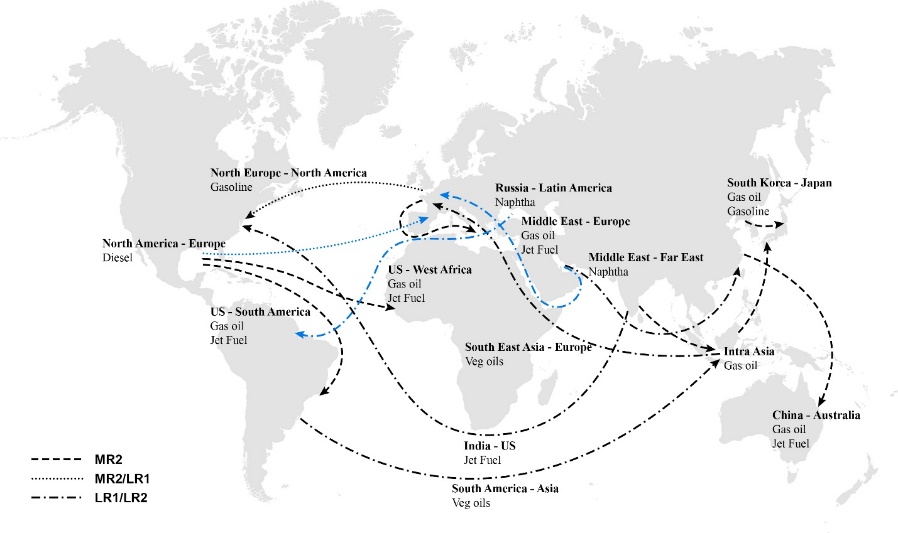
Source: Drewry
Traditionally, fossil fuel-based energy sources such as oil, natural gas and coal have propelled the global economy, but their share was declining over the past few years from 86.9% in 2011 to 82.3%% in 2021, with the share of oil declining from about 33% in 2011 to 31% in 2021. However, the energy transition from fossil fuel-based energy to renewable sources of energy is underway, which has received a boost from the accelerated sales of electric vehicles (‘EVs’), with their share in total sales increasing to 10% in 2021 from a meagre 2.5% in 2019. As the cost of EVs becomes competitive against internal combustion engine vehicles, and charging infrastructure is developed across the world, sales of EVs are expected to gain momentum, reducing the demand for gasoline and diesel in the long run. Increasing focus on decarbonization will impact global oil demand, but the demand for naphtha and jet fuel is likely to remain robust and will be a key driver of global trade in crude and refined petroleum products.
| 42 |
Ballast Water Management Convention
All deep-sea vessels engaged in international trade are required to have a ballast water treatment system (BWTS) before September 8, 2024. BWTS-related expenditure has become another factor impacting the decision to scrap older vessels after Ballast Water Management Convention came into force in 2019.
IMO 2020 Regulation on Low Sulfur Fuel
The second regulation that came into force on January 1, 2020, and impacted vessel supply, particularly in 2020, is the drive to introduce low sulfur fuels. For many years, heavy fuel oil (‘HFO’) has been the main fuel of the shipping industry. It is relatively inexpensive and widely available, but it is ‘dirty’ from an environmental point of view.
The IMO has been devising strategies to reduce greenhouse gases (‘GHG’) and carbon emissions from ships. According to the announcement in 2018, the IMO plans to initiate measures to reduce CO2 emissions intensity by at least 40% by 2030 and 70% by 2050 from the levels in 2008. It also plans to introduce measures to reduce GHG emissions by 50% by 2050 from the 2008 levels.
In June 2021, the IMO adopted amendments to the International Convention for the Prevention of Pollution from ships that will require vessels to reduce their greenhouse gas emissions. These amendments are a combination of technical and operational measures and came into force on November 1, 2022, with the requirements for EEXI and CII certification, effective January 1, 2023.
The impact of EEXI and CII regulations is still unclear at this stage. These regulations are likely to squeeze tonnage availability, especially for older vessels, as shipowners may have to modify engines and slow steam to comply. In addition, these regulations may also lead to increased scrapping and fleet renewal. Environmental regulations continue to evolve on an international and by country basis.
Environmental and Other Regulations in the Shipping Industry
Government regulation and laws significantly affect the ownership and operation of our fleet. We are subject to international conventions and treaties, national, state and local laws and regulations in force in the countries in which our vessels may operate or are registered relating to safety and health and environmental protection including the storage, handling, emission, transportation and discharge of hazardous and non-hazardous materials, and the remediation of contamination and liability for damage to natural resources. Compliance with such laws, regulations and other requirements entails significant expense, including vessel modifications and implementation of certain operating procedures.
A variety of government and private entities subject our vessels to both scheduled and unscheduled inspections. These entities include the local port authorities (applicable national authorities such as the USCG, harbor master or equivalent), classification societies, flag state administrations (countries of registry) and charterers, particularly terminal operators. Certain of these entities require us to obtain permits, licenses, certificates and other authorizations for the operation of our vessels. Failure to maintain necessary permits or approvals could require us to incur substantial costs or result in the temporary suspension of the operation of one or more of our vessels.
Increasing environmental concerns have created a demand for vessels that conform to stricter environmental standards. We are required to maintain operating standards for all of our vessels that emphasize operational safety, quality maintenance, continuous training of our officers and crews and compliance with United States and international regulations. We believe that the operation of our vessels is in substantial compliance with applicable environmental laws and regulations and that our vessels have all material permits, licenses, certificates or other authorizations necessary for the conduct of our operations. However, because such laws and regulations frequently change and may impose increasingly stricter requirements, we cannot predict the ultimate cost of complying with these requirements, or the impact of these requirements on the resale value or useful lives of our vessels. In addition, a future serious marine incident that causes significant adverse environmental impact could result in additional legislation or regulation that could negatively affect our profitability.
International Maritime Organization
The IMO has adopted the International Convention for the Prevention of Pollution from Ships, 1973, as modified by the Protocol of 1978 relating thereto, collectively referred to as MARPOL 73/78, the International Convention for the SOLAS Convention, and the LL Convention. MARPOL establishes environmental standards relating to oil leakage or spilling, garbage management, sewage, air emissions, handling and disposal of noxious liquids and the handling of harmful substances in packaged forms. MARPOL is applicable to dry bulk, tanker and LNG carriers, among other vessels, and is broken into six Annexes, each of which regulates a different source of pollution. Annex I relates to oil leakage or spilling; Annexes II and III relate to harmful substances carried in bulk in liquid or in packaged form, respectively; Annexes IV and V relate to sewage and garbage management, respectively; and Annex VI, lastly, relates to air emissions. Annex VI was separately adopted by the IMO in September of 1997; new emissions standards, titled IMO-2020, took effect on January 1, 2020.
| 43 |
Air Emissions
In September of 1997, the IMO adopted Annex VI to MARPOL to address air pollution from vessels. Effective May 2005, Annex VI sets limits on sulfur oxide and nitrogen oxide emissions from all commercial vessel exhausts and prohibits “deliberate emissions” of ozone depleting substances (such as halons and chlorofluorocarbons), emissions of volatile compounds from cargo tanks, and the shipboard incineration of specific substances. Annex VI also includes a global cap on the sulfur content of fuel oil and allows for special areas to be established with more stringent controls on sulfur emissions, as explained below. Emissions of “volatile organic compounds” from certain vessels, and the shipboard incineration (from incinerators installed after January 1, 2000) of certain substances (such as polychlorinated biphenyls, or “PCBs”) are also prohibited. We believe that all our vessels are currently compliant in all material respects with these regulations.
The MEPC, adopted amendments to Annex VI regarding emissions of sulfur oxide, nitrogen oxide, particulate matter and ozone depleting substances, which entered into force on July 1, 2010. The amended Annex VI seeks to further reduce air pollution by, among other things, implementing a progressive reduction of the amount of sulfur contained in any fuel oil used on board ships. On October 27, 2016, at its 70th session, the MEPC agreed to implement a global 0.5% m/m sulfur oxide emissions limit (reduced from 3.50%) starting from January 1, 2020. This limitation can be met by using low-sulfur compliant fuel oil, alternative fuels, or certain exhaust gas cleaning systems. Ships are now required to obtain bunker delivery notes and International Air Pollution Prevention Certificates from their flag states that specify sulfur content. Additionally, at MEPC 73, amendments to Annex VI to prohibit the carriage of bunkers above 0.5% sulfur on ships were adopted and took effect March 1, 2020, with the exception of vessels fitted with exhaust gas cleaning equipment (“scrubbers”) which can carry fuel of higher sulfur content. These regulations subject ocean-going vessels to stringent emissions controls, and may cause us to incur substantial costs.
Sulfur content standards are even stricter within certain ECAs. As of January 1, 2015, ships operating within an ECA were not permitted to use fuel with sulfur content in excess of 0.1% m/m. Amended Annex VI establishes procedures for designating new ECAs. Currently, the IMO has designated four ECAs, including specified portions of the Baltic Sea area, North Sea area, North American area and United States Caribbean area. Ocean-going vessels in these areas will be subject to stringent emission controls and may cause us to incur additional costs. Other areas in China are subject to local regulations that impose stricter emission controls. In December 2021, the member states of the Convention for the Protection of the Mediterranean Sea Against Pollution (“Barcelona Convention”) agreed to support the designation of a new ECA in the Mediterranean. On December 15, 2022, MEPC 79 adopted the designation of a new ECA in the Mediterranean, with an effective date of May 1, 2025. If other ECAs are approved by the IMO, or other new or more stringent requirements relating to emissions from marine diesel engines or port operations by vessels are adopted by the EPA or the states where we operate, compliance with these regulations could entail significant capital expenditures or otherwise increase the costs of our operations.
Amended Annex VI also establishes new tiers of stringent nitrogen oxide emissions standards for marine diesel engines, depending on their date of installation. At the MEPC meeting held from March to April 2014, amendments to Annex VI were adopted which address the date on which Tier III NOx standards in ECAs will go into effect. Under the amendments, Tier III NOx standards apply to ships that operate in the North American and U.S. Caribbean Sea ECAs designed for the control of NOx produced by vessels with a marine diesel engine installed and constructed on or after January 1, 2016. Tier III requirements could apply to areas that will be designated for Tier III NOx in the future. At MEPC 70 and MEPC 71, the MEPC approved the North Sea and Baltic Sea as ECAs for nitrogen oxide for ships built on or after January 1, 2021. For the moment, this regulation relates to new building vessels and has no retroactive application to existing fleet. The EPA promulgated equivalent (and in some senses stricter) emissions standards in 2010. As a result of these designations or similar future designations, we may be required to incur additional operating or other costs.
As determined at the MEPC 70, the new Regulation 22A of MARPOL Annex VI became effective as of March 1, 2018 and requires ships above 5,000 gross tonnage to collect and report annual data on fuel oil consumption to an IMO database, with the first year of data collection having commenced on January 1, 2019. The IMO intends to use such data as the first step in its roadmap (through 2023) for developing its strategy to reduce greenhouse gas emissions from ships, as discussed further below.
As of January 1, 2013, MARPOL made mandatory certain measures relating to energy efficiency for ships. All ships are now required to develop and implement Ship Energy Efficiency Management Plans (“SEEMP”), and new ships must be designed in compliance with minimum energy efficiency levels per capacity mile as defined by the Energy Efficiency Design Index (“EEDI”). Under these measures, by 2025, all new ships built will be 30% more energy efficient than those built in 2014. MEPC 75 adopted amendments to MARPOL Annex VI which brings forward the effective date of the EEDI’s “phase 3” requirements from January 1, 2025 to April 1, 2022 for several ship types, including gas carriers, general cargo ships, and LNG carriers.
| 44 |
Additionally, MEPC 75 introduced draft amendments to Annex VI which impose new regulations to reduce greenhouse gas emissions from ships. These amendments introduce requirements to assess and measure the energy efficiency of all ships and set the required attainment values, with the goal of reducing the carbon intensity of international shipping. The requirements include (1) a technical requirement to reduce carbon intensity based on a new EEXI, and (2) operational carbon intensity reduction requirements, based on a new operational CII. The attained EEXI is required to be calculated for ships of 400 gross tonnage and above, in accordance with different values set for ship types and categories. With respect to the CII, the draft amendments would require ships of 5,000 gross tonnage to document and verify their actual annual operational CII achieved against a determined required annual operational CII. Additionally, MEPC 75 proposed draft amendments requiring that, on or before January 1, 2023, all ships above 400 gross tonnage must have an approved SEEMP on board. For ships above 5,000 gross tonnage, the SEEMP would need to include certain mandatory content. MEPC 75 also approved draft amendments to MARPOL Annex I to prohibit the use and carriage for use as fuel of heavy fuel oil (“HFO”) by ships in Arctic waters on and after July 1, 2024. The draft amendments introduced at MEPC 75 were adopted at the MEPC 76 session held in June 2021 and have entered into force on November 1, 2022, with the requirements for EEXI and CII certification coming into effect from January 1, 2023. MEPC 77 adopted a nonbinding resolution which urges Member States and ship operators to voluntarily use distillate or other cleaner alternative fuels or methods of propulsion that are safe for ships and could contribute to the reduction of Black Carbon emissions from ships when operating in or near the Arctic. MEPC 79 adopted amendments to MARPOL Annex VI, Appendix IX to include the attained and required CII values, the CII rating and attained EEXI for existing ships in the required information to be submitted to the IMO Ship Fuel Oil Consumption Database. The amendments will enter into force on May 1, 2024.
We may incur costs to comply with these revised standards. Additional or new conventions, laws and regulations may be adopted that could require the installation of expensive emission control systems and could adversely affect our business, results of operations, cash flows and financial condition.
Safety Management System Requirements
The SOLAS Convention was amended to address the safe manning of vessels and emergency training drills. The Convention of Limitation of Liability for Maritime Claims (the “LLMC”) sets limitations of liability for a loss of life or personal injury claim or a property claim against ship owners. We believe that our vessels are in substantial compliance with SOLAS and LLMC standards.
Under Chapter IX of the SOLAS Convention, or the ISM Code, our operations are also subject to environmental standards and requirements. The ISM Code requires the party with operational control of a vessel to develop an extensive safety management system that includes, among other things, the adoption of a safety and environmental protection policy setting forth instructions and procedures for operating its vessels safely and describing procedures for responding to emergencies. We rely upon the safety management system that we and our technical management team have developed for compliance with the ISM Code. The failure of a vessel owner or bareboat charterer to comply with the ISM Code may subject such party to increased liability, may decrease available insurance coverage for the affected vessels and may result in a denial of access to, or detention in, certain ports.
The ISM Code requires that vessel operators obtain a safety management certificate for each vessel they operate. This certificate evidences compliance by a vessel’s management with the ISM Code requirements for a safety management system. No vessel can obtain a safety management certificate unless its manager has been awarded a document of compliance, issued by each flag state, under the ISM Code. We have obtained applicable documents of compliance for our offices and safety management certificates for all of our vessels for which the certificates are required by the IMO. The documents of compliance and safety management certificates are renewed as required.
Regulation II-1/3-10 of the SOLAS Convention governs ship construction and stipulates that ships over 150 meters in length must have adequate strength, integrity and stability to minimize risk of loss or pollution. Goal-based standards amendments in SOLAS regulation II-1/3-10 entered into force in 2012, with July 1, 2016 set for application to new oil tankers and bulk carriers. The SOLAS Convention regulation II-1/3-10 on goal-based ship construction standards for bulk carriers and oil tankers, which entered into force on January 1, 2012, requires that all oil tankers and bulk carriers of 150 meters in length and above, for which the building contract is placed on or after July 1, 2016, satisfy applicable structural requirements conforming to the functional requirements of the International Goal-based Ship Construction Standards for Bulk Carriers and Oil Tankers (GBS Standards).
Amendments to the SOLAS Convention Chapter VII apply to vessels transporting dangerous goods and require those vessels be in compliance with the International Maritime Dangerous Goods Code (“IMDG Code”). Effective January 1, 2018, the IMDG Code includes (1) updates to the provisions for radioactive material, reflecting the latest provisions from the International Atomic Energy Agency, (2) new marking, packing and classification requirements for dangerous goods, and (3) new mandatory training requirements. Amendments which took effect on January 1, 2020 also reflect the latest material from the UN Recommendations on the Transport of Dangerous Goods, including (1) new provisions regarding IMO type 9 tank, (2) new abbreviations for segregation groups, and (3) special provisions for carriage of lithium batteries and of vehicles powered by flammable liquid or gas. Additional amendments, which came into force on June 1, 2022, include (1) addition of a definition of dosage rate, (2) additions to the list of high consequence dangerous goods, (3) new provisions for medical/clinical waste, (4) addition of various ISO standards for gas cylinders, (5) a new handling code, and (6) changes to stowage and segregation provisions.
The IMO has also adopted the International Convention on Standards of Training, Certification and Watchkeeping for Seafarers (“STCW”). As of February 2017, all seafarers are required to meet the STCW standards and be in possession of a valid STCW certificate. Flag states that have ratified SOLAS and STCW generally employ the classification societies, which have incorporated SOLAS and STCW requirements into their class rules, to undertake surveys to confirm compliance.
| 45 |
Furthermore, recent action by the IMO’s Maritime Safety Committee and United States agencies indicates that cybersecurity regulations for the maritime industry are likely to be further developed in the near future in an attempt to combat cybersecurity threats. By IMO resolution, administrations are encouraged to ensure that cyber-risk management systems are incorporated by ship-owners and managers by their first annual Document of Compliance audit after January 1, 2021. In February 2021, the U.S. Coast Guard published guidance on addressing cyber risks in a vessel’s safety management system. This might cause companies to create additional procedures for monitoring cybersecurity, which could require additional expenses and/or capital expenditures. The impact of future regulations is hard to predict at this time. The impact of such regulations is hard to predict at this time.
In June 2022, SOLAS also set out new amendments that will take effect January 1, 2024, which include new requirements for: (1) the design for safe mooring operations, (2) the Global Maritime Distress and Safety System (“GMDSS”), (3) watertight integrity, (4) watertight doors on cargo ships, (5) fault-isolation of fire detection systems, (6) life-saving appliances, and (7) safety of ships using LNG as fuel. These new requirements may impact the cost of our operations.
Pollution Control and Liability Requirements
The IMO has negotiated international conventions that impose liability for pollution in international waters and the territorial waters of the signatories to such conventions. For example, the IMO adopted the BWM Convention in 2004. The BWM Convention entered into force on September 8, 2017. The BWM Convention requires ships to manage their ballast water to remove, render harmless, or avoid the uptake or discharge of new or invasive aquatic organisms and pathogens within ballast water and sediments. The BWM Convention’s implementing regulations call for a phased introduction of mandatory ballast water exchange requirements, to be replaced in time with mandatory concentration limits, and require all ships to carry a ballast water record book and an international ballast water management certificate.
On December 4, 2013, the IMO Assembly passed a resolution revising the application dates of the BWM Convention so that the dates are triggered by the entry into force date and not the dates originally in the BWM Convention. This, in effect, makes all vessels delivered before the entry into force date “existing vessels” and allows for the installation of ballast water management systems on such vessels at the first International Oil Pollution Prevention (IOPP) renewal survey following entry into force of the convention. The MEPC adopted updated guidelines for approval of ballast water management systems (G8) at MEPC 70. At MEPC 71, the schedule regarding the BWM Convention’s implementation dates was also discussed and amendments were introduced to extend the date existing vessels are subject to certain ballast water standards. Those changes were adopted at MEPC 72. Ships over 400 gross tons generally must comply with a “D-1 standard,” requiring the exchange of ballast water only in open seas and away from coastal waters. The “D-2 standard” specifies the maximum amount of viable organisms allowed to be discharged, and compliance dates vary depending on the IOPP renewal dates. Depending on the date of the IOPP renewal survey, existing vessels must comply with the D-2 standard on or after September 8, 2019. For most ships, compliance with the D-2 standard will involve installing on-board systems to treat ballast water and eliminate unwanted organisms. Ballast water management systems, which include systems that make use of chemical, biocides, organisms or biological mechanisms, or which alter the chemical or physical characteristics of the ballast water, must be approved in accordance with IMO Guidelines (Regulation D-3). As of October 13, 2019, MEPC 72’s amendments to the BWM Convention took effect, making the Code for Approval of Ballast Water Management Systems, which governs assessment of ballast water management systems, mandatory rather than permissive, and formalized an implementation schedule for the D-2 standard. Under these amendments, all ships must meet the D-2 standard by September 8, 2024. Costs of compliance with these regulations may be substantial. Additionally, in November 2020, MEPC 75 adopted amendments to the BWM Convention which would require a commissioning test of the ballast water management system for the initial survey or when performing an additional survey for retrofits. This analysis will not apply to ships that already have an installed BWM system certified under the BWM Convention. These amendments have entered into force on June 1, 2022. In December 2022, MEPC 79 agreed that it should be permitted to use ballast tanks for temporary storage of treated sewage and grey water. MEPC 79 also established that ships are expected to return to D-2 compliance after experiencing challenging uptake water and bypassing a BWM system should only be used as a last resort. Guidance will be developed at MEPC 80 (in July 2023) to set out appropriate actions and uniform procedures to ensure compliance with the BWM Convention.
Once mid-ocean exchange ballast water treatment requirements become mandatory under the BWM Convention, the cost of compliance could increase for ocean carriers and may have a material effect on our operations. Irrespective of the BWM convention, certain countries such as the U.S. have enforced and implemented regional requirement related to the system certification, operation and reporting.
The IMO adopted the International Convention on Civil Liability for Oil Pollution Damage of 1969, as amended by different Protocols in 1976, 1984, and 1992, and amended in 2000 (“the CLC”). Under the CLC and depending on whether the country in which the damage results is a party to the 1992 Protocol to the CLC, a vessel’s registered owner may be strictly liable for pollution damage caused in the territorial waters of a contracting state by discharge of persistent oil, subject to certain exceptions. The 1992 Protocol changed certain limits on liability expressed using the International Monetary Fund currency unit, the Special Drawing Rights. The limits on liability have since been amended so that the compensation limits on liability were raised. The right to limit liability is forfeited under the CLC where the spill is caused by the shipowner’s actual fault and under the 1992 Protocol where the spill is caused by the shipowner’s intentional or reckless act or omission where the shipowner knew pollution damage would probably result. The CLC requires ships over 2,000 tons covered by it to maintain insurance covering the liability of the owner in a sum equivalent to an owner’s liability for a single incident. We have protection and indemnity insurance for environmental incidents. P&I Clubs in the International Group issue the required Bunkers Convention “Blue Cards” to enable signatory states to issue certificates. All of our vessels are in possession of a CLC State issued certificate attesting that the required insurance coverage is in force.
| 46 |
The IMO also adopted the International Convention on Civil Liability for Bunker Oil Pollution Damage (the “Bunker Convention”) to impose strict liability on ship owners (including the registered owner, bareboat charterer, manager or operator) for pollution damage in jurisdictional waters of ratifying states caused by discharges of bunker fuel. The Bunker Convention requires registered owners of ships over 1,000 gross tons to maintain insurance for pollution damage in an amount equal to the limits of liability under the applicable national or international limitation regime (but not exceeding the amount calculated in accordance with the LLMC). With respect to non-ratifying states, liability for spills or releases of oil carried as fuel in ship’s bunkers typically is determined by the national or other domestic laws in the jurisdiction where the events or damages occur.
Ships are required to maintain a certificate attesting that they maintain adequate insurance to cover an incident. In jurisdictions, such as the United States where the CLC or the Bunker Convention has not been adopted, various legislative schemes or common law govern, and liability is imposed either on the basis of fault or on a strict-liability basis.
Anti-Fouling Requirements
In 2001, the IMO adopted the International Convention on the Control of Harmful Anti-fouling Systems on Ships, or the “Anti-fouling Convention.” The Anti-fouling Convention, which entered into force on September 17, 2008, prohibits the use of organotin compound coatings to prevent the attachment of mollusks and other sea life to the hulls of vessels. Vessels of over 400 gross tons engaged in international voyages will also be required to undergo an initial survey before the vessel is put into service or before an International Anti-fouling System Certificate is issued for the first time; and subsequent surveys when the anti-fouling systems are altered or replaced. Vessels of 24 meters in length or more but less than 400 gross tonnage engaged in international voyages will have to carry a Declaration on Anti-fouling Systems signed by the owner or authorized agent.
In November 2020, MEPC 75 approved draft amendments to the Anti-fouling Convention to prohibit anti-fouling systems containing cybutryne, which would apply to ships from January 1, 2023, or, for ships already bearing such an anti-fouling system, at the next scheduled renewal of the system after that date, but no later than 60 months following the last application to the ship of such a system. In addition, the International Anti-fouling System (IAFS) Certificate has been updated to address compliance options for anti-fouling systems to address cybutryne. Ships which are affected by this ban on cybutryne must receive an updated IAFS Certificate no later than two years after the entry into force of these amendments. Ships which are not affected (i.e. with anti-fouling systems which do not contain cybutryne) must receive an updated IAFS Certificate at the next Anti-fouling application to the vessel. These amendments were formally adopted at MEPC 76 in June 2021. Our fleet already complies with this regulation.
We have obtained Anti-fouling System Certificates for all of our vessels that are subject to the Anti-fouling Convention.
Compliance Enforcement
Noncompliance with the ISM Code or other IMO regulations may subject the ship owner or bareboat charterer to increased liability, may lead to decreases in available insurance coverage for affected vessels and may result in the denial of access to, or detention in, some ports. The USCG and European Union authorities have indicated that vessels not in compliance with the ISM Code by applicable deadlines will be prohibited from trading in U.S. and European Union ports, respectively. As of the date of this report, each of our vessels is ISM Code certified. However, there can be no assurance that such certificates will be maintained in the future. The IMO continues to review and introduce new regulations. It is impossible to predict what additional regulations, if any, may be passed by the IMO and what effect, if any, such regulations might have on our operations.
United States Regulations
The U.S. Oil Pollution Act of 1990 and the Comprehensive Environmental Response, Compensation and Liability Act
The OPA established an extensive regulatory and liability regime for the protection and cleanup of the environment from oil spills. OPA affects all “owners and operators” whose vessels trade or operate within the U.S., its territories and possessions or whose vessels operate in U.S. waters, which includes the U.S.’s territorial sea and its 200 nautical mile exclusive economic zone around the U.S. The U.S. has also enacted the CERCLA, which applies to the discharge of hazardous substances other than oil, except in limited circumstances, whether on land or at sea. OPA and CERCLA both define “owner and operator” in the case of a vessel as any person owning, operating or chartering by demise, the vessel. Both OPA and CERCLA impact our operations.
Under OPA, vessel owners and operators are “responsible parties” and are jointly, severally and strictly liable (unless the spill results solely from the act or omission of a third party, an act of God or an act of war) for all containment and clean-up costs and other damages arising from discharges or threatened discharges of oil from their vessels, including bunkers (fuel). OPA defines these other damages broadly to include:
| (i) | injury to, destruction or loss of, or loss of use of, natural resources and related assessment costs; |
| 47 |
| (ii) | injury to, or economic losses resulting from, the destruction of real and personal property; | |
| (iv) | loss of subsistence use of natural resources that are injured, destroyed or lost; | |
| (iii) | net loss of taxes, royalties, rents, fees or net profit revenues resulting from injury, destruction or loss of real or personal property, or natural resources; | |
| (v) | lost profits or impairment of earning capacity due to injury, destruction or loss of real or personal property or natural resources; and | |
| (vi) | net cost of increased or additional public services necessitated by removal activities following a discharge of oil, such as protection from fire, safety or health hazards, and loss of subsistence use of natural resources. |
OPA contains statutory caps on liability and damages; such caps do not apply to direct cleanup costs. Effective November 12, 2019, the USCG adjusted the limits of OPA liability for a tank vessel, other than a single-hull tank vessel, over 3,000 gross tons liability to the greater of $2,300 per gross ton or $19,943,400 (subject to periodic adjustment for inflation). On December 23, 2022, the USCG issued a final rule to adjust the limitation of liability under the OPA. Effective March 23, 2022, the new adjusted limits of OPA liability for a tank vessel, other than a single-hull tank vessel, over 3,000 gross tons liability to the greater of $2,500 per gross ton or $21,521,300 (subject to periodic adjustment for inflation). These limits of liability do not apply if an incident was proximately caused by the violation of an applicable U.S. federal safety, construction or operating regulation by a responsible party (or its agent, employee or a person acting pursuant to a contractual relationship), or a responsible party’s gross negligence or willful misconduct. The limitation on liability similarly does not apply if the responsible party fails or refuses to (i) report the incident as required by law where the responsible party knows or has reason to know of the incident; (ii) reasonably cooperate and assist as requested in connection with oil removal activities; or (iii) without sufficient cause, comply with an order issued under the Federal Water Pollution Act (Section 311 (c), (e)) or the Intervention on the High Seas Act.
CERCLA contains a similar liability regime whereby owners and operators of vessels are liable for cleanup, removal and remedial costs, as well as damages for injury to, or destruction or loss of, natural resources, including the reasonable costs associated with assessing the same, and health assessments or health effects studies. There is no liability if the discharge of a hazardous substance results solely from the act or omission of a third party, an act of God or an act of war. Liability under CERCLA is limited to the greater of $300 per gross ton or $5.0 million for vessels carrying a hazardous substance as cargo and the greater of $300 per gross ton or $500,000 for any other vessel. These limits do not apply (rendering the responsible person liable for the total cost of response and damages) if the release or threat of release of a hazardous substance resulted from willful misconduct or negligence, or the primary cause of the release was a violation of applicable safety, construction or operating standards or regulations. The limitation on liability also does not apply if the responsible person fails or refused to provide all reasonable cooperation and assistance as requested in connection with response activities where the vessel is subject to OPA.
OPA and CERCLA each preserve the right to recover damages under existing law, including maritime tort law. OPA and CERCLA both require owners and operators of vessels to establish and maintain with the USCG evidence of financial responsibility sufficient to meet the maximum amount of liability to which the particular responsible person may be subject. Vessel owners and operators may satisfy their financial responsibility obligations by providing a proof of insurance, a surety bond, qualification as a self-insurer or a guarantee. We comply and plan to comply going forward with the USCG’s financial responsibility regulations by providing applicable certificates of financial responsibility.
The 2010 Deepwater Horizon oil spill in the Gulf of Mexico resulted in additional regulatory initiatives or statutes, including higher liability caps under OPA, new regulations regarding offshore oil and gas drilling, and a pilot inspection program for offshore facilities. However, several of these initiatives and regulations have been or may be revised. For example, the U.S. Bureau of Safety and Environmental Enforcement’s (“BSEE”) revised Production Safety Systems Rule (“PSSR”), effective December 27, 2018, modified and relaxed certain environmental and safety protections under the 2016 PSSR. Additionally, the BSEE amended the Well Control Rule, effective July 15, 2019, which rolled back certain reforms regarding the safety of drilling operations, and former U.S. President Trump had proposed leasing new sections of U.S. waters to oil and gas companies for offshore drilling. Subsequently, current U.S. President Biden signed an executive order temporarily blocking new leases for oil and gas drilling in federal waters. However, attorney generals from 13 states filed suit in March 2021 to lift the executive order, and in June 2021, a federal judge in Louisiana granted a preliminary injunction against the Biden administration, stating that the power to pause offshore oil and gas leases “lies solely with Congress.” In August 2022, a federal judge in Louisiana sided with Texas Attorney General Ken Paxton, along with the other 12 plaintiff states, by issuing a permanent injunction against the Biden Administration’s moratorium on oil and gas leasing on federal public lands and offshore waters. With these rapid changes, compliance with any new requirements of OPA and future legislation or regulations applicable to the operation of our vessels could impact the cost of our operations and adversely affect our business.
| 48 |
OPA specifically permits individual states to impose their own liability regimes with regard to oil pollution incidents occurring within their boundaries, provided they accept, at a minimum, the levels of liability established under OPA and some states have enacted legislation providing for unlimited liability for oil spills. Many U.S. states that border a navigable waterway have enacted environmental pollution laws that impose strict liability on a person for removal costs and damages resulting from a discharge of oil or a release of a hazardous substance. These laws may be more stringent than U.S. federal law. Moreover, some states have enacted legislation providing for unlimited liability for discharge of pollutants within their waters, although in some cases, states which have enacted this type of legislation have not yet issued implementing regulations defining vessel owners’ responsibilities under these laws. The Company intends to comply with all applicable state regulations in the ports where the Company’s vessels call.
We currently maintain pollution liability coverage insurance in the amount of $1.0 billion per incident for each of our vessels. If the damages from a catastrophic spill were to exceed our insurance coverage, it could have an adverse effect on our business, results of operation and financial condition.
Other United States Environmental Initiatives
The CAA requires the EPA to promulgate standards applicable to emissions of volatile organic compounds and other air contaminants. Our vessels are subject to vapor control and recovery requirements for certain cargoes when loading, unloading, ballasting, cleaning and conducting other operations in regulated port areas. The CAA also requires states to draft State Implementation Plans, or SIPs, designed to attain national health-based air quality standards in each state. Although state-specific, SIPs may include regulations concerning emissions resulting from vessel loading and unloading operations by requiring the installation of vapor control equipment. Our vessels operating in such regulated port areas with restricted cargoes are equipped with vapor recovery systems that satisfy these existing requirements.
The CWA prohibits the discharge of oil, hazardous substances and ballast water in U.S. navigable waters unless authorized by a duly-issued permit or exemption, and imposes strict liability in the form of penalties for any unauthorized discharges. The CWA also imposes substantial liability for the costs of removal, remediation and damages and complements the remedies available under OPA and CERCLA. In 2015, the EPA expanded the definition of “waters of the United States” (“WOTUS”), thereby expanding federal authority under the CWA. Following litigation on the revised WOTUS rule, in December 2018, the EPA and Department of the Army proposed a revised, limited definition of WOTUS. In 2019 and 2020, the agencies repealed the prior WOTUS Rule and promulgated the Navigable Waters Protection Rule (“NWPR”) which significantly reduced the scope and oversight of EPA and the Department of the Army in traditionally non-navigable waterways. On August 30, 2021, a federal district court in Arizona vacated the NWPR and directed the agencies to replace the rule. On December 7, 2021, the EPA and the Department of the Army proposed a rule that would reinstate the pre-2015 definition, which was subject to public comment until February 7, 2022. On February 24, 2022, the EPA announced ten roundtables to facilitate discussion on the implementation of WOTUS, which met in Spring and Summer of 2022. On January 24, 2022, the U.S. Supreme Court granted certiorari for Sackett v. EPA, for which oral arguments were held in October 2022. Any decision will address the scope of WOTUS and may impact the rulemaking.
The EPA and the USCG have also enacted rules relating to ballast water discharge, compliance with which requires the installation of equipment on our vessels to treat ballast water before it is discharged or the implementation of other port facility disposal arrangements or procedures at potentially substantial costs, and/or otherwise restrict our vessels from entering U.S. Waters. The EPA will regulate these ballast water discharges and other discharges incidental to the normal operation of certain vessels within United States waters pursuant to the VIDA, which was signed into law on December 4, 2018 and replaces the VGP program (which authorizes discharges incidental to operations of commercial vessels, and contains numeric ballast water discharge limits for most vessels to reduce the risk of invasive species in U.S. waters, stringent requirements for exhaust gas scrubbers, and requirements for the use of environmentally acceptable lubricants) and current Coast Guard ballast water management regulations adopted under the NISA, such as mid-ocean ballast exchange programs and installation of approved USCG technology for all vessels equipped with ballast water tanks bound for U.S. ports or entering U.S. waters. VIDA establishes a new framework for the regulation of vessel incidental discharges under the CWA, requires the EPA to develop performance standards for those discharges within two years of enactment, and requires the U.S. Coast Guard to develop implementation, compliance, and enforcement regulations within two years of EPA’s promulgation of standards. Under VIDA, all provisions of the 2013 VGP and USCG regulations regarding ballast water treatment remain in force and effect until the EPA and U.S. Coast Guard regulations are finalized. Non-military, non-recreational vessels greater than 79 feet in length must continue to comply with the requirements of the VGP, including submission of a Notice of Intent (“NOI”) or retention of a PARI form and submission of annual reports. We have submitted NOIs for our vessels where required. Compliance with the EPA, U.S. Coast Guard and state regulations could require the installation of ballast water treatment equipment on our vessels or the implementation of other port facility disposal procedures at potentially substantial cost, or may otherwise restrict our vessels from entering U.S. waters.
European Union Regulations
In October 2009, the European Union amended a directive to impose criminal sanctions for illicit ship-source discharges of polluting substances, including minor discharges, if committed with intent, recklessly or with serious negligence and the discharges individually or in the aggregate result in deterioration of the quality of water. Aiding and abetting the discharge of a polluting substance may also lead to criminal penalties. The directive applies to all types of vessels, irrespective of their flag, but certain exceptions apply to warships or where human safety or that of the ship is in danger. Criminal liability for pollution may result in substantial penalties or fines and increased civil liability claims. Regulation (EU) 2015/757 of the European Parliament and of the Council of 29 April 2015 (amending EU Directive 2009/16/EC) governs the monitoring, reporting and verification of carbon dioxide emissions from maritime transport, and, subject to some exclusions, requires companies with ships over 5,000 gross tonnage to monitor and report carbon dioxide emissions annually starting on January 1, 2018, which may cause us to incur additional expenses.
| 49 |
The European Union has adopted several regulations and directives requiring, among other things, more frequent inspections of high-risk ships, as determined by type, age, and flag as well as the number of times the ship has been detained. The European Union also adopted and extended a ban on substandard ships and enacted a minimum ban period and a definitive ban for repeated offenses. The regulation also provided the European Union with greater authority and control over classification societies, by imposing more requirements on classification societies and providing for fines or penalty payments for organizations that failed to comply. Furthermore, the EU has implemented regulations requiring vessels to use reduced sulfur content fuel for their main and auxiliary engines. The EU Directive 2005/33/EC (amending Directive 1999/32/EC) introduced requirements parallel to those in Annex VI relating to the sulfur content of marine fuels. In addition, the EU imposed a 0.1% maximum sulfur requirement for fuel used by ships at berth in the Baltic, the North Sea and the English Channel (the so called “SOx-Emission Control Area”). As of January 2020, EU member states must also ensure that ships in all EU waters, except the SOx-Emission Control Area, use fuels with a 0.5% maximum sulfur content.
On September 15, 2020, the European Parliament voted to include greenhouse gas emissions from the maritime sector in the European Union’s carbon market, the EU Emissions Trading System (“UE ETS”). On July 14, 2021, the European Parliament formally proposed its plan, which will require shipowners to buy permits to cover these emissions. The Environment Council adopted a general approach on the proposal in June 2022. On December 18, 2022, the Environmental Council and European Parliament agreed to include maritime shipping emissions within the scope of the EU ETS on a gradual introduction of obligations for shipping companies to surrender allowances: 40% for verified emissions from 2024, 70% for 2025 and 100% for 2026. Most large vessels will be included in the scope of the EU ETS from the start. Big offshore vessels of 5,000 gross tonnage and above will be included in the ‘MRV’ on the monitoring, reporting and verification of CO2 emissions from maritime transport regulation from 2025 and in the EU ETS from 2027. General cargo vessels and off-shore vessels between 400-5,000 gross tonnage will be included in the MRV regulation from 2025 and their inclusion in EU ETS will be reviewed in 2026.
International Labour Organization
The ILO is a specialized agency of the UN that has adopted the Maritime Labor Convention 2006 (“MLC 2006”). A Maritime Labor Certificate and a Declaration of Maritime Labor Compliance is required to ensure compliance with the MLC 2006 for all ships that are 500 gross tonnage or over and are either engaged in international voyages or flying the flag of a Member and operating from a port, or between ports, in another country. We believe that all our vessels are in substantial compliance with and are certified to meet MLC 2006.
Greenhouse Gas Regulation
Currently, the emissions of greenhouse gases (“GHG”) from international shipping are not subject to the Kyoto Protocol to the United Nations Framework Convention on Climate Change, which entered into force in 2005 and pursuant to which adopting countries have been required to implement national programs to reduce GHG emissions though 2020. International negotiations are continuing with respect to a successor to the Kyoto Protocol, and restrictions on shipping emissions may be included in any new treaty. In December 2009, more than 27 nations, including the U.S. and China, signed the Copenhagen Accord, which includes a non-binding commitment to reduce GHG emissions. The 2015 United Nations Climate Change Conference in Paris resulted in the Paris Agreement, which entered into force on November 4, 2016 and does not directly limit greenhouse gas emissions from ships. The U.S. initially entered into the agreement, but on June 1, 2017, former U.S. President Trump announced that the United States intended to withdraw from the Paris Agreement, and that withdrawal became effective on November 4, 2020. On January 20, 2021, U.S. President Biden signed an executive order to rejoin the Paris Agreement, which the U.S. officially rejoined on February 19, 2021.
At MEPC 70 and MEPC 71, a draft outline of the structure of the initial strategy for developing a comprehensive IMO strategy on reduction of GHG emissions from ships was approved. In accordance with this roadmap, in April 2018, nations at the MEPC 72 adopted an initial strategy to reduce GHG emissions from ships. The initial strategy identifies “levels of ambition” to reducing GHG emissions, including (1) decreasing the carbon intensity from ships through implementation of further phases of the EEDI for new ships; (2) reducing carbon dioxide emissions per transport work, as an average across international shipping, by at least 40% by 2030, pursuing efforts towards 70% by 2050, compared to 2008 emission levels; and (3) reducing the total annual greenhouse emissions by at least 50% by 2050 compared to 2008 while pursuing efforts towards phasing them out entirely. The initial strategy notes that technological innovation, alternative fuels and/or energy sources for international shipping will be integral to achieve the overall ambition. These regulations could cause us to incur additional substantial expenses. At MEPC 77, the Member States agreed to initiate the revision of the Initial IMO Strategy on Reduction of GHG emissions from ships, recognizing the need to strengthen the ambition during the revision process. MEPC 79 revised the EEDI calculation guidelines to include a CO2 conversion factor for ethane, a reference to the updated ITCC guidelines, and a clarification that in case of a ship with multiple load line certificates, the maximum certified summer draft should be used when determining the deadweight. A final draft Revised IMO GHG Strategy would be considered by MEPC 80 (scheduled to meet in July 2023), with a view to adoption.
| 50 |
The EU made a unilateral commitment to reduce overall GHG emissions from its member states from 20% of 1990 levels by 2020. The EU also committed to reduce its emissions by 20% under the Kyoto Protocol’s second period from 2013 to 2020. Starting in January 2018, large ships over 5,000 gross tonnage calling at EU ports are required to collect and publish data on carbon dioxide emissions and other information. As previously discussed, regulations relating to the inclusion of GHG emissions from the maritime sector in the European Union’s carbon market, EU ETS, are also forthcoming.
In the United States, the EPA issued a finding that greenhouse gases endanger the public health and safety, adopted regulations to limit GHG emissions from certain mobile sources, and proposed regulations to limit GHG emissions from large stationary sources. However, in March 2017, former U.S. President Trump signed an executive order to review and possibly eliminate the EPA’s plan to cut GHG emissions, and in August 2019, the Administration announced plans to weaken regulations for methane emissions. On August 13, 2020, the EPA released rules rolling back standards to control methane and volatile organic compound emissions from new oil and gas facilities. However, U.S. President Biden recently directed the EPA to publish a proposed rule suspending, revising, or rescinding certain of these rules. On November 2, 2021, the EPA issued a proposed rule under the CAA designed to reduce methane emissions from oil and gas sources. The proposed rule would reduce 41 million tons of methane emissions between 2023 and 2035 and cut methane emissions in the oil and gas sector by approximately 74 percent compared to emissions from this sector in 2005. EPA issued a supplemental proposed rule in November 2022 to include additional methane reduction measures following public input and anticipates issuing a final rule in 2023. If these new regulations are finalized, they could affect our operations.
Any passage of climate control legislation or other regulatory initiatives by the IMO, the EU, the U.S. or other countries where we operate, or any treaty adopted at the international level to succeed the Kyoto Protocol or Paris Agreement, that restricts emissions of greenhouse gases could require us to make significant financial expenditures which we cannot predict with certainty at this time. Even in the absence of climate control legislation, our business may be indirectly affected to the extent that climate change may result in sea level changes or certain weather events.
Vessel Security Regulations
Since the terrorist attacks of September 11, 2001 in the United States, there have been a variety of initiatives intended to enhance vessel security such as the MTSA. To implement certain portions of the MTSA, the USCG issued regulations requiring the implementation of certain security requirements aboard vessels operating in waters subject to the jurisdiction of the United States and at certain ports and facilities, some of which are regulated by the EPA.
Similarly, Chapter XI-2 of the SOLAS Convention imposes detailed security obligations on vessels and port authorities and mandates compliance with the ISPS Code. The ISPS Code is designed to enhance the security of ports and ships against terrorism. To trade internationally, a vessel must attain an International Ship Security Certificate (“ISSC”) from a recognized security organization approved by the vessel’s flag state. Ships operating without a valid certificate may be detained, expelled from, or refused entry at port until they obtain an ISSC. The various requirements, some of which are found in the SOLAS Convention, include, for example, on-board installation of automatic identification systems to provide a means for the automatic transmission of safety-related information from among similarly equipped ships and shore stations, including information on a ship’s identity, position, course, speed and navigational status; on-board installation of ship security alert systems, which do not sound on the vessel but only alert the authorities on shore; the development of vessel security plans; ship identification number to be permanently marked on a vessel’s hull; a continuous synopsis record kept onboard showing a vessel’s history including the name of the ship, the state whose flag the ship is entitled to fly, the date on which the ship was registered with that state, the ship’s identification number, the port at which the ship is registered and the name of the registered owner(s) and their registered address; and compliance with flag state security certification requirements.
The USCG regulations, intended to align with international maritime security standards, exempt non-U.S. vessels from MTSA vessel security measures, provided such vessels have on board a valid ISSC that attests to the vessel’s compliance with the SOLAS Convention security requirements and the ISPS Code. Future security measures could have a significant financial impact on us. We intend to comply with the various security measures addressed by MTSA, the SOLAS Convention and the ISPS Code.
The cost of vessel security measures has also been affected by the escalation in the frequency of acts of piracy against ships, notably off the coast of Somalia, including the Gulf of Aden, Arabian Sea area and West Africa area. Substantial loss of revenue and other costs may be incurred as a result of detention of a vessel or additional security measures, and the risk of uninsured losses could significantly affect our business. Costs are incurred in taking additional security measures in accordance with Best Management Practices to Deter Piracy, notably those contained in the BMP5 industry standard.
Inspection by Flag administration and Classification Societies
The hull and machinery of every commercial vessel must be classed by a classification society authorized by its country of registry. The classification society certifies that a vessel is safe and seaworthy in accordance with the applicable rules and regulations of the country of registry of the vessel and SOLAS. Most insurance underwriters make it a condition for insurance coverage and lending that a vessel be certified “in class” by a classification society which is a member of the International Association of Classification Societies, the IACS. The IACS has adopted harmonized Common Structural Rules, or the Rules, which apply to oil tankers and bulk carriers contracted for construction on or after July 1, 2015. The Rules attempt to create a level of consistency between IACS Societies. All of our vessels are certified as being “in class” by all the applicable Classification Societies (e.g., DNV and NKK).
| 51 |
A vessel must undergo annual surveys, intermediate surveys, drydockings and special surveys. In lieu of a special survey, a vessel’s machinery may be on a continuous survey cycle, under which the machinery would be surveyed periodically over a five-year period. Every vessel is also required to be drydocked every 30 to 36 months for inspection of the underwater parts of the vessel. If any vessel does not maintain its class and/or fails any annual survey, intermediate survey, drydocking or special survey, the vessel will be unable to carry cargo between ports and will be unemployable and uninsurable which could cause us to be in violation of certain covenants in our loan agreements. Any such inability to carry cargo or be employed, or any such violation of covenants, could have a material adverse impact on our business, results of operations and financial condition.
Risk of Loss and Liability Insurance
General
The operation of any cargo vessel includes risks such as mechanical failure, physical damage, collision, property loss, cargo loss or damage and business interruption due to political circumstances in foreign countries, piracy incidents, hostilities and labor strikes. In addition, there is always an inherent possibility of marine disaster, including oil spills and other environmental mishaps, and the liabilities arising from owning and operating vessels in international trade. OPA, which imposes virtually unlimited liability upon shipowners, operators and bareboat charterers of any vessel trading in the exclusive economic zone of the United States for certain oil pollution accidents in the United States, has made liability insurance more expensive for shipowners and operators trading in the United States market. We carry insurance coverage as customary in the shipping industry. However, not all risks can be insured, specific claims may be rejected, and we might not be always able to obtain adequate insurance coverage at reasonable rates.
Hull and Machinery Insurance
We procure hull and machinery insurance, protection and indemnity insurance, which includes environmental damage and pollution insurance and war risk insurance and freight, demurrage and defense insurance for our fleet. We generally do not maintain insurance against loss of hire (except for certain charters for which we consider it appropriate), which covers business interruptions that result in the loss of use of a vessel.
Protection and Indemnity Insurance
Protection and indemnity insurance is provided by mutual protection and indemnity associations, or P&I Associations, and covers our third-party liabilities in connection with our shipping activities. This includes third-party liability and other related expenses of injury or death of crew, passengers and other third parties, loss or damage to cargo, claims arising from collisions with other vessels, damage to other third-party property, pollution arising from oil or other substances, and salvage, towing and other related costs, including wreck removal. Protection and indemnity insurance is a form of mutual indemnity insurance, extended by protection and indemnity mutual associations, or “clubs.”
Our current protection and indemnity insurance coverage for pollution is $1.0 billion per vessel per incident. The 13 P&I Associations that comprise the International Group insure approximately 90% of the world’s commercial tonnage and have entered into a pooling agreement to reinsure each association’s liabilities. The International Group’s website states that the Pool provides a mechanism for sharing all claims in excess of US$ 10.0 million up to, currently, approximately US$ 8.9 billion. As a member of a P&I Association, which is a member of the International Group, we are subject to calls payable to the associations based on our claim records as well as the claim records of all other members of the individual associations and members of the shipping pool of P&I Associations comprising the International Group.
Exchange Controls
Under Marshall Islands law, there are currently no restrictions on the export or import of capital, including foreign exchange controls or restrictions that affect the remittance of dividends, interest or other payments to non-resident holders of shares of our common stock.
C. Organizational Structure
We were incorporated under the laws of the Republic of the Marshall Islands on March 23, 2015. As of March 31, 2023, we own the vessels in our fleet through four separate wholly-owned subsidiaries that are incorporated in the Republic of Marshall Islands.
| 52 |
The following is a list of our subsidiaries:
| Name of Company | Country of Incorporation | Principal Activities | Ownership | |||||
| SECONDONE CORPORATION LTD* | Marshall Islands | Non-operating subsidiary | 100 | % | ||||
| THIRDONE CORPORATION LTD.* | Marshall Islands | Non-operating subsidiary | 100 | % | ||||
| FOURTHONE CORPORATION LTD.* | Malta | Non-operating subsidiary | 100 | % | ||||
| SIXTHONE CORP. * | Marshall Islands | Non-operating subsidiary | 100 | % | ||||
| SEVENTHONE CORP. | Marshall Islands | Ship ownership and operations | 100 | % | ||||
| EIGHTHONE CORP. | Marshall Islands | Ship ownership and operations | 100 | % | ||||
| TENTHONE CORP. | Marshall Islands | Ship ownership and operations | 100 | % | ||||
| ELEVENTHONE CORP. | Marshall Islands | Ship ownership and operations | 100 | % | ||||
| MARITIME TECHNOLOGIES CORP. | Delaware | Non-operating subsidiary | 100 | % | ||||
* “Pyxis Delta”, “Northsea Alpha”, “Northsea Beta” and “Pyxis Malou” were sold to unaffiliated third parties on January 13, 2020, January 28, 2022, March 1, 2022 and March 23, 2023, respectively.
D. Property, Plants and Equipment
Other than our vessels, we do not own any material property. Maritime, our affiliated ship management company, provides office space to us in part of Maritime’s offices in Maroussi, Greece in connection with the administrative services provided to us under the terms of the Head Management Agreement.
ITEM 4A. UNRESOLVED STAFF COMMENTS
Not applicable.
ITEM 5. OPERATING AND FINANCIAL REVIEW AND PROSPECTS
The spread of the COVID-19 virus, which has been declared a pandemic by the World Health Organization, in March 2020 has caused substantial disruptions in the global economy and the shipping industry, as well as significant volatility in the financial markets, the severity and duration of which remains uncertain.
In response to the pandemic, we have instituted enhanced safety protocols such as regular disinfection of our on-shore facilities, regular employee COVID-19 testing, digital temperature reading facilities, limitation of on-site visitors and travel, mandatory self-isolation of personnel returning from travel and replacing physical meetings with virtual meetings. We expect to continue such measures, which have not had a significant impact on our expenses, to some degree until the pandemic abates. In addition, the prevailing low interest rates have been at low levels in part due to actions taken by central banks to stimulate economic activity in the face of the pandemic.
During the year ended December 31, 2021, the COVID-19 pandemic mainly contributed to lower charter activity which affected the entire industry and resulted in lower profitability and greater losses, higher crewing costs due to increased precautionary measures and more expensive dry-dockings. We do not expect significant future increases in the Company’s crewing costs and further, we expect this impact to be occasional and costs to be normalized in the next periods. During 2022, the effects of COVID-19 were felt in Asia, primarily China which continued with severe restrictions. Consequently, China experienced the lowest economic activity since 1976 according to the IMF with GDP growth of only 3% for 2022.
The impact of the COVID-19 pandemic continues to unfold and may have a negative effect on the Company’s business, financial performance and the results of its operations, including decreased demand for global seaborne refined petroleum products trade and related charter rates, the extent of which will depend largely on future developments. In light of COVID-19, the Company, as of December 31, 2021, evaluated whether there are conditions or events that cause substantial doubt about its ability to continue as a going concern. The Company reviewed its revenue concentration risk, the recoverability of its accounts receivable (i.e. credit risk) and tested its assets for potential impairment. As a result of this evaluation it has been determined that the only material impact of COVID-19 to the Company has been lower charter activity which has affected the entire industry and resulted in lower profitability and greater losses as well as in higher crewing and dry-docking costs. Due to improving industry conditions and lower incidents of COVID-19 globally, the Company did not undertake a specific evaluation as of December 31, 2022. Many of the Company’s estimates and assumptions, especially charter rates, require increased judgment and carry a higher degree of variability and volatility. As events continue to evolve and additional information becomes available, the Company’s estimates may change in future periods.
More recently, the Russian- Ukrainian war has created further uncertainty for the global economic outlook, especially for the Europe, which could affect the demand for and shipment of refined petroleum products. The price of crude oil and bunker fuel has increased significantly due to geo-political events, leading to added inflationary pressures. In addition, certain officers on our vessels are Russian and Ukrainian nationals whose continued employment with ITM may be in question, and potentially impact the operation of our vessels. To date, no disruption to our operations has occurred. Consequently, our voyage and vessel operating costs could rise materially and negatively impact our profitability. See “Item 3. Key Information – D. Risk Factors – Political instability, terrorist or other attacks, war, international hostilities and global public health threats can affect the seaborne transportation industry, which could adversely affect our business”.
| 53 |
In order to accomplish certain operating, strategic and financial objectives, we started an effort a period of years ago to develop a long-term solution for the small tankers, which were non-core assets. That effort culminated in the sale of the “Northsea Alpha” and “Northsea Beta” in January and March, 2022. More recently, on March 23, 2023, we sold the “Pyxis Malou”, our only eco-modified tanker. The decision to sell her was a function of (i) attractive market conditions and sale prices for older vessels, (ii) high operating costs and greater emissions compared to the rest of the fleet and (iii) third special survey in the first half of 2024. Effective March 23, 2023, our fleet consisted of four MRs, the same class of product tankers.
This section is a discussion of our financial condition and results of operations as of and for the years ended December 31, 2021 and 2022. You should read the following discussion and analysis together with our financial statements and related notes included elsewhere in this Annual Report. This discussion includes forward-looking statements which are subject to risks and uncertainties that could cause actual events or conditions to differ materially from those currently anticipated, expressed or implied by such forward-looking statements. For a discussion of some of those risks and uncertainties, please read the section entitled “Forward-Looking Statements” and “Item 3. Key Information – D. Risk Factors.”
Important Financial and Operational Terms
We use a variety of financial and operational terms and concepts. These include the following:
Voyage Revenues, net
We generate revenues by chartering our vessels for the transportation of petroleum products and other liquid bulk items, such as organic chemicals and vegetable oils. Revenues are generated primarily by the number of vessels in our fleet, the number of voyage days employed and the amount of daily charter hire earned under vessels’ charters. These factors, in turn, can be affected by a number of decisions by us, including the amount of time spent positioning a vessel for charter, dry-dockings, repairs, maintenance and upgrading, as well as the age, condition and specifications of our ships and supply and demand factors in the product tanker market. At December 31, 2022, we employed three of our vessels on time charters and two vessels in our fleet in the spot market. Revenues from time charter agreements providing for varying daily rates are accounted as operating leases and thus are recognized on a straight line basis over the term of the time charter as service is performed. Revenue under spot charters is recognized from loading of the current spot charter to discharge of the current spot charter as discussed below. Vessels operating on time charters provide more predictable cash flows but can yield lower profit margins than vessels operating in the spot market during periods characterized by favorable market conditions. The vessel owner generally pays commissions on both types of charters on the gross charter rate.
We assessed our contracts with charterers for spot charters and concluded that there is one single performance obligation for each of our spot charters, which is to provide the charterer with a transportation service within a specified time period. In addition, we have concluded that spot charters meet the criteria to recognize revenue over time as the charterer simultaneously receives and consumes the benefits of our performance. The adoption of this standard resulted in a change whereby our method of revenue recognition changed from discharge-to-discharge (assuming a new charter has been agreed before the completion of the previous spot charter) to load-to-discharge. This resulted in no revenue being recognized from discharge of the prior spot charter to loading of the current spot charter and all revenue being recognized from loading of the current spot charter to discharge of the current spot charter. This change results in revenue being recognized later in the voyage, which may cause additional volatility in revenues and earnings between periods. Demurrage income represents payments by a charterer to a vessel owner when loading or discharging time exceeds the stipulated time in the spot charter. We have determined that demurrage represents a variable consideration and we estimate demurrage at contract inception. Demurrage income estimated, net of address commission, is recognized over the time of the charter as the performance obligation is satisfied.
Under a spot charter, we incur and pay for certain voyage expenses, primarily consisting of brokerage commissions, port and canal costs and bunker consumption, during the spot charter (load-to-discharge) and during the ballast voyage (date of previous discharge to loading, assuming a new charter has been agreed before the completion of the previous spot charter). Brokerage commissions are deferred and amortized over the related voyage period in a charter to the extent revenue has been deferred since commissions are earned as revenues are earned. Under ASC 606 and after implementation of ASC 340-40 “Other assets and deferred costs” for contract costs, incremental costs of obtaining a contract with a customer and contract fulfillment costs, should be capitalized and amortized as the performance obligation is satisfied, if certain criteria are met. We assessed the new guidance and concluded that voyage costs during the ballast voyage represented costs to fulfil a contract which give rise to an asset and should be capitalized and amortized over the spot charter, consistent with the recognition of voyage revenues from spot charter from load-to-discharge, while voyage costs incurred during the spot charter should be expensed as incurred. With respect to incremental costs, we have selected to adopt the practical expedient in the guidance and any costs to obtain a contract will be expensed as incurred (for our spot charters that do not exceed one year). Vessel operating expenses are expensed as incurred.
In addition, pursuant to this standard, and the Leases standard discussed below, as of January 1, 2018, we elected to present Revenues, net of address commissions. Address commissions represent a discount provided directly to the charterers based on a fixed percentage of the agreed upon charter. Since address commissions represent a discount (sales incentive) on services rendered by us and no identifiable benefit is received in exchange for the consideration provided to the charterer, these commissions are presented as a reduction of revenue in the accompanying audited consolidated statements of comprehensive income/(loss) included elsewhere herein.
We do not disclose the value of unsatisfied performance obligations for contracts with an original expected length of one year or less, in accordance with the optional exception in ASC 606.
| 54 |
Time Charters
A time charter is a contract for the use of a vessel for a specific period of time during which the charterer pays substantially all of the voyage expenses, including port and canal charges and the cost of bunker (fuel oil), but the vessel owner pays vessel operating expenses, including the cost of crewing, insuring, repairing and maintaining the vessel, the costs of spares and consumable stores and tonnage taxes. Time charter rates are usually set at fixed rates during the term of the charter. Prevailing time charter rates fluctuate on a seasonal and on a year-to-year basis and, as a result, when employment is being sought for a vessel with an expiring or terminated time charter, the prevailing time charter rates achievable in the time charter market may be substantially higher or lower than the expiring or terminated time charter rate. Fluctuations in time charter rates are influenced by changes in spot charter rates, which are in turn influenced by a number of factors, including vessel supply and demand. The main factors that could increase total vessel operating expenses are crew salaries, insurance premiums, spare parts orders, repairs that are not covered under insurance policies and lubricant prices.
Spot Charters
Generally, a spot charter refers to a contract to carry a specific cargo for a single voyage, which commonly lasts from several days up to three months. Spot charters typically involve the carriage of a specific amount and type of cargo on a load-port to discharge-port basis, subject to various cargo handling terms, and the vessel owner is paid on a per-ton basis. Under a spot charter, the vessel owner is responsible for the payment of all expenses including its capital costs, voyage expenses (such as port, canal and bunker costs) and vessel operating expenses. Fluctuations in spot charter rates are caused by imbalances in the availability of cargoes for shipment and the number of vessels available at any given time to transport these cargoes at a given port.
Voyage Related Costs and Commissions
We incur voyage related costs for our vessels operating under spot charters, which mainly include port and canal charges and bunker expenses. Port and canal charges and bunker expenses primarily increase in periods during which vessels are employed on spot charters because these expenses are for the account of the vessel owner. Brokerage commissions payable, if any, depend on a number of factors, including, among other things, the number of shipbrokers involved in arranging the charter and the amount of commissions charged by brokers related to the charterer. Such commissions are deferred and amortized over the related voyage period in a charter to the extent revenue has been deferred since commissions are earned as revenues are earned.
Vessel Operating Expenses
We incur vessel operating expenses for our vessels operating under time and spot charters. Vessel operating expenses primarily consist of crew wages and related costs, the cost of insurance, expenses relating to repairs and maintenance, the cost of spares and consumable stores, tonnage taxes and other miscellaneous expenses necessary for the operation of the vessel. All vessel operating expenses are expensed as incurred.
General and Administrative Expenses
The primary components of general and administrative expenses consist of the annual fee payable to Maritime for the administrative services under our Head Management Agreement, which includes the services of our senior executive officers, and the expenses associated with being a public company. Such public company expenses include the costs of preparing public reporting documents, legal and accounting costs, including costs of legal and accounting professionals and staff, and costs related to compliance with the rules, regulations and requirements of the SEC, the rules of NASDAQ, board of directors’ compensation and investor relations.
Management Fees
We pay management fees to Maritime and ITM for commercial and technical management services, respectively, for our vessels. These services include: obtaining employment for our vessels and managing our relationships with charterers; strategic management services; technical management services, which include managing day-to-day vessel operations, ensuring regulatory and classification society compliance, arranging our hire of qualified officers and crew, arranging and supervising dry-docking and repairs and arranging insurance for vessels; and providing shore-side personnel who carry out the management functions described above. As part of their ship management services, Maritime provides us with supervision services for new construction of vessels; these costs are capitalized as part of the total delivered cost of the vessel.
| 55 |
Depreciation
We depreciate the cost of our vessels after deducting the estimated residual value, on a straight-line basis over the expected useful life of each vessel, which is estimated to be 25 years from the date of initial delivery from the shipyard. During the fourth quarter of 2021, we adjusted the scrap rate from $300/ton to $340/ton due to the increased scrap rates worldwide, and remains at the same level of $340/ton in 2022.
Special Survey and Drydocking
We are obliged to periodically drydock each of our vessels for inspection, and to make significant modifications to comply with industry certification or governmental requirements. Generally, each vessel is drydocked every 30 to 60 months for scheduled inspections, depending on its age. The capitalized costs of drydockings for a given vessel are amortized on a straight-line basis to the next scheduled drydocking of the vessel.
Interest and Finance Costs
We have historically incurred interest expense and financing costs in connection with the debt incurred to partially finance the acquisition of our existing fleet. We have also incurred interest expense in relation to the $6.0 million Amended and Restated Promissory Note we issued in favor of Maritime Investors. Except for the interest payments under our promissory note that is based on a fixed rate, the interest rate under our debt agreements is linked to the LIBOR rate. In order to hedge our variable interest rate exposure, on January 19, 2018, we, via one of our vessel-owning subsidiaries, purchased an interest rate cap with one of our lenders for a notional amount of $10.0 million and a cap rate of 3.5%. The interest rate cap terminated on July 18, 2022. Similarly, on July 16, 2021, the same subsidiary purchased an additional interest rate cap for the amount of $9.6 million at a cap rate of 2% with a scheduled termination date of July 8, 2025. This cap was sold on January 25, 2023 and we realized a net cash gain of $0.5 million. In the future, we may consider the use of additional financial hedging products to further limit our interest rate exposure.
In evaluating our financial condition, we focus on the above financial and operating measures as well as fleet and vessel type for utilization, time charter equivalent rates and operating expenses to assess our operating performance. We also monitor our cash position and outstanding debt to assess short-term liquidity and our ability to finance further fleet expansion. Discussions about possible acquisitions or sales of existing vessels are based on our financial and operational criteria which depend on the state of the charter market, availability of vessel investments, employment opportunities, anticipated dry-docking costs and general economic prospects.
We believe that the important factors to consider in analyzing future results of operations and trends in future periods include the following:
| ● | charter rates and periods of charter hire and any revenues we would receive in the future from any pools in which our vessels may operate; | |
| ● | vessel operating expenses and voyage related costs and commissions; | |
| ● | depreciation and amortization expenses, which are a function of the cost of our vessels, significant vessel maintenance or improvement costs, our vessels’ estimated useful lives and estimated residual values; | |
| ● | financing costs related to our indebtedness, including hedging of interest rate risk; | |
| ● | costs of being a public reporting company, including general and administrative expenses, compliance, accounting and legal costs and regulatory expenses; and | |
| ● | fluctuations in foreign exchange rates because our revenues are in U.S. dollars but some of our expenses are paid in other currencies. |
Revenues from time charters, and to the extent we enter into any in the future, bareboat charters, are stable over the duration of the charter, provided there are no unexpected or periodic off-hire periods and no performance claims from the charterer or charterer defaults. Revenues fluctuate from spot charters and, in case we also decide to participate in pools, depending on the hire rate in effect at the time of the charter or the results of the spot based pool.
Recent accounting pronouncements are discussed in Note 2 of the consolidated financial statements contained within this Annual Report.
Implications of Not Being an Emerging Growth Company
On December 31, 2020, we ceased to be an “emerging growth company” as defined in the JOBS Act. Since we are not an “accelerated filer” or a “large accelerated filer” (as such terms are defined under the U.S. securities laws) we are not required comply with the provisions of Section 404(b) of SOX, which would otherwise require our independent registered public accounting firm to provide us with an attestation report on the effectiveness of our IFCR. Compliance with Section 404 is expensive for our shareholders and time consuming for management and could result in the detection of internal control deficiencies of which we are currently unaware. However, we are required to comply with other SOX mandates, including CEO and CFO certifications, the requirement to establish and maintain ICFR and have management assess its effectiveness, and a financial statement audit by an independent auditor, who is required to obtain an understanding of ICFR in the performance of the financial statement audit but not for the purpose of expressing an opinion on the effectiveness of our ICFR. If we become subject to additional SOX provisions, including Section 404(b), in the future, compliance with these provisions will likely incrementally increase our legal and financial compliance costs and make some activities more time consuming and costly.
| 56 |
A. Operating Results
At December 31, 2022, we employed three of the vessels in our fleet on time charters and two vessels were operating in the spot market. Our vessels are available to operate the entire year, except for scheduled special surveys and dry-dockings. In spite of the increased spot trading activity for our MRs, the number of non-operating days per year, which represent the average time spent off-hire, remained at the same level with 2021. If a vessel undergoes a scheduled intermediate survey, or special survey with BWTS installation, the estimated duration is five or 25 days, respectively.
The break-out of revenue by spot and time charters for the years ended December 31, 2021 and 2022 is reflected below (in thousands of U.S. dollars):
| Year ended December 31, | ||||||||
| 2021 | 2022 | |||||||
| Revenues derived from spot charters, net | $ | 13,711 | $ | 39,099 | ||||
| Revenues derived from time charters, net | 11,630 | 19,245 | ||||||
| Revenues, net | $ | 25,341 | $ | 58,344 | ||||
The following table reflects our MR fleet’s ownership days, available days, operating days, utilization, TCE, average number of vessels, number of vessels at period end, average age and operating expenses in each case, for the years ended December 31, 2021 and 2022.
| Year ended December 31, | ||||||||
| MR Fleet Operating Data * | 2021 | 2022 | ||||||
| Ownership days (1) | 1,276 | 1,825 | ||||||
| Available days (2) | 1,264 | 1,811 | ||||||
| Operating days (3) | 1,160 | 1,584 | ||||||
| Utilization % (4) | 91.8 | % | 87.5 | % | ||||
| Daily time charter equivalent rate (5) | $ | 10,195 | $ | 25,739 | ||||
| Daily vessel operating expenses (6) | $ | 6,916 | $ | 6,754 | ||||
| Average number of vessels (7) | 3.5 | 5.0 | ||||||
| Number of vessels at period end | 4 | 5 | ||||||
| Weighted average age of vessels at period end (8) | 8.3 | 9.3 | ||||||
| * | a) | On December 20, 2021, the Company took delivery of the “Pyxis Lamda”, a 50,145 dwt medium range product tanker built in 2017 at SPP Shipbuilding in South Korea. After her first special survey, the “Pyxis Lamda” launched commercial employment in early January, 2022. For 2021, the vessel contributed nil available days, and consequently has been excluded from the above operating expense data. |
| b) | “Pyxis Karteria” was acquired on July 15, 2021 and commenced commercial activities at that time. |
| (1) | Ownership days are the total number of days in a period during which we owned each of the vessels in our fleet. Ownership days are an indicator of the size of our fleet over a period and affect both the amount of revenues generated and the amount of expenses incurred during the respective period. |
| (2) | Available days are the number of ownership days in a period, less the aggregate number of days that our vessels were off-hire due to scheduled repairs or repairs under guarantee, vessel upgrades or special surveys and intermediate dry-dockings and the aggregate number of days that we spent positioning our vessels during the respective period for such repairs, upgrades and surveys. Available days measures the aggregate number of days in a period during which vessels should be capable of generating revenues. |
| (3) | Operating days are the number of available days in a period, less the aggregate number of days that our vessels were off-hire or out of service due to any reason, including technical breakdowns and unforeseen circumstances. Operating days measures the aggregate number of days in a period during which vessels actually generate revenues. |
| (4) | We calculate fleet utilization by dividing the number of operating days during a period by the number of available days during the same period. The shipping industry uses fleet utilization to measure a company’s efficiency in finding suitable employment for its vessels and minimizing the amount of days that its vessels are off-hire for reasons other than scheduled repairs or repairs under guarantee, vessel upgrades, special surveys and intermediate dry-dockings or vessel positioning. |
| 57 |
| (5) | Daily TCE rate is a standard shipping industry performance measure of the average daily revenue performance of a vessel on a per voyage basis. TCE is not calculated in accordance with U.S. GAAP. We utilize TCE because we believe it is a meaningful measure to compare period-to-period changes in our performance despite changes in the mix of charter types (i.e., spot charters, time charters and bareboat charters) under which our vessels may be employed between the periods. Our management also utilizes TCE to assist them in making decisions regarding employment of the vessels. We believe that our method of calculating TCE is consistent with industry standards and is calculated by dividing voyage revenues after deducting voyage expenses, including commissions, by operating days for the relevant period. Voyage expenses primarily consist of brokerage commissions, port, canal and bunker costs that are unique to a particular voyage, which would otherwise be paid by the charter under a time charter contract. |
| (6) | Daily vessel operating expenses are direct operating expenses such as crewing, provisions, repairs and maintenance, insurance, deck and engine stores, lubricating oils and tonnage tax divided by ownership days. |
| (7) | Average number of vessels is the number of vessels that constituted our fleet for the relevant period, as measured by the sum of the number of days each vessel was part of our fleet during such period divided by the number of calendar days in the period. |
| (8) | Weighted average age of the fleet is the sum of the ages of our vessels, weighted by the dwt of each vessel on the total fleet dwt. |
The following table reflects the calculation of our daily TCE rates of our MRs for the years ended December 31, 2021 and 2022 (in thousands of U.S. dollars, except total operating days and daily TCE rates):
| Year ended December 31, | ||||||||
| 2021 | 2022 | |||||||
| MR Revenues, net | $ | 17,717 | $ | 57,749 | ||||
| MR Voyage related costs and commissions | (5,891 | ) | (16,979 | ) | ||||
| MR Time charter equivalent revenues(1) | $ | 11,826 | $ | 40,770 | ||||
| MR Operating days for fleet (2) | 1,160 | 1,584 | ||||||
| MR Daily TCE rate (1) , (2) | $ | 10,195 | $ | 25,739 | ||||
1 “Pyxis Karteria”, a 46,652 dwt medium range product tanker built in 2013 at Hyundai Mipo, was acquired on July 15, 2021 and commenced commercial operations at that time. On December 20, 2021, we took delivery from a related party the “Pyxis Lamda”, a 50,145 dwt MR product tanker built in 2017 at SPP Shipbuilding in South Korea. After her first special survey, the “Pyxis Lamda” launched commercial employment in early January, 2022. For 2021, the vessel contributed nil available days and, consequently voyage and related costs of $10 thousand have been excluded from the above data.
2 Subject to rounding.
The increase in the TCE rate in 2022 compared to 2021 was primarily attributable to higher spot charter rates and more operating days due to the acquisition of the “Pyxis Karteria” and “Pyxis Lamda”, which was acquired on July 15, 2021 and December 20, 2021 respectively, that fully offset the higher voyage related costs and commissions and the effect of slightly lower utilization of our MRs. The higher voyage related costs were primarily a result of a 678-day increase in spot operating days for our MRs, from 241 days during 2021 to 919 days in 2022, as well as substantially higher average bunker fuel costs.
For the year ended December 31, 2022, we reported a net income to common shareholders of $12.5 million. Income per share basic and diluted for the year ended December 31, 2022 was $1.18 and $1.06, respectively. In 2021, our net loss was $12.9 million with a loss per share basic and diluted of $1.43.
In 2022, higher revenues, net of $33.0 million or 130%, compared to 2021 were mainly due to significantly higher spot charter rates for our MR fleet and greater spot employment for our MRs due to the addition of two tankers in July and December 2021. This revenue increase was more than offset by an increase of $7.8 million in voyage related costs and commissions as a result of higher spot market employment as well as substantially higher average bunker fuel costs. The aforementioned improved market conditions resulted to higher daily MR TCE rate of our fleet with an average of $25,739 per day for the year ended December 31, 2022, compared to, $10,195 per day for the year ended in 2021. Furthermore, the increase in our revenues, net, was also impacted by an aggregate net increase of approximately $1.2 million in vessel operating expenses, general and administrative expenses, management fees, depreciation and amortization which primarily reflected the addition of two vessels, the “Pyxis Karteria” and “Pyxis Lamda”. Moreover, in 2022, we recorded a gain from financial derivatives of $0.6 million, which primarily reflected the valuation of our cap rate instrument. Interest and finance costs, net in 2022 were increased by $1.2 million primarily attributable to higher average outstanding debt balances in 2022 accompanying the acquisition of vessels “Pyxis Karteria” and “Pyxis Lamda” and higher LIBOR rates paid on all floating rate bank debt.
| 58 |
Recent Daily Fleet Data:
(In U.S. dollars, except for Utilization %)
| Year ended December 31, | |||||||||||
| (Amounts in U.S. dollars per day) | 2021 | 2022 | |||||||||
| Eco-Efficient MR2: (2022: 4 vessels) | |||||||||||
| (2021: 3 vessels) | TCE : | 10,855 | 23,567 | ||||||||
| Opex : | 6,993 | 6,641 | |||||||||
| Utilization % : | 93.1 | % | 88.8 | % | |||||||
| Eco-Modified MR2: (1 vessel) | |||||||||||
| TCE : | 8,486 | 35,035 | |||||||||
| Opex : | 6,724 | 7,204 | |||||||||
| Utilization % : | 88.5 | % | 82.2 | % | |||||||
| Fleet: (2022: 5 vessels) * | |||||||||||
| (2021: 4 vessels) * | TCE : | 10,195 | 25,739 | ||||||||
| Opex : | 6,916 | 6,754 | |||||||||
| Utilization % : | 91.8 | % | 87.5 | % | |||||||
As at December 31, 2022 our fleet consisted of four eco-efficient MR2 tankers, “Pyxis Lamda” (*), “Pyxis Theta”, “Pyxis Karteria” and “Pyxis Epsilon” and one eco-modified MR2, “Pyxis Malou”. During 2021 and 2022, the vessels in our fleet were employed at various occasions under time and spot charters.
| * | a) On December 20, 2021, the Company took delivery of the “Pyxis Lamda”, a 50,145 dwt medium range product tanker built in 2017 at SPP Shipbuilding in South Korea. After her first special survey, the “Pyxis Lamda” launched commercial employment in early January, 2022. For 2021, the vessel contributed nil available days, and consequently has been excluded from the above data. |
b) “Pyxis Karteria” was acquired on July 15, 2021 and commenced commercial activities at that time.
Consolidated Statements of Comprehensive Income/(Loss) for the Fiscal Year Ended December 31, 2021 Compared to the Fiscal Year Ended December 31, 2022
| Year ended December 31, | ||||||||||||||||
| (Amounts in thousands of U.S. dollars, except per share data) | 2021 | 2022 | Change $ | % | ||||||||||||
| Revenues, net | $ | 25,341 | $ | 58,344 | 33,003 | 130.2 | % | |||||||||
| Expenses: | ||||||||||||||||
| Voyage related costs and commissions | (9,589 | ) | (17,357 | ) | (7,768 | ) | 81.0 | % | ||||||||
| Vessel operating expenses | (12,454 | ) | (12,481 | ) | (27 | ) | 0.2 | % | ||||||||
| General and administrative expenses | (2,538 | ) | (2,508 | ) | 30 | (1.2 | )% | |||||||||
| Management fees, related parties | (716 | ) | (702 | ) | 14 | (2.0 | )% | |||||||||
| Management fees, other | (852 | ) | (916 | ) | (64 | ) | 7.5 | % | ||||||||
| Amortization of special survey costs | (406 | ) | (384 | ) | 22 | (5.4 | )% | |||||||||
| Depreciation | (4,898 | ) | (6,100 | ) | (1,202 | ) | 24.5 | % | ||||||||
| Allowance for credit losses | (11 | ) | (118 | ) | (107 | ) | 972.7 | % | ||||||||
| Loss on vessel held for sale | (2,389 | ) | — | 2,389 | (100.0 | )% | ||||||||||
| Loss / (Gain) from the sale of vessels, net | — | (466 | ) | (466 | ) | n/a | ||||||||||
| Operating income / (loss) | $ | (8,512 | ) | $ | 17,312 | 25,824 | 303.4 | % | ||||||||
| Other expenses, net: | ||||||||||||||||
| Loss from debt extinguishment | (541 | ) | (34 | ) | 507 | (93.7 | )% | |||||||||
| Gain from financial derivative instruments | — | 555 | 555 | n/a | ||||||||||||
| Interest and finance costs, net | (3,285 | ) | (4,441 | ) | (1,156 | ) | 35.2 | % | ||||||||
| Total other expenses, net | $ | (3,826 | ) | $ | (3,920 | ) | (94 | ) | 2.5 | % | ||||||
| Net income / (loss) | $ | (12,338 | ) | $ | 13,392 | 25,730 | 208.5 | % | ||||||||
| Dividend Series A Convertible Preferred Stock | (555 | ) | (885 | ) | (330 | ) | 59.5 | % | ||||||||
| Net income / (loss) attributable to common shareholders | $ | (12,893 | ) | $ | 12,507 | 25,400 | 197.0 | % | ||||||||
| Income / (loss) per common share, basic | $ | (1.43 | ) | $ | 1.18 | 2.61 | 182.5 | % | ||||||||
| Income / (loss) per common share, diluted | $ | (1.43 | ) | $ | 1.06 | 2.49 | 174.1 | % | ||||||||
| Weighted average number of shares, basic | 8,994,768 | 10,613,672 | 1,618,904 | 18.0 | % | |||||||||||
| Weighted average number of shares, diluted | 8,994,768 | 12,640,581 | 3,645,813 | 40.5 | % | |||||||||||
| 59 |
Revenues, net: Revenues, net of $58.3 million for the year ended December 31, 2022, represented an increase of $33.0 million, or 130%, from $25.3 million in the comparable period of 2021 as a result of significantly higher spot charter rates and greater spot employment for our MRs, including a 678-day increase in spot operating days, from 241 days during the same period in 2021. In the year 2022, our MR daily TCE rate for our fleet was $25,739, a $15,544 per day increase from the same 2021 period as a result of higher charter rates, partly offset by an $11.1 million increase in the MR voyage related costs and commissions.
Voyage related costs and commissions: Voyage related costs and commissions of $17.4 million for the year ended December 31, 2022, represented an increase of $7.8 million, or 81.0%, from $9.6 million in the comparable period in 2021. For the year ended December 31, 2022, our MRs were on spot charters for 919 days in total, compared to 241 days in 2021. This higher spot chartering activity for our MRs contributed higher voyage costs which are typically borne by us rather than the charterer, thus an increase in spot employment results in increased voyage related costs and commissions.
Vessel operating expenses: Vessel operating expenses of $12.5 million for the year ended December 31, 2022, remained flat compared to the same period in 2021.
General and administrative expenses: General and administrative expenses of $2.5 million for the year ended December 31, 2022, remained flat compared to the same period in 2021.
Management fees: For the year ended December 31, 2022, management fees charged from Maritime and ITM of $1.6 million in the aggregate, remained stable compared to the same period in 2021.
Amortization of special survey costs: Amortization of special survey costs of $0.4 million for the year ended December 31, 2022, remained flat compared to the same period in 2021.
Depreciation: Depreciation of $6.1 million for the year ended December 31, 2022, increased by $1.2 million or 24.5% compared to $4.9 million in the comparable period of 2021. The increase was attributed to the acquisition of vessels “Pyxis Karteria” and “Pyxis Lamda” in the second half of 2021, partly offset by the ceasing of depreciation for vessels “Northsea Alpha” and “Northsea Beta” which were classified as held for sale at the end of 2021 and were sold during the first quarter of 2022.
Loss on vessels held-for-sale: The non-cash loss of $2.4 million for the year ended December 31, 2021, relates to the sales of the “Northsea Alpha” and “Northsea Beta”, which met the criteria of being classified as held for sale as of December 31, 2021, and were subsequently closed on January 28, 2022 and March 1, 2022, respectively. There were no comparable transactions in 2022.
Loss from the sale of vessels, net: During 2022, we recorded a transaction loss from the sale of the “Northsea Alpha” and “Northsea Beta” of $0.5 million related to the repositioning costs for the delivery of the vessels to their buyer on January 28, 2022 and March 1, 2022, respectively. No such expense was recorded for the comparable period in 2021.
Loss from debt extinguishment: During 2022, we recorded a loss from debt extinguishment of approximately $0.03 million reflecting the write-off of the remaining unamortized balance of deferred financing costs, which were associated with the repayment of the “Northsea Alpha” and “Northsea Beta” loans during the first quarter. For the year ended December 31, 2021, we recorded a loss from debt extinguishment of $0.5 million primarily reflecting a prepayment fee and the write-off of the remaining unamortized balance of deferred financing costs, both of which were associated with the loan on the “Pyxis Epsilon” (the “Eighthone Loan”) that was refinanced at the end of the first quarter in 2021.
Gain from financial derivative instruments: During the year ended December 31, 2022, we recorded a gain from financial derivative instruments amounted to $0.6 million related to the valuation of the interest rate cap purchased in July 2021, for the amount of $9.6 million at a cap rate of 2% with a termination date of July 8, 2025. Subsequently, on January 27, 2023, this cap was sold and we realized a net cash gain of $0.5 million.
Interest and finance costs, net: Interest and finance costs, net, for the year ended December 31, 2022, was $4.4 million, compared to $3.3 million in the comparable period in 2021. This increase was primarily attributable to higher average outstanding debt balances in 2022 accompanying the acquisition of vessels “Pyxis Karteria” and “Pyxis Lamda” and higher LIBOR rates paid on all floating rate bank debt.
Year ended December 31, 2021, compared to the year ended December 31, 2020
Please refer to our annual report on Form 20-F for the year ended December 31, 2021, as filed with the SEC on April 1, 2022.
| 60 |
B. Liquidity and Capital Resources
Overview
Our principal sources of liquidity are cash flows from operations, borrowings of bank debt, proceeds from issuances of equity and, we expect in the future, from the selective sale of vessels and the proceeds from further issuances of equity and debt. We expect that our future liquidity requirements will relate primarily to:
| ● | payments of interest and other debt-related expenses and the repayment of principal on our loans; | |
| ● | our vessel operating expenses, including dry-docking and special survey costs; | |
| ● | payment of technical and commercial management fees for our daily vessel operations; | |
| ● | maintenance of cash reserves to provide for contingencies and to adhere to minimum liquidity for loan covenants; and | |
| ● | potential vessel acquisitions or other strategic initiatives. |
On October 13, 2020, we announced the closing of our offering of 200,000 Units at an offering price of $25.00 per Unit (the “Offering”). Each Unit was immediately separable into one 7.75% Series A Convertible Preferred Shares and eight (8) detachable Warrants, each warrant exercisable for one common share, for a total of up to 1,600,000 of our common shares. Each Warrant will entitle the holder to purchase one common share at an initial exercise price of $1.40 per share (or $5.60 after the Reverse Stock Split) at any time prior to October 13, 2025 or, in case of absence of an effective registration statement, to exchange those cashless based on a formula. Any Warrants that remain unexercised on October 13, 2025 shall be automatically exercised by way of a cashless exercise on that date.
We also agreed to issue and sell to designees of the underwriter as compensation, two separate types of Underwriter’s Warrants for an aggregate purchase price of $100 (absolute amount). The Warrants were issued pursuant to an Underwriting Agreement dated October 8, 2020. The first type of the Underwriter’s Warrants is a warrant for the purchase of an aggregate of 2,000 Series A Convertible Preferred Shares at an exercise price of $24.92 and the second type is a warrant for the purchase of an aggregate of 16,000 Warrants at an exercise price of $0.01, at any time on or after April 6, 2021 and prior to October 8, 2025 (the “Termination Date”). On exercise, each Underwriter Warrant allows the holder to purchase one of our Series A Convertible Preferred Shares or one Warrant or, in case of absence of an effective registration statement, to exchange those cashless based on a formula set in the Underwriting Agreement. Any Underwriter’s Warrants that remain unexercised on the Termination Date shall be automatically exercised by way of a cashless exercise on that date. The Underwriter’s Warrants are also subject to customary adjustment provisions similar to the detachable Warrants discussed above.
As of December 31, 2020, 2,000 Underwriter’s Warrants to purchase 2,000 Series A Convertible Preferred Shares and 16,000 Underwriter’s warrant to purchase 16,000 Warrants remained outstanding.
On October 13, 2020, we had granted the underwriter a 45-day option to purchase up to 30,000 additional Series A Convertible Preferred Shares and/or 240,000 additional Warrants. The purchase price to be paid by the Underwriters per optional preferred share was $23.051 and the purchase price per optional Warrant was $0.00925. On the same day, the underwriter partially exercised its overallotment option for 135,040 Warrants for gross proceeds of $1.00.
The Warrants are also subject to customary adjustment provisions, such as for stock dividends, subdivisions and combinations and certain fundamental transactions such as those in which we directly or indirectly, in one or more related transactions effect our merger or consolidation with or into another entity, or we effect any sale, lease, license, assignment, transfer, conveyance or other disposition of all or substantially all of its assets in one or a series of related transactions. We determined that the Warrants are indexed to our own stock and meet all the conditions for equity classification.
The Series A Convertible Preferred Shares and Warrants are listed on the Nasdaq Capital Market under the symbols “PXSAP” and “PXSAW”, respectively.
Each Series A Convertible Preferred Share is convertible into common shares at an initial conversion price of $5.60 per common share, or 4.46 common shares, at any time at the option of the holder, subject to certain customary adjustments.
If the trading price of our common stock equals or exceeds $2.38 per share (or $9.52, post – Reverse Stock Split) for at least 20 days in any 30 consecutive trading day period ending 5 days prior to notice, we can call, in whole or in part, for mandatory conversion of the Series A Convertible Preferred Shares. The holders, however, will be prohibited from converting the Series A Convertible Preferred Shares into common shares to the extent that, as a result of such conversion, the holder would own more than 9.99% of the total number common shares then issued and outstanding, unless a 61-day notice is delivered to us. The conversion price is subject to customary anti-dilution and other adjustments relating to the issuance of common shares as a dividend or the subdivision, combination, or reclassification of common shares into a greater or lesser number of common shares.
Beginning on October 13, 2023, we may, at our option, redeem the Series A Convertible Preferred Shares, in whole or in part, by paying $25.00 per share, plus any accrued and unpaid dividends to the date of redemption.
| 61 |
If we liquidate, dissolve or wind up, holders of the Series A Convertible Preferred Shares will have the right to receive $25.00 per share, plus all accumulated, accrued and unpaid dividends (whether or not earned or declared) to and including the date of payment, before any payments are made to the holders of our common shares or to the holders of equity securities the terms of which provide that such equity securities will rank junior to the Series A Convertible Preferred Shares. The rights of holders of Series A Convertible Preferred Shares to receive their liquidation preference also will be subject to the proportionate rights of any other class or series of our capital stock ranking in parity with the Series A Convertible Preferred Shares as to liquidation.
The Series A Convertible Preferred Shares are not redeemable for a period of three years from issuance, except upon change of control. In the case of a change of control that is pre-approved by our Board of Directors, holders of Series A Convertible Preferred Shares have the option to (i) demand that we redeem the Series A Convertible Preferred Shares at (a) $26.63 per Series A Convertible Preferred Share from the date of issuance until October 13, 2021, (b) $25.81 per Series A Convertible Preferred Share from October 13, 2021 until October 13, 2022 and (c) $25.00 after October 13, 2022, or (ii) continue to hold the Series A Convertible Preferred Shares. Upon a change of control, the holders also have the option to convert some or all of the Series A Convertible Preferred Shares, together with any accrued or unpaid dividends, into shares of common stock at the conversion rate. “Change of Control” means that (i) Mr. Valentios Valentis and his affiliates cease to own at least 20% of our voting securities of the Company, or (ii) a person or group acquires at least 50% voting control of the Company, and in the case of each of either (i) or (ii), neither we nor any surviving entity has its common stock listed on a recognized U.S. exchange.
The Series A Convertible Preferred Shares will not vote with the common shares, however, if dividends on the Series A Convertible Preferred Shares are in arrears for eighteen (18) or more consecutive or non-consecutive monthly dividends, the holders of the Series A Convertible Preferred Shares, voting as a single class, shall be entitled to vote for the election of one additional director to serve on the Board of Directors until the next annual meeting of shareholders following the date on which all dividends that are owed and are in arrears have been paid. In addition, unless we have received the affirmative vote or consent of the holders of at least 66.67% of the then outstanding Series A Convertible Preferred Shares, voting as a single class, we may not create or issue any class or series of capital stock ranking senior to the Series A Convertible Preferred Shares with respect to dividends or distributions.
Dividends on the Series A Convertible Preferred Shares are cumulative from and including the date of original issuance in the amount of $1.9375 per share each year, which is equivalent to 7.75% of the $25.00 liquidation preference per share. Dividends on the Series A Convertible Preferred Shares are paid monthly in arrears starting November 20, 2020, to the extent declared by our Board of Directors.
The outstanding Warrants, as of December 31, 2021 and December, 2022, were 1,590,540 (exclusive of underwriter’s common stock purchase warrants of which 428,571 and 16,000 have exercise prices of $8.75 and $5.60 per common share, respectively, and 4,683 underwriter’s Series A Convertible Preferred Shares purchase warrants with a weighted average strike price of $24.97 (convertible into 20,881). As of December 31, 2022, 59,014 Series A Convertible Preferred Shares had been converted and 144,500 Warrants exercised, resulting in the issuance of 395,363 common shares. There were 29,388 further conversions of the Series A Convertible Preferred Shares after December 31, 2022 through March 31, 2023 which resulted in the issuance of 131,335 PXS shares.
On February 24, 2021, we announced that we had closed our definitive securities purchase agreements with a group of investors, which resulted in gross proceeds of $25.0 million, before deducting placement offering expenses. We issued 3,571,429 shares of common stock at a price of $7.00 per share. We used the net proceeds from the offering for general corporate purposes, which may include the repayment of outstanding indebtedness and potential vessel acquisitions. Our securities offered and sold in the private placement were subsequently registered under the Securities Act, under a resale registration statement filed with the SEC and became effective on March 11, 2021.
On March 29, 2021, we entered into a new secured loan agreement for the refinancing of the existing Eighthone loan. The $17.0 million provided by the new secured loan combined with $7.3 million of available cash were used to prepay the outstanding indebtedness of $24.0 million of the previous loan in full and fund closing fees and expenses.
On July 15, 2021, we announced the delivery of the newly acquired “Pyxis Karteria”, which was partially funded by a new $13.5 million secured loan with a new bank.
On July 16, 2021, we announced the closing of a follow-on public offering of 308,487 Series A Convertible Preferred Shares which were priced at $20.00 per share (the “Follow-on Offering”) for gross proceeds of $6.17 million. After offering costs and expenses, the net proceeds of $5.56 million of the Follow-on Offering were for applied for general corporate purposes.
During the months of January through December 2021, the Company paid monthly cash dividends of $0.1615 per share for each outstanding Series A Convertible Preferred Share, which aggregated to $537,000 for the year ended as of December 31, 2021.
On December 21, 2021, we announced the closing of the acquisition of the “Pyxis Lamda” and a new secured bank loan of $29.0 million of which $21.68 million was used to partially fund this acquisition and $7.32 million to fund the full repayment of the outstanding loan on the “Pyxis Malou”. The fair value of the consideration for the acquisition of the “Pyxis Lamda” amounted to $31.17 million and consisted of $21.68 million senior loan facility that matures in five years and is secured by the vessel, assuming a liability of $3.0 million, at fair value, under the amended unsecured Promissory Note due 2024, the issuance of 1,034,751 of the Company’s common shares having a fair value of $2.17 million on the delivery date of the vessel on December 20, 2021 and $4.32 million cash on hand.
| 62 |
On December 23, 2021, we entered into an agreement with a third-party to sell the small tankers, “Northsea Alpha” and “Northsea Beta”, at an aggregate gross sales price of $8.9 million. The vessels were delivered to their buyers on January 28, 2022 and on March 1, 2022, respectively. After the repayment of $5.8 million outstanding indebtedness securing these vessels and the payment of various transaction costs, we received aggregated net cash proceeds of approximately $2.7 million and $0.6 million from the lender’s release of the minimum liquidity deposits which was used for working capital purposes.
On May 11, 2022, following the Company’s annual shareholder meeting the board of directors of the Company approved the implementation of the Reverse Stock Split of our common shares at the ratio of one share for four existing common shares, effective May 13, 2022 (the “Reverse Stock Split”). Following the Reverse Stock Split, our common shares continued trading on the Nasdaq Capital Markets under its existing symbol, “PXS”, with a new CUSIP number, 71726130. The payment for fractional share interests in connection with the Reverse Stock Split reduced the outstanding common shares to 10,613,424 post-Reverse Stock Split. The Reverse Stock Split was undertaken with the objective of meeting the minimum $1.00 per share requirement for maintaining the listing of the common shares on the Nasdaq Capital Markets. Furthermore, following the Reverse Stock Split, (a) the Conversion Price, as defined in the certification of designation of the Company’s 7.75% Series A Cumulative Convertible Preferred Shares (NASDAQ Cap Mkts: PXSAP), was adjusted from $1.40 to $5.60 and (b) the Exercise Price, as defined in the Company’s warrants to purchase common shares (NASDAQ Cap Mkts: PXSAW), was adjusted from $1.40 to $5.60. All the share and per share information for all periods presented in this report have been adjusted to reflect the one for four Reverse Stock Split.
During the months of January through December 2022, the Company paid monthly cash dividends of $0.1615 per share for each outstanding Series A Preferred Share, which aggregated to $871,000 for the twelve month period ended as of December, 31 2022. On January 20, 2023, February 21, 2023 and March 20, 2023, we paid cash dividends of $0.1615 per Series A Preferred Share or an aggregate of $208,000 for the first three months of 2023.
As of December 31, 2022, we had 10,614,319, issued and outstanding common shares, 449,473 Series A Preferred Shares and 1,590,540 warrants (excluding non-tradeable underwriter’s common stock purchase warrants of which 428,571 and 16,000 have exercise prices of $8.75 and $5.60, respectively, and 2,000 and 2,683 Series A Preferred Shares purchase warrants which have an exercise price of $24.92 and $25.00 per share, respectively). The calculation of fully-diluted Income per common share for the twelve months ended December 31, 2022 of $1.06 included the potential conversion of the outstanding Series A Preferred Shares to derive an aggregate 12,640,581 weighted average common shares and corresponding elimination of the dividend. As of the date of this Annual Report, Mr. Valentis beneficially owned 5,705,730 or approximately 53.1% of our outstanding common shares.
We expect to rely upon operating cash flows from the employment of our vessels on spot and time charters, amounts due to related parties, long-term borrowings and the proceeds from future equity and debt offerings to fund our liquidity and capital needs and implement our growth plan. We perform regular cash flow projections to evaluate whether we will be in a position to cover our liquidity needs for the next 12-month period and be in compliance with the financial and security collateral cover ratio covenants under our existing debt agreements. In developing estimates of future cash flows, we make assumptions about the vessels’ future performance, with assumptions relating to time charter equivalent rates by vessel type, vessels’ operating expenses, vessels’ capital expenditures, fleet utilization, our management fees, general and administrative expenses, and debt service requirements. The assumptions used to develop estimates of future cash flows are based on historical trends as well as future expectations. As of December 31, 2022, we had a working capital surplus of $8.6 million, defined as current assets minus current liabilities. The Company considered such surplus in conjunction with the future market prospects and potential future financings. As of the filing date of the consolidated financial statements, we expect that we will be in a position to cover our liquidity needs for the next 12-month period through the cash generated from the vessels’ operations and proceeds from the sale of the “Pyxis Malou”. We also believe that we will be in compliance with the financial and security collateral cover ratio covenants under our existing debt agreements for the next 12-month period.
Our business is capital intensive and our future success will depend on our ability to maintain a high quality fleet through the acquisition of modern tanker vessels and the sale of older vessels. These acquisitions and dispositions will be principally subject to management’s expectation of future market conditions, our ability to acquire and dispose of tanker vessels on favorable terms as well as access to cost-effective capital on reasonable terms.
We do not intend to pay dividends to the holders of our common shares in the near future and expect to retain our cash flows primarily for the payment of vessel operating costs, dry-docking costs, debt service and other obligations, general corporate and administrative expenses, and reinvestment in our business (such as to fund vessel or fleet acquisitions), in each case, as determined by our board of directors.
Working Capital Position
Cash and cash equivalents and restricted cash as of December 31, 2022, amounted to $10.2 million, compared to $9.9 million as of December 31, 2021. We had a working capital surplus of $8.6 million as of December 31, 2022, compared to the working capital deficit of $3.7 million as of December 31, 2021. We define working capital as current assets minus current liabilities.
| 63 |
Consolidated Cash Flows information:
| Statements of Cash Flows Data | Year ended December 31, | |||||||
| (In thousands of U.S. Dollars) | 2021 | 2022 | ||||||
| Net cash provided by / (used in) operating activities | $ | (896 | ) | $ | 8,274 | |||
| Net cash (used in) / provided by investing activities | (43,194 | ) | 4,953 | |||||
| Net cash provided by / (used in) financing activities | 49,927 | (12,912 | ) | |||||
| Change in cash and cash equivalents and restricted cash | $ | 5,837 | $ | 315 | ||||
Operating Activities: Net cash provided from operating activities was $8.3 million for 2022, compared to net cash used in operating activities of $0.9 million for 2021. There were a number of factors driving the increase in our net cash provided by operating activities compared to the prior year. Firstly, higher revenues, net in 2022, of $33.0 million more than offset an aggregate net increase of approximately $9.0 million in voyage related costs and commissions, vessel operating expenses, management fees, general and administrative expenses. Secondly, aggregate movements in current assets and liabilities during the year ended December 31, 2022, decreased cash by $14.4 million which was significantly attributable to a decrease of $9.2 million from the changes of the due from/due to related parties account, a decrease of $7.8 million from the trade accounts receivable, net, counterbalanced by an increase of $2.9 million from the hire collected in advance account. Also, a net decrease of $0.2 million related to the other working capital accounts of current assets and current liabilities.
Investing Activities: Net cash provided by investing activities during the year ended December 31, 2022, was $5.0 million primarily a result of the $8.5 million proceeds, net of commissions, of the sale of the “Northsea Alpha” and “Northsea Beta” partially offset by the $3.0 million cash settlement of the balance related to “Pyxis Lamda” acquisition and $0.6 million payments for the Ballast Water Treatment System (“BWTS”) installed in “Pyxis Lamda” during the year. The same period in 2021 net cash used in investing activities was $43.2 million and consisted of $20.0 million and $23.0 million acquisitions of “Pyxis Karteria” and “Pyxis Lamda”, respectively. The purchase price of the “Pyxis Lamda” also included non-cash consideration of 1,034,751 PXS shares issued with fair value of $2.17 million on the delivery date of “Pyxis Lamda” and $3.0 million in additional principal under the Amended and Restated Promissory Note, both reflected below.
Financing Activities: Net cash used in financing activities was $12.9 million for the year ended December 31, 2022, mainly reflected the aggregate of $12.0 million of debt principal payments, including the prepayments of the Secondone’s and Thirdone’s loan facilities of an aggregate $5.8 million to Amsterdam Trade Bank N.V. Also, during 2022, we paid $0.9 million dividends related to the Series A Preferred Shares. For the twelve months ended December 31, 2021, net cash provided from financing activities amounted to $49.9 million, and mainly reflected the new long-term debt of $59.5 million consisted of bank loans of $17.0 million, $13.5 million, $7.32 million and $21.68 million for Eighthone, secured by the “Pyxis Epsilon”, Tenthone, secured by the “Pyxis Karteria”, Fourthone, secured by “Pyxis Malou” and Eleventhone, secured by “Pyxis Lamda”, respectively, counterbalanced by repayment of the outstanding Amended and Restated Promissory Note of $1.0 million, financing fees payments of $0.9 million related to the new loan facilities and aggregate of $36.0 million of debt principal payments, including the prepayment of the Eighthone’s $24.0 million loan with Entrust Permal (the “Credit Facility”) and the prepayment of Fourthone’s $7.3 million loan under the ATB facility. In addition, during 2021 we completed the private placement of common stock of $23.1 million in net proceeds, the issuance of additional Series A Preferred Shares for $5.6 million in net proceeds, the exercise of common stock warrants of $0.2 million offset by Series A Preferred Shares dividend payments of $0.5 million.
Indebtedness
Our vessel-owning subsidiaries, as borrowers, entered into loan agreements in connection with the purchase of each of the vessels in our fleet. As of December 31, 2022, our vessel-owning subsidiaries had outstanding borrowings under the following loan agreements:
SECONDONE CORP. (“Secondone”) (which previously owned “Northsea Alpha”), THIRDONE CORP. (“Thirdone”) (which previously owned “Northsea Beta”) and FOURTHONE CORP. (“Fourthone”) (which owns “Pyxis Malou”) refinanced existing indebtedness of $26.9 million on February 28, 2018 under the Secondone, Thirdone and Fourthone loan agreements utilizing a new 5-year secured term loan of $20.5 million with ATB (Amsterdam Trade Bank N.V.), and cash of $2.1 million. The remaining balance of approximately $4.3 million was written-off by the previous lender at closing and was recorded as gain from debt extinguishment in the first quarter of 2018. The ATB loan borne interest at LIBOR plus a margin of 4.65% per annum, with maturity in February 2023. The loan was repayable in quarterly installments and a balloon payment. Standard loan covenants included, amongst others, a minimum loan to value ratio and liquidity. As a condition subsequent to the execution of this loan agreement, the borrowers, Secondone, Thirdone and Fourthone, proceeded with all required procedures for their re-domiciliation to the jurisdiction of the Republic of Malta. The re-domiciliation became effective on March 1, 2018 and the borrowers were renamed to Secondone Corporation Ltd., Thirdone Corporation Ltd. and Fourthone Corporation Ltd., respectively. The loan is secured by, among other things as set forth below, joint-and-several first preferred mortgages relating to “Northsea Alpha”, “Northsea Beta” and “Pyxis Malou”. On December 20, 2021, Fourthone and ELEVENTHONE CORP. (“Eleventhone”) (which owns “Pyxis Lamda”) jointly and severally entered into a loan agreement with the Alpha Bank, for the purpose of Fourthone refinancing the outstanding indebtedness of $7.32 million under the previous loan facility and Eleventhone to finance the acquisition of the “Pyxis Lamda” (for more details see below). As of December 31, 2021 the respective balances were $2.89 million for each of the small tankers “Northsea Alpha” and Northsea Beta, and $7.32 million for “Pyxis Malou”. On January 28, 2022, and March 1, 2022, the two 2010 built 8,600 dwt product tankers, the “Northsea Alpha” and Northsea Beta, respectively, were sold for the aggregate sale price of $8,900. On the same days, an aggregate $5.78 million in outstanding loans were repaid and collateral released. As of December 31, 2022 the balance for “Pyxis Malou” was $6.62 million.
| 64 |
SIXTHONE CORP. (“Sixthone”) (which owned “Pyxis Delta” as of January 2020) and SEVENTHONE CORP. (“Seventhone”) (which owns “Pyxis Theta”) jointly and severally entered into a loan agreement on October 12, 2012, as subsequently amended and supplemented, with Hamburg Commercial Bank (“HCOB”) (previously known as HSH Nordbank AG) providing for a loan facility up to $37.3 million. In February 2013, Sixthone drew down an amount of $13.5 million and, in September 2013, Seventhone drew down an amount of $21.3 million (“Tranche A” and “Tranche B”, respectively). The loan bears interest at LIBOR plus a margin of 3.35% per year. Under the original agreement, the tranche relating to Sixthone matured in May 2017 and the tranche relating to Seventhone matured in September 2018. On September 29, 2016, we agreed with the lender of Sixthone to extend the maturity of Tranche A from May 2017 to September 2018, under the same amortization schedule and applicable margin. In addition, on June 6, 2017, HCOB agreed to further extend the maturity of the respective loans from September 2018 to September 2022 under the same applicable margin, but with an extended amortization profile. The loan was repayable in quarterly installments and a balloon payment. The loan was secured by, among other things as set forth below, joint-and-several first preferred mortgages relating to “Pyxis Delta” and “Pyxis Theta”. Following the sale of the “Pyxis Delta” in January 2020, the outstanding loan tranche of $4.0 million related to Sixthone was repaid in full and a prepayment of $1.6 million was paid against the outstanding loan tranche of Seventhone. Following these payments, the debt outstanding under the facility was $11.8 million. On July 8, 2020, Seventhone entered into the new $15.25 million secured loan agreement with the Alpha Bank, for the purpose of refinancing the outstanding indebtedness of $11.3 million under the previous loan facility. The new loan bears interest at LIBOR plus a margin of 3.35% per annum. Loan principal amortizes in 19 consecutive quarterly installments of $0.3 million each, the first falling due in January 2021, and the last installment accompanied by a balloon payment of $9.25 million falling due in July 2025. Standard collateral interests and customary covenants are incorporated in this facility. The facility is secured by, among other things as set forth below, a first priority mortgage relating to “Pyxis Theta”. As of December 31, 2021 and December 31, 2022 the outstanding balance of the loan relating to “Pyxis Theta” was $13.75 million and $12.55 million, respectively.
EIGHTHONE CORP. (“Eighthone”) (which owns “Pyxis Epsilon”) entered into a new $24.0 million loan agreement with Wilmington Trust National Association on September 27, 2018 for the purpose of refinancing the outstanding indebtedness with DVB Bank SE. The loan facility borne an interest rate of 11.0% per annum with maturity in September 2023. Fees are payable upon early prepayment or on final repayment of outstanding principal, subject to certain conditions or events being met. The principal obligation amortized in 18 quarterly installments that started on March 29, 2019, equal to the lower of $0.4 million and excess cash computed through a cash sweep mechanism, plus a balloon payment due at maturity. The facility was secured by, among other things as set forth below, a first priority mortgage relating to “Pyxis Epsilon”. On March 29, 2021, we entered into a new secured loan agreement with Alpha Bank for the refinancing of the existing Eighthone loan. The $17.0 million provided by the bank loan combined with $7.3 million of available cash were used to prepay the outstanding indebtedness of $24.0 million of the previous loan in full and fund closing fees and expenses. The new five-year loan has quarterly amortization of $0.3 million with $11.0 million due at maturity. The loan is priced at Libor plus 3.35%. All other terms and conditions were standard for a bank loan of this type. The facility is secured by, among other things as set forth below, a first priority mortgage relating to “Pyxis Epsilon”. As of December 31, 2021 and December 31, 2022 the outstanding balance of the loan relating to “Pyxis Epsilon” was $16.1 and $14.9 million, respectively.
TENTHONE CORP. (“Tenthone”) (which owns “Pyxis Karteria”, as of July 15, 2021) entered into a new $13.5 million seven-year loan agreement with Vista Bank on July 9, 2021 for the purpose of financing the vessel acquisition. The loan bears interest at LIBOR plus a margin of 4.8% and matures in July 2028. The principal obligation amortizes in 28 quarterly installments the first falling due in October 2021, and the last installment accompanied by a balloon payment of $4,900 falling due in July 2028. The first four installments of $350 each are followed by 24 scheduled payments of $300 each. All other terms and conditions were standard for a bank loan of this type. The facility is secured by, among other things as set forth below, a first priority mortgage relating to “Pyxis Karteria”. As of December 31, 2021 and December 31, 2022 the outstanding balance of the loan relating to “Pyxis Karteria” was $13.15 million and $11.8 million, respectively.
FOURTHONE CORP. (“Fourthone”) (which owns “Pyxis Malou”) and ELENTHONE CORP. (“Eleventhone”) (which owns “Pyxis Lamda”) jointly and severally entered into a loan agreement on December 20, 2021, with the Alpha Bank, for the purpose of Fourthone refinancing the outstanding indebtedness of $7.32 million under the previous loan facility and Eleventhone to finance the acquisition of “Pyxis Lamda”. The new facility, provided up to $29.0 million, of which Fourthone drew down an amount of $7.32 million, and, Eleventhone, an amount of $21.68 million (“Tranche A” and “Tranche B”, respectively). The five-year loan bears interest at LIBOR plus a margin of 3.15%. The loan is secured by, among other things as set forth below, joint-and-several first preferred mortgages relating to “Pyxis Malou” and “Pyxis Lamda”. Standard collateral interests and customary covenants are incorporated in this facility. As of December 31, 2021, the aggregate outstanding balance of the loan relating to these vessels was $29 million, consisted of outstanding loan tranche of $7.32 million related to Fourthone and outstanding loan tranche of $21.68 million related to Eleventhone. As of December 31, 2022, the aggregate outstanding balance of the loan relating to these vessels was $26.5 million, consisted of outstanding loan tranche of $6.62 million related to Fourthone and outstanding loan tranche of $19.88 million related to Eleventhone.
| 65 |
Each of the loan agreements referenced above is secured by a first priority mortgage over the respective vessel and a first priority assignment of the vessel’s insurances and earnings, and guaranteed by the parent company. In addition, certain of our loan agreements and guarantees require us to maintain specified financial ratios and satisfy financial covenants. These financial ratios and covenants include requirements that:
| ● | the certain vessel-owning subsidiaries that are a borrower under the respective loan agreement must maintain pledged deposits equal to a specified dollar amount; |
| ● | we must maintain minimum liquidity of between $0.25 million and $0.50 million per vessel; |
| ● | the fair market value of the mortgaged vessel plus any additional collateral must be no less than a certain percentage, ranging from 120% to 150%, of outstanding borrowings under the applicable loan agreement, less, in certain loan agreements, any money in respect of the principal standing to the credit of the retention account and any free or pledged cash deposits held with the lender in our or its subsidiary’s name (the minimum security collateral cover or “MSC”); and |
| ● | for the Alpha Bank credit facilities, the ratio of the Company’s total liabilities (exclusive of the Amended and Restated Promissory Note) to market adjusted total assets is not to exceed 75%. This requirement is only applicable in order to assess whether the Vessel-owning company is entitled to distribute dividends to Pyxis. As of December 31, 2022, the requirement was met as such ratio was 37%, or 38% lower than the required threshold. |
The events of default under our loan documents generally include provisions relating to events of default, such as:
| ● | the non-payment on the due date of any amount under the loan agreements or any related document; |
| ● | the breach of any covenant (which includes a requirement for Mr. Valentis to maintain 25% or more of ownership or Mr. Valentis to continue to act as the Chairman, of the corporate guarantor) or undertaking or failure to provide additional security as required; |
| ● | any untrue or incorrect representation or warranty; and |
| ● | any cross-default. |
As of December 31, 2022, we were in compliance with all of our financial covenants with respect to our loan agreements and there was no amount available to be drawn down under our existing loan agreements.
As discussed above, our interest rates payable under our bank loans are calculated at LIBOR plus a margin, and hence we are exposed to movements in LIBOR. In order to hedge our variable interest rate exposure, on January 19, 2018, Seventhone entered into an interest rate cap agreement with its lender for a notional amount of $10.0 million and a cap rate of 3.5%. The interest rate cap terminated on July 18, 2022. At inception, Seventhone paid $0.05 million to enter into the interest rate cap which at December 31, 2021 had a fair value of $0.0 million. Similarly, on July 16, 2021, the same subsidiary purchased an additional interest rate cap for $0.07 million for the notional amount of $9.6 million at a cap rate of 2% with a termination date of July 8, 2025. At December 31, 2022, this second cap had a fair value of $0.6 million. This cap was sold on January 25, 2023 and we realized a net cash gain of $0.5 million. In the future, we may consider the use of additional financial hedging products to further limit our interest rate exposure.
Amended and Restated Promissory Note
On October 28, 2015, we and Maritime Investors entered into a promissory note, which as subsequently amended and supplemented, has an outstanding principal balance of $6.0 million at December 31, 2021, interest payable in cash on a quarterly basis at an annual rate of 7.5% with a maturity of April 1, 2024. Please refer to “Item 7 – Related Party Transactions” below for more information” and “Note 3 – Transaction with related parties” to our consolidated financial statements included in this Annual Report. On February 10, 2023 we repaid $3.0 million of the $6.0 million Promissory Note due to Maritime Investors Corp., an affiliate of Mr. Valentis. The remaining balance of this obligation was repaid on March 14, 2023.
Major Capital Expenditures
On July 15, 2021, we took delivery of the “Pyxis Karteria”, a medium range product tanker of 46,652 dwt built in 2013 at Hyundai Mipo shipyard in South Korea. The purchase consideration of $20.0 million was funded by a combination of cash and a $13.5 million bank loan that matures in seven years and is secured by the vessel.
On December 20, 2021, we completed the acquisition of the “Pyxis Lamda”, a 50,145 dwt medium range product tanker built in 2017 at SPP Shipbuilding in South Korea for total purchase consideration valued at $31.2 million. After her first special survey, the “Pyxis Lamda” launched commercial employment in early January 2022. The total cost of the special surveys (including BWTS installation) for “Pyxis Lamda” were $0.8 million of which $0.1 million paid in 2021 as advances and the rest fully repaid during 2022.
| 66 |
Critical Accounting Policies
The discussion and analysis of our financial condition and results of operations is based upon our consolidated financial statements, which have been prepared in accordance with U.S. GAAP. The preparation of those financial statements required us to make estimates and judgments that affect the reported amounts of assets and liabilities, revenues and expenses and related disclosure at the date of our financial statements. Actual results may differ from these estimates under different assumptions and conditions. Critical accounting policies are those that reflect significant judgments of uncertainties and potentially result in materially different results under different assumptions and conditions. We have described below what we believe are our most critical accounting policies, because they generally involve a comparatively higher degree of judgment in their application. For a description of all of our significant accounting policies, please see Note 2 to our audited consolidated financial statements included elsewhere in this Annual Report.
Vessel Impairment
The carrying values of our vessels may not represent their fair market value at any point in time since the market prices of secondhand vessels tend to fluctuate with changes in charter rates and the cost of newbuildings. Historically, both charter rates and vessel values tend to be cyclical. We record impairment losses only when events occur that cause us to believe that future cash flows for any individual vessel (which is considered a cash generating unit) will be less than its carrying value plus its unamortized dry-docking and survey balances. The carrying amounts of vessels held and used by us are reviewed accordingly for potential impairment whenever events or changes in circumstances indicate that the carrying amount plus the unamortized dry dock and survey balances of a particular vessel may not be fully recoverable. In these instances, an impairment charge would be recognized if the estimate of the undiscounted future cash flows expected to result from the use of the vessel and our eventual disposition is less than the vessel’s carrying amount plus the unamortized dry-docking and survey balances. This assessment is made at the individual vessel level as separately identifiable cash flow information for each vessel is available. Measurement of the impairment loss is based on the fair value of the asset. We determine the fair value of our assets based on management estimates and assumptions and by making use of available market data and taking into consideration third party valuations. As of December 31, 2021, our fleet was independently valued at $123.0 million exclusive of the small tankers which were sold in early 2022, based on internationally recognized maritime broker. Our fleet was independently valued at $169.0 million at December 31, 2022.
No impairment charge for our vessels was recorded as of December 31, 2022.
For the impairment test assessment, we compare the vessel’s fair market value with vessel’s carrying value plus its unamortized dry-docking and special survey balances. If any vessel’s fair market value is lower than the carrying value plus its unamortized dry dock and special survey balances, we estimate the future undiscounted net operating cash flows for this vessel. In such cases, if the future undiscounted net operating cash flows for these vessels are lower that the carrying value plus its unamortized dry dock and special survey balances, the vessel value is written down by recording a charge to operations.
For the purposes of the impairment test in 2022, we compared the vessel’s carrying value plus its unamortized dry-docking and survey balances with the vessel’s fair market value. In all of our vessels the fair market value was substantial higher, thus there was not any indication for impairment lot for any of our vessels.
Vessel Lives and Depreciation
We depreciate our vessels on a straight line basis over the expected useful life of each vessel, which is 25 years from the date of its initial delivery from the shipyard, which we believe is within industry standards and represents the most reasonable useful life for each of our vessels. Depreciation is based on the cost of the vessel less its estimated residual value at the date of the vessel’s acquisition, which is estimated per lightweight ton, and our management believes is common in the shipping industry. During the fourth quarter of 2021, we adjusted the scrap rate from $300 per ton to $340 per ton due to the increased scrap rates worldwide. Secondhand vessels are depreciated from the date of their acquisition through their remaining estimated useful lives. A decrease in the useful life of a vessel or in its residual value would have the effect of increasing the annual depreciation charge. When regulations place limitations over the ability of a vessel to trade on a worldwide basis, its useful life is adjusted to end at the date such regulations become effective.
Revenues, net
We generate our revenues from charterers. The vessels are chartered using either spot charters, where a contract is made in the spot market for the use of a vessel for a specific voyage for a specified charter rate, or time charters, where a contract is entered into for the use of a vessel for a specific period of time and a specified daily charter hire rate.
| 67 |
The following table presents our revenue disaggregated by revenue source, net of commissions, for the years ended December 31, 2021 and 2022:
| Year ended December 31, | ||||||||
| 2021 | 2022 | |||||||
| Revenues derived from spot charters, net | $ | 13,711 | $ | 39,099 | ||||
| Revenues derived from time charters, net | 11,630 | 19,245 | ||||||
| Revenues, net | $ | 25,341 | $ | 58,344 | ||||
Revenue from customers (ASC 606): We assess our contracts with charterers for spot charters and concluded that there is one single performance obligation for each of our spot charters, which is to provide the charterer with a transportation service within a specified time period. In addition, we have concluded that a spot charter meets the criteria to recognize revenue over time as the charterer simultaneously receives and consumes the benefits of our performance. Our method of revenue recognition is to load-to-discharge. Thus, there is no revenue being recognized from discharge of the prior spot charter to loading of the current spot charter and all revenue being recognized from loading of the current spot charter to discharge of the current spot charter. Demurrage income represents payments by a charterer to a vessel owner when loading or discharging time exceeds the stipulated time in the spot charter. We have determined that demurrage represents a variable consideration and estimates demurrage at contract inception. Demurrage income estimated, net of address commission, is recognized over the time of the charter as the performance obligation is satisfied.
Under a spot charter, we incur and pay for certain voyage expenses, primarily consisting of brokerage commissions, port and canal costs and bunker consumption, during the spot charter (load-to-discharge) and during the ballast voyage (date of previous discharge to loading, assuming a new charter has been agreed before the completion of the previous spot charter). Voyage costs during the ballast voyage represented costs to fulfil a contract which give rise to an asset and capitalized and amortized over the spot charter, consistent with the recognition of voyage revenues from spot charter from load-to-discharge, while voyage costs incurred during the spot charter should be expensed as incurred. With respect to incremental costs, we have adopted the practical expedient in the guidance and any costs to obtain a contract will be expensed as incurred, for our spot charters that do not exceed one year. Vessel operating expenses are expensed as incurred.
In addition, pursuant to this standard and the new Leases standard (discussed below), we present Revenues net of address commissions. Address commissions represent a discount provided directly to the charterers based on a fixed percentage of the agreed upon charter. Since address commissions represent a discount (sales incentive) on services rendered by us and no identifiable benefit is received in exchange for the consideration provided to the charterer, these commissions are presented as a reduction of revenue in the accompanying consolidated statements of comprehensive income/(loss).
We do not disclose the value of unsatisfied performance obligations for contracts with an original expected length of one year or less, in accordance with the optional exception in ASC 606.
Leases: We have assessed our time charter contracts under the criteria imposed by ASC 842 and have concluded that these contracts contain a lease with the related executory costs (insurance), as well as non-lease components to provide other services related to the operation of the vessel, with the most substantial service being the crew cost to operate the vessel. We have concluded that the criteria for not separating the lease and non-lease components of our time charter contracts are met, since (i) the time pattern of recognizing revenues for crew and other services for the operation of the vessels, is similar to the time pattern of recognizing rental income, (ii) the lease component of the time charter contracts, if accounted for separately, would be classified as an operating lease, and (iii) the predominant component in its time charter agreements is the lease component. After the lease commencement date, we evaluate lease modifications, if any, that could result in a change in the accounting for leases. For a lease modification, an evaluation is performed to determine if it should be treated as either a separate lease or a change in the accounting of an existing lease. Brokerage and address commissions on time charter revenues are deferred and amortized over the related voyage period, to the extent revenue has been deferred, since commissions are earned as revenues earned, and are presented in voyage expenses and as a reduction to voyage revenues (see above), respectively. Vessel operating expenses are expensed as incurred. As per the Company’saccounting policy election, we do not recognize contract fulfillment costs for time charters under ASC 340-40.
C. Research and Development, Patents and Licenses, etc.
Not applicable.
D. Trend Information
Our results of operations depend primarily on the charter hire rates that we are able to realize for our vessels, which depend on the supply and demand dynamics characterizing the product tanker market at any given time. The product tanker industry has been highly cyclical in recent years, experiencing volatility in charter hire rates and vessel values resulting from changes in the supply of and demand for products and tanker capacity. The Company’s business could be materially and adversely affected by the risks, or the public perception of the risks and unpredictable and uneven travel restrictions related to the COVID-19 pandemic. The Company is unable to reasonably predict the estimated length or severity of the COVID-19 pandemic on future operating results. More recently, the war between Russia and Ukraine has created additional uncertainty in demand for product tankers and the impact to charter rates For other trends affecting our business please see other discussions in “Item 4. Information on the Company” and “Item 5. Operating and Financial Review and Prospects”.
| 68 |
E. Critical Accounting Estimates
The discussion and analysis of our financial condition and results of operations are based upon our Consolidated Financial Statements, which have been prepared in accordance with U.S. GAAP. The preparation of Consolidated Financial Statements requires us to make estimates and judgments that affect the reported amounts of assets and liabilities, revenues and expenses and related disclosures of contingent assets and liabilities at the date of our Financial Statements. Actual results may differ from these estimates under different assumptions and conditions. Please see “Note 2 – Significant Accounting Policies - (m) Vessels, Net:” and “Note 2 – Significant Accounting Policies - (n) Impairment of Long-Lived Assets” to our consolidated financial statements included in this Annual Report for a discussion of our Critical Accounting Estimates.
ITEM 6. DIRECTORS, SENIOR MANAGEMENT AND EMPLOYEES
A. Directors and Senior Management
Directors and Executive Officers
The following table sets forth information regarding our executive officers and directors as of the date of the Annual Report. The business address of each of the below-listed directors and officers is c/o Pyxis Tankers Inc., K. Karamanli 59, Maroussi 15125, Athens, Greece.
| Name | Age | Position | ||
| Valentios “Eddie” Valentis | 56 | Chairman, Chief Executive Officer and Class I Director | ||
| Henry P. Williams | 67 | Chief Financial Officer and Treasurer | ||
| Konstantinos Lytras | 58 | Chief Operating Officer and Secretary | ||
| Robin P. Das | 50 | Class III Director | ||
| Basil G. Mavroleon | 74 | Class III Director | ||
| Aristides J. Pittas | 63 | Class II Director |
Biographical information with respect to each of our directors and executive officers is set forth below.
Valentios “Eddie” Valentis, a Class I director, has over 26 years of shipping industry experience, including owning, operating and managing tankers. He has served as Chief Executive Officer and Chairman of our board of directors since our inception. In 2007, Mr. Valentis founded and is the president of Pyxis Maritime Corp. Since 2001, Mr. Valentis has been the President and Managing Director of Konkar Shipping Agencies S.A., a drybulk operator based in Greece, a position he continues to hold. From 1998 to 2001, Mr. Valentis was the Commercial Manager for Loucas G. Matsas Salvage & Towage. From 1996 through 1998, Mr. Valentis worked as a dry cargo chartering broker. Upon completion of his 2 year naval service in 1995, Mr. Valentis was involved in the operation of his family’s drybulk vessels. Since 2013, Mr. Valentis serves as a member of the Greek Committee of NKK Classification Society, and, since 2016, as a council member of the International Association of Independent Tanker Owners (INTERTANKO). Mr. Valentis holds an MBA from Southern New Hampshire University.
Henry P. Williams was appointed as our Chief Financial Officer and Treasurer in August 2015. Mr. Williams has over 35 years of commercial, investment and merchant banking experience. From February 2015, he served as a financial consultant to and is employed by Maritime and its affiliates. From March 2014 to January 2015, Mr. Williams was Managing Director, Head of Maritime, Energy Services & Infrastructure (U.S.) investment banking for Canaccord Genuity Inc. From August 2012 to February 2014, Mr. Williams was a Senior Advisor to North Sea Securities LLC, a boutique advisory firm in New York. From November 2010 to June 2012, Mr. Williams was Managing Director, Global Sector Head, Shipping of Nordea Markets in Oslo, Norway and Head of its U.S. Investment Banking division in New York. From 1992 until 2010, Mr. Williams was employed by Oppenheimer & Co. Inc., as Managing Director, Head of Energy & Transportation of its investment banking division. Mr. Williams has an MBA in Finance from New York University Leonard N. Stern School of Business and a BA in Economics and Business Administration from Rollins College.
Konstantinos Lytras has served as our Chief Operating Officer since our inception and as our Secretary since October 15, 2018. Mr. Lytras has also served as Maritime’s Financial Director since 2008. Prior to joining Maritime, from 2007 through 2008, Mr. Lytras served as Managing Director and Co-Founder of Navbulk Shipping S.A., a start-up shipping company focused on dry bulk vessels. From 2002 through 2007, Mr. Lytras worked as Financial Director of Neptune Lines Shipping and Managing Enterprises S.A. Mr. Lytras served as Financial Controller of Dioryx Maritime Corp. and Liquimar Tankers Management Inc. from 1996 through 2002. Mr. Lytras worked as a Financial Assistant from 1992 to 1994 at Inchcape Shipping Services Ltd. Mr. Lytras earned a B.A. in Business Administration from Technological Institute of Piraeus and a B.S. in Economics from the University of Athens.
| 69 |
Robin P. Das serves as a Class III director. Mr. Das has worked in shipping finance and investment banking since 1995. He is the founder and has been a director of Auld Partners Ltd, a boutique shipping and finance focused advisory firm, since 2013. From 2011 to 2012, Mr. Das was Managing Director (partner) of Navigos Capital Management LLC, an asset management firm established to focus on the shipping sector. From 2005 until 2011, Mr. Das was Global Head of Shipping at HSH Nordbank AG, then the largest lender globally to the shipping industry. Before joining HSH Nordbank AG in 2005, he was Head of Shipping at WestLB and prior to that time, Mr. Das was joint Head of European Shipping at J.P. Morgan. Since October 2016, Mr. Das also served as director of Nimrod Sea Assets Limited (LSE:NSA, listed until April 2018), which invested in marine assets associated with the offshore oil and gas industry. Mr. Das holds a BSc (Honours) degree from the University of Strathclyde.
Basil G. Mavroleon serves as a Class III director. Mr. Mavroleon has been in the shipping industry for 45 years. Since 1970, Mr. Mavroleon has worked for Charles R. Weber Company, Inc., one of the oldest and largest tanker brokerages and marine consultants in the United States. Mr. Mavroleon was Managing Director of Charles R. Weber Company, Inc. for 25 years and Manager of the Projects Group for five years, from 2009 until 2013. Mr. Mavroleon currently serves as Managing Director of WeberSeas (Hellas) S.A., a comprehensive sale and purchase, newbuilding, marine projects and ship finance brokerage based in Athens, Greece. He is a Director of Genco Shipping and Trading Limited (NYSE: GNK), a company engaged in the shipping business focused on the drybulk industry spot market. Since its inception in 2003 through its liquidation in 2005, Mr. Mavroleon served as Chairman of Azimuth Fund Management (Jersey) Limited, a hedge fund that invested in tanker freight forward agreements and derivatives. Mr. Mavroleon is on the Advisory Board of NAMMA (North American Maritime Ministry Association), is Director Emeritus of NAMEPA (North American Marine Environmental Protection Association) and the Chairman of the New York World Scale Committee (NYC) INC. Mr. Mavroleon was educated at Windham College, Putney Vermont.
Aristides J. Pittas serves as a Class II Director. Mr. Pittas has more than 30 years of shipping industry experience. He has been a member of the board of directors and the Chairman and Chief Executive Officer of Eurodry Ltd. (NASDAQ: EDRY) (“Eurodry”), an independent shipping company that operates in the drybulk shipping industry, since its inception on January 8, 2018. He has also been a member of the board of directors and Chairman and Chief Executive Officer of Euroseas Ltd. (NASDAQ: ESEA) (“Euroseas”), an independent shipping company that operates in the drybulk and container shipping industry, since May 2005. Since 1997, Mr. Pittas has also been the President of Eurochart S.A., Euroseas’ affiliate, which is a shipbroking company specializing in chartering, selling and purchasing ships. Since 1995, Mr. Pittas has been the President and Managing Director of Eurobulk Ltd., Euroseas’ and Eurodrys’ affiliated ship management company. Eurobulk Ltd. is a ship management company that provides ocean transportation services. In 2005, Mr. Pittas resigned as Managing Director of Eurobulk Ltd. Mr. Pittas has a B.Sc. in Marine Engineering from University of Newcastle Upon Tyne and a M.Sc. in both Ocean Systems Management and Naval Architecture and Marine Engineering from the Massachusetts Institute of Technology.
Family Relationships
There are no familial relationships among any of our executive officers or directors.
Board Diversity Matrix
Mr. Robin Das is considered an Underrepresented Individual in his home country, the United Kingdom. Our philosophy regarding diversity of candidates for the Board of Director is to identify, nominate and elect the most qualified individuals available to us, regardless of race, creed, sexual orientation, nationality, ethnic, language and religion.
| Board Diversity Matrix | ||||
| Country of Principal Executive Offices: | Greece | |||
| Foreign Private Issuer | Yes | |||
| Disclosure Prohibited under Home Country Law | No | |||
| Total Number of Directors | 4 | |||
| Female | Male
|
Non- Binary |
Did Not Disclose Gender | |
| Part I: Gender Identity | ||||
| Directors | 0 | 4 | 0 | 0 |
| Part II: Demographic Background | ||||
| Underrepresented Individual in Home Country Jurisdiction | 1 | |||
| LGBTQ+ | 0 | |||
| Did Not Disclose Demographic Background | 0 | |||
| 70 |
B. Compensation
We have no direct employees. The services of our executive officers, internal auditors and secretary are provided by Maritime. We have entered into a Head Management Agreement with Maritime, pursuant to which we currently pay approximately $1.8 million per year for the services of these individuals, and for other administrative services associated with our being a public company and other services to our subsidiaries. Please see “Item 7. Major Shareholders and Related Party Transactions – B. Related Party Transactions”.
Our non-executive directors receive in aggregate an annual compensation in the amount of $125,000 per year, plus reimbursements for actual expenses incurred while acting in their capacity as a director. We may in the future also grant directors awards under our Pyxis Tankers Inc. 2015 equity incentive plan as compensation. We do not have a retirement plan for our officers or directors. There are no service contracts with our non-executive directors that provide for benefits upon termination of their services as director. Individuals serving as chairs of committees will be entitled to receive additional compensation from us as the board of directors may determine.
Equity Incentive Plan
On October 28, 2015, we adopted the Pyxis Tankers Inc. 2015 equity incentive plan (the “EIP”), which entitles our and our subsidiaries’ and affiliates’ employees, officers and directors, as well as consultants and service providers to us (including persons who are employed by or provide services to any entity that is itself a consultant or service provider) and our subsidiaries (including employees of Maritime, our affiliated ship manager), to receive stock options, stock appreciation rights, restricted stock grants, restricted stock units, unrestricted stock grants, other equity-based or equity-related awards, and dividend equivalents. We summarize below the material terms of the EIP.
The nominating and corporate governance committee of our board of directors serves as the administrator under the EIP. Subject to adjustment for changes in capitalization as provided in the EIP, the maximum aggregate number of shares of common stock that may be delivered pursuant to awards granted under the EIP during the ten-year term of the EIP will be 15% of the then-issued and outstanding number of shares of our common stock. If an award granted under the EIP is forfeited, or otherwise expires, terminates or is cancelled or settled without the delivery of shares, then the shares covered by such award will again be available to be delivered pursuant to other awards under the EIP. Any shares that are held back to satisfy the exercise price or tax withholding obligation pursuant to any stock options or stock appreciation rights granted under the EIP will again be available for delivery pursuant to other awards under the EIP. No award may be granted under the EIP after the tenth anniversary of the date the EIP was adopted by our board of directors.
In the event that we are subject to a “change of control” (as defined in the EIP), the EIP administrator may, in accordance with the terms of the EIP, make such adjustments and other substitutions to the EIP and outstanding awards under the EIP as it deems equitable or desirable.
Except as otherwise determined by the EIP administrator in an award agreement, the exercise price for options shall be equal to the fair market value of a share of our common stock on the date of grant, but in no event can the exercise price be less than 100% of the fair market value on the date of grant. The maximum term of each stock option agreement may not exceed ten years from the date of the grant.
Stock appreciation rights (“SARs”), will provide for a payment of the difference between the fair market value of a share of our common stock on the date of exercise of the SAR and the exercise price of a SAR, which will not be less than 100% of the fair market value on the date of grant, multiplied by the number of shares for which the SAR is exercised. The SAR agreement will also specify the maximum term of the SAR, which will not exceed ten years from the date of grant. Payment upon exercise of the SAR may be made in the form of cash, shares of our common stock or any combination of both, as determined by the EIP administrator.
Restricted and/or unrestricted stock grants may be issued with or without cash consideration under the EIP and may be subject to such restrictions, vesting and/or forfeiture provisions as the EIP administrator may provide. The holder of a restricted stock grant awarded under the EIP may have the same voting, dividend and other rights as our other stockholders.
Settlement of vested restricted stock units may be in the form of cash, shares of our common stock or any combination of both, as determined by the EIP administrator. The holders of restricted stock units will have no voting rights.
Subject to the provisions of the EIP, awards granted under the EIP may include dividend equivalents. The EIP administrator may determine the amounts, terms and conditions of any such awards provided that they comply with applicable laws. We have not set aside any amounts to provide pension, retirement or similar benefits to persons eligible to receive awards under the EIP or otherwise.
On October 28, 2015, our board of directors approved the issuance of 8,306 restricted shares of our common stock to certain of our officers. As of December 31, 2015, all such shares had been vested, but were not issued until March 2016. On November 15, 2017, 50,000 restricted shares of our common stock were granted and issued to one of our senior officers, and were vested immediately upon issuance.
| 71 |
C. Board Practices
Our board of directors consists of four directors, three of whom, Robin P. Das, Basil G. Mavroleon and Aristides J. Pittas, have been determined by our board of directors to be independent under the rules of NASDAQ and the rules and regulations of the SEC. Directors elected by our common shareholders are divided into three classes serving staggered three-year terms. At each annual meeting of shareholders, directors will be elected to succeed the class of directors whose terms have expired, and each of them shall hold office until the third succeeding annual meeting of shareholders if the Board is then classified, and until such director’s successor is elected and has qualified. We held our 2022 annual meeting of shareholders on May 11, 2022, at which Aristides Pittas were re-elected to serve as Class II Directors for a term of three years until our 2025 annual meeting of shareholders. The term of our Class I Director III Basil G. Mavroleon and Robin P. Das, expires at the 2023 annual meeting and the term of our Class I Director, Valentios Valentis, expires at the 2024 annual meeting of shareholders.
Our audit committee consists of three independent, non-executive directors: Robin Das, Basil Mavroleon and Aristides Pittas. We believe that Robin Das qualifies as an audit committee “financial expert,” as such term is defined in Regulation S-K promulgated by the SEC. The audit committee, among other things, reviews our external financial reporting, engages our external auditors, and oversees our financial reporting procedures and the adequacy of our internal accounting controls.
The nominating and corporate governance committee consists of Basil G. Mavroleon, Aristides J. Pittas and Valentios Valentis. The nominating and corporate governance committee is responsible for recommending to the board of directors’ nominees for director and directors for appointment to board committees and advising the board with regard to corporate governance practices.
D. Employees
We have no direct employees. The services of our executive officers, internal auditors and secretary are provided by Maritime. We have entered into a Head Management Agreement with Maritime, pursuant to which we currently pay approximately $1.8 million per year for the services of these individuals, and for other administrative services associated with our being a public company and other services to our subsidiaries. Please see “Item 7. Major Shareholders and Related Party Transactions – B. Related Party Transactions.”
Indemnification of Officers and Directors
We have entered into agreements to indemnify our directors, executive officers and other employees as determined by the board of directors. These agreements provide for indemnification for related expenses, including, among other things, attorneys’ fees, judgments, fines and settlement amounts incurred by any of these individuals in any action or proceeding except as contained in specified exceptions. We believe that the provisions in our bylaws and indemnification agreements described above are necessary to attract and retain talented and experienced officers and directors.
E. Share Ownership
With respect to the total amount of common stock owned by all of our officers and directors as a group, please see “Item 7. Major Shareholders and Related Party Transactions – A. Major Shareholders.”
F. Disclosure of a Registrant’s Action to Recover Erroneously Awarded Compensation
Not applicable.
ITEM 7. MAJOR SHAREHOLDERS AND RELATED PARTY TRANSACTIONS
A. Major Shareholders
The following table sets forth information regarding the beneficial owners of more than five percent of shares of our common stock, and the beneficial ownership of each of our directors and executive officers and of all of our directors and executive officers as a group as of March 31, 2023. All of our stockholders, including the stockholders listed in this table, are entitled to one vote for each share held.
Beneficial ownership is determined in accordance with the SEC’s rules. In computing percentage ownership of each person, shares subject to options held by that person that are currently exercisable or convertible, or exercisable or convertible within 60 days of the date of this Annual Report, are deemed to be beneficially owned by that person. These shares, however, are not deemed outstanding for the purpose of computing the percentage ownership of any other person.
| Shares Beneficially Owned | ||||||||
| Identity of person or group (1) | Number | Percentage (2) | ||||||
| Valentios “Eddie” Valentis (Maritime Investors Corp.) (3) | 5,731,942 | 53.3 | % | |||||
| Henry P. Williams (4) | 45,061 | * % | ||||||
| Konstantinos Lytras (4) | 15,094 | * % | ||||||
| Robin P. Das | — | — | ||||||
| Basil G. Mavroleon | — | — | ||||||
| Aristides J. Pittas | — | — | ||||||
| All directors and executive officers as a group (8 person) | 5,792,097 | 53.9 | % | |||||
| (1) | Except as otherwise provided herein, each person named herein as a beneficial owner of securities has sole voting and investment power as to such securities and such person’s address is c/o 59 K. Karamanli Street, Maroussi, 15125, Greece. |
| 72 |
| (2) | Based upon 10,745,654 common shares outstanding as of March 31, 2023. |
| (3) | Valentios “Eddie” Valentis is a 100% stockholder of Maritime Investors and shares voting and investment power with Maritime Investors of the 5,731,942 shares of our common stock held by it. |
| (4) | Each of Messrs. Lytras and Williams received 2,769 restricted shares of our common stock in March 2016 as an award under our EIP. In addition, Mr. Williams also received 50,000 restricted shares of our common stock in November 2017 as an award under our EIP. |
| * | Less than 1% of our outstanding shares of common stock. |
As of March 31, 2023, we had 692 shareholders of record, 77 of which were located in the United States and held an aggregate of 6,315,472 shares of our common stock, representing 58.8% of our outstanding shares of common stock. However, one of the U.S. shareholders of record is CEDE & CO., a nominee of The Depository Trust Company, which held 6,312,318 shares of our common stock as of March 31, 2023. Accordingly, we believe that the shares held by CEDE & CO. include shares of common stock beneficially owned by both holders in the United States and non-U.S. beneficial owners.
B. Related Party Transactions
Amended and Restated Head Management Agreement with Maritime.
The operations of our vessels are managed by Maritime, an affiliated ship management company, under our Head Management Agreement dated August 5, 2015 and separate management agreements with each of our vessel-owning subsidiaries. Under the Head Management Agreement, Maritime is either directly responsible for or oversees all aspects of ship management for us and our fleet. Under that agreement, Maritime also provides administrative services to us, which include, among other things, the provision of the services of our Chief Executive Officer, Chief Financial Officer, Chief Operating Officer and Secretary, one or more internal auditor(s) and a secretary, as well as use of office space in Maritime’s premises. As part of the ship management services, Maritime provides us and our vessels with the following services: commercial, sale and purchase, provisions, insurance, bunkering, operations and maintenance, dry-docking and newbuilding construction supervision. Maritime also supervises the crewing and technical management performed by ITM for all our vessels.
Prior to our acquisition of the “Pyxis Lamda” in December 2021, the vessel was owned by a party affiliated with Mr. Valentis, our founder and Chief Executive Officer. “Pyxis Lamda” has been and is currently managed by Maritime.
The term of the Head Management Agreement with Maritime commenced on March 23, 2015 for an initial period of five years through March 23, 2020. The Head Management Agreement can be terminated by Maritime only for cause or under other limited circumstances, such as upon a sale of us or Maritime or the bankruptcy of either party. On March 23, 2020, the Head Management Agreement was extended for an additional five-year period through March 23, 2025. Pursuant to the Head Management Agreement, each of our new subsidiaries that acquires a vessel in the future will enter into a separate management agreement with Maritime with a rate set forth in the Head Management Agreement. Under the Head Management Agreement, we pay Maritime a cost of $1.6 million annually for the services of our executive officers and other administrative services, including use of office space in Maritime’s premises. In return for Maritime’s ship management services, we pay to Maritime for each vessel while in operation, a daily fee of $325, and for each vessel under construction, a fee of $450 plus an additional daily fee, which is dependent on the seniority of the personnel, to cover the cost of the engineers employed to conduct the supervision. The fees payable to Maritime for the administrative and ship management services will be adjusted effective as of every January 1st for inflation in Greece or such other country where it is headquartered. On August 9, 2016, we amended the Head Management Agreement with Maritime to provide that in the event that the official inflation rate for any calendar year is deflationary, no adjustment shall be made to the Ship-Management Fees and the Administration Fees, which will remain the same as per the previous calendar year. In 2021 there was nominal inflation in Greece of 1.23% and, effective January 1, 2023, these fees are to increase 9.65% in line with the reported average inflation rate of Greece in 2022. In addition, Maritime will receive 1.00% of the price of any vessel sale, and 1.25% of all chartering, hiring and freight revenue procured by or through it. In the event the agreement is terminated without cause and a change of control (as defined therein) occurs within 12 months after such termination or the agreement is terminated due to a change of control, we will pay Maritime an amount equal to 2.5 times the administrative fee. On March 18, 2020, we amended the Head Management Agreement with Maritime to provide that in the event of such change of control and termination, the Company shall also pay to Maritime an amount equal to 12 months of the then daily Ship-Management Fees.
| 73 |
The following amounts were charged by Maritime to us during 2020, 2021 and 2022:
| Year ended December 31, | ||||||||||||
| (In thousands of U.S. dollars) | 2020 | 2021 | 2022 | |||||||||
| Charter hire commissions | $ | 276 | $ | 322 | $ | 735 | ||||||
| Ship-Management Fees | 637 | 716 | 702 | |||||||||
| Administration Fees | 1,632 | 1,632 | 1,652 | |||||||||
| Total | $ | 2,545 | $ | 2,670 | $ | 3,089 | ||||||
Promissory Note issued to Maritime Investors
On October 28, 2015, we issued a promissory note in the amount of $2.5 million in favor of Maritime Investors in connection with its election to receive a portion of the merger true-up shares in the form of a promissory note. The promissory note also includes amounts due to Maritime Investors for the payment of $0.6 million by Maritime Investors to LookSmart, representing the cash consideration of the merger, and the amounts that allowed us to pay miscellaneous transactional costs. The promissory note had a maturity of January 15, 2017 and an interest rate of 2.75% per annum. Certain amendments were made increasing the principal balance to $5.0 million, extending the maturity date to March 31, 2020 and the interest rate to 4.5%. On May 14, 2019, we entered into a second amendment to the Amended and Restated Promissory Note. This amendment (i) extended the repayment of the outstanding principal, in whole or in part, until the earlier of a) one year after the repayment of the credit facility of Eighthone with Entrust Global (the “Credit Facility”) on September 2023 (see Note 7), b) January 15, 2024 and c) repayment of any Paid-In-Kind (“PIK”) interest and principal deficiency amount under the Credit Facility, and (ii) increased the annual interest rate to 9.0% (of which 4.5% is payable in cash quarterly in arrears and 4.5% payable in the Company’s restricted common stock) per annum on a daily basis from April 1, 2019 until the Amended and Restated Promissory Note is paid in full. Otherwise, the annual interest rate of 9% would continue to be paid in cash or in the afore-mentioned combination of cash and shares on a quarterly basis, at the Company’s option. During the year ended December 31, 2020, we issued additional 65,124 of common shares to settle the interest charged on the Amended and Restated Promissory Note, and during the year 2021 and up to Promissory Note amendment as of May 27, 2021, we issued additional 28,068 of common shares to settle the respective interest charged on the Promissory Note. The Credit Facility was repaid in full on March 30, 2021, and the Company had the right to continue to pay interest on the Amended and Restated Promissory Note in the aforementioned combination of cash and shares.
During 2021, the Promissory Note was restructured and amended as of May 27, 2021, on the following basis: a) repayment on June 17, 2021 of $1,000 in principal and $433 for accrued interest, b) settlement on June 17, 2021 of $1,000 of principal with the issuance 272,766 restricted common shares of the Company computed on the volume weighted average closing share price for the 10-day period commencing one day after its public distribution of first quarter, 2021 financial results press release (i.e. the period from June 3 to June 16, 2021 at $3.6660) and c) remaining balance of $3,000 in principal having a maturity date of April 1, 2023 and interest shall accrue at annual rate of 7.5%, since June 17, 2021, payable quarterly in cash, thereafter. In conjunction with the acquisition of the vessel “Pyxis Lamda” the Promissory Note was further amended on December 20, 2021 increasing the principal balance from $3,000 to $6,000 and extending the maturity date on April 1, 2024, as part of the purchase consideration for the Company’s acquisition of the “Pyxis Lamda” from an entity related to the family of the Company’s Chairman and Chief Executive Officer. All other terms of the Amended and Restated Promissory Note remain in full force and effect.
On February 10, 2023 we repaid $3.0 million of the $6.0 million Promissory Note due to Maritime Investors Corp., an affiliate of Mr. Valentis. The remaining balance of this obligation was repaid on March 14, 2023.
Interest charged on the Promissory Note for the years ended December 31, 2020, 2021 and 2022, amounted to $452, $335 and $450, respectively, and is included in Interest and finance costs, net (Note 12) in the accompanying Consolidated Statements of Comprehensive Income/(Loss). Of the total interest charged on the Promissory Note during the year ended December 31, 2020, $226 was paid in cash during 2021 and the remaining amount of $226 was settled in common shares. Of the amount settled in common shares, $169 was settled in common shares during 2020 and the remaining amount of $57 was settled in January 2021. Of the total interest charged on the Promissory Note during the year ended December 31, 2021, $216 was paid in cash, $64 was payable in cash and the remaining amount of $55 was settled in common shares during 2021. The payable in cash amount of $64 was paid in January 2022. Of the total interest charged on the Promissory Note during the year ended December 31, 2022, $337 was paid in cash, and $113 was payable in cash and subsequently paid in January 2023.
| 74 |
Maritime Advances
At December 31, 2021, Maritime advanced us $4.0 million used to pay various operating costs, debt service, dry docking costs and other obligations, exclusive of the $3.0 million obligation for the purchase of the Pyxis Lamda. The balances with Maritime are interest free and have no specific repayment terms. At December 31, 2022, Maritime advanced balance was $1.0 million.
Acquisition of “Pyxis Lamda”
On December 20, 2021, an entity related to Mr. Valentis, our founder and Chief Executive Office, sold to us the “Pyxis Lamda”, a 2017-built 50,145 dwt. eco-efficient MR product tanker that was constructed at SPP Shipbuilding Co. Ltd. in South Korea. The purchase price of the “Pyxis Lamda” amounted approximately to $31.17 million included $26.0 million in cash, non-cash consideration of 1,034,751 common shares issued with fair value of $2.17 million on the delivery date and $3.0 million in additional principal under the Amended and Restated Promissory Note, that were issued to Maritime Investors. As of December 31, 2021, the outstanding balance relating to the transaction was $3.0 million and was settled with payment in cash on January 10, 2022.
Please also see Item 7.B. Compensation of Directors, Executive Officers and Key Employees – Equity Incentive Plan.
C. Interests of Experts and Counsel
Not applicable.
ITEM 8. FINANCIAL INFORMATION
A. Consolidated Statements and Other Financial Information
Please see Item 18.
Legal Proceedings
We may, from time to time, be involved in litigation and claims arising out of our operations in the normal course of business. At this time, we are not aware of any proceedings against us or the vessels in our fleet or contemplated to be brought against us or the vessels in our fleet which could have significant effects on our financial position or profitability. We maintain insurance policies with insurers in amounts and with coverage and deductibles as our board of directors believes are reasonable and prudent. We expect that most claims arising in the normal course of business would be covered by insurance, subject to customary deductibles. Any such claims, however, even if lacking merit, could result in the expenditure of significant financial and managerial resources.
Dividend Policy
Except as required for the Series A Convertible Preferred Shares, we do not intend to pay common stock dividends in the near future and will make dividend payments to our stockholders in the future only if our board of directors, acting in its sole discretion, determines that such payments would be in our best interest and in compliance with relevant legal, fiduciary and contractual requirements, including our current and future loan agreements. For example, there is a restrictive covenant against paying dividends under certain circumstances, including if there is a default under the loan agreements or, with respect to our subsidiaries Fourthone, Seventhone, Eighthone and Eleventhone under their respective Alpha Bank Facilities entered into in 2020 and 2021, if the ratio of our (and our subsidiaries as a group) total liabilities( exclusive of the Promissory Note) to market value adjusted total assets is greater than 75% in the relevant year. As of December 31, 2022, the ratio of total liabilities over the market value of our adjusted total assets (calculated in accordance with the Alpha Bank Facilities) was 37% and therefore, under the Alpha Bank Facilities, the related subsidiaries were permitted to distribute dividends to us as of December 31, 2022. However, the payment of any dividends is not guaranteed or assured, and if paid at all in the future, may be discontinued at any time at the discretion of the board of directors.
B. Significant Changes
Not applicable.
ITEM 9. THE OFFER AND LISTING
A. Offer and Listing Details
Our shares of common stock were approved for listing on the NASDAQ Capital Market on October 28, 2015 under the symbol “PXS” and the first reported trade on the NASDAQ Capital Market for our shares was in November 2015. Our shares continue to be listed on the NASDAQ Capital Market. Our Series A Convertible Preferred Shares are also currently trading on the NASDAQ Capital Market under the symbol “PXSAP”, and our warrants are trading on the NASDAQ Capital Market under the symbol PXSAW.
| 75 |
As of March 31, 2023, our common stock price was $4.91. Please also see “Item 3. Key Information – D. Risk Factors – If our common stock does not meet the NASDAQ’s minimum share price requirement, and if we cannot cure such deficiency within the prescribed timeframe, our common stock could be delisted.”
B. Plan of Distribution
Not applicable.
C. Markets
Please see “Item 9. The Offer and Listing - A. Offer and Listing Details”.
D. Selling Shareholders
Not applicable.
E. Dilution
Not applicable.
F. Expenses of the Issue
Not applicable.
ITEM 10. ADDITIONAL INFORMATION
A. Share Capital
Not applicable.
B. Memorandum and Articles of Association
Our Articles of Incorporation have been filed as Exhibit 3.1 to our Registration Statement on Form F-4 (File No. 333-203598) filed with the SEC on April 23, 2015. Our Bylaws have been filed as Exhibit 3.2 to our Registration Statement on Form F-4 (File No. 333-203598) filed with the SEC on April 23, 2015. The information contained in these exhibits is incorporated by reference herein.
We are a corporation organized under the laws of the Republic of the Marshall Islands and are subject to the provisions of Marshall Islands law. Given below is a summary of the material features of our common shares. This summary is not a complete discussion of our charter documents and other instruments that create the rights of our shareholders. You are urged to read carefully those documents and instruments, which are included as exhibits to this Annual Report.
Our authorized common and preferred stock consists of 450,000,000 common shares, 50,000,000 preferred shares of which 1,000,000 are authorized as Series A Preferred Shares. As of December 31, 2021, the Company had a total of 10,613,964 and at December 31, 2022, 10,613,424 common shares, post - Reverse Stock Split issued and outstanding, and 449,673 and 449,473 Series A Preferred Shares issued and outstanding, respectively, each with a par value of USD 0.001 per share. All of our shares of stock are in registered form. There are no limitations on the rights to own securities, including the rights of non-resident or foreign shareholders to hold or exercise voting rights on the securities, imposed by the laws of the Republic of The Marshall Islands or by our Articles of Incorporation or Bylaws.
The rights, preferences and restrictions attaching to each class of shares of our capital stock are described in the “Description of Securities” filed herewith as Exhibit 2.2 to this Annual Report.
On October 28, 2015, our board of directors approved the EIP, providing for the granting of share-based awards to our directors, officers and employees and affiliates and to our consultants and service providers. On November 15, 2017, 50,000 restricted shares of our common stock were granted and issued to one of our senior officers, which were vested immediately upon issuance. During the years ended December 31, 2021 and 2022, no additional shares were granted under the EIP.
On December 6, 2017, we entered into a securities purchase agreement with certain accredited investors (the “Investors”), pursuant to which we, in a private placement, agreed to issue and sell to the Investors an aggregate of 600,000 shares of our common stock at a price per share of $8.00.
| 76 |
On March 30, 2018, we launched our At-The-Market Program (“ATM Program”) under which we may, from time to time, issue and sell shares of our common stock up to an aggregate offering of $2.3 million through a sales agent as either agent or principal. On November 19, 2018, the ATM Program was amended to increase the offering to $3.675 million. As of December 31, 2018, and 2019, we offered and sold of 45,574 and 53,707 shares of common stock, respectively, under the ATM Program. No shares have been sold in 2020 under the ATM Program which was discontinued in 2021.
In October 2020, we issued 200,000 Units at a price of $25.00 per Unit (the “Series A Convertible Preferred Share and Warrants Transaction”). Each Unit was immediately separable into (i) one 7.75% Series A Cumulative Convertible Preferred Share, par value $0.001 per share (the “Series A Convertible Preferred Shares”), and (ii) eight warrants (the “Warrants”). Each Warrant will entitle the holder to purchase one common share at an initial exercise price of $5.60 per share at any time prior to October 13, 2025 or, in case of absence of an effective registration statement, to exchange those cashless based on a formula. Any Warrants that remain unexercised on October 13, 2025 shall be automatically exercised by way of a cashless exercise on that date. We also agreed to issue and sell to designees of the underwriter as compensation, two separate types of Underwriter’s Warrants for an aggregate purchase price of $100 (absolute amount). The warrants were issued pursuant to an Underwriting Agreement dated October 8, 2020. The first type of the Underwriter’s Warrants is a warrant for the purchase of an aggregate of 2,000 Series A Convertible Preferred Shares at an exercise price of $24.92 and the second type is a warrant for the purchase of an aggregate of 16,000 Warrants at an exercise price of $0.01, at any time on or after April 6, 2021 and prior to October 8, 2025. As of December 31, 2021, all the respective non-tradeable underwriter’s warrants remain outstanding. Each Series A Convertible Preferred Share is convertible into common shares at a conversion price of $5.60 per common share, or 4.46 common shares, at any time at the option of the holder, subject to certain customary adjustments. Dividends on the Series A Convertible Preferred Shares are cumulative from and including the date of original issuance in the amount of $1.9375 per share each year, which is equivalent to 7.75% of the $25.00 liquidation preference per share. Dividends on the Series A Convertible Preferred Shares are paid monthly in arrears starting November 20, 2020, to the extent declared by our Board of Directors. Please refer to “Item 5. Operating and Financial Review and Prospects – B. Liquidity and Capital Resources” for more information on the foregoing.
During the years ended December 31, 2020 and 2021, we issued additional 65,124 and 28,068 of common shares, respectively, to settle the interest charged on the Amended and Restated Promissory Note, based on the volume weighted average closing share price for the 10-day period immediately prior to the respective quarter end periods. There are no further common shares issued in 2022 for the Amended and Restated Promissory Note.
On February 17, 2021, we entered into a Securities Purchase Agreement with certain accredited investors for the private placement of 3,571,429 shares of our common stock at a purchase price of $7.00 per share (the “2021 Private Placement Transaction”), which resulted in gross proceeds of approximately $25.0 million. In connection with the 2021 Private Placement Transaction, we entered into a registration rights agreement pursuant to which we agreed to register for resale all of the shares issued in the 2021 Private Placement Transaction. In addition, we issued warrants to the placement agent, which are exercisable for the purchase of an aggregate of 3% of our shares sold in the 2021 Private Placement Transaction (428,571 warrants to purchase common shares). As of December 31, 2021, all the respective non-tradeable underwriter’s warrants remain outstanding.
On June 17, 2021, following the exchange of $1.0 million in principal of the Promissory Note, we issued 272,766 common shares computed on the volume weighted average closing share price for the 10-day period commencing one day after publishing our first quarter, 2021 financial results press release.
On July 16, 2021, we announced the closing of a follow-on public offering of 308,487 Series A Convertible Preferred Shares which were priced at $20.00 per share for gross proceeds of $6.17 million. After offering costs and expenses, the net proceeds of $5.56 million of the Follow-on Offering were for applied for general corporate purposes. Further we agreed to issue to the representative of the underwriter warrants to purchase 2,683 shares of Series A Preferred Shares, The Warrants will be exercisable at a per share exercise price of $25.00 and are exercisable at any time and from time to time, in whole or in part, during the four and one-half year period commencing 180 days from the commencement of sales of the securities issued in this offering. As of December 31, 2021, all the respective underwriter’s warrants remain outstanding.
On December 20, 2021, as part of the purchase consideration for the Company’s acquisition of the “Pyxis Lamda”, we issued 1,034,751 common shares, which was equivalent to $3.0 million of the vessel’s purchase price, based on the average of a) the volume weighted average closing share price for the five trading day period immediately before the public announcement of such acquisition dated November 15, 2021 and b) a similar 5 day period after such announcement, which resulted in average price of $2.8992 per share. The fair value of these 1,034,751 common shares on delivery date was $2.17 million.
As of December 31, 2021, 58,814 Series A Preferred Shares had been converted and 144,500 Warrants exercised, resulting in the issuance of 299,258 common shares. During 2022, 200 Series A Preferred Shares had been converted, resulting in the issuance of 895 PXS common shares. After December 31, 2022 through March 31, 2023 further 29,388 Series A Preferred Shares had been converted, resulting in the issuance of 131,335 common shares.
| 77 |
Common Stock
Each outstanding share of common stock entitles the holder to one vote on all matters submitted to a vote of shareholders. Subject to preferences that may be applicable to any outstanding preferred shares, holders of our common stock are entitled to receive ratably all dividends, if any, declared by our board of directors out of funds legally available for dividends. Upon our dissolution or liquidation or the sale of all or substantially all of our assets, after payment in full of all amounts required to be paid to creditors and to the holders of preferred stock having liquidation preferences, if any, the holders of our common stock are entitled to receive pro-rata the remaining assets available for distribution. Holders of our common stock do not have preemptive, subscription or conversion rights or redemption or sinking fund provisions.
Preferred Stock
Our board of directors has the authority to authorize the issuance from time to time of one or more classes of preferred stock with one or more series within any class thereof, with such voting powers, full or limited, or without voting powers and with such designations, preferences and relative, participating, optional or special rights and qualifications, limitations or restrictions thereon as shall be set forth in the resolution or resolutions adopted by our board of directors providing for the issuance of such preferred stock. Issuances of preferred stock, while providing flexibility in connection with possible financings, acquisitions and other corporate purposes, could, among other things, adversely affect the voting power of the holders of our common stock.
Directors
Our directors are elected by a plurality of the votes cast at a meeting of stockholders entitled to vote. There is no provision for cumulative voting.
Directors are elected annually on a staggered basis. There are three classes of directors; each class serves a separate term length. Our board of directors has the authority to, in its discretion, fix the amounts which shall be payable to members of the board of directors and to members of any committee for attendance at the meetings of the board of directors or of such committee and for services rendered to us.
Shareholders Meetings
Under our Bylaws, annual shareholder meetings will be held at a time and place selected by our board of directors. The meetings may be held in or outside of the Marshall Islands. Special shareholder meetings may be called at any time by the majority of our board of directors or the chairman of the board. No business may be conducted at the special meeting other than the business brought before the special meeting by the majority of our board of directors or the chairman of the board. Our board of directors may set a record date between 15 and 60 days before the date of any meeting to determine the shareholders that will be eligible to receive notice and vote at the meeting. One or more shareholders representing at least one-third of the total voting rights of our total issued and outstanding shares present in person or by proxy at a shareholder meeting shall constitute a quorum for the purposes of the meeting.
Interested Transactions
Our Bylaws provide that no contract or transaction between us and one or more of our directors or officers, or between us and any other corporation, partnership, association or other organization in which one or more of its directors or officers are our directors or officers, or have a financial interest, will be void or voidable solely for this reason, or solely because the director or officer is present at or participates in the meeting of the board of directors or committee thereof which authorizes the contract or transaction or solely because his or her or their votes are counted for such purpose, if (i) the material facts as to the relationship or interest and as to the contract or transaction are disclosed or are known to our board of directors or its committee and the board of directors or the committee in good faith authorizes the contract or transaction by the affirmative vote of a majority of disinterested directors, or, if the votes of the disinterested directors are insufficient to constitute an act of the board of directors as provided in the BCA, by unanimous vote of the disinterested directors; (ii) the material facts as to the relationship or interest are disclosed to the shareholders, and the contract or transaction is specifically approved in good faith by the vote of the shareholders; or (iii) the contract or transaction is fair to us as of the time it is authorized, approved or ratified, by the board of directors, its committee or the shareholders.
Certain Provisions of Our Articles of Incorporation and Bylaws
Certain provisions of Marshall Islands law and our articles of incorporation and bylaws could make the acquisition of the Company by means of a tender offer, a proxy contest, or otherwise, and the removal of our incumbent officers and directors more difficult. These provisions are expected to discourage certain types of coercive takeover practices and inadequate takeover bids and to encourage persons seeking to acquire control of the Company to work with our management.
| 78 |
Our articles of incorporation and bylaws include provisions that:
| ● | allow our board of directors to issue, without further action by the shareholders, up to 50,000,000 shares of undesignated preferred stock; | |
| ● | providing for a classified board of directors with staggered, three year terms; | |
| ● | prohibiting cumulative voting in the election of directors; | |
| ● | prohibiting stockholder action by written consent unless consent is signed by all stockholders entitled to vote on the action; | |
| ● | authorizing the removal of directors only for cause and only upon the affirmative vote of the holders of two-thirds of the outstanding shares of our common stock cast at an annual meeting of stockholders; | |
| ● | require that special meetings of our shareholders be called only by a majority of our board of directors or the chairman of the board; and | |
| ● | establish an advance notice procedure for shareholder proposals to be brought before an annual meeting of shareholders. |
Our articles of incorporation also prohibit us from engaging in any “Business Combination” with any “Interested Shareholder” (as such terms are explained further below) for a period of three years following the date the shareholder became an Interested Shareholder, unless:
| ● | prior to such time, our board of directors approved either the Business Combination or the transaction which resulted in the shareholder becoming an Interested Shareholder; | |
| ● | upon consummation of the transaction which resulted in the shareholder becoming an Interested Shareholder, the Interested Shareholder owned at least 85% of our voting stock outstanding at the time the transaction commenced, excluding for purposes of determining the number of shares outstanding those shares owned (i) by persons who are directors and also officers and (ii) employee stock plans in which employee participants do not have the right to determine confidentially whether shares held subject to the plan will be tendered in a tender or exchange offer; | |
| ● | at or subsequent to such time, the Business Combination is approved by our board of directors and authorized at an annual or special meeting of shareholders, and not by written consent, by the affirmative vote of at least two thirds of the outstanding voting stock that is not owned by the Interested Shareholder; or | |
| ● | the shareholder became an Interested Shareholder prior to March 23, 2015. |
These restrictions shall not apply if:
| ● | a shareholder becomes an Interested Shareholder inadvertently and (i) as soon as practicable divests itself of ownership of sufficient shares so that the shareholder ceases to be an Interested Shareholder; and (ii) would not, at any time within the three-year period immediately prior to a Business Combination between the Company and such shareholder, have been an Interested Shareholder but for the inadvertent acquisition of ownership; or | |
| ● | the Business Combination is proposed prior to the consummation or abandonment of and subsequent to the earlier of the public announcement or the notice required of a proposed transaction which (i) constitutes one of the transactions described in the following sentence; (ii) is with or by a person who either was not an Interested Shareholder during the previous three years or who became an Interested Shareholder with the approval of the Board; and (iii) is approved or not opposed by a majority of the members of our board of directors then in office (but not less than one) who were directors prior to any person becoming an Interested Shareholder during the previous three years or were recommended for election or elected to succeed such directors by a majority of such directors. The proposed transactions referred to in the preceding sentence are limited to: |
(a) a merger or consolidation of the Company (except for a merger in respect of which, pursuant to the BCA, no vote of our shareholders is required);
(b) a sale, lease, exchange, mortgage, pledge, transfer or other disposition (in one transaction or a series of transactions), whether as part of a dissolution or otherwise, of assets of the Company or of any direct or indirect majority-owned subsidiary of the Company (other than to any direct or indirect wholly-owned subsidiary or to the Company) having an aggregate market value equal to 50% or more of either that aggregate market value of all of the assets of the Company determined on a consolidated basis or the aggregate market value of all the outstanding shares; or
(c) a proposed tender or exchange offer for 50% or more of our outstanding voting shares.
| 79 |
Our articles of incorporation define a “Business Combination” to include:
| ● | any merger or consolidation of the Company or any direct or indirect majority-owned subsidiary of the Company with (i) the Interested Shareholder or any of its affiliates, or (ii) with any other corporation, partnership, unincorporated association or other entity if the merger or consolidation is caused by the Interested Shareholder; | |
| ● | any sale, lease, exchange, mortgage, pledge, transfer or other disposition (in one transaction or a series of transactions), except proportionately as a shareholder of the Company, to or with the Interested Shareholder, whether as part of a dissolution or otherwise, of assets of the Company or of any direct or indirect majority-owned subsidiary of the Company which assets have an aggregate market value equal to 10% or more of either the aggregate market value of all the assets of the Company determined on a consolidated basis or the aggregate market value of all the outstanding shares; | |
| ● | any transaction which results in the issuance or transfer by the Company or by any direct or indirect majority-owned subsidiary of the Company of any shares, or any share of such subsidiary, to the Interested Shareholder, except: (A) pursuant to the exercise, exchange or conversion of securities exercisable for, exchangeable for or convertible into shares, or shares of any such subsidiary, which securities were outstanding prior to the time that the Interested Shareholder became such; (B) pursuant to a merger with a direct or indirect wholly-owned subsidiary of the Company solely for purposes of forming a holding company; (C) pursuant to a dividend or distribution paid or made, or the exercise, exchange or conversion of securities exercisable for, exchangeable for or convertible into shares, or shares of any such subsidiary, which security is distributed, pro-rata to all holders of a class or series of shares subsequent to the time the Interested Shareholder became such; (D) pursuant to an exchange offer by the Company to purchase shares made on the same terms to all holders of said shares; or (E) any issuance or transfer of shares by the Company; provided however, that in no case under items (C)-(E) of this subparagraph shall there be an increase in the Interested Shareholder’s proportionate share of the any class or series of shares; | |
| ● | any transaction involving the Company or any direct or indirect majority-owned subsidiary of the Company which has the effect, directly or indirectly, of increasing the proportionate share of any class or series of shares, or securities convertible into any class or series of shares, or shares of any such subsidiary, or securities convertible into such shares, which is owned by the Interested Shareholder, except as a result of immaterial changes due to fractional share adjustments or as a result of any purchase or redemption of any shares not caused, directly or indirectly, by the Interested Shareholder; or | |
| ● | any receipt by the Interested Shareholder of the benefit, directly or indirectly (except proportionately as a shareholder of the Company), of any loans, advances, guarantees, pledges or other financial benefits (other than those expressly permitted above) provided by or through the Company or any direct or indirect majority-owned subsidiary. |
Our articles of incorporation define an “Interested Shareholder” as any person (other than the Company, Maritime Investors and any direct or indirect majority-owned subsidiary of the Company or Maritime Investors and its affiliates) that:
| ● | is the owner of 15% or more of our outstanding voting shares; or | |
| ● | is an affiliate or associate of the Company and was the owner of 15% or more of the outstanding voting shares of the Company at any time within the three-year period immediately prior to the date on which it is sought to be determined whether such person is an Interested Shareholder; and the affiliates and associates of such person; provided, however, that the term “Interested Shareholder” shall not include any person whose ownership of shares in excess of the 15% limitation set forth herein is the result of action taken solely by the Company; provided that such person shall be an Interested Shareholder if thereafter such person acquires additional shares of voting shares of the Company, except as a result of further Company action not caused, directly or indirectly, by such person. |
C. Material Contracts
Attached as exhibits to this Annual Report are the contracts we consider to be both material and not entered into in the ordinary course of business. Descriptions of such contracts are included in “Item 4. Information on the Company”, “Item 5. Operating and Financial Review and Prospects”, “Item 7. Major Shareholders and Related Party Transactions”, and in Notes 3 (Transactions with Related Parties) and 7 (Long-term Debt) to our consolidated financial statements included in this Annual Report. Other than these contracts, we have not entered into any other material contracts in the two years immediately preceding the date of this Annual Report, other than contracts entered into in the ordinary course of business.
D. Exchange Controls
Under Marshall Islands law, there are currently no restrictions on the export or import of capital, including foreign exchange controls or restrictions that affect the remittance of dividends, interest or other payments to non-resident holders of our common shares.
| 80 |
E. Taxation
Certain U.S. Federal Income Tax Considerations
The following is a summary of certain material U.S. federal income tax consequences of an investment in our common stock and our Series A Convertible Preferred Shares. The discussion set forth below is based upon the Code, Treasury regulations and judicial and administrative rulings and decisions all as in effect and available on the date hereof and all of which are subject to change, possibly with retroactive effect. There can be no assurance that any of these regulations or other guidance will be enacted, promulgated or provided, and if so, the form they will take or the effect that they may have on this discussion. This discussion is not binding on the IRS or the courts and prospective investors should note that no rulings have been or are expected to be sought from the IRS with respect to any of the U.S. federal income tax consequences discussed below, and no assurance can be given that the IRS will not take contrary positions.
Further, the following summary does not deal with all U.S. federal income tax consequences applicable to any given investor, nor does it address the U.S. federal income tax considerations applicable to categories of investors subject to special taxing rules, such as brokers, expatriates, banks, real estate investment trusts, regulated investment companies, insurance companies, tax-exempt organizations, controlled foreign corporations, individual retirement or other tax-deferred accounts, dealers or traders in securities or currencies, traders in securities that elects to use a mark-to-market method of accounting for their securities holdings, partners and partnerships, S corporations, estates and trusts, investors required to recognize income for U.S. federal income tax purposes no later than when such income is reported on an “applicable financial statement”, persons subject to the “base erosion and anti-avoidance” tax, investors that hold their common stock as part of a hedge, straddle or an integrated or conversion transaction, investors whose “functional currency” is not the U.S. dollar or investors that own, directly or indirectly, 10% or more of our stock by vote or value. Furthermore, the discussion does not address alternative minimum tax consequences or estate or gift tax consequences or any state tax consequences, and is generally limited to investors that hold our common stock as “capital assets” within the meaning of Section 1221 of the Code. Each investor is strongly urged to consult, and depend on, his or her own tax advisor in analyzing the U.S. federal, state, local and non-U.S. tax consequences particular to him or her of an investment in our common stock.
THIS DISCUSSION SHOULD NOT BE VIEWED AS TAX ADVICE. YOU SHOULD CONSULT YOUR OWN TAX ADVISERS CONCERNING THE U.S. FEDERAL TAX CONSEQUENCES TO YOU IN LIGHT OF YOUR OWN PARTICULAR CIRCUMSTANCES, AS WELL AS ANY OTHER TAX CONSEQUENCES ARISING UNDER THE LAWS OF ANY STATE, LOCAL, FOREIGN OR OTHER TAXING JURISDICTION, THE EFFECT OF ANY CHANGES IN APPLICABLE TAX LAW, AND YOUR ENTITLEMENT TO BENEFITS UNDER AN APPLICABLE INCOME TAX TREATY.
U.S. Federal Income Taxation of the Company
Operating Income
Unless exempt from U.S. federal income taxation under Section 883 of the Code or under an applicable U.S. income tax treaty, a foreign corporation that earns only shipping income is generally subject to U.S. federal income taxation under one of two alternative tax regimes: (i) the 4% gross basis tax or (ii) the net basis tax and branch profits tax. For this purpose, shipping income includes income from (i) the use of a vessel, (ii) hiring or leasing of a vessel for use on a time, operating or bareboat charter basis or (iii) the performance of services directly related to the use of a vessel (and thus includes spot, time and bareboat charter income). We anticipate that we will earn substantially all our shipping income from the chartering or employment of vessels for use on a spot or time charter basis; we may also, in the future, place one or more of our vessels in pooling arrangements or on bareboat charters.
The U.S.-source portion of shipping income is 50% of the income attributable to voyages that begin or end, but not both begin and end, in the United States. Generally, no amount of the income from voyages that begin and end outside the United States is treated as U.S. source, and consequently none of the shipping income attributable to such voyages is subject to the 4% gross basis tax. Although the entire amount of shipping income from voyages that both begin and end in the United States would be U.S. source, we are not permitted by United States law to engage in voyages that both begin and end in the United States and therefore we do not expect to have any U.S.-source shipping income.
The Republic of Malta has in place with the United States of America both an order for the relief from double taxation in relation to the taxation of income derived from the international operation of ships as well as a Convention for the avoidance of double taxation and the prevention of fiscal evasion with respect to taxes on income has an income tax treaty with the United States, but the Republic of the Marshall Islands does not have an income tax treaty with the United States. Accordingly, income earned by our subsidiaries organized under the laws of the Republic of Malta, but not by us or our subsidiaries organized under the laws of the Republic of the Marshall Islands, may qualify for a treaty-based exemption.
The 4% Gross Basis Tax
The United States imposes a 4% U.S. federal income tax on a foreign corporation’s gross U.S.- source shipping income to the extent such income is not treated as effectively connected with the conduct of a U.S. trade or business. As a result of the 50% sourcing rule discussed above, the effective tax is 2% of the gross income attributable to voyages beginning or ending in the United States.
| 81 |
The Net Basis Tax and Branch Profits Tax
We do not expect to engage in any activities in the United States or otherwise have a fixed place of business in the United States. Nonetheless, if this situation were to change or if we were to be treated as engaged in a U.S. trade or business, all or a portion of our taxable income, including gain from the sale of vessels, could be treated as effectively connected with the conduct of this U.S. trade or business (or “effectively connected income”). Any effectively connected income, net of allowable deductions, would be subject to U.S. federal corporate income tax (with the statutory rate currently being 21%). In addition, we also may be subject to a 30% “branch profits” tax on earnings effectively connected with the conduct of the U.S. trade or business (as determined after allowance for certain adjustments), and on certain interest paid or deemed paid that is attributable to the conduct of our U.S. trade or business. The 4% gross basis tax described above is inapplicable to income that is treated as effectively connected income. Our U.S.-source shipping income would be considered to be effectively connected income only if we have or are treated as having a fixed place of business in the United States involved in the earning of U.S.-source shipping income and substantially all of our U.S.-source shipping income is attributable to regularly scheduled transportation (such as the operation of a vessel that follows a published schedule with repeated sailings at regular intervals between the same points for voyages that begin or end in the United States). Based on our intended mode of shipping operations and other activities, we do not expect to have any effectively connected income. In the absence of exemption from tax under Section 883 of the Code, other than the shipping income derived by our subsidiaries organized under the laws of the Republic of Malta, our gross U.S. source shipping income would be subject to the 4% U.S. federal income tax imposed, described above.
The Section 883 Exemption
The 4% gross basis tax, the net basis tax and the branch profits tax described above are inapplicable to shipping income that qualifies for exemption under Section 883 of the Code (the “Section 883 Exemption”). A foreign corporation will qualify for the Section 883 Exemption if:
| ● | it is organized in a “qualified foreign country,” which is a country outside the United States that grants an equivalent exemption from tax to corporations organized in the United States (an “equivalent exemption”); | |
| ● | it satisfies one of the following two ownership tests (discussed in more detail below): (A) more than 50% of the value of its shares is beneficially owned, directly or indirectly, by “qualified shareholders” (the “50% Ownership Test”); or (B) its shares are “primarily and regularly traded on an established securities market” in a qualified foreign country or in the United States (the “Publicly-Traded Test.”); and | |
| ● | it meets certain substantiation, reporting and other requirements (which include the filing of U.S. income tax returns). |
For our 2022 taxable year, we and four of our subsidiaries that earn shipping income were organized under the laws of the Republic of the Marshall Islands. Effective March 1, 2018, three of our subsidiaries that earn shipping income domiciled to the Republic of Malta. On December 16, 2022, two of these non-operating subsidiaries were re-domiciled back to the Marshall Islands. The U.S. Treasury recognizes each of the Republic of the Marshall Islands and the Republic of Malta as a country that grants an equivalent exemption and thus is a qualified foreign country. Therefore, if we and our subsidiaries satisfy the 50% Ownership Test or Publicly-Traded Test for a taxable year, and otherwise comply with applicable substantiation and reporting requirements, we will be exempt from U.S. federal income tax for that taxable year with respect to our U.S.-source shipping income.
In respect of our subsidiaries organized under the laws of the Republic of Malta, we believe in any case that we may rely on the applicable treaty exemption provided for in the aforementioned order for double taxation relief in relation to the taxation of income derived from the international operation of ships and/or the tax treaty in place between the U.S. and the Republic of Malta and thus need not satisfy the aforementioned criteria for exemption as set out in Section 883 of the Code
The 50% Ownership Test
For purposes of the 50% Ownership Test, “qualified shareholders” include: (i) individuals who are “residents” (as defined in the Treasury regulations promulgated under Section 883 of the Code (the “Section 883 Regulations”) of qualified foreign countries, (ii) corporations organized in qualified foreign countries that meet the Publicly-Traded Test (discussed below), (iii) governments (or subdivisions thereof) of qualified foreign countries, (iv) non-profit organizations organized in qualified foreign countries, and (v) certain beneficiaries of pension funds organized in qualified foreign countries, in each case, that do not beneficially own the shares in the foreign corporation claiming the Section 883 Exemption, directly or indirectly (at any point in the chain of ownership), in the form of bearer shares (as described in the Section 883 Regulations). For this purpose, certain constructive ownership rules under the Section 883 Regulations require looking through the ownership of entities to the owners of the interests in those entities. The foreign corporation claiming the Section 883 Exemption based on the 50% Ownership Test must obtain all the facts necessary to satisfy the IRS that the 50% Ownership Test has been satisfied (as detailed in the Section 883 Regulations) and must meet certain substantiation and reporting requirements.
| 82 |
The Publicly-Traded Test
The Section 883 Regulations provide, in pertinent part, that shares of a foreign corporation will be considered to be “primarily traded” on an established securities market in a country if the number of shares of each class of stock that are traded during any taxable year on all established securities markets in that country exceeds the number of shares in each such class that are traded during that year on established securities markets in any other single country. Our common shares, which constitute our sole class of issued and outstanding stock, are “primarily traded” on the NASDAQ Capital Market, which is an established market for these purposes.
Under the Section 883 Regulations, our common shares would be considered to be “regularly traded” on an established securities market if one or more classes of our shares representing more than 50% of our outstanding stock, by both total combined voting power of all classes of stock entitled to vote and total value, are listed on such market, to which we refer as the “listing threshold.” Our common shares, which constitutes our sole class of issued and outstanding stock, are listed on the NASDAQ Capital Market. Accordingly, we will satisfy the listing threshold.
The Section 883 Regulations also require that with respect to each class of stock relied upon to meet the listing threshold, (i) such class of stock is traded on the market, other than in minimal quantities, on at least 60 days during the taxable year or one-sixth of the days in a short taxable year (the “trading frequency test”); and (ii) the aggregate number of shares of such class of stock traded on such market during the taxable year must be at least 10% of the average number of shares of such class of stock outstanding during such year or as appropriately adjusted in the case of a short taxable year (the “trading volume test”). Even if this were not the case, the Section 883 Regulations provide that the trading frequency and trading volume tests will be deemed satisfied if such class of stock is traded on an established securities market in the United States and such shares are regularly quoted by dealers making a market in such shares; for this purpose, a dealer makes a market in a stock only if the dealer regularly and actively offers to, and in fact does, purchase the stock from, and sell the stock to, customers who are not related to the dealer in the ordinary course.
Notwithstanding the foregoing, the Section 883 Regulations also provide, in pertinent part, that a class of shares will not be considered to be “regularly traded” on an established securities market for any taxable year in which 50% or more of the vote and value of the outstanding shares of such class are owned, actually or constructively under specified share attribution rules, on more than half the days during the taxable year by one or more persons who each own 5% or more of the vote and value of such class of outstanding stock (the “5% Override Rule”).
For purposes of being able to determine the persons who actually or constructively own 5% or more of the vote and value of our common shares (or “5% shareholders”) the Section 883 Regulations permit us to rely on those persons that are identified on Schedule 13G and Schedule 13D filings with the SEC, as owning 5% or more of our common shares. The Section 883 Regulations further provide that an investment company which is registered under the Investment Company Act of 1940, as amended, will not be treated as a 5% shareholder for such purposes. Consistent with the Schedule 13D/A filed with the SEC on December 27, 2021, Mr. Valentis beneficially owned more than 5% of our common stock for all of the 2022 taxable year. Thus, we believe that the 5% Override Rule is triggered for the 2022 taxable year.
However, even if the 5% Override Rule is triggered, the Treasury regulations provide that the 5% Override Rule will nevertheless not apply if we can establish that within the group of 5% shareholders, qualified shareholders (as defined generally under the Section 883 Regulations and discussed above) own sufficient number of shares to preclude non-qualified shareholders in such group from owning 50% or more of our common shares for more than half the number of days during the taxable year. In this case, Mr. Valentis was the sole 5% shareholder for the 2022 taxable year and is a qualified shareholder for purposes of the Section 883 Regulations. Thus, we believe that the 5% Override Rule would be inapplicable.
Based on the foregoing, we intend to take the position that we and our subsidiaries satisfy both the 50% Ownership Test and the Publicly-Traded Test for the 2022 taxable year and intend to comply with the substantiation and reporting requirements that are applicable under Section 883 of the Code to claim the Section 883 Exemption. If in the 2023 or any future taxable year, the ownership of our shares of common stock changes, because, among other things, we can give no assurance that such shareholders are qualified shareholders or that a sufficient number of qualified shareholders will cooperate with us in respect of the applicable substantiation and reporting requirements, there can be no assurance that we will satisfy either the 50% Ownership Test or the Publicly-Traded Test, in which case we and our subsidiaries would not qualify for the Section 883 Exemption for that taxable year and would be subject to U.S. federal tax as set forth in the above discussion (subject to only in the case of income earned by our subsidiaries organized under the laws of the Republic of Malta, the applicable exemption, under the aforementioned order for double taxation relief in relation to the taxation of income derived from the international operation of ships and/or the income tax treaty between the United States and the Republic of Malta).
Gain on Sale of Vessels
In general, regardless of whether we qualify for the Section 883 Exemption, we will not be subject to U.S. federal income tax with respect to gain realized on a sale of a vessel, provided the sale is considered to occur outside of the United States under U.S. federal income tax principles. A sale of a vessel will generally be considered to occur outside of the U.S. for this purpose if title to the vessel, and risk of loss with respect to the vessel, pass to the buyer outside of the United States. To the extent possible, we will attempt to structure any sale of a vessel so that it is considered to occur outside of the United States.
| 83 |
U.S. Federal Income Taxation of U.S. Holders
As used herein, “U.S. Holder” means a beneficial owner of common stock or Series A Convertible Preferred Shares that is an individual citizen or resident of the United States for U.S. federal income tax purposes, a corporation (or other entity taxable as a corporation for U.S. federal income tax purposes) created or organized in or under the laws of the United States or any state thereof (including the District of Columbia), an estate the income of which is subject to U.S. federal income taxation regardless of its source or a trust where a court within the United States is able to exercise primary supervision over the administration of the trust and one or more U.S. persons (as defined in the Code) have the authority to control all substantial decisions of the trust (or a trust that has made a valid election under Treasury regulations to be treated as a domestic trust). A “Non-U.S. Holder” generally means any owner (or beneficial owner) of common stock or Series A Convertible Preferred Shares that is not a U.S. Holder, other than a partnership. If a partnership holds common stock or Series A Convertible Preferred Shares, the tax treatment of a partner will generally depend upon the status of the partner and upon the activities of the partnership. Partners of partnerships holding common stock or Series A Convertible Preferred Shares should consult their own tax advisors regarding the tax consequences of an investment in the common stock (including their status as U.S. Holders or Non-U.S. Holders).
Distributions on Common Stock
Subject to the discussion of PFICs below, any distributions made by us with respect to our shares of common stock to a U.S. Holder of common stock will generally constitute dividends, which may be taxable as ordinary income or qualified dividend income as described in more detail below, to the extent of our current or accumulated earnings and profits as determined under U.S. federal income tax principles. Distributions in excess of our earnings and profits will be treated as a non-taxable return of capital to the extent of the U.S. Holder’s tax basis in its common stock and, thereafter, as capital gain.
U.S. Holders that are corporations generally will not be entitled to claim a dividends received deduction with respect to any distributions they receive from us, except that certain U.S. Holders that are corporations and that directly, indirectly or constructively own 10% or more of our voting power or value may be entitled to a 100% dividends received deduction under certain circumstances. The rules with respect to the dividends received deduction are complex and involve the application of rules that depend on a U.S. Holder’s particular circumstances and on whether we are a PFIC, CFC or both, among other things. You should consult your own tax advisor to determine the effect of the dividends received deduction on your ownership of our common stock.
Dividends paid with respect to our common stock generally will be treated as non-U.S. source income and generally will constitute “passive category income” for purposes of computing allowable foreign tax credits for U.S. federal foreign tax credit purposes. The rules with respect to foreign tax credits are complex and involve the application of rules that depend on a U.S. Holder’s particular circumstances. You should consult your own tax advisor to determine the foreign tax credit implications of owning our common stock, including rules regarding the ability to utilize foreign tax credits against income recognized currently by a U.S. Stockholder under the TCJA.
Dividends paid on the shares of a non-U.S. corporation to an individual U.S. Holder generally will not be treated as qualified dividend income that is taxable at preferential tax rates. However, dividends paid in respect of our common stock to an individual U.S. Holder may qualify as qualified dividend income if: (i) our common stock is readily tradable on an established securities market in the United States; (ii) we are not a PFIC for the taxable year during which the dividend is paid or in the immediately preceding taxable year; (iii) the individual U.S. Holder has owned the common stock for more than 60 days in the 121-day period beginning 60 days before the “ex-dividend date” and (iv) the individual U.S. Holder is not under an obligation to make related payments with respect to positions in substantially similar or related property. Thus, we can give no assurance that any dividends paid on our common shares will be eligible for these preferential rates in the hands of such individual U.S. Holders. Any dividends paid by us which are not eligible for these preferential rates will be taxed as ordinary income to an individual U.S. Holder.
Further, special rules may apply to any “extraordinary dividend”–generally, a dividend in an amount which is equal to or in excess of 10% of a shareholder’s adjusted tax basis (or fair market value in certain circumstances) or dividends received within a one-year period that, in the aggregate, equal or exceed 20% of a shareholder’s adjusted tax basis (or fair market value upon the shareholder’s election) in a common share–paid by us to a U.S. Holder that is a corporation for U.S. federal income tax purposes. If we pay an “extraordinary dividend” on our common shares that is treated as “qualified dividend income,” then any loss derived by certain U.S. Holders that are corporations for U.S. federal income tax purposes from the sale or exchange of such common shares will be treated as long-term capital loss to the extent of such dividend.
Sale, Exchange or Other Disposition of Common Stock
Subject to the discussion of PFICs below, a U.S. Holder generally will recognize taxable gain or loss upon a sale, exchange or other disposition of common stock in an amount equal to the difference between the amount realized by the U.S. Holder from such sale, exchange or other disposition and the U.S. Holder’s tax basis in such common stock. Assuming we do not constitute a PFIC for any taxable year, this gain or loss will generally be treated as long-term capital gain or loss if the U.S. Holder’s holding period is greater than one year at the time of the sale, exchange or other disposition. A U.S. Holder’s ability to deduct capital losses is subject to certain limitations.
| 84 |
Tax Considerations Relating to the Series A Convertible Preferred Shares
The U.S. federal income tax treatment of distributions on the Series A Convertible Preferred Shares and of gain or loss upon a sale, exchange or other disposition of the Series A Convertible Preferred Shares will be similar to the U.S. federal income tax treatment of distributions on, and gain or loss upon a sale, exchange or disposition, of common shares, as described above. For additional information, U.S. Holders should review the section titled “Taxation” of the prospectus filed with the Securities and Exchange Commission dated October 8, 2020 and consult their own tax advisors regarding the tax consequences of an investment in the Series A Convertible Preferred Shares.
3.8% Tax on Net Investment Income
A U.S. Holder that is an individual, estate, or, in certain cases, a trust, will generally be subject to a 3.8% tax on the lesser of, in the case of a U.S. Holder that is an individual, (i) the U.S. Holder’s net investment income for the taxable year and (ii) the excess of the U.S. Holder’s modified adjusted gross income for the taxable year over a certain threshold (which in the case of individuals will be between $125,000 and $250,000). A U.S. Holder’s net investment income will generally include distributions we make on the common stock which are treated as dividends for U.S. federal income tax purposes and capital gains from the sale, exchange or other disposition of the common stock. This tax is in addition to any income taxes due on such investment income.
PFIC Status and Significant Tax Consequences
Special U.S. federal income tax rules apply to a U.S. Holder that holds shares in a foreign corporation classified as a PFIC, for U.S. federal income tax purposes. In general, we will be treated as a PFIC with respect to a U.S. Holder if, for any taxable year in which such holder holds our common shares, either:
(i) at least 75% of our gross income for such taxable year consists of passive income (e.g., dividends, interest, capital gains and rents derived other than in the active conduct of a rental business), which we refer to as the income test; or
(ii) at least 50% of the average value of our assets during such taxable year produce, or are held for the production of, passive income, which we refer to as the asset test.
For purposes of determining whether we are a PFIC, cash will be treated as an asset which is held for the production of passive income. In addition, we will be treated as earning and owning our proportionate share of the income and assets, respectively, of any of our subsidiary corporations in which we own at least 25% of the value of the subsidiary’s stock. Income earned, or deemed earned, by us in connection with the performance of services would not constitute passive income. By contrast, rental income would generally constitute “passive income” unless we were treated under specific rules as deriving our rental income in the active conduct of a trade or business.
Based on our current and projected operations, we do not believe that we (or any of our subsidiaries) were a PFIC in the 2022 taxable year, nor do we expect (or any of our subsidiaries) to become a PFIC with respect to the 2023 or any later taxable year. In making the determination as to whether we are a PFIC, we intend to treat the gross income that we derive or that are deemed to derive from the spot and time chartering activities of us or any of our subsidiaries as services income, rather than rental income. Correspondingly, such income should not constitute passive income, and the assets that we or our wholly-owned subsidiaries own and operate in connection with the production of such income should not constitute passive assets for purposes of determining whether we are a PFIC. We believe that there is substantial legal authority supporting our position consisting of case law and IRS pronouncements concerning the characterization of income derived from spot and time charters as services income for other tax purposes. However, there is also authority which characterizes time charter income as rental income rather than services income for other tax purposes. In the absence of any legal authority specifically relating to the statutory provisions governing PFICs, the IRS or a court could disagree with our position. In addition, although we intend to conduct our affairs in a manner to avoid being classified as a PFIC with respect to any taxable year, we cannot assure you that the nature of our operations will not change in the future.
As discussed more fully below, if we were to be treated as a PFIC for any taxable year, a U.S. Holder would be subject to different taxation rules depending on whether the U.S. Holder makes an election to treat us as a “qualified electing fund” (a “QEF election”). As an alternative to making a QEF election, a U.S. Holder should be able to make a “mark-to-market” election with respect to our common shares, as discussed below. If we were treated as a PFIC, a U.S. Holder will generally be required to file IRS Form 8621 with respect to its ownership of our common shares.
| 85 |
Taxation of U.S. Holders Making a Timely QEF Election
If a U.S. Holder makes a timely QEF election (an “electing holder”) the electing holder must report for U.S. federal income tax purposes its pro-rata share of our ordinary earnings and net capital gain, if any, for each of our taxable years during which we are a PFIC that ends with or within the taxable year of the electing holder, regardless of whether distributions were received from us by the electing holder. No portion of any such inclusions of ordinary earnings will be treated as “qualified dividend income.” Net capital gain inclusions of certain non-corporate U.S. Holders may be eligible for preferential capital gains tax rates. The electing holder’s adjusted tax basis in the common shares will be increased to reflect any income included under the QEF election. Distributions of previously taxed income will not be subject to tax upon distribution but will decrease the electing holder’s tax basis in the common shares. An electing holder would not, however, be entitled to a deduction for its pro-rata share of any losses that we incur with respect to any taxable year. An electing holder would generally recognize capital gain or loss on the sale, exchange or other disposition of our shares of common stock or Series A Convertible Preferred Shares. A U.S. Holder would make a timely QEF election for our shares of common stock or Series A Convertible Preferred Shares by filing IRS Form 8621 with his U.S. federal income tax return for the first year in which he held such shares when we were a PFIC. If we determine that we are a PFIC for any taxable year, we intend to provide each U.S. Holder with information necessary for the U.S. Holder to make the QEF election described above. If we were treated as a PFIC for our 2022 taxable year, we anticipate that, based on our current projections, we would not have a significant amount of taxable income or gain that would be required to be taken into account by U.S. Holders making a QEF election effective for such taxable year.
Taxation of U.S. Holders Making a “Mark-to-Market” Election
Alternatively, if we were to be treated as a PFIC for any taxable year and, as we anticipate will be the case, our shares are treated as “marketable stock,” a U.S. Holder would be allowed to make a “mark-to-market” election with respect to our shares of common stock or Series A Convertible Preferred Shares, provided the U.S. Holder completes and files IRS Form 8621 in accordance with the relevant instructions and related Treasury regulations. If that election is made, the U.S. Holder generally would include as ordinary income in each taxable year the excess, if any, of the fair market value of the shares at the end of the taxable year over such Holder’s adjusted tax basis in the shares. The U.S. Holder would also be permitted an ordinary loss in respect of the excess, if any, of the U.S. Holder’s adjusted tax basis in the shares over its fair market value at the end of the taxable year, but only to the extent of the net amount previously included in income as a result of the mark-to-market election. A U.S. Holder’s tax basis in his shares of our common stock or Series A Convertible Preferred Shares would be adjusted to reflect any such income or loss amount recognized. Any gain realized on the sale, exchange or other disposition of our shares of common stock or Series A Convertible Preferred Shares would be treated as ordinary income, and any loss realized on the sale, exchange or other disposition of the shares would be treated as ordinary loss to the extent that such loss does not exceed the net mark-to-market gains previously included by the U.S. Holder.
Taxation of U.S. Holders Not Making a Timely QEF or Mark-to-Market Election
If we were to be treated as a PFIC for any taxable year, a U.S. Holder who does not make either a QEF election or a “mark-to-market” election for that year (a “non-electing holder”) would be subject to special rules with respect to (i) any excess distribution (i.e., the portion of any distributions received by the non-electing holder on the shares in a taxable year in excess of 125% of the average annual distributions received by the non-electing holder in the three preceding taxable years, or, if shorter, the non-electing holder’s holding period for the shares), and (ii) any gain realized on the sale, exchange or other disposition of our shares of common stock. Under these special rules:
(i) the excess distribution or gain would be allocated ratably over the non-electing holder’s aggregate holding period for the shares;
(ii) the amount allocated to the current taxable year, and any taxable year prior to the first taxable year in which we were a PFIC, would be taxed as ordinary income and would not be “qualified dividend income”; and
(iii) the amount allocated to each of the other taxable years would be subject to tax at the highest rate of tax in effect for the applicable class of taxpayer for that year, and an interest charge for the deemed tax deferral benefit would be imposed with respect to the resulting tax attributable to each such other taxable year.
U.S. HOLDERS ARE URGED TO CONSULT THEIR TAX ADVISORS AS TO OUR STATUS AS A PFIC, AND, IF WE (AND/OR ONE OR MORE OF OUR SUBSIDIARIES) ARE TREATED AS A PFIC, AS TO THE EFFECT ON THEM OF, AND THE REPORTING REQUIREMENTS WITH RESPECT TO, THE PFIC RULES AND THE DESIRABILITY OF MAKING, AND THE AVAILABILITY OF, EITHER A QEF ELECTION OR A MARK-TO-MARKET ELECTION WITH RESPECT TO OUR SHARES OF COMMON STOCK or Series A Convertible Preferred Shares. WE PROVIDE NO ADVICE ON TAXATION MATTERS.
U.S. Federal Income Taxation of Non-U.S. Holders
Dividends on Common Stock or Series A Convertible Preferred Shares
A Non-U.S. Holder generally will not be subject to U.S. federal income or withholding tax on dividends received from us with respect to our shares of common stock or Series A Convertible Preferred Shares, unless that income is effectively connected with the Non-U.S. Holder’s conduct of a trade or business in the United States. In general, if the Non-U.S. Holder is entitled to the benefits of an applicable U.S. income tax treaty with respect to those dividends, that income is taxable only if it is attributable to a permanent establishment maintained by the Non-U.S. Holder in the United States.
| 86 |
Sale, Exchange or Other Disposition of Common Stock or Series A Convertible Preferred Shares
A Non-U.S. Holder generally will not be subject to U.S. federal income or withholding tax on any gain realized upon the sale, exchange or other disposition of our shares of common stock or Series A Convertible Preferred Shares, unless:
(i) the gain is effectively connected with the Non-U.S. Holder’s conduct of a trade or business in the United States; or
(ii) the Non-U.S. Holder is an individual who is present in the United States for 183 days or more during the taxable year of disposition and who also meets other conditions.
Income or Gains Effectively Connected with a U.S. Trade or Business
If the Non-U.S. Holder is engaged in a U.S. trade or business for U.S. federal income tax purposes, dividends on the common shares and gain from the sale, exchange or other disposition of our shares of common stock or Series A Convertible Preferred Shares, that is effectively connected with the conduct of that trade or business, will generally be subject to regular U.S. federal income tax in the same manner as discussed in the previous section relating to the taxation of U.S. Holders. In addition, in the case of a corporate Non-U.S. Holder, its earnings and profits that are attributable to the effectively connected income, which are subject to certain adjustments, may be subject to an additional U.S. federal branch profits tax at a rate of 30%, or at a lower rate as may be specified by an applicable U.S. income tax treaty.
Backup Withholding and Information Reporting
Information reporting to the IRS may be required with respect to payments on our shares of common stock or Series A Convertible Preferred Shares and with respect to proceeds from the sale of the shares of common stock or Series A Convertible Preferred Shares. With respect to Non-U.S. Holders, copies of such information returns reporting may be made available to the tax authorities in the country in which the Non-U.S. Holder resides under the provisions of any applicable income tax treaty or exchange of information agreement. A “backup” withholding tax (currently at a 24% rate) may also apply to those payments if a non-corporate holder of the shares of common stock or Series A Convertible Preferred Shares fails to provide certain identifying information (such as the holder’s taxpayer identification number or an attestation to the status of the holder as a Non-U.S. Holder), such holder is notified by the IRS that he or she has failed to report all interest or dividends required to be shown on his or her federal income tax returns or, in certain circumstances, such holder has failed to comply with applicable certification requirements.
Non-U.S. Holders may be required to establish their exemption from information reporting and backup withholding by certifying under penalties of perjury their status on IRS Form W-8BEN, W-8BEN-E, W-8ECI or W-8IMY, as applicable. A Non-U.S. Holder should consult his or her own tax advisor as to the qualifications for exemption from backup withholding and the procedures for obtaining the exemption.
U.S. Holders of our shares of common stock or Series A Convertible Preferred Shares may be required to file forms with the IRS under the applicable reporting provisions of the Code. For example, such U.S. Holders may be required, under Sections 6038, 6038B and/or 6046 of the Code, to supply the IRS with certain information regarding the U.S. Holder, other U.S. Holders and us if (i) such person owns at least 10% of the total value or 10% of the total combined voting power of all classes of shares entitled to vote or (ii) the acquisition, when aggregated with certain other acquisitions that may be treated as related under applicable regulations, exceeds $100,000. In the event a U.S. Holder fails to file a form when required to do so, the U.S. Holder could be subject to substantial tax penalties.
If a shareholder is a Non-U.S. Holder and sells his or her shares of common stock or Series A Convertible Preferred Shares to or through a U.S. office of a broker, the payment of the proceeds is subject to both U.S. backup withholding and information reporting unless the shareholder certifies that he or she is not a U.S. person, under penalty of perjury, or he or she otherwise establishes an exemption. If our shareholder is a Non-U.S. Holder and sells his or her common stock or Series A Convertible Preferred Shares through a non-U.S. office of a non-U.S. broker and the sales proceeds are paid to such shareholder outside the United States, then information reporting and backup withholding generally will not apply to that payment. However, U.S. information reporting requirements, but not backup withholding, will apply to a payment of sales proceeds, even if that payment is made to a shareholder outside the United States, if the shareholder sells his or her shares of common stock or Series A Convertible Preferred Shares through a non-U.S. office of a broker that is a U.S. person or has some other contacts with the United States. Such information reporting requirements will not apply, however, if the broker has documentary evidence in its records that the shareholder is not a U.S. person and certain other conditions are met, or the shareholder otherwise establishes an exemption.
Backup withholding is not an additional tax and may be refunded (or credited against the holder’s U.S. federal income tax liability, if any), provided that appropriate returns are filed with and certain required information is furnished to the IRS in a timely manner.
| 87 |
In addition, individuals who are U.S. Holders (and to the extent specified in applicable Treasury regulations, Non-U.S. Holders and certain U.S. entities) who hold “specified foreign financial assets” (as defined in Section 6038D of the Code) are required to file IRS Form 8938 with information relating to the asset for each taxable year in which the aggregate value of all such assets exceeds $75,000 at any time during the taxable year or $50,000 on the last day of the taxable year (or such higher dollar amount as prescribed by applicable Treasury regulations). Specified foreign financial assets would include, among other assets, our shares of common stock or Series A Convertible Preferred Shares, unless the shares are held in an account maintained with a U.S. financial institution. Substantial penalties apply to any failure to timely file IRS Form 8938, unless the failure is shown to be due to reasonable cause and not due to willful neglect. Additionally, in the event an individual U.S. Holder (and to the extent specified in applicable Treasury regulations, a Non-U.S. Holder or a U.S. entity) that is required to file IRS Form 8938 does not file such form, the statute of limitations on the assessment and collection of U.S. federal income taxes of such holder for the related tax year may not close until three years after the date that the required information is filed. U.S. Holders (including U.S. entities) and Non-U.S. Holders are encouraged consult their own tax advisors regarding their reporting obligations in respect of our shares of common stock or Series A Convertible Preferred Shares.
Material Marshall Islands, Maltese and Greek Tax Law Considerations
The following is a summary of certain material tax consequences of our activities to us and our shareholders.
We are incorporated in the Marshall Islands and Malta and some of our operations are located in Greece.
Under current Marshall Islands law, we are not subject to tax on income or capital gains, and no Marshall Islands withholding tax will be imposed upon payments of dividends by us to our shareholder.
Under Maltese law, the subsidiary companies Secondone Corporation Ltd., Thirdone Corporation Ltd. and Fourthone Corporation Ltd., being Maltese registered companies, are deemed by the Income Tax Act to be resident in Malta for tax purposes. However such companies, being the respective registered owners and operators of the Maltese registered vessels “Northsea Alpha” , “Northsea Beta” and “Pyxis Malou” , are not subject to Malta income tax on any profits derived by them, including tax on any gains of a capital nature as may be derived from the sale or other transfer of the vessels concerned, to the extent that (1) such profits are derived from ‘shipping activities’ (being in particular the international carriage of goods or passengers by sea in terms of the EU Maritime State Aid Guidelines and such other activities that have been approved or considered as eligible for tonnage tax purposes by the European Commission) and (2) such vessels have been declared by the Minister responsible for Shipping to be and continue to qualify as ‘tonnage tax ships’ under the Merchant Shipping (Taxation And Other Matters Relating to Shipping Organizations) Regulations 2018; provided that for the year in respect of which exemption from tax is applied (i) all applicable tonnage taxes have been paid and (ii) separate accounts were kept clearly distinguishing the payments and receipts by the companies concerned in respect of shipping activities, including the ownership, operation, administration or management of the vessels as tonnage tax ships, and payments and receipts in respect of any other business.
No Maltese withholding tax will be imposed upon payment of dividends by any one of Secondone Corporation Ltd., Thirdone Corporation Ltd. and Fourthone Corporation Ltd., being the three (3) Maltese registered companies concerned, to their shareholder.
The subsidiary companies Seventhone Corp., Eighthone Corp. Tenthone Corp. and Eleventhone Corp., being companies registered under the laws of the Marshall Islands, are not considered to be tax resident in Malta and are therefore not subject to any income tax in Malta, including tax on any gains of a capital nature as may be derived from the sale or other transfer of the Maltese registered vessels “Pyxis Theta” and “Pyxis Epsilon” which are respectively owned by them. The appointment by these companies of a Resident Agent in Malta in connection with their registration with the registrar of Shipping as ‘International Owners’ does not constitute a permanent establishment in Malta for tax purposes.
Under Greek Law, the ship management companies which have established an office in Greece under the so called “Law 89” regime, currently legislated by Law 27/1975 as in force, are not subject to any income tax. The same applies to the shipowning companies of the vessels which are managed by such ship management companies and to their foreign holding companies, provided the latter are exclusively holding companies of such shipowning companies, without other activities. There is, however, an annual tonnage tax levy over the vessels managed by such companies, lesser than previously (in view of the below mentioned recent agreement) for which the respective shipowning company and ship management company are jointly and severally liable to pay to the Greek State; also, the tax residents of Greece who receive dividends from such shipowning or their holding companies, (pursuant to a recent agreement between the Union of Greek Shipowners and the Greek State) are taxed at 10% on the dividends which they receive and which they import into Greece, not being liable to any other taxation for these, or any tax for those dividends which either remain with the holding company or are paid to the individual Greek tax resident abroad.
F. Dividends and Paying Agents
Not applicable.
G. Statement by Experts
Not applicable.
| 88 |
H. Documents on Display
We file reports and other information with the SEC. These materials, including this Annual Report and the accompanying exhibits, are available at the SEC’s website at http://www.sec.gov.
I. Subsidiary Information
Not applicable.
J. Annual Report to Security Holders
Not applicable.
ITEM 11. QUANTITATIVE AND QUALITATIVE DISCLOSURES ABOUT MARKET RISK
COVID-19 outbreak and its continuing variants: The effects of the infectious disease, COVID-19, are rapidly evolving globally and are uncertain. The Company’s business could be adversely affected by this outbreak. Any prolonged restrictive measures in order to control the spread of COVID-19 or other adverse public health development in Asia, U.S. or the Company’s targeted markets may have a material and adverse effect on the demand for the Company’s vessels, operations and financial condition.
Please see “Note 10. Risk Management and Fair Value Measurements” to our consolidated financial statements included in this Annual Report for a further description of our risk management.
A. Quantitative Information about Market Risk
Interest Rate Risk
The shipping industry is a capital intensive industry, requiring significant amounts of investment. Much of this investment is provided in the form of long-term debt. Our amortizing bank debt usually contains interest rates that fluctuate with the financial markets. Increasing interest rates could adversely impact future earnings and our ability to service debt.
Our interest expense is affected by changes in the general level of interest rates, particularly LIBOR. As an indication of the extent of our sensitivity to interest rate changes, an increase of 100 basis points would have decreased our net income and cash flows during the years ended December 31, 2021 and 2022 by approximately $0.5 million and $3.9 million, respectively, based upon our average debt level during 2021 and 2022.
Foreign Currency Exchange Risk
We generate most of our revenue in U.S. dollars, but a portion of our expenses, are in currencies other than U.S. dollars (mainly in Euro), and any gain or loss we incur as a result of the U.S. dollar fluctuating in value against those currencies is included in vessel operating expenses and in general and administrative expenses. As of December 31, 2021 and 2022, approximately 5% and 9%, respectively, of our outstanding accounts payable were denominated in currencies other than the U.S. dollar (mainly in Euro). We hold cash and cash equivalents mainly in U.S. dollars. We do not consider foreign currency exchange risk to be a significant risk to our business in the current environment and foreseeable future.
Inflation
We do not consider inflation to be a significant risk to our business in the current environment and foreseeable future.
B. Qualitative Information about Market Risk
Interest Rate Exposure
Our debt obligations under each of our subsidiaries’ loan agreements bear interest at LIBOR plus a fixed margin. Increasing interest rates could adversely affect our future profitability. Lower interest rates lower the returns on cash investments. We regularly monitor interest rate exposure and will enter into swap arrangements with acceptable financial counterparties to hedge exposure where it is considered economically advantageous to do so. However, there may be certain incremental costs incurred if we enter into such arrangements. In order to hedge our variable interest rate exposure, on January 19, 2018, Seventhone entered into an interest rate cap agreement with one of its lenders for a notional amount of $10.0 million and a cap rate of 3.5%. The interest rate cap terminated on July 18, 2022. Similarly, on July 16, 2021, the same subsidiary purchased an additional interest rate cap for the amount of $9.6 million at a cap rate of 2% with a termination date of July 8, 2025. On January 25, 2023, we sold the cap and realized a net cash profit of $0.5 million.
| 89 |
Operational Risk
We are exposed to operating costs risk arising from various vessel operations. The key areas of operating risk include dry-dock, repair costs, insurance and piracy. Our risk management includes various strategies for technical management of dry-dock and repairs coordinated with a focus on measuring cost and quality. Our relatively young fleet helps to minimize the risk. Given the potential for accidents and other incidents that may occur in vessel operations, the fleet is insured against various types of risk. Finally, we have established a set of countermeasures in order to minimize this risk of piracy attacks during voyages, which include hiring third party security to protect the crew and make navigation safer for the vessels.
Foreign Exchange Rate Exposure
Our vessel-owning subsidiaries generate revenues in U.S. dollars but incur a portion of their vessel operating expenses, and we incur a majority of our general and administrative costs, in other currencies, primarily Euros. The amount and frequency of some of these expenses (such as vessel repairs, supplies and stores) may fluctuate from period to period, while other of these expenses, such as the compensation paid to Maritime for the administrative services, remain relatively fixed. Depreciation in the value of the U.S. dollar relative to other currencies will increase the U.S. dollar cost to us of paying such expenses and, as a result, an adverse or positive movement could increase or decrease operating expenses. The portion of our business conducted in other currencies could increase in the future, which could expand our exposure to losses arising from currency fluctuations. We believe these adverse effects to be immaterial and have not entered into any derivative contracts for either transaction or translation risk during the year.
Credit Risk
There is a concentration of credit risk with respect to cash and cash equivalents to the extent that substantially all of our amounts are held across four banks. While we believe this risk of loss is low, we keep this under review and will revise our policy for managing cash and cash equivalents if we consider it advantageous and prudent to do so. We limit our credit risk with trade accounts receivable by performing ongoing credit evaluations of our customers’ financial condition. We generally do not acquire collateral for trade accounts receivable.
We may have a credit risk in relation to vessel employment and at times may have multiple vessels employed by one charterer. We consider and evaluate concentration of credit risk regularly and perform on-going evaluations of these charterers for credit risk. As of December 31, 2022 and March 31, 2023, two and two of our vessels, respectively, were employed with the same charterer.
Commodity Risk Exposure
The price and supply of bunker is unpredictable and fluctuates as a result of events outside our control, including geo-political developments, supply and demand for oil and gas, actions by members of the Organization of Petroleum Exporting Countries, or OPEC, and other oil and gas producers, war and unrest in oil producing countries and regions, regional production patterns and environmental concerns and regulations. Because we do not hedge our bunker costs, an increase in the price of bunker beyond our expectations may adversely affect our profitability and cash flows.
Liquidity Risk
The principal objective in relation to liquidity is to ensure that we have access at minimum cost to sufficient liquidity to enable us to meet our obligations as they come due and to provide adequately for contingencies. Our policy is to manage our liquidity by strict forecasting of cash flows arising from time charter revenue, vessel operating expenses, general and administrative overhead and servicing of debt. We maintain limited cash balances in financial institutions operating in Greece.
Inflation
We do not expect inflation to be a significant risk in the current and foreseeable economic environment. In the event that inflation becomes a significant factor in the global economy, inflationary pressures would result in increased operating, voyage and finance costs.
ITEM 12. DESCRIPTION OF SECURITIES OTHER THAN EQUITY SECURITIES
A. Debt Securities
Not applicable.
B. Warrants and Rights
Not applicable.
C. Other Securities
Not applicable.
D. American Depositary Shares
Not applicable.
| 90 |
PART II
ITEM 13. DEFAULTS, DIVIDEND ARREARAGES AND DELINQUENCIES
Not applicable.
ITEM 14. MATERIAL MODIFICATIONS TO THE RIGHTS OF SECURITY HOLDERS AND USE OF PROCEEDS
Not applicable.
ITEM 15. CONTROLS AND PROCEDURES
A. Disclosure Controls and Procedures
The management of Pyxis Tanker Inc., with the participation of the Chief Executive Officer (principal executive officer) and Chief Financial Officer (principal financial officer), after evaluating the effectiveness of our disclosure controls and procedures (as defined in Rule 13a-15(e) of the Exchange Act) as of December 31, 2022, has concluded that, as of such date, our disclosure controls and procedures were effective and ensure that information required to be disclosed by us in reports that we file or submit under the Exchange Act is accumulated and communicated to our management, including our Chief Executive Officer (principal executive officer) and Chief Financial Officer (principal financial officer), to allow timely decisions regarding required disclosure and is recorded, processed, summarized and reported within the time periods specified by the SEC’s rules and forms.
B. Management’s Annual Report on Internal Control over Financial Reporting
In accordance with Rule 13a-15(f) of the Exchange Act, our management is responsible for the establishment and maintenance of adequate internal controls over our financial reporting. Pyxis Tankers Inc.’s internal control system was designed to provide reasonable assurance regarding the reliability of financial reporting and the preparation of financial statements for external purposes in accordance with GAAP. Our system of internal control over financial reporting includes those policies and procedures that (i) pertain to the maintenance of records that, in reasonable detail, accurately and fairly reflect the transactions and dispositions of our assets; (ii) provide reasonable assurance that transactions are recorded as necessary to permit preparation of financial statements in accordance with generally accepted accounting principles, and that our receipts and expenditures are being made only in accordance with authorizations of our management and directors; and (iii) provide reasonable assurance regarding prevention or timely detection of unauthorized acquisition, use, or disposition of our assets that could have a material effect on the financial statements.
Because of its inherent limitations, internal control over financial reporting may not prevent or detect misstatements. Projections of any evaluation of effectiveness to future periods are subject to the risk that controls may become inadequate because of changes in conditions, or that the degree of compliance with the policies or procedures may deteriorate. Management performed an assessment of the effectiveness of our internal controls over financial reporting as of December 31, 2022 using the criteria set forth by the Committee of Sponsoring Organizations of the Treadway Commission (COSO) in Internal Control, Integrated Framework (2013). Based on its assessment, management has determined that our internal control over financial reporting was effective as of December 31, 2022.
C. Attestation Report of the Registered Public Accounting Firm
Not applicable.
D. Changes in Internal Control over Financial Reporting
There were no changes in our internal control over financial reporting that occurred during the period covered by this Annual Report that have materially affected, or that are reasonably likely to materially affect, our internal control over financial reporting.
ITEM 16. RESERVED
Not applicable.
| 91 |
ITEM 16A. AUDIT COMMITTEE FINANCIAL EXPERT
Our Board has determined that Mr. Robin Das is an audit committee financial expert as defined by the SEC rules and that he has the requisite financial sophistication under the applicable rules and regulations of the NASDAQ Stock Market. Mr. Das is independent as such term is defined in Rule 10A-3 under the Exchange Act and under the listing standards of the NASDAQ Stock Market.
ITEM 16B. CODE OF ETHICS
Our board of directors has approved and adopted a Code of Business Conduct and Ethics for all officers and employees, a copy of which is available on our website at http://www.pyxistankers.com. We will provide any person, free of charge, with a copy of our Code of Business Conduct and Ethics upon written request to our registered office at 59 K. Karamanli Street, Maroussi 15125 Greece. Any waivers that are granted from any provision of our Code of Business Conduct and Ethics may be disclosed on our website within five business days following the date of such waiver.
ITEM 16C. PRINCIPAL ACCOUNTANT FEES AND SERVICES
Ernst & Young (Hellas) Certified Auditors Accountants S.A. (“Ernst & Young”) has served as our independent registered public accounting firm for the year ended December 31, 2021. KPMG Certified Auditors S.A., an independent registered public accounting firm, has audited our annual financial statements acting as our independent auditor for the fiscal year ended December 31, 2022. Our audit committee was established October 28, 2015. Ernst & Young (Hellas) Certified Auditors Accountants S.A and KPMG Certified Auditors S.A. billed the following fees to us for professional services:
(a) Audit Fees
The audit fees for the audit of each of the years ended December 31, 2021 and 2022 were $148,000 and $98,500, respectively.
(b) Audit-Related Fees
Audit - related services fees charged for the years ended December 31, 2021 and 2022 were $90,000 and nil, respectively. Such fees reflect audit performed on the Company’s subsidiaries, related consents and comfort letters and any other audit related services required for SEC or other regulatory filings.
(c) Tax Fees
Tax fees charged for the years ended December 31, 2021 and 2022 were $1,000 and nil, respectively. Fees related to U.S. Federal Tax Compliance assurance services.
(d) All Other Fees
No other fees were charged for the years ended December 31, 2021 and 2022.
(e) Audit and Non-Audit Services Pre-Approval Policy
(1) Our audit committee is responsible for the appointment, compensation, retention and oversight of the work of the independent auditors. As part of this responsibility, the audit committee pre-approves the audit and non-audit fees, terms and services performed by the independent auditors in order to assure that they do not impair the auditors’ independence. Our audit committee has not adopted a detailed policy which sets forth the procedures and the conditions pursuant to which services proposed to be performed by the independent auditors may be pre-approved.
(2) Our audit committee has separately pre-approved all engagements and fees paid to our principal accountants since October 28, 2015.
(f) Audit Work Performed by Other Than Principal Accountant if Greater Than 50%
Not applicable.
ITEM 16D. EXEMPTIONS FROM THE LISTING STANDARDS FOR AUDIT COMMITTEES
Not applicable.
| 92 |
ITEM 16E. PURCHASES OF EQUITY SECURITIES BY THE ISSUER AND AFFILIATED PURCHASERS
None.
ITEM 16F. CHANGE IN REGISTRANT’S CERTIFYING ACCOUNTANT
Ernst & Young (Hellas) Certified Auditors Accountants S.A. served as our independent auditor for the fiscal years ended 2021 and 2020.
As previously reported on our Form 6-K filed with the SEC on May 4, 2022, on April 30, 2022, our audit committee and board of directors, approved the engagement of KPMG Certified Auditors S.A. to audit our financial statements for the fiscal year ended December 31, 2022.
ITEM 16G. CORPORATE GOVERNANCE
We believe that our corporate governance practices are in compliance with, and are not prohibited by, the laws of the Marshall Islands. Therefore, we believe we are exempt from many of NASDAQ’s corporate governance practices other than the requirements regarding the disclosure of a going concern audit opinion, submission of a listing agreement, notification of material non-compliance with NASDAQ corporate governance practices, and the establishment and composition of an audit committee and a formal written audit committee charter.
The practices that we follow in lieu of NASDAQ’s corporate governance rules include:
| ● | instead of obtaining an independent review of related party transactions for conflicts of interests by our audit committee or another independent body of our board of directors, consistent with Marshall Islands law requirements, no transaction between us and one or more of our directors or officers, or between us and any other entity in which one or more of our directors or officers are directors or officers, or have a financial interest, shall be void or voidable for this reason alone or solely because such director or officer is present at or participates in the meeting of our board of directors that authorized the contract or transaction or solely because the vote of such director or officer are counted for such purposes if: (i) the material facts as to such director’s or officer’s relationship or interest and as to the contract or transaction are disclosed or are known to our board of directors, and our board of directors in good faith authorizes such contract or transaction by the affirmative votes of a majority of the disinterested directors, or, if the votes of the disinterested directors are insufficient to constitute an act of our board of directors as defined in Section 55 of the BCA, by unanimous vote of our disinterested directors; (ii) the material facts as to the director’s or officer’s relationship or interest and as to such contract or transaction are disclosed and the contract or transaction is specifically approved in good faith by a vote of the stockholders entitled to vote thereon; or (iii) the contract or transaction is fair to us as of the time it is authorized, and is approved or ratified by our board of directors, a committee thereof or our stockholders. Interested directors may be counted in determining the presence of a quorum at a meeting of our board of directors or of a committee that authorizes the aforementioned contract or transaction; | |
| ● | as a foreign private issuer, we will not be required to solicit proxies or provide proxy statements to NASDAQ pursuant to NASDAQ corporate governance rules or Marshall Islands law. Consistent with Marshall Islands law, we intend to notify our stockholders of meetings between 15 and 60 days before the meeting. This notification will contain, among other things, information regarding business to be transacted at the meeting. In addition, our bylaws provide that stockholders must give us advance notice to properly introduce any business at a meeting of the stockholders and that stockholders may designate in writing a proxy to act on their behalf; | |
| ● | consistent with Marshall Islands law, we do not disclose all agreements and arrangements between any director or nominee for director, and any person or entity other than the Company, relating to compensation or other payment in connection with such person’s candidacy or service of director of the Company; | |
| ● | in place of a compensation committee and consistent with Marshall Islands law requirements, our entire board of directors, a majority of whom are currently independent, reviews and approves executive compensation and performance awards as well as the policies and procedures to determine such payments; | |
| ● | in place of a nominating and corporate governance committee composed of only independent directors and consistent with Marshall Islands law requirements, our nominating and corporate governance committee is composed of two independent directors, Mr. Basil Mavroleon and Mr. Aristides Pittas, and one non-independent executive director; | |
| ● | instead of holding regular meetings at which only independent directors are present, our entire board of directors, a majority of whom are currently independent, will hold regular meetings as is consistent with Marshall Islands law; | |
| ● | stockholder approval is not required to amend or terminate our equity incentive plan or to establish a new equity incentive plan since Marshall Islands law permits the board of directors to take these actions; |
| 93 |
| ● | as a foreign private issuer, we will not be required to obtain stockholder approval prior to the issuance of securities in connection with an acquisition of the stock or assets of another company; | |
| ● | in lieu of obtaining stockholder approval prior to the issuance of designated securities, we intend to comply with provisions of the BCA and obtain the approval of our board of directors for such share issuances; and | |
| ● | consistent with Marshall Islands law, we do not require that our corporate actions or issuances cannot disparately reduce or restrict the voting rights of existing shareholders. |
ITEM 16H. MINE SAFETY DISCLOSURE
Not applicable.
ITEM 16I. DISCLOSURE REGARDING FOREIGN JURISDICTIONS THAT PREVENT INSPECTIONS
Not applicable.
PART III
ITEM 17. FINANCIAL STATEMENTS
Refer to Item 18.
ITEM 18. FINANCIAL STATEMENTS
Please see Financial Statements beginning on page F-1 of this Annual Report.
ITEM 19. EXHIBITS
The following exhibits are filed as part of this Annual Report
| Exhibit Number | Description of Exhibit | Schedule / Form | File Number | Exhibit | File Date | |||||
| 1.1# | Articles of Incorporation of the Company | F-4 | 333-203598 | 3.1 | April 23, 2015 | |||||
| 1.2# | Bylaws of the Company | F-4 | 333-203598 | 3.2 | April 23, 2015 | |||||
| 1.3# | Fourthone Corporation Ltd and Eleventhone Corp. join Loan Agreement | 20-F | 001-37611 | 1.4 | April 1, 2022 | |||||
| 2.1# | Specimen Stock Certificate of Pyxis Tankers Inc. | F-4 | 333-203598 | 4.2 | September 28, 2015 | |||||
| 2.2# | Description of Securities | 20-F | 001-37611 | 2.2 | March 31, 2020 | |||||
| 2.3# | Form of Certificate of Designation of Series A Preferred Shares | F-1/A | 333-245405 | 4.2 | September 28, 2020 | |||||
| 2.4# | Form of Warrant Agency Agreement (including Form of Warrant) | F-1/A | 333-245405 | 4.3 | September 28, 2020 | |||||
| 2.5# | Form of Underwriter’s Warrant (Common Share Warrant) | F-1/A | 333-245405 | 4.4 | September 28, 2020 | |||||
| 2.6# | Form of Underwriter’s Warrant (Series A Preferred Shares) | F-1/A | 333-245405 | 4.5 | September 28, 2020 | |||||
| 2.7# | Form of Underwriter’s Warrant (Common Shares Warrant) | F-1 | 333-253741 | 4.6 | March 1, 2021 |
| 94 |
| 95 |
101* The following materials from the Company’s Annual Report on Form 20-F for the fiscal year ended December 31, 2022, formatted in eXtensible Business Reporting Language (XBRL):
(i) Consolidated Balance Sheets as at December 31, 2021 and 2022;
(ii) Consolidated Statements of Comprehensive Income / (Loss) for the years ended December 31, 2020, 2021 and 2022;
(iii) Consolidated Statements of Stockholders’ Equity for the years ended December 31, 2020, 2021 and 2022;
(iv) Consolidated Statements of Cash Flows for the years ended December 31, 2020, 2021 and 2022;
(v) Notes to the Consolidated Financial Statements; and (vi) Schedule I.
| # | Indicates a document previously filed with the SEC, incorporated by reference herein. |
| * | Filed herewith. |
| 96 |
SIGNATURES
The registrant hereby certifies that it meets all of the requirements for filing on Form 20-F and that it has duly caused and authorized the undersigned to sign this Annual Report on its behalf.
| PYXIS TANKERS INC. | ||
| By: | /s/ Valentios Valentis | |
| Name: | Valentios Valentis | |
| Title: | Chairman, Chief Executive Officer and Director | |
| Date: April 12, 2023 | ||
| 97 |
PYXIS TANKERS INC.
INDEX TO CONSOLIDATED FINANCIAL STATEMENTS
| 98 |
Report of Independent Registered Public Accounting Firm
To the Stockholders and Board of Directors
Pyxis Tankers Inc.:
Opinion on the Consolidated Financial Statements
We have audited the accompanying consolidated balance sheet of Pyxis Tankers Inc. and subsidiaries (the Company) as of December 31, 2022, the related consolidated statements of comprehensive net income/(loss), stockholders’ equity, and cash flows for the year ended December 31, 2022, and the related notes (collectively, the consolidated financial statements). In our opinion, the consolidated financial statements present fairly, in all material respects, the financial position of the Company as of December 31, 2022, and the results of its operations and its cash flows for the year ended December 31, 2022, in conformity with U.S. generally accepted accounting principles.
Basis for Opinion
These consolidated financial statements are the responsibility of the Company’s management. Our responsibility is to express an opinion on these consolidated financial statements based on our audit. We are a public accounting firm registered with the Public Company Accounting Oversight Board (United States) (PCAOB) and are required to be independent with respect to the Company in accordance with the U.S. federal securities laws and the applicable rules and regulations of the Securities and Exchange Commission and the PCAOB.
We conducted our audits in accordance with the standards of the PCAOB. Those standards require that we plan and perform the audit to obtain reasonable assurance about whether the consolidated financial statements are free of material misstatement, whether due to error or fraud. The Company is not required to have, nor were we engaged to perform, an audit of its internal control over financial reporting. As part of our audits, we are required to obtain an understanding of internal control over financial reporting but not for the purpose of expressing an opinion on the effectiveness of the Company’s internal control over financial reporting. Accordingly, we express no such opinion.
Our audits included performing procedures to assess the risks of material misstatement of the consolidated financial statements, whether due to error or fraud, and performing procedures that respond to those risks. Such procedures included examining, on a test basis, evidence regarding the amounts and disclosures in the consolidated financial statements. Our audits also included evaluating the accounting principles used and significant estimates made by management, as well as evaluating the overall presentation of the consolidated financial statements. We believe that our audits provide a reasonable basis for our opinion.
| F-1 |
Critical Audit Matter
The critical audit matter communicated below is a matter arising from the current period audit of the consolidated financial statements that was communicated or required to be communicated to the audit committee and that: (1) relates to accounts or disclosures that are material to the consolidated financial statements and (2) involved our especially challenging, subjective, or complex judgments. The communication of a critical audit matter does not alter in any way our opinion on the consolidated financial statements, taken as a whole, and we are not, by communicating the critical audit matter below, providing a separate opinion on the critical audit matter or on the accounts or disclosures to which it relates.
Recoverability of insurance claim receivable
As discussed in Note 6 to the consolidated financial statements, in February 2022, the Company’s vessel “Pyxis Epsilon” experienced a grounding at port which resulted in damages to the vessel. The Company claimed the repair and other expenses it incurred in relation to the grounding from the vessel’s Hull and Machinery underwriters. As of December 31, 2022, an amount of US$ 608 thousand, out of a total claimed amount of US$2,022 thousand, remains unsettled and is presented as insurance claim receivable in the Company’s financial statements.
We identified the evaluation of the recoverability of the insurance claim receivable as a critical audit matter. Subjective auditor judgment and effort was required to assess the estimated recoverable amount of the insurance claim receivable due to the determination of eligibility for the claimed expenses and the length of time between when the claim was made and when it will be paid by the insurers.
The following are the primary procedures we performed to address this critical audit matter. We evaluated the design of an internal control related to the assessment of the recoverability of the insurance claim receivable. We inspected a selection of invoices comprising the insurance claim receivable to evaluate the eligibility of the expense for recoverability in accordance with the underlying insurance contract. We obtained the external insurance adjuster’s report and compared the amount identified as claimable by the external adjuster with the amount recorded by the Company. We inspected evidence of cash receipts during the period and subsequent to period end for a portion of the insurance claim receivable.
/s/
We have served as the Company’s auditor since 2022.
April 12, 2023
| F-2 |
Report of Independent Registered Public Accounting Firm
To the Stockholders and the Board of Directors of Pyxis Tankers Inc.
Opinion on the Financial Statements
We have audited the accompanying consolidated balance sheet of Pyxis Tankers Inc. (the Company) as of December 31, 2021, the related consolidated statements of comprehensive loss, stockholders’ equity and cash flows for each of the two years in the period ended December 31, 2021, and the related notes (collectively referred to as the “consolidated financial statements”). In our opinion, the consolidated financial statements present fairly, in all material respects, the financial position of the Company at December 31, 2021, and the results of its operations and its cash flows for each of the two years in the period ended December 31, 2021, in conformity with U.S. generally accepted accounting principles.
Basis for Opinion
These financial statements are the responsibility of the Company’s management. Our responsibility is to express an opinion on the Company’s financial statements based on our audits. We are a public accounting firm registered with the Public Company Accounting Oversight Board (United States) (PCAOB) and are required to be independent with respect to the Company in accordance with the U.S. federal securities laws and the applicable rules and regulations of the Securities and Exchange Commission and the PCAOB.
We conducted our audits in accordance with the standards of the PCAOB. Those standards require that we plan and perform the audit to obtain reasonable assurance about whether the financial statements are free of material misstatement, whether due to error or fraud. The Company is not required to have, nor were we engaged to perform, an audit of its internal control over financial reporting. As part of our audits we are required to obtain an understanding of internal control over financial reporting but not for the purpose of expressing an opinion on the effectiveness of the Company’s internal control over financial reporting. Accordingly, we express no such opinion.
Our audits included performing procedures to assess the risks of material misstatement of the financial statements, whether due to error or fraud, and performing procedures that respond to those risks. Such procedures included examining, on a test basis, evidence regarding the amounts and disclosures in the financial statements. Our audits also included evaluating the accounting principles used and significant estimates made by management, as well as evaluating the overall presentation of the financial statements. We believe that our audits provide a reasonable basis for our opinion.
/s/
We have served as the Company’s auditor from 2015 to 2022.
April 01, 2022,
except for the retroactive effect of the reverse stock split effected on May 13, 2022, described in Note 9 to the consolidated financial statements, as to which the date is
April 12, 2023
| F-3 |
PYXIS TANKERS INC.
Consolidated Balance Sheets
As at December 31, 2021 and 2022
(Expressed in thousands of U.S. dollars, except for share and per share data)
| December 31, | ||||||||||
| Notes | 2021 | 2022 | ||||||||
| ASSETS | ||||||||||
| CURRENT ASSETS: | ||||||||||
| Cash and cash equivalents | 2 | $ | $ | |||||||
| Restricted cash, current portion | 2, 8 | |||||||||
| Inventories | 4 | |||||||||
| Trade accounts receivable, net | 2 | |||||||||
| Vessels held-for-sale | 5 | |||||||||
| Prepayments and other current assets | ||||||||||
| Insurance claim receivable | 6 | |||||||||
| Total current assets | ||||||||||
| FIXED ASSETS, NET: | ||||||||||
| Vessels, net | 5 | |||||||||
| Total fixed assets, net | ||||||||||
| OTHER NON-CURRENT ASSETS: | ||||||||||
| Restricted cash, net of current portion | 2, 8 | |||||||||
| Financial derivative instrument | 2, 11 | |||||||||
| Deferred dry dock and special survey costs, net | 2, 7 | |||||||||
| Total other non-current assets | ||||||||||
| Total assets | $ | $ | ||||||||
| LIABILITIES AND STOCKHOLDERS’ EQUITY | ||||||||||
| CURRENT LIABILITIES: | ||||||||||
| Current portion of long-term debt, net of deferred financing costs | 8 | $ | $ | |||||||
| Trade accounts payable | ||||||||||
| Due to related parties | 3 | |||||||||
| Hire collected in advance | 2 | |||||||||
| Accrued and other liabilities | ||||||||||
| Total current liabilities | ||||||||||
| NON-CURRENT LIABILITIES: | ||||||||||
| Long-term debt, net of current portion and deferred financing costs | 8 | |||||||||
| Promissory note | 3 | |||||||||
| Total non-current liabilities | ||||||||||
| COMMITMENTS AND CONTINGENCIES | 12 | |||||||||
| STOCKHOLDERS’ EQUITY: | ||||||||||
| Preferred stock ($ par value; shares authorized; of which authorized Series A Convertible Preferred Shares; Series A Convertible Preferred Shares issued and outstanding as at December 31, 2021 and at December 31, 2022) | 9 | |||||||||
| Common stock ($ par value; shares authorized; shares issued and outstanding as at December 31, 2021 and at December 31, 2022, respectively) | 9 | |||||||||
| Additional paid-in capital | 9 | |||||||||
| Accumulated deficit | ( | ) | ( | ) | ||||||
| Total stockholders’ equity | ||||||||||
| Total liabilities and stockholders’ equity | $ | $ | ||||||||
The accompanying notes are an integral part of these Consolidated Financial Statements.
| F-4 |
PYXIS
TANKERS INC.
Consolidated Statements of Comprehensive Net Income/(Loss)
For the years ended December 31, 2020, 2021 and 2022
(Expressed in thousands of U.S. dollars, except for share and per share data)
| Year ended December 31, | ||||||||||||||
| Notes | 2020 | 2021 | 2022 | |||||||||||
| Revenues, net | 14 | $ | $ | $ | ||||||||||
| Expenses: | ||||||||||||||
| Voyage related costs and commissions | 3 | ( | ) | ( | ) | ( | ) | |||||||
| Vessel operating expenses | ( | ) | ( | ) | ( | ) | ||||||||
| General and administrative expenses | 3 | ( | ) | ( | ) | ( | ) | |||||||
| Management fees, related parties | 3 | ( | ) | ( | ) | ( | ) | |||||||
| Management fees, other | ( | ) | ( | ) | ( | ) | ||||||||
| Amortization of special survey costs | 7 | ( | ) | ( | ) | ( | ) | |||||||
| Depreciation | 5 | ( | ) | ( | ) | ( | ) | |||||||
| Allowance for credit losses | ( | ) | ( | ) | ||||||||||
| Loss on vessel held for sale | ( | ) | ||||||||||||
| (Loss) / Gain from the sale of vessels, net | ( | ) | ||||||||||||
| Operating income / (loss) | ( | ) | ( | ) | ||||||||||
| Other expenses, net: | ||||||||||||||
| Loss from debt extinguishment | 8 | ( | ) | ( | ) | |||||||||
| Gain / (loss) from financial derivative instruments | 11 | ( | ) | |||||||||||
| Interest and finance costs, net | 13 | ( | ) | ( | ) | ( | ) | |||||||
| Total other expenses, net | ( | ) | ( | ) | ( | ) | ||||||||
| Net income / (loss) | $ | ( | ) | $ | ( | ) | $ | |||||||
| Dividend Series A Convertible Preferred Stock | ( | ) | ( | ) | ( | ) | ||||||||
| Net income / (loss) attributable to common shareholders | 10 | $ | ( | ) | $ | ( | ) | $ | ||||||
| Income / (loss) per common share, basic and diluted | 10 | $ | ( | ) | $ | ( | ) | $ | ||||||
| Income / (loss) per common share, diluted | 10 | $ | ( | ) | $ | ( | ) | $ | ||||||
| Weighted average number of common shares, basic | 10 | |||||||||||||
| Weighted average number of common shares, diluted | 10 | |||||||||||||
The accompanying notes are an integral part of these Consolidated Financial Statements.
| F-5 |
PYXIS TANKERS INC.
Consolidated Statements of Stockholders’ Equity
For the years ended December 31, 2020, 2021 and 2022
(Expressed in thousands of U.S. dollars, except for share and per share data)
| Series A Convertible Preferred Shares | Common Stock | Additional | Total | |||||||||||||||||||||||||
# of shares | Par Value | # of shares | Par Value | Paid-in Capital | Accumulated Deficit | Stockholders’ Equity | ||||||||||||||||||||||
| Balance January 1, 2020 | $ | $ | $ | ( | ) | $ | ||||||||||||||||||||||
| Impact of adoption of ASU 2016-13 new accounting standard for credit losses | — | — | ( | ) | ( | ) | ||||||||||||||||||||||
| Issuance of common stock under the promissory note | — | |||||||||||||||||||||||||||
| Issuance of Series A Convertible Preferred shares | — | |||||||||||||||||||||||||||
| Conversion of Series A Convertible Preferred shares to common stock | ( | ) | ||||||||||||||||||||||||||
| Preferred stock dividends paid | — | — | ( | ) | ( | ) | ||||||||||||||||||||||
| Net loss | — | — | ( | ) | ( | ) | ||||||||||||||||||||||
| Balance December 31, 2020 | $ | $ | $ | ( | ) | $ | ||||||||||||||||||||||
| Balance January 1, 2021 | $ | $ | $ | ( | ) | $ | ||||||||||||||||||||||
| Issuance of common stock under the PIPE, net | — | |||||||||||||||||||||||||||
| Issuance of common stock under the promissory note | — | |||||||||||||||||||||||||||
| Issuance of Series A Convertible Preferred shares, net | — | |||||||||||||||||||||||||||
| Conversion of Series A Convertible Preferred Shares to common stock | ( | ) | ||||||||||||||||||||||||||
| Common stock from exercise of warrants | — | |||||||||||||||||||||||||||
| Common stock issued for vessel acquisition | — | |||||||||||||||||||||||||||
| Preferred stock dividends paid | — | — | ( | ) | ( | ) | ||||||||||||||||||||||
| Net loss | — | — | ( | ) | ( | ) | ||||||||||||||||||||||
| Balance December 31, 2021 | $ | $ | $ | ( | ) | $ | ||||||||||||||||||||||
| Balance January 1, 2022 | $ | $ | $ | ( | ) | $ | | |||||||||||||||||||||
| Conversion of Series A Convertible Preferred Shares to common stock | ( | ) | ( | ) | ( | ) | ||||||||||||||||||||||
| Cancellation of share | — | ( | ) | |||||||||||||||||||||||||
| Fractional shares settlement for reverse split | — | ( | ) | ( | ) | ( | ) | |||||||||||||||||||||
| Preferred stock dividends | — | — | ( | ) | ( | ) | ||||||||||||||||||||||
| Net income | — | — | ||||||||||||||||||||||||||
| Balance December 31, 2022 | $ | $ | $ | ( | ) | $ | ||||||||||||||||||||||
The accompanying notes are an integral part of these Consolidated Financial Statements.
| F-6 |
PYXIS TANKERS INC.
Consolidated Statements of Cash Flows
For the years ended December 31, 2020, 2021 and 2022
(Expressed in thousands of U.S. dollars)
| Year ended December 31, | ||||||||||||
| 2020 | 2021 | 2022 | ||||||||||
| Cash flows from operating activities: | ||||||||||||
| Net income/(loss) | $ | ( | ) | $ | ( | ) | $ | |||||
| Adjustments to reconcile net loss to net cash provided by operating activities: | ||||||||||||
| Depreciation | ||||||||||||
| Amortization and write-off of special survey costs | ||||||||||||
| Allowance for credit losses | ||||||||||||
| Amortization and write-off of financing costs | ||||||||||||
| Loss from debt extinguishment | ||||||||||||
| (Gain) / loss from financial derivative instrument | ( | ) | ||||||||||
| Loss on vessel held for sale | ||||||||||||
| Gain on sale of vessel, net | ( | ) | ||||||||||
| Issuance of common stock under the promissory note | ||||||||||||
| Changes in assets and liabilities: | ||||||||||||
| Inventories | ( | ) | ( | ) | ( | ) | ||||||
| Due from related parties | ( | ) | ( | ) | ||||||||
| Trade accounts receivable, net | ( | ) | ( | ) | ||||||||
| Prepayments and other assets | ( | ) | ( | ) | ||||||||
| Insurance claim receivable | ( | ) | ||||||||||
| Special survey cost | ( | ) | ( | ) | ||||||||
| Trade accounts payable | ( | ) | ( | ) | ( | ) | ||||||
| Hire collected in advance | ( | ) | ( | ) | ||||||||
| Accrued and other liabilities | ( | ) | ( | ) | ( | ) | ||||||
| Net cash provided by / (used in) operating activities | $ | ( | ) | $ | ( | ) | $ | |||||
| Cash flow from investing activities: | ||||||||||||
| Proceeds from the sale of vessel, net | ||||||||||||
| Payments for vessel acquisition | ( | ) | ( | ) | ||||||||
| Ballast water treatment system installation | ( | ) | ( | ) | ( | ) | ||||||
| Vessel additions | ( | ) | ( | ) | ||||||||
| Net cash provided by / (used in) investing activities | $ | $ | ( | ) | $ | |||||||
| Cash flows from financing activities: | ||||||||||||
| Proceeds from long-term debt | ||||||||||||
| Repayment of long-term debt | ( | ) | ( | ) | ( | ) | ||||||
| Gross proceeds from issuance of common stock | ||||||||||||
| Common stock offering costs | ( | ) | ( | ) | ||||||||
| Gross proceeds from the issuance of Series A Convertible Preferred units | ||||||||||||
| Preferred shares offering costs | ( | ) | ( | ) | ||||||||
| Proceeds from exercise of warrants into common shares | ||||||||||||
| Repayment of promissory note | ( | ) | ||||||||||
| Financial derivative instrument | ( | ) | ||||||||||
| Payment of financing costs | ( | ) | ( | ) | ( | ) | ||||||
| Preferred stock dividends paid | ( | ) | ( | ) | ( | ) | ||||||
| Fractional shares paid | ( | ) | ||||||||||
| Net cash (used in) / provided by financing activities | $ | ( | ) | $ | $ | ( | ) | |||||
| Net (decrease) / increase in cash and cash equivalents and restricted cash | ( | ) | ||||||||||
| Cash and cash equivalents and restricted cash at the beginning of the period | ||||||||||||
| Cash and cash equivalents and restricted cash at the end of the period | $ | $ | $ | |||||||||
The accompanying notes are an integral part of these Consolidated Financial Statements.
| F-7 |
PYXIS TANKERS INC.
Consolidated Statements of Cash Flows
For the years ended December 31, 2020, 2021 and 2022
(Expressed in thousands of U.S. dollars)
| Year ended December 31, | ||||||||||||
| SUPPLEMENTAL INFORMATION: | 2020 | 2021 | 2022 | |||||||||
| Cash paid for interest | $ | $ | $ | |||||||||
| Non-cash financing activities – issuance of common stock under the promissory note | ||||||||||||
| Non-cash financing activities – Promissory Note increase financing acquisition of vessel “Pyxis Lamda” | ||||||||||||
| Non-cash financing activities – issuance of common stock financing acquisition of vessel “Pyxis Lamda” | ||||||||||||
| Unpaid portion for common stock offering costs and issuance of preferred shares | ||||||||||||
| Unpaid portion of financing costs | ||||||||||||
| Unpaid portion of vessel additions | ||||||||||||
| Unpaid portion of Ballast water treatment system installation | ||||||||||||
| Unpaid portion of acquisition of vessel “Pyxis Lamda” | ||||||||||||
The accompanying notes are an integral part of these Consolidated Financial Statements.
| F-8 |
PYXIS TANKERS INC.
Notes to the Consolidated Financial Statements
December 31, 2021 and 2022
(Expressed in thousands of U.S. dollars, except for share and per share data)
1. Basis of Presentation and General Information:
PYXIS
TANKERS INC. (“Pyxis”) is a corporation incorporated in the Republic of the Marshall Islands on March 23, 2015. As of December
31, 2022, Pyxis owns
| ● | FOURTHONE CORPORATION LTD, established under the laws of the Republic of Malta (“Fourthone”); |
| ● | SEVENTHONE CORP., established under the laws of the Republic of the Marshall Islands (“Seventhone”); |
| ● | EIGHTHONE CORP., established under the laws of the Republic of the Marshall Islands (“Eighthone”); |
| ● | TENTHONE CORP., established under the laws of the Republic of the Marshall Islands (“Tenthone”); |
| ● | ELEVENTHONE CORP., established under the laws of the Republic of the Marshall Islands (“Eleventhone” and collectively with Secondone, Thirdone, Fourthone, Seventhone, Eighthone and Tenthone the “Vessel-owning companies”). |
Pyxis
also currently own
| ● | SECONDONE CORPORATION LTD, established under the laws of the Republic of the Marshall Islands (“Secondone”) that owned the Northsea Alpha that was sold to an unaffiliated third party on January 28, 2022; |
| ● | THIRDONE CORPORATION LTD, established under the laws of the Republic of the Marshall Islands (“Thirdone”) that owned the Northsea Beta that was sold to an unaffiliated third party on March 1, 2022; |
| ● | SIXTHONE CORP., established under the laws of the Republic of the Marshal Islands (“Sixthone”) that owned the vessel “Pyxis Delta” that was sold to an unaffiliated third party on January 13, 2020 and, |
| ● | MARITIME TECHNOLOGIES CORP, established under the laws of Delaware. |
All of the Vessel-owning companies are engaged in the marine transportation of liquid cargoes through the ownership and operation of tanker vessels, as listed below:
Vessel-owning Company | Incorporation date | Vessel | DWT | Year built | Acquisition date | |||||||||
| Secondone | ||||||||||||||
| Thirdone | ||||||||||||||
| Fourthone | ||||||||||||||
| Seventhone | ||||||||||||||
| Eighthone | ||||||||||||||
| Tenthone | ||||||||||||||
| Eleventhone | ||||||||||||||
Secondone, Thirdone and Fourthone were initially established under the laws of the Republic of the Marshall Islands, under the names SECONDONE CORP., THIRDONE CORP. and FOURTHONE CORP., respectively. In March and April 2018, these vessel-owning companies completed their re-domiciliation under the jurisdiction of the Republic of Malta and were renamed as mentioned above. In December 2022, Secondone and Thirdone re-domiciled again under the jurisdiction of the Republic of the Marshall Islands. For further information, please refer to Note 8. Northsea Alpha, Northsea Beta and Pyxis Malou was sold to an unaffiliated third party on January 28, 2022, March 1, 2022 and March 23, 2023 respectively.
The accompanying Consolidated Financial Statements have been prepared in accordance with accounting principles generally accepted in the United States of America (“U.S. GAAP”) and include the accounts of Pyxis and its wholly-owned subsidiaries (collectively the “Company”), as of December 31, 2021 and 2022 and for the years ended December 31, 2020, 2021 and 2022.
All of the Company’s vessels are double-hulled and are engaged in the transportation of refined petroleum products and other liquid bulk items, such as organic chemicals and vegetable oils. The vessels “Northsea Alpha” and “Northsea Beta” are small tanker sister ships and “Pyxis Malou”, “Pyxis Theta”, “Pyxis Epsilon”, “Pyxis Karteria” and “Pyxis Lamda”, are medium-range tankers.
| F-9 |
PYXIS TANKERS INC.
Notes to the Consolidated Financial Statements
December 31, 2021 and 2022
(Expressed in thousands of U.S. dollars, except for share and per share data)
1. Basis of Presentation and General Information: -Continued:
Prior
to the consummation of the transactions discussed below, Mr. Valentios (“Eddie”) Valentis was the sole ultimate stockholder
of Pyxis and certain vessel-owning companies, holding all of their issued and outstanding share capital through Maritime Investors. Specifically,
Maritime Investors owned directly
On March 25, 2015, Pyxis caused MARITIME TECHNOLOGIES CORP., a Delaware corporation (“Merger Sub”), to be formed as its wholly-owned subsidiary and to be a party to the agreement and plan of merger discussed below.
On
April 23, 2015, Pyxis and Merger Sub entered into an agreement and plan of merger (the “Agreement and Plan of Merger”) (further
amended on September 22, 2015) with among others, LOOKSMART LTD. (“LS”), a digital advertising solutions company listed on
NASDAQ. Merger Sub served as the entity into which LS was merged in accordance with the Agreement and Plan of Merger (the “Merger”).
Upon execution of the Agreement and Plan of Merger, Pyxis paid LS a cash consideration of $
Prior to the Merger, on October 26, 2015, Holdings and Maritime Investors transferred all of their shares in Secondone, Thirdone, Fourthone, Sixthone, Seventhone and Eighthone, (the “Contributed Companies”) to Pyxis as a contribution in kind, at no consideration. Since there was no change in ultimate ownership or control of the business of the Contributed Companies, the transaction constituted a reorganization of companies under common control and was accounted for in a manner similar to a pooling of interests. Accordingly, upon the transfer of the assets and liabilities of the Contributed Companies, the financial statements of the Company were presented using combined historical carrying amounts of the assets and liabilities of the Contributed Companies.
On October 28, 2015, in accordance with the terms of the Agreement and Plan of Merger, LS, after having divested of its business and all of its assets and liabilities, merged with and into the Merger Sub, with Merger Sub surviving the Merger and continuing to be a wholly-owned subsidiary of Pyxis.
On October 28, 2015, the Merger was consummated and the Company’s shares commenced their listing on the NASDAQ Capital Markets thereafter.
Pyxis was both the legal and accounting acquirer of LS. The acquisition by Pyxis of LS was not an acquisition of an operating company as the business, assets and liabilities of LS were spun-off prior to the Merger. As such, for accounting purposes, the Merger between Merger Sub and LS was accounted for as a capital transaction rather than as a business combination.
PYXIS MARITIME CORP. (“Maritime”), a corporation established under the laws of the Republic of the Marshall Islands, which is beneficially owned by Mr. Valentis, provides certain ship management services to the Vessel-owning companies (Note 3).
With effect from the delivery of each vessel, the crewing and technical management of the vessels are contracted to INTERNATIONAL TANKER MANAGEMENT LTD. (“ITM”) with permission from Maritime. ITM is an unrelated third party technical manager, represented by its branch based in Dubai, UAE. Each ship-management agreement with ITM is in force until it is terminated by either party. The ship-management agreements can be cancelled either by the Company or ITM for any reason at any time upon three months’ advance notice.
As
of December 31, 2022, Mr. Valentis beneficially owned approximately
2. Significant Accounting Policies:
(a) Principles of Consolidation: The accompanying Consolidated Financial Statements have been prepared in accordance with U.S. GAAP. The Consolidated Financial Statements include the accounts of Pyxis and its wholly-owned subsidiaries (the Vessel-owning companies and Merger Sub). All intercompany balances and transactions have been eliminated upon consolidation.
| F-10 |
PYXIS TANKERS INC.
Notes to the Consolidated Financial Statements
December 31, 2021 and 2022
(Expressed in thousands of U.S. dollars, except for share and per share data)
2. Significant Accounting Policies: – Continued:
Pyxis, as the holding company, determines whether it has a controlling financial interest in an entity by first evaluating whether the entity is a voting interest entity or a variable interest entity. Under Accounting Standards Codification (“ASC”) 810 “Consolidation” a voting interest entity is an entity in which the total equity investment at risk is sufficient to enable the entity to finance itself independently and provides the equity holders with the obligation to absorb losses, the right to receive residual returns and the right to make financial and operating decisions. Pyxis consolidates voting interest entities in which it owns all, or at least a majority (generally, greater than 50%), of the voting interest. Variable interest entities (“VIE”) are entities as defined under ASC 810-10, that in general either do not have equity investors with voting rights or that have equity investors that do not provide sufficient financial resources for the entity to support its activities. A controlling financial interest in a VIE is present when a company absorbs a majority of an entity’s expected losses, receives a majority of an entity’s expected residual returns, or both. The company with a controlling financial interest, known as the primary beneficiary, is required to consolidate the VIE. Pyxis evaluates all arrangements that may include a variable interest in an entity to determine if it may be the primary beneficiary, and would be required to include assets, liabilities and operations of a VIE in its Consolidated Financial Statements. As of December 31, 2021, no such interest existed. On January 1, 2020, the Company adopted ASU 2018-17, “Consolidation (Topic 810) – Targeted Improvements to Related Party Guidance for Variable Interest Entities”, which improves the accounting for the following areas: (i) applying the variable interest entity (VIE) guidance to private companies under common control and (ii) considering indirect interests held through related parties under common control for determining whether fees paid to decision makers and service providers are variable interests, thereby improving general purpose financial reporting. The Company applied the amendments in this Update retrospectively, as required. The adoption of this new accounting guidance did not have a material effect on the Company’s Consolidated Financial Statements and related disclosures.
(b) Use of Estimates: The preparation of Consolidated Financial Statements in conformity with U.S. GAAP requires management to make estimates and assumptions that affect the reported amounts of assets and liabilities, and disclosures of contingent assets and liabilities at the date of the financial statements and the reported amounts of revenues and expenses during the reported period. Actual results could differ from these estimates.
(c) Comprehensive Income / (Loss): The Company follows the provisions of ASC 220 “Comprehensive Income”, which requires separate presentation of certain transactions which are recorded directly as components of equity. The Company had no transactions which affect comprehensive income/(loss) during the years ended December 31, 2020, 2021 and 2022 and, accordingly, comprehensive income/(loss) was equal to net loss.
(d) Foreign Currency Translation: The functional currency of the Company is the U.S. dollar as the Company’s vessels operate in international shipping markets and, therefore, primarily transact business in U.S. dollars. The Company’s accounting records are maintained in U.S. dollars. Transactions involving other currencies during the year are converted into U.S. dollars using the exchange rates in effect at the time of the transactions. At the balance sheet dates, monetary assets and liabilities, which are denominated in other currencies, are translated into U.S. dollars at the exchange rates in effect at the balance sheet date. Resulting gains or losses are included in Vessel operating expenses in the accompanying Consolidated Statements of Comprehensive Income/(Loss). All amounts in the Consolidated Financial Statements are presented in thousand U.S. dollars rounded to the nearest thousand.
(e) Commitments and Contingencies: Provisions are recognized when the Company has a present legal or constructive obligation as a result of past events; it is probable that an outflow of resources embodying economic benefits will be required to settle the obligation; and a reliable estimate of the amount of the obligation can be made. Provisions are reviewed at each balance sheet date. Disclosure of a contingency is made if there is at least a reasonable possibility that a change in the Company’s estimate of its probable liability could occur in the near future.
(f) Insurance Claims Receivable: The Company records insurance claim recoveries for insured losses incurred on damage to fixed assets and for insured crew medical expenses. Insurance claim recoveries are recorded, net of any deductible amounts, at the time the Company’s fixed assets suffer insured damages or when crew medical expenses are incurred, recovery is probable under the related insurance policies and the claim is not subject to litigation. The Company assessed the provisions of ASC 326 regarding the collectability of insurance claims recoveries and concluded that there is no material impact on the Company’s Consolidated Financial Statements as of the date of the adoption of ASC 326 on January 1, 2021 and as of December 31, 2021 and 2022, and thus no provision for credit losses was recorded as of those dates.
| F-11 |
PYXIS TANKERS INC.
Notes to the Consolidated Financial Statements
December 31, 2021 and 2022
(Expressed in thousands of U.S. dollars, except for share and per share data)
2. Significant Accounting Policies: – Continued:
(g) Concentration of Credit Risk: Financial instruments, which potentially subject the Company to significant concentrations of credit risk, consist principally of cash and cash equivalents and trade accounts receivable. The Company places its cash and cash equivalents, consisting mostly of deposits, with qualified financial institutions with high credit worthiness. The Company performs periodic evaluations of the relative creditworthiness of those financial institutions that are considered in the Company’s investment strategy. The Company limits its credit risk with accounts receivable by performing ongoing credit evaluations of its customers’ financial condition and generally does not require collateral for its accounts receivable.
(h) Cash and Cash Equivalents and Restricted Cash: The Company considers highly liquid investments such as time deposits and certificates of deposit with an original maturity of three months or less to be cash equivalents. Restricted cash is associated with pledged retention accounts in connection with the loan repayments and minimum liquidity requirements under the loan agreements discussed in Note 8 and is presented separately in the accompanying Consolidated Balance Sheets. The Company assessed the provisions of ASC 326 for cash equivalents and restricted cash and concluded that there is no impact on the Company’s Consolidated Financial Statements as of the date of the adoption of ASC 326 on January 1, 2020 and as of December 31, 2021 and 2022 and thus no provision for credit losses was recorded as of those dates.
(i) Income Taxes: Neither Pyxis Tankers Inc. nor any of its subsidiaries are subject to income taxes. More specifically, under the laws of the Republic of the Marshall Islands, the country of incorporation of the Company and certain of the Company’s vessel-owning companies, and/or the vessels’ registration, the vessel-owning companies and Pyxis Tankers Inc. as well are not liable for any income tax on their income. Instead, a non-income-based tax is levied in certain of the countries where the vessels trade based on their tonnage, which is included in Vessel operating expenses in the accompanying Consolidated Statements of Comprehensive Income/(Loss).
Under the laws of the Republic of Malta, the country of incorporation of certain of the Company’s other vessel-owning companies, and/or the vessels’ registration, these vessel-owning companies are not liable for any income tax on their income derived from shipping operations.
The vessel-owning companies with vessels that have called on the United States during the relevant year of operation are obliged to file income tax returns with the Internal Revenue Service. The applicable tax is 50% of 4% of U.S. related gross transportation income unless an exemption applies. The Company believes that based on current legislation the relevant vessel-owning companies are entitled to an exemption because they satisfy the relevant requirements, namely that (i) the related vessel-owning companies are incorporated in a jurisdiction granting an equivalent exemption to U.S. corporations and (ii) over 50% of the ultimate stockholders of the vessel-owning companies are residents of a country granting an equivalent exemption to U.S. persons. The Company and each of its subsidiaries expects it qualifies for this statutory tax exemption for the 2022, 2021 and 2020 taxable years (the tax years that remain subject to examination), and the Company takes this position for United States federal income tax return reporting purposes.
(j) Inventories: Inventories consist of lubricants and bunkers (where applicable) on board the vessels, which are stated at the lower of cost and net realizable value. Cost is determined by the first-in, first-out (“FIFO”) method.
(k)
Trade Accounts Receivable, Net: Under spot charters, the Company normally issues its invoices to charterers at the completion
of the voyage. Invoices are due upon issuance of the invoice. Since the Company satisfies its performance obligation over the time of
the spot charter, the Company recognizes its unconditional right to consideration in trade accounts receivable, net of an allowance for
credit losses. Trade accounts receivable from spot charters as of December 31, 2021 and 2022, amounted to $
(l)
Allowance for credit losses: As of January 1, 2020, the Company adopted ASC 326 which requires entities to use a forward-looking
approach based on expected losses to estimate credit losses on certain types of financial instruments, including trade receivables. Under
the new guidance, an entity recognizes as an allowance its estimate of lifetime expected credit losses which will result in more timely
recognition of such losses. The Company adopted the accounting standard using the prospective transition approach as of January 1, 2020,
which resulted in a cumulative adjustment of $(
| F-12 |
PYXIS TANKERS INC.
Notes to the Consolidated Financial Statements
December 31, 2021 and 2022
(Expressed in thousands of U.S. dollars, except for share and per share data)
2. Significant Accounting Policies: – Continued:
The adoption of ASC 326 primarily impacted trade receivables recorded on Consolidated Balance Sheet. In particular, the Company assessed that any impairment of receivables arising from operating leases, i.e. time charters, should be accounted for in accordance with Topic 842, Leases, and not in accordance with Topic 326. Impairment of receivables arising from voyage charters, which are accounted for in accordance with Topic 606, Revenues from Contracts with Customers, are within the scope of Subtopic 326 and must therefore be assessed for expected credit losses. The Company assessed collectability by reviewing accounts receivable on a collective basis where similar characteristics exist and on an individual basis when the Company identifies specific customers with known disputes or collectability issues. In determining the amount of the allowance for credit losses, the Company considered historical collectability based on past due status. The Company also considered customer-specific information, current market conditions and reasonable and supportable forecasts of future economic conditions to inform adjustments to historical loss data. The Company maintains an allowance for credit losses for expected uncollectable accounts receivable, which is recorded as an offset to trade accounts receivable and changes in such, if any, are classified as Allowance of credit losses in the Consolidated Statements of Comprehensive Income/(Loss).
As
of December 31, 2021 and December 31, 2022,
(m) Vessels, Net: Vessels are stated at cost, which consists of the contract price or the fair value of the consideration given on the acquisition date and any material expenses incurred in connection with the acquisition (initial repairs, improvements, delivery expenses and other expenditures to prepare the vessel for her initial voyage, as well as professional fees directly associated with the vessel acquisition). Subsequent expenditures for major improvements are also capitalized when they appreciably extend the life, increase the earning capacity or improve the efficiency or safety of the vessels; otherwise, these amounts are expensed as incurred.
The
cost of each of the Company’s vessels is depreciated from the date of acquisition on a straight-line basis over the vessels’
remaining estimated economic useful life, after considering the estimated residual value. A vessel’s residual value is equal to
the product of its lightweight tonnage and estimated scrap rate per ton. Following the reassessment of the scrap rates effective October
1, 2021, the Company increased the estimated scrap rate per ton from $
(n) Impairment of Long-Lived Assets: The Company reviews its long lived assets for impairment whenever events or changes in circumstances indicate that the carrying amount plus the unamortized dry-dock and survey balances of these assets may not be recoverable.
In developing estimates of future undiscounted cash flows, the Company makes assumptions and estimates about the vessels’ future performance, with the significant assumptions being related to time charter equivalent rates by vessel type, while other assumptions include vessels’ operating expenses, management fees, vessels’ capital expenditures, vessels’ residual value, fleet utilization and the estimated remaining useful life of each vessel. The assumptions used to develop estimates of future undiscounted cash flows are based on historical trends as well as future expectations.
| F-13 |
PYXIS TANKERS INC.
Notes to the Consolidated Financial Statements
December 31, 2021 and 2022
(Expressed in thousands of U.S. dollars, except for share and per share data)
2. Significant Accounting Policies: – Continued:
To
the extent impairment indicators are present, the projected net operating cash flows are determined by considering the charter revenues
from existing time charters for the fixed days and an estimated daily time charter rate for the unfixed days (based on the most recent
seven year historical average rates over the remaining estimated useful life of the vessels), expected outflows for vessels’ operating
expenses, planned dry-docking and special survey expenditures, management fees expenditures which are adjusted every year, pursuant to
the Company’s existing group management agreement, and fleet utilization of
Should the carrying value plus the unamortized dry-dock and survey balance of the vessel exceed its estimated future undiscounted net operating cash flows, impairment is measured based on the excess of the carrying value plus the unamortized dry-dock and survey balance of the vessel over the fair market value of the asset. The Company determines the fair value of its vessels based on management estimates and assumptions and by making use of available market data and taking into consideration third party valuations.
The
review of the carrying amounts plus the unamortized dry-dock and survey balances in connection with the estimated recoverable amount
of the Company’s vessels as of December 31, 2020, 2021 and 2022, did
(o) Long-lived Assets Classified as Held for Sale: The Company classifies long-lived assets and disposal groups as being held-for-sale in accordance with ASC 360, “Property, Plant and Equipment”, when: (i) management, having the authority to approve the action, commits to a plan to sell the asset; (ii) the asset is available for immediate sale in its present condition subject only to terms that are usual and customary for sales of such assets; (iii) an active program to locate a buyer and other actions required to complete the plan to sell the asset have been initiated; (iv) the sale of the asset is probable, and transfer of the asset is expected to qualify for recognition as a completed sale, within one year; (v) the asset is being actively marketed for sale at a price that is reasonable in relation to its current fair value and (vi) actions required to complete the plan indicate that it is unlikely that significant changes to the plan will be made or that the plan will be withdrawn. Long-lived assets classified as held-for-sale are measured at the lower of their carrying amount or fair value less costs to sell. According to ASC 360-10-35, the fair value less costs to sell of the long-lived asset (disposal group) should be assessed at each reporting period it remains classified as held-for-sale. Subsequent changes in the long-lived asset’s fair value less costs to sell (increase or decrease) would be reported as an adjustment to its carrying amount, not exceeding the carrying amount of the long-lived asset at the time it was initially classified as held-for-sale. These long-lived assets are not depreciated once they meet the criteria to be classified as held-for-sale and are classified in current assets on the Consolidated Balance Sheet (Notes 5 and 6).
(p) Financial Derivative Instruments: The Company enters into interest rate derivatives to manage its exposure to fluctuations of interest rate risk associated with its borrowings. All derivatives are recognized in the Consolidated Financial Statements at their fair value. The fair value of the interest rate derivatives is based on a discounted cash flow analysis. When such derivatives do not qualify for hedge accounting, the Company recognizes their fair value changes in current period earnings. When the derivatives qualify for hedge accounting, the Company recognizes the effective portion of the gain or loss on the hedging instrument directly in other comprehensive income / (loss), while the ineffective portion, if any, is recognized immediately in current period earnings. The Company, at the inception of the transaction, documents the relationship between the hedged item and the hedging instrument, as well as its risk management objective and the strategy of undertaking various hedging transactions. The Company also assesses at hedge inception whether the hedging instruments are highly effective in offsetting changes in the cash flows of the hedged items.
The Company discontinues cash flow hedge accounting if the hedging instrument expires and it no longer meets the criteria for hedge accounting or its designation is revoked by the Company. At that time, any cumulative gain or loss on the hedging instrument recognized in equity is kept in equity until the forecasted transaction occurs. When the forecasted transaction occurs, any cumulative gain or loss on the hedging instrument is recognized in the consolidated statement of comprehensive income/(loss). If a hedged transaction is no longer expected to occur, the net cumulative gain or loss recognized in equity is transferred to the current period’s consolidated statement of comprehensive income/(loss) as financial income or expense.
(q) Accounting for Special Survey and Dry-docking Costs: The Company follows the deferral method of accounting for special survey and dry-docking costs, whereby actual costs incurred at the yard and parts used in the dry-docking or special survey, are deferred and are amortized on a straight-line basis over the period through the date the next survey is scheduled to become due. Costs deferred are limited to actual costs incurred at the shipyard and costs incurred in the dry-docking or special survey. If a dry-dock or a survey is performed prior to the scheduled date, any remaining unamortized balances of the previous dry-dock and survey are immediately written-off. Unamortized dry-dock and survey balances of vessels that are sold are written-off and included in the calculation of the resulting gain or loss in the period of the vessel’s sale.
| F-14 |
PYXIS TANKERS INC.
Notes to the Consolidated Financial Statements
December 31, 2021 and 2022
(Expressed in thousands of U.S. dollars, except for share and per share data)
2. Significant Accounting Policies: – Continued:
Furthermore, unamortized dry-docking and special survey balances of vessels that are classified as Assets held-for-sale and are not recoverable as of the date of such classification are immediately written-off and included in the resulting loss on vessels held-for-sale.
(r) Financing Costs: Costs associated with new loans or refinancing of existing ones, which meet the criteria for debt modification, including fees paid to lenders or required to be paid to third parties on the lender’s behalf for obtaining new loans or refinancing existing loans, are recorded as a direct deduction from the carrying amount of the debt liability. Such costs are deferred and amortized to Interest and finance costs in the Consolidated Statements of Comprehensive Income/(Loss) during the life of the related debt using the effective interest method. For loans repaid or refinanced that meet the criteria of debt extinguishment, the difference between the settlement price and the net carrying amount of the debt being extinguished (which includes any deferred debt issuance costs) is recognized as a gain or loss in the Consolidated Statement of Comprehensive Income/(Loss). Commitment fees relating to undrawn loan principal are expensed as incurred.
(s) Fair Value Measurements: The Company follows the provisions of ASC 820 “Fair Value Measurements and Disclosures”, which defines fair value and provides guidance for using fair value to measure assets and liabilities. The guidance creates a fair value hierarchy of measurement and describes fair value as the price that would be received to sell an asset or paid to transfer a liability in an orderly transaction between market participants in the market in which the reporting entity transacts. In accordance with the requirements of accounting guidance relating to Fair Value Measurements, the Company classifies and discloses its assets and liabilities carried at the fair value in one of the following categories:
| ● | Level 1: Quoted market prices in active markets for identical assets or liabilities; |
| ● | Level 2: Observable market based inputs or unobservable inputs that are corroborated by market data; |
| ● | Level 3: Unobservable inputs that are not corroborated by market data. |
(t)
Segment Reporting: The Company reports financial information and evaluates its operations by charter revenues and not by the
length of ship employment for its customers, i.e., spot or time charters. The Company does not use discrete financial information to
evaluate the operating results for each such type of charter. Although revenue can be identified for these types of charters, management
cannot and does not identify expenses, profitability or other financial information for these charters. Furthermore, when the Company
charters a vessel to a charterer, the charterer is free to trade the vessel worldwide (subject to certain agreed exclusions) and, as
a result, the disclosure of geographic information is impracticable. As a result, management, reviews operating results solely by revenue
per day and operating results of the fleet and thus the Company has determined that it operates under
The computation of diluted income/(loss) per share reflects the potential dilution that could occur if securities or other contracts to issue common stock were exercised or converted at the beginning of the periods presented, or issuance date, if later. The treasury stock method is used to compute the dilutive effect of warrants and shares issued under the equity incentive plan and the Promissory Note. The if-converted method is used to compute the dilutive effect of shares which could be issued upon conversion of the Series A Convertible Preferred Shares into common shares. Potential common shares that have an anti-dilutive effect (i.e. those that increase income per share or decrease loss per share) are excluded from the calculation of diluted earnings per share. As the Company reported losses for the years ended December 31, 2020 and 2021, the effect of any incremental shares would be antidilutive and thus excluded from the computation of loss per share, however for the year ended December 31, 2022 the effect of any incremental shares dilutes the income per share and have been included.
| F-15 |
PYXIS TANKERS INC.
Notes to the Consolidated Financial Statements
December 31, 2021 and 2022
(Expressed in thousands of U.S. dollars, except for share and per share data)
2. Significant Accounting Policies: – Continued:
(v) Going Concern: The Company performs cash flow projections on a regular basis to evaluate whether it will be in a position to cover its liquidity needs for the next 12-month period and in compliance with the financial and security collateral cover ratio covenants under its existing debt agreements. In developing estimates of future cash flows, the Company makes assumptions about the vessels’ future performance, with significant assumptions relating to time charter equivalent rates by vessel type, vessels’ operating expenses, vessels’ capital expenditures, fleet utilization, the Company’s management fees and general and administrative expenses, and cash flow requirements for debt servicing. The assumptions used to develop estimates of future cash flows are based on historical trends as well as future expectations.
As
of December 31, 2022, the Company had a working capital surplus of $
(w) Revenues, net: The Company generates its revenues from charterers. The vessels are chartered using either spot charters, where a contract is made in the spot market for the use of a vessel for a specific voyage for a specified charter rate, or time charters, where a contract is entered into for the use of a vessel for a specific period of time and a specified daily charter hire rate.
The following table presents the Company’s revenue disaggregated by revenue source, net of commissions, for the years ended December 31, 2020, 2021 and 2022:
| Year ended December 31, | ||||||||||||
| 2020 | 2021 | 2022 | ||||||||||
| Revenues derived from spot charters, net | $ | $ | $ | |||||||||
| Revenues derived from time charters, net | ||||||||||||
| Revenues, net | $ | $ | $ | |||||||||
Revenue from customers (ASC 606): The Company assessed its contracts with charterers for spot charters and concluded that there is one single performance obligation for its spot charter, which is to provide the charterer with a transportation service within a specified time period. In addition, the Company has concluded that a spot charter meets the criteria to recognize revenue over time as the charterer simultaneously receives and consumes the benefits of the Company’s performance. The Company’s method of revenue recognition is load-to-discharge thus, there is no revenue being recognized from discharge of the prior spot charter to loading of the current spot charter and all revenue being recognized from loading of the current spot charter to discharge of the current spot charter. Demurrage income represents payments by a charterer to a vessel owner when loading or discharging time exceeds the stipulated time in the spot charter. The Company has determined that demurrage represents a variable consideration and estimates demurrage at contract inception. Demurrage income estimated, net of address commission, is recognized over the time of the charter as the performance obligation is satisfied.
Under a spot charter, the Company incurs and pays for certain voyage expenses, primarily consisting of brokerage commissions, port and canal costs and bunker consumption, during the spot charter (load-to-discharge) and during the ballast voyage (date of previous discharge to loading, assuming a new charter has been agreed before the completion of the previous spot charter). The Company recognize the voyage costs during the ballast voyage represented costs to fulfil a contract which give rise to an asset that being capitalized and amortized over the spot charter, consistent with the recognition of voyage revenues from spot charter from load-to-discharge, while voyage costs incurred during the spot charter should be expensed as incurred. With respect to incremental costs, the Company has adopted the practical expedient in the guidance and any costs to obtain a contract will be expensed as incurred, for the Company’s spot charters that do not exceed one year. Vessel operating expenses are expensed as incurred.
In addition, pursuant to this standard and the Leases standard (discussed below), the Company presents Revenues net of address commissions. Address commissions represent a discount provided directly to the charterers based on a fixed percentage of the agreed upon charter. Since address commissions represent a discount (sales incentive) on services rendered by the Company and no identifiable benefit is received in exchange for the consideration provided to the charterer, these commissions are presented as a reduction of revenue in the accompanying Consolidated Statements of Comprehensive Income/(Loss).
| F-16 |
PYXIS TANKERS INC.
Notes to the Consolidated Financial Statements
December 31, 2021 and 2022
(Expressed in thousands of U.S. dollars, except for share and per share data)
2. Significant Accounting Policies: – Continued:
The Company does not disclose the value of unsatisfied performance obligations for contracts with an original expected length of one year or less, in accordance with the optional exception in ASC 606.
Leases: The Company has assessed our time charter contracts under the criteria imposed by ASC 842 and have concluded that these contracts contain a lease with the related executory costs (insurance), as well as non-lease components to provide other services related to the operation of the vessel, with the most substantial service being the crew cost to operate the vessel. The Company has concluded that the criteria for not separating the lease and non-lease components of our time charter contracts are met, since (i) the time pattern of recognizing revenues for crew and other services for the operation of the vessels, is similar to the time pattern of recognizing rental income, (ii) the lease component of the time charter contracts, if accounted for separately, would be classified as an operating lease, and (iii) the predominant component in its time charter agreements is the lease component. After the lease commencement date, the Company evaluate lease modifications, if any, that could result in a change in the accounting for leases. For a lease modification, an evaluation is performed to determine if it should be treated as either a separate lease or a change in the accounting of an existing lease. Brokerage and address commissions on time charter revenues are deferred and amortized over the related voyage period, to the extent revenue has been deferred, since commissions are earned as revenues earned, and are presented in voyage expenses and as a reduction to voyage revenues (see above), respectively. Vessel operating expenses are expensed as incurred. As per the accounting policy election, the Company do not recognize contract fulfillment costs for time charters under ASC 340-40.
Revenues
for the years ended December 31, 2020, 2021 and 2022, deriving from significant charterers individually accounting for
| Charterer | Year ended December 31, | |||||||||||
| 2020 | 2021 | 2022 | ||||||||||
| A | % | % | ||||||||||
| B | % | |||||||||||
| C | % | % | % | |||||||||
| D | % | |||||||||||
| Total | % | % | % | |||||||||
The
maximum aggregate amount of loss due to credit risk, net of related allowances, that the Company would incur if the aforementioned charterers
failed completely to perform according to the terms of the relevant charter parties, amounted to $
(x)
Restricted Cash: The Company follows the provisions of ASU 2016-18 “Statement of Cash Flows (Topic 230): Restricted
Cash”, which requires that the statement of cash flows explain the change in the total of cash and cash equivalents and restricted
cash. Restricted cash of $
The following table provides a reconciliation of cash and cash equivalents and restricted cash reported within the accompanying Consolidated Balance Sheets that are presented in the accompanying consolidated statement of cash flows for the years ended December 31, 2020, 2021 and 2022.
| December 31, | ||||||||||||
| 2020 | 2021 | 2022 | ||||||||||
| Cash and cash equivalents | $ | $ | $ | |||||||||
| Restricted cash, current portion | ||||||||||||
| Restricted cash, net of current portion | ||||||||||||
| Total cash and cash equivalents and restricted cash | $ | $ | $ | |||||||||
| F-17 |
PYXIS TANKERS INC.
Notes to the Consolidated Financial Statements
December 31, 2021 and 2022
(Expressed in thousands of U.S. dollars, except for share and per share data)
2. Significant Accounting Policies: – Continued:
(y) Business combinations: The Company follows the provisions of ASU No. 2017-01, “Business Combinations” (Topic 805) which clarifies the definition of a business with the objective of adding guidance to assist entities with evaluating whether transactions should be accounted for as acquisition (or disposals) of assets or businesses. Under current implementation guidance, the existence of an integrated set of acquired activities (inputs and processes that generate outputs) constitutes an acquisition of business. This ASU provides a screen to determine when a set of assets and activities does not constitute a business.
(z) Debt Modifications and Extinguishments: The Company follows the provisions of ASC 470-50, Modifications and Extinguishments, to account for all modifications or extinguishments of debt instruments, except debt that is extinguished through a troubled debt restructuring or a conversion of debt to equity securities of the debtor pursuant to conversion privileges provided in terms of the debt at issuance. This standard also provides guidance on whether an exchange of debt instruments with the same creditor constitutes an extinguishment and whether a modification of a debt instrument should be accounted for in the same manner as an extinguishment. In circumstances where an exchange of debt instruments or a modification of a debt instrument does not result in extinguishment accounting, this standard provides guidance on the appropriate accounting treatment.
On
July 8, 2020, Seventhone entered into a $
On
March 30, 2021, Eighthone’s entered into a $
Upon
repayment of the credit facility referred above, the maturity date for the Promissory Note (Note 3) became March 30, 2022. The existing
Promissory Note was restructured and amended as of May 27, 2021 on the following basis: a) repayment on June 17, 2021 of $
Also, the Company considered the guidance under ASC 470-50 “Debt Modifications and Extinguishments” for both transactions with respect to the Promissory Note and concluded that the first should be accounted for as a debt modification and the second as a debt extinguishment. Upon the aforementioned Promissory Note amendment, the Company did not recognize any loss or gain on debt extinguishment, as these transactions incurred additional fees or finance fee write-offs
On
December 20, 2021, the Company entered into a new $
| F-18 |
PYXIS TANKERS INC.
Notes to the Consolidated Financial Statements
December 31, 2021 and 2022
(Expressed in thousands of U.S. dollars, except for share and per share data)
2. Significant Accounting Policies: – Continued:
(aa) Distinguishing Liabilities from Equity: The Company follows the provisions of ASC 480 “Distinguishing liabilities from equity” to determine the classification of certain freestanding financial instruments as either liabilities or equity. The Company in its assessment for the accounting of the Series A Convertible Preferred Shares and warrants issued in connection with the October 13, 2020 public offering and the July 16, 2021, follow-on offering, has taken into consideration ASC 480 “Distinguishing liabilities from equity” and determined that the Series A Convertible Preferred Shares and warrants should be classified as equity instead of liability (Note 9). The Company further analyzed key features of the Series A Convertible Preferred Shares and detachable warrants to determine whether these are more akin to equity or to debt and concluded that the Series A Convertible Preferred Shares and warrants are equity-like. In its assessment, the Company identified certain embedded features and examined whether these fall under the definition of a derivative according to ASC 815 applicable guidance or whether certain of these features affected the classification. Derivative accounting was deemed inappropriate and thus no bifurcation of these features was performed.
(ab) New Accounting Pronouncements – Not Yet Adopted: In March 2020, the FASB issued ASU 2020-04, Reference Rate Reform (Topic 848): Facilitation of the Effects of Reference Rate Reform on Financial Reporting, which provides optional expedients and exceptions for applying GAAP to contracts, hedging relationships, and other transactions affected by reference rate reform. ASU 2020-04 applies to contracts that reference LIBOR or another reference rate expected to be terminated because of reference rate reform. In January 2021, the FASB issued ASU 2021-01, Reference Rate Reform (Topic 848). The amendments in this Update clarify that certain optional expedients and exceptions in Topic 848 for contract modifications and hedge accounting apply to derivative instruments that use an interest rate for margining, discounting, or contract price alignment that is modified as a result of reference rate reform. Amendments in this Update to the expedients and exceptions in Topic 848 capture the incremental consequences of the scope clarification and tailor the existing guidance to derivative instruments affected by the discounting transition. The amendments in this Update apply to all entities that elect to apply the optional guidance in Topic 848. ASU 2020-04 and ASU 2021-10 can be adopted as of March 12, 2020 through December 31, 2022. As of December 31, 2022, the Company has not yet elected any optional expedients provided in the standard. The Company will apply the accounting relief as relevant contract and hedge accounting relationship modifications are made during the reference rate reform transition period. The Company has not modified yet any contract to replace LIBOR with SOFR and will continue to monitor and evaluate its contracts and the effects of this standard on its consolidated financial position, results of operations, and cash flows. However the Company does not expect any significant impact as a result of adopting this standard.
In August 2020, the FASB issued ASU No. 2020-06, Debt - Debt with Conversion and Other Options (Subtopic 470-20) and Derivatives and Hedging - Contracts in Entity’s Own Equity (Subtopic 815-40): Accounting for Convertible Instruments and Contracts in an Entity’s Own Equity. The ASU reduces the number of accounting models for convertible debt instruments by eliminating the cash conversion model. As compared with current U.S. GAAP, more convertible debt instruments will be reported as a single liability instrument and the interest rate of more convertible debt instruments will be closer to the coupon interest rate. The ASU also aligns the consistency of diluted Earnings Per Share (“EPS”) calculations for convertible instruments by requiring that (1) an entity use the if-converted method and (2) share settlement be included in the diluted EPS calculation for both convertible instruments and equity contracts when those contracts include an option of cash settlement or share settlement. The ASU is effective for fiscal years beginning after December 15, 2021, including interim periods within those fiscal years. Early adoption is permitted, but no earlier than fiscal years beginning after December 15, 2020, including interim periods within those fiscal years. The FASB has specified that an entity should adopt the guidance as of the beginning of its annual fiscal year. The Company will evaluate its debt contracts and the effects of this standard on its consolidated financial position, results of operations, and cash flows prior to adoption.
In May 2021, the FASB issued ASU 2021-04, Earnings Per Share (Topic 260), Debt — Modifications and Extinguishments (Subtopic 470-50), Compensation — Stock Compensation (Topic 718), and Derivatives and Hedging — Contracts in Entity’s Own Equity (Subtopic 815-40): Issuer’s Accounting for Certain Modifications or Exchanges of Freestanding Equity-Classified Written Call Options (a consensus of the FASB Emerging Issues Task Force). The ASU addresses the diversity in practice in an issuer’s accounting for modifications or exchanges of freestanding equity-classified written call options (e.g., warrants) that remain equity classified after modification or exchange. Under the guidance, an issuer determines the accounting for the modification or exchange based on whether the transaction was done to issue equity, to issue or modify debt or for other reasons. The ASU is effective for all entities for fiscal years beginning after December 15, 2021, including interim periods within those fiscal years. Early adoption is permitted, but entities need to apply the guidance as of the beginning of the fiscal year that includes the interim period in which they choose to early adopt the guidance. The guidance is applied prospectively to all modifications or exchanges that occur on or after the date of adoption. The Company is currently evaluating the impact this guidance may have on its Consolidated Financial Statements and related disclosures.
| F-19 |
PYXIS TANKERS INC.
Notes to the Consolidated Financial Statements
December 31, 2021 and 2022
(Expressed in thousands of U.S. dollars, except for share and per share data)
2. Significant Accounting Policies: – Continued:
In July 2021, the FASB issued ASU No. 2021-05 Leases (Topic 842): Lessors-Certain Leases with Variable Lease Payments. The ASU amends the lessor lease classification guidance in ASC 842 for leases that include any amount of variable lease payments that are not based on an index or rate. If such a lease meets the criteria in ASC 842-10-25-2 through 25-3 for classification as either a sales-type or direct financing lease, and application of the sales-type or direct financing lease recognition guidance would result in recognition of a selling loss, then the amendments require the lessor to classify the lease as an operating lease. For public business entities that have adopted ASC 842 as of July 19, 2021, the amendments in ASU 2021-05 are effective for fiscal years beginning after Dec 15, 2021 and for interim periods within those fiscal years. The Company is currently evaluating the impact this guidance may have on its Consolidated Financial Statements and related disclosures.
3. Transactions with Related Parties:
The
Company uses the services of Maritime, a ship management company with its principal office in Greece and an office in the U.S.A. Maritime
is engaged under separate management agreements directly by the Company’s respective subsidiaries to provide a wide range of shipping
services, including but not limited to, chartering, sale and purchase, insurance, operations and dry-docking and construction supervision,
all provided at a fixed daily fee per vessel. For the ship management services, Maritime charges a fee payable by each subsidiary of
$
The
management agreements for the vessels had an initial term of
The
Head Management Agreement (the “Head Management Agreement”) with Maritime commenced on March 23, 2015 and continued through
The
Ship-management Fees and the Administration Fees are adjusted annually according to the official inflation rate in Greece or such other
country where Maritime was headquartered during the preceding year. On August 9, 2016, the Company amended the Head Management Agreement
with Maritime to provide that in the event that the official inflation rate for any calendar year is deflationary, no adjustment shall
be made to the Ship-management Fees and the Administration Fees, which will remain, for the particular calendar year, as per the previous
calendar year.
| F-20 |
PYXIS TANKERS INC.
Notes to the Consolidated Financial Statements
December 31, 2021 and 2022
(Expressed in thousands of U.S. dollars, except for share and per share data)
3. Transactions with Related Parties: – Continued:
The following amounts were charged by Maritime pursuant to the head management and ship-management agreements with the Company, and are included in the accompanying Consolidated Statements of Comprehensive Income/(Loss):
| Year ended December 31, | ||||||||||||
| 2020 | 2021 | 2022 | ||||||||||
| Included in Voyage related costs and commissions | ||||||||||||
| Charter hire commissions | $ | $ | $ | |||||||||
| Included in Management fees, related parties | ||||||||||||
| Ship-management Fees | ||||||||||||
| Included in General and administrative expenses | ||||||||||||
| Administration Fees | ||||||||||||
| Total | $ | $ | $ | |||||||||
As
of December 31, 2021 and 2022, there was a balance due from Maritime of $
On
October 28, 2015, the Company issued a Promissory Note in favor of Maritime Investors in the amount of $
During
2021, the Promissory Note was restructured and amended as of May 27, 2021, on the following basis: a) repayment on June 17, 2021 of $
On
November 15, 2021, the Company signed a Memorandum of Agreement to acquire from an entity related to the family of the Company’s
Chairman and Chief Executive Officer, the “Pyxis Lamda”, a 2017-built 50,145 dwt. eco-efficient MR that was constructed at
SPP Shipbuilding Co. Ltd. (“SPP”) in South Korea, for $
On
February 10, 2023 we repaid $
| F-21 |
PYXIS TANKERS INC.
Notes to the Consolidated Financial Statements
December 31, 2021 and 2022
(Expressed in thousands of U.S. dollars, except for share and per share data)
3. Transactions with Related Parties: – Continued:
Interest
charged on the Promissory Note for the years ended December 31, 2020, 2021 and 2022, amounted to $
With respect to the portion of interest that was to be settled in common shares, the Company considered the guidance in ASC 480 that requires obligations that can be settled in shares with a fixed monetary value at settlement (e.g., share-settled debt) and followed the guidance in ASC 835-30 to accrue the liability to the redemption amount using the interest method.
The
outstanding balance of the Promissory Note as of December 31, 2021 and 2022, amounting to $
4. Inventories:
The amounts in the accompanying Consolidated Balance Sheets are analyzed as follows:
| December 31, | ||||||||
| 2021 | 2022 | |||||||
| Lubricants | $ | $ | ||||||
| Bunkers | ||||||||
| Total | $ | $ | ||||||
5. Vessels, net:
The amounts in the accompanying Consolidated Balance Sheets are analyzed as follows:
Vessel Cost | Accumulated Depreciation | Net Book Value | ||||||||||
| Balance January 1, 2021 | $ | $ | ( | ) | $ | |||||||
| Vessel acquisition - “Pyxis Karteria” | ||||||||||||
| Vessel acquisition - “Pyxis Lamda” | ||||||||||||
| Vessel additions | ||||||||||||
| Transfer to vessels held for sale | ( | ) | ( | ) | ||||||||
| Depreciation | ( | ) | ( | ) | ||||||||
| Balance December 31, 2021 | $ | $ | ( | ) | $ | |||||||
Vessel Cost | Accumulated Depreciation | Net Book Value | ||||||||||
| Balance January 1, 2022 | $ | $ | ( | ) | $ | |||||||
| BWTS installation | ||||||||||||
| Depreciation | ( | ) | ( | ) | ||||||||
| Balance December 31, 2022 | $ | $ | ( | ) | $ | |||||||
On
July 15, 2021, the Company took delivery of the “Pyxis Karteria”, a medium range product tanker of 46,652 dwt built in 2013
at Hyundai Mipo shipyard in South Korea. The purchase consideration of $
| F-22 |
PYXIS TANKERS INC.
Notes to the Consolidated Financial Statements
December 31, 2021 and 2022
(Expressed in thousands of U.S. dollars, except for share and per share data)
5. Vessels, net: – Continued:
On
December 20, 2021, the Company took delivery of the “Pyxis Lamda”, a 50,145 dwt medium range product tanker built in 2017
at SPP Shipbuilding in South Korea. The “Pyxis Lamda” was acquired from an entity related to the family of the Company’s
Chairman and Chief Executive Officer, as discussed in Note 3 above, for a purchase price of $
On
December 23, 2021, the Company entered into an agreement with a third-party to sell the small tankers, “Northsea Alpha” and
“Northsea Beta”. Considering the required criteria by the relevant accounting standard, ASC 360-10-45-9, for the classification
of the vessels as “held for sale”, the Company concluded that all the criteria were met for both vessels. As at December
31, 2021, the aggregate amount of $
As
of December 31, 2020, 2021 and 2022, the Company reviewed the carrying amount in connection with the estimated recoverable amount for
each of its vessels held and used. This review indicated that such carrying amounts were fully recoverable for the Company’s vessels
held and used and, consequently,
As
of December 31, 2021, additions amounted to $
Subsequent
on March 23, 2023 we sold the “Pyxis Malou”, the 2009 built 50,667 dwt. MR product tanker, for a sale price of $
All of the Company’s vessels have been pledged as collateral to secure the bank loans discussed in Note 8.
| F-23 |
PYXIS TANKERS INC.
Notes to the Consolidated Financial Statements
December 31, 2021 and 2022
(Expressed in thousands of U.S. dollars, except for share and per share data)
6. Insurance claim receivable
In
February 2022, the “Pyxis Epsilon” experienced a brief grounding at port which resulted in minor damages to the vessel. The
vessel was off-hire for 43 days including shipyard repairs and returned to commercial employment at the end of March 2022. As of the
date of this Annual report, the outstanding balance of this insurance claim is $
7. Deferred dry dock and special survey costs, net:
The movement in deferred charges, net, in the accompanying Consolidated Balance Sheets are as follows:
| Dry docking costs | 2020 | 2021 | 2022 | |||||||||
| Balance January 1, | $ | $ | $ | |||||||||
| Additions | ||||||||||||
| Amortization of special survey costs | ( | ) | ( | ) | ( | ) | ||||||
| Transfer to vessels held for sale | ( | ) | ||||||||||
| Balance December 31, | $ | $ | $ | |||||||||
The amortization of the special survey costs is separately reflected in the accompanying Consolidated Statements of Comprehensive Income/(Loss).
8. Long-term Debt:
The amounts shown in the accompanying Consolidated Balance Sheets at December 31, 2021 and 2022, are analyzed as follows:
| December 31, | ||||||||
| Vessel (Borrower) | 2021 | 2022 | ||||||
| (a) “Northsea Alpha” (Secondone) | $ | $ | ||||||
| (a) “Northsea Beta” (Thirdone) | ||||||||
| (b) “Pyxis Malou” (Fourthone) | ||||||||
| (c) “Pyxis Theta” (Seventhone) | ||||||||
| (d) “Pyxis Epsilon” (Eighthone) | ||||||||
| (e) “Pyxis Karteria” (Tenthone) | ||||||||
| (b) “Pyxis Lamda” (Eleventhone) | ||||||||
| Total | $ | $ | ||||||
| Current portion | $ | $ | ||||||
| Less: Current portion of deferred financing costs | ( | ) | ( | ) | ||||
| Current portion of long-term debt, net of deferred financing costs, current | $ | $ | ||||||
| Long-term portion | $ | $ | ||||||
| Less: Non-current portion of deferred financing costs | ( | ) | ( | ) | ||||
| Long-term debt, net of current portion and deferred financing costs, non-current | $ | $ | ||||||
(a)
On
December 23, 2021, the Company entered into an agreement with a third-party to sell the small tankers, “Northsea Alpha” and
“Northsea Beta” and the Company concluded that all the criteria required by the relevant accounting standard, ASC 360-10-45-9,
for the classification of the vessels “Northsea Alpha” and “Northsea Beta” as “held for sale” were
met. As at December 31, 2021, upon classification of “Northsea Alpha” and “Northsea Beta” as vessels held-for-sale,
the aggregate outstanding loan balances of $
| F-24 |
PYXIS TANKERS INC.
Notes to the Consolidated Financial Statements
December 31, 2021 and 2022
(Expressed in thousands of U.S. dollars, except for share and per share data)
8. Long-term Debt: – Continued:
(b) On December 20, 2021, Fourthone and Eleventhone concluded as joint and several borrowers a loan agreement with Alpha Bank in order to refinance the existing facility of the “Pyxis Malou” and to partly finance the acquisition of the “Pyxis Lamda”.
On
the same date, Fourthone drew down an amount of $
Upon
delivery of “Pyxis Lamda”, on December 20, 2021, Eleventhone drew down an amount of $
The
loan bears interest at LIBOR plus a margin of
Standard loan covenants include, among others, a minimum liquidity and a minimum required Security Cover Ratio (“MSC”). The facility imposes certain customary covenants and restrictions with respect to, among other things, the borrower’s ability to distribute dividends, incur additional indebtedness, create liens, change its share capital, engage in mergers, or sell the vessel and a minimum collateral value to outstanding loan principal. Certain major covenants include, as defined in such agreements:
Covenants:
| ● | The
borrowers undertook to maintain minimum deposit with the bank of $ | |
| ● | The
ratio of the corporate guarantor’s total liabilities (exclusive of the Promissory Note) to market adjusted total assets is
not to exceed | |
| ● | MSC
is to be at least | |
| ● | No change of control shall be made directly or indirectly in the ownership, beneficial ownership, control or management of any of the borrower and the corporate guarantor or any share therein or the vessels, as a result of which less than 100% of the shares and voting rights in each borrower are owned by the corporate guarantor or less than 25% of the shares and voting rights in the corporate guarantor will remain in the ultimate legal and beneficial ownership of the beneficial shareholders. |
(c)
On July 8, 2020, Seventhone entered into a $
Standard loan covenants include, among others, a minimum liquidity and a minimum required Security Cover Ratio (“MSC”). The facility imposes certain customary covenants and restrictions with respect to, among other things, the borrower’s ability to distribute dividends, incur additional indebtedness, create liens, change its share capital, engage in mergers, or sell the vessel and a minimum collateral value to outstanding loan principal. Certain major covenants include, as defined in such agreement:
Covenants:
| ● | The
Borrower undertakes to maintain minimum deposit with the bank of $ | |
| ● | The
ratio of the Corporate Guarantor’s total liabilities (exclusive of the Promissory Note) to market adjusted total assets is
not to exceed |
| F-25 |
PYXIS TANKERS INC.
Notes to the Consolidated Financial Statements
December 31, 2021 and 2022
(Expressed in thousands of U.S. dollars, except for share and per share data)
8. Long-term Debt: – Continued:
| ● | MSC
is to be at least | |
| ● | No change shall be made directly or indirectly in the ownership, beneficial ownership, control or management of Seventhone or of the Company or any share therein or the “Pyxis Theta”, as a result of which less than 100% of the shares and voting rights in Seventhone or less than 20% of the shares and voting rights in the Corporate Guarantor remain in the ultimate legal and beneficial ownership of the Beneficial shareholders. |
(d)
As of December 31, 2022, the outstanding balance of Eighthone loan amounted to $
Standard loan covenants include, among others, a minimum liquidity and a MSC. The facility imposes certain customary covenants and restrictions with respect to, among other things, the borrower’s ability to distribute dividends, incur additional indebtedness, create liens, change its share capital, engage in mergers, or sell the vessel and a minimum collateral value to outstanding loan principal. Certain major covenants include, as defined in such agreement:
| ● | The
borrower undertakes to maintain minimum deposit with the bank of $ | |
| ● | The
ratio of the corporate guarantor’s total liabilities (exclusive of the Promissory Note) to market adjusted total assets is
not to exceed | |
| ● | MSC
is to be at least | |
| ● | No change shall be made directly or indirectly in the ownership, beneficial ownership, control or management of Eighthone or of Pyxis or any share therein or the “Pyxis Epsilon”, as a result of which less than 100% of the shares and voting rights in Eighthone or less than 20% of the shares and voting rights in Pyxis remain in the ultimate legal and beneficial owners disclosed at the negotiation of this loan agreement. |
(e)
On July 9, 2021, Tenthone entered into a loan agreement with lender, Vista Bank, for an amount of $
As
of December 31, 2022, the Tenthone outstanding loan balance amounting to $
Standard loan covenants of the Tenthone loan include, among others, a minimum liquidity and a minimum required Security Cover Ratio (“MSC”). Certain major covenants include, as defined in such agreement:
| ● | The
Borrower undertakes to maintain minimum deposit with the bank of $ | |
| ● | The Borrower undertakes to maintain a monthly retention account to ensure that, in each calendar month an amount equal with one third of the repayment instalment and the relevant aggregate amount of interest falling due which is payable on the next due date for payment must be transferred to the retention account. | |
| ● | MSC
is to be at least | |
| ● | Not less than 20% of the ultimate beneficial ownership of (i) the shares in the Corporate Guarantor and (ii) the ultimate voting rights attaching to such shares is held directly or indirectly by the Permitted Holder. |
Amounts presented in Restricted cash, current and non-current, in the Consolidated Balance Sheets are related to minimum cash and the retention account requirements imposed by the Company’s debt agreements.
| F-26 |
PYXIS TANKERS INC.
Notes to the Consolidated Financial Statements
December 31, 2021 and 2022
(Expressed in thousands of U.S. dollars, except for share and per share data)
8. Long-term Debt: – Continued:
The annual principal payments required to be made after December 31, 2022, are as follows:
| To December 31, | Amount | |||
| 2023 | $ | |||
| 2024 | ||||
| 2025 | ||||
| 2026 and thereafter | ||||
| Total | $ | |||
Total
interest expense on long-term debt and the Promissory Note for the years ended December 31, 2020, 2021 and 2022, amounted to $
9. Equity Capital Structure and Equity Incentive Plan:
Effective May 13, 2022, the Company effected a four-for-one Reverse Stock Split on its issued and outstanding common stock. All share and per share amounts disclosed in the accompanying financial statements give effect to this Reverse Stock Split retroactively, for all periods presented.
The Company’s authorized common and preferred stock consists of common shares, preferred shares of which are authorized as Series A Convertible Preferred Shares. As of December 31, 2021 and 2022, the Company had a total of common shares and common shares issued and outstanding, respectively and and Series A Convertible Preferred Shares issued and outstanding, respectively, each with a par value of USD per share.
On
October 13, 2020, the Company announced the closing of its offering of
On
October 13, 2020, the Company had granted the underwriter a 45-day option to purchase up to additional Series A Convertible Preferred
Shares and/or
The Series A Convertible Preferred Shares and Warrants are listed on the Nasdaq Capital Market under the symbols “PXSAP” and “PXSAW”, respectively.
| F-27 |
PYXIS TANKERS INC.
Notes to the Consolidated Financial Statements
December 31, 2021 and 2022
(Expressed in thousands of U.S. dollars, except for share and per share data)
9. Equity Capital Structure and Equity Incentive Plan: - Continued:
Beginning
on October 13, 2023, the Company may, at its option, redeem the Series A Convertible Preferred Shares, in whole or in part, by paying
$
If the Company liquidates, dissolves or winds up, holders of the Series A Convertible Preferred Shares will have the right to receive $ per share, plus all accumulated, accrued and unpaid dividends (whether or not earned or declared) to and including the date of payment, before any payments are made to the holders of the Company’s common shares or to the holders of equity securities the terms of which provide that such equity securities will rank junior to the Series A Convertible Preferred Shares. The rights of holders of Series A Convertible Preferred Shares to receive their liquidation preference also will be subject to the proportionate rights of any other class or series of our capital stock ranking in parity with the Series A Convertible Preferred Shares as to liquidation.
The
Series A Convertible Preferred Shares are not redeemable for a period of three years from issuance, except upon change of control.
The Series A Convertible Preferred Shares did not generate a beneficial conversion feature (BCF) upon issuance as the fair value of the Company’s common shares was lower than the conversion price. The Series A Convertible Preferred Shares did not meet the criteria for mandatorily redeemable financial instruments. Additionally, the Company determined that the nature of the Series A Convertible Preferred Shares was more akin to an equity instrument and that the economic characteristics and risks of the embedded conversion options were clearly and closely related to the Series A Convertible Preferred Shares. As such, the conversion options were not required to be bifurcated from the equity host under ASC 815, Derivatives and Hedging. The Company also determined that the redemption call option did meet the definition of a derivative but is eligible for exception from derivative accounting and thus no bifurcation of the feature was performed.
The
Series A Convertible Preferred Shares will not vote with the common shares, however, if dividends on the Series A Convertible Preferred
Shares are in arrears for eighteen (18) or more consecutive or non-consecutive monthly dividends, the holders of the Series A Convertible
Preferred Shares, voting as a single class, shall be entitled to vote for the election of one additional director to serve on the Board
of Directors until the next annual meeting of shareholders following the date on which all dividends that are owed and are in arrears
have been paid.
Dividends on the Series A Convertible Preferred Shares are cumulative from and including the date of original issuance in the amount of $ per share each year, which is equivalent to of the $ liquidation preference per share. Dividends on the Series A Convertible Preferred Shares are paid monthly in arrears starting November 20, 2020, to the extent declared by the board of directors of the Company.
| F-28 |
PYXIS TANKERS INC.
Notes to the Consolidated Financial Statements
December 31, 2021 and 2022
(Expressed in thousands of U.S. dollars, except for share and per share data)
9. Equity Capital Structure and Equity Incentive Plan: - Continued:
The
Company also agreed to issue and sell to designees of the underwriter as compensation, two separate types of Underwriter’s Warrants
for an aggregate purchase price of $
The
Company received gross proceeds of $
During
2020, Series A Convertible Preferred Shares were converted
into
registered common shares of the Company while
no Warrants were exercised. At December 31, 2020, the Company had outstanding Series A Convertible Preferred Shares
and
On
July 16, 2021, the Company completed a follow-on public offering of shares of 7.75% Series A Convertible Preferred Shares of
$ liquidation preference per share, which trade on the Nasdaq Capital Market under the symbol “PXSAP”, at a purchase price
of $ per share. These shares formed a single series with and have the same terms and conditions as the Series A Convertible Preferred
Shares issued on October 13, 2020, discussed above. Pyxis received gross proceeds of approximately $ from the follow-on offering,
prior to deducting underwriting discounts and offering expenses or $ after offering expenses. The Company agreed to issue to the
representative of the underwriter warrants to purchase shares of Series A Preferred Shares. The Warrants will be exercisable at
a per share exercise price of $
During
2021, an aggregate of of Series A Convertible Preferred Shares were
converted into
registered common shares of the Company and
Warrants were exercised for
registered common shares. The Company received
$0.2 million from the Warrant exercise. At December 31, 2021, the Company had outstanding Series A Convertible Preferred Shares
and
Furthermore,
as of December 31, 2021 and December 31, 2022, the Company had outstanding warrants which amounted to
| F-29 |
PYXIS TANKERS INC.
Notes to the Consolidated Financial Statements
December 31, 2021 and 2022
(Expressed in thousands of U.S. dollars, except for share and per share data)
9. Equity Capital Structure and Equity Incentive Plan: - Continued:
On November 20, 2020, the Company paid a cash dividend of $ per share on each Series A Convertible Preferred Share for the first period in November 2020. On December 21, 2020, the Company paid a cash dividend of $ per share on each Series A Convertible Preferred Share for the month of December 2020. During the months of January through December 2021, the Company paid monthly cash dividends of $ per share for each outstanding Series A Convertible Preferred Share, which aggregated to $ for the year ended as of December 31, 2021. During the months of January through December 2022, the Company paid monthly cash dividends of $ per share for each outstanding Series A Convertible Preferred Share, which aggregated to $ for the year ended as of December 31, 2022.
On January 4, 2021 and April 2, 2021, following the second amendment to the Amended & Restated Promissory Note, the Company issued and , common shares respectively, at the volume weighted average closing share price for the 10-day period immediately prior to the quarter end, to settle the interest charged on the Amended & Restated Promissory Note as discussed in Note 3.
On
February 24, 2021, the Company announced that it had closed definitive securities purchase agreements with a group of investors, which
resulted in gross proceeds to the Company of $
On
May 14, 2021, the Company filed, with the Securities and Exchange Commission (“SEC”), a registration statement on Form F-3
(the “Shelf Registration Statement”), under which the Company may sell from time to time common stock, preferred stock, debt
securities, warrants, purchase contracts and units, each as described therein, in any combination, in one or more offerings up to an
aggregate dollar amount of $
On
May 27, 2021, the existing unsecured Amended and Restated Promissory Note was restructured and amended as of May 27, 2021, on the following
basis: a) repayment of $
On June 16, 2021, Nasdaq notified the Company of noncompliance with the minimum bid price of $ over the previous 30 consecutive business days as required by Nasdaq’s listing rules. Following this deficiency notice, the Company was not in compliance with the minimum bid price for the second half of 2021. In mid-December 2021, NASDAQ granted an additional 180-day extension until June 13, 2022 to regain compliance.
On
December 20, 2021, the Company issued common shares with average price of $ per common share, to finance a portion of
the acquisition price of the “Pyxis Lamda”. On the delivery date of “Pyxis Lamda”,s these common shares,
had a fair value of $
| F-30 |
PYXIS TANKERS INC.
Notes to the Consolidated Financial Statements
December 31, 2021 and 2022
(Expressed in thousands of U.S. dollars, except for share and per share data)
9. Equity Capital Structure and Equity Incentive Plan: - Continued:
On
May 11, 2022, following the Company’s annual shareholder meeting the board of directors of the Company approved the implementation
of a reverse-split of our common shares at the ratio of one share for four existing common shares, effective May 13, 2022 (the “Reverse
Stock Split”).
The Company in order to regain compliance with NASDAQ minimum bid price, and effective May 13, 2022, effected a four-for-one Reverse Stock Split on its issued and outstanding common stock. All share and per share amounts disclosed in the accompanying financial statements give effect to this Reverse Stock Split retroactively, for all periods presented.
As
of the date of this annual report, Mr. Valentis beneficially owned
or approximately
| Year ended December 31, | ||||||||||||
| 2020 | 2021 | 2022 | ||||||||||
| Net income / (loss) available to common stockholders, basic | $ | ( | ) | $ | ( | ) | $ | |||||
| Weighted average number of common shares, basic | ||||||||||||
| Net Income / (loss) per common share, basic | $ | ( | ) | $ | ( | ) | $ | |||||
| Net income / (loss) available to common stockholders, diluted | $ | ( | ) | $ | ( | ) | $ | |||||
| Weighted average number of common shares, diluted | ||||||||||||
| Net Income / (loss) per common share, diluted | $ | ( | ) | $ | ( | ) | $ | |||||
As of December 31, 2021, securities that could potentially dilute basic loss per share in the future that were not included in the computation of diluted loss per share, because to do so would have anti-dilutive effect, were any incremental shares of the unexercised warrants, calculated with the treasury stock method, as well as shares assumed to be converted with respect to the Series A Convertible Preferred Shares calculated with the if-converted method. At December 31, 2020 and 2021, there were no securities that could potentially dilute basic loss per share.
11. Risk Management and Fair Value Measurements:
The principal financial assets of the Company consist of cash and cash equivalents, trade accounts receivable due from charterers and amounts due from related parties. The principal financial liabilities of the Company consist of long-term bank loans, trade accounts payable and a Promissory Note.
Interest
rate risk: The Company’s loan interest rates (except for the Promissory Note) are calculated at LIBOR plus a margin, as
described in Note 8 above, hence, the Company is exposed to movements in LIBOR. In order to hedge its variable interest rate exposure,
on January 19, 2018, the Company, via one of its vessel-owning subsidiaries, purchased an interest rate cap with one of its lenders for
a notional amount of $
| F-31 |
PYXIS TANKERS INC.
Notes to the Consolidated Financial Statements
December 31, 2021 and 2022
(Expressed in thousands of U.S. dollars, except for share and per share data)
11. Risk Management and Fair Value Measurements: - Continued:
Four of our bank loans accrue interest based on LIBOR, typically for one and three month interest periods, which has been historically volatile. The publication of U.S. Dollar LIBOR for the one-week and two-month U.S. Dollar LIBOR tenors ceased on December 31, 2021, and the ICE Benchmark Administration (“IBA”), the administrator of LIBOR, with the support of the United States Federal Reserve and the United Kingdom’s Financial Conduct Authority, announced the publication of all other U.S. Dollar LIBOR tenors will cease on June 30, 2023. The United States Federal Reserve concurrently issued a statement advising banks to cease issuing U.S. Dollar LIBOR instruments after 2021. As such, any new loan agreements we enter into will not use LIBOR as an interest rate, and we will need to transition our existing loan agreements from U.S. Dollar LIBOR to an alternative reference rate prior to June 2023.
In response to the discontinuation of LIBOR, working groups are converging on alternative reference rates. The Alternative Reference Rate Committee, a committee convened by the Federal Reserve that includes major market participants, has proposed an alternative rate to replace U.S. Dollar LIBOR: the Secured Overnight Financing Rate, or “SOFR.” Our remaining bank loan accrues interest on SOFR, with optional interest periods of one, three and six months. At this time, it is not possible to predict how markets will respond to SOFR or other alternative reference rates. The impact of such a transition from LIBOR to SOFR or another alternative reference rate could be significant for us.
Credit risk: Credit risk is minimized since trade accounts receivable from charterers are presented net of the expected credit losses. The Company places its cash and cash equivalents, primarily with high credit qualified financial institutions. The Company performs periodic evaluations of the relative credit standing of those financial institutions that are considered in the Company’s investment strategy. On the balance sheet date there were no significant concentrations on credit risk. The maximum exposure to credit risk is represented by the carrying amount of each financial asset on the Consolidated Balance Sheet.
Currency risk: The Company’s transactions are denominated primarily in U.S. dollars; therefore, overall currency exchange risk is limited. Balances in foreign currency other than U.S. dollars are not considered significant.
Fair value: The Management has determined that the fair values of the assets and liabilities as of December 31, 2022, are as follows:
Carrying Value | Fair Value | |||||||
| Cash and cash equivalents (including restricted cash) | $ | $ | ||||||
| Trade accounts receivable | $ | $ | ||||||
| Trade accounts payable | $ | $ | ||||||
| Long-term debt with variable interest rates, net | $ | $ | ||||||
| Promissory note with non-variable interest rate* | $ | $ | ||||||
| Due to related parties | $ | $ | ||||||
| * |
| i. | Assets measured at fair value on a recurring basis: Interest rate cap |
The Company’s interest rate cap does not qualify for hedge accounting. The Company adjusts its interest rate cap contract to fair market value at the end of every period and records the resulting gain or loss during the period in the Consolidated Statements of Comprehensive Income/(Loss). Information on the classification, the derivative fair value and the loss from financial derivative instrument included in the Consolidated Financial Statements is shown below:
| December 31, | ||||||||
| Consolidated Balance Sheets – Location | 2021 | 2022 | ||||||
| Financial derivative instrument – Other non-current assets | $ | $ | ||||||
| F-32 |
PYXIS TANKERS INC.
Notes to the Consolidated Financial Statements
December 31, 2021 and 2022
(Expressed in thousands of U.S. dollars, except for share and per share data)
11. Risk Management and Fair Value Measurements: - Continued:
| December 31, | ||||||||
| Consolidated Statements of Comprehensive Income/(Loss) – Location | 2021 | 2022 | ||||||
| Financial derivative instrument – Fair value at the beginning of the period | $ | $ | ||||||
| Financial derivative instrument – Additions of the period | ||||||||
| Financial derivative instrument – Amounts received | ( | ) | ||||||
| Financial derivative instrument – Fair value as at period end | ||||||||
| Gain/(Loss) from financial derivative instrument | $ | $ | ||||||
| ii. | Assets measured at fair value on a recurring basis: Interest rate cap |
The fair value of the Company’s interest rate cap agreement is determined based on market-based LIBOR rates. LIBOR rates are observable at commonly quoted intervals for the full term of the cap and therefore, are considered Level 2 items in accordance with the fair value hierarchy.
| iii. | Assets measured at fair value on a non-recurring basis: Long lived assets held and used and held for sale |
As
of December 31, 2020, 2021 and 2022, the Company reviewed the carrying amount in connection with the estimated recoverable amount for
each of its vessels held and used. This review indicated that such carrying amount was fully recoverable for the Company’s vessels
held and used.
On
December 23, 2021, the Company entered into an agreement with a third-party to sell the small tankers, “Northsea Alpha” and
“Northsea Beta” and the Company concluded that all the criteria required by the relevant accounting standard, ASC 360-10-45-9,
for the classification of the vessels “Northsea Alpha” and “Northsea Beta” as “held for sale” were
met. Long lived assets classified as held-for-sale are measured at the lower of their carrying amount or fair value less costs to sell.
As at December 31, 2021, the Company has classified “Northsea Alpha” and “Northsea Beta” under Vessel held-for-sale
on the Consolidated Balance Sheet, at an aggregate value of $
On
December 20, 2021, the Company issued
common shares with an average price of $
per common share, to finance a portion of
the acquisition price of the “Pyxis Lamda”. The fair value of these shares on delivery date was $
On
December 20, 2021, the Company issued to Maritime Investors $
As of December 31, 2021 and 2022, the Company did not have any other assets or liabilities measured at fair value on a non-recurring basis.
12. Commitments and Contingencies:
Minimum contractual charter revenues: The Company employs certain of its vessels under lease agreements. Time charters typically may provide for variable lease payments, charterers’ options to extend the lease terms at higher rates and termination clauses. The Company’s contracted time charters as of December 31, 2022, range from one to three months, with varying extension periods at the charterers’ option and do not provide for variable lease payments. Our time charters contain customary termination clauses which protect either the Company or the charterers from material adverse situations.
| F-33 |
PYXIS TANKERS INC.
Notes to the Consolidated Financial Statements
December 31, 2021 and 2022
(Expressed in thousands of U.S. dollars, except for share and per share data)
Future minimum contractual charter revenues, gross of 1.25% address commission and 1.25% brokerage commissions to Maritime and of any other brokerage commissions to third parties, based on the vessels’ committed, non-cancelable, long-term time charter contracts as of December 31, 2022, are as follows:
| Year ending December 31, | Amount | |||
| 2023 | $ | |||
| $ | ||||
Other: Various claims, suits and complaints, including those involving government regulations and environmental liability, arise in the ordinary course of the shipping business. In addition, losses may arise from disputes with charterers, agents, insurance and other claims with suppliers relating to the operations of the Company’s vessels. Currently, management is not aware of any such claims not covered by insurance or contingent liabilities, which should be disclosed, or for which a provision has not been established in the accompanying Consolidated Financial Statements.
The Company accrues for the cost of environmental and other liabilities when management becomes aware that a liability is probable and is able to reasonably estimate the probable exposure. As of December 31, 2022 and as of the date of the issuance of the Consolidated Financial Statements, management is not aware of any other claims or contingent liabilities, which should be disclosed or for which a provision should be established in the accompanying Consolidated Financial Statements. The Company is covered for liabilities associated with the individual vessels’ actions to the maximum limits as provided by Protection and Indemnity (P&I) Clubs, members of the International Group of P&I Clubs.
13. Interest and Finance Costs, net:
The amounts in the accompanying Consolidated Statements of Comprehensive Income/(Loss) are analyzed as follows:
| Year ended December 31, | ||||||||||||
| 2020 | 2021 | 2022 | ||||||||||
| Interest on long-term debt (Note 8) | $ | $ | $ | |||||||||
| Interest on promissory note (Note 3) | ||||||||||||
| Amortization of financing costs | ||||||||||||
| Financing fees and charges | ( | ) | ||||||||||
| Total | $ | $ | $ | |||||||||
14. Subsequent Events:
Series A Convertible Preferred Shares Dividend Payments: During January through March 2023, the Company paid monthly cash dividends of $per share on its outstanding Series A Convertible Preferred Shares, which aggregated to $.
Sale
of Vessel: On March 23, 2023 we sold the “Pyxis Malou”, a 2009 built 50,667 dwt. MR product tanker, for a sale price
of $
Loan
refinancing and Promissory Note repayment: On March 13, 2023, the Company completed the debt refinancing of the “Pyxis
Karteria”, our 2013 built vessel with a $
| F-34 |
Exhibit 4.17
Private & confidential
Dated: 10th March, 2023
PIRAEUS BANK S.A.
(as lender)
- and -
TENTHONE CORP.
(as borrower)
|
LOAN AGREEMENT
for a secured floating interest rate loan facility of up to US$15,500,000 |
TABLE OF CONTENTS
| CLAUSE | HEADINGS | PAGE | ||
| 1. | PURPOSE, DEFINITIONS AND INTERPRETATION | 1 | ||
| 2. | THE LOAN | 22 | ||
| 3. | INTEREST | 26 | ||
| 4. | REPAYMENT - PREPAYMENT | 31 | ||
| 5. | PAYMENTS, TAXES AND COMPUTATION | 33 | ||
| 6. | REPRESENTATIONS AND WARRANTIES | 35 | ||
| 7. | CONDITIONS PRECEDENT | 41 | ||
| 8. | UNDERTAKINGS | 46 | ||
| 9. | EVENTS OF DEFAULT | 61 | ||
| 10. | INDEMNITIES - EXPENSES – FEES | 66 | ||
| 11. | SECURITY, APPLICATION, SET-OFF | 73 | ||
| 12. | UNLAWFULNESS, INCREASED COST, BAIL-IN | 75 | ||
| 13. | OPERATING ACCOUNT | 78 | ||
| 14. | ASSIGNMENT, TRANSFER, PARTICIPATION, LENDING OFFICE | 80 | ||
| 15. | MISCELLANEOUS | 82 | ||
| 16. | NOTICES AND COMMUNICATIONS | 85 | ||
| 17. | LAW AND JURISDICTION | 88 |
SCHEDULES
Form of Drawdown Notice
Form of Insurance Letter
THIS AGREEMENT is dated the 10th day of March, 2023 and made BETWEEN:
| (1) | PIRAEUS BANK S.A., a banking société anonyme incorporated in and pursuant to the laws of the Hellenic Republic having its registered office at 4, Amerikis Street, Athens, Greece, with General Commercial Registry Corporate Registration Number (ΓΕΜΗ): 157660660000 acting for the purposes of this Agreement, except as otherwise herein provided, through that office, as lender (hereinafter called the “Lender”, which expression shall include its successors and assigns); and |
| (2) | TENTHONE CORP., a corporation duly incorporated and validly existing under the laws of the Republic of the Marshall Islands, whose registered address is at Trust Company Complex, Ajeltake Road, Ajeltake Island, Majuro, Marshall Islands MH 96960 (the “Borrower”, which expression shall include its successors) |
AND IT IS HEREBY AGREED as follows:
| 1. | PURPOSE, DEFINITIONS AND INTERPRETATION |
| 1.1 | Amount and purpose |
| (a) | Amount: This Agreement sets out the terms and conditions upon and subject to which it is agreed that the Lender will make available to the Borrower a secured term loan facility in the amount of up to the lesser of (i) Dollars Fifteen million five hundred thousand ($15,500,000) and (ii) 50% of the of the Market Value of the Vessel, as determined in accordance with Clause 8.5(b) (Valuation of Vessel) by a valuation of the Vessel obtained maximum twenty (20) days prior to the Drawdown Date, such loan facility to be made available by way of one (1) Advance. | |
| (b) | Purpose: The proceeds of the Loan shall be used for the purpose of refinancing in full the Existing Loan Indebtedness of the Borrower to the Existing Lender under the Existing Loan Agreement and the balance to cover the general corporate needs of the Borrower. |
| 1.2 | Definitions |
Subject to Clause 1.3 (Interpretation) and Clause 1.4 (Construction of certain terms), in this Agreement (unless otherwise defined in the relevant Finance Document and unless the context otherwise requires) and the other Finance Documents each term or expression defined in the recital of the parties and in this Clause shall have the meaning given to it in the recital of the parties and in this Clause:
“Accounts Pledge Agreement” means an agreement to be entered into between the Borrower and the Lender for the creation of a first priority pledge over the Operating Account in favour of the Lender, in form and substance as the Lender may approve or require, as the same may from time to time be amended and/or supplemented;
“Advance” means the borrowing of the Commitment by the Borrower or (as the context may require) the principal amount of such borrowing;
“Affiliate” means, in relation to any person, a Subsidiary of that person or a parent company of that person or any other subsidiary of that parent company;
“Applicable Accounting Principles” means the US-GAAP or IFRS and practices consistently applied;
| 1 |
“Approved Auditor” means any of KPMG, Ernst & Young, PriceWaterhouse Coopers, Deloitte, Grant Thornton or any other independent and reputable auditor having requisite experience proposed by the Borrower and acceptable to the Lender and, “Approved Auditors” means any or all of them, as the context may require;
“Approved Commercial Manager” means for the time being Pyxis Maritime Corp., a company lawfully incorporated in, and validly existing under the laws of the Republic of the Marshall Islands, and having a licenced office established in Greece pursuant to the Greek laws 378/68, 27/75, 2234/94, 3752/09 and 4150/13 (as amended and in force at the date hereof) at 59 K. Karamanli Street, Maroussi 15125, Greece or any other person appointed by the Borrower with the consent of the Lender, as the commercial manager of the Vessel, and includes its successors in title;
“Approved Managers” means, for the time being, together, the Approved Commercial Manager and the Approved Technical Manager and “Approved Manager” means any of them, as the context may require;
“Approved Manager’s Undertaking” means a letter of undertaking including (inter alia) an assignment of the relevant Approved Manager’s rights, title and interest in the Insurances of the Vessel executed or to be executed by that Approved Manager in favour of the Lender agreeing certain matters in relation to that Approved Manager serving as commercial or, as the case may be, technical manager of the Vessel and subordinating its rights against the Vessel and Borrower to the rights of the Lender under the Finance Documents, in form and substance as the Lender may approve or require, as the same may from time to time be amended and/or supplemented (together, the “Approved Managers’ Undertakings”);
“Approved Shipbrokers” means Seaborne Shipbrokers S.A., Intermodal Shipbrokers Co. and Allied Shipbroking Inc., Galbraiths and any other first class independent firm of internationally known shipbrokers appointed by the Lender, at its discretion, with the Borrower’s consent, such consent not to be unreasonably withheld, and “Approved Shipbroker” means any of them;
“Approved Technical Manager” means for the time being International Tanker Management Ltd., a company lawfully incorporated in, and validly existing under the laws of Bermuda, having its registered office at Victoria Place, 31 Victoria Street, Hamilton HM 10, Bermuda, represented by its branch office at 809 Executive Heights (Damac Bldg.), P.O. Box 24415, Tecom, Dubai, U.A.E., or any other person appointed by the Borrower with the consent of the Lender, as the technical manager of the Vessel, and includes its successors in title;
“Article 55 BRRD” means Article 55 of Directive 2014/59/EU establishing a framework for the recovery and resolution of credit institutions and investment firms;
“Assignable Charterparty” means any time or bareboat charterparty (irrespective of the duration of such bareboat charterparty), consecutive voyage charter or contract of affreightment, agreement or related document in respect of the employment of the Vessel having a fixed duration of more than 12 months without taking into account any optional extensions and any guarantee of the obligations of the charterer under such charter in respect of the Vessel, whether now existing or hereinafter entered or to be entered into by the Borrower or any person, firm or company on its behalf and a charterer, on terms and conditions acceptable to the Lender (and shall include any addenda thereto);
“Assignee” has the meaning ascribed thereto in Clause 14.3 (Assignment by the Lender);
“Availability Period” means the period starting on the date hereof and ending on the 31st day of March, 2023 or such earlier date (if any): (i) on which the whole Commitment has been advanced by the Lender to the Borrower, or (ii) on which the Commitment is reduced to zero pursuant to Clauses 3.6 (Market disruption), 9.2 (Consequences of Default – Acceleration), 12.1 (Unlawfulness) or any other Clause of this Agreement;
| 2 |
“Bail-In Action” means the exercise of any Write-down and Conversion Powers;
“Bail-In Legislation” means:
| (a) | in relation to an EEA Member Country which has implemented, or which at any time implements, Article 55 of Directive 2014/59/EU establishing a framework for the recovery and resolution of credit institutions and investment firms, the relevant implementing law or regulation as described in the EU Bail-In Legislation Schedule from time to time; and | |
| (b) | in relation to any other state, any analogous law or regulation from time to time which requires contractual recognition of any Write-down and Conversion Powers contained in that law or regulation; |
“Balloon Instalment” has the meaning given in Clause 4.1 (Repayment);
“Basel II Accord” means the “International Convergence of Capital Measurement and Capital Standards, a Revised Framework” published by the Basel Committee on Banking Supervision in June 2004 in the form existing on the date of this Agreement;
“Basel II Approach” means either the Standardised Approach or the relevant Internal Ratings Based Approach (each as defined in the Basel II Accord) adopted by the Lender (or its holding company) for the purposes of implementing or complying with the Basel II Accord;
“Basel II Regulation” means (a) any law or regulation implementing the Basel II Accord or (b) any Basel II Approach adopted by the Lender;
“Basel III Accord” means:
| (a) | the agreements on capital requirements, leverage ratio and liquidity standards contained in “Basel III: A global regulatory framework for more resilient banks and banking systems”, “Basel III: International framework for liquidity risk measurement, standards and monitoring” and “Guidance for national authorities operating the countercyclical capital buffer” published by the Basel Committee on Banking Supervision in December 2010, each as amended, supplemented or restated; | |
| (b) | the rules for global systemically important banks contained in “Global systemically important banks: assessment methodology and the additional loss absorbency requirement – Rules text” published by the Basel Committee on Banking Supervision in November 2011, as amended, supplemented or restated; and |
VI. (c) any further guidance or standards published by the Basel Committee on Banking Supervision relating to Basel III;
VII. “Basel III Regulation” means any law or regulation implementing the Basel III Accord save and to the extent that it re-enacts a Basel II Regulation;
“Beneficial Shareholder(s)” means in respect of each of the Borrower and the Corporate Guarantor, the person or persons disclosed to the Lender as being the ultimate legal and beneficial owner or owners (either directly and/or through companies beneficially owned by such person or persons or members of his/her direct family and/or trusts or foundations of which such person or persons or members of his/her direct family are legal and beneficial owners) of 25% of the shares and the voting rights attaching to those shares and the legal ownership of those shares in each of the Borrower and the Corporate Guarantor;
| 3 |
“Borrower” means the Borrower as specified in the beginning of this Agreement;
Break Costs” means the amount (if any) by which:
| (a) | the interest (excluding Margin) which the Lender should have received for the period from the date of receipt of all or any part of its participation in the Loan or the relevant part of it or any sum due and payable but unpaid by a Security Party under the Security Documents to the last day of the current Interest Period in respect of the Loan or the relevant part of it or any sum due and payable but unpaid by a Security Party under the Security Documents, had the principal amount received been paid on the last day of that Interest Period; |
exceeds:
| (b) | the amount which the Lender would be able to obtain by placing an amount equal to the principal amount or the relevant part of it or any sum due and payable but unpaid by a Security Party under the Security Documents received by it on deposit with a leading bank in the London Interbank Market for a period starting on the Business Day following receipt or recovery and ending on the last day of the current Interest Period; |
“Business Day” means:
| (a) | a day (other than a Saturday or Sunday) on which banks are open for general business in Athens | |
| (b) | in New York; and | |
| (c) | (in relation to the fixing of any interest rate which is required to be determined under this Agreement or any Finance Document), a US Government Securities Business Day; |
“Charterparty Assignment” means an assignment of the rights of the Borrower under any Assignable Charterparty and any guarantee of such Assignable Charterparty executed or to be executed by the Borrower in favour of the Lender and the acknowledgement of notice of the assignment in respect of such Assignable Charterparty to be obtained (on best effort basis by the Borrower) in form and substance as the Lender may approve or require, as the same may from time to time be amended and/or supplemented and “Charterparty Assignments” means any or all of them, as the context may require;
“Classification” in relation to the Vessel means the classification referred to in the Mortgage registered thereon with the Classification Society or such other Classification Society as the Lender shall, at the request of the Borrower, have agreed in writing, shall be treated as the Classification Society for the purposes of the Finance Documents;
“Classification Society” means such classification society which is a member of IACS (other than the China Classification Society and the Russian Maritime Registry of Shipping) and which the Lender shall, at the request of the Borrower, have agreed in writing to be treated as the Classification Society for the purposes of the Finance Documents;
| 4 |
“Commitment” means the amount which the Lender agreed to lend to the Borrower under Clause 2.1 (Commitment to Lend) as reduced by any relevant term of this Agreement;
“Commitment Letter” means the Commitment Letter dated 2nd February, 2023 addressed by the Lender to the Corporate Guarantor and accepted by them on 9th February, 2023 and shall include any amendments or addenda thereto;
“Compulsory Acquisition” in relation to the Vessel means requisition for title or other compulsory acquisition, requisition, appropriation, expropriation, deprivation, forfeiture or confiscation for any reason of the Vessel, whether for full or part consideration, a consideration less than its proper value, a nominal consideration or without any consideration, which is effected by any Government Entity or other competent authority, whether de jure or de facto, but shall exclude requisition for use or hire not involving requisition of title;
“Corporate Guarantee” means an irrevocable and unconditional guarantee given or, as the context may require, to be given by the Corporate Guarantor in form and substance satisfactory to the Lender as security for the Outstanding Indebtedness and any and all other obligations of the Borrower under this Agreement and the Security Documents, as the same may from time to time be amended and/or supplemented;
“Corporate Guarantor” means Pyxis Tankers Inc., a corporation incorporated under the laws of the Republic of the Marshall Islands, whose registered address is at Trust Company Complex, Ajeltake Road, Ajeltake Island, Majuro, MH96960, Marshall Islands and/or any other person nominated by the Borrower and acceptable to the Lender which may give a Corporate Guarantee, and includes its successors in title;
“Deed of Release” means a deed releasing the Existing Security in respect of the Existing Loan Agreement in form and substance satisfactory to the Lender;
“Default” means any Event of Default or any event which with the giving of notice or lapse of time (or any combination thereof) would constitute an Event of Default;
“Default Rate” means that rate of interest per annum which is determined in accordance with the provisions of Clause 3.4 (Default Interest);
“DOC” means a document of compliance issued to an Operator in accordance with rule 13 of the ISM Code;
“Dollars” (and the sign “$”) means the lawful currency for the time being of the United States of America;
“Drawdown Date” means the date, being a Business Day, requested by the Borrower for the Loan to be made available, or (as the context requires) the date on which the Loan is actually borrowed;
“Drawdown Notice” means a notice substantially in the terms of Schedule 1 (Form of Drawdown Notice) (or in any other form which the Lender approves);
| 5 |
“Earnings” means all moneys whatsoever which are now, or later become, payable (actually or contingently) to the Owner and which arise out of the use or operation of the Vessel, including (but not limited to) all freight, hire and passage moneys, compensation payable to the Owner in the event of requisition of the Vessel for hire, remuneration for salvage and towage services, demurrage and detention moneys, contributions of any nature whatsoever in respect of general average, damages for breach (or payments for variation or termination) of any charterparty or other contract for the employment of the Vessel and any other earnings whatsoever due or to become due to the Owner in respect of the Vessel and all sums recoverable under the Insurances in respect of loss of Earnings and includes, if and whenever the Vessel is employed on terms whereby any and all such moneys as aforesaid are pooled or shared with any other person, that proportion of the net receipts of the relevant pooling or sharing agreement which is attributable to the Vessel;
“EEA Member Country” means any member state of the European Union, Iceland, Liechtenstein and Norway;
“Environmental Affiliate” means any agent or employee of the Borrower or any other Relevant Party or any person having a contractual relationship with the Borrower or any other Relevant Party in connection with any Relevant Ship or her operation or the carriage of cargo thereon;
“Environmental Approval” means any consent, authorisation, licence or approval of any governmental or public body or authorities or courts applicable to any Relevant Ship or her operation or the carriage of cargo thereon and/or passengers therein and/or provisions of goods and/or services on or from the Relevant Ship required under any Environmental Law;
“Environmental Claim” means:
| (a) | any claim by any governmental, judicial or regulatory authority which arises out of an Environmental Incident or which relates to any Environmental Law; or | |
| (b) | any claim by any other person which relates to an Environmental Incident, |
and “claim” means (i) a claim for damages, compensation, fines, penalties or any other payment of any kind which exceeds $600,000 (or the equivalent in any other currency) per incident or (ii) one or more claims for damages, compensation, fines, penalties or any other payment of any kind, which exceed $600,000 (or the equivalent in any other currency) per incident including in relation to clean-up and removal, whether or not similar to the foregoing; an order or direction to take, or not to take, certain action or to desist from or suspend certain action; and any form of enforcement or regulatory action, including the arrest or attachment of any asset;
“Environmental Incident” means (i) any release of Material of Environmental Concern from the Vessel, (ii) any incident in which Material of Environmental Concern is released from a vessel other than the Vessel and which involves collision between the Vessel and such other vessel or some other incident of navigation or operation, in either case, where the Vessel, the Borrower or the Approved Managers (or any of them) are/is actually at fault or otherwise liable (in whole or in part) or (iii) any incident in which Material of Environmental Concern is released from a vessel other than the Vessel and where the Vessel is actually or potentially liable to be arrested as a result and/or where the Borrower or the Approved Managers (or any of them) are/is actually at fault or otherwise liable;
“Environmental Laws” means all national, international and state laws, rules, regulations, treaties and conventions applicable to any Relevant Ship pertaining to the pollution or protection of human health or the environment including, without limitation, the carriage of Materials of Environmental Concern and actual emissions, spills, releases or discharges of Materials of Environmental Concern from any Relevant Ship (including, without limitation, the United States Oil Pollution Act of 1990 and any comparable laws of the individual States of the United States of America);
| 6 |
“EU Bail-In Legislation Schedule” means the document described as such and published by the Loan Market Association (or any successor person) from time to time;
“Event of Default” means any event or circumstance set out in Clause 9.1 (Events) or described as such in any other of the Finance Documents;
“Existing Lender” means Vista Bank (Romania) S.A, of 90-92 Emanoil Porumbaru street, 1st District, Bucharest, Romania;
“Existing Loan Agreement” means the loan agreement dated 9th July 2021, as amended from time to time, and made between (1) the Existing Lender and (2) the Borrower in respect of a term loan facility of (initially) $13,500,000 the outstanding principal amount of which as at the date hereof is $11,500,000;
“Existing Loan Indebtedness” means, at any relevant date, the principal amount of the loan owed by the Borrower on that date under the Existing Loan Agreement;
“Existing Security” means any Security Interests created to secure the Existing Loan Indebtedness including the mortgage registered on the Vessel;
“Expenses” means the aggregate at any relevant time (to the extent that the same have not been received or recovered by the Lender) of:
| (a) | all losses, liabilities, costs, charges, expenses, damages and outgoings of whatever nature, (including, without limitation, Taxes, repair costs, registration fees and insurance premiums, crew wages, repatriation expenses and seamen’s pension fund dues) suffered, incurred, charged to or paid or committed to be paid by the Lender in connection with the exercise of the powers referred to in or granted by any of the Finance Documents or otherwise payable by the Borrower in accordance with the terms of any of the Finance Documents; | |
| (b) | the expenses referred to in Clause 10.3 (Expenses); and | |
| (c) | interest on all such losses, liabilities, costs, charges, expenses, damages and outgoings from, in the case of Expenses referred to in sub-paragraph (b) above, the date on which such Expenses were demanded by the Lender from the Borrower and in all other cases, the date on which the same were suffered, incurred or paid by the Lender until the date of receipt or recovery thereof (whether before or after judgement) at the Default Rate (as conclusively certified by the Lender save in case of manifest error); |
“FATCA” means:
| (a) | sections 1471 to 1474 of the US Internal Revenue Code of 1986 or any associated regulations or other associated official guidance; | |
| (b) | any treaty, law, regulation or other official guidance enacted in any other jurisdiction, or relating to an intergovernmental agreement between the US and any other jurisdiction, which (in either case) facilitates the implementation of paragraph (a) above; or | |
| (c) | any agreement pursuant to the implementation of paragraphs (a) or (b) above with the US Internal Revenue Service, the US government or any governmental or taxation authority in any other jurisdiction; |
“FATCA Deduction” means a deduction or withholding from a payment under a Finance Document required by FATCA;
| 7 |
“FATCA Exempt Party” means a party that is entitled to receive payments free from any FATCA Deduction;
“Final Maturity Date” means the date falling on the fifth (5th) anniversary of the Drawdown Date;
“Finance Documents” means, together, this Agreement, the Security Documents, the Insurance Letters and any other document designated as such by the Lender and the Borrower;
“Financial Indebtedness” means, in relation to a person (the “debtor”), a liability of the debtor:
| (a) | for principal, interest or any other sum payable in respect of any moneys borrowed or raised by the debtor; | |
| (b) | under any loan stock, bond, note or other security issued by the debtor; | |
| (c) | under any acceptance credit, guarantee or letter of credit facility made available to the debtor; |
| (d) | under a financial lease, a deferred purchase consideration arrangement or any other agreement having the commercial effect of a borrowing or raising of money by the debtor; | |
| (e) | under any interest or currency swap or any other kind of derivative transaction entered into by the debtor or, if the agreement under which any such transaction is entered into requires netting of mutual liabilities, the liability of the debtor for the net amount; or | |
| (f) | under a guarantee, indemnity or similar obligation entered into by the debtor in respect of a liability of another person which would fall within (a) to (e) if the references to the debtor referred to the other person; |
“Financial Year” means, in relation to a Security Party, each twelve months period commencing on 1st January of the financial year of that Security Party and ending on 31st December of that year, in respect of which financial statements referred to in Clause 8.1(f) (Financial statements) are or ought to be prepared;
“First Repayment Date” means the date falling three (3) months after the Drawdown Date;
“Flag State” means the Republic of the Marshall Islands or such other state or territory designated in writing by the Lender, at the request of the Owner, as being the “Flag State” of the Vessel for the purposes of the Security Documents;
“General Assignment” means the first priority assignment of the Earnings, Insurances and Requisition Compensation collateral to the Mortgage, executed or (as the context may require) to be executed by the Owner thereof in favour of the Lender, in form and substance as the Lender may approve or require, as the same may from time to time be amended and/or supplemented;
“Government Entity” means and includes (whether having a distinct legal personality or not) any national or local government authority, board, commission, department, division, organ, instrumentality, court or agency and any association, organisation or institution of which any of the foregoing is a member or to whose jurisdiction any of the foregoing is subject or in whose activities any of the foregoing is a participant;
| 8 |
“Governmental Withholdings” means withholdings and any restrictions or conditions resulting in any charge whatsoever imposed, either now or hereafter, by any sovereign state or by any political sub-division or taxing authority of any sovereign state;
“Group” means together the Borrower, the Corporate Guarantor and its direct or indirect Subsidiaries (including the Borrower) from time to time during the Security Period and “member of the Group” shall be construed accordingly;
“Insurance Letter” means a letter from the Borrower in the form of Schedule 2 (Form of Insurance Letter), and “Insurance Letters” means all of them, as the context may require;
“Insurances” means all policies and contracts of insurance (including, without limitation, all entries of the Vessel in a protection and indemnity, hull and machinery, war risks or other mutual insurance association) which are from time to time in place or taken out or entered into by or for the benefit of the Owner (whether in the sole name of the Owner or in the joint names of the Owner and the Lender, however without the Lender being liable for payment of premiums, contributions or calls) in respect of the Vessel and its Earnings (provided that such loss of Earnings insurance is mutually agreed between Owner and the Lender, however without the Lender being liable for payment of premiums, contributions or calls) or otherwise howsoever in connection with the Vessel and all benefits of such policies and/or contracts (including all claims of whatsoever nature and return of premiums);
“Interest Payment Date” means in respect of the Loan or any part thereof in respect of which a separate Interest Period is fixed the last day of the relevant Interest Period and in case of any Interest Period longer than three (3) months the date(s) falling at successive three (3) monthly intervals during such longer Interest Period and the last day of such Interest Period, provided, however, that if any of the aforesaid dates falls on a day which is not a Business Day the Borrower shall pay the accrued interest on the first Business Day thereafter unless the result of such extension would be to carry such Interest Payment Date over into another calendar month in which event such Interest Payment Date shall be the immediately preceding Business Day;
“Interest Period” means in relation to the Loan or any part thereof, each period for the calculation of interest in respect of the Loan or such part ascertained in accordance with Clauses 3.2 (Selection of Interest Period) and 3.3 (Determination of Interest Periods);
“Interpolated Term SOFR” means, in relation to the Loan or any part of the Loan, the rate (rounded to the same number of decimal places as Term SOFR) which results from interpolating on a linear basis between:
| (a) | the applicable Term SOFR for the longest period (for which Term SOFR is available) which is less than the Interest Period of the Loan or that part of the Loan; and | |
| (b) | the applicable Term SOFR for the shortest period (for which Term SOFR is available) which exceeds the Interest Period of the Loan or that part of the Loan; |
| 9 |
“IFRS” means international accounting standards within the meaning of the IAS Regulations 1606/2002 to the extent applicable to the relevant financial statements;
“ISM Code” means in relation to its application to the Borrower, the Approved Managers, the Vessel and her operation:
| (a) | “The International Management Code for the Safe Operation of Ships and for Pollution Prevention”, currently known or referred to as the “ISM Code”, adopted by the Assembly of the International Maritime Organisation by Resolution A. 741(18) on 4th November, 1993 and incorporated on 19th May, 1994 into chapter IX of the International Convention for the Safety of Life at Sea 1974 (SOLAS 1974); and | |
| (b) | all further resolutions, circulars, codes, guidelines, regulations and recommendations which are now or in the future issued by or on behalf of the International Maritime Organisation or any other entity with responsibility for implementing the ISM Code, including without limitation, the “Guidelines on implementation or administering of the International Safety Management (ISM) Code by Administrations” produced by the International Maritime Organisation pursuant to Resolution A. 788(19) adopted on 25th November, 1995; |
as the same may be amended, supplemented or replaced from time to time;
“ISM Code Documentation” includes:
| (a) | the DOC and SMC issued by a Classification Society in all respects acceptable to the Lender in its absolute discretion pursuant to the ISM Code in relation to the Vessel within the period specified by the ISM Code; | |
| (b) | all other documents and data which are relevant to the ISM SMS and its implementation and verification which the Lender may require by request; and | |
| © | any other documents which are prepared or which are otherwise relevant to establish and maintain the Vessel’s or the Owner’s compliance with the ISM Code which the Lender may require by request; |
“ISM SMS” means the safety management system which is required to be developed, implemented and maintained under the ISM Code;
“ISPS Code” means the International Ship and Port Security Code of the International Maritime Organization and includes any amendments or extensions thereto and any regulation issued pursuant thereto;
“ISSC” means an International Ship Security Certificate issued in respect of the Vessel pursuant to the ISPS Code;
“Lender” means the Lender as specified in the beginning of this Agreement, and includes its successors in title and transferees;
“Lending Office” means the office of the Lender appearing at the beginning of this Agreement or any other office of the Lender designated by the Lender as the Lending Office by notice to the Borrower;
“Loan” means the aggregate principal amount borrowed by the Borrower in respect of the Commitment or (as the context may require) the principal amount thereof owing to the Lender under this Agreement at any relevant time;
“Loan To Value Ratio” means, at any relevant time, the amount of the Loan expressed as a percentage of the Market Value of the Vessel at the relevant time;
“Major Casualty” means any casualty to the Vessel in respect whereof the claim or the aggregate of the claims against all insurers, before adjustment for any relevant franchise or deductible, exceeds the Major Casualty Amount;
| 10 |
“Major Casualty Amount” means Six hundred thousand Dollars ($600,000) or the equivalent in any other currency;
“Management Agreement” means the agreement made between the Borrower, as the Owner of the Vessel, and the relevant Approved Manager as commercial or, as the case may be, technical manager of the Vessel, providing (inter alia) for that Approved Manager to manage the Vessel, as amended, supplemented or substituted from time to time (together, the “Management Agreements”);
“MAPI” has the meaning given in Clause 10.10 (MII and MAPI costs);
“Margin” means two point seven zero per centum (2.70%) per annum;
“Market Value” in relation to the Vessel means the market value of the Vessel as determined in accordance with Clause 8.5(b) (Valuation of Vessel);
“Material Adverse Change” means any event or series of events which, in the opinion of the Lender, is likely to have a Material Adverse Effect;
“Material Adverse Effect” means a material, in the reasonable opinion of the Lender, adverse effect on:
| (a) | the business, property, assets, liabilities, operations or financial condition of the Borrower and/or any other Security Party taken as a whole; | |
| (b) | the ability of the Borrower and/or any other Security Party to (i) comply with or perform any of its obligations or (ii) discharge any of its liabilities, under any Finance Document as they fall due; or | |
| (c) | the validity, legality or enforceability of any Finance Document or the rights and remedies of the Lender under any Finance Document; |
“Material of Environmental Concern” means and includes pollutants, contaminants, toxic substances, oil as defined in the United States Oil Pollution Act of 1990 and all hazardous substances as defined in the United States Comprehensive Environmental Response, Compensation and Liability Act 1980;
“MII” has the meaning given in Clause 10.10 (MII and MAPI costs);
“Minimum Liquidity” has the meaning ascribed thereto in Clause 8.1(k) (Minimum Liquidity);
“month” means a period beginning in one calendar month and ending in the next calendar month on the day numerically corresponding to the day of the calendar month on which it started, provided that (i) if the period started on the last Business Day in a calendar month or if there is no such numerically corresponding day, it shall end on the last Business Day in such next calendar month and (ii) if such numerically corresponding day is not a Business Day, the period shall end on the next following Business Day in the same calendar month but if there is no such Business Day it shall end on the preceding Business Day and “months” and “monthly” shall be construed accordingly;
“Mortgage” means the first preferred ship mortgage or, as the case may be, first priority ship mortgage and, where applicable, the deed of covenant supplemental thereto on the Vessel to be executed by the Borrower in favour of the Lender, in form and substance as the Lender may approve or require, as the same may from time to time be amended and/or supplemented;
| 11 |
“Operating Account” means the account opened or to be opened and maintained in the name of the Borrower with the Lending Office or with any other branch of the Lender or any other office of the Lender or with such other bank as may be required by and at the discretion of the Lender pursuant to Clause 13.7 (Relocation of Operating Account) and shall include any sub-accounts or call accounts (whether in Dollars or any other currency) opened under the same designation or any revised designation or number from time to time notified by the Lender to the Borrower, to which (inter alia) all Earnings of the Vessel and/or any other moneys are to be paid in accordance with the provisions of this Agreement and/or the General Assignment and/or any of the other Finance Documents;
“Operating Expenses” means the voyage and operating expenses of the Vessel, including, but not limited to, the expenses for operating, crewing, victualing, insuring, maintaining, repairing and generally trading the Vessel (and if applicable, voyage expenses), the expenses for spares, administration and management of the Vessel (inclusive of the management fees) the expenses for complying with requirements of the Classification Society and/or with any regulatory requirements as well as the reserves that the Borrower, acting reasonably, considers necessary for the commercial operation of the Vessel and the costs of intermediate and special surveys and dry docking of the Vessel;
“Operator” means any person who is from time to time during the Security Period concerned in the operation of the Vessel and falls within the definition of “Company” set out in rule 1.1.2. of the ISM Code;
“Outstanding Indebtedness” means the aggregate of (a) the Loan and interest accrued and accruing thereon, (b) the Expenses, and (c) all other sums of any nature (together with all interest on any of those sums) which from time to time may be payable by the Borrower to the Lender pursuant to the Finance Documents, whether actually or contingently and (d) any damages payable as a result of any breach by the Borrower of any of the Finance Documents and (e) any damages or other sums payable as a result of any of the obligations of the Borrower under or pursuant to any of the Finance Documents being disclaimed by a liquidator or any other person, or, where the context permits, the amount thereof for the time being outstanding;
“Owner” in relation to the Vessel means the owner of the Vessel as specified in the definition of the Vessel in this Clause 1.2;
“Party” means a party to this Agreement, and “Parties” means any or all of them, as the context may require;
“Permitted Financial Indebtedness” means:
(a) any Financial Indebtedness incurred under the Finance Documents;
| (b) | any shareholders’ loans, including any loans made by the Corporate Guarantor, which are unsecured and fully subordinated to all Financial Indebtedness incurred under the Finance Documents in writing pursuant to a subordination agreement acceptable to the Lender; | |
| (c) | any Financial Indebtedness owing to an Approved Manager, subject to the Borrower ensuring on or prior to incurring such Financial Indebtedness, that the rights of the relevant creditor thereunder are fully subordinated to the rights of the Lender hereunder in writing pursuant to a subordination agreement acceptable to the Lender; and | |
| (d) | any Financial Indebtedness incurred in the ordinary course of owning, operating, maintaining, repairing and trading the Vessel or for the purposes of complying with requirements of the Classification Society and/or with any regulatory requirements; |
| 12 |
“Permitted Security Interests” means:
| (a) | Security Interests created by the Finance Documents; | |
| (b) | until the Refinancing Date, the Existing Security; | |
| (c) | liens for unpaid crew’s wages in accordance with usual maritime practice; | |
| (d) | liens for salvage; | |
| (e) | liens arising by operation of law for not more than 2 months’ prepaid hire under any charter in relation to the Vessel not prohibited by this Agreement; | |
| (f) | liens for master’s disbursements incurred in the ordinary course of trading and any other lien arising by operation of law or otherwise in the ordinary course of the operation, repair or maintenance of the Vessel, provided such liens do not secure amounts more than 90 days overdue (unless the overdue amount is being contested in good faith by appropriate steps) and, in the case of liens for repair or maintenance, in the Vessel is put in the possession of any person for the purpose of work being done upon her in an amount exceeding or likely to exceed the Major Casualty Amount provided that (i) either that person has first given to the Lender and in terms satisfactory to it a written undertaking not to exercise any lien on the Vessel or her Earnings for the cost of such work or (ii) the previous consent of the Lender shall have been obtained (which consent shall not be unreasonably withheld); | |
| (g) | any Security Interest created in favour of a plaintiff or defendant in any action of the court or tribunal before whom such action is brought as security for costs and expenses where the Owner is prosecuting or defending such action in good faith by appropriate steps; and | |
| (h) | Security Interests arising by operation of law in respect of taxes which are not overdue for payment or in respect of taxes which are being contested in good faith by appropriate steps and in respect of which appropriate reserves have been made; |
“Pledged Deposit” has the meaning ascribed thereto in Clause 8.1(l) (Pledged Deposit);
“Pledgor(s)” means such person(s) or legal entity/entities which is/are confirmed to and approved by the Lender holding all the issued share capital in the Borrower and who has executed or (as the context may require) shall execute the Shares Pledge Agreement;
“Quotation Day” means, in relation to any period for which an interest rate is to be determined, the date falling two (2) US Government Securities Business Days before the first day of that period unless market practice differs in the relevant loan market in which case the Quotation Day will be determined by the Lender in accordance with such market practice (and if quotations would normally be given on more than one day, the Quotation Day will be the last of those days);
“Reference Rate” means, in relation to the Loan or any part of the Loan:
| (a) | the applicable Term SOFR as of the Quotation Day and for a period equal in length to the Interest Period of the Loan or that part of the Loan; or | |
| (b) | as otherwise determined pursuant to Clause 3.8 (Unavailability of Term SOFR), and if, in either case, that rate is less than zero, the Reference Rate shall be deemed to be zero; |
| 13 |
“Refinancing Date” means the date on which the Existing Loan Indebtedness is fully repaid by the proceeds of the Loan to the Existing Lender and the Existing Security is duly discharged;
“Registry” means the offices of such registrar, commissioner or representative of the relevant Flag State who is duly authorised to register the Vessel, the Owner’s title thereto and the Mortgage over the Vessel under the laws and flag of the relevant Flag State;
“Regulatory Agency” means the Government Entity or other organization in the relevant Flag State which has been designated by the government of the relevant Flag State to implement and/or administer and/or enforce the provisions of the ISM Code;
“Related Company” means any company or other entity which is an Affiliate of the Borrower, and “Related Companies” means any or all of them, as the context may require;
“Relevant Jurisdiction” means any jurisdiction in which or where any Security Party is incorporated, resident, domiciled, has a permanent establishment, carries on, or has a place of business or is otherwise effectively connected;
“Relevant Party” means the Borrower and each of the Borrower’s Related Companies, and “Relevant Parties” means any or all of them, as the context may require;
“Relevant Ship” means the Vessel and any other vessel from time to time (on or after the date of this Agreement) owned, managed or crewed, by any Relevant Party, and “Relevant Ships” means any or all of them, as the context may require;
“Repayment Date” means each of the dates specified in Clause 4.1 (Repayment) on which the Repayment Instalments shall be payable by the Borrower to the Lender, and “Repayment Dates” means any or all of them, as the context may require;
“Repayment Instalment” means each instalment of the Loan which becomes due for repayment by the Borrower to the Lender on a Repayment Date pursuant to Clause 4.1 (Repayment) (together, the “Repayment Instalments”);
“Requisition Compensation” means all sums of money or other compensation from time to time paid or payable by reason of Compulsory Acquisition of the Vessel otherwise than by requisition for hire;
“Resolution Authority” means any body which has authority to exercise any Write-down and Conversion Powers;
“Safekeeping Securities Account” (Λογαριασμός φύλαξης αξιών) means the account opened or to be opened by the Pledgor(s) with the Shipping Branch located at 137-139 Filonos Street, Piraeus, Greece Lending Office for the safekeeping of the shares held by the Pledgor(s) in the issued share capital of the Borrower and which shall be pledged in favour of the Lender pursuant to the Shares Pledge Agreement;
“Sanctions” means any economic, financial or trade sanctions laws, regulations, embargoes or other restrictive measures adopted, administered, enacted or enforced by any Sanctions Authority, or otherwise imposed by any law or regulation, compliance with which is mandatory in the ordinary course of business of the Borrower, any other Security Party and the Lender or to which the Borrower, any other Security Party and the Lender are subject (which shall include without limitation, any extra-territorial sanctions imposed by law or regulation of the United States of America);
| 14 |
“Sanctions Authority” means:
| (a) | the government of the United States of America; | |
| (b) | the United Nations; | |
| (c) | the European Union (or the governments of any of its member states); | |
| (d) | the United Kingdom; | |
| (e) | the Flag State of the Vessel; or | |
| (f) | the respective governmental institutions and agencies of any of the foregoing including the Office of Foreign Assets Control of the U.S. Department of the Treasury (“OFAC”), the United States Department of State, the United States Department of Commerce and Her Majesty’s Treasury; |
“Sanctions Restricted Jurisdiction” means any country or territory which is the subject of country-wide or territory-wide Sanctions;
“Sanctions Restricted Person” means a person or vessel:
| (a) | that is, or is directly or indirectly, owned or controlled (as such terms are defined by the relevant Sanctions Authority) by, or acting on behalf of, one or more persons or entities on any list (each as amended, supplemented or substituted from time to time) of restricted entities, persons or organisations (or equivalent) published by a Sanctions Authority; | |
| (b) | that is located or resident in or incorporated under the laws of, or owned or controlled by, a person located or resident in or incorporated under the laws of a Sanctions Restricted Jurisdiction; or | |
| (c) | that is otherwise the subject of Sanctions; |
“Security Documents” means:
| ● | the Accounts Pledge Agreement; | |
| ● | the Approved Manager’s Undertakings; | |
| ● | the General Assignment; | |
| ● | the Mortgage; | |
| ● | any Charterparty Assignment in respect of an Assignable Charterparty; | |
| ● | the Corporate Guarantee; | |
| ● | the Shares Pledge Agreement; and |
| (h) | any other agreement or document (whether creating a Security Interest or not) that may have been or shall from time to time after the date of this Agreement be executed to guarantee and/or secure all or any part of the Outstanding Indebtedness and/or any and all other obligations of the Borrower to the Lender pursuant to this Agreement and any other moneys from time to time owing or payable by the Borrower under or in connection with this Agreement and/or any of the other documents designated as “Security Documents” by the Lender and the Borrower, as each such document may from time to time be amended and/or supplemented, and “Security Document” means any of them as the context may require; |
| 15 |
“Security Interest” means any mortgage, charge (whether fixed or floating), pledge, lien, hypothecation, assignment, trust arrangement or security interest or other encumbrance of any kind securing any obligation of any person or any type of preferential arrangement (including without limitation title transfer and/or retention arrest, seizure, garnishee order (whether nisi or absolute) or any other order or judgement arrangements having a similar effect) or other encumbrance of any kind or the security rights of a plaintiff under an action in rem or any right conferring a priority of payment in respect of any obligation of any person;
“Security Party” means the Borrower, the Corporate Guarantor, the Pledgor(s), the Approved Commercial Manager and any other person (other than the Lender, any charterer and any Approved Technical Manager) who, as a surety or mortgagor, as a party to any subordination or priorities arrangement, or in any similar capacity, executes a document falling within the last paragraph of the definition of “Finance Documents”, and “Security Parties” means any or all of them, as the context may require;
“Security Period” means the period commencing on and including the date hereof and terminating on and including the date upon which Outstanding Indebtedness has been paid in full to the Lender;
“Security Requirement” means the amount in Dollars (as certified by the Lender whose certificate shall, in the absence of manifest error, be conclusively binding on the Borrower) which is at any relevant time not less than one hundred and thirty percent (130%) of the Loan outstanding at the relevant time;
“Security Value” means the amount in Dollars (as certified by the Lender whose certificate shall, in the absence of manifest error, be conclusive and binding on the Borrower) which, at any relevant time is the aggregate of (i) the aggregate Market Value of the Vessel as most recently determined in accordance with Clause 8.5(b) (Valuation of Vessel), (ii) the Pledged Deposit and (iii) the market value of any additional security provided under Clause 8.5(a) (Security shortfall-Additional Security) and accepted by the Lender (if any);
“Shares Pledge Agreement” in relation to the Borrower means the pledge agreement to be executed by the Pledgor(s) in favour of the Lender, whereby such Pledgor(s) shall pledge all the issued share capital of the Borrower, in form and substance as the Lender may approve or require, as the same may from time to time be amended and/or supplemented;
“SMC” means a safety management certificate issued in respect of the Vessel in accordance with rule 13 of the ISM Code;
“SOFR” means the secured overnight financing rate (SOFR) administered by the Federal Reserve Bank of New York (or any other person which takes over the administration of that rate) published (before any correction, recalculation or republication by the administrator) by the Federal Reserve Bank of New York (or any other person which takes over the publication of that rate);
“Subsidiary” of a person means any company or entity directly or indirectly controlled by such person;
“Taxes” includes all present and future taxes, levies, imposts, duties, fees or charges of whatever nature together with interest thereon and penalties in respect thereof (except taxes concerning the Lender and imposed on the net income of the Lender) and “Taxation” shall be construed accordingly;
| 16 |
“Term SOFR” means the term SOFR reference rate administered by CME Group Benchmark Administration Limited (or any other person which takes over the administration of that rate) for the relevant period published (before any correction, recalculation or republication by the administrator) by CME Group Benchmark Administration Limited (or any other person which takes over the publication of that rate);
“Total Loss” means, in relation to the Vessel:
| (a) | actual, constructive, compromised or arranged total loss of the Vessel; or | |
| (a) | the Compulsory Acquisition of the Vessel, unless it is within thirty (30) days from the date of such occurrence redelivered to the full control of the Owner; or | |
| (b) | the condemnation, capture, seizure, confiscation, arrest or detention of the Vessel (other than where the same amounts to the Compulsory Acquisition of the Vessel) by any Government Entity, or by persons acting on behalf of any Government Entity, unless the Vessel be released and restored to the Owner from such condemnation, capture, seizure, confiscation arrest or detention or within 120 days after the occurrence thereof; and | |
| (d) | the hijacking, capture, seizure or confiscation of the Vessel arising as a result of a piracy or related incident unless the Vessel be released and restored to the Owner from such hijacking, capture, seizure or confiscation within 180 days after the occurrence thereof; |
“Total Loss Date” means, in relation to the Vessel:
| (a) | in the case of an actual loss of the Vessel, the date on which it occurred or, if that is unknown, the date when the Vessel was last heard of; | |
| (b) | in the case of a constructive, compromised, agreed or arranged total loss of the Vessel, the earliest of: |
| (i) | the date on which a notice of abandonment is given to the insurers; and | |
| (ii) | the date of any compromise, arrangement or agreement made by or on behalf of the Owner of the Vessel with the Vessel’s insurers in which the insurers agree to treat the Vessel as a total loss; |
| (c) | in the case of the Compulsory Acquisition of the Vessel, upon the expiry of the period of thirty (30) days after the occurrence thereof; | |
| (d) | in the case of condemnation, capture, seizure, confiscation, arrest or detention of the Vessel (other than where the same amounts to the Compulsory Acquisition of the Vessel) by any Government Entity, or by persons acting on behalf of any Government Entity, which deprives the Owner of the use of such Vessel for more than one hundred twenty (120) days, upon the expiry of the period of one hundred 120 days after the date upon which the relevant, condemnation, capture, seizure or confiscation, arrest or detention occurred; and | |
| (e) | in the case of hijacking, capture, seizure or confiscation of a Vessel arising as a result of a piracy or related incident upon the expiry of the period of 180 days after the occurrence thereof; |
“Transferee” has the meaning ascribed thereto in Clause 14.3 (Assignment by the Lender);
| 17 |
“UK Bail-In Legislation” means Part 1 of the United Kingdom Banking Act 2009 and any other law or regulation applicable in the United Kingdom relating to the resolution of unsound or failing banks, investment firms or other financial institutes or their Affiliates (otherwise than through liquidation, administration or other insolvency proceedings);
“Unpaid Sum” means any sum due and payable but unpaid by a Security Party under the Finance Documents;
“US” means the United States of America;
“US-GAAP” means generally accepted accounting principles in the United States of America;
“US Government Securities Business Day” means any day other than:
| (a) | a Saturday or a Sunday; and | |
| (b) | a day on which the Securities Industry and Financial Markets Association (or any successor organisation) recommends that the fixed income departments of its members be closed for the entire day for purposes of trading in US Government securities; |
“US Tax Obligor” means:
| (a) | the Borrower if it is resident for tax purposes in the US; or | |
| (b) | a Security Party some or all whose payments under the Finance Documents are from sources within the US for US federal income tax purposes; |
“Valentis Family” means:
| (a) | all the lineal descendants in direct line of Mr. Valentios Valentis; | |
| (b) | a husband and wife or former husband or wife or widower or widow of any of the above persons (including for the avoidance of doubt Mr. Valentios Valentis); and | |
| (c) | each company (other than a member of the Group) legally or beneficially owned or (as the case may be) controlled by one or more of the persons or entities which would fall within paragraphs (a) to (b) above, |
and “member of the Valentis Family” means any one of them;
“Vessel” means the bulk carrier m/v “PYXIS KARTERIA” of about 29,289 gt and 12,209 nt, built in 2013 in Ulsan, S. Korea, IMO No. 9596260, registered under the laws and flag of the Republic of the Marshall Islands at the Ships Registry of the port of Majuro in the ownership of the Borrower with Official No. 9503, together with all her boats, engines, machinery tackle outfit spare gear fuel consumable and other stores belongings and appurtenances whether on board or ashore and whether now owned or hereafter acquired and all the additions, improvements and replacements in or on the above described vessel; and
“Write-down and Conversion Powers” means:
| (a) | in relation to any Bail-In Legislation described in the EU Bail-In Legislation Schedule from time to time, the powers described as such in relation to that Bail-In Legislation in the EU Bail-In Legislation Schedule; and | |
| (b) | in relation to any other applicable Bail-In Legislation, other than the UK Bail-In Legislation: |
| 18 |
| (i) | any powers under that Bail-In Legislation to cancel, transfer or dilute shares issued by a person that is a bank or investment firm or other financial institution or Affiliate of a bank, investment firm or other financial institution, to cancel, reduce, modify or change the form of a liability of such a person or any contract or instrument under which that liability arises, to convert all or part of that liability into shares, securities or obligations of that person or any other person, to provide that any such contract or instrument is to have effect as if a right had been exercised under it or to suspend any obligation in respect of that liability or any of the powers under that Bail-In Legislation that are related to or ancillary to any of those powers; and | |
| (ii) | any similar or analogous powers under that Bail-In Legislation; and |
| (c) | in relation to any UK Bail-In Legislation: |
| (i) | any powers under that UK Bail-In Legislation to cancel, transfer or dilute shares issued by a person that is a bank or investment firm or other financial institution or Affiliate of a bank, investment firm or other financial institution, to cancel, reduce, modify or change the form of a liability of such a person or any contract or instrument under which that liability arises, to convert all or part of that liability into shares, securities or obligations of that person or any other person, to provide that any such contract or instrument is to have effect as if a right had been exercised under it or to suspend any obligation in respect of that liability or any of the powers under that UK Bail-In Legislation that are related to or ancillary to any of those powers; and | |
| (ii) | any similar or analogous powers under that UK Bail-In Legislation. |
| 1.3 | Interpretation |
In this Agreement:
| (a) | Clause headings and the table of contents are inserted for convenience of reference only and shall be ignored in the interpretation of this Agreement; | |
| (b) | subject to any specific provision of this Agreement or of any assignment and/or participation or syndication agreement of any nature whatsoever, reference to each of the parties hereto and to the other Finance Documents shall be deemed to be reference to and/or to include, as appropriate, their respective successors and permitted assigns; | |
| (c) | where the context so admits, words in the singular include the plural and vice versa; | |
| (d) | the words “including” and “in particular” shall not be construed as limiting the generality of any foregoing words; | |
| (e) | references to (or to any specified provisions of) a Finance Document or any other agreement or instrument is a reference to that Finance Document or other agreement or instrument as it may from time to time be amended, restated, novated or replaced, however fundamentally, whether before the date of this Agreement or otherwise; |
| 19 |
| (f) | references to Clauses and Schedules are to be construed as references to the Clauses of, and the Schedules to, the relevant Finance Document and references to a Finance Document include all the terms of that Finance Document and any Schedules, Annexes or Appendices thereto, which form an integral part of same; | |
| (g) | references to the opinion of the Lender or a determination or acceptance by the Lender or to documents, acts, or persons acceptable or satisfactory to the Lender or the like shall be construed as reference to opinion, determination, acceptance or satisfaction of the Lender at the sole discretion of the Lender, and such opinion, determination, acceptance or satisfaction of the Lender shall be conclusive and binding on the Borrower; | |
| (h) | references to a “regulation” include any present or future regulation, rule, directive, requirement, request or guideline (whether or not having the force of law) of any governmental or intergovernmental body, agency, authority, central bank or government department or any self-regulatory or other national or supra-national authority or organisation and includes (without limitation) any Basel II Regulation or Basel III Regulation; | |
| (i) | references to any person include such person’s assignees and successors in title; and | |
| (j) | references to or to a provision of, any law include any amendment, extension, re-enactment or replacement, whether made before the date of this Agreement or otherwise; |
| 1.4 | Construction of certain terms |
In this Agreement:
“asset” includes every kind of property, asset, interest or right, including any present, future or contingent right to any revenues or other payment;
“company” includes any partnership, joint venture and unincorporated association;
“consent” includes an authorisation, consent, approval, resolution, licence, exemption, filing, registration, notarisation and legalisation;
“contingent liability” means a liability which is not certain to arise and/or the amount of which remains unascertained;
“continuing”, in relation to any Default (or any Event of Default, means that that Default or Event of Default, respectively, has not been remedied or waived;
“control” of an entity means:
| (a) | the power (whether by way of ownership of shares, proxy, contract, agency or otherwise) to: |
| (ii) | cast, or control the casting of, more than 50 per cent of the maximum number of votes that might be cast at a general meeting of that entity; or | |
| (iii) | appoint or remove all, or the majority, of the directors or other equivalent officers of that entity; or | |
| (iii) | give directions with respect to the operating and financial policies of that entity with which the directors or other equivalent officers of that entity are obliged to comply; and/or |
| 20 |
| (b) | the holding beneficially of more than 50% of the issued share capital of that entity (excluding any part of that issued share capital that carries no right to participate beyond a specified amount in a distribution of either profits or capital) (and, for this purpose, any Security Interest over the share capital shall be disregarded in determining the beneficial ownership of such share capital); |
and “controlled” shall be construed accordingly;
“document” includes a deed; also a letter or fax;
“guarantee” means any guarantee, letter of credit, bond, indemnity or similar assurance against loss, or any obligation, direct or indirect, actual or contingent, to purchase or assume any indebtedness of any person or to make an investment in or loan to any person or to purchase assets of any person where, in each case, such obligation is assumed in order to maintain or assist the ability of such person to meet its indebtedness and “guaranteed” shall be construed accordingly;
“law” includes any form of delegated legislation, any order or decree, any treaty or international convention and any regulation or resolution of the Council of the European Union, the European Commission, the United Nations or its Security Council;
“liability” includes every kind of debt or liability (present or future, certain or contingent), whether incurred as principal or surety or otherwise;
“person” includes any individual, firm, company, corporation, unincorporated body of persons or any state, political sub-division or any agency thereof and local or municipal authority and any international organisation;
“policy”, in relation to any insurance, includes a slip, cover note, certificate of entry or other document evidencing the contract of insurance or its terms;
“regulation” includes any regulation, rule, official directive, request or guideline whether or not having the force of law of any governmental, intergovernmental or supranational body, agency, department or regulatory, self-regulatory or other authority or organisation;
“right” means any right, privilege, power or remedy, any proprietary interest in any asset and any other interest or remedy of any kind, whether actual or contingent, present or future, arising under contract or law, or in equity;
“successor” includes any person who is entitled (by assignment, novation, merger or otherwise) to any other person’s rights under this Agreement or any other Finance Document (or any interest in those rights) or who, as administrator, liquidator or otherwise, is entitled to exercise those rights; and in particular references to a successor include a person to whom those rights (or any interest in those rights) are transferred or pass as a result of a merger, division, reconstruction or other reorganisation of it or any other person; and
“liquidation”, “winding up”, “dissolution”, or “administration” of person or a “receiver” or “administrative receiver” or “administrator” in the context of insolvency proceedings or security enforcement actions in respect of a person shall be construed so as to include any equivalent or analogous proceedings or any equivalent and analogous person or appointee (respectively) under the law of the jurisdiction in which such person is established or incorporated or any jurisdiction in which such person carries on business including (in respect of proceedings) the seeking or occurrences of liquidation, winding-up, reorganisation, dissolution, administration, arrangement, adjustment, protection or relief of debtors.
| 21 |
| 1.5 | Same meaning |
Unless a contrary indication appears, a term used in any other Finance Document or in any notice given under or in connection with any Finance Document has the same meaning in that Finance Document or notice as in this Agreement.
| 1.6 | Inconsistency |
Unless a contrary indication appears, in the event of any inconsistency between the terms of this Agreement and the terms of any other Finance Document when dealing with the same or similar subject matter (other than as relates to the creation and/or perfection of security) are subject to the terms of this Agreement and, in the event of any conflict between any provision of this Agreement and any provision of any Finance Document (other than in relation to the creation and/or perfection of security) the provisions of this Agreement shall prevail.
| 1.7 | Finance Documents |
Where any other Finance Document provides that Clause 1.3 (Interpretation) and Clause 1.4 (Construction of certain terms), shall apply to that Finance Document, any other provision of this Agreement which, by its terms, purports to apply to all or any of the Finance Documents and/or any Security Party shall apply to that Finance Document as if set out in it but with all necessary changes.
| 2. | THE LOAN |
| 2.1 | Commitment to lend |
The Lender, relying upon (inter alia) each of the representations and warranties set forth in Clause 6 (Representations and warranties) and in each of the Security Documents, agrees to lend to the Borrower, as borrower, in one (1) Advance and upon and subject to the terms of this Agreement, the amount specified in Clause 1.1 (Amount and Purpose) and the Borrower shall apply all amounts borrowed under the Commitment in accordance with Clause 1.1 (Amount and Purpose).
| 2.2 | Drawdown Notice irrevocable |
A Drawdown Notice must be signed by a director or a duly authorised attorney-in-fact of the Borrower and shall be effective on actual receipt thereof by the Lender and, once served, it, subject as provided in Clause 3.6 (Market disruption), cannot be revoked without the prior consent of the Lender.
| 2.3 | Drawdown Notice and commitment to borrow |
Subject to the terms and conditions of this Agreement, the Loan shall be advanced to the Borrower following receipt by the Lender from the Borrower of a Drawdown Notice not later than 11:30 a.m. (Athens time) on the second Business Day before the date on which the drawdown is intended to be made unless the Lender otherwise approves.
| 22 |
| 2.4 | Number of Advances agreed |
The Commitment shall be advanced to the Borrower, subject to the terms and conditions of this Agreement, by one (1) Advance and any amount undrawn under the Commitment shall be cancelled and may not be borrowed by the Borrower at a later date.
| 2.5 | Disbursement |
| (a) | Upon receipt of the Drawdown Notice complying with the terms of this Agreement the Lender shall, subject to the provisions of Clause 7 (Conditions precedent), on the date specified in the Drawdown Notice, make the Commitment available to the Borrower, and payment to the Borrower shall be made to the account which the Borrower specify in the Drawdown Notice. |
| (b) | The Commitment will be drawn upon the refinancing of the Existing Loan Indebtedness under the Existing Loan Agreement in full and will be equal to the lesser of: |
(1) Dollars Fifteen million five hundred thousand ($15,500,000), and
(2) 50% (fifty percent) of the Vessel’s Market Value, as determined in accordance with Clause 8.5(b) (Valuation of Vessel) not earlier than twenty (20) days prior to the Drawdown Date
| (c) | The Borrower shall procure that the proceeds of the Loan shall be applied: |
| (i) | in or towards prepayment of the Existing Loan Indebtedness owed to the Existing Lender; and |
| (ii) | the balance thereof (if any) for general corporate purposes of the Borrower. |
| 2.6 | Application of proceeds |
Without prejudice to the Borrower’s obligations under Clause 8.1(d) (Use of Loan proceeds), the Lender is not bound to monitor or verify the application of any amount borrowed pursuant to this Agreement and shall have no responsibility for the application of the proceeds of the Loan (or any part thereof) by the Borrower.
| 2.7 | Termination date of the Commitment |
Any part of the Commitment undrawn and uncancelled at the end of the Availability Period shall thereupon be automatically cancelled.
| 2.8 | Evidence |
It is hereby expressly agreed and admitted by the Borrower that abstracts or photocopies of the books of the Lender as well as statements of accounts or a certificate signed by an authorised officer of the Lender shall be conclusive binding and full evidence, save for manifest error, on the Borrower as to the existence and/or the amount of the at any time Outstanding Indebtedness, of any amount due under this Agreement, of the applicable interest rate or Default Rate or any other rate provided for or referred to in this Agreement, the Interest Period, the value of additional securities under Clause 8.5(a) (Security shortfall Additional Security), the payment or non-payment of any amount. Nevertheless, enforcement procedures or any other court or out-of-court procedure can be commenced by the Lender on the basis of the above mentioned means of evidence including written statements or certificates of the Lender.
| 23 |
| 2.9 | Cancellation |
The Borrower shall be entitled to cancel any undrawn part of the Commitment under this Agreement upon giving the Lender not less than five (5) Business Days’ notice in writing to that effect, provided that no Drawdown Notice has been given to the Lender under Clause 2.3 (Drawdown Notice and commitment to borrow) for the full amount of the Commitment or in respect of the portion thereof in respect of which cancellation is required by the Borrower. Any such notice of cancellation, once given, shall be irrevocable. Any amount cancelled may not be drawn. Notwithstanding any such cancellation pursuant to this Clause 2.9 the Borrower shall continue to be liable for any and all amounts due to the Lender under this Agreement including without limitation any amounts due to the Lender under Clause 10 (Indemnities - Expenses – Fees).
| 2.10 | No security or lien from other person |
The Borrower has not taken or received, and the Borrower undertakes that until all moneys, obligations and liabilities due, owing or incurred by the Borrower under this Agreement and the Security Documents have been paid in full, the Borrower will not take or receive, any security or lien from any Security Party liable or for any liability whatsoever other than any Permitted Security Interest.
| 2.11 | Disbursement of the Commitment to the Existing Lender |
| (a) | Notwithstanding the foregoing provisions of this Clause 2, in the event that any part of the Commitment is required to be drawn down prior to the satisfaction of the requirements of Clause 7 (Conditions precedent) and remitted to the Existing Lender, the Lender may in its absolute discretion agree to remit such amount to the Existing Lender by MT103 prior to the satisfaction of the requirements of Clause 7 (Conditions precedent) expressly subject to the following conditions: |
| (i) | such amount is remitted to the Existing Lender to be held by it in an account in the Lender’s name and/or to the order of the Lender (the “deposit account”); |
| (ii) | the principal amount (the “deposited amount”) of such funds will only be released to the Existing Lender strictly in accordance with the Lender’s instructions set out in the SWIFT payment instructions of the relevant MT199 (together herein, the “SWIFT Instructions”) of the Lender to the Existing Lender; |
| (iii) | the deposited amount so released may be used only for payment to the account of the Existing Lender in satisfaction of the Existing Indebtedness; and |
| (iv) | in the event that: |
| a) | no part of the said amount so remitted is released (whether on the expected closing date or thereafter) in accordance with the SWIFT instructions or any part thereof is not so released in satisfaction of the Existing Indebtedness, or |
| b) | the Existing Lender fails to remit (or to order the remittance of, as applicable) the said amount and any earned interest to the Operating Account and/or any other account designated by the Lender in accordance with the SWIFT Instructions: |
| 24 |
(1) the continued failure of the Existing Lender to comply with the SWIFT instructions shall be deemed to be an Event of Default for the purposes of this Agreement and (2) the Borrower shall forthwith upon demand by the Lender pay to the Lender such amounts that may be certified by the Lender as being the amount required to indemnify the Lender in respect of any cost transferred to the Lender in relation to the deposited amount from the date of payment thereof to the Existing Lender to the date of disbursement of the deposited amount to the Existing Lender or the refund of the deposited amount to the Lender less the amount (if any) of the earned interest received by the Lender from the Existing Lender.
| (b) | Without prejudice to the obligations of the Borrower to indemnify the Lender on demand, the Lender shall in good faith take reasonable and proper steps diligently to seek recovery of the deposited amount from the Existing Lender (provided that prior to taking such action the Borrower shall have agreed to indemnify the Lender for all costs and expenses which may be incurred in seeking recovery of such amount, including, without limitation, all legal fees and disbursements reasonably and properly incurred) and if the Lender shall recover any part of the deposited amount (and provided that it has previously recovered full indemnification under Clause 2.11(a)(iv)) the Lender shall, so long as no Event of Default has occurred and is continuing, pay to the Borrower the amount so recovered after subtracting any tax suffered or incurred thereon or Expenses incurred by the Lender. |
| (c) | The Lender shall have no liability whatsoever to the Borrower or any other person for any loss caused by the Existing Lender’s failure for any reason whatsoever to remit the said amount and any earned interest to the designated account or to comply fully in accordance with the SWIFT Instructions. |
| (d) | Any amounts remitted by the Existing Lender to the Lender and returned pursuant to this Clause 2.11 will be applied as follows, and express authority is hereby given by the Borrower to the Lender to make such application, in case the repayment of the Existing Indebtedness has not been effected, these amounts together, if needed, with the amount of the Pledged Deposit, shall be applied in or towards prepayment of the Outstanding Indebtedness in full, and, following such prepayment, the remaining amount (if any) shall be freely available to the Borrower. |
| (e) | The provisions of Clause 4.5 (Amounts payable on prepayment) shall apply to any prepayment of the Loan made under this Clause 2.11. |
| 25 |
| 3. | INTEREST |
| 3.1 | Normal Interest Rate |
The Borrower shall pay interest on the Loan (or as the case may be, each portion thereof to which a different Interest Period relates) in respect of each Interest Period related thereto on each Interest Payment Date. The interest rate for the calculation of interest shall be the rate per annum determined by the Lender to be the aggregate of:
| (a) | the Margin; and | |
| (b) | the Reference Rate for that Interest Period. |
| 3.2 | Selection of Interest Periods |
Notice: The Borrower may by notice received by the Lender not later than 11:30 a.m. (Athens time) on the second Business Day before the beginning of each Interest Period specify (subject to Clause 3.3 (Determination of Interest Periods) below) whether such Interest Period shall have a duration of one (1) or three (3) or six (6) months (or such other period as may be requested by the Borrower and as the Lender, in its sole discretion, may agree to).
| 3.3 | Determination of Interest Periods |
Every Interest Period shall, subject to market availability to be conclusively determined by the Lender, be of the duration specified by the Borrower pursuant to Clause 3.2 (Selection of Interest Periods) but so that:
| (a) | Initial Interest Period: the initial Interest Period applicable to the Loan will commence on the Drawdown Date and each subsequent Interest Period will commence forthwith upon the expiry of the preceding Interest Period; |
| (b) | Interest Period overrunning Repayment Date(s): if any Interest Period in respect of the Loan would otherwise overrun one or more Repayment Dates, then, in the case of the last Repayment Date, such Interest Period shall end on such Repayment Date, and in the case of any other Repayment Date or Dates the amount of the Loan shall be divided into parts so that there is one part equal to the amount of the Repayment Instalment or Repayment Instalments due on each Repayment Date falling during that Interest Period and having an Interest Period ending on the relevant Repayment Date and another part equal to the amount of the balance of the Loan having an Interest Period determined in accordance with Clause 3.2 (Selection of Interest Period) and the other provisions of this Clause 3.3 and the other provisions of this Clause 3.3; |
| (c) | No Interest Period to extend beyond Final Maturity Date: No Interest Period for the Loan shall end after the Final Maturity Date and any such Interest Period which would otherwise extend beyond the Final Maturity Date shall instead end on the Final Maturity Date, |
| (d) | Failure to notify: if the Borrower fails to specify the duration of an Interest Period in accordance with the provisions of Clause 3.2 (Selection of Interest Period) and this Clause 3.3, such Interest Period shall have a duration of three (3) months, |
| 26 |
provided, always, that:
| (i) | any Interest Period which commences on the last day of a calendar month, and any Interest Period which commences on the day on which there is no numerically corresponding day in the calendar month during which such Interest Period is due to end, shall end on the last Business Day of the calendar month during which such Interest Period is due to end; and |
| (ii) | if the last day of an Interest Period is not a Business Day the Interest Period shall be extended until the next following Business Day unless such next following Business Day falls in the next calendar month in which case such Interest Period shall be shortened to expire on the preceding Business Day. |
| 3.4 | Default Interest |
| (a) | Default interest: If the Borrower fails to pay any sum (including, without limitation, any sum payable pursuant to this Clause 3.4) on its due date for payment under any of the Finance Documents, the Borrower shall pay interest on such sum from the due date up to the date of actual payment (as well after as before judgement) at the rate determined by the Lender pursuant to this Clause 3.4. The period beginning on such due date and ending on such date of payment shall be divided into successive periods as selected by the Lender, each of which (other than the first, which shall commence on such due date) shall commence on the last day of the preceding such period. The rate of interest applicable to each such period shall be the aggregate (as determined by the Lender) of (i) two per cent (2.00%) per annum, (ii) the Margin and (iii) the Reference Rate. Such interest shall be due and payable on the last day of each such period as determined by the Lender and each such day shall, for the purposes of this Agreement, be treated as an Interest Payment Date, provided that if such Unpaid Sum is of principal which became due and payable by reason of a declaration by the Lender under Clause 9.2 (Consequences of Default – Acceleration) or a prepayment pursuant to Clauses 4.3 (Mandatory Prepayment in case of Total Loss or sale of the Vessel), 8.5(a)(i), 12.1 (Unlawfulness) and 12.2 (Increased Cost) on a date other than an Interest Payment Date relating thereto, the first such period selected by the Lender shall be of a duration equal to the period between the due date of such principal sum and such Interest Payment Date and interest shall be payable on such principal sum during such period at a rate two per cent (2%) per annum above the rate applicable thereto immediately before it fell due. If for the reasons specified in Clause 3.6 (Market disruption), the Lender is unable to determine a rate in accordance with the foregoing provisions of this Clause 3.4, interest on any sum not paid on its due date for payment shall be calculated at a rate determined by the Lender to be two per cent (2%) per annum above what is or, as the case may be, would be payable under Clause 3.7(a). |
| (b) | Compounding of default interest: Any such interest which is not paid at the end of the period by reference to which it was determined may thereupon be compounded every six (6) months and shall be payable on demand. |
| 3.5 | Notification of duration of Interest Periods and interest rate |
VIII. The Lender shall notify the Borrower promptly of the duration of each Interest Period and of each rate of interest determined by it under this Clause 3 without prejudice to the right of the Lender to make determinations at its sole discretion, but this shall not be taken to imply that the Borrower is liable to pay such interest only with effect from the date of the Lender’s notification. However, omission of the Lender to make such notification (without the application of the Borrower) will not constitute and will not be interpreted as if to constitute a breach of obligation of the Lender except in case of wilful misconduct.
| 3.6 | Market disruption |
If before close of business in Athens on the Quotation Day for the relevant Interest Period, the Lender determines (in its sole discretion) that its cost of funds relating to the Loan would be in excess of the Reference Rate, then Clause 3.7 (Cost of funds) shall apply to the Loan for the relevant Interest Period.
| 27 |
| 3.7 | Cost of funds |
| (a) | If this Clause 3.7 (Cost of funds) applies, the rate of interest on the Loan or the relevant part of the Loan for the relevant Interest Period shall be the percentage rate per annum which is the sum of: |
| (i) | the Margin; and |
| (ii) | the rate notified by the Lender to the Borrower, which expresses as a percentage rate per annum the Lender’s cost of funds relating to the Loan or the relevant part thereof. |
| (b) | If this Clause 3.7 (Cost of funds) applies and the Lender or the Borrower so require, the Lender and the Borrower shall enter into negotiations (for a period of not more than 30 days) with a view to agreeing a substitute basis for determining the rate of interest or (as the case may be) an alternative basis for funding. |
| (c) | Subject to Clause 3.9 (Changes to reference rates), any substitute or alternative basis agreed pursuant to paragraph (b) above shall, with the prior consent of both the Lender and the Borrower, be binding on all Parties. |
| (d) | If any rate notified to the Lender under sub-paragraph (ii) of paragraph (a) above is less than zero, the relevant rate shall be deemed to be zero. |
| (e) | If no substitute or alternative basis agreed pursuant to paragraph (b) above, the Borrower may give the Lender not less than 5 days’ notice of its intention to prepay the Loan at the end of the interest period mutually agreed between the Borrower and the Lender. |
| (f) | A notice under paragraph (e) above shall be irrevocable; and on the last Business Day of the interest period mutually agreed between the Borrower and the Lender the Borrower shall prepay (without premium or penalty) the Loan, together with accrued interest thereon at the applicable interest rate and the balance of the Outstanding Indebtedness. |
| (g) | The provisions of Clause 4 (Repayment-Prepayment) shall apply in relation to the prepayment made hereunder. |
| 3.8 | Unavailability of Term SOFR |
| (a) | Interpolated Term SOFR: If no Term SOFR is available for the Interest Period of the Loan or any part of the Loan, the applicable Reference Rate shall be the Interpolated Term SOFR for a period equal in length to the Interest Period of the Loan or that part of the Loan. |
| (b) | Cost of funds: If paragraph (a) above applies but it is not possible to calculate the Interpolated Term SOFR, there shall be no Reference Rate for the Loan or that part of the Loan (as applicable) and Clause 3.7 (Cost of Funds) shall apply to the Loan or that part of the Loan for that Interest Period. |
| 28 |
| 3.9 | Changes to reference rates |
| (a) | If a Published Rate Replacement Event has occurred in relation to any Published Rate, any amendment or waiver which relates to: |
| (i) | providing for the use of a Replacement Reference Rate in place of that Published Rate; and |
(ii)
| (A) | aligning any provision of any Finance Document to the use of that Replacement Reference Rate; |
| (B) | enabling that Replacement Reference Rate to be used for the calculation of interest under this Agreement (including, without limitation, any consequential changes required to enable that Replacement Reference Rate to be used for the purposes of this Agreement); |
| (C) | implementing market conventions applicable to that Replacement Reference Rate; |
| (D) | providing for appropriate fallback (and market disruption) provisions for that Replacement Reference Rate; or |
| (E) | adjusting the pricing to reduce or eliminate, to the extent reasonably practicable, any transfer of economic value from one Party to another as a result of the application of that Replacement Reference Rate (and if any adjustment or method for calculating any adjustment has been formally designated, nominated or recommended by the Relevant Nominating Body, the adjustment shall be determined on the basis of that designation, nomination or recommendation), |
may be made with the consent of the Lender and the Borrower.
| (c) | In this Clause 3.9 (Changes to reference rates): |
“Published Rate” means Term SOFR for any Quoted Tenor.
“Published Rate Replacement Event” means, in relation to a Published Rate:
| (a) | the methodology, formula or other means of determining that Published Rate has, in the opinion of the Lender, materially changed; |
(b)
(i)
| (A) | the administrator of that Published Rate or its supervisor publicly announces that such administrator is insolvent; or |
| (B) | information is published in any order, decree, notice, petition or filing, however described, of or filed with a court, tribunal, exchange, regulatory authority or similar administrative, regulatory or judicial body which reasonably confirms that the administrator of that Published Rate is insolvent, |
| 29 |
provided that, in each case, at that time, there is no successor administrator to continue to provide that Published Rate;
| (i) | the administrator of that Published Rate publicly announces that it has ceased or will cease to provide that Published Rate permanently or indefinitely and, at that time, there is no successor administrator to continue to provide that Published Rate; |
| (ii) | the supervisor of the administrator of that Published Rate publicly announces that such Published Rate has been or will be permanently or indefinitely discontinued; or |
| (iii) | the administrator of that Published Rate or its supervisor announces that that Published Rate may no longer be used; or |
| (c) | in the opinion of the Lender, that Published Rate is otherwise no longer appropriate for the purposes of calculating interest under this Agreement. |
“Quoted Tenor” means, in relation to Term SOFR, any period for which that rate is customarily displayed on the relevant page or screen of an information service.
“Relevant Nominating Body” means any applicable central bank, regulator or other supervisory authority or a group of them, or any working group or committee sponsored or chaired by, or constituted at the request of, any of them or the Financial Stability Board.
“Replacement Reference Rate” means a reference rate which is:
| (a) | formally designated, nominated or recommended as the replacement for a Published Rate by: |
| (i) | the administrator of that Published Rate; or | |
| (ii) | any Relevant Nominating Body, |
and if replacements have, at the relevant time, been formally designated, nominated or recommended under both paragraphs, the “Replacement Reference Rate” will be the replacement under paragraph (ii) above;
| (b) | in the opinion of the Lender, generally accepted in the international or any relevant domestic loan markets as the appropriate successor or alternative to a Published Rate; or |
| (c) | in the opinion of the Lender, an appropriate successor or alternative to a Published Rate. |
| 30 |
| 4. | REPAYMENT - PREPAYMENT |
| 4.1 | Repayment |
The Borrower shall and it is expressly undertaken by the Borrower to repay the Loan by (a) twenty (20) consecutive repayment instalments (the “Repayment Instalments”), the first of which to be repaid on the date falling three (3) months after the Drawdown Date and each of the subsequent ones consecutively falling due for payment on each of the dates falling three (3) months after the immediately preceding Repayment Date with the last (the 20th) of such Repayment Instalments falling due for payment on the Final Maturity Date and (b) a balloon installment in the amount of Dollars Eight million nine hundred thousand ($8,900,000) (the “Balloon Instalment”), such Balloon Instalment to be repaid together with the last (the 20th) Repayment Installment on the Final Maturity Date; subject to the provisions of this Agreement, the amount of each of the Repayment Instalments shall be as follows:
| (a) | 1st to 4th (both incl.) in the amount of Dollars Four hundred fifty thousand ($450,000) each; and |
| (b) | 5th to 20th (both incl.) in the amount of Dollars Three hundred thousand ($300,000) each; |
provided that (i) if the last Repayment Date would otherwise fall after the Final Maturity Date, the last Repayment Date shall be the Final Maturity Date, (ii) there shall be no Repayment Dates after the Final Maturity Date, (iii) on the Final Maturity Date the Borrower shall also pay to the Lender any and all other monies then due and payable under this Agreement and the other Finance Documents, (iv) if any part of the Commitment is not advanced to the Borrower the amounts of the Repayment Instalments and the Balloon Instalment shall be reduced pro-rata, and (v) if any of the Repayment Instalments shall become due on a day which is not a Business Day, the due date therefor shall be extended to the next succeeding Business Day unless such Business Day falls in the next calendar month, in which event such due date shall be the immediately preceding Business Day.
| 4.2 | Voluntary Prepayment |
The Borrower shall have the right, to prepay without premium or penalty, part or all of the Loan in each case together with all unpaid interest accrued thereon and all other sums of money whatsoever due and owing from the Borrower to the Lender hereunder or pursuant to the other Finance Documents and all interest accrued thereon, provided that:
| (a) | the Lender shall have received from the Borrower not less than fifteen (15) days’ prior notice in writing (which shall be irrevocable) of their intention to make such prepayment and specify the account and the date on which such prepayment is to be made; |
| (b) | such prepayment may take place only on the last day of an Interest Period relating to the Loan; |
| (c) | each such prepayment shall be equal to One hundred thousand Dollars ($100,000) or a whole multiple thereof or the balance of the Loan; |
| (d) | any prepayment of less than the whole of the Loan will be applied in or towards pro-rata reduction of the Balloon Instalment and the remaining Repayment Instalments; |
| (e) | every notice of prepayment shall be effective only on actual receipt by the Lender, shall be irrevocable and shall oblige the Borrower to make such prepayment on the date specified; |
| (f) | the Borrower has provided evidence satisfactory to the Lender that any consent required by the Borrower or any Security Party in connection with the prepayment has been obtained and remains in force, and that any regulation relevant to this Agreement which affects the Borrower or any Security Party has been complied with; |
| (g) | no amount prepaid may be re-borrowed; and |
| (h) | the Borrower may not prepay the Loan or any part thereof save as expressly provided in this Agreement; |
| 31 |
Provided, always, that:
| (i) | if the Borrower shall, subject always to Clause 4.2(a), make a prepayment on a Business Day other than the last day of an Interest Period in respect of the Loan, it shall, in addition to the amount prepaid and accrued interest, pay to the Lender any amount which the Lender may certify is necessary to compensate the Lender for any Break Costs incurred by the Lender as a result of the making of the prepayment in question; and |
| (ii) | in case of full prepayment of the Loan within the first two (2) years from the Drawdown Date, which is partially or wholly effected through refinancing by a third party (other than, for the avoidance of doubt, any prepayment made through a sale and lease back of the Vessel (which shall not constitute a refinancing), as well as any prepayment made through equity and equity linked financing) a prepayment fee equal to zero point five zero per cent (0.50%) of the amount to be refinanced shall be paid to the Lender. |
| 4.3 | Mandatory prepayment in case of Total Loss or sale of the Vessel |
The Borrower shall be obliged to prepay the Outstanding Indebtedness on the relevant Prepayment Date (as hereinafter defined), in the following cases:
| (b) | Total Loss of the Vessel: On the Vessel becoming a Total Loss: |
| (i) | prior to the advancing of the Commitment, the obligation of the Lender to make available the Commitment shall immediately cease and the Commitment shall be reduced to zero; or |
| (ii) | in case the Loan has been already made, the Borrower shall prepay on the relevant Prepayment Date the Outstanding Indebtedness in full and the Borrower shall thereupon be obliged to make such Prepayment of the Outstanding Indebtedness. |
| (c) | Sale of the Vessel: In the event of a sale or other disposal of the Vessel or if the Borrower requests the Lender’s consent for the discharge of the Mortgage registered on the Vessel, the Borrower shall prepay to the Lender the Outstanding Indebtedness in full on the relevant Prepayment Date. |
“Prepayment Date” means:
| (a) | in the case of a sale of the Vessel, the date falling on the earlier of: |
| (i) | the date on which the sale is completed by delivery of the Vessel to the buyer of the Vessel; and |
| (ii) | the date of receipt by the Lender of the proceeds relating to such sale; |
| (b) | in the case of a Total Loss of the Vessel, the date falling on the earlier of: |
| (i) | the date falling 180 days after the Total Loss Date; and |
| (ii) | the date of receipt by the Lender of the proceeds of insurance relating to such Total Loss or, as the case may be, the Requisition Compensation. |
| 4.5 | Amounts payable on prepayment |
Any prepayment of all or part of the Loan under this Agreement shall be made together with:
| (a) | accrued interest on the prepaid amount of the Loan to the date of such prepayment (calculated, in the case of a prepayment pursuant to Clause 3.6 (Market disruption) at a rate equal to the aggregate of the Margin and the cost to the Lender of funding the Loan); |
| (b) | any additional amount payable under Clause 5.3 (Gross Up); |
| 32 |
| (c) | all other sums payable by the Borrower to the Lender under this Agreement or any of the other Finance Documents including, without limitation, any amounts payable under Clause 10 (Indemnities - Expenses – Fees); and |
| (d) | in relation to any prepayment made on a date other than an Interest Payment Date in respect of the whole of the Loan, it shall, in addition to the amount prepaid and accrued interest, pay to the Lender any amount which the Lender may certify is necessary to compensate the Lender for any Break Costs incurred by the Lender as a result of the making of the prepayment in question. |
| 5. | PAYMENTS, TAXES AND COMPUTATION |
| 5.1 | Payment - No set-off or Counterclaims |
| (a) | The Borrower hereby acknowledges that, in performing its respective obligations under this Agreement, the Lender will be incurring liabilities to third parties in relation to the funding of amounts to the Borrower, such liabilities matching the liabilities of the Borrower to the Lender and that it is reasonable for the Lender to be entitled to receive payments from the Borrower gross on the due date in order that the Lender is put in a position to perform its matching obligations to the relevant third parties. Accordingly, all payments to be made by the Borrower under this Agreement and/or any of the other Finance Documents shall be made in full, without any set-off or counterclaim whatsoever and, subject as provided in Clause 5.3 (Gross Up), free and clear of any deductions or withholdings or Governmental Withholdings whatsoever, as follows: |
| (i) | in Dollars (except for charges or expenses which shall be paid in the currency in which they are incurred), not later than 11:30 a.m. (Athens time) on the Business Day (in Athens and New York City) on which the relevant payment is due under the terms of this Agreement; and |
| (ii) | to such account and at such bank as the Lender may from time to time specify for this purpose by written notice to the Borrower, reference: “Tenthone Corp./Loan Agreement dated: 10th March, 2023” provided, however, that the Lender shall have the right to change the place of account for payment, upon three (3) Business Days’ prior written notice to the Borrower. |
| (b) | If at any time it shall become unlawful or impracticable for the Borrower to make payment under this Agreement to the relevant account or bank referred to in Clause 5.1(a), the Borrower may request and the Lender may agree to alternative arrangements for the payment of the amounts due by the Borrower to the Lender under this Agreement or the other Finance Documents. |
| 5.2 | Payments on Business Days |
All payments due shall be made on a Business Day. If the due date for payment falls on a day which is not a Business Day, that payment due shall be made on the immediately following Business Day unless such Business Day falls in the next calendar month, in which case payments shall fall due and be made on the immediately preceding Business Day.
| 33 |
| 5.3 | Gross Up |
If at any time any law, regulation, regulatory requirement or requirement of any governmental authority, monetary agency, central bank or the like compels the Borrower to make payment subject to Governmental Withholdings (other than a FATCA Deduction) or other deduction or withholding, the Borrower shall pay to the Lender such additional amounts as may be necessary to ensure that there will be received by the Lender a net amount equal to the full amount which would have been received had payment not been made subject to such Governmental Withholdings (other than a FATCA Deduction). The Borrower shall indemnify the Lender against any losses or costs incurred by the Lender by reason of any failure of the Borrower to make any such deduction or withholding or by reason of any increased payment not being made on the due date for such payment. The Borrower shall, not later than thirty (30) days after each deduction, withholding or payment of any Governmental Withholdings (other than a FATCA Deduction), forward to the Lender official receipts and any other documentary receipts and any other documentary evidence required by the Lender in respect of the payment made or to be made of any deduction or withholding or Governmental Withholding (other than a FATCA Deduction). The obligations of the Borrower under this provision shall, subject to applicable law, remain in force notwithstanding the repayment of the Loan and the payment of all interest due thereon pursuant to the provisions of this Agreement.
| 5.4 | Mitigation |
If circumstances arise which would result in an increased amount being payable by the Borrower under this Clause then, without in any way limiting the rights of the Lender under this Clause, the Lender shall use reasonable endeavours to transfer the obligations, liabilities and rights under this Agreement and the Security Documents to another office or financial institution not affected by the circumstances, but the Lender shall be under no obligation to take any such action if in its opinion, to do so would or might:
| (a) | have an adverse effect on its business, operations or financial condition on the Lender; or |
| (b) | involve it in any activity which is unlawful or prohibited or any activity that is contrary to, or inconsistent, with any regulation of the Lender; or |
| (c) | involve the Lender in any expense (unless indemnified to its reasonable satisfaction) or tax disadvantage. |
| 5.5 | Claw-back of Tax benefit |
If, following any such deduction or withholding as is referred to in Clause 5.3 (Gross-up) from any payment by the Borrower, the Lender shall receive or be granted a credit against or remission for any Taxes payable by it, the Lender shall, subject to the Borrower having made any increased payment in accordance with Clause 5.3 (Gross-up) and to the extent that the Lender can do so without prejudicing its retention of the amount of such credit or remission and without prejudice to the right of the Lender to obtain any other relief or allowance which may be available to it, reimburse the Borrower with such amount as the Lender shall in its absolute discretion certify to be the proportion of such credit or remission as will leave the Lender (after such reimbursement) in no worse position than it would have been in had there been no such deduction or withholding from the payment by the Borrower. Such reimbursement shall be made forthwith upon the Lender certifying that the amount of the credit or remission has been received by it, provided, always, that:
| (a) | the Lender shall not be obliged to allocate this transaction any part of a tax repayment or credit which is referable to a number of transactions; |
| (b) | nothing in this Clause shall oblige the Lender to rearrange its tax affairs in any particular manner, to claim any type of relief, credit, allowance or deduction instead of, or in priority to, another or to make any such claim within any particular time or to disclose any information regarding its tax affairs and computations; |
| 34 |
| (c) | nothing in this Clause shall oblige the Lender to make a payment which exceeds any repayment or credit in respect of tax on account of which the Borrower have/has made an increased payment under this Clause; |
| (d) | any allocation or determination made by the Lender under or in connection with this Clause shall be binding on the Borrower; and |
| (e) | without prejudice to the generality of the foregoing, the Borrower shall not, by virtue of this Clause 5.4, be entitled to enquire about the Lender’s tax affairs. |
| 5.6 | Loan Account |
All sums advanced by the Lender to the Borrower under this Agreement and all interest accrued thereon and all other amounts due under this Agreement from time to time and all repayments and/or payments thereof shall be debited and credited respectively to a separate loan account maintained by the Lender in accordance with its usual practices in the name of the Borrower. The Lender may, however, in accordance with its usual practices or for its accounting needs, maintain more than one account, consolidate or separate them but all such accounts shall be considered parts of one single loan account maintained under this Agreement. In case that a ship mortgage in the form of Account Current is granted as security under this Agreement, the account(s) referred to in this Clause shall be the Account Current referred to in such mortgage.
| 5.7 | Computation |
All interest and other payments payable by reference to a rate per annum under this Agreement shall accrue from day to day and be calculated on the basis of actual days elapsed and a 360 day year.
| 6. | REPRESENTATIONS AND WARRANTIES |
| 6.1 | Continuing representations and warranties |
The Borrower represents and warrants to the Lender that;
| (a) | Due Incorporation/Valid Existence: Each of the Borrower and the other corporate Security Parties is duly incorporated and validly existing and in good standing under the laws of their respective countries of incorporation, and have power to own their respective property and assets, to carry on their respective business as the same are now being lawfully conducted and to purchase, own, finance and operate vessels, or, as the case may be, manage vessels, as well as to undertake the obligations which such Security Party has undertaken or shall undertake pursuant to the Finance Documents and does not have a place of business in the United Kingdom or, in the case of the Corporate Guarantor, the United States of America; |
| (b) | Due Corporate Authority: Each of the Borrower and the other corporate Security Parties has power to execute, deliver and perform its obligations under the Finance Documents to which is or is to be a party and to borrow the Commitment and each of the other Security Parties has power to execute and deliver and perform its obligations under the Finance Documents to which it is or is to be a party; all necessary corporate, shareholder and other action has been taken to authorise the execution, delivery and performance of the same and no limitation on the powers of the Borrower to borrow will be exceeded as a result of borrowing the Loan; |
| 35 |
| (c) | Litigation: no litigation or arbitration, tax claim or administrative proceeding (including action relating to any actual breach of the ISM Code and the ISPS Code) involving a potential liability of the Borrower or the Corporate Guarantor is current or pending or (to its or its officers’ knowledge) threatened against the Borrower or the Corporate Guarantor, which, if adversely determined, would have a Material Adverse Effect of any of them; |
| (d) | No conflict with other obligations: the execution and delivery of, the performance of its obligations under, and compliance with the provisions of, the Finance Documents by the relevant Security Parties will not (i) contravene any existing applicable law, statute, rule or regulation or any judgment, decree or permit to which the Borrower or any other Security Party is subject, (ii) conflict with, or result in any breach of any of the terms of, or constitute a default under, any agreement or other instrument to which the Borrower or any other Security Party is a party or is subject to or by which it or any of its property is bound, (iii) contravene or conflict with any provision of the memorandum and articles of association/articles of incorporation/by-laws/statutes or other constitutional documents of the Borrower or any other Security Party or (iv) result in the creation or imposition of or oblige the Borrower or any other Security Party to create any Security Interest (other than a Permitted Security Interest) on any of the undertakings, assets, rights or revenues of the Borrower or any other Security Party; |
| (e) | Financial Condition: to the knowledge of the Officers/Directors of the Borrower, the financial condition of the Borrower and of the other Security Parties has not suffered any material deterioration since that condition was last disclosed to the Lender; |
| (f) | No Immunity: neither the Borrower nor any other Security Party nor any of their respective assets are entitled to immunity on the grounds of sovereignty or otherwise from any legal action or proceeding (which shall include, without limitation, suit, attachment prior to judgement, execution or other enforcement); |
| (g) | Shipping Company: the Borrower is a company involved in the owning of ships engaged in international trade and earning profits in free foreign currency; the Approved Commercial Manager is a company involved in the management of ships engaged in international trade; |
| (h) | Licences/Authorisation: every consent, authorisation, license or approval of, or registration with or declaration to, governmental or public bodies or authorities or courts required by any Security Party to authorise, or required by any Security Party in connection with, the execution, delivery, validity, enforceability or admissibility in evidence of each of the Finance Documents or the performance by each Security Party of its obligations under the Finance Documents to which such Security Party is or is to be a party has been obtained or made and is in full force and effect and there has been no default in the observance of any of the conditions or restrictions (if any) imposed in, or in connection with, any of the same so far as the Borrower is aware; |
| 36 |
| (i) | Perfected Securities: the Finance Documents do now or, as the case may be, will, upon execution and delivery (and, where applicable, registration as provided for in the Finance Documents): |
(i) constitute the relevant Security Party’s legal, valid and binding obligations enforceable against that Security Party in accordance with their respective terms (having the requisite corporate benefit which is legally and economically sufficient); and
| (ii) | create legal, valid and binding Security Interests (having the priority specified in the relevant Finance Document) enforceable in accordance with their respective terms over all the assets and revenues intended to be covered to which they, by their terms, relate, subject to any relevant insolvency laws affecting creditors’ rights generally; |
| (j) | No third party Security Interests: without limiting the generality of Clause 6.1(i) (Perfected Securities), at the time of the execution and delivery of each Finance Document to which the Borrower is a party: |
| (i) | the Borrower will have the right to create all the Security Interests which that Finance Document purports to create; and |
| (ii) | no third party will have any Security Interests (except for Permitted Security Interests) or any other interest, right or claim over, in or in relation to any asset to which any such Security Interest, by its terms, relates; |
| (k) | No Notarisation/Filing/Recording: save for the registration of the Mortgage in the appropriate shipping Registry and, if required, the registration of the Shares Pledge Agreement at the relevant companies’ registry (or equivalent) , it is not necessary to ensure the legality, validity, enforceability or admissibility in evidence of this Agreement or any of the other Finance Documents that it or they or any other instrument be notarised, filed, recorded, registered or enrolled in any court, public office or elsewhere or that any stamp, registration or similar tax or charge be paid on or in relation to this Agreement or the other Finance Documents; |
| (l) | Beneficial shareholding: all the issued shares and voting rights in the Borrower are held directly or indirectly by the Corporate Guarantor (being as of the date of this Agreement the sole shareholder of the Borrower) and at least 25% of the issued common share capital of the Corporate Guarantor is directly or indirectly held by members of the Valentis Family and on the date of this Agreement Mr. Valentios Valentis is the Chairman of the Board of Directors or Chief Executive Officer of the Corporate Guarantor; |
| (m) | Taxes paid: the Borrower has paid all taxes applicable to, or imposed on or in relation to the Borrower, its business or the Vessel; |
| (n) | Validity and Binding effect: the Finance Documents constitute (or upon their execution - and in the case of any mortgage upon its registration at the Registry - will constitute) valid and legally binding obligations of the relevant Security Parties enforceable against the Borrower and the other Security Parties in accordance with their respective terms and that there are no other agreements or arrangements which may adversely affect or conflict with the Finance Documents or the security thereby created; and |
| (o) | Valid Choice of Law: the choice of law agreed to govern this Agreement and/or any other Finance Document and the submission to the jurisdiction of the courts agreed in each of the Finance Documents are or will be, on execution of the respective Finance Documents, valid and binding on each of the Borrower and any other Security Party which is or is to be a party thereto. |
| 37 |
| 6.2 | Initial representations and warranties |
The Borrower further represents and warrants to the Lender that:
| (a) | Direct obligations - Pari Passu: the obligations of the Borrower under this Agreement are direct, general and unconditional obligations of the Borrower and rank at least pari passu with all other present and future unsecured and unsubordinated Financial Indebtedness of the Borrower with the exception of any obligations which are mandatorily preferred by law; |
| (b) | Information: all information, accounts, statements of financial position, exhibits and reports furnished by or on behalf of any Security Party to the Lender in connection with the negotiation and preparation of this Agreement and each of the other Finance Documents are true and accurate in all material respects and not misleading, do not omit material facts and all reasonable enquiries have been made to verify the facts and statements contained therein and present fairly and accurately the financial position of the Borrower, the Group or the Corporate Guarantor (as the case may be); to the best knowledge of the Directors/Officers of the Borrower there are no other facts the omission of which would make any fact or statement therein misleading and, in the case of accounts and statements of financial position, they have been prepared in accordance with generally accepted international accounting principles, standards and practices which have been consistently applied; and there has been no change in the financial position or state of affairs of the Borrower or the Corporate Guarantor (including its Subsidiaries) from that disclosed in the latest of those accounts which is likely to have a Material Adverse Effect; |
| (c) | No Event of Default: no Event of Default has occurred and is continuing; |
| (d) | No Taxes: no Taxes are imposed by deduction, withholding or otherwise on any payment to be made by any Security Party under this Agreement and/or any other of the Finance Documents or are imposed on or by virtue of the execution or delivery of this Agreement and/or any other of the Finance Documents or any document or instrument to be executed or delivered hereunder or thereunder. In case that any Tax exists now or will be imposed in the future, it will be borne by the Borrower; |
| (e) | No Default under other Financial Indebtedness: neither the Borrower nor any other Security Party is in Default under any agreement relating to Financial Indebtedness to which it is a party or by which it is or may be bound; |
| (f) | Ownership/Flag/Seaworthiness/Class/Insurance of the Vessel: the Vessel is and on the Drawdown Date will be: |
| (i) | in the absolute and free from Security Interests (other than Permitted Security Interests) ownership of the Borrower who is and will on and after the Drawdown Date be the sole legal and beneficial owner of the Vessel; |
| (ii) | registered in the name of the Borrower through the relevant Registry of the port of registry of the relevant Flag State under the laws and flag of the relevant Flag State; |
| (iii) | operationally seaworthy and in every way fit for service; |
| (iv) | classed with a Classification Society member of IACS, which has been approved by the Lender in writing and such classification is and will be free of any overdue requirements and recommendations of such Classification Society ; |
| 38 |
| (v) | insured in accordance with the provisions of this Agreement and the Mortgage; |
| (vi) | managed by the Approved Managers; and |
| (vii) | in full compliance with the ISM and the ISPS Code; |
| (g) | No Charter: save for any Assignable Charterparty and unless otherwise permitted in writing by the Lender, the Vessel will not on or before the Drawdown Date be subject to any charter or contract nor to any agreement to enter into any charter or contract which, if entered into after the Drawdown Date would have required the consent of the Lender under any of the Finance Documents and there will not on or before the Drawdown Date be any agreement or arrangement whereby the Earnings of the Vessel may be shared with any other person; |
| (h) | No Security Interests: neither the Vessel, nor its Earnings, Requisition Compensation or Insurances nor any other properties or rights which are, or are to be, the subject of any of the Security Documents nor any part thereof will, on the Drawdown Date be subject to any Security Interests other than Permitted Security Interests or otherwise permitted by the Finance Documents; |
| (i) | Compliance with Environmental Laws and Approvals: except as may already have been disclosed by the Borrower in writing to, the Lender: |
| (i) | the Borrower and its Related Companies have complied with the provisions of all Environmental Laws; |
| (ii) | the Borrower and its Related Companies have obtained all Environmental Approvals and are in compliance with all such Environmental Approvals; and |
| (iii) | neither the Borrower nor any of its Related Companies have received notice of any Environmental Claim that the Borrower or any of its Related Companies is not in compliance with any Environmental Law or any Environmental Approval; |
| (j) | No Environmental Claims: except as may already have been disclosed by the Borrower in writing to, the Lender: |
| (i) | there is no Environmental Claim in excess of Six hundred thousand Dollars ($600,000) pending or, to the best of the Borrower’s knowledge and belief, threatened against the Borrower or the Vessel or the Borrower’s Related Companies or any other Relevant Ship; and |
| (ii) | there has been no emission, spill, release or discharge of a Material of Environmental Concern from the Vessel or any other Relevant Ship, or any vessel owned by, managed or crewed by or chartered to any Borrower, which could give rise to an Environmental Claim, in each case likely to have a Material Adverse Effect; |
| 39 |
| (k) | Copies true and complete: the copies of the Management Agreements delivered or to be delivered to the Lender pursuant to Clause 7.1 (Conditions precedent to the execution of this Agreement) are, or will when delivered be, true and complete copies of such documents; such documents will when delivered constitute valid and binding obligations of the parties thereto enforceable in accordance with their respective terms and there will have been no amendments or variations thereof or defaults thereunder; |
| (l) | Application made for DOC and SMC: in relation to the Vessel, the DOC applicable to the Approved Manager and the SMC applicable to the Vessel are presently in full effect; |
| (m) | Compliance with ISM Code: the Vessel complies and will comply on the Drawdown Date and the Operator complies with the requirements of the ISM Code and the SMC which has been or, as the case may be, shall be issued in respect of the Vessel shall remain valid on the Drawdown Date and thereafter throughout the Security Period; |
| (n) | Compliance with ISPS Code: the Owner has a valid and current ISSC in respect of the Vessel and it is and will be in full compliance with the ISPS Code; and the Operator complies with the requirements of the ISPS Code and the ISSC shall remain valid on the Drawdown Date and thereafter throughout the Security Period; |
| (o) | Subsidiary: the Borrower is a fully owned Subsidiary of the Corporate Guarantor |
| (p) | No US Tax Obligor: (other than as disclosed to the Lender) none of the Security Parties is a US Tax Obligor; |
| (q) | Sanctions: no Security Party: |
| (i) | is a Sanctions Restricted Person; |
| (ii) | owns or controls directly or indirectly a Sanctions Restricted Person or is controlled or owned directly or indirectly by a Sanction Restricted Person; or |
| (iii) | has a Sanctions Restricted Person serving as a director, officer or, to the best of its knowledge, employee; and |
| (iv) | no proceeds of the Loan shall be made available, directly or to the knowledge of the Borrower (after reasonable enquiry) indirectly, to or for the benefit of a Sanctions Restricted Person contrary to Sanctions or for transactions in a Sanctions Restricted Jurisdiction nor shall they be otherwise directly or indirectly, applied in a manner or for a purpose prohibited by Sanctions; |
| (r) | Compliance with certain undertakings: At the date of this Agreement, the Borrower is in compliance with Clauses 8.2(i) (Negative pledge), 8.2(a) (No other obligations) and 11.2 (Maintenance of Securities). |
| 6.3 | Money laundering - acting for own account |
The Borrower further represents and warrants and confirms to the Lender that it is the beneficiary for each part of the Loan made or to be made available to it and it will promptly inform the Lender by written notice if it is not, or ceases to be, the beneficiary and notify the Lender in writing of the name and the address of the new beneficiary/beneficiaries; the Borrower is aware that under applicable money laundering provisions, it has an obligation to state for whose account the Loan is obtained; the Borrower confirms that, by entering into this Agreement and the other Finance Documents, it is acting on its own behalf and for its own account and it is obtaining the Loan for its own account. In relation to the borrowing by the Borrower of the Loan, the performance and discharge of its obligations and liabilities under this Agreement or any of the other Finance Documents and the transactions and other arrangements effected or contemplated by this Agreement or any of the Documents to which the Borrower is a party, it is acting for its own account and that the foregoing will not involve or lead to a contravention of any law, official requirement or other regulatory measure or procedure which has been implemented to combat “money laundering” (as defined in Article 1 of the Directive (91/308/EEC) of the Council of the European Community).
| 40 |
| 6.4 | Representations Correct |
At the time of entering into this Agreement all above representations and warranties or any other information given by the Borrower and/or the Corporate Guarantor to the Lender are true and accurate.
| 6.5 | Repetition of Representations and Warranties |
The representations and warranties in this Clause 6 (except in relation to the representations and warranties in Clause 6.2 (Initial representations and warranties) and the representations and warranties under sub-clauses (c) (litigation) and (k) (No Notarisation/Filing/Recording) of Clause 6.1) shall be deemed to be repeated by the Borrower:
| (a) | on the date of service of the Drawdown Notice; |
| (b) | on the Drawdown Date; and |
| (c) | on each Interest Payment Date throughout the Security Period, |
as if made with reference to the facts and circumstances existing on each such day.
| 7. | CONDITIONS PRECEDENT |
| 7.1 | Conditions precedent to the execution of this Agreement |
The obligation of the Lender to make the Commitment or any part thereof available shall be subject to the condition that the Lender, shall have received, not later than two (2) Business Days before the day on which the Drawdown Notice in respect of the Commitment or such part thereof is given, the following documents and evidence in form and substance satisfactory to the Lender:
| (a) | Constitutional Documents: a duly certified true copy of the Articles of Incorporation and By-Laws or the Memorandum and Articles of Association, or of any other constitutional documents, as the case may be, of each corporate Security Party; |
| (b) | Certificates of incumbency: a recent certificate of incumbency of each corporate Security Party issued by the appropriate authority and/or at the discretion of the Lender signed by the secretary or a director of each of them respectively, stating the corporate body which binds every one of them, the officers and/or the directors of each of them; |
| (c) | Shareholding: a statement to the Lender confirming the identity of the Beneficial Shareholders of each of the Security Parties in line with “know your customer” procedures of the Lender for opening account purposes, who should be acceptable in all respects to the Lender; where any of the Security Parties has a corporate shareholder, the conditions set out in Sub-clauses (a) (Constitutional Documents), (b) (Certificates of incumbency), (d) if required (Resolutions) and (e) if required (Powers of Attorney) of this Clause 7.1 shall apply (mutatis mutandis) to such corporate shareholder; |
| 41 |
| (d) | Resolutions: minutes of separate meetings of the directors and shareholders of the Borrower, and minutes of meetings of the directors of the Corporate Guarantor and the Approved Commercial Manager, at which there was approved (inter alia) the entry into, execution, delivery and performance of this Agreement, the other Finance Documents to which each is to be a party, and any other documents executed or to be executed pursuant hereto or thereto to which the relevant Security Party is or is to be a party; |
| (e) | Powers of Attorney: the original of any power(s) of attorney and any further evidence of the due authority of any person signing this Agreement, the other Finance Documents, and any other documents executed or to be executed pursuant hereto or thereto on behalf of any corporate person; |
| (f) | Consents: evidence that all necessary licences, consents, permits and authorisations (including exchange control ones) have been obtained by any Security Party for the execution, delivery, validity, enforceability, admissibility in evidence and the due performance of the respective obligations under or pursuant to this Agreement and the other Finance Documents; |
| (g) | DOC: a copy of the DOC applicable to the Approved Technical Manager certified as true and in effect; |
| (h) | Other documents: any other documents or recent certificates or other evidence which would be required by the Lender in relation to each Security Party evidencing that the relevant Security Party has been properly established, continues to exist validly and is in good standing; |
| (i) | Management Agreements – Assignable Charterparty: a copy of each of the following documents certified as true and complete by the legal counsel of the Borrower: |
| (i) | each Management Agreement evidencing that the Vessel is managed by the relevant Approved Manager on terms acceptable to the Lender; and |
| (ii) | any Assignable Charterparty; |
| (j) | Operating Account: evidence that the Operating Account has been duly opened and all mandate forms and other legal documents required for the opening of an account under any applicable law, as well as signature cards and properly adopted authorizations have been duly delivered to and have been accepted by the compliance department of the Lender; and |
| (k) | Safekeeping Securities Account (Λογαριασμός φύλαξης αξιών): evidence that the Safekeeping Securities Account (Λογαριασμός φύλαξης αξιών) has been duly opened and all legal documents required for the opening of that account have been duly delivered to and have been accepted by the compliance department of the Lender. |
| 42 |
| 7.2 | Conditions precedent to the making of the Commitment |
The obligation of the Lender to advance the Commitment (or any part thereof) is subject to the further condition that the Lender shall have received prior to the drawdown or, where this is not possible, simultaneously with the drawdown of the Loan or the relevant part thereof or, as the case may be, immediately upon the release of the part of the Loan which shall be payable to the Existing Lender:
| (a) | Conditions precedent: evidence that the conditions precedent set out in Clause 7.1 (Conditions precedent to the execution of this Agreement) remain fully satisfied; | |
| (b) | Drawdown Notice: the Drawdown Notice duly executed, issued and delivered to the Lender as provided in Clause 2.2 (Drawdown Notice and commitment to borrow); | |
| (c) | Finance Documents: the Accounts Pledge Agreement, the Approved Managers’ Undertakings, the General Assignment, the Mortgage, the Insurance Letter, the Corporate Guarantee, the Shares Pledge Agreement, any Charterparty Assignment, (and of each document to be delivered by each of them) and each duly executed and where appropriate duly registered with the Registry or any other competent authority (as required); | |
| (d) | Title and no Security Interests: evidence that, prior to or simultaneously with the drawdown of the Loan the Vessel will be duly registered in the ownership of the Borrower with the Registry and under the laws and flag of the Flag State free from any Security Interests save for Permitted Security Interests; | |
| (e) | Insurances: evidence in form and substance satisfactory to the Lender that the Vessel will be insured in accordance with the insurance requirements provided for in this Agreement and the Security Documents, including a MII and a MAPI, together with an opinion from insurance consultants (appointed by the Lender at the Borrower’s expense) as to the adequacy of the insurances effected or to be effected in respect of the Vessel, to be followed by full copies of cover notes, policies, certificates of entry or other contracts of insurance and irrevocable authority is hereby given to the Lender at any time at its discretion to obtain copies of the policies, certificates of entry or other contracts of insurance from the insurers and/or obtain any information in relation to the Insurances relating to the Vessel; | |
| (f) | Insurers’ confirmations: evidence in form and substance satisfactory to the Lender in its sole discretion (and - in the event of fleet cover - accompanied by waivers for liens for unpaid premium of other vessels managed by the Approved Managers and which are not subject to any mortgage in favour of the Lender) that the Vessel is insured in accordance with the insurance requirements provided for in this Agreement and the other Security Documents, together with an opinion from insurance consultants (appointed by the Lender at the Borrower’s expense) as to the adequacy of the insurances effected or to be effected in respect of the Vessel, to be followed by full copies of cover notes, policies, certificates of entry or other contracts of insurance and irrevocable authority is hereby given to the Lender at any time at its discretion to obtain copies of the policies, certificates of entry or other contracts of insurance from the insurers and/or obtain any information in relation to the Insurances relating to the Vessel; | |
| (g) | MII & MAPI: the MII and MAPI shall have been effected by the Lender, but at the expense of the Borrower as provided in Clause 10.10 (MII and MAPI costs); |
| 43 |
| (h) | Access to class records: due authorisation from the Borrower in form and substance satisfactory to the Lender authorising the Lender, to have access and/or obtain any copies of class records or other information at its discretion from the Classification Society of the Vessel, provided however that the Lender shall not exercise such power unless and until an Event of Default has occurred and is continuing; | |
| (i) | Notices of assignment: duly executed notices of assignment in the form prescribed by the relevant Security Documents; | |
| (j) | Mortgage registration; evidence that the Mortgage will be registered against the Vessel through the Registry under the laws and flag of the relevant Flag State, immediately upon the release of the part of the Loan which shall be payable to the Existing Lender; | |
| (k) | Trading certificates: upon issuance, copies of the trading certificates of the Vessel certified as true and complete by the legal counsel of the Borrower evidencing the same to be valid and in force; | |
| (l) | Class confirmation: evidence from the Classification Society that the Vessel, on the Drawdown Date is classed with the class notation (referred to in the Mortgage), with the Classification Society or to a similar standard with another classification society of like standing to be specifically approved by the Lender and remains free from any overdue requirements or recommendations affecting her class; | |
| (m) | Trim and stability booklet: an extract of the trim and stability booklet certifying the lightweight of the Vessel, certified as true and complete by the legal counsel of the Borrower; | |
| (n) | SMC: a certified copy of the SMC for the Vessel together with evidence that such documents are presently in full effect; | |
| (o) | ISM Code Documentation: copies of all ISM Code Documentation certified as true and complete in all material respects by the Borrower and the Approved Managers; | |
| (p) | ISPS Code compliance: |
| (i) | evidence satisfactory to the Lender that the Vessel is subject to a ship security plan which complies with the ISPS Code (such as proof that a security plan has been submitted to the recognized organisation for approval); and | |
| (ii) | a copy, certified as a true and complete copy of the ISSC for the Vessel delivered to the Lender on the Drawdown Date; and |
| (q) | Valuation: charter free valuation of the Vessel satisfactory to the Lender, to be obtained by the Lender, at the Borrower’s expense, not earlier than twenty (20) days prior to the expected Drawdown Date made on the basis and in the manner specified in Clause 8.5(b) (Valuation of Vessel); | |
| (r) | Fees: evidence that the Arrangement Fee referred to in Clause 10.14 (Fees) have been paid to the Lender or shall be paid concurrently with the drawdown of the Loan; | |
| (s) | Confirmations from process agents: confirmation from any agents nominated in this Agreement and elsewhere in the other Finance Documents for the acceptance of any notice or service of process, that they consent to such nomination; |
| 44 |
| (t) | Acknowledgement of Receipt: a receipt in writing in form and substance satisfactory to the Lender including an acknowledgement and admission of the Borrower and the Corporate Guarantor to the effect that the Commitment or relevant part thereof (as the case may be) was drawn by the Borrower and a declaration by the Borrower and the Corporate Guarantors that all conditions precedent have been fulfilled, that there is no Event of Default and that all the representations and warranties are true and correct; | |
| (u) | Legal opinions: draft opinion from lawyers appointed by the Lender as to all the matters referred to in Clause 6.1(a) (Due Incorporation/Valid Existence) and Clause 6.1(b) (Due Corporate Authority) and all such aspects of law as the Lender shall deem relevant to this Agreement and the other Finance Documents and any other documents executed pursuant hereto or thereto and any further legal or other expert opinion as the Lender at its sole discretion may require; | |
| (v) | Flag State opinion: draft opinion of legal advisers to the Lender on matters of the laws of the Flag State of the Vessel; | |
| (w) | Prepayment of indebtedness under the Existing Loan Agreement: evidence satisfactory to the Lender (i) as to the total amount of the Existing Loan Indebtedness required to be paid to the Existing Lender, (ii) that the Existing Security shall on the Refinancing Date be duly discharged (iii) on the Refinancing Date the Existing Loan Indebtedness shall be fully repaid and (iv) a copy of the Deed of Release duly executed on behalf of the Existing Lender; | |
| (x) | Pledged Deposit: the Pledged Deposit has been deposited or will be deposited concurrently with the drawdown of the Loan on the Drawdown Date in the Operating Account; and | |
| (y) | Additional documents: all such documents as shall be deemed necessary at the reasonable discretion of the Lender and requested by the Lender no less than 10 days prior to the Drawdown Date for giving full effect to this Agreement, and for perfecting, protecting the value of or enforcing any rights or securities granted to the Bank under any one or more of this Agreement, the other Security Documents and any other documents executed pursuant hereto or thereto. |
| 7.3 | No change of circumstances |
The obligation of the Lender to advance the Commitment or any part thereof is subject to the further condition that at the time of the giving of a Drawdown Notice and on advancing the Commitment:
| (a) | Representations and warranties: the representations and warranties set out in Clause 6 (Representations and warranties) and in each of the other Finance Documents are true and correct on and as of each such time as if each was made with respect to the facts and circumstances existing at such time; | |
| (b) | No Event of Default: no Event of Default shall have occurred and be continuing or would result from the drawdown; | |
| (c) | No change: the Lender shall be satisfied that (i) there has been no change in control directly or indirectly in the ownership, beneficial ownership, or management of the Borrower or any share therein or of the Vessel and (ii) 100% of the shares and voting rights in the Borrower and at least 25% in the Corporate Guarantor remain in the ultimate legal and beneficial ownership of the Beneficial Shareholders disclosed to the Lender prior to the date of this Agreement and (iii) there has been no Material Adverse Change in the financial condition of any Security Party which (change) might, in the sole opinion of the Lender, have a Material Adverse Effect; and |
| (d) | No Market Disruption event: none of the circumstances contemplated by Clause 3.6 (Market disruption) has occurred and is continuing. |
| 45 |
| 7.4 | Know your customer and money laundering compliance |
The obligation of the Lender to advance the Commitment or any part thereof is subject to the further condition that the Lender, prior to or simultaneously with the drawdown of the Loan, shall have received, to the extent required by any change in applicable law and regulation or any changes in the Lender’s own internal guidelines since the date on which the applicable documents and evidence were delivered to the Lender pursuant to Clause 8.9 (Know your customer and money laundering compliance), such further documents and evidence as the Lender shall require to identify the Borrower and the other Security Parties and any other persons involved or affected by the transaction(s) contemplated by this Agreement.
| 7.5 | Further documents |
Without prejudice to the provisions of this Clause 7, and provided reasonable notice is given to the Borrower by the Lender, the Borrower hereby undertakes with the Lender to make or procure to be made such amendments and/or additions to any of the documents delivered to the Lender in accordance with this Clause 7 and to execute and/or deliver to the Lender or procure to be executed and/or delivered to the Lender such further documents as the Lender and its legal advisors may reasonably require to satisfy themselves that all the terms and requirements of this Agreement have been complied with.
| 7.6 | Waiver of conditions precedent |
The conditions specified in this Clause 7 are inserted solely for the benefit of the Lender and may be waived by the Lender in whole or in part and with or without conditions. Without prejudice to any of the other provisions of this Agreement, in the event that the Lender, in its sole and absolute discretion, makes the Commitment available to the Borrower prior to the satisfaction of all or any of the conditions referred to in Clauses 7.1 (Conditions precedent to the execution of this Agreement), 7.2 (Conditions precedent to the making of the Commitment) and 7.3 (No change of circumstances), the Borrower hereby covenants and undertakes to satisfy or procure the satisfaction of such condition or conditions by no later than fifteen (15) days after the Drawdown Date or within such longer period as the Lender may, in its sole and absolute discretion, agree to or specify.
| 8. | UNDERTAKINGS |
| 8.1 | General |
The Borrower undertakes with the Lender that, from the date of this Agreement and until the full and complete payment and discharge of the Outstanding Indebtedness, it will:
| (a) | Notice on Adverse Change or Default: promptly inform the Lender upon becoming aware of any occurrence which might adversely affect the ability of any Security Party to perform its obligations under any of the Finance Documents and, without limiting the generality of the foregoing, will inform the Lender of any Default forthwith upon becoming aware thereof and will from time to time, if so requested by the Lender, confirm to the Lender in writing that, save as otherwise stated in such confirmation, no Default has occurred and is continuing; |
| 46 |
| (b) | Notification of litigation: |
provide the Lender with details of any legal or administrative action against the Borrower, the Vessel, the Earnings or the Insurances in respect of the Vessel or the Corporate Guarantor , as soon as such action is instituted or it becomes apparent to the Borrower that it is likely to be instituted, unless it is clear that the legal or administrative action cannot be considered material in the context of any Finance Document, and the Borrower shall procure that all reasonable measures are taken to defend any such legal or administrative action;
| (c) | Consents and licenses: without prejudice to Clauses 6 (Representations and warranties) and 7 (Conditions precedent), obtain or cause to be obtained, maintain in full force and effect and comply in all material respects with the conditions and restrictions (if any) imposed in, or in connection with, every consent, authorisation, license or approval of governmental or public bodies or authorities or courts and do or cause to be done, all other acts and things which may from time to time be necessary or desirable under applicable law for the continued due performance of all the obligations of the Security Parties under each of the Finance Documents; |
| (d) | Use of Loan proceeds: use the Loan exclusively for the purposes specified in Clause 1.1 (Amount and Purpose); |
| (e) | Pari passu: ensure that its obligations under this Agreement shall, without prejudice to the provisions of this Clause 8.1, at all times rank at least pari passu with all its other present and future unsecured and unsubordinated Financial Indebtedness with the exception of any obligations which are mandatorily preferred by law and not by contract; |
| (f) | Financial statements: furnish the Lender or procure that there are sent to the Lender: |
| (i) | as soon as possible, but in no event later than 180 days after the end of each Financial Year of the Corporate Guarantor, the audited annual financial statements of the Corporate Guarantor for that Financial Year and (commencing with the financial statements for the Financial Year ending on 31 December 2022); and |
| (ii) | promptly after each request by the Lender, such further financial or other information in respect of the Group and the Vessel, the Corporate Guarantor, as may be reasonably requested by the Lender; |
| 47 |
| (g) | Form of financial statements: all accounts delivered under Clause 8.1(f) (Financial Statements) will: |
| (i) | be prepared in accordance with all applicable laws, Applicable Accounting Principles consistently applied, concepts, bases and policies generally adopted and accepted consistently applied and, in the case of any audited financial statements, be certified by an Approved Auditor; | |
| (ii) | fairly represent the financial condition of the Corporate Guarantor at the date of those accounts and of their profit for the period to which those accounts relate; and | |
| (iii) | fully disclose or provide for all significant liabilities of the Corporate Guarantor; |
| (h) | Provision of further information: promptly, when requested, provide the Lender with such financial and other information and accounts relating to the business, undertaking, assets, liabilities, revenues, financial condition commitments, operations or affairs of the Security Parties and members of the Group and such other further general information relating to each Security Party and members of the Group, as the Lender from time to time may reasonably require, save where any such information is publicly available; |
| (i) | Financial Information: provide the Lender from time to time as the Lender may request with information on the financial conditions, cash flow position, commitments and operations of the Borrower including cash flow analysis and voyage accounts of the Vessel with a breakdown of income and running expenses showing net trading profit, trade payables and trade receivables, such financial details to be certified by an authorized signatory of the Borrower as to their correctness; |
| (j) | Information on the employment of the Vessel: provide the Lender from time to time as the Lender may request with information on the employment of the Vessel, as well as on the terms and conditions of any charterparty, contract of affreightment, agreement or related document in respect of the employment of the Vessel, such information to be certified by one of the directors of the Borrower as to their correctness; |
| (k) | Minimum Liquidity: from the Drawdown Date and thereafter throughout the remainder of the Security Period maintain in the Operating Account and/or accounts maintained with the Lender in the name of entities acceptable to the Lender semi-annual-average free deposit balances in an amount not less than Dollars Five hundred thousand ($500,000) during the relevant 6-month period (which for the purpose of this Agreement shall be called herein the “Minimum Liquidity) to be tested on an average 6-month period, the first commencing on 30th June, 2023, and referred to the preceding 6-month period; the amount of the Pledged Deposit at the relevant time shall be taken into account in the calculation of the said semi-annual-average free deposit balances; |
| (l) | Pledged Deposit: prior to or on the Drawdown Date deposit and maintain throughout the Security Period in the Operating Account an amount of Dollars Nine hundred thousand ($900,000) (the “Pledged Deposit”), which Pledged Deposit may be released to the Borrower, after the elapse of 6 (six) months from the Drawdown Date and subject to, at that time: (i) the Loan To Value Ratio does not exceed 65% and (ii) no Event of Default has occurred that is continuing at the relevant time; |
| (m) | Banking operations: ensure that all banking operations in connection with the Vessel are carried out through the Lending Office of the Lender; |
| 48 |
| (n) | Subordination: ensure that all Financial Indebtedness of the Borrower to its shareholders or to any of its Related Company (if any) is fully subordinated to the rights of the Lender under the Finance Documents, all in a form acceptable to the Lender, and to subordinate to the rights of the Lender under the Finance Documents any Financial Indebtedness issued to it by its shareholders, all in a form acceptable to the Lender; |
| (o) | Obligations under Finance Documents: duly and punctually perform each of the obligations expressed to be assumed by it under the Finance Documents; |
| (p) | Payment on demand: pay to the Lender on demand any sum of money which is due and payable by the Borrower to the Lender under this Agreement but in respect of which it is not specified in any other Clause when it is due and payable; |
| (q) | Compliance with Laws and Regulations: comply, or procure compliance with all laws or regulations relating to it and/or the Vessel, its ownership, operation and management or to the business of the Borrower and cause this Agreement and the other Finance Documents to comply with and satisfy all the requirements and formalities established by the applicable laws to perfect this Agreement and the other Finance Documents as valid and enforceable Finance Documents; |
| (r) | Maintenance of Security Interests: |
| (i) | at its own cost, do all that it reasonably can to ensure that any Finance Document validly creates the obligations and the Security Interests which it purports to create; and |
| (ii) | without limiting the generality of paragraph (r) above, at its own cost, promptly register, file, record or enrol any Finance Document with any court or authority in all Relevant Jurisdictions, pay any stamp, registration or similar tax in all Relevant Jurisdictions in respect of any Finance Document, give any notice or take any other step which may be or has become necessary or desirable for any Finance Document to be valid, enforceable or admissible in evidence or to ensure or protect the priority of any Security Interest which it creates; |
| (s) | Registered Office: maintain its registered office at the address referred to in the Recitals; and will not establish, or do anything as a result of which it would be deemed to have, a place of business in the United Kingdom or the United States of America; |
| (t) | Compliance with Covenants: duly and punctually perform all obligations under this Agreement and the other Finance Documents; |
| (u) | Information on adverse change or Default: immediately inform the Lender upon becoming aware of any occurrence which might adversely affect the ability of any Security Party to perform its obligations under any of the Finance Documents and, without limiting the generality of the foregoing, will inform the Lender of any Default forthwith upon becoming aware thereof and will from time to time, if so requested by the Lender, confirm to the Lender in writing that, save as otherwise stated in such confirmation, no Default has occurred and is continuing; and |
| (v) | Corporate Guarantor: the Corporate Guarantor shall remain, throughout the Security Period: |
| (i) | a holding company of shipowning companies and of entities engaged in shipping activities; and |
| (ii) | listed in NASDAQ or at any other regulated stock exchange. |
| 49 |
| 8.2 | Negative undertakings |
The Borrower undertakes with the Lender that, from the date of this Agreement and until the full and complete payment and discharge of the Outstanding Indebtedness, without the prior written consent of the Lender, it will:
| (a) | Negative pledge: |
| (i) | not permit any Security Interest (other than a Permitted Security Interest) to subsist, arise or be created or extended over all or any part of its present or future undertakings, assets, rights or revenues to secure or prefer any present or future Financial Indebtedness or other liability or obligation of the Borrower or any other person other than in the normal course of its business of owning, financing and operating vessels and owning or acquiring ship-owning companies; and |
| (ii) | not cease to hold the legal title to, and own the entire beneficial interest in the Vessel, its Insurances and Earnings, free from all Security Interests and other interests and rights of every kind, except for those created by the Finance Documents and other Permitted Security Interests and the effect of the assignments contained in the General Assignment and any other Finance Documents; |
| (b) | No further Financial Indebtedness: not incur any further Financial Indebtedness other than Permitted Financial Indebtedness; |
| (c) | No merger: not merge or consolidate with any other person; |
| (d) | No disposals: |
| (i) | not sell, transfer, abandon, lend, lease or otherwise dispose of or cease to exercise direct control over any part (being either alone or when aggregated with all other disposals falling to be taken into account pursuant to this Clause 8.2(d) material in the opinion of the Lender in relation to the undertakings, assets, rights and revenues of the Borrower) of its present or future undertaking, assets, rights or revenues (otherwise than by transfers, sales or disposals for full consideration in the ordinary course of operations and trading) whether by one or a series of transactions related or not; and |
| (ii) | not transfer, lease or otherwise dispose of any material, in the opinion of the Lender, debt payable to it or any other right (present, future or contingent right) to receive a payment, including any right to damages or compensation; |
| (e) | No acquisitions: not acquire any further assets other than the Vessel and rights arising under contracts entered into by or on behalf of the Borrower other than in the ordinary course of its business of owning, operating and chartering the Vessel; |
| (f) | No other business: not undertake any type of business other than its current business of owning, financing and operating vessels and owning or acquiring ship-owning companies; |
| 50 |
| (g) | No investments: not make any investments in any person, asset, firm, corporation, joint venture or other entity except for money market investments and interest rate caps; |
| (h) | No other obligations: not incur any liability or obligations except liabilities and obligations arising under the Finance Documents or contracts entered into in the ordinary course of its business of owning, operating, maintaining, repairing and chartering the Vessel or any other Permitted Financial Indebtedness (and for the purposes of this Clause 8.2(h) fees to be paid pursuant to the Management Agreements in respect of the Vessel shall be considered as permitted obligations under the Finance Documents); |
| (i) | No repayment of borrowings: not repay the principal of, or pay interest on or any other sum in connection with, any of its Financial Indebtedness except for Financial Indebtedness pursuant to the Finance Documents and any other Permitted Financial Indebtedness; |
| (j) | No Payments: unless otherwise provided in this Agreement and the other Finance Documents (and then only to the extent expressly permitted by the same) not pay out any funds (whether out of the Earnings or out of moneys collected under the General Assignment and/or the other Finance Documents or not) to any person except in connection with the administration of the Borrower and the operation and/or maintenance and/or repair and/or trading of the Vessel; |
| (k) | No guarantees: not issue any guarantees or indemnities or otherwise become directly or contingently liable for the obligations of any person, firm, or corporation except pursuant to the Finance Documents and except for guarantees or indemnities from time to time required in the ordinary course of its business or by any protection and indemnity or war risks association with which the Vessel is entered, guarantees required to procure the release of the Vessel from any arrest, detention, attachment or levy or guarantees or undertakings required for the salvage of the Vessel; |
| (l) | No loans: not make any loans or advances to, or any investments in any person, firm, corporation, joint venture or other entity including (without limitation) any loan or advance or grant any credit (save for normal trade credit in the ordinary course of business) to any officer, director, stockholder or employee or any other company managed by the Approved Commercial Manager directly or through the Approved Commercial Manager or agree to do so, provided, always, that any loans of its shareholders or member of the Group to the Borrower shall be fully subordinated to the Borrower’s obligations under this Agreement and the other Finance Documents; |
| (m) | No securities: not permit any Financial Indebtedness of the Borrower to any person (other than the Lender) to be guaranteed by any person (save, in the case of the Borrower, for guarantees or indemnities from time to time required in the ordinary course of business or by any protection and indemnity or war risks association with which the Vessel is entered, guarantees required to procure the release of the Vessel from any arrest, detention, attachment or levy or guarantees or undertakings required for the salvage of the Vessel); |
| (n) | No dividends or distribution: not declare or pay any dividends or other distribution under any name or description upon any of the issued shares or otherwise dispose of any of its present or future assets, undertakings, rights or revenues (which are all assigned to the Lender) to any of the shareholders of the Borrower without the prior written consent of the Lender, provided that, if (i) no Event of Default has occurred and is continuing and (ii) no Event of Default results from the payment of such dividends or the making of any other form of distribution or any redemption, purchase or return of share capital of the Borrower, the Borrower shall be entitled to declare or make payments of any dividends without the prior written consent of the Lender; |
| 51 |
| (o) | No Subsidiaries: not form or acquire any Subsidiaries; |
| (p) | No change of business structure: not change the nature, organisation and conduct of its business or the business of the Approved Commercial Manager as owner of the Vessel or as manager of Vessel, as the case may be, or carry on any business other than the business carried on at the date of this Agreement, and the Borrower shall remain a shipping company involved in the owning of ships and engaged in shipping activities, all acceptable to the Lender; |
| (q) | No change of legal structure: ensure that none of the documents defining the constitution of the Borrower and the Corporate Guarantor shall be materially (in the Lender’s opinion) altered without the Lender’s prior written consent; |
| (r) | No Security Interest on assets: other than Permitted Security Interests, not allow any part of its undertaking, property, assets or rights, whether present or future, to be mortgaged, charged, pledged, used as a lien or otherwise encumbered without the prior written consent of the Lender; |
| (s) | No change of control: ensure that, throughout the Security Period: |
| (i) | the Borrower remains, directly or indirectly, a fully (100%) owned Subsidiary of the Corporate Guarantor; and | |
| (ii) | at least 25% of the entire issued common shares/stock of the Corporate Guarantor shall be directly or indirectly held by members of the Valentis Family; and | |
| (iii) | Mr. Valentios Valentis will remain throughout the Security Period Chairman of the Board of Directors or Chief Executive Officer of the Corporate Guarantor and the Valentis Family shall have the power to direct or cause the direction of the management and the policies of the Corporate Guarantor, whether through the ownership of voting rights, securities, by contract or otherwise; |
| (t) | No Master Agreement Derivatives: not enter into any transaction in a derivative of any description whatsoever; |
| (u) | No use of Loan: not use the Loan proceeds or any part thereof for the purpose of acquiring shares in the share capital of the Lender or other banks and/or financial institutions or acquiring hybrid capital debentures (τίτλους υβριδικών κεφαλαίων) of the Lender or other banks and/or financial institutions; and |
| (v) | No US Tax Obligor: procure that, unless otherwise agreed by the Lender, no Security Party shall become a US Tax Obligor. |
| 52 |
| 8.3 | Undertakings concerning the Vessel |
The Borrower undertakes with the Lender that, from the date of this Agreement and until the full and complete payment and discharge of the Outstanding Indebtedness, it will:
| (a) | Conveyance on default: where the Vessel is (or is to be) sold in exercise of any power conferred on the Lender, execute, forthwith upon request by the Lender, such form of conveyance of the Vessel as the Lender may require; |
| (b) | Mortgage: it will execute, and procure the registration of the Mortgage over the Vessel under the laws and flag of its Flag State immediately upon the drawdown of the Loan on the Drawdown Date; |
| (c) | Chartering: not let or agree the Vessel to be let: |
| (i) | on demise charter for any period; or |
| (ii) | without the prior written consent of the Lender which shall not be unreasonably withheld (and then only subject to such conditions as the Lender may impose) by any Assignable Charterparty; or |
| (iii) | without the prior written consent of the Lender which shall not be unreasonably withheld (and then only subject to such conditions as the Lender may impose) on terms whereby more than two (2) months’ hire (or the equivalent) is payable in advance; or |
| (iv) | otherwise than on bona fide arm’s length terms at the time when the Vessel is fixed; or |
| (v) | without the prior written consent of the Lender which shall not be unreasonably withheld (and then only subject to such conditions as the Lender may impose) under any pooling or sharing agreement in respect thereof on terms whereby any and all the Earnings of the Vessel are pooled or shared with any other person; |
| (d) | Laid-up: not de-activate or lay up the Vessel; |
| (e) | No amendment to Assignable Charterparty: not without the prior written consent of the Lender, which shall not be unreasonably withheld, waive or fail to enforce, any Assignable Charterparty to which it is a party or any of its provisions, and will promptly notify the Lender of any material, in the opinion of the Lender, amendment or supplement to any Assignable Charterparty; |
| (f) | Approved Manager: not without the prior written consent of the Lender which shall not be unreasonably withheld agree or appoint a manager of the Vessel other than the Approved Managers; |
| (g) | Ownership/Management/Control: ensure that the Vessel will be registered on the Drawdown Date in the ownership of the Borrower under the laws of the relevant Flag State and thereafter ensure that the Vessel will maintain her registration, ownership, management, control and beneficial ownership; |
| (h) | Class: ensure that the Vessel will remain in class free of overdue recommendations and provide the Lender on demand with copies of all class and trading certificates of the Vessel; |
| 53 |
| (i) | Insurances: ensure that all Insurances (as defined in the Mortgage/General Assignment) of the Vessel is maintained and comply with all insurance requirements specified in this Agreement and in the Mortgage and in case of failure to maintain the Vessel so insured, authorise the Lender (and such authorisation is hereby expressly given to the Lender) to have the right but not the obligation to effect such Insurances on behalf of the Borrower (and in case that the Vessel remains in port for an extended period) to effect port risks insurances at the cost of the Borrower which, if paid by the Lender, shall be Expenses; the Lender shall be entitled to obtain whenever it deems necessary at Borrower’s expense an opinion from insurance consultants (appointed by the Lender at the Borrower’s expense) as to the adequacy of the insurances effected or to be effected in respect of the Vessel; |
| (j) | Security Interests: not without the prior written consent of the Lender agree that the Vessel or any share therein to be sold or otherwise disposed of or to create or agree to create or permit to subsist any Security Interest over the Vessel (or any share or interest therein) other than Permitted Security Interests; |
| (k) | Not imperil Flag, Ownership, Insurances: ensure that the Vessel is maintained and trades in conformity with the laws of the relevant Flag State, of its owning company or of the nationality of the officers, the requirements of the Insurances and nothing is done or permitted to be done which could endanger the flag of the Vessel or its unencumbered (other than Security Interests in favour of the Lender and Security Interests permitted by this Agreement) ownership or its Insurances; |
| (l) | Mortgage Covenants: ensure that the Borrower always comply with all the covenants provided for in the Mortgage registered over the Vessel; |
| (m) | No assignment of Earnings: ensure that the Borrower will not assign or agree to assign otherwise than to the Lender the Earnings or any part thereof; |
| (n) | No sharing of Earnings: ensure that the Borrower: |
| (i) | will not enter into any agreement or arrangement for the sharing of any Earnings; and/or |
| (ii) | will not enter into any agreement or arrangement for the postponement of any date on which any Earnings are due or the reduction of the amount of any Earnings or otherwise for the release or adverse alteration of any right of such Owner to any Earnings; and/or |
| (iii) | will not enter into any agreement or arrangement for the release of, or adverse alteration to, any guarantee or Security Interest relating to any Earnings; |
| (o) | Assignable Charterparty: ensure and procure that in the event of the Vessel being employed under an Assignable Charterparty: |
| (i) | execute and deliver to the Lender within fifteen (15) days of signing thereof a specific assignment of all its rights, title and interest in and to such charter and any charter guarantee in the form of a Charterparty Assignment and a notice of such assignment addressed to the relevant charterer; |
| (ii) | ensure (on a best effort basis) that the relevant charterer and any charter guarantor agree to acknowledge to the Lender the specific assignment of such charter and charter guarantee by executing an acknowledgement substantially in the form included in the relevant Charterparty Assignment; |
| 54 |
| (iii) | in the case where such charter is a demise charter, procure that such demise charter includes provisions that the relevant charterer shall (1) comply with all of the Borrower’s undertakings with regard to the employment, insurances, operation, repairs and maintenance of the Vessel contained in this Agreement, the Mortgage and the General Assignment and (2) provide (inter alia) an assignment of its interest in the insurances of the Vessel in the form of a tripartite agreement in form and substance acceptable to the Lender, to be made between the Lender, the Borrower and such charterer; |
| (p) | No freight derivatives: not enter into or agree to enter into any freight derivatives or any other instruments which have the effect of hedging forward exposures to freight derivatives without the Lender’s consent; |
| (q) | Vessel’s inspection: permit the Lender by surveyors or other persons appointed by it on its behalf to board the Vessel at all reasonable times (but in any event without interfering with the ordinary trading of the Vessel), for the purpose of inspecting her condition or for the purpose of satisfying itself with regard to proposed or executed repairs and to afford all proper facilities for such inspections and (ii) at any time by financial or insurance advisors or other persons appointed by the Lender to review the operating and insurance records of the Vessel and the Borrower and the costs (as supported by vouchers) of any and all such inspections shall be borne by the Borrower; |
| (r) | Trading: use the Vessel only for civil merchant trading; |
| (s) | Compliance with ISM Code: procure that the Approved Commercial Manager and any Operator will: |
| (i) | will comply with and ensure that the Vessel and any Operator by no later than the Drawdown Date complies with the requirements of the ISM Code, including (but not limited to) the maintenance and renewal of valid certificates pursuant thereto throughout the Security Period; |
| (ii) | immediately inform the Lender if there is any threatened or actual withdrawal of the Owner, the Approved Commercial Manager’s or an Operator’s DOC or the SMC in respect of the Vessel; and |
| (iii) | promptly inform the Lender upon the issue to the Owner, the Approved Commercial Manager or any Operator of a DOC and to the Vessel of an SMC or the receipt by the Owner, the Approved Commercial Manager or any Operator of notification that its application for the same has been realised; |
| (t) | Compliance with ISPS Code: procure that the Approved Commercial Manager or any Operator will: |
| (i) | maintain at all times a valid and current ISSC in respect of the Vessel; |
| (ii) | immediately notify the Lender in writing of any actual or threatened withdrawal, suspension, cancellation or modification of the ISSC in respect of the Vessel; and |
| (iii) | procure that the Vessel will comply at all times with the ISPS Code; |
| (u) | Maintenance of legal and beneficial interest in the Vessel: hold the legal title to, and own the entire beneficial interest in the Vessel, its Insurances and Earnings, free from all Security Interests and other interests and rights of every kind, except for those created by the Finance Documents and the effect of assignments contained in the Finance Documents; |
| 55 |
| (v) | Compliance with Environmental Laws: comply with, and procure that all Environmental Affiliates of any Relevant Party comply with, all Environmental Laws including without limitation, requirements relating to manning and establishment of financial responsibility and to obtain and comply with, and procure that all Environmental Affiliates of such Relevant Party obtain and comply with, all Environmental Approvals and to notify the Lender forthwith: |
| (i) | of any Environmental Claim for an amount or amounts exceeding Six hundred thousand Dollars ($600,000) made against the Vessel, any Relevant Ship and/or their respective Owners; and |
| (ii) | upon becoming aware of any incident which may give rise to an Environmental Claim for an amount or amounts exceeding Six hundred thousand Dollars ($600,000) and to keep the Lender advised in writing of the Owner’s response to such Environmental Claim on such regular basis and in such detail as the Lender shall require. |
| (w) | War Risk Insurance cover: in the event of hostilities in any part of the world (whether war is declared or not), it will not cause or permit the Vessel to enter or trade to any zone which is declared a war zone by any government or by the Vessel’s war risks insurers unless the prior written consent of the Lender has been given and the Owner has (at its expense) effected any special, additional or modified insurance cover which the Lender may approve or require. |
| 8.4 | Validity of Securities - Earnings - Taxes etc. |
The Borrower undertakes with the Lender that, from the date of this Agreement and until the full and complete payment and discharge of the Outstanding Indebtedness, it will:
| (a) | Validity: ensure and procure that all governmental or other consents required by law and/or any other steps required for the validity, enforceability and legality of this Agreement and the other Finance Documents are maintained in full force and effect and/or appropriately taken; |
| (b) | Earnings: ensure and procure that, unless and until directed by the Lender otherwise (i) all the Earnings of the Vessel shall be paid to the Operating Account and (ii) the persons from whom the Earnings are from time to time due are irrevocably instructed to pay them to the Operating Account or to such account in the name of the Borrower as shall be from time to time determined by the Lender in accordance with the provisions hereof and of the relevant Security Documents; |
| (c) | Taxes: pay all Taxes, assessments and other governmental charges imposed on the Borrower when the same fall due, except to the extent that the same are being contested in good faith by appropriate proceedings and adequate reserves have been set aside for their payment if such proceedings fail; |
| (d) | Additional Documents: from time to time at the request of the Lender, execute and deliver to the Lender or procure the execution and delivery to the Lender of all such documents as shall be deemed desirable at the reasonable discretion of the Lender for giving full effect to this Agreement, and for perfecting, protecting the value of or enforcing any rights or securities granted to the Lender under any one or more of this Agreement, the other Finance Documents and any other documents executed pursuant hereto or thereto and in case that any conditions precedent (with the Lender’s consent) have not been fulfilled prior to the Drawdown Date, such conditions shall be complied with within ten (10) Business Days after the Lender’s written request (unless the Lender agrees otherwise in writing) and failure to comply with this covenant shall be an Event of Default. |
| 56 |
| 8.5 | Secured Value to Security Requirement ratio - Valuation of the Vessel |
| (a) | Security shortfall - Additional Security: If at any time during the Security Period, the Security Value shall be less than the Security Requirement, the Lender may give notice to the Borrower requiring that such deficiency be remedied and then the Borrower shall (unless the sole cause of such deficiency is the Total Loss of the Vessel and the Borrower is in full compliance with its obligations in relation to such Total Loss) either and at its option: |
| (i) | prepay (in accordance with Clause 4.2 (Voluntary prepayment) (but without regard to the requirement for ten (10) days’ notice within a period of thirty (30) days of the date of receipt by the Borrower of the Lender’s said notice such sum in Dollars as will result in the Security Requirement after such prepayment (taking into account any other repayment of the Loan made between the date of the notice and the date of such prepayment) being at least equal to the Security Value; or |
| (ii) | within thirty (30) days of the date of receipt by the Borrower of the Lender’s said notice constitute to the satisfaction of the Lender such further security for the Loan as shall be acceptable to the Lender having a value for security purposes (as determined by the Lender in its absolute discretion) at the date upon which such further security shall be constituted which, when added to the Security Value, shall not be less than the Security Requirement as at such date. Such additional security shall be constituted by: |
| a) | additional pledged cash deposits in favor of the Lender in an amount equal to such shortfall with the Lender and in an account and manner to be determined by the Lender; and/or |
| b) | any other security acceptable to the Lender at its absolute discretion to be provided in a manner determined by the Lender. |
Any such additional security provided to the Lender shall be promptly released by the Lender once the Security Requirement ratio has been restored. The provisions of Clauses 4.2 (Voluntary prepayment) and 4.5 (Amounts payable on prepayment) shall apply to prepayments under Clause 8.5(a)(i).
| (b) | Valuation of Vessel: The Vessel shall, for the purposes of this Clause 8.5, be valued in Dollars not earlier than 20 days prior to the Drawdown Date and thereafter at least once a year and at any time that the Lender may require by an Approved Shipbroker appointed by the Lender, (such valuations to be addressed to the Lender and made without, unless required by the Lender, physical inspection, and on the basis of a sale for prompt delivery for cash at arm’s length on normal commercial terms as between a willing buyer and a willing seller, without taking into account the benefit of any Assignable Charterparty or other engagement concerning the Vessel. The Lender and the Borrower agree to accept such valuation made by the Approved Shipbrokers appointed as aforesaid as conclusive evidence of the Market Value of the Vessel at the date of such valuation and such valuation shall constitute the Market Value of the Vessel for the purposes of this Clause 8.5. |
| 57 |
The value of the Vessel determined in accordance with the provisions of this Clause 8.5 shall be binding upon the Borrower and the Lender until such time as any further such valuations shall be obtained.
| (c) | Information: The Borrower undertakes to the Lender to provide the Lender and any such Approved Shipbroker such information concerning the Vessel and its condition as such Approved Shipbroker may reasonably require for the purpose of making any such valuation. |
| (d) | Costs: All costs in connection with the Lender obtaining any valuation of the Vessel referred to in Clause 8.5(b) (Valuation of Vessel), and any valuation of any additional security for the purposes of ascertaining the Security Value at any time or necessitated by the Borrower electing to constitute additional security pursuant to Clause 8.5(a)(ii) and all legal and other expenses incurred by the Lender in connection with any matter arising out of this Clause 8.5 shall be borne by the Borrower. |
| (e) | Valuation of additional security: For the purpose of this Clause 8.5, the market value of any additional security provided or to be provided to the Lender shall be determined by the Lender in its absolute discretion without any necessity for the Lender assigning any reason thereto and if such security consists of a vessel shall be that shown by a valuation complying with the requirements of Clause 8.5(b) (Valuation of Vessel) (whereas the costs shall be borne by the Borrower in accordance with Clause 8.5(d) (Costs)) or if the additional security is in the form of a cash deposit full credit shall be given for such cash deposit on a Dollar for Dollar basis. |
| (f) | Documents and evidence: In connection with any additional security provided in accordance with this Clause 8.5, the Lender shall be entitled to receive such evidence and documents of the kind referred to in Clause 7.1 (Conditions precedent to the execution of this Agreement) as may in the Lender’s opinion be appropriate and such favourable legal opinions as the Lender shall in its absolute discretion require. |
| 8.6 | Sanctions |
| (a) | Without limiting Clause 8.7 (Compliance with laws etc.), the Borrower hereby undertakes with the Lender that, from the date of this Agreement and until the date that the Outstanding Indebtedness is paid in full, it shall ensure that the Vessel: |
| (i) | will not be used by or for the benefit of a Sanctions Restricted Person contrary to Sanctions; and/or |
| (ii) | will not be used in trading in any Sanctions Restricted Jurisdiction or in any manner contrary to Sanctions; and/or |
| (iii) | will not be traded in any manner which would trigger the operation of any sanctions limitation or exclusion clause (or similar) in the Insurances. |
| (b) | The Borrower shall: |
| (i) | not directly or to its knowledge (after reasonable enquiry) indirectly use or permit to be used all or any part of the proceeds of the Loan, or lend, contribute or otherwise make available such proceeds directly or to its knowledge (after reasonable enquiry) indirectly, to any person or entity (i) to finance or facilitate any activity or transaction of or with any Sanctions Restricted Person contrary to Sanctions or in any Sanctions Restricted Jurisdiction, or (ii) in any other manner that would result in a violation of any Sanctions by any Party; |
| 58 |
| (ii) | shall not fund all or part of any payment under the Loan out of proceeds derived directly or to its knowledge (after reasonable enquiry) indirectly from any activity or transaction with a Sanctions Restricted Person contrary to Sanctions or in a Sanctions Restricted Jurisdiction or which would otherwise cause any party to be in breach of any Sanctions; and |
| (iii) | procure that no proceeds to its knowledge (after reasonable enquiry) from activities or business with a Sanctions Restricted Person contrary to Sanctions or in a Sanctions Restricted Jurisdiction are credited to the Operating Account. |
| 8.7 | Compliance with laws etc. |
The Borrower shall:
| (a) | comply, or procure compliance with all laws or regulations by the relevant Security Party: |
| (i) | relating to its respective business generally; and |
| (ii) | relating to the Vessel, its ownership, employment, operation, management and registration including, but not limited to, the ISM Code, the ISPS Code, all Environmental Laws and the laws of the relevant Flag State; and |
| (iii) | all Sanctions; |
| (b) | obtain, comply with and do all that is necessary to maintain in full force and effect any Environmental Approvals; and |
| (c) | without limiting paragraph (a) above, not employ the Vessel nor allow its employment, operation or management in any manner contrary to any law or regulation including, but not limited to, the ISM Code, the ISPS Code and all Environmental Laws and Sanctions which has or is likely to have a Material Adverse Effect on any of the Security Parties. |
| 8.8 | Know your customer and money laundering compliance |
The Borrower undertakes with the Lender that, from the date of this Agreement and until the full and complete payment and discharge of the Outstanding Indebtedness, it will provide the Lender, or procure the provision of, such documentation and other evidence as the Lender shall from time to time require, based on applicable law and regulations from time to time and the Lender’s own internal guidelines from time to time to identify each of the Borrower and the other Security Parties, including the disclosure in writing of the ultimate legal and beneficial owner or owners of such entities, and any other persons involved or affected by the transaction(s) contemplated by this Agreement in order for the Lender to carry out and be satisfied it has complied with all necessary “know your customer” or other similar checks under all applicable laws and regulations pursuant to the transactions contemplated in the Finance Documents.
| 59 |
| 8.9 | Financial covenants |
| (a) | Financial covenants: The Borrower will ensure that, at the end of each Financial Year and based on the relevant Accounting Information for that Financial Year, on the Compliance Date falling on 31 December of that Financial Year of the Corporate Guarantor, the Corporate Guarantor shall comply on a consolidated basis with the financial covenants set out below: |
| (i) | Leverage Ratio: the ratio of Total Liabilities (after deducting all Cash and Cash Equivalents and Promissory Notes as of the Compliance Date) to Market Value Adjusted Total Assets (after deducting all Cash and Cash Equivalents as of the Compliance Date) shall not exceed 0.75:1; | |
| (ii) | Minimum Cash and Cash Equivalents: the aggregate amount of all Cash and Cash Equivalents shall not be less than the greater of (i) $2,000,000 and (ii) 3% of the Total Debt excluding Promissory Notes; and |
Being in any case at least on a pari passu basis with relevant provisions of existing loan facilities extended to the Corporate Guarantor and/or its Subsidiaries.
| (b) | Definitions: The expressions used in this Clause 8.9 shall be construed in accordance with the Applicable Accounting Principles, as used in the relevant Accounting Information, and for the purposes of this Agreement: |
“Accounting Information” means, in respect of a Compliance Date, the annual audited consolidated financial statements of the Corporate Guarantor to be provided by the Corporate Guarantor to the Lender in accordance with Clause 8.1(f) (Financial Statements) in relation to that Compliance Date;
“Cash and Cash Equivalents” means the aggregate of:
| (i) | the amount of freely available credit balances on any deposit or current account, including restricted cash; |
| (ii) | the market value of transferable certificates of deposit in a freely convertible currency acceptable to the Lender issued by a prime international bank; |
| (iii) | the market value of equity securities (if and to the extent that the Lender is satisfied that such equity securities are readily saleable for cash and that there is a ready market therefor) and investment grade debt securities which are publicly traded on a major stock exchange or investment market (valued at market value as at any applicable date of determination); |
| (iv) | in each case owned free of any Security Interest (other than a Security Interest in favour of the Lender as well as in favour of each other lender of the Group) by the Corporate Guarantor or any of its subsidiaries where: |
| (A) | the market value of any asset specified in paragraphs (ii) and (iii) shall be the bid price quoted for it on the relevant calculation date by the Lender; and |
| (B) | the amount or value of any asset denominated in a currency other than Dollars shall be converted into Dollars using the Lender’s spot rate for the purchase of Dollars with that currency on the relevant calculation date; |
| 60 |
“Compliance Date” means 31 December of a Financial Year of the Corporate Guarantor;
“Fleet Vessels” means, together, in relation to the Compliance Date, all vessels from time to time (wholly or partly, directly or indirectly) owned or demise chartered only by means of a finance lease by members of the Group (including, without limitation, the Vessel) which are included within the Total Assets of the Group in the Accounting Information, and, in the singular, means any of them;
“Market Value Adjusted Total Assets” means, in respect of the Compliance Date, the Total Assets adjusted to reflect the Market Value of all Fleet Vessels (by substituting the book value of each Fleet Vessel as specified in the Accounting Information with the Market Value of that Fleet Vessel as of the Compliance Date);
“Promissory Note” means a signed document containing a written promise to pay a stated sum to a specified person or the bearer at a specified date or on demand;
“Total Assets” means, in respect of the Compliance Date, the aggregate value of all assets of the Group evidenced in the Accounting Information for the Compliance Date;
“Total Debt” means, in respect of the Compliance Date, the aggregate outstanding principal amount of loans granted by banks to the Group, as evidenced in the Accounting Information for the Compliance Date; and
“Total Liabilities” means, in respect of the Compliance Date, the Total Assets less the aggregate of value of the stockholders’ equity (including minority interests and provisions) of the Group as shown, in each case, in the Accounting Information for the Compliance Date.
| 9. | EVENTS OF DEFAULT |
| 9.1 | Events |
There shall be an Event of Default if:
| (a) | Non-payment: any Security Party fails to pay any sum payable by it under any of the Finance Documents at the time, in the currency and in the manner stipulated in the Finance Documents (and so that, for this purpose, sums payable on demand shall be treated as having been paid at the stipulated time if paid within five (5) Business Days of demand and other sums due shall be treated as having been paid at the stipulated time if paid within three (3) Business Days of its falling due); or |
| (b) | Breach of Insurance and certain other obligations: the Borrower fails to obtain and/or maintain the Insurances (as defined in, and in accordance with the requirements of, the Finance Documents) or if any insurer in respect of such Insurances cancels the Insurances or disclaims liability by reason, in either case, of mis-statement in any proposal for the Insurances or for any other failure or default on the part of the Borrower in relation to the Insurances; or |
| (c) | Breach of other obligations: any Security Party commits any breach of or omits to observe any of its obligations or undertakings expressed to be assumed by it under any of the Finance Documents (other than those referred to in Clauses 9.1(a) (Non-payment) and 9.1(b) (Breach of Insurance and certain other obligations) above) and, in respect of any such breach or omission which in the opinion of the Lender is capable of remedy, such action as the Lender may require shall not have been taken within thirty (30) days of the Lender notifying in writing the relevant Security Party of such default and of such required action; or |
| 61 |
| (d) | Misrepresentation: any representation or warranty made or deemed to be made or repeated by or in respect of any Security Party in or pursuant to any of the Finance Documents or in any notice, certificate or statement referred to in or delivered under any of the Finance Documents is or proves to have been incorrect or misleading in any material respect; or |
| (e) | Cross-default: any Financial Indebtedness of any of the Borrower and the Corporate Guarantor is (i) not paid when due (unless contested in good faith) (ii) becomes (whether by declaration or automatically in accordance with the relevant agreement or instrument constituting the same) due and payable prior to the date when it would otherwise have become due (unless as a result of the exercise by the Borrower or the Corporate Guarantor (as the case may be) of a voluntary right of prepayment), or (iii) the lender of any of the Borrower and the Corporate Guarantor declares any such Financial Indebtedness due and payable or any facility or commitment available to any of the Borrower and the Corporate Guarantor relating to such Financial Indebtedness is withdrawn, suspended or cancelled by reason of any default (however described) of the person concerned unless the Borrower or the Corporate Guarantor (as the case may be) shall have satisfied the Lender that such withdrawal, suspension or cancellation will not affect or prejudice in any way the the Borrower’s or the Corporate Guarantor’s (as the case may be) ability to pay its debts as they fall due, or any guarantee given by the Borrower or the Corporate Guarantor in respect of Financial Indebtedness is not honoured when due and called upon; or |
| (f) | Legal process: any judgment or order made or commenced in good faith by a person against any of the Borrower and the Corporate Guarantor, is not stayed or complied with within sixty (60) days or a good faith creditor attaches or takes possession of, or a distress, execution, sequestration or other bonafide process is levied or enforced upon or sued out against, any of the undertakings, assets, rights or revenues of any of the Borrower and the Corporate Guarantor and is not discharged, or bail is lodged in respect thereof, within sixty (60) days; or |
| (g) | Insolvency: any Security Party becomes insolvent or stops or suspends making payments (whether of principal or interest) with respect to all or any class of its debts or announces an intention to do so; or |
| (h) | Reduction or loss of capital: a meeting is convened by the Borrower for the purpose of passing any resolution to purchase, reduce or redeem any of its share capital; or |
| (i) | Winding up: any petition is presented or other step is taken for the purpose of winding up any of the Borrower and the Corporate Guarantor or an order is made or resolution passed for the winding up of any Security Party or a notice is issued convening a meeting for the purpose of passing any such resolution; or |
| (j) | Administration: any bonafide petition is presented or other step is taken for the purpose of the appointment of an administrator of any corporate Security Party or an administration order is made in relation to any corporate Security Party; or |
| (k) | Appointment of receivers and managers: any administrative or other receiver is appointed of any Security Party or any material, in the opinion of the Lender, part of its assets and/or undertaking or any other steps are taken to enforce any Security Interest over all or any material, in the opinion of the Lender, part of the assets of any such Security Party; or |
| 62 |
| (l) | Compositions: any steps are taken, or negotiations commenced, by any corporate Security Party or by any of its creditors with a view to the general readjustment or rescheduling of all or a material, in the opinion of the Lender, part of its indebtedness or to proposing any kind of composition, compromise or arrangement involving such company and any of its creditors provided, however, that if the Borrower is able to provide such evidence as is satisfactory in all respects to the Lender that such rescheduling will not relate to any payment default or anticipated default the same shall not constitute an Event of Default; or |
| (m) | Analogous proceedings: there occurs, in relation to any Security Party, in any country or territory in which any of them carries on business or to the jurisdiction of whose courts any part of their assets is subject, any event which, in that country or territory corresponds with, or have an effect equivalent or similar to, any of those mentioned in Clauses 9.1(f) (Legal process) to (l) (Compositions) (inclusive) or any of the Borrower and the Corporate Guarantor otherwise becomes subject, in any such country or territory, to the operation of any law relating to insolvency, bankruptcy or liquidation; or |
| (n) | Cessation of business: any corporate Security Party suspends or ceases to carry on its business; or |
| (o) | Seizure: all or a material part of the undertaking, assets, rights or revenues of, or shares or other ownership interests in, any Security Party are seized, nationalised, expropriated or compulsorily acquired by or under the authority of any government or |
| (p) | Consents: any consent, authorisation, licence or approval of, or registration with or declaration to, governmental or public bodies or authorities or courts required by any Security Party to authorise or otherwise in connection with, the execution, delivery, validity, enforceability or admissibility in evidence of this Agreement and/or any of the other Security Documents or the performance by the Security Parties of their respective obligations under this Agreement and/or any of the other Finance Documents is modified in a manner unacceptable to the Lender or is not granted or is revoked or terminated or expires and is not renewed or otherwise ceases to be in full force and effect; or |
| (q) | Invalidity: any of the Finance Documents shall at any time and for any reason become invalid or unenforceable or otherwise cease to remain in full force and effect, or if the validity or enforceability of any of the Finance Documents shall at any time and for any reason be contested by any Security Party which is a party thereto, or if any such Security Party shall deny that it has any, or any further, liability thereunder; or |
| (r) | Unlawfulness: it becomes impossible or unlawful at any time for any Security Party, to fulfil any of the covenants and obligations expressed to be assumed by it in any of the Finance Documents or for the Lender to exercise the rights or any of them vested in it under any of the Finance Documents or otherwise; or |
| (s) | Repudiation: any Security Party repudiates any of the Finance Documents or does or causes or permits to be done any act or thing evidencing an intention to repudiate any of the Finance Documents; or |
| (t) | Security Interests enforceable: any Security Interest (other than Permitted Security Interest) in respect of any of the property (or in a material, in the opinion of the Lender, part thereof) which is the subject of any of the Finance Documents becomes enforceable; or |
| 63 |
| (u) | Arrest: the Vessel is arrested, confiscated, seized, taken in execution, impounded, forfeited, detained in exercise or purported exercise of any possessory lien or other claim or otherwise taken from the possession of the Borrower (otherwise than due to an event falling within the definition of Total Loss) and the Borrower shall fail to procure the release of the Vessel within a period of sixty (60) days thereafter; or |
| (v) | Registration: the registration of the Vessel under the laws and flag of the relevant Flag State is cancelled or terminated without the prior written consent of the Lender; if the Vessel is only provisionally registered on the Drawdown Date and is not permanently registered under the laws and flag of the relevant Flag State at least thirty (30) days prior to the deadline for completing such permanent registration; or |
| (w) | Unrest: the Flag State of the Vessel becomes involved in hostilities or civil war or there is a seizure of power in that Flag State by unconstitutional means if, in any such case, (a) such event would in the opinion of the Lender be expected to have a Material Adverse Effect on the security constituted by any of the Finance Documents and (b) the Borrower has failed within thirty (30) days from receiving notice from the Lender to this effect (which notice shall have been sent following consultation with the Borrower) to (i) delete the Vessel from its Flag State and (ii) re-register the Vessel under another Flag State approved by the Lender in its sole discretion through a relevant Registry, in each case, at the Borrower’s cost and expense; or |
| (x) | Approved Commercial Manager: there occurs, in relation to an Approved Commercial Manager any of the events mentioned in Clauses 9.1(e) (Legal process) to (m) (Cessation of business) (inclusive) and the Borrower fails to appoint a new Approved Commercial Manager of the Vessel acceptable to the Lender within ten (10) days of becoming aware of the occurrence of such event. |
| (y) | Environment: the Borrower or the Approved Commercial Manager fails to comply with any Environmental Law or any Environmental Approval or the Vessel is involved in any incident which gives rise or which may give rise to any Environmental Claim, if in any such case, such non-compliance or incident or the consequences thereof could (in the reasonable opinion of the Lender) be expected to have a Material Adverse Change; or | |
| (z) | P&I: the Borrower or the Approved Commercial Manager fails or omits to comply with any requirements of the protection and indemnity association or other insurer with which the Vessel is entered for insurance or insured against protection and indemnity risks (including oil pollution risks) to the effect that any cover in relation to the Vessel (including without limitation, liability for Environmental Claims arising in jurisdictions where the Vessel operates or trades) is or may be liable to cancellation, qualification or exclusion at any time; or | |
| (aa) | Shareholding-Change of control: there is a breach of paragraphs (i) or (ii) or (iii) of sub-Clause 8.2(r) (Control) without the prior written consent of the Lender; or |
| (bb) | Change of Management: the Vessel ceases to be managed by the Approved Commercial Manager or, as the case may be, the Approved Technical Manager (for any reason other than the reason of a Total Loss or sale of the Vessel) without the approval of the Lender, which shall not be unreasonably withheld, and the Borrower fails to appoint another Approved Commercial Manager or, as the case may be, the Approved Technical Manager prior to the termination of the mandate with the previous relevant Approved Manager; or |
| 64 |
| (cc) | Deviation of Earnings: any Earnings of the Vessel are not paid to the Operating Account for any reason whatsoever (other than with the Lender’s prior written consent); or |
| (dd) | ISM Code and ISPS Code: (without prejudice to the generality of Clause 9.1(c) (Breach of other obligations)) for any reason whatsoever the provisions of Clause 8.3(s) (Compliance with ISM Code) and Clause 8.3(t) (Compliance with ISPS Code) are not complied with and the Vessel ceases to comply with the ISM Code or, as the case may be, the ISPS Code; or |
| (ee) | Operating Account: any moneys are withdrawn from the Operating Account other than in accordance with Clauses 8.4(b) (Earnings) and 13 (Operating Account); or |
| (ff) | Sanctions: (without prejudice to the generality of sub-Clause 9.1(c)) for any reason whatsoever the provisions of Clause 8.6 (Sanctions) and Clause 8.7 (Compliance with laws etc.) are not complied with; or |
| (gg) | Material Adverse Change: there occurs, in the reasonable opinion of the Lender, a Material Adverse Change in the financial condition of the Borrower and the Corporate Guarantor as described by the Borrower or the Corporate Guarantor to the Lender in the negotiation of this Agreement, which materially impairs the ability of the Borrower and the Corporate Guarantor (or either of them) to perform their respective obligations under this Agreement and the Finance Documents to which is or is to be a party. |
| (hh) | Finance Documents: any other event of default (as howsoever described or defined therein) occurs under the Finance Documents (or any of them). |
| 9.2 | Consequences of Default – Acceleration |
The Lender may without prejudice to any other rights of the Lender (which will continue to be in force concurrently with the following), at any time after the happening of an Event of Default which is continuing:
| (a) | by notice to the Borrower declare that the obligation of the Lender to make the Commitment (or any part thereof) available shall be terminated, whereupon the Commitment shall be reduced to zero forthwith; and/or |
| (b) | by notice to the Borrower declare that the Loan and all interest accrued and all other sums payable under the Finance Documents have become due and payable, whereupon the same shall, immediately or in accordance with the terms of such notice, become due and payable without any further diligence, presentment, demand of payment, protest or notice or any other procedure from the Lender which are expressly waived by the Borrower; and/or |
| (c) | put into force and exercise all or any of the rights, powers and remedies possessed by the Lender under this Agreement and/or under any other Finance Document and/or as mortgagee of the Vessel, mortgagee, chargee or assignee or as the beneficiary of any other property right or any other security (as the case may be) of the assets charged or assigned to it under the Finance Documents or otherwise (whether at law, by virtue of any of the Finance Documents or otherwise); |
| 65 |
| 9.3 | Multiple notices; action without notice |
The Lender may serve notices under sub-Clauses (a) and (b) of Clause 9.2 (Consequences of Default – Acceleration) simultaneously or on different dates and it may take any action referred to in that Clause if no such notice is served or simultaneously with or at any time after service of both or either of such notices, it being understood and agreed that the non-service of a notice in respect of an Event of Default hereunder, or under any of the Finance Documents (whether known to the Lender or not), shall not be construed to mean that the Event of Default shall cease to exist and bring about its lawful consequences.
| 9.4 | Demand basis |
If, pursuant to Clause 9.2(b), the Lender declares the Loan to be due and payable on demand, the Lender may by written notice to the Borrower (a) call for repayment of the Loan on such date as may be specified whereupon the Loan shall become due and payable on the date so specified together with all interest accrued and all other sums payable under this Agreement or (b) withdraw such declaration with effect from the date specified in such notice.
| 9.5 | Proof of Default |
It is agreed that (i) the non-payment of any sum of money in time will be proved conclusively by mere passage of time and (ii) the occurrence of this (non-payment) shall be proved conclusively by a mere written statement of the Lender (save for manifest error).
| 9.6 | Exclusion of Lender’s liability |
Neither the Lender nor any receiver or manager appointed by the Lender, shall have any liability to the Borrower or a Security Party:
| (a) | for any loss caused by an exercise of rights under, or enforcement of a Security Interest created by, a Finance Document or by any failure or delay to exercise such a right or to enforce such a Security Interest; or |
| (b) | as mortgagee in possession or otherwise, for any income or principal amount which might have been produced by or realised from any asset comprised in such a Security Interest or for any reduction (however caused) in the value of such an asset, |
except that this does not exempt the Lender or a receiver or manager from liability for losses shown to have been caused by the wilful misconduct of the Lender’s own officers and employees or (as the case may be) such receiver’s or manager’s own partners or employees.
| 10. | INDEMNITIES - EXPENSES – FEES |
| 10.1 | Miscellaneous indemnities |
The Borrower shall on demand (and it is hereby expressly undertaken by the Borrower to) indemnify the Lender, without prejudice to any of the other rights of the Lender under any of the Finance Documents, against any loss (including in the cases only referred to in sub clauses (a) and (b) of this Clause, loss of the applicable Margin and in every case, any Break Costs) or expense which the Lender shall certify as sustained or incurred as a consequence of:
| (a) | any default in payment by any of the Security Parties of any sum under any of the Finance Documents when due; |
| (b) | the occurrence of any Event of Default which is continuing; |
| 66 |
| (c) | any prepayment of the Loan or part thereof being made under Clause 4.2 (Voluntary Prepayment), Clause 4.3 (Mandatory Prepayment in case of Total Loss or sale of the Vessel), Clause 8.5(a) (Security shortfall-Additional Security), Clause 12.1 (Unlawfulness) or Clause 12.4 (Option to prepay) or any other repayment of the Loan or part thereof being made otherwise than on an Interest Payment Date relating to the part of the Loan prepaid or repaid; or |
| (d) | the Commitment or the relevant part thereof not being advanced for any reason (excluding any default by the Lender and any reason specified in Clauses 3.6 (Market disruption), 4.3(a) (Total Loss of the Vessel) or 12.1 (Unlawfulness) after the Drawdown Notice has been given, including, in any such case, but not limited to, any loss or expense sustained or incurred in maintaining or funding the Loan or any part thereof or in liquidating or re-employing deposits from third parties acquired to effect or maintain the Loan or any part thereof. |
| 10.2 | Additional indemnities |
The Borrower shall fully indemnify the Lender on its demand, without prejudice to any of its other rights under any of the Finance Documents, in respect of all claims, liabilities, losses or other Expenses which may be made or brought against or sustained or incurred by the Lender, in any country, as a result of or in connection with:
| (a) | any action taken, or omitted or neglected to be taken, under or in connection with any Finance Document by the Lender or by any receiver appointed under a Finance Document; | |
| (b) | investigating any event which the Lender believes constitutes an Event of Default; or | |
| (c) | acting or relying on any notice, request or instruction which the Lender believes to be genuine, correct and appropriately authorised, |
other than claims, liabilities, losses or other Expenses, which are shown to have been directly and mainly caused by the willful misconduct of the officers or employees of the Lender.
Without prejudice to its generality, this Clause 10.1 covers any claims, expenses, liabilities and losses which arise, or are asserted, under or in connection with any law relating to safety at sea, the ISM Code, the ISPS Code, any Environmental Law and any Sanctions.
| 10.3 | Expenses |
The Borrower shall (and it is hereby expressly undertaken by the Borrower to) pay to the Lender on demand:
| (a) | Initial and Amendment expenses: all expenses (including reasonable legal, printing and out-of-pocket expenses) incurred by the Lender in connection with the negotiation, preparation and execution of this Agreement and the other Finance Documents and of any amendment or extension of or the granting of any waiver or consent under this Agreement and/or any of the Finance Documents and/or in connection with any proposal by the Borrower to constitute additional security pursuant to Clause 8.5(a) (Security shortfall - Additional Security), whether any such security shall in fact be constituted or not; |
| 67 |
| (b) | Enforcement expenses: all expenses (including reasonable legal and out-of-pocket expenses) incurred by the Lender in contemplation of, or otherwise in connection with, the enforcement of, or preservation of any rights under, this Agreement and/or any of the other Finance Documents, or otherwise in respect of the moneys owing under this Agreement and/or any of the other Finance Documents or the contemplation or preparation of the above, whether they have been effected or not; |
| (c) | Legal costs: the documented legal costs of the Lender’s appointed lawyers, in respect of the preparation of this Agreement and the other Finance Documents as well as the documented legal costs of the foreign lawyers (if these are available) in respect of the registration of the Finance Documents or any search or opinion given to the Lender in respect of the Security Parties or the Vessel or the Finance Documents. The said legal costs shall be due and payable on the Drawdown Date; and |
| (d) | Other expenses: any and all other Expenses incurred by the Lender. |
| 10.4 | Value Added Tax |
All fees and expenses payable pursuant to this Clause 10 shall be paid together with value added tax or any similar tax (if any) properly chargeable thereon. Any value added tax chargeable in respect of any services supplied by the Lender under this Agreement shall, on delivery of the value added tax invoice, be paid in addition to any sum agreed to be paid hereunder.
| 10.5 | Stamp duty etc. |
The Borrower shall pay any and all stamp, registration and similar taxes or charges (including those payable by the Lender) imposed by governmental authorities in relation to this Agreement and any of the other Finance Documents, and shall indemnify the Lender against any and all liabilities with respect to, or resulting from delay or omission on the part of the Borrower to pay such stamp taxes or charges.
| 10.6 | Environmental Indemnity |
The Borrower shall indemnify the Lender on demand and hold the Lender harmless from and against all costs, expenses, payments, charges, losses, demands, liabilities, actions, proceedings (whether civil or criminal) penalties, fines, damages, judgements, orders, sanctions or other outgoings of whatever nature which may be suffered, incurred or paid by, or made or asserted against the Lender at any time, whether before or after the repayment in full of principal and interest under this Agreement, relating to, or arising directly or indirectly in any manner or for any cause or reason out of an Environmental Claim made or asserted against the Lender if such Environmental Claim would not have been, or been capable of being, made or asserted against the Lender if it had not entered into any of the Finance Documents and/or exercised any of its rights, powers and discretions thereby conferred and/or performed any of its obligations thereunder and/or been involved in any of the transactions contemplated by the Finance Documents.
| 68 |
| 10.7 | Currency Indemnity |
If any sum due from the Borrower under any of the Finance Documents or any order or judgement given or made in relation hereto has to be converted from the currency (the “first currency”) in which the same is payable under the relevant Finance Document or under such order or judgement into another currency (the “second currency”) for the purpose of (i) making or filing a claim or proof against the Borrower or any other Security Party, as the case may be or (ii) obtaining an order or judgement in any court or other tribunal or (iii) enforcing any order or judgement given or made in relation to any of the Finance Documents, the Borrower shall (and it is hereby expressly undertaken by the Borrower to) indemnify and hold harmless the Lender from and against any loss suffered as a result of any difference between (a) the rate of exchange used for such purpose to convert the sum in question from the first currency into the second currency and (b) the rate or rates of exchange at which the Lender may in the ordinary course of business purchase the first currency with the second currency upon receipt of a sum paid to it in satisfaction, in whole or in part, of any such order, judgement, claim or proof. The term “rate of exchange” includes any premium and costs of exchange payable in connection with the purchase of the first currency with the second currency.
| 10.8 | Central Bank or European Central Bank reserve requirements indemnity |
The Borrower shall on demand promptly indemnify the Lender against any cost incurred or loss suffered by the Lender as a result of its complying with the minimum reserve requirements of the European Central Bank and/or with respect to maintaining required reserves with the relevant national Central Bank to the extent that such compliance relates to the Commitment or deposits obtained by it to fund the whole or part of the Loan and to the extent such cost or loss is not recoverable by such Lender under Clause 12.2 (Increased cost).
| 10.9 | Maintenance of the Indemnities |
The indemnities contained in this Clause 10 shall apply irrespective of any indulgence granted to the Borrower or any other party from time to time and shall continue to be in full force and effect notwithstanding any payment in favour of the Lender and any sum due from the Borrower under this Clause 10 will be due as a separate debt and shall not be affected by judgement being obtained for any other sums due under any one or more of this Agreement, the other Finance Documents and any other documents executed pursuant hereto or thereto.
| 10.10 | MII and MAPI costs |
The Borrower shall reimburse the Lender on demand for any and all costs incurred by the Lender (as conclusively certified by the Lender) in effecting and keeping effected (a) a Mortgagee’s Interest Insurance (herein “MII”) and (b) if requested by the Lender, a Mortgagee’s Interest Additional Perils (Pollution) Insurance policy (herein “MAPI”), each of which the Lender may at any time effect for an amount equal to 110% of the Loan and on such terms and with such insurers as shall from time to time be determined by the Lender, provided, however, that the Lender shall in its absolute discretion appoint and instruct in respect of any such MII and MAPI policy the insurance brokers in respect of such Insurance and provided, further, that in the event that the Lender effects any such Insurance on the basis of any mortgagee’s open cover, the Borrower shall pay on demand to the Lender its proportion of premium due in respect of the Vessel for which such insurance cover has been effected by the Lender, and any certificate of the Lender in respect of any such premium due by the Borrower shall (save for manifest error) be conclusive and binding upon the Borrower.
| 69 |
| 10.11 | Communications Indemnity |
It is hereby agreed in connection with communications that:
| (a) | Express authority is hereby given by the Borrower to the Lender to accept all tested or untested communications given by facsimile, or electronic mail or otherwise, regarding any or all of the notices (as defined in Clause 16.7 (Meaning of “notice”), requests, instructions or other communications under this Agreement, subject to any restrictions imposed by the Lender relating to such communications including, without limitation (if so required by the Lender), the obligation to confirm such communications by letter. |
| (b) | The Borrower shall recognise any and all of the said notices, requests, instructions or other communications as legal, valid and binding, when these notices, requests, instructions or communications come from the fax number or electronic address mentioned in Clause 16.1 (Notices) or any other fax or electronic address usually used by it or the Approved Commercial Manager and are duly signed or in case of emails are duly sent by the person appearing to be sending such notice, request, instruction or other communication. |
| (c) | The Borrower hereby assumes full responsibility for the execution of the said notices, requests, instructions or communications and promise and recognises that the Lender shall not be held responsible for any loss, liability or expense that may result from such notices, requests, instructions or other communications save in case of Lender’s wilful misconduct. It is hereby undertaken by the Borrower to indemnify in full the Lender from and against all actions, proceedings, damages, costs, claims, demands, expenses and any and all direct and/or indirect losses which the Lender may suffer, incur or sustain by reason of the Lender following such notices, requests, instructions or communications. |
| (d) | With regard to notices (as defined in Clause 16.7 (Meaning of “notice”) issued by electronic and/or mechanical processes (e.g. by facsimile or electronic mail) the following are applicable: |
| (i) | The Borrower hereby acknowledges and accepts the risks associated with the use of unsecured electronic mail communication including, without limitation, risk of delay, loss of data, confidentiality breach, forgery, falsification and malicious software. The Lender shall not be liable in any way for any loss or damage or any other disadvantage suffered by the Borrower resulting from such unsecured electronic mail communication. |
| (ii) | If the Borrower or any other Security Party wishes to cease all electronic communication, it shall give written notice to the Lender accordingly after receipt of which notice the Parties shall cease all electronic communication. |
| (iii) | For as long as electronic communication is an accepted form of communication, the Parties shall: |
| a) | notify each other in writing of their electronic mail address and/or any other information required to enable the sending and receipt of information by that means; and |
| b) | notify each other of any change to their respective addresses or any other such information supplied to them; and |
| c) | any electronic communication made by and/or between the Lender and the Security Parties or any of them will be effective only when actually received in readable form and in the case of any electronic communication made by a Party to the Lender only if it is addressed in such a manner as the Lender shall specify for this purpose and |
| 70 |
| d) | any electronic communication which becomes effective, in accordance with paragraph (c) above, after 5.00 p.m. in the place in which the Party to whom the relevant communication is sent or made available has its address for the purpose of this Agreement shall be deemed only to become effective on the following Business Day. |
| (e) | The Lender and the Borrower further agrees that information may be sent via email to (or from) third parties involved in the provision of services. In particular, the Borrower is aware that: |
| (i) | the unencrypted information is transported over an open, publicly accessible network and can, in principle, be viewed by others, thereby allowing conclusions to be drawn about a banking relationship; |
| (ii) | the information can be changed and manipulated by a third party; |
| (iii) | the sender’s identity (sender of the e-mail) can be assumed or otherwise manipulated; |
| (iv) | the exchange of information can be delayed or disrupted due to transmission errors, technical faults, disruptions, malfunctions, illegal interventions, network overload, the malicious blocking of electronic access by third parties, or other shortcomings on the part of the network provider. In certain situations, time-critical orders and instructions might not be processed on time; |
| (v) | the Lender assumes no liability for any loss incurred as a result of manipulation of the e-mail address or content nor is it liable for any loss incurred by the Borrower and any other Security Party due to interruptions and delays in transmission caused by technical problems. |
| (f) | The Lender is entitled to assume that all the orders and instructions, and communications in general, received from the Borrower or the Approved Commercial Manager are from an authorized individual, irrespective of the existing signatory rights in accordance with the commercial register (or any other applicable equivalent document). |
| (g) | In case electronic communication is sent to recipients with the domain <@pyxistankers.com >, the parties shall without undue delay inform each other if there are changes to the said domain or if electronic communication shall thereafter be sent to individual electronic mail addresses. | |
| (i) | The risks of misunderstandings and errors resulting from notices (as defined in Clause 16.7 (Meaning of “notice”) being given as mentioned above, are for the Borrower and the Lender will be indemnified in full pursuant to this Clause save in case of Lender’s wilful misconduct. | |
| (j) | The Lender shall have the right to ask the Borrower to furnish any information the Lender may require to establish the authority of any person purporting to act on behalf of the Borrower for these notices but it is expressly agreed that there is no obligation for the Lender to do so. The Lender shall be fully protected in, and the Lender shall incur no liability to the Borrower for acting upon the said notices which were believed by the Lender in good faith to have been given by the Borrower or by any of its authorised representative(s). |
| 71 |
| (k) | It is undertaken by the Borrower to use its best endeavours to safeguard the function and the security of the electronic and mechanical appliance(s) such as fax(es) electronic mail(s) etc., as well as the code word list, if any, and to take adequate precautions to protect such code word list from loss and to prevent its terms becoming known to any persons not directly concerned with its use. The Borrower shall hold the Lender harmless and indemnified from all claims, losses, damages and expenses which the Lender may incur by reason of the failure of the Borrower to comply with the obligations under this Clause. |
| 10.12 | FATCA Deduction |
| (a) | Each Party may make any FATCA Deduction it is required to make by FATCA, and any payment required in connection with that FATCA Deduction, and no Party shall be required to increase any payment in respect of which it makes such a FATCA Deduction or otherwise compensate the recipient of the payment for that FATCA Deduction. |
| (b) | Each Party shall promptly, upon becoming aware that it must make a FATCA Deduction (or that there is any change in the rate or the basis of such FATCA Deduction), notify the Party to whom it is making the payment. |
| 10.13 | FATCA status |
| (a) | The Lender hereby confirms to the Borrower that it is a FATCA Exempt Party. If, after the date of this Agreement the Lender becomes aware that it has ceased to be a FATCA Exempt Party, it will notify the Borrower promptly. |
| (b) | Subject to Clause 10.13(c) below, each party shall, within ten Business Days of a reasonable request by another party: |
| (i) | confirm to that other party whether it is: |
| (aa) | a FATCA Exempt Party; or |
| (bb) | not a FATCA Exempt Party; and |
| (ii) | supply to that other party such forms, documentation and other information relating to its status under FATCA (including its applicable passthru percentage or other information required under the Treasury Regulations or other official guidance including intergovernmental agreements) as that other party reasonably requests for the purposes of that other party’s compliance with FATCA. |
| (c) | If a party confirms to another party pursuant to Clause 10.13(a)(i) above that it is a FATCA Exempt Party and it subsequently becomes aware that it is not, or has ceased to be a FATCA Exempt Party, that party shall notify that other party reasonably promptly. |
| 72 |
| (d) | Clause 10.13(a)(i) above shall not oblige the Lender to do anything which would or might in its reasonable opinion constitute a breach of: |
| (i) | any law or regulation; | |
| (ii) | any policy of the Lender; | |
| (iii) | any fiduciary duty; or | |
| (iv) | any duty of confidentiality. |
| (e) | If a party fails to confirm its status or to supply forms, documentation or other information requested in accordance with Clause 10.13(a) above (including, for the avoidance of doubt, where Clause 10.13(c) above applies), then: |
| (i) | if that party failed to confirm whether it is (and/or remains) a FATCA Exempt Party then such party shall be treated for the purposes of the Finance Documents as if it is not a FATCA Exempt Party; and | |
| (ii) | if that party failed to confirm its applicable passthru percentage then such party shall be treated for the purposes of the Finance Documents (and payments made thereunder) as if its applicable passthru percentage is 100%, |
until (in each case) such time as the party in question provides the requested confirmation, forms, documentation or other information.
| 10.14 | Fees |
| (a) | Arrangement fee: The Borrower shall pay to the Lender an arrangement fee (the “Arrangement Fee”) in an amount equal to zero point eight zero per cent (0.80%) of the amount of Loan payable on the Drawdown Date. | |
| (b) | Non-refundable: The Arrangement Fee shall be non-refundable. |
| 11. | SECURITY, APPLICATION, SET-OFF |
| 11.1 | Securities |
As security for the due and punctual repayment of the Loan and payment of interest thereon as provided in this Agreement and of all other Outstanding Indebtedness, the Borrower shall ensure and procure that the Security Documents are duly executed and, where required, registered in favour of the Lender in form and substance satisfactory to the Lender at the time specified herein or otherwise as required by the Lender and ensure that such security consists, on the Drawdown Date, of the relevant Security Documents as provided in Clause 7 (Conditions precedent).
| 11.2 | Maintenance of Securities |
It is hereby undertaken by the Borrower that the Finance Documents shall both at the date of execution and delivery thereof and so long as any moneys are owing and/or due under this Agreement and/or under the other Finance Documents be valid and binding obligations of the respective Security Parties thereto and rights of the Lender enforceable in accordance with their respective terms and that they will, at the expense of the Borrower, execute, sign, perfect and do any and every such further assurance, document, act, omission or thing as in the opinion of the Lender may be necessary or desirable for perfecting the security contemplated or constituted by the Finance Documents.
| 73 |
| 11.3 | Application of receipts |
| (a) | Order of application: Except as any Finance Document may otherwise provide, any sums which are received or recovered by the Lender under or pursuant to or by virtue of any of the Finance Documents and expressed to be applicable in accordance with this Clause 11.3 shall be applied by the Lender in the following manner: |
| (i) | FIRST: in or towards satisfaction of any amounts then due and payable under the Finance Documents in the following order and proportions: |
| a) | Firstly, in or towards satisfaction of all amounts then due and payable to the Lender under the Finance Documents (including, but without limitation, all amounts payable by the Borrower under Clauses 11 (Indemnities- Expenses-Fees), 5.1 (Payments – No set-off or counterclaims) or 5.3 (Gross Up) of this Agreement or by the Borrower or any other Security Party under any corresponding or similar provision in any other Finance Document); | |
| b) | Secondly, in or towards payment of any default interest then due and payable to the Lender; | |
| c) | Thirdly, in or towards payment of any arrears of interest (other than default interest) due and payable in respect of the Loan or any part thereof payable to the Lender under the Finance Documents; and | |
| d) | Fourthly, in or towards satisfaction of the Loan then due and payable; |
| (ii) | SECOND: in retention of an amount equal to any amount not then due and payable under any Finance Document but which the Lender, by notice to the Borrower and the other Security Parties, states in its opinion will become due and payable in the future and, upon those amounts becoming due and payable, in or towards satisfaction of them in accordance with the provisions of Clause 11.3(a); and | |
| (iii) | THIRD: the surplus (if any), after the full and complete payment of the Outstanding Indebtedness, shall be paid to the Borrower or to any other person entitled to it. |
| (b) | Notice of variation of order of application: The Lender may, by notice to the Borrower and the Security Parties, provide, at its sole discretion, for a different order of application from that set out in Clause 11.3(a) (Order of application) either as regards a specified sum or sums or as regards sums in a specified category or categories, without affecting the obligations of the Borrower to the Lender. | |
| (c) | Effect of variation notice: The Lender may give notices under Clause 11.3(b) (Notice of variation of order of application) from time to time; and such a notice may be stated to apply not only to sums which may be received or recovered in the future, but also to any sum which has been received or recovered on or after the third Business Day before the date on which the notice is served. | |
| (d) | Insufficient balance: For the avoidance of doubt, in the event that such balance is insufficient to pay in full the whole of the Outstanding Indebtedness, the Lender shall be entitled to collect the shortfall from the Borrower or any other person liable therefor. |
| 74 |
| (e) | Appropriation rights overridden: This Clause 11.3 and any notice which the Lender gives under Clause 11.3(b) (Notice of variation of order of application) shall override any right of appropriation possessed, and any appropriation made, by the Borrower or any other Security Party. |
| 11.4 | Set off |
| (a) | Application of credit balances: Express authority is hereby given by the Borrower to the Lender without prejudice to any of the rights of the Lender at law, contractually or otherwise, at any time after an Event of Default has occurred and is continuing, and without prior notice to the Borrower: |
| (i) | to apply any credit balance standing upon any account of the Borrower with any branch of the Lender (including, without limitation, the Operating Account and in whatever currency in or towards satisfaction of any sum due to the Lender from the Borrower under this Agreement, the General Assignment and/or any of the other Finance Documents; | |
| (ii) | in the name of the Borrower and/or the Lender to do all such acts and execute all such documents as may be necessary or expedient to effect such application; and | |
| (iii) | to combine and/or consolidate all or any accounts in the name of the Borrower with the Lender; and |
for that purpose:
| a) | to break, or alter the maturity of, all or any part of a deposit of the Borrower; | |
| b) | to convert or translate all or any part of a deposit or other credit balance into Dollars; and | |
| c) | to enter into any other transaction or make any entry with regard to the credit balance which the Lender considers appropriate. |
| (b) | Existing rights unaffected: The Lender shall not be obliged to exercise any right given by this Clause; and those rights shall be without prejudice and in addition to any right of set-off, combination of accounts, charge, lien or other right or remedy to which the Lender is entitled (whether under the general law or any document). For all or any of the above purposes authority is hereby given to the Lender to purchase with the moneys standing to the credit of any such account or accounts such other currencies as may be necessary to effect such application. The Lender shall notify the Borrower forthwith upon the exercise of any right of set-off giving full details in relation thereto. |
| 12. | UNLAWFULNESS, INCREASED COST, BAIL-IN |
| 12.1 | Unlawfulness |
If any change in, or introduction of, any law, regulation or regulatory requirement or any request of any central bank, monetary, regulatory or other authority or any order of any court renders it unlawful or contrary to any Sanctions or contrary to any such regulation, requirement, request or order for the Lender to advance the Commitment or the relevant part thereof (as the case may be) or to maintain or fund the Loan, notice shall be given promptly by the Lender to the Borrower whereupon the Commitment shall be reduced to zero and the Borrower shall be obliged to prepay the Loan either (i) forthwith or (ii) on a future specified date not being earlier than the latest date permitted by the relevant law or regulation, together with accrued interest thereon to the date of prepayment and all other sums payable by the Borrower under this Agreement.
| 75 |
| 12.2 | Increased Cost |
If the result of any change in, or in the interpretation, implementation or application of, or the introduction of, any law or any regulation (whether or not having the force of law, but, if not having the force of law, with which the Lender or, as the case may be, its holding company habitually complies), including (without limitation) those relating to Taxation, capital adequacy, liquidity, reserve assets, cash ratio deposits and special deposits or other banking or monetary controls or requirements which affect the manner in which the Lender allocates capital resources to its obligations hereunder (including, without limitation, those resulting from the implementation or application of or compliance with the Basel II Accord or the Basel III Accord or any Basel II Regulation or the Basel III Accord or any Basel III Regulation or any subsequent accord, approach or regulation thereto) (collectively, “Capital Adequacy Law”) or compliance by the Lender with any such Capital Adequacy Law or , is to:
| (a) | increase the cost to, or impose an additional cost on, the Lender or its holding company in making or keeping the Commitment available or maintaining or funding all or part of the Loan; and/or | |
| (b) | subject the Lender to Taxes or change the basis of Taxation of the Lender with respect to any payment under any of the Finance Documents (other than Taxes or Taxation on the overall net income, profits or gains of the Lender imposed in the jurisdiction in which its principal or lending office under this Agreement is located); and/or | |
| (c) | reduce the amount payable or the effective return to the Lender under any of the Finance Documents; and/or | |
| (d) | reduce the Lender’s or its holding company rate of return on its overall capital by reason of a change in the manner in which it is required to allocate capital resources to the Lender’s obligations under any of the Finance Document; and/or | |
| (e) | require the Lender or its holding company to make a payment or forgo a return on or calculated by references to any amount received or receivable by it under any of the Finance Documents is required; and/or | |
| (f) | require the Lender or its holding company to incur or sustain a loss (including a loss of future potential profits) by reason of being obliged to deduct all or part of the Commitment or the Loan from its capital for regulatory purposes, |
then and in each case (subject to Clause 12.5 (Exception)):
| (i) | the Lender shall notify the Borrower in writing of such event promptly upon its becoming aware of the same; and | |
| (ii) | the Borrower shall on demand pay to the Lender the amount which the Lender specifies (in a certificate and supporting documents setting forth and evidencing the basis of the computation of such amount but not including any matters which the Lender or its holding company regards as confidential) is required to compensate the Lender and/or (as the case may be) its holding company for such liability to Taxes, cost, reduction, payment, foregone return or loss whatsoever. |
| 76 |
For the purposes of this Clause 12 “holding company” means the company or entity (if any) within the consolidated supervision of which the Lender is included.
| 12.3 | Claim for increased cost |
The Lender will promptly notify the Borrower in writing of any intention to claim indemnification pursuant to Clause 12.2 (Increased Cost) and such notification will be a conclusive and full evidence binding on the Borrower as to the amount of any increased cost or reduction and the method of calculating the same and the Borrower shall be allowed to rebut such evidence by any means of evidence save for witness. A claim under Clause 12.2 (Increased Cost) may be made at any time and must be discharged by the Borrower within fifteen (15) days of demand. It shall not be a defence to a claim by the Lender under this Clause 12.3 that any increased cost or reduction could have been avoided by the Lender. Any amount due from the Borrower under Clause 12.2 (Increased Cost) shall be due as a separate debt and shall not be affected by judgement being obtained for any other sums due under or in respect of this Agreement.
| 12.4 | Option to prepay |
If any additional amounts are required to be paid by the Borrower to the Lender by virtue of Clause 12.2 (Increased Cost), the Borrower shall be entitled, on giving the Lender not less than ten (10) days prior notice in writing, to prepay (without premium or penalty) the Loan and accrued interest thereon, together with all other Outstanding Indebtedness, on the next Repayment Date. Any such notice, once given, shall be irrevocable.
| 12.5 | Exception |
Nothing in Clause 12.2 (Increased Cost) shall entitle the Lender to receive any amount in respect of compensation for any such liability to Taxes, increased or additional cost, reduction, payment, foregone return or loss to the extent that the same is subject of an additional payment under Clause 5.3 (Gross Up).
| 12.6 | Contractual recognition of bail-in |
Notwithstanding any other term of any Finance Document or any other agreement, arrangement or understanding between the Parties, each Party acknowledges and accepts that any liability of any Party to any other Party under or in connection with the Finance Documents may be subject to Bail-In Action by the relevant Resolution Authority and acknowledges and accepts to be bound by the effect of:
| (a) | any Bail-In Action in relation to any such liability, including (without limitation): |
| (i) | a reduction, in full or in part, in the principal amount, or outstanding amount due (including any accrued but unpaid interest) in respect of any such liability; | |
| (ii) | a conversion of all, or part of, any such liability into shares or other instruments of ownership that may be issued to, or conferred on, it; and | |
| (iii) | a cancellation of any such liability; and |
| 77 |
| (b) | a variation of any term of any Finance Document to the extent necessary to give effect to any Bail-In Action in relation to any such liability. |
| 13. | OPERATING ACCOUNT |
| 13.1 | General |
The Borrower undertakes with the Lender that it will:
| (a) | on or before the Drawdown Date open the Operating Account; and | |
| (b) | procure that all moneys payable to the Borrower in respect of the Earnings of the Vessel shall, unless and until the Lender directs to the contrary pursuant to the General Assignment, be paid to the Operating Account, free from Security Interests and rights of set off other than those created by or under the Finance Documents and, shall be held there on trust for the Lender and shall be applied as provided in Clause 13.2 (Application of Earnings). |
| 13.2 | Application of Earnings |
| (a) | Subject to the terms and conditions of the Accounts Pledge Agreement no monies shall be withdrawn from the Operating Account save as hereinafter provided. Subject to no Event of Default having occurred and being continuing, all monies paid to the Operating Account (whether being Earnings or not) after discharging the costs (if any) incurred by the Lender, in collecting such monies, shall be applied as follows: |
| (i) | First: in payment of any arrears of interest and principal of the Loan due and payable hereunder and any and all other sums whatsoever which from time to time become due and payable to the Lender hereunder (such sums to be paid in such order as the Lender may in its sole discretion elect); |
provided, however, that the Lender shall be entitled to withdraw the required amounts from the Operating Account or any time deposit substitute account under the same or different designation by breaking such time deposit in order to effect payment of any amount due under “First” above;
| (ii) | Second: in payment of the Operating Expenses; and | |
| (iii) | Third: any credit balance shall be, subject to the provisions of this Agreement and the Accounts Pledge Agreement, available to the Borrower to be used for any purpose not inconsistent with the Borrower’s other obligations under this Agreement. |
| 13.3 | Interest |
Any amounts for the time being standing to the credit of the Operating Account shall bear interest at the rate from time to time offered by the Lender to its customers for Dollar deposits of similar amounts and for periods similar to those for which such amounts are likely to remain standing to the credit of the Operating Account. Such interest shall, provided that (a) the foregoing provisions of this Clause 13 shall have been complied with and (b) no Event of Default shall have occurred and is continuing, be released to the Borrower.
| 78 |
| 13.4 | Drawings from Operating Account |
Save as provided in Clause 13.2 (Application of Earnings), the Borrower shall not be entitled to draw from the Operating Account if an Event of Default has occurred and is continuing.
| 13.5 | Authorisation |
For the avoidance of doubt, the Lender shall be entitled (but not obliged) at any time, and to this respect the Lender is hereby authorised by the Borrower from time to time to debit the Operating Account, without notice to the Borrower, in order to discharge any amount due and payable to the Lender under the terms of this Agreement and the Security Documents or otherwise howsoever in connection with the Loan, including, without limitation, any payment of which the Lender has become entitled to demand under Clause 9.2 (Consequences of Default – Acceleration).
| 13.6 | Obligations unaffected |
Nothing herein contained shall be deemed to affect:
| (a) | the liability and absolute obligation of the Borrower to pay interest on and to repay the Loan as provided in Clauses 3 (Interest) and 4 (Repayment-Prepayment) nor shall they constitute or be construed as constituting a manner of postponement thereof; or | |
| (b) | any other liability or obligation of the Borrower or any other Security Party under any Finance Document. |
| 13.7 | Relocation of Operating Account |
The Borrower, at its own costs and expenses, undertakes with the Lender to comply with or cause to be complied with any written requirement of the Lender from time to time as to the location or re-location of the Operating Account and will from time to time enter into such documentation as the Lender may require in order to create or maintain a security interest in the Operating Account.
| 13.8 | Application on Event of Default |
Upon the occurrence of an Event of Default that is continuing or at any time thereafter (whether or not notice of default has been given to the Borrower) when an Event of Default is continuing the Lender shall be entitled to set off and apply all sums standing to the credit of the Operating Account and accrued interest (if any) without prior notice to the Borrower in the manner specified in Clause 11.3 (Application of receipts) (and express and irrevocable authority is hereby given by the Borrower to the Lender so to set off by debiting the Operating Account accordingly by the same.
| 13.9 | No Security Interests |
The Borrower hereby covenants with the Lender that the Operating Account and any moneys therein shall not be charged, assigned, transferred or pledged nor shall there be granted by the Borrower or suffered to arise any third party rights over or against the whole or any part of the Operating Account other than in favour of the Lender as promised herein and in the General Assignment.
| 13.10 | Operation of Operating Account |
The Operating Account shall be operated by the Borrower to the degree permitted by this Agreement and the General Assignment in accordance with the Lender’s usual terms and conditions (full knowledge of which the Borrower hereby acknowledges) and subject to the Lender’s usual charges levied on such accounts and/or transactions conducted on such accounts (as from time to time notified by the Lender to the Borrower).
| 79 |
| 13.11 | Release |
Upon payment in full of all principal, interest and all other amounts due to the Lender under the terms of this Agreement and the other Finance Documents, any balance then standing to the credit of the Operating Account shall be released and paid to the Borrower or to whomsoever else may be entitled to receive such balance.
| 14. | ASSIGNMENT, TRANSFER, PARTICIPATION, LENDING OFFICE |
| 14.1 | Binding Effect |
This Agreement shall be binding upon and inure to the benefit of the Lender and the Borrower and their respective successors and assigns.
| 14.2 | No Assignment by the Borrower and other Security Parties |
Neither the Borrower nor any other Security Parties may assign or transfer any of its rights and/or obligations under this Agreement or any of the other Finance Documents or any documents executed pursuant to this Agreement and/or the other Finance Documents.
| 14.3 | Assignment by the Lender |
The Lender may at any time without the consent of, or consultation with, the Borrower and the other Security Parties but with 30-days prior notice to the Borrower, cause all or any part of its rights, benefits and/or obligations under this Agreement and the other Finance Documents to be assigned or transferred to (i) another branch, any Subsidiary or Affiliate of, or company controlled by, the Lender, (ii) a member of the European Central Bank System, a credit institution, a financial services institution, a financial institution, an insurance company, a social security fund, a pension fund, an investment company/trust or a special purpose company established for the purposes of securitization, (iii) a capital investment company, hedge fund, financial intermediary or special purpose vehicle associated to any of them or (iii) a trust corporation, fund or other person which regularly engaged in or established for the purpose of making, purchasing or investing in loans, securities or other financial assets of which are managed or serviced by the Lender (in each case an “Assignee” or a “Transferee”), provided that the Assignee or Transferee, shall deliver to the Lender such undertaking as the Lender may approve, whereby it becomes bound by the terms of this Agreement and agrees to perform all or, as the case may be, part of the Lender’s obligations under this Agreement and provided, further, that the liabilities of the Borrower and of the other Security Parties under this Agreement and any other Finance Document shall not be increased as a result of any such assignment or transfer and that in the event that the Borrower’s and/or any other Security Party’s liabilities (actual or contingent) are increased, neither the Borrower nor any other Security Party shall be liable for any such excess.
| 14.4 | Participation |
The Lender may at any time without the consent of, or consultation with, or notice to the Borrower sub-participate all or any part of its rights, benefits and/or obligations under this Agreement and the other Finance Documents without the consent of, or consultation with or notice to the Borrower and the other Security Parties, provided that the liabilities of the Borrower and of the other Security Parties under this Agreement and any other Finance Document shall not be increased as a result of any such sub-participation and that in the event that the Borrower’s and/or any other Security Party’s liabilities (actual or contingent) are increased, neither the Borrower nor any other Security Party shall be liable for any such excess.
| 80 |
| 14.5 | Cost |
Any cost of such assignment or transfer or granting sub-participation shall be for the account of the Lender and/or the Assignee, Transferee or sub-participant unless any such assignment, transfer or sub-participation is undertaken at the request of the Borrower, in which case any cost arising therefrom shall be for the account of the Borrower.
| 14.6 | Documenting assignments and transfers |
If the Lender assigns, transfers or in any other manner grants participation in respect of all or any part of its rights or benefits or transfers all or any of its obligations as provided in this Clause 14.6 the Borrower undertakes, immediately on being requested to do so by the Lender, to enter at the expense of the Lender into and procure that each Security Party enters into such documents as may be necessary or desirable to transfer to the Assignee, Transferee or participant all or the relevant part of the interest of the Lender in the Finance Documents and all relevant references in this Agreement to the Lender shall thereafter be construed as a reference to the Lender and/or Assignee, Transferee or participant of the Lender to the extent of their respective interests and, in the case of a transfer of all or part of the obligations of the Lender, the Borrower shall thereafter look only to the Assignee, Transferee or participant in respect of that proportion of the obligations of the Lender under this Agreement assumed by such assignee, transferee or participant. Subject to the provisions of Clause 14.3 (Assignment by the Lender), the Borrower hereby expressly consents to any subsequent transfer of the rights and obligations of the Lender and undertakes that it shall join in and execute such supplemental or substitute agreements as may be necessary to enable the Lender to assign and/or transfer and/or grant participation in respect of its rights and obligations to another branch or to one or more banks or financial institutions in a syndicate or otherwise in accordance with the terms and conditions contained in this Clause 14.. The cost of any such assignment shall be borne by the Lender and/or the relevant Assignee or Transferee.
| 14.7 | Disclosure of information |
The Lender may disclose to a prospective assignee, substitute or transferee or to any other person who may propose entering into contractual relations with the Lender in relation to this Agreement such information about the Borrower as the Lender shall consider appropriate if the Lender first procures that the relevant prospective assignee, substitute or transferee or other person (such person together with any prospective assignee, substitute or transferee being hereinafter described as the “Prospective Assignee”) shall undertake to the Lender to keep secret and confidential and shall not, without the consent of the Borrower, disclose to any third party any of the information, reports or documents supplied by the Lender provided, however, that the Prospective Assignee shall be entitled to disclose such information, reports or documents in the following situations:
| (a) | in relation to any proceedings arising out of this Agreement or the other Finance Documents to the extent considered necessary by the Prospective Assignee to protect its interest; or | |
| (b) | pursuant to a court order relating to discovery or otherwise; or | |
| (c) | pursuant to any law or regulation or to any fiscal, monetary, tax, governmental or other competent authority; or | |
| (d) | to its auditors, legal or other professional advisers. |
| 81 |
In addition the Prospective Assignee shall be entitled to disclose or use any such information, reports or documents if the information contained therein shall have emanated in conditions free from confidentiality, bona fide from some person other than the Lender or the Borrower.
| 14.8 | Changes in constitution or reorganisation of the Lender |
For the avoidance of doubt and without prejudice to the provisions of Clause 14.1 (Binding Effect), this Agreement shall remain binding on the Borrower and the other Security Parties notwithstanding any change in the constitution of the Lender or its absorption in, or amalgamation with, or the acquisition of all or part of its undertaking or assets by, any other person, or any reconstruction or reorganisation of any kind, to the intent that this Agreement shall remain valid and effective in all respects in favour of any Assignee, Transferee or other successor in title of the Lender in the same manner as if such Assignee, Transferee or other successor in title had been named in this Agreement as a party instead of, or in addition to, the Lender.
| 14.9 | Securitisation |
The Lender may include all or any part of the Loan in a securitisation (or similar transaction) pursuant to Law 3156/2003, or any other relevant legislation introduced or enacted after the date of this Agreement, without the consent of, or consultation with, but after giving 30-days notice to the Borrower. The Borrower will assist the Lender as necessary to achieve a successful securitisation (or similar transaction) provided that the Borrower shall not be required to bear any third party costs related to any such securitisation (or similar transaction) and that such securitisation (or similar transaction) shall not result in an increase of the Borrower’s or any other Security Party’s obligations under this Agreement and the other Security Documents and need only provide any such information which any third parties may reasonably require.
| 14.10 | Lending Office |
The Lender shall lend through its office at the address specified in the preamble of this Agreement or through any other office of the Lender selected from time to time by it through which the Lender wishes to lend for the purposes of this Agreement. If the office through which the Lender is lending is changed pursuant to this Clause 14.10, the Lender shall notify the Borrower promptly of such change and upon notification of any such transfer, the word “Lender” in this Agreement and in the other Finance Documents shall mean the Lender, acting through such branch or branches and the terms and provisions of this Agreement and of the other Finance Documents shall be construed accordingly.
| 15. | MISCELLANEOUS |
| 15.1 | Time of essence |
Time is of the essence as regards every obligation of the Borrower under this Agreement.
| 15.2 | Cumulative Remedies |
The rights and remedies of the Lender contained in this Agreement and the other Finance Documents are cumulative and neither exclusive of each other nor of any other rights or remedies conferred by law.
| 82 |
| 15.3 | No implied waivers |
No failure, delay or omission by the Lender to exercise any right, remedy or power vested in the Lender under this Agreement and/or the other Finance Documents or by law shall impair such right or power, or be construed as a waiver of, or as an acquiescence in any default by the Borrower, nor shall any single or partial exercise by the Lender of any power, right or remedy preclude any other or further exercise thereof or the exercise of any other power, right or remedy. In the event of the Lender on any occasion agreeing to waive any such right, remedy or power, or consenting to any departure from the strict application of the provisions of this Agreement or of any other Finance Document, such waiver shall not in any way prejudice or affect the powers conferred upon the Lender under this Agreement and the other Finance Documents or the right of the Lender thereafter to act strictly in accordance with the terms of this Agreement and the other Finance Documents. No modification or waiver by the Lender of any provision of this Agreement or of any of the other Finance Documents nor any consent by the Lender to any departure therefrom by any Security Party shall be effective unless the same shall be in writing and then shall only be effective in the specific case and for the specific purpose for which given. No notice to or demand on any such party in any such case shall entitle such party to any other or further notice or demand in similar or other circumstances.
| 15.4 | Recourse to other security |
The Lender shall not be obliged to make any claim or demand or to resort to any Finance Document or other means of payment now or hereafter held by or available to it for enforcing this Agreement or any of the other Finance Documents against the Security Parties (or any of them) or any other person liable and no action taken or omitted by the Lender in connection with any such Finance Document or other means of payment will discharge, reduce, prejudice or affect the liability of any Security Party under this Agreement and the other Finance Documents to which it is, or is to be, a party.
| 15.5 | Integration of Terms |
This Agreement contains the entire agreement of the parties and its provisions supersede the provisions of the Commitment Letter (save for the provisions thereof which relate to fees) and any and all other prior correspondence and oral negotiation by the parties in respect of the matters regulated by this Agreement.
| 15.6 | Amendments |
This Agreement and any other Finance Documents shall not be amended or varied in their respective terms by any oral agreement or representation or in any other manner other than by an instrument in writing of even date herewith or subsequent hereto executed by or on behalf of the parties hereto or thereto.
| 15.7 | Invalidity of Terms |
In the event of any provision contained in one or more of this Agreement, the other Finance Documents and any other documents executed pursuant hereto or thereto being invalid, illegal or unenforceable in any respect under any applicable law in any jurisdiction whatsoever, such provision shall be ineffective as to that jurisdiction only without affecting the remaining provisions hereof or thereof. If, however, this event becomes known to the Lender prior to the drawdown of the Commitment or of any part thereof the Lender shall be entitled to refuse drawdown until this discrepancy is remedied. In case that the invalidity of a part results in the invalidity of the whole Agreement, it is hereby agreed that there will exist a separate obligation of the Borrower for the prompt payment to the Lender of all the Outstanding Indebtedness. Where, however, the provisions of any such applicable law may be waived, they are hereby waived by the parties hereto to the full extent permitted by the law to the intent that this Agreement, the other Finance Documents and any other documents executed pursuant hereto or thereto shall be deemed to be valid binding and enforceable in accordance with their respective terms.
| 83 |
| 15.8 | Language and genuineness of documents |
| (a) | Language: All certificates, instruments and other documents to be delivered under or supplied in connection with this Agreement or any of the other Finance Documents shall be in the Greek or the English language (or such other language as the Lender shall agree) or shall be accompanied by a certified Greek translation upon which the Lender shall be entitled to rely. | |
| (b) | Certification of documents: Any copies of documents delivered to the Lender shall be duly certified as true, complete and accurate copies by appropriate authorities or legal counsel practicing in Greece or otherwise as will be acceptable to the Lender at the sole discretion of the Lender. | |
| (c) | Certification of signature: Signatures on board of directors or shareholders resolutions, Secretary’s certificates and any other documents are, at the discretion of the Lender, to be verified for their genuineness by appropriate Consul or other competent authority. |
| 15.9 | Further assurances |
The Borrower undertakes that the Finance Documents shall both at the date of execution and delivery thereof and so long as any moneys are owing under any of the Finance Documents be valid and binding obligations of the respective parties thereto and enforceable in accordance with their respective terms and that it will, at its expense, execute, sign, perfect and do, and will procure the execution, signing, perfecting and doing by each of the other Security Parties of, any and every such further assurance, document, act or thing as in the reasonable opinion of the Lender may be necessary or desirable for perfecting the security contemplated or constituted by the Finance Documents.
| 15.10 | Inconsistency of Terms |
In the event of any inconsistency or conflict between the provisions of this Agreement and the provisions of any other Finance Document the provisions of this Agreement shall prevail.
| 15.11 | Counterparts |
This Agreement may be executed in any number of counterparts and all such counterparts taken together shall be deemed to constitute but one and the same instrument.
| 15.12 | Confidentiality |
| (a) | Each of the parties hereto agree and undertake to keep confidential any documentation and any confidential information concerning the business, affairs, directors or employees of the other which comes into its possession in connection with this Agreement and not to use any such documentation, information for any purpose other than for which it was provided. |
Notwithstanding the foregoing, compliance of the Borrower and/or of the Corporate Guarantor with their reporting and filing requirements, relating to the transactions and matters contemplated by this Agreement and the other Finance Documents, to governmental or regulatory agencies and authorities, including, but not limited to, the Securities and Exchange Commission of the United States of America, shall not constitute a breach of confidentiality.
| 84 |
| (b) | The Borrower acknowledges and accepts that the Lender may be required by law or regulation or regulatory requirement or any request of any central bank or any court order to disclose information and deliver documentation relating to the Borrower and the transactions and matters in relation to this Agreement and/or the other Finance Documents to governmental or regulatory agencies and authorities. | |
| (c) | The Borrower acknowledges and accepts that in case of occurrence of any of the Events of Default the Lender may disclose information and deliver documentation relating to the Borrower and the transactions and matters in relation to this Agreement and/or the other Finance Documents to third parties to the extent that this is necessary for the enforcement or the contemplation of enforcement of the Lender’s rights or for any other purpose for which in the opinion of the Lender, such disclosure would be useful or appropriate for the interests of the Lender or otherwise and the Borrower expressly authorises any such disclosure and delivery. | |
| (d) | The Borrower acknowledges and accepts that the Lender may be prohibited or it may be inappropriate for the Lender to disclose information to the Borrower by reason of law or duties of confidentiality owed or to be owed to other persons. | |
| (e) | This Clause 15.12 shall be: (i) in addition to all other duties of confidentiality imposed on the Lender and its professional advisers under applicable law; and (ii) subject to any other applicable provisions contained in this Agreement and the other Finance Documents. |
| 15.13 | Personal data |
| (a) | Process of personal data: The Borrower hereby confirms that it has been informed that its personal data and/or the personal data of its director(s), officer(s) and legal representative(s) (together the “personal data”) contained in this Agreement or the personal data that have been or will be lawfully received by the Lender in relation to this Agreement and the Finance Documents will be included at the personal data database maintained by the Lender as processing agent (Υπεύθυνη Επεξεργασίας) and will be processed by the Lender for the purpose of properly serving, supporting and monitoring their current business relationship as provided in the information brochure “Information for the Processing of Personal Data” (Ενημέρωση για την επεξεργασία δεδομένων προσωπικού χαρακτήρα) which forms an integral part of this Agreement and the Borrower hereby confirms that a copy of such information brochure has been received by the Borrower, its director(s), officer(s) and legal representative(s) and has been perused, duly understood and fully agreed by each of them. | |
| (b) | Duration of the process: The personal data process shall survive the termination of this Agreement for such period as it is required by the applicable law. |
| 16. | NOTICES AND COMMUNICATIONS |
| 16.1 | Notices |
Every notice, request, demand or other communication under the Agreement or, unless otherwise provided therein, any of the other Finance Documents shall:
| (a) | be in writing delivered personally or by first-class prepaid letter (airmail if available), or shall be served through a process server or subject to Clause 10.11 (Communications Indemnity) and Clause 10.12 (Electronic Communication) by fax or electronic mail; |
| 85 |
| (b) | be deemed to have been received, subject as otherwise provided in this Agreement or the relevant Finance Document, in the case of fax or electronic mail, at the time of dispatch as per transmission report (provided, in either case, that if the date of despatch is not a business day in the country of the addressee it shall be deemed to have been received at the opening of business on the next such business day), and in the case of a letter when delivered or served personally or five (5) days after it has been put into the post; and | |
| (c) | be sent: |
| (i) | if to be sent to any Security Party, to: |
c/o Pyxis Maritime corp.,
59 K. Karamanli Street,
Maroussi 15125, Greece
Fax: +30 210 6510530
Attention: Mr. Kostantinos Lytras
IX. E-mail: klytras@pyxistankers.com, fin@pyxis.gr and
X. hwilliams@pyxistankers.com
and
| (ii) | if to be sent to the Lender, to |
Piraeus Bank S.A.,
170 Alexandras Ave.,
11521 Athens, Greece
Fax.: +30-210-3739783
Attention: The Manager
E-mail: shipping@piraeusbank.gr
or to such other person, address fax number or electronic address as is notified by the relevant Security Party or the Lender (as the case may be) to the other parties to this Agreement and, in the case of any such change of address, or fax number or electronic address notified to the Lender, the same shall not become effective until notice of such change is actually received by the Lender and a copy of the notice of such change is signed by the Lender.
| 16.2 | Effective date of notices |
Subject to Clauses 16.3 (Service outside business hours) and 16.4 (Illegible notices):
| (a) | a notice which is delivered personally or posted shall be deemed to be served, and shall take effect, at the time when it is delivered; and | |
| (b) | a notice which is sent by fax or electronic mail shall be deemed to be served, and shall take effect, two hours after its transmission is completed. |
| 86 |
| 16.3 | Service outside business hours |
However, if under Clause 16.2 (Effective date of notices) a notice would be deemed to be served:
| (a) | on a day which is not a Business Day in the place of receipt; or | |
| (b) | on such a Business Day, but after 5 p.m. local time, |
the notice shall (subject to Clause 16.4 (Illegible notices)) be deemed to be served, and shall take effect, at 9 a.m. on the next day which is such a Business Day.
| 16.4 | Illegible notices |
Clauses 16.2 (Effective date of notices) and 16.3 (Service outside business hours) do not apply if the recipient of a notice notifies the sender within one hour after the time at which the notice would otherwise be deemed to be served that the notice has been received in a form which is illegible in a material respect.
| 16.5 | Valid notices |
A notice under or in connection with a Finance Document shall not be invalid by reason that its contents or the manner of serving it do not comply with the requirements of this Agreement or, where appropriate, any other Finance Document under which it is served if:
| (a) | the failure to serve it in accordance with the requirements of this Agreement or other Finance Document, as the case may be, has not caused any party to suffer any significant loss or prejudice; or | |
| (b) | in the case of incorrect and/or incomplete contents, it should have been reasonably clear to the party on which the notice was served what the correct or missing particulars should have been. |
| 16.6 | Effect of electronic communication |
| (a) | Any communication to be made between any two Parties under or in connection with the Finance Documents may be made by electronic mail or other electronic means (including, without limitation, by way of posting to a secure website) if those two Parties: |
| (i) | notify each other in writing of their electronic mail address and/or any other information required to enable the transmission of information by that means; and | |
| (ii) | notify each other of any change to their address or any other such information supplied by them by not less than five Business Days’ notice. |
| (b) | Any such electronic communication as specified in paragraph 16.6(a) above to be made between a Security Party and the Lender may only be made in that way to the extent that those two Parties agree that, unless and until notified to the contrary, this is to be an accepted form of communication. | |
| (c) | Any such electronic communication as specified in paragraph (a) above made between any two Parties will be effective only when actually received (or made available) in readable form and in the case of any electronic communication made by a Party to the Lender only if it is addressed in such a manner as the Lender shall specify for this purpose. |
| 87 |
| (d) | Any electronic communication which becomes effective, in accordance with paragraph (c) above, after 5.00 p.m. in the place in which the Party to whom the relevant communication is sent or made available has its address for the purpose of this Agreement shall be deemed only to become effective on the following Business Day. | |
| (e) | Any reference in a Finance Document to a communication being sent or received shall be construed to include that communication being made available in accordance with this Clause 16.6. |
| 16.7 | Meaning of “notice” |
In this Clause 16 and in Clause 10.11 (Communications indemnity), “notice” includes any demand, consent, authorisation, approval, instruction, waiver or other communication.
| 17. | LAW AND JURISDICTION |
| 17.1 | Governing Law |
| (a) | This Agreement and any non-contractual obligations connected with it shall be governed by and construed in accordance with English Law. | |
| (b) | For the purposes of enforcement in Greece, it is hereby expressly agreed that English law as the governing law of this Agreement will be proved by an affidavit of a solicitor from an English law firm to be appointed by the Lender and the said affidavit shall constitute full and conclusive evidence binding on the Borrower but the Borrower shall be allowed to rebut such evidence save for witness. |
| 17.2 | Jurisdiction |
| (a) | The courts of England have exclusive jurisdiction to settle any dispute arising out of or in connection with this Agreement or any non-contractual obligations connected with it (including a dispute regarding the existence, validity or termination of this Agreement and including claims arising out of tort or delict) (a “Dispute”). The Borrower irrevocably and unconditionally submits to the jurisdiction of such courts. | |
| (b) | The Parties agree that the courts of England are the most appropriate and convenient courts to settle Disputes and accordingly no Party will argue to the contrary and waives any objections to the inconvenience of England as a forum. | |
| (c) | This Clause 17.2 is for the benefit of the Lender only. As a result, the Lender shall not be prevented from taking proceedings relating to a Dispute in any other courts with jurisdiction. To the extent allowed by law, the Lender may take concurrent proceedings in any number of jurisdictions. |
| 17.3 | Process Agent for English Proceedings |
Without prejudice to any other mode of service allowed under any relevant law the Borrower irrevocably designates, appoints and empowers Messrs. Atlas Maritime Services Limited, at its registered office for the time being at Enterprise House, 113-115 George Lane, E18 1AB, London, England (hereinafter called the “Process Agent for English Proceedings”), to receive for it and on its behalf, service of process issued out of the English courts in relation to any proceedings before the English courts in connection with any Finance Document, provided, however, that:
| (a) | the Borrower hereby agrees and undertakes to maintain a Process Agent for English Proceedings throughout the Security Period and hereby agrees that in the event that if any Process Agent for English Proceedings is unable for any reason to act as agent for service of process, the Borrower must immediately (and in any event within ten (10) days of such event taking place) appoint another agent on terms acceptable to the Lender. Failing this, the Lender may appoint for this purpose a substitute Process Agent for English Proceedings and the Lender is hereby irrevocably authorised to effect such appointment on Borrower’s behalf. The appointment of such Process Agent for English Proceedings shall be valid and binding from the date notice of such appointment is given by the Lender to the Borrower in accordance with Clause 16.1 (Notices); and |
| 88 |
| (b) | the Borrower hereby agrees that failure by a Process Agent for English Proceedings to notify the Borrower of the process will not invalidate the proceedings concerned. |
| 17.4 | Proceedings in any other country |
If it is decided by the Lender that any such proceedings should be commenced in any other country, then any objections as to the jurisdiction or any claim as to the inconvenience of the forum is hereby waived by the Borrower and it is agreed and undertaken by the Borrower to instruct lawyers in that country to accept service of legal process and not to contest the validity of such proceedings as far as the jurisdiction of the court or courts involved is concerned and the Borrower agrees that any judgment or order obtained in an English court shall be conclusive and binding on the Borrower and shall be enforceable without review in the courts of any other jurisdiction.
| 17.5 | Process Agent (antiklitos) in Greece |
Mrs. Alexandra Tatagia, an Attorney-at-Law, presently of 61-65 Filonos Street, Piraeus, Greece Greece (hereinafter called the “Process Agent for Greek Proceedings”) is hereby appointed by the Borrower as agent to accept service, upon whom any judicial process in respect of proceedings in Greece may be served and any process notice, judicial or extra-judicial request, demand for payment, payment order, foreclosure proceedings, notarial announcement of claim, notice, request, demand or other communication under this Agreement or any of the Finance Documents. In the event that the Process Agent for Greek Proceedings (or any substitute process agent notified to the Lender in accordance with the foregoing) cannot be found at the address specified above (or, as the case may be, notified to the Lender), which will be conclusively proved by a deed of a process server to the effect that the Process Agent for Greek Proceedings was not found at such address, any process notice, judicial or extra-judicial request, demand for payment, payment order, foreclosure proceedings, notarial announcement of claim or other communication to be sent to any Security Party may be validly served/notified in accordance with the relevant provisions of the Hellenic Code on Civil Procedure.
| 17.6 | Third Party Rights |
A person who is not a party to this Agreement has no right under the Contracts (Rights of Third Parties) Act 1999 to enforce or to enjoy the benefit of any term of this Agreement.
| 17.7 | Meaning of “proceedings” |
In this Clause 17 “proceedings” means proceedings of any kind, including an application for a provisional or protective measure.
[Remainder of page intentionally left blank]
| 89 |
SCHEDULE 1
Form of Drawdown Notice
(referred to in Clause 2.2)
| To: | PIRAEUS BANK S.A. |
| 4 Amerikis Street, | |
| Athens, Greece | |
| [●] March, 2023 | |
| Re: | US$15,500,000 Loan Agreement (the “Loan Agreement”) dated [●] March, 2023 made between (1) the Lender, as lender and (2) TENTHONE CORP. (the “Borrower”), as borrower. |
| 1. | We refer to the Loan Agreement (terms defined in the Loan Agreement have their defined meanings when used in this Drawdown Notice) and hereby give you notice that we wish to draw the Commitment as follows: |
| (i) | Loan: the full amount of the Commitment in the sum of [US$[●] (Dollars [●])]; | |
| (ii) | Drawdown Date: [●] March, 2023; | |
| (iii) | duration of Interest Period: duration of the relevant Interest Period in respect of the Loan shall be [●] months; and | |
| (iv) | Payment instructions: [in payment to the Operating Account as per our instructions under separate cover for the purposes set out in Clause 1.1 (Amount and purpose) of the Loan Agreement]. |
| 2. | We confirm, represent and warrant that: |
| (i) | no event or circumstance has occurred and is continuing which constitutes a Default or will result from the borrowing of the Loan; | |
| (ii) | the representations and warranties contained in Clause 6 (Representations and warranties) of the Loan Agreement and the representations and warranties contained in each of the other Finance Documents are true and correct at the date hereof as if made with respect to the facts and circumstances existing at such date; | |
| (iii) | the borrowing to be effected by the drawing of the Loan will be within our corporate powers, has been validly authorised by appropriate corporate action and will not cause any limit on our borrowings (whether imposed by statute, regulation, agreement or otherwise) to be exceeded; | |
| (iv) | to the best of our knowledge and belief, there has been no material change in the ownership, management, operations and no Material Adverse Change in our financial position or in the consolidated financial position of ourselves and the other Security Parties from that described by us to the Lender in the negotiation of the Loan Agreement; | |
| (v) | we will not use the proceeds of the Loan or any part thereof for the purpose of acquiring shares in the share capital of the Lender or other banks and/or financial institutions or acquiring hybrid capital debentures (τίτλους υβριδικών κεφαλαίων) of the Lender or other banks and/or financial institutions. |
| 90 |
| 3. | We also instruct the Lender to deduct from the proceeds of the Loan any amount of the fees referred to in Clause 10.14 (Fees) which is due and payable. |
| 4. | This Drawdown Notice cannot be revoked without the prior consent of the Lender. |
| SIGNED by | ) | ||
| Mr. | ) | ||
| for and on behalf of | ) | ||
| TENTHONE CORP., | ) | ||
| of the Marshall Islands, | ) | ||
| in the presence of: | ) | Attorney-in-fact |
| Witness: | ||
| Name: | [●] | |
| Title: | Attorney-at-Law | |
| Address: | [●], | |
| Piraeus, Greece |
| 91 |
Schedule 2
Form of Insurance Letter
| To: | [P&I Club] |
| [●] | |
| [●] | |
| From: | [●] |
| [●], | |
| [●] |
[●] 20 [●]
Dear Sirs
m.v. “PYXIS KARTERIA” (the “Vessel”)
We are obtaining loan finance from Piraeus Bank S.A. (the “Lender”) secured (inter alia) by a first ship mortgage over the Vessel. The Vessel’s insurances will also be assigned to the Lender.
You are hereby authorised to send a copy of the Certificate of Entry for the Vessel to the Lender, c/o their lawyers, namely, Theo V. Sioufas & Co. Law Offices, of 13 Defteras Merarchias Street, 185 35 Piraeus, Greece. Further, you are also irrevocably authorised to provide the Lender from time to time with any other information whatsoever which they may require relating to the entry of the Vessel in the association.
This letter is governed by, and shall be construed in accordance with, English law.
_____________________________
For and on behalf of
[●]
| 92 |
EXECUTION PAGE
IN WITNESS whereof the parties hereto have caused this Agreement to be duly executed on the date first above written.
| SIGNED by | ) | ||
| Mrs. Maria Moschopoulou | ) | ||
| for and on behalf of | ) | ||
| TENTHONE CORP. | ) | ||
| of the Marshall Islands, | ) | ||
| in the presence of: | ) | Attorney-in-fact |
| Witness: | ||
| Name: | Ioannis Kotronias | |
| Address: | 13 Defteras Merarchias | |
| Piraeus, Greece | ||
| Occupation: | t. Attorney-at-Law |
| SIGNED by | ) | ||
| Mrs. Olga Voutsa and | ) | ||
| Mrs. Maria Stamatiou | ) | Attorney-in-fact | |
| for and on behalf of | ) | ||
| PIRAEUS BANK S.A., | ) | ||
| of Greece, | ) | ||
| in the presence of: | ) | Attorney-in-fact |
| Witness: | ||
| Name: | Ioannis Kotronias | |
| Address: | 13 Defteras Merarchias | |
| Piraeus, Greece | ||
| Occupation: | t. Attorney-at-Law |
Exhibit 8.1
Pyxis Tankers Inc.
List of Subsidiaries*
| Company Name | Jurisdiction of Incorporation | |
| Secondone Corporation Ltd. ** | Republic of the Marshall Islands | |
| Thirdone Corporation Ltd. ** | Republic of the Marshall Islands | |
| Fourthone Corporation Ltd. ** | Malta | |
| Sixthone Corp. ** | Republic of the Marshall Islands | |
| Seventhone Corp. | Republic of the Marshall Islands | |
| Eighthone Corp. | Republic of the Marshall Islands | |
| Tenthone | Republic of the Marshall Islands | |
| Eleventhone | Republic of the Marshall Islands | |
| Maritime Technologies Corp. | Delaware, U.S.A. |
*Each subsidiary is 100% owned by Pyxis Tankers Inc.
** “Pyxis Delta”, “Northsea Alpha”, “Northsea Beta” and “Pyxis Malou” were sold to unaffiliated third parties on January 13, 2020, January 28, 2022, March 1, 2022, and March 23, 2023 respectively.
Exhibit 12.1
CERTIFICATION OF THE PRINCIPAL EXECUTIVE OFFICER
I, Valentios Valentis, certify that:
1. I have reviewed this annual report on Form 20-F of Pyxis Tankers Inc. for the year ended December 31, 2022;
2. Based on my knowledge, this report does not contain any untrue statement of a material fact or omit to state a material fact necessary to make the statements made, in light of the circumstances under which such statements were made, not misleading with respect to the period covered by this report;
3. Based on my knowledge, the financial statements, and other financial information included in this report, fairly present in all material respects the financial condition, results of operations and cash flows of the company as of, and for, the periods presented in this report;
4. The company’s other certifying officer(s) and I are responsible for establishing and maintaining disclosure controls and procedures (as defined in Exchange Act Rules 13a-15(e) and 15d-15(e)) and internal control over financial reporting (as defined in Exchange Act Rules 13a-15(f) and 15d-15(f)) for the company and have:
(a) Designed such disclosure controls and procedures, or caused such disclosure controls and procedures to be designed under our supervision, to ensure that material information relating to the company, including its consolidated subsidiaries, is made known to us by others within those entities, particularly during the period in which this report is being prepared;
(b) Designed such internal control over financial reporting, or caused such internal control over financial reporting to be designed under our supervision, to provide reasonable assurance regarding the reliability of financial reporting and the preparation of financial statements for external purposes in accordance with generally accepted accounting principles;
(c) Evaluated the effectiveness of the company’s disclosure controls and procedures and presented in this report our conclusions about the effectiveness of the disclosure controls and procedures, as of the end of the period covered by this report based on such evaluation; and
(d) Disclosed in this report any change in the company’s internal control over financial reporting that occurred during the period covered by the annual report that has materially affected, or is reasonably likely to materially affect, the company’s internal control over financial reporting; and
5. The company’s other certifying officer(s) and I have disclosed, based on our most recent evaluation of internal control over financial reporting, to the company’s auditors and the audit committee of the company’s board of directors (or persons performing the equivalent functions):
(a) All significant deficiencies and material weaknesses in the design or operation of internal control over financial reporting which are reasonably likely to adversely affect the company’s ability to record, process, summarize and report financial information; and
(b) Any fraud, whether or not material, that involves management or other employees who have a significant role in the company’s internal control over financial reporting.
Date: April 12, 2023
| /s/ Valentios Valentis | |
| Valentios Valentis | |
| Chief Executive Officer (Principal Executive Officer) |
Exhibit 12.2
CERTIFICATION OF THE PRINCIPAL FINANCIAL OFFICER
I, Henry Williams, certify that:
1. I have reviewed this annual report on Form 20-F of Pyxis Tankers Inc. for the year ended December 31, 2022;
2. Based on my knowledge, this report does not contain any untrue statement of a material fact or omit to state a material fact necessary to make the statements made, in light of the circumstances under which such statements were made, not misleading with respect to the period covered by this report;
3. Based on my knowledge, the financial statements, and other financial information included in this report, fairly present in all material respects the financial condition, results of operations and cash flows of the company as of, and for, the periods presented in this report;
4. The company’s other certifying officer(s) and I are responsible for establishing and maintaining disclosure controls and procedures (as defined in Exchange Act Rules 13a-15(e) and 15d-15(e)) and internal control over financial reporting (as defined in Exchange Act Rules 13a-15(f) and 15d-15(f)) for the company and have:
(a) Designed such disclosure controls and procedures, or caused such disclosure controls and procedures to be designed under our supervision, to ensure that material information relating to the company, including its consolidated subsidiaries, is made known to us by others within those entities, particularly during the period in which this report is being prepared;
(b) Designed such internal control over financial reporting, or caused such internal control over financial reporting to be designed under our supervision, to provide reasonable assurance regarding the reliability of financial reporting and the preparation of financial statements for external purposes in accordance with generally accepted accounting principles;
(c) Evaluated the effectiveness of the company’s disclosure controls and procedures and presented in this report our conclusions about the effectiveness of the disclosure controls and procedures, as of the end of the period covered by this report based on such evaluation; and
(d) Disclosed in this report any change in the company’s internal control over financial reporting that occurred during the period covered by the annual report that has materially affected, or is reasonably likely to materially affect, the company’s internal control over financial reporting; and
5. The company’s other certifying officer(s) and I have disclosed, based on our most recent evaluation of internal control over financial reporting, to the company’s auditors and the audit committee of the company’s board of directors (or persons performing the equivalent functions):
(a) All significant deficiencies and material weaknesses in the design or operation of internal control over financial reporting which are reasonably likely to adversely affect the company’s ability to record, process, summarize and report financial information; and
(b) Any fraud, whether or not material, that involves management or other employees who have a significant role in the company’s internal control over financial reporting.
Date: April 12, 2023
| /s/ Henry Williams | |
| Henry Williams | |
| Chief Financial Officer and Treasurer | |
| (Principal Financial Officer) |
Exhibit 13.1
PRINCIPAL
EXECUTIVE OFFICER CERTIFICATION
PURSUANT TO 18 U.S.C. SECTION 1350
In connection with this Annual Report of Pyxis Tankers Inc. (the “Company”) on Form 20-F for the year ended December 31, 2022 as filed with the Securities and Exchange Commission (the “SEC”) on or about the date hereof (the “Report”), I, Valentios Valentis, Chief Executive Officer of the Company, certify, pursuant to 18 U.S.C. Section 1350, as adopted pursuant to Section 906 of the Sarbanes-Oxley Act of 2002, that:
(1) The Report fully complies with the requirements of Section 13(a) or 15(d) of the Securities Exchange Act of 1934; and
(2) The information contained in the Report fairly presents, in all material respects, the financial condition and results of operations of the Company.
A signed original of this written statement has been provided to the Company and will be retained by the Company and furnished to the SEC or its staff upon request.
Date: April 12, 2023
| /s/ Valentios Valentis | |
| Valentios Valentis | |
| Chief Executive Officer (Principal Executive Officer) |
Exhibit 13.2
PRINCIPAL
FINANCIAL OFFICER CERTIFICATION
PURSUANT TO 18 U.S.C. SECTION 1350
In connection with this Annual Report of Pyxis Tankers Inc. (the “Company”) on Form 20-F for the year ended December 31, 2022 as filed with the Securities and Exchange Commission (the “SEC”) on or about the date hereof (the “Report”), I, Henry Williams, Chief Financial Officer of the Company, certify, pursuant to 18 U.S.C. Section 1350, as adopted pursuant to Section 906 of the Sarbanes-Oxley Act of 2002, that:
(1) The Report fully complies with the requirements of Section 13(a) or 15(d) of the Securities Exchange Act of 1934; and
(2) The information contained in the Report fairly presents, in all material respects, the financial condition and results of operations of the Company.
A signed original of this written statement has been provided to the Company and will be retained by the Company and furnished to the SEC or its staff upon request.
Date: April 12, 2023
| /s/ Henry Williams | |
| Henry Williams | |
| Chief Financial Officer and Treasurer | |
| (Principal Financial Officer) |
Exhibit 15.1
Consent of Independent Registered Public Accounting Firm
We consent to the incorporation by reference in the registration statement (No. 333-256167) on Form F-3 of our report dated April 12, 2023, with respect to the consolidated financial statements of Pyxis Tankers Inc.
/s/ KPMG Certified Auditors S.A.
Athens, Greece
April 12, 2023
Exhibit 15.2
Consent of Independent Registered Public Accounting Firm
We consent to the incorporation by reference in the Registration Statement (Form F-3 No. 333-256167) of Pyxis Tankers Inc. and in the related Prospectus of our report dated April 1, 2022 (except for the retroactive effect of the reverse stock split effected on May 13, 2022, described in Note 9 to the consolidated financial statements, as to which the date is April 12, 2023), with respect to the consolidated financial statements of Pyxis Tankers Inc. included in this Annual Report (Form 20-F) for the year ended December 31, 2022.
/s/ Ernst & Young (Hellas) Certified Auditors Accountants S.A.
Athens, Greece
April 12, 2023
Exhibit 15.3

Pyxis Tankers Inc.
59 K. Karamanli Street
Maroussi 15125
Greece
April 7, 2023
Dear Sir/Madam:
Reference is made to the annual report on Form 20-F of Pyxis Tankers Inc. (the “Company”) for the year ended December 31, 2022 (the “Annual Report”) and the registration statement on Form F-3 (File No. 333-256167) of the Company, as may be amended, including the prospectus contained therein and any prospectus supplements related thereto (the “Registration Statements”). We hereby consent to the incorporation by reference in the Registration Statements of all references to our name in the Annual Report and to the use of the statistical information supplied by us as set forth in the Annual Report. We further advise the Company that our role has been limited to the provision of such statistical data supplied by us. With respect to such statistical data, we advise you that:
(1) we have accurately described the information and data of the oil tanker shipping industry, subject to the availability and reliability of the data supporting the statistical and graphical information presented; and
(2) our methodologies for collecting information and data may differ from those of other sources and does not reflect all or even necessarily a comprehensive set of the actual transactions occurring in the oil tanker shipping industry.
We hereby consent to the filing of this letter as an exhibit to the Annual Report, which is incorporated by reference into the Registration Statements and any related prospectuses.
| Yours faithfully, | |
 |
|
| Jayendu Krishna | |
| Director-Deputy Head Maritime Advisors | |
| Drewry Maritime Services (Asia) Pte Ltd. |
LONDON | DELHI | SINGAPORE | SHANGHAI
Drewry Maritime Services (Asia) Pte. Ltd, #17-01 Springleaf Tower, 3 Anson Road, Singapore 079909
| t: +65 6220 9890 | f: +65 62208258 | e: nquiries@drewry.co.uk |
Registered in Singapore No. 200705426N Registered GST No. 200 7054 26N
www.drewry.co.uk