424B2WHITEHORSE FINANCE, INC.0001552198false0001552198whf:PreferredSharesMember2022-08-022022-08-020001552198whf:CommonSharesMember2022-08-022022-08-020001552198whf:PreferredSharesMember2022-06-062022-06-060001552198whf:CommonSharesMember2022-06-062022-06-0600015521982022-06-062022-06-060001552198whf:WarrantsMember2022-08-022022-08-020001552198whf:UnitsMember2022-08-022022-08-020001552198whf:SubscriptionRightsMember2022-08-022022-08-0200015521982022-07-262022-07-2600015521982023-03-302023-03-3000015521982022-12-312022-12-3100015521982022-01-012022-12-3100015521982022-07-012022-09-3000015521982022-04-012022-06-3000015521982022-01-012022-03-3100015521982021-10-012021-12-3100015521982021-07-012021-09-3000015521982021-04-012021-06-3000015521982021-01-012021-03-3100015521982020-10-012020-12-3100015521982020-07-012020-09-3000015521982020-04-012020-06-3000015521982020-01-012020-03-3100015521982023-03-312023-03-3100015521982022-08-022022-08-02xbrli:pureiso4217:USDiso4217:USDxbrli:sharesxbrli:shares

Table of Contents

Filed Pursuant to Rule 424(b)(2)

 Registration Statement No. 333-265864

PROSPECTUS SUPPLEMENT

(To prospectus dated August 2, 2022)

WhiteHorse Finance, Inc.

Up to $35 million

Common Stock

We have entered into an equity distribution agreement, dated March 31, 2023, with B. Riley Securities, Inc., or the sales agent, relating to the shares of our common stock offered by this prospectus supplement and the accompanying prospectus. The equity distribution agreement provides that we may offer and sell shares of our common stock having an aggregate offering price of up to $35 million from time to time through the sales agent. Sales of our common stock, if any, under this prospectus supplement and the accompanying prospectus may be made in negotiated transactions, which may include block trades, or transactions that are deemed to be “at the market,” as defined in Rule 415 under the Securities Act of 1933, as amended, or the Securities Act, including sales made directly on The Nasdaq Global Select Market, or Nasdaq, or any similar securities exchange or sales made to or through a market maker other than on a securities exchange, at prices related to the prevailing market prices or at negotiated prices. See “Plan of Distribution.” As of the date of this prospectus supplement, we have not sold any shares of common stock under the equity distribution agreement.

We are an externally managed, closed-end, non-diversified management investment company that has elected to be treated as a business development company under the Investment Company Act of 1940, as amended. H.I.G. WhiteHorse Advisers, LLC, or our Investment Adviser, serves as our investment adviser. H.I.G. WhiteHorse Administration, LLC serves as our administrator. These entities are affiliates of H.I.G. Capital, L.L.C., an alternative asset manager founded in 1993 and focused on the lower middle market. H.I.G. Capital, L.L.C. had approximately $52 billion of capital under management as of December 31, 2022 (based on the regulatory assets under management, or AUM, as reported on Form ADV).

Our investment objective is to generate attractive risk-adjusted returns primarily by originating and investing in senior secured loans, including first lien and second lien facilities, to performing lower middle market companies across a broad range of industries. Such loans typically are based on a floating interest rate index such as the Secured Overnight Financing Rate, or SOFR, or the London Interbank Offered Rate, or LIBOR, plus a spread and typically have a term of three to six years. We invest primarily in securities that are rated below investment grade by rating agencies or that may be rated below investment grade if they were so rated. Below investment grade securities, which are often referred to as “junk” bonds, are viewed as speculative investments because of concerns with respect to the issuer’s capacity to pay interest and repay principal.

Our common stock is traded on Nasdaq under the symbol “WHF”. The last reported closing price for our common stock on March 30, 2023 was $12.37 per share. The net asset value, or NAV, of our common stock as of December 31, 2022 (the last date prior to the date of this prospectus supplement on which we determined NAV) was $14.30 per share.

Under the terms of the equity distribution agreement, the sales agent will receive a commission from us of up to 2.0% of the gross sales price of any shares of common stock sold through the sales agent under the equity distribution agreement. The sales agent is not required to sell any specific number or dollar amount of common stock, but will use its commercially reasonable efforts consistent with its sales and trading practices to sell the shares of our common stock offered by this prospectus supplement and the accompanying prospectus. We may also sell shares of common stock to the sales agent, as principal for its own account, at a price agreed upon at the time of sale. If we sell shares to the sales agent as principal, we will enter into a separate agreement with the sales agent, setting forth the terms of such transaction, and we will describe such agreement in a separate prospectus supplement or pricing supplement. See “Plan of Distribution” beginning on page S-15 of this prospectus supplement. The sales price per share of our common stock offered by this prospectus supplement and the accompanying prospectus, less commissions payable under the equity distribution agreement and discounts, if any, will not be less than the NAV per share of our common stock at the time of such sale. Our Investment Adviser may, from time to time, in its sole discretion, pay some or all of the Sale Agents’ commission in order to ensure that the sales price per share of our common stock in connection with all of the offerings made hereunder will not be less than the then current NAV per share of our common stock. Any such payments made by our Investment Adviser will not be subject to reimbursement by us.

Table of Contents

Investing in our common stock involves a high degree of risk. Before investing in our common stock, you should review carefully the risks and uncertainties, including the risk of leverage and dilution, described in the section titled “Risk Factors” in our most recently filed Annual Report on Form 10-K and in any subsequent Quarterly Reports on Form 10-Q and under similar headings in the other documents that are filed on or after the date hereof and incorporated by reference into this prospectus supplement and the accompanying prospectus.

This prospectus supplement and the accompanying prospectus contain important information about us that a prospective investor should know before investing in our common stock. We may also authorize one or more free writing prospectuses to be provided to you in connection with this offering. You should carefully read this prospectus supplement, the accompanying prospectus and any applicable free writing prospectus, and the documents incorporated by reference, before investing in our common stock and retain such documents for future reference. We maintain a website at www.whitehorsefinance.com and make all of our annual, quarterly and current reports, proxy statements and other publicly filed information available on or through our website. You may also obtain such information, free of charge, and make stockholder inquiries by contacting us at 1450 Brickell Avenue, 31st Floor, Miami, Florida 33131, Attention: Investor Relations, or by calling us collect at (305) 381-6999. The Securities and Exchange Commission, or the SEC, also maintains a website at www.sec.gov that contains such information.

Shares of closed-end investment companies, including business development companies, frequently trade at a discount to their NAV. If our shares trade at a discount to our NAV, it may increase the risk of loss for purchasers in this offering.

Neither the SEC nor any state securities commission has approved or disapproved of these securities or determined if this prospectus supplement is truthful or complete. Any representation to the contrary is a criminal offense.

B. Riley Securities

The date of this prospectus supplement is March 31, 2023.

Table of Contents

TABLE OF CONTENTS

PROSPECTUS SUPPLEMENT

ABOUT THIS PROSPECTUS SUPPLEMENT

S-1

PROSPECTUS SUPPLEMENT SUMMARY

S-2

THE OFFERING

S-7

FEES AND EXPENSES

S-9

RISK FACTORS

S-13

USE OF PROCEEDS

S-14

PLAN OF DISTRIBUTION

S-15

LEGAL MATTERS

S-17

INDEPENDENT REGISTERED PUBLIC ACCOUNTING FIRM

S-18

INCORPORATION BY REFERENCE

S-19

ADDITIONAL INFORMATION

S-20

PROSPECTUS

PROSPECTUS SUMMARY

1

FEES AND EXPENSES

7

RISK FACTORS

11

SPECIAL NOTE REGARDING FORWARD-LOOKING STATEMENTS

11

USE OF PROCEEDS

13

SENIOR SECURITIES

17

PRICE RANGE OF COMMON STOCK AND DISTRIBUTIONS

18

SALES OF COMMON STOCK BELOW NET ASSET VALUE

20

PORTFOLIO COMPANIES

25

MANAGEMENT

34

SELLING STOCKHOLDERS

41

DIVIDEND REINVESTMENT PLAN

42

DESCRIPTION OF OUR CAPITAL STOCK

44

DESCRIPTION OF OUR PREFERRED STOCK

49

DESCRIPTION OF OUR SUBSCRIPTION RIGHTS

50

DESCRIPTION OF WARRANTS

51

DESCRIPTION OF OUR DEBT SECURITIES

53

DESCRIPTION OF OUR UNITS

63

BROKERAGE ALLOCATION AND OTHER PRACTICES

65

TAX MATTERS

65

PLAN OF DISTRIBUTION

73

CUSTODIAN, TRANSFER AND DISTRIBUTION PAYING AGENT AND REGISTRAR

75

LEGAL MATTERS

75

INDEPENDENT REGISTERED PUBLIC ACCOUNTING FIRM

75

INDEPENDENT AUDITOR

75

INCORPORATION BY REFERENCE

75

ADDITIONAL INFORMATION

76

S-i

Table of Contents

ABOUT THIS PROSPECTUS SUPPLEMENT

This document is in two parts. The first part is this prospectus supplement, which describes the terms of this offering and also adds to and updates information contained in the accompanying prospectus. The second part is the accompanying prospectus, which gives more general information and disclosure. To the extent the information contained in this prospectus supplement differs from the information contained in the accompanying prospectus, the information in this prospectus supplement will control. Please carefully read this prospectus supplement and the accompanying prospectus, together with any exhibits and documents incorporated by reference, before you make an investment decision. Any exhibits will nonetheless be summarized in this prospectus supplement or the accompanying prospectus.

You should rely only on the information included or incorporated by reference in this prospectus supplement, the accompanying prospectus or in any free writing prospectus prepared by or on behalf of us that relates to this offering of common stock. Neither we nor the sales agent has authorized any other person to provide you with different information or to make representations as to matters not stated in this prospectus supplement, the accompanying prospectus or in any free writing prospectus prepared by or on behalf of us that relates to this offering of common stock. We take no responsibility for, and can provide no assurance as to the reliability of, any other information that others may give you. If anyone provides you with different or inconsistent information, you should not rely on it. This prospectus supplement, the accompanying prospectus and any free writing prospectus prepared by or on behalf of us that relates to this offering of common stock do not constitute an offer to sell, or a solicitation of an offer to buy, any shares of our common stock by any person in any jurisdiction where it is unlawful for that person to make such an offer or solicitation or to any person in any jurisdiction to whom it is unlawful to make such an offer or solicitation. You should not assume that the information included in this prospectus supplement, the accompanying prospectus or in any such free writing prospectus is accurate as of any date other than their respective dates, or that any information incorporated by reference in such documents is accurate as of any date other than the date of the document incorporated by reference, regardless of the time of delivery of this prospectus supplement or of any of our securities.

Forward-Looking Statements

This prospectus supplement, the accompanying prospectus and any applicable free writing prospectus, including the documents we incorporate by reference in such documents, may contain forward-looking statements, which relate to future events or our future performance or financial condition. All statements other than statements of historical facts, including statements regarding our future results of operations or financial condition, business strategy and plans, and objectives of management for future operations, are forward-looking statements.

We use words such as “may,” “might,” “will,” “intends,” “should,” “could,” “can,” “would,” “expects,” “believes,” “estimates,” “anticipates,” “predicts,” “potential,” “plan” and similar expressions to identify forward-looking statements. Our actual results could differ materially from those projected in the forward-looking statements for any reason, including the factors set forth as “Risk Factors” in our most recent Annual Report on Form 10-K, in any subsequent Quarterly Reports on Form 10-Q and elsewhere in this prospectus supplement, the accompanying prospectus and any applicable free writing prospectus.

The forward-looking statements contained or incorporated by reference in this prospectus supplement, the accompanying prospectus and any applicable free writing prospectus involve risks and uncertainties, including the risks, uncertainties and other factors we identify in “Risk Factors” in our most recent Annual Report on Form 10-K, in any subsequent Quarterly Reports on Form 10-Q and elsewhere contained or incorporated by reference in this prospectus supplement, the accompanying prospectus and any applicable free writing prospectus.

In addition, statements that we “believe” and similar statements reflect our beliefs and opinions on the relevant subject. These statements are based on information available to us as of the applicable date of this prospectus supplement, accompanying prospectus, free writing prospectus and documents incorporated by reference into this prospectus supplement and, while we believe such information forms a reasonable basis for such statements, such information may be limited or incomplete, and our statements should not be read to indicate that we have conducted an exhaustive inquiry into, or review of, all potentially available relevant information. These statements are inherently uncertain, and we caution investors not to unduly rely on these statements. We assume no obligation to update any such forward-looking statements. Although we undertake no obligation to update any forward-looking statements, whether as a result of new information, future events or otherwise, you are advised to consult any additional disclosures that we may make directly to you or through reports that we may file with the SEC in the future, including annual reports on Form 10-K, quarterly reports on Form 10-Q and current reports on Form 8-K.

S-1

Table of Contents

PROSPECTUS SUPPLEMENT SUMMARY

This summary highlights information included elsewhere or incorporated by reference in this prospectus supplement or the accompanying prospectus. It is not complete and may not contain all of the information that you should consider before making your investment decision. To understand the terms of the common stock offered in this prospectus supplement before making your investment decision, you should carefully read this entire prospectus supplement, the accompanying prospectus, any free writing prospectus relating to this offering and the documents incorporated by reference in this prospectus supplement and the accompanying prospectus, as provided in “Incorporation by Reference” on page S-19 of this prospectus supplement and “Additional Information” beginning on page S-20 of this prospectus supplement and on page 76 of the accompanying prospectus.

Except as otherwise indicated, the terms:

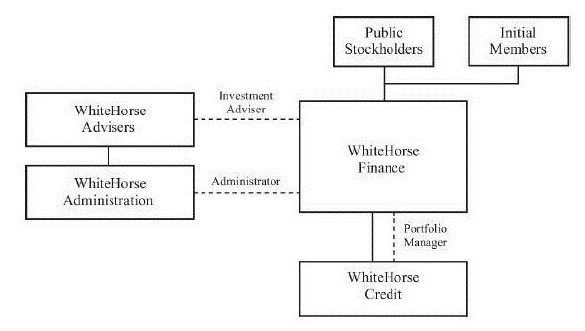
“we,” “us,” “our” and “WhiteHorse Finance” refer (unless the context otherwise requires) to WhiteHorse Finance, Inc., a Delaware corporation, and its consolidated subsidiaries;
“H.I.G. Capital” refers (unless the context otherwise requires), collectively, to H.I.G. Capital, L.L.C., a Delaware limited liability company, and its affiliates. H.I.G. Capital employs all of WhiteHorse Finance’s investment professionals, as well as those of WhiteHorse Advisers (as defined below), WhiteHorse Administration (as defined below) and their respective affiliates;
“WhiteHorse Credit” refers to WhiteHorse Finance Credit I, LLC, a special purpose Delaware limited liability company and a wholly owned subsidiary of WhiteHorse Finance;
“WhiteHorse Advisers” and the “Investment Adviser” refer to H.I.G. WhiteHorse Advisers, LLC, a Delaware limited liability company and an affiliate of H.I.G. Capital;
“WhiteHorse Administration” and the “Administrator” refer to H.I.G. WhiteHorse Administration, LLC, a Delaware limited liability company and an affiliate of H.I.G. Capital;
“6.000% 2023 Notes” refer to the $30 million aggregate principal amount of 6.00% unsecured notes due 2023 privately issued on August 7, 2018 to qualified institutional investors in reliance on Section 4(a)(2) of the Securities Act of 1933, as amended;
“5.375% 2025 Notes” refer to the $40 million aggregate principal amount of 5.375% unsecured notes due 2025 privately issued on October 20, 2020 to qualified institutional investors in reliance on Section 4(a)(2) of the Securities Act of 1933, as amended;
“5.375% 2026 Notes” refer to the $10 million aggregate principal amount of 5.375% unsecured notes due 2026 privately issued on December 4, 2020 to qualified institutional investors in reliance on Section 4(a)(2) of the Securities Act of 1933, as amended;
“5.625% 2027 Notes” refer to the $10 million aggregate principal amount of 5.625% unsecured notes due 2027 privately issued on December 4, 2020 to qualified institutional investors in reliance on Section 4(a)(2) of the Securities Act of 1933, as amended;
“4.250% 2028 Notes” refer to the $25 million aggregate principal amount of 4.25% unsecured notes due 2028 privately issued on December 6, 2021 to qualified institutional investors in reliance on Section 4(a)(2) of the Securities Act of 1933, as amended;
“4.000% 2026 Notes” refer to the $75 million aggregate principal amount of 4.00% unsecured notes due 2026 issued on November 24, 2021;
“Private Notes” refers (unless the context otherwise requires) collectively to the 6.000% 2023 Notes, the 5.375% 2025 Notes, the 5.375% 2026 Notes, the 5.625% 2027 Notes and the 4.250% 2028 Notes; and
“Credit Facility” refers to the $335 million secured revolving credit facility between WhiteHorse Credit, as borrower, and JPMorgan Chase Bank, N.A., and any additional lenders that may join the Credit Facility in the future.

S-2

Table of Contents

WhiteHorse Finance

We are an externally managed, non-diversified, closed-end management investment company that has elected to be treated as a business development company under the Investment Company Act of 1940, as amended, or the 1940 Act. In addition, for tax purposes, we elected to be treated as a regulated investment company, or RIC, under Subchapter M of the Internal Revenue Code of 1986, as amended, or the Code, and intend to qualify annually for such treatment.

We are a direct lender targeting debt investments in privately held, lower middle market companies located in the United States. We define the lower middle market as those companies with enterprise values between $50 million and $350 million. Our investment objective is to generate attractive risk-adjusted returns primarily by originating and investing in senior secured loans, including first lien and second lien facilities, to performing lower middle market companies across a broad range of industries. Such loans typically are based on a floating interest rate index such as SOFR or LIBOR, plus a spread and typically have a term of three to six years. While we focus principally on originating senior secured loans to lower middle market companies, we may also make opportunistic investments at other levels of a company’s capital structure, including mezzanine loans or equity interests, and in companies outside of the lower middle market, to the extent we believe the investment presents an opportunity to achieve an attractive risk-adjusted return. We also may receive warrants to purchase common stock in connection with our debt investments. We generate current income through the receipt of interest payments, as well as origination and other fees, capital appreciation and dividends.

We invest primarily in securities that are rated below investment grade by rating agencies or that may be rated below investment grade if they were so rated. Below investment grade securities, which are often referred to as “junk” bonds, are viewed as speculative investments because of concerns with respect to the issuer’s capacity to pay interest and repay principal.

As of December 31, 2022, our investment portfolio consisted primarily of senior secured loans across 115 positions in 72 companies with an aggregate fair value of $760.2 million. As of December 31, 2022, the majority of our portfolio was comprised of senior secured loans to lower middle market borrowers.

H.I.G. Capital

H.I.G. Capital, founded in 1993, is a leading global alternative asset manager focused on the lower middle market. As of December 31, 2022, H.I.G. Capital managed approximately $52 billion of capital (based on regulatory assets under management, as reported on Form ADV) across multiple investment funds supported by approximately 560 dedicated investment professionals. These investment professionals bring a depth of experience and skills across a broad range of industries and transaction types, including primary loan originations, secondary debt purchases and special situations and distressed debt investing.

Market Opportunity

We pursue an investment strategy focused on originating senior secured loans to lower middle market companies, including first lien and second lien facilities. We may also make investments at other levels of a company’s capital structure, including mezzanine loans or equity interests, and receive warrants to purchase common stock in connection with our debt investments. We believe that market inefficiencies and an imbalance between the supply of, and demand for, capital in the lower middle market credit market creates an attractive investment opportunity through the origination of primary loans for the following reasons:

Specialized Lending Requirements. In our experience, lending to lower middle market companies requires more rigorous due diligence and underwriting processes than lending to larger companies. Lower middle market companies typically have fewer management resources to dedicate to the borrowing process, and often receive little or no assistance from financial advisors. Because of these and other specialized lending requirements, only a limited segment of the lending community has historically served lower middle market borrowers.

Decrease in Commercial Bank Lending Activity. In recent years, regulatory changes and ongoing consolidation of smaller commercial banks have curtailed U.S. bank lending capacity. In response, we believe that many remaining commercial banks have deemphasized their service and product offerings to lower middle market companies in favor of lending to larger customers. We believe that the relative decline in the number of commercial banks and a shift in emphasis by remaining banks has driven a higher volume of lower middle market deal flow to us.

S-3

Table of Contents

Lower Middle Market Environment. We believe that as the economic recovery continues following the credit crisis, there has been increased competition for lower middle market investments due to new hedge funds and non-bank lenders that have entered the market and due to improving financial performance of lower middle market companies. However, we believe that our strong lower middle market position will continue to allow us to find investment opportunities with attractive risk-adjusted returns.

Significant Demand for Credit. We believe that demand for debt financing from lower middle market companies will remain strong because these companies will continue to require credit to refinance existing debt, to support growth initiatives and to finance acquisitions. We believe the strong demand by lower middle market companies should increase lending opportunities for us.

Inefficient Market. We believe there are a number of inefficiencies in the lower middle market credit market which allow us to achieve superior risk-adjusted returns relative to other types of loans. Unlike larger companies, lower middle market borrowers may not have a financial advisor and, as a result, may not receive as many financing offers, leading to more favorable financing terms for us, and may be less sophisticated in negotiating the terms of their financing. Moreover, the simpler capital structures frequently found in lower middle market companies often enhance protections and reduce or eliminate inter-creditor issues. In addition, lower middle market lenders face less competition than lenders to larger companies. As a result, lower middle market lenders frequently have greater flexibility in structuring favorable transactions.

We believe these factors, taken together, should increase lending opportunities for us and enable us to generate attractive risk-adjusted returns.

Competitive Strengths

Leading Lower Middle Market Position. H.I.G. Capital is one of the leading global alternative asset managers focused on the lower middle market. With more than 25 years of investment experience focused primarily on lower middle market companies, H.I.G. Capital believes it has a specialized knowledge of the lower middle market and expertise in evaluating the issues and opportunities facing lower middle market companies throughout economic cycles. We believe that the quality of these resources provides a significant advantage and contributes to the strength of our business.

Large and Experienced Management Team with Substantial Resources. Our Investment Adviser has access through a staffing agreement with an affiliate of H.I.G Capital to the resources and expertise of H.I.G. Capital’s more than 1,000 employees in 18 offices across the United States, Europe and South America as of December 31, 2022. As of such date, H.I.G. Capital had approximately 560 dedicated investment professionals. We believe that the quality of these resources provides a significant advantage and contributes to the strength of our business.

Extensive Deal Sourcing Infrastructure. Given the inefficiencies of the lower middle market, finding smaller companies that represent attractive debt investment opportunities requires a different sourcing network than that for larger companies. For more than 25 years, H.I.G. Capital has built an extensive and proprietary network of deal sources in the lower middle market consisting of accountants, attorneys and other advisors who have access to these companies. Each of H.I.G. Capital’s investment professionals is involved in deal sourcing, and our in-house business development group of approximately 25 dedicated deal sourcing professionals as of December 31, 2022 further enhanced our sourcing network. We believe H.I.G. Capital’s extensive deal sourcing infrastructure provides us with access to investment opportunities that may not be available to many of our competitors.

Deep Credit Expertise. As of December 31, 2022, H.I.G. Capital’s credit platform managed approximately $19 billion of AUM across multiple investment funds supported by its dedicated credit investment professionals. These investment professionals bring a depth of experience and skills across a broad range of transaction types, including primary loan originations, secondary debt purchases and special situations and distressed debt investments. We believe this experience and expertise in credit documentation, loan structuring and restructuring negotiations helps to protect our investments and maximize our recovery value to the extent a portfolio company does not perform as expected.

Disciplined Investment and Underwriting Process. Through its more than 25 years of investment experience, H.I.G. Capital has developed a disciplined investment process entailing intensive “bottom-up” fundamental analysis in order to generate attractive risk-adjusted returns while preserving downside protection. Our Investment Adviser utilizes the established investment processes developed by H.I.G. Capital to analyze investment opportunities, including structuring loans with appropriate covenants and pricing loans based on its knowledge of the lower middle market and on its rigorous underwriting standards. Each investment is reviewed by

S-4

Table of Contents

the Investment Committee, which is comprised of senior investment professionals of H.I.G. Capital with an average of more than 25 years of investment experience as of December 31, 2022.

Investment Strategy

Our investment strategy is to generate current income and capital appreciation primarily by originating secured loans. We seek to create a broad portfolio consisting of investments generally in the range of $5 million to $25 million primarily in debt securities and loans of U.S. based lower middle market companies. We primarily target borrowers in the United States with enterprise values of $50 million to $350 million across a broad range of industries. The proceeds of our loans are used for a variety of purposes, including refinancings of existing debt, acquisition financing, or working capital to support growth or realignment.

While we focus principally on originating senior secured loans to lower middle market companies that we believe have attractive risk adjusted returns, including first lien and second lien facilities, we may also opportunistically make investments at other levels of a company’s capital structure, including mezzanine loans or equity interests. We also may receive warrants to purchase common stock in connection with our debt investments. We may also invest in assets consistent with our investment strategy indirectly through the acquisitions of interests in other investment companies. We generate current income through the receipt of interest payments, origination and other fees, and dividends. Our typical loans are based on a floating interest rate index such as SOFR or LIBOR plus a spread, have a term of three to six years, are secured by all tangible and intangible assets of the borrower and include covenants, monitoring and information rights in favor of the lender.

Target businesses will typically exhibit some or all of the following characteristics:

enterprise value of between $50 million and $350 million;
organized in the United States;
experienced management team;
stable and predictable free cash flows;
discernible downside protection through recurring revenue or strong tangible asset coverage;
products and services with distinctive competitive advantages or other barriers to entry;
low technology and market risk; and
strong customer relationships.

None of these investment policies is fundamental, and they may be changed without stockholder approval.

We expect that, from time to time, our investments may include certain non-qualifying assets, including assets of non-U.S. companies, certain publicly traded companies and, to a lesser extent and subject to certain limits under the 1940 Act, registered or unregistered investment companies, to the extent permissible under the 1940 Act. See “Risk Factors — Risks Relating to our Business and Structure — The constraints imposed on us as a business development company and RIC may hinder the achievement of our investment objective” and “Regulation — Qualifying Assets” each in our most recent Annual Report on Form 10-K.

Leverage

Historically, the 1940 Act permitted us to issue “senior securities,” including borrowing money from banks or other financial institutions, only in amounts such that our asset coverage, as defined in the 1940 Act, equaled at least 200% after such incurrence or issuance. In March 2018, the Small Business Credit Availability Act, or the SBCAA, among other things, amended the 1940 Act to reduce the asset coverage requirements applicable to business development companies from 200% to 150% so long as the business development company meets certain disclosure requirements and obtains certain approvals. At our annual meeting of stockholders held on August 1, 2018, our stockholders approved the reduced asset coverage ratio from 200% to 150%. As a result, our asset

S-5

Table of Contents

coverage requirements applicable to senior securities decreased from 200% to 150%, effective August 2, 2018, such that our maximum debt-to-equity ratio increased on such date from a prior maximum of 1.0x (equivalent of $1 of debt outstanding for each $1 of equity) to a maximum of 2.0x (equivalent to $2 of debt outstanding for each $1 of equity). As of December 31, 2022, our asset coverage for borrowed amounts was 174.7%.

Company Information

Our principal executive offices are located at 1450 Brickell Avenue, 31st Floor, Miami, Florida 33131, telephone number (305) 381-6999. Our corporate website is located at www.whitehorsefinance.com. Information on our website is not incorporated into or a part of this prospectus supplement or the accompanying prospectus.

S-6

Table of Contents

THE OFFERING

Common stock offered by the Company


Up to $35 million of shares of our common stock

Common stock outstanding as of March 29, 2023

23,243,088 shares.

Manner of offering

“At the market offering” that may be made from time to time through B. Riley Securities, Inc., the sales agent, using commercially reasonable efforts. See “Plan of Distribution.”

Nasdaq symbol

“WHF”

Use of Proceeds

If we sell shares of our common stock with an aggregate offering price of $35 million, we anticipate that our net proceeds, after deducting sales agent’s commissions and estimated expenses payable by us, will be approximately $34,050,000.

We expect to use all or substantially all of the net proceeds from this offering to invest in portfolio companies in accordance with our investment objective and strategies and for general corporate purposes. See “Use of Proceeds” for more information.

Trading at a Discount

Shares of closed-end investment companies, including business development companies, frequently trade at a discount to their NAV. The risk that our shares may trade at a discount to our NAV is separate and distinct from the risk that our NAV per share may decline. We cannot predict whether our shares will trade above, at or below NAV.

Distributions on Common Stock

The timing and amount of our quarterly distributions, if any, are determined by our board of directors. While we intend to make distributions on a quarterly basis to our stockholders out of assets legally available for distribution, we may not be able to achieve operating results that will allow us to make distributions at a specific level or to increase the amount of our distributions from time to time. In addition, we may be limited in our ability to make distributions due to the asset coverage requirements applicable to us as a business development company under the 1940 Act. If we do not distribute a certain percentage of our income annually, we will suffer adverse tax consequences, including the possible loss of our ability to be subject to tax as a RIC. We cannot assure stockholders that they will receive any distributions.

Dividend Reinvestment Plan

We have adopted a dividend reinvestment plan, or the DRIP, that provides for reinvestment of our dividends and other distributions on behalf of our stockholders, unless a stockholder elects to receive cash. As a result, if our board of directors authorizes and declares a cash dividend or other distribution, then our stockholders who have not “opted out” of our DRIP will have their cash distribution automatically reinvested in additional shares of our common stock, rather than receiving the cash distribution. Stockholders who receive dividends and other distributions in the form of stock are generally subject to the same U.S. federal, state and local tax consequences as are stockholders who elect to receive their distributions in cash; however, since their cash dividends will

S-7

Table of Contents

be reinvested, such stockholders will not receive cash with which to pay any applicable taxes on reinvested dividends. See “Dividend Reinvestment Plan” in the accompanying prospectus.

Risk Factors

Investing in our common stock involves risks. See “Risk Factors” in our most recent Annual Report on Form 10-K and any subsequent Quarterly Report on Form 10-Q incorporated by reference to this prospectus supplement and in any free writing prospectuses we have authorized for use in connection with this offering, and under similar headings in the documents that are filed with the SEC on or after the date hereof and are incorporated by reference into this prospectus supplement and the accompanying prospectus.

S-8

Table of Contents

FEES AND EXPENSES

The following table is intended to assist you in understanding the various costs and expenses that an investor in shares of our common stock will bear directly or indirectly. We caution you that some of the percentages indicated in the table below are estimates and may vary from actual results. The following table should not be considered a representation of our future expenses. Actual expenses may be greater or less than shown. Except where the context suggests otherwise, whenever this prospectus supplement contains a reference to fees or expenses paid by “us” or “WhiteHorse Finance,” or that “we” will pay fees or expenses, common stockholders will indirectly bear such fees or expenses as investors in WhiteHorse Finance.

Stockholder transaction expenses:


Sales load (as a percentage of offering price)


2.0

%(1)

Offering expenses (as a percentage of offering price)


0.71

%(2)

Dividend reinvestment plan fees (per sales transaction fee)

$

15 Transaction Fee

(3)

Total stockholder transaction expenses (as a percentage of offering price)


2.71

%

Annual expenses (as a percentage of net assets attributable to common stock):


Base management fees


4.69

%(4)

Incentive fees payable under Investment Advisory Agreement (20% of Pre-Incentive Fee Net Investment Income and 20% of realized capital gains)


2.12

%(5)

Interest payments on borrowed funds


6.60

%(6)

Acquired fund fees and expenses


3.65

%(7)

Other expenses


1.71

%(8)

Total annual expenses


18.77

%

(1)Represents the maximum agent commission with respect to the shares of our common stock sold by us in this offering. There is no guarantee that there will be any sales of our common stock pursuant to this prospectus supplement and the accompanying prospectus.
(2)The percentage reflects estimated offering expenses payable by us of approximately $250,000 for the estimated duration of this offering.
(3)The expenses of the distribution reinvestment plan, which consist primarily of the expenses of American Stock Transfer & Trust Company, LLC, our plan administrator, are included in “Other expenses.” If a participant elects by written notice to the plan administrator prior to termination of his or her account to have the plan administrator sell part or all of the shares held by the plan administrator in the participant’s account and remit the proceeds to the participant, the plan administrator is authorized to deduct a $15.00 transaction fee plus a $0.10 per share brokerage commission from the proceeds. See “Dividend Reinvestment Plan” in the accompanying prospectus.
(4)Our base management fee under an investment advisory agreement with WhiteHorse Advisers, or the Investment Advisory Agreement, is calculated at an annual rate equal to 2.0% based on our gross assets, including assets purchased with borrowed funds; provided, however, our base management fee shall be calculated at an annual rate equal to 1.25% of our gross assets, including cash and cash equivalents and assets purchased with borrowed funds, that exceed the product of (i) 200% and (ii) the value of our total net assets. Our base management fee is payable quarterly in arrears. The SEC requires that the “Management fees” percentage be calculated as a percentage of net assets attributable to common stockholders, rather than total assets, including assets that have been funded with borrowed monies, because common stockholders bear all of this cost.
(5)The incentive fee referenced in the table above is based on actual amounts of the income-based component of the incentive fee incurred during the year ended December 31, 2022 and the actual amount of the capital gains-based incentive fee recorded during this same period. The incentive fee consists of two components that are independent of each other (except as provided in the Incentive Fee Cap and Deferral Mechanism described below), with the result that one component may be payable even if the other is not.

We have structured the calculation of these incentive fees, which we refer to as the “Income and Capital Gain Incentive Fee Calculations,” to include a fee limitation such that no incentive fee will be paid to our Investment Adviser for any fiscal quarter if, after such payment, the cumulative incentive fees paid to our Investment Adviser for the period that includes such fiscal quarter and the 11 full preceding fiscal quarters, which we refer to in this prospectus supplement as the Incentive Fee Look-back Period, would

S-9

Table of Contents

exceed 20.0% of our Cumulative Pre-Incentive Fee Net Return during the applicable Incentive Fee Look-back Period. The deferral component of the Incentive Fee Cap and Deferral Mechanism may cause incentive fees that accrued during one fiscal quarter to be paid to our Investment Adviser at any time during the 11 full fiscal quarters following such initial full fiscal quarter. The “Cumulative Pre-Incentive Fee Net Return” refers to the sum of (a) Pre-Incentive Fee Net Investment Income for each period during the Incentive Fee Look-back Period and (b) the sum of cumulative realized capital gains, cumulative realized capital losses, cumulative unrealized capital depreciation and cumulative unrealized capital appreciation during the applicable Incentive Fee Look-back Period.

We accomplish this limitation by subjecting each incentive fee payable to a cap, which we refer to in this prospectus supplement to as the “Incentive Fee Cap.” The Incentive Fee Cap in any quarter is equal to (a) 20.0% of Cumulative Pre-Incentive Fee Net Return during the Incentive Fee Look-back Period less (b) cumulative incentive fees of any kind paid to our Investment Adviser by us during the Incentive Fee Look-back Period. To the extent the Incentive Fee Cap is zero or a negative value in any quarter, we will pay no incentive fee to our Investment Adviser in that quarter. We will only pay incentive fees to the extent allowed by the Incentive Fee Cap and Deferral Mechanism. To the extent that the payment of incentive fees is limited by the Incentive Fee Cap and Deferral Mechanism, the payment of such fees may be deferred and paid up to three years after their date of deferment subject to applicable limitations included in the Investment Advisory Agreement.

The first component of the incentive fee, which is income-based and payable quarterly in arrears, equals 20% of the amount, if any, that our “Pre-Incentive Fee Net Investment Income” exceeds a 1.75% quarterly (7.00% annualized) hurdle rate, or the Hurdle Rate, subject to a “catch-up” provision measured at the end of each calendar quarter and the Incentive Fee Cap and Deferral Mechanism described below. For this purpose, “Pre-Incentive Fee Net Investment Income” means, in each case on a consolidated basis, interest income, distribution income and any other income (including any other fees (other than fees for providing managerial assistance), such as commitment, origination, structuring, diligence and consulting fees or other fees that we receive from portfolio companies) accrued during the calendar quarter, minus our operating expenses for the quarter (including the base management fee, expenses payable under the Administration Agreement (as defined below), any interest expense and any dividends paid on any issued and outstanding preferred stock, but excluding the incentive fee). Pre-Incentive Fee Net Investment Income does not include any realized capital gains, realized capital losses or unrealized capital appreciation or depreciation. The operation of the first component of the incentive fee for each quarter is as follows:

no incentive fee is payable to our Investment Adviser in any calendar quarter in which our Pre-Incentive Fee Net Investment Income does not exceed the Hurdle Rate of 1.75% (7.00% annualized);
100% of our Pre-Incentive Fee Net Investment Income with respect to that portion of such Pre-Incentive Fee Net Investment Income, if any, that exceeds the Hurdle Rate but is less than 2.1875% in any calendar quarter (8.75% annualized) is payable to our Investment Adviser. We refer to this portion of our Pre-Incentive Fee Net Investment Income (which exceeds the Hurdle Rate but is less than 2.1875%) as the “catch-up.” The effect of the “catch-up” provision is that, if such Pre-Incentive Fee Net Investment Income exceeds 2.1875% in any calendar quarter, our Investment Adviser will receive 20% of such Pre-Incentive Fee Net Investment Income as if the Hurdle Rate did not apply; and
20% of the amount of such Pre-Incentive Fee Net Investment Income, if any, that exceeds 2.1875% in any calendar quarter (8.75% annualized) is payable to our Investment Adviser (once the Hurdle Rate is reached and the catch-up is achieved).

The portion of such incentive fee that is attributable to deferred interest (such as payment-in-kind interest or original issue discount) will be paid to the Investment Adviser, together with any other interest accrued on the loan from the date of deferral to the date of payment, only if and to the extent we actually receive such interest in cash, and any accrual thereof will be reversed if and to the extent such interest is reversed in connection with any write-off or similar treatment of the investment giving rise to any deferred interest accrual. Any reversal of such amounts would reduce net income for the quarter by the net amount of the reversal (after taking into account the reversal of incentive fees payable) and would result in a reduction and possibly elimination of the incentive fees for such quarter. For the avoidance of doubt, no incentive will be paid to the Investment Adviser on amounts accrued and not paid in respect of deferred interest.

There is no accumulation of amounts on the Hurdle Rate from quarter to quarter and, accordingly, there is no clawback of amounts previously paid if subsequent quarters are below the quarterly Hurdle Rate and there is no delay of payment if prior quarters are below the quarterly Hurdle Rate. Since the Hurdle Rate is fixed, as interest rates rise, it will be easier for our Investment Adviser to surpass the Hurdle Rate and receive an incentive fee based on Pre-Incentive Fee Net Investment Income.

S-10

Table of Contents

The second component of the incentive fee, which is capital gains-based, is determined and payable in arrears as of the end of each calendar year (or upon termination of the Investment Advisory Agreement, as of the termination date) and equals 20% of our cumulative aggregate realized capital gains through the end of such year, computed net of our aggregate cumulative realized capital losses and aggregate cumulative unrealized capital depreciation through the end of such year, less the aggregate amount of any previously paid capital gains incentive fees and subject to the Incentive Fee Cap and Deferral Mechanism described above. The capital-gains component of the incentive fee excludes any portion of realized gains (losses) that are associated with the reversal of any portion of unrealized appreciation/depreciation attributable to periods prior to January 1, 2013. The capital gains component of the incentive fee is not subject to any minimum return to stockholders.

As described above, we will not pay any incentive fee at any time when, after such payment, the cumulative incentive fees paid to date would exceed 20% of the Cumulative Pre-Incentive Fee Net Return during the Incentive Fee Look-back Period.

(6)Our stockholders bear directly or indirectly the costs of borrowings under the Credit Facility and other debt instruments. Our actual borrowing costs as a percentage of net assets attributable to common stock on our outstanding indebtedness as of December 31, 2022, which consisted of $255.1 million of indebtedness outstanding under the Credit Facility, $75.0 million of indebtedness outstanding in 4.000% 2026 Notes and $115.0 million of indebtedness outstanding in Private Notes, was 6.60%. As of December 31, 2022, the weighted average interest rate for total outstanding debt was 6.12%. Assuming we meet certain disclosure requirements and obtain certain approvals required by the SBCAA, we expect to use leverage to finance a portion of our investments in the future, consistent with the rules and regulations under the 1940 Act.
(7)Our stockholders also indirectly bear 66.67% of the expenses of our investment in a joint venture, or STRS JV, that we entered into in January 2019 with State Teachers Retirement System of Ohio. No management fee is charged by Whitehorse Advisers to STRS JV. For this chart, STRS JV fees and operating expenses are based on our share of the actual fees and operating expenses of STRS JV for the year ended December 31, 2022. Expenses for STRS JV may fluctuate over time and may be substantially higher or lower in the future.
(8)Includes our overhead expenses, including payments under the Administration Agreement, based on our allocable portion of overhead and other expenses incurred by WhiteHorse Administration in performing its obligations under the Administration Agreement, and income and excise taxes. “Other expenses” are estimated for the current fiscal year based on actual other expenses for the fiscal quarter ended December 31, 2022, annualized for a full year.

Example

The following example demonstrates the projected dollar amount of total cumulative expenses that would be incurred over various periods with respect to a hypothetical investment in our common stock. In calculating the following expense amounts, we have assumed that our annual operating expenses remain at the levels set forth in the table above and that you would pay a sales load of up to 2.0% (the commission to be paid by us with respect to common stock sold by us in this offering). This example and the expenses in the table above should not be considered a representation of our future expenses, and actual expenses (including the cost of debt, if any, and other expenses) may be greater or less than those shown.

Stockholders would pay the following expenses on a $1,000 common stock investment:


1 year


3 years


5 years


10 years

Assuming a 5% annual return (none of which is subject to the incentive fee)

$

174

$

453

$

662

$

980

The above table is designed to assist you in understanding the various costs and expenses that an investor in our common stock will bear directly or indirectly. While the example assumes, as required by the SEC, a 5% annual return, our performance will vary and may result in a return greater or less than 5%. The incentive fee under the Investment Advisory Agreement, which, assuming a 5% annual return, would either not be payable or would have an insignificant impact on the expense amounts shown above, is not included in the example. This illustration assumes that we will not realize any capital gains (computed net of all realized capital losses and unrealized capital depreciation) in any of the indicated time periods. If we achieve sufficient returns on our investments, including through the realization of capital gains, to trigger an incentive fee of a material amount, our expenses and returns to our investors would be higher.

S-11

Table of Contents

If the 5% annual return were derived entirely from capital gains, you would pay expenses on a $1,000 investment as follows:

Stockholders would pay the following expenses on a $1,000 common stock investment:


1 year


3 years


5 years


10 years

Assuming a 5% annual return resulting entirely from net realized capital gains (which is subject to the incentive fee based on capital gains)

$

184

$

479

$

700

$

1,036

The example assumes reinvestment of all dividends and other distributions at NAV. Under certain circumstances, reinvestment of dividends and distributions under our DRIP may occur at a price per share that differs from NAV. Participants in the DRIP will receive a number of shares of our common stock determined by dividing the total dollar amount of the distribution payable to a participant by the market price per share of our common stock at the close of trading on the valuation date for the distribution. See “Dividend Reinvestment Plan” for additional information regarding the DRIP.

S-12

Table of Contents

RISK FACTORS

Before you invest in our common stock, you should be aware of various risks, including those described in our most recent Annual Report on Form 10-K and any subsequent Quarterly Report on Form 10-Q incorporated by reference in this prospectus supplement, in any free writing prospectuses we have authorized for use in connection with this offering and under similar headings in the documents that are filed with the SEC on or after the date of this prospectus supplement and are incorporated by reference into this prospectus supplement and the accompanying prospectus. You should carefully consider these risk factors, together with all of the other information included or incorporated by reference in this prospectus supplement, the accompanying prospectus and in any free writing prospectuses we have authorized for use in connection with this offering, before you decide whether to make an investment in our common stock.

The risks described in these documents are not the only risks we face. If any of the following events occur, our business, financial condition and results of operations could be materially adversely affected. In such case, our NAV and the trading price of our common stock could decline, and you may lose all or part of your investment.

S-13

Table of Contents

USE OF PROCEEDS

Sales of our common stock, if any, under this prospectus supplement and the accompanying prospectus may be made in negotiated transactions or transactions that are deemed to be “at the market” as defined in Rule 415 under the Securities Act, including sales made directly on Nasdaq or sales made to or through a market maker other than on an exchange. There is no guarantee that there will be any sales of our common stock pursuant to this prospectus supplement and the accompanying prospectus. Actual sales, if any, of our common stock under this prospectus supplement and the accompanying prospectus may be less than the proceeds set forth in this paragraph depending on the market price of our common stock at the time of any such sale. As a result, the actual net proceeds we receive may be more or less than the amount of net proceeds estimated in this prospectus supplement. The sales price per share of our common stock offered by this prospectus supplement and the accompanying prospectus, less commissions payable under the equity distribution agreement and discounts, if any, will not be less than the NAV per share of our common stock at the time of such sale. If we sell shares of our common stock with an aggregate offering price of $35 million, we anticipate that our net proceeds, after deducting sales agent’s commissions and estimated expenses payable by us, will be approximately $34,050,000.

We expect to use all or substantially all of the net proceeds from this offering to invest in portfolio companies in accordance with our investment objective and strategies and for general corporate purposes. We expect that our new investments will consist primarily of senior secured debt investments in lower middle market companies.

We anticipate that we will use substantially all of the net proceeds of the sale of the common stock in this offering for the above purposes within approximately six months after the completion of the offering described in this prospectus supplement, depending on the availability of appropriate investment opportunities consistent with our investment objective and market conditions. We cannot assure you that we will achieve our targeted investment pace.

Until such appropriate investment opportunities can be found, we intend to invest the net proceeds of the offering of our common stock in cash, cash equivalents, U.S. government securities and high-quality debt investments that mature in one year or less from the date of investment. These temporary investments may have lower yields than our other investments and, accordingly, may result in lower distributions, if any, during such period. Our ability to achieve our investment objective may be limited to the extent that the net proceeds from an offering, pending full investment, are held in lower yielding interest-bearing deposits or other short-term instruments. See “Item 1. Business — Regulation — Temporary Investments” in our most recent Annual Report on Form 10-K for additional information about temporary investments we may make while waiting to make longer-term investments in pursuit of our investment objective.

S-14

Table of Contents

PLAN OF DISTRIBUTION

We have entered into an equity distribution agreement, dated March 31, 2023, with B. Riley Securities, Inc. under which it will act as the sales agent in connection with the offer and sale of up to $35 million of shares of our common stock pursuant to this prospectus supplement and the accompanying prospectus. Upon instructions from us, the sales agent will use its commercially reasonable efforts consistent with its normal sales and trading practices to sell, as the sales agent, our common stock under the terms and subject to the conditions set forth in the equity distribution agreement. We will instruct the sales agent as to the amount of common stock to be sold by us. We may instruct the sales agent not to sell common stock if the sales cannot be effected at or above the price designated by us in any instruction. The sales price per share of our common stock offered by this prospectus supplement and the accompanying prospectus, less commissions payable under the equity distribution agreement and discounts, if any, will not be less than the NAV per share of our common stock at the time of such sale. We or the sales agent may suspend the offering of shares of common stock upon proper notice and subject to other conditions.

Sales of the shares of our common stock, if any, by us under this prospectus supplement and the accompanying prospectus may be made in negotiated transactions, which may include block trades, or transactions that are deemed to be “at the market,” as defined in Rule 415 under the Securities Act, including sales made directly on Nasdaq or similar securities exchanges or sales made to or through a market maker other than on a securities exchange at prices related to the prevailing market prices or at negotiated prices.

The sales agent will provide written confirmation of a sale to us as soon as practicable following the close of trading on Nasdaq each day in which shares of our common stock are sold under the equity distribution agreement. Each confirmation will include the number of shares of common stock sold on such day, the net proceeds payable to us and the aggregate compensation payable by us to the sales agent in connection with such sales.

We will pay the sales agent a commission of up to 2.0% of the gross sales price of shares of our common stock sold through them pursuant to this prospectus supplement. The estimated offering expenses payable by us, in addition to such commission and reimbursement of expenses, are approximately $250,000, which includes legal, accounting and printing costs and various other fees associated with registering the shares of common stock and the filing fees incident to the review by the Financial Industry Regulatory Authority, Inc., or FINRA, of the terms of the sale of common stock in this offering, as well as an aggregate of $50,000 in reimbursement of reasonable fees and expenses of counsel to the sales agent incurred in connection with the initial launch of this offering (including legal fees and expenses relating to the review by FINRA of the terms of the sale of our common stock in this offering), and up to $7,500 per calendar quarter during the term of the equity distribution agreement for fees and expenses of counsel to the sales agent incurred in connection with quarterly updates for this offering. The remaining sales proceeds, after deducting any other transaction fees, will equal net proceeds from the sale of such shares payable to us.

Settlement for sales of shares of common stock will occur on the second trading day following the date on which such sales are made, or on some other date that is agreed upon by us and the sales agent in connection with a particular transaction, in return for payment of the net proceeds to us. There is no arrangement for funds to be received in an escrow, trust or similar arrangement.

Under the terms of the equity distribution agreement, we may also sell shares of common stock to the sales agent as principal for its own accounts at a price agreed upon at the time of sale. The sales agent may offer common stock sold to them as principals from time to time through public or private transactions at market prices prevailing at the time of sale, at fixed prices, at negotiated prices, at various prices determined at the time of sale or at prices related to prevailing market prices. If we sell shares to the sales agent as principal, we will enter into a separate agreement with the sales agent, setting forth the terms of such transaction, and we will describe such agreement in a separate prospectus supplement or pricing supplement.

We will report at least quarterly the number of shares of common stock sold by us through the sales agent under the equity distribution agreement and the net proceeds to us.

In connection with the sale of the common stock on our behalf, the sales agent may be deemed to be an “underwriter” within the meaning of the Securities Act, and the compensation of the sales agent may be deemed to be underwriting commissions or discounts. We have agreed to provide indemnification and contribution to the sales agent with respect to certain civil liabilities, including liabilities under the Securities Act.

S-15

Table of Contents

The offering of shares of common stock by us pursuant to the equity distribution agreement will terminate upon the earlier of (i) the sale of all common stock subject to the equity distribution agreement or (ii) the termination of the equity distribution agreement as permitted therein.

This summary of the material provisions of the equity distribution agreement does not purport to be a complete statement of its terms and conditions. A copy of the equity distribution agreement will be filed as an exhibit to a Current Report on Form 8-K and incorporated into this prospectus supplement by reference.

The principal business address of B. Riley Securities, Inc. is 299 Park Avenue, 21st Floor, New York, New York 10171.

S-16

Table of Contents

LEGAL MATTERS

Certain legal matters regarding the shares of common stock offered by this prospectus supplement will be passed upon for WhiteHorse Finance by Dechert LLP, Boston, Massachusetts. Dechert LLP also represents the Investment Adviser. Certain legal matters regarding the shares of common stock offered by this prospectus supplement will be passed upon for the sales agent by Kirkland & Ellis LLP, Washington, DC.

S-17

Table of Contents

INDEPENDENT REGISTERED PUBLIC ACCOUNTING FIRM

Crowe LLP, located at 485 Lexington Avenue, FL 11, New York, NY 10017, an independent registered public accounting firm, has audited our consolidated financial statements as of December 31, 2022 and 2021 and for each of the three years in the period ended December 31, 2022, as set forth in its report incorporated by reference in this prospectus supplement and the accompanying prospectus. We have incorporated by reference our consolidated financial statements in reliance on Crowe LLP’s report, given on the authority of said firm as experts in accounting and auditing. The senior securities table of WhiteHorse Finance included in the accompanying prospectus and in our most recent Annual Report on Form 10-K has been included in reliance upon the report of Crowe LLP, an independent registered public accounting firm, as stated in its report related thereto.

S-18

Table of Contents

INCORPORATION BY REFERENCE

We incorporate by reference in this prospectus supplement the documents listed below and any future filings (including those made after the date of this prospectus supplement) we will make with the SEC under Sections 13(a), 13(c), 14, or 15(d) of the Securities Exchange Act of 1934, or the Exchange Act, until the termination of the offering of the securities covered by this prospectus supplement (such reports and other documents deemed to be incorporated by reference into this prospectus supplement and to be part hereof from the date of filing of such reports and other documents); provided, however, that information “furnished” under Item 2.02 or Item 7.01 of Form 8-K or other information “furnished” to the SEC which is not deemed filed is not incorporated by reference into this prospectus supplement:

our Annual Report on Form 10-K for the fiscal year ended December 31, 2022, filed with the SEC on March 3, 2023; and
The description of our common stock contained in Exhibit 4.5 of our Annual Report on Form 10-K for the fiscal year ended December 31, 2022 filed with the SEC on March 3, 2023, which updated the description thereof referenced in our Registration Statement on Form 8-A (No. 001-35752), as filed with the SEC on December 4, 2012, including any amendment or report filed for the purpose of updating such description prior to the termination of the offering of the common stock registered hereby.

To obtain copies of these filings, see “Additional Information.”

S-19

Table of Contents

ADDITIONAL INFORMATION

We have filed with the SEC a registration statement on Form N-2, together with all amendments and related exhibits, under the Securities Act, with respect to the securities offered by this prospectus supplement and the accompanying prospectus. The registration statement contains additional information about us and the securities being offered by this prospectus supplement and the accompanying prospectus.

We file with or submit to the SEC annual, quarterly and current periodic reports, proxy statements and other information meeting the informational requirements of the Exchange Act. We maintain a website at www.whitehorsefinance.com and make all of our annual, quarterly and current reports, proxy statements and other publicly filed information available, free of charge, on or through our website as soon as reasonably practicable after we electronically file such material with, or furnish it to, the SEC. Information contained on our website is not incorporated into this prospectus supplement, and you should not consider information on our website to be part of this prospectus supplement. You may also obtain such information by contacting us, in writing at: 1450 Brickell Avenue, 31st Floor, Miami, Florida 33131, Attention: Investor Relations, or by telephone at (305) 381-6999. The SEC maintains a website that contains reports, proxy and information statements and other information we file electronically with the SEC which are available free of charge on the SEC’s Internet website at www.sec.gov. Copies of these reports, proxy and information statements and other information may be obtained, after paying a duplicating fee, by sending a request by email to: publicinfo@sec.gov.

S-20

Table of Contents

PROSPECTUS

$275,405,146

WHITEHORSE FINANCE, INC.

Common Stock

Preferred Stock

Warrants

Subscription Rights

Debt Securities

Units

We are an externally managed, closed-end, non-diversified management investment company that has elected to be treated as a business development company under the Investment Company Act of 1940, as amended. H.I.G. WhiteHorse Advisers, LLC serves as our investment adviser. H.I.G. WhiteHorse Administration, LLC serves as our administrator. These entities are affiliates of H.I.G. Capital, L.L.C., an alternative asset manager founded in 1993 and focused on the lower middle market. H.I.G. Capital, L.L.C. had approximately $46 billion of capital under management as of December 31, 2021 (based on the regulatory assets under management as reported on Form ADV).

Our investment objective is to generate attractive risk-adjusted returns primarily by originating and investing in senior secured loans, including first lien and second lien facilities, to performing lower middle market companies across a broad range of industries. Such loans typically are based on a floating interest rate index such as the London Interbank Offered Rate, plus a spread and typically have a term of three to six years. We invest primarily in securities that are rated below investment grade by rating agencies or that may be rated below investment grade if they were so rated. Below investment grade securities, which are often referred to as “junk” bonds, are viewed as speculative investments because of concerns with respect to the issuer’s capacity to pay interest and repay principal.

We may offer, from time to time, in one or more offerings or series, together or separately, up to $275,405,146 of our common stock, preferred stock, warrants representing rights to purchase shares of our common stock, preferred stock or debt securities, subscription rights, debt securities or units, which we refer to, collectively, as the “securities.” We may sell our common stock through underwriters or dealers, “at-the-market” to or through a market maker into an existing trading market or otherwise directly to one or more purchasers or through agents or through a combination of methods of sale. The identities of such underwriters, dealers, market makers or agents, as the case may be, will be described in one or more supplements to this prospectus. The securities may be offered at prices and on terms to be described in one or more supplements to this prospectus. In the event we offer common stock, the offering price per share of our common stock exclusive of any underwriting commissions or discounts will not be less than the net asset value per share of our common stock at the time we make the offering except (1) in connection with a rights offering to our existing stockholders, (2) with the consent of the majority of our common stockholders and approval of our board of directors, or (3) under such circumstances as the Securities and Exchange Commission, or the SEC, may permit. See “Risk Factors” on page 11 and “Sales of Common Stock Below Net Asset Value” on page 19 of this prospectus for more information.

In addition, this prospectus relates to 4,976,258 shares of our common stock that may be sold by the selling stockholder identified under “Selling Stockholders.” Sales of our common stock by the selling stockholder, which may occur at prices below the net asset value per share of our common stock, may adversely affect the market price of our common stock and may make it more difficult for us to raise capital. Each offering by the selling stockholder of its shares of our common stock through agents, underwriters or dealers will be accompanied by a prospectus supplement that will identify the selling stockholder that is participating in such offering. We will not receive any proceeds from the sale of shares of our common stock by the selling stockholder.

Our common stock trades on the Nasdaq Global Select Market under the symbol “WHF.” The last reported closing price for our common stock on July 26, 2022 was $13.90. Based on this last reported closing price of our common stock, the aggregate market value of the shares of our common stock held by the selling stockholders identified under “Selling Stockholders” was approximately $69.2 million. The net asset value of our common stock on March 31, 2022 (the last date prior to the date of this prospectus on which we determined net asset value) was $14.99 per share.

This prospectus describes some of the general terms that may apply to an offering of our securities and contains important information you should know before investing in our securities. We will provide the specific terms of these offerings and securities in one or more supplements to this prospectus. We may also authorize one or more free writing prospectuses to be provided to you in connection with these offerings. The prospectus supplement and any related free writing prospectus may also add, update, or change

Table of Contents

information contained in this prospectus. You should carefully read this prospectus, the applicable prospectus supplement, and any related free writing prospectus, and the documents incorporated by reference, before buying any of the securities being offered. We file annual, quarterly and current reports, proxy statements and other information with the SEC. We maintain a website at http://www.whitehorsefinance.com and make all of our annual, quarterly and current reports, proxy statements and other publicly filed information available on or through our website. Information contained on our website is not incorporated by reference into this prospectus or any supplement to this prospectus, and you should not consider that information to be part of this prospectus or any such supplement. You may also obtain such information, free of charge, and make stockholder inquiries by contacting us at 1450 Brickell Avenue, 31st Floor, Miami, Florida 33131, Attention: Investor Relations, or by calling us collect at (305) 381-6999. The SEC also maintains a website at http://www.sec.gov that contains such information.

Shares of closed-end investment companies, including business development companies, frequently trade at a discount to their net asset value. If our shares trade at a discount to our net asset value, it may increase the risk of loss for purchasers in an offering made pursuant to this prospectus or any related prospectus supplement.

Neither the SEC nor any state securities commission has approved or disapproved of these securities or determined if this prospectus is truthful or complete. Any representation to the contrary is a criminal offense.

Investing in our common stock involves a high degree of risk. You should review carefully the risks and uncertainties, including the risk of leverage and dilution, described in the section titled “Risk Factors” included in, or incorporated by reference into, the applicable prospectus supplement and in any free writing prospectuses we have authorized for use in connection with a specific offering, and under similar headings in the other documents that are incorporated by reference into this prospectus before investing in our securities.

This prospectus may not be used to consummate sales of securities unless accompanied by a prospectus supplement.

You should rely only on the information contained in this prospectus, any accompanying prospectus supplement, any free writing prospectus and the documents incorporated by reference in this prospectus and any applicable prospectus supplement when considering whether to purchase any securities offered by this prospectus. We have not, and the selling stockholder has not, authorized any other person to provide you with different information. If anyone provides you with different or inconsistent information, you should not rely on it. We are not, and the selling stockholder identified under “Selling Stockholders” is not, making an offer to sell these securities in any jurisdiction where the offer or sale is not permitted. You should assume that the information appearing in or incorporated by reference in this prospectus and any accompanying prospectus supplement or free writing prospectus is accurate only as of the date on the front cover of this prospectus or such prospectus supplement or free writing prospectus. Our business, financial condition, results of operations, cash flows and prospects may have changed since that date. We will update these documents to reflect material changes only as required by law.

The date of this prospectus is August 2, 2022.

Table of Contents

TABLE OF CONTENTS

PROSPECTUS SUMMARY

1

FEES AND EXPENSES

7

RISK FACTORS

11

SPECIAL NOTE REGARDING FORWARD-LOOKING STATEMENTS

11

USE OF PROCEEDS

13

SENIOR SECURITIES

17

PRICE RANGE OF COMMON STOCK AND DISTRIBUTIONS

18

SALES OF COMMON STOCK BELOW NET ASSET VALUE

20

PORTFOLIO COMPANIES

25

MANAGEMENT

34

SELLING STOCKHOLDERS

41

DIVIDEND REINVESTMENT PLAN

42

DESCRIPTION OF OUR CAPITAL STOCK

44

DESCRIPTION OF OUR PREFERRED STOCK

49

DESCRIPTION OF OUR SUBSCRIPTION RIGHTS

50

DESCRIPTION OF WARRANTS

51

DESCRIPTION OF OUR DEBT SECURITIES

53

DESCRIPTION OF OUR UNITS

63

BROKERAGE ALLOCATION AND OTHER PRACTICES

65

TAX MATTERS

65

PLAN OF DISTRIBUTION

73

CUSTODIAN, TRANSFER AND DISTRIBUTION PAYING AGENT AND REGISTRAR

75

LEGAL MATTERS

75

INDEPENDENT REGISTERED PUBLIC ACCOUNTING FIRM

75

INDEPENDENT AUDITOR

75

INCORPORATION BY REFERENCE

75

ADDITIONAL INFORMATION

76

i

Table of Contents

ABOUT THIS PROSPECTUS

This prospectus is part of a registration statement that we have filed with the SEC using the “shelf” registration process. Under the shelf registration process, we may offer from time to time up to $275,405,146 of our common stock, preferred stock, warrants representing rights to purchase shares of our common stock, preferred stock or debt securities, subscription rights, debt securities or units on the terms to be determined at the time of the offering. We may sell our common stock through underwriters or dealers, “at-the-market” to or through a market maker, into an existing trading market or otherwise directly to one or more purchasers or through agents or through a combination of methods of sale. The identities of such underwriters, dealers, market makers or agents, as the case may be, will be described in one or more supplements to this prospectus. The securities may be offered at prices and on terms described in one or more supplements to this prospectus. In addition, this prospectus relates to 4,976,258 shares of our common stock that may be sold by the selling stockholder identified under “Selling Stockholders.”

This prospectus provides you with a general description of the securities that we may offer. Each time we use this prospectus to offer securities, we will provide a prospectus supplement that will contain specific information about the terms of that offering. We may also authorize one or more free writing prospectuses to be provided to you that may contain material information relating to these offerings. In a prospectus supplement or free writing prospectus, we may also add, update, or change any of the information contained in this prospectus or in the documents we have incorporated by reference into this prospectus. This prospectus, together with the applicable prospectus supplement, any related free writing prospectus and the documents incorporated by reference into this prospectus and the applicable prospectus supplement, will include all material information relating to the applicable offering. Before buying any of the securities being offered, you should carefully read both this prospectus and the applicable prospectus supplement, and any related free writing prospectus, together with any exhibits and the additional information described in the sections titled “Incorporation by Reference” and “Additional Information.”

This prospectus may contain estimates and information concerning our industry, including market size and growth rates of the markets in which we participate, that are based on industry publications and reports. This information involves many assumptions and limitations, and you are cautioned not to give undue weight to these estimates. We have not independently verified the accuracy or completeness of the data contained in these industry publications and reports. The industry in which we operate is subject to a high degree of uncertainty and risk due to a variety of factors, including those described or incorporated by reference in the section titled “Risk Factors,” that could cause results to differ materially from those expressed in these publications and reports.

This prospectus includes summaries of certain provisions contained in some of the documents described in this prospectus, but reference is made to the actual documents for complete information. All of the summaries are qualified in their entirety by the actual documents. Copies of some of the documents referred to herein have been filed, will be filed, or will be incorporated by reference as exhibits to the registration statement of which this prospectus is a part, and you may obtain copies of those documents as described in the section titled “Additional Information.”

You should rely only on the information included or incorporated by reference in this prospectus, any prospectus supplement or in any free writing prospectus prepared by or on behalf of us or to which we have referred you. We have not authorized any dealer, salesperson or other person to provide you with different information or to make representations as to matters not stated in this prospectus or in any free writing prospectus prepared by or on behalf of us or to which we have referred you. We take no responsibility for, and can provide no assurance as to the reliability of, any other information that others may give you. If anyone provides you with different or inconsistent information, you should not rely on it. This prospectus, any applicable prospectus supplement and any free writing prospectus prepared by or on behalf of us or to which we have referred you do not constitute an offer to sell, or a solicitation of an offer to buy, any securities by any person in any jurisdiction where it is unlawful for that person to make such an offer or solicitation or to any person in any jurisdiction to whom it is unlawful to make such an offer or solicitation. You should not assume that the information included or incorporated by reference in this prospectus or any prospectus supplement or in any such free writing prospectus is accurate as of any date other than their respective dates.

ii

Table of Contents

PROSPECTUS SUMMARY

This summary highlights some of the information in this prospectus. It is not complete and may not contain all of the information that you may want to consider. You should read the more detailed information set forth under “Risk Factors” and the other information included in this prospectus carefully.

Except as otherwise indicated, the terms:

“we,” “us,” “our” and “WhiteHorse Finance” refer (unless the context otherwise requires) to WhiteHorse Finance, Inc., a Delaware corporation, and its consolidated subsidiaries, WhiteHorse Credit (as defined below) and WhiteHorse California (as defined below);
“H.I.G. Capital” refers (unless the context otherwise requires), collectively, to H.I.G. Capital, L.L.C., a Delaware limited liability company, and its affiliates. H.I.G. Capital employs all of WhiteHorse Finance’s investment professionals, as well as those of WhiteHorse Advisers (as defined below), WhiteHorse Administration (as defined below) and their respective affiliates;
“WhiteHorse Credit” refers to WhiteHorse Finance Credit I, LLC, a special purpose Delaware limited liability company and a wholly owned subsidiary of WhiteHorse Finance;
“WhiteHorse California” refers to WhiteHorse Finance (CA), LLC, a special purpose Delaware limited liability company and a wholly owned subsidiary of WhiteHorse Credit;
“WhiteHorse Advisers” and the “Investment Adviser” refer to H.I.G. WhiteHorse Advisers, LLC, a Delaware limited liability company and an affiliate of H.I.G. Capital;
“WhiteHorse Administration” and the “Administrator” refer to H.I.G. WhiteHorse Administration, LLC, a Delaware limited liability company and an affiliate of H.I.G. Capital;
“6.000% 2023 Notes” refer to the $30 million aggregate principal amount of 6.00% unsecured notes due 2023 privately issued on August 7, 2018 to qualified institutional investors in reliance on Section 4(a)(2) of the Securities Act of 1933, as amended;
“5.375% 2025 Notes” refer to the $40 million aggregate principal amount of 5.375% unsecured notes due 2025 privately issued on October 20, 2020 to qualified institutional investors in reliance on Section 4(a)(2) of the Securities Act of 1933, as amended;
“5.375% 2026 Notes” refer to the $10 million aggregate principal amount of 5.375% unsecured notes due 2026 privately issued on December 4, 2020 to qualified institutional investors in reliance on Section 4(a)(2) of the Securities Act of 1933, as amended;
“5.625% 2027 Notes” refer to the $10 million aggregate principal amount of 5.625% unsecured notes due 2027 privately issued on December 4, 2020 to qualified institutional investors in reliance on Section 4(a)(2) of the Securities Act of 1933, as amended;
“4.250% 2028 Notes” refer to the $25 million aggregate principal amount of 4.25% unsecured notes due 2028 privately issued on December 6, 2021 to qualified institutional investors in reliance on Section 4(a)(2) of the Securities Act of 1933, as amended;
“4.000% 2026 Notes” refer to the $75 million aggregate principal amount of 4.00% unsecured notes due 2026 issued on November 24, 2021;
“Private Notes” refers (unless the context otherwise requires) collectively to the 6.000% 2023 Notes, the 5.375% 2025 Notes, the 5.375% 2026 Notes, the 5.625% 2027 Notes and the 4.250% 2028 Notes; and

1

Table of Contents

“Credit Facility” refers to the $335 million secured revolving credit facility between WhiteHorse Credit, as borrower, and the “Lender”, which refers, collectively, to JPMorgan Chase Bank, N.A., together with any additional lenders that may join the Credit Facility in the future.

WhiteHorse Finance

We are an externally managed, non-diversified, closed-end management investment company that has elected to be treated as a business development company under the Investment Company Act of 1940, as amended, or the 1940 Act. In addition, for tax purposes, we elected to be treated as a regulated investment company, or RIC, under Subchapter M of the Internal Revenue Code of 1986, as amended, or the Code, and intend to qualify annually for such treatment.

We are a direct lender targeting debt investments in privately held, lower middle market companies located in the United States. We define the lower middle market as those companies with enterprise values between $50 million and $350 million. Our investment objective is to generate attractive risk-adjusted returns primarily by originating and investing in senior secured loans, including first lien and second lien facilities, to performing lower middle market companies across a broad range of industries. Such loans typically are based on a floating interest rate index such as the London Interbank Offered Rate, or LIBOR, plus a spread and typically have a term of three to six years. While we focus principally on originating senior secured loans to lower middle market companies, we may also make opportunistic investments at other levels of a company’s capital structure, including mezzanine loans or equity interests, and in companies outside of the lower middle market, to the extent we believe the investment presents an opportunity to achieve an attractive risk-adjusted return. We also may receive warrants to purchase common stock in connection with our debt investments. We generate current income through the receipt of interest payments, as well as origination and other fees, capital appreciation and dividends.

We invest primarily in securities that are rated below investment grade by rating agencies or that may be rated below investment grade if they were so rated. Below investment grade securities, which are often referred to as “junk” bonds, are viewed as speculative investments because of concerns with respect to the issuer’s capacity to pay interest and repay principal.

As of December 31, 2021, our investment portfolio consisted primarily of senior secured loans across 127 positions in 76 companies with an aggregate fair value of approximately $819.2 million. As of December 31, 2020, our investment portfolio consisted primarily of senior secured loans across 98 positions in 67 companies with an aggregate fair value of approximately $690.7 million. As of both dates, the majority of our portfolio comprised senior secured loans to lower middle market borrowers.

Our Investment Adviser

Our investment activities are managed by our investment adviser, WhiteHorse Advisers. WhiteHorse Advisers is an affiliate of H.I.G. Capital and is responsible for sourcing potential investments, conducting research and diligence on prospective investments and equity sponsors, analyzing investment opportunities, structuring our investments and monitoring our investments in portfolio companies on an ongoing basis. WhiteHorse Advisers has also agreed to provide us with access to personnel and its investment committee, or the Investment Committee. WhiteHorse Advisers is a registered investment adviser under the Investment Advisers Act of 1940, as amended, or the Advisers Act. Under our investment advisory agreement with WhiteHorse Advisers, or the Investment Advisory Agreement, we pay WhiteHorse Advisers a base management fee and an incentive fee for its services.

WhiteHorse Advisers entered into a staffing agreement, or the Staffing Agreement, with an affiliate of H.I.G. Capital under which the affiliate has agreed to make experienced investment professionals available to WhiteHorse Advisers and to provide access to its senior investment personnel to enable WhiteHorse Advisers to perform all of its obligations under the Investment Advisory Agreement. The Staffing Agreement provides WhiteHorse Advisers with access to deal flow generated by H.I.G. Capital in the ordinary course of business and commits certain members of H.I.G. Capital’s investment committee to serve as members of the Investment Committee. In addition, under the Staffing Agreement, H.I.G. Capital is obligated to allocate investment opportunities among its managed affiliates fairly and equitably over time in accordance with its allocation policy. The Staffing Agreement provides WhiteHorse Advisers with the deal origination, credit underwriting, due diligence, investment structuring, execution, portfolio management and monitoring experience of H.I.G. Capital’s senior investment professionals.

Pursuant to an administration agreement, or the Administration Agreement, an affiliate of our investment adviser, WhiteHorse Administration, provides the administrative services necessary for us to operate.

2

Table of Contents

H.I.G. Capital

H.I.G. Capital, founded in 1993, is a leading global alternative asset manager focused on the lower middle market. As of December 31, 2021, H.I.G. Capital managed approximately $46 billion of capital (based on regulatory assets under management, as reported on Form ADV) across multiple investment funds supported by approximately 500 dedicated investment professionals. These investment professionals bring a depth of experience and skills across a broad range of industries and transaction types, including primary loan originations, secondary debt purchases and special situations and distressed debt investing.

Market Opportunity

We pursue an investment strategy focused on originating senior secured loans to lower middle market companies, including first lien and second lien facilities. We may also make investments at other levels of a company’s capital structure, including mezzanine loans or equity interests, and receive warrants to purchase common stock in connection with our debt investments. We believe that market inefficiencies and an imbalance between the supply of, and demand for, capital in the lower middle market credit market creates an attractive investment opportunity through the origination of primary loans for the following reasons:

Specialized Lending Requirements. In our experience, lending to lower middle market companies requires more rigorous due diligence and underwriting processes than lending to larger companies. Lower middle market companies typically have fewer management resources to dedicate to the borrowing process, and often receive little or no assistance from financial advisors. Because of these and other specialized lending requirements, only a limited segment of the lending community has historically served lower middle market borrowers.

Decrease in Commercial Bank Lending Activity. In recent years, regulatory changes and ongoing consolidation of smaller commercial banks have curtailed U.S. bank lending capacity. In response, we believe that many remaining commercial banks have deemphasized their service and product offerings to lower middle market companies in favor of lending to larger customers. We believe that the relative decline in the number of commercial banks and a shift in emphasis by remaining banks has driven a higher volume of lower middle market deal flow to us.

Lower Middle Market Environment. We believe that as the economic recovery continues following the credit crisis, there has been increased competition for lower middle market investments due to new hedge funds and non-bank lenders that have entered the market and due to improving financial performance of lower middle market companies. However, we believe that our strong lower middle market position will continue to allow us to find investment opportunities with attractive risk-adjusted returns.

Significant Demand for Credit. We believe that demand for debt financing from lower middle market companies will remain strong because these companies will continue to require credit to refinance existing debt, to support growth initiatives and to finance acquisitions. We believe the strong demand by lower middle market companies should increase lending opportunities for us.

Inefficient Market. We believe there are a number of inefficiencies in the lower middle market credit market which allow us to achieve superior risk-adjusted returns relative to other types of loans. Unlike larger companies, lower middle market borrowers may not have a financial advisor and, as a result, may not receive as many financing offers, leading to more favorable financing terms for us, and may be less sophisticated in negotiating the terms of their financing. Moreover, the simpler capital structures frequently found in lower middle market companies often enhance protections and reduce or eliminate inter-creditor issues. In addition, lower middle market lenders face less competition than lenders to larger companies. As a result, lower middle market lenders frequently have greater flexibility in structuring favorable transactions.

We believe these factors, taken together, should increase lending opportunities for us and enable us to generate attractive risk-adjusted returns.

3

Table of Contents

Competitive Strengths

Leading Lower Middle Market Position. H.I.G. Capital is one of the leading global alternative asset managers focused on the lower middle market. With more than 25 years of investment experience focused primarily on lower middle market companies, H.I.G. Capital believes it has a specialized knowledge of the lower middle market and expertise in evaluating the issues and opportunities facing lower middle market companies throughout economic cycles. We believe that the quality of these resources provides a significant advantage and contributes to the strength of our business.

Large and Experienced Management Team with Substantial Resources. Our Investment Adviser has access through the Staffing Agreement to the resources and expertise of H.I.G. Capital’s 819 employees in 18 offices across the United States, Europe and South America as of December 31, 2021. As of such date, H.I.G. Capital had approximately 500 dedicated investment professionals, including approximately 120 professionals dedicated to debt investing. We believe that the quality of these resources provides a significant advantage and contributes to the strength of our business.

Extensive Deal Sourcing Infrastructure. Given the inefficiencies of the lower middle market, finding smaller companies that represent attractive debt investment opportunities requires a different sourcing network than that for larger companies. For more than 25 years, H.I.G. Capital has built an extensive and proprietary network of deal sources in the lower middle market consisting of accountants, attorneys and other advisors who have access to these companies. Each of H.I.G. Capital’s investment professionals is involved in deal sourcing, and our in-house business development group of approximately 25 dedicated deal sourcing professionals as of December 31, 2021 further enhanced our sourcing network. We believe H.I.G. Capital’s extensive deal sourcing infrastructure provides us with access to investment opportunities that may not be available to many of our competitors.

Deep Credit Expertise. As of March 31, 2022, H.I.G. Capital’s credit platform managed approximately $19 billion of AUM across multiple investment funds supported by its dedicated credit investment professionals. These investment professionals bring a depth of experience and skills across a broad range of transaction types, including primary loan originations, secondary debt purchases and special situations and distressed debt investments. We believe this experience and expertise in credit documentation, loan structuring and restructuring negotiations helps to protect our investments and maximize our recovery value to the extent a portfolio company does not perform as expected.

Disciplined Investment and Underwriting Process. Through its more than 25 years of investment experience, H.I.G. Capital has developed a disciplined investment process entailing intensive “bottom-up” fundamental analysis in order to generate attractive risk-adjusted returns while preserving downside protection. Our Investment Adviser utilizes the established investment processes developed by H.I.G. Capital to analyze investment opportunities, including structuring loans with appropriate covenants and pricing loans based on its knowledge of the lower middle market and on its rigorous underwriting standards. Each investment is reviewed by the Investment Committee, which is comprised of senior investment professionals of H.I.G. Capital with an average of more than 25 years of investment experience as of March 31, 2022.

Investment Strategy

Our investment strategy is to generate current income and capital appreciation primarily by originating secured loans. We seek to create a broad portfolio consisting of investments generally in the range of $5 million to $25 million primarily in debt securities and loans of U.S. based lower middle market companies. We primarily target borrowers in the United States with enterprise values of $50 million to $350 million across a broad range of industries. The proceeds of our loans are used for a variety of purposes, including refinancings of existing debt, acquisition financing, or working capital to support growth or realignment.

While we focus principally on originating senior secured loans to lower middle market companies that we believe have attractive risk adjusted returns, including first lien and second lien facilities, we may also opportunistically make investments at other levels of a company’s capital structure, including mezzanine loans or equity interests. We also may receive warrants to purchase common stock in connection with our debt investments. We may also invest in assets consistent with our investment strategy indirectly through the acquisitions of interests in other investment companies. We generate current income through the receipt of interest payments, origination and other fees, and dividends. Our typical loans are based on a floating interest rate index such as LIBOR plus a spread, have a term of three to six years, are secured by all tangible and intangible assets of the borrower and include covenants, monitoring and information rights in favor of the lender.

4

Table of Contents

Target businesses will typically exhibit some or all of the following characteristics:

enterprise value of between $50 million and $350 million;
organized in the United States;
experienced management team;
stable and predictable free cash flows;
discernible downside protection through recurring revenue or strong tangible asset coverage;
products and services with distinctive competitive advantages or other barriers to entry;
low technology and market risk; and
strong customer relationships.

None of these investment policies is fundamental, and they may be changed without stockholder approval.

We expect that, from time to time, our investments may include certain non-qualifying assets, including assets of non-U.S. companies, certain publicly traded companies and, to a lesser extent and subject to certain limits under the 1940 Act, registered or unregistered investment companies, to the extent permissible under the 1940 Act. See “Risk Factors — Risks Relating to our Business and Structure — The constraints imposed on us as a business development company and RIC may hinder the achievement of our investment objective” and “Regulation — Qualifying Assets” each in our most recent Annual Report on Form 10-K.

Leverage

Historically, the 1940 Act permitted us to issue “senior securities,” including borrowing money from banks or other financial institutions, only in amounts such that our asset coverage, as defined in the 1940 Act, equaled at least 200% after such incurrence or issuance. In March 2018, the Small Business Credit Availability Act, or the SBCAA, among other things, amended the 1940 Act to reduce the asset coverage requirements applicable to business development companies from 200% to 150% so long as the business development company meets certain disclosure requirements and obtains certain approvals. At our annual meeting of stockholders held on August 1, 2018, our stockholders approved the reduced asset coverage ratio from 200% to 150%. As a result, our asset coverage requirements applicable to senior securities decreased from 200% to 150%, effective August 2, 2018, such that our maximum debt-to-equity ratio increased on such date from a prior maximum of 1.0x (equivalent of $1 of debt outstanding for each $1 of equity) to a maximum of 2.0x (equivalent to $2 of debt outstanding for each $1 of equity). As of March 31, 2022 and December 31, 2021, our asset coverage for borrowed amounts was 173.4% and 172.6%, respectively.

5

Table of Contents

Organizational Structure

The following shows an organizational chart reflecting our relationship with our Investment Adviser and Administrator and our direct and indirect ownership interests in certain of our subsidiaries as of the date of this prospectus:

Graphic

Risks Associated with Our Business

Our business is subject to numerous risks, as described in the section titled “Risk Factors” in the applicable prospectus supplement and in any free writing prospectuses we have authorized for use in connection with a specific offering, and under similar headings in the documents that are incorporated by reference into this prospectus, including the section titled “Risk Factors” included in our most recent Annual Report on Form 10-K and our quarterly reports on Form 10-Q, as well as any amendments reflected in subsequent filings with the SEC.

Company Information

Our principal executive offices are located at 1450 Brickell Avenue, 31st Floor, Miami, Florida 33131, telephone number (305) 381-6999. Our corporate website is located at www.whitehorsefinance.com. Information on our website is not incorporated into or a part of this prospectus or any supplements to this prospectus, and you should not consider information contained on our website to be part of this prospectus or any supplements to this prospectus.

6

Table of Contents

FEES AND EXPENSES

The following table is intended to assist you in understanding the costs and expenses that an investor in shares of our common stock will bear directly or indirectly. We caution you that some of the percentages indicated in the table below are estimates and may vary. The following table should not be considered a representation of our future expenses. Actual expenses may be greater or less than shown. Except where the context suggests otherwise, whenever this prospectus or any prospectus supplements, if any, contains a reference to fees or expenses paid by “you” or “us” or “WhiteHorse Finance,” or that “we” will pay fees or expenses, common stockholders will indirectly bear such fees or expenses as investors in WhiteHorse Finance.

Stockholder transaction expenses:


Sales load (as a percentage of offering price)


%(1) 

Offering expenses (as a percentage of offering price)


%(2) 

Dividend reinvestment plan fees (per sales transaction fee)

$

15 Transaction Fee

(3)

Total stockholder transaction expenses (as a percentage of offering price)


%

Annual expenses (as a percentage of net assets attributable to common stock):


Base management fees


4.00

%(4)

Incentive fees payable under Investment Advisory Agreement (20% of Pre-Incentive Fee Net Investment Income and 20% of realized capital gains)


2.15

%(5) 

Interest payments on borrowed funds


4.74

%(6) 

Acquired fund fees and expenses


1.82

%(7)(8) 

Other expenses


1.50

%(9) 

Total annual expenses


14.21

%

(1)In the event that the securities to which this prospectus relates are sold to or through underwriters or agents, a corresponding prospectus supplement will disclose the applicable sales load.
(2)The related prospectus supplement, including each underwritten offering by the selling stockholder identified under “Selling Stockholders,” will disclose the estimated amount of total offering expenses (which may include offering expenses borne by third parties on our behalf), the offering price and the offering expenses borne by us as a percentage of the offering price.
(3)The expenses of the dividend reinvestment plan, which consist primarily of the expenses of American Stock Transfer & Trust Company, LLC, our plan administrator, are included in “Other expenses.” If a participant elects by written notice to the plan administrator prior to termination of his or her account to have the plan administrator sell part or all of the shares held by the plan administrator in the participant’s account and remit the proceeds to the participant, the plan administrator is authorized to deduct a $15.00 transaction fee plus a $0.10 per share brokerage commission from the proceeds. See “Dividend Reinvestment Plan.”
(4)Our base management fee under the Investment Advisory Agreement is calculated at an annual rate of 2.0% based on our gross assets, including assets purchased with borrowed funds; provided, however, our base management fee shall be calculated at an annual rate of 1.25% of our gross assets, including cash and cash equivalents and assets purchased with borrowed funds, that exceed the product of (i) 200% and (ii) the value of our total net assets. Our base management fee is payable quarterly in arrears. The SEC requires that the “Management fees” percentage be calculated as a percentage of net assets attributable to common stockholders, rather than total assets, including assets that have been funded with borrowed monies, because common stockholders bear all of this cost.

(5)The incentive fee referenced in the table above is based on actual amounts of the income-based component of the incentive fee incurred during the year ended December 31, 2021 and the actual amount of the capital gains-based incentive fee recorded during this same period. The incentive fee consists of two components that are independent of each other (except as provided in the Incentive Fee Cap and Deferral Mechanism described below), with the result that one component may be payable even if the other is not.

We have structured the calculation of these incentive fees, which we refer to as the “Income and Capital Gain Incentive Fee Calculations,” to include a fee limitation such that no incentive fee will be paid to our Investment Adviser for any fiscal quarter if, after such payment, the cumulative incentive fees paid to our Investment Adviser for the period that includes such fiscal quarter and the 11 full preceding fiscal quarters, which we refer to in this prospectus as the Incentive Fee Look-back Period, would exceed 20.0%

7

Table of Contents

of our Cumulative Pre-Incentive Fee Net Return during the applicable Incentive Fee Look-back Period. The deferral component of the Incentive Fee Cap and Deferral Mechanism may cause incentive fees that accrued during one fiscal quarter to be paid to our Investment Adviser at any time during the 11 full fiscal quarters following such initial full fiscal quarter.

We accomplish this limitation by subjecting each incentive fee payable to a cap, which we refer to in this prospectus to as the “Incentive Fee Cap.” The Incentive Fee Cap in any quarter is equal to (a) 20.0% of Cumulative Pre-Incentive Fee Net Return during the Incentive Fee Look-back Period less (b) cumulative incentive fees of any kind paid to our Investment Adviser by us during the Incentive Fee Look-back Period. To the extent the Incentive Fee Cap is zero or a negative value in any quarter, we will pay no incentive fee to our Investment Adviser in that quarter. We will only pay incentive fees to the extent allowed by the Incentive Fee Cap and Deferral Mechanism. To the extent that the payment of incentive fees is limited by the Incentive Fee Cap and Deferral Mechanism, the payment of such fees may be deferred and paid up to three years after their date of deferment subject to applicable limitations included in the Investment Advisory Agreement.

The first component of the incentive fee, which is income-based and payable quarterly in arrears, equals 20% of the amount, if any, that our “Pre-Incentive Fee Net Investment Income” exceeds a 1.75% quarterly (7.00% annualized) hurdle rate, or the Hurdle Rate, subject to a “catch-up” provision measured at the end of each calendar quarter and the Incentive Fee Cap and Deferral Mechanism described below. The operation of the first component of the incentive fee for each quarter is as follows:

no incentive fee is payable to our Investment Adviser in any calendar quarter in which our Pre-Incentive Fee Net Investment Income does not exceed the Hurdle Rate of 1.75% (7.00% annualized);
100% of our Pre-Incentive Fee Net Investment Income with respect to that portion of such Pre-Incentive Fee Net Investment Income, if any, that exceeds the Hurdle Rate but is less than 2.1875% in any calendar quarter (8.75% annualized) is payable to our Investment Adviser. We refer to this portion of our Pre-Incentive Fee Net Investment Income (which exceeds the Hurdle Rate but is less than 2.1875%) as the “catch-up.” The effect of the “catch-up” provision is that, if such Pre-Incentive Fee Net Investment Income exceeds 2.1875% in any calendar quarter, our Investment Adviser will receive 20% of such Pre-Incentive Fee Net Investment Income as if the Hurdle Rate did not apply; and
20% of the amount of such Pre-Incentive Fee Net Investment Income, if any, that exceeds 2.1875% in any calendar quarter (8.75% annualized) is payable to our Investment Adviser (once the Hurdle Rate is reached and the catch-up is achieved).

The portion of such incentive fee that is attributable to deferred interest (such as payment-in-kind, or PIK, interest or original issue discount) will be paid to the Investment Adviser, together with any other interest accrued on the loan from the date of deferral to the date of payment, only if and to the extent we actually receive such interest in cash, and any accrual thereof will be reversed if and to the extent such interest is reversed in connection with any write-off or similar treatment of the investment giving rise to any deferred interest accrual. Any reversal of such amounts would reduce net income for the quarter by the net amount of the reversal (after taking into account the reversal of incentive fees payable) and would result in a reduction and possibly elimination of the incentive fees for such quarter. For the avoidance of doubt, no incentive will be paid to the Investment Adviser on amounts accrued and not paid in respect of deferred interest.

There is no accumulation of amounts on the Hurdle Rate from quarter to quarter and, accordingly, there is no clawback of amounts previously paid if subsequent quarters are below the quarterly Hurdle Rate and there is no delay of payment if prior quarters are below the quarterly Hurdle Rate. Since the Hurdle Rate is fixed, as interest rates rise, it will be easier for our Investment Adviser to surpass the Hurdle Rate and receive an incentive fee based on Pre-Incentive Fee Net Investment Income.

The second component, which is capital gains-based, is determined and payable in arrears as of the end of each calendar year (or upon termination of the Investment Advisory Agreement, as of the termination date) and equals 20% of our cumulative aggregate realized capital gains through the end of such year, computed net of our aggregate cumulative realized capital losses and aggregate cumulative unrealized capital depreciation through the end of such year, less the aggregate amount of any previously paid capital gains incentive fees and subject to the Incentive Fee Cap and Deferral Mechanism described above. The capital-gains component of the incentive fee excludes any portion of realized gains (losses) that are associated with the reversal of any portion of unrealized appreciation/depreciation attributable to periods prior to January 1, 2013. The capital gains component of the incentive fee is not subject to any minimum return to stockholders.

8

Table of Contents

As described above, we will not pay any incentive fee at any time when, after such payment, the cumulative incentive fees paid to date would exceed 20% of the Cumulative Pre-Incentive Fee Net Return during the Incentive Fee Look-back Period.

(6)Our stockholders bear directly or indirectly the costs of borrowings under the Credit Facility and other debt instruments. Our actual borrowing costs as a percentage of net assets attributable to common stock on our outstanding indebtedness as of December 31, 2021, which consisted of $291.6 million of indebtedness outstanding under the Credit Facility, $75.0 million of indebtedness outstanding in 4.000% 2026 Notes and $115.0 million of indebtedness outstanding in Private Notes, was 4.74%. At December 31, 2021, the weighted average interest rate for total outstanding debt was 3.44%. Assuming we meet certain disclosure requirements and obtain certain approvals required by the SBCAA, we expect to use leverage to finance a portion of our investments in the future, consistent with the newly enacted rules and regulations under the 1940 Act.
(7)Our stockholders indirectly bear the expenses of underlying funds or other investment vehicles that would be investment companies under Section 3(a) of the 1940 Act but for the exceptions to that definition provided for in Sections 3(c)(1) and 3(c)(7) of the 1940 Act, or Acquired Funds, in which we invest. Specifically, our stockholders indirectly bear the expenses of our investment in NMFC Senior Loan Program I LLC, or NMFC. Included in the expenses indirectly borne by our investment in NMFC is a management fee, charged each quarter equal to 0.35% per annum of the average outstanding loan balances held in the portfolio of NMFC multiplied by our pro-rata ownership percentage in NMFC. Our position in NMFC was fully realized in April 2021. Future fees and expenses for Acquired Funds, including NMFC, may be substantially higher or lower because certain fees and expenses are based on the performance of such Acquired Funds, which may fluctuate over time.
(8)Our stockholders also indirectly bear 60% of the expenses of our investment in a joint venture, or STRS JV, that we entered into in January 2019 with State Teachers Retirement System of Ohio. No management fee is charged by Whitehorse Advisers in connection to STRS JV. For this chart, STRS JV fees and operating expenses are based on our share of the actual fees and operating expenses of STRS JV for the year ended December 31, 2021. Expenses for STRS JV may fluctuate over time and may be substantially higher or lower in the future.
(9)Includes our overhead expenses, including payments under the Administration Agreement, based on our allocable portion of overhead and other expenses incurred by WhiteHorse Administration in performing its obligations under the Administration Agreement, and income and excise taxes. “Other expenses” are based on actual amounts incurred during the year ended December 31, 2021.

Example

The following example demonstrates the projected dollar amount of total cumulative expenses that would be incurred over various periods with respect to a hypothetical investment in our common stock. In calculating the following expense amounts, we have assumed that our annual operating expenses remain at the levels set forth in the table above. This example and the expenses in the table above should not be considered a representation of our future expenses, and actual expenses (including the cost of debt, if any, and other expenses) may be greater or less than those shown. In the event that shares to which this prospectus relates are sold to or through underwriters, a corresponding prospectus supplement will restate this example to reflect the applicable sales load.

Stockholders would pay the following expenses on a $1,000 common stock investment:


1 year


3 years


5 years


10 years

Assuming a 5% annual return (none of which is subject to the incentive fee)

$

116

$

325

$

505

$

855

The above table is designed to assist you in understanding the various costs and expenses that an investor in our common stock will bear directly or indirectly. While the example assumes, as required by the SEC, a 5% annual return, our performance will vary and may result in a return greater or less than 5%. The incentive fee under the Investment Advisory Agreement, which, assuming a 5% annual return, would either not be payable or would have an insignificant impact on the expense amounts shown above, is not included in the example. This illustration assumes that we will not realize any capital gains (computed net of all realized capital losses and unrealized capital depreciation) in any of the indicated time periods. If we achieve sufficient returns on our investments, including through the realization of capital gains, to trigger an incentive fee of a material amount, our expenses and returns to our investors would be higher.

9

Table of Contents

If the 5% annual return were derived entirely from capital gains, you would pay expenses on a $1,000 investment as follows:

Stockholders would pay the following expenses on a $1,000 common stock investment:


1 year


3 years


5 years


10 years

Assuming a 5% annual return resulting entirely from net realized capital gains (which is subject to the incentive fee based on capital gains)

$

126

$

353

$

549

$

929

The example assumes reinvestment of all dividends and other distributions at net asset value, or NAV. Under certain circumstances, reinvestment of dividends and distributions under our dividend reinvestment plan, or the DRIP, may occur at a price per share that differs from NAV. Participants in the DRIP will receive a number of shares of our common stock determined by dividing the total dollar amount of the distribution payable to a participant by the market price per share of our common stock at the close of trading on the valuation date for the distribution. See “Dividend Reinvestment Plan” for additional information regarding the DRIP.

10

Table of Contents

RISK FACTORS

Investing in our securities involves a high degree of risk. Before deciding whether to invest in our securities, you should carefully consider the risks and uncertainties described in the section titled “Risk Factors” in the applicable prospectus supplement and any related free writing prospectus, and discussed in the section titled “Risk Factors” incorporated by reference in our Annual Report on Form 10-K for the fiscal year ended December 31, 2021, filed with the SEC on March 4, 2022, as amended by our Annual Report on Form 10-K/A, filed with the SEC on March 31, 2022, or our then most recent Annual Report on Form 10-K, in our Quarterly Report on Form 10-Q for the fiscal quarter ended March 31, 2022, filed with the SEC on May 10, 2022, and any subsequent Quarterly Reports on Form 10-Q or Current Reports on Form 8-K we file after the date of this prospectus, and all other information contained or incorporated by reference into this prospectus, as updated by our subsequent filings under the Exchange Act and the risk factors and other information contained in any prospectus supplement and any free writing prospectus before acquiring any of such securities and before making an investment in our securities. The risks described in these documents are not the only risks we face. Additional risks and uncertainties that we are unaware of, or that we currently believe are not material, may also become important factors that adversely affect our business. Past financial performance may not be a reliable indicator of future performance, and historical trends should not be used to anticipate results or trends in future periods. If any of these risks actually occurs, our business, reputation, financial condition, results of operations, revenue, and future prospects could be materially and adversely affected. In such a case, the NAV of our common stock and the trading price of our securities could decline, and you may lose all or part of your investment. Please also read carefully the section titled “Special Note Regarding Forward-Looking Statements.”

SPECIAL NOTE REGARDING FORWARD-LOOKING STATEMENTS

This prospectus, including the documents that we incorporate by reference in this prospectus, contains, and any applicable prospectus supplement or free writing prospectus, including the documents we incorporate by reference in such documents, may contain forward-looking statements, which relate to future events or our future performance or financial condition. All statements other than statements of historical facts, including statements regarding our future results of operations or financial condition, business strategy and plans, and objectives of management for future operations, are forward-looking statements. The forward-looking statements contained or incorporated by reference in this prospectus and any applicable prospectus supplement or free writing prospectus may include statements as to:

our future operating results;
our ability to consummate new investments and the impact of such investments;
our ability to continue to effectively manage our business due to the significant disruptions caused by the current pandemic caused by the novel coronavirus (commonly known as “COVID-19”);
our business prospects and the prospects of our prospective portfolio companies, including as a result of the current COVID-19 pandemic;
the ability of our portfolio companies to achieve their objectives;
our contractual arrangements and relationships with third parties;
changes in political, economic or industry conditions, the interest rate environment or conditions affecting the financial and capital markets, which could result in changes to the value of our assets, including changes from the impact of the current COVID-19 pandemic;
the dependence of our future success on the general economy and its impact on the industries in which we invest;
the impact of increased competition;
the ability of our investment adviser to locate suitable investments for us and to monitor our investments;
our expected financings and investments and the rate at which our investments are refunded by portfolio companies;

11

Table of Contents

our ability to pay dividends or make distributions;
the adequacy of our cash resources and working capital;
the timing of cash flows, if any, from the operations of our prospective portfolio companies; and
the impact of future acquisitions and divestitures.

We use words such as “anticipate,” “believe,” “expect,” “intend” “may,” “might,” “will,” “should,” “could,” “can,” “would,” “believe,” “estimate,” “anticipate,” “predict,” “potential” and similar words to identify forward-looking statements. Our actual results could differ materially from those projected in the forward-looking statements for any reason, including the factors set forth as “Risk Factors” and elsewhere in this prospectus.

The forward-looking statements contained or incorporated by reference in this prospectus and any applicable prospectus supplement or free writing prospectus involve risks and uncertainties, including the risks, uncertainties and other factors we identify in “Risk Factors” in our most recent Annual Report on Form 10-K, our Quarterly Reports on Form 10-Q and elsewhere contained or incorporated by reference in this prospectus and any applicable prospectus or free writing prospectus.

Discussions containing these forward-looking statements may be found in the sections titled “Business,” “Risk Factors” and “Management’s Discussion and Analysis of Financial Condition and Results of Operations” incorporated by reference from our most recent Annual Report on Form 10-K, our Quarterly Reports on Form 10-Q, as well as any amendments filed with the SEC. We discuss in greater detail, and incorporate by reference into this prospectus in their entirety, many of these risks and uncertainties in the sections titled “Risk Factors” in the applicable prospectus supplement, in any free writing prospectus we may authorize for use in connection with a specific offering and in our most recent Annual Report on Form 10-K, our Quarterly Reports on Form 10-Q, as well as any amendments thereto or reports that we in the future may file with the SEC, including reports on Form 10-K/Q and current reports on Form 8-K.

In addition, statements that we “believe” and similar statements reflect our beliefs and opinions on the relevant subject. These statements are based on information available to us as of the applicable date of this prospectus, free writing prospectus and documents incorporated by reference into this prospectus and while we believe such information forms a reasonable basis for such statements, such information may be limited or incomplete, and our statements should not be read to indicate that we have conducted an exhaustive inquiry into, or review of, all potentially available relevant information. These statements are inherently uncertain and investors are cautioned not to unduly rely on these statements.

12

Table of Contents

USE OF PROCEEDS

Unless otherwise specified in a prospectus supplement or free writing prospectus we have authorized for use in connection with a specific offering, we intend to use all or substantially all of the net proceeds from the sale of our securities to invest in portfolio companies in accordance with our investment objective and strategies and for general corporate purposes. We expect that our new investments will consist primarily of senior secured debt investments in lower middle market companies. We will also pay operating expenses, including management and administrative fees, and may pay other expenses such as due diligence expenses relating to potential new investments, from the net proceeds of any offering of our securities. We may also use a portion of the net proceeds from the sale of our securities to repay amounts outstanding under our Credit Facility or any issued and outstanding Private Notes and/or our 4.000% 2026 Notes, as permitted. As of March 31, 2022, we had $283.8 million outstanding under our Credit Facility, $75.0 million of indebtedness outstanding in 4.000% 2026 Notes and $115.0 million of indebtedness outstanding in Private Notes.

We anticipate that we will use substantially all of the net proceeds of an offering for the above purposes within approximately six months after the completion of any offering of our securities, depending on the availability of appropriate investment opportunities consistent with our investment objective and market conditions. We cannot assure you that we will achieve our targeted investment pace.

Until such appropriate investment opportunities can be found, we intend to invest the net proceeds of any offering of our securities primarily in cash, cash equivalents, U.S. government securities and high-quality debt investments that mature in one year or less from the date of investment. These temporary investments may have lower yields than our other investments and, accordingly, may result in lower distributions, if any, during such period. Our ability to achieve our investment objective may be limited to the extent that the net proceeds from an offering, pending full investment, are held in lower yielding interest-bearing deposits or other short-term instruments. See “Business — Regulation — Temporary Investments” in our most recently filed Annual Report on Form 10-K for additional information about temporary investments we may make while waiting to make longer-term investments in pursuit of our investment objective.

We have agreed to pay the printing, legal, filing and other similar expenses of any offering of common stock by the selling stockholder, identified under “Selling Stockholders.” However, the selling stockholder will bear all other expenses, including any brokerage fees, underwriting discounts and commissions, of any such offering. We will not receive any proceeds from any sale of common stock by the selling stockholder.

13

Table of Contents

FINANCIAL HIGHLIGHTS

The financial data set forth in the following table as of and for the years ended December 31, 2021, 2020, 2019, 2018, 2017, 2016, 2015, 2014, 2013 and 2012 are derived from our consolidated financial statements, which have been audited by Crowe LLP, an independent registered public accounting firm whose reports thereon are incorporated by reference in this prospectus, certain documents incorporated by reference in this prospectus or the accompanying prospectus supplement, or our Annual Reports on Form 10-K filed with the SEC, which may be obtained from www.sec.gov or upon request. The financial data set forth in the following table as of and for the three months ended March 31, 2022 is derived from our unaudited consolidated financial statements, but in the opinion of management, reflects all adjustments (consisting only of normal recurring adjustments) that are necessary to present fairly the results of such interim period. Interim results as of and for the three months ended March 31, 2022 are not necessarily indicative of the results that may be expected for the year ending December 31, 2022. This financial data should be read in conjunction with our Consolidated Financial Statements and related notes thereto and “Management’s Discussion and Analysis of Financial Condition and Results of Operations” included in our most recent Annual Report on Form 10-K and subsequent Quarterly Reports on Form 10-Q.


Three months ended


March 31, 2022

Years Ended December 31,

(unaudited)


2021


2020


2019


2018


2017


2016


2015


2014


2013


2012


Per share data:(1)


Net asset value, beginning of period

$

15.10

$

15.23

$

15.23

$

15.35

$

13.98

$

13.63

$

13.33

$

15.04

$

15.16

$

15.30

$

N/A

Issuance of common stock(5)


(0.11)


0.01


N/A

Offering costs


(0.07)


N/A

Investment operations:


Net investment income


0.37


1.36


1.18


1.52


1.22


1.35


1.48


1.36


1.13


1.29


N/A

Net realized and unrealized gains(losses) on investments and foreign currency transactions


(0.12)


0.07


0.37


(0.02)


1.57


0.42


0.24


(1.47)


0.17


(0.02)


N/A

Net increase in net assets resulting from operations


0.25


1.43


1.55


1.50


2.79


1.77


1.72


(0.11)


1.30


1.27


N/A

Distributions declared from net investment income


(0.36)


(1.56)


(1.55)


(1.62)


(1.42)


(1.42)


(1.42)


(1.42)


(1.42)


(1.42)


N/A

Net asset value, end of period

$

14.99

$

15.10

$

15.23

$

15.23

$

15.35

$

13.98

$

13.63

$

13.33

$

15.04

$

15.16

$

15.30

Total annualized return based on market value(2)


(2.71)

%  


13.89

%  


(0.66)

%  


9.72

%  


(5.22)

%  


10.27

%  


6.01

%  


(0.61)

%  


(23.56)

%  


2.03

%  


6.55

%

Total annualized return based on net asset value


6.62

%  


9.21

%  


10.36

%  


7.70

%  


18.66

%  


12.69

%  


12.64

%  


(1.24)

%  


8.52

%  


8.32

%  


15.85

%

Net assets, end of period

$

347,919

$

349,751

$

312,897

$

312,955

$

315,296

$

286,952

$

249,389

$

224,052

$

225,358

$

227,002

$

229,049

Per share market value at end of period

$

15.08

$

15.50

$

13.61

$

13.70

$

12.72

$

13.42

$

12.17

$

11.48

$

11.55

$

15.11

$

14.81

Shares outstanding end of period


23,211,413


23,162,667


20,546,032


20,546,032


20,546,032


20,531,948


18,303,890


18,303,890


14,982,857


14,977,056


14,965,624

Ratios/Supplemental Data:(3)


Ratio of expenses before incentive fees to average net assets(4)


11.68

%  


10.96

%  


9.78

%  


8.88

%  


8.50

%  


8.12

%  


8.03

%  


9.66

%  


7.48

%  


5.91

%  


1.04

%

Ratio of incentive fees to average net assets


1.66

%  


2.30

%  


2.49

%  


2.43

%  


3.95

%  


2.42

%  


2.80

%  


1.90

%  


1.48

%  


2.10

%  


%

Ratio of total expenses to average net assets(4)


13.34

%  


13.26

%  


12.27

%  


11.31

%  


12.45

%  


10.54

%  


10.83

%  


11.56

%  


8.96

%  


8.01

%  


1.04

%

Ratio of net investment income to average net assets(4)


9.91

%  


8.81

%  


7.90

%  


9.83

%  


8.14

%  


9.66

%  


10.90

%  


9.11

%  


7.41

%  


8.45

%  


16.91

%

Portfolio turnover ratio


12.79

%  


60.79

%  


35.86

%  


48.15

%  


57.74

%  


27.96

%  


29.38

%  


32.97

%  


40.01

%  


74.83

%  


86.01

%

(1)

Calculated using the weighted average shares outstanding for the period.

(2)

Total return is based on the change in market price per share during the period and takes into account distributions, if any, reinvested in accordance with the DRIP.

(3)

With the exception of the portfolio turnover rate, ratios are reported on an annualized basis.

(4)

Calculated using total expenses, including income tax provision.

14

Table of Contents

During the year ended December 31, 2014, WhiteHorse Advisers irrevocably waived $447 thousand of base management fees. Had WhiteHorse Advisers not waived these fees, the annualized ratios of expense without incentive fees, incentive fees and total expenses to average net assets would have been 7.68%, 1.36% and 9.04% for the year ended December 31, 2014. During the year ended December 31, 2019, WhiteHorse Advisers irrevocably waived $397 thousand of base management fees. Excluding these management fee waivers, the ratios to average net assets consisting of the ratio of expenses before incentive fees, ratio of incentive fees, ratio of total expenses and ratio of net investment income would have been 9.00%, 2.41%, 11.41% and 9.73%, respectively, for the year ended December 31, 2019. During the year ended December 31, 2018, WhiteHorse Advisers irrevocably waived $270 thousand of base management fees. Excluding these management fee waivers, the ratios to average net assets consisting of the ratio of expenses before incentive fees, ratio of incentive fees, ratio of total expenses and ratio of net investment income would have been 8.59%, 3.93%, 12.52% and 8.06%, respectively, for the year ended December 31, 2018.

15

Table of Contents

MANAGEMENT’S DISCUSSION AND ANALYSIS OF

FINANCIAL CONDITION AND RESULTS OF OPERATIONS

The information included in the section entitled “Management’s Discussion and Analysis of Financial Condition and Results of Operations” in Part II, Item 7 of our most recent Annual Report on Form 10-K, as amended, is incorporated by reference herein.

16

Table of Contents

SENIOR SECURITIES

Information about our senior securities as of fiscal years ended December 31, 2021 to 2012 is located in “Part II, Item 7 — Management’s Discussion and Analysis of Financial Condition and Results of Operations — Financial Condition, Off-Balance Sheet Arrangements, Liquidity and Capital Resources — Senior Securities” in our most recent Annual Report on Form 10-K, and is incorporated by reference into the registration statement of which this prospectus is a part. The report of our independent registered public accounting firm, Crowe LLP, on the senior securities table as of December 31, 2021, 2020, 2019, 2018 and 2017, is included in our most recent Annual Report on Form 10-K, filed on March 4, 2022, as amended, and is incorporated by reference into the registration statement of which this prospectus is a part.

17

Table of Contents

PRICE RANGE OF COMMON STOCK AND DISTRIBUTIONS

Our common stock began trading on December 5, 2012 and is currently traded on the Nasdaq Global Select Market under the symbol “WHF.” As of June 6, 2022, we had 12 stockholders of record, which did not include stockholders for whom shares are held in nominee or “street” name. The following table sets forth, for each fiscal quarter since January 1, 2020, the NAV per share of our common stock, the high and low closing sales price for our common stock, such closing sales price as a premium or discount to our NAV per share and quarterly distributions declared per share.


Premium

(Discount) of


(Discount) of


Distributions

Closing Sales Price

High Sales

Low Sales Price

Declared Per

Period


NAV(1)


High


Low


Price to NAV(2)


to NAV(2)


Share(3)

Fiscal year ending December 31, 2022


Third Quarter (through July 26, 2022)

$

*

$

13.97

$

13.24


*

%  

*

%  

$

*

Second Quarter


*


15.49


12.52


*


*


0.355

First Quarter


14.99


15.55


14.80


3.7


(1.3)


0.355

Fiscal year ended December 31, 2021


Fourth Quarter

$

15.10

$

16.22

$

14.61


7.4

%  

(3.2)

%  

$

0.490

Third Quarter


15.46


16.02


14.90


3.6


(3.6)


0.355

Second Quarter


15.42


16.72


14.60


8.4


(5.3)


0.355

First Quarter


15.27


16.08


13.10


5.3


(14.2)


0.355

Fiscal year ended December 31, 2020


Fourth Quarter

$

15.22

$

14.37

$

9.90


(5.6)

%  

(35.0)

%  

$

0.480

Third Quarter


15.31


10.98


9.18


(28.3)


(40.0)


0.355

Second Quarter


14.61


11.69


6.15


(20.0)


(57.9)


0.355

First Quarter


13.86


14.30


6.08


3.2


(56.1)


0.355

(1)NAV per share is determined as of the last day in the relevant quarter and therefore may not reflect the NAV per share on the date of the high and low sales prices. The NAV shown is based on outstanding shares at the end of the period.
(2)Calculated as of the respective high or low closing sales price divided by the quarter end NAV.
(3)Unless otherwise noted, the distributions were declared from net investment income and long-term capital gains and did not include a return of capital.

*

Not determinable at the time of filing.

The last reported price for our common stock on July 26, 2022 was $13.90 per share.

Shares of business development companies may trade at a market price both above and below the NAV that is attributable to those shares. Our shares have historically traded above and below our NAV. The possibility that our shares of common stock will trade at a discount from NAV or at a premium that is unsustainable over the long term is separate and distinct from the risk that our NAV will decrease. It is not possible to predict whether our shares will trade at, above or below our NAV in the future.

Information about our distributions as of fiscal years ended December 31, 2021 and 2020 is located in “Part II, Item 7 — Management’s Discussion and Analysis of Financial Condition and Results of Operations — Financial Condition, Off-Balance Sheet Arrangements, Liquidity and Capital Resources — Distributions” in our most recent Annual Report on Form 10-K, and is incorporated by reference herein.

18

Table of Contents

THE COMPANY

The information in the sections entitled “Business” in Part I, Item 1, “Properties” in Part I, Item 2 and “Legal Proceedings” in Part I, Item 3, in our most recent Annual Report on Form 10-K, as amended, is incorporated by reference herein.

19

Table of Contents

SALES OF COMMON STOCK BELOW NET ASSET VALUE

Our stockholders may give approval for us to sell shares of our common stock below our then-current NAV per share during a 12-month period in one or more public offerings of our common stock in the future. In making a determination that an offering below NAV per share is in our and our stockholders’ best interests, our board of directors, a majority of our directors who have no financial interest in the sale and a majority of our independent directors considered a variety of factors, including:

The effect that an offering below NAV per share would have on our stockholders, including the potential dilution they would experience as a result of the offering;
The amount per share by which the offering price per share and the net proceeds per share are less than the most recently determined NAV per share;
The relationship of recent market prices of our common stock to NAV per share and the potential impact of the offering on the market price per share of our common stock;
Whether the estimated offering price would closely approximate the market value of our shares, less distributing commissions or discounts, and would not be below current market price;
The potential market impact of being able to raise capital in the current financial market;
The nature of any new investors anticipated to acquire shares in the offering;
The anticipated rate of return on and quality, type and availability of investments;
The leverage available to us, both before and after the offering and other borrowing terms; and
The potential investment opportunities available relative to the potential dilutive effect of additional capital at the time of the offering.

Our board of directors will also consider the fact that a sale of shares of common stock at a discount will benefit our Investment Adviser, as the Investment Adviser will earn additional investment management fees on the proceeds of such offerings, as it would from the offering of any other securities of WhiteHorse Finance or from the offering of common stock at premium to NAV per share.

Sales by us of our common stock at a discount from NAV pose potential risks for our existing stockholders whether or not they participate in the offering, as well as for new investors who participate in the offering. As of the date of this registration statement, stockholders have not approved sales of our common stock below our then-current NAV per share.

We will not seek to sell shares under a prospectus supplement to the registration statement, or a post-effective amendment to the registration statement, of which this prospectus forms a part (as used in this section, the “current registration statement”) if the cumulative dilution to our NAV per share arising from offerings from the effective date of the current registration statement through and including any follow-on offering would exceed 15% based on the anticipated pricing of such follow-on offering. This limit would be measured separately for each offering pursuant to the current registration statement by calculating the percentage dilution or accretion to aggregate NAV from that offering and then summing the anticipated percentage dilution from each subsequent offering.

For example, if our most recently determined NAV per share at the time of the first offering is $10.00, and we have 100,000,000 shares outstanding, the sale of an additional 25,000,000 shares at net proceeds to us of $5.00 per share (a 50% discount) would produce dilution of 10.0%.

If we subsequently determined that our NAV per share increased to $11.00 on the then outstanding 125,000,000 shares and contemplated an additional offering, we could, for example, propose to sell approximately 31,250,000 additional shares at a price that would be expected to yield net proceeds to us of $8.25 per share, resulting in incremental dilution of 5.0%, before we would reach the aggregate 15% limit. If we file a new post-effective amendment, the threshold would reset.

20

Table of Contents

The following three headings and accompanying tables explain and provide hypothetical examples assuming proceeds are temporarily invested in cash equivalents on the impact of an offering at a price less than NAV per share on three different sets of investors:

existing stockholders who do not purchase any shares in the offering;
existing stockholders who purchase a relatively small number of shares in the offering or a relatively large number of shares in the offering; and
new investors who become stockholders by purchasing shares in the offering.

Impact on Existing Stockholders who do not Participate in the Offering

Our existing stockholders who do not participate, or who are not given the opportunity to participate, in an offering below NAV per share or who do not buy additional shares of common stock in the secondary market at the same or lower price we obtain in the offering (after any underwriting discounts and commissions) face the greatest potential risks. All stockholders will experience an immediate decrease (often called dilution) in the NAV of the shares of common stock they hold. Stockholders who do not participate in the offering will also experience a disproportionately greater decrease in their participation in our earnings and assets and their voting power than stockholders who do participate in the offering. All stockholders may also experience a decline in the market price of their shares of common stock, which often reflects, to some degree, announced or potential increases and decreases in NAV per share. This decrease could be more pronounced as the size of the offering and level of discounts increase.

The following examples illustrate the level of NAV dilution that would be experienced by a nonparticipating stockholder in three different hypothetical common stock offerings of different sizes and levels of discount from NAV per share, although it is not possible to predict the level of market price decline that may occur. Actual sales prices and discounts may differ from the presentation below.

The examples assume that Company XYZ has 1,000,000 shares of common stock outstanding, $15.0 million in total assets and $5.0 million in total liabilities. The current NAV and NAV per share are thus $10.0 million and $10.00, respectively. The table below illustrates the dilutive effect on nonparticipating Stockholder A of (1) an offering of 50,000 shares (5% of the outstanding shares) at $9.50 per share after offering expenses and commissions (a 5% discount from NAV); (2) an offering of 100,000 shares (10% of the outstanding shares) at $9.00 per share after offering expenses and commissions (a 10% discount from NAV); (3) an offering of 250,000 shares (25% of the outstanding shares) at $7.50 per share after offering expenses and commissions (a 25% discount from NAV); and (4) an offering of 250,000 shares (25% of the outstanding shares) at $0.001 per share after offering expenses and

21

Table of Contents

commissions (effectively a 100% discount from NAV). The 100% column in the following table is presented for illustrative purposes only, as our directors would not be able to approve such an offering under Delaware law.


Example 1 


Example 2 


Example 3 


Example 4 


5% Offering at 

10% Offering at 

25% Offering at 

25% Offering at 


Prior to

5% Discount

10% Discount

25% Discount

100% Discount


Sale Below 

Following 

Following 

Following 

Following 


NAV

Sale

Change

Sale

Change

Sale

Change

Sale

Change


Offering Price


Price per share to public


$

10.00


$

9.47


$

7.89


$

0.001


Net proceeds per share to issuer


$

9.50


$

9.00


$

7.50


$

0.001


Decrease to NAV


Total shares outstanding


1,000,000


1,050,000


5.00

%  


1,100,000


10.00

%  


1,250,000


25.00

%  


1,250,000


25.00

%

NAV per share

$

10.00

$

9.98


(0.20)

%  

$

9.91


(0.90)

%  

$

9.50


(5.00)

%  

$

8.00


(20.00)

%

Dilution to Stockholder


Shares held by Stockholder A


10,000


10,000


10,000


10,000


10,000


Percentage held by Stockholder A


1.00

%  


0.95

%  

(5.00)

%  


0.91

%  

(9.00)

%  


0.80

%  

(20.00)

%  


0.80

%  

(20.00)

%

Total Asset Values


Total NAV held by Stockholder A

$

100,000

$

99,800


(0.20)

%  

$

99,100


(0.90)

%  

$

95,000


(5.00)

%  

$

80,000


(20.00)

%

Total investment by Stockholder A (assumed to be $10.00 per Share)

$

100,000

$

100,000


$

100,000


$

100,000


$

100,000


Total dilution to Stockholder A (total NAV less total investment)


$

(200)


$

(900)


$

(5,000)


$

(20,000)


Per Share Amounts


NAV per share held by Stockholder A


$

9.98


$

9.91


$

9.50


$

8.00


Investment per share held by Stockholder A (assumed to be $10.00 per share on shares held prior to sale)

$

10.00

$

10.00


$

10.00


$

10.00


$

10.00


Dilution per share held by Stockholder A (NAV per share less investment per share)


$

(0.02)


$

(0.09)


$

(0.50)


$

(2.00)


Percentage dilution to Stockholder A (dilution per share divided by investment per share)


(0.20)

%  


(0.90)

%  


(5.00)

%  


(20.00)

%

Impact on Existing Stockholders who Participate in the Offering

Our existing stockholders who participate in an offering below NAV per share or who buy additional shares of common stock in the secondary market at the same or lower price as we obtain in the offering (after any underwriting discounts and commissions) will experience the same types of NAV dilution as the nonparticipating stockholders, albeit at a lower level, to the extent they purchase less than the same percentage of the discounted offering as their interest in our shares of common stock immediately prior to the offering. The level of NAV dilution on an aggregate basis will decrease as the number of shares of common stock such stockholders purchase increases. Existing stockholders who buy more than such percentage will experience NAV dilution but will, in contrast to existing stockholders who purchase less than their proportionate share of the offering, experience an increase (often called accretion) in NAV per share over their investment per share and will also experience a disproportionately greater increase in their participation in our earnings and assets and their voting power than our increase in assets, potential earning power and voting interests due to the offering. The level of accretion will increase as the excess number of shares of common stock such stockholder purchases increases. Even a stockholder who over-participates will, however, be subject to the risk that we may make additional discounted offerings in which such stockholder does not participate, in which case such a stockholder will experience NAV dilution as described above in such subsequent offerings. These stockholders may also experience a decline in the market price of their shares, which often reflects to some degree announced or potential increases and decreases in NAV per share. This decrease could be more pronounced as the size of the offering and level of discount to NAV increases.

The examples assume that Company XYZ has 1,000,000 shares of common stock outstanding, $15.0 million in total assets and $5.0 million in total liabilities. The current NAV and NAV per share are thus $10.0 million and $10.00, respectively. The table below illustrates the (dilutive) and accretive effect in the hypothetical 25% discount offering from the prior chart for Stockholder A that acquires shares equal to (1) 50% of their proportionate share of the offering (i.e., 1,250 shares, which is 0.50% of the offering of 250,000 shares rather than their 1.00% proportionate share) and (2) 150% of their proportionate share of the offering (i.e., 3,750 shares, which is 1.50% of the offering of 250,000 shares rather than their 1.00% proportionate share). The prospectus supplement

22

Table of Contents

pursuant to which any discounted offering is made will include a chart for this example based on the actual number of shares in such offering and the actual discount from the most recently determined NAV per share.


Prior to


50% Participation


150% Participation


Sale Below 

Following 

Following 


NAV

Sale

Change

Sale

Change


Offering Price


Price per share to public


$

7.89


$

7.89


Net proceeds per share to issuer


$

7.50


$

7.50


Increases in Shares and Decrease to NAV


Total shares outstanding


1,000,000


1,250,000


25.00

%  


1,250,000


25.00

%

NAV per share

$

10.00

$

9.50


(5.00)

%  

$

9.50


(5.00)

%

(Dilution)/Accretion to Participating Stockholder A


Shares held by Stockholder A


10,000


11,250


12.50

%  


13,750


37.50

%

Percentage held by Stockholder A


1.0

%  


0.90

%  

(10.00)

%  


1.10

%  

10.00

%

Total Asset Values


Total NAV held by Stockholder A

$

100,000

$

106,875


6.88

%  

$

130,625


30.63

%

Total investment by Stockholder A (assumed to be $10.00 per share on shares held prior to sale)

$

100,000

$

109,863


9.86

%  

$

129,588


29.59

%

Total (dilution)/accretion to Stockholder A (total NAV less total investment)


$

(2,988)


$

1,037


Per Share Amounts


NAV per share held by Stockholder A


$

9.50


$

9.50


Investment per share held by Stockholder A (assumed to be $10.00 per share on shares held prior to sale)

$

10.00

$

9.77


(2.30)

%  


9.42


(5.80)

%

(Dilution)/accretion per share held by Stockholder A (NAV per share less investment per share)


(0.27)


$

0.08


Percentage (dilution)/accretion to Stockholder A (dilution/accretion per share divided by investment per share)


(2.76)

%  


0.85

%

Impact on New Investors

The following examples illustrate the level of NAV dilution or accretion that would be experienced by a new stockholder in three different hypothetical common stock offerings of different sizes and levels of discount from NAV per share, although it is not possible to predict the level of market price decline that may occur. Actual sales prices and discounts may differ from the presentation below.

Investors who are not currently stockholders, but who participate in an offering below NAV and whose investment per share is greater than the resulting NAV per share due to any underwriting discounts and expenses paid by us will experience an immediate decrease, albeit small, in the NAV of their shares of common stock and their NAV per share compared to the price they pay for their shares. Investors who are not currently stockholders and who participate in an offering below NAV per share and whose investment per share is also less than the resulting NAV per share due to any underwriting discounts and expenses paid by us being significantly less than the discount per share, will experience an immediate increase in the NAV of their shares and their NAV per share compared to the price they pay for their shares. All these investors will experience a disproportionately greater participation in our earnings and assets and their voting power than our increase in assets, potential earning power and voting interests. These investors will, however, be subject to the risk that we may make additional discounted offerings in which such new stockholder does not participate, in which case such new stockholder will experience dilution as described above in such subsequent offerings. These investors may also experience a decline in the market price of their shares, which often reflects to some degree announced or potential increases and decreases in NAV per share. This decrease could be more pronounced as the size of the offering and level of discounts increases.

The following examples illustrate the level of NAV dilution or accretion that would be experienced by a new stockholder who purchases the same percentage (1.00%) of the shares in the three different hypothetical offerings of common stock of different sizes and levels of discount from NAV per share. The examples assume that Company XYZ has 1,000,000 shares of common stock outstanding, $15.0 million in total assets and $5.0 million in total liabilities. The current NAV and NAV per share are thus $10.0 million and $10.00, respectively. The table below illustrates the dilutive and accretive effects on Stockholder A at (1) an offering of 50,000 shares (5% of the outstanding shares) at $9.50 per share after offering expenses and commissions (a 5% discount from NAV); (2) an offering of 100,000 shares (10% of the outstanding shares) at $9.00 per share after offering expenses and commissions (a 10%

23

Table of Contents

discount from NAV); (3) an offering of 250,000 shares (25% of the outstanding shares) at $7.50 per share after offering expenses and commissions (a 25% discount from NAV); and (4) an offering of 250,000 shares (25% of the outstanding shares) at $0.001 per share after offering expenses and commissions (effectively a 100% discount from NAV). The 100% column in the following table is presented for illustrative purposes only, as our directors would not be able to approve such an offering under Delaware law.

Example 1 

Example 2 

Example 3

Example 4 


5% Offering at 

10% Offering at 

25% Offering at

25% Offering at 


Prior to

5% Discount

10% Discount

25% Discount

100% Discount


Sale Below


Following


%


Following


%


Following


%


Following


%


NAV

Sale

Change

Sale

Change

Sale

Change

Sale

Change


Offering Price


Price per share to public


$

10.00


$

9.47


$

7.89


$

0.001


Net offering proceeds per share to issuer


$

9.50


$

9.00


$

7.50


$

0.001


Decrease to NAV


Total shares outstanding


1,050,000


5.00

%  


1,100,000


10.00

%  


1,250,000


25.00

%  


1,250,000


25.00

%

NAV per share


$

9.98


(0.20)

%  

$

9.91


(0.90)

%  

$

9.50


(5.00)

%  

$

8.00


(20.00)

%

Dilution to Stockholder A


Shares held by Stockholder A


500


1,000


2,500


2,500


Percentage held by Stockholder A


0.05

%  


0.90

%  


0.20

%  


0.20

%  

Total Asset Values


Total NAV held by Stockholder A


$

4,990


$

9,910


$

23,750


$

20,000


Total investment by Stockholder A


$

5,000


$

9,470


$

19,725


$

2.50


Total (dilution)/accretion to Stockholder A (total NAV less total investment)


$

(10)


$

440


$

4,025


$

19,997.50


Per Share Amounts


NAV per share held by Stockholder A


$

9.98


$

9.91


$

9.50


$

8.00


Investment per share held by Stockholder A


$

10.00


$

9.47


$

7.89


$

0.001


(Dilution)/Accretion per share held by Stockholder A (NAV per share less investment per share)


$

(0.02)


$

0.44


$

1.61


$

8.00


Percentage (dilution)/accretion to Stockholder A ((dilution)/accretion per share divided by investment per share)


(0.20)

%  


4.65

%  


20.41

%  


24

Table of Contents

PORTFOLIO COMPANIES

The following table sets forth certain information as of March 31, 2022 for each portfolio company in which we had an investment. Other than these investments, our only formal relationships with our portfolio companies are the managerial assistance that we may provide upon request and the board observer or participation rights we may receive in connection with an investment. Except as otherwise noted, we do not “control” and are not an “affiliate” of any of our portfolio companies, each as defined in the 1940 Act. In general, under the 1940 Act, we would “control” a portfolio company if we owned more than 25% of its voting securities and would be an “affiliate” of a portfolio company if we owned five percent or more of its voting securities.

All debt investments were income producing as of March 31, 2022, unless otherwise noted. Preferred and common equity investments are non-income producing unless otherwise noted.


Principal/


% of

Spread

Share

Fair

Class

Issuer and Address of

Investment

Above

Interest

Acquisition

Maturity

Amount

Value(11)

Held at

Portfolio Company

Industry

Type(1)

Index(2)

Rate(3)

Date(10)

Date

(in thousands)

(in thousands)

3/31/2022(25)

ABB/Con-cise Optical Group LLC (d/b/a ABB Optical Group, LLC) 12301 NW 39th Street, Coral Springs, FL 33065


Health Care Supplies


First Lien Secured Term Loan


L+ 7.50

%  

8.26

%  

02/23/22


02/23/28


21,736

$

21,202


4.53

ABB/Con-cise Optical Group LLC (d/b/a ABB Optical Group, LLC)(7) 12301 NW 39th Street, Coral Springs, FL 33065


Health Care Supplies


First Lien Secured Revolving Loan


Base rate+ 6.83

%  

9.77

%  

02/23/22


02/23/28


838


817


4.53

Access USA Shipping, LLC (d/b/a MyUS.com) 4299 Express Lane, Sarasota, FL 34249


Air Freight & Logistics


First Lien Secured Term Loan


L+ 8.00

%  

9.50

%  

02/08/19


02/08/24


4,864


4,864


5.12

Aeyon LLC 8618 Westwood Center Drive, Suite 240 Vienna, VA, VA 22182


Research & Consulting Services


First Lien Secured Term Loan


SF+ 8.88

%  

9.88

%  

02/10/22


02/10/27


8,978


8,801


24.66

ALM Media, LLC 150 East 42nd Street, Mezzanine Level New York, NY 10017


Research & Consulting Services


First Lien Secured Term Loan


L+ 6.50

%  

7.51

%  

11/25/19


11/25/24


13,978


13,838


7.33

American Crafts, LC 588 West 400 South Suite 300, Lindon, UT 84042


Office Services & Supplies


First Lien Secured Term Loan


L+ 8.50

%  

9.50

%  

05/28/21


05/28/26


8,351


8,238


28.33

American Crafts, LC 588 West 400 South Suite 300, Lindon, UT 84042


Office Services & Supplies


First Lien Secured Delayed Draw Loan


L+ 8.50

%  

9.50

%  

01/25/22


05/28/26


1,403


1,376


28.33

Arcole Holding Corporation(4)(5)(6)(18) 7 Huntingdale Road, Winnipeg Winnipeg, MB R3P 2G7


Investment Banking & Brokerage


Shares


N/A


N/A


10/01/20


N/A


7,045


15.53

Arcstor Midco, LLC (d/b/a Arcserve (USA), LLC 8855 Columbine Road, Suite 150 Eden Prairie, MN 55347


Systems Software


First Lien Secured Term Loan


L+ 7.00

%  

8.01

%  

03/16/21


03/16/27


19,305


18,919


5.13

Atlas Purchaser, Inc. (d/b/a Aspect Software) 5 Technology Park Dr ive, Unit 9 Westford, MA 01886


Application Software


Second Lien Secured Term Loan


L+ 9.00

%  

9.75

%  

05/03/21


05/07/29


15,000


14,850


6.00

ATSG, Inc. 507 North State Road, New York City, NY 10119


IT Consulting & Other Services


First Lien Secured Term Loan


L+ 6.50

%  

7.50

%  

11/12/21


11/12/26


13,965


13,713


24.58

Avision Holdings, LLC (d/b/a Avision Sales Group)(4) 487 Devon Park Drive Suite 200, Wayne, PA 19087


Advertising


Class A LLC Interests


N/A


N/A


12/15/21


N/A


200


208


0.32

BBQ Buyer, LLC (d/b/a BBQ Guys) 8151 Airline Hwy, Baton Rouge, LA 70815


Internet & Direct Marketing Retail


First Lien Secured Term Loan


L+ 10.00

%  

11.50% (9.50% Cash + 2.00% PIK)


08/28/20


08/28/25


12,654


12,527


16.57

BBQ Buyer, LLC (d/b/a BBQ Guys)(4) 8151 Airline Hwy, Baton Rouge, LA 70815


Internet & Direct Marketing Retail


Shares


N/A


N/A


08/28/20


N/A


1,100


2,266


1.10

BBQ Buyer, LLC (d/b/a BBQ Guys)(7) 8151 Airline Hwy, Baton Rouge, LA 70815


Internet & Direct Marketing Retail


First Lien Secured Delayed Draw Loan


L+ 10.00

%  

11.50% (9.50% Cash + 2.00% PIK)


12/02/21


08/28/25


2,580


2,561


16.57

BL Products Parent, LP (d/b/a Bishop Lifting Products, Inc.)(4) 125 McCarty Drive Building 1, Houston, TX 77029


Industrial Machinery


Class A Units


N/A


N/A


02/01/22


N/A


667


667


0.70

BPII-JL Group Holdings LP (d/b/a Juniper Landscaping Holdings LLC)(4) 5880 Staley Road, Florida, FL 33905


Environmental & Facilities Services


Class A Units


N/A


N/A


12/29/21


N/A


83


825


0.66

Bridgepoint Healthcare, LLC 2760 Eisenhower Avenue, Suite 406 Alexandria, VA 22314


Health Care Facilities


First Lien Secured Term Loan


L+ 7.75

%  

8.75

%  

10/05/21


10/05/26


10,840


10,731


15.88

Bridgepoint Healthcare, LLC(7) 2760 Eisenhower Avenue, Suite 406 Alexandria, VA 22314


Health Care Facilities


First Lien Secured Delayed Draw Loan


L+ 7.75

%  

8.75

%  

10/05/21


10/05/26


6


15.88

Bridgepoint Healthcare, LLC(7) 2760 Eisenhower Avenue, Suite 406 Alexandria, VA 22314


Health Care Facilities


First Lien Secured Revolving Loan


L+ 7.75

%  

8.75

%  

10/05/21


10/05/26


13


15.88

Bulk Midco, LLC(15) 338 Pier Avenue, Hermosa Beach, CA 90254


Cable & Satellite


First Lien Secured Term Loan


L+ 7.64

%  

9.13

%  

06/08/18


06/08/23


14,922


14,475


16.19

Camp Facility Services Holdings, LLC (d/b/a Camp Construction Services, Inc.) 15139 S Post Oak Rd, Houston, TX 77053


Specialized Consumer Services


First Lien Secured Term Loan


L+ 6.50

%  

7.50

%  

11/16/21


11/16/27


12,968


12,729


16.25

Camp Facility Services Holdings, LLC (d/b/a Camp Construction Services, Inc.)(4)(7) 15139 S Post Oak Rd, Houston, TX 77053


Specialized Consumer Services


First Lien Secured Delayed Draw Loan


L+ 6.50

%  

7.50

%  

11/16/21


11/16/27


2


16.25

25

Table of Contents


Principal/


% of

Spread

Share

Fair

Class

Issuer and Address of

Investment

Above

Interest

Acquisition

Maturity

Amount

Value(11)

Held at

Portfolio Company

Industry

Type(1)

Index(2)

Rate(3)

Date(10)

Date


(in thousands)

(in thousands)


3/31/2022(25)

Camp Facility Services Parent, LLC (d/b/a Camp Construction Services, Inc.)(4) 15139 S Post Oak Rd, Houston, TX 77053


Specialized Consumer Services


Preferred Units


10.00

%  

10.00% PIK


11/16/21


N/A


15


861


0.75

CHS Therapy, LLC 7251 Engle Road, Suite 350 Middleburg Heights, OH 44130


Health Care Services


First Lien Secured Term Loan A


L+ 9.00

%  

10.50% (10.00% Cash + 0.50% PIK)


06/14/19


06/14/24


7,203


7,203


21.11

CHS Therapy, LLC 7251 Engle Road, Suite 350 Middleburg Heights, OH 44130


Health Care Services


First Lien Secured Term Loan C


L+ 9.00

%  

10.50% (10.00% Cash + 0.50% PIK)


10/07/20


06/14/24


886


886


21.11

Claridge Products and Equipment, LLC 805 Cottonwood Road, Annex 3 Harrison, AR 72601


Construction Materials


First Lien Secured Term Loan


L+ 6.50

%  

7.51

%  

12/30/20


12/29/25


7,621


7,468


14.04

Claridge Products and Equipment, LLC(7)(12) 805 Cottonwood Road, Annex 3 Harrison, AR 72601


Construction Materials


First Lien Secured Revolving Loan


Base rate+ 5.64

%  

9.21

%  

12/30/20


12/29/25


596


584


14.04

CleanChoice Energy, Inc. (d/b/a CleanChoice) 1055 Thomas Jefferson Street, Washington, DC 20007


Electric Utilities


First Lien Secured Term Loan


L+ 7.25

%  

8.25

%  

10/12/21


10/12/26


10,500


10,290


26.25

Coastal Television Broadcasting Group LLC 2700 East Tudor Road, Anchorage, AK 99507


Broadcasting


First Lien Secured Term Loan


SF+ 6.50

%  

7.50

%  

12/30/21


12/30/26


8,191


8,035


15.45

Coastal Television Broadcasting Group LLC(7) 2700 East Tudor Road, Anchorage, AK 99507


Broadcasting


First Lien Secured Revolving Loan


SF+ 6.50

%  

7.50

%  

12/30/21


12/30/26


15.45

Crown Brands LLC(19) 300 Knightsbridge Parkway, Suite 400 Lincolnshire, IL 60069


Distributors


Second Lien Secured Term Loan


L+ 10.50

%  

12.00

%  

12/15/20


01/08/26


4,383


3,507


17.00

Crown Brands LLC(19) 300 Knightsbridge Parkway, Suite 400 Lincolnshire, IL 60069


Distributors


Second Lien Secured Delayed Draw Loan


L+ 10.50

%  

12.00

%  

12/15/20


01/08/26


651


521


17.00

CX Holdco LLC (d/b/a Cennox Inc.)(4) 3010 Santa Fe Court, Missoula, MT 59808


IT Consulting & Other Services


Common Units


N/A


N/A


05/04/21


N/A


972


1,584


1.10

Eddy Acquisitions, LLC (d/b/a EducationDynamics, LLC)(4) 111 River Steet, 10th Floor Hoboken, NJ 07030


Education Services


Preferred Units


12.00

%  

12.00

%  

09/15/21


N/A


167


156


0.32

Education Networks of America, Inc. 618 Grassmere Park Drive Suite 12, Nashville, TN 37211


Application Software


First Lien Secured Term Loan


L+ 5.50

%  

6.50

%  

11/30/21


10/27/26


4,680


4,680


11.45

EducationDynamics, LLC 111 River Steet, 10th Floor Hoboken, NJ 07030


Education Services


First Lien Secured Term Loan


L+ 7.00

%  

8.00% (7.50% Cash + 0.50% PIK)


09/15/21


09/15/26


13,251


13,004


11.99

EducationDynamics, LLC(4) 111 River Steet, 10th Floor Hoboken, NJ 07030


Education Services


Subordinated Unsecured Term Loan


4.00

%  

4.00

%  

09/15/21


03/15/27


167


167


0.36

EducationDynamics, LLC(4)(7) 111 River Steet, 10th Floor Hoboken, NJ 07030


Education Services


First Lien Secured Delayed Draw Loan


L+ 7.00

%  

8.00% (7.50% Cash + 0.50% PIK)


09/15/21


09/15/26


(1)


11.99

EducationDynamics, LLC(7) 111 River Steet, 10th Floor Hoboken, NJ 07030


Education Services


First Lien Secured Revolving Loan


P+ 5.50

%  

9.00

%  

09/15/21


09/15/26


240


235


11.99

26

Table of Contents


Principal/


% of

Spread

Share

Fair

Class

Issuer and Address of

Investment

Above

Interest

Acquisition

Maturity

Amount

Value(11)

Held at

Portfolio Company

Industry

Type(1)

Index(2)

Rate(3)

Date(10)

Date

(in thousands)

(in thousands)

3/31/2022(25)

Empire Office, Inc. 654 Madison Avenue, 14th Floor New York, NY 10065


Office Services & Supplies


First Lien Secured Term Loan


L+ 6.50

%  

8.00

%  

04/12/19


04/12/24


12,443


12,350


14.80

Empire Office, Inc.(4)(7) 654 Madison Avenue, 14th Floor New York, NY 10065


Office Services & Supplies


First Lien Secured Delayed Draw Loan


L+ 6.50

%  

8.00

%  

08/17/21


04/12/24


(40)


14.80

Escalon Services Inc. 2345 Yale Street 1st Floor, Palo Alto, CA 94306


Data Processing & Outsourced Services


First Lien Secured Term Loan


L+ 10.30

%  

11.30% (10.60% Cash + 0.70% PIK)


12/04/20


12/04/25


17,259


16,991


32.00

Escalon Services Inc.(4) 2345 Yale Street 1st Floor, Palo Alto, CA 94306


Data Processing & Outsourced Services


Warrants


N/A


N/A


12/04/20


N/A


709


1,644


1.60

Flexitallic Group SAS 4150 N. Sam Houston Parkway East , Suite 190 Houston, TX 77032


Commodity Chemicals


First Lien Secured Term Loan


L+ 7.50

%  

8.51% (8.01% Cash + 0.50% PIK)


10/28/19


10/29/26


15,702


15,337


8.00

Future Payment Technologies, L.P. 12700 Park Central Drive, Suite 1100 Dallas, TX 75241


Data Processing & Outsourced Services


First Lien Secured Term Loan


L+ 8.25

%  

9.25

%  

12/23/16


06/07/24


23,845


23,785


50.00

HC Salon Holdings, Inc. (d/b/a Hair Cuttery) 8281 Greensboro Drive, McLean, VA 22102


Specialized Consumer Services


First Lien Secured Term Loan


L+ 8.00

%  

9.01

%  

09/30/21


09/30/26


11,608


11,384


23.33

HC Salon Holdings, Inc. (d/b/a Hair Cuttery)(7) 8281 Greensboro Drive, McLean, VA 22102


Specialized Consumer Services


First Lien Secured Revolving Loan


L+ 8.00

%  

9.01

%  

09/30/21


09/30/26


(1)


23.33

Honors Holdings, LLC (d/b/a Orange Theory)(16) 900 Circle 75 Pkwy, Suite 860 Atlanta, GA 30339


Leisure Facilities


First Lien Secured Term Loan


L+ 7.92

%  

8.92% (8.42% Cash + 0.50% PIK)


09/06/19


09/06/24


9,440


9,345


13.46

Honors Holdings, LLC (d/b/a Orange Theory)(16) 900 Circle 75 Pkwy, Suite 860 Atlanta, GA 30339


Leisure Facilities


First Lien Secured Delayed Draw Loan


L+ 7.63

%  

8.63% (8.05% Cash + 0.58% PIK)


09/06/19


09/06/24


4,649


4,603


13.46

ImageOne Industries, LLC(4) 677 Dunksferry Road, Bensalem, PA 19020


Diversified Support Services


Common A Units


N/A


N/A


09/20/19


N/A


225


122


1.97

Industrial Specialty Services USA LLC 4900 Railroad Street, Deer Park, TX 77536


Environmental & Facilities Services


First Lien Secured Term Loan


L+ 6.25

%  

7.26

%  

12/31/21


12/31/26


11,977


11,750


23.64

27

Table of Contents


Principal/


% of

Spread

Share

Fair

Class

Issuer and Address of

Investment

Above

Interest

Acquisition

Maturity

Amount

Value(11)

Held at

Portfolio Company

Industry

Type(1)

Index(2)

Rate(3)

Date(10)

Date

(in thousands)

(in thousands)

3/31/2022(25)

Industrial Specialty Services USA LLC(7) 4900 Railroad Street, Deer Park, TX 77536


Environmental & Facilities Services


First Lien Secured Revolving Loan


L+ 6.25

%  

7.25

%  

12/31/21


12/31/26


709


696


23.64

Inspired Beauty Brands, Inc. 330 Seventh Avenue, New York, NY 10001


Personal Products


First Lien Secured Term Loan


L+ 7.00

%  

8.00

%  

12/30/20


12/30/25


12,117


12,117


17.75

Inspired Beauty Brands, Inc.(7) 330 Seventh Avenue, New York, NY 10001


Personal Products


First Lien Secured Revolving Loan


L+ 7.00

%  

8.00

%  

12/30/20


12/30/25


8


17.75

IvyRehab Intermediate II, LLC (d/b/a Ivy Rehab) 1311 Mamaroneck Avenue, Suite 140 White Plains, NY 10605


Health Care Services


First Lien Secured Term Loan


L+ 6.75

%  

7.75

%  

12/04/20


12/04/24


17,322


17,322


6.87

IvyRehab Intermediate II, LLC (d/b/a Ivy Rehab)(7) 1311 Mamaroneck Avenue, Suite 140 White Plains, NY 10605


Health Care Services


First Lien Secured Delayed Draw Loan


L+ 6.75

%  

7.75

%  

12/04/20


12/04/24


2,908


2,883


6.87

IvyRehab Intermediate II, LLC (d/b/a Ivy Rehab)(7) 1311 Mamaroneck Avenue, Suite 140 White Plains, NY 10605


Health Care Services


First Lien Secured Revolving Loan


P+ 5.75

%  

9.25

%  

12/04/20


12/04/24


142


147


6.87

JVMC Holdings Corp. (fka RJO Holdings Corp) 222 S. Riverside Plaza, Suite 1200 Chicago, IL 60606


Investment Banking & Brokerage


First Lien Secured Term Loan


L+ 7.00

%  

8.00

%  

02/28/19


02/28/24


12,512


12,512


10.74

JZ Capital Partners Ltd.(4)(5) 9 West 57th Street, 33rd Floor New York, NY 10019


Asset Management & Custody Banks


First Lien Secured Term Loan


L+ 7.00

%  

8.00

%  

01/26/22


01/26/27


10,286


10,087


22.86

JZ Capital Partners Ltd.(4)(5)(7) 9 West 57th Street, 33rd Floor New York, NY 10019


Asset Management & Custody Banks


First Lien Secured Delayed Draw Loan


L+ 7.00

%  

8.00

%  

01/26/22


01/26/27


22.86

Keras Holdings, LLC (d/b/a KSM Consulting, LLC)(4) 111 Monument Circle, Suite 202 Indianapolis, IN 46204


IT Consulting & Other Services


Shares


N/A


N/A


12/31/20


N/A


496


496


1.07

Lab Logistics, LLC 30 Railroad Avenue, West Haven, CT 06516


Health Care Services


First Lien Secured Term Loan


L+ 7.25

%  

8.25

%  

10/16/19


09/25/23


1,153


1,153


3.72

28

Table of Contents


Principal/ 


%  of

Spread

Share 

Fair

 Class

Issuer and Address of

Investment

 Above 

Interest 

Acquisition

Maturity

Amount 

 Value(11) 

 Held at

Portfolio Company

Industry

Type(1)

Index(2)

Rate(3)

 Date(10)

 Date

(in thousands)

(in thousands)

 3/31/2022(25)

Lab Logistics, LLC 30 Railroad Avenue, West Haven, CT 06516


Health Care Services


First Lien Secured 
Delayed Draw Loan


L+ 7.25

%  

8.25

%  

10/16/19


09/25/23


5,170


5,170


3.72

Lab Logistics, LLC(4)(21) 30 Railroad Avenue, West Haven, CT 06516


Health Care Services


Preferred Units


14.00

%  

14.00% PIK


10/29/19


N/A


2


915


5.79

Lenny & Larry’s, LLC(17) 14300 Arminta Street, Panorama City, CA 91402


Packaged Foods&
Meats


First Lien Secured
Term Loan


L+ 7.83

%  

8.83% (7.68%
Cash + 1.15% PIK)


05/15/18


05/15/23


11,185


10,907


14.98

Lift Brands, Inc. (d/b/a Snap Fitness) 2411 Galpin Court, Suite 110 Chanhassen, MN 55317


Leisure Facilities


First Lien Secured
Term Loan A


L+ 7.50

%  

8.50

%  

06/29/20


06/29/25


5,617


5,581


9.06

Lift Brands, Inc. (d/b/a Snap Fitness) 2411 Galpin Court, Suite 110 Chanhassen, MN 55317


Leisure Facilities


First Lien Secured
Term Loan B


9.50

%  

9.50% (0.00%
Cash + 9.50% PIK)


06/29/20


06/29/25


1,309


1,274


9.06

LSCS Holdings, Inc. (d/b/a Eversana Life Science Services, LLC) 190 N Milwaukee St, Milwaukee, WI 53202


Life Sciences
Tools & Services


Second Lien Secured
Term Loan


L+ 8.00

%  

8.50

%  

11/23/21


12/16/29


5,000


4,902


1.72

Luxury Brand Holdings, Inc. (d/b/a Ross-Simons, Inc.) 9 Ross Simons Drive, Cranston, RI 02920


Internet & Direct
Marketing Retail


First Lien Secured
Term Loan


L+ 6.50

%  

7.50

%  

12/04/20


06/04/26


5,925


5,925


10.00

Manchester Acquisition Sub LLC (d/b/a Draslovka Holding AS) 2571 Fite Rd, Memphis, TN 38127


Diversified Chemicals


First Lien Secured 
Term Loan


SF+ 5.75

%  

6.50

%  

11/16/21


11/16/26


7,980


7,712


2.30

Maxitransfers Blocker Corp. 222 West Las Colinas Boulevard, Suite 2000 Irving, TX 75039


Consumer Finance


First Lien Secured
Term Loan


L+ 8.50

%  

9.51

%  

10/07/20


10/07/25


8,478


8,478


20.75

Maxitransfers Blocker Corp.(4)(7) 222 West Las Colinas Boulevard, Suite 2000 Irving, TX 75039


Consumer Finance


First Lien Secured
Revolving Loan


L+ 8.50

%  

9.51

%  

10/07/20


10/07/25


17


20.75

Mills Fleet Farm Group, LLC 512 Laurel Street, Brainerd, MN 56401


Department Stores


First Lien Secured
Term Loan


L+ 6.25

%  

7.25

%  

10/24/18


10/24/24


13,538


13,538


3.66

Motivational CIV, LLC (d/b/a Motivational Fulfillment)(4) 15820 Euclid Avenue, Chino, CA 91708


Air Freight & Logistics


Class B Units


N/A


N/A


07/12/21


N/A


1,250


863


1.60

Motivational Marketing, LLC (d/b/a Motivational Fulfillment) 15820 Euclid Avenue, Chino, CA 91708


Air Freight & Logistics


First Lien Secured
Term Loan


L+ 6.25

%  

7.25

%  

07/12/21


07/12/26


11,461


11,347


15.76

Motivational Marketing, LLC (d/b/a Motivational Fulfillment)(7) 15820 Euclid Avenue, Chino, CA 91708


Air Freight & Logistics


First Lien Secured
Revolving Loan


L+ 6.25

%  

7.25

%  

07/12/21


07/12/26


8


15.76

Naviga Inc. (f/k/a Newscycle Solutions, Inc.) 7900 International Drive, Suite 800 Bloomington, MN 55425


Application Software


First Lien Secured
Term Loan


L+ 7.00

%  

8.01

%  

06/14/19


12/29/22


3,205


3,205


21.59

29

Table of Contents


Principal/


% of

Spread

 Share 

Fair 

 Class

Issuer and Address of

Investment

 Above

Interest

Acquisition 


Maturity 

Amount

Value(11) 

 Held at

Portfolio Company

Industry


Type(1)

 Index(2)

 Rate(3)

Date(10)

Date

 (in thousands)

(in thousands)

 3/31/2022(25)

Naviga Inc. (f/k/a Newscycle Solutions, Inc.)(7) 7900 International Drive, Suite 800 Bloomington, MN 55425


Application Software


First Lien Secured
Revolving Loan


L+ 7.00

%  

8.00

%  

06/14/19


12/29/22


169


169


21.59

Nelson Worldwide, LLC 1201 Marquette Avenue South, Suite 200 Minneapolis, MN 55403


Research & Consulting
Services


First Lien Secured
Term Loan


L+ 10.25

%  

11.25% (10.25%
Cash + 1.00% PIK)


01/09/18


01/09/23


9,719


9,547


25.18

NNA Services, LLC 9350 De Soto Avenue, Chatsworth, CA 91313


Diversified Support
Services


First Lien Secured
Term Loan


L+ 6.75

%  

7.76

%  

08/27/21


08/27/26


11,521


11,465


16.67

PFB Holdco, Inc. (d/b/a PFB Corporation) 711 East Broadway Avenue, Meridian, ID 83642


Building Products


First Lien Secured
Term Loan


L+ 6.50

%  

7.50

%  

12/17/21


12/17/26


2,193


2,151


7.65

PFB Holdco, Inc. (d/b/a PFB Corporation)(13) 711 East Broadway Avenue, Meridian, ID 83642


Building Products


First Lien Secured
Term Loan


C+ 6.50

%  

7.50

%  

12/17/21


12/17/26


9,004


7,069


24.35

PFB Holdco, Inc. (d/b/a PFB Corporation)(4)(13) 711 East Broadway Avenue, Meridian, ID 83642


Building Products


Class A Units


N/A


N/A


12/17/21


N/A


1


432


0.92

PFB Holdco, Inc. (d/b/a PFB Corporation)(7) 711 East Broadway Avenue, Meridian, ID 83642


Building Products


First Lien Secured
Revolving Loan


L+ 6.50

%  

7.50

%  

12/17/21


12/17/26


7.65

PFB Holdco, Inc. (d/b/a PFB Corporation)(7)(13) 711 East Broadway Avenue, Meridian, ID 83642


Building Products


First Lien Secured
Revolving Loan


C+ 6.50

%  

7.50

%  

12/17/21


12/17/26


24.35

PG Dental New Jersey Parent, LLC 320 South Main Street, Phillipsburg, NJ 08856


Health Care Services


First Lien Secured
Term Loan


L+ 9.75

%  

10.75% (9.25%
Cash + 1.50% PIK)


11/25/20


11/25/25


15,177


13,963


23.33

PG Dental New Jersey Parent, LLC 320 South Main Street, Phillipsburg, NJ 08856


Health Care Services


First Lien Secured
Revolving Loan


L+ 9.75

%  

10.75% (9.25%
Cash + 1.50% PIK)


11/25/20


11/25/25


704


647


23.33

Playmonster Group Equity, Inc. (d/b/a PlayMonster Group LLC)(4)(6)(22) 1400 E. Inman Parkway, Beloit, WI 53511


Leisure Products


Common Stock


N/A


N/A


01/24/22


N/A


72


7.27

Playmonster Group Equity, Inc. (d/b/a PlayMonster Group LLC)(4)(6)(8)(22) 1400 E. Inman Parkway, Beloit, WI 53511


Leisure Products


Preferred Stock


14.00

%  

14.00% PIK


01/24/22


N/A


36


2,268


7.27

Playmonster Group LLC(6)(20)(22) 1400 E. Inman Parkway, Beloit, WI 53511


Leisure Products


First Lien Secured
Term Loan


L+ 8.00

%  

9.00% (0.00%
Cash + 9.00% PIK)


01/24/22


06/08/26


2,985


2,985


7.27

PlayMonster LLC(6)(7) 1400 E. Inman Parkway, Beloit, WI 53511


Leisure Products


First Lien Secured
Revolving Loan


L+ 1.75

%  

2.10

%  

01/24/22


06/08/26


1,044


1,044


7.27

Potpourri Group, Inc. 101 Billerica Avenue, Building 2 N. Billerica, MA 01862


Internet & Direct
Marketing Retail


First Lien Secured
Term Loan


L+ 8.25

%  

9.75

%  

07/03/19


07/03/24


17,034


17,034


12.38

PPS CR Acquisition, Inc. (d/b/a Power Plant Services) 3131 West Soffel Avenue, Melrose Park, IL 60160


Heavy Electrical
Equipment


First Lien Secured
Term Loan


L+ 6.25

%  

7.26

%  

06/25/21


06/25/26


11,095


10,984


20.90

PPS CR Acquisition, Inc. (d/b/a Power Plant Services)(7) 3131 West Soffel Avenue, Melrose Park, IL 60160


Heavy Electrical
Equipment


First Lien Secured
Revolving Loan


L+ 6.25

%  

7.26

%  

06/25/21


06/25/24


104


118


20.90

Quest Events, LLC(4) 2591 Dallas Parkway, Suite 201 Frisco, TX 75034


Diversified Support
Services


Preferred Units


N/A


N/A


12/28/18


12/08/25


317


71


1.69

RLJ Pro-Vac, Inc. (d/b/a Pro-Vac) 2511 Inter Avenue, Puyallup, WA 98373


Environmental &
Facilities Services


First Lien Secured
Term Loan


L+ 6.25

%  

7.26

%  

12/31/21


12/31/26


8,753


8,587


13.50

RLJ Pro-Vac, Inc. (d/b/a Pro-Vac)(7) 2511 Inter Avenue, Puyallup, WA 98373


Environmental &
Facilities Services


First Lien Secured
Revolving Loan


L+ 6.25

%  

7.26

%  

12/31/21


12/31/26


13.50

Ross-Simons Topco, LP (d/b/a Ross-Simons, Inc.)(4) 9 Ross Simons Drive, Cranston, RI 02920


Internet & Direct Marketing Retail


Preferred Units


8.00

%  

8.00% PIK


12/04/20


N/A


600


1,246


0.65

30

Table of Contents


Principal/ 


% of

Spread

Share

Fair 

 Class

Issuer and Address of

Investment

 Above


Acquisition

Maturity 

 Amount 

Value(11)

 Held at

Portfolio Company

Industry


Type(1)

 Index(2)

Interest Rate(3)

 Date(10)

Date

(in thousands)

 (in thousands)

 3/31/2022(25)

SFS Global Holding Company (d/b/a Sigue Corporation)(4) 13190 Telfair Avenue, Sylmar, CA 91342


Other Diversified
Financial Services


Warrants


N/A


N/A


06/28/18


12/28/25


19.46

Sigue Corporation(4) 13190 Telfair Avenue, Sylmar, CA 91342


Other Diversified
Financial Services


Warrants


N/A


N/A


06/28/18


12/28/25


22


3,490


19.46

Sklar Holdings, Inc. (d/b/a Starco) 3137 East 26th Street, Vernon, CA 90058


Diversified
Chemicals


First Lien Secured
Term Loan


L+ 9.75

%  

10.75% (8.75%
Cash + 2.00% PIK)


11/13/19


05/13/23


7,390


7,020


20.26

Sleep OpCo LLC (d/b/a Brooklyn Bedding LLC) 4455 W Camelback Rd., Phoenix, AZ 85031


Home
Furnishings


First Lien Secured
Term Loan


L+ 6.50

%  

7.50

%  

10/12/21


10/12/26


19,984


19,739


7.56

Sleep OpCo LLC (d/b/a Brooklyn Bedding LLC)(7) 4455 W Camelback Rd., Phoenix, AZ 85031


Home
Furnishings


First Lien Secured
Revolving Loan


L+ 6.50

%  

7.50

%  

10/12/21


10/12/26


15


7.56

Snap Fitness Holdings, Inc. (d/b/a Lift Brands, Inc.)(4) 2411 Galpin Court, Suite 110 Chanhassen, MN 55317


Leisure
Facilities


Class A
Common Stock


N/A


N/A


06/29/20


N/A


2


199


1.84

Snap Fitness Holdings, Inc. (d/b/a Lift Brands, Inc.)(4) 2411 Galpin Court, Suite 110 Chanhassen, MN 55317


Leisure
Facilities


Warrants


N/A


N/A


06/29/20


06/28/28


1


81


9.06

Snap Fitness Holdings, Inc. (d/b/a Lift Brands, Inc.)(9) 2411 Galpin Court, Suite 110 Chanhassen, MN 55317


Leisure
Facilities


First Lien Secured
Term Loan C


9.50

%  

9.50% (0.00%
Cash + 9.50% PIK)


06/29/20


NA


1,268


1,227


9.06

Sure Fit Home Products, LLC 8000 Quarry Road, Alburtis, PA 18011


Home
Furnishings


First Lien Secured
Term Loan


L+ 9.75

%  

10.76

%  

04/12/21


07/13/23


4,877


4,146


9.03

Team Car Care Holdings, LLC (Heartland Auto)(12) 6250 North River Road, Rosemont, IL 60018


Automotive
Retail


First Lien Secured
Term Loan


Base rate+ 7.98

%  

9.02

%  

02/16/18


06/28/24


15,055


14,980


19.22

Telestream Holdings Corporation 848 Gold Flat Rd, Nevada City, CA 95959


Technology Hardware,
Storage & Peripherals


First Lien Secured
Term Loan


L+ 8.75

%  

9.75

%  

10/15/20


10/15/25


15,041


15,041


5.33

Telestream Holdings Corporation(7) 848 Gold Flat Rd, Nevada City, CA 95959


Technology Hardware,
Storage & Peripherals


First Lien Secured
Revolving Loan


L+ 8.75

%  

9.75

%  

10/15/20


10/15/25


30


5.33

Tensar Corporation 2500 Northwinds Parkway, Suite 500 Alpharetta, GA 30009


Construction &
Engineering


First Lien Secured
Term Loan


L+ 6.75

%  

7.76

%  

11/20/20


08/20/25


6,913


7,051


3.18

The Kyjen Company, LLC (d/b/a Outward Hound) 7337 South Revere Parkway, Centennial, CO 80112


Household
Products


First Lien Secured
Term Loan


L+ 6.50

%  

7.50

%  

04/05/21


04/05/26


11,374


11,374


9.39

The Kyjen Company, LLC (d/b/a Outward Hound)(7) 7337 South Revere Parkway, Centennial, CO 80112


Household
Products


First Lien Secured
Revolving Loan


L+ 6.50

%  

7.50

%  

04/05/21


04/05/26


258


266


9.39

Trimlite Buyer LLC (d/b/a Trimlite LLC)(5)(13) 901 SW 39th Street, Renton, WA 98057


Building
Products


First Lien Secured
Term Loan


C+ 6.50

%  

7.71

%  

07/27/21


07/27/26


22,833


18,249


28.35

Trimlite Buyer LLC (d/b/a Trimlite LLC)(5)(7) 901 SW 39th Street, Renton, WA 98057


Building
Products


First Lien Secured
Revolving Loan


L+ 6.50

%  

7.50

%  

07/27/21


07/27/26


491


508


28.35

31

Table of Contents


Principal/


Spread

Share

Fair

% of

Issuer and Address of

Above

Interest

Acquisition

Maturity

Amount

Value(11)

Class Held at

Portfolio Company

Industry

Investment Type(1)

Index(2)

Rate(3)

Date(10)

Date

(in thousands)

(in thousands)

3/31/2022(25)

True Blue Car Wash, LLC 9375 East Shea Boulevard, Suite 1200 Scottsdale, AZ 85260


Specialized Consumer Services


First Lien Secured Term Loan


SF+ 6.88

%  

7.88

%  

10/17/19


10/17/24


10,101


10,018


19.64

True Blue Car Wash, LLC(7) 9375 East Shea Boulevard, Suite 1200 Scottsdale, AZ 85260


Specialized Consumer Services


First Lien Secured Delayed Draw Loan


SF+ 6.50

%  

7.50

%  

10/17/19


10/17/24


1,845


1,831


19.64

What If Holdings, LLC (d/b/a What If Media Group, LLC) 400 Kelby Street, Fort Lee, NJ 07024


Interactive Media & Services


First Lien Secured Term Loan


L+ 6.50

%  

7.50

%  

10/02/19


10/02/24


18,725


18,725


19.64

What If Media Group, LLC(4) 400 Kelby Street, Fort Lee, NJ 07024


Interactive Media & Services


Common Units


N/A


N/A


07/02/21


N/A


8


1,439


0.68

WHF STRS Ohio Senior Loan Fund LLC(4)(5)(9)(14)(24) 1450 Brickell Avenue, 31st Floor Miami, FL 33131


Specialized Finance


Subordinated Note


L+ 6.50

%  

6.94

%  

07/19/19


N/A


80,000


80,000


66.67

WHF STRS Ohio Senior Loan Fund(4)(5)(14)(24) 1450 Brickell Avenue, 31st Floor Miami, FL 33131


Specialized Finance


LLC Interests


N/A


N/A


07/19/19


N/A


20,000


20,776


66.67

$

800,371

(1)Except as otherwise noted, all investments are non-controlled/non-affiliate investments as defined by the Investment Company Act of 1940, as amended (the “1940 Act”), and provide collateral for the Company’s credit facility.
(2)The investments bear interest at a rate that may be determined by reference to the London Interbank Offered Rate (“LIBOR” or “L”), which resets monthly, quarterly or semiannually, the Secured Overnight Financing Rate (“SOFR” or “SF”), the Canadian Dollar Offered Rate (“CDOR” or “C”), Canada Prime Rate (“CP”) or the U.S. Prime Rate (“Prime” or “P”).
(3)The interest rate is the “all-in-rate” including the current index and spread, the fixed rate, and the payment-in-kind (“PIK”) interest rate, as the case may be.
(4)The investment or a portion of the investment does not provide collateral for the Company’s credit facility.
(5)Not a qualifying asset under Section 55(a) of the 1940 Act. Under the 1940 Act, the Company may not acquire any non-qualifying asset unless, at the time the acquisition is made, qualifying assets represent at least 70% of total assets. Qualifying assets represented 83.7% of total assets.
(6)Investment is a non-controlled affiliate investment as defined by the 1940 Act.
(7)The investment has an unfunded commitment in addition to any amounts presented in the consolidated schedule of investments as of March 31, 2022.
(8)Preferred equity investment is a non-income producing security.
(9)Security is perpetual with no defined maturity date.
(10)Except as otherwise noted, all of the Company’s portfolio company investments, which as of the date of the consolidated schedule of investments represented 230.0% of the Company’s net assets or 95.4% of the Company’s total assets, are subject to legal restrictions on sales.

32

Table of Contents

(11)The fair value of each investment was determined using significant unobservable inputs.
(12)The investment was comprised of two contracts, which were indexed to different base rates, L and P, respectively. The Floor, Spread Above Index and Interest Rate presented represent the weighted average of both contracts.
(13)Principal amount is non-USD denominated and is based in Canadian dollars.
(14)Investment is a controlled affiliate investment as defined by the 1940 Act. On January 14, 2019, the Company entered into an agreement (as described in Note 4 hereto) with State Teachers Retirement System of Ohio, a public pension fund established under Ohio law (“STRS Ohio”), to create WHF STRS Ohio Senior Loan Fund, LLC (“STRS JV”), a joint venture, which invests primarily in senior secured first and second lien term loans.
(15)In addition to the interest earned based on the stated interest rate of this security, the Company is entitled to receive an additional interest in the amount of 2.75% on its “last out” tranche of the portfolio company’s senior term debt, which was previously syndicated into “first out” and “last out” tranches, whereby the “first out” tranche will have priority as to the “last out” tranche with respect to payments of principal, interest and any other amounts due thereunder.
(16)In addition to the interest earned based on the stated interest rate of this security, the Company is entitled to receive an additional interest in the amount of 3.50% on its “last out” tranche of the portfolio company’s senior term debt, which was previously syndicated into “first out” and “last out” tranches, whereby the “first out” tranche will have priority as to the “last out” tranche with respect to payments of principal, interest and any other amounts due thereunder.
(17)In addition to the interest earned based on the stated interest rate of this security, the Company is entitled to receive an additional interest in the amount of 3.00% on its “last out” tranche of the portfolio company’s senior term debt, which was previously syndicated into “first out” and “last out” tranches, whereby the “first out” tranche will have priority as to the “last out” tranche with respect to payments of principal, interest and any other amounts due thereunder.
(18)On October 1, 2020, as part of a restructuring agreement between the Company and Arcole Acquisition Corp, the Company’s investments in first lien secured term loans to Arcole Acquisition Corp were converted into common shares of Arcole Holding Corp.
(19)At the option of the issuer, interest can be paid in cash or cash and PIK. The issuer may elect to pay up to 2.00% PIK.
(20)At the option of the issuer, interest can be paid in cash or cash and PIK. The issuer may elect to pay up to 9.00% PIK.
(21)Investment earns 14.00% that converts to PIK on an annual basis and is recorded in interest and dividend receivable in the consolidated statements of assets and liabilities.
(22)On January 24, 2022, as part of a restructuring agreement between the Company and PlayMonster LLC, the Company’s first lien secured term loan and delayed draw loan investments to PlayMonster LLC were converted into a new first lien secured term loan, preferred stock and common stock of Playmonster Group LLC.
(23)Ownership of certain equity investments may occur through a holding company or partnership.
(24)As defined in the 1940 Act, the Company is deemed to be both an “Affiliated Person” of and “Control” this portfolio company because it owns more than 25% of the portfolio company’s outstanding voting securities or it has the power to exercise control over the management or policies of such portfolio company. Information on this transaction is detailed in Note 4 to the consolidated financial statements of our most recent Quarterly Report on Form 10-Q.
(25)Percentage of class held reflects management’s good faith estimate based on information made available by the underlying portfolio company. Pecentages shown for warrants held represent the percentages of common stock we may own on a fully diluted basis, assuming we exercise our warrants or they are converted to common stock.

33

Table of Contents

MANAGEMENT

The information contained in the sections “Directors, Executive Officers and Corporate Governance” in Part III, Item 10, and “Business — Management Agreements” in Part I, Item 1 of our most recent Annual Report on Form 10-K, as amended, is incorporated by reference herein.

34

Table of Contents

PORTFOLIO MANAGEMENT

The information contained in the sections “Business – Our Investment Adviser” and “Business – Investment Committee and Decision Process” of our most recent Annual Report on Form 10-K, as amended, is incorporated by reference herein.

Our Investment Adviser is a Delaware limited liability company that is registered as an investment adviser under the Advisers Act. The principal executive offices of our Investment Adviser are located at 1450 Brickell Avenue, 31st Floor, Miami, Florida 33131.

Investment Committee

Each of the individuals listed below, in addition to Stuart Aronson, Jay Carvell and John Bolduc, is a member of the Investment Committee and has primary responsibility for the day-to-day management of our portfolio. The members of our investment committee are also members of the Investment Committee. All of the portfolio managers are employed by H.I.G. Capital.

The members of our investment committee receive no compensation from us. These members are employees or partners of H.I.G. Capital and receive no direct compensation from our Investment Adviser. The compensation of the members of the investment committee paid by H.I.G. Capital includes an annual base salary and, in certain cases, an annual bonus based on an assessment of short-term and long-term performance. In addition, all of the members of our investment committee have equity interests in H.I.G. Capital or its affiliates, including our Investment Adviser, and may receive distributions of profits in respect of those interests. H.I.G. Capital has employment agreements with the members of the investment committee, and such individuals are subject to certain confidentiality, nonsolicitation and, in most cases, noncompetition provisions to assist H.I.G. Capital in retaining their services.

Members of Our Investment Adviser’s Investment Committee Who Are Not Our Directors or Officers

Sami Mnaymneh:  Mr. Mnaymneh is a co-founding Partner of H.I.G. Capital and has served as a Managing Partner of the firm since 1993. He has directed H.I.G. Capital’s development since its inception and, alongside Mr. Tamer, is responsible for the day-to-day management of H.I.G. Capital. He approves all capital commitments made by H.I.G. Capital and is a board member of several H.I.G. Capital portfolio companies. Prior to co-founding H.I.G. Capital, Mr. Mnaymneh was a Managing Director at The Blackstone Group in New York. Prior to that time, he was a Vice President in the Mergers & Acquisitions department at Morgan Stanley & Co., where he devoted a significant amount of his time to leveraged buyouts, serving as senior advisor to a number of large and prominent private equity firms. Mr. Mnaymneh currently serves on the board of Columbia College and on the Dean’s Council of Harvard Law School. Mr. Mnaymneh received a B.A. degree from Columbia University (Summa Cum Laude), a J.D. degree from Harvard Law School and an M.B.A. from Harvard Business School, respectively, with honors. Mr. Mnaymneh splits his time between H.I.G. Capital’s London and Miami offices.

Anthony Tamer:  Mr. Tamer is a co-founding Partner of H.I.G. Capital and has served as a Managing Partner of the firm since 1993. He has directed H.I.G. Capital’s development since its inception and, alongside Mr. Mnaymneh, is responsible for the day-to-day management of the firm. Prior to founding H.I.G. Capital, Mr. Tamer was a Partner at Bain & Company, a leading management consulting firm. His focus at Bain & Company was on developing business unit strategies, improving clients’ competitive positions, implementing productivity improvement and cycle time reduction programs, and leading acquisition and divestiture activities for Fortune 500 clients. Mr. Tamer has extensive operating experience, having held marketing, engineering and manufacturing positions at Hewlett-Packard and Sprint Corporation. Mr. Tamer holds a B.S. degree from Rutgers University, an M.S. degree in Electrical Engineering from Stanford University and an M.B.A. degree from Harvard Business School.

Mark Bernier:  Mr. Bernier is a Managing Director of an H.I.G. Capital-affiliated investment adviser. Mr. Bernier has over twenty years of leverage finance experience across a broad range of sectors including telecom, software, media, tech enabled, internet and business services. Prior to joining H.I.G. Capital, Mr. Bernier worked at GE Capital for eighteen years where he held various leadership roles in risk and originations within GE Capital’s U.S. and European businesses. Prior to GE Capital, he spent four years at Fleet Bank in its Media and Communications Finance Group where he completed Fleet’s Financial Management and Credit Training Programs. Mr. Bernier received a Bachelor of Science in Business Administration from Bryant University.

Javier Casillas:  Mr. Casillas is a Managing Director of an H.I.G. Capital-affiliated investment adviser. Since joining H.I.G. Capital in 2006, Mr. Casillas has worked on a wide range of investments, including recapitalizations, debt purchases and original issue loans. Mr. Casillas has been particularly active in sourcing, structuring and monitoring middle market original issue loans across several industries, including healthcare, business services, and specialty finance. Mr. Casillas has over thirteen years of experience in

35

Table of Contents

investment banking and principal investing. He began his career with JPMorgan Chase & Co.’s mergers and acquisitions team, and prior to joining H.I.G. Capital worked with ING Groep N.V., developing new financing products for companies in Mexico. At H.I.G. Capital, Mr. Casillas has played a leading role in the firm’s expansion into original issue credit. Mr. Casillas received a B.A. in Government from Harvard University and an M.B.A. from Stanford University’s Graduate School of Business.

Pankaj Gupta:  Mr. Gupta is a Managing Director of an H.I.G. Capital-affiliated investment adviser. Mr. Gupta has over eighteen years of experience in private debt and equity investing across a broad range of industries, including business services, manufacturing, distribution, telecom, healthcare, consumer products and consumer services. Prior to joining H.I.G. Capital, Mr. Gupta served as a Managing Director of American Capital Ltd., a middle-market investment firm, where he co-managed the firm’s debt investment business and sat on the boards of directors of several of the firm’s portfolio companies. Prior to joining American Capital Ltd., Mr. Gupta spent six years at Audax Group LP, a Boston and New York-based private equity and mezzanine firm, where he was responsible for the origination, structuring, execution and monitoring of mezzanine investments. Mr. Gupta also worked in the private equity group of J.H. Whitney & Co., LLC. Mr. Gupta earned a B.A. in Economics from Dartmouth College.

David Indelicato:  Mr. Indelicato is a Managing Director of an H.I.G. Capital-affiliated investment adviser where he focuses on underwriting and structuring direct lending transactions across a range of industries. Prior to joining H.I.G. Capital, Mr. Indelicato was Head of Credit and Restructuring at Medley Capital, a credit-focused asset management firm primarily originating senior secured loans to private middle market companies. Prior to Medley, Mr. Indelicato was a Senior Vice President with GE Antares Capital, where he was a risk team leader responsible for underwriting, structuring, documenting and managing sponsor backed leveraged finance transactions. Prior to GE Antares, Mr. Indelicato was a Managing Director at CDG Group, a boutique restructuring firm. Mr. Indelicato began his career at PricewaterhouseCoopers in business assurance and financial advisory services. Mr. Indelicato received a BBA in Accounting from the University of Notre Dame and is also a Certified Public Accountant.

John Yeager: Mr. Yeager is a Managing Director of an H.I.G. Capital-affiliated investment adviser based in Chicago. He is responsible for all aspects of the investment process including sourcing, transaction structuring and execution of post-closing operational strategies. Mr. Yeager has more than a decade of experience in middle market private equity, investment banking and lending. He has executed investments across a wide range of industries including healthcare, specialty finance, financial services, transportation, business services and manufacturing and distribution. Prior to joining H.I.G. Capital in 2012, Mr. Yeager was a senior professional with Patriot Capital, where he executed and managed numerous debt and equity investments. Mr. Yeager earned an M.B.A. from The Kellogg School of Management at Northwestern University with distinction and an undergraduate degree, magna cum laude, in accounting from the Towson University. Mr. Yeager also holds his Certified Public Accountant (CPA) designation.

Brian Schwartz:  Mr. Schwartz joined H.I.G. Capital in 1994 and has served as an Executive Managing Director since 2008. He currently co-heads the firm’s Middle Market Fund where he is responsible for all the day to day activities. Prior to this role, Mr. Schwartz held a number of leadership positions at the firm, as well as having led the acquisition of over 25 platform investments in a variety of industries. Prior to joining H.I.G., Mr. Schwartz worked in PepsiCo’s strategic planning group. His responsibilities included managing strategic acquisitions for PepsiCo and evaluating new business opportunities. Mr. Schwartz began his career with the investment banking firm of Dillon, Read and Co. where he split his time between the corporate finance group and the private equity funds, Saratoga Partners and Yorktown Partners. Mr. Schwartz earned his M.B.A. from Harvard Business School and his B.S. with honors from the University of Pennsylvania.

Portfolio Management

The portfolio managers who are primarily responsible for the day-to-day management of the Company manage a total of 134 registered investment companies, pooled investment vehicles or other accounts with a total amount of approximately $46 billion of capital (based on the regulatory AUM as reported on Form ADV) as of December 31, 2021.

36

Table of Contents

Securities Owned in the Company by Our Directors

The following table sets forth the dollar range of our equity securities beneficially owned by each of our directors as of June 6, 2022:

Name of Director


Dollar Range of Equity Securities in the Company(1)

Independent Directors


Kevin F. Burke


Over $100,000

Rick P. Frier


$50,001 – $100,000

Rick D. Puckett


Over $100,000

G. Stacy Smith


$50,001 – $100,000

Interested Directors


Stuart Aronson


Over $100,000

John Bolduc


Over $100,000

Jay Carvell


Over $100,000

(1)Dollar ranges are as follows: None; $1 – $10,000; $10,001 – $50,000; $50,001 – $100,000; and over $100,000.

Securities Owned in the Company by our Portfolio Managers

The table below shows the dollar range of shares of our equity securities by each manager of our Investment Adviser and each of our officers as of June 6, 2022:

Name


Dollar Range of Equity Securities in the Company(1)

Sami Mnaymneh


Over $1,000,000

Anthony Tamer


Over $1,000,000

John Bolduc


Over $1,000,000

Jay Carvell

$100,001 – $500,000

Brian Schwartz

Over $1,000,000

Pankaj Gupta

$50,001 – $100,000

Stuart Aronson

$500,001 – $1,000,000

Joyson Thomas

$100,001 – $500,000

Marco Collazos

$100,001 – $500,000

Javier Casillas

$100,001 – $500,000

Mark Bernier

None

David Indelicato

$50,001 – $100,000

John Yeager

$50,001 – $100,000

(1)Dollar ranges are as follows: None; $1 – $10,000; $10,001 – $50,000; $50,001 – $100,000; $100,001 – $500,000; $500,001 – $1,000,000; or Over $1,000,000.

37

Table of Contents

RELATED PARTY TRANSACTIONS AND CERTAIN RELATIONSHIPS

The information in the section entitled “Certain Relationships and Related Transactions, and Director Independence” in Part III, Item 13 of our most recent Annual Report on Form 10-K, as amended, is incorporated by reference herein.

38

Table of Contents

CONTROL PERSONS AND PRINCIPAL STOCKHOLDERS

The following table sets forth, as of June 6, 2022, certain ownership information with respect to our Common Stock for those persons who directly or indirectly own, control or hold with the power to vote, five percent or more of our outstanding Common Stock and all officers and directors, individually and as a group. As of June 6, 2022, there were 23,243,088 shares of Common Stock outstanding.


Type of


Shares


Name and Address

Ownership

Owned

Percentage


H.I.G. Bayside Loan Opportunity Fund IV, L.P.(1)


Beneficial


4,976,258


21.4

%

Stuart Aronson(2)


Beneficial


36,000


*

John Bolduc(2)(3)


Beneficial


316,000


1.4

%

Jay Carvell(2)


Beneficial


15,630


*

Sami Mnaymneh(4)(5)


Beneficial


5,379,890


23.1

%

Anthony Tamer(4)(6)


Beneficial


5,373,870


23.1

%

Kevin F. Burke(2)


Beneficial


7,530


*

Rick P. Frier(2)(8)


Beneficial


3,700


*

Rick D. Puckett(2)(7)


Beneficial


19,912


*

G. Stacy Smith(2)


Beneficial


3,700


*

Marco Collazos(2)


Beneficial


10,000


*

Joyson C. Thomas(2)


Beneficial


11,220


*

All officers and directors as a group (9 persons)


Beneficial


423,692


1.8

%

*

Represents less than 1.0%.

(1)The address of H.I.G. Bayside Loan Opportunity Fund IV, L.P., a Delaware limited partnership, is 1450 Brickell Avenue, 31st Floor, Miami, Florida 33131. The number of shares of common stock shown in the above table as being owned by H.I.G. Bayside Loan Opportunity Fund IV, L.P. reflects the fact it may be viewed as having investment power over 4,976,258 shares of our common stock indirectly owned of record by such entity, although voting rights to such securities have been passed through to the respective limited partners. H.I.G. Bayside Loan Opportunity Fund IV, L.P. disclaims beneficial ownership of such shares of common stock, except to the extent of its pecuniary interests therein.
(2)The address for each of our officers and directors is c/o WhiteHorse Finance, Inc., 1450 Brickell Avenue, 31st Floor, Miami, Florida 33131.
(3)Mr. Bolduc is the sole shareholder of the general partner of Bolduc Family L.P. The number of shares of common stock shown in the above table as being owned by Mr. Bolduc reflects the fact that, due to his control of Bolduc Family, L.P., Mr. Bolduc may be viewed as having investment power over 158,854 shares of common stock owned by such entity. Mr. Bolduc disclaims beneficial ownership of shares of common stock held by Bolduc Family, L.P., except to the extent of his direct pecuniary interest therein.
(4)Messrs. Mnaymneh and Tamer are control persons of H.I.G.-GP II, Inc., which is the manager of the general partner of H.I.G. Bayside Loan Opportunity Fund IV, L.P. The number of shares of common stock shown in the above table as being owned by each named individual reflects the fact that, due to their control of such entities, each may be viewed as having investment power over 4,976,258 shares of common stock indirectly owned by such entities, although voting rights to such securities have been passed through to the respective members and limited partners. Messrs. Mnaymneh and Tamer disclaim beneficial ownership of such shares of common stock except to the extent of their respective pecuniary interests therein. The address for each of Messrs. Mnaymneh and Tamer is c/o H.I.G. Capital, L.L.C., 1450 Brickell Avenue, 31st floor, Miami, Florida 33131.
(5)Mr. Mnaymneh is the General Partner and Manager of Mnaymneh H.I.G. Management, L.P. The number of shares of common stock shown in the above table as being owned by Mr. Mnaymneh reflects the fact that, due to his control of Mnaymneh H.I.G. Management, L.P., Mr. Mnaymneh may be viewed as having investment power over 403,632 shares of common stock owned by such entity. Mr. Mnaymneh disclaims beneficial ownership of shares of common stock held by Mnaymneh H.I.G. Management, L.P., except to the extent of his direct pecuniary interest therein.

39

Table of Contents

(6)Mr. Tamer is the President of Tamer H.I.G. Management, L.P. The number of shares of common stock shown in the above table as being owned by Mr. Tamer reflects the fact that, due to his control of Tamer H.I.G. Management, L.P., Mr. Tamer may be viewed as having investment power over 388,943 shares of common stock owned by such entity. Mr. Tamer disclaims beneficial ownership of shares of common stock held by Tamer H.I.G. Management, L.P., except to the extent of his direct pecuniary interest therein.
(7)Mr. Puckett is a member of the Jen and Rick Puckett Foundation. The number of shares of common stock shown in the above table as being owned by Mr. Puckett reflects the fact that, due to his control of the Jen and Rick Puckett Foundation, Mr. Puckett has shared voting and dispositive power over 19,912 shares of common stock owned by such entity.
(8)Mr. Frier is the grantor of the Rick P Frier Revocable Trust Dated 12/30/2015. The number of shares of common stock shown in the above table as being owned by Mr. Frier reflects the fact that, due to his control of the Rick P. Frier Revocable Trust Dated 12/30/2015, Mr. Frier may be viewed as having dispositive power over 3,700 shares of common stock owned by such entity.

40

Table of Contents

SELLING STOCKHOLDERS

This prospectus also relates to 4,976,258 shares of our common stock that may be offered for resale by the stockholder identified below. This stockholder acquired the shares from us in connection with our conversion from a Delaware limited liability company to a Delaware corporation elected to be treated as a business development company, as well as subsequent distributions as part of the distribution reinvestment plan. We are registering the shares to permit the stockholder and its pledgees, donees, transferees and other successors-in-interest that receive their shares from a stockholder as a gift, partnership distribution or other non-sale related transfer after the date of this prospectus to resell the shares when and as it deems appropriate. We do not know how long the stockholder will hold the shares before selling them, if at all, or how many shares it will sell, if any, and we currently have no agreements, arrangements or understandings with the stockholder regarding the sale of any of the resale shares. We will pay the printing, legal, filing and other similar expenses of any offering of common stock by the selling stockholder. The selling stockholder will bear all other expenses, including any brokerage fees, underwriting discounts and commissions, of any such offering.

As of the date of this prospectus, the following table sets out certain ownership information with respect to the selling stockholders and our common stock. The shares offered by this prospectus may be offered from time to time by the stockholder listed below.

H.I.G. Capital serves as investment adviser to the selling stockholder. By virtue of its investment power over securities held by the selling stockholder, H.I.G. Capital may be deemed to have beneficial ownership of, and investment power over, the shares of the Company indirectly owned by the selling stockholder although voting rights to such securities have been passed through to the limited partners of the selling stockholder.


Number of


Shares

Shares Beneficially

Shares Beneficially

That

Owned

Owned

May Be

After Offering (Assuming

Prior to Offering

Offered

All Offered Shares are Sold)

Stockholder


Shares


Percent


Shares


Shares

Percent

H.I.G. Bayside Loan Opportunity Fund IV, L.P.(1)


4,976,258


21.4

%  

4,976,258


Total


4,976,258


21.4

%  

4,976,258


(1)Due to their control of the general partner of H.I.G. Bayside Loan Opportunity Fund IV, L.P., Messrs. Mnaymeneh and Tamer may each be deemed to be beneficial owners of common stock in the Company. Messrs. Mnaymeneh and Tamer each disclaim beneficial ownership of shares of common stock held by H.I.G. Bayside Loan Opportunity Fund IV, L.P. (except to the extent of their pecuniary interest therein), and they have not sold any shares of the Company’s common stock personally owned.

41

Table of Contents

DIVIDEND REINVESTMENT PLAN

We have adopted an “opt out” dividend reinvestment plan, or the DRIP, that provides for reinvestment of our dividends and other distributions on behalf of our stockholders, unless a stockholder elects to receive cash as provided below. As a result, if our board of directors authorizes, and we declare, a cash dividend or other distribution, then our stockholders who have not “opted out” of the DRIP will have their cash distribution automatically reinvested in additional shares of our common stock, rather than receiving the cash distribution.

No action is required on the part of a registered stockholder to have their cash dividend or other distribution reinvested in shares of our common stock. A registered stockholder may elect to receive an entire distribution in cash by notifying American Stock Transfer & Trust Company, LLC, the plan administrator and our transfer agent and registrar, in writing so that such notice is received by the plan administrator no later than the record date for distributions to stockholders.

The plan administrator will set up an account for shares acquired through the plan for each stockholder who has not elected to receive dividends or other distributions in cash and hold such shares in non-certificated form. Upon request by a stockholder participating in the plan, received in writing not less than 10 days prior to the record date, the plan administrator will, instead of crediting shares to the participant’s account, issue a certificate registered in the participant’s name for the number of whole shares of our common stock and a check for any fractional share.

Those stockholders whose shares are held by a broker or other financial intermediary may receive dividends and other distributions in cash by notifying their broker or other financial intermediary of their election.

We may use primarily newly issued shares to implement the plan, whether our shares are trading at a premium or at a discount to NAV. However, we reserve the right to purchase shares in the open market in connection with our implementation of the plan. The number of shares to be issued to a stockholder is determined by dividing the total dollar amount of the distribution payable to such stockholder by the market price per share of our common stock at the close of regular trading on the Nasdaq Global Select Market on the valuation date fixed by our board for such distribution. The market price per share on that date will be the closing price for such shares on the Nasdaq Global Select Market or, if no sale is reported for such day, at the average of their reported bid and asked prices. The number of shares of our common stock to be outstanding after giving effect to payment of the dividend or other distribution cannot be established until the value per share at which additional shares will be issued has been determined and elections of our stockholders have been tabulated. Stockholders who do not elect to receive dividends in shares of common stock may experience accretion to the NAV of their shares if our shares are trading at a premium at the time we issue new shares under the plan and dilution if our shares are trading at a discount. The level of accretion or discount would depend on various factors, including the proportion of our stockholders who participate in the plan, the level of premium or discount at which our shares are trading and the amount of the dividend payable to a stockholder.

There will be no brokerage charges or other charges to stockholders who participate in the plan. The plan administrator’s fees are paid by us. If a participant elects by written notice to the plan administrator prior to termination of his or her account to have the plan administrator sell part or all of the shares held by the plan administrator in the participant’s account and remit the proceeds to the participant, the plan administrator is authorized to deduct a $15.00 transaction fee plus a $0.10 per share brokerage commission from the proceeds.

Stockholders who receive dividends and other distributions in the form of stock are generally subject to the same U.S. federal, state and local tax consequences as are stockholders who elect to receive their distributions in cash; however, since their cash dividends will be reinvested, such stockholders will not receive cash with which to pay any applicable taxes on reinvested dividends. A stockholder’s basis for determining gain or loss upon the sale of stock received in a dividend or other distribution from us generally will be equal to the total dollar value of the distribution paid to the stockholder. Any stock received in a dividend or other distribution will have a new holding period for tax purposes commencing on the day following the day on which the shares are credited to the stockholder’s account. To the extent a stockholder is subject to U.S. federal withholding tax on a distribution, we will withhold the applicable tax and the balance will be reinvested in our common stock (or paid to such stockholder in cash if the stockholder has “opted out” of the DRIP).

Participants may terminate their accounts under the plan by notifying the plan administrator via its website at www.amstock.com by filling out the transaction request form located at the bottom of the participant’s statement and sending it to the plan administrator at the address below.

42

Table of Contents

The plan may be terminated by us upon notice in writing mailed to each participant at least 30 days prior to any record date for the payment of any dividend or other distribution by us. All correspondence concerning the plan should be directed to the plan administrator by mail at American Stock Transfer & Trust Company, LLC, P.O. Box 922, Wall Street Station, New York, New York 10269, or by the plan administrator’s Interactive Voice Response System at (877) 276-7499.

If you withdraw or the plan is terminated, you will receive the number of whole shares in your account under the plan and a cash payment for any fraction of a share in your account.

If you hold your common stock with a brokerage firm that does not participate in the plan, you will not be able to participate in the plan and any distribution reinvestment may be effected on different terms than those described above. Consult your financial advisor for more information.

43

Table of Contents

DESCRIPTION OF OUR CAPITAL STOCK

The following description is based on relevant portions of the DGCL and on our certificate of incorporation and bylaws. This summary is not necessarily complete, and we refer you to the DGCL and our certificate of incorporation and bylaws for a more detailed description of the provisions summarized below. We urge you to read the applicable prospectus supplement and any free writing prospectus that we may authorize to be provided to you related to any shares of our capital stock being offered.

Capital Stock

Our authorized stock consists of 100,000,000 shares of common stock, par value $0.001 per share, and 1,000,000 shares of preferred stock, par value $0.001 per share. Our common stock is traded on the Nasdaq Global Select Market under the ticker symbol “WHF.” There are no outstanding options or warrants to purchase our stock. No stock has been authorized for issuance under any equity compensation plans. Under Delaware law, our stockholders generally are not personally liable for our debts or obligations.

The following are our outstanding classes of securities as of June 6, 2022:

(3)

(4)

Amount

Amount

Held

Outstanding Exclusive of

(2)

By us or

Amounts

(1)

Amount

for

Shown

Title of Class

Authorized

Our Account

Under (3)

Common Stock


100,000,000


23,243,088

Preferred Stock


1,000,000


All shares of our common stock have equal rights as to earnings, assets, dividends and other distributions and voting and, when they are issued, will be duly authorized, validly issued, fully paid and nonassessable. Distributions may be paid to the holders of our common stock if, as and when authorized by our board of directors and declared by us out of funds legally available therefrom. Shares of our common stock have no preemptive, exchange, conversion or redemption rights and are freely transferable, except when their transfer is restricted by U.S. federal and state securities laws or by contract. In the event of our liquidation, dissolution or winding up, each share of our common stock would be entitled to share ratably in all of our assets that are legally available for distribution after we pay all debts and other liabilities and subject to any preferential rights of holders of our preferred stock, if any preferred stock is outstanding at such time. Each share of our common stock is entitled to one vote on all matters submitted to a vote of stockholders, including the election of directors. Except as provided with respect to any other class or series of stock, the holders of our common stock will possess exclusive voting power. There is no cumulative voting in the election of directors, which means that holders of a majority of the outstanding shares of common stock can elect all of our directors, and holders of less than a majority of such shares will not be able to elect any directors.

Provisions of the DGCL and Our Certificate of Incorporation and Bylaws

Limitation on Liability of Directors and Officers; Indemnification and Advance of Expenses

The indemnification of our officers and directors is governed by Section 145 of the DGCL, and our certificate of incorporation and bylaws. Subsection (a) of DGCL Section 145 empowers a corporation to indemnify any person who was or is a party or is threatened to be made a party to any threatened, pending or completed action, suit or proceeding, whether civil, criminal, administrative or investigative (other than an action by or in the right of the corporation) by reason of the fact that the person is or was a director, officer, employee or agent of the corporation, or is or was serving at the request of the corporation as a director, officer, employee or agent of another corporation, partnership, joint venture, trust or other enterprise, against expenses (including attorneys’ fees), judgments, fines and amounts paid in settlement actually and reasonably incurred by the person in connection with such action, suit or proceeding if (1) such person acted in good faith, (2) in a manner such person reasonably believed to be in or not opposed to the best interests of the corporation and (3) with respect to any criminal action or proceeding, such person had no reasonable cause to believe the person’s conduct was unlawful.

Subsection (b) of DGCL Section 145 empowers a corporation to indemnify any person who was or is a party or is threatened to be made a party to any threatened, pending or completed action or suit by or in the right of the corporation to procure a judgment in its favor by reason of the fact that the person is or was a director, officer, employee or agent of the corporation, or is or was serving at the

44

Table of Contents

request of the corporation as a director, officer, employee or agent of another corporation, partnership, joint venture, trust or other enterprise against expenses (including attorneys’ fees) actually and reasonably incurred by such person in connection with the defense or settlement of such action or suit if such person acted in good faith and in a manner the person reasonably believed to be in, or not opposed to, the best interests of the corporation, and except that no indemnification may be made in respect of any claim, issue or matter as to which such person has been adjudged to be liable to the corporation unless and only to the extent that the Delaware Court of Chancery or the court in which such action or suit was brought determines upon application that, despite the adjudication of liability but in view of all the circumstances of the case, such person is fairly and reasonably entitled to indemnity for such expenses which the Court of Chancery or such other court deems proper.

DGCL Section 145 further provides that to the extent that a present or former director or officer is successful, on the merits or otherwise, in the defense of any action, suit or proceeding referred to in subsections (a) and (b) of Section 145, or in defense of any claim, issue or matter therein, such person will be indemnified against expenses (including attorneys’ fees) actually and reasonably incurred by such person in connection with such action, suit or proceeding. In all cases in which indemnification is permitted under subsections (a) and (b) of Section 145 (unless ordered by a court), it will be made by the corporation only as authorized in the specific case upon a determination that indemnification of the present or former director, officer, employee or agent is proper in the circumstances because the applicable standard of conduct has been met by the party to be indemnified. Such determination must be made, with respect to a person who is a director or officer at the time of such determination, (1) by a majority vote of the directors who are not parties to such action, suit or proceeding, even though less than a quorum, (2) by a committee of such directors designated by majority vote of such directors, even though less than a quorum, (3) if there are no such directors, or if such directors so direct, by independent legal counsel in a written opinion or (4) by the stockholders. The statute authorizes the corporation to pay expenses incurred by an officer or director in advance of the final disposition of a proceeding upon receipt of an undertaking by or on behalf of the person to whom the advance will be made to repay the advances if it is ultimately determined that he or she was not entitled to indemnification. DGCL Section 145 also provides that indemnification and advancement of expenses permitted under such Section are not to be exclusive of any other rights to which those seeking indemnification or advancement of expenses may be entitled under any bylaw, agreement, vote of stockholders or disinterested directors or otherwise. DGCL Section 145 also authorizes the corporation to purchase and maintain liability insurance on behalf of its directors, officers, employees and agents regardless of whether the corporation would have the statutory power to indemnify such persons against the liabilities insured.

Our certificate of incorporation provides that our directors will not be liable to us or our stockholders for monetary damages for breach of fiduciary duty as a director to the fullest extent permitted by the current DGCL or as the DGCL may hereafter be amended. DGCL Section 102(b)(7) provides that the personal liability of a director to a corporation or its stockholders for breach of fiduciary duty as a director may be eliminated except for liability (1) for any breach of the director’s duty of loyalty to the corporation or its stockholders, (2) for acts or omissions not in good faith or which involve intentional misconduct or a knowing violation of law, (3) under Section 174 of the DGCL, relating to unlawful payment of dividends or unlawful stock purchases or redemption of stock or (4) for any transaction from which the director derives an improper personal benefit.

Our certificate of incorporation and bylaws provide for the indemnification of any person to the full extent permitted, and in the manner provided, by the current DGCL or as the DGCL may hereafter be amended. In addition, we have entered into indemnification agreements with each of our directors and officers in order to effect the foregoing except to the extent that such indemnification would exceed the limitations on indemnification under Section 17(h) of the 1940 Act.

Delaware Anti-Takeover Law

The DGCL and our certificate of incorporation and bylaws contain provisions that could make it more difficult for a potential acquirer to acquire us by means of a tender offer, proxy contest or otherwise. These provisions are expected to discourage certain coercive takeover practices and inadequate takeover bids and to encourage persons seeking to acquire control of us to negotiate first with our board of directors. These measures may delay, defer or prevent a transaction or a change in control that might otherwise be in the best interests of our stockholders. These provisions could have the effect of depriving stockholders of an opportunity to sell their shares at a premium over prevailing market prices by discouraging a third party from seeking to obtain control over us. Such attempts could have the effect of increasing our expenses and disrupting our normal operations. We believe, however, that the benefits of these provisions outweigh the potential disadvantages of discouraging any such acquisition proposals because the negotiation of such proposals may improve their terms.

45

Table of Contents

We are subject to the provisions of Section 203 of the DGCL regulating corporate takeovers. In general, these provisions prohibit a Delaware corporation from engaging in any business combination with any interested stockholder for a period of three years following the date that the stockholder became an interested stockholder, unless:

prior to such time, the board of directors approved either the business combination or the transaction which resulted in the stockholder becoming an interested stockholder;
upon consummation of the transaction that resulted in the stockholder becoming an interested stockholder, the interested stockholder owned at least 85% of the voting stock of the corporation outstanding at the time the transaction commenced; or
on or after the date the business combination is approved by the board of directors and authorized at a meeting of stockholders, by at least two-thirds of the outstanding voting stock that is not owned by the interested stockholder.

Section 203 defines “business combination” to include the following:

any merger or consolidation involving the corporation and the interested stockholder;
any sale, transfer, pledge or other disposition (in one transaction or a series of transactions) of 10% or more of either the aggregate market value of all the assets of the corporation or the aggregate market value of all the outstanding stock of the corporation involving the interested stockholder;
subject to certain exceptions, any transaction that results in the issuance or transfer by the corporation of any stock of the corporation to the interested stockholder;
any transaction involving the corporation that has the effect of increasing the proportionate share of the stock of any class or series of the corporation owned by the interested stockholder; or
the receipt by the interested stockholder of the benefit of any loans, advances, guarantees, pledges or other financial benefits provided by or through the corporation.

In general, Section 203 defines an interested stockholder as any entity or person beneficially owning 15% or more of the outstanding voting stock of the corporation and any entity or person affiliated with or controlling or controlled by any of these entities or persons.

The statute could prohibit or delay mergers or other takeover or change in control attempts and, accordingly, may discourage attempts to acquire us.

Election of Directors

Our certificate of incorporation and bylaws provide that the affirmative vote of the holders of a majority of the votes cast by stockholders present in person or by proxy at an annual or special meeting of stockholders and entitled to vote thereat will be required to elect a director. Under our certificate of incorporation, our board of directors may amend the bylaws to alter the vote required to elect directors.

Classified Board of Directors

Our board of directors is divided into three classes of directors serving staggered three-year terms, with the term of office of only one of the three classes expiring each year. A classified board of directors may render a change in control of us or removal of our incumbent management more difficult. This provision could delay for up to two years the replacement of a majority of our board of directors. We believe, however, that the longer time required to elect a majority of a classified board of directors helps to ensure the continuity and stability of our management and policies.

46

Table of Contents

Number of Directors; Removal; Vacancies

Our certificate of incorporation provides that the number of directors will be set only by the board of directors in accordance with our bylaws. Our bylaws provide that a majority of our entire board of directors may at any time increase or decrease the number of directors. However, unless our bylaws are amended, the number of directors may never be less than four nor more than eight. Under the DGCL, unless the certificate of incorporation provides otherwise (which our certificate of incorporation does not), directors on a classified board of directors such as our board of directors may be removed only for cause by a majority vote of our stockholders. Under our certificate of incorporation and bylaws, any vacancy on the board of directors, including a vacancy resulting from an enlargement of the board of directors, may be filled only by vote of a majority of the directors then in office. The limitations on the ability of our stockholders to remove directors and fill vacancies could make it more difficult for a third-party to acquire, or discourage a third-party from seeking to acquire, control of us.

Action by Stockholders

Under our certificate of incorporation stockholder action can be taken only at an annual or special meeting of stockholders or by unanimous written consent in lieu of a meeting. This may have the effect of delaying consideration of a stockholder proposal until the next annual meeting.

Advance Notice Provisions for Stockholder Nominations and Stockholder Proposals

Our bylaws provide that with respect to an annual meeting of stockholders, nominations of persons for election to the board of directors and the proposal of business to be considered by stockholders may be made only (1) by or at the direction of the board of directors, (2) pursuant to our notice of meeting or (3) by a stockholder who is entitled to vote at the meeting and who has complied with the advance notice procedures of the bylaws. Nominations of persons for election to the board of directors at a special meeting may be made only (1) by or at the direction of the board of directors or (2) provided that the board of directors has determined that directors will be elected at the meeting, by a stockholder who is entitled to vote at the meeting and who has complied with the advance notice provisions of the bylaws.

The purpose of requiring stockholders to give us advance notice of nominations and other business is to afford our board of directors a meaningful opportunity to consider the qualifications of the proposed nominees and the advisability of any other proposed business and, to the extent deemed necessary or desirable by our board of directors, to inform stockholders and make recommendations about such qualifications or business, as well as to provide a more orderly procedure for conducting meetings of stockholders. Although our bylaws do not give our board of directors any power to disapprove stockholder nominations for the election of directors or proposals recommending certain action, they may have the effect of precluding a contest for the election of directors or the consideration of stockholder proposals if proper procedures are not followed and of discouraging or deterring a third party from conducting a solicitation of proxies to elect its own slate of directors or to approve its own proposal without regard to whether consideration of such nominees or proposals might be harmful or beneficial to us and our stockholders.

Stockholder Meetings

Our certificate of incorporation and bylaws provide that any action required or permitted to be taken by stockholders at an annual meeting or special meeting of stockholders may only be taken if it is properly brought before such meeting. In addition, in lieu of such a meeting, any such action may be taken by the unanimous written consent of our stockholders. Our certificate of incorporation and bylaws also provide that, except as otherwise required by law, special meetings of the stockholders can only be called by the chairman of the board of directors, the chief executive officer or the board of directors. In addition, our bylaws establish an advance notice procedure for stockholder proposals to be brought before an annual meeting of stockholders, including proposed nominations of candidates for election to the board of directors. Stockholders at an annual meeting may only consider proposals or nominations specified in the notice of meeting or brought before the meeting by or at the direction of the board of directors, or by a stockholder of record on the record date for the meeting who is entitled to vote at the meeting and who has delivered timely written notice in proper form to the secretary of the stockholder’s intention to bring such business before the meeting. These provisions could have the effect of delaying until the next stockholder meeting stockholder actions that are favored by the holders of a majority of our outstanding voting securities.

47

Table of Contents

Calling of Special Meetings of Stockholders

Our certificate of incorporation provides that special meetings of stockholders may be called by our board of directors, the chairman of the board of directors and our chief executive officer.

Conflict with 1940 Act

Our bylaws provide that, if and to the extent that any provision of the DGCL or any provision of our certificate of incorporation or bylaws conflicts with any provision of the 1940 Act, the applicable provision of the 1940 Act will control.

48

Table of Contents

DESCRIPTION OF OUR PREFERRED STOCK

In addition to shares of common stock, our certificate of incorporation authorizes the issuance of preferred stock. We may issue preferred stock from time to time in one or more classes or series without stockholder approval. Prior to issuance of shares of each class or series, our board of directors is required by Delaware law and by our certificate of incorporation to set the terms, preferences, conversion or other rights, voting powers, restrictions, limitations as to dividends or other distributions, qualifications and terms or conditions of redemption for each class or series. Thus, the board of directors could authorize the issuance of shares of preferred stock with terms and conditions that could have the effect of delaying, deferring or preventing a transaction or a change in control that might involve a premium price for holders of our common stock or otherwise be in their best interest. You should note, however, that any such an issuance must adhere to the requirements of the 1940 Act, Delaware law and any other limitations imposed by law.

The 1940 Act currently requires that (1) immediately after issuance and before any dividend or other distribution is made with respect to our common stock and before any purchase of common stock is made, such preferred stock together with all other senior securities must not exceed an amount equal to 66 2/3% of our total assets after deducting the amount of such dividend, distribution or purchase price, as the case may be, and (2) the holders of shares of preferred stock, if any are issued, must be entitled as a class to elect two directors at all times and to elect a majority of the directors if dividends or other distribution on the preferred stock are in arrears by two years or more. Some matters under the 1940 Act require the separate vote of the holders of any issued and outstanding preferred stock. For example, holders of preferred stock would vote separately from the holders of common stock on a proposal to cease operations as a business development company. We believe that the availability for issuance of preferred stock will provide us with increased flexibility in structuring future financings and acquisitions.

For any series of preferred stock that we may issue, our board of directors will determine and the certificate of designation and the prospectus supplement relating to such series will describe:

the designation and number of shares of such series;
the rate and time at which, and the preferences and conditions under which, any dividends or other distributions will be paid on shares of such series, as well as whether such dividends or other distributions are participating or non-participating;
any provisions relating to convertibility or exchangeability of the shares of such series, including adjustments to the conversion price of such series;
the rights and preferences, if any, of holders of shares of such series upon our liquidation, dissolution or winding up of our affairs;
the voting powers, if any, of the holders of shares of such series;
any provisions relating to the redemption of the shares of such series;
any limitations on our ability to pay dividends or make distributions on, or acquire or redeem, other securities while shares of such series are outstanding;
any conditions or restrictions on our ability to issue additional shares of such series or other securities;
if applicable, a discussion of certain U.S. federal income tax considerations; and
any other relative powers, preferences and participating, optional or special rights of shares of such series, and the qualifications, limitations or restrictions thereof.

All shares of preferred stock that we may issue will be identical and of equal rank except as to the particular terms thereof that may be fixed by our board of directors, and all shares of each series of preferred stock will be identical and of equal rank except as to the dates from which dividends or other distributions, if any, thereon will be cumulative.

We urge you to read the applicable prospectus supplement and any free writing prospectus that we may authorize to be provided to you related to any preferred stock being offered, as well as any certificate of designation that contains the terms of the applicable series of preferred stock.

49

Table of Contents

DESCRIPTION OF OUR SUBSCRIPTION RIGHTS

The following is a general description of the terms of the subscription rights we may issue from time to time. Particular terms of any subscription rights we offer will be described in the prospectus supplement relating to such subscription rights. We urge you to read the applicable prospectus supplement and any free writing prospectus that we may authorize to be provided to you related to any subscription rights being offered. We will not offer transferable subscription rights to our stockholders at a price equivalent to less than the then-current NAV per share of common stock, taking into account underwriting commissions, unless we first file a post-effective amendment that is declared effective by the SEC with respect to such issuance and the common stock to be purchased in connection with the rights represents no more than one-third of our outstanding common stock at the time such rights are issued.

We may issue subscription rights to our stockholders to purchase common stock. Subscription rights may be issued independently or together with any other offered security and may or may not be transferable by the person purchasing or receiving the subscription rights. In connection with any subscription rights offering to our stockholders, we may enter into a standby underwriting, backstop or other arrangement with one or more persons pursuant to which such persons would purchase any offered securities remaining unsubscribed for after such subscription rights offering. In connection with a subscription rights offering to our stockholders, we would distribute certificates evidencing the subscription rights and a prospectus supplement to our stockholders on the record date that we set for receiving subscription rights in such subscription rights offering. Our common stockholders will indirectly bear all of the expenses incurred by us in connection with any subscription rights offerings, regardless of whether any common stockholder exercises any subscription rights.

A prospectus supplement will describe the particular terms of any subscription rights we may issue, including the following:

the period of time the offering would remain open (which shall be open a minimum number of days such that all record holders would be eligible to participate in the offering and shall not be open longer than 120 days);
the title and aggregate number of such subscription rights;
the exercise price for such subscription rights (or method of calculation thereof);
the currency or currencies, including composite currencies, in which the price of such subscription rights may be payable;
if applicable, the designation and terms of the securities with which the subscription rights are issued and the number of subscription rights issued with each such security or each principal amount of such security;
the ratio of the offering (which, in the case of transferable rights, will require a minimum of three shares to be held of record before a person is entitled to purchase an additional share);
the number of such subscription rights issued to each stockholder;
the extent to which such subscription rights are transferable and the market on which they may be traded if they are transferable;
the date on which the right to exercise such subscription rights shall commence, and the date on which such right shall expire (subject to any extension);
if applicable, the minimum or maximum number of subscription rights that may be exercised at one time;
the extent to which such subscription rights include an over-subscription privilege with respect to unsubscribed securities and the terms of such over-subscription privilege;
any termination right we may have in connection with such subscription rights offering;
the terms of any rights to redeem, or call such subscription rights;

50

Table of Contents

information with respect to book-entry procedures, if any;
the terms of the securities issuable upon exercise of the subscription rights;
the material terms of any standby underwriting, backstop or other purchase arrangement that we may enter into in connection with the subscription rights offering;
if applicable, a discussion of certain U.S. federal income tax considerations applicable to the issuance or exercise of such subscription rights; and
any other terms of such subscription rights, including exercise, settlement and other procedures and limitations relating to the transfer and exercise of such subscription rights.

Each subscription right will entitle the holder of the subscription right to purchase for cash or other consideration such number of shares of common stock at such subscription price as shall in each case be set forth in, or be determinable as set forth in, the prospectus supplement relating to the subscription rights offered thereby or in any free writing prospectus that we may authorize to be provided to you in relation to any subscription rights being offered. Subscription rights may be exercised as set forth in the prospectus supplement beginning on the date specified therein and continuing until the close of business on the expiration date for such subscription rights set forth in the prospectus supplement or in any free writing prospectus that we may authorize to be provided to you in relation to any subscription rights being offered. After the close of business on the expiration date, all unexercised subscription rights will become void.

Upon receipt of payment and the subscription rights certificate properly completed and duly executed at the corporate trust office of the subscription rights agent or any other office indicated in the prospectus supplement we will forward, as soon as practicable, the shares of common stock purchasable upon such exercise. If less than all of the rights represented by such subscription rights certificate are exercised, a new subscription certificate will be issued for the remaining rights. Prior to exercising their subscription rights, holders of subscription rights will not have any of the rights of holders of the securities purchasable upon such exercise. To the extent permissible under applicable law, we may determine to offer any unsubscribed offered securities directly to persons other than stockholders, to or through agents, underwriters or dealers or through a combination of such methods, as set forth in the applicable prospectus supplement or in any free writing prospectus that we may authorize to be provided to you in relation to any subscription rights being offered.

DESCRIPTION OF OUR WARRANTS

The following is a general description of the terms of the warrants we may issue from time to time. Particular terms of any warrants we offer will be described in the prospectus supplement relating to such warrants. We urge you to read the applicable prospectus supplement and any free writing prospectus that we may authorize to be provided to you related to any warrants being offered, as well as any warrant agreement or warrant certificate that contains the terms of the applicable warrant offered to you.

We may issue warrants to purchase shares of our common stock, preferred stock or debt securities. Such warrants may be issued independently or together with shares of common stock, preferred stock or debt securities and may be attached or separate from such securities. We will issue each series of warrants under a separate warrant agreement to be entered into between us and a warrant agent. The warrant agent will act solely as our agent and will not assume any obligation or relationship of agency for or with holders or beneficial owners of warrants.

A prospectus supplement will describe the particular terms of any series of warrants we may issue, including the following:

the title and aggregate number of such warrants;
the price or prices at which such warrants will be issued;
the currency or currencies, including composite currencies, in which the price of such warrants may be payable;

51

Table of Contents

if applicable, the designation and terms of the securities with which the warrants are issued and the number of warrants issued with each such security or each principal amount of such security;
in the case of warrants to purchase debt securities, the principal amount of debt securities purchasable upon exercise of one warrant and the price at which and the currency or currencies, including composite currencies, in which this principal amount of debt securities may be purchased upon such exercise;
in the case of warrants to purchase common stock or preferred stock, the number of shares of common stock or preferred stock, as the case may be, purchasable upon exercise of one warrant and the price at which and the currency or currencies, including composite currencies, in which these shares may be purchased upon such exercise;
the date on which the right to exercise such warrants shall commence and the date on which such right will expire (subject to any extension);
whether such warrants will be issued in registered form or bearer form;
if applicable, the minimum or maximum amount of such warrants that may be exercised at any one time;
if applicable, the date on and after which such warrants and the related securities will be separately transferable;
the terms of any rights to redeem, or call such warrants;
information with respect to book-entry procedures, if any;
the terms of the securities issuable upon exercise of the warrants;
if applicable, a discussion of certain U.S. federal income tax considerations; and
any other terms of such warrants, including terms, procedures and limitations relating to the exchange and exercise of such warrants.

We and the warrant agent may amend or supplement the warrant agreement for a series of warrants without the consent of the holders of the warrants issued thereunder to effect changes that are not inconsistent with the provisions of the warrants and that do not materially and adversely affect the interests of the holders of the warrants.

Each warrant will entitle the holder to purchase for cash such common stock or preferred stock at the exercise price or such principal amount of debt securities as shall in each case be set forth in, or be determinable as set forth in, the prospectus supplement or in any free writing prospectus authorized by us relating to the warrants offered thereby. Warrants may be exercised as set forth in the prospectus supplement or applicable free writing prospectus authorized by us beginning on the date specified therein and continuing until the close of business on the expiration date set forth in the prospectus supplement or applicable free writing prospectus authorized by us. After the close of business on the expiration date, unexercised warrants will become void.

Upon receipt of payment and a warrant certificate properly completed and duly executed at the corporate trust office of the warrant agent or any other office indicated in the prospectus supplement, we will, as soon as practicable, forward the securities purchasable upon such exercise. If less than all of the warrants represented by such warrant certificate are exercised, a new warrant certificate will be issued for the remaining warrants. If we so indicate in the applicable prospectus supplement, holders of the warrants may surrender securities as all or part of the exercise price for warrants.

Prior to exercising their warrants, holders of warrants will not have any of the rights of holders of the securities purchasable upon such exercise, including, in the case of warrants to purchase debt securities, the right to receive principal, premium, if any, or interest payments, on the debt securities purchasable upon exercise or to enforce covenants in the applicable indenture or, in the case of warrants to purchase common stock or preferred stock, the right to receive dividends or other distributions, if any, or payments upon our liquidation, dissolution or winding up or to exercise any voting rights.

52

Table of Contents

Under the 1940 Act, we may generally only offer warrants provided that (1) the warrants expire by their terms within ten years, (2) the exercise or conversion price is not less than (i) the current market value at the date of issuance or (ii) if no such market value exists, the then-current NAV per share of our common stock (unless the requirements of Section 63 of the 1940 Act are met), (3) our stockholders authorize the proposal to issue such warrants, and our board of directors approves such issuance on the basis that the issuance is in the best interests of WhiteHorse Finance and its stockholders and (4) if the warrants are accompanied by other securities, the warrants are not separately transferable unless no class of such warrants and the securities accompanying them has been publicly distributed. The 1940 Act also provides that the amount of our voting securities that would result from the exercise of all outstanding warrants, as well as options and rights, at the time of issuance may not exceed 25% of our outstanding voting securities.

DESCRIPTION OF OUR DEBT SECURITIES

We may issue additional debt securities in one or more series. The specific terms of each series of debt securities will be described in the particular prospectus supplement relating to that series. The prospectus supplement may or may not modify the general terms found in this prospectus and will be filed with the SEC. For a complete description of the terms of and any free writing prospectus authorized by us a particular series of debt securities, you should read this prospectus and the prospectus supplement relating to that particular series.

As required by federal law for all bonds and notes of companies that are publicly offered, the debt securities are governed by a document called an “indenture.” An indenture is a contract between us and American Stock Transfer & Trust Company, LLC, a financial institution acting as trustee on your behalf, and is subject to and governed by the Trust Indenture Act of 1939, as amended. The trustee has two main roles. First, the trustee can enforce your rights against us if we default. There are some limitations on the extent to which the trustee acts on your behalf, described in the second paragraph under “— Events of Default —  Remedies if an Event of Default Occurs.” Second, the trustee performs certain administrative duties for us.

Because this section is a summary, it does not describe every aspect of the debt securities and the indenture. We urge you to read the indenture because it, and not this description, defines your rights as a holder of debt securities. For example, in this section, we use capitalized words to signify terms that are specifically defined in the indenture. We have filed the form of the indenture with the SEC. See “Additional Information” for information on how to obtain a copy of the indenture.

A prospectus supplement, which will accompany this prospectus, will describe the particular terms of any series of debt securities being offered, including the following:

the designation or title of the series of debt securities;
the total principal amount of the series of debt securities;
the percentage of the principal amount at which the series of debt securities will be offered;
the date or dates on which principal will be payable;
the rate or rates (which may be either fixed or variable) and/or the method of determining such rate or rates of interest, if any;
the date or dates from which any interest will accrue, or the method of determining such date or dates, and the date or dates on which any interest will be payable;
the terms for redemption, extension or early repayment, if any;
the currencies in which the series of debt securities are issued and payable;
whether the amount of payments of principal, premium or interest, if any, on a series of debt securities will be determined with reference to an index, formula or other method (which could be based on one or more currencies, commodities, equity indices or other indices) and how these amounts will be determined;

53

Table of Contents

the place or places, if any, other than or in addition to the City of New York, of payment, transfer, conversion and/or exchange of the debt securities;
the denominations in which the offered debt securities will be issued;
the provision for any sinking fund;
any restrictive covenants;
any Events of Default (as defined below);
whether the series of debt securities are issuable in certificated form;
any provisions for defeasance or covenant defeasance;
if applicable, U.S. federal income tax considerations relating to original issue discount;
whether and under what circumstances we will pay additional amounts in respect of any tax, assessment or governmental charge and, if so, whether we will have the option to redeem the debt securities rather than pay the additional amounts (and the terms of this option);
any provisions for convertibility or exchangeability of the debt securities into or for any other securities;
whether the debt securities are subject to subordination and the terms of such subordination;
the listing, if any, on a securities exchange; and
any other terms.

The debt securities may be secured or unsecured obligations. Unless the prospectus supplement states otherwise, principal (and premium, if any) and interest, if any, will be paid by us in immediately available funds.

We are permitted, under specified conditions, to issue multiple classes of indebtedness if our asset coverage, as defined in the 1940 Act, after each such issuance is at least equal to 150%, subject to certain disclosure requirements. In addition, while any indebtedness and other senior securities remain outstanding, we must make provisions to prohibit any distribution to our stockholders or the repurchase of such securities or shares unless we meet the applicable asset coverage ratios at the time of the distribution or repurchase. We may also borrow amounts up to 5% of the value of our total assets for temporary or emergency purposes without regard to asset coverage. For a discussion of the risks associated with leverage, see “Risk Factors” in our annual, quarterly and other reports filed with the SEC from time to time.

General

The indenture provides that any debt securities proposed to be sold under this prospectus and the attached prospectus supplement, or offered debt securities, and any debt securities issuable upon the exercise of warrants or upon conversion or exchange of other offered securities, or underlying debt securities, may be issued under the indenture in one or more series.

For purposes of this prospectus, any reference to the payment of principal of or premium or interest, if any, on debt securities will include additional amounts if required by the terms of the debt securities.

The indenture does not limit the amount of debt securities that may be issued thereunder from time to time. Debt securities issued under the indenture, when a single trustee is acting for all debt securities issued under the indenture, are called the “indenture securities.” The indenture also provides that there may be more than one trustee thereunder, each with respect to one or more different series of indenture securities. See “Resignation of Trustee” section below. At a time when two or more trustees are acting under the indenture, each with respect to only certain series, the term “indenture securities” means the one or more series of debt securities with

54

Table of Contents

respect to which each respective trustee is acting. In the event that there is more than one trustee under the indenture, the powers and trust obligations of each trustee described in this prospectus will extend only to the one or more series of indenture securities for which it is trustee. If two or more trustees are acting under the indenture, then the indenture securities for which each trustee is acting would be treated as if issued under separate indentures.

We refer you to the prospectus supplement or any free writing prospectus authorized by us relating to the offering of dept securities for information with respect to any deletions from, modifications of or additions to the Events of Default or our covenants that are described below, including any addition of a covenant or other provision providing event risk or similar protection.

We have the ability to issue indenture securities with terms different from those of indenture securities previously issued and, without the consent of the holders thereof, to reopen a previous issue of a series of indenture securities and issue additional indenture securities of that series unless the reopening was restricted when that series was created.

We expect that we will issue debt securities in book-entry only form represented by global securities.

If any debt securities are convertible into shares of our common stock, the exercise price for such conversion will not be less than the NAV per share at the time of issuance of such debt securities (unless the majority of our board of directors determines that a lower exercise price is in the best interests of us and the stockholders, a majority of our stockholders (including stockholders who are not affiliated persons of us) have approved an issuance of common stock below the then-current NAV per share in the 12 months preceding the issuance and the exercise price closely approximates the market value of our common stock at the time the debt securities are issued).

Conversion and Exchange

If any debt securities are convertible into or exchangeable for other securities, the prospectus supplement or applicable free writing prospectus authorized by us will explain the terms and conditions of the conversion or exchange, including the conversion price or exchange ratio (or the calculation method), the conversion or exchange period (or how the period will be determined), if conversion or exchange will be mandatory or at the option of the holder or us, provisions for adjusting the conversion price or the exchange ratio and provisions affecting conversion or exchange in the event of the redemption of the underlying debt securities. These terms may also include provisions under which the number or amount of other securities to be received by the holders of the debt securities upon conversion or exchange would be calculated according to the market price of the other securities as of a time stated in the prospectus supplement or applicable free writing prospectus authorized by us.

Payment and Paying Agents

We will pay interest to the person listed in the applicable trustee’s records as the owner of the debt security at the close of business on the record date, even if that person no longer owns the debt security on the interest due date. Because we will pay all the interest for an interest period to the holders on the record date, holders buying and selling debt securities must work out between themselves the appropriate purchase price. The most common manner is to adjust the sales price of the debt securities to prorate interest fairly between buyer and seller based on their respective ownership periods within the particular interest period. This prorated interest amount is called “accrued interest.”

Payments on Global Securities

We will make payments on a global security in accordance with the applicable policies of the depositary as in effect from time to time. Under those policies, we will make payments directly to the depositary, or its nominee, and not to any indirect holders who own beneficial interests in the global security. An indirect holder’s right to those payments will be governed by the rules and practices of the depositary and its participants.

Payments on Certificated Securities

We will make payments on a certificated debt security as follows. We will pay interest that is due on an interest payment date by check mailed on the interest payment date to the holder at his or her address shown on the trustee’s records as of the close of business on the regular record date. We will make all payments of principal and premium, if any, by check at the office of the applicable trustee

55

Table of Contents

in New York, New York and/or at other offices that may be specified in the prospectus supplement or applicable free writing prospectus authorized by us or in a notice to holders against surrender of the debt security.

Alternatively, if the holder asks us to do so, we will pay any amount that becomes due on the debt security by wire transfer of immediately available funds to an account at a bank in New York City, on the due date. To request payment by wire, the holder must give the applicable trustee or other paying agent appropriate transfer instructions at least 15 business days before the requested wire payment is due. In the case of any interest payment due on an interest payment date, the instructions must be given by the person who is the holder on the relevant regular record date. Any wire instructions, once properly given, will remain in effect unless and until new instructions are given in the manner described above.

Payment when Offices are Closed

If any payment is due on a debt security on a day that is not a business day, we will make the payment on the next day that is a business day. Payments made on the next business day in this situation will be treated under the indenture as if they were made on the original due date, except as otherwise indicated in the prospectus supplement or any free writing prospectus authorized by us. Such payment will not result in a default under any debt security or the indenture, and no interest will accrue on the payment amount from the original due date to the next day that is a business day.

Book-entry and other indirect holders should consult their banks or brokers for information on how they will receive payments on their debt securities.

Events of Default

You will have rights if an Event of Default occurs in respect of the debt securities of your series and is not cured, as described later in this subsection.

The term “Event of Default” in respect of the debt securities of your series means any of the following (unless the prospectus supplement or any free writing prospectus authorized by us relating to such debt securities states otherwise):

we do not pay the principal of, or any premium on, a debt security of the series on its due date, and do not cure this default within five days;
we do not pay interest on a debt security of the series when due, and such default is not cured within 30 days;
we do not deposit any sinking fund payment in respect of debt securities of the series on its due date, and do not cure this default within five days;
we remain in breach of a covenant in respect of debt securities of the series for 60 days after we receive a written notice of default stating we are in breach. The notice must be sent by either the trustee or holders of at least 25% of the principal amount of debt securities of the series;
we file for bankruptcy or certain other events of bankruptcy, insolvency or reorganization occur and remain undischarged or unstayed for a period of 60 days;
on the last business day of each of 24 consecutive calendar months, we have an asset coverage of less than 100%; and
any other Event of Default in respect of debt securities of the series described in the applicable prospectus supplement occurs.

An Event of Default for a particular series of debt securities does not necessarily constitute an Event of Default for any other series of debt securities issued under the same or any other indenture. The trustee may withhold notice to the holders of debt securities of any default, except in the payment of principal, premium or interest or in the payment of any sinking or purchase fund installment, if it considers the withholding of notice to be in the best interests of the holders.

56

Table of Contents

Remedies if an Event of Default Occurs

If an Event of Default has occurred and has not been cured, the trustee or the holders of at least 25% in principal amount of the debt securities of the affected series may declare the entire principal amount of all the debt securities of that series to be due and immediately payable. This is called a declaration of acceleration of maturity. In certain circumstances, a declaration of acceleration of maturity may be canceled by the holders of a majority in principal amount of the debt securities of the affected series.

The trustee is not required to take any action under the indenture at the request of any holders unless the holders offer the trustee reasonable protection from expenses and liability (called an “indemnity”). If reasonable indemnity is provided, the holders of a majority in principal amount of the outstanding debt securities of the relevant series may direct the time, method and place of conducting any lawsuit or other formal legal action seeking any remedy available to the trustee. The trustee may refuse to follow those directions in certain circumstances. No delay or omission in exercising any right or remedy will be treated as a waiver of that right, remedy or Event of Default.

Before you are allowed to bypass your trustee and bring your own lawsuit or other formal legal action or take other steps to enforce your rights or protect your interests relating to the debt securities, the following must occur:

the holder must give your trustee written notice that an Event of Default has occurred and remains uncured;
the holders of at least 25% in principal amount of all outstanding debt securities of the relevant series must make a written request that the trustee take action because of the default and must offer reasonable indemnity to the trustee against the cost and other liabilities of taking that action;
the trustee must not have taken action for 60 days after receipt of the above notice and offer of indemnity; and
the holders of a majority in principal amount of the debt securities must not have given the trustee a direction inconsistent with the above notice during that 60 day period.

However, you are entitled at any time to bring a lawsuit for the payment of money due on your debt securities on or after the due date.

Holders of a majority in principal amount of the debt securities of the affected series may waive any past defaults other than:

the payment of principal, any premium or interest; or
in respect of a covenant that cannot be modified or amended without the consent of each holder.

Book-entry and other indirect holders should consult their banks or brokers for information on how to give notice or direction to or make a request of the trustee and how to declare or cancel an acceleration of maturity.

Each year, we will furnish to each trustee a written statement of certain of our officers certifying that to their knowledge we are in compliance with the indenture and the debt securities, or else specifying any default.

Merger or Consolidation

Under the terms of the indenture, we are generally permitted to consolidate or merge with another entity. We may also be permitted to sell all or substantially all of our assets to another entity. However, unless the prospectus supplement or applicable free writing prospectus authorized by us relating to certain debt securities states otherwise, we may not take any of these actions unless all the following conditions are met:

where we merge out of existence or sell our assets, the resulting entity must agree to be legally responsible for our obligations under the debt securities;
immediately after giving effect to such transaction, no Default or Event of Default shall have happened and be continuing;

57

Table of Contents

we must deliver certain certificates and documents to the trustee; and
we must satisfy any other requirements specified in the prospectus supplement relating to a particular series of debt securities.

Modification or Waiver

There are three types of changes we can make to the indenture and the debt securities issued thereunder.

Changes Requiring Approval

First, there are changes that we cannot make to debt securities without specific approval of all of the holders. The following is a list of those types of changes:

change the stated maturity of the principal of or interest on a debt security;
reduce any amounts due on a debt security;
reduce the amount of principal payable upon acceleration of the maturity of a security following a default;
adversely affect any right of repayment at the holder’s option;
change the place (except as otherwise described in the prospectus or prospectus supplement) or currency of payment on a debt security;
impair your right to sue for payment;
adversely affect any right to convert or exchange a debt security in accordance with its terms;
modify the subordination provisions in the indenture in a manner that is adverse to holders of the debt securities;
reduce the percentage of holders of debt securities whose consent is needed to modify or amend the indenture;
reduce the percentage of holders of debt securities whose consent is needed to waive compliance with certain provisions of the indenture or to waive certain defaults;
modify any other aspect of the provisions of the indenture dealing with supplemental indentures, modification and waiver of past defaults, changes to the quorum or voting requirements or the waiver of certain covenants; and
change any obligation we have to pay additional amounts.

Changes Not Requiring Approval

The second type of change does not require any vote by the holders of the debt securities. This type is limited to clarifications and certain other changes that would not adversely affect holders of the outstanding debt securities in any material respect. We also do not need any approval to make any change that affects only debt securities to be issued under the indenture after the change takes effect.

Changes Requiring Majority Approval

Any other change to the indenture and the debt securities would require the following approval:

if the change affects only one series of debt securities, it must be approved by the holders of a majority in principal amount of that series; and

58

Table of Contents

if the change affects more than one series of debt securities issued under the same indenture, it must be approved by the holders of a majority in principal amount of all of the series affected by the change, with all affected series voting together as one class for this purpose.

The holders of a majority in principal amount of all of the series of debt securities issued under an indenture, voting together as one class for this purpose, may waive our compliance with some of our covenants in that indenture. However, we cannot obtain a waiver of a payment default or of any of the matters covered by the bullet points included above under “— Changes Requiring Approval.”

Further Details Concerning Voting

When taking a vote, we will use the following rules to decide how much principal to attribute to a debt security:

for original issue discount securities, we will use the principal amount that would be due and payable on the voting date if the maturity of these debt securities were accelerated to that date because of a default;
for debt securities whose principal amount is not known (for example, because it is based on an index), we will use a special rule for that debt security described in the prospectus supplement; and
for debt securities denominated in one or more foreign currencies, we will use the U.S. dollar equivalent.

Debt securities will not be considered outstanding, and therefore not eligible to vote, if we have deposited or set aside in trust money for their payment or redemption. Debt securities will also not be eligible to vote if they have been fully defeased as described later under “Defeasance — Full Defeasance.”

We will generally be entitled to set any day as a record date for the purpose of determining the holders of outstanding indenture securities that are entitled to vote or take other action under the indenture. If we set a record date for a vote or other action to be taken by holders of one or more series, that vote or action may be taken only by persons who are holders of outstanding indenture securities of those series on the record date and must be taken within eleven months following the record date.

Book-entry and other indirect holders should consult their banks or brokers for information on how approval may be granted or denied if we seek to change the indenture or the debt securities or request a waiver.

Defeasance

The following provisions will be applicable to each series of debt securities unless we state in the applicable prospectus supplement that the provisions of covenant defeasance and full defeasance will not be applicable to that series.

Covenant Defeasance

Under current U.S. federal tax law, we can make the deposit described below and be released from some of the restrictive covenants in the indenture under which the particular series was issued. This is called “covenant defeasance.” In that event, you would lose the protection of those restrictive covenants but would gain the protection of having money and government securities set aside in trust to repay your debt securities. If applicable, you also would be released from the subordination provisions as described under the “Indenture Provisions — Subordination” section below. In order to achieve covenant defeasance, we must do the following:

if the debt securities of the particular series are denominated in U.S. dollars, we must deposit in trust for the benefit of all holders of such debt securities a combination of money and U.S. government or U.S. government agency notes or bonds that will generate enough cash to make interest, principal and any other payments on the debt securities on their various due dates;
we must deliver to the trustee a legal opinion of our counsel confirming that, under current U.S. federal income tax law, we may make the above deposit without causing you to be taxed on the debt securities any differently than if we did not make the deposit and just repaid the debt securities ourselves at maturity; and

59

Table of Contents

we must deliver to the trustee a legal opinion of our counsel stating that the above deposit does not require registration by us under the 1940 Act, as amended, and a legal opinion and officers’ certificate stating that all conditions precedent to covenant defeasance have been complied with.

If we accomplish covenant defeasance, you can still look to us for repayment of the debt securities if there were a shortfall in the trust deposit or the trustee is prevented from making payment. For example, if one of the remaining Events of Default occurred (such as our bankruptcy) and the debt securities became immediately due and payable, there might be a shortfall. Depending on the event causing the default, you may not be able to obtain payment of the shortfall.

Full Defeasance

If there is a change in U.S. federal tax law, as described below, we can legally release ourselves from all payment and other obligations on the debt securities of a particular series (called “full defeasance”) if we put in place the following other arrangements for you to be repaid:

if the debt securities of the particular series are denominated in U.S. dollars, we must deposit in trust for the benefit of all holders of such debt securities a combination of money and U.S. government or U.S. government agency notes or bonds that will generate enough cash to make interest, principal and any other payments on the debt securities on their various due dates.
we must deliver to the trustee a legal opinion confirming that there has been a change in current U.S. federal tax law or an Internal Revenue Service, or IRS, ruling that allows us to make the above deposit without causing you to be taxed on the debt securities any differently than if we did not make the deposit and just repaid the debt securities ourselves at maturity. Under current U.S. federal tax law, the deposit and our legal release from the debt securities would be treated as though we paid you your share of the cash and notes or bonds at the time the cash and notes or bonds were deposited in trust in exchange for your debt securities and you would recognize gain or loss on the debt securities at the time of the deposit; and
we must deliver to the trustee a legal opinion of our counsel stating that the above deposit does not require registration by us under the 1940 Act, as amended, and a legal opinion and officers’ certificate stating that all conditions precedent to defeasance have been complied with.

If we ever did accomplish full defeasance, as described above, you would have to rely solely on the trust deposit for repayment of the debt securities. You could not look to us for repayment in the unlikely event of any shortfall. Conversely, the trust deposit would most likely be protected from claims of our lenders and other creditors if we ever became bankrupt or insolvent. If applicable, you would also be released from the subordination provisions described later under “Indenture Provisions — Subordination.”

Form, Exchange and Transfer of Certificated Registered Securities

Holders may exchange their certificated securities, if any, for debt securities of smaller denominations or combined into fewer debt securities of larger denominations, as long as the total principal amount is not changed.

Holders may exchange or transfer their certificated securities, if any, at the office of their trustee. We have appointed the trustee to act as our agent for registering debt securities in the names of holders transferring debt securities. We may appoint another entity to perform these functions or perform them ourselves.

Holders will not be required to pay a service charge to transfer or exchange their certificated securities, if any, but they may be required to pay any tax or other governmental charge associated with the transfer or exchange. The transfer or exchange will be made only if our transfer agent is satisfied with the holder’s proof of legal ownership.

If we have designated additional transfer agents for your debt security, they will be named in your prospectus supplement. We may appoint additional transfer agents or cancel the appointment of any particular transfer agent. We may also approve a change in the office through which any transfer agent acts.

If any certificated securities of a particular series are redeemable and we redeem less than all the debt securities of that series, we may block the transfer or exchange of those debt securities during the period beginning 15 days before the day we mail the notice of redemption and ending on the day of that mailing, in order to freeze the list of holders to prepare the mailing. We may also refuse to

60

Table of Contents

register transfers or exchanges of any certificated securities selected for redemption, except that we will continue to permit transfers and exchanges of the unredeemed portion of any debt security that will be partially redeemed.

Resignation of Trustee

Each trustee may resign or be removed with respect to one or more series of indenture securities provided that a successor trustee is appointed to act with respect to these series. In the event that two or more persons are acting as trustee with respect to different series of indenture securities under the indenture, each of the trustees will be a trustee of a trust separate and apart from the trust administered by any other trustee.

Indenture Provisions — Subordination

Upon any distribution of our assets upon our dissolution, winding up, liquidation or reorganization, the payment of the principal of (and premium, if any) and interest, if any, on any indenture securities denominated as subordinated debt securities is to be subordinated to the extent provided in the indenture in right of payment to the prior payment in full of all Senior Indebtedness (as defined below), but our obligation to you to make payment of the principal of (and premium, if any) and interest, if any, on such subordinated debt securities will not otherwise be affected. In addition, no payment on account of principal (or premium, if any), sinking fund or interest, if any, may be made on such subordinated debt securities at any time unless full payment of all amounts due in respect of the principal (and premium, if any), sinking fund and interest on Senior Indebtedness has been made or duly provided for in money or money’s worth.

In the event that, notwithstanding the foregoing, any payment by us is received by the trustee in respect of subordinated debt securities or by the holders of any of such subordinated debt securities before all Senior Indebtedness is paid in full, the payment or distribution must be paid over to the holders of the Senior Indebtedness or on their behalf for application to the payment of all the Senior Indebtedness remaining unpaid until all the Senior Indebtedness has been paid in full, after giving effect to any concurrent payment or distribution to the holders of the Senior Indebtedness. Subject to the payment in full of all Senior Indebtedness upon this distribution by us, the holders of such subordinated debt securities will be subrogated to the rights of the holders of the Senior Indebtedness to the extent of payments made to the holders of the Senior Indebtedness out of the distributive share of such subordinated debt securities.

By reason of this subordination, in the event of a distribution of our assets upon our insolvency, certain of our senior creditors may recover more, ratably, than holders of any subordinated debt securities. The indenture provides that these subordination provisions will not apply to money and securities held in trust under the defeasance provisions of the indenture.

Senior Indebtedness is defined in the indenture as the principal of (and premium, if any) and unpaid interest on:

our indebtedness (including indebtedness of others guaranteed by us), whenever created, incurred, assumed or guaranteed, for money borrowed (other than indenture securities issued under the indenture and denominated as subordinated debt securities), unless in the instrument creating or evidencing the same or under which the same is outstanding it is provided that this indebtedness is not senior or prior in right of payment to the subordinated debt securities; and
renewals, extensions, modifications and refinancings of any of this indebtedness.

If this prospectus is being delivered in connection with the offering of a series of indenture securities denominated as subordinated debt securities, the accompanying prospectus supplement will set forth the approximate amount of our Senior Indebtedness outstanding as of a recent date.

The Trustee under the Indenture

American Stock Transfer & Trust Company, LLC will serve as the trustee under the indenture.

Certain Considerations Relating to Foreign Currencies

Debt securities denominated or payable in foreign currencies may entail significant risks. These risks include the possibility of significant fluctuations in the foreign currency markets, the imposition or modification of foreign exchange controls and potential

61

Table of Contents

illiquidity in the secondary market. These risks will vary depending upon the currency or currencies involved and will be more fully described in the applicable prospectus supplement or free writing prospectus authorized by us.

Book-Entry Debt Securities

The Depository Trust Company, or DTC, will act as securities depository for the debt securities. The debt securities will be issued as fully registered securities registered in the name of Cede & Co. (DTC’s partnership nominee) or such other name as may be requested by an authorized representative of DTC. One fully registered certificate will be issued for the debt securities, in the aggregate principal amount of such issue, and will be deposited with DTC.

DTC is a limited-purpose trust company organized under the New York Banking Law, a “banking organization” within the meaning of the New York Banking Law, a member of the Federal Reserve System, a “clearing corporation” within the meaning of the New York Uniform Commercial Code, and a “clearing agency” registered pursuant to the provisions of Section 17A of the Exchange Act. DTC holds and provides asset servicing for over 3.5 million issuers of U.S. and non-U.S. equity, corporate and municipal debt issues, and money market instruments from over 100 countries that DTC’s participants, or Direct Participants, deposit with DTC. DTC also facilitates the post-trade settlement among Direct Participants of sales and other securities transactions in deposited securities through electronic computerized book-entry transfers and pledges between Direct Participants’ accounts. This eliminates the need for physical movement of securities certificates. Direct Participants include both U.S. and non-U.S. securities brokers and dealers, banks, trust companies, clearing corporations, and certain other organizations. DTC is a wholly-owned subsidiary of The Depository Trust & Clearing Corporation, or DTCC.

DTCC is the holding company for DTC, National Securities Clearing Corporation and Fixed Income Clearing Corporation, all of which are registered clearing agencies. DTCC is owned by the users of its regulated subsidiaries. Access to the DTC system is also available to others such as both U.S. and non-U.S. securities brokers and dealers, banks, trust companies and clearing corporations that clear through or maintain a custodial relationship with a Direct Participant, either directly or indirectly, or Indirect Participants. DTC has Standard & Poor’s rating: AA+. The DTC Rules applicable to its participants are on file with the SEC. More information about DTC can be found at www.dtcc.com.

Purchases of debt securities under the DTC system must be made by or through Direct Participants, which will receive a credit for the debt securities on DTC’s records. The ownership interest of each actual purchaser of each security, or the Beneficial Owner, is in turn to be recorded on the Direct and Indirect Participants’ records. Beneficial Owners will not receive written confirmation from DTC of their purchase. Beneficial Owners are, however, expected to receive written confirmations providing details of the transaction, as well as periodic statements of their holdings, from the Direct or Indirect Participant through which the Beneficial Owner entered into the transaction. Transfers of ownership interests in the debt securities are to be accomplished by entries made on the books of Direct and Indirect Participants acting on behalf of Beneficial Owners. Beneficial Owners will not receive certificates representing their ownership interests in debt securities, except in the event that use of the book-entry system for the debt securities is discontinued.

To facilitate subsequent transfers, all debt securities deposited by Direct Participants with DTC are registered in the name of DTC’s partnership nominee, Cede & Co. or such other name as may be requested by an authorized representative of DTC. The deposit of debt securities with DTC and their registration in the name of Cede & Co. or such other DTC nominee do not effect any change in beneficial ownership. DTC has no knowledge of the actual Beneficial Owners of the debt securities; DTC’s records reflect only the identity of the Direct Participants to whose accounts such debt securities are credited, which may or may not be the Beneficial Owners. The Direct and Indirect Participants will remain responsible for keeping account of their holdings on behalf of their customers.

Conveyance of notices and other communications by DTC to Direct Participants, by Direct Participants to Indirect Participants, and by Direct Participants and Indirect Participants to Beneficial Owners will be governed by arrangements among them, subject to any statutory or regulatory requirements as may be in effect from time to time.

Redemption notices shall be sent to DTC. If less than all of the debt securities within an issue are being redeemed, DTC’s practice is to determine by lot the amount of the interest of each Direct Participant in such issue to be redeemed.

Neither DTC nor Cede & Co. (nor such other DTC nominee) will consent or vote with respect to the debt securities unless authorized by a Direct Participant in accordance with DTC’s Procedures. Under its usual procedures, DTC mails an Omnibus Proxy to us as soon as possible after the record date. The Omnibus Proxy assigns Cede & Co.’s consenting or voting rights to those Direct

62

Table of Contents

Participants to whose accounts the debt securities are credited on the record date (identified in a listing attached to the Omnibus Proxy).

Redemption proceeds, distributions, and dividend payments on the debt securities will be made to Cede & Co., or such other nominee as may be requested by an authorized representative of DTC. DTC’s practice is to credit Direct Participants’ accounts upon DTC’s receipt of funds and corresponding detail information from us or the trustee on the payment date in accordance with their respective holdings shown on DTC’s records. Payments by Participants to Beneficial Owners will be governed by standing instructions and customary practices, as is the case with securities held for the accounts of customers in bearer form or registered in “street name,” and will be the responsibility of such Participant and not of DTC nor its nominee, the trustee, or us, subject to any statutory or regulatory requirements as may be in effect from time to time. Payment of redemption proceeds, distributions, and dividend payments to Cede & Co. (or such other nominee as may be requested by an authorized representative of DTC) is the responsibility of us or the trustee, but disbursement of such payments to Direct Participants will be the responsibility of DTC, and disbursement of such payments to the Beneficial Owners will be the responsibility of Direct and Indirect Participants.

DTC may discontinue providing its services as securities depository with respect to the debt securities at any time by giving reasonable notice to us or to the trustee. Under such circumstances, in the event that a successor securities depository is not obtained, certificates are required to be printed and delivered. We may decide to discontinue use of the system of book-entry-only transfers through DTC (or a successor securities depository). In that event, certificates will be printed and delivered to DTC.

The information in this section concerning DTC and DTC’s book-entry system has been obtained from sources that we believe to be reliable, but we take no responsibility for the accuracy thereof.

DESCRIPTION OF OUR UNITS

As specified in the applicable prospectus supplement, we may issue units comprised of one or more of the other securities described in this prospectus in any combination. Each unit may also include securities issued by the U.S. Treasury. Each unit will be issued so that the holder of the unit is also the holder of each security included in the unit. Thus, the holder of a unit will have the rights and obligations of a holder of each included security. The prospectus supplement will describe:

the designation and terms of the units and of the securities comprising the units, including whether and under what circumstances the securities comprising the units may be held or transferred separately;
a description of the terms of any unit agreement governing the units;
a description of the provisions for the payment, settlement, transfer or exchange of the units; and
whether the units will be issued in fully registered or global form.

If a unit includes a share of common stock, the public offering price for the unit will reflect a price per share of common stock that equals or exceeds our then current NAV per share, unless the requirements of Section 63 of the 1940 Act have been satisfied. Section 63 permits us to sell shares of common stock below our then current NAV per share if: (1) the majority of our board of directors approves the offering as being in the best interests of us and our stockholders, (2) a majority of our stockholders (including a majority of our stockholders who are not affiliated persons of us) have approved the issuance of common stock below the then current NAV per share in the 12 months preceding the offering and (3) the offering price closely approximates the market value of the common stock. If the requirements of Section 63 of the 1940 Act are met, the price per share of common stock included in a unit may be below the Company’s then current NAV per share. As of the date of this registration statement, stockholders have not approved sales of our common stock below our then-current NAV per share. See “Sales of Common Stock Below Net Asset Value” for more information.

Units may also include warrants to purchase shares of our common stock in the future. We may generally only offer such warrants if (1) the warrants expire by their terms within ten years, (2) the exercise price is not less than the market value of our common stock at the date of issuance, (3) the exercise prices is not less than the then current NAV per share of our common stock (unless the Section 63 requirements are met), (4) our stockholders authorize the proposal to issue such warrants, and our board of directors approves such issuance on the basis that the issuance is in the best interests of us and our stockholders and (5) if the warrants are accompanied by other securities, the warrants are not separately transferable unless no class of such warrants and the securities

63

Table of Contents

accompanying them have been publicly distributed. The 1940 Act also provides that the amount of our voting securities that would result from the exercise of all outstanding warrants at the time of issuance may not exceed 25% of our outstanding voting securities.

Units may also include subscription rights to purchase shares of our common stock. We will not offer transferable subscription rights in a unit providing for subscription at a price below the then current NAV per share of common stock, excluding underwriting commissions, unless we first file a post-effective amendment that is declared effective by the SEC with respect to such issuance and the common stock to be purchased in connection with the rights represents no more than one-third of our outstanding common stock at the time such rights are issued.

Units may also include debt securities. If such debt securities are convertible into shares of our common stock, the exercise price for such conversion will not be less than the NAV per share of our common stock at the time of issuance of the unit (unless the Section 63 requirements are met).

The descriptions of the units and any applicable underlying security or pledge or depositary arrangements in this prospectus and in any prospectus supplement are summaries of the material provisions of the applicable agreements and are subject to, and qualified in their entirety by reference to, the terms and provisions of the applicable agreements, forms of which have been or will be filed as exhibits to the registration statement of which this prospectus forms a part.

64

Table of Contents

BROKERAGE ALLOCATION AND OTHER PRACTICES

Since we acquire and dispose of many of our investments in privately negotiated transactions, many of the transactions that we engage in will not require the use of brokers or the payment of brokerage commissions. Subject to policies established by our board of directors, our Investment Adviser is primarily responsible for selecting brokers and dealers to execute transactions with respect to the publicly traded securities portion of our portfolio transactions and the allocation of brokerage commissions. Our Investment Adviser does not expect to execute transactions through any particular broker or dealer but will seek to obtain the best net results for us under the circumstances, taking into account such factors as price (including the applicable brokerage commission or dealer spread), size of order, difficulty of execution and operational facilities of the firm and the firm’s risk and skill in positioning blocks of securities. Our Investment Adviser generally seeks reasonably competitive trade execution costs but will not necessarily pay the lowest spread or commission available. Subject to applicable legal requirements, our Investment Adviser may select a broker based upon brokerage or research services provided to our Investment Adviser and us and any other clients. In return for such services, we may pay a higher commission than other brokers would charge if our Investment Adviser determines in good faith that such commission is reasonable in relation to the services provided. We also pay brokerage commissions incurred in connection with open-market purchases pursuant to the DRIP.

TAX MATTERS

The following discussion is a general summary of the material U.S. federal income tax considerations applicable to us and to an investment in our shares of common stock. This summary does not purport to be a complete description of the income tax considerations applicable to such an investment. For example, we have not described certain considerations that may be relevant to certain types of holders subject to special treatment under U.S. federal income tax laws, including stockholders subject to the alternative minimum tax, tax-exempt organizations, insurance companies, dealers in securities, traders in securities that elect to mark-to-market their securities holdings, pension plans and trusts, partnerships (including entities treated as partnerships for U.S. federal income tax purposes), and their partners, members and owners, persons whose functional currency (as defined in Section 985 of the Code) is not the U.S. dollar, and financial institutions. This summary assumes that investors hold our common stock as capital assets (within the meaning of the Code). The discussion is based upon the Code, Treasury regulations, and administrative and judicial interpretations, each as of the date of this prospectus and all of which are subject to change, possibly retroactively, which could affect the continuing validity of this discussion. We have not sought and will not seek any ruling from the IRS regarding any offering of our securities. This summary does not discuss any aspects of U.S. estate or gift tax or foreign, state or local tax. It does not discuss the special treatment under U.S. federal income tax laws that could result if we invested in tax-exempt securities or certain other investment assets.

A “U.S. stockholder” is a beneficial owner of shares of our common stock that is for U.S. federal income tax purposes:

a citizen or individual resident of the United States;
a corporation, or other entity treated as a corporation for U.S. federal income tax purposes, created or organized in or under the laws of the United States or any state thereof or the District of Columbia;
an estate, the income of which is subject to U.S. federal income taxation regardless of its source; or
a trust if either a U.S. court can exercise primary supervision over its administration and one or more United States persons (as defined in the Code) have the authority to control all of its substantial decisions or the trust was in existence on August 20, 1996, was treated as a United States person prior to that date, and has made a valid election to be treated as a United States person.

A “Non-U.S. stockholder” is a beneficial owner of shares of our common stock that is neither a U.S. stockholder nor a partnership (or entity classified as a partnership for U.S. federal income tax purposes).

If a partnership (including an entity treated as a partnership for U.S. federal income tax purposes) holds shares of our common stock, the tax treatment of a partner in the partnership will generally depend upon the status of the partner and the activities of the partnership. A prospective investor that is a partner in a partnership that will hold shares of our common stock should consult its tax advisors with respect to the purchase, ownership and disposition of shares of our common stock.

65

Table of Contents

Tax matters are very complicated and the tax consequences to an investor of an investment in our shares of common stock will depend on the facts of his, her or its particular situation. We encourage investors to consult their own tax advisors regarding the specific consequences of such an investment, including tax reporting requirements, the applicability of U.S. federal, state, local and foreign tax laws, eligibility for the benefits of any applicable tax treaty, and the effect of any possible changes in the tax laws.

Taxation in Connection with Holding Securities other than our Common Stock

We intend to describe in any prospectus supplement related to the offering of preferred stock, debt securities, warrants, rights offerings to purchase our common stock, or units, the U.S. federal income tax considerations applicable to such securities as will be sold by us pursuant to that prospectus supplement, including, if applicable, the taxation of any debt securities that will be sold at an original issue discount.

Election to Be Taxed as a RIC

As a business development company, we have elected to be treated as a RIC under Subchapter M of the Code, and intend to continue to qualify annually for such treatment. As a RIC, we generally are not subject to corporate-level U.S. federal income taxes on any net ordinary income or capital gains that we timely distribute to as dividends for U.S. federal income tax purposes our stockholders. To qualify as a RIC, we must meet certain source-of-income and asset diversification requirements (as described below) and we must meet the Annual Distribution Requirement.

Taxation as a RIC

If we:

qualify as a RIC; and
satisfy the Annual Distribution Requirement;

then we will not be subject to U.S. federal income tax on the portion of our investment company taxable income and net capital gain, defined as net long-term capital gains in excess of net short-term capital losses, we distribute as dividends for U.S. federal income tax purposes to our stockholders. We will be subject to U.S. federal income tax at regular corporate rates on any taxable income, including net capital gain, not distributed to our stockholders.

We will be subject to a 4% nondeductible U.S. federal excise tax on our undistributed income unless we distribute in a timely manner dividends of an amount at least equal to the sum of (1) 98% of our ordinary income (taking into account certain deferrals and elections) for each calendar year, (2) 98.2% of our capital gain net income (adjusted for certain ordinary losses) for the one-year period ending October 31 in that calendar year and (3) any ordinary income and capital gain net income for preceding years that were not distributed during such years on which we did not incur any U.S. federal income tax, or the Excise Tax Avoidance Requirement. Any distribution treated as dividends for U.S. federal income tax purposes declared by us during October, November or December of any calendar year, payable to stockholders of record on a specified date in such a month and actually paid during January of the following calendar year, will be treated as if it had been paid by us, as well as received by our U.S. stockholders, on December 31 of the calendar year in which the distribution was declared.

While we intend to make sufficient distributions each taxable year to avoid incurring any material U.S. federal excise tax on our earnings, we may not be able to, or may choose not to, distribute amounts sufficient to avoid the imposition of the tax entirely. In that event, we generally will be liable for the excise tax only on the amount by which we do not meet the Excise Tax Avoidance Requirement. Under certain circumstances, however, we may, in our sole discretion, determine that it is in our best interests to retain a portion of our income or capital gains rather than distribute such amount as dividends and accordingly cause us to bear the excise tax burden associated therewith.

In order to qualify as a RIC for U.S. federal income tax purposes, we must:

qualify to be treated as a business development company under the 1940 Act at all times during each taxable year;

66

Table of Contents

derive in each taxable year at least 90% of our gross income from dividends, interest, payments with respect to certain securities loans, gains from the sale of stock or other securities, or other income derived with respect to our business of investing in such stock or securities, and net income derived from interests in “qualified publicly traded partnerships” (partnerships that are traded on an established securities market or tradable on a secondary market, other than partnerships that derive 90% of their income from interest, dividends and other permitted RIC income), or the 90% Income Test; and diversify our holdings so that at the end of each quarter of the taxable year:

º

at least 50% of the value of our assets consists of cash, cash equivalents, U.S. government securities, securities of other RICs, and other securities if such other securities of any one issuer do not represent more than 5% of the value of our assets or more than 10% of the outstanding voting securities of the issuer; and

º

no more than 25% of the value of our assets is invested in the securities, other than U.S. government securities or securities of other RICs, of one issuer or of two or more issuers that are controlled, as determined under applicable tax rules, by us and that are engaged in the same or similar or related trades or businesses or in the securities of one or more qualified publicly traded partnerships (together, the Diversification Tests).

We may invest in partnerships, including qualified publicly traded partnerships, which may result in our being subject to state, local or foreign income, franchise or withholding liabilities.

We may be required to recognize taxable income in circumstances in which we do not receive cash. For example, if we hold debt instruments that are treated under applicable tax rules as having original issue discount (such as debt instruments with PIK interest or, in certain cases, with increasing interest rates or issued with warrants), we must include in income each taxable year a portion of the original issue discount that accrues over the life of the instruments, regardless of whether cash representing such income is received by us in the same taxable year. Because any original issue discount accrued will be included in our investment company taxable income for the taxable year of accrual, we may be required to make a distribution to our stockholders in order to satisfy the Annual Distribution Requirement and the Excise Tax Avoidance Requirement, even though we will not have received any corresponding cash amount. In addition, we are required to recognize income for tax purposes no later than when recognized for financial reporting purposes.

Certain of our investment practices may be subject to special and complex U.S. federal income tax provisions that may, among other things, (1) treat dividends that would otherwise constitute qualified dividend income as non-qualified dividend income, (2) treat dividends that would otherwise be eligible for the corporate dividends received deduction as ineligible for such treatment, (3) disallow, suspend or otherwise limit the allowance of certain losses or deductions, (4) convert lower-taxed long-term capital gain into higher-taxed short-term capital gain or ordinary income, (5) convert an ordinary loss or a deduction into a capital loss (the deductibility of which is more limited), (6) cause us to recognize income or gain without a corresponding receipt of cash, (7) adversely affect the time as to when a purchase or sale of stock or securities is deemed to occur, (8) adversely alter the characterization of certain complex financial transactions and (9) produce income that will not be qualifying income for purposes of the 90% Income Test. We intend to monitor our transactions and may make certain tax elections to mitigate the effect of these provisions and prevent our disqualification as a RIC.

Gain or loss realized by us from warrants acquired by us as well as any loss attributable to the lapse of such warrants generally will be treated as capital gain or loss. Such gain or loss generally will be long term or short term, depending on how long we held a particular warrant.

Although we do not presently expect to do so, we are authorized to borrow funds and to sell assets in order to satisfy distribution requirements. However, under the 1940 Act, we are not permitted to make distributions to our stockholders while our debt obligations and other senior securities are outstanding unless certain “asset coverage” tests are met. Moreover, our ability to dispose of assets to meet our distribution requirements may be limited by (1) the illiquid nature of our portfolio and/or (2) other requirements relating to our qualification as a RIC, including the Diversification Tests. If we dispose of assets in order to meet the Annual Distribution Requirement or the Excise Tax Avoidance Requirement, we may make such dispositions at times that, from an investment standpoint, are not advantageous.

We generally invest in securities that have been rated below investment grade by independent rating agencies or that would be rated below investment grade if they were rated. Investments in these types of instruments may present special tax issues for us. U.S. federal income tax rules are not entirely clear about issues such as when we may cease to accrue interest, original issue discount or

67

Table of Contents

market discount, when and to what extent deductions may be taken for bad debts or worthless instruments, how payments received on obligations in default should be allocated between principal and income and whether exchanges of debt obligations in a bankruptcy or workout context are taxable. These and other issues will be addressed by us to the extent necessary in order to seek to ensure that we distribute sufficient income in order to avoid the imposition of any material U.S. federal income or excise tax liability.

We and the companies we invest in will be generally subject to certain leverage limitations regarding the deductibility of interest expense for federal income tax purposes.

The IRS has taken the position that if a RIC has two classes of shares, it may report distributions made to each class in any year as consisting of no more than such class’s proportionate share of particular types of income, such as long-term capital gain. A class’s proportionate share of a particular type of income is determined according to the percentage of total dividends paid by the RIC during such year that was paid to such class. Because of this rule, we are required to allocate a portion of net capital gain if any, qualified dividend income if any and dividends qualifying for the dividends received deduction if any to holders of common stock and preferred stock.

If we acquire the equity securities of certain non-U.S. entities classified as corporations for U.S. federal income tax purposes that earn at least 75% of their annual gross income from passive sources (such as interest, dividends, rents, royalties or capital gain) or hold at least 50% of their total assets in investments producing such passive income (“passive foreign investment companies,” or PFICs), we could be subject to federal income tax and additional interest charges on “excess distributions” received from such PFICs or gain from the sale of stock in such PFICs, even if all income or gain actually received by us is timely distributed to our stockholders. We would not be able to pass through to our stockholders any credit or deduction for such a tax. Certain elections may, if available, ameliorate these adverse tax consequences, but any such election could require us to recognize taxable income or gain without the concurrent receipt of cash. We intend to limit and/or manage our holdings in PFICs to minimize our liability for any such taxes and related interest charges.

If we hold greater than 10% of the interests treated as equity for U.S. federal income tax purposes in a foreign corporation that is treated as a controlled foreign corporation, or CFC, we may be treated as receiving a deemed distribution (taxable as ordinary income) each taxable year from such foreign corporation in an amount equal to our pro rata share of the corporation’s income for such taxable year (including both ordinary earnings and capital gains), whether or not the corporation makes an actual distribution during such taxable year. We would be required to include the amount of a deemed distribution from a CFC when computing our investment company taxable income as well as in determining whether we satisfy the distribution requirements applicable to RICs, even to the extent the amount of our income deemed recognized from the CFC exceeds the amount of any actual distributions from the CFC and our proceeds from any sales or other dispositions of CFC stock during a taxable year. In general, a foreign corporation will be considered a CFC if greater than 50% of the shares of the corporation, measured by reference to combined voting power or value, is owned (directly, indirectly or by attribution) by U.S. Shareholders. A “U.S. Shareholder,” for this purpose, is any U.S. person that possesses (actually or constructively) 10% or more of the combined voting power of all classes of shares of a foreign corporation.

Under Treasury Regulations, certain income derived by us from a CFC or PFIC with respect to which we have made a qualified electing fund, or QEF, election would generally constitute qualifying income for purposes of determining our ability to be subject to tax as a RIC if CFC or the PFIC makes distributions of that income to us or if such income is related to our business of investing in stocks or securities. As such, we may be restricted in our ability to make QEF elections with respect to our holdings in issuers that could be treated as PFICs or implement certain restrictions with respect to any issuers that could be treated as CFCs in order to limit our tax liability or maximize our after-tax return from these investments.

Our functional currency, for U.S. federal income tax purposes, is the U.S. dollar. Under the Code, foreign exchange gains and losses realized by us in connection with certain transactions involving foreign currencies, or payables or receivables denominated in a foreign currency, as well as certain non-U.S. dollar denominated debt securities, certain foreign currency futures contracts, foreign currency option contracts, foreign currency forward contracts, and similar financial instruments are subject to Code provisions that generally treat such gains and losses as ordinary income and losses and may affect the amount, timing and character of distributions to our stockholders. Any such transactions that are not directly related to our investment in securities (possibly including speculative currency positions or currency derivatives not used for hedging purposes) also could, under future Treasury regulations, produce income not among the types of “qualifying income” for purposes of the 90% income test.

Some of the income and fees that we may recognize will not satisfy the 90% Income Test. In order to mitigate the risk that such income and fees do not disqualify us as a RIC for a failure to satisfy the 90% Income Test, we may be required to recognize such

68

Table of Contents

income and fees indirectly through one or more entities classified as corporations for U.S. federal income tax purposes. Such corporations will be required to incur U.S. corporate income tax on their earnings, which ultimately will reduce our return on such income and fees.

Failure to Qualify as a RIC

If we were unable to qualify for continued treatment as a RIC and are unable to cure the failure, for example, by disposing of certain investments quickly or raising additional capital to prevent the loss of RIC status, we would be subject to tax on all of our taxable income at regular corporate rates. The Code provides certain relief from RIC disqualification due to failures of the source of income and asset diversification requirements, although there may be additional taxes due in such cases. We cannot assure you that we would qualify for any such relief should we fail the 90% Income Test or the Diversification Tests.

Should failure occur not only would all our taxable income be subject to tax at regular corporate rates, we would not be able to deduct distributions to stockholders in computing our taxable income, nor would they be required to be made. Distributions, including distributions of net long-term capital gain, would generally be taxable to our stockholders as ordinary dividend income to the extent of our current and accumulated earnings and profits. Subject to certain limitations under the Code, certain corporate stockholders would be eligible to claim a dividends received deduction with respect to such dividends, and non-corporate stockholders would generally be eligible to treat such dividends as “qualified dividend income,” which is subject to reduced rates of U.S. federal income tax. Distributions in excess of our current and accumulated earnings and profits would be treated first as a return of capital to the extent of a stockholder’s tax basis in our shares, and any remaining distributions would be treated as a capital gain. If we fail to qualify as a RIC for a period greater than two taxable years, to qualify as a RIC in a subsequent taxable year we may be subject to regular corporate tax on any net built-in gains with respect to certain of our assets (i.e., the excess of the aggregate gains, including items of income, over aggregate losses that would have been realized with respect to such assets if we had been liquidated) that we elect to recognize on requalification or when recognized over the next five taxable years.

The remainder of this discussion assumes that we qualify as a RIC and have satisfied the Annual Distribution Requirement.

Taxation of U.S. Stockholders

This subsection applies to U.S. stockholders, only. If you are not a U.S. stockholder, this subsection does not apply to you and you should refer to “Taxation of Non-U.S. Stockholders,” below.

Distributions by us generally are taxable to U.S. stockholders as ordinary income or capital gains. Distributions of our “investment company taxable income” (which is, generally, our net ordinary income plus net short-term capital gains in excess of net long-term capital losses) will be taxable as ordinary income to U.S. stockholders to the extent of our current or accumulated earnings and profits, whether paid in cash or reinvested in additional shares of our common stock. To the extent such distributions paid by us to U.S. non-corporate (including individuals) stockholders are attributable to dividends from U.S. corporations and certain qualified foreign corporations and if certain holding period requirements are met, such distributions generally will be treated as qualified dividend income and generally eligible for a maximum U.S. federal tax rate of either 15% or 20%, in the case of a U.S. non-corporate (including individual) stockholder depending on whether such U.S. non-corporate stockholder’s income exceeds certain threshold amounts. In this regard, it is anticipated that distributions paid by us will generally not be attributable to dividends and, therefore, generally will not qualify for the preferential maximum U.S. federal tax rate.

Distributions of our net capital gains (which is generally our realized net long-term capital gains in excess of realized net short-term capital losses) properly reported by us as “capital gain dividends” will be taxable to a U.S. stockholder as long-term capital gains (currently generally at a maximum rate of either 15% or 20%, depending on whether the individual shareholder’s income exceeds certain threshold amounts) in the case of individuals, trusts or estates, regardless of the U.S. stockholder’s holding period for his, her or its common stock and regardless of whether paid in cash or reinvested in additional common stock. Distributions in excess of our earnings and profits first will reduce a U.S. stockholder’s adjusted tax basis in such stockholder’s common stock and, after the adjusted basis is reduced to zero, will constitute capital gains to such U.S. stockholder. Stockholders receiving dividends or distributions in the form of additional shares of our common stock purchased in the market should be treated for U.S. federal income tax purposes as receiving a distribution in an amount equal to the amount of money that the stockholders receiving cash dividends or distributions will receive, and should have a cost basis in the shares received equal to such amount.

69

Table of Contents

Stockholders receiving dividends in newly issued shares of our common stock will be treated as receiving a distribution equal to the value of the shares received, and should have a cost basis of such amount.

Although we currently intend to distribute any net long-term capital gains at least annually, we may in the future decide to retain some or all of our net long-term capital gains but report the retained amount as a “deemed distribution.” In that case, among other consequences, we will pay tax on the retained amount, each U.S. stockholder will be required to include their share of the deemed distribution in income as if it had been distributed to the U.S. stockholder, and the U.S. stockholder will be entitled to claim a credit equal their allocable share of the tax paid on the deemed distribution by us. The amount of the deemed distribution net of such tax will be added to the U.S. stockholder’s tax basis for their common stock. Since we expect to pay tax on any retained capital gains at our regular corporate tax rate, and since that rate is in excess of the maximum rate currently payable by individuals on long-term capital gains, the amount of tax that individual stockholders will be treated as having paid and for which they will receive a credit will exceed the tax they owe on the retained net capital gain. Such excess generally may be claimed as a credit against the U.S. stockholder’s other U.S. federal income tax obligations or may be refunded to the extent it exceeds a stockholder’s liability for U.S. federal income tax. A stockholder that is not subject to U.S. federal income tax or otherwise required to file a U.S. federal income tax return would be required to file a U.S. federal income tax return on the appropriate form in order to claim a refund for the taxes we paid. In order to utilize the deemed distribution approach, we must provide written notice to our stockholders prior to the expiration of 60 days after the close of the relevant taxable year. We cannot treat any portion of our investment company taxable income as a “deemed distribution.”

Certain distributions reported by us as Section 163(j) interest dividends may be treated as interest income by stockholders for purposes of the tax rules applicable to interest expense limitations under Section 163(j) of the Code. Such treatment by the stockholder is generally subject to holding period requirements and other potential limitations, although the holding period requirements are generally not applicable to dividends declared by money market funds and certain other funds that declare dividends daily and pay such dividends on a monthly or more frequent basis. The amount that we are eligible to report as a Section 163(j) dividend for a tax year is generally limited to the excess of our business interest income over the sum of our (i) business interest expense and (ii) other deductions properly allocable to our business interest income.

An additional 3.8% Medicare tax is imposed on certain net investment income (including ordinary dividends and capital gain distributions received from us and net gains from redemptions or other taxable dispositions of our shares) of U.S. individuals, estates, and trusts to the extent that such person’s “modified adjusted gross income” (in the case of an individual) or “adjusted gross income” (in the case of an estate or trust) exceeds certain threshold amounts.

For purposes of determining (1) whether the Annual Distribution Requirement is satisfied for any year and (2) the amount of capital gain dividends paid for that year, we may, under certain circumstances, elect to treat a dividend that is paid during the following taxable year as if it had been paid during the taxable year in question. If we make such an election, the U.S. stockholder will still be treated as receiving the dividend in the taxable year in which the distribution is made. However, any dividend declared by us in October, November or December of any calendar year, payable to stockholders of record on a specified date in such a month and actually paid during January of the following calendar year, will be treated as if it had been received by our U.S. stockholders on December 31 of the calendar year in which the dividend was declared.

If an investor acquires shares of our common stock shortly before the record date of a distribution, the price of the shares of our common stock will include the value of the distribution and the investor will be subject to tax on the distribution even though it represents a return of their investment.

A stockholder generally will recognize taxable gain or loss if the stockholder sells or otherwise disposes of their shares of our common stock. Any gain arising from such sale or disposition generally will be treated as long-term capital gain or loss if the stockholder has held their shares of common stock for more than one year. Otherwise, it would be treated as short-term capital gain or loss. However, any capital loss arising from the sale or disposition of shares of our common stock held for six months or less will be treated as long-term capital loss to the extent of the amount of capital gain dividends received, or undistributed capital gain deemed received, with respect to such shares. In addition, all or a portion of any loss recognized upon a disposition of shares of our common stock may be disallowed if other shares of our common stock are purchased (whether through reinvestment of distributions or otherwise) within 30 days before or after the disposition. In such a case, the basis of the common stock acquired will be increased to reflect the disallowed loss.

In general, U.S. non-corporate (including individual) stockholders are subject to a maximum U.S. federal income tax rate of either 15% or 20% (depending on whether such U.S. stockholder’s income exceeds certain threshold amounts) on their net capital gain, i.e.,

70

Table of Contents

the excess of realized net long-term capital gain over realized net short-term capital loss for a taxable year, including a long-term capital gain derived from an investment in our shares of common stock. Such rate is lower than the maximum federal income tax rate on ordinary income currently payable by individuals. An additional 3.8% Medicare tax will be imposed on certain net investment income (including ordinary dividends and capital gain distributions received from us and net gains from redemptions or other taxable dispositions of our shares) of U.S. individuals, estates and trusts to the extent that such person’s “modified adjusted gross income” (in the case of an individual) or “adjusted gross income” (in the case of an estate or trust) exceed certain threshold amounts. Corporate U.S. stockholders currently are subject to U.S. federal income tax on net capital gain at the maximum 35% rate also applied to ordinary income. U.S. non-corporate stockholders with net capital losses for a taxable year (i.e., net capital losses in excess of net capital gains) generally may deduct up to $3,000 of such losses against their ordinary income each taxable year; any net capital losses of a U.S. non-corporate stockholder in excess of $3,000 generally may be carried forward and used in subsequent taxable years as provided in the Code. U.S. corporate stockholders generally may not deduct any net capital losses for a taxable year, but may carryback such losses for three taxable years or carry forward such losses for five taxable years.

We (or if a U.S. stockholder holds shares through an intermediary, such intermediary) will provide each of our U.S. stockholders, as promptly as possible after the end of each calendar year, a notice detailing, on a per share and per distribution basis, the amounts includible in such U.S. stockholder’s taxable income for such year as ordinary income and as long-term capital gain. In addition, the U.S. federal tax status of each calendar year’s distributions generally will be reported to the IRS. Such distributions may also be subject to additional state, local and foreign taxes depending on a U.S. stockholder’s particular situation. Such distributions generally will not be eligible for the dividends-received deduction otherwise available to certain U.S. corporations or the lower U.S. federal income tax rates applicable to certain qualified dividends.

The Code requires reporting of adjusted cost basis information for covered securities, which generally include shares of a RIC acquired after January 1, 2012, to the IRS and to taxpayers. Stockholders should contact their financial intermediaries with respect to reporting of cost basis and available elections for their accounts.

We will treat preferred stock as our equity for U.S. federal income tax purposes. Stockholders should be aware that the IRS could assert a contrary position — meaning that the IRS could attempt to classify preferred stock as debt. If the IRS prevailed on such a position, dividends paid by us on preferred stock (including dividends already paid) would be treated as interest payments.

We may be required to withhold U.S. federal income tax (“backup withholding”) currently at a rate of 24% from all taxable distributions to any non-corporate U.S. stockholder (1) who fails to furnish us with a correct taxpayer identification number or a certificate that such stockholder is exempt from backup withholding or (2) with respect to whom the IRS notifies us that such stockholder has failed to properly report certain interest and dividend income to the IRS and to respond to notices to that effect. An individual’s taxpayer identification number is his or her social security number. Any amount withheld under backup withholding is allowed as a credit against the U.S. stockholder’s U.S. federal income tax liability and may entitle such stockholder to a refund, provided that proper information is timely provided to the IRS.

If a U.S. stockholder recognizes a loss with respect to shares of our common stock of $2.0 million or more for an individual stockholder or $10.0 million or more for a corporate stockholder, the stockholder must file with the IRS a disclosure statement on Form 8886. Direct stockholders of portfolio securities are in many cases exempted from this reporting requirement, but under current guidance, stockholders of a RIC are not exempted. The fact that a loss is reportable under these regulations does not affect the legal determination of whether the taxpayer’s treatment of the loss is proper. U.S. stockholders should consult their tax advisors to determine the applicability of these regulations in light of their specific circumstances.

We may be required to withhold U.S. federal income tax, or backup withholding, currently at a rate of 24%, from all distributions to any U.S non-corporate stockholder (1) who fails to furnish us with a correct taxpayer identification number or a certificate that such stockholder is exempt from backup withholding or (2) with respect to whom the IRS notifies us that such stockholder has failed to properly report certain interest and dividend income to the IRS and to respond to notices to that effect. An individual’s taxpayer identification number is his or her social security number. Any amount withheld under backup withholding is allowed as a credit against the U.S. stockholder’s U.S. federal income tax liability, provided that proper information is provided to the IRS.

Taxation of Non-U.S. Stockholders

This subsection applies to Non-U.S. stockholders only. If you are not a Non-U.S. stockholder, this subsection does not apply to you and you should refer to “Taxation of U.S. Stockholders,” above.

71

Table of Contents

Whether an investment in the shares of our common stock is appropriate for a Non-U.S. stockholder will depend upon that person’s particular circumstances. An investment in the shares of our common stock by a Non-U.S. stockholder may have adverse tax consequences. Non-U.S. stockholders should consult their tax advisors before investing in our common stock.

Subject to the discussion in “Foreign Account Tax Compliance Act,” below, distributions of our “investment company taxable income” to Non-U.S. stockholders (including interest income, net short-term capital gain or foreign-source dividend and interest income, which generally would be free of withholding if paid to Non-U.S. stockholders directly) will be subject to withholding of U.S. federal tax at a 30% rate (or lower rate provided by an applicable treaty) to the extent of our current and accumulated earnings and profits unless the distributions are effectively connected with a U.S. trade or business of the Non-U.S. stockholder, in which case the distributions will generally be subject to U.S. federal income tax at the rates applicable to United States persons. In that case, we will not be required to withhold U.S. federal tax if the Non-U.S. stockholder complies with applicable certification and disclosure requirements. Special certification requirements apply to a Non-U.S. stockholder that is a foreign partnership or a foreign trust, and such entities are urged to consult their own tax advisors.

Subject to the discussion in “Foreign Account Tax Compliance Act,” below, properly reported dividends received by a Non-U.S. stockholder generally are exempt from U.S. federal withholding tax when they (1) are paid in respect of our “qualified net interest income” (generally, our U.S. source interest income, other than certain contingent interest and interest from obligations of a corporation or partnership in which we are at least a 10% stockholder, reduced by expenses that are allocable to such income), or (2) were paid in connection with our “qualified short-term capital gains” (generally, the excess of our net short-term capital gain over our long-term capital loss for such taxable year). There can be no assurance that we will report all, some or none of our potentially eligible dividends as such qualified net interest income or as qualified short-term capital gains, or treat such dividends, in whole or in part, as ineligible for this exemption from withholding. In order to qualify for this exemption from withholding, a Non-U.S. stockholder must comply with applicable certification requirements relating to its non-U.S. status (including, in general, furnishing an IRS Form W-8BEN, or other U.S. nonresident withholding tax certification form (as discussed below), or an acceptable substitute or successor form). In the case of shares held through an intermediary, the intermediary could withhold even if we report the payment as qualified net interest income or qualified short-term capital gain. Non-U.S. stockholders should contact their intermediaries with respect to the application of these rules to their accounts.

Actual or deemed distributions of our net capital gains to a Non-U.S. stockholder, and gains realized by a Non-U.S. stockholder upon the sale of our common stock, will not be subject to federal withholding tax and generally will not be subject to U.S. federal income tax unless the distributions or gains, as the case may be, are effectively connected with a U.S. trade or business of the Non-U.S. stockholder and, if an income tax treaty applies, are attributable to a permanent establishment maintained by the Non-U.S. stockholder in the United States or, in the case of an individual Non-U.S. stockholder, the stockholder is present in the United States for 183 days or more during the year of the sale or capital gain dividend and certain other conditions are met.

If we distribute our net capital gains in the form of deemed rather than actual distributions (which we may do in the future), a Non-U.S. stockholder will be entitled to a U.S. federal income tax credit or tax refund equal to the stockholder’s allocable share of the tax we pay on the capital gains deemed to have been distributed. In order to obtain the refund, the Non-U.S. stockholder must obtain a U.S. taxpayer identification number and file a U.S. federal income tax return even if the Non-U.S. stockholder would not otherwise be required to obtain a U.S. taxpayer identification number or file a U.S. federal income tax return. For a corporate Non-U.S. stockholder, distributions (both actual and deemed), and gains realized upon the sale of our common stock that are effectively connected with a U.S. trade or business may, under certain circumstances, be subject to an additional “branch profits tax” at a 30% rate (or at a lower rate if provided for by an applicable treaty).

A Non-U.S. stockholder who is a non-resident alien individual, and who is otherwise subject to withholding of U.S. federal income tax, may be subject to information reporting and backup withholding of U.S. federal income tax on dividends unless the Non-U.S. stockholder provides us or the dividend paying agent with a U.S. nonresident withholding tax certification form (e.g., an IRS Form W-8BEN or an acceptable substitute form) or otherwise meets documentary evidence requirements for establishing that it is a Non-U.S. stockholder or otherwise establishes an exemption from backup withholding.

An investment in shares by a non-United States person may also be subject to U.S. federal estate tax. Non-United States persons should consult their own tax advisors with respect to the U.S. federal income tax, U.S. federal estate tax, withholding tax, and state, local and foreign tax consequences of acquiring, owning or disposing of our common stock.

72

Table of Contents

Foreign Account Tax Compliance Act

We are required to withhold U.S. tax (at a 30% rate) on payments of taxable dividends made to certain non-U.S. entities that fail to comply (or be deemed compliant) with extensive reporting and withholding requirements designed to inform the U.S. Department of the Treasury of U.S.-owned foreign investment accounts. The information required to be reported includes the identity and taxpayer identification number of each account holder and transaction activity within the holder’s account. Stockholders may be requested to provide additional information to us to enable us to determine whether such withholding is required.

State and Local Taxes

We may be subject to state or local taxes in jurisdictions in which we are deemed to be doing business. In those states or localities, our entity-level tax treatment and the treatment of distributions made to stockholders under those jurisdictions’ tax laws may differ from the treatment under the Code. Accordingly, an investment in our shares of common stock may have tax consequences for stockholders that are different from those of a direct investment in our portfolio investments. Stockholders are urged to consult their own tax advisers concerning state and local tax matters.

PLAN OF DISTRIBUTION

We may offer, from time to time, in one or more offerings or series, up to $275,405,146 of our common stock, preferred stock, debt securities, subscription rights to purchase shares of our common stock or warrants representing rights to purchase shares of our common stock, preferred stock, debt securities or units in one or more underwritten public offerings, at-the-market offerings, negotiated transactions, block trades, best efforts or a combination of these methods. In addition, this prospectus relates to 4,976,258 shares of our common stock that may be sold by the selling stockholder identified under “Selling Stockholders.” We or the selling stockholder may sell the securities through underwriters or dealers, directly to one or more purchasers, including existing stockholders in a rights offering, through agents or through a combination of any such methods of sale. Any underwriter or agent involved in the offer and sale of the securities will be named in the applicable prospectus supplement. A prospectus supplement or supplements will also describe the terms of the offering of the securities, including: the purchase price of the securities and the proceeds, if any, we will receive from the sale; any over-allotment options under which underwriters may purchase additional securities from us; any agency fees or underwriting discounts and other items constituting agents’ or underwriters’ compensation; the public offering price; any discounts or concessions allowed or re-allowed or paid to dealers; and any securities exchange or market on which the securities may be listed. Only underwriters named in the prospectus supplement will be underwriters of the securities offered by such prospectus supplement.

The distribution of the securities may be effected from time to time in one or more transactions at a fixed price or prices, which may be changed, at prevailing market prices at the time of sale, at prices related to such prevailing market prices, or at negotiated prices; provided, however, that the offering price per share of our common stock, less any underwriting commissions or discounts, must equal or exceed the NAV per share of our common stock at the time of the offering except (1) in connection with a rights offering to our existing stockholders, (2) offerings completed within one year of the receipt of consent of the majority of our common stockholders or (3) under such circumstances as the SEC may permit. The price at which securities may be distributed may represent a discount from prevailing market prices.

In connection with the sale of the securities, underwriters or agents may receive compensation from us or from purchasers of the securities, for whom they may act as agents, in the form of discounts, concessions or commissions. Our common stockholders will indirectly bear such fees and expenses as well as any other fees and expenses incurred by us in connection with any sale of securities. In some cases, the Investment Adviser may pay all or a portion of such fees and expenses, in which case such fees and expenses will not be borne by our common stockholders. Underwriters may sell the securities to or through dealers and such dealers may receive compensation in the form of discounts, concessions or commissions from the underwriters and/or commissions from the purchasers for whom they may act as agents. Underwriters, dealers and agents that participate in the distribution of the securities may be deemed to be underwriters under the Securities Act, and any discounts and commissions they receive from us and any profit realized by them on the resale of the securities may be deemed to be underwriting discounts and commissions under the Securities Act. Any such underwriter or agent will be identified and any such compensation received from us will be described in the applicable prospectus supplement. The maximum aggregate commission or discount to be received by any member of the Financial Industry Regulatory Authority, Inc. or independent broker-dealer will not be greater than 8% of the gross proceeds of the sale of securities offered pursuant to this prospectus and any applicable prospectus supplement. We may also reimburse the underwriter or agent for certain fees and legal expenses incurred by it.

73

Table of Contents

Any underwriter may engage in over-allotment, stabilizing transactions, short-covering transactions and penalty bids in accordance with Regulation M under the Exchange Act. Over-allotment involves sales in excess of the offering size, which create a short position. Stabilizing transactions permit bids to purchase the underlying security so long as the stabilizing bids do not exceed a specified maximum price. Syndicate-covering or other short-covering transactions involve purchases of the securities, either through exercise of the over-allotment option or in the open market after the distribution is completed, to cover short positions. Penalty bids permit the underwriters to reclaim a selling concession from a dealer when the securities originally sold by the dealer are purchased in a stabilizing or covering transaction to cover short positions. Those activities may cause the price of the securities to be higher than it would otherwise be. If commenced, the underwriters may discontinue any of the activities at any time.

Any underwriters that are qualified market makers on the Nasdaq Global Select Market may engage in passive market making transactions in our common stock on the Nasdaq Global Select Market in accordance with Regulation M under the Exchange Act, during the business day prior to the pricing of the offering, before the commencement of offers or sales of our common stock. Passive market makers must comply with applicable volume and price limitations and must be identified as passive market makers. In general, a passive market maker must display its bid at a price not in excess of the highest independent bid for such security; if all independent bids are lowered below the passive market maker’s bid, however, the passive market maker’s bid must then be lowered when certain purchase limits are exceeded. Passive market making may stabilize the market price of the securities at a level above that which might otherwise prevail in the open market and, if commenced, may be discontinued at any time.

We or the selling stockholder may sell securities directly or through agents we designate from time to time. We will name any agent involved in the offering and sale of securities and we will describe any commissions we will pay the agent in the prospectus supplement. Unless the prospectus supplement states otherwise, our agent will act on a best-efforts basis for the period of its appointment.

Unless otherwise specified in the applicable prospectus supplement, each class or series of securities will be a new issue with no trading market, other than our common stock, which is traded on the Nasdaq Global Select Market. We may elect to list any other class or series of securities on any exchanges, but we are not obligated to do so. We cannot guarantee the liquidity of the trading markets for any securities.

Under agreements that we may enter, underwriters, dealers and agents who participate in the distribution of shares of our securities may be entitled to indemnification by us against certain liabilities, including liabilities under the Securities Act, or contribution with respect to payments that the agents or underwriters may make with respect to these liabilities. Underwriters, dealers and agents may engage in transactions with, or perform services for, us in the ordinary course of business.

If so indicated in the applicable prospectus supplement, we will authorize underwriters or other persons acting as our agents to solicit offers by certain institutions to purchase our securities from us pursuant to contracts providing for payment and delivery on a future date. Institutions with which such contracts may be made include commercial and savings banks, insurance companies, pension funds, investment companies, educational and charitable institutions and others, but in all cases such institutions must be approved by us. The obligations of any purchaser under any such contract will be subject to the condition that the purchase of our securities shall not at the time of delivery be prohibited under the laws of the jurisdiction to which such purchaser is subject. The underwriters and such other agents will not have any responsibility in respect of the validity or performance of such contracts. Such contracts will be subject only to those conditions set forth in the prospectus supplement, and the prospectus supplement will set forth the commission payable for solicitation of such contracts.

We may enter into derivative transactions with third parties, or sell securities not covered by this prospectus to third parties in privately negotiated transactions. If the applicable prospectus supplement indicates, in connection with those derivatives, the third parties may sell securities covered by this prospectus and the applicable prospectus supplement, including in short sale transactions. If so, the third party may use securities pledged by us or borrowed from us or others to settle those sales or to close out any related open borrowings of stock, and may use securities received from us in settlement of those derivatives to close out any related open borrowings of stock. The third parties in such sale transactions will be underwriters and, if not identified in this prospectus, will be identified in the applicable prospectus supplement.

In order to comply with the securities laws of certain states, if applicable, our securities offered hereby will be sold in such jurisdictions only through registered or licensed brokers or dealers.

74

Table of Contents

CUSTODIAN, TRANSFER AND DISTRIBUTION PAYING AGENT AND REGISTRAR

Our securities are held under a custody agreement with The Bank of New York Mellon. The principal address of the custodian is One Wall Street, New York, New York 10286. American Stock Transfer & Trust Company, LLC acts as our transfer agent, distribution paying agent and registrar. The principal business address of American Stock Transfer & Trust Company, LLC is 6201 15th Avenue, Brooklyn, New York 11219.

LEGAL MATTERS

Certain legal matters regarding the securities offered by this prospectus will be passed upon for WhiteHorse Finance by Dechert LLP, Boston, Massachusetts. Dechert LLP also represents the Adviser. Certain legal matters in connection with a particular offering will be passed upon for the underwriters, if any, by the counsel named in the applicable prospectus supplement.

INDEPENDENT REGISTERED PUBLIC ACCOUNTING FIRM

Crowe LLP, located at 650 Town Center Drive, Suite 740, Costa Mesa, California 92626, an independent registered public accounting firm, has audited our consolidated financial statements as of December 31, 2021 and 2020 and for each of the three years in the period ended December 31, 2021, appearing in our Annual Report on Form 10-K for the year ended December 31, 2021, as amended. We have incorporated by reference our consolidated financial statements in reliance on Crowe LLP’s report, incorporated by reference herein, given on their authority of said firm as experts in accounting and auditing. The senior securities table of the Company incorporated by reference under the heading “Senior Securities” has been incorporated by reference herein in reliance upon the report on supplemental information of Crowe LLP, an independent registered public accounting firm, as stated in their report incorporated by reference herein.

INDEPENDENT AUDITOR

The consolidated financial statements of WHF STRS Ohio Senior Loan Fund LLC as of and for the year ended December 31, 2021 incorporated by reference herein have been so incorporated in reliance on the report of Crowe LLP, an independent auditor, given on the authority of said firm as experts in auditing and accounting.

INCORPORATION BY REFERENCE

This prospectus is part of a registration statement that we have filed with the SEC. Pursuant to the Small Business Credit Availability Act, we are allowed to “incorporate by reference” the information that we file with the SEC, which means that we can disclose important information to you by referring you to those documents. The information incorporated by reference is considered to be part of this prospectus, and later information that we file with the SEC will automatically update and supersede this information.

We incorporate by reference the documents listed below and any future filings (including those made after the date of the filing of the registration statement of which this prospectus is a part and prior to the effectiveness of the registration statement) we will make with the SEC under Sections 13(a), 13(c), 14, or 15(d) of the Exchange Act until the termination of the offering of the securities covered by this prospectus; provided, however, that information “furnished” under Item 2.02 or Item 7.01 of Form 8-K or other information “furnished” to the SEC which is not deemed filed is not incorporated by reference:

our Annual Report on Form 10-K for the fiscal year ended December 31, 2021, filed with the SEC on March 4, 2022, as amended by our Annual Report on Form 10-K/A, filed with the SEC on March 31, 2022;
our Quarterly Report on Form 10-Q for the fiscal quarter ended March 31, 2022, filed with the SEC on May 10, 2022;
our Current Reports on Form 8-K (other than information furnished rather than filed in accordance with SEC rules) filed with the SEC on January 10, 2022, February 10, 2022, February 17, 2022, April 5, 2022, May 3, 2022, May 10, 2022 and July 21, 2022; and
The description of our common stock contained in Exhibit 4.5 of our Annual Report on Form 10-K for the fiscal year ended December 31, 2021, as amended, filed with the SEC on March 4, 2022, which updated the description thereof referenced in our Registration Statement on Form 8-A (No. 001-35752), as filed with the SEC on December 4, 2012, including any

75

Table of Contents

amendment or report filed for the purpose of updating such description prior to the termination of the offering of the common stock registered hereby.

To obtain copies of these filings, see “Additional Information.”

ADDITIONAL INFORMATION

This prospectus is part of a registration statement we filed with the SEC. This prospectus does not contain all of the information set forth in the registration statement, some of which is contained in exhibits to the registration statement as permitted by the rules and regulations of the SEC. For further information with respect to us and the securities we are offering under this prospectus, we refer you to the registration statement, including the exhibits filed as a part of the registration statement. Statements contained in this prospectus concerning the contents of any contract or any other document are not necessarily complete. If a contract or other document has been filed as an exhibit to the registration statement, please see the copy of the contract or document that has been filed. Each statement in this prospectus relating to a contract or document filed as an exhibit is qualified in all respects by the filed exhibit.

We file with or submit to the SEC annual, quarterly and current reports, proxy statements and other information meeting the informational requirements of the Exchange Act. We maintain a website at www.whitehorsefinance.com and make all of our annual, quarterly and current reports, proxy statements and other publicly filed information available, free of charge, on or through our website. Except for the documents incorporated by reference into this prospectus and any accompanying prospectus supplement, the information contained on our website is not incorporated into this prospectus or any prospectus supplement, and you should not consider information on our website to be part of this prospectus. You may also obtain such information (other than exhibits, unless the exhibits are specifically incorporated by reference into these documents) by contacting us, in writing at: 1450 Brickell Avenue, 31st Floor, Miami, Florida 33131, Attention: Investor Relations, or by telephone at (305) 381-6999. The SEC maintains a website that contains reports, proxy and information statements and other information we file electronically with the SEC which are available free of charge on the SEC’s Internet website at www.sec.gov. Copies of these reports, proxy and information statements and other information may be obtained, after paying a duplicating fee, by sending a request by email to: publicinfo@sec.gov.

76

Table of Contents

Up to $35 million

WHITEHORSE FINANCE, INC.

Common Stock

PROSPECTUS SUPPLEMENT

March 31, 2023

B. Riley Securities

77