Exhibit 13
As used in this report, the words “Company,” “we,” “us,” and “our” refer to International Bancshares Corporation, a Texas corporation, its five wholly owned subsidiary banks (“Subsidiary Banks”), and other subsidiaries. The information that follows may contain forward-looking statements, which are qualified as indicated under “Cautionary Notice Regarding Forward-Looking Statements” in Item 7 (Management’s Discussion and Analysis of Financial Condition and Results of Operations) of this report. Our website address is www.ibc.com.
INTERNATIONAL BANCSHARES CORPORATION AND SUBSIDIARIES
(Consolidated)
The following consolidated selected financial data is derived from our audited financial statements as of and for the five years ended December 31, 2022. The following consolidated financial data should be read in conjunction with Management’s Discussion and Analysis of Financial Condition and Results of Operations and the Consolidated Financial Statements and related notes in this report.
SELECTED FINANCIAL DATA
AS OF OR FOR THE YEARS ENDED DECEMBER 31, |
| |||||||||||||||
| 2022 |
| 2021 |
| 2020 |
| 2019 |
| 2018 |
| ||||||
(Dollars in Thousands, Except Per Share Data) |
| |||||||||||||||
STATEMENT OF CONDITION | ||||||||||||||||
Assets | $ | 15,501,476 | $ | 16,046,236 | $ | 14,029,467 | $ | 12,112,894 | $ | 11,871,952 | ||||||
Investment securities available-for-sale |
| 4,417,796 |
| 4,213,920 |
| 3,080,768 |
| 3,378,923 |
| 3,411,350 | ||||||
Net loans |
| 7,304,631 |
| 7,098,777 |
| 7,432,695 |
| 6,834,668 |
| 6,499,905 | ||||||
Deposits |
| 12,660,007 |
| 12,617,877 |
| 10,721,860 |
| 8,826,034 |
| 8,696,545 | ||||||
Other borrowed funds |
| 10,944 |
| 436,138 |
| 436,327 |
| 626,511 |
| 705,665 | ||||||
Junior subordinated deferrable interest debentures |
| 134,642 |
| 134,642 |
| 134,642 |
| 134,642 |
| 160,416 | ||||||
Shareholders’ equity |
| 2,044,759 |
| 2,308,481 |
| 2,177,998 |
| 2,118,053 |
| 1,939,582 | ||||||
INCOME STATEMENT | ||||||||||||||||
Interest income | $ | 525,781 | $ | 398,103 | $ | 427,008 | $ | 492,401 | $ | 465,822 | ||||||
Interest expense |
| 38,156 |
| 26,831 |
| 39,119 |
| 58,629 |
| 52,668 | ||||||
Net interest income |
| 487,625 |
| 371,272 |
| 387,889 |
| 433,772 |
| 413,154 | ||||||
Provision for probable loan losses |
| 21,651 |
| 7,955 |
| 45,379 |
| 18,843 |
| 6,112 | ||||||
Non-interest income |
| 187,134 |
| 222,326 |
| 150,579 |
| 154,826 |
| 165,042 | ||||||
Non-interest expense |
| 270,469 |
| 263,316 |
| 281,331 |
| 309,801 |
| 299,501 | ||||||
Income before income taxes |
| 382,639 |
| 322,327 |
| 211,758 |
| 259,954 |
| 272,583 | ||||||
Income taxes |
| 82,407 |
| 68,405 |
| 44,439 |
| 54,850 |
| 56,652 | ||||||
Net income |
| 300,232 |
| 253,922 |
| 167,319 |
| 205,104 |
| 215,931 | ||||||
Net income available to common shareholders | $ | 300,232 | $ | 253,922 | $ | 167,319 | $ | 205,104 | $ | 215,931 | ||||||
Per common share: | ||||||||||||||||
Basic | $ | 4.79 | $ | 4.01 | $ | 2.63 | $ | 3.13 | $ | 3.27 | ||||||
Diluted | $ | 4.78 | $ | 4.00 | $ | 2.62 | $ | 3.12 | $ | 3.24 | ||||||
1
MANAGEMENT’S DISCUSSION AND ANALYSIS OF
FINANCIAL CONDITION AND RESULTS OF OPERATIONS
Management’s discussion and analysis represents an explanation of significant changes in our financial position and results of our operations on a consolidated basis for the three-year period ended December 31, 2022. The following discussion should be read in conjunction with our Annual Report on Form 10-K for the year ended December 31, 2022, and the Selected Financial Data and Consolidated Financial Statements included elsewhere herein.
Special Cautionary Notice Regarding Forward Looking Information
Certain matters discussed in this report, excluding historical information, include forward-looking statements, within the meaning of Section 27A of the Securities Act of 1933, as amended, and Section 21E of the Securities Exchange Act of 1934, as amended, and are subject to the safe harbor created by these sections. Although we believe such forward-looking statements are based on reasonable assumptions, no assurance can be given that every objective will be reached. The words “estimate,” “expect,” “intend,” “believe” and “project,” as well as other words or expressions of a similar meaning, are intended to identify forward-looking statements. Readers are cautioned not to place undue reliance on forward-looking statements, which speak only as of the date of this report. Such statements are based on current expectations, are inherently uncertain, are subject to risks and should be viewed with caution. Actual results and experience may differ materially from the forward-looking statements as a result of many factors.
Risk factors that could cause actual results to differ materially from any results that we project, forecast, estimate or budget in forward-looking statements include, among others, the following possibilities:
| ● | Local, regional, national and international economic business conditions and the impact they may have on us, our customers, and such customers’ ability to transact profitable business with us, including the ability of our borrowers to repay their loans according to their terms or a change in the value of the related collateral. |
| ● | Volatility and disruption in national and international financial markets. |
| ● | Government intervention in the U.S. financial system. |
| ● | The unavailability of funding from the FHLB, the Fed or other sources in the future could adversely impact our growth strategy, prospects and performance. |
| ● | Changes in consumer spending, borrowing and saving habits. |
| ● | Changes in interest rates and market prices, including, changes in federal regulations on the payment of interest on demand deposits. |
| ● | Changes in the capital markets we utilize, including changes in the interest rate environment that may reduce margins. |
| ● | Changes in state and/or federal laws and regulations, including, the impact of the Consumer Financial Protection Bureau (“CFPB”) as a regulator of financial institutions, changes in the accounting, tax and regulatory treatment of trust preferred securities, as well as changes in banking, tax, securities, insurance, employment, environmental and immigration laws and regulations and the risk of litigation that may follow. |
| ● | Changes in U.S.—Mexico trade, including, reductions in border crossings and commerce, integration and implementation of the United States-Mexico-Canada Agreement and the possible imposition of tariffs on imported goods. |
| ● | The reduction of deposits from nonresident alien individuals due to the IRS rules requiring U.S. financial institutions to report deposit interest payments made to such individuals. |
| ● | The loss of senior management or operating personnel. |
| ● | The timing, impact and other uncertainties of the potential future acquisitions, as well as our ability to maintain our current branch network and enter new markets to capitalize on growth opportunities. |
| ● | Changes in estimates of future reserve requirements based upon periodic review thereof under relevant regulatory and accounting requirements. |
2
| ● | Additions to our allowance for credit loss as a result of changes in local, national or international conditions which adversely affect our customers. |
| ● | Greater than expected costs or difficulties related to the development and integration of new products and lines of business. |
| ● | Increased labor costs and effects related to health care reform and other laws, regulations and legal developments impacting labor costs. |
| ● | Impairment of carrying value of goodwill could negatively impact our earnings and capital. |
| ● | Changes in the soundness of other financial institutions with which we interact. |
| ● | Political instability in the United States or Mexico. |
| ● | Technological changes or system failures or breaches of our network security, as well as other cyber security risks, could subject us to increased operating costs, litigation and other liabilities. |
| ● | Acts of war or terrorism. |
| ● | Natural disasters or other adverse external events such as pandemics or epidemics. |
| ● | Reduced earnings resulting from the write down of the carrying value of securities held in our securities available-for-sale portfolios. |
| ● | The effect of changes in accounting policies and practices by the Public Company Accounting Oversight Board, the Financial Accounting Standards Board and other accounting standards setters. |
| ● | The costs and effects of regulatory developments or regulatory or other governmental inquiries and the results of regulatory examinations or reviews and obtaining regulatory approvals. |
| ● | The effect of final rules amending Regulation E that prohibit financial institutions from charging consumer fees for paying overdrafts on ATM and one-time debit card transactions, as well as the effect of any other regulatory or legal developments that limit overdraft services. |
| ● | The reduction of income and possible increase in required capital levels related to the adoption of legislation, including and the implementing rules and regulations, including those that establish debit card interchange fee standards and prohibit network exclusivity arrangements and routing restrictions. |
| ● | The increase in required capital levels related to the implementation of capital and liquidity rules of the federal banking agencies that address or are impacted by the Basel III capital and liquidity standards. |
| ● | The enhanced due diligence burden imposed on banks related to the banks’ inability to rely on credit ratings under Dodd-Frank. |
| ● | Our failure or circumvention of our internal controls and risk management, policies and procedures. |
Forward-looking statements speak only as of the date on which such statements are made. It is not possible to foresee or identify all such factors. We make no commitment to update any forward-looking statement, or to disclose any facts, events or circumstances after the date hereof that may affect the accuracy of any forward-looking statement, unless required by law.
Overview
We are headquartered in Laredo, Texas, with 167 facilities and 257 ATMs, providing banking services for commercial, consumer and international customers of north, south, central and southeast Texas and the State of Oklahoma. We are one of the largest independent commercial bank holding companies headquartered in Texas. We, through our Subsidiary Banks, are in the business of gathering funds from various sources and investing those funds in order to earn a return. We, either directly or through a Subsidiary Bank, own one insurance agency, a liquidating subsidiary, a fifty percent interest in an investment banking unit that owns a broker/dealer, a controlling interest in four merchant banking entities, and a majority ownership in a real-estate development partnership. Our primary earnings come from the spread between the interest earned on interest-bearing assets and the interest paid on interest-bearing liabilities. In addition, we generate income from fees on products offered to commercial, consumer and international customers. The sales team of each of our Subsidiary Banks aims to match the right mix of products and services to each customer to best serve the customer’s needs. That process entails spending time with customers to assess those needs and servicing the sales arising from those
3
discussions on a long-term basis. Our Subsidiary Banks have various compensation plans, including incentive-based compensation, for fairly compensating employees. Our Subsidiary Banks also have a robust process in place to review sales that support the incentive-based compensation plan to monitor the quality of the sales and identify any significant irregularities, a process that has been in place for many years.
One of our primary goals is to grow net interest income and non-interest income while adequately managing credit risk, interest rate risk and expenses. Effective management of capital is one of our critical objectives. A key measure of the performance of a banking institution is the return on average common equity (“ROE”). Our ROE for the year ended December 31, 2022 was 12.52% as compared to 11.28% for the year ended December 31, 2021.
We are highly active in facilitating trade along the United States border with Mexico. We do a large amount of business with customers domiciled in Mexico and deposits from persons and entities domiciled in Mexico comprise a large and stable portion of the deposit base of our Subsidiary Banks. We also serve the growing Hispanic population through our facilities located throughout north, south, central and southeast Texas and the State of Oklahoma.
Expense control is an essential element of our long-term profitability. It has been a constant focus of ours for many years and is especially critical during periods of economic uncertainty. As a result, we have achieved a decrease of approximately 12.7% or $39.3 million, before tax, in non-interest expense over the three-year period ended December 31, 2022, primarily driven by decreases in our employee compensation and benefit plan expenses, professional fees and other general operating expenses with the ultimate goal of ensuring that we align our workforce and operating expenses with our revenue streams.
Future economic conditions remain uncertain and the impact of those conditions on our business also remains uncertain. Our business depends on the willingness and ability of our customers to conduct banking and other financial transactions. Our revenue streams including service charges on deposits and banking and non-banking service charges and fees (ATM and interchange income) have been impacted and may continue to be impacted in the future if economic conditions do not improve. Expense control has been a long-time focus and essential element to our long-term profitability. We have kept that focus in mind as we continue to look at operations and create efficiencies and institute cost-control protocols at all levels. We will continue to monitor our efficiency ratio, a measure of non-interest expense to net interest income plus non-interest income and our overhead burden ratio, a ratio of our operating expenses against total assets, closely. We use these measures in determining if we are accomplishing our long-term goals of controlling our costs in order to provide superior returns to our shareholders.
Results of Operations
Summary
Consolidated Statements of Condition Information
|
|
|
| ||||||
December 31, 2022 | December 31, 2021 | Percent Increase (Decrease) |
| ||||||
(Dollars in Thousands) |
| ||||||||
Assets | $ | 15,501,476 | $ | 16,046,236 | (3.4) | % | |||
Net loans |
| 7,304,631 |
| 7,098,777 |
| 2.9 | |||
Deposits |
| 12,660,007 |
| 12,617,877 |
| 0.3 | |||
Securities sold under repurchase agreements | 431,191 | 439,672 | (1.9) | ||||||
Other borrowed funds |
| 10,944 |
| 436,138 |
| (97.5) | |||
Junior subordinated deferrable interest debentures |
| 134,642 |
| 134,642 |
| — | |||
Shareholders’ equity |
| 2,044,759 |
| 2,308,481 |
| (11.4) | |||
4
Consolidated Statements of Income Information
|
| Percent | Percent |
| ||||||||||
Year Ended | Year Ended | Increase | Year Ended | Increase |
| |||||||||
December 31, | December 31, | (Decrease) | December 31, | (Decrease) |
| |||||||||
2022 | 2021 | 2022 vs. 2021 | 2020 | 2021 vs. 2020 |
| |||||||||
(Dollars in Thousands, Except Per Share Data) |
| |||||||||||||
Interest income | $ | 525,781 | $ | 398,103 |
| 32.1 | % | $ | 427,008 |
| (6.8) | % | ||
Interest expense |
| 38,156 |
| 26,831 |
| 42.2 |
| 39,119 |
| (31.4) | ||||
Net interest income |
| 487,625 |
| 371,272 |
| 31.3 |
| 387,889 |
| (4.3) | ||||
Provision for probable loan losses |
| 21,651 |
| 7,955 |
| 172.2 |
| 45,379 |
| (82.5) | ||||
Non-interest income |
| 187,134 |
| 222,326 |
| (15.8) |
| 150,579 |
| 47.6 | ||||
Non-interest expense |
| 270,469 |
| 263,316 |
| 2.7 |
| 281,331 |
| (6.4) | ||||
Net income |
| 300,232 |
| 253,922 |
| 18.2 |
| 167,319 |
| 51.8 | ||||
Per common share: | ||||||||||||||
Basic | $ | 4.79 | $ | 4.01 |
| 19.5 | % | $ | 2.63 |
| 52.5 | % | ||
Diluted |
| 4.78 |
| 4.00 |
| 19.5 |
| 2.62 |
| 52.7 | ||||
Net Income
Net income for the year ended December 31, 2022 increased by 18.2% compared to the same period of 2021. Net income was positively impacted by an increase in net interest income and is primarily attributable to an increase in the size of our investment portfolio, the interest earned on funds held at the Federal Reserve Bank, and an increase in loan interest income, of which the latter two have increased in line with Federal Reserve Board actions to raise interest rates in 2022. The increase in those revenue streams coupled with the cost control initiatives to streamline operations and increase efficiency in recent years have been the primary drivers in achieving these results. Non-interest income for the year ended December 31, 2022 was also positively impacted by gains on the sale of some properties from our branch network as we continue to monitor and evaluate our retail branch footprint and align the footprint with customer activity. Net income for the year ended December 31, 2021 increased by 51.8% compared to the same period of 2020. Net income for 2021 was positively impacted by the sale of an equity interest in a merchant banking investment held by one of our non-bank subsidiaries totaling $42.8 million, net of tax, in the second quarter of 2021. Net income for 2021 was also positively impacted by a decrease in the provision for credit losses compared to the same period of 2020. We adopted the provisions of Accounting Standards Update No. 2016-13, “Financial Instruments – Credit Losses: (“ASU 2016-13”) on January 1, 2020, resulting in a transition from the long-standing incurred loss model to an expected credit loss model, which recognizes credit losses over the life of a financial asset. Expected credit losses capture historical information, current conditions, and reasonable and supportable forecasts of future conditions. The impact of the adoption resulted in a one-time charge to capital of $8.3 million, net of tax. The credit loss expense charged to operations increased throughout 2020 as a result of increases in the allowance for credit losses (“ACL”) due to deteriorating economic conditions as a result of COVID-19 and the impact of those conditions on certain segments of our loan portfolio. Economic conditions during 2021 stabilized or improved in certain segments.
Net Interest Income
Net interest income is the spread between income on interest-earning assets, such as loans and securities, and the interest expense on liabilities used to fund those assets, such as deposits, repurchase agreements and funds borrowed. Net interest income is our largest source of revenue. Net interest income is affected by both changes in the level of interest
5
rates and changes in the amount and composition of interest-earning assets and interest-bearing liabilities. Tax-exempt yields have not been adjusted to a tax-equivalent basis.
For the years ended December 31, |
| ||||||
| 2022 |
| 2021 | 2020 |
| ||
Average | Average | Average |
| ||||
Rate/Cost | Rate/Cost | Rate/Cost |
| ||||
Assets | |||||||
Interest earning assets: | |||||||
Loan, net of unearned discounts: | |||||||
Domestic |
| 5.69 | % | 4.85 | % | 5.12 | % |
Foreign |
| 3.49 |
| 3.31 |
| 3.73 | |
Investment securities: | |||||||
Taxable |
| 1.66 |
| 0.95 |
| 1.43 | |
Tax-exempt |
| 3.60 |
| 3.38 |
| 3.61 | |
Other |
| 1.63 |
| 0.13 |
| 0.12 | |
Total interest-earning assets |
| 3.62 | % | 2.94 | % | 3.72 | % |
Liabilities | |||||||
Interest bearing liabilities: | |||||||
Savings and interest-bearing demand deposits |
| 0.27 | % | 0.10 | % | 0.18 | % |
Time deposits: | |||||||
Domestic |
| 0.64 |
| 0.71 |
| 1.06 | |
Foreign |
| 0.40 |
| 0.37 |
| 0.81 | |
Securities sold under repurchase agreements |
| 0.52 |
| 0.15 |
| 0.28 | |
Other borrowings |
| 1.75 |
| 1.75 |
| 1.60 | |
Junior subordinated deferrable interest debentures |
| 3.74 |
| 2.07 |
| 2.85 | |
Total interest-bearing liabilities |
| 0.49 | % | 0.36 | % | 0.59 | % |
The level of interest rates and the volume and mix of earning assets and interest-bearing liabilities impact net income and net interest margin. The yield on average interest-earning assets increased 23.1% from 2.94% in 2021 to 3.62% in 2022, and the rates paid on average interest-bearing liabilities increased 36.1% from 0.36% in 2021 to 0.49% in 2022. The yield on average interest-earning assets decreased 21.0% from 3.72% in 2020 to 2.94% in 2021, and the rates paid on average interest-bearing liabilities decreased 39.0% from .59% in 2020 to .36% in 2021.
6
The following table analyzes the changes in net interest income during 2022, 2021 and 2020 and the relative effect of changes in interest rates and volumes for each major classification of interest-earning assets and interest-bearing liabilities. Non-accrual loans have been included in assets for the purpose of this analysis, which reduces the resulting yields:
| 2022 compared to 2021 | 2021 compared to 2020 |
| ||||||||||||||||
Net increase (decrease) due to | Net increase (decrease) due to |
| |||||||||||||||||
| Volume(1) | Rate(1) | Total | Volume(1) | Rate(1) | Total |
| ||||||||||||
(Dollars in Thousands) | (Dollars in Thousands) |
| |||||||||||||||||
Interest earned on: | |||||||||||||||||||
Loans, net of unearned discounts: | |||||||||||||||||||
Domestic | $ | (16,540) | 58,771 | $ | 42,231 | $ | 1,459 | $ | (19,237) | $ | (17,778) | ||||||||
Foreign |
| 488 |
| 243 |
| 731 |
| (64) |
| (522) |
| (586) | |||||||
Investment securities: | |||||||||||||||||||
Taxable |
| 8,385 |
| 32,272 |
| 40,657 |
| 5,909 |
| (17,673) |
| (11,764) | |||||||
Tax-exempt |
| 903 |
| 155 |
| 1,058 |
| (850) |
| (101) |
| (951) | |||||||
Other |
| 479 |
| 42,522 |
| 43,001 |
| 1,971 |
| 203 |
| 2,174 | |||||||
Total interest income | $ | (6,285) | $ | 133,963 | $ | 127,678 | $ | 8,425 | $ | (37,330) | $ | (28,905) | |||||||
Interest incurred on: | |||||||||||||||||||
Savings and interest-bearing demand deposits | $ | 353 | 8,223 | $ | 8,576 | $ | 1,367 | $ | (3,615) | $ | (2,248) | ||||||||
Time deposits: | |||||||||||||||||||
Domestic |
| (404) |
| (677) |
| (1,081) |
| 784 |
| (3,756) |
| (2,972) | |||||||
Foreign |
| 205 |
| 378 |
| 583 |
| 121 |
| (4,724) |
| (4,603) | |||||||
Securities sold under repurchase agreements |
| 98 |
| 1,776 |
| 1,874 |
| 210 |
| (515) |
| (305) | |||||||
Other borrowings |
| (865) |
| (8) |
| (873) |
| (1,780) |
| 661 |
| (1,119) | |||||||
Junior subordinated deferrable interest debentures |
| — |
| 2,246 |
| 2,246 |
| — |
| (1,041) |
| (1,041) | |||||||
Total interest expense | $ | (613) | $ | 11,938 | $ | 11,325 | $ | 702 | $ | (12,990) | $ | (12,288) | |||||||
Net interest income | $ | (5,672) | $ | 122,025 | $ | 116,353 | $ | 7,723 | $ | (24,340) | $ | (16,617) | |||||||
(1) The change in interest due to both rate and volume has been allocated to volume and rate changes in proportion to the relationship of the absolute dollar amounts of the change in each.
The increase in net interest income for the year ended December 31, 2022 can be primarily attributable to an increase in the size of our investment portfolio, the interest earned on funds held at the Federal Reserve Bank, and an increase in loan interest income, of which the latter two have increased in line with Federal Reserve Board actions to raise interest rates in 2022. The overall size of our loan portfolio has decreased due to slow loan demand, thus reducing the benefit of the rate changes to only the floating rate loans in our portfolio. As part of our strategy to manage interest rate risk, we strive to manage both assets and liabilities so that interest sensitivities match. One method of calculating interest rate sensitivity is through gap analysis. A gap is the difference between the amount of interest rate sensitive assets and interest rate sensitive liabilities that re-price or mature in a given time period. Positive gaps occur when interest rate sensitive assets exceed interest rate sensitive liabilities, and negative gaps occur when interest rate sensitive liabilities exceed interest rate sensitive assets. A positive gap position in a period of rising interest rates should have a positive effect on net interest income as assets will re-price faster than liabilities. Conversely, net interest income should contract somewhat in a period of falling interest rates. Our management can quickly change our interest rate position at any given point in time as market conditions dictate. Additionally, interest rate changes do not affect all categories of assets and liabilities equally or at the same time. Analytical techniques we employ to supplement gap analysis include simulation analysis to quantify interest rate risk exposure. The gap analysis prepared by management is reviewed by our Investment Committee at least twice a year. The Investment Committee is comprised of certain members of the board of directors and senior managers of the various Subsidiary Banks. Management currently believes that we are properly positioned for interest rate changes; however, if management determines at any time that we are not properly positioned, we will strive to adjust the interest rate sensitive assets and liabilities in order to manage the effect of interest rate changes.
7
Allowance for Credit Losses
The ACL increased 14.1% to $125,972,000 at December 31, 2022 from $110,374,000 at December 31, 2021. The provision for credit losses charged to expense increased $13,696,000 to $21,651,000 for the year ended December 31, 2022 from $7,955,000 for the same period in 2021.
The following table summarizes loan balances at the end of each year and average loans outstanding during the year and the following ratios: nonaccrual loans to total loans, nonaccrual loans to the ACL, charge-offs to average loans, by loan type, and total charge-off to average total loans:
| 2022 | 2021 | 2020 | |||||||
(Dollars in Thousands) | ||||||||||
Allowance for credit losses to total loans outstanding | 1.70 | % | 1.53 | % | 1.47 | % | ||||
Allowance for credit losses | $ | 125,972 | $ | 110,374 | $ | 109,059 | ||||
Loans, net of unearned discounts | $ | 7,430,603 | $ | 7,209,151 | $ | 7,415,464 | ||||
Nonaccrual loans to total loans outstanding | 0.70 | % | 0.03 | % | 0.27 | % | ||||
Nonaccrual loans | $ | 51,648 | $ | 1,921 | $ | 19,822 | ||||
Loans, net of unearned discounts | $ | 7,430,603 | $ | 7,209,151 | $ | 7,415,464 | ||||
Allowance for credit losses to nonaccrual loans | 243.90 | % | 5,745.65 | % | 550.19 | % | ||||
Allowance for credit losses | $ | 125,972 | $ | 110,374 | $ | 109,059 | ||||
Nonaccrual loans | $ | 51,648 | $ | 1,921 | $ | 19,822 | ||||
Net charge-offs during the period to average loans outstanding: |
| |||||||||
Commercial |
| 0.61 | % |
| 0.48 | % |
| 0.53 | % | |
Net charge-offs during the period | $ | 9,050 | $ | 8,083 | $ | 8,936 | ||||
Average amount outstanding | $ | 1,472,338 | $ | 1,669,233 | $ | 1,680,502 | ||||
Commercial real estate: other construction and land development | — | % | — | % | — | % | ||||
Net charge-offs during the period | $ | 2 | $ | 2 | $ | 19 | ||||
Average amount outstanding | $ | 1,802,210 | $ | 1,700,220 | $ | 2,186,779 | ||||
Commercial real estate: farmland and commercial | — | % | 0.01 | % | — | % | ||||
Net charge-offs during the period | $ | 16 | $ | 364 | $ | 55 | ||||
Average amount outstanding | $ | 2,541,380 | $ | 2,573,151 | $ | 2,010,666 | ||||
Commercial real estate: multifamily | — | % | — | % | — | % | ||||
Net charge-offs during the period | $ | — | $ | — | $ | — | ||||
Average amount outstanding | $ | 252,685 | $ | 401,551 | $ | 277,416 | ||||
Residential: first lien | 0.04 | % | 0.09 | % | 0.04 | % | ||||
Net charge-offs during the period | $ | 160 | $ | 373 | $ | 160 | ||||
Average amount outstanding | $ | 448,816 | $ | 433,262 | $ | 433,586 | ||||
Residential: junior lien | 0.01 | % | — | % | 0.02 | % | ||||
Net charge-offs during the period | $ | 28 | $ | 25 | $ | 124 | ||||
Average amount outstanding | $ | 420,062 | $ | 501,451 | $ | 658,723 | ||||
Consumer | 0.55 | % | 0.44 | % | 0.66 | % | ||||
Net charge-offs during the period | $ | 223 | $ | 176 | $ | 280 | ||||
Average amount outstanding | $ | 40,399 | $ | 39,890 | $ | 42,558 | ||||
Foreign | — | % | — | % | — | % | ||||
Net charge-offs during the period | $ | — | $ | 1 | $ | — | ||||
Average amount outstanding | $ | 138,262 | $ | 123,524 | $ | 125,234 | ||||
Total loans | 0.13 | % | 0.12 | % | 0.13 | % | ||||
Net charge-offs during the period | $ | 9,479 | $ | 9,024 | $ | 9,574 | ||||
Average amount outstanding | $ | 7,116,152 | $ | 7,442,282 | $ | 7,415,464 | ||||
(1) The average balances for purposes of the above table are calculated on the basis of daily balances.
8
The ACL has been allocated based on the amount management has deemed to be reasonably necessary to provide for the credit losses incurred within the following categories of loans at the dates indicated and the percentage of loans to total loans in each category:
At December 31, | ||||||||||||||||
2022 | 2021 | 2020 | ||||||||||||||
Percent | Percent | Percent | ||||||||||||||
Allowance | of total | Allowance | of total | Allowance | of total | |||||||||||
(Dollars in Thousands) | ||||||||||||||||
Commercial |
| $ | 26,728 | 20.2 | % | $ | 23,178 |
| 20.8 | % | $ | 21,908 |
| 23.7 | % | |
Commercial real estate: other construction and land development | 44,684 | 26.7 | 35,390 | 23.1 | 37,612 | 24.5 | ||||||||||
Commercial real estate: farmland & commercial | 36,474 | 34.6 | 35,654 | 37.6 | 30,000 | 30.4 | ||||||||||
Commercial real estate: multifamily | 3,794 | 4.1 | 3,291 | 4.0 | 5,051 | 5.8 | ||||||||||
Residential : first lien |
| 4,759 | 5.7 |
| 4,073 |
| 5.6 |
| 3,874 |
| 5.4 | |||||
Residential: junior lien |
| 8,284 | 5.9 |
| 7,754 |
| 6.4 |
| 9,570 |
| 7.9 | |||||
Consumer |
| 281 | 0.6 |
| 272 |
| 0.6 |
| 291 |
| 0.5 | |||||
Foreign |
| 968 | 2.2 |
| 762 |
| 1.9 |
| 753 |
| 1.8 | |||||
$ | 125,972 |
| 100.0 | % | $ | 110,374 |
| 100.0 | % | $ | 109,059 |
| 100.0 | % | ||
The ACL primarily consists of the aggregate ACL’s of the Subsidiary Banks. The ACL’s are established through charges to operations in the form of provisions for credit losses.
The Subsidiary Banks charge-off that portion of any loan which management considers to represent a loss as well as that portion of any other loan which is classified as a “loss” by bank examiners. Commercial, financial and agricultural or real estate loans are generally considered by management to represent a loss, in whole or part, (i) when an exposure beyond any collateral coverage is apparent, (ii) when no further collection of the portion of the loan so exposed is anticipated based on actual results, (iii) when the credit enhancements, if any, are not adequate, and (iv) when the borrower’s financial condition would so indicate. Generally, unsecured consumer loans are charged-off when 90 days past due.
The ACL is a reserve established through a provision for credit losses charged to expense, which represents management’s best estimate of credit losses within the existing portfolio of loans based on our internal ACL calculation. While our management considers that it is generally able to identify borrowers with financial problems reasonably early and to monitor credit extended to such borrowers carefully, there is no precise method of predicting credit losses. The determination that a loan is likely to be uncollectible and that it should be wholly or partially charged-off as a loss is an exercise of judgment. Similarly, the determination of the adequacy of the ACL can be made only on a subjective basis. Our management believes that the ACL at December 31, 2022 was adequate to absorb expected losses from loans and other financial instruments in the portfolio at that date. See Critical Accounting Policies on page 19.
9
Non-Interest Income
Percent | Percent |
| ||||||||||||
Year Ended | Year Ended | Increase | Year Ended | Increase |
| |||||||||
December 31, | December 31, | (Decrease) | December 31, | (Decrease) |
| |||||||||
2022 | 2021 | 2022 vs. 2021 | 2020 | 2021 vs. 2020 |
| |||||||||
(Dollars in Thousands) |
| |||||||||||||
Service charges on deposit accounts |
| $ | 72,781 |
| $ | 66,205 |
| 9.9 | % | $ | 61,983 |
| 6.8 | % |
Other service charges, commissions and fees | ||||||||||||||
Banking |
| 55,253 |
| 54,280 |
| 1.8 |
| 48,986 |
| 10.8 | ||||
Non-banking |
| 8,568 |
| 8,007 |
| 7.0 |
| 7,822 |
| 2.4 | ||||
Investment securities transactions, net |
| — |
| (16) |
| (100.0) |
| (5) |
| 220.0 | ||||
Other investments, net |
| 17,538 |
| 68,807 |
| (74.5) |
| 4,920 |
| 1,298.5 | ||||
Other income |
| 32,994 |
| 25,043 |
| 31.7 |
| 26,873 |
| (6.8) | ||||
Total non-interest income | $ | 187,134 | $ | 222,326 |
| (15.8) | % | $ | 150,579 |
| 47.6 | % | ||
Total non-interest income for the year ended December 31, 2022 decreased by 15.8% compared to 2021. Non-interest income was positively impacted due to an increase in service charges on deposit accounts as customer activity continues to increase from previously depressed levels resulting from the COVID-19 pandemic. Other income was positively impacted by gains on the sale of some properties from our branch network as we continue to monitor and evaluate our retail branch footprint and align the footprint with customer activity. The decrease in other investment income for the year ended December 31, 2022 compared to the same period of 2021 is primarily attributable to the sale of an equity interest in a merchant banking investment held by one of our non-bank subsidiaries in the second quarter of 2021. Total non-interest income for the year ended December 31, 2021 increased by 47.6% compared to the same period of 2020. Income from service charges on deposits increased for the year ended December 31, 2021 compared to the same period of 2020 due to an increase in customer activity as a result of the current economic environment and a decrease in the impact of the COVID-19 pandemic on day-to day activities. Non-interest income from other investments for the year ended December 31, 2021 was positively impacted by the sale of an equity interest in a merchant banking investment held by one of our non-bank subsidiaries.
Non-Interest Expense
Percent | Percent |
| ||||||||||||
Year Ended | Year Ended | Increase | Year Ended | Increase |
| |||||||||
December 31, | December 31, | (Decrease) | December 31, | (Decrease) |
| |||||||||
2022 | 2021 | 2022 vs. 2021 | 2020 | 2021 vs. 2020 |
| |||||||||
(Dollars in Thousands) |
| |||||||||||||
Employee compensation and benefits |
| $ | 127,722 |
| $ | 123,480 |
| 3.4 | % | $ | 130,039 |
| (5.0) | % |
Occupancy |
| 25,654 |
| 26,176 |
| (2.0) |
| 24,909 |
| 5.1 | ||||
Depreciation of bank premises and equipment |
| 21,821 |
| 25,028 |
| (12.8) |
| 28,318 |
| (11.6) | ||||
Professional fees |
| 11,292 |
| 7,890 |
| 43.1 |
| 12,546 |
| (37.1) | ||||
Deposit insurance assessments |
| 6,987 |
| 4,389 |
| 59.2 |
| 1,870 |
| 134.7 | ||||
Net expense, other real estate owned |
| 122 |
| 5,073 |
| (97.6) |
| 9,808 |
| (48.3) | ||||
Advertising |
| 4,588 |
| 4,037 |
| 13.6 |
| 4,284 |
| (5.8) | ||||
Software and software maintenance | 15,271 | 17,794 | (14.2) | 19,238 | (7.5) | |||||||||
Other |
| 57,012 |
| 49,449 |
| 53.4 |
| 50,319 |
| (1.7) | ||||
Total non-interest expense | $ | 270,469 | $ | 263,316 |
| 2.7 | % | $ | 281,331 |
| (6.4) | % | ||
Non-interest expense for the year ended December 31, 2022 increased by 2.7% compared to the same period of 2021. The increase is primarily attributable to an increase in our employee compensation and benefits costs as we continue to review and adjust our compensation and benefits programs to recognize performance and retain our workforce. We continue to monitor and manage our controllable non-interest expenses through a variety of measures with the ultimate goal of ensuring we align non-interest expenses with our operations and revenue streams. The expense reductions occurred because management acted quickly and precisely at the onset of the pandemic to mitigate the impact of reduced interest rates and business activities and have remained in place over the last two years. Although certain controllable expenses
10
have increased, the overall strategy of controlling expenses remains in place. Non-interest expense for the year ended December 31, 2021 decreased by 6.4% compared to the same period of 2020. The decrease is primarily due to our continued employee compensation and benefits expense reductions and is primarily being driven by efforts to right-size and closely manage our workforce commensurate with decreased activities in our branches while ensuring that we are able to continue to serve our customers.
Effects of Inflation
The principal component of earnings is net interest income, which is affected by changes in the level of interest rates. Changes in rates of inflation affect interest rates. It is difficult to precisely measure the impact of inflation on net interest income because it is not possible to accurately differentiate between increases in net interest income resulting from inflation and increases resulting from increased business activity. Inflation also raises costs of operations, primarily those of employment and services.
Financial Condition
Investment Securities
The following tables set forth the average yield, by contractual maturities of debt investment securities, at December 31, 2022, except for the totals, which reflect the weighted average yields. Actual maturities will differ from contractual maturities because borrowers may have the right to prepay obligations with or without prepayment penalties.
Available for Sale Maturing |
| ||||||||||||
Within one | After one but | After five but |
| ||||||||||
year | within five years | within ten years | After ten years |
| |||||||||
Adjusted | Adjusted | Adjusted | Adjusted |
| |||||||||
Yield | Yield | Yield | Yield |
| |||||||||
(Dollars in Thousands) |
| ||||||||||||
U.S. Treasury Securities | 1.31 | % | — | % | — | % | — | % | |||||
Residential mortgage-backed securities |
| 2.06 |
| 2.79 |
| 2.34 |
| 2.23 | |||||
Obligations of states and political subdivisions | — |
| — |
| — |
| 4.13 | ||||||
Total | 1.35 | % |
| 2.79 | % |
| 2.34 | % |
| 2.29 | % | ||
Held to Maturity Maturing |
| ||||||||||||
Within one | After one but | After five but |
| ||||||||||
year | within five years | within ten years | After ten years |
| |||||||||
Adjusted | Adjusted | Adjusted | Adjusted |
| |||||||||
Yield | Yield | Yield | Yield |
| |||||||||
(Dollars in Thousands) |
| ||||||||||||
Other securities |
| 1.65 | % |
| 0.62 | % |
| — | % |
| — | % | |
Total | 1.65 | % |
| 0.62 | % |
| — | % |
| — | % | ||
Residential mortgage-backed securities are securities primarily issued by the Federal Home Loan Mortgage Corporation (“Freddie Mac”), Federal National Mortgage Association (“Fannie Mae”), and the Government National Mortgage Association (“Ginnie Mae”). Investments in residential mortgage-backed securities issued by Ginnie Mae are fully guaranteed by the U.S. government. Investments in residential mortgage-backed securities issued by Freddie Mac and Fannie Mae are not fully guaranteed by the U.S. government; however, we believe that the quality of the bonds is similar to other AAA rated bonds with limited credit risk, particularly given the placement of Fannie Mae and Freddie Mac into conservatorship by the federal government in 2008 and because securities issued by others that are collateralized by residential mortgage-backed securities issued by Fannie Mae or Freddie Mac are rated consistently as AAA rated securities.
11
Loans
The following table shows the amounts of loans outstanding as of December 31, 2022, which based on remaining scheduled repayments of principal are due in the years indicated. Also, the amounts due after one year are classified according to the sensitivity to changes in interest rates:
Maturing | |||||||||||||||
After one but | After five but | ||||||||||||||
Within one | within five | within fifteen | After fifteen | ||||||||||||
year | years | years | years | Total | |||||||||||
(Dollars in Thousands) | |||||||||||||||
Commercial |
| $ | 613,000 |
| $ | 637,945 |
| $ | 247,416 | $ | 393 |
| $ | 1,498,754 | |
Commercial real estate: other construction & land development | 678,842 | 1,210,240 | 100,307 | 280 | 1,989,669 | ||||||||||
Commercial real estate: farmland & commercial | 634,481 | 1,721,371 | 212,154 | 112 | 2,568,118 | ||||||||||
Commercial real estate: multifamily | 147,633 | 153,329 | 4,564 | 975 | 306,501 | ||||||||||
Residential: first lien | 26,500 | 110,053 | 60,799 | 228,372 | 425,724 | ||||||||||
Residential: junior lien | 6,200 | 27,589 | 321,410 | 85,071 | 440,270 | ||||||||||
Consumer |
| 28,385 |
| 12,937 |
| 233 |
| 37 |
| 41,592 | |||||
Foreign |
| 85,816 |
| 48,343 |
| 7,839 |
| 17,977 |
| 159,975 | |||||
Total | $ | 2,220,857 | $ | 3,921,807 | $ | 954,722 | $ | 333,217 | $ | 7,430,603 | |||||
Interest sensitivity |
| ||||||
Fixed Rate | Variable Rate |
| |||||
(Dollars in Thousands) |
| ||||||
Amount due after one year: |
|
| |||||
Commercial | $ | 194,052 | $ | 691,702 | |||
Commercial real estate: other construction & land development | 29,476 | 1,281,351 | |||||
Commercial real estate: farmland & commercial | 41,754 | 1,891,883 | |||||
Commercial real estate: multifamily | 2,032 | 156,836 | |||||
Residential: first lien | 232,545 | 166,679 | |||||
Residential: junior lien | 411,293 | 22,777 | |||||
Consumer | 13,207 | — | |||||
Foreign | 21,424 | 52,735 | |||||
Total | $ | 945,783 | $ | 4,263,963 | |||
International Operations
On December 31, 2022, we had $159,975,000 (1.0% of total assets) in loans outstanding to borrowers domiciled in foreign countries, which included primarily borrowers domiciled in Mexico. The loan policies of our Subsidiary Banks generally require that loans to borrowers domiciled in foreign countries be primarily secured by assets located in the United
12
States or have credit enhancements in the form of guarantees from significant United States corporations. The composition of such loans as of December 31, 2022 and 2021 is presented below.
For the year ended December 31, |
| ||||||||
2022 | 2021 |
| |||||||
| |||||||||
Amount of | Amount of |
| |||||||
Loans | Loans |
| |||||||
(Dollars in Thousands) |
| ||||||||
Secured by certificates of deposit in United States banks |
| $ | 90,887 |
|
| $ | 85,532 |
| |
Secured by United States real estate |
| 36,048 |
| 29,436 | |||||
Secured by other United States collateral (securities, gold, silver, etc.) |
| 6,125 |
| 5,676 | |||||
Unsecured |
| 21,108 |
| 10,224 | |||||
Other (principally Mexico real estate) |
| 5,807 |
| 3,929 | |||||
$ | 159,975 | $ | 134,797 | ||||||
13
Deposits
The following table illustrates the average amounts of deposits for the twelve months ended December 31, 2022 and December 31, 2021. Included in the table is our estimate of the amount of total uninsured deposits as of December 31, 2022 and December 31, 2021.
2022 | 2021 | |||||
Average Balance | Average Balance | |||||
(Dollars in Thousands) | ||||||
Deposits: |
|
|
|
| ||
Demand—non-interest bearing | ||||||
Domestic | $ | 4,831,516 | $ | 4,370,929 | ||
Foreign |
| 1,141,946 |
| 984,175 | ||
Total demand non-interest bearing |
| 5,973,462 |
| 5,355,104 | ||
Savings and interest-bearing demand | ||||||
Domestic |
| 3,510,099 |
| 3,315,831 | ||
Foreign |
| 1,156,949 |
| 981,730 | ||
Total savings and interest-bearing demand |
| 4,667,048 |
| 4,297,561 | ||
Time certificates of deposit | ||||||
Domestic |
| 1,020,388 |
| 1,077,371 | ||
Foreign |
| 1,139,209 |
| 1,083,866 | ||
Total time, certificates of deposit |
| 2,159,597 |
| 2,161,237 | ||
Total deposits | $ | 12,800,107 | $ | 11,813,902 | ||
Uninsured Deposits: | $ | 4,718,606 | $ | 4,904,469 | ||
Scheduled maturities of time deposits in amounts of $250,000 or more at December 31, 2022 and an estimate of uninsured time deposits, were as follows:
Due within 3 months or less |
| $ | 432,478 |
Due after 3 months and within 6 months |
| 208,930 | |
Due after 6 months and within 12 months |
| 262,882 | |
Due after 12 months |
| 62,666 | |
$ | 966,956 | ||
Portion of time deposits that are uninsured | $ | 585,456 |
We offer a variety of deposit accounts having a wide range of interest rates and terms. We rely primarily on our high-quality customer service, sales programs, customer referrals and advertising to attract and retain these deposits. Deposits provide the primary source of funding for our lending and investment activities, and the interest paid for deposits must be managed carefully to control the level of interest expense. Deposits at December 31, 2022 were $12,660,007,000, an increase of .3% from $12,617,877,000 at December 31, 2021.
Other Borrowed Funds
Other borrowed funds include FHLB borrowings which are long-term borrowings issued by the FHLB of Dallas and the FHLB of Topeka at the market price offered at the time of funding. These borrowings are secured by residential mortgage-backed investment securities and a portion of our loan portfolio. At December 31, 2022, other borrowed funds totaled $10,944,000, a decrease of 97.5% from $436,138,000 at December 31, 2021. Other borrowed funds included non-
14
amortizing callable advances with the FHLB of Dallas. The non-amortizing callable advances were called in the fourth quarter of 2022.
Return on Equity and Assets
Certain key ratios for the years ended December 31, 2022, 2021 and 2020 follow (1):
Years ended |
| ||||||
December 31, |
| ||||||
2022 | 2021 | 2020 |
| ||||
Percentage of net income to: |
|
|
|
|
|
| |
Average shareholders’ equity |
| 12.52 | % | 11.28 | % | 7.86 | % |
Average total assets |
| 1.83 | 1.68 | 1.27 | |||
Percentage of average shareholders’ equity to average total assets |
| 14.63 | 14.88 | 16.20 | |||
Percentage of cash dividends per share to net income per share |
| 24.84 | 28.70 | 41.60 | |||
(1) The average balances for purposes of the above table are calculated on the basis of daily balances.
Liquidity and Capital Resources
Liquidity
The maintenance of adequate liquidity provides our Subsidiary Banks with the ability to meet potential depositor withdrawals, provide for customer credit needs, maintain adequate statutory reserve levels and take full advantage of high-yield investment opportunities as they arise. Liquidity is afforded by access to financial markets and by holding appropriate amounts of liquid assets. Our Subsidiary Banks derive their liquidity largely from deposits of individuals and business entities. Other important funding sources for our Subsidiary Banks during 2022 and 2021 were borrowings from the FHLB, securities sold under repurchase agreements and large certificates of deposit, requiring management to closely monitor its asset/liability mix in terms of both rate sensitivity and maturity distribution. Our Subsidiary Banks have had a long-standing relationship with the FHLB and keep open, unused, lines of credit in order to fund liquidity needs. In the event that the FHLB indebtedness is not renewed, the repayment of the outstanding indebtedness would more than likely be repaid through proceeds generated from the sales of unpledged available-for-sale securities. We maintain a sizable, high quality investment portfolio to provide significant liquidity. These securities can be sold or sold under agreements to repurchase, to provide immediate liquidity. As in the past, we will continue to monitor the volatility and cost of funds in an attempt to match maturities of rate-sensitive assets and liabilities and respond accordingly to anticipated fluctuations in interest rates over reasonable periods of time.
Asset/Liability Management
Our funds management policy has as its primary focus the measurement and management of the Subsidiary Banks’ earnings at risk in the face of rising or falling interest rate forecasts. The earliest and most simplistic concept of earnings at risk measurement is the gap report, which is used to generate a rough estimate of the vulnerability of net interest income to changes in market rates as implied by the relative re-pricings of assets and liabilities. The gap report calculates the difference between the amounts of assets and liabilities re-pricing across a series of intervals in time, with emphasis typically placed on the one-year period. This difference, or gap, is usually expressed as a percentage of total assets.
If an excess of liabilities over assets matures or re-prices within the one-year period, the statement of condition is said to be negatively gapped. This condition is sometimes interpreted to suggest that an institution is liability-sensitive, indicating that earnings would suffer from rising rates and benefit from falling rates. If a surplus of assets over liabilities occurs in the one-year time frame, the statement of condition is said to be positively gapped, suggesting a condition of asset sensitivity in which earnings would benefit from rising rates and suffer from falling rates.
15
The gap report thus consists of an inventory of dollar amounts of assets and liabilities that have the potential to mature or re-price within a particular period. The flaw in drawing conclusions about interest rate risk from the gap report is that it takes no account of the probability that potential maturities or re-pricings of interest-rate-sensitive accounts will occur, or at what relative magnitudes. Because simplicity, rather than utility, is the only virtue of gap analysis, financial institutions increasingly have either abandoned gap analysis or accorded it a distinctly secondary role in managing their interest-rate risk exposure.
The net interest rate sensitivity at December 31, 2022, is illustrated in the following table. This information reflects the balances of assets and liabilities whose rates are subject to change. As indicated in the table below, we are asset sensitive through all of the time periods illustrated. The table shows the sensitivity of the statement of condition at one point in time and is not necessarily indicative of the position at future dates.
INTEREST RATE SENSITIVITY
(Dollars in Thousands)
Rate/Maturity | ||||||||||||||||
Over 3 | Over 1 | |||||||||||||||
3 Months | Months to | Year to 5 | Over 5 | |||||||||||||
December 31, 2022 | or Less | 1 Year | Years | Years | Total | |||||||||||
(Dollars in Thousands) | ||||||||||||||||
Rate sensitive assets |
|
|
|
|
| |||||||||||
Investment securities | $ | 221,770 | $ | 717,461 | $ | 3,328,172 | $ | 159,151 | $ | 4,426,554 | ||||||
Loans, net of non-accruals |
| 6,166,241 |
| 254,582 |
| 143,978 |
| 814,154 |
| 7,378,955 | ||||||
Total earning assets | $ | 6,388,011 | $ | 972,043 | $ | 3,472,150 | $ | 973,305 | $ | 11,805,509 | ||||||
Cumulative earning assets | $ | 6,388,011 | $ | 7,360,054 | $ | 10,832,204 | $ | 11,805,509 | ||||||||
Rate sensitive liabilities | ||||||||||||||||
Time deposits | $ | 947,200 | $ | 974,983 | $ | 145,994 | $ | 7 | $ | 2,068,184 | ||||||
Other interest-bearing deposits |
| 4,745,768 |
| — |
| — |
| — |
| 4,745,768 | ||||||
Securities sold under repurchase agreements |
| 419,703 |
| 11,488 |
| — |
| — |
| 431,191 | ||||||
Other borrowed funds |
| — |
| — |
| — |
| 10,944 |
| 10,944 | ||||||
Junior subordinated deferrable interest debentures |
| 134,642 |
| — |
| — |
| — |
| 134,642 | ||||||
Total interest-bearing liabilities | $ | 6,247,313 | $ | 986,471 | $ | 145,994 | $ | 10,951 | $ | 7,390,729 | ||||||
Cumulative sensitive liabilities | $ | 6,247,313 | $ | 7,233,784 | $ | 7,379,778 | $ | 7,390,729 | ||||||||
Repricing gap | $ | 140,698 | $ | (14,428) | $ | 3,326,156 | $ | 962,354 | $ | 4,414,780 | ||||||
Cumulative repricing gap |
| 140,698 |
| 126,270 |
| 3,452,426 |
| 4,414,780 | ||||||||
Ratio of interest-sensitive assets to liabilities |
| 1.02 |
| 0.99 |
| 23.78 |
| 88.88 |
| 1.60 | ||||||
Ratio of cumulative, interest-sensitive assets to liabilities |
| 1.02 |
| 1.02 |
| 1.47 |
| 1.60 | ||||||||
The detailed inventory of statement of condition items contained in gap reports is the starting point of income simulation analysis. Income simulation analysis also focuses on the variability of net interest income and net income, but without the limitations of gap analysis. In particular, the fundamental, but often unstated, assumption of the gap approach that every statement of condition item that can re-price will do so to the full extent of any movement in market interest rates is taken into consideration in income simulation analysis.
16
Accordingly, income simulation analysis captures not only the potential of assets and liabilities to mature or re-price, but also the probability that they will do so. Moreover, income simulation analysis focuses on the relative sensitivities of these balance sheet items and projects their behavior over an extended period of time in a motion picture rather than snapshot fashion. Finally, income simulation analysis permits management to assess the probable effects on balance sheet items not only of changes in market interest rates, but also of proposed strategies for responding to such changes. We and many other institutions rely primarily upon income simulation analysis in measuring and managing exposure to interest rate risk.
We have established guidelines for acceptable volatility of projected net interest income on the income simulation analysis and the guidelines are reviewed at least annually. As of December 31, 2022, in decreasing rate scenarios of -100, -200 and -300 basis points and in rising rate scenarios of +100, +200 and +300 basis points, the guidelines established by management require that the net interest income not vary by more than minus 20%, 25%, 30%, and 35%, respectively, for the first 12-month period projected. At December 31, 2022, the most recent income simulations show that a rate shift of -100, -200, -300, +100, +200, and +300 basis points in interest rates up will vary projected net interest income for the coming 12-month period by -5.11%, -19.15%, -31.19%, +11.6%, +23.35%, and +35.3%, respectively. The basis point shift in interest rates is a hypothetical rate scenario used to calibrate risk and does not necessarily represent management’s current view of future market developments. We believe that we are properly positioned for a potential interest rate increase or decrease.
All the measurements of risk described above are made based upon our business mix and interest rate exposures at the particular point in time. The exposure changes continuously as a result of our ongoing business and our risk management initiatives. While management believes these measures provide a meaningful representation of our interest rate sensitivity, they do not necessarily take into account all business developments that have an effect on net income, such as changes in credit quality or the size and composition of the statement of condition.
Our principal sources of liquidity and funding dividends from subsidiaries and borrowed funds, with such funds being used to finance our cash flow requirements. We closely monitor the dividend restrictions and availability from our Subsidiary Banks as disclosed in Note 20 to the Consolidated Financial Statements. At December 31, 2022, the aggregate amount legally available to be distributed to us from our Subsidiary Banks as dividends was approximately $961,000,000, assuming that each Subsidiary Bank continues to be classified as “well-capitalized” under the applicable regulations in effect at December 31, 2022. The restricted capital (capital and surplus) of our Subsidiary Banks was approximately $1,299,530,000 as of December 31, 2022. The undivided profits of our Subsidiary Banks were approximately $1,469,147,000 as of December 31, 2022.
At December 31, 2022, we had outstanding $10,944,000 in other borrowed funds and $134,642,000 in junior subordinated deferrable interest debentures. In addition to borrowed funds and dividends, we have a number of other available alternatives to finance the growth of our Subsidiary Banks as well as future growth and expansion.
Capital
We maintain an adequate level of capital as a margin of safety for our depositors and shareholders. At December 31, 2022, shareholders’ equity was $2,044,759,000 compared to $2,308,481,000 at December 31, 2021, a decrease of $263,722,000, or 11.4%. Shareholders’ equity decreased primarily due to an increase in accumulated other comprehensive loss as a result of market interest conditions and the impact of those conditions on the value of our investment portfolio. The accumulated other comprehensive loss is not included in the calculation of regulatory capital ratios.
During 1990, the FRB adopted a minimum leverage ratio of 3% for the most highly rated bank holding companies and at least 4% to 5% for all other bank holding companies. Our leverage ratio (defined as shareholders’ equity plus eligible trust preferred securities issued and outstanding less goodwill and certain other intangibles divided by average quarterly assets) was 14.59% at December 31, 2022 and 13.94% at December 31, 2021. The core deposit intangibles and goodwill of $282,532,000 as of December 31, 2022, are deducted from the sum of core capital elements when determining our capital ratios.
17
The FRB has adopted risk-based capital guidelines which assign risk weightings to assets and off-balance sheet items. The guidelines also define and set minimum capital requirements (risk-based capital ratios). Under the final 1992 rules, all banks are required to have Tier 1 capital of at least 4.0% of risk-weighted assets and total capital of 8.0% of risk-weighted assets. Tier 1 capital consists principally of shareholders’ equity plus trust preferred securities issued and outstanding less goodwill and certain other intangibles, while total capital consists of Tier 1 capital, certain debt instruments and a portion of the reserve for loan losses. In order to be deemed well-capitalized pursuant to the regulations, an institution must have a total risk-weighted capital ratio of 10%, a Tier 1 risk-weighted ratio of 8% and a Tier 1 leverage ratio of 5%. We had risk-weighted Tier 1 capital ratios of 21.04% and 21.59% and risk weighted total capital ratios of 22.22% and 22.73% as of December 31, 2022 and 2021, respectively, which are well above the minimum regulatory requirements and exceed the well-capitalized ratios (see Note 19 to Notes to Consolidated Financial Statements).
In July 2013, the Federal Deposit Insurance Corporation (“FDIC”) and other regulatory bodies established a new, comprehensive capital framework for U.S. banking organizations, consisting of minimum requirements that increase both the quantity and quality of capital held by banking organizations. The final rules are a result of the implementation of the BASEL III capital reforms and various Dodd-Frank related capital provisions. Consistent with the Basel international framework, the rules include a minimum ratio of Common Equity Tier 1 (“CET1”) to risk-weighted assets of 4.5% and a CET1 capital conservation buffer of 2.5% of risk-weighted assets. The capital conservation buffer began phasing-in on January 1, 2016 at .625% and increased each year until January 1, 2019, when we were required to have a 2.5% capital conservation buffer, effectively resulting in a minimum ratio of CET1 capital to risk-weighted assets of at least 7% upon full implementation. The rules also raised the minimum ratio of Tier 1 capital to risk-weighted assets from 4% to 6% and include a minimum leverage ratio of 4% for all banking organizations. Regarding the quality of capital, the rules emphasize CET1 capital and implements strict eligibility criteria for regulatory capital instruments. The rules also improve the methodology for calculating risk-weighted assets to enhance risk sensitivity. The rules were subject to a four-year phase in period for mandatory compliance and we were required to begin to phase in the rules beginning on January 1, 2015. We believe that as of December 31, 2022, we meet all fully phased-in capital adequacy requirements.
On November 21, 2017, the OCC, the Federal Reserve and the FDIC finalized a proposed rule that extends the current treatment under the regulatory capital rules for certain regulatory capital deductions and risk weights and certain minority interest requirements, as they apply to banking organizations that are not subject to the advanced approaches capital rules. Effective January 1, 2018, the rule also pauses the full transition to the Basel III treatment of mortgage servicing assets, certain deferred tax assets, investments in the capital of unconsolidated financial institutions and minority interests. The agencies are also considering whether to make adjustments to the capital rules in response to CECL (the FASB Standard relating to current expected credit loss) and its potential impact on regulatory capital.
On December 7, 2017, the Basel Committee on Banking Supervision unveiled the latest round of its regulatory capital framework, commonly called “Basel IV.” The framework makes changes to the capital framework first introduced as “Basel III” in 2010. The committee targeted 2022-2027 as the timeframe for implementation by regulators in individual countries, including the U.S. federal bank regulatory agencies (after notice and comment).
Junior Subordinated Deferrable Interest Debentures
We have formed five statutory business trusts under the laws of the State of Delaware, for the purpose of issuing trust preferred securities. These statutory business trusts (the “Trusts”) have each issued Capital and Common Securities and invested the proceeds thereof in an equivalent amount of junior subordinated debentures (the “Debentures”) that we issued. As of December 31, 2022 and December 31, 2021, the principal amount of debentures outstanding totaled $134,642,000.
The Debentures are subordinated and junior in right of payment to all of our present and future senior indebtedness (as defined in the respective indentures) and are pari passu with one another. The interest rate payable on, and the payment terms of the Debentures are the same as the distribution rate and payment terms of the respective issues of Capital and Common Securities issued by the Trusts. We have fully and unconditionally guaranteed the obligations of each of the Trusts with respect to the Capital and Common Securities. We have the right, unless an Event of Default (as defined in the Indentures) has occurred and is continuing, to defer payment of interest on the Debentures for up to twenty consecutive quarterly periods on Trusts VIII, IX, X, XI and XII. If interest payments on any of the Debentures are deferred, distributions
18
on both the Capital and Common Securities related to that Debenture would also be deferred. The redemption prior to maturity of any of the Debentures may require the prior approval of the Federal Reserve and/or other regulatory bodies.
For financial reporting purposes, the Trusts are treated as investments and not consolidated in the consolidated financial statements. Although the Capital Securities issued by each of the Trusts are not included as a component of shareholders’ equity on the consolidated statement of condition, the Capital Securities are treated as capital for regulatory purposes. Specifically, under applicable regulatory guidelines, the Capital Securities issued by the Trusts qualify as Tier 1 capital up to a maximum of 25% of Tier 1 capital on an aggregate basis. Any amount that exceeds the 25% threshold would qualify as Tier 2 capital. At December 31, 2022 and December 31, 2021, the total $134,642,000 of the Capital Securities outstanding qualified as Tier 1 capital.
The following table illustrates key information about each of the Debentures and their interest rates at December 31, 2022:
| Junior |
| ||||||||||||
Subordinated |
| |||||||||||||
Deferrable |
| |||||||||||||
Interest | Repricing | Interest Rate | Optional |
| ||||||||||
Debentures | Frequency | Interest Rate | Index | Maturity Date | Redemption Date(1) |
| ||||||||
(in thousands) |
| |||||||||||||
Trust VIII |
| 25,774 |
| Quarterly |
| 7.13 | % | LIBOR + 3.05 |
| October 2033 |
| October 2008 | ||
Trust IX |
| 41,238 |
| Quarterly |
| 5.36 | % | LIBOR + 1.62 |
| October 2036 |
| October 2011 | ||
Trust X |
| 21,021 |
| Quarterly |
| 6.09 | % | LIBOR + 1.65 |
| February 2037 |
| February 2012 | ||
Trust XI |
| 25,990 |
| Quarterly |
| 5.36 | % | LIBOR + 1.62 |
| July 2037 |
| July 2012 | ||
Trust XII |
| 20,619 |
| Quarterly |
| 6.21 | % | LIBOR + 1.45 |
| September 2037 |
| September 2012 | ||
$ | 134,642 | |||||||||||||
| (1) | The Capital Securities may be redeemed in whole or in part on any interest payment date after the Optional Redemption Date. |
Critical Accounting Policies
We have established various accounting policies which govern the application of accounting principles in the preparation of our consolidated financial statements. The significant accounting policies are described in the Notes to the Consolidated Financial Statements. Certain accounting policies involve significant subjective judgments and assumptions by management which have a material impact on the carrying value of certain assets and liabilities; management considers such accounting policies to be critical accounting policies.
We consider our estimated ACL as a policy critical to the sound operations of our Subsidiary Banks. We adopted the provisions of Accounting Standards Update No. 2016-13 to ASC 326, “Financial Instruments – Credit Losses,” on January 1, 2020. ASU 2016-13 replaces the long-standing incurred loss model with an expected credit loss model that recognizes credit losses over the life of a financial asset. Expected credit losses capture historical information, current conditions, and reasonable and supportable forecasts of future conditions. The ACL is deducted from the amortized cost of an instrument to present the net amount expected to be collected on the financial asset. Our ACL primarily consists of the aggregate ACL estimates of our Subsidiary Banks. The estimates are established through charges to operations in the form of charges to provisions for credit loss expense. Loan losses or recoveries are charged or credited directly to the ACL. The ACL of each Subsidiary Bank is maintained at a level considered appropriate by management, based on estimated current expected credit losses in the current loan portfolio, including information about past events, current conditions and reasonable and supportable forecasts.
The estimation of the ACL is based on a loss-rate methodology that measures lifetime losses on loan pools that have similar risk characteristics. Loans that do not have similar risk characteristics are evaluated on an individual basis. The segmentation of the loan portfolio into pools requires a balancing process between capturing similar risk characteristics and containing sufficient loss history to provide meaningful results. Our segmentation starts at the general loan category with further sub-segmentation based on collateral types that may be of meaningful size and/or may contain
19
sufficient differences in risk characteristics based on management’s judgement that would warrant further segmentation. The general loan categories along with primary risk characteristics used in our calculation are as follows:
Commercial and industrial loans. This category includes loans extended to a diverse array of businesses for working capital or equipment purchases. These loans are mostly secured by the collateral pledged by the borrower that is directly related to the business activities of the company such as equipment, accounts receivable and inventory. The borrower’s abilities to generate revenues from equipment purchases, collect accounts receivable, and to turn inventory into sales are risk factors in the repayment of the loan. A small portion of this loan category is related to loans secured by oil & gas production and loans secured by aircraft.
Construction and land development loans. This category includes the development of land from unimproved land to lot development for both residential and commercial use and vertical construction across residential and commercial real estate classes. These loans carry risk of repayment when projects incur cost overruns, have an increase in the price of construction materials, encounter zoning, entitlement and environmental issues, or encounter other factors that may affect the completion of a project on time and on budget. Additionally, repayment risk may be negatively impacted when the market experiences a deterioration in the value of real estate. Risks specifically related to 1-4 family development loans also include mortgage rate risk and the practice by the mortgage industry of more restrictive underwriting standards, which inhibits the buyer from obtaining long term financing creating excessive housing and lot inventory in the market.
Commercial real estate loans. This category includes loans secured by farmland, multifamily properties, owner occupied commercial properties, and non-owner-occupied commercial properties. Owner occupied commercial properties include warehouses often along the border for import/export operations, office space where the borrower is the primary tenant, restaurants and other single-tenant retail. Non-owner-occupied commercial properties include hotels, retail centers, office and professional buildings, and leased warehouses. These loans carry risk of repayment when market values deteriorate, the business experiences turnover in key management, the business has an inability to attract or keep occupancy levels stable, or when the market experiences an exit of a specific business type that is significant to the local economy, such as a manufacturing plant.
1-4 family mortgages. This category includes both first and second lien mortgages for the purpose of home purchases or refinancing of existing mortgage loans. A small portion of this loan category is related to home equity lines of credits, lots purchases, and home construction. Loan repayments may be affected by unemployment or underemployment and deteriorating market values of real estate.
Consumer loans. This category includes deposit secured, vehicle secured, and unsecured loans, including overdrafts, made to individuals. Repayment is primarily affected by unemployment or underemployment.
The loan pools are further broken down using a risk-based segmentation based on internal classifications for commercial loans and past due status for consumer mortgage loans. Non-mortgage consumer loans are evaluated as one segment. On a weekly basis, commercial loan past due reports are reviewed by the credit quality committee to determine if a loan has any potential problems and if a loan should be placed on our internal Watch List report. Additionally, our credit department reviews the majority of our loans for proper internal classification purposes regardless of whether they are past due and segregates any loans with potential problems for further review. The credit department will discuss the potential problem loans with the servicing loan officers to determine any relevant issues that were not discovered in the evaluation. Also, an analysis of loans that is provided through examinations by regulatory authorities is considered in the review process. After the above analysis is completed, we will determine if a loan should be placed on an internal Watch List report because of issues related to the analysis of the credit, credit documents, collateral and/or payment history.
Our internal Watch List report is segregated into the following categories: (i) Pass, (ii) Economic Monitoring, (iii) Special Review, (iv) Watch List—Pass, or (v) Watch List—Substandard, and (vi) Watch List—Doubtful. The loans placed in the Special Review category and lower rated credits reflect our opinion that the loans reflect potential weakness which require monitoring on a more frequent basis. Credits in those categories are reviewed and discussed on a regular basis, no less frequently than quarterly, with the credit department and the lending staff to determine if a change in category is warranted. The loans placed in the Watch List—Pass category and lower rated credits reflect our opinion that the credit
20
contains weaknesses which represent a greater degree of risk, which warrant “extra attention.” Credits in this category are reviewed and discussed on a regular basis with the credit department and the lending staff to determine if a change in category is warranted. The loans placed in the Watch List—Substandard category are considered to be potentially inadequately protected by the current sound worth and debt service capacity of the borrower or of any pledged collateral. These credit obligations, even if apparently protected by collateral value, have shown defined weaknesses related to adverse financial, managerial, economic, market or political conditions which may jeopardize repayment of principal and interest. Furthermore, there is the possibility that we may sustain some future loss if such weaknesses are not corrected. The loans placed in the Watch List—Doubtful category have shown defined weaknesses and it is likely, based on current information and events, that we will be unable to collect all principal and/or interest amounts contractually due. Watch List—Doubtful loans are placed on non-accrual when they are moved to that category.
For the purposes of the ACL, in order to maintain segments with sufficient history for meaningful results, the credits in the Pass and Economic Monitoring categories are aggregated, the credits in the Special Review and Watch List—Pass credits are aggregated, and the credits in the Watch List—Substandard category remain in their own segment. For loans that are classified as Watch List—Doubtful, management evaluates these credits in accordance with ASC 310-10, “Receivables,” and, if deemed necessary, a specific reserve is allocated to the loan. The specific reserve allocated under ASC 310-10, is based on (i) the present value of expected future cash flows discounted at the loan’s effective interest rate; (ii) the loan’s observable market price; or (iii) net realizable value of the fair value of the collateral if the loan is collateral dependent. Substantially all of our loans evaluated as Watch List—Doubtful under ASC 310-10 are measured using the fair value of collateral method. In rare cases, we may use other methods to determine the specific reserve of a loan under ASC 310-10 if such loan is not collateral dependent.
Within each collectively evaluated pool, the robustness of the lifetime historical loss-rate is evaluated and, if needed, is supplemented with peer loss rates through a model risk adjustment. Certain qualitative loss factors are then evaluated to incorporate management’s two-year reasonable and supportable forecast period followed by a reversion to the pool’s average lifetime loss-rate. Those qualitative loss factors are: (i) trends in portfolio volume and composition, (ii) volume and trends in classified loans, delinquencies, non-accruals and TDR’s, (iii) concentration risk, (iv) trends in underlying collateral value, (v) changes in policies, procedures, and strategies, and (vi) economic conditions. Qualitative factors also include potential losses stemming from operational risk factors arising from fraud, natural disasters, pandemics and geopolitical events. Should any of the factors considered by management in evaluating the adequacy of the ACL change, our estimate could also change, which could affect the level of future credit loss expense.
We have elected to not measure an ACL for accrued interest receivable given our timely approach in identifying and writing off uncollectible accrued interest. An ACL for off-balance sheet exposure is derived from a projected usage rate of any unfunded commitment multiplied by the historical loss rate, plus model risk adjustment, if any, of the on-balance sheet loan pools.
Our management continually reviews the ACL of the Subsidiary Banks using the amounts determined from the estimates established on specific doubtful loans, the estimate established on quantitative historical loss percentages, and the estimate based on qualitative current conditions and reasonable and supportable two-year forecasted data. Our methodology reverts to the average lifetime loss-rate beyond the forecast period when we can no longer develop reasonable and supportable forecasts. Should any of the factors considered by management in evaluating the adequacy of the estimate for current expected credit losses change, our estimate of current expected credit losses could also change, which could affect the level of future credit loss expense. While the calculation of our ACL utilizes management’s best judgment and all information reasonably available, the adequacy of the ACL is dependent on a variety of factors beyond our control, including, among other things, the performance of the entire loan portfolio, the economy, government actions, changes in interest rates and the view of regulatory authorities towards loan classifications.
Recent Accounting Standards Issued
See Note 1—Summary of Significant Accounting Policies in the accompanying Notes to the Consolidated Financial Statements for details of recently issued and recently adopted accounting standards and their impact on our consolidated financial statements.
21
Common Stock and Dividends
We have issued and outstanding 62,144,589 shares of $1.00 par value common stock held by approximately 1,796 holders of record at February 17, 2023. The book value of the common stock at December 31, 2022 was $34.93 per share compared with $38.17 per share at December 31, 2020.
Our common stock is traded on the NASDAQ National Market under the symbol “IBOC.” The following table sets forth the approximate high and low bid prices in our common stock during 2022 and 2021, as quoted on the NASDAQ National Market for each of the quarters in the two-year period ended December 31, 2021. Some of the quotations reflect inter-dealer prices, without retail mark-up, mark-down or commission and may not necessarily represent actual transactions. The closing sales price of our common stock was $46.26 per share at February 17, 2023.
|
|
| High | Low |
| ||||
2022: |
| First quarter | $ | 45.99 | $ | 38.92 | |||
| Second quarter |
| 44.02 |
| 38.00 | ||||
| Third quarter |
| 46.03 |
| 38.58 | ||||
| Fourth quarter |
| 53.71 |
| 42.58 | ||||
|
|
| High | Low |
| ||||
2021: |
| First quarter | $ | 53.06 | $ | 35.92 | |||
| Second quarter |
| 50.40 |
| 42.86 | ||||
| Third quarter |
| 43.88 |
| 37.72 | ||||
| Fourth quarter |
| 46.67 |
| 39.26 | ||||
We paid cash dividends of $.60 per share on February 28, and August 29, 2022, respectively, to record holders of our common stock on February 15, and August 16, 2022, respectively. We paid cash dividends of $.60 and $.55 per share on February 17, and September 3, 2021, respectively, to record holders of our common stock on February 5, and August 20, 2021, respectively.
Our principal source of funds to pay cash dividends on our common stock is cash dividends from our Subsidiary Banks. For a discussion of the limitations, please see Note 19 of Notes to Consolidated Financial Statements.
Stock Repurchase Program
In April 2009, the Board of Directors re-established a formal stock repurchase program that authorized the repurchase of up to $40 million of common stock within the following 12 months. Annually since then, including on February 23, 2022, the Board of Directors extended and increased the repurchase program to purchase up to $150 million of common stock during the 12-month period commencing on March 15, 2022. Shares of common stock may be purchased from time to time on the open market or through privately negotiated transactions. Shares purchased in this program will be held in treasury for reissue for various corporate purposes, including employee compensation plans. During the fourth quarter of 2022, the Board of Directors adopted a Rule 10b-18 trading plan and a Rule 10b5-1 trading plan and intends to adopt additional Rule 10b-18 and Rule 10b5-1 trading plans, which will allow us to purchase shares of our common stock during certain open and blackout periods when we ordinarily would not be in the market due to trading restrictions in our insider trading policy. During the terms of both a Rule 10b-18 and a Rule 10b5-1 trading plan, purchases of common stock are automatic to the extent the conditions of the plan’s trading instructions are met. Shares purchased under these trading plans will be held in treasury for reissue for various corporate purposes, including employee stock compensation plans. As of February 17, 2023, a total of 13,584,730 shares had been repurchased under all programs at a cost of $409,820,000. We are not obligated to purchase shares under our stock repurchase program outside of the Rule 10b-18 and Rule 10b5-1 trading plans.
Except for repurchases in connection with the administration of an employee benefit plan in the ordinary course of business and consistent with past practices, common stock repurchases are only conducted under publicly announced repurchase programs approved by the Board of Directors. The following table includes information about common stock share repurchases for the quarter ended December 31, 2022.
22
| Total Number of | ||||||||||
Shares | |||||||||||
Purchased as | Approximate | ||||||||||
Average | Part of a | Dollar Value of | |||||||||
Total Number | Price Paid | Publicly- | Shares Available | ||||||||
of Shares | Per | Announced | for | ||||||||
Purchased | Share | Program | Repurchase(1) | ||||||||
October 1 – October 31, 2022 |
| — | $ | — |
| — | $ | 101,440,000 | |||
November 1 – November 30, 2022 |
| 1,239 |
| 51.84 |
| 1,239 |
| 101,376,000 | |||
December 1 – December 31, 2022 |
| 1,007 |
| 45.20 |
| 1,007 |
| 101,331,000 | |||
Total |
| 2,246 | $ | 48.86 |
| 2,246 | |||||
| (1) | The repurchase program was increased and extended on February 23, 2022 and allows for the repurchase of up to an additional $150,000,000 of treasury stock through March 15, 2023. |
Equity Compensation Plan Information
The following table sets forth information as of December 31, 2022, with respect to our equity compensation plans:
| (C) |
| ||||||
Number of securities |
| |||||||
remaining available for |
| |||||||
(A) | (B) | future issuance under |
| |||||
Number of securities to | Weighted average | equity compensation |
| |||||
be issued upon exercise | exercise price of | plans (excluding |
| |||||
of outstanding options, | outstanding options, | securities reflected in |
| |||||
Plan Category | warrants and rights | warrants and rights | column A) |
| ||||
Equity Compensation plans approved by security holders |
| 461,822 | $ | 29.67 |
| — | ` | |
Total |
| 461,822 | $ | 29.67 |
| — | ||
23
Stock Performance
COMPARISON OF CUMULATIVE FIVE-YEAR TOTAL RETURN
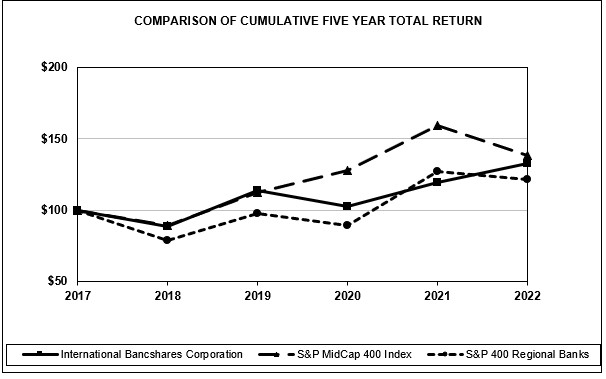
Total Return To Shareholders
(Includes reinvestment of dividends)
Base | INDEXED RETURNS |
| |||||||||||
Period | December 31, |
| |||||||||||
Company / Index | 2017 | 2018 | 2019 | 2020 | 2021 | 2022 |
| ||||||
International Bancshares Corporation |
| 100 |
| 88.22 |
| 113.51 |
| 102.72 |
| 119.68 |
| 132.77 | |
S&P 400 Index |
| 100 |
| 88.92 |
| 112.21 |
| 127.54 |
| 159.12 |
| 138.34 | |
S&P 400 Banks |
| 100 |
| 78.60 |
| 97.95 |
| 89.52 |
| 126.83 |
| 121.59 | |
24
REPORT OF INDEPENDENT REGISTERED PUBLIC ACCOUNTING FIRM
Shareholders and the Board of Directors
of International Bancshares Corporation and its Subsidiaries
Opinion on the Financial Statements
We have audited the accompanying consolidated statements of condition of International Bancshares Corporation and its Subsidiaries (the Company) as of December 31, 2022 and 2021, the related consolidated statements of income, comprehensive income, shareholders' equity and cash flows for each of the three years in the period ended December 31, 2022, and the related notes to the consolidated financial statements (collectively, the financial statements). In our opinion, the financial statements present fairly, in all material respects, the financial position of the Company as of December 31, 2022 and 2021, and the results of its operations and its cash flows for each of the three years in the period ended December 31, 2022, in conformity with accounting principles generally accepted in the United States of America.
We have also audited, in accordance with the standards of the Public Company Accounting Oversight Board (United States) (PCAOB), the Company's internal control over financial reporting as of December 31, 2022, based on criteria established in Internal Control — Integrated Framework issued by the Committee of Sponsoring Organizations of the Treadway Commission in 2013, and our report dated February 23, 2023 expressed an unqualified opinion on the effectiveness of the Company's internal control over financial reporting.
Basis for Opinion
These financial statements are the responsibility of the Company’s management. Our responsibility is to express an opinion on the Company’s financial statements based on our audits. We are a public accounting firm registered with the PCAOB and are required to be independent with respect to the Company in accordance with U.S. federal securities laws and the applicable rules and regulations of the Securities and Exchange Commission and the PCAOB.
We conducted our audits in accordance with the standards of the PCAOB. Those standards require that we plan and perform the audits to obtain reasonable assurance about whether the financial statements are free of material misstatement, whether due to error or fraud. Our audits included performing procedures to assess the risks of material misstatement of the financial statements, whether due to error or fraud, and performing procedures that respond to those risks. Such procedures included examining, on a test basis, evidence regarding the amounts and disclosures in the financial statements. Our audits also included evaluating the accounting principles used and significant estimates made by management, as well as evaluating the overall presentation of the financial statements. We believe that our audits provide a reasonable basis for our opinion.
Critical Audit Matter
The critical audit matter communicated below is a matter arising from the current period audit of the consolidated financial statements that was communicated or required to be communicated to the audit committee and that: (1) relates to accounts or disclosures that are material to the consolidated financial statements and (2) involved our especially challenging, subjective, or complex judgments. The communication of critical audit matters does not alter in any way our opinion on the consolidated financial statements, taken as a whole, and we are not, by communicating the critical audit matter below, providing a separate opinion on the critical audit matter or on the accounts or disclosures to which it relates.
Allowance for Credit Losses
As described in Note 4 of the consolidated financial statements, the Company established an allowance for credit losses totaling $125,972,000 as of December 31, 2022. The allowance for credit losses is derived from (1) a loss-rate methodology that measures lifetime losses on loan pools that have similar risk characteristics; and (2) estimated losses on individually evaluated loans that do not have similar risk characteristics. The segmentation of the loan portfolio into pools requires a balancing process between capturing similar risk characteristics and sufficient loss history to provide relevant results. Loan pools are further broken down using a risk-based segmentation based on internal classifications of credit
25
quality. Within each loan pool, the lifetime historical loss-rate is evaluated and, if needed, is supplemented with peer loss rates through a model risk adjustment. Certain qualitative factors are applied at the loan pool level to incorporate management’s two-year forecast period followed by a reversion to the pool’s average lifetime loss-rate. Those qualitative factors include: (i) trends in portfolio volume and composition, (ii) volume and trends in classified loans, delinquencies, non-accruals and troubled debt restructurings (TDR’s), (iii) concentration risk, (iv) trends in underlying collateral value, (v) changes in policies, procedures, and strategies, (vi) economic conditions, and (vii) operational and other risk factors to capture potential losses arising from fraud, natural disasters, pandemics, and geopolitical events.
We identified the qualitative factor component of the allowance for credit losses as a critical audit matter. Auditing management’s estimate of the qualitative factors required a high degree of auditor judgment due to the nature of the adjustments and the subjectivity in judgments applied by management in forming them.
Our audit procedures related to the Company’s qualitative factors included, the following, among others:
We obtained an understanding of the relevant controls related to the allowance for credit losses, including the qualitative factors, and tested such controls for design and operating effectiveness, including controls related to management’s review of the qualitative factors and approval of the allowance for credit losses calculation.
We evaluated the appropriateness and consistency of management’s methods and assumptions used to determine qualitative factors by (1) evaluating management’s identification and quantification of qualitative factors; (2) testing the completeness and accuracy of data and information used in calculating the components of the qualitative factors; (3) evaluating the reasonableness, directional consistency, and magnitude of the quantification of the qualitative factors; and (4) reviewing subsequent events and considering their impact on judgments applied in forming the qualitative factor component of the allowance for credit losses as of the consolidated balance sheet date.
/s/ RSM US LLP
We have served as the Company's auditor since 2007.
Austin, Texas
February 23, 2023
26
INTERNATIONAL BANCSHARES CORPORATION AND SUBSIDIARIES
Consolidated Statements of Condition
December 31, 2022 and 2021
(Dollars in Thousands, Except Per Share Amounts)
December 31, | December 31, | ||||||
| 2022 |
| 2021 |
| |||
Assets | |||||||
Cash and cash equivalents | $ | | $ | | |||
Investment securities: | |||||||
Held to maturity debt securities (Market value of $ |
| |
| | |||
Available for sale debt securities (Amortized cost of $ |
| |
| | |||
Equity securities with readily determinable fair values | | | |||||
Total investment securities |
| |
| | |||
Loans |
| |
| | |||
Less allowance for credit losses |
| ( |
| ( | |||
Net loans |
| |
| | |||
Bank premises and equipment, net |
| |
| | |||
Accrued interest receivable |
| |
| | |||
Other investments |
| |
| | |||
Cash surrender value of life insurance policies | | | |||||
Goodwill |
| |
| | |||
Other assets |
| |
| | |||
Total assets | $ | | $ | | |||
See accompanying notes to consolidated financial statements.
27
INTERNATIONAL BANCSHARES CORPORATION AND SUBSIDIARIES
Consolidated Statements of Condition Continued
December 31, 2022 and 2021
(Dollars in Thousands, Except Per Share Amounts)
December 31, | December 31, | ||||||
| 2022 |
| 2021 |
| |||
Liabilities and Shareholders’ Equity | |||||||
Liabilities: | |||||||
Deposits: | |||||||
Demand—non-interest bearing | $ | | $ | | |||
Savings and interest-bearing demand |
| |
| | |||
Time |
| |
| | |||
Total deposits |
| |
| | |||
Securities sold under repurchase agreements |
| |
| | |||
Other borrowed funds |
| |
| | |||
Junior subordinated deferrable interest debentures |
| |
| | |||
Other liabilities |
| |
| | |||
Total liabilities |
| |
| | |||
Shareholders’ equity: | |||||||
Common shares of $ |
| |
| | |||
Surplus |
| |
| | |||
Retained earnings |
| |
| | |||
Accumulated other comprehensive loss |
| ( |
| ( | |||
| |
| | ||||
Less cost of shares in treasury, |
| ( |
| ( | |||
Total shareholders’ equity |
| |
| | |||
Total liabilities and shareholders’ equity | $ | | $ | | |||
See accompanying notes to consolidated financial statements.
28
INTERNATIONAL BANCSHARES CORPORATION AND SUBSIDIARIES
Consolidated Statements of Income
Years ended December 31, 2022, 2021 and 2020
(Dollars in Thousands, Except Per Share Amounts)
2022 |
| 2021 |
| 2020 | |||||
Interest income: | |||||||||
Loans, including fees | $ | | $ | | $ | | |||
Investment securities: | |||||||||
Taxable |
| |
| |
| | |||
Tax-exempt |
| |
| |
| | |||
Other interest income |
| |
| |
| | |||
Total interest income |
| |
| |
| | |||
Interest expense: | |||||||||
Savings deposits |
| |
| |
| | |||
Time deposits |
| |
| |
| | |||
Securities sold under repurchase agreements |
| |
| |
| | |||
Other borrowings |
| |
| |
| | |||
Junior subordinated deferrable interest debentures |
| |
| |
| | |||
Total interest expense |
| |
| |
| | |||
Net interest income |
| |
| |
| | |||
Provision for credit losses |
| |
| |
| | |||
Net interest income after provision for credit losses |
| |
| |
| | |||
Non-interest income: | |||||||||
Service charges on deposit accounts |
| |
| |
| | |||
Other service charges, commissions and fees | |||||||||
Banking |
| |
| |
| | |||
Non-banking |
| |
| |
| | |||
Investment securities transactions, net |
| — |
| ( |
| ( | |||
Other investments, net |
| |
| |
| | |||
Other income |
| |
| |
| | |||
Total non-interest income | $ | | $ | | $ | | |||
See accompanying notes to consolidated financial statements.
29
INTERNATIONAL BANCSHARES CORPORATION AND SUBSIDIARIES
Consolidated Statements of Income, continued
Years ended December 31, 2022, 2021 and 2020
(Dollars in Thousands, Except Per Share Amounts)
| 2022 |
| 2021 |
| 2020 | ||||||
Non-interest expense: | |||||||||||
Employee compensation and benefits | $ | | $ | | $ | | |||||
Occupancy |
| |
| |
| | |||||
Depreciation of bank premises and equipment |
| |
| |
| | |||||
Professional fees |
| |
| |
| | |||||
Deposit insurance assessments |
| |
| |
| | |||||
Net operations, other real estate owned |
| |
| |
| | |||||
Advertising |
| |
| |
| | |||||
Software and software maintenance | | | | ||||||||
Other |
| |
| |
| | |||||
Total non-interest expense |
| |
| |
| | |||||
Income before income taxes |
| |
| |
| | |||||
Provision for income taxes |
| |
| |
| | |||||
Net income | $ | | $ | | $ | | |||||
Basic earnings per common share: | |||||||||||
Weighted average number of shares outstanding |
| |
| |
| | |||||
Net income per common share | $ | | $ | | $ | | |||||
Fully diluted earnings per common share: | |||||||||||
Weighted average number of shares outstanding |
| |
| |
| | |||||
Net income per common share | $ | | $ | | $ | | |||||
See accompanying notes to consolidated financial statements.
30
INTERNATIONAL BANCSHARES CORPORATION AND SUBSIDIARIES
Consolidated Statements of Comprehensive Income
Years ended December 31, 2022, 2021, and 2020
(Dollars in Thousands)
| |||||||||||
| 2022 |
| 2021 |
| 2020 | ||||||
Net income | $ | | $ | | $ | | |||||
Other comprehensive loss, net of tax: | |||||||||||
Net unrealized holding (losses) gains on securities available for sale arising during period (net of tax effects of $( |
| ( |
| ( |
| | |||||
Reclassification adjustment for losses on securities available for sale included in net income (net of tax effects of $ |
| — |
| |
| | |||||
| ( |
| ( |
| | ||||||
Comprehensive (loss) income | $ | ( | $ | | $ | | |||||
See accompanying notes to consolidated financial statements.
31
INTERNATIONAL BANCSHARES CORPORATION AND SUBSIDIARIES
Consolidated Statements of Shareholders’ Equity
Years ended December 31, 2022, 2021 and 2020
(in Thousands, except per share amounts)
|
| Number |
|
|
|
| Other |
|
|
| ||||||||||||||
Preferred | of | Common | Retained | Comprehensive | Treasury |
| ||||||||||||||||||
Stock | Shares | Stock | Surplus | Earnings | Income (Loss) | Stock | Total |
| ||||||||||||||||
Balance at December 31, 2019 | $ | — |
| |
| |
| |
| |
| |
| ( | $ | | ||||||||
Net Income |
| — | — | — | — | | — | — |
| | ||||||||||||||
Dividends: | ||||||||||||||||||||||||
Cash ($ |
| — | — | — | — | ( | — | — |
| ( | ||||||||||||||
Purchase of treasury ( |
| — | — | — | — | — | — | ( |
| ( | ||||||||||||||
Exercise of stock options |
| — | | | | — | — | — |
| | ||||||||||||||
Stock compensation expense recognized in earnings |
| — | — | — | | — | — | — |
| | ||||||||||||||
Cumulative adjustment for adoption of new accounting standards | — | — | — | — | ( | — | — | ( | ||||||||||||||||
Other comprehensive (loss), net of tax: | ||||||||||||||||||||||||
Net change in unrealized gains and losses on available for sale securities, net of reclassification adjustment |
| — | — | — | — | — | | — |
| | ||||||||||||||
Balance at December 31, 2020 |
| — |
| |
| |
| |
| |
| |
| ( |
| | ||||||||
Net Income |
| — | — | — | — | | — | — |
| | ||||||||||||||
Dividends: | ||||||||||||||||||||||||
Cash ($ |
| — | — | — | — | ( | — | — |
| ( | ||||||||||||||
Purchase of treasury ( | — | — | — | — | — | — | ( | ( | ||||||||||||||||
Exercise of stock options |
| — | | | | — | — | — |
| | ||||||||||||||
Stock compensation expense recognized in earnings |
| — | — | — | | — | — | — |
| | ||||||||||||||
Other comprehensive (loss), net of tax: | ||||||||||||||||||||||||
Net change in unrealized gains and losses on available for sale securities, net of reclassification adjustments |
| — | — | — | — | — | ( | — |
| ( | ||||||||||||||
Balance at December 31, 2021 |
| — |
| | $ | | $ | | $ | | $ | ( | $ | ( | $ | | ||||||||
Net Income | — | — | — | — | | — | — | | ||||||||||||||||
Dividends: | ||||||||||||||||||||||||
Cash ($ | — | — | — | — | ( | — | — | ( | ||||||||||||||||
Purchase of treasury ( | — | — | — | — | — | — | ( | ( | ||||||||||||||||
Exercise of stock options | — | | | | — | — | — | | ||||||||||||||||
Stock compensation expense recognized in earnings | — | — | — | | — | — | — | | ||||||||||||||||
Other comprehensive income, net of tax: | ||||||||||||||||||||||||
Net change in unrealized gains and losses on available for sale securities, net of reclassification adjustments | — | — | — | — | — | ( | — | ( | ||||||||||||||||
Balance at December 31, 2022 | — | | $ | | $ | | $ | | $ | ( | $ | ( | $ | | ||||||||||
See accompanying notes to consolidated financial statements.
32
INTERNATIONAL BANCSHARES CORPORATION AND SUBSIDIARIES
Consolidated Statements of Cash Flows
Years ended December 31, 2022, 2021 and 2020
(Dollars in Thousands)
| ||||||||||
2022 |
| 2021 |
| 2020 | ||||||
Operating activities: | ||||||||||
Net income | $ | | $ | | $ | | ||||
Adjustments to reconcile net income to net cash provided by operating activities: | ||||||||||
Provision for credit loss |
| |
| |
| | ||||
Specific reserve, other real estate owned |
| |
| |
| | ||||
Depreciation of bank premises and equipment |
| |
| |
| | ||||
(Gain) loss on sale of bank premises and equipment |
| ( |
| |
| ( | ||||
Gain on sale of other real estate owned |
| ( |
| ( |
| ( | ||||
Accretion of investment securities discounts |
| ( |
| ( |
| ( | ||||
Amortization of investment securities premiums |
| |
| |
| | ||||
Investment securities transactions, net |
| — |
| |
| | ||||
Unrealized loss (gain) on equity securities with readily determinable fair values | | | ( | |||||||
Proceeds from settlements of claims |
| — | | — | ||||||
Stock based compensation expense |
| |
| |
| | ||||
(Earnings) losses from affiliates and other investments |
| ( |
| ( |
| | ||||
Deferred income taxes |
| |
| |
| ( | ||||
(Increase) decrease in accrued interest receivable |
| ( |
| |
| ( | ||||
Decrease in other assets |
| |
| |
| | ||||
Increase (decrease) in other liabilities |
| |
| ( |
| ( | ||||
Net cash provided by operating activities |
| |
| |
| | ||||
Investing activities: | ||||||||||
Proceeds from maturities of securities |
| |
| |
| | ||||
Proceeds from sales and calls of available for sale securities |
| |
| |
| | ||||
Purchases of available for sale securities |
| ( |
| ( |
| ( | ||||
Principal collected on mortgage-backed securities |
| |
| |
| | ||||
Net (increase) decrease in loans |
| ( |
| |
| ( | ||||
Purchases of other investments |
| ( |
| ( |
| ( | ||||
Distributions from other investments |
| |
| |
| | ||||
Purchases of bank premises and equipment |
| ( |
| ( |
| ( | ||||
Proceeds from sales of bank premises and equipment |
| |
| |
| | ||||
Proceeds from sales of other real estate owned |
| |
| |
| | ||||
Net cash used in investing activities |
| ( |
| ( |
| ( | ||||
See accompanying notes to consolidated financial statements.
33
INTERNATIONAL BANCSHARES CORPORATION AND SUBSIDIARIES
Consolidated Statements of Cash Flows (Continued)
Years ended December 31, 2022, 2021 and 2020
(Dollars in Thousands)
| ||||||||||
2022 |
| 2021 |
| 2020 | ||||||
Financing activities: | ||||||||||
Net increase in non-interest-bearing demand deposits | $ | | $ | | $ | | ||||
Net increase in savings and interest-bearing demand deposits |
| |
| |
| | ||||
Net (decrease) increase in time deposits |
| ( |
| |
| | ||||
Net (decrease) increase in securities sold under repurchase agreements |
| ( |
| |
| | ||||
Net decrease in other borrowed funds |
| ( |
| ( |
| ( | ||||
Purchase of treasury stock |
| ( |
| ( |
| ( | ||||
Proceeds from stock transactions |
| |
| |
| | ||||
Payments of cash dividends |
| ( |
| ( |
| ( | ||||
Net cash (used in) provided by financing activities |
| ( |
| |
| | ||||
(Decrease) increase in cash and cash equivalents |
| ( |
| |
| | ||||
Cash and cash equivalents at beginning of period |
| |
| |
| | ||||
| ||||||||||
Cash and cash equivalents at end of period | $ | | $ | | $ | | ||||
Supplemental cash flow information: | ||||||||||
Interest paid | $ | | $ | | $ | | ||||
Income taxes paid |
| |
| |
| | ||||
Non-cash investing and financing activities: | ||||||||||
Purchases of available-for-sale securities not yet settled | $ | | $ | — | $ | — | ||||
Net transfers from loans to other real estate owned | | | | |||||||
Net transfers from bank premises and equipment to other assets | | — | | |||||||
See accompanying notes to consolidated financial statements.
34
INTERNATIONAL BANCSHARES CORPORATION AND SUBSIDIARIES
Notes to Consolidated Financial Statements
(1) Summary of Significant Accounting Policies
Our accounting and reporting policies conform to U.S. generally accepted accounting principles (“GAAP”) and to general practices within the banking industry. The following is a description of the more significant of those policies.
Consolidation and Basis of Presentation
Our consolidated financial statements include the accounts of the International Bancshares Corporation, its wholly owned Subsidiary Banks and its wholly owned non-bank subsidiaries, IBC Trading Company, Premier Tierra Holdings, Inc., IBC Charitable and Community Development Corporation, IBC Capital Corporation and Diamond Beach Holdings, LLC. All significant inter-company balances and transactions have been eliminated in consolidation.
We, through our Subsidiary Banks, are primarily engaged in the business of banking, including the acceptance of checking and savings deposits and the making of commercial, real estate, personal, home improvement, automobile and other installment and term loans. Our primary markets are north, south, central, and southeast Texas and the state of Oklahoma. Each of our Subsidiary Banks is highly active in facilitating international trade along the United States border with Mexico and elsewhere. Although our loan portfolio is diversified, the ability of our debtors to honor their contracts is primarily dependent upon the economic conditions in our trade area. In addition, the investment portfolio is directly impacted by fluctuations in market interest rates. We are subject to the regulations of certain federal agencies as well as the Texas Department of Banking and the Oklahoma Department of Banking and undergo periodic examinations by those regulatory authorities. Such agencies may require certain standards or impose certain limitations based on their judgments or changes in law and regulations.
We own
The preparation of the consolidated financial statements in conformity with accounting principles generally accepted in the United States of America requires management to make estimates and assumptions that affect the reported amounts of assets and liabilities as of the dates of the statement of condition and income and expenses for the periods. Actual results could differ significantly from those estimates. Material estimates that are particularly susceptible to significant changes in the near-term relate to the determination of the allowance for credit losses (“ACL”).
Subsequent Events
We have evaluated all events or transactions that occurred through the date we issued these financial statements. During this period, we did not have any material recognizable or non-recognizable subsequent events.
Investment Securities
We classify debt securities into one of these categories: held-to-maturity, available-for-sale, or trading. Such classifications are reassessed for appropriate classification at each reporting date. Securities that are intended and expected to be held until maturity are classified as “held-to-maturity” and are carried at amortized cost for financial statement reporting. Securities that are not positively expected to be held until maturity but are intended to be held for an indefinite period of time are classified as “available-for-sale” or “trading” and are carried at their fair value. Unrealized holding gains and losses are included in net income for those securities classified as “trading,” while unrealized holding gains and losses related to those securities classified as “available-for-sale” are excluded from net income and reported net of tax as other comprehensive income (loss) and in shareholders’ equity as accumulated other comprehensive income (loss) until realized. Unrealized gains and losses related to equity securities with readily determinable fair values are included in net income. In accordance with ASU 2016-13, which we adopted on January 1, 2020, available-for-sale and held-to-maturity debt securities in an unrealized loss position must be evaluated for the underlying cause of the loss. In the event that the deterioration in value is attributable to credit related reasons, then the amount of credit-related impairment would be recorded as a charge to our ACL with subsequent changes in the amount of impairment, up or down, also recorded through
35
INTERNATIONAL BANCSHARES CORPORATION AND SUBSIDIARIES
Notes to Consolidated Financial Statements (Continued)
our ACL. The exception to this process will occur if we intend to sell an impaired available-for-sale debt security or if we will more likely than not be required to sell a credit impaired available-for-sale debt security prior to the value recovering to the security’s amortized cost. In those situations, the entire credit-related impairment amount would be required to be recognized in earnings. We have evaluated the debt securities classified as available-for-sale and held-to-maturity at December 31, 2022 and have determined that no debt securities in an unrealized loss position are arising from credit related reasons and have therefore not recorded any allowances for debt securities in our ACL for the periods. We did not maintain any trading securities during the three-year period ended December 31, 2022.
Mortgage-backed securities held at December 31, 2022 and 2021 represent participating interests in pools of long-term first mortgage loans originated and serviced by the issuers of the securities. Mortgage-backed securities are either issued or guaranteed by the U.S. government or its agencies including Freddie Mac, Fannie Mae, Ginnie Mae or other non-government entities. Investments in residential mortgage-backed securities issued by Ginnie Mae are fully guaranteed by the U. S. government. Investments in residential mortgage-backed securities issued by Freddie Mac and Fannie Mae are not fully guaranteed by the U.S. government; however, we believe that the quality of the bonds is similar to other AAA rated bonds with limited credit risk, particularly given the placement of Fannie Mae and Freddie Mac into conservatorship by the federal government in 2008 and because securities issued by others that are collateralized by residential mortgage-backed securities issued by Fannie Mae or Freddie Mac are rated consistently as AAA rated securities. Market interest rate fluctuations can affect the prepayment speed of principal and the yield on the security.
Premiums and discounts are amortized using the level yield or “interest method” over the terms of the securities. Declines in the fair value of held-to-maturity and available-for sale-securities below their cost that are deemed to be other than temporary are reflected in earnings as realized losses. In determining whether other-than-temporary impairment exists, management considers many factors, including (i) the length of time and the extent to which the fair value has been less than cost, (ii) the financial condition and near-term prospects of the issuer, and (iii) our intent to hold and our determination of whether we will more likely than not be required to sell the security prior to a recovery in fair value. If we determine that (i) we intend to sell the security or (ii) it is more likely than not that we will be required to sell the security before it’s anticipated recovery, the other-than-temporary impairment that is recognized in earnings is equal to the difference between the fair value of the security and our amortized cost of the security. If we determine that we (i) do not intend to sell the security and (ii) we will not be more likely than not required to sell the security before it’s anticipated recovery, the other-than-temporary impairment is segregated into its
Equity Securities
Equity securities with readily determinable fair values at December 31, 2022 and December 31, 2021 consist primarily of Community Reinvestment Act funds. Unrealized gains and losses on the equity securities are recognized in net income.
Provision and Allowance for Credit Losses
We adopted the provisions of Accounting Standards Update No. 2016-13 to ASC 326, “Financial Instruments – Credit Losses,” on January 1, 2020. ASU 2016-13 replaces the long-standing incurred loss model with an expected credit loss model that recognizes credit losses over the life of a financial asset. Expected credit losses capture historical information, current conditions, and reasonable and supportable forecasts of future conditions. The ACL is deducted from the amortized cost of an instrument to present the net amount expected to be collected on the financial asset. Our ACL primarily consists of the aggregate ACL estimates of our Subsidiary Banks. The estimates are established through charges to operations in the form of charges to provisions for credit loss expense. Loan losses or recoveries are charged or credited directly to the ACL. The ACL of each Subsidiary Bank is maintained at a level considered appropriate by management, based on estimated current expected credit losses in the current loan portfolio, including information about past events, current conditions and reasonable and supportable forecasts.
36
INTERNATIONAL BANCSHARES CORPORATION AND SUBSIDIARIES
Notes to Consolidated Financial Statements (Continued)
Our management continually reviews the ACL of the Subsidiary Banks using the amounts determined from the estimates established on specific doubtful loans, the estimate established on quantitative historical loss percentages, and the estimate based on qualitative current conditions and reasonable and supportable two-year forecasted data. Our methodology reverts to the average lifetime loss-rate beyond the forecast period when we can no longer develop reasonable and supportable forecasts. Should any of the factors considered by management in evaluating the adequacy of the estimate for current expected credit losses change, our estimate of current expected credit losses could also change, which could affect the level of future credit loss expense. While the calculation of our ACL utilizes management’s best judgment and all information reasonably available, the adequacy of the ACL is dependent on a variety of factors beyond our control, including, among other things, the performance of the entire loan portfolio, the economy, government actions, changes in interest rates and the view of regulatory authorities towards loan classifications. We believe that the allowance for probable loan losses is adequate.
The Subsidiary Banks charge-off that portion of any loan which management considers to represent a loss as well as that portion of any other loan which is classified as a “loss” by bank examiners. Commercial, financial and agricultural or real estate loans are generally considered by management to represent a loss, in whole or part, (i) when an exposure beyond any collateral coverage is apparent, (ii) when no further collection of the portion of the loan so exposed is anticipated based on actual results, (iii) when the credit enhancements, if any, are not adequate, and (iv) when the borrower’s financial condition would indicate so. Generally, unsecured consumer loans are charged-off when
Loans
Loans are reported at the principal balance outstanding, net of unearned discounts. Interest income on loans is reported on an accrual basis. Loan fees and costs associated with originating the loans are accreted or amortized over the life of the loan using the interest method. We originate mortgage loans that may subsequently be sold to an unaffiliated third party. The loans are not securitized and if sold, are sold without recourse. Loans held for sale are carried at cost and the principal amount outstanding is not significant to the consolidated financial statements.
Doubtful Loans
Doubtful loans are those loans where it is probable that all amounts due according to contractual terms of the loan agreement will not be collected. Doubtful loans are measured based on (i) the present value of expected future cash flows discounted at the loan’s effective interest rate; (ii) the loan’s observable market price; or (iii) the fair value of the collateral if the loan is collateral dependent. Substantially all our doubtful loans are measured at the fair value of the collateral. In limited cases, we may use other methods to determine the level of impairment of a loan if such loan is not collateral dependent.
37
INTERNATIONAL BANCSHARES CORPORATION AND SUBSIDIARIES
Notes to Consolidated Financial Statements (Continued)
Troubled Debt Restructured Loans
Troubled debt restructured loans (“TDR”) are those loans where, for reasons related to a borrower’s difficulty to repay a loan, we grant a concession to the borrower that we would not normally consider in the normal course of business. In accordance with interagency guidance issued in March 2020, certain short-term deferrals are not considered troubled debt restructurings. The original terms of the loan are modified or restructured. The terms that may be modified include a reduction in the original stated interest rate, an extension of the original maturity of the loan, a renewal of the loan at an interest rate below current market rates, a reduction in the principal amount of debt outstanding, a reduction in accrued interest or deferral of interest payments. A loan classified as a TDR is classified as a doubtful loan and included in the doubtful loan totals. A TDR loan may be returned to accrual status when the loan is brought current, has performed in accordance with the restructured terms for a reasonable period of time, is at the current market rate, and the ultimate collectability of the outstanding principal and interest is no longer questionable, however, although those loans may be placed back on accrual status, they will continue to be classified as doubtful. Consistent with regulatory guidance, a TDR loan that is subsequently modified, but has shown sustained performance and classification as a TDR, will be removed from TDR status provided that the modified terms were market-based at the time of modification.
Non-Accrual Loans
The non-accrual loan policy of our Subsidiary Banks is to discontinue the accrual of interest on loans when management determines that it is probable that future interest accruals will be un-collectible. As it relates to consumer loans, management charges-off those loans when the loan is contractually
Other Real Estate Owned and Repossessed Assets
Other real estate owned is comprised of real estate acquired by foreclosure and deeds in lieu of foreclosure. Other real estate is carried at the lower of the recorded investment in the property or its fair value less estimated costs to sell such property (as determined by independent appraisal). Prior to foreclosure, the value of the underlying loan is written down to the fair value of the real estate to be acquired by a charge to the ACL, if necessary. Any subsequent write-downs are charged against other non-interest expense through a valuation allowance. Other real estate owned totaled approximately $
Bank Premises and Equipment
Bank premises and equipment are stated at cost less accumulated depreciation. Depreciation is computed on straight-line and accelerated methods over the estimated useful lives of the assets. Repairs and maintenance are charged to operations as incurred and expenditures for renewals and betterments are capitalized. We primarily own all the property we occupy, with the exception of certain branches operating in grocery store or retail shopping centers and certain ATM locations, which are all under operating leases as classified under guidance prior to the issuance of ASU 2016-02, “Leases.”
38
INTERNATIONAL BANCSHARES CORPORATION AND SUBSIDIARIES
Notes to Consolidated Financial Statements (Continued)
Other Investments
Other investments include equity investments in non-financial companies, as well as equity securities with no readily determinable fair market value. Equity investments are accounted for using the equity method of accounting. Equity securities with no readily determinable fair value are accounted for using the cost method.
Revenue Recognition
Our revenue is primarily comprised of net interest income on financial assets and liabilities, which are excluded from the scope of ASU No. 2014-09 to ASC 606, “Revenue from Contracts with Customers.” The remaining non-interest revenue streams were identified and then analyzed under the provisions of the update, to: (i) identify the contract, (ii) identify the performance obligation, (iii) determine the transaction price, (iv) allocate the transaction price to the performance obligations, and (v) recognize revenue when the performance obligation was satisfied. Our non-interest revenue contracts with customers are primarily short term and our performance obligation is satisfied at a single point in time, typically within a single period. No changes to our existing methods for recognizing revenue were made as a result of the accounting standards update.
Income Taxes
Deferred income tax assets and liabilities are determined using the asset and liability method. Under this method, the net deferred tax asset or liability is determined based on the tax effects of the differences between the book and tax basis of the various balance sheet assets and liabilities and gives current recognition to changes in tax rates and laws. We file a consolidated federal income tax return with our subsidiaries.
Recognition of deferred tax assets is based on management’s assessment that the benefit related to certain temporary differences, tax operating loss carry forwards, and tax credits are more likely than not to be realized. A valuation allowance is recorded for the amount of the deferred tax items for which it is more likely than not that the tax benefits will not be realized.
We evaluate uncertain tax positions at the end of each reporting period. We may recognize the tax benefit from an uncertain tax position only if it is more likely than not that the tax position will be sustained on examination by the taxing authorities, based on the technical merits of the position. The tax benefit recognized in the financial statements from any such a position is measured based on the largest benefit that has a greater than
We file consolidated tax returns in the U.S. Federal jurisdiction and various state jurisdictions. We are no longer subject to U.S. federal or state income tax examinations by tax authorities for years before 2019.
Stock Options and Stock Appreciation Rights
Compensation expense for stock-based awards is based on the market price of the stock on the measurement date, which is generally the date of grant, and is recognized ratably over the service period of the award. The fair value of stock options and stock appreciation rights granted was estimated using a Black-Sholes-Merton pricing model. These models were developed for use in estimating the fair value of publicly traded options and stock appreciation rights that have no vesting restrictions and are fully transferable. Additionally, these models require the input of highly subjective assumptions. Because our employee stock options and stock appreciation rights have characteristics significantly different from those of publicly traded options and appreciation rights, and because changes in the subjective input assumptions can materially affect the fair value estimate, in management’s opinion, the Black-Scholes-Merton pricing models do not necessarily provide a reliable single measure of the fair value of our stock options and stock appreciation rights.
39
INTERNATIONAL BANCSHARES CORPORATION AND SUBSIDIARIES
Notes to Consolidated Financial Statements (Continued)
Net Income Per Share
Basic Earnings Per Share (“EPS”) is calculated by dividing net income by the weighted average number of common shares outstanding. The computation of diluted EPS assumes the issuance of common shares for all dilutive potential common shares outstanding during the reporting period. The dilutive effect of stock options is considered in earnings per share calculations, if dilutive, using the treasury stock method.
Goodwill and Identified Intangible Assets
Goodwill represents the excess of costs over fair value of assets of businesses acquired. Goodwill is tested for impairment at least annually or on an interim basis if an event triggering impairment may have occurred. As of October 1, 2022, after completing goodwill testing, we have determined that
Identified intangible assets are acquired assets that lack physical substance but can be distinguished from goodwill because of contractual or other legal rights or because the asset is capable of being sold or exchanged either on its own or in combination with a related contract, asset, or liability. Our identified intangible assets relate to core deposits and contract rights. As of December 31, 2022, we have determined that
Impairment of Long-Lived Assets
Long-lived assets, such as property, plant and equipment, and purchased intangibles subject to amortization, are reviewed for impairment whenever events or changes in circumstances indicate that the carrying value of an asset may not be recoverable. Recoverability of assets to be held and used is measured by a comparison of the carrying value of the asset to the estimated undiscounted future cash flows expected to be generated by the asset. If the carrying value of an asset exceeds its estimated future cash flows, an impairment charge is recognized by the amount by which the carrying value of the asset exceeds the fair value of the asset. Assets to be disposed of would be separately presented in the statement of condition and reported at the lower of the carrying value or fair value less costs to sell and are no longer depreciated. The assets and liabilities of a disposed group classified as held for sale would be presented separately in the appropriate asset and liability sections of the statement of condition.
Consolidated Statements of Cash Flows
For purposes of the consolidated statements of cash flows, we consider all short-term investments with a maturity at date of purchase of three months or less to be cash equivalents. Also, we report transactions related to deposits and loans to customers on a net basis.
Accounting for Transfers and Servicing of Financial Assets
We account for transfers and servicing of financial assets and extinguishments of liabilities based on the application of a financial-components approach that focuses on control. After a transfer of financial assets, we recognize the financial and servicing assets we control and liabilities we have incurred, derecognize financial assets when control has been surrendered and derecognize liabilities when extinguished. We have retained mortgage servicing rights in connection with the sale of mortgage loans. Because we may not initially identify loans as originated for resale, all loans are initially treated as held for investment. The value of the mortgage servicing rights are reviewed periodically for impairment and are amortized in proportion to, and over the period of estimated net servicing income or net servicing losses. The value of the mortgage servicing rights is not significant to the consolidated statements of condition.
Segments of an Enterprise and Related Information
We operate as
40
INTERNATIONAL BANCSHARES CORPORATION AND SUBSIDIARIES
Notes to Consolidated Financial Statements (Continued)
We have
Comprehensive Income (Loss)
Comprehensive income (loss) consists of net income and other comprehensive income (loss). Other comprehensive income (loss) includes unrealized gains and losses on securities available for sale.
Advertising
Advertising costs are expensed as incurred.
Reclassifications
Certain amounts in the prior year’s presentations have been reclassified to conform to the current presentation. These reclassifications had no effect on previously reported net income or shareholders’ equity.
New Accounting Standards
In June 2016, the FASB issued Accounting Standards Update No. 2016-13 to ASC 326, “Financial Instruments – Credit Losses.” The update amends existing standards for accounting for credit losses for financial assets. The update requires that the expected credit losses on the financial instruments held as of the end of the period being reported be measured based on historical experience, current conditions, and reasonable and supportable forecasts. The update also expands the required disclosures related to significant estimates and judgements used in estimating credit losses, as well as the credit quality and underwriting standards of an organization’s financial assets. The update also amended the accounting for credit losses on available-for-sale debt securities and purchased financial assets with credit deterioration. The impact of the adoption of the standard is to be recorded as a cumulative-effect adjustment to retained earnings as of the beginning of the first reporting period in which the guidance is adopted. The accounting standard was effective for us on January 1, 2020. The task force formed last year, which includes key members of the teams that work with the calculation of the allowance for probable loan losses plus members representing the corporate accounting and risk management areas, has worked with the implementation of the update and validation to complete our model/tool. Based on the composition of the portfolio at December 31, 2019 and after finalizing the methodology, the adoption of the update increased our allowance for probable loan losses (referred to as the ACL under ASU 2016-13), by approximately
In December 2019, the FASB issued Accounting Standards Update No. 2019-12, to ASC 740, “Income Taxes.” The update amends existing guidance with the intention of simplifying the accounting for income taxes. Specifically, the update removes some exceptions in existing guidance around intraperiod tax allocations, recognition of deferred tax liabilities for certain changes in investments in foreign subsidiaries and to the general methodology for calculating taxes on interim periods when year to date losses exceed the anticipated loss for the year. Additionally, the update clarifies and provides more guidance with respect to the classification of franchise or similar taxes, requirements to evaluate when a step up in the tax basis of goodwill should be considered, eliminates the requirement that a consolidated entity allocate a portion of current and deferred tax expense to a legal entity that is not subject to tax, requires that an entity reflect the effect of changes in tax laws and tax rates in the effective tax rate computed in the interim period that includes the enactment date and makes minor changes for taxes related to employee stock ownership plans and investments in qualified affordable housing projects accounted for using the equity method. The update is effective for fiscal years beginning after December 15, 2020. The adoption of the update did not have a significant impact on our consolidated financial statements.
In March 2020, the FASB issued Accounting Standards Update No. 2020-04, “Reference Rate Reform (Topic 848): Facilitation of the Effects of Reference Rate Reform on Financial Reporting.” The update provides optional guidance for a limited period of time to ease the potential burden in accounting for and recognizing the effects of reference
41
INTERNATIONAL BANCSHARES CORPORATION AND SUBSIDIARIES
Notes to Consolidated Financial Statements (Continued)
rate reform on financial reporting. The practical expedients and exceptions in the update apply only to contracts, hedging relationships and other transactions affected by reference rate reform if certain criteria are met. The update does not apply to contract modifications made and hedging relationships entered into or evaluated after December 31, 2022, except for hedging relationships existing as of December 31, 2022 that an entity has elected certain optional expedients for and that are retained through the end of the hedging relationship. The update was effective as of the date of issuance and can be applied through December 31, 2022. We have not adopted the provisions of the update and do not anticipate that the adoption of the update will have a significant impact on our consolidated financial statements.
In January 2021, the FASB issued Accounting Standards Update No. 2021-01, “Reference Rate Reform (Topic 848): Scope.” The update clarifies the applicability of the practical expedients and exceptions issued in ASU 2020-04 to derivative instruments that use an interest rate for margining, discounting or contract price alignment that is modified as a result of reference rate reform. The update is intended to capture the incremental consequences of the scope clarification and tailor the existing guidance to derivative instruments affected by the discounting transition. The update was effective as of the date of issuance and can be applied through December 31, 2022. We have not adopted the provisions of the update and do not anticipate that the adoption of the update will have a significant impact on our consolidated financial statements.
(2) Investment Securities, Equity Securities with Readily Determinable Fair Values and Other Investments
In accordance with ASU 2016-13, which we adopted on January 1, 2020, available-for-sale and held-to-maturity debt securities in an unrealized loss position must be evaluated for the underlying cause of the loss. In the event that the deterioration in value is attributable to credit related reasons, then the amount of credit-related impairment would be recorded as a charge to our ACL with subsequent changes in the amount of impairment, up or down, also recorded through our ACL. The exception to this process will occur if we intend to sell an impaired available-for-sale debt security or if we will more likely than not be required to sell a credit impaired available-for-sale debt security prior to the value recovering to the security’s amortized cost. In those situations, the entire credit-related impairment amount would be required to be recognized in earnings. We have evaluated the debt securities classified as available-for-sale and held-to-maturity at December 31, 2022 and have determined that no debt securities in an unrealized loss position are arising from credit related reasons and have therefore not recorded any allowances for debt securities in our ACL for the period. Unrealized gains and losses related to equity securities with readily determinable fair values are included in net income.
The amortized cost and estimated fair value by type of investment security at December 31, 2022 are as follows:
Held to Maturity | ||||||||||||||||
Gross | Gross | |||||||||||||||
Amortized | unrealized | unrealized | Estimated | Carrying | ||||||||||||
cost | gains | losses | fair value | value | ||||||||||||
(Dollars in Thousands) | ||||||||||||||||
Other securities |
| $ | |
| $ | — |
| $ | — |
| $ | |
| $ | | |
Total investment securities | $ | | $ | — | $ | — | $ | | $ | | ||||||
Available for Sale Debt Securities | ||||||||||||||||
Gross | Gross | |||||||||||||||
Amortized | unrealized | unrealized | Estimated | Carrying | ||||||||||||
cost | gains | losses | fair value | value(1) | ||||||||||||
(Dollars in Thousands) | ||||||||||||||||
U.S. Treasury securities |
| $ | |
| $ | — |
| $ | ( |
| $ | |
| $ | | |
Residential mortgage-backed securities | | | ( | | | |||||||||||
Obligations of states and political subdivisions |
| |
| |
| ( |
| |
| | ||||||
Total investment securities | $ | | $ | | $ | ( | $ | | $ | | ||||||
| (1) | Included in the carrying value of residential mortgage- backed securities are $ |
42
INTERNATIONAL BANCSHARES CORPORATION AND SUBSIDIARIES
Notes to Consolidated Financial Statements (Continued)
The amortized cost and estimated fair value of investment securities at December 31, 2022, by contractual maturity, are shown below. Expected maturities will differ from contractual maturities because borrowers may have the right to prepay obligations with or without prepayment penalties.
Held to Maturity | Available for Sale | ||||||||||||
Amortized | Estimated | Amortized | Estimated | ||||||||||
Cost | fair value | Cost | fair value | ||||||||||
(Dollars in Thousands) | |||||||||||||
Due in one year or less |
| $ | |
| $ | |
| $ | |
| $ | | |
Due after one year through five years |
| |
| |
| — | — | ||||||
Due after ten years |
| — |
| — |
| |
| | |||||
Residential mortgage-backed securities |
| — |
| — |
| |
| | |||||
Total investment securities | $ | | $ | | $ | | $ | | |||||
The amortized cost and estimated fair value by type of investment security at December 31, 2021 are as follows:
Held to Maturity | ||||||||||||||||
Gross | Gross | |||||||||||||||
Amortized | unrealized | unrealized | Estimated | Carrying | ||||||||||||
cost | gains | losses | fair value | value | ||||||||||||
(Dollars in Thousands) | ||||||||||||||||
Other securities |
| $ | |
| $ | — |
| $ | — |
| $ | |
| $ | | |
Total investment securities | $ | | $ | — | $ | — | $ | | $ | | ||||||
Available for Sale | ||||||||||||||||
Gross | Gross | Estimated | ||||||||||||||
Amortized | unrealized | unrealized | fair | Carrying | ||||||||||||
cost | gains | losses | value | value(1) | ||||||||||||
(Dollars in Thousands) | ||||||||||||||||
Residential mortgage-backed securities |
| $ | |
| $ | |
| $ | ( |
| $ | |
| $ | | |
Obligations of states and political subdivisions |
| |
| |
| — |
| |
| | ||||||
Total investment securities | $ | | $ | | $ | ( | $ | | $ | | ||||||
| (1) | Included in the carrying value of residential mortgage- backed securities are $ |
Residential mortgage-backed securities are securities issued by Freddie Mac, Fannie Mae, Ginnie Mae or non-government entities. Investments in residential mortgage-backed securities issued by Ginnie Mae are fully guaranteed by the U.S. government. Investments in mortgage-backed securities issued by Freddie Mac and Fannie Mae are not fully guaranteed by the U.S. government; however, we believe that the quality of the bonds is similar to other AAA rated bonds with limited credit risk, particularly given the placement of Fannie Mae and Freddie Mac into conservatorship by the federal government in early September 2008 and because securities issued by others that are collateralized by residential mortgage-backed securities issued by Fannie Mae and Freddie Mac are rated consistently as AAA rated securities.
The amortized cost and fair value of available for sale investment securities pledged to qualify for fiduciary powers, to secure public monies as required by law, repurchase agreements and short-term fixed borrowings was $
Proceeds from the sale and call of securities available-for-sale were $
43
INTERNATIONAL BANCSHARES CORPORATION AND SUBSIDIARIES
Notes to Consolidated Financial Statements (Continued)
Gross unrealized losses on investment securities and the fair value of the related securities, aggregated by investment category and length of time that individual securities have been in a continuous unrealized loss position, at December 31, 2022 were as follows:
Less than 12 months | 12 months or more | Total | |||||||||||||||||
Unrealized | Unrealized | Unrealized | |||||||||||||||||
Fair Value | Losses | Fair Value | Losses | Fair Value | Losses | ||||||||||||||
(Dollars in Thousands) | |||||||||||||||||||
Available for sale: | |||||||||||||||||||
U.S. Treasury securities | $ | | $ | ( | $ | — | $ | — | $ | | $ | ( | |||||||
Residential mortgage-backed securities |
| |
| ( |
| |
| ( |
| |
| ( | |||||||
Obligations of states and political subdivisions |
| |
| ( |
| — |
| — |
| |
| ( | |||||||
$ | | $ | ( | $ | | $ | ( | $ | | $ | ( | ||||||||
Gross unrealized losses on investment securities and the fair value of the related securities, aggregated by investment category and length of time that individual securities have been in a continuous loss position, at December 31, 2021 were as follows:
Less than 12 months | 12 months or more | Total | |||||||||||||||||
Unrealized | Unrealized | Unrealized | |||||||||||||||||
Fair Value | Losses | Fair Value | Losses | Fair Value | Losses | ||||||||||||||
(Dollars in Thousands) | |||||||||||||||||||
Available for sale: | |||||||||||||||||||
Residential mortgage-backed securities |
| $ | |
| $ | ( |
| $ | |
| $ | ( |
| $ | |
| $ | ( | |
$ | | $ | ( | $ | | $ | ( | $ | | $ | ( | ||||||||
The unrealized losses on investments in residential mortgage-backed securities are primarily caused by changes in market interest rates. We have no intent to sell and more likely than not be required to sell before a market price recovery or maturity of the securities; therefore, it is our conclusion that the investments in residential mortgage-backed securities issued by Freddie Mac, Fannie Mae and Ginnie Mae are not considered other-than-temporarily impaired.
Equity securities with readily determinable fair values consist primarily of Community Reinvestment Act funds. At December 31, 2022 and December 31, 2021, the balance in equity securities with readily determinable fair values recorded at fair value were $
Year Ended | ||||
December 31, 2022 | ||||
(Dollars in Thousands) | ||||
Net losses recognized during the period on equity securities |
| $ | ( | |
Less: Net gains and (losses) recognized during the period on equity securities sold during the period |
| — | ||
Unrealized losses recognized during the reporting period on equity securities still held at the reporting date | $ | ( | ||
44
INTERNATIONAL BANCSHARES CORPORATION AND SUBSIDIARIES
Notes to Consolidated Financial Statements (Continued)
Year Ended | ||||
December 31, 2021 | ||||
(Dollars in Thousands) | ||||
Net losses recognized during the period on equity securities |
| $ | ( | |
Less: Net gains and (losses) recognized during the period on equity securities sold during the period |
| — | ||
Unrealized losses recognized during the reporting period on equity securities still held at the reporting date | $ | ( | ||
Year Ended | ||||
December 31, 2020 | ||||
(Dollars in Thousands) | ||||
Net gains recognized during the period on equity securities |
| $ | | |
Less: Net gains and (losses) recognized during the period on equity securities sold during the period |
| — | ||
Unrealized losses recognized during the reporting period on equity securities still held at the reporting date | $ | | ||
Other investments include equity and merchant banking investments held by our subsidiary banks and non-banking entities. We hold ownership interests in limited partnerships for the purpose of investing in low-income housing tax credit (“LIHTC”) projects. The partnerships may acquire, construct or rehabilitate housing for low- and moderate-income individuals. We realize a return primarily from federal tax credits and other federal tax deductions associated with the underlying projects. We are a limited partner in the partnerships, and not required to consolidate the entities in our consolidated financial statements. Investments in LIHTC projects totaled $
(3) Loans
A summary of loans, by loan type at December 31, 2022 and 2021 is as follows:
December 31, | December 31, | ||||||
2022 | 2021 | ||||||
(Dollars in Thousands) | |||||||
Commercial, financial and agricultural |
| $ | |
| $ | | |
Real estate - mortgage |
| |
| | |||
Real estate - construction |
| |
| | |||
Consumer |
| |
| | |||
Foreign |
| |
| | |||
Total loans | $ | | $ | | |||
(4) Allowance for Credit Losses
We adopted the provisions of ASU 2016-13 on January 1, 2020 on a modified retrospective basis. Results and information regarding our ACL included in this Note are calculated and presented in accordance with that accounting standards update. Results and information prior to January 1, 2020 are calculated and presented in accordance with previously applicable U.S. GAAP.
45
INTERNATIONAL BANCSHARES CORPORATION AND SUBSIDIARIES
Notes to Consolidated Financial Statements (Continued)
ASU 2016-13 replaces the long-standing incurred loss model with an expected credit loss model that recognizes credit losses over the life of a financial asset. Expected credit losses capture historical information, current conditions, and reasonable and supportable forecasts of future conditions. The ACL is deducted from the amortized cost of an instrument to present the net amount expected to be collected on the financial asset. Our ACL primarily consists of the aggregate ACL estimates of our Subsidiary Banks. The estimates are established through charges to operations in the form of charges to provisions for credit loss expense. Loan losses or recoveries are charged or credited directly to the ACL. The ACL of each Subsidiary Bank is maintained at a level considered appropriate by management, based on estimated current expected credit losses in the current loan portfolio, including information about past events, current conditions and reasonable and supportable forecasts.
The estimation of the ACL is based on a loss-rate methodology that measures lifetime losses on loan pools that have similar risk characteristics. Loans that do not have similar risk characteristics are evaluated on an individual basis. The segmentation of the loan portfolio into pools requires a balancing process between capturing similar risk characteristics and containing sufficient loss history to provide meaningful results. Our segmentation starts at the general loan category with further sub-segmentation based on collateral types that may be of meaningful size and/or may contain sufficient differences in risk characteristics based on management’s judgement that would warrant further segmentation. The general loan categories along with primary risk characteristics used in our calculation are as follows:
Commercial and industrial loans. This category includes loans extended to a diverse array of businesses for working capital or equipment purchases. These loans are mostly secured by the collateral pledged by the borrower that is directly related to the business activities of the company such as equipment, accounts receivable and inventory. The borrower’s abilities to generate revenues from equipment purchases, collect accounts receivable, and to turn inventory into sales are risk factors in the repayment of the loan. A small portion of this loan category is related to loans secured by oil & gas production and loans secured by aircraft.
Construction and land development loans. This category includes the development of land from unimproved land to lot development for both residential and commercial use and vertical construction across residential and commercial real estate classes. These loans carry risk of repayment when projects incur cost overruns, have an increase in the price of construction materials, encounter zoning, entitlement and environmental issues, or encounter other factors that may affect the completion of a project on time and on budget. Additionally, repayment risk may be negatively impacted when the market experiences a deterioration in the value of real estate. Risks specifically related to 1-4 family development loans also include mortgage rate risk and the practice by the mortgage industry of more restrictive underwriting standards, which inhibits the buyer from obtaining long term financing creating excessive housing and lot inventory in the market.
Commercial real estate loans. This category includes loans secured by farmland, multifamily properties, owner occupied commercial properties, and non-owner-occupied commercial properties. Owner occupied commercial properties include warehouses often along the border for import/export operations, office space where the borrower is the primary tenant, restaurants and other single-tenant retail. Non-owner-occupied commercial properties include hotels, retail centers, office and professional buildings, and leased warehouses. These loans carry risk of repayment when market values deteriorate, the business experiences turnover in key management, the business has an inability to attract or keep occupancy levels stable, or when the market experiences an exit of a specific business type that is significant to the local economy, such as a manufacturing plant.
1-4 family mortgages. This category includes both first and second lien mortgages for the purpose of home purchases or refinancing of existing mortgage loans. A small portion of this loan category is related to home equity lines of credits, lots purchases, and home construction. Loan repayments may be affected by unemployment or underemployment and deteriorating market values of real estate.
Consumer loans. This category includes deposit secured, vehicle secured, and unsecured loans, including overdrafts, made to individuals. Repayment is primarily affected by unemployment or underemployment.
The loan pools are further broken down using a risk-based segmentation based on internal classifications for commercial loans and past due status for consumer mortgage loans. Non-mortgage consumer loans are evaluated as one
46
INTERNATIONAL BANCSHARES CORPORATION AND SUBSIDIARIES
Notes to Consolidated Financial Statements (Continued)
segment. On a weekly basis, commercial loan past due reports are reviewed by the credit quality committee to determine if a loan has any potential problems and if a loan should be placed on our internal Watch List report. Additionally, our credit department reviews the majority of our loans for proper internal classification purposes regardless of whether they are past due and segregates any loans with potential problems for further review. The credit department will discuss the potential problem loans with the servicing loan officers to determine any relevant issues that were not discovered in the evaluation. Also, an analysis of loans that is provided through examinations by regulatory authorities is considered in the review process. After the above analysis is completed, we will determine if a loan should be placed on an internal Watch List report because of issues related to the analysis of the credit, credit documents, collateral and/or payment history.
Our internal Watch List report is segregated into the following categories: (i) Pass, (ii) Economic Monitoring, (iii) Special Review, (iv) Watch List—Pass, or (v) Watch List—Substandard, and (vi) Watch List—Doubtful. The loans placed in the Special Review category and lower rated credits reflect our opinion that the loans reflect potential weakness which require monitoring on a more frequent basis. Credits in those categories are reviewed and discussed on a regular basis, no less frequently than quarterly, with the credit department and the lending staff to determine if a change in category is warranted. The loans placed in the Watch List—Pass category and lower rated credits reflect our opinion that the credit contains weaknesses which represent a greater degree of risk, which warrant “extra attention.” Credits in this category are reviewed and discussed on a regular basis with the credit department and the lending staff to determine if a change in category is warranted. The loans placed in the Watch List—Substandard category are considered to be potentially inadequately protected by the current sound worth and debt service capacity of the borrower or of any pledged collateral. These credit obligations, even if apparently protected by collateral value, have shown defined weaknesses related to adverse financial, managerial, economic, market or political conditions which may jeopardize repayment of principal and interest. Furthermore, there is the possibility that we may sustain some future loss if such weaknesses are not corrected. The loans placed in the Watch List—Doubtful category have shown defined weaknesses and it is likely, based on current information and events, that we will be unable to collect all principal and/or interest amounts contractually due. Watch List—Doubtful loans are placed on non-accrual when they are moved to that category.
For the purposes of the ACL, in order to maintain segments with sufficient history for meaningful results, the credits in the Pass and Economic Monitoring categories are aggregated, the credits in the Special Review and Watch List—Pass credits are aggregated, and the credits in the Watch List—Substandard category remain in their own segment. For loans that are classified as Watch List—Doubtful, management evaluates these credits in accordance with ASC 310-10, “Receivables,” and, if deemed necessary, a specific reserve is allocated to the loan. The specific reserve allocated under ASC 310-10, is based on (i) the present value of expected future cash flows discounted at the loan’s effective interest rate; (ii) the loan’s observable market price; or (iii) net realizable value of the fair value of the collateral if the loan is collateral dependent. Substantially all of our loans evaluated as Watch List—Doubtful under ASC 310-10 are measured using the fair value of collateral method. In rare cases, we may use other methods to determine the specific reserve of a loan under ASC 310-10 if such loan is not collateral dependent.
Within each collectively evaluated pool, the robustness of the lifetime historical loss-rate is evaluated and, if needed, is supplemented with peer loss rates through a model risk adjustment. Certain qualitative loss factors are then evaluated to incorporate management’s two-year reasonable and supportable forecast period followed by a reversion to the pool’s average lifetime loss-rate. Those qualitative loss factors are: (i) trends in portfolio volume and composition, (ii) volume and trends in classified loans, delinquencies, non-accruals and TDR’s, (iii) concentration risk, (iv) trends in underlying collateral value, (v) changes in policies, procedures, and strategies, and (vi) economic conditions. Qualitative factors also include potential losses stemming from operational risk factors arising from fraud, natural disasters, pandemics and geopolitical events. Should any of the factors considered by management in evaluating the adequacy of the ACL change, our estimate could also change, which could affect the level of future credit loss expense.
We have elected to not measure an ACL for accrued interest receivable given our timely approach in identifying and writing off uncollectible accrued interest. An ACL for off-balance sheet exposure is derived from a projected usage rate of any unfunded commitment multiplied by the historical loss rate, plus model risk adjustment, if any, of the on-balance sheet loan pools.
Our management continually reviews the ACL of the Subsidiary Banks using the amounts determined from the estimates established on specific doubtful loans, the estimate established on quantitative historical loss percentages, and
47
INTERNATIONAL BANCSHARES CORPORATION AND SUBSIDIARIES
Notes to Consolidated Financial Statements (Continued)
the estimate based on qualitative current conditions and reasonable and supportable two-year forecasted data. Our methodology reverts to the average lifetime loss-rate beyond the forecast period when we can no longer develop reasonable and supportable forecasts. Should any of the factors considered by management in evaluating the adequacy of the estimate for current expected credit losses change, our estimate of current expected credit losses could also change, which could affect the level of future credit loss expense. While the calculation of our ACL utilizes management’s best judgment and all information reasonably available, the adequacy of the ACL is dependent on a variety of factors beyond our control, including, among other things, the performance of the entire loan portfolio, the economy, government actions, changes in interest rates and the view of regulatory authorities towards loan classifications.
A summary of the changes in the allowance for probable loan losses by loan class is as follows:
December 31, 2022 |
| |||||||||||||||||||||||||||
Domestic | Foreign |
| ||||||||||||||||||||||||||
Commercial |
| |||||||||||||||||||||||||||
real estate: |
| |||||||||||||||||||||||||||
| other |
| Commercial | |||||||||||||||||||||||||
| construction & |
| real estate: | Commercial | ||||||||||||||||||||||||
| land | farmland & | real estate: | Residential: | Residential: | |||||||||||||||||||||||
Commercial | development | commercial | multifamily | first lien | junior lien | Consumer | Foreign | Total | ||||||||||||||||||||
| (Dollars in Thousands) | |||||||||||||||||||||||||||
Balance at December 31, 2021 |
| $ | $ | $ | $ | $ | $ | $ | $ | $ | ||||||||||||||||||
Losses charged to allowance |
| ( |
| ( | ( |
| — |
| ( |
| ( |
| ( |
| — |
| ( | |||||||||||
Recoveries credited to allowance |
| |
| |
| |
| — |
| |
| |
| |
| — |
| | ||||||||||
Net losses charged to allowance |
| ( |
| |
| |
| — |
| |
| |
| ( |
| — |
| ( | ||||||||||
Provision (credit) charged to operations |
| | |
| |
| |
| |
| |
| |
| |
| | |||||||||||
Balance at December 31, 2022 | $ | | $ | | $ | | $ | | $ | | $ | | $ | | $ | | $ | | ||||||||||
December 31, 2021 |
| |||||||||||||||||||||||||||
Domestic | Foreign |
| ||||||||||||||||||||||||||
Commercial |
| |||||||||||||||||||||||||||
real estate: |
| |||||||||||||||||||||||||||
| other |
| Commercial |
| ||||||||||||||||||||||||
| construction & |
| real estate: | Commercial | ||||||||||||||||||||||||
| land | farmland & | real estate: | Residential: | Residential: | |||||||||||||||||||||||
Commercial |
| development | commercial | multifamily | first lien | junior lien | Consumer | Foreign | Total | |||||||||||||||||||
| (Dollars in Thousands) | |||||||||||||||||||||||||||
Balance at December 31, 2020 |
| $ | $ | $ | $ | $ | $ | $ | $ |
| $ | |||||||||||||||||
Losses charged to allowance |
| ( |
| ( | ( |
| — |
| ( |
| ( |
| ( |
| ( |
| ( | |||||||||||
Recoveries credited to allowance |
| |
| — |
| |
| — |
| |
| |
| |
| — |
| | ||||||||||
Net losses charged to allowance |
| ( |
| ( |
| ( |
| — |
| ( |
| |
| ( |
| ( |
| ( | ||||||||||
Provision (credit) charged to operations |
| | ( |
| |
| ( |
| |
| ( |
| |
| |
| | |||||||||||
Balance at December 31, 2021 | $ | | $ | | $ | | $ | | $ | | $ | | $ | | $ | | $ | | ||||||||||
December 31, 2020 |
| |||||||||||||||||||||||||||
Domestic | Foreign |
| ||||||||||||||||||||||||||
Commercial |
| |||||||||||||||||||||||||||
real estate: |
| |||||||||||||||||||||||||||
| other |
| Commercial |
|
| |||||||||||||||||||||||
| construction & |
| real estate: | Commercial |
| |||||||||||||||||||||||
| land | farmland & | real estate: | Residential: | Residential: |
| ||||||||||||||||||||||
Commercial |
| development | commercial | multifamily | first lien | junior lien | Consumer | Foreign | Total |
| ||||||||||||||||||
| (Dollars in Thousands) |
| ||||||||||||||||||||||||||
Balance at December 31, 2019 |
| $ | $ | $ | $ | $ | $ | $ | $ |
| $ | | ||||||||||||||||
Adoption of ASU 2016-13 | | | ( | ( | ( | ( | ( | ( | | |||||||||||||||||||
Losses charged to allowance |
| ( |
| ( |
| ( |
| — |
| ( |
| ( |
| ( |
| — |
| ( | ||||||||||
Recoveries credited to allowance |
| |
| |
| |
| — |
| |
| |
| |
| |
| | ||||||||||
Net losses charged to allowance |
| ( |
| |
| |
| — |
| ( |
| |
| ( |
| |
| ( | ||||||||||
Provision (credit) charged to operations |
| | |
| |
| |
| |
| |
| |
| |
| | |||||||||||
Balance at December 31, 2020 | $ | | $ | | $ | | $ | | $ | | $ | | $ | | $ | | $ | | ||||||||||
48
INTERNATIONAL BANCSHARES CORPORATION AND SUBSIDIARIES
Notes to Consolidated Financial Statements (Continued)
The allowance for credit losses is a reserve established through a provision for credit losses charged to expense, which represents management’s best estimate of probable loan losses when evaluating loans (i) individually or (ii) collectively. The credit loss expense charged to operations for the twelve months ended December 31, 2022 has increased from the same period of 2021 in order to provide some protection from potential losses in our loan portfolio given the high level of uncertainty in the economy and a potential economic recession on the horizon. We have increased the severity of some of the qualitative loss factors in certain pools of the portfolio to encompass the economic uncertainty, resulting in an increase in the required ACL. The credit loss expense charged to operations for the twelve months ended December 31, 2021 decreased from the same period of 2020 as economic conditions in 2021 stabilized and in some cases, improved, impacting certain segments of our loan portfolio. The stabilization and improvement meant that the pool specific qualitative loss factors used in the December 31, 2020 ACL calculation remained constant in the December 31, 2021 ACL calculation, which positively impacted the calculation and resulted in a decrease in the credit loss expense for 2021.
The table below provides additional information on the balance of loans individually or collectively evaluated for impairment and their related allowance, by loan class:
| |||||||||||||
December 31, 2022 | |||||||||||||
Loans Individually | Loans Collectively | ||||||||||||
Evaluated For | Evaluated For | ||||||||||||
Impairment | Impairment | ||||||||||||
Recorded | Recorded | ||||||||||||
Investment | Allowance | Investment | Allowance | ||||||||||
(Dollars in Thousands) | |||||||||||||
Domestic | |||||||||||||
Commercial |
| $ | |
| $ | |
| $ | |
| $ | | |
Commercial real estate: other construction & land development |
| |
| |
| |
| | |||||
Commercial real estate: farmland & commercial |
| |
| — |
| |
| | |||||
Commercial real estate: multifamily |
| |
| — |
| |
| | |||||
Residential: first lien |
| |
| — |
| |
| | |||||
Residential: junior lien |
| |
| — |
| |
| | |||||
Consumer |
| — |
| — |
| |
| | |||||
Foreign |
| — |
| — |
| |
| | |||||
Total | $ | | $ | | $ | | $ | | |||||
December 31, 2021 | |||||||||||||
Loans Individually | Loans Collectively | ||||||||||||
Evaluated For | Evaluated For | ||||||||||||
Impairment | Impairment | ||||||||||||
Recorded | Recorded | ||||||||||||
Investment | Allowance | Investment | Allowance | ||||||||||
(Dollars in Thousands) | |||||||||||||
Domestic | |||||||||||||
Commercial |
| $ | |
| $ | |
| $ | |
| $ | | |
Commercial real estate: other construction & land development |
| |
| |
| |
| | |||||
Commercial real estate: farmland & commercial |
| |
| — |
| |
| | |||||
Commercial real estate: multifamily |
| |
| — |
| |
| | |||||
Residential: first lien |
| |
| — |
| |
| | |||||
Residential: junior lien |
| — |
| — |
| |
| | |||||
Consumer |
| — |
| — |
| |
| | |||||
Foreign |
| — |
| — |
| |
| | |||||
Total | $ | | $ | | $ | | $ | | |||||
Loans accounted for on a non-accrual basis at December 31, 2022, 2021 and 2020 amounted to $
49
INTERNATIONAL BANCSHARES CORPORATION AND SUBSIDIARIES
Notes to Consolidated Financial Statements (Continued)
secured by equipment used in the oil and gas industry and one is secured by real estate. The decrease in non-accrual loans at December 31, 2021 compared to December 31, 2020 is primarily attributable to a relationship secured by commercial property that was placed on non-accrual in the fourth quarter of 2020 and foreclosed upon in the first quarter of 2021. The effect of such non-accrual loans reduced interest income by approximately $
The table below provides additional information on loans accounted for on a non-accrual basis by loan class:
December 31, 2022 | December 31, 2021 | ||||||
(Dollars in Thousands) | |||||||
Domestic | |||||||
Commercial |
| $ | |
| $ | | |
Commercial real estate: other construction & land development |
| |
| | |||
Commercial real estate: farmland & commercial |
| |
| | |||
Commercial real estate: multifamily |
| |
| | |||
Residential: first lien |
| |
| | |||
Total non-accrual loans | $ | | $ | | |||
Doubtful loans are those loans where it is probable that all amounts due according to contractual terms of the loan agreement will not be collected. We have identified these loans through our normal loan review procedures. Doubtful loans are measured based on (i) the present value of expected future cash flows discounted at the loan’s effective interest rate; (ii) the loan’s observable market price; or (iii) the fair value of the collateral if the loan is collateral dependent. Substantially all of our doubtful loans are measured at the fair value of the collateral. In limited cases, we may use other methods to determine the level of impairment of a loan if such loan is not collateral dependent.
The following table details loans accounted for as “troubled debt restructuring,” segregated by loan class. Loans accounted for as troubled debt restructuring are included in impaired loans.
| December 31, 2022 |
| December 31, 2021 | ||||
(Dollars in Thousands) | |||||||
Domestic | |||||||
Residential: first lien | $ | | $ | | |||
Residential: junior lien | | | |||||
Consumer | | | |||||
Foreign | | | |||||
Total troubled debt restructuring | $ | | $ | | |||
The Subsidiary Banks charge-off that portion of any loan which management considers to represent a loss as well as that portion of any other loan which is classified as a “loss” by bank examiners. Commercial and industrial or real estate loans are generally considered by management to represent a loss, in whole or part, when an exposure beyond any collateral coverage is apparent and when no further collection of the loss portion is anticipated based on the borrower’s financial condition and general economic conditions in the borrower’s industry. Generally, unsecured consumer loans are charged-off when
While management considers that it is generally able to identify borrowers with financial problems reasonably early and to monitor credit extended to such borrowers carefully, there is no precise method of predicting loan losses. The determination that a loan is likely to be uncollectible and that it should be wholly or partially charged-off as a loss is an exercise of judgment. Similarly, the determination of the adequacy of the ACL (formerly allowance for probable loan
50
INTERNATIONAL BANCSHARES CORPORATION AND SUBSIDIARIES
Notes to Consolidated Financial Statements (Continued)
losses) can be made only on a subjective basis. It is the judgment of our management that the ACL at December 31, 2022 and December 31, 2021, was adequate to absorb expected losses from loans in the portfolio at that date.
The following table presents information regarding the aging of past due loans by loan class:
December 31, 2022 | ||||||||||||||||||||||
90 Days or | Total | |||||||||||||||||||||
30 - 59 | 60 - 89 | 90 Days or | greater & | Past | Total | |||||||||||||||||
Days | Days | Greater | still accruing | Due | Current | Portfolio | ||||||||||||||||
(Dollars in Thousands) | ||||||||||||||||||||||
Domestic | ||||||||||||||||||||||
Commercial |
| $ | |
| $ | |
| $ | |
| $ | |
| $ | |
| $ | |
| $ | | |
Commercial real estate: other construction & land development |
| |
| — |
| — |
| — |
| |
| |
| | ||||||||
Commercial real estate: farmland & commercial |
| |
| |
| — |
| — |
| |
| |
| | ||||||||
Commercial real estate: multifamily |
| — |
| — |
| — |
| — |
| — |
| |
| | ||||||||
Residential: first lien |
| |
| |
| |
| |
| |
| |
| | ||||||||
Residential: junior lien |
| |
| |
| |
| |
| |
| |
| | ||||||||
Consumer |
| |
| |
| |
| |
| |
| |
| | ||||||||
Foreign |
| |
| |
| |
| |
| |
| |
| | ||||||||
Total past due loans | $ | | $ | | $ | | $ | | $ | | $ | | $ | | ||||||||
December 31, 2021 | ||||||||||||||||||||||
90 Days or | Total | |||||||||||||||||||||
30 - 59 | 60 - 89 | 90 Days or | greater & | Past | Total | |||||||||||||||||
Days | Days | Greater | still accruing | Due | Current | Portfolio | ||||||||||||||||
| (Dollars in Thousands) | |||||||||||||||||||||
Domestic |
|
|
|
|
|
|
|
|
|
|
|
|
|
| ||||||||
Commercial | $ | |
| $ | |
| $ | |
| $ | |
| $ | |
| $ | |
| $ | | ||
Commercial real estate: other construction & land development |
| |
| |
| |
| |
| |
| |
| | ||||||||
Commercial real estate: farmland & commercial |
| |
| |
| |
| |
| |
| |
| | ||||||||
Commercial real estate: multifamily |
| — |
| — |
| — |
| — |
| — |
| |
| | ||||||||
Residential: first lien |
| |
| |
| |
| |
| |
| |
| | ||||||||
Residential: junior lien |
| |
| |
| |
| |
| |
| |
| | ||||||||
Consumer |
| |
| |
| |
| |
| |
| |
| | ||||||||
Foreign |
| |
| |
| |
| |
| |
| |
| | ||||||||
Total past due loans | $ | | $ | | $ | | $ | | $ | | $ | | $ | | ||||||||
The decrease in commercial real estate: farmland and commercial loans past due 30 – 59 days is primarily attributable to a relationship secured by real estate that was not past due in 2022. Our internal classified report is segregated into the following categories: (i) “Special Review Credits,” (ii) “Watch List—Pass Credits,” or (iii) “Watch List—Substandard Credits.” The loans placed in the “Special Review Credits” category reflect our opinion that the loans reflect potential weakness which require monitoring on a more frequent basis. The “Special Review Credits” are reviewed and discussed on a regular basis with the credit department and the lending staff to determine if a change in category is warranted. The loans placed in the “Watch List—Pass Credits” category reflect our opinion that the credit contains weaknesses which represent a greater degree of risk, which warrant “extra attention.” The “Watch List—Pass Credits” are reviewed and discussed on a regular basis with the credit department and the lending staff to determine if a change in category is warranted. The loans placed in the “Watch List—Substandard Credits” classification are considered to be potentially inadequately protected by the current sound worth and debt service capacity of the borrower or of any pledged collateral. These credit obligations, even if apparently protected by collateral value, have shown defined weaknesses related to adverse financial, managerial, economic, market or political conditions which may jeopardize repayment of principal and interest. Furthermore, there is the possibility that we could sustain some future loss if such weaknesses are not corrected.
51
INTERNATIONAL BANCSHARES CORPORATION AND SUBSIDIARIES
Notes to Consolidated Financial Statements (Continued)
A summary of the loan portfolio by credit quality indicator by loan class is as follows:
| 2022 |
| 2021 |
| 2020 |
| 2019 |
| 2018 |
| Prior |
| Total | |||||||||
(Dollars in Thousands) | ||||||||||||||||||||||
Balance at December 31, 2022 | ||||||||||||||||||||||
Domestic | ||||||||||||||||||||||
Commercial |
| |||||||||||||||||||||
Pass | $ | | $ | | $ | | $ | | $ | | $ | | $ | | ||||||||
Special Review | | | — | — | — | — | | |||||||||||||||
Watch List - Substandard | | | | — | | — | | |||||||||||||||
Watch List - Doubtful | | — | | — | — | | | |||||||||||||||
Total Commercial | $ | | $ | | $ | | $ | | $ | | $ | | $ | | ||||||||
Commercial real estate: other construction & land development | ||||||||||||||||||||||
Pass | $ | | $ | | $ | | $ | | $ | | $ | | $ | | ||||||||
Special Review | — | — | — | | — | — | | |||||||||||||||
Watch List - Doubtful | | | | — | — | — | | |||||||||||||||
Total Commercial real estate: other construction & land development | $ | | $ | | $ | | $ | | $ | | $ | | $ | | ||||||||
Commercial real estate: farmland & commercial |
| |||||||||||||||||||||
Pass | $ | | $ | | $ | | $ | | $ | | $ | | $ | | ||||||||
Special Review | | — | | — | — | — | | |||||||||||||||
Watch List - Pass | | | — | — | — | — | | |||||||||||||||
Watch List - Substandard | | — | | | — | — | | |||||||||||||||
Watch List - Doubtful | | — | — | — | — | — | | |||||||||||||||
Total Commercial real estate: farmland & commercial | $ | | $ | | $ | | $ | | $ | | $ | | $ | | ||||||||
Commercial real estate: multifamily |
| |||||||||||||||||||||
Pass | $ | | $ | | $ | | $ | | $ | | $ | | $ | | ||||||||
Watch List - Doubtful | | — | — | — | — | — | | |||||||||||||||
Total Commercial real estate: multifamily | $ | | $ | | $ | | $ | | $ | | $ | | $ | | ||||||||
Residential: first lien | ||||||||||||||||||||||
Pass | $ | | $ | | $ | | $ | | $ | | $ | | $ | | ||||||||
Watch List - Substandard | — | | — | — | — | — | | |||||||||||||||
Watch List - Doubtful | | — | — | — | — | — | | |||||||||||||||
Total Residential: first lien | $ | | $ | | $ | | $ | | $ | | $ | | $ | | ||||||||
Residential: junior lien | ||||||||||||||||||||||
Pass | $ | | $ | | $ | | $ | | $ | | $ | | $ | | ||||||||
Watch List- Doubtful | — | | — | — | — | — | | |||||||||||||||
Total Residential: junior lien | $ | | $ | | $ | | $ | | $ | | $ | | $ | | ||||||||
Residential: junior lien | ||||||||||||||||||||||
Consumer | ||||||||||||||||||||||
Pass | $ | | $ | | $ | | $ | | $ | | $ | | $ | | ||||||||
Total Consumer | $ | | $ | | $ | | $ | | $ | | $ | | $ | | ||||||||
Foreign |
| |||||||||||||||||||||
Pass | $ | | $ | | $ | | $ | | $ | | $ | | $ | | ||||||||
Total Foreign | $ | | $ | | $ | | $ | | $ | | $ | | $ | | ||||||||
Total Loans | $ | | $ | | $ | | $ | | $ | | $ | | $ | | ||||||||
52
INTERNATIONAL BANCSHARES CORPORATION AND SUBSIDIARIES
Notes to Consolidated Financial Statements (Continued)
| 2021 |
| 2020 |
| 2019 |
| 2018 |
| 2017 |
| Prior |
| Total | ||||||||
(Dollars in Thousands) | |||||||||||||||||||||
Balance at December 31, 2021 | |||||||||||||||||||||
Domestic | |||||||||||||||||||||
Commercial |
| ||||||||||||||||||||
Pass | $ | | $ | | $ | | $ | | $ | | $ | | $ | | |||||||
Special Review | | | | | — | — | | ||||||||||||||
Watch List - Pass | | — | — | — | — | | | ||||||||||||||
Watch List - Substandard | | | | | — | | | ||||||||||||||
Watch List - Doubtful | | — | — | — | | — | | ||||||||||||||
Total Commercial | $ | | $ | | $ | | $ | | $ | | $ | | $ | | |||||||
Commercial | |||||||||||||||||||||
Commercial real estate: other construction & land development | |||||||||||||||||||||
Pass | $ | | $ | | $ | | $ | | $ | | $ | | $ | | |||||||
Special Review | | | |||||||||||||||||||
Watch List - Pass | — | | — | — | — | — | | ||||||||||||||
Watch List - Doubtful | | | — | — | — | — | | ||||||||||||||
Total Commercial real estate: other construction & land development | $ | | $ | | $ | | $ | | $ | | $ | | $ | | |||||||
Commercial real estate: farmland & commercial |
| ||||||||||||||||||||
Pass | $ | | $ | | $ | | $ | | $ | | $ | | $ | | |||||||
Special Review | | | — | | | — | | ||||||||||||||
Watch List - Pass | | | — | — | | | | ||||||||||||||
Watch List - Substandard | — | | | — | | | | ||||||||||||||
Watch List - Doubtful | — | | | — | — | | | ||||||||||||||
Total Commercial real estate: farmland & commercial | $ | | $ | | $ | | $ | | $ | | $ | | $ | | |||||||
Commercial real estate: multifamily |
| ||||||||||||||||||||
Pass | $ | | $ | | $ | | $ | | $ | | $ | | $ | | |||||||
Watch List - Doubtful | | | |||||||||||||||||||
Total Commercial real estate: multifamily | $ | | $ | | $ | | $ | | $ | | $ | | $ | | |||||||
Residential: first lien | |||||||||||||||||||||
Pass | $ | | $ | | $ | | $ | | $ | | $ | | $ | | |||||||
Watch List - Substandard | | — | | — | | — | | ||||||||||||||
Watch List - Doubtful | — | | — | — | — | — | | ||||||||||||||
Total Residential: first lien | $ | | $ | | $ | | $ | | $ | | $ | | $ | | |||||||
Residential: junior lien | |||||||||||||||||||||
Pass | $ | | $ | | $ | | $ | | $ | | $ | | $ | | |||||||
Total Residential: junior lien | $ | | $ | | $ | | $ | | $ | | $ | | $ | | |||||||
Consumer | |||||||||||||||||||||
Pass | $ | | $ | | $ | | $ | | $ | | $ | | $ | | |||||||
Total Consumer | $ | | $ | | $ | | $ | | $ | | $ | | $ | | |||||||
Foreign |
| ||||||||||||||||||||
Pass | $ | | $ | | $ | | $ | | $ | | $ | | $ | | |||||||
Total Foreign | $ | | $ | | $ | | $ | | $ | | $ | | $ | | |||||||
Total Loans | $ | | $ | | $ | | $ | | $ | | $ | | $ | | |||||||
The decrease in Commercial loans in the Special Review category is primarily attributable to the upgrade of a relationship secured by oil and gas properties to Pass. The decrease in the Commercial Watch List – Pass category is primarily attributable to the downgrade of a relationship secured by equipment used in the oil and gas industry to Watch-List Doubtful and a relationship secured by inventory, which was paid off in 2022. The decrease in Commercial Real Estate: Other Construction and Land Development loans in the Watch List – Pass category is primarily attributable to the downgrade of a loan secured by real estate to Watch List – Doubtful. The decrease in Commercial Real Estate: Farmland & Commercial Watch List – Pass category is primarily attributable to a relationship secured by real estate that was paid off in 2022.
53
INTERNATIONAL BANCSHARES CORPORATION AND SUBSIDIARIES
Notes to Consolidated Financial Statements (Continued)
(5) Bank Premises and Equipment
A summary of bank premises and equipment, by asset classification, at December 31, 2022 and 2021 were as follows:
Estimated |
| |||||||||||
useful lives | 2022 | 2021 |
| |||||||||
(Dollars in Thousands) |
| |||||||||||
Bank buildings and improvements |
| - | years |
| $ | |
| $ | | |||
Furniture, equipment and vehicles |
| - | years |
| |
| | |||||
Land |
| |
| | ||||||||
Less: accumulated depreciation |
| ( |
| ( | ||||||||
Bank premises and equipment, net | $ | | $ | | ||||||||
(6) Goodwill and Other Intangible Assets
The majority of our identified intangibles are in the form of amortizable core deposit premium. A small portion of the fully amortized identified intangibles represent identified intangibles in the acquisition of the rights to the insurance agency contracts of InsCorp, Inc., acquired in 2008. Information on our identified intangible assets follows:
Carrying | Accumulated |
| ||||||||
Amount | Amortization | Net |
| |||||||
(Dollars in Thousands) |
| |||||||||
December 31, 2022: |
|
|
|
|
|
| ||||
Core deposit premium | $ | | $ | | $ | — | ||||
Identified intangible (contract rights) |
| |
| |
| — | ||||
Total identified intangibles | $ | | $ | | $ | — | ||||
December 31, 2021: | ||||||||||
Core deposit premium | $ | | $ | | $ | — | ||||
Identified intangible (contract rights) |
| |
| |
| — | ||||
Total identified intangibles | $ | | $ | | $ | — | ||||
Amortization expense of intangible assets was $
There were
54
INTERNATIONAL BANCSHARES CORPORATION AND SUBSIDIARIES
Notes to Consolidated Financial Statements (Continued)
(7) Deposits
Deposits as of December 31, 2022 and 2021 and related interest expense for the years ended December 31, 2022, 2021 and 2020 were as follows:
2022 | 2021 |
| |||||
(Dollars in Thousands) |
| ||||||
Deposits: |
|
|
|
| |||
Demand - non-interest bearing | |||||||
Domestic | $ | | $ | | |||
Foreign |
| |
| | |||
Total demand non-interest bearing |
| |
| | |||
Savings and interest-bearing demand | |||||||
Domestic |
| |
| | |||
Foreign |
| |
| | |||
Total savings and interest-bearing demand |
| |
| | |||
Time, certificates of deposit $100,000 or more | |||||||
Domestic |
| |
| | |||
Foreign |
| |
| | |||
Less than $100,000 | |||||||
Domestic |
| |
| | |||
Foreign |
| |
| | |||
Total time, certificates of deposit |
| |
| | |||
Total deposits | $ | | $ | | |||
2022 | 2021 | 2020 |
| |||||||
(Dollars in Thousands) |
| |||||||||
Interest expense: |
|
|
|
|
|
| ||||
Savings and interest-bearing demand | ||||||||||
Domestic |
| $ | | $ | | $ | | |||
Foreign |
| |
| |
| | ||||
Total savings and interest-bearing demand |
| |
| |
| | ||||
Time, certificates of deposit $100,000 or more | ||||||||||
Domestic |
| |
| |
| | ||||
Foreign |
| |
| |
| | ||||
Less than $100,000 | ||||||||||
Domestic |
| |
| |
| | ||||
Foreign |
| |
| |
| | ||||
Total time, certificates of deposit |
| |
| |
| | ||||
Total interest expense on deposits | $ | | $ | | $ | | ||||
55
INTERNATIONAL BANCSHARES CORPORATION AND SUBSIDIARIES
Notes to Consolidated Financial Statements (Continued)
Scheduled maturities of time deposits as of December 31, 2022 were as follows:
| Total |
| ||
(in thousands) |
| |||
2023 | $ | | ||
2024 |
| | ||
2025 |
| | ||
2026 |
| | ||
2027 |
| | ||
Thereafter |
| | ||
Total | $ | | ||
Scheduled maturities of time deposits in amounts of $100,000 or more at December 31, 2022, were as follows:
Total | |||
(in thousands) | |||
Due within 3 months or less |
| $ | |
Due after 3 months and within 6 months |
| | |
Due after 6 months and within 12 months |
| | |
Due after 12 months |
| | |
$ | | ||
Time deposits that meet or exceed the FDIC insurance limit of $250,000 at December 31, 2022 and December 31, 2021 were $
(8) Securities Sold Under Repurchase Agreements
Our Subsidiary Banks have entered into repurchase agreements with individual customers of the Subsidiary Banks. The purchasers have agreed to resell to the Subsidiary Banks identical securities upon the maturities of the agreements. Securities sold under repurchase agreements were mortgage-backed securities and averaged $
Further information related to repurchase agreements at December 31, 2022 and 2021 is set forth in the following table:
56
INTERNATIONAL BANCSHARES CORPORATION AND SUBSIDIARIES
Notes to Consolidated Financial Statements (Continued)
Collateral Securities | Repurchase Borrowing |
| ||||||||||
Book Value of | Fair Value of | Balance of | Weighted Average |
| ||||||||
Securities Sold | Securities Sold | Liability | Interest Rate |
| ||||||||
(Dollars in Thousands) |
| |||||||||||
December 31, 2022 term: |
|
|
|
|
|
|
|
| ||||
Overnight agreements | $ | | $ | | $ | |
| | % | |||
1 to 29 days |
| — |
| — |
| — |
| — | ||||
30 to 90 days |
| — |
| — |
| — |
| — | ||||
Over 90 days |
| |
| |
| |
| | ||||
Total | $ | | $ | | $ | |
| | % | |||
December 31, 2021 term: | ||||||||||||
Overnight agreements | $ | | $ | | $ | |
| | % | |||
1 to 29 days |
| — |
| — |
| — |
| — | ||||
30 to 90 days |
| — |
| — |
| — |
| — | ||||
Over 90 days |
| |
| |
| |
| | ||||
Total | $ | | $ | | $ | |
| | % | |||
The book value and fair value of securities sold includes the entire book value and fair value of securities partially or fully pledged under repurchase agreements.
(9) Other Borrowed Funds
Other borrowed funds include Federal Home Loan Bank borrowings, which may be short, and long-term fixed borrowings issued by the Federal Home Loan Bank of Dallas and the Federal Home Loan Bank of Topeka at the market price offered at the time of funding. These borrowings are secured by mortgage-backed investment securities and a portion of our loan portfolio. The decrease in long-term borrowings at December 31, 2022 is a result of
Further information regarding our other borrowed funds at December 31, 2022 and 2021 is set forth in the following table:
December 31, |
| ||||||
2022 | 2021 |
| |||||
(Dollars in Thousands) |
| ||||||
Federal Home Loan Bank advances—short-term |
|
|
|
| |||
Balance at year end | $ | — | $ | — | |||
Rate on balance outstanding at year end |
| — | % |
| — | % | |
Average daily balance | $ | — | $ | — | |||
Average rate |
| — | % |
| — | % | |
Maximum amount outstanding at any month end | $ | — | $ | — | |||
Federal Home Loan Bank advances—long-term(1) | |||||||
Balance at year end | $ | | $ | | |||
Rate on balance outstanding at year end |
| | % |
| | % | |
Average daily balance | $ | | $ | | |||
Average rate |
| | % |
| | % | |
Maximum amount outstanding at any month end | $ | | $ | | |||
| (1) | Long-term advances at December 31, 2022 and December 31, 2021 consisted of both amortizing and non-amortizing advances. The non-amortizing advances totaling $ |
57
INTERNATIONAL BANCSHARES CORPORATION AND SUBSIDIARIES
Notes to Consolidated Financial Statements (Continued)
(10) Junior Subordinated Deferrable Interest Debentures
We have formed
The Debentures are subordinated and junior in right of payment to all our present and future senior indebtedness (as defined in the respective indentures) and are pari passu with one another. The interest rate payable on, and the payment terms of the Debentures are the same as the distribution rate and payment terms of the respective issues of Capital and Common Securities issued by the Trusts. We have fully and unconditionally guaranteed the obligations of each of the Trusts with respect to the Capital and Common Securities. We have the right, unless an Event of Default (as defined in the Indentures) has occurred and is continuing, to defer payment of interest on the Debentures for up to
For financial reporting purposes, the Trusts are treated as investments and not consolidated in the consolidated financial statements. Although the Capital Securities issued by each of the Trusts are not included as a component of shareholders’ equity on the consolidated statement of condition, the Capital Securities are treated as capital for regulatory purposes. Specifically, under applicable regulatory guidelines, the Capital Securities issued by the Trusts qualify as Tier 1 capital up to a maximum of
The following table illustrates key information about each of the Debentures and their interest rates at December 31, 2022:
| Junior |
|
|
|
|
| ||||||||||
Subordinated | ||||||||||||||||
Deferrable | ||||||||||||||||
Interest | Repricing | Interest | Interest | Optional | ||||||||||||
Debentures | Frequency | Rate | Rate Index(1) | Maturity Date | Redemption Date(1) | |||||||||||
(Dollars in Thousands) | ||||||||||||||||
Trust VIII | $ | |
| Quarterly |
| | % | + |
| October 2033 |
| October 2008 | ||||
Trust IX |
| |
| Quarterly |
| | % | + |
| October 2036 |
| October 2011 | ||||
Trust X |
| |
| Quarterly |
| | % | + |
| February 2037 |
| February 2012 | ||||
Trust XI |
| |
| Quarterly |
| | % | + |
| July 2037 |
| July 2012 | ||||
Trust XII |
| |
| Quarterly |
| | % | + |
| September 2037 |
| September 2012 | ||||
$ | |
| ||||||||||||||
| (1) | The Capital Securities may be redeemed in whole or in part on any interest payment date after the Optional Redemption Date. |
(11) Earnings per Share (“EPS”)
Basic EPS is calculated by dividing net income by the weighted average number of common shares outstanding. The computation of diluted EPS assumes the issuance of common shares for all dilutive potential common shares
58
INTERNATIONAL BANCSHARES CORPORATION AND SUBSIDIARIES
Notes to Consolidated Financial Statements (Continued)
outstanding during the reporting period. The calculation of the basic EPS and the diluted EPS for the years ended December 31, 2022, 2021, and 2020 is set forth in the following table:
Net Income | Shares | Per Share |
| ||||||
(Numerator) | (Denominator) | Amount |
| ||||||
(Dollars in Thousands, |
| ||||||||
Except Per Share Amounts) |
| ||||||||
December 31, 2022: |
|
|
|
|
|
| |||
Basic EPS | |||||||||
Net income available to common shareholders | $ | |
| | $ | | |||
Potential dilutive common shares |
| — |
| | |||||
Diluted EPS | $ | |
| | $ | | |||
December 31, 2021: | |||||||||
Basic EPS | |||||||||
Net income available to common shareholders | $ | |
| | $ | | |||
Potential dilutive common shares |
| — |
| | |||||
Diluted EPS | $ | |
| | $ | | |||
December 31, 2020: | |||||||||
Basic EPS | |||||||||
Net income available to common shareholders | $ | |
| | $ | | |||
Potential dilutive common shares |
| — |
| | |||||
Diluted EPS | $ | |
| | $ | | |||
(12) Employees’ Profit-Sharing Plan
We have a deferred profit-sharing plan for full-time employees with a minimum of
(13) International Operations
We provide international banking services for our customers through our Subsidiary Banks. Neither we nor our Subsidiary Banks have facilities located outside the United States. International operations are distinguished from domestic operations based upon the domicile of the customer.
Because the resources we employ are common to both international and domestic operations, it is not practical to determine net income generated exclusively from international activities.
59
INTERNATIONAL BANCSHARES CORPORATION AND SUBSIDIARIES
Notes to Consolidated Financial Statements (Continued)
A summary of assets attributable to international operations at December 31, 2022 and 2021 are as follows:
2022 | 2021 |
| |||||
(Dollars in Thousands) |
| ||||||
Loans: |
|
|
|
| |||
Commercial | $ | | $ | | |||
Others |
| |
| | |||
| |
| | ||||
Less allowance for probable loan losses |
| ( |
| ( | |||
Net loans | $ | | $ | | |||
Accrued interest receivable | $ | | $ | | |||
At December 31, 2022 and December 31, 2021, we had $
Revenues directly attributable to international operations were approximately $
(14) Income Taxes
We file a consolidated U.S. Federal and State income tax return. The current and deferred portions of net income tax expense included in the consolidated statements of income are presented below for the years ended December 31:
2022 | 2021 | 2020 |
| |||||||
(Dollars in Thousands) |
| |||||||||
Current |
|
|
|
|
|
| ||||
U.S. | $ | | $ | | $ | | ||||
State |
| |
| |
| | ||||
Foreign |
| — |
| — |
| | ||||
Total current taxes |
| |
| |
| | ||||
Deferred | ||||||||||
U.S. |
| |
| |
| ( | ||||
State |
| |
| ( |
| ( | ||||
Total deferred taxes |
| |
| |
| ( | ||||
Total income taxes | $ | | $ | | $ | | ||||
60
INTERNATIONAL BANCSHARES CORPORATION AND SUBSIDIARIES
Notes to Consolidated Financial Statements (Continued)
Total income tax expense differs from the amount computed by applying the U.S. Federal income tax rate of
2022 | 2021 | 2020 |
| |||||||
(Dollars in Thousands) |
| |||||||||
Computed expected tax expense |
| $ | |
| $ | |
| $ | | |
Change in taxes resulting from: | ||||||||||
Tax-exempt interest income |
| ( |
| ( |
| ( | ||||
State tax, net of federal income taxes, tax credit and refunds |
| |
| |
| | ||||
Other investment income |
| ( |
| ( |
| ( | ||||
Net investment in low-income housing investments | | | | |||||||
Other |
| ( |
| |
| ( | ||||
Actual tax expense | $ | | $ | | $ | | ||||
The tax effects of temporary differences that give rise to significant portions of the deferred tax assets and deferred tax liabilities at December 31, 2022 and 2021 are reflected below:
2022 | 2021 |
| |||||
(Dollars in Thousands) |
| ||||||
Deferred tax assets: |
|
|
|
| |||
Loans receivable, principally due to the allowance for probable loan losses | $ | | $ | | |||
Other real estate owned |
| |
| | |||
Accrued expenses |
| |
| | |||
Net unrealized losses on available for sale investment securities | | | |||||
Other |
| |
| | |||
Total deferred tax assets |
| |
| | |||
Deferred tax liabilities: | |||||||
Bank premises and equipment, principally due to differences on depreciation |
| ( |
| ( | |||
Impairment charges on available-for-sale securities | ( | ( | |||||
Identified intangible assets and goodwill |
| ( |
| ( | |||
Other |
| ( |
| ( | |||
Total deferred tax liabilities |
| ( |
| ( | |||
Net deferred tax liability | $ | | $ | ( | |||
The net deferred tax asset of $
(15) Stock Options and Stock Appreciation Rights
On April 5, 2012, the Board of Directors adopted the 2012 International Bancshares Corporation Stock Option Plan (the “2012 Plan”). There are
61
INTERNATIONAL BANCSHARES CORPORATION AND SUBSIDIARIES
Notes to Consolidated Financial Statements (Continued)
The fair value of each option award granted under the plan is estimated on the date of grant using a Black-Scholes-Merton option valuation model that uses the assumptions noted in the following table. Expected volatility is based on the historical volatility of the price of our stock. We use historical data to estimate the expected dividend yield and employee termination rates within the valuation model. The expected term of options is derived from historical exercise behavior. The risk-free rate for periods within the contractual life of the option is based on the U.S. Treasury yield curve in effect at the time of grant.
| 2022 |
| 2021 |
| |
Expected Life (Years) |
| ||||
Dividend yield |
| | % | | % |
Interest rate |
| | % | | % |
Volatility |
| | % | | % |
A summary of option activity under the stock option plans for the twelve months ended December 31, 2022 is as follows:
|
|
| Weighted |
|
| ||||||
Weighted | average | ||||||||||
average | remaining | Aggregate | |||||||||
Number of | exercise | contractual | intrinsic | ||||||||
options | price | term (years) | value ($) | ||||||||
(in Thousands) | |||||||||||
Options outstanding at December 31, 2021 |
| | $ | ||||||||
Plus: Options granted |
| |
| | |||||||
Less: | |||||||||||
Options exercised |
| |
| ||||||||
Options expired |
| — |
| — | |||||||
Options forfeited |
| |
| ||||||||
Options outstanding at December 31, 2022 |
| |
|
| $ | | |||||
Options fully vested and exercisable at December 31, 2022 |
| | $ |
| $ | | |||||
Stock-based compensation expense included in the consolidated statements of income for the years ended December 31, 2022, 2021 and 2020 was approximately $
Other information pertaining to option activity during the twelve months ended December 31, 2022, 2021 and 2020 is as follows:
Twelve Months Ended December 31, |
| |||||||||
2022 | 2021 | 2020 |
| |||||||
Weighted average grant date fair value of stock options granted |
| $ | |
| $ | |
| $ | | |
Total fair value of stock options vested | $ | | $ | | $ | | ||||
Total intrinsic value of stock options exercised | $ | | $ | | $ | | ||||
On April 18, 2022, the Board of Directors adopted the 2022 International Bancshares Stock Appreciation Rights Plan (the “SAR Plan”). There are
62
INTERNATIONAL BANCSHARES CORPORATION AND SUBSIDIARIES
Notes to Consolidated Financial Statements (Continued)
cash. SARs granted may be exercisable for a period of up to
A summary of activity under the SAR Plan for the twelve months ended December 31, 2022 is as follows:
|
|
| Weighted |
|
| |||||
Weighted | average | |||||||||
Number of | average | remaining | Aggregate | |||||||
stock appreciation | exercise | contractual | intrinsic | |||||||
rights | price | term (years) | value ($) | |||||||
(in Thousands) | ||||||||||
Stock appreciation rights outstanding at December 31, 2021 |
| — | $ | — | ||||||
Plus: Stock appreciation rights granted |
| | | |||||||
Less: | ||||||||||
Stock appreciation rights exercised |
| — | — | |||||||
Stock appreciation rights expired |
| — | — | |||||||
Stock appreciation rights forfeited |
| | ||||||||
Stock appreciation rights outstanding at December 31, 2022 |
| |
|
| $ | | ||||
Stock appreciation rights fully vested and exercisable at December 31, 2022 |
| — | $ | — |
| |||||
The fair value of the liability for payments due to stock appreciation rights holders at December 31, 2022 is approximately $
(16) Commitments, Contingent Liabilities and Other Matters
On March 15, 2020, the FRB announced that it had reduced regulatory reserve requirements to zero percent effective on March 26, 2020; therefore no cash is required to be maintained to satisfy regulatory reserve requirements.
We are involved in various legal proceedings that are in various stages of litigation. We have determined, based on discussions with our counsel that any material loss in such actions, individually or in the aggregate, is remote or the damages sought, even if fully recovered, would not be considered material to our consolidated statements of condition and related statements of income, comprehensive income, shareholders’ equity and cash flows. However, many of these matters are in various stages of proceedings and further developments could cause management to revise its assessment of these matters.
(17) Transactions with Related Parties
In the ordinary course of business, the Subsidiary Banks make loans to our directors and executive officers, including their affiliates, families and companies in which they are principal owners. In the opinion of management, these loans are made on substantially the same terms, including interest rates and collateral, as those prevailing at the time for comparable transactions with other persons and do not involve more than normal risk of collectability or present other unfavorable features. The aggregate amounts receivable from such related parties amounted to approximately $
(18) Financial Instruments with Off-Statement of Condition Risk and Concentrations of Credit Risk
In the normal course of business, the Subsidiary Banks are party to financial instruments with off-statement of condition risk to meet the financing needs of their customers. These financial instruments include commitments to their customers. These financial instruments involve, to varying degrees, elements of credit risk in excess of the amounts recognized in the consolidated statement of condition. The contract amounts of these instruments reflect the extent of
63
INTERNATIONAL BANCSHARES CORPORATION AND SUBSIDIARIES
Notes to Consolidated Financial Statements (Continued)
involvement the Subsidiary Banks have in particular classes of financial instruments. At December 31, 2022, the following financial amounts of instruments, whose contract amounts represent credit risks, were outstanding:
Commitments to extend credit |
| $ | |
Credit card lines |
| | |
Standby letters of credit |
| | |
Commercial letters of credit |
| |
We enter into a standby letter of credit to guarantee performance of a customer to a third party. These guarantees are primarily issued to support public and private borrowing arrangements. The credit risk involved is represented by the contractual amounts of those instruments. Under the standby letters of credit, we are required to make payments to the beneficiary of the letters of credit upon request by the beneficiary so long as all performance criteria have been met. At December 31, 2022, the maximum potential amount of future payments is approximately $
We enter into commercial letters of credit on behalf of our customers which authorize a third party to draw drafts upon us up to a stipulated amount and with specific terms and conditions. A commercial letter of credit is a conditional commitment on our part to provide payment on drafts drawn in accordance with the terms of the commercial letter of credit.
The Subsidiary Banks’ exposure to credit loss in the event of nonperformance by the other party to the above financial instruments is represented by the contractual amounts of the instruments. The Subsidiary Banks use the same credit policies in making commitments and conditional obligations as they do for on-statement of condition instruments. The Subsidiary Banks control the credit risk of these transactions through credit approvals, limits and monitoring procedures. Commitments to extend credit are agreements to lend to a customer as long as there is no violation of any condition established in the contract. Commitments generally have fixed expiration dates normally less than
The Subsidiary Banks make commercial, real estate and consumer loans to customers principally located in South, Central and Southeast Texas and the State of Oklahoma. Although the loan portfolio is diversified, a substantial portion of its debtors’ ability to honor their contracts is dependent upon the economic conditions in these areas, especially in the real estate and commercial business sectors.
(19) Capital Requirements
Bank regulatory agencies limit the amount of dividends, which the Subsidiary Banks can pay, without obtaining prior approval from such agencies. At December 31, 2022, the Subsidiary Banks could pay dividends of up to $
We and the Subsidiary Banks are subject to various regulatory capital requirements administered by the federal banking agencies. Failure to meet minimum capital requirements can initiate certain mandatory and possibly additional discretionary actions by regulators that, if undertaken, could have a direct material effect on our consolidated financial statements. Under capital adequacy guidelines and the regulatory framework for prompt corrective action, we must meet
64
INTERNATIONAL BANCSHARES CORPORATION AND SUBSIDIARIES
Notes to Consolidated Financial Statements (Continued)
specific capital guidelines that involve quantitative measures of our assets, liabilities, and certain off-statement of condition items as calculated under regulatory accounting practices. Our capital amounts and classification are also subject to qualitative judgments by the regulators about components, risk weightings, and other factors.
Current quantitative measures established by regulation to ensure capital adequacy require us to maintain minimum amounts and ratios (set forth in the table on the following page) of Total and Tier 1 capital to risk-weighted assets and of Tier 1 capital to average assets. Management believes, as of December 31, 2022, that we met all capital adequacy requirements to which we are subject.
In July 2013, the FDIC and other regulatory bodies established a new, comprehensive capital framework for U.S. banking organizations, consisting of minimum requirements that increase both the quantity and quality of capital held by banking organizations. The final rules are a result of the implementation of the BASEL III capital reforms and various Dodd-Frank related capital provisions. Consistent with the Basel international framework, the rules include a new minimum ratio of Common Equity Tier 1 (“CET1”) to risk-weighted assets of 4.5% and a CET1 capital conservation buffer of 2.5% of risk-weighted assets. The capital conservation buffer began phasing-in on January 1, 2016 at .625% and increased each year until January 1, 2019, when we were required to have a 2.5% capital conservation buffer, effectively resulting in a minimum ratio of CET1 capital to risk-weighted assets of at least 7% upon full implementation. The rules also raised the minimum ratio of Tier 1 capital to risk-weighted assets from 4% to 6% and include a minimum leverage ratio of 4% for all banking organizations. Regarding the quality of capital, the rules emphasize CET1 capital and implements strict eligibility criteria for regulatory capital instruments. The rules also improve the methodology for calculating risk-weighted assets to enhance risk sensitivity. The rules were subject to a four-year phase-in period for mandatory compliance, and we were required to begin to phase-in the new rules beginning on January 1, 2015. We believe that as of December 31, 2022, we meet all fully phased-in capital adequacy requirements.
On November 21, 2017, the OCC, the Federal Reserve and the FDIC finalized a proposed rule that extends the current treatment under the regulatory capital rules for certain regulatory capital deductions and risk weights and certain minority interest requirements, as they apply to banking organizations that are not subject to the advanced approaches capital rules. Effective January 1, 2018, the rule also paused the full transition to the Basel III treatment of mortgage servicing assets, certain deferred tax assets, investments in the capital of unconsolidated financial institutions and minority interests. The agencies are also considering whether to make adjustments to the capital rules in response to CECL (the FASB Standard relating to current expected credit loss) and its potential impact on regulatory capital.
On December 7, 2017, the Basel Committee on Banking Supervision unveiled the latest round of its regulatory capital framework, commonly called “Basel IV.” The framework makes changes to the capital framework first introduced as “Basel III” in 2010. The committee targeted 2022-2027 as the timeframe for implementation by regulators in individual countries, including the U.S. federal bank regulatory agencies (after notice and comment).
The aforementioned capital conservation buffer is designed to absorb losses during periods of economic stress. Banking institutions with a ratio of CET1 capital to risk-weighted assets above the minimum but below the conservation buffer will face constraints on dividends, equity repurchases, and compensation based on the amount of the shortfall.
As of December 31, 2022, our capital levels continue to exceed all capital adequacy requirements under the Basel III Capital Rules as currently applicable to us.
On May 24, 2018, the EGRRCPA was enacted, and, among other things, it includes a simplified capital rule change which effectively exempts banks with assets of less than $10 billion that exceed the “community bank leverage ratio,” from all risk-based capital requirements, including Basel III and its predecessors. The federal banking agencies must establish the “community bank leverage ratio” (a ratio of tangible equity to average consolidated assets) between 8% and 10% before community banks can begin to take advantage of this regulatory relief provision. Some of the Subsidiary Banks, with assets of less than $10 billion, may qualify for this exemption. Additionally, under the EGRRCPA, qualified bank holding companies with assets of up to $3 billion (currently $1 billion) will be eligible for the Federal Reserve’s Small Bank Holding Company Policy Statement, which eases limitations on the issuance of debt by holding companies. On August 28, 2018, the Federal Reserve issued an interim final rule expanding the applicability of its Small Bank Holding Company Policy Statement. While holding companies that meet the conditions of the policy statement are excluded from
65
INTERNATIONAL BANCSHARES CORPORATION AND SUBSIDIARIES
Notes to Consolidated Financial Statements (Continued)
consolidated capital requirements, their depository institutions continue to be subject to minimum capital requirements. Finally, for banks that continue to be subject to the risk-based capital rules of Basel III (e.g., 150%), certain commercial real estate loans that were formally classified as high volatility commercial real estate 31 (“HVCRE”) will not be subject to heightened risk weights if they meet certain criteria. Also, while acquisition, development, and construction (“ADC”) loans will generally be subject to heightened risk weights, certain exceptions will apply. On September 18, 2018, the federal banking agencies issued a proposed rule modifying the agencies’ capital rules for HVCRE.
As of December 31, 2022, the most recent notification from the FDIC categorized all the Subsidiary Banks as well-capitalized under the regulatory framework for prompt corrective action. To be categorized as “well-capitalized,” we must maintain minimum Total risk-based, Tier 1 risk based, and Tier 1 leverage ratios as set forth in the table. There are no conditions or events since that notification that management believes have changed our categorization as well-capitalized.
In December 2018, the federal bank regulators issued a final rule that would provide an optional three-year phase-in period for the day-one regulatory capital effects of the adoption of ASU 2016-13 to ASC 326 “Financial Instruments – Credit Losses,” as amended, on January 1, 2020. We did not elect to use the optional three-year phase-in period when we adopted ASU 2016-13 to ASC 326 “Financial Instruments – Credit Losses,” as amended, on January 1, 2020.
Our actual capital amounts and ratios for 2022 under current guidelines are presented in the following table:
For Capital Adequacy | To Be Well-Capitalized |
| ||||||||||||||
Purposes | Under Prompt Corrective |
| ||||||||||||||
Actual | Phase In Schedule | Action Provisions |
| |||||||||||||
Amount | Ratio | Amount | Ratio | Amount | Ratio |
| ||||||||||
(greater than | (greater than | (greater than | (greater than |
| ||||||||||||
or equal to) | or equal to) | or equal to) | or equal to) |
| ||||||||||||
(Dollars in Thousands) |
| |||||||||||||||
As of December 31, 2022: |
|
|
| |||||||||||||
Common Equity Tier 1 (to Risk Weighted Assets): | ||||||||||||||||
Consolidated | $ | |
| % | $ | |
| % | N/A |
| N/A | |||||
International Bank of Commerce, Laredo |
| |
|
| |
| $ | |
| % | ||||||
International Bank of Commerce, Brownsville | | | | |||||||||||||
International Bank of Commerce, Oklahoma |
| |
|
| |
|
| |
| |||||||
Commerce Bank |
| |
|
| |
|
| |
| |||||||
International Bank of Commerce, Zapata |
| |
|
| |
|
| |
| |||||||
Total Capital (to Risk Weighted Assets): | ||||||||||||||||
Consolidated | $ | |
| % | $ | |
| % | N/A |
| N/A | |||||
International Bank of Commerce, Laredo |
| |
|
| |
| $ | |
| % | ||||||
International Bank of Commerce, Brownsville | | | | |||||||||||||
International Bank of Commerce, Oklahoma |
| |
|
| |
|
| |
| |||||||
Commerce Bank |
| |
|
| |
|
| |
| |||||||
International Bank of Commerce, Zapata |
| |
|
| |
|
| |
| |||||||
Tier 1 Capital (to Risk Weighted Assets): | ||||||||||||||||
Consolidated | $ | |
| % | $ | |
| % |
| N/A |
| N/A | ||||
International Bank of Commerce, Laredo |
| |
|
| |
| $ | |
| % | ||||||
International Bank of Commerce, Brownsville | | | | |||||||||||||
International Bank of Commerce, Oklahoma |
| |
|
| |
|
| |
| |||||||
Commerce Bank |
| |
|
| |
|
| |
| |||||||
International Bank of Commerce, Zapata |
| |
|
| |
|
| |
| |||||||
Tier 1 Capital (to Average Assets): | ||||||||||||||||
Consolidated | $ | |
| % | $ | |
| % | $ | N/A |
| N/A | ||||
International Bank of Commerce, Laredo |
| |
|
| |
|
| |
| % | ||||||
International Bank of Commerce, Brownsville | | | | |||||||||||||
International Bank of Commerce, Oklahoma |
| |
|
| |
|
| |
| |||||||
Commerce Bank |
| |
|
| |
|
| |
| |||||||
International Bank of Commerce, Zapata |
| |
|
| |
|
| |
| |||||||
66
INTERNATIONAL BANCSHARES CORPORATION AND SUBSIDIARIES
Notes to Consolidated Financial Statements (Continued)
Our actual capital amounts and ratios for 2021 are also presented in the following table:
To Be Well-Capitalized | ||||||||||||||||
For Capital Adequacy | Under Prompt Corrective | |||||||||||||||
Actual | Purposes | Action Provisions | ||||||||||||||
Amount | Ratio | Amount | Ratio | Amount | Ratio |
| ||||||||||
(greater than | (greater than | (greater than | (greater than |
| ||||||||||||
or equal to) | or equal to) | or equal to) | or equal to) |
| ||||||||||||
(Dollars in Thousands) |
| |||||||||||||||
As of December 31, 2021: |
|
|
|
|
|
|
|
|
|
|
|
| ||||
Common Equity Tier 1 (to Risk Weighted Assets): | ||||||||||||||||
Consolidated | $ | | % | $ | |
| % | N/A |
| N/A | ||||||
International Bank of Commerce, Laredo |
| |
| |
| $ | |
| % | |||||||
International Bank of Commerce, Oklahoma | | | | |||||||||||||
International Bank of Commerce, Brownsville |
| |
| |
|
| |
| ||||||||
International Bank of Commerce, Zapata |
| |
| |
|
| |
| ||||||||
Commerce Bank |
| |
| |
|
| |
| ||||||||
Total Capital (to Risk Weighted Assets): | ||||||||||||||||
Consolidated | $ | | % | $ | |
| % | N/A |
| N/A | % | |||||
International Bank of Commerce, Laredo |
| |
| |
| $ | |
| ||||||||
International Bank of Commerce, Oklahoma | | | | |||||||||||||
International Bank of Commerce, Brownsville |
| |
| |
|
| |
| ||||||||
International Bank of Commerce, Zapata |
| |
| |
|
| |
| ||||||||
Commerce Bank |
| |
| |
|
| |
| ||||||||
Tier 1 Capital (to Risk Weighted Assets): | % | |||||||||||||||
Consolidated | $ | | % | $ | |
| % |
| N/A |
| N/A | |||||
International Bank of Commerce, Laredo |
| |
| |
| $ | |
| ||||||||
International Bank of Commerce, Oklahoma | | | | |||||||||||||
International Bank of Commerce, Brownsville |
| |
| |
|
| |
| ||||||||
International Bank of Commerce, Zapata |
| |
| |
|
| |
| ||||||||
Commerce Bank |
| |
| |
|
| |
| % | |||||||
Tier 1 Capital (to Average Assets): | ||||||||||||||||
Consolidated | $ | | % | $ | |
| % | $ | N/A |
| N/A | |||||
International Bank of Commerce, Laredo |
| |
| |
|
| |
| ||||||||
International Bank of Commerce, Oklahoma | | | | |||||||||||||
International Bank of Commerce, Brownsville |
| |
| |
|
| |
| ||||||||
International Bank of Commerce, Zapata |
| |
| |
|
| |
| ||||||||
Commerce Bank |
| |
| |
|
| |
| ||||||||
(20) Fair Value
ASC Topic 820, “Fair Value Measurements and Disclosures” (“ASC 820”) defines fair value, establishes a framework for measuring fair value in generally accepted accounting principles, and expands disclosures about fair value measurements. ASC 820 applies to all financial instruments that are being measured and reported on a fair value basis. ASC 820 defines fair value as the price that would be received to sell an asset or paid to transfer a liability in an orderly transaction between market participants at the measurement date; it also establishes a fair value hierarchy that prioritizes the inputs used in valuation methodologies into the following three levels:
| ● | Level 1 Inputs—Unadjusted quoted prices in active markets for identical assets or liabilities. |
| ● | Level 2 Inputs—Observable inputs other than Level 1 prices, such as quoted prices for similar assets or liabilities, quoted prices in markets that are not active; or other inputs that are observable or can be corroborated by observable market data for substantially the full term of the assets or liabilities. |
| ● | Level 3 Inputs—Unobservable inputs that are supported by little or no market activity and that are significant to the fair value of the assets or liabilities. Level 3 assets and liabilities include financial instruments whose value is determined using pricing models, discounted cash flow methodologies, or other valuation techniques, |
67
INTERNATIONAL BANCSHARES CORPORATION AND SUBSIDIARIES
Notes to Consolidated Financial Statements (Continued)
| as well as instruments for which the determination of fair value requires significant management judgment or estimation. |
A description of the valuation methodologies used for instruments measured at fair value, as well as the general classification of such instruments pursuant to the valuation hierarchy is set forth below.
The following table represents financial instruments reported on the consolidated statements of condition at their fair value as of December 31, 2022 by level within the fair value measurement hierarchy.
Fair Value Measurements at | |||||||||||||
Reporting Date Using | |||||||||||||
(in Thousands) | |||||||||||||
Quoted | |||||||||||||
Prices in | |||||||||||||
Active | Significant | ||||||||||||
Assets/Liabilities | Markets for | Other | Significant | ||||||||||
Measured at | Identical | Observable | Unobservable | ||||||||||
Fair Value | Assets | Inputs | Inputs | ||||||||||
December 31, 2022 | (Level 1) | (Level 2) | (Level 3) | ||||||||||
Measured on a recurring basis: |
|
|
|
|
|
|
|
| |||||
Assets: | |||||||||||||
Available for sale debt securities | |||||||||||||
U.S. Treasury securities | $ | | $ | — | $ | | $ | — | |||||
Residential mortgage-backed securities | | — | | — | |||||||||
States and political subdivisions |
| |
| — |
| |
| — | |||||
Equity Securities |
| |
| |
| — |
| — | |||||
$ | | $ | | $ | | $ | — | ||||||
The following table represents financial instruments reported on the consolidated balance sheets at their fair value as of December 31, 2021 by level within the fair value measurement hierarchy.
Fair Value Measurements at | |||||||||||||
Reporting Date Using | |||||||||||||
(in Thousands) | |||||||||||||
Quoted | |||||||||||||
Prices in | |||||||||||||
Active | Significant | ||||||||||||
Assets/Liabilities | Markets for | Other | Significant | ||||||||||
Measured at | Identical | Observable | Unobservable | ||||||||||
Fair Value | Assets | Inputs | Inputs | ||||||||||
December 31, 2021 | (Level 1) | (Level 2) | (Level 3) | ||||||||||
Measured on a recurring basis: |
|
|
|
|
|
|
|
| |||||
Assets: | |||||||||||||
Available for sale securities | |||||||||||||
Residential mortgage - backed securities | $ | | $ | — | $ | | $ | — | |||||
States and political subdivisions |
| |
| — |
| |
| — | |||||
Equity Securities |
| |
| |
| — |
| — | |||||
$ | | $ | | $ | | $ | — | ||||||
For the years ended December 31, 2022 and December 31, 2021, debt investment securities available-for-sale are classified within Level 2 of the valuation hierarchy. Equity securities with readily determinable fair values are classified within Level 1. For debt securities classified as Level 2 in the fair value hierarchy, we obtain fair value measurements from an independent pricing service. The fair value measurements consider observable data that may include dealer quotes, market spreads, cash flows, the U.S. Treasury yield curve, live trading levels, trade execution data, market consensus prepayment speeds, credit information and the bond’s terms and conditions, among other things.
68
INTERNATIONAL BANCSHARES CORPORATION AND SUBSIDIARIES
Notes to Consolidated Financial Statements (Continued)
Certain financial instruments are measured at fair value on a nonrecurring basis. They are not measured at fair value on an ongoing basis but are subject to fair value adjustments in certain circumstances (for example, when there is evidence of impairment).
The following table represents financial instruments measured at fair value on a non-recurring basis as of and for the period ended December 31, 2022 by level within the fair value measurement hierarchy:
Fair Value Measurements at Reporting | |||||||||||||||
Date Using | |||||||||||||||
(in thousands) | |||||||||||||||
Quoted | |||||||||||||||
Assets/Liabilities | Prices in | ||||||||||||||
Measured at | Active | Significant | |||||||||||||
Fair Value | Markets for | Other | Significant | Net (Credit) | |||||||||||
Period ended | Identical | Observable | Unobservable | Provision | |||||||||||
December 31, | Assets | Inputs | Inputs | During | |||||||||||
2022 | (Level 1) | (Level 2) | (Level 3) | Period | |||||||||||
Measured on a non-recurring basis: |
|
|
|
|
|
|
|
|
|
| |||||
Assets: | |||||||||||||||
Watch-List doubtful loans | $ | | $ | — | $ | — | $ | | $ | | |||||
Other real estate owned | $ | | $ | — | $ | — | $ | | $ | | |||||
The following table represents financial instruments measured at fair value on a non-recurring basis as of and for the year ended December 31, 2021 by level within the fair value measurement hierarchy:
Fair Value Measurements at Reporting | |||||||||||||||
Date Using | |||||||||||||||
(in thousands) | |||||||||||||||
Quoted | |||||||||||||||
Assets/Liabilities | Prices in | ||||||||||||||
Measured at | Active | Significant | |||||||||||||
Fair Value | Markets | Other | Significant | Net Provision | |||||||||||
Year ended | for Identical | Observable | Unobservable | (Credit) | |||||||||||
December 31, | Assets | Inputs | Inputs | During | |||||||||||
2021 | (Level 1) | (Level 2) | (Level 3) | Period | |||||||||||
Measured on a non-recurring basis: |
|
|
|
|
|
|
|
|
|
| |||||
Assets: | |||||||||||||||
Watch-List doubtful loans | $ | | $ | — | $ | — | $ | | $ | | |||||
Other real estate owned | $ | | $ | — | $ | — | $ | | $ | | |||||
Our assets measured at fair value on a non-recurring basis are limited to loans classified as Watch List – Doubtful and other real estate owned. The fair value of Watch-List Doubtful loans is derived in accordance with FASB ASC 310, “Receivables”. They are primarily comprised of collateral-dependent commercial loans. As the primary sources of loan repayments decline, the secondary repayment source, the collateral, takes on greater significance. Correctly evaluating the fair value becomes even more important. Re-measurement of the loan to fair value is done through a specific valuation allowance included in the ACL. The fair value of the loan is based on the fair value of the collateral, as determined through either an appraisal or evaluation process. The basis for our appraisal and appraisal review process is based on regulatory guidelines and strives to comply with all regulatory appraisal laws, regulations, and the Uniform Standards of Professional Appraisal Practice. All appraisals and evaluations are “as is” (the property’s highest and best use) valuations based on the current conditions of the property/project at that point in time. The determination of the fair value of the collateral is based on the net realizable value, which is the appraised value less any closing costs, when applicable. As of December 31, 2022, we had approximately $
69
INTERNATIONAL BANCSHARES CORPORATION AND SUBSIDIARIES
Notes to Consolidated Financial Statements (Continued)
the immediately preceding twelve months and of which approximately $
The determination to either seek an appraisal or to perform an evaluation begins in weekly credit quality meetings, where the committee analyzes the existing collateral values of the doubtful loans and where obsolete appraisals are identified. In order to determine whether we would obtain a new appraisal or perform an internal evaluation to determine the fair value of the collateral, the credit committee reviews the existing appraisal to determine if the collateral value is reasonable in view of the current use of the collateral and the economic environment related to the collateral. If the analysis of the existing appraisal does not find that the collateral value is reasonable under the current circumstances, we would obtain a new appraisal on the collateral or perform an internal evaluation of the collateral. The ultimate decision to get a new appraisal rests with the independent credit administration group. A new appraisal is not required if an internal evaluation, as performed by in-house experts, is able to appropriately update the original appraisal assumptions to reflect current market conditions and provide an estimate of the collateral’s market value for impairment analysis. The internal evaluations must be in writing and contain sufficient information detailing the analysis, assumptions and conclusions and they must support performing an evaluation in lieu of ordering a new appraisal.
Other real estate owned is comprised of real estate acquired by foreclosure and deeds in lieu of foreclosure. Other real estate owned is carried at the lower of the recorded investment in the property or its fair value less estimated costs to sell such property (as determined by independent appraisal) within Level 3 of the fair value hierarchy. Prior to foreclosure, the value of the underlying loan is written down to the fair value of the real estate to be acquired by a charge to the ACL (formerly allowance for probable loan losses), if necessary. The fair value is reviewed periodically, and subsequent write downs are made accordingly through a charge to operations. Other real estate owned is included in other assets on the consolidated financial statements. For the twelve months ended December 31, 2022, 2021 and 2020, we recorded approximately $
The fair value estimates, methods, and assumptions for our financial instruments at December 31, 2022 and December 31, 2021 are outlined below.
Cash and Cash Equivalents
For these short-term instruments, the carrying amount is a reasonable estimate of fair value.
Investment securities held-to-maturity
The carrying amounts of investments held-to-maturity approximate fair value.
Investment Securities
For debt investment securities, which may include U.S. Treasury securities, obligations of other U.S. government agencies, obligations of states and political subdivisions and mortgage pass through and related securities, fair values are from an independent pricing service. The fair value measurements consider observable data that may include dealer quotes, market spreads, cash flows, the U.S. Treasury yield curve, live trading levels, trade execution data, market consensus prepayment speeds, credit information and the bond’s terms and conditions, among other things. See disclosures of fair value of investment securities in Note 2.
Loans
Fair values are estimated for portfolios of loans with similar financial characteristics. Loans are segregated by type such as commercial, real estate and consumer loans as outlined by regulatory reporting guidelines. Each category is segmented into fixed and variable interest rate terms and by performing and non-performing categories.
70
INTERNATIONAL BANCSHARES CORPORATION AND SUBSIDIARIES
Notes to Consolidated Financial Statements (Continued)
For variable rate performing loans, the carrying amount approximates the fair value. For fixed rate performing loans, except residential mortgage loans, the fair value is calculated by discounting scheduled cash flows through the estimated maturity using estimated market discount rates that reflect the credit and interest rate risk inherent in the loan. For performing residential mortgage loans, fair value is estimated by discounting contractual cash flows adjusted for prepayment estimates using discount rates based on secondary market sources or the primary origination market. Fixed rate performing loans are within Level 3 of the fair value hierarchy. At December 31, 2022 and December 31, 2021, the carrying amount of fixed rate performing loans was $
Accrued Interest
The carrying amounts of accrued interest approximate fair value.
Deposits
The fair value of deposits with no stated maturity, such as non-interest bearing demand deposit accounts, savings accounts and interest-bearing demand deposit accounts, was equal to the amount payable on demand as of December 31, 2022 and December 31, 2021. The fair value of time deposits is based on the discounted value of contractual cash flows. The discount rate is based on currently offered rates. Time deposits are within Level 3 of the fair value hierarchy. At December 31, 2022 and December 31, 2021, the carrying amount of time deposits was $
Securities Sold Under Repurchase Agreements
Securities sold under repurchase agreements are short-term maturities. Due to the contractual terms of the instruments, the carrying amounts approximated fair value at December 31, 2022 and December 31, 2021.
Junior Subordinated Deferrable Interest Debentures
We currently have floating rate junior subordinated deferrable interest debentures outstanding. Due to the contractual terms of the floating rate junior subordinated deferrable interest debentures, the carrying amounts approximated fair value at December 31, 2022 and December 31, 2021.
Other Borrowed Funds
We currently have long-term borrowings issued from the Federal Home Loan Bank (“FHLB”). The long-term borrowings outstanding at December 31, 2022 and December 31, 2021 are fixed-rate borrowings and the fair value is based on established market spreads for similar types of borrowings. The fixed-rate long-term borrowings are included in Level 2 of the fair value hierarchy. At December 31, 2022 and December 31, 2021 the carrying amount of the fixed-rate long-term FHLB borrowings was $
Commitments to Extend Credit and Letters of Credit
Commitments to extend credit and fund letters of credit are principally at current interest rates and therefore the carrying amount approximates fair value.
Limitations
Fair value estimates are made at a point in time, based on relevant market information and information about the financial instrument. These estimates do not reflect any premium or discount that could result from offering for sale at one time of our entire holdings of a particular financial instrument. Because no market exists for a significant portion of our financial instruments, fair value estimates are based on judgments regarding future expected loss experience, current
71
INTERNATIONAL BANCSHARES CORPORATION AND SUBSIDIARIES
Notes to Consolidated Financial Statements (Continued)
economic conditions, risk characteristics of various financial instruments and other factors. These estimates are subjective in nature and involve uncertainties and matters of significant judgment and therefore cannot be determined with precision. Changes in assumptions could significantly affect the estimates.
Fair value estimates are based on existing on-and off-statement of condition financial instruments without attempting to estimate the value of anticipated future business and the value of assets and liabilities that are not considered financial instruments. Other significant assets and liabilities that are not considered financial assets or liabilities include the bank premises and equipment and core deposit value. In addition, the tax ramifications related to the effect of fair value estimates have not been considered in the above estimates.
72
INTERNATIONAL BANCSHARES CORPORATION AND SUBSIDIARIES
Notes to Consolidated Financial Statements (Continued)
(21) International Bancshares Corporation (Parent Company Only) Financial Information
Statements of Condition
(Parent Company Only)
December 31, 2022 and 2021
(Dollars in Thousands)
| 2022 |
| 2021 |
| |||
ASSETS | |||||||
Cash | $ | | $ | | |||
Other investments |
| |
| | |||
Net loans |
| |
| | |||
Investment in subsidiaries |
| |
| | |||
Goodwill | | | |||||
Other assets |
| |
| | |||
Total assets | $ | | $ | | |||
LIABILITIES AND SHAREHOLDERS’ EQUITY | |||||||
Liabilities: | |||||||
Junior subordinated deferrable interest debentures | $ | | $ | | |||
Due to IBC Trading |
| |
| | |||
Other liabilities |
| |
| | |||
Total liabilities |
| |
| | |||
Shareholders’ equity: | |||||||
Common shares |
| |
| | |||
Surplus |
| |
| | |||
Retained earnings |
| |
| | |||
Accumulated other comprehensive income (loss) |
| ( |
| ( | |||
| |
| | ||||
Less cost of shares in treasury |
| ( |
| ( | |||
Total shareholders’ equity |
| |
| | |||
Total liabilities and shareholders’ equity | $ | | $ | | |||
73
INTERNATIONAL BANCSHARES CORPORATION AND SUBSIDIARIES
Notes to Consolidated Financial Statements (Continued)
(22) International Bancshares Corporation (Parent Company Only) Financial Information
Statements of Income
(Parent Company Only)
Years ended December 31, 2022, 2021 and 2020
(Dollars in Thousands)
| 2022 |
| 2021 |
| 2020 |
| ||||
Income: | ||||||||||
Dividends from subsidiaries | $ | | $ | | $ | | ||||
Interest income on notes receivable |
| |
| |
| | ||||
Interest income (loss) on other investments |
| |
| |
| ( | ||||
Other |
| |
| |
| | ||||
Total income |
| |
| |
| | ||||
Expenses: | ||||||||||
Interest expense (Debentures) |
| |
| |
| | ||||
Provision for credit loss | | — | | |||||||
Other |
| |
| |
| | ||||
Total expenses |
| |
| |
| | ||||
Income before federal income taxes and equity in undistributed net income of subsidiaries |
| |
| |
| | ||||
Income tax expense (benefit) |
| |
| |
| ( | ||||
Income before equity in undistributed net income of subsidiaries |
| |
| |
| | ||||
Equity in undistributed net income of subsidiaries |
| |
| |
| | ||||
Net income | $ | | $ | | $ | | ||||
74
INTERNATIONAL BANCSHARES CORPORATION AND SUBSIDIARIES
Notes to Consolidated Financial Statements (Continued)
(23) International Bancshares Corporation (Parent Company Only) Financial Information
Statements of Cash Flows
(Parent Company Only)
Years ended December 31, 2022, 2021 and 2020
(Dollars in Thousands)
| 2022 |
| 2021 |
| 2020 |
| ||||
Operating activities: | ||||||||||
Net income | $ | | $ | | $ | | ||||
Adjustments to reconcile net income to net cash provided by operating activities: | ||||||||||
Provision for credit loss | | — | | |||||||
Unrealized loss (gain) on equity securities with readily determinable fair values | | ( | | |||||||
Stock compensation expense |
| |
| |
| | ||||
Increase (decrease) in other liabilities |
| |
| ( |
| | ||||
Equity in undistributed net income of subsidiaries |
| ( |
| ( |
| ( | ||||
Net cash provided by operating activities |
| |
| |
| | ||||
Investing activities: | ||||||||||
Net (increase) decrease in notes receivable |
| ( |
| |
| — | ||||
(Decrease) increase in other assets and other investments |
| ( |
| ( |
| | ||||
Net cash (used in) provided by investing activities |
| ( |
| ( |
| | ||||
Financing activities: | ||||||||||
Proceeds from stock transactions |
| |
| |
| | ||||
Payments of cash dividends - common |
| ( |
| ( |
| ( | ||||
Purchase of treasury stock |
| ( |
| ( |
| ( | ||||
Net cash used in financing activities |
| ( |
| ( |
| ( | ||||
Increase (decrease) in cash |
| |
| ( |
| | ||||
Cash at beginning of year |
| |
| |
| | ||||
Cash at end of year | $ | | $ | | $ | | ||||
75
INTERNATIONAL BANCSHARES CORPORATION AND SUBSIDIARIES
Condensed Quarterly Income Statements
(Dollars in Thousands, Except Per Share Amounts)
(Unaudited)
| Fourth |
| Third |
| Second |
| First |
| |||||
Quarter | Quarter | Quarter | Quarter |
| |||||||||
2022 | |||||||||||||
Interest income | $ | 174,678 | 145,087 | 109,584 | 96,432 | ||||||||
Interest expense | 15,217 | 9,870 | 6,683 | 6,386 | |||||||||
Net interest income | 159,461 | 135,217 | 102,901 | 90,046 | |||||||||
Provision for probable loan losses | 7,910 | 8,525 | 3,735 | 1,481 | |||||||||
Non-interest income | 45,778 | 54,602 | 43,242 | 43,512 | |||||||||
Non-interest expense | 62,422 | 75,173 | 68,756 | 64,118 | |||||||||
Income before income taxes | 134,907 | 106,121 | 73,652 | 67,959 | |||||||||
Income taxes | 29,495 | 22,765 | 15,681 | 14,466 | |||||||||
Net income | $ | 105,412 | $ | 83,356 | $ | 57,971 | $ | 53,493 | |||||
Per common share: | |||||||||||||
Basic | |||||||||||||
| |||||||||||||
Net income | $ | 1.69 | $ | 1.34 | $ | 0.92 | $ | 0.84 | |||||
Diluted | |||||||||||||
Net income | $ | 1.68 | $ | 1.34 | $ | 0.92 | $ | 0.84 | |||||
76
INTERNATIONAL BANCSHARES CORPORATION AND SUBSIDIARIES
Condensed Quarterly Income Statements
(Dollars in Thousands, Except Per Share Amounts)
(Unaudited)
| Fourth |
| Third |
| Second |
| First |
| |||||
Quarter | Quarter | Quarter | Quarter |
| |||||||||
2021 | |||||||||||||
Interest income |
| $ | 101,058 |
| 101,192 |
| 97,979 |
| 97,874 | ||||
Interest expense | 6,613 | 6,682 | 6,671 | 6,865 | |||||||||
Net interest income | 94,445 | 94,510 | 91,308 | 91,009 | |||||||||
Provision for probable loan losses | 2,818 | 2,801 | 1,144 | 1,192 | |||||||||
Non-interest income | 40,974 | 47,209 | 97,906 | 36,237 | |||||||||
Non-interest expense | 61,450 | 69,727 | 69,954 | 62,185 | |||||||||
Income before income taxes | 71,151 | 69,191 | 118,116 | 63,869 | |||||||||
Income taxes | 14,625 | 14,592 | 26,090 | 13,098 | |||||||||
Net income |
| $ | 56,526 |
| $ | 54,599 |
| $ | 92,026 |
| $ | 50,771 | |
Per common share: | |||||||||||||
Basic | |||||||||||||
| |||||||||||||
Net income |
| $ | 0.90 |
| $ | 0.86 |
| $ | 1.45 |
| $ | 0.80 | |
Diluted | |||||||||||||
Net income |
| $ | 0.89 |
| $ | 0.86 |
| $ | 1.45 |
| $ | 0.80 |
77
INTERNATIONAL BANCSHARES CORPORATION AND SUBSIDIARIES
Condensed Average Statements of Condition
(Dollars in Thousands)
(Unaudited)
Distribution of Assets, Liabilities and Shareholders’ Equity
The following table sets forth a comparative summary of average interest earning assets and average interest-bearing liabilities and related interest yields for the years ended December 31, 2022, 2021, and 2020. Tax-exempt income has not been adjusted to a tax-equivalent basis:
2022 | 2021 | 2020 |
| ||||||||||||||||||||||
Average | Average | Average | Average | Average | Average |
| |||||||||||||||||||
Balance | Interest | Rate/Cost | Balance | Interest | Rate/Cost | Balance | Interest | Rate/Cost |
| ||||||||||||||||
(Dollars in Thousands) |
| ||||||||||||||||||||||||
Assets |
|
|
|
|
|
|
|
|
| ||||||||||||||||
Interest earning assets: | |||||||||||||||||||||||||
Loan, net of unearned discounts: | |||||||||||||||||||||||||
Domestic | $ | 6,977,890 | 397,356 |
| 5.69 | % | $ | 7,318,756 | 355,125 |
| 4.85 | % | $ | 7,290,230 | 372,903 |
| 5.12 | % | |||||||
Foreign |
| 138,262 |
| 4,821 |
| 3.49 |
| 123,524 |
| 4,090 |
| 3.31 |
| 125,234 |
| 4,676 |
| 3.73 | |||||||
Investment securities: | |||||||||||||||||||||||||
Taxable |
| 4,510,293 |
| 74,988 |
| 1.66 |
| 3,624,903 |
| 34,331 |
| 0.95 |
| 3,213,039 |
| 46,095 |
| 1.43 | |||||||
Tax-exempt |
| 70,636 |
| 2,541 |
| 3.60 |
| 43,906 |
| 1,483 |
| 3.38 |
| 67,487 |
| 2,434 |
| 3.61 | |||||||
Other |
| 2,831,040 |
| 46,075 |
| 1.63 |
| 2,449,193 |
| 3,074 |
| 0.13 |
| 767,837 |
| 900 |
| 0.12 | |||||||
Total interest-earning assets |
| 14,528,121 |
| 525,781 |
| 3.62 | % |
| 13,560,282 |
| 398,103 |
| 2.94 | % |
| 11,463,827 |
| 427,008 |
| 3.72 | % | ||||
Non-interest earning assets: | |||||||||||||||||||||||||
Cash and cash equivalents |
| 365,194 |
| 204,747 |
| 174,557 | |||||||||||||||||||
Bank premises and equipment, net |
| 415,883 |
| 442,281 |
| 465,267 | |||||||||||||||||||
Other assets |
| 1,203,790 |
| 1,021,644 |
| 1,118,561 | |||||||||||||||||||
Less allowance for probable loan losses |
| (116,188) |
| (111,791) |
| (89,558) | |||||||||||||||||||
Total | $ | 16,396,800 | $ | 15,117,163 | $ | 13,132,654 | |||||||||||||||||||
Liabilities and Shareholders’ Equity | |||||||||||||||||||||||||
Interest bearing liabilities: | |||||||||||||||||||||||||
Savings and interest-bearing demand deposits | $ | 4,667,048 | 12,686 |
| 0.27 | % | $ | 4,297,561 | 4,110 |
| 0.10 | % | $ | 3,537,014 | 6,358 |
| 0.18 | % | |||||||
Time deposits: | |||||||||||||||||||||||||
Domestic |
| 1,020,388 |
| 6,555 |
| 0.64 |
| 1,077,371 |
| 7,636 |
| 0.71 |
| 1,003,221 |
| 10,608 |
| 1.06 | |||||||
Foreign |
| 1,139,209 |
| 4,602 |
| 0.40 |
| 1,083,866 |
| 4,019 |
| 0.37 |
| 1,068,907 |
| 8,622 |
| 0.81 | |||||||
Securities sold under repurchase agreements |
| 476,877 |
| 2,495 |
| 0.52 |
| 411,661 |
| 621 |
| 0.15 |
| 335,392 |
| 926 |
| 0.28 | |||||||
Other borrowings |
| 386,924 |
| 6,781 |
| 1.75 |
| 436,226 |
| 7,654 |
| 1.75 |
| 547,283 |
| 8,773 |
| 1.60 | |||||||
Junior subordinated interest deferrable debentures |
| 134,642 |
| 5,037 |
| 3.74 |
| 134,642 |
| 2,791 |
| 2.07 |
| 134,642 |
| 3,832 |
| 2.85 | |||||||
Total interest-bearing liabilities |
| 7,825,088 |
| 38,156 |
| 0.49 | % |
| 7,441,327 |
| 26,831 |
| 0.36 | % |
| 6,626,459 |
| 39,119 |
| 0.59 | % | ||||
Non-interest-bearing liabilities: | |||||||||||||||||||||||||
Demand Deposits |
| 5,973,462 |
| 5,355,105 |
| 4,211,988 | |||||||||||||||||||
Other liabilities |
| 200,013 |
| 70,601 |
| 166,213 | |||||||||||||||||||
Shareholders’ equity |
| 2,398,237 |
| 2,250,130 |
| 2,127,994 | |||||||||||||||||||
Total | $ | 16,396,800 | $ | 15,117,163 | $ | 13,132,654 | |||||||||||||||||||
Net interest income | $ | 487,625 | $ | 371,272 | $ | 387,889 | |||||||||||||||||||
Net yield on interest earning assets |
| 3.36 | % |
| 2.74 | % |
| 3.38 | % | ||||||||||||||||
78
INTERNATIONAL BANCSHARES CORPORATION
OFFICERS AND DIRECTORS
OFFICERS | DIRECTORS |
DENNIS E. NIXON | DENNIS E. NIXON |
Chairman of the Board and President | Chairman of the Board |
International Bank of Commerce | |
JUDITH I. WAWROSKI | |
Chief Accounting Officer and Treasurer | JAVIER DE ANDA |
Senior Vice President | |
DALIA F. MARTINEZ | B.P. Newman Investment Company |
Vice President | |
DOUG HOWLAND | |
MIRTA SALCEDO | Investments |
Auditor | |
RUDOLPH M. MILES | |
MARISA V. SANTOS | Investments |
Secretary | |
LARRY NORTON | |
HILDA V. TORRES | Investments |
Assistant Secretary | |
ROBERTO R. RESENDEZ | |
Investments | |
ANTONIO R. SANCHEZ, JR. | |
Chairman of the Board | |
Sanchez Oil & Gas Corporation | |
Investments | |
DIANA G. ZUNIGA | |
President and Owner | |
Investors Alliance, Inc. | |
79
Exhibit 21
List of Subsidiaries
Subsidiaries of International Bancshares Corporation
Name |
| State of Incorporation |
| Business |
| % of |
|
IBC Trading Company | | Texas | | Export Trading | | 100 | % |
IBC Capital Corporation | | Texas | | Investments | | 100 | % |
IBC Charitable and Community Development Corporation | | Texas | | Community Development | | 100 | % |
Premier Tierra Holdings, Inc. | | Texas | | Liquidating Subsidiary | | 100 | % |
International Bank of Commerce | | Texas | | State Bank | | 100 | % |
Commerce Bank | | Texas | | State Bank | | 100 | % |
International Bank of Commerce, Zapata | | Texas | | State Bank | | 100 | % |
International Bank of Commerce, Brownsville | | Texas | | State Bank | | 100 | % |
International Bank of Commerce, Oklahoma | | Oklahoma | | State Bank | | 100 | % |
Diamond Beach Holdings, LLC | | Texas | | Merchant Banking | | 100 | % |
Gulfstar Merchant Banking I, Ltd. | | Texas | | Merchant Banking | | 70 | % |
Gulfstar Merchant Banking II, Ltd. | | Texas | | Merchant Banking | | 70 | % |
Gulfstar Merchant Banking III, Ltd. | | Texas | | Merchant Banking | | 50 | % |
Gulfstar Merchant Banking IV, Ltd. | | Texas | | Merchant Banking | | 50 | % |
| | | | | | | |
EXHIBIT 23
CONSENT OF INDEPENDENT REGISTERED PUBLIC ACCOUNTING FIRM
We consent to the incorporation by reference in the Registration Statement (No. 333-183958) on Form S-8 of International Bancshares Corporation of our reports dated February 23, 2023, relating to the consolidated financial statements and and to the effectiveness of internal control over financial reporting, appearing in this Annual Report on Form 10-K of International Bancshares Corporation for the year ended December 31, 2022.
/s/ RSM US LLP
Austin, Texas
February 23, 2023
Exhibit 31a
Certification
I, Dennis E. Nixon, certify that:
1. | I have reviewed this Annual Report on Form 10-K of International Bancshares Corporation; |
2. | Based on my knowledge, this report does not contain any untrue statement of a material fact or omit to state a material fact necessary to make the statements made, in light of the circumstances under which such statements were made, not misleading with respect to the period covered by this report; |
3. | Based on my knowledge, the financial statements, and other financial information included in this report, fairly present in all material respects the financial condition, results of operations and cash flows of the registrant as of, and for, the periods presented in this report; |
4. | The registrant’s other certifying officer and I are responsible for establishing and maintaining disclosure controls and procedures (as defined in Exchange Act Rules 13a-15(e) and 15d-15(e)) and internal control over financial reporting (as defined in Exchange Act Rules 13a-15(f) and 15d-15(f)) for the registrant and have: |
a. | Designed such disclosure controls and procedures, or caused such disclosure controls and procedures to be designed under our supervision, to ensure that material information relating to the registrant, including its consolidated subsidiaries, is made known to us by others within those entities, particularly during the period in which this report is being prepared; |
b. | Designed such internal control over financial reporting, or caused such internal control over financial reporting to be designed under our supervision, to provide reasonable assurance regarding the reliability of financial reporting and the preparation of financial statements for external purposes in accordance with generally accepted accounting principles; |
c. | Evaluated the effectiveness of the registrant’s disclosure controls and procedures and presented in this report our conclusions about the effectiveness of the disclosure controls and procedures, as of the end of the period covered by this report based on such evaluation; and |
d. | Disclosed in this report any change in the registrant’s internal control over financial reporting that occurred during the registrant’s most recent fiscal quarter (the registrant’s fourth fiscal quarter in the case of an annual report) that has materially affected, or is reasonably likely to materially affect, the registrant’s internal control over financial reporting; and |
5. | The registrant’s other certifying officer and I have disclosed, based on our most recent evaluation of internal control over financial reporting, to the registrant’s auditors and the audit committee of the registrant’s board of directors (or persons performing the equivalent functions): |
a. | All significant deficiencies and material weaknesses in the design or operation of internal control over financial reporting which are reasonably likely to adversely affect the registrant’s ability to record, process, summarize and report financial information; and |
b. | Any fraud, whether or not material, that involves management or other employees who have a significant role in the registrant’s internal control over financial reporting. |
| Date: February 23, 2023 | |
| | |
| By: | /s/ Dennis E. Nixon Dennis E. Nixon |
Exhibit 31b
Certification
I, Judith I. Wawroski, certify that:
1. | I have reviewed this Annual Report on Form 10-K of International Bancshares Corporation; |
2. | Based on my knowledge, this report does not contain any untrue statement of a material fact or omit to state a material fact necessary to make the statements made, in light of the circumstances under which such statements were made, not misleading with respect to the period covered by this report; |
3. | Based on my knowledge, the financial statements, and other financial information included in this report, fairly present in all material respects the financial condition, results of operations and cash flows of the registrant as of, and for, the periods presented in this report; |
4. | The registrant’s other certifying officer and I are responsible for establishing and maintaining disclosure controls and procedures (as defined in Exchange Act Rules 13a-15(e) and 15d-15(e)) and internal control over financial reporting (as defined in Exchange Act Rules 13a-15(f) and 15d-15(f)) for the registrant and have: |
a. | Designed such disclosure controls and procedures, or caused such disclosure controls and procedures to be designed under our supervision, to ensure that material information relating to the registrant, including its consolidated subsidiaries, is made known to us by others within those entities, particularly during the period in which this report is being prepared; |
b. | Designed such internal control over financial reporting, or caused such internal control over financial reporting to be designed under our supervision, to provide reasonable assurance regarding the reliability of financial reporting and the preparation of financial statements for external purposes in accordance with generally accepted accounting principles; |
c. | Evaluated the effectiveness of the registrant’s disclosure controls and procedures and presented in this report our conclusions about the effectiveness of the disclosure controls and procedures, as of the end of the period covered by this report based on such evaluation; and |
d. | Disclosed in this report any change in the registrant’s internal control over financial reporting that occurred during the registrant’s most recent fiscal quarter (the registrant’s fourth fiscal quarter in the case of an annual report) that has materially affected, or is reasonably likely to materially affect, the registrant’s internal control over financial reporting; and |
5. | The registrant’s other certifying officer and I have disclosed, based on our most recent evaluation of internal control over financial reporting, to the registrant’s auditors and the audit committee of the registrant’s board of directors (or persons performing the equivalent functions): |
a. | All significant deficiencies and material weaknesses in the design or operation of internal control over financial reporting which are reasonably likely to adversely affect the registrant’s ability to record, process, summarize and report financial information; and |
b. | Any fraud, whether or not material, that involves management or other employees who have a significant role in the registrant’s internal control over financial reporting. |
| Date: February 23, 2023 | |
| | |
| By: | /s/ Judith I. Wawroski Judith I. Wawroski |
Exhibit 32a
CERTIFICATION PURSUANT TO
18 U.S.C. SECTION 1350,
AS ADOPTED PURSUANT TO
SECTION 906 OF THE SARBANES-OXLEY ACT OF 2002
In connection with the Annual Report of International Bancshares Corporation (the “Company”) on Form 10-K for the year ended December 31, 2022 as filed with the Securities and Exchange Commission on the date hereof (the “Report”), I, Dennis E. Nixon, President and Principal Executive Officer of the Company, certify, pursuant to 18 U.S.C. 1350, as adopted pursuant to Section 906 of the Sarbanes-Oxley Act of 2002, that:
(1) | The Report fully complies with the requirements of Section 13(a) or 15(d) of the Securities Exchange Act of 1934 (15 U.S.C. 78m or 78o(d)), as applicable; and |
(2) | The information contained in the Report fairly presents, in all material respects, the financial condition and results of operations of the Company. |
| By: | /s/ Dennis E. Nixon Dennis E. Nixon |
| Date: February 23, 2023 | |
The foregoing certification is being furnished solely to accompany the Report pursuant to 18 U.S.C. Section 1350, and not being filed for purposes of Section 18 of the Securities Exchange Act, as amended, and is not to be incorporated by reference into any filing of the Company, whether on and before or after the date hereof, regardless of any general incorporation language in such filing.
A signed original of this written statement required by Section 906 has been provided to the Company and will be retained by the Company and furnished to the Securities and Exchange Commission or its staff upon request.
Exhibit 32b
CERTIFICATION PURSUANT TO
18 U.S.C. SECTION 1350,
AS ADOPTED PURSUANT TO
SECTION 906 OF THE SARBANES-OXLEY ACT OF 2002
In connection with the Annual Report of International Bancshares Corporation (the “Company”) on Form 10-K for the year ended December 31, 2022 as filed with the Securities and Exchange Commission on the date hereof (the “Report”), I, Judith I. Wawroski, Treasurer and Principal Financial Officer of the Company, certify, pursuant to 18 U.S.C. 1350, as adopted pursuant to Section 906 of the Sarbanes-Oxley Act of 2002, that:
(1) | The Report fully complies with the requirements of Section 13(a) or 15(d) of the Securities Exchange Act of 1934 (15 U.S.C. 78m or 78o(d)), as applicable; and |
(2) | The information contained in the Report fairly presents, in all material respects, the financial condition and results of operations of the Company. |
| By: | /s/ Judith I. Wawroski Judith I. Wawroski |
| Date: February 23, 2023 | |
The foregoing certification is being furnished solely to accompany the Report pursuant to 18 U.S.C. Section 1350, and not being filed for purposes of Section 18 of the Securities Exchange Act, as amended, and is not to be incorporated by reference into any filing of the Company, whether on and before or after the date hereof, regardless of any general incorporation language in such filing.
A signed original of this written statement required by Section 906 has been provided to the Company and will be retained by the Company and furnished to the Securities and Exchange Commission or its staff upon request.